TURN YOUR HEAD TO THE LEFT, PLEASE
By MICHAEL PERKINS
THE HISTORY OF PHOTOGRAPHY IS OFTEN PRESENTED AS IF IT WERE WRITTEN SOLELY by the medium’s inventors, but the complete story is a bit more complicated; in fact, many people who never clicked a shutter in their lives had a profound effect on photography’s societal impact.
Consider, for example, the humble mug shot.
Photographs had only been around for a few years before someone hit on the idea of using them in basic criminal identification. And while no one knows for sure who was the very first person to either pose the bad guys or be forced to pose for the good guys (Belgium, Australia, the U.K. and Philadelphia are all suspects), the record is clear on the non-photographer who turned the practice into a system, one of the first criminological data bases on earth, a “rogues’ gallery” as it used to be called, that even pre-dates the universal use of fingerprinting.
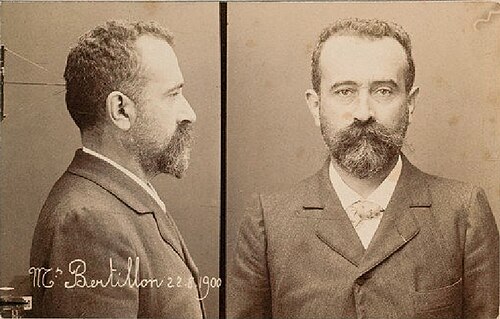
Meet Alphonse Bertillon, a French police officer and biometrics researcher who pioneered a system called anthropometry, a series of body measurements designed to create a specific physical record of everyone who fell under arrest, the first law enforcement reference work to identify features, marks, scars, etc., anything unique to the individual being detained. The first reference photos of criminals began sporadically in the 1840’s, but Bertillon had standardized the practice into a strict set of procedures by 1888. It was only one of many innovations he brought to crime detection, including casting procedures for taking molds of footprints and early comparative tables on ballistics.
Bertillon developed the format that, generally, is still used to the present day: one full-on view, accompanied by a right profile, with both shots housed in the same catalog entry: a neutral or blank background to minimize confusion about head and hair contours: a standard camera and lens used for all images. The photographs were initially added to the other elements of the anthropometric system, which consisted of several baseline measurements: head length, head breadth, length of middle finger, length of the left foot, etc. Together, they took what would, in any other context, be a simple candid photograph and make it an essential tool in crime detection, redefining at the same time what photography is “for”. Images are purposed and intended differently, depending on who creates them. We who receive them assign a variety of values to what we see. Can a photograph provide evidence based solely on how we judge a human face? Do we project a sense of menace or evil purely because of how and when we were photographed? Clearly, we are in an area where there are way more questions than answers.

