LIKE THE CORNERS OF MY MIND….
By MICHAEL PERKINS
HUMANS WORSHIP MEMORY MORE THAN ANYTHING IN THEIR BELIEF SYSTEM. Fact? Never heard of it. Religion? Not even close. The preservation of our sense of “how it really was” is a stronger urge than friendship, policy, custom, you name it….a quality that makes me marvel at the very special power photography holds in our lives.
hotographs, according to what we are taught to believe, are the preservers of memory. The camera measures light and records it from whatever is in front of it. Or so we continue to assume. In fact, the static preservation of an instant in a picture can be an unwelcome challenge, an intruder into our minds, where we “don’t remember it that way” and disbelieve anything that says different. The very precision of a photo isn’t just the way we hang on to memory. It can be an inconvenient challenge to something we carry in our own internal camera. We will swear on a stack of bibles that it actually happened this way, while the camera says it was actually more like this. And that’s a conflict.
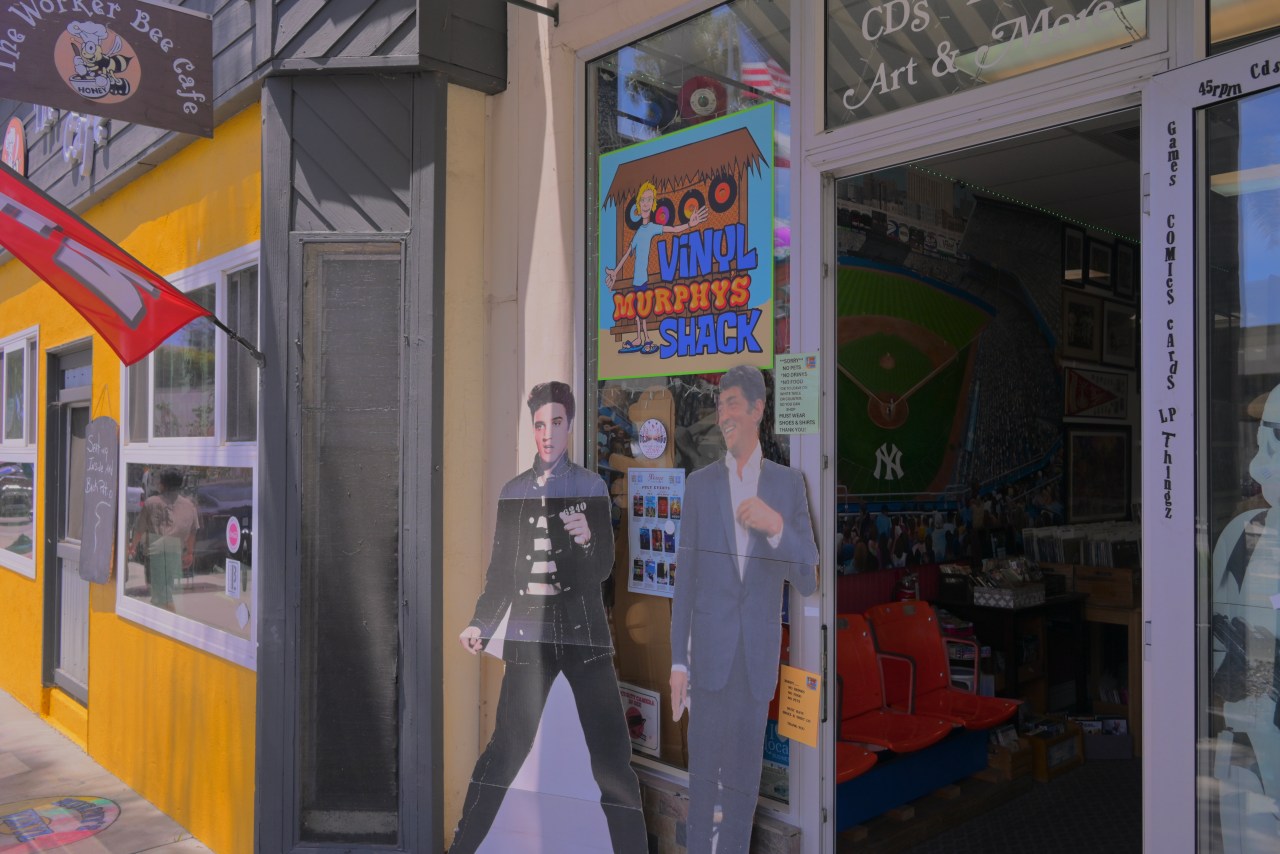
It wasn’t soon after photography was born that we turned into societies of memory hoarders, and, year later, collectors of any and every totem of our popular culture. Antiques. Replicas. Reproductions. COLLECTibles. Every town in the world has a shoppe just like the one seen here, where we celebrate, in Paul McCartney’s words, “my ever-present past”. The discarded becomes the treasured. The long-ago becomes, to our minds, a lost Eden, a bygone golden age. Even as I myself have spent my elder years doing more and more with less and less, even as I’ve winnowed out many a once-prized life souvenir, I can’t always resist snapping a shot or two at places like this, joints that celebrate our most beloved belief that we have somehow lost something precious. But how can I make a picture of something that so many of us can’t agree on the terms of? What can a mere machine know, as compared to our own hearts and minds?
For some, a cardboard Dean Martin is enough to honor a memory. In the opinion of others, I’ve wasted my time trying to make a picture out of something as personal as remembrance. I’m never sure who is winning this debate. I only know it’s out there.
60 SECONDS TO HAPPINESS
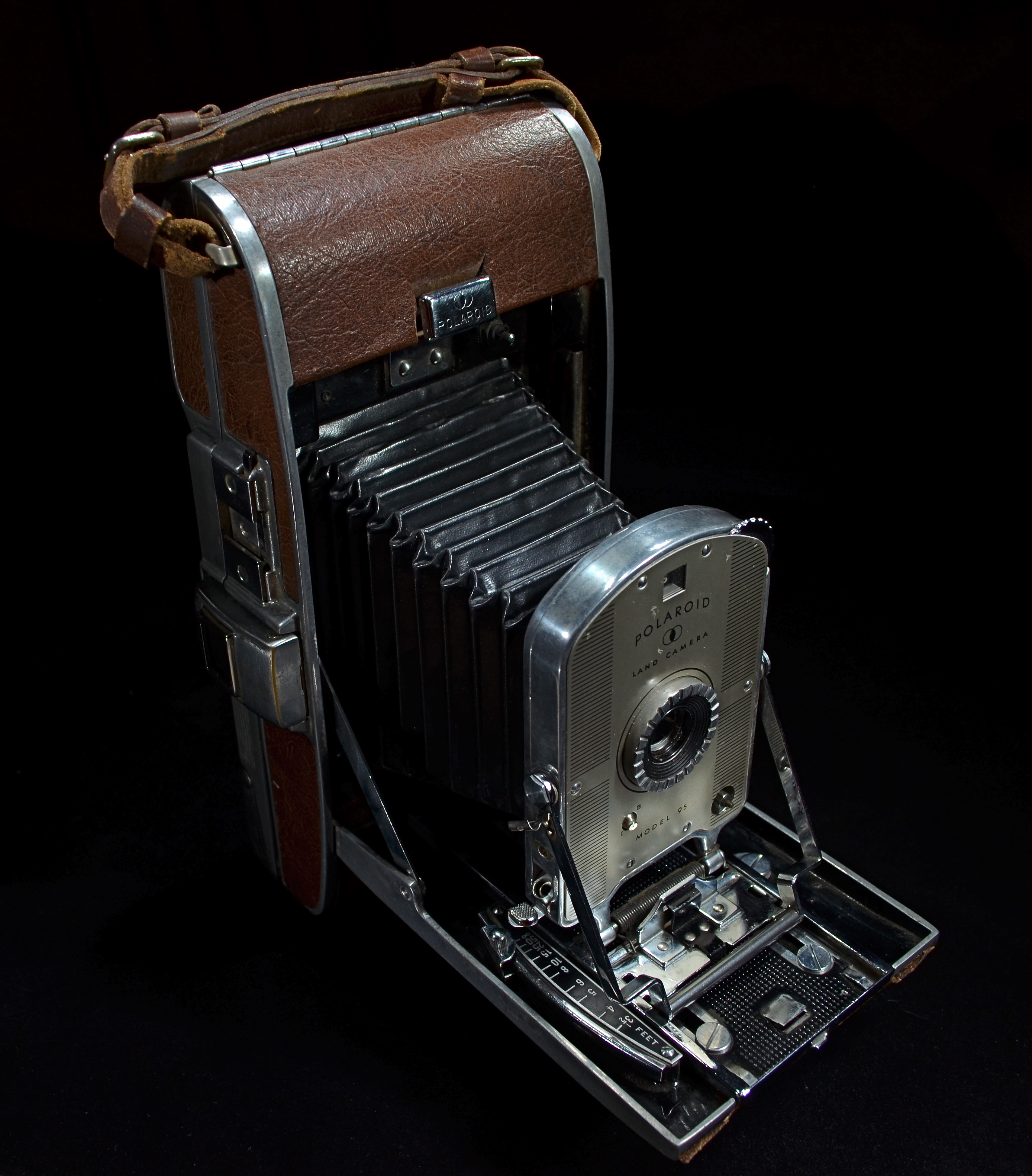
The first of its kind: A model 95 Polaroid Land Camera, circa 1948. Light-painted in darkness for a 15 second exposure at f/5.6, ISO 100, 18mm.
By MICHAEL PERKINS
I REMEMBER, YEARS AGO, HEARING A COMMERCIAL FROM AN OLD RADIO SERIAL IN WHICH THE SPONSOR, Ovaltine, rhapsodized about the show’s latest mail-in “premium”, a genuine Captain Midnight Shake-Up Mug, which, according to the ad copy, was made of “exciting, new PLASTIC!!” It struck me, as a child of the ’50’s, that there actually had been a time when plastic was both exciting and new. The “latest thing” in an age which was bursting with latest things, an unparalleled era of innovation and miracle. Silly Putty. Rocket Ships. Television.
And your photographs….delivered in just one minute.
The introduction of the Polaroid Land Camera, Model 95, in 1948 was one of those “exciting, new plastic” moments. Developed by inventor Edward Land, the device was, amazingly, both camera and portable darkroom. Something mystical began to happen just after you snapped the shutter, an invisible, gremlins-in-the-machine process that accomplished the development of the image right in the camera. Open the back of the thing 60 seconds later, peel away the positive from the negative (a layer of developing gel lay in-between the them) and, sonofagun,you had a picture. Black and White only. Fragile, too, because you immediately had to dab it with a stick of smelly goo designed to keep the picture from browning and fading, a procedure which created the worldwide habit of fanning the picture back and forth to speed up the drying process (sing it with me: shake it like a Polaroid). And then you got ready for company. Lots of it.
Original Polaroid User’s Flyer. Easy, right?
When you brought a Model 95 (unofficially dubbed the “Speedliner”) to a party, you didn’t just walk in the door. You arrived, surrounded by an aura of fascination and wonder. You found yourself at the center of a curious throng who oohed and ahhed, asked endlessly how the damn thing worked, and remarked that boy, you must be rich. Your arrival was also obvious due to the sheer bulk of the thing. Weighing in at over a pound and measuring 10 x 5 x 8″, it featured a bellows system of focusing. Electronic shutters and compact plastic bodies would come later. The 95 was made of steel and leatherette, and was half the size of a Speed Graphic, the universal “press” cameras seen at news events. Convenient it wasn’t.
But if anything about those optimistic post-war boom years defined “community”, it was the Polaroid, with its ability to stun entire rooms of people to silent awe. The pictures that came out were, somehow, more “our” pictures. We were around for their “birth” like a roomful of attentive midwives. Today, over 75 years after its creation, the Polaroid corporation has been humbled by time, and yet still retains a powerful grip on the human heart. Unlike Kodak, which is now a hollowed out gourd of its former self, Polaroid in 2014 now makes a new line of instant cameras, pumping out pics for the hipsters who shop for irony on the shelves of Urban Outfitters. Eight photos’ worth of film will run you about $29.95 and someone besides Polaroid makes it, but it’s still a gas to gather around when the baby comes out.
So, a toast to all things “new” and “exciting”. But I’ll have to use a regular glass.
For some reason, I can’t seem to locate my Captain Midnight Shake-Up Mug.
 thenormaleye