GOING POSTAL (CARD)
By MICHAEL PERKINS
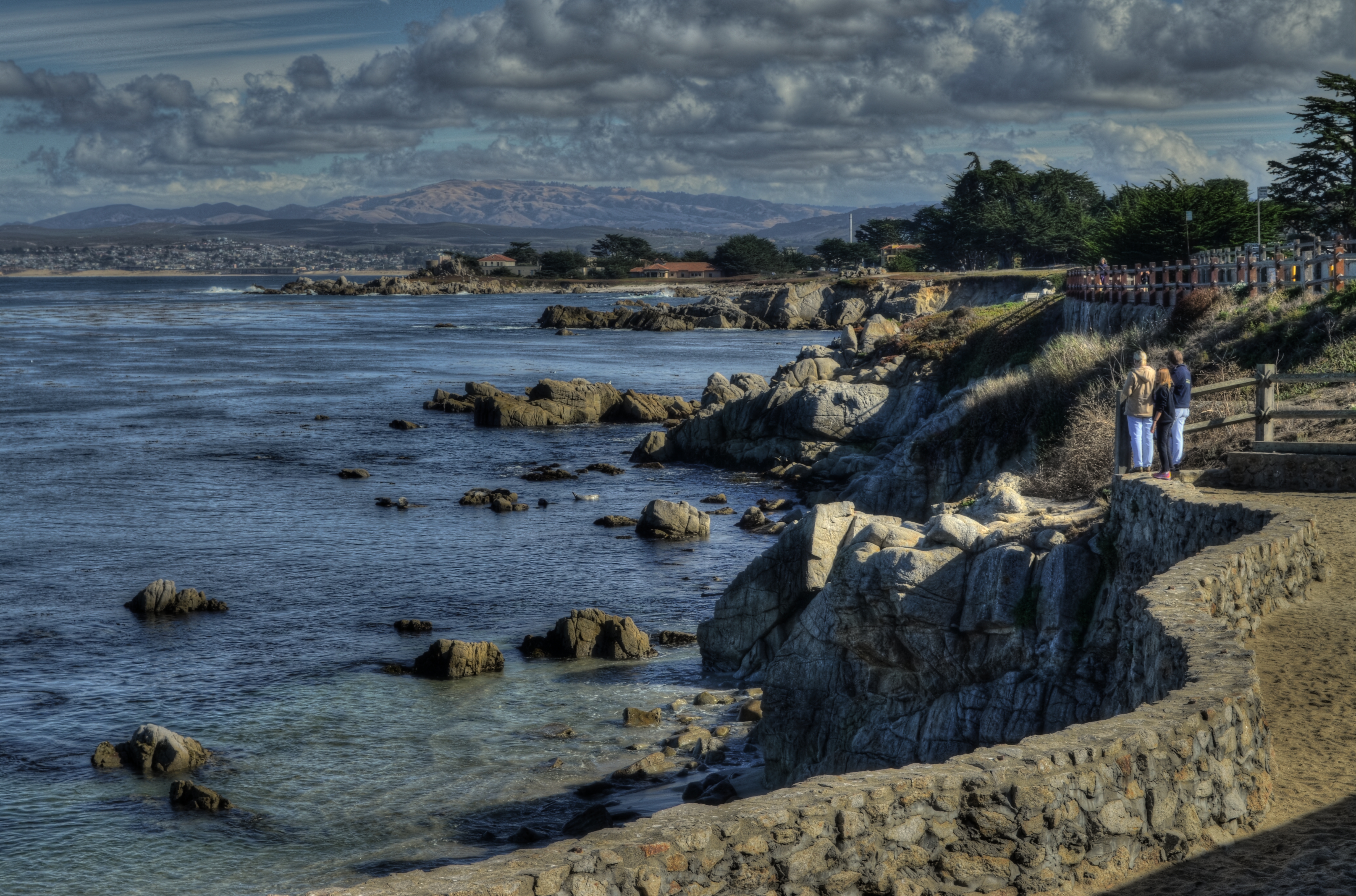
Looking south down Oceanview Boulevard to Monterey from Pacific Grove’s “Lover’s Point” Park. A three-exposure HDR with an average shutter speed of 1/250, f/11, ISO 100, 45mm.
“Ooh, nice. Looks just like a post card!”—98% of everyone who looks at your pictures
MUCH AS I WOULD LOVE TO BE SEEN AS A “SERIOUS” PHOTOGRAPHER (whatever that means), I am, basically, always seeking beauty and some way to freeze it in time.
Come to think of it, that seems pretty “serious” too, although there are schools of thought that seem to profess that making pretty pictures is somehow as insubstantial as crocheting tea cozies or writing haikus about clouds.
Whatever.
My visual sense actually developed along two fairly exclusive tracks. There was the reportorial photography of Life, which reliably came to our house each week chock full of amazing portraiture, riveting war coverage and contentious social issues. That’s the “serious” track. And then there was my early and abiding love for the travel destinations in the illuminated Kodachrome of my View-Master reels, stunning forays into color crafted mostly by unknown shooters working for scale, many of whom sold the company’s “scenic” packets to photo dealers for their real paychecks. These eye-popping tours of France, The Grand Canyon, New York City, and the Holy Land held me spellbound in a way none of VM’s kiddie titles could. Their beauty was their justification. They deserved to be, just because they were a celebration of symmetry, shape, scale, mystery, history.
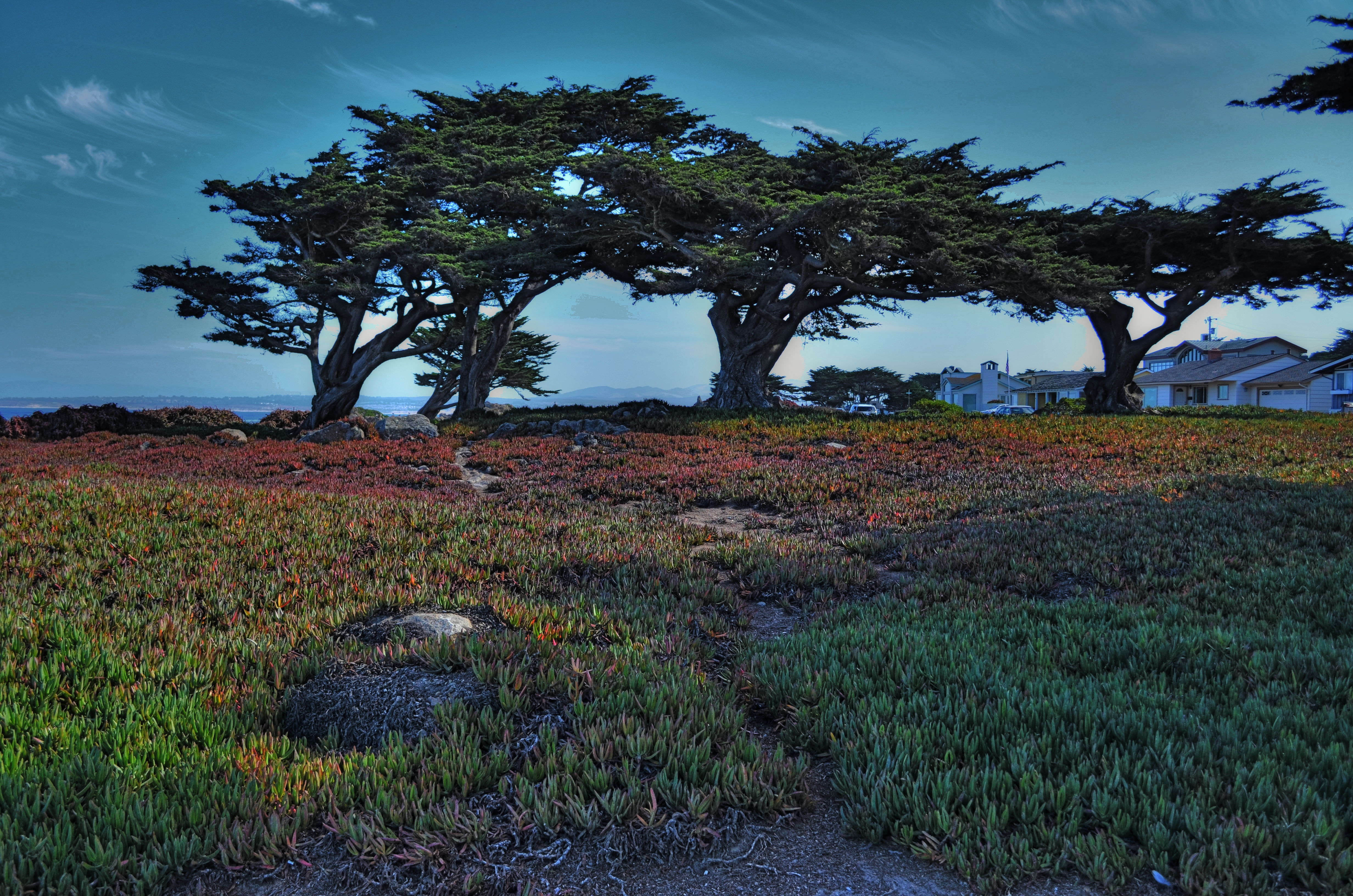
Canopy and Carpet: Eerily majestic cypresses and manzanita ground cover, just inland of the coastline at Pacific Grove, California. Two-exposure HDR shot at f/11, ISO 100, 45mm.
Since my childhood I have seemed to toggle between taking pictures that “matter” (another meaningless distinction) and images that merely delight me because I was able to grab a sliver of something larger than myself, a souvenir that I myself helped create. And, much as I hate the generic and dismissive “looks like a post card” remark I often get on some kinds of photos, it is the iconic view of the iconic object that I consciously go for, attempting to put my own stamp on something even as I realize that creating the image is way above my pay grade or skill set.
Still.
There are times to be a reporter, and there are times to gawk and gape in awe. Anytime I have any chance to be anywhere near the Monterey Peninsula, I vault onto the plane like a ’49-er who heard they just found gold at Sutter’s Mill. The stunning mix of coastal terrain, local botany and color that floods the eye at every turn in Monterey, Pacific Grove and Carmel blows me right out of “documentary” mode and makes my romantic heart beat faster.
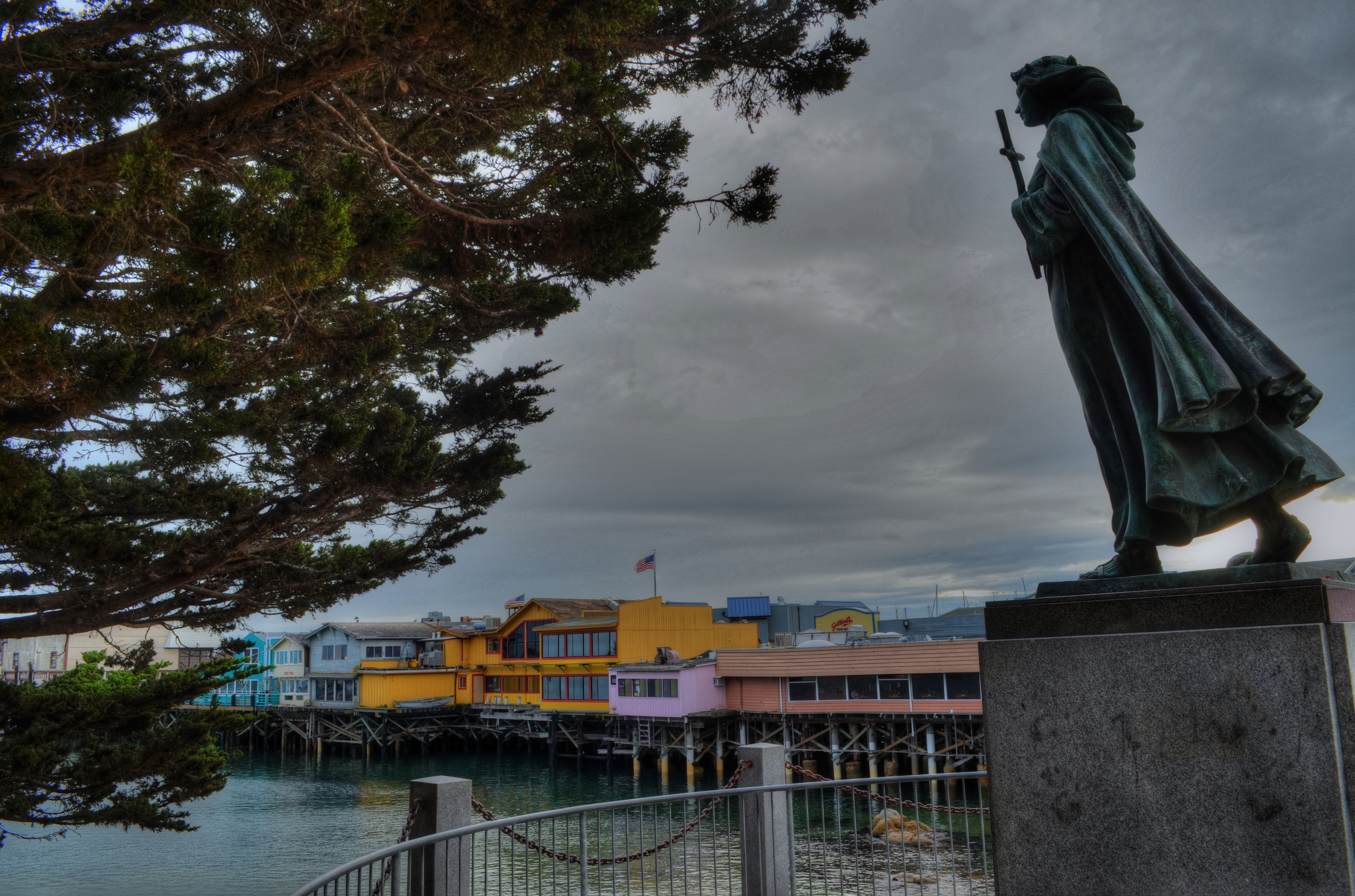
Patron Santa Rosaria watches over the”Fisherman’s Wharf” district of Monterey Bay. A three-shot HDR at f/9, ISO 100, 18mm.
I am going postal, as in postal card. I want the ooh-ahh moment. Later on, I’ll get back to shooting urban decay and despair. Right now, we’re making the ultimate View-Master reel.
“Seven More Wonders Of The World!” So ran the wording on the paper envelopes that held those little 3-d wheels.
Seven more wonders.
That’s all I need.
“Serious”-ly.
THE HOUSE THAT ED BUILT
By MICHAEL PERKINS
AMIDST THE CARNIVAL ATMOSPHERE OF MONTEREY, CALIFORNIA’S CANNERY ROW, IT IS A DRAB, ORDINARY THING, and, if you are not paying close attention, Ed Rickett’s original biological lab, tucked next to the towering Monterey Bay Aquarium, looks as if it is just waiting for the wrecking ball. In fact, it has escaped that fate several times over, much to the glory of this old industrial district, now scrubbed squeaky-clean to house Starbucks and other national chains within the substructures of what was once the beating heart of the California fishing industry. However, with a little closer look at the former headquarters of Rickett’s Pacific Biological Laboratories, you realize that it carries more history within its humble walls than most of the theme park dreck in the area that attempts to recall that era.
If Cannery Row is a salute to history, the House That Ed Built is history, and has been, luckily, left alone to tell its amazing story.
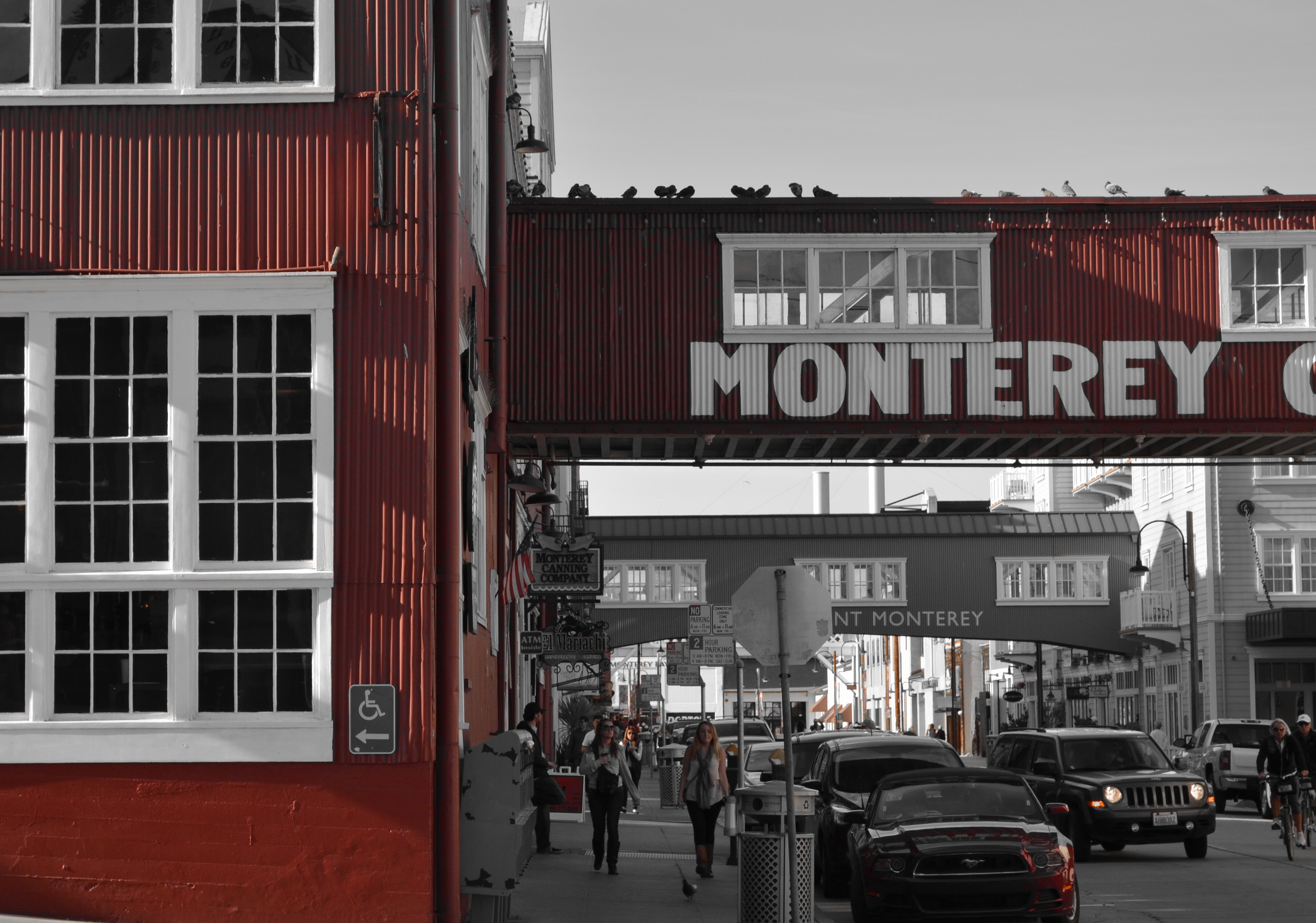
Authenticity is a hard item to come by in Monterey’s Cannery Row, which depicts a grand old factory district as a kind of Fish Disneyland.
Edward Flanders Robb Ricketts, who found himself living and working in Pacific Grove, California in the early 1920’s after bouncing around the country as an Army medical corpsman, a dropout zoology student at the University of Chicago, and a travel writer, founded Pacific Biology Laboratories with a friend in 1922. The original lab was in Pacific Grove, a next-door neighborhood to Monterey, and was later relocated to Ocean View Boulevard in the heart of the bustling fisheries and processing plants of Cannery Row. Ricketts took consignment orders from researchers and museums for various life forms from the coastal tides in the region, commissions which made him a modest living and helped finance his own experiments. By 1930, with his reputation fairly established, he met an up-and-coming author from the area named John Steinbeck. The two became lifelong friends.
The PBL lab, with holding tanks around the bank for storing specimens (still viewable today), was nearly destroyed in 1936, when a fire consumed the neighboring Del Mar cannery (now the site of the world-class Monterey Bay aquarium). Steinbeck, stepping in to purchase a half-interest in Ed’s lab, financed its rebuilding (and helped keep a roof over his friend’s head).Saved from the flames was Rickett’s career-defining work, Between Pacific Tides, the manuscript for which had been sent ahead to his publisher before the blaze.
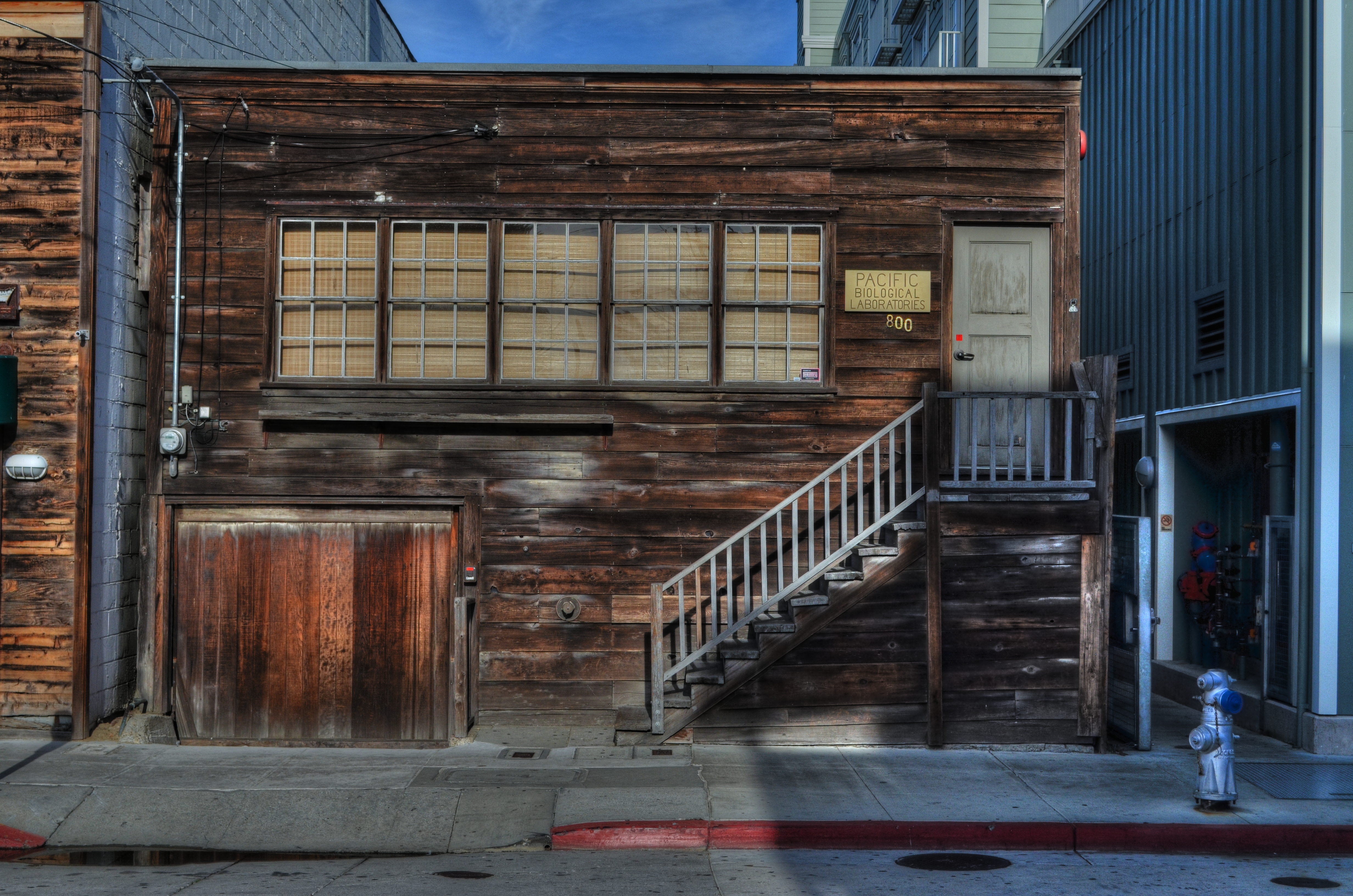
The Monterey Bay headquarters of Pacific Biological Laboratories, whose proprietor, Ed Ricketts, became the inspiration for the character “Doc” in his pal John Steinbeck’s novel, Cannery Row. 1600 sec., f/7.1, ISO 200, 35mm.
In 1940, following one of many messy breakups with the various women in his life, Ed decided to take a road trip to Mexico and pay for it by researching and writing a new book on marine life. Steinbeck, looking to escape some of the controversy that dogged him following the publication of The Grapes of Wrath, decided to partner with Ricketts on the project.The result, Log From The Sea of Cortez, one of Steinbeck’s only works of non-fiction, became a solid reference work in the field of marine biology.
Writing his novel Cannery Row in 1945, Steinbeck modeled his marine biologist character “Doc” on Ricketts, fictionalizing the PBL as “Western Biological Laboratory” and keeping the spirit of Ed’s place as a gathering (and drinking) point for writers and artists. Following Rickett’s death in 1948 (he was hit by a train carrying Del Monte canned fish through the area!), friends bought the place, keeping it as a kind of clubhouse until 1983, when they sold it to the city of Monterey. The budding Cannery Row Foundation, then just getting underway with a renovation of the area, saw to the restoration of the building, which now is listed on the National Register of Historic Places. Specimens Ed gathered from the tidal pools have, for decades, graced collections at Harvard, the American Museum of Natural History, Lund University in Sweden, and dozens of other places the world over. Now the place his work began is itself a specimen.
Cheesy retail and chain restaurants have blotted out a lot of the physical history of Cannery Row, leaving Pacific Biological Laboratories as one of the only authentic visual legacies of one of America’s most storied industrial centers. As such, it’s always worth an extra (and loving) look.
(Here’s a great link from the Museum of Monterey with a wonderful overview of Ed’s life: http://www.youtube.com/watch?v=obz6BdAtgIk )
WAITING FOR THE REVEAL
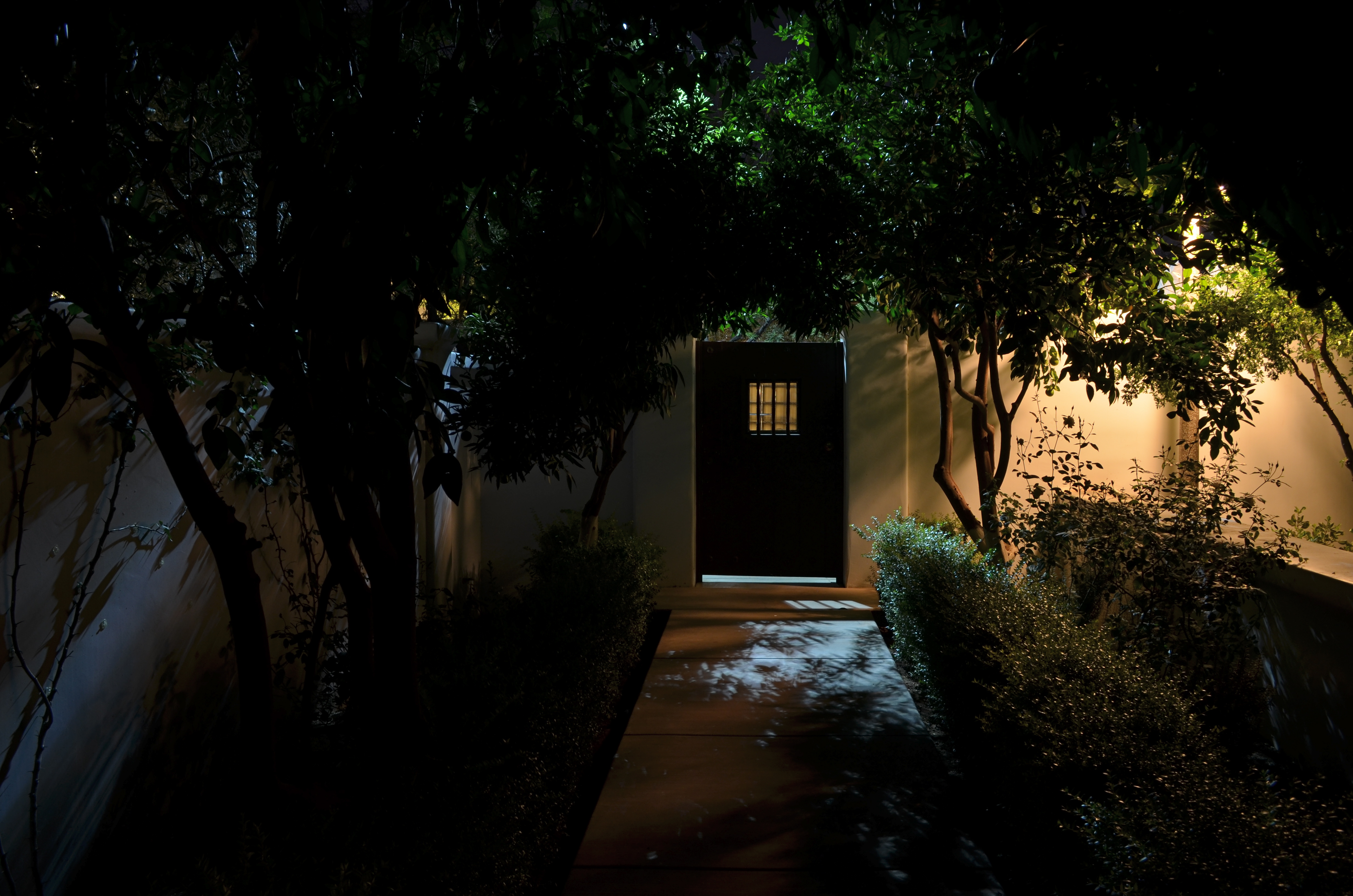
What lies beyond that door? Probably nothing to match the outside mood afforded to this forgotten delivery entrance by the onset of night. Hey, this is all about the magic, right? 15 second time-exposure, f/9, ISO 100, 20mm.
By MICHAEL PERKINS
THERE’S A REASON BATMAN DOESN’T SWING THROUGH THE SKY AT HIGH NOON. Or that Shakespeare didn’t have his witches crowded around a cauldron during the mid-morning coffee break. And, of course, there are no love ballads bearing the title By The Light Of The Silvery…Sun. Mood is everything in photography and many subjects just don’t convey mystery or romance when brightly lit. This is no truer anywhere else than in the American southwest.
In Arizona, New Mexico, and California, there are plenty of places where the sun blazes away like a Hollywood klieg light during most of the day. The light is harsh, white, glaring. By mid-morning across the summer months most of the richer colors are blasted right out of the sky, and the only way to capture beauty is to wait for the hours warmed by low light.
Or no light.
I’ve always been a big believer in the transformation of familiar materials once night falls, and, going back to my old baby box camera days, I have always marveled at the simple miracle of holding a shutter open long enough to wring a few extra drops of light—just enough–from the deepening dark. I call it waiting for the reveal, and it never fails to serve up surprises.
One night last week, I was waiting on the sunset to fully finish behind a destination restaurant in Paradise Valley, Arizona (that’s really the name of the town…kind of like naming your city “Wonderfulville”). The front entrances and patios were gorgeous, of course, but after about a half hour I found myself getting restless with the utter postcardiness of it all. I was looking for something off the grid, forbidden even.
I found this door around the side of the resort, hidden by an overgrown, narrow walkway and illuminated by a single bleak bulb. As a location, especially in the daytime, this is no one’s idea of a choice spot. Except at this precise moment. It actually works better because of how much you can’t see, and I can’t justify shooting it at all, except that the reveal was working for me. And, while I liked the more conventional Chamber of Commerce shots I had taken earlier, there is something iffy and offbeat about this frame that I keep coming back to.
Sometimes the underdog is the best dog in the fight.
HANDS OFF. SORT OF.
By MICHAEL PERKINS
THERE SHOULD BE CURATED SHOWS AT MUSEUMS ALL OVER THE WORLD JUST FOR SNAPSHOTS. It’s already a known fact that images taken in an impulsive instant are among the most emotionally immediate in history. What these billions of “shooting from the hip” pictures share is the uncompromised commitment of hitting that button, and letting what happens, happen. Of course, back in the day, many of us had no choice in the matter, especially with our earliest cameras. Sadly, sometimes the box was too dumb, too seized up in tech cramps to guess what we wanted. Today, however, we can’t blame the camera anymore if we fail to live in the moment. They are world-class enablers. If we didn’t get the shot, we need to be smarter.
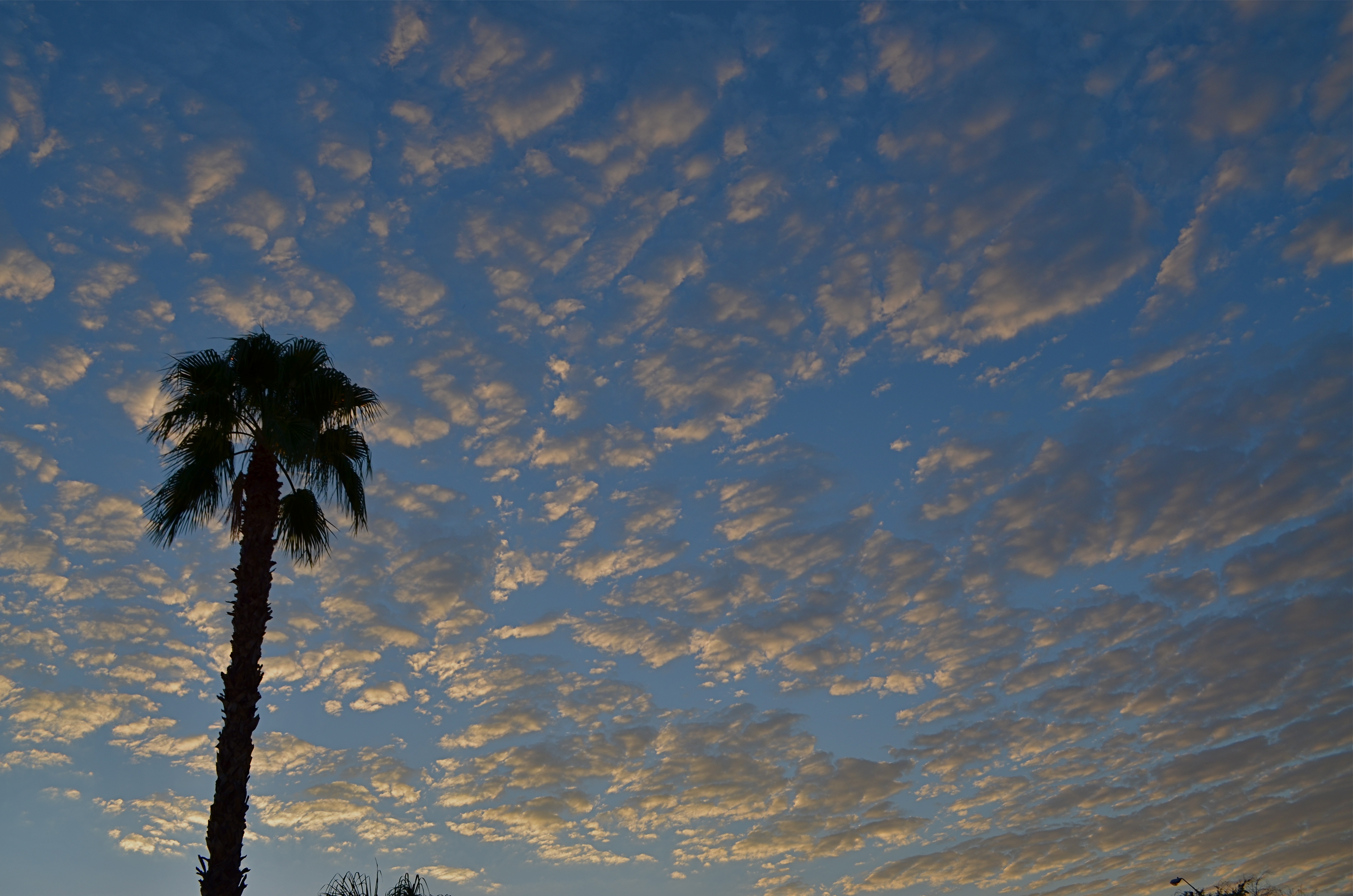
Sometimes you gotta shoot ’em quick and hope. Available light and less of it every second: 1/200, f/8, ISO 100, 20mm.
And, to be fair, we are smarter, even in those just-shoot-it-moments. The amazing complexity of today’s captures on automatic modes has saved us the trouble, more than at any time in history, of having to put on the twin hats of physicist and chemist. That should mean scads of instances when we can truly trust our instincts and hand the dirty work off to the camera with a reasonable hope of getting what we were after.
Now, in the modern world, comes the tricky part.
We may now know too much, compared to the cavemen we were in the earliest days of photography. And, once we begin to comprehend the totality of tweaking, calculation, and post-processing that are available to “rescue” more of our shots, it’s amazingly hard to avoid availing ourselves of all of it. We can remove the tiniest mote of dust, conveniently wipe out the crummy telephone wires, erase the ex-girl friend at the wedding. Trickier still, if we shoot on manual mode, we can practically think the process to death, essentially bleeding the adventure and spontaneity out of at least some images that we should just shoot.
There will always be shots that are so complete in themselves that continuing to fiddle with them before shooting will just have a diminishing return, little gifts of the moment that are so nearly perfect already that you could render them lifeless by trying to “perfect” them. Important: this is not an argument for super-gluing your mode dial to the auto position, since that can also create a string of acceptable exposures that fall short of being compelling pictures.
The balance, the aggravation, and eventually, the joy, lies somewhere in the middle.
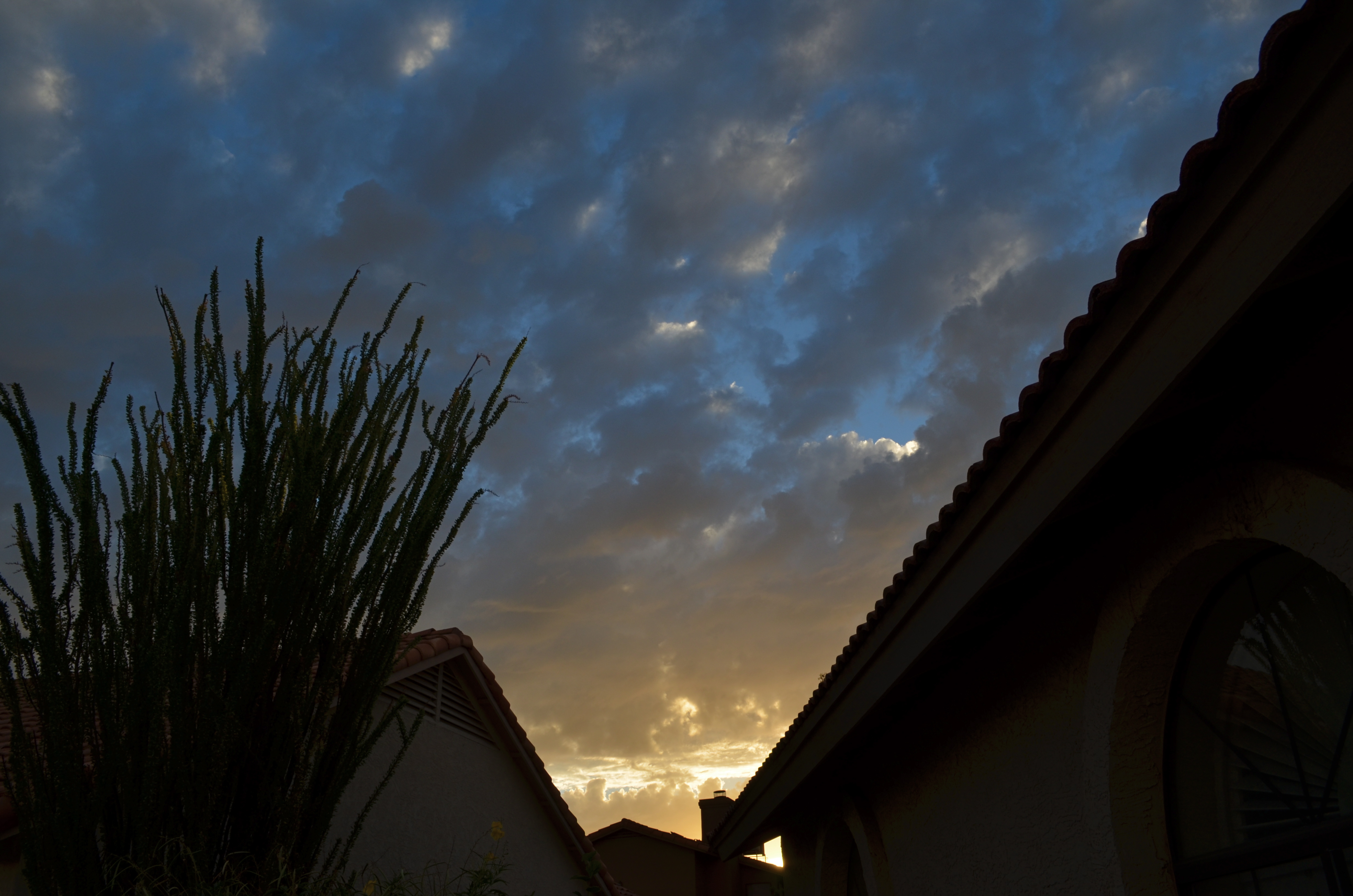
Once the sun starts to set in Arizona, you’re racing the light to the horizon, so he who hesitates is lost. Shot on the fly at 1/160 sec., f/11, ISO 100, 18mm.
This is the kind of sunset that only becomes possible near the end of the rainy season (a relative term!) in the Sonoran desert. You get more days with at least some clouds overhead, breaking the mega-blue monotony of the southwestern sky. And you get wonderful gradations of color as the last light of day vanishes over the horizon. In this image, that light was changing, and leaving, rapidly. Not a lot of time to weigh options, but a perfect place to flail away and maybe get something. This was not shot on auto mode, but I made a very quick, simple calculation in manual, and kept the prep as brief as possible. Later on, I was tempted again to go on tinkering, considering a lot of little “fixes” to “improve” my result. To my eventual satisfaction, I sat on my hands, and so what you see is what I got…no frills, no fuss, no interfering with my self.
It would probably be a great exercise to compile your own personal museum exhibit of the best pictures that you successfully left alone, the captures that most validate your instincts, your impulse, your artistic courage. And, certainly I would love to see them linked back to this blog, as conversation between all of us is what I value most about the project.
Go for it.
Related articles
- Getting Started: How to Hold Your Camera (nikonusa.com)
PERISHABLE
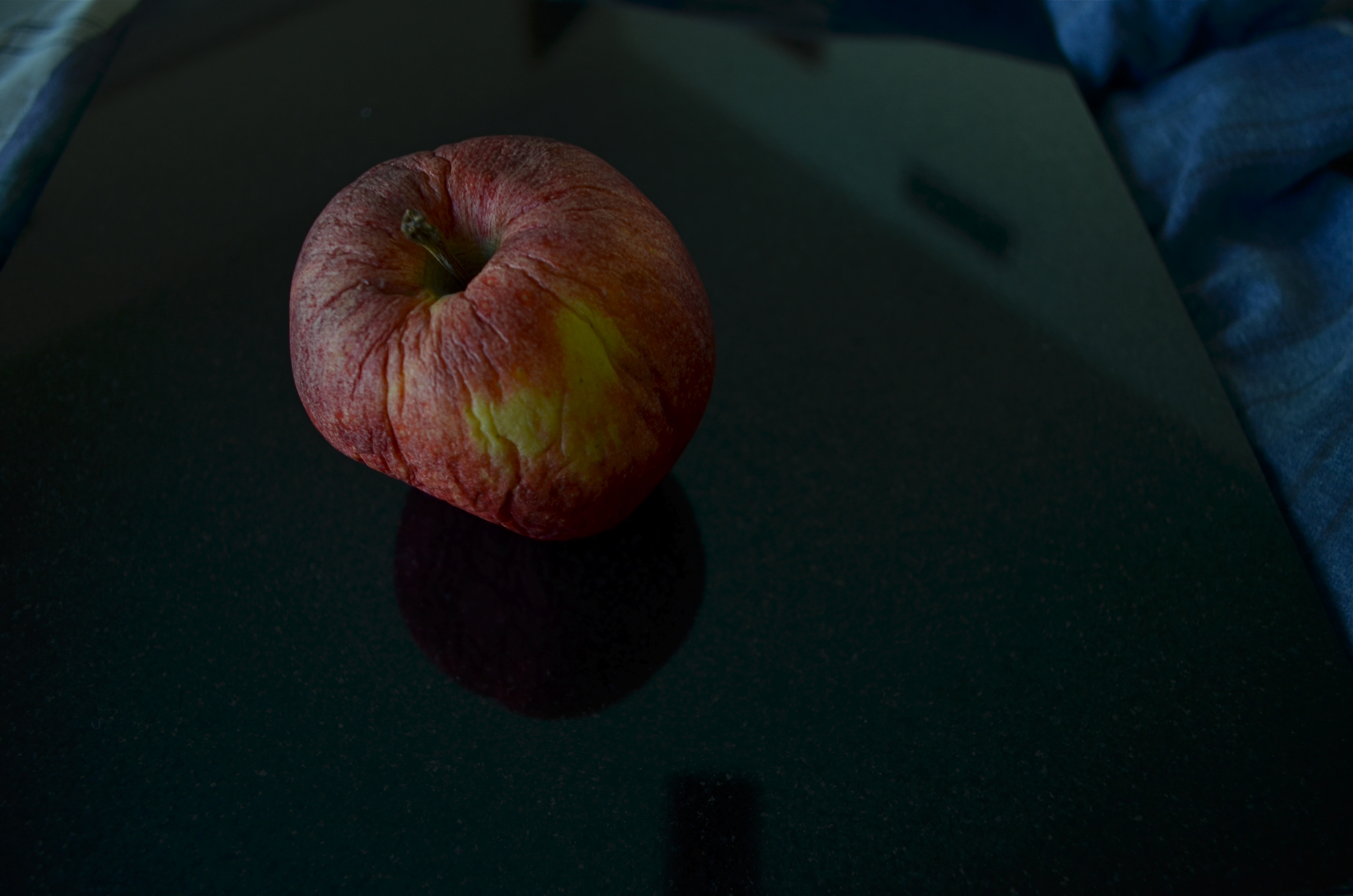
Once upon a time there was a very old apple. Shot real wide and in tight to suck up as much window light as possible and bend the shape a little. 1/50 sec., f/3.5, ISO 160, 18mm.
By MICHAEL PERKINS
I‘M ALMOST TO THE POINT WHERE I DON’T WANT TO THROW ANYTHING AWAY. I’ve written here before about pausing just a beat before chucking out what, on first glance, appears to simply be junk, hoping that a second look will tell me if this rejected thing has any potential as a still life subject. I realize that this admission on my part may conjure images of a pathetic old hoarder whose apartment is packed with swaying columns of yellowed newspapers from 1976 and pizza boxes that have become filing cabinets for old soda bottles, mismatched hardware, and souvenir tickets from Elvis’ last concert.
It’s not that bad.
Yet.
For this I have my wife to thank, since the civilizing influence she brings to my life tends to bank the freakier fires of my aesthetic wanderings. Still, there are hours each day when she’s at work, heh heh, hours during which the mad scavenger rescues the odd object, deluding himself that it is the next big thing in artsy coolness.
That’s what led me to the apple. Actually, I was rooting around in the garage fridge for a beer. The “backup” fridge often acts as a kind of museum of the lost for things we meant to finish eating or bring into the house. The abandoned final four strands of ziti from the restaurant. The sad survivors from the lunch we packed for the office, then left behind since we were running late.
And, in this case, a very old apple.
Having seen gazillions of pieces of fruit frozen in time by photographers, I am sometimes more interested in preserving the moment when Nature has decided to call them home. It’s not like decay is attractive per se, but seeing the instant where time is actually changing the terms of the game for an object, as it always is for us, can be oddly fixating.
So I set this old soldier on a slab and shot away for about a dozen frames. Window light, plain as mud, really zero technique. The colors on the apple were still bright, but the wrinkles had become furrows now, sucking up light and creating strange shadows. Something was leaving, collapsing, vanishing before my eyes, and I wanted to stop it, if only for a second.
And yes, in case you are asking, I did finally throw the thing away.
And got myself a beer.
WHAT COULD BE
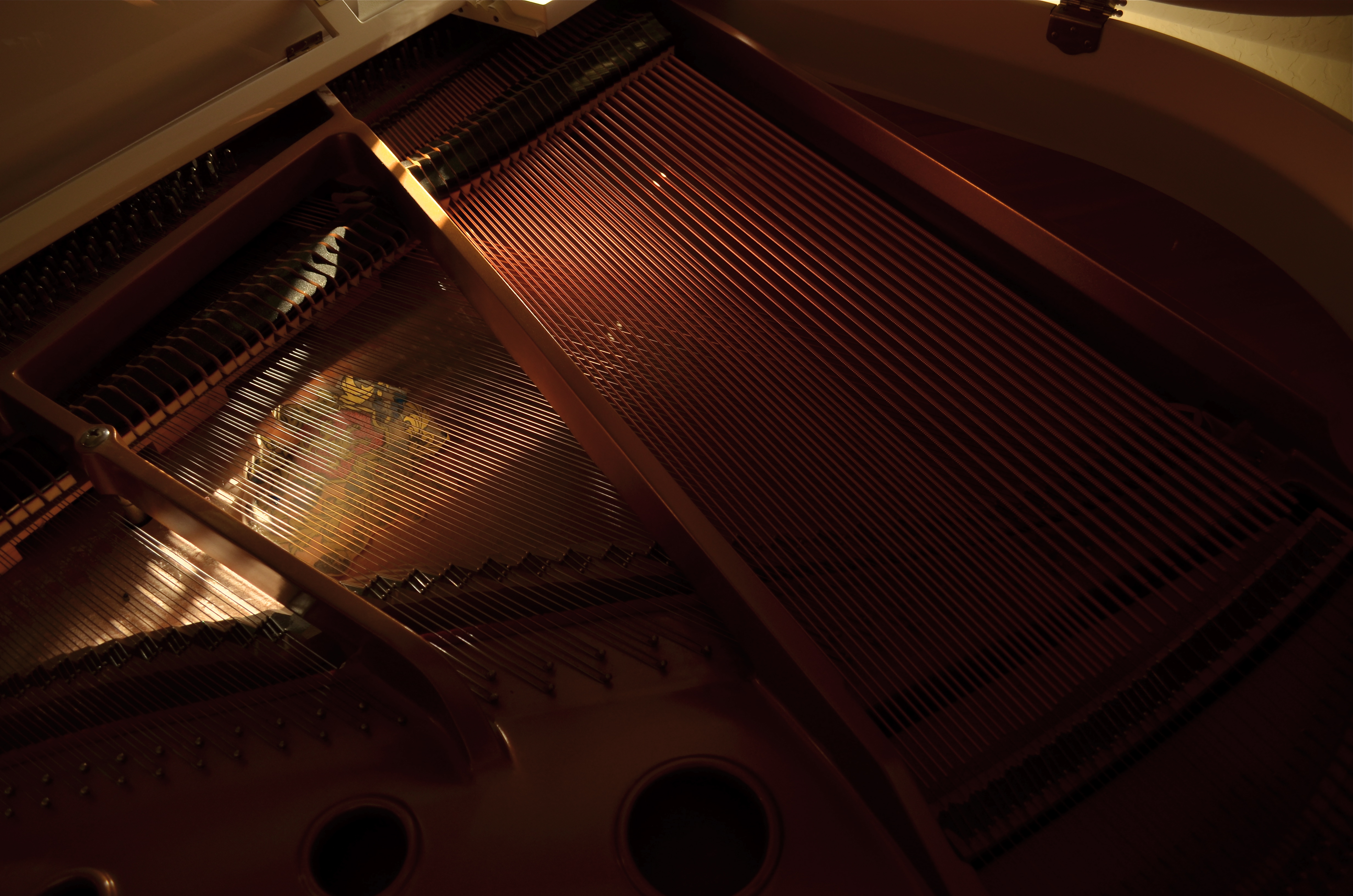
My umpteenth piano picture over a lifetime, but one which at least shows me something I don’t usually see. Available light, straight out of the camera. 1/50 sec., 5/5.6, ISO 100, 18mm.
By MICHAEL PERKINS
THERE ARE ALWAYS CONCEPTS THAT YOU FORCE YOURSELF TO RE-VISIT, almost to the point of obsession. We all have subjects that, as photographers, we just can’t stop turning over in our minds. This reluctance to “just move on” may occur with a place, a person’s face, an arrangement of shapes, a select element of light, but, whatever the source, it gnaws at us. We dream of the next chance to go back and tackle it again. We truly believe that the “right” shot is in there somewhere, just as a statue of an elephant is somewhere inside a slab of marble. As the old joke goes, just chip away anything that doesn’t look like an elephant and there you are (That’s either a really stupid joke or amazing profundity. Depending on which day you ask me, I can take either side. Anyway….).
I have at least one restaurant, a small city park, about a dozen still life projects, and one or two human faces that haunt me in this way. In every case, I get stuck on the idea that, with a moment of inspiration, I’m one click away from the ideal I see in my mind. Only, like a desert mirage, the ideal keeps wiggling and warping into something else. Maybe I’ve already made the best version of that picture already. Maybe there really is nothing more to be done.
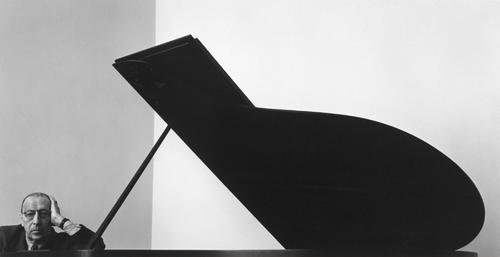
Arnold Newman’s amazing abstract portrait of a piano, “accompanied” by composer Igor Stravinsky. This is a copyrighted image.
As a lifelong musical tinkerer, I’ve always been interested in pianos both as machines that are crafted to do incredibly complicated things, and as a kind of sculpture, a shaper of space and light. Some photographers have used them as incredibly dynamic design elements to remarkably dramatic effect. Arnold Newman’s classic portrait of composer Igor Stravinsky uses only the lid of a concert grand to flank the maestro, but it’s all the piano he needs to tell the story and it’s a wondrous horizontal use of space. Others have created brilliant images using just portions of the keyboard. Do a search of your own and be amazed at the variety of results.
Me, I’m a “guts” kinda guy. Lifting the lid on my first piano to see what made it tick was one of the most thrilling moments of my childhood, and, now, years later, I see the mechanism inside my own baby grand as a way to reflect, capture and shape light. It’s like having a giant Spirograph or a metallic spider web. Lots of ways this could go. In the above image, morning light gave me a big break, as the golden cast of the good, early stuff blended with ambient tones in the harp strings and the inside of the cabinet. While the light falls off sharply at the margins, it makes much of the mechanism fairly glow, and, while I can’t stop tinkering with my lifelong “piano-as-design-object” quest (at least this side of the grave), I think this is a step in the right direction. Where we’re eventually going, who knows?
As usual, I’m just enjoying the ride.
Thoughts?
Related articles
BASIC CABLE
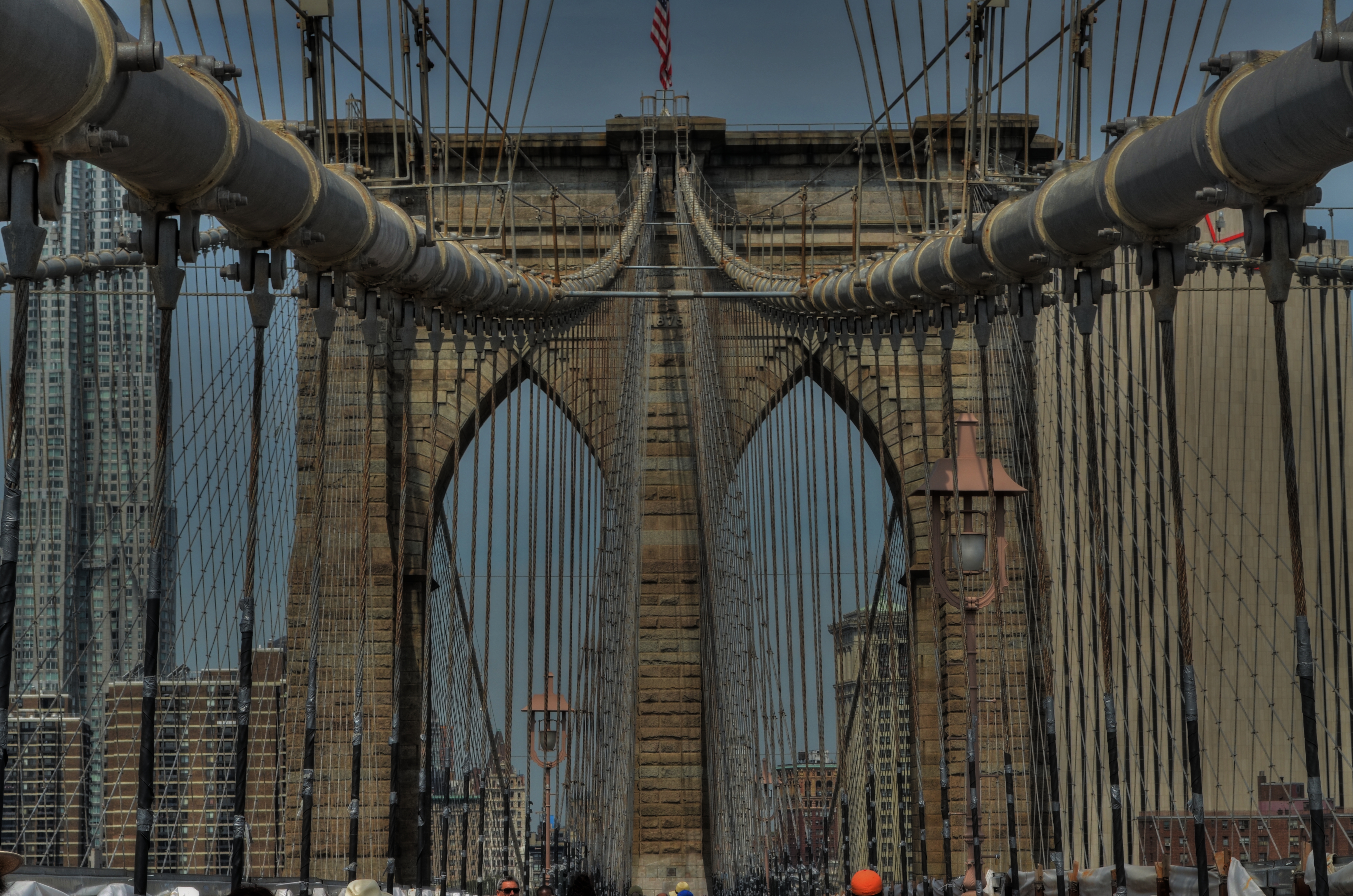
In many ways, the Brooklyn Bridge, although not a “land” edifice, is the first of New York’s skyscrapers, and an elegant reminder of a bygone era. Three-shot HDR blend, shutter speeds of 1/160, 1/200, and 1/250 sec., all F/11, ISO 100, 55mm.
By MICHAEL PERKINS
THERE ARE ANY NUMBER OF LANDMARKS IN THE GREATER NEW YORK AREA which reward repeated viewings. Their mythic impact is such that it is never dulled or diminished. On the contrary, these special places (in a city which boasts so many) actually reveal distinctly different things to different visitors, and, doing so, cannot be exhausted by the millions of interpretations of them that flood the photographic world.
We make pictures of these objects, pictures of the pictures, a tribute picture to someone else’s picture, an impression of someone’s painting. We shoot them at night, in close-up, in fisheye, in smeary Warholian explosions of color, in lonely swaths of shadow.
For me, the Brooklyn Bridge is about two things: texture and materials.
After more than a century over the East River, John and Washington Roebling’s pioneering span, the first steel cable suspension bridge in the world, shows its wear and tear as a proud trophy of its constant service. The delicate and yet sinewy cables, amazingly strong interwoven strands of what Roebling manufactured under the name “steel rope”, are the most amazing design elements in the bridge, presenting an infinite number of kaleidoscopic web patterns depending on when and where you look.
As simply stunning as its two towers are, it is its grid of steel that mutates, shimmers, and hypnotizes the visitor as he makes his way past the crushing mobs of walkers, runners, skaters and cyclists that clog the span’s upper promenade from dawn to dusk. To show the bridge and only the bridge is a challenging trick. To get the dance of angles and rays that the cables have to offer in a way that speaks to you is both frustrating and fun.
Browse through several hundred amateur views of the bridge in one sitting sometime: marvel at how many ways it stamps itself onto the human imagination. Here, I tried to show the steady arc of the master cables as they dip down from the eastern tower, lope into a dramatic dip, then mount to the sky again to pass through the anchors on the western tower. HDR seemed like the way to go on exposure, with three separate shots at f/11, blended to maximize the detail of this most decorated of urban giants.
Next time, some other picture will call out to me, and to you. The bridge will display all the ways it wants to be seen, like a magician fanning out a trick deck. Pick a card, it invites, any card.
Doesn’t matter which one you choose.
They’re all aces.
Thoughts?
Related articles
- Video: Building the Brooklyn Bridge (history.com)
- Brooklyn Bridge Manhattan (markd.typepad.com)
BEAUTIFUL LOSERS
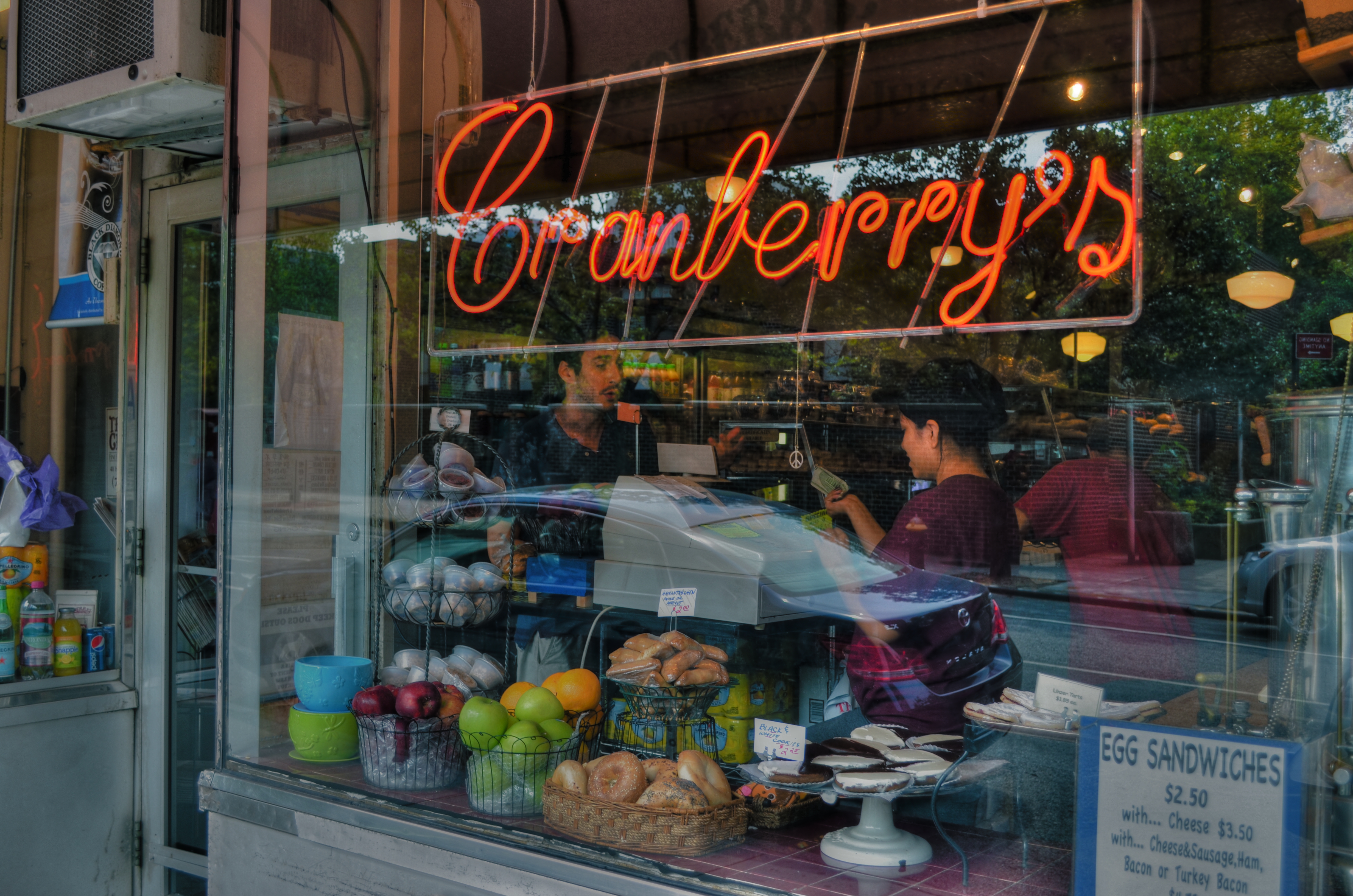
Shooting on the street is bound to give you mixed results. I have been messing with this shot of a Brooklyn coffee shop for days, and I still can’t decide if I like it. 1/80 sec., f/5, ISO 100, 24mm.
By MICHAEL PERKINS
THERE ARE A LOT OF INSTANTANEOUS “KEEP” OR “LOSE” CALLS that are made each day when first we review a new batch of photos. Which to cherish and share, which to delete and try to forget? Thumbs up, thumbs down, Ebert or Roper. Trash or treasure. Simple, right?
Only, the more care we take with our shooting, the fewer the certainties, those shots that are immediately clear as either hits or misses. As our experience grows, many, many more pictures fall into the “further consideration” pile. Processing and tweaking might move some of them into the “keep” zone, but mostly, they haunt us, as we view, re-view and re-think them. Even some of the “losers” have a sort of beauty, perhaps for what they might have been rather than what they turned out to be. It’s like having a kid that you know will always be “C” average, but who will never stop reaching for the “A”, God love their heart.
I have thousands of such pictures now,pictures that I study, weep over, slap my forehead about, ask “what was I thinking?” about. I never have been one for doing a reflexive jab on the “delete” button as I shoot, as I believe that the near misses, even more than the outright disasters, teach us more than even the few lucky aces. So I wait at least to see what the shot really looks like beyond the soft deception of the camera monitor. I buy the image at least that much time, to really, really make sure I dropped a creative stitch.
Many times my initial revulsion was correct, and the shot is beyond redemption.
Ah, but those other times, those nagging, guilt-laden re-thinks, during which I get to twist in the wind a little longer. Pretty? Ugly? Genius? Jerk? Just like waiting for an old Polaroid to gradually fade in, so too, the ultimate success or failure of some pictures takes a while to emerge. And even then, well, let’s come back and look at this one later…….
The above frame, taken while I was walking toward the pedestrian ramp to the Brooklyn Bridge, is just such a shot. My wife stepped into a coffee shop just fast enough to grab us some bottled water, while I waited on the sidewalk trying to make my mind up whether I had anything to shoot. As you can see, what I got could be legitimately called a fiasco. Nice color on the store’s neon sign, and a little “slice of life” with the customer checking out at the register, but then it all starts to mush into a hot mess, with the building and car across the street eating up so much of the front window that your eye is dragged all over the place trying to answer the musical question, “what are we doing here?” Storefront shots are a real crap shoot. That is, sometimes you have something to shoot, and sometimes you just have crap.
Even at this point, with more than a few people giving the shot a thumbs-up online, I can’t be sure if I just captured something honest and genuine, or if I’ve been reading too many pointy-headed essays on “art” and have talked myself into accepting a goose egg as something noble.
But as I said at the top of this piece, the choices get harder the more kinds of stuff you try. If you shoot your entire life on automode, you don’t have as many shots that almost break your heart. I wonder what my personal record is for how long after the fact I’ve allowed myself to grieve over the shots that got away. It’s tempting to hit that delete button like a trigger-happy monkey and just move on.
But, finally, the “almosts” show you something, even if they just stand as examples of how to blow it.
And that is sometimes enough to make the losers a little bit beautiful.
Thoughts?
 thenormaleye