THE LOVED ONE
By MICHAEL PERKINS
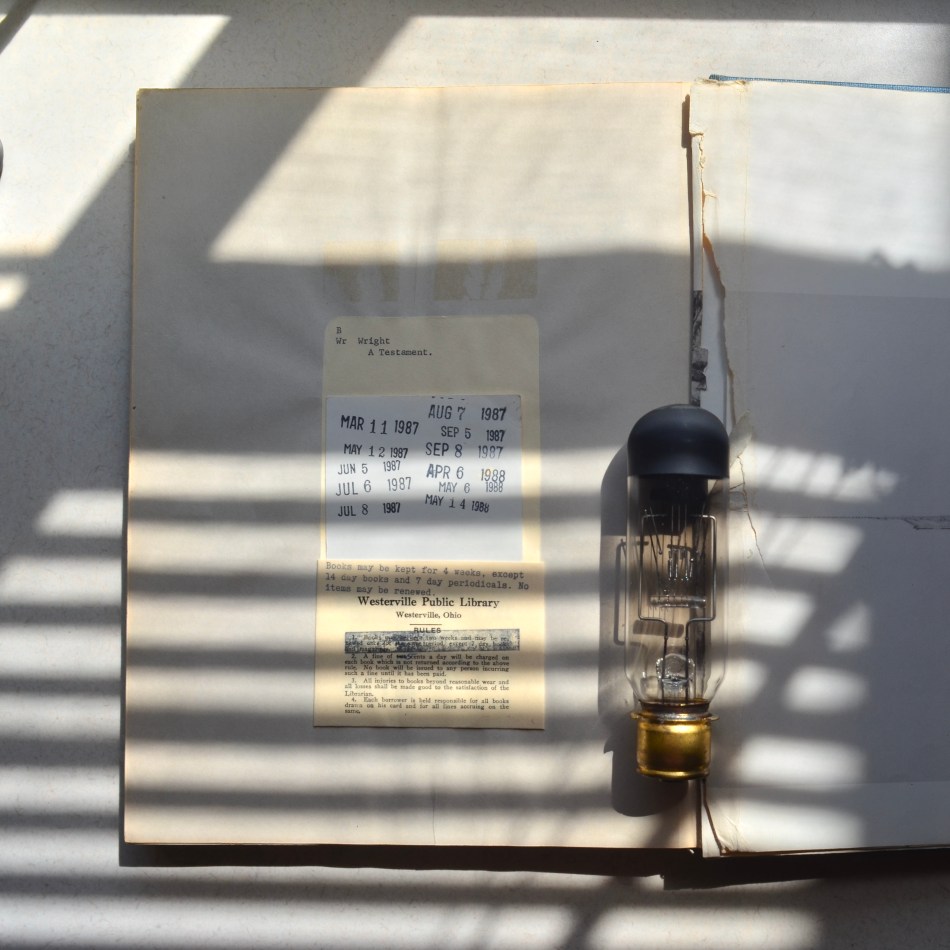
I STOLE THIS BOOK.
That is…..I think I might have.
Actually, the truth is a good deal more nuanced than that. Rather than deliberately planning to loot my local library for it, I just…sorta accidentally…failed to return it. Ever. Call it passive-aggressive larceny.
Or just sloth (likeliest option).
To be truthful, the book is merely part of a wider pathology, a lifetime habit of returning, well, anything back to its rightful owner well past its due date. Back in the VHS era, the local Blockbuster probably should have mounted a “wanted” poster of my kisser near the cash register…..but, as it turned out, I probably paid for the manager’s kid’s first year of college with overdue fees that rivaled the operating budget of a small nation-state. The fact: I’m a bad borrower, and it doesn’t really matter what the borrowed thing is. Late library books were more a symptom than a cause, and so I most likely made no particularly mindful attempt to appropriate Frank Lloyd Wright’s A Testament for myself.
However, in re-discovering this relic during a recent house-cleaning and general junk inventory, I can certainly see how I might have dreamed of pinching it, given what its ideas…about artistic integrity, vision, courage and reason… have meant to me for over a third of my life. And, like many old objects I’ve stumbled over anew in recent years, it seemed reasonable to want to photograph it, to try to both see it for what it was and for what it merely is, now.
What it is, among other things, is an old library book, and so it made sense to show its most library-like feature….the now-bygone checkout pocket and circulation ticket mounted inside the back cover. Such systems, in an age of barcodes, are now, themselves, history, as much as the book itself, and so that is the “face” I wanted to display. The wearing and tearing of the binding and pages is also evidence of a sort, of the heavy love-use the book had received over time, and so that also needed to be part of the visual story. Finally, I had located, within the same closet that held the book, an old replacement lamp for a film projector, which I never, as it turned out, actually used. This lightbulb which never had its “lightbulb moment”, could now act as a kind of symbol of the inspiration that had poured forth from the book’s pages for me with every single reading. Pretty on the nose, but still satisfying.
And click.
The objects we keep are never completely captured on camera. Even when we think we are objectively recording a thing, we are interpreting it, and that ambiguous approach somehow fits the muddled memory of the book’s journey from Theirs to Mine. I might have stolen it, after all. But maybe I just couldn’t make myself tell it goodbye. But now, in my picture, regardless of official ownership, I had made it indisputably mine at last, anyhow.
OH, SNAP
By MICHAEL PERKINS
MOST PHOTOGRAPHIC JARGON IS FAIRLY ACCURATE OVER TIME, with words like aperture, shutter, or f-stop remaining clear and useful terms across the years. Other terms like negative or analog are redefined as evolution demands. One holdover from the earliest days of image-making, however, has warped utterly out of relevance over the centuries, however, and for that reason, I’d like to see it retired. Like forever.
The word is snapshot.
When camera technology initially advanced from slow lenses and laboriously long exposures to what was, at the time called “instantaneous photography”, a proponent of this leap forward, writer John Herschel, coined the phrase snap-shot to denote a picture that could be taken in around a tenth of a second, as compared to several minutes for traditional cameras. The term was, then, a celebration of freedom….from the tyranny of the clock, from sustained frozen poses, and, with the introduction of the personal camera, from the tripod and the studio.

Reality is overrated: an out-the-window quickie from 2021 converted via phone app to a faux “snapshot”.
Sadly, over time (there’s that word again), the word snapshot came to denote something else, something substantially less “serious” than a “real” photograph, being used to describe a careless or badly made shot, done on the fly, and with little or no forethought. Go to a dictionary in 2021 and you will still see a snapshot defined as something captured ” without artistic or journalistic intent and usually made with a relatively cheap camera (Wikipedia), “a casual photograph made typically by an amateur” (Merriam-Webster) or even “a photograph taken without the use of professional equipment” (MacMillan). Truly, in a medium that, like all artistic realms, is riddled with its own aristocracy of snobs, the snapshot is the Rodney Dangerfield of photography.
And yet the word really only means what it originally meant: an image taken in the moment. There is even an entire school of photographic technique that teaches a “snapshot aesthetic”, or the ability to take images simply, quickly, albeit with a sensitive eye. A fast process doesn’t necessarily equate to bad exposure or poor composition: it just means that the photographer is ready to make his/her choice in a short time frame.
In fact, the idea behind what the snapshot originally gave us the freedom to do has driven all camera technology since that time…..that is, a constant evolution toward making pictures quicker and more accurately, in effect making the camera more and more simple in operation so that it can remove the biggest obstacle to taking pictures instinctively. You no doubt have images that you truly treasure that were shot with a minimum of prep or fuss, as is the case with this super-fast capture of my own (which was, ironically, processed afterward to make it look like a snapshot). Merely having the luxury of endless time to linger over your shooting decisions does not guarantee that you will make those decisions wisely. Likewise, speed, ease, or a casual attitude doesn’t automatically doom you to bad pictures. Indeed, the whole history of photography shows us lusting after convenience, as an aid to better photos. Again, it’s down to what you do with what you got.
LOVE, IN SPITE
By MICHAEL PERKINS
PHOTOGRAPHERS GET A LOT OF PRACTICE HATING WHAT THEY HAVE SHOT, failure being, in our thinking, the necessary road to eventual success. As with any art, mastery is initially shaped by misfires, and so shooters spend a lot of time marinating in regret, longing to close the uncloseable gap between the vision of their eye and the fruit of their fingers. This, in turn, means that we are on very, very intimate terms with the pictures that merely “came close”.
But pining over what we believe we muffed, although it seems like the very heart of humility, is the wrong way to get to better pictures. Instead of thinking in terms of “keepers” and “klunkers”, we should realize that there is no completely wrong or right photograph. Even something we seem to have botched contains the germ of an idea we once loved, and even an imperfect execution shows that we were, after all, in search of something, well, worth searching for. Likewise, even our favorite images bear the same bruises as even the most succulent apple, in that there is always something we have left undone, or under-realized.
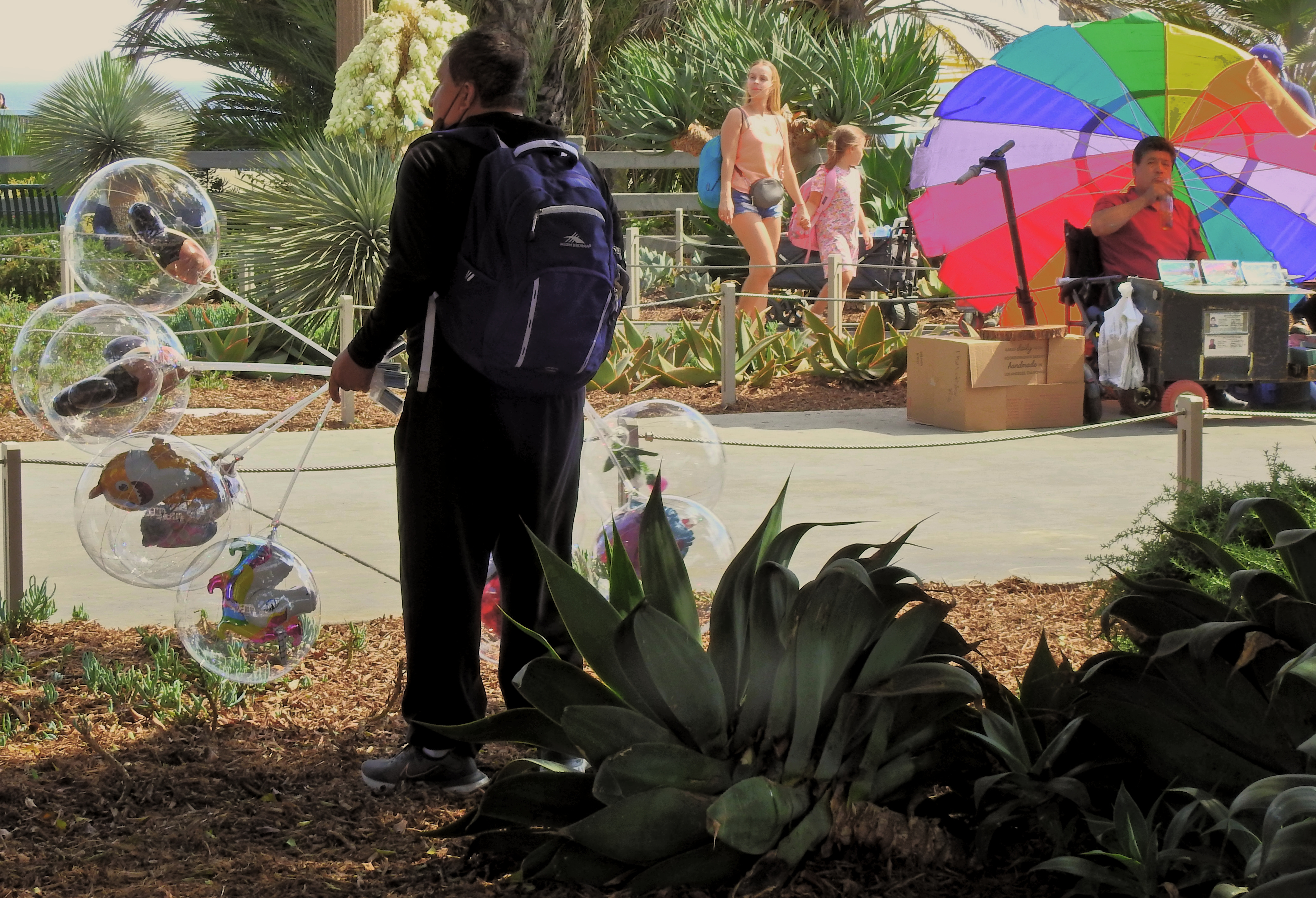
The Joy Dispenser, 2021
At the risk of sounding like I have attended too many post-graduate Zen classes, making a photographic image is, in itself, an essential good. It’s an act of faith….in our concepts, in our skills, in our evolving sense of truth and worth. In that light, we have many pictures which we claim that we don’t “love” which we should love…in spite. We begin making pictures by saying that some things in the ever-zipping parade of instants that make up our life deserve to be savored, preserved. We continue making them because that initial concept was true, and every salvageable frame that we produce after that starting point proves just how true it was.
And so, just as this image is a balance between what I wish I’d done better and what I actually manage to occasionally do perfectly, your best work is half-ripe, half-rotten fruit (the apple, remember?) We are all, as Cat Stevens wrote, On The Road To Findout. Stop trying to make the perfect picture and keep making the potential picture. Over the long haul, it’s a richer, more satisfying journey by far.
FLY/NO FLY ZONE
By MICHAEL PERKINS
THIS MORNING, AS I WALKED THROUGH A LOCAL PARK, my “poster child” for this current phase of the pandemic became, in essence, a poster bird.
One thing is certain about predators: they’re not crazy about hanging with humans in close quarters, certainly not at a distance of little more than twenty feet, which is where I found this red-tailed hawk staring back at me on the edge of a suburban park, only ten yards away from the nearest house and barely fifteen feet off the ground. Raptors typically keep their distance and maximize their stealth in heavily peopled areas, and so I was quite astounded that this fellow was remaining within camera range for what seemed forever.
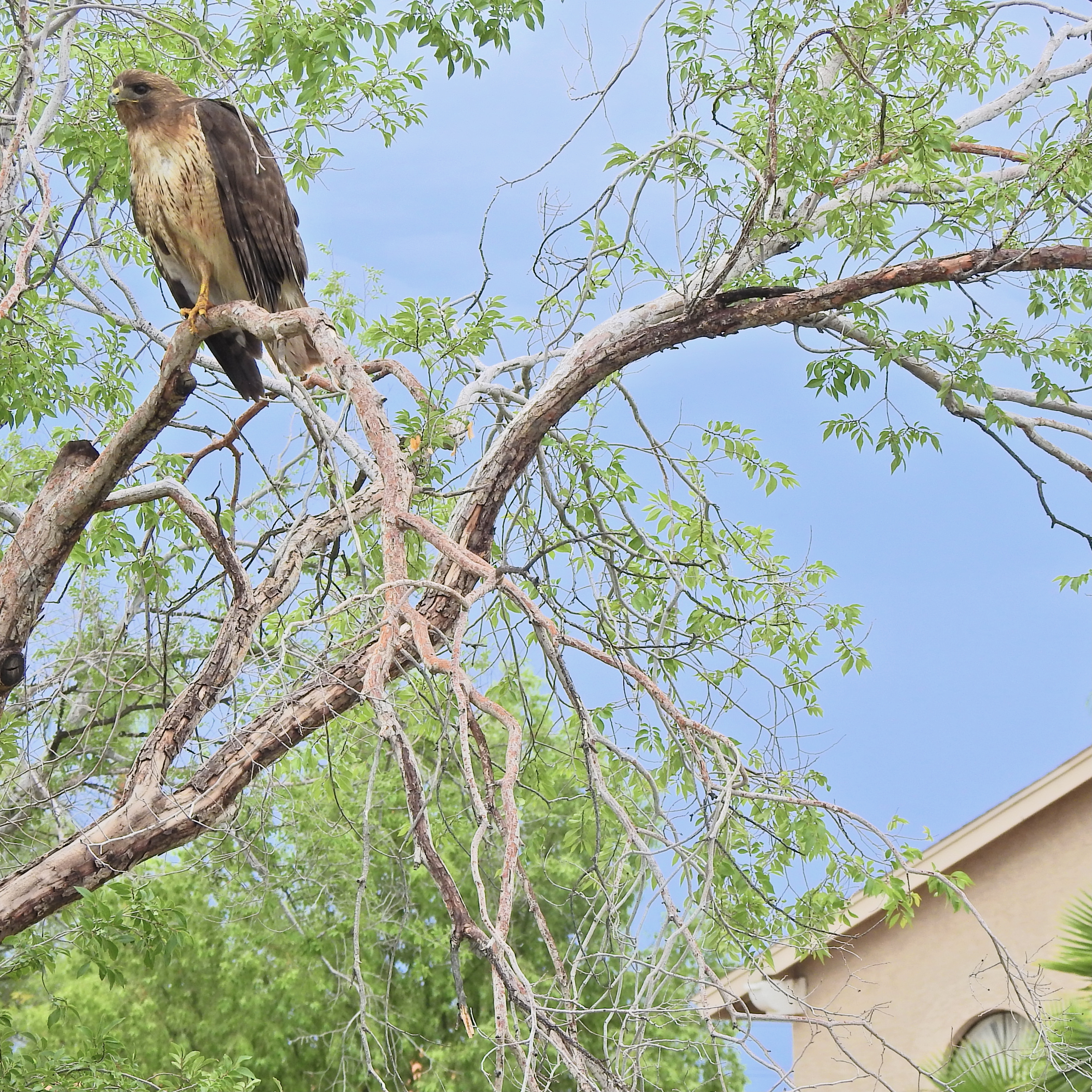
Then I noticed his left foot….or, rather, his lack of one.
A million different scenarios zipped through my brain as to how this elegant hunter might have been rendered, in the worst case, unable to hunt, to feed himself. A fight? A storm? A birth defect? All roads led to the same conclusion… that an intervention of some kind was needed. A call was made to the local wildlife rescue agency, and the street coordinates were reported. Stay there, a volunteer said, and we will call you back in a half an hour….
And so we walked….literally “once more around the park”. As we killed the clock, I began to think of the bird as emblematic of where we all are at the moment. Technically, we still might have wings, but can we fly? In the wake of our various recent “injuries”, can we protect ourselves from the possibility of even worse harm? Can we keep our balance, adapt, adjust? Which skills are most crucial to the new “us”, and which of us might prove too damaged to make the transition?
Upon returning to the tree just ahead of the wildlife agency’s return call, we found that our charge had already answered most of those questions: he was gone. The agency told us that many such hobbled birds manage, and that, once on the wing, no rescuers could capture our hawk anyhow. Its survival was completely a product of its own actions from here forward. Just like us. God, just like us……
A SYMPHONY IN AQUAMARINE
By MICHAEL PERKINS
A DRIVE DOWN OCEAN AVENUE IN SANTA MONICA, CALIFORNIA, directly opposite the town’s fabled Pacific Park (and that glorious neon pier entrance), is usually a slow and stately one, given the nonstop traffic along the city’s main artery, which is itself a major link to the Pacific Coast Highway. The streets are regularly clogged with visitors, a given in a city that, only a hundred years ago, was a sleepy bedroom community far enough away from Hollywood Proper to be thought of as an exclusive (and slightly shady) getaway for the rich and famous.
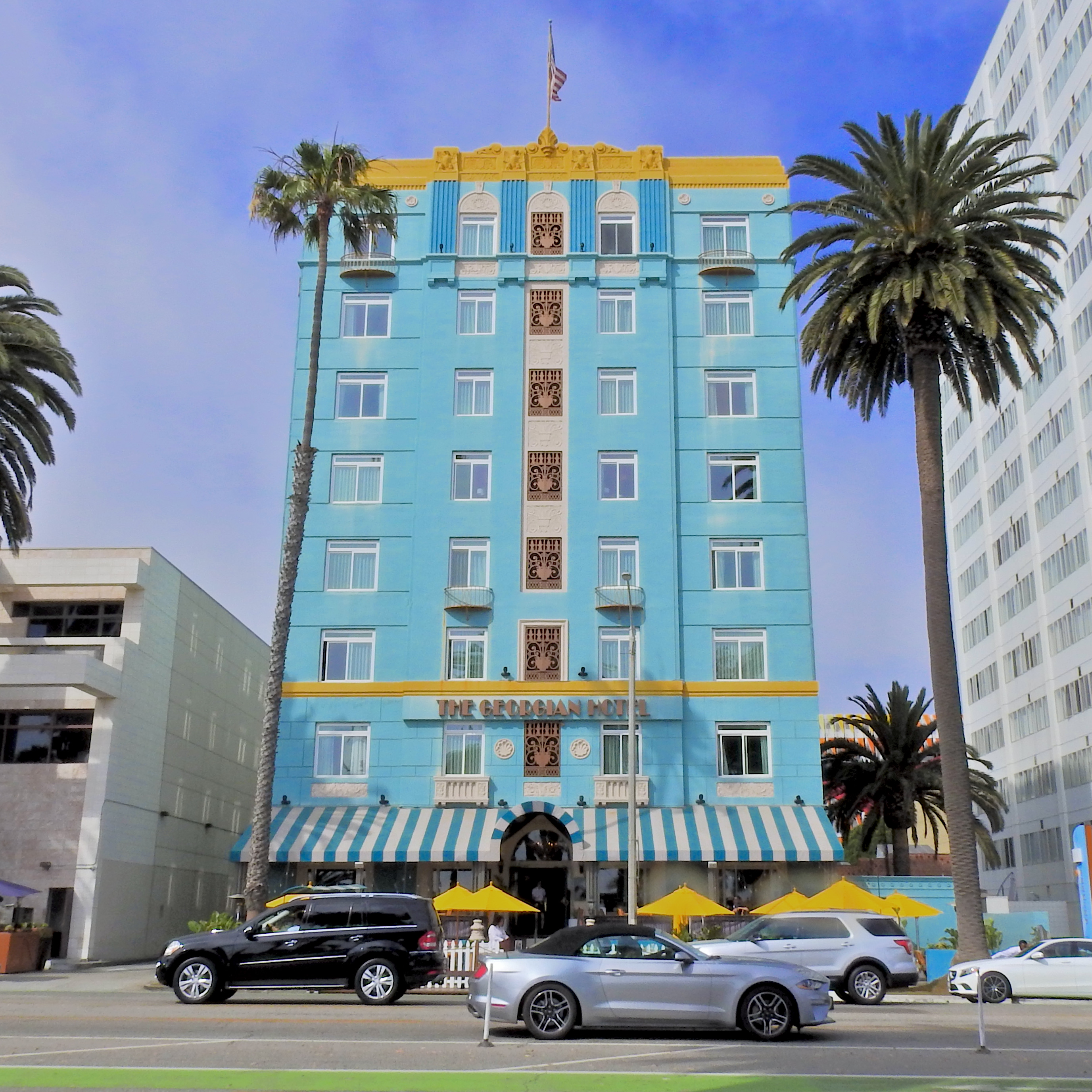
The Georgian Hotel, Santa Monica, California, July 3, 2021
One of SM’s most venerable architectural citizens is the gloriously Deco-rative Georgian Hotel, which, during the waning days of Prohibition, gained notoriety as a glamorous go-to for those seeking a little under-the-table taste. In the California of the late 1920’s, Santa Monica was still not long past its days as a tiny Chinese-Japanese fishing village, with the site of the hotel surrounded by a small forest, and….not much else. The Georgian’s formal 1933 opening coincided with the return of legal liquor, which confirmed its status as a chic retreat for the film community, with the likes of Clark Gable and Carole Lombard enjoying the ocean views alongside occasional clandestine stays from Al Capone and Bugsy Siegel. The hotel came to be the visual signature of the town’s full entry into the 20th century, and of the non-stop westward sprawl from L.A. that would continue to transform the waterfront for decades to come. By 2000, this elegant symphony in aquamarine attained monument status, and underwent a multi-million dollar restoration, guaranteeing its survival to the present day.
Photographing what I call a First-Tier-Postcard attraction, a place that everyone feels they simply must check off their bucket lists, doesn’t often result in anything new being done, beyond merely recording one’s “take” of it. In some ways, famous places are the most challenging things to shoot, since you’re in competition with the entire world in your desire to say something personal or unique. But, as this summer marks almost twenty years since the last time I photographed the Georgian, I recently approached the task with as much “just do it” zen energy as possible. It continues to delight and fascinate me with its quiet elegance, and its ability to evoke a world that has largely vanished, even as it’s been joined by other brighter, brassier neighbors over the years. Sometimes it’s just a privilege to be standing where so much magic has happened, and to take comfort that, to a degree, some of the old spell persists.
A MASK OF A DIFFERENT KIND
By MICHAEL PERKINS
HUMANS EXPERIENCE AMNESIA IN TWO DISTINCT WAYS, both by organic accident, i.e., an affliction or injury that erases the memory, and by a deliberate effort to leave ugly things by the side of the road like a shed skin. It is the second kind with which we are concerned here.
Since early 2021, photographers have leveled their lenses at every aspect of The Great Hibernation, as a world of throngers became, overnight, a planet of cave-dwellers. We shot deserted streets, shuttered businesses, desperate moments in ERs. Now, as we all variously wander out into the sunlight to test our courage in a stab at the “new normal” (a perfect example of willful amnesia), cameras are recording a strange collection of conflicting messages, as both hope and haunting walk our streets hand-in-hand. We are either in the throes of recovery, or a colossal poker bluff with fate, or both, depending on who you ask, and anyone attempting to record what’s happening out there will see manifestations of relief, anxiety, relaxation, and readiness. We are in a unique transition phase, one that could result in both freedom and defeat. And the pictures, as always, will reflect that ambivalence.
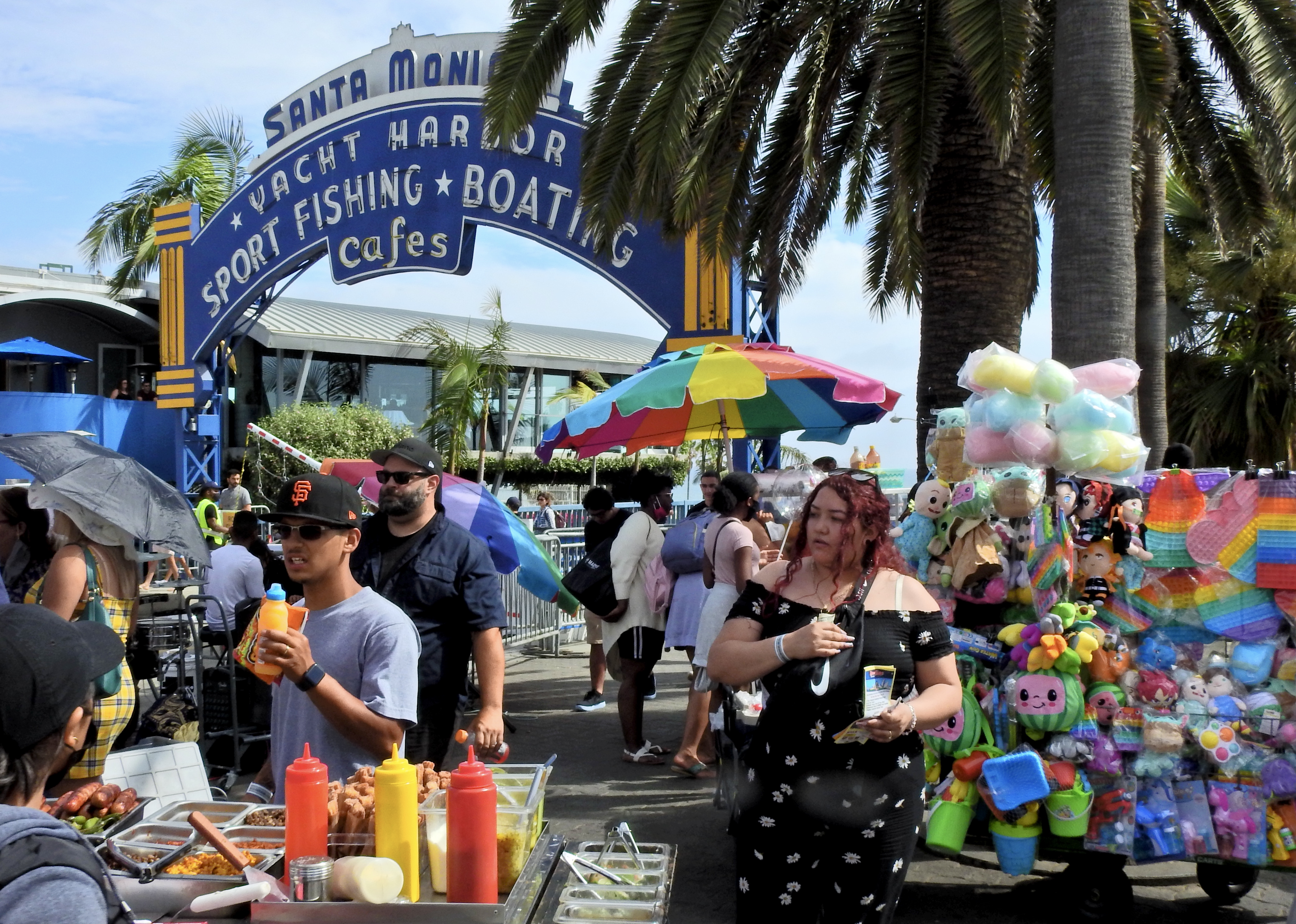
As I mentioned in the post previous to this one, I have just spent the 2021 Fourth of July weekend reinserting myself into the flow of life in Los Angeles for the first time in sixteen months. The sensation was both reassuring and tentative. Masks are not everywhere, but they are in greater evidence in a city that was so battle-scarred by the pandemic than in the foolhardy desert domains of Arizona. People are mixing, partying, eating, laughing, even as they walk across worn “six feet” signs that remind them that, just because the big bombs have stopped falling, the war isn’t over. It’s confusing, but in an exhilarating, jump-out-of-the-plane kind of way. We could fall to our death, but, hey, on the other hand, how about that view?
Willful Amnesia is seen in a camera’s quick flashes, alternating with the latent fears that are still very much a part of our daily navigations. The above image seems to be All About The Party, but equally true pictures of the masked and homeless lie just inches away. Pivot to the left, and the energy says resurrection. Pivot to the left, and it’s Anxiety On Parade. Both kinds of photographs are true, at least until we can replace our willful amnesia with the real, healing variety.
BALANCING ACT
By MICHAEL PERKINS
THIS WEEKEND MARKS MY FIRST ENTRY INTO LOS ANGELES since February of 2020, or just before the beginning of The Long Dark Night. The city has been a kind of third home to us for nearly twenty years, with both family and friends helping us make the City of Angels a very comfortable fit. Then, as happened all over the world, the familiar became the fraught….as a town that is always ready for its closeup saw more images of tragedy than of tinsel. I have counted the days until I could walk its streets again with nothing more serious on my mind than finding Bing Crosby’s star on the Walk of Fame.
As you read this, I will have spent the Fourth of July weekend trying to, well, feel free, which is still a tricky feat for many of us. We aren’t really done with all this horror, and we pray that our first halting steps back into the sunlight won’t scorch us. Additionally, phrases like “back to normal” will continue to ring hollow for many of us, for……who knows how long?
And yet we venture out. And the pictures that result from those uneasy explorations will have their own special signature. As I have begun packing for the trip this morning, I also spent some time leafing through some of the last images I shot last year, looking for something that could symbolize what we’ve all given up, what we’ve all learned to do to navigate the World After. Oddly, the picture that spoke to me the most has nothing to do with what was about to happen.
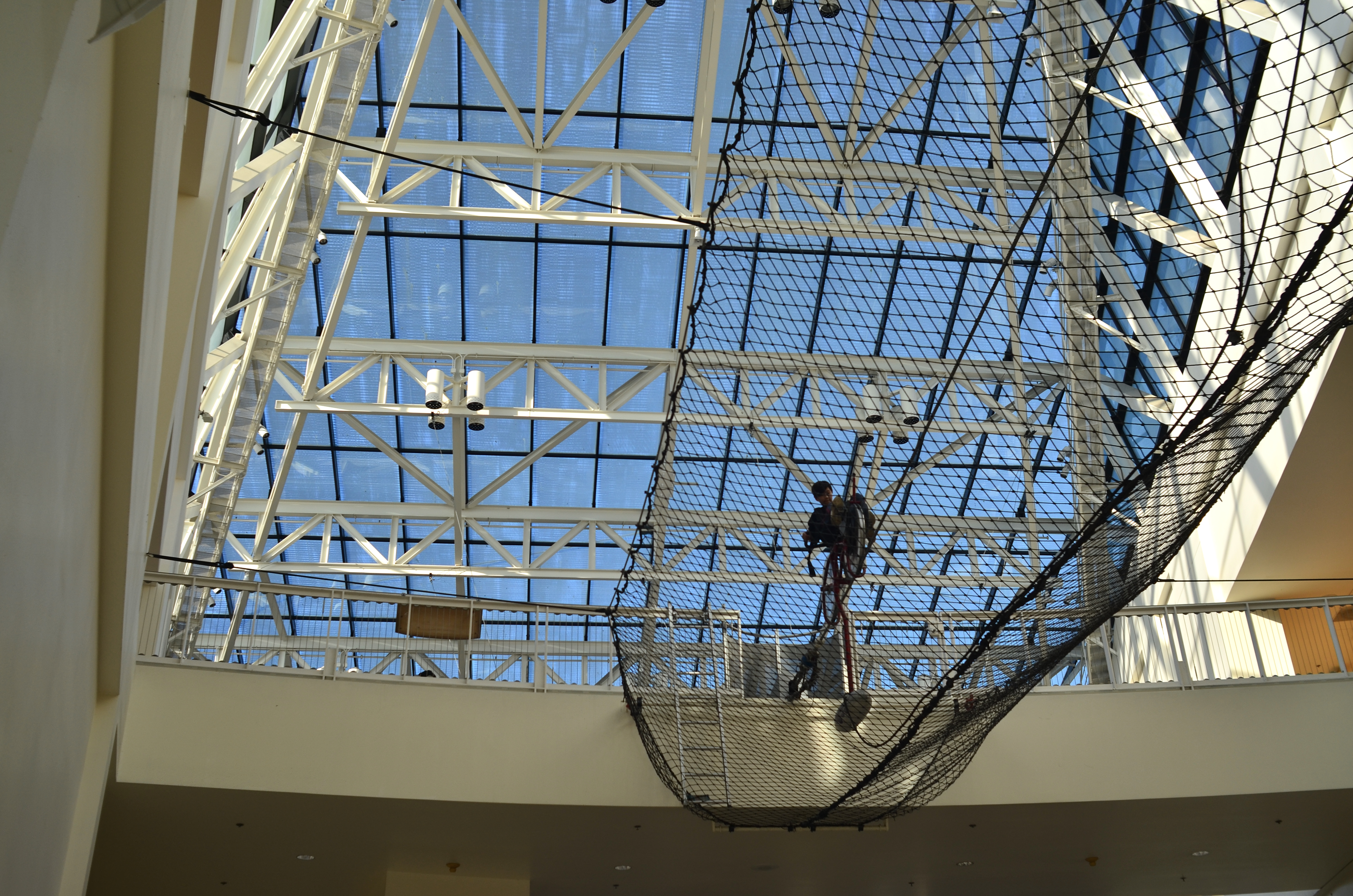
On a normal day in a city that boasts amazing museums and galleries, this lad’s wobbly, but essentially risk-free trek across a small hunk of open space, protected by a safety net, now suggests something different about our own uncertain steps back toward Business As Usual. On one hand, we share his thrill: that little bit of hazard quickens the blood and keens the senses, after all. But in a larger sense, we are very much working without a net, learning to weigh each step with care and caution, trying to forget that we’re on a tightwire. So, yeah, I took general shots all over Los Angeles during my last stay there. But this one is both the stuff of dreams and nightmares, and I share it here as a simple metaphor.
Perhaps the net is underneath us all at last. Perhaps not. But from Marco Polo to Lindbergh to Armstrong, explorers press on even where there be monsters. Cities are merely collections of individual journeys, after all. We all crowd together even as our personal paths set us apart. And, as always, images will be first seen, then made.
Safe travel to us all.
“Cal-i-for-nia, here I come….”
 thenormaleye
SLO-MO EARTHQUAKES
Now you see it, now you don’t: the death of Paradise Valley Mall, Phoenix, Arizona, July 2021
By MICHAEL PERKINS
THE SO-CALLED “CREATIVE” ARTS ARE CONSPICUOUSLY OBSESSED WITH RUIN. Whether our platform is the printed page, the canvas, or the camera, we who are supposedly committed to the depiction of uplift and inspiration seem equally fascinated with devastation. Easily half of the photographic images that have copped the Pulitzer Prize chronicle death rather than life, destruction in lieu of generation. The old saw about not being able to resist craning our necks when slow-rolling past a gruesome accident is based in truth: when it comes to Things Gone Wrong, we just can’t look away.
Our gradual escape from The Great Hibernation has already produced images that act like an encyclopedia of the horrible, a grotesque gallery of sudden tragedies, unexpected nightmares. But not all things that come apart are torn asunder in an instant, and we will continue, for the next few years, to also be witness to a series of what might be called slo-mo earthquakes, shifts in the tectonic plates of our behaviors that unfold in quiet, gradual tableaux, still visceral in their power, but less seismic in their suddenness, parts of our daily lives that don’t so much explode as melt away.
Some of these things, like the dead mall you see here being reduced to dust, will be vanished without epitaph or tears. Others, like the cozy neighborhood bars or the single-screen bijous, may elicit a sigh on their way out the door. Is it important to make photographs of these things? Opinions will vary, as one man’s “tragic loss” is another man’s “good riddance”. But perhaps what’s most important is that the camera is the only time machine that yanks time out of joint on purpose, that extracts people and places out of their proper sequence of life, abstracting them as they imprison selected fragments of them in amber. Without the bustle of people and commerce, is a mall even really a mall? Are the frozen images of a place’s now-separate component parts of any interest, once they are no longer integrated into a whole? And who’s to say?
Well, of course, as always, you’s to say….that is, you and your camera. We not only comment on meaning with our images, we confer meaning on things as well. Photography is both reportorial and editorial; it’s just another tool in the arsenal of the poet. Use your art to suggest, even insist upon, what things mean to you. Because not all earthquakes unfold in slow-motion, and time is opportunity.
Share this:
July 21, 2021 | Categories: Uncategorized | Tags: Commentary, current events, urban decay | Leave a comment