GASLIGHTING WHILE GLASS PLATING
By MICHAEL PERKINS
THE 19th CENTURY ENTREPRENEUR P.T. BARNUM, the Victorian era’s grand master of humbuggery, marketed the unbelievable and the fantastic to millions with a wink to his audiences, as if he knew that they knew that this or that latest marvel was an utter fraud, but that it was all in good fun, since his customers loved to be lied to almost as much as he loved taking their dimes and quarters to accommodate their desire to be snookered. In that way, Barnum foretold the relationship we in the 21st century still have with fakery. It is thus easy to see how A.I. slop has continued to blur the line between the real and unreal, especially as regards photographs. If you want to see what we’ll fall for, look back at what we have already fallen for.
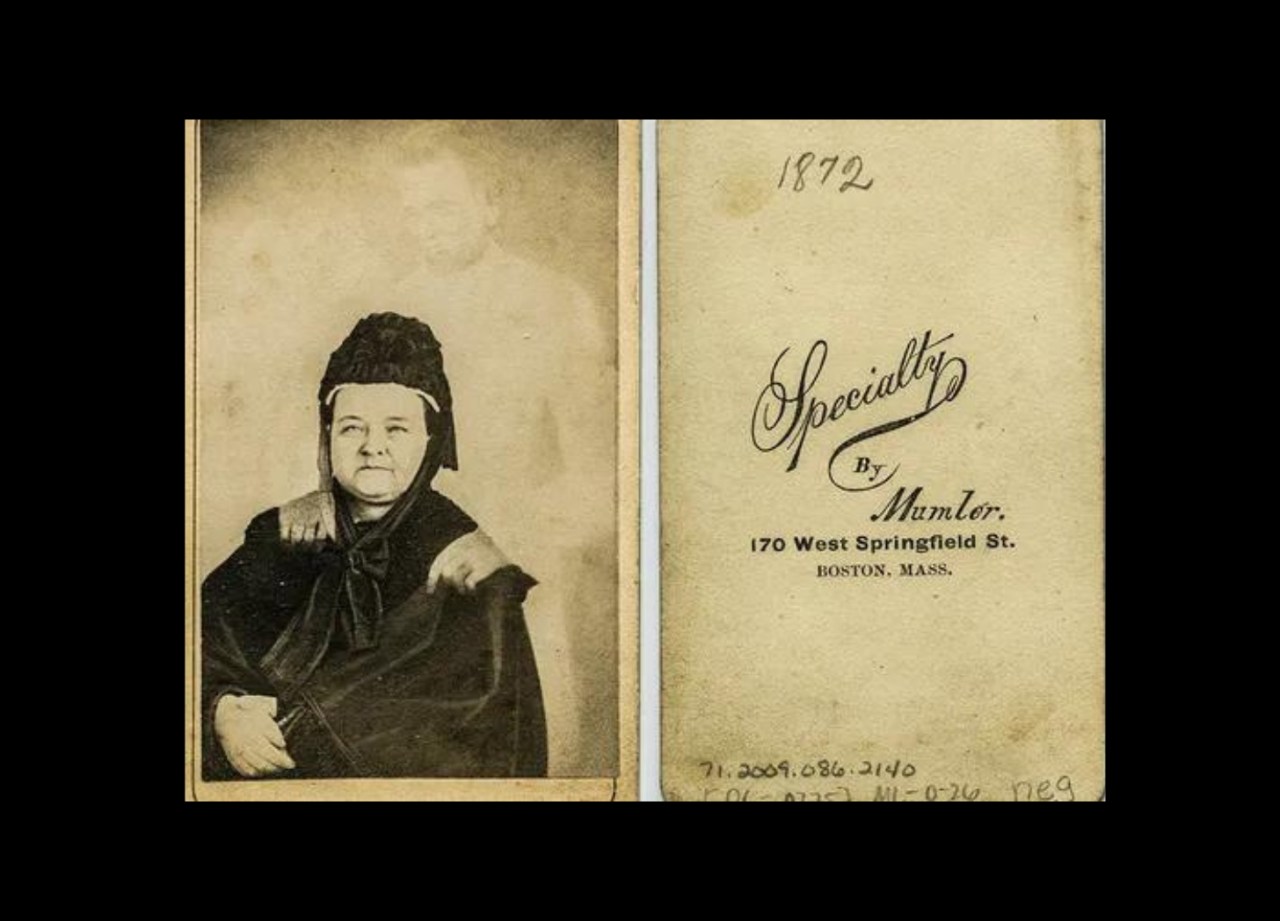
In 1861, the re-use of an improperly re-cleaned glass plate in the lab of photographer William Mumler made his finished print appear to show his own self-portrait “accompanied” by the shadowy figure of a girl. Mumler wrote the whole thing off as a lark, and forgot all about it until a spiritualist journal concluded that he had, in fact, captured a ghost inside his camera. Such publications were thriving in the back half of the 19th century, as the world was enthralled by the study of paranormal phenomena, and, smelling an easy payday, Mumler began marketing himself as the possessor of a unique “spirit camera”, scheduling sittings for bereaved people eager to pose with their departed loved ones. Insane? Well, consider in context: photography was such a new craft at the time that many were uncertain just what feats were even possible for it. After all, a soulless machine that could freeze time? Create a convincing record of reality with greater fidelity than the most skilled painter alive? What couldn’t the camera do?
Mumler made mad stacks of cash, and not only from the suckers, er, sorry, believers who flocked to his studio to be photographically reunited with the departed; he also played upon the grief and sentiment of the public at large, selling prints of the widowed Mary Todd Lincoln, seeming to be comforted by the ectoplasmic presence of her slain husband. The entire business seemed threatened when the Grand Fakeroo of the World, no less than P.T. Barnum himself, commissioned a photographer to create an image of himself with a shadowy presence in the background to demonstrate how easily the “spirit” effect could be achieved, and testified personally against Mumler at his trial for fraud. Acquitted by a judge, Muller simply started up where he had left off, cranking out the ghost pictures while also conducting legitimate experiments. At his death in 1884, he was celebrated for his greatest technical success, a system that made it possible to generate affordable and accurate prints from photo-electrotype plates, a technique which is still called the Mumler process. These days, with fraud walking hand-in-hand with art in the new golden age of manipulated images, it’s fascinating to remind ourselves of just how baked-in fakery has been across the entire history of photography. The camera may not lie, as the old saying goes, but the person holding the camera will often bear watching.


Leave a Reply