INDY’S INNER SHUTTERBUG
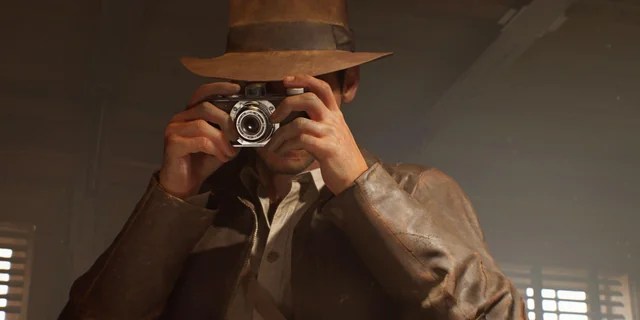
What does your favorite adventurer use to snap snappy snaps in tombs?
By MICHAEL PERKINS
THE HISTORY OF THE MOVIES IS LIBERALLY SPRINKLED with images of cameras used by its heroes on-screen, whether it’s a hard-boiled detective snapping spy photos of a suspect or proud parents posing the family for key moments. Many, if not most of the cameras shown in the films are composites of design cues from various devices cobbled together by the prop department, either for visual effect or to avoid copyright infringement or both. And then there are characters that you’d figure would be armed with a camera for certain occasions, but, oddly, never are.
Like Indiana Jones, for example.
Across the span of half a century and five theatrical films, Indy has concentrated on locating all the items on his archaeological bucket list, but shooting images of his finds? Not so much. Until now. The creators of the video game Indiana Jones & The Great Circle have finally put a camera in the legendary digger’s mitts, and, unlike everything else in the game, it’s something that actually existed. A very special something, in fact, that quietly revolutionized personal photography. Meet the Argus “A”, the camera that got the world hooked on compact 35mm photography.
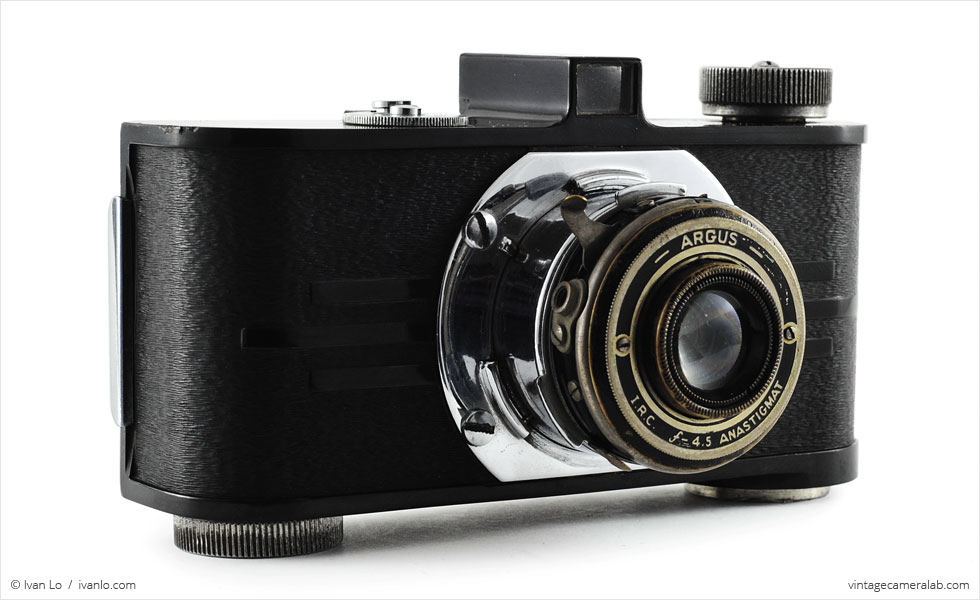
It’s true that many archaeological digs were documented in pictures, but most of said pictures were made on medium or large format rigs that were tripod-mounted for long exposures in dimly lit rooms. However, their sheer stationary bulk argues against their use by a guy who’s always leaping across craggy chasms or trying to outdistance giant boulders, and so the producers of Great Circle have given Jones one of the first successful compacts of the 1930’s, a dandy little number that actually outsold the main competition at Kodak. The “A”, launched in 1936, established Argus as a major player in the camera game, so much so that it sold off all its other holdings to concentrate totally on photographic products. The “A” came with a collapsible lens for a slim pocket profile, a light body of bakelite and chrome, a nifty 50mm prime lens, an aperture range from f/4.5 to f/11 and shutter speeds from 1/200th to 1/25 plus “Time” and “Bulb” settings. The viewfinder was small but serviceable, and, most importantly, the “A” accepted the new Kodak film “cassettes” for easy loading. Moreover, they delivered all this for just $12.50. The initial model reportedly sold 30,000 units in its very first year of release. More models, including one equipped with a flash shoe, would be introduced through 1941.
For Indiana Jones, a guy known to travel light, the “A” would have taken up very little real estate in even a modestly sized valise, leaving plenty of room for his signature Webley and Smith & Wesson revolvers, with which he did far more “shooting” in practical terms. It’s ironic that an iconic fictional character should finally get a camera that not only came from the real world, but, in photographic terms, changed it as well. And, in case of nuclear attack, it would fit neatly beside you as you huddled inside a refrigerator.
So there’s that.


Leave a Reply