SHARING A SUNSET WITH LOUIS AND LEON
By MICHAEL PERKINS
PHOTOGRAPHY HAS NEVER BEEN DEFINED BY A SINGLE TECHNICAL BREAKTHROUGH. It is, of course an invention, but one which is evolutionary, unlike a “eureka” moment in which a single inventor, an Edison, say, solves a problem and generates a product. The making of pictures unfolded in a much slower fashion, with many “little edisons” adding this technique or that method along a protracted timeline. Photography is never “finished”; it is always on the way to being finished.
This means that assigning authorship to a particular development or stage in photography is difficult. The art has so many co-creators that we find it hard to nail down who was the first to do or try a particular thing. The first days of the craft saw many different people all trying to portray very basic elements of the world, with very little documentation as to who was first across a given finish line. As we find in our own time, if you think up a great idea for a picture, chances are that a zillion other people have had the same “original” notion at the same time, given how universal some of our life experiences are.
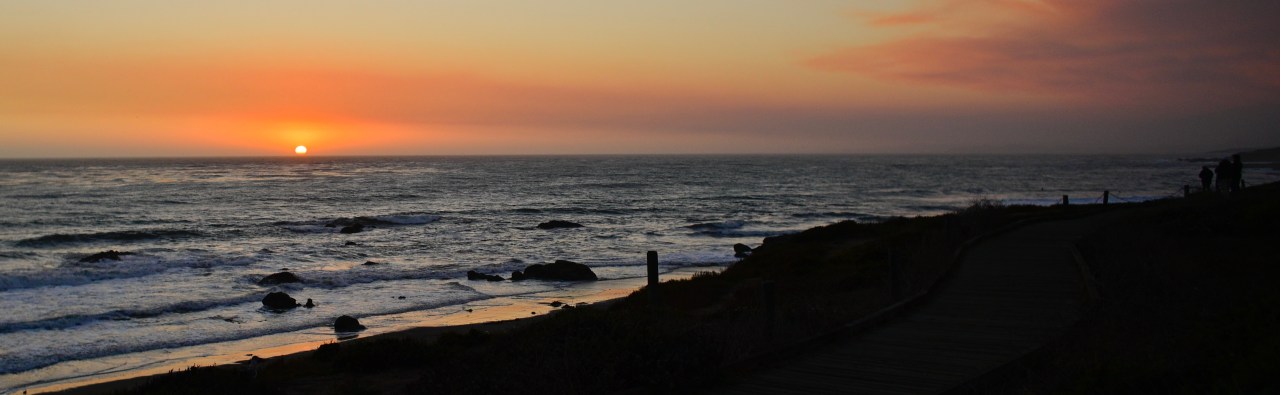
Moonstone Beach, Cambria, California, August 29, 2026, 7:40pm
By this time, for example, nearly everyone who has picked up a camera has made some kind of image of the sun. Our primal connection to nature was documented in photos almost as soon as the arrival of photos themselves. Ah, but who was the first to try such a picture? Some credit the first solar photograph to Louis Fizeau and Leon Foucault, a pair of French physicists who were experimenting in 1845 with the relatively new daguerreotype method, one of the first photographic systems to boast sharp resolution and fine detail. Their exposure was amazingly fast for the time (1/60sec.) and the resulting image was small, just 4.7 inches big, but it reportedly recorded spots on the sun’s surface and so was regarded as a scientific milestone. Okay, that’s the accepted version of history. But can we really attribute “firsties” in any photographic history with any certainty? It’s been argued that several people invented the telephone at about the same time as Alexander Graham Bell, but he was just the one who got to the patent office first. The same is likely true of most advances in photography. They have so many fathers that they are community property.
Which points to the fact that almost any subject has, by now, been photographed to death, or at least beyond the point of novelty, with the only crucial ingredient one’s own approach or experience. Even then, it’s hard to approach the hyper-familiar in a fresh way. Still, it’s the degree to which we refuse to accept that “there is nothing new under the sun” that makes us, well, photographers.


Leave a Reply