SEVEN MORE WONDERS OF THE WORLD
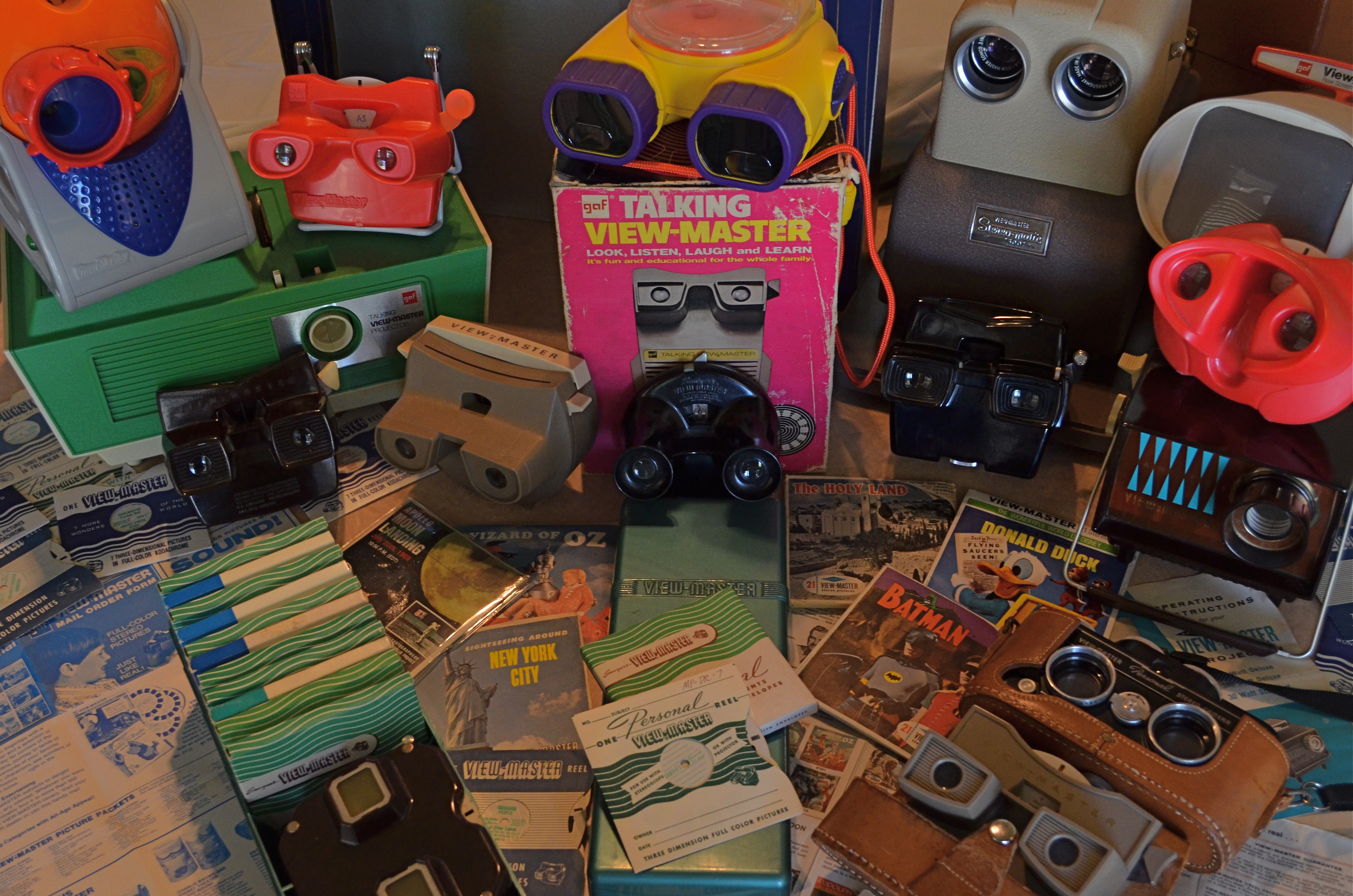
Class Picture: A small sampling of the massive product line from over sixty-four years of View-Master. 1/80 sec., f/5.6, ISO 640, 24mm.
By MICHAEL PERKINS
I’LL NEVER KNOW THE NAMES OF MANY OF THE PHOTOGRAPHERS THAT HAD THE GREATEST ROLES IN SHAPING MY EARLY WAY OF SEEING. The most important primary influences on my visual style in childhood weren’t the guys who received billing in the very public credits of Life, Look, or National Geographic, but the nameless freelancers whose work popped out of the small 3-d Kodachrome squares mounted in white cardboard View-Master reels. To this day, I can directly link the way I visualize images to VM’s crew of uncredited shooters, with their full-color highlight tours of everything from Yosemite to Notre Dame. Truly, from the first brown bakelite Model “D” viewer I received as a boy, through endless model variations over the next fifty years, I framed my own method for telling a picture story after the scenes in those little blue envelopes which bore the portentous legend, Seven More Wonders Of The World.
If you’ve been out of short pants for a while, you might not know that these little middle-tech stereoscopic beauties are still around, although just barely. View-Master has provided diversion and delight for three generations of devotees the world over, but the ride, billions of reels and zillions of memories later, might finally be crawling to a halt. More on that in a moment.
The co-invention of a photographer/tinker and a postcard salesman, View-Master cranked out its first rudimentary viewers and travel titles in 1939, more or less growing out of its appearance at the New York World’s Fair, where its souvenir views of “The World Of Tomorrow” made their debut. One of the earliest VM subjects was the then-new Boulder (later Hoover) Dam, setting the tone for the format’s explanatory “texts”, image descriptions short enough to make Tweets look encyclopedic, all crammed to fit inside the tiny caption window resting between your eyes. View-Master was largely an adult amusement for its first decade, catering to the armchair traveler with an endless catalogue of national parks, castles, cathedrals, and natural wonders, selling through a network of dealerships at camera shops and the souvenir stands at various travel attractions. Many of the format’s contributing scenic photographers also made some side money as VM sales agents, criss-crossing the country by car, shooting a little here, selling a little there.
By the early 50’s, View-Master grew from single-subject reels to three-reel packets and from travel images to its first children’s titles. Entering into a contract with Walt Disney studios, the VM format made a seismic shift toward youth fare with cartoon and TV shows, movies, even their own original fairy tale and nursery titles, shot with tiny clay figures arranged in their own miniature tabletop dioramas. And of course “the scenics”, as they were called, rolled on to chronicle many more World’s Fairs, canyons, mountains, parks, even NASA flights.
Depending on when you first encountered the format, View-Master was made either by Sawyers, GAF, Tyco, Fisher-Price, or Mattel, and the classic viewer was joined by projectors (2-D and 3-d), stereo cameras for making your own reels, “talking” viewers with internal phonographs to announce the captions, home “theatre” sets, storage cases and a slew of other short-and-long-term products.Now for the inevitable “passage of time” part: by the start of the 21st century, View-Master’s ancestral factory in Portland, Oregon closed its doors and production was moved to Mexico. And in 2013, there is, after sixty-four years, the clear possibility that the View-Master division of Mattel will be leased to a separate company, spun off like a despised stepchild, if not discontinued altogether.
Why the nostalgia? Because my whole orientation toward trying to tell a compelling, simple story in pictures, nurtured later by more famous photographers, cut its baby teeth on View-Master images: the composition, the angle, the way of leading the viewer’s eye into a frame and nailing it there….that’s all part of the “reel” world of my early, baby-sized eyes. There is no wasted space, no cute artiness in a View-Master image. It is all practical information, all shorthand communication. And even though the kiddie titles have long dominated the format’s output, there are, amazingly, still artists who create everything from complete tours of the Lewis & Clark expedition to edgy art exhibits with View-Master. And in a world that still embraces lo-tech imaging artifacts like plastic toy cameras and artificial “retro” platforms like Instagram, it seems that VM could still be an instrument for at least some kinds of photo expression.
Or, as with our tearful farewell to Kodachrome a few years back, we might, at least, cast a fond backward glance at the little box that gave us the world.
Seven wonders at a time.
FIND THE OUTLIERS
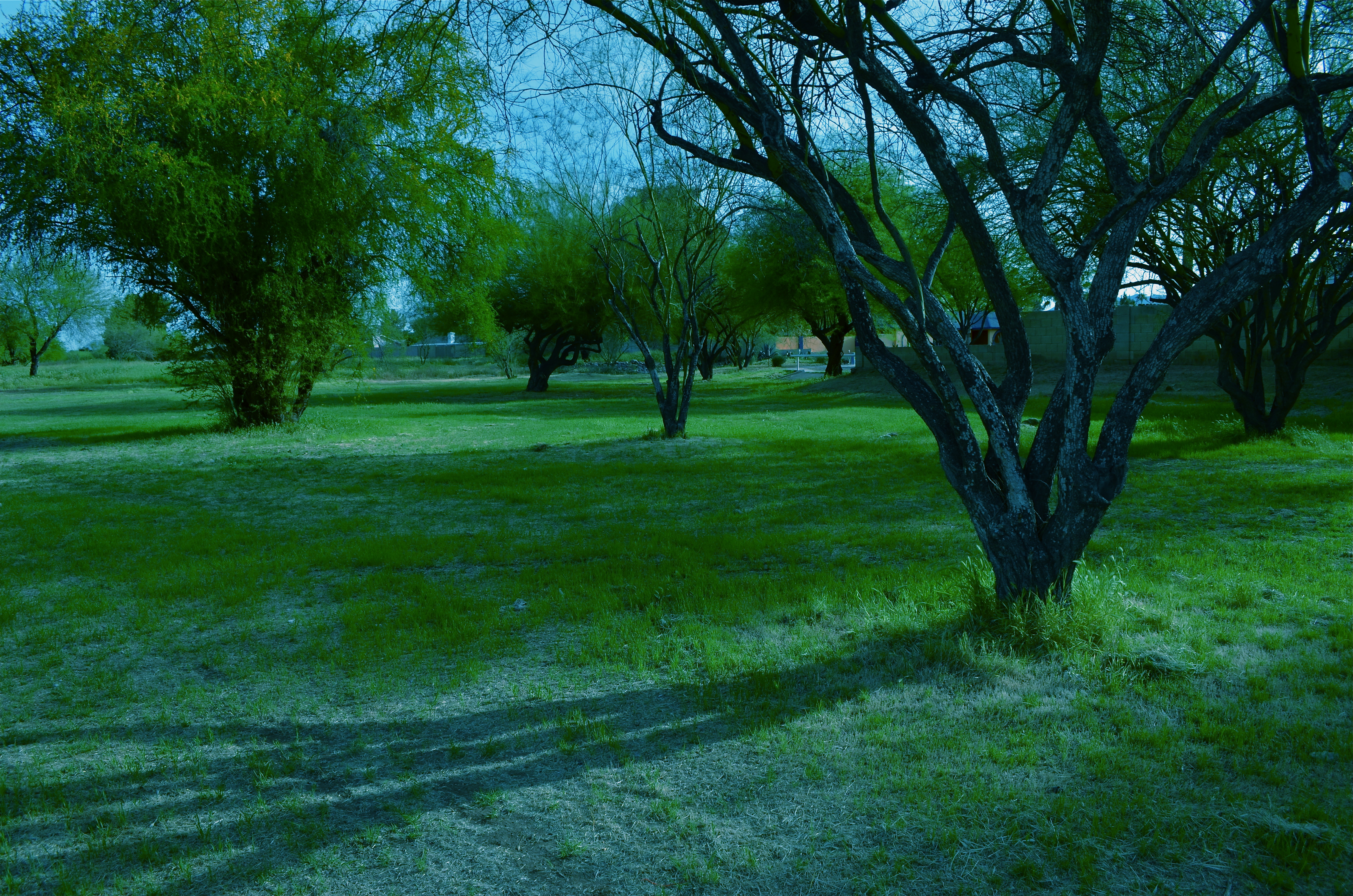
Not the kind of space you’d expect to see in a visually crowded suburban environment. And that’s the point. 1/320 sec., f/8, ISO 100, 18mm.
By MICHAEL PERKINS
EVERY TIME MY WIFE AND I TRAVEL, A STRANGE PHENOMENON OCCURS. We will be standing on the exact same geographic coordinates, pointing separate cameras in generally the same general area. And, invariably when she gets her first look at the pictures I took on that day, I will hear the following:
Where was THAT? I don’t remember seeing that!? Where was I?
Of course, we see differently, as do any two shooters. Some things that are blaring red fire alarms to one of us are invisible, below the radar, to the other. And of course we are both right. And valid. Admittedly, I do seem to come back with more strange, off-to-the-side-of-the road oddities than Marian does, but that may be due more to my wildly spasmodic attention span than any real or rare “vision”. Lots of it comes because I consciously trying to overcome the numbing experience of driving in a car. I have to work harder to take notice of the unconventional when repeatedly tracking back and forth,day after day, down routine driving routes. Familiarity not only breeds contempt, it also fosters artificial blindness. The “outliers” within five miles of your own house should glow like fluorescent paint….but often they seem cloaked by a kind of habit-dulled camo.
Once detected, outliers don’t quite fit within their neighboring context. The last Victorian gingerbread home in a clutch of tract houses. The old local movie theatre reborn as a Baptist church. Or, in a place like Phoenix, Arizona, where urban development is not only unbridled but seemingly random, the rare “undeveloped” lot, crammed between more familiar symbols of sprawl.
The above image is such an outlier. It’s about an acre-and-a-half of wild trees bookended by a firehouse,
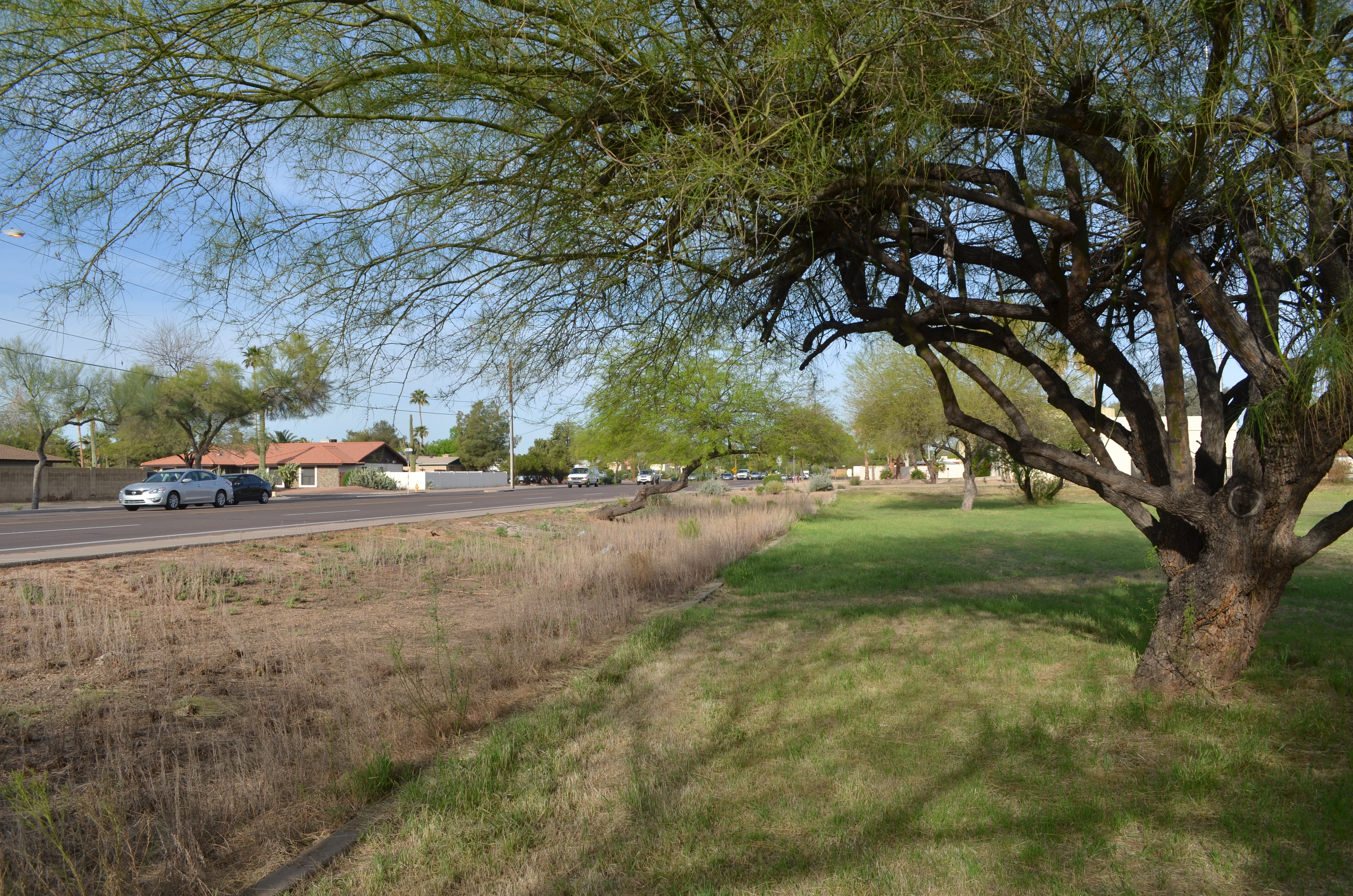
The sprawl-laden neighborhood that surrounds my “enchanted forest” Hey. it”s all about the context.
a row of ranch houses, and a busy four-lane street. Everything else on the block screams “settled turf”, while this strange stretch of twisted trunks looks like it was dropped in from some fairy realm. At least that’s what it says to me.
My first instinct in cases like this is to get out and shoot, attempting, as I go, to place the outlier in its own uncluttered context. Everything else around my “find” must be rendered visually irrelevant, since it adds nothing to the image, and, in fact, can diminish what I’m after. Sometimes I also tweak my own color mix, since natural hues also may not get my idea across.
Even after all this, I often find that there is no real revelation to be had, and I must chalk the entire thing up to practice. Occasionally, I come back with something to show my wife. And I know I have struck gold if the first thing out of her mouth is, “Where is THAT?”
To paraphrase the old proverb, behind every great man is a woman who rightfully asks, “Do you know what you’re doing?”
Sometimes I have an answer….
LOOK THIRTY FEET FURTHER
By MICHAEL PERKINS
ONE SURE THING ABOUT TAKING IN “THE SIGHTS” AT THE AVERAGE TOURIST ATTRACTION. You will be channeled, herded, if you will, toward exactly what the proprietors want you to see. This insures most people their coveted “Kodak Moment”, with Mom and the kids standing at the precisely picturesque sweet spot at the cathedral, the ruins, the monument, the mountain, etc. In fact, Kodak worked with parks for years to actually post signs near such perfect vistas, a polite way of yelling OVER HERE, STUPID at passersby. Thanks for the flash cards, guys.
Obviously this attempt to guide visitors to the “good stuff” can result in the occasional great image. But you and I know that, for the most part, it amounts to the completion of a homework assignment. You know, like the opposite of fun, spontaneity, um, photography.
Tomorrow, class, bring a picture of yourself standing in front of a famous landmark. And remember to smile.
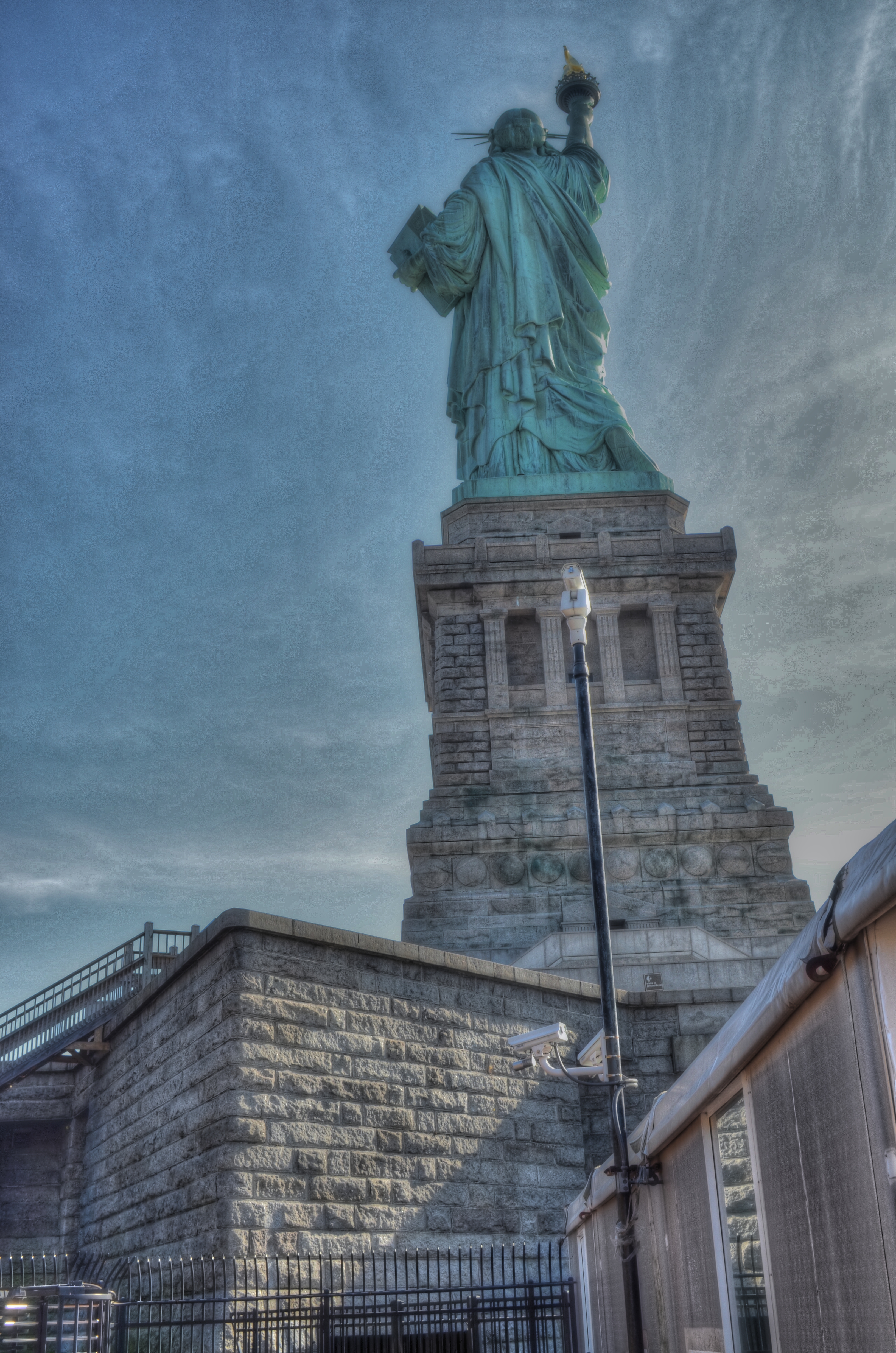
So go ahead and shoot the obvious thing. Just try to find another way to see it.
I’m a big one for wandering away from the tour group….not so far as to wander aimlessly into a scary forest full of monsters, just far enough to take in the entire area while the guide drones on.
I’m not so much interested in what’s available to photograph as I am in what else is available to photograph.
Sometimes, of course, you are better off just taking your approved thirty seconds in front of the waterfall and moving on. Other times you hit something, sometimes by just looking thirty feet further.
Do I have an example? Thought you’d never ask…
There is an over-hyped old house-turned-souvie shop in La Jolla, California (one of the most gorgeous coastal towns in the west) that sits atop a subterranean cave which looks out onto the ocean. Once inside the shop, the able-boded (and those who do not suffer claustrophobia) pay to enter an extremely dark, steep, damp and cramped staircase that takes them down below the house to the cave.
Now, for a guy with a camera constantly hanging from his neck, taking anything like a usable shot in this crimped cavern is largely a crap shoot, since light is, let us say, at a premium. So the “officially” cool thing, was, for me, frustrating to say the least, and I trudged up The Staircase From Hell (my knees aren’t what they used to be) to re-enter the shop at the earth’s surface. So far, so pointless.
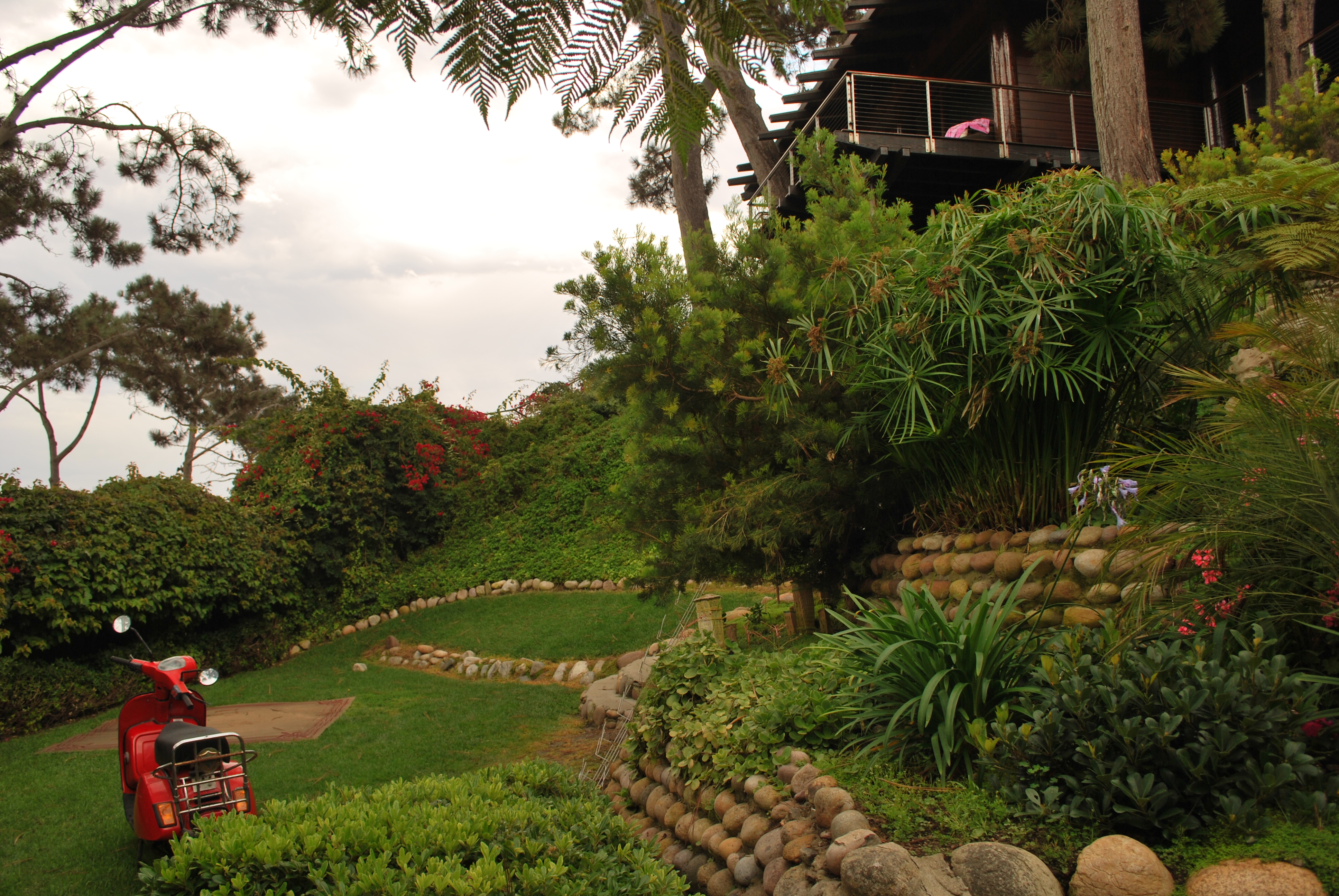
Pictures are where you find them, often tucked away behind so-called “attractions”. 1/100 sec., f/6.3, ISO 100, 18mm.
While my wife performed her mandatory inspection of the store’s copious supply of trinkets, I walked outside, then, instead of going back to the street, wandered around to the back of the building. Lucky choice. Suddenly I was in someone’s backyard, a hilly, curvy, strange little lot that could prove to be a nightmare for whatever neighborhood kid was doomed to cut the owner’s grass. It was only a matter of being curious enough to go about thirty feet off the official path….and yet here was the relief I wanted from chronic tour disease. An actual human habitation, complete with Hobbit-like stone landscaping and an extremely cool red scooter to counter-balance the rain-rich greens. Here was a picture I wanted. The “famous” view had shown me nothing. The “unimportant” view had given me everything.
Hey, I regularly get lost anyway. Why not have some fun doing it?
Now, where did my mommy go?
GRABBING THE GIFT
Light makes photography. Embrace light. Admire it. Love it. But above all, know light. Know it for all you are worth, and you will know the key to photography. ——-George Eastman
By MICHAEL PERKINS
WHEN I WAS ASSEMBLING THE FIRST COMPILATION OF MY OWN IMAGES, Juxtapositions, I felt a little awkward about captioning the photos in any way, since they were clearly the work of an unaccomplished amateur. In my native Catholic thinking, my default question was, who the hell did I think I was to pontificate on anything, hmm? Notice that, since you are presently reading the musings of the selfsame unaccomplished amateur, I obviously got over past that obstacle, but anyway…
Needing the book to have some kind of general structure or theme, I decided that, although my own wisdom may not be in demand, there were plenty of thoughts from the greats in the photographic field that were worth re-quoting, and which, correctly placed, might even illustrate or amplify what I was trying to say in my own photos. It was a way of channeling great minds and acknowledging that, pro or amateur, we all started off on the same journey with much the same aims.
Looking at the finished book, I noticed that the two most consistent subjects among the finest minds in photography were (1) light; how to harness it, how to serve it, shape it, seek its ability to frame or exalt a subject and (2) the importance of staying flexible, open, and able to embrace the moment.
Both objectives came into clear focus for me last week. A combination of early sunlight, dense foliage and thick morning fog came together in breathtaking patterns in the high canyon rim streets of Santa Barbara, California. Light was busting out wherever it could, coming through branches and boughs in soft shafts that lent an almost supernatural quality to objects even a few feet away, which, when suffused with this satiny mist, were themselves softened, even abstracted. If there was ever a delicate, temporary gift of light, this was it, and I was suddenly in a hurry, lest it run away from me. Any picture I failed to take in the moment was lost within minutes. Overthinking meant going home empty.
There was no time to carefully read the tyrannical histogram, since I knew it would disapprove of the flood of white that would throw some of my shots off the graph. Likewise I couldn’t “cover” myself by bracketing exposures, since there was so much territory to cover, so many images to attempt before the light could mutate into something else. I needed to be shooting, not fiddling.
Better to burn out than to rust out, as Neil Young famously said. One particular arch of overhanging branches called me. It looked like this:
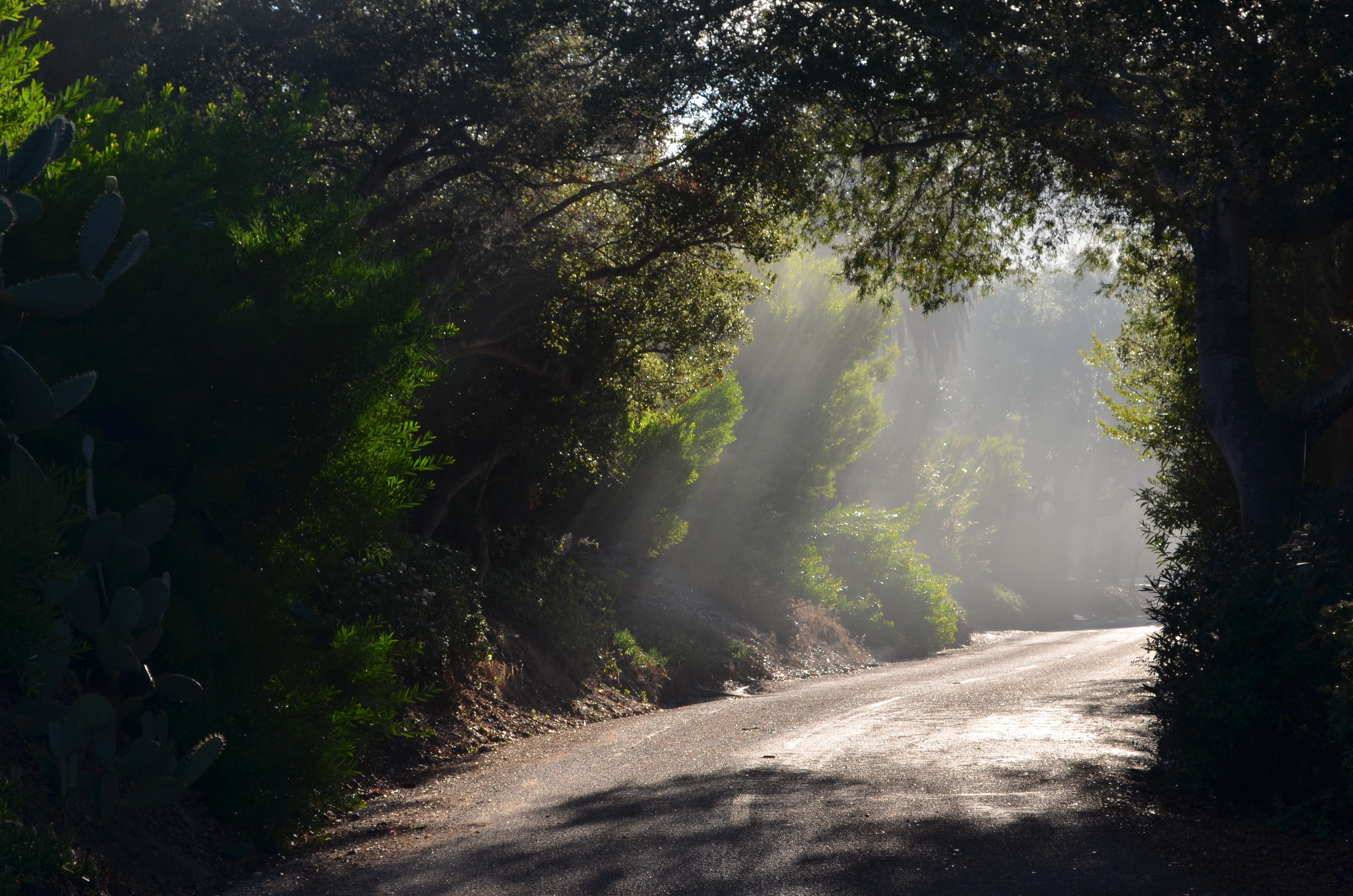
1/250 sec., f/7.1, ISO 100, 50mm
I was, after all these years, back to complete instinct. Snap shot? Certainly. Snap judgement? Hope not.
I didn’t go home empty. And when I got home, a re-check of one of Ansel Adams’ quotes encouraged me:
Sometimes, I do get to places where God’s ready for somebody to click the shutter.
Look for the moment. Listen for God (sometimes he whispers).
And don’t forget to click.
Related articles
- The 15 Most Popular Photography Tutorials from the 2nd Half of 2012 (digital-photography-school.com)
- What is photography? (bangladesh2u.com)
THE HOUSE THAT ED BUILT
By MICHAEL PERKINS
AMIDST THE CARNIVAL ATMOSPHERE OF MONTEREY, CALIFORNIA’S CANNERY ROW, IT IS A DRAB, ORDINARY THING, and, if you are not paying close attention, Ed Rickett’s original biological lab, tucked next to the towering Monterey Bay Aquarium, looks as if it is just waiting for the wrecking ball. In fact, it has escaped that fate several times over, much to the glory of this old industrial district, now scrubbed squeaky-clean to house Starbucks and other national chains within the substructures of what was once the beating heart of the California fishing industry. However, with a little closer look at the former headquarters of Rickett’s Pacific Biological Laboratories, you realize that it carries more history within its humble walls than most of the theme park dreck in the area that attempts to recall that era.
If Cannery Row is a salute to history, the House That Ed Built is history, and has been, luckily, left alone to tell its amazing story.
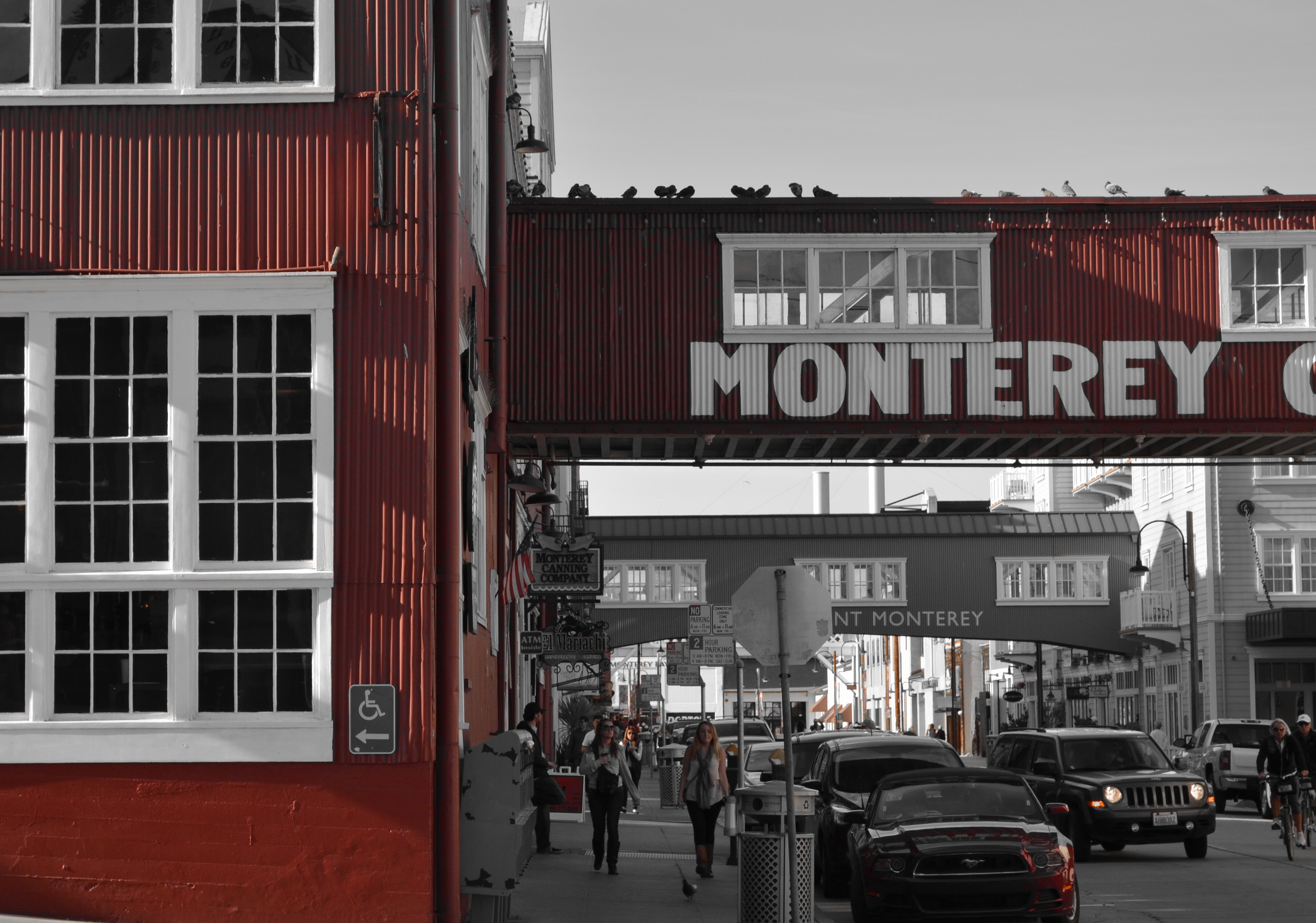
Authenticity is a hard item to come by in Monterey’s Cannery Row, which depicts a grand old factory district as a kind of Fish Disneyland.
Edward Flanders Robb Ricketts, who found himself living and working in Pacific Grove, California in the early 1920’s after bouncing around the country as an Army medical corpsman, a dropout zoology student at the University of Chicago, and a travel writer, founded Pacific Biology Laboratories with a friend in 1922. The original lab was in Pacific Grove, a next-door neighborhood to Monterey, and was later relocated to Ocean View Boulevard in the heart of the bustling fisheries and processing plants of Cannery Row. Ricketts took consignment orders from researchers and museums for various life forms from the coastal tides in the region, commissions which made him a modest living and helped finance his own experiments. By 1930, with his reputation fairly established, he met an up-and-coming author from the area named John Steinbeck. The two became lifelong friends.
The PBL lab, with holding tanks around the bank for storing specimens (still viewable today), was nearly destroyed in 1936, when a fire consumed the neighboring Del Mar cannery (now the site of the world-class Monterey Bay aquarium). Steinbeck, stepping in to purchase a half-interest in Ed’s lab, financed its rebuilding (and helped keep a roof over his friend’s head).Saved from the flames was Rickett’s career-defining work, Between Pacific Tides, the manuscript for which had been sent ahead to his publisher before the blaze.
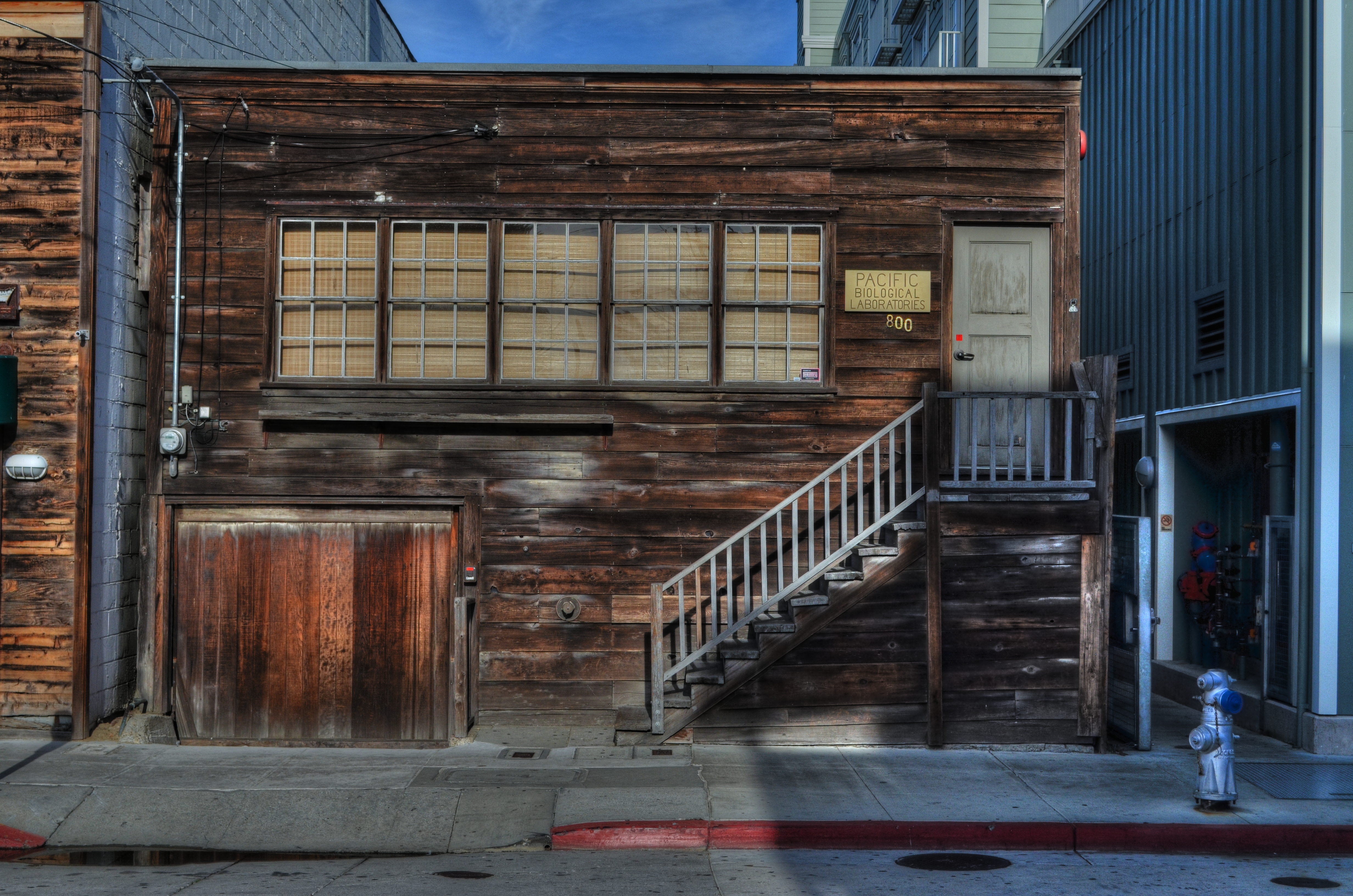
The Monterey Bay headquarters of Pacific Biological Laboratories, whose proprietor, Ed Ricketts, became the inspiration for the character “Doc” in his pal John Steinbeck’s novel, Cannery Row. 1600 sec., f/7.1, ISO 200, 35mm.
In 1940, following one of many messy breakups with the various women in his life, Ed decided to take a road trip to Mexico and pay for it by researching and writing a new book on marine life. Steinbeck, looking to escape some of the controversy that dogged him following the publication of The Grapes of Wrath, decided to partner with Ricketts on the project.The result, Log From The Sea of Cortez, one of Steinbeck’s only works of non-fiction, became a solid reference work in the field of marine biology.
Writing his novel Cannery Row in 1945, Steinbeck modeled his marine biologist character “Doc” on Ricketts, fictionalizing the PBL as “Western Biological Laboratory” and keeping the spirit of Ed’s place as a gathering (and drinking) point for writers and artists. Following Rickett’s death in 1948 (he was hit by a train carrying Del Monte canned fish through the area!), friends bought the place, keeping it as a kind of clubhouse until 1983, when they sold it to the city of Monterey. The budding Cannery Row Foundation, then just getting underway with a renovation of the area, saw to the restoration of the building, which now is listed on the National Register of Historic Places. Specimens Ed gathered from the tidal pools have, for decades, graced collections at Harvard, the American Museum of Natural History, Lund University in Sweden, and dozens of other places the world over. Now the place his work began is itself a specimen.
Cheesy retail and chain restaurants have blotted out a lot of the physical history of Cannery Row, leaving Pacific Biological Laboratories as one of the only authentic visual legacies of one of America’s most storied industrial centers. As such, it’s always worth an extra (and loving) look.
(Here’s a great link from the Museum of Monterey with a wonderful overview of Ed’s life: http://www.youtube.com/watch?v=obz6BdAtgIk )
A QUIET VOICE, A STILL SOUL
By MICHAEL PERKINS
As I have practiced it, photography produces pleasure by its simplicity. I see something special and show it to the camera. A picture is produced. The moment is held until someone sees it. Then it is theirs. -Sam Abell, STAY THIS MOMENT, 1990
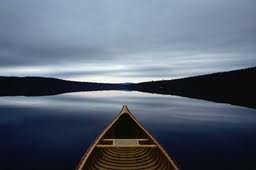
The voyage and the vehicle: Sam Abell’s classic image of a canoe on Maine’s Allagash River, the cover image for his book, 1990’s Stay This Moment.
THERE ARE PHOTOGRAPHERS THAT ARE SO AMAZINGLY ADVANCED that they make their images, wrought with love, ferocity, daring, and single-minded purpose, seem not merely visionary but inevitable. We see what they have brought us and exclaim, “of course”, as if theirs is the only way this message could possibly have been crafted, as if its truth is so self-evident that to have to formally recognize it is almost needless overkill. We confirm and validate that, for these pictures, the machine has truly been placed in the service of a soul, and one which writes fluently while we stumble with numb gestures.
One such soul resides in the work of Sam Abell.
If his name doesn’t roll off the top of your tongue alongside those of the obvious Jedi knights of photography, it’s because, for most of his forty-plus year career, he has kept a lower profile than Amelia Earhart, producing amazing work beneath the masthead of National Geographic magazine along with a host of other special commissions. When Sam came to to Geographic in 1967 as an intern, he already had four years of “hard” experience producing images for the University of Kentucky’s school of journalism to his credit, but the magazine’s photo editor, Robert Gilka, was hesitant to hire him, worried that his work was “too artistic”, too personal in its beauty to survive in the service of journalism.
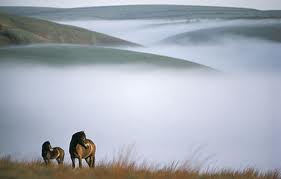
For Abell, it’s all about the patience. How long do you wait for the horse to wistfully glance over his shoulder? As long as it takes…..
With help, Sam Abell learned the balance for getting the facts for stories and getting the truth implied in their locales. Even when those stories’ words shouted with urgency, Sam’s notes were always on the soft pedal. Their poignancy fades in and builds, rises to your attention and then rivets it in place. Writing in his 1990 collection Stay This Moment, Abell declares that the test of great pictures is that “they cannot be memorized”. Small wonder that he began, early in life, to pursue a career on the cello. Smaller wonder yet is that the patience of that instrument is “heard” in the music of his pictures.
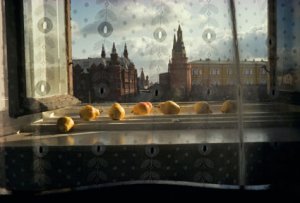
Always, a human context. Sam Abell capture of the iconic buildings of the Kremlin, framed by ripening fruit and lace curtains.
Even more muted than the images Sam creates is his technical approach to taking them. For much of his early career, he shot breathtaking landscapes with a simple 35mm camera, often a Leica reflex or rangefinder, mounted with standard or “normal” lenses ranging from 28 to 35mm, generating the least amount of distortion and rendering the most natural relationship of sizes and distances. For years, the most advanced tools in his bag were a sturdy Gitzmo tripod and the slowest, richest films he could find, frequently Kodachrome 25 and 64. The tripod delivered the stability needed to produce slow, sensual exposures; the ‘Chrome delivered texture and nuance beyond the power of hand-held shots. However, the most vital weapon in Abell’s arsenal is his astonishing patience, the wisdom, which flies in the face of traditional journalism photography, to wait for the story in a picture to slowly unfold, like the petals of a flower. Some of the best images Abell placed in National Geographic over the years took nearly a year to create. It happens when it happens, and once it does, God is it worth it.
The number of printed collections of Sam’s work are few and far between, given his enormous output, but diligence rewards the curious. Among the most available of them is the collaboration undertaken with historian Steven Ambrose, Lewis & Clark: Voyage of Discovery ( 2002), for which Sam created images of the surviving sections of the legendary explorers’ trail to the Pacific; Amazonia (2010), an essay on the kind of delicate ecosystems that are vanishing from the earth; and Life of a Photograph (2008), an examination of how his most famous pictures were built, stage by stage. And, of course, there is the luxuriant (and hopelessly out-of-print) Stay This Moment (1990), the companion book to his mid-career exhibition at New York’s International Center for Photography. Buy it in a used book shop, grab it on e-Bay, scour your local library, but find this book.
More importantly, find Sam’s work…any of it…and savor every detail. For copyright protection purposes, I have deliberately kept the illustrations in this article constrained to minimal resolutions. Find the real stuff, and see what Abell’s amazing sweep and scope can do at full-size. This blog is chiefly about how I, as a rank amateur, struggle with my own creative conundrums. But it is also about knowing what teachers to bend toward. Sam Abell, who literally teaches in mentor programs all over the country, has a powerful gift to impart. “What is right?”, he asked in 1990. “Simply put, it is any assignment in which the photographer has a significant emotional stake.” He also emphasized an important distinction (one of my favorites) in his remarks to a young photography student. Don’t say, he said, I took this picture.
Say instead, I made this picture.
Of course.
Thoughts?
Related articles
- Sam Abell Interview (keronpsillas.com)
- The Life of a Photographer – Sam Abell (billives.typepad.com)
THE NEW MOSES
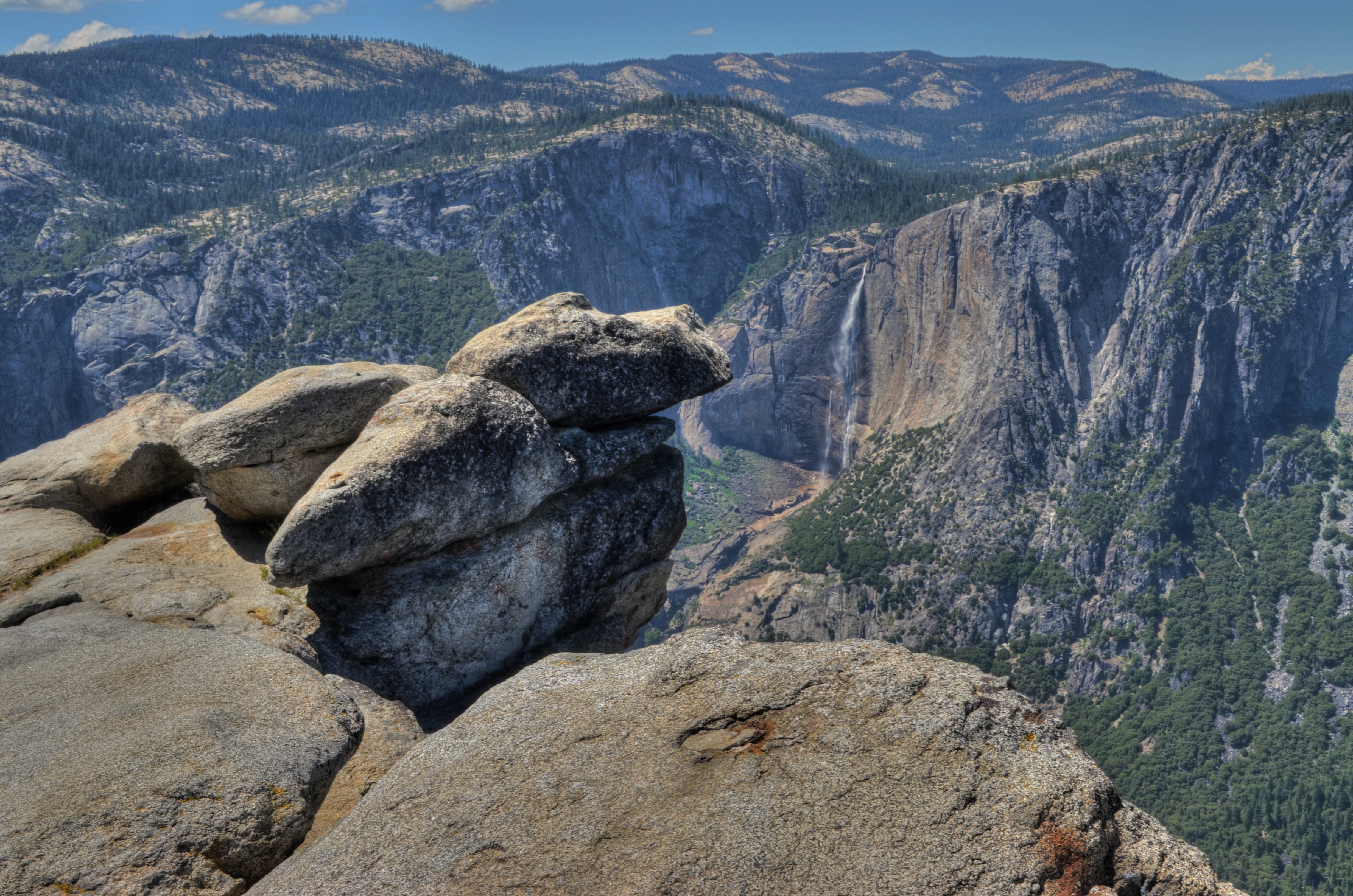
This is where it all began; the famous outcropping of stone atop Yosemite’s Glacier Point, where Sierra Club founder John Muir and President Theodore Roosevelt stood in 1903 to symbolize the beginning of the United States National Park system. 1/125 sec., f/14, ISO 100, 32mm.
By MICHAEL PERKINS
WE CAN ONLY GUESS, AS HE GAZED OUT UPON CANAAN, the long-promised homeland of the wander-weary Israelites, what Moses felt, especially given that he himself would be forbidden to set foot upon that sacred soil. Perhaps, in our recent history, something of a parallel can be drawn to the vista shown above, the aerie from which John Muir, the lanky, ascetic Scotsman who became the first champion of the Yosemite, peered into the vast wilderness he was sworn to protect. This is the view from atop Glacier Point, directly opposite Half-Dome and, in the farther distance, the majesty of Yosemite Falls. It is also one of the only places in the United States where you can literally stand on the spot where history took a new turn.
Like Moses, Muir was a both a prophet and a protector, entranced by the stunning beauty of his adopted country and horrified at its vulnerability before the juggernaut of progress. Unlike Moses, he actually gained entry to his personal promised land, hiking its immense acreage, personally discovering many of its most amazing features and acting as correspondent to his fellow countrymen to apprise them of the great treasure lying unknown inside their borders.
As the founder of the Sierra Club and the most profound poet laureate of the preservation movement (he favored that word over the later “conservation”), Muir’s first choice would probably have been to surround all of Yosemite with at least a mental fence, a barrier of conscience to prevent its plunder by profiteers. His second choice became fateful for us all…..to enlist the federal government as a guardian for his Eden, and to unleash the energy of that nation’s most intrepid crusader for the environment.
John Muir was a veteran of nearly 35 years of preservationist skirmishes by the time he met President Theodore Roosevelt in 1903. Muir, desperate for a way to protect Yosemite beyond the puny efforts of local and state governments, met TR in Oakland, California, and the pair traveled by train to Redmond before taking a stagecoach the rest of the way into Yosemite Valley. Muir used the travel time to implore the president to place Yellowstone under national protection, and Roosevelt, agreeing, asked his host to show him “the real Yosemite”. After heading out into the back country essentially alone and camping under the stars atop Glacier Point, the two awoke to new-fallen snow and a new alliance.
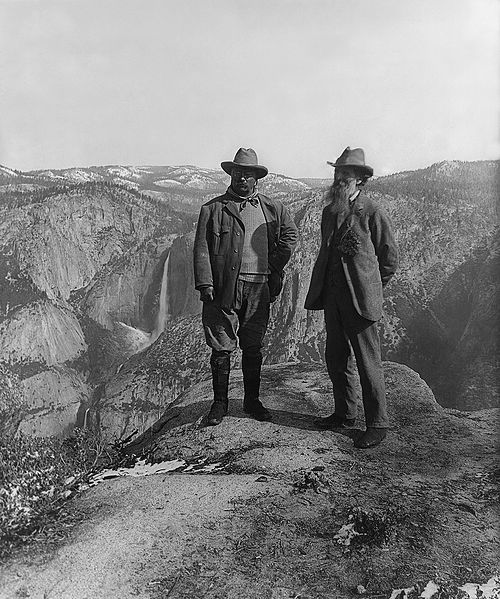
“This is Bully!” Roosevelt and Muir atop Glacier Point, 1903.
That alliance was captured in the shot at left, which shows nearly the same view of the Yosemite Valley as my image at the head of this article. Three years later, in 1906, Muir and the Sierra Club successfully added the valley and the Mariposa Grove (a massive forest of giant sequoias) to the overall Yosemite National Park acreage, and finally saw the entire area placed under federal protection. The United States National Park concept, unique in the entire world of the early 20th century, had been born, the American Moses leading the way to a greener, more perfect union.
Related articles
- Congress to consider Yosemite site for new “Los Angeles Lake” (yubanet.com)
- Happy 174th birthday, John Muir. (fossicking.wordpress.com)
- My First Summer in the Sierra: Illustrated Edition downloads (dubcoou.typepad.com)
 thenormaleye