INVISIBLE MIRACLES
By MICHAEL PERKINS
WHEN YOU’RE A CITY THAT HOSTS OVER EIGHT MILLION PEOPLE, certain things, even certain extraordinary things, are bound to get lost in the shuffle. In fact, maybe “shuffle” is the perfect word for what happens to people in a town like New York; they become part of an endless mixing of cards, from Joker to Knave, King to commoner, in an equally endless jumble of encounters. Maybe the lyric “if I can make it there” is more correctly worded “if I can get noticed there”. The sheer speed of the shuffle guarantees that the daily menu of things contains many unseen tragedies, many invisible miracles.
The city is so very crammed with every aspect of the human experiment that it is, by definition, jam-packed with extraordinary talents, great feats. There is, on any given day, an embarrassment of artistic riches that just passes unseen. In other places, the marvelous is more of a rarity. In New York, it’s the very mortar between the bricks. Where else but in New York could a vast greenspace like Central Park be merely part of the local scene, as if it were an old lady’s backyard garden? And where else but in Central Park could a superb saxophonist, like the one seen here, merely be the latest amazing musician you encountered on your morning stroll, halfway between the a capella quartet near the children’s zoo and the gypsy accordionist next to the Bethesda fountain?
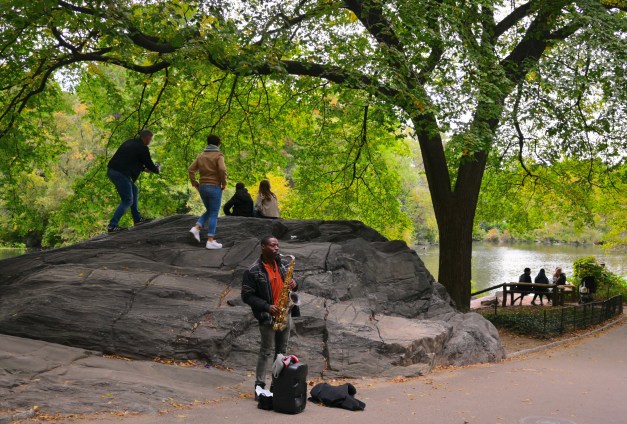
The most New York thing about this player’s performance, however, is the degree to which he is being regarded not as an extraordinary musician, but as just another element in the daily mix of sensations. As a frequent visitor that is not a native, my first instinct is still to point a camera at this gentleman, because of course he must be acknowledged, and of course people should struggle to be aware of him. But in Manhattan, there is always the next sensation, the next show, just as, if you miss the latest 7 train, there will be another one just as good arriving in the next few minutes.
Maybe if I were ever to become an actual NYC resident, I would eventually get to the point where more of the city’s on-tap miracles would become invisible to me, so commonplace as not to even merit a camera click. But a regular willingness to be surprised, even amazed, is at the heart of every photographer I have every admired, and, so far, it’s an instinct that has served me well. Maybe I’m just not very sophisticated, living up to the Ohio farmboy rep many have hung on me, the little frog awash in the big pond, and so on.
Maybe I am, indeed, every inch a hayseed. A cornball. A bug-eyed kid agog on his first visit to the circus.
Cool.
I can live with that.
A PLAGUE ON ALL THEIR HOUSES
By MICHAEL PERKINS
PHARAOH WAS A TOUGH SELL.
The infamous Egyptian needed a lot, and I mean a lot of convincing that things needed to change. A guy named Moses pitched him the idea of a new world order, a fresh model of the world in which one man simply didn’t enslave his brother. Simple. Still, Mo had to take several meetings with the sovereign to get the concept across.
Took some boils. Some frogs. Some locusts. And a few other subtle little warning signs that Pharoah’s worldview wasn’t… sustainable.
Then came the ultimate plague. Imminent destruction, after which the terrified tyrant finally, finally agreed to let Moses’ people go. And still he tried to change his mind. Humans seem, always, always, always, to choose negative feedback as their only means of improvement. We don’t even believe there even is crap until said crap hits the fan. Which brings us to this week, when I found myself looking across the street at this:
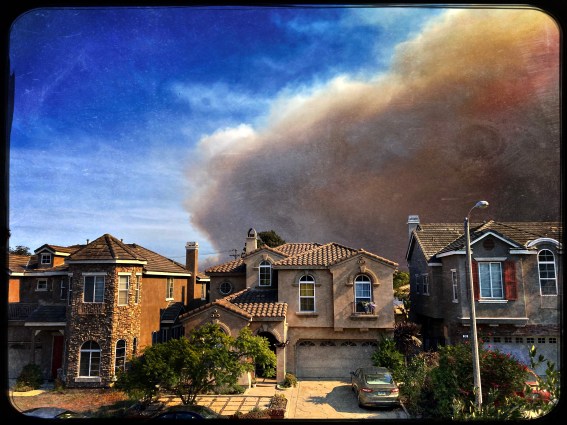
In California, the Santa Ana wind season is as predictable as spring rain. One day, you’re a cheeseburger in Paradise. Next day, you’re on Mother Nature’s s@*tlist. The cloud seen here appeared out our front window in Ventura as a result of the S.A.’s whipping through Camarillo, a town just twenty miles away. Within minutes of an ignition incident that, at this writing, still remains a mystery, the seasonal gusts transplanted flaming embers onto the rooves of dozens of mini-mansions, landing as well on vast swaths of crackling-dry brush and forests, spreading over 20,000 acres in less than a day, charring over 120 homes to ash and placing all surrounding towns on air-quality lockdown.
The usual platitudes about climate change were trotted out as vast teams of responders raced to outpace the blaze, which is, as I write this, is inching nearer containment. I certainly wasn’t the first to take a snap of Nature in the act of bucking us off her back, of returning the favor for our attempted murder of the planet by deciding to murder back a little. Hell, I’m sure that, had he an iPhone handy, Ramses himself might even have reacted to the horror unfolding before him by snapping a selfie of he and the wife posed before a sea of locusts. As photographers, we need to be constantly bearing witness to what’s already happening. And we have to stop thinking of climate change as something “out there, over there”. As the Monkees sang so long ago, “so you better get ready; we may be coming to your town..”
WHENEVER WHATEVER
By MICHAEL PERKINS
IT IS ASSUMED THAT ART IS MEANT TO EXPLAIN THINGS, to illuminate the dimmer corners of our perception. Or at least that’s what the logical side of our brain wants to believe.
In fact, art is not a settler of disputes, but rather a disrupter. It starts more arguments than it decides, and, properly done, poses more questions that it can ever answer. Art is meant to upset the applecart.
Nearly every enduring piece of art, that is, work that has had a sustained impact over time, enters the world as a despised outlier. The first words that great much of great art are not “what genius!” but more like “what is that supposed to be?” And so it goes with photographs, the ones we view that others have created and especially the ones we create ourselves. We have, of course, certain intentions for pictures as we plan them, but, in many cases, some other spirit gets into our head, in the nanosecond-long decision to shoot or not shoot, and it can leave us with pictures we might even like, but certainly do not understand.
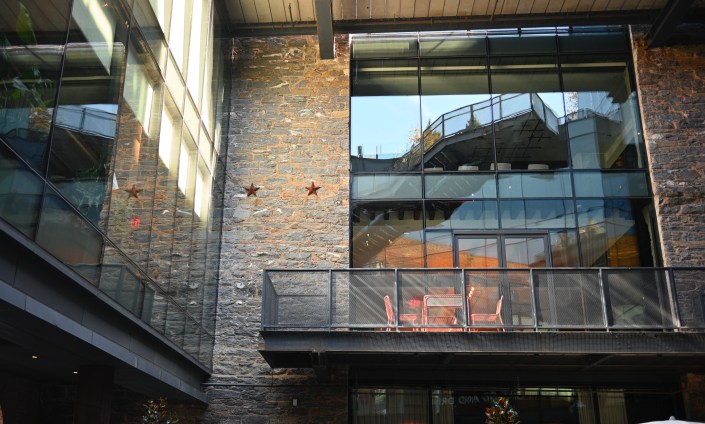
I don’t know where this came from.
It’s not a particularly attractive subject, and as chronicle, narration or commentary, it doesn’t really justify its existence. And yet it got here, and, I have admit, I rather like it. I just have nothing to say about it.
Sometimes an image just is, and despite all the overwrought captions that might accompany it, from critics, museum curators, or we ourselves, it may never be anything else but what it is. It doesn’t fit a ready-made category; it doesn’t change the world. It just represents a frozen abstracted moment snatched from billions of such moments, all those other times in which we might have snapped the shutter but, for some reason or another, didn’t. Photographs are a random sampling of time, and sometimes the sample presents nothing other than a cipher. And I suppose that’s okay. And even if it’s not, it’s art, so in most cases, all we can do is ask, “what’s that supposed to be?”
R&G in NYC
By MICHAEL PERKINS
LIFE, IN GENERAL, HAPPENS QUICKLY, a condition that photographers, out of necessity, learn to live with. We decide in mere instants what gets stored into our little boxes, evaluating the “lose/keep” equation with whatever scant time we’re given. Some places, admittedly, afford us decent stretches of contemplation, allowing us to sculpt and shape an image at our leisure. You know; the “park my tripod and wait hours for the ducks” type of picture.
And then there’s shooting in New York.
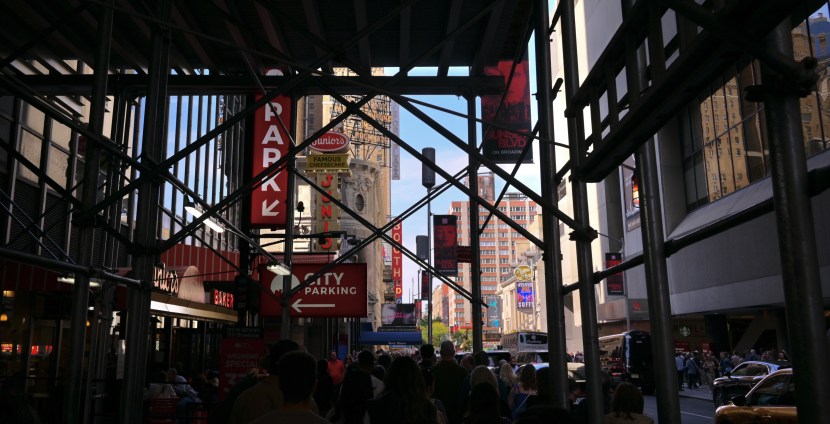
Shooting on semi-automatic mode, perfect for nailing the basics when speeding through busy Manhattan.
Manhattan may not be the place were impatience was born, but it certainly is the town where it is most practiced. On my recent “reunion” with the city (after five years away), I found myself longing for the occasional moments of recent visits, when I could at least have the luxury of five to ten seconds to size up and calculate a shot. In such cases, as is my usual preference, I would shoot on full manual, delighting in being able to be discriminating, even choosy, in my execution. But this time around, I found myself in the company of several other people wherever I went. Thus, their “mission”, whether it was to catch the 7 train or a Broadway curtain, became my mission, meaning I had to be in nearly constant motion. As a result, manual shots were simply going to take too long, with an endless chorus of “wait just a sec!” from me, answered by annoying looks from the other folks in the crowd.
And thus, for the first time in what seemed forever, I went into R&G, or what time constrained fashion photographers call “run and gun” mode. I pre-selected an automatically determined aperture (typically f/5.6 or f/8), with as much customizing for color and contrast as was called for in most urban situations, and locked it in on one of my Nikon’s “U” mode switches, effectively converting the camera into a point-and-shoot. Don’t get me wrong; semi-automatic modes are great. It’s just that I myself hate to overly rely on them, and even in a situation where I have to use them, I wander back into manual as often as time will permit. However, let’s face it, when you’re bringing up the rear on a crowd of people who are hell bent on getting somewhere fast, you either make the deal and make your life easier, or else make everyone’s life harder.
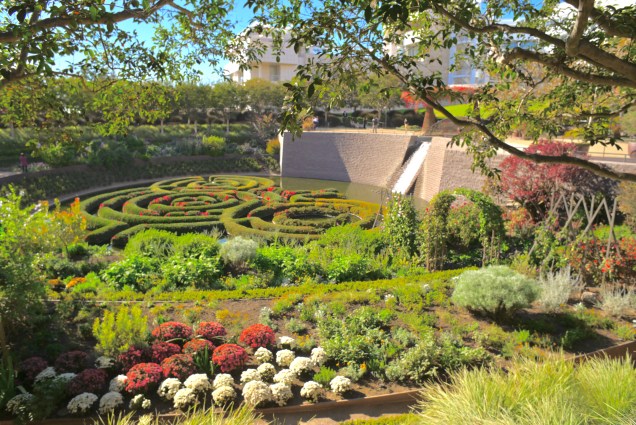
Whoops. What’s this ring marked “focus” for?
The risk of doing this all came back to haunt me later, when I was back in Los Angeles working a subject where I could take my time, and thus was using a fully manual lens. The first time I got into a minor time crunch, I continued to assume, deep in my lizard brain, that the camera would nail the focus for me, when, in fact, I was neglecting my job of doing it myself, resulting in a passel of gooey, fuzzy shots, all wonderfully composed and exposed, all as soft as a 1910 postcard (see above). The moral here is to be mindful at all times, which for me, usually means taking complete responsibility for a shot. Quite simply, convenience makes me lazy, and laziness makes me careless. Like native New Yorkers who’ve just risen to meet the stimulus level of their very busy city, I accept it as the price of doing business.
UNTIL THE NEXT THING COMES ALONG
By MICHAEL PERKINS
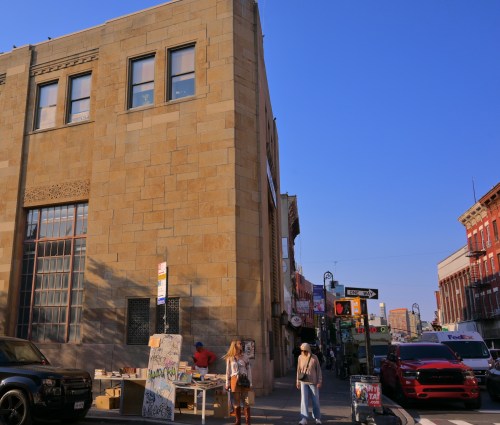
I AM NO STATISTICIAN, but it’s a safe bet that staring at one’s phone may be one of the most universal of human behaviors in this, the year of Oh Lord, 2024. However, as a photographer, and one who seeks the street over every other available canvas, I would bet that the number one human pastime, by a mile, is waiting.
In trying to catch homo sapiens in his most native (candid) state, I find cell phones to be a forbidding barrier between me and the human face. Expressions of any revealing sort seem to simply drain out of our features when we are transfixed on screens, and the heart and soul of street photography is showing people in the act of reacting; thinking, enjoying, interacting, celebrating, dreading, wishing, raging, whatever. And the unavoidable pauses imposed on us while we are waiting are rich with all of that, in a way that “man on a phone” just ain’t.
And there is still so much of this loot to mine; we wait on trains, buses, Ubers, fate, fortune, accident, each other. We must stand in line and on corners and tap our toes impatiently until the light changes, until the moment arrives, until something delivers a shift in the life equation. And in those dead spaces, we spell out spectacular ballets, not only with our faces, but with our bodies, and how they move in relation to other bodies, other fates. And, like the colorful glass shards within a kaleidoscope, every fresh shake of destiny calls up patterns we somehow never saw before.
The activity of making photographs can be like Lucy and Ethel sorting chocolates on a high-speed conveyor belt; there is only a brief instant in which to decide what goes where, whether any of it is worth saving, or whether we should just pop it down our shirt. The shirt shots are forgotten quickly. The stuff that gets sorted correctly teaches us things about ourselves.
AND IT WAS ALL YELLOW….
By MICHAEL PERKINS
THE LATE COLUMNIST PETE HAMILL ONCE DEFINED A “REAL” NEW YORKER as one who could tell you, in great detail, what a great town New York used to be. I was born in Ohio, but, as I married a woman who grew up in the city and its immediate environs, I have been privileged to visit there scads of times over the past twenty years, enough that I have been able to compile my own personal list of longings for Things That Have Gone Away in the Apple. There are the usual pangs for beloved bars and restaurants; bittersweet memories of buildings that fell to the unfeeling juggernaut of Progress; and the more abstract list of things that could be called How We Used To Do Things Around Here.
For me, one of those vanishing signposts of all things Noo Yawk is the great American taxi.
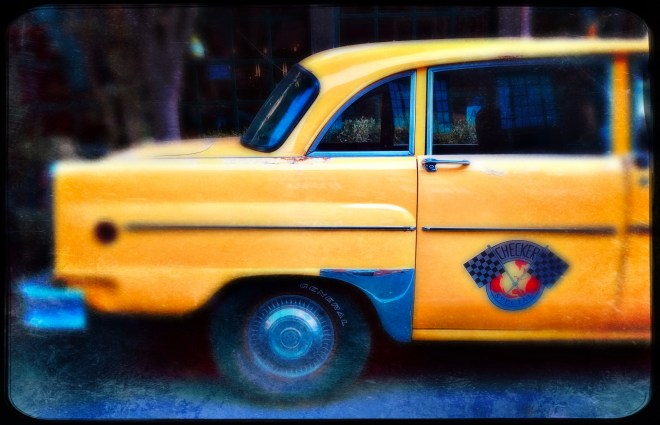
Take Me Uptown, October 12, 2024
As the gig economy has more or less neutered the cab industry in most cities, the ubiquitous river of yellow Checkers that used to flood every major NYC street at all turns is now a trickle, as Uber and Lyft drivers work in their own personal vehicles, causing one of the major visual signatures of life in the city to ebb, like a gradually disintegrating phantom. As much as the subway or sidewalk hot dog wagons, cabs are a cue to the eye, perhaps even the heart, that a distinct thing called “New York” endures. As a photographer, I’ve caught many huge flocks of them careening down the avenue over the years, even on days when I couldn’t, for the life of me, get even one to stop for me. Now, on a recent trip that was my first time in New York in nearly five years, spotting even one Checker was something of an event for me, and suddenly posed a bit of a photographic challenge.
The problem with taxis, now, is to show not only the physical object itself, but to visually suggest that it is slowly going ghost, fading into extinction. In such situations, I find myself with the always-tricky test of trying to photograph a feeling, finding that mere reality is, somehow, inadequate to the task. It bears stating that I am, typically, a straight-out-of-the-camera guy; I make my best effort to say everything I have to say before I click the shutter. That’s neither right nor wrong; it’s just the way I roll. And so, for me to lean heavily on post-tweak processing, I have to really be after something specific that I believe is outside of the power of the camera itself. The above shot, leaning heavily on such dream-feel, is even more ironic, because the Checker in question is no longer a working unit, but a prop parked permanently in front of a funky-chic boutique hotel. In other words, a museum piece. A relic.
Like moi.
Pete Hamill knew that New York’s only perpetual export is change. Managing that change means managing ourselves; knowing what to say hello and goodbye to; and hoping that we guess right most of the time on what’s worth keeping. Or maybe, just to forever hear a New York cabbie shouting over his shoulder to us, “Where To, Mac?”
REDEMPTION, ARRIVING ON TRACK 11
In the old time, you arrived at Pennsylvania Station at the train platform. You went up the stairs to heaven. Make that Manhattan. And we shall have it again. Praise All.
Senator Daniel Patrick Moynihan
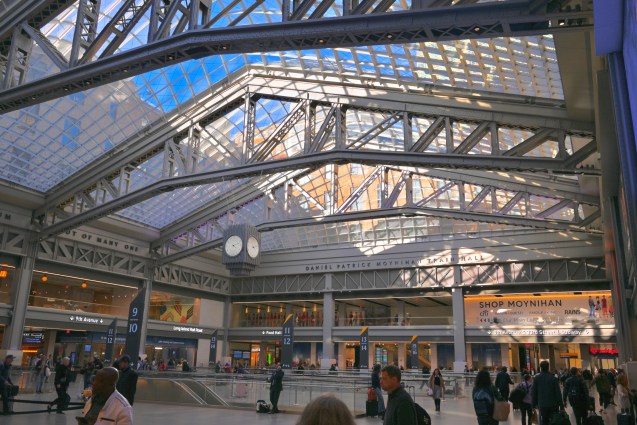
Main concourse, Moynihan Train Hall, New York City
By MICHAEL PERKINS
FOR THOSE WHO LIVE OUTSIDE NEW YORK CITY, it is hard to express the sense of loss that’s is still felt locally over the 1963 demolition of the old Penn Station railroad terminal. Crumbling from age and neglect, it was one of hundreds of landmarks that fell to the wrecking ball in an age where so-called “urban renewal” reigned supreme, and its end has continued to haunt urban planners ever since, as the very definition of a wasted opportunity. Today, classic buildings are more typically salvaged and repurposed, allowing their storied legacies to write new chapters for succeeding generations. Penn Station’s death was the Original Sin of a more careless age.
But sins can sometimes be redeemed.
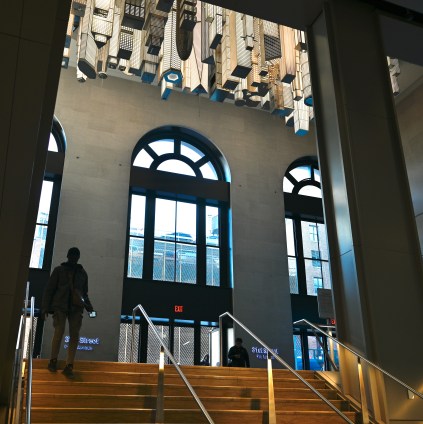
“The Hive” , a dramatic art installation inside the 21st Street entrance to Moynihan Train Hall.
Around 2000, Senator Daniel Patrick Moynihan, who, years before, had worked as a shoeshine boy inside the first Penn Station (which was “replaced” by a grim dungeon in the ’60’s on its original site), began to float the idea of augmenting rail access to Amtrak and other carriers by recreating the majesty of the old building in the most obvious place; across the street. Turns out that the terminal had a near-twin, just beyond the crosswalk on Eighth Avenue in New York’s old main post office, which, like the train station, was designed by the legendary firm of McKim, Mead & White. By the start of the 21st century, the post office, by then known as the James Farley building, had already begun to move many of its operations to other facilities, heading for white elephant status in one of the city’s most expensive neighborhoods. By the senator’s death in 2003, funding for what many locals were already calling the Moynihan Train Hall went through years of fiscal stop-and-start, careening like a foster child through the hands of half a dozen different potential sponsors. Construction finally began in 2017, with special care taken to preserve and restore the post office’s massive colonnade entrance, which was, itself, protected with landmark status.
On January 1, 2021, almost as a symbol of New York’s resurrection following its year-long struggle as the first epicenter of the Covid pandemic, the completed Moynihan Train Hall was finally dedicated by New York governor Andrew Cuomo. My photographs of the site now join those of millions of others as testimony to the power of the human imagination, as do the Hall’s waiting-room murals, which illustrate the grandeur of the terminal’s long-vanished predecessor, poignant reminders of the new building’s purpose in redeeming the sin of letting the old one be lost. Among the mural captions are the words of Daniel Patrick Moynihan himself, celebrating the town’s unique trove of tradition and talent:
Where else but in New York could you tear down a beautiful beaux-arts building and find another one across the street?
Amen. Praise all.
OPEN WIDE AND SAY AHHHH
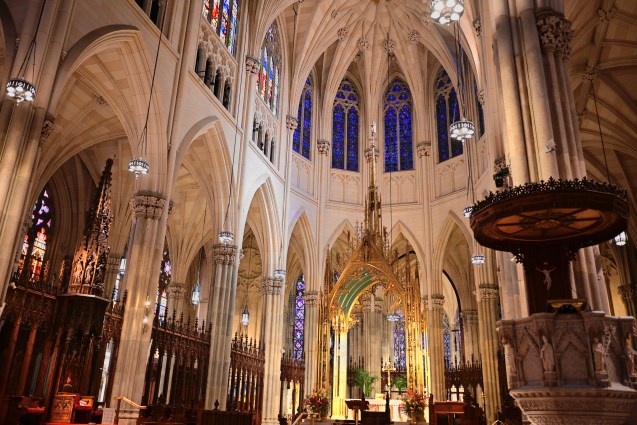
Handheld inside St. Patrick’s Cathedral, NYC. f/2.8, 28mm, ISO 1000, 1/50 sec.
By MICHAEL PERKINS
1960’s COMMERCIALS FOR THE SWINGER, Polaroid’s first entry-level instant camera, marketed mostly to teens, showed how easy it was to achieve good exposures, simply by twisting the knob that supported the shutter button. Too dark, and the word “NO” would appear in the viewfinder. Twist to tweak, and the display turned to “YES”. Many flubbed fotos later, we all learned (at substantial expense) that it really ain’t that simple. And in the years that followed, with better and better cameras, we still seemed to be getting a “YES” from our gear, only to find that the resulting image was definitely a “NO”.
The reason for all this reminiscing is the completely different experiences I’ve had in recent years taking shots that, just a while ago, were almost guaranteed to fail, but which now succeed, and amazingly well. You know the kind I mean; those extreme pockets of darkness and gloom where light goes to hide and pictures go to die. In my early DLSR days I did my best to harvest a higher percentage of them, working with that format’s smaller sensors, the fastest prime lenses I could afford, and higher ISO settings. Working on a tripod made even more of such shots possible, but those were always in the minority of overall frames. Let’s face it; unlike Ansel Adams, who could work all day waiting for the right shadow to hit the side of El Capitan, we largely live in a hand-held world. I got a lot of “NOs”.
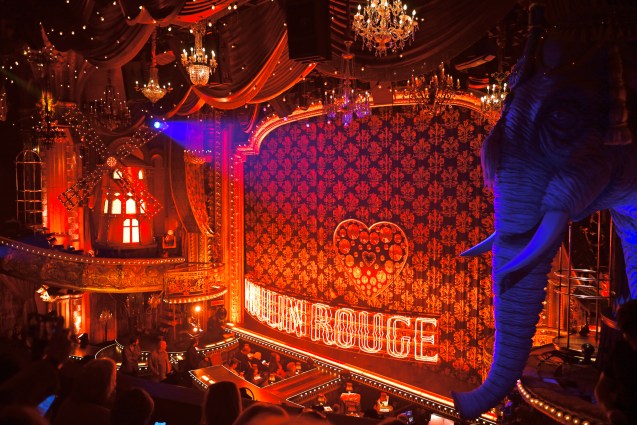
Just before curtain at Broadway’s Herschfeld Theatre. Hand-held at f/2.8, 28mm, ISO 2000, 1/100 sec.
After switching to a full-frame sensor and allowing for the tech to catch up in terms of more evenly rendering high-contrast subjects, even straight out of the camera, I find that the list of “undoables” is a lot shorter than it used to be, as witness the two shots in this article. Both are done with a 28mm lens wide open to f/2.8; both are handheld; both are taken inside locales (a cathedral and a Broadway theatre) known for harboring deep, deep pockets of shadow, often leading to dark patches that swallow detail or light areas that tend to blow out. Amazingly, minus a few minor color corrections, neither shot has been corrected in post.
In the days of our first cameras, we largely shot on an “if come” basis. If we did everything right to second-guess every technical tiger trap that was part of the process of calculating the shot, the picture might “come”. Maybe. And now, the carefree joy of picture-making which Polaroid promised back in the days of mini-skirts and paisley, a real closing of the gap between the imagining and the realizing of an image, might finally be imminent.
It’s enough to make you feel like a Swinger.
ALL ROADS LEAD TO EVERYWHERE

By MICHAEL PERKINS
OVER THE LAST QUARTER-CENTURY, ONE OF THE PERSISTENT BIASES THAT HAS HELPED CONVENTIONAL CAMERAS HOLD THEIR OWN against the tidal wave of cellphone-based photography has been the belief that there is some unbridgeable gulf between the amount of sophistication and control of old-school gear and the pocket-sized options of the average iPhone or Android. This belief has long helped the traditional camera manufacturers maintain a slim market edge over their upstart rivals. But if that belief was once justified, it is less so, now than ever before, and soon it will become merely a superstition.
Cellphones have exploded because they solve most of the problems that most regular photographers have with most of their shooting situations. And they do it intuitively, often instantaneously, and, in many cases, at a fraction of the cost of trad cameras. We are fast approaching a time when great, not merely satisfactory pictures, are obtainable universally, across all price points and platforms. Put simply, you may be buying a conventional machine simply because you like it better, rather than because it performs some magic that a mobile device can’t. In terms of getting the shot, we are almost at the point where all roads lead to everywhere.
To make a very specific comparison on an occasionally useful effect, i.e., selective focus, check out the image at the top, which was made on a Lensbaby Composer II with a “Sweet 35” optic. This particular art lens is designed to render a portion of the image sharply, with graduated blur surround that sweet spot. The optic can be rotated to place the sharper portion anywhere within the frame, and changing apertures will control how big the sweet spot is. This was shot at f/5.6.
Cost for both these components is well in excess of $250.
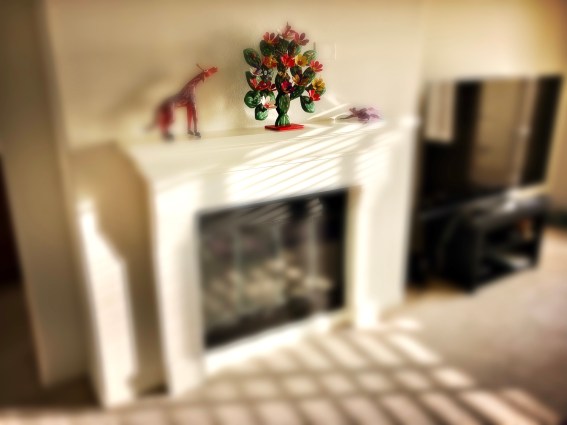
Now, consider the shot seen above. It was shot on an iPhone SE Generation 2 but the original image was in uniform sharpness. It was then processed in-phone with the Hipstamatic app, which offers options for “depth of field”, which, with a squeeze of two fingers, allows any part of the shot to be left sharp while the surrounding area goes to blur. If you louse up the placement of the sweet spot, you just re-do it in real time until you like it. The size of said sweet spot is likewise controlled by your fingers.
Cost: Well, you already own the phone, so all you need is the Hipstamatic app. In-camera purchases are available to emulate a variety of “lenses” and “films”, but the DOF tweak comes with the app, which is free. Yeah.
Are the two images identical in every respect? Of course not. BUT you tell me, or, more importantly, tell yourself what the answer is for you, for how you shoot, for the look you’re going for, what convenience means to you, and, most importantly, what your current concept of your “serious” or “real” camera is to you. It’s down to results, and, these days, results can be found nearly anyplace, using nearly anything.
BACK INSIDE THE HEARTBEAT
By MICHAEL PERKINS
I SPENT MY ENTIRE LAND-LOCKED OHIO CHILDHOOD longing to wander the concrete canyons of New York City.
I ordered things from the Big Apple just to see the return address on the packages that came to my little suburban Columbus house, as if I needed regular assurance that the Gotham of myth, the New Yawk of movies and music and literature, was an actual place. I was nearly forty before I got to make my first trip there; I was creeping up on fifty before it became a semi-regular destination, thanks to my having married a girl who grew up on Rockaway Beach and to whom “the City” was just a subway ride away. Better still, her sister and daughter still lived there, giving us a readymade excuse to leave the torrid flats of Arizona for regular recharges from the World’s Biggest Battery.

As you read this, I will finally have been able to visit Manhattan for the first time in five years, much of that dry spell enforced by the monastic life was all adopted during Covid. During the worst of the pandemic, which assaulted NYC with the force of a tsunami well before it hit the rest of us, I used the city as a flickering candle of resilience that we all prayed would not be snuffed out, posting images of the town from my archives nearly everyday on Facebook along with as much rah-rah encouragement for her resurrection as I could muster. Now, I am back inside the heartbeat, arriving in the season that is the most reflective for many, as it was for songwriter Vernon Duke:
Autumn in New York
Why does it seem so inviting?
Autumn in New York
It spells the thrill of first-nighting
Glittering crowds
And shimmering clouds
In canyons of steel
They’re making me feel
I’m home
I love turning my eye in all directions to try to capture the city’s drama, its grandeur, its errors, its untamed, electrical energy. In a city that never sleeps, I also want to remain awake; I might miss something. And sometimes, the boy inside me snaps the shutter purely out of instinct. Because, really, I’ve had all the pictures inside my head my entire life.
They’re making me feel I’m home.
‘TIS THE SEASON. ANY DAY NOW.
By MICHAEL PERKINS
MANY YEARS BEFORE I MYSELF MOVED TO CALIFORNIA, I heard reference to “soft seasons”, or a condition in which the four major quadrants of the natural calendar kind of mushed into one another like melted crayons. Spring, Summer, Fall and Winter no longer were distinguished by a hard, defined marker, as was the case in my native Ohio. I’d ask a CA native if they had winter, for example, and he’s reply, “we sorta have winter.” As I write this, I’m heading, for the first time in five years, back to New York City, where they definitely have fall and then definitely have winter. So seasons are where you find them, giving some of us a strange neutral-gear sensation that is now replicated in how we celebrate holidays. From now (today is October 7) to New Years’ Day, we are sorta in a holiday season, with a much blurrier distinction between the major celebrations than ever before. Happymerry Hallogivingmas, everyone!

Go into any store at this time of year and you will see holidays that used to have their own distinct lane suffering a dizzying case of merging traffic. In the case of this image, the spooky costumes of October are already being shoved out the door ahead of the Yuletide onslaught, something that old buzzards like me love to include on our “It Ain’t How It Used To Be” playlist. Having taken this picture, however, I am already puzzling as to why I did. Is this commentary? Humor? Protest? Is this even a good photograph, or is what’s seen here already so commonplace as to be banal? Do we need one more ticked-off geezer saying everything’s too commercial?
I mean, we all know why this happens. Retail needs more and more time to “make” its fiscal year, and the fourth quarter is the field on which that battle happens. Spending forecasts for the last three months of the year are nervously trotted out well before Labor Day, forcing retailers to stock as much as they can cram onto the sales floor, as early as they can. And now that I read back this paragraph, I have the answer to my earlier question as to whether this picture even needs to exist, or serves any purpose. Of course, I ask the same question about every picture I make. It’s just that I’m usually happier with the answer. Hand me the chocolate-covered turkey gingerbread, willya?
A SHOT IN THE DARK
By MICHAEL PERKINS
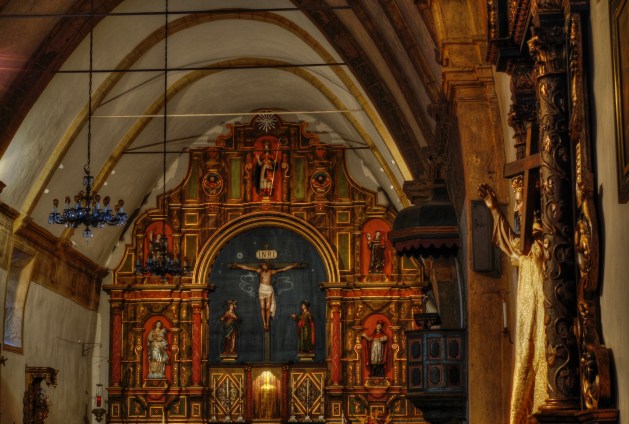
ONE OF THE MAJOR DINGS IN THE SIDE OF DIGITAL PHOTOGRAPHY in its earliest days, and something which gave analog haters a legit gripe against the emerging technology, was the narrow dynamic ranges of some of the first sensors. The full spectrum of exposure from light to dark was simply not represented in the earliest digital cameras, giving rise to more than a few smug “see? we TOLD you film was better” editorials. One of the first remedies to the problem, as we waited for the tech to catch up, was the fix known as HDR, or High Dynamic Range processing. Maybe you toyed with it; maybe you embraced it; and maybe you recoiled from it in horror. Fact is, it caught on big, and, by the time of this writing it is….well, less so.
The idea was simple. Just take several bracketed exposures, from dark to light, of the same subject in rapid succession, then stitch them all together in programs like Photomatix, tweaking the lows and taming the highs until you got a balanced composite. HDR was capable of rendering a variety of looks, from passably real to ultra-real to what I call Tolkien Fever Dream, with a heavy emphasis on enhanced sharpness. Soon, manufacturers, from conventional cameras to iPhone variants, hurried to bundle HDR generating software into their designs, simplifying the process, if not always achieving the same results.
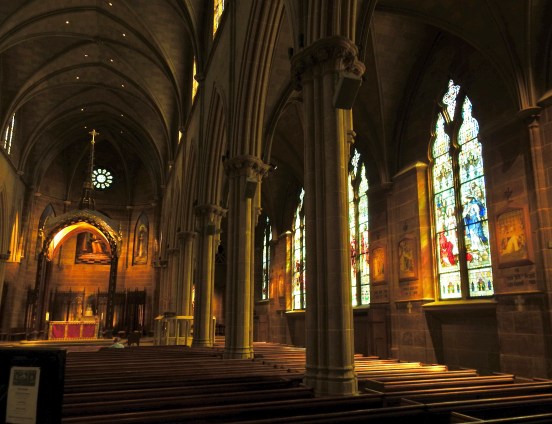
But yesterday’s essential hack is today’s bygone parlor trick. The image at top, made in 2010, is a Photomatix blend of seven different exposures, all taken on a tripod, inside as especially light-starved church in Monterey, California on a crop-sensor Nikon D60. The second image is a single, hand-held exposure inside an equally darkly church, taken on a full-frame Nikon Z5 in August 2024. A minor amount of shadow rescue was needed, and, of course there was some blowout on the stained-glass windows, but essentially this shot is straight out of the camera.
The facts on the ground have simply changed in a mighty big way. Sensors in nearly all cameras are much larger in 2024 than at the beginning of the digital era, resulting in a much wider dynamic range in even modest gear, and making for much more balanced exposures regardless of conditions or subject. This simply makes all the prep and mechanics of HDR manipulation unnecessary, rendering the process an art effect, or just another interpretive tool for special occasions. Once again, the forward march of technology works to remove more and more obstacles between the photographer’s vision and his machine’s ability to deliver that vision, a trend that began when the first Kodak Brownie enabled average shooters to make a predictably reliable picture with the touch of a single button over 100 years ago. Allowing photogs to get out of their own way, and to concentrate primarily on what they see in the moment….that is progress.
THE YEAR OF THE “GO” PILE
By MICHAEL PERKINS
THIS SPRING SAW THE CURTAIN RUNG DOWN ON OUR LIVES IN PHOENIX, ARIZONA. Marian had stuck it out in the Valley Of The Sun for thirty-three years; I put in twenty-five. We were both, as the young say, “over it” for some time prior to our move to California, but we had to wait until all the planets and stars lined up along with our retirement options to give us an escape window. What made the final phase of this strange was that, after decades of dreaming about The Final Day, we found the end-stage events leading up to it to be traveling at light speed. At the end of a looooong stretch of “wait”, we were fired out of a big “now” cannon.
I didn’t chronicle the entire project. On most days. there was simply too much to do in too short a span of time to stop to pick up a camera. We had about three furious weeks to finalize our new lease in Ventura, sort 3,000 square feet of earthly goods into a take-with pile comprising about half that space, hire and direct the efforts of an estate sale agent, get the surviving stuff packed and trucked westward, re-carpet the entire empty house, meet our transferred junk on the other end, and supervise the sale of the house through phone, fax and email. As I say, not a lot of time for snaps.
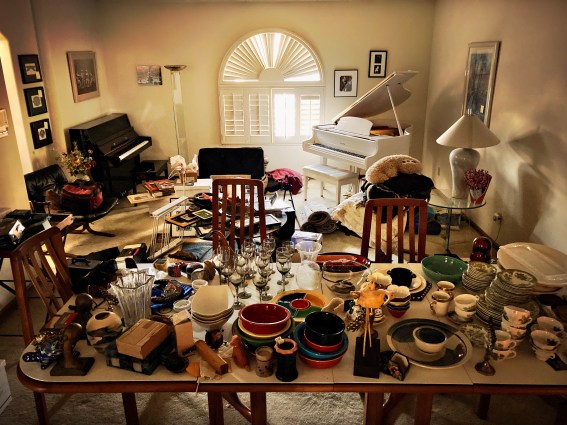
The scene here is something of a mish-mosh, in that it’s an early study of what-goes-what-stays, done before any final decisions for any of it were made. Hence, I can pick out objects, here and there, that we actually brought with us, some that went to estate sale, some that had yet to be ruled on, and a few things we thought we could sell that eventually went to charity. The reason this photo recently bobbed back up into my consciousness was because Marian and I are presently in the “did we leave that behind, or did we pack it?” phase, which looks as if it will go on for the next immediate….millennium. There were other photos made during the madness, including many tabletop commemorations of school and art projects by her two children going back over thirty-some years. Every museum isn’t a house, but every house is a museum. I could sum this all up by saying something philosophical about how little you can live with once you make a few tough calls, but I don’t want to congratulate myself too much while I am still occasionally opening boxes filled with “why the hell did I bring this…..?”
PARALLEL TRACKS
By MICHAEL PERKINS
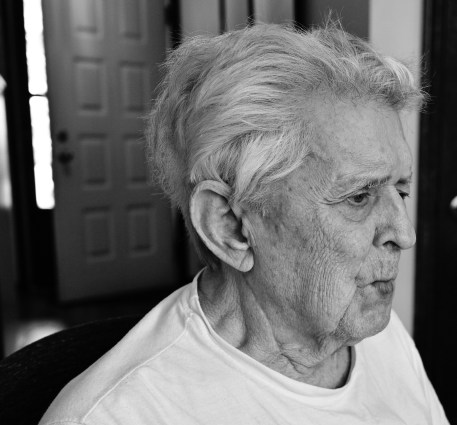
I’VE SPOKEN IN THESE PAGES BEFORE about the obligation and/or honor of photographically chronicling my ninety-five-year-old father’s last years, of being torn between wanting to create an honest, unvarnished record of his gentle but inevitable decline, and feeling duty-bound to also make the most reverent images of him possible for a family that will never really be ready to say goodbye to him.
It’s one massive juggling job, much of it done with a very solid lump in my throat. It’s chronicling a single human life along parallel tracks with dual versions of itself.
As a photographer himself, Dad raised me to be as visually alert and as honest as possible. He taught me that there is no such thing, for example as a “line” in nature, that what we call that thing is actually just a difference in the kind of light that meets two adjoining surfaces. That interpretation means respecting what you see but also extracting what’s not readily visible as well. Were he still able to see well enough to make pictures himself, I’d like to hope that he would support a version of him like the one seen above. I didn’t seek his permission. I had him in most cases totally to myself, and quietly, candidly made the images I felt needed to be made, but of two minds.
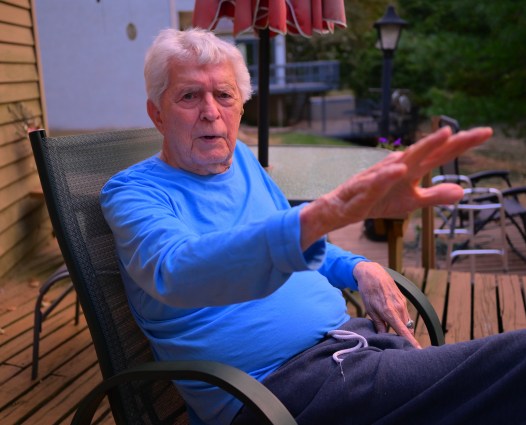
The second “mind” regards the way we would all prefer to think of him as his candle flickers. It’s taking the measure of the same face, maybe even on the same day, but with the benefit of a fresh shower and sunshine instead of cold overcast and emotional exhaustion. It’s as close to the difference between day and night as photographs can be. Both have their truth. Both have their special place in the heart.
Not every one will agree with both of these series of photos. Either they will regard one as too cruel, or they will see the other as too candy-coated. Maybe some would reject both. But if Dad taught me anything at all, he taught me to make something as well as you can. Well enough that you are proud to put your name to it at the bottom, to, in fact, testify, if you will, that you did it, you own it, you believe it. I hope I learned the lesson well enough for at least that.
QUEER QUBISM
By MICHAEL PERKINS
PHOTOGRAPHS ARE MORE AN INSIDE-OUT THAN OUTSIDE-IN PROCESS. We tend to think that the images we capture just sort of seeped or flooded their way into our cameras, but, just as often, we begin with a desire behind our eyes that then pours itself outward into the lens. Point of view is the real determinant of how a picture will be created: the thing is never really as simple as pointing at something and shooting. Where we stand, our choice of tools, our intuitive interpretation…these make or break a picture.
In recently shooting the “Canopy Walk”, a new treetop-height attraction in Reynoldsburg, Ohio’s Blacklick Woods Metro Park, I found myself confounded by the rangy, twisty contours of the platform. None of my standard lenses seemed able to corral the thing into a single frame, and, after several attempts to tell its story in that fashion, I switched gear completely and opted for an approach I can only call cubist.
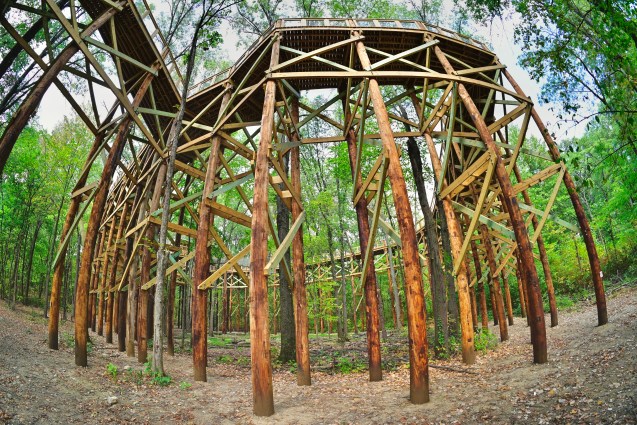
The widest lens I have in my kitbag is a TTArtisan 11mm lateral fisheye, which can enable more than one plane of view at a time, similar to cubist work from Picasso and other painters who felt imprisoned by the standard flat image and tried to suggest all sides of their subjects (left, right, over, under, etc.) by simply painting it that way, and “reality” be damned. The fisheye gives a photographer much the same freedom, as, in this image, we’re looking both down onto the forest floor, as if shooting from above, and up to the bottom of the platform, as if looking skyward. The lens also creates the illusion of looking around corners that would appear like hard angles in viewing them with a standard optic, plus both compressing and exaggerating spaces as they are twisted into strange mutations of their actual dimensions. The overall sensation is one of bigness, but a surreal kind of bigness, a design sprawling out of control. Like a cubist painting, the image is one of disorientation, a deconstruction of reality.
Or maybe it’s just a weird picture.
As is always the case, there is either a connection between my own queer cubism and the viewer’s tolerance, or there isn’t. The idea of making a picture isn’t really to have the final say but to have the first say, and then get a conversation going. Where we meet, or don’t meet, on each others terms of what “art” is can be frustrating or fun, actual or true.
ANOTHER OPENING, ANOTHER SHOW
By MICHAEL PERKINS
THE GOLDEN AGE OF CINEMA THEATRES, which saw its high tide during the glory days of the silent era, placed grandiose entertainment palaces within the reach of the common man from one end of America to the other, bestowing gilded temples, dripping with over-the-top ornamentation, on towns large and small. These grand retreats, awash in velvet curtains and cavernous prosceniums, recalled the lavish excesses of Aztec, Spanish, Greek and Moorish architecture, and served as gathering places where more than movies were on display. They were fantasy worlds in plaster and gold leaf.
By the end of the ’20’s, the era of the huge operatic movie palaces had mostly cooled, with a secondary crop of smaller venues dotting the map in tinier towns. By 1929, when the Boulevard theatre opened in the small farming community of Oxnard, California, there was a greater emphasis on streamlined Art Deco exteriors, spare ornamentation, and simple inner auditoriums. The Boulevard served for many years as the city’s only theatre, switching to Spanish language films in the ’60’s in order to survive a general downturn for neighborhood screens. By the 1990’s, the shuttered Boulevard had long since been renamed the Teatro, its old popcorn machine mouldering in the lobby and its seats an occasional refuge for the homeless. But as one curtain was ringing down for the building, another was about to go up.
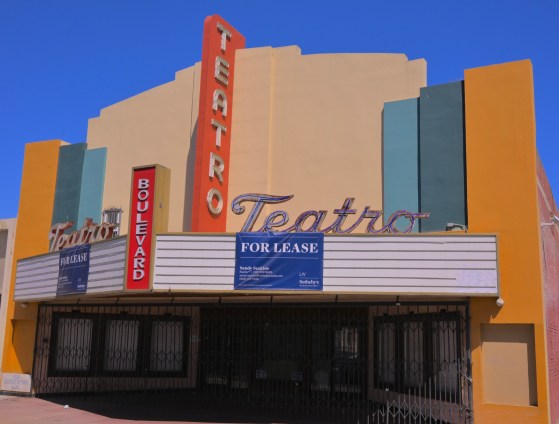
Oxnard, California’s Teatro Boulevard Theatre, frozen in pastel time, 2024
In 1995, recording engineer Mark Howard, taking a turn through the town, which was, at that time, right off the Pacific Coast Highway, spotted a “for lease” sign on the Teatro’s marquee and thought it might make for the kind of makeshift recording site which he favored over traditional studio setups. He suggested the idea to producer Daniel Lanois, already famous for having shepherded classic albums like U2’s Unforgettable Fire, Peter Gabriel’s Us and Bob Dylan’s Oh Mercy, and the two began a five-year collaboration on a series of recording projects that also had the effect of rehabilitating the latter-day careers of veteran rock and country legends. Among the best: the demo sessions for Dylan’s 1998 masterpiece Time Out Of Mind (which was actually finished in Miami) and Willie Nelson’s aptly titled Teatro, which featured an album cover picture of the theatre entrance very like the one I shot here.
After Howard and Lanois went their separate ways, other artists continued to seek out the Teatro, including Emmylou Harris, Red Hot Chili Peppers, and, most notably, Neil Young, playing with WIllie Nelson’s sons Lucas and Micah on The Monsanto Years, a protest about industrial farming practices in Southern California in towns like Oxnard. Today, the Teatro is again seeking a sponsor, its current owner dreaming of converting it to a live music venue, studio, or both. The former Boulevard’s exterior is still proud, elegant and colorful, and pretty much ready for its third act. I can’t wait to see how the movie ends.
POST CARDS FROM MEMORYLAND

Dave Willardson’s classic album cover for The Beach Boys’ CARL AND THE PASSIONS / SO TOUGH (1972)
By MICHAEL PERKINS
SOMETIMES THE WORST LOCATIONS TO PHOTOGRAPH A SUBJECT are the places where the most admirers of that subject are gathered. To put it politely, people generally make composition of an image an uphill slog, crammed together as they might be to appreciate a hobby, an event, or a collectible. This is certainly true with that staple of the weekend festival, the classic car show.
It’s one thing to find a bygone ride that you adore. It’s something else entirely to visually have it to yourself, with your fellow fans ogling, leaning in, looking into, posing with, or merely passing by in packs. Shooting an entire car at once becomes a virtual impossibility, and so the car has to be, to varying degrees, abstracted, with tighter-framed sections of it standing in for the whole. This usually means a focus on the elaborate grills, exterior contours like fenders or fins, or, in the case of this image, a door/wing window/mirror panel on a Ford Country Squire station wagon. The SoCal sunshine on the day of the shot had already boosted the extreme colors of the treated wood trim and aqua body, making the old girl look like one of those hyper-processed “Greetings from L.A.” post cards, and might have made for a great view of the entire side of the car had the area not been clogged with humanity. So the challenge became: how little of the car can I show in a cropped shot and still sell the idea effectively?

Hop In, Kids, Oxnard, California, 2024
The answer actually came to me later, in the editing phase, when my mind traveled sideways to a great cover from the 1972 Beach Boys album Carl & The Passions/So Tough, which featured a similar viewpoint by airbrush painter Dave Willardson, whose work graced dozens of classic records in the early ’70’s. Being that he wasn’t confined to mere reality, Dave was free to show a few fantasy palm trees and a surfboard reflected in the driver’s-side window, but the great thing about his conception was how little of the total car he actually showed. I played around with my own shot and decided that less could indeed be more in my case as well. Fans of anything can mar the view of the thing most adored, but that doesn’t mean the thing can’t be effectively photographed. You just cut away everything that isn’t an essential part of the story. It’s a fun ride.
NOT REAL. JUST TRUE.
By MICHAEL PERKINS
FOR PHOTOGRAPHERS, THE APP KNOWN AS HIPSTAMATIC BEGAN (in 2009) AS A BIT OF A CARNIVAL TRICK, back when mobile-based platforms for photo processing were the same kind of trendy novelty as custom phone rings. Just as it was fun, in the first heady days of iPhones, to replace the heads of your friends with squirrels or kitties, it was considered “crazy” that an entire app would be dedicated to simulating the look of various analog films or lenses. Hey, this is the digital age. Didn’t we just get rid of that stuff. What’s next, faux tintypes?

It’s Around Here Someplace, 2024. Master shot on an iPhone SE, post-processed with Hipstamatic “Jack London” lens and “Love 81” film filters
Well, of course, those came along, too…but the naysayers missed the point in thinking that a photog would only want to recall the look of Kodachrome or a pinhole lens just for the sheer weirdness of it. Turns out Hipstamatic and its many later imitators filled a need, just as, in another medium, a certain kind of brush or canvas might shape the final iteration of a painting, or a director may deliberately choose black-and-white as the better format for a feature film. Every era in photography has its own look, simply because the qualities, or even limits, of the recording systems in those eras had their own visual signatures. But if all Hipstamatic had provided photographers with was nothing more than the means to make new shots appear old, it would have rapidly faded. Instead, it became an interpretive tool, its digital filters shaping the outcome of pictures instead of just making another “version” of them. That makes Hipstamatic at least as legit for shooters as, say, silkscreening was for Andy Warhol. We’re talking tools.
International prizes for photography and journalism of Hipstamatic images by the likes of Francois Besch and the New York Times’ Damon Winter, awarded more than ten years ago, are no longer outliers. Certainly, many photo apps in the digital era are one-trick ponies or, worse, mere goofs, but the key to a tool’s survival is how many people decide to give it a permanent place in artists’ toolbox as a regular go-to or solution. If it’s used, it’s needed. If it’s needed, it stays.
KEEPING MY LUNCH DOWN
By MICHAEL PERKINS
I’M PRETTY SURE THAT MY FIRST-EVER DIGITAL CAMERA was the product of intense guilt. Allow me to explain…
For a while after my divorce and my move from Columbus, Ohio to Phoenix, Arizona, my ex and I persisted in buying Christmas and birthday gifts for each other, partly to convince ourselves that the break-up was amicable (it mostly was) and partly to delay admitting to ourselves that everything was, indeed, finished (boy, was it). And thus my introduction to digital photography, a puny Olympus Cambodia C-1, rocking an intense 1.3mp of raw power, arrived at my new apartment as a result of that awkward and protracted goodbye process.
At that point, early 2000, I was, like many people raised on film, still trying to decide if this whole digital deal was just a faddish toy, spiking its way into the pop culture stratosphere only to crash to earth with equal speed. I was far from impressed with the results from the camera, which I only occasionally picked up to play with, feeling I was obligated to at least try to like it since it was a guilt gift. The resolution topped out at a mighty 1280 x 960 pixels, rendering a barely acceptable image on a computer screen and absolute garbage for any print larger than a credit card. The Olympus was soon relegated to vacation snaps and candids only, with my “real” cameras doing the heavy lifting for any images that mattered.
But, of course, that changed, dinnit?
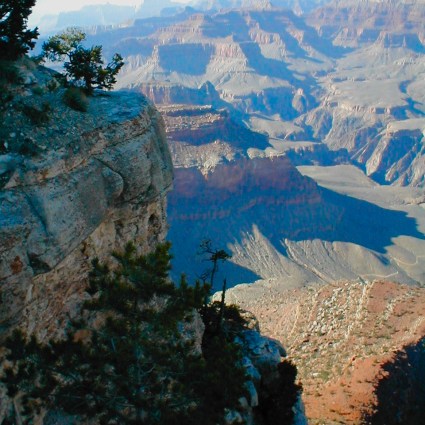
So ask yourself: what was the first digital image that you shot that was decent enough to share, or point to with any modicum of pride. For me, it was this Grand Canyon quickie, taken almost two years after I got the camera. This was the first inkling I got that, hey, this “dig-it-all” stuff might become something….someday.
Around this time, Chase Jarvis, a photographer who had made his professional bones shooting for accounts like Nike, Pepsi, Volvo and Apple (!), published The Best Camera Is The One That’s With You, a then-daring book of nothing but digital photographs shot on a two-MP camera on his phone. I was astounded at the audacity of the project: his results were as grainy and off-color and smudgy as my own….and he didn’t seem to mind. The entire point of the book was that you didn’t only shoot on days when you happened to pack your serious gear, but that you should free yourself by shooting whatever was in front of you, in the moment, with whatever was handy. It was a revelation/revolution for me as a shooter.
Suddenly I started reading up on the evolving state of digital…..who was switching to it, and why, and how the new medium was making its way into the mainstream. I had always known that stodgy old clubs like Arizona Highways or National Geographic would continue to cling to film as if it were the last copter leaving Saigon, but now I wanted them to justify that stance, to convince me that the old way still deserved to hold sway. My second digital camera, a Sony CyberShot sporting a screaming 5.1MP finally gave me pictures that evinced more smiles than winces, and I felt like a convert to a new religion. The deed was done and could not be undone. I was a digital guy.
In preparing to move westward to California several months ago, I spent far too much time poring over way too many photo files from my twenty-five years in Arizona, and the emotion I am experiencing most often is gratitude. I am grateful for the thousands of Ugly Duckling photos that eventually allowed me to occasionally produce a swan. As with all of the best in photography, you grow your gear after you’ve grown yourself, eventually hitting the plateau where you can make pictures with your best camera, which is, of course, the one that’s with you.
RE-EMBRACING THE RANDOM
By MICHAEL PERKINS
LIFE FOR PHOTOGRAPHERS HAS BECOME ENTIRELY TOO SAFE.
It’s to be expected, really. In recent decades the forward tsunami of technical improvement in cameras and editing options has almost completely “idiot-proofed” the process of making pictures. In nearly every possible scenario, today’s gear guarantees that you will at least get something usable every time you take a shot, and, in many cases, images that are far better than even your best efforts could have guaranteed just a few years ago. The risk of making visuall lousy photographs has been nearly zeroed out.
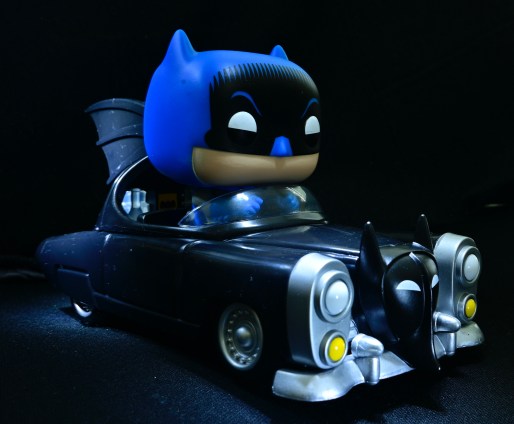
And that’s the problem. Because with the randomness of luck, which used to mean the potential for ruined images, there’s also the potential for the happy accident, the unplanned discovery that comes when something unpredictable is introduced into the mix. I was reminded of that in a recent return to the tabletop fun of light painting, where you shoot an object in complete darkness, with your camera set on full manual and mounted on a tripod. Using a remote shutter release for extra stability, you start the exposure on “bulb” setting, meaning that the shutter will stay open until you click it shut. You then selectively “paint” light onto the subject, passing over different parts of it with a small penlight. Unlike a static lighting scheme, this system more or less guarantees randomness, since you will never pass the light over the scene twice exactly the same way. And that very randomness affords you a kind of impulsive, instinctual indulgence from frame to frame.
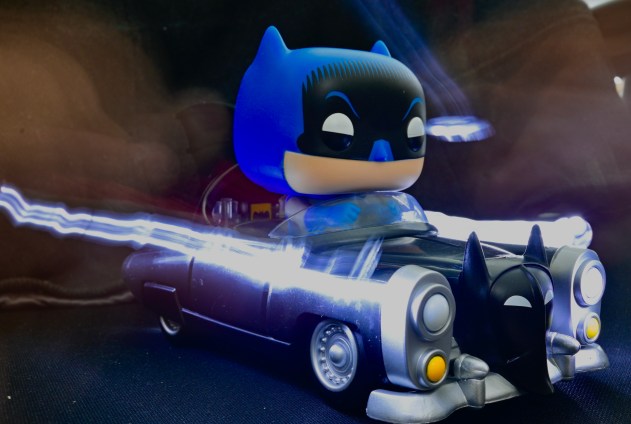
I usually shoot anywhere from thirty to fifty frames when doing a light painting, as I am always surprised or inspired by how the smallest variation in my passes will drastically affect the results. I can literally make the light look like it came from any direction, with whatever intensity I desire, from deep shadows to total blowouts. I can even let the flashlight itself be seen in the frame to suggest motion or speed, as seen in the above shot.
Is it art? Well, in that randomness is an element of risk/reward in photography, I’d say that art occurs when you can’t absolutely nail everything down. It’s often considered an alibi to say, of one’s occasional errors, “hey, I’m only human”, but, in photography, the same phrase might actually be a valid brag.
 thenormaleye