WE HERE DEDICATE….
By MICHAEL PERKINS
PHOTOGRAPHERS HAVE THEIR HANDS FULL, in the first third of the twenty-first century, documenting the vanishing details of the urban architecture of the 20th. Change is a constant and the elusive quality of “progress” is often equated with, to put it simply, knocking down the old to make room for the new. One very good reason to preserve all that visual detail is to show what we intended with older structures beyond their mere physical presence.
The so-called golden age of skyscrapers was fueled by the egos and aspirations of titans in government and business, with both forces incorporating expressions of ideals into the detail and design of their pet architectural projects. These places weren’t merely open to the public; they were dedicated to them, or at least to their loftier goals, with entrances, lobbies and outward ornamentation embodying beliefs, invoking virtues like trust, industry, fidelity, labor, integrity, or honesty in inscriptions, reliefs, and arches, as if such qualities were not only those of the building’s founders, but things eagerly to be wished for all who entered these common spaces.
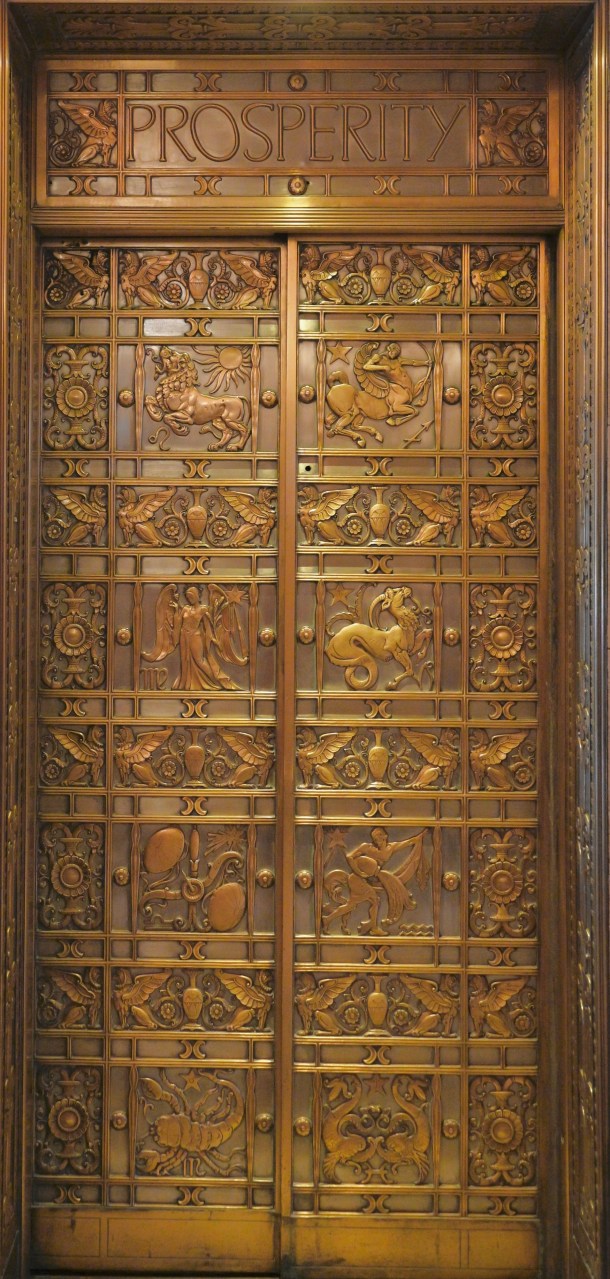
Elevator cab door, Leveque Tower, Columbus, Ohio
This elevator cab door, named “Prosperity” can be seen in Columbus, Ohio’s Leveque Tower (opened in 1927 as the American Insurance Union Citadel). It’s one of a group of three (the others are named “Health” and “Happiness”) that remain in the building’s lobby, and, like many interior and exterior designs of the time, also incorporate the signs and symbols of the zodiac. Photographing features like this is like summoning the past, not merely in its physical aspect, but also in its stated aims within its era; to instruct, to inspire, to act as a pledge of civic betterment. In an age of brutalist architecture characterized by bland or blunt concrete boxes, such sentiments seem beyond quaint; imbuing bank buildings or post offices with all that aspirational sloganeering feels over the top, corny. Better reason still to snap these signposts from a previous time before they are swept away. They are more than buildings, or, at least, they were intended to be.
REDEMPTION, ARRIVING ON TRACK 11
In the old time, you arrived at Pennsylvania Station at the train platform. You went up the stairs to heaven. Make that Manhattan. And we shall have it again. Praise All.
Senator Daniel Patrick Moynihan
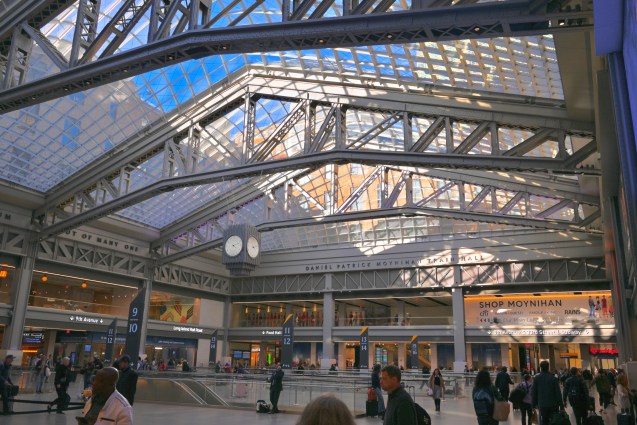
Main concourse, Moynihan Train Hall, New York City
By MICHAEL PERKINS
FOR THOSE WHO LIVE OUTSIDE NEW YORK CITY, it is hard to express the sense of loss that’s is still felt locally over the 1963 demolition of the old Penn Station railroad terminal. Crumbling from age and neglect, it was one of hundreds of landmarks that fell to the wrecking ball in an age where so-called “urban renewal” reigned supreme, and its end has continued to haunt urban planners ever since, as the very definition of a wasted opportunity. Today, classic buildings are more typically salvaged and repurposed, allowing their storied legacies to write new chapters for succeeding generations. Penn Station’s death was the Original Sin of a more careless age.
But sins can sometimes be redeemed.
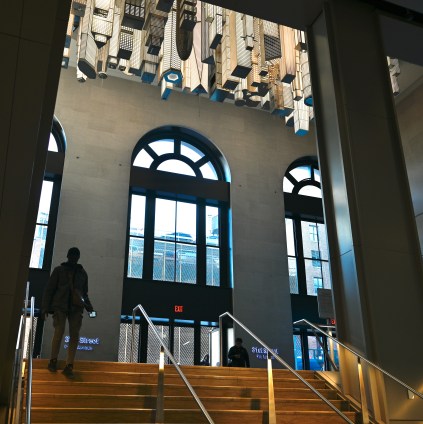
“The Hive” , a dramatic art installation inside the 21st Street entrance to Moynihan Train Hall.
Around 2000, Senator Daniel Patrick Moynihan, who, years before, had worked as a shoeshine boy inside the first Penn Station (which was “replaced” by a grim dungeon in the ’60’s on its original site), began to float the idea of augmenting rail access to Amtrak and other carriers by recreating the majesty of the old building in the most obvious place; across the street. Turns out that the terminal had a near-twin, just beyond the crosswalk on Eighth Avenue in New York’s old main post office, which, like the train station, was designed by the legendary firm of McKim, Mead & White. By the start of the 21st century, the post office, by then known as the James Farley building, had already begun to move many of its operations to other facilities, heading for white elephant status in one of the city’s most expensive neighborhoods. By the senator’s death in 2003, funding for what many locals were already calling the Moynihan Train Hall went through years of fiscal stop-and-start, careening like a foster child through the hands of half a dozen different potential sponsors. Construction finally began in 2017, with special care taken to preserve and restore the post office’s massive colonnade entrance, which was, itself, protected with landmark status.
On January 1, 2021, almost as a symbol of New York’s resurrection following its year-long struggle as the first epicenter of the Covid pandemic, the completed Moynihan Train Hall was finally dedicated by New York governor Andrew Cuomo. My photographs of the site now join those of millions of others as testimony to the power of the human imagination, as do the Hall’s waiting-room murals, which illustrate the grandeur of the terminal’s long-vanished predecessor, poignant reminders of the new building’s purpose in redeeming the sin of letting the old one be lost. Among the mural captions are the words of Daniel Patrick Moynihan himself, celebrating the town’s unique trove of tradition and talent:
Where else but in New York could you tear down a beautiful beaux-arts building and find another one across the street?
Amen. Praise all.
Of Hauntings Great And Small
By MICHAEL PERKINS
AS A PHOTGRAPHER, I TEND TO DIVIDE MUSEUMS into two general classes. The first includes the grand halls that act largely as warehouses for collections of disparate items from across history. The second consists of the more personal spaces that were actually once someone’s private dwelling, such as a presidential home or an historic manor. In the first class, the emphasis, at least for me, is on the visual appeal of individual objects, i.e., the mummy cases, caveman tools, etc. In the second class, the narrative lies in the physical space that surrounds the relics, that is, the feel of the house or structure itself.
When I am being conducted through a home where a great family raised its children, where its dreams and schemes were birthed, I of course am fascinated by their quilts, kerosene lamps, butter churns and such. But, since this was a place designed not as a housing for curiosities but as a place where actual people lived, I am interested in trying to show what it might have been like to personally occupy that space. What it was like to wake up with morning light streaming through a bedroom window. What the anticipation of callers felt like, viewing the back of the front door from the second-floor landing. What solitude a certain room might have afforded. Where glad and sad things happened.
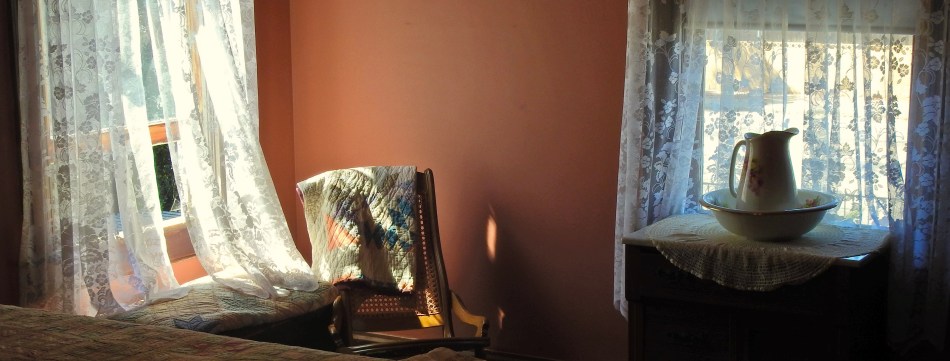
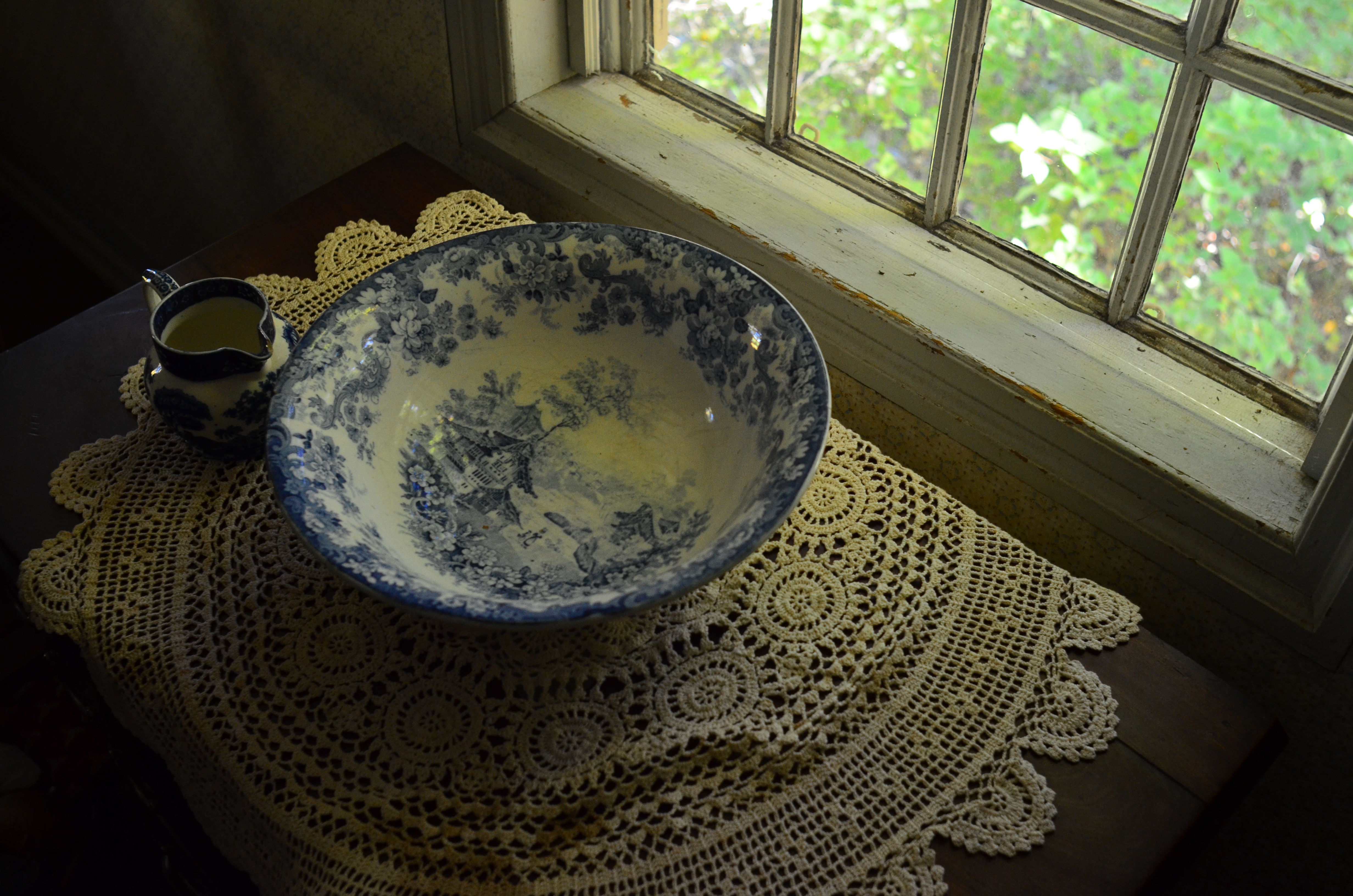
Take me to the Met and I will want to see certain things. Take me to an old family home and I will try to depict certain feelings. In the frame seen here, I was lucky enough to be in a bedroom where the delicate lace curtains at left were bending slightly inward from the window, courtesy of a cooling breeze. I began to wonder what it might be like to wake in such a room. What you would see first. How the basics of the room could create a feeling of solidity or safety. My only visual prop was the washstand at right, but that was enough. The suggestion of a life lived was present in just those basics, uncluttered by the mash of curios and collectibles that filled many of the home’s other rooms. Museums sort of represent a variety of hauntings, and their spirits can often speak more clearly in sparse, open settings. It’s like a whisper that you have to teach yourself to listen for. And then the pictures come…..
MULTIPLE RECKONINGS
By MICHAEL PERKINS
CERTAINLY SINCE THE DAWN OF DIGITAL PHOTOGRAPHY, and, with it, the fall of the last economic barrier to the making of many, many pictures, my urge to document simply everything that comes into my daily experience is stronger than at any time in my life. In short, I can afford to make many more attempts to document my journey through life than was even thinkable in the film-dominant age of my youth.
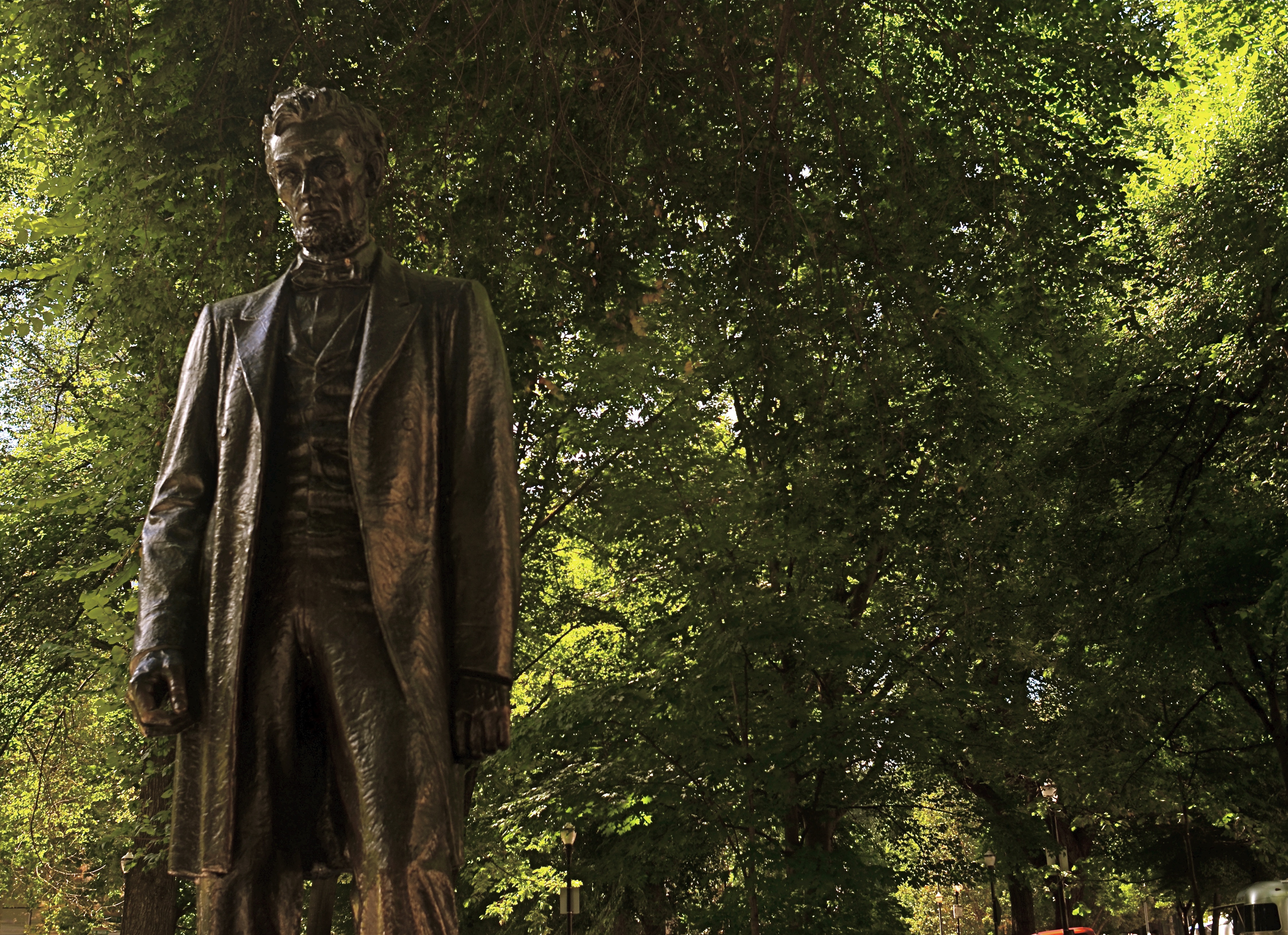
This means that I wind up recording much more of the world, and, accordingly, preserving more from its ever-changing churn of events. That fact came roaring home to me the other day when I was looking at some shots from a walking tour of Portland, Oregon that I took in 2018. One of the then-constant sights within the city’s South Park Blocks district was George Fite Waters’ statue of Abraham Lincoln, and, in happening upon it, it seemed like a no-brainer to take a quick snap of it. In reviewing the image, I idly wondered just how many public statues of the 16th president had actually been produced in the 163 years since his death. Turns out he may be the most memorialized figure in American history, with sculptures in over thirty American cities as well as carved effigies in Mexico, England, Norway, Scotland and even Russia (where he is depicted shaking hands with the Tsar…you may want to fact-check that event). Waters’ statue is perfectly average in every respect, except for the fact that, since I last viewed it, it just isn’t there anymore.
Apparently a particularly boisterous 2020 protest on the annual Indigenous Peoples’ Day Of Rage resulted in the toppling of not only the Lincoln statue but a marble depiction of Teddy Roosevelt’s Rough Rider days, with the result that both works are presently in a protective suspended state. Of course, what with all the tortured re-evaluations of the American Civil War seen in recent seasons, it seems consistent that Honest Abe himself remains as controversial as when he walked among us. At this writing the mayor of Sandy, Oregon still has an offer on the table to host both statues in his town, but the entire issue remains in limbo. Which allows me to circle back to my original point: nothing could be easier in the digital age but shooting any and everything that catches your fancy, for any reason. You don’t even have to have an opinion on whether something should be. The mere fact that it is, as well as the knowledge that, at a moment’s notice, it might no longer be, is enough to merit a picture. Snap away.
THE PERSISTENCE OF PRESENCE
By MICHAEL PERKINS
REVOLUTIONS IN TECHNOLOGY ARE CYCLICAL IN NATURE, in that, in ushering in the transition from one era to the next, they also create an entry door for future revolutions, to one day facilitate in the unseating of the age that is currently unseating something else. We see discoveries tear free from past versions of themselves, even as they guarantee that they themselves will be rendered obsolete. The loop is perfect and consistent.
The history of the railroad is the tale of worlds being annihilated or repurposed, of distance and time being shattered in favor of new means of measuring both. If trains were already completely obsolete, it would be necessary to erect monuments to their once-great power, but, as it is, their fade has been gradual enough that the infrastructure of the railways themselves serve as their own headstones. We can only imagine the true muscle they once flexed across the globe, but they are also in enough daily use to serve as miniature museums to their former glory.
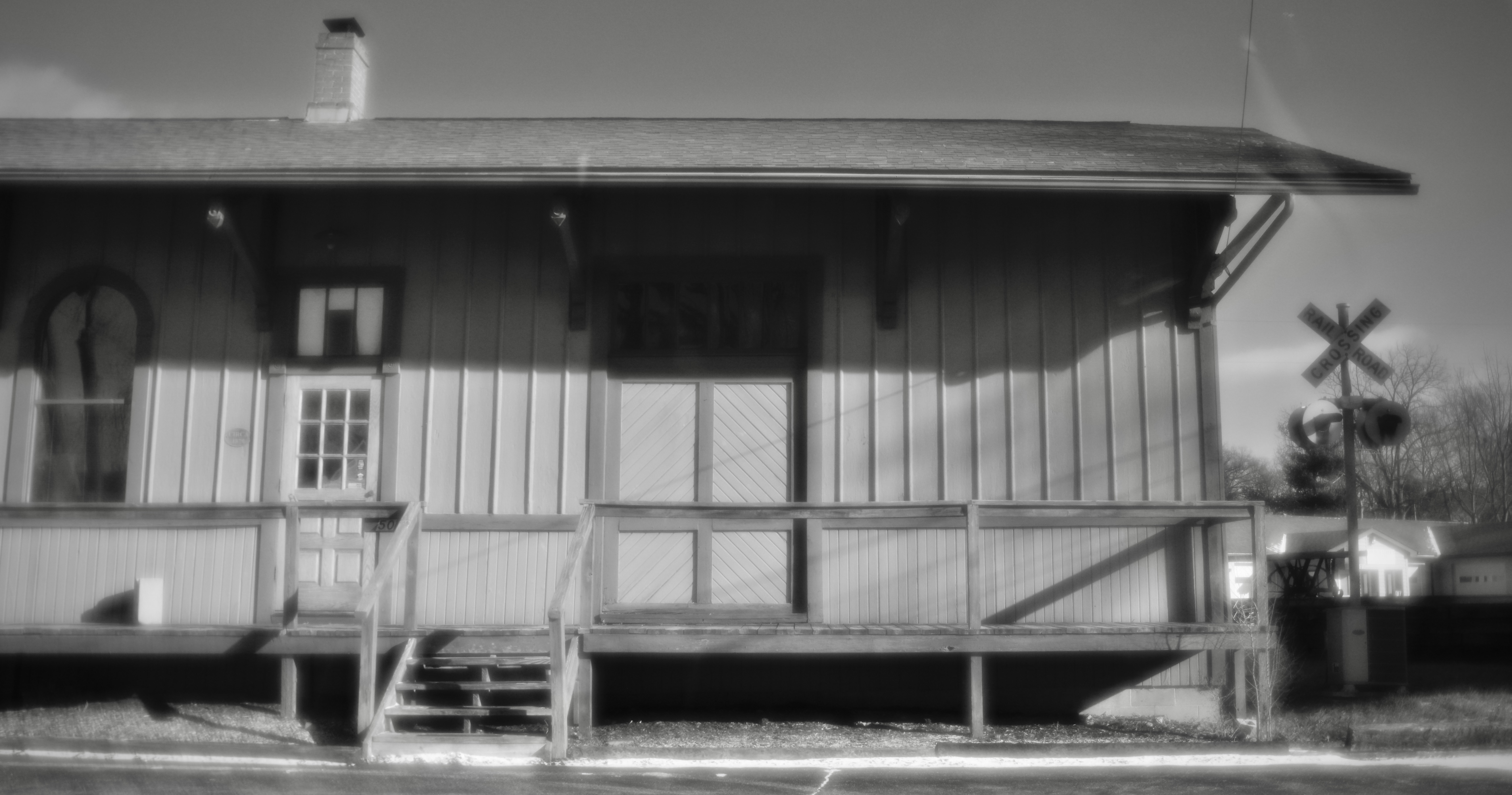
The depot seen here was erected in 1879 in Pickerington, Ohio, the same year the Toledo and Ohio rail line first sliced a diagonal across the town. The city, permanently frozen in size as a small farm village, never required a bigger version of the building, which is only slightly larger than a standard boxcar. One historian has noted that the architecture of such places was little more than an echo of the railroad itself, parallel to the tracks and low-profile in both shape and height. One thing seems certain about this particular depot, and that’s that it helped usher in its own obsolescence, when a local named D.B. Taylor took delivery of the first automobile registered in the town shortly after 1900. By 1956, local train service to Pickerington slowed to a trickle, then winked out completely. The station was restored in 1975 by a man named Grunewald, whose family still retains ownership, landing the building a prized berth on the National Registry of Historic Places.
I have visited Pickerington dozens of times over the years, and each time, I shoot the depot all over again, somehow seeing some small something different in it each time. Good weather and bad, fancy cameras or plain, film or digital, wide-angle, macro or soft focus lenses (like the Lensbaby Velvet 28 used here), I can’t resist having one more go. I suppose I’m actually photographing the different persons I have been over a lifetime, and so, even when the village is out of my way on a given trip, I drive to “Picktown” to assure myself that something of value from the past, however drab or simple, has been allowed to remain, to instruct, to educate, and to fill wandering man-boys’ heads with dreams of riding the rails.
BOATS AGAINST THE CURRENT
Act Of Faith #265 (2016)
By MICHAEL PERKINS
THE LATE STUDS TERKEL’S BOOKS created almost a category of their own, collecting memoirs from across the length and breadth of American experience and class in essential essays like Working, The Good War, and Hard Times. Traveling the length and breadth of the nation for over forty years, Terkel interviewed the big and the small, the meek, the marginal and the mighty, as they recalled their individual experiences in the wake of massive historical events, from wars to depressions. For one of his final social montages, he spoke to people in their twilight years about their efforts to remain positive and engaged despite lives that had often proven challenging, even tragic.
Its title: Hope Dies Last.
Upon first seeing the book, I had to read it, partly because it was Studs, and partly because that title spoke to my own minor acts of faith in what I look for in photographs. Pictures are often testimony about people who cannot be seen, measured in the objects they care about, or in which they invest their hope. We have all seen the tenacity of wildflowers thrusting up between the fissures of cracked concrete, and appreciated, in the abstract, what that image says about the faith of the human animal. We capture pictures of places bombed to ruin, then testify with our cameras as they begin, once more, to lay a stone upon a stone. Building. Dreaming. Launching our boats against the current.
Hope dies last.
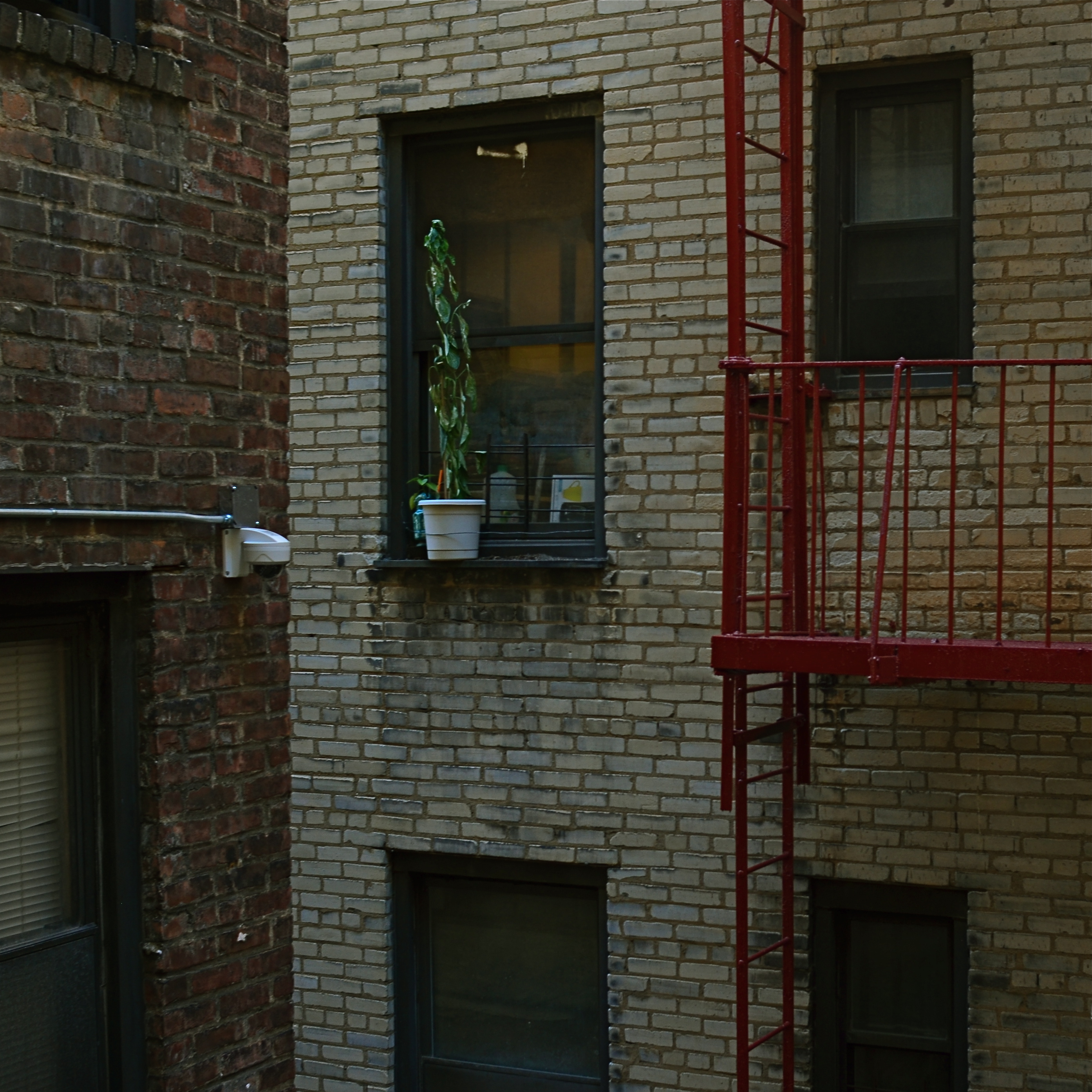
When I see a picture of something that, to me, symbolizes our collective refusal to knuckle under, I want to take it home with me. Because we need it. Now, yesterday, ever. We draw strength from that escapist wildflower, or a battered face upturned toward the light, or, as above, a potted plant defying the odds in a dark apartment air shaft. Someone decided to give that plant a chance…or, at least, to remind the grey walls and grimy brick that color and life are still around, still fighting for their shot.
Studs made his best case for the persistence of hope with the words of his interviewees. I find comfort in trying to find visual evidence of their actions. Either way, photographers can serve as conservators of hope.
If there’s a better gig to be had in this life, please let me know.
THE WRITE SIDE OF HISTORY
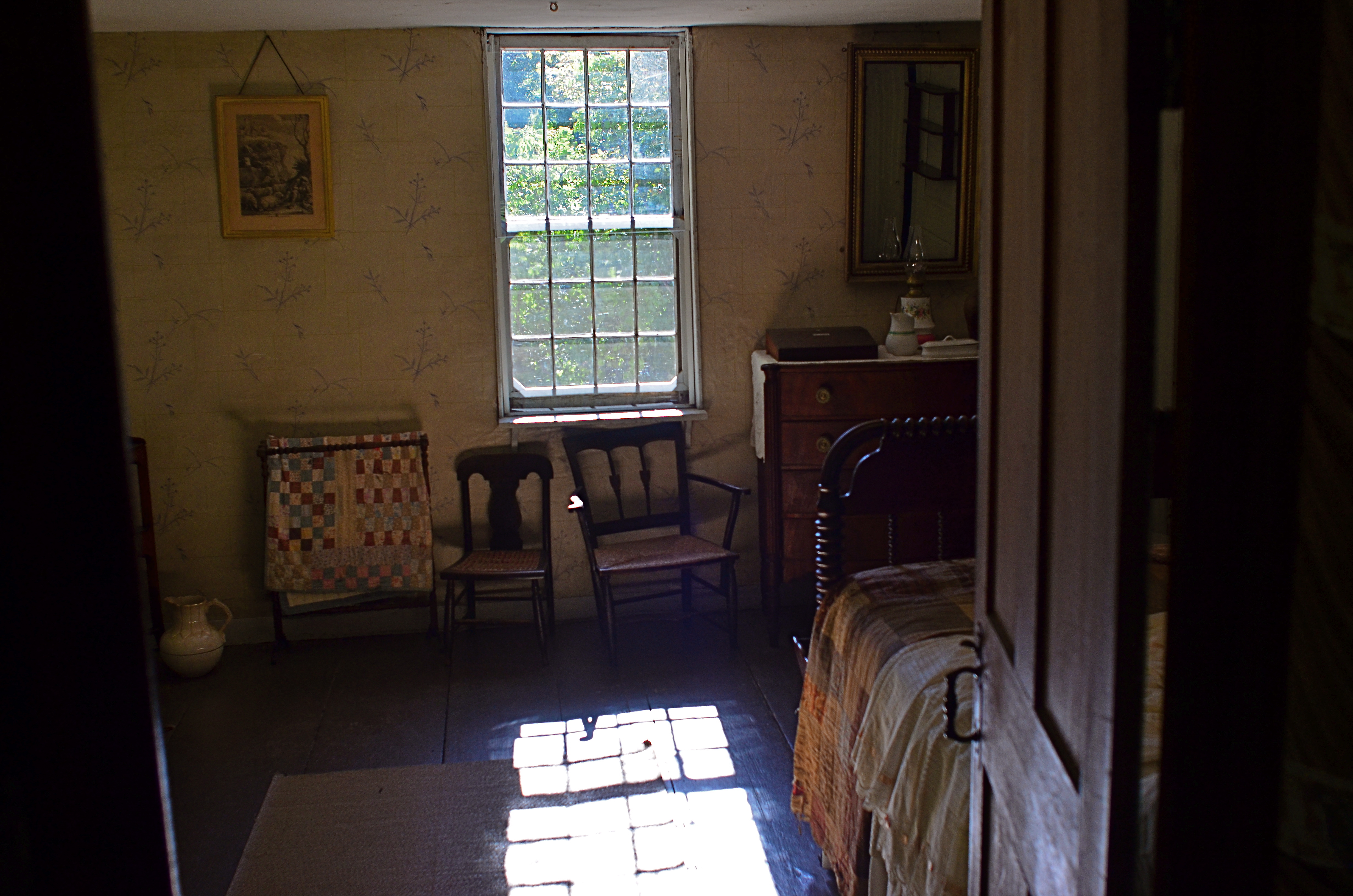
A sunlit bedroom at the Old Manse, the farm home built for the grandfather of Ralph Waldo Emerson.
By MICHAEL PERKINS
THERE CAN BE NO BETTER DEMONSTRATION OF THE HUMAN RACE’S TWO CONFLICTING APPROACHES TO EXISTENCE than are on display in the peaceful town of Concord, Massachusetts, where one of the most renowned jumping-off sites for war and destruction sits cheek-by-jowl with one of the quietest monuments to the serenity of the mind. It’s a contrast which no photographer should fail to experience.
Just a few hundred yards from the tiny footbridge which is rumored to have launched the American Revolution is a carefully preserved haven known as the Old Manse, a modest two-story country home built in 1770 for patriot minister William Emerson. The home came, eventually, to temporarily host a trio of the young nation’s most eloquent voices: Nathaniel Hawthorne, Henry David Thoreau, and Ralph Waldo Emerson (the good minister’s grand-son).
The house remained in the hands of the extended Emerson family until as late as 1939, when it was conveyed to the state’s Trustee of Reservations. Over the years, the Manse helped incubate the energies that produced Emerson’s Nature, Hawthorne’s Mosses From An Old Manse, and various love poems written between Thoreau and his wife. The house also retains writing desks used by Hawthorne and Emerson.
Over 90% of the Manse’s original furnishings from the 18th century have been preserved.
The manse supports itself, its side garden and its replica corn field with a modest bookstore and daily walking tours of the house’s rooms, which are said to feature nearly 90% of the structure’s original furnishings. However, as is the case with Annie Liebowitz’ profound essay on the living spaces of quintessential Americans, Pilgrimage, the effect of the house on the photographer’s eye can never only be in the arrangement of physical artifacts. There is something more ethereal going on than merely snapping The Place Where He Sat And Wrote, an unfilled space that exists between these mere things and the essence of those transcendent writers.
And while I’m not sentimental enough to believe that you can render a person just by photographing an object from his desk, there is something that lingers, however impossible it is to quantify. Revolutions are very amorphous things. Some come delivered by musket ball. Others arrive in wisps of quietude, seeping into the soul with the stealth of smoke. The Old Manse launched its own crop of “shots heard ’round the world”, the echoes of which can sometimes resound in the echo of an image.
It’s a lucky thing to be ready when the message comes.
 thenormaleye
SPHERE ITSELF
Wet Democracy (2017): The 1964 World’s Fair’s central icon as play space.
By MICHAEL PERKINS
CULTURAL ICONS, which burn very distinct patterns into our memory, can become the single most challenging subjects for photography. As templates for our key experiences, icons seem to insist upon being visualized in very narrow ways–the “official” or post card view, the version every shooter tries to emulate or mimic. By contrast, photography is all about rejecting the standard or the static. There must be, we insist, another way to try and see this thing beyond the obvious.
Upon its debut as the central symbol for the 1964 New York World’s Fair, the stainless steel structure known as the Unisphere was presented as the emblem of the peaceful ideals put forth by the Exhibition’s creators. Under the theme “Peace Through Understanding”, the Uni, 120 feet across and 140 feet in height, was cordoned off from foot traffic and encircled by jetting fountains,which were designed to camouflage the globe’s immense pedestal, creating the illusion that this ideal planet was, in effect, floating in space. Anchoring the Fair site at its center, the Unisphere became the big show’s default souvenir trademark, immortalized in hundreds of licensed products, dozens of press releases and gazillions of candid photographs. The message was clear: To visually “do” the fair, you had to snap the sphere.
After the curtain was rung down on the event and Flushing Meadows-Corona Park began a slow, sad slide toward decay, the Unisphere, coated with grime and buckling under the twin tyrannies of weather and time, nearly became the world’s most famous chunk of scrap metal. By 1995, however, the tide had turned; the globe was protected by the New York City Landmarks Preservation Commission, and its rehabilitation was accompanied by a restoration of its encircling fountains, which were put back in service in 2010. The fair park, itself staging a comeback, welcomed back its space-age jewel.
As for photography: over the decades, 99% of the amateur images of the Unisphere have conformed to the photographic norm for icons: a certain aloof distance, a careful respect. Many pictures show the sphere alone, not even framed by the park trees that flank it on all sides, while many others are composed so that not one of the many daily visitors to the park can be seen, robbing this giant of the impact imparted by a true sense of scale.
In shooting Uni myself for the first time, I found it impossible not only to include the people around it, but to marvel at how completely they now possess it. The decorum of the ’64 fair as Prestigious Event now long gone, the sphere has been claimed for the very masses for whom it was built: as recreation site, as family gathering place..and, yes, as the biggest wading pool in New York.
This repurposing, for me, freed the Unisphere from the gilded cage of iconography and allowed me to see it as something completely new, no longer an abstraction of the people’s hopes, but as a real measure of their daily lives. Photographs are about where you go and also where you hope to go. And sometimes the only thing your eye has to phere is sphere itself.
Share this:
July 29, 2017 | Categories: Americana, Arts, Cities, Commentary | Tags: American History, Composition, New York, World's Fairs | Leave a comment