ALL OR NEARLY ALL
By MICHAEL PERKINS
A COMMON MISTAKE AMONG CAMERA-TOTING NEWBIE BIRDWATCHERS (a very distinct subset among photographers at large) is to regard their outings as either Successes or Failures, as if they were hunting for deer, or trying to land a ten-pound bass. That is, either I ‘came back with something’, or the morning was a waste of time. Of course, it’s disappointing when either no birds show, or the ones that do show can’t be persuaded to jump into your camera. I have even heard some photogs say that, unless they actually managed to capture an image of a particular breed or species, it doesn’t, for them, really exist. Such people are bound not only to be horribly bad birders; they are also likely to be failed photographers.
To be out in the world in search of a particular thing is to deliberately narrow your concept of what’s “worth shooting”, and it’s counter-productive to why you should be out in the first place; to develop and exercise your eye. Certainly, there will be days when the winged ones seem to be deliberately thwarting you, but who said that they must be the only thing you train your camera on while you’re out anyway? In short, if the birds ain’t happening, what else is? If you’re not trying to answer that question, then your shooting experience will be pass/fail, completely binary. It’s as if you went to a state fair and said you were only going to shoot the hot dog stands. Using that logic, a quartet of naked aerialists juggling flaming chainsaws might pass by you while you held out for a shot of a wiener on a stick. Short-sighted?
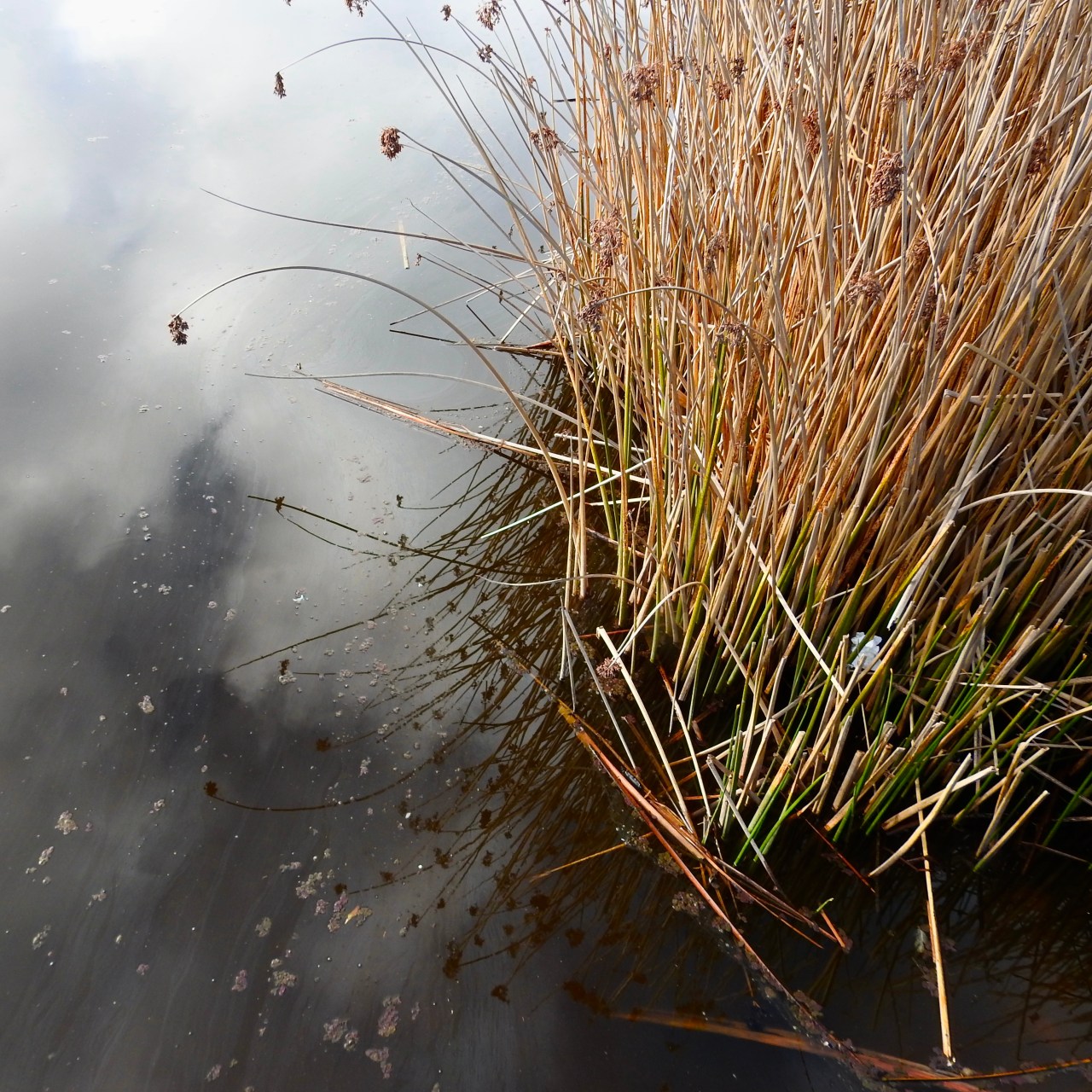
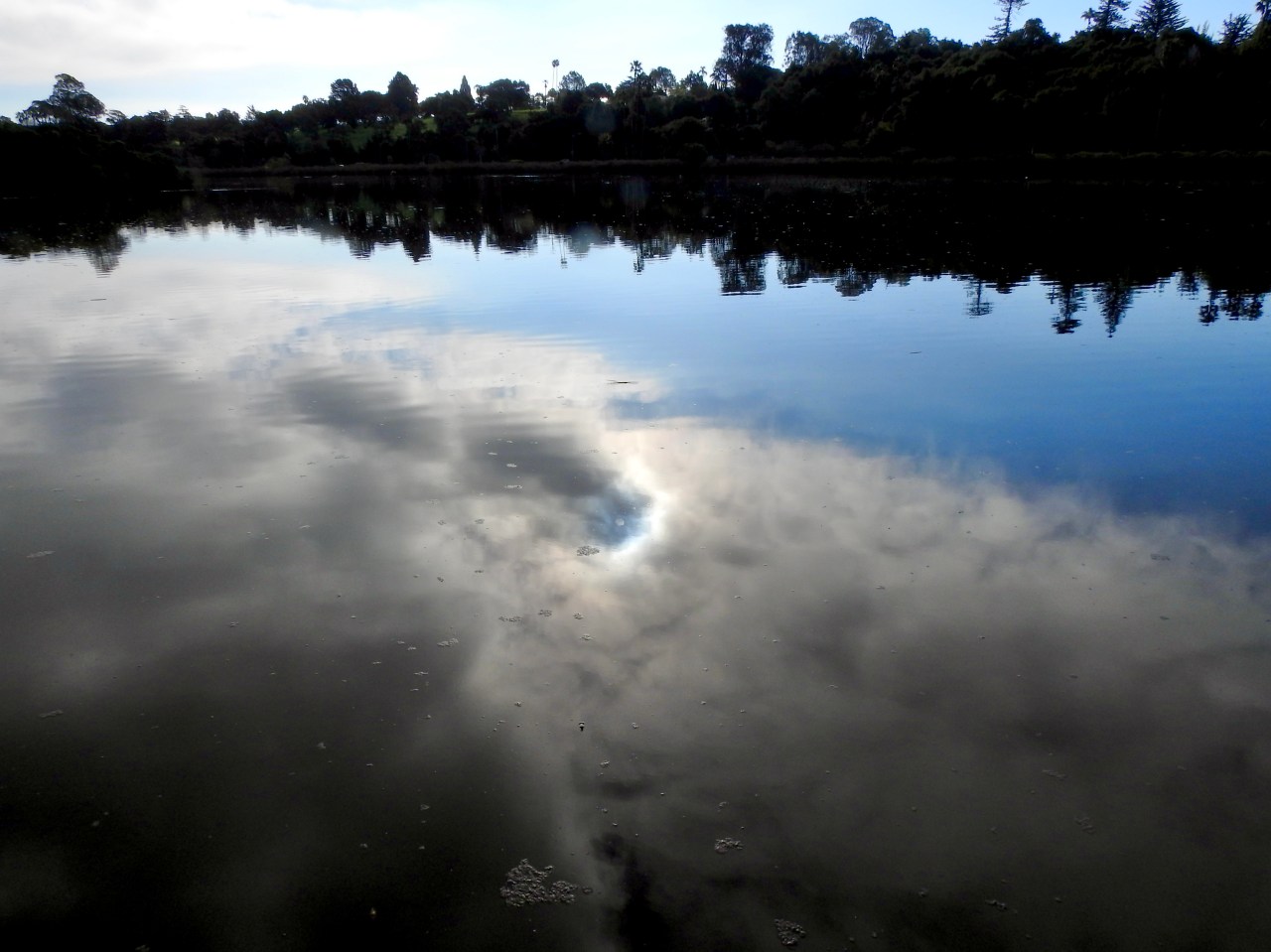
Some of the things that redeem many of my birding outings have nothing to do with what I couldn’t find and everything to do with what else was available in the moment. Birdwatching is really about observation, and so, being already in that state of mind, why wouldn’t you also be equally fascinated with whatever else comes to hand? Yesterday I shot over 100 frames, most of them failed attempts at capturing winged subjects that were just having none of it. As birding is usually communal, this left me with a lot of time to fill, since the others in my pack were having better luck or were simply more skilled. As they scored on the feathered column of their scorecards, I shot environmental impressions of a pond we were scouting. It wasn’t what I came for, but I was glad I didn’t write off the entire morning as a “miss”. Photographers obviously stumble upon many naturally amazing scenes that are, if you will, “ready-to-eat”, but remaining open to the less obvious is even more important than a quick win. That’s where your growth comes from. A bird in the hand….
lower case G’s
By MICHAEL PERKINS
THE HUMAN VANITY WITH WHICH ALL PHOTOGRAPHERS, much like disposable cameras, come “pre-loaded” would have our audiences believe that all our work is the product of meticulous, deliberate planning, a “vision” that flows, fully formed, from our marvelous minds through the lens. Of course, anyone who’s taken the requisite number of rotten pictures needed to attain any skill whatever knows that this is a fantasy.
The raw fact is that many, many of our most wonderful photographic notions die a-borning. Either they come up short because we don’t possess enough skill to execute them or they fall prey to a thousand random factors that occur in the instant an exposure is made. And while we are more than willing to parade our successes as if they are de rigueur, something that happens effortlessly everytime we trip a shutter, we don’t tout the many happy accidents that sometimes work out better than what we started out to achieve. We aim at upper-case “Greatness” and, instead, get lower-case “gifts” from the Gods Of Camera Randomness.
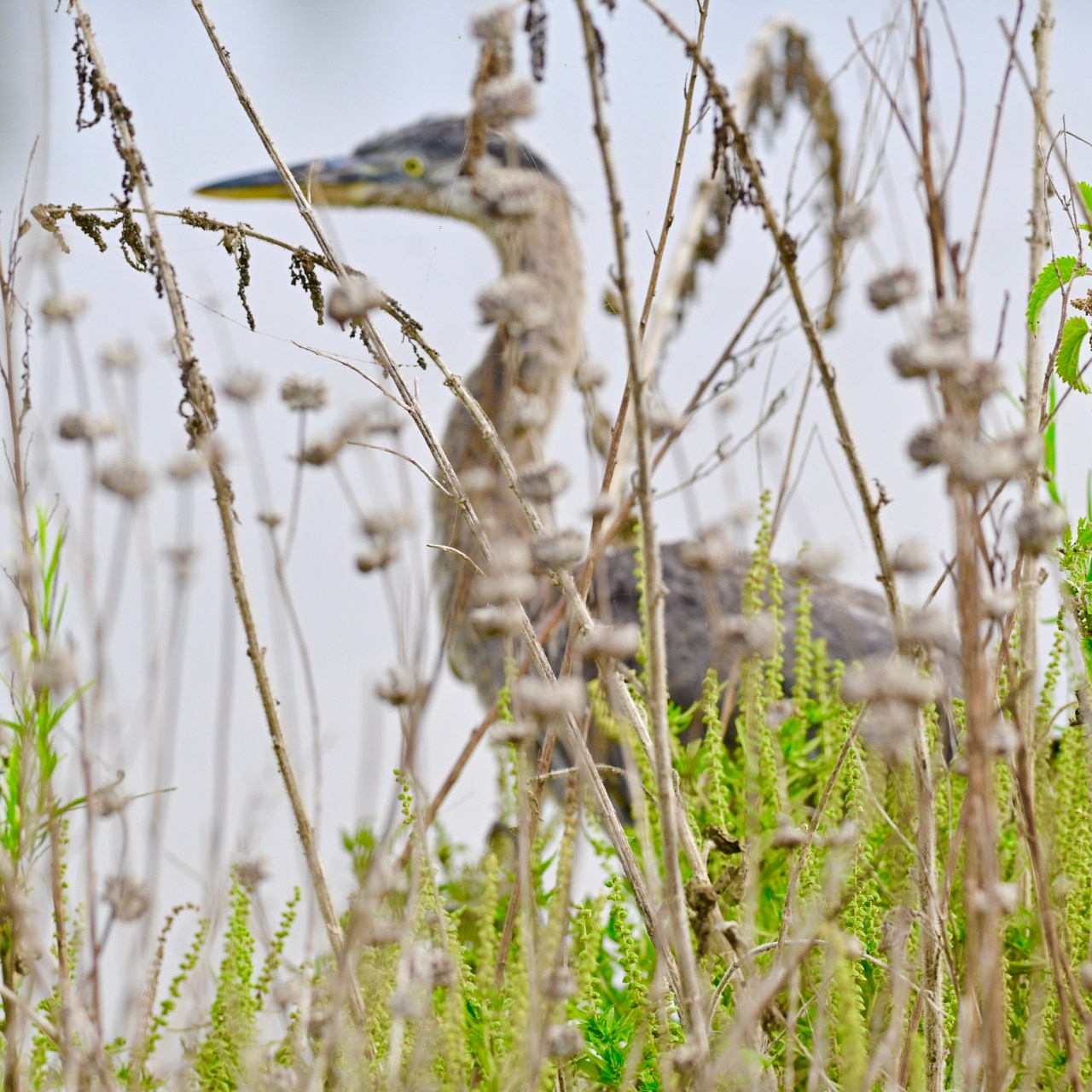
This image began as a gift, then had the brief potential for Great, then receded back down to a lesser gift. The juvenile heron you see here was pausing in a tall pond bank of reeds and flowers just twenty feet from where I and a group of birders were standing. Our binocular and telephoto gazes had been fixed on other birds, farther out in the water, when we suddenly realized this gorgeous creature was practically standing next to us, young enough to be unspooked by a cluster of aging hobbyists. The race was then on to grab some kind of image before he realized that he would be far better off putting some distance between us and him.
The foliage in front of him made autofocus useless, in that my lens would try to render the closest thing to it in sharpest relief, blurring out the bird. Switching to manual, I was racing against the clock to lock in the heron’s face before he could move even an inch and go back out of focus. I got five frames cranked off before he took wing, none of which had been in perfect register. Had I failed? Was I left with a generally bad batch, or could at least one image be said to deliver something more than a perfectly sharp frame might have? I had failed to capture “Greatness”, but had I truly been given a “gift”?
I know what you’re thinking. Photographers are all too eager to excuse their failures and try to see them as strengths, like an indulgent parent who sees a budding Picasso in his child’s incomprehensible crayon scrawl. I’m certainly not immune to my own ego, nor my bias toward whatever wretched messes emerge from my camera.
Still….
I’LL LET MYSELF OUT
Leave a tender moment alone. —Billy Joel
By MICHAEL PERKINS
I HAVE KNOWN MANY CREATIVE TYPES, from writers to painters to musicians to photographers, who struggle with deadlines. Not because they actually can’t complete assignments or projects on time, but because they find it excruciating to pry their fingers off their work, surrender it, and let it stand on its own….to, in effect say, it’s done enough; it’s good enough. Or, more precisely, realizing that it’s as good as I can make it, and that, perhaps, continuing to tinker with it in search of perfection will actually invite more flaws.
We know how to enter the “room” of a piece of work. Knowing when to head for the exit is something else again.
As a photographer who largely works for himself, I usually have the luxury of fiddling endlessly with images in the hope that I can somehow make them one step, one click, one fix closer to “finished”. This is actually a trap. If I were, in fact, delivering work on someone else’s dime, I would know that the delivery date is Friday at 5pm and that’s it. Bam. The rigid forces of the marketplace would guarantee that there would come a point when I would lay down my pencil and hand over the work. When the boss is me, not so much.
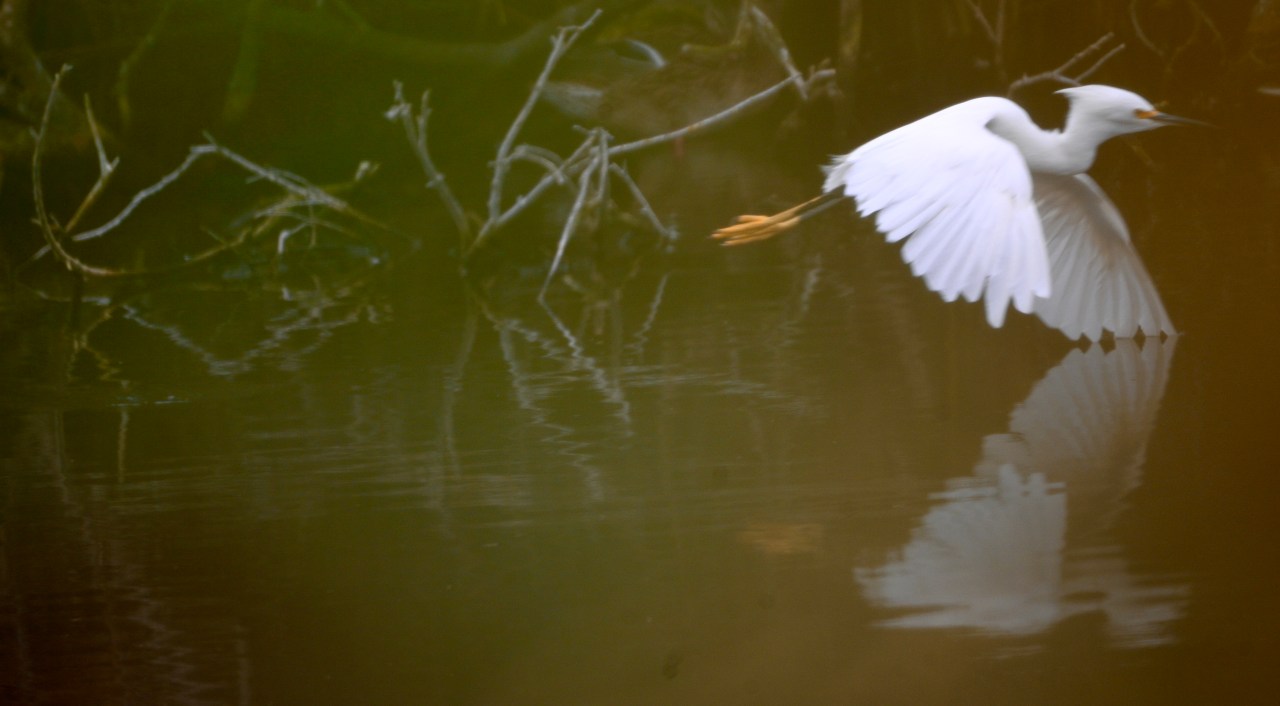
600mm, 1/400sec.,ISO 400, f/6.3
Take this image. It was a complete accident, the final image of a series of shots of an egret who had remained pretty much stable near a riverbank as I cranked away. Then, without warning, he decided to fly away, allowing me two panic-driven clicks of his exit within about a second and a half. My autofocus made a brave attempt at freezing the action, but in trying to track the bird, I was bound to create some amount of camera shake, all made worse by the fact that I was clear across the river and zoomed out at 600mm handheld. The second of the two frames largely worked, in that I caught the gorgeous contour of the bird and the reflection of his wings as they lightly skimmed the surface of the water. But the softness bothered me somehow, and so I was stuck with a technically imperfect shot that, for at least an hour or two, I told myself that I could somehow “fix”.
But you can’t really insert precision where it was lacking in the master shot, something I often have to admit only after fruitless tinkering, a desperate chase that leaves me with so-called “improved” versions of the shot that still, somehow, pale next to the original. You have to fight to keep the innocence and discovery in your work. Sometimes that means that you have to show yourself the door before you’re really ready. Often as not, though, it’s the most strategic exit you can make.
IT’S RIGHT ON THE WAY
By MICHAEL PERKINS
I WON’T SAY THAT I’M EXACTLY GRATEFUL for my meager skills as a birdwatcher, but I will state that, in my specific case, being mediocre at it has been a boon to my photography. To be more precise, my inability to spot as many varieties of winged wonders as my birding companions often results in my mind wandering while others about me are transfixed, as the photographer in me swiftly moving from “what birds are to shoot?” to “what else is there to shoot?”
Fact is, when the rest of the pack is following the various melodic “whoots” and wheets” of whatever is hiding in the foliage, I frequently answer with the call of the adult Dull-Witted Geezer, a song that sounds like “WHERE? WHERE?” as I rotate my head madly from side to side. Here’s the deal: when I can’t see what everyone else can see, my attention flags, at which time I’m glad that most of the outings are half birdwatch and half nature walk. Because, let’s face it, many birders come home from a walk with bupkis to show for their efforts, while a nice little saunter through the woods always yields something. And all photographers want to go home with something. Anything.
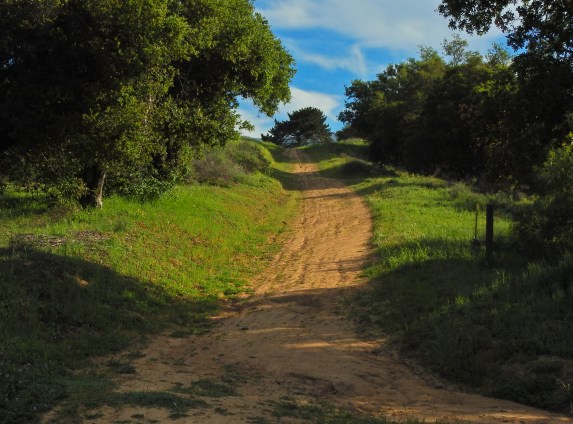
This bright little path rising up through a small wood spoke to me one recent morning when the birds were basically giving me the middle feather. Despite my plaintive “where? where?” cries, no mercy was shown me, and so, when all others were riveted to the ground, binocs trained on some divine sight, I turned about 180 degrees the other way and found a golden moment. The very best thing about being out with birders is that, given their very deliberate (spelled “obsessive”) pacing, I can click away to my heart’s content without worrying that they will have moved on, or, God forbid, are tapping their feet waiting for me to catch up. No, I can shoot everything I care to, go out for coffee, return my morning emails, blink off for a quick nap, and they will very likely still be standing in the same spot when I return. Come to think on it, I wish I could have had this bunch with me on all those vacations when my kids kept asking me, “are you still taking pictures?”
Now, I have my own path.
atureAs you can see.
HURT TIL IT SMILES
By MICHAEL PERKINS
WILDLIFE HAS BEEN SUCH A SMALL SUBSET of my overall photographic work over a lifetime that it holds a very special challenge for me. In shooting nearly everything else, I have landed at what might be termed a plateau of competence, an ability, through repetition and practice, to predictably deliver a decent result in a variety of disciplines. However, immersing myself in nature subjects places me so far outside my comfort zone, so far from any smug illusions of mastery, that it involves real risk. Ironically, more than ever before, that is where I am deliberately placing myself. Art doesn’t always thrive in the danger zone, but, on the other hand, doing what you’ve always done means you’ll always get what you’ve always gotten.
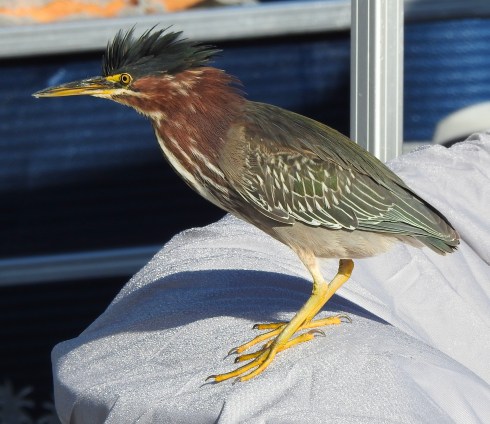
Green heron perched on a boat. Best to take the freebie and relax, but….(see next)
Bird work is a subset inside a subset, occupying a larger portion of my nature output in recent years, and offering equal portions of satisfaction and frustration. Birds are unlike other subjects for portrait work because they don’t care what I want and aren’t here to make me a success at it. They exist in their own sphere and under their own impulses and needs, and whether I can focus fast enough to catch them on the wing, or compose well enough to properly showcase them is of no importance to them. I am, by habit, caught up in what I want to achieve or capture, or, technically, succeed at. To properly photograph a bird, you have to shift every normal emphasis of style and approach. You can’t go out with a given quota or “yield” in mind, as conditions shift so quickly, so consistently that, on many days, you’re fortunate to have even a single usable shot to show for your effort. But that’s not really a negative. In fact, quite the opposite.
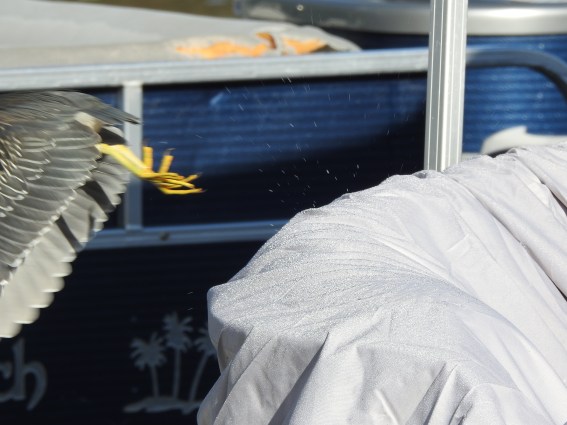
…Mr. Heron decides he’s out of here, and you’re too slow, boyo. In otherwords, a typical day.
To, as portrait photographers used to term it, “watch the birdie”, you have to develop a different kind of watching than for any other form of photography. You have to slow down. You have to listen as well as see. And you need to silence the part of your ego that instinctively thinks of the photograph as a trophy, as one more scalp on your belt. It sounds very New Age-y to say that you need to “let the picture take you”, but that is, at least, an approximation of what you’re aspiring to. Finally, given the sheer number of blown shots you must walk past on the way to the keepers, you need to be all right with failure, or at least be able to find a new definition of “success”. Art is not something that’s logged on a scorecard; it’s peeling away all the wrong versions of something until the right version is revealed. You hurt ’til you smile. Nature work is its own separate discipline, in that it’s defined by how well you manage yourself, rather than whether you tame the subject.
IT’S ALSO ABOUT THE JOURNEY
By MICHAEL PERKINS
WE TALK A LOT IN THE PAGES OF THIS LITTLE GAZETTE about the difference between process and product, of the things that happen both in our intentions for a photograph and what we hope will be the final rendition. Both steps have their appeal, but I imagine that we spend most of our time thinking primarily about the destination of a picture; the journey to that point, not so much.
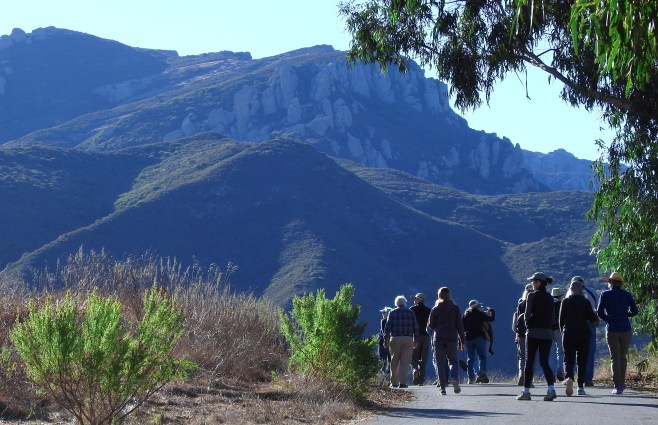
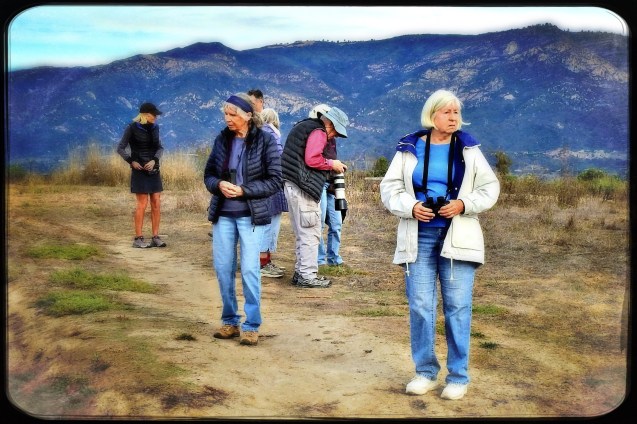
For me, birdwatching, which comprises an ever-larger part of my photographic output, is balanced almost perfectly between product and process, between how are we going to find what we’re looking for? and what will be do when we find it? Many birders are also shutterbugs, and so their “product” calculation is, in part, based on the physical mechanics of mastering their gear and settings….which is where I mostly find myself. That means I have to put more work into the “process” part of the equation; that is, not merely taking pictures of birds, but also trying to capture the anticipation and intensity of the people who are seeking them.
I often forget to, in a way, turn the camera around to see the watchers as well as the watched. It really should just half of a balanced approach, but it can actually slip my mind. The entire chronicle of the trip would, of course, include the personalities of the search party as well as whatever quarry we locate. Because, even on days of no birds (of which there are many), you are still spending quality time with quality people on a great walk. And that’s worth a click or two anytime. Product. Process. Both can generate compelling images.
WONDER WHAT THEY MEANT BY THAT…..
By MICHAEL PERKINS
PHOTOGRAPHY, BY ITS VERY NATURE, pulls things not only out of their time, imprisoning them in a perpetually frozen state, but also out of their context. Extracted from all the other elements present at the time the shutter snapped, a subject must be judged on its own visual merits. It may, indeed, suggest the other conditions that prevailed when it was in the world; that is, a view of the Empire State implies the unseen remainder of the city skyline in which it exists; however, being captured in a photograph can just as often isolate an object or a person, robbing the eye of what it meant in the flow of regular reality.
Museums operate much like photographs, in that they create exhibits of things that have lost their overall context. We learn what we are looking at through explanatory texts or captions displayed near them, but the complete world the things once inhabited is removed. This forces us, as in a photo, to interpret their visual value to us. Sometimes they become diminished, while in other cases, their force actually increases. In visiting museums, I weigh a lot of factors, from empty spaces to shadow play to composition, but I am predominantly drawn to exhibits because the items in them are no longer merely what they were. My camera can thus contort their reality in a million different ways.
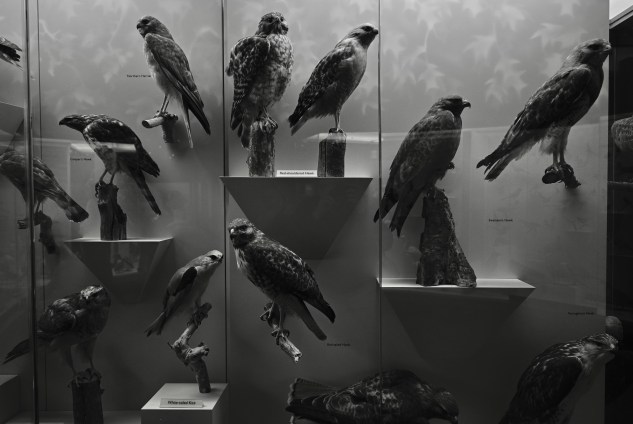
Birds are a prime example. As a birdwatcher, I see living creatures that inhabit an entire ecosystem of activity and place. As a guest in a museum, however, I see them in their corporeal form, perfect, in fact, in every detail, but now just objects to be arranged, lit in a particular way, or even abstracted. They become clay in my fingers, recognizable as birds, certainly, but capable of calling up a host of different associations. I can look at them and imagine majesty, mythical power, menace, or a mixture of all three. It reminds me that pictures are created long before the click, and that no two people can frame up the same subject and get the same result. I know what I mean, but figuring out what you mean, well, that’s the wondrous variance that keeps photography a perpetually unfolding mystery.
TWIN-AXIS ACCESS
By MICHAEL PERKINS
EVERY TIME I PHOTOGRAPH BIRDS, I lament the fact that I started in at it so late in life. Indeed, if I had not married a birdwatcher, I might never have strayed into wildlife work to any degree. Just being in the moment as I peer into the very special domains of living creatures has enriched my life. Being able to enrich the lives of others with what I capture from that experience has proven a much more random thing. That is to say, since I started year after others did, I may not live long enough to get really good at the whole thing. Sigh.
Bird shooting is really a double quest, a twin-axis access. Finding the bird, the first axis, is one thing. Finding a reliable way to record them is the second axis, and getting the two tracks to intersect perfectly is not a project for the faint of heart.
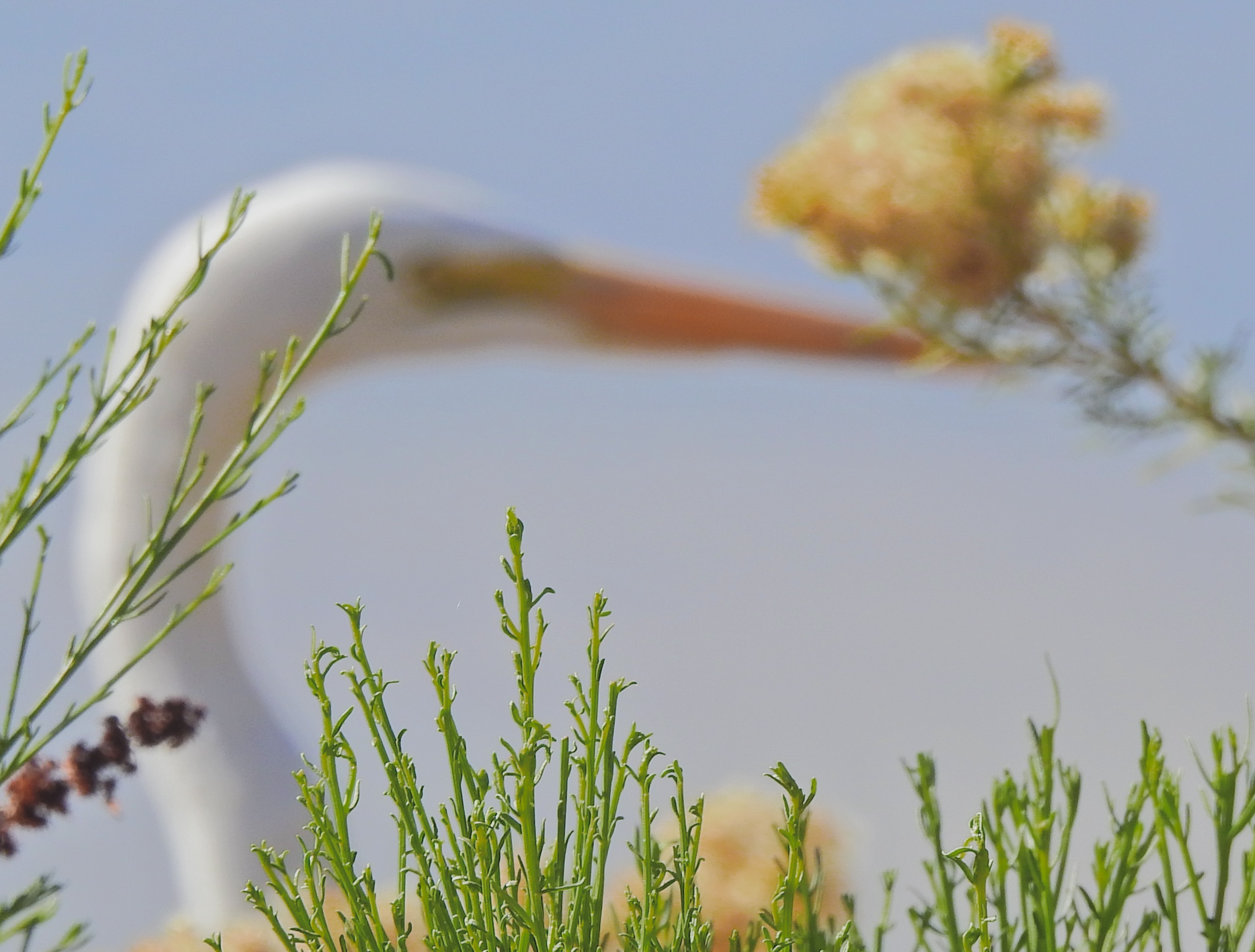
My aim was to render a sharp close-up of a heron behind some decorative pond clutter. Auto-focus, however, had other ideas.
With me, focus is a bigger issue than any other shooting consideration. Entering the world of birds as I did with a modestly priced “superzoom” rather than a dedicated (and far pricier) telephoto, I was exhilarated that, with the ridiculous reach of such cameras, I could suddenly get at least some pictures that had historically been the stuff of fantasy. However, just bringing the birds closer was only the first part of the challenge. Many superzooms (and some upscale telephotos) struggle to nail autofocus quickly enough to register bird shots sharply, and much of this problem is exacerbated by the subject’s surroundings. A single blade of grass interposed between your target and your lens can mean a tack-sharp picture of that blade of grass, backed up by a completely blurred bird (see embarrassing example above). Thus, shooting birds in a dense thicket or tree can make it nearly impossible to isolate your subject, resulting in more spoiled shots than my Irish temperament can comfortably endure. I’d like to say that images like the one shown here are rare in my portfolio, but I’d be lying through my tightly gritted teeth.
Of course, some bird photogs are expert in going the other way, and opting for completely manual focus. This, over the span of the unavoidable learning curve, will mean even more missed shots, given the little darlings’ tendency to dart about suddenly. Even when using a tripod to help minimize camera shake at longer focal lengths, nailing focus manually takes a lot of practice, the result being that most shooters would rather swallow bleach than rely on it, but, hey, different strokes and all that. As is the case in almost all types of camera optics, lenses which have the fastest and most responsive rates of precision in auto-focus modes can only be had by laying out serious dollars. This is one of the last barriers to a truly inclusive world for all photographers, and needs to be addressed. It shouldn’t cost thousands to make a beautiful picture, and more and more of photographic tech is all about addressing that issue. Alas, long-range, autofocus-dependent wildlife work is one area where the playing field sorely needs to be leveled. We ought to be able to easily show what we see.
I KNOW WHY THE (UN)CAGED BIRD SINGS
By MICHAEL PERKINS
JOHN JAMES AUDUBON NEVER EMBRACED THE NASCENT ART OF PHOTOGRAPHY, which was only just out of its crib when the naturalist and artist passed in 1851. More’s the pity: his studies, and the magnificent paintings which resulted from them, were only accomplished by the killing of nearly all of the four hundred species he depicted, a technique well in line with practices of the 1800’s but regarded with horror by today’s birders. Photographs, in his lifetime, were a curiosity, certainly no competition for the observation and focus required to capture nature on canvas. And so it goes.
I have repeatedly credited my wife in these pages for retraining my eye regarding birds, which I certainly noticed over the courts of my life but didn’t really see. As someone who has always had a camera hanging around his neck, I have, since her miraculous intervention, experienced successive waves of “where the hell I have I been?” when naively delighting in creatures that she has been keenly aware of for decades. Fortunately, unlike Audubon, I don’t have to catch, shoot or poison them just to get a good look at their habits or habitats, as it’s rewarding enough just to be able to linger over the details of their design and grace in pictures. Sadly, I should have begun this journey as a much younger man.
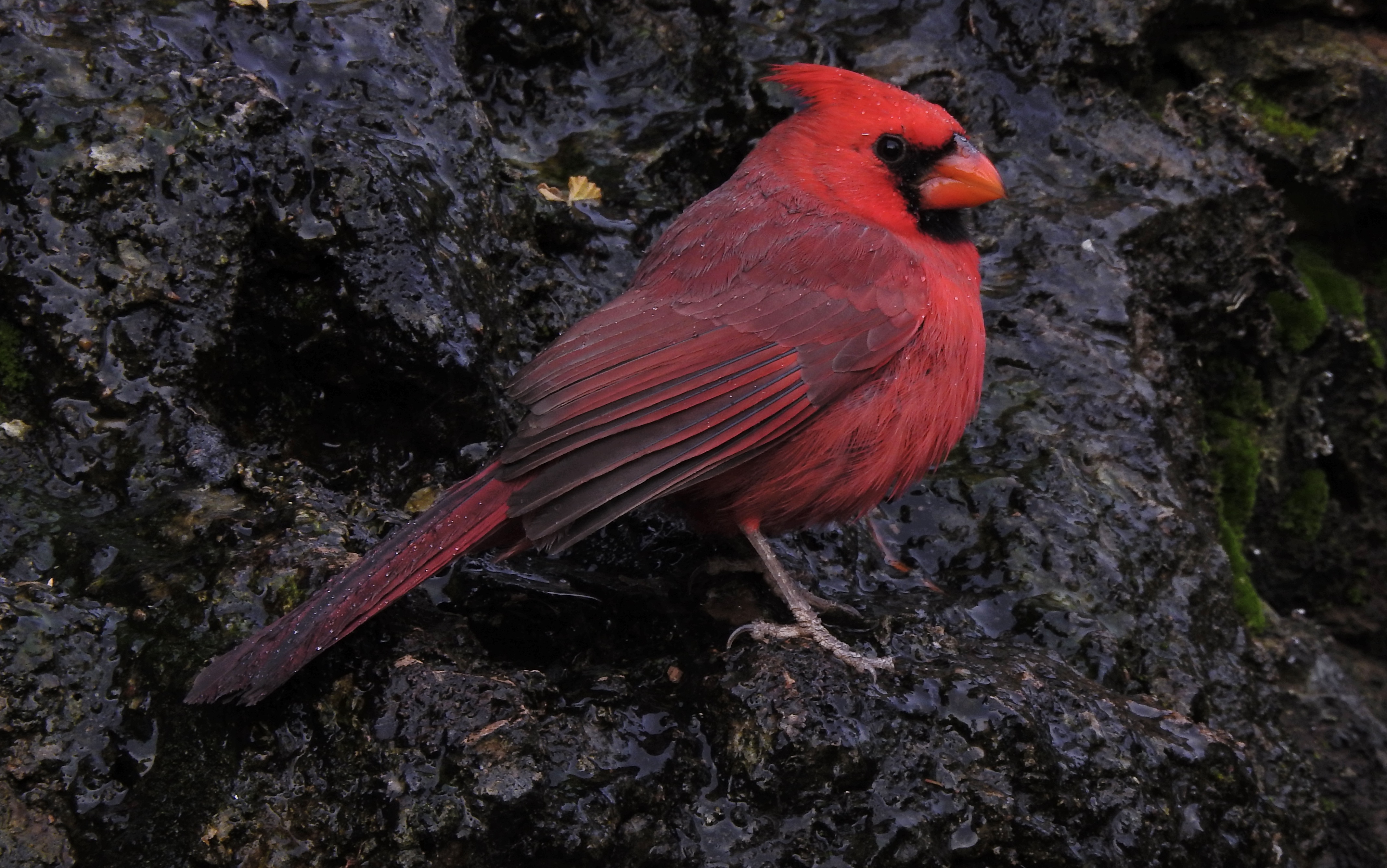
Making a photograph of a bird is a privilege.
Hang with birders for even a short while, and you will be stunned by how very much you do not, but should, know about creatures whose life is impacted, impoverished and just plain crowded out by our very existence, by our selfish gluttony and plunder of all things natural. It’s not just that we are just the loud, rude neighbors down the block: it’s as if we decided to throw empty beer bottles and cigarette butts from our parties over the back fence and into the yard next door. Birds are both a reminder of the infinite beauty built into the world and a rebuke to the unwitting war we wage against it. To measure what is either threatened or vanishing, you need a reliable recording tool….faster, more accurate, and less deadly than Audubon’s slay-’em-and-then-salute-’em method. For millions, including myself, that’s a camera.
The Audubon Society is currently undertaking the sizable task of changing the names of all birds who were identified by the names of humans. Not merely the more notoriously racist or rapaciously heedless of them, Audubon and John Muir among them, but any humans. The names will now merely be descriptive of the individual bird’s identifying characteristics, making their labels more purely scientific and perhaps sending at least a small signal that the earth is ours to inhabit, not conquer; to cherish, not dominate; to curate, not capture. And to learn, as the makers of all too many cages, why the uncaged bird sings so clearly and so beautifully.
OF CLEAN SHOTS AND DIRTY BIRDS
By MICHAEL PERKINS
“WELL, THAT’S A DAY I’LL NEVER GET BACK” goes the cliche about irretrievably wasted time, muttered after many a dud movie, inert concert or (say it with me), a particularly frustrating photo shoot. Many days we greet the dawn overflowing with hope at the day’s golden prospects, only to slink back home under cover of nightfall with nothing to show for our efforts but sore feet. Such is the camera life.
One of my own key wastes of picture-making time consists of the hours spent trying to do workarounds, that is, outsmarting a camera that is too limited to give me what I want without a ton of in-the-field cheats and fixes. My chief offender over the last five years is the compact super-zoom that I use for casual birdwatching. I lovingly call this camera “The Great Compromiser”, since it only makes acceptable images if the moon is in the right phase, the wind is coming from the northeast, and if I start the day by sacrificing small animals on a stone altar to appease the bloody thing. We’re talking balky.
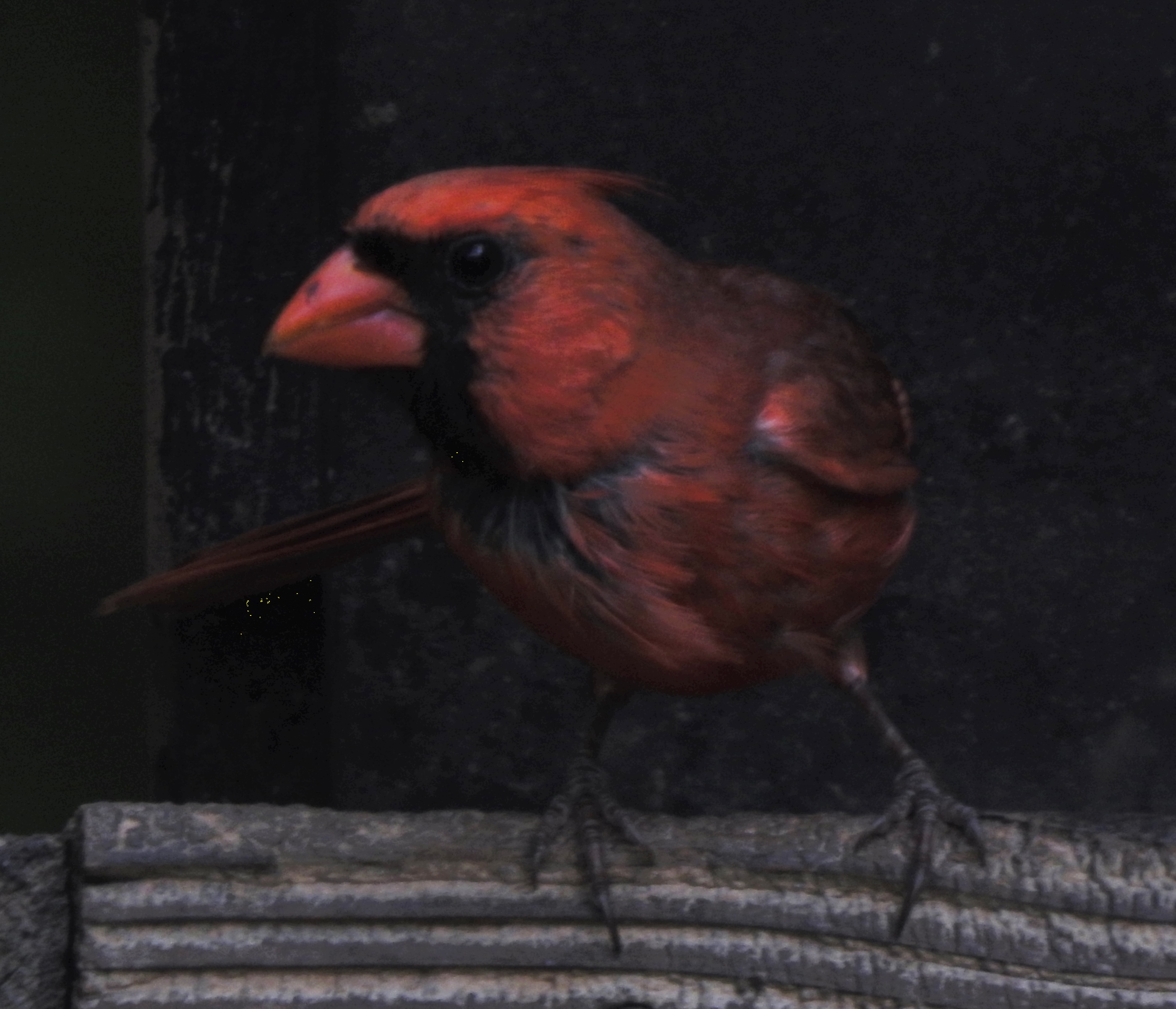
Out of the murk rises a small miracle. Or not.
The Compromiser achieved its convenient size and insane levels of magnification by writing all its images to a small, small sensor. That means that direct, plentiful sunlight is the only way to get acceptable results, proof of which can only be evaluated in playback, since the EVF is dim and utterly unreliable as a predictor of success. Add to that a maddeningly slow response rate after burst shoots, menus that only Satan himself could admire, and the surety that even a mild boost in ISO will generate more noise than a midnight Kid Rock show, and you begin to get the idea. I saved lots of money by not purchasing a dedicated prime zoom lens and I pay for it daily in the agony of using my “bargain” in the real world. Live and learn.
But just as any camera can deliver shots that are technically, well, caca, an occasionally “wrong” picture somehow works in spite of its shortcomings, and that’s where we find the above image, which gave me a dirty bird instead of a clean shot. The picture’s very imperfections gave me a look that I certainly would not have sought on purpose, but which is strangely endearing, even though nine out of ten other shooters might justifiably consign it to the Phantom Zone.
And so we soldier on, learning to love our red-headed (red-feathered?) stepchildren even as we see them as something that we never, ever want to do again. Love-hate is a term that seems to have been coined specifically to describe how the artist evaluates his art. Get away from me. Come here, I need you. I’ve never despised anyone like I despise you. Kiss me.
Repeat as necessary.
THE KEEPER OF THE LIST
By MICHAEL PERKINS
IN ALL THE YEARS I HAVE WATCHED HER PRESIDE over hundreds of both seasoned and starter birdwatchers in the Arizona desert, I can’t recall ever having seen Andree Tardy without her signature We Are Serious About This Stuff sunhat and her loose khaki fatigues. Chances are that if I were ever to bump into her in “civvies” at the local Safeway, I might easily pass her without notice, even though, by now, she has served for years as our group’s go-to Earth Mother, an empirical and encyclopedic source of information on Which Birds Breed With Who, how their plumage changes with the seasons, why the immatures are less resplendent than the adults, and how you can distinguish a “Too-Whit-To-Whoo” from a “Wit-Wit-Wit-Too-Too”. Because she is just that good.
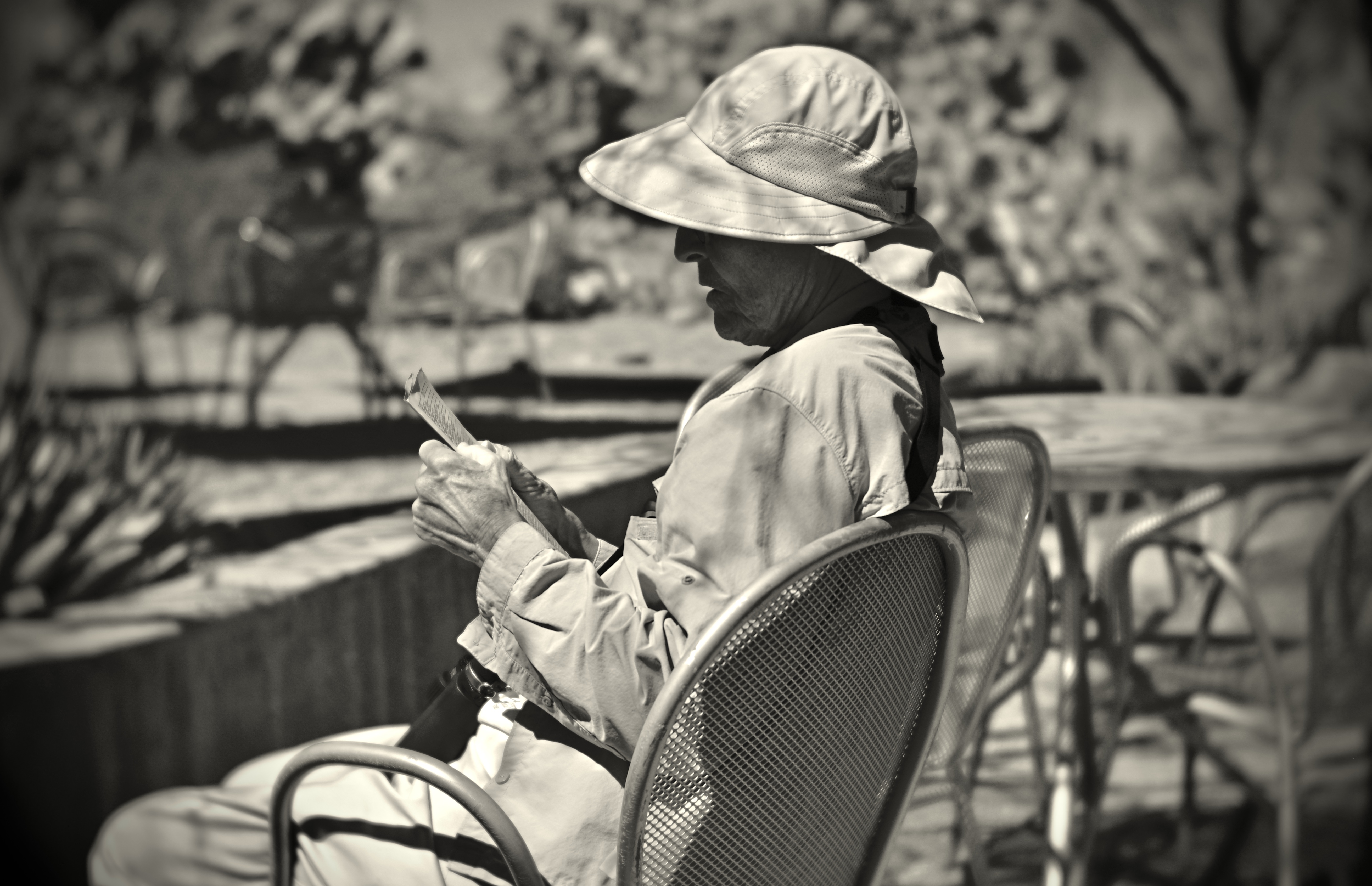
“Okay, did anyone see any vermillion flycatchers?”
I mention Andree’s all-season costume because, for us, it is inextricable from her physical form, the “plumage” by which we identify her “behaviors”. Tough as a turtle’s toenail and consumed with a passion that defies the damage of time, she is, at 81, hardier than many of the sex-and-septuagenarians that trail behind her like lost chicks. That bottomless supply of energy is fed by an insatiable hunger to know more, to see what’s around yet another corner, and the corner after that. I have shot dozens of candids of her over the past twenty years, but I find that minimal images of her in full birders’ regalia registers even higher than a mere facial portrait. She just is the sumtotal of all her outer contours. from her fingerless gloves (easier to work binoculars with) to the billowy slacks that protect her from the scars and scrapes of desert plants to the headgear that all but obscures the aquiline angularity of her face. I can’t imagine making a picture of just her face. It would somehow seem incomplete, like Schweitzer without a pith helmet or Superman without the cape.
The other object that is constantly with her is only withdrawn at the end of bird walks, but is as crucial as every other component in her makeup: The List. Andree’s lifetime role as teacher, interpreter, guide and dauntless ornithological doyenne demands that, at the end of the day’s spotting, she, and she alone call out the categories and species, the better to officially tally the count of what, to a certainly, was actually seen. She knows she can count on us all to honorably report our individual sightings; after all, birding, unlike fishing or hunting, is a system built on honor, along with a proper Hippocratic pimch of “do no harm”. Anyone can teach someone else about birds, but The Lady Herself also teaches respect, humility, responsibility. The birds, and all who choose to watch them alongside her, could not be in better hands.
VITAL SIGNS
By MICHAEL PERKINS
ANYONE LUCKY ENOUGH TO TAP INTO THE NATURAL PAIRING BETWEEN PHOTOGRAPHY and birdwatching will be humbled by observing the raw courage of winged creatures to survive despite humanity’s best efforts to the contrary. Even in rural settings, one cannot help but be struck by the numbing crush of obstacles mankind has left for the natural world to stumble over; how our habitat is so tilted in our own heedless favor that nature must live, not with us, but in spite of us.
Within cities, the horror is even greater, as our life crowds out any and everything that does not directly redound to our needs. In such tableaux, it is incumbent on the photographer to become a journalist, a chronicler of what needs to happen if we are to carry on sharing the planet with, well, anything. And, as an amateur birdwatcher, I am reminded by what bad earth citizens we have always been when my eye is drawn to what, to my mind, is one of the most elegant and misunderstood birds in our nature: the starling.
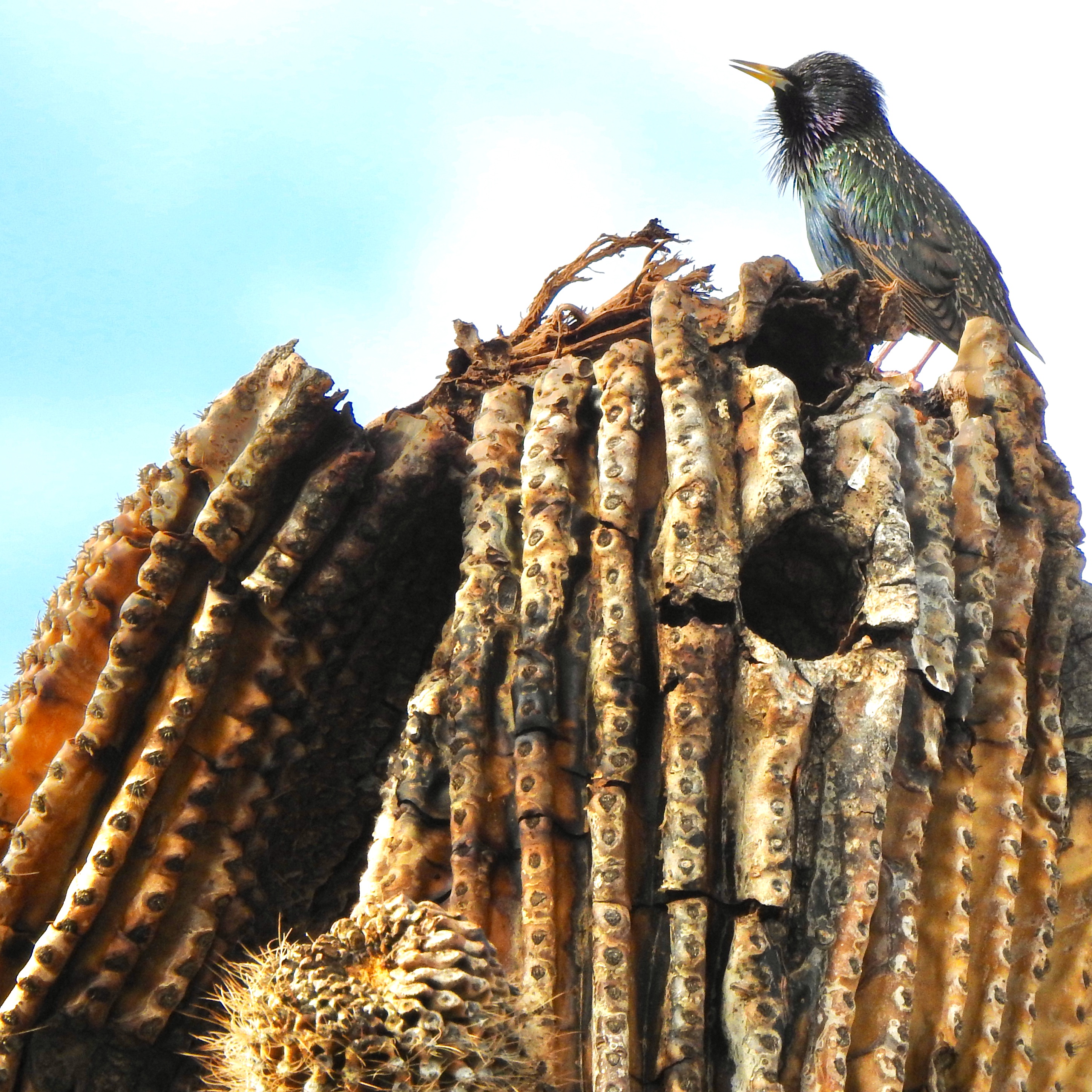
Introduced forcibly to North America in 1890 by a fanatical Shakespeare aficionado from Britain, who believed that his new home should feature literally every species of bird mentioned in the Bard’s works, the first stateside starlings originally numbered only about one hundred birds in all. Predictably, those have since become millions, earning not praise for the bird’s adaptability and intelligence, but scorn from those who regard them as invasive pests or worse. These gorgeous creatures, whose plumage, in the changing light of the full day, literally contains the rainbow, have made the best of their fate over the centuries, much like any other erstwhile immigrant. Sadly, they are often hunted and hated as if they themselves had decided to invade our shores just for the fun of it. And so it goes with scores of other creature; untold species of animals, plants and birds have been forcibly introduced onto the continent by the most predatory pests ever unleashed on the planet; humans.
Starlings are plentiful nearly everywhere, but the intense sunlight of the American southwest can highlight their hues in spectacular fashion, something I never would have slowed down to notice were it not for the birding buddies my wife has generously shared with me. My initial interest was boosted in intensity during Lockdown, mainly because being outside was one of the only essentially safe ways to pass the time, speeding up my bird learning curve a bit (although I am still barely able to hobble along in the “beginner” division). It has produced a kind of evangelism in me, and I can never again see a bird without wondering to what extent my fellow humans have complicated or compromised its existence. If we can muster shame about anything, it should be our hideous habit, going back over our entire history as a species, of fouling our own nests.
BEATING WINGS, BEATING HEARTS
By MICHAEL PERKINS
OF THE OVER 73,000,000 ACRES OF LAND IN THE STATE OF ARIZONA, only 43.2% is in private hands. That might, on paper, seem to weigh in nature’s favor, if “favor” means being protected from the more horrible by-products of human activity. However, from my the vantage point of my twenty-three years in Phoenix, the state’s largest urban concentration, it can seem like nature is either whipped to a draw by civilization (on a good day) or bound, gagged and locked in a dark closet by it (on all too many other days).
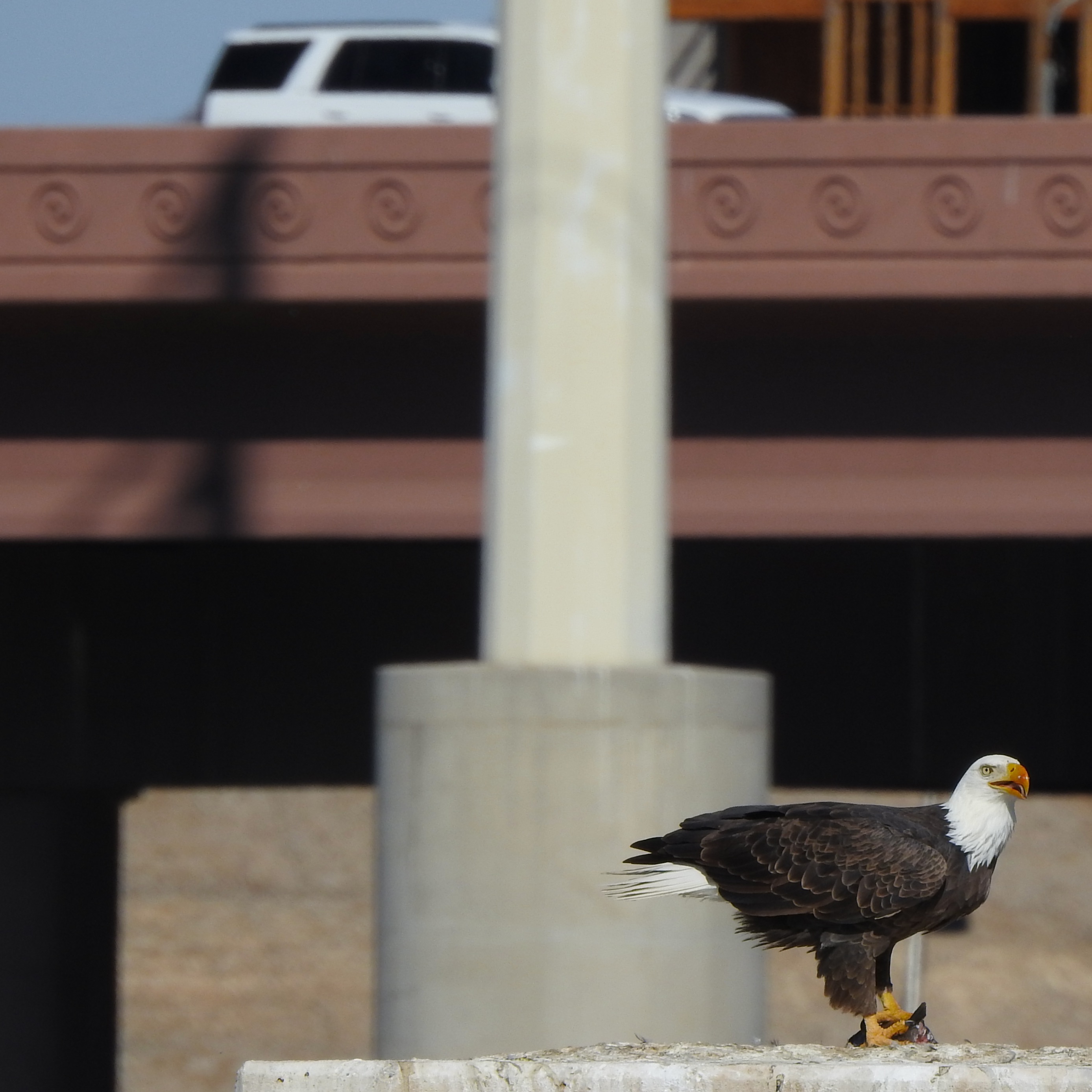
A bald eagle finishes a meal atop a concrete platform, just yards away from the 202 freeway in Tempe Arizona.
Nature photography in such a conflicted reality can be a challenge, but not because wildlife cannot be found near Arizona cities. In fact, rather than fleeing to the open desert or mountain ranges, it often thrives literally feet away from the most invasively harmful aspects of what we term “civilization”. No, the problem with making pictures of Arizona wildlife is in being tempted to do what I call “template photography”, to take the expected route toward idealization of animals, displaying them in the pristine conditions in which we wish they lived all the time. And yet, if we are to follow any tendency toward photojournalism, toward honestly chronicling the lives of these creatures in such a place, we must also make images of their struggles and triumphs within the world we have actually made for them. And that can be heartbreaking.
This is especially true in the case of birds, and most dramatic with larger varieties like raptors. The bald eagle you see in these images has learned to make his way alongside freeways, electrical wires, air traffic and other delights of the modern age, choosing, as seen here, the concrete footing for a bygone bridge over an urban stretch of the Salt River as the roosting point for enjoying a fish captured from what was, very recently, a dry bed deliberately replenished and stocked by the same governmental agencies charged with making the desert, well, “livable” for humans. It’s a strange and sad symbiosis, but it makes for enduring images. An eagle left to his own devices exists in an interlocking gearbox of interdependent ecosystems. It exists in balance. It’s brushing up against us that makes his life more hazardous than anything encountered in the wild.
Strangely, we begin to address this problem by addressing our own. If power grids go down because of birds becoming entangled in our wiring systems, those systems need to be re-designed, which has the dual effect of protecting more birds while guaranteeing that we keep our lights on. People are becoming more aware of how our own lives are impoverished if we make it impossible for creatures to grow and hunt and prey as nature intended, but, my God, the learning curve has been slow. How many of the motorists seen here, made aware of the majesty couched just yards away from their elevated roadways, might pull over, park, gawk and wonder? How many beating wings and hearts throb on, outside the scope of our impaired hearing? And how can we point our cameras at the wildness left in the world without also showing how our own untamed selfishness threatens that divine, raw beauty?
WHO’S IN CHARGE HERE? DEPENDS..
By MICHAEL PERKINS
THE OLD ADAGE ABOUT LIFE BEING WHAT HAPPENS WHILE YOU’RE BUSY MAKING PLANS also seems like a perfect fit for the act of photography. Certainly we love to take bows for our best work, and to let the myth persist that what’s hanging on the wall is exactly what we were going after in the first place. Well, I use the word “myth”. I actually mean “convenient lie”.
The scientist in us loves to keep alive the belief that we are in charge of our lives, that all our great results are the inevitable outcome of brilliant foresight and faultless planning. But the photographer side of us, the more instinctual half of our nature, knows how much luck and randomness figure into the mix. Yes, we came back with a great shot of C, but only after our “perfect” concepts of A and B fell flat.
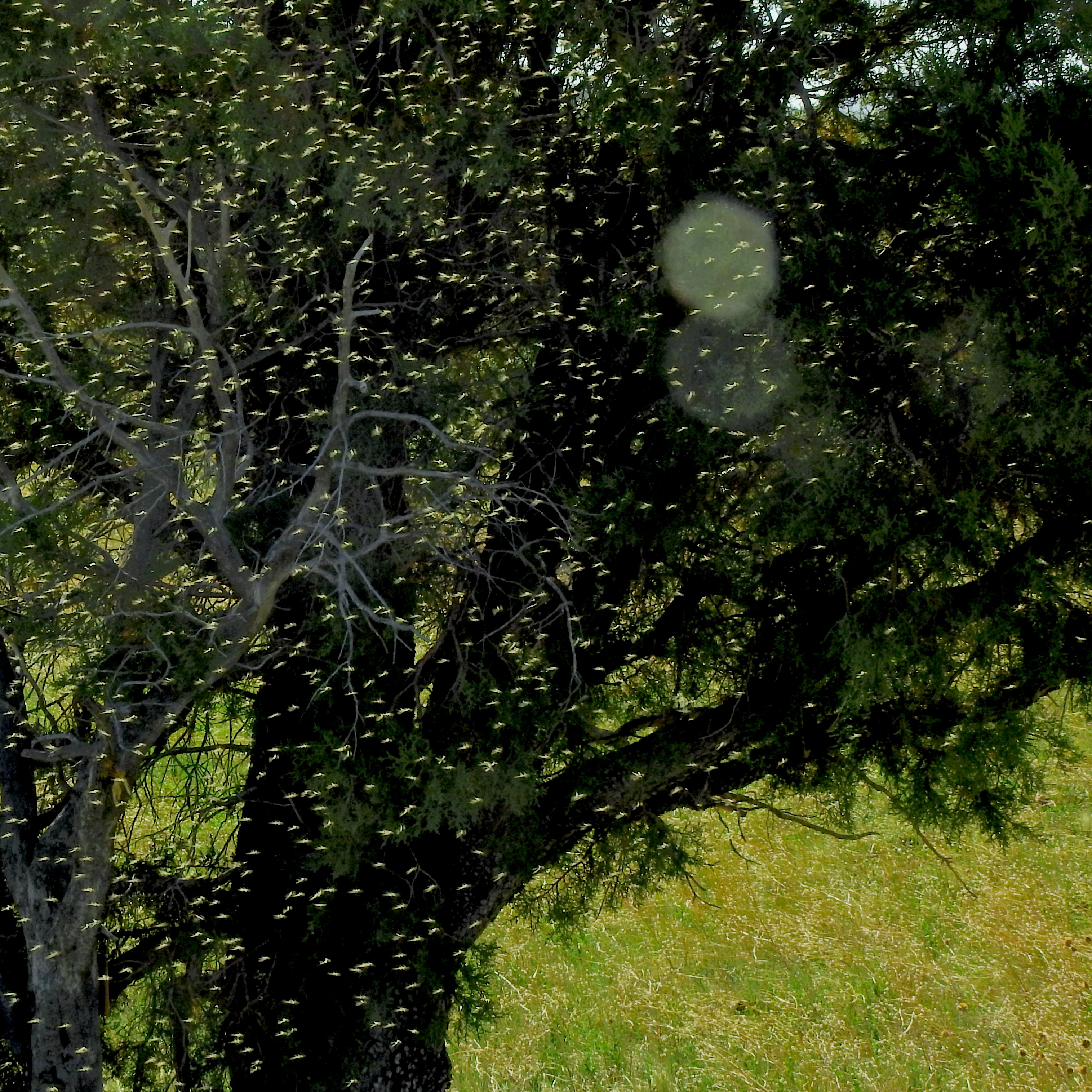
Several weeks ago, I went birding with a small group into a marshy area near Show Low, Arizona. The water was all part of a reclamation project that created the illusion of a large pond/small river in what is typically semi-desert, and the entire local landscape was transformed, because of the extra moisture, with reedy banks, plentiful supplies of yellow-headed and red-winged blackbirds, and, well, bugs. A bleeding swarm of infinitesimal insects which are a huge Happy meal for the flycatchers in the area, but which also fill the hair, eyes and mouths of any, well, non-birds in the area.
Which is where my plan A fell apart.
Yes, O logical side, we will, as expected, be taking pictures of shorebirds and the shores that host them. Easy call. But, oof, here comes the photographer side, the instinctual guy, who now wants to make a bug picture. But how? Everything is awash in early morning sun, which renders the swarm all but invisible. They are so thick that they may make even carefully focused pictures look soft, as if I had a diffusion filter attached to my lens. The only way, then, to at least suggest the look of the plague was to aim at the darkest thing I could find, which turned out to be a small copse of free-standing trees further inland from the water and standing in their own shade. At least I had enough of a picture to suggest my new, revised main message, to wit: man, there’s a &%$ton of bugs here.
And so it goes. Planner Me begins with a startup scheme. No-Plan Me eventually straggles with another viewpoint. And the eternal question of “who’s in charge here” for a given picture changes on a whim, or around whatever might be, sorry, bugging me at the moment.
INHERITANCES
By MICHAEL PERKINS
HUMILITY IN AN ARTIST IS NOT ONLY ADMIRABLE, but, for purposes of growth, absolutely essential.
We’re not talking here about a kind of polite, “aw shucks” modesty, which is usually staged for the benefit of others anyway. No, being humble does not mean disowning honest achievement, in photography or any other field. It consists of putting a dot on a line to show your position, where you stand versus where you stood and where you need to eventually stand. And in the making of images, as with many other endeavors, it’s about acknowledging that some of your worst failures and your best successes alike are totally accidental.
When shooting in the moment, conditions converge in milliseconds to either push us forward to completion or block us utterly from it. The losses are easy to see as “rotten luck” that we somehow didn’t deserve but can learn from. However, it’s the unearned wins, the pictures that fall into our lap despite everything, that truly aid the ripening of humility. We get great shots that we didn’t, in some way, “deserve”, although that’s an odd way to phrase it. And, in our gratitude for our occasional (and inexplicable) fortune, we can really learn something about not taking ourselves too bloody seriously.
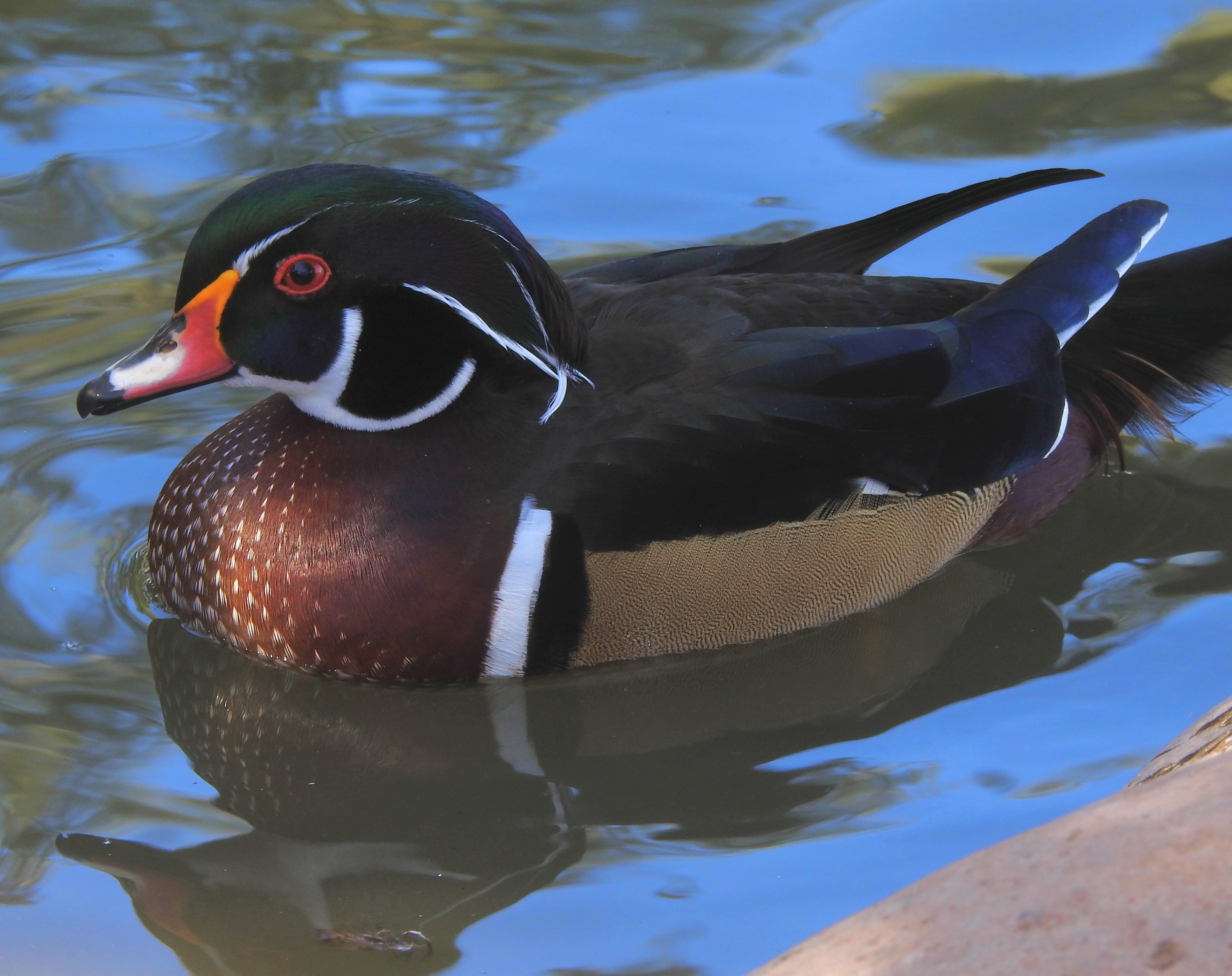 this male wood duck was the gods’ gift to your humble author, on a day on which I could certainly use one.
This duck is luck, and nothing more. It’s more clearly described as a sort of inheritance.
There is no other way to describe the success of this picture. I did, certainly, travel to his regular habitat with the intention of shooting him, but any vain thought I had of proceeding from a deliberate plan or program evaporated when I finally caught a glimpse of him. Within seconds of his calmly sailing out of his secluded lair under a large shrub, he became part of a blurry mob of hunger-crazed mallards who thronged around him in a desperate bid for food that had been tossed into the pond by a kind visitor. The frame you see here was a desperate and quick click just insta-seconds before the starting pistol, and there was only time for this one frame.
Certainly, other attempts were made, once the melee ensued, but, trust me, they were as appallingly fruitless as this one shot was miraculous. This was not a case of my lifetime of experience and instinct coming to the fore in a grand blend of skill and judgement. This was click-like-your-life-depends-on-it- and-hope-like-hell. The important thing is to accept the fact that all the stars and planets lined up correctly and gave you a goodie, and that all your preparation and focus could be surpassed in a second by something this random. If that doesn’t inspire humility, then you’re probably beyond hope.
Part of artistry is embracing the ineffable quality of not being in total control, of being worked by the process as well as working it. Because once you know how little you are actually in charge, then you actually stand a chance of being used in a meaningful way. Whether it’s the flautists’s breath or the flute itself that makes the music, the melody is just as sweet, and keeping score of who’s the boss in an artistic endeavor is beyond useless.
BURNERS
By MICHAEL PERKINS
“You’re taking your camera with you? TODAY?”
WHEN PHOTOGRAPHERS SPEAK OF A “LEARNING CURVE” for either techniques or gear, they’re actually talking about the process in which you make a whole lot of bad pictures on your way to good ones. Mastery is about of lot of things, but it’s mainly about lousing things up for a good long while and using the negative feedback to figure out what to do right by doing a whole lot of things wrong first.
The reasonable goal, therefore, in trying to get to the next level with your photography, is to do any and everything to speed up that curve…. to, in effect, tunnel toward your goal by getting all those transitionally wrong pictures past you. Being impatient in this regard, I have developed the habit of taking along whatever camera I’m currently trying to tame at every available opportunity, especially if there will be “nothing worth photographing”, whatever that means. I call such outings “burner days”, as I have no expectation whatever of producing any keepers, but am merely making myself shoot enough with the gear in question so that mental and muscle memory are built up more quickly, leaving me readier at an earlier stage to do something of consequence when it really matters.
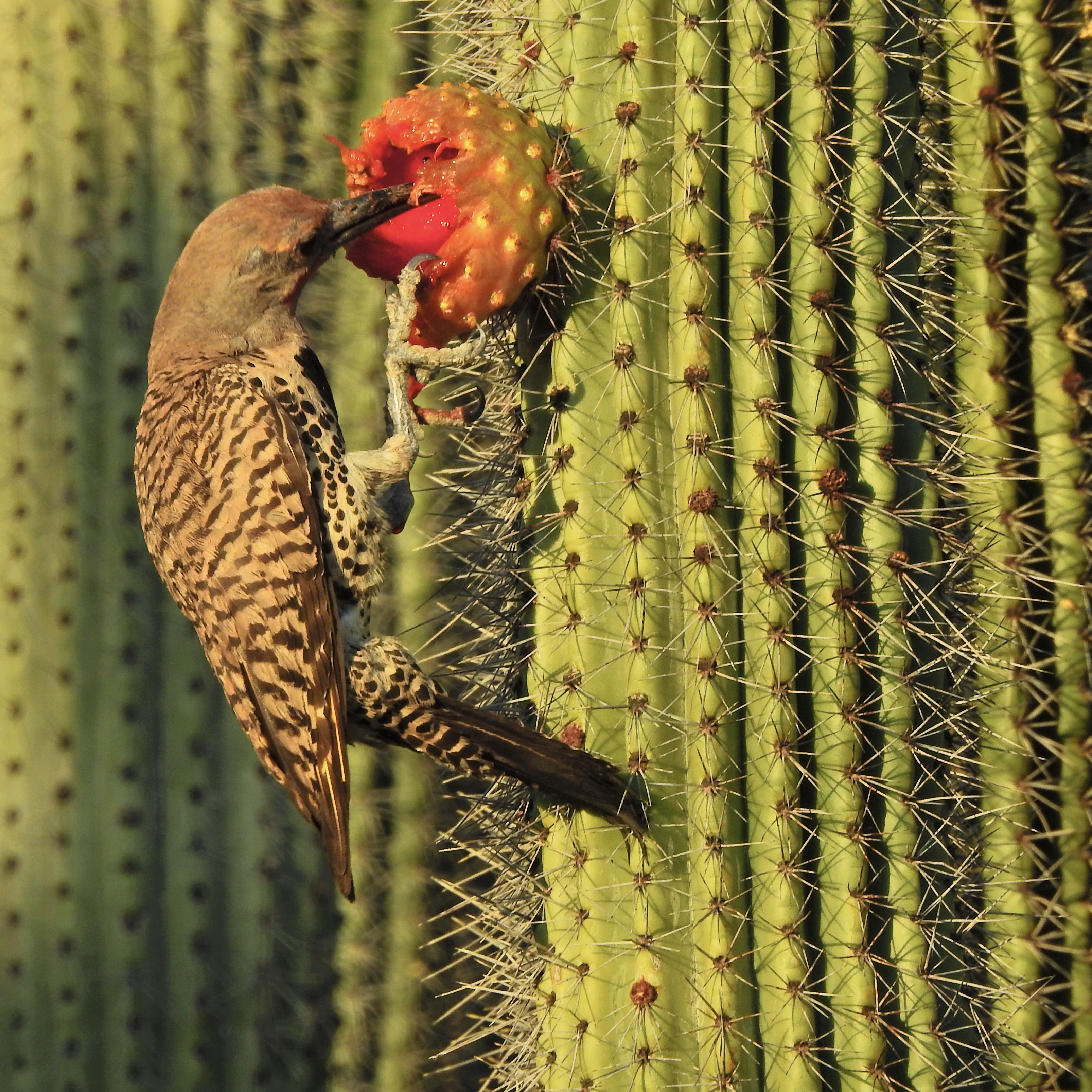
The hungry woodpecker seen here was the product of a burner day, as I figured that a June morning in Arizona was too hot for any birds to venture out. I was wrong, and I took home a little miracle, not because I’m amazing, but because I was available.
Shooters who have never known any other realm than digital are already a little mentally ahead in the burner game, in that they are already accustomed to quickly firing off and evaluating lots of blown shots on their way to the final product. Those trained inititally in film were hemmed in by how many shots they could financially afford to attempt; moreover, the time-line of their failures was also drawn out by the unavoidable waiting period between snapping and processing. Now everyone can afford to fail, a lot, very quickly, and that is a good thing. The break-in period for any approach or equipment in greatly foreshortened in the digital era, with the added plus that many shots that might have been total flops in analog days can now be instantly re-calculated and reshot in the field, and possibly saved. An amazing luxury.
And so, there is real educational value in shooting your little fingers off at every opportunity. First, there’s little cost in either time or cash in trying everything you can think of. Secondly, since no one knows for sure that there’s literally “nothing to shoot” when they head out on a given morning, the element of surprise is constantly in effect. Many days you will bring home both blown exposures and technically perfect shots that are devoid of impact. But each one of those misses builds the habits that eventually will produce a higher harvest of hits. Simply, you can’t be sure that the picture of your life won’t jump into your lap even under the most unpromising scenarios. Better to be present to at least make the attempt, because even the bad pictures are stepping stones to the miraculous ones.
SWEET CLAUSTROPHOBIA
By MICHAEL PERKINS
ENOUGH WITH THE FLOWERS.
Give the birds a rest. Put the quiet trails and placid sunsets on pause.
I want my skyscrapers back.
Yes, I’ve dutifully done my photographic confinement therapy, like everyone else whose worlds have shrunk during the Great Hibernation. I’ve lovingly lingered over the natural world, embraced the tiny universes revealed by my macro lenses and close-up filters. I’ve properly marveled at the wonder of simple things, patiently revealed in the quiet composure of a more inward kind of photo-therapy.
It was needful. It was even helpful. Hell, on a few days, it was essential. But instead of steady, slow inspirations into the deepest reaches of my lungs, I now long for shallow, quick breaths, terse inhalations of monoxide, stolen as I dash across a crowded crosswalk. I want to dodge things. I want to run for a train. I need to see the infinite collision of brick, stone, and steel textures all fighting for my visual attention in a mad crush.
I want to hear noise.
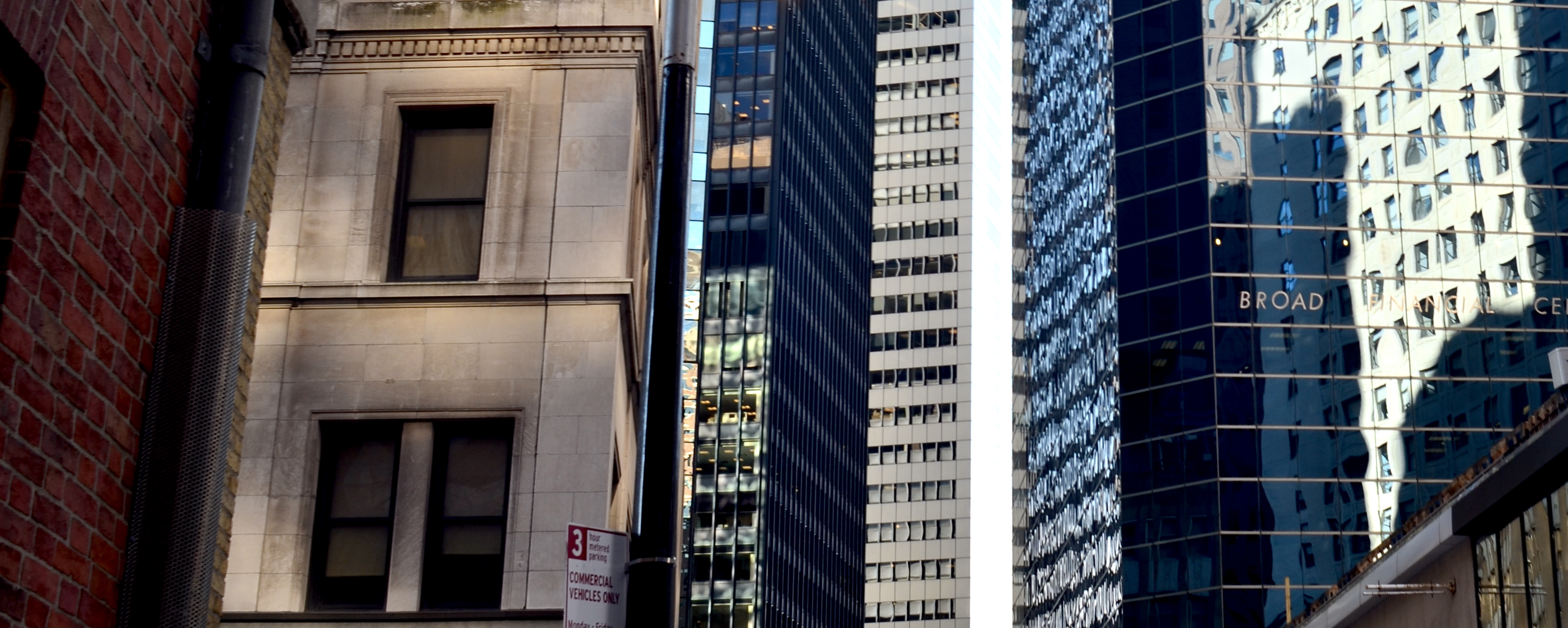
I can make myself comfortable, even modestly eloquent, shooting the splendors of the natural world. God knows we have placed too many barriers of estrangement from our inheritance in field and flower. But I have known, since I was a child, that my soul synched perfectly to the unnatural world, the arbitrary creation of we wicked, weak bipeds, with an affection that is every bit the equal to that which I feel for a tree or a blossom.
I see the same geometry and design in our crude imitations of nature as in the contours of the rose or the patterns within a cactus flower, and I’m not embarrassed to say that the spires, arches, bridges and alleyways that map our densest interactions give me an electric thrill. I should also add that I am not typical within my family, where there are far more Thoreaus, all centered on their respective Waldens, than there are Whitmans, who see glory in even the failed strivings of the urban experiment. I take comfort in my sweet claustrophobia, and I make no apology for the fact that my photography breathes its fullest in cities.
There were, of course, millions for whom, during the Horror, cities were a cruel prison, and I absolutely get that. As the Eagles said, we are all just prisoners of our own device. Artists can create a heaven or hell in any setting, as witness the miraculous faith of prisoner poets or the inventive tinkering of a Robinson Crusoe. Confinement is largely a matter of geography or physical constraint, but, as we have all spent a long year discovering, it can be overcome by a refusal of the mind to remain locked into a particular place.
Still.
I have not yet completed my slow trip back to the hunting grounds where my cameras talk loudest to me. Like the start of our communal imprisonment, it will come in layers, in a million tiny shards of re-discovery. But it will come. My cities will be restored to me. My flowers and birds and bugs will always be celebrated as the protectors of my sanity, of the need to take my art inward from time to time. But right now, I need to get out on the streets, and see what’s up.
HERD MENTALITY
By MICHAEL PERKINS
AS MUCH AS WE’D LIKE TO PRE-VISUALIZE OR PLAN OUR IMAGES, the practice of photography is still chiefly a test to see how well we calculate and react in the moment. We all love to map out the various itineraries for our respective photo safaris in advance, but are also keenly aware that everything, literally everything in our blueprint can, and should be, blown to bits the moment magic is afoot.
The image you see here is the product of such a moment.
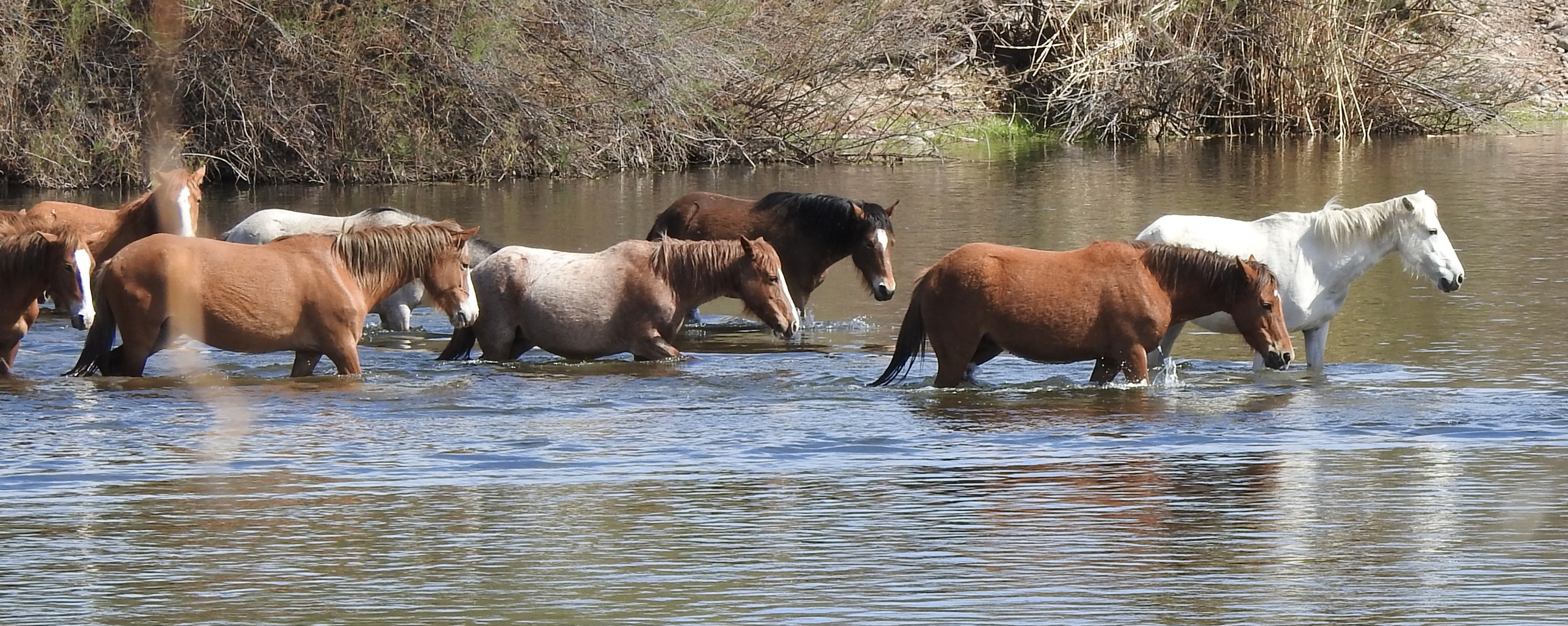
Officially, on the day this was taken, I was at the Coon Bluff Recreation Site in Arizona’s Tonto National Forest to scope out new birdwatching sites. I was a first-timer on the property, wandering pretty much in whichever direction my friends decided to drift. At some point, a smaller portion of our party decided to trek along the edge of the Salt River, in search of what I had no idea, or design. Half a mile or so later, I was surprised to have our point man remark that he had seen two horses wading and munching along the shore.
Barely five more minutes went by before it became clear that an entire small herd of wild mustangs had decided to cross the river from the far shore toward where we were standing. In what swiftly became something out of my own personal chapter of Lonesome Dove, I scrambled for an open space on the river’s sandy beach and, without thinking very much, cranked out as many frames at as many different exposures as I could. The entire parade got across in the space of barely two minutes. There was no way to plan: this was the frontier equivalent of what urban street shooters call “run and gun”. All in or all out.
But here’s the deal: while the appearance of a clutch of wild horses during a casual stroll certainly exemplifies the There Are No Second Chances rule in a very obvious way, all photographers are operating under that same rule all the time, in every situation. We may not be at risk of missing our own personal Wild West Fantasy, but there are thousands of expressions, variances of light, rapid transitions and other immeasurable changes that we stand to lose in every single shooting scenario. We are always being challenged to detect and isolate such moments-within-moments, with big events or small, and we need to calculate and click before the horses reach the opposite shore.
WINGING IT
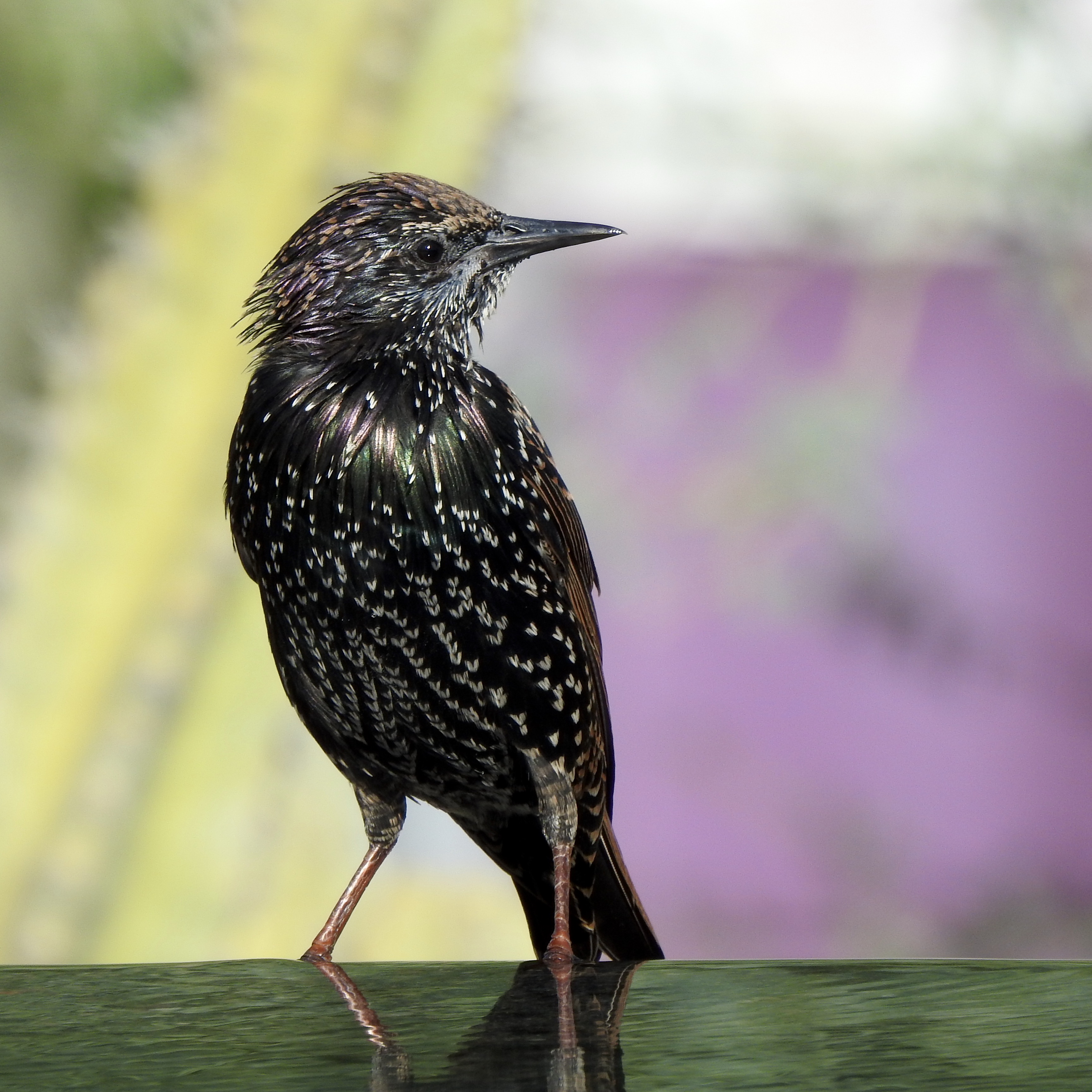
Superstarling, 2020.
By MICHAEL PERKINS
I AM A PHOTOGRAPHER WHO MAKES PICTURES OF BIRDS, but I cannot rightly be called a bird photographer. This is not cute double-talk: there is a mile of difference between a generalist, who occasionally shoots a lot of specific things every once in a while, and a dedicated artist who shoots those same things almost exclusively. One person is a dabbler who occasionally makes a few cookies from a mix. The other is a master chef. That said, then, what follows is both a love letter to the chefs and bit of a starter’s guide for the dabblers.
The fact is that, in more recently coordinating my shoots with birders who really know a budgie from a boomerang ( I assume there is one), I am in the field trying my luck to a far greater degree than I ever have been before. Essentially, this means speeding up my learning curve by taking a whole bunch of bad pictures in a shorter space of time. The bad pictures have to be a part of any serious new shooting discipline, and so I am at least getting them out of the way in a few years’ time instead of a few decades. Deliberately throwing yourself into a decidedly uncomfortable place (.i.e., not knowing what you’re doing) is good from several standpoints. First, it’s humbling, and a photographer without humility has stopped learning and has slid into mere habit. Second of all, uncertainty slows you down, meaning that there is both contemplation and planning in every shot. You might still get stinkeroo pictures, but at least you know why they happened.
A big part of the uncertainty in shooting birds is that you are either using your familiar equipment in unfamiliar ways, or using unfamiliar equipment, meaning you’re actually on two parallel learning tracks, one for figuring out what to shoot and the other determining how you’re going to do it. Your knowledge of composition, autofocus, and exposure rate will all be called into question and re-combined in ways that may seem strange. Warning: if you do need to re-tool, there will be a strong urge to go full tilt boogie and break the bank on state-of-the-art lenses. This could entail several thousands of dollars, and, since you will still have to go through the all-my-pictures-came-out-lousy phase, it will make you angry, and then it will make you quit. Do what you did during the first phase of your photographic career. Buy the simplest, easiest-to-use gear that gets the job done and work it to death until you actually outgrow everything it can do, and then upgrade to the bazillion-MM howitzers.
But let’s get back to humility, which will serve you better than all the gear in the world. In bird photography, you’re working with subjects that are more uncooperative than the grouchiest portrait subject you’ve ever faced. You must be okay with it when Plans A, B, C, and D go awry. You may not be shooting fast, but you must shoot with a fluid state of mind. And then there is patience: if waiting for a traffic light to change gets on your last nerve, you might want to stick to still life. Wildlife don’t care if you’re having a day, and part of the fun is sweating out an entire outing and coming home empty. So, yeah, there’s that.
And even though we’re primarily talking here about shooting birds, the same concept applies in any fresh area of photography, anytime you become, in effect a fledgling, allowing yourself to be kicked out of the nest of your accumulated comforts. Because, in making yourself do something so very different in its approach, asking something undiscovered within yourself, all of your other photographic instincts will widen as well. Sure, “winging it” can look like desperate flapping. But sometimes it can look like soaring.
(Michael Perkins’ new collection of images, Fiat Lux: Illuminations In Available Light, is available through NormalEye Books.)
 thenormaleye
WE ARE ALL BURT LANCASTER NOW
By MICHAEL PERKINS
I REMEMBER BEING FASCINATED as a child by the 1963 film The Birdman Of Alcatraz, based loosely on the life of murderer Robert Stroud, whose accumulated crimes drew him a life sentence, much of it spent in solitary confinement. The movie, starring Burt Lancaster, centered on Stroud’s almost accidental introduction to birds, an improvised pastime which blossomed into an extensive and self-taught study of ornithology. The story’s biggest impact on me was the idea that someone could center on the smallest scintilla of hope, something others around you might ignore or simply not see at all, and that such small things might lead beyond mere survival to a kind of separate peace, even wisdom. In retrospect, I probably should have chosen a better model than that of a total psychopath. Still, the idea of being able to successfully navigate isolation was one that occasionally fascinated me over a lifetime. It’s also come to mind a great deal over the past year.
To paraphrase a cliched expression, we are all Burt Lancaster now; we have all learned to place greater focus on smaller worlds, and it is no accident that one of the biggest growth industries during our Global Great Hibernation has been the hobby of birdwatching. It’s cheap, it’s relatively easy to break into, and it’s as close as your window. More importantly, it’s a reassurance that life, or some semblance of it, has gone on, even if all we can do is watch as it wafts by. Like Stroud, we are all improvising to reduce the ache of greatly reduced circumstances. And like prisoners everywhere, confined behind either tangible or figurative bars, we are able, maybe for the first time, to see, in depth, something that was all but invisible to our previous system of seeing.
Nobody puts Baby in the corner, but you can occasionally put Starling in the circle.
For photographers, including this one, birds can be a metaphor for many things we already value about our art. Color, motion, texture, context, even a kind of portraiture…all are addressed in trying to assign traits or personalities to flying creatures. Working from the long, empty days, we slow down and deepen our observational powers. We view things in finer depths and degrees, in inches rather than miles now. I will freely admit that my own photographic coverage of birds had been, during The Before Times, confined to the easiest, most obvious captures; flocks caught accidentally in a vast beach vista; raptors in zoo cages; the occasional comic shot of a gull stealing a hot dog, etc. The quarantine has altered all that, stretching time like taffy, elongating our implementation of any undertaking from hours to days. But this is not an effort to overprescribe a general therapy for everyone; your “birds” may be furniture, the veins of a leaf, still lifes of your accumulated buffalo nickels. This is why we have congregations of varying denominations. While I am worshipping at the first temple of the ruby-throated sparrow, you may bow your head at the Community Church of the Holy Art Deco Ashtray or some such. The idea is that photography always benefits from patience and deliberation. Snap shots are marvelous manifestations of our impulses, but they are not the products of quiet contemplation.
My point is that there is room in your photography for both the spontaneous and the deliberative. In my case, tiny tweeters have become a kind of surrogate for human subjects, as I find myself searching their faces for traces of motive, emotion, even joy. Unlike the Birdman of Alcatraz, most of us will eventually be sprung, released back into the larger work yard, hopefully having learned a little more about playing well with others. And the pictures we made behind walls will be, in lasting ways, capable of taking grander flight.
Share this:
February 17, 2021 | Categories: Commentary, Hobbies, Nature | Tags: bird photography, Nature Photography | Leave a comment