AFTER-IMAGES
By MICHAEL PERKINS
YOU GOTTA LOVE HUMANS.
No really, you need to. Not ’cause we deserve it, God knows (she does), but because, if you view us from the vantage point of an emotionally detached galactic being, we have some adorable habits. Our fashion decisions? Laughable enough to be endearing. Our life choices? Pathetically cute. And our compulsive habit of compiling “best of” lists of our work at the end of each year?
Well, okay, that is rather obnoxious.
But the lists persist, if, by the word “persists” you mean they are crammed into every molecule of available space in the final columns, blogs, newscasts, sermons and recipes of the entire last month of each and every calendar year. Reason tells us that there is someone, somewhere, whom, this very instant, is compiling a list of the year’s best ” best of” lists. You know that’s totally happening.
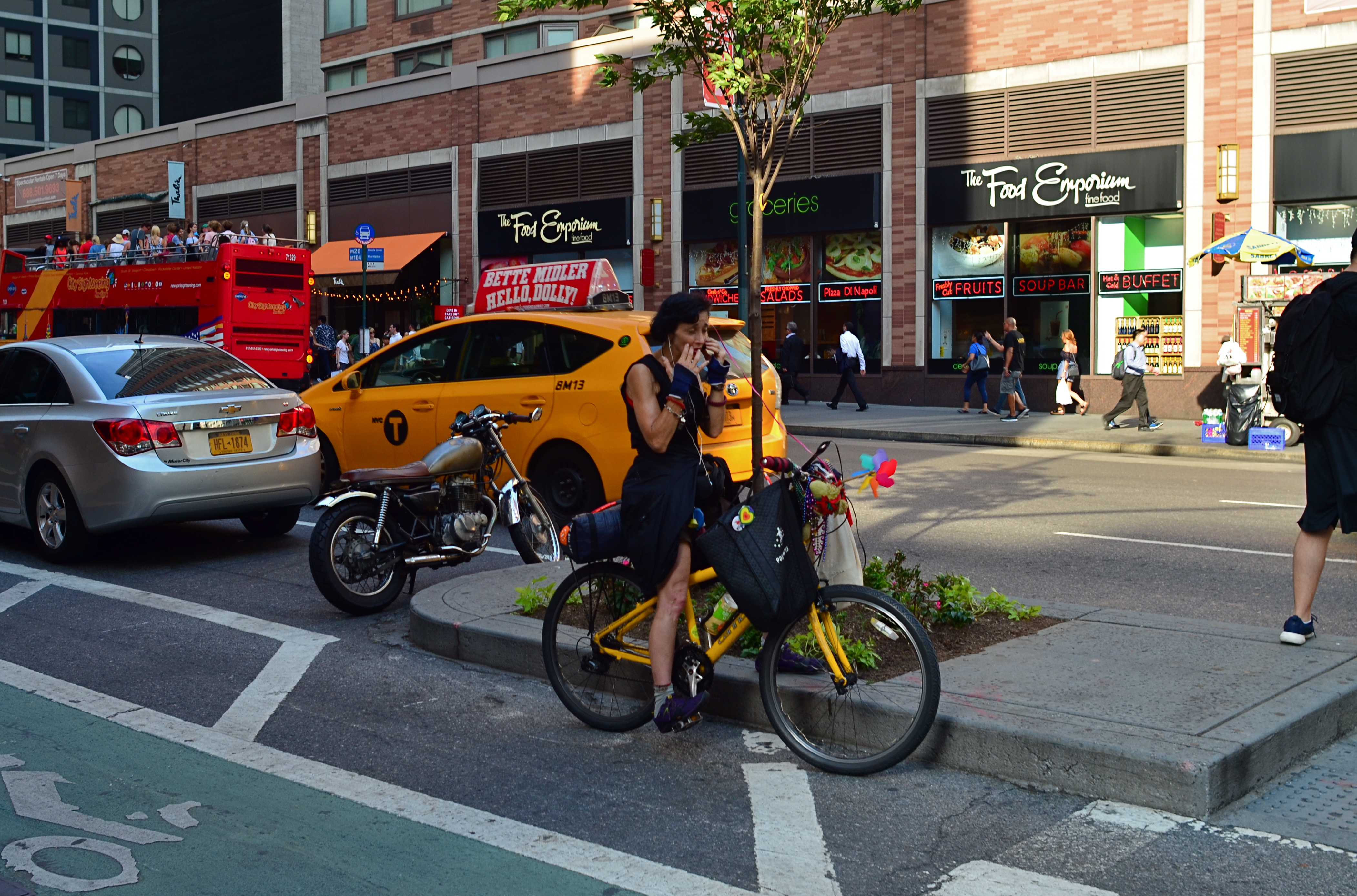
Of course, photographers are no less given to this vanity exercise than anyone else in public life, and I myself have certainly succumbed to the annual temptation to round up the usual suspects from the previous twelve months. What has changed over the years, however, is my belief that I am in any position to even know what my own best work is. What I think I do feel comfortable doing is to make, instead of a ” best of”, what I call a “most of” list…..collecting shots which yielded most of what I was seeking in a particular image, regardless of its precision or formal technique. Those choices are viewable by clicking the new “seventeen for 17” menu tab, found, starting today, at the top of this page.
This means that some of these very subjective “keepers” are by no means the most technically accomplished photos I made this year, nor are they always the images that were best received, or even understood. What they do represent are the areas in which I most wanted to dabble, whether that dabbling resulted in wins or losses. If you always try to produce prize winners, your work somehow starts starving for oxygen. And I’d rather suck than suffocate.
So thanks in advance for viewing my most-ofs. They might also be my bests…….but how would I know?
Humans. Go figure.
ORCHESTRATING THE DARK
By MICHAEL PERKINS
PHOTOGRAPHERS LEARN, FAIRLY EARLY ON, that he who controls the frame controls the conversation. The act of composition is really forced upon the artist, since every picture has some kind of hard physical limits or arbitrary dimensions. And since no photographic vista is truly unlimited, one’s vision is subject to two crucial choices: what to put in the frame, and what to leave out.
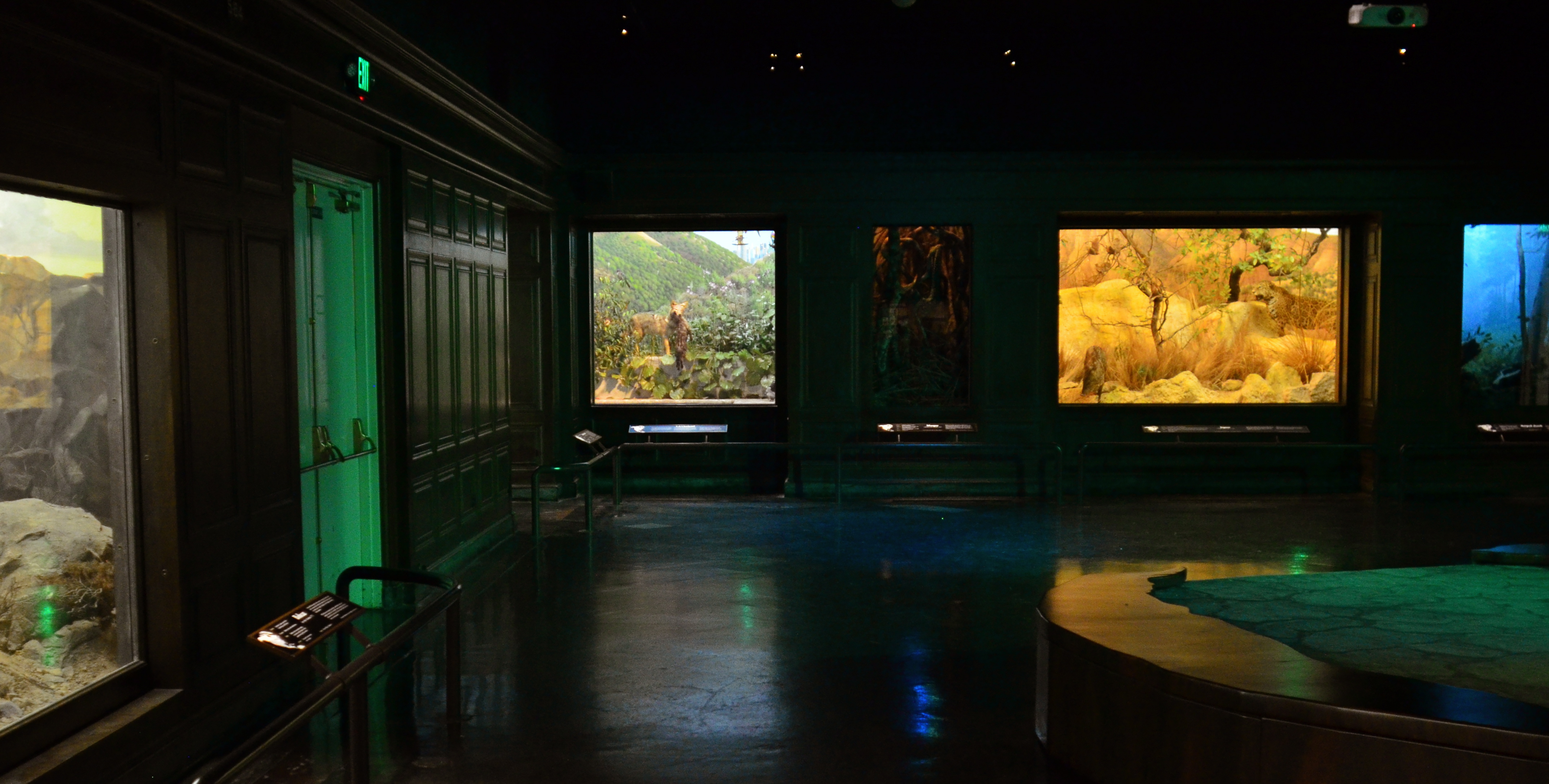
This process is lovingly demonstrated in 2017’s glorious film Wonderstruck, a nostalgic observation on the art of presentation, specifically the way it has historically been practiced by traditional museums, those special places where we arrange, as do photographs, a version of reality. The film chiefly centers upon New York’s Museum of Natural History, whose legendary dioramas of global habitats have transported generations of young minds to a universe of savannahs, shores, and deserts, all trapped in backlit cubicles and arranged in grand halls, warehouses of worlds orchestrated in darkness.
Here, in this supermarket of climates and locales, each diorama must convey its message in a shorthand of visual cues, hinting at entire ecosystems within a limited space and with only a modest number of props and textures. At their best, they echo the skills of the most effective of photographs, making eloquent choices on what is included, what is excluded, and whatever narrative power those choices generate in the finished product.
Of course, Wonderstruck’s affection for the museums it honors (including Los Angeles’ Museum Of Natural History, shown here) is a valentine to an age that is quickly vanishing, its prosaic, passive vistas giving way to the buzz and flash of ever more interactive, “hands-on” experiences, an immersive engagement that can make the dioramas of old seem like silent movies.
Still, if you can slow your absorption rate to pre-digital speeds, the old wonder boxes can still teach, because photographers are still bound by many of rules of engagement they observe. Don’t distract, attract: clarify your message: get the story told. Snapping an image is a fairly process. It takes time, real time, to learn to curate them.
(RE)SHAKE IT LIKE A POLAROID
By MICHAEL PERKINS
OVER THE PAST FEW DECEMBERS, The Normal Eye has marked the holidays by recalling classic Christmas advertisements from the Eastman Kodak Company, the first corporation to merge consumers’ seasonal sentiment with the promotion of camera sales. We’ve had fun revisiting examples of the firm’s amazingly successful “Open Me First” campaign, which cheerfully asserted that, basically, it ain’t Christmas until someone puts a Kodak under the tree.
This year, however, seems to argue for a new wrinkle in our tradition, with the long-anticipated resurrection of the Polaroid corporation, or at least its Christmas ghost. The strange saga began in 2008 when Polaroid decided to discontinue the production of its iconic instant film, leaving a half-century’s worth of global users stranded. Enter the entrepreneurial trio of Florian Kaps, Andre Bosman, and Marwan Saba, who bought as much of the company’s factory hardware and film-making process that still remained after Polaroid had begun scrapping parts and burning files. Sadly, most of the sacred secret film recipe had already been destroyed, meaning that the team’s new company, dubbed The Impossible Project, had to painstakingly reverse-engineer the production process, eventually creating an instant film that was much closer to the quirky, low-fi look of Lomography cameras than the precise instruments Polaroid produced in its heyday.
For the next seven years, Impossible Project instant film shot off the shelves to feed the world’s aged inventory of SX-70’s and One-Steps, drawing praise for preserving the feel of film and drawing fire for what was actually pretty crappy color rendition and slooooow development time. Finally, in 2017, Impossible purchased the last remnants of Polaroid’s intellectual property, allowing it to begin manufacturing brand-new cameras for the first time in years and rebranding the company as Polaroid Originals. Christmas 2017 would herald the arrival of the Polaroid OneStep 2, a point-and-shoot quickie designed to compete with other mostly-toy cameras cashing in on the instant film fever. The Ghost Of Shaken Snaps Past walks amongst us once again.
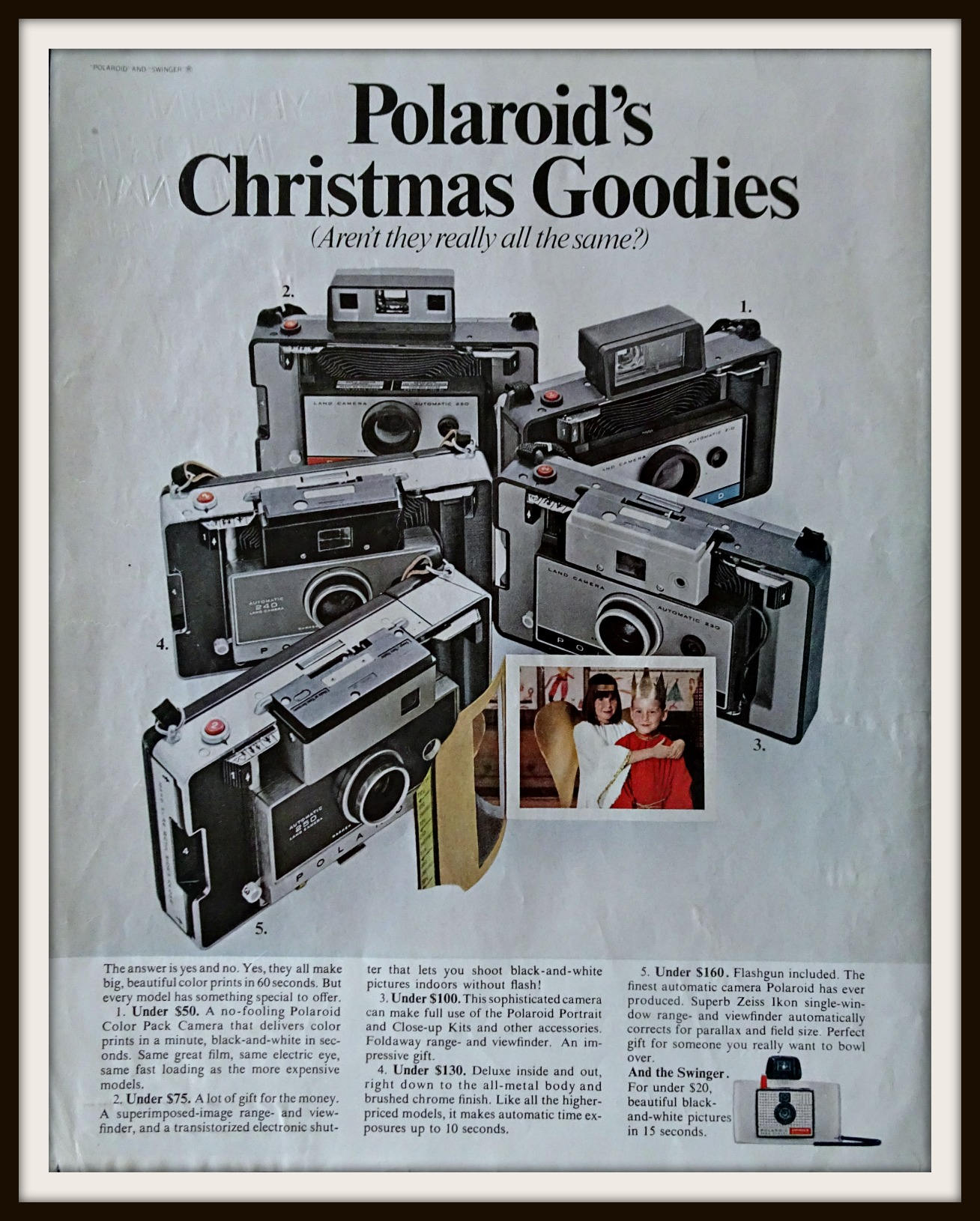
And so, Polaroid is dead and long live Polaroid. The above 1967 Christmas pitch for the original company’s full product line (read the fine print) gives testimony to the incredible instruments that once bore the Polaroid name. You can’t go home again, truly. Not to live, anyway. However, an occasional 60-second visit can be fun.
Strange colors and all.
THAT’S THE SPIRIT
By MICHAEL PERKINS
JACOB MARLEY, THE RUEFUL GHOST of Dickens’ A Christmas Carol, refers to the manacles and links that trail behind him as “the chain I forged in life”, and indeed, as the years wear on, one can certainly feel the accumulated weight of one’s own “ponderous” train, its clanking amplified to even greater force during the holiday season.
Certain cycles of the year speak louder to our memories than others, whether they mark anniversaries of loss, joy, sacrifice, devotion, or any other emotional life trophies. And the visual arts, including photography, tap into and amplify these feelings in everything from the pages of the calendar to snapshots of dear ones both present and absent.
Both present and absent. Living and dead. Still here and almost gone. Ghosts and survivors. Marley and Scrooge. The photographer can sometimes almost feel the collision of past and present within a single image, as if each force is grappling for control of the picture’s message.
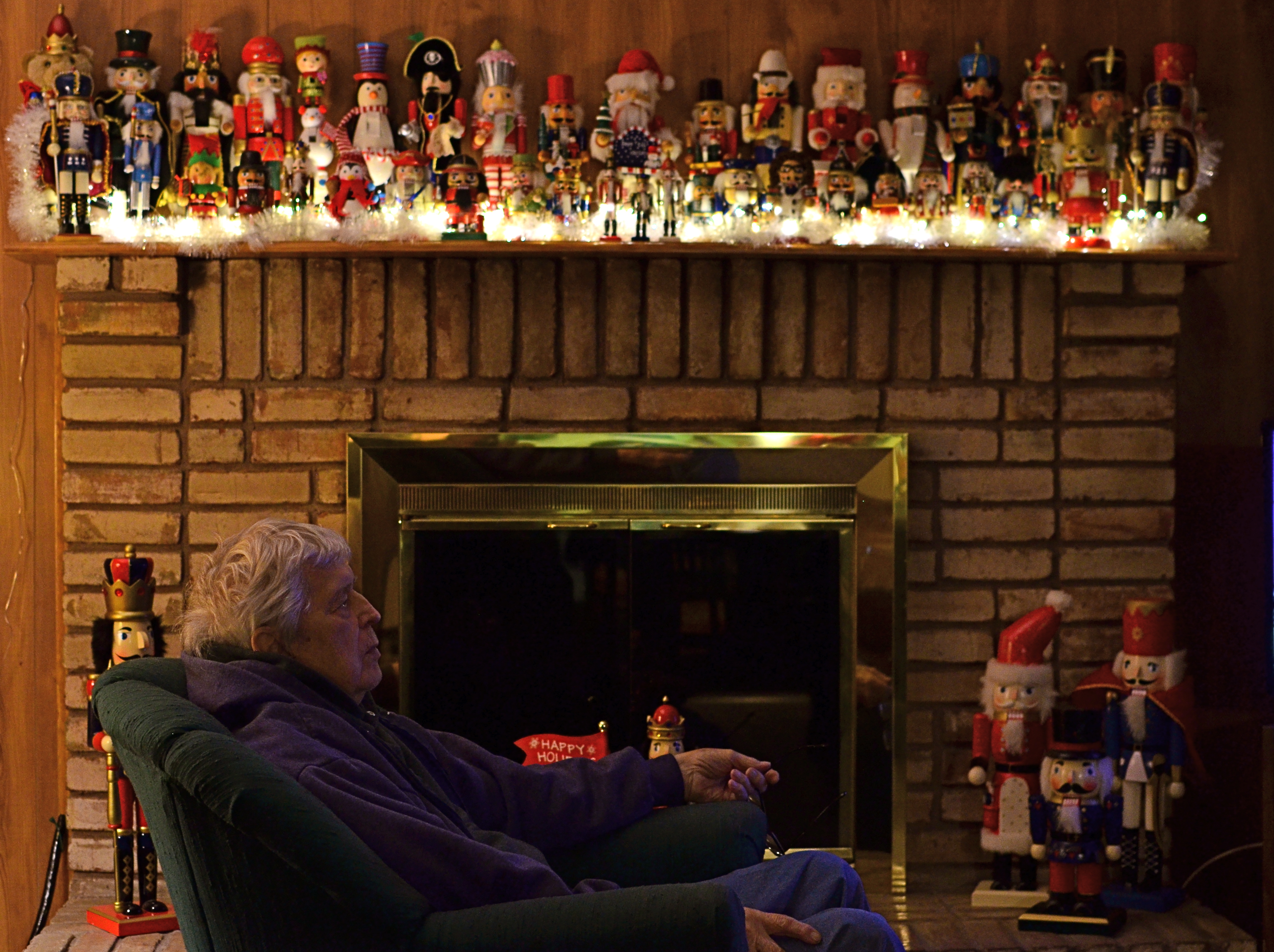
In the above photograph, I was initially looking to steal a candid of my father as he watched some television. It should have been a simple task, but, when your father is still here at 88, the faces of those no longer here echo in his every feature. To add to the density of emotion, you have the fact that he’s seated beneath a mantle fairly buckling under the weight of a third of a century’s worth of well-curated nutcrackers. Thus, even though she’s dodged having her picture taken at this particular moment (a well-honed skill), my mother is present here as well.
And so, decisions, decisions: I could have made my father look over in my direction, maybe even coaxing a smile from him, but I liked his weary look of detachment, as if the years were a kind of Marley chain dragging him earthward. I also could have cropped out the nutcrackers, simplifying the overall frame. But the “ponderous” tonnage of memory the figures symbolize would have been wasted, so they stay.
Photographs can only rarely be snapped in their most complete form, and certain times of year prove too layered with history to make for so-called “simple” pictures. Maybe it’s the different way we see on certain days. And just maybe it’s a ghostly presence, a glimpse of the chain we forged in life.
NO SECOND ACT
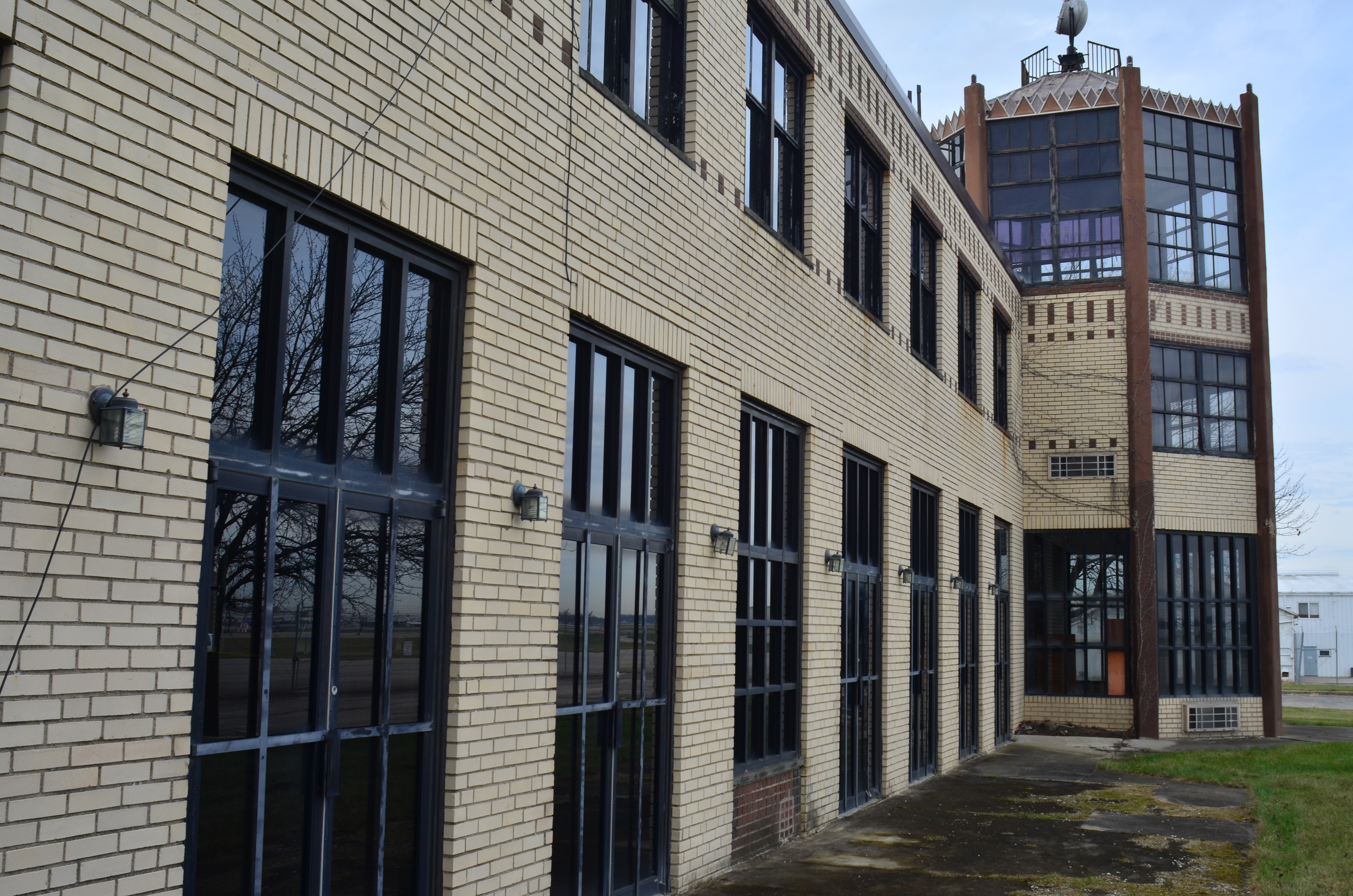
The first Port Columbus air terminal, opened in 1929.
By MICHAEL PERKINS
THERE IS SOMETHING TRAGIC, AND CONFOUNDING, in America’s longstanding reluctance to re-use and re-purpose its historic infrastructure. This ever-young nation seems to have an allergic reaction to preservation, as if the physical artifacts of its heritage contained some kind of dread plague. As a consequence, buildings that have figured most prominently in the story of our nation’s amazing evolution fall…. first to neglect, then to the wrecking ball.
Photography is a way to bear witness to what Gore Vidal called “the United States Of Amnesia”, a way to document lost opportunities and wasted potential across the fifty states. Miles of once-vital roads that no longer lead anywhere: blocks of neighborhoods that now howl and whistle in a dead wind: acres of buildings that once housed history instead of cockroaches and cobwebs. All is ripe for either revelation or regret at the point of a camera.
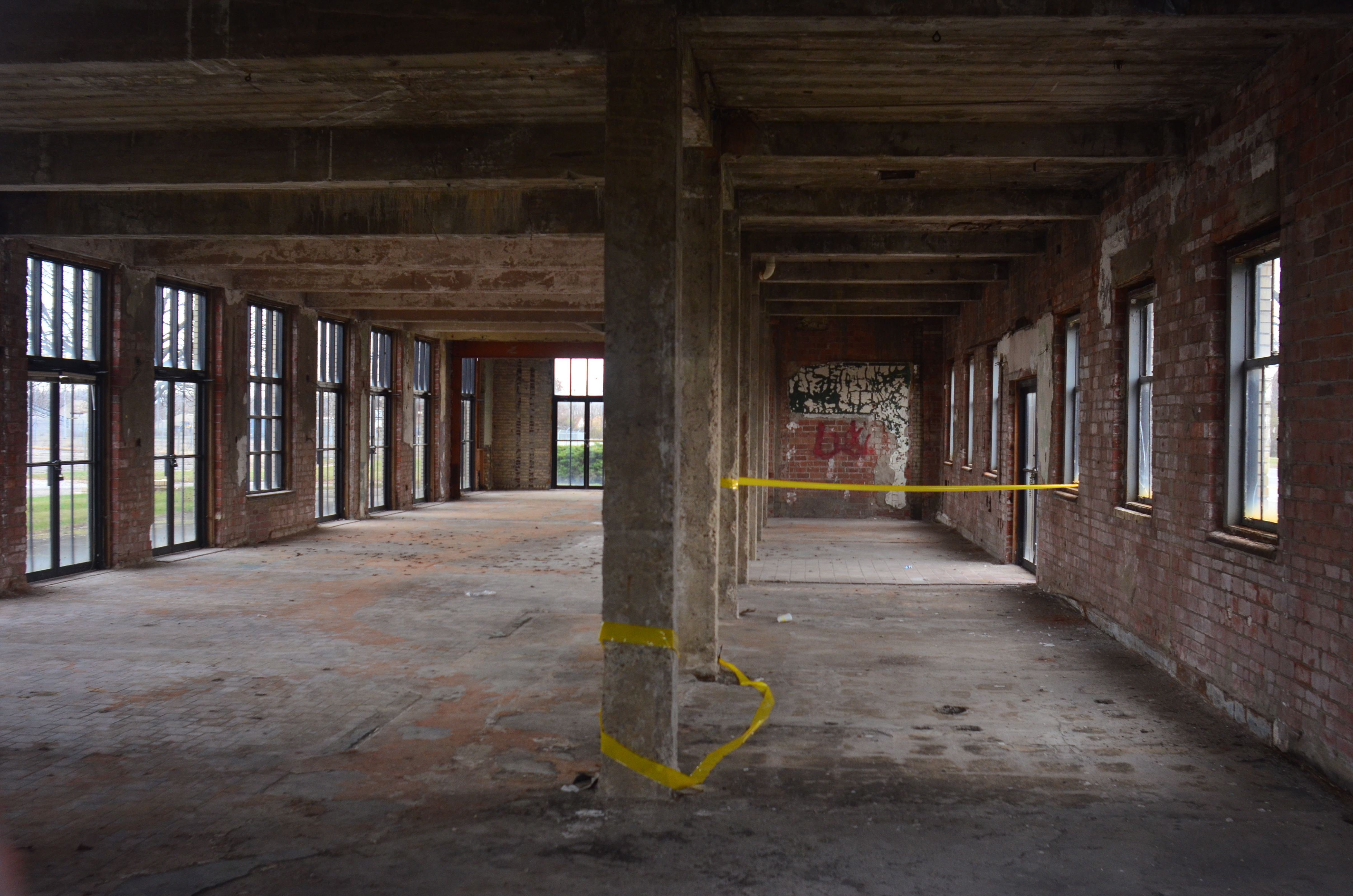
The deserted interior of the terminal in 2017.
Columbus, Ohio’s original air terminal building, opened in 1929 with hoopla and help from both Amelia Earhart and co-founder Charles Lindbergh, is one such location. Created as part of the country’s first fledgling attempt at a transcontinental air service (and this, only two years after Lindbergh’s astonishing solo flight to Paris) “Port Columbus” was solid proof that the air age was real.
Real enough, in fact, that a mere nineteen years later, the city’s air traffic had grown so rapidly that construction began on a shiny new international hub, big enough to accommodate a mid-century tourist boom, the jet era, and an explosion of international travel. The 1929 terminal was shuttered, living a few latter-day half-lives as offices for one short-term tenant or another, finally coming its silent rest on the Port’s back property, its legacy given half-hearted lip service with the obligatory plaque on the door.
Full disclosure: Columbus, Ohio was, for most of my life, my hometown. It is, among other things, a city of many firsts, a vital test market of ideas for everything from ATMs to hula hoops. And while I know that new uses won’t be in the cards for all historically important buildings there (or, indeed, anywhere), I am glad, at least, that, as photographers, we are privileged to say of such places: look here. This happened. This was important.
It’s often said that there are no second acts in American lives.
That’s tragic. And confounding.
GETTING PAST IT ALL
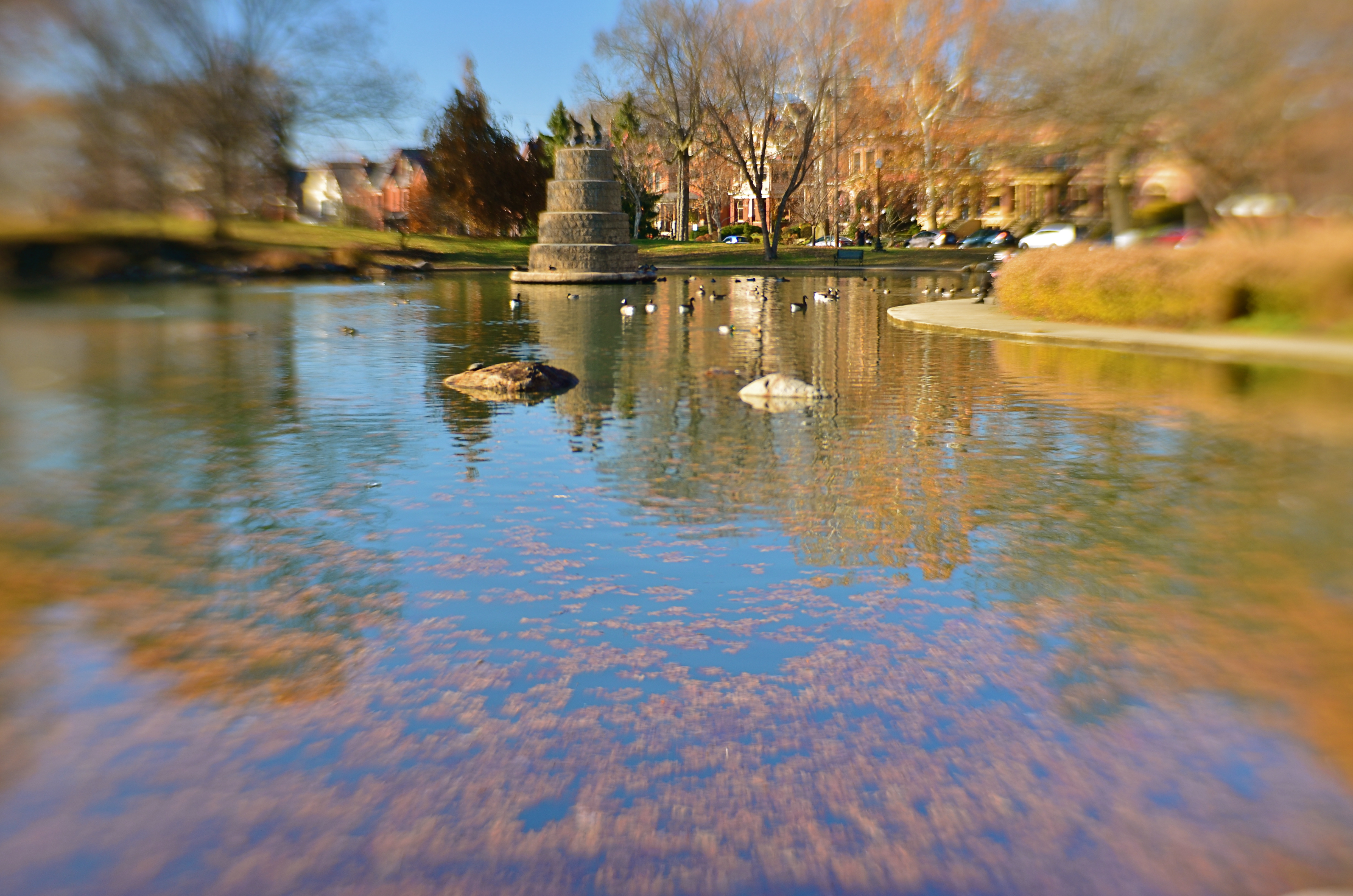
Is this image of a city park any less “real” than my childhood memory of it?
By MICHAEL PERKINS
SOME MEMORIES ARE BURIED SO DEEPLY in our mental archives that, like old snapshots, they deteriorate, browning along the edges, retrieved only in imprecise or incomplete detail. Ironically, these mainstays of our very personhood evolve over time from fact into folklore, rendering fundamental, formative events unreliable, suspect.
And if one’s personal memory of a time or place is less than “actual”, what about photographs of the places where those imperfect memories were forged? How can camera images of battlefields, home towns, even one’s childhood home record anything real beyond physical dimensions?
The park in the above picture first entered my consciousness in the late 1950’s, when my mother had medical appointments a block away and my father walked me around the perimeter of the pond to kill time while she lingered in the waiting room. I recall very specific things about tile mosaics of fish set in the concrete walkways around the water, and a few flashing impressions of a nearby cafe which no longer exists, but that’s pretty much the sum total of my memories of the place.
So, as a photographer in 2017, how do I even attempt to make a visual document of this locale? Any specifics of my own experiences here have been smeared and sandpapered until they only represent a part of a part of the real story. Shouldn’t I, in fact, sort of “free-associate” the scene, assuming that any fresh impressions are at least as trustworthy as my moth-eaten memories of it? Since I can’t reasonably capture a faded dream, isn’t the dream realm where I should draw for the missing pieces?
We only suppose that a camera, which at one level is a mere recording instrument, will act as an objective reporter on the current sites of our old adventures. But that’s the problem. It can only take measure of things as they are, not the unique mix of fact and fable that passes for experience in our imperfect minds. And so we frown at the results and mutter, “it’s not like it was…”
The reply to which should be: how would we know?
THAT’S WRONG, YOU’RE RIGHT
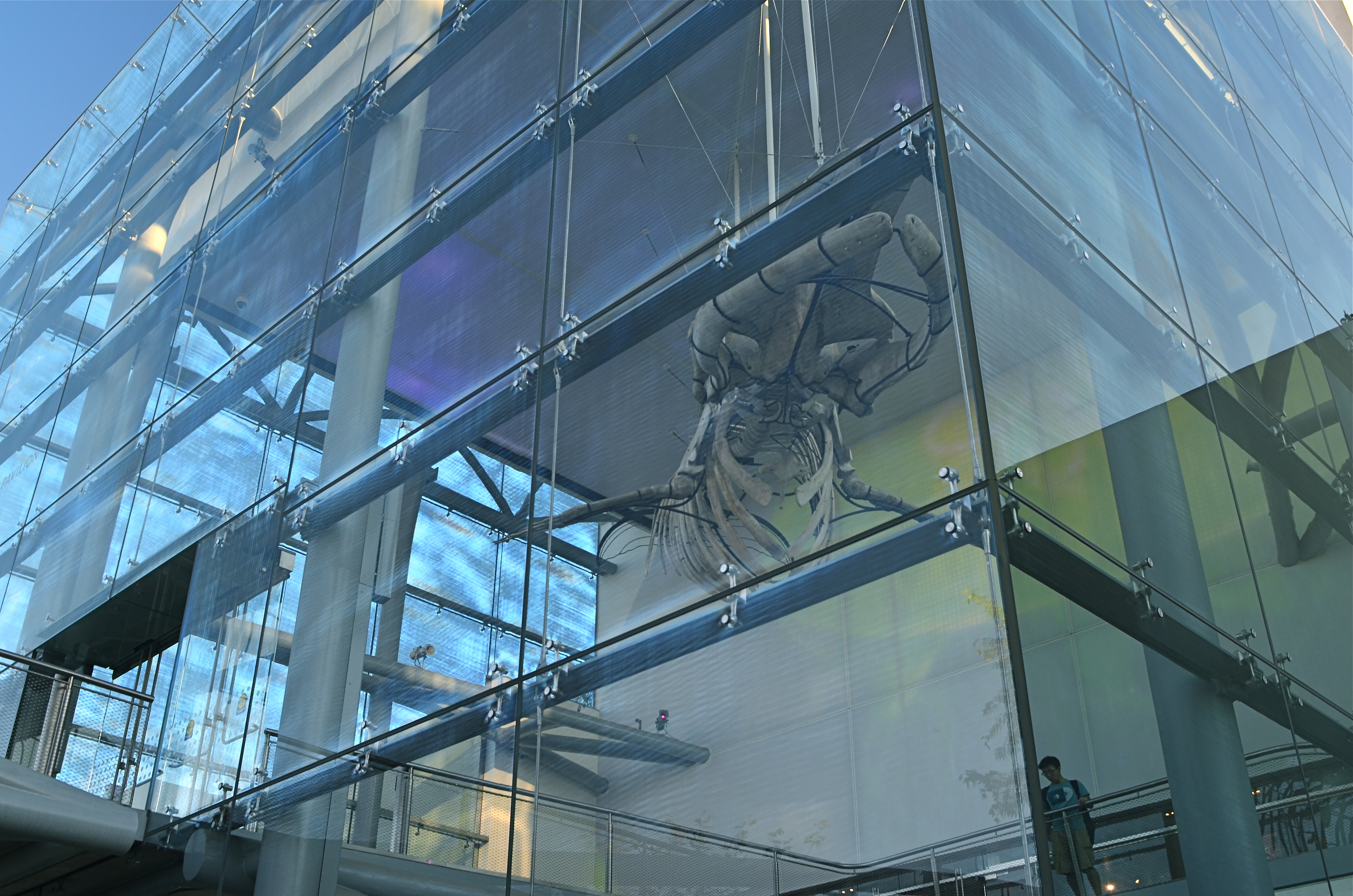
Cutting glare from the outside of a glass building with a circular polarizing filter…
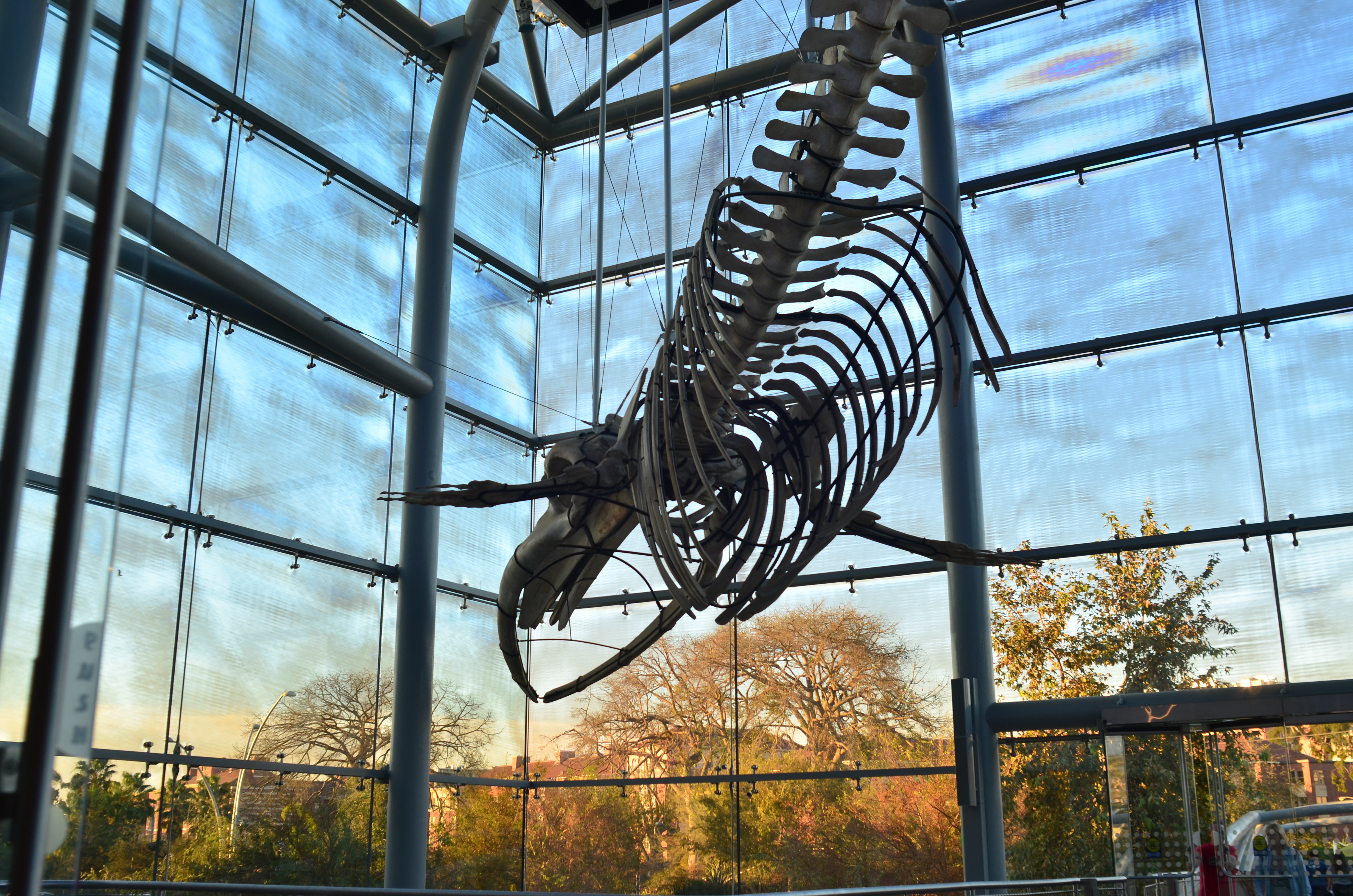
….and using the same filter to create effects on glass from within the same structure.
By MICHAEL PERKINS
IF, AS A PHOTOGRAPHER, YOU ARE A DEDICATED RULE–BREAKER, you may view every new piece of equipment as a double opportunity….a chance to explore gear both in the way the manufacturer intended (see the user manual) and in whatever intuitive (spelled “wrong”) way you see fit (we don’t need no stinkin’ manual).
This is not as perverse as it first sounds. Shooters have been flipping telephotos backwards to create makeshift macros and partially uncoupling glass from camera bodies to “free lens” their way to selective blurring and distortion for eons. And you yourself can no doubt recount instances in which your gear has been persuaded to go off the rails to achieve some experimental end or other. Good photographers vascillate wildly between I hope I’m doing this right and I wonder what would happen if I….
One of my favorite departures from normal practice involves circular polarizing filters, typically used to either deepen the blue of skies or remove reflective glare from surfaces like water or glass. In the image at the top of this page, it’s used in exactly that way, allowing me to view a huge fishy fossil in Los Angeles’ Museum Of Natural History. In the lower image, both the vantage point and the effect of the filter are reversed: I’m looking outwards, with the CPF producing imaginary streaky artifacts on the glass, adding dramatic framing accents to the fossil and breaking up the monotony of a large patch of sky. Is this the recommended use for the filter? Nope. Does this approach work for just any picture? Nah. Am I glad to be able to produce this look at will? Yes, please.
Around the house, driving a nail with the butt end of a screwdriver can seem, well, desperate. But in photography, stretching equipment beyond its intended use can be an adventure. It’s actually freeing, as if you’re playing hooky and getting away with it.
So, when the spirit moves you, choose the right tool. Then use it wrong. But only in the right way.
INSIDE THE OUTSIDE
By MICHAEL PERKINS
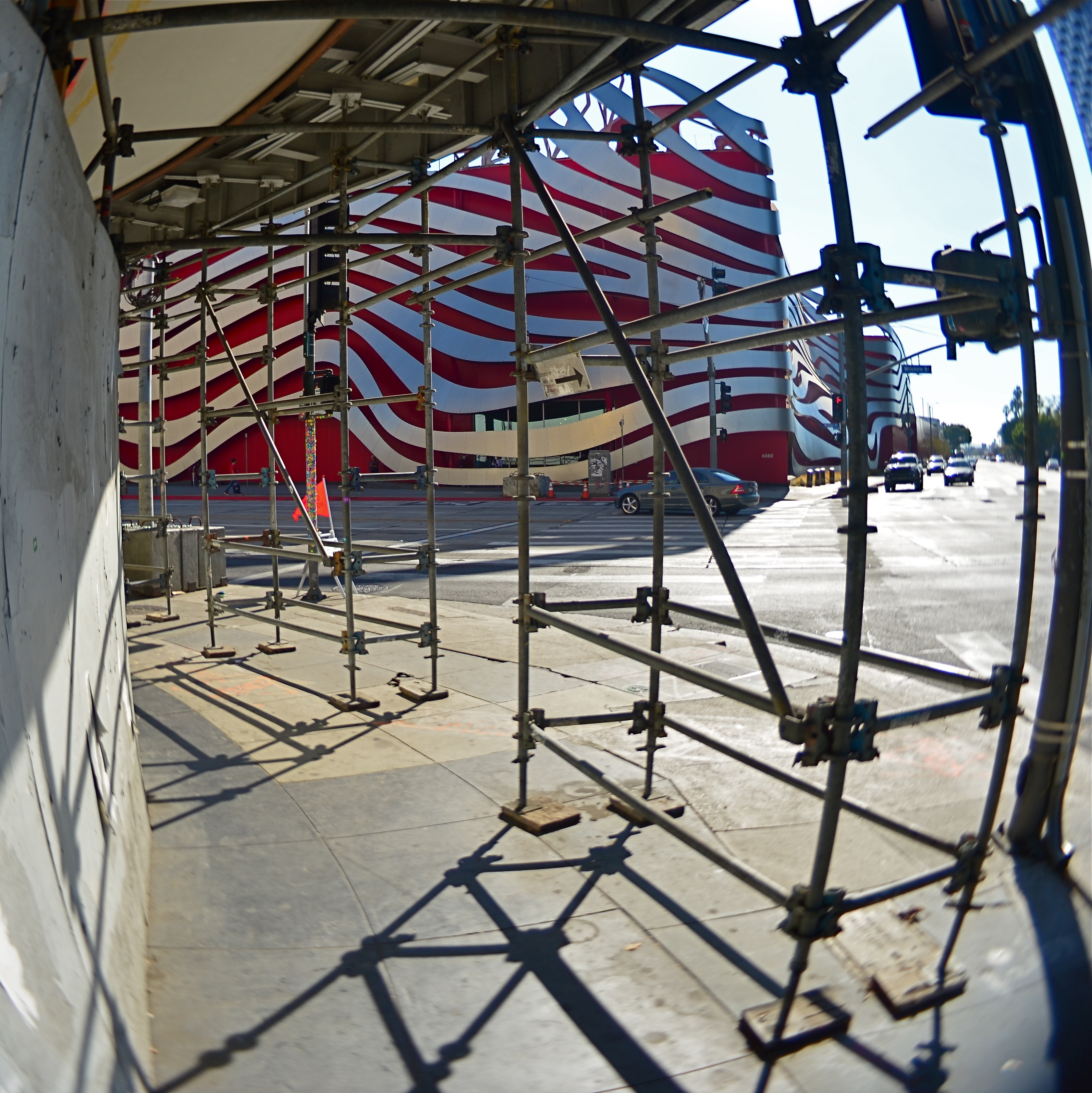
Los Angeles’ Petersen Automotive Museum, as seen from Fairfax Boulevard.
IT’S HARD TO ATTRACT ATTENTION IN HOLLYWOOD, a town that shouts in five dimensions, a million colors, and four thousand decibels about almost everything. Here, in the town that hype calls home, design always swings for the fences, and Subtle Is For Sissies. Small wonder, then, that photographers, who typically love to play top this with their peers, find that Tinseltown and greater L.A. are already at gold medal status in playing the very same game. I’ll see your weird, and raise you two weirders.
As a street shooter in Hollywood/L.A., you routinely witness the bizarre being passed off as the normal. As a consequence, the very act of visually commenting on this mad sensual overdose can make even your most prosaic shots seem like a trip through the looking glass. Words like stately, venerable, or traditional seem oddly out of place in the town that invented fourteen-story billboards and the Walk of Fame. Using a camera to say something new about it all can be a fool’s errand, or at least, a mental obstacle course.
Whenever I visit Los Angeles, I am constantly looking for some kind of reversal pattern, a way to treat the most outrageous visual artifacts on their heads. I don’t always succeed. I did, however, have fun trying, recently, to come up with a new way of seeing a very strange building, the Peterson Automotive Museum, located at the intersection of Wilshire Boulevard and Fairfax Avenue, the outside of which has undergone a very radical facelift in recent years. From afar, the building seems to be a wild, untethered series of curves and swoops, a mobius strip of red and steel spaghetti floating in space in an abstract suggestion of motion. It’s a stunning bit of sculpture that actually is a wrap-around of the original, far more conventionally-shaped museum building beneath it.
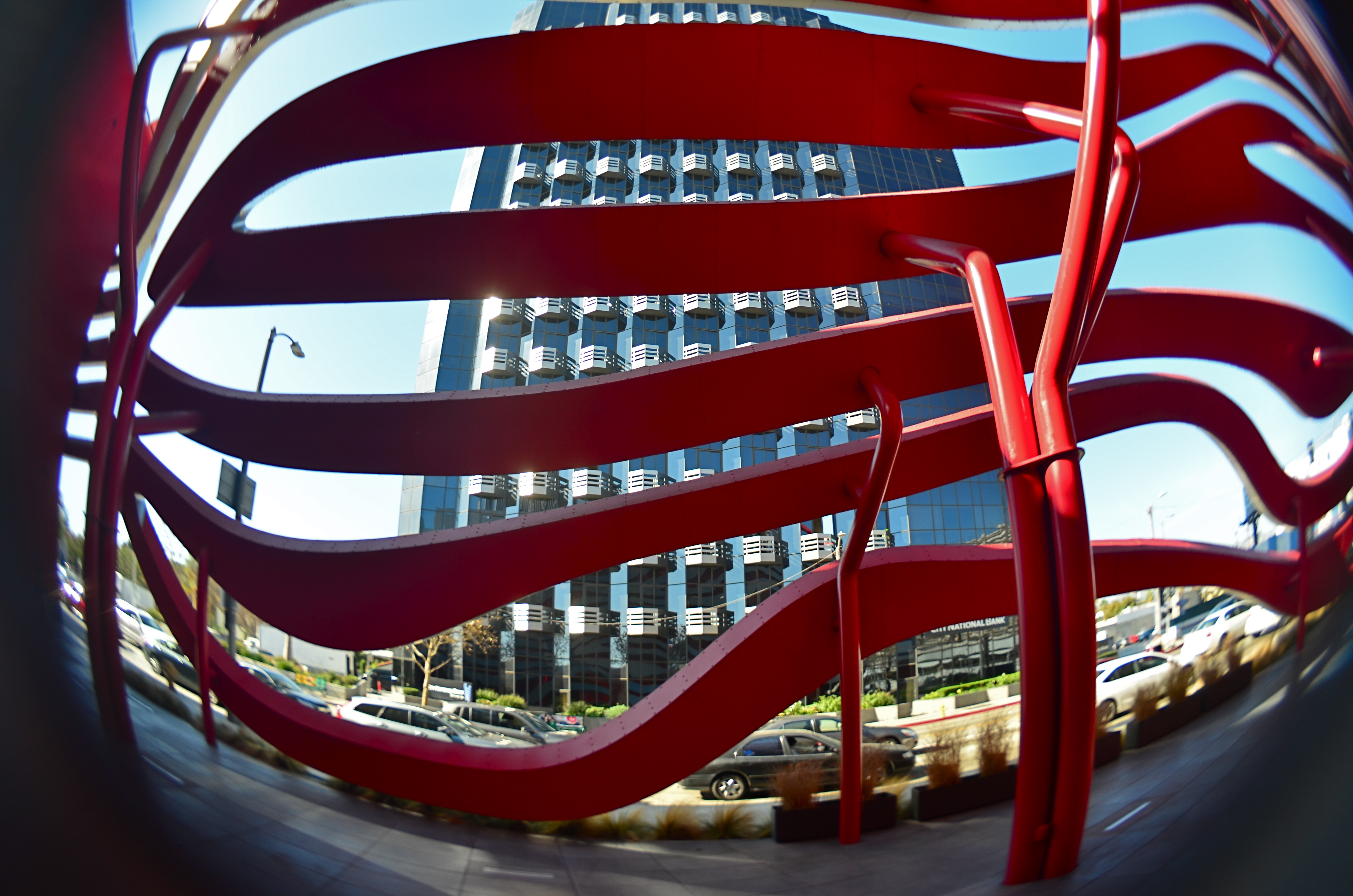
Inside the Petersen’s exterior facade, looking out.
And, as it turns out, that’s the way to reverse-engineer a photo of the museum, since it’s possible to walk behind the swirly facade and into a shadow-and-color-saturated buffer space that exists between it and the underlying structure. From inside said space you can view the outer bands as a peekaboo grid through which you can view neighboring buildings and local traffic, rather like looking between the slats of some big psychedelic set of venetian blinds. And that’s where I stood when taking the above shot with a Lensbaby Composer Pro lens with a fisheye optic, the aperture set at about f/5.6 to render the whole thing somewhat soft and dreamy. I’ll see your two weirders and raise you one bizarre.
 thenormaleye
O SILVER TREE, O SILVER TREE……
Cussins & Fern Hardware, Columbus, Ohio, Christmas 1965
By MICHAEL PERKINS
CBS TELEVISION FIRST AIRED A Charlie Brown Christmas on December 9, 1965, creating an instant seasonal classic. It got its first tenuous viewing despite the network suits’ fears that the modest little story, voiced by children(!), sporting a jazz soundtrack(!) and gently suggesting that the holiday may be about more than greed and glitz, would lay a giant Yuletide egg. They needn’t have worried, as it turned out. The show nobody wanted became the tradition without which no Christmas could be thought to be complete.
One of the show’s main plot points involves Charlie Brown’s fear that the holiday has been hijacked by hucksters, so much so that the hottest selling Christmas trees in his neighborhood are not verdant firs but pastel-painted, neon monstrosities. There was a lot of that nonsense going on in those days.
The photograph you see here was taken just days after that first airing of ACBC, but I can’t really claim to be channeling its energy or trying to echo its sentiments. The picture isn’t so much a comment on commercialism (nothing that formal) so much as it is a question.
I was a very young thirteen in December 1965, and had only wielded my Imperial Mark XII box camera on a few occasions prior to the day I found myself wandering around Northern Lights shopping center in Columbus, Ohio, specifically past the display window of the Cussins & Fern Hardware Company. Like Charlie Brown, I thought that some holiday novelties, like the recently introduced aluminum Xmas trees were odd, even though I liked the included rotating wheels that projected ever-changing colors onto the silvery sticks in a kind of robotically cold imitation of gaiety. However, unlike Charlie Brown, I don’t think I regarded these abstract Future Trees as an affront to decency. I just thought they were weird.
I do remember thinking that the window showed a Christmas that was just kind of……off, a Christmas in which you got a whole television set or a food freezer as a present, a Christmas filled with Strange Trees From The Future, a Christmas where you could always buy….money orders? I knew, in that era, next to nothing about how to formally frame a shot or a visual commentary. I didn’t have the pictorial vocabulary to make an argument. I couldn’t interpret. I just pointed at things that interested me and trusted those things to carry their own narrative weight. I was point-and-shoot before point-and-shoot wuz cool.
This Christmas, both the holiday and I are still in flux. I continue to point my camera at shop windows, and continue to wonder what the whole mad mix of beauty and banality means. I still don’t have the answer. Alas, as a photographer, you often have to be content with merely learning better ways to ask the question.
Now, if I can just find someplace to buy Uncle Ed that money order he asked for…..
Share this:
December 22, 2017 | Categories: Americana, Christmas, Commentary | Tags: Holiday photography, Techniques and Styles | Leave a comment