IT’S A JIGSAW OUT THERE
By MICHAEL PERKINS
AS A PHOTOGRAPHER, IT SEEMS TO ME that a municipality only qualifies as a “real” city when it becomes nearly impossible to visually identify its beginnings. Neighborhoods may begin as unified civic signatures with coherent visual styles, but let fire, war, hard times or earthquakes add their input, and those same streets start to look like jigsaws with the pieces chosen from different puzzles. It’s a nightmare for urban planners but a treasure trove for the camera.
As they age, cities become visual collision points between good intentions and unintended consequences, with parts of one era being grafted onto fragments from another. Absent a bomb or natural disaster, few streets are completely destroyed by time, just evolved into a crazy-quilt jumble of bygone trends, deaths, and rebirths.
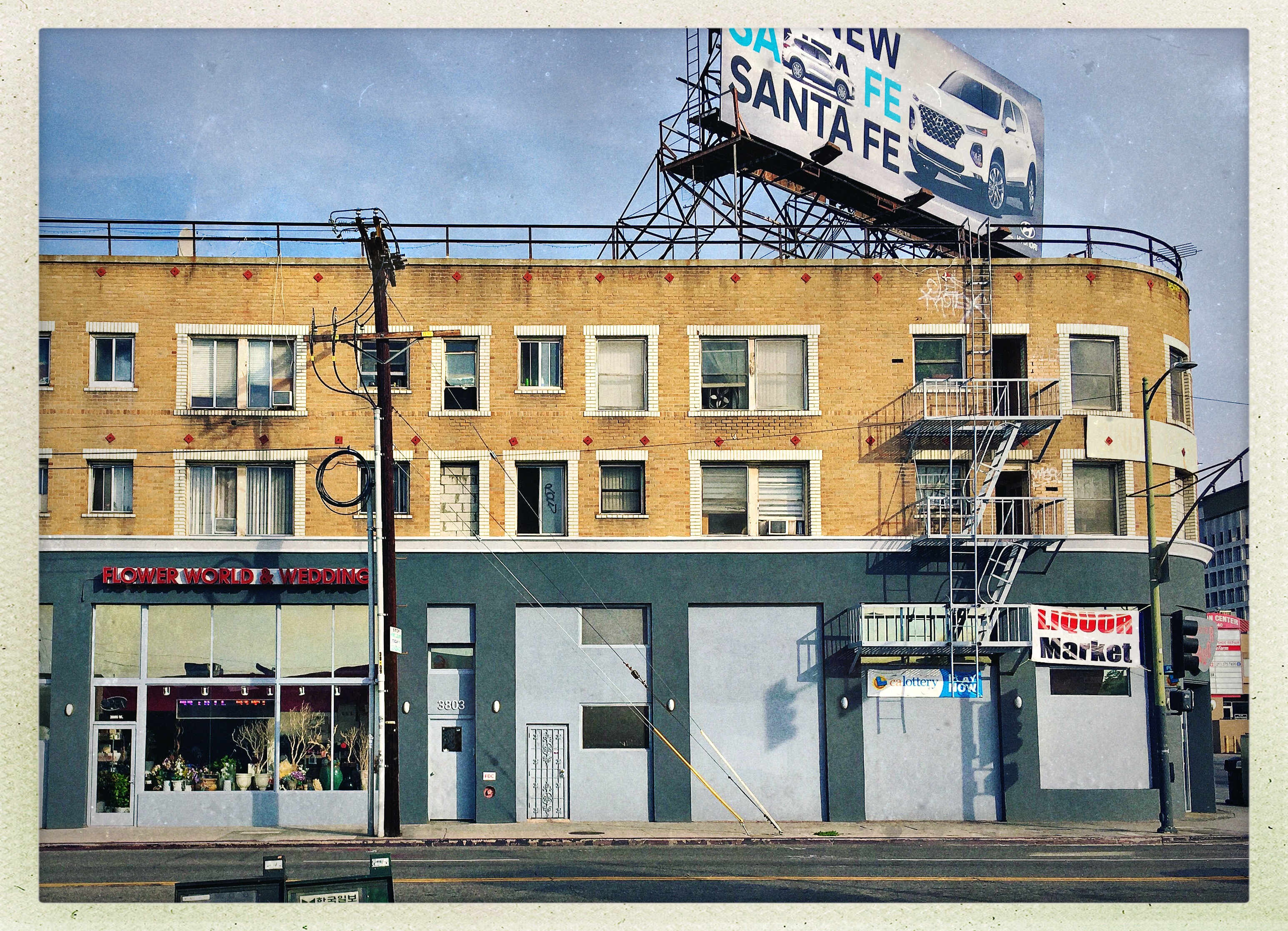
This image shows a typical block in Los Angeles’ Koreatown district, with residential, retail and undefined space co-existing in a single building, following the general rule for the neighborhood that everything should be re-purposed and then re-re-purposed pretty much forever. Things get old. Things break. Ownerships and administrations change. Priorities shift. Some parts of buildings disappear, others are re-imagined, still others are absorbed into other visions.
This urban recycling has real benefits. As an area with the densest population concentration in all of Los Angeles county, there is no space in Koreatown to waste, and thus many priceless remnants of the Art Deco movement which might have fallen to the wrecking ball in other sectors of L.A. were saved and re-used when the neighborhood transitioned from an entertainment district to a residential and commercial area in the 1960’s. Like most of the city at large, Koreatown’s streets are living exhibits, laboratories involving all of the different “Los Angeleses” that have existed throughout the last century. And as with “real” cities in general, part of the new way for the various Koreatown’s is always marbled with what Paul McCartney calls “my ever-present past”. creating unique photographic opportunities in the process. Essentially, cameras were born to bear witness to this amazing cross between architecture and archaeology, this irreconcilable argument between competing jigsaw puzzles. It’s part of the Big Picture we all seek.
SITUATION WELL IN HAND
By MICHAEL PERKINS
A SELECTIVE READING OF SOME of the posts featured in The Normal Eye over the years might give the impression that I am “anti-flash” in my approach to photography. A closer look, however, would reveal that I am more properly non-flash….that, while I stipulate that judicious use of artificial light can be amazing, (a) it can often do more harm than good, and (b) there are fewer situations in which it’s needed than at any other point in time. So, anti……no. But non…..absolutely.
Choosing not to use flash in low light situations used to mean that a tripod was essential for sharpness in even reasonably quick exposures, but even that truth is falling by the wayside, as sensors allow for lower noise at ever-higher ISO levels. The handheld shot is now more convenient and reliable than ever, with only modest investments in gear and/or practice to yield suitable results. This means that, outside of very formalized studio settings, you may now be able to leave both flash and pod in the closet in more and more cases.
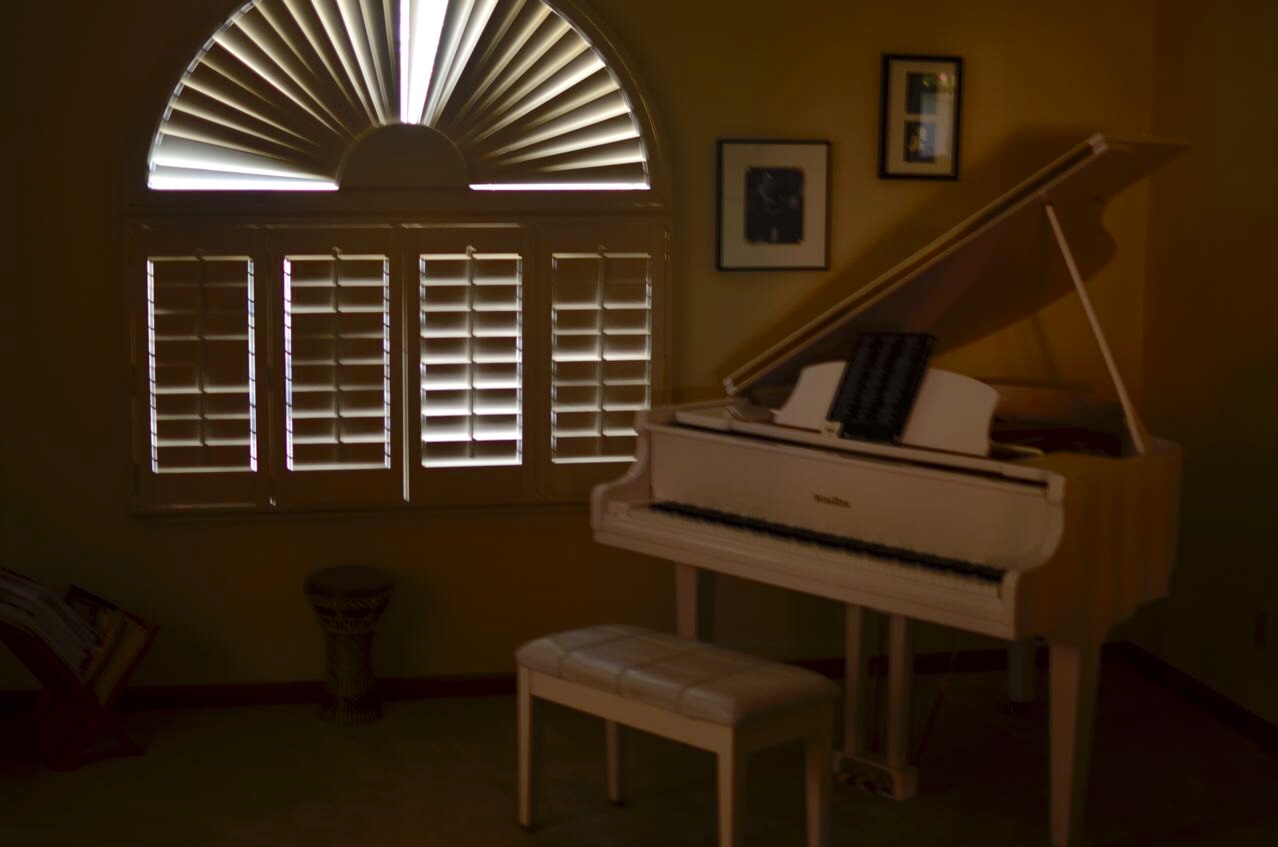
So let’s pursue the ideal: a low-light image, shot handheld, with the lowest possible ISO, achieved without flash or tripod. First, your glass needs to be fast, something that can’t be said for the basic kit lenses that are packaged with most DSLRs. A lens like a kit 18-55mm that only opens in the f/3.5 range can’t compete with prime lenses such as a 35 or 50mm of f/1.8 or faster. The extra several stops can render many more handheld shots feasible, and so investing in an affordable prime (single focal length) is money well spent.
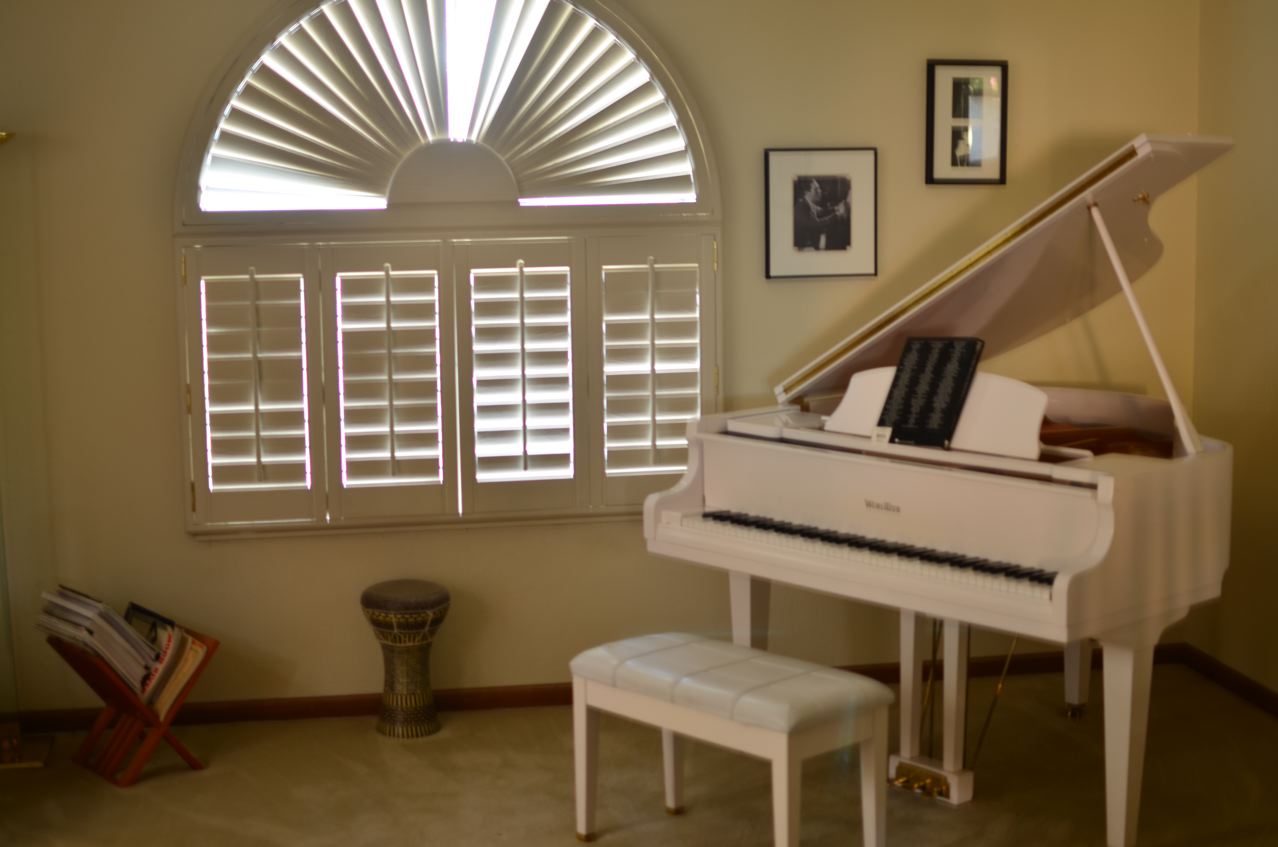
The other, and far more decisive factors in this handheld quest, since you’ll be dealing in slower exposure times, are the purely physical moves involved in bracing your camera. Whether it’s a firm stance, a solid grip, a handy resting place like a shelf, or a combination of all three, you have to practice….a lot…in minimizing camera shake. Everyone’s technique for this will vary, and the web is rich in written or video tutorials from which to choose. The point is, it’s possible to learn how to do it.
The two shots shown here are both shot wide open, at F/1.8, at a rock-bottom ISO value of 100 and available light only (the room was actually further darkened for purposes of this test). And while you can certainly see a clear contrast in sharpness between the first and second shot, they are handheld at 1/5th of a second and 1 full second respectively and are both usable shots (seen here straight out of the camera). Moreover, even shooting at, say, 1/10th of a second or faster, the picture could still be done with very low ISO and no flash, no tripod. And that buys you ease, mobility and speed. Travel light, shoot more, and in more places.
Again, I am most definitely not anti-flash. I just think that the fluidity of today’s gear, along with a few hours of practice, can simplify your shooting, giving you more concentration on the why of a picture rather than the how of getting it done.
STOLEN
By MICHAEL PERKINS
NO DOUBT WEARY OF QUESTIONS about the secret of his photographic technique, the late Lars Tunbjork once told an interviewer, “I try to take photos like an alien”, a statement which strikes me as the perfect description of the shooter’s viewpoint. We are steeped in our own humanity: we are swept along in its tidal swell. But being part of all life gives us a skewed perspective as commentators. Striving to renounce our membership, to become The Outsider, is an art in itself. And certain pictures simply can’t be made without it.
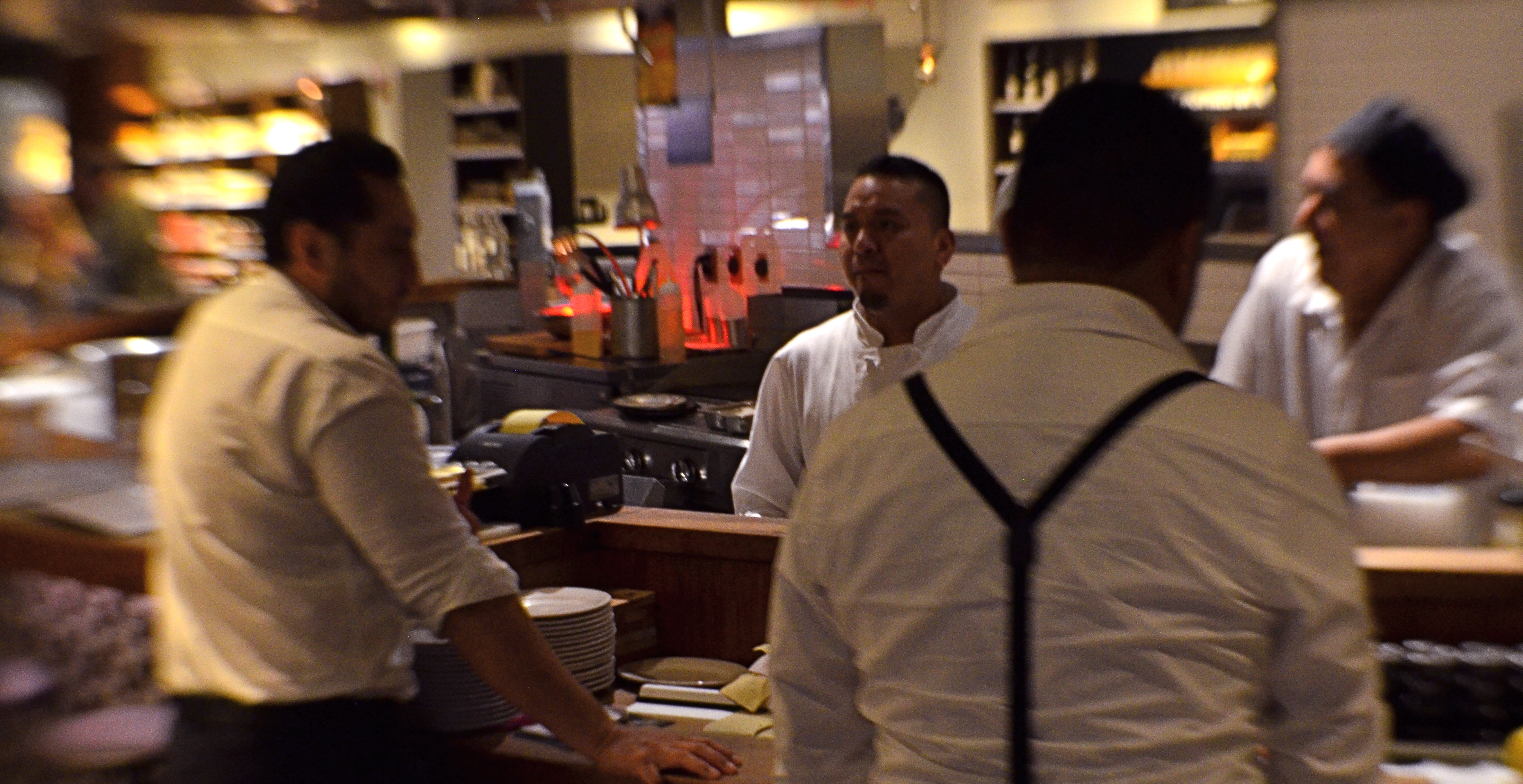
Observing a scene as if one were an “alien”, as if we were freshly arrived on a scene which possessed nothing familiar to us, forces us to make unbiased, instantaneous evaluations of what is picture-worthy, not from our memory or habit, but from instincts, even raw guesses. Like E.T., harvesting earth plants for the purpose of study, we are placing ourselves into the viewpoint of a Columbus or an Armstrong. If we succeed, our perspective is truly that of someone Who Has Never Been Before. These small stolen instants of what one photographer called the flash of perception free us, momentarily, from what we’ve learned or assumed over a lifetime of experience. They allow us to shoot things we don’t pause to understand or contexualize. We feel that something ought to be a picture, and so it becomes one.
Tunbjork often took shots of randomly selected people in office environments doing the daily mundane tasks of making a living. The pictures were certainly “real” in a sense, and can, in fact, convey the feeling that we are getting our first (fresh?) look at things so ordinary that they have become invisible. Just as in the case of the shot seen here, snapped as I took a shortcut through a busy restaurant, the sensation can be that we have just happened upon something previously hidden: a conversation, a short relaxed break, a backstage glimpse. We are intruding into a place where we normally are not admitted. We are stealing. Hopefully with a tale that, later, back on the mother ship, we can share with our fellow aliens.
A TRIP TO THE SUPERMARKET
By MICHAEL PERKINS
WE’VE ALL DONE IT: we’re sent to the grocery store for bread and milk, and come back with a six-pack of beef jerky, a gallon tub of guacamole, and a family-sized box of Trix. Sometimes, lost in the sublime and seductive specials inside the store, we even come home without the bread and milk. But, hey, beef jerky.
That’s what happens on some photographic shoots.
The sequence is familiar. You pick the target. You pack the appropriate gear. You may also have to book passage or pay for admission to something. You research the forecast. You even visualize the expected layout or sequence of shots. And then comes the day itself, a day upon which, for whatever reason, the pictures won’t come. A day upon which you can’t buy a usable image for love or money. To further torture my original metaphor, the grocery store is fresh out of bread and milk.
But, fear not: as a photographer, you are nothing if not resilient. Like a lost dad determined to find something of use somewhere in the supermarket, you go looking for deals. The pictorial orphans. The what-the-hell or go-for broke shots. Wild clicks as you’re slinking back to the parking lot. Cripes, at this point, you’re reduced to looking for cute dogs. But will these desperate moves yield pictorial gold?
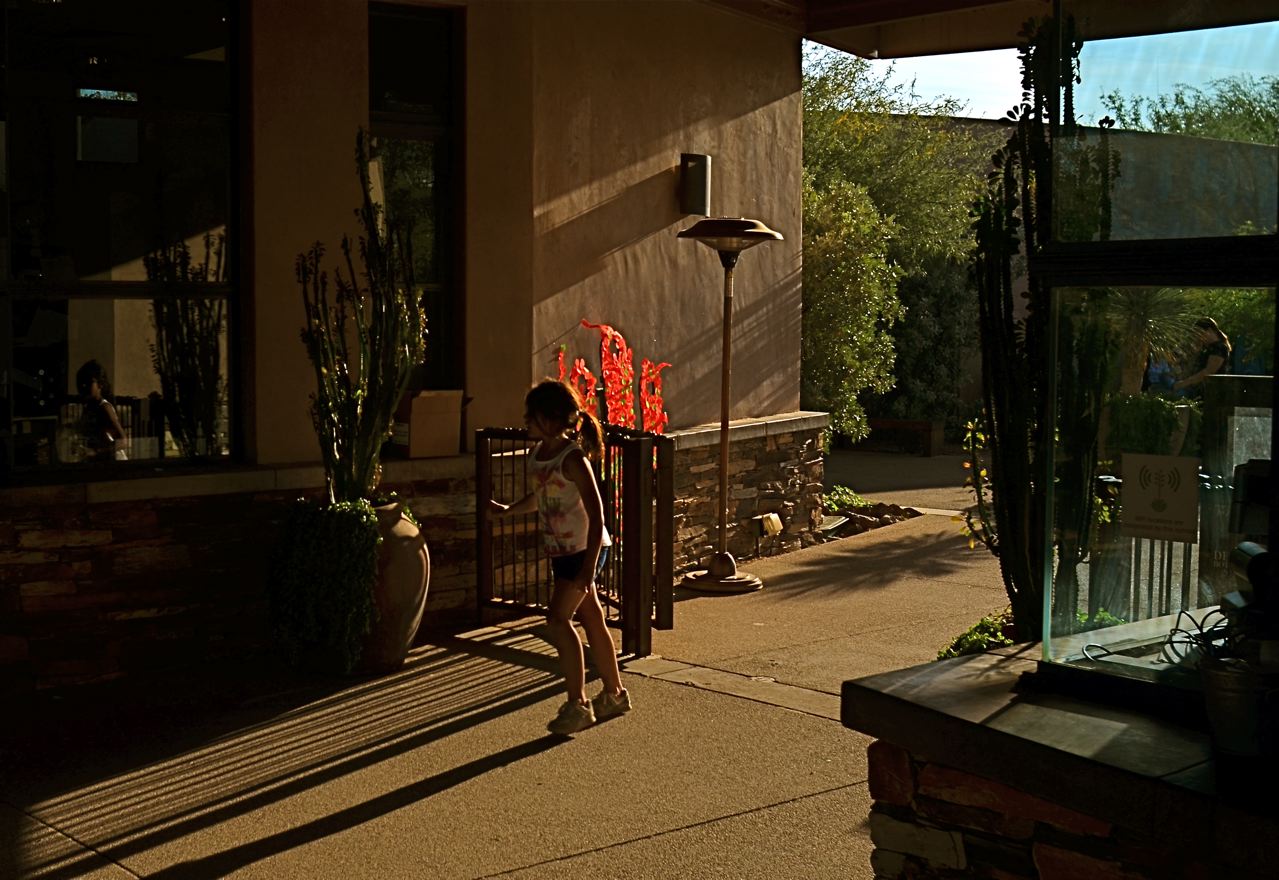 No guarantees. Fate doesn’t dole out consolation prizes. However, the primal panic that results from seeing your Plan “A” go down in flames can make you more open to experimentation, less fastidious about getting the perfect frame. That, in turn, may lead to embracing the accidental over the intentional……of moving your emphasis from the conceptual (your original plan) to the perceptual (flashes of ideas that occur once your mind is open).
The shot seen here, if I’m honest, is neither good nor bad. It was merely workable at the end of a day on which absolutely nothing else was. I liked what the light was ( and wasn’t) doing in the moment, and the girl gave me a small anchor for the viewer’s eye, albeit a small one. Other than that, I had no overarching concept for the picture. An empty grocery cart made me reach for the beef jerky.
Photographs begin with intention, certainly. But we often kid ourselves about what a huge part randomness plays in what happens between Think and Click. We’d love to assume we’re in charge of our process. But let’s also learn to love the disrupters, the detours, and the dreams gone amiss.
MEMORIALS OF MEMORIALS
By MICHAEL PERKINS
AT THE TIME OF THIS WRITING, November 2018, the world is pausing, all too briefly, to mark the one hundredth anniversary of the armistice between Germany and the Allied powers, the first halting step toward ending what our forebears called The Great War. Such was the scope and scale of butchery in that conflict that more than a few prophets of the time predicted that no such savagery could ever be repeated. So much for mankind’s ability to forecast, or even to learn from, its own folly.
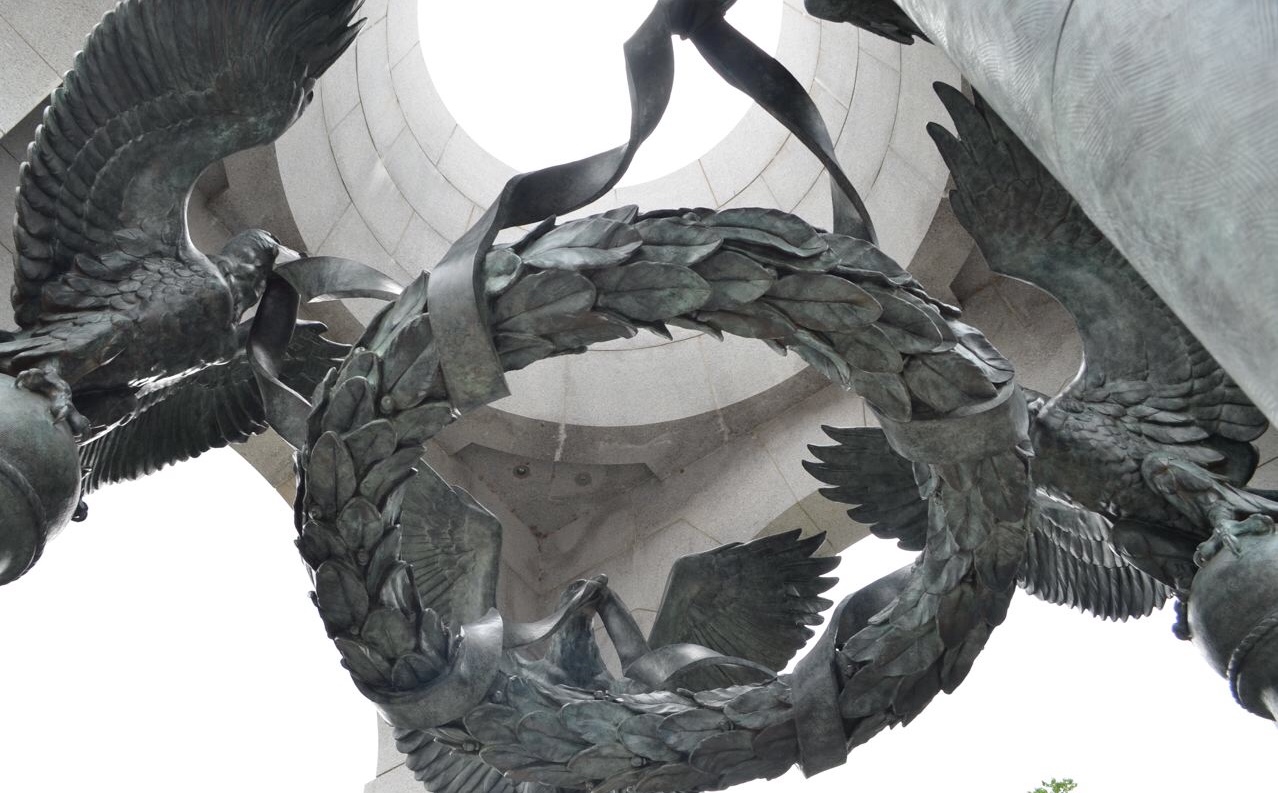
The war was the first armed conflict to be photographed exhaustively both in still and moving images, producing a ponderous archive that, even with the losses of a full century, provides a common legacy of memory that is beyond price. Another such photographic archive is more emotionally immediate, in the snapshots, taken in the field and sent home to mothers and sweethearts, snapped at reunions, shared at funerals. And the third legacy, for photographers, is chronicling the various public works created to honor the fallen. Memorials. Mausoleums. Arches. Dedications. Grave sites. Statues. Every remembrance becomes a kind of history in its own right, with its own origin stories, artists, controversies, legends. We make images of war, create photos of those swept up in them, and take pictorial memorials of….other memorials.
Some of the tributes for one war become casualties of another: others may last long enough to be re-thought or re-purposes. Even more find their story blurred or obliterated, with plaques marking battles that have fallen out of popular memory. One of the things obliterated by all the bombs is context.
Perhaps Lincoln was right: we may not be able to hallow the ground that heroes trod, for all our noble intentions and grand words. It is only in our corrective action that we guarantee that the sacrifices of the few become, please God, the wisdom of the many.
THE PAINT-IT-YOURSELF-PORTRAIT
I am a member of the blank generation. – Richard Hell
By MICHAEL PERKINS
STREET PHOTOGRAPHY HAS LARGELY BUILT ITS TRADITIONS on the truths and tales of the human face. The art of illustrating urban narratives on the fly relies chiefly on how those stories register on those faces. It’s a visual drama that no shooter can resist.
But the story of how, for good or ill, modern cities affect people….the way they process, channel, contain or empower them as moving props……that kind of story can be told without clear or readable facial features. This doesn’t mean that “humanity” doesn’t matter in these pictures: it means that some images are designed to show how it’s impacted that humanity en masse rather than one person at a time.
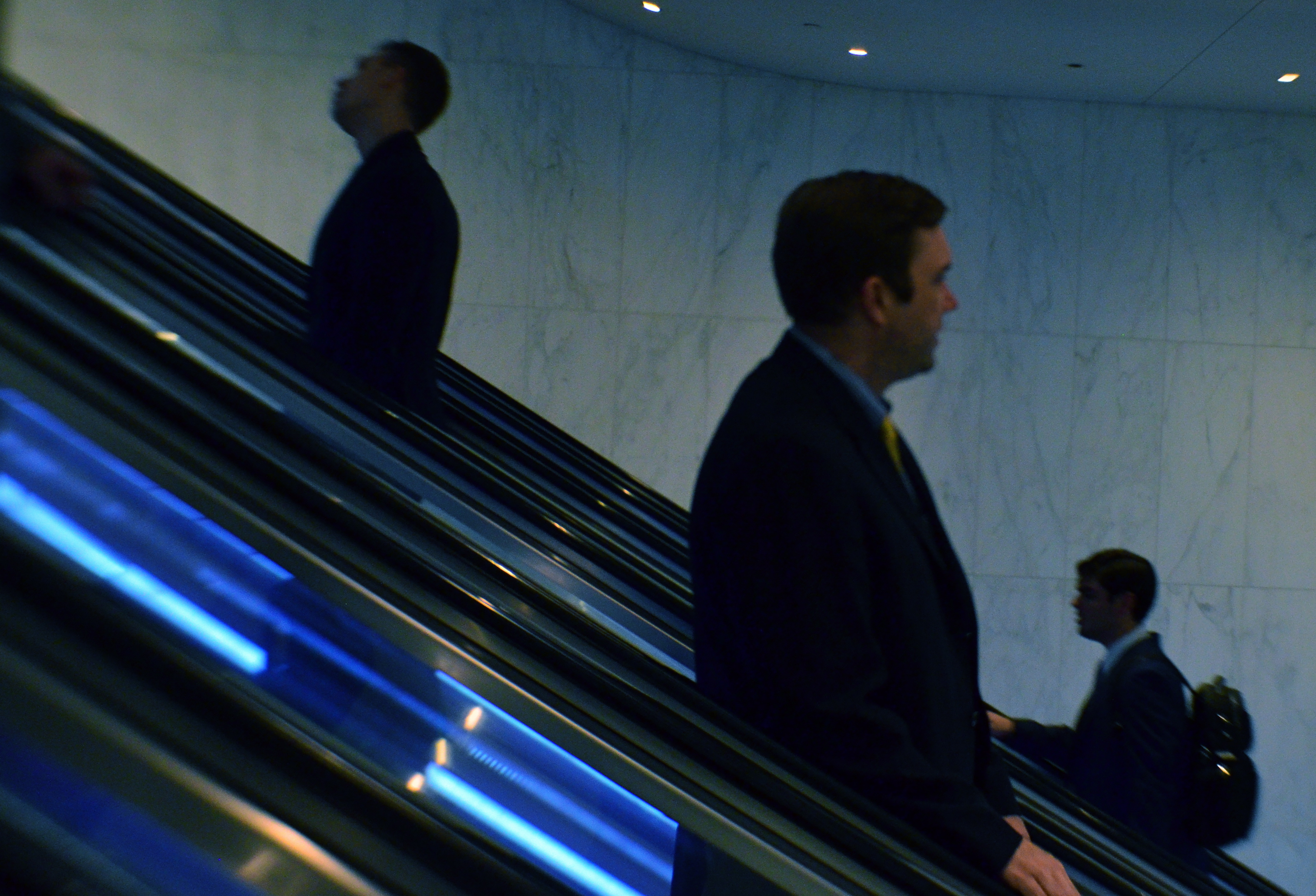
There is one other singular thing that happens when a photograph renders a face as a blank canvas. It means that, for the interpretive viewer, that face can now contain whatever he/she wants it to. In such pictures, both photographer and audience are in a kind of coded conversation about what the image “says”.
To illustrate this point: the above photo may or may not be about anything more dramatic than three men in the act of riding an escalator, headed for lunch/a meeting/the parking lot. However, since their features are shrouded in shadow and presented in a softer focus, I can intend a message of my own devise, and outside eyes can supply subplots that either complement or derail that narrative. That’s the kind of chat that keeps an art throbbing along. It allows everybody on either side of a photograph a chance to paint portraits based on their own eye.
PLANE SPEAKING
 By MICHAEL PERKINS
THE CONCEPT OF FOCUS HAS, over my lifetime (and, I’m sure in some of your own), moved through three distinct phases. The first, when I was very new to the making of pictures, was absolute. All or nothing. An image was either sharp from corner to corner, front to back, or it was worthless. My goals at this point all centered on technical mastery, I suspect because I had none.
The second phase for how I viewed focus could be called front plane, rear plane as I got more adept at the selective use of depth-of-field, making decisions to sharpen either the tree in the front plane or the mountain in the rear plane. Here, I started to actually make deliberate choices on what to emphasize within a frame, and thus to prioritize the order in which I wanted people to discover my pictures.
The third and most recent focal phase, one that could be called priorities within the plane, allows for even more controlled decision-making, as objects that are, from left to right, all the same general distance from the lens, rendered in vastly different degrees of sharpness as a matter of interpretation. This kind of selective focus is abetted by lenses like the Lensbaby line of products, many of which allow for the placement of a sharp “sweet spot” in-camera, anywhere within the image. Even more importantly, many remarkable apps allow for the same effect to be applied in post from a cel camera.
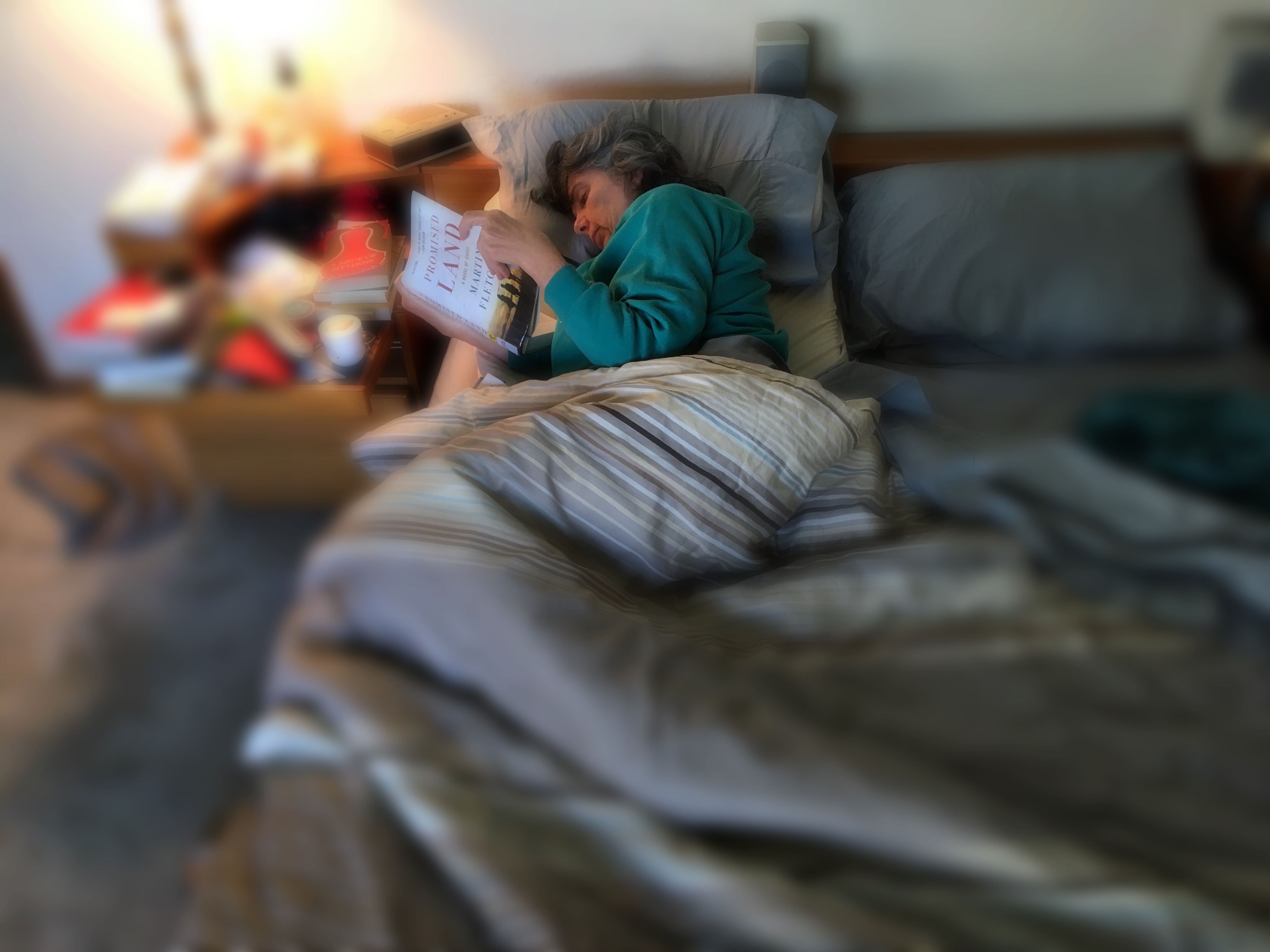
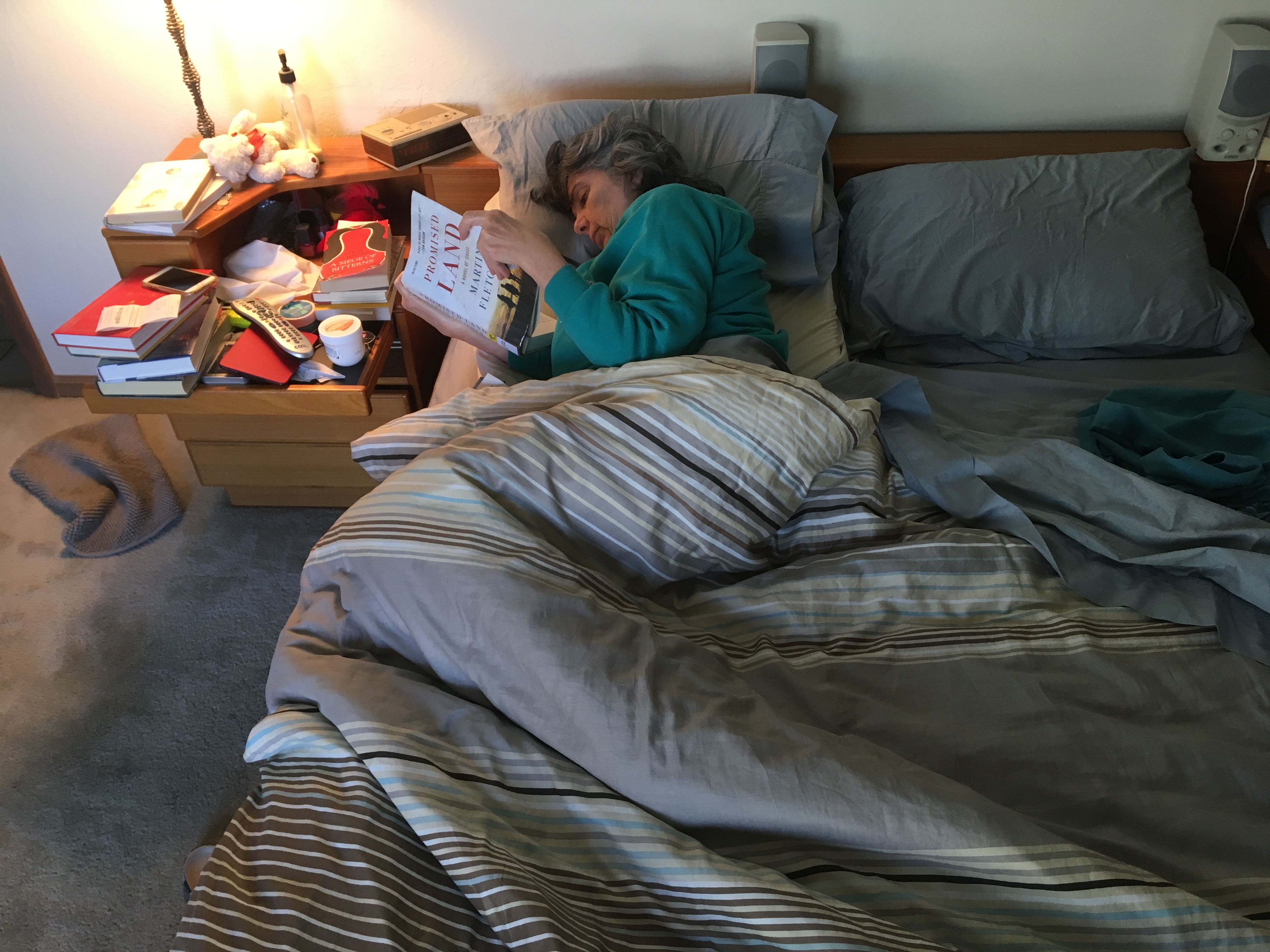
The image at the top left is straight from my iPhone, with all objects across the plane registering in the same depth of field. The larger frame just overhead was rendered using the popular Hipstamatic app, which features a depth-of-field control that can be applied by the same tap-pinch move used by millions for nearly ten years. The effect of the doctored shot is to isolate the subject and her book from the general clutter of the room, suggesting a gauzy dream state as she settles into her chill mode. In inter-plane imagery, even a finished photograph can be re-interpreted endlessly, each “reading” as potentially powerful as a conventionally focused shot, proving, as the best photography always does, that images benefit most from an open approach.
Years after I snapped my first shutter, I try to see myself as being on a journey. Every time I think I’ve arrived at a destination, it’s time to stick out my thumb again.
 thenormaleye
I /WE REMEMBER IT WELL
By MICHAEL PERKINS
FEW WOULD DISPUTE THE IDEA that photography forever changed the way we see. However, I also believe it has altered the way we recall. The process of accessing our memories as a reference point for our thoughts and feelings was complex even before the invention of the camera. But add the seemingly “trustworthy” or “authentic” records of things interpreted by photography, though, and the sorting of memory becomes an even greater muddle. Do we remember, or do we recognize, through the inheritance of masses of images, how someone else remembered?
Through the camera, we can confuse our actual sensory experiences of things with the trove of pictures which formed our “versions” of them beyond what we ourselves have lived. Many more of us have viewed photos of the Eiffel Tower than have actually gazed upon it. When we do first encounter a “known” thing in person, one of our first reactions is often that it “isn’t how I pictured it”……that is, our collective photographic “memory” doesn’t match authentic experience.
As photographers, we are trying to see things originally even as we hack our way through the inherited gallery of images of those things that are an unavoidable element of our visual legacy from other photographers. It is damned difficult to develop our own eye, since the after-image of everyone else’s take is always present in our consciousness.
I shot the image shown here in 2011, during a typical package tour of the Statue of Liberty and Ellis Island. Part of the circuit was a brief shuttle ride to Ellis on a boat that afforded a long, wide view of lower Manhattan. I shot the picture quite unconsciously, which is to say, oh look at that cool view. Later, in combing through the day’s shoot, I saw something else in the scene, something that connected me to photographs taken generations before me: Alfred Stieglitz’ poignant scenes of newly-arrived immigrants in steerage: grainy silent newsreels of crowded ferries passing the Statue, their passengers’ faces etched with a mixture of terror, longing and joy. Suddenly my own picture was no longer about a pleasure cruise for tourists. It was my chance to take in the same view millions had seen before me: the first glimpse of The Promised Land. The New Start. The Second Chance. And for many, Life Itself.
I had already underexposed the shot somewhat to emphasize the skyline, but the picture still contained too many distracting features on the faces of the passengers. I adjusted the exposure even more and saturated the color to further create the look of a low-light, slow film stock. Their particulars muted, my tourists now replicated the “look” of all those earlier arrivals, the ones I had inherited from other people’s experiences. Had I reached a kind of communion with those millions? Could I be adding my own story to theirs?
Well….
Even though I was traveling in the same waters as the people in the archival pictures had traveled, I wasn’t them. As a native-born American, I didn’t face the terrifying pass/fail that they had as they approached our front porch. I wouldn’t come this close, see a life beckoning just beyond that window, and yet be sent back because my eye looked odd to the doctors or my papers were not in order. I found this picture again the other day. I think I have to live inside it for a while. I may not have shot it with the eye of someone new to this country, but the inherited images of lives past have asked me, in my own limited way, to bear witness to the fact that, at some time, we have, all of us, been The Other. I really don’t want to forget that.
Share this:
November 28, 2018 | Categories: America, Cities, Framing, Interpretation | Tags: Commentary, history of photography | Leave a comment