WHAT KIND OF ME AM I?
By MICHAEL PERKINS
BEING THAT I WAS BORN DURING THE MIDDLE OF THE PREVIOUS CENTURY, most of the pictures that have been taken of me over a lifetime were, on average, shot by someone else. In my day (the old coot intoned), the self-portrait, along with the ubiquitous “selfie” was not the universal default for photography that it later became, meaning that, in my earlier years, one more carefully contemplated having one’s face captured for posterity, in that it was more of an occasional thing. Certainly, as a baby-boomer, I grew up in a world littered by millions more amateur snapshots than was the case in my parents’ generation, all of them mixed into the stew of more formal portrait “sittings” associated with major life events. Still, the ability to instantly and endlessly turn the camera inward was in no way as instinctive a habit for me and mine as it is for those born in the present era. This place in time that I occupy in time, then, continues to color the task of making my self-portrait. My aims are distinct. I seek certain things; I avoid others.
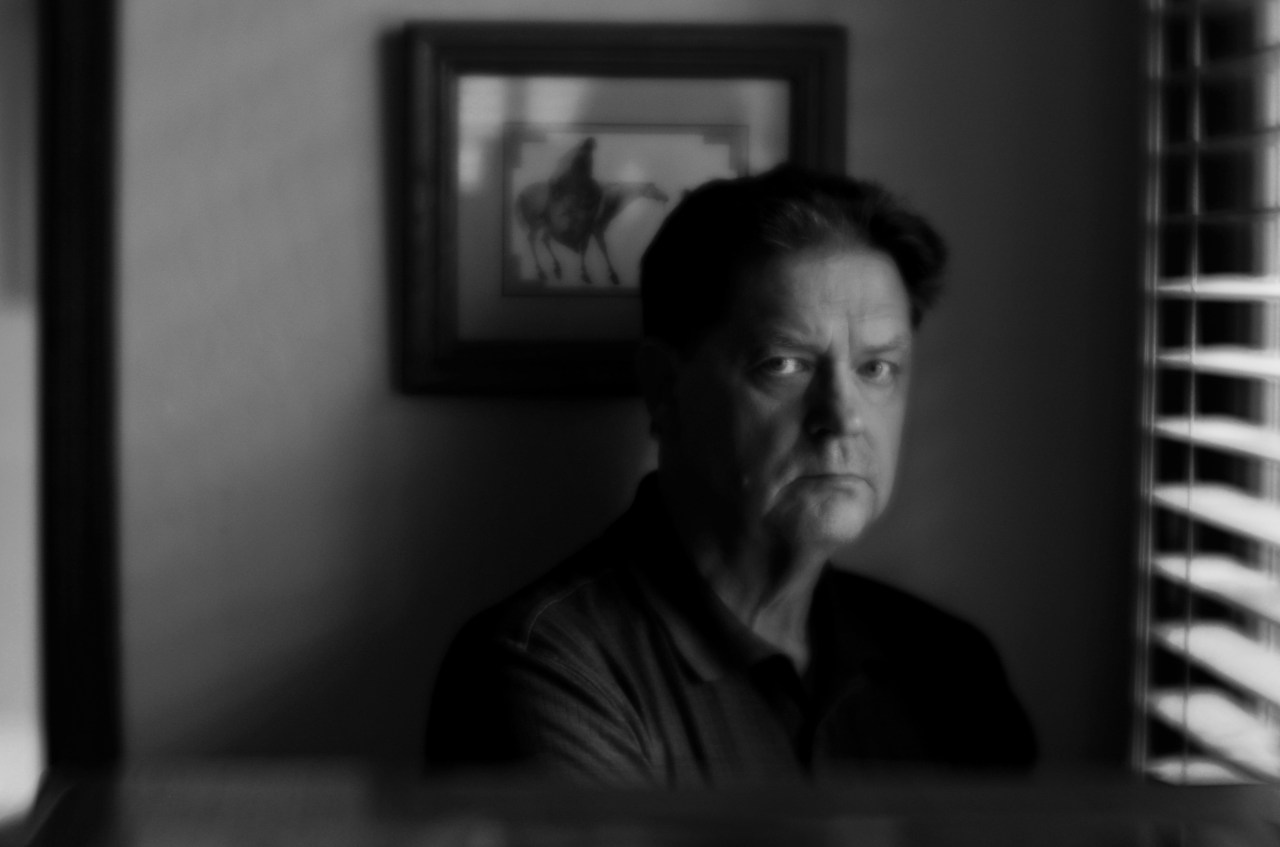
Portrait work, for me, is an investigation, an attempt by my outside eye to detect something inner about another person; to view them interpretively, possibly with the goal of seeing something in that person that not even they themselves knew existed. That draws a definite line between how they self-view and how I am privileged to approach them, that is, objectively, as subjects. When it comes to having someone snap me, however, I have the normal human instinct toward self-protection. I perform. I pose. I craft a caricature of myself that I can live, a simplified, polished rendition of my best parts.
Ah, but once I decide to capture myself, I’m hoping to plumb down into some layer that not only has never been discovered by outside eyes, but which might even surprise me. However, the modern “selfie”, by contrast, is actually anti-discovery in nature. How could it not be? We craft palatable, pleasing versions of ourselves that are as superficial as an outsider or a publicity agent might shoot, because, in the age of social self-marketing, they are commercial products designed for mass consumption, and, crucially, mass approval. Shooting straight in such a context is tricky. I don’t always like what I see in a self-portrait. Sometimes I dig a little too deep. Sometimes I still catch myself performing, attempting to make myself more serious, or intense, or important than I actually am. Hell, I’d even like to make myself look twenty pounds thinner and ten years younger. But, as a photographer who is supposedly interested in truth, I have to keep trying to find out what that actually looks like. Or what I look like when I am true.
It’s a process.
WE HERE DEDICATE….
By MICHAEL PERKINS
PHOTOGRAPHERS HAVE THEIR HANDS FULL, in the first third of the twenty-first century, documenting the vanishing details of the urban architecture of the 20th. Change is a constant and the elusive quality of “progress” is often equated with, to put it simply, knocking down the old to make room for the new. One very good reason to preserve all that visual detail is to show what we intended with older structures beyond their mere physical presence.
The so-called golden age of skyscrapers was fueled by the egos and aspirations of titans in government and business, with both forces incorporating expressions of ideals into the detail and design of their pet architectural projects. These places weren’t merely open to the public; they were dedicated to them, or at least to their loftier goals, with entrances, lobbies and outward ornamentation embodying beliefs, invoking virtues like trust, industry, fidelity, labor, integrity, or honesty in inscriptions, reliefs, and arches, as if such qualities were not only those of the building’s founders, but things eagerly to be wished for all who entered these common spaces.
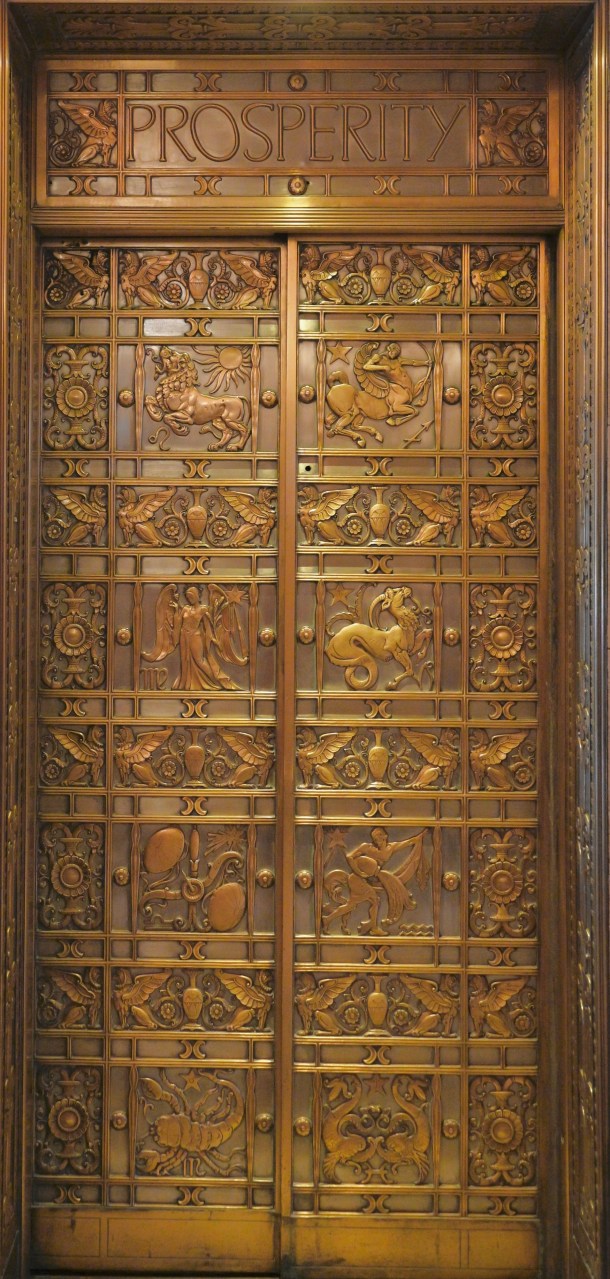
Elevator cab door, Leveque Tower, Columbus, Ohio
This elevator cab door, named “Prosperity” can be seen in Columbus, Ohio’s Leveque Tower (opened in 1927 as the American Insurance Union Citadel). It’s one of a group of three (the others are named “Health” and “Happiness”) that remain in the building’s lobby, and, like many interior and exterior designs of the time, also incorporate the signs and symbols of the zodiac. Photographing features like this is like summoning the past, not merely in its physical aspect, but also in its stated aims within its era; to instruct, to inspire, to act as a pledge of civic betterment. In an age of brutalist architecture characterized by bland or blunt concrete boxes, such sentiments seem beyond quaint; imbuing bank buildings or post offices with all that aspirational sloganeering feels over the top, corny. Better reason still to snap these signposts from a previous time before they are swept away. They are more than buildings, or, at least, they were intended to be.
THE FEEL OF REAL
By MICHAEL PERKINS
MUCH OF OUR INHERITED SENSE OF TEXTURE IN PHOTOGRAPHY was shaped early on by what the earliest camera images could practically deliver. We experience historic images of Lincoln, Twain, and the great generals of the Civil War through the very rough “tooth” of the processes that almost exclusively recorded them, chemical and technical methods that rendered features, clothing and skin in a certain limited fashion. And over time, those methods dictate our concept of how the skin and features of those people should look, forever, even as they define for us what words like tough, stern, brave, frightening or serious ought to mean in terms of how smooth or how coarse a mood we’d pursuing.
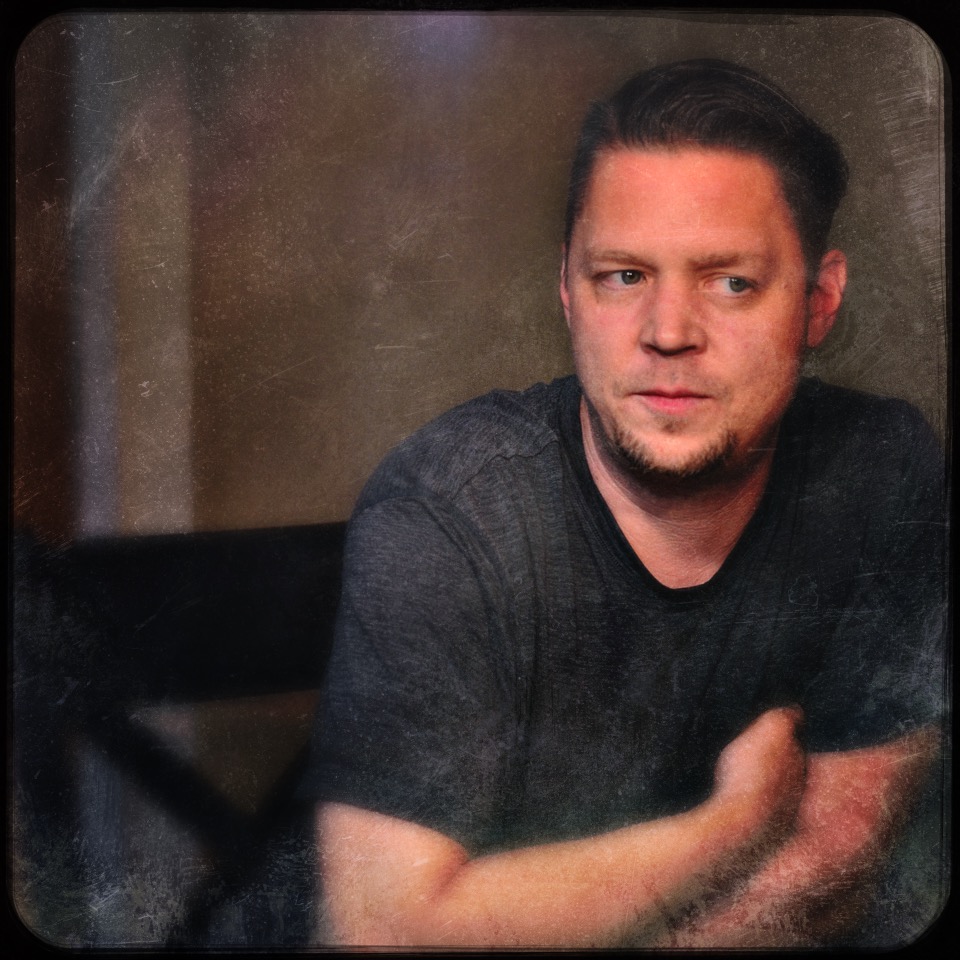
Ryan Michael Perkins, Columbus, Ohio, 2017
And it’s not merely historic; a big part of the recent retro movement toward analog imaging even a rec-creation of it on digital platforms, lies in in aping or recreating the textures we saw of people as they were depicted in previous eras. What we collectively call a “film look” is, in fact, many different looks, depending on whether you’re recalling an 1850 daguerreotype or a 1975 Kodachrome slide, with special emphasis on the degree of grit or silkiness appropriate for different time frames. In some circles, this emphasis on texture has risen to the same level of importance as such fundamental pillars as color and exposure.
I myself will often assign an older texture to selected portrait subjects, based on what elements of their personalities I wish to suggest, as in this image of my oldest son Ryan. It’s safe to say that, over his nearly fifty years of life, he has veered far closer to rough times than serene ones. A perfectly-lit or balanced image of him seems as ill-fitting as a pair of jeans that’s two sizes too small. He doesn’t do “easy”, and so my favorite pictures of him attempt to capture that fact, calling, in this case for example, a kind of sandy, friction-rubbed aging to the final frame. I don’t embrace all of the “just like film” movement, but there are moments when even the freshest faces should have a little acid-washed quality to them, as if to suggest all that time has etched into their features. “Real” and “feel” are subjective words, and they are likely, for photographers, to remain ever thus.
THE FOUR SISTERS
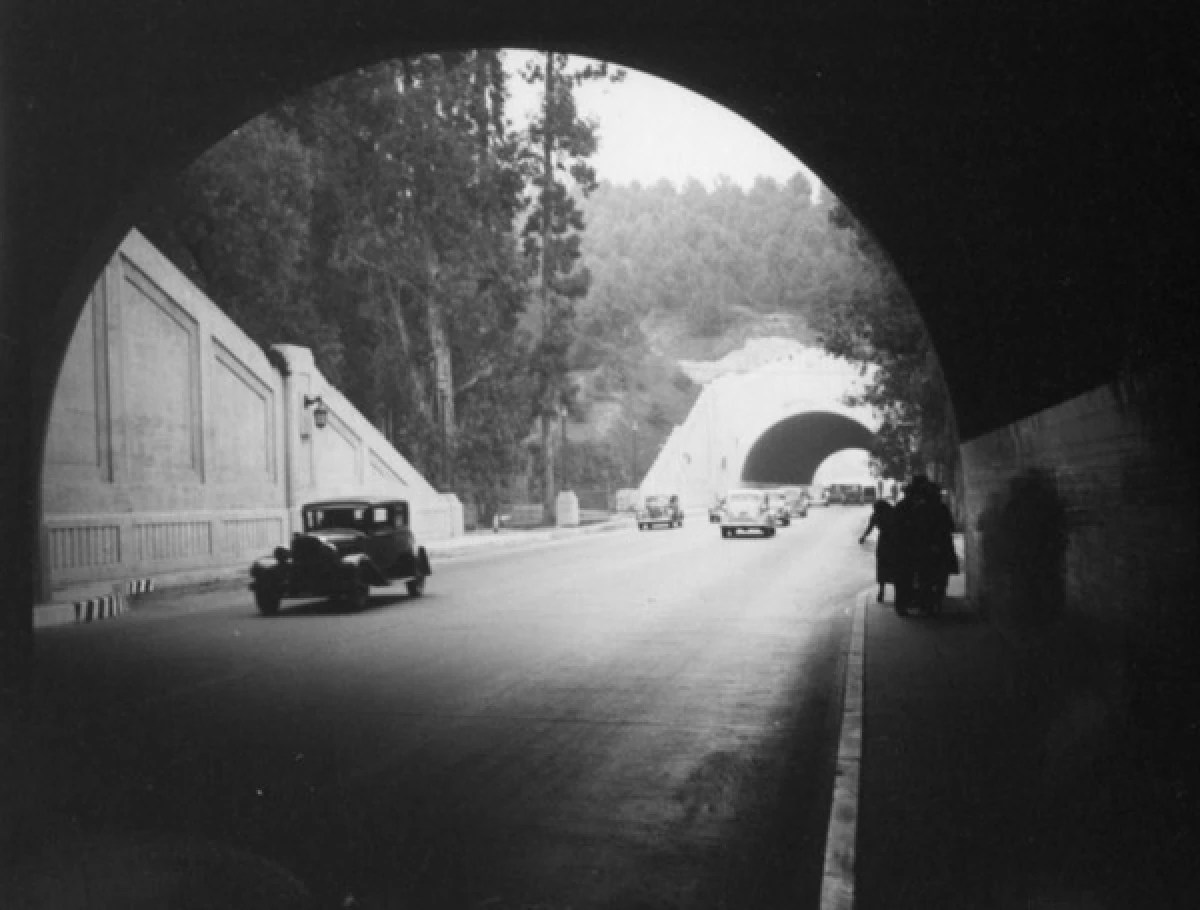
The Figueroa Tunnels connecting L.A. and Pasadena, soon after their opening in the 1930’s.
By MICHAEL PERKINS
LOS ANGELES IS CONSTANTLY IN THE ACT of obliterating its past; a term like “Old L.A” applies as much to a 1985 Blockbuster Video as a 1926 bank building in a town that, like the movie industry it hosts, tends to frequently “strike the set” and start again from scratch on a nearly daily basis. That’s why, for photographers (especially newly-arrived ones) finding infrastructure that is older than your family dog can be a touch task. Recently, however, I got my first look at such a fabled structure by merely driving up to it. And through it. Or through them.
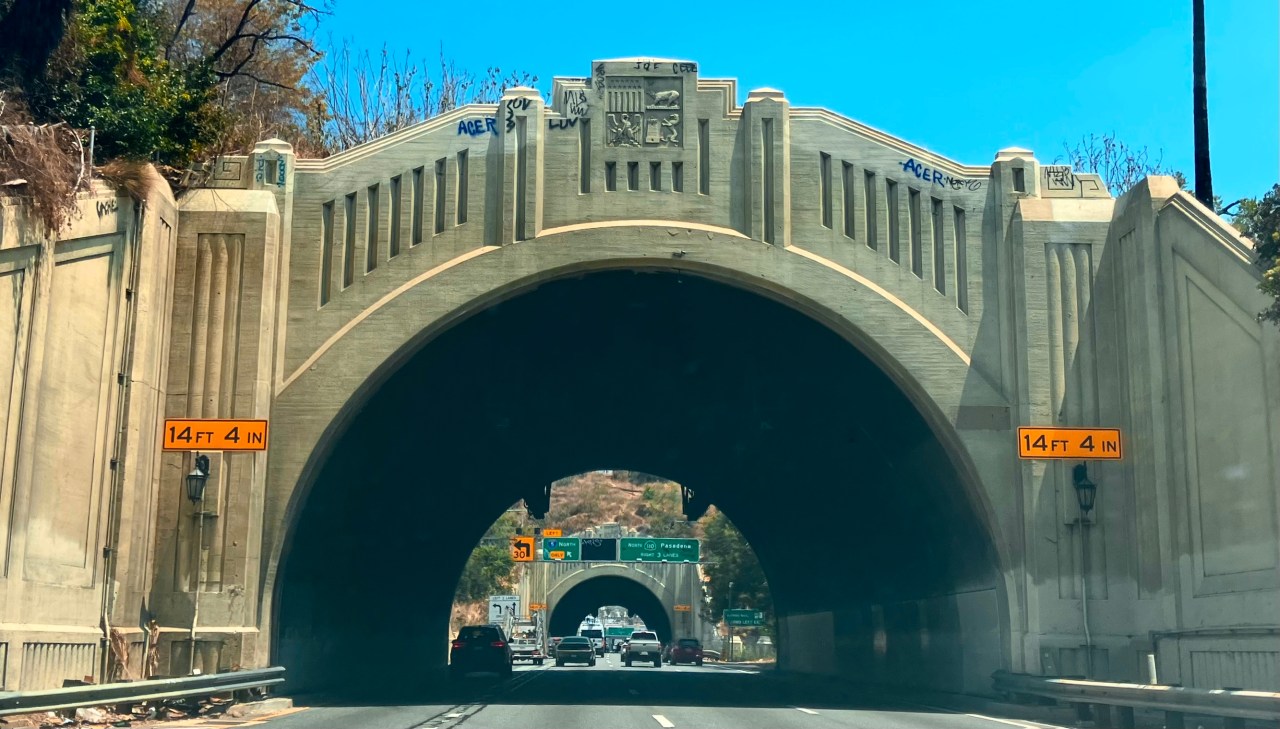
The view through one of the four tunnels to its neighbor, along with local traffic signage, July 2025.
The first major highway linkages between downtown Los Angeles and nearby Pasadena were hard-won affairs, as the rugged hills of Elysian Park blocked the city’s Figueroa Street from direct entry to the smaller town, forcing north-south traffic to cross a bridge over the Los Angeles river, creating huge daily bottlenecks. And as was the usual case with many physical obstacles in the 20th century, it seemed like a “dynamite” idea to simply blast a roadway through the hills, not for just one tunnel, but for four. Engineer Merrill Butler, who also designed many other landmark crossings and tunnels throughout greater L.A., cranked out the first three of these beauties beginning in 1931, with a fourth, the longest at 755 feet, arriving after 1936 as yet one more way to direct and relieve traffic flow. Each was a gentle Deco arch design with streamlined support wings, custom “coach lights” and, at the keystone of each, an abstract sculpture of the Los Angeles city seal.
The shot you see here is a true snapshot, in that, not having motored through Pasadena for a long spell, I had completely forgotten that the tunnels were a feature of the last leg into town. Before I could reach any of my formal gear, we’d already entered the first tunnel, and so I managed to grab images of the proceeding three with my iPhone, anticipating the extremely wide lens default of the camera by waiting almost until entry to attempt to fill the shot with just the structure and very little of the surrounding sky, roadside and terrain. I love my first glimpses of sites in L.A. that were once fundamental to the growth of the city (the Arroyo Seco Parkway, built after the tunnels opened, actually does the heavy lifting on local traffic flow now) and have, almost by chance, been allowed to hang around and age into venerability. The camera’s function as time-traveler cum time-freezer is magical, and I value the gifts it yields.
LUMIERE’S PHOTGRAPHIC HAT TRICK
By MICHAEL PERKINS
ALL HISTORIES OF THE EARLIEST DAYS OF MOTION PICTURES rightfully credit brothers August and Louis Lumiere as twin titans in the creation of some of the medium’s most important technical advancements. Their first breakthrough came when they refined Thomas Edison’s earliest motion picture cameras and devised a more uniform method of moving film through them, with the simple but elegant invention of sprockets. Their second, and substantially bigger win involved the creation of the cinematograph, which combined photography, developing, and projection within a single device. Both innovations helped the Lumieres become the first true producers of motion picture content and the very concept of “movies”, years ahead of Edison and the rest of the field. Ironically, they believed that the cinema was a dead-end fad, a novelty that would play itself out in time. That mistake would eventually lead them back to their beginnings in still photography, and their third fundamental miracle: color.
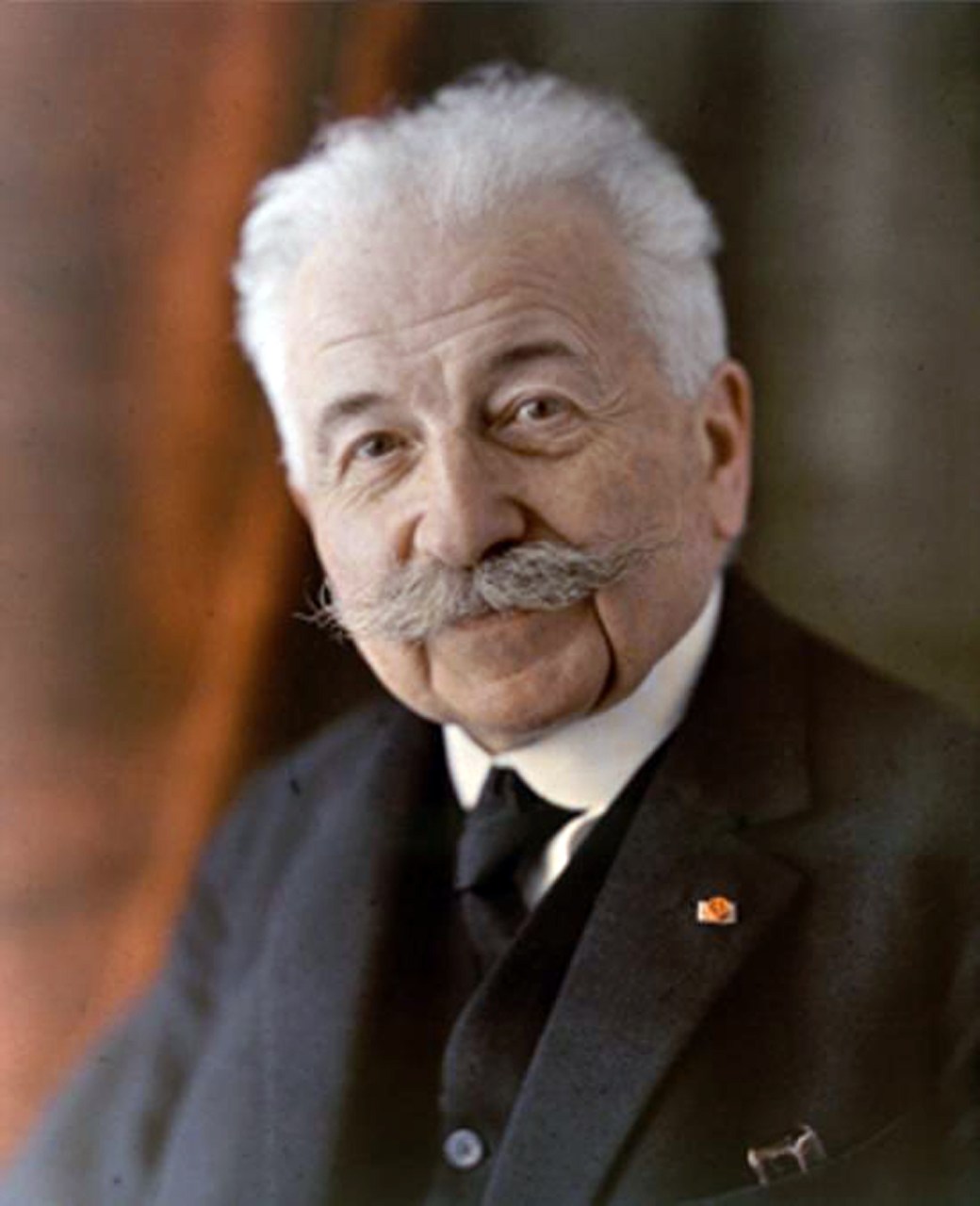
Auguste Lumiere, captured by the Autochrome process he developed with his brother Louis, just after 1900.
Attempts at a natural, stable color process had begun very nearly at the start of the photographic era, but nearly all were what we’d now called coloration processes, with either special filtration or hand-drawn hues added after a positive monochrome print was achieved. The Lumieres built color into the very act of making a photograph with their chemically complex Autochrome system, an “additive” process, versus the “subtractive” methods which would later characterize the first true color films such as Kodachrome.
Near the turn of the 20th century, just a few years after roll film was popularized by George Eastman, the Lumieres built Autochrome on existing glass plate technology. coating a plate with a random mosaic of microscopic grains of potato starch, dyed red-orange, green, and blue-violet, with each grain hue acting as a color filter. Lampblack was mixed in with the colored grains and an over-layer of silver halide emulsion was applied over that. The exposed plate would produce a color negative, which was then re-exposed after the removal of most of the plate’s silver content to result in a positive transparency. The result was extremely natural in its reproduction of the existing color spectrum but dark in tone, so that a backlight of some sort would have to be shone through it for sufficient illumination. Special carrying cases were produced to make this process easier and more consistent.
Autochrome became the first complete process for in-camera recording of a colored image, but, due to its required longer exposure times, it became a medium for mostly portraiture and still-life work. Accordingly, many historic figures “sat” for Autochromes, including President William Howard Taft, the first president to be photographed in natural color. The Lumiere’s system, short-lived though it was, kicked open the door to color photography, taking it from an afterthought craft to a living art. Every one of us are standing on their shoulders.
A ONE-WAY TICKET TO HUMBLEVILLE
By MICHAEL PERKINS
EVEN THOSE WHO CELEBRATE HAVING FOUND THE LOVE OF THEIR LIVES must, in their candid moments, also attest to the fact that they adore their mates as much in spite of things as because of things. I love him, even though he snores. I lover her, even though she snaps her chewing gum in the movies. Do your own lists; I know you have them.
So it is with camera equipment.
The gear we use and cherish the most across our lives as photographers is the very same equipment that has, at one time or another, let us down, betrayed us, or frustrated us, especially in the “honeymoon” period, when a given piece of kit is brand-new, along with our relationship to it. We miscalculate. We guess wrong. We assume that just because “my old camera” or “my first lens” did a certain thing, the new doohickey will deliver the goods in that same way. In our very first pictures with a fresh toy, we not only don’t know what went wrong with the duds, we don’t fully understand what went right with the winners. Indeed, during our “getting to know you” phase with fresh devices, we are, like a disillusioned newlywed, likely to yearn for a divorce because, my God, I can’t stand that thing you do.….

Week One with a new telephoto. Just enough luck to keep me at it…
If it’s not painfully obvious that I am going through such a break-in/break up state of mind, then let me just admit that, at this writing, that I am currently slogging up a slow learning curve with a new telephoto. I needed it, I wanted it, I counted pennies and snipped coupons to get it, but, man, there are about three times during every shoot when chucking it into the lake would feel oh so great. For about three seconds. Truth: I can already see a strong justification for having bought it, as the improvement in my work that I assumed might occur is, in fact happening, but, boy howdy, I am frustrated by how long it’s taking me to be smooth, or natural, or, God spare me, instinctual with it. The ergonomics are as about as good as I’m going to find in a behemoth of this size (a 180-600mm f/5/6-6/3) and yet I am still, like a nervous teen on a first date, trying to figure out where it’s safe to put my hands.
Fortunately, I have an entire summer of fairly ordinary days to figure it out, to blow out my first thousand horrid shots before a project of any importance comes around. Most days, I am anxious when there’s “nothing good to shoot”. For the next few weeks, however, all that “nothing” will later mean “everything”. Thank heaven for pictures that don’t matter. They keep me sane. And keep a very large and expensive plaything out of the lake. For now.
BACK TO EDEN
The task I’m trying to achieve, above all, is to make you see.—-D.W. Griffith
By MICHAEL PERKINS
EVERY YEAR OR SO, OVER THE NORMAL EYE’S FOURTEEN-YEAR JOURNEY, I tackle anew the task of explaining the choice of that particular name. That means proposing a kind of working definition for the word “normal”, or at least putting forth the reasoning behind my own use of it within these pages.
For me, to be “normal” is to operate within the first, natural state of something. And when it comes to the making of photographs, that means the first state of the human eye. The “factory setting” for your eye is observation, not merely “seeing”. As a new human being coming into the world, you don’t just believe what you see; you believe in excess of, even in spite of what you see. That which we call “factual” is fluid, colored by experience, and certainly not formed by data alone. Only after we leave childhood are we trained to think that are eyes are only to be used for documentation or recording, for evidentiary work. At that point, we stray from the “normal” state of our eyes, the vision we were equipped with, as a default, when we first came to be.
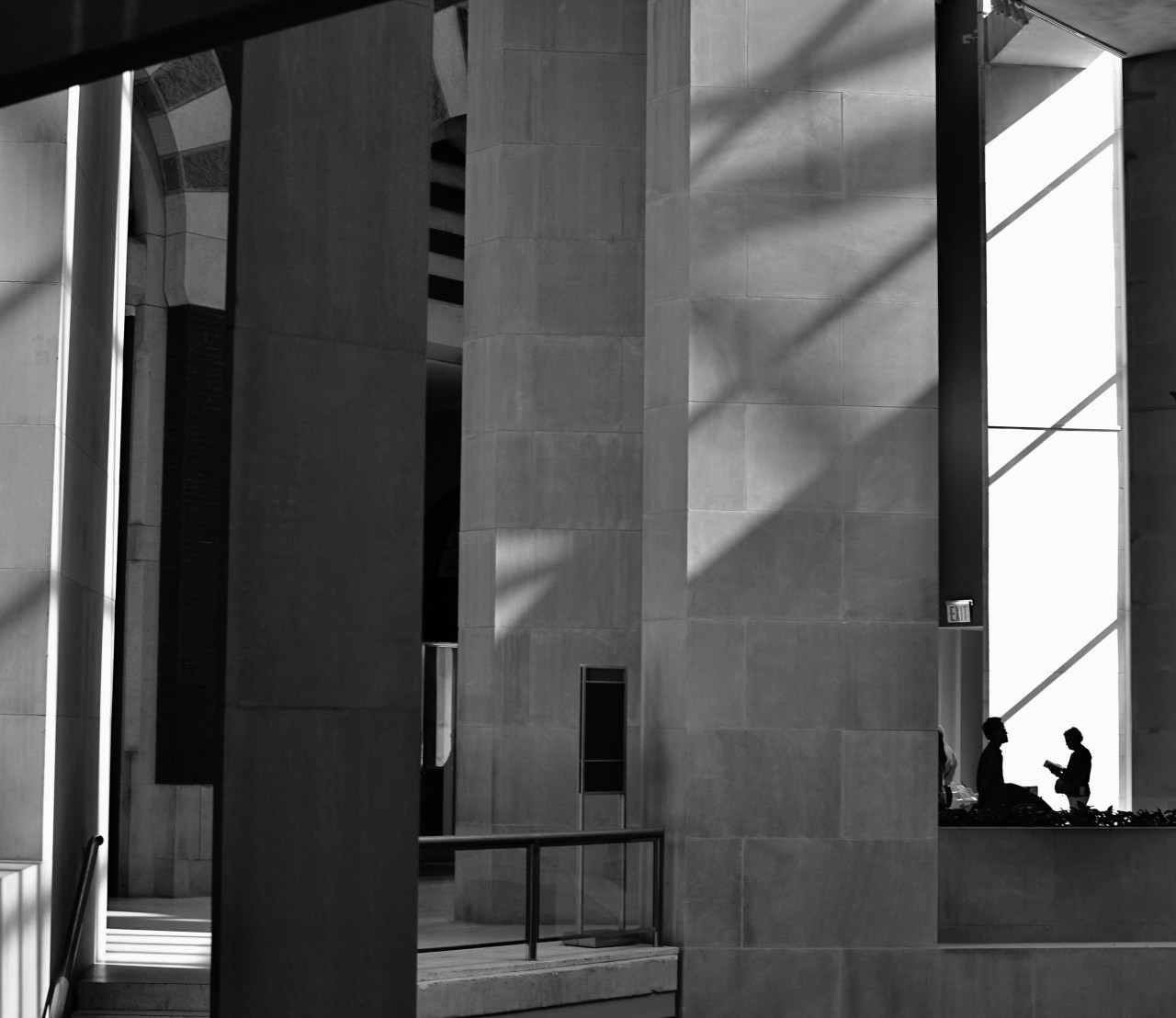
However, once you pick up a camera, you actually leave the plainly factual behind, since you are already utilizing a machine that, on its best day, can only generate an abstraction of “reality”. By making images with that machine, you are already weighted in favor of interpretation, of seeing past your senses. And that restores your ocular factory setting or default. Your soul, in effect, gets rebooted.
It took me four years to paint like Raphael, but a lifetime to paint like a child.—-Picasso
Pablo had the right dope: we have to unlearn the bad training, foisted upon us by the world, about what’s “important” to look at. We have to re-learn the ability to trust fancy. That is the only path to art. If our eyes were merely designed to make a visual document of the world, we would only have to take a single photography of any object on earth, as only one would be necessary. Instead, we honor sentences that begin with “the way I see it is..” We are moved by photographers with normal eyes. That’s what this venue is, and has always been, about. A return to Eden, if you will. A reassertion of innocence. To believe that what we have to say about the world is, indeed, normal. For us.
AN AUDIENCE OF ONE
By MICHAEL PERKINS
YEARS BACK, MY FATHER, TAKING NOTE OF MY OBSESSIVELY FASTIDIOUS MANNER OF WATCHING MOVIES, i.e., free of interaction with my fellow audience members, remarked that, in a perfect world, I would have my own private projection room, watching films in perfectly controlled environments as a fussy, controlling audience of one. Unfortunately, that dream film-critic scenario never presented itself.
Until this year.
Turns out, if you want to share a movie with a minimal number of people, go see a sixty-year-old French art film in the middle of a weekday afternoon. We’re talking guaranteed crowd control here. Marian and I had driven from Ventura, California to a quaint cinema high in the hills above Santa Barbara, hardly the venue to catch Godzilla XXXIV: The Final Reckoning or any other cinematic Hoover designed to suck in the public by the millions. Upon taking our seats, it soon became obvious that we would have the entire house to ourselves, a true rarity. Additionally, ahead of the curtain time, the theatre was not pumping a firehose of advertisements and idiotic on-screen trivia quizzes into the room, but, instead, bathing us in pure, wonderful silence.
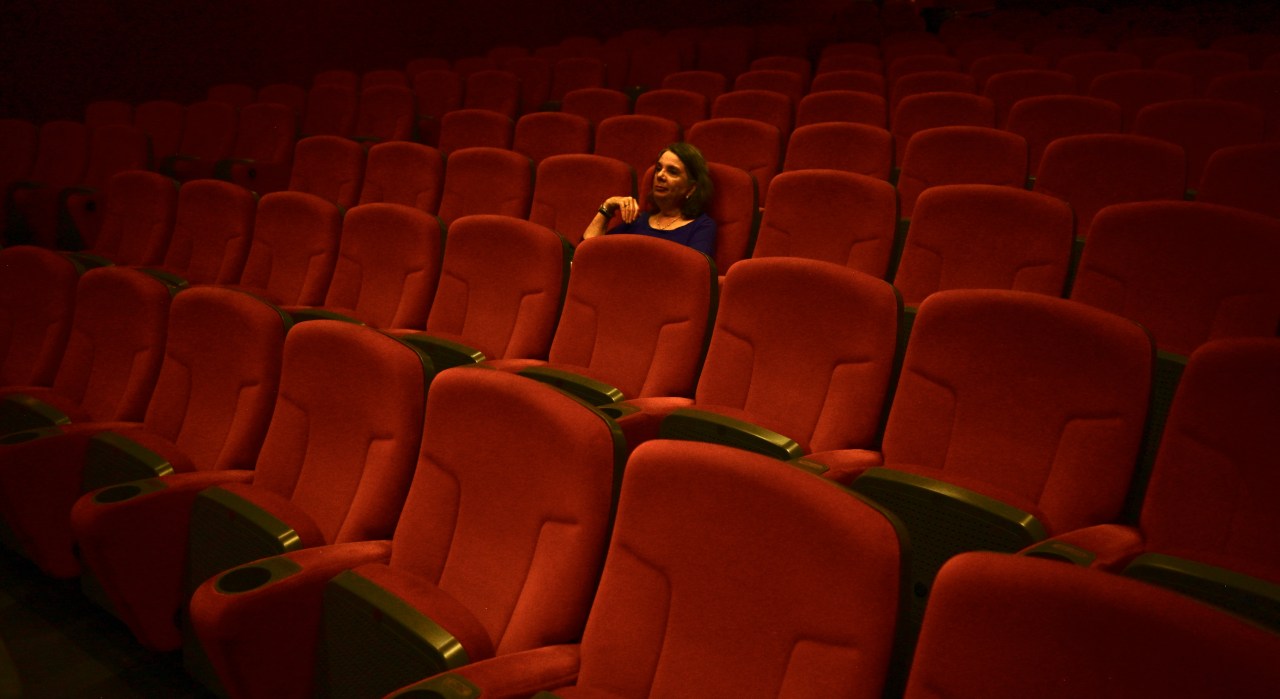
It didn’t take long for me to realize that, there, at that moment, I could take a picture of Marian that would be impossible in 99% such cases. There was that face in the middle of a sea of muted red. The image would compose itself! Three frames and I was happy enough with the Edward Hopper-ish result to sit back down and dig the quiet. I knew I’d stolen something precious out of the darkness.
Fifteen minutes later, a few other people drifted in (the film had a French plot, meaning no plot, so it really didn’t matter when they arrived) and the moment was gone. But I had at least obeyed my instinct and had the great fortune to make a record of it. That is the heart and soul of making a good picture, and I’ll sit through someone else’s lousy one, anyday, to make that happen.
FITS AND (FALSE) STARTS
By MICHAEL PERKINS
ERGONOMICS is defined as “the application of psychological and physiological principles to the engineering and design of products, processes and systems.” When it comes to photography, the term “good fit” is probably the simplest way to express this concept. Cameras engage the hands, the eye, and the mind with each click. The question to be asked of any camera then, is, “how is this machine helping me make better pictures with a minimum of fuss and delay?”
The term “human factors engineering” (HFE) is sometimes used instead of “ergonomics” and I actually like that phrase better, since it says exactly what the designer’s goal should be; making things so that they are easy to operate in an efficient and satisfying manner. So let’s apply that idea to the various dials, buttons and menu options on a camera, and where they are situated. Does your device cause you too many tasks per image in terms of calculating, reaching, holding, executing? Many of the most elegantly designed pieces of kit in photographic history have also been some of the worst nightmares when those stunning sketches leave the inventor’s table and enter the real world of shooting. And so, what makes a generally operational camera not work for you must be the primary consideration when you’re shopping, more so than features, price, or high marks from techie reviewers.
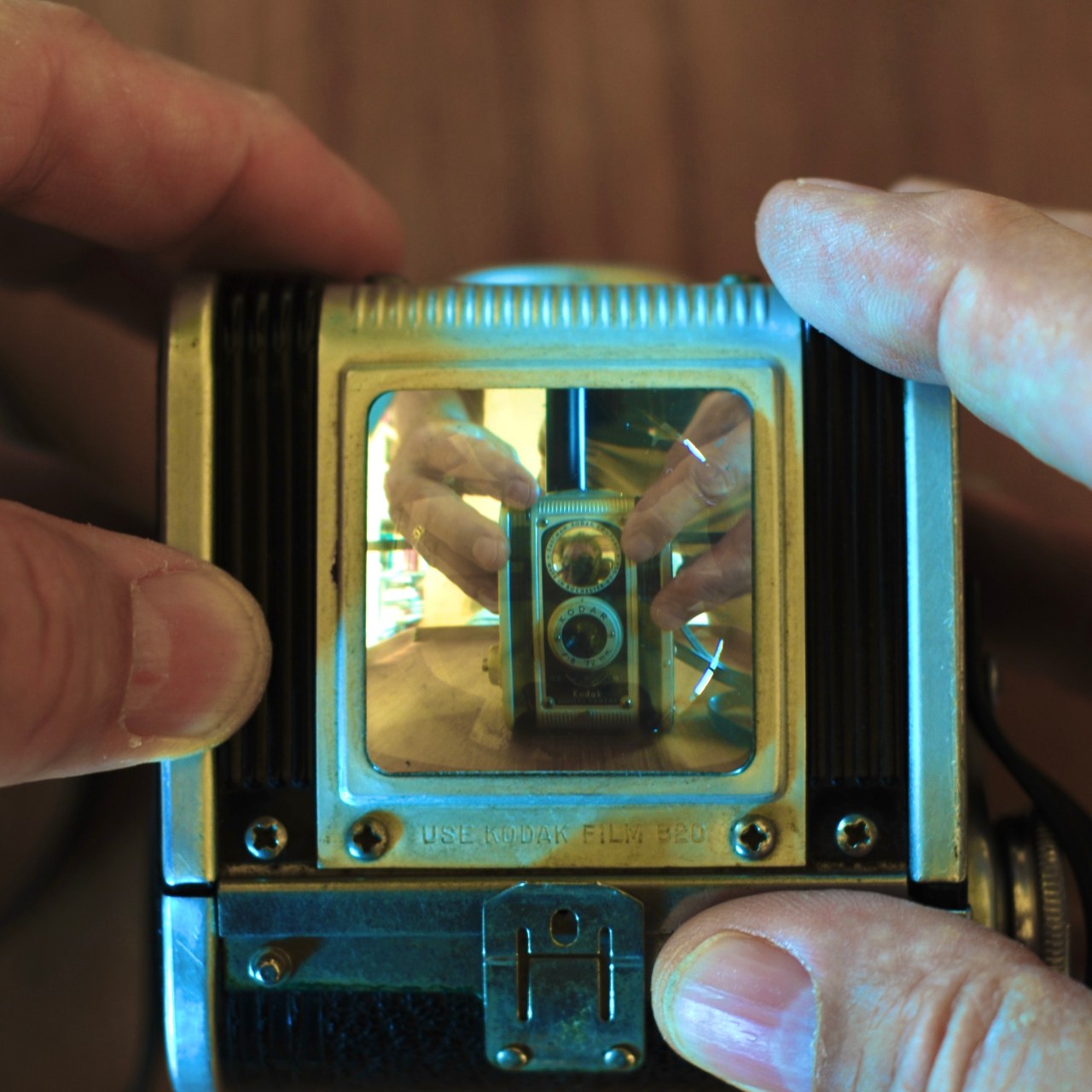
In a 2012 article called Camera Ergonomics, revised for 2023, a common operation done by a very popular model (name withheld) was outlined to illustrate the frustrating processes that were baked into the camera by its designers:
“When we want to operate the front control dial, there is not enough space for the right index finger to bear on it without moving the other fingers of the right hand out of the way, so we have to release our grip on the handle with the third or fourth fingers, move those fingers down the handle, move the index finger forward and down to the front dial, rotate it, move the index finger back up to the shutter button, release our grip with the third and fourth fingers, and move them back to their regular holding position. This is seven different actions, two of which involve moving the entire hand…”
Sadly, many of us simply make the adjustment in ourselves when presented with an obstacle placed in our path by the camera. We make ourselves fit the device instead of vice versa. This is madness. Any thinking review of a new camera should focus primarily on what it’s like to use the thing, because anything else simply builds extra, time-wasting, shot-missing junk into the process.
Never mind that cameras currently come loaded with enough tricks and toys that will never be fully used over their useful lifetimes, or that the snarl of intertwined option menus on many machines is a jungle all on its own. Take it down to the most basic and essential issue; if the camera literally requires you to contort your body beyond its natural functions just to take a picture, it is the device, not the human, which merits a re-design.
FAKE IT ‘TIL YOU TAKE IT (OR EVEN LATER)
By MICHAEL PERKINS
THERE ARE SO MANY VARIABLES IN STREET PHOTOGRAPHY, from composition to exposure and everything in between, that it’s a minor miracle that any useful pictures ever get made, by anyone, anywhere. Being that street work is even more subject to hazard or random accident than any other kind of shot, the shooter must negotiate dozens of factors before squeezing off a frame. Contrary to popular terminology, this process produces the very opposite of a “snap shot”, in that nothing is completely controlled, and most everything is unanticipated.
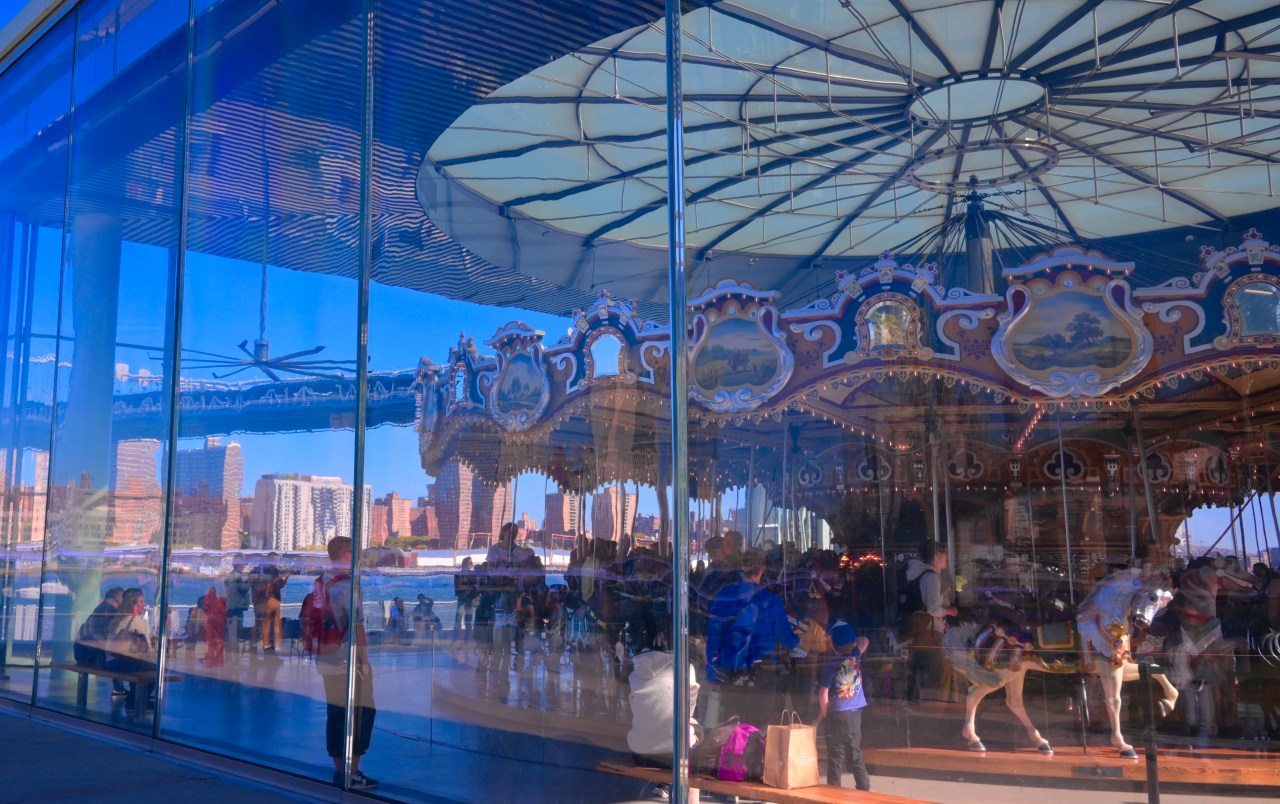
Frequently, when I first sort through images back home, I discover that Nature or Chance gave me a bit of a boost in making a picture work slightly better. On the day I took this shot of Jane’s Carousel) in Brooklyn Bridge Park opposite lower Manhattan, I was mostly concentrating on the interactions of parents and kids as they queued up for the ride, and occasionally trying to frame to include the bridge, which is very close by. I typically don’t try to convey motion in such shots, snapping at a quicker shutter speed to keep everything frozen for the sake of faces. In the case of this carousel, exposure was also a bit tricky, since it sits inside a glass enclosure topped by an overhanging roof which also includes atrium-like cutouts. That’s a lot to handle at one time.
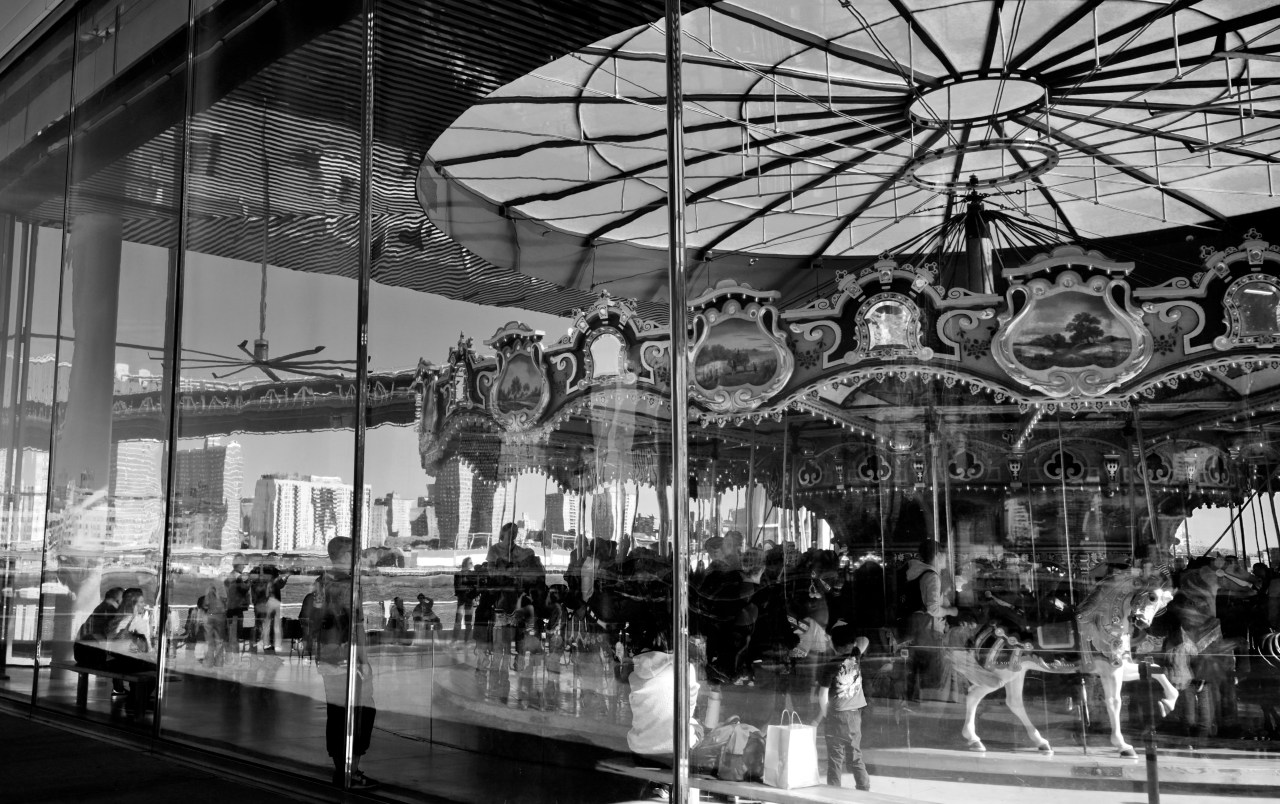
So much, in fact, that it wasn’t until days later that I realized that shooting through a closed side of the carousel’s glass box would, in effect, filter the carousel through a wiggly warp of sorts, creating the sensation of whirling or spinning. In fact, close examination reveals that most of the details are, in, fact, in fairly sharp, normal focus, but the slight distortion lent a dreamy quality to both the original shot at the mono conversion, both of which I submit here.
Whatever “plan” you try to make in advance, street work places you at the mercy of prevailing conditions, and so it’s better to be gracious/grateful for the odd bits of luck that are thrown your way. As soon as you become cool with the knowledge that you’re not actually in charge, you can just get out of the way of the entire process and chalk up an occasional win.
THE CASE FOR REINCARNATION
By MICHAEL PERKINS
ONE OF THE HALLMARKS OF A MATURE SOCIETY is a healthy respect for its own history. When a nation is busy a-borning, doing anything “for the ages”, from physical infrastructure to laws to philosophy, can get lost in the blur of just…becoming. The dust of Now is just swirling too madly to get a good view of what can, or should, be made to last. Change is so rapid that it becomes its own religion. Preserving, protecting, salvaging things….that comes later.
American, a country that has always surged forward too quickly to allow ourselves much of a backwards glance, was always more about building than keeping. Things that became outmoded or obsolete were quickly consigned to the national scrapheap. As a result, we only recently have begun to place a premium on conservation, on re-purposing our past. And nowhere is that more evident than our cities, where signs that read “soon, on this site” usually mean that something old must first be destroyed. We have taken a long time learning to give things second lives. Including ourselves.
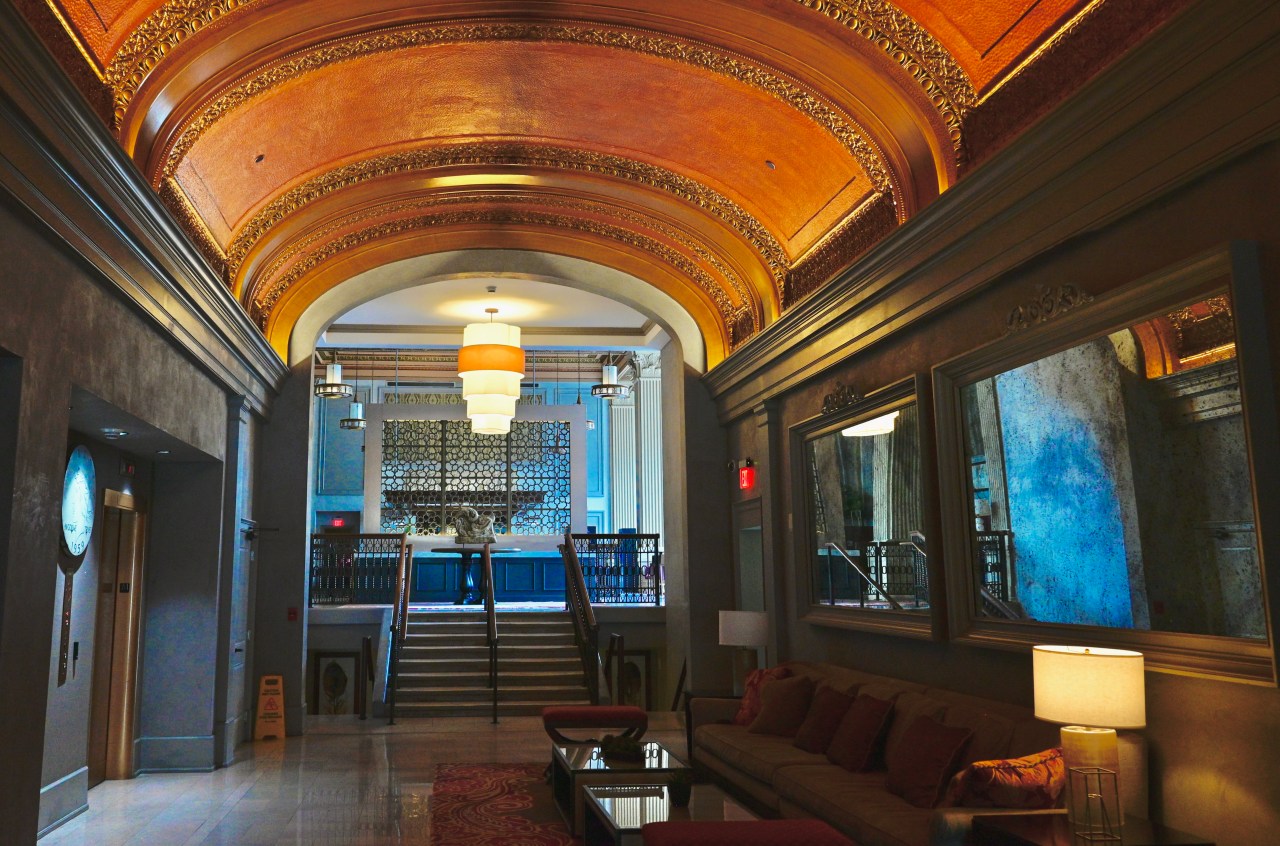
The foyer of the restored Citizens Building, a 1917 bank-turned-condo community in Columbus, Ohio.
I have a special affection for the urban spaces that get “saved”, that are lucky enough to survive the wrecking ball and shine forth anew, escaping the fate of so many things we mistakenly label “improvements”. Not everything old is immortal, certainly, but not everything new is magical, either. I love to take my camera to renovations, grand re-openings, conversions. It is a great privilege to see, in a place’s original design or materials, what its creators did. In the case of the above image, taken inside a 1917 bank in Columbus, Ohio that’s been recently reborn as luxury urban condominiums, one sees many original features that brought beauty and elegance to a financial institution that work perfectly well, thank you very much, as features in a residential building. I document these small victories because they are still too rare. I long to demonstrate, for as many eyes as I can, that “past” need not mean “dead”. As our country, or any young country, grows up, it’s easier to see what seemed invisible when we were young and in a hurry. That’s true of ourselves no less than of our creations.
BOTH SIDES, NOW
By MICHAEL PERKINS
THOSE OF US WITH ROOTS IN THE STONE AGE may recall the opening of the old Disney TV series Wonderful World Of Color, which consisted of a burstingly brilliant kaleidoscope, endlessly unfolding behind the show’s title card. It was a stunning way to display the infinite rainbow of hues of the early color network broadcast, echoing what everyone had seen when turning those little cardboard tubes filled with rattling bits of color glass; the hypnotic appeal of the symmetrical.
From ancient architectural frameworks to medieval tapestries to the intricately balanced frameworks of common spaces in the present day, we love to imitate the visual counter-balances seen in nature, such as the patterns within a flower, or the delicate web of design in a snowflake. And, as photographers, especially in an age in which anything can be manipulated or faked to our heart’s content, we are often seduced by the temptation to artificially impose that balance on our images, to make the world uniform and orderly. Why is this visual urge so strong?
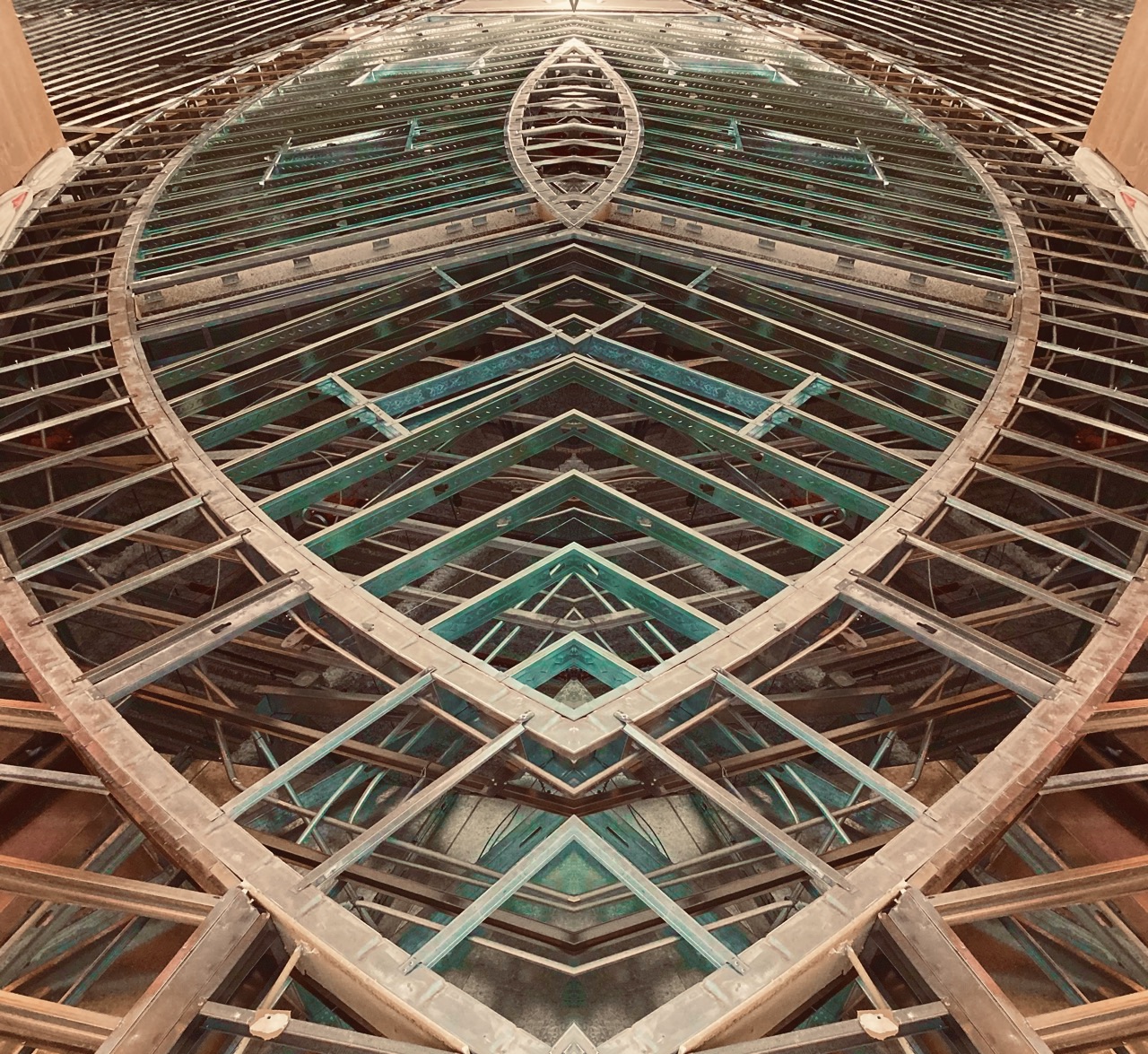
A genuine fake. Because reality is, you know, just reality…
Psychologists claim that humans take a kind of comfort from “balance”, feeling more rooted, in, for example, inside a church that has four matching wings conjoined by a central hub, or a wagon wheel, or a plaza built around a square mosaic. There are even studies that indicate that we think of symmetrical faces in other people as more attractive than non-symmetrical ones. Small wonder, then, that we deliberately simulate symmetry where none naturally exists. As in our younger days, when we first folded sheets of paper into fourths, then cut pieces out of them that, once unfurled, replicated the cuts four times in perfect opposition to each other, we use photographs not only as proof of natural balances, but as a jumping-off point toward the creation of Other Worlds, better ones with a neater, more mathematical precision. We play Creator, or at least Re-Creator.
Which to a say, in roundabout fashion (my usual method), that photographs are only marginally documentary in nature. They evolve from ideas that may or may not reflect the actual world. That’s why they aspire to art.
A FEATURE, NOT A BUG
By MICHAEL PERKINS
PHOTOGRAPHY IS CURRENTLY EXPERIENCING SOMETHING OF A TEENAGE CRUSH on defects, a glorification of the technical flaws in our images that values errors as something that confers “authenticity” on our work. Some of this is a recoil from the digital revolution, with shooters believing that all that new-fangled perfection is somehow suspect, less real without the glitches, miscalculations and unpredictability of analog methods. This nostalgic vibe has fired the lo-fi movement, as well as the tactile back-to-film thrills of instant photography, as seen in the reborn Polaroid brand. Some applaud this as a return to innocence, while others revile it as pretentious and faddish.
Going out of our way to purchase equipment that deliberately engineers what we used to call “mistakes” back into our work is certainly one way to approach the making of pictures. And going lo-fi by means of hi-tech is also an option, as shredding or rewiring the quality of images through apps and post-production gets the job done pretty much at the speed of whim. And certainly the ingenuity of inventors in trying to re-introduce analog imprecision back into a medium that they fear has become too cold is amazing to witness. The photo market is ablaze with new gadgets designed to make everything new look old again. But beyond achieving the novelty of an old-timey aspect, are we truly adding anything to our art?
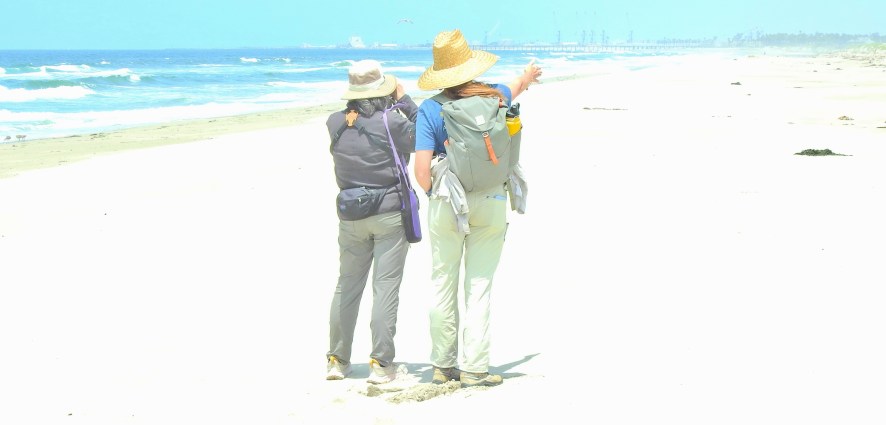
Making a shot like this, for example, is easy, even with older gear. It’s an over-exposure, or what the artful amongst us love to call “high key”, and, upon first glance, it does have a certain impact, given the subject matter and location. But is it, finally, a better picture, or merely a novelty? Would a conventionally exposed shot have had the same impact, or even more? I have a friend who works professionally in digital but disdains it for his personal work, teaching himself how to apply collodion to glass plates and shoot everything as if it were 1850. Aside from the scientific achievement of getting and controlling an image under extremely demanding conditions, I am not convinced that the pictures he’s making are anything more than a trick from a kid’s science fair. You can only marvel at a tabletop volcano so many times before you ask yourself whether it really merits a blue ribbon.
But that’s why there is more than one approach to doing all this. I myself indulge in various effects-oriented shots, depending on what I need to do. But what I need to do, most of the time, is make sure I choose the right canvas for what I’m trying to depict. Chasing an effect for its own sake, even the seductive appeal of nostalgia, can become a dead end, lowering art to the status of mere craft.
(PLEASE DON’T) WATCH THE BIRDIE
By MICHAEL PERKINS
I AM CERTAINLY NOT THE ONLY SHOOTER OUT THERE BEMOANING THE EFFECT OF SMARTPHONES on how people behave when being photographed. On the contrary, the way these ubiquitous and simple devices have transformed how we present ourselves to the camera has filled bookshelves with dire essays and laments, including an essay I recently discovered called The Death Of Candid Photography In The Age Of The Smartphone by Alex Cooke (read it here.) It is no longer a question of whether image-making has been compromised by the cel; it’s merely the degree to which it’s happened.
Stated simply, the very way we act when we know a camera is present (and one always is) has dramatically shifted from when cameras were formally “brought out” for selected occasions, or largely confined to studios. Having your picture “taken” has gone, within a generation, from a somewhat special event to a non-stop process of recorded surveillance. We are all always on, always assuming that a perpetual wave of photo-ops will be washing over us. This creates a hyper-alertness to keep ourselves in “take-able” mode, to constantly assess how we look, where we stand, what cultivated, managed version of ourselves we wish to offer up for mass consumption. Family photos no longer reside in albums or shoeboxes, but are expected to serve as our ongoing audition for the world’s approval.
In such an environment, there can be no such thing as the Unguarded Moment. As Cooke writes, more and more of us “have never experienced social interactions without potential camera presence. (Our) baseline behavior incorporates photo awareness as a natural state rather than a special condition.” We actively choreograph the visual geography of every frame that captures us, calculating, on the fly, how it will be received. We pre-edit our faces and figures to achieve a picture of us as we would prefer to be seen, and judged, by millions of strangers. For the photographer, especially the so-called “street” shooter, it is increasingly hard to make images of people exhibiting the full range of human experience and emotion, since everyone, everywhere, is “trying out” for some kind of approbation.
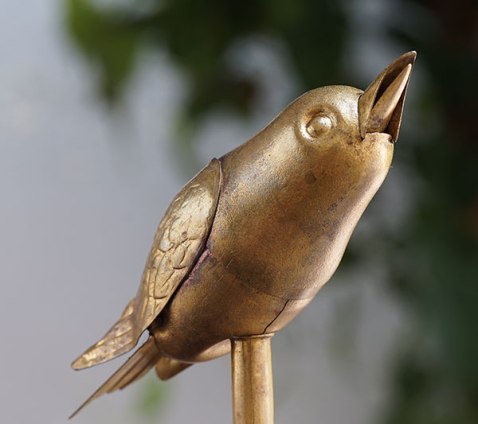
About a million years ago, people having their photograph “made” had to be instructed how to even look in the right place in order to look natural. Watch the birdie. Now, we worry, about what the birdie thinks of us; whether it likes us, whether it can be seduced into helping to market us. And, sadly, we take more and more pictures of ourselves that reveal less and less. We are, finally, a production.
HUE MONGOUSNESS
By MICHAEL PERKINS
THE LAST MONTH OF SPRING and the first month of summer in Ventura County, California are termed by the locals as “May Gray” and “June Gloom” for their long stretches of solidly overcast days. During that extended time-out from the area’s typically limitless supply of sunshine, I tend to experiment with variations on monochrome, given that the quality of color becomes flat and dull. There’s nothing blander to the eye than a beach town on a cloudy day.
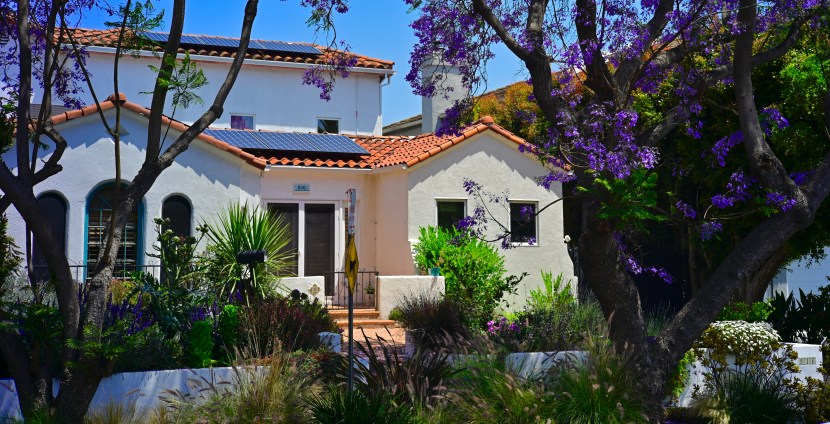
This temporary cooling of hues usually has me playing with b&w contrast as well, since it, too is in short supply in May and June. But sixty days of gray is finally too much for my soul to bear, and I revert to in-camera color settings designed to spice up mere reality…to, in essence, fake the effect of true sunlight.
To this purpose, there are the scads of custom online settings “recipes” that shooters offer to cheat one’s way into splendor. One such sim that has made it onto my camera’s preset buttons is a fairly good fake of Fuji Velvia 100 slide film, which is a vital tool during Ventura’s annual dip into ick. As seen here, it’s really flattering to foliage and skies, if a bit surreal when it comes to reds and yellows.
Thing is, humans armed with cameras are humans that come predisposed to seek the sun, and thus open to breaking out the Crayolas to dose up on a little ersatz atmosphere. Is it enhancement? Sure. Is it “cheating” as my wife terms anything photographic beyond a straight-from-the-camera shot (including cropping)? Who knows? Who cares? Cameras are interpretive tools, not mere recording devices, and one man’s fudged workaround is another man’s miracle.
SEEK THE UNIVERSAL
By MICHAEL PERKINS
To see a world in a grain of sand / and a heaven in a wild flower / hold infinity in the palm of your hand / and eternity in an hour. ——–William Blake, Auguries of Innocence
ONE OF THE MOST MIRACULOUS GIFTS OF PHOTOGRAPHY is the same gift that all great arts, from painting to music, produce; the ability to take a small sample of life and make obvious its universal connection to existence in general. To see a local sunrise is to see the same sun that every person on the planet can see; to show Blake’s “grain of sand” is to glimpse every shoreline and beach; and to show emotion on a single human face is to experience the joys and sorrows of all faces everywhere.
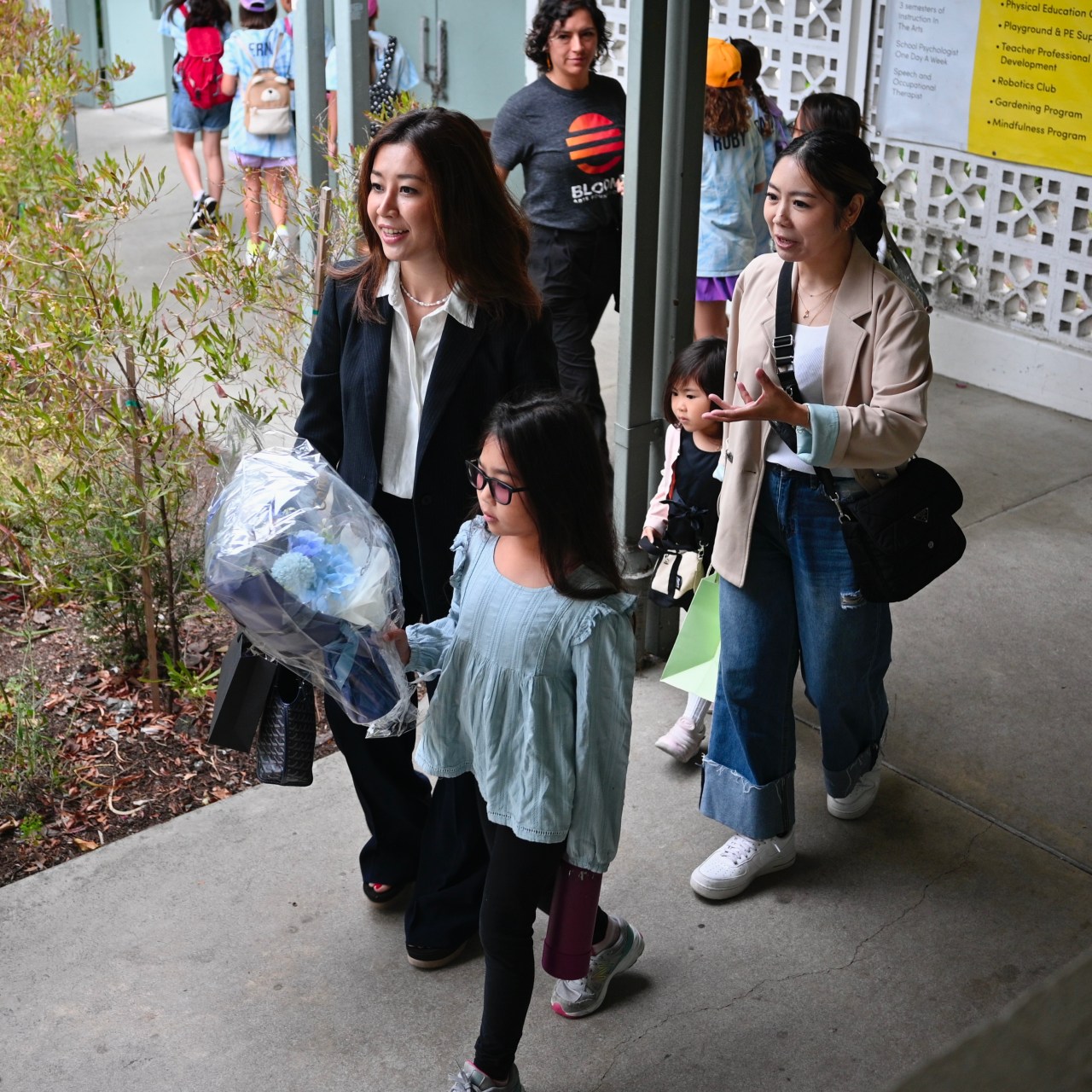
Seeking the universal in the particular is, of course, beyond instinctual to anyone who spends any appreciable time as a photographer. We learn from our first photo shoots how to recognize patterns and their replication across peoples and generations. We know that everything we show has all been shown before. So why restate the obvious? I guess because some instances of “all of us are everybody” strike us as particularly poignant. It reinforces the truth that all experience is shared experience.
I recently attended an elementary school graduation at a school in Los Angeles, an elegant, sweet-hearted recognition of our general humanity that, on that particular day, contrasted strongly with angry energy elsewhere in the city that underscored our divisions rather than our commonality. This particular school is a wondrous mixture of ethnic pride, a school in which no fewer than eleven languages are spoken across the student body. There were any number of opportunities to record the celebrations of various families as they arrived to celebrate the miracle of their young people, but for some reason I was particularly happy with this one, a small parade of three generations gathering to mark success, to certify our common humanity, to beam with pride. I love this picture, for reasons that go far beyond any technical skill on my part. Photography succeeds when it seeks, and preserves, evidence of the universal. We are all the same child, happy to pick up our diplomas and go to the next level. We are all cameras striving to freeze that happiness for posterity.
************************************************************
Want to review past articles? The Normal Eye is fully archived. Just click on POST TIMELINE at the bottom of any page on the site to scroll through our entire first dozen years. Thanks and happy hunting!
THE WONDER OF THE WALKABOUT
By MICHAEL PERKINS
I AM ASTOUNDED BY PHOTOGRAPHERS WHO UNERRINGLY APPREHEND the essentials of the ideal framing for a composition. And, believe me, they are out there; artists whose eye immediately fixes on the ideal way to launch a narrative in a static shot. The legendary Henri Cartier-Bresson was one. He reputedly kept his camera hanging around his chest until the very instant he was ready to make a shot, whereupon he lifted his Leica to his eye, and snap, one flawlessly framed image after another. The photo editor’s dreaded wax pencil never defaced his images in search of crop lines or a way to trim away fat to make HCB’s pictures communicate more effectively. There was no “fat”. The editor was already looking upon perfection.
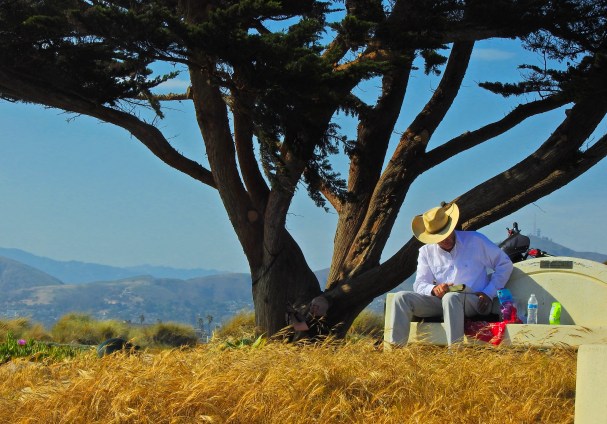
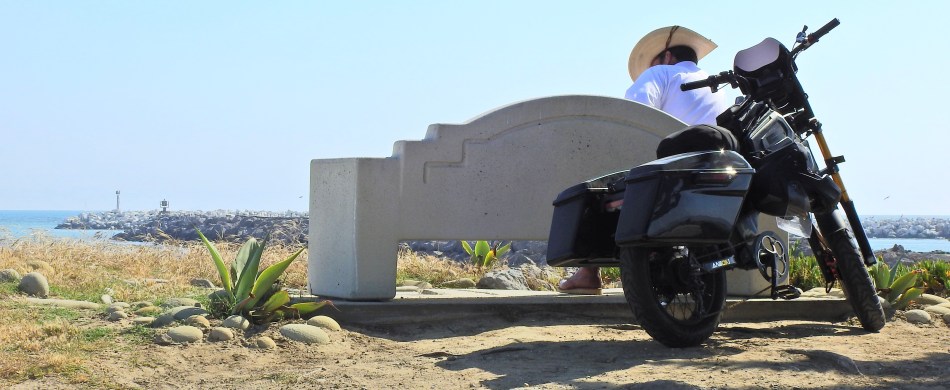
For me, composition is more typically trial and error, and so my favorite subjects are things that will more or less remain in place long enough for me to literally walk around them in search of their “good side”. or the angle that best serves the visual story I’m after. Street photography offers up some opportunities for such focused study, but, in that real-time environment, the stories are often morphing too quickly, and one has to trust to instinct to nail that one second of eloquence, since a follow-up or re-take may not present itself. But, when I can, I try to be slow, deliberate. To do things with purpose and on purpose.
Digital, and the luxury of nearly endless numbers of exposures with immediate feedback, has been a life saver for me in a way that film, God bless its little analog heart, never was. This instantaneous concept-to-result cycle has saved many an image for me, since I am granted the ability to make a lot of wrong pictures very quickly, thus arriving at the right picture with more efficiency. The gentleman seen here in two frames was very accommodating in ignoring me, allowing me to squeeze off perhaps fifteen shots as I walked from his rear left side to his rear right side. Along the way, the scenery and props rose and fell as focal points, subtly changing the message of the photographs. Were I expert enough to follow Cartier-Bresson’s example, the image just just above might have been my goal, but, as I dwell among mere mortals in Photo-Land, I find myself by getting lost a bit. I go on walkabout.
DUST WITHIN DUST
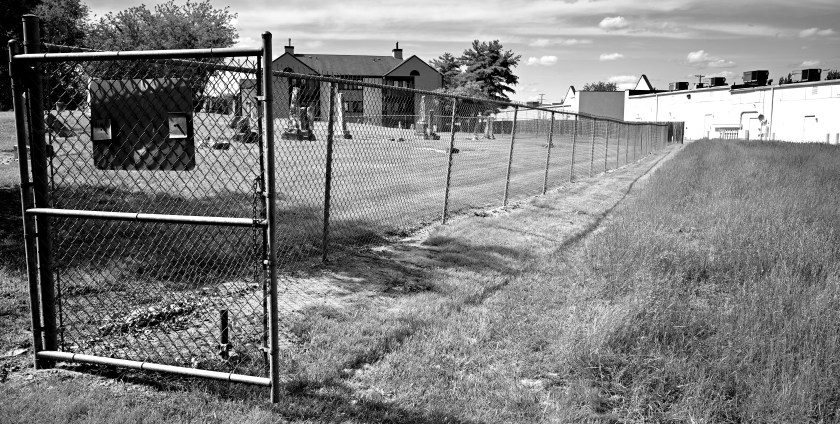
Sandwiched between a strip mall and an apartment complex in Ohio, an 18th-century graveyard..
By MICHAEL PERKINS
CEMETERIES USUALLY PROVIDE VISUAL CUES GALORE for both passersby and photographer, with hefty monuments, iron gates, placid, leafy grounds, and flower-crowned epitaphs. Most final resting places also stir in a big dollop of dignity, of august respect, a way of marking the importance of those interred below. A send-off befitting the lives they lived.
But not always.
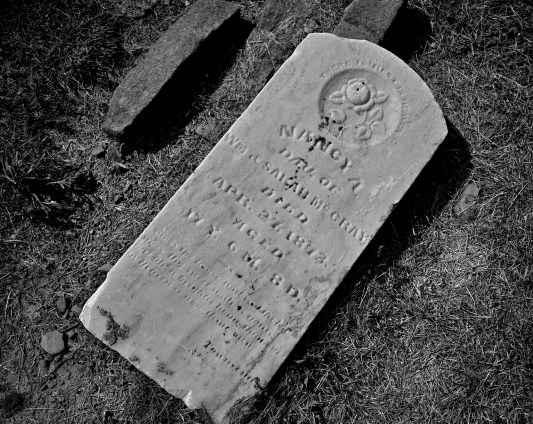
A place of neglect instead of respect.
Grave sites, and the gravitas they receive from us, vary wildly from town to town. You might be laid to rest beneath the uniform, manicured fields of Arlington, or, as in this forgotten patch behind a strip mall in Reynoldsburg, Ohio, you might be in a random gathering of crumbling headstones hemmed in by an ugly cyclone fence, overgrown with weeds, lacking even the simplest legend on the origins of souls gone so long ago that half the data on their markers has been effaced by time. The graves here date back to the earliest days of the republic, with even a few occupants from the revolutionary era. However, to drivers whizzing by the front of the shopping strip on state route 256, they may as well be on the moon, the only hint of the site’s existence being a small post-mounted sign reading “Historical 1819 Seceder Cemetery, Behind Shops.”
In speaking to several people who live in the immediate area, I found that the fact that there was an historic cemetery moldering in neglect just yards away from where the locals drop off their dry cleaning or shop for snacks was a complete surprise. The living and the dead tend to be more side-by-side in smaller towns, and, in fact, several other, more lovingly maintained graveyards are scattered throughout Reynoldsburg. But so many things slip between the cracks of history. Time not only heals, allowing pain to be endured; it also erases, allowing loss to go unheeded, or completely forgotten. For guys with cameras, both legacies of the departed impart their own poignant pain.
SPITTING BACK THE CANDY
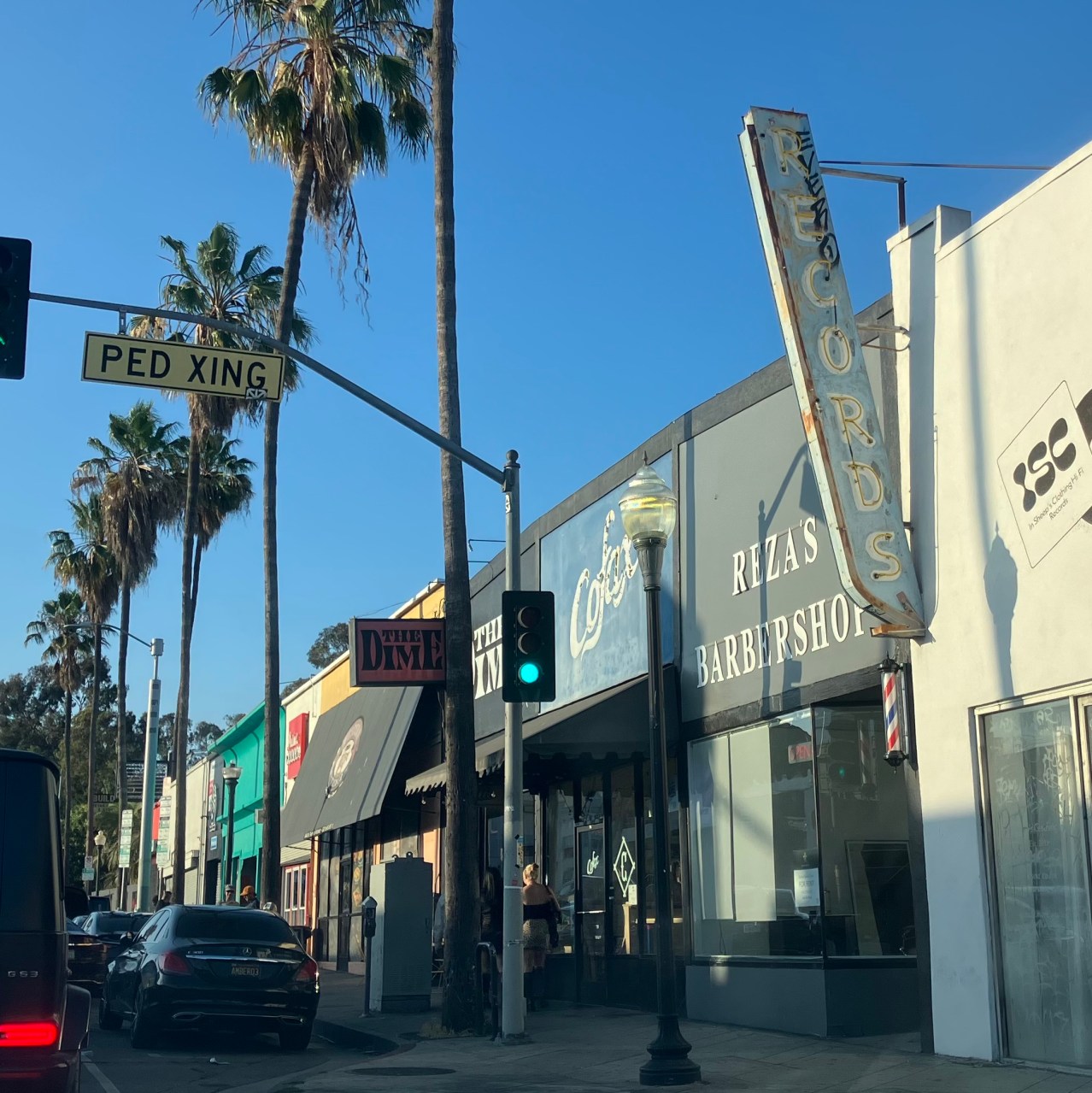
A straght-out-of-the-iPhone shot. Not remarkable, but not bad, and all my own.
By MICHAEL PERKINS
IT HAS TAKEN ME SOME TIME TO SORT OUT MY FEELINGS about the onrushing tsunami of interaction between photography and artificial intelligence. I have tried to see this tech wave as a bounty of new, useful tools, or a step toward greater efficiency. I really have tried. But I can’t get there, and now I fully understand why.
Creativity is often a collaboration, but it is a human function, and so, even collaborators in any creative act should be aligned in their common humanity. Humans have a distinct way of viewing problems, assessing results, and making executive decisions about where a given piece of art is born and where it arrives. Any process in which humans delegate this authority to non-human entities ceases to be creativity, since it surrenders the agency of the creator.
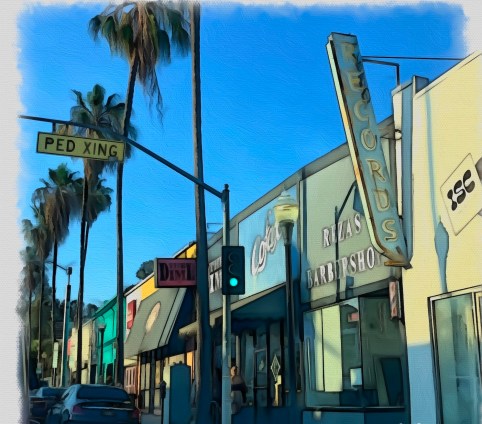
The same image, fed through a faux-painting A.I. generator app called Oilbrush.
And then there is the problem of authorship, which is called into question the very instant that a photographer makes use of an A.I. generator. In the image above, my original photo from the top of the page has been fed into an app called Oilbrush, which, as its name suggests, simulates the tonal and textural feel of a painting. In an instant, it samples billions of pictures from millions of artists, simulating their approach, technique, and, yes, even the type of brushstroke they used in an endless random mix of elements. When I click a tab in the app, I have no idea whose ideas I am compromising, or stealing outright, to enhance my own. I have traded any pretense at originality or honesty for instant gratification. Efficient as hell, and soulless.
I love playing with all these toys, but having spent some time in the their strange playroom. I do not wish to present work as “mine” when I can’t even have a conversation with my “collaborators”. I am not obligated by career pressures to fold this revolution into my own photography, and so I am free to make pictures in the way that I trust….that is, of myself, by myself. The tech treats offered these days are indeed tasty. However, after the first flavorful burst of sweetness, some of us will choose to spit back the candy.
AS ADVERTISED
By MICHAEL PERKINS
CALIFORNIA HAS ALWAYS BEEN ITS OWN BEST PUBLICITY AGENT, burnishing its already dazzling visual beauty with idealized vistas in posters, packaging and legends that elevate the state from a mere paradise to something like a fairyland. Anchored in my midwest reveries in Columbus, Ohio, my own first glimpses of scenes of the far west were not candid photographs or documentaries, but the golden bounty of the land as depicted on fruit crate art. Long before I experienced the range of light that is a daily miracle in its mountain skies and coastal beaches, I saw it simulated like some fantasy landscape in Maxfield Parrish’s over-the-top posters for Edison Mazda Lamps. And decades before I would step off a plane to experience the Golden Gate first-hand, I marveled at postcard-perfect views of San Francisco through the lenses of a View-Master.
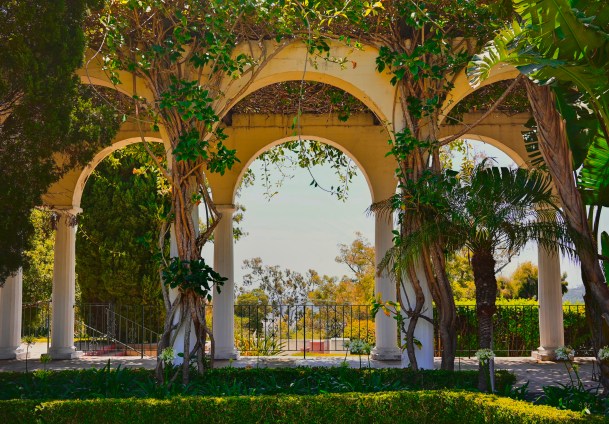
Now, long past all those childhood visions of California, I actually live here, and am amazed to see the same sort of light and color that I had assumed were mere hype and boast, only to find the very vistas that inspired so many brochures, magazine spreads and travel guides. The amazing thing is that the real deal is not that much removed from the imaginary when it comes this place. The shot you see here, of part of the old Santa Barbara State University campus, is pretty much straight out of the camera, although I retreived some details from the more extreme shadows. And this picture, I find, is not an anomaly, but the daily legacy of life out here.
The only thorn on this rose is what the California native knows about his Eden…that protecting it from the ravages of the very people who claim to love it can break your heart, overwhelm you with the task you are charged with, to save, serve, defend, replenish. Photography is the religious worship of light and what it can beautify. But in all that beauty is buried a challenge; we must remember that we are not owners but merely caretakers, and that we must use the arts for, among other things, reminding everyone just what is at stake. Only in that way can the wonders we cherish most about this world continue to delight as advertised.
 thenormaleye