By MICHAEL PERKINS
PHOTOGRAPHY IS JAMMED WITH MADDENING PARADOXES, conditions that can work to either promote or thwart creativity, or, insanely, do both at once. One of the more maddening of these conditions came about with the dawn of the digital age. Suddenly, the unforgiving economics of film, which had made people work slowly and deliberately (lest they click their way into the poorhouse) shifted in favor of the photographer. Now, in essence, once he bought the camera, he was virtually shooting for free, meaning, in practical terms, he could produce more images, at shorter and shorter delivery times, than had previously been possible. Good, huh?
Well, in terms of the learning curve for making good photographs, swell. Being able to shoot hundreds of shots in a fraction of the time that it used to take to crank out dozens sped that curve up dramatically. This meant that there was at least the potential to get good in a shorter stretch of time. But with those instant mega-batches of pics came a price…measured not in money or convenience, but in precision.
Simply put, shooting at the speed of instinct obliterates the careful pre-planning that film used to enforce on us. It’s an anti-contemplative way to make pictures, since the fact that we can make so many of them so quickly begs the issue of whether we should do so, or whether we might merely slow down and make fewer but better photos. Some photographers have tried to steal back those precious moments of deliberation by using simpler, more purely mechanical cameras, forcing them to pause and think before every shot, in order to compensate for a device that can’t do nearly everything by itself. Others have decided to give film another try, again to make mistakes costlier, make the results more uncertain, and thus promote a more painstaking prep for each frame.
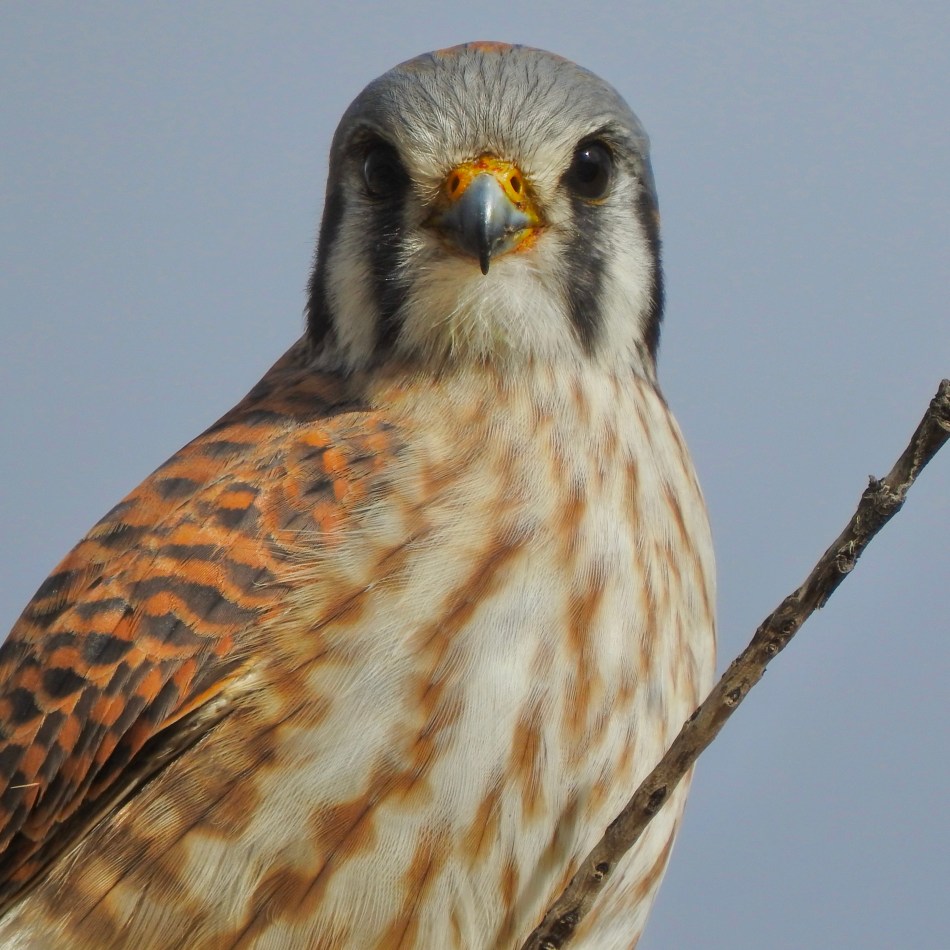
Point That Thing Somewhere Else #354, January 2023. 1/800 sec., f/6.5, 2000mm, ISO 200.
In my own case, my recent accidental wanderings into more wildlife work, dictated by the narrowed range of safety during the pandemic, has had the extra benefit of making me take more time to shoot fewer pictures. First of all, both the focus and zoom functions on the camera used in this capture of an American kestrel are sloooow, meaning that firing multi-bursts at a rapidly moving object is just a waste of time. And beyond just having to wait on the camera to respond, choosing a moment when the bird is moving the least is another calculation that slows the decision-making process. You must simply wait for the shot to come to you rather than just firing off a fusillade of frames and hoping something works out. Presto. You’re working slower, and with more mindfulness.
When it comes to creativity, speed doesn’t necessarily kill, but in many cases there is nothing to be lost by interjecting the occasional “why am I doing this?” into the process. It takes longer, but it was that very reduced speed that accompanied many of the greatest images that were ever made, in the days before we could shoot as fast as we could press the shutter. Taking a breath sometimes resets the mind and solidifies the intention.

 By MICHAEL PERKINS
 thenormaleye
ALONE AGAIN, NATURALLY
By MICHAEL PERKINS
TAGGING, OR MARKING A BUILDING WITH GRAFFITI, seems to me one of the strangest bids for immortality that an artist can undertake. It’s obviously, on one level, a plea not to be ignored: I was here. But since so much of the information in its various signatures and symbols are rigidly encoded, it’s only a testament to some people for some vague stretch of time. Soon, like the grass reclaims the battlefield, rust and amnesia efface the artist just as surely as if he had never passed this way.
When infrastructures rot and fail, they either collapse in catastrophe (like a fallen bridge) or needless suffering (like a municipal water system), and, as their pieces are hauled away, every cultural element tied up in their daily use, especially signs or writing, are taken away as well, robbing the tagger of his/her shot at immortality. Other times, the rot just stands, useless and unmourned amidst other changes in our daily world, still emblazoned with the phantom scrawlings of earlier poets who now cannot rely on either memory or context to make their work persist in meaning.
The strange legend on this disintegrating trestle bridge in Ventura, California was explained to me by a local as a reference to a heinous crime that occurred in the area. She didn’t seem to recall the precise details nor the time frame, although I assume it does not pre-date the invention of aerosol spray paint. Point is, even though the bridge has the year of its erection, 1909, stamped into it at the back and front, the span’s name, to everyone who passes until it plunges into the river, will be “the ‘Baby Girl’ bridge”. Unfair to the anonymous scribe who sought to freeze a horrific event in time, but eventually a moot point.
I wanted to shoot the bridge because of the textures of its deterioration, but then I realized that, eventually, I was also making what would, eventually, become the lone record of a message that someone, somewhere, thought important enough to stamp onto the trestle’s oxidized remains. Maybe, in some way, I think it’s important as well. Artists hate the idea of other artists dissolving into history. We come into the world by ourselves, and, after mingling with the world, we all end up, as the song goes, alone again. Naturally.
Share this:
Posted by Michael Perkins | November 13, 2022 | Categories: Uncategorized | Tags: Commentary, history, memory | 1 Comment