SHOTS AREN’T SEEDS
By MICHAEL PERKINS
I AM TRULY THANKFUL FOR MY PHOTOGRAPHIC FAILURES. And it’s right that I have a benevolent attitude toward the pictures I’ve muffed, since there are so many of them. As a photographer, you pray for the kind of analytical ruthlessness that you need to separate wheat from chaff and label your duds as duds….no excuses, no explanations, no magical thinking that, left in a drawer long enough, these rotten seeds will someday bloom into roses. Once you can call your own stuff worthless, you’re truly on the road toward making something….well, less so.
I have just spent a week giving the (overdue) pink slip to my last and largest remaining archive of really, really bad pictures from the twilight of the film era, about 400 35mm slides that I have been hauling around the globe since the late ’90’s, and none of which, surprisingly, have blossomed into masterpieces since the last three times I pulled them out, shrieked, and sealed them back behind brick walls. Funny how that happens.
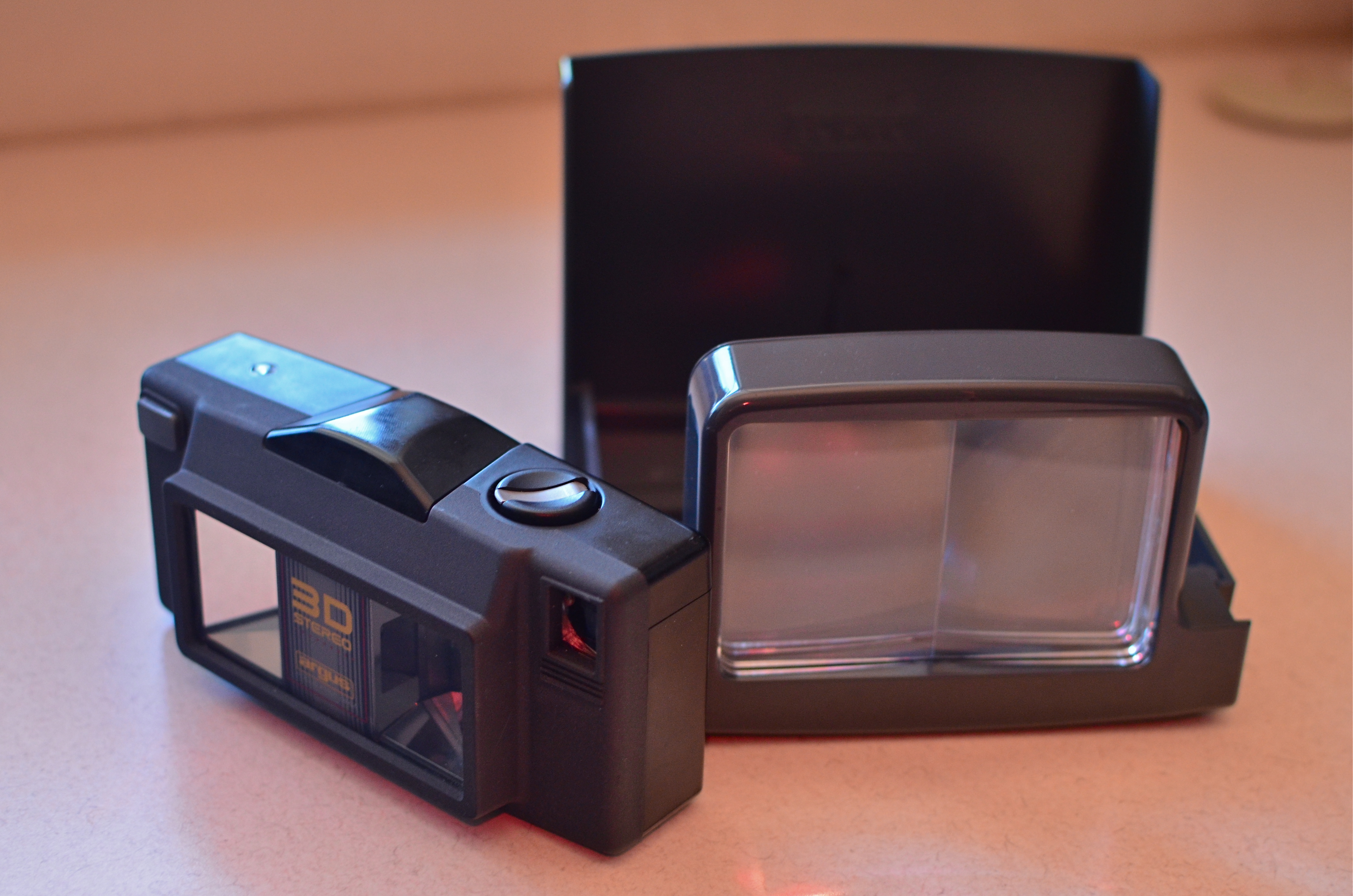
The (somewhat less than) Mighty Argus 3D film camera of the late ’90’s. shown here with its print viewer. Jealous?
This errant tonnage represents my first attempts with 3D photography, which involves a huge learning curve, not to mention a pound and a half of heavy-duty study. At the time I began this journey, very few stereoscopic cameras were available for sale, and the ones that produced the effect the best were also the most technically limited. The Argus/Loreo 3D, my toy of choice, was, in fact, a point-and-shoot 35mm with only two apertures, since the additional depth of field at f/11 and f/18 produced the best stereo illusion. The Argus was produced to create 4 x 6 prints (which you actually had to pay to have printed, remember), each featuring two side-by-side images viewed through a prism holder. It was not intended for high-end art use, since the lenses were frozen at 1/100, there were no additional optics available, and a usable result could only be achieved outdoors, in full daylight.
Worse, I stubbornly decided to shoot slide film in the thing, thus creating a whole separate set of problems for myself. First, were processors supposed to produce both images in the same slide? Well, sure, yeah, they could do that, but how was I going to view them? No worries! Turns out that other fools like me had also shot so-called “half-frame” stereo slides over the decades, and some of the viewers made to serve them were still on Ebay. Of course, I was shooting daylight slide film at 100 ASA in all conditions, and I didn’t yet know enough (or have enough money) to instruct processors on how to “push” the slide film an extra stop or two just to make them a trice lighter, so most of my shots were murky mysteries even Sherlock Holmes couldn’t decipher.
Worse, anyone shooting stereo must learn to compose for the depth effect, something you can only master by taking lots of lousy pictures (I did) or agreeing to take pictures of boring garbage just to attain said effect (did that, too). Add to this that you only had half of a 35mm frame in which to compose and you start to see what a raging success the whole enterprise was destined to be. At one point, I even went so far as to slice the twin images apart, re-jigger them in super-wide slide mounts, find an antediluvian projector that projected those kinds of slides ($$$), then search the globe again for viewing glasses that would allow me to see the projected slides in 3-d. Getting tired yet?
So, farewell to scads of badly composed, boring and unviewable slides, a grim reminder of how expensive and unwieldy large projects were in the film era. Post-script: I eventually thrived by learning to make my own View-Master reels (still expensive and work-intensive, but there’s a reason the format has been around nearly seventy years). At least the entire fiasco finally made a real editor out of me, teaching me a most valuable mantra: bad is bad is bad is bad. Some seeds will never become roses.
SEVEN MORE WONDERS OF THE WORLD
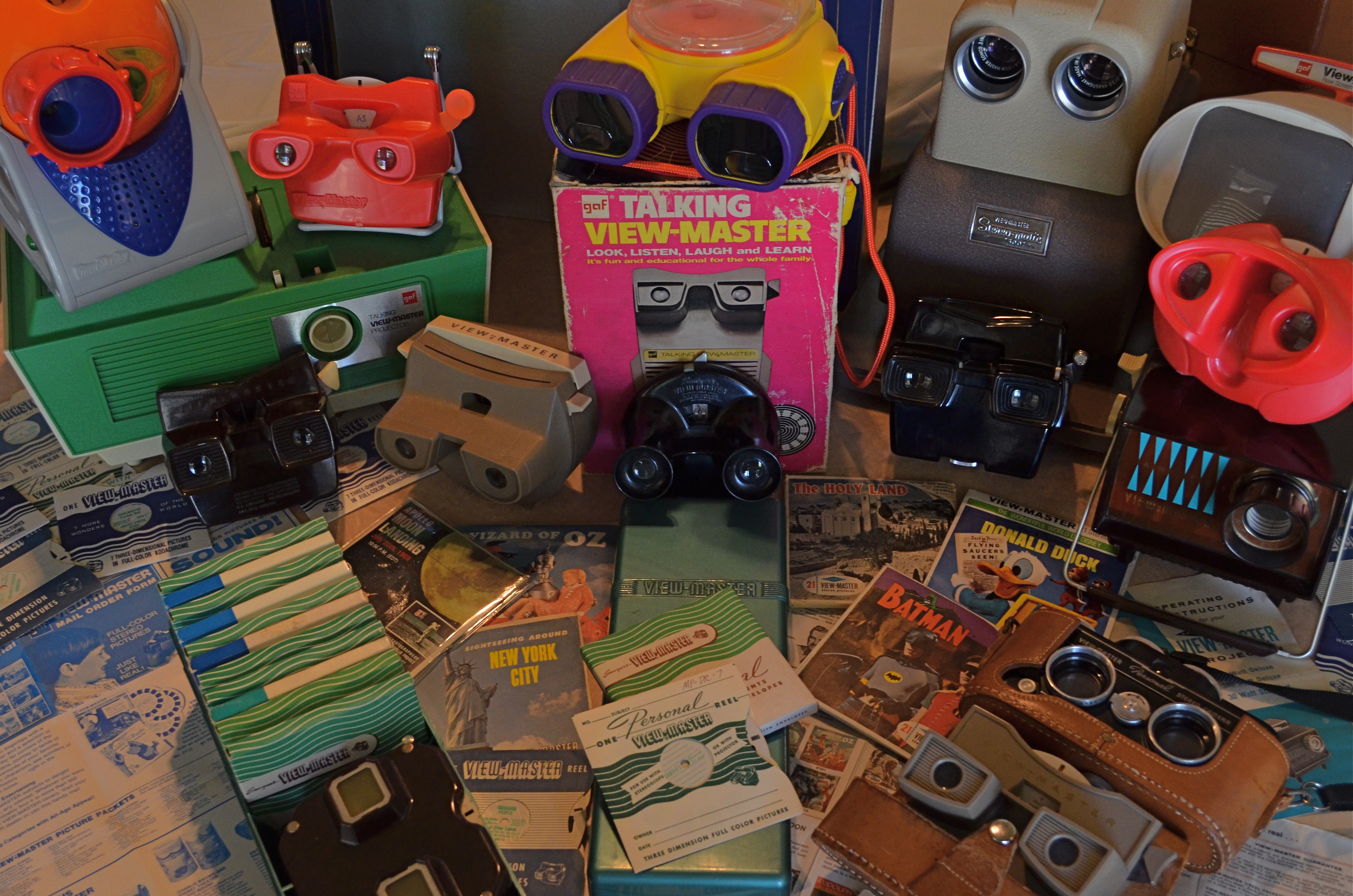
Class Picture: A small sampling of the massive product line from over sixty-four years of View-Master. 1/80 sec., f/5.6, ISO 640, 24mm.
By MICHAEL PERKINS
I’LL NEVER KNOW THE NAMES OF MANY OF THE PHOTOGRAPHERS THAT HAD THE GREATEST ROLES IN SHAPING MY EARLY WAY OF SEEING. The most important primary influences on my visual style in childhood weren’t the guys who received billing in the very public credits of Life, Look, or National Geographic, but the nameless freelancers whose work popped out of the small 3-d Kodachrome squares mounted in white cardboard View-Master reels. To this day, I can directly link the way I visualize images to VM’s crew of uncredited shooters, with their full-color highlight tours of everything from Yosemite to Notre Dame. Truly, from the first brown bakelite Model “D” viewer I received as a boy, through endless model variations over the next fifty years, I framed my own method for telling a picture story after the scenes in those little blue envelopes which bore the portentous legend, Seven More Wonders Of The World.
If you’ve been out of short pants for a while, you might not know that these little middle-tech stereoscopic beauties are still around, although just barely. View-Master has provided diversion and delight for three generations of devotees the world over, but the ride, billions of reels and zillions of memories later, might finally be crawling to a halt. More on that in a moment.
The co-invention of a photographer/tinker and a postcard salesman, View-Master cranked out its first rudimentary viewers and travel titles in 1939, more or less growing out of its appearance at the New York World’s Fair, where its souvenir views of “The World Of Tomorrow” made their debut. One of the earliest VM subjects was the then-new Boulder (later Hoover) Dam, setting the tone for the format’s explanatory “texts”, image descriptions short enough to make Tweets look encyclopedic, all crammed to fit inside the tiny caption window resting between your eyes. View-Master was largely an adult amusement for its first decade, catering to the armchair traveler with an endless catalogue of national parks, castles, cathedrals, and natural wonders, selling through a network of dealerships at camera shops and the souvenir stands at various travel attractions. Many of the format’s contributing scenic photographers also made some side money as VM sales agents, criss-crossing the country by car, shooting a little here, selling a little there.
By the early 50’s, View-Master grew from single-subject reels to three-reel packets and from travel images to its first children’s titles. Entering into a contract with Walt Disney studios, the VM format made a seismic shift toward youth fare with cartoon and TV shows, movies, even their own original fairy tale and nursery titles, shot with tiny clay figures arranged in their own miniature tabletop dioramas. And of course “the scenics”, as they were called, rolled on to chronicle many more World’s Fairs, canyons, mountains, parks, even NASA flights.
Depending on when you first encountered the format, View-Master was made either by Sawyers, GAF, Tyco, Fisher-Price, or Mattel, and the classic viewer was joined by projectors (2-D and 3-d), stereo cameras for making your own reels, “talking” viewers with internal phonographs to announce the captions, home “theatre” sets, storage cases and a slew of other short-and-long-term products.Now for the inevitable “passage of time” part: by the start of the 21st century, View-Master’s ancestral factory in Portland, Oregon closed its doors and production was moved to Mexico. And in 2013, there is, after sixty-four years, the clear possibility that the View-Master division of Mattel will be leased to a separate company, spun off like a despised stepchild, if not discontinued altogether.
Why the nostalgia? Because my whole orientation toward trying to tell a compelling, simple story in pictures, nurtured later by more famous photographers, cut its baby teeth on View-Master images: the composition, the angle, the way of leading the viewer’s eye into a frame and nailing it there….that’s all part of the “reel” world of my early, baby-sized eyes. There is no wasted space, no cute artiness in a View-Master image. It is all practical information, all shorthand communication. And even though the kiddie titles have long dominated the format’s output, there are, amazingly, still artists who create everything from complete tours of the Lewis & Clark expedition to edgy art exhibits with View-Master. And in a world that still embraces lo-tech imaging artifacts like plastic toy cameras and artificial “retro” platforms like Instagram, it seems that VM could still be an instrument for at least some kinds of photo expression.
Or, as with our tearful farewell to Kodachrome a few years back, we might, at least, cast a fond backward glance at the little box that gave us the world.
Seven wonders at a time.
A BOX FULL OF ALMOSTS
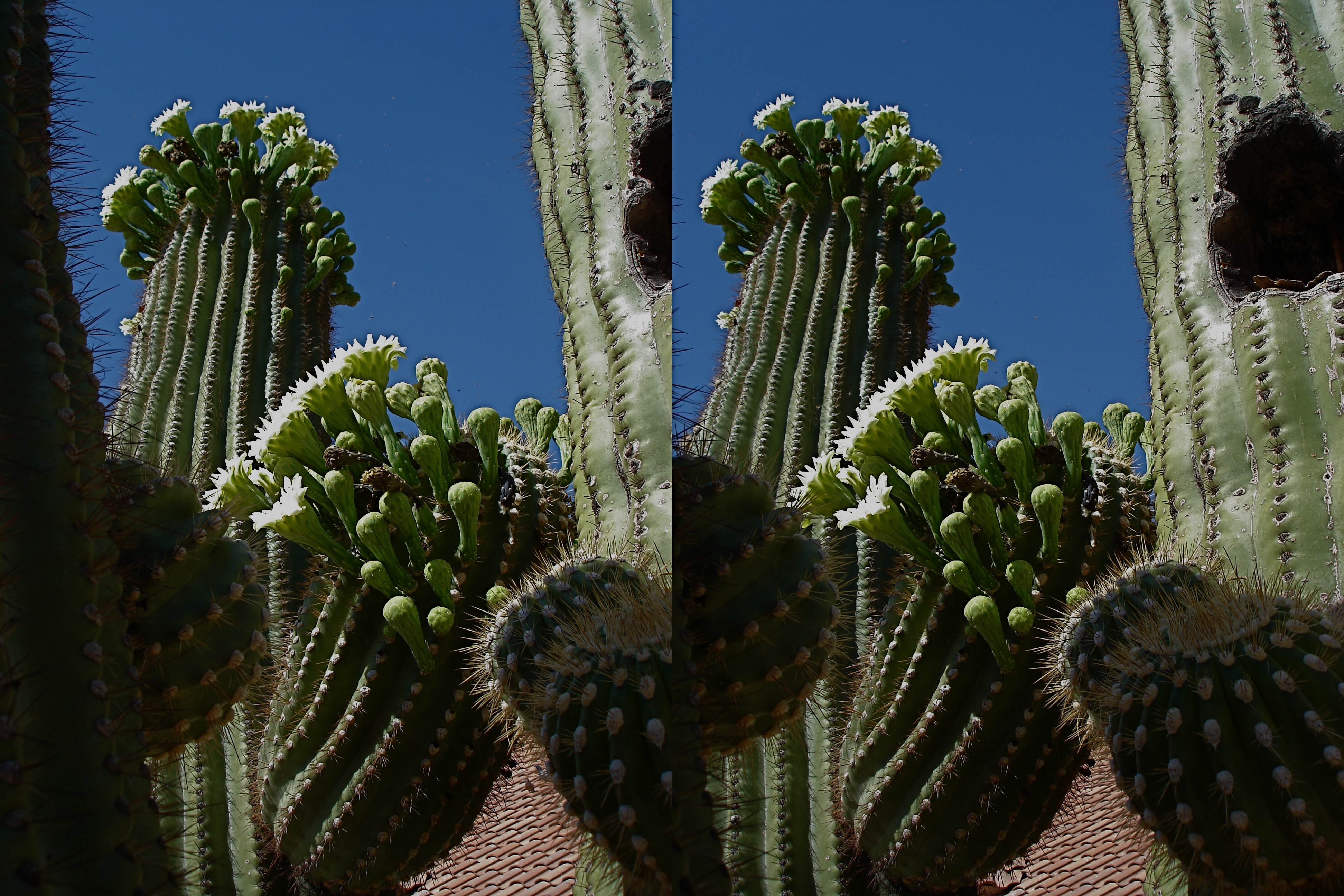

Shooting for 3D (top image) often cost me a lot of composition space, forcing me to frame in a narrow vertical range, but learning to frame my message in those cramped quarters taught me better how to draw the viewer “in deep” when composing flat 2D images.
By MICHAEL PERKINS
I RECENTLY SPENT AN ANGUISHED AFTERNOON sifting through a box of prints that I shot from about 1998 through 2002, a small part of my amateur work overall, but a particularly frustrating batch of images to revisit. Even given the high number of shots of any kind that one has to take to get a small yield of cherished images, the number of “keepers” from this period is remarkably low. It is a large box of almosts, a warehouse of near misses. Still, I felt that I needed to spend some “quality time” (strange phrase) mentally cataloguing everything that went wrong. I could have used a stiff drink.
One reason that the failure rate on these pictures was so high was because the pictures, all of them stereoscopic, were taken with one of the only cameras available for taking such shots at the time. The Argus 3D was an extremely limited film-based point-and-shoot which had been introduced for the sole purpose of producing cheap prints that could be developed by any vendor with conventional processing. The resulting 4×6 prints from the Argus were not the red-green anaglyph shots requiring the infamous cardboard glasses to decipher their overlaid images. but single prints made up of two side-by-side half-frame images in full color, which could later be inserted into an accompanying split-glass viewer that came with the camera.
The 3D effect was, in fact, quite striking, but the modest camera exacted a price for producing this little miracle. Since stereo works more dramatically at longer focal lengths, only shots made at f/11 or f/16 were offered on the Argus, which also had a fixed shutter speed and could not accommodate films rated higher than ASA 100. As for better 3D cameras, most available in the late ’90’s were dusty old relics from the late ’40’s and ’50’s, meaning that any hobbyist interested in stereo photography had to pretty much accept the built-in limitations of the rigs that were available. As a result, I had only basic control over exposure; light flares would invariably create huge streaks on one of the two angled lenses, creating a headache-y “flicker” in the viewing of the final print; and, worst of all, you had to compose every shot in vertical orientation, regardless of subject, in half the width in which you normally worked.
Worse for the artistic aspect of the project, I seem to have been sucked into the vortex that traps most shooters when learning a new technique; that is, I began to shoot for the effect. It seems to have been irrelevant whether I was shooting a bouquet of roses or a pile of debris, so long as I achieved the “eye-poke” gimmick popping out of the edge of the frame. Object (and objectives) became completely sidelined in my attempts to either “wow” the viewer or overcome the strictures of the camera itself. The whole carton of prints from this period seems to be a chronicle of a man who has lost his way and is too stubborn to ask directions. And of the few technically acceptable images in this cluster of shots, fewer still can boast that the stereoscopic element added anything to the overall impact of the subject matter. Can I have that drink now?
A few years later, I would eventually acquire a 1950’s-vintage Sawyer camera (designed to make amateur View-Master slides), which would allow me to control shutter speed, film type, and depth of field. And a few years after that, my stereo shots started to be pictures first, thrill rides second. Grateful as I was for the improved flexibility, however, the Argus’ cramped frame had, indeed, taught me to be pro-active and deliberate in planning my compositions. Learning to shoot inside that cramped visual phone booth meant that, once better cameras gave me back the full frame, I had developed something of an eye for where to put things. Even in 2D, I had become more aware of how to draw the eye into a flat shot.
Today, as I have consigned 3D to an occasional project or two, the lessons learned at the hands of the cruel and fickle Argus serve me in regular photography, since I remain reluctant to trust even more advanced cameras to make artistic decisions for me. Thus, even in the current smorgasbord of optical options, I feel that, in every shot, I am still the dominant voice in the discussion.
That makes all those “almosts” worth while.
Almost.
Bartender? Another round.
Thoughts?
 thenormaleye