BLOWING OUT THE PIPES
By MICHAEL PERKINS
SOME OF MY WORST AND BEST PICTURES share a common bond; their origin usually begins with desperation.
They happen when I’m stalled, knotted-up, stuck. The times when you not only don’t know what the next image will look like, you don’t know if it will even be taken. Hell, you may be done. Poured out, squeezed dry, nothing left to say. Put the cameras in the next neighborhood garage sale and take up, I dunno, knitting.
Written down, this whole sequence of thought seems, well, crazy. And yet, I know that from time to time, something will knock me off course and, for a while, I will just not care if I ever take another picture ever again. It usually occurs as a consequence of a physical injury or illness, the kind of sidelined status where life is boiled down to its absolute essence, when, weighed against photography, makes the pursuit seems trivial, a ridiculous luxury. Earlier this year, in learning how to use a new telephoto lens in the field, I miscalculated how to transfer its nearly six pounds between my two arms, and I pulled some muscle tissue in my right shoulder. We’re talking X-rays, physical therapy, the whole deal, with me stuck with the irony of having waited years to get my hands on this prized toy, only to have it cripple me. I were not thrilled with life.
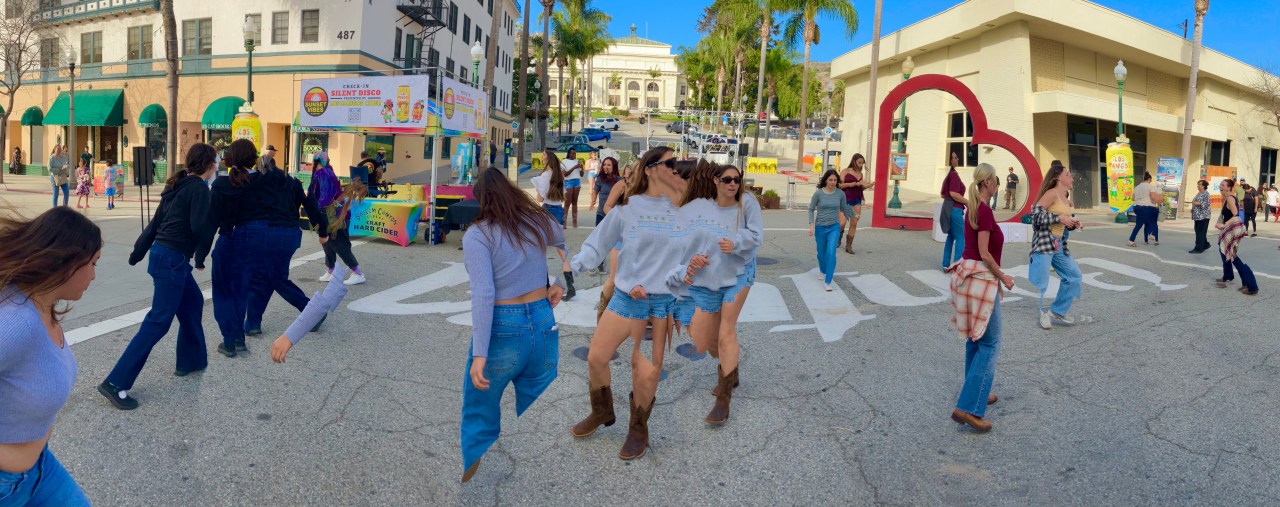
At this writing, a pinched nerve in my lower back has come along right on the heels of the shoulder, pushing photography even further back into “I can’t deal with this right now”-land and resulting in a week in which I shot virtually nothing. Yesterday, as I watched an impromptu dance mob take form in an arts festival, I knew I had to shoot something. Anything. To remind myself why I was gnashing my teeth from the sidelines. To re-prove to myself that images at least had to be tried. This very strange panorama is the result.
It’s not a great picture. It was available. And it was important for it to be available. Now, while my back hurts. Now, while I’m grouchy and nervous. At the moment, I don’t need home runs. I need to step up and swing at every pitch. Meanwhile, toss this one in the “under consideration” pile, and move on. To anything.
THE BOYS ON THE BEACH
By MICHAEL PERKINS
ONCE THEY ENTER THEIR TEEN YEARS, many young folk enter a very exclusive photographic club, whose rules dictate that, while they will suddenly become withdrawn or sullen if an adult tries to snap their picture, there is no limit to their enthusiasm for posing ad nauseam for their contemporaries. If their bff points a phone at them, out comes the goofiness and ease. Let a parent make the same move, however, and an iron curtain of blank expressions descends.
I used to think it was just me, since, during my own kids’ adolescence, the questions I received most from the three of them, at the first appearance of a camera, were “really, Dad?” or “again the with camera” or both together. My own children were born too early to come of age in the “always on” era of cel snappers, but they definitely gave their pals a wider berth than myself when it came to striking a pose or showing me their “real face”. Turns out, blood or no blood, they all do it. I mean, I am annoying when armed with a camera, but that’s beside the point.
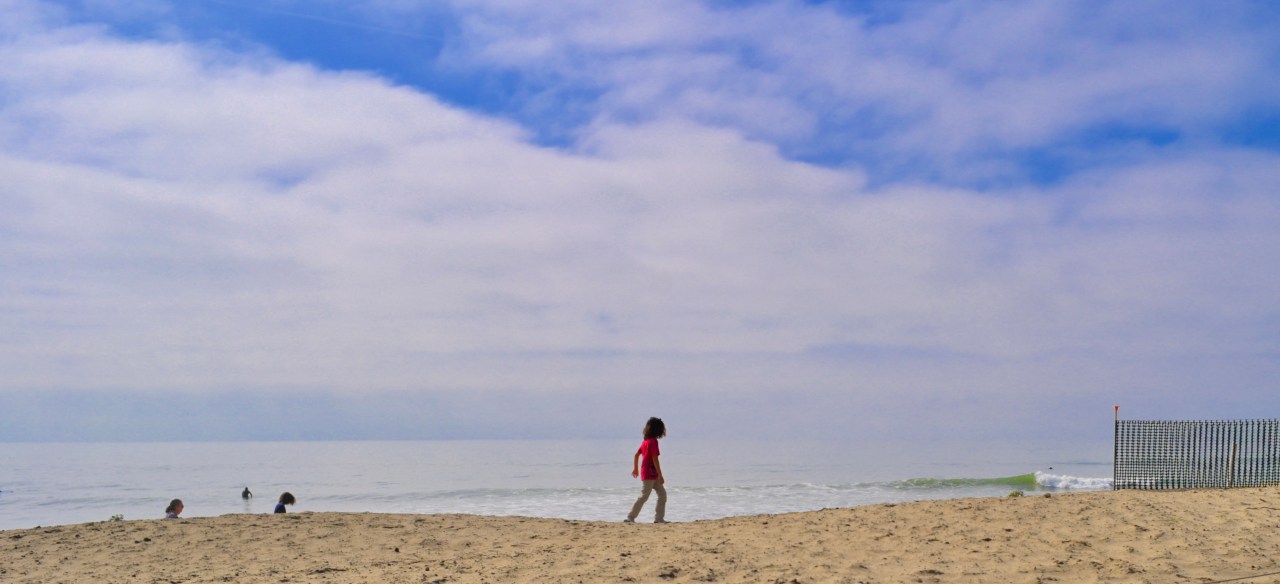
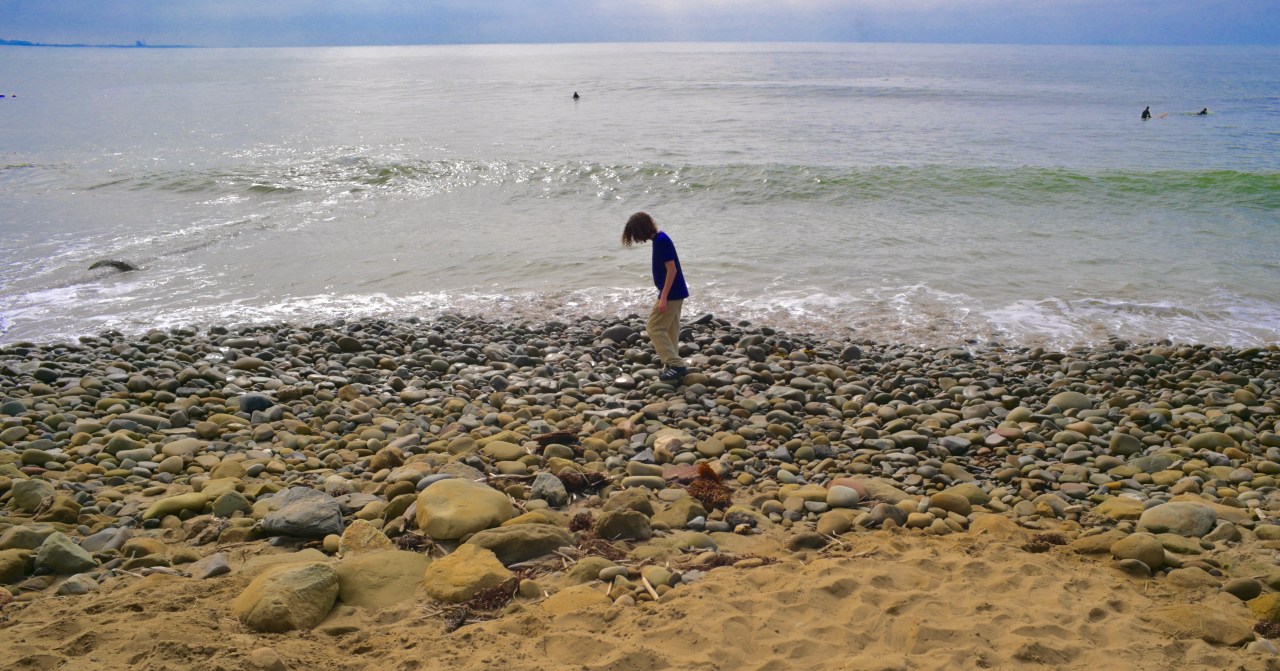
My wife’s grandsons have now entered the corridor of time in which she has to enact the will of Congress to get them to sit for portraits, suffused with coolness as they are. As the default chronicler for their lives since Day One, I still make the effort, but I work twice as hard rendering them, well, mere components within a composition, as you see here. Getting them to “act natural” when they are enjoying a day at the beach is, well, no day at the beach, and so I merely absorb them into their surroundings, as you see here. And, it’s no concern whether they will like seeing themselves this way, since neither one of them will show any interest in even seeing the results until they reach, say thirty. To get them to care that I even took the picture I would have to be thirteen, female, and cute. I mean, I’m fairly well-preserved, but everyone has their limits.
EDEN OR ABYSS?
By MICHAEL PERKINS
WHY IS IT ALWAYS THIS WAY?
Why do we always unleash new technologies before we bother to determine whether we need them at all, or whether, used wrongly, they can spell disaster for us?
And yes, I am talking about A.I.’s potential impact on photography. More precisely, I’m expressing a bit of panic, echoed by many, as to what it means for the future of the creative process overall.
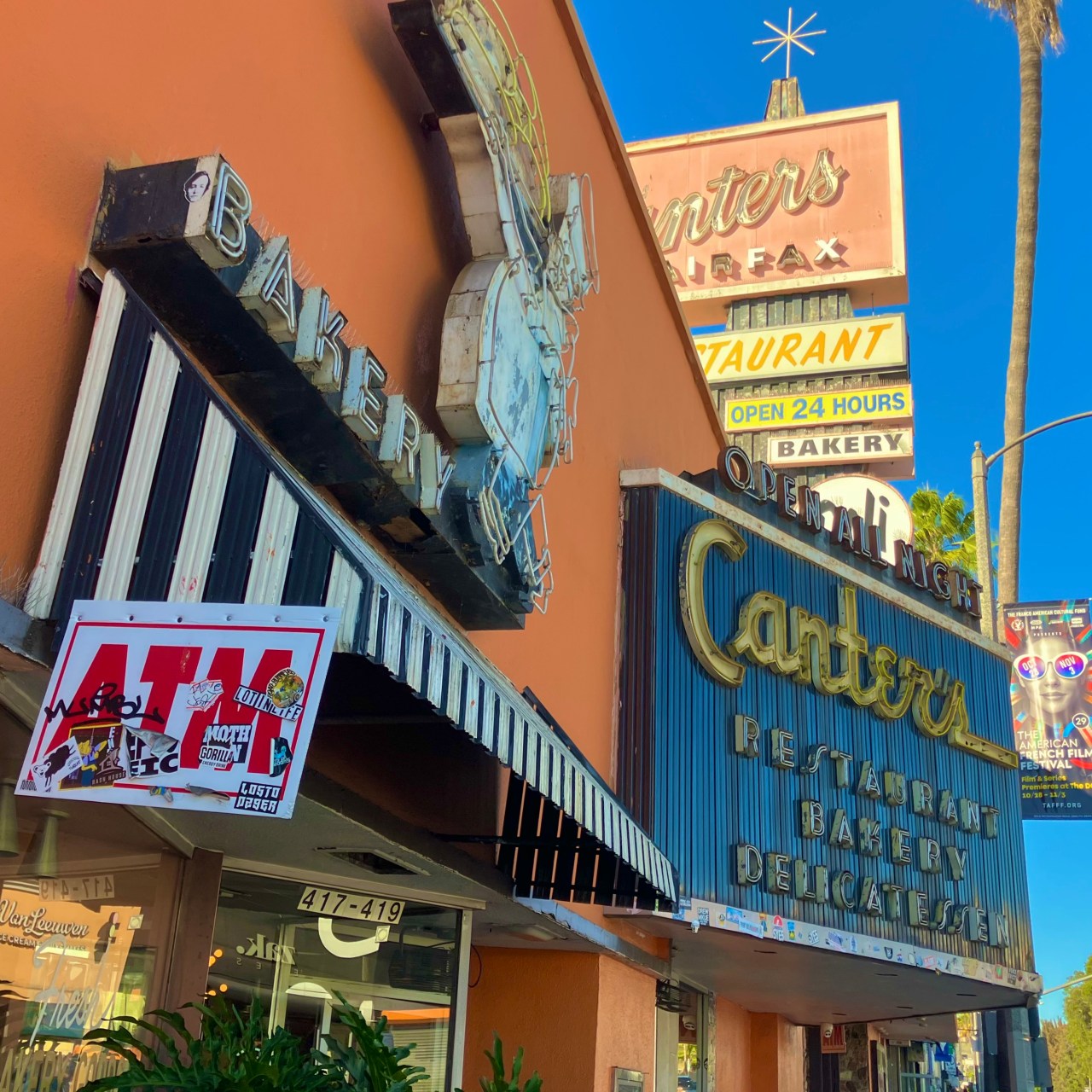
Let me confess that, prior to this year, I have not experimented much with A.I. as a post-processing tool. Even now, I have only tried a small handful of “for fun” experiments on my own images. Like many. I am really wrestling with what it means to hand any decisions over on my original work to an entity that largely cannot think by itself, even when acting upon my own directives. The images you see in this post constitute the most dramatic “before” and “after” comparisons I’ve yet mustered, and I must admit that I’m a little, well, frightened.
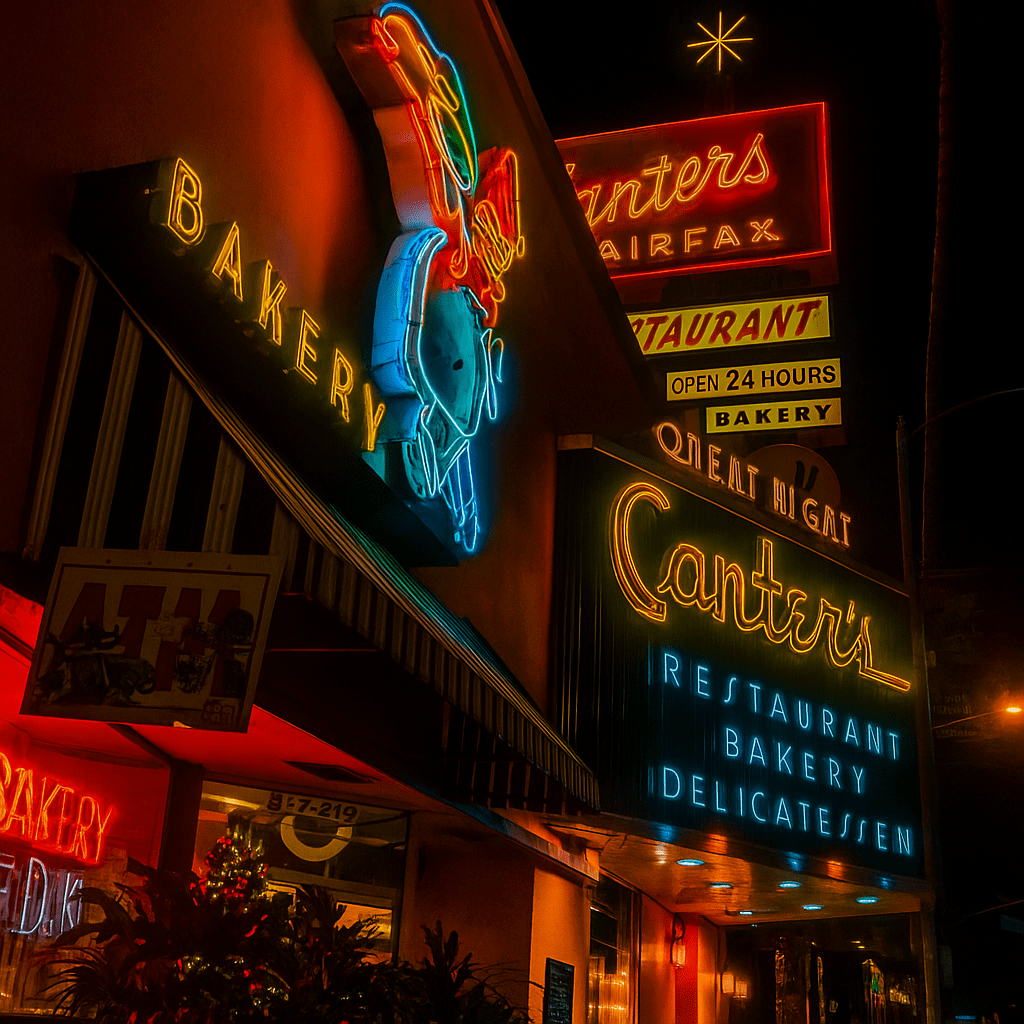
My apprehension comes from finally seeing one of my images changed, in an instant, from one vision of a subject to a believably rendered version of the opposite of that vision. Beyond novelty, it shows the ability to convincingly re-interpret reality, making the ingredients of my original into a secret “recipe” concocted largely by a non-human that’s learned how to sift through gazillions of actual human works and spit out a reasonable fascimile of what I might have intended myself. That should surely inspire awe as a technical breakthrough, but it also poses an essential creative conundrum; where is the role of the individual in all of this?
Until I can answer that question to my satisfaction, I must treat A.I. photography as both phenomenon and menace. The tech will be a route to either Eden or the Abyss, but every photographer must decide what it means to actually create, and whether he or she will in charge of that decision.
(P.S.—-the second image is the A.I.-generated one.
FUNCTION OVER FORM
By MICHAEL PERKINS
PHOTOGRAPHY BEGAN MAINLY AS A MEANS TO DEPICT THINGS, to faithfully document and record. Those things tended to be fairly concrete and familiar; a landscape, a building, a locomotive, portraits, events. Later, when painting freed itself from such strictly defined subject matter, veering into ever more abstract and impressionistic areas, photography, too, found itself exploring patterns and angles that were less “about something”, tableaux that were interesting as pure form.
The industrial age created many installations and factories whose purpose was not clearly obvious at first glance, but as vast collections of pipes, ducts, platforms, and gear that, unlike commercial objects, didn’t at once reveal what their function was. They weren’t contained in stylish cabinets or hidden behind alluring packaging. They just were, and they just did. The arrival of abstract industrial photography was the perfect means for merely admiring the contour and texture of things, without the need for context or explanation. Edward Steichen, Walker Evans and other giants saw and exploited this potential.
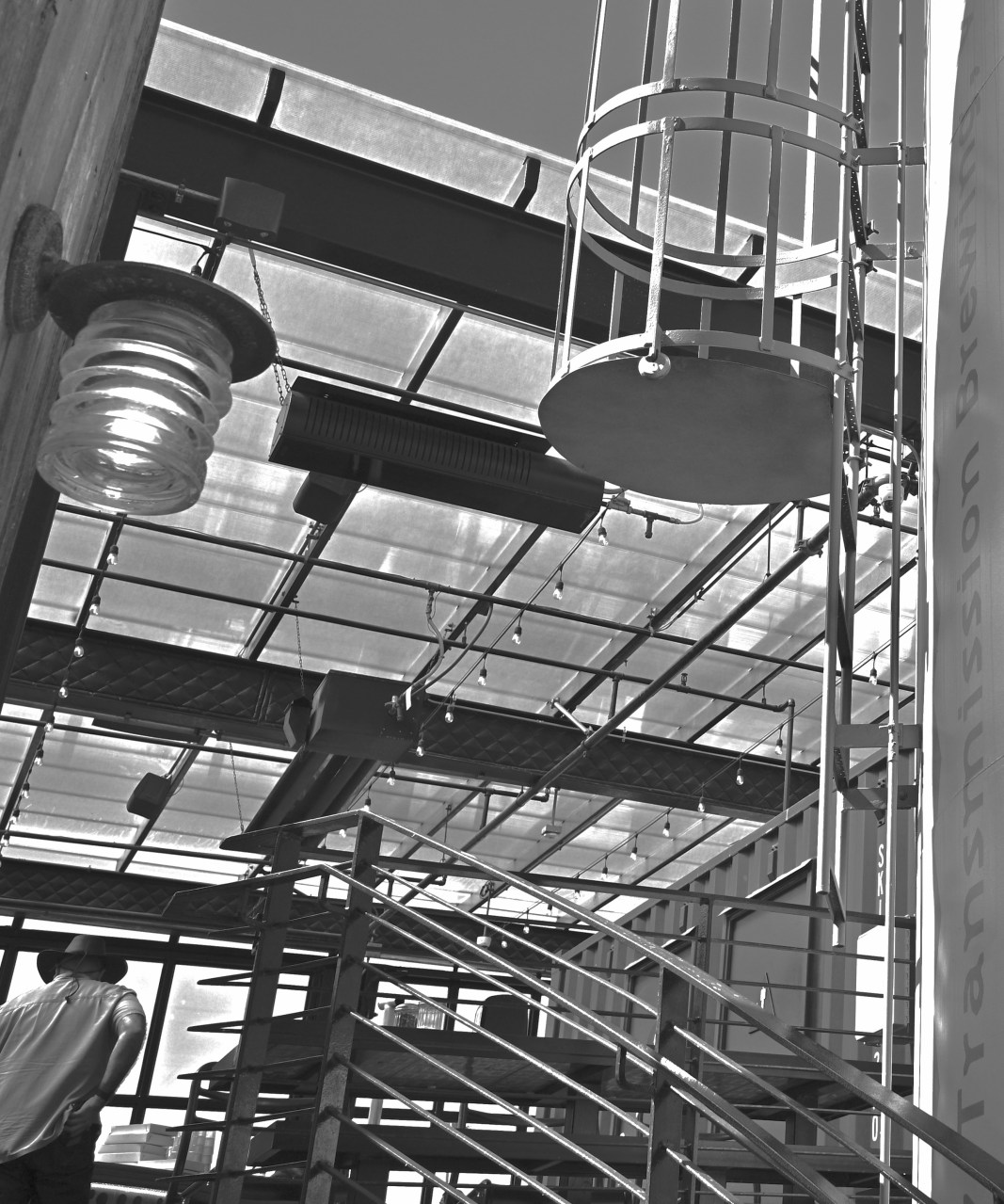
That Day At The Plant, 2025
I find myself still drawn to the same aesthetic, as I enjoy walking into complex structures whose use is not immediately obvious. It’s not so much an attempt to imitate those earlier creators of pure form photography as it is to rediscover their joy in the doing. It’s an homage, but it’s also me trying to have a subject affect me in the same way it did for those who went before me. And, of course, with its refusal to use tone to explain or contextualize things, I prefer to do this work in black and white.
In the end, it’s just one more way to look at things, a way to shake up your expectations. You can’t surprise anyone else if you can’t surprise yourself. Forcing yourself to see in new ways, to reconfigure the rules for what a “picture” is, provides stimulation, and that, in turn, invites growth.
DOWN GO THE DOMINOES
By MICHAEL PERKINS
THOSE WHO WRITE HISTORIES ON PHOTOGRAPHY understandably see it as an unbroken series of technological breakthroughs that have allowed the art to move forward and gain wider adoption for an ever-growing audience. This leads to an endless litany of Who Did What followed by Who Did What Next followed by What Did It Mean. When I look at the breaking of these barriers, it’s even more personal. Because when something new happens in photography, the net result, for me, is to help me get to the picture-making part with less delay and fewer screwups.
Take the most elementary part of creating an image, i.e., the gathering of light. We make ourselves crazy trying to corral as much of it as quickly as possible with as few intermediary steps in the process. After actually grabbing the light, we get snarled in other thickets, such as how to refine it, how to use it as a compositional tool, even how to control its range in color and tone. All this takes time and patience and learning, and so I bow to no one in my adoration for the wizards who’ve helped me get there easier. The tools are changing incredibly fast and the benefits are bigger and deeper than ever before.
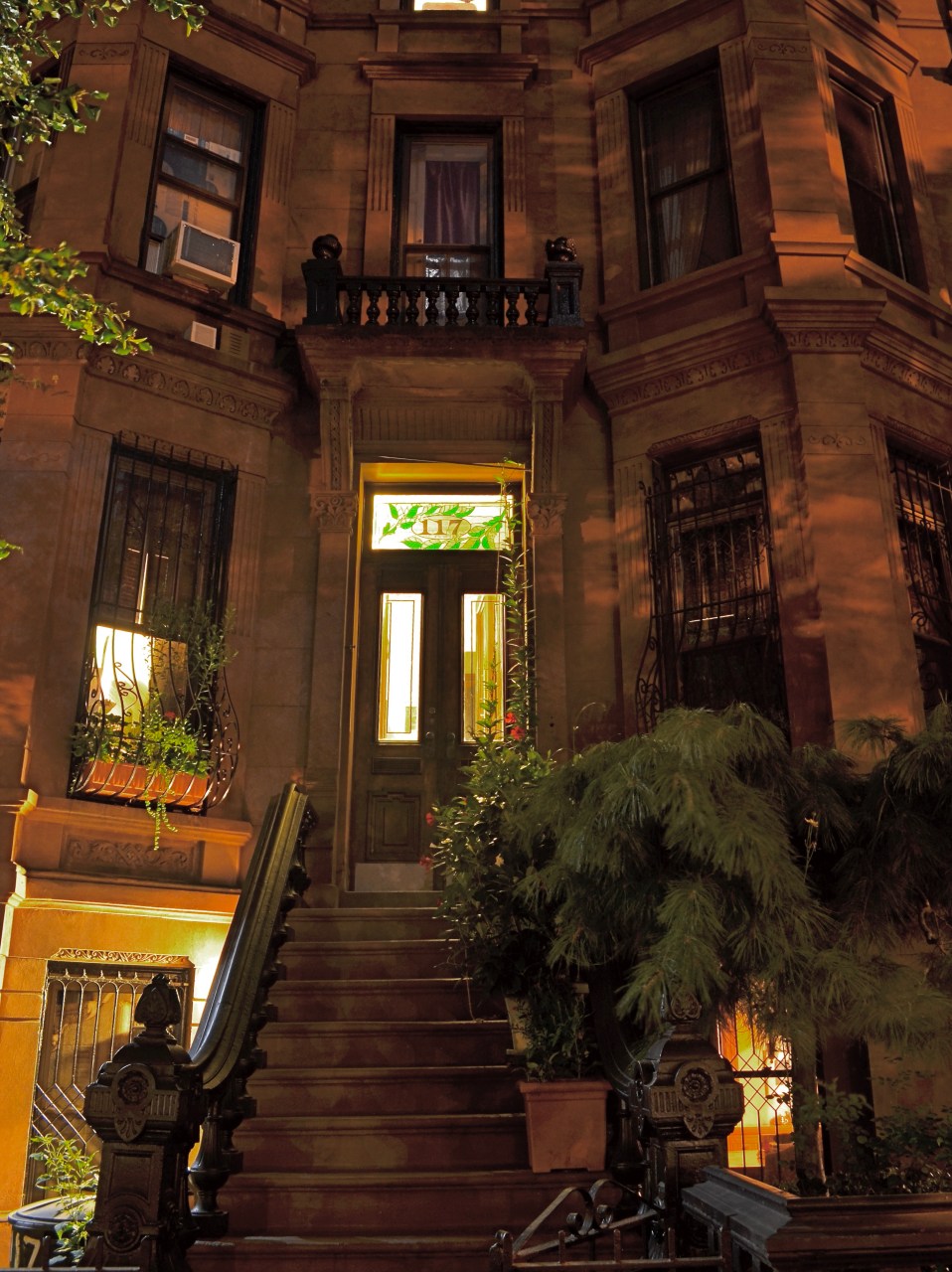
Take the idea of time exposure. The shot you see here was grabbed thirteen years ago, in the inky black of night, several hours after sunset, my camera, a crop-sensor DSLR, was mounted on a tripod and held open for ten seconds, allowing me to keep my ISO to 100, so zero noise. Jump ahead to 2025 and the larger, more sophisticated sensors of a full-frame camera, and it is nearly possible to take this photo handheld, albeit with a very high ISO that, amazingly, still comes out very, very clean. Is the tripod dead?
Certainly not, and you can draw up your own checklist of occasions that still call for it. Obsolescence happens slower than technical advancement (as witness the too-stubborn-to-die case of analog film). And yet. And yet we are that much closer to the tripod eventually going the way of the dodo, and in a remarkably brief stretch of time. That’s what I was pointing out at the top of this article; the fact that photography is swiftly getting to the point were excellence and flexibility are almost a given with present-day gear….with the steps needed to get the picture, to, in essence help us get out of our own way, being rapidly streamlined and simplified. Less calculating, more envisioning. Less adjustment, more captures. Every domino trips another domino trips another domino. Progress.
A CAMERA SETTING OF 120 OVER 80
By MICHAEL PERKINS
AS MANY PHOTOGRAPHERS NO DOUBT CAN, I find it easy to look at images I’ve shot in different times of my life and fully recall the state of my mind at the time. I know which pictures correlate to difficult periods, and which photos are, in effect, a barometer on various occasions of contentment. In the case of both happy and challenging events, however, I regard the making of photographs to be restorative in itself, something that the scientific world has recognized for some time.
Let me be more clear: photography is an essential good for both the heart and the mind. Its procedures and techniques actually promote mental health, pulling you away from the gravitational suck of care and worry. I have long suspected that it produced a greater feeling of calm and focus in the case of me, myself, but a body of study is backing up a benefit that I used to assume was “only me”. In a 2025 issue of the online magazine fStoppers, entitled Why Photography Could Be the Mental Health Boost You Never Knew You Needed, writer/shooter Alex Cooke shares the good news:
The psychological benefits of photography aren’t just anecdotal; they’re rooted in well-established principles of cognitive behavioral therapy, mindfulness practice, and positive psychology. When someone engages in photography, they’re essentially practicing a form of present-moment awareness that mirrors many therapeutic techniques used by mental health professionals. The act of composing a shot requires the photographer to observe their environment carefully, notice details they might otherwise overlook, and make conscious decisions about what to include or exclude from the frame.
True feel-good stuff, I know. However, Cooke insists that the benefits of snapping are rooted in real science:
Research in neuroscience has shown that creative activities like photography can actually change brain structure and function in positive ways. When people engage in artistic pursuits, areas of the brain associated with reward processing, emotional regulation, and cognitive flexibility show increased activity. Over time, regular creative practice can strengthen neural pathways related to resilience and emotional stability. Photography, with its combination of technical skill, artistic expression, and problem-solving, activates multiple brain regions simultaneously, creating a rich neurological experience that supports mental health.
If an ideal blood pressure is around 120 over 80, then I can attest to having come closer to that mark the minute I pick up a camera. Alex Cooke’s article is extensive, but an easy read, and I recommend that you at least leaf through its findings. Creative people are doing more than merely commenting on the world; they are, in small but real measure, helping put it, and themselves, in order. And that is one pretty picture.
GO BACK ONE
By MICHAEL PERKINS
I FIRST HEARD THE PHRASE “RUN AND GUN” applied to street photography in a lecture by the great Joe McNally, a lifelong pro and official worldwide Nikon ambassador and the author of superb tutorials like the classic The Moment It Clicks, who used the term to describe the practice of shooting quickly and intuitively with a minimum of fussing about gear and a deliberate intention toward the instinctual. Trained in rapidly-evolving journalistic environments, Joe was every bit as facile in clicking away at a rapid clip as he was in his most prepared and staged images. This means, despite the term’s wording, that “flexible” is a more important trait than “fast”.
When I must shoot a lot of things in a short space of time, as when I am walking alongside my New York-born wife, who definitely has a “Manhattan stride” and is definitely on a time line (usually a brisk one) to get somewhere and do something, I find that I must make many decisions in the moment. This does not merely mean racking up as many shots as I can physically click off and hoping for the best. It comes down to evaluating situations in the moment, trusting my first instinct on what may or may not constitute a worthwhile shot, and at least being prepared to execute without excess delay.
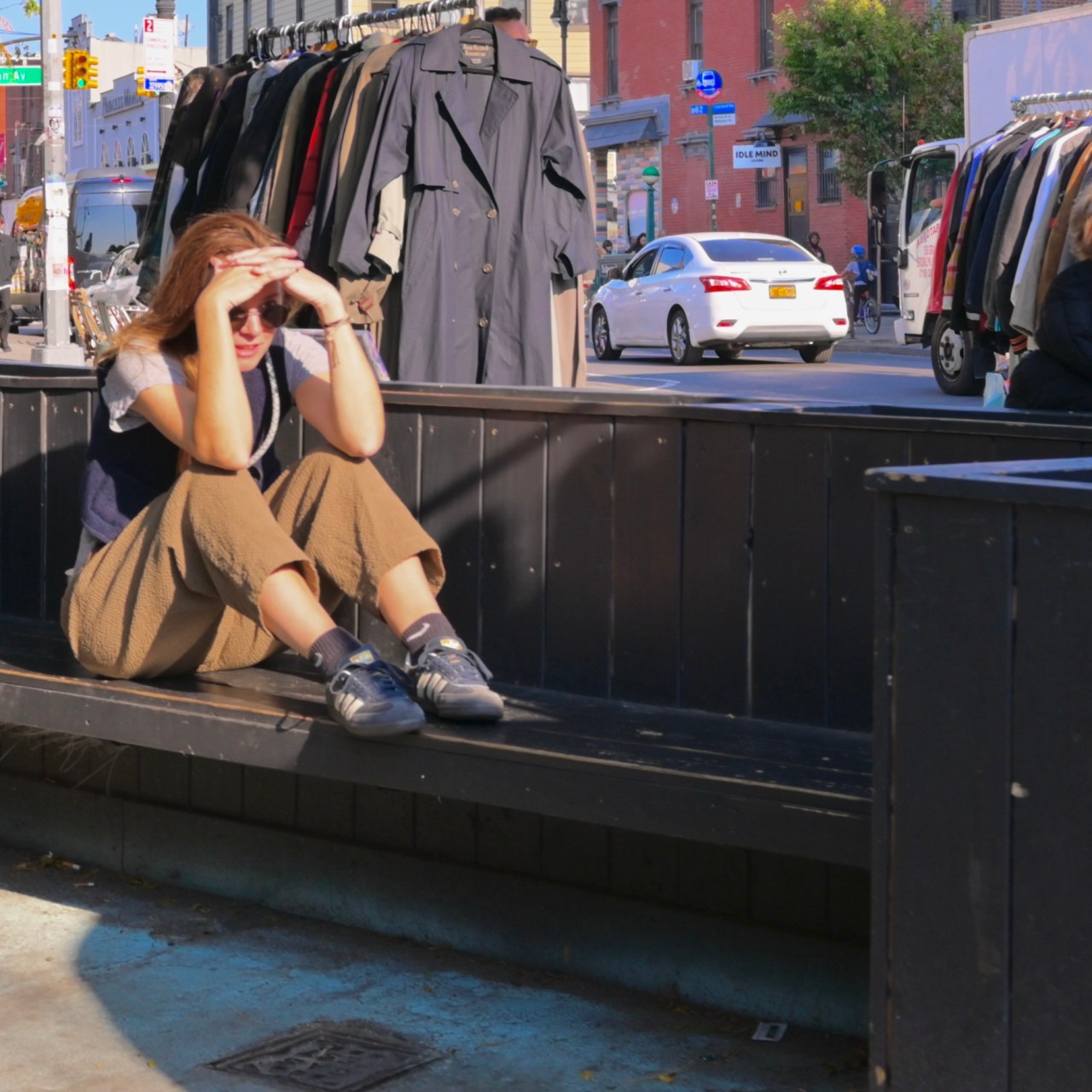
Obviously, at the end of a R&G day, this results in a fairly bumper crop of images, the value of which can not always be seen when upon first view. The certified killers certainly stand out, as do the abject clunkers, but the vast number of shots in between those extremes sometimes take a while to reveal themselves. I myself have built up the habit of looking back on a given shoot at the distance of at least one year, as it erases many of the first judgements you made about the pictures and allows you some objectivity, as if you are evaluating someone else’s photos, which in a very real sense you are.
Upon my earlier reviews of pics taken on a fairly quick walk through Greenpoint, Brooklyn almost exactly a year ago at this writing, this young woman got lost in the shuffle. She had a special quality, but I was uncertain as to my execution, and so moved on to more obvious prize winners. It’s a sucker bet to act as your own photo editor anyway, as your choices are fraught with both bias and bad habit, but waiting a year can make you look at things in a far different way from when you first chose to click the shutter. Of course, some times you decide that your “blue ribbon” entries from that time aren’t quite the miracles you originally thought they were. But, when a smile comes to you from an unexpected place, well, that’s the whole ball game, innit?
GO WES, YOUNG MAN
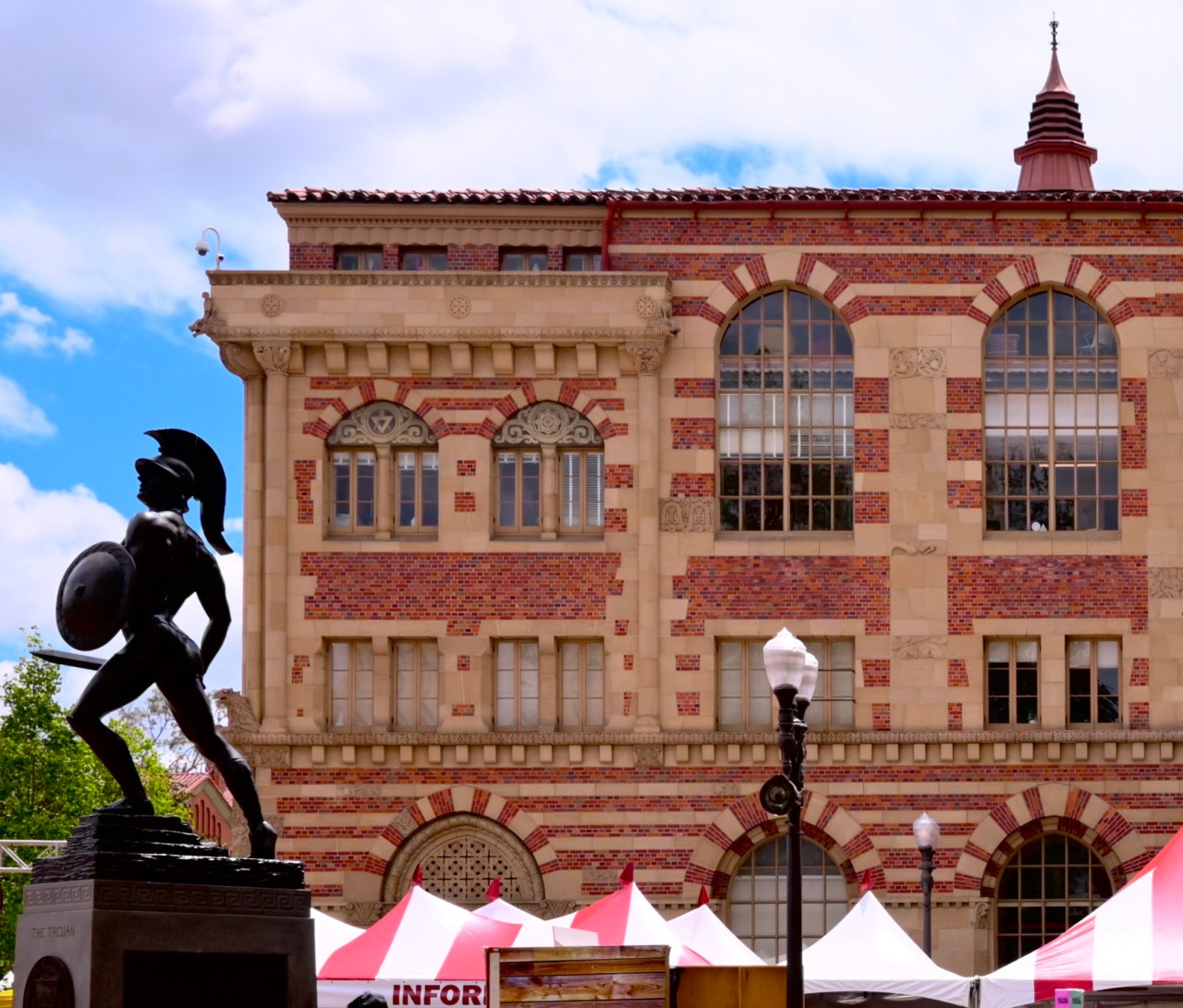
Straight out of the camera at f/8, 28mm, ISO 100, and 1/400 sec. Standard exposure scheme.
By MICHAEL PERKINS
SEVERAL YEARS AGO, WHEN WES ANDERSON FEVER was tearing across the popular culture, there was a mad race among photographers to simulate the director’s hyper-saturated, deliberately unreal color schema, partly as a tribute and partly as a technical challenge for those of us who love tinkering almost as much as we like shooting. Like many such fevers, the mania to be more Wes-like exploded into processing shortcuts and on-line recipes for in-camera sims of scenes from films like Asteroid City, a movie which transforms the starched American Desert into a mega-pastel postcard from the 1950’s. Entire books, like the Accidentally Wes Anderson series of travel images, were created to basically allow anyone to try faking what WA had created organically. We went a little nuts.
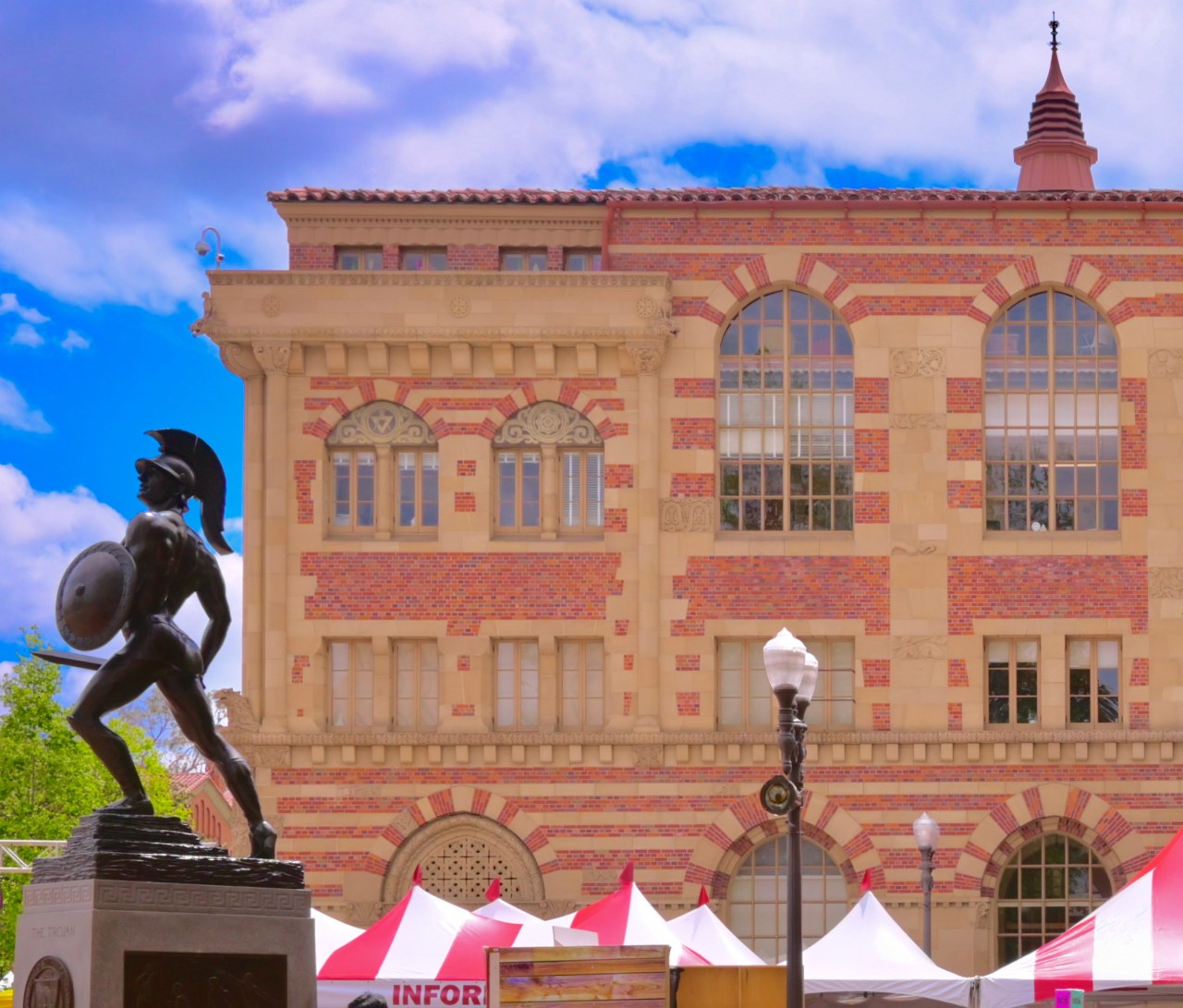
Same image “Wes Anderson-ized” with substantial reduction in contrast and a bump in vibrance. Not complicated.
The thing that occurred to me during all this here’s-how-you-do-it mania was how overcomplicated people were making the entire fakery-cum-tribute project. To me, it was not supremely technical to get the “Wes look”, although it did induce me to rethink how to alternatively “mix” things I’d already captured beforehand. To me, most of the effect came down to merely moving left on the contrast slider and moving right on the vibrance one. No major strain, as James Cagney used to say of acting.
Of course, one man’s cool effect is another man’s useless gimmick, and there are many strong opinions about the so-called “flatness” of low-contrast photography, no matter who it intends to salute. That may be why the Just-Like-Wes movement burned out so quickly; it was treating a technique as if it were, by itself, a message. There’s a reason why we stopped going to fairs and carnivals to have ourselves snapped as fake daguerreotypes as we once did in the ’70’s. It’s because a photograph has to be about something beyond just the technique required to make it. Shooting for the effect alone is craft, with no art to flesh it out or deepen it. Your camera, your vision, your choice.
THE FUTURE’S SO BRIGHT…
By MICHAEL PERKINS
PHOTOGRAPHIC TOOLS HAVE FINITE LIVES; they are introduced largely to solve a problem or improve results, and, as they age, can eventually create different problems which, in turn, have to be solved by succeeding technology. Gear thus has a birth, a life and a death, moving from something we need desperately to commonplace practice to antiquity and obsolescence.
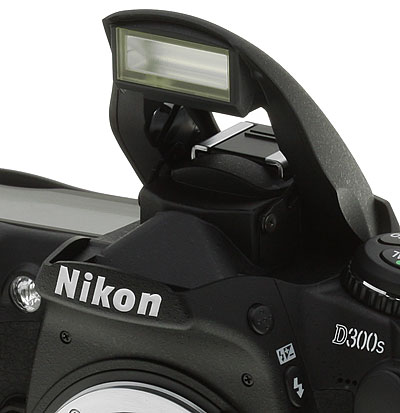
One such tool that, in the year 2025, is heading for the scrapheap of history is the loved/hated electronic pop-up flash, which, at this writing, is fast disappearing from new cameras at almost every level of expertise. Once seen as an ingenious miniaturization of the bulky electronic flashes of earlier eras, pop-ups are being deliberately designed out of incoming models, as fundamental rules of how we amplify or disperse auxiliary light in an image have shifted dramatically. Truth be told, the humble pop-up was always the Rodney Dangerfield of flash, in that it “never got no respect” from serious pros, who either mounted more responsive, more controllable units on camera flash shoes or used the pop-up merely as a trigger for off-camera slaves. Pop-ups were never capable of throwing light very far (ten feet was a reach) and, without the means to pivot or customize their angles, they mostly blew super-hot light directly into faces, blowing out detail and obliterating even those shadows the shooter actually liked. This linked them forever to a kind of snapshot. or “light it at any cost” mentality, mostly among amateurs.
And then there was the fact that pop-ups, being in part a mechanical feature, were more prone to failure or breakage than nearly any other component on the camera. The digital age pounded another nail into the pop-up’s coffin as well, making sensors more responsive to a wider dynamic range, lessening the number of shots that would even benefit from spot flash. Finally, as even cell-phone cameras create a balanced exposure through so-called “computational” calculation, flash pictures themselves, except in professional studio situations, are obviated more and more by better camera brains. And, finally, there is the consideration of the sheer space and electronic real estate taken up by a pop-up, space that could be better allocated, as Fstoppers magazine has remarked, “for better screens, faster processors, or improved connectivity.”
Photography has always been about the better mousetrap, and, after more than half a century as a standard feature on cameras the world over, the pop-up flash is just about ready for its final close-up. Some would say it’s the end of an era, but making pictures isn’t about isolated sectors of time, more like a continuous river of upward improvement. Tools are tools until they are impediments, and then, they are gone in a flash.
HORSESHOES
By MICHAEL PERKINS
ONE OF THE MORE QUIET EXITS from the average photographer’s toolbox over the last twenty years has been that of the once-ubiquitous tripod, that rigid testimony to the fact that here, ladies and gentlemen, was a serious shooter, someone dedicated to precision and accuracy. The anti-shake and image stabilization programs that are now incorporated into even the most modest cameras have largely relegated the “three-legged-spider”, as I call it, to the closet. The devices still command a multi-million dollar industry and are certainly in no danger of winking out of existence, but the everyday shooter can do very well without them much more of the time. That’s not a judgement, merely an observation of how once-crucial gear becomes a luxury or exception, like light meters or flash guns.
Of course, spending lots of time with birders, I still see folks carting their cameras around atop the things, using them mostly to stabilize shots that are zoomed out all the way and which would otherwise pose the problem of magnified body shake. But my own use of tripods, back when I regularly used them, was not for nature work but for urban nightscapes, where light would be a premium and extended handheld exposures would guarantee an unsteady result.
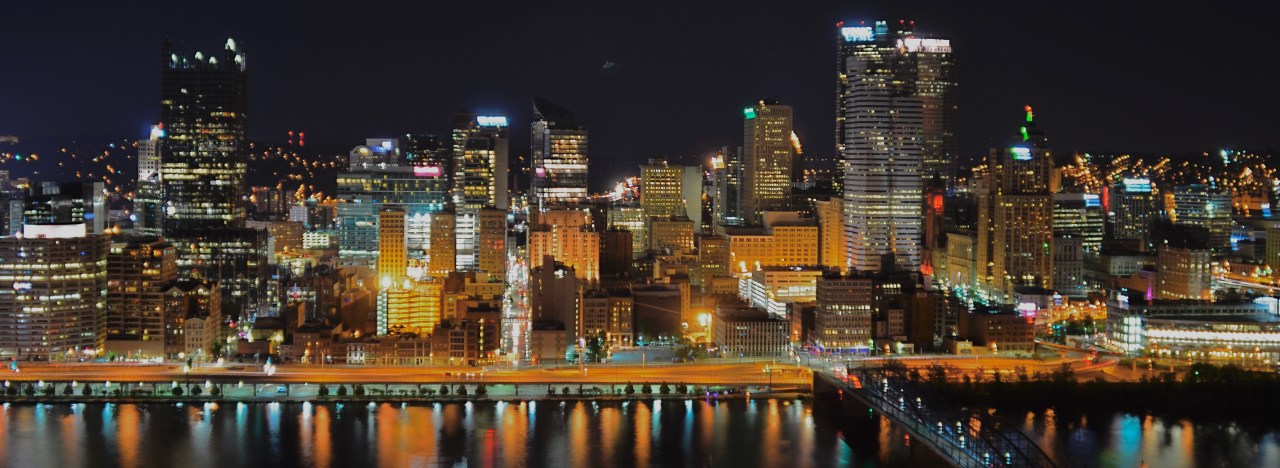
This 2017 shot of the skyline of Pittsburgh, Pennsylvania, for example, would have been impossible to do handheld, back then, especially since it was taken from the top of nearby Mount Washington, with evening winds buffeting me around even as the icy temperatures made me shiver. Shooting without a tripod would have meant going wide-open, to about f/2, to allow for maximum light intake in a brief exposure, as well as jacking up the ISO to untold heights, which, in shooting a dark sky, would have invited in a ton of noise and rendered the building lights as bleary blobs. Today, with a full-frame mirrorless sensor, I just might be able to shoot the thing hand-held, but getting it this clean would still be more luck than genius.
Things are essential until the world deems them not so. We don’t buy a lot of vacuum tubes and horseshoes anymore, and so living a life that still incorporates them centers more on nostalgia than functionality. Every once in a while, hauling around a 600mm telephoto while stalking a tiny bushtit may make me long for the physical comfort of a three-legged spider, but I value being able to work faster with less fuss, a state to which every photographer aspires.
STRONG AT THE CENTER
By MICHAEL PERKINS
EDWARD STEICHEN’S MAJESTIC PHOTO ESSAY The Family Of Man, which was first mounted in 1955 at MOMA as a curated exhibit and was then captured within one of the most essential reference books in all of photography, remains a essential document on the sameness and uniformity of human behavior across all social, ethnic and financial demarcations. It actually gives reality to the old saw that “we are all the same”, showing mankind in peace, love, war, ritual, youth, old age, birth, death and hope. It is a miracle project which I urge you to add to your collection.
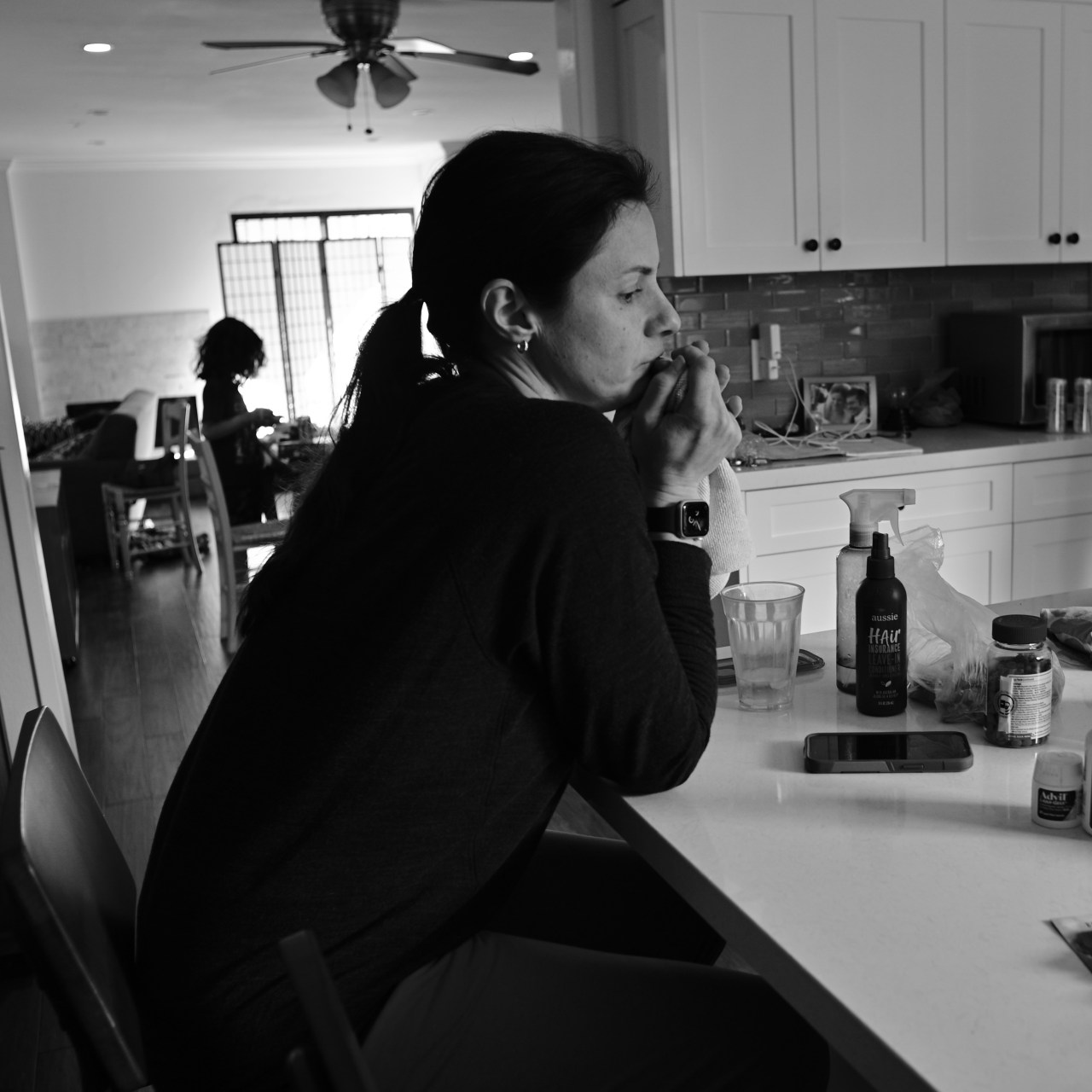
One of the key elements of FOM for me is its depiction of the universal essence of motherhood. All the anxiety, risk, and courage displayed by all women in all corners of the world, all of them wanting to endure, to protect their children, to hand something on to the next generation of mothers. In my own halting way, I am always looking to capture some small something of the unique energy of mothers. It informs my street work in a way no other subject does. And, is often the case with candid work, you find more little miracles the harder you look for them.
And, sometimes, you get a gift.
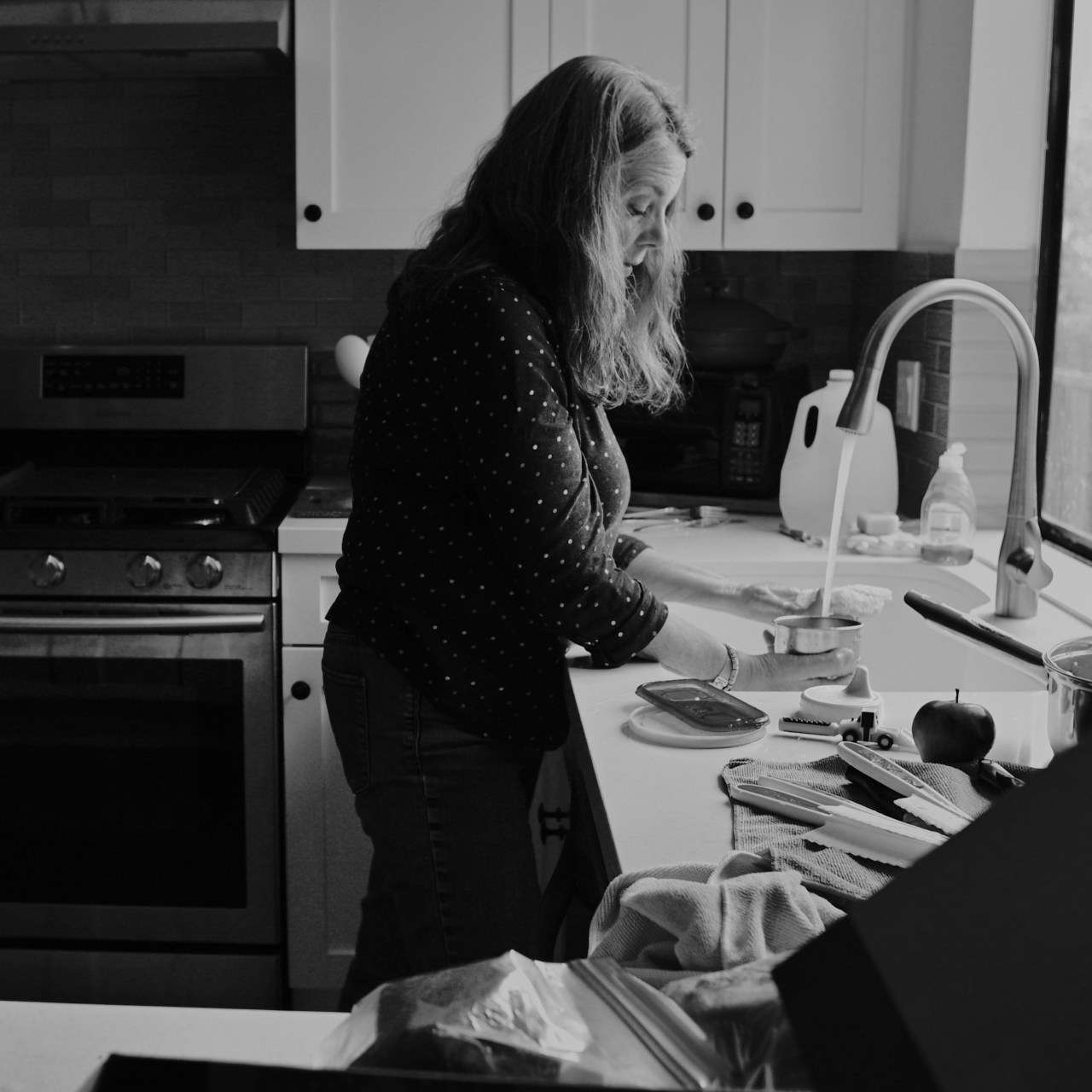
Three years ago, during an ordinary visit to my wife’s son and his family, I had the occasion to observe both her and her daughter-in-law, gathered within a few feet of each other, each submerged within quiet worlds of their own making, Marian musing over a sinkful of dishes, Erin taking a breath between Momtasks. Both women possess faces which both reveal and conceal, making them irresistible for frequent visits from my camera. I know them both well and yet could never really, fully know them at all, making the next images of them magical with potential.
Perhaps that next shot, goes the delusion, will be the one that explains everything. Of course, this can never be the case, and yet I continue to click away into infinity in vain pursuit of the day when, as Frank Zappa used to say, The Great Oracle Has It All Psyched Out. Steichen’s Family Of Man is an exploration into what all of us share across our collective humanity. But you don’t have to wander the globe to see those commonalities. Sometimes, all you have to do is look across a kitchen.
I WAS JUST IN THE NEIGHBORHOOD ANYWAY…
By MICHAEL PERKINS
CROOKS AREN’T THE ONLY PEOPLE WHO RETURN TO THE SCENE OF THE CRIME. Photographers have the same neurotic habit of going back to the place where things went wrong. Only, instead of a “crime”, it’s the scene of a picture that we (a) loused up the first time (b) loused up the second time, (c) might look better with a different camera/exposure/lens or (d) is just some infernal, unsatisfiable itch that we must scratch or go crazy.
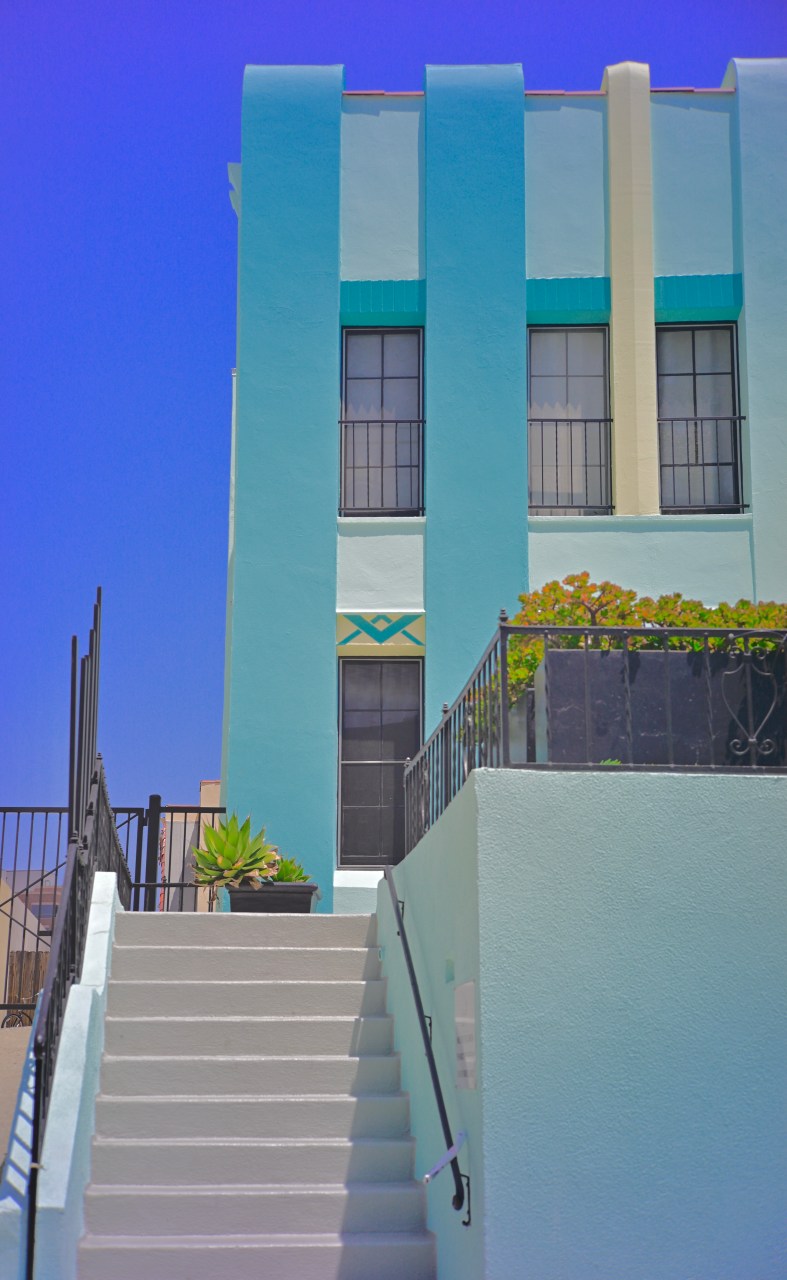
This building is one such place. I don’t know why it is filed in my fevered brain under “unfinished business”, but it is.
This apartment block is just one street away from the home of a dear friend in central Los Angeles, so I have probably made the short pilgrimage to it for at at least ten years’ worth of visits. Part of its attraction is that it’s one of the only original Art Deco structures left in the neighborhood. Another part of it is the utter simplicity of its design, as is its clean teal tone. I’ve been snapping it for so long now that a complete folder of my collected shots of it could easily serve as a time-line on my own development as a photographer, as I’ve taken a crack at it through every phase, fad and infatuation I’ve endured over those ten years.
I’ve taken it with wide-angles and telephotos, primes manual lenses and fully automatic exposure. I’ve given it the lo-fi treatment with both cheap plastic and pricey Lensbaby art lenses. I’ve done full-on frontal shots of the entire building, distorted fisheye angles from the corners and sides, time exposures just after sunset with its windows all aglow and, as seen here as vertical slices designed to abstract it to pure shape. I think I’m done. However, I’ve said that many times before.
It’s frustrating enough to get a single pass at a place or subject, such as a snap of a tourist location you’ll never re-visit. It’s frustrating in a different way to have unlimited access to something that you can’t quite seem to nail, not matter how many swings you take. I was not blessed with a natural bent toward humility. However, thanks to photography, it’s closer to second nature for me. If I live long enough, I might just finish growing up. Or finally get The Picture of this wretched building.
Dream Machines
By MICHAEL PERKINS
AT THIS WRITING, I HAVE JUST COMPLETED A LONG WEEKEND characterized by three really early morning treks to three consecutive birdwatching sites, a brutal trifecta of trudging and toil that has left me footsore and bent over, worn raw from bad shoes and the nagging shoulder weight of a five-pound telephoto. The weather, as is often the case along the Pacific coast, was iffy, which meant that the percentage of keeper shots plunged even further below my usually sorry harvest. It will take me another three days to sift through the raw takings, alternatively cursing the blown opportunities and over-celebrating the luck-outs. And so, as an antidote to that very long march, I have plunged into the only pure fun I gleaned during the entire ordeal.
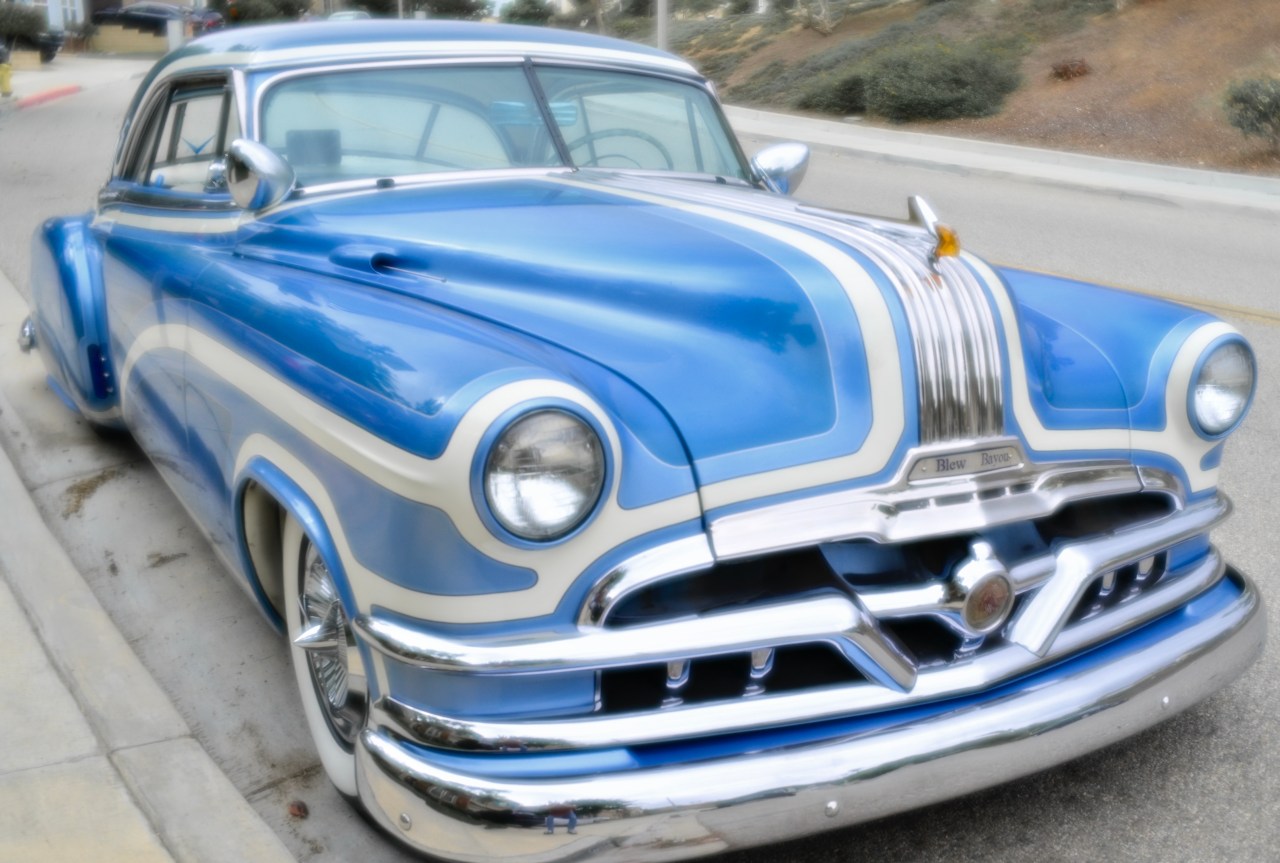
Spoiler alert: it’s not a picture of a bird.
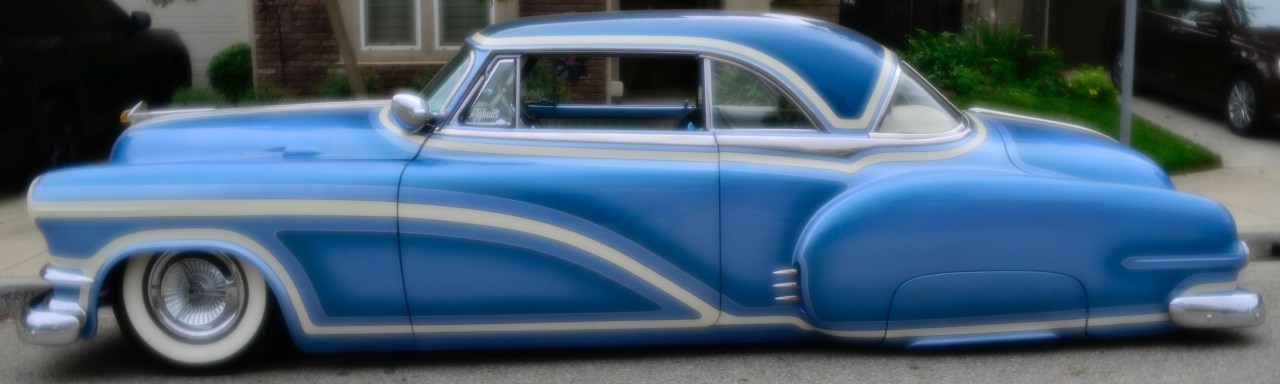
Well, in its day, it certainly soared like one. And, for me, limping several blocks from my apartment to visually make love to a supreme achievement in pure, seductive design, as an emotional balm for my aching’ dogs, it definitely made my heart take wing. I don’t know where this vintage 1940’s Pontiac Torpedo came from. The home where it was parked is, regularly, home to owners of elegant machines from bygone eras, usually of the pimp-my-ride-low-rider variety. One thing I do know is that none of these dream machines hang around for more than a few days. That made it Pilgrimage Time for me and my Lensbaby Velvet 28, which, shot nearly wide open, wraps its subjects in a dreamy haze that encases the focused image without blurring it. Watch the over-exposure on the chrome highlights, buy yourself some insurance with the use of focus peaking, and, voila, an express ticket to Hotrod Heaven.
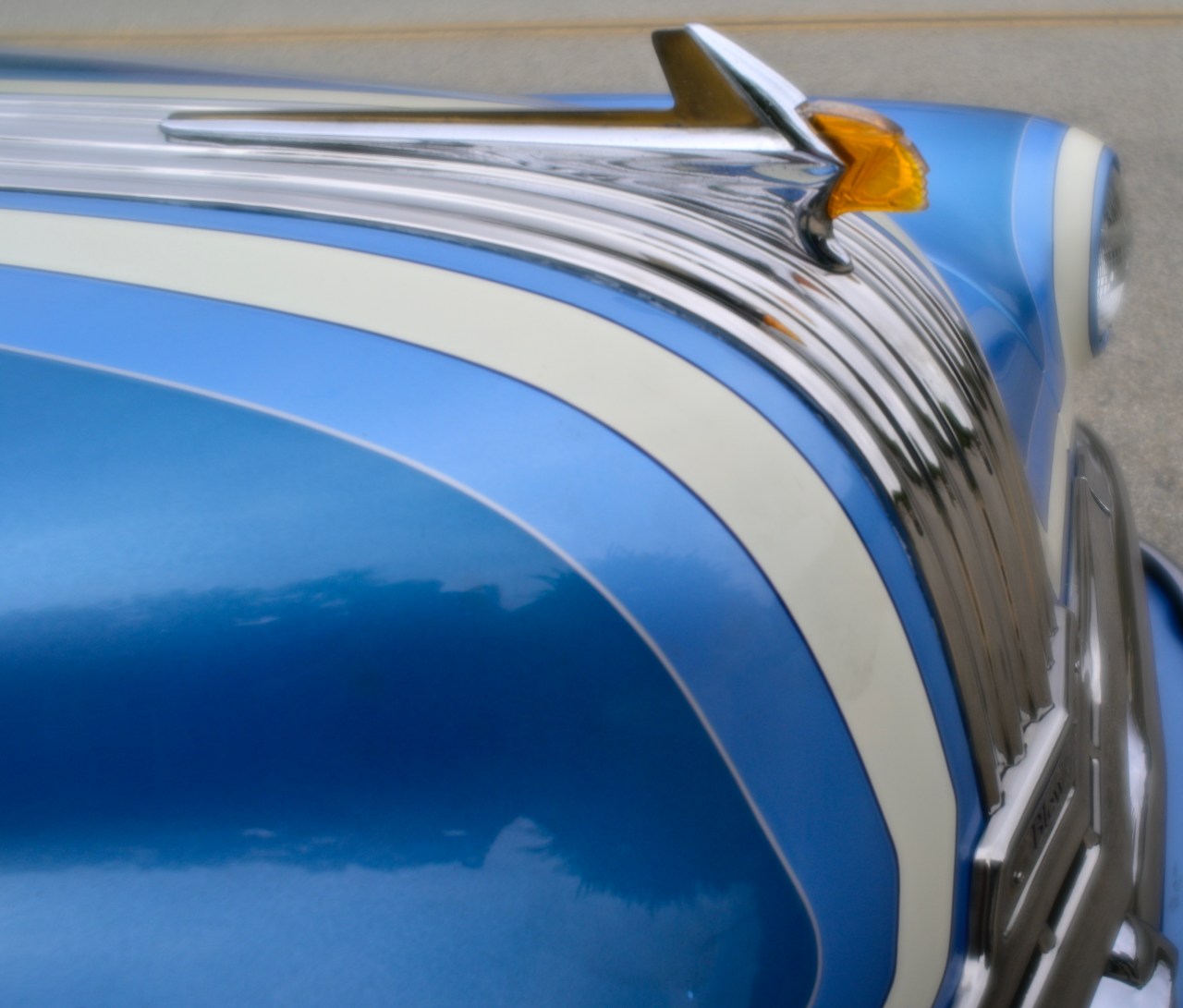
I feel a little better equipped now to wade through three days’ worth of “maybe” images of birds while my knees and shoulder mend. I needed a quick dose of control, or at least the illusion of being able to make a picture instead of hoping I captured one. The fever’s broken now. But oh, what a delightful delirium!
DAYCARE CASUAL
By MICHAEL PERKINS
ONE OF THE THINGS THAT DISTINGUISHES THE VIBE in small towns is the variable definition of what constitutes “public space”. Where do people actually gather? Where are social interactions transacted? What is the familiar hang, the “everyone goes there?” Photographers who find themselves even temporarily out of their own neighborhood elements are constantly searching for the answer to the “where it’s at” question in the places they’re cruising through.
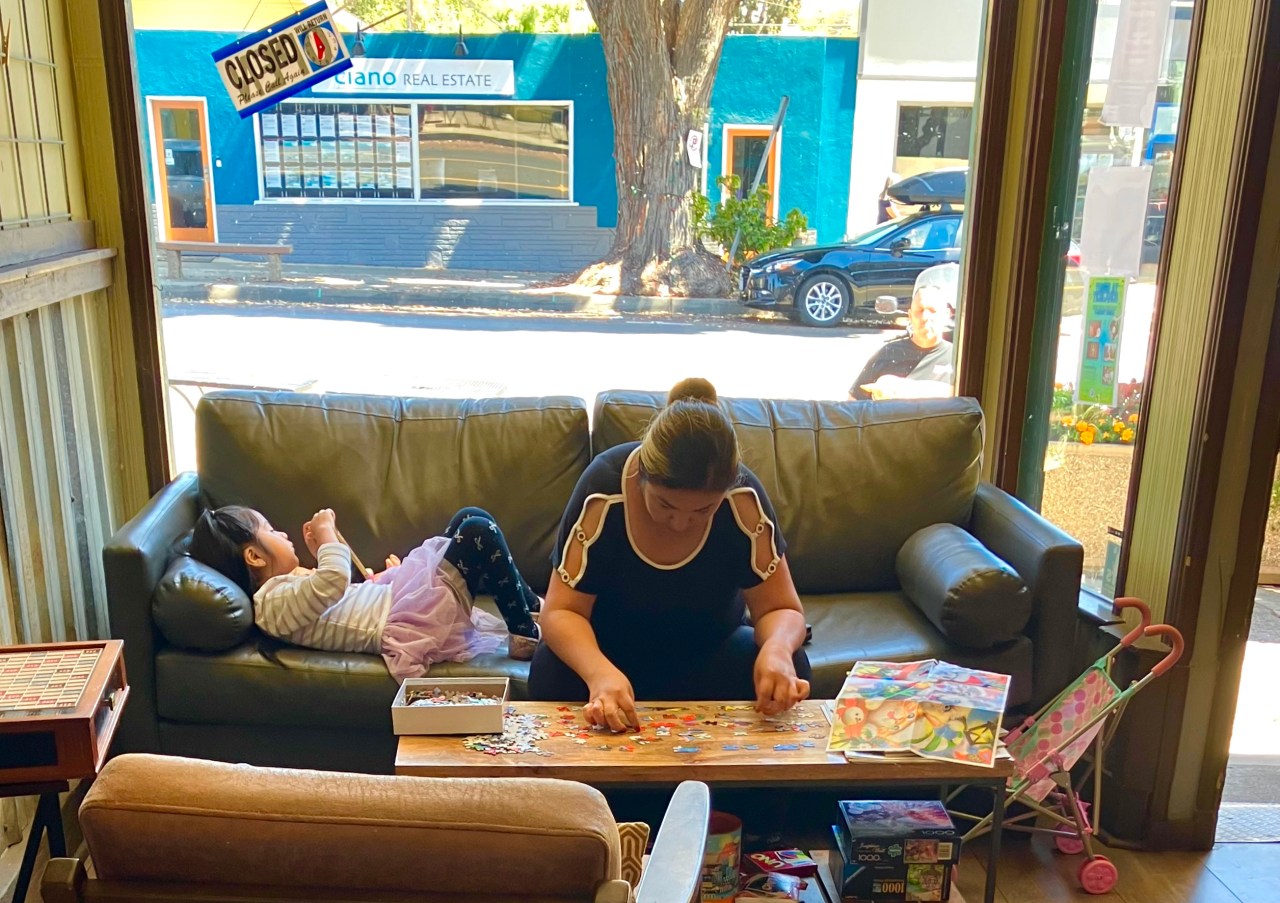
I’ve never seen a puzzle and game play space inside a Starbucks, or, for that matter, inside the average courthouse, city hall or bar. But inside a coffee house in the small coastal town of Morro Bay, California, it’s obvious that whole families, kids and dads and moms, are frequent players, stopping by for a cappuccino or espresso, a bun or croissant, and….a few chill moments with a jigsaw puzzle. The coolest part about encountering this mother-and-child team in the joint was how unremarkable they seemed. The local feel for this cafe was more than “everyone is welcome”. It was all the way to “whatever you need”. And then some.
No other customers in the shoppe seemed to acknowledge this micro daycare center activity; it was obviously just part of the daily rhythm, what made the town the town. I was only about eight feet away from the pair when I snapped this, a single-frame go-for-broke frame. I was so afraid of either making them feel as if they had to pose, or, worse, feel violated by my presence. But there was just so much life, real life, in the scene. I’m glad I had my shot.
lower case G’s
By MICHAEL PERKINS
THE HUMAN VANITY WITH WHICH ALL PHOTOGRAPHERS, much like disposable cameras, come “pre-loaded” would have our audiences believe that all our work is the product of meticulous, deliberate planning, a “vision” that flows, fully formed, from our marvelous minds through the lens. Of course, anyone who’s taken the requisite number of rotten pictures needed to attain any skill whatever knows that this is a fantasy.
The raw fact is that many, many of our most wonderful photographic notions die a-borning. Either they come up short because we don’t possess enough skill to execute them or they fall prey to a thousand random factors that occur in the instant an exposure is made. And while we are more than willing to parade our successes as if they are de rigueur, something that happens effortlessly everytime we trip a shutter, we don’t tout the many happy accidents that sometimes work out better than what we started out to achieve. We aim at upper-case “Greatness” and, instead, get lower-case “gifts” from the Gods Of Camera Randomness.
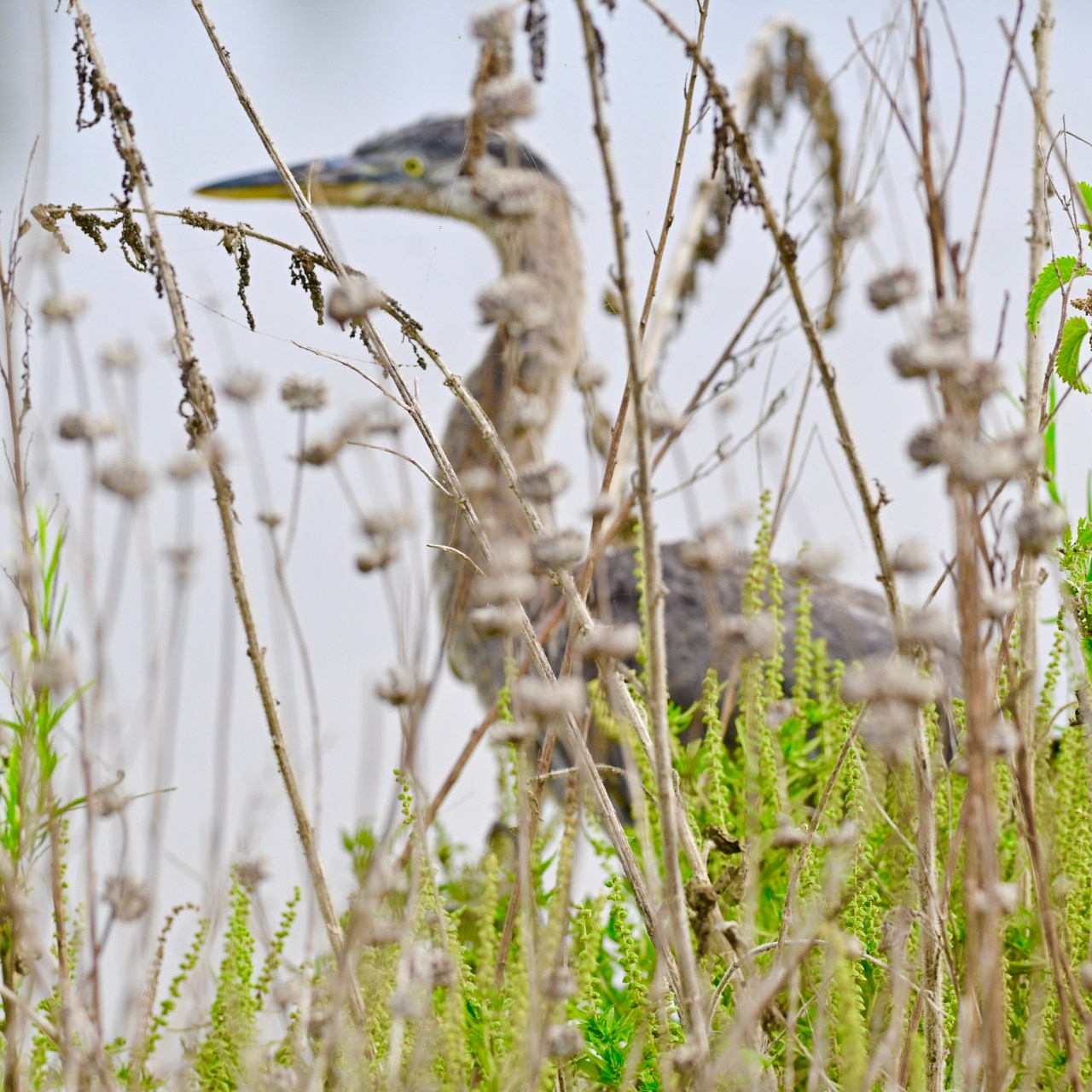
This image began as a gift, then had the brief potential for Great, then receded back down to a lesser gift. The juvenile heron you see here was pausing in a tall pond bank of reeds and flowers just twenty feet from where I and a group of birders were standing. Our binocular and telephoto gazes had been fixed on other birds, farther out in the water, when we suddenly realized this gorgeous creature was practically standing next to us, young enough to be unspooked by a cluster of aging hobbyists. The race was then on to grab some kind of image before he realized that he would be far better off putting some distance between us and him.
The foliage in front of him made autofocus useless, in that my lens would try to render the closest thing to it in sharpest relief, blurring out the bird. Switching to manual, I was racing against the clock to lock in the heron’s face before he could move even an inch and go back out of focus. I got five frames cranked off before he took wing, none of which had been in perfect register. Had I failed? Was I left with a generally bad batch, or could at least one image be said to deliver something more than a perfectly sharp frame might have? I had failed to capture “Greatness”, but had I truly been given a “gift”?
I know what you’re thinking. Photographers are all too eager to excuse their failures and try to see them as strengths, like an indulgent parent who sees a budding Picasso in his child’s incomprehensible crayon scrawl. I’m certainly not immune to my own ego, nor my bias toward whatever wretched messes emerge from my camera.
Still….
ON MY WAY OUT…
By MICHAEL PERKINS
THE RECENT DEATH OF MY NINETY-SIX-YEAR-OLD FATHER actually resembled most visits I’ve made to Columbus, Ohio to visit him over the past quarter-century, in that a lot of my alone time was spent trying to reconcile the locales of my youth with the ghosts of things long vanished from those physical places. You can actually go home again, if you can bear the sight of things that you once thought were important, even vital, reverting to be just…..well, things.
No two people, certainly no two photographers, can regard the same scenes and come away with the same experience, and so we make fools of ourselves walking up to vacant lots and remarking to strangers that “there used to be a ball park here”. Not to the strangers’ eyes, certainly, and no longer even to us. Physical sites are imbued with only temporary meaning in one part of our lives, then revert to just their materials and geography once we stop needing them.
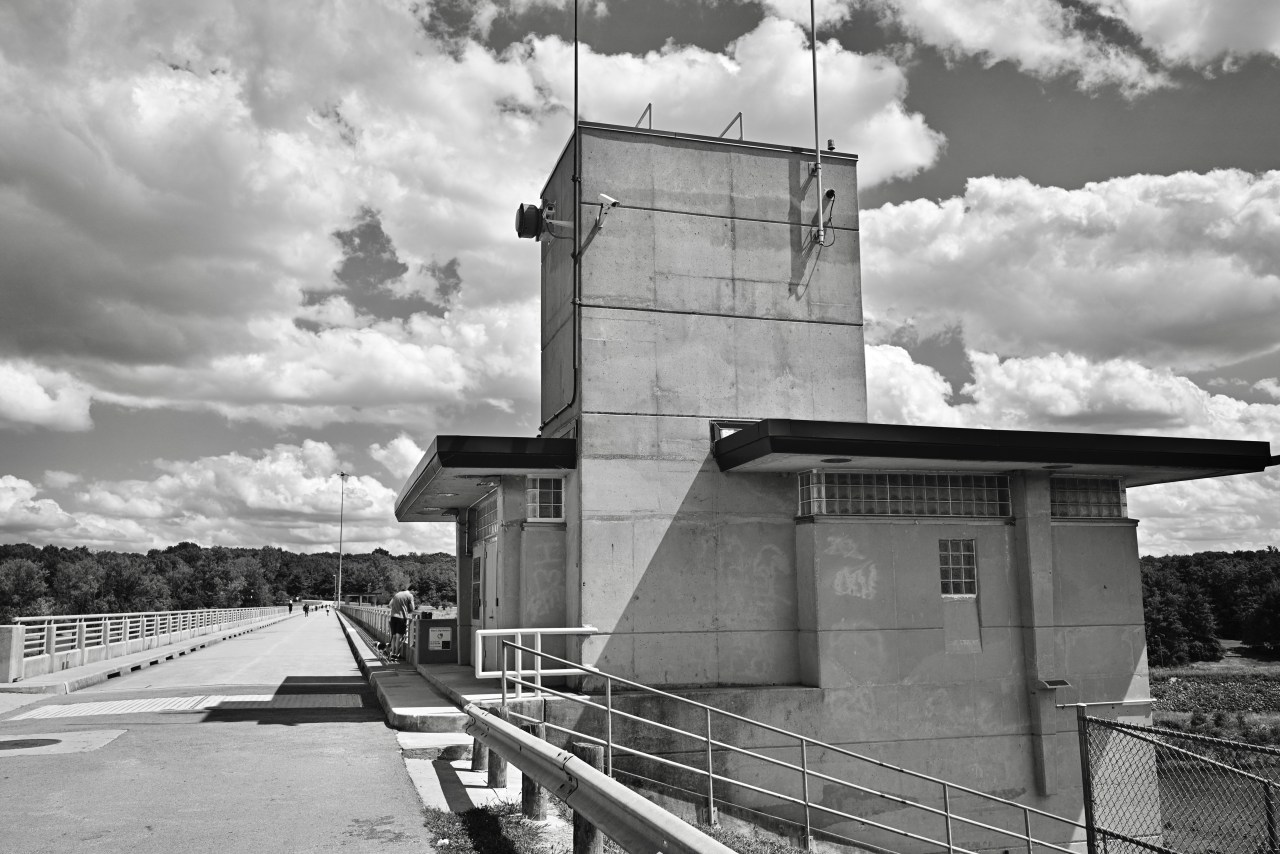
Nothing could be more ordinary than this simple arrangement of block concrete, which is adjacent to the spillway of Hoover Reservoir (not the more famous”dam”, nor the more infamous Hoover) on the northern edge of Columbus. Other than its role in providing some recreation and a clean supply of local drinking water, there is nothing visually remarkable about the place to the average photographer’s eye, and yet, to a seventy-three-year old just mourning the passing of a parent, it once held some special magic, and merited one last click.
When I was a boy, decades before farms and fields in the area would be swallowed by freeways and sprawl, motoring from my neighborhood to the Hoover constituted a half-day in the country. Driving our old Plymouth Savoy to the site meant a guaranteed stop at its rudimentary snack wagon (“food truck” for you kids) and a walk out to the spillway, where a thunderous cascade of water would explode forth from one of its release pipes and we kids would terrify our folks by leaning out over the low guard rail that barely separated us from watery doom hundreds of feet below.
I don’t know why I decided, after so many years of passing the reservoir on the way to somewhere else, that I needed one more up-close look. On this trip especially, I seem to have made several mini-pilgrimages to parks and wooded areas that once defined me, very aware that I was walking out of my old life for what now seemed forever. Of course, I will go back to Columbus gain, to see my sister, my adult children, my grandsons, and a dwindling network of old pals. But in some very real way, I was conscious that I walking out of some kind of door for the last time, with once-special places now returning to their normal uses as just more things in the world. A very strange kind of goodbye.
I’LL LET MYSELF OUT
Leave a tender moment alone. —Billy Joel
By MICHAEL PERKINS
I HAVE KNOWN MANY CREATIVE TYPES, from writers to painters to musicians to photographers, who struggle with deadlines. Not because they actually can’t complete assignments or projects on time, but because they find it excruciating to pry their fingers off their work, surrender it, and let it stand on its own….to, in effect say, it’s done enough; it’s good enough. Or, more precisely, realizing that it’s as good as I can make it, and that, perhaps, continuing to tinker with it in search of perfection will actually invite more flaws.
We know how to enter the “room” of a piece of work. Knowing when to head for the exit is something else again.
As a photographer who largely works for himself, I usually have the luxury of fiddling endlessly with images in the hope that I can somehow make them one step, one click, one fix closer to “finished”. This is actually a trap. If I were, in fact, delivering work on someone else’s dime, I would know that the delivery date is Friday at 5pm and that’s it. Bam. The rigid forces of the marketplace would guarantee that there would come a point when I would lay down my pencil and hand over the work. When the boss is me, not so much.
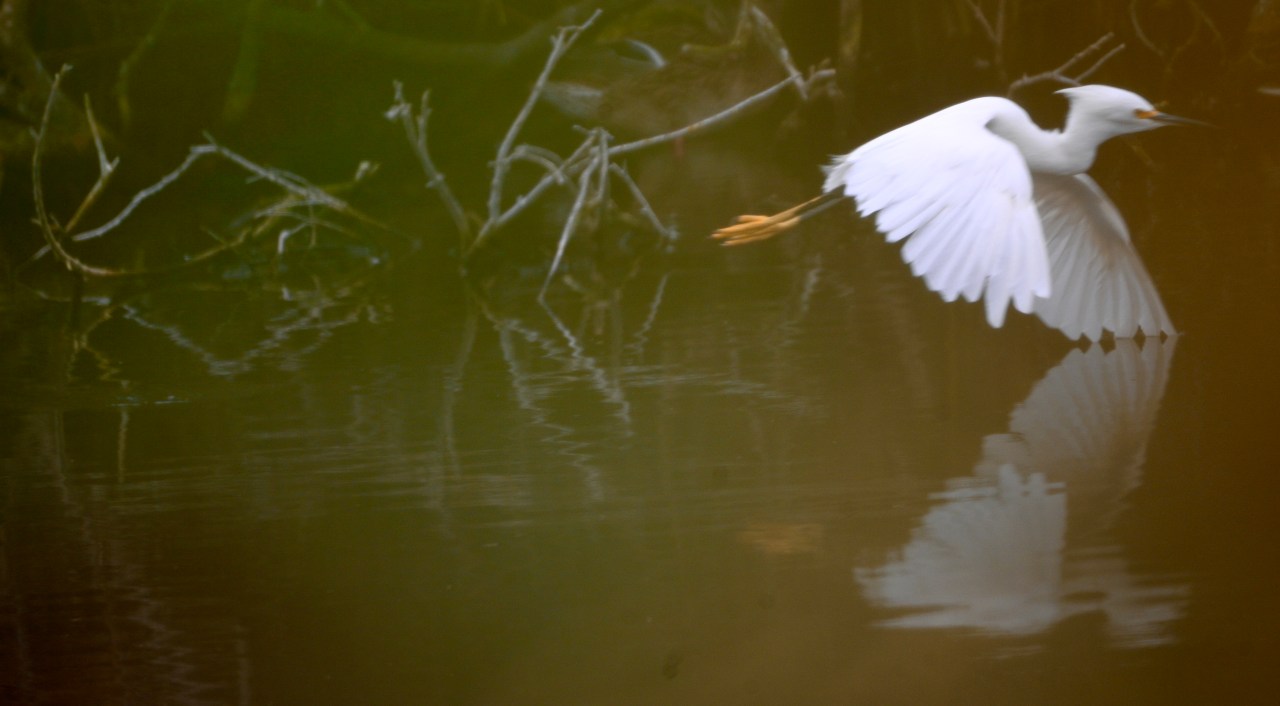
600mm, 1/400sec.,ISO 400, f/6.3
Take this image. It was a complete accident, the final image of a series of shots of an egret who had remained pretty much stable near a riverbank as I cranked away. Then, without warning, he decided to fly away, allowing me two panic-driven clicks of his exit within about a second and a half. My autofocus made a brave attempt at freezing the action, but in trying to track the bird, I was bound to create some amount of camera shake, all made worse by the fact that I was clear across the river and zoomed out at 600mm handheld. The second of the two frames largely worked, in that I caught the gorgeous contour of the bird and the reflection of his wings as they lightly skimmed the surface of the water. But the softness bothered me somehow, and so I was stuck with a technically imperfect shot that, for at least an hour or two, I told myself that I could somehow “fix”.
But you can’t really insert precision where it was lacking in the master shot, something I often have to admit only after fruitless tinkering, a desperate chase that leaves me with so-called “improved” versions of the shot that still, somehow, pale next to the original. You have to fight to keep the innocence and discovery in your work. Sometimes that means that you have to show yourself the door before you’re really ready. Often as not, though, it’s the most strategic exit you can make.
OFF THE SHELF
By MICHAEL PERKINS
JERRY SEINFELD ONCE REMARKED. OF GUYS OBSESSED WITH OVERUSE OF THE REMOTE CLICKER, that they “aren’t interested in what’s on tv; they’re interested in what else is on tv.” Funny and true, and also indicative of some photographers, in that, while we love what our basic gear does, we’re really excited at the prospect of hybridizing equipment from any and all sources. We’re interested in what else our cameras can do.
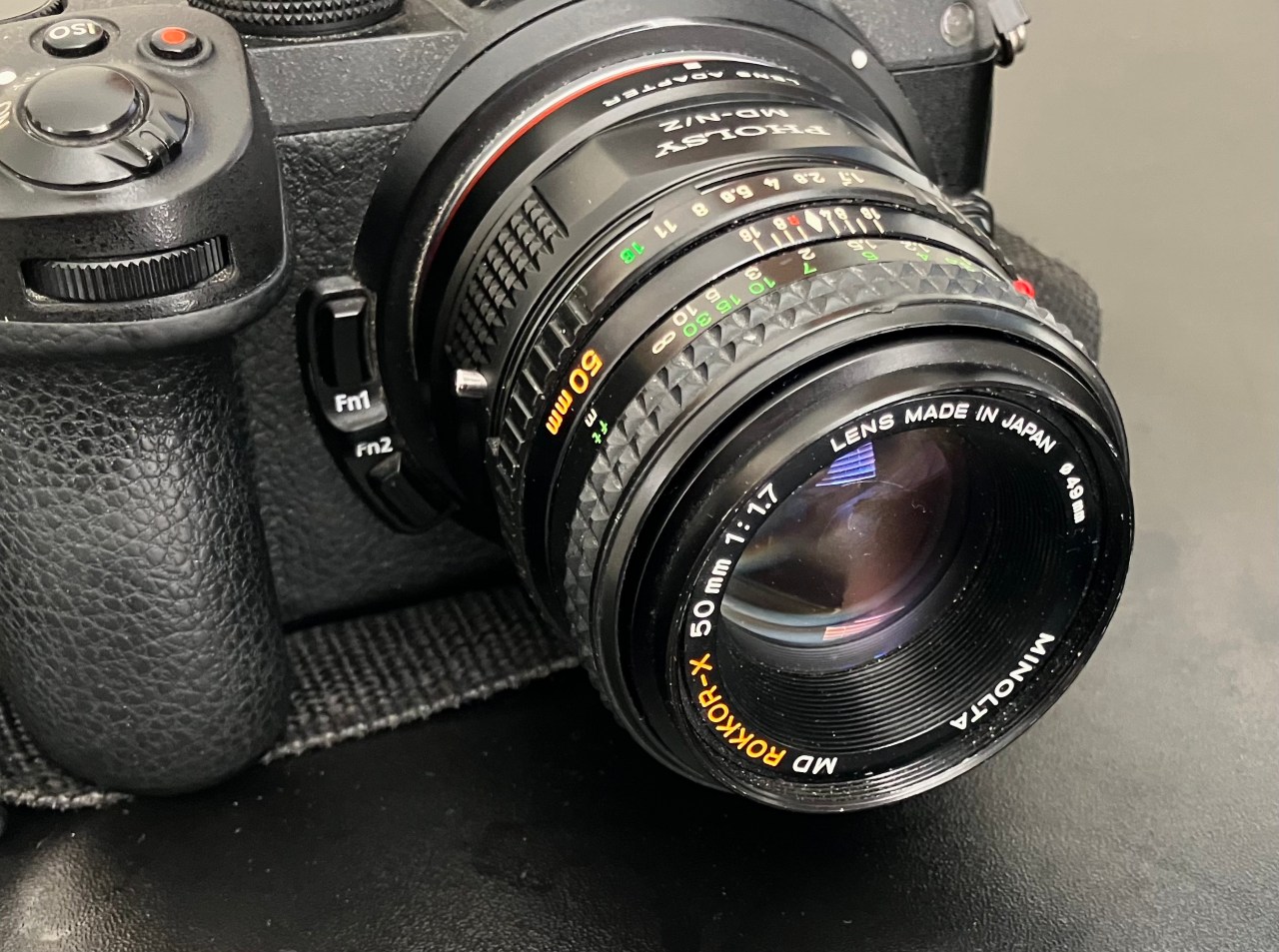
My 1977 Minolta 50mm, dormant in my closet for over twenty years, now fronting my Nikon mirrorless.
Many of us at least stray slightly from the only-original-manufacturers mindset (that is, only Canon lenses for my Canon camera, etc.), yielding to some degree of lens bi-curiosity, leading us to adapt glass from other makers to find the perfect marriage between body and optic. It’s not always a win for our work, but the journey is far more fun than the destination anyway. And the old hybridizing romance of the DSLR period has easily found a contemporary equivalent with the move to mirrorless cameras, as dozens of third-party equipment houses have rushed modestly-priced adapters to market for converting older glass, including many manual-only lenses, to use on mirrorless platforms. Photographers tend to be tinkerers; they are fascinated by what happens when you do this to this. And now it’s easier than ever to get answers for that tantalizing question.
Like many reading this, I spent my DSLR years adapting old manual primes from the film era, treating myself to optics with all-metal construction, smoother aperture and focus adjustment, superior sharpness, and a huge cost savings. These tended, for the most part, to be Nikkor lenses for my Nikon cameras, and so no adapter was required, since I was going from an F-mount lens to an F-mount body. Then, after making the leap to mirrorless, I adapted the same lenses to continue their use on a Z-body (using so-called “dumb” adapters that don’t communicate with the camera body, another cost-savings for someone who’s shooting without the need for AF). And finally, I’m enjoying going completely off-brand to give new life to optics that have been gathering dust since my first days behind a viewfinder.
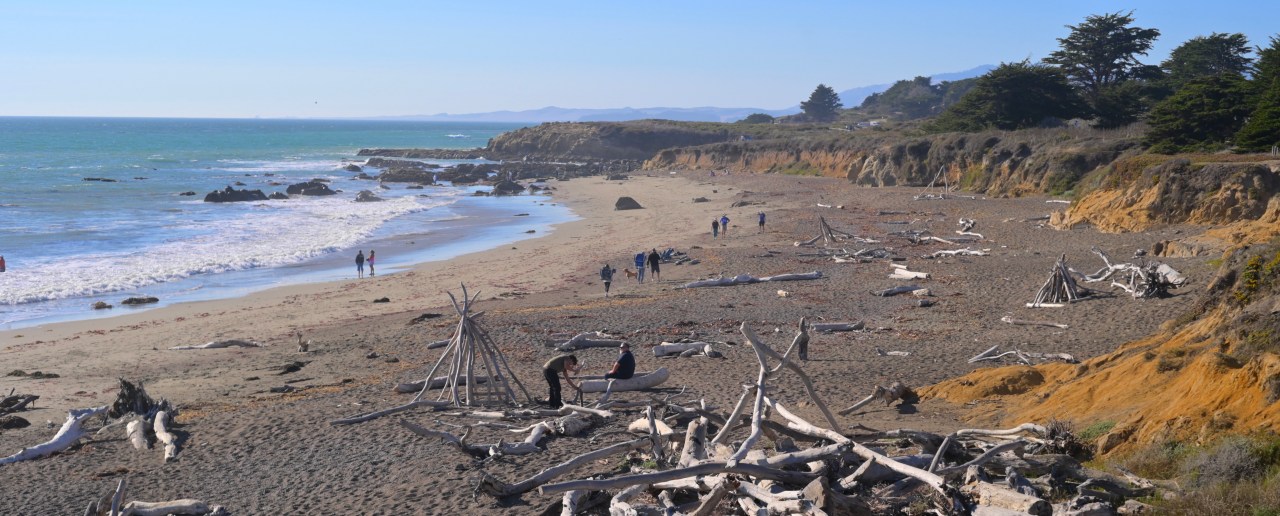
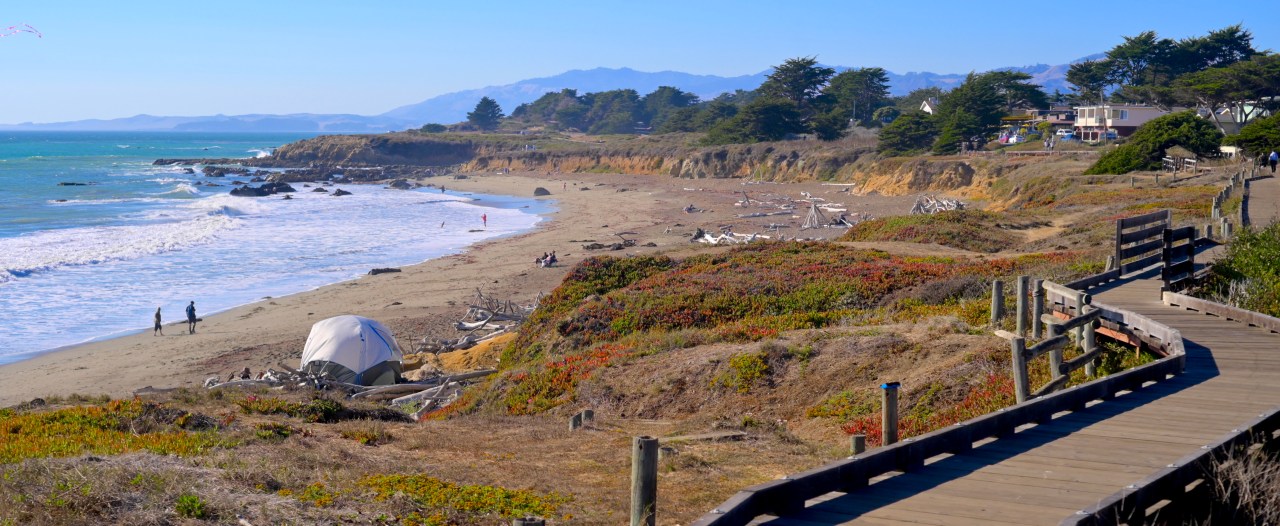
Moonstone Beach near Cambria California, 9/6/25, seen through the eye of a 1977 Minolta 50mm prime.
The lens shown here came from a Minolta SRT200, a ’70’s-era SLR that I grabbed for $100 in the ’90’s when my daughter decided to enroll in a high school camera class. The class came and went, but I kept the camera, fitted out with a Rokkor-X MD 50mm f/1.7 prime lens. I spent a lot of time, just before and just after 2000, shooting mostly slide film with it, sticking it in the closet only after the purchase of my first digital point-and-shoot. Learning that, decades later, it could be restored to service as a sharp and clear prime for the mere cost of a $30 adapter put a huge grin on my face, and, at this writing, we have been renewing our old love affair for several weeks. Scores of articles are now online as to the efficacy of this or that bit of “legacy” glass on mirrorless bodies, most written with a flavor of delight, or adventure, or both. Some even claim that such vintage optics perform even better on digital cameras than they ever could on film. Your mileage may vary. As for me, I’m just beginning to explore what else is on my camera.
Oh, and hand me that clicker, willya?
SOOC, and SOwhat
By MICHAEL PERKINS
ONE OF THE THINGS THAT ACCOMPANIED THE FIRST GOLDEN AGE of amateur photography, when most people around the world were just acquiring their very first cameras, was the whole support industry of “how-to” guides, exemplified by Eastman Kodak’s long-running How To Make Good Pictures series of instructional books, along with endless others. These volumes emphasized basic practices for the beginning shooter, from composition to focus, aperture control to basic lighting, and so forth. In the age before complex processing was within reach of the many, such instructionals quickly codified certain steps for “acceptable” images, with a special accent on getting a good result S.O.O.C., or Straight Out Of The Camera. They were technical tips that were adopted by many as aesthetic standards as well.
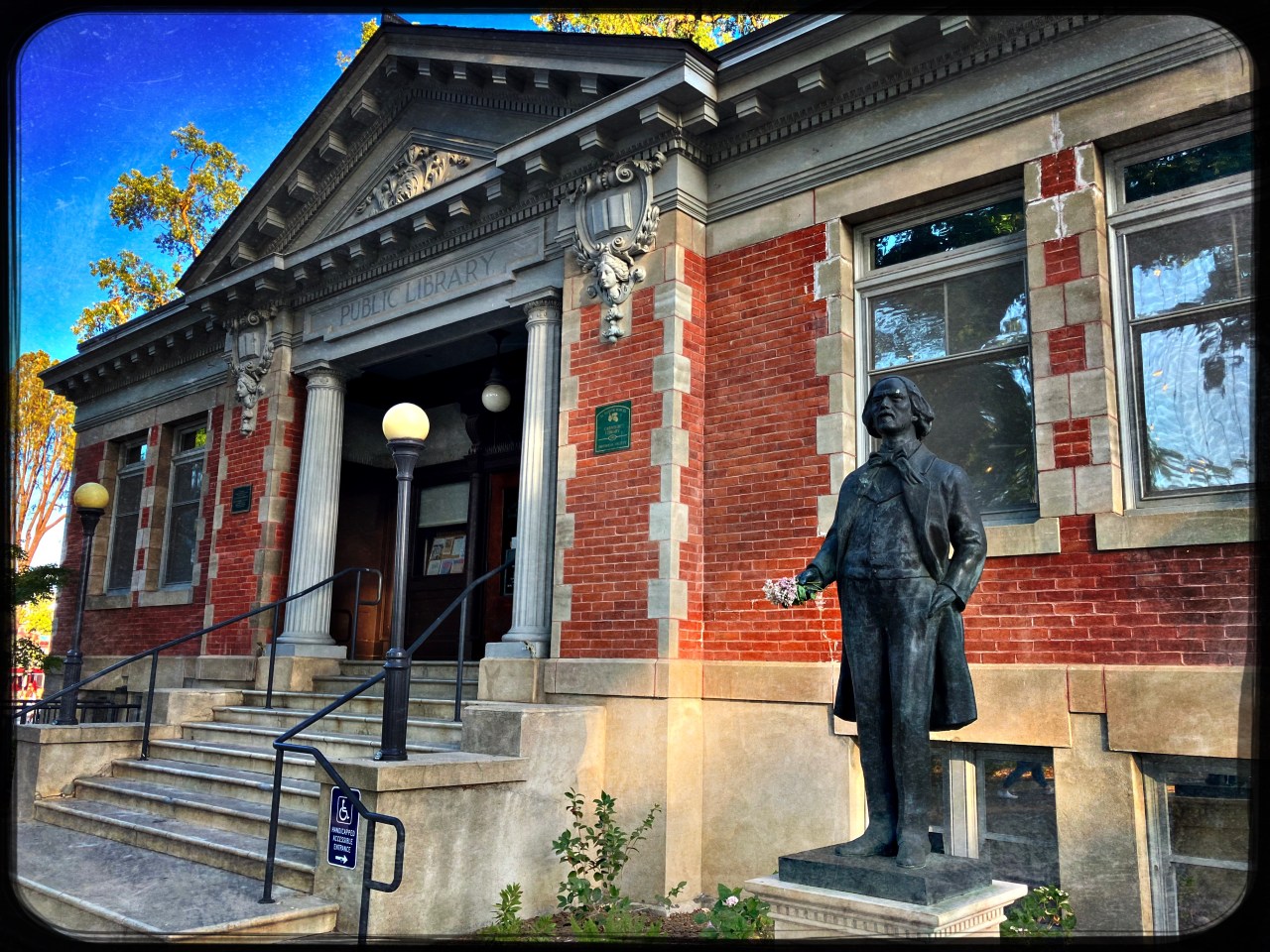
Zoom forward to the present, where the word “acceptable” is as elastic as the term “normal”, and the “rightness” of the final photographic result is very, very much in the eye of the beholder. We can literally make anything look like anything, and yet this newfound freedom is still a source of controversy for people who define acceptability merely by the standards of recording or documentation. I am surprised, for example, to see on-line critiques of images based on their not being “realistic” or “naturalistic” enough, as if such arbitrary terms even can be applied to an interpretative art form.
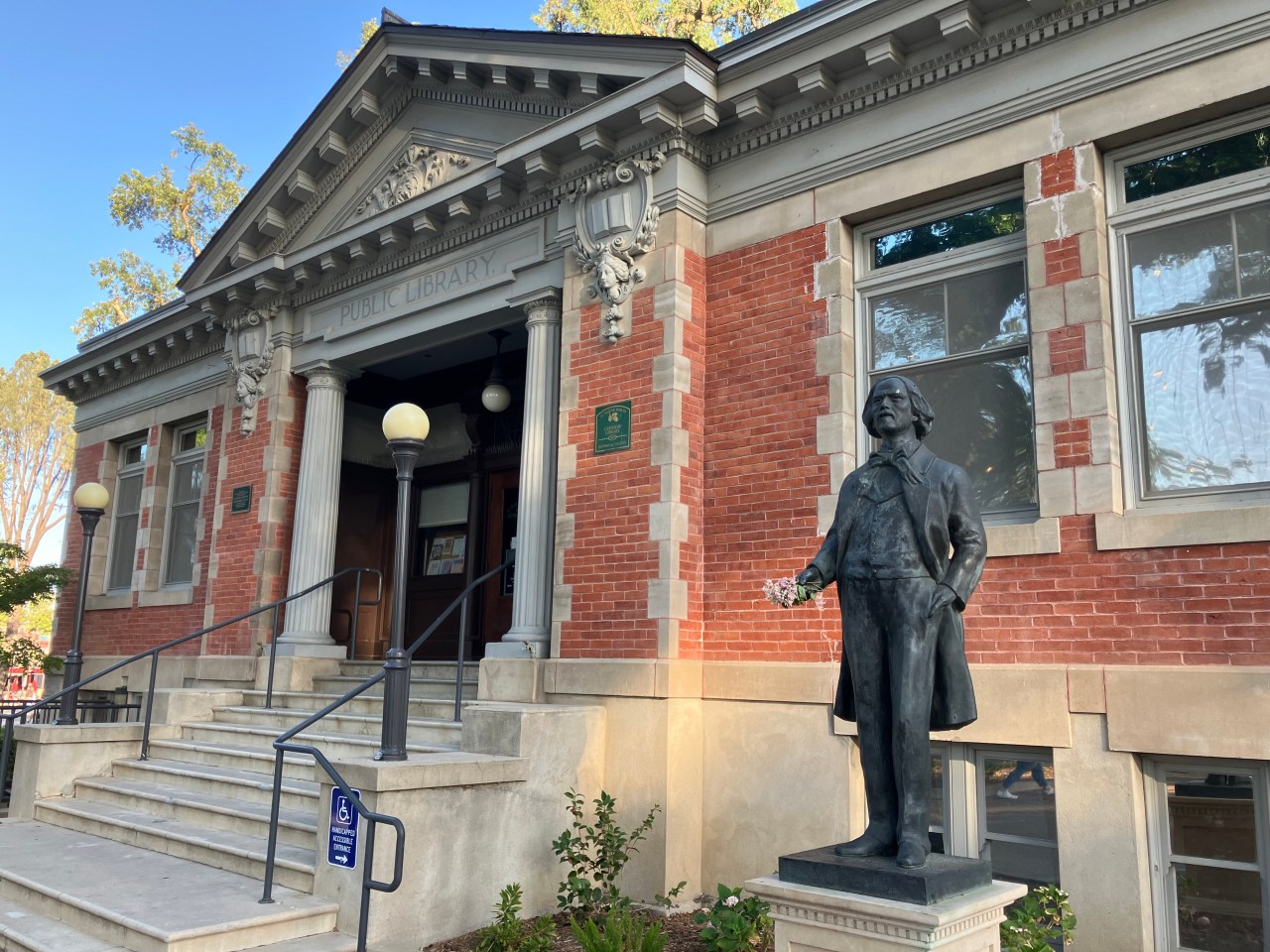
Which of the two images shown here, either the SOOC shot (at top) or the one that’s had its texture and tone augmented (just above), is more “real” or “natural”? And in what context? To what purpose? Despite all our years of “how-to” conditioning, isn’t it pointless to reduce photography to a narrow set of acceptable parameters? Moreover, isn’t it obvious that most photographers refuse to be so hemmed in? As photography experiences a renaissance in its third century, the only thing that works in a picture is, to be redundant, whatever works for that picture.
ALL AT SEA
By MICHAEL PERKINS
MY RECENT RE-LOCATION TO CALIFORNIA has, in just over a year, already informed my photographic work, especially since I live largely near the Pacific coast. As just one example, my entire attitude toward landscape work has been re-jiggered, mostly due to the fact that I have near daily access to the ocean, which, as either subject or backdrop, seems ever new to me. I was never a “landscape guy” in any committed sense, my passion being concentrated either on street scenes or abstract patterns, which, in architecture, also centered me in cities. Being newly entranced by an area of photography that I always thought of as auxiliary rather than essential, then, requires me to be a lot more deliberate in choosing projects or compositions. It’s easy to get to the beach; it’s harder to get the beach, if you like.
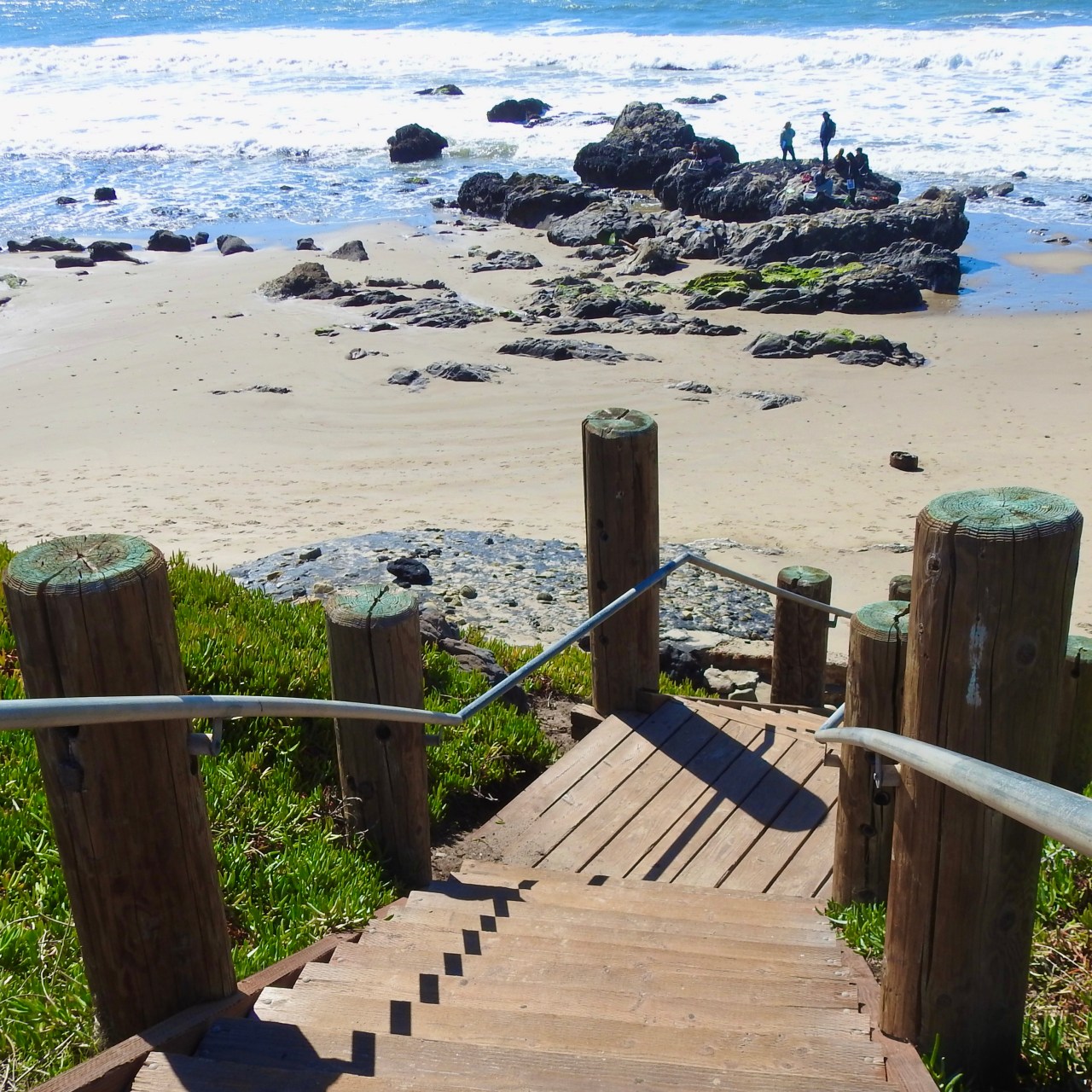
You can see the effort here. What you can’t see is actual planning toward that effort.
One thing I learned pretty fast, and that is that I need to become more of a technician when it comes to even exposures that include say, the brighter surfaces in the sea. It takes a mortifying amount of practice to program either me or my camera (or both) to get balanced shots. The scene shown here is a great example of what I must absolutely not do, and that’s to trust my camera to either full auto modes or a semi-auto setting like Aperture Priority. I simply come away with too many blowouts on the waves, which, as we all know, are unfixable in post. You cannot recover detail that you didn’t capture in the first place. Underexposures can sometimes be mined for additional information, but a whiteout is a whiteout, and, in fact, you can make the entire frame worse by going overboard to fix an unfixable situation.
Shooting this image on full manual and adjusting the histogram for better balance throughout would obviously have prevented some of the damage, but, in a rapidly shifting scene (something that is a constant with “active” landscapes like water) I have ofttimes succumbed to the ease and speed of auto shooting, usually to my regret. And so, as I evolve fully into Beachcomber Boy, I need to re-school myself on all the lessons I have not had to draw upon for most of my recent work. As stupid as it sounds, there is no substitute for actually knowing what you’re doing.
 thenormaleye