(PLEASE DON’T) WATCH THE BIRDIE
By MICHAEL PERKINS
I AM CERTAINLY NOT THE ONLY SHOOTER OUT THERE BEMOANING THE EFFECT OF SMARTPHONES on how people behave when being photographed. On the contrary, the way these ubiquitous and simple devices have transformed how we present ourselves to the camera has filled bookshelves with dire essays and laments, including an essay I recently discovered called The Death Of Candid Photography In The Age Of The Smartphone by Alex Cooke (read it here.) It is no longer a question of whether image-making has been compromised by the cel; it’s merely the degree to which it’s happened.
Stated simply, the very way we act when we know a camera is present (and one always is) has dramatically shifted from when cameras were formally “brought out” for selected occasions, or largely confined to studios. Having your picture “taken” has gone, within a generation, from a somewhat special event to a non-stop process of recorded surveillance. We are all always on, always assuming that a perpetual wave of photo-ops will be washing over us. This creates a hyper-alertness to keep ourselves in “take-able” mode, to constantly assess how we look, where we stand, what cultivated, managed version of ourselves we wish to offer up for mass consumption. Family photos no longer reside in albums or shoeboxes, but are expected to serve as our ongoing audition for the world’s approval.
In such an environment, there can be no such thing as the Unguarded Moment. As Cooke writes, more and more of us “have never experienced social interactions without potential camera presence. (Our) baseline behavior incorporates photo awareness as a natural state rather than a special condition.” We actively choreograph the visual geography of every frame that captures us, calculating, on the fly, how it will be received. We pre-edit our faces and figures to achieve a picture of us as we would prefer to be seen, and judged, by millions of strangers. For the photographer, especially the so-called “street” shooter, it is increasingly hard to make images of people exhibiting the full range of human experience and emotion, since everyone, everywhere, is “trying out” for some kind of approbation.
About a million years ago, people having their photograph “made” had to be instructed how to even look in the right place in order to look natural. Watch the birdie. Now, we worry, about what the birdie thinks of us; whether it likes us, whether it can be seduced into helping to market us. And, sadly, we take more and more pictures of ourselves that reveal less and less. We are, finally, a production.
HUE MONGOUSNESS
By MICHAEL PERKINS
THE LAST MONTH OF SPRING and the first month of summer in Ventura County, California are termed by the locals as “May Gray” and “June Gloom” for their long stretches of solidly overcast days. During that extended time-out from the area’s typically limitless supply of sunshine, I tend to experiment with variations on monochrome, given that the quality of color becomes flat and dull. There’s nothing blander to the eye than a beach town on a cloudy day.
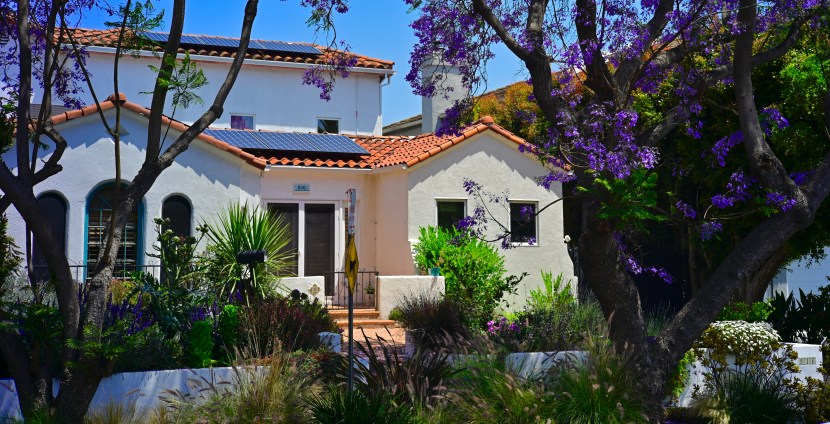
This temporary cooling of hues usually has me playing with b&w contrast as well, since it, too is in short supply in May and June. But sixty days of gray is finally too much for my soul to bear, and I revert to in-camera color settings designed to spice up mere reality…to, in essence, fake the effect of true sunlight.
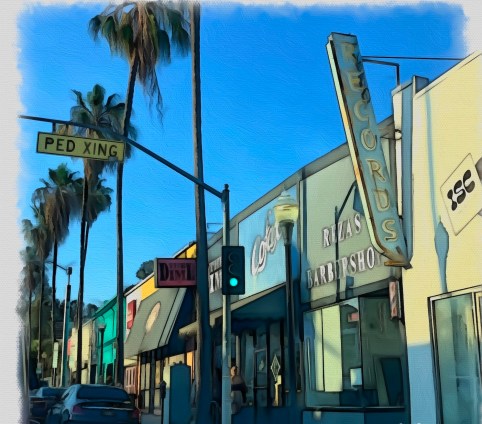
To this purpose, there are the scads of custom online settings “recipes” that shooters offer to cheat one’s way into splendor. One such sim that has made it onto my camera’s preset buttons is a fairly good fake of Fuji Velvia 100 slide film, which is a vital tool during Ventura’s annual dip into ick. As seen here, it’s really flattering to foliage and skies, if a bit surreal when it comes to reds and yellows.
Thing is, humans armed with cameras are humans that come predisposed to seek the sun, and thus open to breaking out the Crayolas to dose up on a little ersatz atmosphere. Is it enhancement? Sure. Is it “cheating” as my wife terms anything photographic beyond a straight-from-the-camera shot (including cropping)? Who knows? Who cares? Cameras are interpretive tools, not mere recording devices, and one man’s fudged workaround is another man’s miracle.
SEEK THE UNIVERSAL
By MICHAEL PERKINS
To see a world in a grain of sand / and a heaven in a wild flower / hold infinity in the palm of your hand / and eternity in an hour. ——–William Blake, Auguries of Innocence
ONE OF THE MOST MIRACULOUS GIFTS OF PHOTOGRAPHY is the same gift that all great arts, from painting to music, produce; the ability to take a small sample of life and make obvious its universal connection to existence in general. To see a local sunrise is to see the same sun that every person on the planet can see; to show Blake’s “grain of sand” is to glimpse every shoreline and beach; and to show emotion on a single human face is to experience the joys and sorrows of all faces everywhere.
Seeking the universal in the particular is, of course, beyond instinctual to anyone who spends any appreciable time as a photographer. We learn from our first photo shoots how to recognize patterns and their replication across peoples and generations. We know that everything we show has all been shown before. So why restate the obvious? I guess because some instances of “all of us are everybody” strike us as particularly poignant. It reinforces the truth that all experience is shared experience.
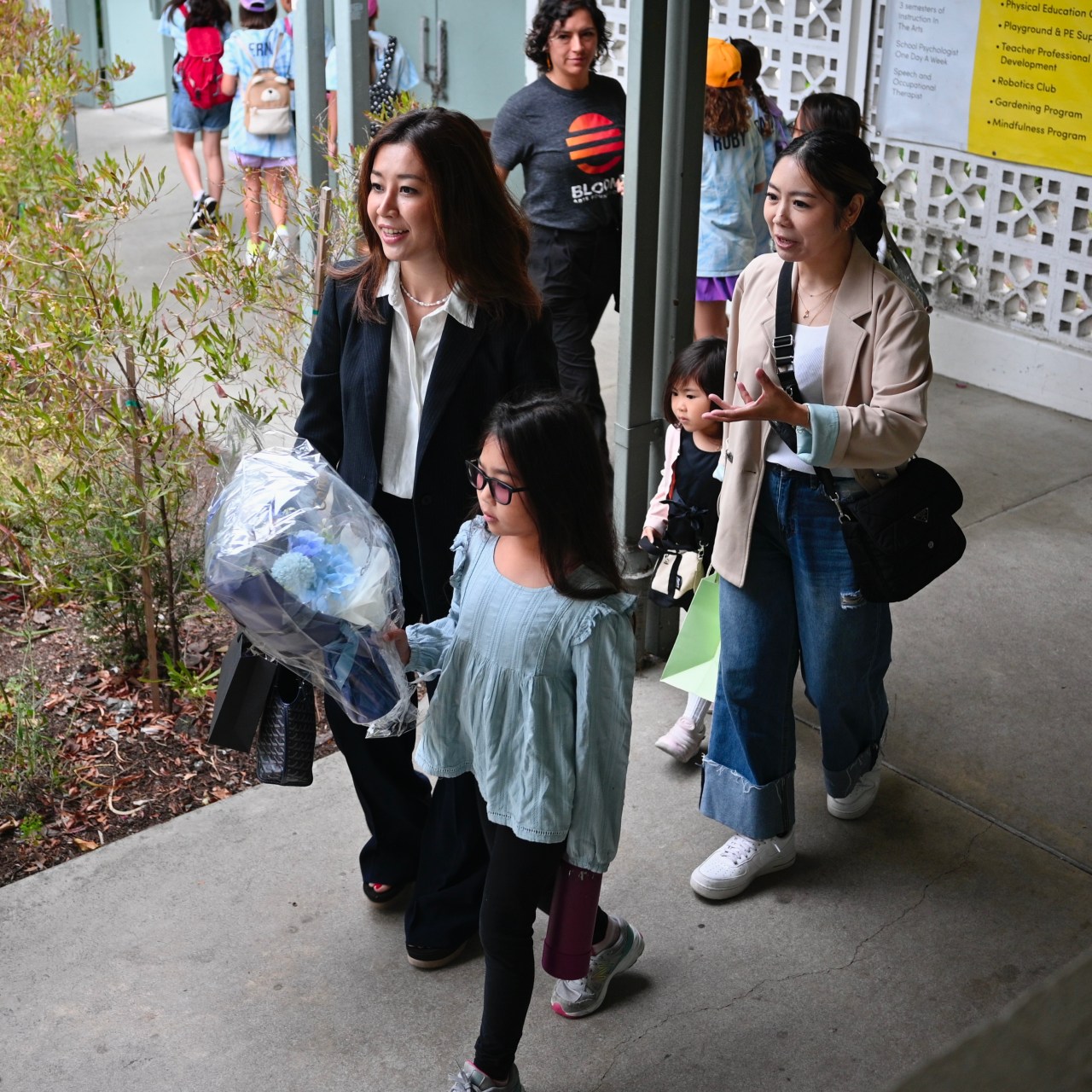
I recently attended an elementary school graduation at a school in Los Angeles, an elegant, sweet-hearted recognition of our general humanity that, on that particular day, contrasted strongly with angry energy elsewhere in the city that underscored our divisions rather than our commonality. This particular school is a wondrous mixture of ethnic pride, a school in which no fewer than eleven languages are spoken across the student body. There were any number of opportunities to record the celebrations of various families as they arrived to celebrate the miracle of their young people, but for some reason I was particularly happy with this one, a small parade of three generations gathering to mark success, to certify our common humanity, to beam with pride. I love this picture, for reasons that go far beyond any technical skill on my part. Photography succeeds when it seeks, and preserves, evidence of the universal. We are all the same child, happy to pick up our diplomas and go to the next level. We are all cameras striving to freeze that happiness for posterity.
************************************************************
Want to review past articles? The Normal Eye is fully archived. Just click on POST TIMELINE at the bottom of any page on the site to scroll through our entire first dozen years. Thanks and happy hunting!
THE WONDER OF THE WALKABOUT
By MICHAEL PERKINS
I AM ASTOUNDED BY PHOTOGRAPHERS WHO UNERRINGLY APPREHEND the essentials of the ideal framing for a composition. And, believe me, they are out there; artists whose eye immediately fixes on the ideal way to launch a narrative in a static shot. The legendary Henri Cartier-Bresson was one. He reputedly kept his camera hanging around his chest until the very instant he was ready to make a shot, whereupon he lifted his Leica to his eye, and snap, one flawlessly framed image after another. The photo editor’s dreaded wax pencil never defaced his images in search of crop lines or a way to trim away fat to make HCB’s pictures communicate more effectively. There was no “fat”. The editor was already looking upon perfection.
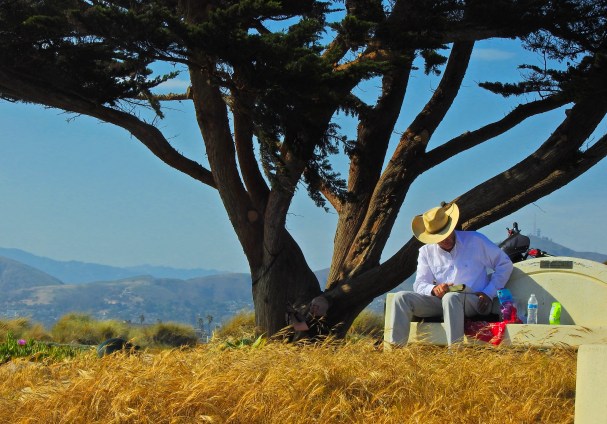
For me, composition is more typically trial and error, and so my favorite subjects are things that will more or less remain in place long enough for me to literally walk around them in search of their “good side”. or the angle that best serves the visual story I’m after. Street photography offers up some opportunities for such focused study, but, in that real-time environment, the stories are often morphing too quickly, and one has to trust to instinct to nail that one second of eloquence, since a follow-up or re-take may not present itself. But, when I can, I try to be slow, deliberate. To do things with purpose and on purpose.
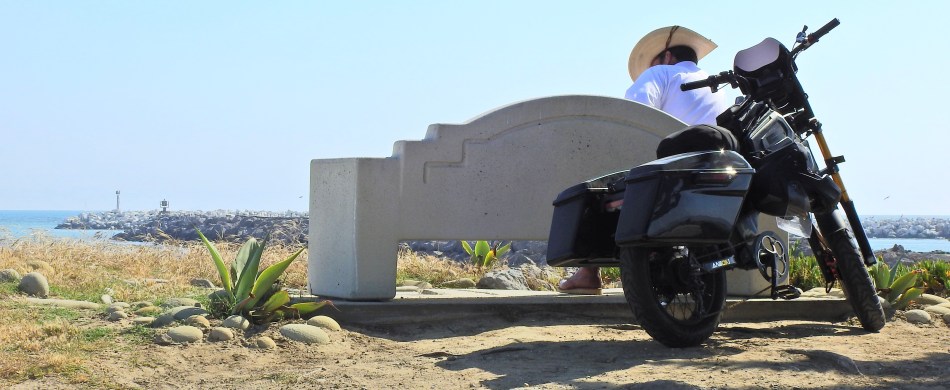
Digital, and the luxury of nearly endless numbers of exposures with immediate feedback, has been a life saver for me in a way that film, God bless its little analog heart, never was. This instantaneous concept-to-result cycle has saved many an image for me, since I am granted the ability to make a lot of wrong pictures very quickly, thus arriving at the right picture with more efficiency. The gentleman seen here in two frames was very accommodating in ignoring me, allowing me to squeeze off perhaps fifteen shots as I walked from his rear left side to his rear right side. Along the way, the scenery and props rose and fell as focal points, subtly changing the message of the photographs. Were I expert enough to follow Cartier-Bresson’s example, the image just just above might have been my goal, but, as I dwell among mere mortals in Photo-Land, I find myself by getting lost a bit. I go on walkabout.
DUST WITHIN DUST
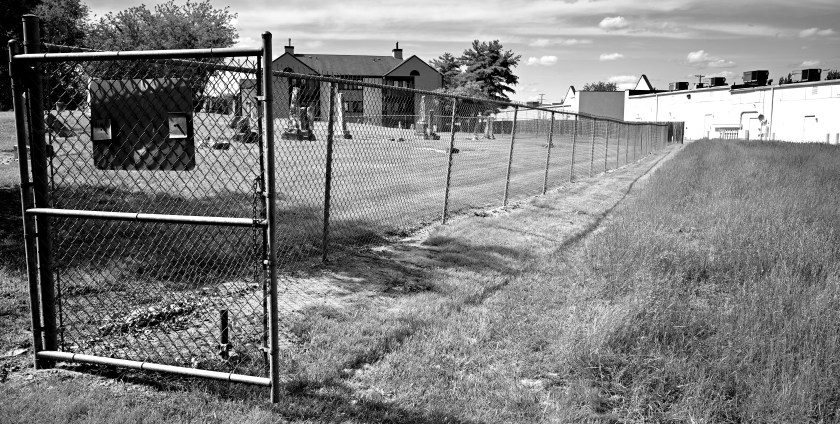
Sandwiched between a strip mall and an apartment complex in Ohio, an 18th-century graveyard..
By MICHAEL PERKINS
CEMETERIES USUALLY PROVIDE VISUAL CUES GALORE for both passersby and photographer, with hefty monuments, iron gates, placid, leafy grounds, and flower-crowned epitaphs. Most final resting places also stir in a big dollop of dignity, of august respect, a way of marking the importance of those interred below. A send-off befitting the lives they lived.
But not always.
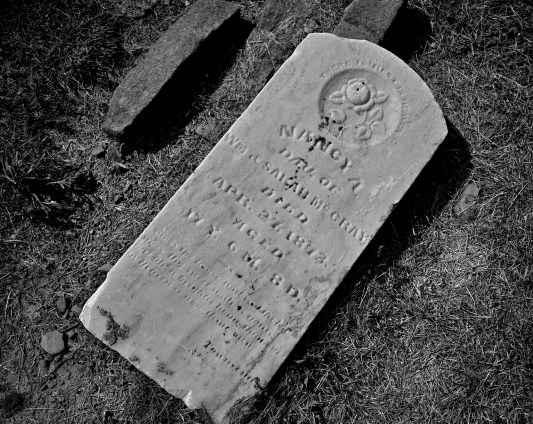
A place of neglect instead of respect.
Grave sites, and the gravitas they receive from us, vary wildly from town to town. You might be laid to rest beneath the uniform, manicured fields of Arlington, or, as in this forgotten patch behind a strip mall in Reynoldsburg, Ohio, you might be in a random gathering of crumbling headstones hemmed in by an ugly cyclone fence, overgrown with weeds, lacking even the simplest legend on the origins of souls gone so long ago that half the data on their markers has been effaced by time. The graves here date back to the earliest days of the republic, with even a few occupants from the revolutionary era. However, to drivers whizzing by the front of the shopping strip on state route 256, they may as well be on the moon, the only hint of the site’s existence being a small post-mounted sign reading “Historical 1819 Seceder Cemetery, Behind Shops.”
In speaking to several people who live in the immediate area, I found that the fact that there was an historic cemetery moldering in neglect just yards away from where the locals drop off their dry cleaning or shop for snacks was a complete surprise. The living and the dead tend to be more side-by-side in smaller towns, and, in fact, several other, more lovingly maintained graveyards are scattered throughout Reynoldsburg. But so many things slip between the cracks of history. Time not only heals, allowing pain to be endured; it also erases, allowing loss to go unheeded, or completely forgotten. For guys with cameras, both legacies of the departed impart their own poignant pain.
SPITTING BACK THE CANDY
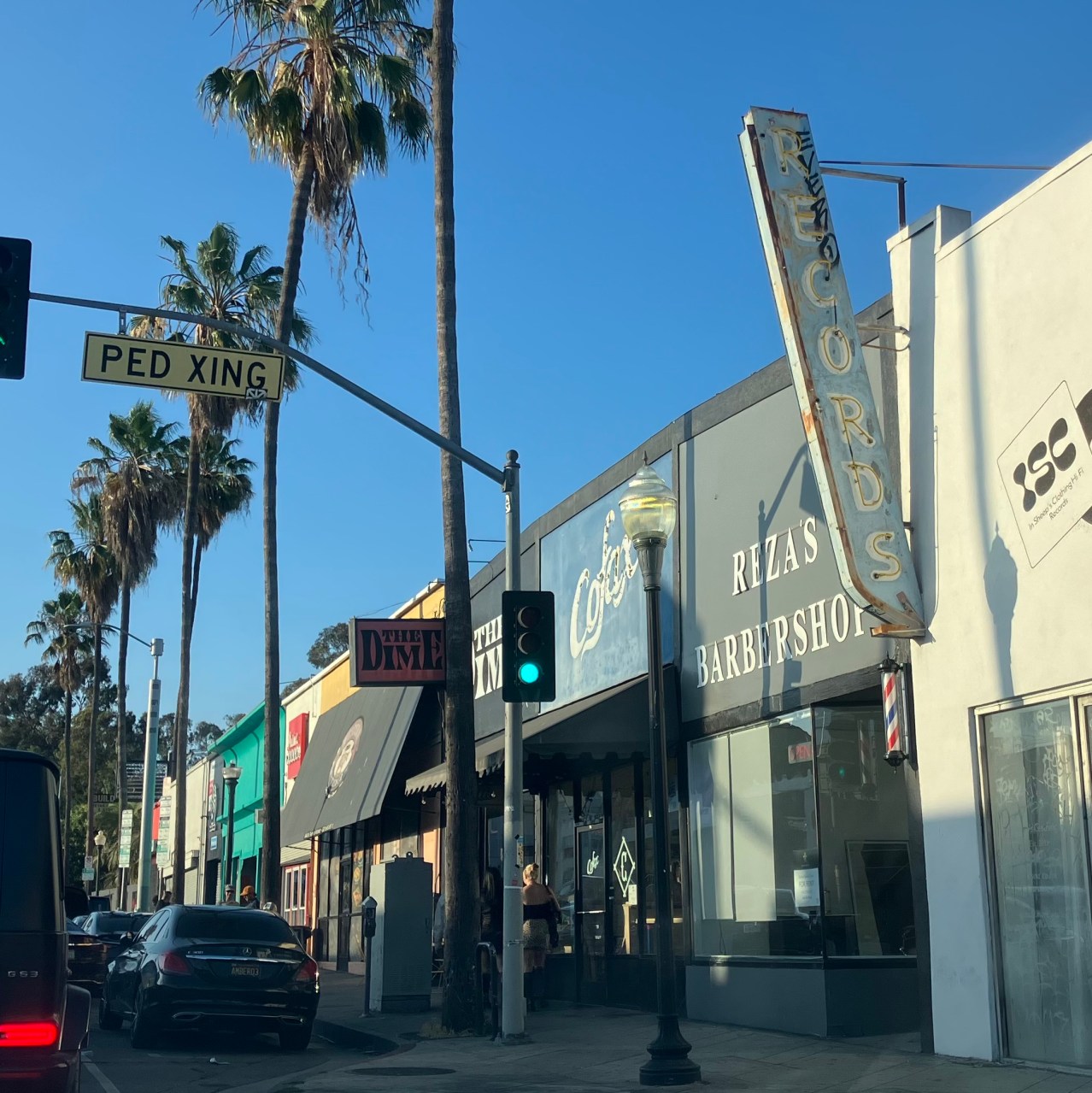
A straght-out-of-the-iPhone shot. Not remarkable, but not bad, and all my own.
By MICHAEL PERKINS
IT HAS TAKEN ME SOME TIME TO SORT OUT MY FEELINGS about the onrushing tsunami of interaction between photography and artificial intelligence. I have tried to see this tech wave as a bounty of new, useful tools, or a step toward greater efficiency. I really have tried. But I can’t get there, and now I fully understand why.
Creativity is often a collaboration, but it is a human function, and so, even collaborators in any creative act should be aligned in their common humanity. Humans have a distinct way of viewing problems, assessing results, and making executive decisions about where a given piece of art is born and where it arrives. Any process in which humans delegate this authority to non-human entities ceases to be creativity, since it surrenders the agency of the creator.
The same image, fed through a faux-painting A.I. generator app called Oilbrush.
And then there is the problem of authorship, which is called into question the very instant that a photographer makes use of an A.I. generator. In the image above, my original photo from the top of the page has been fed into an app called Oilbrush, which, as its name suggests, simulates the tonal and textural feel of a painting. In an instant, it samples billions of pictures from millions of artists, simulating their approach, technique, and, yes, even the type of brushstroke they used in an endless random mix of elements. When I click a tab in the app, I have no idea whose ideas I am compromising, or stealing outright, to enhance my own. I have traded any pretense at originality or honesty for instant gratification. Efficient as hell, and soulless.
I love playing with all these toys, but having spent some time in the their strange playroom. I do not wish to present work as “mine” when I can’t even have a conversation with my “collaborators”. I am not obligated by career pressures to fold this revolution into my own photography, and so I am free to make pictures in the way that I trust….that is, of myself, by myself. The tech treats offered these days are indeed tasty. However, after the first flavorful burst of sweetness, some of us will choose to spit back the candy.
AS ADVERTISED
By MICHAEL PERKINS
CALIFORNIA HAS ALWAYS BEEN ITS OWN BEST PUBLICITY AGENT, burnishing its already dazzling visual beauty with idealized vistas in posters, packaging and legends that elevate the state from a mere paradise to something like a fairyland. Anchored in my midwest reveries in Columbus, Ohio, my own first glimpses of scenes of the far west were not candid photographs or documentaries, but the golden bounty of the land as depicted on fruit crate art. Long before I experienced the range of light that is a daily miracle in its mountain skies and coastal beaches, I saw it simulated like some fantasy landscape in Maxfield Parrish’s over-the-top posters for Edison Mazda Lamps. And decades before I would step off a plane to experience the Golden Gate first-hand, I marveled at postcard-perfect views of San Francisco through the lenses of a View-Master.
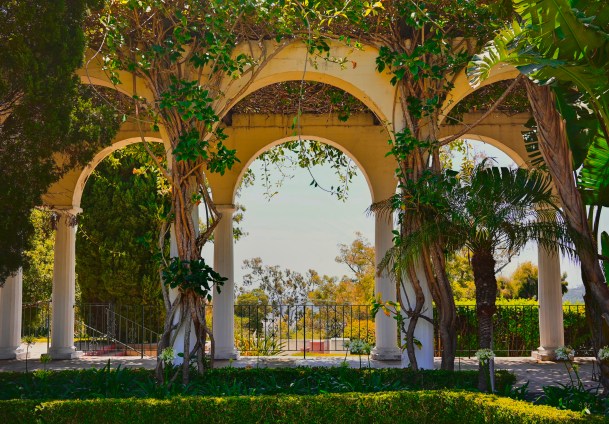
Now, long past all those childhood visions of California, I actually live here, and am amazed to see the same sort of light and color that I had assumed were mere hype and boast, only to find the very vistas that inspired so many brochures, magazine spreads and travel guides. The amazing thing is that the real deal is not that much removed from the imaginary when it comes this place. The shot you see here, of part of the old Santa Barbara State University campus, is pretty much straight out of the camera, although I retreived some details from the more extreme shadows. And this picture, I find, is not an anomaly, but the daily legacy of life out here.
The only thorn on this rose is what the California native knows about his Eden…that protecting it from the ravages of the very people who claim to love it can break your heart, overwhelm you with the task you are charged with, to save, serve, defend, replenish. Photography is the religious worship of light and what it can beautify. But in all that beauty is buried a challenge; we must remember that we are not owners but merely caretakers, and that we must use the arts for, among other things, reminding everyone just what is at stake. Only in that way can the wonders we cherish most about this world continue to delight as advertised.
NEW ANGELS
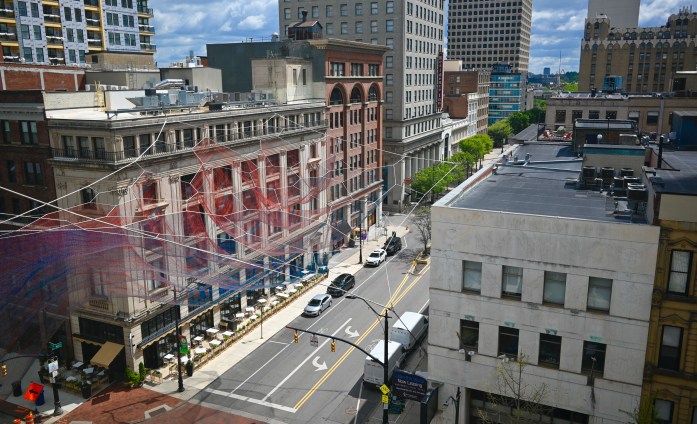
Current, a rope and cord art installation in Columbus, Ohio, created by “fiber artist” Janet Echelman
By MICHAEL PERKINS
FOR ME, ONE OF THE MOST EXCITING TRENDS IN URBAN DESIGN, in the twenty-first century, is not the latest generation of skyscrapers or town plazas, but a bold new redefinition of the concept of public art. Where once it was sufficient to plop down a statute of some wartime general near the county courthouse, commissioned works now make mere sculpture look as primitive as cave paintings. We have evolved past the commemorative earthbound seraphim that once graced our parks, to flights of fancy that connect and shimmer from the air. It is an age of New Angels, and Janet Echelman is one of its patron saints.
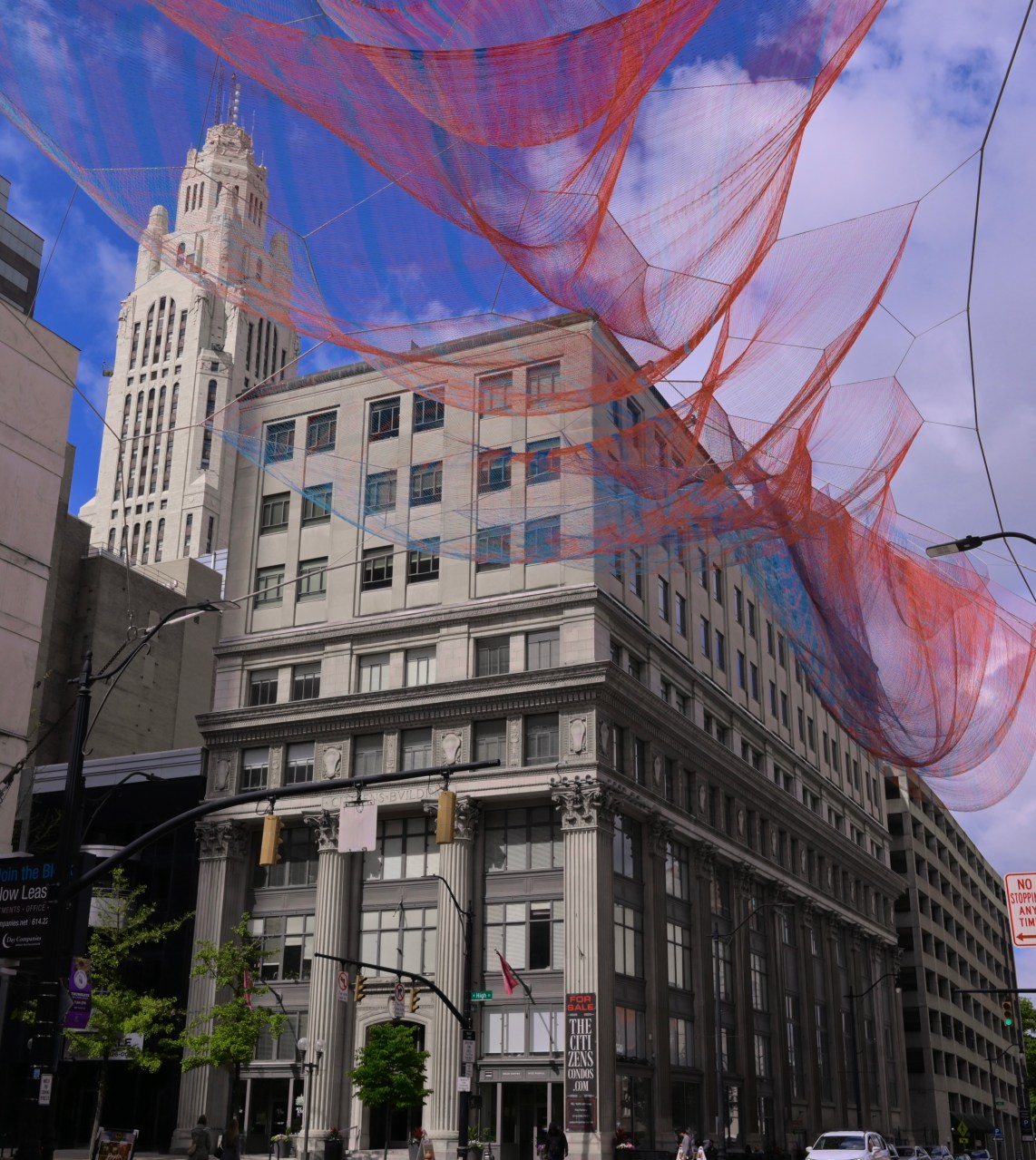
Echelman, a Guggenheim fellow and Harvard graduate, who refers to herself as a “fiber artist”, is, in fact, an altogether new kind of sculptor. Instead of being grounded on pedestals, her arrangements of shimmering color, created by mixtures of fiber, netting and rope, hang in suspension over cityscapes like vast spider webs, refracting the rainbow and generating waves of shifting hues depending on changes in sunlight, wind or the angle of view. Some of her creations are billowing circles and cones that resemble a whirlwind of cyclone; others look like sky-bound rivers, curling and twisting into tributaries of red and blue. Each is uniquely tailored to its specific location in cities like San Francisco, Vancouver, Seattle, and a half-dozen other cities around the world. They are, simply, magnificent, and the best challenge for any photographer, since they appear vastly different under varying conditions.
I first saw one of her works while working at Arizona State University, where Her Secret Is Patience floats like a phantom hot air balloon near the school’s Cronkite School of Journalism. And just this spring, I was thrilled to see her first work to be floated over an entire intersection, 2023’s Current, which spreads across the meeting of High and Gay Streets in Columbus, Ohio, anchored to the tops of buildings at the crossing’s four corners. Commissioned by a local real estate developer as a kind of front porch for his refurbished bank building (now housing deluxe condos), Current can be seen from any approach within a four-block distance of the area, an irresistible advertisement for the regentrification of the neighborhood. Janet Echelman is but one voice in a rising chorus that demands that public art re-define itself for a new age. That age will not only withstand controversy but actively court it, just as any art, including photography, needs to do.
THE STRAIGHT (AND TALL) SKINNY
By MICHAEL PERKINS
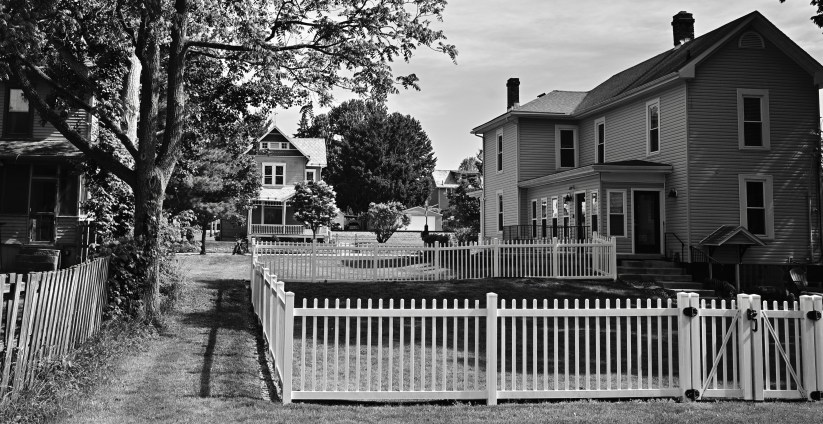
EVERY TIME OVER THE PAST TWENTY-FIVE YEARS that I have strayed from my home in the American southwest and headed back to my mid-Ohio roots for family visits, I am struck by a stark difference in the general arrangement of architectural space between the two regions, or at least a difference that I myself perceive. It would be a monstrous over-generalization to say that legacy houses, out west, tend to be horizontal in orientation while midwestern houses in older towns tend toward the vertical. I have absolutely no empirical data to back up this impression, only the way that it strikes my photographer’s eye.
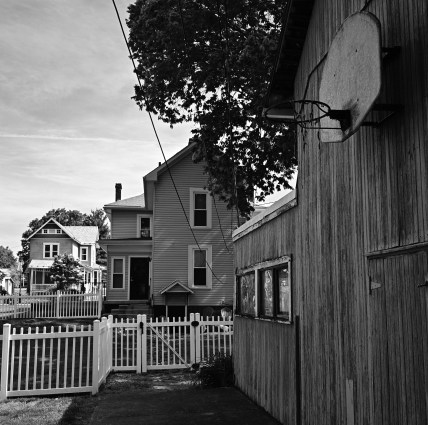
Western dwellings strike me as variants on the basic ranch house design, with many homes arranged from left to right, many without basements or attics. Midwestern homes, by contrast, seem to be narrow and high, resembling a brick turned up on end. I tend not to actively notice this distinction unless I am back home, trying to compose frames in which several buildings cluster together to suggest an entire town or street. My hometown of Columbus, Ohio, which is a sprawling city composed of many legacy neighborhoods, boasts a ton of “tall-and-skinny” sectors from the Short North to German Village to outlying villages like Pickerington or Reynoldsburg. In many of these neighborhoods in which, unlike say a city like Brooklyn, houses need not be crunched and crowded together like a row of brownstones, the brick shape still often predominates, setting up a strange contrast between wide, deep yards and narrow, stretched headstones of design.
Sometimes the look of a small town can actually seem like the view between gravestones. And, in the rural areas where the local cemetery is actually cheek-by-jowl to to the residential districts, the connection is even more compelling. I walk these Midwestern streets, once as inevitable as breath to me, and realize that not only my physical address, but I, myself, have undergone deep, deep change. And that, in turns changes the pictures I envision.
DOWN TO THE BONES
By MICHAEL PERKINS
TOWNS, VERY MUCH LIKE THE PEOPLE WHO CREATE THEM, don’t pass away all at once. Over the lives of neighborhoods and villages, as in the lives of the people who populate them, there are various ebbings and flowings of health. Even years after there are no more comebacks or rebirths, decline itself takes on a slow, predictable rhythm. Streets and businesses can, indeed, take a long time to die.
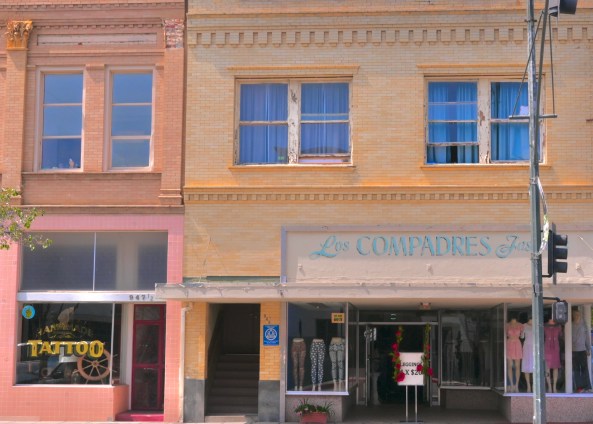
America is a place where beginnings are over-ripe with hope, as if nothing that happens after the word “go” is even worthwhile mentioning. In such a place, nothing says, “this no longer matters” like the empty, featureless faces of ebbing storefronts. Once performing as mission statements for their proprietors (“now open!” “lowest prices in town!” “bargain city!”), these places start to resemble an old actress who no longer care to put on makeup of brush her hair. The buildings remain standing but their faces are blank.
Towns like this one (let’s protect its privacy) are so stripped of ornament that they become mere jumbles of rectangles, building-block puzzles with few messages outside, no hope inside. Still, as abstract versions of their old selves, they can make interesting compositions, even as their continuing existence is both mysterious and sad. We love the start of things. We avert our gaze rather than acknowledge the end of them.
I WAS A TEENAGE CAMERA-SMASHER
By MICHAEL PERKINS
JOE McNALLY, WHOSE ASTOUNDING IMAGES HAVE GRACED THE PAGES of Life and National Geographic, along with far too many other to be mentioned here, has, in recent decades, developed quite a roadshow as an ambassador for Nikon products. What began as a few simple tips and tricks eventually blossomed into a grand presentation of his greatest hits and a hilarious TedTalk-type chat about the many mishaps and near-death experiences he as accumulated in Getting The Shot. His results “in spite” were always astonishing, but the takeaway for me was knowing that there was at least one other super-talented shooter out there who was also something of a doofus. I needed, really needed to know that everyone gets their share of gasp-inducing smash-ups.
I have littered the cloudscape of Camera Heaven over my lifetime with all the devices I have dented, dashed, dropped and dinged. These include my Kodak Instamatic M12 movie camera, which I lost hold of only to watch its battery gate smashed to bits (I finished the film roll by rubber-banding it back on), a Polaroid Colorpack II which disintegrated in my hands during a wintry shoot, and two recent face-plantings followed by bad bounces for both my Nikon P900 and Z5 (both survived, to varying degrees). In most cases, the so-called “ruined” cameras continued to function after the mishaps, leaving mostly my pride or dignity as casualties. Some of my favorite shots of downtown Los Angeles, for example, were taken just minutes after the shutter on my camera froze from old-age, allowing me to nurse it through a few more crucial frames before it finally seized up for good. One such image, of the majestic Eastern Columbia building, is seen here.

Cameras live and then cameras die and we grieve and we move on. Seeing something physically damage your favorite tool is a great way to be reminded that it is merely a tool, that you take the picture to a much greater degree than any bit of gear you use to help you do it. But I still love to hear the Joe McNallys of the world admit, in front of witnesses, that they have almost dropped a flash bulb from the top of the Empire State Building or have watched multi-thousand-dollar equipment cases bubble beneath the surface of a bog in Eastern God-Knows-Where. Weirdly, it helps Little Me soldier on.
THE MOMENT IT CLICKS
By MICHAEL PERKINS
AS A PHOTOGRAPHER MARRIED TO A BIRDWATCHER, I WAS PRETTY MUCH DESTINED to eventually cross over into her world, especially given the natural affinity which has always existed between the two hobbies. Like the making of pictures, the science of spotting and organizing data on the world’s winged wonders is based on the thrill of discovery, a unique mix of surprise and wonder.
Eureka moments.
The sound made by a birder who’s just checked a pileated woodpecker off his “life list” is similar to the cry of joy/relief a photog makes when the plan for the image comes real. And when both kinds of people occupy the same space, it’s inevitable that the photographer will be tempted to try to capture, not merely the birds on hand, but those who get emotionally supercharged when they spot a beauty.

I have captured many manifestations of pure joy among birders over the years, since, due to my inability to see even half of what the experts see, I have lots of time to troll about looking at everything else, including the local scenery and the gleeful faces of those whose knowledge occasionally affords them a major payoff. The frame seen here encapsulates that feeling, the moment when Nature grants you The Big Reveal.
A Eureka moment.
Birding is also like photography in that there is a definite learning curve, an apprenticeship which encourages humility. Being good at anything means slowing down and waiting on the process of learning. It is never immediate, and there are no real shortcuts. Either you put in the time or you fail.
But, God, the joy if you hang in….
GOING-AWAY PRESENTS
By MICHAEL PERKINS
YOU MAY REMEMBER THE BRIEF 70’s-ERA FLING MANY OF US HAD with the wooden cases that were originally designed to carry the metal type used in composing newspapers and magazines. We stored them vertically on walls and stuck cute little knickknacks in the compartments, re-purposing something that once had been so universal as to be invisible to most of us into something we paid fresh attention to, now that it was charmingly obsolete.
Photography, being at least part reportage, is uniquely equipped to take note when everyday items become rare curiosities. You can take measure of this process poring through the tons of articles listing the common objects from earlier generations that later generations can no longer identify, like Rolodexes or rotary phones. Antique stores, which are mostly resale forums for other people’s old junk, are replete with things that were once essential and are now peripheral. Sometimes, the shocking distance between eras can produce good grist for images.

When the everyday becomes the vanished, like this old library card catalog, we are removed enough from them to note individual elements of them, like materials, design, patterns….all the practical aspects that their inventors had to balance to make the things. You realize that there were once several support industries just for these catalogs. Someone had to make the file cards. Cabinet makers were engaged; there were special varnishes to seal the wood, metal rods to anchor the cards in place, brassworks to make the pull handles. There were people who could sit you down and spend an evening just discussing the finer points of this catalog company versus another. Expertise was gained. Factories were engaged; people hired.
Can a photograph of an obsolete library tool evoke any or all of this? Depends. There are no guarantees that either a snapshot or a deliberately composed picture can or will do the job. But, at the very least, our understanding of earlier versions of ourselves begins with a physical document of what those people lived with, and around. And that narrative is always a potential treasure.
THE GIRLS WITH THE ELECTRIC SMILES
THE GIRLS WITH THE ELECTRIC SMILES
By MICHAEL PERKINS
PHOTOGRAPHS AS LEGACY CONSTITUTE REAL WEALTH for us as we age. Heirlooms like jewels, or books, clothing, all contain powerful energy when viewed against the backdrop of the memories of those who have gone before us. However, the accumulated madras quilt of physical images is that backdrop, the most perfect proof we have that these people lived, and loved, and yearned, and strove. That kind of inheritance is truly beyond price, and, in my family, photographs are incredible talismans. They call spirits forth, anew.
My parents were both avid snapshooters as my sister and I were raised. Slides, prints, home movies, framed histories lined all our walls, crammed every cranny atop pianos and nooks and shelves. The visual documentation of our lives not only acted as parameters for our everyday lives as kids, it is now a miraculous comfort for our own old age.
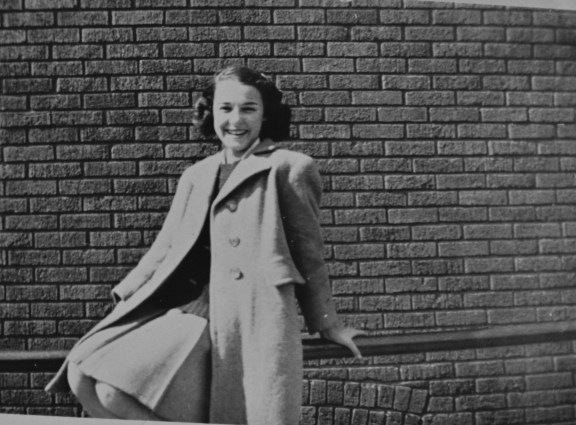
Mother, mid-1940’s.
But photographs have done more for me than just parade my own past experiences before me. They have also granted me entry into the time before my own, to see my parents as children, teenagers, young lovers. To see the bright boys with the cocky attitudes and the gorgeous girls with the electric smiles. Before all the wars, trials, sorrows and slams of grown-up life. Before the world tried to tame them, force them into line, steal their joy. Before they even dreamed of being Mom and Dad.
As it happens, I am writing this on Mother’s Day 2025, but, in practice, these frozen pieces of personal history are truly a part of my daily life. I need all those fresh-faced grins, the unguarded moments caught in a box, the markings of days major and minor in the lives of the people who shaped me. They created, or curated, these photographs for an inheritance they could never have foreseen. But intentional or accidental, they are my legacy, and I cannot imagine life without them.
WALK BETWEEN THE RAINDROPS
By MICHAEL PERKINS
THERE ARE PICTURES, AND THEN THERE ARE PICTURES OF PICTURES, and then…
At this point in the history of photography, we have probably made almost as many images of other people’s images as we have made original photographs of our own. We cop a shot of a great painting; we snap a souvenir of a stunning statue; and then, there are those other kinds of “pictures of pictures”; those that are actually also of the surrounding spaces around and between them, as seen in galleries or museums. And while it may seem odd to think of light fixtures, benches, or visitors as part of the same composition as an art exhibit enshrined in those spaces, I find it an exciting challenge to take in entire rooms….paintings, furnishings and all, as a single piece, almost like a stage set.
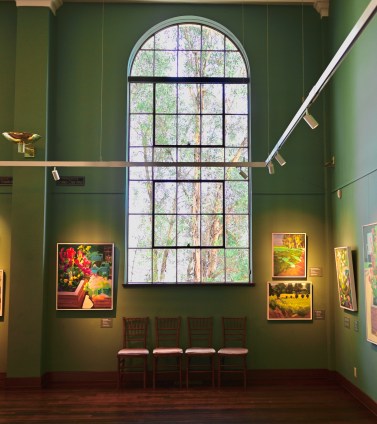
Well, let’s face it; galleries are stages, and their look is set or designed so that every element in it enhances all the others. This means organizing both active and empty space as a continuum, and it means thinking dynamically about the role of those spaces where “nothing” seems to be happening. Open areas give the works room to breathe; the eye can then, in the words of Steely Dan, “walk between the raindrops”.
In the above shot of an art gallery in Santa Paula, California, what was once just one of many tall, arched windows in an old bank building becomes, under the careful curatorial eye, a centerpiece of the frame, affording a view of the outside world which both reflects and amplifies the beauty of the framed art. Everything works together, and yet nothing collides or occludes. Visually, there is space for all of it to happen, on equal terms with itself.
Is that zen? Is it feng shui? Is it just the fever dream of your humble author? Who knows and who cares? The paintings, designed to be seen on their own terms, can also be viewed within a context that caresses them, completes them in a way. And I’ll make a photograph of that any day of the week.
A GRAIN OF TRUTH
By MICHAEL PERKINS
TEXTURE IS ONE OF THE MOST VARIABLE FACTORS in photography, in that its importance in an image goes all over the map given the situation. While exposure and composition, even focus, are key considerations in the making of nearly every picture, texture can jump to the front of the line and become the crucial element in the making of a photograph, moving from merely part of the story to its central point.
In photographing, for example, Da Vinci’s Last Supper, you’re creating a narrative not only on the figures in the fresco or of the painter’s technique; you’re also making a document of the current physical condition of the work, commenting, in effect, on its state of deterioration, the befores and afters of any restoration efforts, even the grain and grit of the surface itself, since, over the centuries, the art, and what it was created on, are now inextricably linked; two halves of a whole.
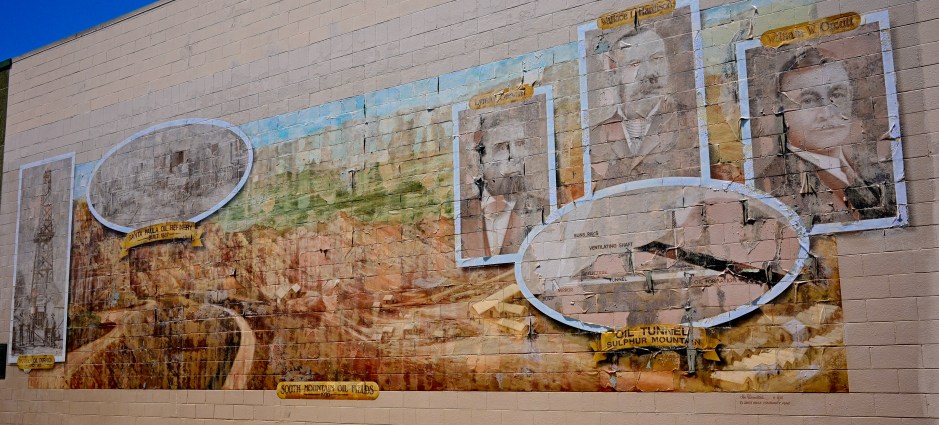
Murals in particular can only be complete documents when the aging or weathering factors on surfaces can become part of the story. This memorial to the central west coast’s oil industry (top) seen on the side of a building in Santa Paula, California, can, years after it was created, no longer merely be a painting or an homage.
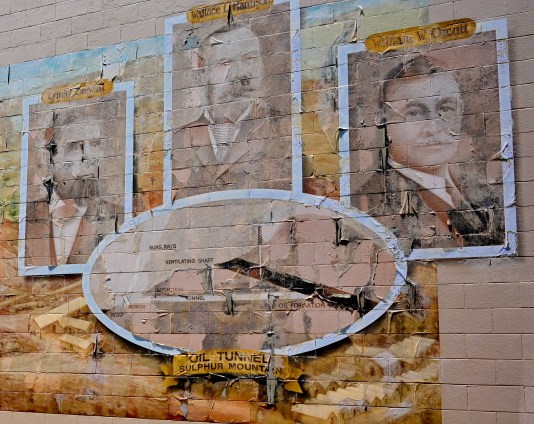
In a very real way, the wall has become part of the painting, an expression of the toll of years since the town’s glory days. This elevates texture to the status of a key factor in the relating of the area’s history. As seen in the detail, just above, the peeling and cracking of the work is a story in itself, an unstated what happened? that forms in the mind of the visitor. as in the Last Supper or other venerable works, the ravages of time root an event or an era in fixed historical position. We are aware that we are looking at a relic, still visible in this world; a souvenir of other, vanished worlds.
In photographs, the final effect ranges from casual to formal, from mere reportage to historical commentary. We bring intent to a scene when we capture it in a box, adding accents along the way to underscore what we feel about it. Come to think on it, that is about as close to a working definition of texture as you can get.
FADE TO BLACK
By MICHAEL PERKINS
I WAS NOT YET DEEPLY INVOLVED IN PHOTOGRAPHY in 1968, the first time I heard Jimmy Webb’s song Watermark, which he wrote when he was collaborating with the actor Richard Harris, who, owing to his role as King Arthur in Camelot, was briefly celebrated as an intriguing, if unconventional, singer. The lyrics of the song try to capture the essence of things that are not destined to be preserved, to rail against the fading and impermanence of memory. A half century had to pass before a song that I really enjoyed at first hearing became the very definition of the magic trick we attempt in making a photograph.
But enough talking. First, an image:
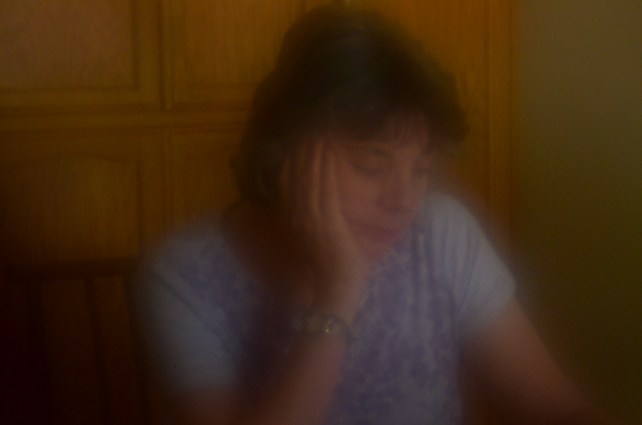
And now, the words that make all such images so, as Webb writes “draped with my regret…”
How delicate the tracery of her fine lines
Like the moonlight lacetops of the evening pines
Like a song half heard through a closed door
Like an old book when you cannot read the writing anymore
How innocent her visage as my child lover lies
Pressed against the rainswept windy windows of my eyes
Like an antique etching glass design that somehow turned out wrong
I keep looking through old varnish
At my late lover’s body
Caught on ancient canvas
Decaying, disappearing
Even as I sing this song
How tenderly the tapestry is draped with my regret
And the bittersweet inbroidery that hasn’t faded yet
But I see the details dying in that distant soft design
Like the taste of summer fading like from a dusty winter wine
How secretly and silently my sorrow disappears
You can’t see it with your eyes or hear it with your ears
It’s like a watermark that’s never there and never really gone
I keep looking through old varnish
At my late lover’s body
Caught on ancient canvas
Decaying, disappearing
Even as I sing this song
OUT OF ONE, MANY
By MICHAEL PERKINS
SOME PHOTOGRAPHIC SUBJECTS ARE SO DENSE that they simply give the eye too much to decode or prioritize. When in the act of shooting immense or complicated compositions, I often fail to see that I am taking in enough information for two or more completely different images, and that wielding the scissors this way or that can drastically re-direct the intention of the picture. This is perhaps why shooting vast landscapes only works occasionally for me as wholes. I see the mountains and the neighboring farmlands and the barns and the babbling brook and am never certain if, in a single frame, I’m actually creating more confusion than clarity.
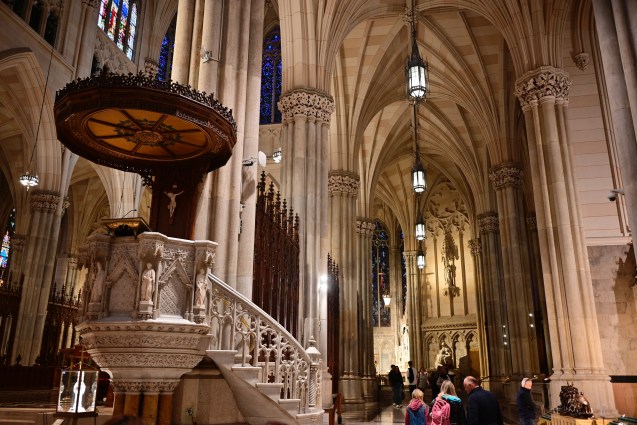
One recent example of my not being aware of this, at least not in the moment, happened last year as I stepped inside St. Patrick’s cathedral in midtown Manhattan. This massive space was devised in a time when going to church was a sensory experience that was designed to be overwhelming, to inspire awe, where even the cheap seats afforded complex, competing vistas. In taking a rapid series of snaps, however, I came away with a feeling of sensory overload, with many images containing more than enough information to be cropped by half, or even two thirds.
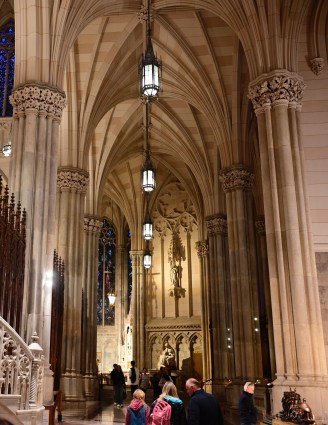
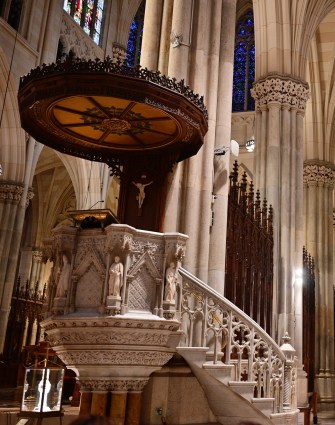
The original frame, seen up top, sends my eye looking into so many sub-stories at once that a general view is, well, too much of a good thing. A left-handed crop (middle image) make the picture about something, as attention is now centered on the beautifully ornate pulpit. Cropping to the right, we see a story that could be about worshippers on a journey; that is, heading from front to back in search of something, perhaps the devotional altar in the distance. All cropping is, of course, a creative act all its own, with its own dictates and designs, and sometimes a very busy image can be stunning (think a complex overhead skylight of concentric stained glass panels). However, many of the big canvasses we shoot could be, if you will, subdivided into even more effective individual parts rather than one stunning whole. Reviewing our old so-called “very good” pictures can often find a “wow” picture hiding within.
IT’S RIGHT ON THE WAY
By MICHAEL PERKINS
I WON’T SAY THAT I’M EXACTLY GRATEFUL for my meager skills as a birdwatcher, but I will state that, in my specific case, being mediocre at it has been a boon to my photography. To be more precise, my inability to spot as many varieties of winged wonders as my birding companions often results in my mind wandering while others about me are transfixed, as the photographer in me swiftly moving from “what birds are to shoot?” to “what else is there to shoot?”
Fact is, when the rest of the pack is following the various melodic “whoots” and wheets” of whatever is hiding in the foliage, I frequently answer with the call of the adult Dull-Witted Geezer, a song that sounds like “WHERE? WHERE?” as I rotate my head madly from side to side. Here’s the deal: when I can’t see what everyone else can see, my attention flags, at which time I’m glad that most of the outings are half birdwatch and half nature walk. Because, let’s face it, many birders come home from a walk with bupkis to show for their efforts, while a nice little saunter through the woods always yields something. And all photographers want to go home with something. Anything.
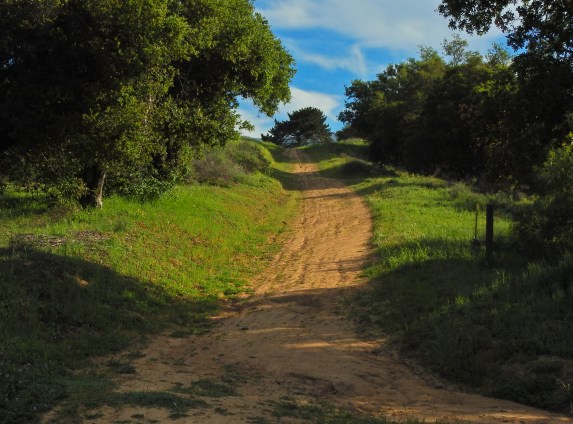
This bright little path rising up through a small wood spoke to me one recent morning when the birds were basically giving me the middle feather. Despite my plaintive “where? where?” cries, no mercy was shown me, and so, when all others were riveted to the ground, binocs trained on some divine sight, I turned about 180 degrees the other way and found a golden moment. The very best thing about being out with birders is that, given their very deliberate (spelled “obsessive”) pacing, I can click away to my heart’s content without worrying that they will have moved on, or, God forbid, are tapping their feet waiting for me to catch up. No, I can shoot everything I care to, go out for coffee, return my morning emails, blink off for a quick nap, and they will very likely still be standing in the same spot when I return. Come to think on it, I wish I could have had this bunch with me on all those vacations when my kids kept asking me, “are you still taking pictures?”
Now, I have my own path.
atureAs you can see.
MIRROR, MIRROR

By MICHAEL PERKINS
MUCH OF COLOR PHOTOGRAPHY IS DEPENDENT ON THE SPECIFIC SURFACES captured in its field of vision. We don’t just record light in a frame; we also record the particular properties of that light as it plays on a given subject. The dynamics of contract, reflection, texture and the way a surface sends light back to our eyes all weigh in the results. In broad terms, we can just simplify this to high light/normal light/low light, but in fact the results are far more nuanced.
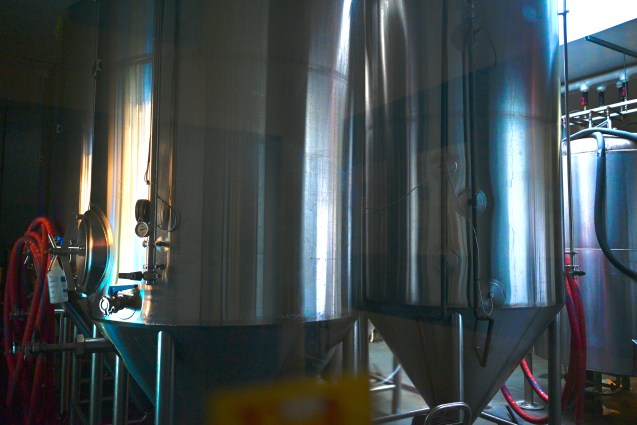
In the two shots shown here for comparison, the metal distillery tanks at a microbrewery bear the distinctive stamp of the kind of light they are reflecting back to the camera. One is taken with natural sunlight pouring through the room’s skylight, while the other is lit completely by ceiling fluorescents after nightfall. Both were taken on the same white balance setting, i.e., “natural light auto”, making the two exposures at least neutral in how the camera processed what it saw. But what a contrast in the color registration of the two.
The daylight shot shows highlights in the steel of the tanks that runs to pale redness in some patches, while the night shot reads very dark blue with hints of green here and there. The results are certainly no big surprise to those who take multiple exposures of the same surface, say, a mountain lake, under changing light conditions. The dominant hues are dictated by how the surface of what you’re shooting decides to bounce back light. It’s not merely the difference between “light” and “dark” but, specifically, between the changes in tonal registration creates by the surfaces themselves. If these tanks were made of cardboard, for example, their light-bouncing properties would be drastically different than those seen here. Why does this matter? Well, it goes to the intended result. You have some control over how you visualize a scene with a camera, but Nature often has the final say. Understand light better, and you shoot smarter. And perhaps smile more at the end.
 thenormaleye