CUES
By MICHAEL PERKINS
PHOTOGRAPHIC COMPOSITION is never the mere geographic assignment of elements within a frame. Certainly, mapping out what is to go up, down, left, or right in a picture is a vital part of the process, but you have to do more than rearrange the deck chairs. You also have to make real decisions about where the ship is sailing.
Aperture, focus, the use of light…..make up your own list of contributing factors… the assembly of a composition is about setting the terms of engagement between your vision and the eyes of the audience. It is never merely about the limits or contents within the frame. This means that a picture that you would shoot in a certain way today may seem completely out of synch with your thinking a year from now, because your idea of composition will (and should) be in constant flux.
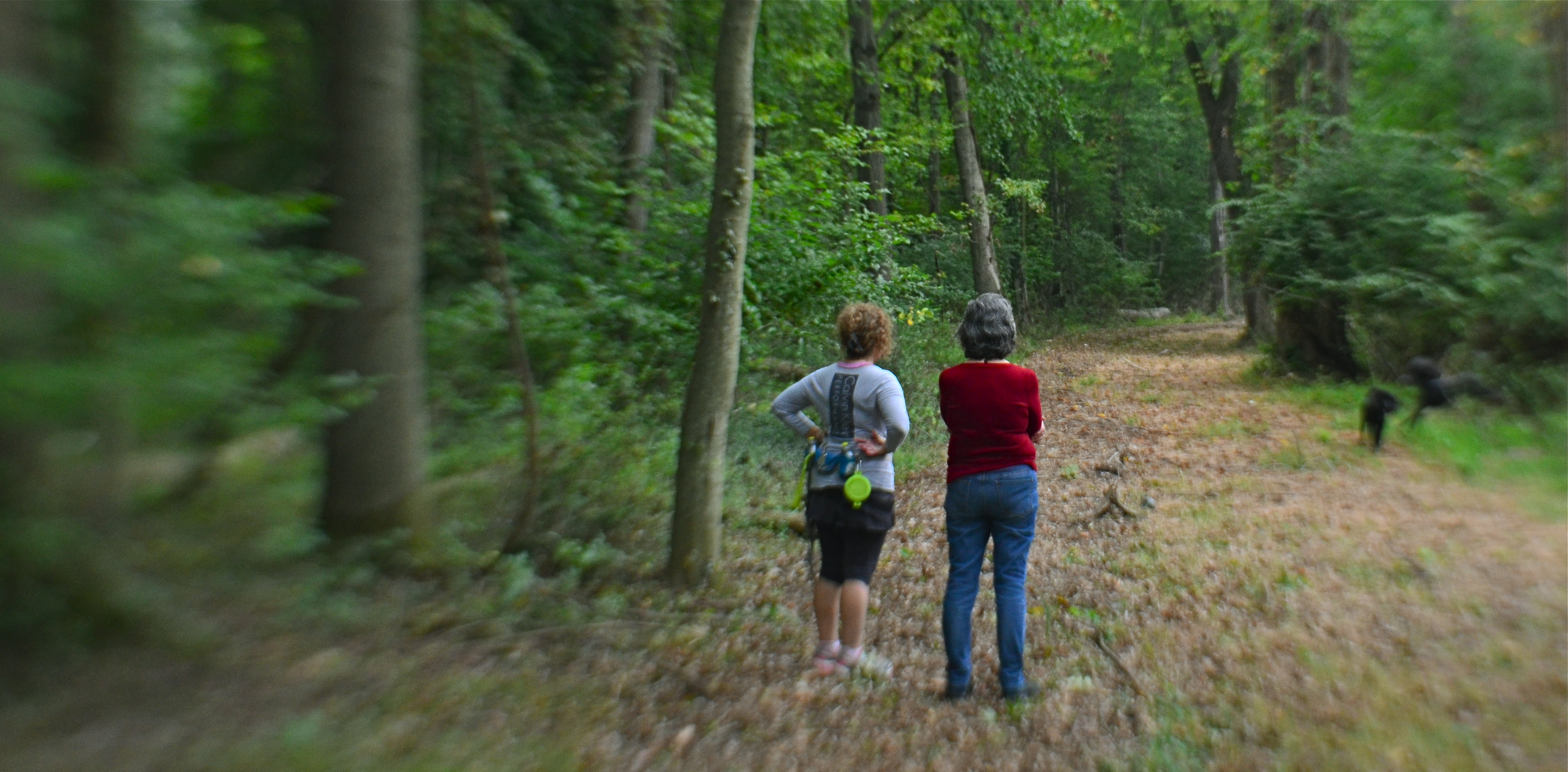
The Clearing (2016)
In my own case, I have spent a lot of the last five years re-evaluating focus, deciding in many more cases to use it selectively, where, previously, I might have applied it more evenly. This is an exploratory journey, and I am not sure where it will wind up. I don’t really feel as if I’m abandoning sharpness per se, just trying to decide how much of it I need in a given situation, making its use a lot more intentional choice than it has historically been for me.
Focus is a way of prioritizing the visual elements in a picture. It cues the audience as to what information there is and how hard to look to retrieve it. It also tells if there is no object or “mission” in a picture, as in a totally abstract arrangement. Photographer Uta Barth, describing why practically all of her work is deliberately refocused, notes that “the question, for me, is how I can make you more aware of your activity of looking. I value confusion…”
Indeed, placing incomplete information before a viewer, about focus or anything else in a photograph, is inviting him/her into an interaction…..with all parties having a conversation about what a picture means. For the viewer, it means exercising more control: for the photographer, who no longer has to spell everything out, it can be freeing.
ONE MOTIVE AT A TIME
By MICHAEL PERKINS
CROWDS ARE OFTEN DESCRIBED as if they were single entities, as if each member were acting in accord with all others, like cells combining to form an organ. Writers likewise use the word “crowd” as a kind of collective noun, as in “the crowd went wild” or ” the crowd grew restless”, again making it seem as if a collection of individuals can act as a single thing. Spend time in any crowd as a photographic observer, however, and it becomes obvious that there is virtually no such thing as group behavior. Everyone comes to a crowd separately, one motive, one agenda at a time, and photographers can begin to harvest real human stories by seeing them that way.
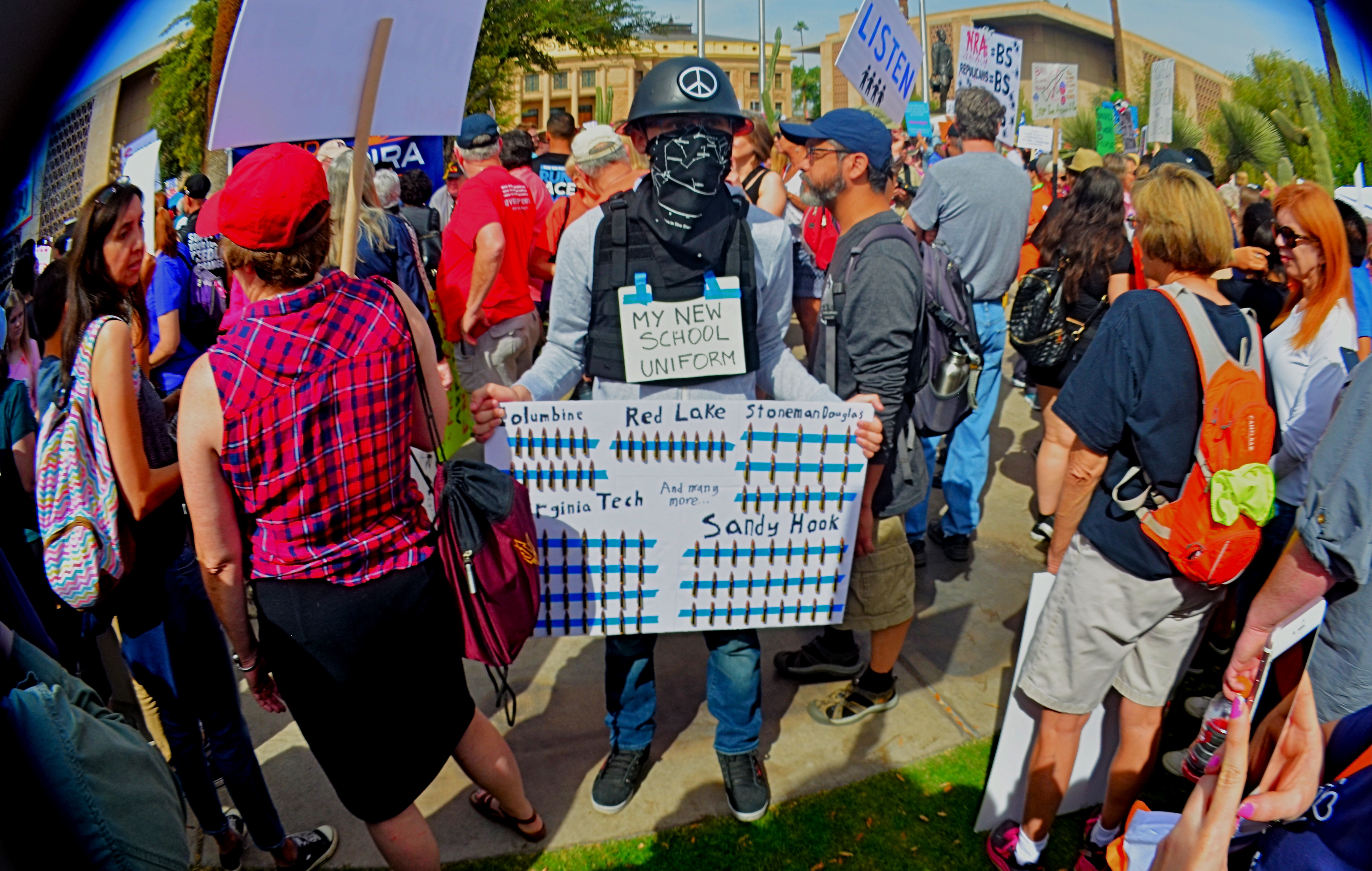
This person is not trying to be “part of the crowd“.
To be sure, there is scope and drama in making uber-pictures that convey the sheer size and scope of mass gatherings. Likewise, there are certainly moments when crowds seem to be moving or acting as one, as in the moment when the winning run is hit or a rousing orator evokes a roar of approval. But look carefully within those general waves of action and you will still see the individual proudly on display. By turns, he is, even in a crowd, engaged, irritated, enthusiastic, bored, tired, ecstatic, and angry, just as visibly as if he were in any other situation. Get close enough to a mass of people and you’ll see The Person…..perhaps attempting to be part of something larger than himself, but still pushing his own brand of street theatre, still brandishing his own quirks.
Demonstrations, parades, celebrations, protests….they’re all staging points for persons, persons who give up their stories to the photographer’s eye no less in a mob than in the family den. Wait for the moment when that happens and grab it. Teach yourself to look at a crowd and see the person who’s truly one in a million.
EVERYTHING IN ITS PLACE
By MICHAEL PERKINS
EVERY PHOTOGRAPH REMOVES SOMETHING from its original context, extracting it from its proper place in the world at large. In the act of placing things in a frame, the photographer excludes whatever else once surrounded that thing, so that, in the final result, a vast valley is reduced to one tree in one part of one meadow. Our mind stipulates to the supporting reality of whatever was extracted, and we either approve or disapprove of the shooter’s arbitrary editorial choice in composing the frame.
And so pictures often annihilate an object’s “origin story”, since we can’t often search them to view what something “came from”. Objects in a photograph merely are, with little obvious evidence of what they used to be. Sometimes that means that, when we do see where something originated, a picture of it can seem exotic or strange. And, as photographers, we can train ourselves to find that one view of a thing that has been, in effect, under-explored.
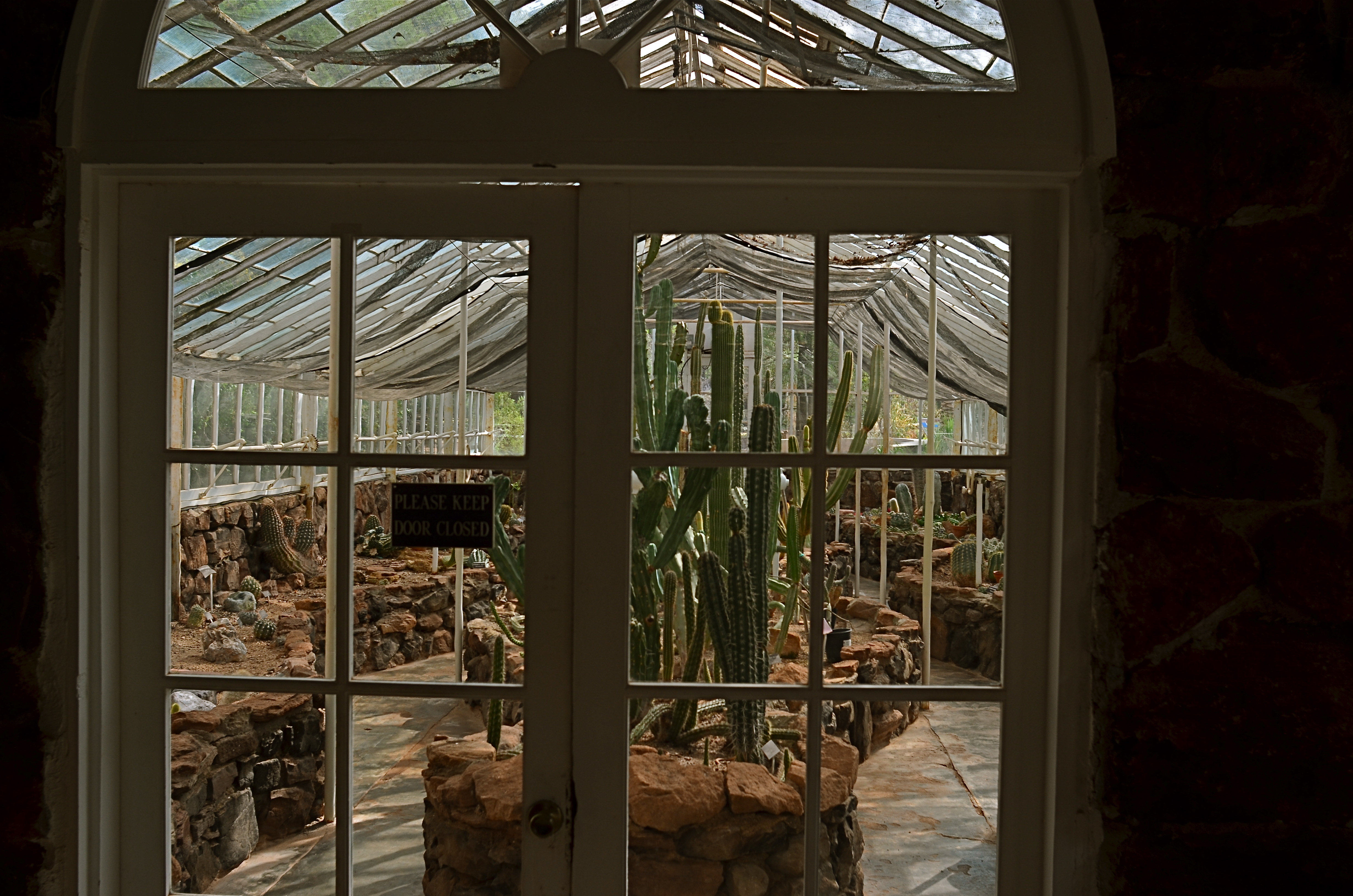
1/125 sec., f/5.6, ISO 100, 24mm.
In the above picture, something that we tend to think of as being organically “born” in a natural setting (i.e., a cactus) is shown being deliberately farmed within a controlled environment (i.e., a greenhouse). It looks a little wrong, a bit strange…..certainly not typical. And yet, an interesting picture can be made from the scene, simply because we never see a cactus’ origin story, given that most photographs don’t select that story within their frames. This picture really doesn’t display its information in an original fashion: it’s the thing, in this particular context, that makes the photograph seem novel.
As always, the choices made inside and outside the frame of a photograph set the narrative for it. It’s therefore the most important choice a photographer can make.
STEP RIGHT UP
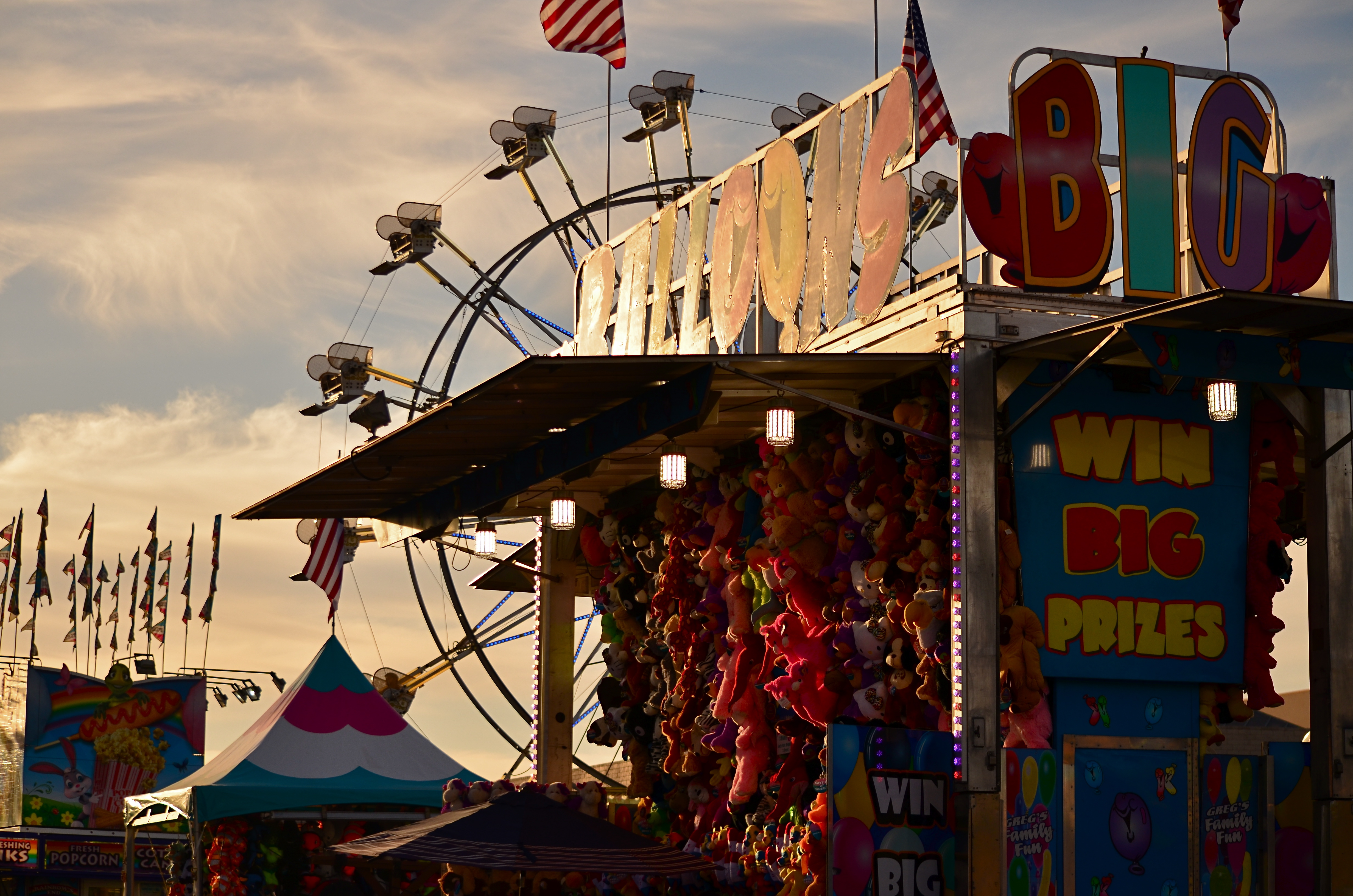
1/1250 sec., f/5, ISO 100, 55mm.
By MICHAEL PERKINS
PHOTOGRAPHY SHOULD ALWAYS OPERATE, at least to some extent, as a cultural mile marker, a chronicle of what time has taken away, a scrapbook of vanishings and extinctions. We make records. We bear witness. We take pictures of the comings and the goings.
One of the things that has been going, since the coming of the permanent, Disneyeque theme parks, those sanitized domains of well-regulated recreation, is the great American carnival, in all its gaudy and ever so slightly dodgy glory. Loud, crude and exotically disreputable, these neon and canvas gypsy camps of guilty pleasure once sprang up in fields and vacant lots across the nation, laden with the delicious allure of original sin, that is, if the first apple of Eden had been dipped in shiny red candy. We came, we saw, whe rode, we ate, we clicked off millions of snapshots on our Kodak Brownies.
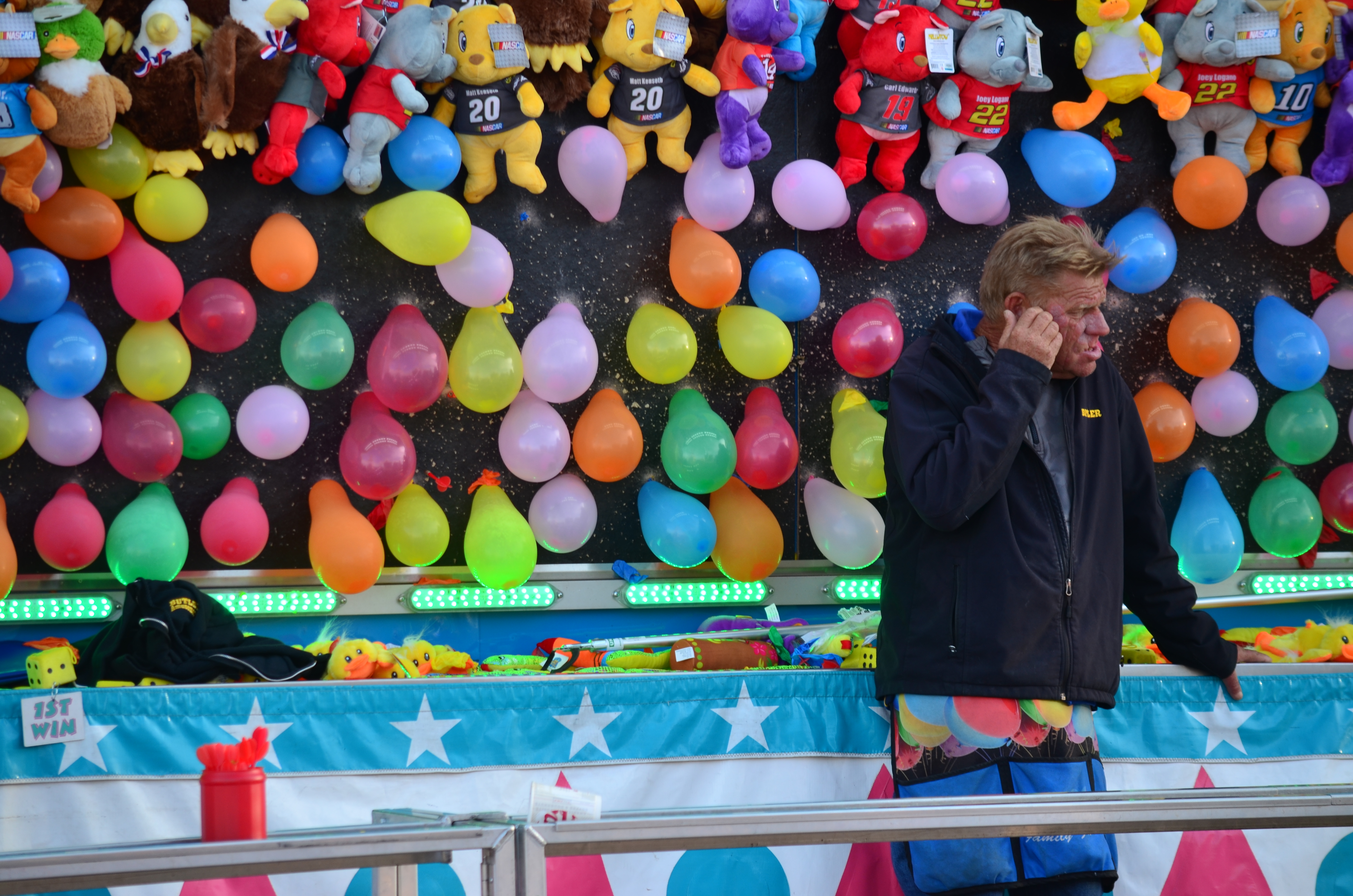
1/125 sec., f/5, ISO 100, 165mm.
The thing that made it all so magical was geography. Unlike Seven Flags or Cedar Point, the carnival came to us. Like the circus, the carnival was coming to your town, just down your block. That meant that your drab streets were transformed into wonderlands in the few hours it took for the roustabouts to assemble their gigantic erector sets into rickety Ferris wheels and Tilt-a-Whirls. And then there was the faint whiff of danger, with rides that made dads ask “is this thing safe?” and crews that made moms repeat horrific tales of what happens to Little Children Who Talk To Strangers.
It was heaven.
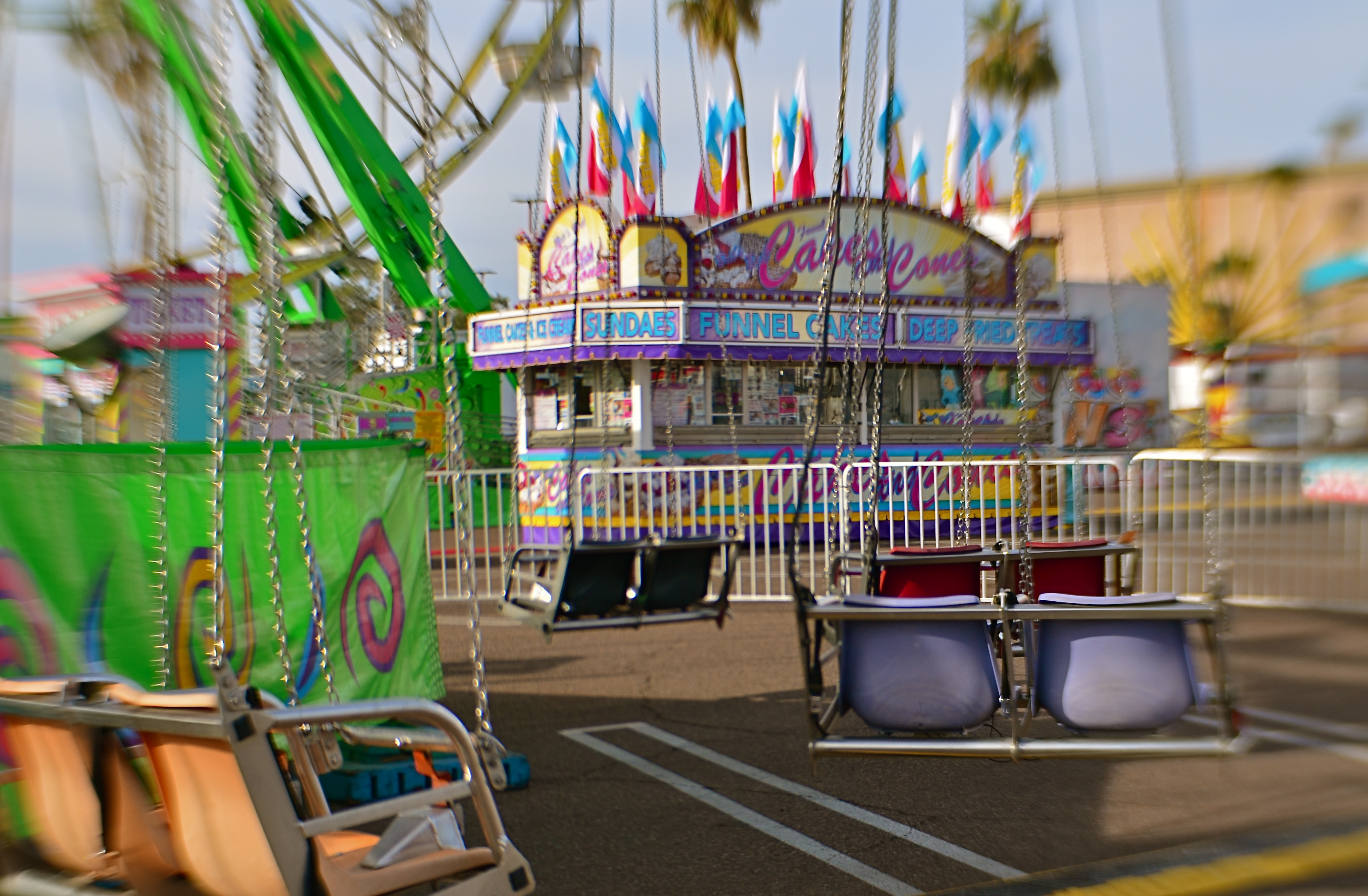
1/250 sec., f/5.6, ISO 100, 35mm.
The images seen here are a partial return to that sketchy paradise, with the arrival in my neighborhood, this week of a carnival in an area that hasn’t hosted one in well over a decade. It’s almost as if Professor Marvel just ballooned in from Oz, or Doc and Marty had suddenly materialized in the DeLorean. It’s that weird. Four days in, and I’m there with a different lens each time, sopping up as much trashy delight as I can before the entire mirage folds and all our lives return to, God help us, normal. Photographs are never a substitute for reality, any more than a hoof print is a horse. But when dreams re-appear, however fleetingly, well past their historical sell-by date, well, I’ll settle for a few swiftly stolen souvenirs.
PHASES AND STAGES
By MICHAEL PERKINS
MORE INK HAS BEEN POURED OUT about Henri Cartier-Bresson’s notion of “the decisive moment” than perhaps any other chunk of photographic philosophy ever hashed out between honest brokers. HCB’s assertion was, essentially, that there is a single, ideal instant in which a picture of something will be, like an apple, perfect for the plucking. Miss that moment, and all is lost.
While some applaud this theory as holy scripture, others dismiss it with a vulgar reference to bovine by-products. All well and good. Everyone needs to evolve a belief system that drives their personal photographic vision. The important thing is to evolve something.
Personally, while I don’t believe there is only a single moment that will make an image immortal, I also don’t think that just any moment you choose to freeze an event is as good as every other moment. Conditions, timing and decisions matter in the making of a picture, and, when they intersect, the magic happens.
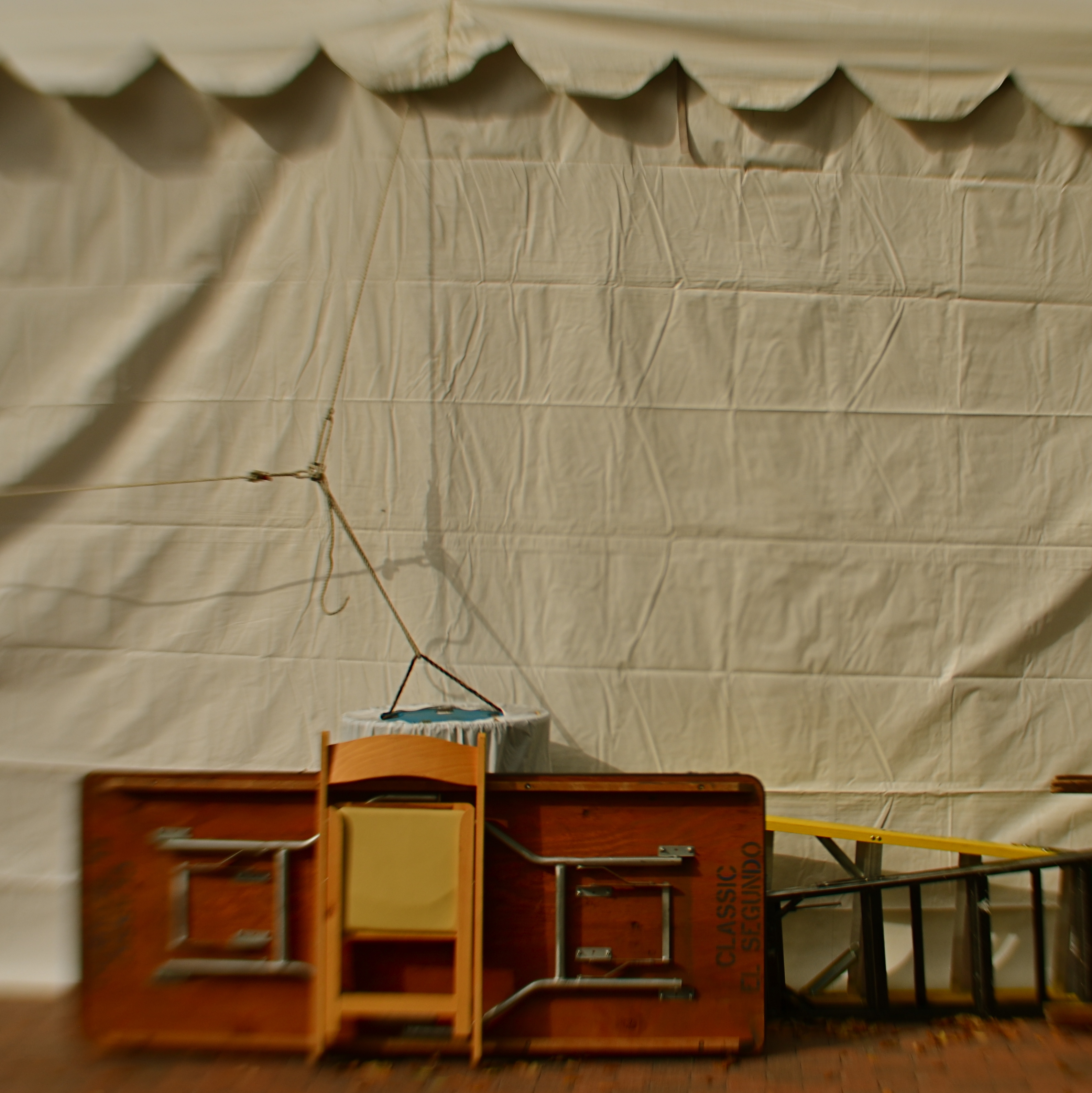
Backstage, 2018. 1/400 sec., f/5.6, ISO 100, 35mm
So the number of “decisive moments” for an event, for me, would number about three. Think of them as acts in a play, each act performing a distinct element in a dramatic story. Act One shows things that are about to happen: a nearly blooming blossom: the minutes before street lights are turned on for the evening. Act Two depicts something that is in the process of occurring: candles on a cake being blown out: a pistol shot. And Act Three shows where things have now completed. A concert crowd leaves the theatre: a dog snoozes after a long day of play.
The image seen here can potentially be an example of any of the three acts. Are the backstage props being spread out in anticipation of a show? Is the performance, unseen from this angle, being given right now? Or have the stage hands already begun to strike the tents and gather everything up before moving the players on to the next town? All three interpretations are of specific places in time. And all can be “decisive moments” when the right bond between photographer and viewer is established.
A SUPERIOR DAY
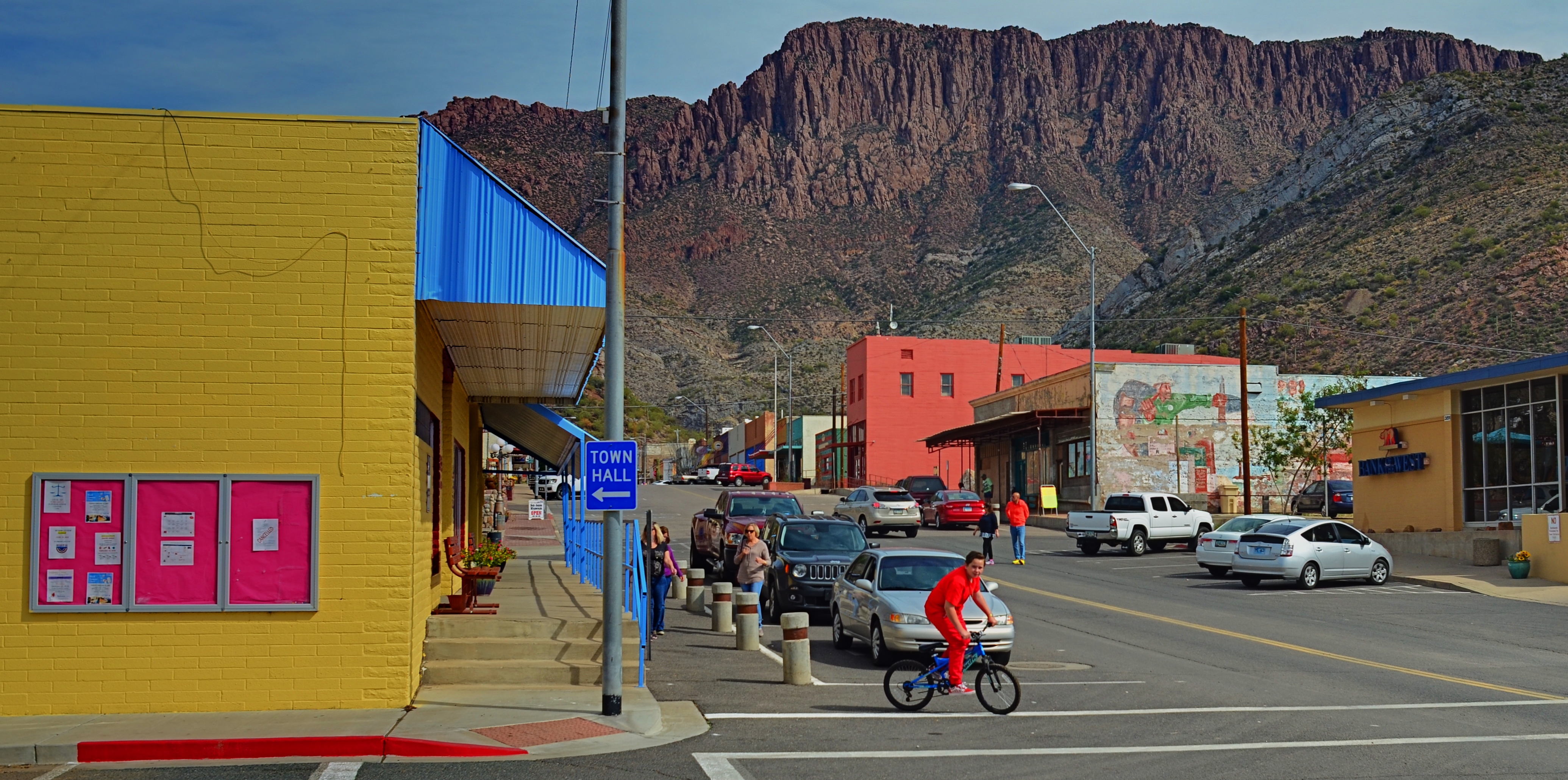
Downtown Superior, Arizona, February, 2018
By MICHAEL PERKINS
LIKE MANY TOWNS in the American southwest, Superior, Arizona sprung up in the nineteenth century primarily to get people close to something promising that Nature had already parked in the local dirt. So long as that something gushed up, flashed in a prospector’s pan or helped light or heat something, the towns flourished….. boomed, as the term goes.
Until they didn’t.
In the case of Superior (2010 census population 2,837), the silver that anchored the locals to the grim crags of the Superstitions mountain range tumbled in value when the metal lost its status as the backing for the American dollar in 1893. Fortunately, Superior had a second act, rebounding with the discovery of copper in the same area where silver had been mined. And then, of course, Hollywood came calling, seeking a visual taste of the Real Old West. Superior rose yet again, standing in for yesteryear in the films How The West Was Won, Blind Justice, and The Gauntlet, among many others. And the beat goes on; as recently as the 1990’s, yet another copper mining company hooked Superior up to yet one more source of life support. And how’s your hometown?
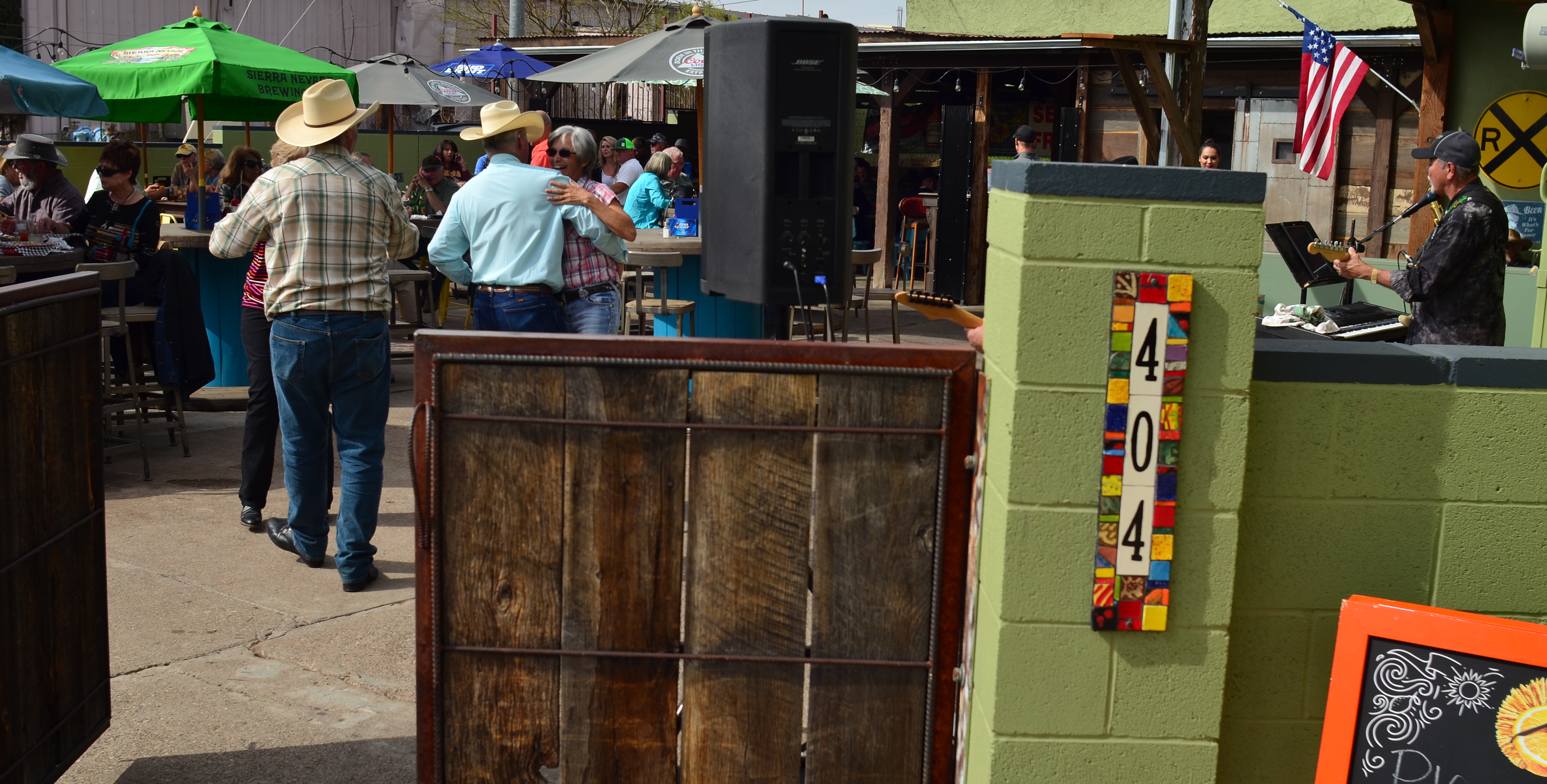
Saturday afternoon in Superior: everyone dance.
Even so, a photographer looking to take Superior’s pulse in the twenty-teens is well advised to look a little deeper than the shopworn storefronts of the main street, heavy with thrift shops and antique stores but also alive with hot pastels and the twang of Saturday afternoon dance music, complete with Stetsons and cold longnecks. The town is rusty and dusty down to its toenails, pressed up against gritty stone peaks, but it is still brave at the corners of its mouth. As a place that is “a fur piece” from Phoenix and a hoot and a holler from Globe, Superior is more mile marker than actual destination, but it is still standing, still smiling for the camera.
And, who knows, things could change.
They always have before….
CHECK THOSE ABS
By MICHAEL PERKINS
IT SEEMS ODD to hear someone refer to part of their photographic output as “abstract”…..as if the rest of their work somehow isn’t. I guess it depends on what you believe the word ” abstract” means, as well as what is meant by other words like, say, “reality”. For me , the whole discussion seems overthought. To my mind, all photography, all art is “abstract”.
 To abstract something is to extract it from its original context, to re-frame it, take it from one form and paste it into another. And there is no way not to do that with a photograph. We don’t show reality. We show shards, fragments, selectively sliced slivers of time. Even if we take great care to take a no-frills, documentary approach to the recording of an image, once we click the shutter, we have abstracted that moment from reality, making an editorial choice to pluck away this instant versus all others.
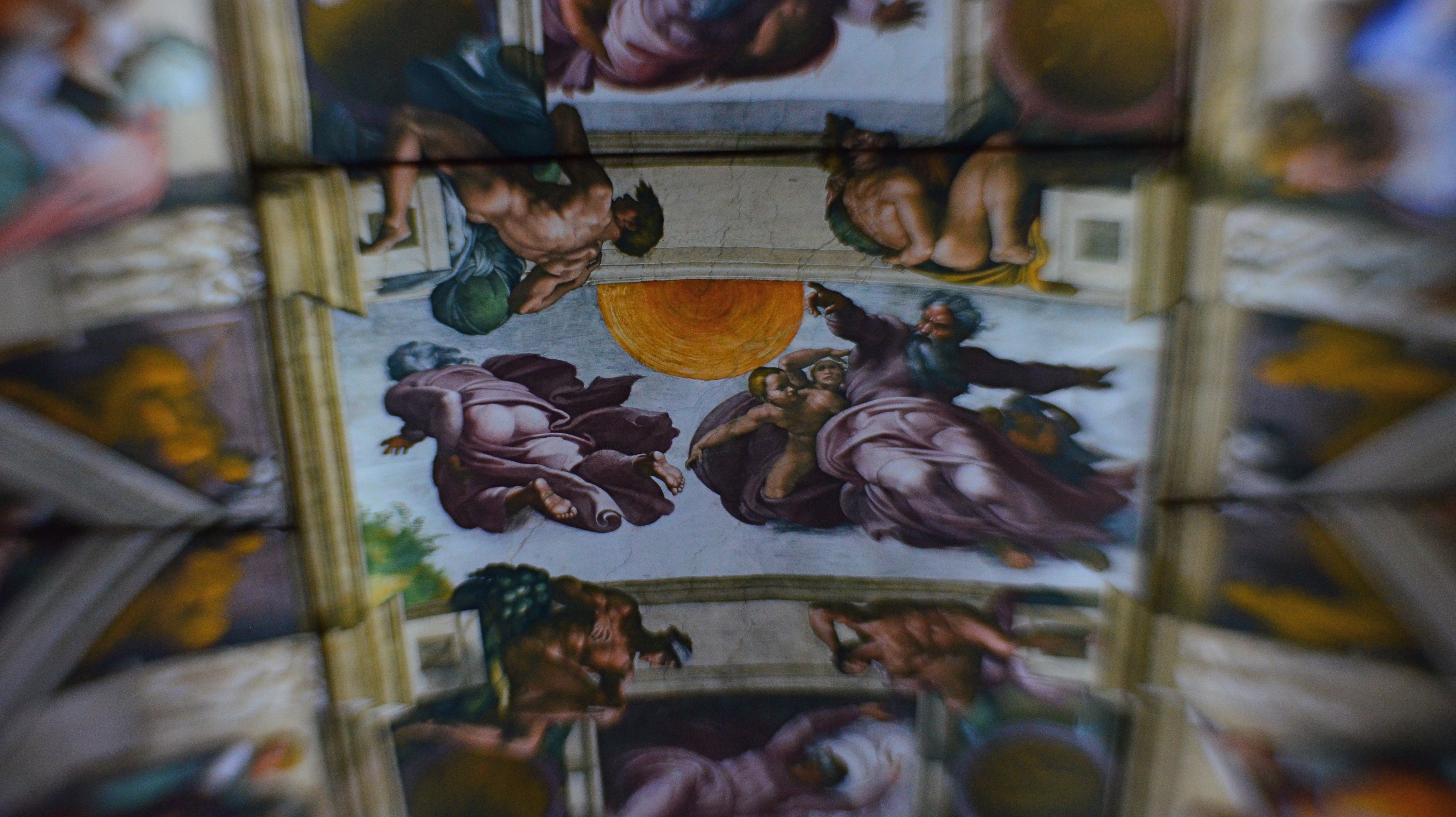
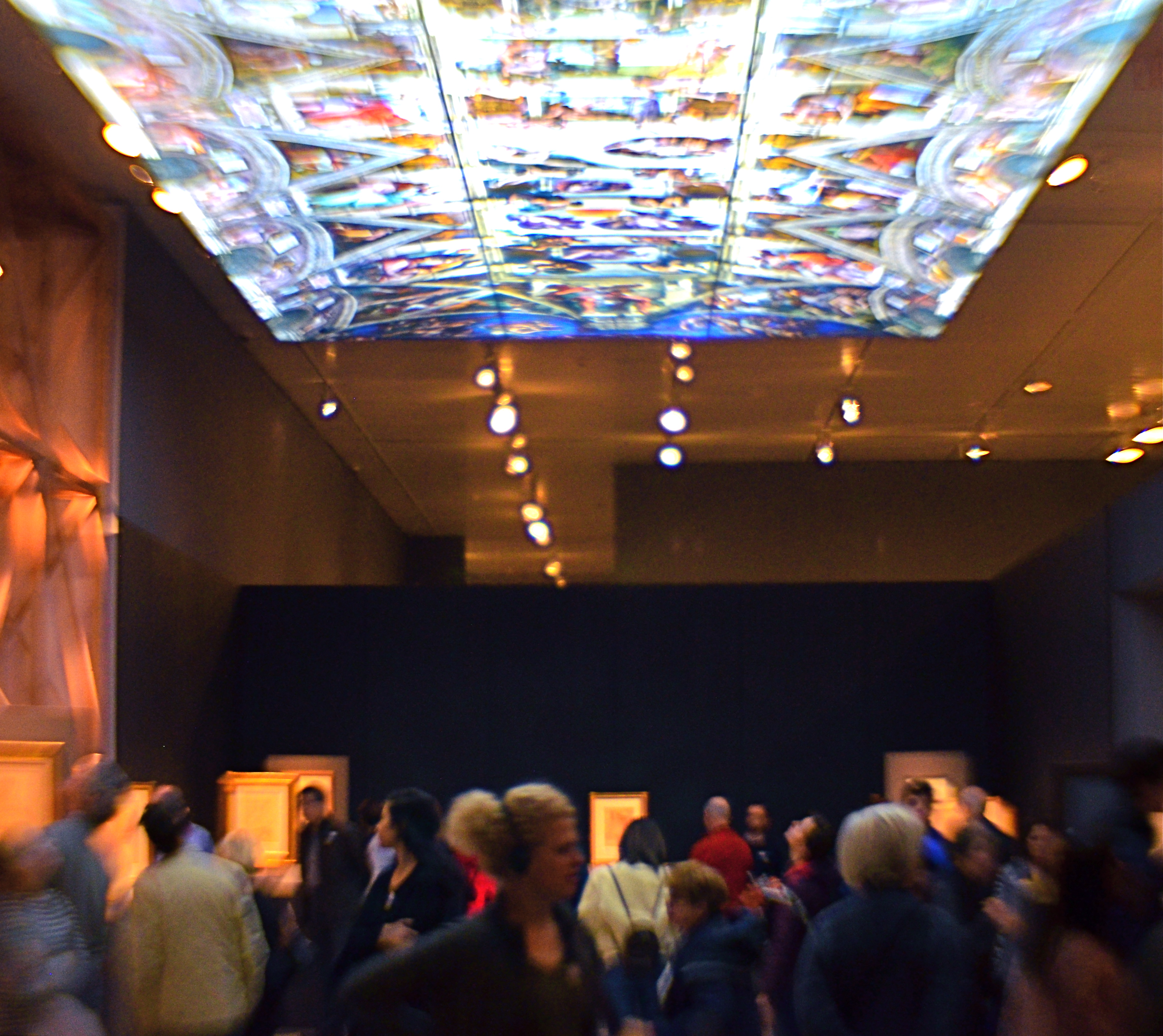
One way to illustrate this process is to consider the image at the top of the page, which represents a virtually endless chain of abstraction. Thinking backwards from this photo of a museum exhibit:
In the beginning, God creates man, an abstraction of himself. Then Michelangelo creates an abstraction of God (and a lot of other Biblical superstars) by depicting Him in the act of creation, even as he (the painter) is also abstracting representations of the Creator’s creatures. Centuries later, art historians take selective pictures of Michelangelo’s massive abstractions on the ceiling of the Sistine Chapel, abstracting them further by using selected excerpts as book illustrations. Inspired by those books, curators in Manhattan create an exhibit honoring Michelangelo’s ceiling by reproducing it as a miniature, assembling a replica composed of dozens of backlit transparencies suspended over guests at the Metropolitan museum in an artificial abstraction of the original Sistine frescoes. Finally, using a selective-focus art lens in 2017, I abstract those same guests to blobby smears of color and make editorial choices about which single panel in the faux-ceiling exhibit to shoot in sharp focus, thus hinting that it’s somehow more important than all the others.
Photographs snatch away parts of the real. To use a camera is to abstract that reality. Every snap of the shutter is a calculation of choice. Therefore choose wisely.
 thenormaleye
BRIGHTER IS BETTER
By MICHAEL PERKINS
JUST BECAUSE SOMETHING IS GLIB OR SIMPLE doesn’t mean it’s not true. We tire of people’s pet platitudes because saying things like “get a good night’s sleep” or “honesty is the best policy” seems too easy, as if the wisdom contained in these time-worn axioms must have dried up years ago. So when I tell you something extremely “well, duh!” about photography, it won’t sound wise or profound. It will sound like something any simpleton knows. Obvious. Goes without saying. And yet..
So, here’s my one immutable truth about making pictures:
Get enough light, and you will have solved 99% of any problems that bedevil your photos.
There’ll be a brief pause here for the crowd to collectively roll its eyes.
And before we proceed further, I’m speaking primarily of natural, organic, comes-through-the-window-like-God’s-gift-to-the-world light. Most of what you do with artificial light has to do with compensating and correcting for the fundamental wrongness of the stuff. Yes, I know you have an incredible flash set-up. I don’t care.
Buy the most voraciously light–hungry lenses you can afford.
Light is the only factor in photography that determines the efficacy of every other factor. Every major advancement in the design of lenses, recording media, and camera mechanics has been made for the sole purpose of gathering and utilizing more of it. Light alone can control how a subject is modeled, highlighted, presented. Get enough of it, and you shoot faster and simpler. Learn to shape it and you also learn how to create drama, to compose, to characterize things in precisely the way your mind has visualized them.
Light controls texture. It makes a shot either muted or loud. It can create the sensation of any moment of the day or night. It directs the eye. It makes bad lenses better and good lenses great. And, speaking of lenses, the best money you can spend on any lens, anywhere, is on how fast, how light-hungry it is. All other functions of high-tech optics aren’t worth a bucket of spit if the things can’t deliver lots of light in a hurry. Forget about chromatic aberration, vignetting and all the other headaches associated with glass: get enough light and you’re halfway home.
Most importantly, light is the only element in photography that is literally its own subject. A wonderful image can be of light, about light, because of light. So before you get good at anything else in the making of pictures, learn to gather light efficiently, mold it to your will, and serve it. Every other boat in your optical harbor will be lifted in the process.
Share this:
March 12, 2018 | Categories: Available Light, Commentary, Lenses | Tags: Fast lenses, iso | 1 Comment