THE KEEPER OF THE LIST
By MICHAEL PERKINS
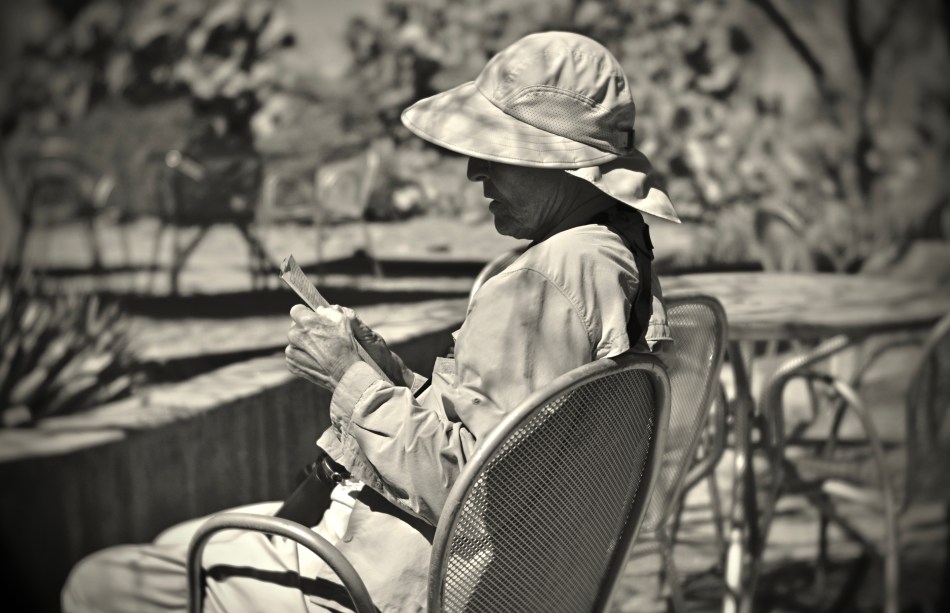
IN ALL THE YEARS I HAVE WATCHED HER PRESIDE over hundreds of both seasoned and starter birdwatchers in the Arizona desert, I can’t recall ever having seen Andree Tardy without her signature We Are Serious About This Stuff sunhat and her loose khaki fatigues. Chances are that if I were ever to bump into her in “civvies” at the local Safeway, I might easily pass her without notice, even though, by now, she has served for years as our group’s go-to Earth Mother, an empirical and encyclopedic source of information on Which Birds Breed With Who, how their plumage changes with the seasons, why the immatures are less resplendent than the adults, and how you can distinguish a “Too-Whit-To-Whoo” from a “Wit-Wit-Wit-Too-Too”. Because she is just that good.
“Okay, did anyone see any vermillion flycatchers?”
I mention Andree’s all-season costume because, for us, it is inextricable from her physical form, the “plumage” by which we identify her “behaviors”. Tough as a turtle’s toenail and consumed with a passion that defies the damage of time, she is, at 81, hardier than many of the sex-and-septuagenarians that trail behind her like lost chicks. That bottomless supply of energy is fed by an insatiable hunger to know more, to see what’s around yet another corner, and the corner after that. I have shot dozens of candids of her over the past twenty years, but I find that minimal images of her in full birders’ regalia registers even higher than a mere facial portrait. She just is the sumtotal of all her outer contours. from her fingerless gloves (easier to work binoculars with) to the billowy slacks that protect her from the scars and scrapes of desert plants to the headgear that all but obscures the aquiline angularity of her face. I can’t imagine making a picture of just her face. It would somehow seem incomplete, like Schweitzer without a pith helmet or Superman without the cape.
The other object that is constantly with her is only withdrawn at the end of bird walks, but is as crucial as every other component in her makeup: The List. Andree’s lifetime role as teacher, interpreter, guide and dauntless ornithological doyenne demands that, at the end of the day’s spotting, she, and she alone call out the categories and species, the better to officially tally the count of what, to a certainly, was actually seen. She knows she can count on us all to honorably report our individual sightings; after all, birding, unlike fishing or hunting, is a system built on honor, along with a proper Hippocratic pimch of “do no harm”. Anyone can teach someone else about birds, but The Lady Herself also teaches respect, humility, responsibility. The birds, and all who choose to watch them alongside her, could not be in better hands.
THE DEVIL’S IN…
BY MICHAEL PERKINS
A GAME OF INCHES
By MICHAEL PERKINS
TO BEGIN WITH, EVER SINCE THE INSTANT I TOOK THIS PICTURE, I have wondered if I had the right to.
The all-invading eye of the camera should be tempered at times by our awareness that it allows us to look in places that perhaps should remain beyond our discovery….that, having seen a thing via these miraculous machines, we cannot ever un-see them. This feeling has accompanied the most recent images I’ve made of my parents, both now in their nineties, both unsteadily Pulling Into The Station, so to speak. Their every day is a high-wire act that vibrates between desire and risk, between the drive to do what they once did so effortlessly and the daunting dilemma posed by trying to do, well, anything. They are playing a reverse game of inches.
I want to stop what time is still left. I want to lean on the camera’s reliable value as a recorder. I want just. one. more. memory. And yet, in chronicling the ever-tougher track of their days, I am aware that no single frame will convey what I’m seeing, or can ever sum up a near century of living, striving, failing, loving, dreaming. And so I keep making pictures, pictures that will always come up short, even as they are increasingly precious.
I can often feel as if I’m violating a trust, making these images.
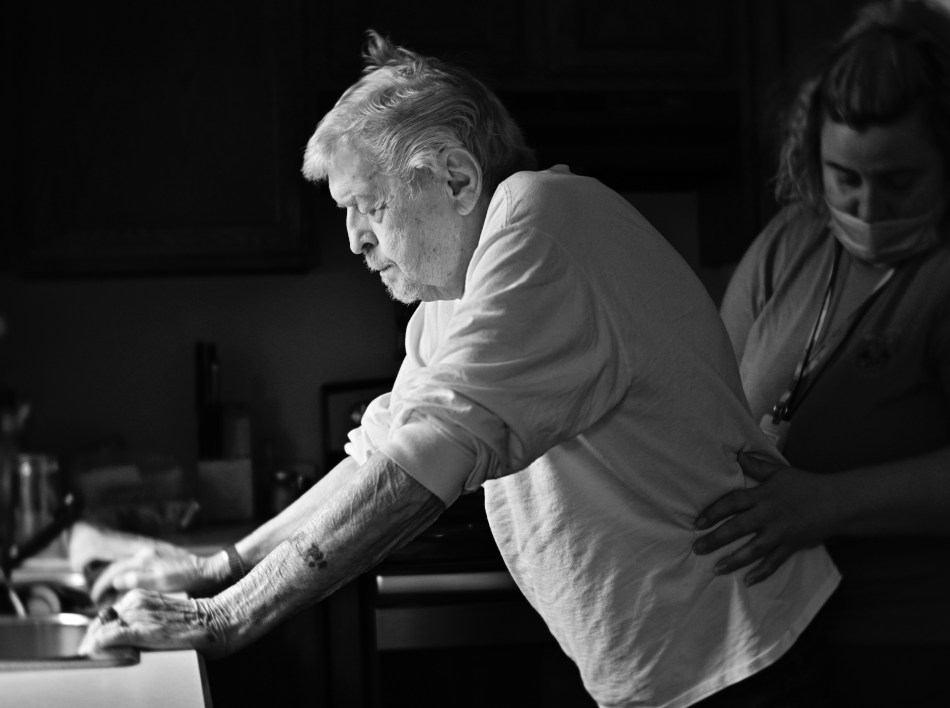
The one you see here is of a very ordinary thing; my father, at ninety-three, doing his weekly physical therapy session. He needs it to shore up his strength, protect his muscles against atrophy, improve his balance. Beyond that, he needs for his body to have something achievable to reach for, just as his still-acute mind is still stretching to embrace ever-new concepts and projects. His focus in these sessions is determined, but not angry; he knows how much has been taken from him and my mother, but his emphasis is not on regret, but instead on squeezing the juice of opportunity out of every instant of time he has left to him. Me, I have to force myself to photograph this all as dispassionately as I can, since it’s me, not him, that is mad, that indulges in self-pity. But that’s my parents; gaping into the chasm, they are still turning back toward me, the everlasting upstart student, as if to say, watch carefully; this is how it’s done.
This morning, driving around my neighborhood and mentally sketching a layout for this post, I asked Siri to play a song that, for me, has gained additional poignancy over my lifetime, Carly Simon’s “Anticipation”, knowing full well that I would be sobbing by the end of it. Still, in the context of where I and my parents are at the moment, I also knew it would leave me feeling, in some amazing way, grateful for its wisdom:
And tomorrow we might not be togetherI’m no prophet and I don’t know nature’s waysSo I’ll try and see into your eyes right nowAnd stay right here ’cause these are the good old days
THE RIGHT-HAND BRACKET
By MICHAEL PERKINS
SOME OF THE MOST HISTORICALLY ESSENTIAL IMAGES from photography’s first decades were created without much public awareness of their authors, as many of the art’s earliest practictioners labored unsung and uncelebrated. In painting, drawing, poetry or literature, tracing the creators of the great works of the 1800’s has proven far easier than crediting those who made the first world’s first immortal photographs. The feeling that the world could, should be documented far preceded the notion that individual voices in that historical work should receive their due.
In some ways, the American Civil War served as the launchpad for the first photographers to be personally recognized and marketed as a “brand”. At the beginning of the conflict, only Matthew Brady, who operated the first true professional studio out of New York, was anything like a household name to the general public, with the illuminati of the Victorian age beating a path to his door for their moment of immortality. Once war broke out, Brady exported his fame by dispatching several wagons of mobile darkrooms across the country, documenting the North/South carnage in a way that had never before been attempted anywhere on earth.
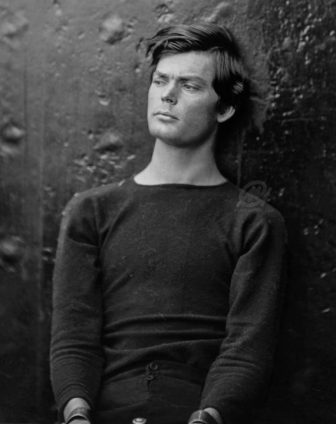
It was inevitable that at least a few members of the army whose war images were universally credited as “photo by Brady” would aspire to emerge from their anonymity, and one of the first such to succeed in going solo was Alexander Gardner, a Scottish immigrant who, like Brady, had initially distinguished himself chiefly as a portraitist. In one of history’s great in-your-lap twists, Gardner landed one of the grimmest photographic assignments of the 19th Century when, at the war’s end, he was chosen to create portraits of the conspirators who had aided John Wilkes Booth in murdering Abraham Lincoln.
Visiting the prisoners (including Lewis Powell, above) in their cells, Gardner snapped images that can strike the modern viewer as remarkably informal and candid, even contemporary in their aspect. And then, within days, he suddenly reverted back to his wartime role as a pure chronicler, assigned to document the plotters’ executions. His before-and-after series of the hangings, gruesome as they were, were also, for a grieving nation bent on revenge, in high demand, marketed on post cards, magazine covers, photo-derived lithographs and even glass slides for magic lantern projectors. Matthew Brady may well have provided the left-hand bookend for a national tragedy, but Alexander Gardner provided the right-hand one. And in between those brackets, the art of photography was changed forever.
OUT OF HIS SLEEVE
By MICHAEL PERKINS
THE TRUEST TEST OF ANY GREAT ART is endurance over time. We’re not talking the mere ability of the work to survive physically, through preservation or curation; just managing to not crumble into dust is not a major accomplishment. No, the real proof lies in the time-travel property of art’s intention or vision, the ease with which it leap-frogs eras to give new audiences a glimpse of what sparked its original creation. Things last because they continue to relate.
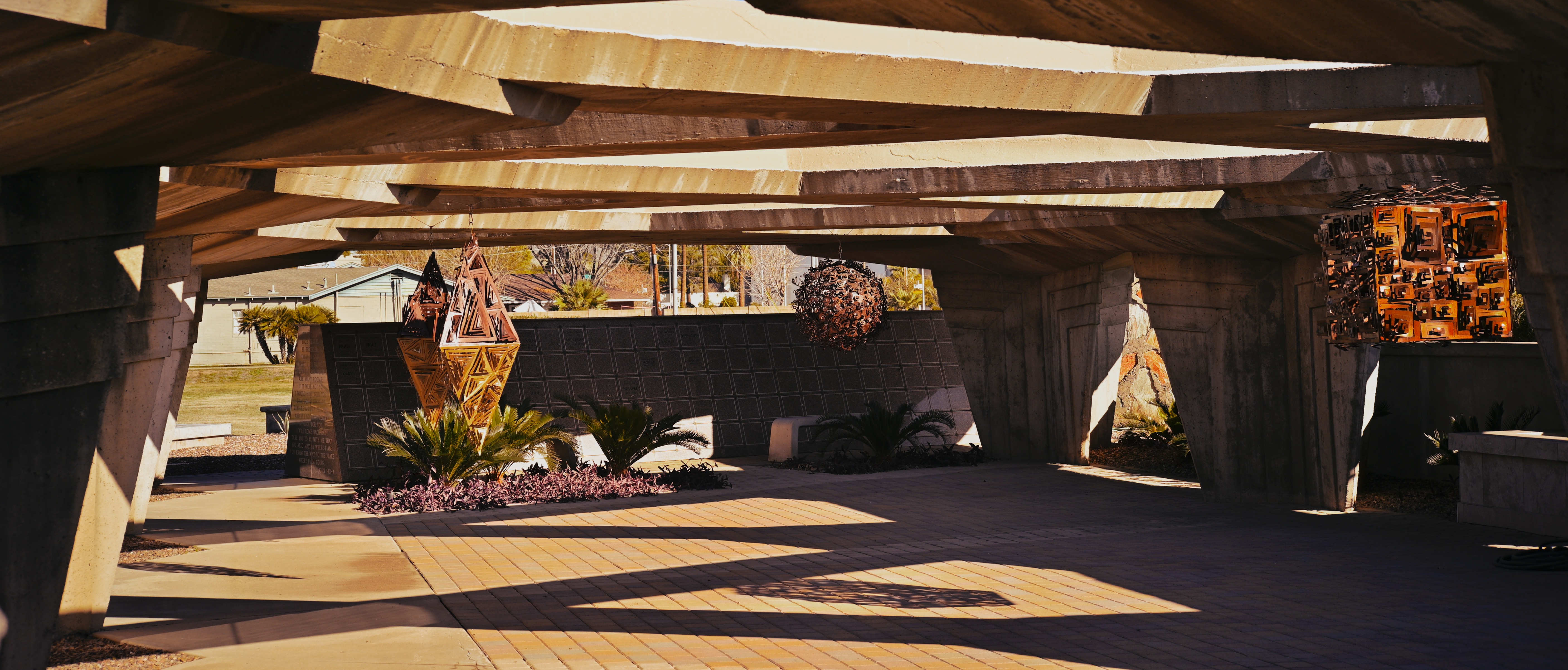
In my personal case, one of the joys of photography has been in trying to use my own limited powers of interpretation to view lasting works of art and try to see something fresh in even the most famous among them. One of my chief targets in this joyrney is the work of Frank Lloyd Wright, designs that continue to turn a fresh face to each succeeding generation and thus invite re-evaluation.
This is especially true of Wright’s lesser-known projects, some created in his ’90’s, when he told Mike Wallace that, however many more years he might live, he could just “keep shaking them out of my shirtsleeve.” Indeed, at his death in 1959, dozens of his designs remained unbuilt, such as this side court on a church whose blueprints were purchased from the Wright Foundation by a Phoenix congregation decades after his passing. Unlike his superstar signature pieces, this quiet structure has not been photographed to death, allowing both viewer and shooter a fairly blank slate on which to inscribe whatever impressions they choose.
Art bounds across time to delight us anew because we find our own age’s reasons for loving it. Photography is a vital tool in this quest to see established works from a new angle, in a new light, offering fresh messages.
THE WOMAN WITH THE WALKING STICK
By MICHAEL PERKINS

IF “LIFE” IS DEFINED AS THE STUFF THAT HAPPENS while you’re making plans, Photography can be said to be comprised of the pictures that emerge while you’re planning other pictures. We have all begun setting up what we hope will be the ideal frame when something from just offstage screams, “hey, look over here.” Success and failure, then, are often measured by how insistent them strange little voices can be.
In the astringent desert vistas of Arizona’s Tonto National Forest, merely the shock of color generated by a late-winter “superbloom” of Mexican poppies would normally be all the visual fuel needed for a luscious landscape. And, just ahead of this shot, things certainly started out that way.
And then I saw Her.
Just a solo woman with a walking stick. Just one small figure with a determined stride, separating from the roadside throngs of thrilled snappers wading through the golden waves of flowers and striking out on her own to head….where? Her actual destination was unimportant; more importantly, her very position in my viewfinder had given an “okay” scene a stronger central axis.
Walking along a wire fence, she reinforced its receding line, pulling the viewer’s eye into the picture and toward her. Her separation from the parallel highway and the distant mountains established scale. And finally, showing a scattered field of poppies provided more contrast and texture than the unbroken blankets of them available just across the road.
Start with one plan, shift gently to a slightly different one. Think them both through and make a deliberate choice. In an art that strives to be less about taking pictures and more about making them, challenging your first instincts is a habit worth cultivating.
TEST (OR MOEBIUS) STRIP
BY MICHAEL PERKINS
SOME IMAGES ARE THE FINAL DESTINATION for a concept, while others are only the launch pad for one. For most of its first century, photography was, at least for non-professionals, a sort of “straight out of the camera” proposition. You calculated, aimed and clicked, and what you got was, for all intents and purposes, your final product. Sweetening and manipulation was for the elite.
Now, tech has conferred the gift of boundless tweakery on everyone, meaning that a photo is not “done” unless we are completely through fiddling with it. Artistically speaking, this removes all barriers to, or alibis for, unsatisfactory results. It’s both empowering and intimidating, as it means that photogs, and not cruel fate, are ultimately responsible for the final version of a picture.
Witness the steps in the gestation of a photo that many of us already see as a somewhat average process:
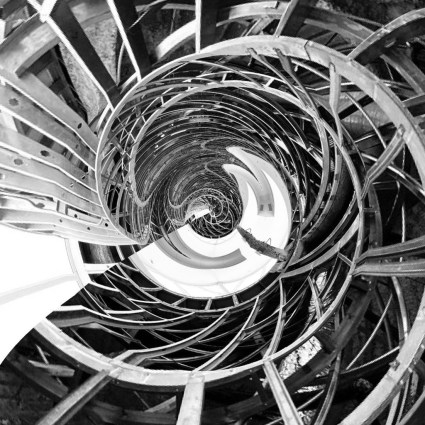
The image seen here began life as a phone snap of the ceiling understructure inside a mall that had been stripped to the bones ahead of a restoration. After the initial snap, I cropped out the lower retail storefronts, leaving me with a mere patterns of girders and supports. I then coverted it to mono, ran it through an app that created a mirror image of one half of the pattern, and finally used a “mini-planet” platform that transformed it into a spiral. And I still may not be finished.
The sheer giddy joy of having this amount of freedom is far more important than what I myself choose to do with it. The main takeaway is that, for all photographers everywhere, the training wheels are truly off the bike. It’s an amazing time.
SECOND SIGHT
By MICHAEL PERKINS
FOR ME, ONE PREDICTABLE TAKEAWAY FROM THE RECENT PLAGUE YEARS has been a forced re-ordering of my priorities and pleasures as a photographer. Quite simply, the conditions imposed by a need for caution and patience have not only made me see differently, they have altered what it is that I look for in the first place. Any time you change the number of places you can go, or reduce the total number of things you can get near enough to photograph, your pictures will automatically be re-shaped.
In my own case, the isolation imposed by The Great Hibernation moved me about three feet forward as a bird watcher.
My wife and I had already been settling into the division of labor seen in many birding couples, in which one partner spots ’em and the other shoots ’em. This is totally logical since I am not even ready for the Rank Amateur Semi-finals when it comes to identification, and makes even more sense since Marian would rather experience the birds in the moment, through binoculars, than worry about “capturing” them. The result is that I learn how to slow down and learn something before I shoot, and she gets the souvenirs at the end of the day. Happiness all around.

A checked box on my wife’s birding “life list”; a flock of Cedar Waxwings convenes in Tempe, Arizona, 2023
This year afforded us an exercise in patience that, frankly, I might have muffed just a while ago, in that we spent weeks searching for the same avian pot of gold, with lots of frustration and near misses along the way. Colder, wetter winter weather in the higher altitudes of Arizona had created a shortfall of food for several species, forcing them down into the massive deep bowl in which the Phoenix metro sits. This in turn created a surge of one of Marian’s “life list” birds, those special rare sightings that birders truly live for. That bird, the cedar waxwing, was suddenly popping up in massive flocks everywhere, usually in the company of a throng of robins, who are no great shakes in many parts of the country, but are fairly rare around here. The affinity of the two species for each other meant that if you saw a single one of either bird, chances are you were near a major gathering of both. The hunt was on.
I relate this tale to reaffirm that, in The Before Times, I was just peripherally aware of birds, in that they were something I occasionally photographed but seldom had as my primary focus. The intervening years have changed all that, something I realized when, at the point we happened upon a motherlode of waxwings and robins surging into a local pocket park, I not only felt I had accomplished something photographically, but also that I had experienced real, unalloyed joy. My wife and her friends had finally had me in their classroom long enough to get my attention. And while I will probably never have the discipline to become a great wildlife photographer, at least I know, now, what I could be missing. And that’s a gift beyond measure.
DISSOLVE TO…..
By MICHAEL PERKINS
The world is too much with us. —Shakespeare
NO OFFENSE TO THE BARD, but, as a photographer, I find that the world, far from being “too much with us”, is perpetually dissolving, slipping away, fading into memory. That very impermanence is, of course, also one of the things that makes photographs precious, in that we are constantly documenting places that will eventually rot, burn, or fall down. And now, from the ever-loftier perch of my dotage, I can call up fat catalogues of the sites of many crucial aspects of my life, from schools to workplaces and beyond, that simply are no longer in the physical world. This change is both expected and shocking. We reluctantly accept that the old tower where you were an eager office boy must fall to the wreaking ball, but when even Notre Dame catches on fire, you realize that reality itself is standing on a banana peel.

One day’s reality is the next day’s “where did it all go?”
In these columns, we often lament not merely the pictures that were made “wrong”, but, more importantly, the ones that were never made at all. Even with the crushing daily input of millions of images made possible by the digital revolution, we still miss shots, and, with them, the chance to preserve memory. With thousands of clicks in our shutter counts, we still finish every day slapping ourselves for the one thing we meant to snap but didn’t. This is made trickier by the fact that we lull ourselves into believing that all the things we’ve always been around will, you you know, always be around.
Which all goes back to the master maxim: Shoot It Now.
Many of us have places that shaped us in some way that we’d love to tour just once more before they are condemned or collapsed into ash. Sometimes we make the pilgrimage; sometimes we are too late. Often, sadly, a thing is gone long before our artist’s eye will have formed a fitting way to pay homage to it. The business of photography is thus a high-wire act between salvage and loss, a yin/yang struggle that can never be resolved. Our art represents both our gratitude at saving some things and our regret at not being able to save it all.
FREE RANGE
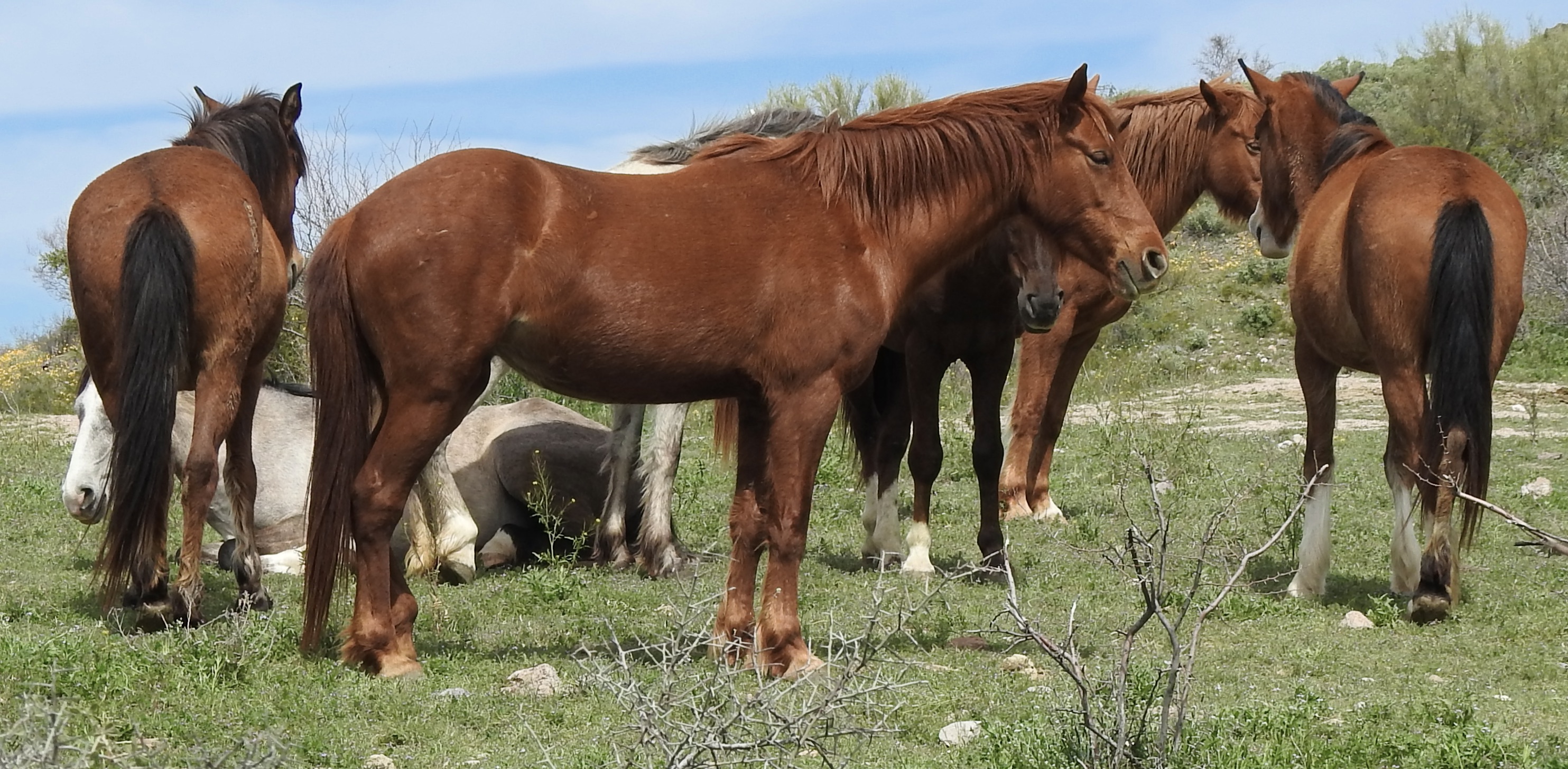
Wild Mustangs graze in an eastern section of Arizona’s Tonto National Forest.
By MICHAEL PERKINS
HUMANS, ALL TOO OFTEN, ARE PATHETICALLY INEPT AT VIEWING THE NATURAL WORLD through any lens of experience outside their own. We define things as being relevant or irrelevant relative only to our own needs, operating under the idea that the whole works is somehow put here for us. The wider universe of breathing, thriving, feeling things only becomes visible when it crosses over into the realm of our wants, our concerns. We are predictably, often fatally, clueless about life except as it pertains to us; we act as if someone left us in charge.
Obviously, this affects the kind of photographs we make of our interaction with nature. But seeing nature only on our terms shapes the images that we seek, providing only a narrow frame of reference. How to make a picture of something that we barely apprehend? How to capture the essence of a thing that strikes us as exotic, even alien?
Acting yesterday on a tip as to the whereabouts of a sizable herd of wild mustangs in the part of the Tonto National Forest near Fountain Hills, Arizona, I found myself, like all the other travelers pulling off to the side of the Old Bush Highway, struggling to apprehend the existence of a horse stripped of any connection with man. These gorgeous animals would never know the sting of a bit between their teeth, never wince from the pain of a branding iron, never labor under the weight of a rider or the cinched constriction of a saddle. That is, they would live their entire life as horses among other horses, with no thought of any other life or task beyond just being a horse. They looked like the “nature” we thought we had seen a thousand times, and yet they lived in a world defined by their priorities, not ours.
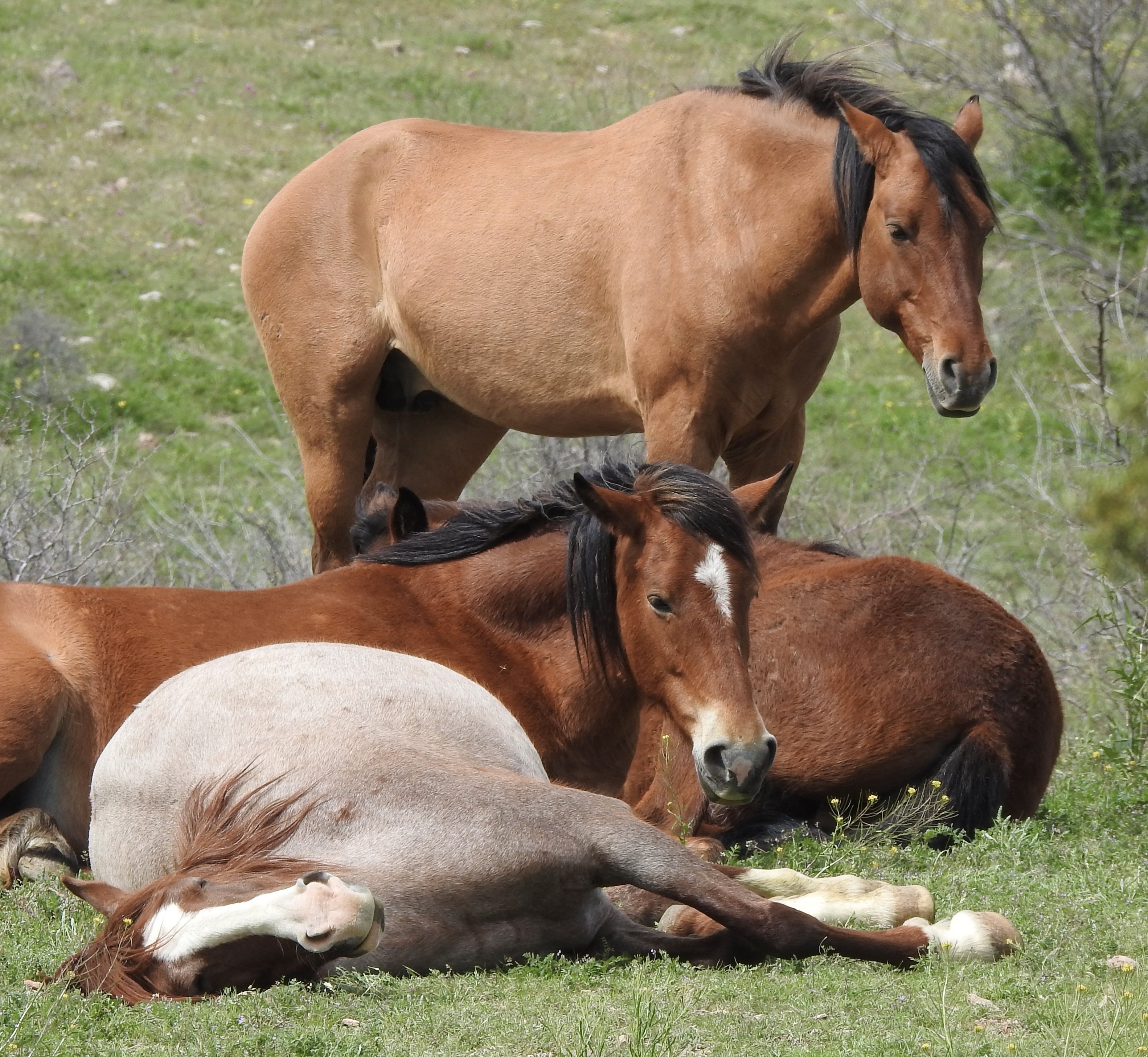
Guides in the area were on constant alert to make sure that we gawkers maintained a respectful distance, lest our presence violate the terms of the very special audience we were being granted, with most of the horses within fifty feet from their visitors. Some interpreted this as a way to safeguard our safety, but I chose to believe that it was they who needed protection from us. Our smells and sounds; our energy, our intrusive humanness. For one of the only times in our lives, we were in the presence of something innocent, something raw, unrefined. Unmolested. The wise thing was to remind ourselves that we were guests, not masters, awed children, not cowboys. Here was a chance to slow down and learn something.
Taking pictures of the natural world is never a single, simple thing. Many of the problems we have created for this tired old planet stem from the fact that we are increasingly estranged from most of the beings that we share the Earth with. Too often, we spurn true partnership between our realities and those of other creatures. How can our cameras be trained to tell the truth when we still know so little of what that truth looks like?
A SENSE OF PLACE
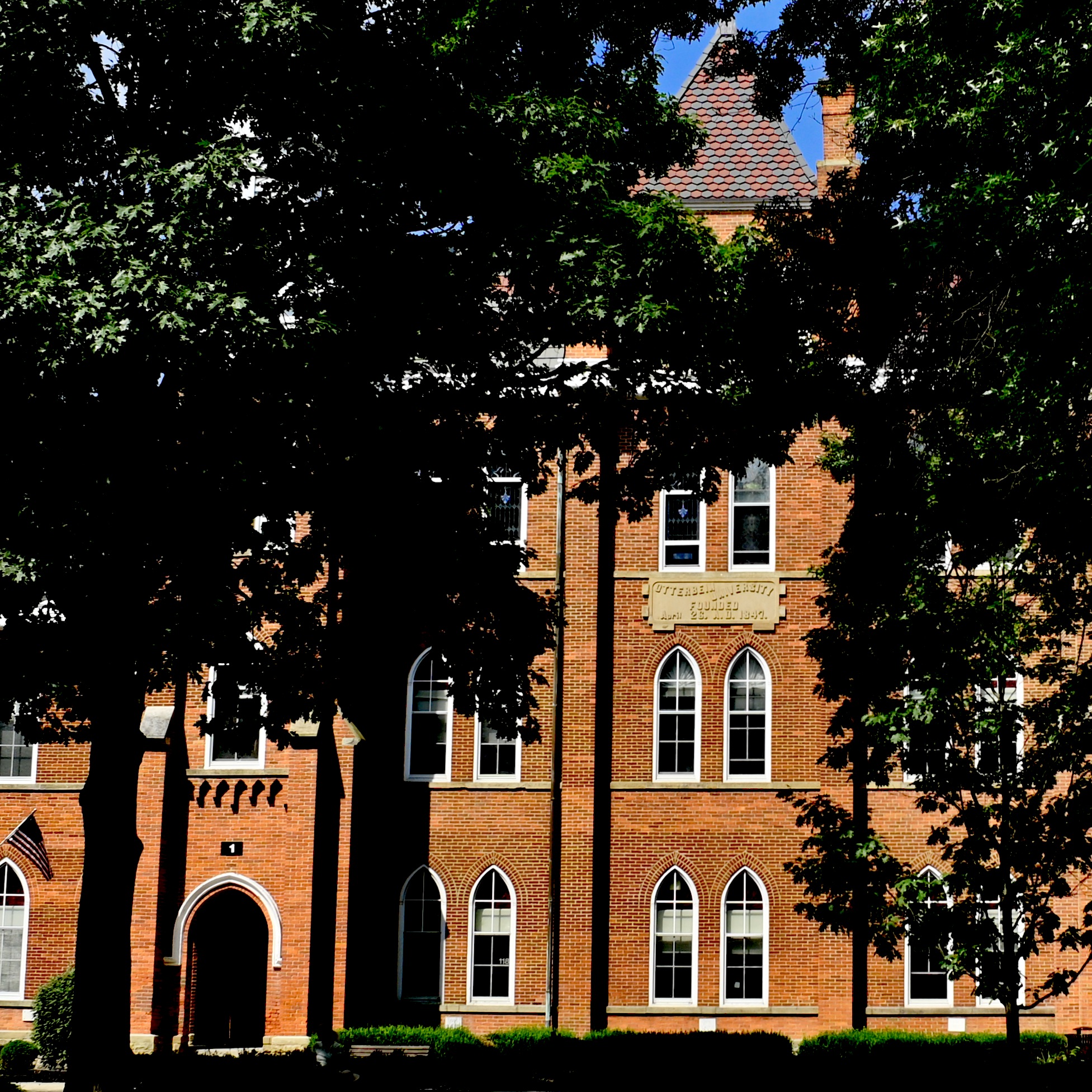
A strait-laced institution dictates a straitlaced, technically simple interpretation.
By MICHAEL PERKINS
WHENEVER I MAKE A PICTURE OF A BUILDING, any building, I have an intention in mind for it, a definite way I want it to be presented, and so am faced with much the same choices I might exercise in the making of a portrait. My choice of exposure or composition has to be deliberately designed, as that is where all comment on the building’s age, features, provenance, or context is based. This means that every time I shoot a site, there has to be an active discussion in my head on every aspect of lighting, texture, color. Buildings, for me, are never mere background. Indeed, properly seen, they often speak louder than the people passing in front of them.
One of the biggest decisions in this process is how photographically representational I want to present the structure. Sharp lenses, for example, convey a kind of straightforward, documentarian approach. Brick looks like brick. Reflections in windows are simple, without capturing stray information from neighboring activity. Colors are natural. Definition is clear and clinical. That’s one way to show the building, and choosing that way means purposefully choosing the glass I’ll use to shoot it.
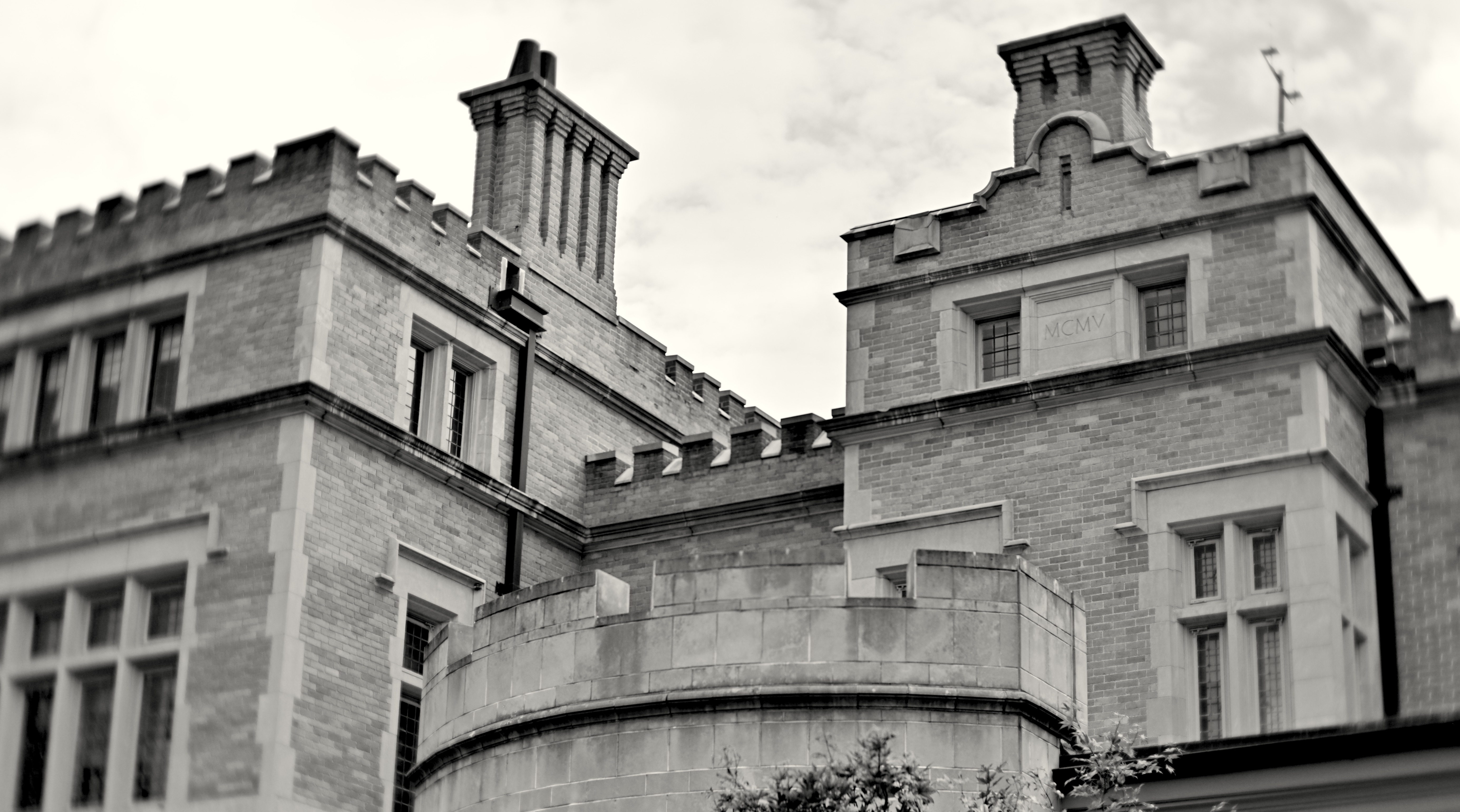
A former robber baron’s estate, now a historical park, may be better seen with a softer lens.
Recently, I have also re-acquainted myself with the look of soft or selective focus lenses, which takes the depiction of buildings in a much gauzier, vague, even whimsical direction. You can make a place seem as if it’s part of a recurring dream. You can boost contrast and efface small details. The result strikes some as “anti-real” but, since buildings store memories as well as people and furniture, we are already imparting surreal qualities to them as they surface from our collective subconscious. Both optical approaches have their virtues.
In the top image, the college building is captured in the way we suppose that we actually see, in something of an “official” view that might comfortably adorn the school’s brochures. In the lower shot, a building nearly as old as the college is softened deliberately to evoke the fairy-castle quality that an old mansion from the early 1900’s conveys to the modern visitor. Under our gaze, the “use” of such a structure invites personal interpretation, since, as a modern-day city park, its old, specific use as a personal mansion has become unmoored. Liberated from its old associations, we are free to assign new ones, and to make images that reflect that flexibility.
Camera technology has expanded over the centuries to facilitate choice, because people are always struggling to reflect new ways of seeing. If your gear tells your story, you are one lucky kid. If it doesn’t, then it doesn’t matter a damn how accurate, or expensive, or highly rated it is. It’s a pen in your hand. Make it write the light the way you want.
TOO MUCH OF NOTHING, AND VICE VERSA
By MICHAEL PERKINS
IT WOULD BE FAIR TO ASSUME THAT MOST DEFINITIONS OF PHOTOGRAPHIC COMPOSITION refer to the total arrangement of space between objects, as well as the selection of what goes into, or stays out of, the frame. This can include objects like furniture or people, even intangibles like weather, but, for the most part, what we mean when we say a shot is well composed means that the final assignment of things within the frame is either balanced or busy, correctly directing the eye to things that are compelling and steering it away from items that are extraneous. The word “composition”, then, tends to be, primarily, a thing-based term.
I would argue, however, that the consideration of value and tone is every bit as vital a consideration as where the scenery is placed. Certainly the photographer must make solid calls on where a tree or a mountain or a left-right parameter figures in a shot, but key decisions in the use of color, contrast or overall exposure are also a kind of composing. In sound terms, for example, the sheer inventory of items in a photographic frame is roughly akin to the notes on a piece of sheet music the composer decides what the total number of notes will be on the page, and whether that arrangement is sparse or dense. However, the art of “composing” requires a second dimension; the values assigned to said notes, from near-silence to fortissimo; the rests; the attacks; even what orchestrators call “color”. The same thing holds true in a photograph.
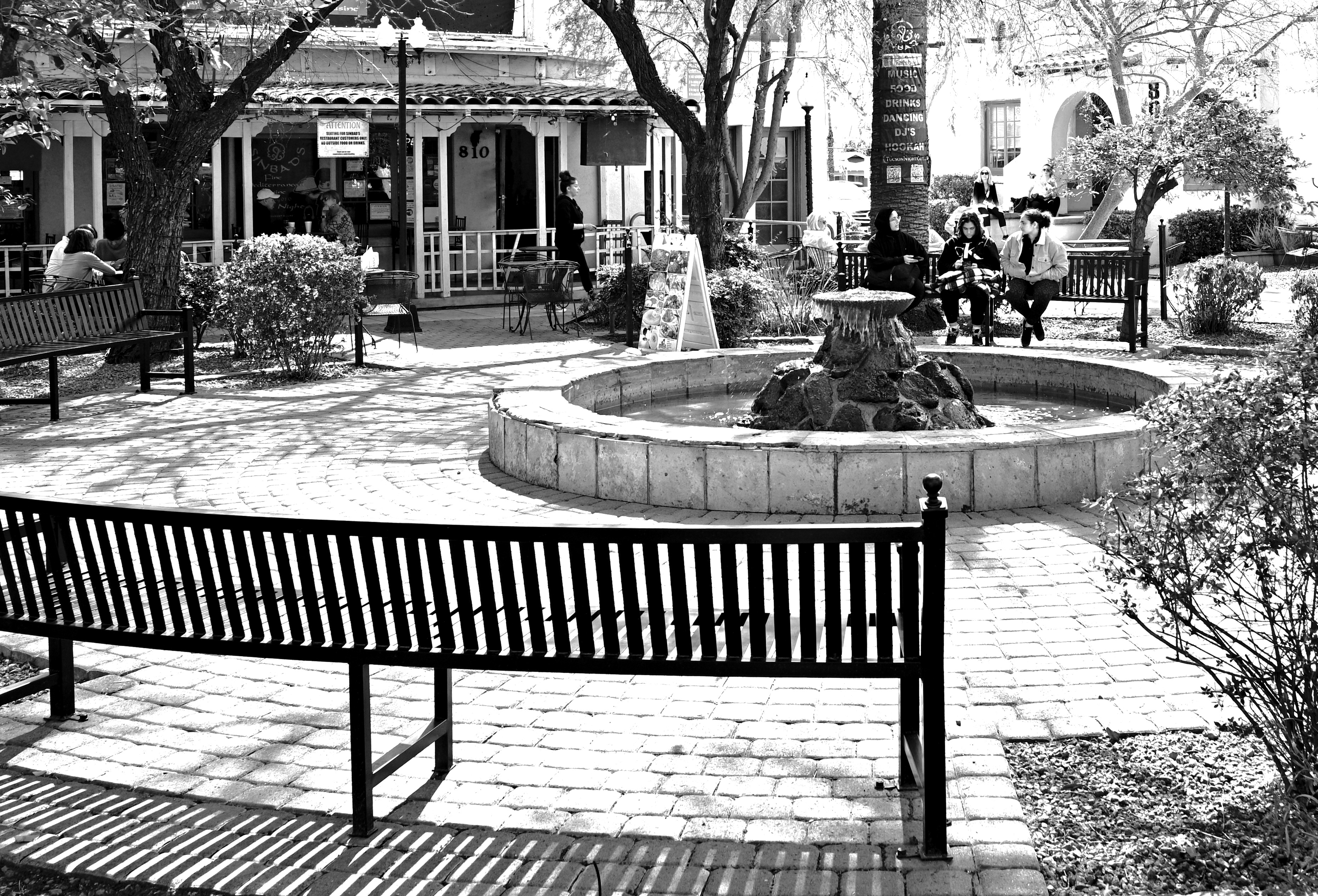
Once I have agreed what the dispersal of, let’s say, the props within a shot is to be, I still have to direct the eye in terms of how it will weigh the importance of those items in relation to each other. In the case of the above image, the choice of monochrome and a relatively high-key exposure attempts to do that. This in turn leads to other decision: for example, is the texture of every single brick important here? The grain of the stucco buildings in the background? Do I need to adjust shadows so that more information is revealed within them? In other words, the picture’s composition is affected by every choice made in its making, not merely what makes it into the frame from top to bottom or left to right. Even without cropping, I can “de-select” certain visual data, or give clues as to its relative importance. That all just goes to whatever singular formula it takes to make a picture “work.” Bob Dylan wrote of the maddening power of a life defined by “too much of nothing”, but, without either changing “something” in a picture to “nothing”, or vice versa, we are, in effect, saying that all things in the frame are equal, and, artistically speaking, we know that just isn’t true.
YOUR BRAIN IS STILL THE BOSS
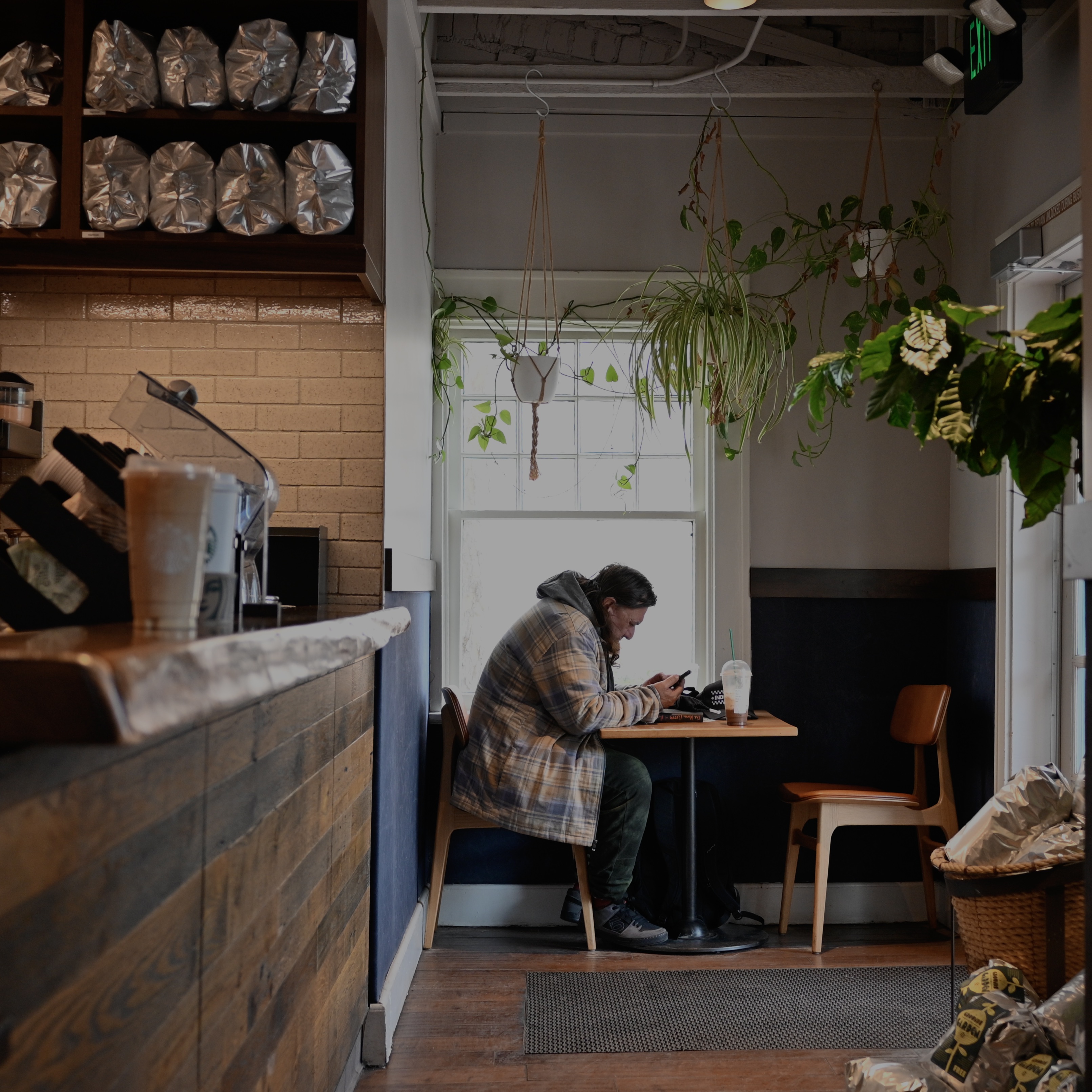
A first draft, shot on full auto: f/2.8, 1/125sec., 28mm, ISO 640
BY MICHAEL PERKINS
AT THIS WRITING THERE IS A BLIZZARD OF EDITORIAL CONTENT hitting the news services about the imminent arrival of artificial intelligence, which, according to your viewpoint, is either going to save humanity from itself or speed its obsolescence or a combination of both. Visions of 2001’s Hal 9000 setting plans to replace or murder us are making headlines and causing heartburn across all public sectors. Such trembly dispatches might seem novel to many, but, for photographers, the issue of whether we or our machines are to be the decision makers has been a regular grappling match for decades.
Technology often proceeds ahead of any true appreciation of its real benefits or risks; just ask a planet whose air was being fouled by automobiles for decades before we even started to ask, “do we really need this?” As to photography, ever since the first basic autofocus systems were introduced, cameras have steadily introduced dozens of additional features that are designed to anticipate what we will want in a picture so that it can be provided for us without our direct input. There is no reversing this trend, but the best photographers labor to keep all of it on a short leash, or, more to the point, to keep asking the question Who’s In Charge Here?
Caution: major use of quotation marks ahead.
When a camera shoots on automated modes (even partial ones like Aperture or Shutter Priority), it endeavors to create a “perfect” or “balanced” or “correct” exposure, making its best “guess” as to what you might want. But who is defining these terms, and how can they be appropriate for all the moods and motives that travel through the shooter’s mind? At best they are merely a point of departure, leading at times to, yes, a really great image that captures exactly what we imagined. At worst, they empower a device to assume what we want, creating a picture that it “reasons” will please us. This is the certain road to a tsunami of “good enough” pictures, a vast mountain of mediocrity.
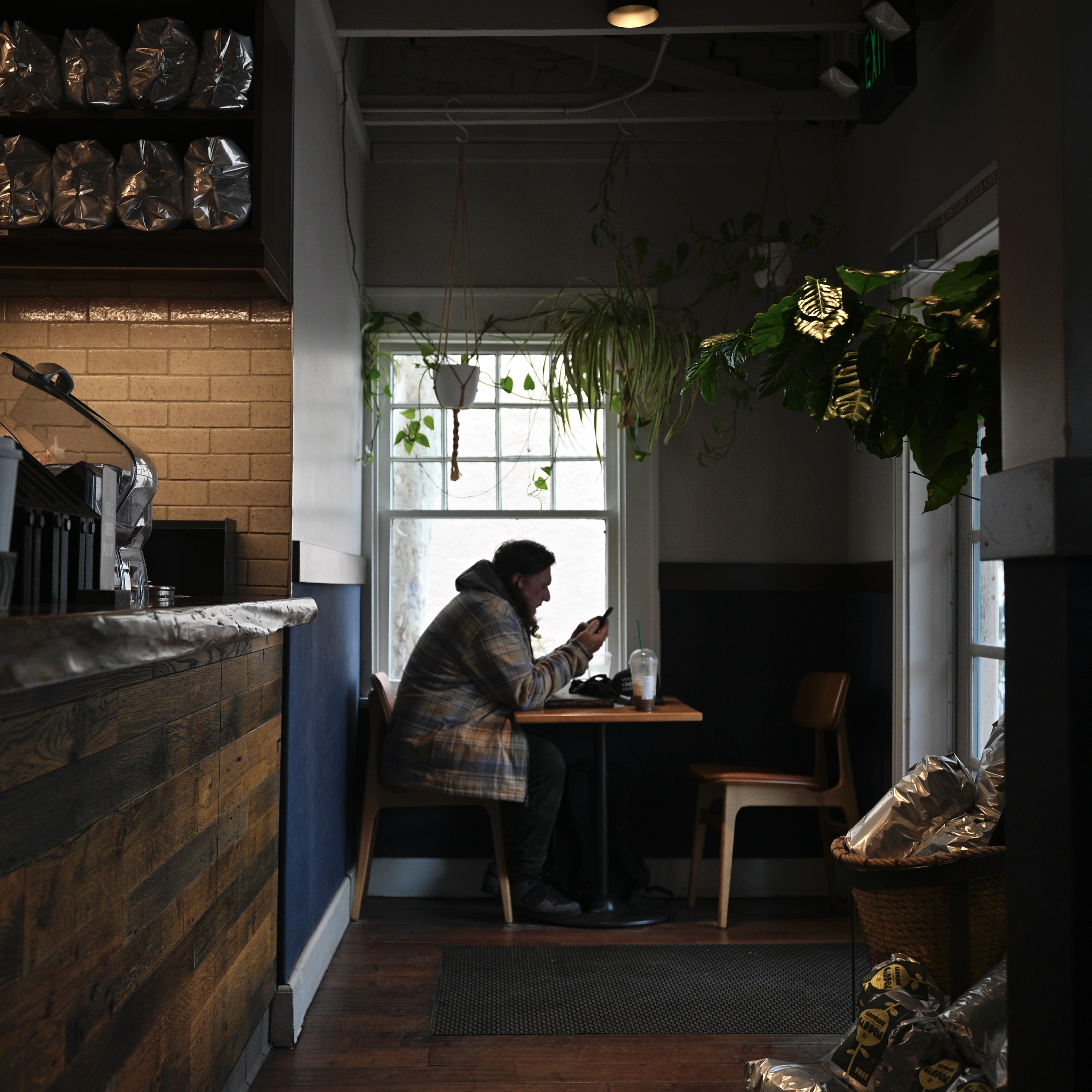
Same subject on full manual: f/3.5, 1/250 sec., 28mm, ISO 400.
In the top image, I responded to a sudden opportunity by shooting on full auto. Now, the result is perfectly okay, in that the exposure is balanced and the range of color values is, how you say in the English, “realistic”, but I feel that the second image, shot on full manual and designed to selectively illuminate some areas while deliberately underexposing others, is closer to how I see the shot. But how can I fault the camera? It, at least, is working up to its full design capacity. In telling it to shoot on full auto, it’s actually me that is abdicating my responsibility for how well the picture works/fails. Camera users have long dealt with the challenges that the population at large is just now facing with A.I., and our advice is: keep your own intelligence in the driver’s seat; something can’t assist you when it’s actually instructed to ignore you.
OF EASTER EGGS AND SURPRISE JOYS
By MICHAEL PERKINS
PHOTOGRAPHS CANNOT TRULY BE MADE AT THE SPEED OF WHIM, but, in the busiest shooting environments, it can certainly feel that way. In the digital era, we click off bursts within bursts, racking up frames at a rate that was prohibitively expensive for all but the most monied among us back in the film days. This means that, even as we shoot more and more in less and less time, we have to force ourselves, in the editing process, to slow ourselves back down, lest we miss a shot. Not a shot we neglected to grab in the moment, but a shot that we failed to notice in reviewing our work in haste.
It’s really common for me to fire off a fussilade of exposures on something that I fear I may not have long to work on, and completely miss the fact that, even in a wave of so-called “wasted” shots, I was accidentally blessed with a little Easter egg that, upon more deliberative consideration, gave me something I didn’t even realize had been snagged at the time. It’s the surprise joy of finding out that you accidentally did something right for a change, even when it’s a something that you weren’t actually going for.
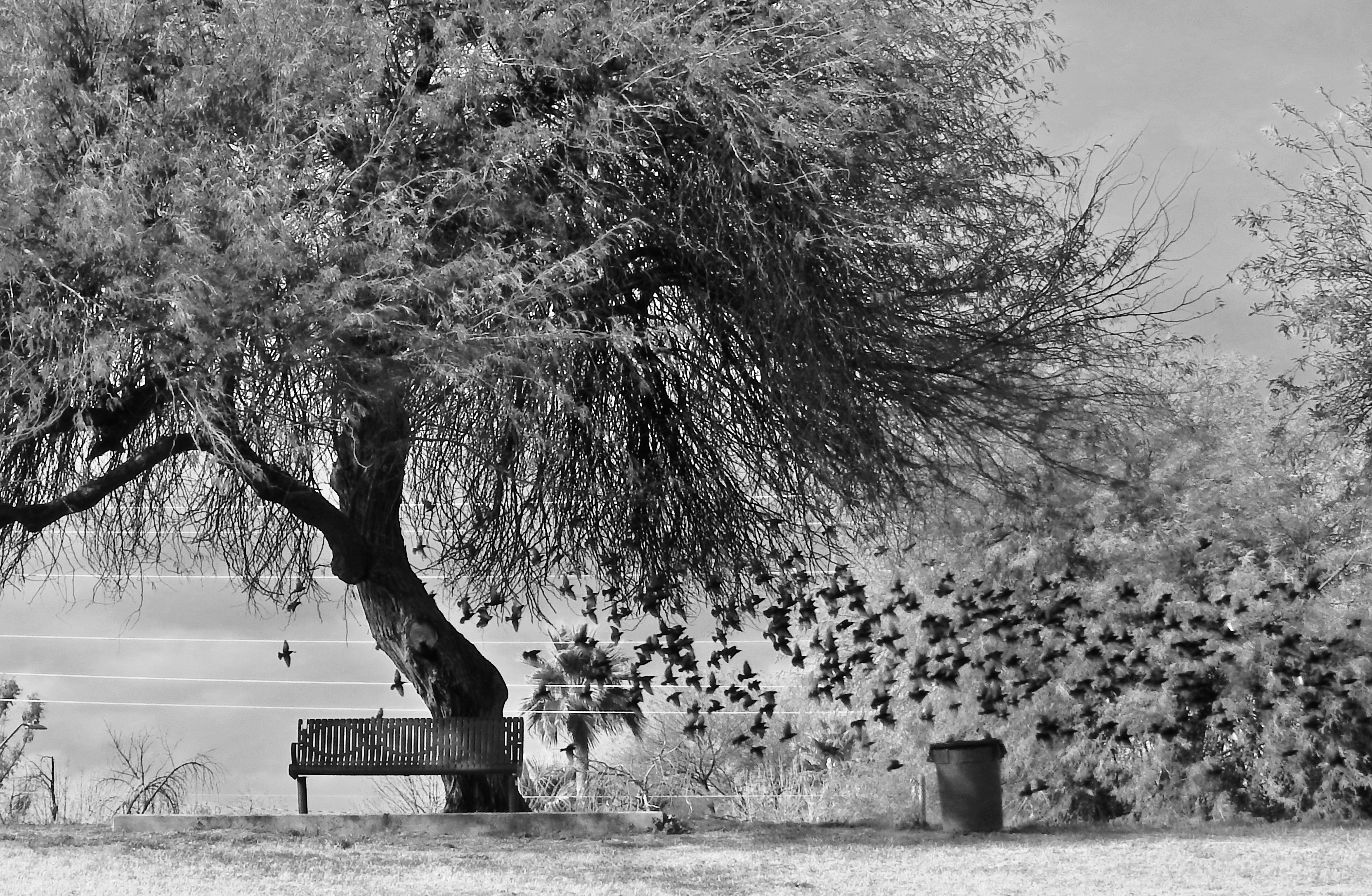
Run For It, 2023
The tree you see here is, for a variety of reasons, one of my favorites ever. It’s also within a mile of my house, and so I have literally unlimited access to it whenever the fancy strikes me. On the occasion of this shot, I was trying to show the unique sweep of its branches (which are far demonstrably dramatic in monochrome), giving the impression that the tree is swept up in a windstorm even when the weather is dead calm. What you see here is one of about six frames I cranked out in rapid succession. My first review of the shoot being too hasty, I rejected all of the images I got, going back for a different angle on a different day, convinced that the earlier day was a washout.
About a week passed before I had enough time to pore over the first sequence with any real patience, and that’s when I saw them; a sizable flock of starlings which, just an instant before the snap, had apparently been completely hidden in the tree’s canopy, and which, during this one exposure, were spooked into flight. There was no sign of them whatever in the shots either immediately before or after this one, making the moment uniquely alive with movement in a way that static images of the tree had failed to be. And yet, the shot might have lay forever unnoticed in a large general folder of pictures, had I not allowed it to reveal itself by slowing my roll and paying as much attention to the aftermath of the photograph as to its birth.
SELF-LEGENDS
By MICHAEL PERKINS
Let me kick my credentials.
Ice-T, Back On The Block
A HUNDRED YEARS AGO, THE WORD WAS “BALLYHOO“, a term for the most salient trait of Americans; self-promotion, the proud and loud announcement that we are here. Ballyhoo has assumed many forms, being at once proclamations about who we are; statements of who we hope to be; agendas for what we want you to think; claims about what we have to sell or bargain with; reminders about how much respect we demand; warnings about our boundaries; rules of engagement, for good or ill.
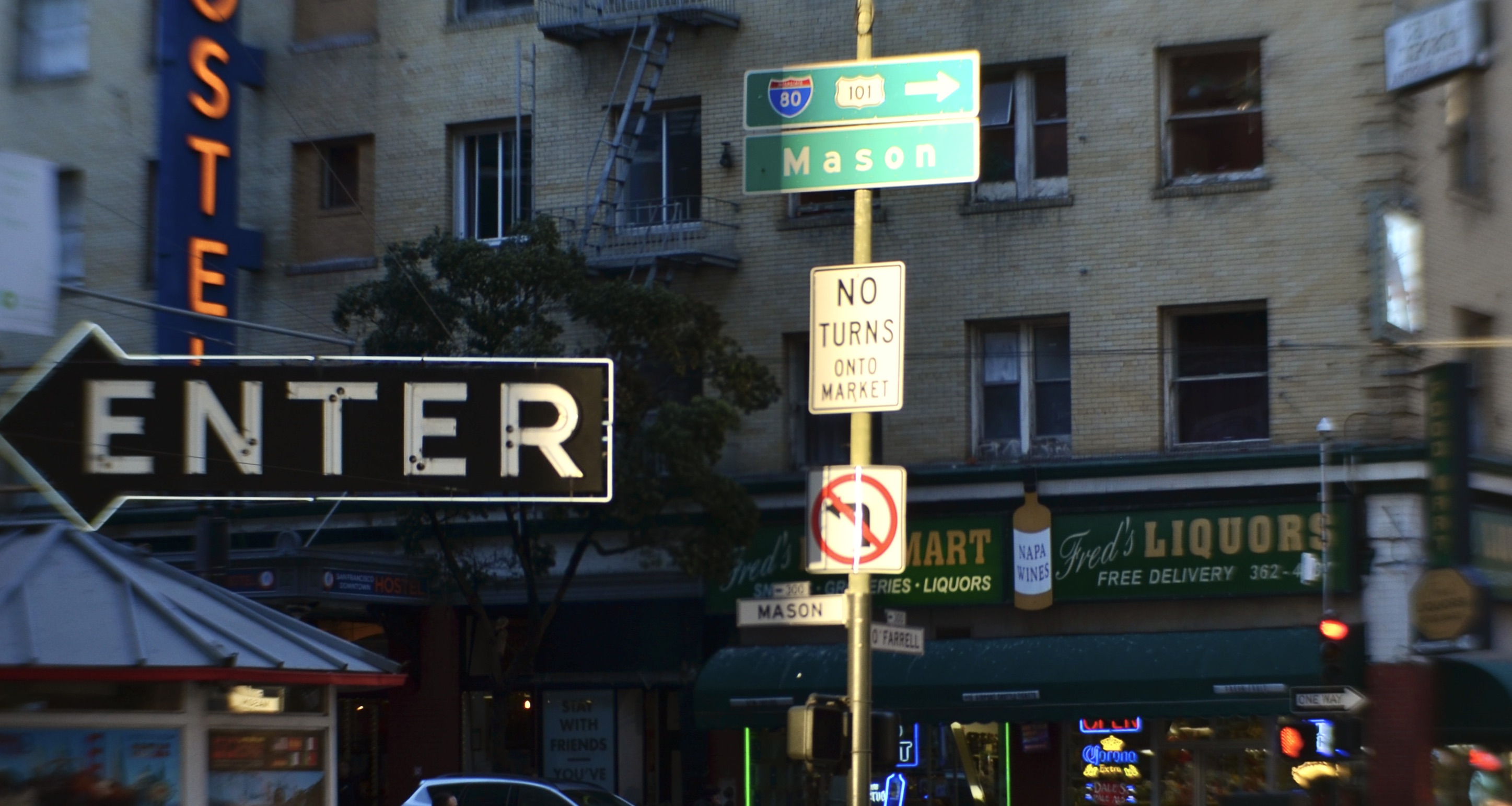
“Self-legending”, and how it makes its way into our every visual communication, is perhaps the most American of American qualities. We didn’t single-handedly invent mass communication or advertising, but we certainly promoted and perfected the fine art of ballyhoo in ways that are still modeled the world over. Photographs of our urban landscape are a blur of our various brags, boasts, promises, and promotions, along with the hard truth that, like it or not, you must deal with us. Americans are almost fatally allergic to being ignored, and so, simply announcing is never as good as shouting through a megaphone, or, in graphic terms, making the colors bolder and the letters bigger. We visually bellow at each other like barkers in a carnival or competing vendors in a street market.
In making their enduring images of life in this country in the twentieth century, masters like Robert Frank and Walker Evans often shot frames that were almost completely composed of signage. Today, those time freezes are a valuable resource for marking what our priorities were in bygone eras; the various announcements of merchandise, company names and prices anchor the pictures in specific dreams of specific times. Nearly one hundred years on, we use different tools to, in Ice-T’s phrase, “kick our credentials”, but the same urgent need to be noticed, to be heeded, goes on, albeit in new guises. I can never photographically take the measure of a city without trying to contrast old and new signage, original inscriptions and names along with the newest refits from a Starbucks or a McDonald’s. Photography is the first art in the history of the world that is equal parts reportage and interpretation, and trying to learn how to see humanity amidst all the ballyhoo will always make for legendary pictures.
FIFTY SHADES OF VANILLA
By MICHAEL PERKINS
THE DAWN OF DIGITAL PHOTOGRAPHY SO COMPLETELY CHANGED so many equations in the art of picture-making that it would take the rest of this calendar year to even take a stab at comprehensively listing them. Such an enormous roster would certainly include ease of operation, speed, enhanced learning, increased control, and a universe of choices and options. However, for me, it when I’m working in color that I realize that most of the effects that, years ago, were the exclusive products of the rich and well-equipped (call them the “darkroom generation”) are now at our fingertips at a whim. If the democratization of photography can be said to have begun with the first modestly-priced, more easily operated “everyman” cameras around 1900, digital process has certainly given all of us the power to deliver any look, any personal “reality” if you like, in any circumstances.
Color shows off this power this most effectively because we no longer are limited to a primary or official rendition of a hue, such as was the case in the earliest days of mass-appeal photo publications. Anyone who wanted to tweak a red to a magenta, for example, had to make very deliberate preparation before the shutter snap or complicated intervention after it (or both) to get that particular value. Now, a child can do it in a short series of clicks. Even the spectrographic presence of all colors, resulting (in light terms) in “white” is now subject to an infinite number of variants. Egg shell? Vanilla Ice Cream? Snow? Forget about being able to control all the other colors of the rainbow; plain old white is a complete spectrum unto itself.
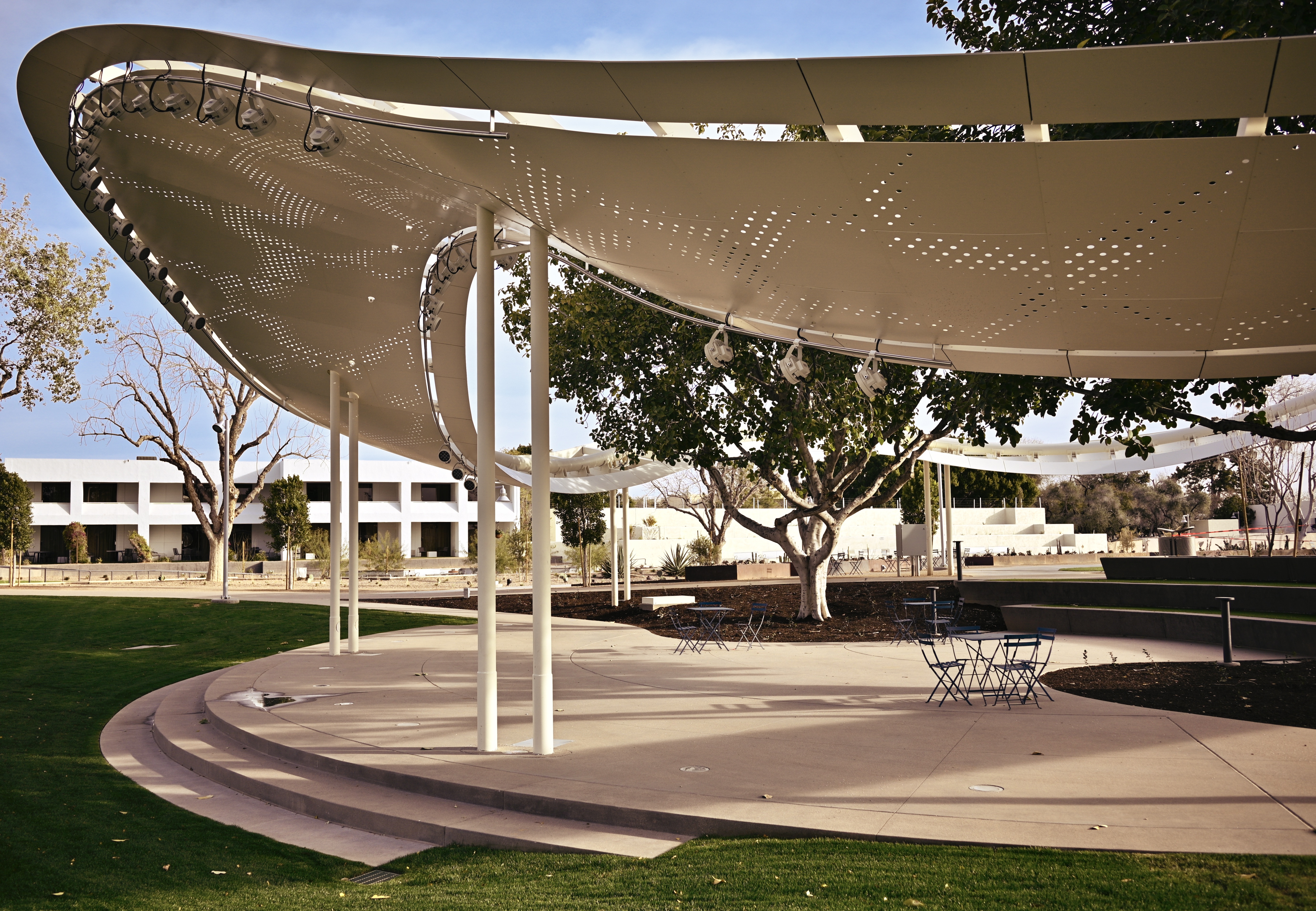
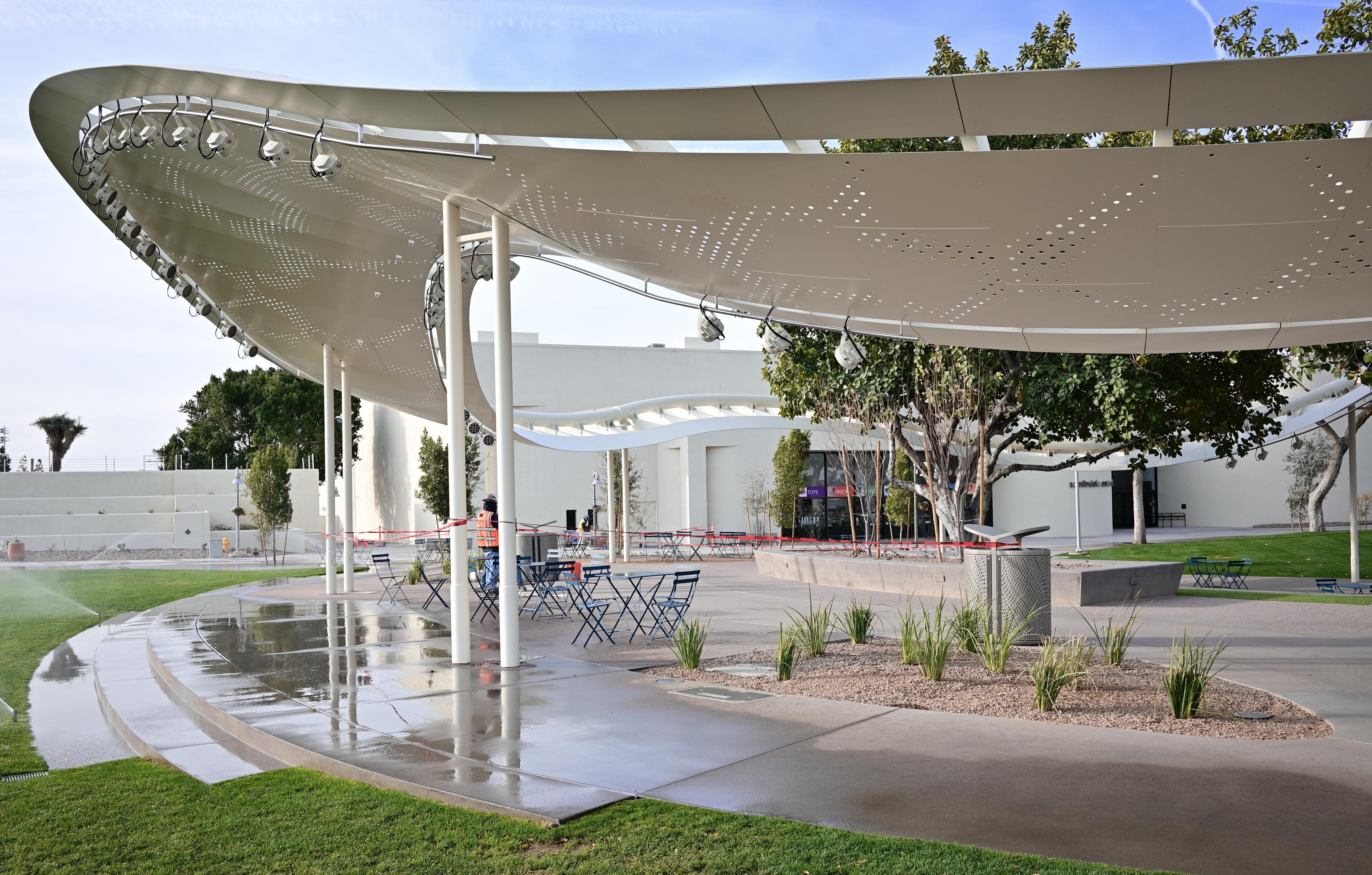
White balance, for decades a difficult and frustrating calculation, is now completely automated on even the cheapest cameras, adjustable to tons of variants with a mere twist of a knob. Going even further, apps by the zillions allow for white to recall any atmosphere or mood with incredible ease and speed. In the two pictures of a mobius-strip-like stage canopy shown here, the top is rendered in “daylight auto” white-balance in the camera’s manual mode, while the lower shot, taken mere seconds later, required nothing more than clicking the mode wheel to “U2”, where I’ve stored the settings required to instantly render a fairly good replica of the warmer tones of Kodachrome film. Both of the canopies can rightly be called “white” by the brain, and yet there is a lot of wiggle room in delivering what might best be termed “white according to whom?”. For those of use long enough in the tooth to remember how laborious this all used to be, it’s a miracle.
Photography was once the domain of magicians and wizards, practicing dark and unknowable arts in shadowy, secret places. There were the limited play spaces that we, the general public inhabited, and then there was their separate, mystical realm. Now everything’s out in the open, and, once again, technology has dissolved the barriers between the tinkerers and the artists, giving us all a shot at playing the same game. It’s a lot more fun this way.
VITAL SIGNS
By MICHAEL PERKINS
ANYONE LUCKY ENOUGH TO TAP INTO THE NATURAL PAIRING BETWEEN PHOTOGRAPHY and birdwatching will be humbled by observing the raw courage of winged creatures to survive despite humanity’s best efforts to the contrary. Even in rural settings, one cannot help but be struck by the numbing crush of obstacles mankind has left for the natural world to stumble over; how our habitat is so tilted in our own heedless favor that nature must live, not with us, but in spite of us.
Within cities, the horror is even greater, as our life crowds out any and everything that does not directly redound to our needs. In such tableaux, it is incumbent on the photographer to become a journalist, a chronicler of what needs to happen if we are to carry on sharing the planet with, well, anything. And, as an amateur birdwatcher, I am reminded by what bad earth citizens we have always been when my eye is drawn to what, to my mind, is one of the most elegant and misunderstood birds in our nature: the starling.
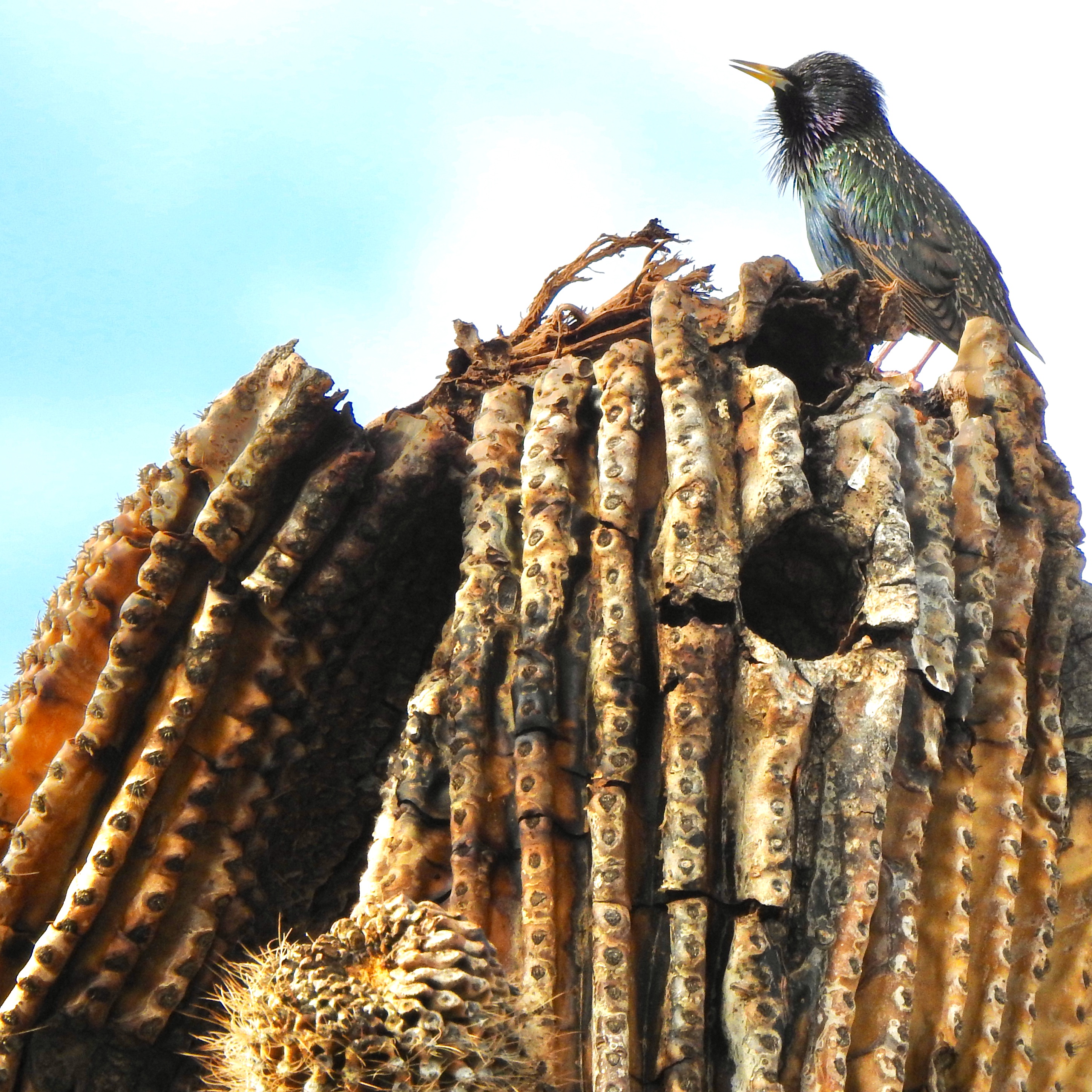
Introduced forcibly to North America in 1890 by a fanatical Shakespeare aficionado from Britain, who believed that his new home should feature literally every species of bird mentioned in the Bard’s works, the first stateside starlings originally numbered only about one hundred birds in all. Predictably, those have since become millions, earning not praise for the bird’s adaptability and intelligence, but scorn from those who regard them as invasive pests or worse. These gorgeous creatures, whose plumage, in the changing light of the full day, literally contains the rainbow, have made the best of their fate over the centuries, much like any other erstwhile immigrant. Sadly, they are often hunted and hated as if they themselves had decided to invade our shores just for the fun of it. And so it goes with scores of other creature; untold species of animals, plants and birds have been forcibly introduced onto the continent by the most predatory pests ever unleashed on the planet; humans.
Starlings are plentiful nearly everywhere, but the intense sunlight of the American southwest can highlight their hues in spectacular fashion, something I never would have slowed down to notice were it not for the birding buddies my wife has generously shared with me. My initial interest was boosted in intensity during Lockdown, mainly because being outside was one of the only essentially safe ways to pass the time, speeding up my bird learning curve a bit (although I am still barely able to hobble along in the “beginner” division). It has produced a kind of evangelism in me, and I can never again see a bird without wondering to what extent my fellow humans have complicated or compromised its existence. If we can muster shame about anything, it should be our hideous habit, going back over our entire history as a species, of fouling our own nests.
I GOT THEM OL’ DIGITAL TOLLBOOTH BLOOZ
By MICHAEL PERKINS
I HAVE CARPED PREVIOUSLY (AND MAY WELL AGAIN) over the fact that cell phone photo apps are, at once, a spark for creative manipulation and, ironically, the kiss of death for pictorial quality. Fer shur, apps giveth the chance to carry a photo lab, with all its flexibility and instant gratification, in your pocket, and that’s truly exciting. However, the same apps also taketh away sharpness, contrast and nuance. Oh, you wanted both a work of art and an image that’s visually conherent? Good luck with that.
Digital platforms provide quick sharing for any work, but there is a price tag. Once a picture leaves its original domain, which in for the sake of argument, let’s say, is the cell phone that created it, mischief begins. The main toll your image must pony up on its way to an app, from Instagram to Twitter to thousands of others, is compression, which removes data from the original in order to squeeeeeeze it along on its virtual way. Problem is, the same toll is collected again when the app sends the modified file back to Facebook, Reddit, and so forth, and collected at least a third time if the result is so compelling that you elect to share it back out to other apps or friends. The result is like the old office memo that was Xeroxed from a Xerox of a Xerox. In other woids, gobbidge.
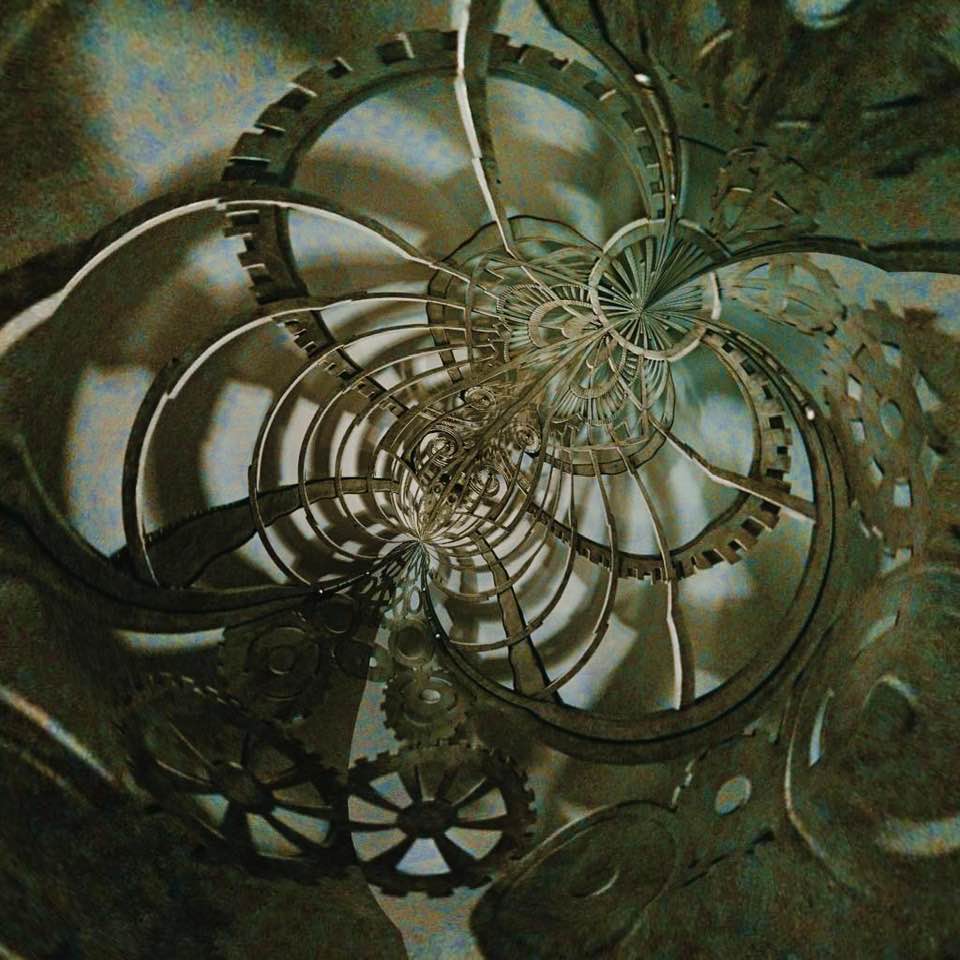
When Time Itself Exploded (2017)
Let’s look at a test case: in the above image, the master shot was of an ornate Art Deo-era door grate which I snapped via phone in a museum. The original was sent to the Hipstamatic app for color modification and contrast adjustment. That second version was then shoved through Tiny Planet Pro to produce the spiraling effect, then shared back to my Phone, then sent out to Facebook, and back from there to this platform, WordPress. The final result was a bit like starting out a race with a thoroughbred horse and limping across the Finish line with a legless hamster.
One of the more obvious by-products of all this bouncing and slicing is that the color shift in the image is violently out of control, as if the blank wall that originally served as the photo’s background has been replaced by a psychedelic lab slide of angry protozoa. If that was what I had been going for, mission accomplished. Photography is rife with works that were deliberately degraded for effect. But here, all my choices have been degraded without my permish, leaving me totally at the mercy of whatever penalty the various apps have exacted in order to perform their various parlour tricks. Someday this may no longer be the case; however, for the time being, it’s a pricey tradeoff for the photographer. I made something that made you want to see, but I hate how it looks.
SOOC / SOOB
By MICHAEL PERKINS
AFTER ALL THESE YEARS, ONE OF THE ONLY TIMES THAT I SHOOT AT FULL AUTO, that is, literally just pointing and delegating all of my upper brain functions to the camera, is when a brand-new lens comes into my life. Because just as I love the romance behind the idea of SOOC (or “straight out of the camera”, a state I aspire to but seldom attain), I also flirt with the concept that automatic focusing and exposure systems might eventually progress to the point where I could concentrate on nothing more than subject and composition. This second ideal I call shooting “SOOB”, or Straight Outta The Box. It’s a little like hoping that the four millionth horse you see in a corral will somehow, also, be a unicorn. And just as likely.
I admit it; I’m incurably curious about what a fresh piece of kit will do simply by being snapped in place and turned on, and I will usually spend a few days or even weeks after a new purchase taking a near hands-off approach to shooting with it. I know that technology is inching ever closer to intelligent machines that can nearly, nearly second-guess my intentions, that operate with their own pseudo-intuition. And yet, after this honeymoon period, I predictably revert back to my personal comfort zone, which is shooting on nearly 100% manual settings, minus the occasional crutching on auto-focus. Why is this?
Another new lens, another try at full auto shooting. Certainly acceptable, but I still feel the need to intervene…
It’s just a fact that a significant number of photographers the world over are perfectly fine with letting their cameras make nearly every exposure decision for them (as in the fully automatic exposure seen here), with millions more at least clicking on full auto and fixing the faults later, either in-camera or with software or apps. Most importantly, the manufacturers of cell phone cameras have staked their amazing success on making their devices sweat the details of making a picture so that users can sweat it that much less. The trend line over time in camera tech has always run toward easier execution, with each succeeding generation of features making it more and more tempting to let the camera assume greater control, all with the promise of better results.
But better according to whom? There is a line, in the minds of many photographers, between removing technical obstacles to acting on your picture-making instincts and relying on the tech to, in effect, execute those instincts for you without your active participation. SOOC still means that you are personally shaping your decisions, as best you can, ahead of the click, trying to get things so right that modifications after the fact can be minimal. SOOB, at least for me, is asking me to relinquish all creative control because a device can maybe guess what I would have wanted anyway, and I’m not ready to go there yet. Like anything else in this racket, it’s a matter of degree, a game of inches. But those inches matter more than anything in the pictures that emerges from the process.
CHEWSING
By MICHAEL PERKINS
IN THE UNLIKELY EVENT THAT I AM EVER REINCARNATED, perhaps I would live my best (next) life as a cow. At least that’s my gut feeling. No, I mean, literally my gut, since, like my bovine brothers and sisters, I am a ruminant. I regurgitate and re-chew my existential cud endlessly, obsessively masticating my life to extract every bit of anxiety from my every choice. I overthink my options the way Elsie and Elmer worry a wad of pasture grass.
And that is why it is so amazing that I should be a photographer at all.
Making pictures is one of the only things I do almost purely by instinct. Examine any other enterprise in which I’ve been involved, from cooking to business matters to philosophy, and you’ll observe a consistent pattern of slow, deliberate development, with few bursts of pure fancy or whim. Photography is something else. To be sure, capturing a image does take at least a modicum of advance strategy; however, in the final snap of the shutter, there is a bit of a leap of faith, a commitment that moves you past the knowledge that This Might Not Work Out. And oddly, for an over-a-chewer like myself, the ability to finally let go and click is not terrifying, but thrilling, a moment of pure abandon that, for me, is truly exotic, almost drug-like. It allows me to do things that cannot be precisely nailed down before they are tried, as in the case of this image, which is clearly not the result of lengthy over-thinking.
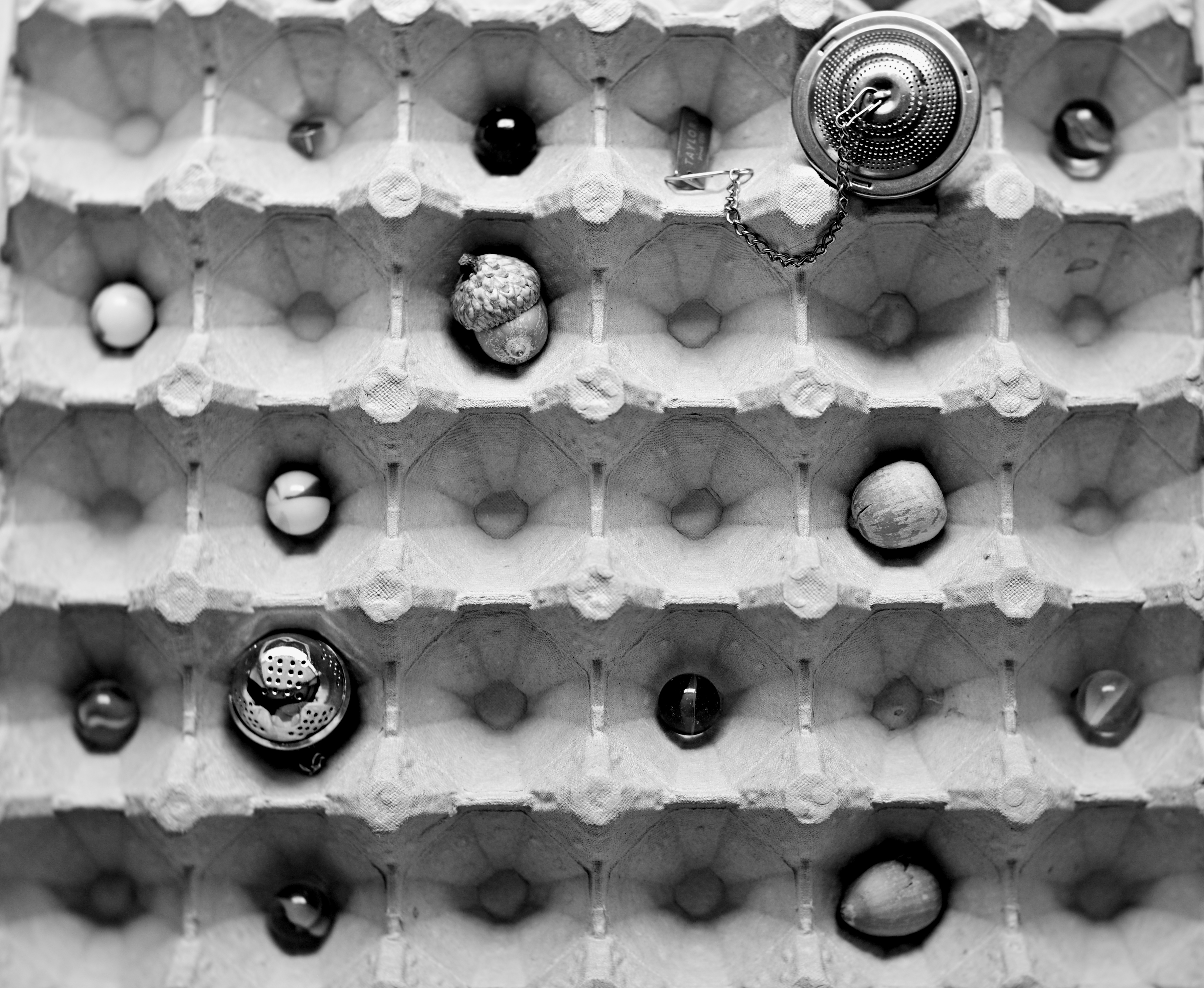
That’s why my “favorite” picture must always be the one I’m just about to make. I get such a dopamine hit off being able to release my anxieties in the creative process that I hunger desperately for the next high. And the next one. And the next one. In so many other aspects of our lives, we can more easily talk ourselves out of doing something than into doing it. We learn to approach almost any choice as if reading a risk-benefit assessment. That’s why there are never nearly enough astronauts or mountain climbers or novelists among us; the risk of failure….worse, of being judged a failure by others, is too daunting. But in the creative sphere, we seem to give ourselves a hall pass; this one time, you can be bold. This one moment, you can just not care whether it’s perfect.
This why I hate for the camera to be elevated to the status of a magically autonomous instrument, or a perfect machine. Photography is so much more than the technical execution of a recording. It is not a mechanical seismograph but an emotional one, and so making pictures has to be done by chewing less and swallowing more. It simply must be done with the emotions in the driver’s seat.
 thenormaleye