ON THE STRAIGHT AND NARROW
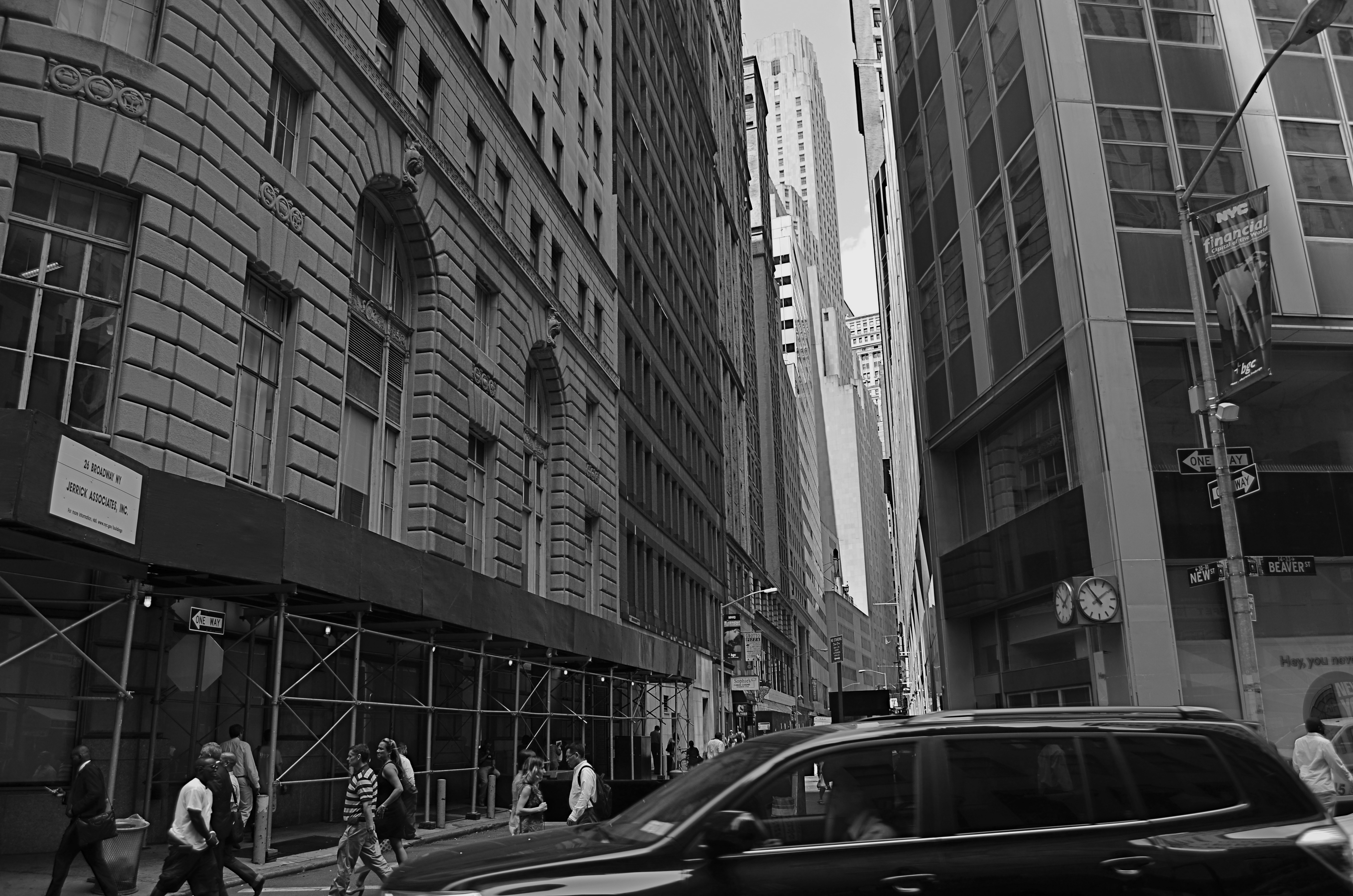
New & Beaver, 2014. 1/200 sec., f/5.6, ISO 100, 18mm.
By MICHAEL PERKINS
THE NARROW STREETS OF LOWER MANHATTAN WERE NEVER DESIGNED TO ACCOMMODATE the claustrophobic jam of commerce, foot traffic and skyscrapers that have characterized the neighborhood since the early 20th century. I should back that up and acknowledge that, for some locals, the streets of lower Manhattan were never designed,period. New York’s growth has always come in rangy spurts and jolts, much like a gangly adolescent that shoots upward and outward overnight without any apparent plan, and yet, those unruly explosions are also what delight the photographer’s eye and make the city an inexhaustible laboratory for technique.
Shooting down the slits that pass for side streets and alleys in lower Manhattan is enough to make even the most seasoned native feel like he or she is being shut up in a tomb, but I am drawn to going even further, and over-emphasizing the extreme dimensions peculiar to the area. That, for me, means shooting with as wide a lens as I have handy, distortion be damned. Actually, it’s distortion be welcomed, since I think that the horizontal lines of the buildings create a much more dramatic lead-in for the eye as they race far away from the foreground. And since ultra-wide magnify front-to-back distances, the bigness and closeness of the city is jacked into a real exaggeration, but one that serves my purpose.
It helps to crouch down and tilt up when composing the shot, and to make sure that you don’t crop passersby out of the shot, since they will add to the drama even more as indications of scale. I have certainly gone too far more than once and rendered rectangular buildings into futuristic trapezoids, but the aim of each image will dictate what you’re going for. Also, in many of these shots, I decide, after much dithering, to choose monochrome over color, but I always shoot the originals in color, since they respond better to re-contrasting once they’re desaturated.
The magic about Manhattan is that no camera can ever tame her or show all her beauty and/or ugliness. It’s somthing of a fool’s errand to try to take the picture of NYC. Better to take a picture you like and add it to the ongoing story.
ORPHANS
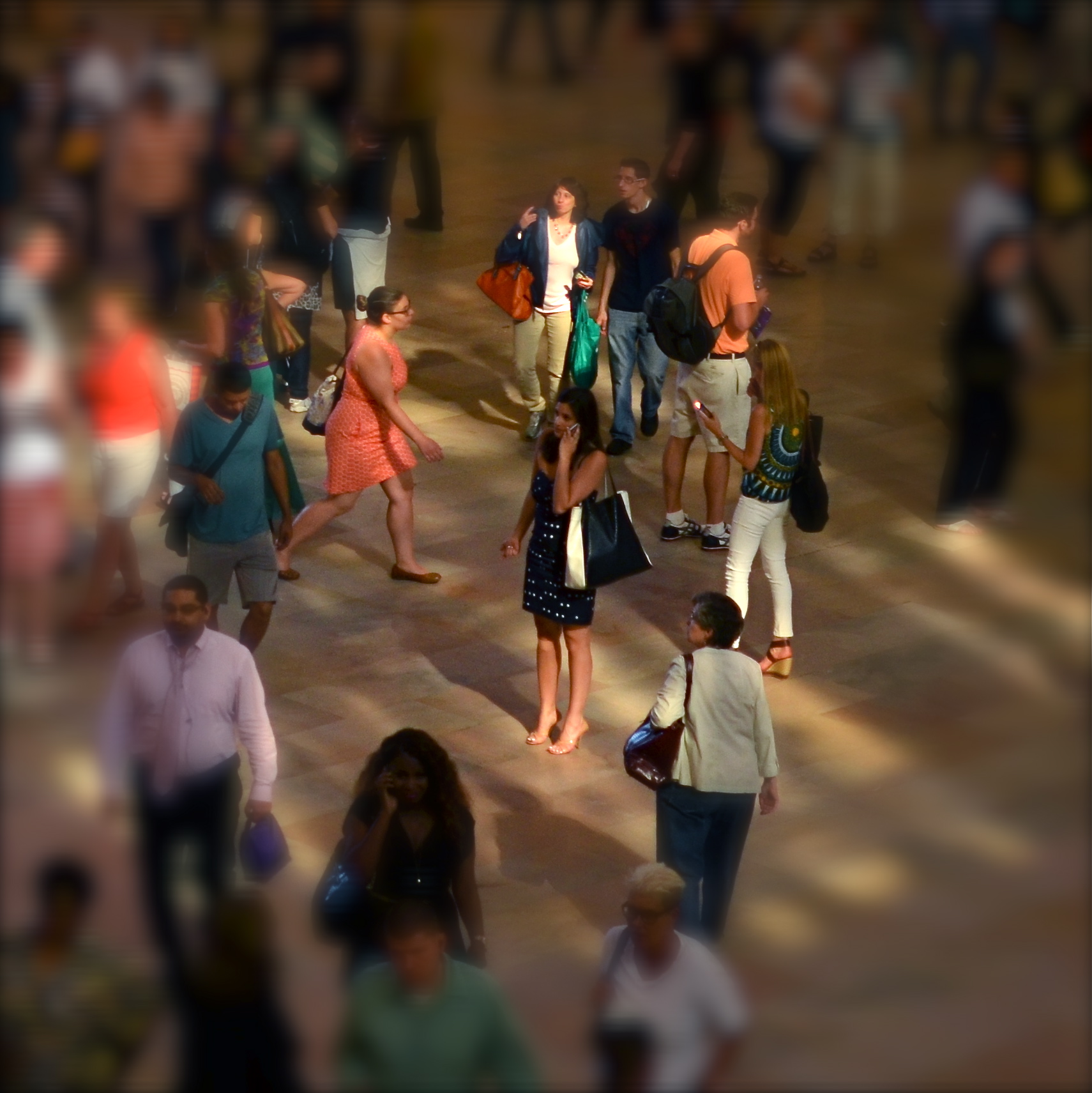
Grand Central, 2013. 1/160 sec., f/1.8, ISO 250, 35mm.
By MICHAEL PERKINS
IF YOU SHOOT ALL THE TIME, NEARLY EVERY DAY, THE SHEER TONNAGE of what you bring home guarantees that you will inevitably lose track of a large portion of your total output. Being that your alloted daily attention span is a finite number, you will literally run out of time before you can lavish affection on everything you’ve captured, on any occasion. Some shots will jump into your car like eager puppies, panting “take me home”, while others will be orphaned, tossed into the vast digital shoebox marked “someday”, many never seeing the light of day again.
The cure for this, oddly, lies in the days when no ideas emerge and no pictures are taken…the dreaded “drys”, those horrible, slow periods when you can’t buy an inspiration to save your life. In those null times, the intellectual equivalent of a snow day, you may find it useful to revisit the shoebox, to rescue at least a shot or two formerly consigned to the shadows.
Using your paralysis periods for reflection may get you off the creative dime (and it may not), but it will, at least, allow you to approach old experiments with a fresh eye, one seasoned by time and experience. Maybe you overlooked a jewel in your haste. You almost certainly left free lessons on either technique or humility by the wayside, wisdom that can be harvested now, since you’re currently watching your camera mock you from across the room (okay, mock is harsh).
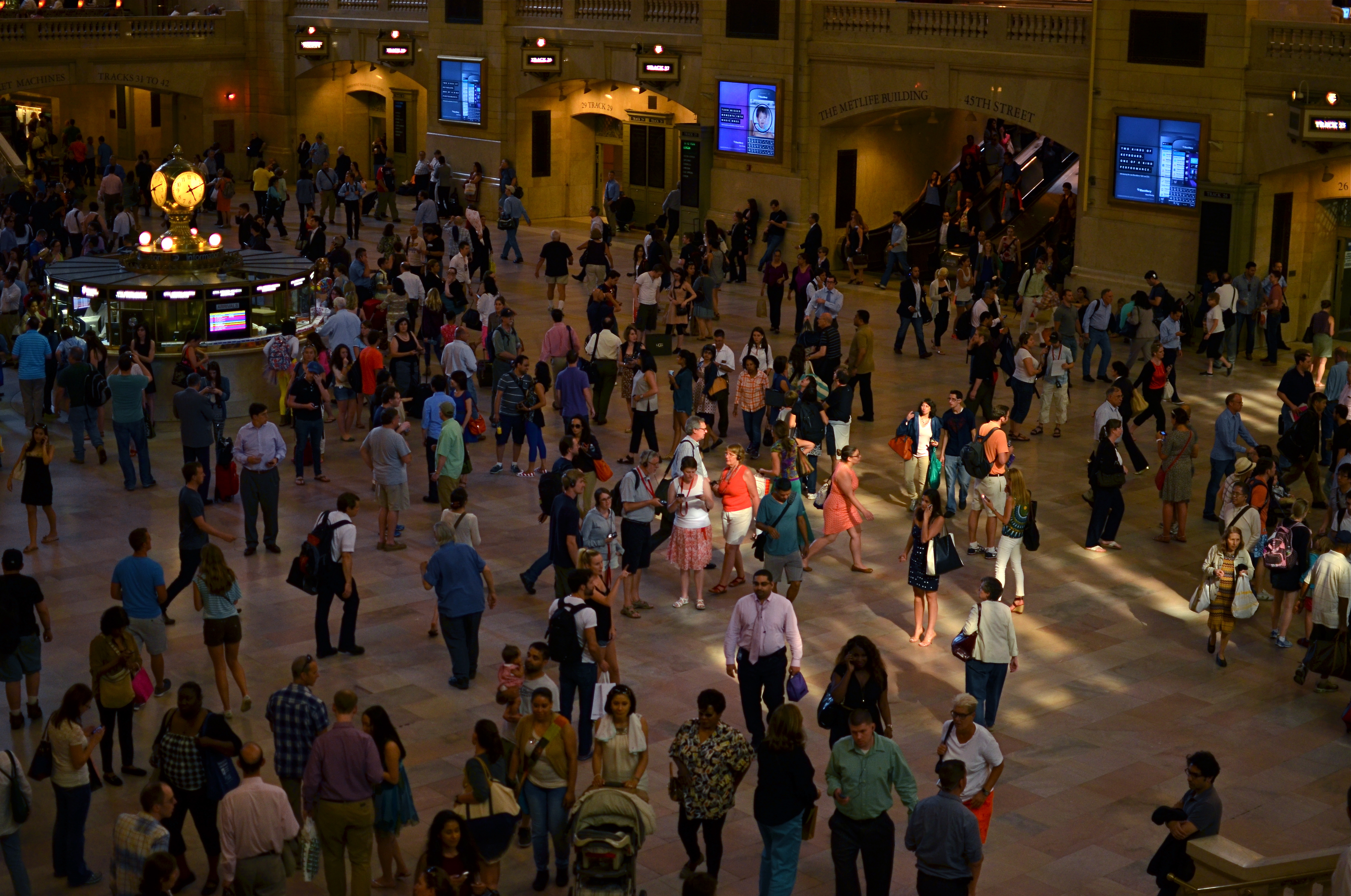
The master shot, before cropping.
During my last visit to Manhattan, I was determined to explore the limits of natural light streaming from the gigantic windows of the main terminal floor at Grand Central, and, for the most part, I framed the place’s architectural features in such a way as to dwarf the scurrying humanity heading to their various destinations. I did shoot a few floor shots as “crowd pieces”, but, upon editing, I failed to look within those big groupings for any kind of individual story or drama. I chose the gigundo-windows master shot I wanted, and left all the other frames in the dust.
Recently hitting a dead spot of several days’ duration, I decided to wander through The Ghosts Of Photo Attempts Past, and I saw a mix of bodies and light within the smallest 1/3 of a larger crowd shot that seemed worth re-framing, with a little softening effect to help the story along. Still not a masterpiece, but, since I was lucky enough to isolate it within a “Where’s Waldo” frame crammed with detail, it was something of a gift to salvage a chunk of it that I could actually care about.
Another orphan finds a home.
THE WOMAN IN THE TIME MACHINE
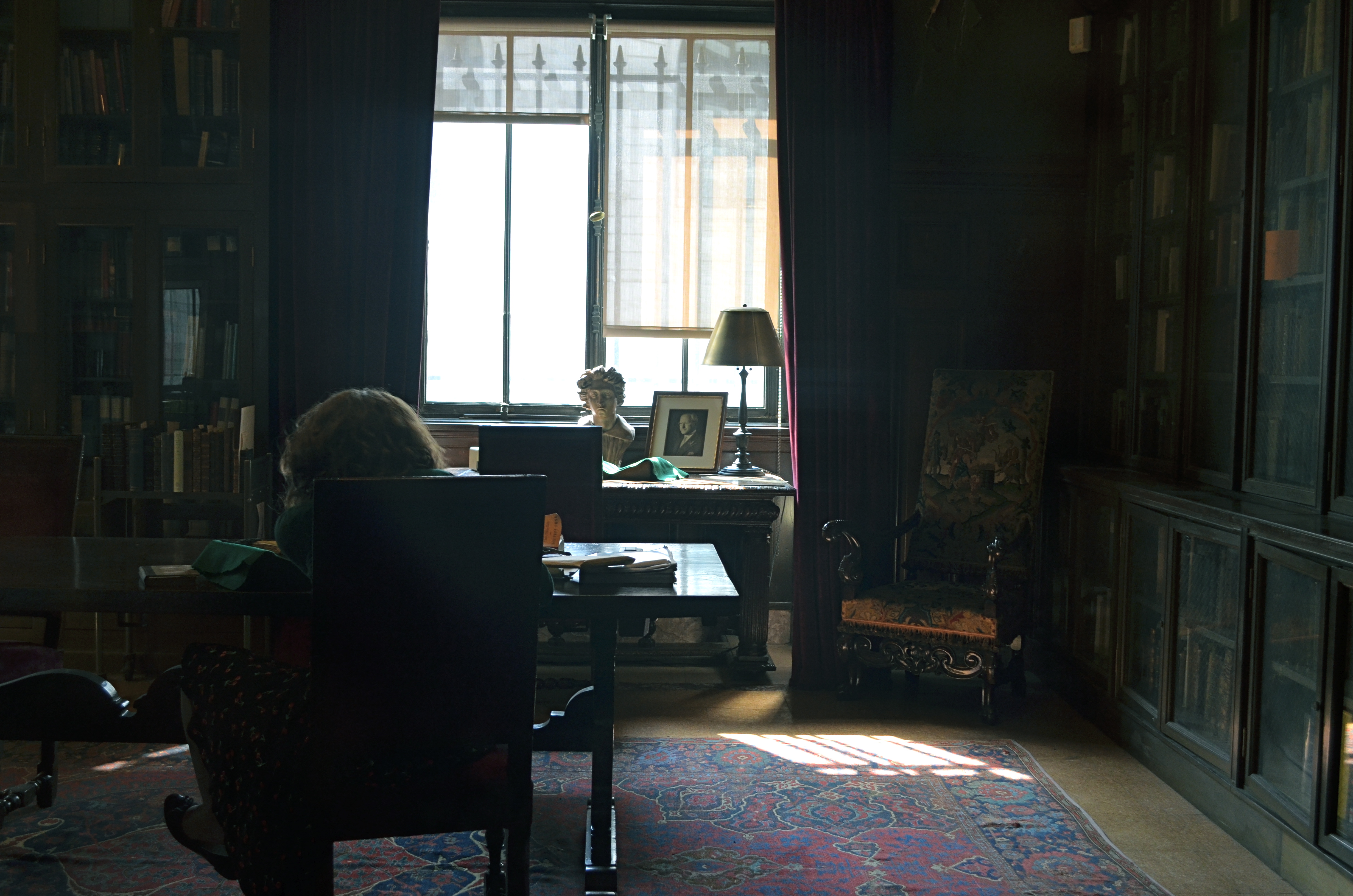
Where is this place? And how is it here, now? 1/40 sec., f/5.6, ISO 320, 24mm.
by MICHAEL PERKINS
THERE ARE TIMES WHEN A CAMERA’S CHIEF FUNCTION IS TO BEAR WITNESS, TO ASSERT THAT SOMETHING FANTASTIC REALLY DID EXIST IN THE WORLD. Of course, most photography is a recording function, but, awash in a sea of infinite options, it is what we choose to see and celebrate that makes an image either mundane or majestic.
And then sometimes, you just have the great good luck to wander past something wonderful. With a camera in your hand.
The New York Public Library’s main mid-town Manhattan branch is beyond magnificent, as even a casual visit will attest. However, its beauty always seems to me like just “the front of the store”, a controlled-access barrier between its visually stunning common areas and “the good stuff” lurking in untold chambers, locked vaults and invisible enclaves in the other 2/3 of the building. I expect these two worlds to be forever separate and distinct, much as I don’t expect to ever see the control room for electrical power at Disneyland. But the unseen fascinates, and recently, I was given a marvelous glimpse into the other side at the NYPL.
A recent exhibit of Mary Surratt art prints, wall-mounted along the library’s second-floor hall, was somehow failing to mesmerize me when, through a glass office window, I peeked into a space that bore no resemblance whatever to a contemporary office. The whole interior of the room seemed to hang suspended in time. It consisted of a solitary woman, her back turned to the outside world, seated at a dark, simple desk, intently poring over a volume, surrounded by dark, loamy, ceiling-to-floor glass-paneled book shelves along the side and back walls of the room. The whole scene was lit by harsh white light from a single window, illuminating only selective details of another desk nearer the window, upon which sat a bust of the head of Michelangelo’s David, an ancient framed portrait, a brass lamp . I felt like I had been thrown backwards into a dutch-lit painting from the 1800’s, a scene rich in shadows, bathed in gold and brown, a souvenir of a bygone world.
I felt a little guilty stealing a few frames, since I am usually quite respectful of people’s privacy. In fact, had the woman been aware of me, I would not have shot anything, as my mere perceived presence, however admiring, would have felt like an invasion, a disturbance. However, since she was oblivious to not only me, but, it seemed, to all of Planet Earth 2013, I almost felt like I was photographing an image that had already been frozen for me by an another photographer or painter. I increased my Nikon’s sensitivity just enough to get an image, letting the light in the room fall where it may, allowing it to either bless or neglect whatever it chose to. In short, the image didn’t need to be a faithful rendering of objects, but a dutiful recording of feeling.
How came this room, this computer-less, electricity-less relic of another age preserved in amber, so tantalizingly near to the bustle of the current day, so intact, if out of joint with time? What are those books along the walls, and how did they come to be there? Why was this woman chosen to sit at her sacred, private desk, given lone audience with these treasures? The best pictures pose more questions than they answer, and only sparingly tell us what they are “about”. This one, simply, is “about” seeing a woman in a time machine. Alice through the looking-glass.
A peek inside the rest of the store.
Follow Michael Perkins on Twitter @mpnormaleye.
Thanks to THE NORMAL EYE’s latest follower! View NAFWAL’s profile and blog at :
 thenormaleye