NEW ANGELS
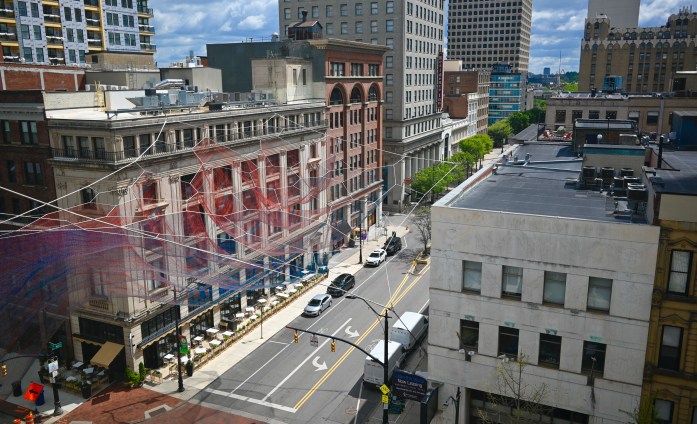
Current, a rope and cord art installation in Columbus, Ohio, created by “fiber artist” Janet Echelman
By MICHAEL PERKINS
FOR ME, ONE OF THE MOST EXCITING TRENDS IN URBAN DESIGN, in the twenty-first century, is not the latest generation of skyscrapers or town plazas, but a bold new redefinition of the concept of public art. Where once it was sufficient to plop down a statute of some wartime general near the county courthouse, commissioned works now make mere sculpture look as primitive as cave paintings. We have evolved past the commemorative earthbound seraphim that once graced our parks, to flights of fancy that connect and shimmer from the air. It is an age of New Angels, and Janet Echelman is one of its patron saints.
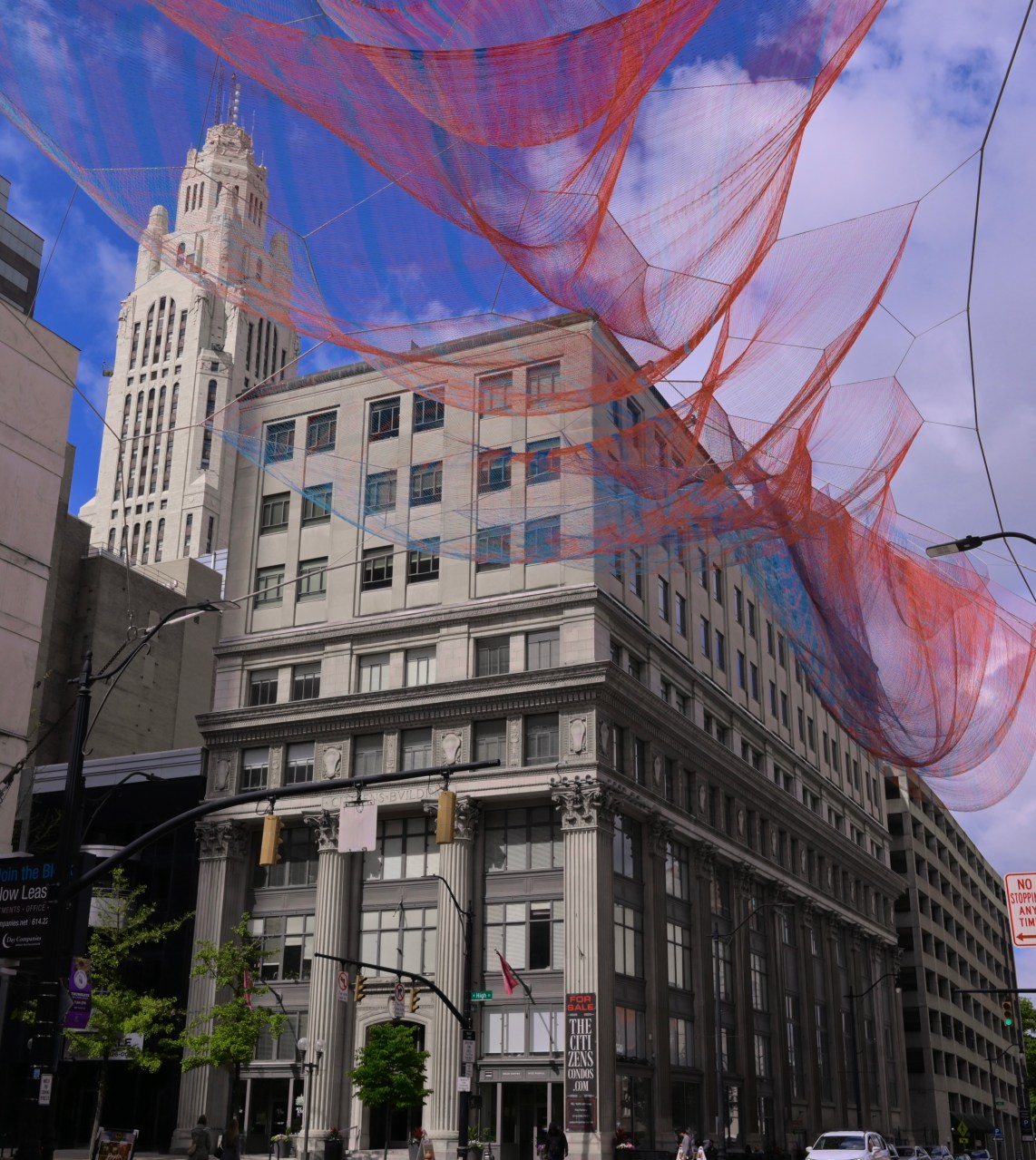
Echelman, a Guggenheim fellow and Harvard graduate, who refers to herself as a “fiber artist”, is, in fact, an altogether new kind of sculptor. Instead of being grounded on pedestals, her arrangements of shimmering color, created by mixtures of fiber, netting and rope, hang in suspension over cityscapes like vast spider webs, refracting the rainbow and generating waves of shifting hues depending on changes in sunlight, wind or the angle of view. Some of her creations are billowing circles and cones that resemble a whirlwind of cyclone; others look like sky-bound rivers, curling and twisting into tributaries of red and blue. Each is uniquely tailored to its specific location in cities like San Francisco, Vancouver, Seattle, and a half-dozen other cities around the world. They are, simply, magnificent, and the best challenge for any photographer, since they appear vastly different under varying conditions.
I first saw one of her works while working at Arizona State University, where Her Secret Is Patience floats like a phantom hot air balloon near the school’s Cronkite School of Journalism. And just this spring, I was thrilled to see her first work to be floated over an entire intersection, 2023’s Current, which spreads across the meeting of High and Gay Streets in Columbus, Ohio, anchored to the tops of buildings at the crossing’s four corners. Commissioned by a local real estate developer as a kind of front porch for his refurbished bank building (now housing deluxe condos), Current can be seen from any approach within a four-block distance of the area, an irresistible advertisement for the regentrification of the neighborhood. Janet Echelman is but one voice in a rising chorus that demands that public art re-define itself for a new age. That age will not only withstand controversy but actively court it, just as any art, including photography, needs to do.
MULTIPLE RECKONINGS
By MICHAEL PERKINS
CERTAINLY SINCE THE DAWN OF DIGITAL PHOTOGRAPHY, and, with it, the fall of the last economic barrier to the making of many, many pictures, my urge to document simply everything that comes into my daily experience is stronger than at any time in my life. In short, I can afford to make many more attempts to document my journey through life than was even thinkable in the film-dominant age of my youth.
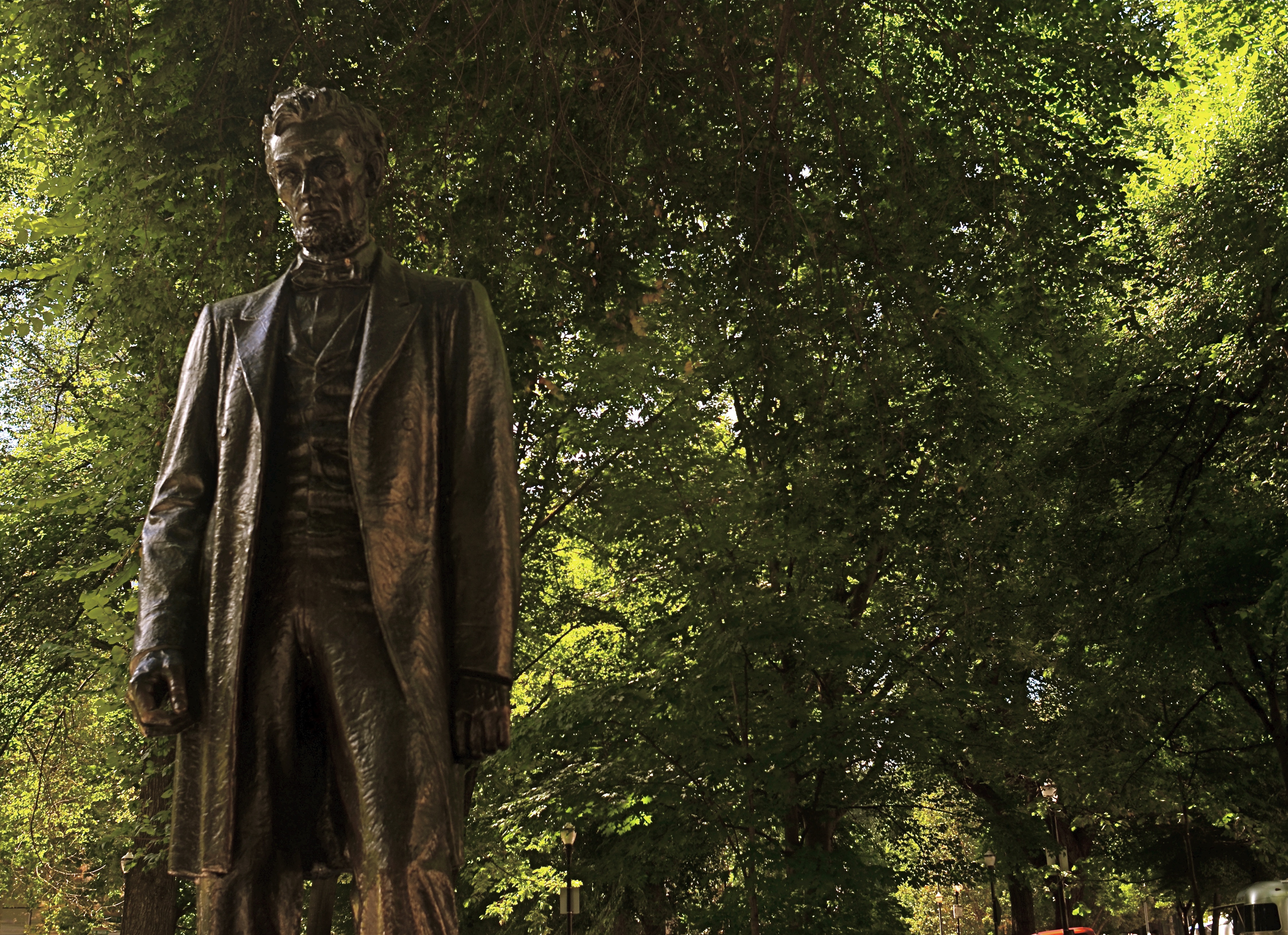
This means that I wind up recording much more of the world, and, accordingly, preserving more from its ever-changing churn of events. That fact came roaring home to me the other day when I was looking at some shots from a walking tour of Portland, Oregon that I took in 2018. One of the then-constant sights within the city’s South Park Blocks district was George Fite Waters’ statue of Abraham Lincoln, and, in happening upon it, it seemed like a no-brainer to take a quick snap of it. In reviewing the image, I idly wondered just how many public statues of the 16th president had actually been produced in the 163 years since his death. Turns out he may be the most memorialized figure in American history, with sculptures in over thirty American cities as well as carved effigies in Mexico, England, Norway, Scotland and even Russia (where he is depicted shaking hands with the Tsar…you may want to fact-check that event). Waters’ statue is perfectly average in every respect, except for the fact that, since I last viewed it, it just isn’t there anymore.
Apparently a particularly boisterous 2020 protest on the annual Indigenous Peoples’ Day Of Rage resulted in the toppling of not only the Lincoln statue but a marble depiction of Teddy Roosevelt’s Rough Rider days, with the result that both works are presently in a protective suspended state. Of course, what with all the tortured re-evaluations of the American Civil War seen in recent seasons, it seems consistent that Honest Abe himself remains as controversial as when he walked among us. At this writing the mayor of Sandy, Oregon still has an offer on the table to host both statues in his town, but the entire issue remains in limbo. Which allows me to circle back to my original point: nothing could be easier in the digital age but shooting any and everything that catches your fancy, for any reason. You don’t even have to have an opinion on whether something should be. The mere fact that it is, as well as the knowledge that, at a moment’s notice, it might no longer be, is enough to merit a picture. Snap away.
ECHOES OF HOPE
By MICHAEL PERKINS
WHEN DARKNESS LOOMS IN THE HEART OF MAN, THE SIZE OF ANY LIGHT IN THE ROOM IS LARGELY IRRELEVANT. What matters is that someone, anyone, struck a match. The light puts physical limits on the dark. The light points toward escape. The light is the promise of continuation, of survival.
During the present forced hibernation among nations, it’s easy to compare today’s responses to The Latest Troubles with the responses seen in other crises. Everyone is free to make those comparisons, to crowd the air with arguments about who did what, and, once all the discussion abates, having a record of what we’ve tried and learned over the years is the work of art. Art records the dimension of our dislocations, measures the distance between Old and New Normals. Memorials, built by survivors, exist to delineate what happened to us, and, more importantly, what happened next.
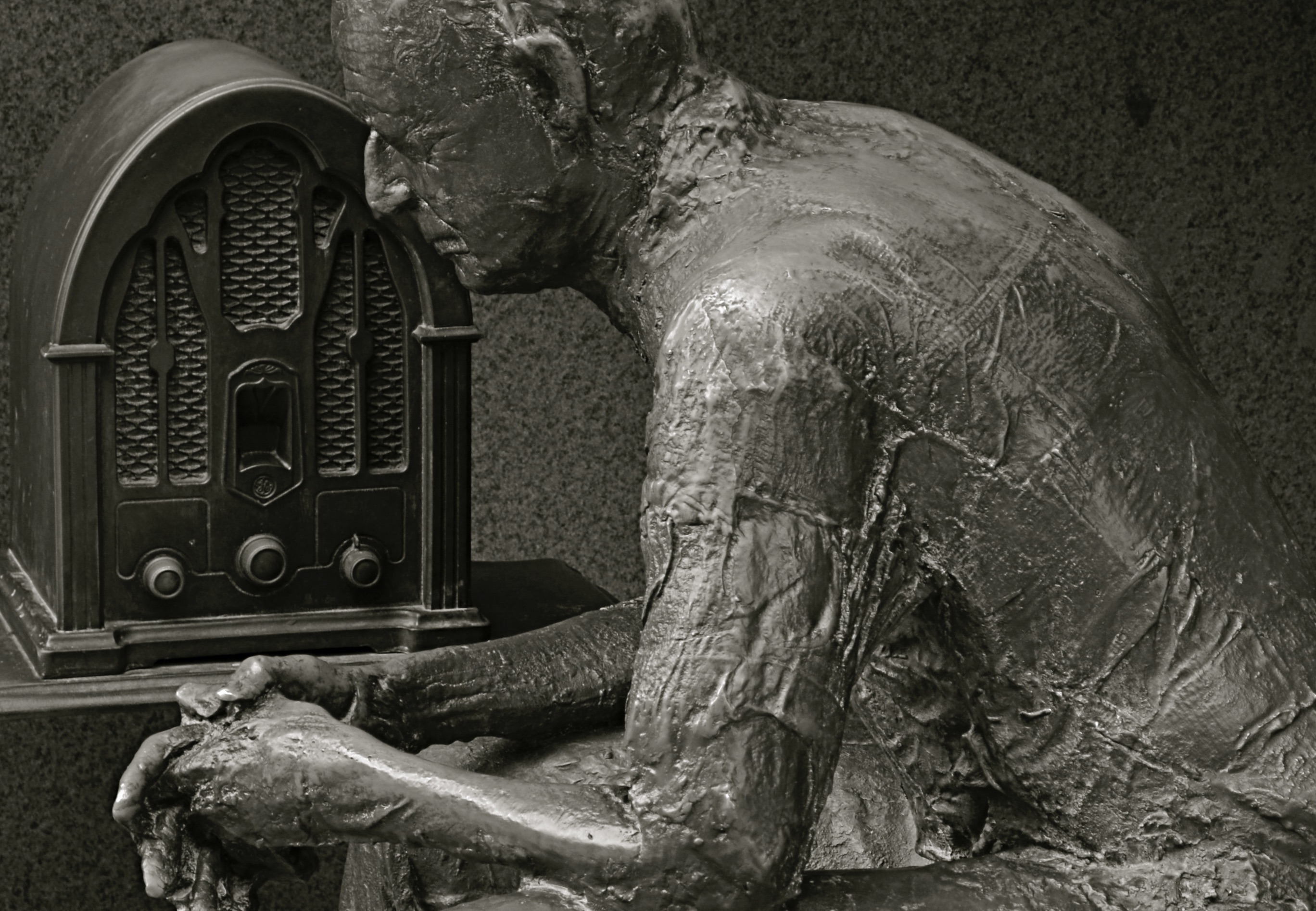
Fireside Chat by sculptor George Segal
There are four open-air “rooms” in the FDR Memorial in Washington, D.C., each designed to symbolize one of the separate presidential terms of Franklin Roosevelt, along with references to the specific challenges of those four eras-within-an-era. One such room houses sculptural reminders of how the average person interacted with the White House as it faced the singular challenges of the Great Depression. The figures, by George Segal (1924-2000), are spare, gaunt, haunting. One tableau shows an emaciated farming couple standing with grim determination amidst reminders of the Dust Bowl. Another shows a string of ragged men waiting in line for bread. My favorite figure shows a seated man leaning forward on his knees, his eyes fixed on the small “cathedral” radio set located just inches away. The sculpture is more than a mere tribute to Roosevelt’s encouraging series of “fireside chat” broadcasts, which acted to bolster the frightened nation as banks failed and privation swept across America like a plague of locusts. It is a snapshot of the relationship between leaders and the led. A bond. A lifeline of trust.
For Segal, who himself spent some of his college years scratching out a living on a chicken farm, and whose personal loss was measured in the Holocaust-related deaths of much of his family, the figures were emotional measures of the space taken up by mere mortals in alternating renderings of both pain and potential, expressed in a bold blend of materials. Covering models’ bodies completely in orthopedic bandages, he removed the hardened shells of plaster and gauze from their human “bearers” to create life-sized hollow spaces in three dimensions, leaving the details of the bandages in full view. In addition to his impactful pieces at the FDR Memorial, his surviving work in this format includes memorials to the gay liberation movement and the victims of Kent State.
Where do we regular shooters come into it? Making photographs of other people’s art from other types of media can range from mere snapshots to a kind of re-interpretation. The eye of the beholder shapes the eye of the camera. In Segal’s work for the FDR, a time so far removed from our own is transported back to anguished relevance. Generations later, we are all still seeking that bond, that link between leader and led. If we achieve it, the souvenirs of earlier days are merely quaint. If we can’t find that connection, however, these Echoes Of Hopes Past become more harrowing in their haunting power.
Because we need to walk toward the light.
Anyone have a match?
MUTATION
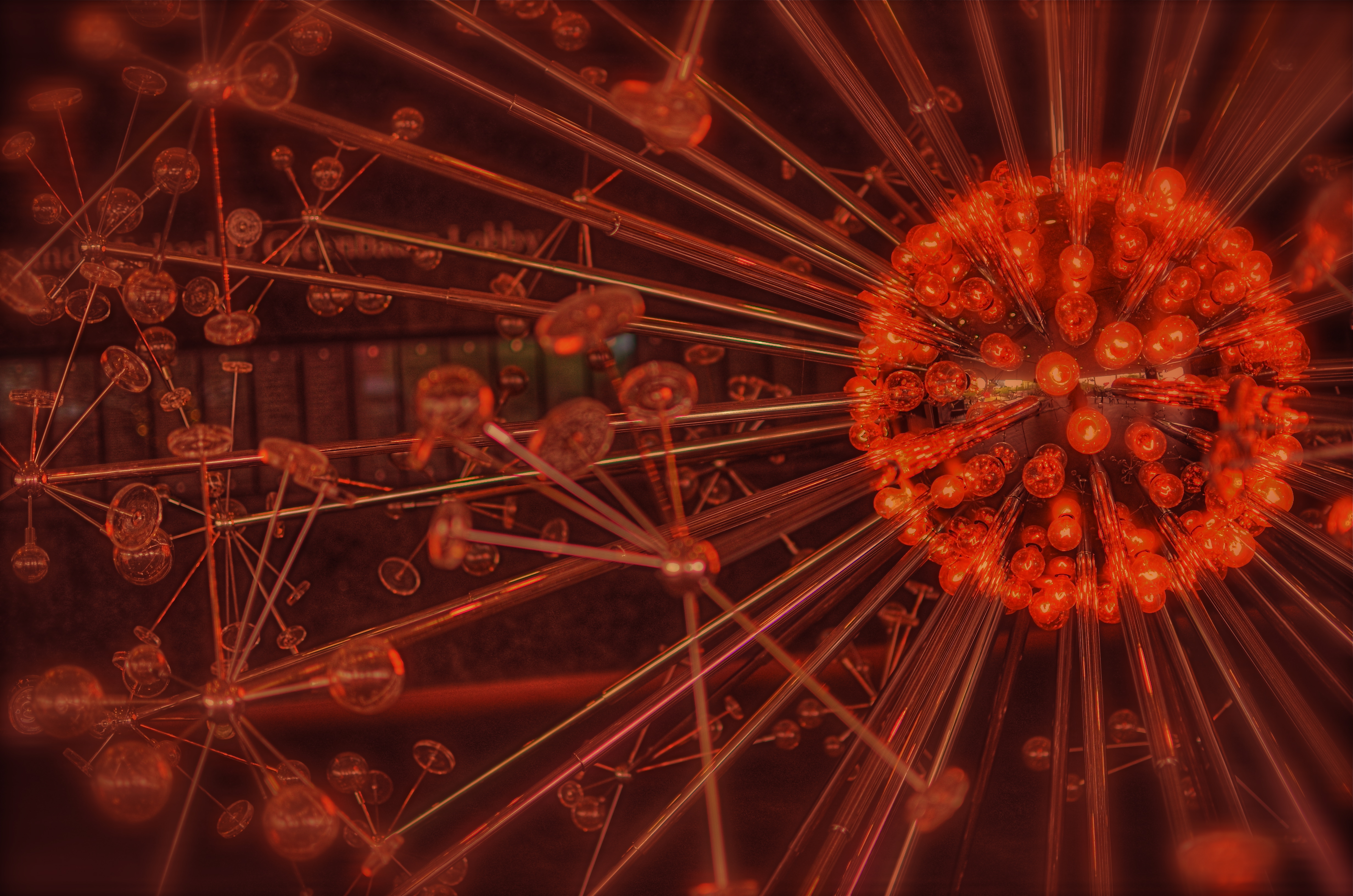
Okay, this has a LOT of processing. Love me or hate me based on whether it worked. 1/500 sec., f/1.8, ISO 100, 35mm.
BY MICHAEL PERKINS
NOT CONTENT TO BE AN ART ON ITS OWN TERMS, PHOTOGRAPHY IS ALSO CONSTANTLY RE-INTERPRETING ALL THE OTHER ARTS AS WELL. Ever since imaging fell out of the cradle in the early 1800’s, several of us have always been looking at the works of others and saying, “eh, I can probably do something with that.”
Yeah, not too presumptuous, right? And the trend has continued (some say worsened) to the present day. Half the time we are creating something. The other half of the time we are tweaking, mocking, honoring, loving, hating, shredding, re-combining, or ragging on somebody else’s work. Are these mashups also art? Are we co-creators or just cheesy thieves?
And does it matter?
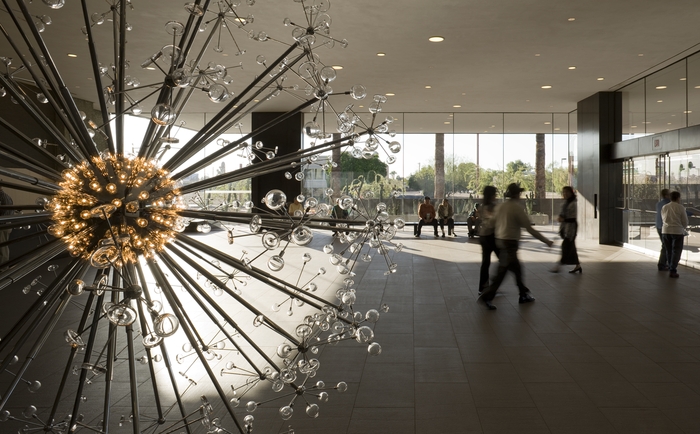
The Last Scattering Surface as it appears in the lobby of the Phoenix Art Museum.
The Phoenix Art Museum greets customers with a stunning original sculpture in glass and plexi right at the entrance to its ticket lobby. A huge installation of light bulbs, mirrored surfaces and reflective discs, Josiah McIlheny’s The Last Scattering Surface resembles a brightly burning orb (planet? asteroid? dwarf star?) surrounded by jutting rods that carry the central sphere’s light along “rays” to a series of circular satellites (moons? craft? debris?) Like many examples of pure design it is both everything and nothing, that is, it is mutative based on your observation. So, in a way, as in the manner of a photographer, you are already a participant in the co-creation of this object just by looking at it. Does this mean that it’s less theif-ish to go ahead and mutate the man’s work?
Well, there’s probably a lively back-and-forth on that.
For my own “take”, I wanted to remove the background walls, visitors, ambient blurry light from other junk, to isolate this nova-like work in “space”. I only had one frame that I liked from my short blast of shots, so I duped it, slammed the contrast real light/real dark on the pair, and did an exposure fusion in Photomatix. Adding a little edge blur and a re-tinting to the composite gave me the look of an interstellar explosion.
I freely advertise that I am making a semi-original re-mix on a completely original work. It’s not much more radical than shooting with a filter on the lens, or choosing black and white for a color subject, and yet, it always feels funny to try and make something beautiful that was beautiful in the first place.
But art is supposed to be about starting conversation, so consider this mine.
I just did my talking with a box instead of a mouth.
follow Michael Perkins on Twitter @ mpnormaleye.com
 thenormaleye