the photoshooter's journey from taking to making

Latest

ON MY WAY OUT…

By MICHAEL PERKINS

THE RECENT DEATH OF MY NINETY-SIX-YEAR-OLD FATHER actually resembled most visits I’ve made to Columbus, Ohio to visit him over the past quarter-century, in that a lot of my alone time was spent trying to reconcile the locales of my youth with the ghosts of things long vanished from those physical places. You can actually go home again, if you can bear the sight of things that you once thought were important, even vital, reverting to be just…..well, things.

No two people, certainly no two photographers, can regard the same scenes and come away with the same experience, and so we make fools of ourselves walking up to vacant lots and remarking to strangers that “there used to be a ball park here”. Not to the strangers’ eyes, certainly, and no longer even to us. Physical sites are imbued with only temporary meaning in one part of our lives, then revert to just their materials and geography once we stop needing them.

Nothing could be more ordinary than this simple arrangement of block concrete, which is adjacent to the spillway of Hoover Reservoir (not the more famous”dam”, nor the more infamous Hoover) on the northern edge of Columbus. Other than its role in providing some recreation and a clean supply of local drinking water, there is nothing visually remarkable about the place to the average photographer’s eye, and yet, to a seventy-three-year old just mourning the passing of a parent, it once held some special magic, and merited one last click.

When I was a boy, decades before farms and fields in the area would be swallowed by freeways and sprawl, motoring from my neighborhood to the Hoover constituted a half-day in the country. Driving our old Plymouth Savoy to the site meant a guaranteed stop at its rudimentary snack wagon (“food truck” for you kids) and a walk out to the spillway, where a thunderous cascade of water would explode forth from one of its release pipes and we kids would terrify our folks by leaning out over the low guard rail that barely separated us from watery doom hundreds of feet below.

I don’t know why I decided, after so many years of passing the reservoir on the way to somewhere else, that I needed one more up-close look. On this trip especially, I seem to have made several mini-pilgrimages to parks and wooded areas that once defined me, very aware that I was walking out of my old life for what now seemed forever. Of course, I will go back to Columbus gain, to see my sister, my adult children, my grandsons, and a dwindling network of old pals. But in some very real way, I was conscious that I walking out of some kind of door for the last time, with once-special places now returning to their normal uses as just more things in the world. A very strange kind of goodbye.

I’LL LET MYSELF OUT

Leave a tender moment alone. —Billy Joel

By MICHAEL PERKINS

I HAVE KNOWN MANY CREATIVE TYPES, from writers to painters to musicians to photographers, who struggle with deadlines. Not because they actually can’t complete assignments or projects on time, but because they find it excruciating to pry their fingers off their work, surrender it, and let it stand on its own….to, in effect say, it’s done enough; it’s good enough. Or, more precisely, realizing that it’s as good as I can make it, and that, perhaps, continuing to tinker with it in search of perfection will actually invite more flaws.

We know how to enter the “room” of a piece of work. Knowing when to head for the exit is something else again.

As a photographer who largely works for himself, I usually have the luxury of fiddling endlessly with images in the hope that I can somehow make them one step, one click, one fix closer to “finished”. This is actually a trap. If I were, in fact, delivering work on someone else’s dime, I would know that the delivery date is Friday at 5pm and that’s it. Bam. The rigid forces of the marketplace would guarantee that there would come a point when I would lay down my pencil and hand over the work. When the boss is me, not so much.

600mm, 1/400sec.,ISO 400, f/6.3

Take this image. It was a complete accident, the final image of a series of shots of an egret who had remained pretty much stable near a riverbank as I cranked away. Then, without warning, he decided to fly away, allowing me two panic-driven clicks of his exit within about a second and a half. My autofocus made a brave attempt at freezing the action, but in trying to track the bird, I was bound to create some amount of camera shake, all made worse by the fact that I was clear across the river and zoomed out at 600mm handheld. The second of the two frames largely worked, in that I caught the gorgeous contour of the bird and the reflection of his wings as they lightly skimmed the surface of the water. But the softness bothered me somehow, and so I was stuck with a technically imperfect shot that, for at least an hour or two, I told myself that I could somehow “fix”.

But you can’t really insert precision where it was lacking in the master shot, something I often have to admit only after fruitless tinkering, a desperate chase that leaves me with so-called “improved” versions of the shot that still, somehow, pale next to the original. You have to fight to keep the innocence and discovery in your work. Sometimes that means that you have to show yourself the door before you’re really ready. Often as not, though, it’s the most strategic exit you can make.

OFF THE SHELF

By MICHAEL PERKINS

JERRY SEINFELD ONCE REMARKED. OF GUYS OBSESSED WITH OVERUSE OF THE REMOTE CLICKER, that they “aren’t interested in what’s on tv; they’re interested in what else is on tv.” Funny and true, and also indicative of some photographers, in that, while we love what our basic gear does, we’re really excited at the prospect of hybridizing equipment from any and all sources. We’re interested in what else our cameras can do.

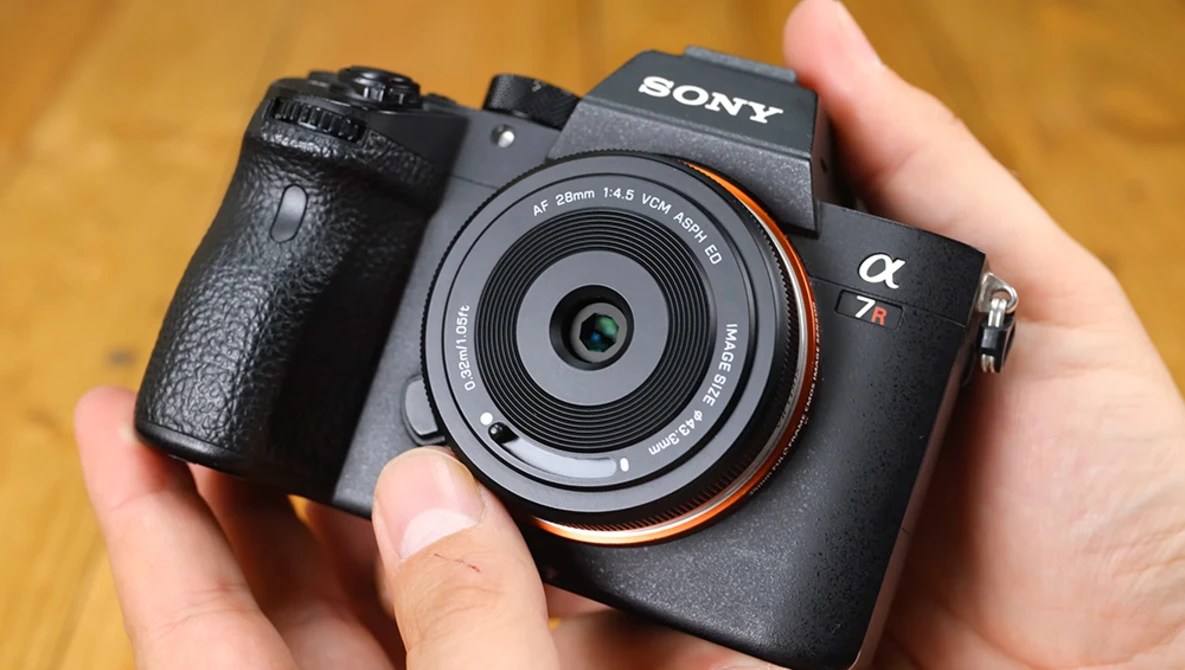
My 1977 Minolta 50mm, dormant in my closet for over twenty years, now fronting my Nikon mirrorless.

Many of us at least stray slightly from the only-original-manufacturers mindset (that is, only Canon lenses for my Canon camera, etc.), yielding to some degree of lens bi-curiosity, leading us to adapt glass from other makers to find the perfect marriage between body and optic. It’s not always a win for our work, but the journey is far more fun than the destination anyway. And the old hybridizing romance of the DSLR period has easily found a contemporary equivalent with the move to mirrorless cameras, as dozens of third-party equipment houses have rushed modestly-priced adapters to market for converting older glass, including many manual-only lenses, to use on mirrorless platforms. Photographers tend to be tinkerers; they are fascinated by what happens when you do this to this. And now it’s easier than ever to get answers for that tantalizing question.

Like many reading this, I spent my DSLR years adapting old manual primes from the film era, treating myself to optics with all-metal construction, smoother aperture and focus adjustment, superior sharpness, and a huge cost savings. These tended, for the most part, to be Nikkor lenses for my Nikon cameras, and so no adapter was required, since I was going from an F-mount lens to an F-mount body. Then, after making the leap to mirrorless, I adapted the same lenses to continue their use on a Z-body (using so-called “dumb” adapters that don’t communicate with the camera body, another cost-savings for someone who’s shooting without the need for AF). And finally, I’m enjoying going completely off-brand to give new life to optics that have been gathering dust since my first days behind a viewfinder.

Moonstone Beach near Cambria California, 9/6/25, seen through the eye of a 1977 Minolta 50mm prime.

The lens shown here came from a Minolta SRT200, a ’70’s-era SLR that I grabbed for $100 in the ’90’s when my daughter decided to enroll in a high school camera class. The class came and went, but I kept the camera, fitted out with a Rokkor-X MD 50mm f/1.7 prime lens. I spent a lot of time, just before and just after 2000, shooting mostly slide film with it, sticking it in the closet only after the purchase of my first digital point-and-shoot. Learning that, decades later, it could be restored to service as a sharp and clear prime for the mere cost of a $30 adapter put a huge grin on my face, and, at this writing, we have been renewing our old love affair for several weeks. Scores of articles are now online as to the efficacy of this or that bit of “legacy” glass on mirrorless bodies, most written with a flavor of delight, or adventure, or both. Some even claim that such vintage optics perform even better on digital cameras than they ever could on film. Your mileage may vary. As for me, I’m just beginning to explore what else is on my camera.

Oh, and hand me that clicker, willya?

SOOC, and SOwhat

By MICHAEL PERKINS

ONE OF THE THINGS THAT ACCOMPANIED THE FIRST GOLDEN AGE of amateur photography, when most people around the world were just acquiring their very first cameras, was the whole support industry of “how-to” guides, exemplified by Eastman Kodak’s long-running How To Make Good Pictures series of instructional books, along with endless others. These volumes emphasized basic practices for the beginning shooter, from composition to focus, aperture control to basic lighting, and so forth. In the age before complex processing was within reach of the many, such instructionals quickly codified certain steps for “acceptable” images, with a special accent on getting a good result S.O.O.C., or Straight Out Of The Camera. They were technical tips that were adopted by many as aesthetic standards as well.

Zoom forward to the present, where the word “acceptable” is as elastic as the term “normal”, and the “rightness” of the final photographic result is very, very much in the eye of the beholder. We can literally make anything look like anything, and yet this newfound freedom is still a source of controversy for people who define acceptability merely by the standards of recording or documentation. I am surprised, for example, to see on-line critiques of images based on their not being “realistic” or “naturalistic” enough, as if such arbitrary terms even can be applied to an interpretative art form.

Which of the two images shown here, either the SOOC shot (at top) or the one that’s had its texture and tone augmented (just above), is more “real” or “natural”? And in what context? To what purpose? Despite all our years of “how-to” conditioning, isn’t it pointless to reduce photography to a narrow set of acceptable parameters? Moreover, isn’t it obvious that most photographers refuse to be so hemmed in? As photography experiences a renaissance in its third century, the only thing that works in a picture is, to be redundant, whatever works for that picture.

ALL AT SEA

By MICHAEL PERKINS

MY RECENT RE-LOCATION TO CALIFORNIA has, in just over a year, already informed my photographic work, especially since I live largely near the Pacific coast. As just one example, my entire attitude toward landscape work has been re-jiggered, mostly due to the fact that I have near daily access to the ocean, which, as either subject or backdrop, seems ever new to me. I was never a “landscape guy” in any committed sense, my passion being concentrated either on street scenes or abstract patterns, which, in architecture, also centered me in cities. Being newly entranced by an area of photography that I always thought of as auxiliary rather than essential, then, requires me to be a lot more deliberate in choosing projects or compositions. It’s easy to get to the beach; it’s harder to get the beach, if you like.

You can see the effort here. What you can’t see is actual planning toward that effort.

One thing I learned pretty fast, and that is that I need to become more of a technician when it comes to even exposures that include say, the brighter surfaces in the sea. It takes a mortifying amount of practice to program either me or my camera (or both) to get balanced shots. The scene shown here is a great example of what I must absolutely not do, and that’s to trust my camera to either full auto modes or a semi-auto setting like Aperture Priority. I simply come away with too many blowouts on the waves, which, as we all know, are unfixable in post. You cannot recover detail that you didn’t capture in the first place. Underexposures can sometimes be mined for additional information, but a whiteout is a whiteout, and, in fact, you can make the entire frame worse by going overboard to fix an unfixable situation.

Shooting this image on full manual and adjusting the histogram for better balance throughout would obviously have prevented some of the damage, but, in a rapidly shifting scene (something that is a constant with “active” landscapes like water) I have ofttimes succumbed to the ease and speed of auto shooting, usually to my regret. And so, as I evolve fully into Beachcomber Boy, I need to re-school myself on all the lessons I have not had to draw upon for most of my recent work. As stupid as it sounds, there is no substitute for actually knowing what you’re doing.

NOTHING IS EVERYTHING IS… NOTHING

By MICHAEL PERKINS

THERE IS AN OLD VAUDEVILLE JOKE WHERE ONE COMEDIAN ASKS THE OTHER, “so what is it that you do?”, to which the other replies, “nothing.”. “Well, then, says the first, “how do you know when you’re done??” Yes, I know, stupid, but it also explains exactly how I feel when I’m on photographic walkabout.

There is a big difference between having “something” to shoot, i.e., a defined plan or target, and having “whatever”, or, some might say, “nothing” to shoot. The former is for things that you intend, that you want chronicled in a certain manner. Such a shoot may include a few random shots, but the chief objective of the outing is to accomplish a set thing. By contrast, in doing a walkabout, a “wherever my feet lead me” kind of shoot, you are on a much simpler path, in that nothing you do really matters, and the whole experience can be based on pure impulse.

Walkabouts happen frequently for me, since I am notoriously early for every appointment, and many of my family are just as predictably late. And since I am never without some kind of camera, my default action, when I arrive ahead of schedule, is to just start wandering and snapping. At the very least, all those “non-pictures” will teach me a little bit more about whatever kit I’m using, and at the most, I may come home with a surprise or two, such as the image seen here. It’s about as much “of the moment” as it can get, as I was merely walking through a parking garage when its red neon sign appeared overhead through a patterned atrium tunnel. The juxtaposition of the two, mounted against a jet black sky, said take a shot. Not two, or five, or anything that might constitute a deliberate act; a pure distillation of let’s see what happens. And what you see here is all there was; no backstory, no context, no procedure.

Why is this important? Perhaps it’s a reaction against the anti-instinctual habits we acquire over the years, as our gear becomes more complicated and our technique becomes more multi-staged. Perhaps it’s good, once in a while, to reconnect with the kid that originally was so fascinated by the taking of pictures that he/she couldn’t click fast enough, couldn’t wait to get to the next raw sensation. When I can’t find that kid, I panic a bit. His hunger to Plan Later, Just Shoot can still feed something important in me. He makes a big fat itch of himself sometimes, and until I scratch him, I feel a bit lost.

WHAT WILL HAVE BEEN SEEN?

By MICHAEL PERKINS

THE PHOTOGRAPHIC FRAME, LIKE EVERY OTHER KIND OF FENCE, includes things and excludes things at the same time, creating a double mystery in every image. Why was this information deemed important enough to be “in”? Why were other things forever left outside the perimeter, robbing us of the remaining context of the people or things within? What have we hidden, intentionally or not? What have we deliberately called attention to? What is the tension, the connection between these seen and unseen worlds?

Especially, in older pictures that depict who are no more, their position in the frame and the way in which their own gaze is directed implies things than will forever go unanswered. What, or who, are they looking at? Are they merely lost in reverie, caught accidentally in mid-step, or truly fixated on something or someone about which we can never know? It is the ability of the photograph to both convey and edit information in this perpetually unresolved fashion that contributes to its ongoing fascination. We are being told something; we will never be told everything.

Often, in so-called street work, I find myself seeking out people who, far from actively engaging with the camera, are actually oblivious to it. They are the ultimate candid subjects; those for whom the photographer is completely invisible, and more importantly, irrelevant. This has made me feel a bit of connection to those hobbyists who collect “vernacular photographs”, pictures found in odd lots in junk stores and auctions, made by people they themselves know nothing about. Not only do we find that the eternal verities of humanity are shared pretty much the same way all over the world (a birthday party is a birthday party wherever you go), but the same mystery of in-the-frame/out-of-the-frame unfolds in much the same way for every shooter. Who are these people?, we ask at first, only to realize that, of course, they are all us.

LIGHT BENDERS FROM HECK

By MICHAEL PERKINS

ONE OF THE TOUGHEST THINGS TO LEARN IN PHOTOGRAPHY is just how many popularly held beliefs you have to unlearn in order to grow your work. This means trusting fewer “obvious truths” and being open to ideas that seem counterintuitive. One such area has to do with lenses and how they render sharpness.

Many of us learned, early on, that each lens has its own “sweet spot” of focus, and that, on average, it tends to be two f-stops slower (smaller) than the lens’ widest aperture, so that a lens with a maximum aperture of f/2 might have its best, biggest patch of sharpness at about f/5.6. This generally accurate tidbit might easily tempt one to take the idea to its “logical extension”; that is, to assume that, if the aperture is closed down even further, there will be an even greater increase in sharpness. However, as intuitive as that belief is, it’s just not borne out by the raw physics, or by how light actually behaves.

Disclaimer: what follows here is a ridiculously simplified explanation, and I sincerely urge the reader to do much, much more sophisticated research on the subject. It can easily fill up several blackboards and make one feel as if one’s head were stuffed full of cotton, but it’s worth reviewing the full science of it. That said….

If you feel that, since your lens is much sharper and has a better depth of field at f/5.6 than f/2, then you may assume that a really small aperture like, say f/22, will be super-sharp end to end. However, that’s not the way it works. Light rays flow through a large aperture more or less in a straight line, traveling parallel to each other. This favors sharpness. However, once the diaphragm is tightened down further to f/22, the light rays have to crowd together to make it through a very narrow slit, which bends the rays and sends them cascading over top of one another, and that generally leads to poorer focus and loss of detail. Think of your lens’ sweet spot as a Martha Stewart “good thing” and f/22 as Too Much Of A Good Thing. That means that my 50mm’s f/5.6 sweet spot can deliver a shot like the one seen here better than could be had by stopping all the way down.

Of course, it goes without saying that your experience could be different in one particular or another, and I again emphasize that a kid assistant working with Bill Nye the Science Guy could probably have explained the whole phenomenon with greater skill, but the general idea is that lenses perform the function of focus in very different ways depending on what is asked of them. Mastering their potential means mastering your own observations and conclusions, and that means putting in the hours. The best lens in the world can’t eliminate your learning curve. That takes time.

PUT ME IN, COACH

By MICHAEL PERKINS

THE HEAVIEST LIFT FOR ANY PHOTOGRAPH of a loved one is when time removes the original player depicted in the image, and the picture itself must come off the bench and stand in for that vanished team member, forever after. It’s at a time of personal loss that the casual shots we snap in a careless instant become more valuable than any other commodity. The picnics, the graduations, the weddings, the days at the beach….all are converted in an instant from base metal to gold.

The author and his father, circa 1954.

This week, as my ninety-six-year-old father prepared for his final bow upon the stage, I spent a lot of time, as one does, poring over the photographic tracings of nearly a century of life. Of course, all these candids were only the top layers on my memories, as I still have the ability to place them all in deeper context, to match up the seen with the unseeable. I can’t decide, from minute to minute, whether it’s an exercise in comfort or agony, but I suspect it’s an alloy of the two. I can’t smile without crying and I can’t cry without smiling, and round and round we go.

When we flash a smile, throughout the years, for whoever happens to have just turned up with a camera, we aren’t posing for the ages. We aren’t trying to create an official version of ourselves to stand in for us after we are no longer around. Few of our portraits are formal or official. Beyond that, there is the random ravage of time, which determines which of the thousands of pictures of us will be lost, burned, stolen, or merely vanished, and which ones will survive to mark our passing. There is something horribly fateful in that knowledge. There is always the shot that oh, was taken right after I left the service, or ah, was right before we got married, etc., etc. that may be the one that’s forever vanished beneath the waves. The ones that got away, and all that.

Photographs, for being as recent in our human history as they are, have become our avatars, our “counterfeits”, as Shakespeare used to call cameo portraits. When the real player is tired or fallen, the fates, like some cosmic coach, reaches into the box of photos on the bench and sends in the substitute. It’ll never be enough. But it’s a very powerful little something, and sometime, it hits a grand slam.

RE-FRAMING THE TERMS

By MICHAEL PERKINS

IN A RECENT POST, I mentioned that my first year in California, has, in photographic terms, been largely reactive. The huge surge in new situations and fresh sensations has truly shaped my images, in that they are predominantly quick snaps fired off during vastly different living scenarios, some kind of attempt to not let anything “get away”. All this rush has cut down the planning time for individual shots. They are, most of them, shot on full auto, or, at the very least, on autofocus modes. But I’ve now settled in, and I need to reassert the instincts and intuitions that made me a photographer in the first place.

It’s time to re-emphasize the basics.

This blog takes its name from The Normal Eye, a book I compiled, nearly twenty years ago, of pictures I made over an entire year’s time with only a manual 50mm prime. The idea was to teach myself patience, composition, instinct and mindfulness by avoiding the trap of bagfuls of specialized gear, and thus hyper-learning how to wring results out of only one optic, a simple, sensitive but unforgiving tool that would force me to plan and direct photos with a finely-tuned intentionality. If I needed a wider shot or tighter shot, I would need to move my feet. If I was uncertain about focus, I’d have to risk being wrong rather than lazily delegate that choice to my camera. It made me work slower, but smarter, and it gave me a template that, years later, I still retreat to when I need to get my brain back into training.

Using automates to be able to shoot on the fly is a luxury, with the gear making all those troublesome creative decisions for me. And the pictures I get, even when my brain is in neutral, are adequate. However, they never aspire to excellence, to risk. For that, I need my mind in full engagement. I need to narrow the choices the equipment provides and make those decisions for myself. This strategy was, years ago, the only path to teaching myself to see, and it is the only sure path I know to refreshing those skills before convenience and impatience make my talents decay. Today, I’m setting out with yet another 50mm prime, shooting on complete manual. I don’t know how long I have to work exclusively with this setup, but I know, from experience, that it will school me anew. And it’s what I need right now.

AND NOW, BACK TO OUR ORIGINAL PROGRAM

By MICHAEL PERKINS

YOUR FIRST YEAR IN A NEW PLACE, as far as your photography goes, is a lot like being on vacation, in that a firehose of sensory information is coming on so quickly that, in an effort to not miss anything, you shoot very much on instinct. Everything is new, and therefore fascinating in a way that it won’t be after you’ve logged enough time to regard your new world as your standard environment, instead of just the latest stop on the tour bus. And that changes the way you make pictures.

Snapshots, by their nature, are reactive, and they make perfect sense when you feel like something very fleeting is whipping by you, never to be recovered if you don’t act (snap) immediately. You are not slowing yourself down to make a shot do all that it can do; you’re just making sure you get something in the can, now. And so, in my first year in California, I’ve been shooting like a tourist, as if I soon have to rejoin the rest of the group back at the ruins, so we can move on to the next attraction. I haven’t been approaching scenes or situations with any intent or contemplation. Instead, I’m shooting largely as if I’ll never be here again, or. as if I have to fly home in five days.

I have to rein it in.

I’ve now been to a few locales out here enough times that I am reverting back to my regular program of slowing things down, seeing them from different angles, wondering if I have the right idea for a picture, or, most importantly, whether a thing is even worth a picture in the first place. One such case that I noticed in particular is the Ventura County Fair, which I attended last year in the heat of my first summer along the central coast. The pictures are colorful and bright, but they are merely pictures of masses of people walking by funnel cake and burger stands, and not much more.

This year, in returning to the midway, I stole away from my wife, who had accompanied me for last year’s visit, and started looking for stories, things that might reveal or imply other things. After a ton of walking and waiting, I finally got several images that I felt had been approached with at least a modicum of forethought. Masterpieces? No, but a kind of proof-of-theory revelation. I have to reclaim a more investigative method of framing images. I have to get off the tour bus, and back to real life.

WHAT KIND OF ME AM I?

By MICHAEL PERKINS

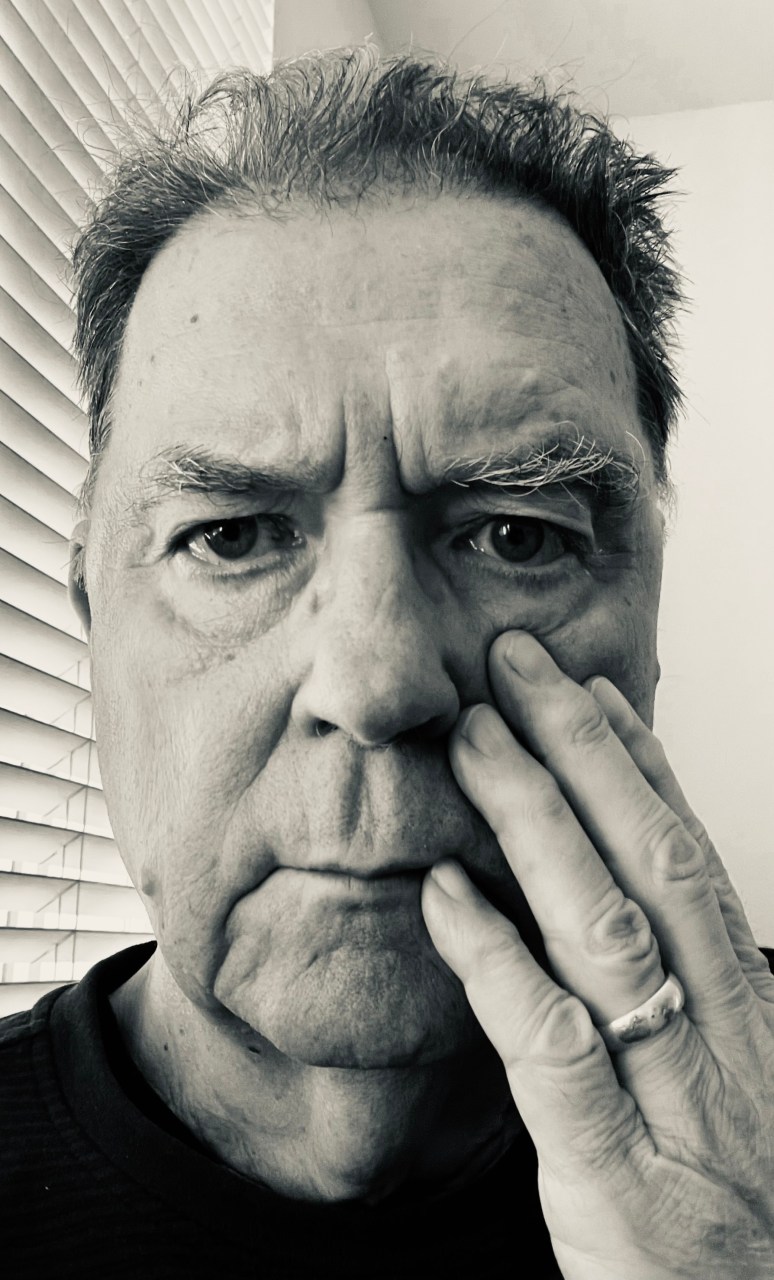
BEING THAT I WAS BORN DURING THE MIDDLE OF THE PREVIOUS CENTURY, most of the pictures that have been taken of me over a lifetime were, on average, shot by someone else. In my day (the old coot intoned), the self-portrait, along with the ubiquitous “selfie” was not the universal default for photography that it later became, meaning that, in my earlier years, one more carefully contemplated having one’s face captured for posterity, in that it was more of an occasional thing. Certainly, as a baby-boomer, I grew up in a world littered by millions more amateur snapshots than was the case in my parents’ generation, all of them mixed into the stew of more formal portrait “sittings” associated with major life events. Still, the ability to instantly and endlessly turn the camera inward was in no way as instinctive a habit for me and mine as it is for those born in the present era. This place in time that I occupy in time, then, continues to color the task of making my self-portrait. My aims are distinct. I seek certain things; I avoid others.

Portrait work, for me, is an investigation, an attempt by my outside eye to detect something inner about another person; to view them interpretively, possibly with the goal of seeing something in that person that not even they themselves knew existed. That draws a definite line between how they self-view and how I am privileged to approach them, that is, objectively, as subjects. When it comes to having someone snap me, however, I have the normal human instinct toward self-protection. I perform. I pose. I craft a caricature of myself that I can live, a simplified, polished rendition of my best parts.

Ah, but once I decide to capture myself, I’m hoping to plumb down into some layer that not only has never been discovered by outside eyes, but which might even surprise me. However, the modern “selfie”, by contrast, is actually anti-discovery in nature. How could it not be? We craft palatable, pleasing versions of ourselves that are as superficial as an outsider or a publicity agent might shoot, because, in the age of social self-marketing, they are commercial products designed for mass consumption, and, crucially, mass approval. Shooting straight in such a context is tricky. I don’t always like what I see in a self-portrait. Sometimes I dig a little too deep. Sometimes I still catch myself performing, attempting to make myself more serious, or intense, or important than I actually am. Hell, I’d even like to make myself look twenty pounds thinner and ten years younger. But, as a photographer who is supposedly interested in truth, I have to keep trying to find out what that actually looks like. Or what I look like when I am true.

It’s a process.

WE HERE DEDICATE….

By MICHAEL PERKINS

PHOTOGRAPHERS HAVE THEIR HANDS FULL, in the first third of the twenty-first century, documenting the vanishing details of the urban architecture of the 20th. Change is a constant and the elusive quality of “progress” is often equated with, to put it simply, knocking down the old to make room for the new. One very good reason to preserve all that visual detail is to show what we intended with older structures beyond their mere physical presence.

The so-called golden age of skyscrapers was fueled by the egos and aspirations of titans in government and business, with both forces incorporating expressions of ideals into the detail and design of their pet architectural projects. These places weren’t merely open to the public; they were dedicated to them, or at least to their loftier goals, with entrances, lobbies and outward ornamentation embodying beliefs, invoking virtues like trust, industry, fidelity, labor, integrity, or honesty in inscriptions, reliefs, and arches, as if such qualities were not only those of the building’s founders, but things eagerly to be wished for all who entered these common spaces.

Elevator cab door, Leveque Tower, Columbus, Ohio

This elevator cab door, named “Prosperity” can be seen in Columbus, Ohio’s Leveque Tower (opened in 1927 as the American Insurance Union Citadel). It’s one of a group of three (the others are named “Health” and “Happiness”) that remain in the building’s lobby, and, like many interior and exterior designs of the time, also incorporate the signs and symbols of the zodiac. Photographing features like this is like summoning the past, not merely in its physical aspect, but also in its stated aims within its era; to instruct, to inspire, to act as a pledge of civic betterment. In an age of brutalist architecture characterized by bland or blunt concrete boxes, such sentiments seem beyond quaint; imbuing bank buildings or post offices with all that aspirational sloganeering feels over the top, corny. Better reason still to snap these signposts from a previous time before they are swept away. They are more than buildings, or, at least, they were intended to be.

THE FEEL OF REAL

By MICHAEL PERKINS

MUCH OF OUR INHERITED SENSE OF TEXTURE IN PHOTOGRAPHY was shaped early on by what the earliest camera images could practically deliver. We experience historic images of Lincoln, Twain, and the great generals of the Civil War through the very rough “tooth” of the processes that almost exclusively recorded them, chemical and technical methods that rendered features, clothing and skin in a certain limited fashion. And over time, those methods dictate our concept of how the skin and features of those people should look, forever, even as they define for us what words like tough, stern, brave, frightening or serious ought to mean in terms of how smooth or how coarse a mood we’d pursuing.

Ryan Michael Perkins, Columbus, Ohio, 2017

And it’s not merely historic; a big part of the recent retro movement toward analog imaging even a rec-creation of it on digital platforms, lies in in aping or recreating the textures we saw of people as they were depicted in previous eras. What we collectively call a “film look” is, in fact, many different looks, depending on whether you’re recalling an 1850 daguerreotype or a 1975 Kodachrome slide, with special emphasis on the degree of grit or silkiness appropriate for different time frames. In some circles, this emphasis on texture has risen to the same level of importance as such fundamental pillars as color and exposure.

I myself will often assign an older texture to selected portrait subjects, based on what elements of their personalities I wish to suggest, as in this image of my oldest son Ryan. It’s safe to say that, over his nearly fifty years of life, he has veered far closer to rough times than serene ones. A perfectly-lit or balanced image of him seems as ill-fitting as a pair of jeans that’s two sizes too small. He doesn’t do “easy”, and so my favorite pictures of him attempt to capture that fact, calling, in this case for example, a kind of sandy, friction-rubbed aging to the final frame. I don’t embrace all of the “just like film” movement, but there are moments when even the freshest faces should have a little acid-washed quality to them, as if to suggest all that time has etched into their features. “Real” and “feel” are subjective words, and they are likely, for photographers, to remain ever thus.

THE FOUR SISTERS

The Figueroa Tunnels connecting L.A. and Pasadena, soon after their opening in the 1930’s.

By MICHAEL PERKINS

LOS ANGELES IS CONSTANTLY IN THE ACT of obliterating its past; a term like “Old L.A” applies as much to a 1985 Blockbuster Video as a 1926 bank building in a town that, like the movie industry it hosts, tends to frequently “strike the set” and start again from scratch on a nearly daily basis. That’s why, for photographers (especially newly-arrived ones) finding infrastructure that is older than your family dog can be a touch task. Recently, however, I got my first look at such a fabled structure by merely driving up to it. And through it. Or through them.

The view through one of the four tunnels to its neighbor, along with local traffic signage, July 2025.

The first major highway linkages between downtown Los Angeles and nearby Pasadena were hard-won affairs, as the rugged hills of Elysian Park blocked the city’s Figueroa Street from direct entry to the smaller town, forcing north-south traffic to cross a bridge over the Los Angeles river, creating huge daily bottlenecks. And as was the usual case with many physical obstacles in the 20th century, it seemed like a “dynamite” idea to simply blast a roadway through the hills, not for just one tunnel, but for four. Engineer Merrill Butler, who also designed many other landmark crossings and tunnels throughout greater L.A., cranked out the first three of these beauties beginning in 1931, with a fourth, the longest at 755 feet, arriving after 1936 as yet one more way to direct and relieve traffic flow. Each was a gentle Deco arch design with streamlined support wings, custom “coach lights” and, at the keystone of each, an abstract sculpture of the Los Angeles city seal.

The shot you see here is a true snapshot, in that, not having motored through Pasadena for a long spell, I had completely forgotten that the tunnels were a feature of the last leg into town. Before I could reach any of my formal gear, we’d already entered the first tunnel, and so I managed to grab images of the proceeding three with my iPhone, anticipating the extremely wide lens default of the camera by waiting almost until entry to attempt to fill the shot with just the structure and very little of the surrounding sky, roadside and terrain. I love my first glimpses of sites in L.A. that were once fundamental to the growth of the city (the Arroyo Seco Parkway, built after the tunnels opened, actually does the heavy lifting on local traffic flow now) and have, almost by chance, been allowed to hang around and age into venerability. The camera’s function as time-traveler cum time-freezer is magical, and I value the gifts it yields.

LUMIERE’S PHOTGRAPHIC HAT TRICK

By MICHAEL PERKINS

ALL HISTORIES OF THE EARLIEST DAYS OF MOTION PICTURES rightfully credit brothers August and Louis Lumiere as twin titans in the creation of some of the medium’s most important technical advancements. Their first breakthrough came when they refined Thomas Edison’s earliest motion picture cameras and devised a more uniform method of moving film through them, with the simple but elegant invention of sprockets. Their second, and substantially bigger win involved the creation of the cinematograph, which combined photography, developing, and projection within a single device. Both innovations helped the Lumieres become the first true producers of motion picture content and the very concept of “movies”, years ahead of Edison and the rest of the field. Ironically, they believed that the cinema was a dead-end fad, a novelty that would play itself out in time. That mistake would eventually lead them back to their beginnings in still photography, and their third fundamental miracle: color.

Auguste Lumiere, captured by the Autochrome process he developed with his brother Louis, just after 1900.

Attempts at a natural, stable color process had begun very nearly at the start of the photographic era, but nearly all were what we’d now called coloration processes, with either special filtration or hand-drawn hues added after a positive monochrome print was achieved. The Lumieres built color into the very act of making a photograph with their chemically complex Autochrome system, an “additive” process, versus the “subtractive” methods which would later characterize the first true color films such as Kodachrome.

Near the turn of the 20th century, just a few years after roll film was popularized by George Eastman, the Lumieres built Autochrome on existing glass plate technology. coating a plate with a random mosaic of microscopic grains of potato starch, dyed red-orange, green, and blue-violet, with each grain hue acting as a color filter. Lampblack was mixed in with the colored grains and an over-layer of silver halide emulsion was applied over that. The exposed plate would produce a color negative, which was then re-exposed after the removal of most of the plate’s silver content to result in a positive transparency. The result was extremely natural in its reproduction of the existing color spectrum but dark in tone, so that a backlight of some sort would have to be shone through it for sufficient illumination. Special carrying cases were produced to make this process easier and more consistent.

Autochrome became the first complete process for in-camera recording of a colored image, but, due to its required longer exposure times, it became a medium for mostly portraiture and still-life work. Accordingly, many historic figures “sat” for Autochromes, including President William Howard Taft, the first president to be photographed in natural color. The Lumiere’s system, short-lived though it was, kicked open the door to color photography, taking it from an afterthought craft to a living art. Every one of us are standing on their shoulders.

A ONE-WAY TICKET TO HUMBLEVILLE

By MICHAEL PERKINS

EVEN THOSE WHO CELEBRATE HAVING FOUND THE LOVE OF THEIR LIVES must, in their candid moments, also attest to the fact that they adore their mates as much in spite of things as because of things. I love him, even though he snores. I lover her, even though she snaps her chewing gum in the movies. Do your own lists; I know you have them.

So it is with camera equipment.

The gear we use and cherish the most across our lives as photographers is the very same equipment that has, at one time or another, let us down, betrayed us, or frustrated us, especially in the “honeymoon” period, when a given piece of kit is brand-new, along with our relationship to it. We miscalculate. We guess wrong. We assume that just because “my old camera” or “my first lens” did a certain thing, the new doohickey will deliver the goods in that same way. In our very first pictures with a fresh toy, we not only don’t know what went wrong with the duds, we don’t fully understand what went right with the winners. Indeed, during our “getting to know you” phase with fresh devices, we are, like a disillusioned newlywed, likely to yearn for a divorce because, my God, I can’t stand that thing you do.….

Week One with a new telephoto. Just enough luck to keep me at it…

If it’s not painfully obvious that I am going through such a break-in/break up state of mind, then let me just admit that, at this writing, that I am currently slogging up a slow learning curve with a new telephoto. I needed it, I wanted it, I counted pennies and snipped coupons to get it, but, man, there are about three times during every shoot when chucking it into the lake would feel oh so great. For about three seconds. Truth: I can already see a strong justification for having bought it, as the improvement in my work that I assumed might occur is, in fact happening, but, boy howdy, I am frustrated by how long it’s taking me to be smooth, or natural, or, God spare me, instinctual with it. The ergonomics are as about as good as I’m going to find in a behemoth of this size (a 180-600mm f/5/6-6/3) and yet I am still, like a nervous teen on a first date, trying to figure out where it’s safe to put my hands.

Fortunately, I have an entire summer of fairly ordinary days to figure it out, to blow out my first thousand horrid shots before a project of any importance comes around. Most days, I am anxious when there’s “nothing good to shoot”. For the next few weeks, however, all that “nothing” will later mean “everything”. Thank heaven for pictures that don’t matter. They keep me sane. And keep a very large and expensive plaything out of the lake. For now.

BACK TO EDEN

The task I’m trying to achieve, above all, is to make you see.—-D.W. Griffith

By MICHAEL PERKINS

EVERY YEAR OR SO, OVER THE NORMAL EYE’S FOURTEEN-YEAR JOURNEY, I tackle anew the task of explaining the choice of that particular name. That means proposing a kind of working definition for the word “normal”, or at least putting forth the reasoning behind my own use of it within these pages.

For me, to be “normal” is to operate within the first, natural state of something. And when it comes to the making of photographs, that means the first state of the human eye. The “factory setting” for your eye is observation, not merely “seeing”. As a new human being coming into the world, you don’t just believe what you see; you believe in excess of, even in spite of what you see. That which we call “factual” is fluid, colored by experience, and certainly not formed by data alone. Only after we leave childhood are we trained to think that are eyes are only to be used for documentation or recording, for evidentiary work. At that point, we stray from the “normal” state of our eyes, the vision we were equipped with, as a default, when we first came to be.

However, once you pick up a camera, you actually leave the plainly factual behind, since you are already utilizing a machine that, on its best day, can only generate an abstraction of “reality”. By making images with that machine, you are already weighted in favor of interpretation, of seeing past your senses. And that restores your ocular factory setting or default. Your soul, in effect, gets rebooted.

It took me four years to paint like Raphael, but a lifetime to paint like a child.—-Picasso

Pablo had the right dope: we have to unlearn the bad training, foisted upon us by the world, about what’s “important” to look at. We have to re-learn the ability to trust fancy. That is the only path to art. If our eyes were merely designed to make a visual document of the world, we would only have to take a single photography of any object on earth, as only one would be necessary. Instead, we honor sentences that begin with “the way I see it is..” We are moved by photographers with normal eyes. That’s what this venue is, and has always been, about. A return to Eden, if you will. A reassertion of innocence. To believe that what we have to say about the world is, indeed, normal. For us.

AN AUDIENCE OF ONE

By MICHAEL PERKINS

YEARS BACK, MY FATHER, TAKING NOTE OF MY OBSESSIVELY FASTIDIOUS MANNER OF WATCHING MOVIES, i.e., free of interaction with my fellow audience members, remarked that, in a perfect world, I would have my own private projection room, watching films in perfectly controlled environments as a fussy, controlling audience of one. Unfortunately, that dream film-critic scenario never presented itself.

Until this year.

Turns out, if you want to share a movie with a minimal number of people, go see a sixty-year-old French art film in the middle of a weekday afternoon. We’re talking guaranteed crowd control here. Marian and I had driven from Ventura, California to a quaint cinema high in the hills above Santa Barbara, hardly the venue to catch Godzilla XXXIV: The Final Reckoning or any other cinematic Hoover designed to suck in the public by the millions. Upon taking our seats, it soon became obvious that we would have the entire house to ourselves, a true rarity. Additionally, ahead of the curtain time, the theatre was not pumping a firehose of advertisements and idiotic on-screen trivia quizzes into the room, but, instead, bathing us in pure, wonderful silence.

It didn’t take long for me to realize that, there, at that moment, I could take a picture of Marian that would be impossible in 99% such cases. There was that face in the middle of a sea of muted red. The image would compose itself! Three frames and I was happy enough with the Edward Hopper-ish result to sit back down and dig the quiet. I knew I’d stolen something precious out of the darkness.

Fifteen minutes later, a few other people drifted in (the film had a French plot, meaning no plot, so it really didn’t matter when they arrived) and the moment was gone. But I had at least obeyed my instinct and had the great fortune to make a record of it. That is the heart and soul of making a good picture, and I’ll sit through someone else’s lousy one, anyday, to make that happen.

FITS AND (FALSE) STARTS

By MICHAEL PERKINS

ERGONOMICS is defined as “the application of psychological and physiological principles to the engineering and design of products, processes and systems.” When it comes to photography, the term “good fit” is probably the simplest way to express this concept. Cameras engage the hands, the eye, and the mind with each click. The question to be asked of any camera then, is, “how is this machine helping me make better pictures with a minimum of fuss and delay?”

The term “human factors engineering” (HFE) is sometimes used instead of “ergonomics” and I actually like that phrase better, since it says exactly what the designer’s goal should be; making things so that they are easy to operate in an efficient and satisfying manner. So let’s apply that idea to the various dials, buttons and menu options on a camera, and where they are situated. Does your device cause you too many tasks per image in terms of calculating, reaching, holding, executing? Many of the most elegantly designed pieces of kit in photographic history have also been some of the worst nightmares when those stunning sketches leave the inventor’s table and enter the real world of shooting. And so, what makes a generally operational camera not work for you must be the primary consideration when you’re shopping, more so than features, price, or high marks from techie reviewers.

In a 2012 article called Camera Ergonomics, revised for 2023, a common operation done by a very popular model (name withheld) was outlined to illustrate the frustrating processes that were baked into the camera by its designers:

“When we want to operate the front control dial, there is not enough space for the right index finger to bear on it without moving the other fingers of the right hand out of the way, so we have to release our grip on the handle with the third or fourth fingers, move those fingers down the handle, move the index finger forward and down to the front dial, rotate it, move the index finger back up to the shutter button, release our grip with the third and fourth fingers, and move them back to their regular holding position. This is seven different actions, two of which involve moving the entire hand…”

Sadly, many of us simply make the adjustment in ourselves when presented with an obstacle placed in our path by the camera. We make ourselves fit the device instead of vice versa. This is madness. Any thinking review of a new camera should focus primarily on what it’s like to use the thing, because anything else simply builds extra, time-wasting, shot-missing junk into the process.

Never mind that cameras currently come loaded with enough tricks and toys that will never be fully used over their useful lifetimes, or that the snarl of intertwined option menus on many machines is a jungle all on its own. Take it down to the most basic and essential issue; if the camera literally requires you to contort your body beyond its natural functions just to take a picture, it is the device, not the human, which merits a re-design.