REWORKING THE UNIVERSE
By MICHAEL PERKINS
CONTEXT, FOR A PHOTOGRAPHER, IS LIKE THE CONDUCTOR’S BATON IN MUSIC, that magic wand that dictates fast and slow, soft and loud, ordering a specific world within a confined space. Since it impossible to show the world entire, all shooters decide what part of it, what story within it, that they will frame. Sounds obvious, but without the mastery of this skill, we fail as storytellers, and the eye that we develop for what to include and exclude is, despite all the tools and toys, the only thing that really makes an artistic performance out of a photograph.
It can also be a helluva lot of fun. With some dumb luck thrown in for good measure.
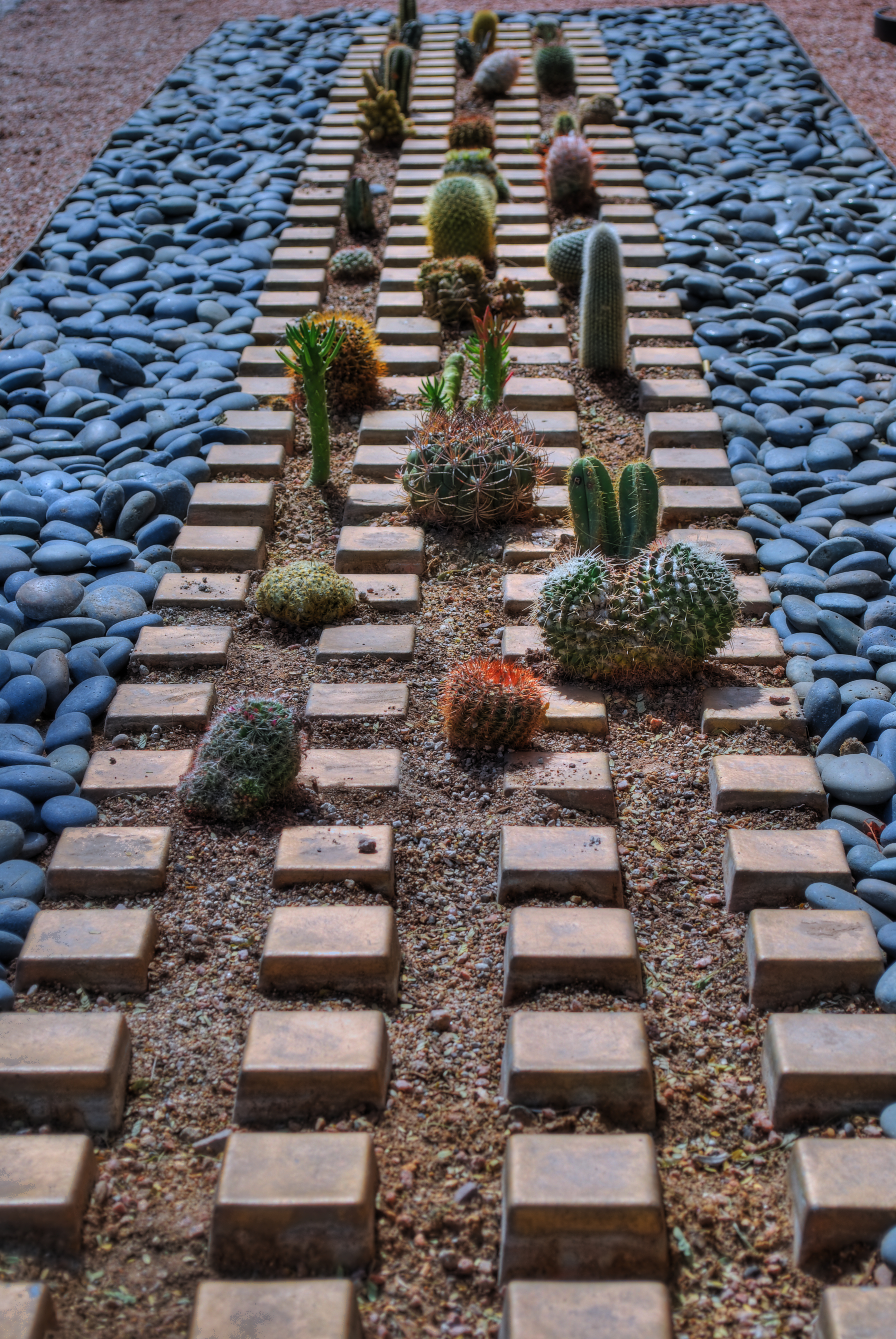
Cactropolis, 2011. A three-exposure HDR blend with a little color and contrast teaking. This whole layout, in reality, is about fifteen feet square, total. Various shutter speeds, f/8, ISO 100, 52mm.
I love opportunities that allow me to disrupt the original visual “place” of objects, to force them to be re-purposed for the viewer. A few years ago, my daily lunch routine involved a short walk across a bustling college campus to my habitual lunch hang, a stroll which took me past one of the school’s busiest crossroads, marked by the intersection of two superwide sidewalks flanked by small patches of landscaping. Since this is Arizona, such short plots of land frequently are not the stuff dreams are made of. We’re talking pink quartz gravel interrupted by the occasional scabby aloe plant or cholla. And that’s what made this one little rectangle, just several feet long on each side, vie for my attention.
An arrangement of several varieties of small cacti has been arranged in rows, regulated by square tiles, grounded in gravel, and bounded by smooth bluish stones. Simple stuff, really, but this was somebody’s deliberate design, a pattern that registered, to my eye, like some kind of fantasy urban streetscape, blocks of tiny, spiny skyscrapers vanishing off toward an unseen horizon….a miniature downtown from Weirdsville, a tabletop diorama from Beetlejuice.
I didn’t really have to compose anything. I was in the framing business. But getting that frame meant getting rid of the surrounding throngs of students, the sidewalks, the buildings, the sky…..anything that seemed outside of the closed world implied by that little rectangle. Changing the context. In fact, I was adding something for everything I was taking away.
So let’s crop this puppy and see what happens.
Now I saw what seemed to be a self-contained world, one in which I was free to imagine what lay “beyond”. I goosed up the hues and texture with HDR processing, but otherwise, what you see is what there was. Maybe it works as pure design. Maybe I conveyed something, but the fact is, we have to make choices as shooters. The only thing that marks us as individuals is what we decide to see, and show.
Like I said…fun….luck….some other somethings…..
(Many Thanks Dept.:The idea for this post was inspired, in part, by a suggestion from my good friend Michael Grivois.)
OPTING FOR IMPERFECTION
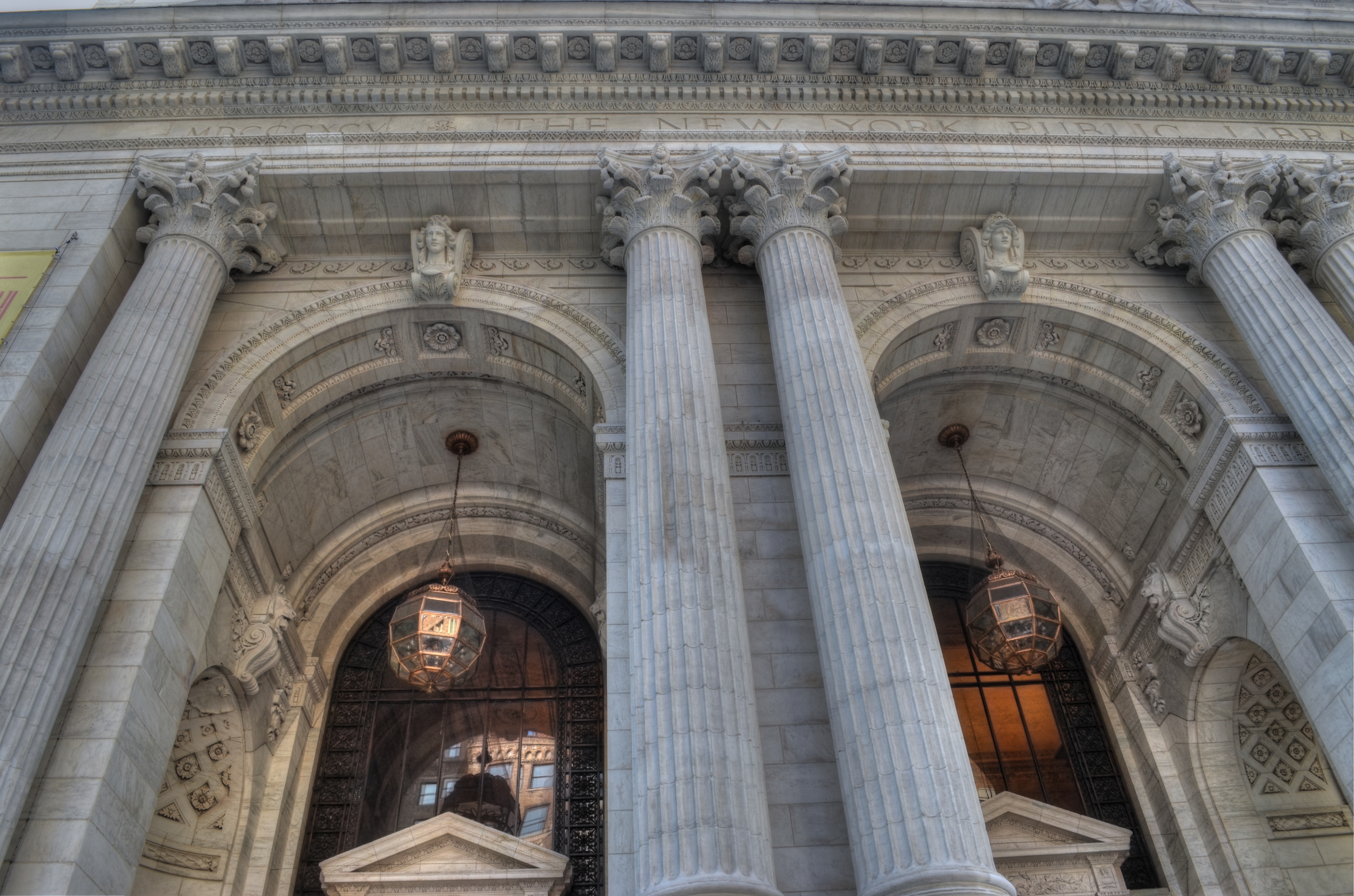
When additional detail needs to be extracted from shadows and from the texture of materials, HDR (High Dynamic Range) is a great solution. This shot of the entrance to the New York Public Library is a three-exposure bracket composited in Photomatix. Is this process great for all images of the same subject? See a different approach below….
By MICHAEL PERKINS
SOMETIMES I LOSE MY WAY, CREATIVELY. Given that cameras are technical devices and not creative entities, we all do. We have been given, in today’s market, wonderful aids to seeing and interpreting what we consider noteworthy. Technological advances are surging so swiftly in the digital era that we are being given scads of pre-packaged effects that are baked into the brains of our cameras, ideally designed to help us calculate and fail less, succeed and create more. To that end, we are awash in not only genuinely beneficial shortcuts like programmable white balance and facial recognition, but “miniature”, sketch, selective desaturation, and, recently, in-camera HDR options as well. Something of a tipping point is occurring in all this, and maybe you feel it as strongly as I do; more and more of our output feels like the camera, the toys, the gimmicks are dictating what gets shot, and what it finally looks like.
Here’s the nugget in all this: I have been wrestling with HDR as both a useful enhancer and a seductive destroyer for about three years now. Be assured that I am no prig who sees the technique as unworthy of “pure” photography. Like the old masters of burning and dodging, multiple exposure, etc., I believe that, armed with a strong concept, you use whatever tool it takes to get the best result. And when it comes to rescuing details in darker patches, crisping up details in certain materials like brick and stone, and gently amplifying color intensity, HDR can be a marvelous tool. Where it becomes like crack is in coming to seem as if it is the single best gateway to a fully realized image. That is wrong, and I have more than a few gooey Elvis-on-black-velvet paintings that once had a chance to be decent pictures, before they were deep-fried in the conceptual Crisco of bad HDR. Full disclosure: I also have a few oh-wow HDR images which delivered the range of tone and detail that I honestly believe would have been beyond my reach with a conventional exposure. The challenge, as always, is in not using the same answer to every situation, and also to avoid using an atomic bomb to swat a fly.
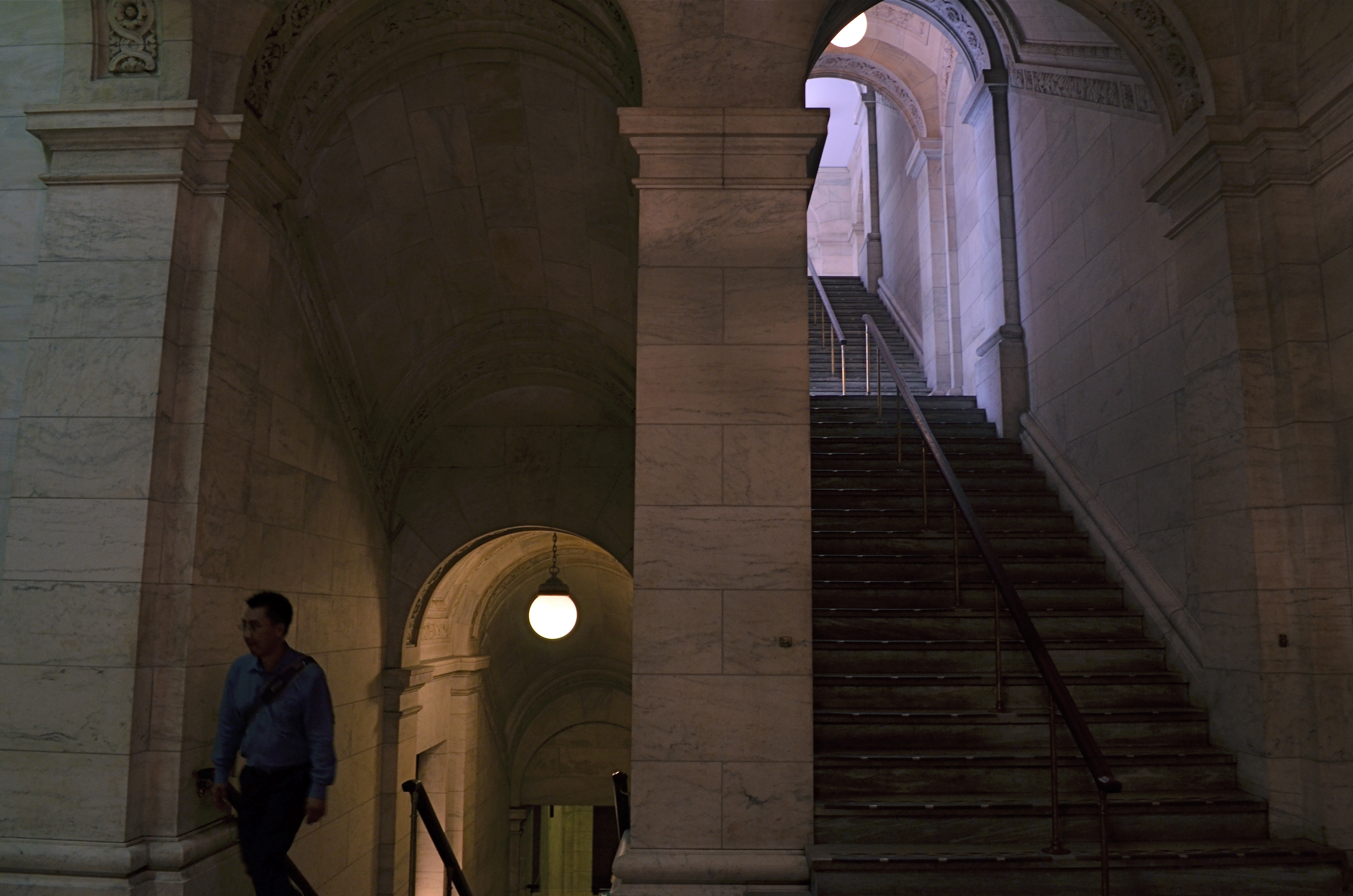
Same library, different solution: I could have processed this in HDR in an attempt to pluck additional detail from the darker areas, but after agonizing over it, I decided to leave well enough alone. The exposure was a lucky one over a wide range of light, and it’s close enough to what I saw without fussing it to death and perhaps making it appear over-baked. 1/30 sec., f/6.3, ISO 320, 18mm.
Recently, I am looking at more pictures that are not, in essence, flawless, and asking, how much solution do I need here? How much do I want people to swoon over my processing prowess versus what I am trying to say? As a consequence, I find that images that I might have reflexively processed in HDR just a few weeks ago, are now agonized over a bit longer, with me often erring on the side of whatever “flaws” may be in the originals. Is there any crime in leaving in a bit more darkness here, a slight blowout in light there, if the overall result feels more organic, or dare I say, more human? Do we have to banish all the mystery in a shot in some blind devotion to uniformity or prettiness?
I know that it was the camera, and not me, that actually “took” the picture, but I have to keep reminding myself to invest as much of my own care and precision ahead of clicking the shutter, not merely relying on the super-toys of the age to breathe life into something, after the fact, that I, in the taking, could not do myself. I’m not swearing off of any one technique, but I always come back to the same central rule of the best kind of photography; do all your best creative work before the snap. Afterwards, all your best efforts are largely compensation, compromise, and clean-up.
It’s already a divine photographic truth that some of the best pictures of all time are flawed, imperfect, incomplete. That’s why you go back, Jack, and do it again.
The journey is as important as the destination, maybe more so.
Thoughts?
Related articles
SPLITTING THE DIFFERENCE
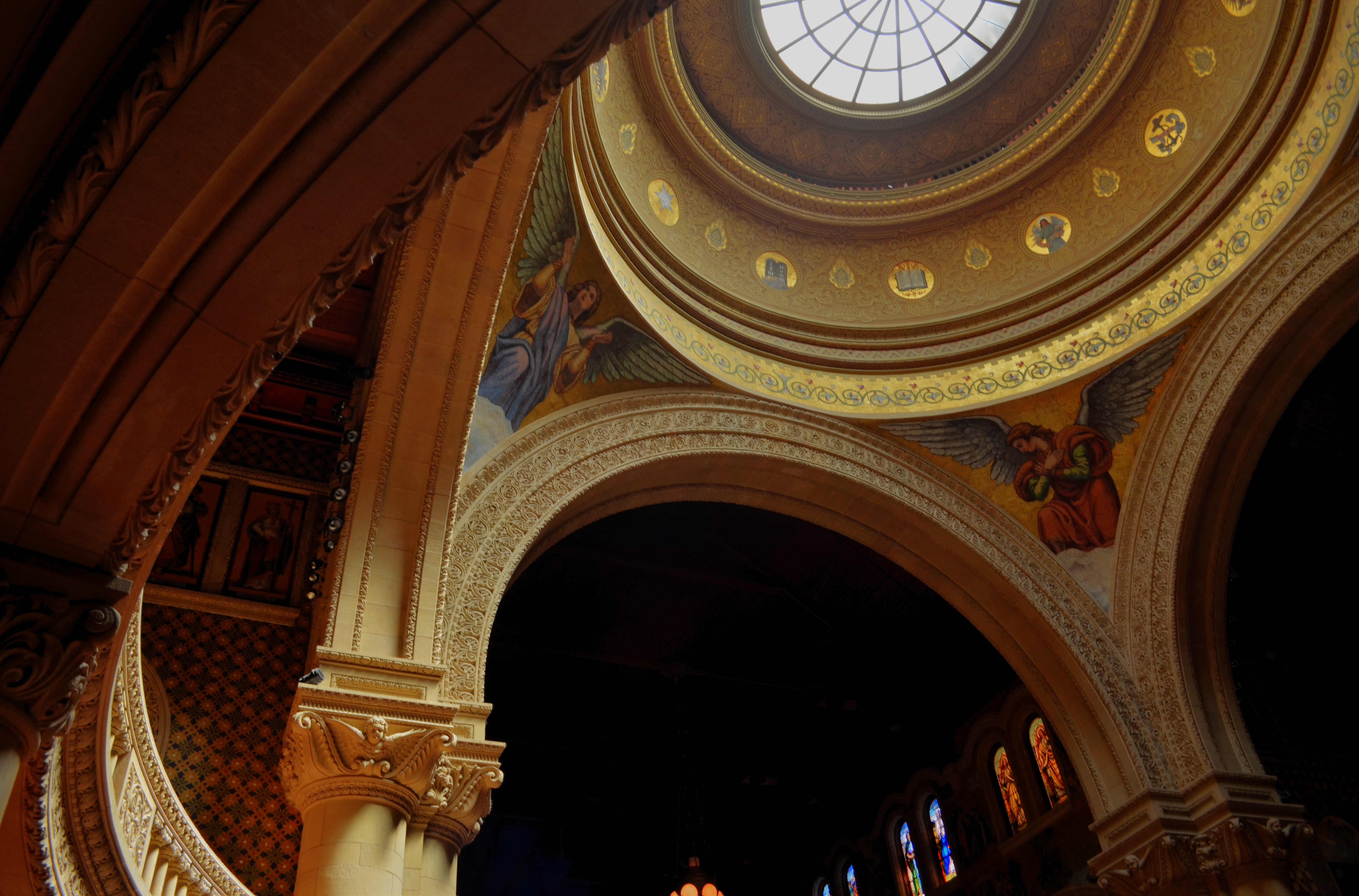
Really dark church, not much time. An HDR composite of just two exposures to refrain from trying to read the darkest areas and thus keep extra noise out of the final image. Shot at 1/15 and 1/30 sec., both exposures at f/5.6, a slight ISO bump to 200 at 18mm. Far from perfect but something less than a total disaster with an impatient tour group wondering where I wandered off to.
By MICHAEL PERKINS
THE MOST EXASPERATING WORDS HEARD ON VACATION: Everyone back on the tour bus.
Damn. Okay, just a second.
Now. We’re going NOW.
I’ve almost got it (maybe a different f-stop….? …..no, I’m just standing in my own light….here, let’s try THIS….
I mean it, we’re leaving without you.
YES, right there, seriously, I’m right behind you. Read a brochure will ya? Geez, NOTHING’S working…….
Sound remotely familiar? There seems to be an inverse proportion of need-to-result that happens when an entire group of tourists is cursing your name and the day you ever set eyes on a camera. The more they tap their collective toe wondering what’s taking so looooong, the farther you are away from anything that will, even for an instant, give you a way to get on that bus with a smile on your face. It’s like the boulder is already bearing down on Indiana Jones, and, even as he runs for his life, he still wonders if there’d be a way to go back for just one more necklace….
Dirty Little Secret: there is no such thing as a photo “stop” when you are part of a traveling group. At best it’s a photo “slow down” unless you literally want to shoot from the hip and hope for the best, which doesn’t work in skeet shooting, horseshoes, brain surgery, ….or photography. Dirty Little Secret Two: you are only marginally welcome at the tomb or cathedral or historically awesome whosis they’re dragging you past, so be grateful we’re letting you in here at all and don’t go all Avedon on us. We know how to handle people like you. We’re taking the next delay out of your bathroom break, wise guy.
A recent trip to the beautiful Memorial Church at Stanford University in Palo Alto, California was that latest of many “back on the bus” scenarios in my life, albeit one with a somewhat happy outcome. Dedicated in 1903 by the surviving widow of the school’s founder, Leland Stanford, the church loads the eye with borrowed styles and decorous detail from a half-dozen different architectural periods, and yet, is majestic rather than noisy, a tranquil oasis within a starkly contemporary and busy campus. And, within seconds of having entered its cavernous space as part of a walking campus tour, it becomes obvious that it will be impossible to do anything, image-wise, other than selecting a small part of the story and working against the clock to make a fast (prayerful) grab. No tripods, no careful contemplation; this will be meatball surgery. And the clock is ticking now.
So we ducked inside. With many of the church’s altars and alcoves shrouded in deep shadow, even at midday, choices were going to be limited. A straight-on flash was going to be an obscene waste of time, unless I wanted to see a blown-out glob of white, three feet in front of me, the effect of lighting a flare in a cave. Likewise, bumping my Nikon’s ISO high enough to read a greater amount of detail was going to be a no-score, since the inner darkness was so stark, away from the skylight of the central basilica dome, that I was inviting enough noise to make the whole thing look like a kid’s smudged watercolor. No, I had to find a way to split the difference; Show some of the light and let the darkness alone.
Instead of bracketing anywhere from 3 to 5 shots in hopes of creating a composite high dynamic range image in post production, I took a narrower bracket of two. I jacked the ISO for both of them just a bit, but not enough to get a lethal grunge gumbo once the two were merged. I shot for the bright highlights and tried to compose so that the light’s falloff would suggest the detail I wouldn’t be able to actually show. At least getting a good angle on the basilica’s arches would allow the mind to sketch out the space that couldn’t be adequately lit on the fly. For insurance, I tried the same trick with several other compositions, but by that time my wife was calling my cel from outside the church, wondering if I had fallen into the baptismal font and drowned.
Yes, right there, I’m coming. Oh, are you all waiting for me? Sorry…..
Perhaps its the worst kind of boorish tourism to forget that, when the doors to the world’s special places are opened to you, you are an invited guest, not some battle-hardened newsie on deadline for an editor. I do really want to be nice. However, I really want to go home with a picture,too, and so I remain a work in progress. Perhaps I can be rehabilitated, and, for the sake of my marriage, I should try.
And yet.
Related articles
- The Ultimate Guide to HDR Photography (pixiq.com)
“WHAT” IS THE QUESTION
ONE OF THE MOST FREQUENTLY ASKED QUESTIONS of shooters is, “what’s that supposed to be?”, usually asked of any image that is less obvious than a sunset shot of the Eiffel Tower or a souvenir snap of Mount Rushmore. You may have found, in fact, that the number of times that the question is asked is directly proportional to how intensely personal your vision is exercised on a given project. As much as the hidden aspects of life fascinate us, the obvious recording of familiar objects soothe the eye, like a kind of ocular comfort food. The farther you wander in your own direction as a photographer, the greater journey you also ask of your viewers. Sometimes the invitation is taken. Sometimes you must face “the question”.
What’s that supposed to be?
How, actually, in a world shaped by our own subjective experience, an image is “supposed” to be anything is a little baffling. It’s probably safe to say that what we present, as artists is probably supposed to be the view as one’s mind filters it through his or her accumulated life. When we use the camera as a mere recorder, it may make it easier, presenter-to-viewer, to agree on that image’s terms of engagement, but that may or may not reveal what we actually felt about when creating it. If I use the same three colors to render a picture of the American flag as everyone else uses, I may get into fewer arguments about how appropriate the resulting image is, but then, I don’t get to open up the discussion to any other conceptions of that flag. Back in the first days of the environmental movement, the simple use of green on the original, Old-Glory-derived ecology flag suggested an alternative way of being American, of living your life. As I recall, some viewed the design as sacrilegious, while others embraced it as liberating.
Over 150 years after the first photographs were regarded as a threat to the painter’s domain, we are still most at ease with pictures that ape the painting’s method for framing the world. Oddly, it is always outlaws and amateurs that break free of these pictorial chains first; the professionals must protect the turf they have so carefully mapped out for themselves in the mainstream. There remains, then, an ongoing battle over what should or should not be called a “picture”. Abstractions, arranged or perceived patterns, even selected details or drastic re-imaginings of small parts of the so-called “actual” world must always fight for their place at the table alongside the technically accurate mirroring of easily named subjects. We still regard that which is realistic as being the most real, and the most worthy of praise.
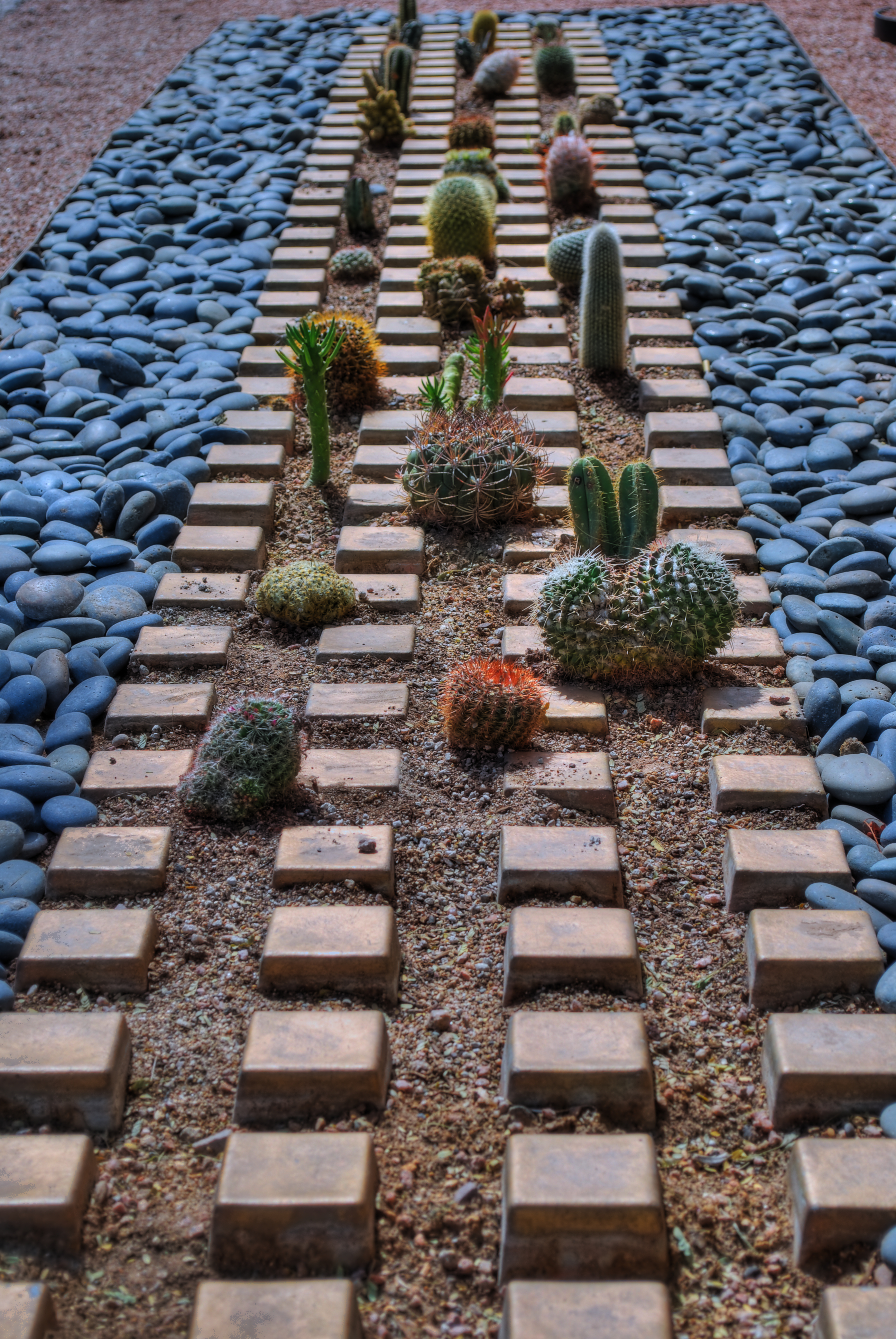
Cactropolis, 2011. Three bracketed shots about a half-stop apart combined into an HDR composite. CLICK TO ENLARGE.
To want to show something for its own sake on our own terms is to move into more personal territory, and hence onto shakier ground for critical evaluation, but occasionally we strike a balance between what people want to see and what we must show. In the above image, I only wanted to focus attention on an arrangement that was a very small and visually ignored accent along a heavily travelled public street. An unsung landscaper’s arrangement of tiles, gravel, paving rock, and succulent plants, was in plain view, and yet, at only a few inches in height, easily missed by the thousands of daily passersby speeding along the street. To me, when framed close to ground level, it resembled a kind of desert cityscape, blocks of abstract skyscrapers, a cactus metropolis, and that’s how I tried to frame and process it. Of course, it us, after all, just a pattern, and anyone who looks at the image can fill in their own blanks with impressions that are just as valid as my kind of toy idea.
The vital point is that no one else’s take on your dream can be wrong, just because it differs with yours. Art is not a science, which is why we don’t become photographers, or as the word implies, “light writers” just by pushing a button.
We become photographers by pushing everyone’s buttons.
What is it “supposed to be”? You tell me, and I’ll tell you.
Thoughts?
 thenormaleye