ON MY WAY OUT…
By MICHAEL PERKINS
THE RECENT DEATH OF MY NINETY-SIX-YEAR-OLD FATHER actually resembled most visits I’ve made to Columbus, Ohio to visit him over the past quarter-century, in that a lot of my alone time was spent trying to reconcile the locales of my youth with the ghosts of things long vanished from those physical places. You can actually go home again, if you can bear the sight of things that you once thought were important, even vital, reverting to be just…..well, things.
No two people, certainly no two photographers, can regard the same scenes and come away with the same experience, and so we make fools of ourselves walking up to vacant lots and remarking to strangers that “there used to be a ball park here”. Not to the strangers’ eyes, certainly, and no longer even to us. Physical sites are imbued with only temporary meaning in one part of our lives, then revert to just their materials and geography once we stop needing them.
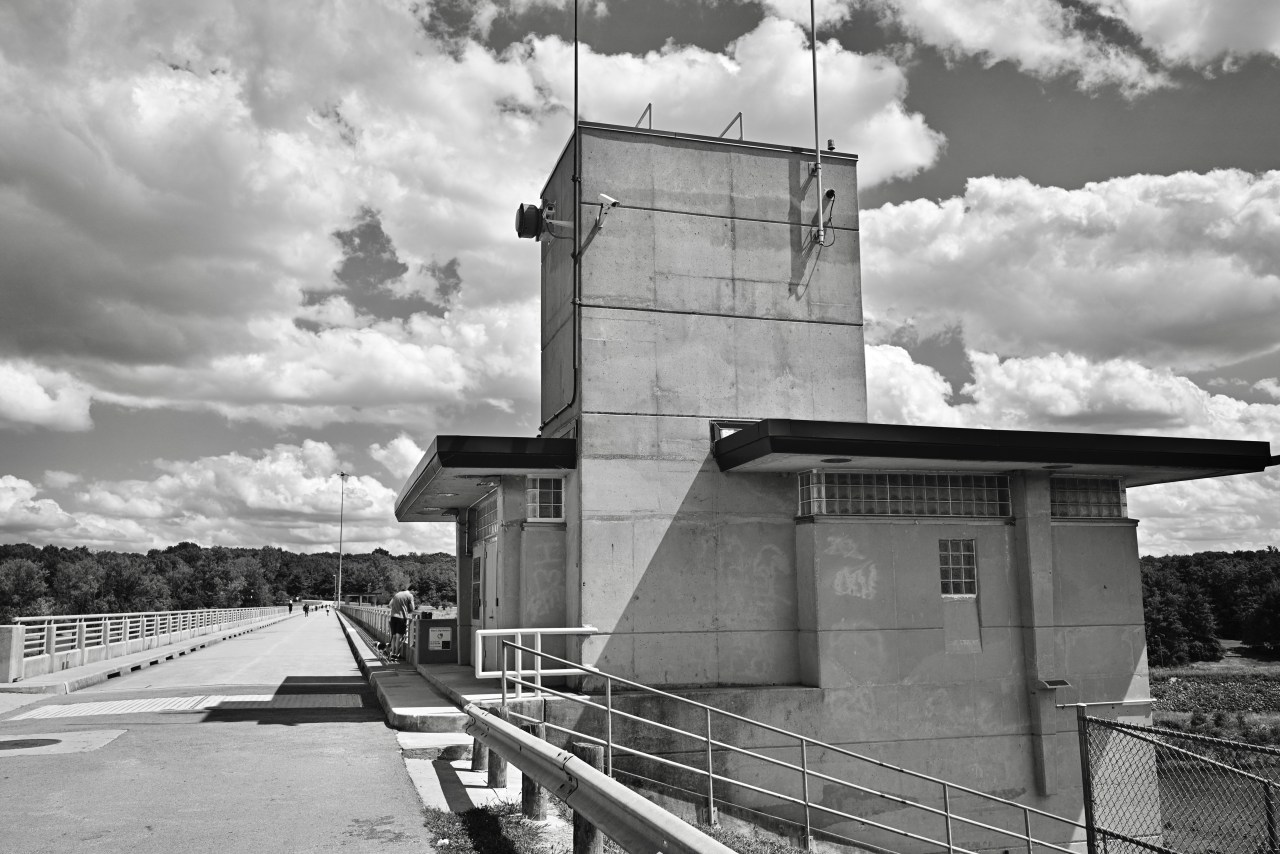
Nothing could be more ordinary than this simple arrangement of block concrete, which is adjacent to the spillway of Hoover Reservoir (not the more famous”dam”, nor the more infamous Hoover) on the northern edge of Columbus. Other than its role in providing some recreation and a clean supply of local drinking water, there is nothing visually remarkable about the place to the average photographer’s eye, and yet, to a seventy-three-year old just mourning the passing of a parent, it once held some special magic, and merited one last click.
When I was a boy, decades before farms and fields in the area would be swallowed by freeways and sprawl, motoring from my neighborhood to the Hoover constituted a half-day in the country. Driving our old Plymouth Savoy to the site meant a guaranteed stop at its rudimentary snack wagon (“food truck” for you kids) and a walk out to the spillway, where a thunderous cascade of water would explode forth from one of its release pipes and we kids would terrify our folks by leaning out over the low guard rail that barely separated us from watery doom hundreds of feet below.
I don’t know why I decided, after so many years of passing the reservoir on the way to somewhere else, that I needed one more up-close look. On this trip especially, I seem to have made several mini-pilgrimages to parks and wooded areas that once defined me, very aware that I was walking out of my old life for what now seemed forever. Of course, I will go back to Columbus gain, to see my sister, my adult children, my grandsons, and a dwindling network of old pals. But in some very real way, I was conscious that I walking out of some kind of door for the last time, with once-special places now returning to their normal uses as just more things in the world. A very strange kind of goodbye.
NO, REALLY, GOOD BYE. I MEAN IT.
By MICHAEL PERKINS
MY FATHER USED TO DEFINE “OLD SCHOOL” ENTERTAINERS by how many bows or encores they took at the end of a given performance. The vaudeville-era concept of a “curtain call” was illustrative both of the showman’s natural inclination to stick around, drinking in a little more applause, and the audience’s reluctance to let those wonderful pied pipers get away, abandoning us to our regular humdrum lives. There’s something in those feelings that speaks to a need for photographs, and photographers.
A year ago this month, Marian and I closed the book on over twenty years in the same house, as well as its accumulated baggage and bloat. Estate sales were staged. Decades of memories were sifted, often jettisoned at a speed that astounded both of us. And most importantly, some key objects were committed to photos. Children’s art projects; historic front pages; and, in a kind of “Rosebud” moment, one more “curtain call” for a life I left half a century ago, symbolized by a curio that had been dragged with me from house to house since my salad days; an inoperable radio from the 1930’s.
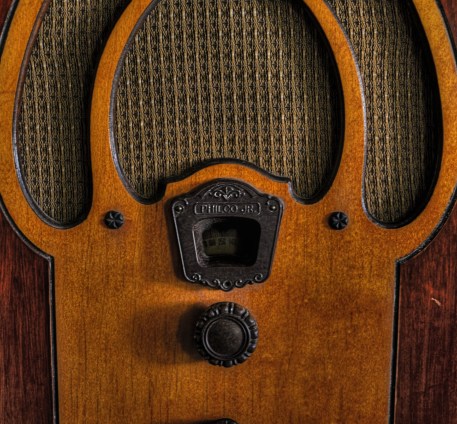
The Philco Junior cathedral model shown here was already an antique in 1972, when my best friend at the time toiled at great length to refurbish it as a wedding present for me. The vacuum-tube guts of the thing had proven beyond repair, and so he had replaced the workings with a transistor-based tuner of his own design, then provided power to the front-mounted tuning “spook light” with alligator clips and a Ray-O-Vac lantern battery. Fortunately, the cloth speaker grille was intact, as was the tortoise shell trim and two-tone face plate. And so, to the naked eye, the Philco was still in good working order, occupying an honored place in the first apartment I and my young bride moved into after our budget nuptials.
ntiquesBy the time I snapped one more image of the front of the radio, just ahead of our leaving for California, the back had rotted away, the sides were splintered, and it hadn’t received a broadcast in over a generation. Moreover, that first marriage had long since vanished beneath the waves, as, sadly, had the friendship that sparked the initial radio project. In the spirit of Bogie’s “we’ll always have Paris”, I guess I can say that, in this image at least, I’ll always have the Philco. One more curtain call before we sign off for the evening, ladies and gentlemen, and be sure to tune in again tomorrow for…..
TRANSMISSION
By MICHAEL PERKINS
MY MOTHER’S PASSING, JUST A LITTLE OVER A WEEK AGO AT THIS WRITING, has understandably released a tornado of feeling, not all of it tragic. More specifically, the portion that is purely sad is actually quite compact; intense, certainly, and at times devastating, but by no means the dominant current in my head. Gratitude occupies the space within my heart far too greatly to yield much real estate to mere sorrow.
Looking over the many images of Mother for use in the usual tributes, I find myself wishing that someone, somewhere, had taken far more pictures of just the two of us together. That unique transmission of energy, hope, and love between parent and child is a rare quality, and is, in photographs, as visually elusive as heat lightning. Candids from birthdays, Christmases and graduations hint at it; few fully capture the entire miracle.
But, this morning, as I was once again bemoaning how few of those grownup-kid transmissions I possessed to comfort me in her absence, I saw that exact energy in a shot I had made of strangers, a single frame among hundreds in a sequence that I had glanced at once and filed away under For Future Consideration. Suddenly that “future” was upon me, as I rediscovered the image you see here.
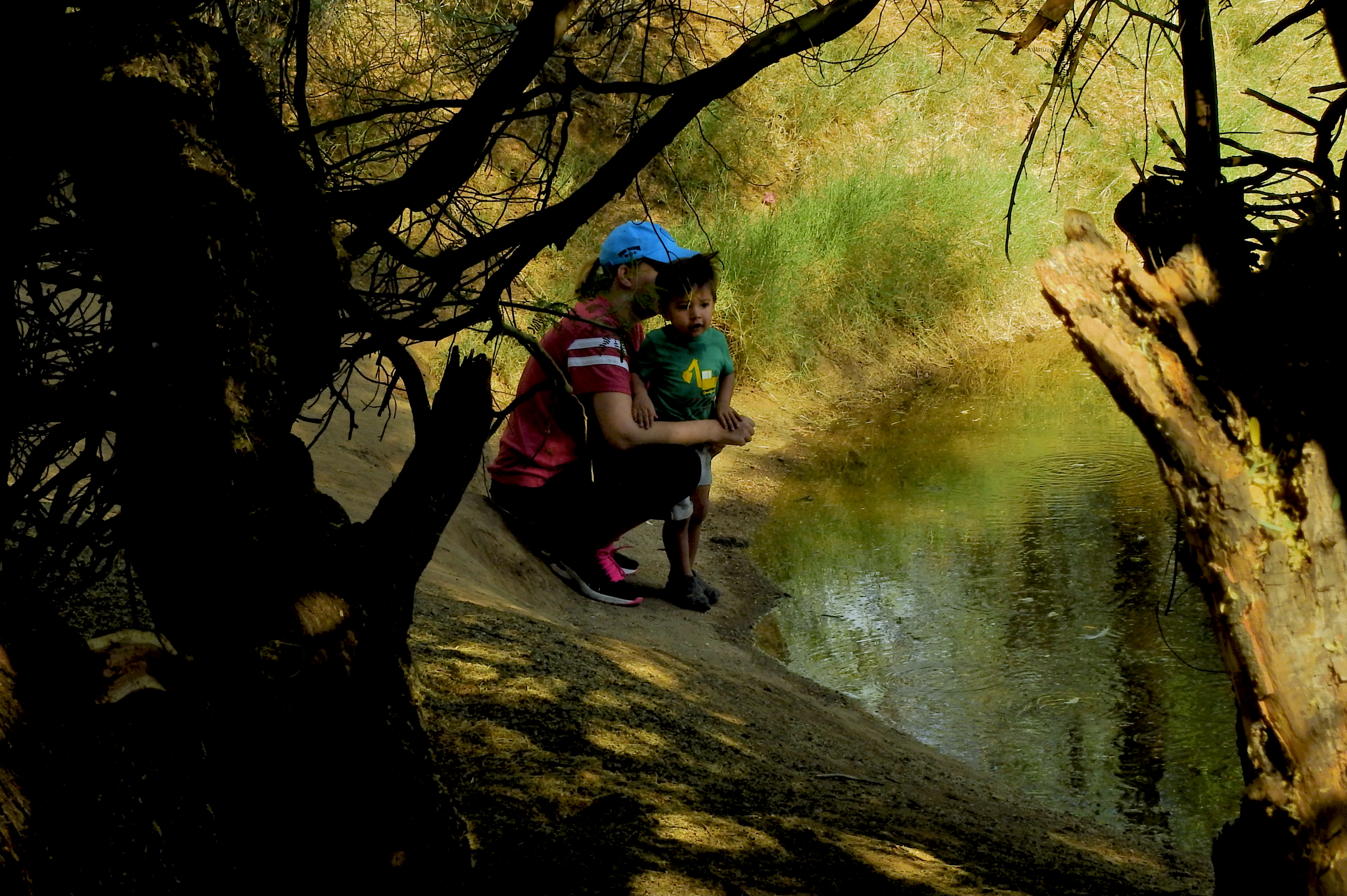
Like many photos, it’s as evocative for what it doesn’t show as what it does. I can’t tell if this is merely a tender moment, or one in which the small boy is excited, bewildered, tired or just clingy. And nothing of the mother’s face can be seen at all. In some ways, the picture is unfinished, a rehearsal for something more eloquent promised for a few moments later. However, there is the feeling that these two people are, for this one instant, totally sufficient to each other. Their connection is wonderfully profound. They are of each other, and the rest of the world is, at least for now, irrelevant. Looking at it through the filter of my recent loss, the image is no longer invisible to the current me. It’s now an essential possession, something magical that I was luckier than I knew just to witness.
For a moment, looking at the picture, I forgot about reality, and experienced the feeling that I’d love to show it to Mother. But, in her wisdom and her love, it’s nothing, really, that she hasn’t seen before, nothing she and I haven’t lived before. And that’s enough for now.
THE SACRAMENTALS
By MICHAEL PERKINS
WHENEVER YOU MAKE A PHOTOGRAPH, you set several things in force at the same time, as if you were generating, in addition to the “sun” or central subject of your image, a rotating solar system of lesser planets, or the other information that hitches a ride along with the main idea of the shot. This is especially true of the memory trove that accompanies our most personal photographs. We think we’re just snapping someone we love: as it turns out, we’re also extending an invitation to their entire surrounding reality as well.
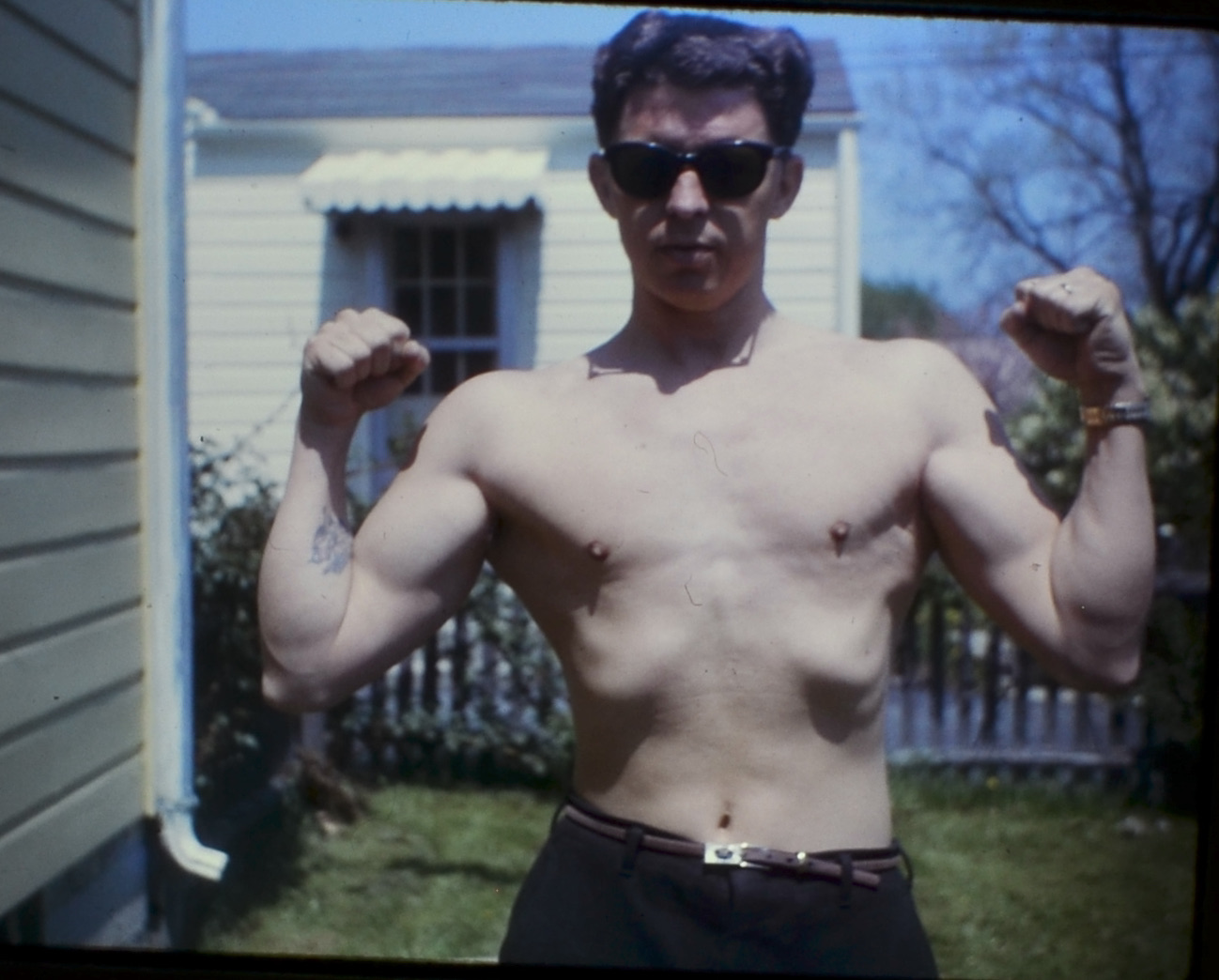
This image of my father in 1964, when he was 35, was rescued from an old Kodachrome slide to accompany a Facebook appreciation of the Old Gunfighter for this year’s Father’s Day. The mission was simple…to summon a few chuckles and tears as he begins his 94th year on the planet. That’s really all I was going for when I resurrected the shot.
But other things, keen, clear, important memories accompany and contextualize him as well, even in a so-called “simple” snapshot. In the Catholic Church these things are called “sacramentals“. They are not sacraments in themselves, but the additional sensations that are forever linked to them: candles: the smell of incense: the kind of noise a wooden pew makes when you first creak into your seat: and so on. In this shot, there are many such sacramentals, many little mental barnacles clinging to the bottom of the photo’s main hull.
First, there are the memories connected to the space itself, which was our backyard at 1752 Marston Road, an address that accounts for twelve years of my young life. The house was wood, painted yellow, which means this picture was taken before it became clad in white aluminum siding, which never felt quite as good, or solid, to my fingers as, well, wood. In a time when people rhapsodize about houses with picket fences, we literally had one, and the section just over Dad’s right shoulder was, in his earliest days as an amateur rose planter, his first trellis. There is the metal awning over the side entrance of our neighbor’s house, which was how my mother entered the place to take morning coffee with the Irish lady who owned it and her adopted Puerto Rican baby boy. And over Dad’s left shoulder is The Tree, an immense maple that belonged to the family four doors down, a supertree too big to climb, so massive that the developers who laid out our tract of homes didn’t even try to yank it out, as they had nearly every other stick of vegetation in the area, a titanic ship’s mast of a tree that could be seen from every vantage point in the neighborhood, like a sign that you were returning to safe harbor.
And with this list I am just getting started. And that’s before I consider how strong, how young, how handsome my father was. I clearly remember being ridden around on those shoulders. He gave me a view that I, in turn, tried to impart to my own children, figuratively if not literally. It was, and remains, quite a ride. The one thing this picture does not reveal is who the person behind the viewfinder of our old Kodak 828 Pony was, although I assume it was my mother, as mere children were not entrusted to operate A Real Camera at that time. But that’s a mystery for another day. In the meantime, I hope you will be spending your Father’s Day smothered in warm echoes. And that when a picture emotionally takes you to church, the sacramentals ring forth as musically as a solemn High Mass.
LOVE AT THE SPEED OF A SHUTTER
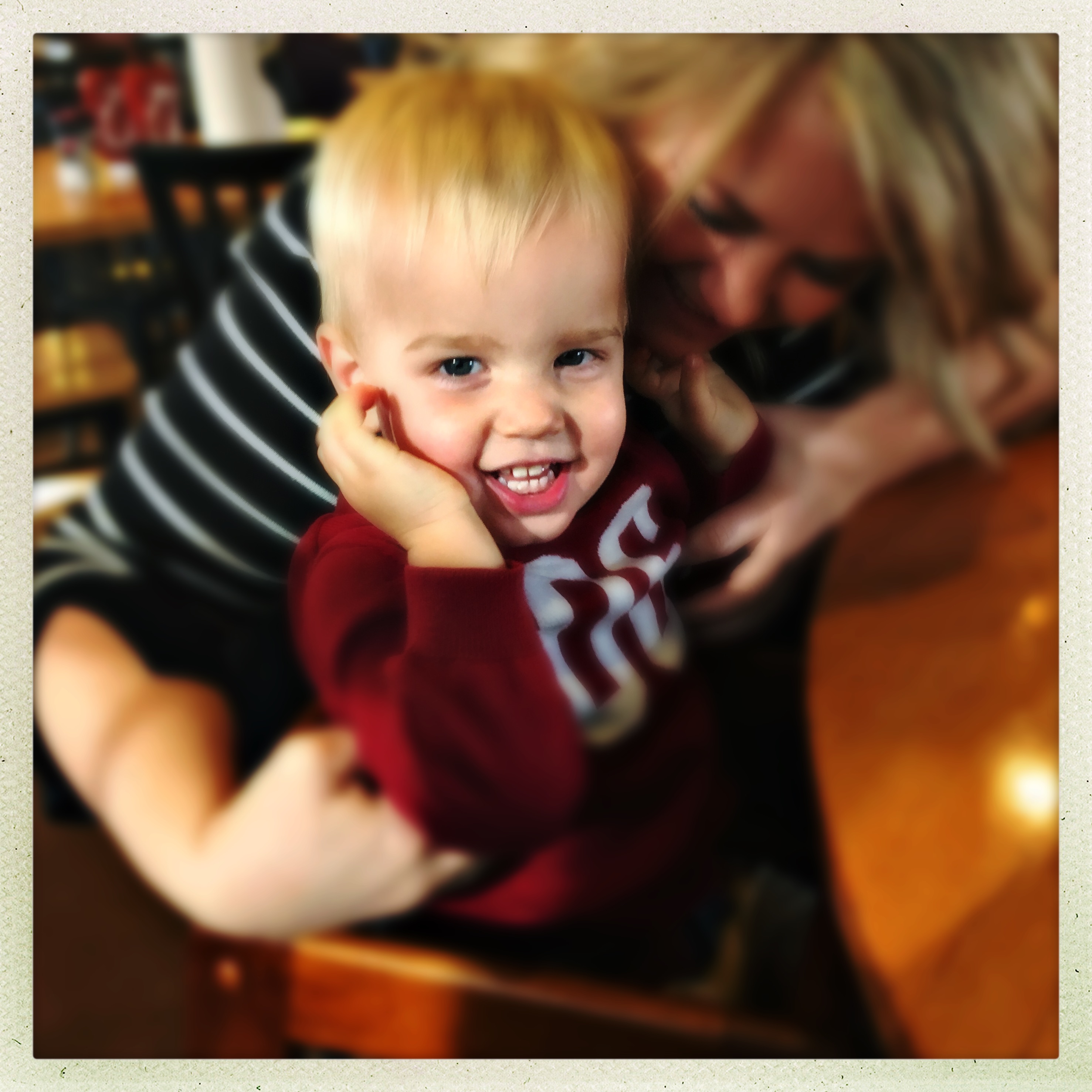
A Christmas Tickle, 2018
By MICHAEL PERKINS
DICKENS‘ A CHRISTMAS CAROL IS OFTEN REGARDED as a ghost story, and a marvelous and chilling one it certainly is. But because its lessons are couched in the colors and echoes of the most wonderful time of the year, the tale of Scrooge’s regeneration also acts on the heart like a series of photographs. It freezes time and invites us to re-inhabit that which has so fleetingly danced by our life lenses. Instead of weeping for what we’ve lost, we smile over what we’ve lived.
There is a reason that Christmas and photography forged such a natural bond. Both deal in retrieval, the summoning of shadows for Just One More Look. Aided by images, we call dear ones back from the beyond for a final embrace, a warm wince of recognition. Remember how handsome he was? Do you recall the day when she got that dress? Oh, there’s the baby.
Time it was, and what a time it was………
No one had to teach the world the value of all those little tintype testimonies when it came to the holidays. Everyone instinctively got the connection between the inexorable march of years and the value of stealing back just a taste of them with the snap of a shutter. Scrooge had his spirits to remind him of the man he had been and the man he still might be. They were his snapshots. His renewed realization of what had been wonderful in his life was his photo album.
Today, still, when someone is privileged to head home for a few days, we wish them well in several ways. Have a safe trip, we say. Give everyone my love, we say.
And then the inevitable tag line.
Take lots of pictures.
THE TRIANGLE
Dark days, dark thoughts.
By MICHAEL PERKINS
WINTER IS A TIME OF MUTED COLORS, DIMINISHED SUNLIGHT and inner struggle. I’ve heard people refer to the leaner, darker months as the feeling of being shut up inside a box, almost like having yourself placed in storage. I would lop one side off of that polygon and say that, to me, it feels more like being locked in a triangle.
As a photographer, I feel as if, in winter, I sustain three distinct emotional “hits” about my work, forming the three sides of the triangle, all three pressing up against, and balancing, each other. These sides can be described as:
Not enough new or compelling ideas coming into my brain. A case of the “drys”.
Too much re-evaluation of all of my images that failed, along with a big fat dose of recrimination.
A near-crippling sadness over the photographic opportunities, many tied to people now departed, that I simply didn’t act upon, and which are now lost to me forever.
The first side of the triangle really isn’t unique to winter-time. I experience  fallow periods throughout the year. They just ache more when amplified by slate-gray skies and dead trees. The second is to be expected, since spending more time indoors means rifling through old boxes of prints and slides, asking myself what the hell I was thinking when I chose this exposure or that subject, and ending the entire process by pitching some of those boxes into the incinerator. A needed exercise, but hardly anyone’s idea of a fun time.
No, it’s the third side of the triangle which is the real killer, since the photos that haunt you the worst are always the ones you didn’t take. Friendships pour additional salt into this particular wound, since, somehow, you never recorded quite enough of the faces which once were the common features of your world, and which time has, one by one, erased.
Your own personal list of pals-not-present grows steadily over the years, and the thought that you could have shot one less sunset to capture just one more portrait of some of them hurts. It’s not as if your emotional souvenirs of them aren’t burned into your mind’s eye. It’s not even that you might have done something magical or singular with their faces beyond another birthday candid. It’s simply that once you could, and now you can’t.
The triangle isn’t all torture. Breaking out of it means taking arms against ghosts, and (as Shakespeare said), by opposing, ending them. You not only have to keep shooting, but keep shooting mindfully. Because when all of this that we call reality finally drains through our fingers, the scraps of it that we leave behind really can matter. Even with triangles, there’s always one more side to the story.
APP-Y HOLIDAYS

You can convert a color shot through the “old Kodachrome” filter on the AltPhoto app…..
By MICHAEL PERKINS
THE HOLIDAY SEASON MAY OFTEN SEEM TO HAVE “OFFICIAL” COLORS, (red, green, etc.) but its unofficial colors reside primarily, and gloriously, in memory. Given how many iterations of photography span most of our lives, our minds tend to twist and tweak colors into highly individualized chromatic channels. Are your most treasured moments in ’50’s Black and White? ’60’s Kodachrome? In the time-tinted magentas of snaps from the 70’s? In blue-green Super 8 Ektachrome or expired Lomo film? Or do you dream in Photoshop?
This is personal stuff, very personal. It seems like we ought to agree universally on the “correct” colors of the season, but, given that our most precious holiday moments are preserved on various archival media, it might be our memory of seeing these events “played back” that is stronger than our actual remembrance of them. As Paul Simon says, everything looks worse in black and white, or in this case, what really happened pales in comparison to our print, Polaroid, movie and slide souvenirs.
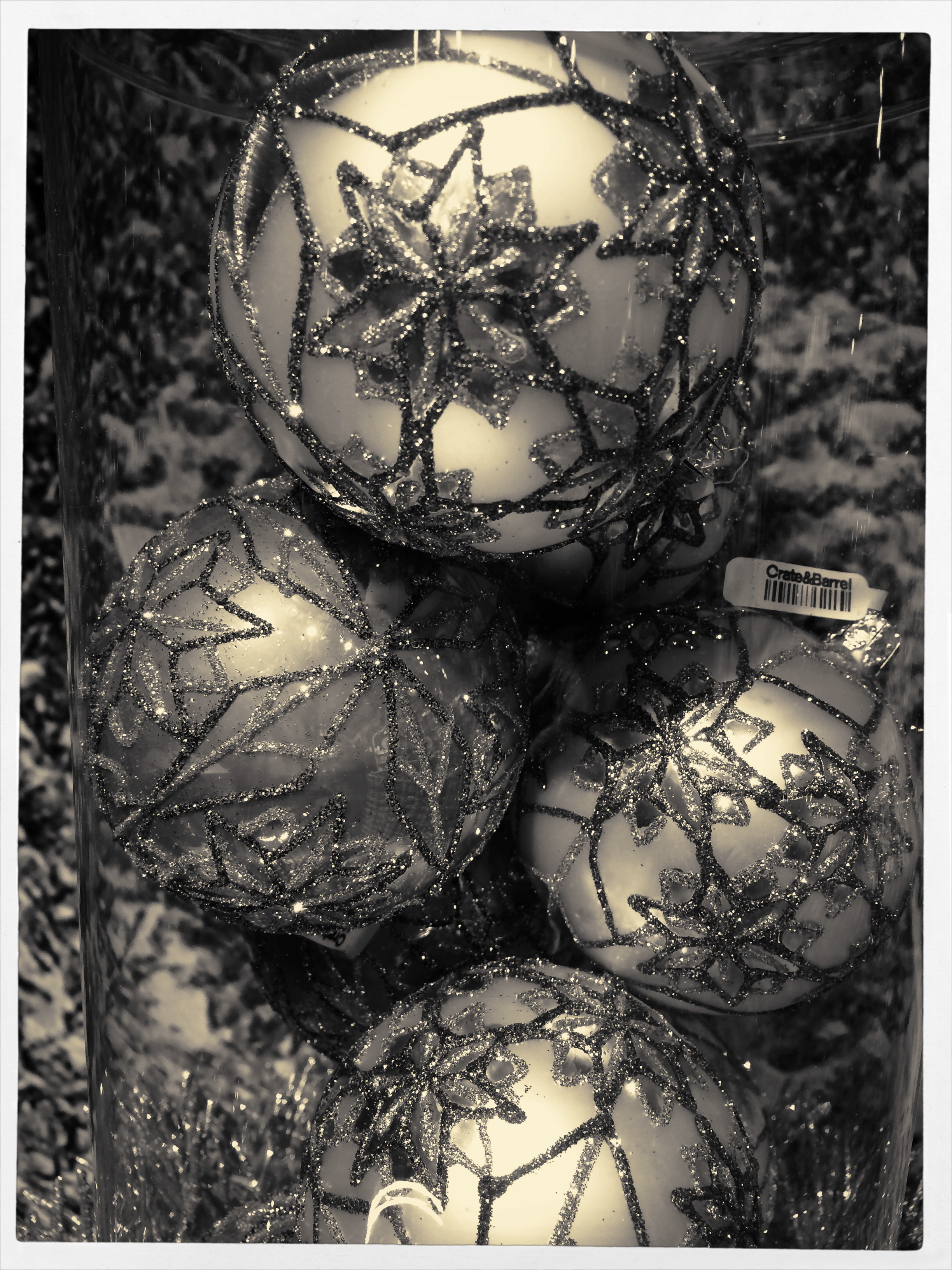
..or you can whip up this warm platinum print simulation.
This means that there are a million subliminal color “cues” that trigger memory, and not all of them come from “correctly” exposed images. Color is mood, and seasonal pictures can benefit greatly from the astounding range of processing tools suddenly available to everyone. Not all photographs benefit from apps and digital darkroom massages, for sure, but their use is perhaps more seductive, in this mental mid-point between reality and memory than at other times of the year. Fantasy is in play here, after all, and fantasy has no “right” hue. Dreams are too vast a realm to be confined to the basics, so ’tis the season to dip into a wider paintbox.
Memory needs room to breathe, and the photographs that help them fully fill their lungs become the gifts that keep on giving.
THE LION IN WINTER
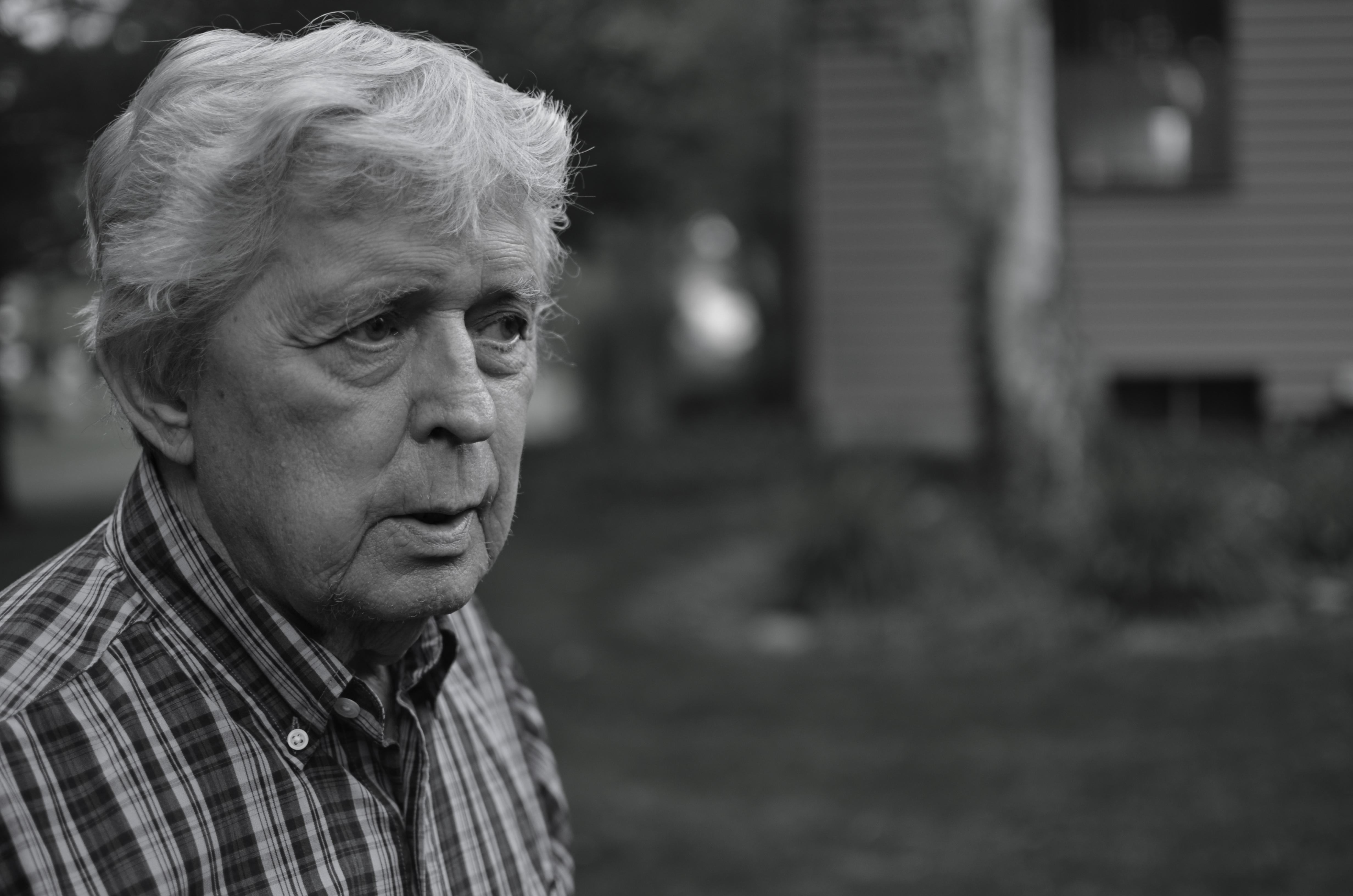
Ralph Adrian Perkins, June 12, 2013. 1/100 sec., f/1.8, ISO 100, 35mm.
By MICHAEL PERKINS
I AM AMAZINGLY BLESSED TO BE ENTERING OLD AGE, STILL TRAILING MY FATHER BY ABOUT TWENTY-THREE YEARS. Defying the odds, statistical probabilities, and luck, my personal North Star is still, at 84, providing me with a point of light to steer by. I cannot imagine a world in which he is not just a few miles ahead of me, gently insisting, “this way.” And, years after the worst the world has to offer has long since stopped generating any panic in me, the thought of life without him remains unimaginable, like trying to envision the world without gravity, or sunlight.
I can’t begin to catalogue the thousands of ways his wisdom and patience have tempered and shaped me, but it’s worth singling out his influence on my visual sense and curiosity as a photographer. I remember his intrepid search for beauty, armed with the simple tool of a Kodak Pony 828 camera, a device which both intrigued and frustrated him. During my childhood, the Pony was the official recorder of dreams, events, and possibility for the Perkins clan. We all cheered when it delivered what Dad saw in his mind’s eye. We all offered sympathy and encouragement when he asked it to see beyond its powers, when a set of Kodachrome slides entered the “better luck next time” category.
As a designer and illustrator for North American Aviation, then, later, as a fine arts teacher, he had a developed eye for beauty, a genuine instinct for how a visual story was framed and shown. Armed with my first cheap plastic camera, I only knew I wanted my images to be as good as his own. His eagerness became my ambition, and, half a lifetime later, I still regard a picture as “good” if the old man sees something in it.
Like many photographers major and minor, I am happy to make my father a subject in my own work. I am recording, interpreting and saluting his life all at once, and trying, in my halting way, to capture, in his face, all of the wisdom I have drawn from him over a lifetime. It’s a tall order, but he always taught me to go a little bit beyond what you think you can deliver. I remember him pushing the Kodak Pony to its limits, and beyond, in impossible situations. Some projects landed with a clunk, but it was always about the next frame, the coming opportunity.
There was…is….no bad photograph. Just mileage markers on the way, toward “gee, who knows?”
Thank you, Dad, for showing me that the journey is everything.
 thenormaleye
SUNSETTING
They’ll Be Ready Tuesday (2015)
By MICHAEL PERKINS
IN RAY BRADBURY’S WONDERFUL ONE-ACT PLAY, TO THE CHICAGO ABYSS, an old man equipped with a near-photographic memory makes both friends and enemies because he remembers so much of a world vanished in the aftermath of global war. His talent lies not merely in being able to conjure the world of large things….cathedrals, cars, countries, but of the micro-minutia of a life, a realm filled with the colors of cigarette packages, what compressed air sounded like hissing out of a newly opened can of coffee, the names of candy bars. The play reminds us that it is the million little pieces, the uncountable props of daily living, that matter…..especially when they are no more.
Professions and services offer the photographer the chance to preserve entire miniature worlds for the viewer, worlds which are in the constant process of sunsetting, of transitioning from “is” to “was”. Shops where we used to get our watches repaired. Bookstores that are now furniture warehouses. Home where those people we knew, oh, you know their names, used to live. Was it on the corner? Or over there?
Clip Joint (2016)
Even when long-familiar things survive in some form, they are not quite as we knew them. Does anyone still get their shoes re-soled? Was there ever a time when “salons” were just “barber shops”? Was it, long ago, some kind of luxury to weigh yourself for a penny in the bus station? Photos of these daily rituals take on even greater import as time re-contexualizes our lives, shuffling our position in the cosmic deck. Decades hence, we almost need visible evidence that we ever lived this way, ever dressed like that.
I love shooting businesses that should not be around, but are, places that should have already been scrubbed from day-to-day experience, but stubbornly linger around the edges. Images taken of these places argue strongly that not all forward motion is progress, that the familiar and the comfortable are also little pieces of our identity. In the words of the old song, there used to be ballpark right here.
Here, I have a picture of it…..
Share this:
May 13, 2016 | Categories: Americana, Commentary, History, Nostalgia | Tags: documentary, Memories, popular culture, Street Photography | Leave a comment