THE BLESSED BUY-IN
By MICHAEL PERKINS
WE ARE ENTERING THE ANNUAL SEASON OF ENHANCED BELIEF, that sadly brief period during which we temporarily suspend many of our most cynical operating procedures, erring on the side of hope. Religion is most probably the root cause of much of this uptick in outlook, although plenty of us experience additional “buy in” to the world’s best possibilities in ways that transcend creed or calling. Photographers, too, approach the world through slightly rosier glasses, especially as it regards the season’s main repositories of belief, children.
Of course, belief isn’t really a seasonal thing with kids: it’s more like their home territory, their native base of operations. Long after adults learn not to hope for too much, years after we’ve taught ourselves to lower or tamp down our expectations, new generations of kids are factory-preset to imagine what if, and wouldn’t it be cool? Magic isn’t an aberration for a child but a basic law of the universe. If a kid can dream a thing, he or she generally believes that it can, and should, come true. Photographers see this “buy-in” manifest in every child’s game, every cardboard box made into a makeshift rocket ship. And images that capture that wonder are among the most heart-warming of this or any season.
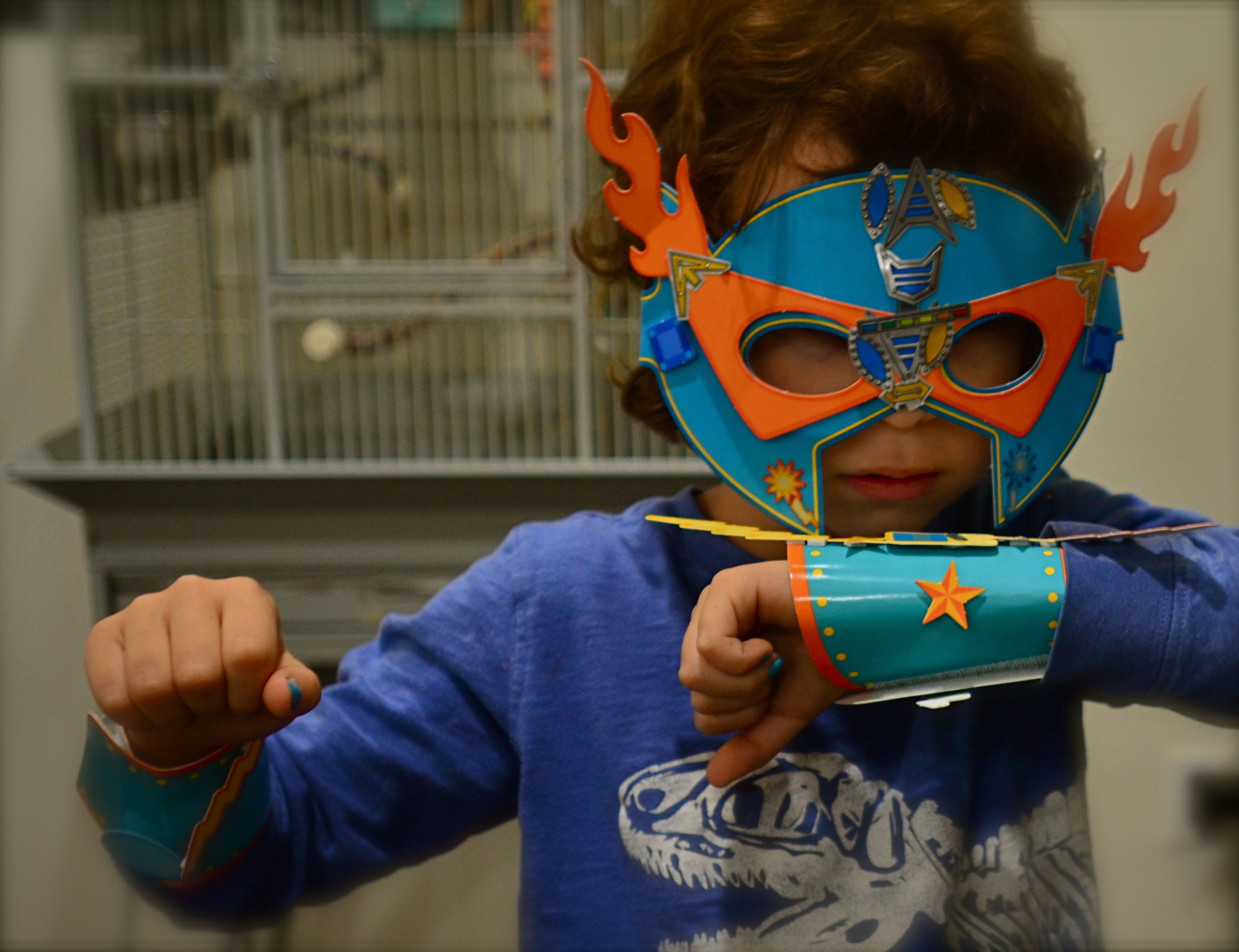
Urgent Communication (2017)
The young man you see here is dead serious about his idea of fun. He made the mask and cuff he’s wearing with his own hands, but that doesn’t render them any less miraculous. Once he’s put them on, he’s ready for reality to be altered into something useful, something fanciful. It doesn’t take much. Mom’s bath towel becomes Superman’s cape: a sock pulled over your hand becomes a sidekick, right down to his button eyes. And, apparently, there’s no disconnect between the space garb on his head and wrist and his regular dinosaur t-shirt. Consistency is for grown-ups, bah humbug.
Pictures like this are a gift because they remind us of having already received a far bigger one; the gloriously indomitable ability of a child to will dreams into life. Mom and Dad may check in and out of the zone of belief, but kids rule the realm.
SMALL WORLD
By MICHAEL PERKINS
OVER THE NEARLY SEVENTY-YEAR HISTORY of the legendary View-Master, showing generations “seven more wonders of the world” with each fresh reel of views, the format has been used to depict everything from targeting exercises for sharpshooters in World War II to detailed cut-aways of the human body for anatomy students. And of course, VM’s two mainstays of popular appeal persist to this day: armchair tours of the globe’s greatest attractions and an endless variety of children’s titles, including scenes from tv shows, movies, and, most prominently, fairy tales.
View-Master’s original headquarters in Portland, Oregon operated mainly to print, duplicate and package the views taken by its roving band of freelance scenic photographers. However, there was one part of the plant that created special, homegrown bits of pure fancy within the factory walls: the company’s legendary “table-top” studios. Here were created wondrous dioramas of everything from Cinderella’s castle to the Emerald City, built to scale and populated by tiny princesses, heroes, animals, and storybook legends. The range of product, from the Grimm Brothers to Disney, was not, as in later years, just frozen animation cels but solid clay art figures, lovingly created by a select staff of model makers and photographed in 3-d Kodachrome images for the children’s division. Later on, corners were cut, budgets were slashed, and View-Master’s worlds of wonder became the stuff of legend, not to mention keen interest among collectors.
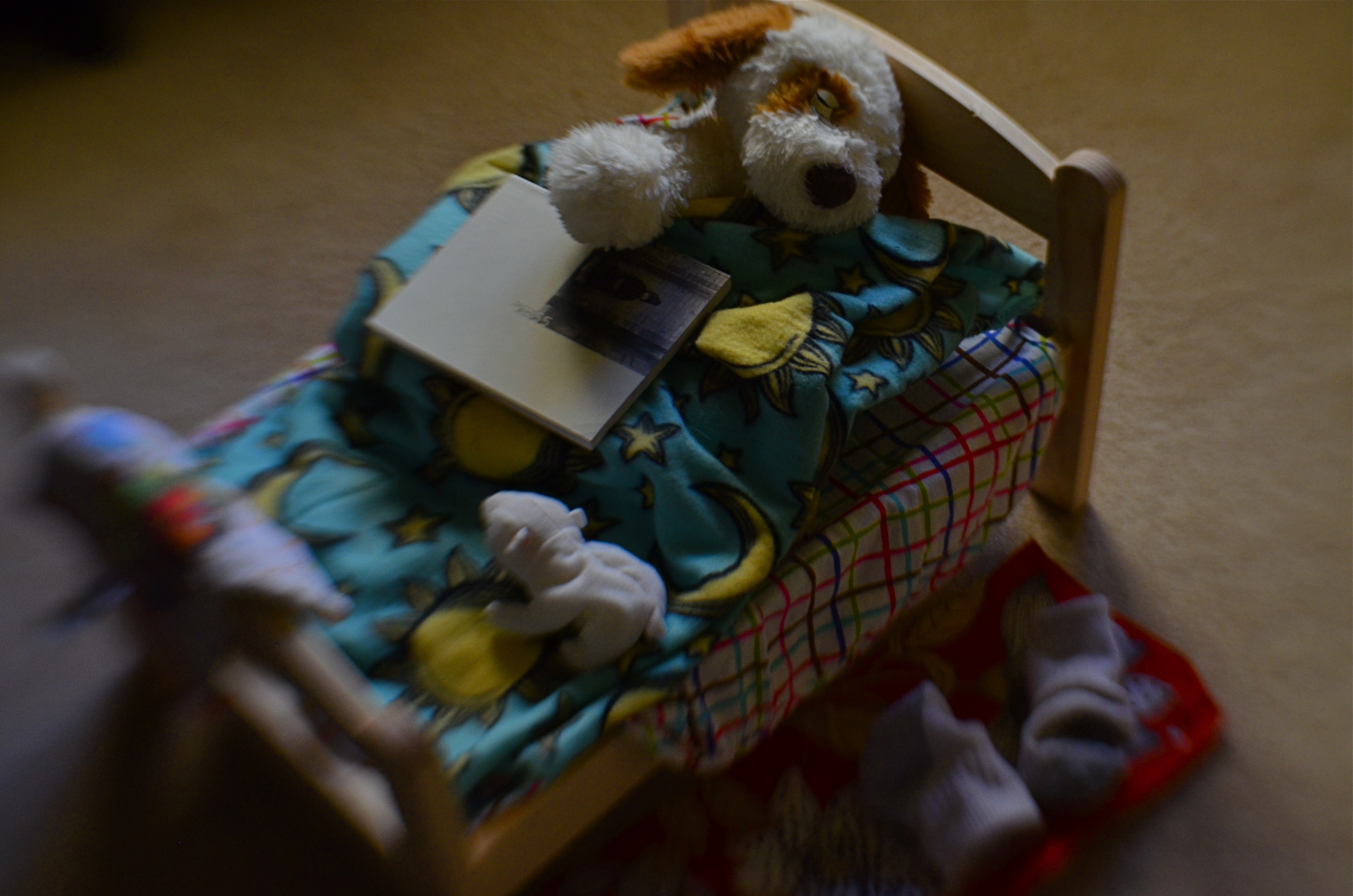
Dog Tired (2017)
Every once in a while, I take a crack at an imaginary scene that the wizards of Portland might have dreamed up, such as the concoction you see here. The stuffed dog and miniature bed had both been purchased to help the sole survivor of a quartet of rabbits get over her grief at being the Last Bunny Standing, but both props had been rejected out of hand. Turns out she rather liked having all the room, grub and water to herself, so she retired her black armband within twenty-four hours without a backward glance.
Walking by the two blacklisted toys each day, I started to imagine the dog as a small child, and wondered what his night-time retiring ritual might be, from the book that eased him off to Dreamland to the socks shed by the side of his bed. Ten minutes of prep and I was ready to shoot my tribute to the days when clay models transported us all from mere reality into View-Master’s exquisite realms of possibility. Days are often arranged in too straight a line. At such times, a slight detour into daydreaming is all you need to render the journey a little more worthwhile.
ONE-TRICK PONIES
By MICHAEL PERKINS
YARD SALES AROUND THE WORLD abound with unwanted gadgets that, just a few year prior, seemed utterly indispensable, be they electric olive pit extractors or deluxe coffee foam skimmers. You know the kind of toys I mean– those glorious, gleaming, largely single-function devices that dazzle us on all-night infomercials and seem like depraved decadence after we’ve hooked them up a few times and found that, hey, you can still access a new batch of carrots with a 79-cent manual can opener and use the regained counter-space for something more essential. Like food.
And, of course, these one-trick ponies of gimmickdom are not only found in the world’s greatest kitchens, but also on dusty shelves in the closets of disaffected photographers, who, like any humans, are subject to the lure of the new. Hey, I get it. It’s fun to have a special, fresh, whirly-twirly glowing godalmighty gizmo, that little add-on that creates amazing effects, amusing simulations, crazy textures. Lens manufacturers are particularly great at getting the fishhook into the mouths of photogs when it comes to toy time, since no one responds better to the latest optical trick. But, as in the case of the pit extractor, you have to ask yourself how much permanent, sustaining, everyday use you will get out of a given piece of gear.
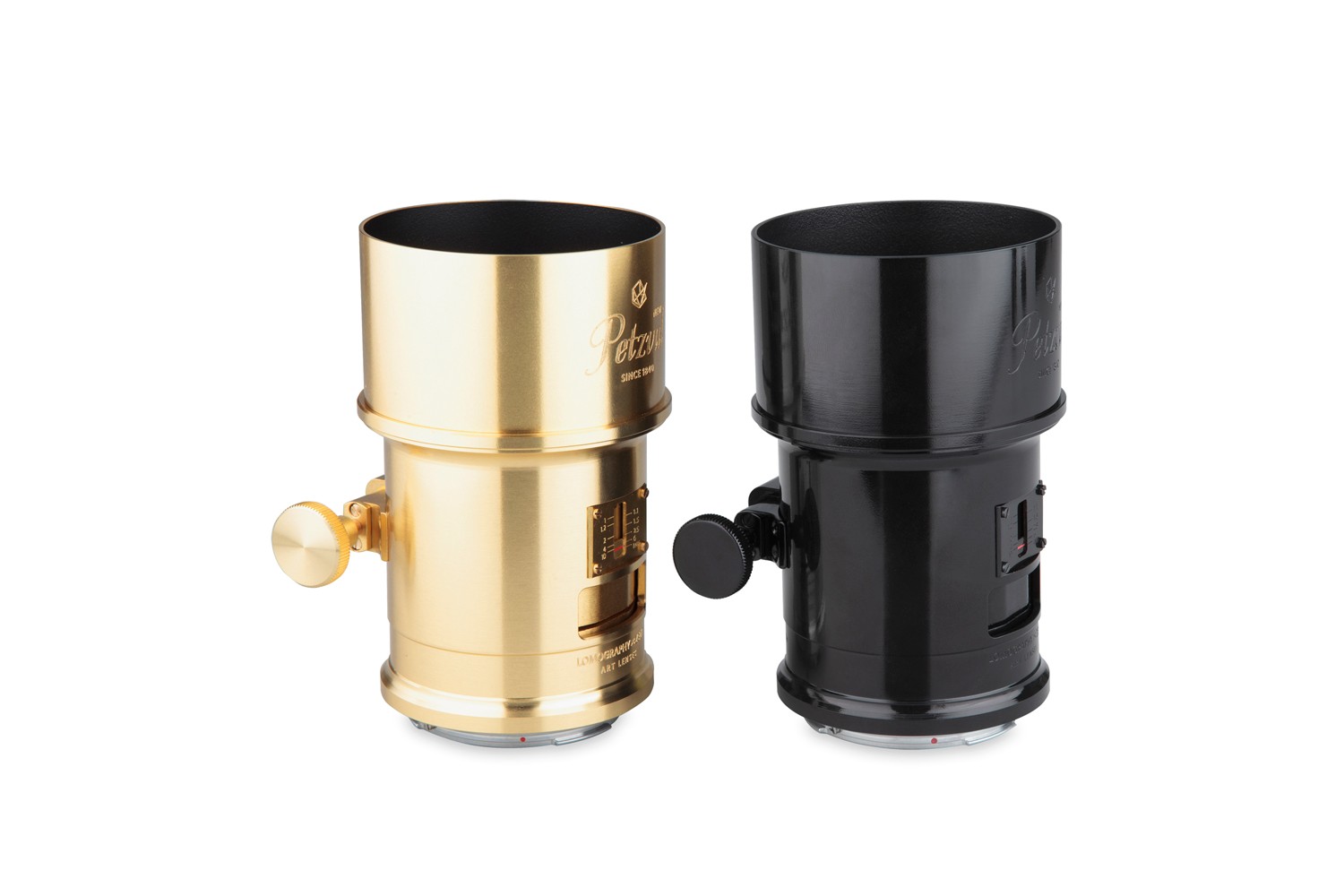
Want your pictures to party like it’s 1849? The Petzval might be the lens for you…
One great way lens manufacturers have devised to separate you from your cash is to introduce a new version of a classic or “art” lens that re-creates an effect that is associated with the halcyon days of early photography. One such lens is the Petzval, named after Josef Petzval, who developed it around the 1840’s. The optics of the Petzval are particularly seductive for portraitists, as they separate your subject from the ambient scenery by rendering it sharp at the center while making all background information look like a swirling blur. Very artsy, very specialized, and very, very expensive.
Neo-Petzvals are all-manual (niche market #1), metal bodied (niche market #2) and gorgeously nostalgic (niche market #3), looking like something Ahab would use to track Moby Dick around the seven seas. These beauties, which, again, can only make one kind of image at one focal length, can cost upwards of $700 through Lomography.com. Companies like Lensbaby can create the same effect for around $149 and more than a few phone apps can deliver the same thrill for $2.99 or under. But the cost is almost irrelevant. What counts is how much you will actually use the thing.
You have to decide what your approach to equipment is, making a personal calculation based on what you most need to do for you. My own version of this riddle is based on how much I can do with how little, making me prefer lenses and appliances that can multi-task. However, there’ll always be days when life’s hella hectic and you just haven’t got time to scrape your own coffee foam. As usual, the answer lies in the kind of photography that snaps your personal shutter. Your pictures, your playthings.
OUT OF THE DEPTHS
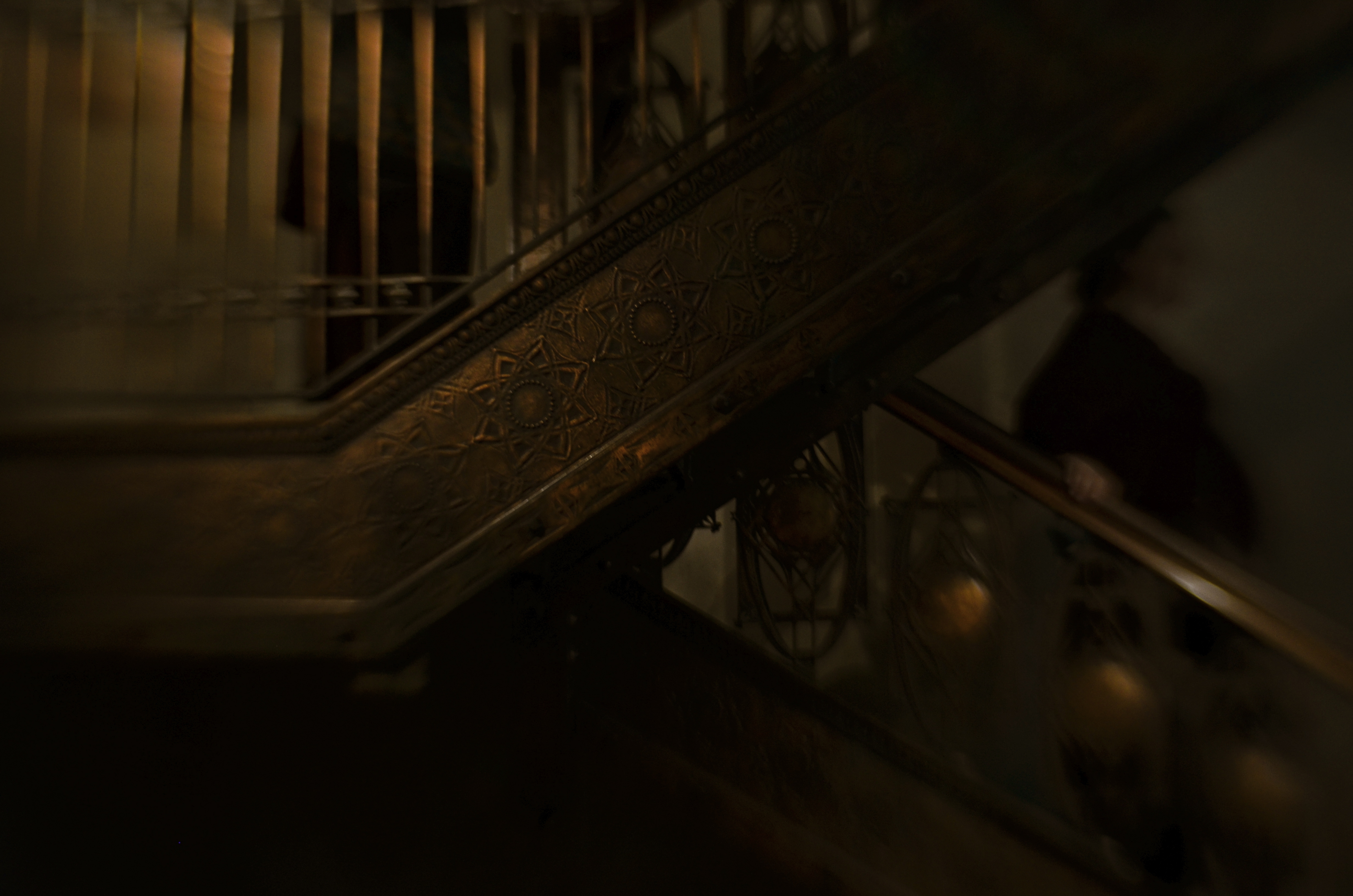
Descent Into…(2017)
By MICHAEL PERKINS
I MAY BE OVER-COMPENSATING A BIT OF LATE, making the kind of correction a newly-minted driver makes when he steers too far in one direction, then steers just as radically in the other. Five years ago, my photography was caught up in the feverish rescue of detail from dark places. I embraced HDR (High Dynamic Range) imaging as a way to illuminate every part of a frame, fearing that important information was being lost in the shadows. I was consumed with delivering what the camera was inefficient at seeing, and spent a lot of time making exposures “balanced”, making sure everything in them was viewable.
These days, by contrast, I seem to be all about the dark, or least its creative use as an element in more and more pictures. Darkness is a lot more subtle than that which is visible, as it merely hints, rather than states, information. I see darkness now the way that graphic artists might have several centuries ago, when the recording medium might be a treated paper that was all colored, or all dark, and the lighter values of a composition might be drawn onto that medium with white paint or chalk.
With such methods, early drawings by Michelangelo and others saw darkness as the start point, with so-called “positive” values sort of extracted from it. In photographic terms, I seem to be taking the same approach to a lot of pictures recently, beginning with a sea of undefined murk and pulling just enough information out of it to create a composition. Whereas, just a few years ago, I was summoning forth every hobnail of detail possible out of a frame, now I am mining the very minimum. I want the unanswered questions posed by darkness to remain largely unanswered. Too much detail means too much distraction.
The practitioners of chiaroscuro (artists like Rembrandt and Reubens) also started with a dark canvas but used light, usually from a single source such as a window, to model their subjects, to give them a three-dimensional quality. I sometimes do that too, but mostly, I am asking the viewer to enter into a partnership with me. The terms: I’ll show you part of the story, and you supply the rest.
Where will I be in the next five years? I’m totally in the dark.
MOZART’S CORONA
By MICHAEL PERKINS
SOME PRACTITIONERS OF PHOTOGRAPHY EMBRACE WHAT THEY CALL REALITY, while other factions run as far away as they can from the strictures of the “actual” world. There will always be shooters who see their main role as that of a chronicler or witness, recording “Joe Friday” pictures, i.e., just the facts, ma’am. Others see the real universe as nothing more than a point of departure. Their images could easily be labeled “based on a true story.”
Neither viewpoint can go it alone. Without reality as a reference point, flights of fancy float off into chaos. Conversely, without a sense of whimsy, the gravity of the world can make a photograph leaden and moribund. Let’s face it: dreamers and didacts need each other, and complement each other within a single picture the way fat flavors lean meat. Moreover, trying to attenuate a customized mix of these two disciplines is the real fun in photography.
I’ve been fascinated of late by the new surge of interest in manual typewriters. It’s the same longing for recently-departed technology that’s fired a revival in film and the rebirth of vinyl lps. We are moving so quickly forward in some ways that we are understandably reluctant to regard every part of our past as dispensible ballast to be jettisoned on the way to some perfect Futureworld. And so we linger a while. We prolong our goodbyes a bit.
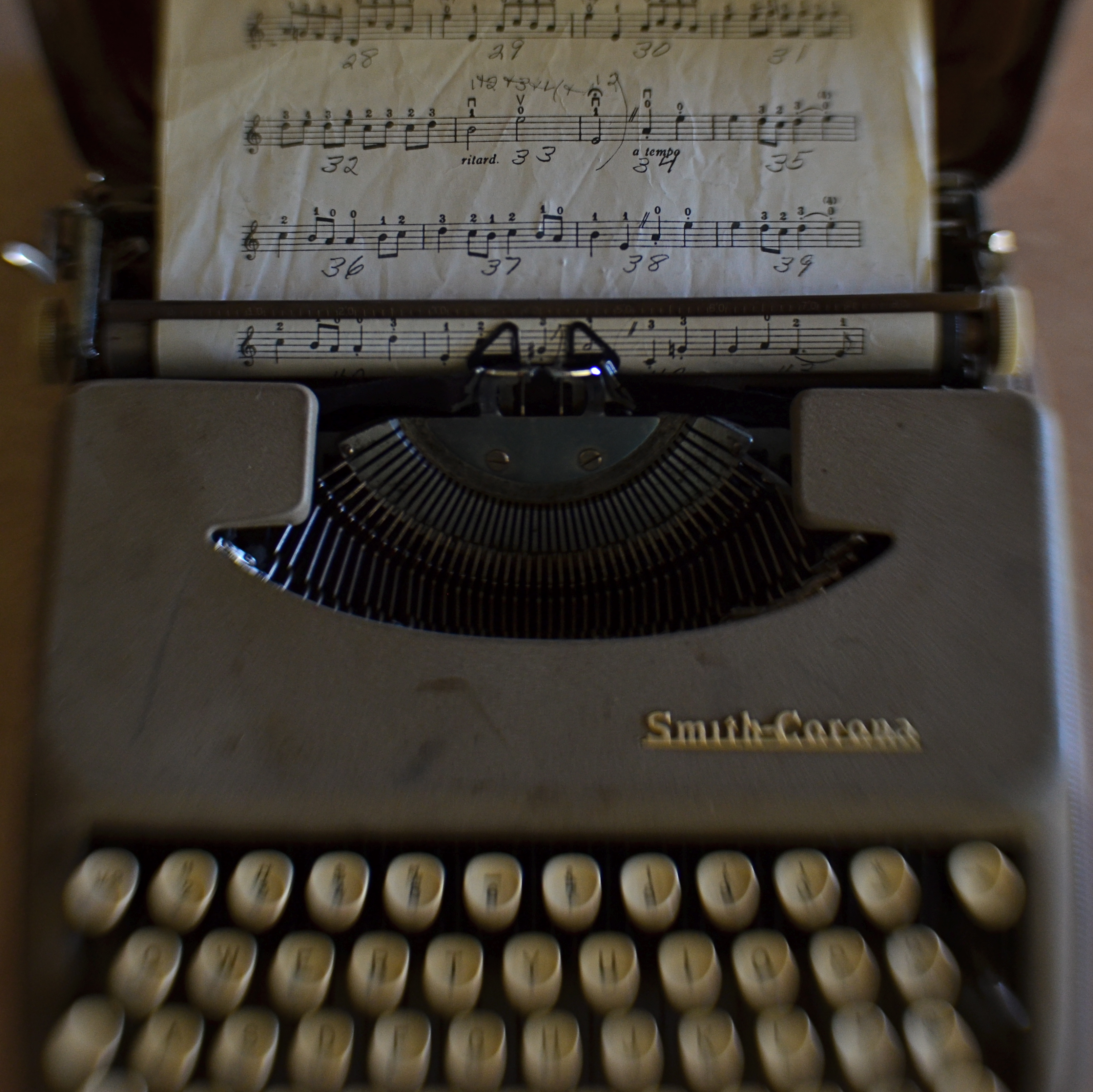
Compose Yourself (2017)
Some writers have recently renewed their love affair with the clack and clatter of the mechanical keyboard, marrying its noise, heft, and bulk to a kind of seriousness, as if a story or essay were somehow more authentic if pounded out on an old Royal or Smith-Corona. The recent documentary California Typewriter takes its title from a scrappy repair shop that survives to the present day by restoring old beaters for a new crop of trendy customers who either admire the sheer engineering wonder or the mystical oomph it confers on their scribblings. High-profile adherents like Tom Hanks, John Meyer and David McCullough rhapsodize about the contours, keyboard height, and return bell of their respective treasures. It’s great fun.
Photographically, I started to explore just how far the idea of the typewriter-as-magical-device could be stretched. Would it endow the user with the ability to solve knotty equations? Conjure ingenious recipes? What if the typewriter had unilateral power to enhance the creation of anything, even melody? What kind of typewriter might help Mozart crank out a concerto? Would his greatest works go mid-performed for centuries just because he transposed certain keys? And what would that process look like?
I decided to use a selective focus lens (the Lensbaby Composer with Sweet 35 optic) to de-emphasize the process of typing (the softly rendered keys) and call attention to the magical product (the sheet music being generated, focused more sharply) coming out of an imagined Corona wielded by an inspired Amadeus. The concept is so ridiculous that it’s compelling, producing a photograph which can’t be true but which ought to be true, rather like Dumbo using his ears to fly despite the fact that he weighs half a ton. I love these kinds of exercises because I embrace the fact that photographs can tell enchanting lies. And as Paul McCartney sings, “what’s wrong with that?”
CAN’T GET THERE FROM HERE
By MICHAEL PERKINS
THE “U.S.A.” OF THE EARLY NINETEENTH CENTURY was, in every way, a collection of separate and unconnected “Americas”. Cities were fewer in number, and the ones that did exist were hermetically sealed off from each other, each in their own orbits in a way that would end when telegraph wires and railroad tracks annihilated distance on the continent forever. At one end of the 1800’s, each town and village was its own distinct universe; at the other end, it was only one of many dots on a line chain-linking the nation as one entity.
In the 21st century, there is only spotty evidence of the days when your town was, in a very real way, the predominant version of “the world” to you. The terms of survival were so very different. “In town” and “out of town” were measured in blocks, not miles. There was a pronounced sense of “how we do things around here”. Local accents were a clearer stamp of identity. News from outer regions arrived slowly. People’s lives impacted each other directly. And the towns first canvassed by photographers reflected the isolation of one city from another, for good or ill.
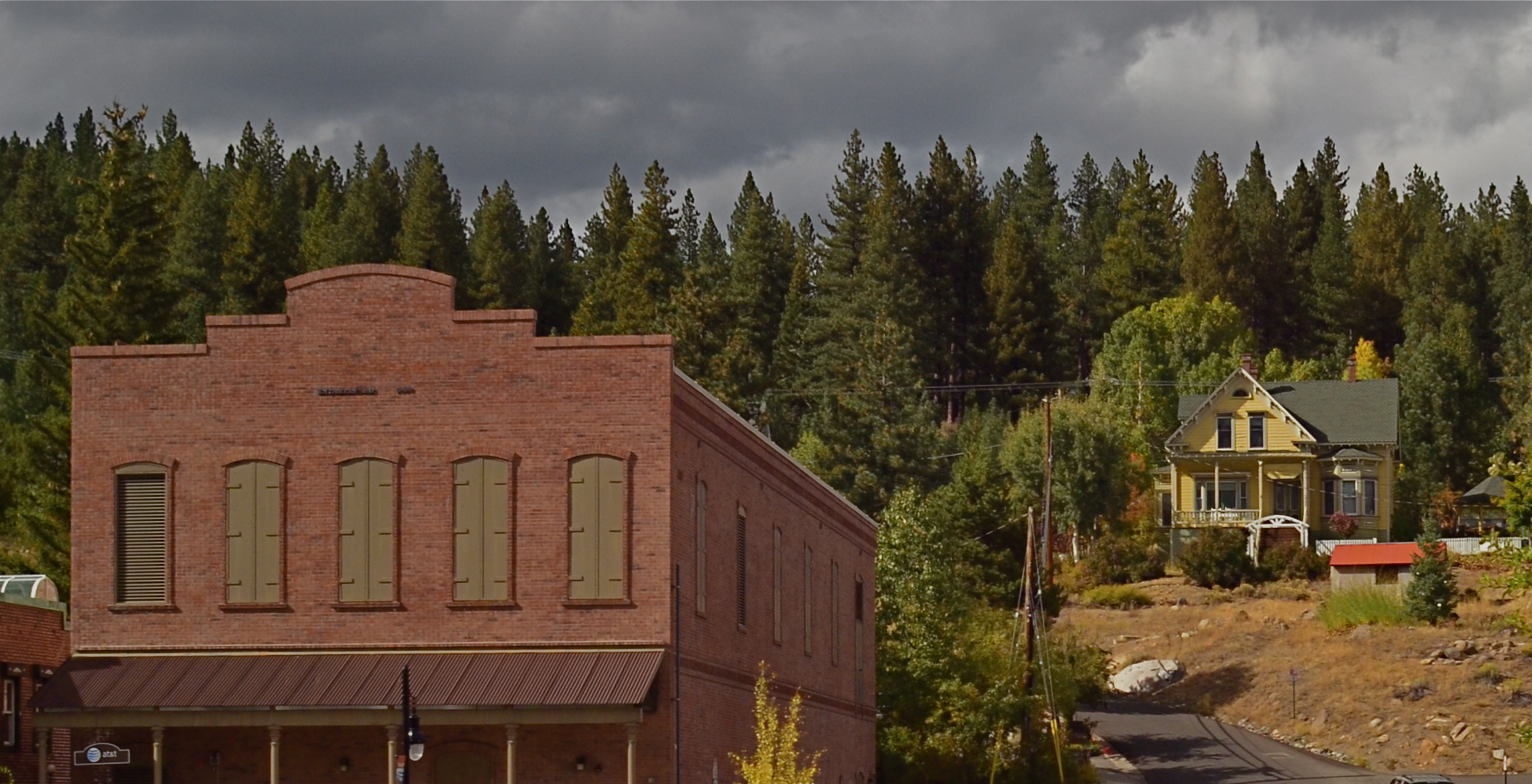
My parents met each other in a town that started small and stayed that way. It’s contracted now, the way a grape shrinks to a raisin; there is still enough of its old essence to identify what it was, but no hope for a future that resembles the past in any remote manner. I love making photographs of places in America where the feeling of apartness is still palpable. It is harder to be hidden away now. We are all one coast-to-coast nervous system, with impulses crossing the void in nanoseconds. The places which still say “our town” are often baffled off from other towns by raw geography….the mountains someone forgot to cross, the rivers no one wanted to ford. And, in the towns walled off by those last remaining barriers, as in this view of Truckee, California in the Sierras, there are still stories to be told, and images to be captured.
I was struck in this picture by how close the residential and business parts of town were to each other, long before we all started spreading out and, well, getting away from each other. It creates a longing in me for something I can’t fully experience, and a desire to use my camera to come as close as I can.
THE VIEW FROM (OTHER) HERE(S)
By MICHAEL PERKINS
THE FIRST EMOTION I EXPERIENCE IN LOOKING AT GREAT COMMERCIAL PHOTOGRAPHERS’ WORK, is, of course, the awe that vision and talent naturally elicit. The second emotion, although I’m not proud to say it, is something akin to old-fashioned, green-eyed envy, given that so many of the world’s best images are, no surprise, taken from the world’s best vantage points. National Geographic, The Audubon Society, NASA, and hundreds of amazing journalists take our breath away not only for what they shoot, but for where they shoot it. Theirs is the stuff of Pulitzers and mass circulation. They literally make the shots seen ’round the world.
But there is, in all this camera envy, a spark of hope for the rest of us. Consider: not all of us can create great work even, by being in the right place at the right time. We also have to be the right people to make a shot eloquent, even if we’re standing at the edge of momentous events or breathtaking views. Yes, sadly, many of us won’t be sent by our editor to the sites with the greatest potential, or have enough liquidity to venture to them on our own dime. Most of us won’t be across the street for those moments when the world changes.
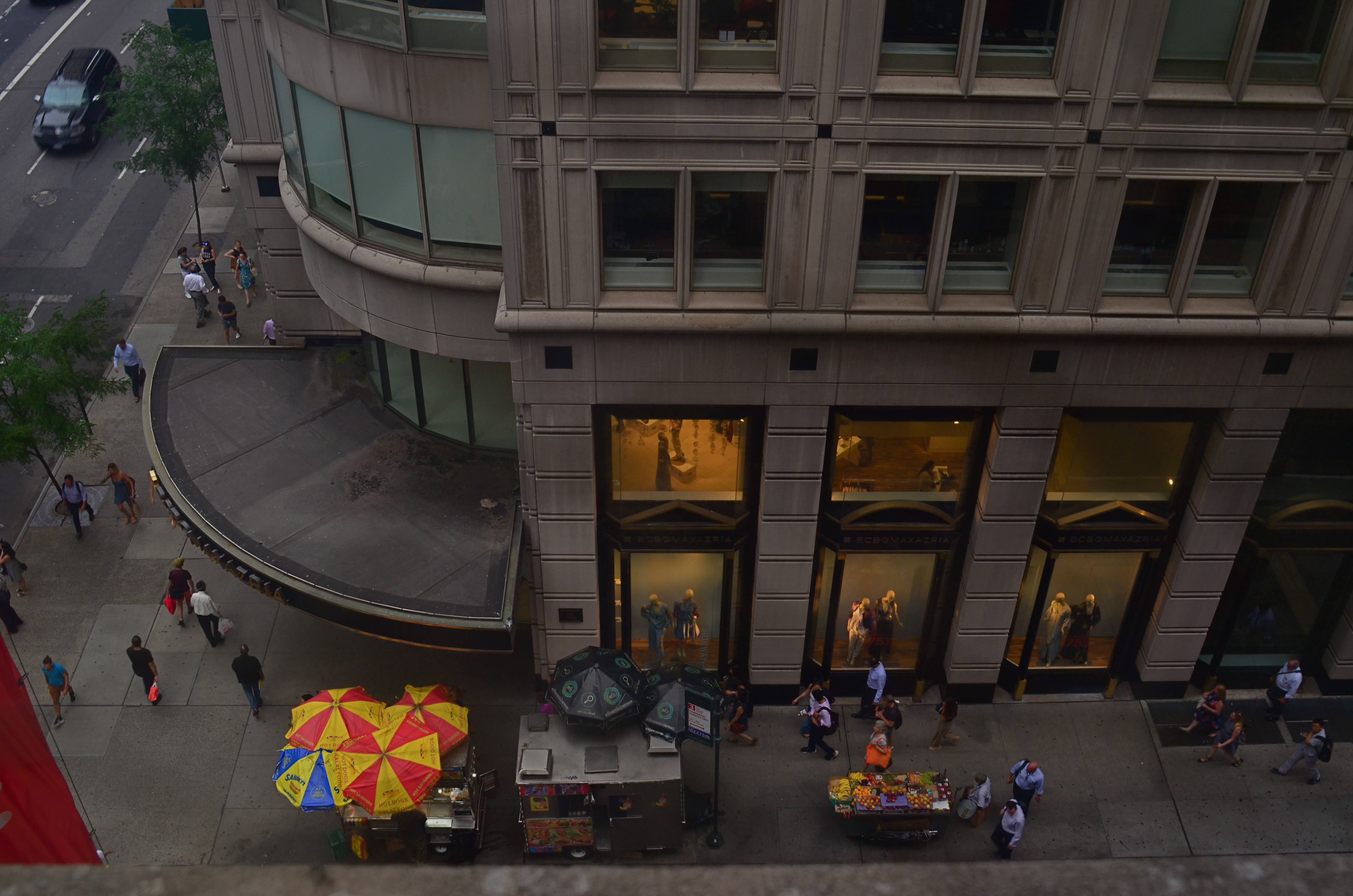
A bird’s-eye view of a “common” street scene. Does the point of view make a difference?
But here’s the deal: we do control the way we approach the places that we can get to. We can be the difference between a mundane and a miraculous image, even if the subjects we cover might escape everyone else’s glance. And we can re-imagine, through an angle, a viewpoint, a sensibility, something that’s been thought to be “photographed to death”, and harvest something fresh from it. Our cities, our daily routines, our most familiar mile markers need not have a single, “official” identity in photographs. Where we stand, what we choose to say, transforms even the most well-trod material. The street corner in the image at the top has mostly been seen or photographed at street level. Did I find something new in shooting it from an eighth-story window? And if I didn’t, could someone else?
Cameras, even the most expensive ones, don’t create beauty. Events, no matter how momentous, don’t guarantee stunning images. It’s the eye at the viewfinder, and the brain behind it, that determines whether a picture speaks.
NOMADS
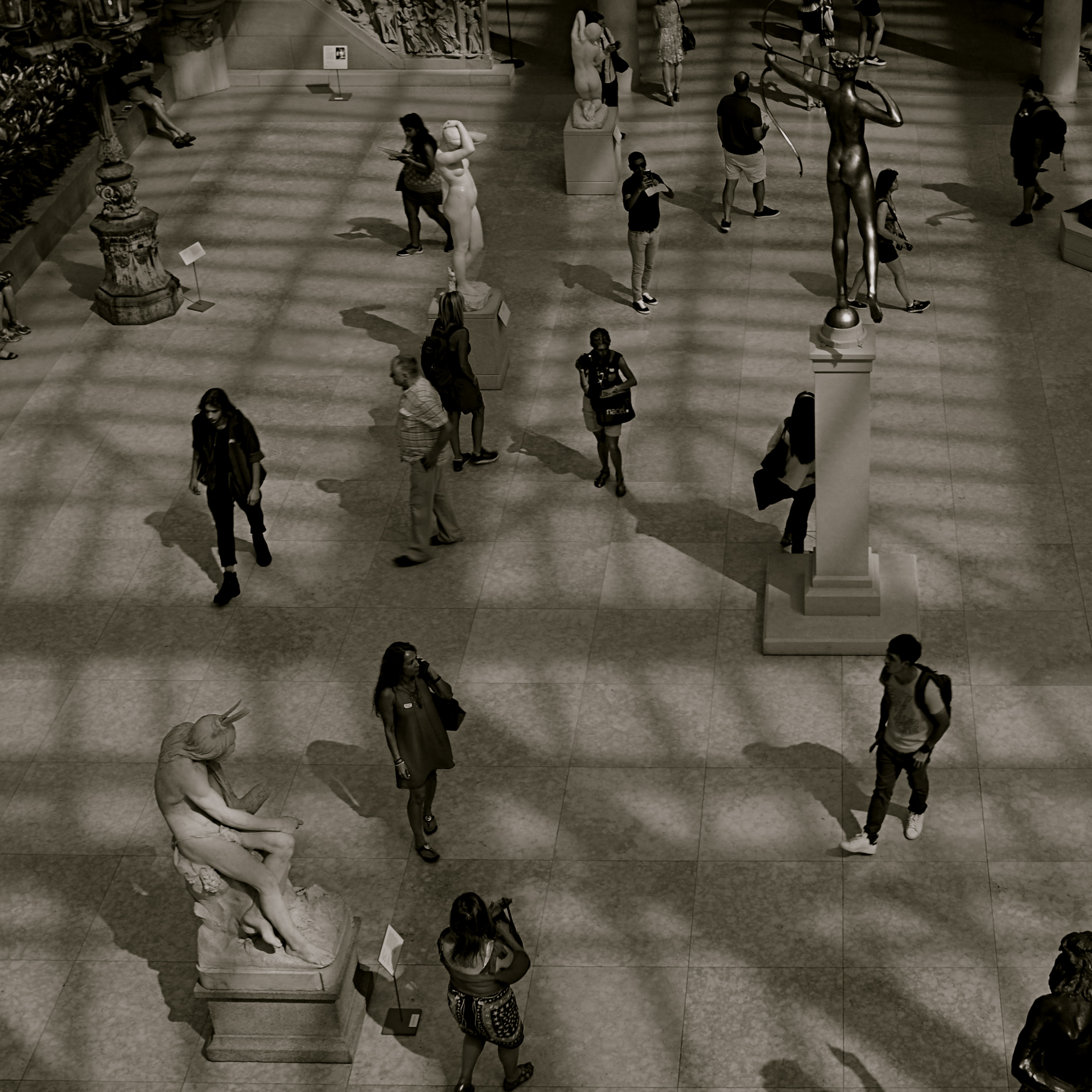
Animate/Inanimate (2017)
By MICHAEL PERKINS
IN A PARTICULARLY CHILLING SCENE from the classic film The Third Man, Orson Welles, as the story’s amoral profiteer Harry Lime, looks down from a carnival ride to the teeming, tiny throngs on the pavement below, distancing himself from people that have been reduced, in his mind, to mere ‘dots’. ” Tell me”, he asks his friend Holly Martens, “would you really feel any pity if one of those dots stopped moving forever?” Lime has, in fact, been selling tainted medicine to desperate refugees in post-war Berlin, and his product does, almost certainly, make several of those dots stop moving. Forever. Horrible, and yet his estrangement from his fellow wanderers on that sidewalk occurs all the time in all our minds. When we look more carefully, more compassionately, however, photographs can happen.
We are all nomads, wanderers, dots on a map. We convince ourselves that our journey is surely taking us toward something….a very important something. As for everyone else….what? Like Harry Lime, we place great emphasis on our own story, with ourselves cast as the hero. In fact, though, pulling one’s eye just far enough back from the throng can show our camera’s eye the real story. Every journey, every destination is equal….equally vital or equally banal. It’s the process of observing that seeking that creates a tableau, a composition. That, and how we view it.
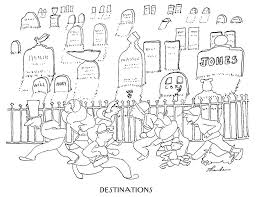
James Thurber, Destinations
I take a lot of images of crowds in motion: streaming in and out of buildings, rushing for trains, teeming through malls, crowding the subway. What they’re after isn’t what gives them the drama. It’s the continuous process of seeking, of going toward all our collective somewheres, that provides the narrative. I don’t try to record faces: these are moving chess boards, not portraits. Additional clinical distance can come from the use of monochrome, or angle of view. Sometimes I think of the overhead camera shots of director Busby Berkeley, he of the kaleidoscopic dance routines in 42nd Street and other ’30’s musicals. The rush of the crowd is all a kind of choreography, intentional and random at the same time.
One of the images that brought this idea home to me as a child was a cartoon James Thurber drew for the New Yorker titled “Destinations”(above left). It shows, simply, a rightward mob rushing toward a leftward mob, with a cemetery in the background. Everyone is headed for the same end point but all act as if they are bound for someplace else. The story for a photographer in all this wandering lies in how we look as we do it. Where we eventually wind up may well be fate’s whim, but the story of all the comings and the goings, of ourselves and our fellow nomads, is in the hands of the camera.
ACCIDENTALLY ON PURPOSE
By MICHAEL PERKINS
THE IMAGE SHARING GROUP UTATA, which operates within Flickr, has been, for this boy snapper, a daily touch of Christmas. It expands upon the rather pointless online quest for mere “likes” and is, instead, a genuine dialogue with other like-minded strange-o’s who want to push the boundaries of at least their own eyes and commiserate with others who long to do the same. The administrators keep Utatans united with periodic, deadline-based homework assignments organized along a a variety of seriously unconventional themes. Some require serious thought. Some can be created almost completely on impulse. And many more fall somewhere in between.
One of the nice bits of insta-fame conferred upon Utatans is having their work occasionally plugged onto the utata.org welcome page. Even better, head honcho Greg Fallis and his fellow guardians of the Utata universe will often provide new captions, poems, or essays of their own for the images, as if to tangibly demonstrate that, just as there is more than one way to see, there are a million ways to be seen. Upon recently conferring home-page status on a rather hurried celphone image I’d posted, Greg also managed to perfectly crystallize thoughts I’ve mulled over recent years:
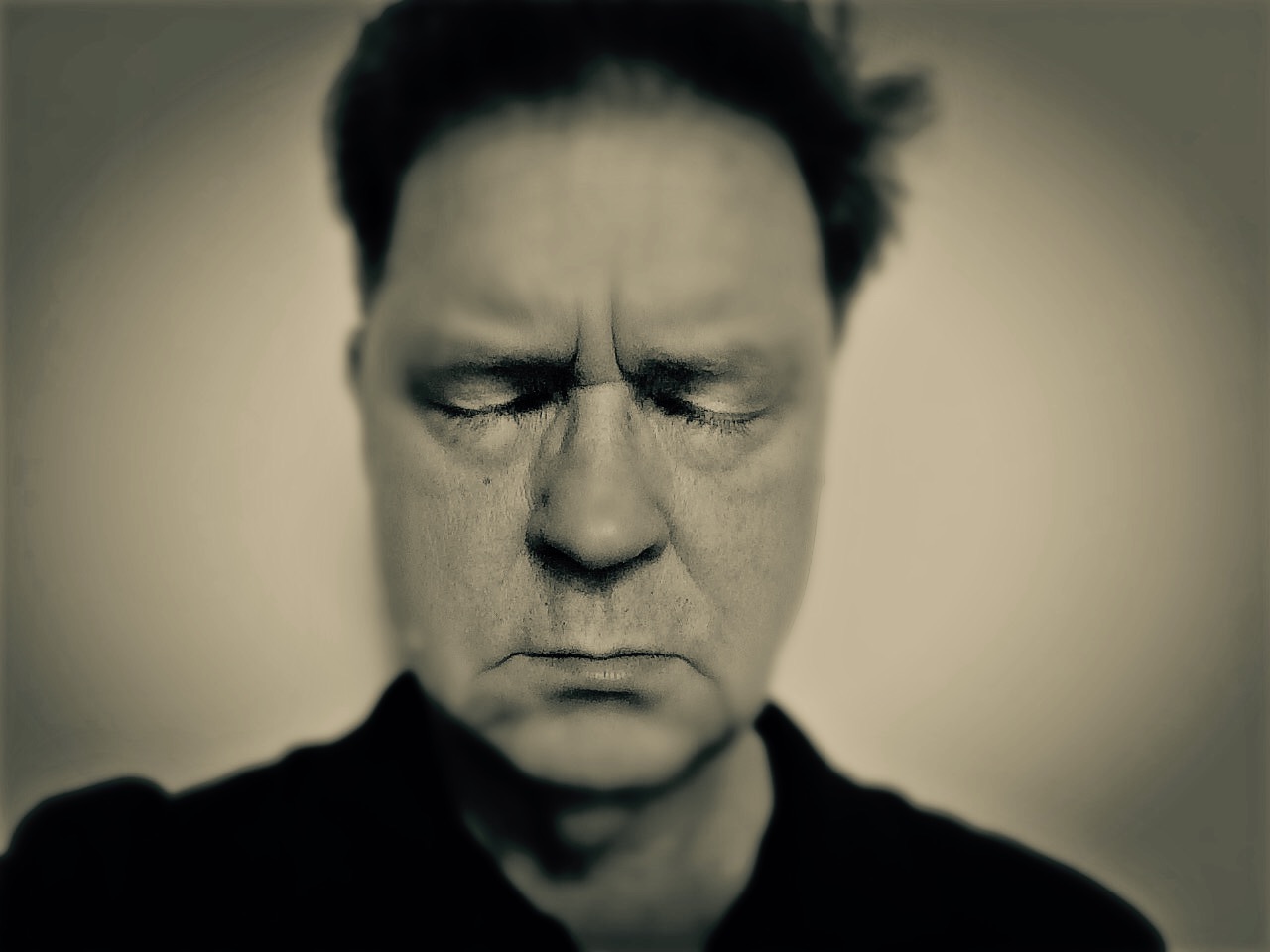
A quick impulse, a thing of no importance. And that, in itself, may be important.
See, here’s the thing about shooting photographs with your cell phone: it’s not a serious camera. That means you can relax. Try stuff. Shoot something different. Shoot something familiar in a different way. Shoot something different in a familiar way. It’s liberating because it’s “just” your cell phone.
In fact, the image was made in a very short space of time, shorter by far than if I’d made it with my “real” cameras. The original phone selfie was fed through an app designed to mimic both the strengths and weaknesses of antique portrait lenses, and, since I liked the ethereal quality it delivered, I decided to stop. Just stop. Stop fooling, fretting and fixing. Stop, and publish.
So, have I gotten to the point, at least some of the time, when I’m really living that old saw that “the best camera is the one you have with you?” Am I more spontaneous, more open to experiment, higher up the “wot the hell” scale when armed with a cel? Dunno. Really. Not being coy. I definitely still feel that umbilical-cord connection to my trad gear. But I dig immediate gratification as well, at least the gratification of shortening the gap between “wonder what would happen” and “hmm, that kind of worked.”
Is my conventional gear more “real”than my iPhone? Well, how do you define real? Obviously, there is an almost infinite number of post-processing tools available to compensate for whatever shortcomings the cameras themselves might possess. So, if I do advance prep in a DSLR before the shutter snap to ensure a good picture, does it disqualify an image if I snap it first and then enhance it afterwards in a cel? What is a darkroom? What is a workflow?
Big questions. And I don’t always get the same answers when I ask them.
 thenormaleye
(ALMOST) NO ADMITTANCE
By MICHAEL PERKINS
DOORS PRESENT A MOST INTRIGUING PARADOX for the photographer. They are both invitations and barriers, the threshhold of opportunity and the end of it. Entrances and exits create a two-way traffic, with people either vanishing into or emerging from mystery either behind or in front of them. In either case, there are questions to be answered. And while the camera is certainly no x-ray, it does set the terms of the discussion…an endless discussion… about secrets.
Think of those fateful doors beyond which we know something portentous or crucial occurs. Ten Downing Street. The portal to an execution chamber. A confessional. An organization open to “Members Only”. Doors are like red meat to the photographer because they mean everything and nothing at once. Like the children of Pandora, we inherit the insatiable curiosity to know what’s back of that thing. Who’s there? Who’s not there? What does the great Oz look like? What’s going on inside that doesn’t invite me, doesn’t want me?
All barriers seem wrong, even cruel to us, on some level. “Something there is that doesn’t love a wall, that wants it down” writes Robert Frost in the poem Mending-Wall, and it seems like a reasonable sentiment. I can’t walk past a door, forbidding or friendly, without wanting my camera to go back and ask, knock, knock, who’s there? As an example the above image came to me unbidden, on a night in which my wife and I had walked along Queens Boulevard in New York in search of an all-night diner. Having succeeded in securing sustenance, we were walking home when a brief glimpse of a rather substantial iron gate became visible down a side street during the few scant moments it took us to skip through an intersection. I knew two things at once: I would never know what lay beyond that grand facade, and I would, still, have to make time to come back, on another night, to have my camera ask “the question.”
Photography can be about The Big Reveal, and often traffics in the solving of puzzles. But just picturing the puzzle is all right too. We don’t have to know whether the lady or the tiger is behind that door. We just have to use our magic boxes to knock on it.
Share this:
November 23, 2017 | Categories: Commentary, Composition, Conception | Tags: Framing, Point Of View | Leave a comment