THE TEMPORARY COLLECTION
By MICHAEL PERKINS
FOR PHOTOGRAPHERS, MUSEUMS SHOULD NEVER BE A ONE–WAY STREET. The popular conception of the role of our various Hallowed Halls of Important Stuff is that the artifacts do all the sensory sending and we, the visiting public, do all the receiving. The idea prevails that paintings and sculptures and installations impart their wisdom and we passively soak it up, like ambulatory blotters. Thus, this logic must follow, a photographic record of the museum experience should only pointed in one direction.
But of course this is nonsense.
Anywhere you have hundreds of humans assembling in a common area, you have created an active anthropological laboratory, and thus a rich harvesting ground for the camera. A myriad of motives and paths, from “something to do” to a personal thirst for experience to a place to duck in out of the rain, converge as a “temporary collection” mixing with the museum’s’ more permanent ones. All these arrivals, each with their own energy, curiosity, hostility, apathy, fatigue, and joy to deal with, create a kaleidoscopic pattern of intrapersonal intersections and collisions. The eager attendee and the unwilling hostage exist side by side. That creates the unpredictable, and that unpredictability, for the photographer, creates opportunity.
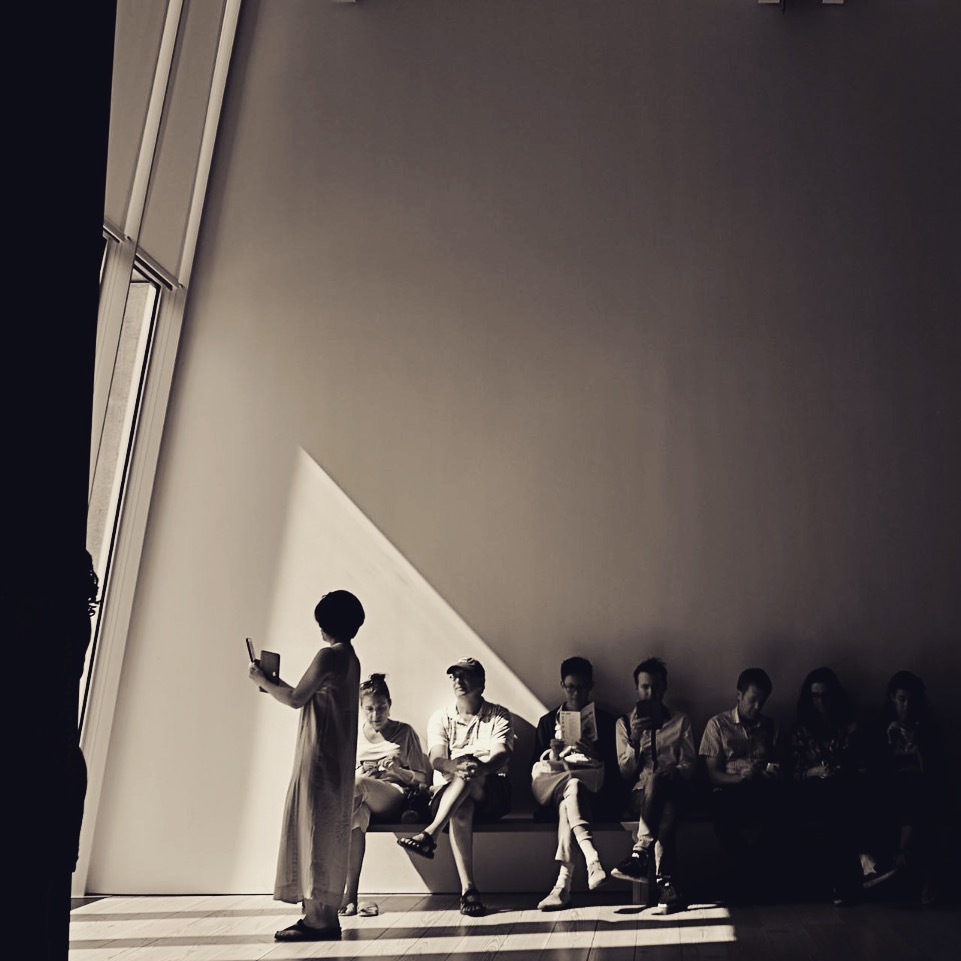
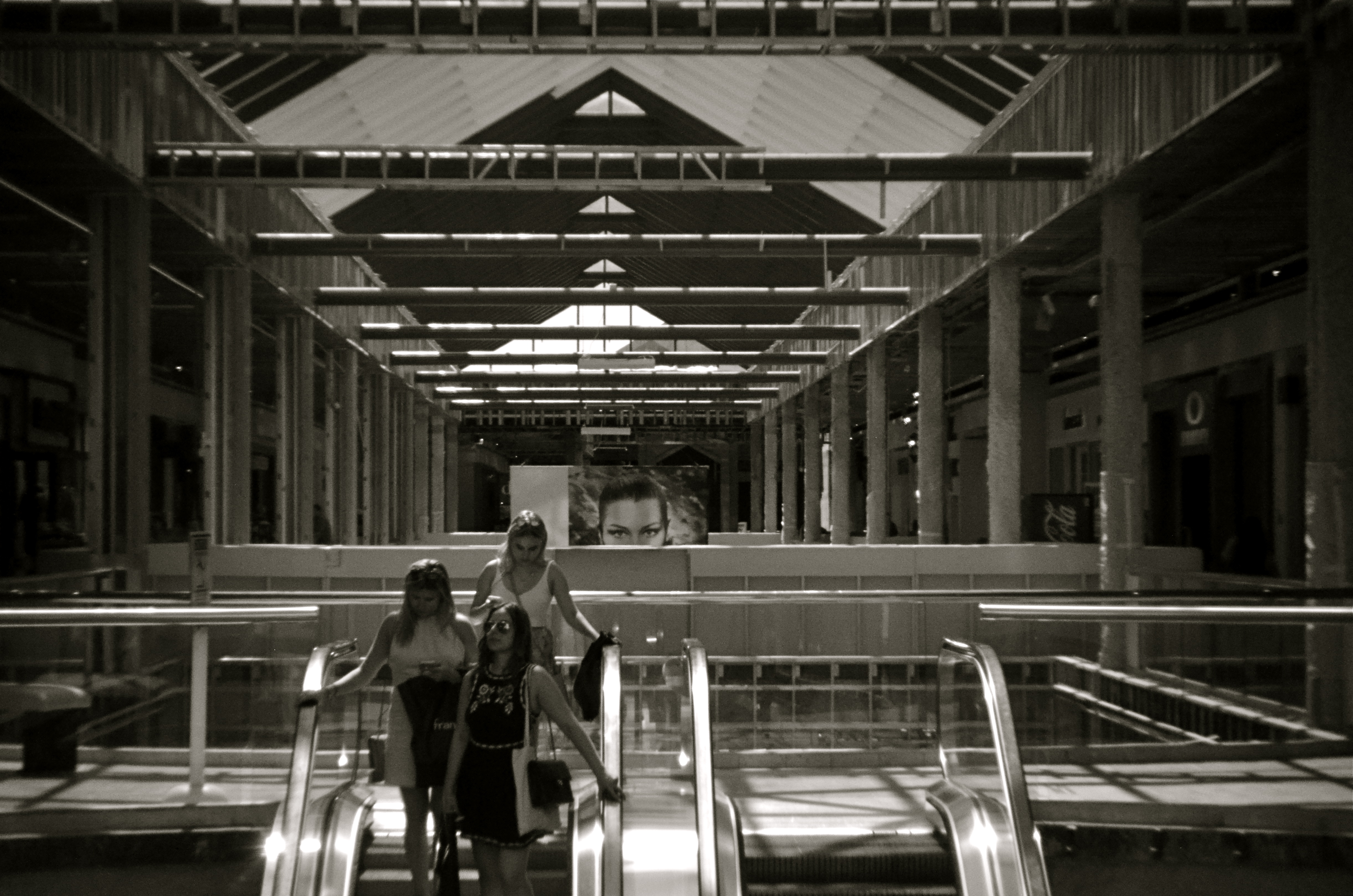
In the image shown here, the “official” delights of the museum in question have failed to amaze, at least for the group occupying the bench. As for the woman peering out the window, she has simply found something with bigger “wow” value than anything hanging on the walls. The sheer dimensions of the space threaten to dwarf the group, to make it seem small or insignificant, and yet their faces and bodies contain a strange mix between tension and ennui that is so wonderfully human that it invites the investigative eye of the shooter.
This shot came to me virtually ready-made, although a later conversion to monochrome eliminated the minor color distractions of various articles of clothing. When a picture is this simple, everything that tends to complicate it becomes expendable. The phrase keep it simple, stupid, may not have originated with photographers, but we ought really to have it tattooed on our foreheads.
I spent nearly two hours in the museum in question (name withheld) and, I assure you, this was one of the most interesting tableaux I observed in the entire joint. It’s not that I find no interest in the arts: quite the opposite. It’s just that, visually, people reacting to the world is more vital to me than just pictures of the world alone. The whole gig is a museum, really, and frequently, the permanent collection of life is thus upstaged by the temporary one. Go figure.
AS THE WORLD TURNS
By MICHAEL PERKINS
THE GREATEST TEACHING MUSEUMS are not “museums” at all, but those sites where a present, living enterprise is ongoing, activities that also preserve and demonstrate the original purpose of the spaces. Walking through a building whose continuing existence illustrates what made it great in the first place outranks any mere remembrance staged in some sterile exhibit space. It also allows photographers to re-invent the visual records of such sites for their generation.
In the case of one venerable building in New York City, I have lately felt a poignancy in how photography itself has figured in the creation of the American Century.
As this little scribble goes to press, the latest owner for the long-embattled New York Daily News has decided to lay off nearly fifty per cent of that scrappy newspaper’s editorial staff, including virtually all its photographers. Born in 1919, the News was, from the beginning, an upstart, a locally focused, close-to-the-ground, bare-knuckled chronicle of Gotham’s daily doings, delivered with a huge dollop of attitude. Promoting itself as “New York’s Picture Newspaper”, the NYDN brought photography to the fore as a dominant storytelling component, in a way no other American newspaper ever had. While the New York Times‘ polite and prim broadsheet spoke in its inside voice, the News, its smaller tabloid format an easier fit for one-handed commuters, screamed “EXTRA!!”. You might not like the message, but by God, you couldn’t look away.
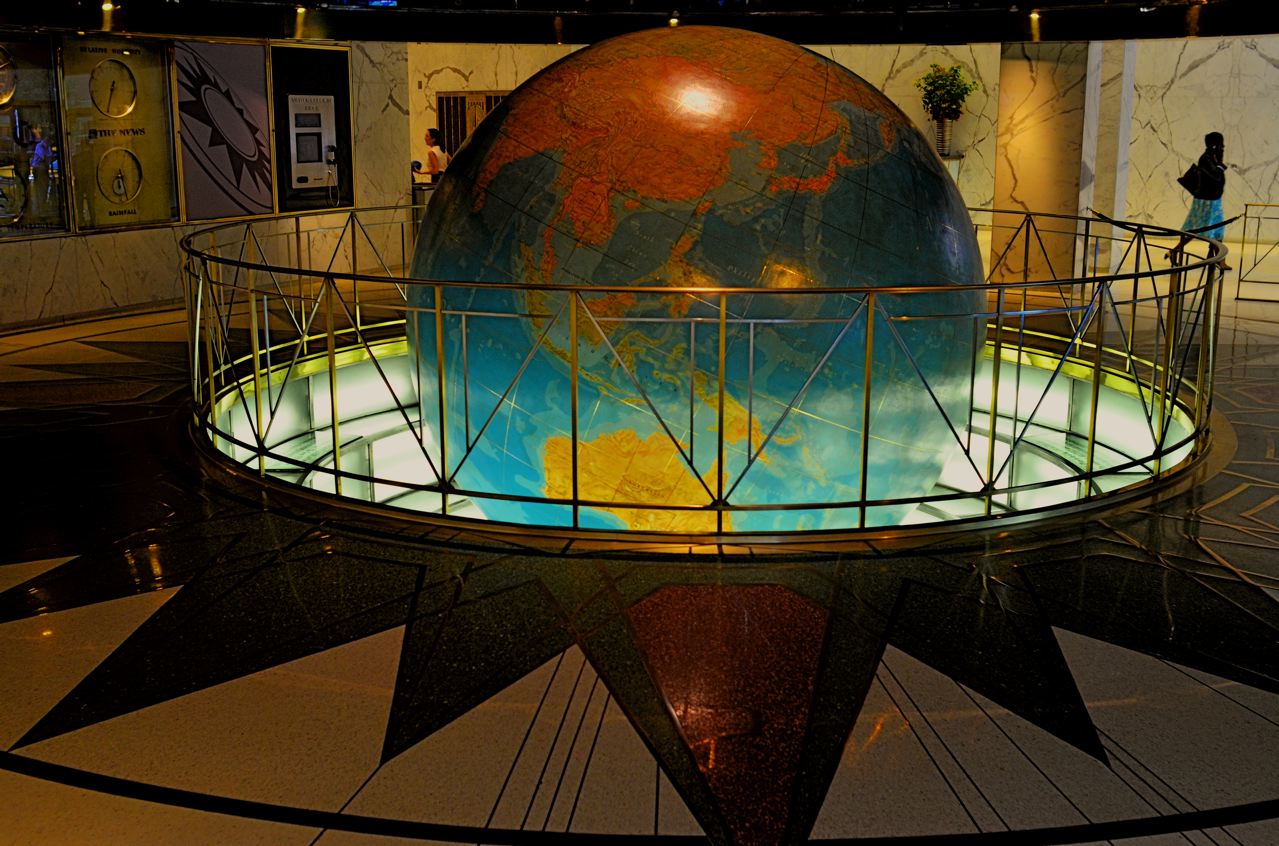
Inside the lobby of the News‘ building at 220 East 42nd Street, the message was a little more mellow, with its enormous illuminated world globe emitting a vibe of stability, science, order, reliability. Today, with the paper long since having emigrated to 4 New York Plaza, the globe, now protected (as is its host building) by city landmark status, still revolves, quietly glowing like the ember of a world that once burned as bright as a comet.
And that world moves on, of course. Markets decide what kinds of newspapers they want, and careers will always wax and wane. But, for photographers, places like the News building, places that defined the American Century, still speak more eloquently than any tepid re-creations in formal museums, and chronicling them with cameras qualifies as vital work.
Finally, there is no substitute for the real thing, something director Richard Donner affirmed in 1978. Building sets for Superman: The Movie, Donner decided that he could save a tidy sum in the creation of the atmosphere for Clark Kent’s day job at the Daily Planet. The solution? Just send the camera crew and cast down to the News building……
OF TREASURES AND TORTURES
By MICHAEL PERKINS
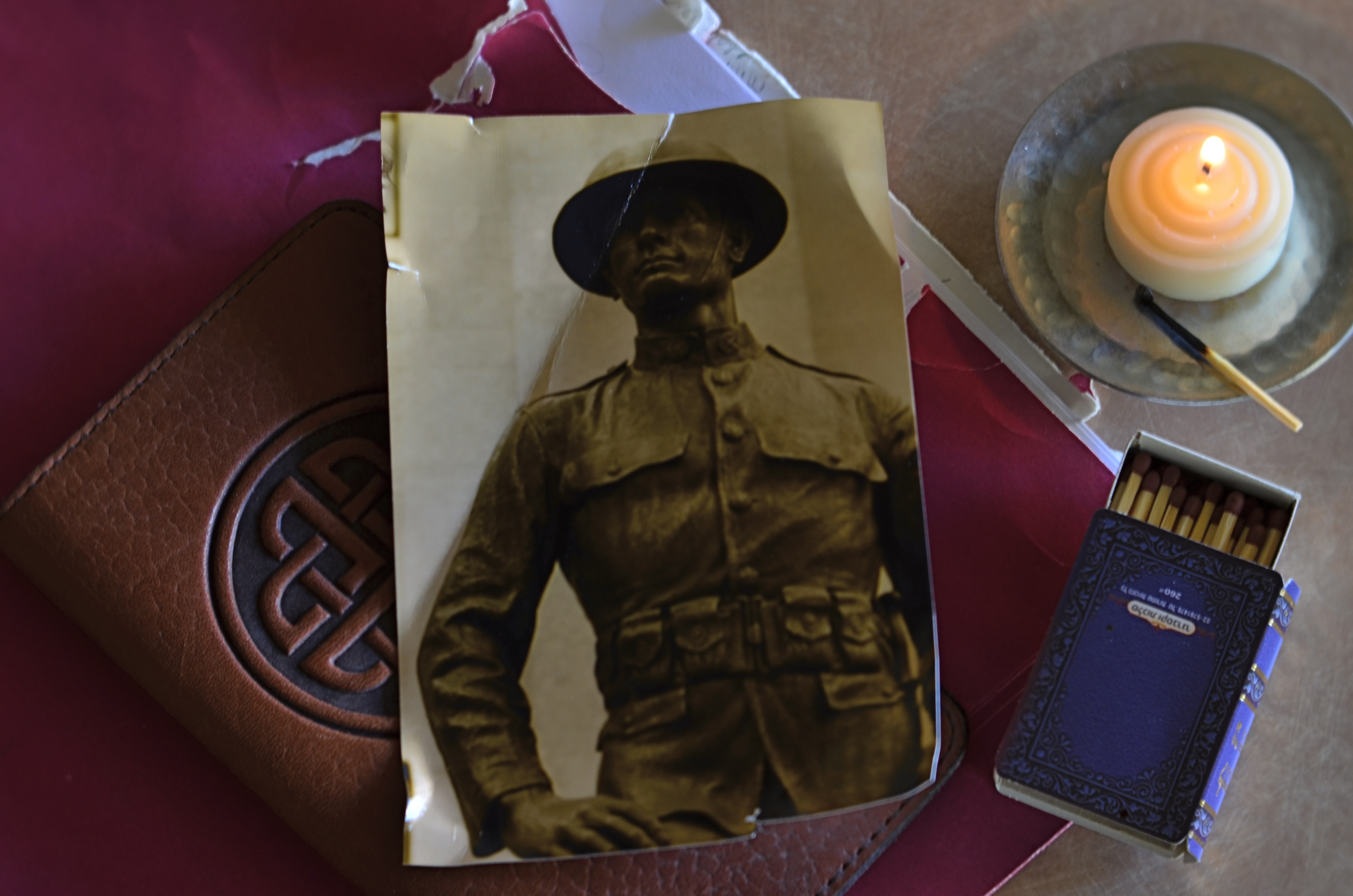
EDWIN M. STANTON, Abraham Lincoln’s Secretary of War, is, regarding photography, in the unique position of having acted both wisely and foolishly following the death of his Commander-in-Chief. Foolishly, because, at the request of the president’s bereaved widow, he reportedly ordered the destruction of the only glass plate negative showing the fallen president lying in state…..and wisely, because he apparently kept a personal print of the image amongst his personal papers, lost to history until a teenage Lincoln afficionado accidentally stumbled upon it in 1952. Stanton’s actions, along with those of the First Lady, betray a very human ambivalence to the camera’s ability to either annihilate or preserve memory, based on one’s viewpoint.
With its power to extract discrete slices of time, the photograph does provide a permanent record for the mournful….but is that comforting, or rather a clinical way of obviating the more personal, if less precise preservation afforded by memory? Did the camera enable us to re-conjure our loved ones at will, or did it deny us the right to keep them in the very private part of our hearts that exists beyond vision?
Essayist and librarian Jean-Noel Jeanneney, writing of the first days of photography, remarked that “the people who lived in the second half of the nineteenth century and the first part of the twentieth are the first in the long history of humanity to be able to see accurate and faithful portraits of their predecessors…..their ancestors are no longer the imagines carried at funeral ceremonies, no longer the painted mementoes devised as aides–memories. Instead, they appear to us as all too horribly true to life: perhaps that is why, today, a greater pathos is attached to our relationship to the departed…..”
The photographer is never merely a chronicler, and so images of the most important people of our experience can never really be mere snapshots. We frame faces in the shadow of our own influence, and time itself re-touches the images years after they are captured. Hence portraiture is never a purely casual act. Mr. Stanton and Mrs. Lincoln were both right, in their own ways. One could not bear the lingering memory of her husband. The other could not endure the idea of a world without his President.
Our last memory of a person may not literally be a shot of them in the coffin, but the impact, many ages on, of even their smallest interactions with this life makes images of them among the most remarkable of human documents. That confers a unique honor, as well as a profound responsibility, upon the photographer.
GOING HALFIES
By MICHAEL PERKINS
IN A PERFECT WORLD, all our photographs would have their permanent address at the intersection of Flawless Technique Street and Great Message Boulevard. And while some do, magically, make it to this mystical crossroads, many others lose the paper the directions were scribbled on and wind up down some back alley.
Powerful narratives can arrive in perfect packages, sure. But not often and not with any predictability. Often we settle for one half of the ideal or the other. That “going halfies” choice determines what we regard as most important in our favorite images.
I would love to be able to achieve technical perfection every time I’m up to bat, but I’m not religious about raw precision….at least not the way I am about emotional resonance. Every one of you has a pile of pictures which are optically flawless and another pile of pictures that speak to your best intentions. Given an either/or judgement on which of these are your “keepers”, why wouldn’t you always, always choose the images that, regardless of various “flaws”, conveyed your mind and heart?
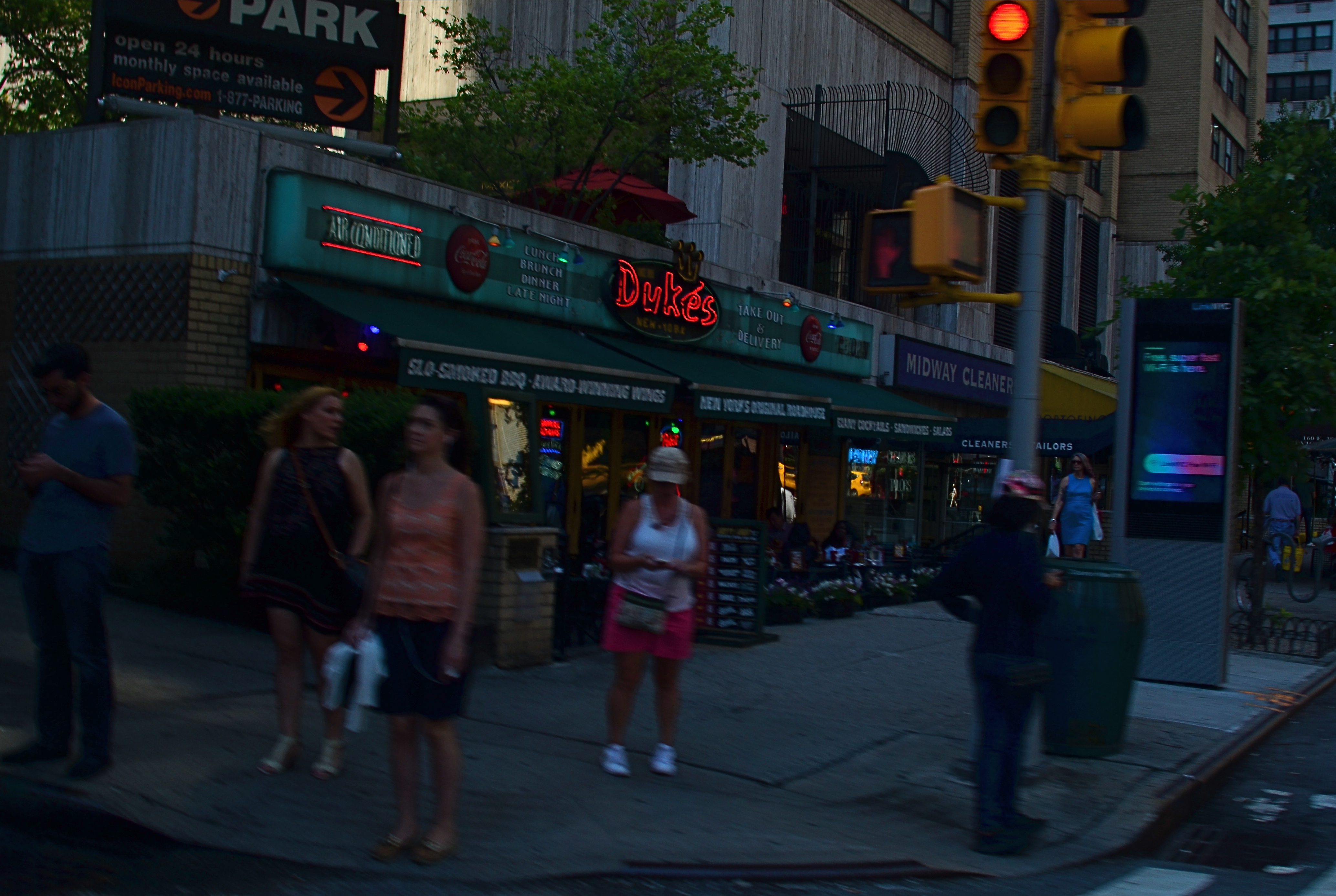
Down At Duke’s, 2018
Light, focus, aperture, even composition are tools, not ends unto themselves, and even the best photographers drop one or another of these techno-balls in some of their best work. But should we seriously disqualify an image merely on technical points? If the answer is yes, then half of the works that we collectively value as great must be stricken from the public record, and photography is merely a recording process, like the operation of a seismograph or any other instrument where precision trumps every other consideration. But if the answer is no, then a picture that fails one or more technical tests can stil be considered valid, so long as it is emotionally true.
I struggle with these choices whenever I produce a shot that has things “wrong” with it, but which is also an authentic register of where my mind was at the time it was snapped. Photos like the one seen here would fail many a judge’s test, depending on who’s doing the judging. It’s too dark. The shutter speed is way too slow, inviting blur. Some of the shadows swallow detail that might just be important. And yet I love this building, these people, this moment. In my defense, I had to decide in an instant whether to even attempt the picture, taken, as it was, from the back seat of an Uber lurching unevenly through the streets of Manhattan. Shooting on full manual, I had to anticipate fast changes in available light, the length of traffic signals, the process of shooting through glass with a filtered lens, and the occasional offensive/defensive maneuvers of the driver. In raw scoring, I just didn’t manage to master all of these variables in a technically perfect manner. And yet..
There has been a lot of talk lately about not letting the Perfect be the enemy of the Good, a phrase which says more about photography in ten words than I’ve said in this entire page. Rule one for shooters: don’t let the flawless be master over the real.
DRINK / SHOOT YOUR FILL
By MICHAEL PERKINS
SHOOTING FROM A PROPRIETARY VIEWPOINT is the photographer’s equivalent of being invited to a wedding with an open bar. You try everything. Turns out you don’t really like Singapore Slings? Leave it on a tray and go back for the Jack and Coke.
It really is that simple. If you find yourself with a one-of-a-kind view, assume you’ll never be invited back and hit the subject with everything you’ve got. Change lenses. Up-end your normal method of working. Do something screwy. But do try it all. Hey, you’re on top of Mt. Fuji, right? So it’s not like you’re passing this way again next month. Go for broke.
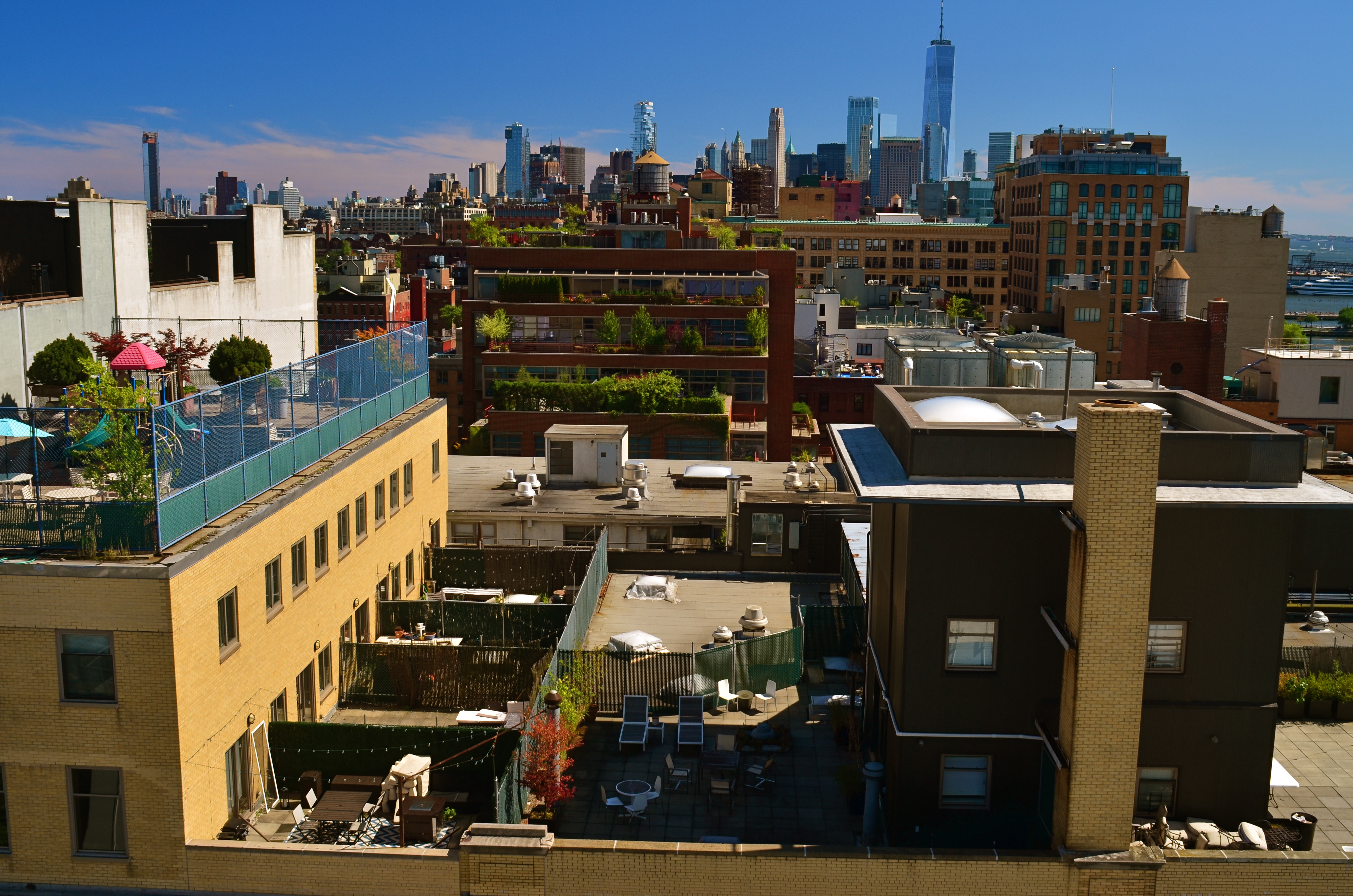
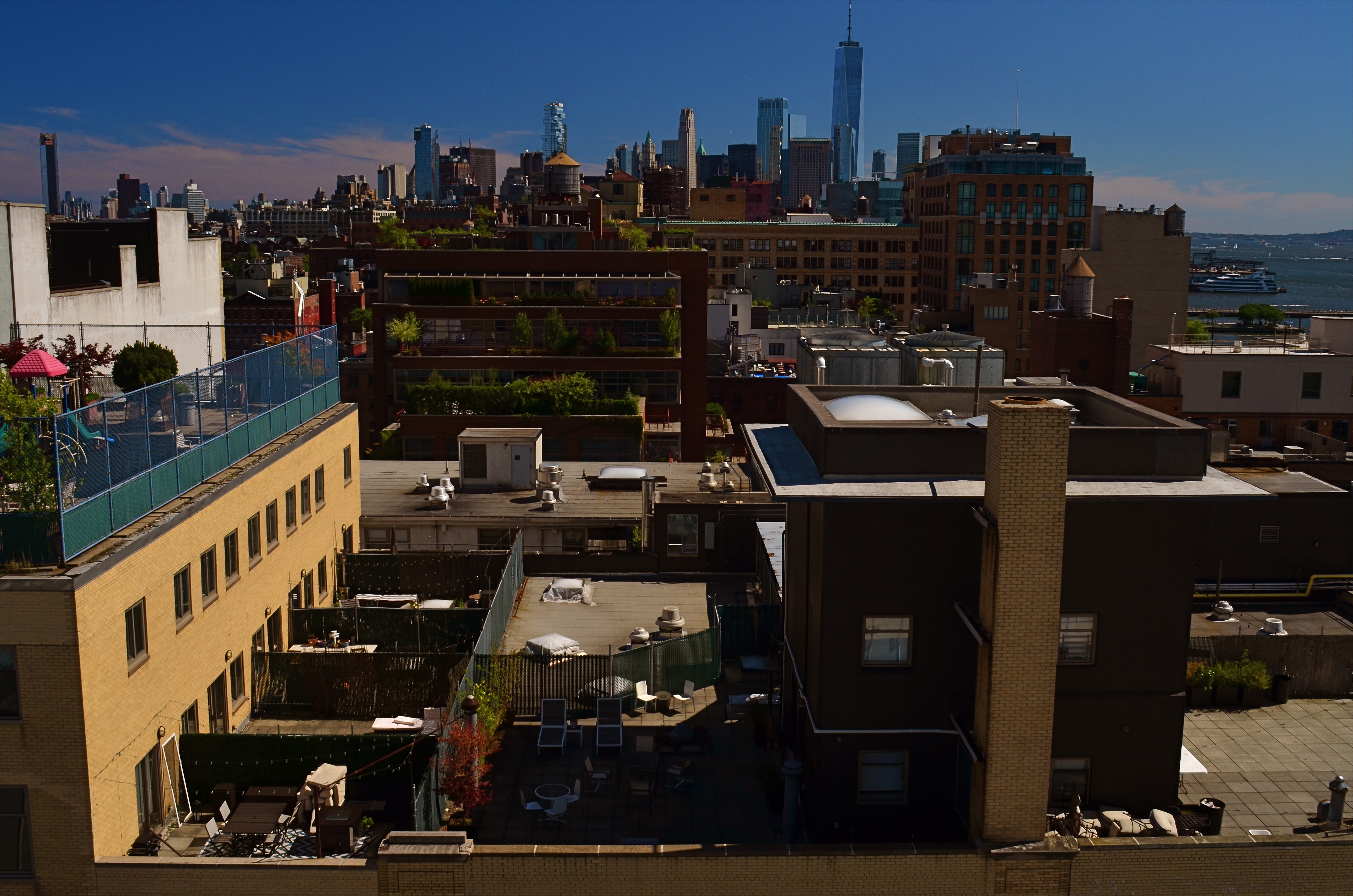
The Manhattan rooftop from which these samples were shot was a gift, and I knew it. I popped off dozens of frames in every direction with every combination of gear and settingscI could think of, simply because the vantage point would likely never be available to me in the future. Not anytime soon, anyway. One thing that’s always in the back of my mind when shooting in New York is the wonderful look of classic images shot in Kodachrome, the greatest but most temperamental film in history, now gone to that Big Darkroom In The Sky. Kodachrome had amazingly warm color saturation, but, all science-y talk aside, its “look” was probably due in large part to the fact that it was slooooww, just the equivalent of 100 ISO at its speediest. That means that, simply, many of us were underexposing it. By a lot. Anyway, I’m always out to craft my own Kodachromesque Manhattan, and I saw a chance to do so in this particular situation.
The two shots seen here were taken mere seconds apart from each other, both shot with a 24mm prime sporting a circular polarizing filter. The lighter one is f/8 at 1/60 sec., while the darker, more “day is done” image is deliberately underexposed at f/16, 1/160 sec. The combination of the smaller aperture and the filter doubles the intensity of all colors, but sacrifices someinformation in the shadier areas. I leave it to you as to what’s been gained and what’s been lost. The point is that I shot about eight other versions of this scene, erring on the side of too many choices in everything I aimed at that afternoon. Photography is not only apprehending where you are, but understanding just how briefly you’ll be there.
But, hey, it’s possible I’ll get a repeat invitation to this particular roof. Then again, I spilled my Jack and Coke all over the hostess on my way out, so you never can tell.
OSCAR’S CRADLE
By MICHAEL PERKINS
HOLLYWOOD IS ONE OF THE SELECT LOCALITIES in the world’s largest democracy where royalty is not only tolerated but slavishly sought after. The crown (or crowns, plural) transfer from the recently fallen to the newly anointed with predictable regularity, but the ritual is always the same: we love the common people (they’re just like us!) until they are lucky enough to escape our ranks, after which we, in turn, adore them, despise them (who do they think they are?), forgive them, and adore them anew.
In terms of photography, the camera seeks out ever new lovers, nearly all of them human, and therefore fleeting. A careful study of Tinseltown, however reveals that the true royalty, the royalty that endures, is the real estate. And even in a town where “reality” is defined by whether you shoot on location or on the back lot, Hollywood harbors plenty of actual places where actual events actually occurred. Some are on the bus tours (Marilyn Monroe slept here), while others require a bit more digging. One of the industry’s most prestigious addresses is smack dab in a section so spectacularly tacky that, by virtue of merely being merely ostentatious, it seems positively muted.
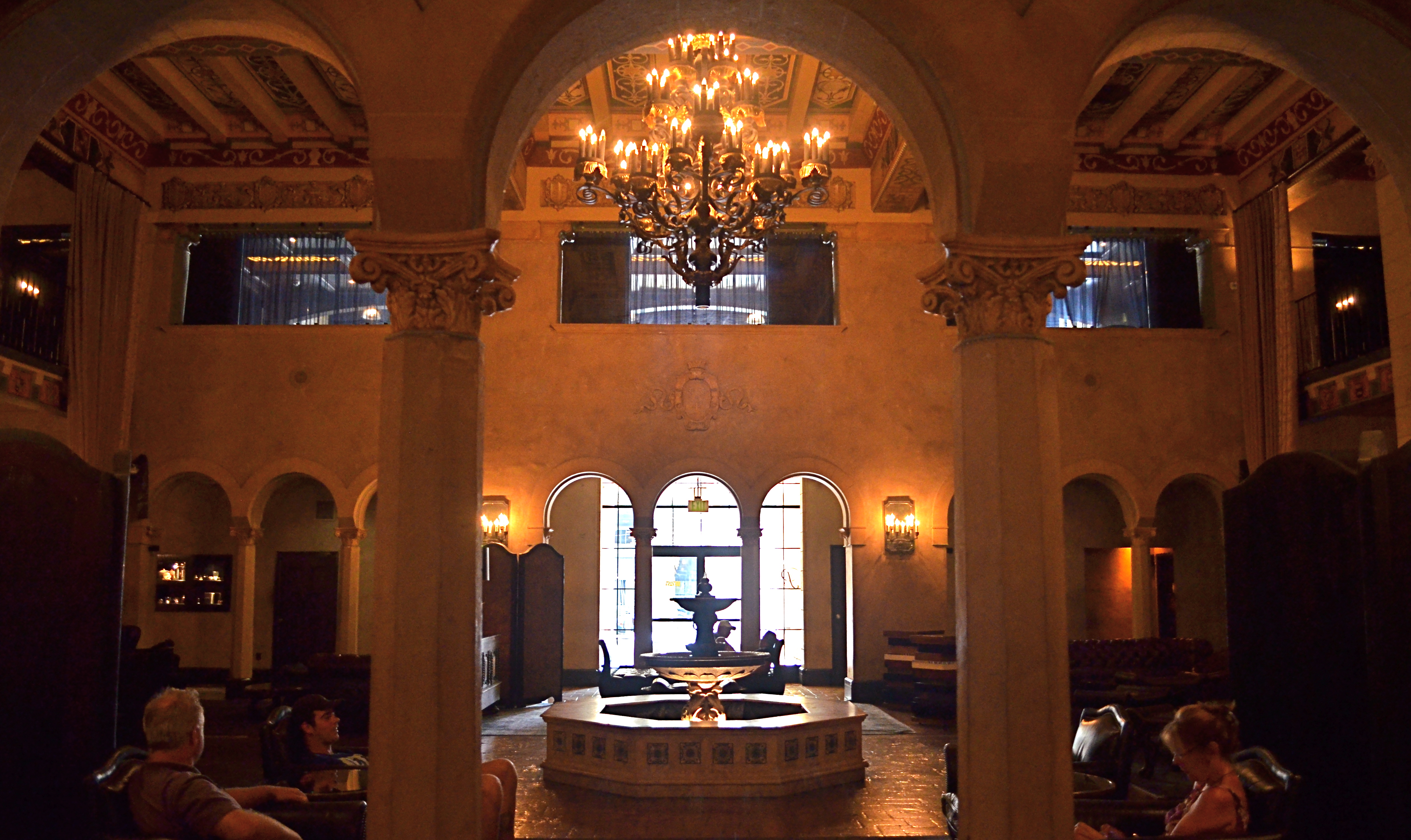
The Hollywood Roosevelt Hotel (named in memory of Teddy, not Franklin) survives in legend not because it served as a studio or corporate cradle for the film industry, but because it was the first time the town turned out to honor….itself. Then make an annual habit of it. Hey, if you want modesty, live in Des Moine, okay?
The Roosevelt earned its filmic pedigree from the get-go, financed in 1926 by a group that included MGM chief Louis B.Mayer and screen idols Mary Pickford and Douglas Fairbanks (two-fourths of the founding quartet behind United Artists Pictures, along with Charlie Chaplin and director D.W. Griffith). Two years later, the hotel hosted a modest little dinner for 270 guests to fete honorees of the newly organized Academy of Motion Picture Arts & Sciences, some three months after the actual awards had been handed out, and minus the nickname “Oscars”, which would come about four years later.
Over the decades the Roosevelt and its across-the-street neighbor the Chinese Theatre (which opened within months of the “R”‘s premiere) saw a fairly staid business district transformed into “Hollywood & Highland” (trade mark)…. Sucker Bait Central, a day-glo drag whose countless souvenir stops, IMAX pleasure palaces, low-rent novelties and neon knock-offs raised tackiness to the status of a religious movement. Meanwhile, the hotel’s crazy-quilt architectural style (‘Spanish Colonial Revival’…and, yes, there will be a test later), with its coffered ceilings, mid-century pool cabanas and wrought-iron chandeliers, was just fake-elegant enough to pass for average in a town renowned for its, er, flexible relationship with “class”. Rolling through the years with an occasional ownership transfer and the odd walk-on in movies like Beverly Hills Cop II and Catch Me If You Can, the Roosevelt has recently offered lodging as a contest prize on ABC’s Jimmy Kimmel Live!, and landed landmark status as Los Angeles Historic-Cultural Monument #545.
The Roosevelt’s photographic riches lie chiefly in its extremely dark main and elevator lobbies, its still-regal pool area and the legendary Cinegrill Lounge. The lobbies, at least for handheld shots, require high ISOs, slow shutter speeds and wide apertures. Flash may not be verboten but you won’t like the result, trust me. Indeed, the soft gold afforded by natural light washing into the murk from outside brings out the warmth of the Spanish textures, and adds a little tonal nostalgia to the scene. All things together, the Roosevelt stands as a monument to real occurrences, some of them fairly historically significant, in The Town That Invented Phony. And that’s the main challenge in Hollywood: if you can fake sincerity, the rest is easy.
WRITING THE FINAL CHAPTERS
By MICHAEL PERKINS
SAXOPHONIST PAUL DESMOND, asked the “how’s it going?” question during his many years with the Dave Brubeck Quartet, frequently answered, “we’re making music like it’s going out of style….which, of course, it is.” A glib answer, certainly, but no less accurate for being so. Everything, everywhere, is, indeed, always going out of style. Photographers feel the rhythm of a clock that is synched to all of existence. We raise constantly against that unheard tick, extracting and freezing moments to testify that, yes, the world was this way.
But the clock is now ticking off not only the passing of things within the world, but, plausibly, the very world itself. The planet is straining at its physical limits, veering toward the voiding of The Big Warranty. And while can all rattle our gums about where all this change will eventually lead, photographers have an obligation to record where it has already made itself known. In shrinking ice shelves. Rising seas. Searing summers. Vanishing species. Storms without mercy and without end.
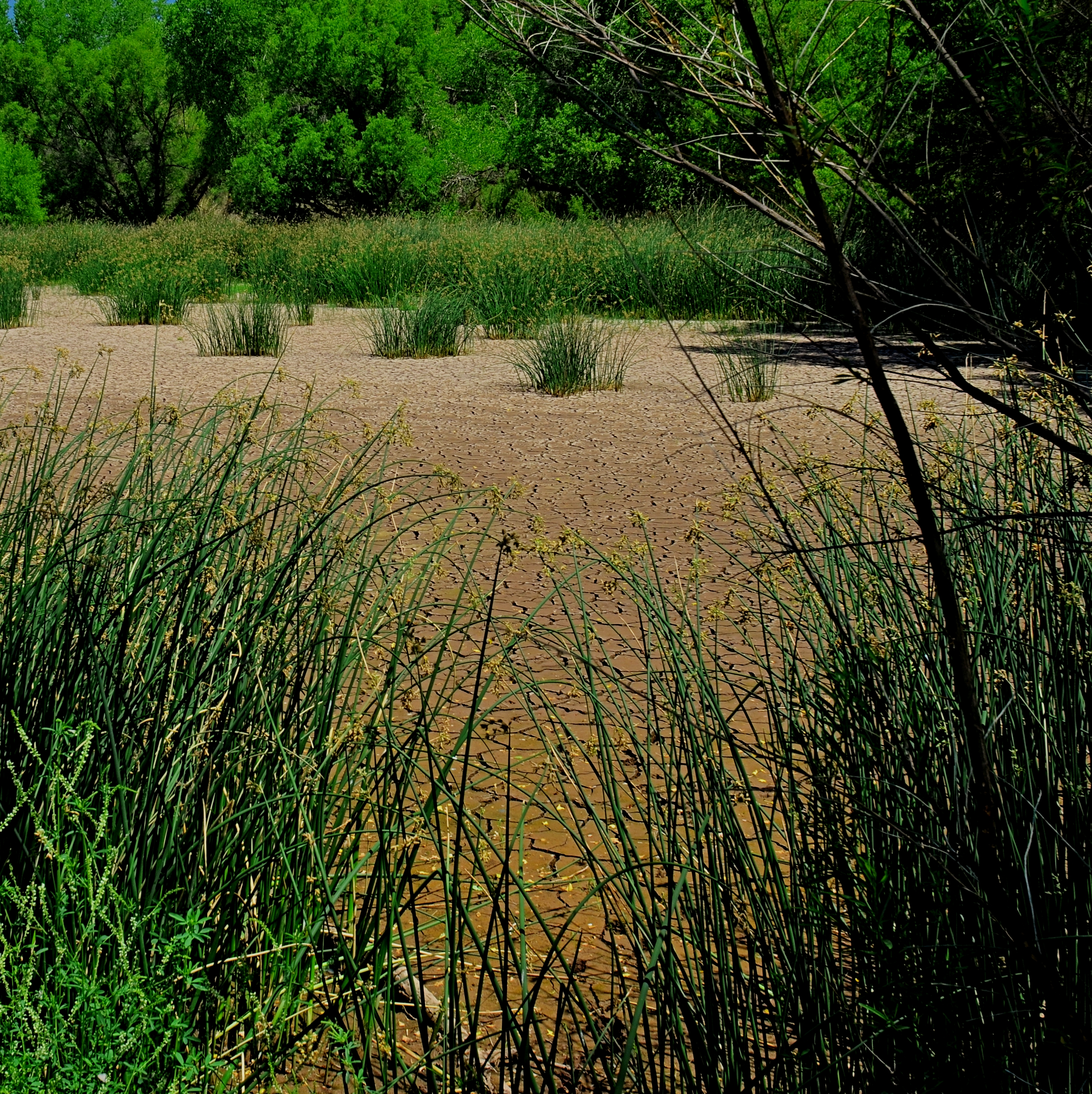
From my viewpoint, in the American southwest, the seasons pass into years and the years pass into decades with record-setting drought as the only constant. Reservoirs become ditches. Temperatures start to resemble good IQ scores. And in the above image, shot about an hour south of Tucson, Arizona, the bed of the San Pedro River is a cracked plain, a parched memory, a ghost.
In marking these monumental shifts, photography is both eloquent and neutral. The camera doesn’t care how we got to this place, nor does it assign a name to the blame. That kind of storytelling falls to wiser minds. But in a visual medium like ours, a tale can be told just by declaring “this is.This happened.” Politics and science can arm-wrestle about the details and the destiny. Pictures go beyond that noise. They are eloquent beyond words.
One thing is certain. Whether we are reporting the latest chapters of the human story or the final ones, photography is testimony. And we are all witnesses.
THE HYBRID APPROACH
By MICHAEL PERKINS
THE RECENT LOW–FI MOVEMENT IN PHOTOGRAPHY, immediately following the rise of digital imaging, was something of a reflexive spasm, a retro-reaction against the feared extinction of film (still not arrived as of this writing). Its chief weapon was the plastic toy camera, its principal quest a stubborn return to unpredictability, a celebration of the flaws, defects and deficiencies of film photography, made novel, even holy, once the bad old pixels threatened to end them for all time. Such is human nature: if you want people to brush after every meal, threaten to outlaw toothbrushes.
But not every primitive is a genius, and not every hipster wielding a $35 Diana with light-leaks, color streaking, vignetting and fixed-focus was serving up masterworks under the low-fi credo “don’t think, shoot”. Turns out that a lot of lousy cameras produced…..a lot of lousy pictures. Funny thing: shooting with bad gear is no more a guarantee of “authenticity” than a Leica is of artistry. But that doesn’t mean low-fi is a complete write-off.
What kept me from pledging myself to the plastic was the guaranteed cost of financing film, whether the pictures were great or horrid. Whether you produced dynamite or duds, you paid for each image twice, once for the consumption of the stock itself and once more for the extra time needed to plan and process shots. It was, for me, a constant reminder of all the compromises forced upon photographers by that medium. I occasionally loved the look but despised the labor.
Enter the hybrid solution, introduced a few years back: a lens typically made for a Holga toy camera but minus the Holga body, adaptable to both Nikon and Canon DSLRs…..a cheapo lens (typically under $25), loaded with divinely low-fi features, including vignetting, fixed aperture (f/8) frozen focal length (60mm), stiff-as-a-board “zone” focusing (turn to the “mountain” symbol to shoot a landscape!) and a rear lens cap you can easily pry off with a Philips screwdriver and a modicum of swearing. We’re talking precision here.
The results? Every bit as great as you’d expect for 25 bills, mitigated slightly by your DSLR’s ability, running 100% on manual, to turn at least some straw into gold, as witness the above picture. Even at that, you’ll generate a lot of shots that you’ll try to convince yourself are “edgy”. You just won’t be laying out cash for the true nightmares. Turns out you can put a price on hipness. Or at least keep it from bankrupting you.
 thenormaleye
DOUBLE REVERSE CHAOS
By MICHAEL PERKINS
SOME THINGS CANNOT BE MADE VISUALLY COHERENT merely by pointing a camera at them. That is, all subjects won’t give up their secrets to the mere act of photographic recording. And that’s when mere documentation must give way to interpretation.
A case study……
There is probably no denser concentration of immersive marketing on earth than in the yawning canyons of New York City’s Times Square, a cacophonous minefield of flashing, spinning, exploding LED overload. Messages aren’t simply or singly sent or received here: rather, they elbow past each other by the hundreds, desperately contending for the viewer’s attention in microbursts of insane color and absurd scale, in what actually amounts to the dead opposite of communication. Billboards, marquees and crass chunks of street theatre, from ersatz Miss Liberties to pose-with-me Batmen, all scream and stream at once, sending the senses careening from sensation to sensation like pinballs on ampthetamines. The irony: nobody wins the race: messages all eventually fail to register, cascading in a blur like a flipped deck of cards.
Street Rebus (2018)
This is why, for a Times Square-type subject , “straight” photography is doomed to disappoint. It’s just not enough to convey the feeling of fragmentation created by the site’s sensory bombardment. Merely freezing the action with one’s camera is an attempt to “make sense” of a reality that is, by definition, non-sensical. We don’t need to slow things down so they’re recognizable…..quite the opposite. We need instead to capture and comment on the confusion in a visual language we ourselves improvise.
In my own case, I try to further amp up the broken, shattered quality of the information that meets the eye by breaking pieces of data into even smaller pieces….a kind of double-reverse chaos. In the image seen here, I’ve turned away from a bright cluster of signs on one side of the street to shoot their reflections in a split-panel office window, forcing all the messaging from the signs into splintered abstractions, some of which come from shadows within the office itself.
This is, of course, just an example and not in any way a universal template. The precise method for creating a distortion of an already distorted reality isn’t paramount, but what I don’t want is a literal representation of these streets. Reality is in short supply in the Times Squares and Tokyos of the world. Photographers intent on commenting on that condition have to stay one step ahead, to find the double reverse chaos lurking within.
Share this:
July 15, 2018 | Categories: Americana, Composition, Conception, New York | Tags: Abstraction, Commentary, Surrealism | Leave a comment