STUBBORNS
By MICHAEL PERKINS
THE BEST OF YOUR PHOTOGRAPHS HAVE A KIND OF INEVITABILITY TO THEM, as if they were always destined to be made. Once they are finally captured, they also seem always to have existed, somehow. This is due, in part, to the fact that many of them had to fight hard to be born. That is, something about their conception or execution kept getting stuck in the pipe, try after try, until a tremendous amount of patience and work made them seem almost accidental or effortless.
I call these shots stubborns because I can almost feel them refusing to be taken, haunting me for months or even years until I can get a final take that does what I see in my head. The stubborns list contains a few that actually were tamed and brought to heel, but it’s mostly an agonizing roster of images that I have yet to nail down. Maybe the idea’s not fully formed. Maybe there’s something geographically blocking me, like a location I can’t readily get back to for a re-take. Sometimes I just haven’t brought the idea to its final, best form, unable to generate anything but near misses.
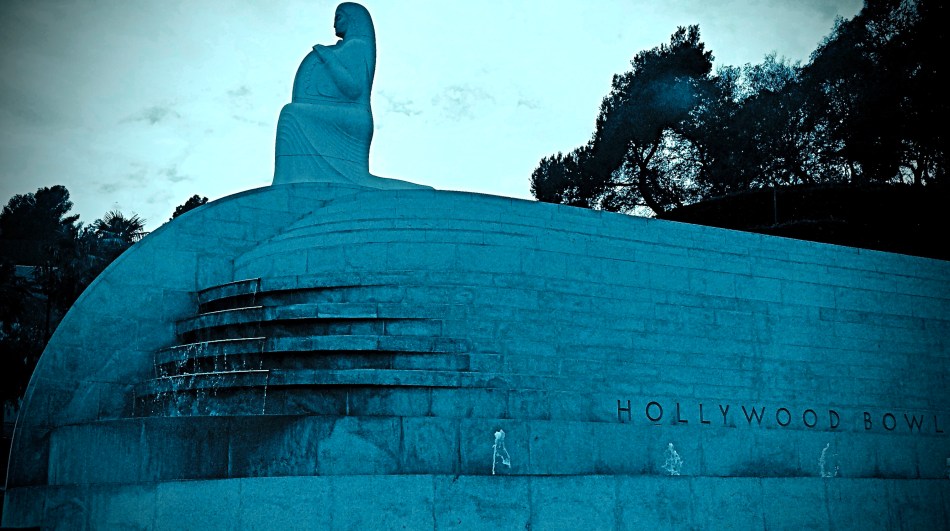
Ever since I first saw this wondrous entrance to the Hollywood Bowl, George Stanley’s Muses of Music, Dance, & Drama, I have dreamed of making “the” image of it. The enormous slab of concrete, which is faced by over two-hundred and forty-five tons of granite, depicts one sitting figure and two smaller standing figures (not visible in this shot) at its left and right flank. It is the biggest WPA-New Deal-era sculpture project in all of California, completed in 1940. Beyond the sheer beauty and enormity of the thing is that fact that, to do a proper job of interpreting it, you’d have to have time to roam around the site and shoot dozens of variously wrong versions over a number of hours, then decide whether it’s more stunning by daylight or lit on concert nights.
As fate and circumstance would have it, my access to it over the space of seven years and at least fifteen visits to the Los Angeles area has been limited to this passenger-seat drive-by (okay, we were paused at a light for ten whole seconds) from 2015, shot through a smudgy window on an iPhone 5S. Ideal conditions this ain’t, and as of 2022 I am still unsure when I will manage to get onto the Bowl property to do the ladies justice. Stubborn, indeed.
My point is that the best photographs are generated in stages, or drafts, if you like. True, some masterpieces come into the world on the first click, but even those lucky winners might be improved if time and care drill down to a second, more foundational truth.
EDGE OF NIGHT/CUSP OF DAY
By MICHAEL PERKINS
OF THE VARIOUS DEFINITIONS OF THE WORD “TWILIGHT” found in most references, one is generally factual in a kind of scientific sense, i.e.,
the soft glowing light from the sky when the sun is below the horizon, caused by the refraction and scattering of the sun’s rays from the atmosphere.
….which is nice if you’re a meteorologist, I guess. But a second interpretation of the word is more poetic, and, for my money, a little more on the philosophic side, as in
a period or state of obscurity, ambiguity, or gradual decline.
…or, to break it down more personally, I am sad to behold the first kind of twilight because I tend to typify the second type.
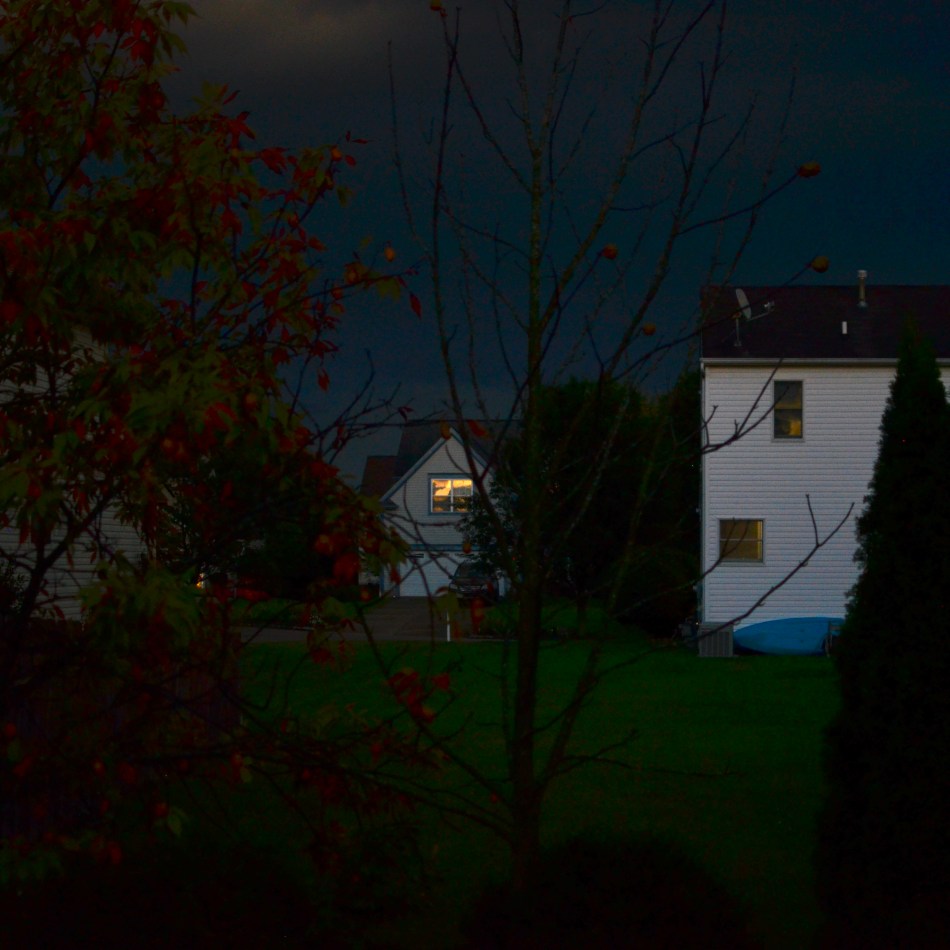
Photographically, I am always drawn to the strange inter-stages of life, in which things exist in more than one plane of existence at once.
For example, in the frame shown here, which I took just as a normal summer dusk was about to be swallowed up in a sudden surge of storm clouds, things are rather stuck in neutral. There is some bright light to be had, but it’s suggested more than stated. In like “midphase” fashion, the thunderheads that rolling in are not absolute black, just an overripe version of daylight colors. Everything is coming, and going, about to happen, and absolutely over with, all in the same moment. As this all came together, I wasn’t sure I could snag any usable image at all, but in instances like these, with everything mutating every second, you have to try, if for no other reason than to immortalize the weird convergence of forces.
Or, to use this collision of edge of night/cusp of day to refer back to the contrasting definitions of twilight we started with: I saw something ending in the day, and likewise felt something ebbing away in myself, and that’s why I took the picture.
GENUINE FAKE REVEAL
By MICHAEL PERKINS
THUMBING THROUGH THE PORTFOLIOS OF THE CLASSIC HOLLYWOOD PORTRAITISTS, we marvel at the combination of art and science that created not just images of the famous but delicate, artificial constructs, visual myths of lower-case gods and goddesses that held far more allure than mere snapshots. We look at these pictures now and see them for the sly marketing they were, as we were taught to value the idea of a face more than the face itself.
Today, the average photographer has tools at his command that rival those of the old masters of airbrush and studio lighting, allowing us to mold our own smiles as deftly as George Hurrell sculpted the cheekbones of Joan Crawford or placed a twinkle in a corner of Myrna Loy’s eyes. The enormous surge in self-portraiture in the digital age has grown up side-by-side with these instant-fix tools, to the point that we are seldom presenting ourselves to the world “in the raw”, but, instead are troweling layers of post-shuttersnap glop onto ourselves in a desperate attempt to, if you will, create a legend. The legend of us as we’d like to be.

Getting the children of the iPhone age to agree to having their picture made without their direct participation in the endless preening and retouching process that comes after is a major effort. We all trust our own “vision” of what we look like and reject the original idea of portraiture, which is for the artists to make an outside observation and share out that interpretation with others. The photographer is not supposed to be a mere assistant to our own vanities, however well-justified, but an objective second opinion. He or she may produce something with which we disagree, but the beauty of art is that, as a personal statement, it can’t be invalidated as being false merely because we don’t see things the same way: art merely is.
It’s understandably impossible to create a completely honest self-portrait. We simply can’t bear the unvarnished, brutal truth of it. But that doesn’t mean someone else’s vision of our face is inaccurate or wrong in some way. Like the Hollywood giants of old, we naturally would like some publicity department to shape us until we’re perfect . But maybe, in being honest, we become more so than we ever dreamed.
A HARVEST OF WONDERS
By MICHAEL PERKINS
ONE THING THAT MANY OF MY FAVORITE PICTURES HOLD IN COMMON is that they somewhat sneak up on me, beginning as the most instantaneous blips of whim and ending up as the kinds of images that make me grateful for the day I first picked up a camera. Many of these pictures barge into my brain while I think I am looking for something almost totally unrelated. They demand my attention: they insist on my participation.
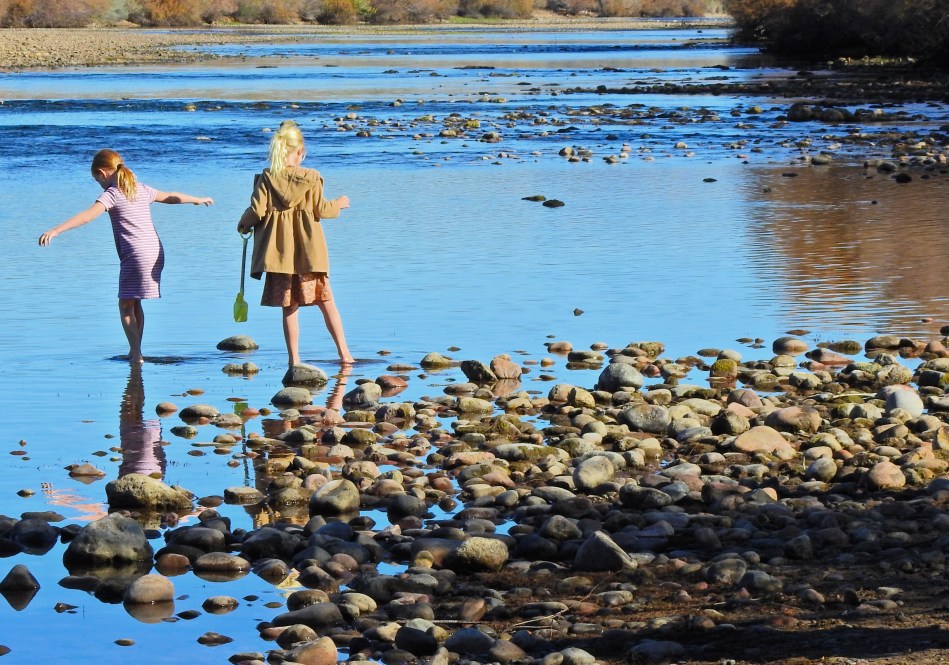
That’s what we’ve got here. The young girls you see, happily sharing the thrill of tripping barefoot in the shallows of a river, appeared, seemingly out of nowhere, during my “official” picture-taking, a birdwatching hike that’s become a regular event between Marian and me and several close friends. The day’s snaps predictably consist of a few lucky sightings and a lot of landscape shots, with a smattering of candids of the crew. During one such group shot, framed down near the edge of the Snake River (a major player in Arizona’s Tonto National Forest), I heard girlish giggles over my shoulder, and, seconds later, a flash of blurred color as several friends began to wade in, surprised that, even in January, the water wasn’t yet too cold for the thrill of discovery.
There was simply nothing else that made any sense at this point other than to spend the next few minutes trying to capture the essence of their fun, about a dozen frames of them running, exploring, and, mostly, laughing, all shot on some kind of mental autopilot. In eavesdropping on their fun, I was reminded of the quote from the author Walter Streightiff, who wrote, “There are no ‘seven wonders of the world’ in the eyes of children. There are seven million..” A child’s eye takes in a cascade of newness that allows it to process every experience through a filter of amazement. It’s an openness that we all initially possess but forget we have as the years advance.
Teaching ourselves to see photographically pries us back open again, lets us re-enter that harvest of wonders with as much delight as was once our primary instinct to do. That’s when the Plan “A” of what we started out to shoot becomes wonderfully hijacked and Plan “B” kicks in. You were making one kind of picture, and now, gloriously, you’re making another.
And you are grateful.
WIDE OPEN SPACES
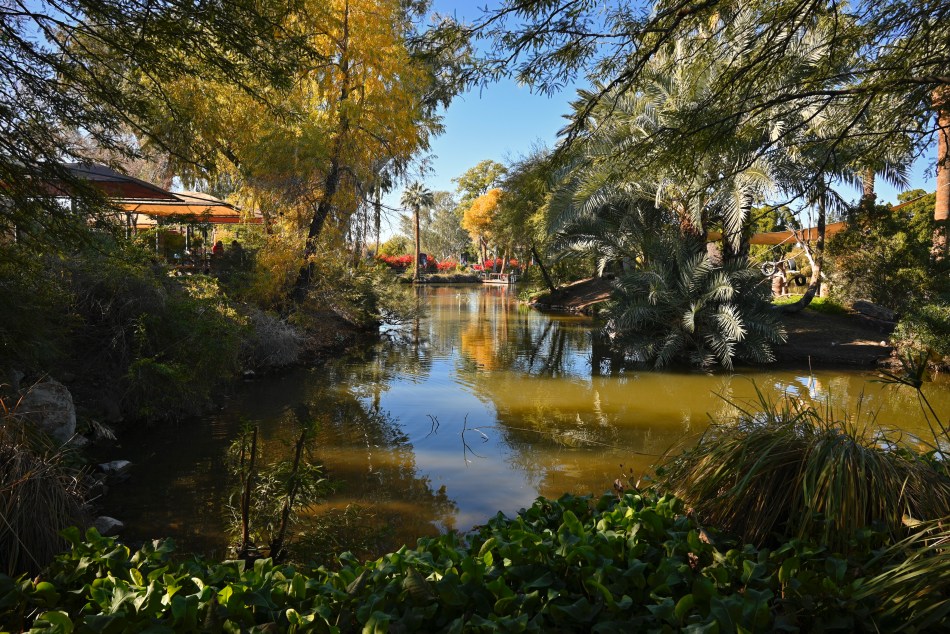
Fronted by a 70’s-era Nikon 24mm lens, a digital crop-sensor DSLR makes this frame look closer to 35mm.
By MICHAEL PERKINS
ANY TIME YOU MOVE FROM ONE PHOTOGRAPHIC PLATFORM TO ANOTHER, there are tradeoffs in either approach or technique. Things you used to do that you can’t do anymore. Others that were formerly impossible and are now achievable. And so forth. In my recent move from crop-sensor DSLRs to full-frame mirrorless cameras (a long and torturous journey, I assure you) there was one main objective that kept me eagerly engaged: a desire to unleash the full power of my existing wide-angle lenses.
Some of us have come of age completely in the digital era, and so there must be a significant number of people who have never used their wide-angles to their complete potential. Given that a lot of glass, especially old glass, was manufactured well before the introduction of smaller, or “cropped” sensors in digital SLRS and compacts, it’s possible that you, yourself, may have shot thousands of images with lenses that could not capture the dimensions that the same optics would capture on a full-frame camera. On my Nikon DSLRs, I came to understand that, for example, a 24mm lens shot at a 1.5x crop factor, meaning it was really shooting at around 35mm. A 35 shot closer to a full-frame 50, and so on. And for years, I merely adjusted my thinking as to what defined a wide shot.
Same scene with the exact same ancient lens, but mounted on a new full-frame mirrorless body, so that 24mm is really 24mm.
Now, with full-frame, I have to re-learn what do to with all that…. space. I am looking at compositions I used to shoot with built-in cropping (see the top shot, done with a 24mm lens on a cropped DSLR) and find that the same shot in full-frame (the second image seen here, also with a 24mm lens, but at its intended width) drags in a hellacious amount of extra clutter on the left and right sides. Some of it is welcome, in that I used to want to include that extra info in the smaller frame, but a lot of it is like too much extra birthday cake: thanks, but no thanks.
Tech reviewer Ken Rockwell (www.kenrockwell.com) is famous for saying that a wide lens is not just for getting more stuff corralled into the frame from left to right, but for putting yourself, and in turn your viewer, further inside the shot…..kind of the difference between placing your stereo speakers directly across from you, twenty feet apart, and grouping them around you in a sonic surround. It’ll take me a while to make the mental trip back in time to when a lens shot exactly as it was purported to shoot, but I think I’ll net a needed refresher in Composition 101.
OWNING YOUR ORPHANS
By MICHAEL PERKINS
ONE THING THAT HAS GOTTEN HARDER, RATHER THAN EASIER, in the making of photographs in the present day, is dodging the answer to the question, “what’s wrong with this picture?” Yes, this picture. The one right here. The one you took. At its inception, the art of capturing an image was heavily weighted with obstacles to merely getting things done from a mechanical point of view. Now, several centuries on, the technical guarantees (what some might call idiot-proofing) of the process has taken more and more of those traditional alibis for making lousy photos off the table. What remains on the table: we either did or did not make the picture happen. We. Us. Me.
Over a lifetime, I have seen a slew of excuses for lousy images dissolve like sugar, from I had the wrong speed film and the flash bulb didn’t go off to I left the lens cap on, many of them obviated by succeeding improvements in gear and the ability of manufacturers to anticipate both our needs and, let’s face it, our incompetence. By now, however, with cameras nearly possessing their own artificial judgement-making ability, the list of reasons why a photo bombed has been reduced to things like I brought the wrong camera, this isn’t the right light/hour/day to try for a picture, and the sun got in my eye. More and more, there is one stubbornly persistent cause I find behind most of my muffed shots:
I don’t know how to make the picture.
Think about it: how many of your photos that you currently feel came up short are due to technical failure, equipment malfuction, or not having enough options to get the job done? A failure to realize one’s vision was once something where, between you and your gear, there was plenty of blame to go around. Now, there is still blame, but all arrows lead back into our own faces.
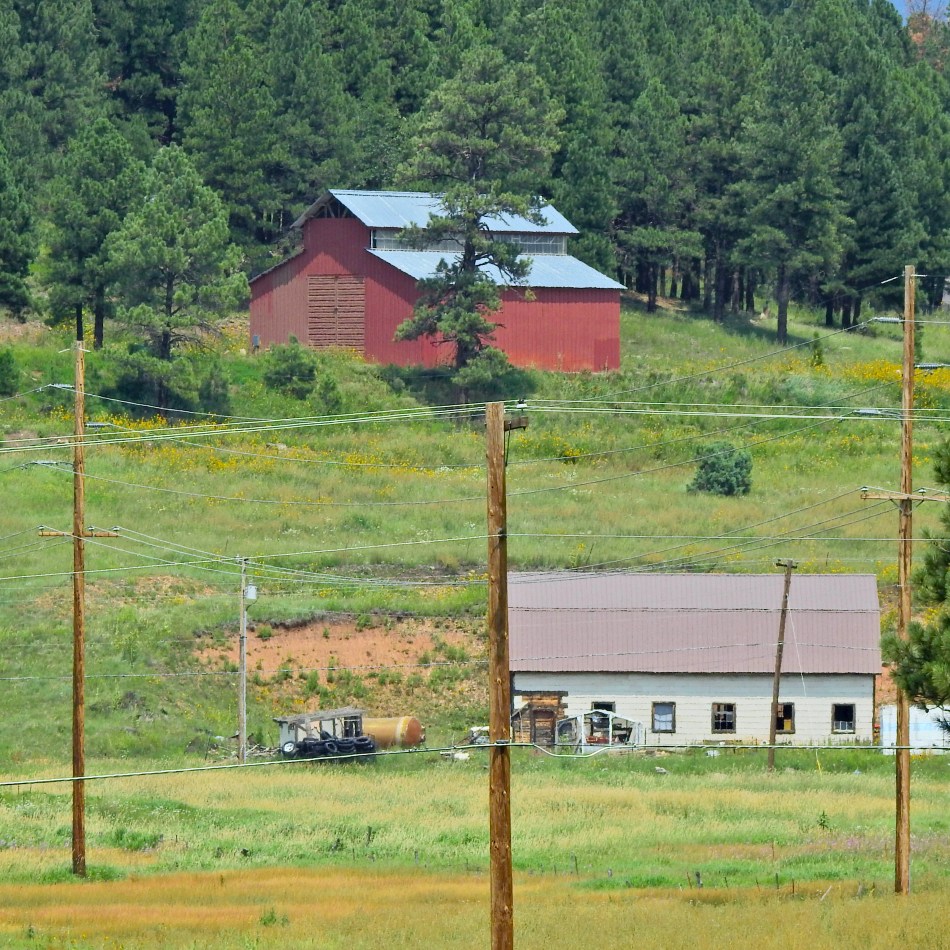
I don’t like this picture. And it really doesn’t matter that I can’t yet analyze just why it failed. The only thing that will allow me to eventually address its flaws is to admit that the fault lies with me. My vision. My poor choices. There is nothing technically wrong with this image. It was exposed properly by any general rule of thumb. And yet… it just lies there, like a lox. And the fault in such pix is even worse if the image was taken with fully manual settings, because I opted to make all the choices in the making of it, delegating nothing, certainly not responsibility, to the camera. And yet these are the only pictures that will ever teach me anything.
If my answer to a failed shot is, “jeez I don’t know what happened” (and assuming I’m not lying through my teeth), then that picture is worse than worthless, since I’ve consigned it to chance or lousy luck. In fact, my worst pictures are educational chiefly because the more I understand myself..my motives, my conceptions, and so forth…the more I can deliberately make something better. And this is certainly true for anyone. But first, you have to honestly, totally and lovingly own your orphans.
Liberty Liberated
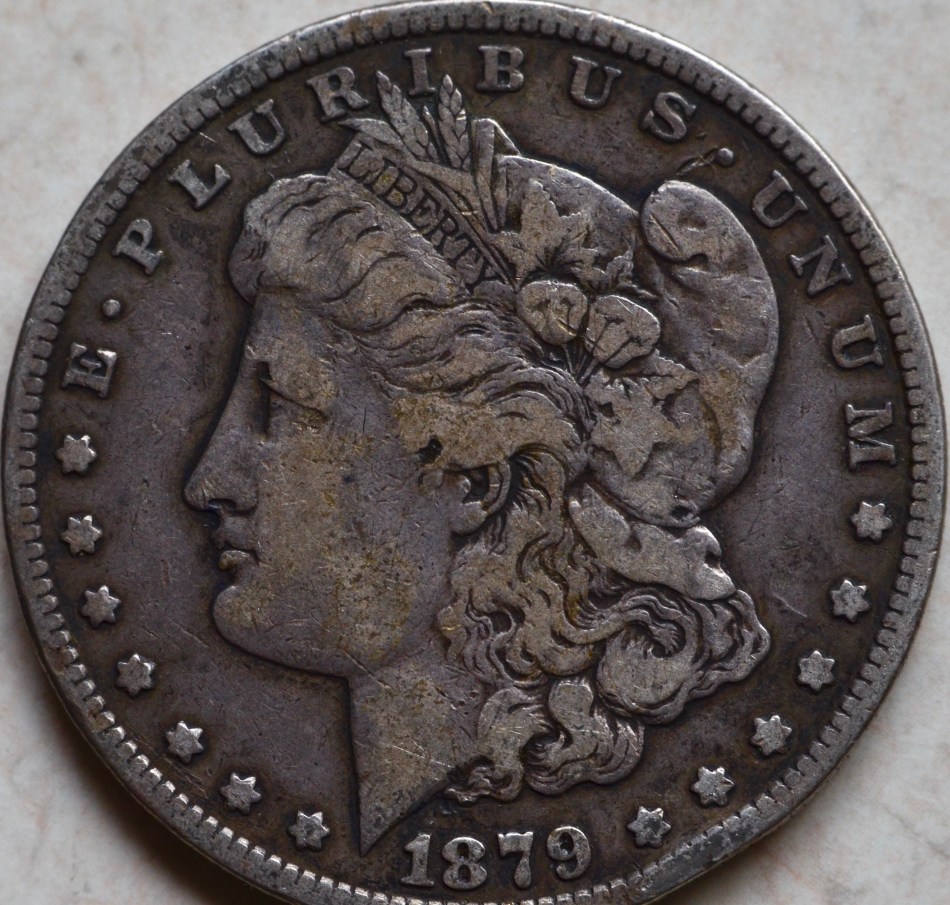
A rather cold, imperious rendition of “Liberty” as seen on this 1879 U.S. silver dollar.
By MICHAEL PERKINS
THE BEST WAY TO APPROACH A PHOTOGRAPHIC SUBJECT PURELY ON YOUR OWN TERMS is for the thing to be severed from its original context, torn free of any associations it once had with the world at large. Once these so-called “found objects” come into our hands, we can make pictures of them as only we see them, not as they were anchored to everyday use. They become, in this way, blank canvasses of sorts.
In recently looking over some old coins ranging from the 1880’s to the 1920’s, I became struck with how self-obliterating their history was. That is, they were all something so commonly used by the public as to be virtually invisible…and then became literally invisible as newer designs vanished them, yanking them from circulation to be replaced by versions more consistent with the fashions and priorities of new eras. One thing that seemed particularly fluid was the depiction of Liberty, each generation’s edition created to conform to our conceptions of the concept they personified.
On the 1887 silver dollar, seen at top, the lady is a rather classic goddess figure, austere, inscrutable, even muscular. She’s shown in a classic two-dimensional profile, very much in the tradition of Greek and Roman antiquity. She’s remote, above it all. In contrast, the rendition that replaced her on the 1921 “peace” design, seen below, is more contoured, and decidedly a woman of the troubled twentieth century. Her neck is slender. Her expression is expectant, even anxious, coming at the end of a decade of horrendous global slaughter. Her “peace” is more of an aspiration than a fact, her femininity borne of a personal, more mortal idea of hope. I wanted to make a picture that captured those qualities.
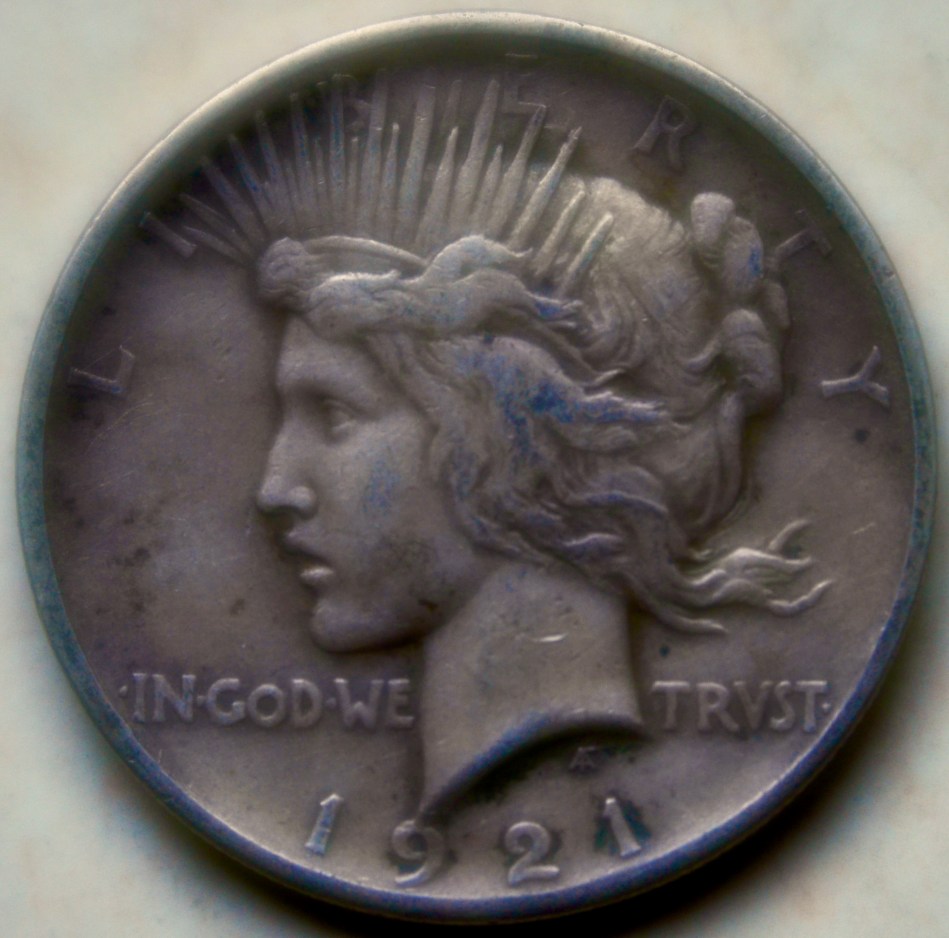
Liberty for a new age: the same ideal as envisioned on the U.S. “peace” dollar coin.
For “my” Liberty, then, the clinically stern crispness of a standard macro shot, i.e., hard evidence of the tough life of a widely circulated coin (scratches, dents, etc., in bold relief) had to, in photographs, gave way to an idealized, softened kind of aspect, or as close as I could come to a kind of dream state. I used a Lensbaby Velvet 56 lens, which is deliberately designed to create the spherical and chromatic aberrations that used to produce glowy, softer focus as an accidental artifact of older, more flawed lenses. In recent years, Canon, Pentax and Mamiya have also made glass that mimic that flaw, especially at wider apertures (this was shot at f/3).
Working to liberate “my Liberty” was creatively easier because the coin she graces has vanished from daily use, and, with it, all the associative ties to the world that it was created for. That allowed me to imagine her for myself, and every photograph I have ever truly cared about began under just such terms.
THROUGH A GLASS, DARKLY
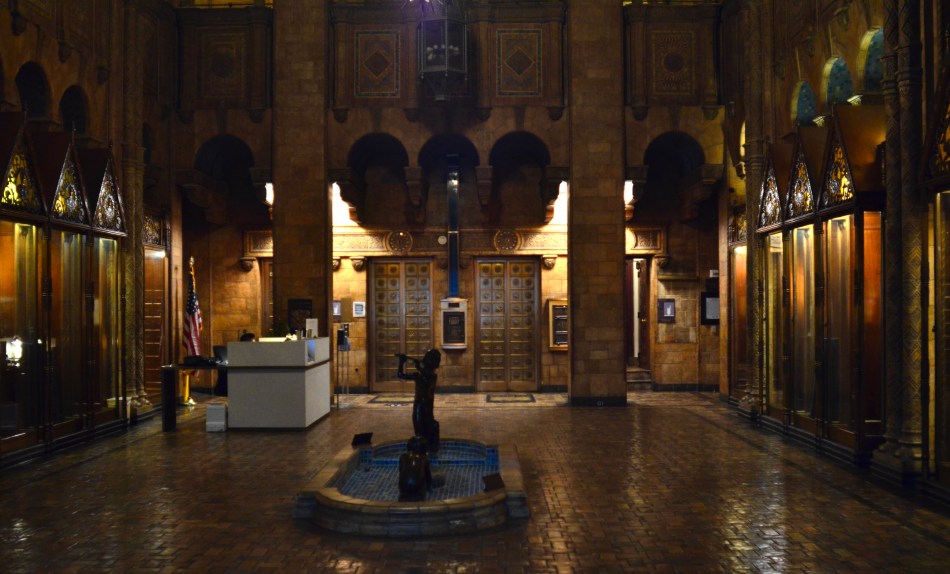
Handheld, manual through-the-front-window exposure of the interior of Los Angeles’ Fine Arts Building.
By MICHAEL PERKINS
SHOW ME A SOLID LOCKED DOOR and I’ll tell you what I’m imagining as to what lies beyond it.
Show me a locked door with a pane of glass in it, and I’ll tell you what my next photograph will be.
We’ve all been on our share of historic urban tours in which really great buildings are viewable only as exteriors. Many sites that used to be everyday places of business are now at least partially protected from the prying peepers of passersby (alliteration fans rejoice!), usually by barring access to their interiors. And it seems to also be true that the juiciest lobbies and entries are described by the tour guides with the phrase, “unfortunately, we can’t go inside..but you can peep through the glass..”
Well, peeping is great, as far as it goes, but, since I’m packing a camera anyway, I always decide to add to my ever-growing go-for-broke file of near misses and happy accidents and snap something, anything. The potential in the gamble is often a bigger thrill than the actual results, but, oh, well.
Here we see the interior of the venerable Fine Arts Building, which opened in downtown Los Angeles in 1927. The outside of the place is a grandiose beaux-arts birthday cake of excess, and the builders were no more restrained when it came to the lobby, some of which, being multi-storied, is cut off from view here. But what delights within immediate eye-shot! I was jammed flat up against the glass to fend off reflections and glare and set my trusty old Nikkor 24mm manual prime for ISO 800 at 1/50th of a second. Since I was some distance from the rear lobby wall, I could shoot wide open at f/2.8 and focus on infinity. Some lights were on, but luckily they were indirect, and so, were not rendered too glow-y or globb-y by the extreme aperture. The whole thing was a matter of some fifteen seconds, and luckily the tour group had only moved on a few yards by the time I was done.
I am a firm believer that you louse up 100% of the shots you don’t try, so I always have a whatthehell attitude toward any flops or flukes. Because a barrier can be the end of an experience, or just the gateway to the rest of it.
SILENT NIGHT
By MICHAEL PERKINS
IN THE CHRISTMASES OF MY CHILDHOOD, homes were less frequently garnished on their outsides, with most of the houses in my neighborhood sporting little more in the yard than a few slim strings of lights or the occasional lawn Santa. Our current emphasis on LED-coated exteriors and rolling light shows lay far in the future in the Eisenhower era, leaving the family tree to perform most of the heavy lifting as the visual emblem for the holidays. Our own system was simple: string the lights and lay on the ornaments in a fully lit room, with the tree positioned before the house’s biggest window: then, after everyone had scampered out onto the front yard, deputize Dad to douse the house lights and plug in the tree, launching its social debut to street view. That collective moment of “aww” was, for me, worth the entire holiday.
In photographing Christmas as a much older child, while I do admire all the pyrotechnics required to give every house the full Clark Griswold treatment, I tend to make pictures of trees as seen through front windows, framed by shadows, devoid of drama, as quiet as a silent movie, the one centerpiece delivering its visual message in a muted, almost personal tone. It’s the time of year when sentiment and habit are so closely intertwined as to be indistinguishable from each other, and thus there are so many things that we always do because we’ve always done them. One thing I seek in a picture is permanence, the impression that what’s right in that one image is in some way right for all time. That means that, at Christmas, I look for sights that could have sprung from any or all Christmases over the decades. It’s remarkably comforting in a world that has become so comfortable with tumult and noise to deliberately try to show stillness.
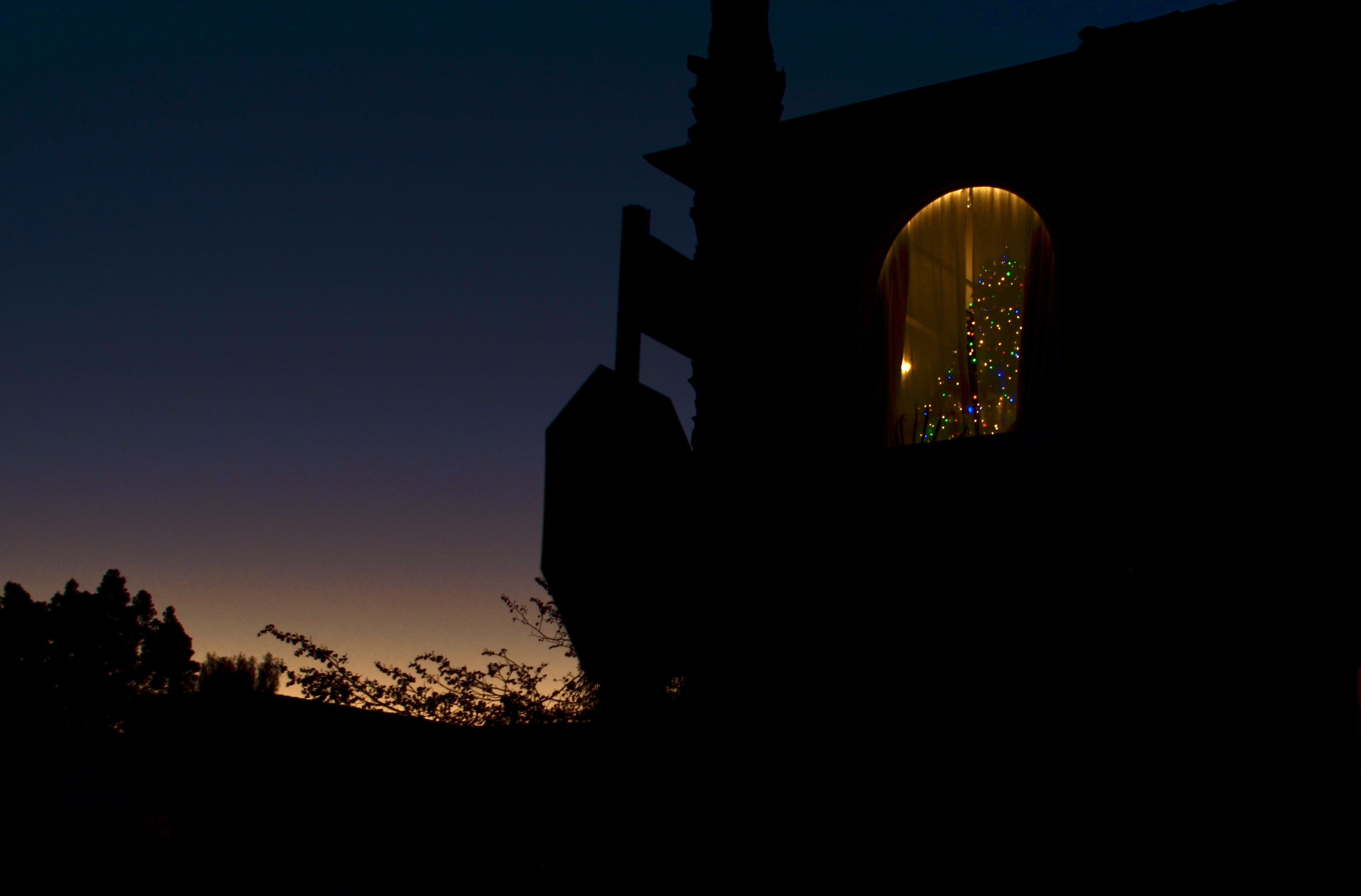
This particular window, in central Los Angeles, required a bit of patience. Between trying to nail the correct blend of twilight and dark in the surrounding sky and tracking the occupant’s nightly decision to either draw or open the drapes, I walked by the place for several consecutive nights before I saw what I was after. Upon clicking the shutter, I may or may not have completely reverted to boyhood and uttered an “Awww” aloud, but I certainly said it in my heart, as I tried to in this picture.
Be safe. Be well. Be here next year.
THE ENGINEERING OF DESIRE
By MICHAEL PERKINS
EACH HOLIDAY SEASON OF EVERY YEAR since The Normal Eye was launched over a decade ago, we have had some nostalgic fun recalling the glory days of the Eastman Kodak Company, the people who first took photography from a science nerd’s hobby to a global pastime, and the unique way that they influenced Christmastime gifting habits for over a century. Through an incredible, sustained campaign of persuasion that equated good times with the photographic chronicling of every major human event, Kodak cemented its relationship with its customers in a way that gave all other advertisers a key lesson in what one marketer would dub “the engineering of desire”.
Kodak was a film company that chiefly succeeded by appearing to be a camera company. In effect, the constant refinements in their cameras were a mere investment in the film side of the firm. Better, easier devices removed any resistance to taking more pictures, and thus purchasing more film. And, at Christmas, the company made the most of its relationship with its customers, using the occasion to create more users and make existing users consume at an ever-higher rate. There were several names for this ingenious marriage of form and function, and one of its most illustrious monickers was “Instamatic”.
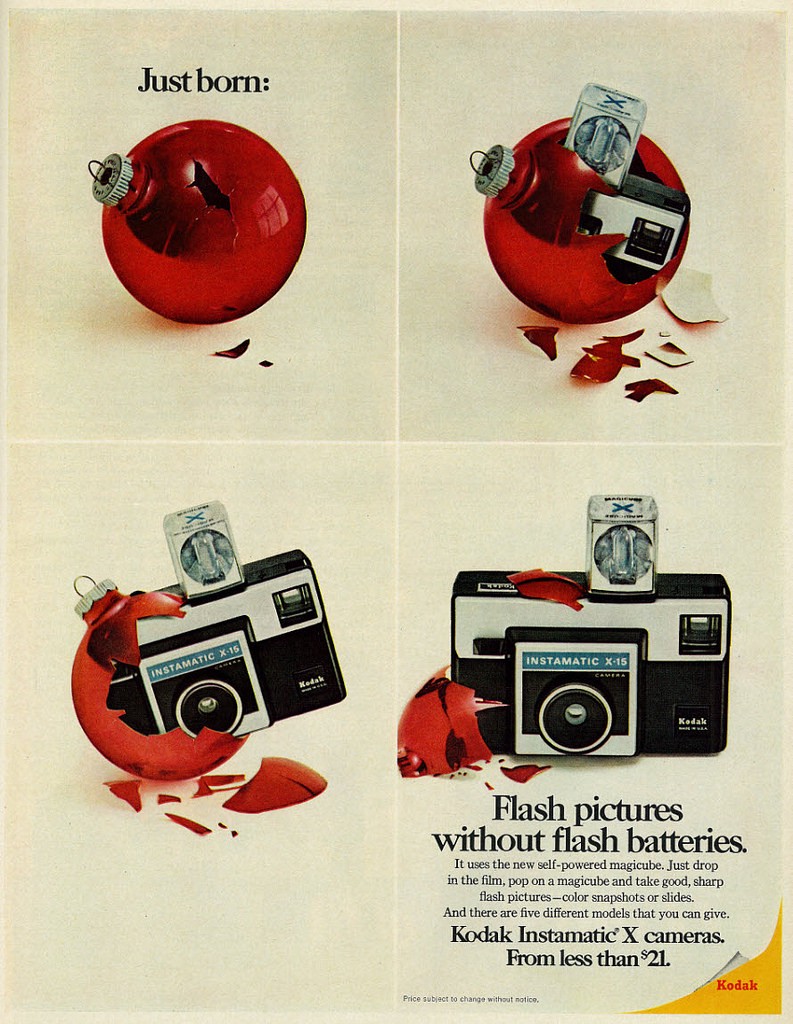
The introduction of the Instamatic camera line in the early 1960’s was as big a leap forward for Kodak as the debut of its first Everyman camera, the Brownie, had been in the 1890’s. Like the Brownie, the Instamatic was a major advance in ease of operation. Designers Dean Peterson and Alexander Gow’s new cartridge-loaded film(which was simply dropped intact into the camera body) eliminated users’ long-time aversion to threading, and potentially ruining, traditional roll film. Its slim design made it easier to stash and carry. Its eventual use of self-contained flash “cubes” got rid of the bulk and mess of extended add-on flash guns and red-hot bulbs. And its fixed-focus lens and single shutter speed made it the world’s first true point-and-shoot.
The only challenge that remained lay in selling the new design to the public, and when the Instamatic was introduced in 1963 at a price point of $16 dollars and made the star of its Christmas campaigns for the year, the deal was sealed, to the tune of over fifty million Instamatics sold in the camera’s first seven years of production. Positioned as a cute newborn chick “hatched” just in time for your “morning-of” memories (as seen in the above ad), the Instamatic made as major an impact on the amateur market as have the cellphone cameras of today, in that they took more uncertainty out of the process of making pictures by ensuring better and more consistent results. Which is still the way you sell a ton of cameras, as you allow more and more people to get on with getting their shot on. Or, to re-frame the old “fishing” adage: Take a man’s picture and he has one picture for one day. Teach him to make his own pictures, and you’ll keep selling him everything else associated with that process forever.
STUMBLING IN
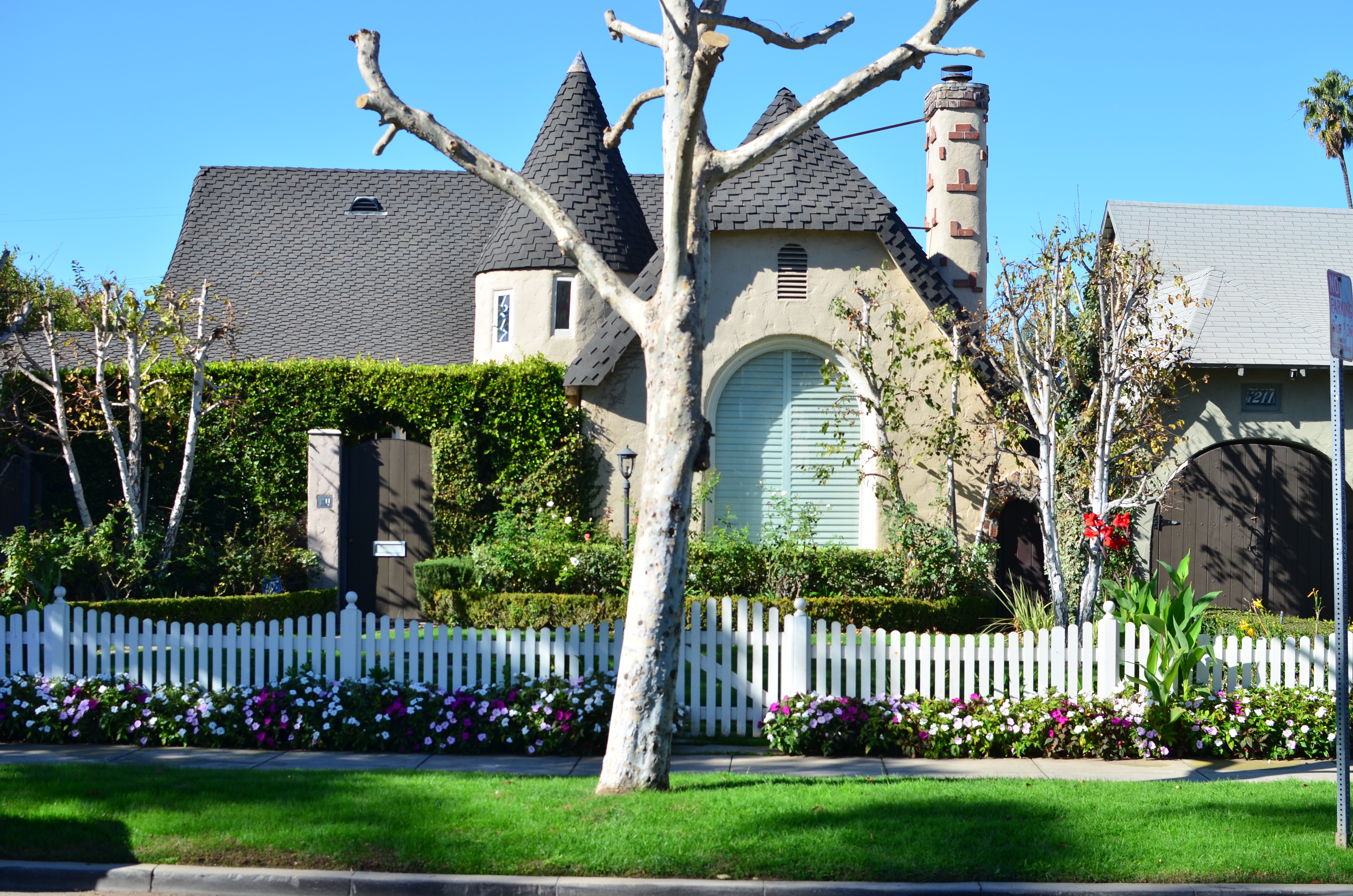
Nice house, decent shot, but not quite the fantasy look I wanted for this subject. So, into the Nikon “retouch” menu we go (see next image).
By MICHAEL PERKINS
JUST AS SOME PAINTERS PRIDE THEMSELVES on producing works that “look just like a photograph” there are photographers who love it when someone tells them their image “looks just like a painting.” Both arts borrow strongly from each other, each envies what the other does, and, in pages such as this one, spend altogether too much time worrying about it. Still, if your foot is predominantly in one camp, it’s fun to occasionally dip a toe into the other, just to see what it feels like.
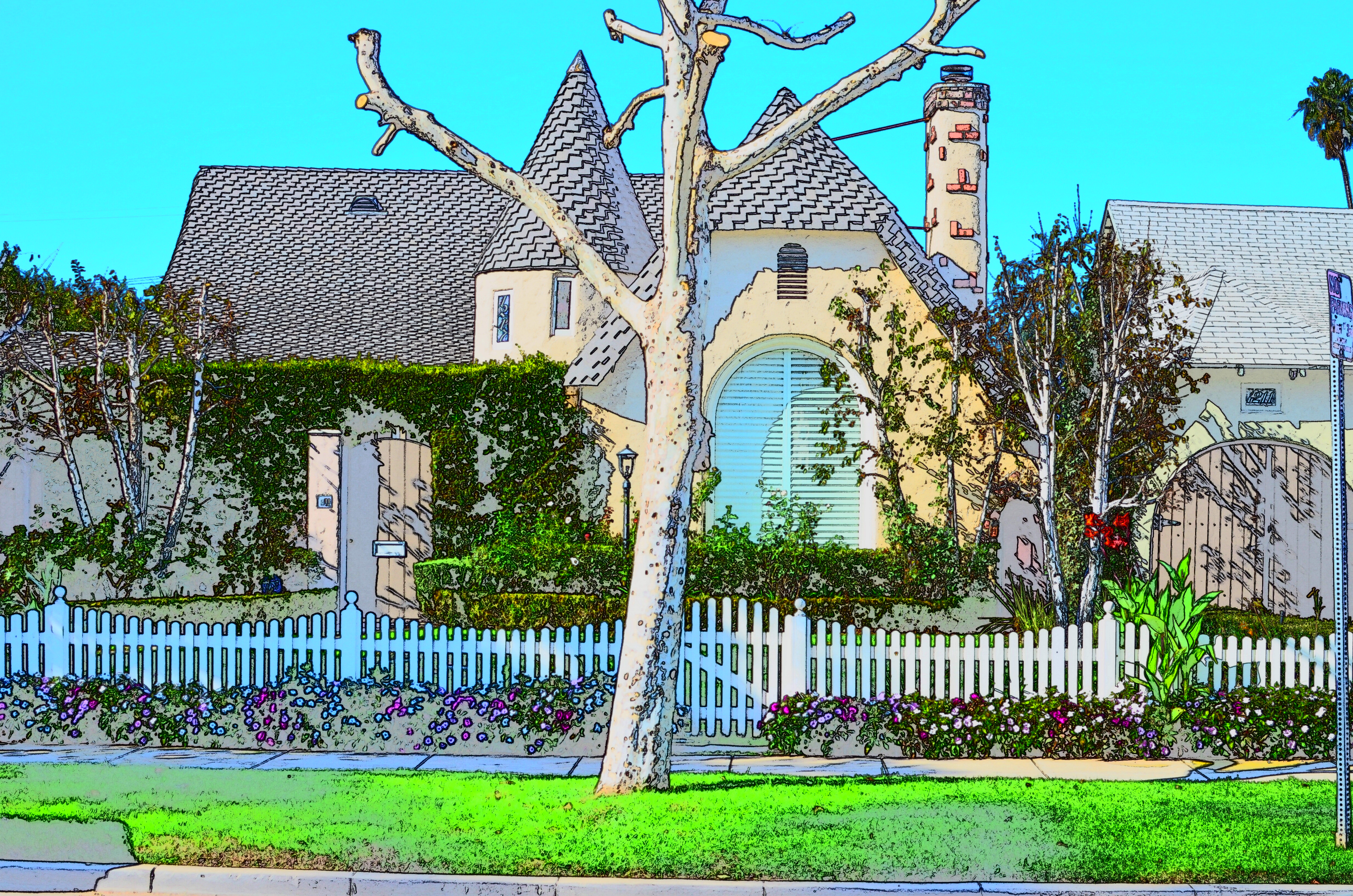
The “pencil sketch” effect created in-camera, via Nikon’s retouch menu. Cool, but now a little too much like a drawing. Almost there (go to next image)……
In trying to use photos to idealize certain subjects, to, in effect, make them better visually than they may be in mere reality, I’ve tried lots of tricks, many of them just novelty effects and some of them useful tools. You have to judge their effectiveness one picture at a time. Recently I went back to an in-camera look that most Nikons have contained in their “retouch” menus for years, mostly because it never seemed to deliver quite what I wanted. In the “color sketch” mode, you make a second copy of a master shot that is mostly just the outlines of the objects and people within, losing a lot of interior detail within the image and making it look as if you whipped it up with, yeah, okay, a set of colored pencils. I had created occasional copies with the effect over the years but never fell in love with it. Please forgive me, but the word sketchy is the only one that applies, and not in a groovy way. Over the years, I mostly forgot that the effect existed, along with several others that Nikon gave me without asking me if I wanted them (!)
Recently, however, I have been reworking several pictures of homes I considered to be nearly in a fantasy category, old designs so fanciful and fussy that they’d look at home in a fairy tale or a Hobbit community. I wanted some extra quality of unreality mixed into their post processing, and so was taking multiple exposures of the same house and tweaking them in exposure fusion programs like Photomatix, which allows you to blend a custom mix of both pictures together with sliders, almost like working on a movie dissolve that’s frozen in the middle. I found that mixing a pencil-sketch tweak with the original shot it was derived from made for an interesting look. A controlled amount of detail, a lot of color patches that looked as if they were washed on by a brush, and a super-sharpening of the peripheral lines. I had stumbled into something useful.
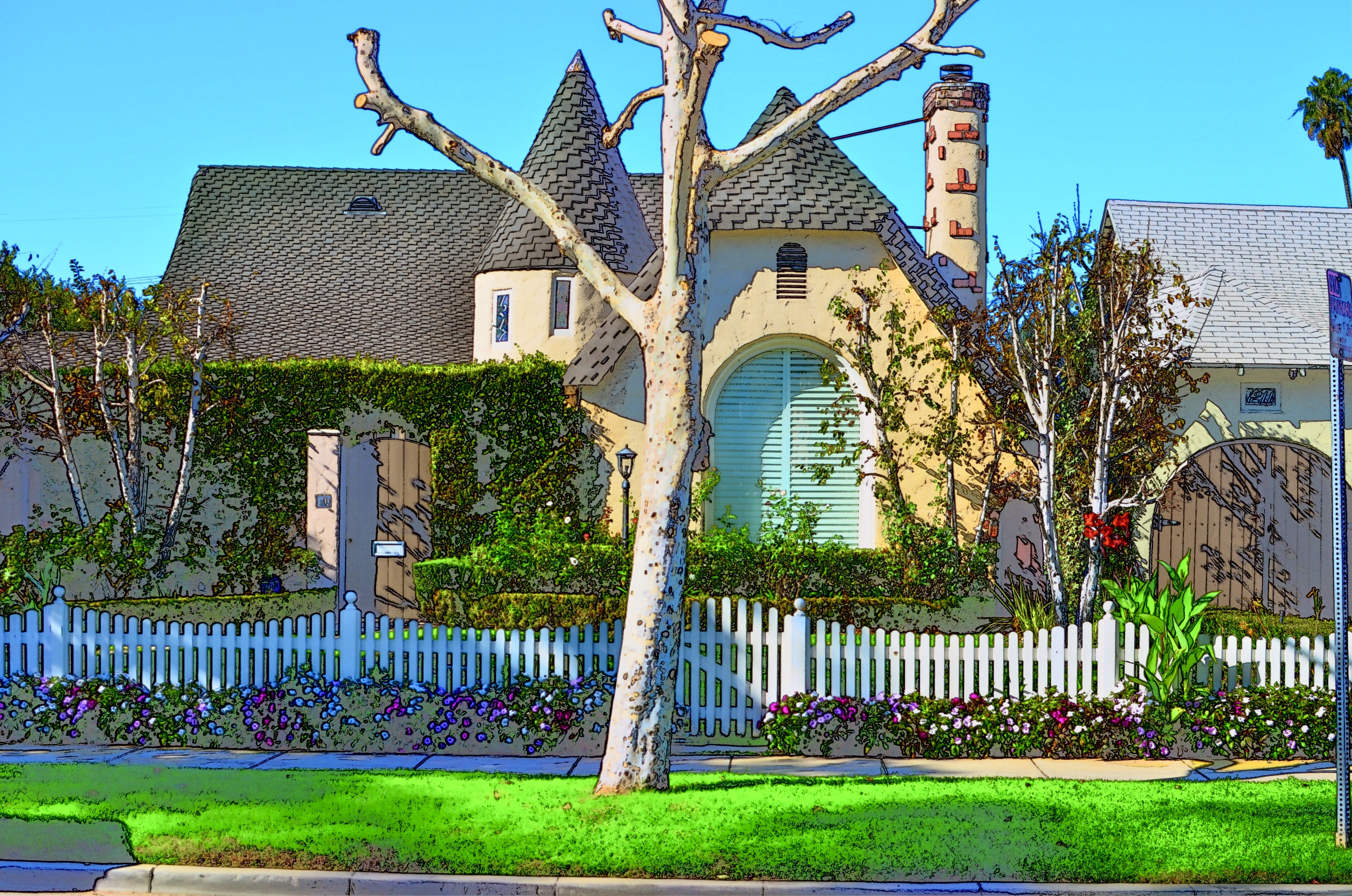
Final composite of original and sketch images, hand-mixed as an “exposure fusion” in Photomatix.
The result is part photo, part painting, and controllably surreal. It almost recalls those lovely artist renderings that architects used to produce as previews for investors in the early days of acrylics…the kinds of “coming soon” illustrations you saw in sales brochures. And, even though it’s certainly like birthday cake, in that a little of it is more than plenty, it’s fun to just make some pictures that are solely about process, not to try to hide a lousy picture, but to explore what happens when you kick Papa Reality out of the room and just get down on the floor with the other kids and play.
JUST ‘CAUSE
By MICHAEL PERKINS
SEARCH ANY ONLINE PHOTO SHARING PLATFORM and it’s pretty easy to compose a quick list of the categories into which the site’s submissions fall. You’ll see the usual suspects, ranked in order of their appearance, from Sunsets, Landscapes and Kids to Animals, Seascapes and Macro, and so on into the night. However, if I’m honest (and I am, if you catch me on the right day), I’d have to confess that a significant number of my own images more accurately belong under a heading no one actually creates, a category called I Really Like What The Light Is Doing Now.
It always strikes me odd that classifications should exist in art at all. Such appelations are largely the work of clerical people, who decided, long ago, that pictures are supposed to be about something. They are expected to be narrative or explanatory in nature, documents of specific places or experiences. A permanent record of something concrete (or cement, if that’s your preference). Thing is, at some level, many of us fell in love with photography because of magic, not reason. We felt a thrill at doing this and watching that happen. Wait, if I turn it this way, wow, look at that. That’s not the thought pattern of a bean counter. That’s the wonder of a child encountering a new toy.
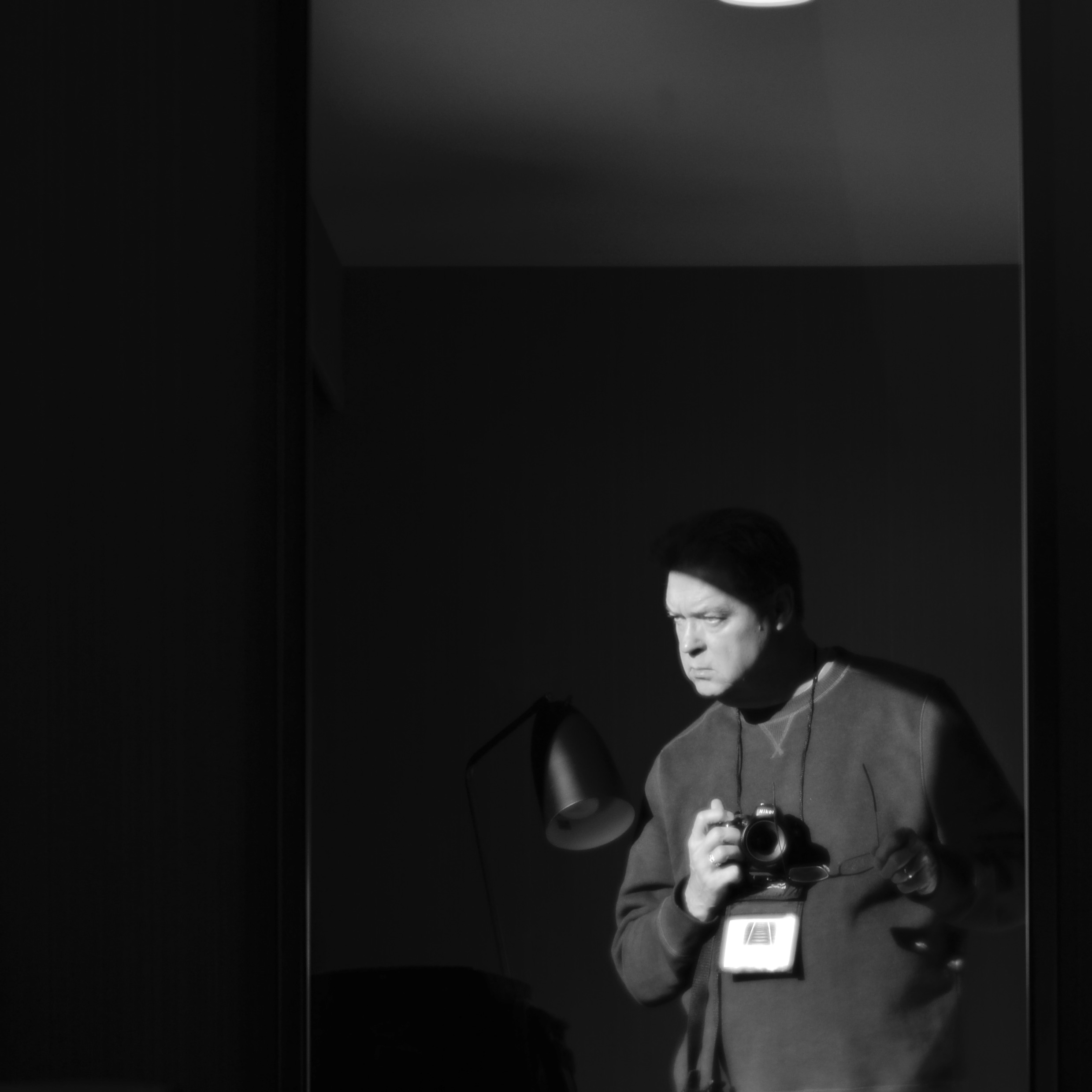
Every time someone produces what you might call an “absolute” photograph, something that is only about itself and nothing more, the dreaded “A”-word (abstract!) is trotted out and pasted all over the work like some kind of biohazard warning. In fact, making a picture just because I Really Like What The Light Is Doing Now is perfectly sufficient unto itself. Let’s not forget that being able to capture light in a box is not only a flat-out miracle, but, in terms of history, a fairly recent one. Being overawed with joy at just that process alone is still totally appropriate. Emotionally, when it comes to the process of making pictures, we’re still at the baby steps stage, regardless of how sophisticated we currently believe ourselves to be.
The only thing more tedious than trying to corral photos into categories is making photographers feel like they need to explain them, as if that’s even possible. My favorite title for a picture (and the most popular world-wide) is “untitled”, and, even though I apply titles to most of my work, such captions are deliberately constructed as mere snarky wordplay and do not convey any information, much less explain, the pictures. In the same spirit, if I encounter a person whose first reaction to an image is “what’s that supposed to be?”, I stop showing them any pictures thereafter. If I knew what it was supposed to be, I’d take one picture, one time, nail it, and move on. I’m only interested in the pictures I haven’t yet figured out how to make.
Subject matter is a tidy way for some people to divide art into easily sortable bins, and that’s not how the best pictures get made. We need to concentrate less on the bin and more on the stuff that falls to the floor outside it, and to notice, above everything else, What The Light Is Doing Right Now. Celebrating the magic is the only way to ensure that we’ll make more of it in future.
2021: ODYSSEY OF ANOTHER KIND
By MICHAEL PERKINS
THE 1968 RELEASE OF STANLEY KUBRICK’S 2001: A Space Odyssey is generally recognized as a kind of fork in the road for science-fiction cinema, a point beyond which tales of space travel ceased to be the exclusive domain of bug-eyed monsters and disintegrator rays. Certainly, space films would continue to be made with the kiddie market in mind, but Stan’s Cinerama epic demonstrated that, for all time, that such movies could, actually, be about something.
Something wonderful.
Perennial oddball/control freak that he was, Kubrick resisted early requests to preserve the models and props that had contributed to “the ultimate trip” (as it was billed in the Age of Aquarius) by either ordering MGM to warehouse the things or see that they were destroyed, apparently out of a belief that the movie’s mystery would be diminished the more that audiences saw what lay back of the miracle. The missing pieces, of course, were thus catapulted, by this decision, to Holy Grail status among collectors, and discoveries of the original treasures remained few and far between for nearly half a century.
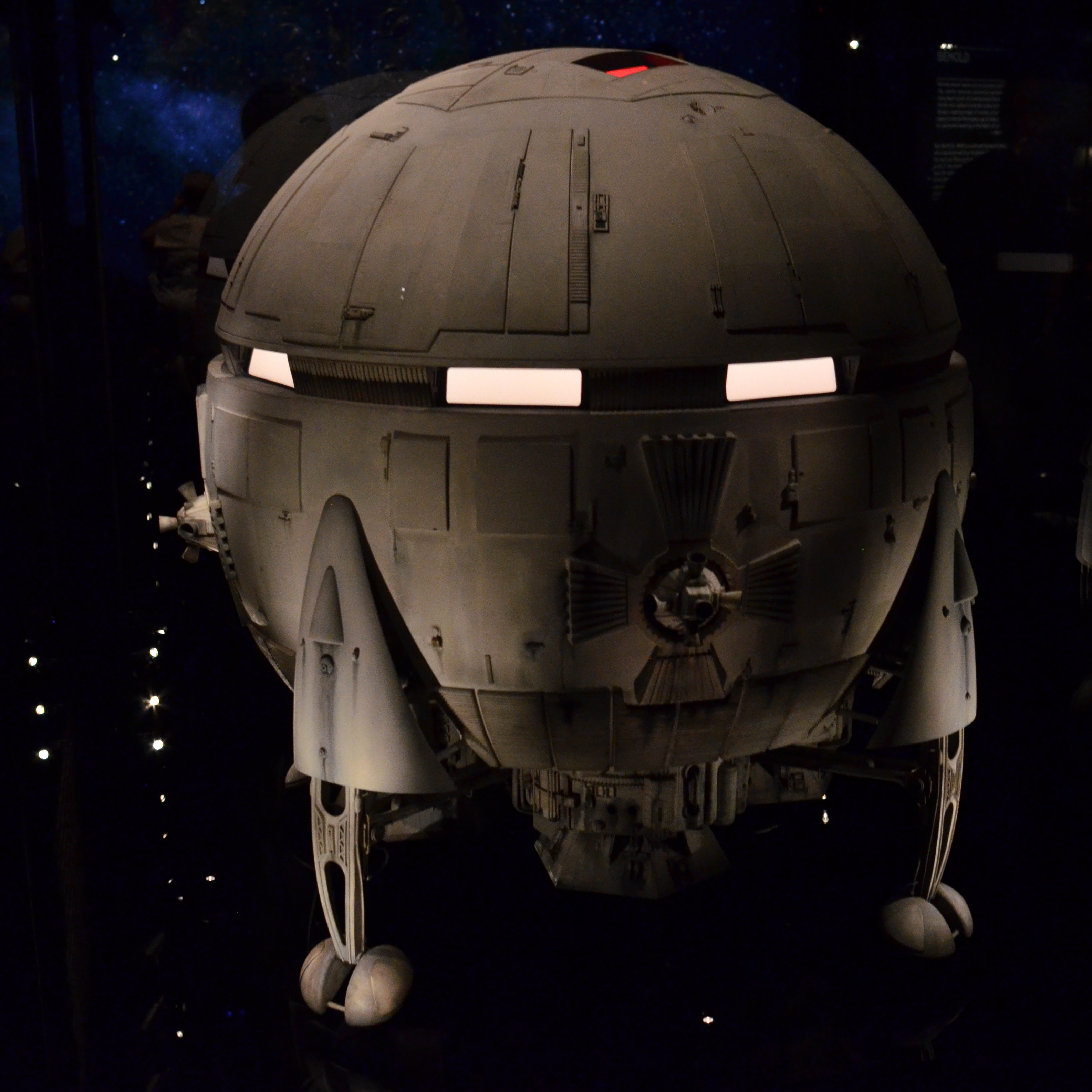 The lone surviving model of the Aries 1-B Lunar Landing Shuttle, produced for Stanley Kubrick’s 2001: A Space Odyssey, fully restored and on permanent display at the newly opened Academy Museum of Motion Pictures in Los Angeles ( Image by the author )
With the 2021 opening of the new Academy Museum of Motion Pictures in Los Angeles, however, 2001 fans have been given one of their first-ever chances of actually gazing upon one of the movie’s key players….a surviving model of the Aries 1-B landing module that carries earth scientists to the lunar surface to see, ya know, what all this “monolith” business is about. The prop’s strange post-film voyage begins with Kubrick apparently trading it to an art teacher in Hertfordshire, England in exchange for lessons for one of his children. As a consequence, before surfacing at an auction in 2015, the Aries model had spent some forty years in said teacher’s garden shed. The catalog in which the model appeared caught the attention of director Christopher Nolan (Batman trilogy, Inception, etc) and some guy named Tom Hanks, who contacted Kubrick’s original special effects wizard Doug Trumbull, who, in turn, verified the authenticity of the find. Hanks and Nolan then proceeded to pool $344,000 to purchase the model.
From there, since, as Hanks remarked, “I didn’t have room for it in my living room” it was decided that the shuttle was at least as vital to the history of Hollywood as Dorothy’s ruby slippers, and so it was turned over to the curators-to-be for the museum being built by the Academy of Motion Picture Arts & Sciences (where Hanks sits on the board of trustees), who disassembled it, cleaned off scabs of ancient glue with cotton swabs and razor blades, restored missing components, even studied drawings of kits for submarines and tanks, both of which were idea sources for Trumbull’s design crew. Finally, the now-pristine model was artificially made un-pristine again, the better to simulate the worn/used patina it had in 2001, allowing the Aries 1-B to again trigger memories of The Blue Danube as visitors imagined it descending slowly to the lunar surface.
The protection of photographic history is part creation, part re-creation, part curation, and part sacred duty. Or as the Hal 9000 so eloquently put it, “I am putting myself to the fullest possible use, which is all I think that any conscious entity can ever hope to do…”
WHICH R ARE YOU?
By MICHAEL PERKINS
VENERABLE BUILDINGS ARE VIEWED THROUGH SEVERAL AESTHETIC PRISMS OVER TIME, and so, as a consequence, photographs of them also fall under different general themes. To my eye, architecture is a visible testimony of so many things human: our relationship to each other: the myths and beliefs that we hold sacred: our own ambition: our way to contextualize ourselves in history or in space. And when I try to decide how to photograph a building, I tend to see it through three distinct filters, or what I call the three “R”s: reference, reverence and relevance.
Reference covers the image of a place from the original artist’s renderings and sketches through its opening phase, as we imagine how this new thing is designed to “fit in” to its hosting surroundings, which, themselves, figure in its original depictions. Reverence comes later on, as we idealize a structure out of context, long after its original neighborhoods or uses have faded. In this “post card” phase, we regard the building for itself, perhaps attempting to protect or restore it.
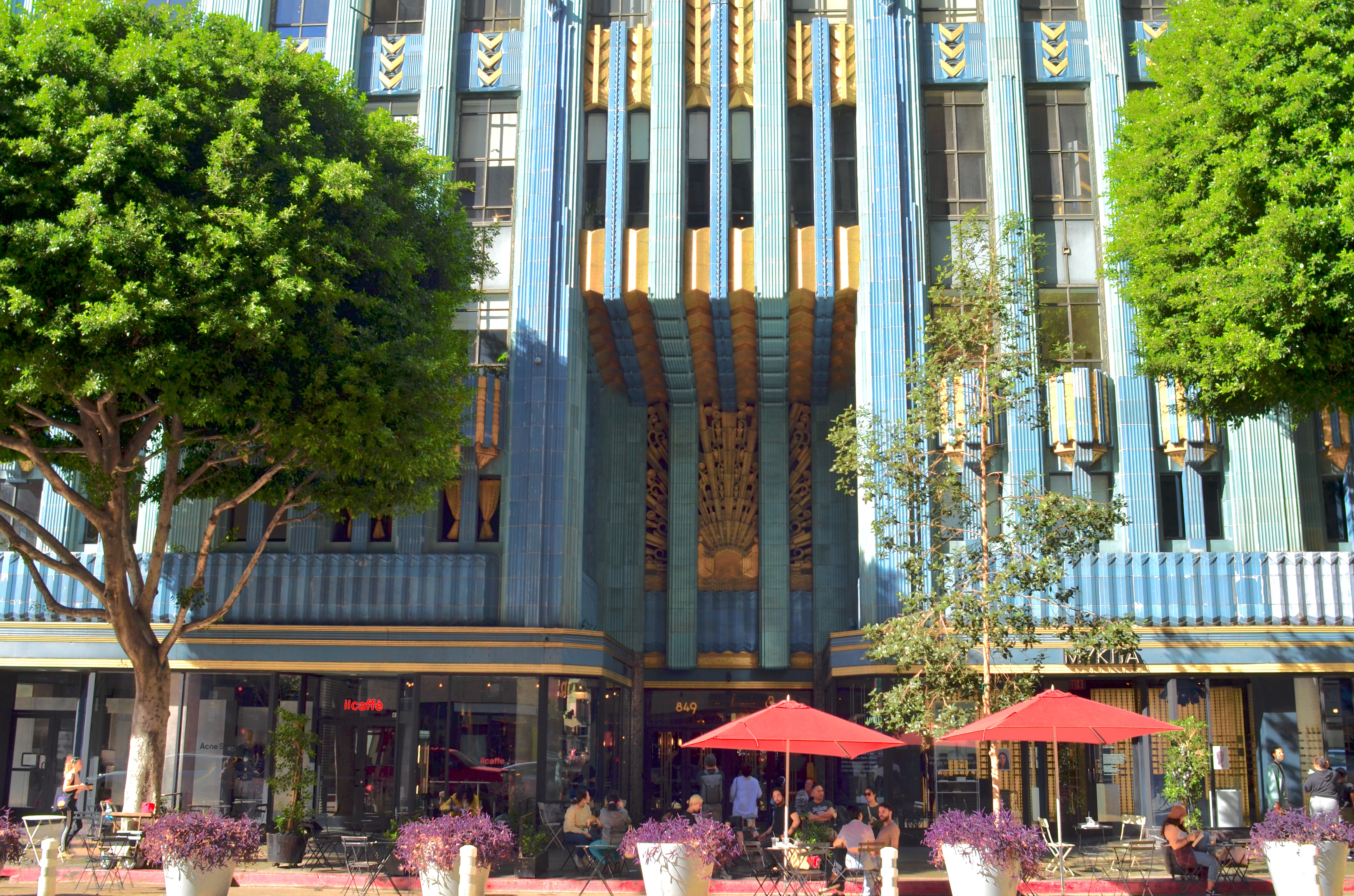
The aqua and gold terra-cotta of 1930’s Eastern Columbia Building, reborn in downtown L.A.
The third R, relevance, comes even later in the edifice’s life, perhaps post-rehab, as we happily welcome it back into daily use and re-apply the scale, objects and people that will anchor it to its second life, the same kind of use-context that was seen in the reference phase.
In finally checking Los Angeles’ 1930 Eastern Columbia Building off my life-list a few weeks ago, I found myself toggling between the reverence and relevance mindsets, taking idealistic images of the tower’s features in isolation from everything around it, and, in the case of this photo, showing it alive with people and activity, as part of the neighborhood. In the end, even though I have seen thousands of idealized images of the EC (the city’s most photographed building, and one of the most renowned Art Deco treasures in the country), I prefer this view, since it places it in a vital (that is, living) setting.
We make buildings for so many reasons, but, in all cases, we make them to be used, not merely adored. The Eastern Columbia, host to two of the country’s largest retailers until the 1960’s, emerged from its banishment years to enter life anew as multi-million dollar lofts to the the stars, its resurrection well in rhythm with the rise of the entire central L.A. “Broadway” district. That makes it relevant once more, and so the camera should always chronicle its elements of what America has always loved best: a second chance. It “R” the best way to treasure a space.
THE GRAPHICS OF GRIEF
By MICHAEL PERKINS
MY PHOTOGRAPHY DOES NOT FOCUS ON HORROR, nor does it have despair as a factory default. I don’t set out at the start of the day to use my camera to prove that life is worthless. Quite the opposite, in fact. Certainly, I realize that my own native need to depict hope in my creative work will render me quaint, even naive in the eyes of many. However, that persistent bias toward beauty, toward uplift, does not mean that I shy away from visualizing the things that make life difficult. As always, it’s in the balance between the two extremes that we manage to be most honest in the pictures that we make.
The universality of grief, as it’s enveloped the entire world in recent years, can be crushing, and yet deciding to express that grief in photographs can be daunting. Can we just glibly shoot weeping mourners at graveside and say we’ve told the complete story of our communal losses? Can we restrict our commentary to merely depicting statistics, tables, charts? Can we veil our tears behind symbolic images? How can we use the camera to show something that is so internal, so personal, so individual?
Looking over my work from the end of 2019 to the present (or late ’21, at this writing) I don’t see a lot of deliberate attempts to “show” the damage the pandemic has done to us…that is, nothing purely reportorial. You can’t “cover” a global nightmare the way you’d cross town to “cover” a building on fire or document a collapsed highway. Everyone creates their own visual contours to these kinds of feelings, and any attempt to cram them into a ready-made template will fall short.
And then there’s another idea that occurs to me.
Perhaps my way of walking out of this crater is through images of hope, to make my camera a defiant force for not allowing the darkness to prevail. Maybe the persistence of ugliness demands that at least some art embrace the light, to affirm our need to go on, to actually insist on doing so.
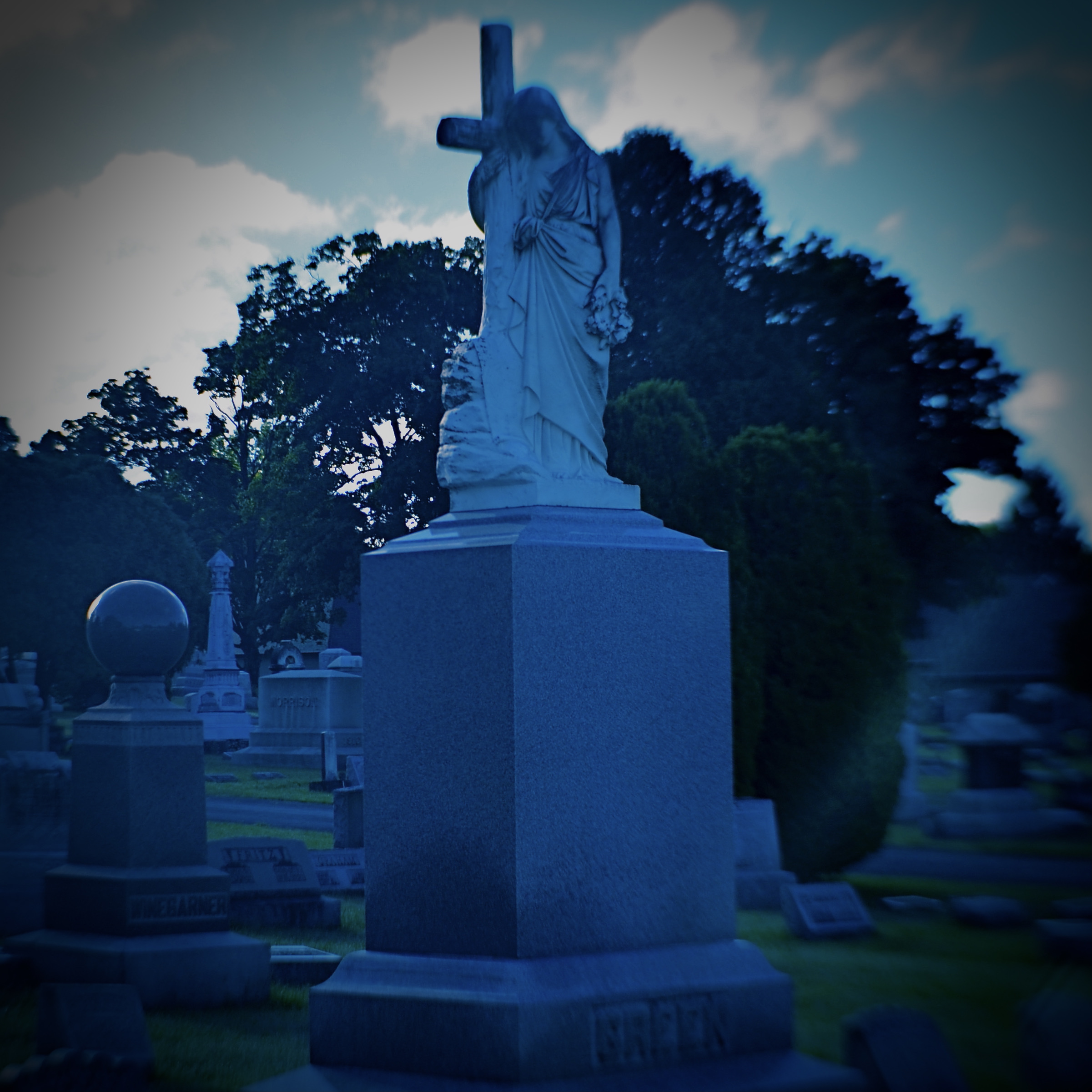
We could all fill huge portfolios of pictures that merely symbolize the burden of our times, such as the shot seen above, which, ironically, actually predates the crisis. But where are the pictures that proclaim that “my heart will go on”? Are those to be thought of as hopelessly sentimental, and thus dismissable? Is our only concept of “reality” a mosaic of misery? I believe the world of photography is wide enough for many voices to be heard, and I refuse to certify the mere recording of tragedy as the only official story worth telling, even in these times. My camera is my tool for finding a path out of the shadows, and I trust myself to make pictures that acknowledge horror while showing what forces are needed to counter it.
OF DREAMS AND DUST
By MICHAEL PERKINS
IN A WORLD THAT SO SURGICALLY SORTS ALL MORTAL PLAYERS into winners and losers, it seems inevitable that we would devise systems by which the ”L”s might aspire to join the “W”s….some kind of schooling or preparation that transforms some of us, the one who are coal, into The Anointed, the ones designated to be Diamonds. Often, that sorting process comes in the form of commercial consumption, and one of its Meccas is Hollywood.
A photographer on the loose in Tinseltown becomes aware early on that all its shops and attractions, all its tour stops and theme parks, are actually one big Academy Of Making It, a huge machine that models the behaviors of the Chosen, a tutorial on how to persuade the Choosers to ask you into the club. And the most obvious cues occur at retail level.
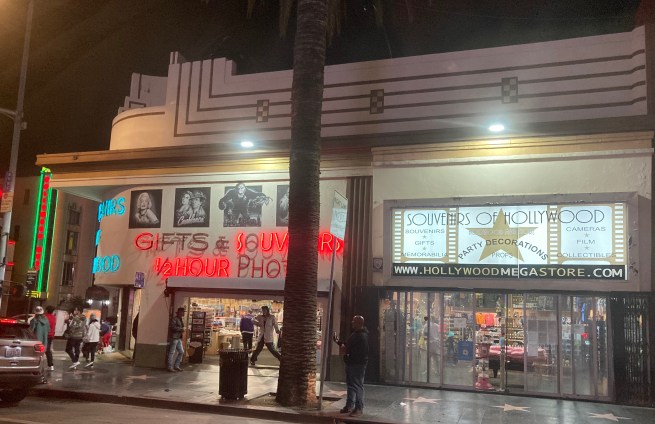
Across every souvenir stand and shirt shoppe, the message is clear: winners buy this: winners wear these. If you don’t see anything here that looks like your look, your look is wrong. Hollywood purports to be about dreams, but it is also about nightmares, like the fever dream of not belonging to The Crowd, of not being plucked out of the chorus.
Whether the scenes we encounter on our streets are of victory or despair, the camera bears witness to the ongoing emotional high wire act. Hollywood is a uniquely American construct, which, like this all-night souvenir stand, encompasses both our desires and our defeats in the single act of selling us stuff…symbols, myths, ways of keeping score. It’s a special kind of envy-driven loneliness that’s also an industry that feeds on itself.
TAKING THINGS FOR GRANT-ed
By MICHAEL PERKINS
“PHOTOGRAPHERS, ESPECIALLY AMATEUR PHOTOGRAPHERS, WILL TELL YOU that the camera cannot lie” wrote a columnist for Lincoln, Nebraska’s Evening News in 1895. “This only proves that photographers, especially amateur photographers, can…for the dry plate can fib as badly as the canvas, on occasion.” All of which is to restate the obvious, that the manipulation of images is as old as images themselves, and that, even when a picture does actually tell the truth, the healthy skepticism persists that tomfoolery, if not actually perpetrated in this particular case, lurks ever nearby.
Faked photos emerged in the nineteenth century as soon as photography itself was out of the cradle, and by the time the world was rounding the corner into the 1900’s, successful hoaxes were perpetrated along two main tracks: profit and propaganda. The very fact that people regarded the camera as an objective machine with no particular axe to grind, a mere recording instrument, if you like, gave credence to outright lies created with a growing variety of tweaking techniques. Propaganda proved an obvious growth medium, as governments attempted to massage the historical record to win hearts and minds, a practice brought to the level of art by both Hitler and Madison Avenue in the century that followed. Likewise, profit loomed large, as companies marketed images that the public wished were real, blurring the line between dreams and documents in the service of sentiment or fantasy.
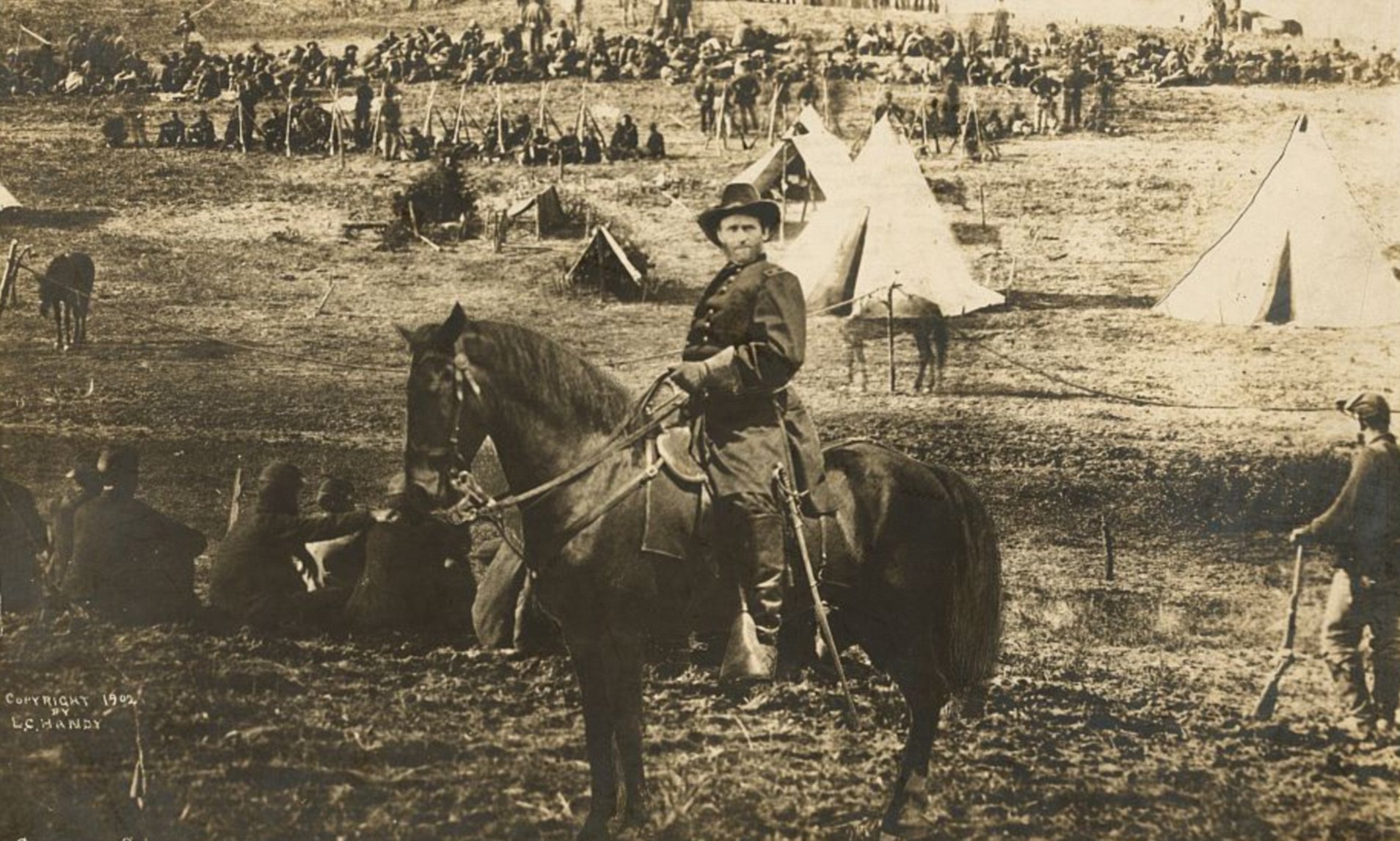
Both the motive to influence and the desire to cash in converge in this image, one of the best-selling photos of the late 1800’s, which purports to show General U.S. Grant heroically astride his horse surveying a roundup of Confederate prisoners at City Point near Richmond in 1864. Following the death of the pioneering Civil War photographer Matthew Brady, his nephew L.C. Handy came into possession of most of his uncle’s negative masters, and began reproducing them to the custom order of many who had, just a short time before, served in the conflict. The picture is striking, mythic, and an unmitigated fake. In fact, it is not a single picture at all, but a composite that combines Grant’s head (from an original Brady portrait), the body of Major General Alexander McCook, and a third image of the prisoners, who were actually photographed at a separate battle that took place hundreds of miles away from City Point. Handy copyrighted the composite and made a small fortune marketing it.
It took decades for the fraud to be detected, after sleuths discerned that, among other inconsistencies, the officer’s body is that of a one-star general (Grant was a three-star by that time) and that the body markings on his horse do not match those of Cincinnati, Grant’s favored mount in 1864. The point is that today’s photographers certainly have no fewer scruples than did the old masters when it comes to fakery, and that, at least today, we are aware of the tools that can be employed to stretch or scar the truth, and accept photography as an interpretative art, for good or ill, rather than merely a means of documenting events. Caveat emptor.
ON THE FACE OF IT
By MICHAEL PERKINS
I HAVE ALWAYS HAD A VIOLENT ALLERGIC REACTION TO PHOTOGRAPHERS WHO SPEAK IN ABSOLUTES, rigidly regulated by rules and procedures, especially as regards gear. Any opinion piece or analysis that contains the phrases “alway do” or “never do” have a perverse effect on me. It’s like telling Adam and Eve that they can eat from any tree in the garden except, you, know that one. It makes the apples on said tree start to seem like they might be the most delicious in the world.
Same with telling people that a set piece of kit or a certain approach will “always” result in a miraculous image. One thing that the digital era has achieved is the increasing rarity of this kind of guidance. In the film era, we were told in no uncertain terms what good and bad focus was, what constituted a “correct” composition. Today, we’re in more of an “anything goes” arena, with people finding freedom in a more experimental frame of mind. And one of the areas where this is most in evidence, since we are more fascinated by faces than ever before here in Selfie World, is in all types of portraiture.
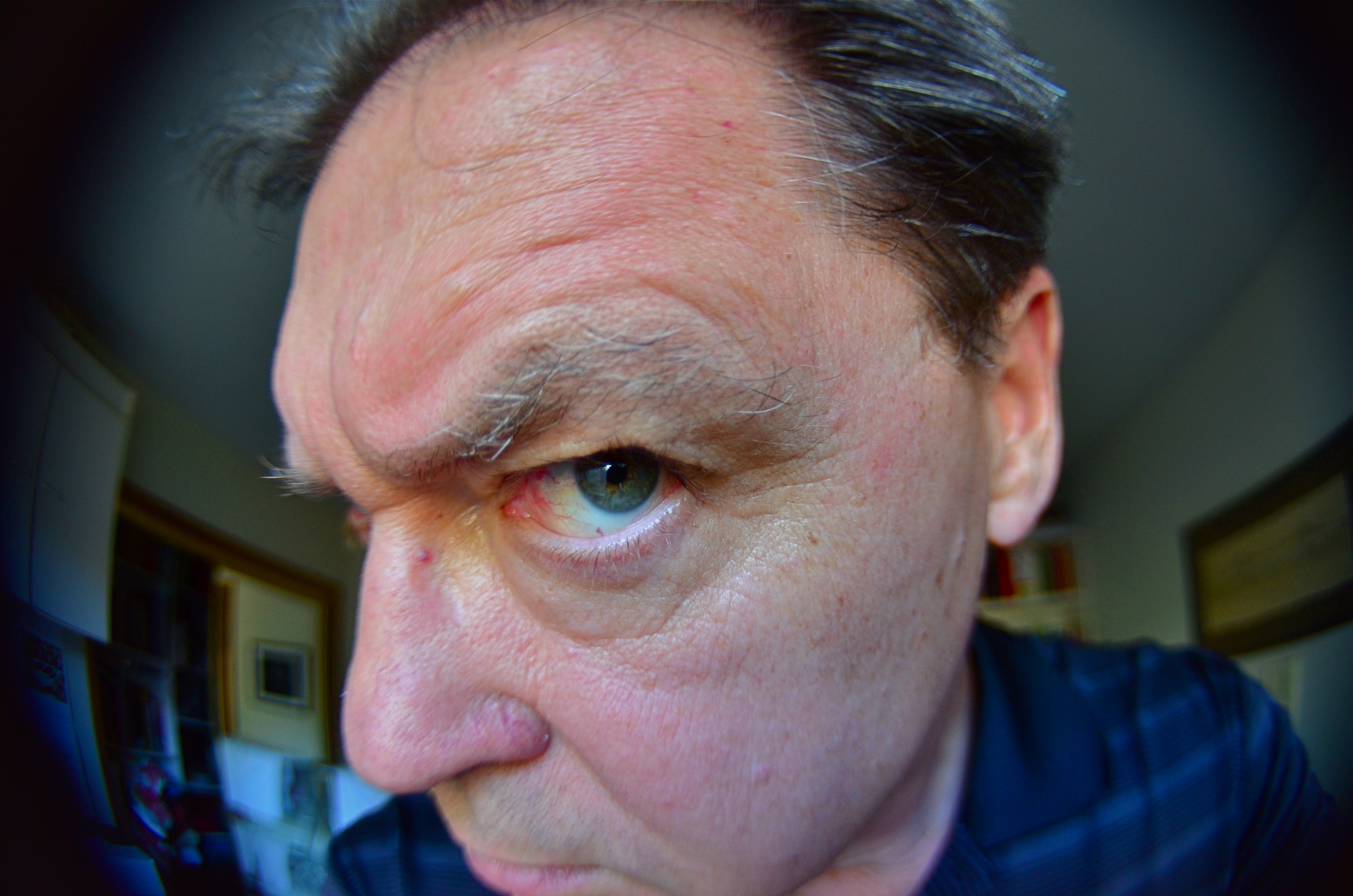
Does this lens make by eye look too fat?
Formal studios used to dominate portrait work to such a degree (hey, we get out of class for an hour…it’s PICTURE DAY!) that a kind of holy writ of thought held sway on the “best” lenses to use to capture someone’s personality. Now, with an insane variety of apps packed in our pockets, the concept of portraiture has been freed from the photo mills of the past, as is the idea of how best to present human features. Whereas amateur photographers used to use a certain hunk of glass consistently for every kind of face, say something in the 85 to 105mm range, extreme wide-angles from 8 to 18mm are now just as much in use.
One of the reason for this shift is that cellphone cameras, at least basic ones, tend to shoot in the wider focal lengths that were once considered “wrong” or unflattering, since they can create distortion in the middle of the subject’s face depending on the distance. However, some people have used just this look to purposefully sculpt their facial contours, to play stretch-and-shrink with their given proportions in order to make their faces look longer or slimmer or to accentuate other elements. On the other end of the spectrum, zooms used to looked down upon by some for portraits because it could be harder to blur out backgrounds at smaller apertures, but now, since most digital images are really only a starting point ahead of post-snap tweaks anyway, even that problem can be solved more easily than in days past.
For years I heard primes in the 35-50mm range touted as the so-called “normal” lenses, since they were supposed to “see” the face at the same proportions as the human eye, or “normally”. But do I use them exclusively? Heck, I don’t use anything exclusively anymore. And neither does anyone else. The days of the didactic “never do” and “always do” tutorials are long gone, with a great portrait defined by nothing more than your own satisfaction. Finally.
FLEETING GLORY
By MICHAEL PERKINS
THE CURRENT CONTROVERSIES OVER WHO SHOULD OR SHOULD NOT BE HONORED in public art will continue to be a key point of emotional engagement, whatever one’s traditions, beliefs, or politics. This is not the forum for discussing any of the motives or agendas behind these debates. Still, as photographers, the rise or fall of certain monuments is an alert for all parts of the process to be documented. We shoot wars, uprisings, rituals, and customs of every kind, and we need to chronicle these shifts in culture when they occur, regardless of how it affects us personally.
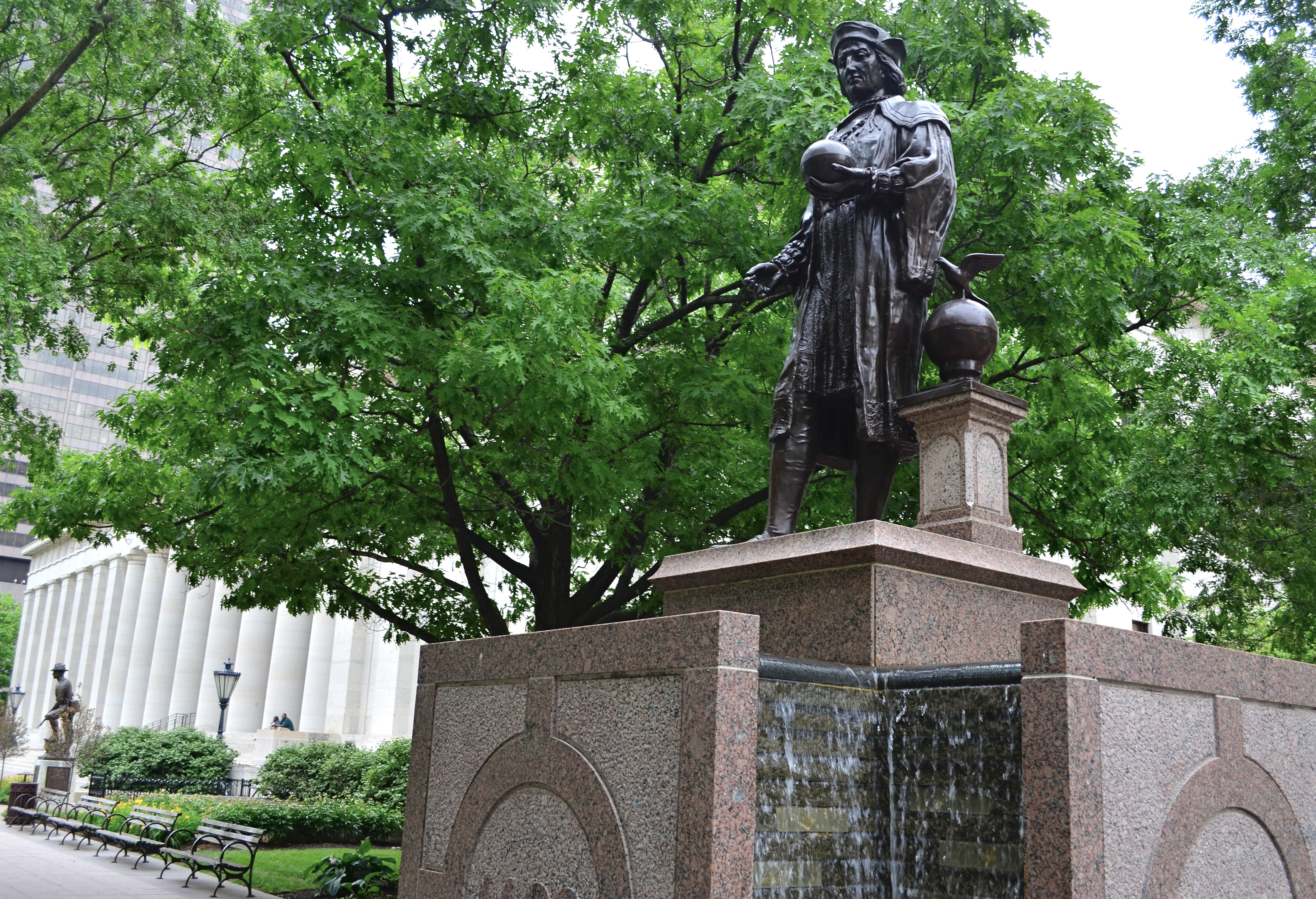
I am always pushing the idea that photography must serve as a document for every age, and our present contention over memorials and statues is merely more proof of the need for that service. I come from a town named after Christopher Columbus, and so the present-day reevaluation of his historical role has already had consequences in that town’s civic rhythm, notably the removal of a huge statue of the explorer from the town’s City Hall complex, a site it’s occupied since 1955. As of this writing, the fate of two more somewhat less imposing sculptures remains in limbo, including the one shown here, which is located on the grounds of the State House in the heart of downtown. Photographing these things need not be a commentary. It can be important merely in terms of time measurement, of the “before” and “after” status of a place or people.
“Heroes” are often as much crafted and created as they are naturally forged, and many a minor figure in history has outlasted his/her actual impact after being immortalized in marble by someone else who needs him/her as a symbol, for any variety of reasons. Making a picture of these memorials, especially when they may be on the way out, is no more a “statement” than shooting a frame of an historic hotel just before the swing of the wrecking ball. Good, bad, or indifferent, these things in our public squares are reference points for our daily existence, and images of them are an effective way of visually contextualizing them in time.
My favorite image of the Statue of Liberty is one taken of just the lady’s head and shoulders, which stood at the 1878 Paris International Exposition before the entire work was crated up and shipped to New York. In a very real sense, it was part of France’s daily walkabout life long before it was a feature in ours. Until it wasn’t.
Heroes will be crowned and decommissioned for as long as mankind persists. The things that either certify or disqualify them across the generations is one kind of memory. Photographs bear neutral witness to the changes in what we hold important, and, for that reason alone, pictures need to be made.
 thenormaleye
HOORAY. DAMN.
By MICHAEL PERKINS
I DON’T UNDERSTAND THE CONCEPT OF AN IMPULSE PURCHASE. Everyone who buys things (so…everyone) has some code in their DNA that dictates how they go about the process, and I know that, for some, there is a virtually unbroken space of time between I Want It and I’ll Take It.
I don’t know what that’s like.
Every purchase I make, great or small, is, for me, a matter of exhaustive research, self-reproach, deliberation, and/or paralysis. And right now I’m experiencing all of those things to an excruciating degree, because right now, like, this week, I’m about to purchase a camera.
I buy cameras not when I want them (which is all the time), nor when I first need them (which is when most sensible people might do so), but only after my current camera is literally disintegrating in my hands, or about the time I am desperate for a replacement. The result of this desperation is an intense program of investigation of all products and their respective claims. I search endlessly for the best functions, price, performance and reliability, but not just for reasons connected to the making of photographs. I mostly do all this homework so I will ensure that it will be a long, long time before I have to go through all this agony again anytime soon.
Wait, does this come in full-frame, too?
This approach, of course, drains any potential enjoyment out of the project, with dread replacing anticipation and fear of failure subbed for excitement..or what I call the hooray-damn syndrome. It’s sick…that is, it makes me literally ill, with many a temptation to chuck the entire task and maybe attempt surgery on my old camera, or perhaps sacrifice a goat over the gravesite of George Eastman.
This is typically the portion of the program where someone in the audience raises a hand and remarks, diplomatically, “wait…that’s not normal, is it?”
Well, I can only speak for myself, of course, but I suspect that all my agita and itchy rashes are not, strictly speaking, what I’m supposed to be feeling. And yet, wading through the goopy internet soup of conflicting reviews, opinion-makers, influencers and, let’s face it, plain old cranks is enough to make me regard organ donation as a seaside romp versus selecting a damn camera that works.
Part of this dilemma lies with the manufacturers, of course, who market features and options with as much aggression as they do the basics of their devices. It’s a little like saying that a car manufacturer gives as much weight to the floor mats and cupholders as they do to the engine or transmission. Cameras are so loaded with toys that add to the flash of their newest models that it’s easy to drown in effects that one may seldom, if ever, use, when the main idea of the purchase is making pictures, which, when all is said and done, is not that bloody complicated. We say we came for the steak, but we often reach for our wallets at the first sound of the sizzle.
Maybe my buying anxiety is just another version of my wanting, throughout my life, to reduce the chance that I’ll make the wrong decision…in anything…where I’ll live, what I’ll work at, which toothpaste to use, or whatever. I’d love to know what an impulse purchase feels like. If I did, I’d have someone take a picture of me making one.
If I could only decide which camera to use…
Share this:
December 26, 2021 | Categories: Uncategorized | Tags: Commentary, Equipment, Humor | Leave a comment