JUDGING BOOKS BY THEIR “COVERS”
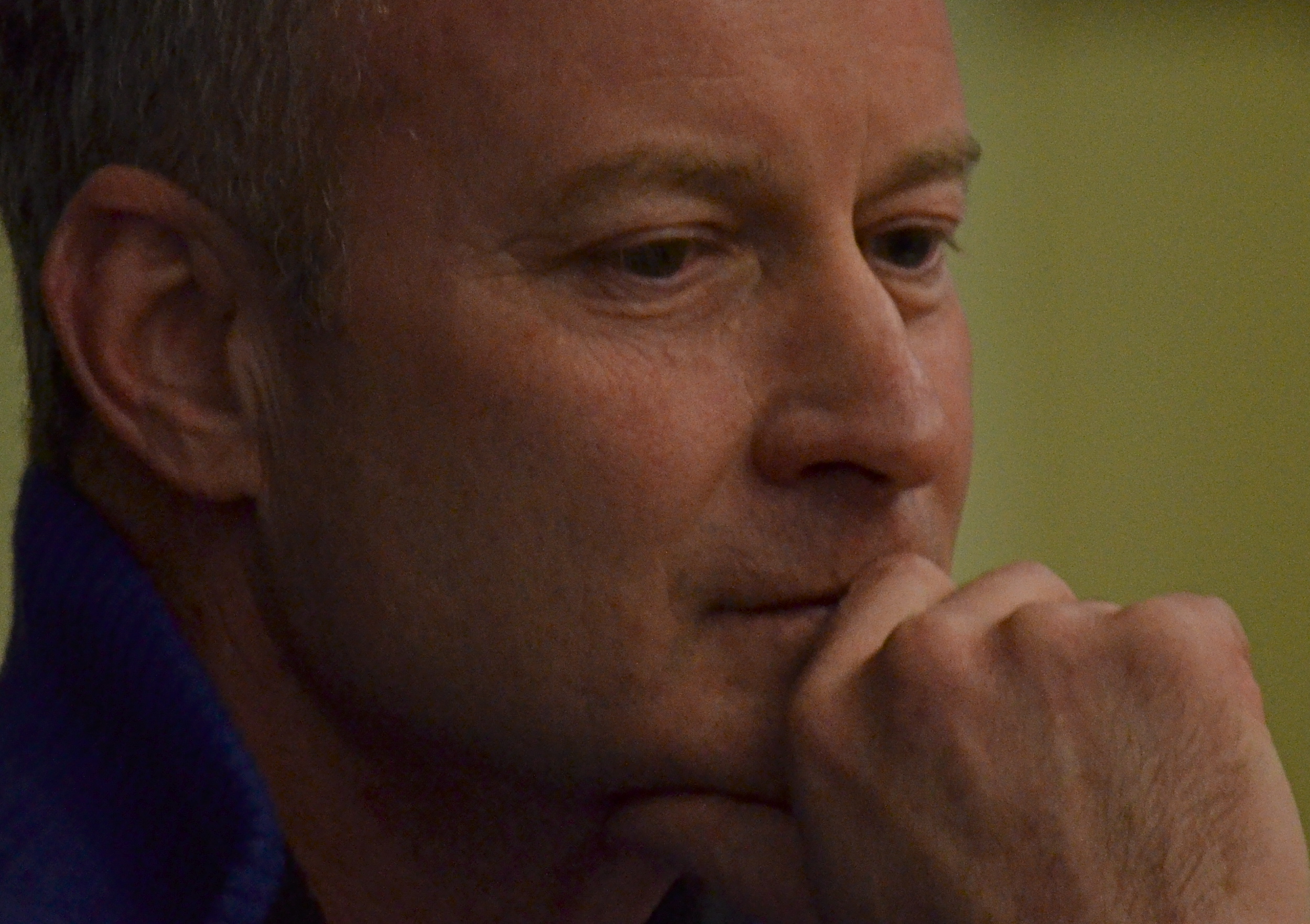
A pensive moment with Timothy Egan, “Opinionator”columnist for the New York Times and Pulitzer prize-winning author of “The Worst Hard Time”. 1/80 sec., f/6.3, ISO 1600, 300mm.
By MICHAEL PERKINS
THE TUCSON FESTIVAL OF THE BOOK, not yet five years old, has quickly evolved into one of the premier annual events in the publishing world. Hosted over an entire weekend in March during spring break on the University of Arizona campus, it showcases hundreds of authors and thousands of titles that range in content over the entire spectrum of the printed word. It is also one of the most hassle-free environments for candid photography of many world-famous authors, with an atmosphere which is intimate, informal, and bristling with energy.
In the simple discussion forums and panels of the TFOB, authors occupy the immediate space of their readers in a way that fires their features with zeal, a quality that lends itself powerfully to seeing the very faces of books. It’s a shooter’s smorgasbord, and the meeting spaces are compact enough (usually University classrooms) that a good medium zoom boosted to about 1600 ISO will give you captures fairly free of noise and a real feeling of being there. In these smaller settings, a relaxed feeling pervades, with authors evolving into stage performers rather than lecturers. The result is no bloodless reading, but a kind of theatrical sales pitch on behalf of the author’s ideas, one part poet and one part Professor Harold Hill from The Music Man.
I started shooting at TFOB four years ago and have learned more each year about circumventing the less-than-ideal lighting scheme (there really isn’t any) and clicking off hundreds of “drat!” images that fell short of what I was seeing. Shooting inside by flourescent light always means taking sample images with various white balances and making changes on the fly, as well as compensating for the light fall-off and additional vibration risk that occurs when you’re fully zoomed in.
Best thing is, though, there are almost no visual distractions to lead the eye away from the authors, since
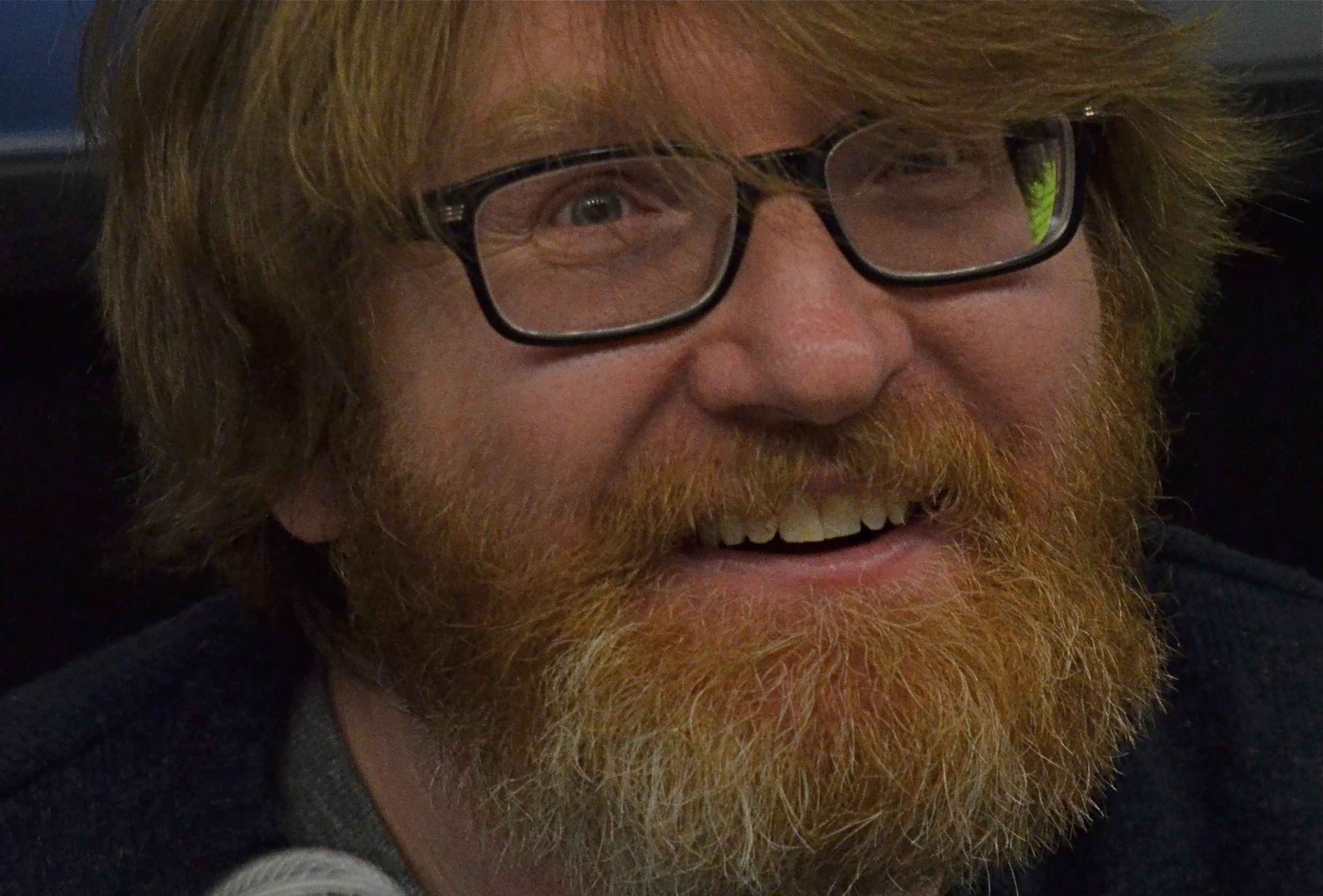
Culture hero Chuck Klosterman, author of “Sex, Drugs, and Cocoa Puffs”. 1/100 sec., f/6.3, ISO 1600, 116mm.
for the most part they stand before blackboards or blank walls. The shots don’t have to be simplified….they are already pretty stark. In addition, you can just frame head shots for the middle third of the subject’s faces, since you aren’t really there to capture their haircut or the water bottles and mics nearby.
Do yourself a favor and investigate a trip to the southwest each March for this amazing event.
If you love books, it’s essential. If you study faces, it’s the icing on the cake.
(NOTE: follow Michael Perkins on Twitter for the “Normal Eye Clicks Of The Day” and “Today in Photo History” at http://www.twitter.com/mpnormaleye. Share your own images with me, especially Instagram and phone snaps. You are always a vital part of this conversation.)
Related articles
- 5 ways to find favorite authors at book festival (azstarnet.com)
- Tucson book festival author inspired by grandkids (azstarnet.com)
PULL DOWN THE NOISE
by MICHAEL PERKINS
PHOTOGRAPHY OFTEN SPEAKS LOUDER IN A SOFTER VOICE. Think about it. If you accept the idea of visual information as a sort of “sound”, then it’s easy to see why some images don’t make a direct connection with viewers. They are busy, overloaded with information, or, in this metaphor, noisy, loud. Cachophonous. Chaotic. Too many “sounds” competing for attention. In a visual image, “noise” can be anything that keeps anyone from hearing the “voice” of your image. To be seen more clearly, pictures need to go soft, in order to be heard louder.
That usually means simplifying the image. Shaping its tone, its framing, its central message. In photography, we all make the mistake of trying to show everything, and, in the process, creating an overdose of data that sends the viewer’s eye wandering all around the picture, trying to find something, anything, to focus on. We present a three-ring circus where just one would be more than adequate.
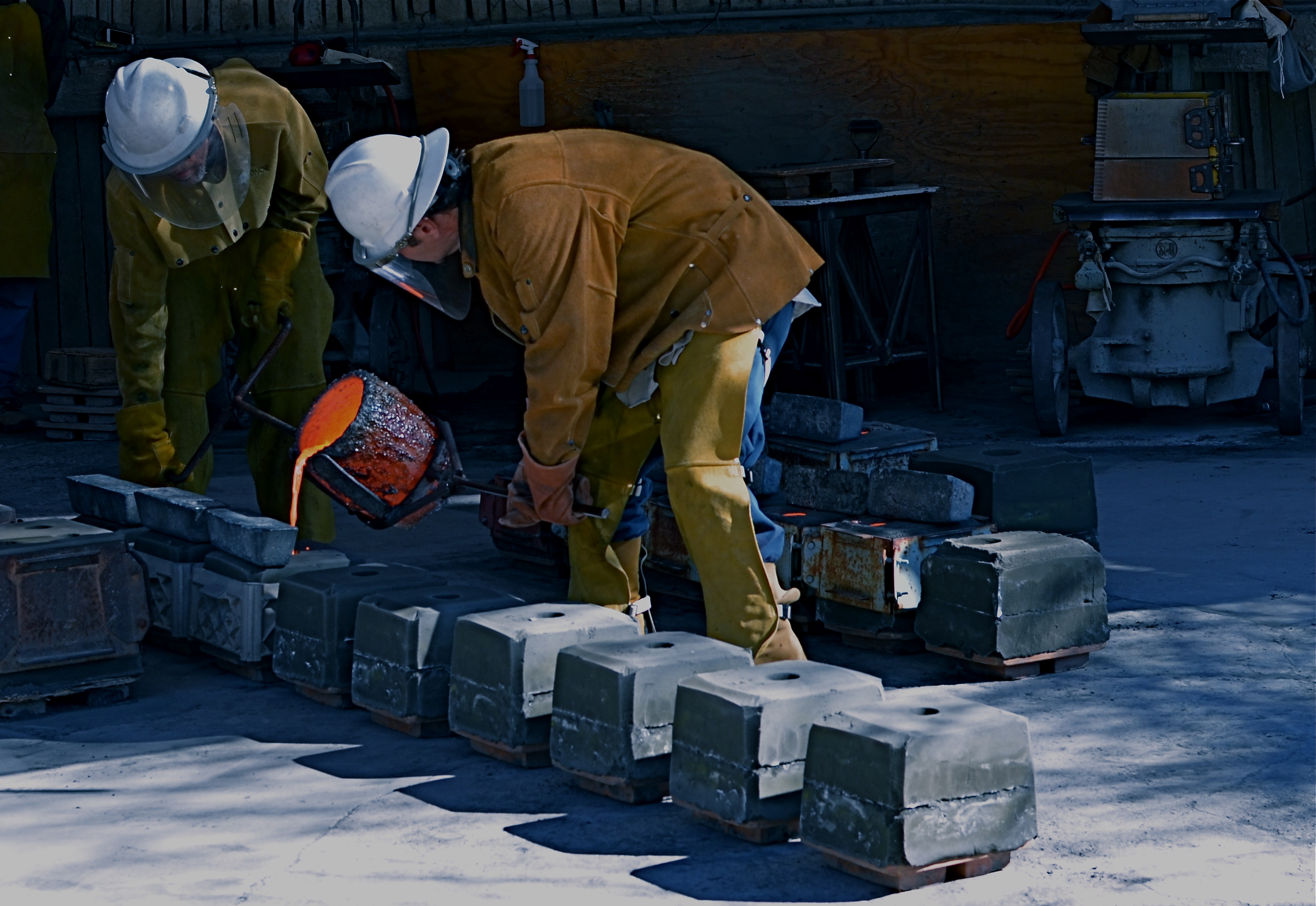
A “perfect” exposure would have inhibited the drama inherent in this situation. So we made it more imperfect.
On a recent trip to an art studio in Paradise Valley, Arizona, I was lucky enough to be present when artisans were pouring molten bronze into decorative molds for all us green “touristas”. Capturing the scene “as is” was easy, as I had plenty of time to calculate exposure and lighting. As a result, I got a lot of “acceptable” pictures good enough for the average postcard, but their storytelling quality was only so-so, since they were almost too full of color, detail and people/props. In the moment, I merely recorded a group of people in a crowded shop doing a job. The tonal balance was “perfect” according to the how-to books, as if I had shot the images on full auto. In fact, though, I had shot on manual, as I always do, so where was my imprint or influence on the subject? The pictures weren’t done.
Back home, when my brain had time to go into editor mode, I realized that the glowing cup of metal was the only essential element in the pictures, and that muting the colors, darkening the detail and removing extra visual clutter was the only way that the center of the shot could really shine.
With that in mind, I deepened the shadowy areas, removed several extraneous onlookers and amped up the orange in the cup. Seems absurdly simple, but as a result, the image was now a unique event instead of a generic “men at work” photo. The picture had to use a softer voice to speak louder.
Great picture? Not yet.
But, hey, I’m still young.
Best thing about the creative process, unlike banking, building or brain surgery, is the luxury of do-overs. And doing over the do-overs, over.
Related articles
- On the Nature + Purpose of Photography (statenislandstories.wordpress.com)
FROM TOY TO TOOL
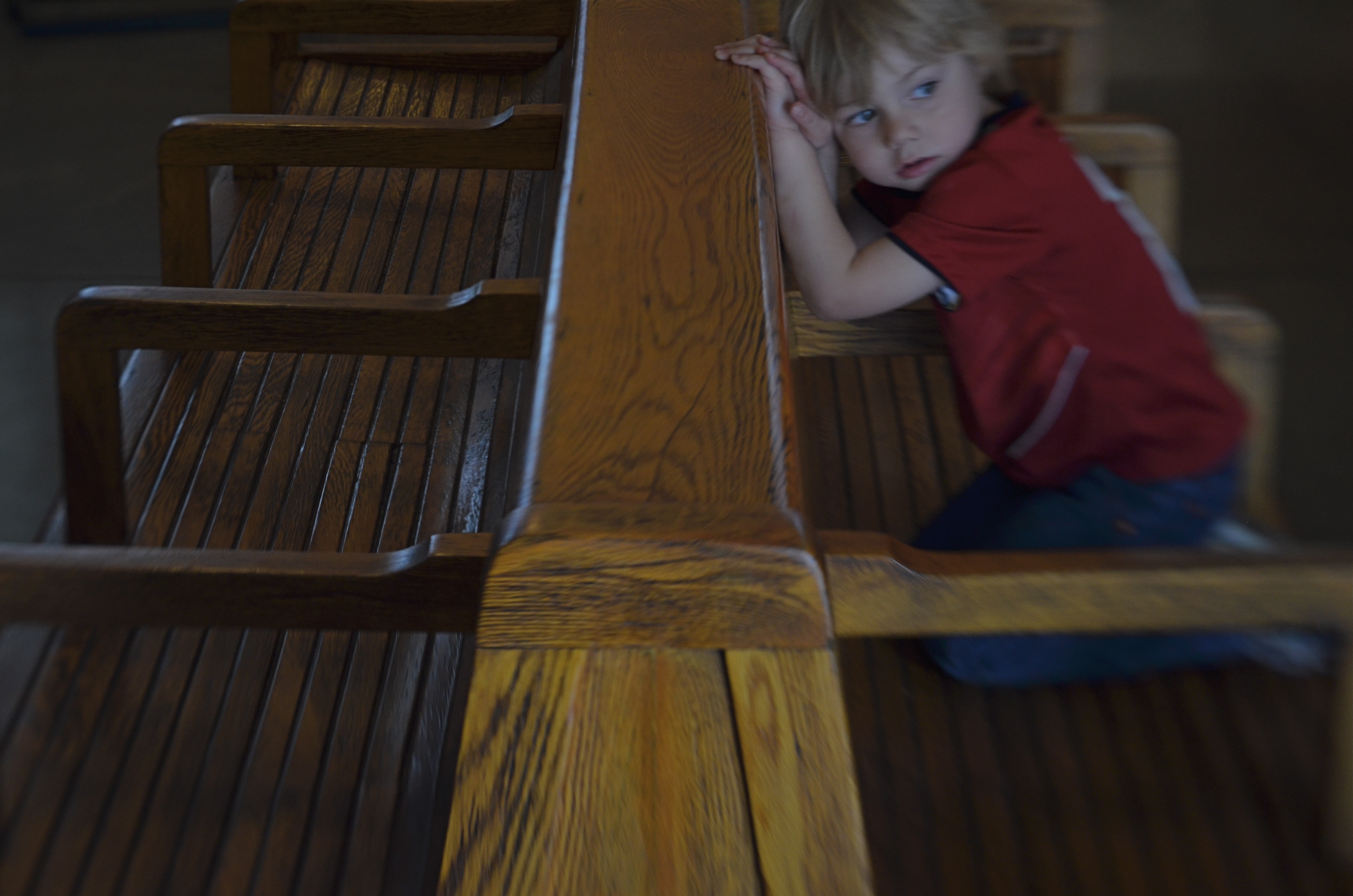
Selective focus can help direct your viewer’s eye. Taken with a Lensbaby Spark lens at 1/80 sec., f/5.6, ISO 320, 50mm.
By MICHAEL PERKINS
A LONG STANDING BIT ON THE DAVID LETTERMAN SHOW, rather than claiming to be entertaining, actually poses the question of what entertainment actually is. Entitled “Is This Anything?”, the feature consists of about thirty seconds of acts or feats that might be amazing (like juggling), might be banal (like, um, juggling) or might qualify as merely strange. After the curtain is drawn, Dave and Paul briefly discuss the merits of what ever strangeness just transpired, and ask each other if “that was anything”. Sometimes there is no clear-cut decision. The show has disclaimed responsibility, and entertainment remains in the eye of the beholder.
That’s how you can feel the first time you use a Lensbaby.
Released several years ago to inventor Craig Strong’s great monetary benefit, the Lensbaby comes in a variety of
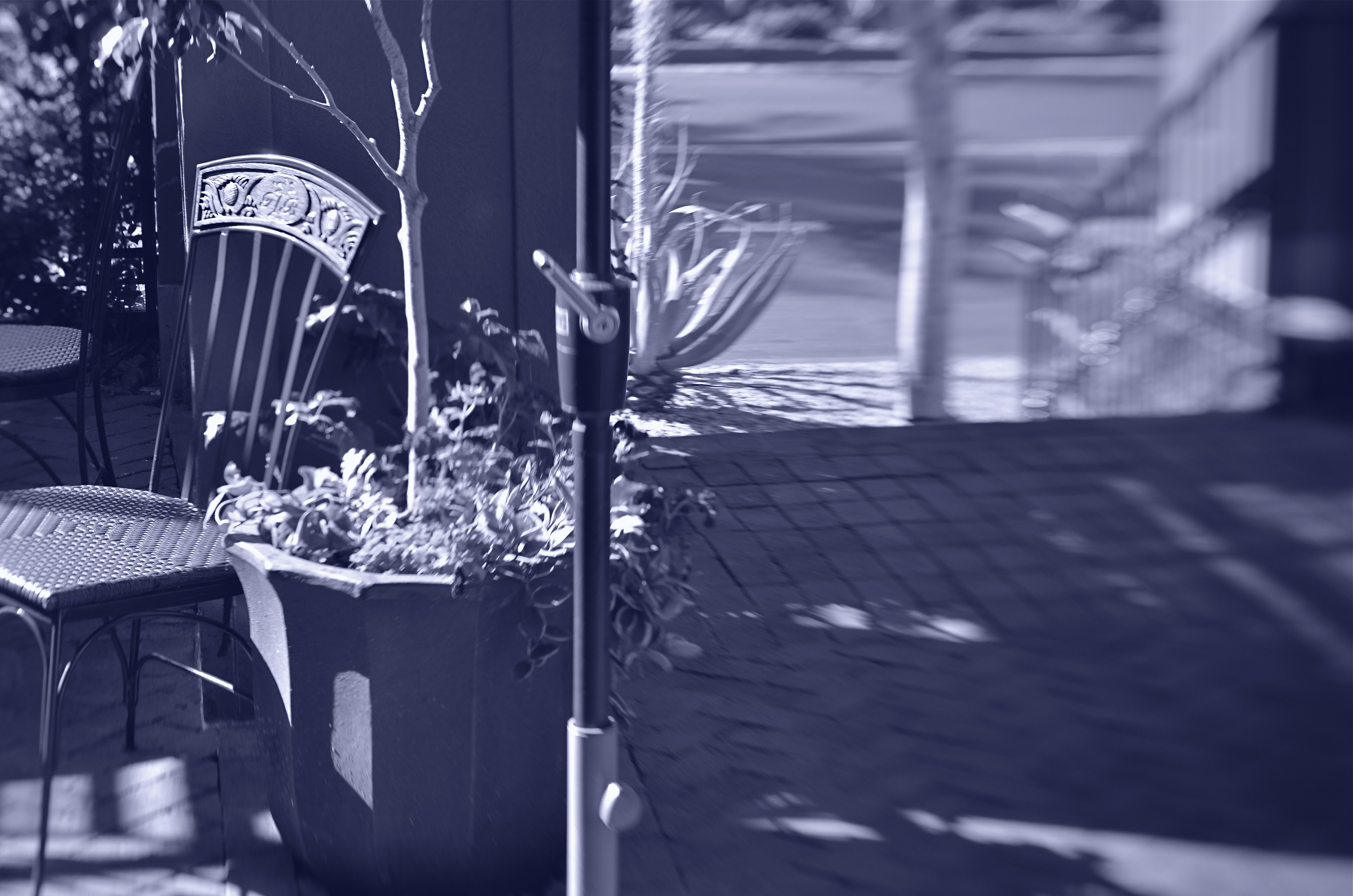
levels but is essentially an affordable tilt-shift attachment, a way to soften focus over selective areas of the frame while rotating the “sweet spot” of sharper focus wherever the shooter feels it should go. Now, essentially, selective focus is really part of every photo ever taken, since a choice of depth-of-field is made every time the shutter snaps. Lensbaby, however, offers the chance to pre-design the precise level of left-right, high-low focus, in the camera, and before the shot is taken. No post-processing is needed, and each use of the effect is completely under the shooter’s control, and at a fraction of what dedicated DSLR lenses cost.The Lensbaby effect is understandably an attractive gimcrack for the instinctive subculture of lo-fi photography, they of the hipster nonchalance and light-leaking, fixed-focus plastic cameras. Hey, it looks freaky, random, edgy. But, like everything else in your kit bag, it’s either toy or tool. The verdict as to which it is comes out one picture at a time.
So far I am whelmed….not overwhelmed, not underwhelmed. For one thing, Lensbabies are a lot of extra work. The entry-level model, the Spark, is actually a lens within a springy plastic bellows. You have to hold your camera body, delegate fingers from both hands to rotate the axis of the front of the lens, squeeze the bellows to bring part of the frame into focus (the Spark’s “sweet spot” is fixed at f/5.6), allocate another finger for the shutter, and click. At least you can’t carp about not having enough creative control. There’s more than enough of that, especially at first, to O.D. on. Your chosen area of focus can be held in place more easily with upgrade models (which also include additional optics and add-ons), but the Lensbaby is truly best for shoots where you have a lot of time to think, plan, and create….the very opposite of the “shoot from the hip” attitude embraced by the lomography crowd. You will take a lot of pictures that miss by inches, or fractions of inches.
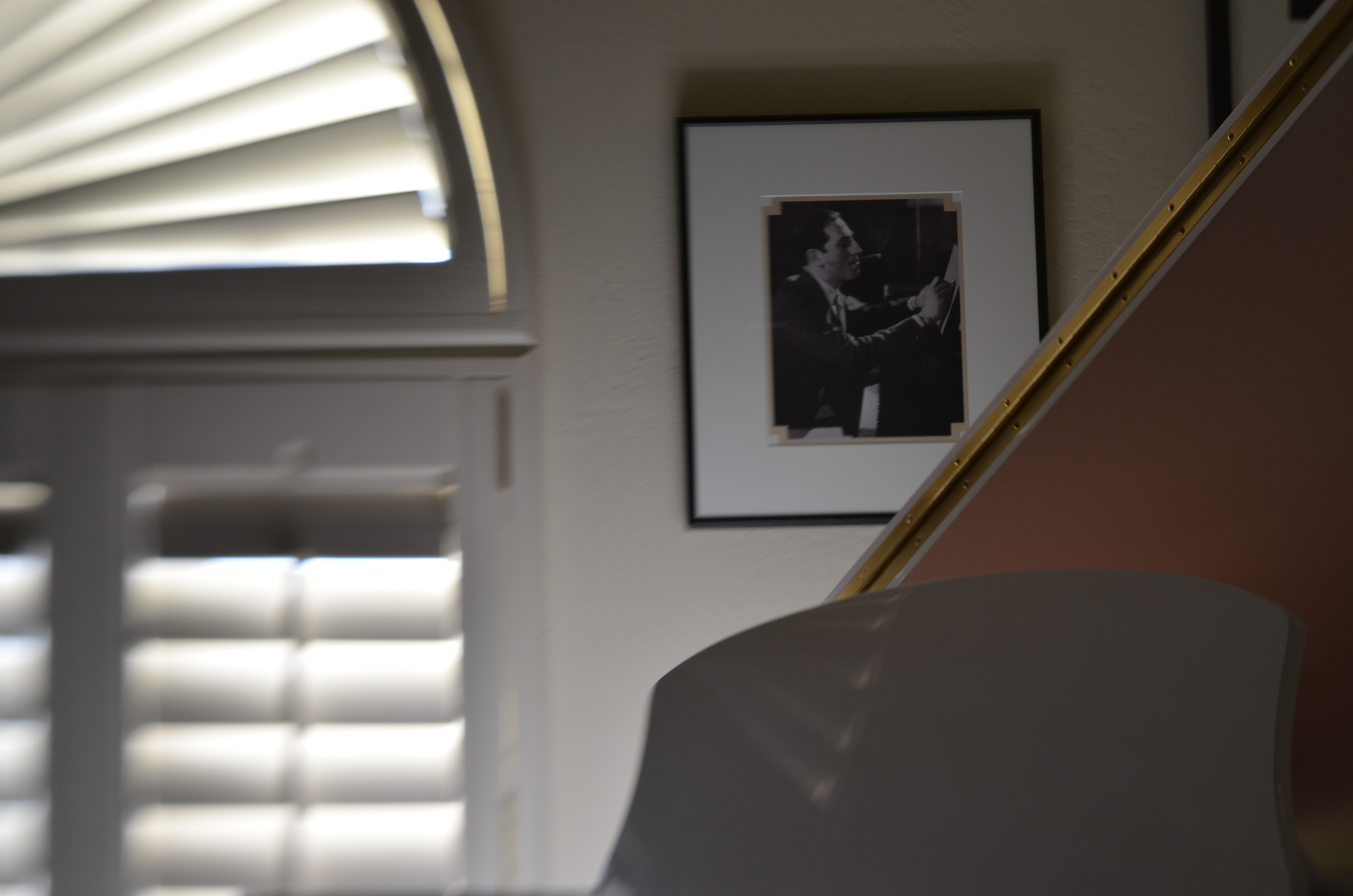
Lensbaby Spark gives you some of the control of a custom lens for under $80.
What will move me from whelmed to overwhelmed will be finding those images where the Lensbaby effect actually aids my storytelling, yet does not define it, as in the lucky shot at the top of this post. The camera gadgets I eventually consign to the “toy” pile go there because they call too much attention to what they can do, not to what I can do using them. The”tools” pile contains the gear that is essential to my saying something in a distinctly different voice. Finally, the two piles are divvied up only after taking lots of pictures and asking a ton of questions (a few gimmicks, like fisheye, have spent time in both piles; hey, I’m not above just playing around).
I sympathize with Letterman’s dilemma when he ironically asks, “Is this anything?” Selective focus is a way to install big neon pointers into your pictures, a more emphatic command to look over here. It’s also a way to amplify the drama of certain data or simplify cluttered compositions. I get it.
But it needs to be about much more than that. Or, more correctly, I have to help it.
Related articles
- My Lensbaby SCOUT, baby! (greyiscolour.wordpress.com)
A LOT OF LITTLE, FOR NOT A LOT
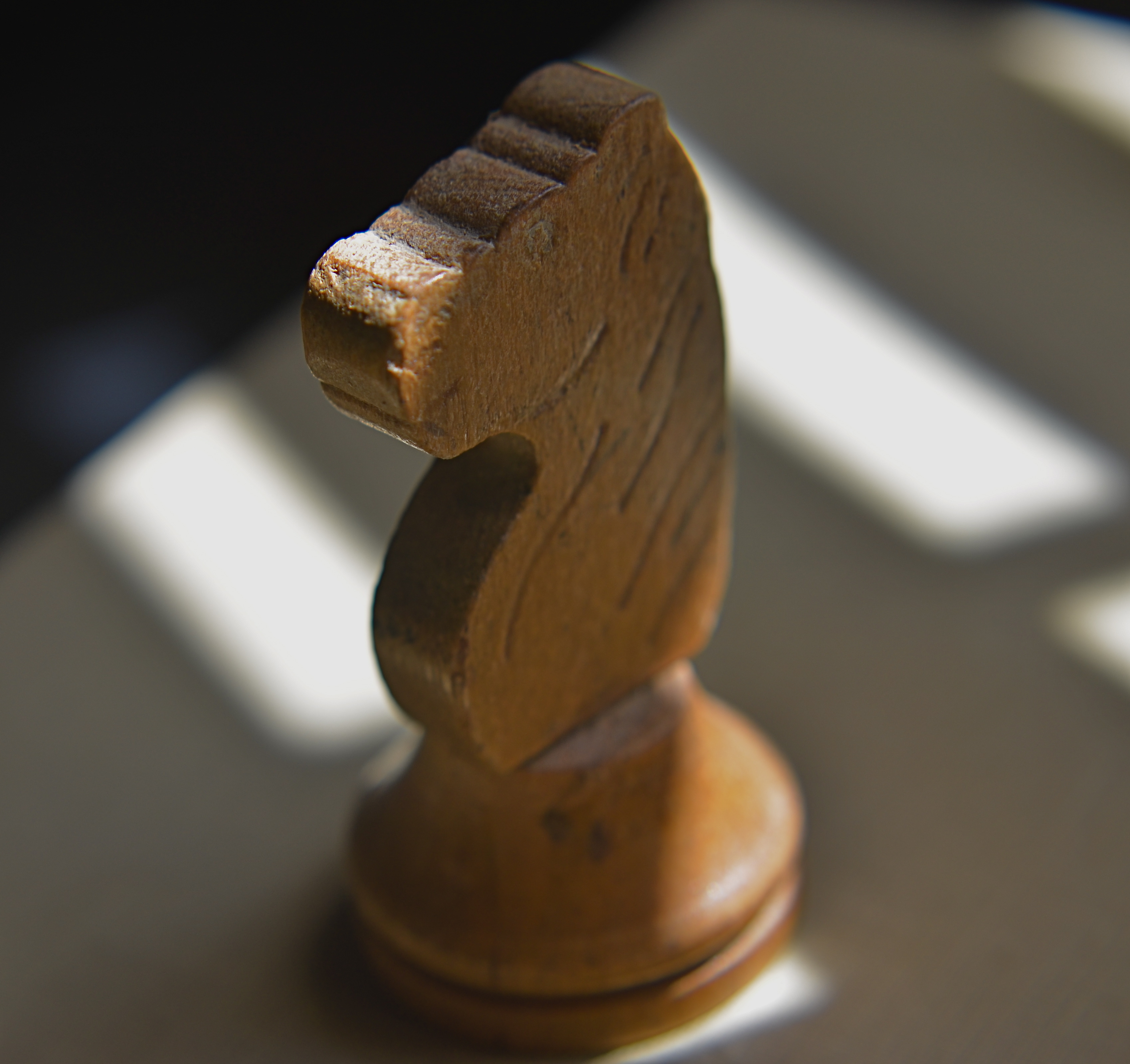
About three inches away with stacked diopters equivalent to 7x magnification. Manual focus, 1/200 sec., f/4.5, ISO 100, 35mm.
By MICHAEL PERKINS
EVER SINCE I FIRST READ STORIES ABOUT THE ARCH-VILLAIN BRAINIAC shrinking and stealing cities from the across the galaxy (studying them like miniature trophies) in Superman comics, I knew that I would someday embrace macro photography.
Well, given the insane costs of dedicated macro lenses, maybe embrace isn’t the right word. Maybe one arm around its shoulder. Or a friendly handshake. Or a gentle chat in which I say I really like you, macro, but I think we should see other people.
Let’s face it. You shouldn’t have to mortgage your..mortgage to determine how often you’re going to want to use your camera to, say, count the crumbs on an Oreo. Yes, once you can crank in close enough to see the flea on the back of the buffalo on the nickel, you may become hopelessly infatuated with the world of tiny. But to make that decision, you needn’t assume the financial humility of a monk. Dedicated macro lenses are a monster investment (a minimum of $300, all the way to over $1,000), to be weighed against how many other shooting situations you’re likely to find yourself in, and the economics of whatever special hunks of glass you’ll need to accomplish all those other tasks. If macro is truly “all” for you, then that sort of justifies the complex construction and sharp autofocusing of a separate lens. Brutal honesty disclaimer: there is no substitute for the performance of a high-end piece of precision optics.
BUT, not all of us make a lifelong study of the number of dimples on a bee’s knees, and that can make a huge investment in macro an iffy indulgence. I’m a big one for not buying major toys until they justify their use in my work. Thus, the only photographic commandment I unflinchingly live by is: don’t buy even one more extra feature than you will actually use.
Two main alternative options have emerged to serve the needs of “occasional” macro shooters. One of these are extension tubes, the hollow cylinders that attach between your lens and your camera body, creating an artificially enhanced range of maximum magnification. Being the same size as actual lenses (albeit with no glass inside), they do add additional bulk and weight to your setup, and may result in a loss of light, as well as a shallower depth of field. Investment-wise, you are still in for over $100 for a decent pair of these, as the cheap ones aren’t worth winding toilet paper around. Given the tubes’ limitations, you may be looking at sticking the camera on a tripod to lengthen your exposures, or jacking up the ISO. Different strokes.
The other, far cheaper option, and one which gives you a taste of macro without surgically removing your wallet, involves magnifying diopters. They screw on like filters, come in sets of three for well under forty bucks, and can get you in on the ground floor of macro (or the little tiny things crawling on said floor).
Diopters come in magnifying strengths of +1, +3 , +4, and above, so you can use a single diopter, attach several in series, or assemble a bunch into a custom mix and affix that to the front of your lens. Even with a cluster of them attached, you’re adding little more than an inch of extra depth to your lens body, and they’re easy to detach and stash in a spare pocket, something that cannot be done as easily with extension tubes. If you’re an on-the-go, travel-light kind of guy/gal, this is worth a mention.
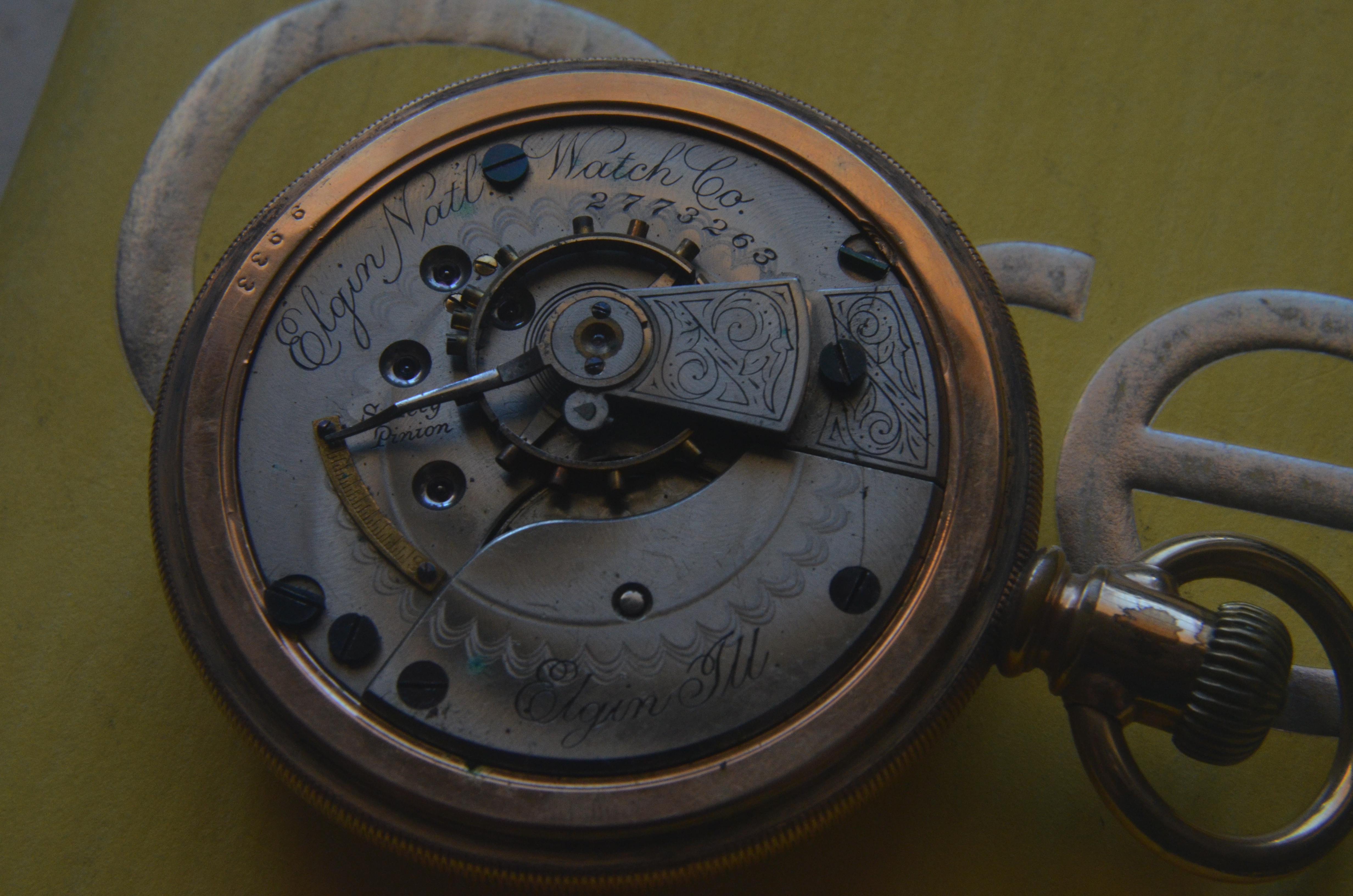
Now, let’s not delude ourselves. You can’t use your lens’ autofocus with diopters, which means you’re on manual. This is a serious consideration if you prefer to shoot hand-held, since you will louse up more frames, what with your every quiver being magnified and playing hell with sharpness. As with extension tubes, you may want to whip out the tripod.
If you are a techie as well as an artiste, do a Sherlock Holmes on the interwebs for the exact science of which option will give you the most control and best results. I am far from the best source for this kind of exact wisdom, since, as stated above, I acquired a good deal of my scientific knowledge from Superman comics. That said, if you need a peer review on the properties of Kryptonite, I’m your boy.
My point here is that I can only vouch for what has worked for me……and that’s the entry-level diopters option. Why jump immediately to the big-boy toys when you can master the baby steps with a smaller outlay of green, then move up as your needs dictate? Seems logical that training wheels should precede entry in the Tour de France.
Doesn’t take a Brainiac.
(reach Michael Perkins on Twitter @mpnormaleye)
Related articles
- Macro Flower Photography (ajburuca.com)
- Getting Close Enough (rakmilphotography.wordpress.com)
GET LOST
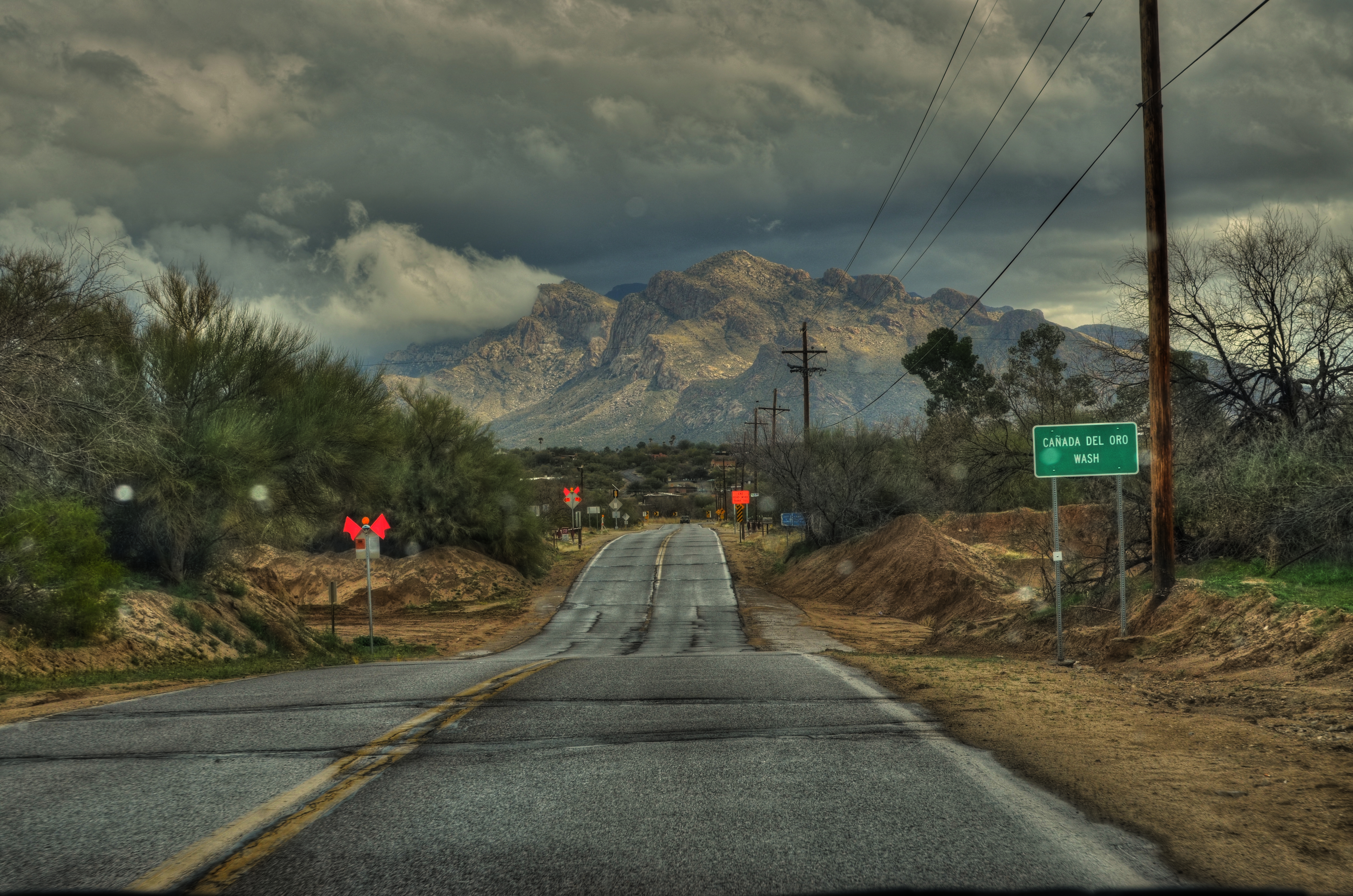
Straight through the windshield, using a technique I like to call “dumb luck”. Original shot specs: 1/320 sec., f/8, ISO 100, 35mm.
By MICHAEL PERKINS
PHOTOGRAPHY IS 10% PLANNING, 90% SERENDIPITY. Yes, I know. we would all rather believe that most of our images spring from brilliant conceptions, master plans, and, ahem, stunning visions. But a lot of what we do amounts to making the most of what fate provides.
There is no shame in this game. In fact, the ability to pivot, to improvise, to make the random look like the intentional…all of these things reveal the best in us. It exercises the eye. It flexes the soul. And, in terms of images, it delivers the goods.
Getting lost (geographically, not emotionally) is less an emergency than in ages past. Armed with smartphones, GPS, and other hedges against our own ignorance, we can get rescued almost as soon as we wander off the ranch. It is easier than ever to follow the electronic trail of crumbs back to where we belong, so drifting from the path of righteousness is no longer cause for panic. Indeed, for shooters, it’s pure opportunity.
Okay, so you’re not where you’re supposed to be. Fine. Re-group and start shooting. There is something in all these “unfamiliar” things that is worth your gaze.
Last week , my wife and I decided to trust her car’s onboard guidance system. The results were wrong but interesting. No danger, just the necessary admission that we’d strayed really far afield of our destination. We’re talking about twenty minutes of back-tracking to set things right.
But first….
One of the rural roads we drifted down, before realizing our error, led us to a stunning view of the back end of Tucson’s Catalina mountains, framed by small town activity, remnants of rainfall, and a portentous sky. I squeezed off a few shots straight out of the windshield and got what I call the “essence” exposure I needed. That single image was relatively well-balanced, but it wouldn’t show the full range of textures from the stormy sky and the mountains. Later, in post, I duplicated the one keeper frame that I got, modifying it in Photomatix, my HDR processing program. Adding underexposure, deeper contrast, and a slight rolloff of highlights on the dupe, I processed it with the original shot to get a composite that accentuated the texture of the clouds, the stone,, even the local foliage. A sheer “wild” shot had given me something that I would have totally missed if the car’s GPS had actually taken us to our “correct” destination.
What was ironic was that, once we got where we were going, most of the “intentional” images that I sweat bullets working on were lackluster, compared to the one I shot by the seat of my pants. Hey, we’ve all been there.
Maybe I should get lost more often.
Actually, people have been suggesting that to me for years.
Especially when I whip out a camera.
Related articles
NO TEACHER, NO GURU, NO METHOD
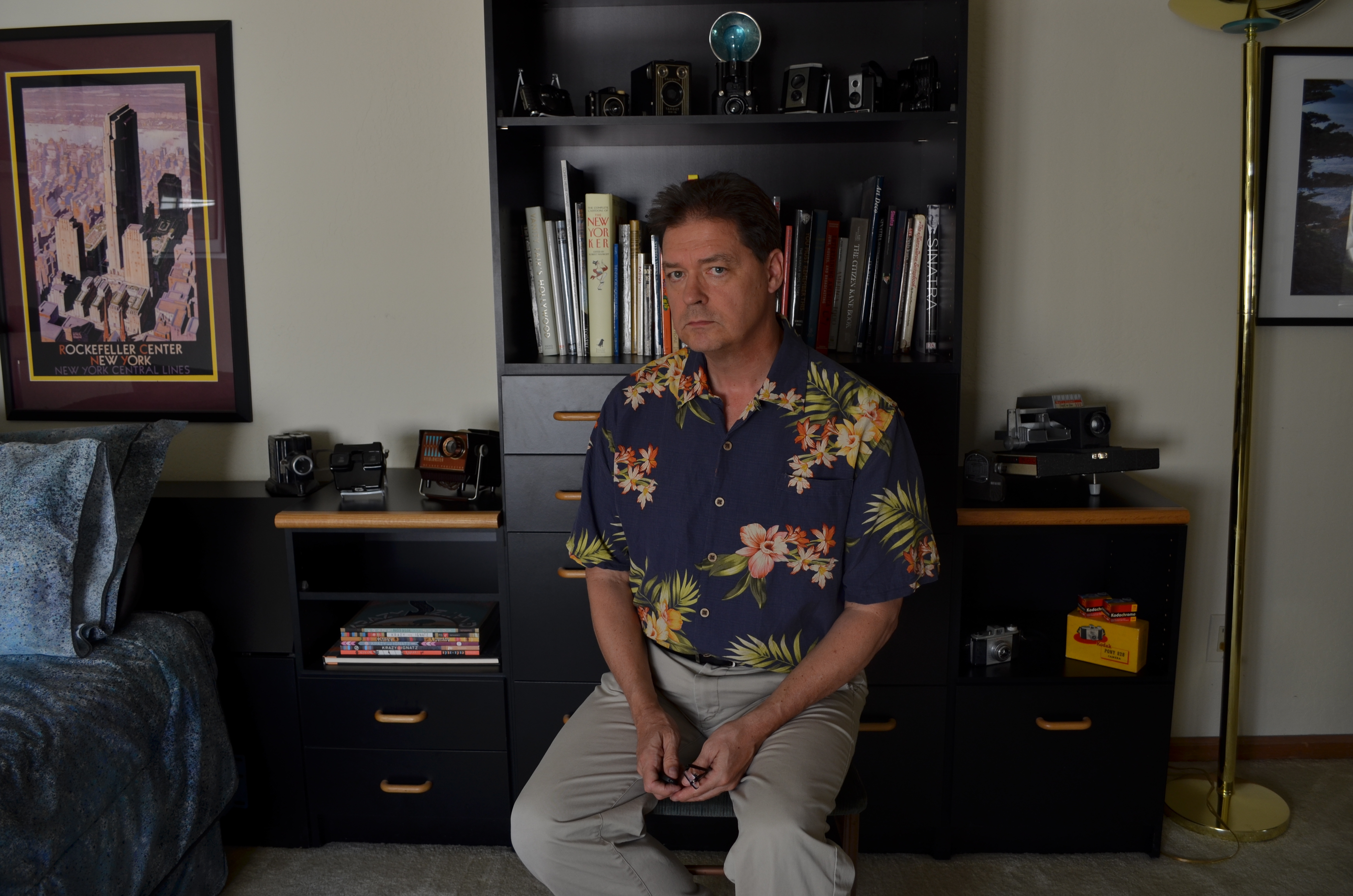
Waiting for inspiration. Yeah, how’s that workin’ out for ya?
By MICHAEL PERKINS
THERE MAY NOT BE SUCH A THING IN PHOTOGRAPHY AS “STYLE”.
Hmm? Come again? No way for the artist to brand his persona on his output, to accumulate a body of work stamped with his own exclusive, and wonderful, identity?
Well, given the special nature of photography, maybe not. Think about it. We all emerged as the quasi-legitimate spawn of painting. Yes, you can struggle and wriggle, but The Brush is essentially our aesthetic daddy, the most important shaper of our inherited rules on what to look at, how to see. Of course, we were no sooner whelped than we began dissing the old man, saying we were not at all like painting, that our means of measuring the world was distinct, different, revolutionary. The upshot is that the typical artists’ claim to a personal style, an identifiable visual signature, may not be, in image-making, how we do business at all.
Van Morrison (God’s gift to moody poets) summed it all up in the title of one of his classic albums, No Teacher, No Guru, No Method. And that means that, unlike the painters of antiquity, none of us shoots enough of any one approach to the world to claim that any of us has a “style”. Think about your own images. Is every one of them representative of one kind of thought? Or do you, like most of us, flit from one dynamic to another? Are any of you 100% committed to landscapes? Sacred subjects? Abstractions? Street? Cute kitties? No, and none of us ever were.
One of the most frustrating things about reviewing the careers of the greatest poets (there’s that word again) of photography is that there is no central thread, no typical image for many of the masters. What is the iconic signature of a Steichen, an Avedon, a Weston? Review forty years of photographs from Alfred Eisenstadt during his tenure at Life magazine and pick out one picture which defines him. You can’t. There is no Mona Lisa moment. And perhaps there shouldn’t be.
I’ve been shooting for over forty years, and if someone were to ask me to select one image that absolutely represented the essential me, I’d be dumbstruck. And maybe that’s to be expected. The world’s most democratic medium is also democratic toward its subject matter as well. In photography, unlike painting, everything can be a picture. Anything can be plucked out of the continuity of time and frozen for us to ponder, worship, objectify, or loathe.
We are all self-taught, self-created, without antecedent or influence. No Teacher, No Guru, No Method. It should make us feel free, and can, of course, make us terrified as well.
Here’s the central nugget of that freedom feeling: photography isn’t here “because of”, or “in order to”, or “so that”…..it’s just here.
And that is enough.
(follow Michael Perkins on Twitter @mpnormaleye.)
Related articles
- Edward Steichen’s great American Dream (japantimes.co.jp)
- Not your average photography book (audreysnaturequestphotography.wordpress.com)
LOOK THIRTY FEET FURTHER
By MICHAEL PERKINS
ONE SURE THING ABOUT TAKING IN “THE SIGHTS” AT THE AVERAGE TOURIST ATTRACTION. You will be channeled, herded, if you will, toward exactly what the proprietors want you to see. This insures most people their coveted “Kodak Moment”, with Mom and the kids standing at the precisely picturesque sweet spot at the cathedral, the ruins, the monument, the mountain, etc. In fact, Kodak worked with parks for years to actually post signs near such perfect vistas, a polite way of yelling OVER HERE, STUPID at passersby. Thanks for the flash cards, guys.
Obviously this attempt to guide visitors to the “good stuff” can result in the occasional great image. But you and I know that, for the most part, it amounts to the completion of a homework assignment. You know, like the opposite of fun, spontaneity, um, photography.
Tomorrow, class, bring a picture of yourself standing in front of a famous landmark. And remember to smile.
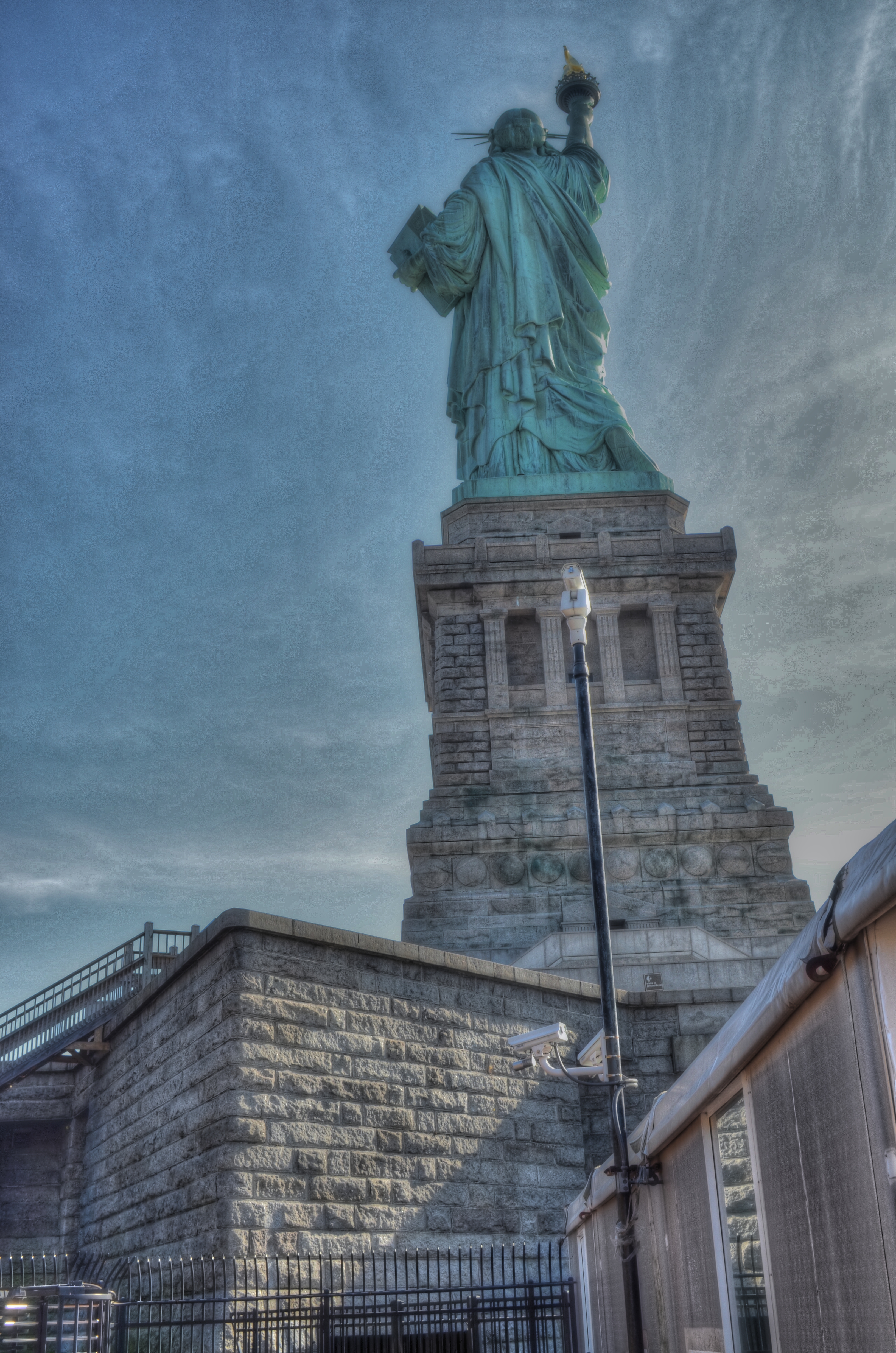
So go ahead and shoot the obvious thing. Just try to find another way to see it.
I’m a big one for wandering away from the tour group….not so far as to wander aimlessly into a scary forest full of monsters, just far enough to take in the entire area while the guide drones on.
I’m not so much interested in what’s available to photograph as I am in what else is available to photograph.
Sometimes, of course, you are better off just taking your approved thirty seconds in front of the waterfall and moving on. Other times you hit something, sometimes by just looking thirty feet further.
Do I have an example? Thought you’d never ask…
There is an over-hyped old house-turned-souvie shop in La Jolla, California (one of the most gorgeous coastal towns in the west) that sits atop a subterranean cave which looks out onto the ocean. Once inside the shop, the able-boded (and those who do not suffer claustrophobia) pay to enter an extremely dark, steep, damp and cramped staircase that takes them down below the house to the cave.
Now, for a guy with a camera constantly hanging from his neck, taking anything like a usable shot in this crimped cavern is largely a crap shoot, since light is, let us say, at a premium. So the “officially” cool thing, was, for me, frustrating to say the least, and I trudged up The Staircase From Hell (my knees aren’t what they used to be) to re-enter the shop at the earth’s surface. So far, so pointless.
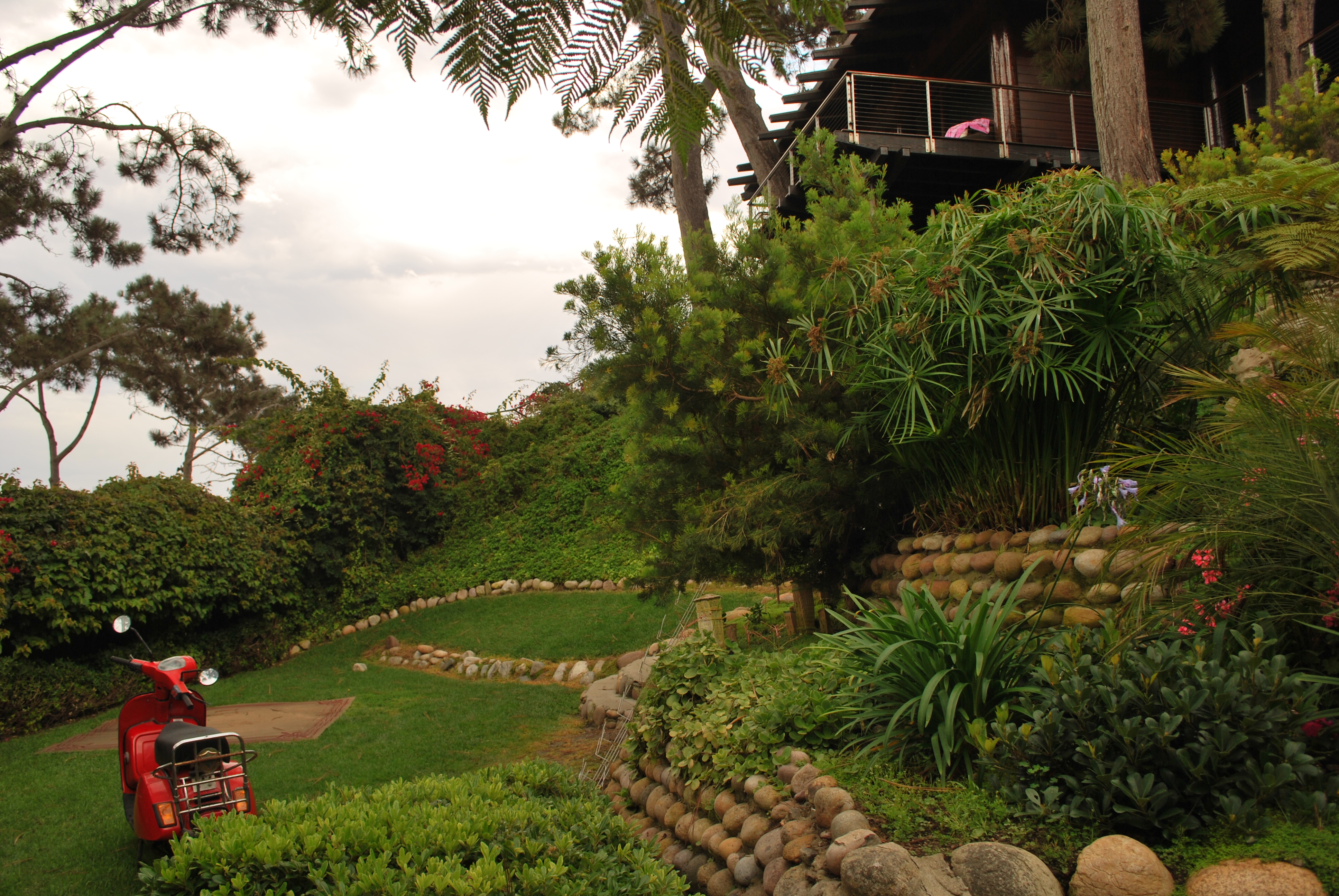
Pictures are where you find them, often tucked away behind so-called “attractions”. 1/100 sec., f/6.3, ISO 100, 18mm.
While my wife performed her mandatory inspection of the store’s copious supply of trinkets, I walked outside, then, instead of going back to the street, wandered around to the back of the building. Lucky choice. Suddenly I was in someone’s backyard, a hilly, curvy, strange little lot that could prove to be a nightmare for whatever neighborhood kid was doomed to cut the owner’s grass. It was only a matter of being curious enough to go about thirty feet off the official path….and yet here was the relief I wanted from chronic tour disease. An actual human habitation, complete with Hobbit-like stone landscaping and an extremely cool red scooter to counter-balance the rain-rich greens. Here was a picture I wanted. The “famous” view had shown me nothing. The “unimportant” view had given me everything.
Hey, I regularly get lost anyway. Why not have some fun doing it?
Now, where did my mommy go?
AFTER-IMAGE
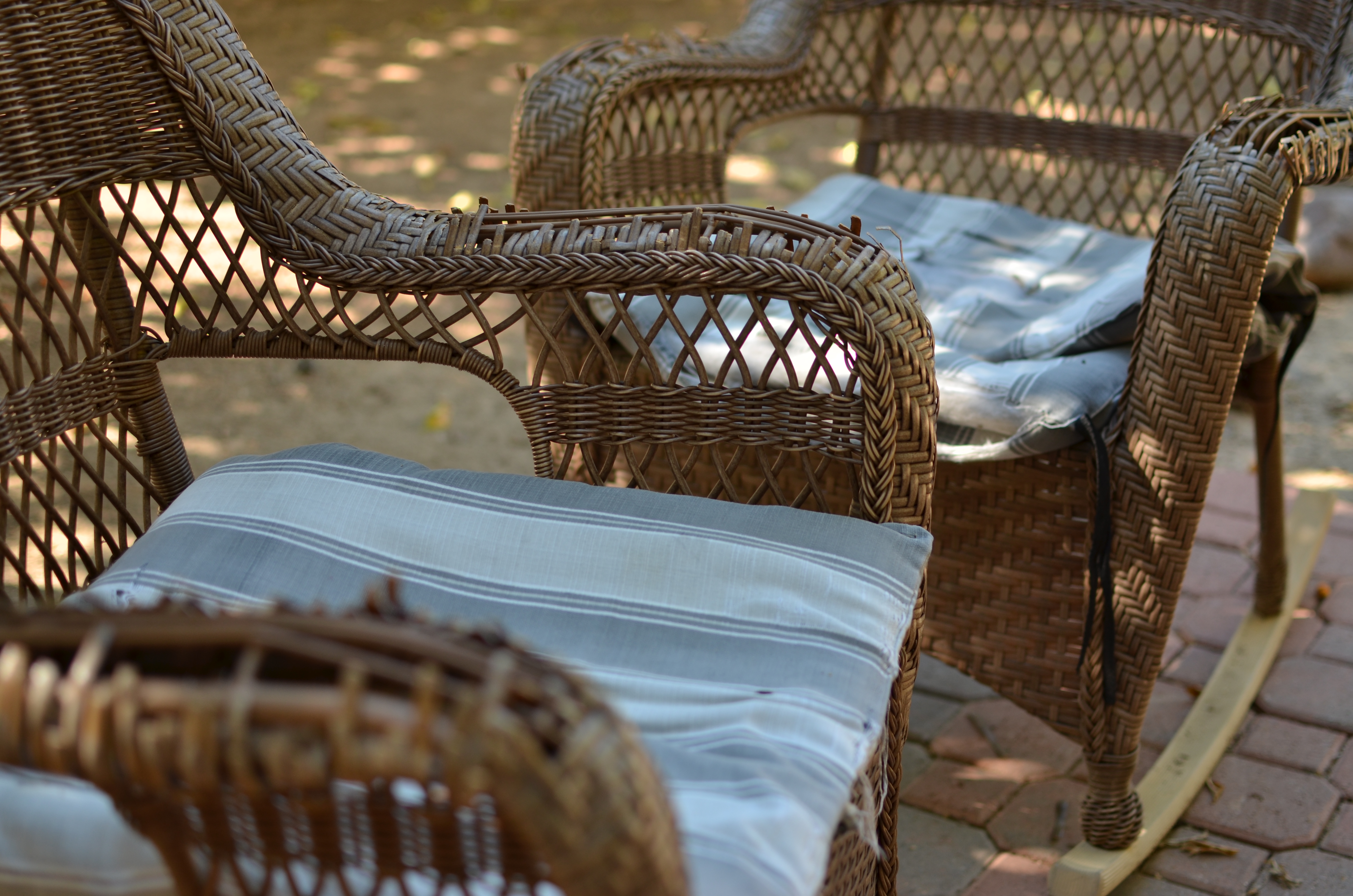
Old friends, or echoes of the old friends that once filled them. 1/320 sec., f/2.5, ISO 100, 35mm.
By MICHAEL PERKINS
WITHOUT GETTING TOO OVERLY OOKY-SPOOKY, I believe that photographers are witnesses to, well, ghosts. Specializing in the visualization of what might be (as near as our next frame), we are also retro-witnesses, or mediums, if you will, using found objects to call back the spirit of things that are no longer here. “If these walls could talk”, we instinctively remark as we walk into Notre Dame, Independence Hall, or Ellis Island, and yet, we think we are merely being poetic when we utter that phrase.
Are we?
Objects give up their secrets slowly, and in these posts I have often gone back to my fond desire to resurrect at least the essence of the owners of those objects, re-capturing people in the things they held, kept, cherished, wore to pieces, loved to death. We use every atom of our imagination trying to inch forward toward some revelation yet-to-be….a way to will a picture into being. But we are surprised to find ourself also trying to conjure forth echoes. And yet some of the most moving portraits we can produce show no people at all. I’m sure you have found this to be true.
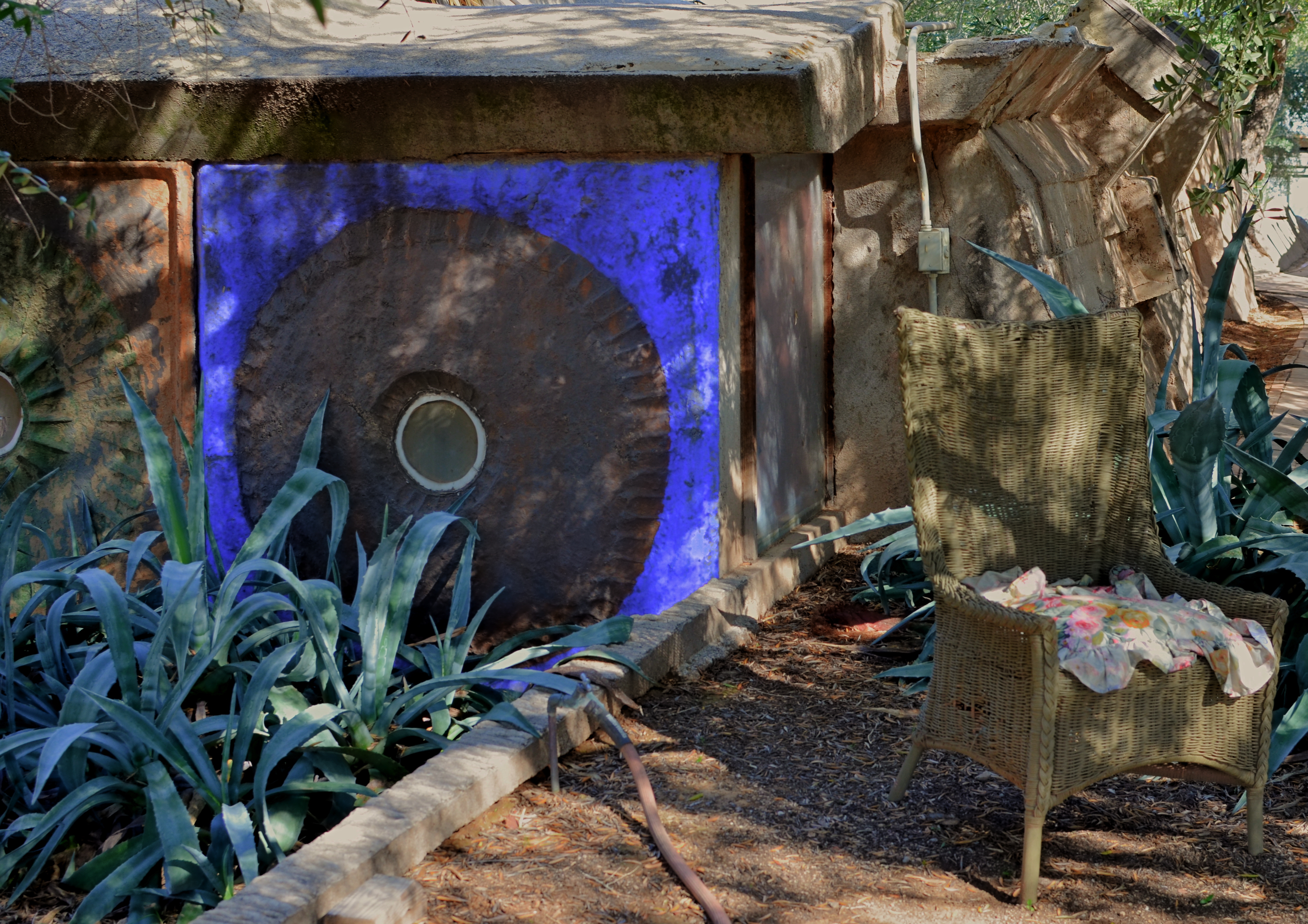
Somebody’s rest spot..but whose? And how long ago?
For reasons I don’t quite understand, chairs resonate especially for me. They’re personal. They’re social. Deals are struck in them; stories are told, babies are soothed, pauses are taken, contemplation occurs. Lives pass.
For you, it might be other things that are left behind, but still ringing with the echoes of people. Books. Clothing. Cars. They can be anything, but whatever their strange stories, you can often hear them, and that makes them far from “empty”. Cameras record everything that can be seen and lots of things that can only be sensed. They may be only machines, but in the hands of dreamers they are divining rods.
Your houses are haunted, and in a good way.
Call the spirits forth.
Related articles
- Between objects and life (thehindu.com)
 thenormaleye