TATTERED BEAUTY
By MICHAEL PERKINS
ONE OF THE MOST MIRACULOUS FEATS OF PHOTOGRAPHY, TO ITS ORIGINAL 19TH-CENTURY AFFICIONADOS, was to freeze time, to arrest or isolate the continuum of progress. Indeed, if you think about it, the act of snatching a fragment of life, of holding it immobile for endless examination, is truly amazing, even at this late date in the art’s development. We spend a huge part of the time that is trying to grab a souvenir of what’s about to become was.
Photography’s great gift, being able to document time’s passing….its ravages, its wear and tear on the things of this life is often focused on the living world; people, trees, the temporary aftermath of a rainstorm, the quick passing of a sunset. But it can be an intriguing way to measure the impact of time on inanimate thing as well. Slicing, dicing, magnifying, and parsing time as we do with cameras, we can concoct an infinite number of ways to pore over the details of things that, in previous ages, only the poets fixated upon. The world has become our microscope lab, a petri dish for experiments in seeing and analyzing.
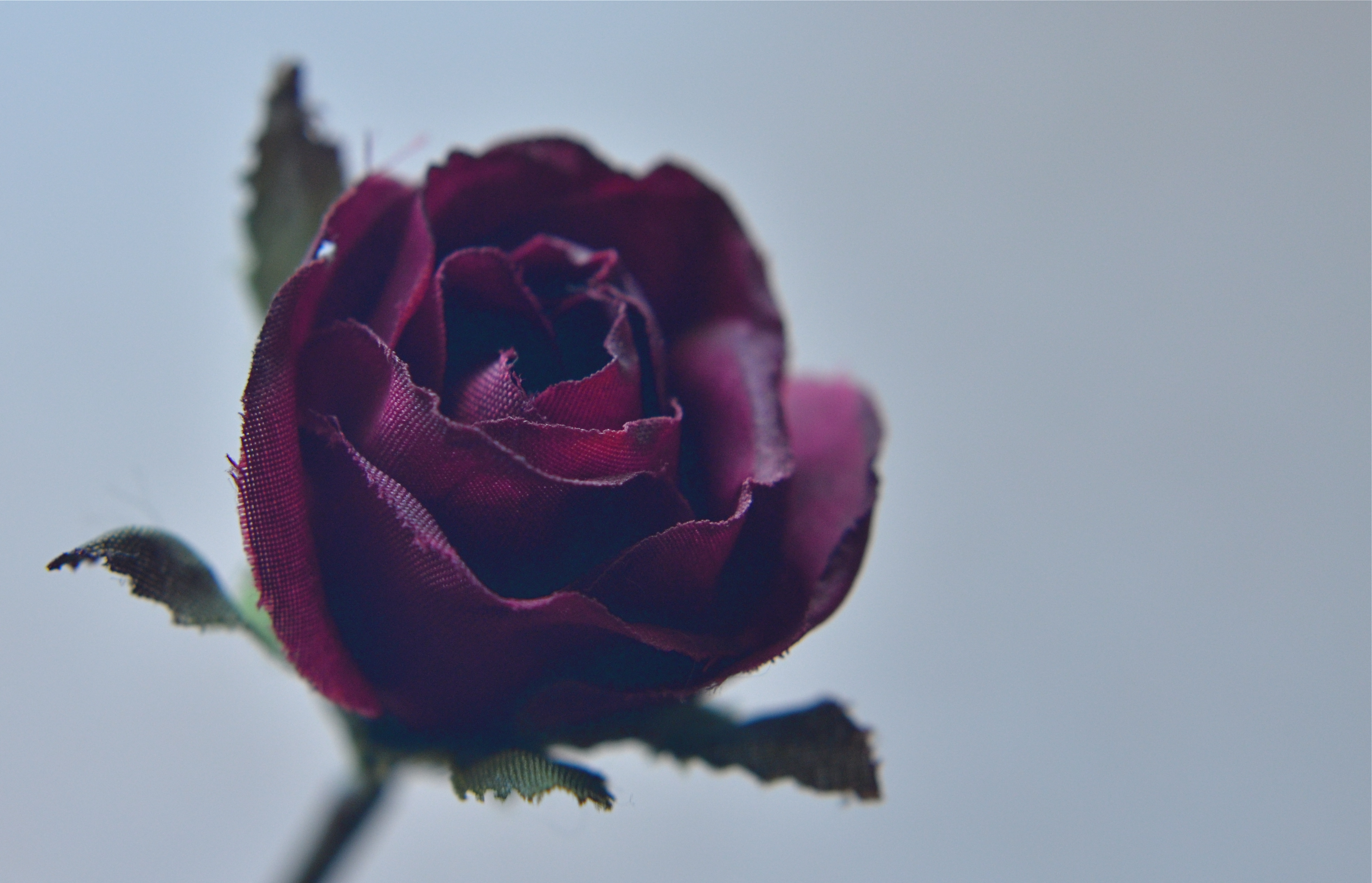
“A rose is a rose”. Unless it’s a ragged, fake rose. 1/50 sec., f/4.5, ISO 640, 35mm.
What started this whole train of thought was the recent discovery, under a bed, of an old fabric rose. Sadly, I have long since passed the point where I can actually throw anything away without having some kind of debate inside my skull about whether it’s worth looking at, one more time, before a lens. In this case, I was intrigued by how frayed and threadbare the thing had become over time, its petals and leaves bereft of any ability to create even the illusion of beauty. Its magic, and thus its reason to exist, had vanished.
I always keep a stack of three magnifying diopters handy to attach to the front of my prime 35 lens, giving me a poor-man’s macro at about 10x magnification, and I was soon within tight enough range to see the ragged edges and unraveled texture of the faux rose. It looked just a bit flat illuminated by soft window light, though, so I tilted the blossom away from the window a tad to deepen the shadows in some petals and give it a little added depth. Too me five minutes to find out the answer to the everlasting photo question, “is this anything?”
Even if such little exercises don’t result in great pictures, they do result in a speedup of the learning curve, and as practice, as seeing everything in as many ways as possible.
Not a big lesson. Just a lot of little ones bunched together.
Follow Michael Perkins on Twitter @MPnormaleye.
Related articles
- framing an emotion (afternoonwalks.wordpress.com)
OF BIRDS AND BARRIERS
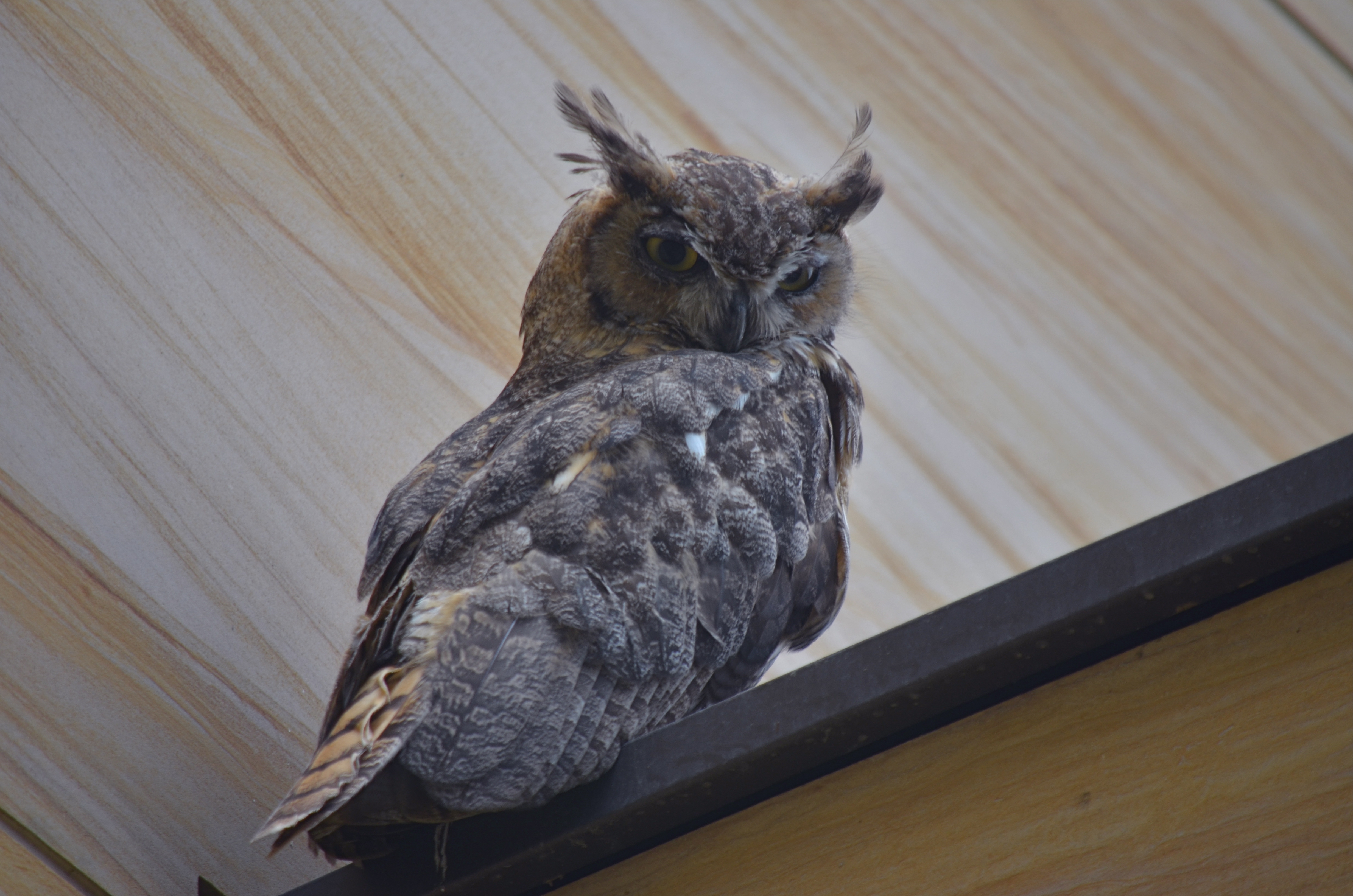
Zoom lenses, while great, price many shooters out of the market for making shots like this. 1/160, f/5.6, ISO 100, 300mm.
By MICHAEL PERKINS
PHOTOGRAPHY IS ART’S GREATEST “DEMOCRATIZER“, a medium that levels the playing field for creative minds as no other medium can. “Everyone gets a shot”, goes the old saying, and, today, more than ever, the generation of images is so available, so cost-effective that almost anyone can play.
Yes, I said almost. Because even as cameras become so integrated into our devices and lives as to be nearly invisible, there is at least one big stump in the road, one major barrier to truly universal access to image-making. That barrier is defined by distance and science.
For those longing to bring the entire world ever closer, zoom lenses and the optics they require still slam a huge NO ADMITTANCE door in front of many shooters, simply because their cost remains beyond the reach of too many photographers. Lenses going beyond around 300mm simply price users out of the market, and so keep their work confined in a way that the work of the rich isn’t.
Look at the metadata listed in the average “year’s best” or “blue ribbon” competitions in National Geographic, Audubon, Black & White, or a score of other photo magazines. Look specifically at the zoom ranges for the best photos of birds, insects and general wildlife. The greatest praise is heaped on images taken with 400, 600, 800mm glass, and rightfully so, as they are often stunning. But the fiscal wall between these superb optics and users of limited funds means that many of those users cannot take those images, and thus cannot compete or contribute in the same way as those who can afford them. For an art that purports to welcome all comers, this is wrong.
The owl image at the top of this post fell into my lap recently, and I was able to take advantage of this handsome fellow’s atypical appearance at a public place with the help of a 300mm lens. But that’s only because (A) he was still only about forty feet away from me, and (B) he is as big as a holiday ham. If he and I had truly been “out in the wild”, he would have been able to effectively enforce his own no pictures today policy, as I would have been optically outflanked. Two options would thus emerge: drop thousands for the next biggest hunk of glass, or take pictures of something else.
I am for anyone being able to take any kind of picture, anywhere, with nothing to limit them except their vision and imagination. Unfortunately, we will need a revolution on the high end of photography, such as that which has happened on the entry level, to make the democracy of the medium universal and complete. We need an “everyman” solution in the spirit of the Kodak, the Polaroid, and the iPhone.
The world of imaging should never be subdivided into haves and have-nots.
follow Michael Perkins on Twitter @mpnormaleye.
SECOND SIGHT, SECOND LIFE
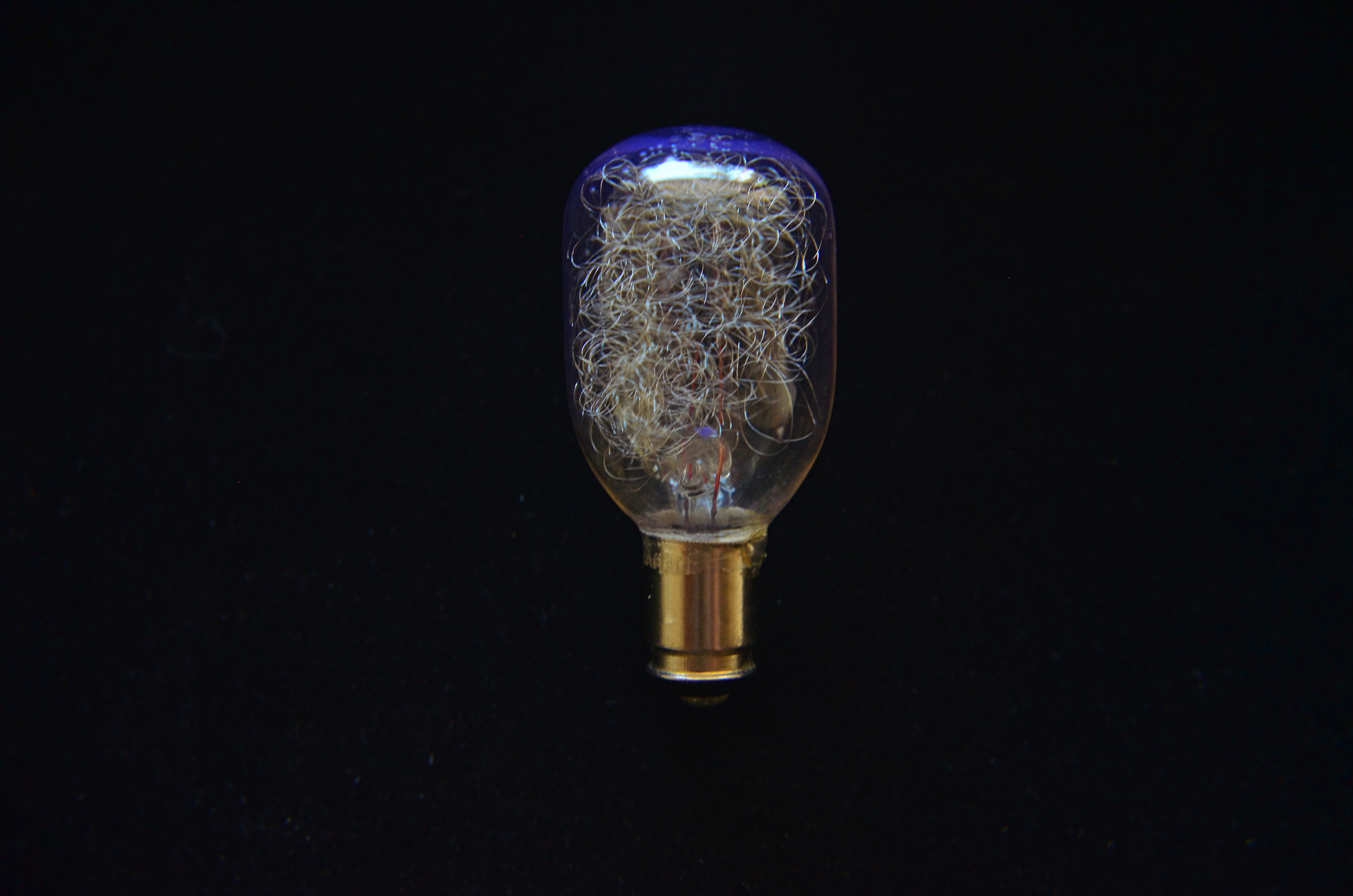
Pragmatically “useless” but visually rich: an obsolete flashbulb glows with window light. 1/80 sec., f/5.6, ISO 640, 35mm.
By MICHAEL PERKINS
A DECADE-AND-A-HALF INTO THE TWENTY-FIRST CENTURY, we are still struggling to visually comprehend the marvels of the twentieth. As consumers, we race from innovation to innovation so amazingly fast that we scarcely apprehend the general use of the things we create, much less the underlying aesthetic of their physical forms. We are awash in the ingenuity of vanishing things, but usually don’t think about them beyond what we expect them to supply to our lives. We “see” what things do rather than seeing their essential design.
As photographers, we need not only engage the world as recorders of “reality” but as deliberate re-visualizers of the familiar. By selecting, magnifying, lighting and composing the ordinary with a fresh eye, we literally re-discover it. Second sight gives second life, especially to objects that have outlasted their original purpose. No longer needed on an everyday basis, they can be enjoyed as pure design.
And that’s exciting for anyone creating an image.
The above shot is ridiculously simple in concept. Who can’t recognize the subject, even though it has fallen out of daily use? But change the context, and it’s a discovery. Its inner snarl of silvery filaments, designed to scatter and diffuse light during a photoflash, can also refract light, break it up into component colors, imparting blue, gold, or red glows to the surrounding bulb structure. Doubling its size through use of “the poor man’s macro”, simple screw-on magnifying diopters ahead of a 35mm lens, allows its delicate inner detail to be seen in a way that its “everyday” use never did. Shooting near a window, backed by a non-reflective texture, allows simple sculpting of the indirect light: move a quarter of an inch this way or that, and you’ve dramatically altered the impact.
The object itself, due to the race of time, is now “useless”, but, for this little tabletop scene, it’s a thing made beautiful, apart from its original purpose. It has become something you can make an image from.
Talk about a “lightbulb moment”….
Follow Michael Perkins on Twitter @mpnormaleye.
Related articles
- “A Sight Into My Photographic Mind” (Perspective) (mrphotosmash.wordpress.com)
PARADOX
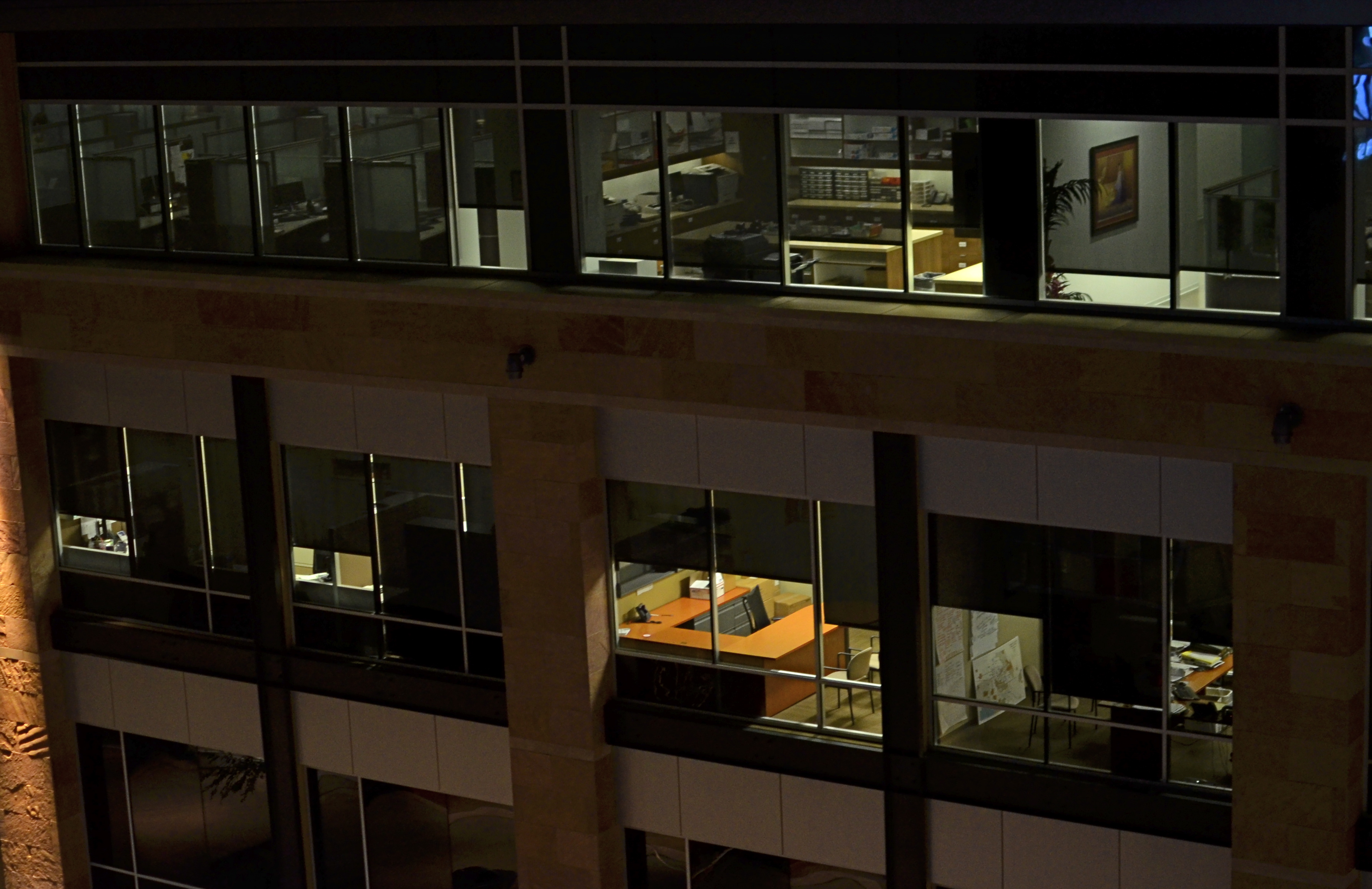
Where is the main story here? Far away, or up close? 1/60 sec., f/1.8, ISO 400, 35mm.
By MICHAEL PERKINS
EVERY SET OF VISUAL ELEMENTS, CAPTURED AT OPPOSITE EXTREMES, DELIVERS A COMPLETELY DIFFERENT SET OF STORY RESULTS. For photographers, the everlasting tug-of-war, involving “what to shoot?” is usually between “how close” and “how far away”? Even the lenses we buy, along with their unique properties, reflect this struggle between the intimate tale, told by a close-up, versus the saga, drawn from a vast panorama. There is a season, turn turn turn, for all kinds of image-making, and it’s no great revelation that many shooters can look at the same grouping of components and get remarkably different results.
Had I come upon the cluster of office cubicles seen in the image above on, say, day “A”, I might have been inclined to move in close, for a personal story, a detailed look at Life In The Office In This Modern World, or how worker #3456 left behind his umbrella and half a tuna sandwich. As it turned out, however, it was day “B”, and instead I saw the entire block of spaces as part of an overall pattern, as a series of lives linked together but separate, resulting in the more general composition shown here. I was shooting wide open at f/1.8 to retrieve as much light, handheld, as quickly as possible, to use the surrounding darkness to frame all the visual parts of the scene as boxes-within-boxes, rather than a single cube that warranted special attention.
Next time I’m up to bat with a similar scene, I could make the completely opposite decision, which is not a problem, because there never is a wrong decision, only (usually) wrong execution. And, yes, I realize that, by shooting empty offices, I dodged the whole ethical bullet of “should I be spying on all these people?”, otherwise known as Street Photographers’ Conundrum # 36.
I love wrestling with the paradox of how close, how far. There can be no decisive solution.
Only the fun of the struggle.
Welcome to our newest followers. Check their work out at :
http://www.en.gravatar.com/glennfolkes85
STILL GRAND, STILL CENTRAL
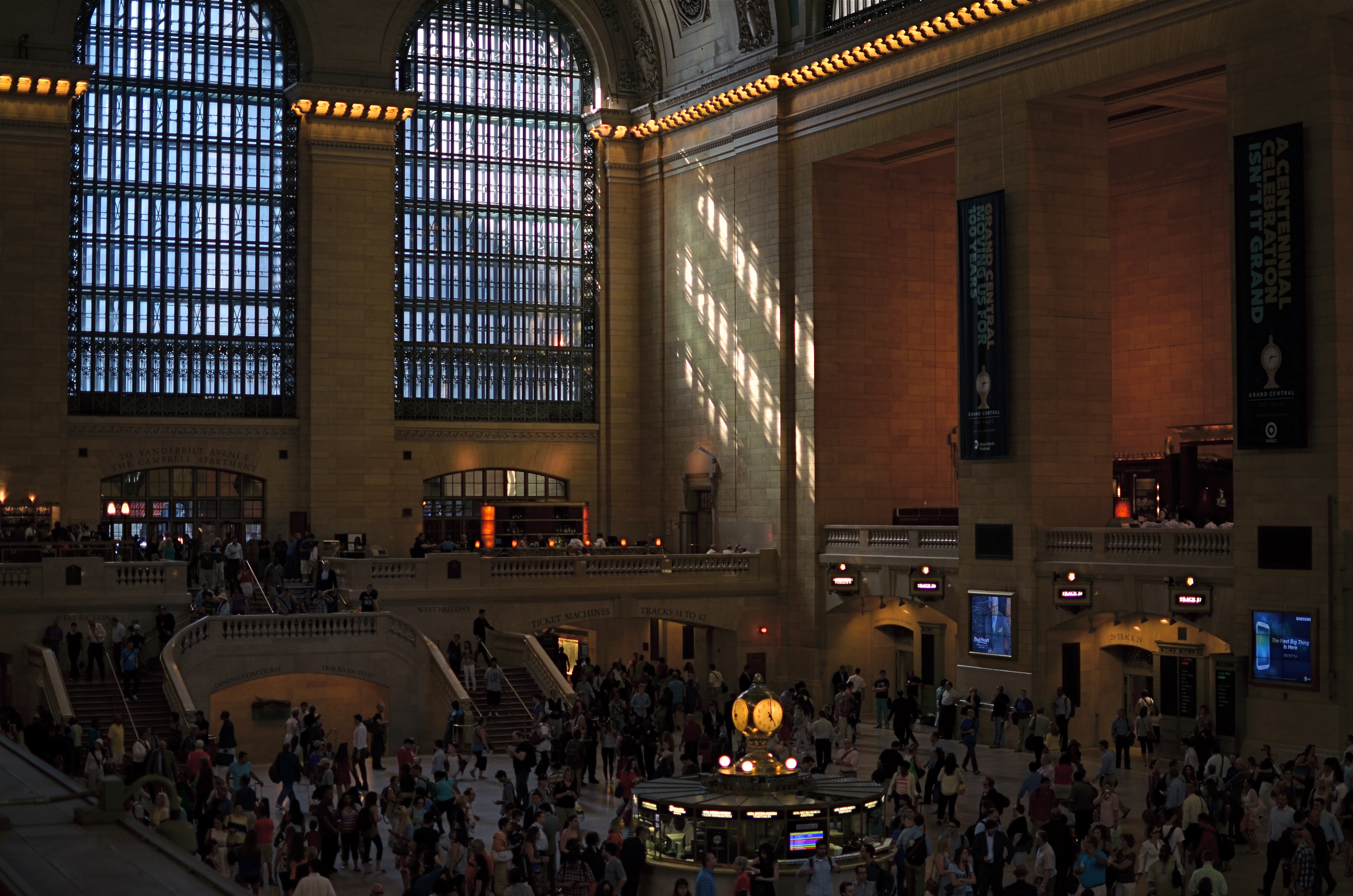
Grand Central Terminal, New York City. 2:11PM, June 21, 2013.
By MICHAEL PERKINS
AMERICA’S ROMANCE WITH RAIL TRAVEL MAY NOW JUST BE A SORT OF CASUAL ACQUAINTANCE (hey, we can still be friends), but the temple which sparked much of the old love between man and train still throbs with life. At 100, Grand Central Terminal (don’t, they beg, call it a station) still delights the eye of even a jaded New Yorker with the sheer scale of its vision. Over 750,000 people per day file through its platforms, shops and restaurants, and, of course, its commuter connections.
As to the era when the terminal truly connected the entire nation, the inevitability of the building as a final destination was never better captured than in the opening for the old network radio series named for it:
As a bullet seeks its target, shining rails in every part of our great country are aimed at GRAND CENTRAL STATION, heart of the nation’s greatest city.
Drawn by the magnetic forces of the fantastic metropolis, day and night, great trains rush toward the Hudson River…..sweep down its eastern bank for one hundred and forty-three miles…..flash briefly by the long, red row of tenement houses south of 125th street…..dive with a roar in to the two and one-half mile tunnel that burrows beneath the glittering swank of Park Avenue…and then…..GRAND CENTRAL STATION!!!!
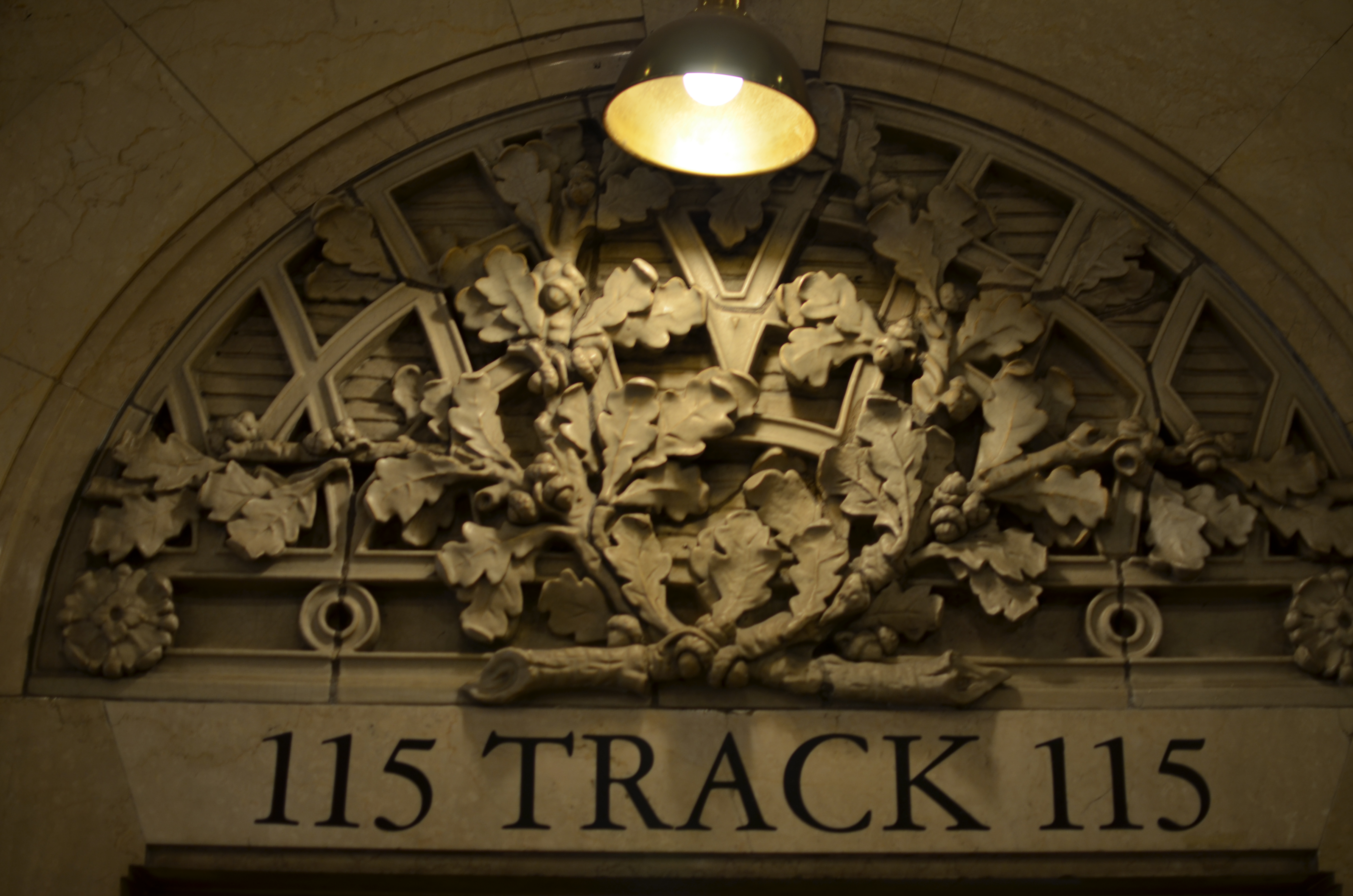
Details, details.
Shooting the terminal is a bit of an alluring trap, since we all want the wider-than-wide, one-shot glama-panorama that takes in every window, skylight, side stall, commuter, ceiling detail and kiosk. The trap is in becoming so wedded to that shot that we forget about all the smaller dramas and details that would be lost within those gigantic, where’s-waldo mega-frames. On my latest trip there, I had been avoiding the usual wide-angle mania that is all too easy to surrender to, in shooting New York, traveling with only a 35mm prime lens and forcing myself to shoot smaller, more intimate subjects. Primes have normal, human-eye proportions, rather than the distorted stretch of a wide-angle, and cannot zoom. Therefore, shooting inside Grand Central meant:
I couldn’t even dream of getting everything in a single shot, meaning a select part of the story had to be chosen over a “master shot”.
I would have a lens that’s incredibly fast and sharp, so I could take advantage of the terminal’s vast interior (275 ft. long, 120 ft. wide, 125 ft. high) a space that is still largely illuminated by east-west natural light.
When I arrived, the golden glow of mid-afternoon was gently warming its way through the 75-ft-high arched windows on the terminal’s west side. I avoided shooting toward the east, since it currently features large “1-0-0” anniversary numerals in the three windows, plus the new Apple store, both of which I regard as barriers to visual enjoyment of the building. Go time: I settled on 1/200 second, ISO 160, wide open at f/1.8 (sharp to infinity since I was shooting from the diagonal opposite of my subject…we’re talking looong distance) and I kept one of about twenty frames.
Lenses, no less than subjects, are about decisions. You choose one thing and un-choose all other options.
And let the sun shine through.
For more history on the terminal, check out this article, courtesy of Gotham magazine:
http://gotham-magazine.com/living/articles/centennial-secrets-of-grand-central-terminal
YOU ARE THE CAMERA
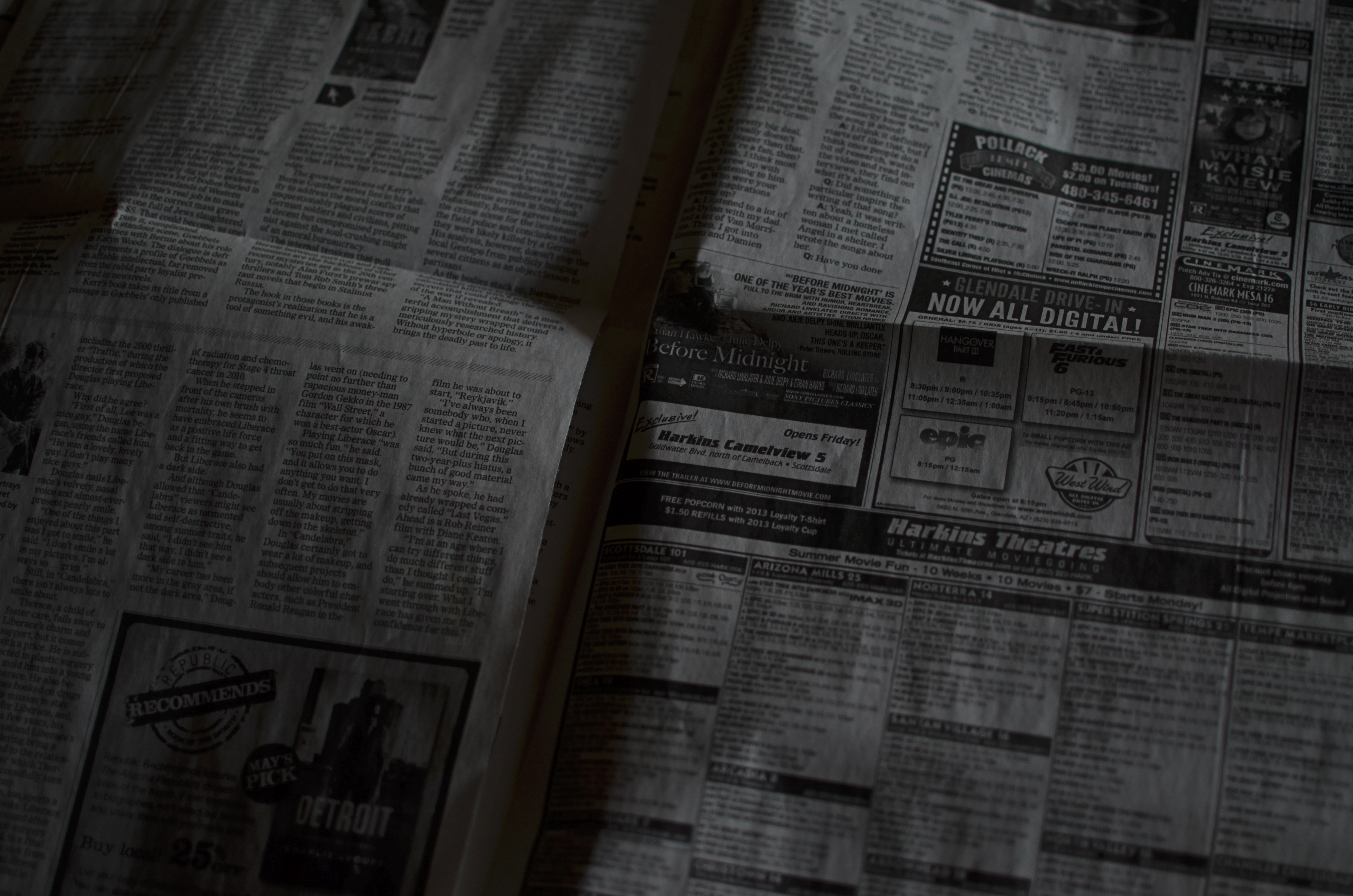
Dark Days for the printed page. 1/80 sec., f/1.8, ISO 100, 35mm.
By MICHAEL PERKINS
THE MOST ANNOYING COMMERCIAL ON TELEVISION AT PRESENT is the one from Apple reminding you that more people take pictures with the iPhone5 than with any other camera in the world. Now, I understand that The Men Who Would Be Steve at Apple need to assert their dominance in a rapidly accelerating race between smartphone camera brands. It’s just good business, and all that. Granting that, let’s agree that their statement is essentially meaningless for photography.
Apple can claim that their photo gadget is in more hands than anyone else’s? Ho-hum. The Kodak Brownie was able to make the same claim over 100 years ago, and successfully defend it for almost another fifty. We’re number one, sis-boom-bah, and what does that have to do with the kind of pictures that are being taken? The iPhone5 is a technical marvel on many levels, and it contains, among many other toys, a reasonably reliable, limited point-and-shoot-camera. You will always be able to get some kind of image on it under nearly any circumstances.
However, the Apple TV ad, while factually accurate, is artistically false, since it leads one to the spurious conclusion that more iPhone5 pictures means more excellent pictures. And there isn’t a camera, cheap or cherry, that can make that statement. I get just as agitated when trendo camera mags try to imply that if your gear costs thousands, your pictures will look like a million.
We’ve had almost two hundred years to shake off this childish notion. Equipment does not equal excellence. Convenience, speed, affordability, flexibility…cameras can make all these claims. But they do not confer the title of photographer on anyone.
Only you can do that.
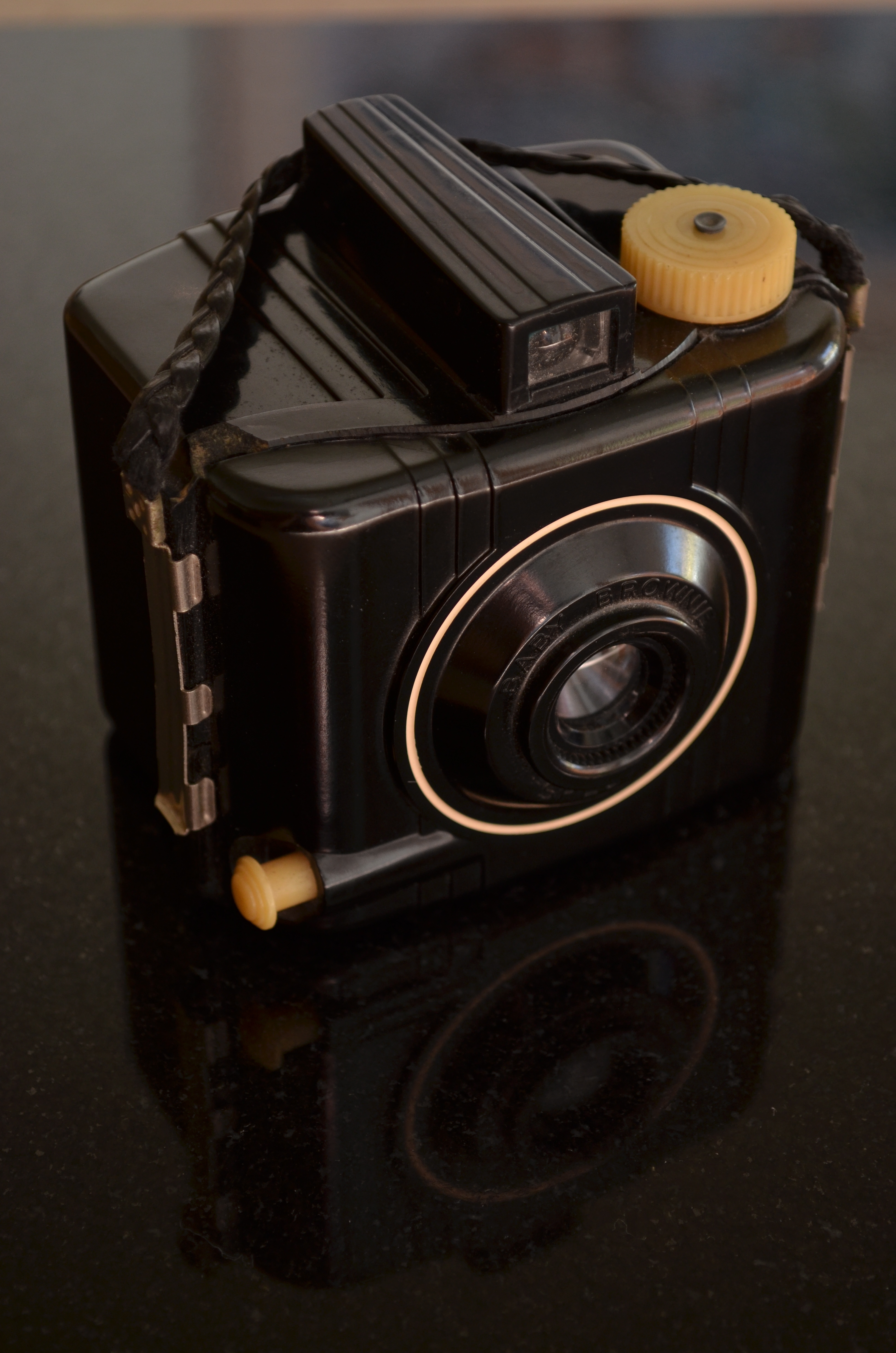
There used to be more of these than any other camera in the world, and so what?
And you can do it with a cheap piece of garbage, or a technical wonder, or any equipment stage in between. The idea is all. Everything else is just tinkering.
Here’s another piece of lunatic logic coming from another direction:
The idiotic recent decision of the Chicago Sun-Times to lay off all of its staff photographers, replacing them with freelancers (whom they will train on iPhones!), is not a lousy idea because there aren’t enough low-cost cameras out there to afford them some kind of coverage on their stories. It’s a lousy idea because it’s based on a flawed concept: the belief that photography is a universal skill, and that bystanders with smartphones are the equal of seasoned visual journalists, imbedded in their communities and schooled in its sources. They are not, and can never be.
Sadly,you can bet that editors across the nation are watching to see if the Sun-Times gets away with it. And they just might. Of course the quality of image reporting will take a hit, but since people are leaving the traditional newspaper as if it has leprosy anyway, will the customers know the difference? Look for this horrible move to be duplicated at a newspaper near you, since it’s (a) cheap, (b) easy to explain failure some other way, and (c) oh, yeah did I mention it’s cheap? Ironic sidebar: this is, officially the first time a newspaper has opted for less technology to become more competitive.
Expensive cameras and decent salaries are certainly no guarantee of good news coverage, but a staff loaded with veterans of wars, uprisings, elections, disasters and human interest is. The fact that several of them are Pulitzer Prize winners isn’t exactly a disqualifier, either.
You are the camera. You make the picture, regardless of the technology at hand. Forget that, and you might as well be holding a canned ham.
follow Michael Perkins on Twitter @MPnormaleye.com
Related articles
JOINTS
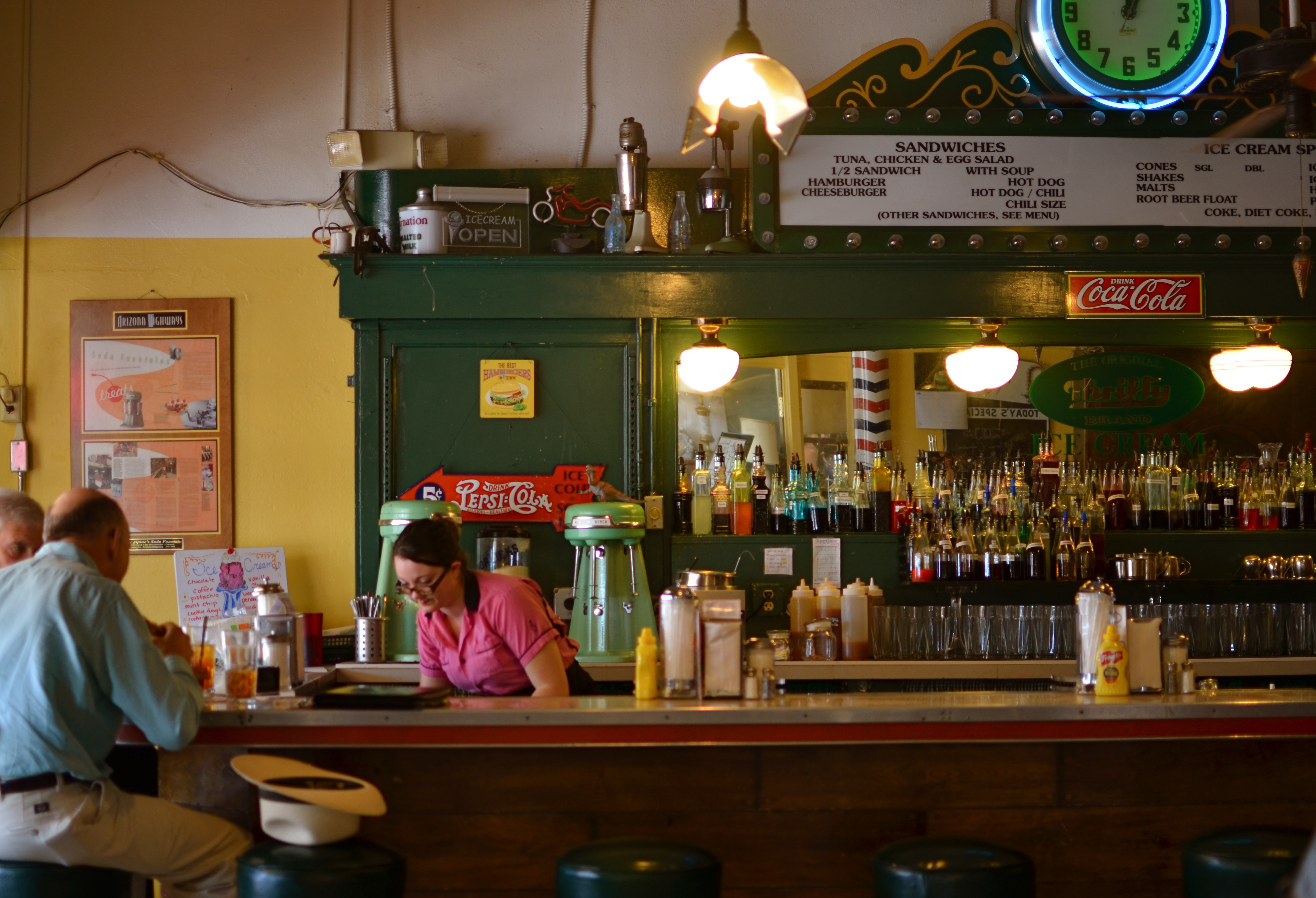
Try the special. Heck, it’s all special at the lunch counter at McAlpine’s Soda Fountain in Phoenix. 1/100 sec., f/1.8, ISO 100 35mm.
By MICHAEL PERKINS
BETTER MINDS THAN MINE HAVE LAMENTED THE HOMOGENIZING OF URBAN LIFE, that process by which uniqueness is gradually engineered out of human experience in buildings, businesses and products, to be replaced by the standardized, the research-proven, the chain-generated.
We all say we hate it. And we all put the lie to that statement by making the super-brands, all those golden arches and whole food superstores, more and more fabulously wealthy.
As a photographer, I feel a particular pang for the ongoing vanishing act that occurs in our cities. Who wants to aspire to take more and more pictures of less and less? Is a Starbucks in Kansas City really going to give me a profoundly different experience than a Starbucks in Jackson Mississippi? How, through creative location of the mug racks? And here, in the name of honesty, I have to catch myself in my own trap, since I also often default to something “safe” over something “unproven”. That is, I am as full of it as everyone else, and every day that I don’t choose to patronize someplace special is a day that such places come closer to the edge of the drain.
So.
It’s a delight to go someplace where fashion, and relevance, and context have all been rendered moot by time. Where, finally, just the fact that you have lasted this long means you can probably do so indefinitely. Such a place is McAlpine’s Soda Fountain Restaurant in central Phoenix. Birthed in 1926, the place was itself a part of America’s first huge surge of chain stores, originally housing a Rexall Pharmacy but centered around its fountain counter. The fare was, and remains, simple. No pondering over trans fats, no obsessing over sugar, no hair-raising tales of gluten reactions. Gourmet means you take your burger with both ketchup and mustard. “Soda” implies not mere fizzy water but something with a huge glob of ice cream in it. Thus your “drink” may also be your dessert, or you can just skip the meal pretense altogether and head right for the maraschino cherries.
McAlpine’s is a place where the woods of the booths are dark, and the materials of general choice are chrome, marble, neon, glass. Plastic comes later, unless you’re talking about soda straws. The place is both museum and active business, stacking odd period collectibles chock-a-block into every nook as if the joint itself weren’t atmosphere enough. But hey, when you’re a grand old lady, you can wear a red hat and white gloves and waist-length pearls, and if you don’t like it, take a hike, thankyouverymuch.
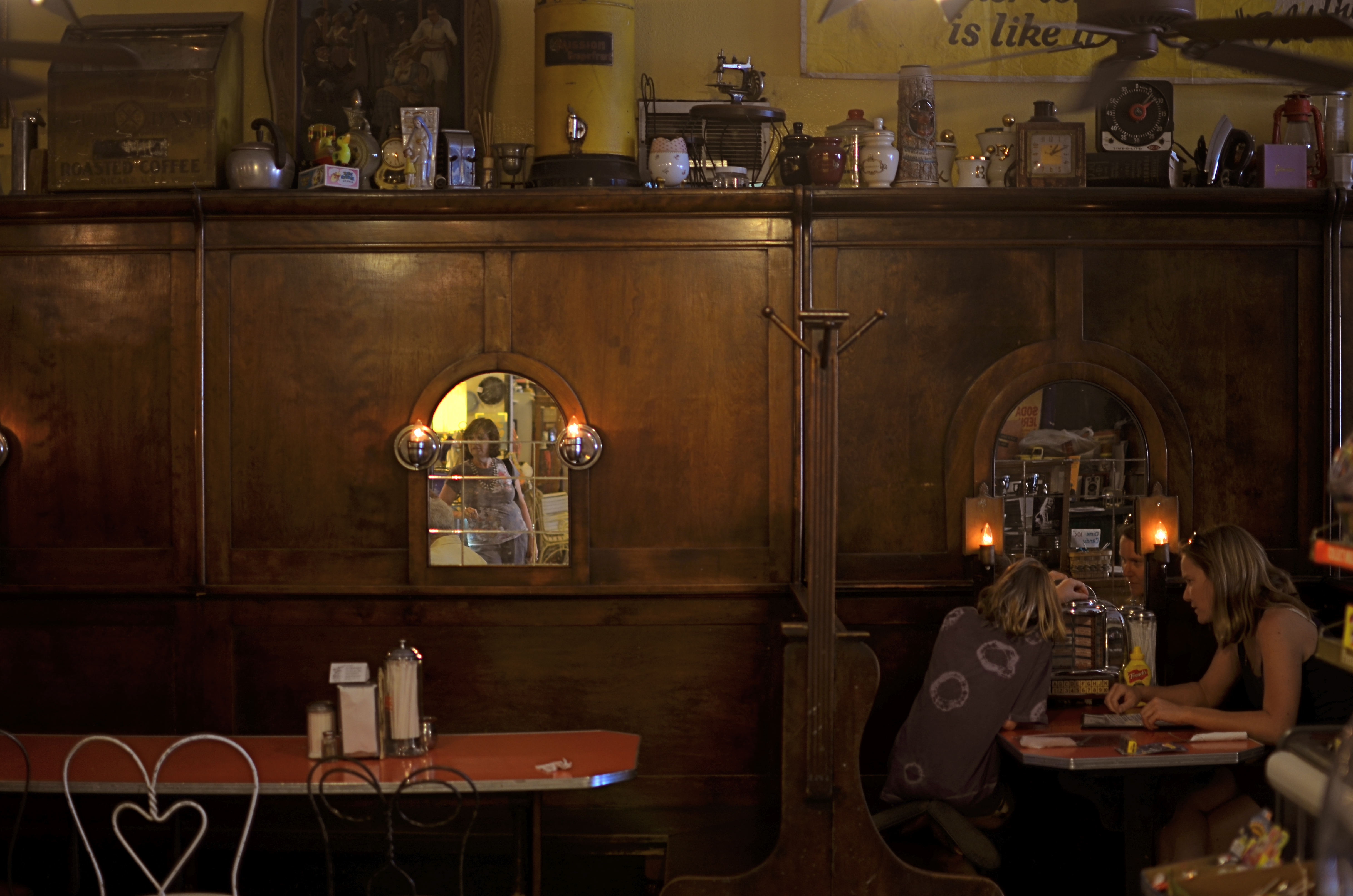
Three plays for a quarter, so you can eat “Tutti Fruiti” and listen to it, too. 1/40 sec., f/1.8, ISO 100, 35mm.
Graced with a 35mm prime lens opened all the way to f/1.8 and great soft midday light from the store’s front window, I could preserve the warm tones of the counter area pretty much as they are. For the booths, a little slower shutter speed was needed, almost too long for a handheld shot, but delivering a more velvety feel overall. Both shots are mere recordings, in that I was not trying to “sculpt” or”render” anything. McAlpine’s is enough just as she comes. It was only a question of light management and largely leaving the place to tell its own story.
What a treat when a subject comes to you in such a complete state that the picture nearly takes itself.
Even better when the subject offers 75 flavors of ice cream.
Especially when every other joint on the block is plain vanilla.
follow Michael Perkins on Twitter @mpnormaleye.
FROM TOY TO TOOL
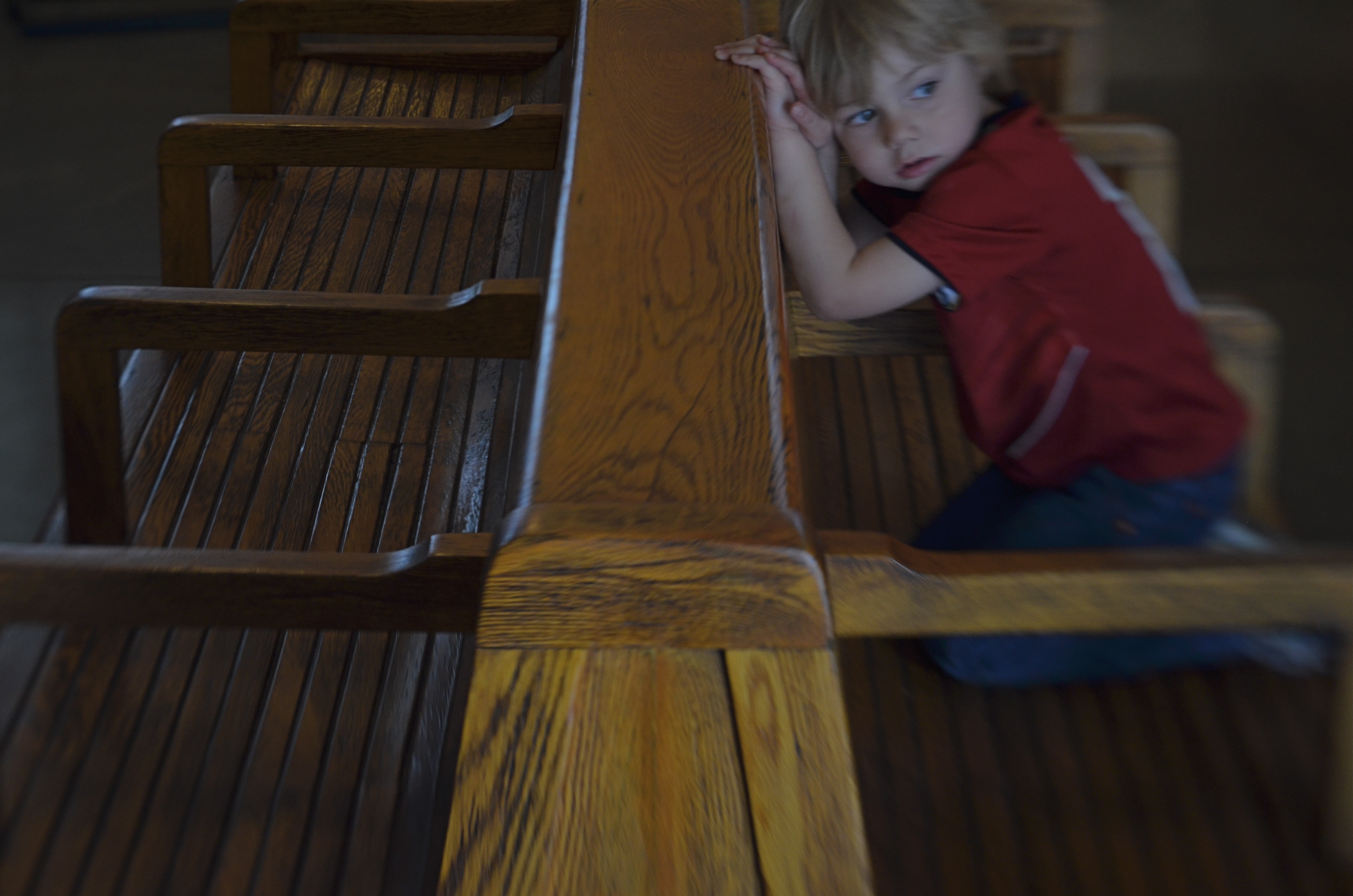
Selective focus can help direct your viewer’s eye. Taken with a Lensbaby Spark lens at 1/80 sec., f/5.6, ISO 320, 50mm.
By MICHAEL PERKINS
A LONG STANDING BIT ON THE DAVID LETTERMAN SHOW, rather than claiming to be entertaining, actually poses the question of what entertainment actually is. Entitled “Is This Anything?”, the feature consists of about thirty seconds of acts or feats that might be amazing (like juggling), might be banal (like, um, juggling) or might qualify as merely strange. After the curtain is drawn, Dave and Paul briefly discuss the merits of what ever strangeness just transpired, and ask each other if “that was anything”. Sometimes there is no clear-cut decision. The show has disclaimed responsibility, and entertainment remains in the eye of the beholder.
That’s how you can feel the first time you use a Lensbaby.
Released several years ago to inventor Craig Strong’s great monetary benefit, the Lensbaby comes in a variety of
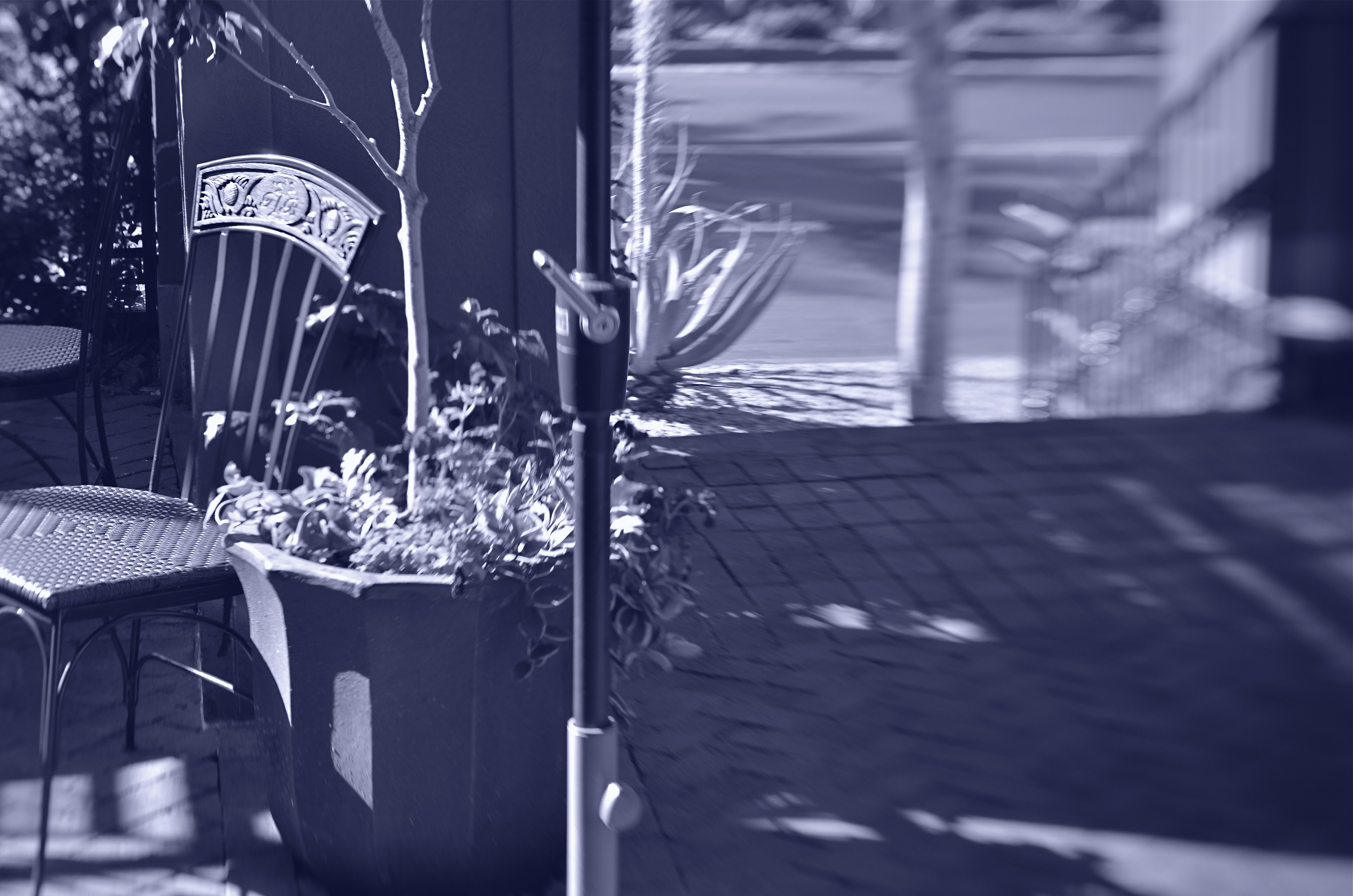
levels but is essentially an affordable tilt-shift attachment, a way to soften focus over selective areas of the frame while rotating the “sweet spot” of sharper focus wherever the shooter feels it should go. Now, essentially, selective focus is really part of every photo ever taken, since a choice of depth-of-field is made every time the shutter snaps. Lensbaby, however, offers the chance to pre-design the precise level of left-right, high-low focus, in the camera, and before the shot is taken. No post-processing is needed, and each use of the effect is completely under the shooter’s control, and at a fraction of what dedicated DSLR lenses cost.The Lensbaby effect is understandably an attractive gimcrack for the instinctive subculture of lo-fi photography, they of the hipster nonchalance and light-leaking, fixed-focus plastic cameras. Hey, it looks freaky, random, edgy. But, like everything else in your kit bag, it’s either toy or tool. The verdict as to which it is comes out one picture at a time.
So far I am whelmed….not overwhelmed, not underwhelmed. For one thing, Lensbabies are a lot of extra work. The entry-level model, the Spark, is actually a lens within a springy plastic bellows. You have to hold your camera body, delegate fingers from both hands to rotate the axis of the front of the lens, squeeze the bellows to bring part of the frame into focus (the Spark’s “sweet spot” is fixed at f/5.6), allocate another finger for the shutter, and click. At least you can’t carp about not having enough creative control. There’s more than enough of that, especially at first, to O.D. on. Your chosen area of focus can be held in place more easily with upgrade models (which also include additional optics and add-ons), but the Lensbaby is truly best for shoots where you have a lot of time to think, plan, and create….the very opposite of the “shoot from the hip” attitude embraced by the lomography crowd. You will take a lot of pictures that miss by inches, or fractions of inches.
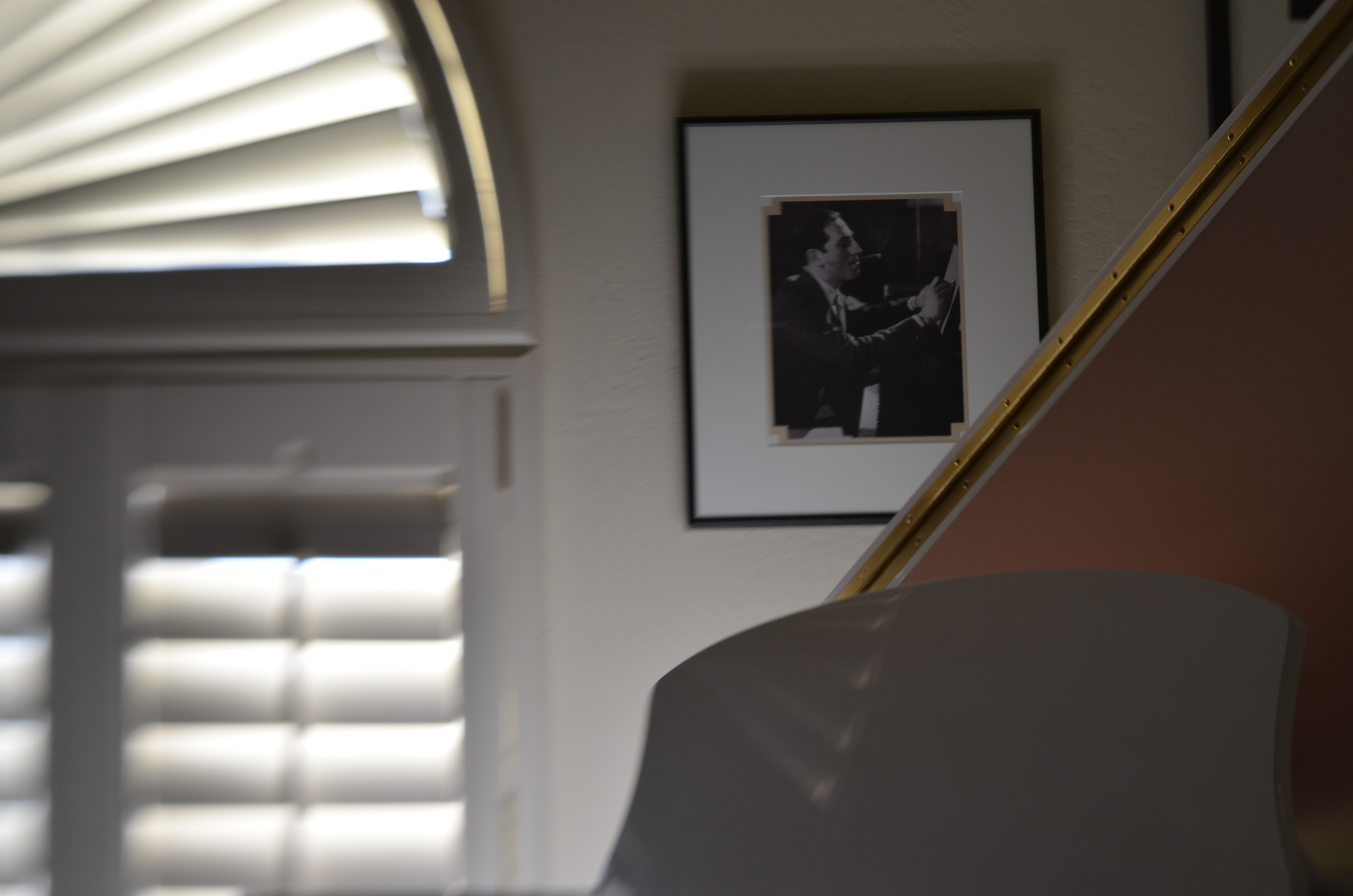
Lensbaby Spark gives you some of the control of a custom lens for under $80.
What will move me from whelmed to overwhelmed will be finding those images where the Lensbaby effect actually aids my storytelling, yet does not define it, as in the lucky shot at the top of this post. The camera gadgets I eventually consign to the “toy” pile go there because they call too much attention to what they can do, not to what I can do using them. The”tools” pile contains the gear that is essential to my saying something in a distinctly different voice. Finally, the two piles are divvied up only after taking lots of pictures and asking a ton of questions (a few gimmicks, like fisheye, have spent time in both piles; hey, I’m not above just playing around).
I sympathize with Letterman’s dilemma when he ironically asks, “Is this anything?” Selective focus is a way to install big neon pointers into your pictures, a more emphatic command to look over here. It’s also a way to amplify the drama of certain data or simplify cluttered compositions. I get it.
But it needs to be about much more than that. Or, more correctly, I have to help it.
Related articles
- My Lensbaby SCOUT, baby! (greyiscolour.wordpress.com)
A LOT OF LITTLE, FOR NOT A LOT
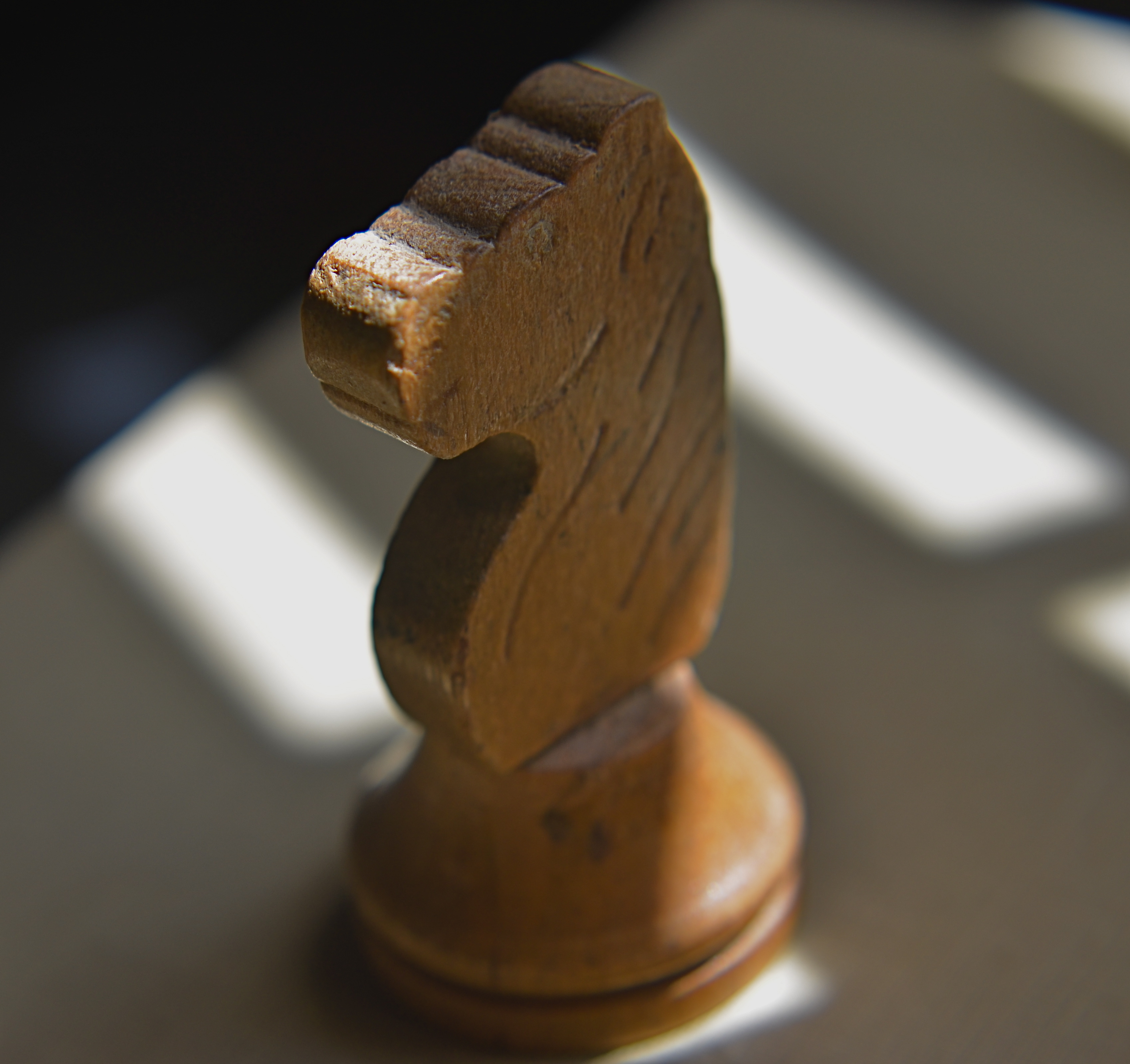
About three inches away with stacked diopters equivalent to 7x magnification. Manual focus, 1/200 sec., f/4.5, ISO 100, 35mm.
By MICHAEL PERKINS
EVER SINCE I FIRST READ STORIES ABOUT THE ARCH-VILLAIN BRAINIAC shrinking and stealing cities from the across the galaxy (studying them like miniature trophies) in Superman comics, I knew that I would someday embrace macro photography.
Well, given the insane costs of dedicated macro lenses, maybe embrace isn’t the right word. Maybe one arm around its shoulder. Or a friendly handshake. Or a gentle chat in which I say I really like you, macro, but I think we should see other people.
Let’s face it. You shouldn’t have to mortgage your..mortgage to determine how often you’re going to want to use your camera to, say, count the crumbs on an Oreo. Yes, once you can crank in close enough to see the flea on the back of the buffalo on the nickel, you may become hopelessly infatuated with the world of tiny. But to make that decision, you needn’t assume the financial humility of a monk. Dedicated macro lenses are a monster investment (a minimum of $300, all the way to over $1,000), to be weighed against how many other shooting situations you’re likely to find yourself in, and the economics of whatever special hunks of glass you’ll need to accomplish all those other tasks. If macro is truly “all” for you, then that sort of justifies the complex construction and sharp autofocusing of a separate lens. Brutal honesty disclaimer: there is no substitute for the performance of a high-end piece of precision optics.
BUT, not all of us make a lifelong study of the number of dimples on a bee’s knees, and that can make a huge investment in macro an iffy indulgence. I’m a big one for not buying major toys until they justify their use in my work. Thus, the only photographic commandment I unflinchingly live by is: don’t buy even one more extra feature than you will actually use.
Two main alternative options have emerged to serve the needs of “occasional” macro shooters. One of these are extension tubes, the hollow cylinders that attach between your lens and your camera body, creating an artificially enhanced range of maximum magnification. Being the same size as actual lenses (albeit with no glass inside), they do add additional bulk and weight to your setup, and may result in a loss of light, as well as a shallower depth of field. Investment-wise, you are still in for over $100 for a decent pair of these, as the cheap ones aren’t worth winding toilet paper around. Given the tubes’ limitations, you may be looking at sticking the camera on a tripod to lengthen your exposures, or jacking up the ISO. Different strokes.
The other, far cheaper option, and one which gives you a taste of macro without surgically removing your wallet, involves magnifying diopters. They screw on like filters, come in sets of three for well under forty bucks, and can get you in on the ground floor of macro (or the little tiny things crawling on said floor).
Diopters come in magnifying strengths of +1, +3 , +4, and above, so you can use a single diopter, attach several in series, or assemble a bunch into a custom mix and affix that to the front of your lens. Even with a cluster of them attached, you’re adding little more than an inch of extra depth to your lens body, and they’re easy to detach and stash in a spare pocket, something that cannot be done as easily with extension tubes. If you’re an on-the-go, travel-light kind of guy/gal, this is worth a mention.
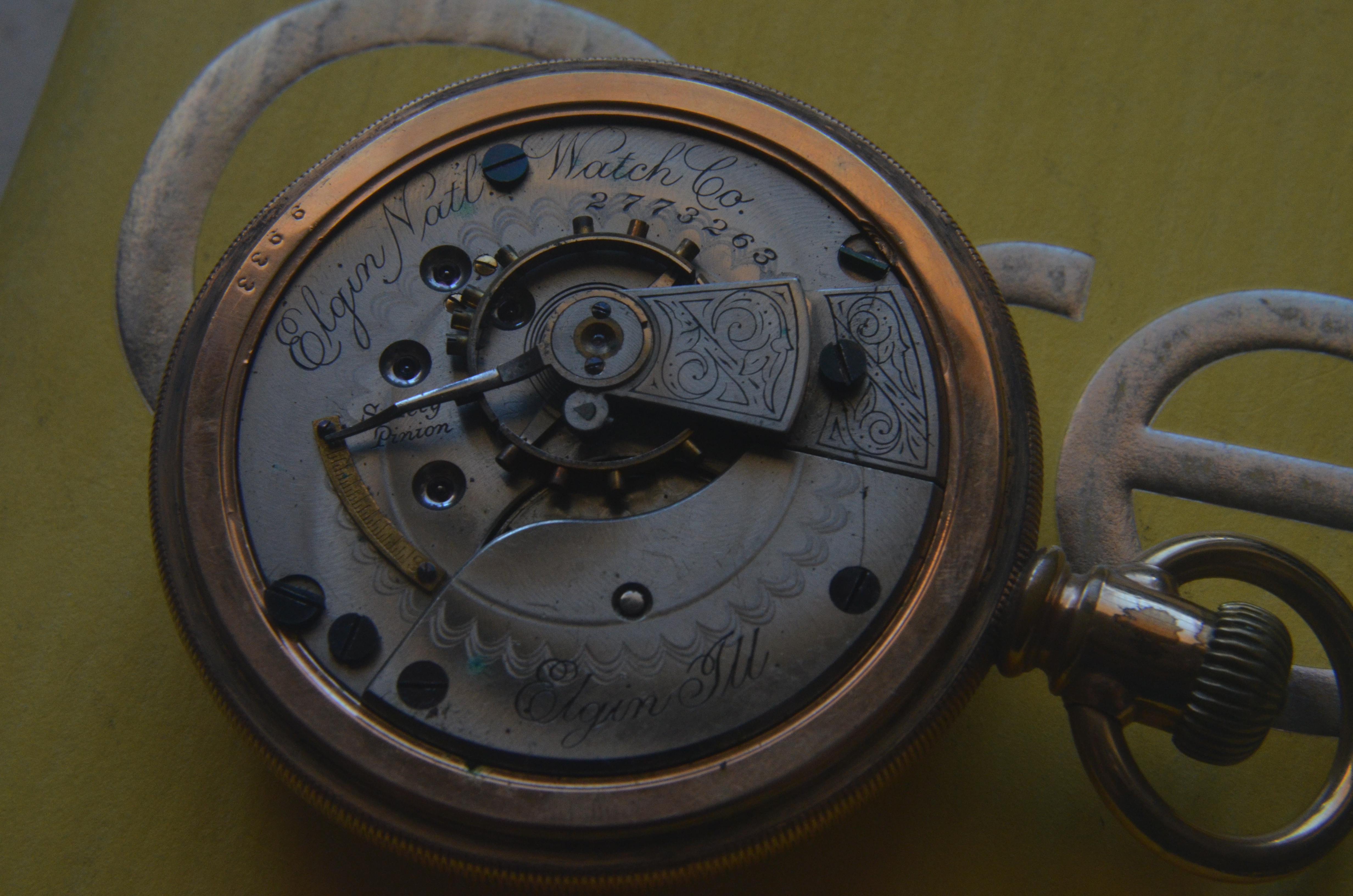
Now, let’s not delude ourselves. You can’t use your lens’ autofocus with diopters, which means you’re on manual. This is a serious consideration if you prefer to shoot hand-held, since you will louse up more frames, what with your every quiver being magnified and playing hell with sharpness. As with extension tubes, you may want to whip out the tripod.
If you are a techie as well as an artiste, do a Sherlock Holmes on the interwebs for the exact science of which option will give you the most control and best results. I am far from the best source for this kind of exact wisdom, since, as stated above, I acquired a good deal of my scientific knowledge from Superman comics. That said, if you need a peer review on the properties of Kryptonite, I’m your boy.
My point here is that I can only vouch for what has worked for me……and that’s the entry-level diopters option. Why jump immediately to the big-boy toys when you can master the baby steps with a smaller outlay of green, then move up as your needs dictate? Seems logical that training wheels should precede entry in the Tour de France.
Doesn’t take a Brainiac.
(reach Michael Perkins on Twitter @mpnormaleye)
Related articles
- Macro Flower Photography (ajburuca.com)
- Getting Close Enough (rakmilphotography.wordpress.com)
 thenormaleye