A QUIET VOICE, A STILL SOUL
By MICHAEL PERKINS
As I have practiced it, photography produces pleasure by its simplicity. I see something special and show it to the camera. A picture is produced. The moment is held until someone sees it. Then it is theirs. -Sam Abell, STAY THIS MOMENT, 1990
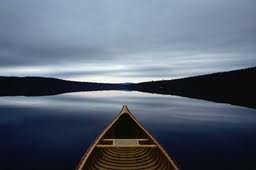
The voyage and the vehicle: Sam Abell’s classic image of a canoe on Maine’s Allagash River, the cover image for his book, 1990’s Stay This Moment.
THERE ARE PHOTOGRAPHERS THAT ARE SO AMAZINGLY ADVANCED that they make their images, wrought with love, ferocity, daring, and single-minded purpose, seem not merely visionary but inevitable. We see what they have brought us and exclaim, “of course”, as if theirs is the only way this message could possibly have been crafted, as if its truth is so self-evident that to have to formally recognize it is almost needless overkill. We confirm and validate that, for these pictures, the machine has truly been placed in the service of a soul, and one which writes fluently while we stumble with numb gestures.
One such soul resides in the work of Sam Abell.
If his name doesn’t roll off the top of your tongue alongside those of the obvious Jedi knights of photography, it’s because, for most of his forty-plus year career, he has kept a lower profile than Amelia Earhart, producing amazing work beneath the masthead of National Geographic magazine along with a host of other special commissions. When Sam came to to Geographic in 1967 as an intern, he already had four years of “hard” experience producing images for the University of Kentucky’s school of journalism to his credit, but the magazine’s photo editor, Robert Gilka, was hesitant to hire him, worried that his work was “too artistic”, too personal in its beauty to survive in the service of journalism.
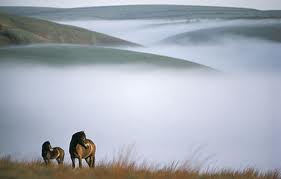
For Abell, it’s all about the patience. How long do you wait for the horse to wistfully glance over his shoulder? As long as it takes…..
With help, Sam Abell learned the balance for getting the facts for stories and getting the truth implied in their locales. Even when those stories’ words shouted with urgency, Sam’s notes were always on the soft pedal. Their poignancy fades in and builds, rises to your attention and then rivets it in place. Writing in his 1990 collection Stay This Moment, Abell declares that the test of great pictures is that “they cannot be memorized”. Small wonder that he began, early in life, to pursue a career on the cello. Smaller wonder yet is that the patience of that instrument is “heard” in the music of his pictures.
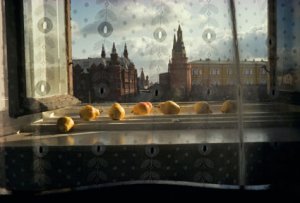
Always, a human context. Sam Abell capture of the iconic buildings of the Kremlin, framed by ripening fruit and lace curtains.
Even more muted than the images Sam creates is his technical approach to taking them. For much of his early career, he shot breathtaking landscapes with a simple 35mm camera, often a Leica reflex or rangefinder, mounted with standard or “normal” lenses ranging from 28 to 35mm, generating the least amount of distortion and rendering the most natural relationship of sizes and distances. For years, the most advanced tools in his bag were a sturdy Gitzmo tripod and the slowest, richest films he could find, frequently Kodachrome 25 and 64. The tripod delivered the stability needed to produce slow, sensual exposures; the ‘Chrome delivered texture and nuance beyond the power of hand-held shots. However, the most vital weapon in Abell’s arsenal is his astonishing patience, the wisdom, which flies in the face of traditional journalism photography, to wait for the story in a picture to slowly unfold, like the petals of a flower. Some of the best images Abell placed in National Geographic over the years took nearly a year to create. It happens when it happens, and once it does, God is it worth it.
The number of printed collections of Sam’s work are few and far between, given his enormous output, but diligence rewards the curious. Among the most available of them is the collaboration undertaken with historian Steven Ambrose, Lewis & Clark: Voyage of Discovery ( 2002), for which Sam created images of the surviving sections of the legendary explorers’ trail to the Pacific; Amazonia (2010), an essay on the kind of delicate ecosystems that are vanishing from the earth; and Life of a Photograph (2008), an examination of how his most famous pictures were built, stage by stage. And, of course, there is the luxuriant (and hopelessly out-of-print) Stay This Moment (1990), the companion book to his mid-career exhibition at New York’s International Center for Photography. Buy it in a used book shop, grab it on e-Bay, scour your local library, but find this book.
More importantly, find Sam’s work…any of it…and savor every detail. For copyright protection purposes, I have deliberately kept the illustrations in this article constrained to minimal resolutions. Find the real stuff, and see what Abell’s amazing sweep and scope can do at full-size. This blog is chiefly about how I, as a rank amateur, struggle with my own creative conundrums. But it is also about knowing what teachers to bend toward. Sam Abell, who literally teaches in mentor programs all over the country, has a powerful gift to impart. “What is right?”, he asked in 1990. “Simply put, it is any assignment in which the photographer has a significant emotional stake.” He also emphasized an important distinction (one of my favorites) in his remarks to a young photography student. Don’t say, he said, I took this picture.
Say instead, I made this picture.
Of course.
Thoughts?
Related articles
- Sam Abell Interview (keronpsillas.com)
- The Life of a Photographer – Sam Abell (billives.typepad.com)
SMILE! OR NOT.
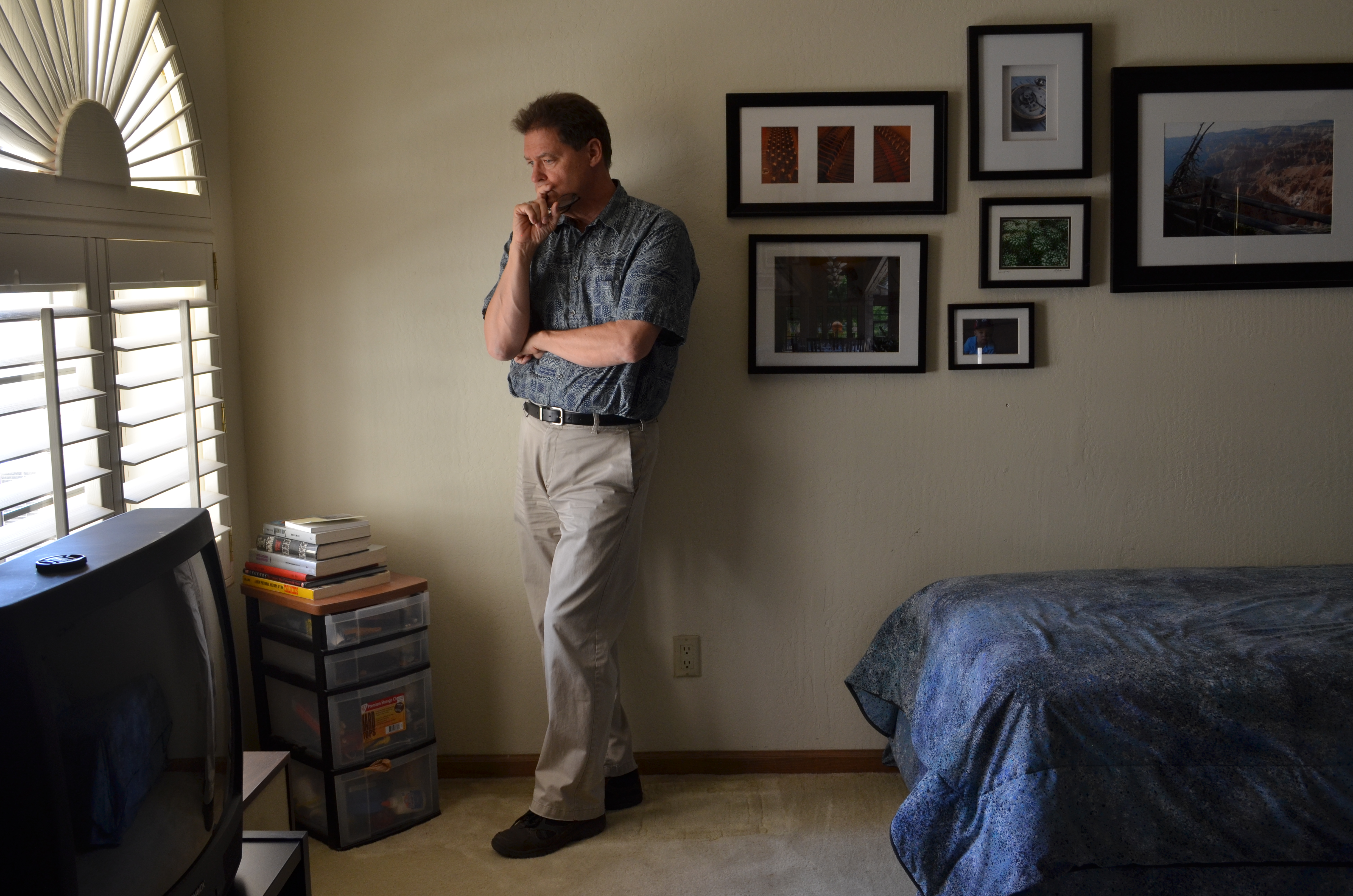
Since we’re usually unhappy with the way others capture us, we have nothing to lose by a making a deliberate effort to come closer to the mark ourselves. Self-portraits are more than mere vanity; they can become as legitimate a record of our identities as our most intimate journals. 1/15 sec., f/7.1, ISO 250, 24mm.
By MICHAEL PERKINS
A COMMONLY HELD VIEW OF SELF-PORTRAITURE is that it epitomizes some kind of runaway egotism, an artless symbol of a culture saturated in narcissistic navel-gazing. I mean, how can “us-taking-a-picture-of-us” qualify as anything aesthetically valid or “pure”? Indeed, if you look at the raw volume of quickie arm’s length shots that comprise the bulk of self-portrait work, i.e., here’s me at the mountains, here’s me at the beach, etc., it’s hard to argue that anything of our essence is revealed by the process of simply cramming our features onto a view screen and clicking away…..not to mention the banality of sharing each and every one of these captures ad nauseum on any public forum available. If this is egotism, it’s a damned poor brand of it. If you’re going to glorify yourself, why not choose the deluxe treatment over the economy class?
I would argue that self-portraits can be some of the most compelling images created in photography, but they must go beyond merely recording that we were here or there, or had lunch with this one or that one. Just as nearly everyone has one remarkable book inside them, all of us privately harbor a version of ourselves that all conventional methods of capture fail to detect, a visual story only we ourselves can tell. However, we typically carry ourselves through the world shielded by a carapace of our own construction, a social armor which is designed to keep invaders out, not invite viewers in. This causes cameras to actually aid in our camouflage, since they are so easy to lie to, and we have become so self-consciously expert at providing the lies.
The portraits of the famous by Annie Liebovitz, Richard Avedon, Herb Ritts and other all-seeing eyes (see links to articles below) have struck us because they have managed to penetrate the carapace, to change the context of their subjects in such dramatic ways that they convince us that we are seeing them, truly seeing them, for the first time. They may only be doing their own “take” on a notable face, but this only makes us hunger after more interpretations on the theme, not fewer. Key to many of the best portraits is the location of their subjects within specific spaces to see how they and the spaces feed off each other. Sometimes the addition of a specific object or prop creates a jumping off point to a new view. Often a simple reassignment of expression (the clown as tragedian, the adult as child, etc) forces a fresh perspective.
As for the self-portrait, an artistic assignment that I feel everyone should perform at least once (as an intentional design, not a candid snap), there is a wealth of new information gleaned from even an indifferent result. Shooters can act as lab rats for all the ways of seeing people that we can think of to play at, serving as free training modules for light, exposure, composition, form. I am always reluctant to enter into these projects, because like everyone else, I balk at the idea of centering my expression on myself. Who, says my Catholic upbringing, do I think I am, that I might be a fit subject for a photograph? And what do I do with all the social conditioning that compels me to sit up straight, suck in my gut, and smile in a friendly manner?
One can only wonder what the great figures of earlier centuries might have chosen to pass along about themselves if the self-portrait has existed for them as it does for us. What could the souls of a Lincoln, a Jefferson, a Spinoza, an Aquinas, have said to us across the gulf of time? Would this kind of introspection been seen by them as a legacy or an exercise in vanity? And would it matter?
In the above shot, taken in a flurry of attempts a few days ago, I am seemingly not “present” at the proceedings, apparently lost in thought instead of engaging the camera. Actually, given the recent events in my life, this was the one take where I felt I was free of the constraints of smiling, posing, going for the shot, etc. I look like I can’t focus, but in catching me in the attempt to focus, this image might be the only real one in the batch. Or not. I may be acting the part of the tortured soul because I like the look of it. The point is, at this moment, I have chosen what to depict about myself. Accept or reject it, it’s my statement, and my attempt to use this platform to say something, on purpose. You and I can argue about whether I succeeded, but maybe that’s all art is, anyway.
Thoughts?
Related articles
- Avedon For Breakfast (fabsugar.com)
- Getty Center Exhibits Herb Ritts and Celebrity Portraits (ginagenis.wordpress.com)
- Annie Leibovitz: ‘Creativity is like a big baby that needs to be nourished’ (guardian.co.uk)
A BOX FULL OF ALMOSTS
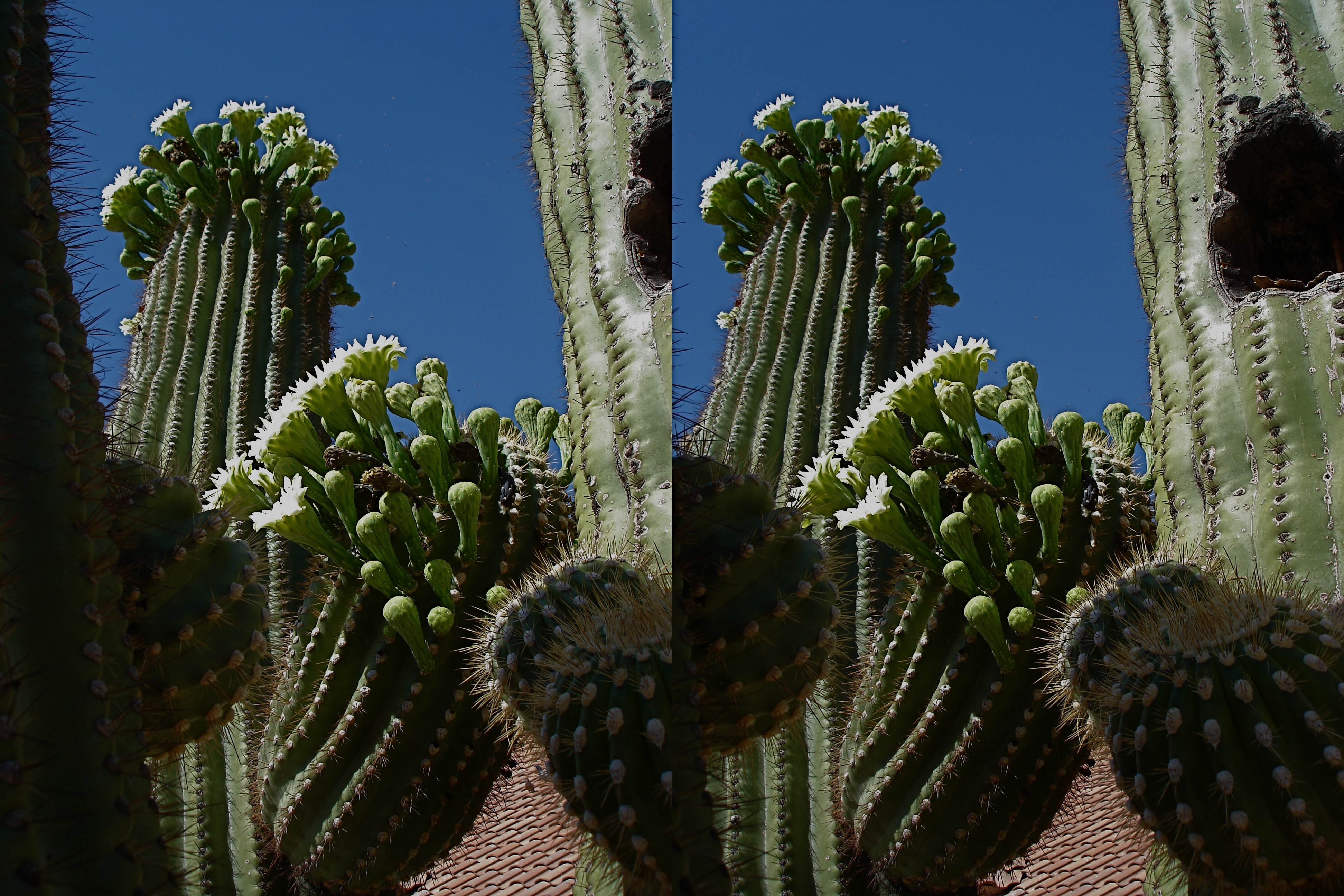
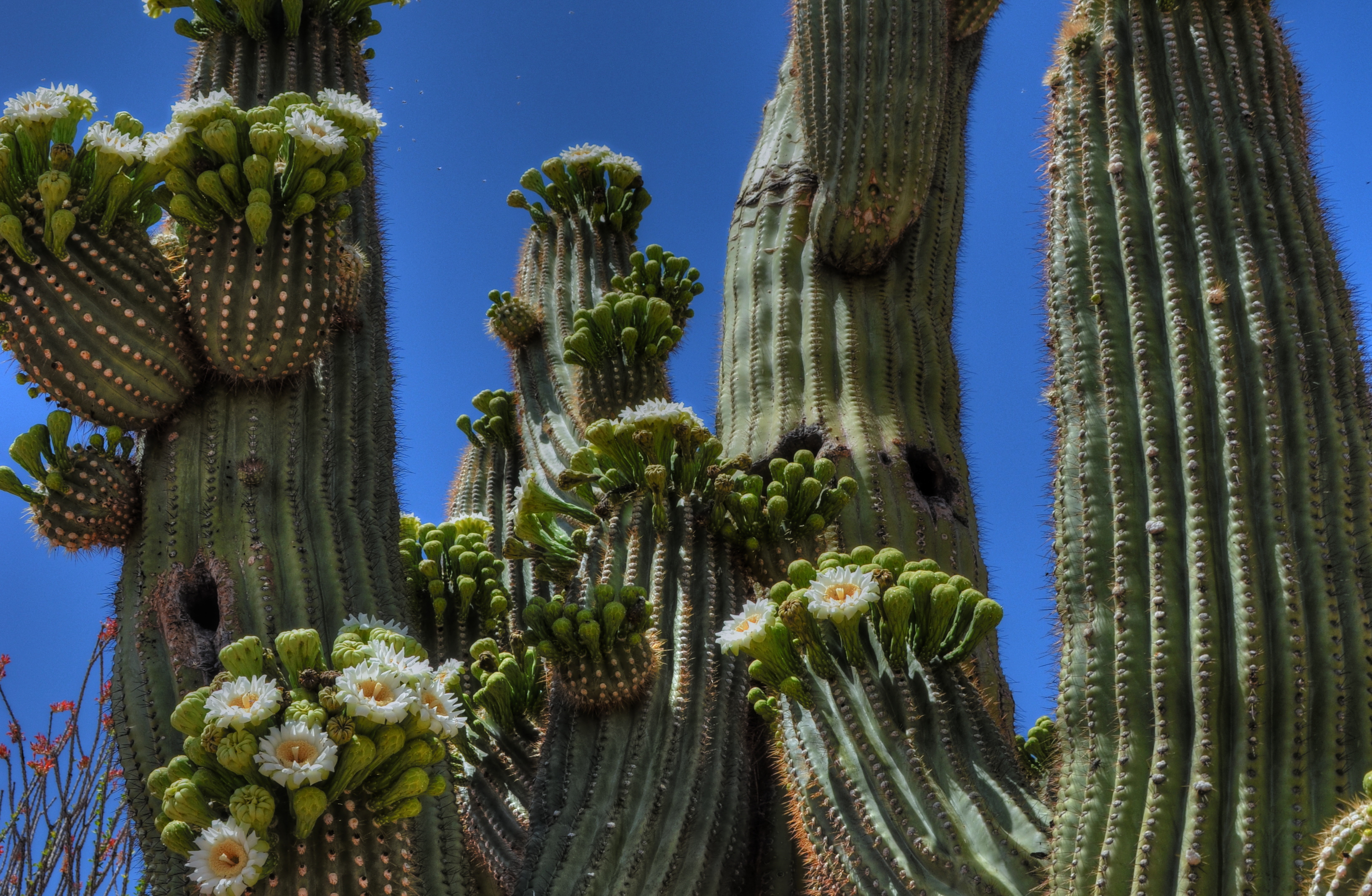
Shooting for 3D (top image) often cost me a lot of composition space, forcing me to frame in a narrow vertical range, but learning to frame my message in those cramped quarters taught me better how to draw the viewer “in deep” when composing flat 2D images.
By MICHAEL PERKINS
I RECENTLY SPENT AN ANGUISHED AFTERNOON sifting through a box of prints that I shot from about 1998 through 2002, a small part of my amateur work overall, but a particularly frustrating batch of images to revisit. Even given the high number of shots of any kind that one has to take to get a small yield of cherished images, the number of “keepers” from this period is remarkably low. It is a large box of almosts, a warehouse of near misses. Still, I felt that I needed to spend some “quality time” (strange phrase) mentally cataloguing everything that went wrong. I could have used a stiff drink.
One reason that the failure rate on these pictures was so high was because the pictures, all of them stereoscopic, were taken with one of the only cameras available for taking such shots at the time. The Argus 3D was an extremely limited film-based point-and-shoot which had been introduced for the sole purpose of producing cheap prints that could be developed by any vendor with conventional processing. The resulting 4×6 prints from the Argus were not the red-green anaglyph shots requiring the infamous cardboard glasses to decipher their overlaid images. but single prints made up of two side-by-side half-frame images in full color, which could later be inserted into an accompanying split-glass viewer that came with the camera.
The 3D effect was, in fact, quite striking, but the modest camera exacted a price for producing this little miracle. Since stereo works more dramatically at longer focal lengths, only shots made at f/11 or f/16 were offered on the Argus, which also had a fixed shutter speed and could not accommodate films rated higher than ASA 100. As for better 3D cameras, most available in the late ’90’s were dusty old relics from the late ’40’s and ’50’s, meaning that any hobbyist interested in stereo photography had to pretty much accept the built-in limitations of the rigs that were available. As a result, I had only basic control over exposure; light flares would invariably create huge streaks on one of the two angled lenses, creating a headache-y “flicker” in the viewing of the final print; and, worst of all, you had to compose every shot in vertical orientation, regardless of subject, in half the width in which you normally worked.
Worse for the artistic aspect of the project, I seem to have been sucked into the vortex that traps most shooters when learning a new technique; that is, I began to shoot for the effect. It seems to have been irrelevant whether I was shooting a bouquet of roses or a pile of debris, so long as I achieved the “eye-poke” gimmick popping out of the edge of the frame. Object (and objectives) became completely sidelined in my attempts to either “wow” the viewer or overcome the strictures of the camera itself. The whole carton of prints from this period seems to be a chronicle of a man who has lost his way and is too stubborn to ask directions. And of the few technically acceptable images in this cluster of shots, fewer still can boast that the stereoscopic element added anything to the overall impact of the subject matter. Can I have that drink now?
A few years later, I would eventually acquire a 1950’s-vintage Sawyer camera (designed to make amateur View-Master slides), which would allow me to control shutter speed, film type, and depth of field. And a few years after that, my stereo shots started to be pictures first, thrill rides second. Grateful as I was for the improved flexibility, however, the Argus’ cramped frame had, indeed, taught me to be pro-active and deliberate in planning my compositions. Learning to shoot inside that cramped visual phone booth meant that, once better cameras gave me back the full frame, I had developed something of an eye for where to put things. Even in 2D, I had become more aware of how to draw the eye into a flat shot.
Today, as I have consigned 3D to an occasional project or two, the lessons learned at the hands of the cruel and fickle Argus serve me in regular photography, since I remain reluctant to trust even more advanced cameras to make artistic decisions for me. Thus, even in the current smorgasbord of optical options, I feel that, in every shot, I am still the dominant voice in the discussion.
That makes all those “almosts” worth while.
Almost.
Bartender? Another round.
Thoughts?
Related articles
LOMO MOJO
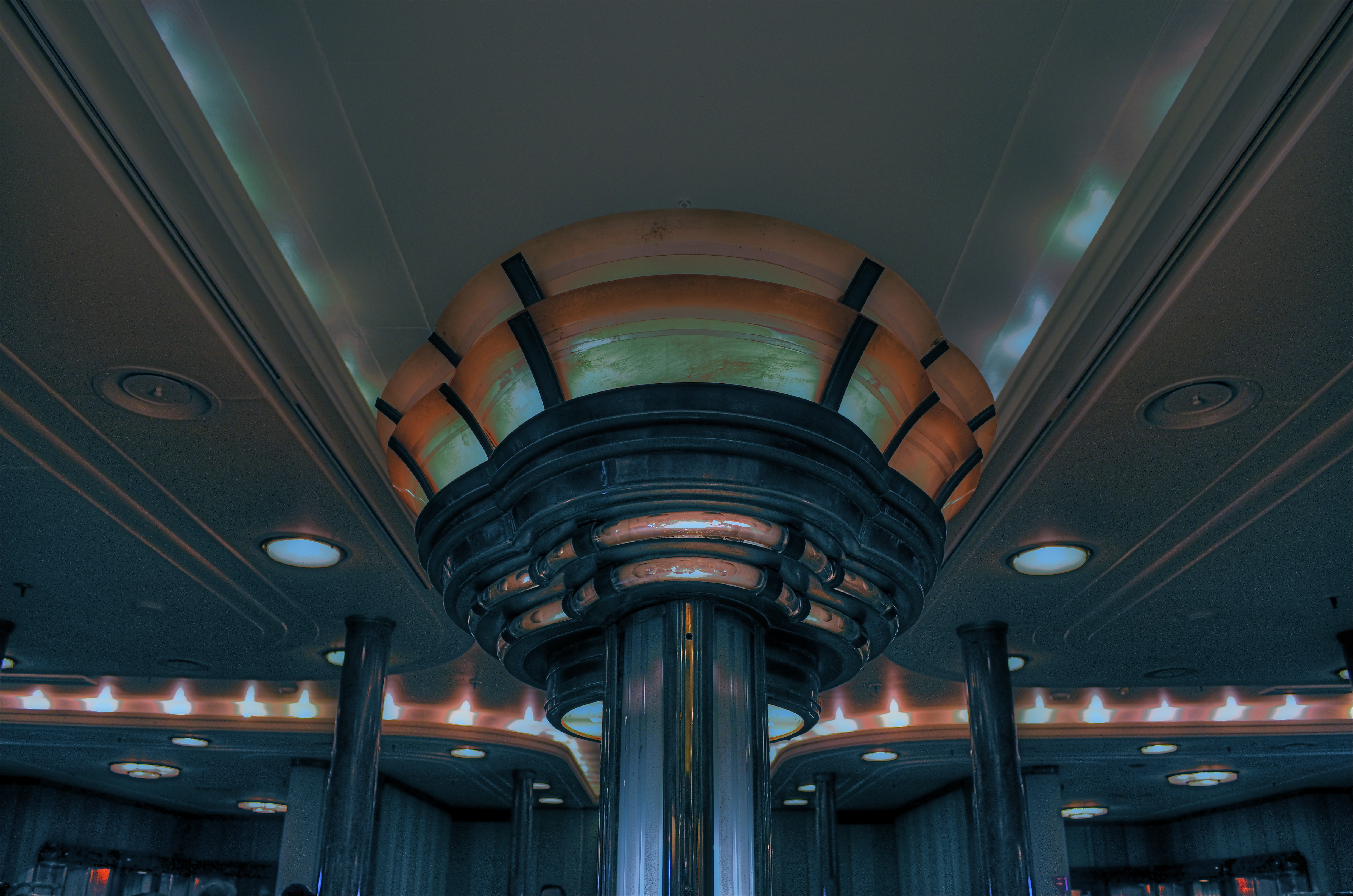
A perfectly average handheld interior shot taken without flash in 2012. What is amazing, to an old geezer like myself, is how completely impossible it would have been, back in the day, to capture even this modest shot with the very same type of toy plastic camera now being sold to “lomography” enthusiasts and marketed as “hip”. Light leaks and color streaks do not an image make.
I AM INTERESTED MOST IN WHAT MAKES PEOPLE WANT TO TAKE PICTURES, as well as what makes them take the best ones. In that spirit, I have been recently re-examining the decade-long debate on the trend known as lomography, or the use of plastic bodied, low-tech toy cameras as serious imaging instruments. In renewing the impact of “lomo”, with its rudimentary shutter speeds and fixed-focus meniscus lenses, I have pored over four bazillion angry diatribes by those who condemn the cameras’ extreme technical limits and dismiss their enthusiasts as trendy phonies. I have also tracked its rabid defense by ardent users who celebrate lomo cameras as a way back to a kind of artistic innocence, a return to a photographic Eden in which we all shoot with our hearts instead of our heads. At the end of it all, does it matter what anyone thinks about how we take pictures if something, anything comes along to want them to take more of them? Probably not, and I certainly can’t decide the issue, if it needs deciding at all. Still, a brief re-examination of the whole concept, as I see it, might be worth a run-through. Your mileage may vary…
And, yes, before we proceed, I freely admit that a few world-class photos have been taken with cameras that are one step above drawing the image yourself with a crayon, just as a few amazing canvasses have been created by artists who hurl paint the way a monkey flings poo. I leave it to your discretion whether these accomplishments are vindication of a great vision, or happy accidents granted by the randomness fairy.
Backstory section: as a lifelong shooter, I enthusiastically began taking pictures with the very types of cameras which lomo fans so highly prize. This was dictated purely by economics, not art. It’s fair to say that, with the opening of every new packet of prints that arrived from the processor in those days, I spent more time cursing the smotheringly narrow limits of my light-leaky box and its take-it-or-leave-it settings than I spent cheering the results as some kind of creative breakthrough. I knew what real cameras could do. My father had a real camera. I had a toy, a toy which would betray my best efforts at breathtaking captures pretty much at will.
I didn’t feel avant-garde. I didn’t feel edgy.
I felt like I wanted a real camera.
Turns out that the manufacturers of my Imperial Mark XII, along with the Holga, the Diana, and other constellations in the lomo firmament, eventually came to the same conclusion. Many of their cheap products were made in the underdeveloped economies of iron-curtain countries.They cranked these babies out with the chief object of making a quick buck on undemanding first-time buyers and children. There was no attempt to market these clunkers as serious instruments; they were the fixed-focus, plastic-lensed equivalent of a bootlegged Dylan album taped off the mixer board. Eventually, these companies went on to other ways of separating the rubes from their rubles.
Now factor in the effect of time, nostalgia and (wait for it) ironic marketing. In the beginning of the digital age, photography arrives at a crossroads. Film is being challenged, if not falling under actual attack. Photography seems, to some, to have surrendered to a soulless technology rather than the “warm”, “human”, “hands-on” feel of analog picture-making. And as for the black arts of post-processing, the digital darkroom begins to be demonized only slightly less than the clubbing of baby seals. The unexpected, the unforseeable, the random begins to be attractive, simply because it spits in the eye of all this robo-gearhead slide toward pixels and light sensors.
A longing for a simpler time is observed among the young, who long to dress in forty-year old clothes and who regard vinyl records as more “authentic” than digital audio, not in spite of the scratches, but because of them. Film photography and its worst accidental artifacts becomes “retro” product, to be marketed through trendy boutiques and vintage stores. The sales message: anyone can take a picture (true, actually). The box isn’t important (less true). None of it’s important (outright lie). Shoot from the hip! Look, it made a weird rainbow streak on the picture, isn’t that cool?
Cool at a premium cost, as well. Cameras that went for $5.00 as toys in the ’60’s are now topping $100.00 for the same optics and defects in 2012, with one principal, cynical difference; in the newly produced cameras, the optical defects are being engineered in on purpose, so that every frame comes saturated not only with garish color but attitude as well. Every click produces a tic. This kind of salesmanship makes Andy Warhol’s Campbell’s soup cans seem absolutely honorable by comparison.
Tolerance disclaimer: can great art be created with a rudimentary tool? ABSOLUTELY. Cave dwellers made wheels good enough to move their carts to market well before Sears Craftsman came on the scene. I can make a sort of painting using dried sticks, but somehow I suspect that a supple, tapered brush gives me more fine-tuned control. In the field of combat, I can open someone’s airway with the shaft of a Bic pen (see your favorite M*A*S*H* re-run) but writing instruments are not, typically, the tool of choice in the operating rooms at the Mayo. We don’t use sealing wax to send love letters anymore, we don’t take the family horse on a Sunday jaunt to the county seat, and we don’t eat peas off a knife. Of course we could. But what is our motivation to do so?
The historic arc of photography bends toward technical development, not fallback. As soon as glass plates were developed, their limits implied the need for film. Once film first froze movement, we needed it to do it faster. No sooner had pinhole apertures allowed a picture to be crudely focused than the market cried out for dedicated glass to refine those pictures. And while many were just getting over the novelty of recording events in monochrome, some dreamed of harnessing all the shades in the rainbow.
Tolerance disclaimer #2: the only reason to use a technique or system is if it gives you the pictures you want. Once your dreams exceed the limits of that medium, however, it’s time to seek a better system. Prevailing over the limits of your medium because that’s all there is can be noble. However, there is no artistic triumph in deliberately using bad equipment to take great pictures. Lomo cameras may entice people to begin shooting, then move on once they outgrow the warps, distortions and flares that these toys produce. Thus the trend will at least have given them time to experiment and master the basics. But for the most part, for me,there are already far too many obstacles to making good pictures to allow the camera itself to be one of them.
Even in the name of cool.
Thoughts?
“WHAT” IS THE QUESTION
ONE OF THE MOST FREQUENTLY ASKED QUESTIONS of shooters is, “what’s that supposed to be?”, usually asked of any image that is less obvious than a sunset shot of the Eiffel Tower or a souvenir snap of Mount Rushmore. You may have found, in fact, that the number of times that the question is asked is directly proportional to how intensely personal your vision is exercised on a given project. As much as the hidden aspects of life fascinate us, the obvious recording of familiar objects soothe the eye, like a kind of ocular comfort food. The farther you wander in your own direction as a photographer, the greater journey you also ask of your viewers. Sometimes the invitation is taken. Sometimes you must face “the question”.
What’s that supposed to be?
How, actually, in a world shaped by our own subjective experience, an image is “supposed” to be anything is a little baffling. It’s probably safe to say that what we present, as artists is probably supposed to be the view as one’s mind filters it through his or her accumulated life. When we use the camera as a mere recorder, it may make it easier, presenter-to-viewer, to agree on that image’s terms of engagement, but that may or may not reveal what we actually felt about when creating it. If I use the same three colors to render a picture of the American flag as everyone else uses, I may get into fewer arguments about how appropriate the resulting image is, but then, I don’t get to open up the discussion to any other conceptions of that flag. Back in the first days of the environmental movement, the simple use of green on the original, Old-Glory-derived ecology flag suggested an alternative way of being American, of living your life. As I recall, some viewed the design as sacrilegious, while others embraced it as liberating.
Over 150 years after the first photographs were regarded as a threat to the painter’s domain, we are still most at ease with pictures that ape the painting’s method for framing the world. Oddly, it is always outlaws and amateurs that break free of these pictorial chains first; the professionals must protect the turf they have so carefully mapped out for themselves in the mainstream. There remains, then, an ongoing battle over what should or should not be called a “picture”. Abstractions, arranged or perceived patterns, even selected details or drastic re-imaginings of small parts of the so-called “actual” world must always fight for their place at the table alongside the technically accurate mirroring of easily named subjects. We still regard that which is realistic as being the most real, and the most worthy of praise.
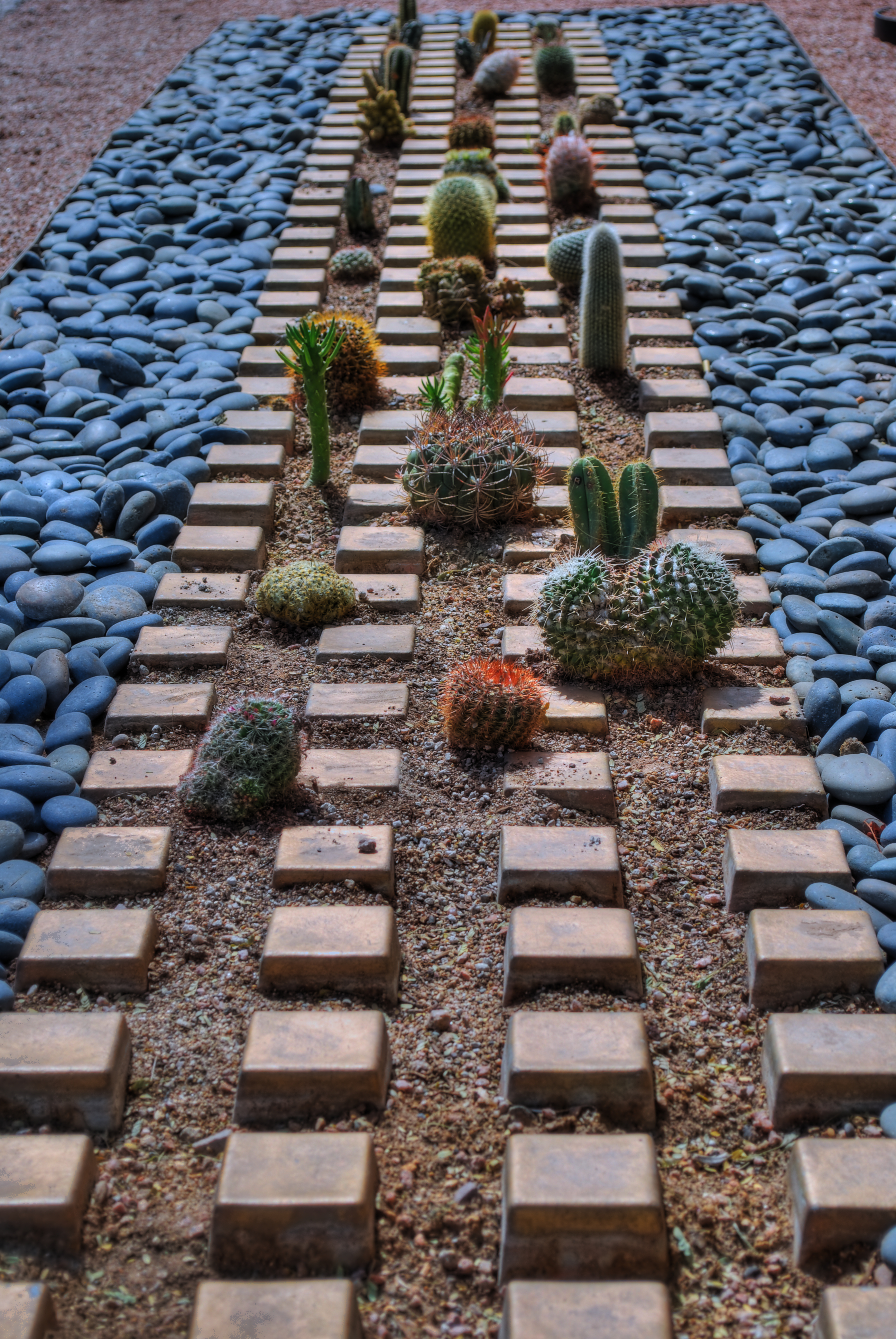
Cactropolis, 2011. Three bracketed shots about a half-stop apart combined into an HDR composite. CLICK TO ENLARGE.
To want to show something for its own sake on our own terms is to move into more personal territory, and hence onto shakier ground for critical evaluation, but occasionally we strike a balance between what people want to see and what we must show. In the above image, I only wanted to focus attention on an arrangement that was a very small and visually ignored accent along a heavily travelled public street. An unsung landscaper’s arrangement of tiles, gravel, paving rock, and succulent plants, was in plain view, and yet, at only a few inches in height, easily missed by the thousands of daily passersby speeding along the street. To me, when framed close to ground level, it resembled a kind of desert cityscape, blocks of abstract skyscrapers, a cactus metropolis, and that’s how I tried to frame and process it. Of course, it us, after all, just a pattern, and anyone who looks at the image can fill in their own blanks with impressions that are just as valid as my kind of toy idea.
The vital point is that no one else’s take on your dream can be wrong, just because it differs with yours. Art is not a science, which is why we don’t become photographers, or as the word implies, “light writers” just by pushing a button.
We become photographers by pushing everyone’s buttons.
What is it “supposed to be”? You tell me, and I’ll tell you.
Thoughts?
WHEN ART SELF-CENSORS
IN ITS FIRST DAYS, photography took on the inward, personal aspect of painting, both in its selection of pictorial subjects and in its method of presentation, which was designed to legitimize the new science by aping the look of the canvas. Only by actively engaging the world and invading every corner of it in an outward search for truth or beauty did picture-making break free of the painter’s constraints. Once Matthew Brady’s stark images of the Civil War froze that conflict’s horror on glass, at least one leg of the photographer’s stool rested on a confrontation of reality.
In the 20th century, as shooters toggled between deliberate, arranged images and pure documentation, the “face” of the public became an unwitting tool in the artist’s toolbox. Human manifestations of delight, horror, revelation and ruin told the story of the new era even more graphically than the correspondent’s pen, creating some of the most indelible images of modern times. Indeed, there seemed to be an unspoken pact between the artist and his “prey” to the effect that their lives, like ours, could be endlessly recorded, interpreted, interrupted and enshrined for the sake of our “art”.
But is that era coming to an end? And, for photography, what lies beyond?
By agreeing to appear at a book fair and signing, public figures like Elmore James (author of Get Shorty and, 3:10 to Yuma, and consultant on the TV series Justified) more or less agree to allow their images to be recorded as part of the celebrity they have willfully undertaken. But what of everyone else? 1/40 sec., F/11, ISO 160, 300mm.
In recent years, both public and private institutions have begun to disallow photography in some venues that had historically been open to it, including retail stores, parks, malls and other previously “free” spaces. Some of this is the inevitable aftermath of our recent obsession with security, a kind of whoa-slow-down against the pervasive replication of all aspects of one’s identity. Perhaps, several gazillion camera phone snaps and gotcha YouTubes later, we have reached a tipping point of sorts, a world in which people desperately seek a firewall around their secret selves.
Even as certain nondescript individuals shamelessly seek the spotlight of reality shows and paparazzi-fed ego gratification, many more are feeling an unfamiliar new yen for shelter from the ubiquitous flash of fame. In such a time, the concept of commentary or “street” photography faces one of its most daunting challenges. What is permissible in an image, now? Are what were once the eloquently revealing truths of spontaneous snaps now a kind of voyeurism, a “reality porn” peek into peoples’ lives to which we have no right?
Without the harrowing chronicle of Dorothea Lange’s dust-bowl refugees, would we understand less of the horrific impact of the Great Depression? Was she underscoring an important message or exploiting her subjects’ suffering? Absent Larry Burrows’ grunt’s-eye-view of Vietnam for Life magazine, would we have missed a valuable insight into a war our government might just have gladly kept under wraps? We may have already reached the point where some of us, embarrassed for the intrusive nature of our craft, have begun to self-censor, to mentally de-select some images before we even shoot them. Such prior restraint may be the height of sensitivity, but it spells paralysis for art.

