THE NIGHT OF THREE MIRACLES
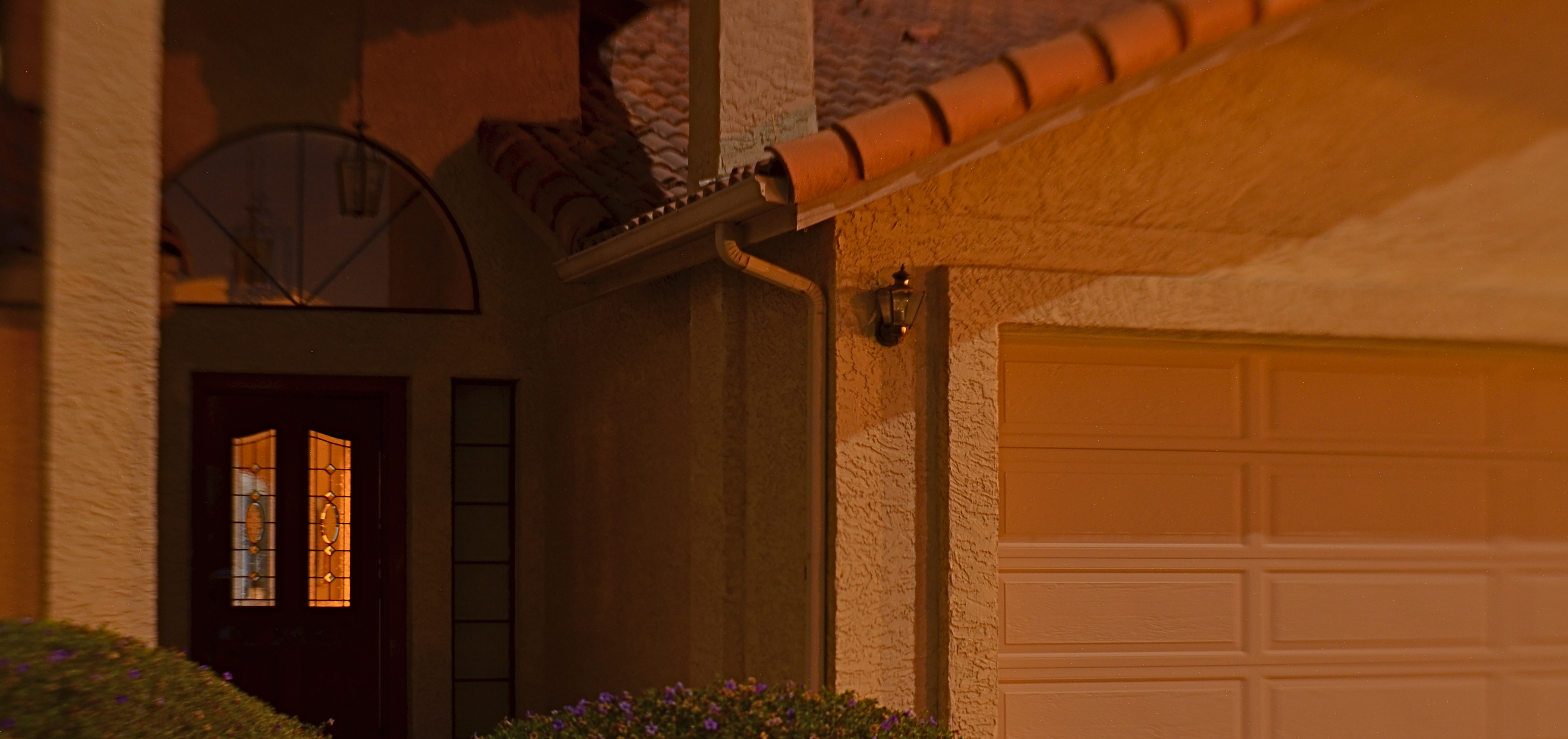
10 pm the night before: a time exposure made exclusively with “Supermoon” light.
By MICHAEL PERKINS
I NEARLY MISSED OUT. Early last evening, my wife spied an internet article on the imminent arrival of what could only be called an astronomical trifecta, a moon which, for the first time since 1866 would qualify as a wow in three distinct cosmological categories, as an oversized, or “super” moon, a lunar eclipse, and an orange-red “blood moon”, seen to fullest effect in America’s western states.
Hey, I live in one of those……
I’ll be out in the driveway, honey. For, oh, I dunno, a while….
The first, or supermoon phase of the trifecta I had experienced several times before: lunar light strong enough to read by, with time exposures of three minutes, or even less, retrieving a full range of natural color in everything from orange roof tiles to blue skies…..hours after sunset. That’s what you see up top. A manual 35mm lens (the shutter remote won’t work with autofocus, anyway), an aperture of f/5.6 for fair depth of field, and the flat top of a mailbox for a makeshift tripod and, bingo, it looks like early dusk instead of 10pm.
The second phase had to wait for the early hours of this morning, at which time various web accounts predicted the earth would interpose itself perfectly between the sun and the moon, causing a crescent-shaped shadow to crawl up the orb from the bottom, giving it a deep red-orange glow beginning at around 6:15am (which in an Arizona winter, is still pre-dawn).
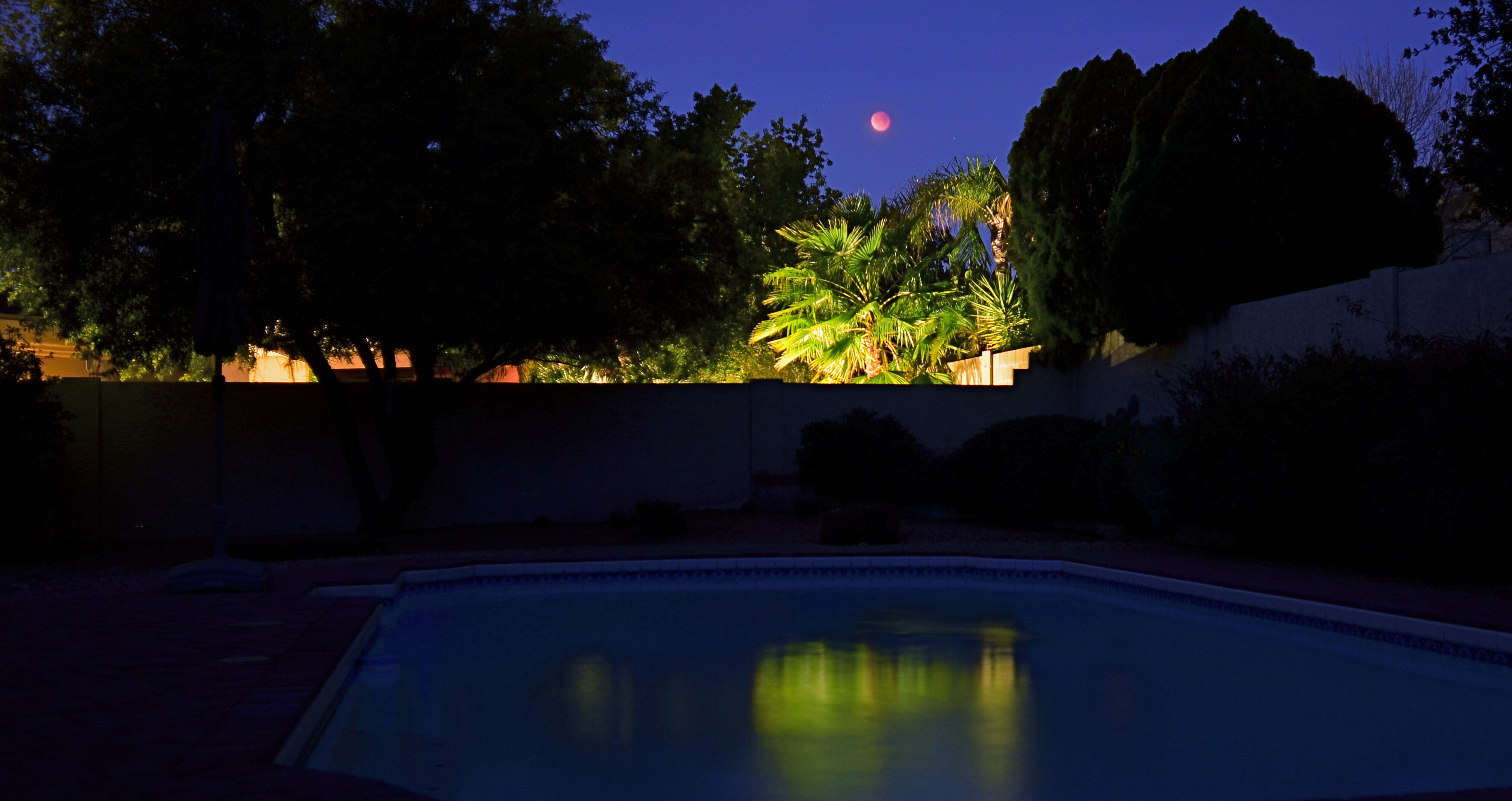
6:15am the morning of: pre–dawn view of the “Bloodmoon”.
As with dusk the night before, the sky, appearing black to the naked eye, would reveal a lot of blue in a time-exposure taken just before sun-up, so I elected to make the moon a small part of an overall composition instead of an isolated solo superstar. I have plenty of textured zoom shots of the moon: what interests me in such special cases is the light and hue of it in context. In this case, fifteen seconds wide open at f/2 was enough to get the major bits to register. Still too lazy to find my tripod, I subbed a folding stepladder. A matter of five minutes’ work.
I certainly plan to be around in 2037 when another “Super Blue Moon/ Bloodmoon/Lunar Eclipse appears, but in years past I also have planned to retain all my hair and teeth, and the jury’s still out on that particular quest. In the meantime, all of life is littered with wonder, so, as the old pop song sez, pick up your hat, lock up your flat, get out, get under the moon…
ALL ON ME
 By MICHAEL PERKINS
PHOTOGRAPHERS ARE FREQUENTLY ASKED to define a “bad” picture, or, more specifically, the worst picture they themselves ever shot. The question is a bit of a logic trap, though, since it typically tricks us into naming something that failed because the subject was moribund, or because we mis-read the light, the aperture, the composition. The trap further reasons that, if you have checked off all those boxes, you should end up with a great picture.
But all of that is bug wash. What makes a picture bad is when you were not ready to take it….. but you took it anyway.
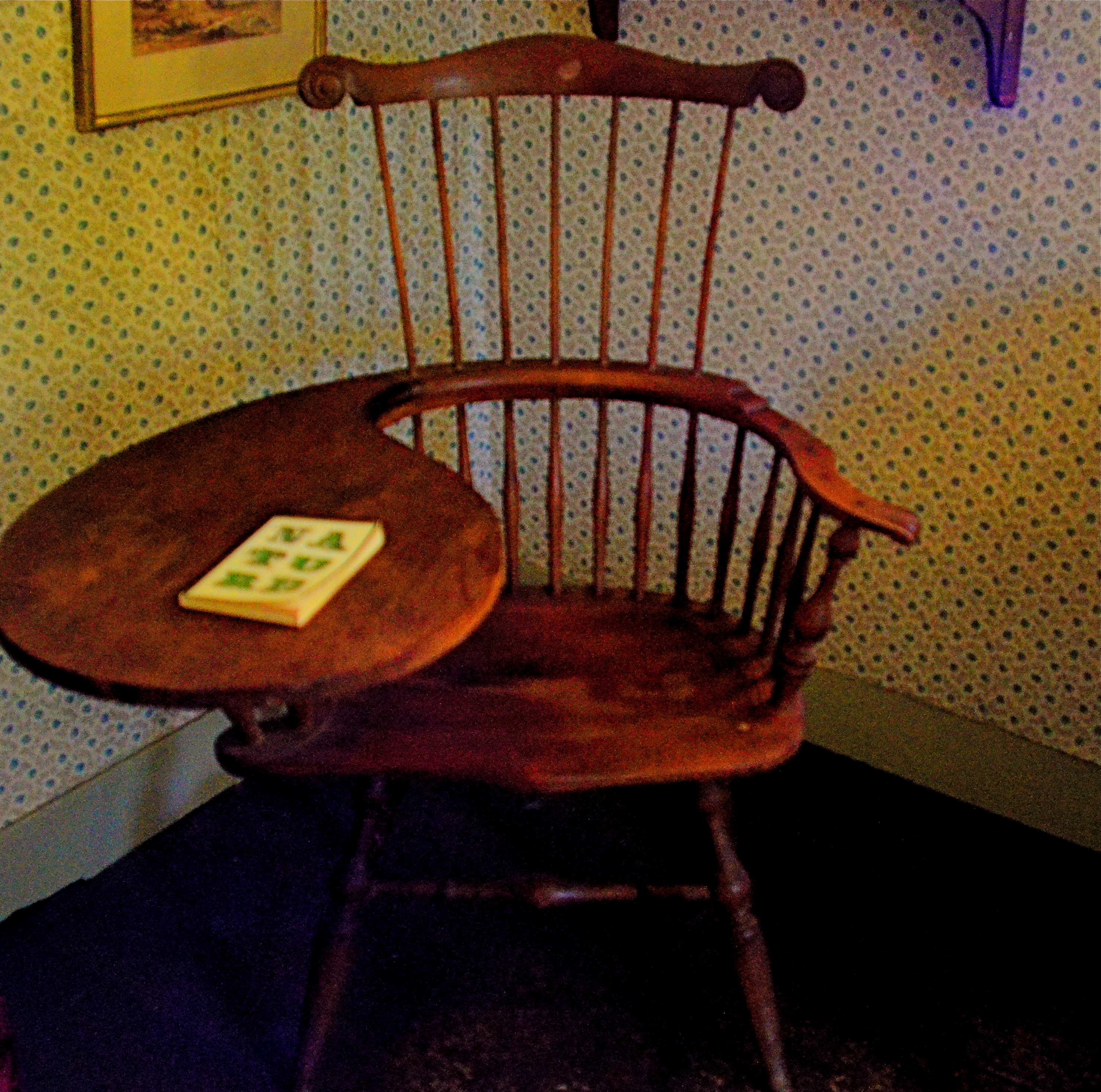
Sometimes the problem is ignorance: you simply aren’t old or wise enough to know what to do with the subject. Other times, you have substantial barriers between you and an effective story, but you try to drill past what you can’t fix. And, you can no doubt add your own list of things that, ahead of the shutter click, should scream, “not now”. Try to make the picture before either the conditions or you (usually you) are right, and you lose. Just as I lost, in great big neon letters, with the mess you at above left.
In 2016, I visited the Old Manse in Concord, Massachusetts, a venerable colonial-era home which sits right next to the small footbridge that served as the site of the first major battle of the Revolutionary War. What excited me most, however, was that it had served as a temporary home for the young Ralph Waldo Emerson, and that he had written Nature, the first of his great works, while living there. And to really put the cherry on the sundae, the house still contains the small writing desk he used to do it.
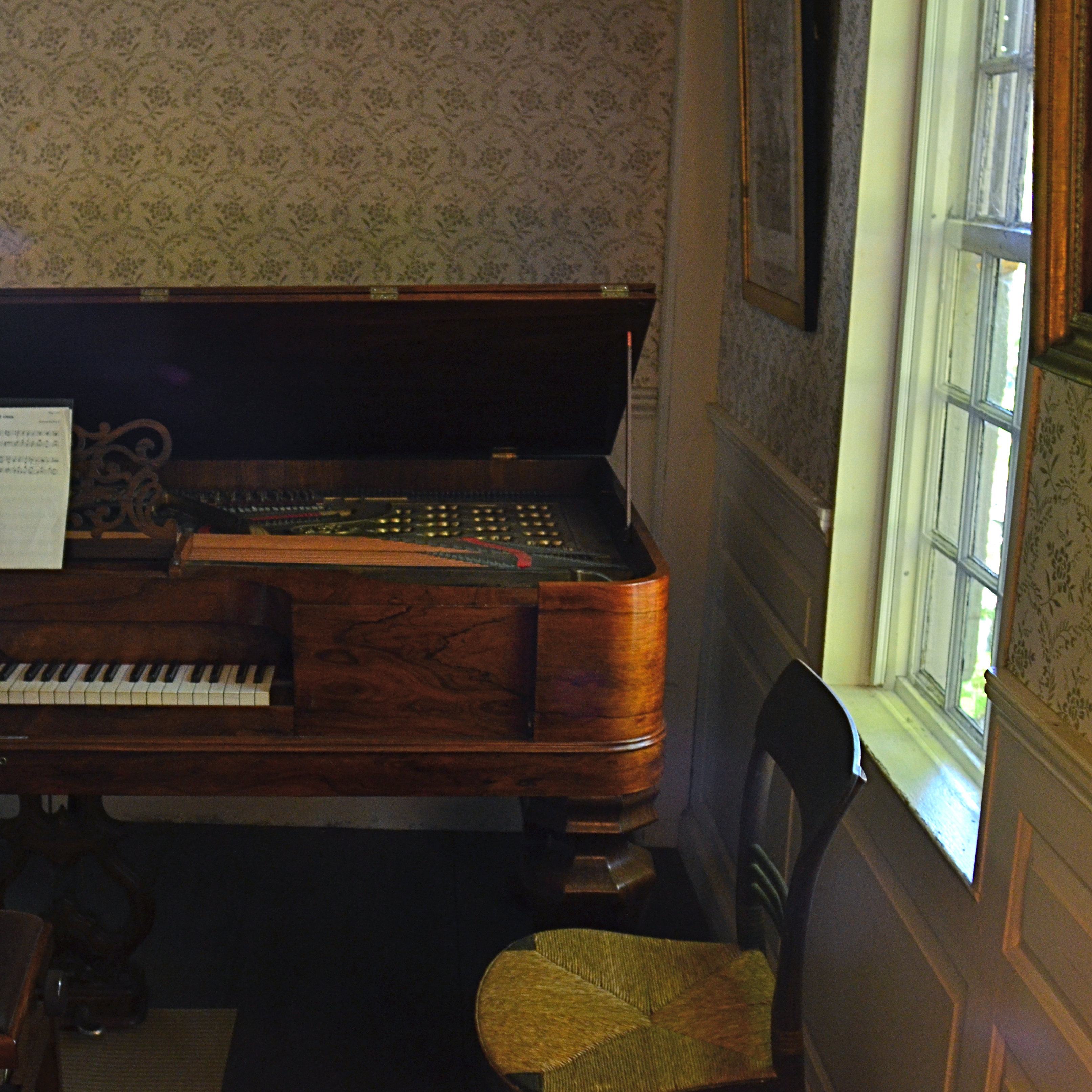 The house is lit only with indirect window light during the day, but with a fast prime lens and a decent eye, there’s more than enough soft illumination to work with to produce decent results (see left). In fact, just before my tour was to head into the room containing the desk, I had already harvested quite a few usable shots…so many, in fact, that I was getting teased by the others in the group…the usual “oh, another picture?” stuff. Uncharacteristically, I began to worry about whether I was holding everyone else up, and thus started to hurry myself, to shoot not as I intended, but in deference to what I thought others would like. By the time I got to Emerson’s chair, the light, my lens, even my own experience were all useless to me….because I wasn’t ready to shoot….but did anyway.
And so you behold the unholy mess that resulted: lousy contrast, uneven exposure, muddy texture (is the chair made out of wood or Play-Doh?), tons of noise, indifferent angle, and, oh yeah, garbage focus. Worse yet, the psyche I’d put upon myself was so severe that I didn’t slow down for a more considered re-do. No, I rejoined the group like a polite little camper, and left without what I had come for.
And that is all on me, and thus an important entry in The Normal Eye, an ongoing chronicle which is designed to emphasize personal choice and responsibility in photography, versus just hoping well-designed machines will compensate for our lack of concept or intention. This is not easy. This is ha It’s no fun realizing that what went wrong with an image was us.
But it’s a valuable thing to own. And to act upon.
FACE FRONT
By MICHAEL PERKINS
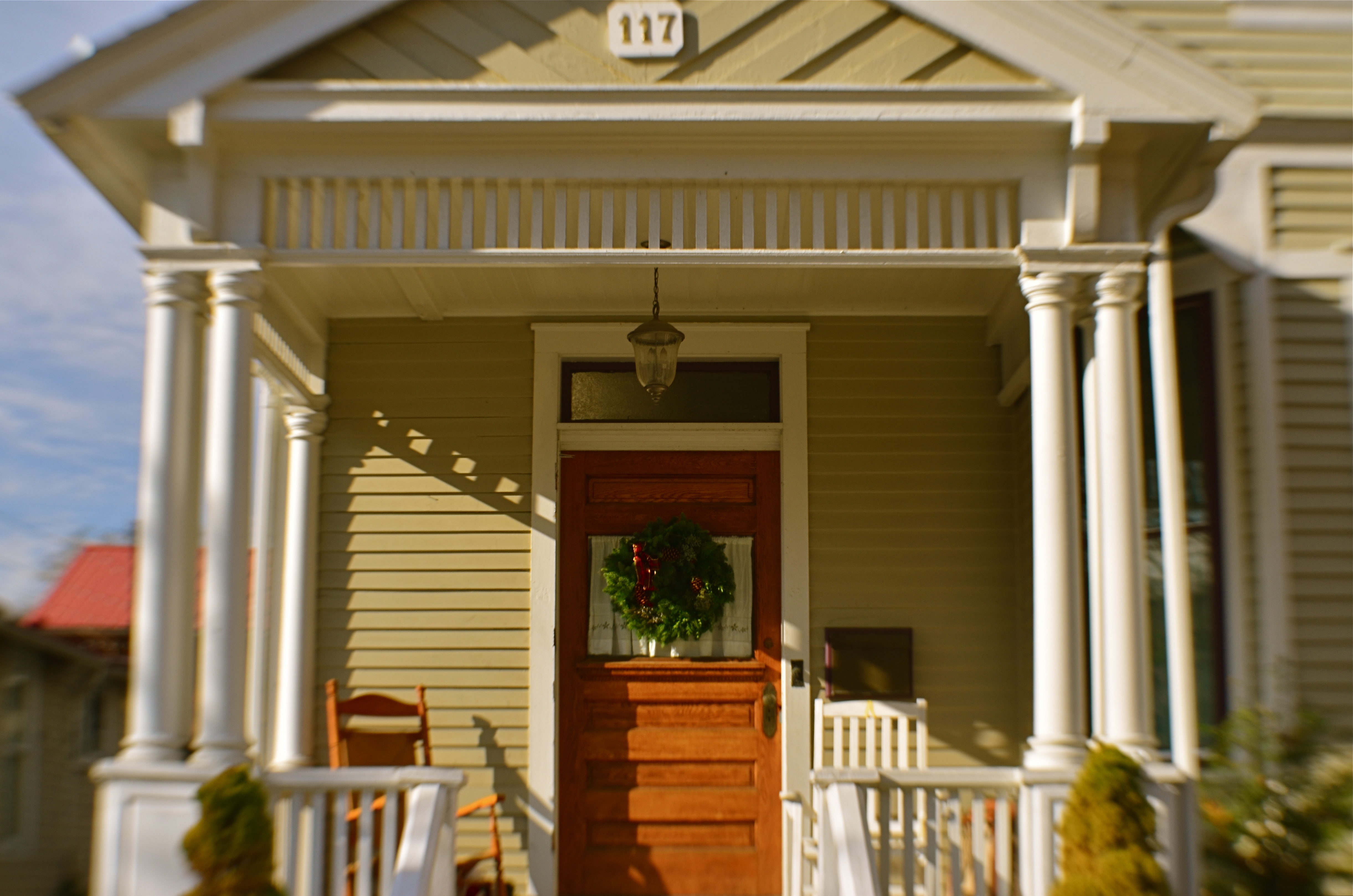
HUMANS HAVE A DEFINITE ANTHROPOMORPHIC BIAS when it comes to faces. From dancing Disney flowers to Pixar office lamps, we tend to project our features onto nearly every kind of object or entity. And, as a photographer, I fall prey to that selfsame bias, especially when it comes to making pictures of buildings.
It’s isn’t much of a stretch, really. Windows become eyes. Doors assume the role of both noses and mouths. Overhangs and pitched rooves take on the appearance of eyebrows. And so on. For a variety of reasons, I tend to position houses in the same way I might shoot the most basic human portrait. Eyes facing straight toward the camera, face centered in the shot. No arty angles, no three quarter views. As clinical as a mug shot, or, in architectural terms, the plainspoken exposition of Walker Evans’ studies of houses and businesses in days of the New Deal.
And, like the aforementioned mug shot, I tend to frame the picture as close as I dare without sacrificing either context or impact. Again, the human face is the template, with the same decisions to be made about cropping. Do you need the top of the hair, the width of both ears? Should the shot stop at the bottom of the chin? Below the shoulders? Does any surrounding information add to the selling of the picture?
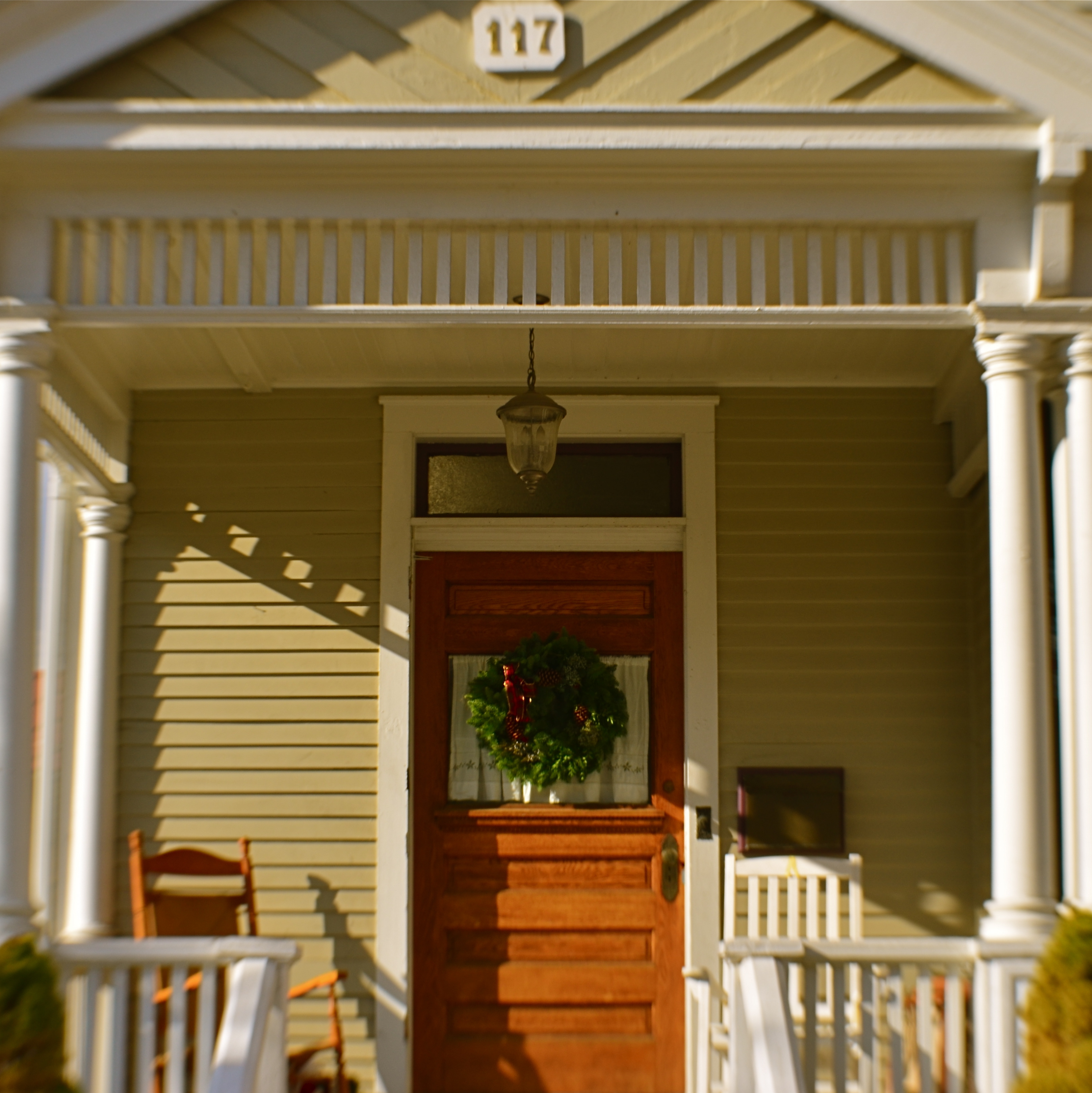
Does the traditional rectangular framing of the house in the top shot feel roomy, or merely loose? Is the square re-cropping of the same image, seen just overhead, simplified, or cramped? If the front of a building truly has the same potential impact as that of a face, it would follow that a building study might benefit from the same compositional criteria. That means that, like a face, a building has to earn every inch it occupies within the frame.
LEADING FROM THE REAR
By MICHAEL PERKINS
PHOTOGRAPHING CROWDS IS SOMEWHAT AKIN to using one’s camera to track a billowing cloud of soap suds. The shape of the mass shifts constantly, roiling this way and that, presenting the shooter with an ever-evolving range of choices. Is this the shape that delivers the story? Or does this arrangement of shapes do it?
And is just the size of the overall crowd the main visual message….with the perfect picture merely showing a giant jumble of bodies? Plenty of great images have been made that convey a narrative with just mass or scale. But throngs are also collections of individuals. Can’t a compelling tale also be told focusing on the particular?
When shooting any large gathering, be it a festival, a party or a demonstration, I am torn between the spectacle of the “cast of thousands” type shot and the tinier stories to be had at the personal level. In the shot seen below, I was following a parade, actually behind the traditional approach to such an event. What arrested my attention from this vantage point was the printed shawl of the woman directly ahead of me. The graphic on the shawl had been seen on other flags and banners in the march, but, billowing in the breeze on her back, the print became a kind of uniform for the march… a theme, a face all its own.
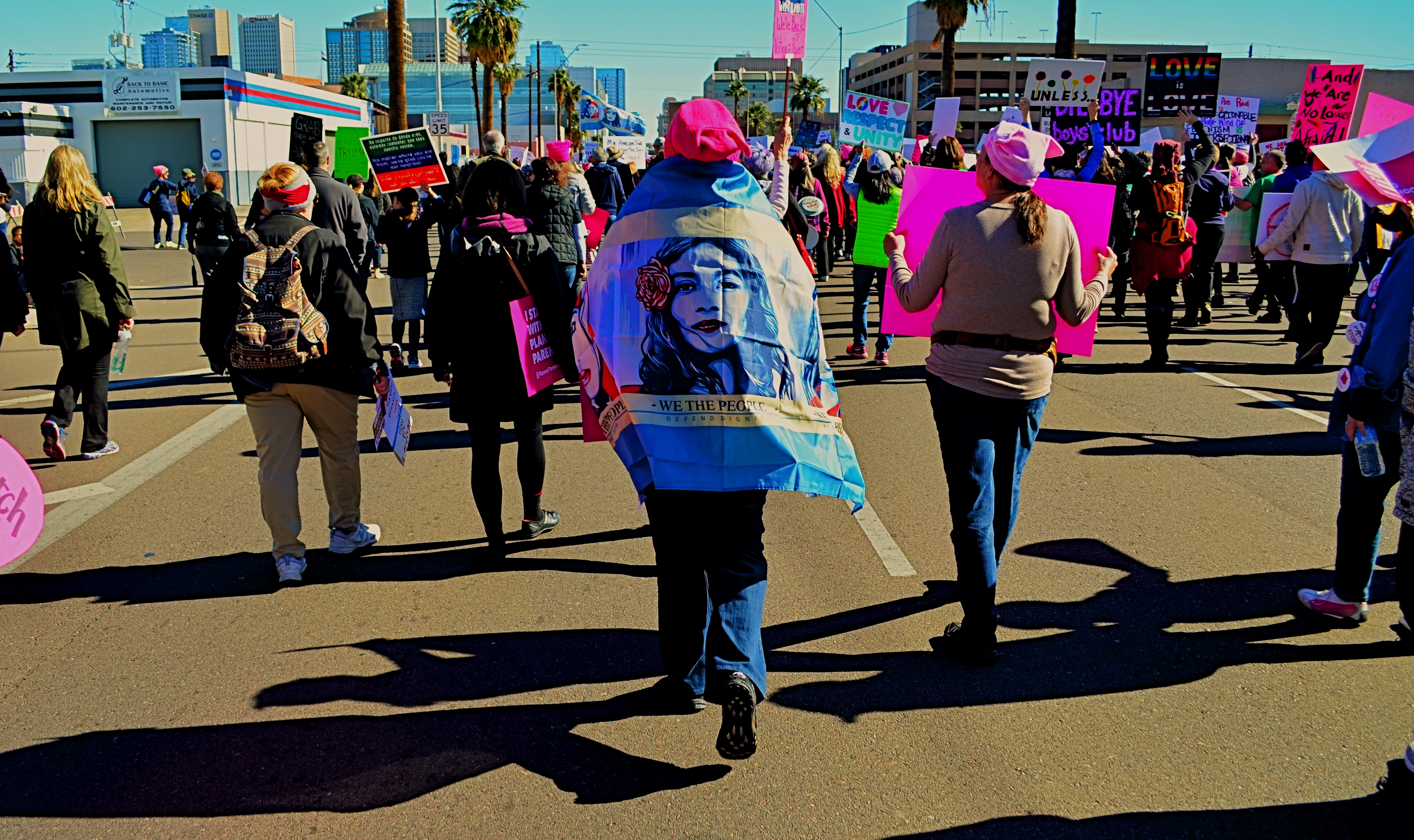
Sometimes a face in the crowd has no face.
In this context, I didn’t need to see the actual expressions of the marchers: there was enough information in their body language, especially if I composed to place the woman at the center of the shot, as if she were the leader. That was enough. The actual march boasted thousands, but I didn’t need to show them all. The essence of everyone’s intentions could be shown by the assemblage of small parts.
Some crowd photographs speak loudly by showing the sheer volume of participants on hand. Others show us the special energies of individuals. Neither approach is universally sufficient, and you’ll have to see which is better for the narrative you’re trying to relate in a particular moment.
CLUES AS TO WHOSE
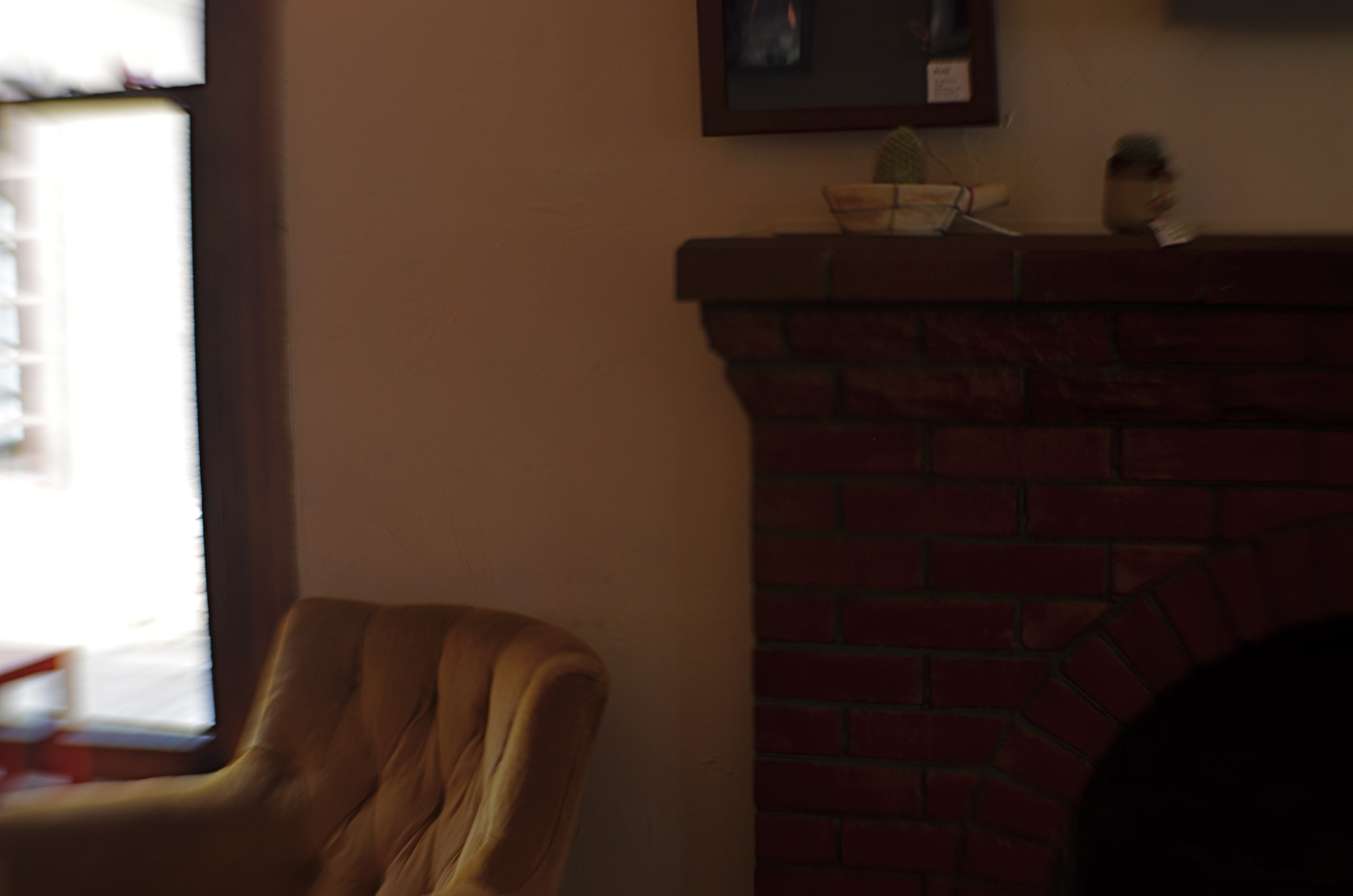
Pull Up A Chair (2018)
By MICHAEL PERKINS
THE CONCEPT OF THE STILL–LIFE is one of the most malleable in all of photography. Pore over enough image anthologies and you’ll see the term applied to every type of conglomeration of objects. Scale doesn’t matter, nor do either complexity or simplicity.
Story, however, does.
Annie Liebowitz’ massive shot of the cluttered interior of singer Pete Seeger’s workshop, jammed with tools, scraps and other glorious geegaws, forms a rich phantom portrait of the absent master. On the other end of the spectrum, the simple, classic bowl of fruit can suggest a time, a mood, and a place, all within the space of a few square inches. A still life is most eloquent when it implies existences without actually showing them. There is a life in these things. The photographer leaves behind clues as to whose.
I tend to feel the presence of people in empty rooms. I’m not saying I see apparitions of dead folks. The sensation is more like what I imagine Sherlock Holmes might experience when initially arriving upon a crime scene. To the great fictional sleuth, all rooms fairly scream out their stories: every stick of furniture, every scrap of food, every scattered book testifies in some way. Of course, photographs eventually prove that there is no such thing in nature as an “empty room”. Human activity leaves an after-image: we don’t scrub a place of evidence just because we physically leave it. Effective still-lifes recover part of that ethereal data.
It’s a great exercise in minimalism to see how little you need to show in a still life of a room and still suggest a narrative. It’s not necessary to tell the entire story. You need only pique your viewer’s curiosity as to what might have happened, or what the potential plot line of the scene could be. Photography, after all, is an interpretive art, and only a percentage of a place’s “reality” ever makes it into the frame. A still life, from Pete’s workshop to the bowl of fruit, is all about extrapolating from the seen to the unseen. If you’re lucky, someone outside yourself will see what you see.
Or……don’t see.
See?
OH, HALE YEAH
By MICHAEL PERKINS
CONSIDER: MANY OF THE PHOTOGRAPHIC EFFECTS MOST DEARLY PRIZED by today’s edgier shooters actually have their roots in the shortcomings inherent in the techniques of the medium’s first years. That is, the artifacts produced in early photos (the blotches, streaks and smears that visually betrayed the limits of a particular era’s technology, from bad film emulsions to flawed lenses) are being sought out and deliberately inserted back into contemporary images, almost as if they confer some kind of authenticity on the final results. We came this far only to pretend that we haven’t moved at all.
There’s nothing to be gained by trying to figure out why we struggle to remove certain glitches from pictures in one age only to revere them in another. Fact is that many of us occasionally crave that “old timey” look, and so the very thing that once annoyed us as a defect becomes, later on, desired as an effect.
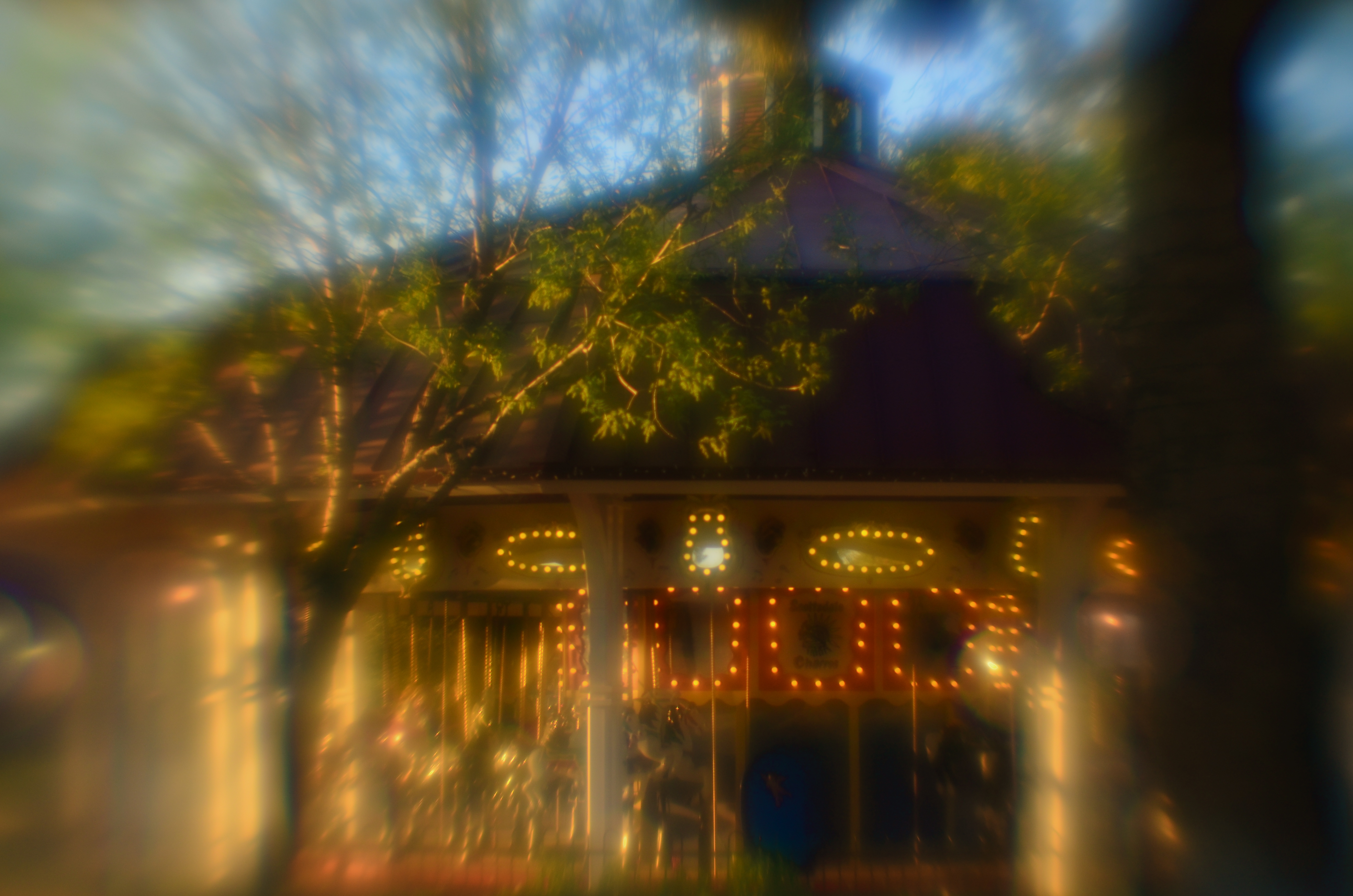
Halation, once an artifact of film processes, now can be achieved with special lenses.
Halation, or the soft, glowing aura around bright areas in an image (imagine the diffused appearance of street lamps in a thick fog) was originally an unwanted look that happened when light would go through sensitized film, then reflect off a surface behind it (say the inside back of the camera body) and bounce back through the film a second time. This so-called “light scatter” would appear as an ethereal haze around the brighter objects in the picture, almost like a halo around the head of a saint. Halo—Halation. Annoying defect if you don’t want it. Subtly dreamy effect if you do.
The “accidental” part of halation was addressed ages ago by adding inhibiting agents to film and matte surfaces to camera bodies. The “intentional”part has been added back in artificially, either with the use of layers in Photoshop, or with Lensbabys or other “art” lenses intentionally designed to render the effect (as seen in the above image). This kind of reverse-engineering, the process of “putting the scratches back into the record”, of restoring the very things we once rejected, is increasingly common in the post-digital era, as we still long for analog experiences, even, it seems, the imperfect ones.
LOOK ME IN THE ( ? ) AND SAY THAT
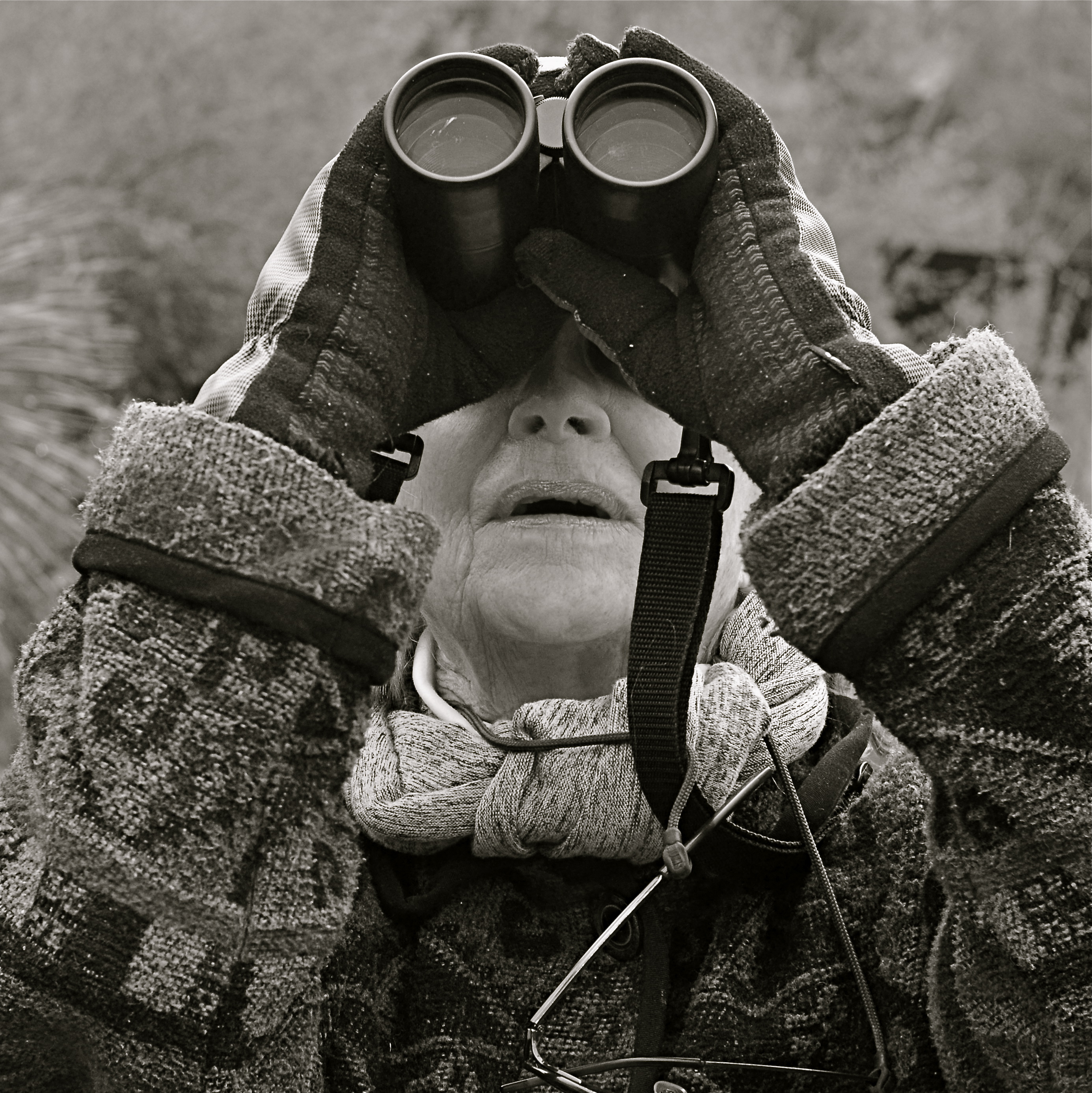
On The Wing (2017)
By MICHAEL PERKINS
PHOTOGRAPHY’S FIRST HUGE SURGE OF POPULARITY served notice on the painting world that there would, going forward, be more than one way to capture the human essence in a portrait. Initially dismissed as a mere recording device by panicky daubers the world over, the camera soon earned a place at the table by revealing just as much of the inner souls of its subjects as even the most trained brush, albeit by different roads. One of these, of course, was the eye, characterized as “the window to the soul.” To some, it seemed that painters merely drew your gaze to the eye, whereas the camera drilled straight through it.
Whether you share that view or shrink in horror from it, the fact is that generations of technical treatises have centered on the vital importance of engaging the eye in portraits: getting the right “catch light” spark reflected in it, making it the primary focus of the face, even zeroing out sharpness in the entire frame except in the orb’s immediate vicinity. It’s accepted wisdom that the eye sells the face and the face sells the picture. But what of faces that have another kind of story?
In the above image, we are, as viewers, denied access to the birdwatcher’s eyes, unless you interpret her binoculars as a kind of abstract substitute. But does that make the picture not a portrait? Using every other feature and prop available to the shooter, is there insufficient evidence to properly tell her story? Are we at all uncertain of her intent, enthusiasm, state of mind? Is her zeal any less obvious without those windows to the soul in sight? Or to think of it another way, would the picture have any greater narrative power if her eyes were visible?
Portraits are certainly anchored by their most provocative features, riveting our gaze to precise points of drama as urged by talented photographers. However, that list of elements is not absolute, any more than a blue sky is an absolute for a painter. Faces can spell out a message in upper-case neon letters or whisper it in muted shadows. But other than that, everything else is on the table. Portraits are a process, not a recipe.
PALING BY COMPARISON
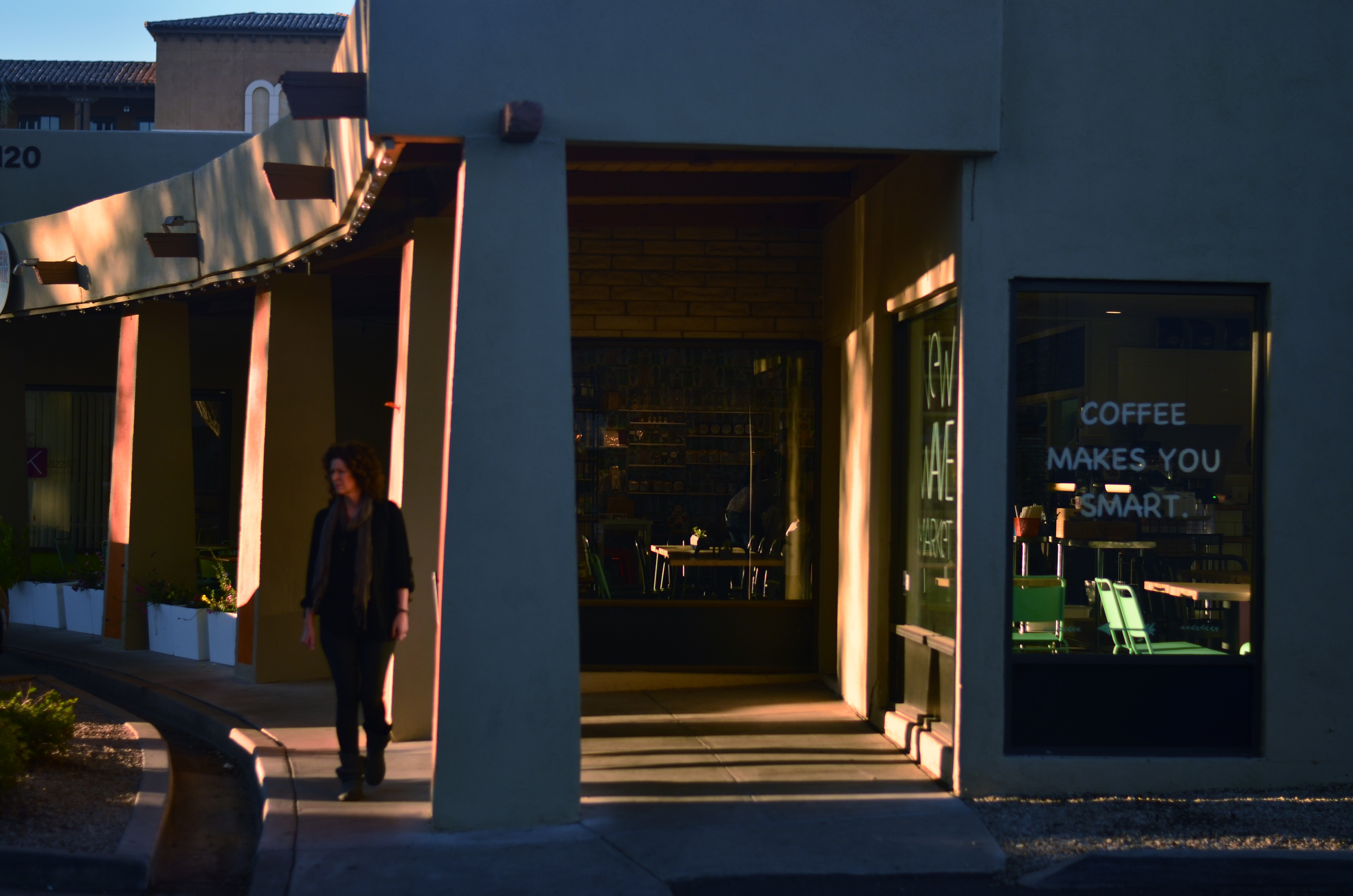
A good sunset to the naked eye, but rendered very blue by the camera’s auto white balance setting.
By MICHAEL PERKINS
GIVEN HOW MANY PICTURES YOU NEED TO SHOOT, over a lifetime, to develop the kind of eye that will deliver more keepers more often, you have to make peace with the taking of many, many images that do not, strictly speaking, “matter”. They’re either uninteresting or indifferently executed or mere technical exercises that don’t emotionally stick. However, that does not mean they are a waste of time, since the practice meter is running whether you’re making magic or mud. And with some mindfulness, you can get into the habit of harvesting something worth knowing, even in the most mundane of shoots.
Just straying from your standard procedures in very small particulars can show you new options for shaping or salvaging a photo. In the two comparison shots seen here, there is only one thing that distinguishes the first picture from the second one; the camera’s white balance setting.
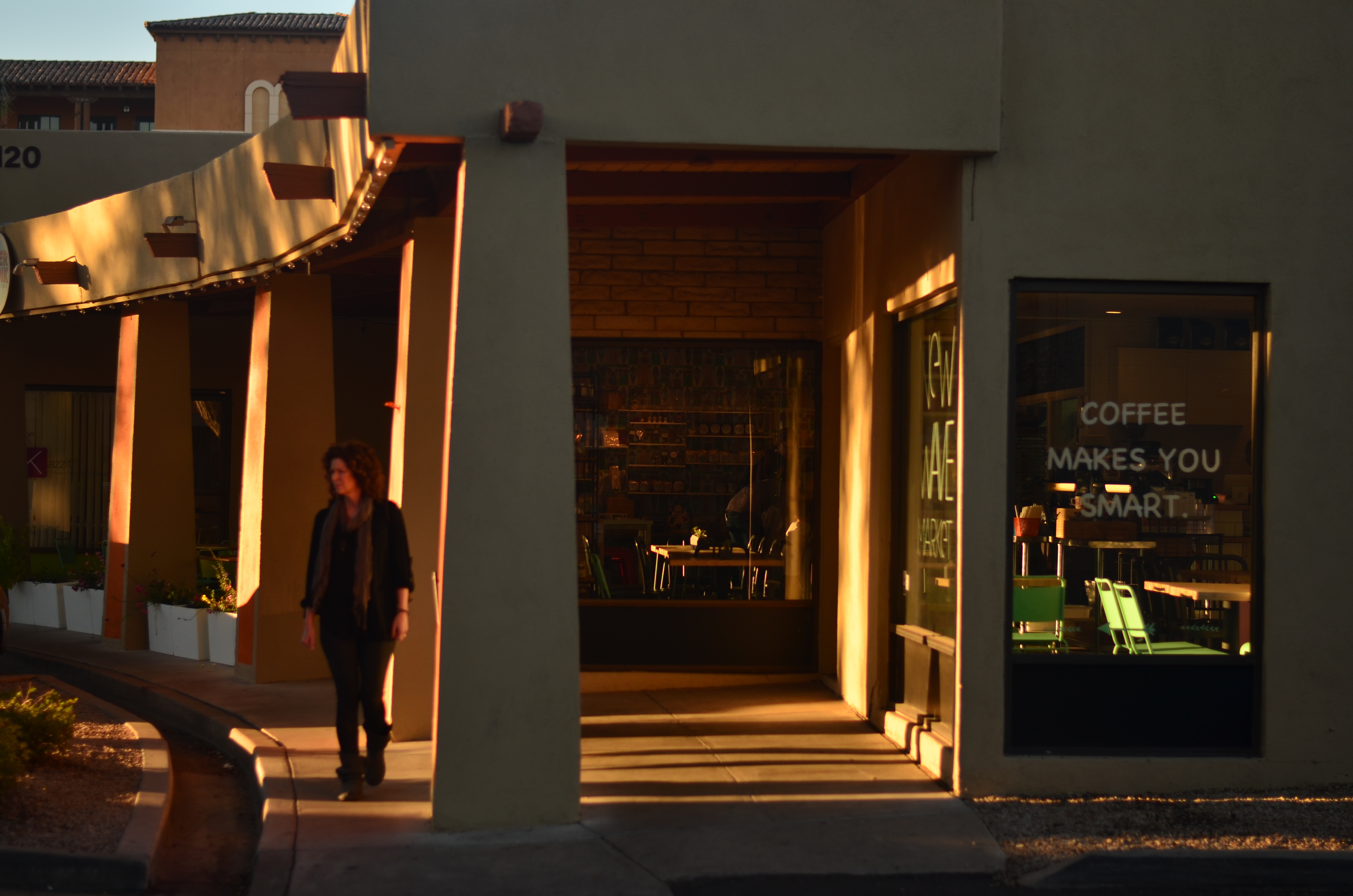
Same shot, same exposure, but with a switch to the camera’s “shade” white balance setting.
I just am not a fan of shooting on auto modes or default settings, for the simple reason that they are designed to produce average, not extraordinary pictures. They prevent us from making a total dog’s breakfast of an image, but they also deny everyone choice except, weirdly, the camera.
On the particular shooting expedition seen here, I was seeing a warm, full-on golden hour of pre-sunset, the rich oranges and browns visible even in shade. However, the camera’s auto white balance, which reads the temperature of light to “see” white the way we do, was delivering a lot of blue. The simple switch to a “shade” setting rendered even the deepest shadows as warmly as my eyes did.
The point is, this image was part of an uneventful afternoon’s casual stroll, yielding nothing in the way of “legacy”-level work. It was simple journeyman practice. What makes such tiny technical decisions valuable is how instinctual they can become when repeated over thousands of pictures, how available they become as tools when the picture does matter. Pictures come when they’re ready. With luck, building on the lessons from all those “nothing” pictures mean you’ll be ready as well.
AFTER-IMAGES
By MICHAEL PERKINS
YOU GOTTA LOVE HUMANS.
No really, you need to. Not ’cause we deserve it, God knows (she does), but because, if you view us from the vantage point of an emotionally detached galactic being, we have some adorable habits. Our fashion decisions? Laughable enough to be endearing. Our life choices? Pathetically cute. And our compulsive habit of compiling “best of” lists of our work at the end of each year?
Well, okay, that is rather obnoxious.
But the lists persist, if, by the word “persists” you mean they are crammed into every molecule of available space in the final columns, blogs, newscasts, sermons and recipes of the entire last month of each and every calendar year. Reason tells us that there is someone, somewhere, whom, this very instant, is compiling a list of the year’s best ” best of” lists. You know that’s totally happening.
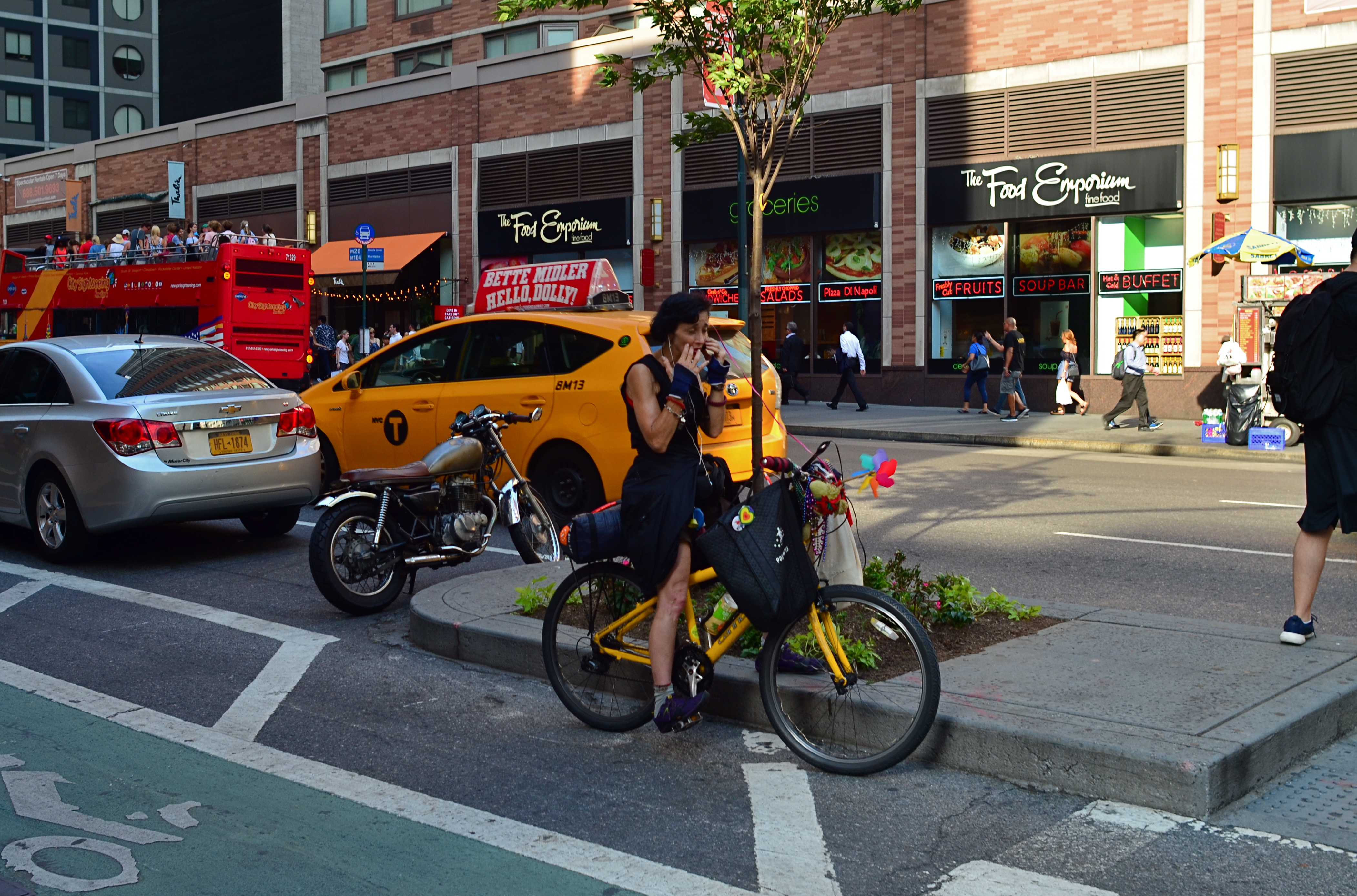
Of course, photographers are no less given to this vanity exercise than anyone else in public life, and I myself have certainly succumbed to the annual temptation to round up the usual suspects from the previous twelve months. What has changed over the years, however, is my belief that I am in any position to even know what my own best work is. What I think I do feel comfortable doing is to make, instead of a ” best of”, what I call a “most of” list…..collecting shots which yielded most of what I was seeking in a particular image, regardless of its precision or formal technique. Those choices are viewable by clicking the new “seventeen for 17” menu tab, found, starting today, at the top of this page.
This means that some of these very subjective “keepers” are by no means the most technically accomplished photos I made this year, nor are they always the images that were best received, or even understood. What they do represent are the areas in which I most wanted to dabble, whether that dabbling resulted in wins or losses. If you always try to produce prize winners, your work somehow starts starving for oxygen. And I’d rather suck than suffocate.
So thanks in advance for viewing my most-ofs. They might also be my bests…….but how would I know?
Humans. Go figure.
ORCHESTRATING THE DARK
By MICHAEL PERKINS
PHOTOGRAPHERS LEARN, FAIRLY EARLY ON, that he who controls the frame controls the conversation. The act of composition is really forced upon the artist, since every picture has some kind of hard physical limits or arbitrary dimensions. And since no photographic vista is truly unlimited, one’s vision is subject to two crucial choices: what to put in the frame, and what to leave out.
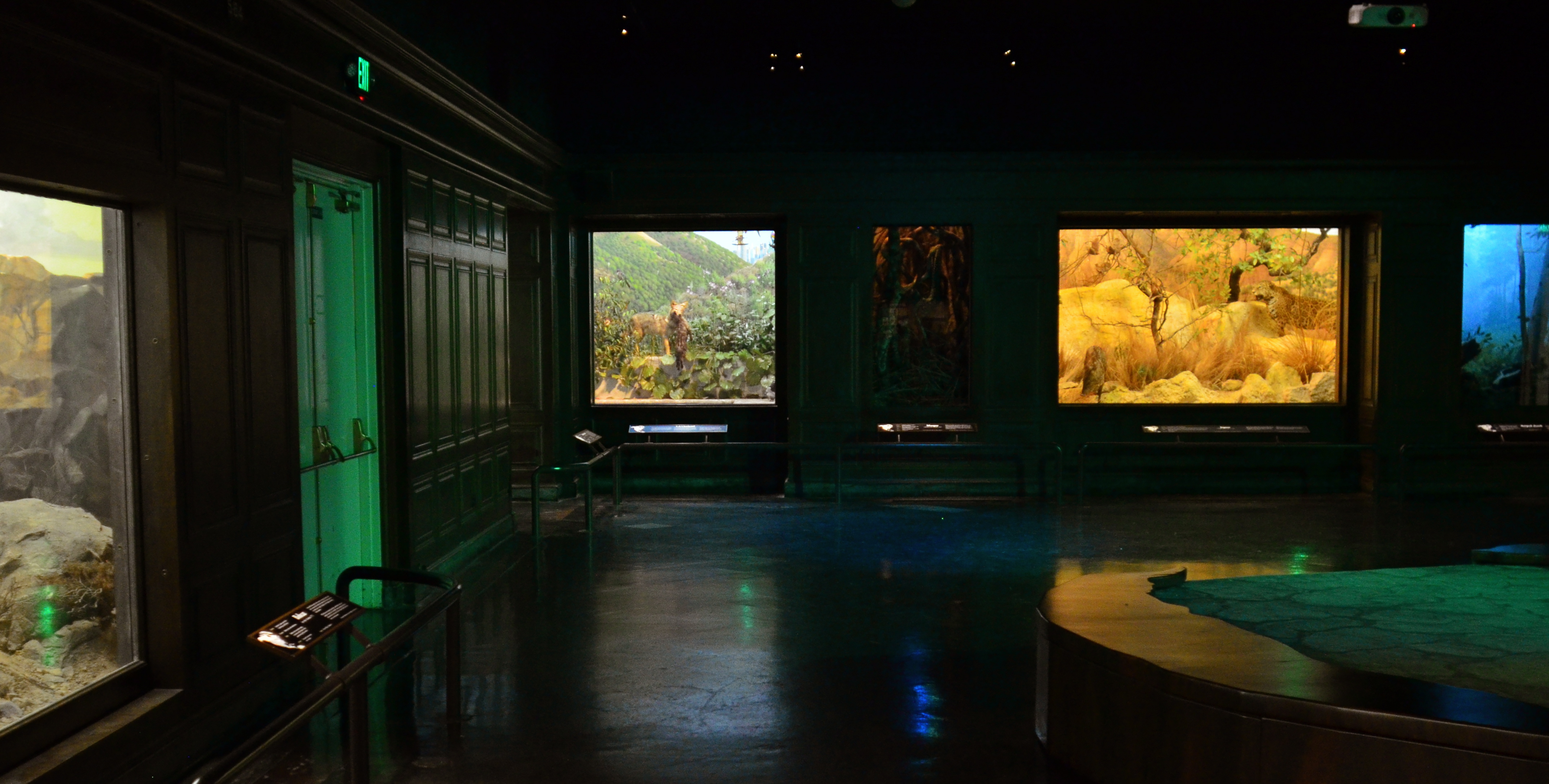
This process is lovingly demonstrated in 2017’s glorious film Wonderstruck, a nostalgic observation on the art of presentation, specifically the way it has historically been practiced by traditional museums, those special places where we arrange, as do photographs, a version of reality. The film chiefly centers upon New York’s Museum of Natural History, whose legendary dioramas of global habitats have transported generations of young minds to a universe of savannahs, shores, and deserts, all trapped in backlit cubicles and arranged in grand halls, warehouses of worlds orchestrated in darkness.
Here, in this supermarket of climates and locales, each diorama must convey its message in a shorthand of visual cues, hinting at entire ecosystems within a limited space and with only a modest number of props and textures. At their best, they echo the skills of the most effective of photographs, making eloquent choices on what is included, what is excluded, and whatever narrative power those choices generate in the finished product.
Of course, Wonderstruck’s affection for the museums it honors (including Los Angeles’ Museum Of Natural History, shown here) is a valentine to an age that is quickly vanishing, its prosaic, passive vistas giving way to the buzz and flash of ever more interactive, “hands-on” experiences, an immersive engagement that can make the dioramas of old seem like silent movies.
Still, if you can slow your absorption rate to pre-digital speeds, the old wonder boxes can still teach, because photographers are still bound by many of rules of engagement they observe. Don’t distract, attract: clarify your message: get the story told. Snapping an image is a fairly process. It takes time, real time, to learn to curate them.
O SILVER TREE, O SILVER TREE……
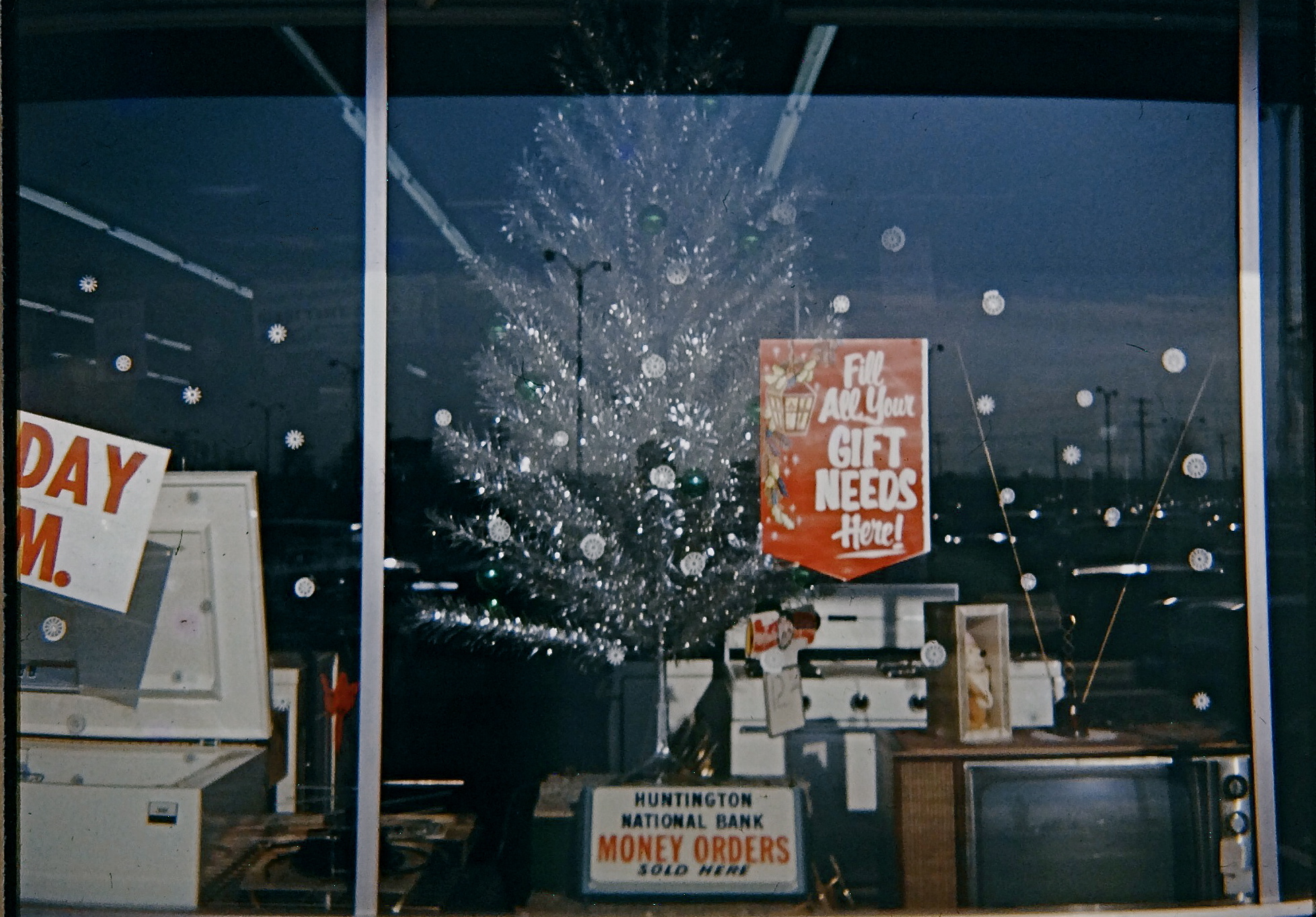
Cussins & Fern Hardware, Columbus, Ohio, Christmas 1965
By MICHAEL PERKINS
CBS TELEVISION FIRST AIRED A Charlie Brown Christmas on December 9, 1965, creating an instant seasonal classic. It got its first tenuous viewing despite the network suits’ fears that the modest little story, voiced by children(!), sporting a jazz soundtrack(!) and gently suggesting that the holiday may be about more than greed and glitz, would lay a giant Yuletide egg. They needn’t have worried, as it turned out. The show nobody wanted became the tradition without which no Christmas could be thought to be complete.
One of the show’s main plot points involves Charlie Brown’s fear that the holiday has been hijacked by hucksters, so much so that the hottest selling Christmas trees in his neighborhood are not verdant firs but pastel-painted, neon monstrosities. There was a lot of that nonsense going on in those days.
The photograph you see here was taken just days after that first airing of ACBC, but I can’t really claim to be channeling its energy or trying to echo its sentiments. The picture isn’t so much a comment on commercialism (nothing that formal) so much as it is a question.
I was a very young thirteen in December 1965, and had only wielded my Imperial Mark XII box camera on a few occasions prior to the day I found myself wandering around Northern Lights shopping center in Columbus, Ohio, specifically past the display window of the Cussins & Fern Hardware Company. Like Charlie Brown, I thought that some holiday novelties, like the recently introduced aluminum Xmas trees were odd, even though I liked the included rotating wheels that projected ever-changing colors onto the silvery sticks in a kind of robotically cold imitation of gaiety. However, unlike Charlie Brown, I don’t think I regarded these abstract Future Trees as an affront to decency. I just thought they were weird.
I do remember thinking that the window showed a Christmas that was just kind of……off, a Christmas in which you got a whole television set or a food freezer as a present, a Christmas filled with Strange Trees From The Future, a Christmas where you could always buy….money orders? I knew, in that era, next to nothing about how to formally frame a shot or a visual commentary. I didn’t have the pictorial vocabulary to make an argument. I couldn’t interpret. I just pointed at things that interested me and trusted those things to carry their own narrative weight. I was point-and-shoot before point-and-shoot wuz cool.
This Christmas, both the holiday and I are still in flux. I continue to point my camera at shop windows, and continue to wonder what the whole mad mix of beauty and banality means. I still don’t have the answer. Alas, as a photographer, you often have to be content with merely learning better ways to ask the question.
Now, if I can just find someplace to buy Uncle Ed that money order he asked for…..
(RE)SHAKE IT LIKE A POLAROID
By MICHAEL PERKINS
OVER THE PAST FEW DECEMBERS, The Normal Eye has marked the holidays by recalling classic Christmas advertisements from the Eastman Kodak Company, the first corporation to merge consumers’ seasonal sentiment with the promotion of camera sales. We’ve had fun revisiting examples of the firm’s amazingly successful “Open Me First” campaign, which cheerfully asserted that, basically, it ain’t Christmas until someone puts a Kodak under the tree.
This year, however, seems to argue for a new wrinkle in our tradition, with the long-anticipated resurrection of the Polaroid corporation, or at least its Christmas ghost. The strange saga began in 2008 when Polaroid decided to discontinue the production of its iconic instant film, leaving a half-century’s worth of global users stranded. Enter the entrepreneurial trio of Florian Kaps, Andre Bosman, and Marwan Saba, who bought as much of the company’s factory hardware and film-making process that still remained after Polaroid had begun scrapping parts and burning files. Sadly, most of the sacred secret film recipe had already been destroyed, meaning that the team’s new company, dubbed The Impossible Project, had to painstakingly reverse-engineer the production process, eventually creating an instant film that was much closer to the quirky, low-fi look of Lomography cameras than the precise instruments Polaroid produced in its heyday.
For the next seven years, Impossible Project instant film shot off the shelves to feed the world’s aged inventory of SX-70’s and One-Steps, drawing praise for preserving the feel of film and drawing fire for what was actually pretty crappy color rendition and slooooow development time. Finally, in 2017, Impossible purchased the last remnants of Polaroid’s intellectual property, allowing it to begin manufacturing brand-new cameras for the first time in years and rebranding the company as Polaroid Originals. Christmas 2017 would herald the arrival of the Polaroid OneStep 2, a point-and-shoot quickie designed to compete with other mostly-toy cameras cashing in on the instant film fever. The Ghost Of Shaken Snaps Past walks amongst us once again.
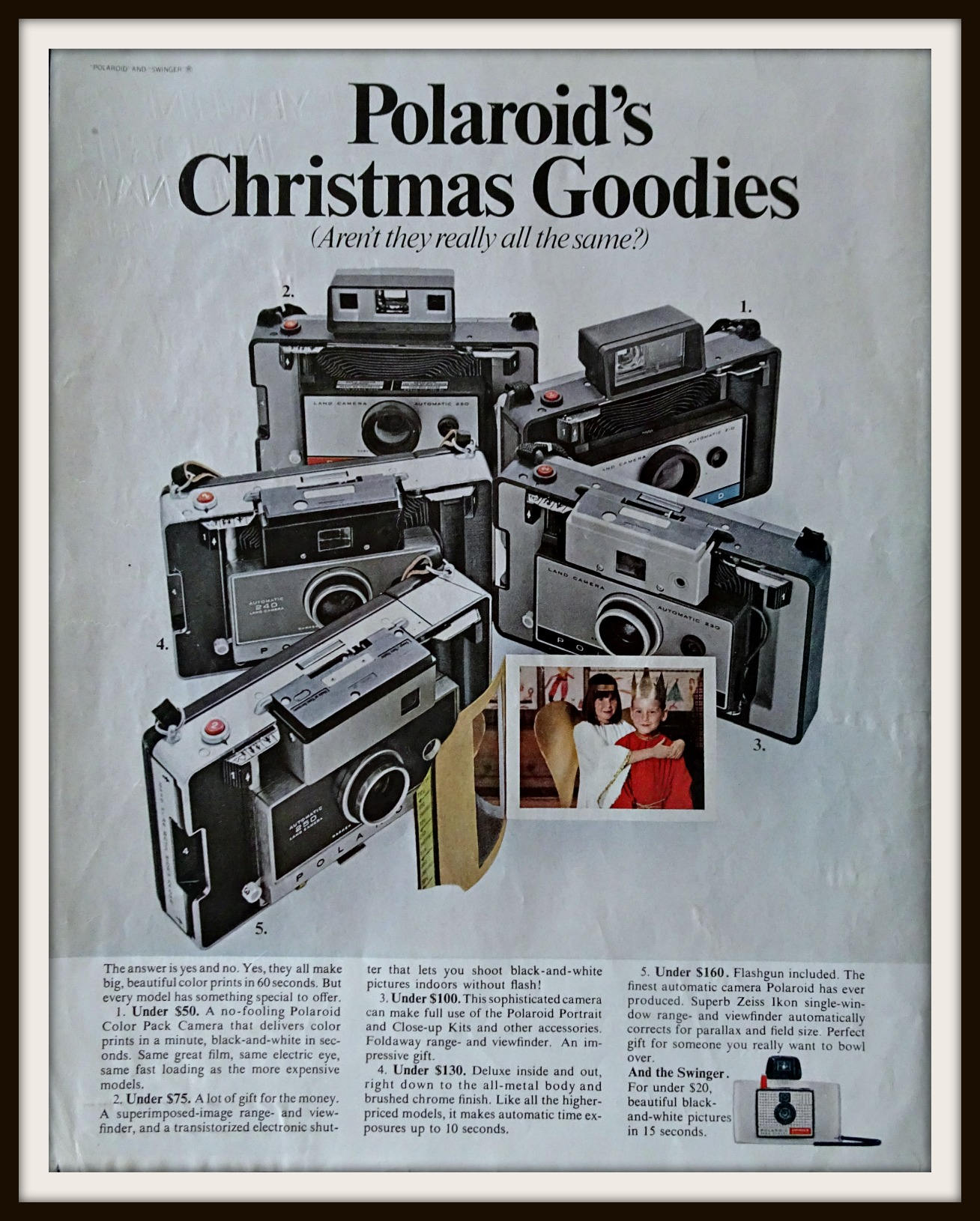
And so, Polaroid is dead and long live Polaroid. The above 1967 Christmas pitch for the original company’s full product line (read the fine print) gives testimony to the incredible instruments that once bore the Polaroid name. You can’t go home again, truly. Not to live, anyway. However, an occasional 60-second visit can be fun.
Strange colors and all.
THAT’S THE SPIRIT
By MICHAEL PERKINS
JACOB MARLEY, THE RUEFUL GHOST of Dickens’ A Christmas Carol, refers to the manacles and links that trail behind him as “the chain I forged in life”, and indeed, as the years wear on, one can certainly feel the accumulated weight of one’s own “ponderous” train, its clanking amplified to even greater force during the holiday season.
Certain cycles of the year speak louder to our memories than others, whether they mark anniversaries of loss, joy, sacrifice, devotion, or any other emotional life trophies. And the visual arts, including photography, tap into and amplify these feelings in everything from the pages of the calendar to snapshots of dear ones both present and absent.
Both present and absent. Living and dead. Still here and almost gone. Ghosts and survivors. Marley and Scrooge. The photographer can sometimes almost feel the collision of past and present within a single image, as if each force is grappling for control of the picture’s message.
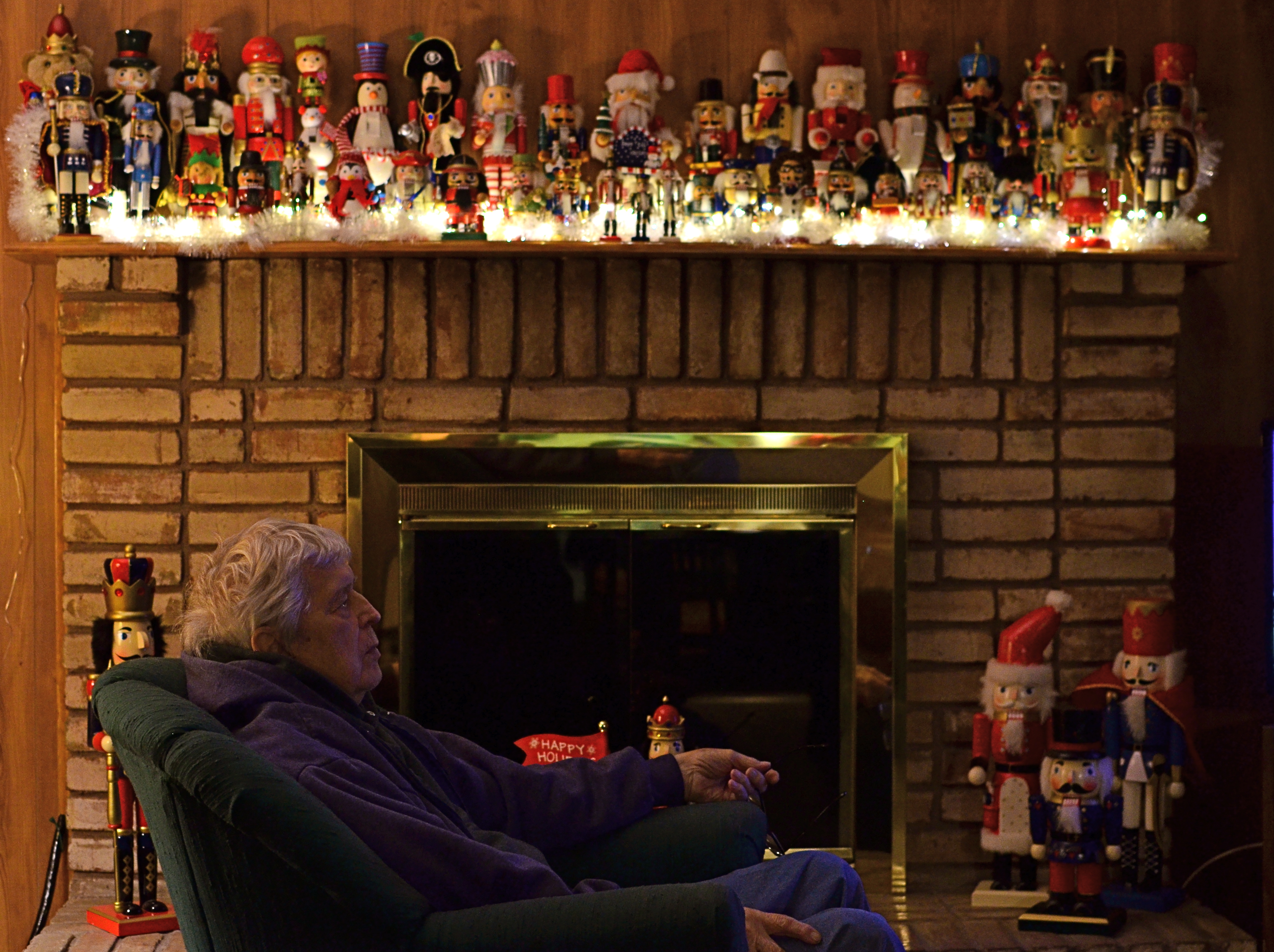
In the above photograph, I was initially looking to steal a candid of my father as he watched some television. It should have been a simple task, but, when your father is still here at 88, the faces of those no longer here echo in his every feature. To add to the density of emotion, you have the fact that he’s seated beneath a mantle fairly buckling under the weight of a third of a century’s worth of well-curated nutcrackers. Thus, even though she’s dodged having her picture taken at this particular moment (a well-honed skill), my mother is present here as well.
And so, decisions, decisions: I could have made my father look over in my direction, maybe even coaxing a smile from him, but I liked his weary look of detachment, as if the years were a kind of Marley chain dragging him earthward. I also could have cropped out the nutcrackers, simplifying the overall frame. But the “ponderous” tonnage of memory the figures symbolize would have been wasted, so they stay.
Photographs can only rarely be snapped in their most complete form, and certain times of year prove too layered with history to make for so-called “simple” pictures. Maybe it’s the different way we see on certain days. And just maybe it’s a ghostly presence, a glimpse of the chain we forged in life.
NO SECOND ACT
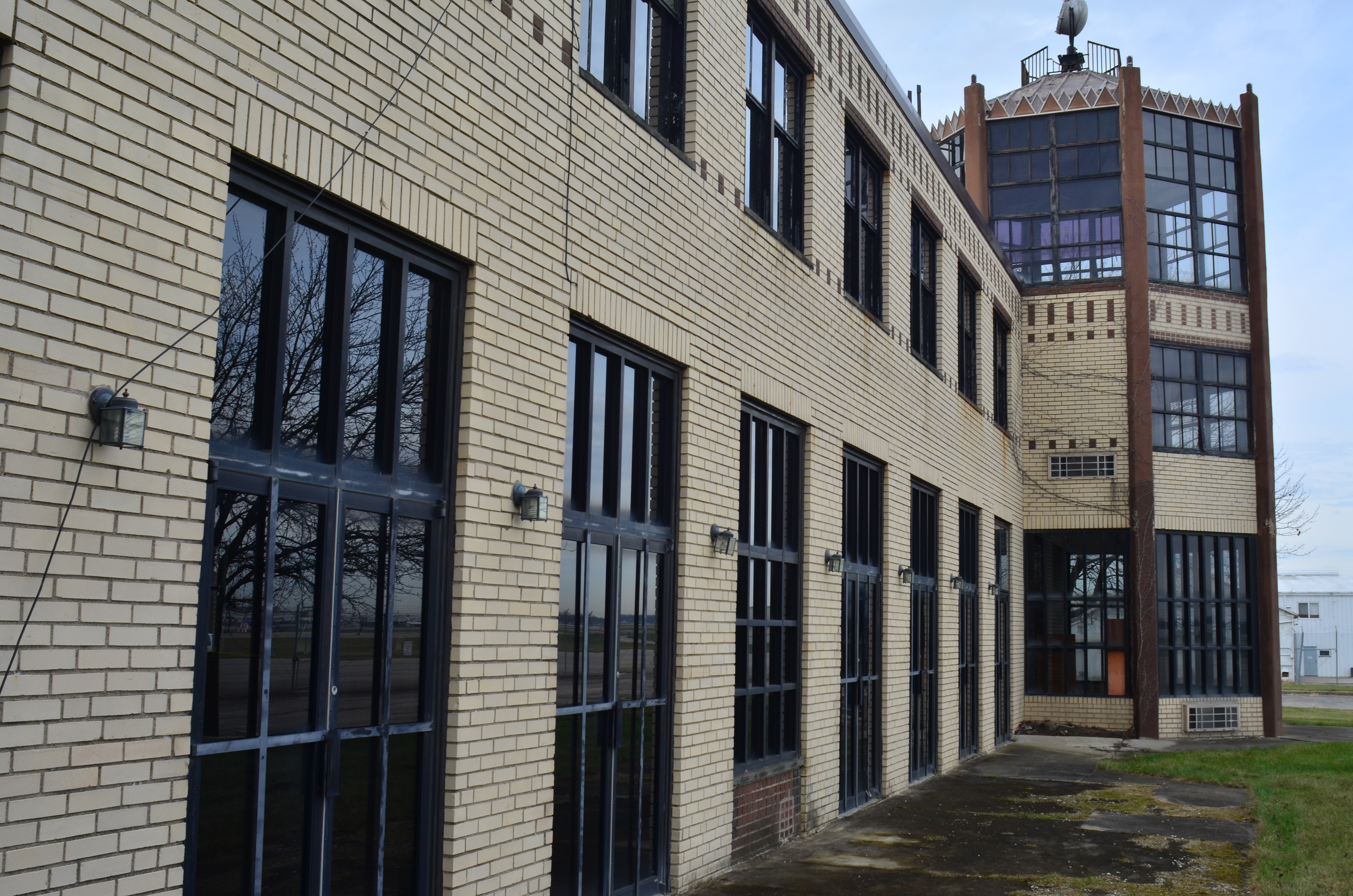
The first Port Columbus air terminal, opened in 1929.
By MICHAEL PERKINS
THERE IS SOMETHING TRAGIC, AND CONFOUNDING, in America’s longstanding reluctance to re-use and re-purpose its historic infrastructure. This ever-young nation seems to have an allergic reaction to preservation, as if the physical artifacts of its heritage contained some kind of dread plague. As a consequence, buildings that have figured most prominently in the story of our nation’s amazing evolution fall…. first to neglect, then to the wrecking ball.
Photography is a way to bear witness to what Gore Vidal called “the United States Of Amnesia”, a way to document lost opportunities and wasted potential across the fifty states. Miles of once-vital roads that no longer lead anywhere: blocks of neighborhoods that now howl and whistle in a dead wind: acres of buildings that once housed history instead of cockroaches and cobwebs. All is ripe for either revelation or regret at the point of a camera.
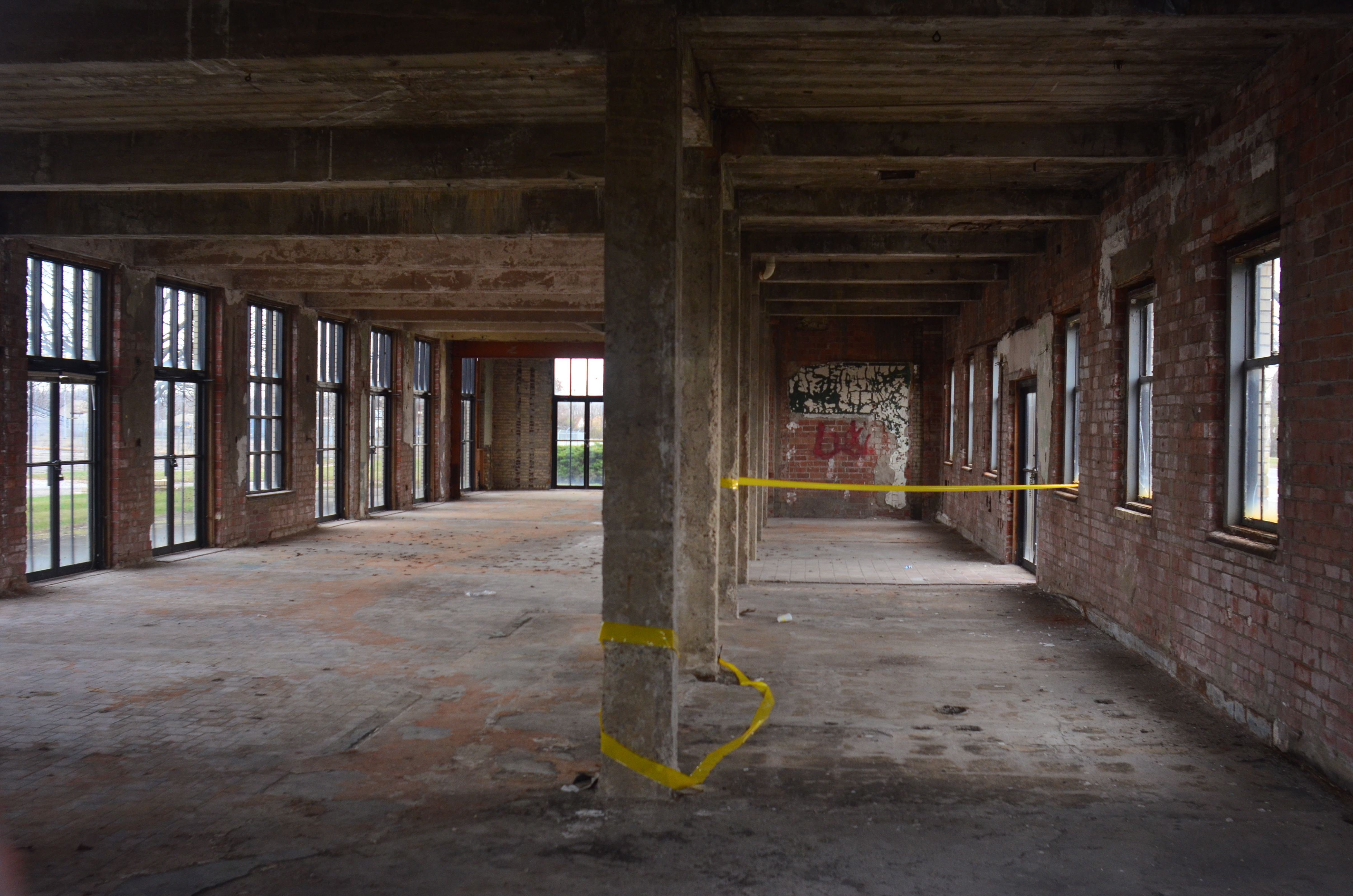
The deserted interior of the terminal in 2017.
Columbus, Ohio’s original air terminal building, opened in 1929 with hoopla and help from both Amelia Earhart and co-founder Charles Lindbergh, is one such location. Created as part of the country’s first fledgling attempt at a transcontinental air service (and this, only two years after Lindbergh’s astonishing solo flight to Paris) “Port Columbus” was solid proof that the air age was real.
Real enough, in fact, that a mere nineteen years later, the city’s air traffic had grown so rapidly that construction began on a shiny new international hub, big enough to accommodate a mid-century tourist boom, the jet era, and an explosion of international travel. The 1929 terminal was shuttered, living a few latter-day half-lives as offices for one short-term tenant or another, finally coming its silent rest on the Port’s back property, its legacy given half-hearted lip service with the obligatory plaque on the door.
Full disclosure: Columbus, Ohio was, for most of my life, my hometown. It is, among other things, a city of many firsts, a vital test market of ideas for everything from ATMs to hula hoops. And while I know that new uses won’t be in the cards for all historically important buildings there (or, indeed, anywhere), I am glad, at least, that, as photographers, we are privileged to say of such places: look here. This happened. This was important.
It’s often said that there are no second acts in American lives.
That’s tragic. And confounding.
GETTING PAST IT ALL
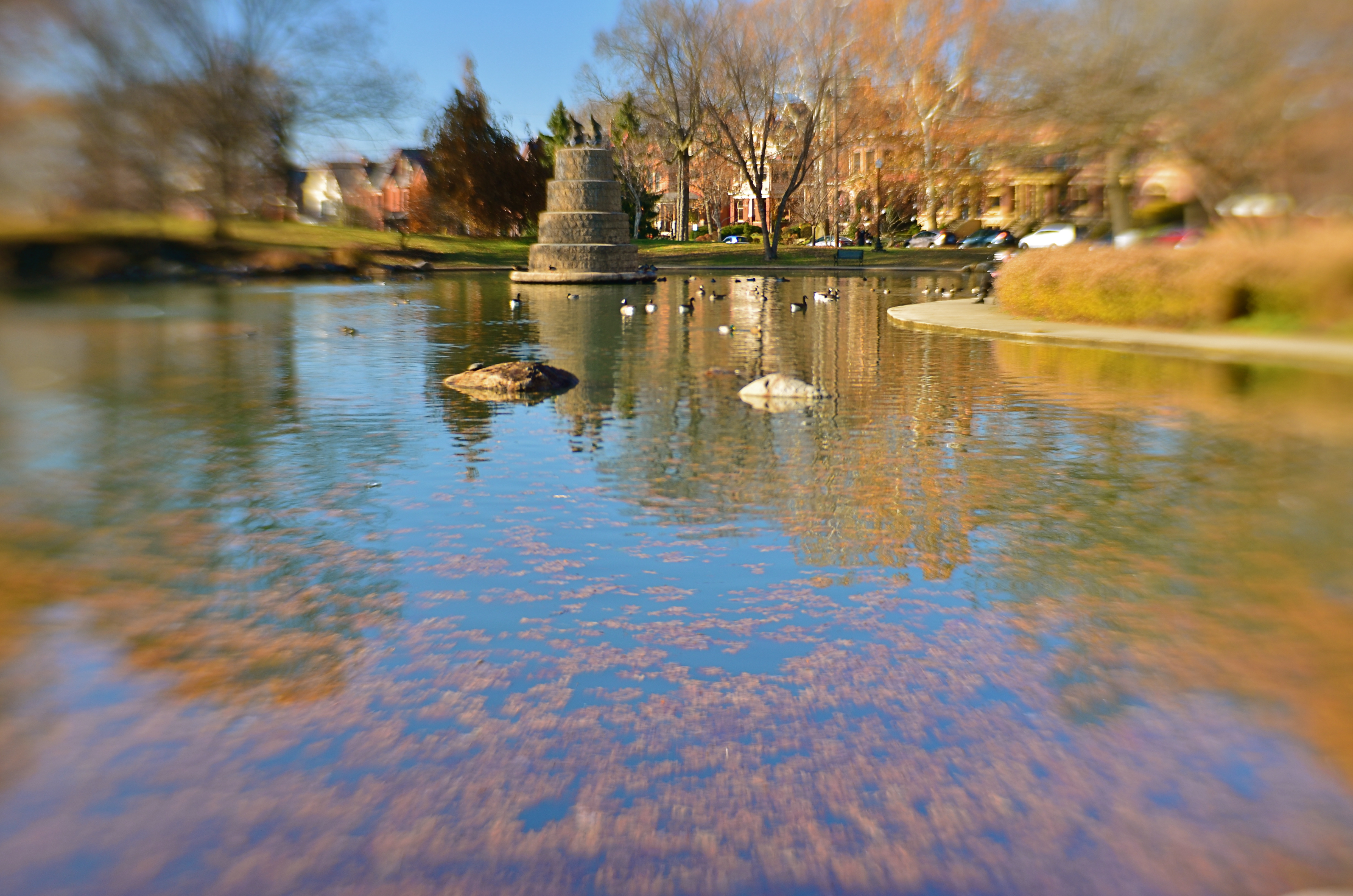
Is this image of a city park any less “real” than my childhood memory of it?
By MICHAEL PERKINS
SOME MEMORIES ARE BURIED SO DEEPLY in our mental archives that, like old snapshots, they deteriorate, browning along the edges, retrieved only in imprecise or incomplete detail. Ironically, these mainstays of our very personhood evolve over time from fact into folklore, rendering fundamental, formative events unreliable, suspect.
And if one’s personal memory of a time or place is less than “actual”, what about photographs of the places where those imperfect memories were forged? How can camera images of battlefields, home towns, even one’s childhood home record anything real beyond physical dimensions?
The park in the above picture first entered my consciousness in the late 1950’s, when my mother had medical appointments a block away and my father walked me around the perimeter of the pond to kill time while she lingered in the waiting room. I recall very specific things about tile mosaics of fish set in the concrete walkways around the water, and a few flashing impressions of a nearby cafe which no longer exists, but that’s pretty much the sum total of my memories of the place.
So, as a photographer in 2017, how do I even attempt to make a visual document of this locale? Any specifics of my own experiences here have been smeared and sandpapered until they only represent a part of a part of the real story. Shouldn’t I, in fact, sort of “free-associate” the scene, assuming that any fresh impressions are at least as trustworthy as my moth-eaten memories of it? Since I can’t reasonably capture a faded dream, isn’t the dream realm where I should draw for the missing pieces?
We only suppose that a camera, which at one level is a mere recording instrument, will act as an objective reporter on the current sites of our old adventures. But that’s the problem. It can only take measure of things as they are, not the unique mix of fact and fable that passes for experience in our imperfect minds. And so we frown at the results and mutter, “it’s not like it was…”
The reply to which should be: how would we know?
THAT’S WRONG, YOU’RE RIGHT
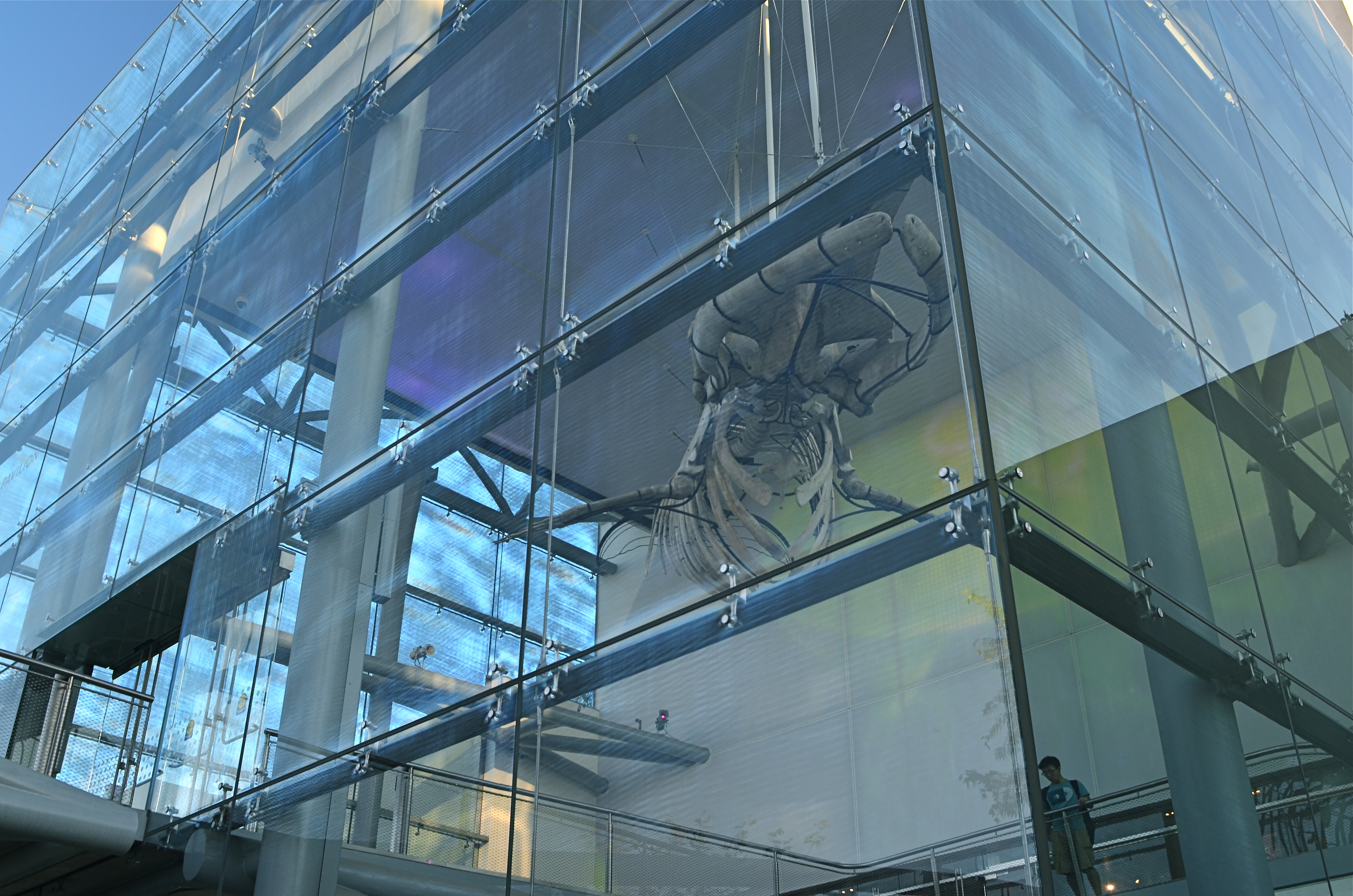
Cutting glare from the outside of a glass building with a circular polarizing filter…
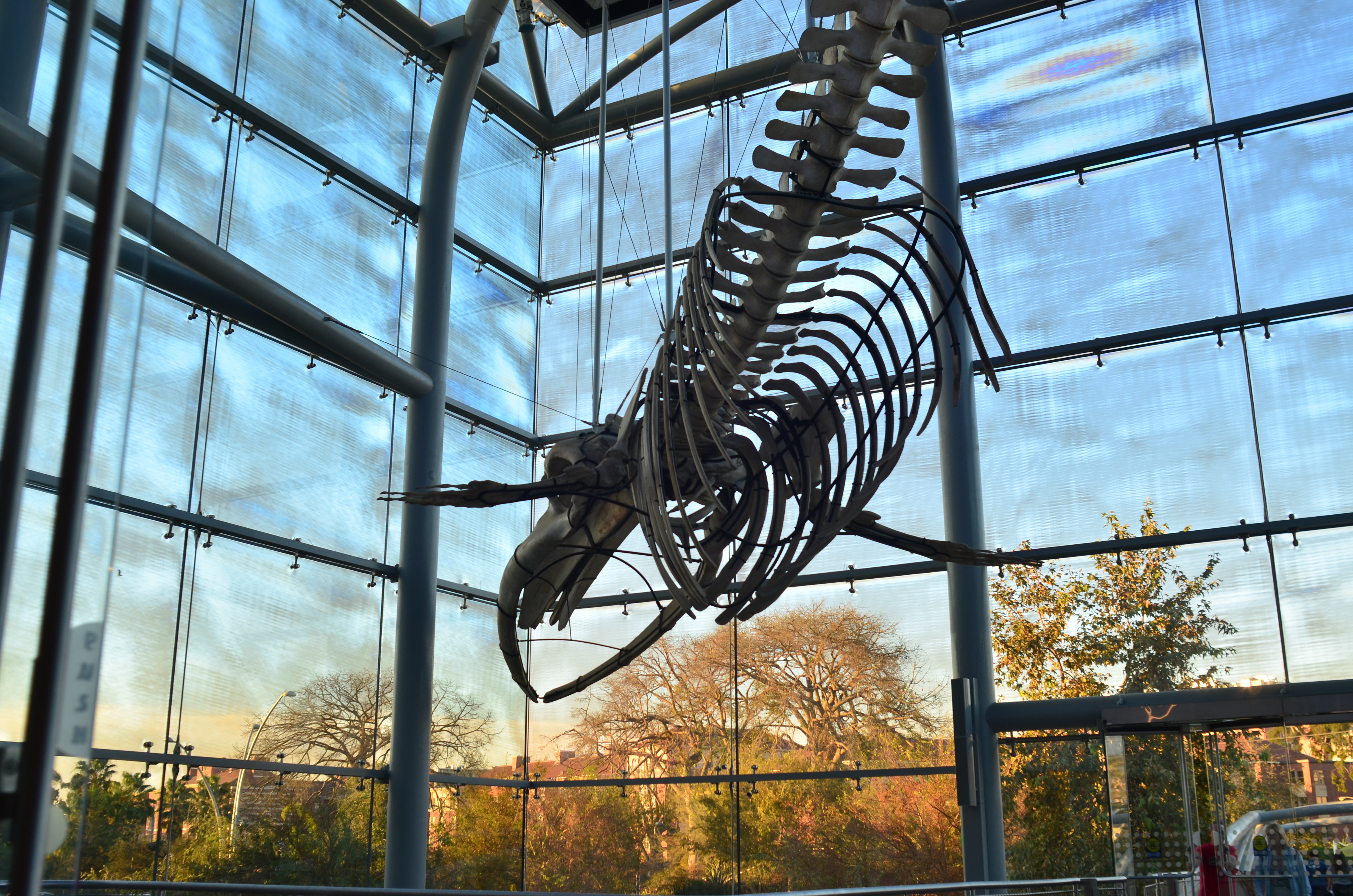
….and using the same filter to create effects on glass from within the same structure.
By MICHAEL PERKINS
IF, AS A PHOTOGRAPHER, YOU ARE A DEDICATED RULE–BREAKER, you may view every new piece of equipment as a double opportunity….a chance to explore gear both in the way the manufacturer intended (see the user manual) and in whatever intuitive (spelled “wrong”) way you see fit (we don’t need no stinkin’ manual).
This is not as perverse as it first sounds. Shooters have been flipping telephotos backwards to create makeshift macros and partially uncoupling glass from camera bodies to “free lens” their way to selective blurring and distortion for eons. And you yourself can no doubt recount instances in which your gear has been persuaded to go off the rails to achieve some experimental end or other. Good photographers vascillate wildly between I hope I’m doing this right and I wonder what would happen if I….
One of my favorite departures from normal practice involves circular polarizing filters, typically used to either deepen the blue of skies or remove reflective glare from surfaces like water or glass. In the image at the top of this page, it’s used in exactly that way, allowing me to view a huge fishy fossil in Los Angeles’ Museum Of Natural History. In the lower image, both the vantage point and the effect of the filter are reversed: I’m looking outwards, with the CPF producing imaginary streaky artifacts on the glass, adding dramatic framing accents to the fossil and breaking up the monotony of a large patch of sky. Is this the recommended use for the filter? Nope. Does this approach work for just any picture? Nah. Am I glad to be able to produce this look at will? Yes, please.
Around the house, driving a nail with the butt end of a screwdriver can seem, well, desperate. But in photography, stretching equipment beyond its intended use can be an adventure. It’s actually freeing, as if you’re playing hooky and getting away with it.
So, when the spirit moves you, choose the right tool. Then use it wrong. But only in the right way.
INSIDE THE OUTSIDE
By MICHAEL PERKINS
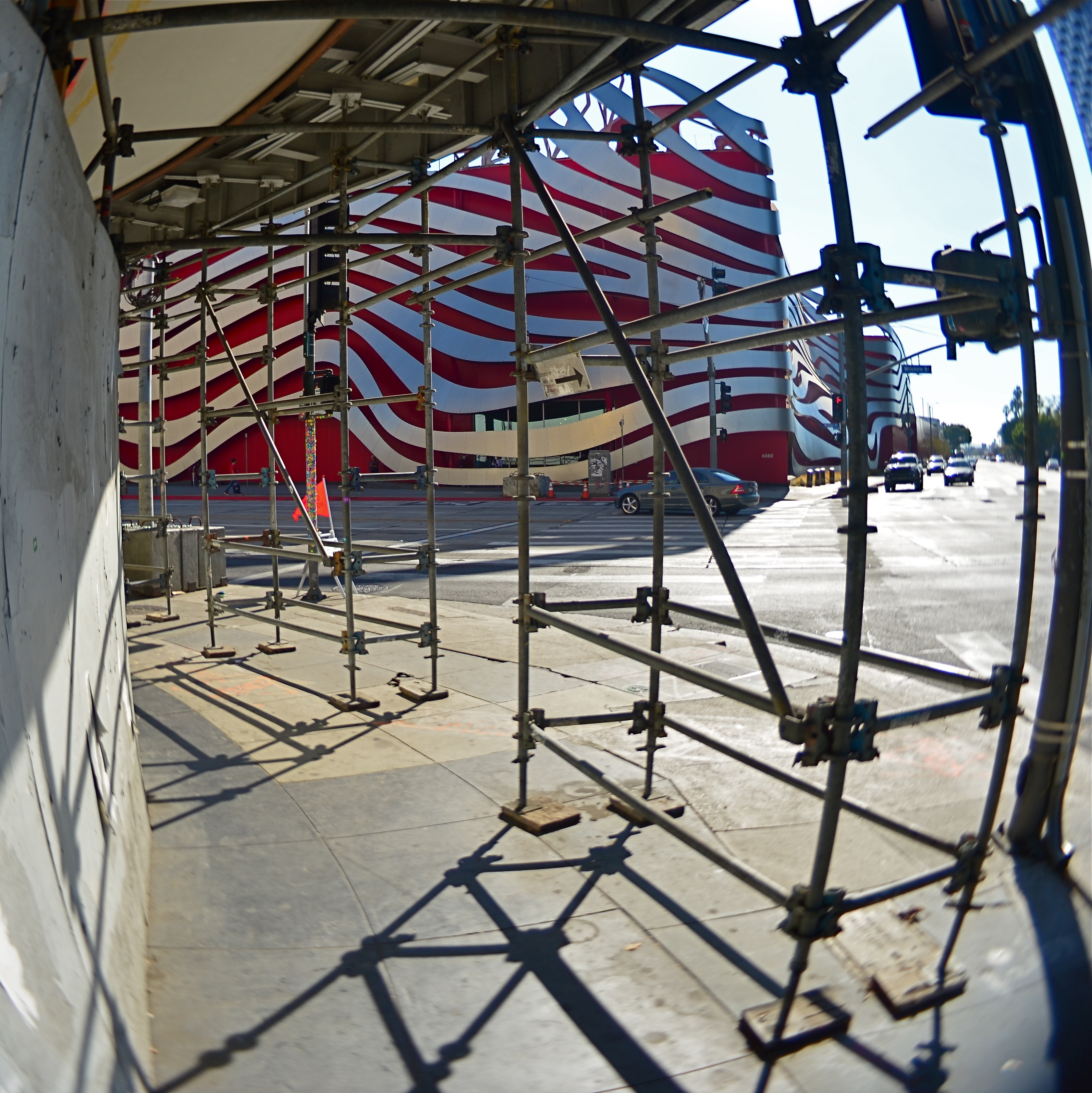
Los Angeles’ Petersen Automotive Museum, as seen from Fairfax Boulevard.
IT’S HARD TO ATTRACT ATTENTION IN HOLLYWOOD, a town that shouts in five dimensions, a million colors, and four thousand decibels about almost everything. Here, in the town that hype calls home, design always swings for the fences, and Subtle Is For Sissies. Small wonder, then, that photographers, who typically love to play top this with their peers, find that Tinseltown and greater L.A. are already at gold medal status in playing the very same game. I’ll see your weird, and raise you two weirders.
As a street shooter in Hollywood/L.A., you routinely witness the bizarre being passed off as the normal. As a consequence, the very act of visually commenting on this mad sensual overdose can make even your most prosaic shots seem like a trip through the looking glass. Words like stately, venerable, or traditional seem oddly out of place in the town that invented fourteen-story billboards and the Walk of Fame. Using a camera to say something new about it all can be a fool’s errand, or at least, a mental obstacle course.
Whenever I visit Los Angeles, I am constantly looking for some kind of reversal pattern, a way to treat the most outrageous visual artifacts on their heads. I don’t always succeed. I did, however, have fun trying, recently, to come up with a new way of seeing a very strange building, the Peterson Automotive Museum, located at the intersection of Wilshire Boulevard and Fairfax Avenue, the outside of which has undergone a very radical facelift in recent years. From afar, the building seems to be a wild, untethered series of curves and swoops, a mobius strip of red and steel spaghetti floating in space in an abstract suggestion of motion. It’s a stunning bit of sculpture that actually is a wrap-around of the original, far more conventionally-shaped museum building beneath it.
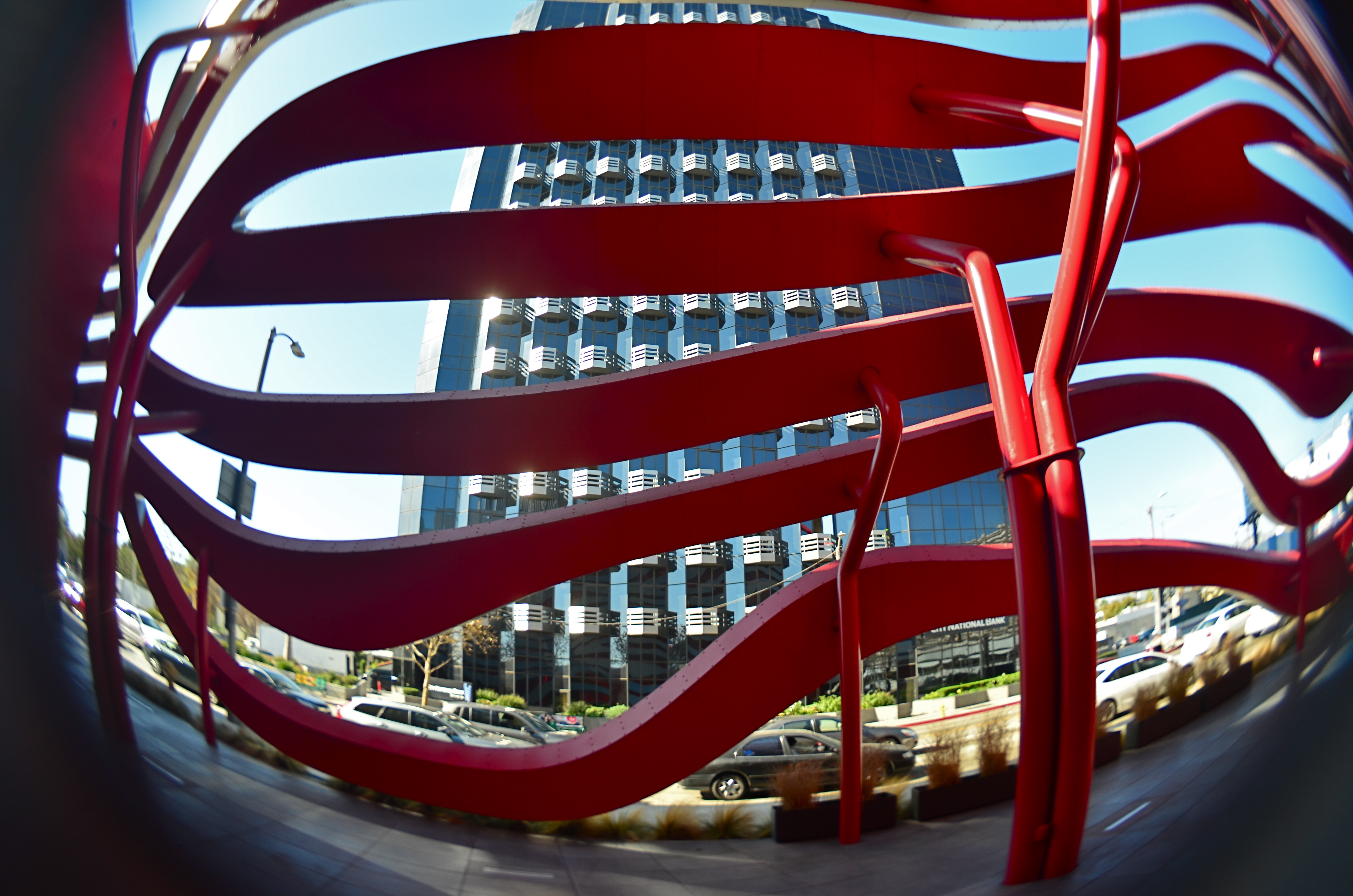
Inside the Petersen’s exterior facade, looking out.
And, as it turns out, that’s the way to reverse-engineer a photo of the museum, since it’s possible to walk behind the swirly facade and into a shadow-and-color-saturated buffer space that exists between it and the underlying structure. From inside said space you can view the outer bands as a peekaboo grid through which you can view neighboring buildings and local traffic, rather like looking between the slats of some big psychedelic set of venetian blinds. And that’s where I stood when taking the above shot with a Lensbaby Composer Pro lens with a fisheye optic, the aperture set at about f/5.6 to render the whole thing somewhat soft and dreamy. I’ll see your two weirders and raise you one bizarre.
THE BLESSED BUY-IN
By MICHAEL PERKINS
WE ARE ENTERING THE ANNUAL SEASON OF ENHANCED BELIEF, that sadly brief period during which we temporarily suspend many of our most cynical operating procedures, erring on the side of hope. Religion is most probably the root cause of much of this uptick in outlook, although plenty of us experience additional “buy in” to the world’s best possibilities in ways that transcend creed or calling. Photographers, too, approach the world through slightly rosier glasses, especially as it regards the season’s main repositories of belief, children.
Of course, belief isn’t really a seasonal thing with kids: it’s more like their home territory, their native base of operations. Long after adults learn not to hope for too much, years after we’ve taught ourselves to lower or tamp down our expectations, new generations of kids are factory-preset to imagine what if, and wouldn’t it be cool? Magic isn’t an aberration for a child but a basic law of the universe. If a kid can dream a thing, he or she generally believes that it can, and should, come true. Photographers see this “buy-in” manifest in every child’s game, every cardboard box made into a makeshift rocket ship. And images that capture that wonder are among the most heart-warming of this or any season.
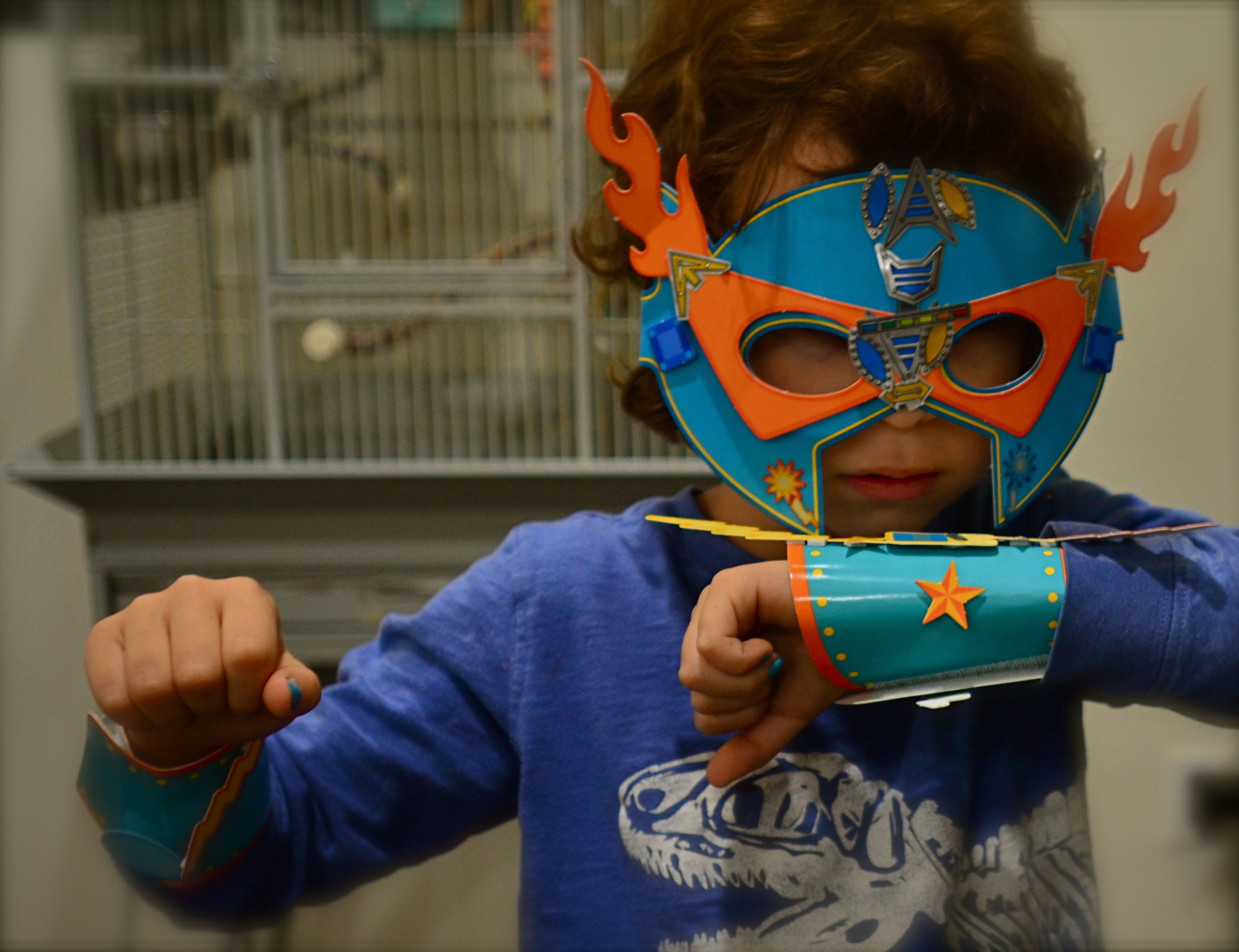
Urgent Communication (2017)
The young man you see here is dead serious about his idea of fun. He made the mask and cuff he’s wearing with his own hands, but that doesn’t render them any less miraculous. Once he’s put them on, he’s ready for reality to be altered into something useful, something fanciful. It doesn’t take much. Mom’s bath towel becomes Superman’s cape: a sock pulled over your hand becomes a sidekick, right down to his button eyes. And, apparently, there’s no disconnect between the space garb on his head and wrist and his regular dinosaur t-shirt. Consistency is for grown-ups, bah humbug.
Pictures like this are a gift because they remind us of having already received a far bigger one; the gloriously indomitable ability of a child to will dreams into life. Mom and Dad may check in and out of the zone of belief, but kids rule the realm.
SMALL WORLD
By MICHAEL PERKINS
OVER THE NEARLY SEVENTY-YEAR HISTORY of the legendary View-Master, showing generations “seven more wonders of the world” with each fresh reel of views, the format has been used to depict everything from targeting exercises for sharpshooters in World War II to detailed cut-aways of the human body for anatomy students. And of course, VM’s two mainstays of popular appeal persist to this day: armchair tours of the globe’s greatest attractions and an endless variety of children’s titles, including scenes from tv shows, movies, and, most prominently, fairy tales.
View-Master’s original headquarters in Portland, Oregon operated mainly to print, duplicate and package the views taken by its roving band of freelance scenic photographers. However, there was one part of the plant that created special, homegrown bits of pure fancy within the factory walls: the company’s legendary “table-top” studios. Here were created wondrous dioramas of everything from Cinderella’s castle to the Emerald City, built to scale and populated by tiny princesses, heroes, animals, and storybook legends. The range of product, from the Grimm Brothers to Disney, was not, as in later years, just frozen animation cels but solid clay art figures, lovingly created by a select staff of model makers and photographed in 3-d Kodachrome images for the children’s division. Later on, corners were cut, budgets were slashed, and View-Master’s worlds of wonder became the stuff of legend, not to mention keen interest among collectors.
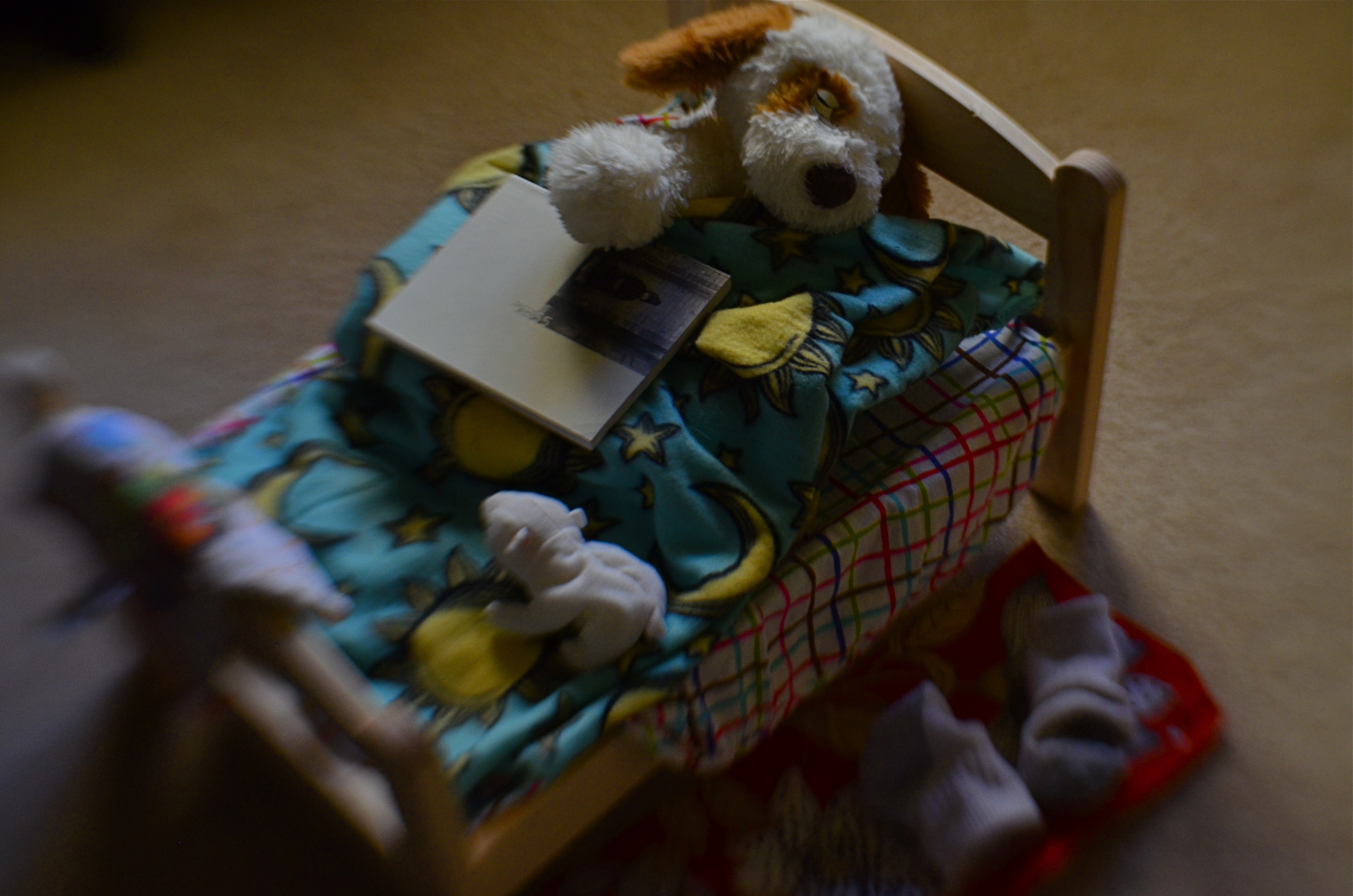
Dog Tired (2017)
Every once in a while, I take a crack at an imaginary scene that the wizards of Portland might have dreamed up, such as the concoction you see here. The stuffed dog and miniature bed had both been purchased to help the sole survivor of a quartet of rabbits get over her grief at being the Last Bunny Standing, but both props had been rejected out of hand. Turns out she rather liked having all the room, grub and water to herself, so she retired her black armband within twenty-four hours without a backward glance.
Walking by the two blacklisted toys each day, I started to imagine the dog as a small child, and wondered what his night-time retiring ritual might be, from the book that eased him off to Dreamland to the socks shed by the side of his bed. Ten minutes of prep and I was ready to shoot my tribute to the days when clay models transported us all from mere reality into View-Master’s exquisite realms of possibility. Days are often arranged in too straight a line. At such times, a slight detour into daydreaming is all you need to render the journey a little more worthwhile.
 thenormaleye
HOWS AND WHYS
By MICHAEL PERKINS
AS THE NORMAL EYE BEGINS ANOTHER YEAR of scraps and scribblings, we like to both welcome those of you who’ve joined our little volunteer fire company since we last passed “go”, and thank our long-term friends and contributors for their vision and faith. As they say on the airlines, we know you have many choices for ways to fly. That you choose, from time to time, to fly with us is a great privilege.
We also mark the turn of the calendar to re-affirm what this home-town newspaper is, or is not. To my mind, the most vital part of photography has never been about mere technical proficiency. Virtually anyone, I believe, can learn the rudiments of exposure and aperture in a weekend. Not master them, but learn them. The greater task, by far, for anyone hoping to attain that mastery, is to train oneself to see in ever more comprehensive ways, to develop the instinct-based curiosity that takes the creative decisions from the camera’s automodes and puts them back into the hands of the photographer.
The Author Looks Back. Or maybe just to the right.
Prior to the development of more and more fool-proofed ways of acquiring consistently satisfactory images from the technical assists offered by amazing cameras, the native, or “normal” state of the photographer’s eye was one of mindfulness, of forethought, of consciously mapping out and planning a shot. Thus, as our name implies, “the normal eye” is one that sees critically and makes choices with deliberation. That means declaring more and more independence from mere technology. It means that your camera is your servant, not your master.
In the years since The Normal Eye was launched, the world has witnessed several significant revolutions in photographic philosophy, all of them placing the highest possible emphasis on experimentation and the kind of wondrous, personal uncertainty that can only result from the photographer, and not the camera, being in charge. The rebirth of instant camera’s, the refusal of film to “die”, the Lomography movement…. all are happening, not because of any sage wisdom in these pages, but because art cannot stand still, and will always reject the notion that everything’s already been invented, or that all the great images have already been shot.
The journey from taking pictures to making pictures remains irresistible, and, as it happens, inevitable. Thank you once again for joining us on that road.
Share this:
January 10, 2018 | Categories: Commentary, Conception, Uncategorized | Tags: Essay, opinion, Philosophy | Leave a comment