TRAVEL JITTERS
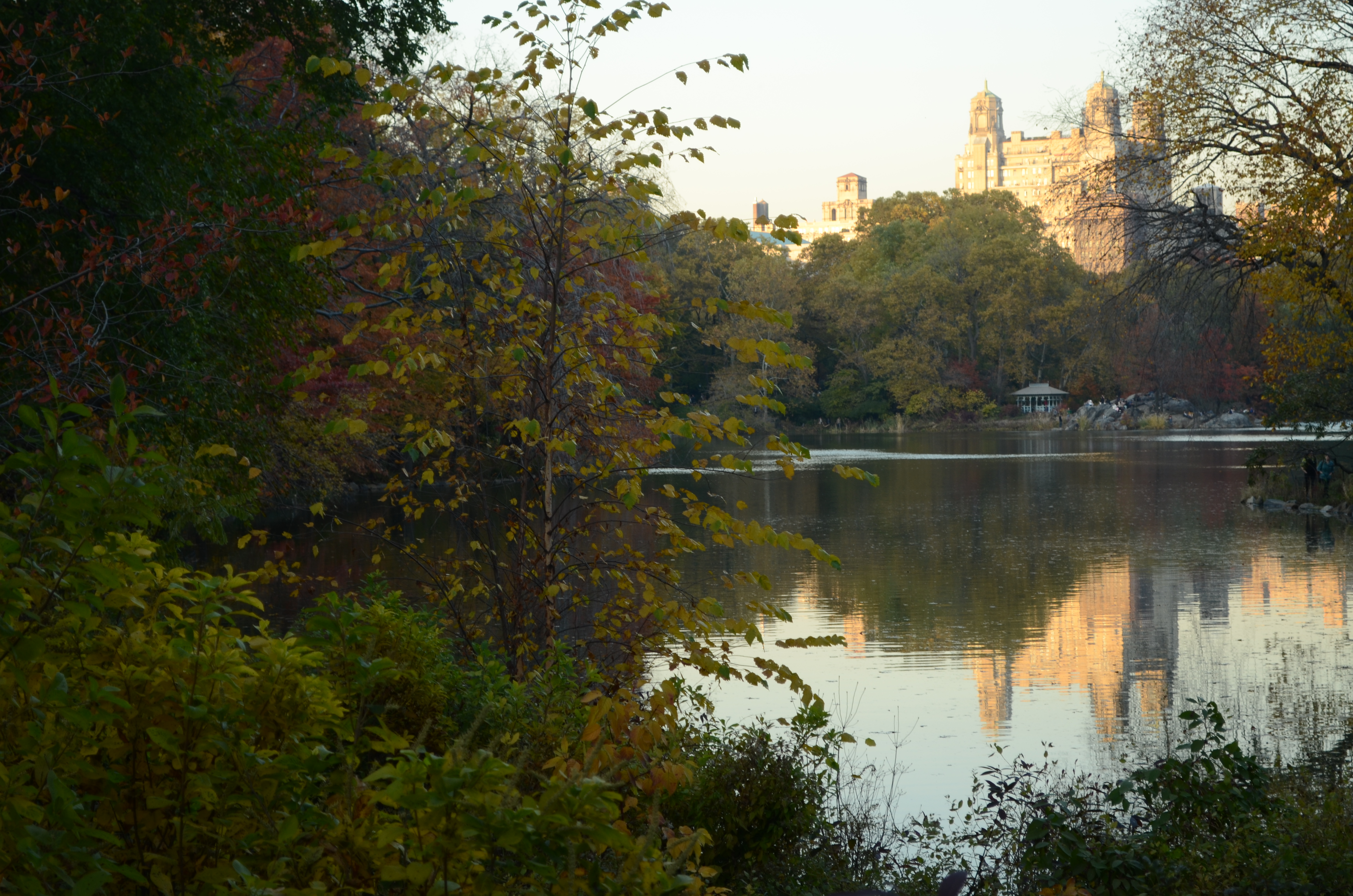
“Autumn in New York, why does it seem so inviting?” A shot inside Central Park, November 2011. 1/60 sec., f/5.6, ISO 160, 50mm.
By MICHAEL PERKINS
IF THERE IS SUCH A THING AS PHOTOGRAPHIC STAGE FRIGHT, it most likely is that vaguely apprehensive feeling that kicks in just before you connect with a potentially powerful subject. And when that subject is really Subject One, i.e., New York City, well, even a pro can be forgiven a few butterflies. They ain’t kidding when they sing, if I can make it there I can make it anywhere. But, of course, the Apple is anything but anywhere…….
Theoretically, if “there are eight million stories in the Naked City”, you’d think a photographer would be just fine selecting any one of them, since there is no one single way of representing the planet’s most diverse urban enclave. And there are over 150 years of amazing image-making to support the idea that every way of taking in this immense subject is fair territory.
And yet.
And yet we are drawn (at least I am) to at least weigh in on the most obvious elements of this broad canvas. The hot button attractions. The “to-do list” locations. No, it isn’t as if the world needs one more picture of Ellis Island or the Brooklyn Bridge, and it isn’t likely that I will be one of the lucky few who will manage to bring anything fresh to these icons of American experience. In fact, the odds are stacked horribly in the opposite direction. It is far safer to predict that every angle or framing I will try will be a precise clone of millions of other visualizations of almost exactly the same quality. Even so, with every new trip to NYC I have to wean myself away from trying to create the ultimate postcard,to focus upon one of the other 7,999,999 stories in the city. Even at this late date, there are stories in the nooks and crannies of the city that are largely undertold. They aren’t as seductive as the obvious choices, but they may afford greater rewards, in that there may be something there that I can claim, that I can personally mine from the rock.
By the time this post is published, I will be taking yet another run at this majestic city and anything additional in the way of stories that I can pry loose from her streets. Right now, staring at this computer, nothing has begun, and everything is possible. That is both exhilarating and terrifying. The way to banish the travel jitters is to get there, and get going. And yes, I will bring back my share of cliches, or attempts at escaping them. But, just like a stowaway on a ship arriving in the New World, something else may smuggle itself on board.
I have to visit my old girlfriend again, even if we wind up agreeing to be just friends.
And, as all photographers (and lovers) do, I hope it will lead to something more serious.
Thoughts?
HELLO DARKNESS MY OLD FRIEND
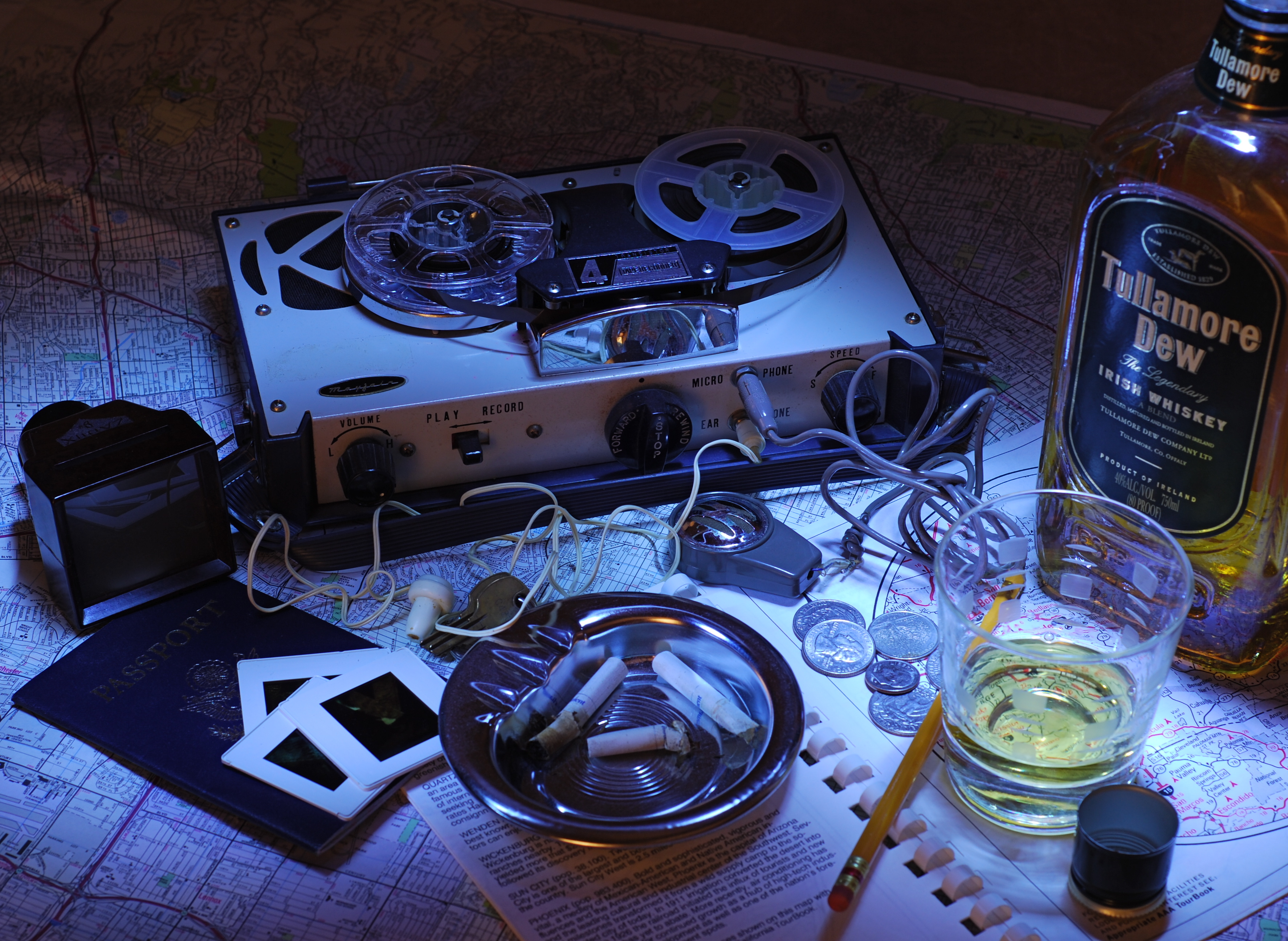
This still life, designed to recall the “cold war” feel of the tape recorder and other props, was shot in a completely darkened room, and lit with sweeps and stabs of light from a handheld LED, used to selectively create the patterns of bright spots and shadows. Taken at 19 seconds, f/6.3, ISO 100 at 50mm.
By MICHAEL PERKINS
MOST OF THE PICTURES WE TAKE involve shaping and selecting details from subjects that are already bathed, to some degree, in light. “Darkness” is in such images, but it resides peripherally in the nooks and crannies where the light didn’t naturally flow or was prevented from going. Dark is thus the fat that marbles the meat, the characterizing texture in a generally bright palette of colors. It is seasoning, not substance.
By contrast, shooting that begins in total darkness means entering a realm of mystery, since you start with nothing, a blank and black slate, onto which you selectively import some light, not enough to banish the dark, but light that suggests, implies, hints at definition. For the viewer, it is the difference between the bright window light of a chat at a mid-afternoon cafe and the intimacy of a shared huddle around a midnight campfire. What I call “absolute night” shots are often more personal work than just managing to snap a well-lit public night spot like an urban street or an illuminated monument after dusk. It’s teaching yourself to show the minimum, to employ just enough light to the tell the story, and no more. It is about deciding to leave out things. It is an editorial, rather than a reportorial process.
The only constants about “absolute dark” shooting are these:
You need a tripod-mounted camera. Your shutter will be open as long as it takes to create what you want, and far longer than you can hope to hold the camera steady. If you have a timer and/or a remote shutter release, break those out of the bag, too. The less you touch that camera, the better. Besides, you’ll be busy with other things.
Set the minimum ISO. If you’re quickly snapping a dark subject, you can compromise quality with a higher and thus slightly noisier ISO setting. When you have all the time you need to slowly expose your subject, however, you can keep ISO at 100 and banish most of that grain. Some cameras will develop wild or “hot” pixels once the shutter’s open for more than a minute, but for many hand-illuminated dark shots, you can get what you need in far less than that amount of time.
Use some kind of small hand-held illumination. Something about the size of a keychain-sized LED, with an extremely narrow focus of very white light. Pick them up at the dollar store and get a model that works well in your hand. This is your magic wand, with which, after beginning the exposure in complete darkness, you will be painting light onto various parts of your subject, depending on what kind of effect you want. Get a light with a handy and responsive power switch, since you may turn the light on and off many times during a single exposure.
You can use autofocus, even in manual mode, but compose and lock the focus when all the room lights are on. Set it, forget it, douse the power and get to work.
Which brings us to an important caveat. Even though you are avoiding the absolute blast-out of white that would result if you were using a conventional flash, lingering over a particular contour of your subject for more than a second or so will really burn a hot spot into its surface, perhaps blowing out an entire portion of the shot. Best way to curb this is to click on, paint, click off, re-position, click back on and repeat the sequence as needed. Another method could involve making slow but steady passes over the subject….back and forth, imagining in your mind what you want to see lit and what you want to remain dark. It’s your project and your mood, so you’ll want to shoot lots of frames and pause between each exposure to adjust what you’re doing, again based on what kind of look you’re going for.
Beyond that, there are no rules, and, over the course of a long shoot, you will probably change your mind as to what your destination is anyhow. No one is getting a grade on this, and the results aren’t going in your permanent file, so have fun with it.
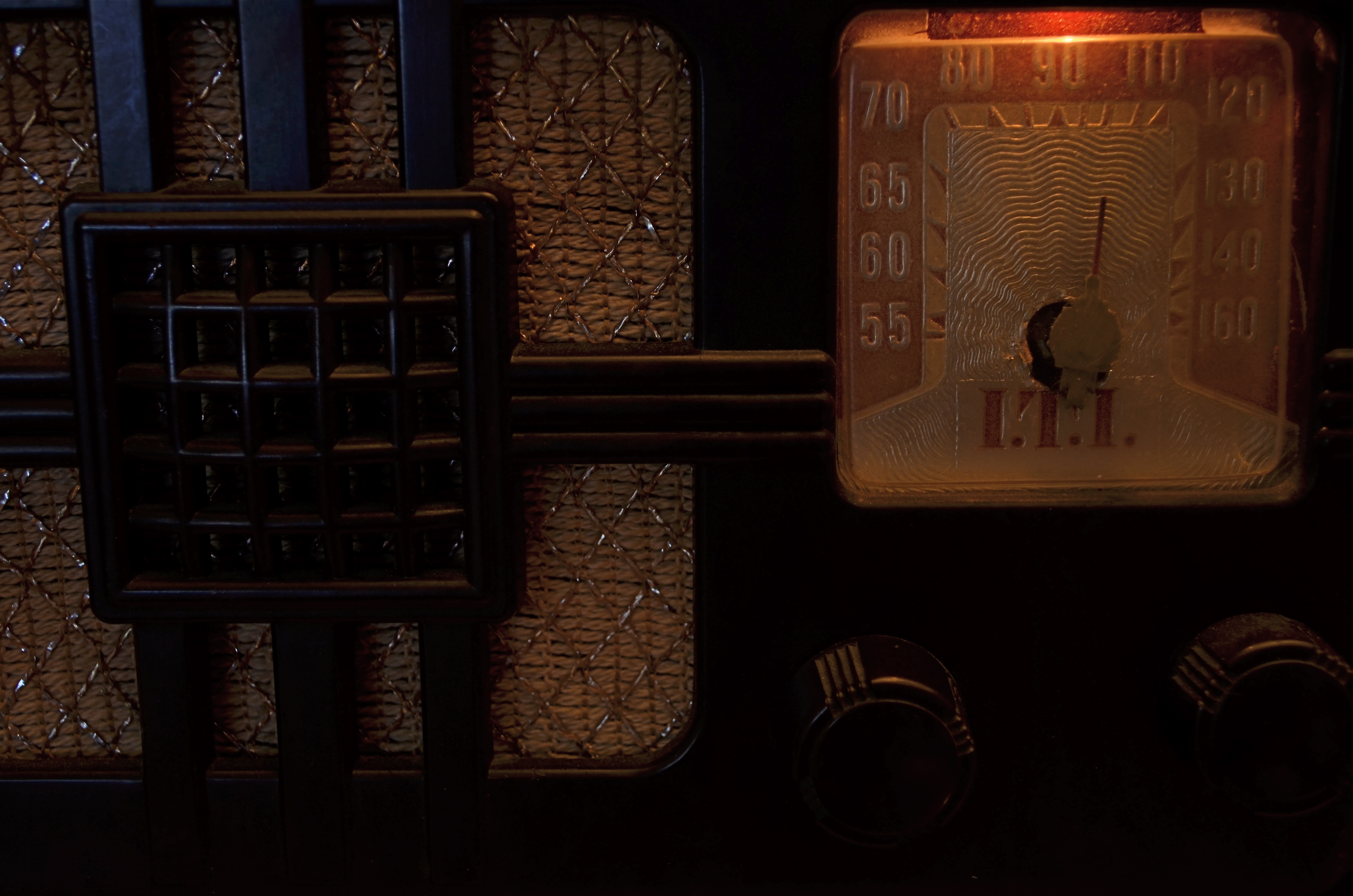
Also shot in a darkened room, but with simpler lighting plan and a shorter exposure time. The dial created its own glow and a handheld light gave some detail to the grillwork. 1/2 sec., 5/4.8, ISO 100, 32mm.
Some objects lend themselves to absolute night than others. For example, I am part of the last generation that often listened to radio in the dark. You just won’t get the same eerie thrill listening to The Shadow or Inner Sanctum in a gaily lit room, so, for the above image of my mid-1930’s I.T.I. radio, I wanted a somber mood. I decided to make the tuning dial’s “spook light” my primary source of interest, with a selective wash of hand-held light on the speaker grille, since the dial was too weak (even with a longer exposure) to throw a glow onto the rest of the radio’s face. Knobs are less cool so they are darker, and the overall chassis is far less cool, so it generally resides in shadow. Result: one ooky-spooky radio. Add murder mystery and stir well.
Flickr and other online photo-sharing sites can give you a lot of examples on what subjects really come alive in the dark. The most intoxicating part of point-and-paint lighting is the sheer control you have over the process, which, with practice, is virtually absolute. Control freaks of the world rejoice.
Head for the heart of darkness. You’ll be amazed what you can see, or, better yet, what you can enable others to see.
Thoughts?
NOTE: If you wish to see comments on this essay, click on the title at the top of the article and they should be viewable after the end of the post.
Related articles
- Lighting Techniques: Light Painting (nikonusa.com)
- Light Writing (cutoutandkeep.net)
BOXFULS OF HISTORY
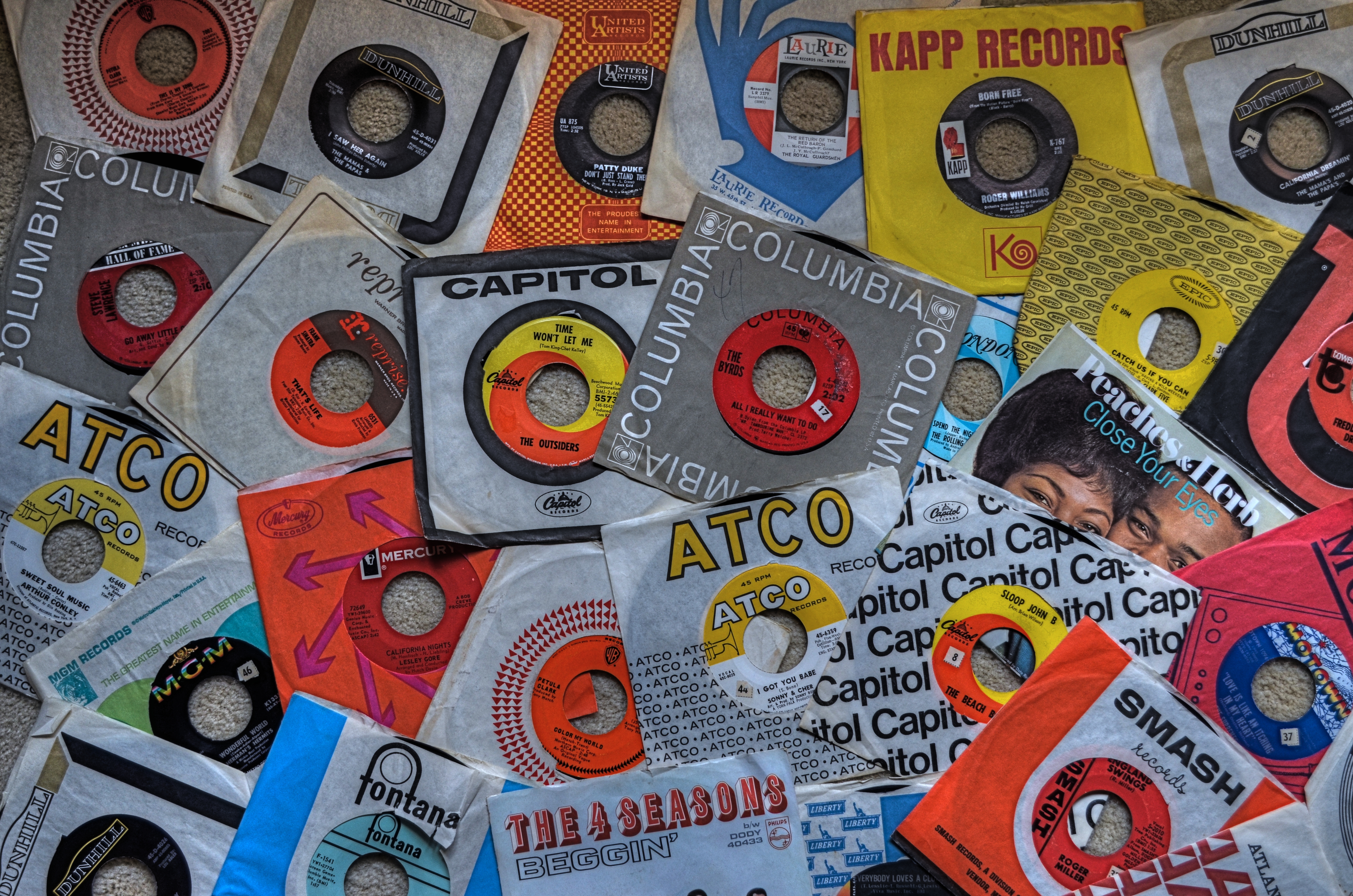
Once, these objects were among the most important in our daily lives. Seen anew after becoming lost in time, they show a new truth to our eyes. 1/60 sec., f/4.5, ISO 100, 30mm.
By MICHAEL PERKINS
THERE ARE DAYS WHEN THERE IS NOTHING TO SHOOT, or so it seems. The “sexy” projects are all out of reach, the cool locales are too far away, or the familiar themes seem exhausted. Indolence makes the camera feels like it weighs thirty pounds, and, in our creative doldrums, just the thought of lifting it into service seems daunting. These dead spots in our vision can come between projects, or reflect our own short-sighted belief that all the great pictures have already been made. Why bother?
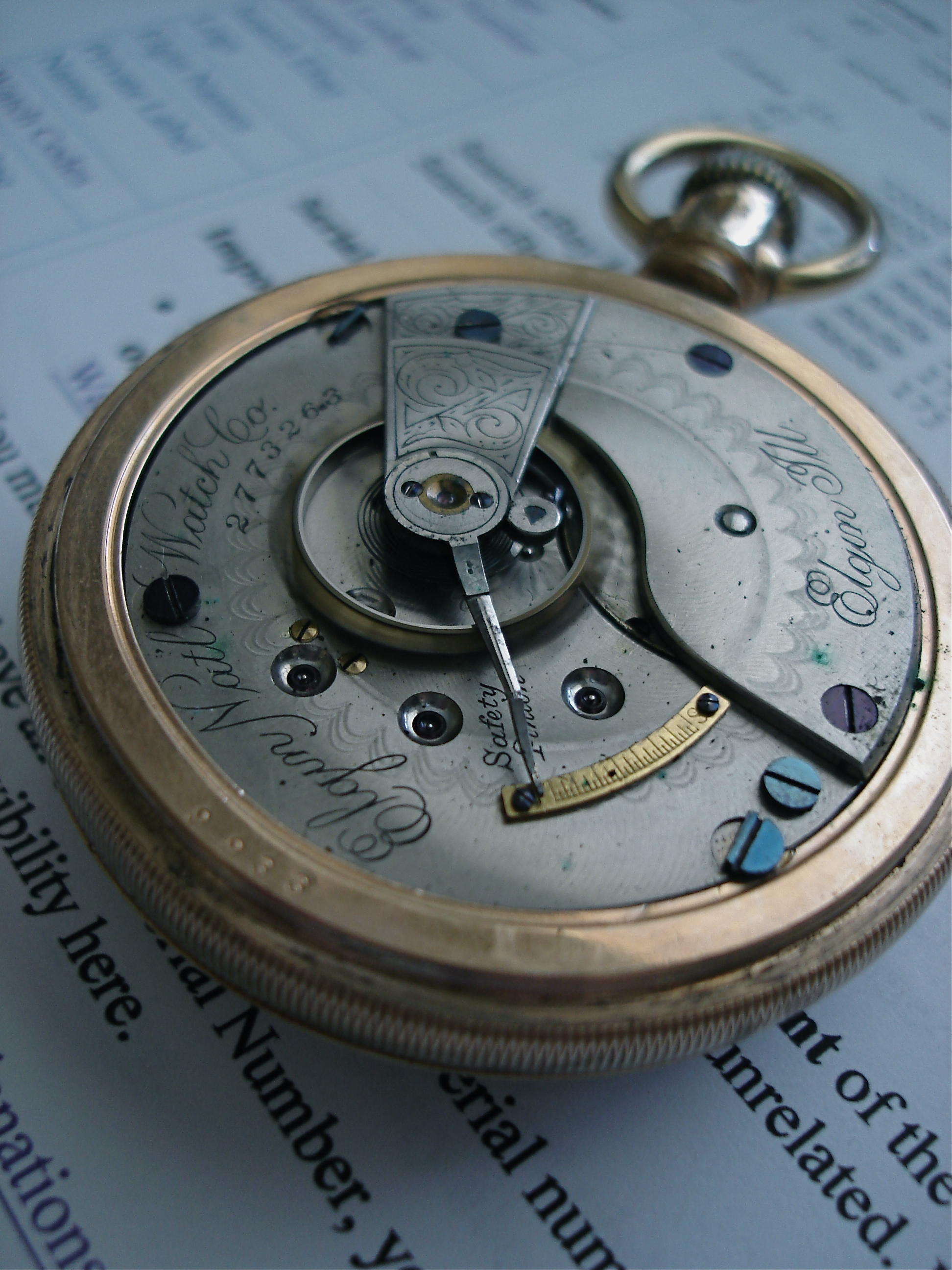
“Time is wasting”… but need not be wasted. Find the small stories of lost objects lurking in your junk drawers. 1/30 sec., f/2.8, ISO 200, 7.9mm.
And yet, in most people’s immediate circle of life there are literally boxfuls of history …..the debris of time, the residue of the daily routines we no longer observe. In Raiders Of The Lost Ark, the villain Rene Belloq makes the observation that everything can be an archaeological find:
Look at this pocket watch. It’s worthless. Ten dollars from a vendor in the street. But I take it, I bury it in the sand for a thousand years, and it becomes priceless.
Subjects ripe for still lifes abound in our junk drawers, in the mounds of memorabilia that our loving friends or spouses dreamily wish we would give to the Goodwill. Once ordinary, they have been made into curiosities by having been taken out of the timeline. In many ways, our camera is acting as we did when we first beheld them. And getting to see something familiar in a new way is photography’s greatest gift, a creative muscle we should all be seeking to flex.
Call it “seeing practice.”
Ordinary things are no longer ordinary once they are removed from daily use. Their context is lost and we are free to judge them as we cannot when they are part of the invisible fabric of daily habit. For example, how ordinary are those old piles of 45-rpm records on which we no longer drop a needle? Several revolutions in sound later, they no longer provide the same aural buzz they once did, and yet they still offer something special in the visual sense. The bright colors and bold designs that the record labels used to grab the attention of music-crazed teenagers in the youth-heavy ’60’s are now vanished in a world that first made all “records” into bland silver-colored CDs and then abolished the physical form of the record altogether. They are little billboards for the companies that packaged up our favorite hits; there is no “art” message on most of the sleeves, as there would have been on album covers. They are pure, unsentimental marketing, but the discs they contain are now a chronicle of who we were and what we thought was important, purchases which now, at the remove of half a century, allow us to make a picture, to interpret or re-learn something we once gave no thought to at all.
Old trading cards, obsolete clothing, trinkets, souvenirs, heirlooms….our houses are brimming with things to be looked at with a different eye. There is always a picture to be made somewhere in our lives. And that means that many of the things we thought of as gone are ready to be here, again, now. Present in the moment, as our eyes always need to be.
The idea of “re-purposing” was an everyday feat for photographers 150 years before recycling hit its stride. Everything our natural and mechanical eyes see is fit for a second, or third, or an infinite number of imaginings.
Your crib is bulging with stories.
All the tales need is a teller.
Thoughts?
SPLITTING THE DIFFERENCE
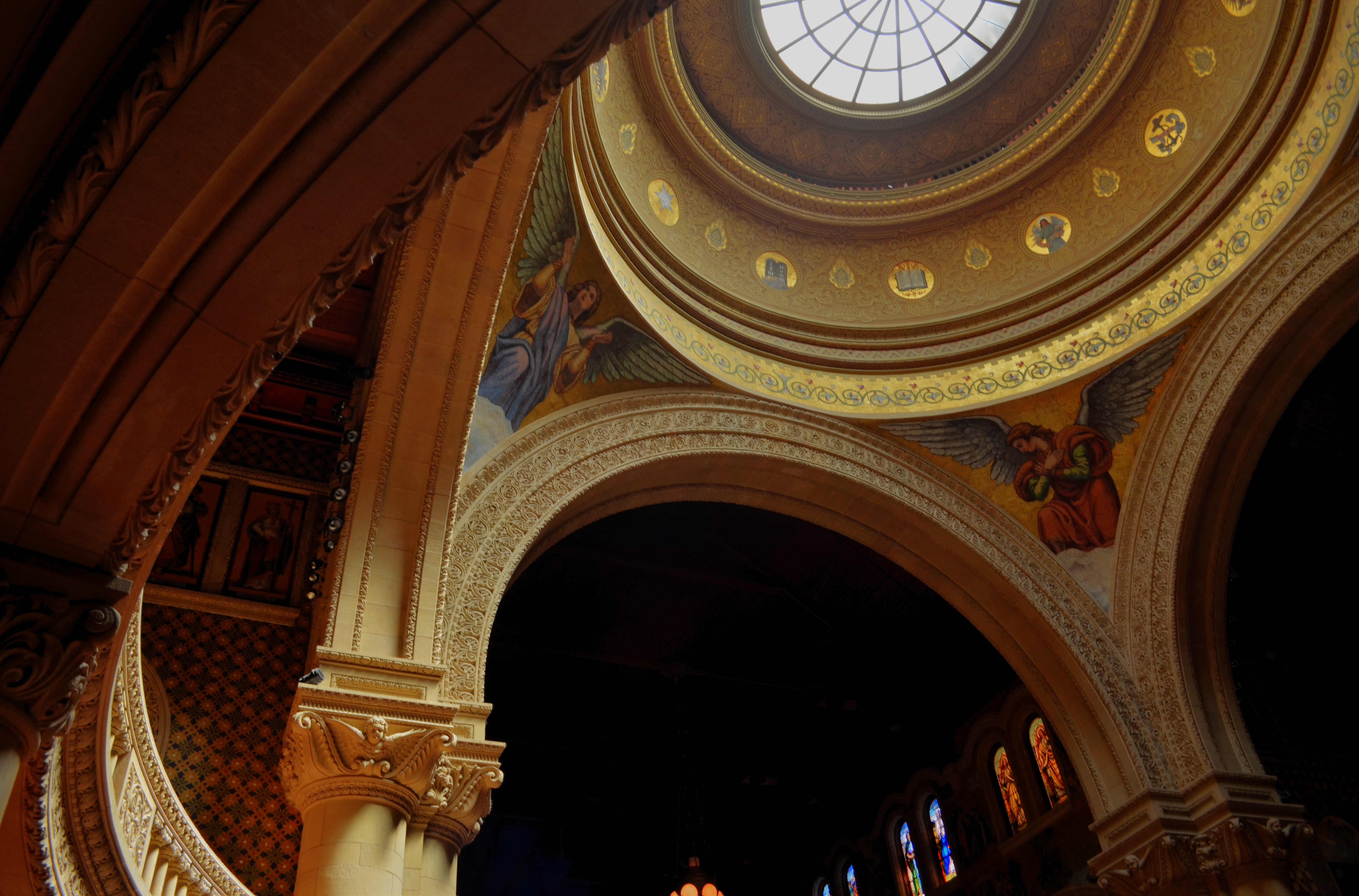
Really dark church, not much time. An HDR composite of just two exposures to refrain from trying to read the darkest areas and thus keep extra noise out of the final image. Shot at 1/15 and 1/30 sec., both exposures at f/5.6, a slight ISO bump to 200 at 18mm. Far from perfect but something less than a total disaster with an impatient tour group wondering where I wandered off to.
By MICHAEL PERKINS
THE MOST EXASPERATING WORDS HEARD ON VACATION: Everyone back on the tour bus.
Damn. Okay, just a second.
Now. We’re going NOW.
I’ve almost got it (maybe a different f-stop….? …..no, I’m just standing in my own light….here, let’s try THIS….
I mean it, we’re leaving without you.
YES, right there, seriously, I’m right behind you. Read a brochure will ya? Geez, NOTHING’S working…….
Sound remotely familiar? There seems to be an inverse proportion of need-to-result that happens when an entire group of tourists is cursing your name and the day you ever set eyes on a camera. The more they tap their collective toe wondering what’s taking so looooong, the farther you are away from anything that will, even for an instant, give you a way to get on that bus with a smile on your face. It’s like the boulder is already bearing down on Indiana Jones, and, even as he runs for his life, he still wonders if there’d be a way to go back for just one more necklace….
Dirty Little Secret: there is no such thing as a photo “stop” when you are part of a traveling group. At best it’s a photo “slow down” unless you literally want to shoot from the hip and hope for the best, which doesn’t work in skeet shooting, horseshoes, brain surgery, ….or photography. Dirty Little Secret Two: you are only marginally welcome at the tomb or cathedral or historically awesome whosis they’re dragging you past, so be grateful we’re letting you in here at all and don’t go all Avedon on us. We know how to handle people like you. We’re taking the next delay out of your bathroom break, wise guy.
A recent trip to the beautiful Memorial Church at Stanford University in Palo Alto, California was that latest of many “back on the bus” scenarios in my life, albeit one with a somewhat happy outcome. Dedicated in 1903 by the surviving widow of the school’s founder, Leland Stanford, the church loads the eye with borrowed styles and decorous detail from a half-dozen different architectural periods, and yet, is majestic rather than noisy, a tranquil oasis within a starkly contemporary and busy campus. And, within seconds of having entered its cavernous space as part of a walking campus tour, it becomes obvious that it will be impossible to do anything, image-wise, other than selecting a small part of the story and working against the clock to make a fast (prayerful) grab. No tripods, no careful contemplation; this will be meatball surgery. And the clock is ticking now.
So we ducked inside. With many of the church’s altars and alcoves shrouded in deep shadow, even at midday, choices were going to be limited. A straight-on flash was going to be an obscene waste of time, unless I wanted to see a blown-out glob of white, three feet in front of me, the effect of lighting a flare in a cave. Likewise, bumping my Nikon’s ISO high enough to read a greater amount of detail was going to be a no-score, since the inner darkness was so stark, away from the skylight of the central basilica dome, that I was inviting enough noise to make the whole thing look like a kid’s smudged watercolor. No, I had to find a way to split the difference; Show some of the light and let the darkness alone.
Instead of bracketing anywhere from 3 to 5 shots in hopes of creating a composite high dynamic range image in post production, I took a narrower bracket of two. I jacked the ISO for both of them just a bit, but not enough to get a lethal grunge gumbo once the two were merged. I shot for the bright highlights and tried to compose so that the light’s falloff would suggest the detail I wouldn’t be able to actually show. At least getting a good angle on the basilica’s arches would allow the mind to sketch out the space that couldn’t be adequately lit on the fly. For insurance, I tried the same trick with several other compositions, but by that time my wife was calling my cel from outside the church, wondering if I had fallen into the baptismal font and drowned.
Yes, right there, I’m coming. Oh, are you all waiting for me? Sorry…..
Perhaps its the worst kind of boorish tourism to forget that, when the doors to the world’s special places are opened to you, you are an invited guest, not some battle-hardened newsie on deadline for an editor. I do really want to be nice. However, I really want to go home with a picture,too, and so I remain a work in progress. Perhaps I can be rehabilitated, and, for the sake of my marriage, I should try.
And yet.
Related articles
- The Ultimate Guide to HDR Photography (pixiq.com)
BEYOND THE THING ITSELF
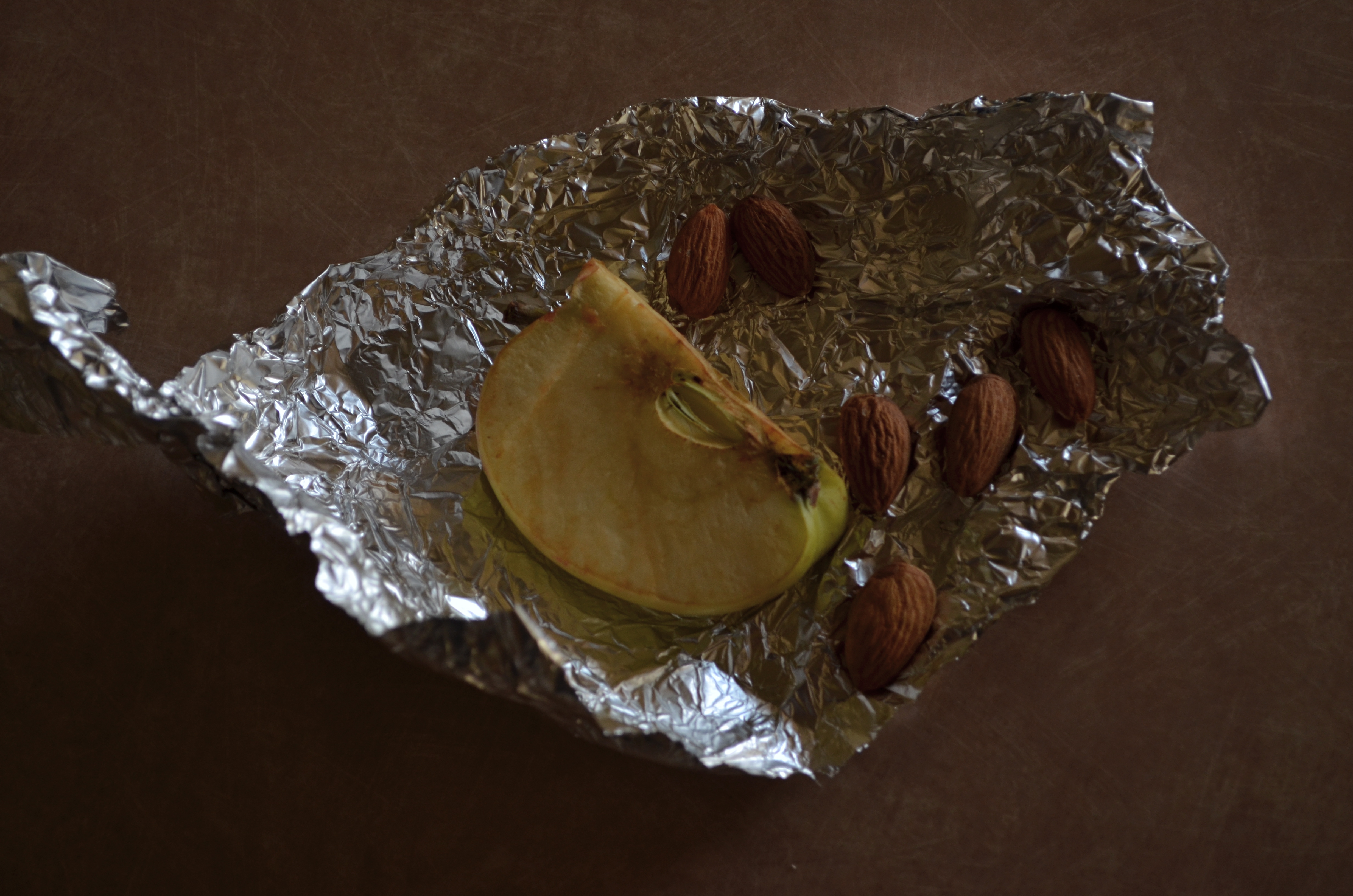
Saved from the trash can, long enough to satisfy my curiosity. 1/50 sec., f/5.3, ISO 200, 40mm.
By MICHAEL PERKINS
YOU NO DOUBT HAVE YOUR OWN “RULES” as to when a humble object becomes a noble one to the camera, that strange transference of energy from ordinary to compelling that allows an image to do more than record the thing itself. A million scattered fragments of daily life have been morphed into, if not art, something more than mundane, and it happens in an altogether mysterious way somewhere between picking it and clicking it. I don’t so much have a list of rules as I do a sequence of instincts. I know when I might have stumbled across something, something that, if poked, prodded or teased out in some way, might give me pleasure on the back end. It’s a little more advanced than a crap shoot and a far cry from science.
With still life subjects, unlike portraits or documentary work. there isn’t an argument about the ethics or “purity” of manipulating the material….rearranging it, changing the emphasis, tweaking the light. In fact, still lifes are the only kinds of pictures where “working it” is the main objective. You know you’re molding the material. You want to see what other qualities or aspects you can reveal by, well, kind of playing with your food. It’s like Richard Dreyfuss shaping mashed potatoes into the Devil’s Tower.
If I have any hard and fast rule about still lifes, it may be to throw out my trash a little slower. I can recall several instances in which I was on my way the garbage can with something, only to save it from oblivion at the last minute, turn it over on a table, and then try to tell myself something new about it from this angle or that. The above image, taken a few months ago, was such a salvage job, and, for reasons only important to myself, I like what resulted. Hey, Rauschenburg glued egg cartons on canvas. This ain’t new.
My wife had packed a quick fruit and nut snack into a piece of aluminum foil, forgot to eat it, and brought it back home in her lunch sack. In cleaning out the sack, I figured she would not want to take it a second day and started to throw it out. Re-wrapped several times, the foil now had a refractive quality which, in conjunction with window light from our patio, seemed to amp up the color of the apple slice and the almonds. Better yet, by playing with the crinkle factor of the foil, I could turn it into a combination reflector pan and bounce card. Five or six shots worth of work, and suddenly the afternoon seemed worthwhile.
I know, nuts.
Fruits and nuts, to be exact. Hey, if we don’t play, how will we learn to work? Get out on the playground. Make the playground.
And inspect your trash as you roll it to the curb.
Hey, you never know.
Thoughts?
PLAN B, C, D…..
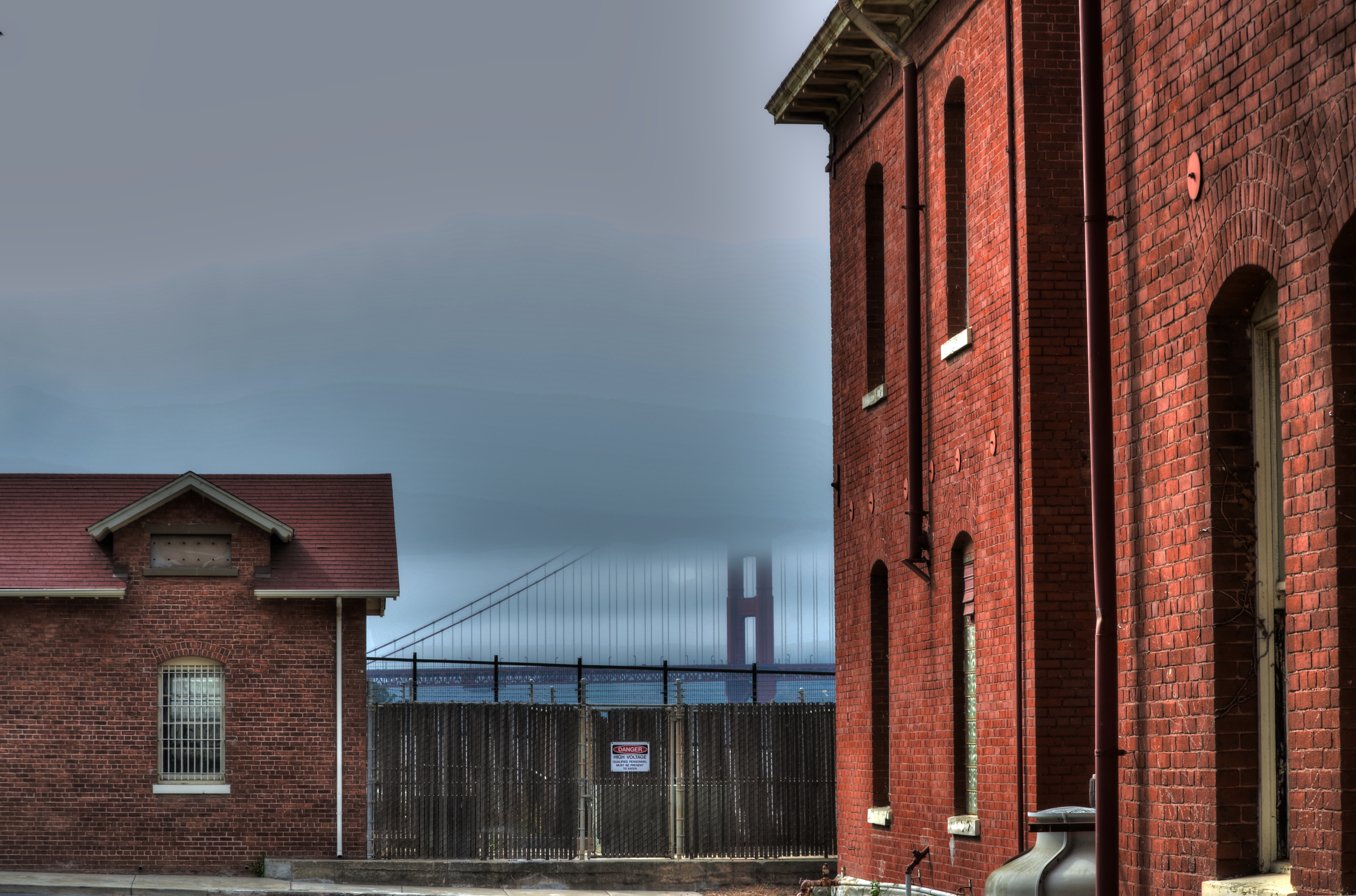
San Francisco decides what to give you, weather-wise. You have decide to accept or reject it, picture-wise.
By MICHAEL PERKINS
SOME ICONIC SUBJECTS ACTUALLY SUBVERT CREATIVE PHOTOGRAPHY, since they fire a normal human urge to record “your take” of an image that literally millions have taken before. There is a strong temptation to merely simulate or re-create the ideal depictions of such objects, be they skyscrapers or mountains, cathedrals or canyons. There is an inherent trap in this process, of course. Why strive to merely match what others have done, to ape or emulate the “ideal” shot? Why settle for the chance to render a Xerox of someone else’s vision?
However, just because I can recognize this trap doesn’t mean I haven’t fallen into it. Indeed, as recently as last week, I found myself despondent because I was being denied the “perfect” shot of San Francisco’s #1 visual trademark…the Golden Gate Bridge. I was visiting the marvelous new Walt Disney Family Museum, housed inside re-purposed buildings in the Presidio, whose severe, spartan brick buildings are an inspiring reminder of their original role as a line of national defense for this vital port. However, for me in 2012, they were attractive chiefly because they were the last layer of urban development before the bridge. I drooled over the images on the museum’s website. It’s right in their backyard! Moreover, the only place in the Disney museum where photography is allowed is along a glass walled gallery specifically designed to serve up the perfect shot of Big Red. Perfect, right?
Except that, on the day I visited the museum, a stubborn canopy of fog had refused to clear the bridge towers, even in the clear light of late afternoon sun. There goes plan A. I left the building convinced that I could shoehorn a telephoto shot in between Presidio buildings and still get my “optimum” shot. I soon realized, however, that plan B was also unworkable. The fog stubbornly persisted in eclipsing the top of the south tower, while the property fence in my immediate view was chopping into a clear shot of its foundations. What remained looked cluttered, wrong, unconventional. Then plan C came into focus. Shoot something. Try to save this. Can I make a composition out of these stark brick blocks of space, with a glimpse of the tower in between? I was on total instinct by this time. My wife was waiting in the car, we were both tired after a day of flying, and it was just a whole helluva lot easier to just walk away. Enter the rationale: The bridge isn’t going anywhere. There have to be a million places to stand and get the “right” shot I want. Run away and live to fight another day.
And yet.
There was just a twinkling of an idea….not really a fully formed concept, just a seed pod. The bridge is, given the local weather, always in the process of being concealed and revealed. Photographers have made great images of the bridge not only when it can be seen but when it coyly hides, like Salome, beneath the veils of weather. In fact, many of the best pictures of the bridge have been made under adverse conditions. Artistically, I was in good company. The bridge is always teasing, always taunting: come and find me. Try to define me. I dare you to capture me. I am not easy.
I am not obvious.
To hell with it.
I decided to wedge the partially visible tower between two dead blocks of brick, and make the picture. Like an immigrant who has to look through a dirty window to see a fast, smeared glimpse of Lady Liberty as he enters New York harbor, I knew I was stealing a view, snatching a fragment, a bit of hope, a shard of truth. I had to settle. I had moved plan C up to A position and was determined to live with the choice. Strangely, I will, upon future visits to San Francisco, feel a little cheap taking the “perfect” shot, if it ever presents itself.
I am no longer so certain of the best way to approach this subject. Whether I really got something or whether I am merely rationalizing my long shot in a lousy situation, I can no longer determine. But I am happy with what happened. And that’s supposed to be what this is all about.
Thoughts?
Related articles
- In The Presidio: Hard To Imagine, But There Wasn’t Always A Bridge Across The Golden Gate (sf.curbed.com)
- Plans Set, Drivers Brace For Golden Gate Bridge 75th Anniversary (sanfrancisco.cbslocal.com)
BEYOND THE PATH OF THE GLACIER
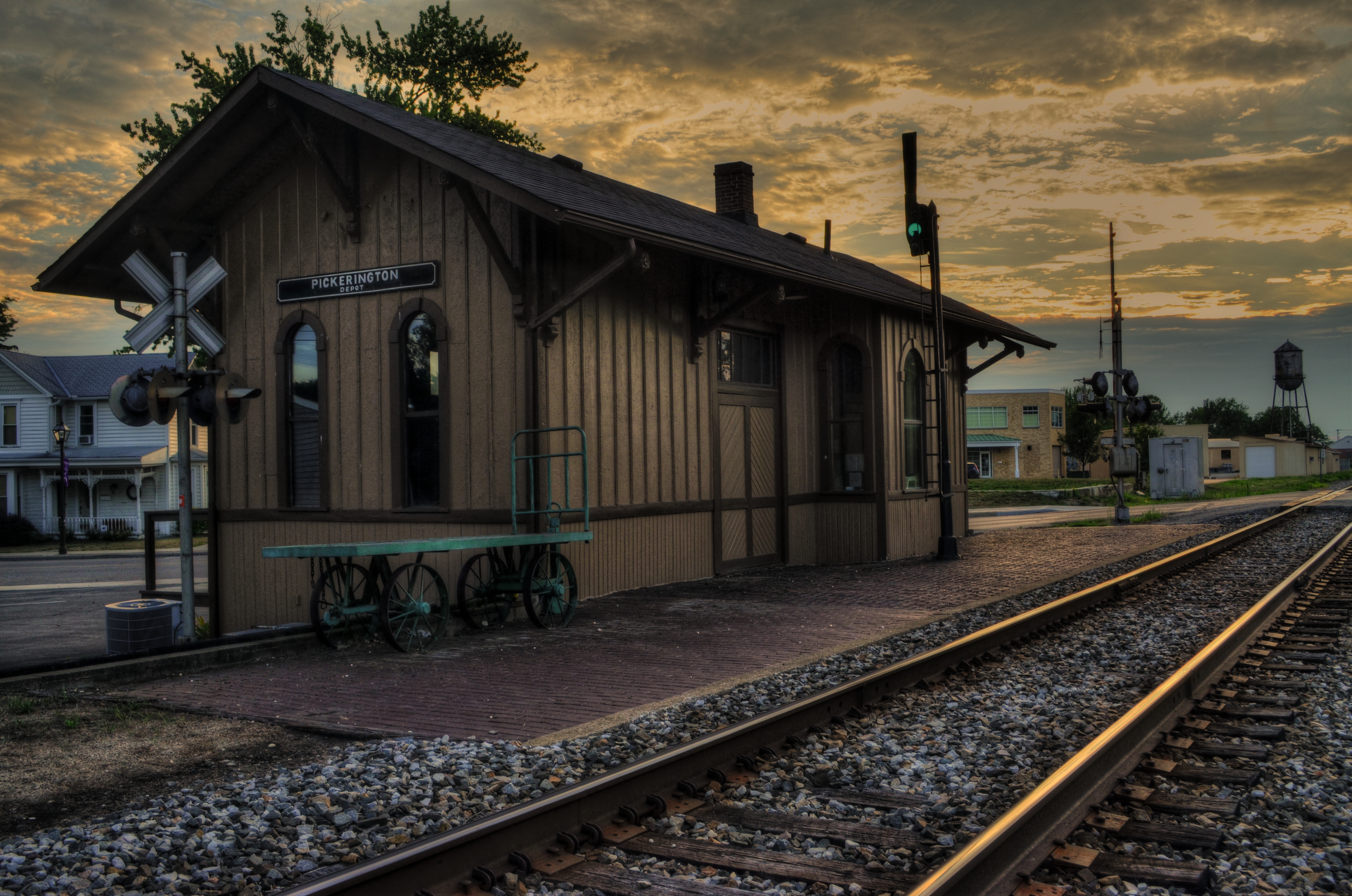
Sentimental Journey: the original depot building for the Toledo & Ohio Central railroad, still standing in Pickerington, Ohio. Just because.
By MICHAEL PERKINS
IN AMERICA WE GET ACCUSTOMED TO SEEING OUR URBAN HISTORY REGULARLY REDUCED TO RUINS, not because our cities are laid to waste by invaders or sacked by conquerors, but because we are such paltry stewards of the architectural legacies we share in this essentially young nation. Obvious nationalistic images aside, the wrecking ball, our answer to the crushing glaciers of history, is the real visual signature of the USA. We get tired of looking at old stuff. We knock the old stuff down. And in doing so, we squander the value of things to which we once attached great importance, rendering them moot, as if we really never cared about them at all.
The change glacier usually sweeps through the vast canyons of our larger cities, cutting a swath of wreckage that levels, implodes or simply knocks down any testimony to history, fashion, flair, whimsey, and the thing we most dread, uselessness. Every town has its casualties; stadiums, grand hotels, transportation hubs, retail centers, neighborhoods…it’s simply not American to get too attached to anything. It’s all going away, all of it, and with it, any sense of continuity, memory, or a contextual place in time.
Fortunately, it is the tendency of the glacier to “think big” that keeps the crushing onslaught of “renewal” concentrated in the larger urban centers, often leaving more survivors in small towns and rural communities. That means that some things in off-track towns, being below the radar of macro-change, are simply left alone, allowed to survive, because they are neglected by the bigger sweep of things.
This means that the “in-between” parts of the country still hold some treasures, a few gentle ties to times we have largely disposed of in the major hub cities. And while no one is suggesting that we bring back the village blacksmith and the local cobbler’s shop, it’s comforting in some way to be able to see and touch what in other parts of the nation are merely footnotes in books. That is, if we haven’t burned the books.
The building pictured at the top of this post is such a survivor. Built in 1879 just as the Toledo & Ohio Central railroad was being cut across the small village of Pickerington, Ohio (just southeast of Columbus), this compact little structure was the nerve center of trade and travel for “Picktown” for more than half a century. Its three rooms included an entry area for freight, an arrival room for passengers, and, in the center, an office for the combined jobs of depot agent and Western Union telegrapher. It was not until the hiring of its first female depot agent in 1947 that the facility could boast indoor plumbing, but the T&O’s tracks, during rail’s heyday, criss-crossed the tiny town with spur lines to a lumberyard, a grain mill, a hoop factory and warehouses.
Amazingly, the depot survived an extended closure from 1958 to 1975, when private money made its restoration possible. Lanterns, tools, bottles, wall maps, schedules, freight wagons, and a fully functional Western Union telegraph key were all assembled to visually cement the station in time. And there it stands to this day, serving no other “function” than to mark where the town, and we, have passed on our way to the inevitable.
Better than my luck in finding this place was in finding it just as dusk was streaking across the sky, giving me the perfect visual complement to the passing of time. And yet, here, out of the path of the glacier, time was allowed to tick just a little slower, slower enough to teach. And remember.
Thoughts?
A QUIET VOICE, A STILL SOUL
By MICHAEL PERKINS
As I have practiced it, photography produces pleasure by its simplicity. I see something special and show it to the camera. A picture is produced. The moment is held until someone sees it. Then it is theirs. -Sam Abell, STAY THIS MOMENT, 1990
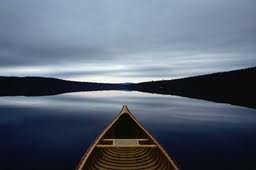
The voyage and the vehicle: Sam Abell’s classic image of a canoe on Maine’s Allagash River, the cover image for his book, 1990’s Stay This Moment.
THERE ARE PHOTOGRAPHERS THAT ARE SO AMAZINGLY ADVANCED that they make their images, wrought with love, ferocity, daring, and single-minded purpose, seem not merely visionary but inevitable. We see what they have brought us and exclaim, “of course”, as if theirs is the only way this message could possibly have been crafted, as if its truth is so self-evident that to have to formally recognize it is almost needless overkill. We confirm and validate that, for these pictures, the machine has truly been placed in the service of a soul, and one which writes fluently while we stumble with numb gestures.
One such soul resides in the work of Sam Abell.
If his name doesn’t roll off the top of your tongue alongside those of the obvious Jedi knights of photography, it’s because, for most of his forty-plus year career, he has kept a lower profile than Amelia Earhart, producing amazing work beneath the masthead of National Geographic magazine along with a host of other special commissions. When Sam came to to Geographic in 1967 as an intern, he already had four years of “hard” experience producing images for the University of Kentucky’s school of journalism to his credit, but the magazine’s photo editor, Robert Gilka, was hesitant to hire him, worried that his work was “too artistic”, too personal in its beauty to survive in the service of journalism.
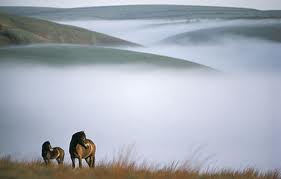
For Abell, it’s all about the patience. How long do you wait for the horse to wistfully glance over his shoulder? As long as it takes…..
With help, Sam Abell learned the balance for getting the facts for stories and getting the truth implied in their locales. Even when those stories’ words shouted with urgency, Sam’s notes were always on the soft pedal. Their poignancy fades in and builds, rises to your attention and then rivets it in place. Writing in his 1990 collection Stay This Moment, Abell declares that the test of great pictures is that “they cannot be memorized”. Small wonder that he began, early in life, to pursue a career on the cello. Smaller wonder yet is that the patience of that instrument is “heard” in the music of his pictures.
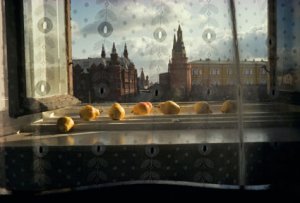
Always, a human context. Sam Abell capture of the iconic buildings of the Kremlin, framed by ripening fruit and lace curtains.
Even more muted than the images Sam creates is his technical approach to taking them. For much of his early career, he shot breathtaking landscapes with a simple 35mm camera, often a Leica reflex or rangefinder, mounted with standard or “normal” lenses ranging from 28 to 35mm, generating the least amount of distortion and rendering the most natural relationship of sizes and distances. For years, the most advanced tools in his bag were a sturdy Gitzmo tripod and the slowest, richest films he could find, frequently Kodachrome 25 and 64. The tripod delivered the stability needed to produce slow, sensual exposures; the ‘Chrome delivered texture and nuance beyond the power of hand-held shots. However, the most vital weapon in Abell’s arsenal is his astonishing patience, the wisdom, which flies in the face of traditional journalism photography, to wait for the story in a picture to slowly unfold, like the petals of a flower. Some of the best images Abell placed in National Geographic over the years took nearly a year to create. It happens when it happens, and once it does, God is it worth it.
The number of printed collections of Sam’s work are few and far between, given his enormous output, but diligence rewards the curious. Among the most available of them is the collaboration undertaken with historian Steven Ambrose, Lewis & Clark: Voyage of Discovery ( 2002), for which Sam created images of the surviving sections of the legendary explorers’ trail to the Pacific; Amazonia (2010), an essay on the kind of delicate ecosystems that are vanishing from the earth; and Life of a Photograph (2008), an examination of how his most famous pictures were built, stage by stage. And, of course, there is the luxuriant (and hopelessly out-of-print) Stay This Moment (1990), the companion book to his mid-career exhibition at New York’s International Center for Photography. Buy it in a used book shop, grab it on e-Bay, scour your local library, but find this book.
More importantly, find Sam’s work…any of it…and savor every detail. For copyright protection purposes, I have deliberately kept the illustrations in this article constrained to minimal resolutions. Find the real stuff, and see what Abell’s amazing sweep and scope can do at full-size. This blog is chiefly about how I, as a rank amateur, struggle with my own creative conundrums. But it is also about knowing what teachers to bend toward. Sam Abell, who literally teaches in mentor programs all over the country, has a powerful gift to impart. “What is right?”, he asked in 1990. “Simply put, it is any assignment in which the photographer has a significant emotional stake.” He also emphasized an important distinction (one of my favorites) in his remarks to a young photography student. Don’t say, he said, I took this picture.
Say instead, I made this picture.
Of course.
Thoughts?
Related articles
- Sam Abell Interview (keronpsillas.com)
- The Life of a Photographer – Sam Abell (billives.typepad.com)
GOING FOR BROKE
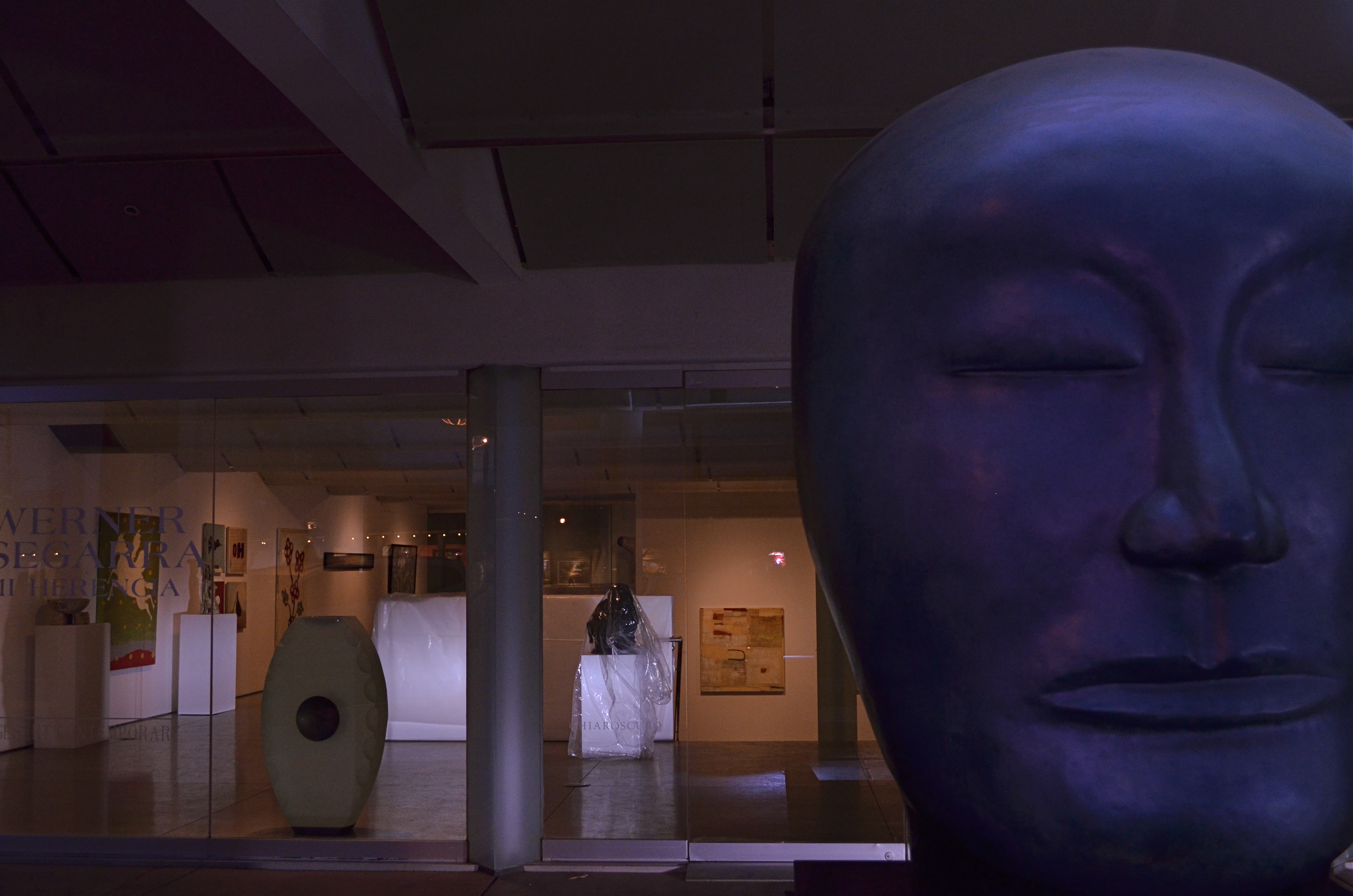
Some people are over the whole “art” thing. Certainly this cynical fellow has seen it all. I used a primitive flash bounce to illuminate his darkened features. 1/40 sec., f/5, ISO 500, 22mm.
By MICHAEL PERKINS
I HAVE READ MORE THAN A FEW ARTICLES OF LATE by professional photographers who confess that they occasionally get stuck in teaching mode, even to the detriment of their own love of shooting. One such author went to far as to recall a recent concert he had attended, camera-less, only to observe, with snotty amusement, the attempts of a young woman to capture action on the far-off stage area. His first reaction was to disdain not only her limited camera but to catalogue all her most heinous errors in composition, exposure, and use of flash, as he mentally predicted how poor her results would be and how she was, essentially, wasting her time.
Then something shifted in his thinking. Instead of being depressed at what hadn’t worked, the woman’s energy revealed that she was actually making the most of the moment; learning, through trial and error, what to do or not do in future. At the end of his essay, he came to realize that “she is a better photographer than me”, since she was taking risks, pushing the limits of her own skills, and developing her craft, one frame at a time, while he had left his own camera at home and was learning nothing. His point hit home with me, since it is a recurring theme of this blog and a key belief among those I respect most in the imaging world.
In brief:
Shoot. Shoot some more. Dare to fail. Be willing to take more “bad” pictures than the next guy. Get your head out of academic minutia and into the doing of it. Screw up, suck up, but above all, show up.
Ready to play.
Sometimes, just the sheer unwillingness to go home empty-handed provides you with real delight. Last week, I was making the rounds at an area gallery district, the type that does nightly “art walks” as a way of speed-dating potential customers. Many of the best shots I get in these surroundings are near or just after dark, and I always like peeping into the windows of shuttered businesses at night, since some key character of light and mood invariably occurs. For the shot shown above, I fell in love with one gallery that had a kind of sentry posted outside, in the form of an enormous sculpted head. Its aloof expression reminded me of a cross between Easter Island and Blue Man Group, and I really wanted him/her/it to be a part of the shot. However, I had not brought an external flash unit with me, and the sculpture was reading 100% dark in contrast to the interior of the gallery. I was desperate, but not desperate enough to use straight-on pop-up flash, which would have blown the face out completely and destroyed any chance at a moody feel.
Time to improvise.
Having left my bounce card at home as well (I was on foot and truly traveling light), I noticed that the head was underneath a low over-hanging porch roof, something you just must have on the front of an Arizona business in summer. Going totally into what-the-hell mode, I stuck my flat left hand just under the bottom of the pop-up flash and angled it upward about 15 degrees to create a crude bounce off the roof ceiling, allowing the light to soften as it came down upon the top of the head. It took a few tries to avoid creating an uber-white Aurora Borealis effect on the ceiling, and I had to move my feet around to figure out how to get some of the light to cascade down the head’s front and illuminate its features. I also had to bump the ISO up a bit to compensate for the fall-off in the flash at the distance I was standing, but, at the end, I at least got something. Moreover, like the woman at the concert, what I had picked up in technique more than compensated me for the fact that the shot wasn’t strictly an award winner.
I have been playing around with primitive flash bouncing for a while now, and the results run the gamut from god-awful to glad-I-did-that. But it’s all a win no matter how each individual shot plays out, because every image brings me closer to the cumulatively evolved instinct that, someday, will give me great pictures. The baby will eventually be born, but the midwife has to do the front-end work. Nothing I will ever shoot will be captured under perfect conditions, so why drop dead of old age waiting for that to happen? We’re almost to the end of Century Two in this game of writing with light, and all the easy pictures have already been shot, so what’s left will have to be hewed out by hand.
I suggest that we occasionally get our nose out of books (and, duh, blogs too) and start carving.
ATYPICAL

This is Arizona? Well, for several months a year, it can be. Trading our non-stop blue skies for a little seasonal sky drama affords some unique shooting, especially just after dawn.
By MICHAEL PERKINS
IF YOU LIKE UNPREDICTABILITY in the look at feel of a region, it’s hard to beat (or escape) the clock-like consistency of the American southwest. Here in Arizona and in many parts of the region, the TV weatherman’s gig is slightly easier than that of the town drunk. Sunny, Hot, Blue Skies, Dry. That’s it. Repeat as necessary for nearly the entire year, every year, forever. It’s one of God’s little jokes in that, for photographers, there are magnificent subjects to shoot out here under the western sky…..but, typically, the western sky ain’t one of them. Featureless, glaringly bright, and unremittingly azure, the visual pickings, overhead, are rather limited. There are golden sky periods at sunrise and sunset, but midday is like one big unforgiving strobe. Inside an oven.
Enter the annual season we call “the monsoon”. Hardly like the tropical megastorms that the name implies, monsoon in Arizona is merely a time of increased humidity (still dry as toast to people in other climes) and an increased amount of short, speedy rain dumps and attendant dust storms. The talcum-powder textured grit that the monsoon drives under our doorsills is a pain, as is the sudden onset of zero visibility when the gusts are really cranking and the comedy of errors that is the average ‘Zonie motorist on wet roads. It’s the bizarro world reverse of blizzard season in Minnesota, with a dash of weird added for good measure. However, it is the one time that Arizona skies are, for days or weeks at a stretch, a little more theatrical, and thus worthy of a shot or two. Mother nature dabbles in drama overhead for a short season, and suddenly all of our “normal” shoots become something out of an El Greco painting.
Early morning coffee runs, even in over-developed urban areas (i.e., everywhere in Arizona) can reward the patient with clouds that streak, darken, and swirl. Neutral colors deepen. Rich hues run all the way into foreboding. In season, objects framed against the freakish overcast take on new aspects…some inviting, some fearsome. Last Sunday morning I saw a sunrise that was struggling to break free of a mask of freakish cloud cover, popping through in several breaks, and providing a sinister background for a business building that normally wouldn’t merit a second look. Don’t ask me why, but the juxtaposition of the various elements just cried, jump out and shoot. And so I did.
Here in Arizona we boast about how many days out of the year we serve up pure sunshine. Sometimes, however, during our darkest days, we can serve up pure gold.
Thoughts?
Related articles
- Fourth of July monsoon floods homes, streets in Arizona City (azfamily.com)
- Why There are Bridges in Phoenix (brightlightsbigcacti.wordpress.com)
180 DEGREES
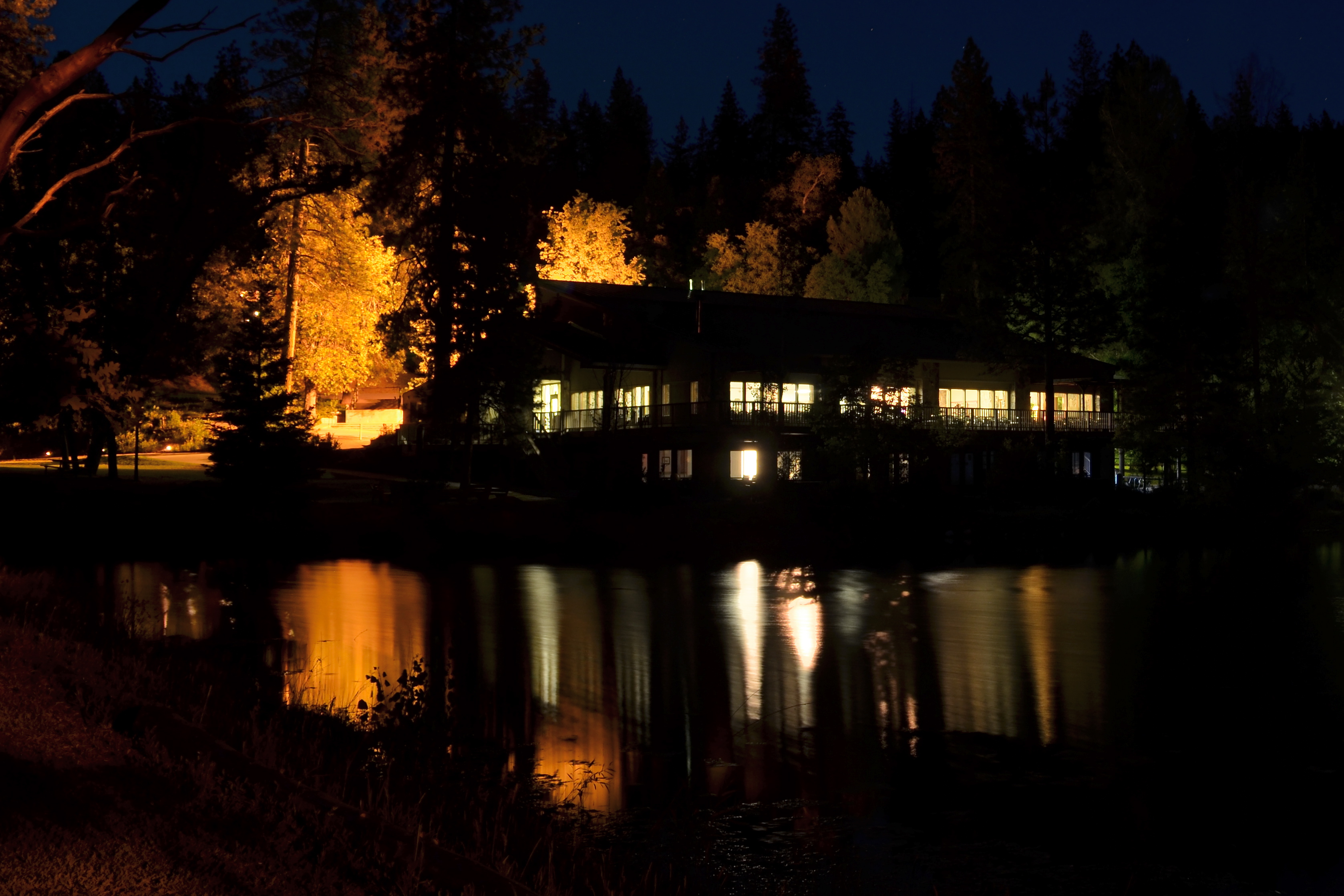
This image, the reason I ventured out into the night, originally eluded me, causing me to turn a half circle to discover a totally different scene and feel waiting just over my shoulder. 20 sec., f/8, ISO 100, 20mm.
By MICHAEL PERKINS
I WISH I HAD A LEICA for every time I came away from a shooting project with something completely opposite from the prize I was originally seeking. The odd candid moment, the last-minute change of light, the bizarre intervening event….there are so many random factors even in the shots that are the most meticulously planned that photography is kept perpetually fresh, since it is absolutely impossible to ensure its end results, especially for infants playing at my level. That point was dramatically brought home to me again a few weeks ago, and all I had to do was turn my head 180 degrees.
All during a week’s stay at a conference center near Yosemite National Park, I had been struck by how the first view a visitor got of the main lodge and its surrounding pond, from an approach road slightly above the building, was by far a better framing of the place than could be had anywhere else on the grounds. A few days of strolling by the lodge from several approaches had not provided any better staging of the quiet scene, but, with the harshness of the daylight at that altitude, I was convinced that a long exposure done just after nightfall would convey a more peaceful, intimate mood than I could ever hope to capture by day. And so, on the evening before I was to leave the lodge for home, I decided to take my tripod to the approach road and set up for a try.
The road is rather twisty and narrow, and so its last turn before heading for the lodge’s parking areas is lit with a street lamp, and a bloody bright one at that. It’s a sodium vapor light, which registers very orange to the eye. I’m used to these monsters, since, back home in Phoenix, they are the predominant city light sources, creating less long-distance “light pollution” for astronomers in Flagstaff trying to see the finer features in the night sky. At any rate, the road was so bright that I had to set up closer to the lodge than originally planned in order to avoid a lot of ambient light over my shoulder killing the subdued dark I wanted for my shot. Intervening event and last-minute change of light. Changing my stance, I was also having problems with movement on the pond surface. It was a tad too swift to allow for a mirroring of the lodge, and a long exposure was going to soften it up even more. I was going to get pretty colors, but they would be diffuse and gauzy rather than reflective. At the same time I was trying to avoid framing another lamp, this one to the right of the lodge. Illuminating a walking path, it would, over the length of the exposure, pretty much burn its way into the scene and distract from the impact. Typical problems, but I was already losing my love for the project, and after about a half-dozen flubbed attempts, I was trying to avoid mouthing several choice Anglo-Saxon epithets.
It was the need to take a break that had me looking around to see if anything else could be done under the conditions, and that’s when I turned my head to really see the light from the approach road that had been over my shoulder. Candid moment. Now I saw that orange light illuminating the road, the rustic fence, and the surrounding trees and shrubs in an eerie, Halloween-ish cast. The same scene in daylight or natural color would have registered just as “some nice trees”, but now it was Sleepy Hollow, the scary walk home after the goblins come out, the place where evil things breed. Better yet, if I stepped just about six inches to the right of where I was standing, the hated lamp-post would be totally obscured by the largest tree in the shot, casting its shadow another 20 or so feet longer and serving up a little added drama as a bonus. Suddenly, the lamp had been transformed from a fiend to a friend. I swiveled the tripod’s head around, set the shot, and got where I needed to be in two clicks.
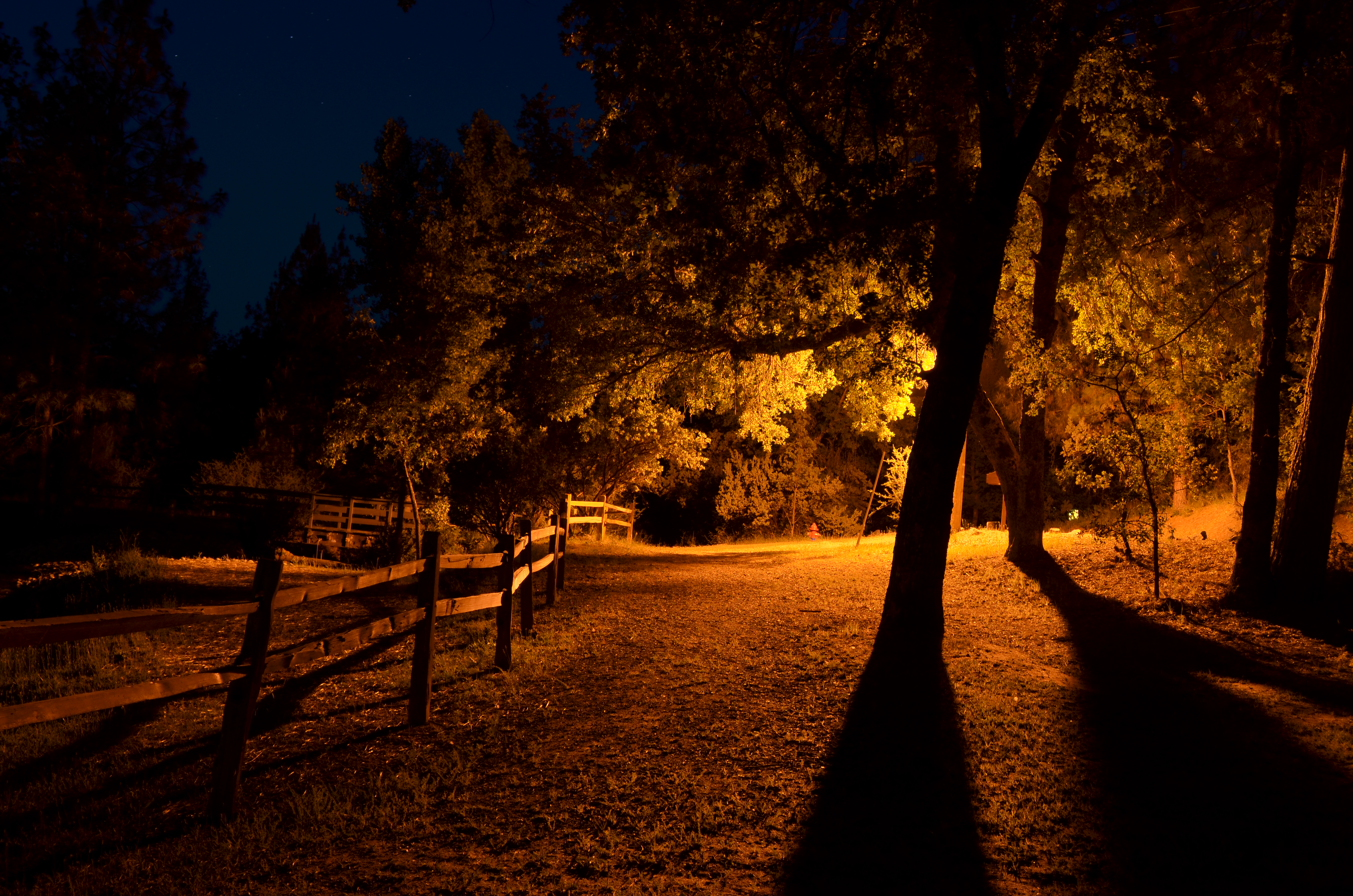
After first trying (and failing) to nail the image of the lodge, I pivoted around and found this scene, which had been waiting to be discovered right behind me. Once I shot this, I turned around and made one more attempt on the lodge, using, as it turned out, the exact same setting as this picture; 20 sec., f/8, ISO 100, 20mm.
Better yet, the break in the action allowed me to re-boot my head vis-a-vis the lodge image. I turned back around, and, oddly, with the exact same exposure settings, hit a balance I could live with. Neither shot was perfect, but the creation of one had actually enabled the capture of the other. On the walk back to my cabin, I was already dissecting the weaknesses in both, but they each, in turn, had taught me, again, the hardest lessons, for me, in photography. Slow down. Look. Think. Plan, but don’t be afraid of reactive instinct. Sometimes, a sacred plan can keep you from “getting the picture”, figuratively and literally.
All I have to do is remember to turn my head around.
SMALL MAY BE ALL
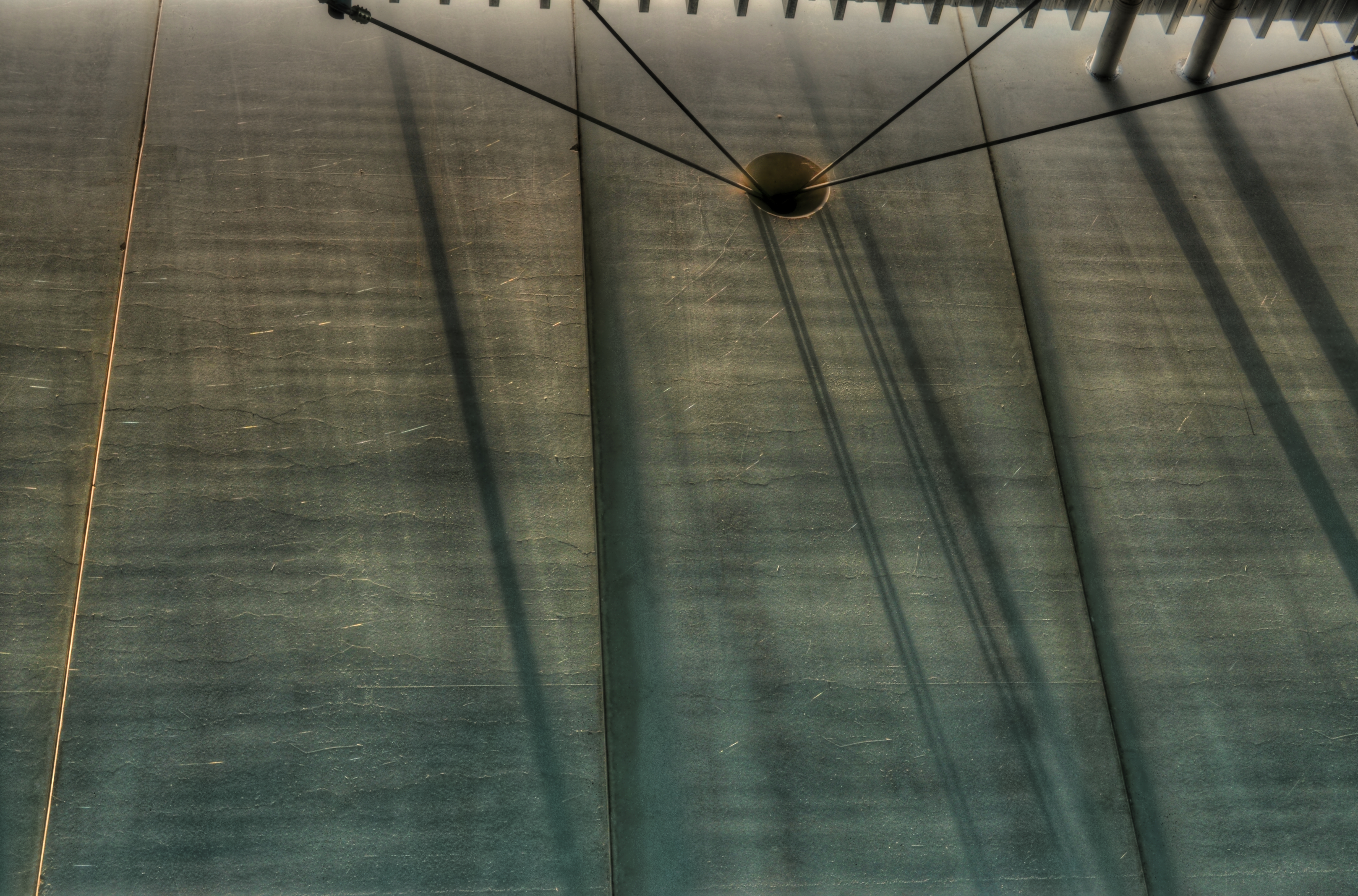
Along came a (light) spider. Intense mid-day light on Summer Solstice 2012 creates dramatic shadows and heightened texture in this HDR image.
By MICHAEL PERKINS
SOME SUBJECTS SEEM AS IF THEY ARE GOING TO FOLLOW A SURE PATH, then dog-leg on you in the doing. Last week I was fascinated to attend a celebration of the summer solstice in a building designed to highlight the drama of its unique light. Phoenix’ Burton Barr Library reading room, an enormous space bordered by shaded glass on its north and south faces and slab concrete for its west and east walls, has, since its opening, hosted an annual midday demonstration by its architect, Will Bruder centered on the longest day of the year. First, a capacity crowd watches intense light crawl dramatically down the library’s west wall, seeming to sweep shadows downward like a rapidly descending curtain until the entire west surface fairly glows with light. For a few minutes, under this enhanced illumination,what normally appears as a seamless monolith of concrete shimmers with a million tiny fractures, creases, and flaws, rendering the usually dull surface alive with small but perceptible dances of color.
Immediately following this subtle but sweet show, as the sun travels to the west over the top of the library, the same display begins in reverse on the east wall, as shadows begin to crawl up from the floor and eventually confine sunlight on the concrete surface to a narrow slit at its top. The same intense reveal on every facet of the slab’s surface is seen again, and, along the ceiling, the library’s carefully designed support pillars, all positioned under individual circular skylights in the reading room’s roof, begin to resemble glowing candles. The entire phenomenon, subtle and quiet, yet beautiful in aspect, is all completed within a half hour.
In that half hour, my original shooting strategy, an overall wide shot to show the amazed onlookers inside the vast room, craning their necks to observe the miracle between rows of book shelves, moved from “sure thing” to “what was I thinking”? As it turned out “the story” was too big to be trusted to a big picture (!), and I came to realize that the heart of the light effect might best be told, for me, in one part of one wall. All the other props inside the structure provided so much visual information that nothing true was going to emerge in any attempt at an overall “coverage” image. I decided to show the shadowy tendrils trailing from a single part of the ceiling structure, but to shoot a three-shot bracket of exposures, all at ISO 100, to be combined later in High Dynamic Range software, to glean as much information (and the widest range of tone) on the texture revealed by the travel of the light across the wall.
The result was a shot that eliminated the rest of the overall solstice story as I tried instead to show object, shadow and detail combining as elements in one integrated design. It’s up to anyone as to whether I made the correct decision, but it’s safe to say that it was correct for me at the time. Sometimes a thing is interesting to look at by itself, for itself, without context or alibi. Of course I realize that I have provided both those things by writing this, but this forum is dedicated to the urge that makes us all throw something at the wall (excuse the expression) to see if anything sticks, so maybe it’s not wrong to give this a bit of backstory. Eventually, however, it’s either a picture or it’s not.
Thoughts?
Related articles
- Spiritual Significance of the Summer Solstice (aquariuschannelings.com)
THE NEW MOSES
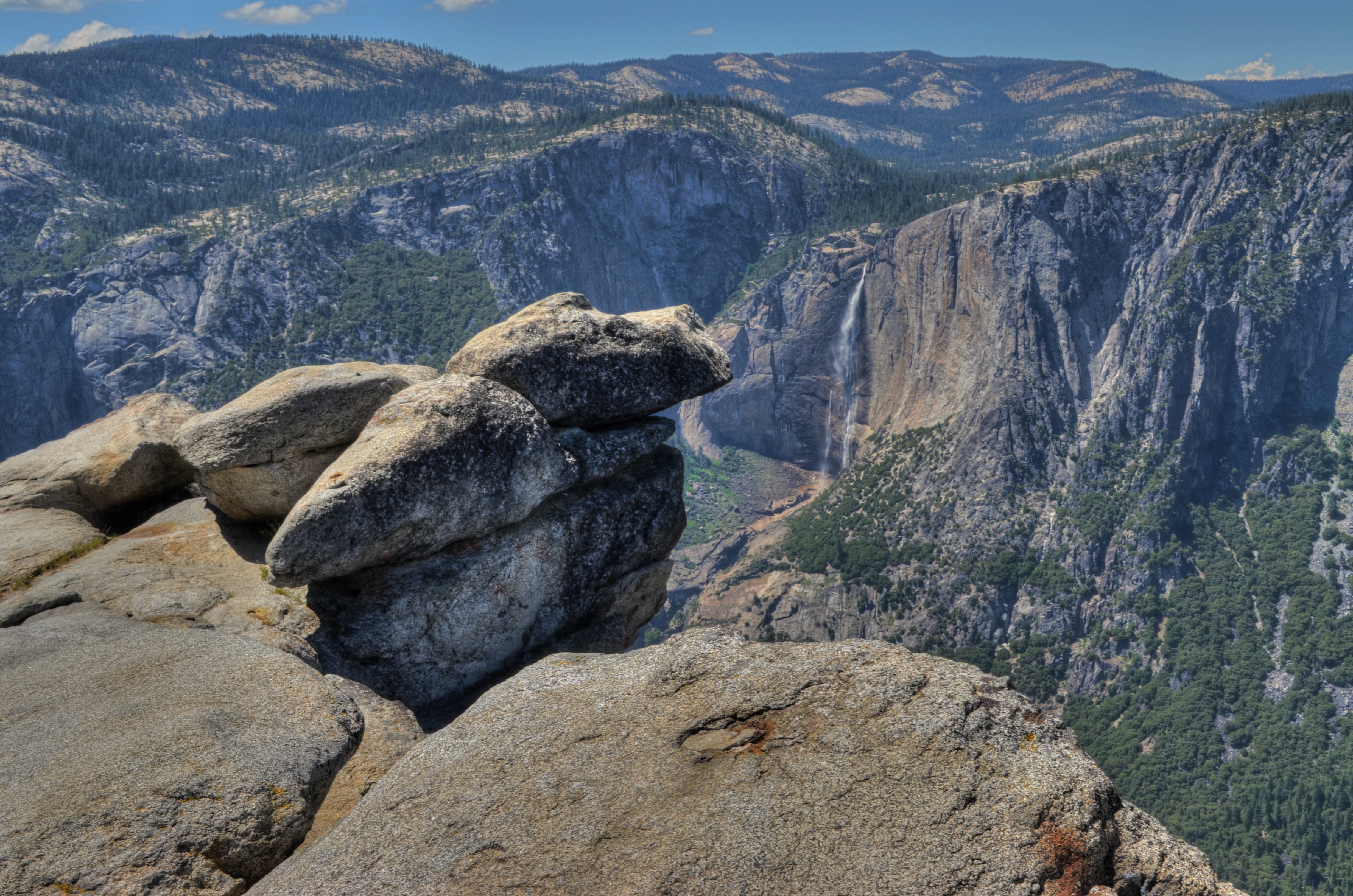
This is where it all began; the famous outcropping of stone atop Yosemite’s Glacier Point, where Sierra Club founder John Muir and President Theodore Roosevelt stood in 1903 to symbolize the beginning of the United States National Park system. 1/125 sec., f/14, ISO 100, 32mm.
By MICHAEL PERKINS
WE CAN ONLY GUESS, AS HE GAZED OUT UPON CANAAN, the long-promised homeland of the wander-weary Israelites, what Moses felt, especially given that he himself would be forbidden to set foot upon that sacred soil. Perhaps, in our recent history, something of a parallel can be drawn to the vista shown above, the aerie from which John Muir, the lanky, ascetic Scotsman who became the first champion of the Yosemite, peered into the vast wilderness he was sworn to protect. This is the view from atop Glacier Point, directly opposite Half-Dome and, in the farther distance, the majesty of Yosemite Falls. It is also one of the only places in the United States where you can literally stand on the spot where history took a new turn.
Like Moses, Muir was a both a prophet and a protector, entranced by the stunning beauty of his adopted country and horrified at its vulnerability before the juggernaut of progress. Unlike Moses, he actually gained entry to his personal promised land, hiking its immense acreage, personally discovering many of its most amazing features and acting as correspondent to his fellow countrymen to apprise them of the great treasure lying unknown inside their borders.
As the founder of the Sierra Club and the most profound poet laureate of the preservation movement (he favored that word over the later “conservation”), Muir’s first choice would probably have been to surround all of Yosemite with at least a mental fence, a barrier of conscience to prevent its plunder by profiteers. His second choice became fateful for us all…..to enlist the federal government as a guardian for his Eden, and to unleash the energy of that nation’s most intrepid crusader for the environment.
John Muir was a veteran of nearly 35 years of preservationist skirmishes by the time he met President Theodore Roosevelt in 1903. Muir, desperate for a way to protect Yosemite beyond the puny efforts of local and state governments, met TR in Oakland, California, and the pair traveled by train to Redmond before taking a stagecoach the rest of the way into Yosemite Valley. Muir used the travel time to implore the president to place Yellowstone under national protection, and Roosevelt, agreeing, asked his host to show him “the real Yosemite”. After heading out into the back country essentially alone and camping under the stars atop Glacier Point, the two awoke to new-fallen snow and a new alliance.
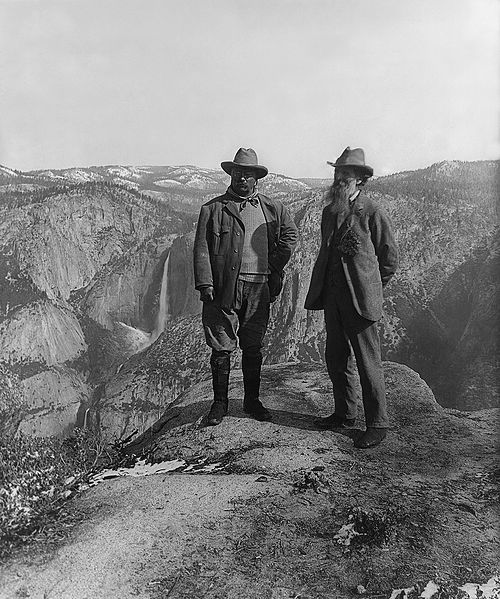
“This is Bully!” Roosevelt and Muir atop Glacier Point, 1903.
That alliance was captured in the shot at left, which shows nearly the same view of the Yosemite Valley as my image at the head of this article. Three years later, in 1906, Muir and the Sierra Club successfully added the valley and the Mariposa Grove (a massive forest of giant sequoias) to the overall Yosemite National Park acreage, and finally saw the entire area placed under federal protection. The United States National Park concept, unique in the entire world of the early 20th century, had been born, the American Moses leading the way to a greener, more perfect union.
Related articles
- Congress to consider Yosemite site for new “Los Angeles Lake” (yubanet.com)
- Happy 174th birthday, John Muir. (fossicking.wordpress.com)
- My First Summer in the Sierra: Illustrated Edition downloads (dubcoou.typepad.com)
ASKING THE MOUNTAINS TO SAY “CHEESE”
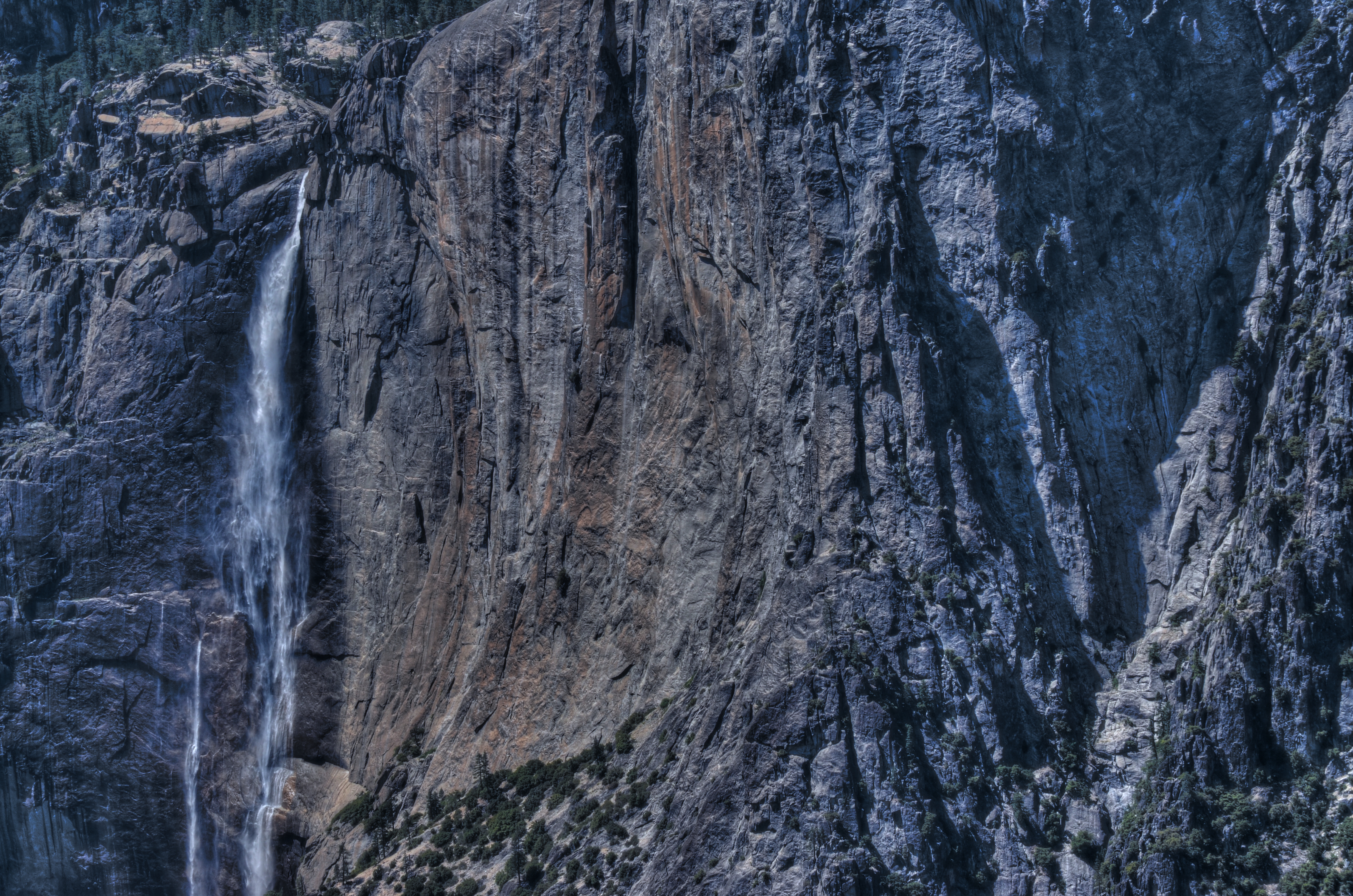
Yosemite Falls, June 14, 2012
By MICHAEL PERKINS
YOSEMITE NATIONAL PARK IS A SUPREME PARADOX FOR A SHOOTER. On one hand, it has never been technically easier to simulate the texture and range of tones that were hard-won miracles for its guardian angel, Ansel Adams. On the other, the very act of visiting the park has never presented a more severe barrier to the kind of mental and emotional commitment to picture making that was, to him, a constant.
The original mission of this blog is to share creative successes from amateur to amateur, but also to name the problems which restrict us to taking, instead of making, pictures. Yosemite, historically the proving ground for photographers the world over, also presents one of these problems.
Adams had to suffer, slog, hike, and persevere to set up his visions, all the while wrestling with a technology that punished the slightest miscalculation. The park itself presented a rugged challenge to him as well in the early 20th century, as its greatest vistas were not just a minivan jog away and its best treasures resisted his inquiring eye. So how come his pictures are so much better, still, than anything most of us can deliver in an age of ultimate simplicity, ease, and access?
There is a disturbing statistic quoted by the park service, that the average visitor to Yosemite is actually in the park for a grand total of two and a half hours. Not exactly the time investment that a photographic subject of this scope warrants. We also tend to enter the park in much the same way, stop by a predictable list of features, and take most of the same “money shots”. We all know where the good stuff is, and it seems to be irresistible to offer up our “take” on the craggy face of El Capitan, the serene power of the Mariposa Grove (with its astonishing giant sequoias), or the obligatory capture of a waterfall….hell, any waterfall. And yet….I can’t be the only one who has come home from vacation to find that my pictures are just….okay. Overwhelmingly…..non-sucky. Stunningly….passable.
Adams’ life’s work, a mutual exchange of energy in which he and Yosemite were creative partners in the deliberate making of images, is, for us, a re-creation, a simulation, the photo equivalent of karaoke. Just like many lounge lizards “kinda” sing like Sinatra, too many of us “kinda” shoot pictures like Ansel. For Adams, photography was like asking the wilderness to dance. For us, it’s like asking the mountains to say “cheese”.
Part of his mission was showing us what a treasure we had, but he might have sold the product too well. Part of the Yosemite that spoke to him is gone, compromised into tameness by sidewalks,snack bars, and gift shops. Worse, much of what we do choose to record of it is done in quick stops off the tour bus, stolen moments before the kids get too tired , and the rabid urgency of God-let’s-hurry-up-we-have-three-more-places-to-hit-today. Indeed, park officials laughingly refer to people who drive in and out of the park’s main areas without even emerging from their cars, bragging that they “did” Yosemite, like a ten minute rock wall climb at REI, squeezed in before a trip to the food court.
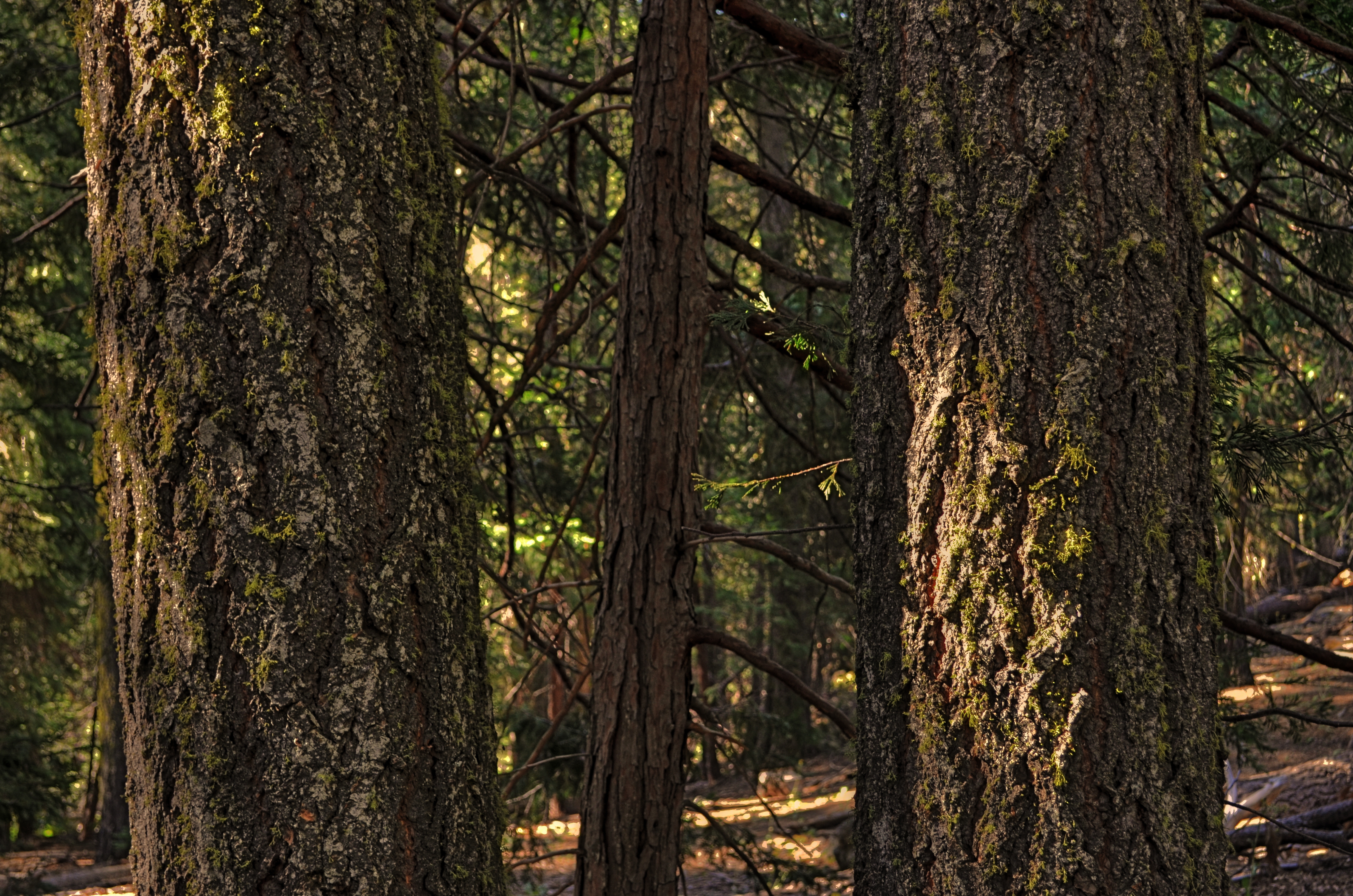
Inside the Mariposa Grove, June 14, 2012
The Ansel Adams Gallery, which has operated in the park for more than a century now, certainly features fresh visions by new artists who are still re-interpreting the wonder, still managing to say something unique. But many of our cameras will betray how little of our selves are invested behind the viewing screen. Adams’ work resonates through time because we recognize when someone has poured part of their soul into the creative cauldron. And certainly, if we are honest, we also know when that ingredient is missing.
“I want to see your face in every kind of light” goes the old love song lyric. Being in love with a woman, an idea, anything, demands time, deliberation. To see the object of one’s affection in all light, all seasons, all moods and tempers, is more of a pact than many of us are willing to make. The pictures we bring back from many places may not be lessened in their impact by this fact. But Yosemite is not “many places”, and she will not give up her secrets to just anyone. Fortunately, if we care, we can return and try again to do more than merely tattoo pixels onto a sensor. That has always been the promise of photography, that you can redeem your myopia from one day by re-thinking, re-feeling on another. But it means changing the rules of engagement with our subject. For those of us who cannot or will not do that, the world will not stop spinning, and, in fact, we will chalk up many acceptable images along the way, but Ansel will always be the one among us who really understood the magic, and discovered how to conjure it at will.
Related articles
- What’s black & white, famous, and coming to Peabody? (hangwithbigpictureframing.com)
- A Weekend in Yosemite (theepochtimes.com)
SLOGGING INTO HISTORY

Landing craft and tanks at Omaha beach during the D-Day landings, many of which had departed from Penarth (Photo credit: Wikipedia)
By MICHAEL PERKINS
THE SHEER WEIGHT OF THE NUMBERS attendant to the D-Day invasion, begun sixty-eight years ago today, beggars the imagination. And yet, faced with the even tougher task of weighing the unimaginable horror and slaughter played out on the beaches of Normandy, the ability to somehow quantify the cost in raw data is oddly comforting. It’s certainly easier than evaluating the loss to the world, in muscle and blood, of the largest military operation in recorded history. Some selected figures:
The players: one million Allies, seven hundred thousand German troops.
The hardware: 8.000 artillery pieces; 2,546 Allied bombers and 1,731 fighters, 820 German bombers and fighters; 3,500 towed gliders (100 glider pilots killed).
Lost materiel: 24 warships and 35 merchant ships sunk; 127 allied planes shot down.
The human cost of the initial invasion in gross numbers: 6,603 Americans, 2,700 British, 946 Canadians, and between 4,000 and 9.000 Germans;
And then there was the “before” killing and the “after” killing, with 12,000 airmen and 200 war planes lost in April and May 1944 in preparation for 6/4/44, and a general toll by the end of the Battle of Normandy of 425,000 Allies and Germans killed or wounded.
Today, in Normandy, spread across 77 separate cemeteries lie the remains of 77,866 Germans; 9,386 Americans; 17,769 British; 5,002 Canadians and 650 Poles.
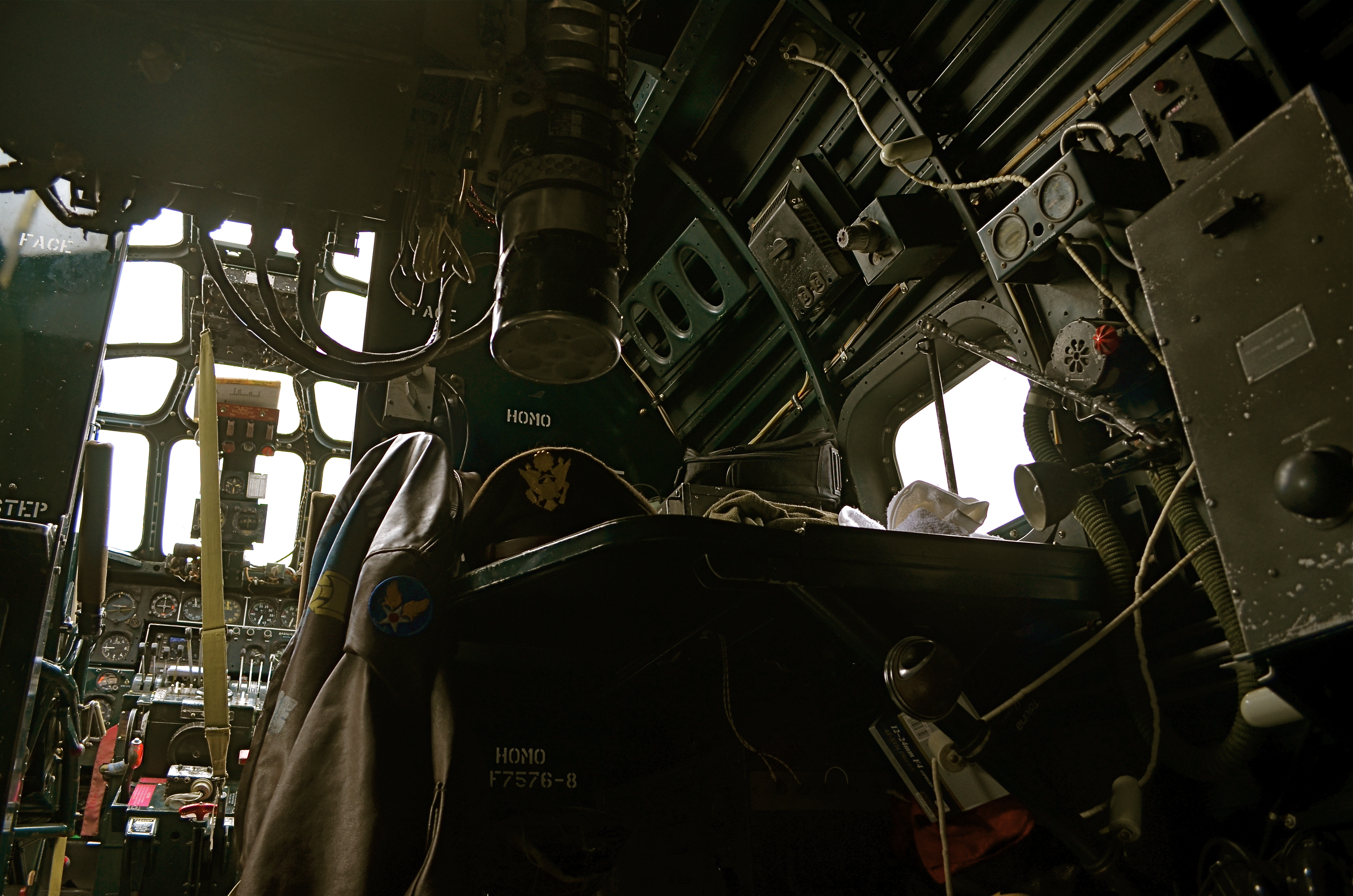
Inside the cabin of a restored B-17, one of the workhorses of the air war over Normandy on the first wave of the D-Day Invasion. 1/125 sec., f/5, 250 ISO, 18mm.
Related articles
- ‘Band of Brothers’ honored on D-Day anniversary (newsobserver.com)
- June 6, 1944: Artificial Harbor Paves the Way for Normandy Invasion (wired.com)
SMILE! OR NOT.
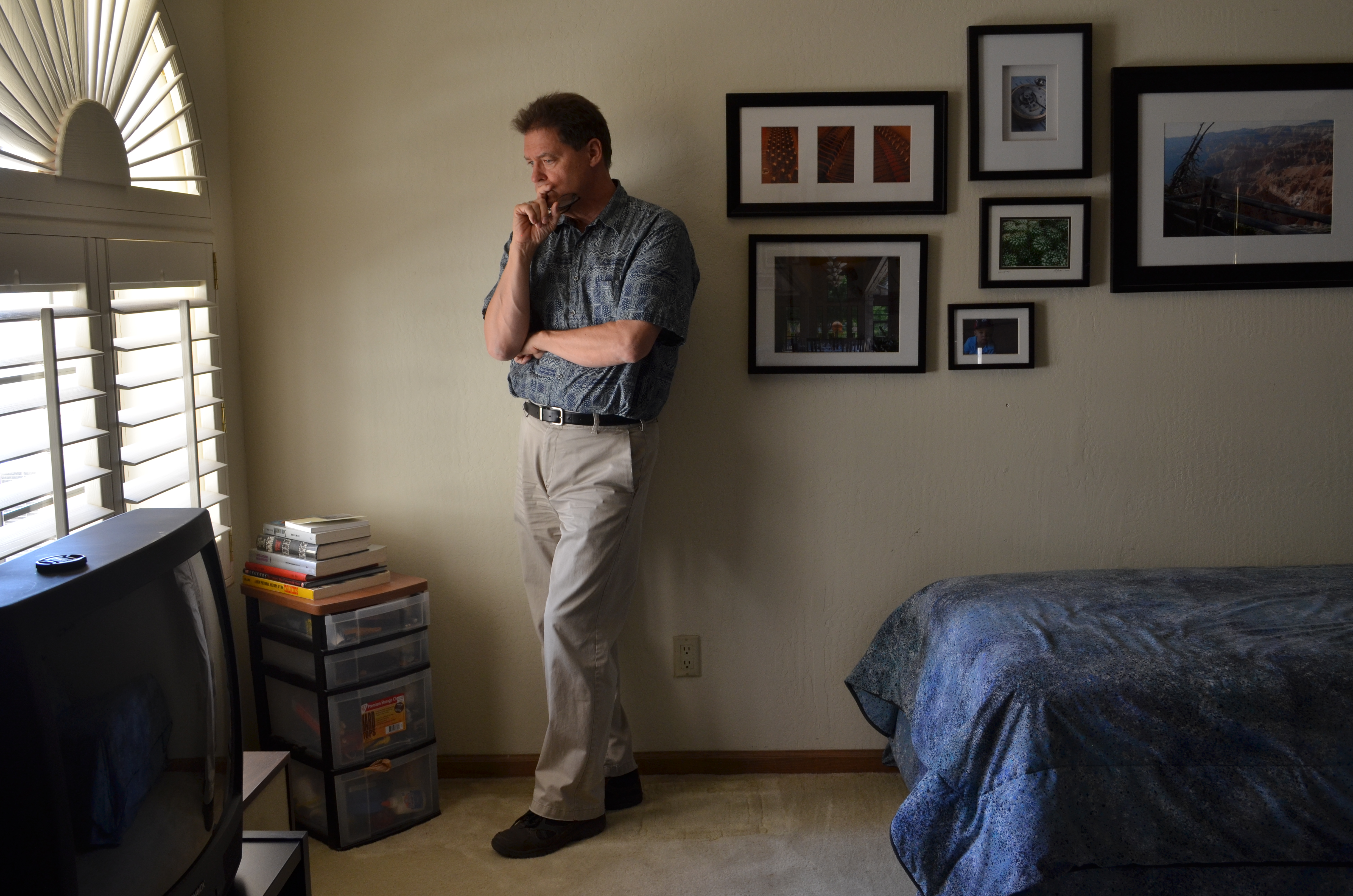
Since we’re usually unhappy with the way others capture us, we have nothing to lose by a making a deliberate effort to come closer to the mark ourselves. Self-portraits are more than mere vanity; they can become as legitimate a record of our identities as our most intimate journals. 1/15 sec., f/7.1, ISO 250, 24mm.
By MICHAEL PERKINS
A COMMONLY HELD VIEW OF SELF-PORTRAITURE is that it epitomizes some kind of runaway egotism, an artless symbol of a culture saturated in narcissistic navel-gazing. I mean, how can “us-taking-a-picture-of-us” qualify as anything aesthetically valid or “pure”? Indeed, if you look at the raw volume of quickie arm’s length shots that comprise the bulk of self-portrait work, i.e., here’s me at the mountains, here’s me at the beach, etc., it’s hard to argue that anything of our essence is revealed by the process of simply cramming our features onto a view screen and clicking away…..not to mention the banality of sharing each and every one of these captures ad nauseum on any public forum available. If this is egotism, it’s a damned poor brand of it. If you’re going to glorify yourself, why not choose the deluxe treatment over the economy class?
I would argue that self-portraits can be some of the most compelling images created in photography, but they must go beyond merely recording that we were here or there, or had lunch with this one or that one. Just as nearly everyone has one remarkable book inside them, all of us privately harbor a version of ourselves that all conventional methods of capture fail to detect, a visual story only we ourselves can tell. However, we typically carry ourselves through the world shielded by a carapace of our own construction, a social armor which is designed to keep invaders out, not invite viewers in. This causes cameras to actually aid in our camouflage, since they are so easy to lie to, and we have become so self-consciously expert at providing the lies.
The portraits of the famous by Annie Liebovitz, Richard Avedon, Herb Ritts and other all-seeing eyes (see links to articles below) have struck us because they have managed to penetrate the carapace, to change the context of their subjects in such dramatic ways that they convince us that we are seeing them, truly seeing them, for the first time. They may only be doing their own “take” on a notable face, but this only makes us hunger after more interpretations on the theme, not fewer. Key to many of the best portraits is the location of their subjects within specific spaces to see how they and the spaces feed off each other. Sometimes the addition of a specific object or prop creates a jumping off point to a new view. Often a simple reassignment of expression (the clown as tragedian, the adult as child, etc) forces a fresh perspective.
As for the self-portrait, an artistic assignment that I feel everyone should perform at least once (as an intentional design, not a candid snap), there is a wealth of new information gleaned from even an indifferent result. Shooters can act as lab rats for all the ways of seeing people that we can think of to play at, serving as free training modules for light, exposure, composition, form. I am always reluctant to enter into these projects, because like everyone else, I balk at the idea of centering my expression on myself. Who, says my Catholic upbringing, do I think I am, that I might be a fit subject for a photograph? And what do I do with all the social conditioning that compels me to sit up straight, suck in my gut, and smile in a friendly manner?
One can only wonder what the great figures of earlier centuries might have chosen to pass along about themselves if the self-portrait has existed for them as it does for us. What could the souls of a Lincoln, a Jefferson, a Spinoza, an Aquinas, have said to us across the gulf of time? Would this kind of introspection been seen by them as a legacy or an exercise in vanity? And would it matter?
In the above shot, taken in a flurry of attempts a few days ago, I am seemingly not “present” at the proceedings, apparently lost in thought instead of engaging the camera. Actually, given the recent events in my life, this was the one take where I felt I was free of the constraints of smiling, posing, going for the shot, etc. I look like I can’t focus, but in catching me in the attempt to focus, this image might be the only real one in the batch. Or not. I may be acting the part of the tortured soul because I like the look of it. The point is, at this moment, I have chosen what to depict about myself. Accept or reject it, it’s my statement, and my attempt to use this platform to say something, on purpose. You and I can argue about whether I succeeded, but maybe that’s all art is, anyway.
Thoughts?
Related articles
- Avedon For Breakfast (fabsugar.com)
- Getty Center Exhibits Herb Ritts and Celebrity Portraits (ginagenis.wordpress.com)
- Annie Leibovitz: ‘Creativity is like a big baby that needs to be nourished’ (guardian.co.uk)
A BOX FULL OF ALMOSTS
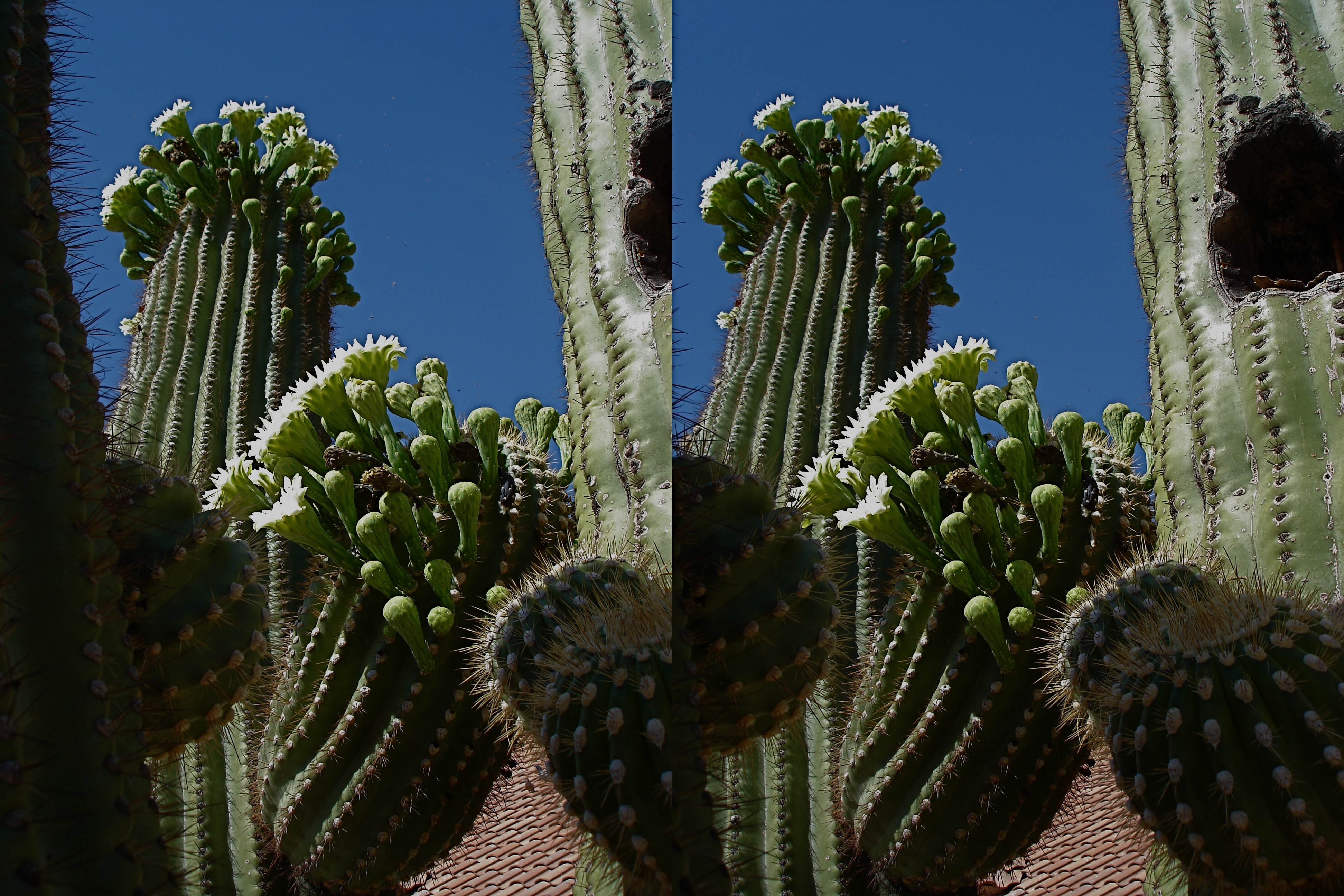
Shooting for 3D (top image) often cost me a lot of composition space, forcing me to frame in a narrow vertical range, but learning to frame my message in those cramped quarters taught me better how to draw the viewer “in deep” when composing flat 2D images.
By MICHAEL PERKINS
I RECENTLY SPENT AN ANGUISHED AFTERNOON sifting through a box of prints that I shot from about 1998 through 2002, a small part of my amateur work overall, but a particularly frustrating batch of images to revisit. Even given the high number of shots of any kind that one has to take to get a small yield of cherished images, the number of “keepers” from this period is remarkably low. It is a large box of almosts, a warehouse of near misses. Still, I felt that I needed to spend some “quality time” (strange phrase) mentally cataloguing everything that went wrong. I could have used a stiff drink.
One reason that the failure rate on these pictures was so high was because the pictures, all of them stereoscopic, were taken with one of the only cameras available for taking such shots at the time. The Argus 3D was an extremely limited film-based point-and-shoot which had been introduced for the sole purpose of producing cheap prints that could be developed by any vendor with conventional processing. The resulting 4×6 prints from the Argus were not the red-green anaglyph shots requiring the infamous cardboard glasses to decipher their overlaid images. but single prints made up of two side-by-side half-frame images in full color, which could later be inserted into an accompanying split-glass viewer that came with the camera.
The 3D effect was, in fact, quite striking, but the modest camera exacted a price for producing this little miracle. Since stereo works more dramatically at longer focal lengths, only shots made at f/11 or f/16 were offered on the Argus, which also had a fixed shutter speed and could not accommodate films rated higher than ASA 100. As for better 3D cameras, most available in the late ’90’s were dusty old relics from the late ’40’s and ’50’s, meaning that any hobbyist interested in stereo photography had to pretty much accept the built-in limitations of the rigs that were available. As a result, I had only basic control over exposure; light flares would invariably create huge streaks on one of the two angled lenses, creating a headache-y “flicker” in the viewing of the final print; and, worst of all, you had to compose every shot in vertical orientation, regardless of subject, in half the width in which you normally worked.
Worse for the artistic aspect of the project, I seem to have been sucked into the vortex that traps most shooters when learning a new technique; that is, I began to shoot for the effect. It seems to have been irrelevant whether I was shooting a bouquet of roses or a pile of debris, so long as I achieved the “eye-poke” gimmick popping out of the edge of the frame. Object (and objectives) became completely sidelined in my attempts to either “wow” the viewer or overcome the strictures of the camera itself. The whole carton of prints from this period seems to be a chronicle of a man who has lost his way and is too stubborn to ask directions. And of the few technically acceptable images in this cluster of shots, fewer still can boast that the stereoscopic element added anything to the overall impact of the subject matter. Can I have that drink now?
A few years later, I would eventually acquire a 1950’s-vintage Sawyer camera (designed to make amateur View-Master slides), which would allow me to control shutter speed, film type, and depth of field. And a few years after that, my stereo shots started to be pictures first, thrill rides second. Grateful as I was for the improved flexibility, however, the Argus’ cramped frame had, indeed, taught me to be pro-active and deliberate in planning my compositions. Learning to shoot inside that cramped visual phone booth meant that, once better cameras gave me back the full frame, I had developed something of an eye for where to put things. Even in 2D, I had become more aware of how to draw the eye into a flat shot.
Today, as I have consigned 3D to an occasional project or two, the lessons learned at the hands of the cruel and fickle Argus serve me in regular photography, since I remain reluctant to trust even more advanced cameras to make artistic decisions for me. Thus, even in the current smorgasbord of optical options, I feel that, in every shot, I am still the dominant voice in the discussion.
That makes all those “almosts” worth while.
Almost.
Bartender? Another round.
Thoughts?
Related articles
BIG STORY, LITTLE STORY
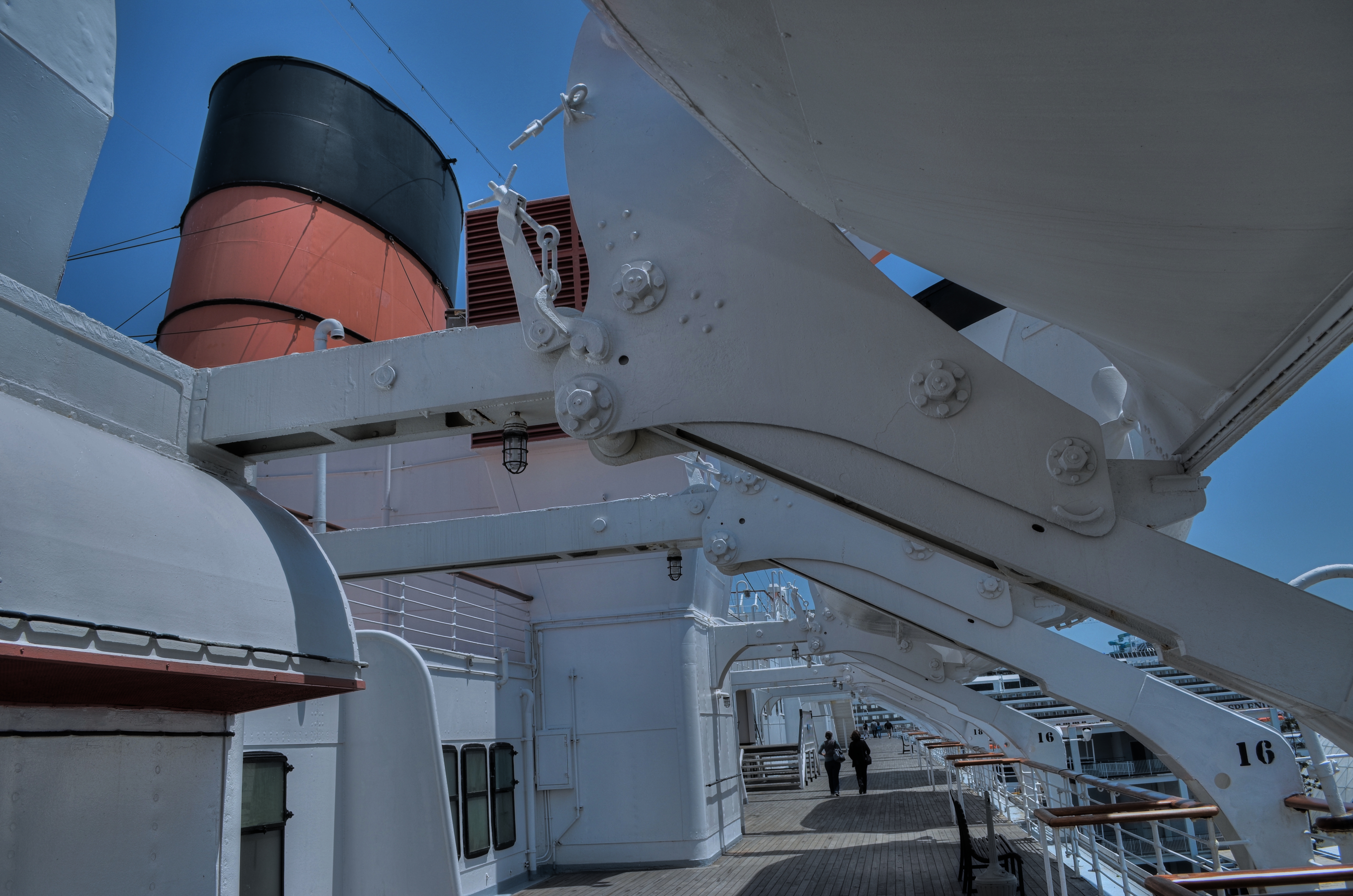
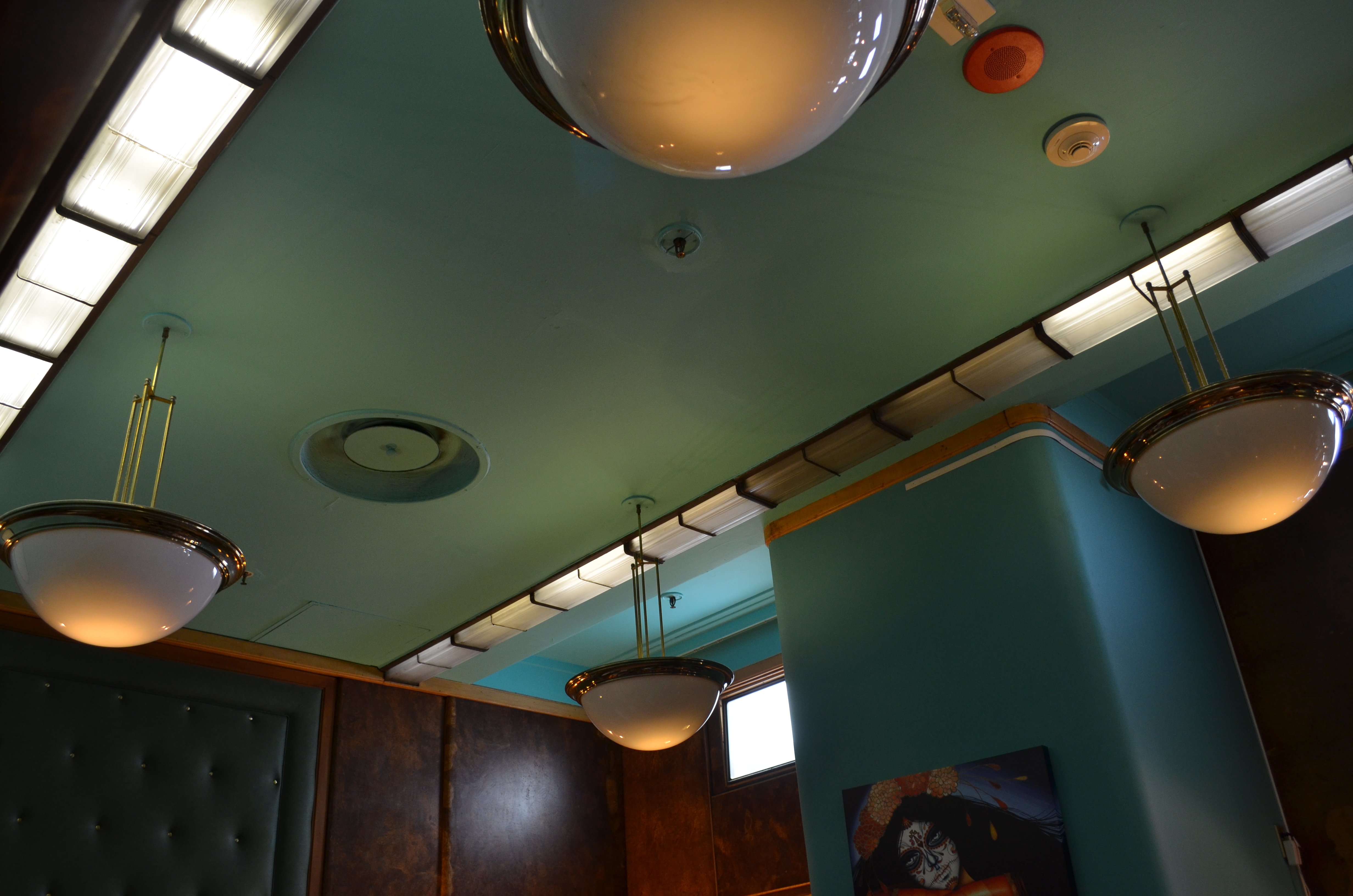
Which image better conveys the romantic era of the Queen Mary, the wide-angle shot along the promenade deck (above), or a detail of lights and fixtures within one of the ship’s shops (below)?
By MICHAEL PERKINS
THE VERY APPEAL THAT ATTRACTS HORDES OF VISITORS to travel destinations around the world, sites that are photographed endlessly by visitors and pilgrims alike, may be the same thing that ensures that most of the resulting images will be startlingly similar, if not numbingly average. After all, if we are all going for the same Kodak moment, few of us will find much new truth to either the left or right of a somewhat mediocre median.
In a general sense, yes, we all have “access” to the Statue of Liberty, the Grand Canyon, Niagara Falls, etc., but it is an access to which we are carefully channeled, herded, and roped by the keepers of these treasures. And if art is a constant search for a new view on a familiar subject, travel attractions provide a tightly guarded keyhole through which only a narrowly proscribed vantage point is visible. The very things we have preserved are in turn protected from us in a way that keeps us from telling our subject’s “big story”, to apprehend a total sense of the tower, temple, cathedral or forest we yearn to re-interpret.
More and more, a visit to a cultural keepsake means settling….for the rooms you’re allowed to see, the areas where the tours go, the parts of the building that have been restored. Beyond that, either be a photographer for National Geographic, or help yourself to a souvenir album in our gift shop, thank you for your interest. Artistically speaking, shooters have more latitude in capturing the stuff nobody cares about; if a locale is neglected or undiscovered, you have a shot at getting the shot. Imagine being Ansel Adams in the Yosemite of the 1920’s, tramping around at will, decades before the installation of comfort stations and guard rails, where his imagination was only limited by where his legs could carry him (and his enormous and unwieldy view camera, I know). Sadly, once a site has been “saved”, or more precisely, monetized, the views, the access, the original feel of its “big story” is buried in theme cafes, commemorative shrines, info counters, and, not insignificantly, competition with every other ambitious shooter, who, like you, wants a crack at whatever essences can still be seen between the trinkets and kiosks.
On a recent visit to the 1930’s luxury liner RMS Queen Mary, in Long Beach, California, I tried with mixed results to get a true sense of scale for this Art Deco leviathan, but its current use as a hotel, tour trek and retail mall has so altered the overall visual flow that in some cases only “small stories” can effectively be told. Steamlined details and period motifs can render a kind of feel for what the QM might have been before its life as a kind of ossified merchandise museum, but, whereas time has not been able to rob the ship’s beauty, commerce certainly nibbles around its edges.
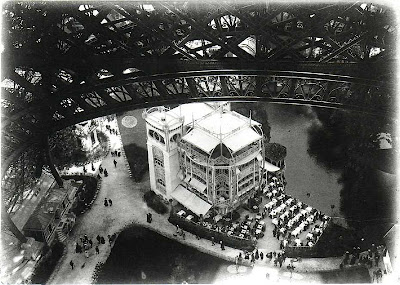
Sometimes you win the game. I recently discovered the above snapshot of the Eiffel Tower, taken in 1900 by the French novelist Emile Zola, where real magic is at work. Instead of clicking off the standard post card view of the site, Zola climbed to the tower’s first floor staircase, then shot straight down to capture an elegant period restaurant situated below the tower’s enormous foundation arches. And although only a small part of the Eiffel is in his final frame, it is contextualized in size and space against the delicate details of tables, chairs, and diners gathered below, glorifying both the tower and the bygone flavor of Paris at the turn of the 20th century.
Perhaps, for a well-recorded destination, the devil (and the delight) is in the details. Maybe we should all be framing tighter, zooming in, looking for the visual punctuation instead of the whole paragraph. Maybe all the “little stories” add up to a sum greater than that of the almighty master shot we originally went after. Despite the obstacles, we must still try to dictate the terms of engagement.
One image at a time.
Thoughts?
GLO-SCHTICK
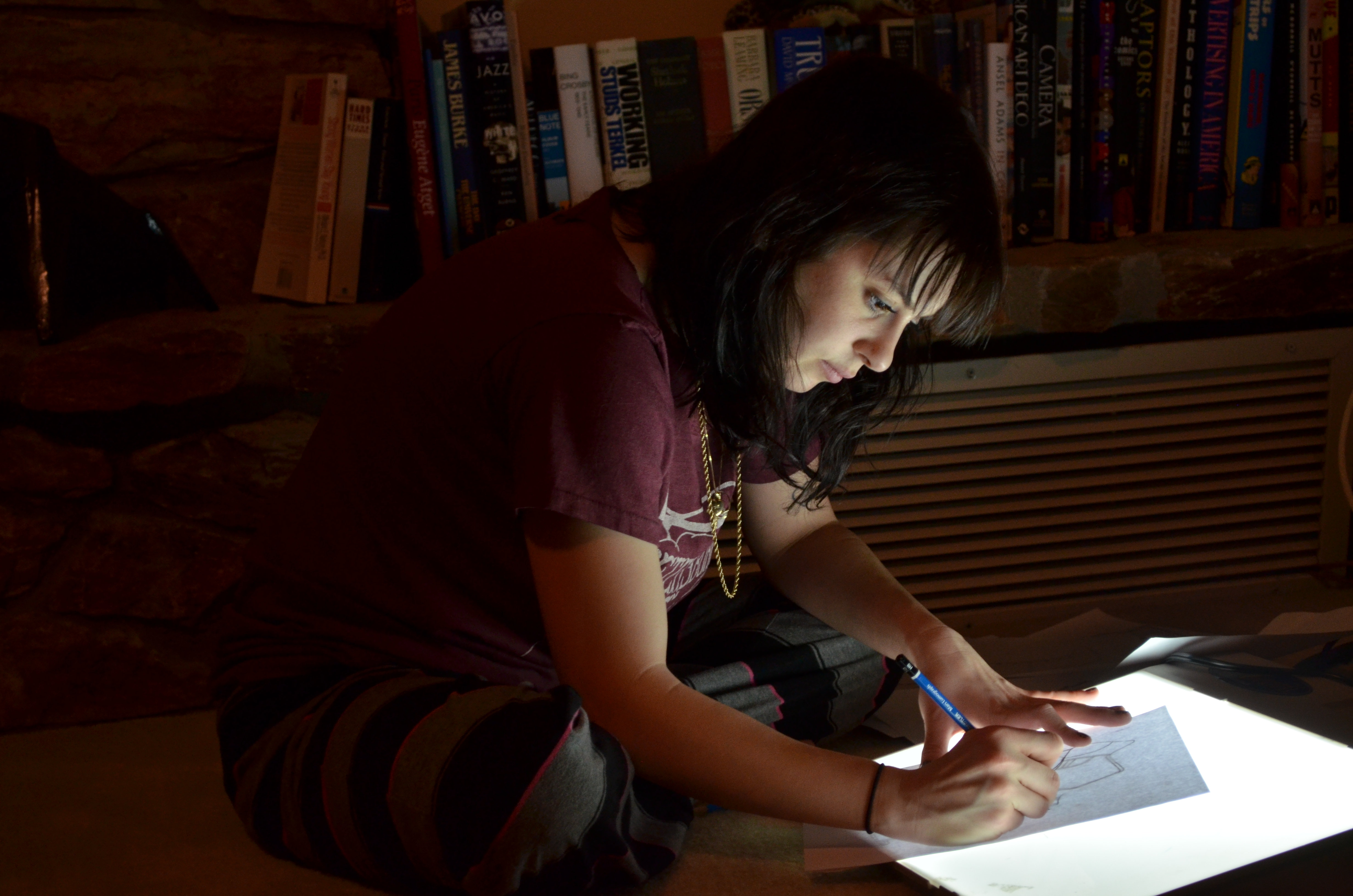
Sometimes just a bit is just enough. A bump up to ISO 640 kept me fairly free of noise and allowed me to use the screen’s glow as my only light source. 1/30 sec., f/5.6 at 52mm.
By MICHAEL PERKINS
THE BEST TECHNIQUE is one that does not scream for attention like a neon t-shirt emblazoned with the phrase LOOK WHAT I DID.
Now, of course, we are all messing around backstage, working hard to make the elephant disappear. We all manipulate light. We all nudge nature in the direction we’d prefer that she go. But what self-respecting magician wants to get caught pulling the rabbit out of a hole in the table?
I recently had the perfect low-light solution handed to me as I watched a young designer working in a dim room, and, thankfully, only marginally aware of my presence. “Lighting 101” dictated that, to get a sense of her intense concentration, I send the most important light right to her face.
Turns out, a light tracer screen, in a pinch, makes a perfect softbox.
Better yet, the light from the screen thinned out and dampened after it traveled left past her shoulders, leaving just enough illumination to keep the rest of the frame from falling off completely into black, making the face the lone story-teller. An ISO bump to 640 and a white balance tweak were enough to grab the best of what the screen had to give. At this point in the “gift from the gods” process, you click, and promise, in return, to live a moral life.
Sometimes you don’t have to do anything extra to make a thing look like it actually was. That’s better than finding a hundred-dollar bill on the street.
Well, almost.
What was your best light luck-out?
LOMO MOJO
A perfectly average handheld interior shot taken without flash in 2012. What is amazing, to an old geezer like myself, is how completely impossible it would have been, back in the day, to capture even this modest shot with the very same type of toy plastic camera now being sold to “lomography” enthusiasts and marketed as “hip”. Light leaks and color streaks do not an image make.
I AM INTERESTED MOST IN WHAT MAKES PEOPLE WANT TO TAKE PICTURES, as well as what makes them take the best ones. In that spirit, I have been recently re-examining the decade-long debate on the trend known as lomography, or the use of plastic bodied, low-tech toy cameras as serious imaging instruments. In renewing the impact of “lomo”, with its rudimentary shutter speeds and fixed-focus meniscus lenses, I have pored over four bazillion angry diatribes by those who condemn the cameras’ extreme technical limits and dismiss their enthusiasts as trendy phonies. I have also tracked its rabid defense by ardent users who celebrate lomo cameras as a way back to a kind of artistic innocence, a return to a photographic Eden in which we all shoot with our hearts instead of our heads. At the end of it all, does it matter what anyone thinks about how we take pictures if something, anything comes along to want them to take more of them? Probably not, and I certainly can’t decide the issue, if it needs deciding at all. Still, a brief re-examination of the whole concept, as I see it, might be worth a run-through. Your mileage may vary…
And, yes, before we proceed, I freely admit that a few world-class photos have been taken with cameras that are one step above drawing the image yourself with a crayon, just as a few amazing canvasses have been created by artists who hurl paint the way a monkey flings poo. I leave it to your discretion whether these accomplishments are vindication of a great vision, or happy accidents granted by the randomness fairy.
Backstory section: as a lifelong shooter, I enthusiastically began taking pictures with the very types of cameras which lomo fans so highly prize. This was dictated purely by economics, not art. It’s fair to say that, with the opening of every new packet of prints that arrived from the processor in those days, I spent more time cursing the smotheringly narrow limits of my light-leaky box and its take-it-or-leave-it settings than I spent cheering the results as some kind of creative breakthrough. I knew what real cameras could do. My father had a real camera. I had a toy, a toy which would betray my best efforts at breathtaking captures pretty much at will.
I didn’t feel avant-garde. I didn’t feel edgy.
I felt like I wanted a real camera.
Turns out that the manufacturers of my Imperial Mark XII, along with the Holga, the Diana, and other constellations in the lomo firmament, eventually came to the same conclusion. Many of their cheap products were made in the underdeveloped economies of iron-curtain countries.They cranked these babies out with the chief object of making a quick buck on undemanding first-time buyers and children. There was no attempt to market these clunkers as serious instruments; they were the fixed-focus, plastic-lensed equivalent of a bootlegged Dylan album taped off the mixer board. Eventually, these companies went on to other ways of separating the rubes from their rubles.
Now factor in the effect of time, nostalgia and (wait for it) ironic marketing. In the beginning of the digital age, photography arrives at a crossroads. Film is being challenged, if not falling under actual attack. Photography seems, to some, to have surrendered to a soulless technology rather than the “warm”, “human”, “hands-on” feel of analog picture-making. And as for the black arts of post-processing, the digital darkroom begins to be demonized only slightly less than the clubbing of baby seals. The unexpected, the unforseeable, the random begins to be attractive, simply because it spits in the eye of all this robo-gearhead slide toward pixels and light sensors.
A longing for a simpler time is observed among the young, who long to dress in forty-year old clothes and who regard vinyl records as more “authentic” than digital audio, not in spite of the scratches, but because of them. Film photography and its worst accidental artifacts becomes “retro” product, to be marketed through trendy boutiques and vintage stores. The sales message: anyone can take a picture (true, actually). The box isn’t important (less true). None of it’s important (outright lie). Shoot from the hip! Look, it made a weird rainbow streak on the picture, isn’t that cool?
Cool at a premium cost, as well. Cameras that went for $5.00 as toys in the ’60’s are now topping $100.00 for the same optics and defects in 2012, with one principal, cynical difference; in the newly produced cameras, the optical defects are being engineered in on purpose, so that every frame comes saturated not only with garish color but attitude as well. Every click produces a tic. This kind of salesmanship makes Andy Warhol’s Campbell’s soup cans seem absolutely honorable by comparison.
Tolerance disclaimer: can great art be created with a rudimentary tool? ABSOLUTELY. Cave dwellers made wheels good enough to move their carts to market well before Sears Craftsman came on the scene. I can make a sort of painting using dried sticks, but somehow I suspect that a supple, tapered brush gives me more fine-tuned control. In the field of combat, I can open someone’s airway with the shaft of a Bic pen (see your favorite M*A*S*H* re-run) but writing instruments are not, typically, the tool of choice in the operating rooms at the Mayo. We don’t use sealing wax to send love letters anymore, we don’t take the family horse on a Sunday jaunt to the county seat, and we don’t eat peas off a knife. Of course we could. But what is our motivation to do so?
The historic arc of photography bends toward technical development, not fallback. As soon as glass plates were developed, their limits implied the need for film. Once film first froze movement, we needed it to do it faster. No sooner had pinhole apertures allowed a picture to be crudely focused than the market cried out for dedicated glass to refine those pictures. And while many were just getting over the novelty of recording events in monochrome, some dreamed of harnessing all the shades in the rainbow.
Tolerance disclaimer #2: the only reason to use a technique or system is if it gives you the pictures you want. Once your dreams exceed the limits of that medium, however, it’s time to seek a better system. Prevailing over the limits of your medium because that’s all there is can be noble. However, there is no artistic triumph in deliberately using bad equipment to take great pictures. Lomo cameras may entice people to begin shooting, then move on once they outgrow the warps, distortions and flares that these toys produce. Thus the trend will at least have given them time to experiment and master the basics. But for the most part, for me,there are already far too many obstacles to making good pictures to allow the camera itself to be one of them.
Even in the name of cool.
Thoughts?
 thenormaleye