VINTAGE VESSEL
By MICHAEL PERKINS
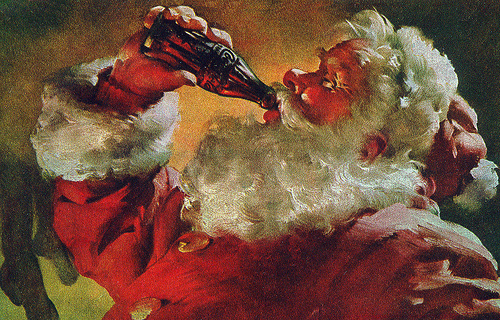 ALTHOUGH SHOOTERS FANCY THEMSELVES “INTERPRETIVE VISUAL POETS”, a big part of photography is also the dutiful marking of time, the chronicling of things that are in the process of going away. The medium of image-making itself is one long history of mutation, evolution and imminent obsolescence, so why should we shy away from recording those things in our world which are always going extinct? Think of the world as one big repeat of your eighth-grade class picture. Yeah.
I am a lifelong Coca-Cola buff. Part of this fascination comes out of a career in mass media advertising and marketing, where Coke has largely shown the rest of the world how a brand is created and sustained. This fizzy (and guilty) pleasure is probably unique among all of the products ever marketed in the industrial world, coming, as it does, with its own traditions, mythology, and iconography. From the annual seasonal Haddon Sundblom illustrations of Santa Claus pausing to refresh himself to our present-day polar bear soda fantasies, Coke has established a legacy of style and, yes, a certain visual vocabulary. We may argue “new recipe” versus “classic formula”, but we know what Coca-Cola should look like.
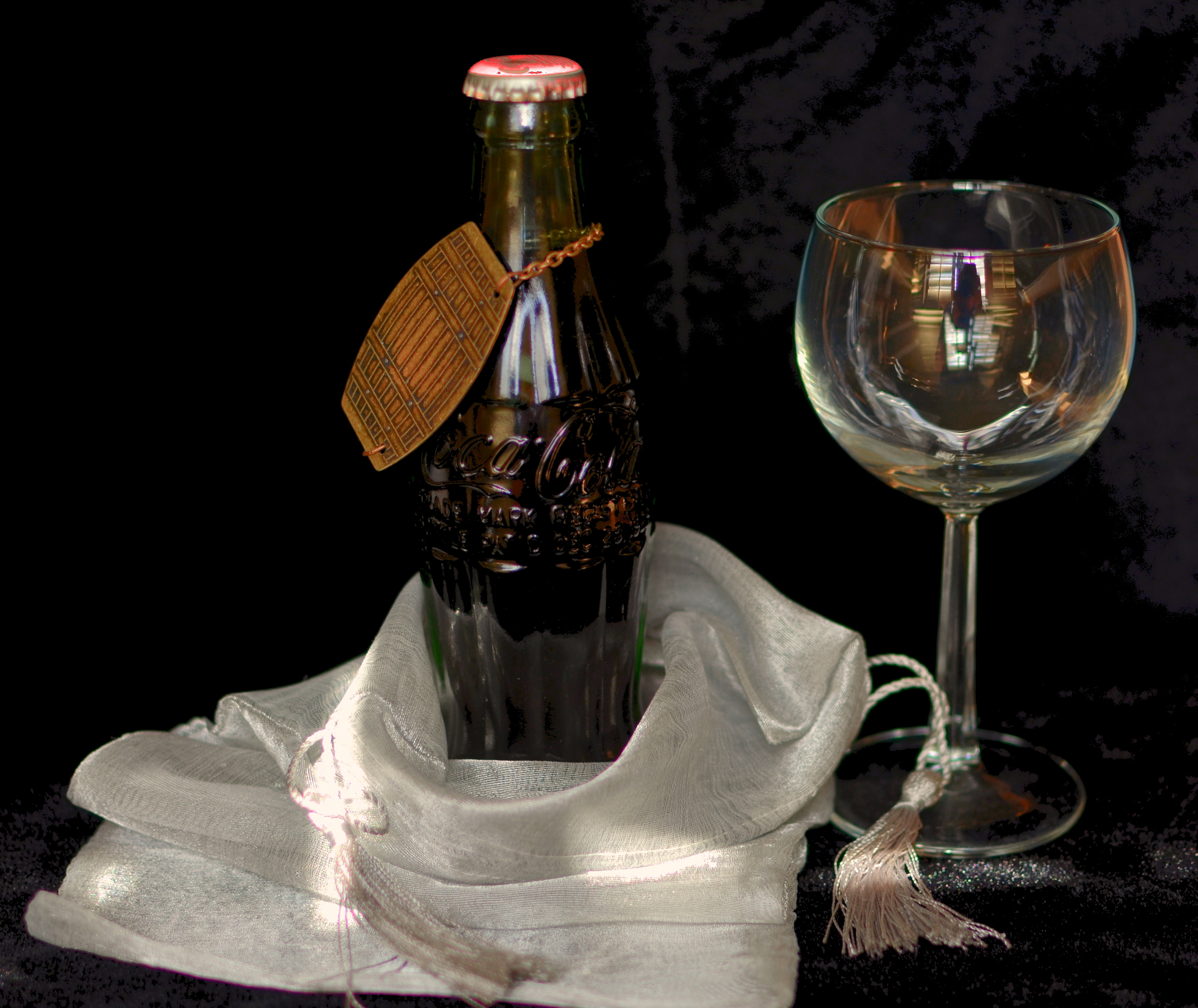
I can suggest an elegant cheese to accompany this unique ’95 vintage. Something in a discreet Velveeta, perhaps? A tone-mapped blend of 1/320 and 1/620 sec. exposures on a Nikon 35mm prime lens, both at f/2.5 and ISO of 100.
One of the “looks” that we expect is the sinuous curl of the so-called “contour” bottle, introduced in 1916 and maintained as a constant of style well into the 21st century. This distinctively shaped design was so quintessentially American that it was originally nicknamed the “Mae West” due to its, er, curvaceous dimensions. And when it comes to Coca-Cola, icons die hard. Years after this traditional container has ceased to be the dominant delivery system for Coke products, current commercials still show customers lifting, ta da, a glass bottle to their joyful lips. In everyday practice, of course, nearly all Coke sold in America is encased in plastic, with, by 2012, only a single bottling plant in Winona, Minnesota continuing to refill the 6.5- ounce “green glass” bottles, or “bar Cokes”. By October, rising costs and diminishing returns called a halt to it all, and the last bottles rolled off the line to a chorus of pop culture weeping and wailing.
Some small glass bottles of Coke will continue to be sold at retail going forward, but their graphics are painted on, rather than molded into the glass. Call me a purist, but, as a fan of tabletop still lifes, I thought it was high time the original hand-sized, green glass, America-won-the-war Coca-Cola bottle posed for its closeup. I decided to add a little pomp by way of props to suggest Everyman’s Drink as a fine vintage, but, hey, we all know damn well that we never, ever had a glass of wine that came close to the first burpy sting of a cold swig of The Real Thing.
It’s fun mocking up product shots. It’s even more fun when it’s an act of love.
Still, maybe all those kids singing on the side of a hill in that old TV ad were on to something.
I’d like to buy the world a Coke……
WHILE THE PATTERNS COME

No reason for this picture to be taken, except that it was time for it to be. 1/125 sec., f/5.6, ISO 100, 35mm.
By MICHAEL PERKINS
(birthday boy blows out the candles, clears his throat, raises his glass, and begins..)
I DONT, AS A RULE, GET EITHER GIDDY, OR MELANCHOLY, ON BIRTHDAYS. I tend, as I age, to regard them as the equivalent of the “Free Parking” space on the Monopoly board. No gain. No risk. A breather. Change your socks, comb your hair, and head back out on stage.
There are a few things that make me pause longer than others, however, and my passion for photography is one of them……simply because I wish I could stick around long enough to really learn something about it. Something core beyond the pleasant little monkey tricks that bring me amusement as I stumble my way through life’s gallery. Sixty-one years on, I still feel at times like the kid who just learned that finger-painting is fun, whether you wind up with anything of value or not. Surely, I must be somewhat beyond that stage, I tell myself, a conviction which dissolves like wet sugar once I see who else is out there messing with the finger paints, since (a) their stuff looks like the work of, you know, grown-ups, and (b) my stuff looks like it came from inside a state institution.
What keeps me crawling forward is that what I call “the patterns” keep jumping up in front of me. Try to get this right, they say. We’re just here for an instant.
Click.
Wow, where did that come from?
*************
Some of my favorite things in the world are images that can’t explain themselves. There is no “reason” for them to exist, except their need to. The patterns jump up in front of us all, and, to the degree that we try to grab them, photography grows. That’s why it’s never old, why we are all like kid on Christmas morning when we go out early in the morning, clueless as the day we were born, and, through a fortuitous marriage of light and luck, come home with a diamond in our backpack. It’s such a delicious sensation, such an undeserved miracle, such a privilege to be the thing through which the magic shoots, that it’s scary. Being mortal is scary. Getting older is scary……because all this, all of our turn at this, will go away.
Birthdays are a rest period, a time to pull back, a time to re-gird ourselves for the battle.
And I want to keep clicking as long as the patterns come.
Or, as Dylan Thomas so poignantly states it: rage, rage against the dying of the light.
THE ROOMS DOWN THE HALL
By MICHAEL PERKINS
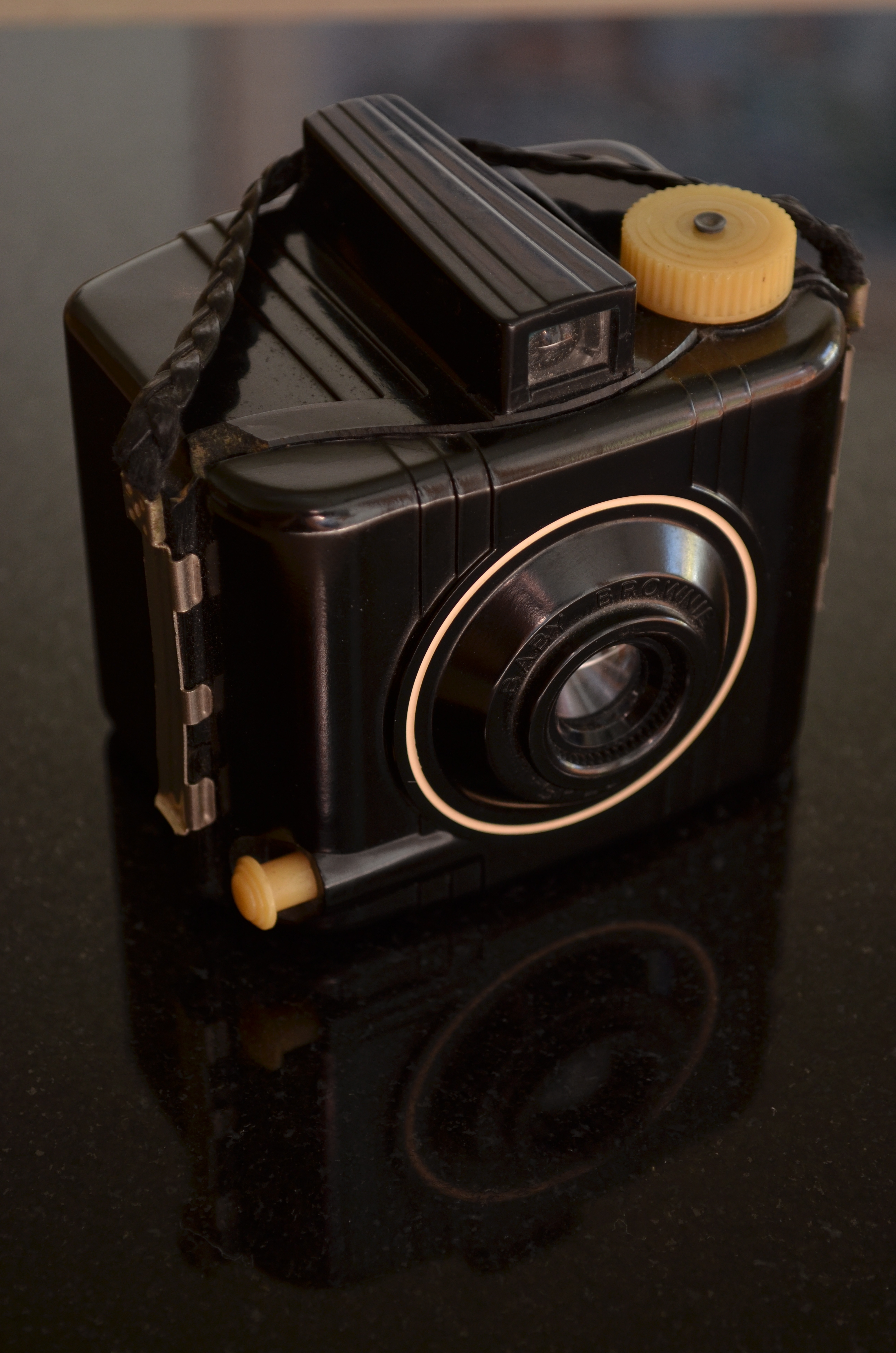 FOR THESE PAGES, IT WAS NEVER MY VISION TO MERELY POST PICTURES. Not, at least, without some kind of context. Just meeting a regular deadline with the “picture of the day” held as little interest for me as maintaining a diary, an oppressive regularity that I have resisted my entire life. For the most part, the images on THE NORMAL EYE are here to anchor my thoughts about what it feels like to be enticed, seduced, enthralled, and, yes, disappointed by photography, to caption the frames with some semblance of the creative process, at least as I had the poor power to see it at the time.Like all blogs, it is written on my own very personal terms. I am always thrilled to harvest reaction and comment, since, as Ike Turner once sang, “was my plan from the very began”. But the important thing is to get the thoughts right, or at least to use them as a guide to the shots. Thus, the mission is neither words nor pictures, but some kind of handshake symbiosis between the two.
However, since day one, I have reserved several gallery pages on which visual info is pretty much all there is, since I also believe that it is important to react to photographs on a purely visceral basis. If the blog is the main hall in the house, think of these as the rooms down the hall that you never thought to explore.
I have tried to give each gallery its own general feel, since there are different “themes” which motivate our taking of pictures, and I thought, for this post, it might be helpful to underscore those themes just enough to justify how they were organized. I have now also given them specific names instead of the A-B-C tags they had previously.
Here’s the new rundown:
Gallery A is now “HDR”, since I think that this process affords very specific benefits for reproducing the entire range of visible light in a way that, until recently, has been impracticable for many shooters. No tool is suitable for every kind of shooting situation, but HDR comes close to reproducing what the eye sees, and can enhance detail in fascinating ways. There is a lot controversy over its best use, so, like everywhere else on this blog, your opinions are invited.
The former B gallery is a collection of impulse shots. All of these images were taken in the moment, on a whim, with only instinct to guide me. No real formal prep went into the making of any of them, as they were the product of those instants when something just feels right, and you try to snag it before it vanishes. We’ll call these “SNAP JUDGEMENTS”.
And finally, the photos formerly known as Gallery “C” are now renamed “NATURAL STATE”, as these portraits are all shot using available light, captured without flash or the manipulation of light through reflectors, umbrellas, or other tools.
Let me state here that your participation in this forum was always the centerpiece of my doing it in the first place, and your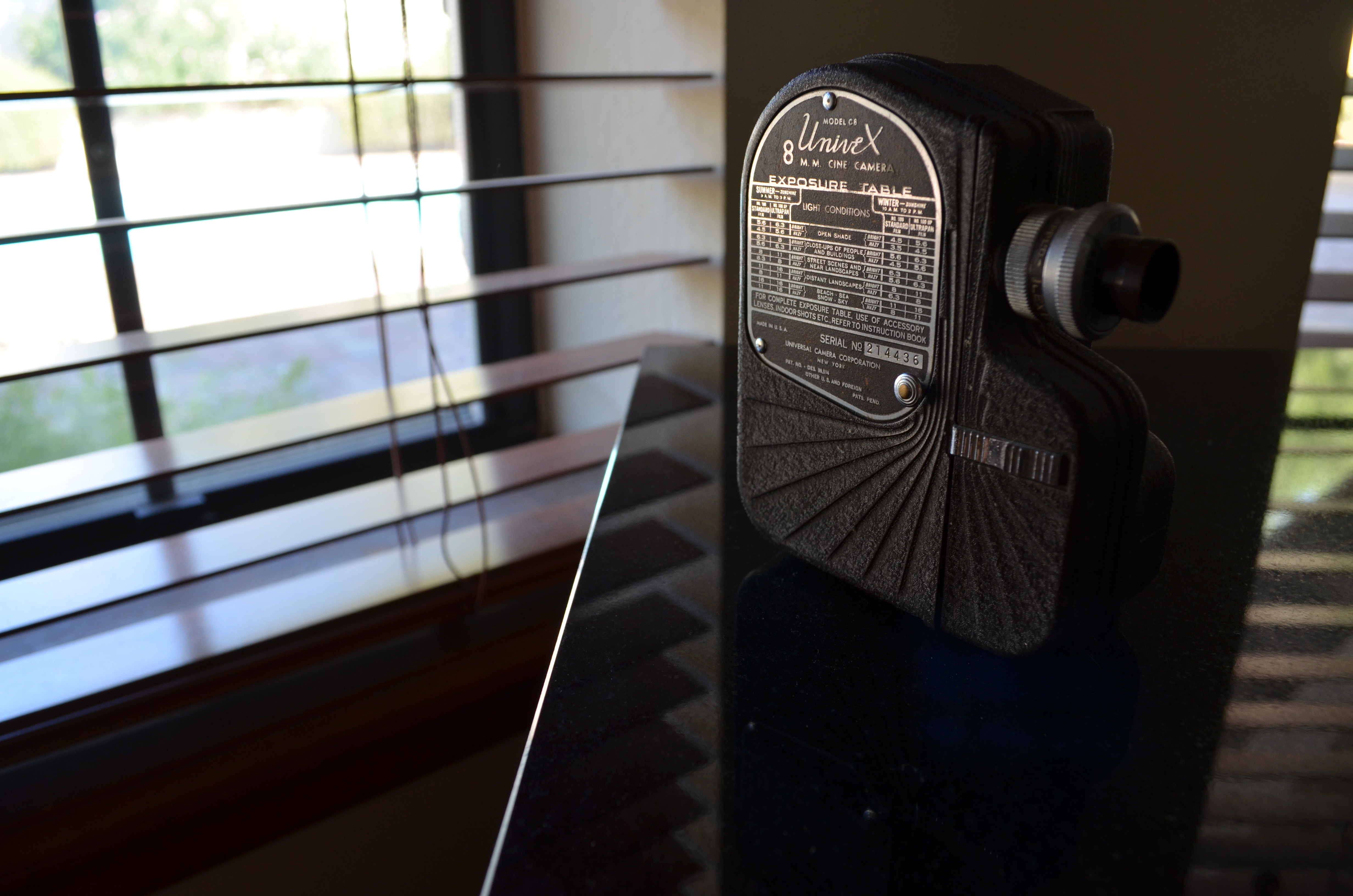 ideas and suggestions have always inspired me to try to be worthy of the space I’m taking up. I also have enjoyed linking back to your individual sites and visions. It’s a great way to learn.
So please know that, when you click the “like” button at the bottom of these posts, or take the time to type a comment, it does help me see what works, as well as what needs to be done better. I don’t believe that art can grow in a vacuum, and I thank everyone for giving these pages shape and form.
And thanks for exploring all the rooms in my house.
FLATTERY WILL GET YOU NOWHERE
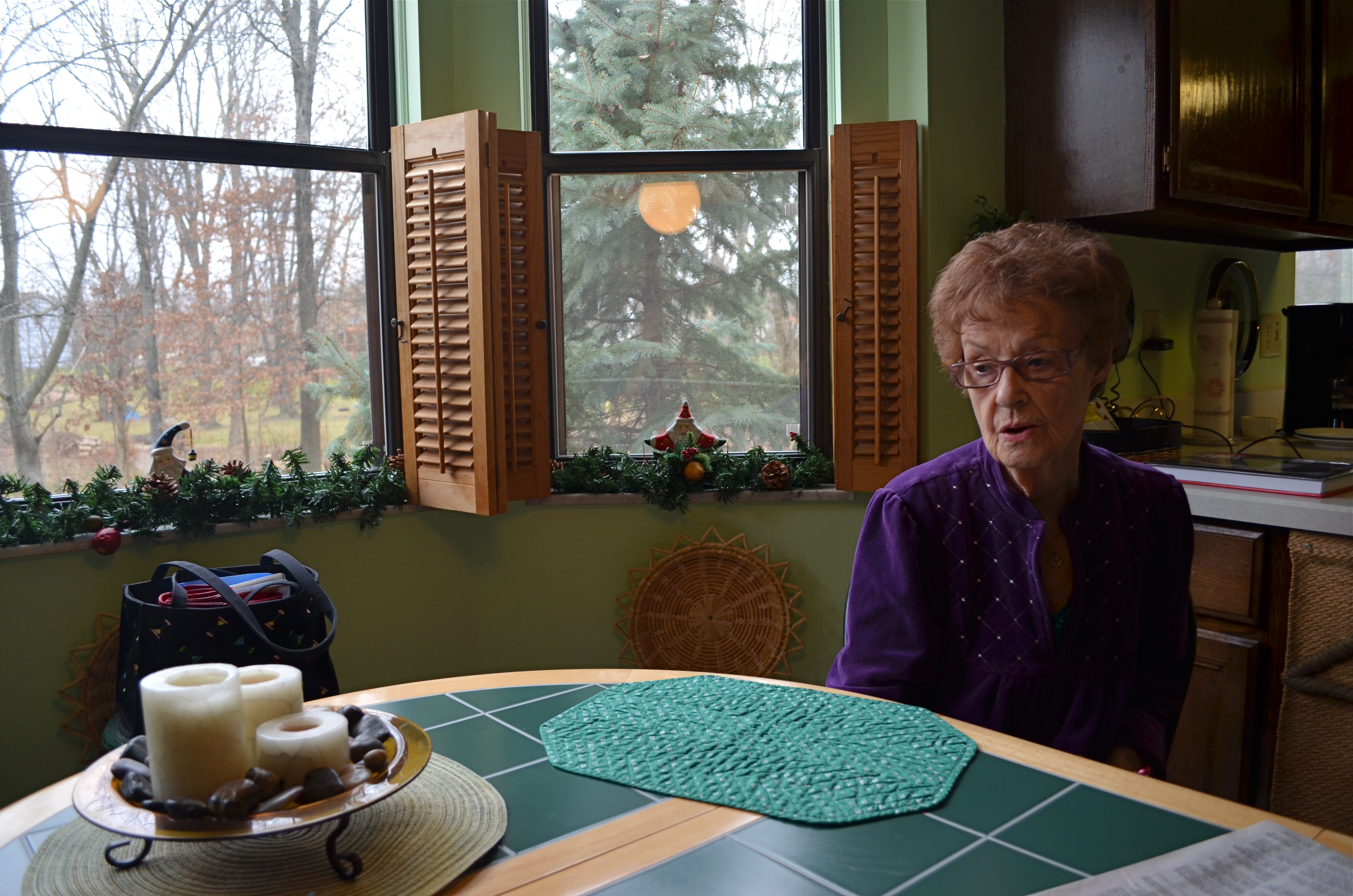
My beautiful mother, well past 21 but curator of a remarkable face. Window light softens, but does not erase, the textures of her features. 1/60 sec., f/4.5, ISO 200. 18mm.
By MICHAEL PERKINS
THE DEPICTION OF THE FACES OF THOSE WE LOVE IS AMONG THE MOST DIVISIVE QUESTIONS IN PHOTOGRAPHY. Since the beginning of the medium, thoughts on how to capture them “best” clearly fall into two opposing camps. In one corner, the feeling that we must idealize, glamorize, venerate the features of those most special in our lives. In the other corner, the belief that we should capture faces as effects of time and space, that is, record them, without seeking to impose standards of grace or beauty on what is in front of the lens. This leads us to see faces as objects among other objects.
The first, more cosmetic view of faces, which calls for ideal lighting, a flattering composition, a little “sweetening” in the taking, will always be the more popular view, and its resultant images will always be cherished for emotionally legitimate reasons. The second view is, let’s “face” it, a hard sell. You have to be ready for a set series of responses from your subjects, usually including:
Don’t take me. I just got up.
God, I look so old. Delete that.
I hate having my picture taken.
That doesn’t even look like me.
Of course, since no one is truly aware of what they “look like”, there is always an element of terror in having a “no frills” portrait taken. God help me, maybe I really do look like that. And most of us don’t want to push to get through people’s defenses. It’s uncomfortable. It’s awkward. And, in this photo-saturated world, it’s a major trick to get people to drop their instinctive masks, even if they want to.
Still.
As I visually measure the advance of age on my living parents (both 80+ ) and have enough etchings on my own features to mirror theirs, I am keener than ever to avoid limiting my images of us all to mere prettiness. I am particularly inspired by photographers who actually entered into a kind of understanding with their closest life partners to make a sort of document out of time’s effects. Two extreme examples: Richard Avedon’s father and Annie Leibovitz’ partner Susan Sontag were both documented in their losing battles with age and disease as willing participants in a very special relationship with very special photographers….arrangements which certainly are out of the question for many of us. And yet, there is so much to be gained by making a testament of sorts out of even simple snaps. This was an important face in my life, the image can say, and here is how it looked, having survived more than 3/4 of a century. Such portraits are not to be considered “right” or “wrong” against more conventional pictures, but they should be at least a part of the way we mark human lives.
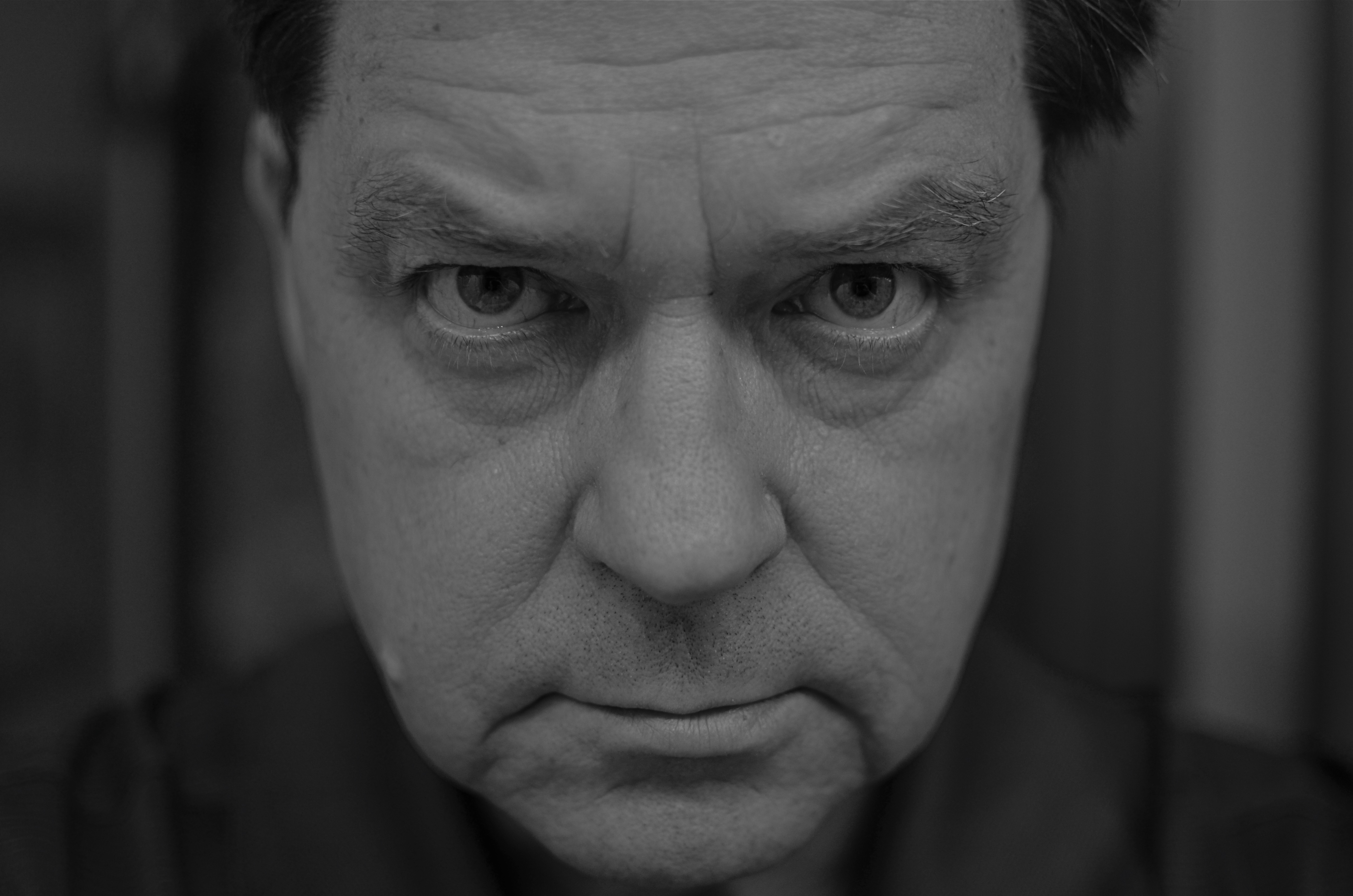
Don’t forget to document the effects of time on your own face. 1/160 sec., f/1.8, ISO 200, 35mm.
Everyone has to decide their own comfort zone, and how far it can be extended. But I think we have to stretch a bit. Pictures of essentially beautiful people who, at the moment the shutter snaps, haven’t done up their hair, put on their makeup, or conveniently lost forty pounds. People in less than perfect light, but with features which have eloquent statements and truths writ large in their every line and crevice. We should also practice on ourselves, since our faces are important to other people, and ours, like theirs, are going to go away someday.
In trying to record these statements and truths, mere flattery will get us nowhere. The camera has an eye to see; let’s take off the rose-colored filter, at least for a few frames.
Related articles
- The Great Richard Avedon (sandroesposito.wordpress.com)
SKIN IN THE GAME
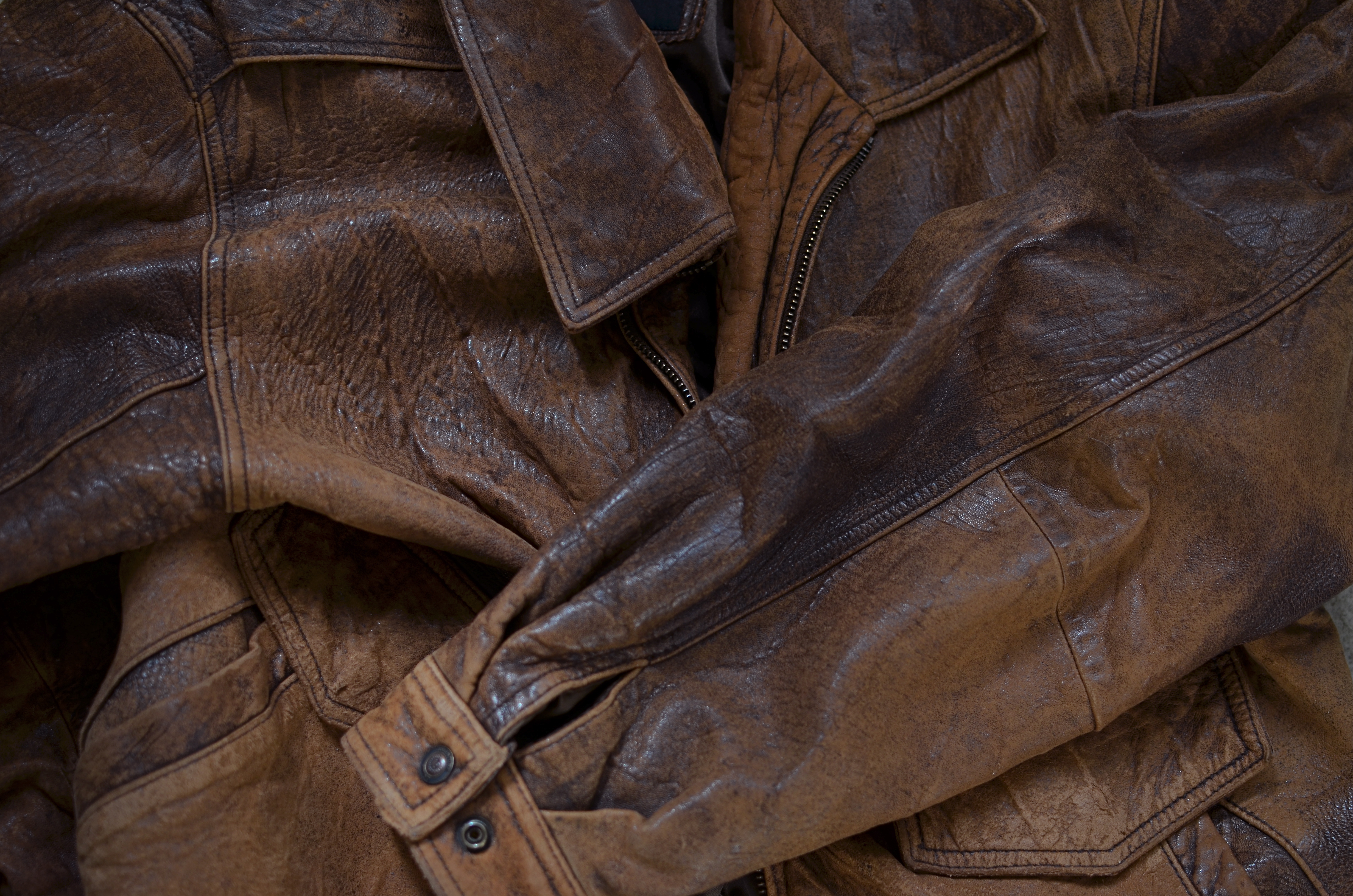
“Old Faithful”, the jacket that has accompanied me on more shoots than any other single piece of “gear”. 1/200 sec., f/2.8, ISO 100, 35mm.
By MICHAEL PERKINS
THE ONE PIECE OF “EQUIPMENT” THAT HAS SEEN ME THROUGH THE TRANSITION FROM FILM TO DIGITAL is not a hunk of techno gear. In fact, it has not directly figured in the taking of even a single picture. I was reminded of its amazing longevity a few months ago, as I was going through a 2002 shoot done in Ireland. Among my own shots was a pretty good candid of me, taken by my wife, as I crouched to line up a shot next to a road heading to the Ring of Kerry. And there “it” was with me.
In fact, it was keeping me warm and dry.
Context: I never took the plunge of the eager amateur and purchased one of those puffy, sleeveless photog vests, honeycombed with a zillion pockets, pouches and secret compartments, much as I never painted the words CAMERA NERD on my face in day-glo orange. Chalk it up to self-consciousness. I figured it was hard enough to blend in and keep people relaxed in a shooting situation without looking like a cross between a spinster butterfly hunter and a middle-school lab assistant. Call me vain.
And you’d be right.
So, a plain brown leather jacket. Gimme three good pockets and call it day. And thus it was that, for the next thirteen years or so, I have had “skin in the game”, skin that has survived exploded pens, leaked batteries, rotten weather on two sides of the Atlantic, and more scrapes, tears, and rips than I care to recall. It has also helped keep countless camera straps from inscribing a permanent groove in my left shoulder, and, here in the Land Of Incipient Arthritis, I appreciate that more than I can say.
Such service calls for a little respect, and so, in the name of the weirdest still lifes ever, I figured it was time for Old Faithful to pose for a portrait of its own. Originally I thought to lay it out straight, the way they show off famous duds at the Smithsonian. But what really caught my eye was that, texture-wise, it is almost six different jackets, from the glossy sheen of an old horse saddle to the frayed look of something that’s been making out with a cheese grater.
At the last, I simply experimented with a few crumpled waves of grain, as if the jacket had been hastily tossed aside, which, trust me, it has been, on countless occasions.
Best thing is, when I’m ready, it’s still there.
I’m not a big fan of good luck charms, but maybe some things protect against bad luck, and that’s no easy feat, either. Either way, me and what Kipling would have called my “Lazarushian leather” and I will keep signing up new missions.
At least until one of our arms fall off.
D.O.F., 1-2-3
By MICHAEL PERKINS
IF YOU ARE EVEN HALF AS LAZY AS I AM, you welcome practical shortcuts to the kind of calculations and measurements that used to consume about half our time as shooters. Looking back at the light exposure graphs, aperture conversions, and flash charts of the camera tutorials of just a generation ago is enough to remind you of every time you ever hooked math class or paid someone else to take your quiz on the periodic table. Some of us photomaniacs were born with the combined skills of Ansel Adams, Pythagoras and Ptolemy, and the rest of us just take pictures as best we can.
I believe in getting on with things, and I’m not proud about consulting books with the word dummies in the title. So, I most strongly suggest, that, if you do not yet have a smartphone app that acts as an instantaneous depth-of-field calculator, that you download one as fast as your little text-weary digits will allow. They are generally free, and are offered by literally dozens of vendors. They are fast. They work. And they help minimize the amount of blasphemy uttered by your humble author. Mostly.
The apps are very simple. You dial in the lens you’re using, the f-stop you want, and an approximation of the camera-to-subject distance, and hit “calculate”. The app tells you in feet (or metres) where the near and far focus point for your subject occurs, and how many total feet of sharpness that equates to. This kind of thing is extremely handy to jog your thinking out of traditional mode, as in the picture below.

A wide-open 35mm prime lens allows a sharp handheld shot with short exposure time. 1/30 sec., f/1.8, ISO 200.
In the above image, I wanted to shoot the interior lights of the back of my house and their reflection on our pool. The two normal ways to do this:
1) get on a tripod, dial up an aperture of about 6.3, use a remote release and click off a 10-15 second exposure depending on how much deep detail you need. That takes setup time and precludes your shooting on a whim or in the moment, but it allows you to go noise-free, since for a time exposure, you can stay at ISO 100. I also could opt for:
2) An instant shot with the ISO cranked to 600-1000, again at a medium focal distance, but with the chance that noise is going to be more noticeable.
The DOF app let me quickly figure out a third way. Since I was using a 35mm prime lens, I was going to open up all the way to f/1.8 and suck light like a demon, facilitating a quick exposure and the ability to stay at low ISO. Shooting that particular lens wide open guarantees a shallower depth of field than in the other two methods, but, while DOF for a macro image, shot about a foot away at 1.8, is very shallow, shooting at far objects with the same aperture can give you plenty of room to work in. Dialing my coordinates into the app, I could see that sharpness would kick in at about 20 feet (just beyond where the pool decking bricks meet the edge of the pool) and stay solid till well past 32 feet. The twelve feet of usable sharpness would be more than enough to capture what I wanted, since anything ahead of (or behind) my “sweet spot” would be shrouded in darkness.
If I wanted to show additional detail in the surrounding yard, play up the texture of the pool decking, or give an overall glow to the shot, I could still shoot it on a tripod and just lengthen out the exposure, but for this specific set of data, the 35mm prime, wide open, would give me the look I wanted. The DOF app was just a way to get a quick calculation without fumbling with my slide rule in the dark, and to check my thinking in the moment.
For a near zero investment, you can’t find a better friend out in the field. And if you’re a really avid photographer, you can use all the friends you can get.
Especially one who’s more gooder at math than you are.
SPLINTERING THE SQUARE
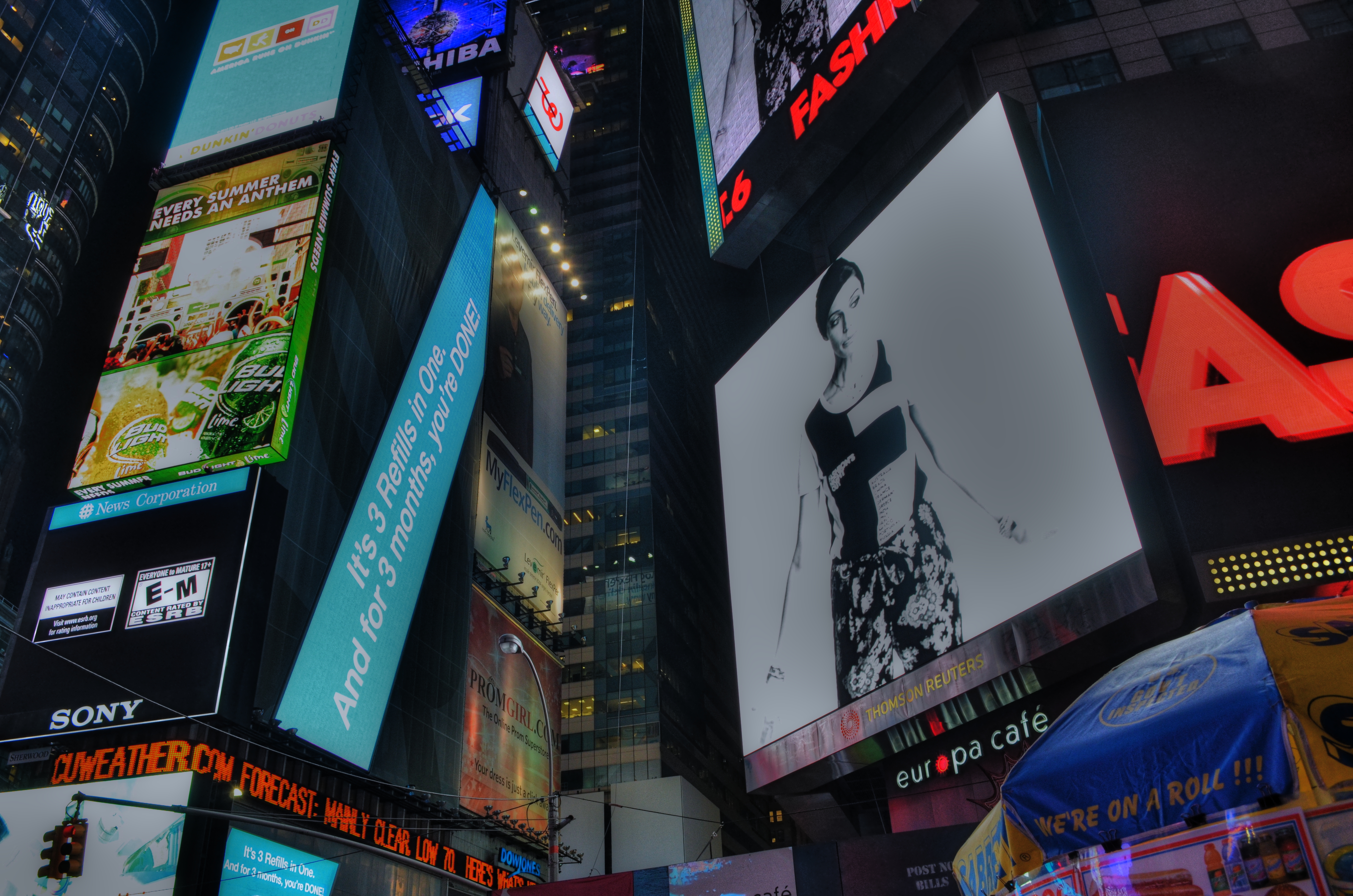
Times Square, August 2012. Somehow, the dark spaces in this spark my interest more than the garish light. 1/40 sec., F/8, ISO 320, 18mm.
By MICHAEL PERKINS
GOING BACK OVER HUGE FOLDERS OF IMAGES LONG AFTER THE FACT OF THEIR CREATION, a kind of aesthetic amnesia comes over me as to what the original intent of some of the pictures were. Who is this person? And why can’t I remember being him when this thing was shot?
A bit of background:
As much time as I have spent in New York’s Time Square, I should know better than to even raise my camera to my face, given that this particular locale has produced, for me, more hot messes and failed missions than any other subject I’ve ever aimed at. The place is a mirage, a trap for shooters: a visual overload, obscenely loud and demanding of attention, but spectacularly devoid of content. There is no “message” afoot in this vast glowing urban canyon except step right up we got what you need right here great seats at half price a whole dinner for just ten bucks hey watch who yer shovin’.
Hey, if you’re looking for meaning, stay home and read your Bible.
And yet, every time I’m there, I still try to take “THE shot”, vainly sticking to the idea that there is even one in there, and that all I have to do is find it. If I only had a helicopter, if I shot it at this end of the street, if I just find the great unifying theme, the truth will come forth….
Yeah, right.
Anyway, in reviewing the above image, one I originally consigned to the dustbin, I’m once again that aesthetic amnesiac. I don’t recognize the person who took it. It doesn’t look like anything I’d try, since it’s just an arrangement of angles, colors, and dark spaces. In other words, an attempt to see a design in part of the scene, rather than an overall tapestry of the entire phenom. Sort of splintering the square. It’s the casting of the city as a personality, I guess, that appeals to me, like the Los Angeles of Blade Runner or the neon neo-Asia of Joel Schumacher’s Gotham City.
What adds to the mystery is the fact that, I’m not usually this loose. I’m a little too formalized in my approach, a mite too Catholic. I tend to have a plan, an intention. Let’s stick with the outline, kids, and proceed in order. Shooting from the hip and living in the moment is not instinctual to me. I’m always fighting with my inner anal bureaucrat.
I seriously don’t remember what I was going for here, and maybe, with a subject like this, that’s the only way to go. Stop calculating, stop plotting, just react, and treat Times Square as the amusement park ride it is. Going for “THE shot” has always given me dozens of , eh, sorta okay pix, but this approach appeals to me a little bit. I am not totally unpleased with it, or as a more eloquent writer might put it, it doesn’t suck.
And given my track record in Times Square, that’s slightly better than a break-even.
Now if I could only remember who took the damned thing…..
Related articles
LET THERE BE (MORE) LIGHT
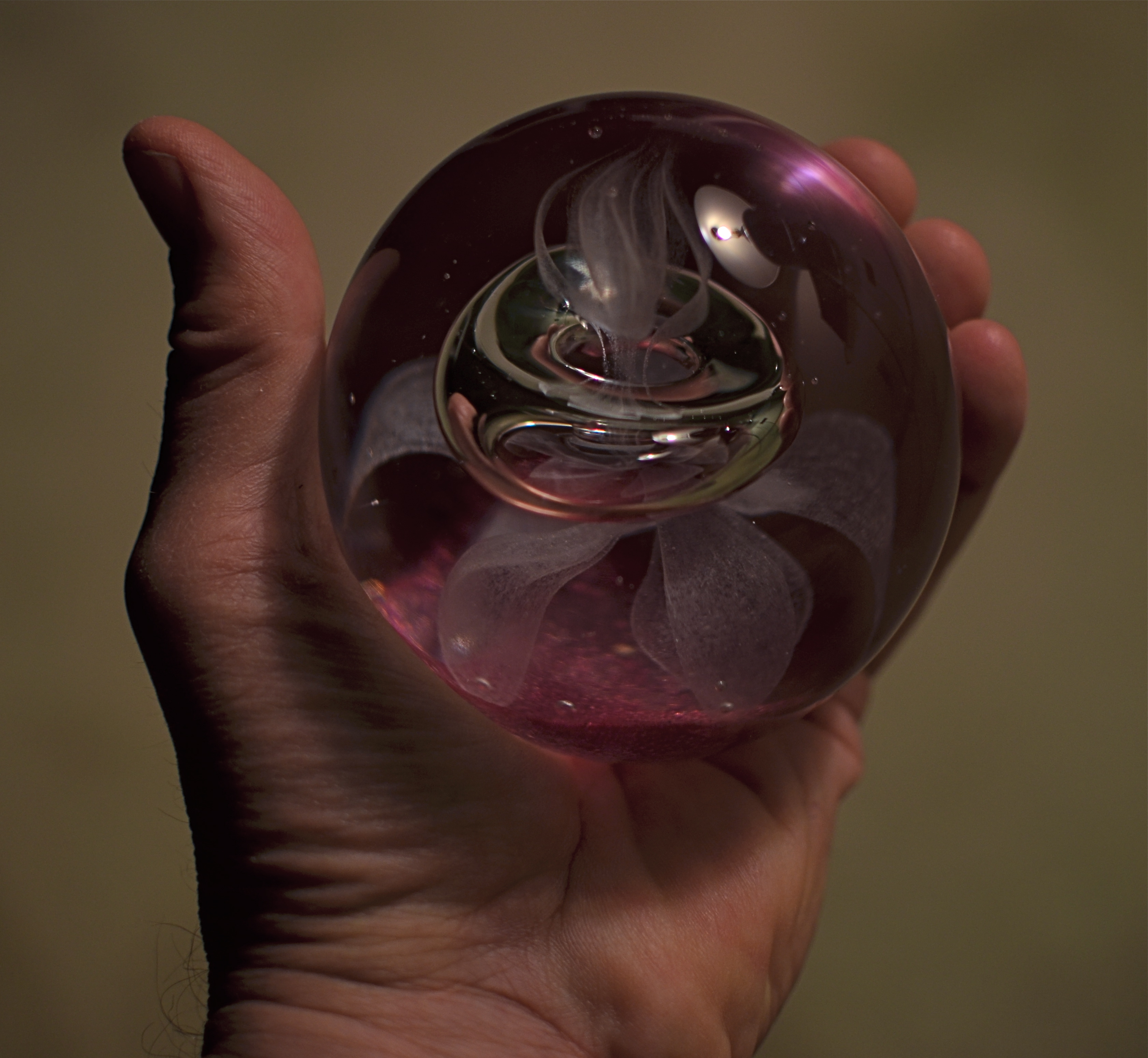
A new piece of glass makes everything look better….even another piece of glass. First day with my new 35mm prime lens, wide open at f/1.8, 1/160 sec., ISO 100.
By MICHAEL PERKINS
I HAVE RECENTLY BEEN EXPERIENCING ONE OF THOSE TIME MACHINE MOMENTS in which I am, again, right back at the beginning of my life as a photographer, aglow with enthusiasm, ripe with innocence, suffused by a feeling that anything can be done with my little black box. This is an intoxication that I call: new lens.
Without fail, every fresh hunk of glass I have ever purchased has produced the same giddy wonder, the same feeling of artistic invincibility. This time out, the toy in question is a Nikon f/1.8 35mm prime lens, and, boy howdy, does this baby perform. For cropped sensor cameras, it “sees” about like the 50mms of old, so its view is almost exactly as the human eye sees, without exaggerated perspective or angular distortion. Like the 50, it is simple, fast, and sharp. Unlike the 50, it doesn’t force me to do as much backing up to get a comfortable framing on people or near objects. The 35 feels a little “roomier”, as if there are a few extra inches of breathing space around my portrait subjects. Also, the focal field of view, even wide open, is fairly wide, so I can get most of your face tack sharp, instead of just an eye and a half. Matter of preference.
All this has made me marvel anew at how fast many of us are generally approaching the age of flashless photography. It’s been a long journey, but soon, outside the realm of formal studio work, where light needs to be deliberately boosted or manipulated, increasingly thirsty lenses and sensors will make available light our willing slave to a greater degree than ever before. For me, a person who believes that flash can create as many problems as it solves, and that it nearly always amounts to a compromise of what I see in my mind, that is good news indeed.
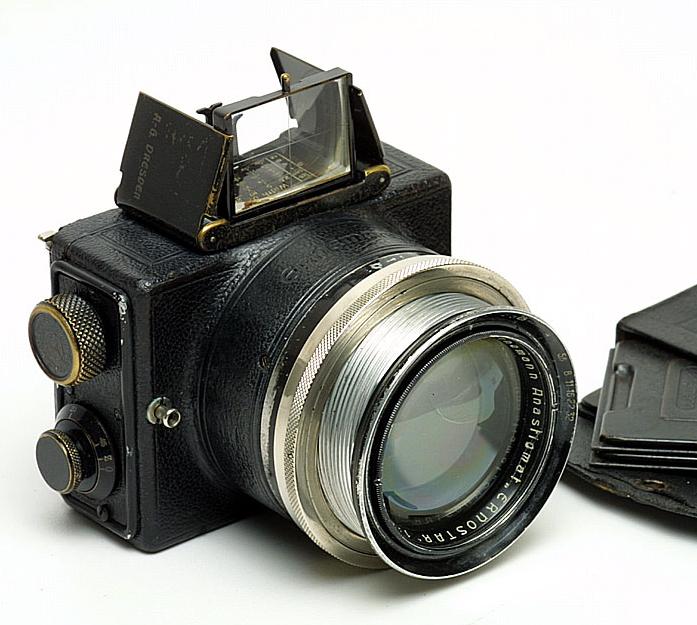
The Ermanox, perhaps the first camera designed to free mankind from the tyranny of flash.
It also makes me think of the first technical efforts to illuminate the dark, such as the camera you see off to the left. The Ermanox, introduced by the German manufacturer Ernemann in 1924, was one of the first big steps in the quest to free humankind of the bulk, unreliability and outright danger of early flash. Its cigarette-pack-sized body was dwarfed by its enormous lens, which, with a focal length of f/2, was speedy enough (1/1000 max shutter) to allow sharp, fast photography in nearly any light. It lost a few points for still being based on the use of (small) glass plates instead of roll film, but it almost single-handedly turned the average man into a stealth shooter, in that you didn’t have to pop in hefting a lotta luggage, as if to scream “HEY, THE PHOTOGRAPHER IS HERE!!” In fact, in the ’20’s and ’30’s, the brilliant amateur shooter Erich Solomon made something of a specialty out of sneaking himself and his tiny Ermanox into high-level government summits and snapping the inner circle at its unguarded best (or worst). Long exposures and blinding flash powders were no longer part of the equation. Candid photography had crawled out of its high chair… and onto the street.
Today or yesterday, this is about more than just technical advancement. The unspoken classism of photography has always been: people with money get great cameras; people without money can make do. Sure, early breakthroughs like the Ermanox made it possible for anyone to take great low-light shots, but at $190.65 in 1920’s dollars, it wasn’t going to be used at most folks’ family picnics. Now, however, that is changing. The walls between “high end” and “entry level” are dissolving. More technical democracy is creeping into the marketplace everyday, and being able to harness available light affordably is a big part of leveling the playing field.
So, lots more of us can feel like a kid with a new toy, er, lens.
Related articles
- Prime Lenses (nikonusa.com)
- Understanding Focal Length (nikonusa.com)
REWORKING THE UNIVERSE
By MICHAEL PERKINS
CONTEXT, FOR A PHOTOGRAPHER, IS LIKE THE CONDUCTOR’S BATON IN MUSIC, that magic wand that dictates fast and slow, soft and loud, ordering a specific world within a confined space. Since it impossible to show the world entire, all shooters decide what part of it, what story within it, that they will frame. Sounds obvious, but without the mastery of this skill, we fail as storytellers, and the eye that we develop for what to include and exclude is, despite all the tools and toys, the only thing that really makes an artistic performance out of a photograph.
It can also be a helluva lot of fun. With some dumb luck thrown in for good measure.
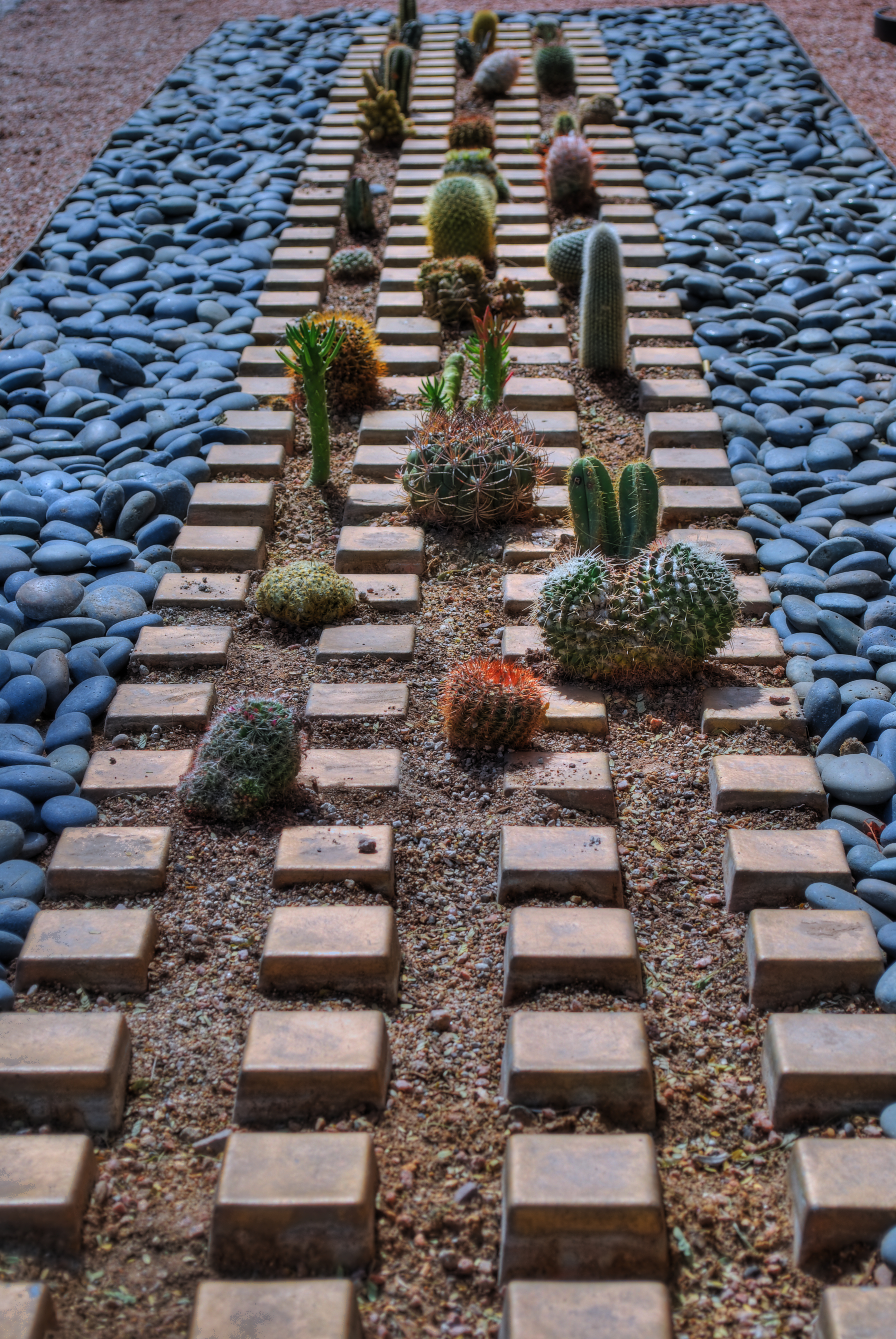
Cactropolis, 2011. A three-exposure HDR blend with a little color and contrast teaking. This whole layout, in reality, is about fifteen feet square, total. Various shutter speeds, f/8, ISO 100, 52mm.
I love opportunities that allow me to disrupt the original visual “place” of objects, to force them to be re-purposed for the viewer. A few years ago, my daily lunch routine involved a short walk across a bustling college campus to my habitual lunch hang, a stroll which took me past one of the school’s busiest crossroads, marked by the intersection of two superwide sidewalks flanked by small patches of landscaping. Since this is Arizona, such short plots of land frequently are not the stuff dreams are made of. We’re talking pink quartz gravel interrupted by the occasional scabby aloe plant or cholla. And that’s what made this one little rectangle, just several feet long on each side, vie for my attention.
An arrangement of several varieties of small cacti has been arranged in rows, regulated by square tiles, grounded in gravel, and bounded by smooth bluish stones. Simple stuff, really, but this was somebody’s deliberate design, a pattern that registered, to my eye, like some kind of fantasy urban streetscape, blocks of tiny, spiny skyscrapers vanishing off toward an unseen horizon….a miniature downtown from Weirdsville, a tabletop diorama from Beetlejuice.
I didn’t really have to compose anything. I was in the framing business. But getting that frame meant getting rid of the surrounding throngs of students, the sidewalks, the buildings, the sky…..anything that seemed outside of the closed world implied by that little rectangle. Changing the context. In fact, I was adding something for everything I was taking away.
So let’s crop this puppy and see what happens.
Now I saw what seemed to be a self-contained world, one in which I was free to imagine what lay “beyond”. I goosed up the hues and texture with HDR processing, but otherwise, what you see is what there was. Maybe it works as pure design. Maybe I conveyed something, but the fact is, we have to make choices as shooters. The only thing that marks us as individuals is what we decide to see, and show.
Like I said…fun….luck….some other somethings…..
(Many Thanks Dept.:The idea for this post was inspired, in part, by a suggestion from my good friend Michael Grivois.)
THE GOLDEN AGE OF JUST OKAY
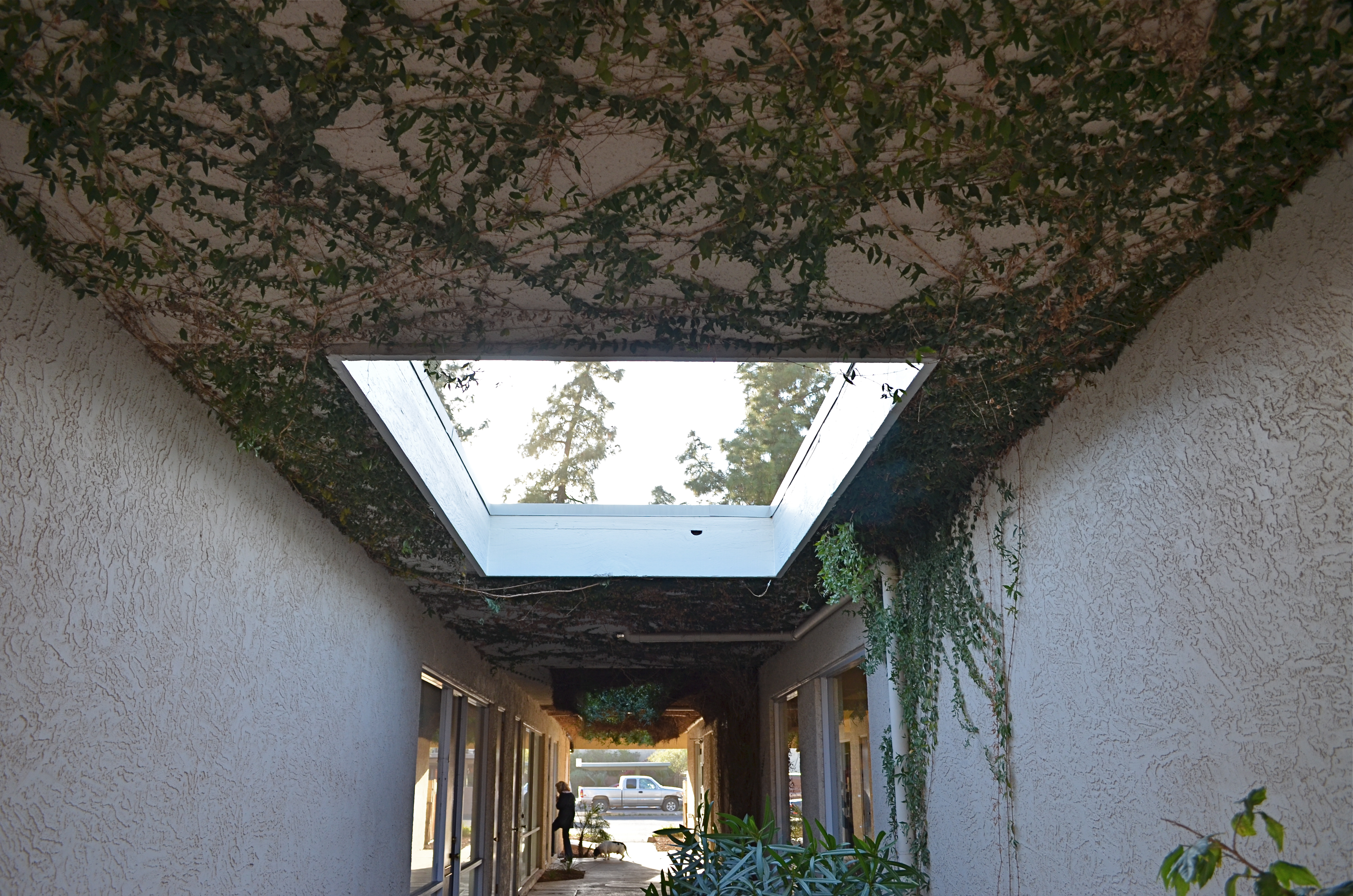
Plenty of mistakes made on this one. Is it a success or a failure? Does it matter? All that’s important is that you, not the camera, is making the picture. Manual mode, 1/100 sec., f/5.6, ISO 100, 18mm.
By MICHAEL PERKINS
WE ALL SAY IT: THERE ARE NO SHORTCUTS TO SUCCESS.
We all say it. None of us believes it. It’s just not, well, American to throw aside our national myths, and the folk tale of the lucky, quick genius who zooms to the head of the line to fame, bounding in front of all the sloggers and suckers, is intoxicating. One blinding inspiration, we tell ourselves, just one great notion, and we can bypass all that “practicing and patience” stuff, the same virtues we feel honor bound to extol in others. In anyone else but me.
Me, I’m taking the shortcut.
So now is about the time when the photography angle of this rant should kick in, right?
Okay, here goes.
As the automode functions of cameras have grown ever more complex, they have made taking a perfectly acceptable picture effortless. Great for immediate gratification. Not so great for the art of photography. Think about it. It has become so fabulously easy to point and get something that isn’t too bad, that we are bypassing the slower, uglier, but eventually more satisfying process that comes with trial, error, recalculation, and risk. We produce more error-free pictures than ever before, but, to do that, we have to hang our own creativity…..the raw, sloppy process of imagineering our own vision…on the wall. We get fat and lazy. And so do our pictures.
Now that I have successfully defended my title as the great Grinch Buzzkill, trying to rid Whoville of good, clean camera fun, let me just ask one more question. Do we want a large mountain of “okay” pictures, taken, to an ever greater degree, by our cameras, or a smaller, more amazing pile of remarkable pictures borne of our own sweat and struggle? Tricky part: there is no right or wrong answer, just a choice to be made based on your own expectations. Turning off the “green zone” of guaranteed effect modes and really educating ourselves as to what is going into the making of our pictures means turning off a snapshot mentality and opting for the unpredictable.
Hey, I’m not suggesting you go all Matthew Brady and lug around forty pounds of wet plates and a covered wagon full of caustic chemicals just to take a birthday picture of Grandma blowing out her candles. But we can probably aspire to more than just the golden age of okay.
We already know how easy it is to take a picture. Now we need to rediscover how hard it can be, and what miracles can spring from our minds when we get our hands dirty and go down the rockier path.
THE OTHER 50%
By MICHAEL PERKINS
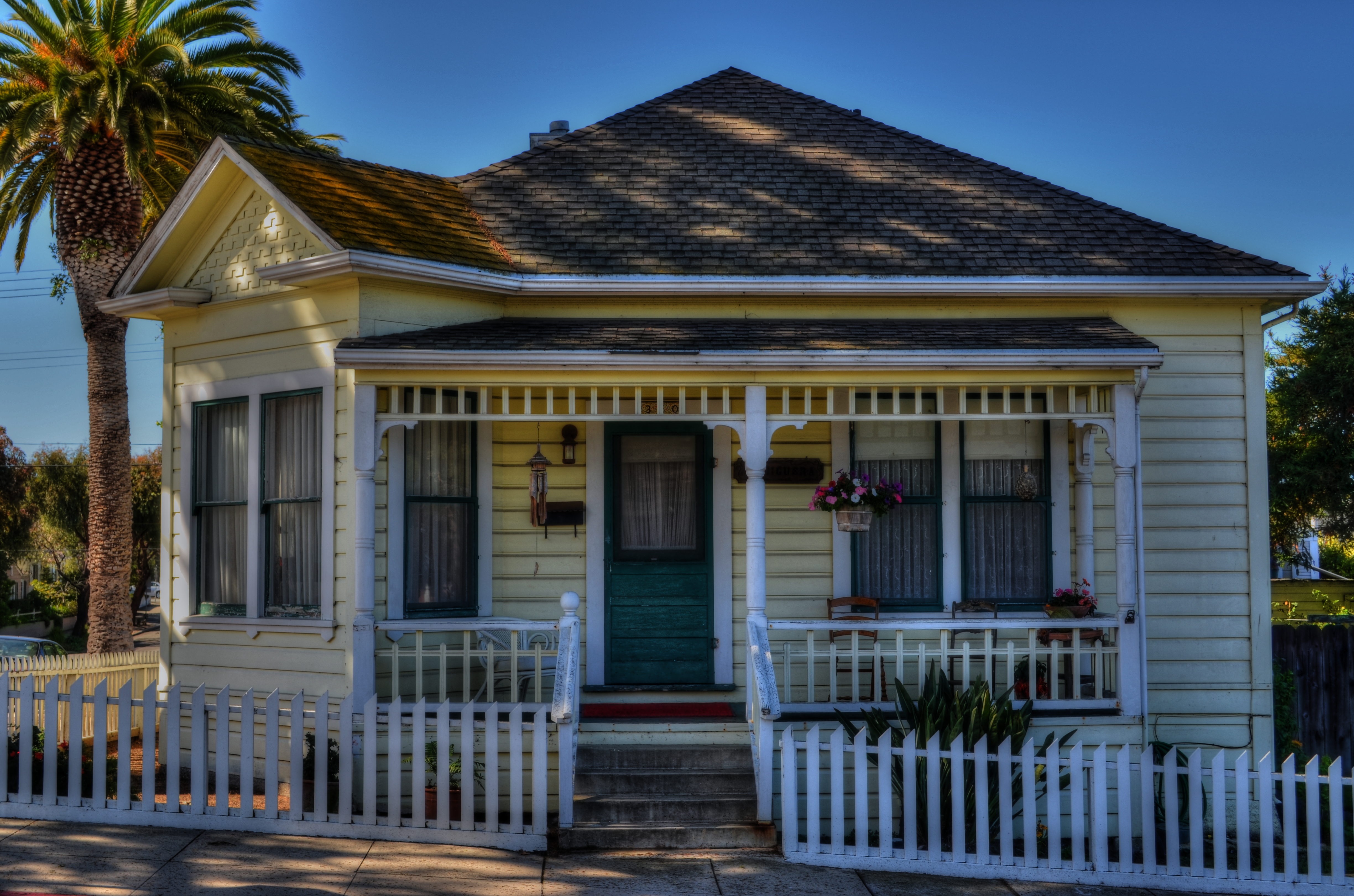
The American Dream, Pacific Grove, California, 2012. A three-exposure HDR with shutter speeds ranging from 1/100 to 1/160, all three shots at f/8, ISO 100, 32mm.
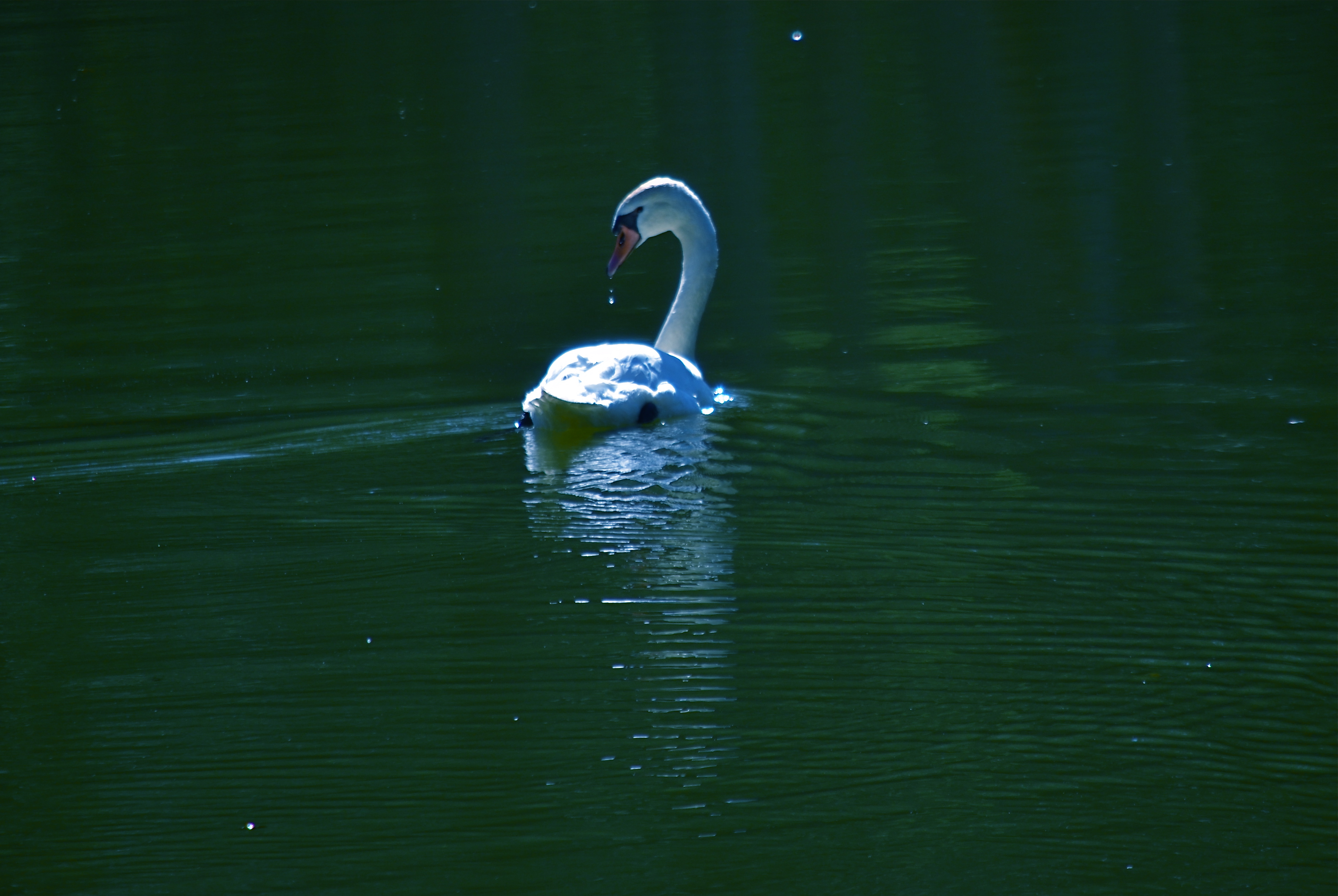
Serene On Green, near Yosemite National Park, 2012. 1/640 sec., f/5.6, ISO 100, 300mm.
THE LAST SUNDAY EDITION OF THE NEW YORK TIMES FOR 2012 features its annual review of the year’s most essential news images, a parade of glory, challenge, misery and deliverance that in some ways shows all the colors of the human struggle. Plenty of material to choose from, given the planet’s proud display of fury in Hurricane Sandy, the full scope of evil on display in Syria, and the mad marathon of American politics in an electoral year. But photography is only half about recording, or framing, history. The other half of the equation is always about creating worlds as well as commenting on them, on generating something true that doesn’t originate in a battlefield or legislative chamber. That deserves a year-end tribute of its own, and we all have images in our own files that fulfill the other 50% of photography’s promise.
This year, for example, we saw a certain soulfulness, even artistry, breathed into Instagram and, by extension, all mobile app imaging. Time ran a front cover image of Sandy’s ravages taken from a pool of Instagramers, in what was both a great reportorial photo and an interpretive shot whose impact goes far beyond the limits of a news event. Time and again this year, I saw still lifes, candids, whimsical dreams and general wonderments of the most personal type flooding the social media with shots that, suddenly, weren’t just snaps of the sandwich you had for lunch today saturated with fun filters. It was a very strong year for something personal, for the generation of complete other worlds within a frame.
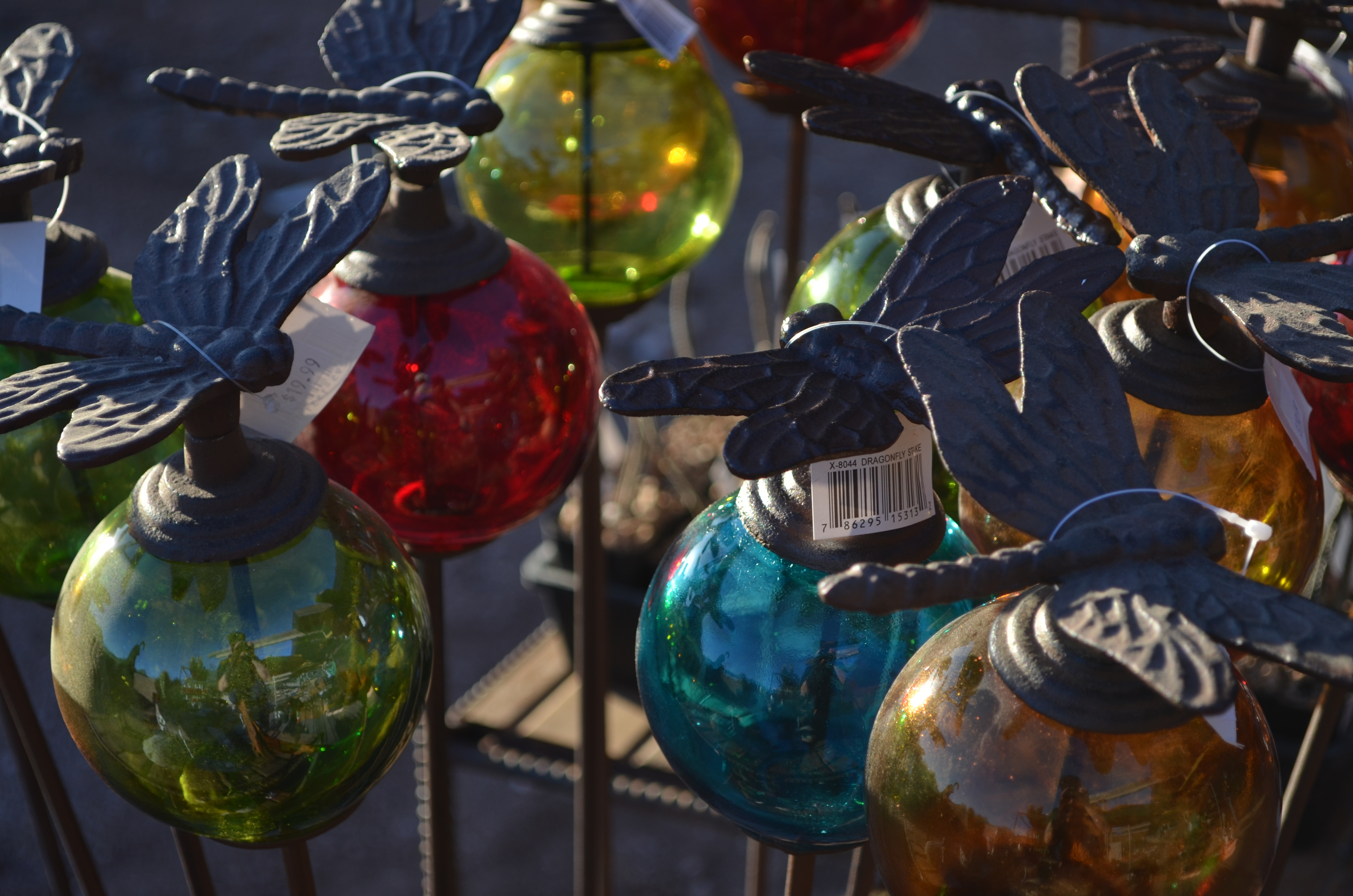
Dragonfly Globes, Tempe, Arizona, 2012. 1/200 sec., f/5.6, ISO 100, 55mm.
I love broad vistas and sweeping visual themes so much that I have to struggle constantly to re-anchor myself to smaller things, closer things, things that aren’t just scenic postcards on steroids, although that will always be a strong draw for me. Perhaps you have experienced the same pull on yourself…that feeling that, whatever you are shooting, you need to remember to also shoot…..something else. It is that reminder that, in addition to recording, we are also re-ordering our spaces, assembling a custom selection of visual elements within the frame. Our vision. Our version. Our “other 50%.”
My wife and I crammed an unusual amount of travel into 2012, providing me with no dearth of “big game” to capture…from bridges and skyscrapers to the breathlessly vast arrays of nature. But always I need to snap back to center….to learn to address the beauty of detail, the allure of little composed universes. Those are the images I agonize over the most at years’ end, as if I am poring over thumbnails to see a little piece of myself , not just in the mountains and broad vistas, but also in the grains of sand, the drops of dew, the minutes within the hours.
Year-end reviews are, truly, about the big stories. But in photography, we are uniquely able to tell the little ones as well. And how well we tell them is how well we mark that we were here, not just as observers, but as participants.
It’s not so much how well you play the game, but that you play.
Happy New Year, and many thanks for your attention, commentary, and courtesy in 2012.
Related articles
- 10 social mobile photography trends for 2013 (davidsmcnamara.typepad.com)
- Old-Timer Joins Instagram, Schools Everyone With Poignant Flood Photos (wired.com)
HEAVENLY PEACE
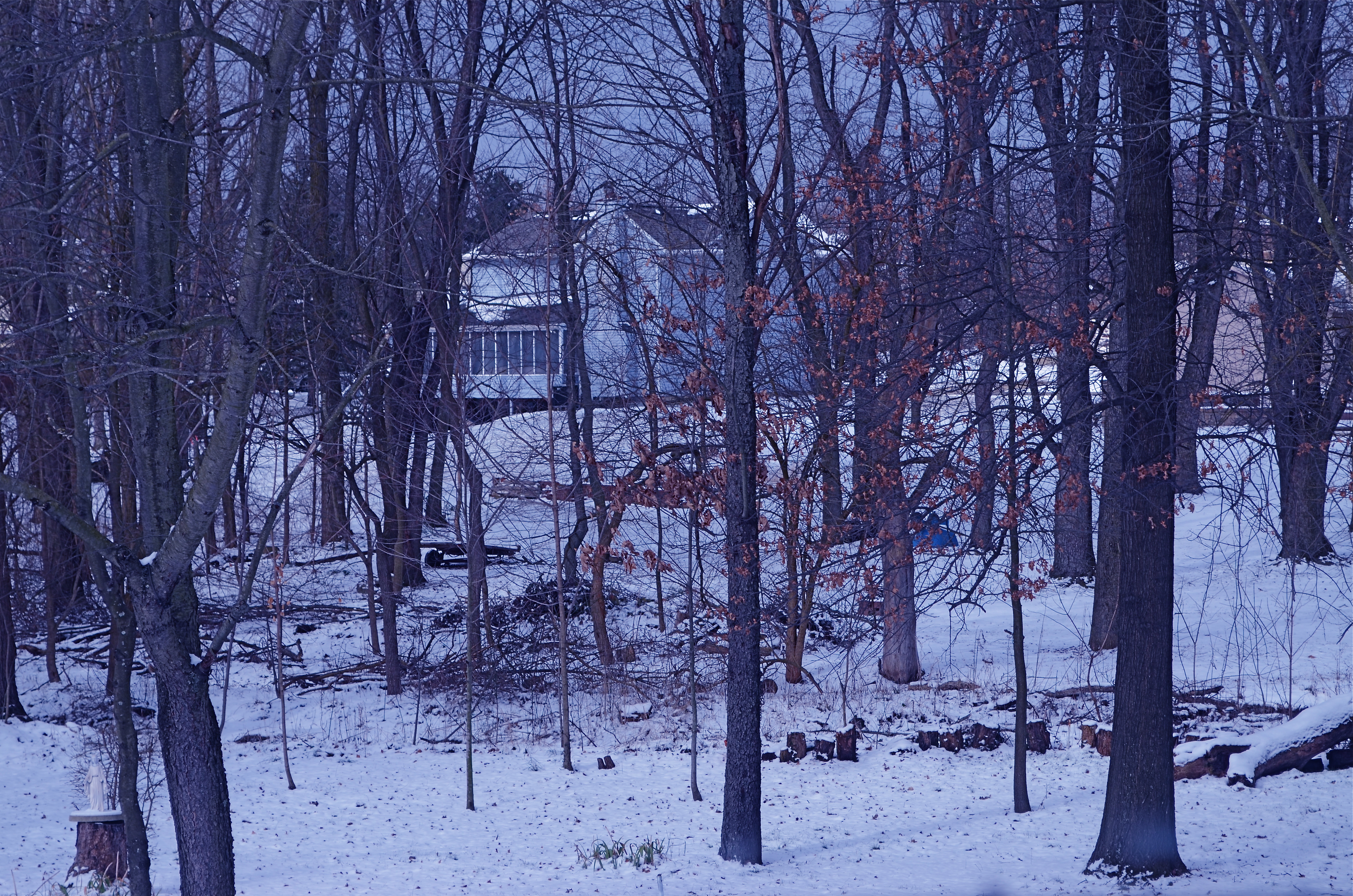
Peace is where you find it. You no doubt have images of your own that remind you of what “might be”, in a quieter world. Cherish them. 1/320 sec., f/8, ISO 100, 55mm.
“But you were always a good man of business”, faltered Scrooge.
“Business!”, cried the Ghost, wringing its hands again. “Mankind was my business! Charity, mercy, forbearance, and benevolence were, all, my business. The dealings of my trade were but a drop of water in the comprehensive ocean of MY BUSINESS!!”
By MICHAEL PERKINS
IN FORWARD COMBAT AREAS, CHRISTMAS IS NOT SO MUCH A CELEBRATION as a cessation of hostilities. We have all seen those poignant scenes from war movies in which, at the tolling of the midnight bell on the 25th, combatants from both sides, some within mere feet of each other, lay down their arms, share a smoke, a snort of whiskey, even a song, before resuming the slaughter. Such cinematic schmaltz is both touching….and infuriating.
Touching…..because it’s a comfort to think that our essential humanity cannot be totally submerged in madness. Infuriating……because we never learn how to extend, export, and explore such episodes of humanity. We make our way through the world as if we had no choice but to heed whatever animal urges see fit to boil up in us in the moment.
We act as if we are helpless to choose anything but our own destruction.
That self-imposed fake destiny was never in greater evidence than in the recently completed year. Use any yardstick you want. Animosity, brutality, stupidity, selfishness, heedlessness…we bounced and ricocheted off each one like the proverbial bull in a shop. But instead of merely smashing china, we smashed lives…or, more importantly, cut them short, as if this were just the way of the world and we were merely unanchored flotsam on a churning sea of fate.
The pure punishment of the events of 2012 has recently sent me looking through my images for this year in search of peace. Maybe not peace in its perfection, but something to look upon which betokens calm, silence, a cessation of hostilities. I am not frequently at my family home for Christmas, and those visits that I do make during the winter months may or may not have the classic visual trappings one looks for during the season. The above picture was actually taken in February, with a scant amount of snow on the ground, the bare trees from my father’s back lot providing a stark landscape, and his next nearest neighbor’s house beckoning as the next best hope of refuge. Or so it looks to me, looking back. It’s a lonely little scene, but over the past few weeks, the quiet of it has meant everything to me. And not because I’m the one who shot it.
Maybe making it to that next warm, safe house is all any of us longs for. Maybe it represents how far off the mark we have wandered during the year. Maybe it’s like Robert Frost’s definition of “home” as the place where, when you go there, they have to take you in. In any event, I hope you all can find a picture somewhere that, for you, marks a place to reflect, catch your breath, and, just for a moment, stop shooting at that other guy just a few feet away.
I also intend to pray for something a little more lasting.
And while it would take an old-fashioned Christmas Miracle to get to that place……well, what else are prayers for?
Pax.
Related articles
- Heavenly Peace – At Least In Canada (maxredline.typepad.com)
TO THINE OWN SELF BE TRUE
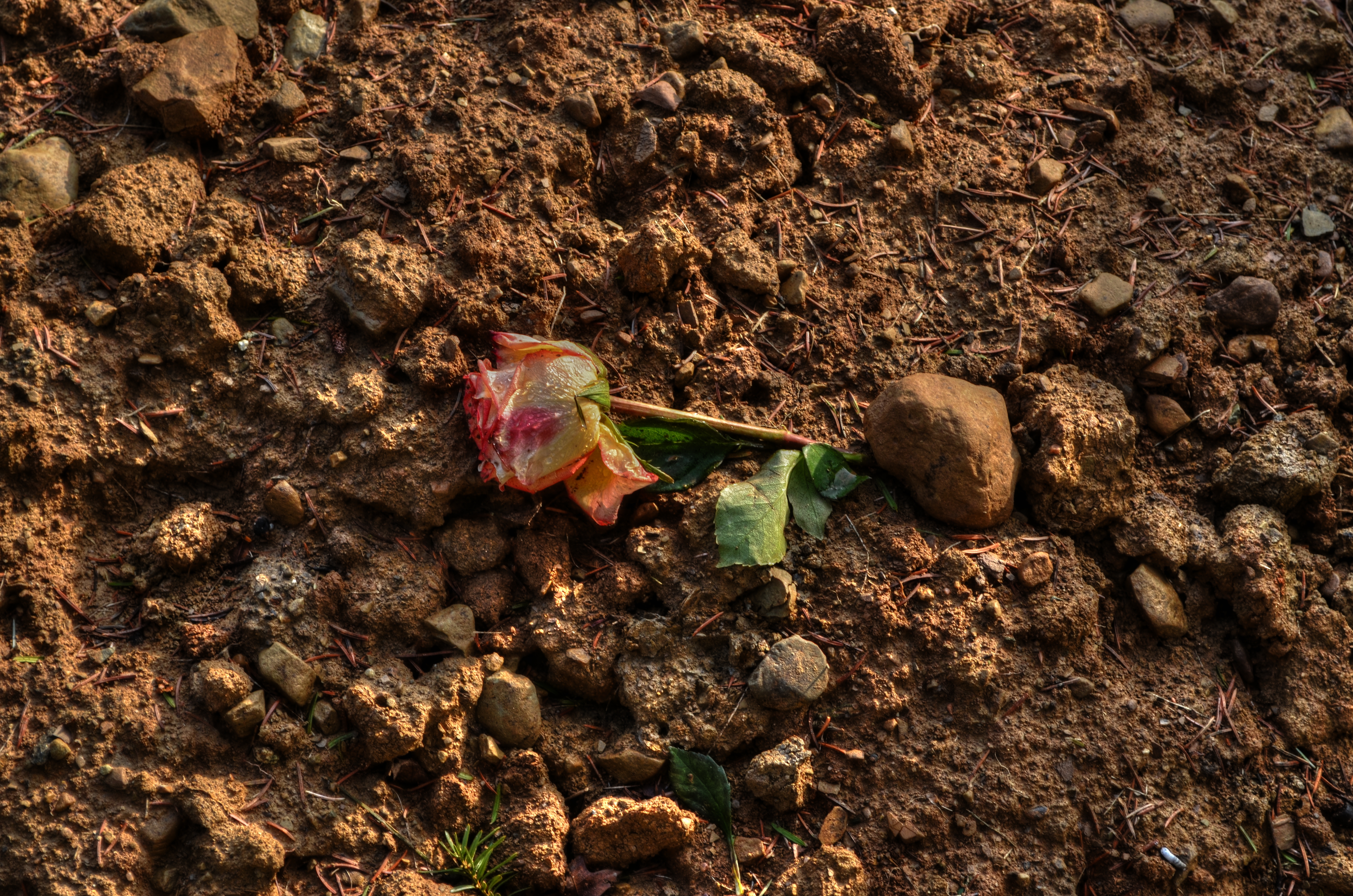
This image may not be a masterpiece, but it’s mine….unless I willingly give it away. Why should we help dig a grave for authorship of our photos? 1/80 sec., f/8, ISO 100, 55mm.
By MICHAEL PERKINS
THE CONUNDRUM OF AUTHORSHIP, OR WHAT WE NOW TERM “INTELLECTUAL PROPERTY” RUNS ON A PARALLEL TRACK with the history of photography. Being a mechanical process of printing and reproduction, imaging has, from the first, proven more vulnerable to theft than anything created by the painters’ hand. Indeed, the very means by which photographs became reproducible in mass media such as newspapers and magazines became the first access afforded to thieves of what we ourselves had crafted. It became an unholy bargain. To be seen and discussed, our work had to employ these methods of distribution, and, at the same time, render ourselves vulnerable to those who would spirit away and claim as their own that which they did not create.
Which brings me to the recent brouhaha over Instagram, and its latest user agreement, going into effect in mid-January 2013, which allows the site to redistribute, lease or allocate use of members’ images with no obligation to inform or compensate the creators of those images. This is not my “representation” or “interpretation”. The language of the agreement is so brazenly clear that it’s breathtaking.
Read it.
Reality check: it can easily be argued that our best efforts to certify our claim to our images, through copyright laws, watermarks, terms of service, contracts, etc., still leave us as exposed to harm as a naked mountain climber on a blustery day. But, dear God, that is no reason to help the thieves, or, worse yet, to put ourselves in jeopardy by willingly consigning our work to websites whose stated purpose is to financially benefit by the exploitation of our work.
Instagram has millions of subscribers around the world. Do not ask me why, since I have never seen the benefit of taking mostly mediocre snapshots and rendering them murkier, darker, dirtier or more flawed by the post-application of “fun” filters. I spent my childhood longing for cameras beyond the scope of the cheap plastic boxes affordable to a 12-year-old. Light leaks, color streaks, vignetted corners and lousy chroma were the chains I was longing to break free of, not the post-ironic posturings I thought would render me hip. Toy cameras made bad pictures compared to the cameras grown-ups were using.
Period.
However, while personally writing off Instagram as a harmless toy (even one which has yielded some superior images, by the way), I never saw it as a threat to the sanctity of authorship. Until now. The digital imaging age has encouraged all of us to “give it away” just to get our work noticed (that unholy bargain from Paragraph One), encouraging us to do insane things like send our “on the spot” photos of events (unpaid..!) for use on-air by local TV stations too cheap to put their own photographers in the field. How nice that we have volunteered to be their uncompensated photog team. What a feeling of community, of belonging. Ick.
It should be noted that, following a crap-storm of anger over their announced new user agreement (as of 12/18/12), Instagram has sought to “clarify” their intent, claiming that the agreement’s “language” may have caused consternation.
No duh.
We’ll see what happens, but as of this writing, throngs of tweeters and others have announced their intention to bail, like the jilted lovers they feel themselves to be.
Like I said at the top, it is our need to have our work seen that has often made us shake hands with the devil. With the Instagram debacle, however,we are also fixing him a hot lunch, offering him wine and cigars afterward, and finishing up with a deep tissue message so he can digest properly.
If we sign up for this swindle, it’s on us.
Thoughts?
Related articles
- Why I Quit Instagram And Am Moving To Flickr (readwrite.com)
- Instagram backtracks after user privacy revolt (wtvr.com)
I SEE YOUR FACE BEFORE ME
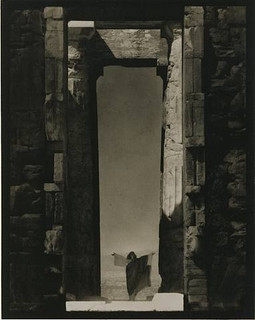
Edward Steichen’s amazing 1921 portrait of dance icon Isadora Duncan beneath a massive arch of the Parthenon in Greece, an image which recently surged to the top of my mind. See a link to a larger view of this shot, below.
By MICHAEL PERKINS
THE IMAGES SIT AT THE BOTTOM OF THE BRAIN, LIKE STONE PILLARS IN THE FOUNDATION OF AN IMMENSE TOWER.The structures erected on top of them, those images we ourselves have fashioned in memory of these foundations, dictate the height and breadth of our own creative edifices. Between these elemental pictures and what we build on top of them, we derive a visual style of our own.
In my own case,many of the pillars that hold up my own house of photography come from a single man.
Edward Steichen is arguably the greatest photographer in history. If that seems like hyperbole, I would humbly suggest that you take a reasonable period of time, say, oh, twenty years or so, just to lightly skim the breadth of his amazing career….from revealing portraits to iconic product shots to nature photography to street journalism and half a dozen other key areas that comprise our collective craft of light writing. His work spans the distance from wet glass plates to color film, from the Edwardian era to the 1960’s, from photography as an insecure imitation of painting to its arrival as a distinct and unique art form in its own right.
At the start of the 20th century, Steichen co-sponsored many of the world’s first formal photographic galleries, and was a major contributor to Camera Work, the first serious magazine dedicated wholly to photography. He ended his career as the creator of the legendary Family Of Man, created in the early 1950’s and still the most celebrated collection of global images ever mounted anywhere on earth. He is, simply, the Moses of photography, towering above many lesser giants whose best work amounts to only a fraction of his own prodigious output.
Which is why I sometimes see fragments of what he saw when I view a subject. I can’t see with his clarity, but through the milky lens of my own vision I sometime detect a flashing speck of what he knew on a much larger scale, decades before. The image at left recently rocketed to my mind’s eye several weeks ago, as I was framing shots inside a large government building in Ohio.In 1921, Steichen journeyed to Greece to use the world’s oldest civilization basically as a prop for portraits of Isadora Duncan, then in the forefront of American avant-garde dance. Framing her at the bottom of an immense arch in the ruins of the Parthenon, he made her appear majestic and minute at the same time, both minimized and deified by the huge proportions in the frame. It is one of the most beautiful compositions I have ever seen, and I urge you to click the Flickr link at the end of this post for a slightly larger view of it. (Also note the link to a great overview of Steichen’s life on Wikipedia.)
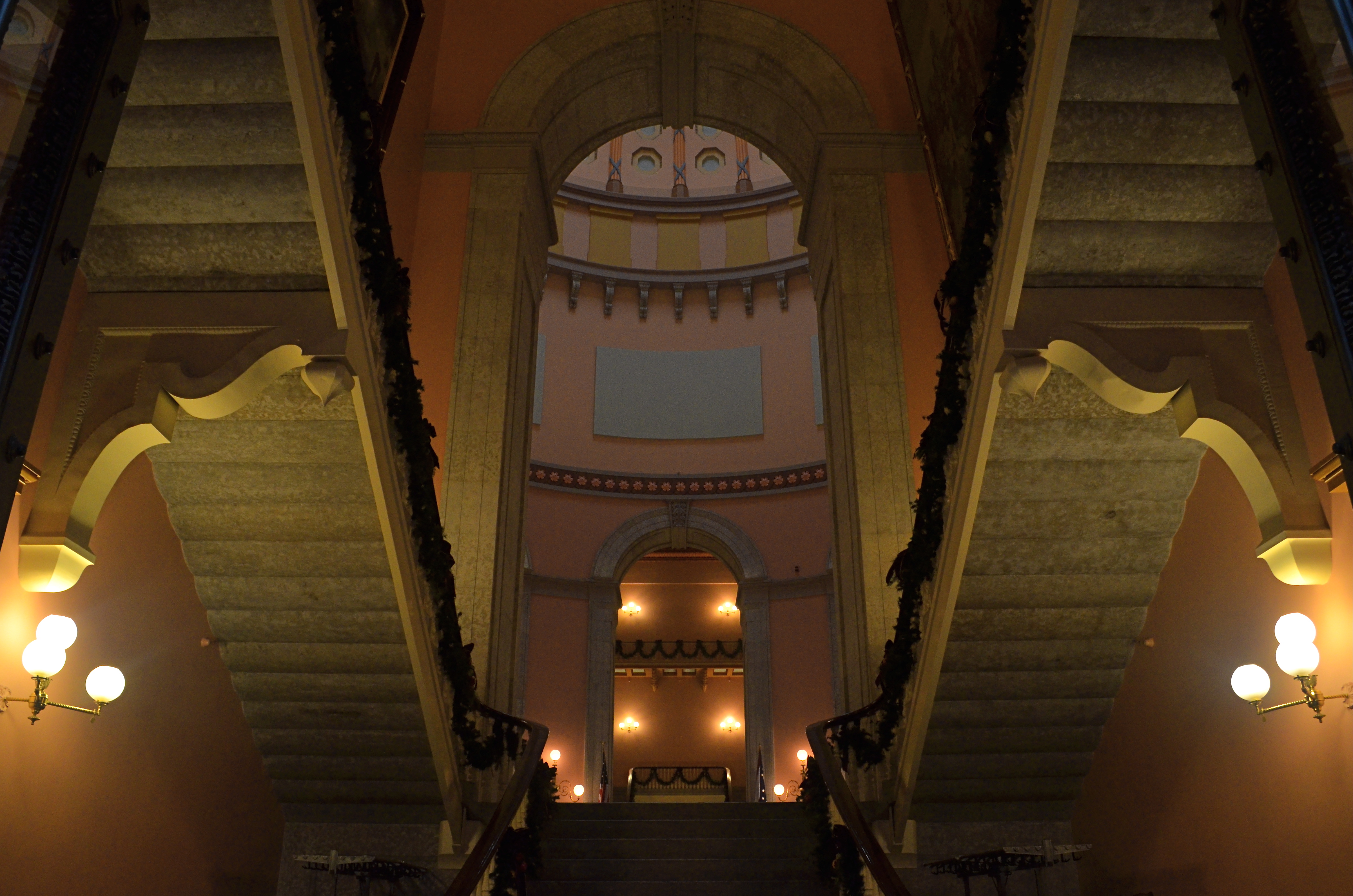
Uplighting creates a moody frame-within-frame feel at the Ohio Statehouse building, in a shot inspired by Edward Steichen’s images of massive arches. 1/30 sec., f/8, ISO 800, 18mm.
In framing a similarly tall arch leading into the rotunda of the Ohio Statehouse in Columbus, I didn’t have a human figure to work with, but I wanted to show the building as a series of major and minor access cavities, in, around, under and through one of its arched entrance to the central lobby. I kept having to back up and step down to get at least a partial view of the rotunda and the arch at the opposite end of the open space included in the frame, which created a kind of left and right bracket for the shot, now flanked by a pair of staircases. Given the overcast sky meekly leaking grey light into the rotunda’s glass cupola, most of the building was shrouded in shadow, so a handheld shot with sufficient depth of field was going to call for jacked-up ISO, and the attendant grungy texture that remains in the darker parts of the shot. But at least I walked away with something.
What kind of something? There is no”object” to the image, no story being told, and sadly, no dancing muse to immortalize. Just an arrangement of color and shape that hit me in some kind of emotional way. That and Steichen, that foundational pillar, calling up to me from the basement:
“Just take the shot.”
Related articles
- The Photograph as a Social Statement (halsmith.wordpress.com)
- Picture Imperfect (andrewsullivan.thedailybeast.com)
- http://www.flickr.com/photos/quelitab/5793648357/lightbox/
- http://en.wikipedia.org/wiki/Edward_Steichen
THE PROSCENIUM
By MICHAEL PERKINS
IT IS THE OLDEST FRAMING DEVICE IN HISTORY. If you’ve ever watched a play on any stage, anywhere in the world, you’ve accepted it as the classic method of visual presentation. The Romans coined the word proscenium, “in front of the scenery”. Between stage left and stage right exists a separate reality, defined and contained in the finite space of the theatre’s forward area. What is included in the frame is everything, the center of the universe of certain characters and events. What’s outside the frame is, indefinite, vague, less real.
Just like photography, right? Or to be accurate, photography is like the proscenium. We, too select a specific world to display. We leave out all the other worlds not pertinent to our message. And we follow information in linear fashion…left to right, right to left. The frame gives us the sensation of “looking in” to something that we are only visiting, just as we only “rent” our viewpoint from our theatre seats.
We learned our linear habit from the descendants of stage arrangement….murals, frescoes, paintings, all working, as our first literate selves would, from left to right. Painters were forced to arrange information inside the frame, to make choices of what that frame would include, and, as the quasi-legitimate children of painting, we inherited that deliberately chosen viewpoint, that decision to show a select world, by arranging visual elements within the frame.
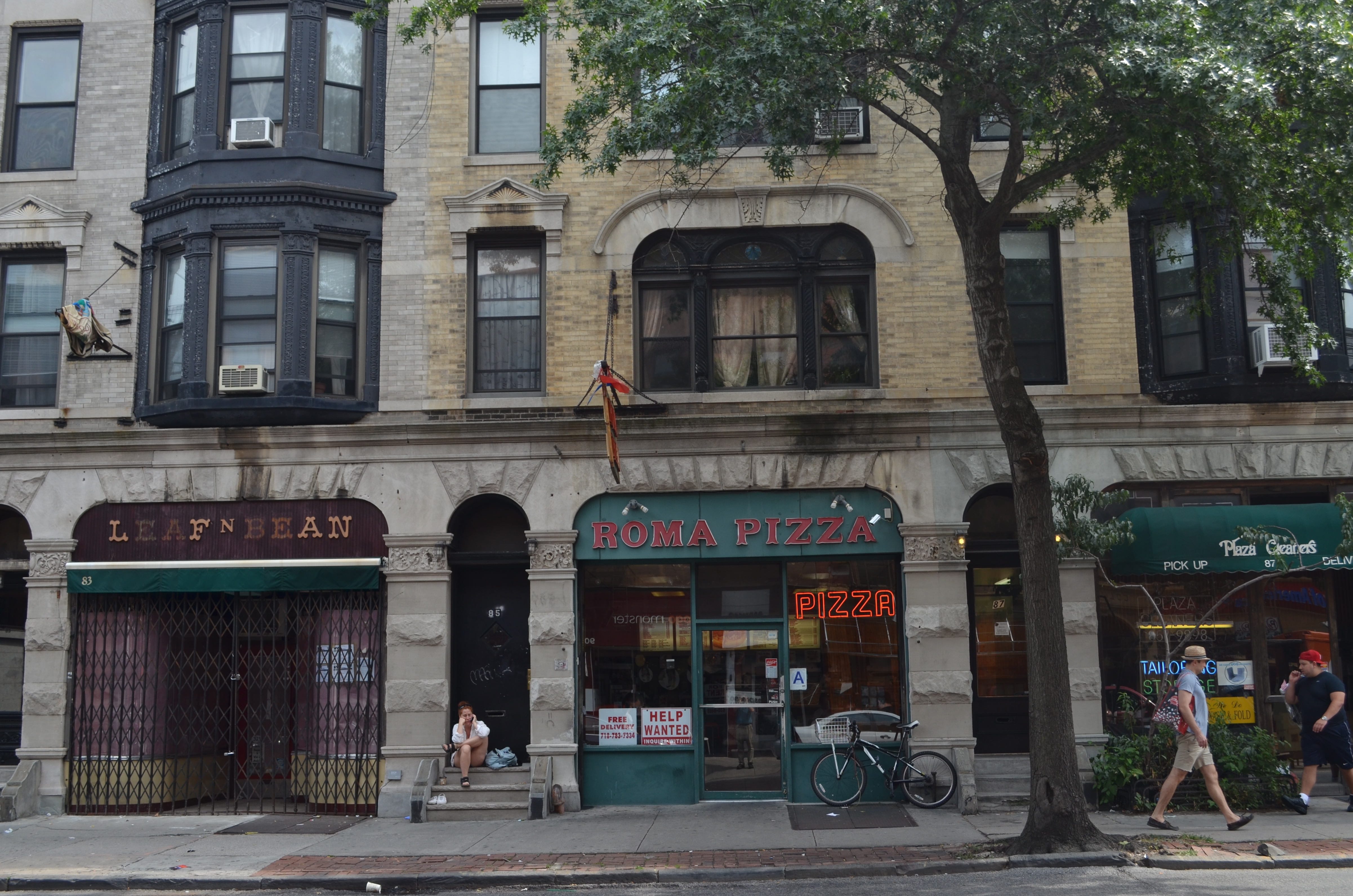
Park Slope, Brooklyn, 2012. Trying to catch as much activity as a street glance, at any given moment, can. 1/320 sec., F/7.1, ISO 100, 24mm.
For some reason, in recent months, I have been abandoning the non-traditional in shooting street scenes and harking back to the proscenium, trying to convey a contained world of simple, direct left-right information. Candid neighborhood shots seem to work well without extra adornment. Just pick your borders and make your capture. It’s a way of admitting that some worlds come complete just as they are. Just wrap the frame around them like a packing crate and serve ’em up.
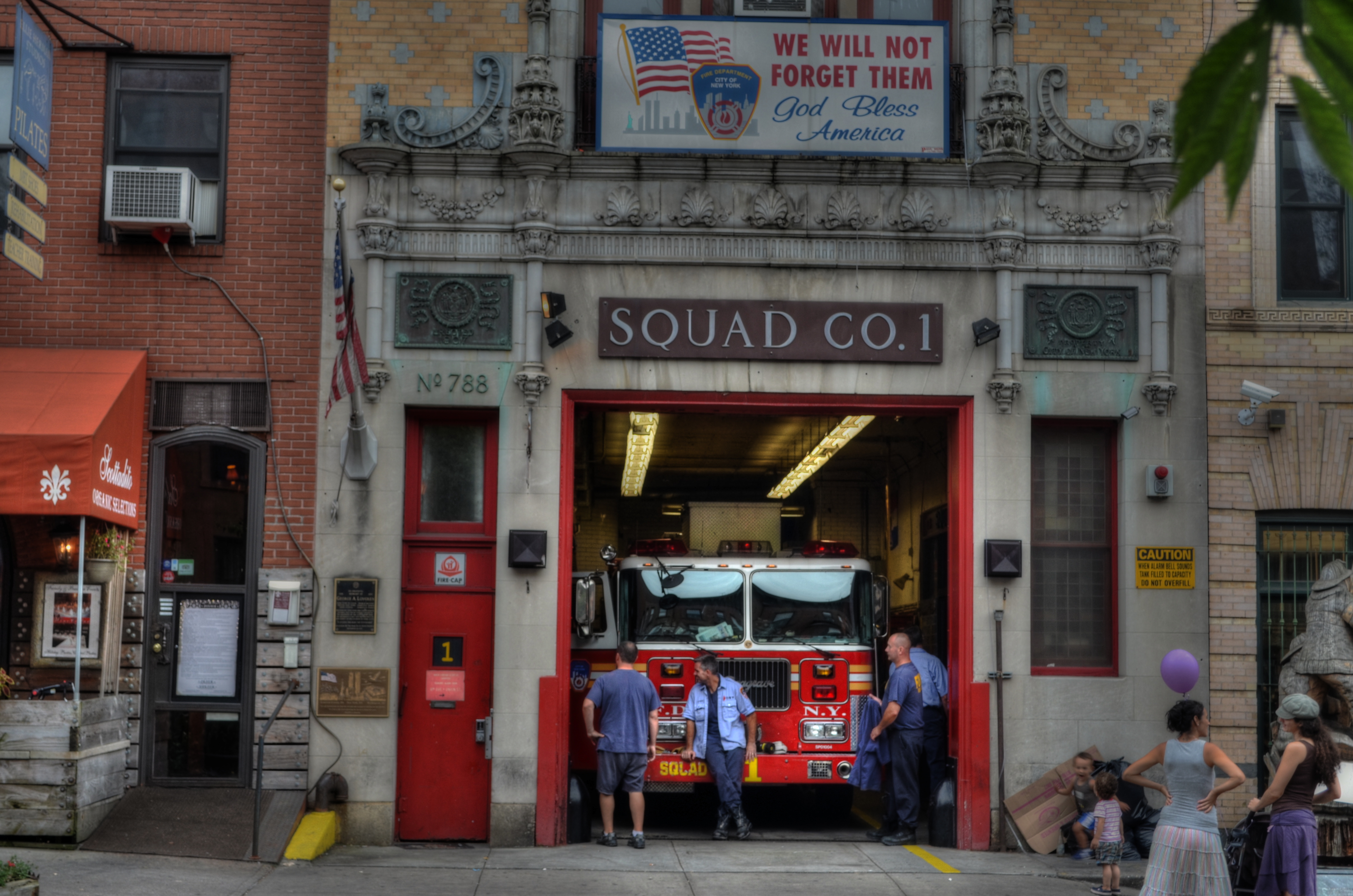
Like a theatre play, some images read best as self-contained, left-to-right “worlds”. A firehouse in Brooklyn, 2012. 1/60 sec., f/6.3, ISO 100, 38mm.
This is not to say that an angled or isometric view can’t portray drama or reality as well as a “stagy” one. Hey, sometimes you want a racing bike and sometimes you want a beach cruiser. Sometimes I don’t mind that the technique for getting a shot is, itself, a little more noticeable. And sometimes I like to pretend that there really isn’t a camera.
That’s theatre. You shouldn’t believe that the well-meaning director of the local production of Oklahoma really conjured a corn field inside a theatre. But you kind of do.
Hey what does Picasso say? “Art is the lie that tells the truth”?
Okay, now I’m making my own head hurt. I’m gonna go lie down.
TURNING UP THE MAGIC
By MICHAEL PERKINS
CHRISTMAS IS SO BIG THAT IT CAN AFFORD TO GO SMALL. Photographers can, of course, tackle the huge themes….cavernous rooms bursting with gifts, sprawling trees crowning massive plazas, the lengthy curve and contour of snowy lanes and rustic rinks…..there are plenty of vistas of, well, plenty. However, to get to human scale on this most superhuman of experiences, you have to shrink the frame, tighten the focus to intimate details, go to the tiny core of emotion and memory. Those things are measured in inches, in the minute wonder of things that bear the names little, miniature, precious.
And, as in every other aspect of holiday photography, light, and its successful manipulation, seals the deal.
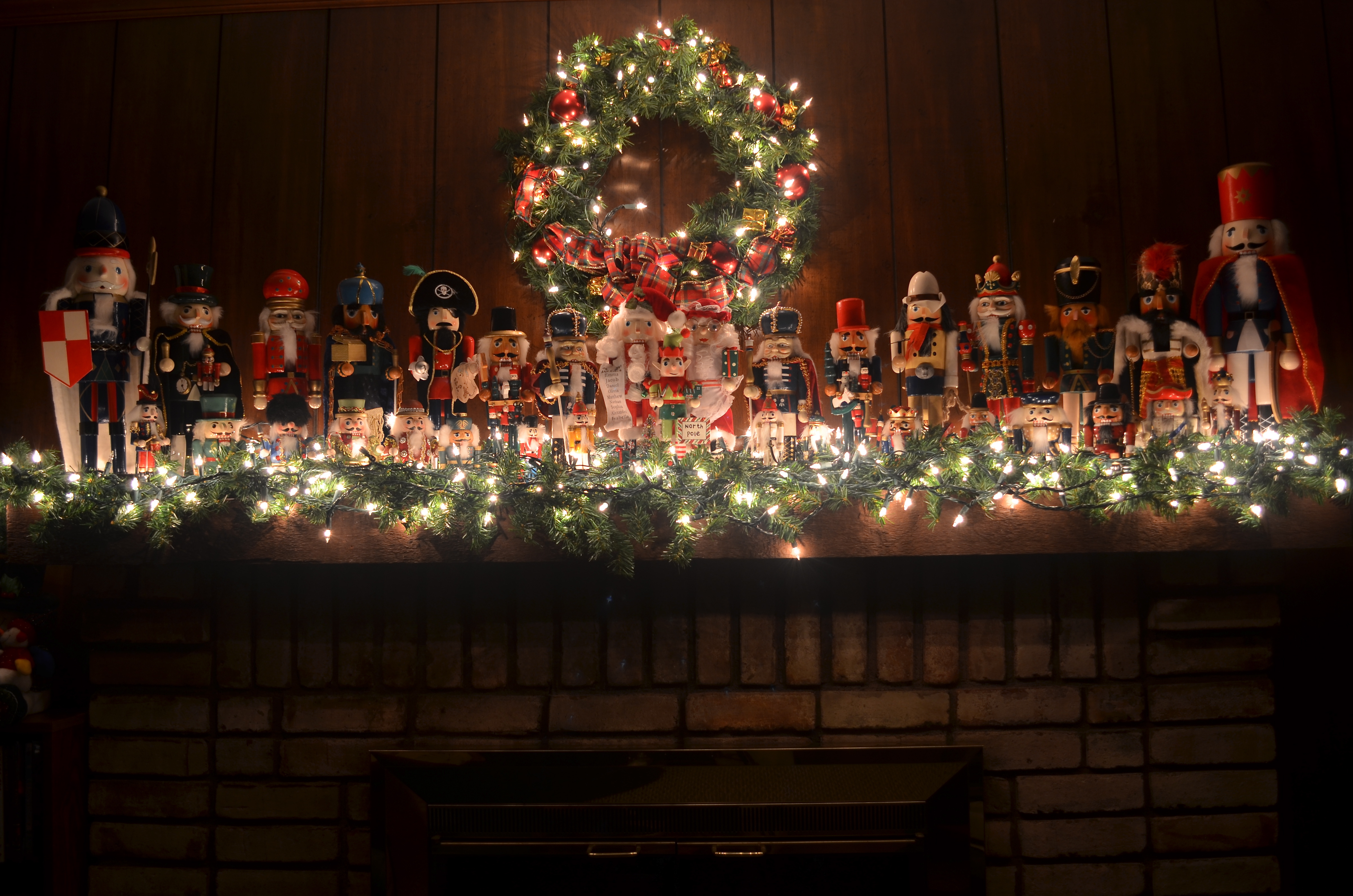
A proud regiment of nutcrackers, made a little more enchanting by turning off the room light and relying on tiny twinklers. 1/2 sec., f/4, ISO 100, 20mm
In recent years I have turned away from big rooms and large tableaux for the small stories that emanate from close examination of corners and crannies. The special ornament. The tiny keepsake. The magic that reveals itself only after we slow down, quiet down, and zoom in. In effect, you have to get close enough to read the “Rosebud” on the sled.
Through one life path and another, I have not been “home” (that is, my parents’ home) for Christmas for many years now. This year, I broke the pattern to visit early in December, where the airfare was affordable, the overall scene was less hectic and the look of the season was visually quiet, if no less personal. It became, for me, a way to ease back into the holidays as an experience that I’d laid aside for a long time.
A measured re-entry.
I wanted to eschew big rooms and super-sized layouts to concentrate on things within things, parts of the scene. That also went for the light, which needed to be simpler, smaller, just enough. Two things in my parents’ house drew me in: several select branches of the family tree, and one small part of my mother’s amazing collection of nutcrackers. In both cases, I had tried to shoot in both daylight and general night-time room light. In both cases, I needed some elusive tool for enhancement of detail, some way to highlight texture on a very muted scale.
Call it turning up the magic.
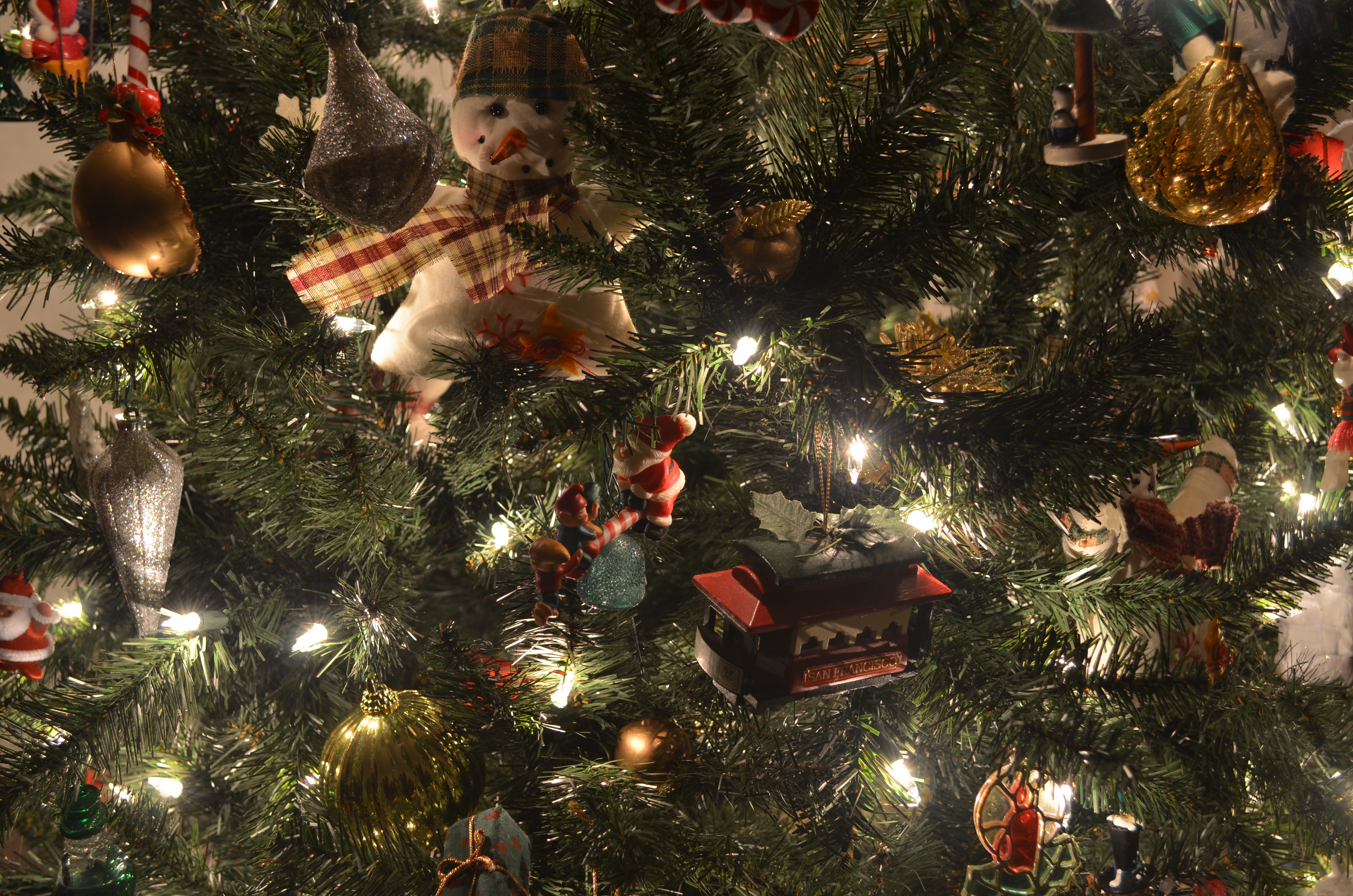
Use of low-power, local light instead of general room ambience enhances detail in tiny objects, revealing their textures. 1/2 sec., f/4, ISO 100, 20mm.
As it turned out, both subjects were flanked by white mini-lights, the tree lit exclusively by white, the nutcrackers assembled on a bed of green with the lights woven into the greenery. The short-throw range of these lights was going to be all I would need, or want. All that was required was to set up on a tripod so that exposures of anywhere from one to three seconds would coax color bounces and delicate shadows out of the darkness, as well as keeping ISO to an absolute minimum. In the case of the nutcrackers, the varnished finish of many of the figures, in this process, would shine like porcelain. For many of the tree ornaments, the looks of wood, foil, glitter, and fabric were magnified by the close-at-hand, mild light. Controlled exposures also kept the lights from “burning in” and washing out as well, so there was really no down side to using them exclusively.
Best thing? Whole project, from start to finish, took mere minutes, with dozens of shots and editing choices yielded before anyone else in the room could miss me.
And, since I’d been away for a while, that, along with starting a new tradition of seeing, was a good thing.
Ho.
Related articles
- How to Take a Picture of Your Christmas Tree (purdueavenue.com)
GRABBING THE GIFT
Light makes photography. Embrace light. Admire it. Love it. But above all, know light. Know it for all you are worth, and you will know the key to photography. ——-George Eastman
By MICHAEL PERKINS
WHEN I WAS ASSEMBLING THE FIRST COMPILATION OF MY OWN IMAGES, Juxtapositions, I felt a little awkward about captioning the photos in any way, since they were clearly the work of an unaccomplished amateur. In my native Catholic thinking, my default question was, who the hell did I think I was to pontificate on anything, hmm? Notice that, since you are presently reading the musings of the selfsame unaccomplished amateur, I obviously got over past that obstacle, but anyway…
Needing the book to have some kind of general structure or theme, I decided that, although my own wisdom may not be in demand, there were plenty of thoughts from the greats in the photographic field that were worth re-quoting, and which, correctly placed, might even illustrate or amplify what I was trying to say in my own photos. It was a way of channeling great minds and acknowledging that, pro or amateur, we all started off on the same journey with much the same aims.
Looking at the finished book, I noticed that the two most consistent subjects among the finest minds in photography were (1) light; how to harness it, how to serve it, shape it, seek its ability to frame or exalt a subject and (2) the importance of staying flexible, open, and able to embrace the moment.
Both objectives came into clear focus for me last week. A combination of early sunlight, dense foliage and thick morning fog came together in breathtaking patterns in the high canyon rim streets of Santa Barbara, California. Light was busting out wherever it could, coming through branches and boughs in soft shafts that lent an almost supernatural quality to objects even a few feet away, which, when suffused with this satiny mist, were themselves softened, even abstracted. If there was ever a delicate, temporary gift of light, this was it, and I was suddenly in a hurry, lest it run away from me. Any picture I failed to take in the moment was lost within minutes. Overthinking meant going home empty.
There was no time to carefully read the tyrannical histogram, since I knew it would disapprove of the flood of white that would throw some of my shots off the graph. Likewise I couldn’t “cover” myself by bracketing exposures, since there was so much territory to cover, so many images to attempt before the light could mutate into something else. I needed to be shooting, not fiddling.
Better to burn out than to rust out, as Neil Young famously said. One particular arch of overhanging branches called me. It looked like this:
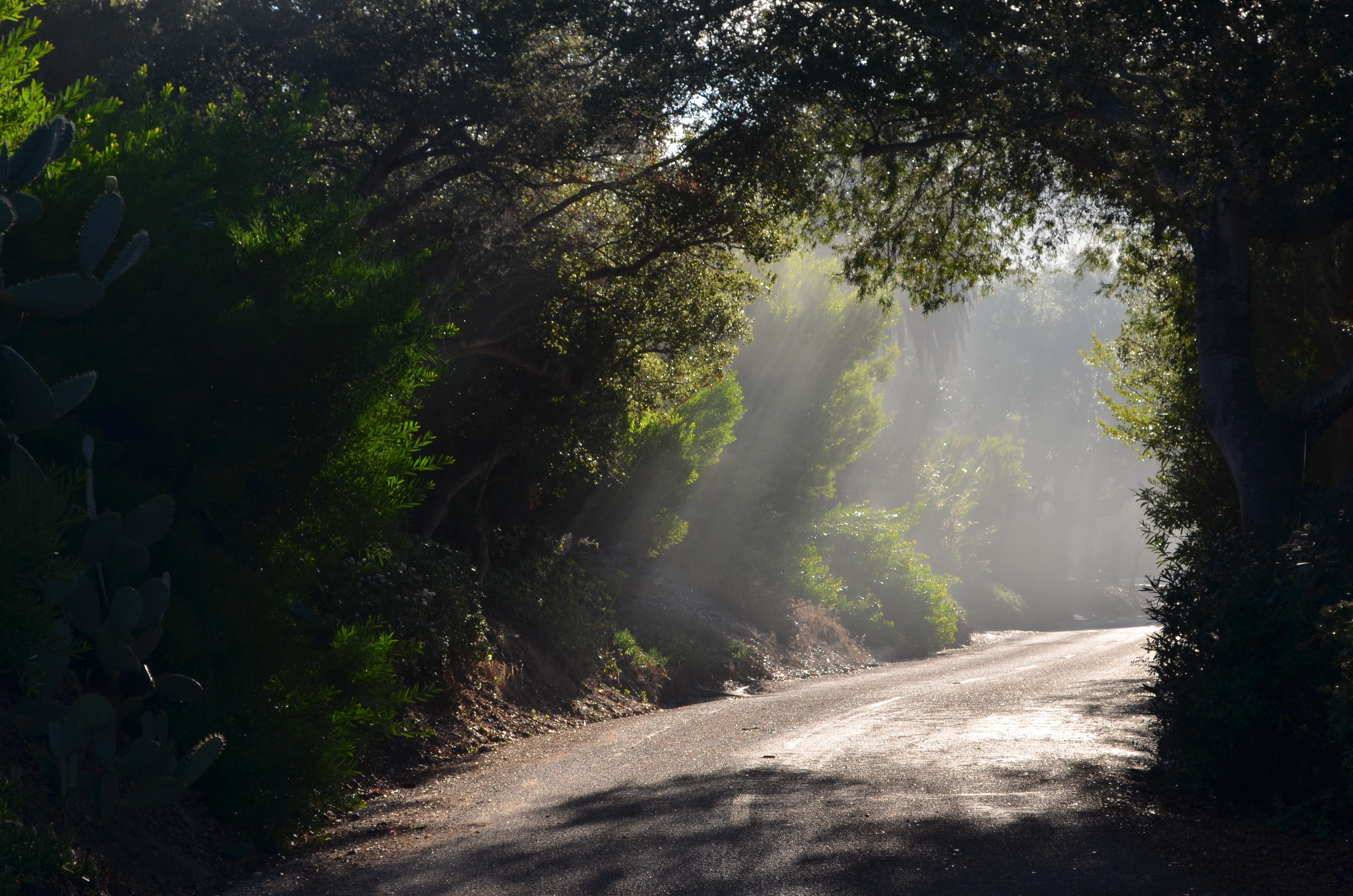
1/250 sec., f/7.1, ISO 100, 50mm
I was, after all these years, back to complete instinct. Snap shot? Certainly. Snap judgement? Hope not.
I didn’t go home empty. And when I got home, a re-check of one of Ansel Adams’ quotes encouraged me:
Sometimes, I do get to places where God’s ready for somebody to click the shutter.
Look for the moment. Listen for God (sometimes he whispers).
And don’t forget to click.
Related articles
- The 15 Most Popular Photography Tutorials from the 2nd Half of 2012 (digital-photography-school.com)
- What is photography? (bangladesh2u.com)
DREAMS DOWN TO DUST
By MICHAEL PERKINS
IT WAS, ON ONE LEVEL, A COMPLETE WASTE OF GASOLINE: a half-hour’s drive to a dusty cluster of tables scattered across a vacant lot in Carefree, Arizona; a gathering of junk gypsies, hunkering for shade under their teepee nation of display tents, their sprawls of pre-owned debris bunched onto card tables filled with the remains of people’s lives. It was going to take exactly five minutes to make one sad pass around this serpentine mound of resale refuse. No treasures today. Maybe we have time to catch lunch before we drive back to town.
These strange mash-ups of godforsaken bric-a-brac are common in many of the small towns of the southwest. Sometimes they are found shoehorned into sagging old adobe buildings on their umpteenth re-use. Other times they are charitably called “swap meets” or “vintage sales” and litter the parking lots of down-and-out drive-in theatres like the aftermath of an air crash. The visual impact is always the same, that of an attic that has been dynamited to bits, then shoveled into milk cartons and slapped with improvised glo-orange price tags. Coffee cans filled with unrelated fragments of trinkets; cardboard cartons overflowing with random chunks of household backfill. Two mysteries pervade: where has all of this come from….and where can it possibly be heading?
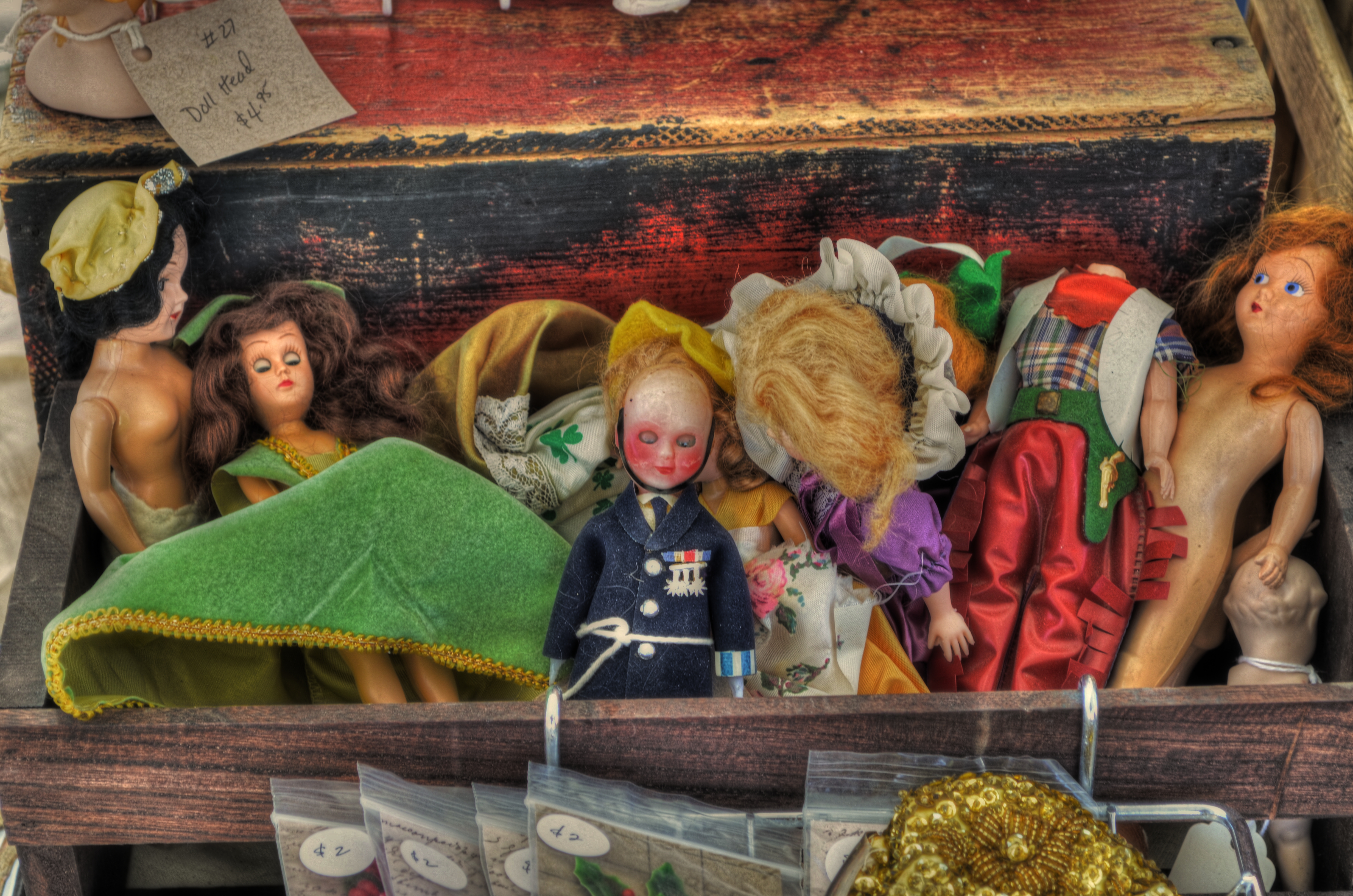
Once Loved: 1/25 sec., f/5.6, ISO 100, 55mm.
I was about one minute away from the end of my doleful tour when I spotted this box, which someone had filled with mis-matched bits of small dolls. One of such souvenirs on a big table makes no visual impression whatever, but a mass of them together is some kind of little minor-key symphony of dreams gone down to dust. Loved objects that were once transformed into the stuff of fancy, now just shards of lives dumped into a cigar box. I risked one picture. For some reason it haunts me.
But see what you think.
It isn’t about what we look at but what we see.
We leave such a colossal wake of trash behind us as our lives thunder and crash through the world. How to sort out all the stories inside?
ONE LESS MESS TO SWEAT
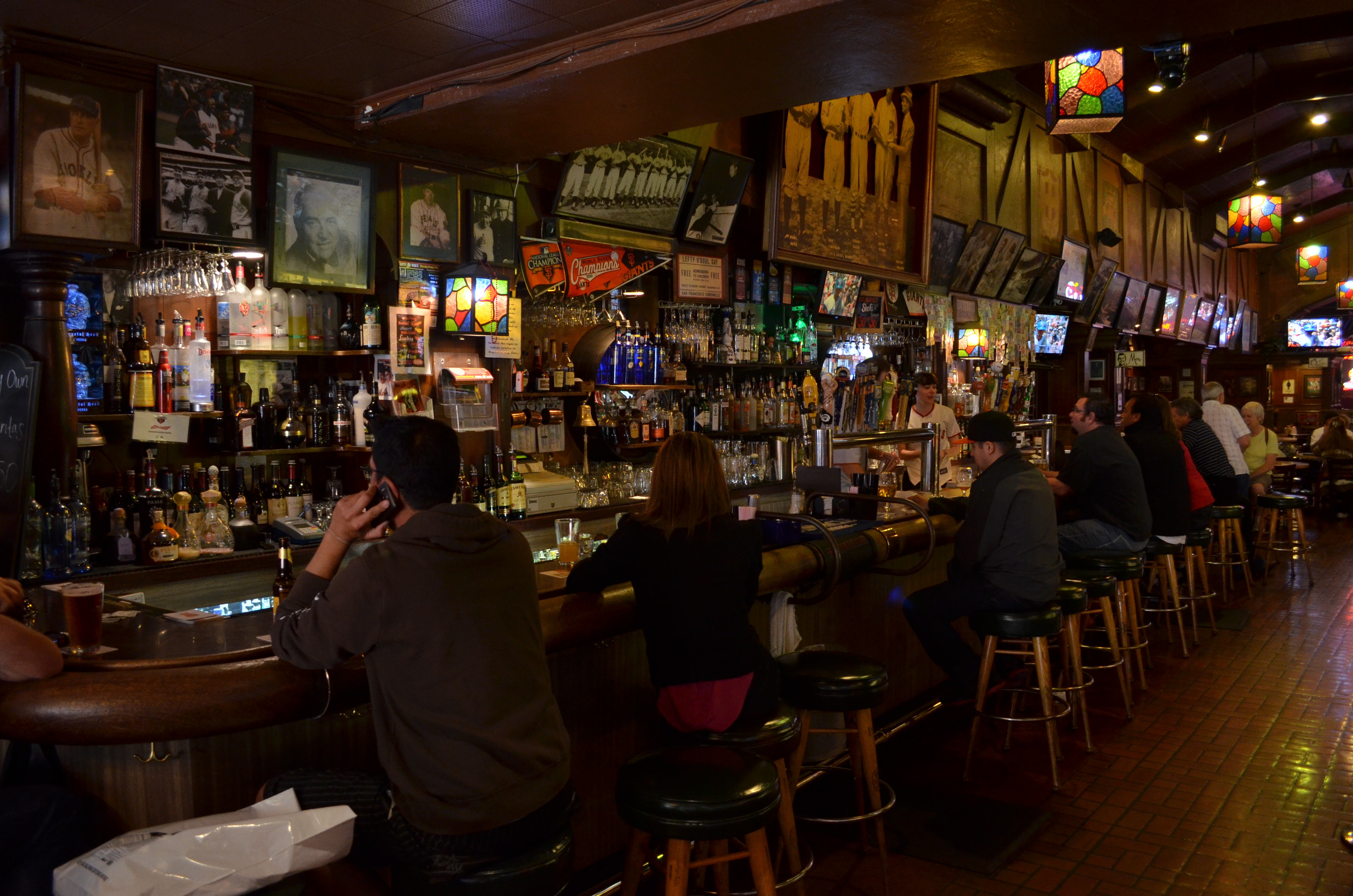
Lefty O’Doul’s bar, near Union Square in San Francisco. Lovely place, great grub, but a dark cavern where light goes to die. Modern DSLRs allow this to be a handheld shot with a minimum of noise: 1/20 sec., 5/5, ISO 640, 18mm.
by MICHAEL PERKINS
EVERY TIME I READ SINCERE ARGUMENTS FOR THE SUPERIORITY OF FILM OVER DIGITAL, the debate seems a little more lopsided on the side of sentiment than on the side of reason. The whole thing can make me a little….tired. As I write this, Arizona Highways has just released its annual collection of the fifty best images ever published in that august standard of print photography, and, yep, you guessed it, only about the last three images are digital. It’s an aesthetic bias which AH will only abandon once the entire rest of the world regards film as a quaint artifact of The Good Ole Days, but, God bless ’em, they are true believers. As for myself, I am in no huge hurry to see film go the way of the Hostess Twinkie. However, I do readily admit that it’s my heart casting that vote, and not my head.
Emulsions or pixels? Your preference still comes down to what you need to do and how you need to do it. That means that many of us will choose one medium or the other because it either enables or constricts our art…..in other words, a simply practical judgement, not one based on our fondness for what we are used to. Earlier this year, I applauded National Public Radio’s commemoration of the 150th anniversary of the battle of Antietam (one of the first Civil War skirmishes to be photographically documented), by commissioning their own photog to shoot some of the same battle sites as Alexander Gardner had done in 1862, using the same kind of coated glass plate process. Were the results fascinating? Certainly. Are they likely to create a run on camera stores for collodion? Don’t hold your breath.
Photography is a constant process of knocking down more obstacles between what you are shooting at and the imagination you are shooting with. You need to keep the camera from fighting you, due to its inability to react, think, discriminate or judge the way that only you can. To that end, you have to be in a constant flow of improvement, simply because your mind is always traveling on a faster track than even the best camera, and that instrument must be corralled into helping, and not hindering, the task of getting your vision into that box.
One of the most helpful such advances for me has been the accelerated performance of DSLRs in low-light situations and the improvement in picture quality at increasingly higher ISO settings. In the film world of “ago”, if you wanted to shoot at 800 speed ASA, you had to have a camera loaded with 800 speed film. If you then, five minutes later, wanted to shoot at 100 speed ASA you would need to reload your camera with that speed of film, or have a whole separate camera that was loaded with it. And so on.
Not the best for flexibility. Or spontaneity.
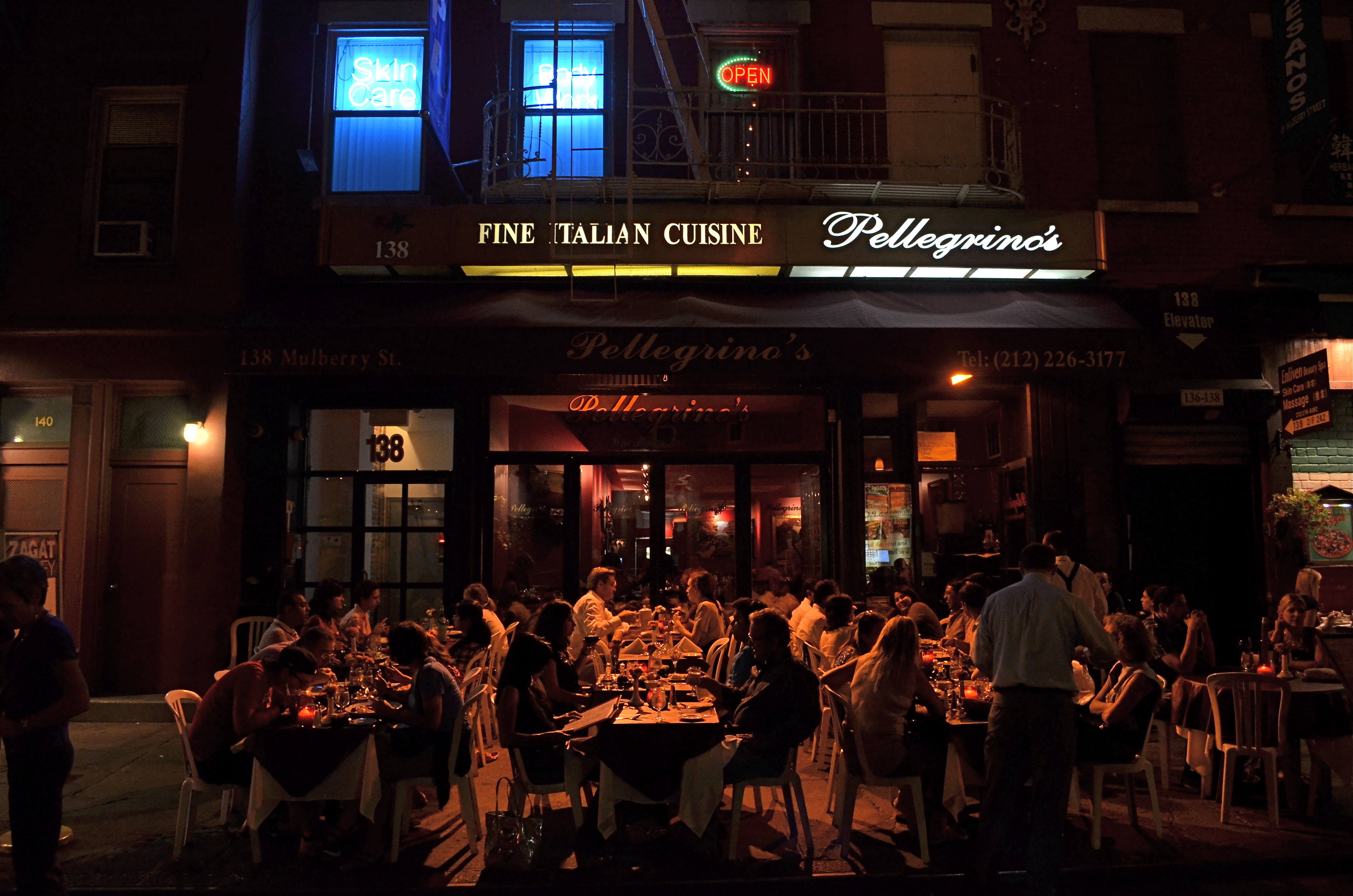
Pellegrino’s Restaurant, Little Italy, New York City. Handheld. Street photography gets an amazing boost from cameras that feed on low light. 1/50 sec., f/5.6, ISO 640, 18mm.
This rocketing forward of the technology that gives us sharp, nearly noise-free pictures, handheld and at fast exposure times, in all but the most hopeless lighting scenarios, is now filtering down to even the most rudimentary camera phones.It’s not alarmist or false to declare that the days of the compact point-and-shoot are officially numbered. With ISO now delivering better results in so many shooting situations, I can now go nearly anywhere and have a shot at getting a shot. That puts me at a distinct advantage over the most proficient shooters and the best cameras of barely a generation ago.
Does that guarantee I’ll bring back a winner? Nope. But the point is, more and more, if I don’t get the shot, it’s on me. I can’t blame my failure on balky technology, at least not in this particular case.
And it means I can spend more time shooting, dreaming, doing, instead of crossing my fingers and hoping.
Related articles
- Camera+ 3.6 is here: “It’s a camera, not a flight simulator!” (taptaptap.com)
- Is a DSLR right for you? (fatwallet.com)
LOOK THROUGH ANY WINDOW, PART TWO
By MICHAEL PERKINS
I WILL DO ANYTHING TO PHOTOGRAPH BOOKSTORES. Not the generic Costco and Wal-Mart bargain slabs laden with discounted bestsellers. Not the starched and sterile faux-library air of Barnes & Noble. I’m talking musty, dusty, crammed, chaotic collections of mismatched, timeless tomes…. “many a quaint and curious volume of forgotten lore” as Poe labeled them. I’m looking for places run by dotty old men with their glasses high on their forehead, cultural salvage yards layered in multiple stories of seemingly unrelated offerings in random stacks and precarious piles. Something doomed by progress, and beautiful in its fragility.
I almost missed this one.
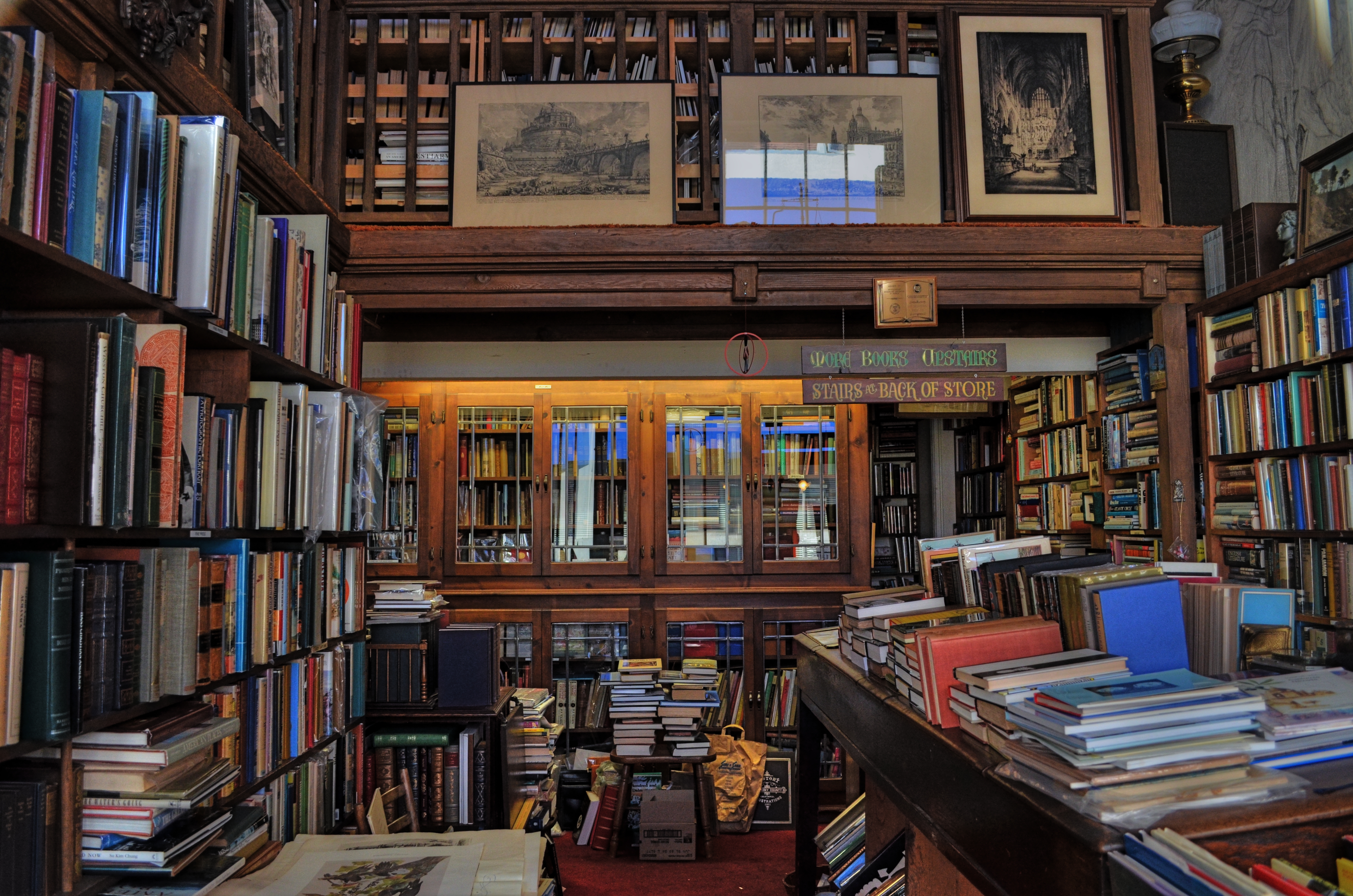
Through the window, and into a forgotten world. A fake two-shot HDR from a single exposure at 1/80 sec., f/5, ISO 400, 18mm.
In my last post, I commented that, even when your photography is rules-based….i.e., always do this, never do that, there are times when you have to shoot on impulse alone and get what you can get. It sometimes begins when you’re presented with something you’re not, but should be, looking for. A few weeks ago, I was spending the afternoon at one of Monterey, California‘s most time-honored weekly rituals..the marvelous, multi-block farmers’ market along Alvarado Street. The sheer number of vendors dictates that some of the booths spill over onto the side streets, and that’s where I found The Book Haven. The interior of the store afforded an all-in-one view of its entire sprawling inventory, but the crush of tourists bustling in and out of its teeny front door meant that any image was going to look like the casting call for The Ten Commandments.
I had to come back, when both the store and I were alone.
With the limited amount of time I had in town, that meant that I would have to stroll by just hours ahead of my plane for home. Heading out at 8:30 in the morning, I had obviously solved the problem of “too many people in the picture”, but I had traded that hassle for a new one: the store would not be open for another three hours.
For the second time in a week (see “Look Through Any Window, Part One”) I was forced to shoot through a window, but at least there was enough light inside to illuminate nearly all of the store’s interior. To avoid a reflection, I would have to cram my lens right up against the glass. Once my autofocus stopped fidgeting, I could only obtain the framing I wanted by shooting through a narrow open place on the center of the front door, standing on tiptoe to hold the composition. I also had to keep the ISO dialed low enough to not create extra noise, but high enough so I could take a fairly fast handheld exposure and get as much detail from the dark corners as possible. Balancing act.
Let’s see what happens.
In viewing the image later, I saw that there wasn’t enough detail to suit me, either in the individual books or the darker spaces around the store, so I pulled a small cheat. Making a copy of the shot, I pulled down the contrast, boosted the exposure, and sucked out some shadow, then loaded both shots into Photomatix, fooling the HDR program into thinking they were two separate exposures. Photomatix is also a detail enhancer program, so I could add sharper textures to the books and a richer range of tones than were seen in the original through-the-window shot.
Hey, you can’t have it all, but, by at least trying, you get more than nothing.
And sometimes that’s everything.
Nice bookstore.

