TLI
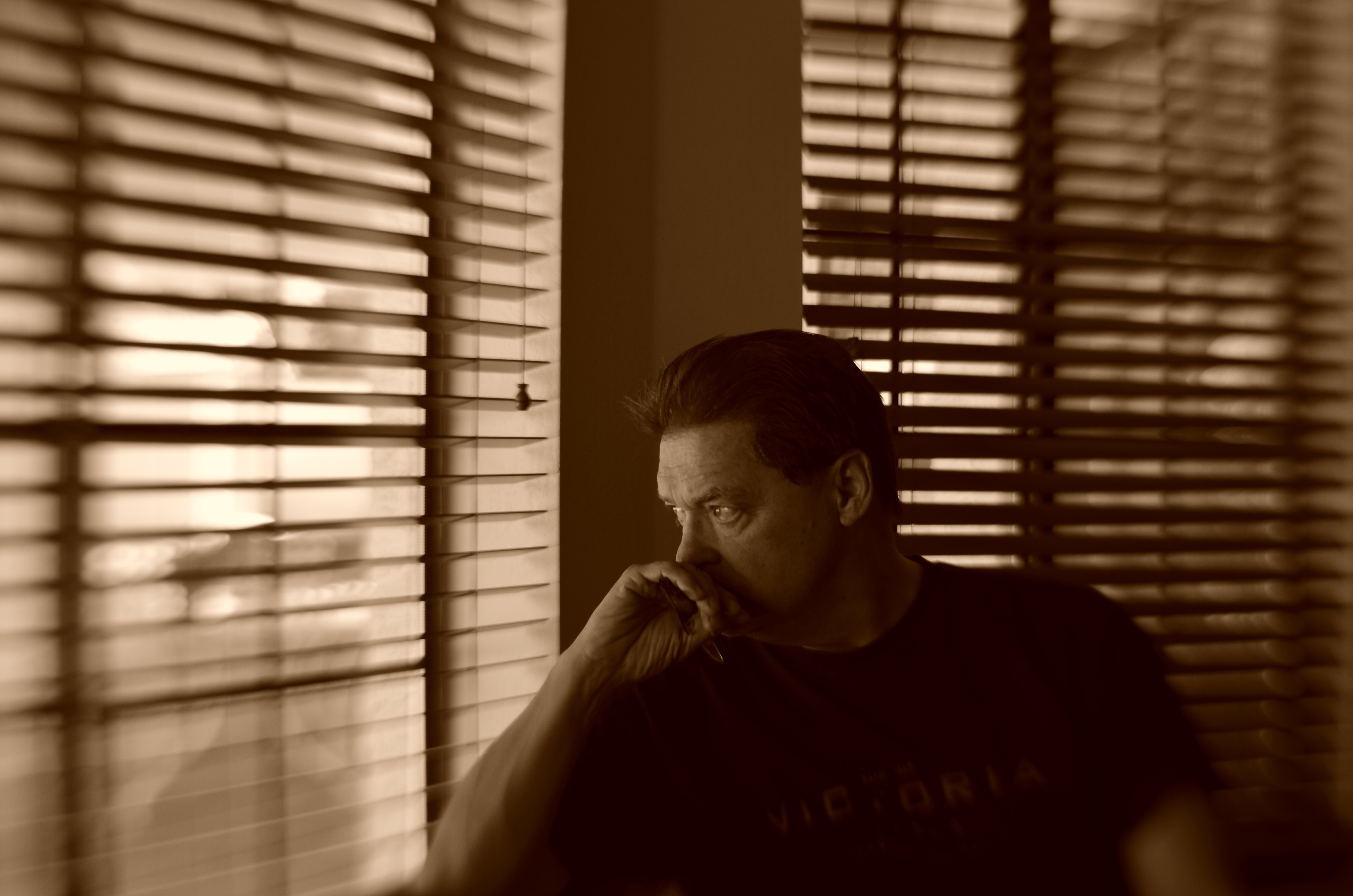
Is a self-portrait just a face crammed into an iPhone screen, or should it be more?
By MICHAEL PERKINS
THERE MAY BE NO PART OF PRESENT–DAY PHOTOGRAPHY that is more practiced and less understood than the humble self-portrait. This has not always been the case. Turning the lens on oneself was a much less common act until the arrival of mobile phones, at which time the somewhat awkward old technique of setting a timer and jumping into the picture was supplanted by an act that was at once instantaneous and effortless. Ironically, at that point, the sheer numerical proliferation of the selfie overwhelmed the artistic fact that many of us weren’t doing them very well.
The modern selfie has been degraded largely because any variance from the same banal fill-the-entire-frame-with-your-face approach is so rare. We get plenty of features and not much context, a condition that could be called TLI, or Too Little Information. Worse, selfies in the iPhone era are limited mostly to what framing is permitted by the length of the shooter’s arm, causing any surrounding people, places or events to be eclipsed from the shot, rendering an image of “me at the canyon” maddeningly identical to one of “me in front of the cathedral.” Add the distortion of near objects inherent in the wide-angle lenses of many mobiles, and too many selfies conceal or mutate more than they reveal. And don’t get me started on the effects of on-board flash. In short, who are these bloated ghosts?
A portrait is more than a mere record of one’s features. The self is also defined by its surroundings, with the accompanying props of one’s life anchoring that person in an era and providing scale, the staging needed for a complete narrative. Can the face alone sufficiently “sell” one’s story? In the hands of the right shooter, absolutely.But riff through a few hundred online selfies and see how often you behold such gems.
In all too many self-portraits, we mostly settle for mere volume, for blurred and puffy smears of ourselves instead of insights. And, as is often the case when taking pictures is so incredibly easy, we fail to plan. This isn’t vanity, but self-sabotage. The self-portrait needs to slow down, to once more become something of a special occasion.
More information, please..
RE-ASSIGNING VALUE
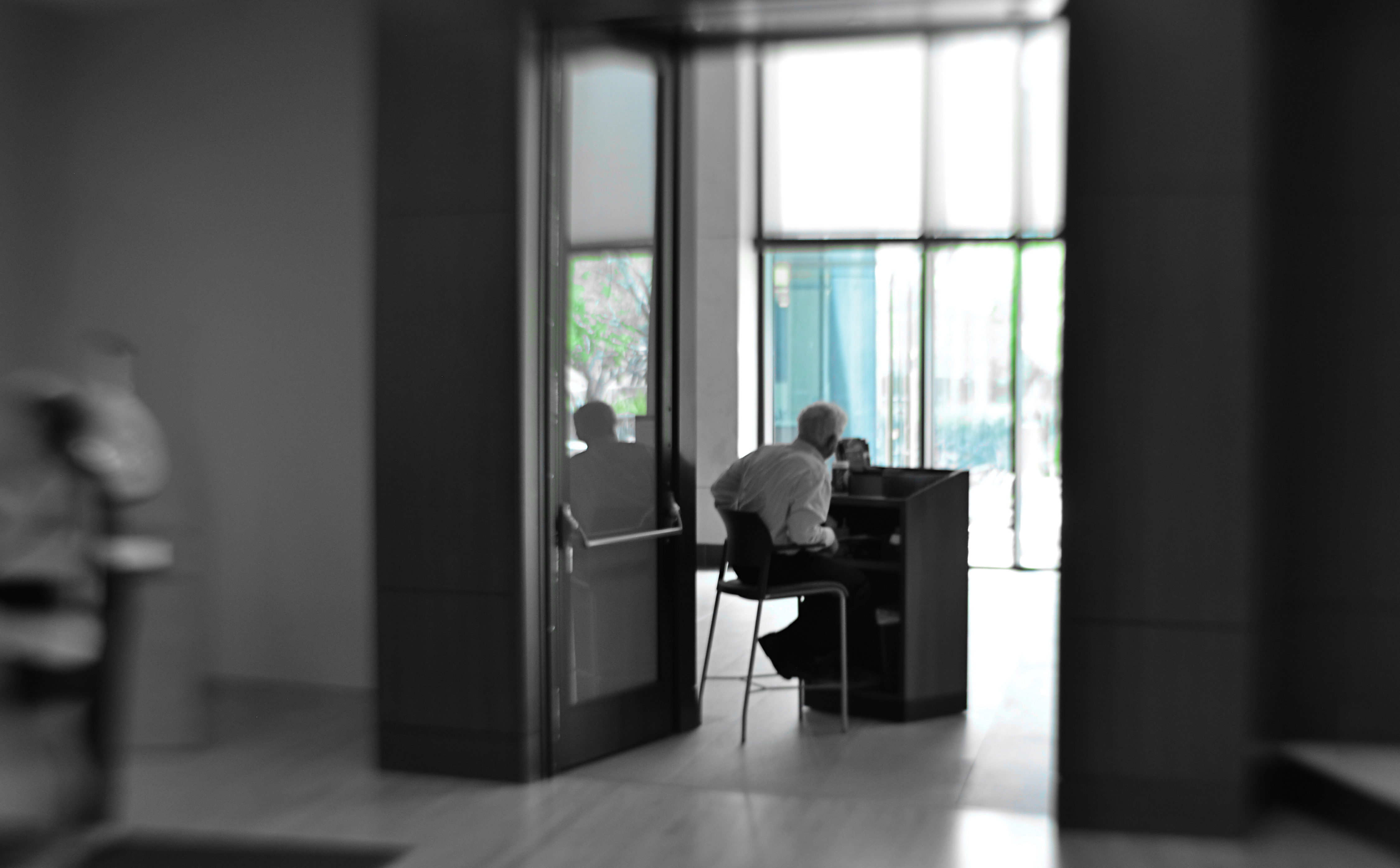
Can you judge this man’s mind from how he’s shown in the image?
By MICHAEL PERKINS
PHOTOGRAPHY DEMONSTRATED, EARLY IN ITS HISTORY, that, despite the assumption that it was merely a recording device, it regarded “reality” as….overrated. Since those dawning daguerreotype days, it has made every attempt possible to distort, lie about, or improve upon the actual world. There is no “real” in a photograph, only an arrangement between shooter and viewer, who, together, decide what the truth is.
So-called street photography is rife with what I call “reassigned value” when it comes to the depiction of people. Obviously, the heart of “street” is the raw observation of human stories as the photographer sees them, tight little tales of endeavor, adventure…even tragedy. However, the nature of the artist is not to merely document but also to interpret: he may use the camera to freeze the basic facts of a scene, but he will inevitably re-assign values to every part of it, from the players to the props. He becomes, in effect, a stage manager in the production of a small play.
In the above image you can see an example of this process. The man sitting at his assigned post at a museum gallery began as a simple visual record, but I obviously didn’t let the matter end there. Everything from the selective desaturation of color to the partial softening of focus is used to suggest more than what would be given in just a literal snap.
So what is the true nature of the man at the podium? Is he wistfully gazing out the distant window, or merely daydreaming? Is he regretful, or does he just suffer from sore feet? Is he chronically bored, or has his head in fact turned just because a patron asked him the direction of the restroom? And, most importantly, how can you creatively alter the perception of this (or any) scene merely by dealing the cards of technique in a slightly different shuffle?
Photographers traffic in the technical measure of the real, certainly. But they’re not chained to it. The bonds are only as steadfast as the limit of our imagination, or the terms of the dialogue we want with the world at large.
FIVE MINUTES OF FANCY
Start fooling around and see where it leads. It isn’t wasting time, it’s investing it.
By MICHAEL PERKINS
PUTTERING SUFFERS A BAD REPUTATION, coming somewhere on the disreputability scale between “screwing around” and “just passing the time”, poking an insolent finger in the eye of the Puritan work ethic. The headmaster’s voice echoes from the land of Hard-Won Wisdom: Time is money. Make something of yourself. Whattaya gonna do, waste the entire day?
Yeah, replies the photographer within you. Thought I might….
Making a picture isn’t the same process as building a bridge. You don’t always end the project with the same aims as you began with. Like any other artistic enterprise, the answer might come in the journey, rather than the destination. And a photographer, caught in mid-creation and asked, “what you doing?” should be quite comfortable answering, “you know, I’m not really sure yet…”
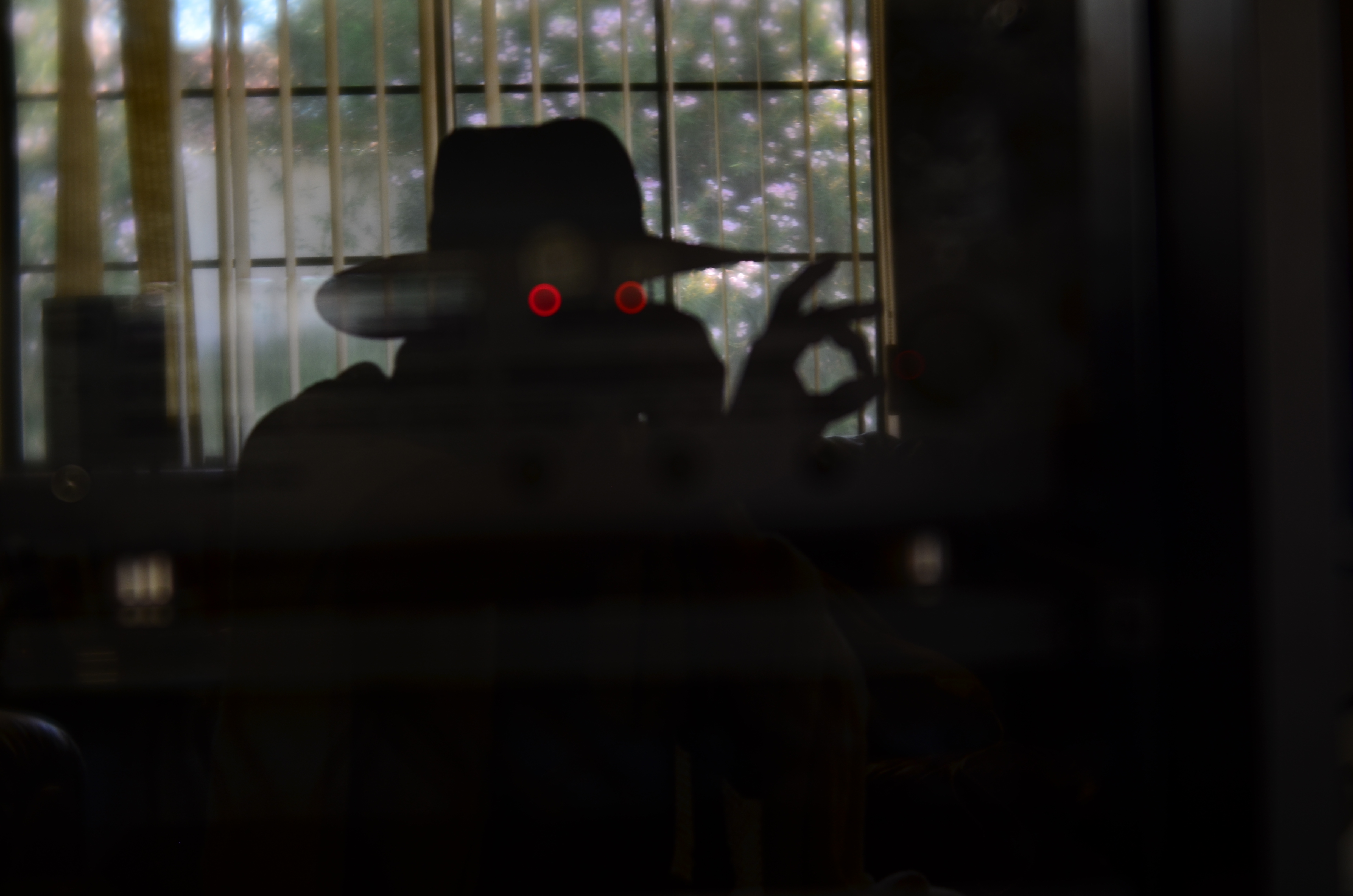
The above image is a total exercise in “let’s see what happens if I do this“, and at no time in the making of it did I have a set plan or firm objective: I just did know when to stop, but everything else was negotiable in the moment. I wasn’t wasting time: I was investing it.
At first, I was trying to take a picture of my back yard, which over my shoulder, as it was reflected in the glass cabinet door in front of me. I was about to kill the power on the amplifier on a shelf behind the door when a test shot revealed something unusual. At my chosen aperture, the amp’s two red LEDs weren’t reading as sharp points of light, but as diffuse outer circles surrounding soft inner circles, almost like a pair of feral eyes. And at that point, the garden scene slowly started to take a back seat.
Shooting the glass door at a slight angle made my body register as a reflection, while shooting straight on turned me into a silhouette, which would become handy. Now that I was just a shape, I could be anything, so I positioned myself to where the dots indeed appeared to glowing, spooky eyes. Shooting with my right hand, my body details now masked by shadow, I crossed my left hand over beyond the right edge of my body, posing it to look as if I were stealing something, or perhaps twisting the dial on a combination safe. Having thus established the behavior for the character I was now creating, I grabbed my wife’s garden hat and threw a bed blanket around my shoulders for some sinister atmosphere. Click and done, with my newly imagined Phantom Blot plotting his way into the house. I didn’t know the whole story, but I knew when to stop playing. Total time investment: five big minutes.
You won’t always have an organized blueprint for a picture when you set about making one. Besides, if you confine yourself solely to the familiar when shooting, eventually all of your photos will start to resemble each other, and not in a good, “cohesive body of work” way.
Screw with the formula. Embrace the uncertain.
WHAT DREAMS MAY COME
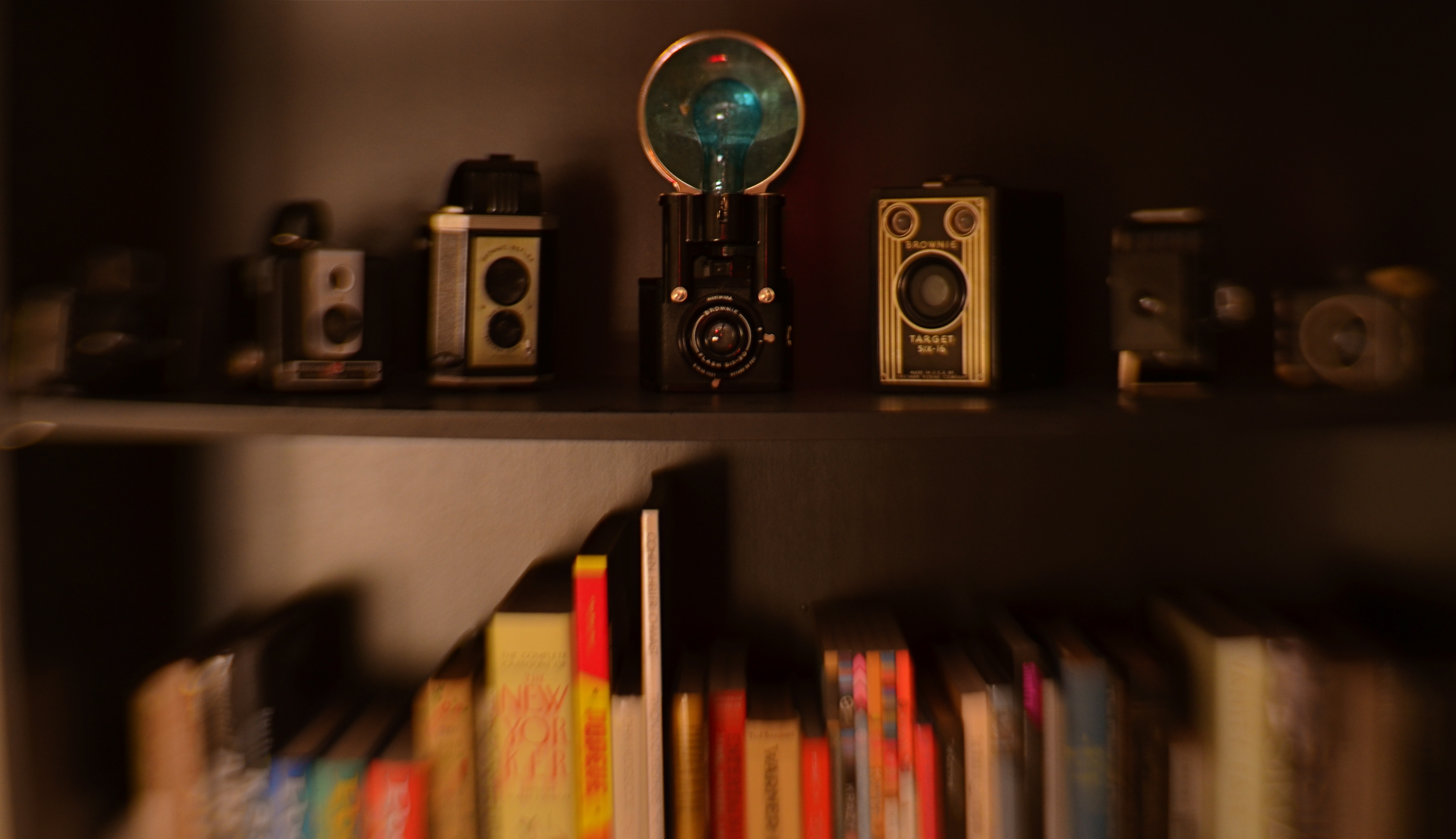
Yestertoys (2017). Making this image look merely “real” held no interest, so…..
By MICHAEL PERKINS
MEMORY ISN’T SHARPLY DEFINED OR TIDY, and so the act of conjuring remembrance in art is never as forensically factual as sliding open an autopsy drawer. The yester-thing that we treasure most dearly are the true opposite of clinical artifacts: they are, instead, bleary, distorted, indistinct, and mysterious. Small wonder that trying to fix memory on a camera sensor is like trying to pitchfork smoke.
Creating images in an attempt to capture the past is a huge part of photography, but it’s a no-man’s land without clear markings or signs. We begin our visual argument by asserting that our version of a memory is the official one… but official according to whom? Even people who have shared a specific event will offer different testimony of what it “really” was. And that very subjective uncertainty becomes one of photography’s greatest charms.
It only took a few years for early shooters to conclude that photographs need not be confined to merely measuring or documenting the world. Early on, they enlisted fancy and whimsy to the cause of depicting memory, just as painters did. And conversely, once there was a machine like the camera to perform the task of faithfully recording “reality”, painters began to abandon it for Impressionism and everything that followed after. Both arts began, like Alice, to regularly venture out on both sides of the looking glass.
A great part of photography’s allure is in discovering how little objective reality has to be in image involving memory, and what an adventure it is to escape the actual in the pursuit of the potential. The camera lets us tell lovely lies in pursuit of the truth.
SETTING THINGS STRAIGHT
By MICHAEL PERKINS
ONE OF THE MOST ELUSIVE EFFECTS IN ARCHITECTURAL PHOTOGRAPHY would seem to be the one most easily achieved: the look of a straight line, the foundation upon which an orderly image is built. However, the human eye is often more unreliable than assumed when it comes to reading and identifying that which is supposed to be “straight.”
We’ve all been confounded by optical illusions that present lines that are not, objectively, straight at all, even though our brains, based on our interpretation of the visual data, say they must be. However, we tend to dismiss this sensation as trickery, something we don’t have to sweat about in making a “real” picture. And that is probably a mistake.
Based on what kind of architectural design you’re shooting, what lens you choose, even where you stand, a straight line, either horizontal or vertical, can seem to bend or lean, making our “factual” images less than trustworthy.
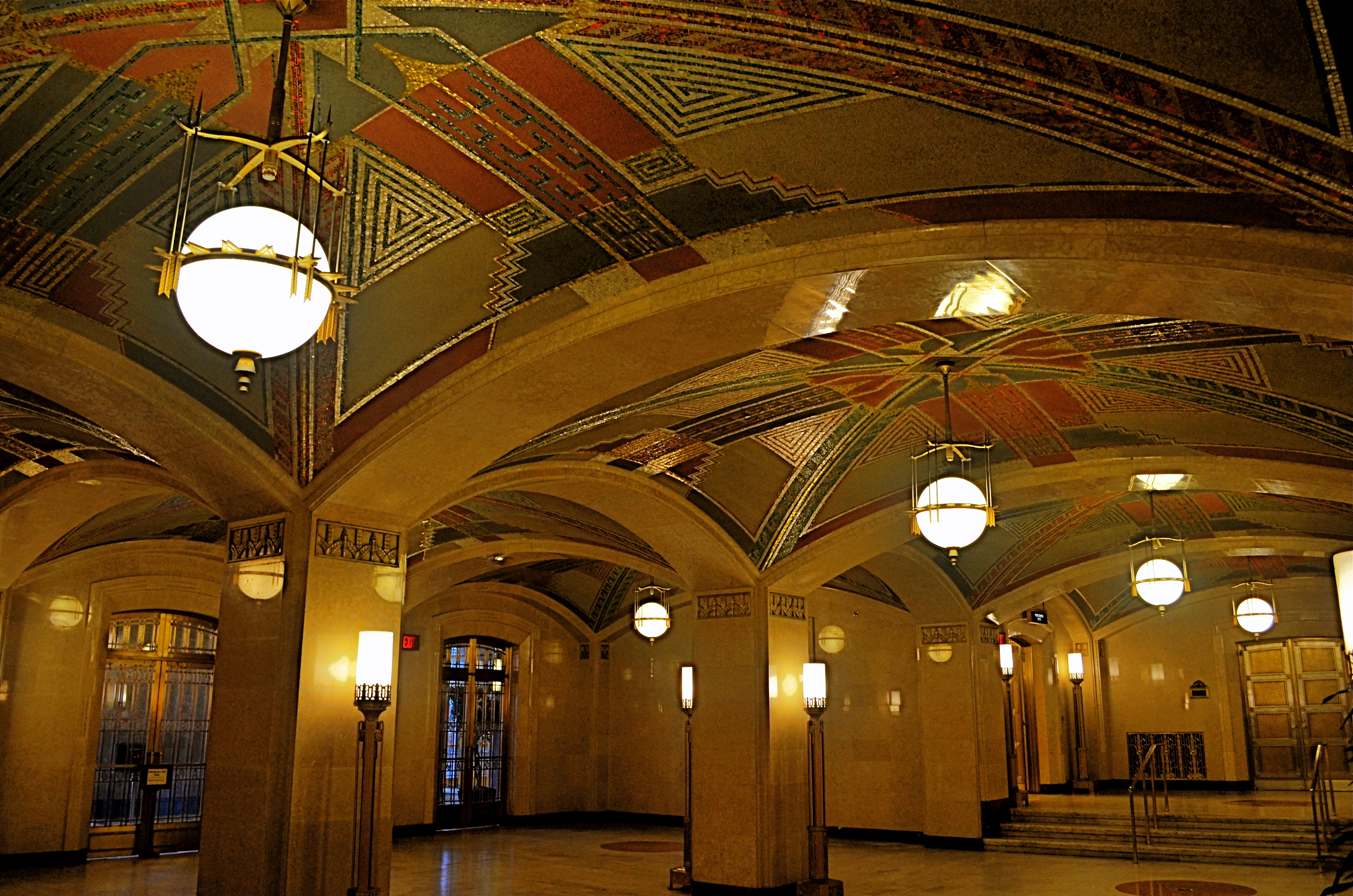
Even setting up a shot on a carefully calibrated tripod and a bubble level can produce a result that looks as if it was manipulated. Of course, based on what look you desire, you may regard geometric reality as irrelevant, and deliberately engineer ” unreality” into a photograph. That’s why we make a distinction between taking a picture and making one.
As an example, the picture seen above was taken super-wide, at 18mm, to intentionally exaggerate the size of the room, making some verticals bow in while others register normally, and playing stretchy with the ceiling arches and floor horizon. The idea here was to distort the already extreme Art Deco accents and give them an extra funhouse quality. Shooting with a more conventional focal length like 35 or 50 mm would have made for straighter lines, but would also have sacrificed every other effect achieved at 18mm.
Bottom (straight or crooked) line: dimensions and angles are suggestions, not commandments. But it’s a lot easier to break rules creatively once you understand how they work.
I’M LOOKING THROUGH YOU
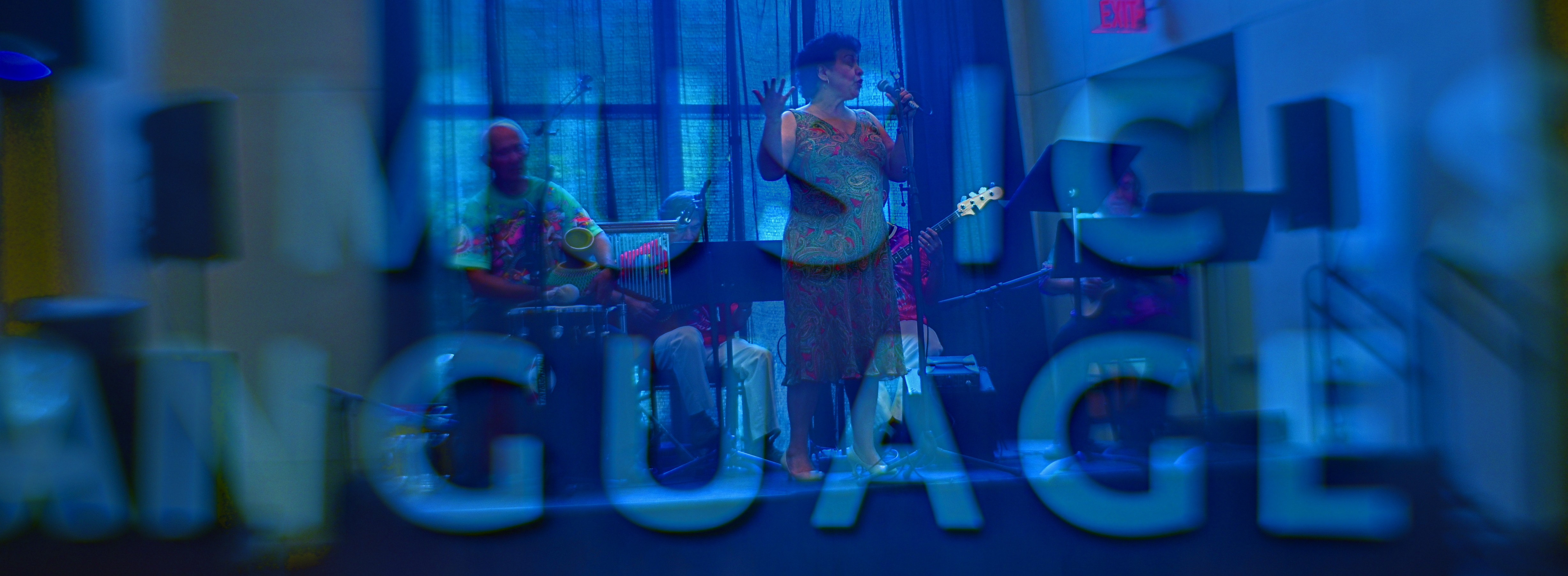
A double–exposure generated in Photomatix‘ “exposure fusion” mode, usually used to blend multiple exposures of the same subject, like the blending done in HDR programs.
By MICHAEL PERKINS
THERE IS A GROWING DEBATE OVER THE RECENT EMERGENCE of a process called exposure fusion, which has been touted as an alternative , if not a replacement for, High Dynamic Range or HDR processing. Which camp you fall into depends greatly upon what look you want in your final image, and both processes can be generated within a popular program call Photomatix.
So, first, a bit of review: HDR blends multiple frames of the same subject, shot at differing degrees of exposure, basically deepening the lighter values and rescuing detail in the darker ones. This means that you can potentially create a composite photo which “sees” the entire range of values in the same intensity, somewhat like your own eye (the ultimate camera) sees them.
Photomatix’ other main flavor, exposure fusion, takes the same multiple exposures and weighs every pixel in each of them for its value, letting some pixels from all exposures ” show through” in the final composite. The range of tones from light to dark is far less dramatic than in HDR, producing an image that strikes some as more natural. It’s worth noting that exposure fusion processes faster and easier than HDR and produces none of its annoying “halo” around the periphery of objects.
One additional fun aspect of exposure fusion, for me, is in its ease of use in creating montage, or controlled double-exposures, as well as same-subject composites. In the above shot, you’ll see a particularly clean amount of transparency between the musicians at a museum and a shot of part of a sign advertising its theme statement. Moreover, exposure fusion operates with several supple contrast and compression slider switches that make very minute adjustments in a snap.
The current HDR / Exposure Fusion “face-off” can only be resolved by actual users’ results, the only thing that matters in photography. Hey, if you made a piece of cowhide light-sensitive with a mix of lemonade and Lestoil and found a way to make a print with it, then mazel tov and God bless.
It’s always, and only, about the pictures.
TWILIGHT TIME
By MICHAEL PERKINS
I HAVE STRUGGLED OVER A LIFETIME to tell photographic stories with as few elements as possible. It’s not unlike confining your culinary craft to four-ingredient recipes, assuming you can actually generate something edible from such basic tools. The idea, after all, is whether they’ll eat what you’ve cooked.
With images, I’ve had to learn (and re-learn) just how easy it is to lard extra slop onto a picture, how effortlessly you can complicate it with surplus distractions, props, people, and general clutter. Streamlining the visual language of a picture takes a lot of practice. More masterpieces are cropped to perfection than conceived that way.
The super-salesman Bruce Barton once said that the most important things in life can be reduced to a single word: hope, love, heart, home, family, etc. And so it is with photographs: images gain narrative power when you learn to stop sending audiences scampering around inside the frame, chasing competing story lines. Some of my favorite pictures are not really stories at all, but single-topic expressions of feeling. You can merely relate a sensation to viewers, at which point they themselves will supply the story.
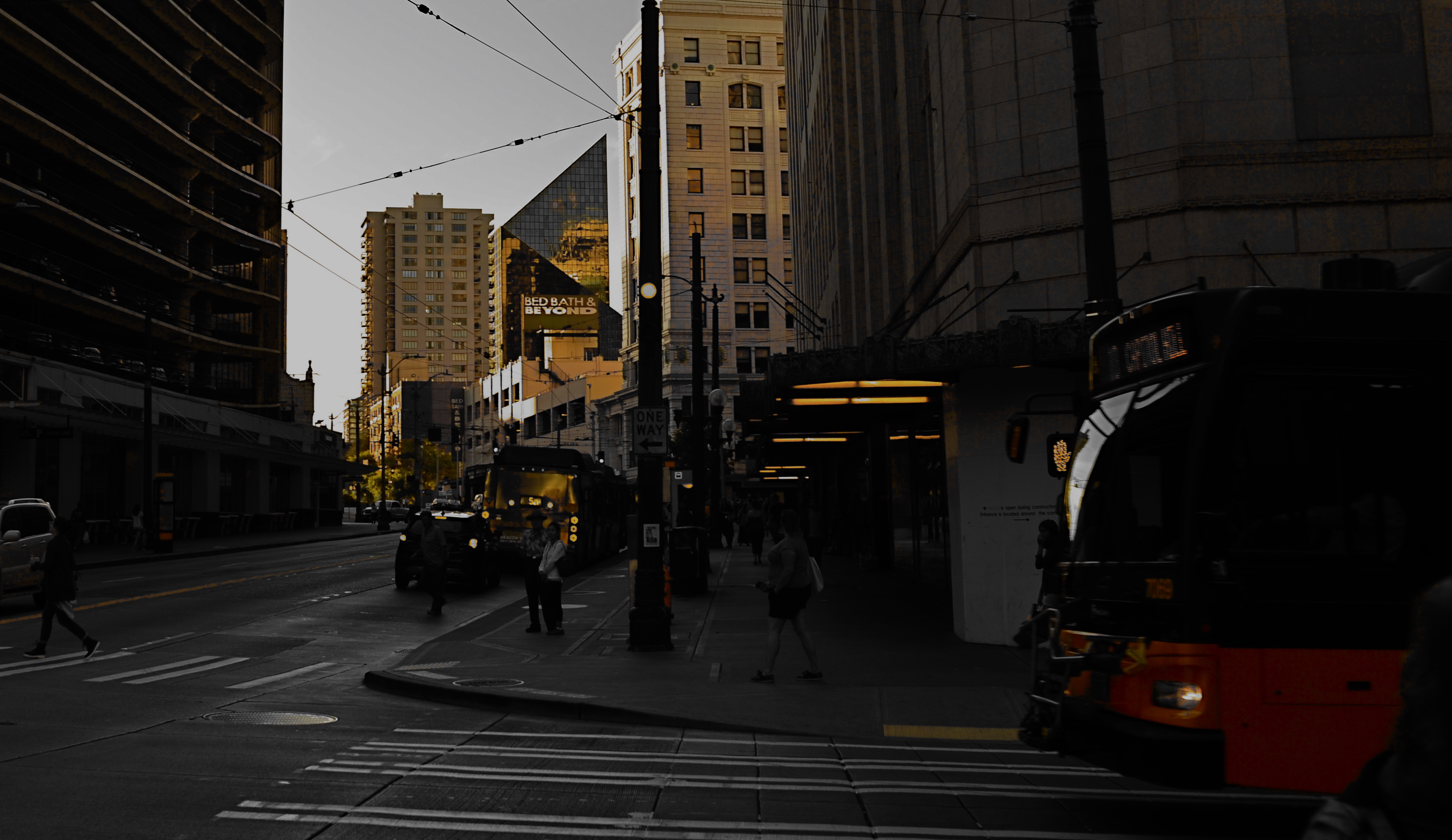
As an example, the above image supplies no storyline, nor was it meant to. The only reason for the photo is the golden light of a Seattle sunset threading its way through the darkening city streets, and I have decided that, for this particular picture, that’s enough. I have even darkened the frame to amp up the golds and minimize building detail, which can tend to “un-sell” the effect. And yet, as simple as this picture is, I’m pretty sure I could not have taken it (or perhaps might not even have attempted it) as a younger man. I hope I live long enough to teach myself the potential openness that can evolve in a picture if the shooter will Just. Stop. Talking.
YOU AND YOUR BRIGHT IDEAS
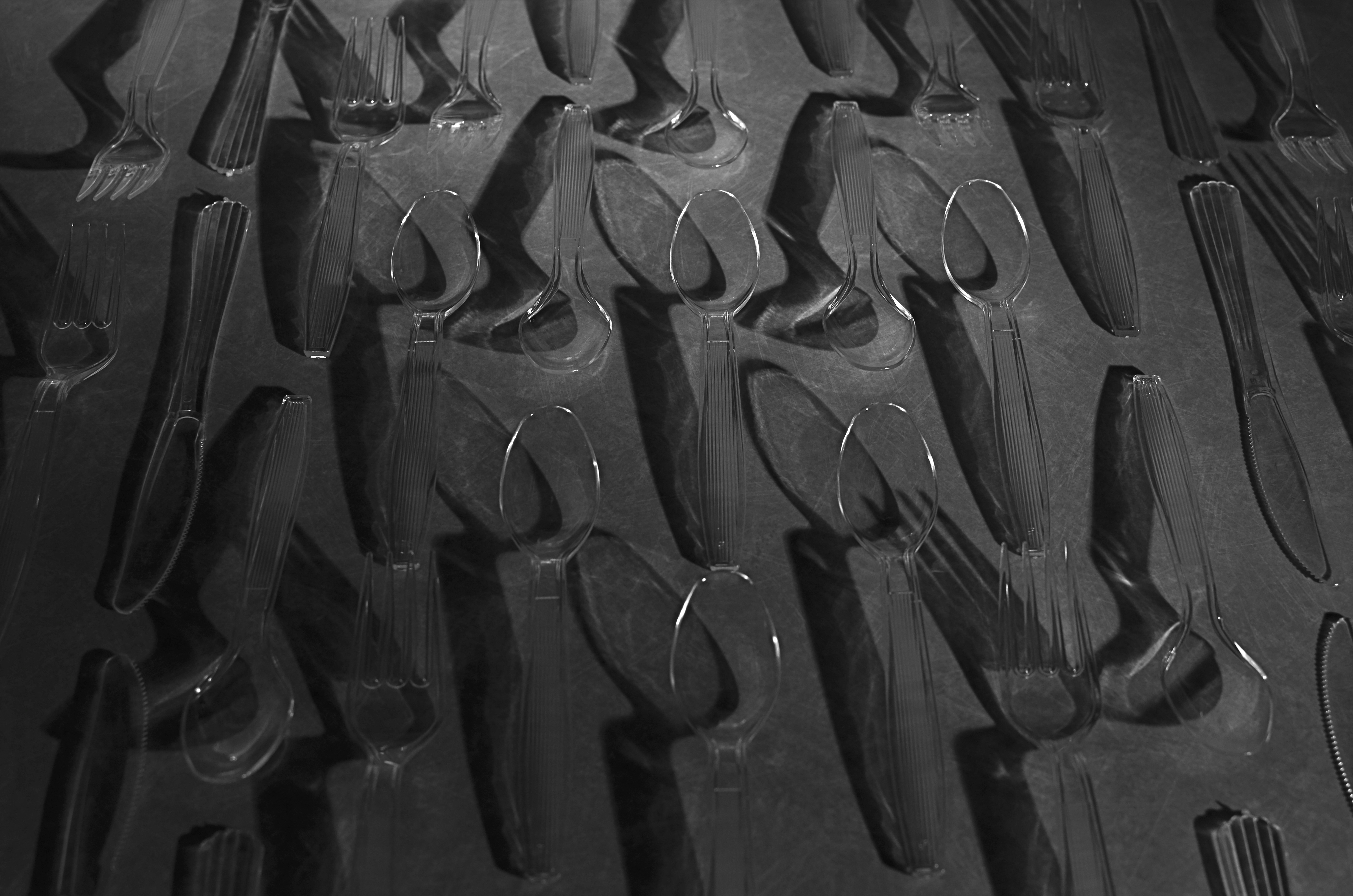
A simple manipulation of single–source light produces a wide range of effects.
By MICHAEL PERKINS
THE SELF–EDUCATION PROCESS INHERENT in photography is perpetual: that is, the lesson-learning doesn’t “clock out” merely because a given task is completed, but flows equally during the in-between moments, the spaces outside of,or adjacent to, the big ideas and big projects. Down time need not be wasted time.
Often it’s because the pressure of delivering on a deadline is absent that we relax into a more open frame of mind as regards experimentation. You find something because you’re not looking for it.
One such area for me is lighting. I seldom use flash or formal studio lights, so I obsess over cheap, mobile, and flexible means of either maximizing natural light or adding artificial illumination in some simple fashion. This isn’t just about making an object seem plausibly lit, or, if you like, “real: it’s also about choosing or sculpting lighting schemes, making something look like I want it to.
Small, powerful LEDs have really given me the chance to fill spare moments cranking out a wide array of experimental shots in a limited space with little or no prep, producing shaping light from every conceivable angle. I just lock the camera down on a tripod, make some simple arrangement on a table top, and shoot dozens of frames with different directional sweeps of the light, usually over the space of a time exposure of around a half a minute. I can move the light in any pattern, either by holding it static or tracking high/low, left/right, etc.
Frequently this activity does not result in a so-called “keeper” image. Such spare-time experiments are about process, not product. The real pay-off comes somewhere further down the road, when you have need of a skill that you developed over several days when you had.. nothing to do.
A FUNERAL AND A BIRTHDAY
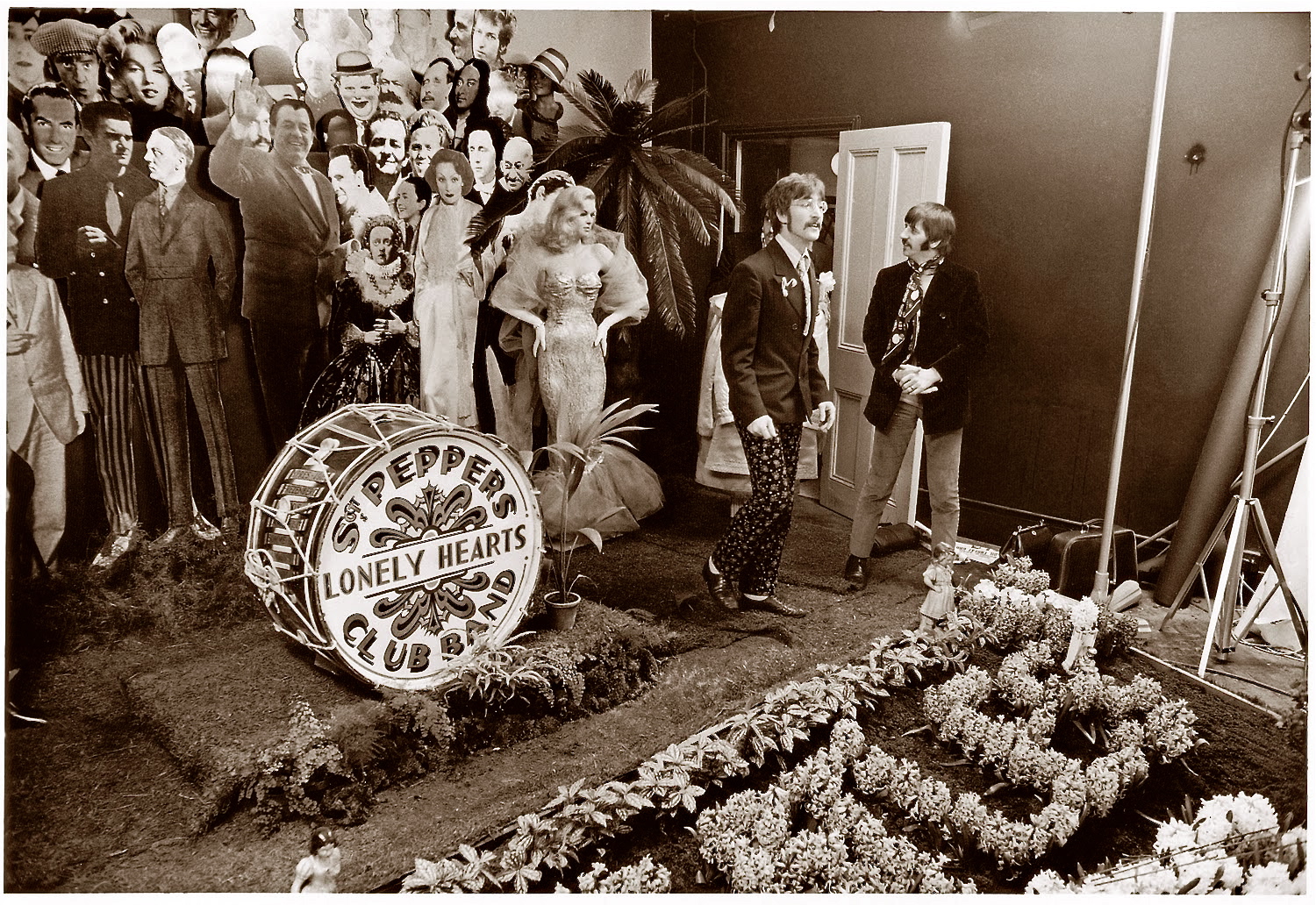
John Lennon and Ringo Starr inspect the assembly of the celebrity diorama that would be the main set piece for the Sgt. Pepper album cover, 1967.
By MICHAEL PERKINS
ANY COMPLETE DISCUSSION OF THE LEGACY OF THE BEATLES‘ Sgt. Pepper’s Lonely Hearts Club Band, marking its fiftieth anniversary in 2017, will include voluminous analyses of its ground-breaking production technique and breakthrough approach to musical composition, and rightfully so. But this most fundamental of pop culture events of the 1960’s must also be thought of in purely visual terms, since many of us first encountered it as an amazing, challenging image.
In truth, the collaboration between Pop Art designer Peter Blake and studio photographer Michael Cooper, with its ad-hoc gathering of cardboard celebrities grouped around a gravesite with the word BEATLES spelled out in blossoms, is the first act of a two-act play. The cover set the same audacious terms of engagement that the record inside the sleeve would abide by: Art and Music are what we say they are: We, the Beatles, are in complete charge of our music, our image, and our connection with the audience: we will not have “a” style, but will hybridize whatever schools of thought come to hand, from modes of composition to instruments to shifting patterns of Past, Present, and Future to coloring outside the lines of even our own culture. I read the news, today, oh, boy, and it said there are no more rules: there are no more walls. The stage can no longer hold us. Only the studio itself is vast enough to contain what we have to say.
The cover of Sgt. Pepper made a stunning break with the accepted practices used by record labels to market their goods. Quite simply, the suits in the front office were no longer in charge of the pictures. And what of that picture, or, more accurately, that picture of pictures? Is it a tribute? A put-on? A serving of notice that the Beatles are dead, long live the Beatles? Yes, yes, and hell, yes. Pepper made it plain, once and for all, that album covers, which had begun in the 1930’s as basic advertising sleeves for the goods within, could be venerated, influential, and, yeah, framed on some freak’s wall. Like, you know, man, art.
And, if Cooper and Blake were drawing a line between eras for the record world, they were doing so to an even greater degree for photography, which, in 1967, was still considered by some as more craft than art. Within a few years after A Day In The Life‘s long, ringing super-chord, museums were mounting shows by Diane Arbus, Lee Friedlander, and Robert Frank, right alongside the painters, and directly adjacent to people like Warhol who constituted categories all their own.
Just as Alice In Wonderland is somehow legless without John Tenniel’s illustrations, Sgt. Pepper’s’ outside will always be wedded to its inside, and vice versa. As the most popular multimedia product in commercial history, it owes much of its titanic impact to the image of four oddly costumed men with four strangely new mustaches and one big message: there is more to us than meets the eye. Like the best of photography, the picture issues a challenge. Nothing is real.
And nothing to get hung about…….
WHEN AND HOW
By MICHAEL PERKINS
I photograph late in the day, the time Rembrandt favored for painting, so that the subtlest tones surface. ———Marie Cosindas
ONE OF THE GREATEST SIDE EFFECTS OF MY HAVING LIVED IN THE AMERICAN SOUTHWEST over the past eighteen years has been its impact on how I harness light in my photography. The word harness conjures the act of getting a bit and bridle on a wild stallion, and so is extremely apt in reference to how you have to manage and predict illumination here in the land of So Much Damn Sun. It’s not enough here to decide what or how to shoot. You must factor in the When as well.
To see this idea in stark terms, study the work of photogs who have shot all day long from a stationary position along the rim of the Grand Canyon. The hourly, and sometimes minute-to-minute shift of shadows and tones illustrates what variety you can achieve in the outcome of a picture, if you consciously factor in the time of day. After a while, you can glance at a subject or site and predict pretty accurately how light will paint it at different times, meaning that many a session can produce a wild variance in results.
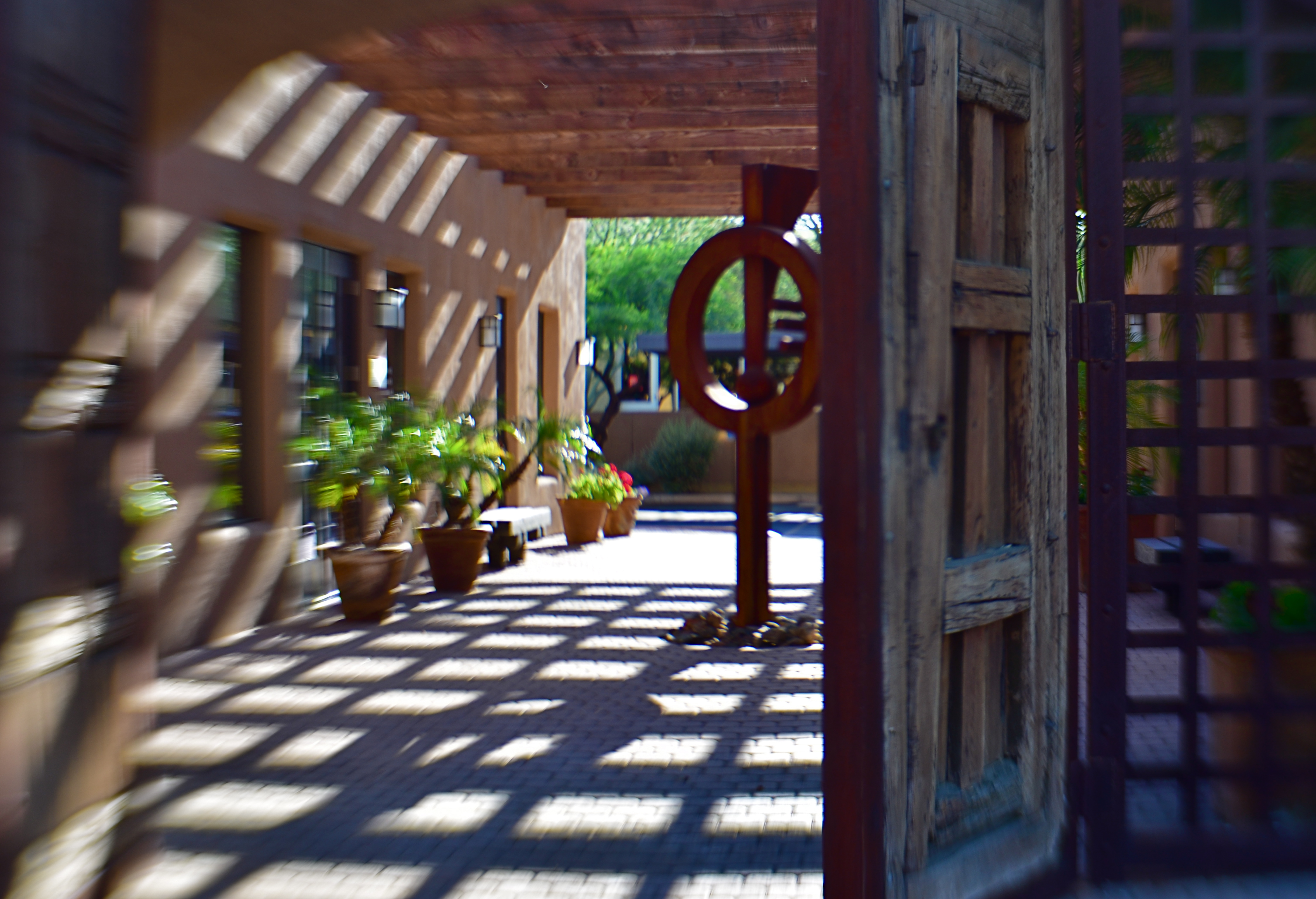
I scouted this location when sunlight was coming from the front of the court, then returned in the late afternoon to shoot it with the sun entering from the back to snag the shadow pattern I preferred.
The late photographer Marie Cosindas, whose miraculous early-1960’s work with the then-new Polacolor film helped change the world’s attitude toward color imaging, didn’t just load her film into a standard Polaroid instant camera. She shot it in her large format Linhof, experimenting with exposure times, filters and development techniques, and, above all, with the careful selection of natural light. She didn’t just wait for her subject; she waited on the exact light that would make it, and all its colors, sing. As a result, the art world began to rethink its opinion about color just being for advertising, or as somehow less “real” than black & white.
In my own work, I take the time, whenever feasible, to “case” locations a while before I shoot them, taking note over days, even weeks, to see what light does to them at specific times of day. As I mentioned, the West suffers from an overabundance of light, mostly the harsh, tone-bleaching kind that is the enemy of warm tone. In the above image, I scouted the location in the early morning, when the eastern sun was drenching the front end of the court, but waited about eight hours to return and get the precise projection of shadow grids that only occurred once the sun was in its western descent, about two hours before dusk. My test shots from the morning told me that the picture I wanted would simply not exist until ’round about suppertime. And that’s when I stole my moment.
There are three legs to the basic photographic tripod: What, How, and When. Over the years, paying greatest attention to that third leg has often given me one to stand on.
 thenormaleye