THE BLUE AND THE GREY
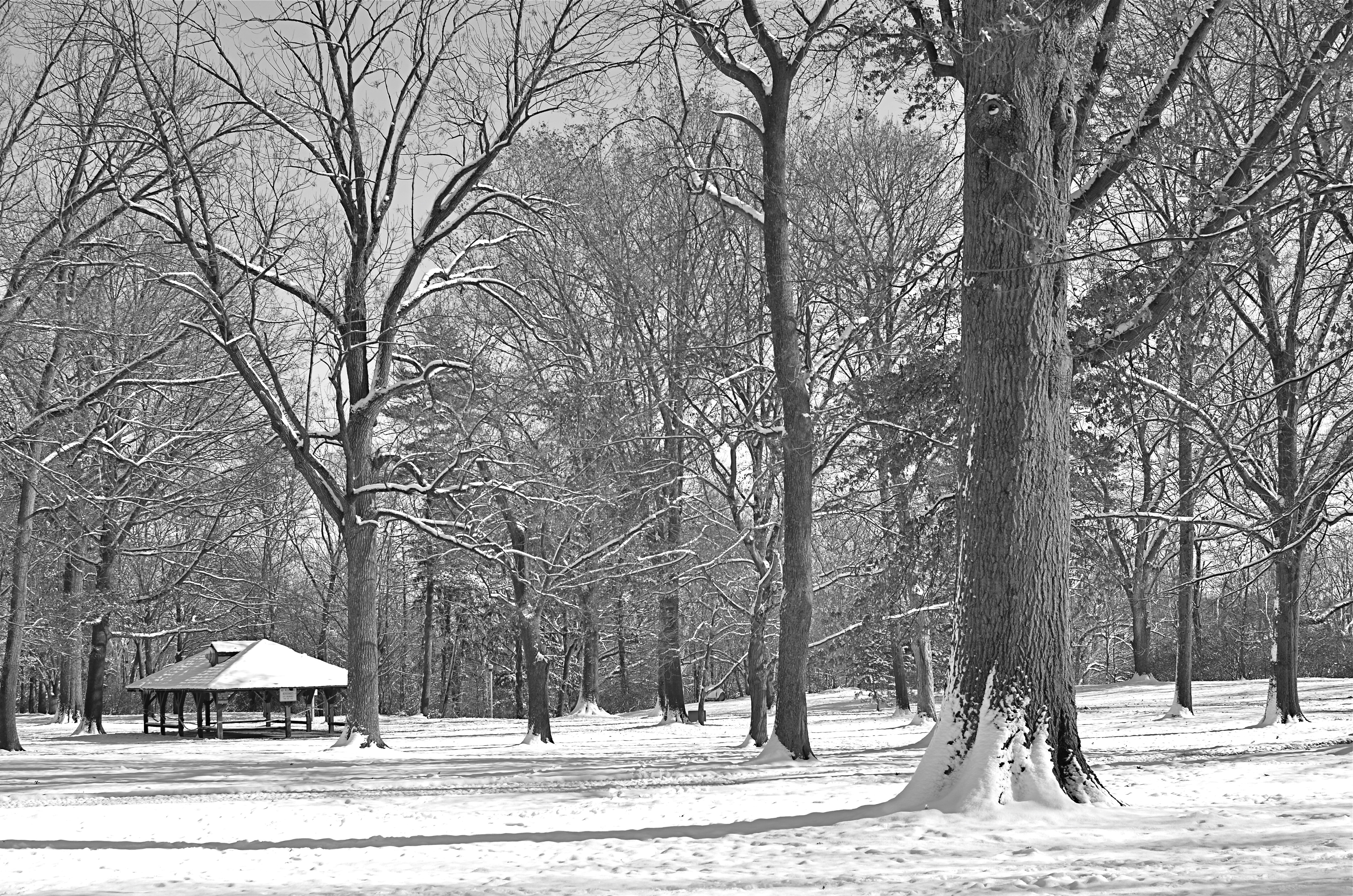
A decent winter scene, a bit too charming in its full color original, converted in-camera to straight monochrome. Now, however, it’s too bland.
By MICHAEL PERKINS
ONE OF THE GREAT BENEFITS OF DIGITAL PHOTOGRAPHY, other than its ease and affordability, is the speed at which it allows you to make comparative value judgements on images in the field. Even as digital darkrooms make it ever easier to change or modify your vision after the fact, today’s cameras also allow you to choose between several versions of a photograph while its subject is right at hand. This is an amazing mental and artistic economy, and it’s another reason why this is the absolute best time in history to be making pictures.
Many of us who made the transition from film have a lifelong habit of “bracketing”, taking multiples of the same image over a range of exposure rates to ensure that we are “covered” with at least one keeper in the batch. Others have already adopted the equivalent habit of taking several different frames with a sampling of varying white balances. I also find it helpful to use today’s in-camera filters to instantly convert color shots to three other monochrome “takes”….straight black and white, sepia and cyanotype. It’s a way to see if certain low-color subject matter will actually benefit from being reworked as duotone, and knowing that fact extra fast.
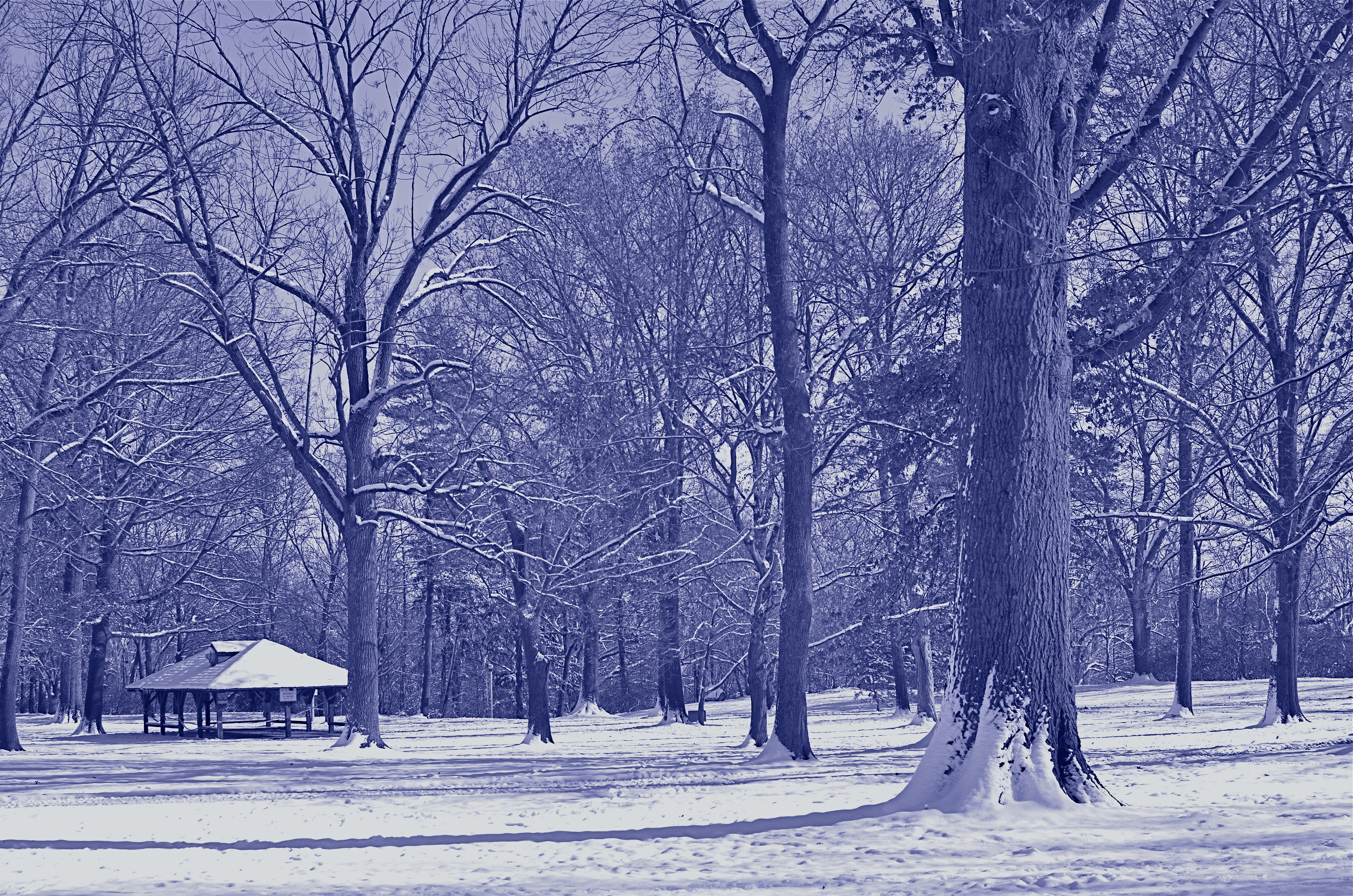
Another in-camera conversion, this time to cyanotype. This one says “winter” to me. 1/320 sec, f/5.6, ISO 100, 35mm.
Color or its selective elimination is one of the easiest tools to wield in photography. In the case of the series shown in this post, I decided that the winter scene was a little too warm and cheery in full color, a little flat in straight B&W, but properly evocative of winter’s severity in cyan. The choice was quick, and I still had the color master shot that I could choose to massage later on.
Shooting fast, that is, at the speed of your mood or whim, is a remarkable luxury, and exploiting it to the max is easy with even the most elementary camera. And anything that converts more “maybe” shots to “yes” is my idea of a good time.
I’ll have a Blue Christmas, thank you.
Related articles
- 5 Good Photography Habits to Start Today (digital-photography-school.com)
EAVESDROPPING ON REALITY
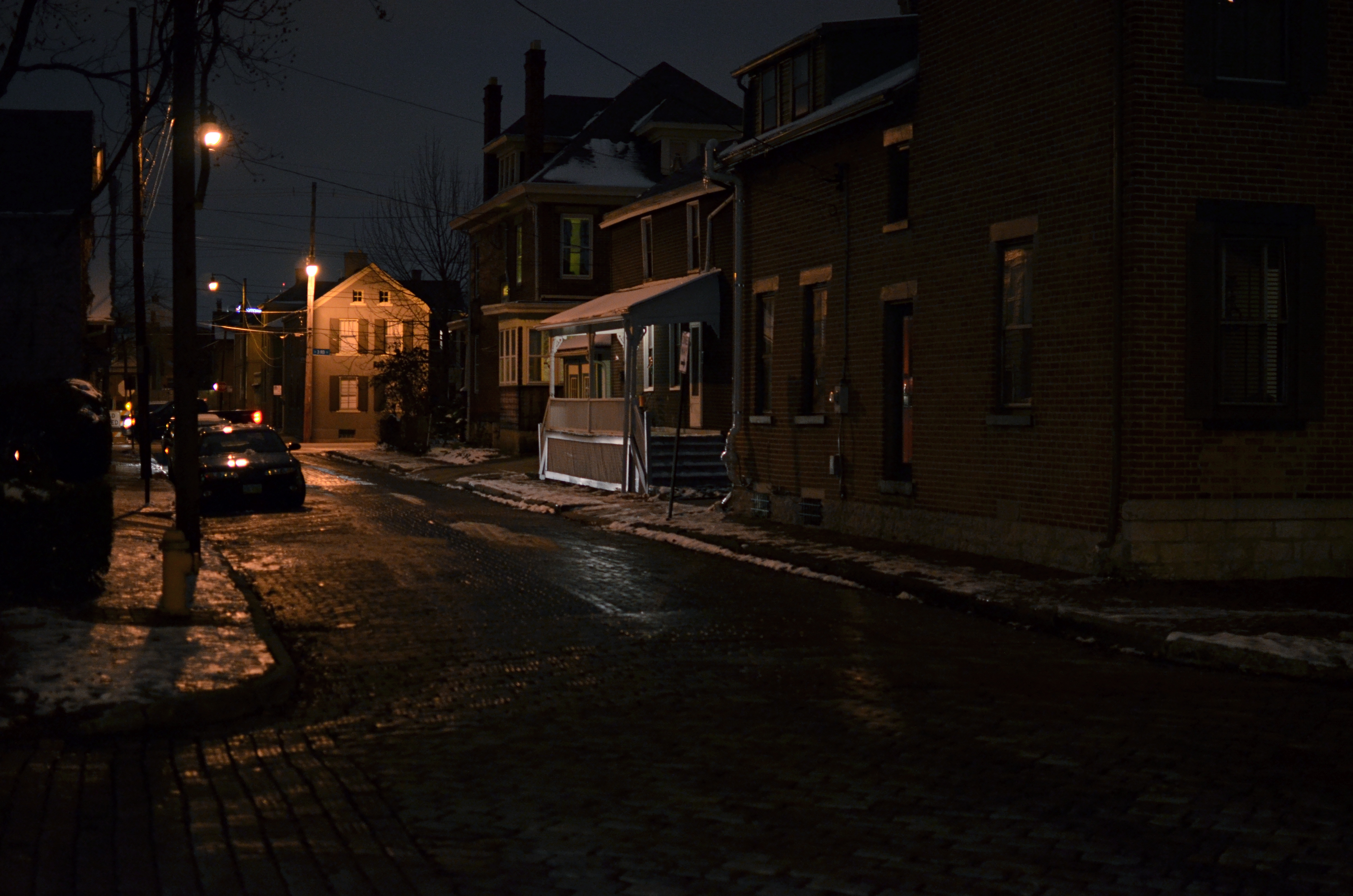
Stepping onto Blenkner Street and into history. Columbus, Ohio’s wonderful German Village district, December 2013. 1/60 sec., f/1.8, ISO 800, 35mm.
By MICHAEL PERKINS
THE FAMILIAR ADMONITION FROM THE HIPPOCRATIC OATH, the exhortation for doctors to, “First, Do No Harm” has applications to many kinds of enterprises beyond the scope of medicine, photography among them. We are so used to editing, arranging, scouting, rehearsing and re-imagining reality that sometimes, we need merely to eavesdrop on it.
Some pictures are so complete in themselves that, indeed, even minimal interference from a photographer is a bridge too far. Sometimes such images come as welcome relief after a long, unproductive spell of trying to force subjects into our cameras, only to have them wriggle away like so much conceptual smoke. I recently underwent several successive days of such frustration in, of all things, my own home town, fighting quirky weather, blocked access, and a blank wall of my own mental making. I finally found something I can use in (say it all together) the last place I was looking.
In fact, it was a place I hadn’t wanted to be at all.
Columbus, Ohio at night in winter is lots of things, but it’s seldom conducive to any urge more adventurous than reheating the Irish coffee and throwing another log on the fire. At my age, there’s something about winter and going out after sunset that screams “bad idea” to me, and I was reluctant to accept a dinner invite that actually involved my schlepping across the tundra from the outskirts to the heart of downtown. Finally, it was the lure of lox and bagel at Katzinger’s deli, not my artistic wanderlust, that wrenched me loose from hearth and home, and into range of some lovely picture-making territory.
The German Village neighborhood, along the city’s southern edge, has, for over a century, remained one of the most completely intact caches of ethnic architecture in central Ohio, its twisty brick streets evoking a mini-Deutschland from a simpler time. Its antique street lamps, shuttered windows and bricked-in gartens have been an arts and party destination for generations of visitors, casting its spell on me clear back in high school. Arriving early for my trek to Katzie’s, I took advantage of the extra ten minutes to wander down a few familiar old streets, hoping they could provide something….unfamiliar.
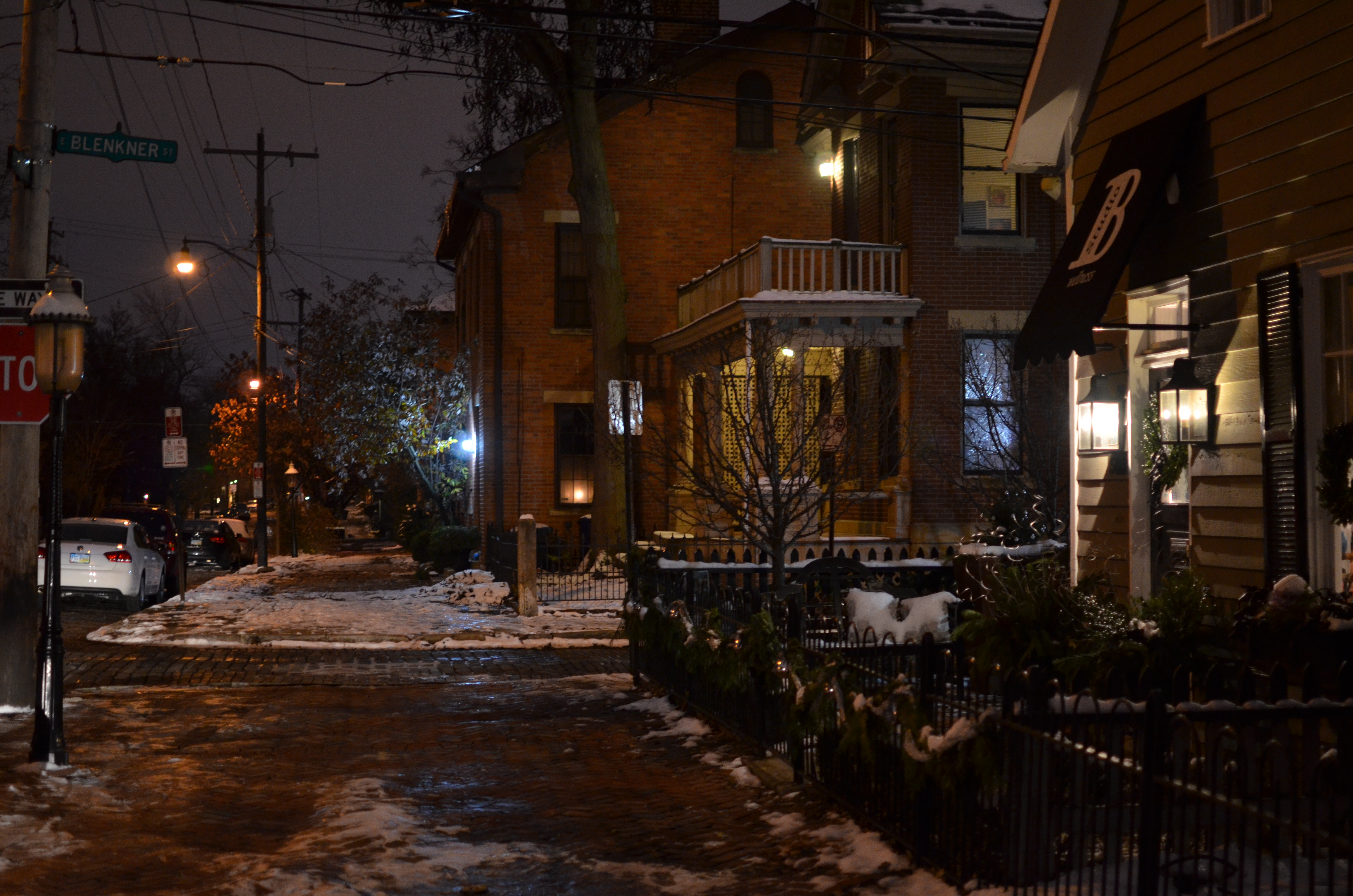
1/60 sec., f/1.8, ISO 800, 35mm.
The recently melted snowfall of several days prior still lent a warm glaze to the cobbled alleyways, and I soon found myself with city scenes that evoked a wonderful mood with absolutely minimal effort. The light was minimal as well, often coming from just one orange sodium-vapor street lamp, and it made sense to make them the central focus of any shots I was to take, allowing the eye to be led naturally from the illuminated streets at the front of the frame clear on back to the light’s source.
Using my default lens, a 35mm prime at maximum f/1.8 aperture, and an acceptable amount of noise at ISO 800, I clicked away like mad, shooting up and down Blenkner Street, first toward Third Street, then back around toward High. I didn’t try to rescue the details in the shadows, but let the city more or less do its own lighting with the old streets. I capped my lens, stole away like the lucky thief I had become, and headed for dinner.
The lox was great, too. Historic, in fact.
CROP YOUR WAY TO SUCCESS
By MICHAEL PERKINS
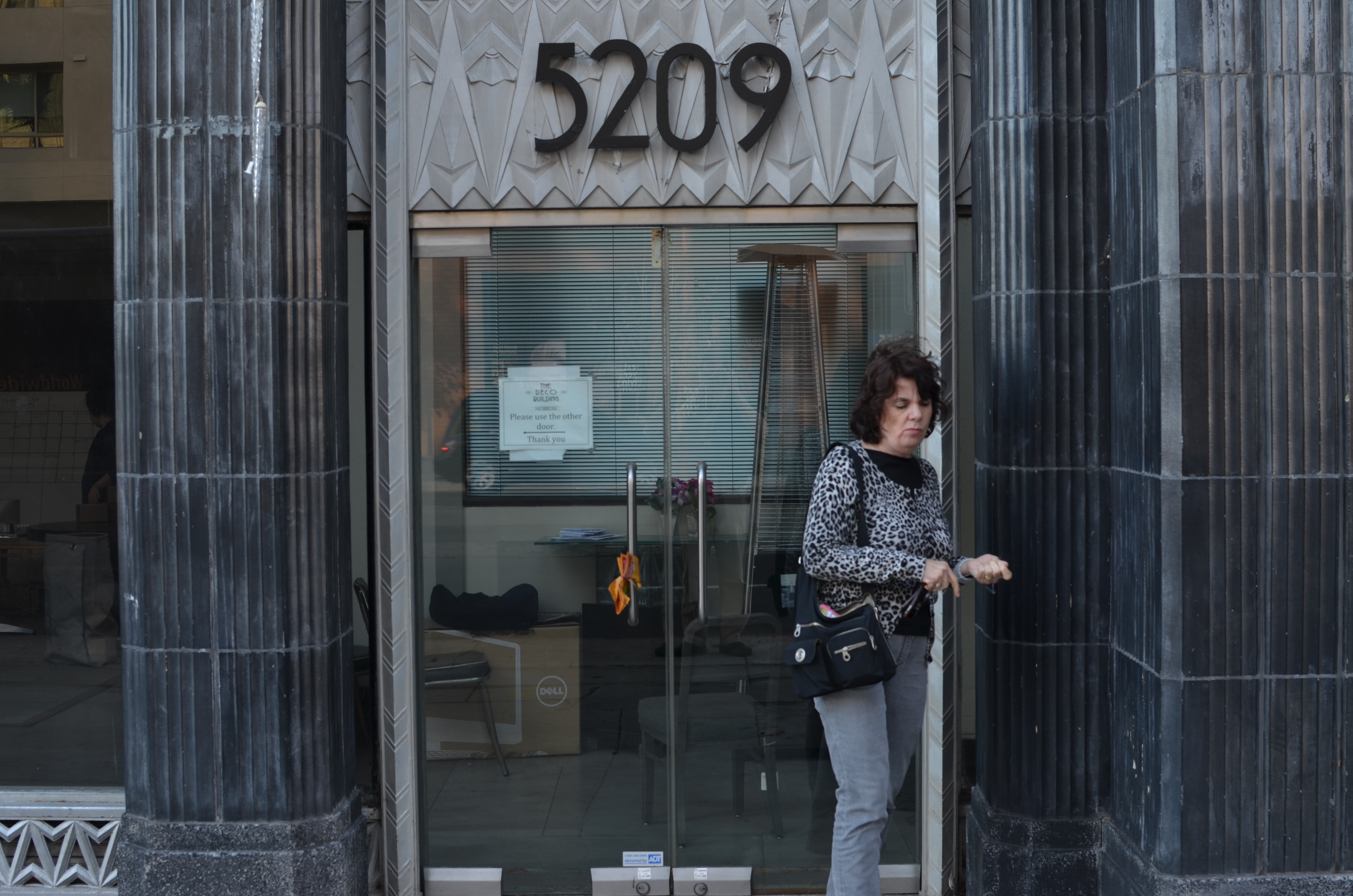
Whoops, I wasn’t ready. 1/100 sec., f/5.6, ISO 100, 35mm.
THOSE OF US WHO HAVE LOGGED SOME TIME IN THE WAITING ROOMS OF PEDIATRICIANS can recall struggling through the “Hidden Pictures” page of Highlights For Children magazine. I would love to tell you that I always found 100% of cartoonist John Gee’s camoflaged squiggles by the time the receptionist invited me into the examining room. But I would be lying.
That said, there are many times when, as photographers, we play the same game with our images, especially the ones in the “doesn’t work” pile. Loving at least the idea behind what we were originally after, we pore over every pixel in the frame, repeating the vain mantra there must be a picture in here somewhere. Often, the photo simply returns to the Hall of Shame despite our best efforts to redeem it. Sometimes, the crop tool is your unexpected best friend.
I recently looked at a failed candid of my wife outside one of my favorite buildings in Los Angeles, the “Deco” Building (real name) at the corner of La Brea and Wilshire near the museum district. A combination of wind and facial expression had spoiled the quickie portrait, but the address panel over Marian’s head contained something I could use if I re-purposed the picture.
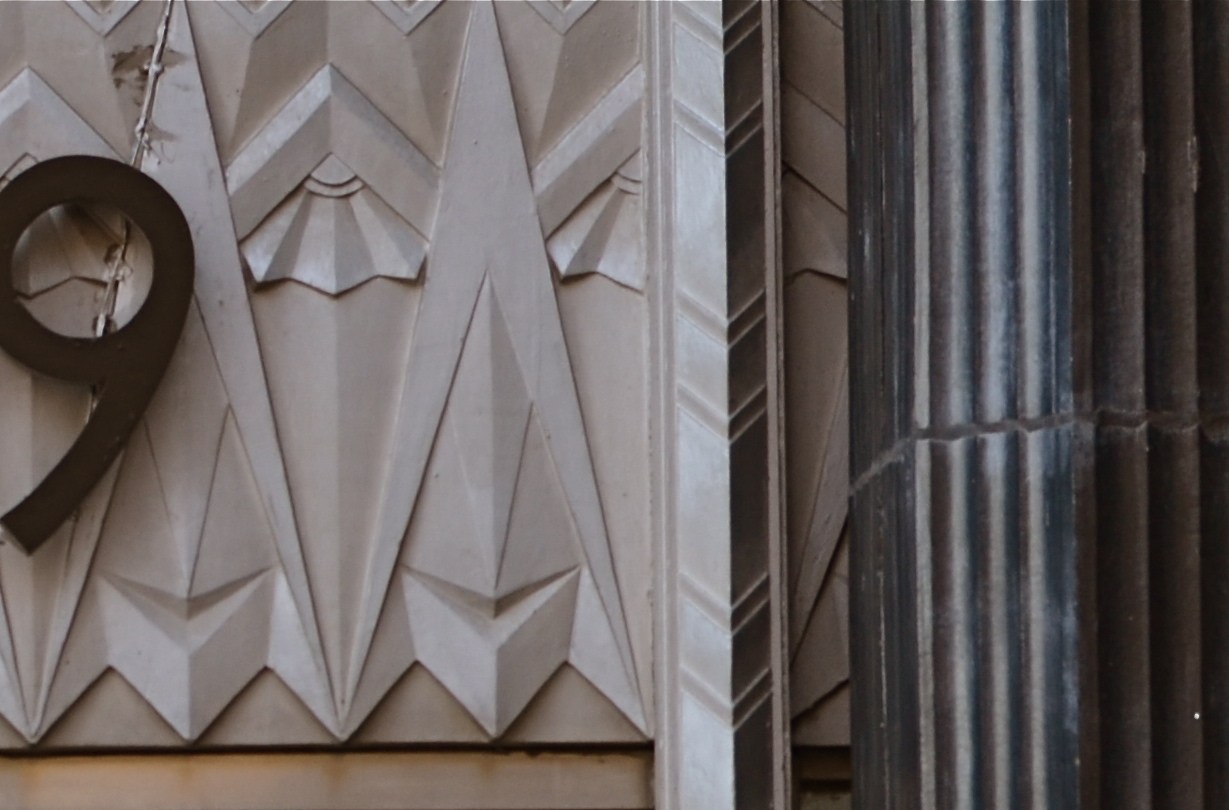
I gave the above shot a severe haircut and wound up with this. Hmm, maybe this was all the picture I needed in the first place.
In the space of a few inches of the building’s entrance was a miniature representation of the best features of the entire building; its wild pattern of chevrons and zigzags. I had already done a master shot of about 90% of the front of the place, but a study of its details started to sound appealing. Cropping away more than 2/3rds of the original shot reduced the sharpness a little, but since I always shoot at the highest file size possible, I just squeaked by.
For a moment, I found that I had redeemed all those failed sessions with Highlights.
Watch out, New York Times crossword. You’re next.
THE WORLD IN A FACE
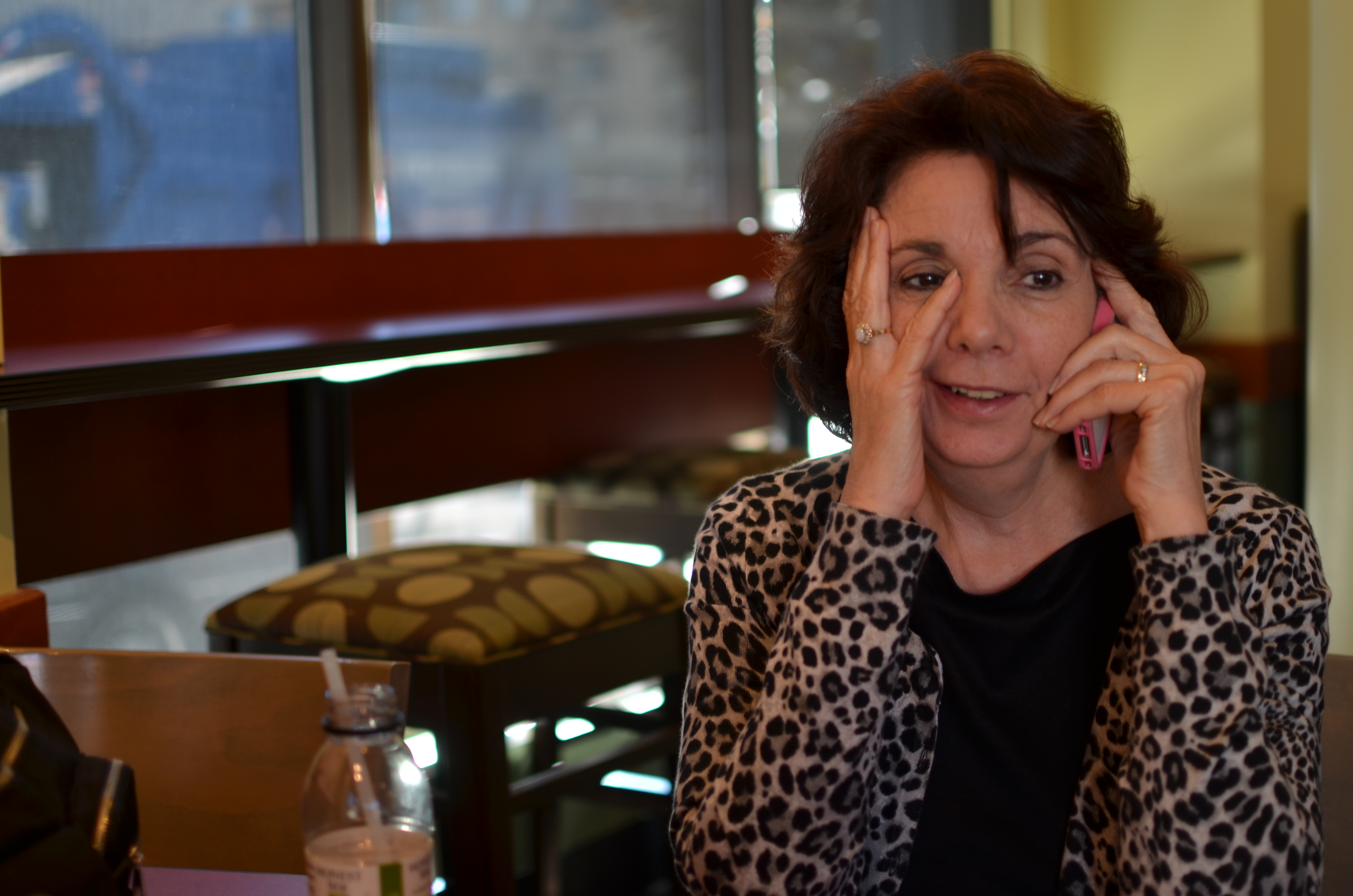
Marian, Los Angeles, November 2013. 1/100 sec., f/1.8, ISO 100, 35mm.
By MICHAEL PERKINS
The mystery isn’t in the technique. It’s in each of us.
THE AMERICAN PHOTOGRAPHER HARRY CALLAHAN , author of the above quotation, knew about the subject of mystery, especially as it regarded women. Make that one woman, namely his wife Eleanor, who posed for Callahan’s camera for sixty-three years in every kind of setting from abstracts to nudes and back again, providing him with his most enduring muse.
Lucky man.
I know exactly how he felt. Because I feel the same way about my own wife, Marian.
Interpreting and re-interpreting a single face over time is one of the best ways I can imagine to train your eye to detect small changes, crucial evolutions in both your subject and your own sense of seeing. And Marian has given me that gift during our time together, as her features seem, to me, to be an inexhaustible source of exploration. It’s a face that is equal parts tenderness and iron resolve, a perfect balance between joy and tragedy, a wellspring of sensations. It is a great face, a great woman’s face, and a fascinating workspace.
Working as I always am to make her relax and forget herself when I am framing her up, I have long since abandoned the practice of announcing that I was going to take her photograph. There is never any posing or sitting. I approach her the way I would a stranger on the street. I wait for the moment when her face is in the act of becoming, than sneak off with whatever I can steal. Sometimes it takes a little more stealth than I am comfortable with, but my motives are simple; I don’t want the mechanics of photography to block what is coming from that face.
Phone conversations are my best friends, as they seem to magically suspend her self-consciousness and her awareness of the schmuck with the camera. And every once in a while, in viewing the results, she bestows my favorite compliment:
“That one’s not too bad…”
For praise like that, I’ll follow a face anywhere. Because the mystery isn’t in the technique.
It’s in all of her.
JUST SAY THANK YOU
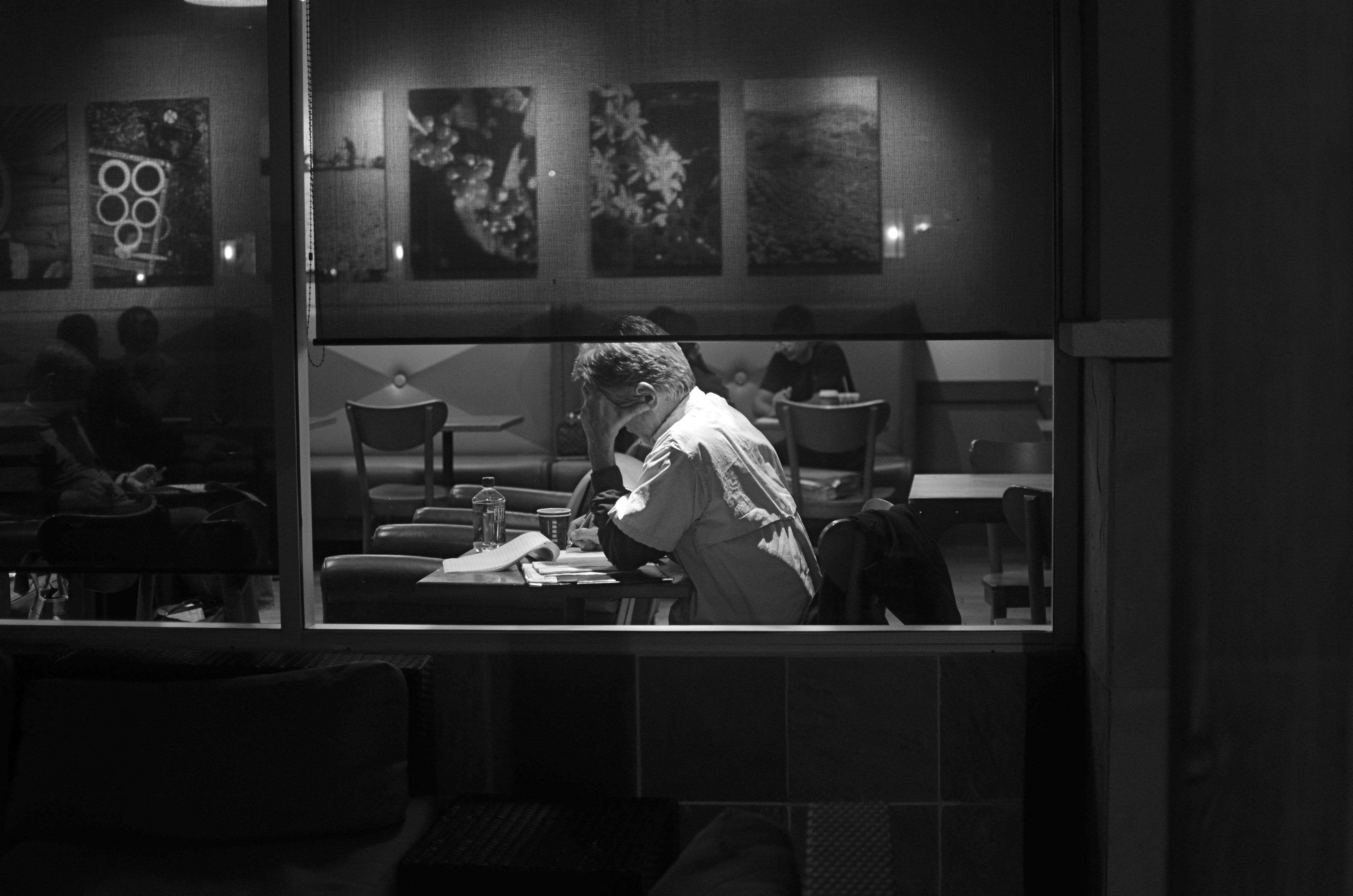
The All-Nighter: 1/60 sec., f/1.8, ISO 800, 35mm.
By MICHAEL PERKINS
PICTURES HAPPEN WHEN YOU’RE OUT TRYING TO TAKE “OTHER” PICTURES. Pictures happen when you didn’t feel like taking any pictures at all. And, occasionally, the planets align perfectly and you hold something in your hand, that, if you are honest, you know you had nothing to with.
Those are the pictures that delight and haunt. They happen on off-days, against the grain of whatever you’d planned. They crop up when it’s not convenient to take them, demanding your attention like a small insistent child tugging at your pants leg with an urgent or annoying issue. And when they call, however obtrusively, however bothersome, you’d better listen.
Don’t over-think the gift. Just say thank you….and stay open.
This is an overly mystical way of saying that pictures are sometimes taken because it’s their time to be taken. You are not the person who made them ready. You were the person who wandered by, with a camera if you’re lucky.
I got lucky this week, but not with any shot I had set out on a walkabout to capture. By the time I spotted the scene you see at the top of this post, I was beyond empty, having harvested exactly zip out of a series of locations I thought would give up some gold. I couldn’t get the exposures right: the framing was off: the subjects, which I hoped would reveal great human drama, were as exciting as a bus schedule.
I had just switched from color to monochrome when I saw him: a young nighthawk nursing some eleventh-hour coffee while poring over an intense project. Homework? A heartfelt journal? A grocery list? Who could tell? All I could see, in a moment, was that the selective opening and closing of shades all around him had given me a perfect frame, with every other element in the room diffused to soft focus. It was as if the picture was hanging in the air with a big neon rectangle around it, flashing shoot here, dummy.
My subject’s face was hidden. His true emotion or state of mind would never be known. The picture would always hide as much as it revealed.
Works for me. Click.
Just like the flicker of a firefly, the picture immediately went away. My target shifted in his chair, people began to walk across the room, the universe changed. I had a lucky souvenir of something that truly was no longer.
I said thank you to someone, packed up my gear, and drove home.
I hadn’t gotten what I originally came for.
Lucky me.
related articles:
- Crop and turn a bad picture into a good one (weliveinaflat.wordpress.com)
TAKE WHAT YOU NEED AND LEAVE THE REST
By MICHAEL PERKINS
LOOKING OVER MY LIFETIME “FAIL” PHOTOGRAPHS, FROM EARLIEST TO LATEST, it’s pretty easy to make a short list of the three main problems with nearly all of them, to wit:
Too Busy.
Too Much Stuff Going On.
I Don’t Know Where I’m Supposed To Be Looking.
Okay, you got me. It’s the same problem re-worded three ways. And that’s the point, not only with my snafus but with nearly other picture that fails to connect with anybody, anywhere. As salesmen do, photographers are always “asking for the order”, or, in this case, the attention of the viewer. Often we can’t be there when our most earnest work is seen by others. If the images don’t effectively say, this is the point of the picture, then we haven’t closed the deal.
It’s not simple, but, yeah, it is that simple.
If we don’t properly direct people to the main focus of our story, then we leave our audiences wandering in the woods, looking for a way out. Is it this path? Or this one?
In our present era, where it’s possible to properly expose nearly everything in the frame, we sometimes lose a connection to the darkness, as a way to cloak the unimportant, to minimize distraction, to force the view into a succinct part of the image. Nothing says don’t look here like a big patch of black, and if we spend too much time trying to show everything in full illumination, we could be throwing away our simplest and best prop.
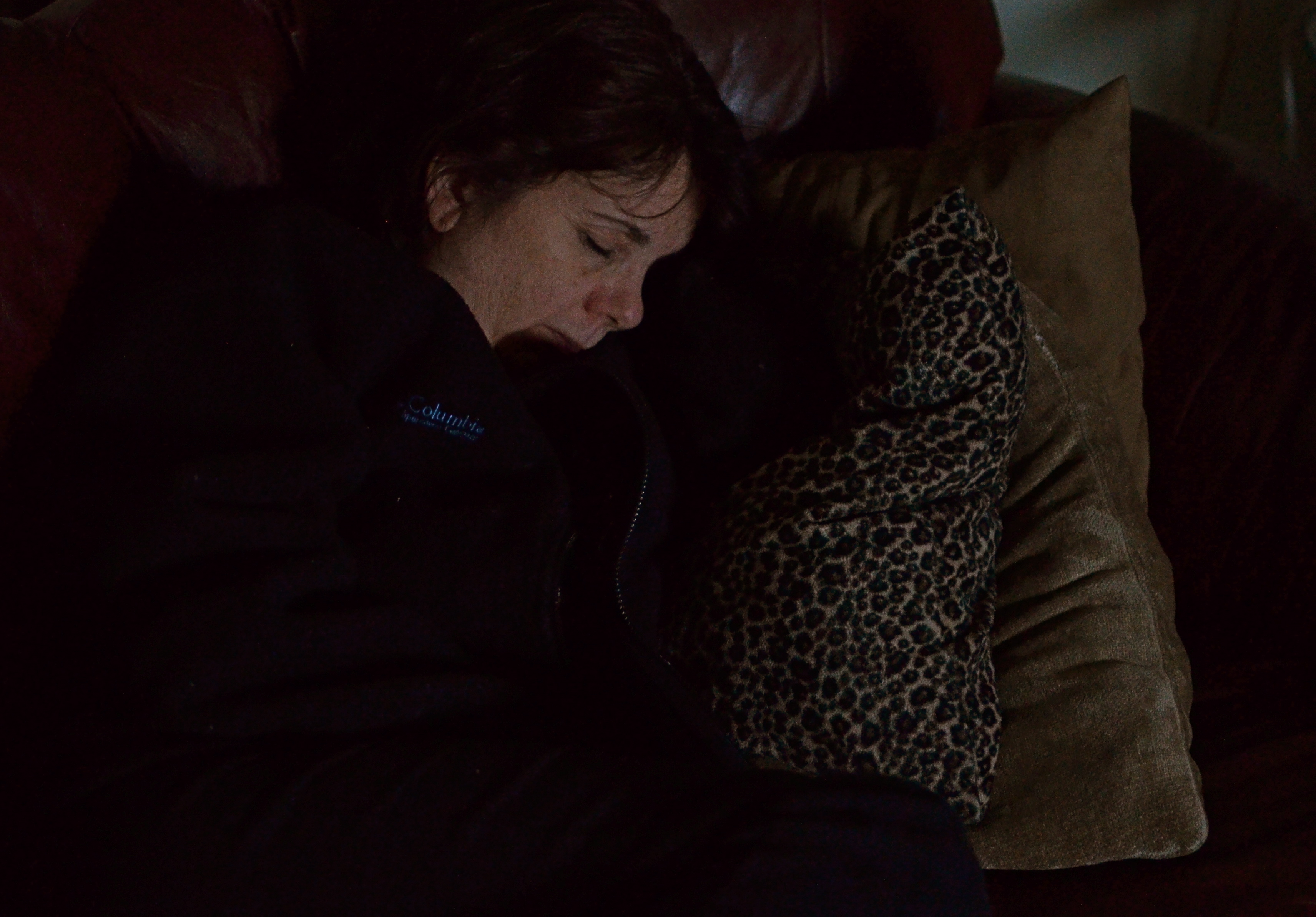
Let sleeping wives lie. Work the darkness like any other tool. 1/40 sec., f/1.8, ISO 1250 (the edge of pain), 35mm.
In the above picture of my beautiful Marian, I had one simple mission, really. Show that soft sleeping face. A little texture from the nearby pillows works all right, but I’m just going to waste time and spontaneity rigging up a tripod to expose long enough to show extra detail in the chair she’s on, her sweatshirt, or any other surrounding stuff, and for what? Main point to consider: she’s sleeping, and (trust me) sleeping lightly, so one extra click might be just enough to end her catnap (hint: reject this option). Other point: taking extra trial-and-error shots just to show other elements in the room will give nothing to the picture. Make it a snapshot, jack up the ISO enough to get her face, and live with the extra digital noise. Click and done.
For better or worse.
Composition-wise, that’s often the choice. If you can’t make it better, for #%$&!’s sake don’t make it worse.
Follow Michael Perkins on Twitter @MPnormaleye.
TAKING / BRINGING
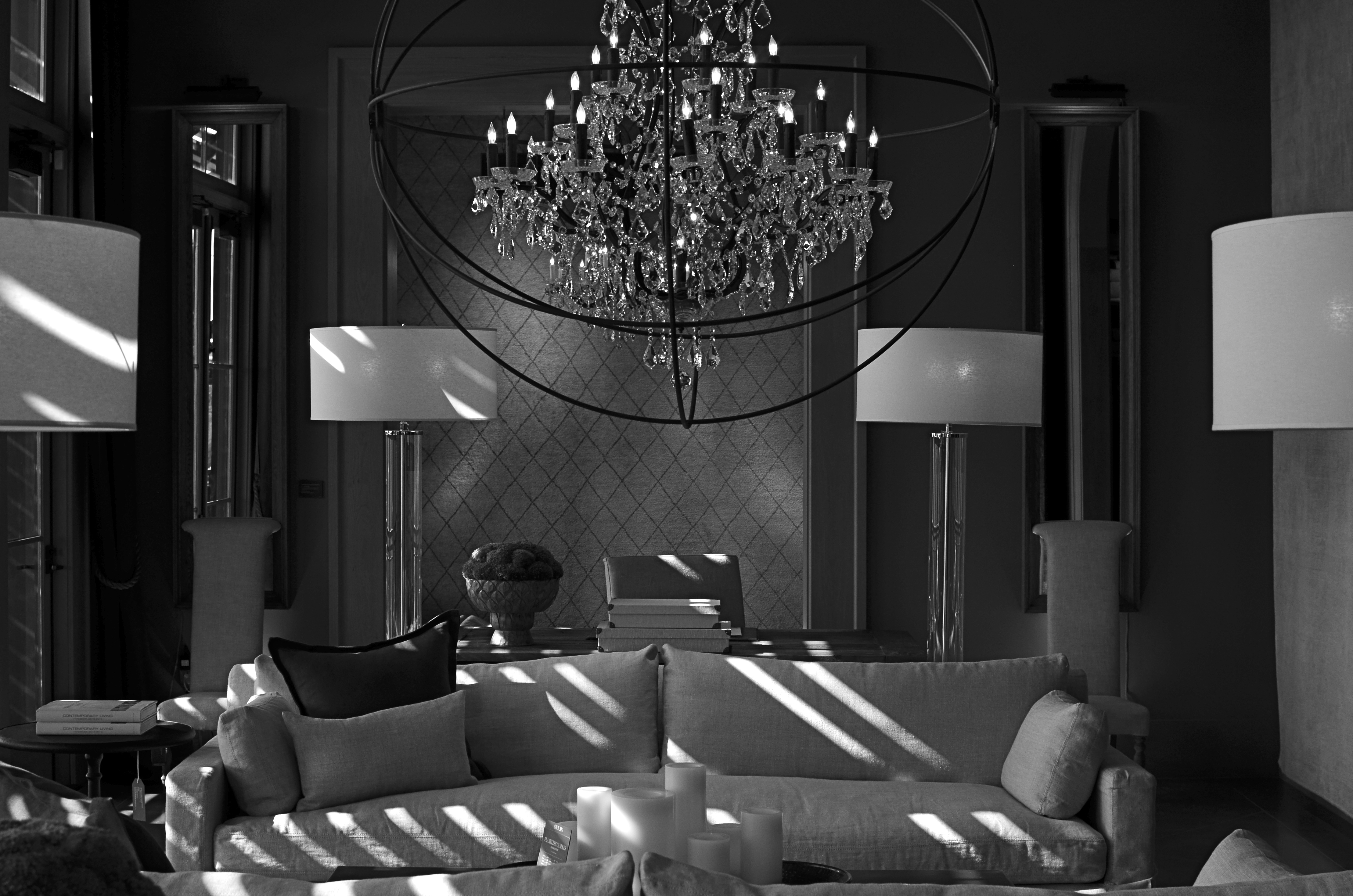
The Room Where Nothing Happens. Or Not. 1/100 sec., f/5.6, ISO 160, 35mm.
By MICHAEL PERKINS
INTELLECTUALLY, I KNOW THAT PHOTOGRAPHS DON’T NECESSARILY HAVE TO BE “ABOUT”, well, anything, but that doesn’t stop the 12-year-old photo newbie deep inside me from trying to produce images with “meaning” (yawn). Some reason to look. A subject. A story line. A deliberate arrangement of things for the purpose of communicating…something. Itchy and twitchy within my artist’s skin as I always am, I am never more out of my element than when I make a picture that is pure composition and form, a picture that has no reason to exist except that I wish it to.
As I get older, I get looser (no G.I. tract jokes about the elderly, please), and thus making what you might call “absolute” images gets easier. I just had to learn to give myself permission to do them. Unlike Atget, Brassai, and half a dozen early pioneering photographers, I don’t have to take pictures to earn my bread, so, if I capture something that no one else “gets” or likes, my children will not starve. Still, the act of making photographs that carry no narrative is far from native to me, and, if I live to be 125, I’ll probably learn to relax and really do something okay by about 93.
The process can be a head-scratcher.
The above image is an “absolute” of sorts, since I have no emotional investment whatever in the subject matter, and have nothing to reveal about it to anyone else. The arbitrary and somewhat sterile symmetry of this room, discovered during a random walk through a furniture store, just struck me, and I still cannot say why. Nor can I explain why it scores more views on Flickr over some of my more emotional work by a margin of roughly 500 to 1. A whole lot of people are seeing something in this frame, but I suspect that they are all experiencing something different. They each are likely taking vastly varied things from it, and maybe they are bringing something to it as well. Who knows what it is? Sense memory, a fondness for form or tone, maybe even a mystery that is vaguely posed and totally unresolved.
“Even though there are recognizable objects making up the arrangement, the result is completely abstract.There isn’t a “human” story to tell here, since this room has never been inhabited by humans, except for wandering browsers. It has no history; nothing wonderful or dreadful ever happened here. In fact, nothing of any kind ever happened here. It has to be form for its own sake; it has no context.
I liked what happened with the very huge amount of soft window light (just out of frame), and I thought it was best to render the room’s already muted tones in monochrome (it wasn’t a big leap). Other than that, it would be stupid to caption or explain anything within it. It is for bringers and takers, bless them, to confer meaning on it, if they can. As I said earlier, it’s always a little scary for me to let go of my overbrain when making a picture.
Then I remember this is supposed to be about feeling as well as thinking.
***Deep breath***
Next.
Follow Michael Perkins on Twitter @MPnormaleye.
Related articles
- First Critique (cohensrphotography.wordpress.com)
CHASING THE SENSATION
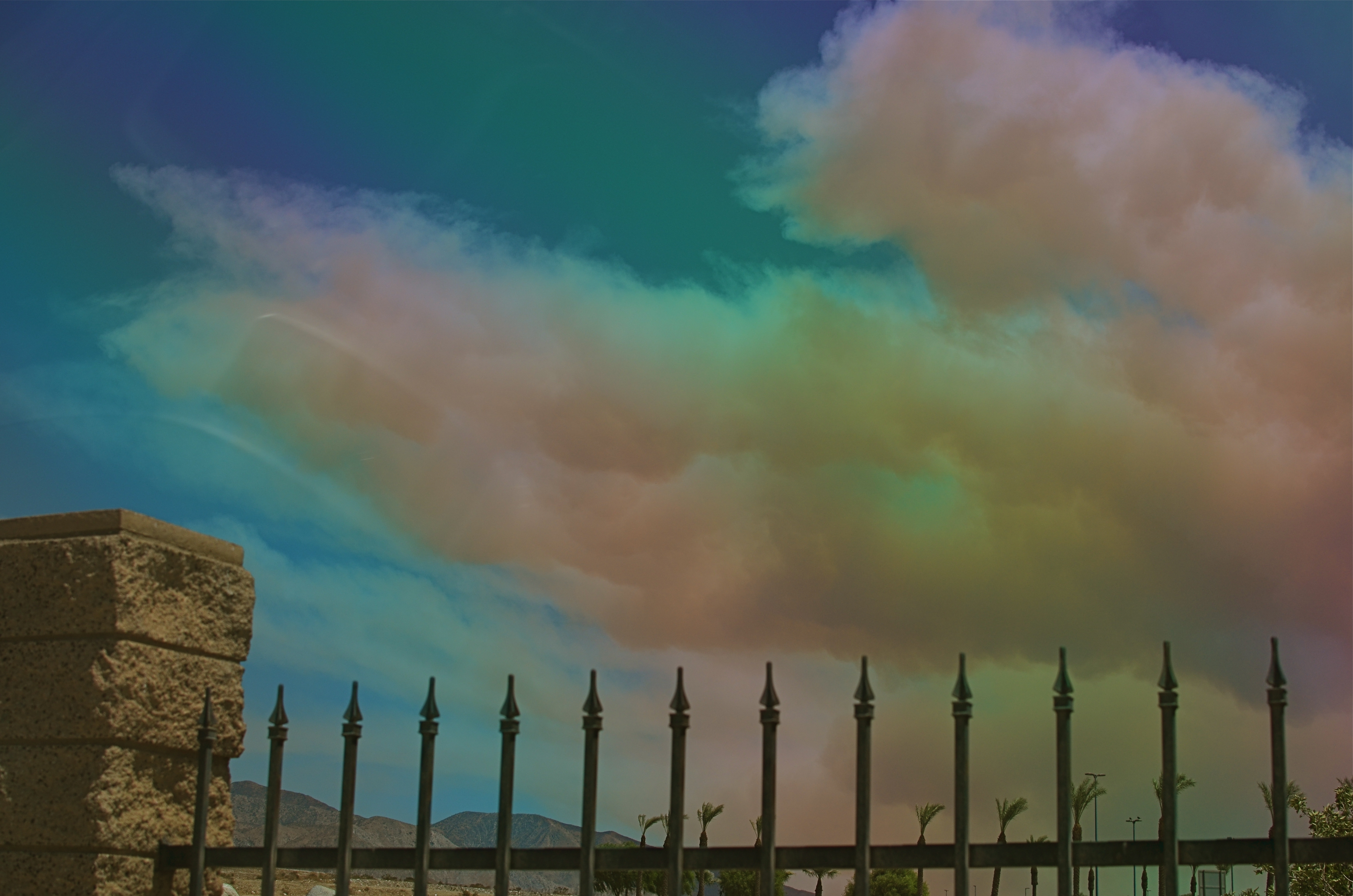
Wildfire, Cabazon, California, August 8, 2013. 1/500 sec., f/5.6, ISO 100, 35mm.
By MICHAEL PERKINS
SHOOTING LARGE SUBJECTS IS OFTEN MORE CHALLENGING THAN CAPTURING STORIES NEAR AT HAND. If you’re doing a tight frame around a bowl of fruit, there may be more than only one story for the shot, but, compared to trying to find the essential visual core of a vast area, it’s not really the stuff of MENSA club meetings. When you’re shooting tight, the message, the central spine of the idea reveals itself fairly quickly. Panning over an immense scene, the story is “out there”, but your editor’s eye will certainly get a more rigorous workout in paring away the unneeded extras.
Important note before we continue: I am not a storm chaser. I lack the mixture of admirable fortitude and creepy bravado that allows people to take truck and gear in hand in an insane game of dodge-ball with a meteorological Godzilla. So, if I am in the position to grab a moment during one of Mother Nature’s more picturesque tantrums, it’s purely a case of being in the right place at the right time. I am not intrepid. To my thinking, the only thing cool about being Indiana Jones is, you get to wear a seriously rockin’ hat.
Thus, the above frame is largely luck, the very casual luck associated with pulling off the road for a rest stop precisely as something is becoming interesting. The cloud you see belongs to a horrible wildfire that tore through more than 20,000 acres in California’s San Jacinto Mountains last Thursday, August 8, 2013. From our westward trek toward Los Angeles on the I-10, most of what we saw of the fire, for nearly 100 miles, was a dense, diffuse haze which more closely resembled Pollution’s Greatest Hits of 1968 than a fire. However, during our leg-stretcher at the wonderful Hadley Fruit & Nut superstore in Cabazon, California, it was finally possible to see a salmon-colored, tightly defined cloud of fire smoke, snaking its way southward across the freeway, billowing to the size of a football stadium over the mountainous terrain near our car.
The cloud was a free, here-you-are gift, the central part of the story, but the shot wasn’t ready. I needed some earthly point of reference to convey its size, and all I had were distant palm trees and fairly featureless terrain. Fortunately, there was a short masonry wall that marked Hadley’s lot from those of its neighbors, and, crouching down a bit, I could bring it into frame as some way to contextualize the cloud monster. The other problem was haze, which was rendering all colors too faintly, given the high position of the sun reading off the smoke. A simple screw-on polarized filter cut the haze and delivered the hues. Click and done.
Back in the car, far away from the Devil Cloud, and on to L.A.
With a lucky frame in the back seat.
And walnuts and raisins in the front.
Follow Michael Perkins on Twitter @MPnormaleye, and view his Flickr photostream at:

 thenormaleye