LADLING IT ON
By MICHAEL PERKINS
IN THE PRACTICE OF PHOTOGRAPHY, it’s often difficult to know when a simple composition will serve as the best overall tool for an effective narrative. We all heard something from our ninth-grade science teacher about the shortest distance between two points being a straight line, and some of that directness, expressed as an image that gets to the point without needless visual distractions or detours, certainly applies to some of our best work.
But then again…
Some pictures certainly suffer from an overabundance of detail. The eye can get lost on its way to the main point of the photograph; competing components of equal appeal can wrestle each other for dominance in a scene; and, of course, excessive clutter can defuse a photo’s impact altogether. Imagine a large Where’s Waldo? panorama in which, to your frustration, you just never manage to find Waldo at all.
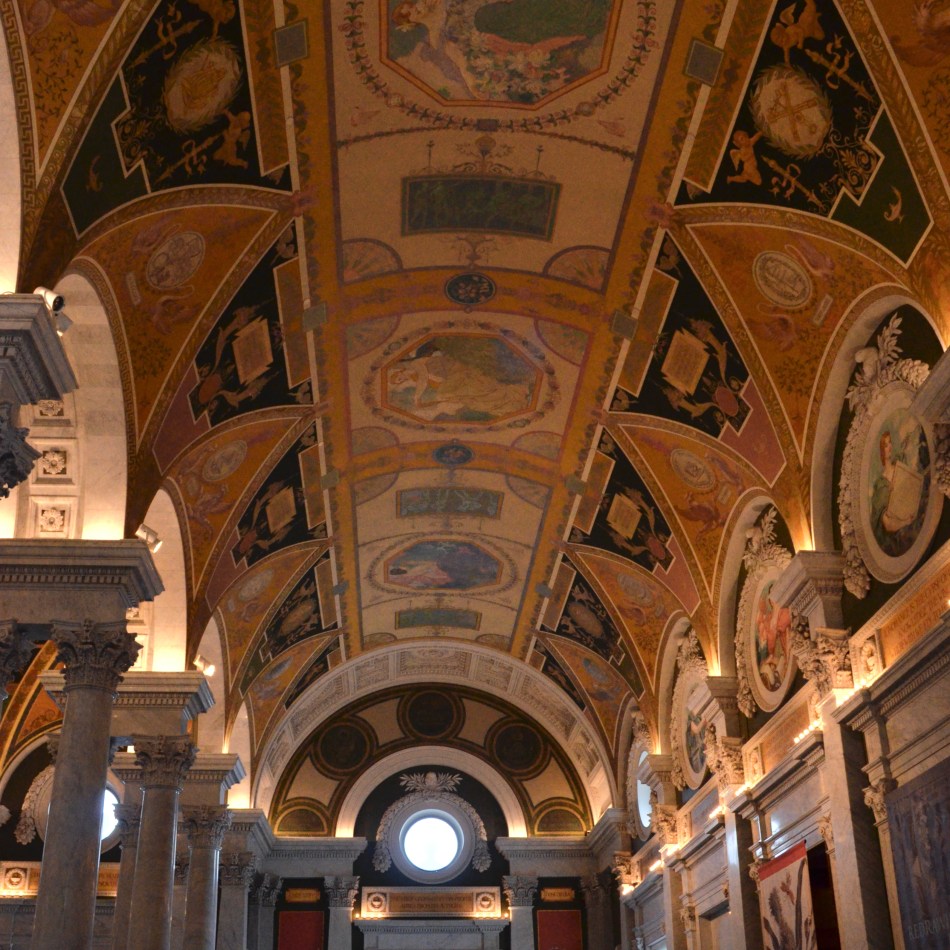
That said, there are subjects which are busy, busy, busy, but which might actually lose their power if you tried to tidy them up or streamline them. Consider the above shot of a hallway inside the Library of Congress. Here is a place where no one even considered the minimalist credo that “less is more”. Indeed, this magnificent building is about majesty, power, prestige, officialdom, if you will. It means to shout loud and proud. It is an expression of an empire, an edifice to the grandeur of the ideas contained within its walls. Simple and spare just won’t cut it for such a place, and a photograph taken of it needs to respect that.
Even in places that boast this level of ornamentation, however, you can take small steps to prevent your viewer’s eye from being overwhelmed. An even, bright exposure, for example, with nothing lurking in shadows to trick your viewer into going on a scavenger hunt; sharp focus from front to back to allow all the detail to be prominently displayed; and the use of whatever leading lines might be in the structure, to keep the eye moving in as close to a single direction as possible, emphasizing depth and scale.
The old “keep it simple, stupid” rule does, indeed serve photographers well in scads of cases. But for those few occasions where busier is better, go full-tilt boogie and really ladle it on. The knack of knowing when to say “how much” and when to say “too much” is some of the best editorial education you can ever treat yourself to.
DANCING WITH A STRANGER
By MICHAEL PERKINS
I’VE BEEN ORGANIZING A GIFT FOR MY SON’S FORTIETH BIRTHDAY, which is an overview of a specific photographic theme spanning the last ten years. A decade is a nice round figure, a handy unit of time for evaluating one’s evolution in various enterprises, and so the exercise has led me to go back the same stretch across my online image postings, but, instead of looking at the entire span of ten years, I became obsessed with throwing out the clutter from exactly ten years ago. I’d like to say it was a pleasant trip down memory lane, but, in fact, I’ve done most of it with one eye closed, all the better to minimize my cringing.
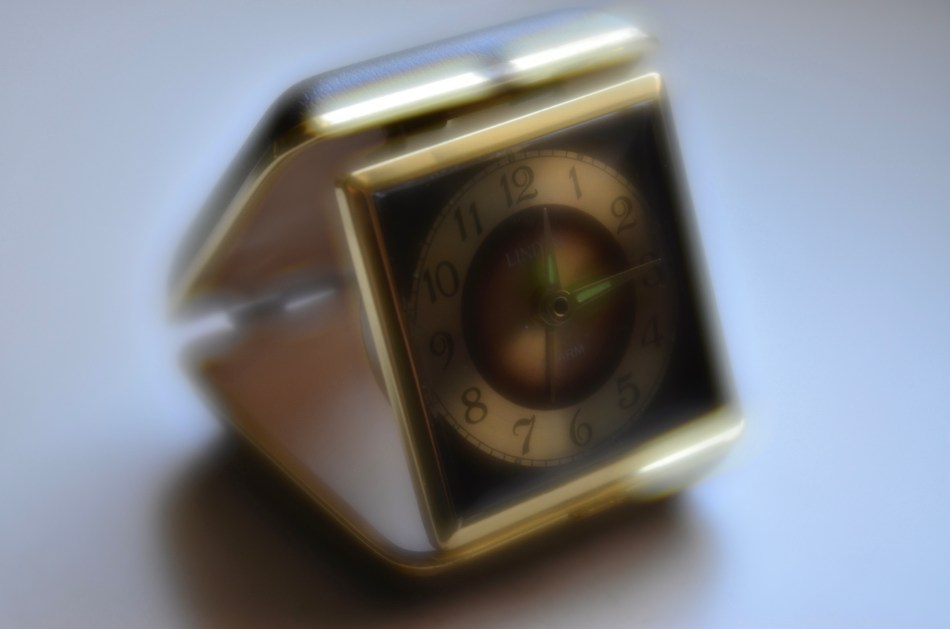
It’s more than sobering to look at the stuff you felt happy enough about to throw onto the interweb just a decade ago, almost like trying to pull off an intimate dance with a total stranger, and not a very good looking one at that. I am not trying to lead the world championship in false modesty when I say that the old delete button was looking quite shopworn when the job was done, and, if anything, I feel that the large pile of photographic detritus at my feet represents me being generous in too many cases where my sentiment overrode my sense.
You are, of course, a little bit alienated from your old self every new time you pick up a camera. Get enough distance between yourself and what you once thought was your “good stuff” and the contrast can knock you off your pins. Chances are, the You of Today sees composition, narrative, exposure and subject matter with a completely different set of priorities than the You of Yesteryear. That is, if you’re lucky. If you still regard your work of ten years ago as “all killer, no filler”, you may have spent the last decade walking in circles. Or you may be the greatest genius in the history of photography, in which case I’d like to become the local chapter president of your fan club.
Me, I’m pledging to re-edit my portfolio with a lot more regularity in the future. It may not be much more pleasant, but I’d rather face several dozens of my biggest misses at a time than legions of the suckers. In the meantime, I have that gift book to finish, and I’d better hurry up about it. If I think about it too long, I might just reduce the tome to a pamphlet and send my kid a coupon for a Happy Meal.
FAB FOR THE TIMES
By MICHAEL PERKINS
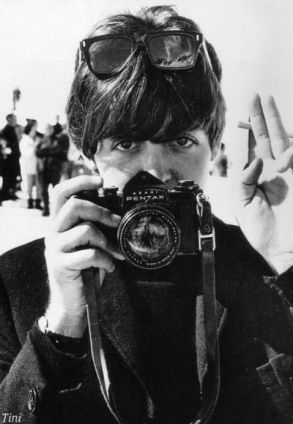
OUR STORY BEGAN as I was recently rifling through early images of the Beatles, and marveling at the material objects the Fab Four spent some of their First Real Money on, like, as with many of us, so-called “serious” cameras.
Over the history of camera design there have been two distinct Halls of Fame, one being a “who done it first” roster of innovators and the other being more of a “who wore it best” list of brands that had the greatest success and/or reputation connected with those breakthroughs. Many camera makers both introduce and adapt, and some brands, even if they come late to someone else’s refinement, capitalize on them better than even its originators. And so it goes.
One company that sparked true innovation at its peak but saw its tech eventually adapted by names that eventually eclipsed it was Pentax, now known as a mere phantom shell brand under Ricoh but once a verrrry key player in camera design. Founded in Tokyo in 1919, Pentax began as a maker of lenses for eyeglasses and soon thereafter adapted its polishing and coating techniques to make entry into the camera lens field. By the early 1960’s, the 35mm camera had become universal as an amateur tool, but many things remained to be done for it to appeal to aspiring pros as well. Two such needs, for true through-the-lens focusing and simplified light metering, was being met by a few forward-thinking makers, and, among these, Pentax was the first to create a fully practical SLR, years ahead of Canon, Nikon and other contenders.
And so enter the Pentax Spotmatic, sporting a film advance lever (faster and easier than most company’s advance knobs), completely in-body metering function, compatibility with all M42 screw-mount lenses (offering a lot of choices across competing manufacturers) and a sleek, lightweight body. And here is where we, if you will, Meet The Beatles. The Fab Four, on their first American tour in 1964, were still in the habit of doing nearly everything as a group, and so Paul, George and Ringo all purchased new Asahi Pentax Spotmatics as their “real” cameras as they made their way across the states. Ringo in particular seems to have taken to the snapping hobby especially well, taking advantage of the hours the band spent sequestered in hotel rooms or sheltering away from their manic public by taking tons of candids that have recently come to light in special exhibitions and in the 2017 book Photograph. Most of the previously unpublished images were shot on Ringo’s Pentax.
The Spotmatic and its progeny proved to be an affordable, easily-operated workhorse within the Pentax stable for years to come, even as the company itself saw its innovations co-opted and perfected by other brands. Today, like many once-mighty names that have been purchased, re-purchased or hollowed out by new parent companies, this once-major player in the design sweepstakes deserves a hallowed place among those who made the creation of images easier, faster, and more reliable. Analog or digital, all design rises or falls on how it removes obstacles between the envisioning and the execution of an idea, as the world asks but one thing of its most beloved cameras:
“Please please me..”.
ZOOMACRO
By MICHAEL PERKINS
THE LONGER ONE IS INVOLVED IN PHOTOGRAPHY, the greater the temptation is to streamline one’s “quantitative” approach to equipment….specifically, how much of it we need with us at any one time. We’ve all seen ( have often been) the folks who decide to lug along multiple camera bodies, lots of lenses, and assorted support devices and toys, and, for many of these people, that is a workable approach to doing good work. Others decide, over time, that they want less gear that does more. I have lived in Camp One, and I prefer life in Camp Two. I try to decide, before heading out, which camera/lens combo will give me most of what I want in most situations. That means leaving some stuff back at the house and maximizing the flexibility of what you have at hand, or, as the modified stock car racers term it, “run what you brung”.
In recent years, the increased number of wildlife shoots in which I tag along has more or less dictated the use of a telephoto of some kind. However, when the birds and beasts decide to sleep in, I love to default to close work with flowers or other nature subjects. That means trying to make the zoom do the work of a macro lens, since I don’t have a true macro with me at the moment. And, happily, it turns out that I can do about 90% of what I want from a macro with a telephoto anyway.
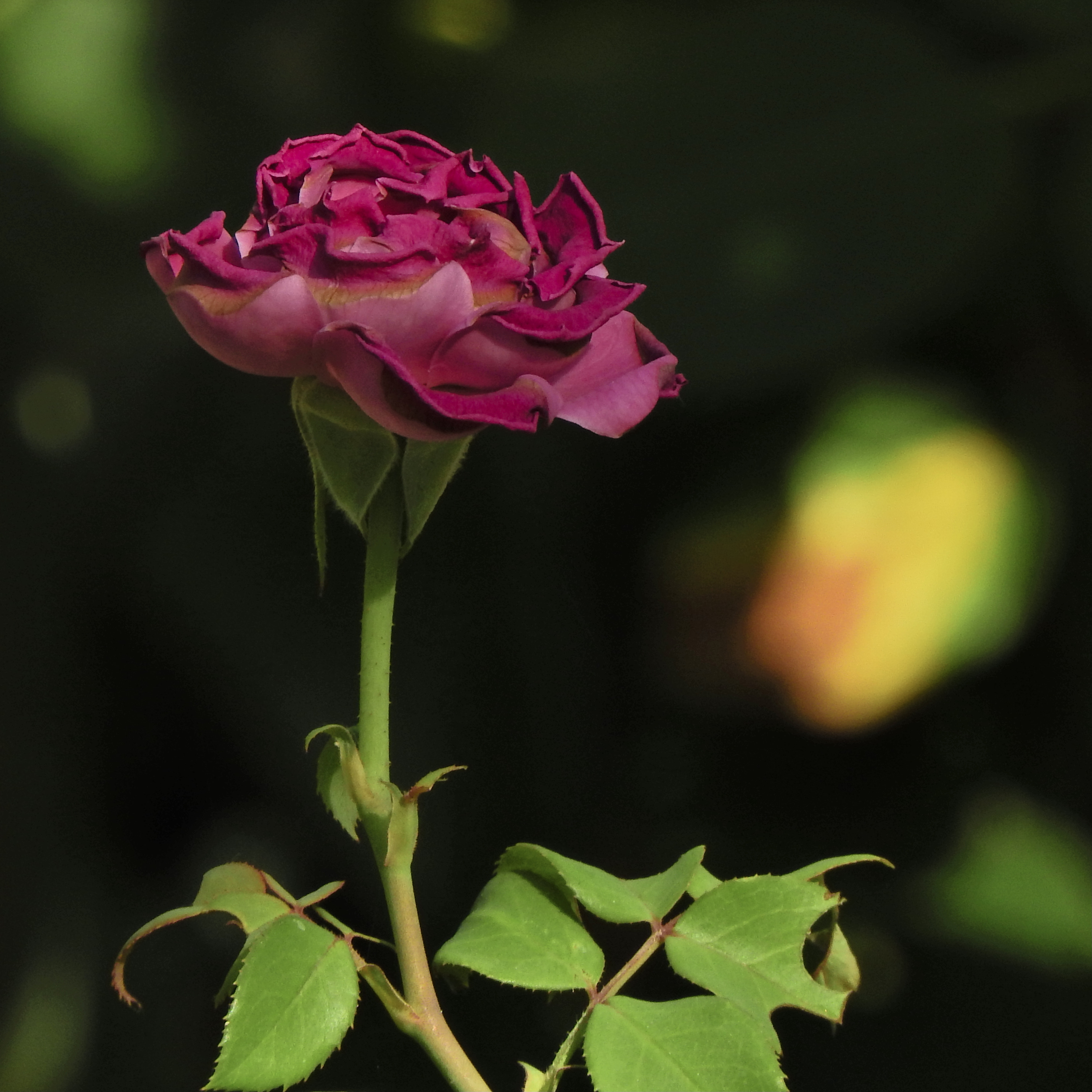
The minimum focal distance of a zoom dictates that you stand fairly far away from your target (say a flower), or else your autofocus will just whirr and dither, and so the first thing you have to do is back away. It’s not uncommon to stand fifteen or more feet from your subject before zooming in. Of course, at maximum zoom, your choice of apertures may be more limited, meaning you can’t open up wider than about f/4. This, in turn, means that you may not be as able to isolate a sharp foreground object from its softer background clutter as neatly as a macro would allow you to at, say, f/2 or wider. What I do in a case like this is actually underexpose a bit by shooting at a fast shutter speed, trying to position the subject in direct light and letting everything behind it roll off into darkness. It’s crude but easy.
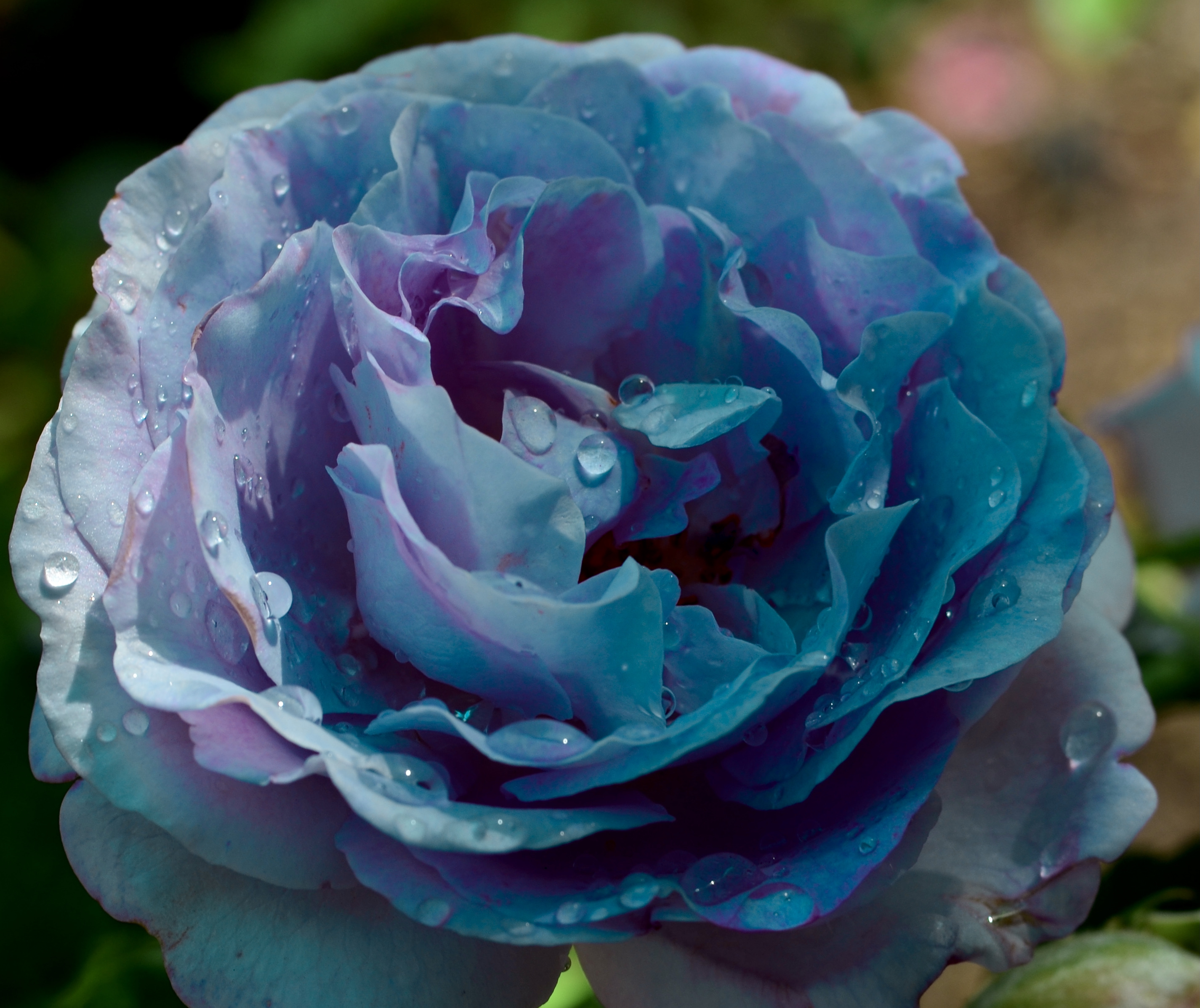
A caveat: true macros are extremely precise instruments, and, in making a zoom do macro-like work, you shouldn’t expect to nail the same superfine detail as a lens dedicated solely to the task. That means you’ll see the delicate patterns on a butterfly’s wings, but you won’t be able to count the dots in his eyes. Still, in comparing the two images here, one a true macro and the other a “zoomacro”, many might concede that they both generally bring home the bacon (spoiler alert: the top photo is the genuine macro). Bottom line: it is easy to force a telephoto to perform this kind of double duty, making your shooting less complicated and cumbrous and producing fairly consistent results.
THE BALLET OF BIG AND LITTLE
By MICHAEL PERKINS
LOOKING BACK AT THE EARLIEST FORMATS FOR AMATEUR SNAPSHOTS, it’s almost possible to hear the frustration of photographers trying to deliver the world in a greatly constricted work space. Peruse your grandparents’ photo albums and you will find a number of images printed in such small sizes as to render anything more complex than a candid of a friend nearly unreadable. Size doesn’t matter in all things, but, for some subjects, the canvas needs to have a little breathing space.
Serious photographers with bulky medium and large format cameras could always create work on any scale that they preferred (think Ansel Adams), but amateurs in the first decades of the twentieth century were often confined to small spaces, many around the size of the present-day “credit card” prints produced by the Instax line of instant cameras. This miniature-scaled way of seeing in the world was death for landscape work especially, and it was not until the introduction of the 35mm camera and improved technology for enlargement (including the option of slide projection) that mountain ranges, seashores and canyons started to get their proper due.
Now, while it’s possible to photographically capture and suggest grand scenes, our urban sprawl hems us in once more, littered as it is with wires, signs and neon clutter. It’s not what to shoot, but where to stand when shooting it, that makes the difference. Often we ourselves are so desensitized to the garbage through which we habitually view beauty that we’re surprised when the camera records the visual debris that we’ve taught ourselves not to see. I once heard a Nikon rep say that, even in the middle of the ocean, some people’s pictures could somehow manage to have telephone lines visible in them.
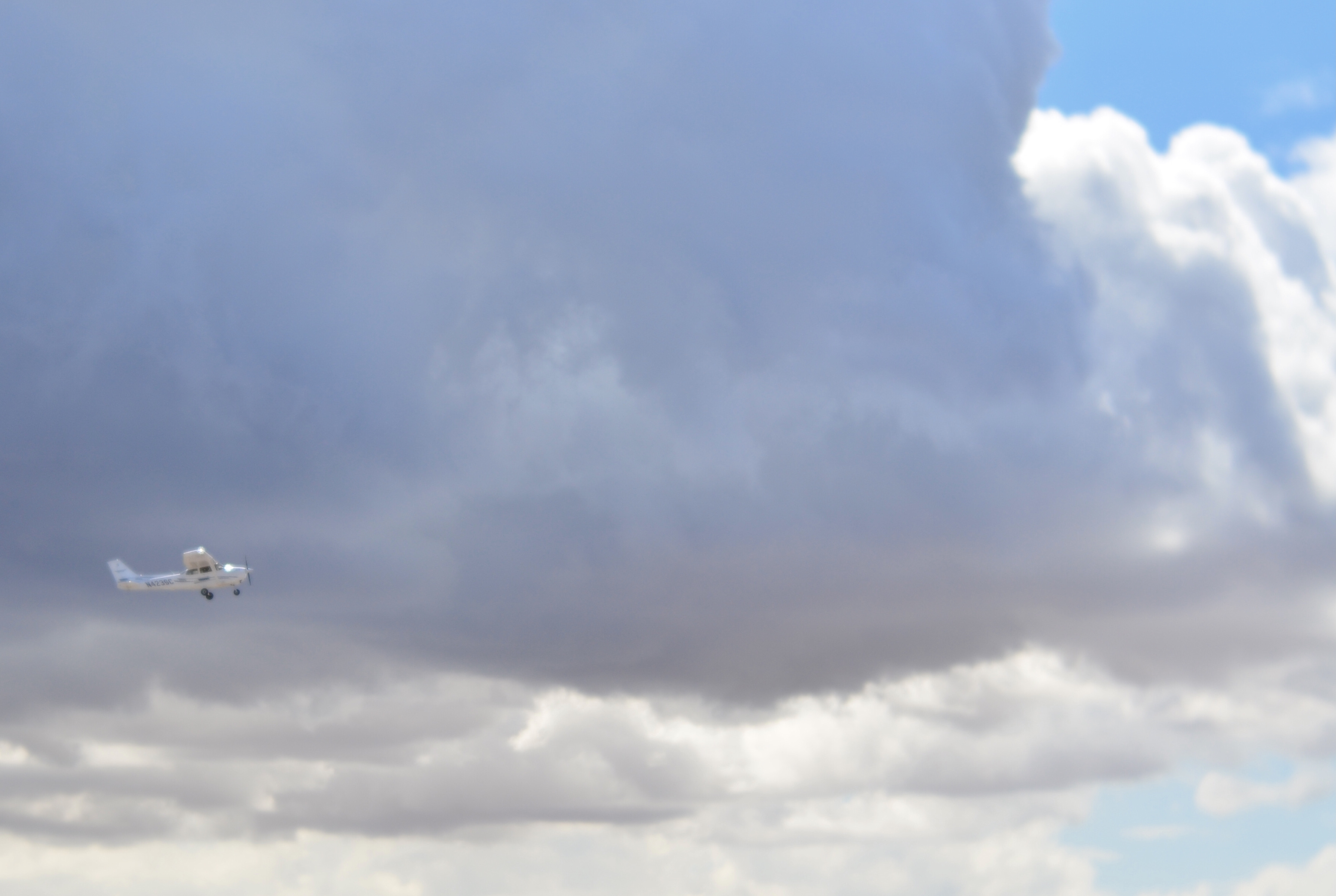
But that’s a problem of seeing. Thing is, even when a photographer apprehends an epic-scale scene, getting a shot of it that’s free of junk can be daunting. In the case of this image, I woke up struck by the beauty of enormous banks of clouds rolling through the skies in a part of Arizona that is typically free of anything but solid blue. The problem soon became where to drive/pull over/aim to make sure that nothing else punctuated the impact of these enormous billows. I drove about ten miles until I got to a tiny municipal airport whose elevated observation deck afforded nearly unbroken horizons in all directions and started to crank away. Strangely, it was when I got my unbroken sky that I realized that there was nothing of scale to indicate how big the formations actually were. Enter a tiny mosquito of a private plane, barely big enough to create a flint of light to announce its presence. The ballet of big and little was now complete. The photographer’s job in showing the size of something lies simply in supplying the answer, “compared to what?” It’s Storytelling 101, it’s simple to do, and it makes the difference between a picture and a narrative.
MAKING IT MINE/YOURS
By MICHAEL PERKINS
THE EARLIEST PROPONENTS OF THE IDEA OF MAKING CELLPHONE CAMERAS the “go to” devices for everyone were also big fans of the motto, “the best camera is the one you have with you”, a sentiment that, for me, has always had a big honking asterisk connected to it. Yes, I guess having a limited camera is better than having no camera when an opportunity arises, if you believe that a compromised version of your vision is better than having made no attempt at all. Certainly, in an emergency, you can use a butter knife as some kind of screwdriver. However, that begs the question: why don’t you have a screwdriver?
A better version of this maxim might be something like, “the best camera is the one that does the best job for you”, coupled with the corollary “and you should always have it with you”. I’m much more aligned with the idea of going through the process of deciding what camera is perfect for your needs and always, always, having it alongside. How can any other option be as correct?
Of course, this means examining your own habits, biases, and talents, and matching them to the particular machine that mostly translates those things into good pictures. Sounds ridiculously obvious, and yet you still meet many people who excuse a failed image by saying “I didn’t have my good/real camera with me”, and so maybe the idea of properly pairing yourself with the right gear isn’t that on-the-nose, with everyone, everywhere.
This is really basic stuff, reducible to a simple checklist. Is the camera easy to carry, or is it a burden to lug around? People love their cameras, but not if they think of them as luggage. Are the ergonomics right, that is, are the buttons and functions that you use the most easy to get to? How about set-up time? From the moment you take it off your shoulder to when you frame up your shot, how many arbitrary get-ready steps are in the way before your camera’s ready to rock? Does it have the optical ability to approximate what you see in your mind? Is the camera sufficient unto itself, which is to say, can it take pictures that you like without the purchase or assembly of additional gimcracks and toys? Do you understand all its functions, or do you just use the same settings and features over and over? And, if so, is that because you’re successful doing things that way, or because you are, to some extent, afraid of your camera?
To twist the “best camera is the one you have with you” thinking around, you can’t (often) take your best picture with “whatever’s at hand”. Or, more precisely, you can’t make pictures you love with a camera you hate. If you are not on intimate terms with your gear, then get a no-fault divorce from it and marry something that (apologies to Jerry McGuire) “completes” you. You gotta make them little boxes yours. Really yours. “Best available” will always be second best.
EMERGENCES
By MICHAEL PERKINS
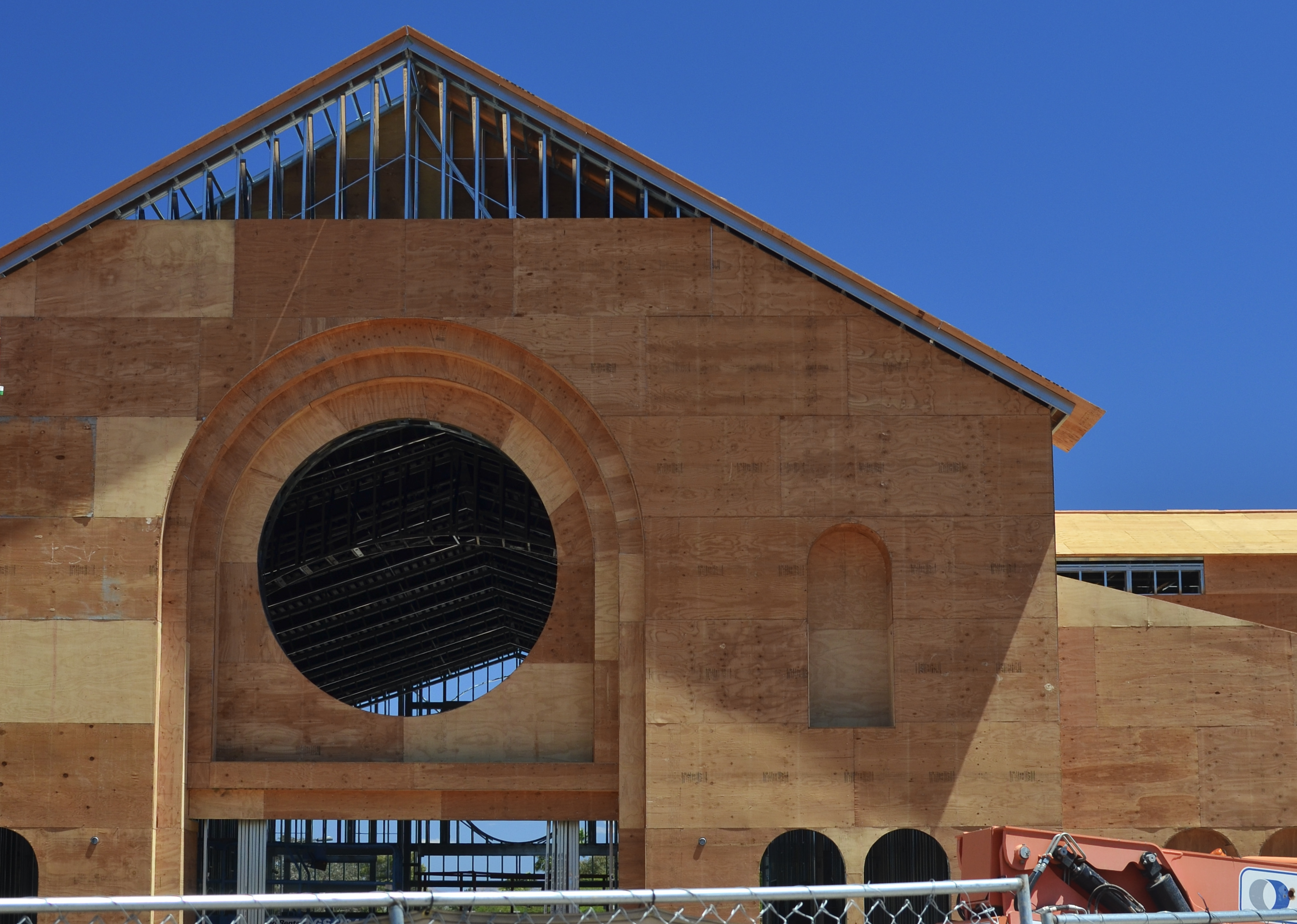
THIS IS NOT AN EXTRAORDINARY PHOTOGRAPH. It only exists because, in the moment, I needed to make it.
Over my lifetime, the two things likeliest to draw me to the side of the road for a quick snap are the polar opposites of existence; things getting ready to be born and things waiting to die off. Both have resulted in pictures that, almost purely on impulse, I felt the urge to attempt. This one, which is of a church under construction, held special appeal to me because, after a year of endlessly looping sameness, it was something just unusual enough to break the pattern I’d established, that of making more and more pictures out of less and less.
It’s not about the church as such, or about whether the world even needs churches at this point or what they convey about our lives. It’s not that grand a concept. To tell the truth, I was more drawn to the building site for how very raw and unrealized it was, how the building is just beginning to transition from a pile of materials into a stated purpose. The round recess at the front promises to eventually hold a stained-glass window, but, for now, it’s just a hole in a wall of wood. That same wood, in all its light and color variations, will soon see all its rough-hewn texture erased by a featureless coat of plaster or paint, making it so definitively “a church” that it will lose its appeal to me as a mere arrangement of shapes. As I said, it’s when things are on the way to being something (or on the way to becoming nothing) that I feel a picture needs to be made, or attempted.
As to said attempt, I shot seven frames very quickly, in simple, stark, midday light with a 35mm prime lens and almost no plan or scheme in mind. When the angle or composition seemed right, I shot. And then I stopped. The whole thing was a matter of three minutes. And yet, after months of unbroken sameness, of being forced to mine the overly familiar in my constricted sphere of experience, trying to find new ways to see it, this almost-church became a holy thing of sorts to me, a fresh canvas on which to paint. The refreshment this little exercise brought me still puts a smile on my face some five days after the fact, and I imagine that I will always have a special affection for this picture. In a way, it sent a signal to my tired brain that there is, still, a world out there, and that I will be one of the lucky ones permitted to re-enter it. I only hope I can earn the privilege.
INSTANT DISAPPOINTMENT
By MICHAEL PERKINS
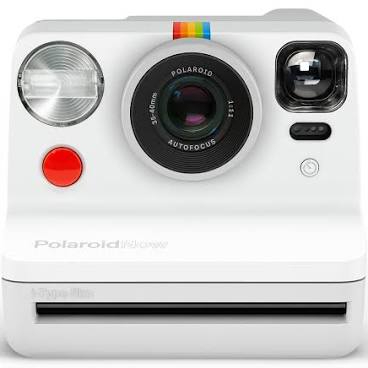
I HATE THE DISMISSIVE SNOBBISHNESS THAT CONDEMNS THIS OR THAT PHOTOGRAPHIC DEVICE as “not a serious camera.” I truly believe that almost any LightStealerBox, modest or fully tricked out, has at least the potential to deliver wondrous pictures, and I can’t think of anything that renders a camera more “serious” than that. But the recent resurgence of the old Polaroid name(along with the films and cameras that have been marketed under that legendary brand) has got me scratching my head.
Seriously.
Since rising from the ashes of the company built by the inventor Edward Land in the 1940’s, the “new” Polaroid has pumped out bright, simplistic photo toys bearing the old name and promising the return of the unpredictable, random fun of creating photos on the spot. However, apart from the admittedly giddy experience of generating shareables and momentoes, I see no sign that the current keepers of the Polaroid flame have taken a single step toward what was, under Land, a constantly evolving forward march toward innovation and technical improvement. Which is to ask, how can photographers take a camera seriously that is not regarded as such by its producers?
Land took the cumbersome development process of his first Polaroid films and eliminated the mess and bother to create a medium that was fairly responsive, pairing them with better and better cameras that were at once stylish and convenient. In the 1970’s, with the creation of Polaroid’s only true SLR, the SX-70, the company moved further beyond its innate novelty to actual artistic control, introducing custom settings, electronic exposure and quality lenses in a sleek package that won design awards and helped the company enter the premium market. Unfortunately, after that, the product line moved toward models that were easier to operate but admitting of less and less user input, and, by the end of its first life in the early 20th-century, Polaroid, embracing cheaper components and flashier packaging, was squeezing out glorified point-and-shoots that produced pictures that, well, looked like Polaroids, which is to say soft, low-contrast mush that just happened to develop quickly.
Cut to the present day, years after the digital revolution and several seasons since a passel of European art students reverse-engineered the defunct company’s system for film production (Polaroid had destroyed all its files on the subject before going bankrupt) and began marketing all-new cameras that took up where the firm’s last “One Step” models left off. Today, the re-introduced film remains a pale imitation of its namesake, which doesn’t really matter since their cameras are essentially playthings. And so, whereas it was difficult for photographers to create their best work even with the best of the original Polaroids, now it is fairly impossible to get even consistent results with the gizmos that bear that once proud name.
Some of this could have been predicted. Polaroid’s rebirth coincided with the 21st-century “Lomography” analog film craze and its love of technically defective “fun” cameras….the “shoot-any-old-way-and-see-what-happens, randomness-and-failure-are-arty-and- cool” school of thought. Polaroid 2.0 is also a reaction to Fujifilm’s Instax cameras, which produce instant images so small as to be good for little else than selfies (which seems to be the market for the things), the blearier and mushier the better.
Why do I care, enough to risk being written off as the creaky troll I probably am? Because Polaroid, at one time, held out the hope of combining instantaneous feedback (a key advantage of digital) with the artistic control of cameras that took themselves seriously and offered a true alternate path to higher-end photographic expression. Seeing the name now used to market murky party favors (at nearly $20 for eight exposures) saddens me, as does the proliferation of any camera that requires its users to leap-frog across endless work-arounds just to get a usable image. When a camera becomes an obstacle between a shooter and a good result, that camera is a bad camera.
Seriously.
THE MIRACLE OF IMMERSION
By MICHAEL PERKINS
THE CHIEF ADVANCE IN THE PROCESS OF MODERN PHOTOGRAPHY, a kind of hitchhiker on the back of the digital revolution, has been the unprecedented scope of choice conferred on the shooter. Much is written about how great pictures are selective extractions from the endless flow of time…how random and important seconds are snatched from that flood tide and “captured”. However, the emphasis, for most of the history of the medium has been on many of us getting that one fortunate moment, with few options for re-takes or even a variety of attempts from which to select our final winners.
If this seems to be an arbitrary distinction between amateurs and pros, well, it sorta is, and that’s because of how the technology and the economics of photography work on each other. Before roll film, even a professional had difficulty in taking multiple frames of the same subject in search of a keeper. The media were unwieldy and expensive. Soon, the consumer-based photo market, created by the first simple mass-produced cameras paired with film, allowed for slightly more breathing room for the average snapper to take more than one crack at his/her quarry…to say, try several different angles on a subject rather than one, but, again, the cost of purchasing and processing film tended to divide the photographic world into amateur and professional ranks. Quite simply, a professional, out of necessity or opportunity or both, could afford an investment in enough film to create choices, or multiple ways of seeing the same thing, whereas the amateur has to budget his shots and invest less money in the pursuit overall.
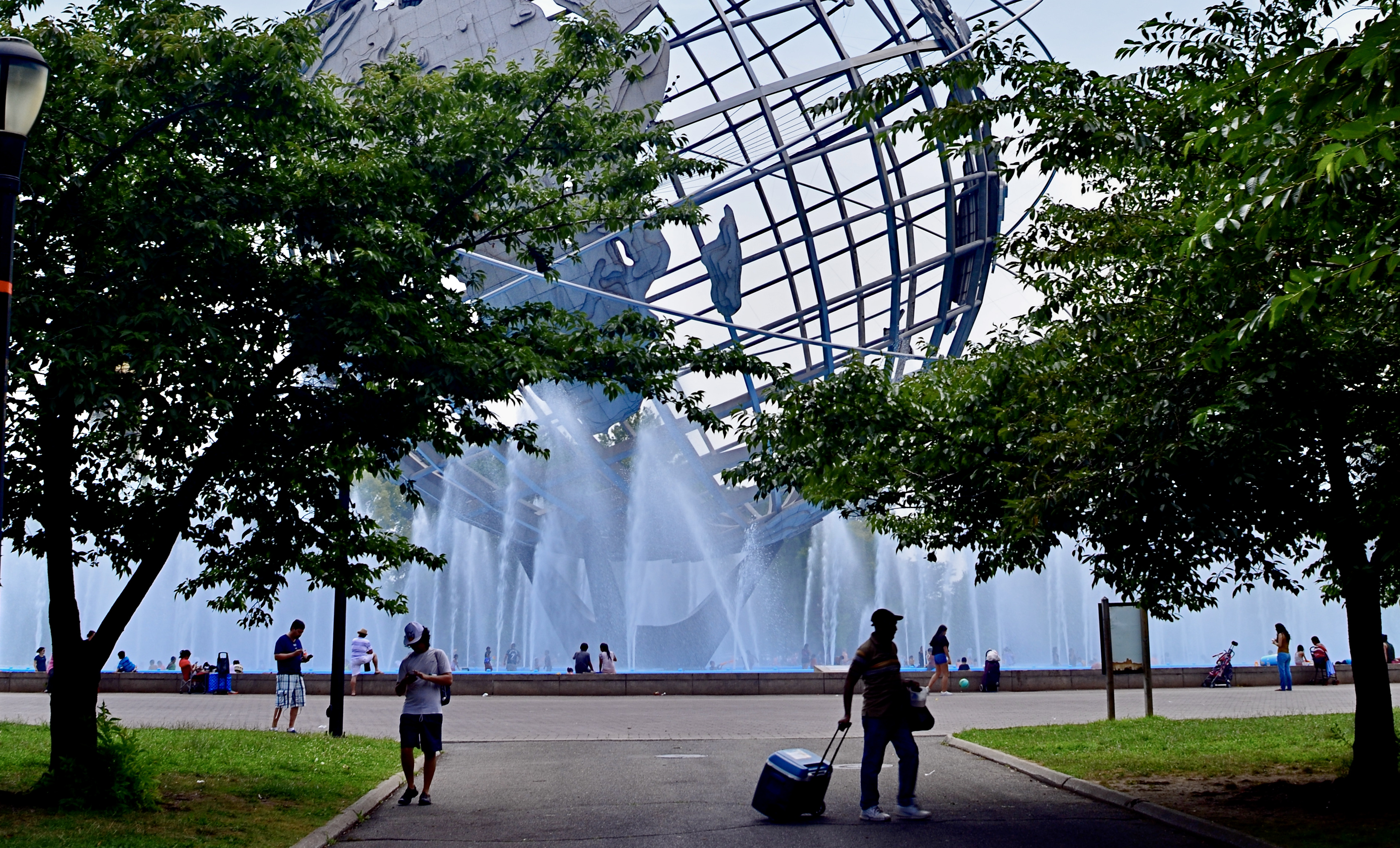
Digital democratized that entire process, effectively shrinking the photographer’s budget to the purchase of the camera and an occasional memory card (which itself could be wiped and re-used). We immediately shifted from a plan-as-you-go mentality to an all-you-can-eat, shooting-for-free model, which, in turn, changed the results of our picture making. Now newbies can stand in the batter’s box and swing away endlessly in pursuit of their final result, just as the pros always could. Any subject can be given the treatment of an essay, and we have the luxury of going back for seconds, thirds, or whatever is required to develop and eventually deliver on an idea. The image seen above, had I taken it in the age of film, would have been the product of a few snaps, not, as happened digitally, the work of over an hour of walking, planning, experimenting. In the old days, only a pro would have been free to shoot several rolls in search of an iconic image. Now anyone can do it, simply and cheaply.
Photographers who experience this miracle of immersion as everyday reality are freer than shooters in any previous age. We can whittle away years of the ponderous failures that used to take years to accumulate in a matter of weeks or even days. Mistakes are still necessary for the training of the eye, but being able to speed up the process of stylistic evolution is a true liberation. The science and the economics of photography are finally aligned with each other, and although it took some time, time is, finally, on our side, whenever we endeavor to photograph anything.
THE YEAR OF SEEING DIFFERENTLY
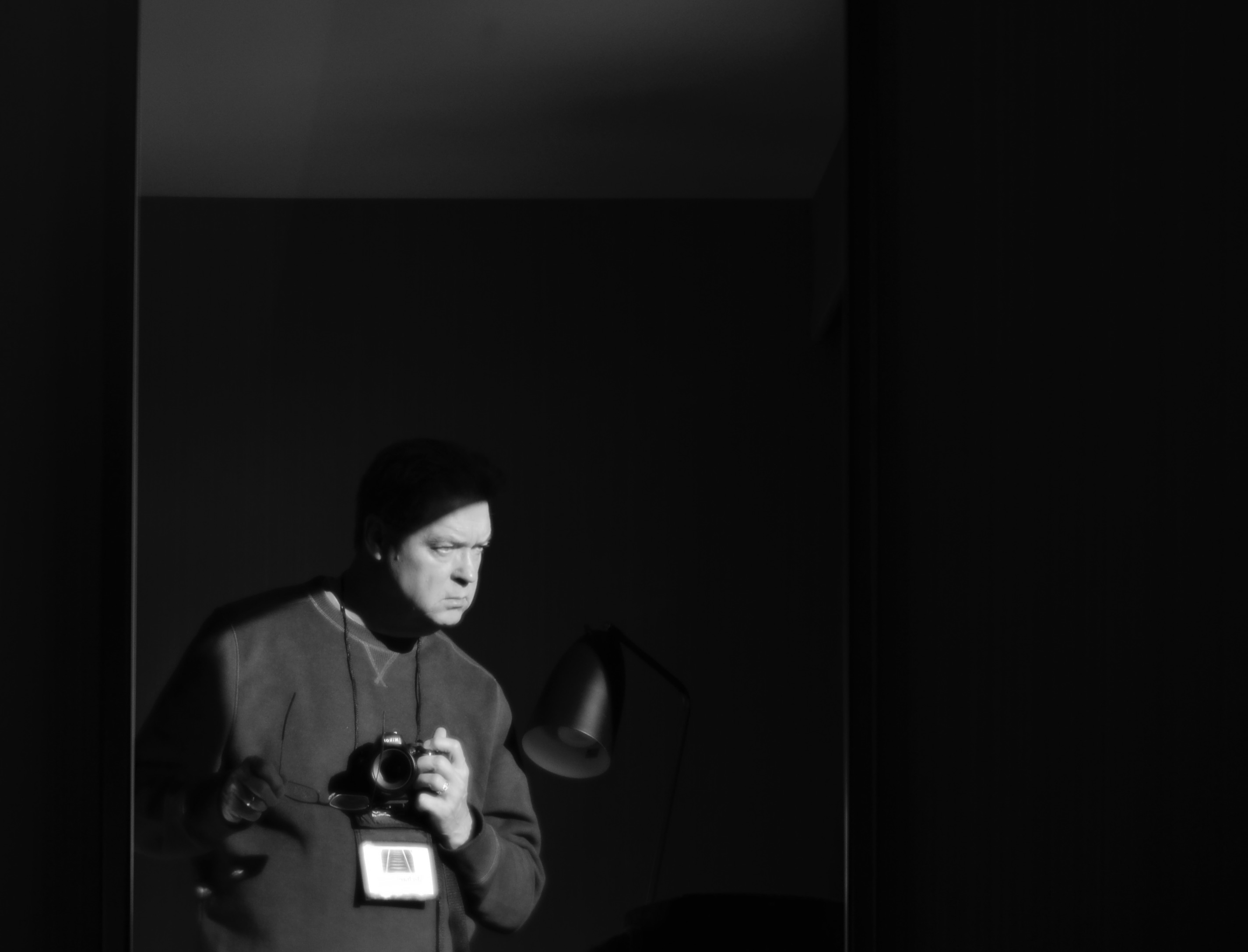
There’s something out there. And, I assume, there’s something “in here” as well.
By MICHAEL PERKINS
FOR YEARS, I HAVE READ INTERVIEWS WITH VARIOUS PHOTOGRAPHERS that include some form of the question, “why do you think you first picked up a camera?” Some answers are profound, detailed, while others are more along the lines of “because it was there”, or “well, why not? In 2021, as the surfaces of many of our personal cocoons begin to crack a bit, a more relevant question might be “why will you next pick up a camera?” All art is fueled by motivations, by the need to create an outside expression of the person within. Change that person, or, in our case, change the entire human species, and motivations, and the art they create, will likewise be altered.
All of which is to say that, without a doubt, I am somehow a different kind of photographer today than I was a year ago. The fact that I can’t yet analyze in what specific ways that change has manifested itself is beside the point. Every cell in our bodies is a replacement for a cell from an earlier version of our physical selves, and yet the change has come about so gradually that we feel that we are the same person that we always were. It will take time, and the evidence of my work, to be able to see how this last year has adjusted how I see, and more importantly, what I now choose to look at.
This online forum, now in its tenth year, was never designed to be a meditation on my personal life, and that’s generally the way I like it. I can talk all day about why I decide to make a picture, and I have tried to find, in those reflections, something that is universal to the growth of every photographer. Sharing things more personal than the creation of an image, however, comes less naturally to me, a strange admission from someone who has chosen social media as a platform, but there it is. I always feel that the work will provide and clues to the person that created it better than my poor power to add or detract, or indulge in any freehand navel-gazing.
It will be some time before any of us can draw a clean line from “the kind of pictures I used to make” to “here’s how I see now”. I do know, however, that there’s been a huge change in the subject matter that’s available to me to shoot, whether it’s the faces of distant loved ones or the loss of routine hangs. But just being forced to create photographs with different stuff is not the whole issue; being persuaded to actually see differently is where the rubber meets the road, or, if you will, where the eye meets the viewfinder. I have been fortunate enough to see most of my old world emerge from this global nightmare intact, a fact that I consider a miraculous, if random, gift. I have been given what photographers value most; time. Now let’s see what I can do to identify the work to be done before me, both as a photographer and as a human being. No doubt new narratives and stories will emerge. And they will all need illustrations….
LITTLE THINGS MEAN A LOT
By MICHAEL PERKINS
PHOTOGRAPHIC COMPOSITION MAY MATTER MORE than any other single aspect of technical mastery. The godlike power to decide what to include in the frame is the ultimate tool in the making of any photograph. It sets the terms of engagement, stating, merely by what’s been included, this is what we’re talking about today. That makes the photographer a narrator…a storyteller. The rest is all just measurements.
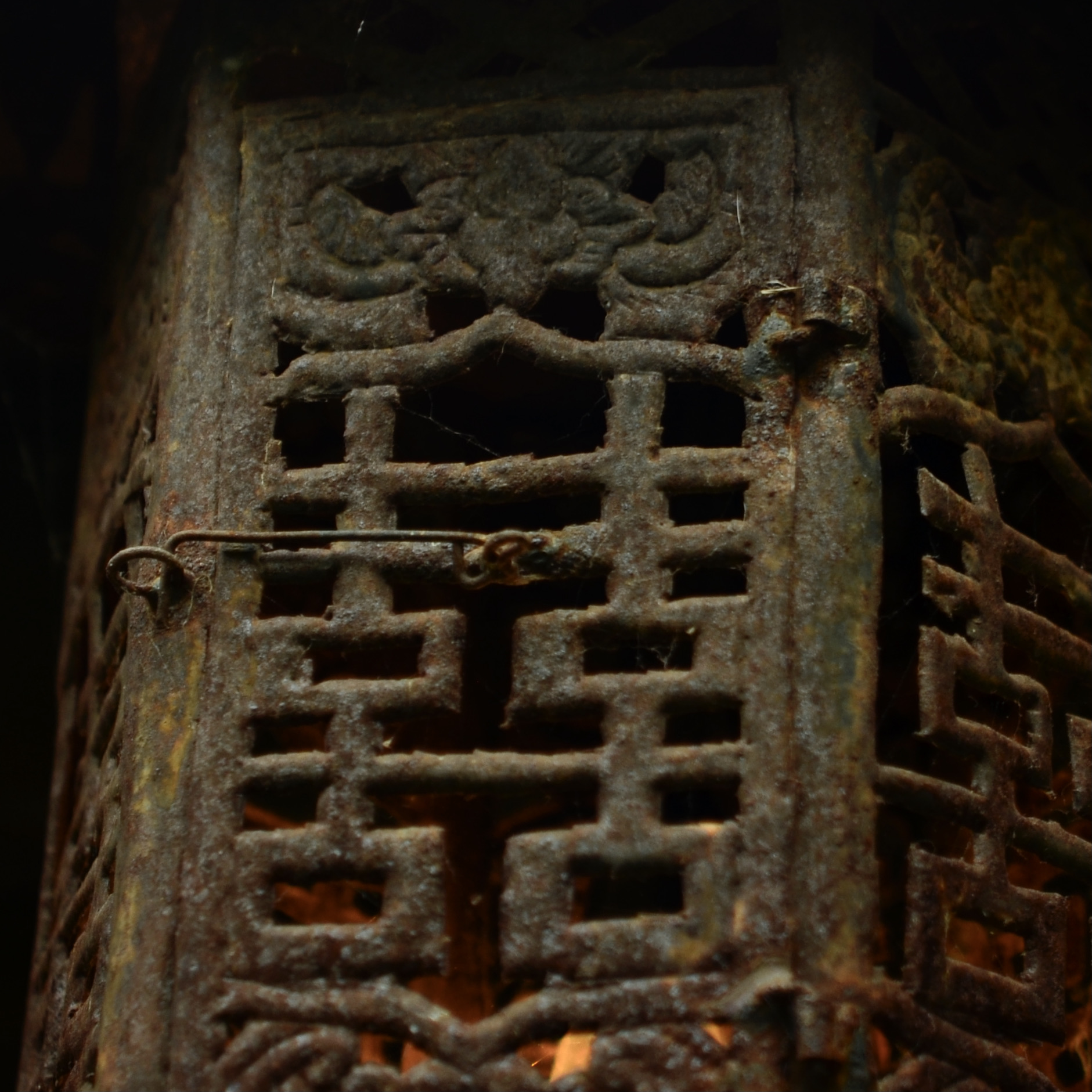
Macro photography, or, as we used to call it, “close-ups” are the purest exercise in compositional choice, because in getting nearer to our subject, we are forced to be aware, in the making of a picture, just how much of the rest of the world we are paring away…whether because it’s distracting, or too busy, or merely because it’s not what our picture is “about”. Macro work also shows, in the clearest possible terms, what happens when too much is left in the frame, and reinforces the same discipline that’s vital in composing a shot at any scale, i.e., including what communicates best, and snipping out the rest. It also becomes a useful introduction to “abstraction”, which is valuable even for people who think they hate that term.
When you abstract something, you are merely pulling it free of its normal contexts and associations. Once you are close enough to your subject, you are working more and more in terms of raw light, patterns, and texture, in a way that makes the familiar unfamiliar. You see compositional elements purely. For example, a piano, as a fully-sized object, registers in the mind as a quite particular thing, whereas magnified detail applied to the arrangement of its inner workings, is an exercise in mechanics, math, the pure arrangement of repetitive motifs. Composition in macro , then, is always great practice for composition in general. When you are zoomed in tight, you must make real choices as to what will make the cut for the final image, and these choices are obvious, and immediately understood. Pull back out for shots taken in the wider world, and that choice-making ability is now more instinctual. There’s a reason so many people say that, in the acquisition of a skill, you should start small. Because little things mean a lot, and the sooner that thinking gets into our pictures, the better tales we tell.
THE LAND I LEFT BEHIND ME
By MICHAEL PERKINS
LANDSCAPES, AS I HAVE CONFESSED SEVERAL TIMES IN THESE PAGES, are not the lead arrow in my photographic quiver. Given an urban setting exploding with human activity, I will typically forsake a serene seacoast or majestic mountain range as shooting fodder, not because I necessarily disdain them, but because I often find myself unable to bring anything profoundly personal to them. Perhaps shooters with a more naturalist bent are inspired to new heights of expression when framing up scenery. I certainly value nature as a foundation for certain kinds of pictures, a backdrop for my “lead” components, if you will, but I find myself flummoxed in trying to depict them as the main attraction, as nature for its own sake. Why?
Of course, I have shot literally thousands of landscapes, and, under certain circumstances, such as the past year’s Great Hibernation, I have been forced to embrace more open spaces not only as refuge but as default subject matter. I simply am stuck miles from where I prefer to shoot, and so I have tried to capitalize on the surplus practice time to, at long last, be “better” at landscapes. This time, I have tried to plow into fresh ground by changing the way I depict such scenes, with the traditional sharpness and detail of the postcard giving way to understatement and atmosphere. And I’m finding that the resulting minimalism is comforting, that the idea of trying to say more things through mere suggestion might finally be my sweet spot.
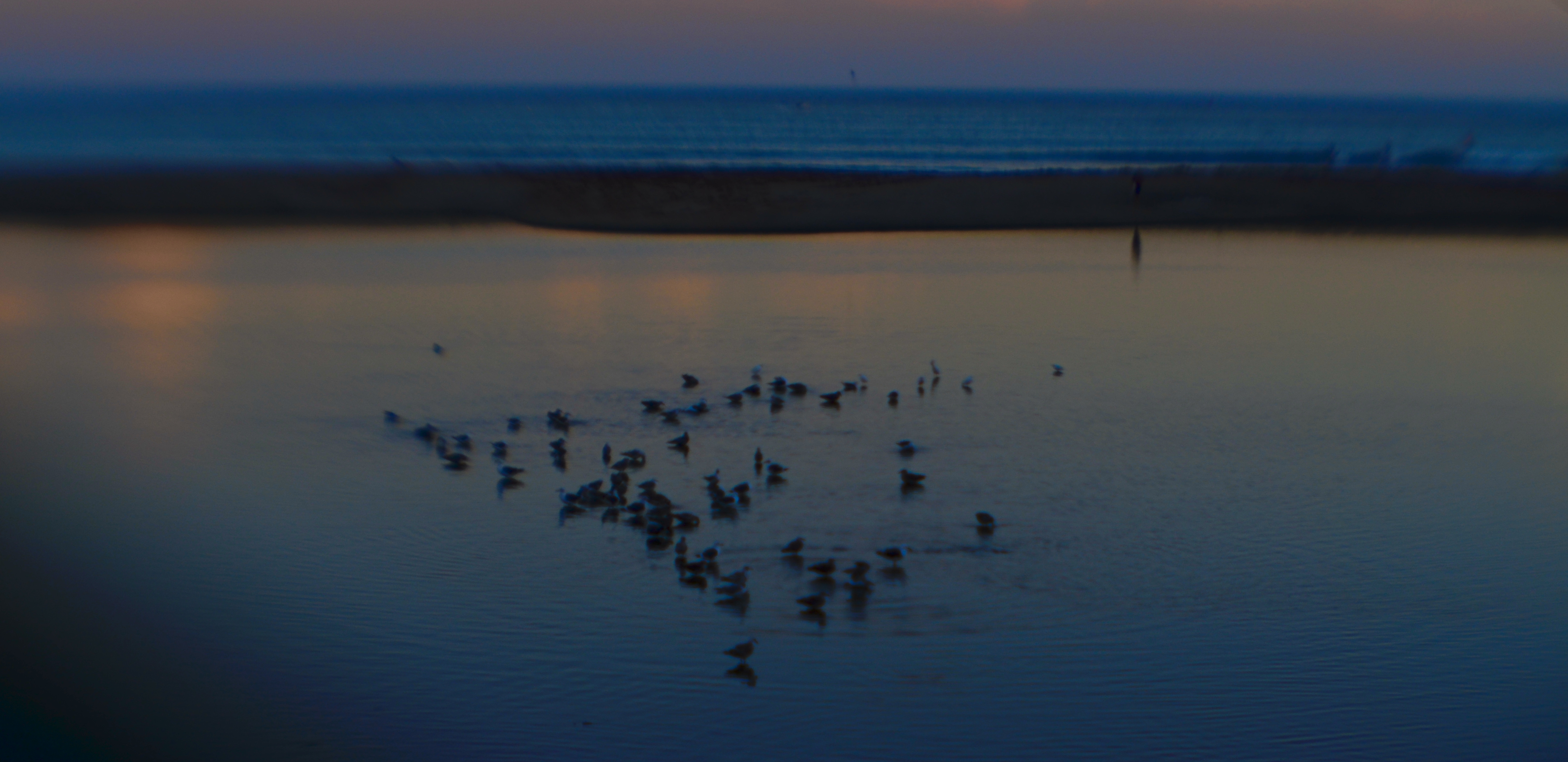
Once the baseline information of a landscape needed for identification has been established…that is, once enough visual cues have been provided to attest to its being a picture of a boulder, shoreline, forest, etc., what really needs to be included that has any additional narrative power? I totally get the fact that detail and texture can be a story in themselves, as in the granite grandeur of Ansel Adams’ Yosemite giants, but I believe that landscapes rendered in paintings, for example, often reduce those details to their essence, especially in the work of impressionists. Why does the photograph have to be faithfully “graphic” or documentary in depicting those details?
The image shown here certainly contains enough data to be perceived as a night shot of a beach with birds. Would a further rendering of every grain of sand and every ripple of ocean make the picture “work” any better, or can the piece just succeed as a hint of reality in which your heart or mind fill in the blanks, a picture in which the openness of the thing allows more individual interpretation on the part of the viewer? I understand that, to a certain audience, this is a blurry mess, while, for others, it might be the beginning of something that originates in the picture and finishes in the mind. What I’m starting to learn, finally, as a landscape photographer, is how to show just enough of the story I see to convey it to another person, but to rein myself in before I just produce a document that is technically accurate but emotionally threadbare.
IF YOU LEICA ME LIKE I LEICA YOU….
By MICHAEL PERKINS
EVEN FOR PHOTOGRAPHERS WHO WILL NEVER OWN A LEICA, the brand has always been synonymous with pristine quality, innovation, and a mystique that is as durable as gold and as elusive as vapor. In fact, the company which began its life in Germany 1907 as Ernst Leitz Optische Werke (or simply “Leitz”) has inspired imitation, envy, and a definite bloodlust of desire that separates Those Who Would Have Nothing Else from Those Who Can Only Dream. In short, all Leicas are good children and all good children go to heaven. They are an impeccable species sufficient unto themselves, making no concessions to lesser species. History, right?
Except of course, that such “history” is mostly folklore. In point of fact, Leica has experienced the same ups and downs, the same botched launches and bitter failures, as other manufacturers, creating its own mutant wing of weird hybrids and downright flops, occasionally going so far afield as to come dangerously close to winking out of existence. One of those errant wanderings is traceable to the 1970’s, which was, overall, a marvelous time to own a camera, unless that camera was… a Leica.
Beginning in the ’60’s, the single-lens reflex camera revolutionized the world of both pro and amateur shooting, with Nikon, Canon, Pentax and other lean young barbarians adding amazing features at a reasonable cost in a way that was rendering the venerable Leica rangefinder system obsolete. The late-breaking line of Leicaflex SLRs, introduced years behind the competition, offered a mealy-mouthed feature set and insane price tags. They also brought the company nearly to its knees, as its makers found themselves unable to control runaway production costs, actually losing money on every unit sold.
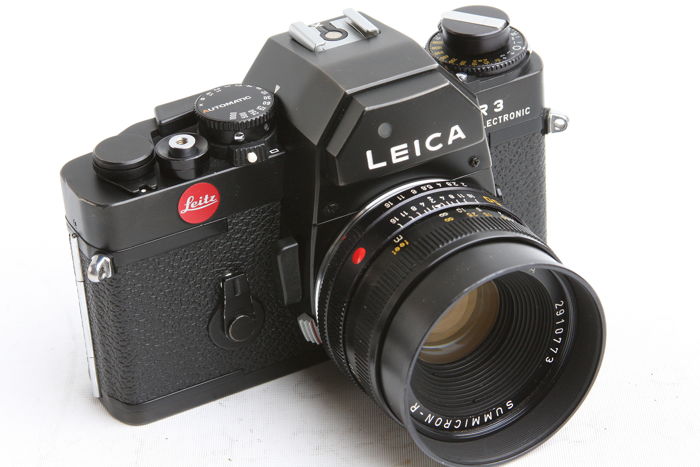
And then something historic happened. Around 1973, Leica (whose parent company was still officially named Leitz) looked down from its perch atop photography’s Mt. Olympus (no camera joke intended) and asked for help, entering into a partnership with Minolta, which, at the time, was one of the big dogs in the SLR kennel. The two companies agreed to share designs while the actual manufacture of selected components would be moved from Wetzlar, Germany to Japan. Their first product collaboration was a revised rangefinder called the CL, which sold well, but chiefly at the expense of the equivalent “pure” Leica product line, a fact which succeeded in ticking off the company’s purist fan base (bless ’em). Right on schedule, the ever-present Leica snob machine began to put an asterisk after all such Leitz-Minolta products, marking them as less than genuine than “real Leicas”, even though the partnership actually helped improve the sleekness of the company’s SLR design and pioneered many new features, such as aperture and shutter priority, that would become standard in the following decades.
Over the next decade, the Leitz-Minolta marriage refined the weight, ergonomics and acuity of its mutual “children”, producing some of the world’s favorite cameras before differences in philosophy forced a divorce in the early ’80’s. Notable among their successes was the magnificent Leica R3 (1976, seen above), which boasted center-weighted metering, an improved mount to better accommodate a variety of lenses, and a more responsive shutter, all making for a full-on comeback for the folks in Wetzlar.
After the breakup, Minolta entered into a later arrangement with Sony, as eventually would Leica, which also went on to share technology with Panasonic. Neither company would ever again fly completely solo, and their original collaboration would demonstrate that even the companies with the highest pedigrees could enhance their survival in a fiercely competitive global market by thinking outside their own branded boxes.
RECOMMENDED READING: Josh Solomon, The Sweetest Taboo: The Unlikely Story Of Leitz-Minolta.
PRECIOUS LITTLE THEFTS
By MICHAEL PERKINS
PHOTOGRAPHY, FOR BOTH ARTIST AND AUDIENCE, operates like all the other arts, in that it affords us entry into a million worlds beyond the narrow confines of our own. The camera is both reporter and thief, a kind of mechanical pack rat that comes back to home base bearing treasures from other people’s lives. Like poetry, painting, literature, and music, the art of making images is an act of purloining pieces of things that do not belong to us. And that’s a good thing?
The question mark at the end of that sentence is needful, as are further inquiries. Are the things we nick from the stores of other people’s experience thefts, or are they an innocent sampling of wonder, like a bunch of wildflowers carried home from the field? Obviously, such questions can only be settled one picture at the a time. Photographers have, indeed, hooked themselves, worm-like, onto the hearts of people who are both content and suffering, of those who deserve some kind of baseline privacy which the very existence of the camera has placed at risk.
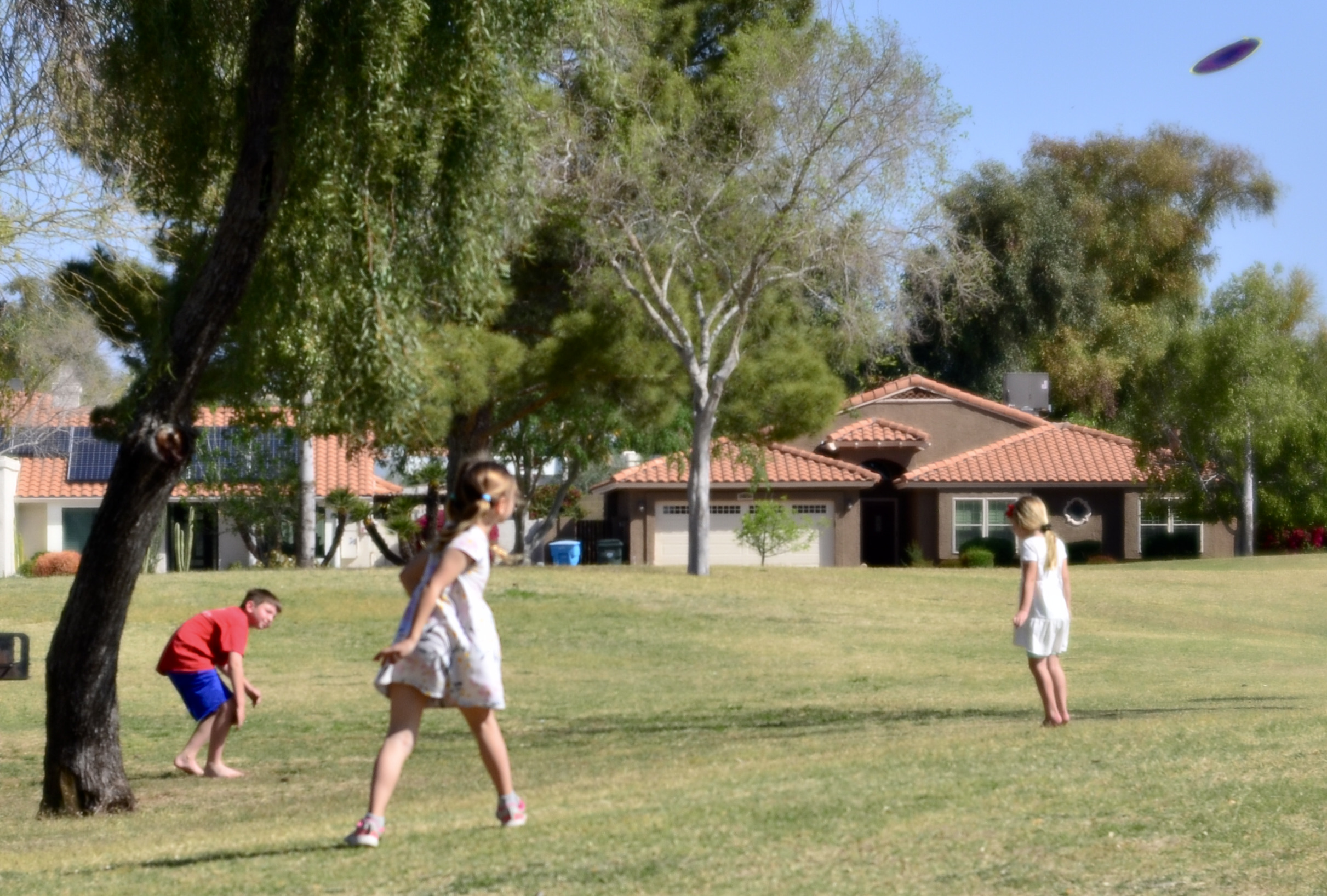
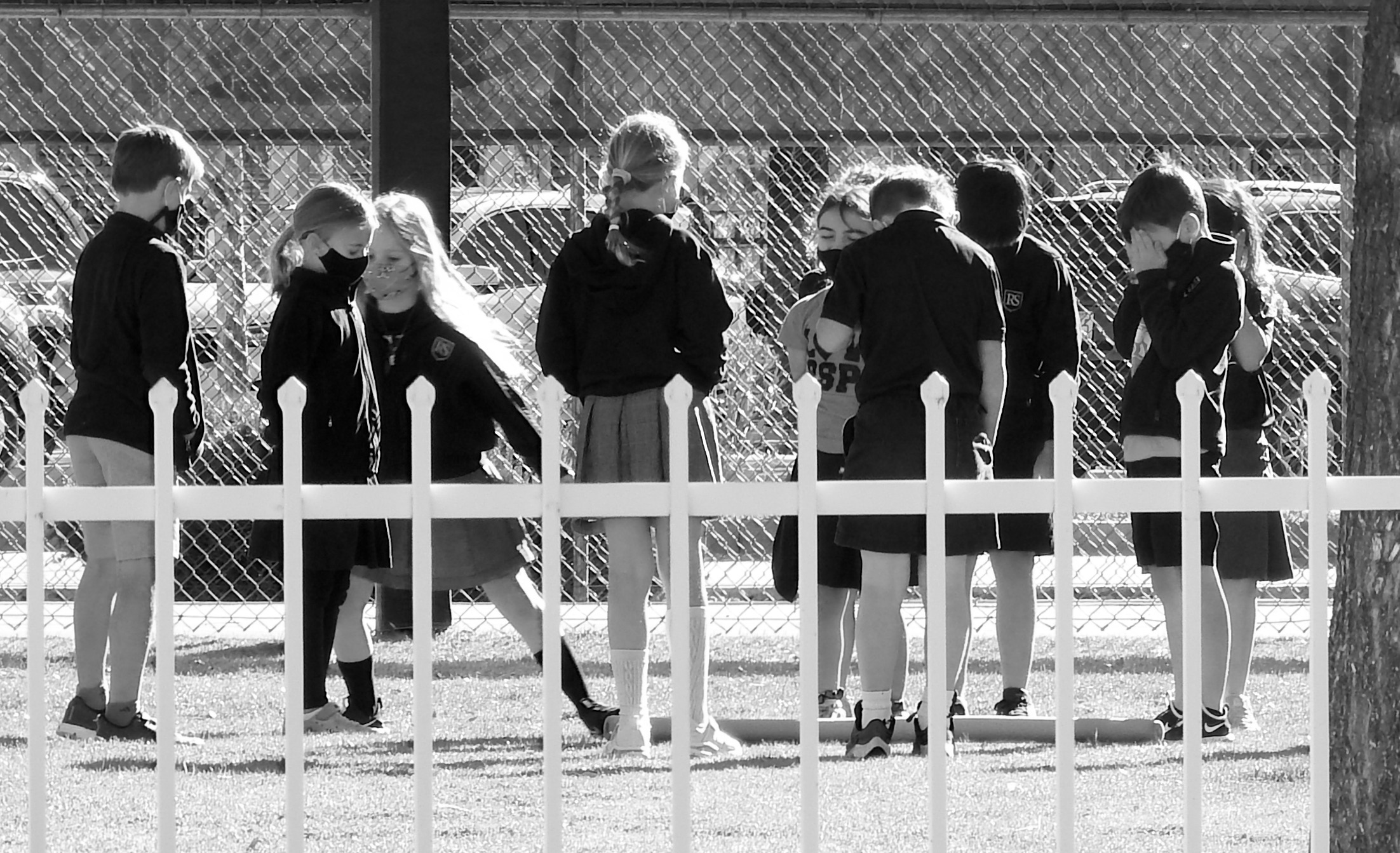
In making pictures of children at play, I make no bones about the fact that I am, certainly, eavesdropping on their experience. It can’t be expressed any other way. I am using a machine to freeze slices of their joy in an effort to enhance my own. But it’s not a predatory activity per se: I have no criminal motive in stealing a fragment of their carefree game, which is both private and public property in a strange see-saw that photographers must always struggle to keep in balance. The photograph shown here, for example, is more benign, even respectful, than the work of a reporter, say, who, under deadline, must extract loss or grief from the aftermath of war or disaster to earn his daily bread. But is my invasion only a friendly one because I have told myself it is? This is all to be discussed further, and by “further”, I mean “endlessly”.
In other arts, the audience comes into contact with a variety of lives, and yet, in novels or movies, those lives are largely invented to illustrate the creator’s point of view. In a photograph, the subjects are actual people, and our parking ourselves near them for our enjoyment dictates different rules of engagement. Appropriating someone’s story makes you, as its next translator, responsible for its truth.
HERD MENTALITY
By MICHAEL PERKINS
AS MUCH AS WE’D LIKE TO PRE-VISUALIZE OR PLAN OUR IMAGES, the practice of photography is still chiefly a test to see how well we calculate and react in the moment. We all love to map out the various itineraries for our respective photo safaris in advance, but are also keenly aware that everything, literally everything in our blueprint can, and should be, blown to bits the moment magic is afoot.
The image you see here is the product of such a moment.
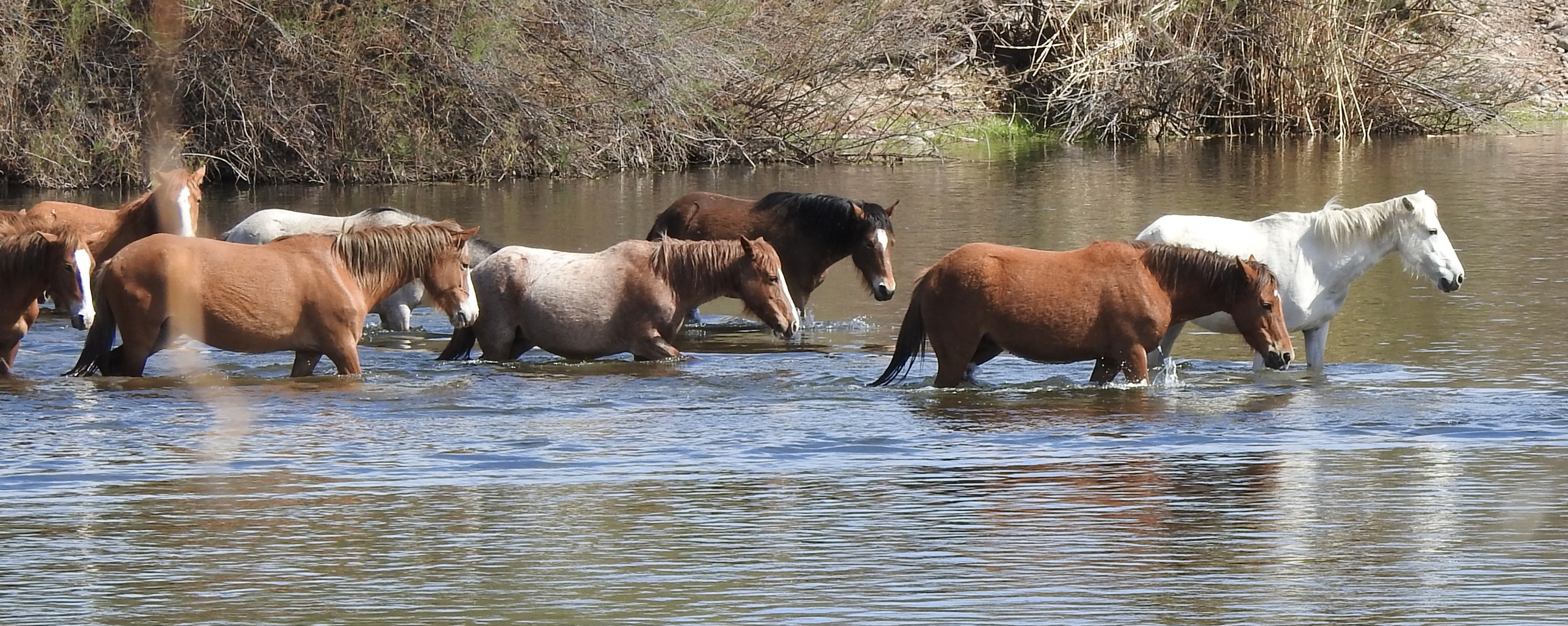
Officially, on the day this was taken, I was at the Coon Bluff Recreation Site in Arizona’s Tonto National Forest to scope out new birdwatching sites. I was a first-timer on the property, wandering pretty much in whichever direction my friends decided to drift. At some point, a smaller portion of our party decided to trek along the edge of the Salt River, in search of what I had no idea, or design. Half a mile or so later, I was surprised to have our point man remark that he had seen two horses wading and munching along the shore.
Barely five more minutes went by before it became clear that an entire small herd of wild mustangs had decided to cross the river from the far shore toward where we were standing. In what swiftly became something out of my own personal chapter of Lonesome Dove, I scrambled for an open space on the river’s sandy beach and, without thinking very much, cranked out as many frames at as many different exposures as I could. The entire parade got across in the space of barely two minutes. There was no way to plan: this was the frontier equivalent of what urban street shooters call “run and gun”. All in or all out.
But here’s the deal: while the appearance of a clutch of wild horses during a casual stroll certainly exemplifies the There Are No Second Chances rule in a very obvious way, all photographers are operating under that same rule all the time, in every situation. We may not be at risk of missing our own personal Wild West Fantasy, but there are thousands of expressions, variances of light, rapid transitions and other immeasurable changes that we stand to lose in every single shooting scenario. We are always being challenged to detect and isolate such moments-within-moments, with big events or small, and we need to calculate and click before the horses reach the opposite shore.
LOVE IS FOR LOSERS
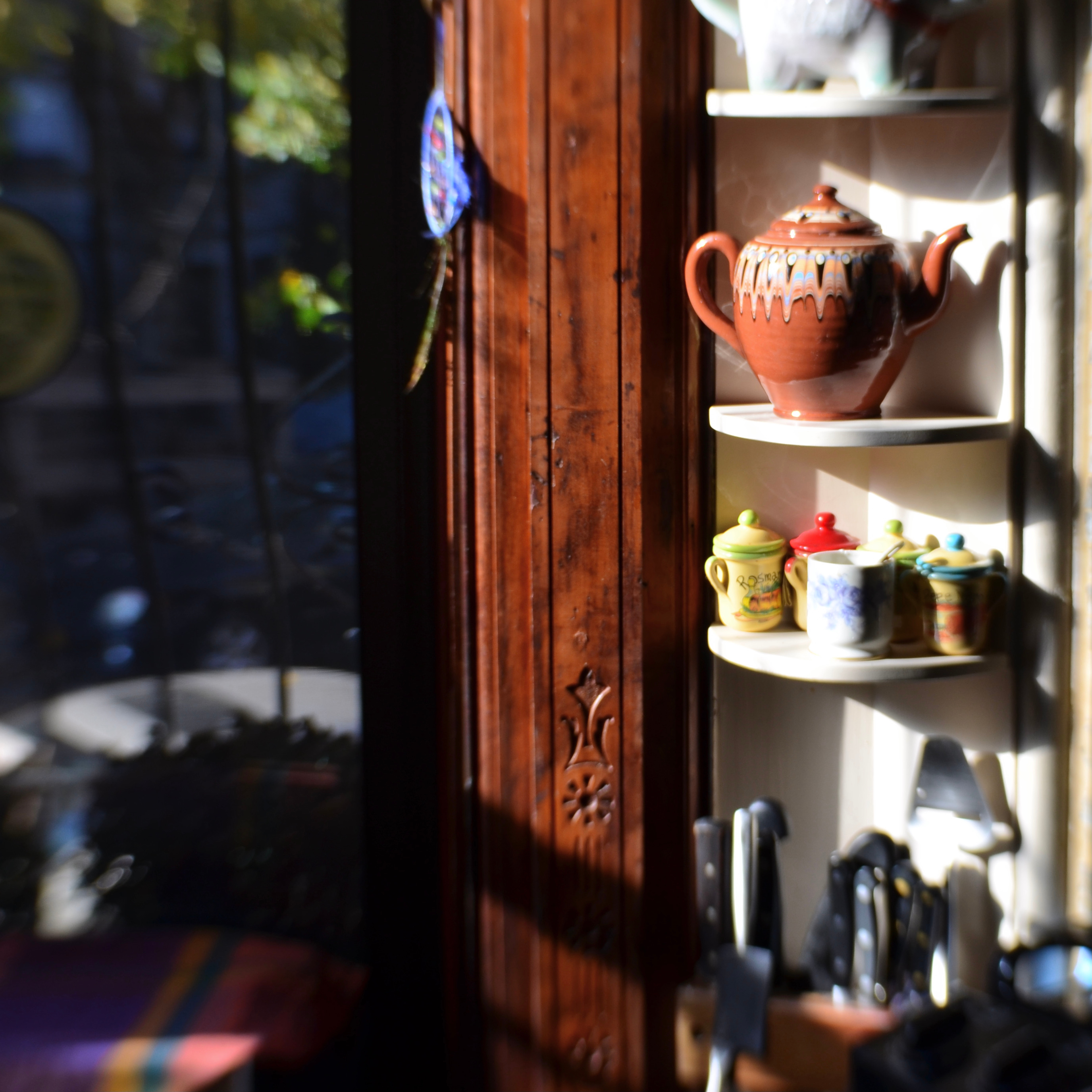
Perfection is not a “product”; it’s a process.
By MICHAEL PERKINS
ONE OF THE MOST REPEATED TROPES IN PHOTOGRAPHIC INSTRUCTION in recent years has been some variant on the “there are no rules” theme, as if all of image-making were some miraculous hybrid of instinct and chance. And while I certainly applaud an attitude of flexibility when it comes to artistic expression, and even allowing for personal preferences for baseline techniques or practices, I would assert that, for nearly all photographers, there is one immutable law, and that is, simply, to allow yourself the opportunity to fail.
Failure is the cheapest and most lasting of educational building blocks. No art happens out of a natural superabundance of talent or taste: it has to be nurtured through the refinement of negative feedback. Even the most advanced AI devices feed off of bad data; evaluating errors, filtering them out, re-designing systems to reject those errors in future iterations. Failure in photography, defined here as “making bad pictures”, is the only correct path to making good ones. There is no technical advancement or ideal toy that can short-cut this process. You simply have to put in the time.
This is means learning to love your losers, to, in fact, have a particular gratitude for the shots you blow. Just as we lament over other mistakes we’ve made in our lives, we naturally linger over our artistic miscalcuations. The mis-read light. The fouled focus. The Compositions From Hell. The gap between what we could see and what we could induce our camera to see. And, most significantly, our own ignorance or life inexperience. Mistakes make us questions things in a way that successes seldom do.
A picture doesn’t even have to be a flat-out flop to gnaw at us, to demand re-takes and re-thinks, as seen in the image above, which neither completely delights or disgusts me, but certainly haunts me. The near misses can sometimes nag us as mercilessly as the missed-by-a-miles. More aggravating still is the fact that some of the very things that drive us mad will totally skate past the casual observer, or even appear to them to be “just fine”. Happily, as we develop, we learn to trust our own eye and dismiss everyone else’s as, well, irrelevant. Buying a more expensive camera, trying to “go with the flow”, following trends….nothing can compete with the slow, gradual, agonizing, and eventually gratifying process of snapping a lot of duds and changing course as we digest what went wrong until the problem is addressed.
The study of photography is fat with experts who swear it’s all about a whole bunch of rules on one end and people on the other extreme who declare that rules are meaningless. The real truth, your truth, is somewhere in between those two poles. But believe this: there is no substitute, formal or otherwise, for doing your homework, loving your losers as if they were wayward children, and working honestly to bring them right.
SIZE MATTERS (SOMETIMES)
 By MICHAEL PERKINS
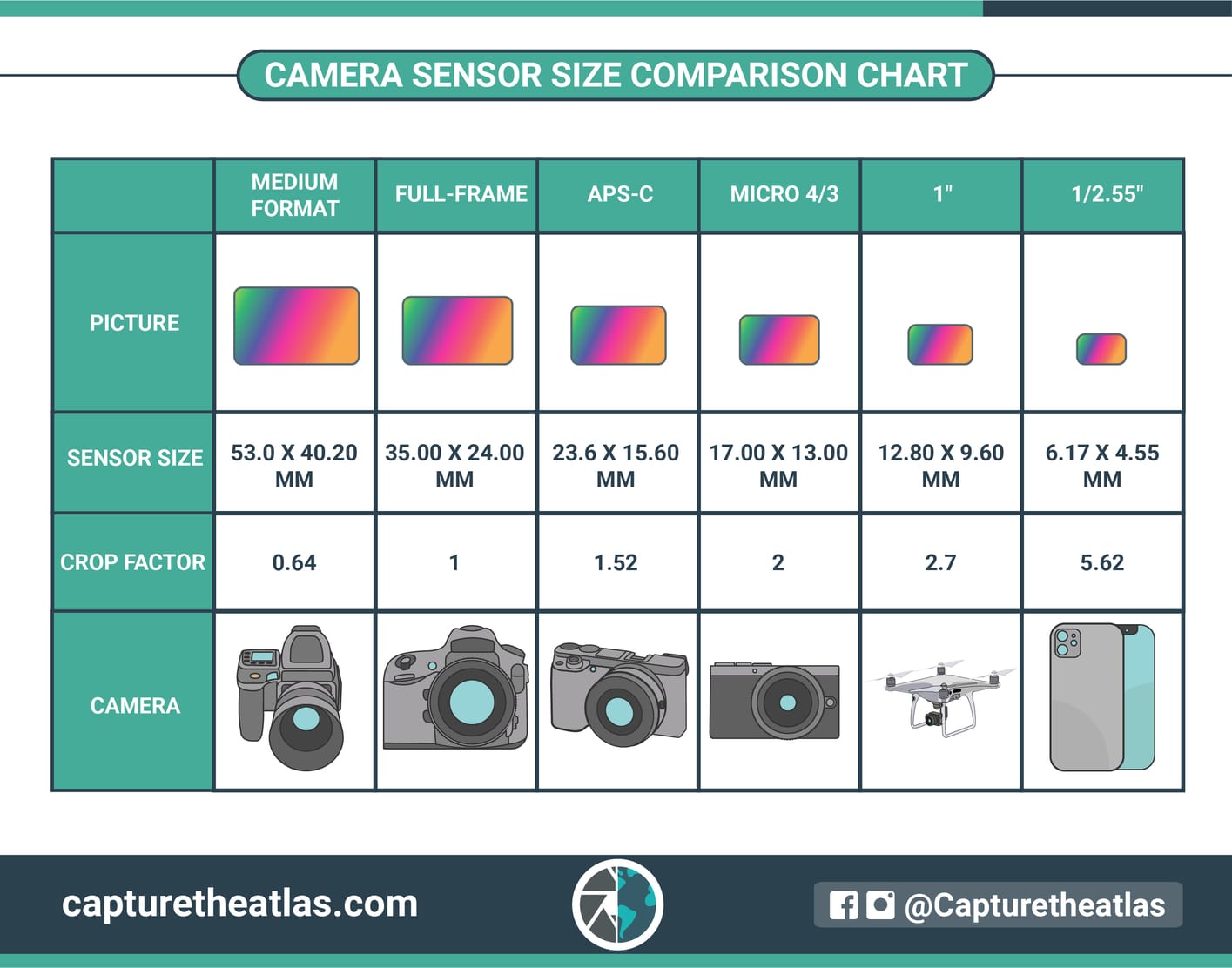
IF YOU’VE SHOPPED FOR A CAMERA OVER THE PAST TWENTY-FIVE YEARS OR SO, there’s a good chance that you’ve seen a chart similar to the one shown here, which compares the dimensions of variously sized digital camera sensors. Across the history of photography, there have always been a selection of frame shapes and sizes on offer, many passing in and out of existence based on technical advancements or the changing needs of shooters. In the digital era, however, there are more formats existing side-by-side than ever before, each grappling for their chunk of the overall marketplace.
The longest-lasting such configuration is the “full-frame” format, which carries over the basic dimensions of the old 35mm film frame. When introduced in the 1920’s by Oskar Barnack, it sped his development of the Leica and the introduction of hand-held or “miniature” cameras, which freed amateurs from the bulkier “medium format” cameras of the period. With many popular consumer films like Kodachrome created specifically for it, 35mm remained pretty close to a universal format until the 21st century, when early digital cameras began to offer the convenience of ever-smaller sensors. Of these, the APS-C, or “crop” sensor became the new standard of use for DSLRS, compacts and “bridge’ cameras. The crop, as its name implies, delivers a smaller frame area (and fewer pixels) than an FF, changing a larger image’s focal length by a multiplier (or “crop factor”on the chart) of roughly 1.5x. Your lens may say that it’s a 50mm, but, with the multiplier, on your crop sensor camera, your focal length is effectively 75mm.
And so things progress across the chart as you move further to the right on the chart. Each smaller-sized format has its own listed crop factor, with each higher number giving you a smaller percentage of the framing area in a full-frame format. Trends in the camera market have shifted back and forth a lot in the digital age, but none of the listed formats has managed to eclipse the rest to become a truly universal standard. Full-frame is still a factor, but has become increasingly expensive since fewer models are offered than was the case just a few years ago . 4/3rds has its fans, both for convenience and compactness, but, as is generally true of smaller sensors with fewer pixels, it can perform poorly in low light. Cellphone cameras, some of the smallest sensors available, began their run at a definite disadvantage when it came to resolution, with even more image loss once their pictures were translated through apps. However, each new iteration of the technology deals more effectively with these problems, and cels can no longer be dismissed as “not real cameras”. Just depends what you need and what you are willing to pay for/do without/put up with/settle for.
Size discussions off to the side, sensors rise or fall on how efficiently they process light. Some bitty ones do a bang-up job, while some larger ones are flat horrible. Overall they are a miraculous improvement over even great film because their sensitivity and performance can be customized in-camera and on-the-fly. That’s a consistent truth in photography: anything that gets out from between you and the easy making of pictures is a good thing.
THE CURRENTS OF THESE STREETS
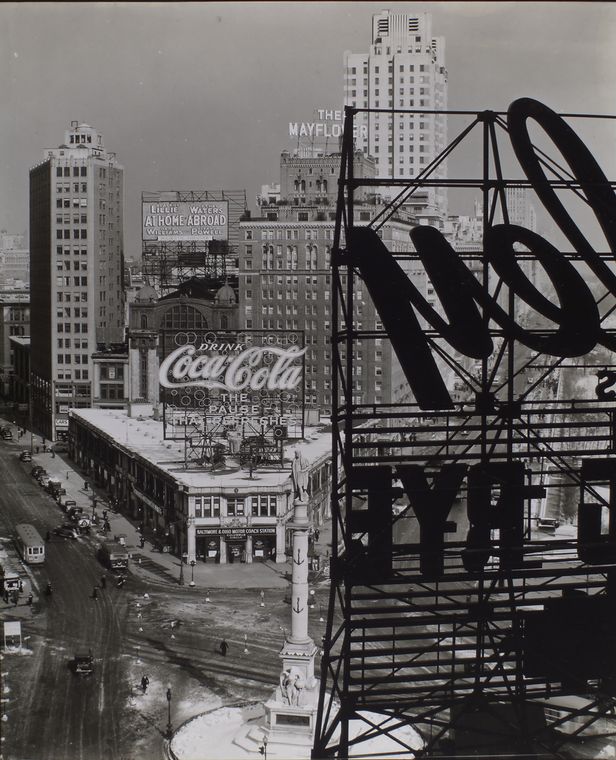
Berenice Abbott’s view of Columbus Circle, from her 1938 opus Changing New York
By MICHAEL PERKINS
WHEN IT FIRST APPEARED IN 1939, photographer Berenice Abbott’s comprehensive visual essay Changing New York had already weathered several years of bitter struggle over its content, a debate between Abbott’s New Deal-era sponsors at the Federal Art Project and her publisher, E.P.Dutton, over just what kind of book it should be. Berenice and her partner, writer Elizabeth McCausland, envisioned the tour of the the five boroughs as a documentary, at a time when the very term itself was new, with virtually no one agreed on what it even meant. Abbott’s idea for the book was to show skyscrapers and shacks, apartment towers and wharf warehouses, side-by-side, to illustrate the constancy of evolution, of a city that not only never slept but hardly ever slowed down. Meanwhile the Feds and Dutton had their own separate agendas, resulting in a fierce tug-of-war over the final configuration of CNY. In the end, Abbott was forced to severely modulate her vision. However, in the broad sweep of history, even her “mutilated” masterpiece proved essential, not only in the history of New York but in the development of photography as a fine art.
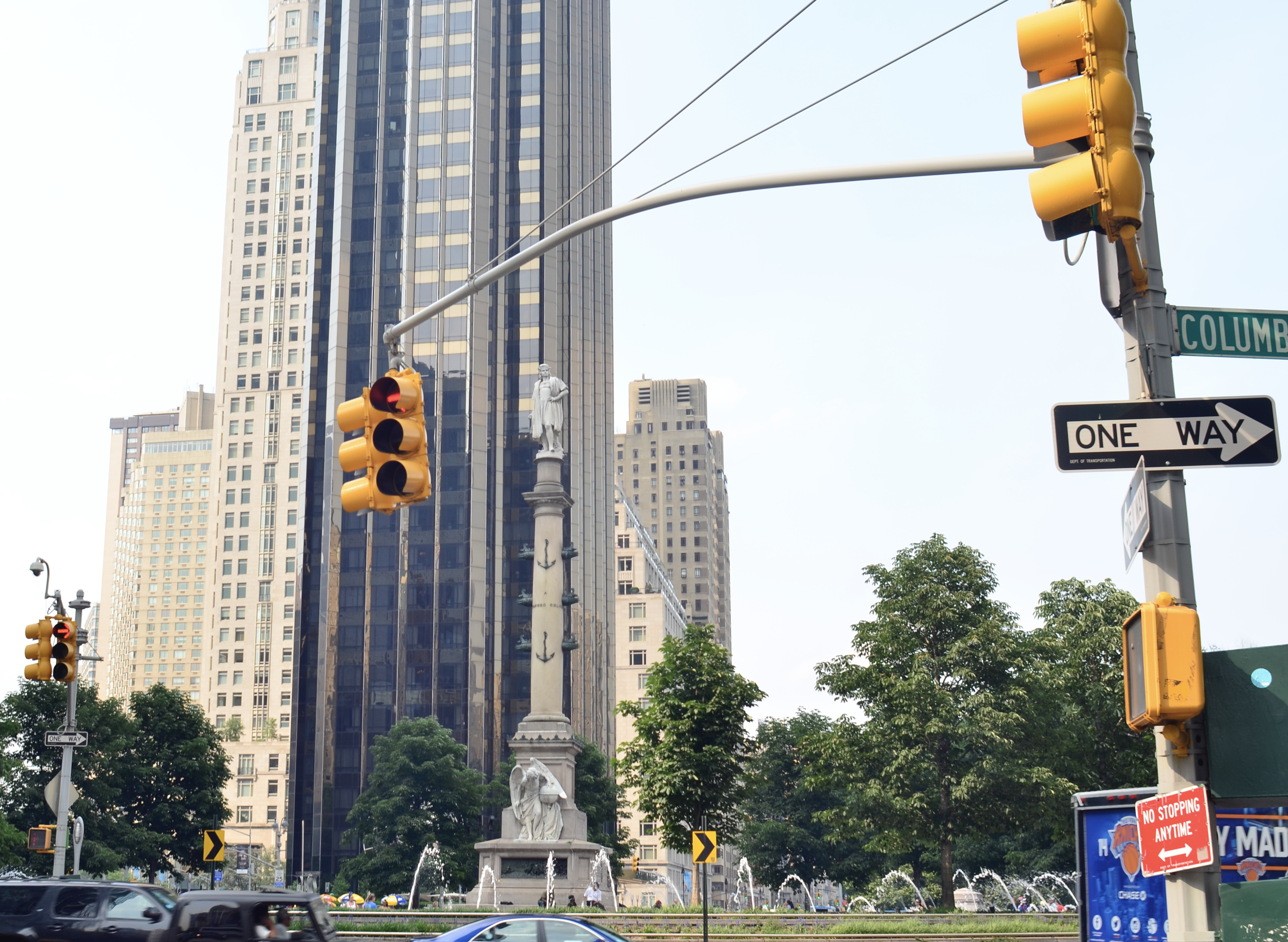
A 2015 view from the same angle. Goodbye, Coca Cola, goodbye Mayflower hotel.
Over the years, I have seldom been without a copy of Changing New York, which began as a collection of over 300 plates and was published with just under 100. Different “restored” or “complete” versions continue in print to the present day, and the reader is welcome to embrace Abbott and McCausland’s original sequence and text, or an exhaustive compendium of everything she shot, and draw his/her own conclusions. With the past year involving a lot of looking over my shoulder at my own accumulated photographic output, I recently found that, quite unintentionally, I have, over the last twenty years or so, made pictures of several of the very same street scenes that were covered in CNY, creating a very personal “before and after” comparison between the Manhattan of 1939 and that of today. In a few cases, many of the players….buildings, transport systems, street configurations…have remained remarkably stable. By contrast, a look at the two images of Columbus Circle shown here, Abbott’s from 1938 and my own from 2015, may as well be comparisons of the sun and the moon.
We tend to think of cities as static things, as fixed objects which are always “there”. And, in the case of a few mile markers like the Empire State or the Statue of Liberty, that’s certainly true. But in general, urban areas are being both created and destroyed every day, the currents of their streets ebbing and flowing. Abbott tried to demonstrate this in the New York of the Depression years, a time when convulsive social change, tremendous economic disparity and an uncertain future showed a city that had already begun to obliterate its pre-1900 past in the name of progress. Despite the art-by-committee compromises that Dutton and the FAP visited upon the first version of Changing New York, Berenice Abbott succeeded better than she could have known in giving us a detailed, unsentimental record of the way of cities in The American Century. And today, when we make our own pilgrimages to those same streets, we cannot help peering through her viewfinder in pursuit of our personal visions.
FROM HERE TO THERE EVENTUALLY
We are all in this alone. We are all in this together.
By MICHAEL PERKINS
IN THE HALTING EARLY DAYS OF PHOTOGRAPHY, the only thing balkier than the making of an image was in getting one’s work seen outside the artist’s personal social circle. Several dozen technical revolutions later, we take real-time distribution networks for granted, accustomed to a reality with literally no time lag between the generation of a picture and its dissemination to the world at large. Click, it exists. Click Click, it’s published. That is now the rhythm of a photograph. It’s ours, and everybody’s, in the same instant .
That immediacy has proven to be of incredible value in our most recent Great Hibernation, as a virtual way of compensating for the shrinking of our material worlds. Early 19th-century photographs were initially stunted in their impact on society, since they had to overcome the obstacles of space and time to reach mass audiences. A picture made in one place had to be physically shipped or transported to the few centers from which it could be faithfully reproduced and effectively shared. A lockdown of the entire world in such a time would have corraled art into small local sectors of influence, whereas Covid-19 internees have lost nothing in the options for connecting their visions with the entire globe at a keystroke. Thus our literal isolation has a kind of modern-day antidote, in that our art can travel where we cannot. And so, in terms of images, two opposing statements are nonetheless equally true: we are all going through this alone, and we are all going through this together.
Photographs have indeed proven the great storytellers in this weird, weird banishment. In the years ahead, volumes will be written on the psychic and emotional damage suffered by those who will have survived these times. That damage is real, and will probably be long-lasting for some. But, in what must be one of the most bizarre sources of comfort possible, it’s hard to imagine how much worse the isolation would have been in an earlier time, a time when going it alone also meant not being able to release a little carrier pigeon of wonderment or hope via our poetry, our wonderings, or our pictures. Can a camera save one’s sanity? Not literally, of course. However, the time-honored thrill of being able to simply shout across a canyon and get an answer back has a modern analog, and sometimes that echo comes in the form of an image.


PATHS AND PURPOSES
The Rebel (2021)
By MICHAEL PERKINS
THE JOURNEY OF THE INDIVIDUAL IN SOCIETY courses along two diametrically opposed paths. Both roads can impel the spirit toward ends that are both cherished and loathed. One fork cruises through the innumerable ranks of the predictable, taking the individual along prescribed patterns of conformity; the other travels the more arduous road to individuality, a complete realization of the unique self. Both paths have their positive and negative aspects; both seem attractive or repellent at different times in our lives. And both have a visual signature for the photographer.
Conformity is perhaps the easier of the two paths to trace, evoking row after row of identical work cubicles or endless blocks of lookalike dwellings. It leaves its visible track in the way we close ranks or join organizations; the kinds of gatherings that offer us protection or anonymity. Our photographer’s eye readily tags the look of the collective, the joiner society.
The path toward individual expression is a little more abstract, as there are as many ways to stand out or apart as there are human hearts in the world. How do we choose to leave the rutted path? What means do we employ in improvising a personal life signature? How is our rebellion in the name of a more sculpted self visually measured?
It can be something simple, like being the only kid that wears bunny slippers to symphony rehearsals. A bumper sticker that’s guaranteed to provoke comment. Or, as seen above, a little public space that we convert to private space with a paper lantern, a wind chime, or a bird feeder. Making photographs of the way we go along to get along is measuring the patterns of our agreement (maybe even our surrender), and that creates one kind of picture. Framing up the stories that we tell out of our very own storybook gives us another result completely. Both kinds of images are educational. Both are commentary. And if we’re really lucky, both can be compelling.
Share this:
April 21, 2021 | Categories: Uncategorized | Tags: Commentary, Street Photography | Leave a comment