ONE OF US
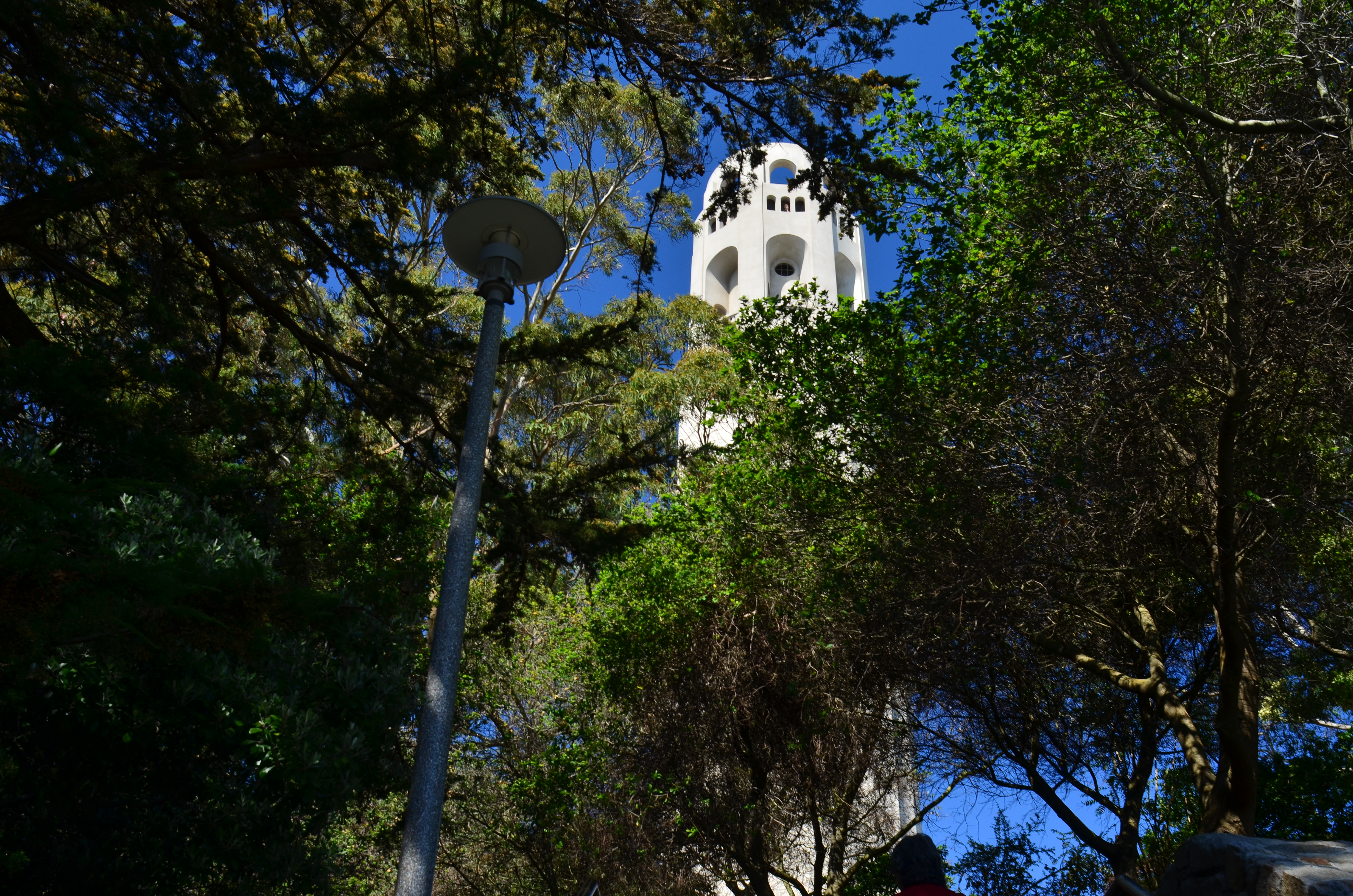
The final approach to Coit Tower is shielded by a dense shroud of trees.
By MICHAEL PERKINS
OF THOSE WHO REGULARLY BRAVE THE KNEE-CRUNCHING, 275-FOOT TREK up San Francisco’s Telegraph Hill, a promontory in a city that is, itself, a sea of promontories, many make the pilgrimage for the privilege of filing into a circular tub of a mausoleum that houses the central core of Coit Tower. Since 1933, this white, streamlined concrete shaft, looking over the bay from atop the archly hip North Beach neighborhood, has been visible from anywhere in the greater SF area, now resembling a lighthouse, now looking more like the topper on some important tomb. Built in honor of a local character named Lillie Hitchcock Coit, who chased fire engines to local blazes and used her inherited wealth to fund a memorial to what we now call first responders, the 210-foot tower is, on the outside, the curiosity of but a few minutes. But inside, it’s a great place to watch people. People watching other people. People from every craft and trade on the earth, their vanished world enshrined in the brightly-hued murals that decorate the entire interior of the tower’s base. People who provide a visual encyclopedia of who we are, captured in the “whos” of what we were.
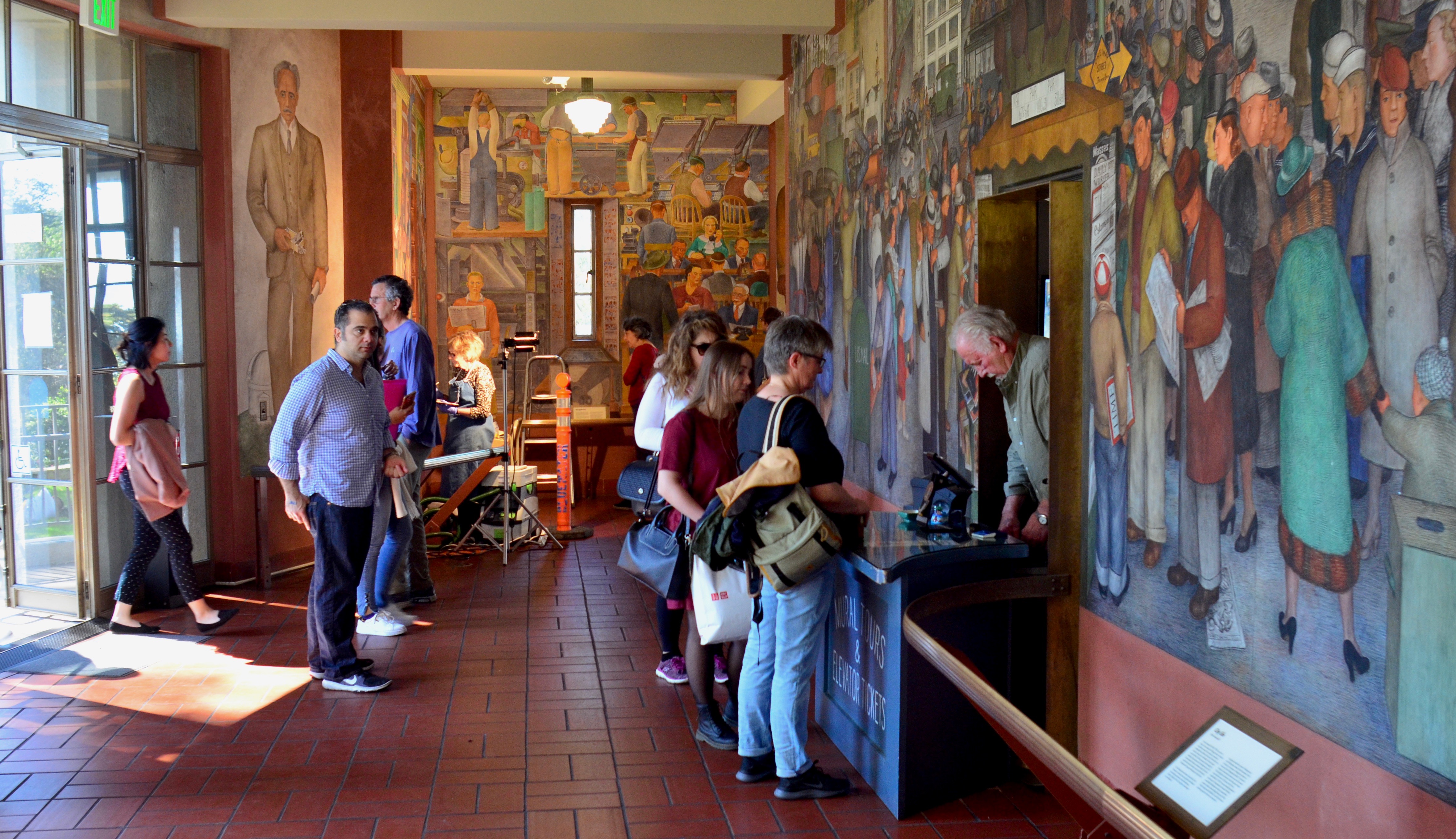
The mural-embellished lobby of San Francisco’s iconic Coit Tower. Note the touch-up artist behind the daily visitors.
The America of the 1930’s was indeed a very different place, one groaning under the near-25% unemployment rate of the Great Depression. Solutions both good and bad abounded in the desperate atmosphere of the day, one such solution involving the idea of regarding the country’s artists as no less important than its workmen…that is, creating government programs to put them back to work. Sculpting. Painting. Writing plays, songs, novels, guidebooks. Recording photographic archives by which we better understand the bitter struggle of those years. A variety of “alphabet soup” acronyms like the WPA (Works Progress Administration) chose the projects and fronted the cash to make them happen.
Think that over. We paid people to make art. In post offices. In libraries. In meeting houses and union halls and railroad terminals and theatres and auditoriums. Frescoes. Reliefs. Statues. Works with which our government announced, in a very loud voice, that Art Is Important. And that steps were going to be taken to keep it alive.
Coit tower’s lobby is only one of dozens of places in San Francisco where public art was used for not only beauty but commentary. The people on the walls are not generals, nor political leaders, nor gods, but ordinary working people, shown in every trade from farming to construction. Fruit pickers. Meat packers. Librarians. Cowboys. Their majesty is in the very un-exalted way they are depicted. Generations later, they are still recognizable. As us. From us. One of us. Watching the daily crowds queue up for a ticket to the tower’s one slow Otis elevator is a little like watching a mirror. The types, from large to small, skinny to stout, match up. The faces of fresco and flesh melt together. The past and the present blend, as in the above image, where people visiting the monument for the first time pass unwittingly by a seated worker, tasked with repairing the wear and tear of salt air and time. Wheels turn.The work goes on. One day it’s mining. Next day, it’s coding. All work.
From the top of Coit, visitors enter a time machine of a different kind, as San Francisco’s mad mix of Victorian elegance, Bohemian beat, and psychedelic scrawl unfold in a 360-degree panorama. But it’s the technicolor testimony at ground level that makes the building great, its factory workers, miners and coal miners anchoring the place in human effort. A good general source for learning about the Coit’s panels (which include work by many of Diego Rivera’s students), as well as the other projects that survive in the area is Depression-Era Murals of the Bay Area (Veronico, Morello< Casadonte, Collins, 2014), although a general study of New Deal-sponsored art programs will also delight even the casual student.
So come for the climb. Or the tower. But stay for the stories, all the while taking pictures of people looking at people. And seeing something they recognize.
CAREFUL WHERE YOU POINT THAT THING
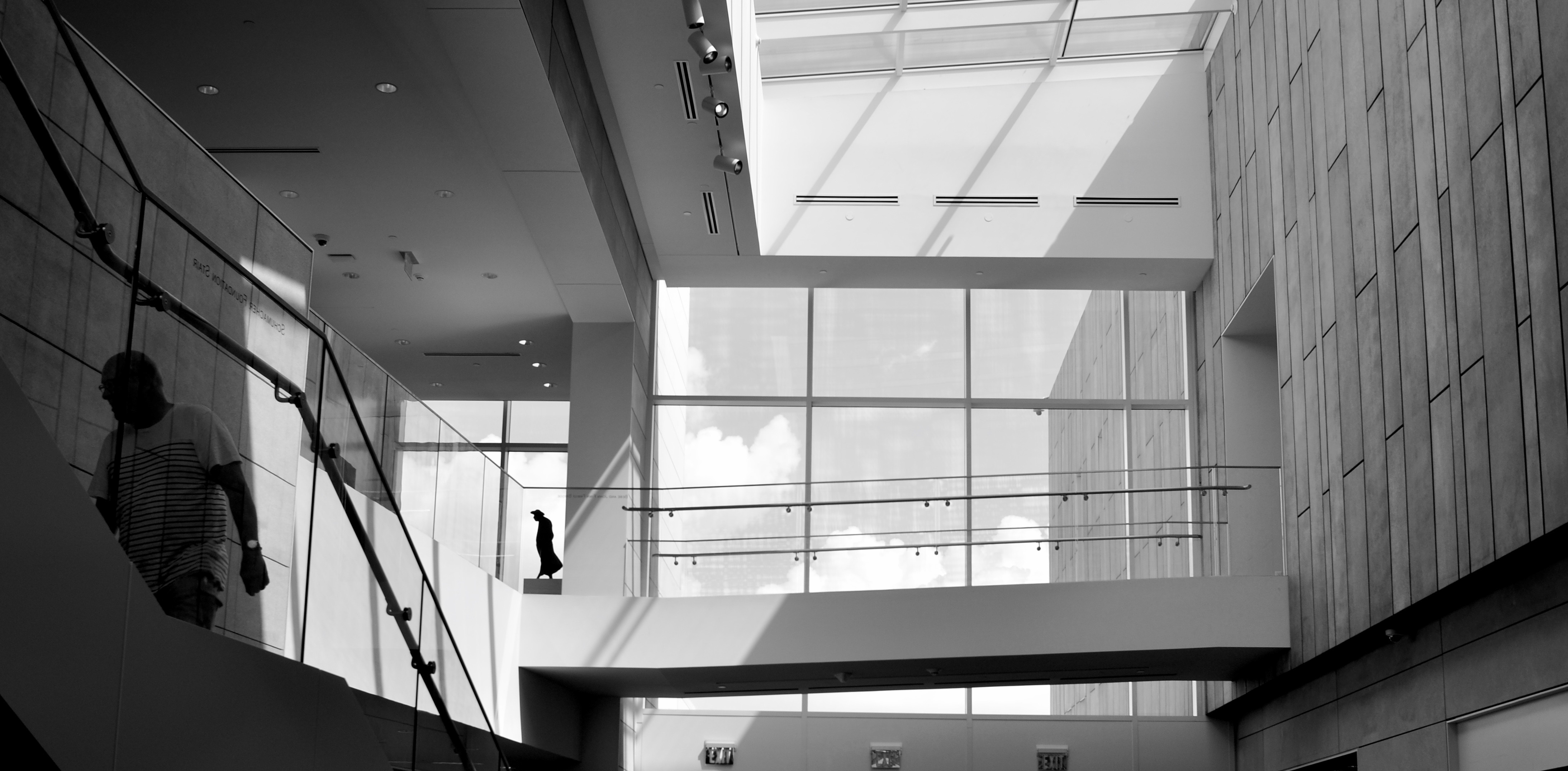
Planes And Pathways, 2018
By MICHAEL PERKINS
THE MUTUALLY AGREED-UPON NAMES FOR THINGS THAT WE HAVE ALL USED “FOREVER” can become quaintly inaccurate over time, as their original descriptions lag behind their gradual re-purposing. Thus, over a century into the age of the internal combustion engine, we still measure the output of an automobile in units of “horsepower”. Similiarly, fifty years since the discontinuation of the rotary telephone, we still refer to numbers that we are to “dial” in order to place a call. And nearly two hundred years after the introduction of photography, we still have only two labels for the orientation of a camera frame…”portrait” and “landscape”.
It once made sense to talk this way. In order for film to become a mass-manufactured medium, some standards had to be established as to the size of a frame, and so P & L were solidified as really just one set of dimensions for all pictures recorded on celluloid. The “two” orientations were effected by simply twisting the camera around to shoot either vertically or horizontally. Likewise, all images we got back from the film processor were standard in measurement, with only the print industry or those who developed their own pictures regularly altering the frame through the editing process that came to be known as cropping. Digital imaging and processing democratized a practice that had formerly been proprietary, with cropping becoming as widespread for billions of shooters as clicking. Final frame size became a creative tool rather than an arbitrary limit.
Each year, fewer and fewer of the photographs we shoot arrive at their final version in the same dimensions in which they were initially shot. The word “portrait” thus describes any image of any dimension that centers upon a face, while the term “landscape” can be applied to any generally linear subject arranged along a horizon line. Beyond that, all bets are off, with photographers using frame size to not only create according to very specific personal styles but to re-create or optimize pictures long after they are first snapped, as witness the above picture, which had nearly half of its original height chopped off the bottom almost a year after it was shot.
Even more importantly, cropping can now be done in multiple optional “takes”, the way some shooters used to make several trial prints of a single shot by re-processing the same negative in a variety of ways. Certainly, camera manufacturers may stubbornly stick to the words “portrait” and “landscape” just as we all continue to “dial” phones, but in reality, a frame is damn near anything we decide it is. Cropping is now an executive decision, just like color correction or exposure compensation, and there is no limit to how tall or how wide an image is “supposed” to be. Like so many other side benefits of digital technology, cropping in the present era has placed more choices in more hands. And that’s as it should be. Every great leap forward in photography across time has granted people wider decision-making powers. This is always a win for everyone. Because, once you can technically do a thing, you are free to choose to do it, pretty much at will, and your photographic vision has a better chance of getting from your eye to your hand intact.
TOGETHER, ALONE
By MICHAEL PERKINS
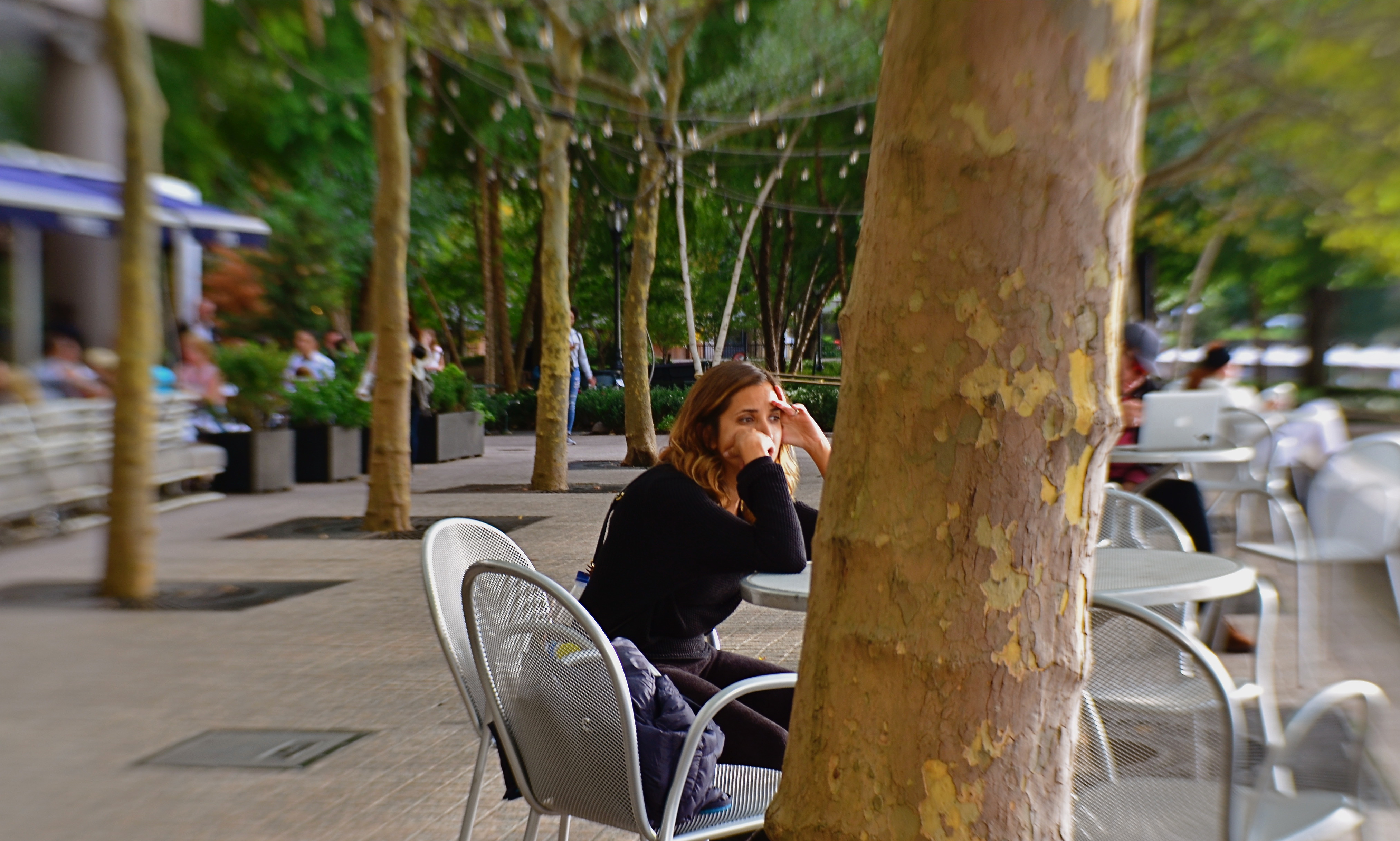
THE IRONIC NOTION THAT PEOPLE, JAMMED BY THE MILLIONS INTO CITIES, COULD ALSO BE DYING OF LONELINESS is not novel. Not to poets. Not to authors. Certainly not to photographers. T.S. Elliot’s contention that most people live lives of quiet desperation resonates with anyone who’s ever felt like the odd man out at a party, or burned a single cupcake candle on their own birthday, or hopelessly tried to bury themselves among the throngs in Times Square. What keeps this idea of “together, alone” so current in the arts is, in fact, its almost cliche level of truth. We are all in this together. And we are in all of this alone.
As photographers, we are always looking for the vision with the vision, the hidden within the apparent. Or, in the case of aloneless, the moment the mask slips, the instant in which we reveal how different, how frightened, even how miraculous we are when separated from the masses, if only for the length of a shutter snap. We pause in reverie. We reflect with sweet comfort and bitter regret. We stop to breathe, to gather our strength up anew. And our faces testify about it all.
We need to belong to things beyond ourselves, but we also need to be sufficient unto ourselves. Those two needs tug us in opposite directions, and the stress of it shows. Photographers teach themselves to see when truth surfaces like a whale coming up for a gulp of air. How strong that creature is, we remind ourselves, and yet how vulnerable. It can rove as the very master of the seas and yet, like ourselves, can drown in a teacup of water.
I look for those registrations on people’s faces, those telltale signs of someone coming up for air. A sigh. A faraway look. A laying down of burdens. Cities both supply us and suck us dry. Some of us can’t serve the two masters of together and alone for a lifetime. Others actually manage to juggle the extremes, but pay a price for their agility. The camera measures all those battles, once we teach ourselves to see. Sometimes the struggle behind our own eyes is so keen that we can’t see outwardly, even inches away, to notice the journeys of others. But with practice, observation creates a graphic map of together/alone, and our individual battles with being components in big things and prisoners of small ones.
LIP SERVICE
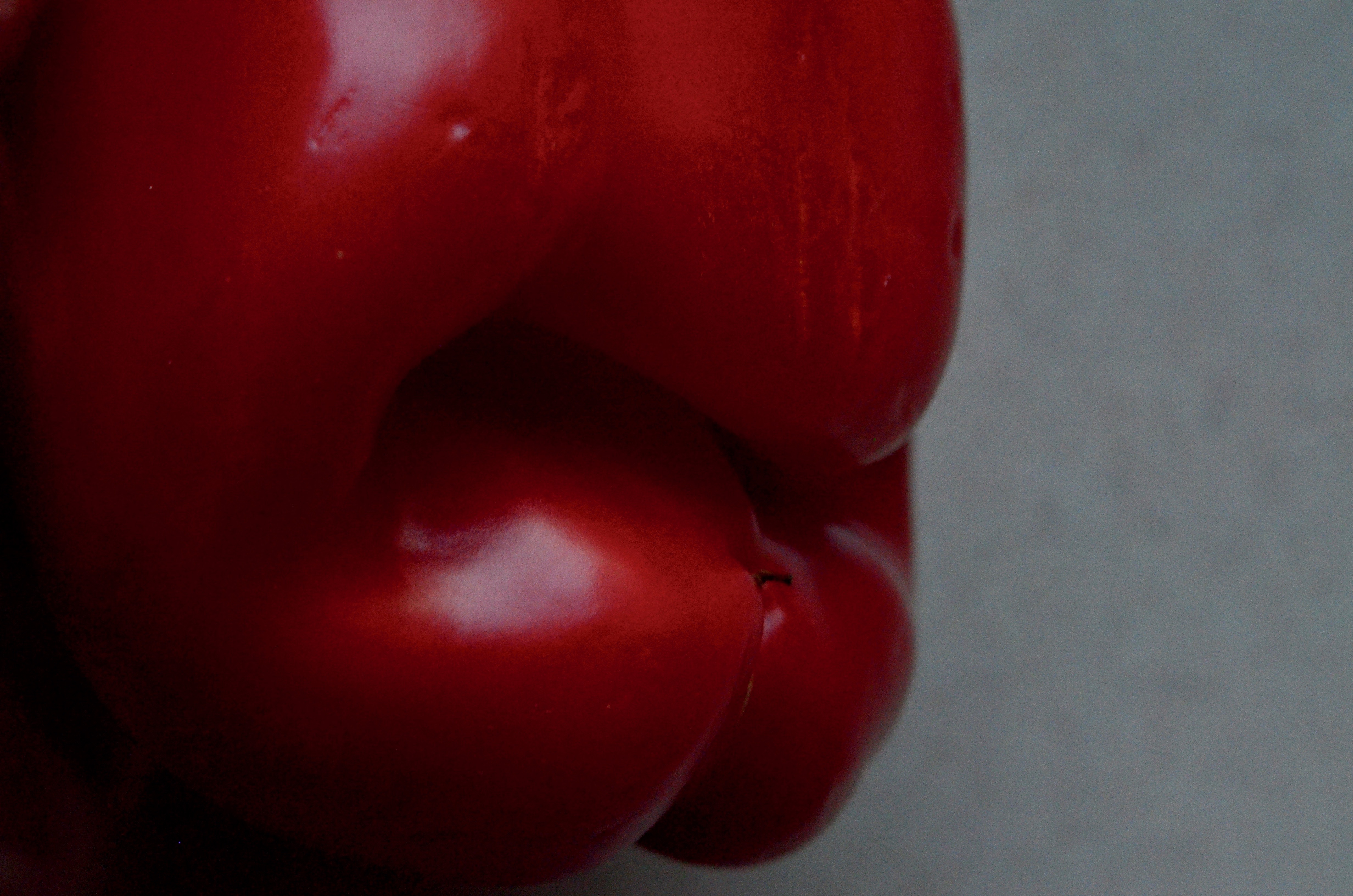
The Elder Speaks His Truth, 2016
By MICHAEL PERKINS
PRIOR TO AROUND 1920, photographs of objects were generally naturalistic recordings of objects as they were popularly perceived in the actual world. Apples were shot to resemble apples, trees to emulate trees, and so forth. Techniques that had served photography in the nineteenth century, which favored the same objective rendering of things in the same way that painters did, persisted until generally after the First World War, after which both camps began to question whether reality was, indeed, the only way to portray the world. Some shooters began to veer away from any painterly softness or interpretation, declaring focal sharpness and documentary truth over the dreamy qualities of the canvas. Others, however, took another page from paint’s playbook, opting to see compositions as arrangements of light or shapes, and nothing more. Everyday objects were filtered through a new way of seeing, and the ordinary was drastically reconsidered beyond the act of mere recording. Photographers began to also be interpreters.
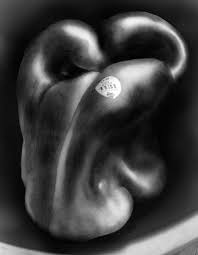
A Weston Pepper.
One of the most stunning examples of this new freedom were Edward Weston’s “pepper” images of the 1920’s, a series that re-envisioned vegetables as new somethings that were reminiscent of abstract nudes. Weston’s monochromes were, first and foremost, compositions of line, absent the context that the normal world typically afforded. Suddenly, shapes were absolute: the photograph didn’t have to be about anything: it merely was, in much the same way that modernist paintings re-framed the way people saw faces, bodies, architecture. Some were shocked, even frightened by the newfound freedom Weston and others were championing, while others felt liberated. As ever, the best photographs sparked the best arguments.
I was reminded recently what a simple revolution can be created by such a minor warping of the visual sense when I unpacked a pepper that I felt could have escaped from Weston’s own garden. The gnarly thing seemed, even before my memory had made a connection back to his work, like a ripe, red set of lips, something between the cartoon kiss of a Jessica Rabbit and the Rolling Stones’ lascivious logo. The curviness of the pepper proved too seductive for me to just start immediately carving it up for salad, so I attached a macro lens and started to take a tour around the thing. At one angle, the vegetable almost looked like a mouth in profile, but with perhaps the faintest suggestion of an overall crimson face as well. The entire exercise took about three minutes, after which the pepper dutifully kept its prior appointment with my homemade balsamic dressing. The one fun takeaway was reminding myself that, no offense to reality, but it’s fancy that makes photographs.
Just think what kind of portrait I could make from a rutabaga with attitude.
ERRING ON THE YES SIDE
By MICHAEL PERKINS
EVERY ONCE IN A WHILE, IN THE VERY INSTANT THAT I COMPOSE AND SNAP A PHOTOGRAPH, it occurs to me that, in the past, there might have been circumstances under which I talked myself out of taking that very same shot. That is, there is something in the scene before me that, at some time, might have convinced me not to attempt the picture at all. I don’t know whether to interpret this feeling as proof of growth of any type, or whether it just demonstrates my utter lack of confidence. I just know that, on different days, I can be a very different kind of photographer.
As habitual users of The Normal Eye already know, this small-town newspaper is less about the mechanics of taking a picture and more about the motivations. If we don’t understand what compels us to click/not click in particular situations, it’s pretty hard for us to figure what the whole thing’s about. Photographs are chosen, not “taken”. So, let’s peel apart my inner conversation in the making of the image seen below.
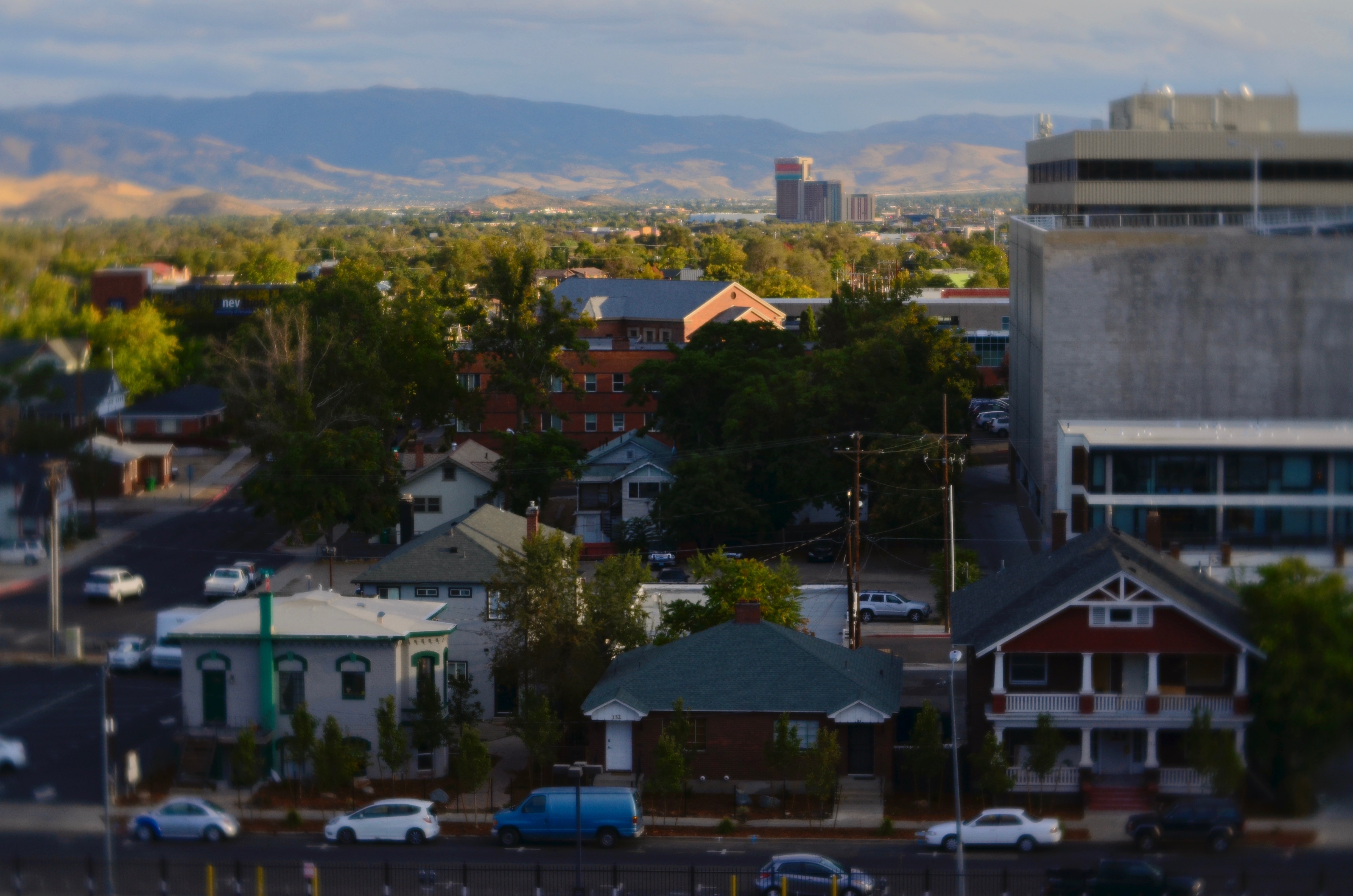
Small Town, Big Horizon, 2016
In looking at this scene from two years ago, in which some shadowy residential streets of Reno, Nevada are back-stopped by the Sierras, I could, through my own experience, easily rattle off a short grocery list of reasons not to attempt the picture. Among them:
There is too wide a contrast between the foreground and background (but is that a problem, really?).
I’m shooting through a window and therefore can’t absolutely suppress glare and reflection (but is that a deal breaker?).
There is, at first glimpse, no human story in evidence (or is there merely an absence of people in the frame? Aren’t the houses indicative of a “human story”?).
Okay, I’ll take the picture, but I’ll totally fix it later in “post”( fix it, or over-cook it and make it “ideal” rather than natural?).
……..and so on, with the additional inclusion of the most compelling “why not to” reason of them all:
the last time I tried something like this, it was a disaster.
*******
You can see where this can lead. The very experience that should be helping you make more, better informed choices can actually scare you into seeing certain shooting situations as fraught with risk, as something to be avoided. Since we know what didn’t work in the past, we tend to think we also know what won’t work in the future. In reality, though, every time we’re up to bat, some little thing is different from our last time. Huge stuff like a different camera or lens, small stuff like being tired or distracted and every other variant in between. We may think we’ve “been here before”, but that’s only generally true. The only real way to make a picture a success or failure is to try to shoot it. Guesswork, even guesswork based on real-life experience, can paralyze. Sift through what you know and what you’ve lived through. Re-live all your so-called “failed” pictures, and then get back on the horse. As Rudyard Kipling said, “meet with triumph and disaster, and treat those two imposters just the same.”
I don’t preach many absolutes here, but remember this one:
Always. Shoot. The. Picture.
ESTRANGEMENTS
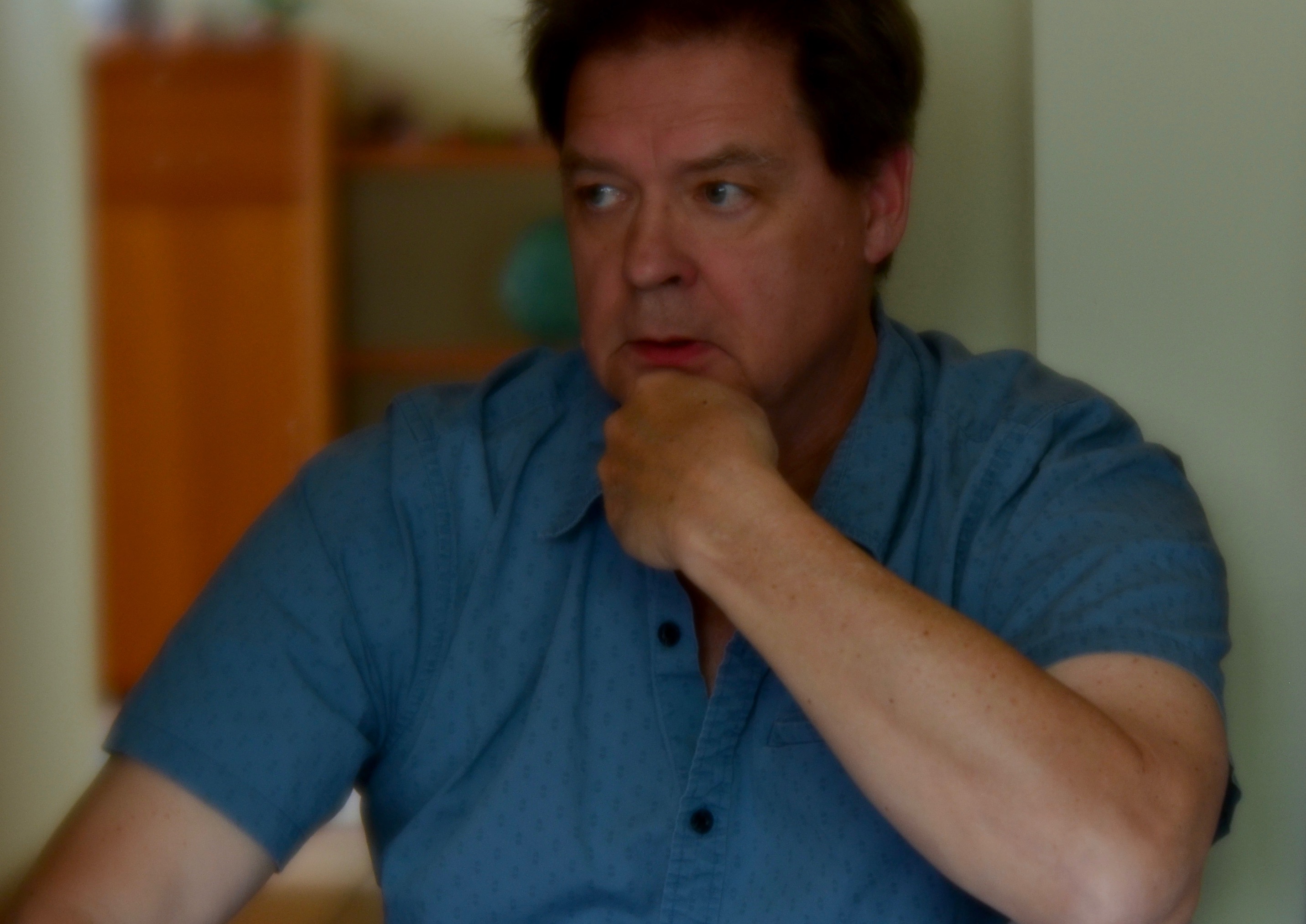
The author, in a typical moment of consternation.
By MICHAEL PERKINS
THE OLDER I BECOME, both as a person and as a photographer, I wonder if there truly is any such thing as a “self-portrait”. Of course, I don’t doubt that it’s technically easier than ever to record one’s own image in a photograph. What I do doubt is whether the term portrait is a valid one when applied to oneself. Simply, can we be objective enough to accurately interpret who we are with a camera that we ourselves wield?
Now, bear with me. This isn’t as hippy-dippy as it sounds.
Many of us can recall the first time we heard out recorded voice played back. Its sounded alien, untrue, outside ourselves, even abstract. Similarly, we have also disparaged other people’s attempts to “capture” us in a photograph, dismissing their efforts with “that doesn’t even look like me!” Does this mean that the other person’s camera somehow transformed us into a distortion of ourselves? Or is it, rather, that we have an imperfect concept of what our actual appearance really is? But….okay, let’s suppose for a moment that everyone else in the world that takes our photo somehow doesn’t “get” us, that we, out of our vast knowledge of our own hearts and minds, are, in fact, the only person qualified to reveal ourselves in a photograph. All right, that being our theory, what are the real results of our having, especially in the current age, almost unlimited “do-overs” to get our pictures of ourselves “just right”?
After all, as much sheer practice as we have taking images of ourselves (and it is some real tonnage, folks), we should have reached some plateau of proficiency, some perfecting of process for telling our true story. But have we? Are you satisfied that your best, most authentic self resides in a picture that you yourself have taken? I know that, in my own case, I can only confirm that I have gotten better at producing a version of myself that I choose to represent me to the world. I have crafted a performance out of my own talent as a photographer that shows me in the most flattering light, portraying me, by turns, as thoughtful, funny, courageous, resilient, and whatever other recipe of herbs and spices flatter me most. But have any of these performances qualified as “portraits”? I can’t answer that question with complete confidence….and neither, I suspect, can many of you.
So is the “self-portrait” destined to be a beautifully concocted lie? Well, to a degree, yes, always. Those of us who apply an unflinching and honest eye to our own shortcomings and biases may occasionally approach the truth in the way we present ourselves to our own cameras. And a few of us will even achieve a kind of angelic honesty. And it will always, always be easy to have the whole process collapse in self-parody. But the point is this: given the sheer volume of “selfie” traffic loose in the modern world, we should at least try to break through our estrangements, our protective layers. A photograph can certainly be seductive even when it’s a lie. Sometimes because it’s a lie. But from time to time, it’s nice to take a gut check and see if we recall what the truth looks like as well.
THE LUXURY OF LEAVING
By MICHAEL PERKINS
WE’VE SPOKEN A FEW TIMES HERE about the snapshot mentality, that hard-wired sense of urgency that seems to accompany nearly all picture-making….the flashing red light that screams Hurry. Get the shot. It’s a nagging feeling that we’re missing something great, that we’d better stop wasting time and start clicking. This hair-on-fire sensation may have come originally from cameras that were too slow or clumsy to operate, resulting in many lost opportunities. Then, as both cameras and film became more responsive, the idea that we could crank off a frame almost as quickly as the action of a special event spurred us on even further. Many generations and millions of personally precious occasions later, we almost always shoot on instinct. It takes practice and deliberation to slow down and actually plan a shot.
But the world is not composed solely of kids blowing out birthday candles or Bob being surprised by his retirement party, and there will always be times when, as far as photography is concerned, there is literally no big rush. Thing is, we have to retrain ourselves to sense what those moments are, and enjoy the luxury of being able to linger, even to leave, come back, reconsider, and re-shoot in an attempt to get the additional dimension that only comes from taking one’s time. This is an increasingly difficult habit to form, since we have so long married the instantaneous or fleeting quality of many situations to the way we take pictures. People who think too much about this kind of stuff have sold scads of books with the words contemplative or mindfulness in the title, but it really is just about slowing down long enough to let ideas percolate, for better pictures to emerge.
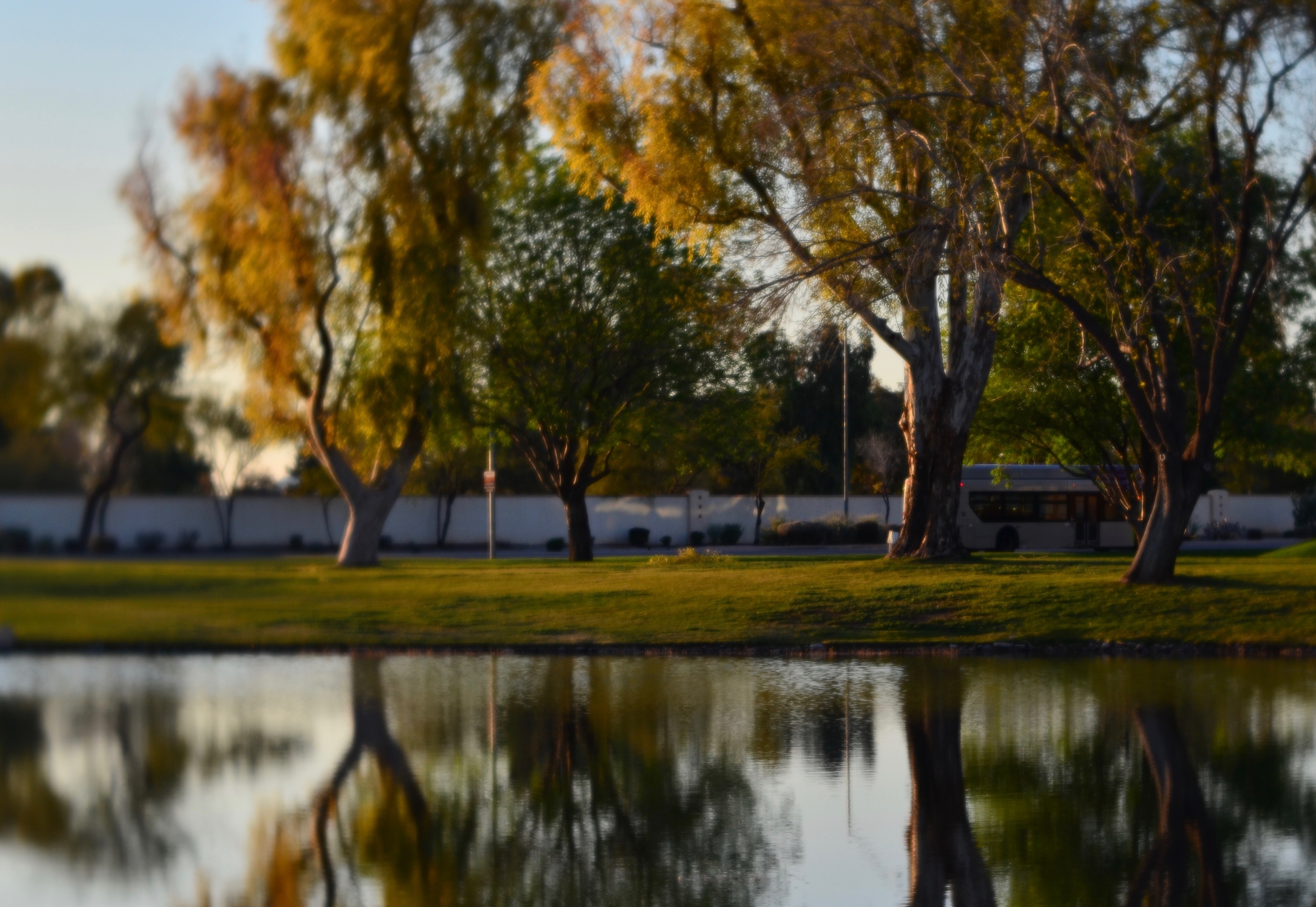
The Lakeshore Line, 2019
It is certainly true that technology has allowed us to make acceptable pictures of nearly anything, our cameras taking many decisions (including careless ones) out of our hands, trying, in essence, to anticipate what we probably “want” and attempt to give it to us. The aggravation of what results when we turn over the keys completely to these brilliant but non-intuitive machines, the gap between what it serves us up and what we truly seek, is the reason behind the blog you’re reading right now. The Normal Eye is dedicated to those times we wean ourselves off auto-settings, electing to both ask and answer our own questions, relegating the camera to its proper status….that of a servant. Part of the taking back of that control is placing yourself in situations where it’s okay, even optimum, for you to just simply cool your jets and think.
The frame you see here is #18 out of twenty shots taken toward a busy suburban road as seen from a roadside pond. The surface of this small lagoon is usually filled with concentric ripples from a centrally located fountain which is nearly always turned on, so in many cases, I could not dream of the reflections seen here. That idea alone was enough to make me pull off the road and park. Several of my first tries were framing disasters; a couple of others were taken from an opposite angle and contained too much clutter: and then there was this one, which was preceded by several in which the road was just crammed with late afternoon traffic. Frustration was mounting. I wasn’t getting what I wanted. Indeed I wasn’t sure I even knew what I was going for.
But then the lightbulb moment. This scene was going to remain stable for a while. Nothing could be lost by quitting the scene for a few minutes and approaching the whole thing with refreshed concentration.
I took a walk.
Five minutes had, indeed, made a difference in the intensity of the local traffic, which, in turn, gave me an idea for something that the picture could be about, as I saw a lone bus approaching from the leftward edge of my peripheral vision. Suddenly I had just enough context to at least imply a story. Whereas dozens of vehicles were just visual litter, a single bus could anchor the picture, add scale to the scenery, or at least tell the eye where first to focus. Ironically, I had a “snapshot’s” worth of decision time in which to snap the shutter before the bus passed out of frame, so, even though I had taken extra minutes to get the shot I wanted, I only had seconds to recognize that it had arrived. In the final analysis, I would have had, at least in my own mind, much less of a picture if I had settled for the first, perfectly adequate rendering of the scene. I had benefited by not having to make up my mind in an instant. Contemplative? Mindful? Who knows? To me, it’s just enjoying the luxury of those instances in which I can afford To. Just. Wait.
WITH THE GREATEST OF EASE
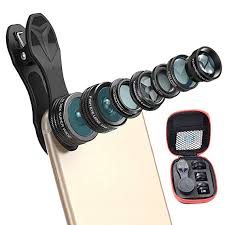
You, too, can convert your cell phone to a, well, I don’t really know what this is…
By MICHAEL PERKINS
THERE IS A NATURAL INCLINATION IN THE MINDS OF MANY PHOTOGRAPHERS to fall in love with systems…widgets, intricate calculations, work-arounds, gimmicks, diagrams, gadgets, toys. We like to tinker, to play Workshop Edison. Let’s see what happens if I do this, connect these, try it without that. We love convenience and simplicity, but a Dark Gearhead lurks within us all as well, trying to reduce photography to a series of technical solutions, intricate puzzles. And so we see-saw. We selectively want our cameras to seamlessly carry out our wishes without a lot of bother and to make things as complicated, as hands-on, as feasible. It’s a strange balancing act.
Almost immediately after the mad global crush we all experienced at the virtually effortless ease of cell phone cameras, there was a countervailing energy to add on to the things, to make them do more, be better. First was the tidal wave of apps for the post-processing of all those quick snaps. Then followed the tsunami of toys and add-ons that were designed to compensate for the device’s technical limits. This ever-expanding array of screw-ons, extenders, mini-tripods and effects lenses make the simple iBricks in our pockets look like pocket weapons given to Bond by a nervous Q. Do try to bring the ordinance back in one piece this time, 007.
The rig seen at left is by no means the most complex set-up I’ve found in recent years for enhancing cell camera proficiency. In fact, on the fussiness scale, I’d say it scores roughly in the middle, although I think it’s off the charts for excessive intricacy (too many parts), annoyance in operation (wait a second till I get this out of its cool carrying case and assemble it!) and plain damned silliness (no example required). I’d also stipulate that I haven’t seen a lot of such contrivance actually being used in the field, that is, nowhere near the “market penetration” of the dreaded (and soon, Dear God, to be become obsolete) selfie-stick. Still, this kind of iPhone-based arms race for additional macros, fisheyes, and other optional optics begs a few questions. For starters, is the convenience/portability feature that made millions love and use these cameras now on the wane(doubtful)? And as a follow-up, if you require this level of accuity in your picture-taking experience, why not simply buy a conventional (notice I did not say “real”) camera and be done with it?
The twin impulses of make-it-easy and make-it-complicated will continue their ages-long tug-of-war for the photographer’s soul, and perhaps that’s part of the fun. Both paths can lead to both excellent and execrable images, so, as we frequently conclude, the results, and not the toys, are what truly matter.
ONE BRICK AT A TIME
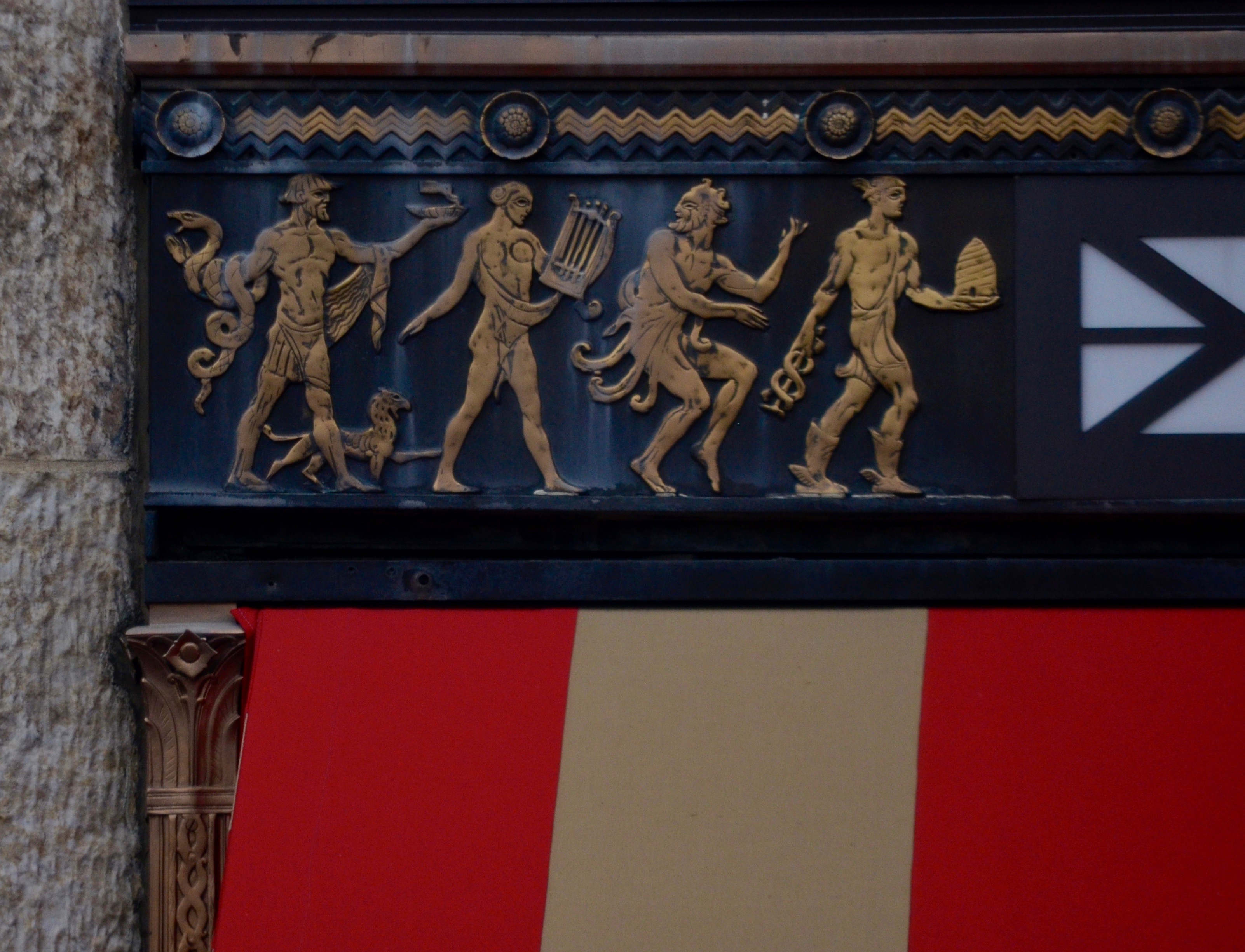
The devil…. or the delight…is in the details in urban architecture.
By MICHAEL PERKINS
MANY URBAN BUILDINGS FROM THE EARLY 20th CENTURY CAN BE OPEN SECRETS, objects that we walk or drive past with such frequency (and speed) that their most telling elements are often underseen. Certainly, we visually record their larger contours…the block or the spear or the obelisk or the faux cathedral or the Romanesque monument, those general features that figure prominently in long-distance skylines and postcard views. But what remains virtually invisible are what musicians might call the grace notes, the smaller accents and textures that, upon closer inspection, reveal as much, or even more, about the intentions of their makers. And seeking close encounters with these elements can yield great subjects for photography.
More so than with the taciturn minimalism of the post-WWII years, buildings from the 20’s, 30’s, and 40’s were often personal headstones for men who piled up great fortunes, captains of industry who wanted to invest every inch of their towers and spires with references to their beliefs as well as their bank accounts. Lintels, door frames, spandrels, arches, vestibules and cornerstones all bore testimony to company mottoes, symbols of both the modern and ancient worlds, and the idealization of public service. Some lobby mailboxes were invested with more design than a forest-ful of the icy glass boxes of the International period that followed. Often, the founders of a building had a small army of independent artists, from muralists to sculptors, working various sections of the the interiors and exteriors, each with their own unique contribution. Thus, a quick drive-by of a tower in one’s city “that’s been there forever” may not reveal the myriad messages imbedded in areas no bigger than a few square inches, while a dedicated trip for slow-walking and scout work may reward the photographer with a generous dose of time travel. Wonderfully, this can happen in layers, with repeated trips to a building that you thought you’d already “done” yielding additional treasures.
The relief you see in the image at top is repeated over every minor first-floor frame and street entrance of Columbus’ Ohio’s Leveque Tower, which, upon its completion in 1927, briefly enjoyed the distinction of being the fifth tallest building in the world. The property has been generally “preserved” in the current era, but that doesn’t mean it’s come into its second century unscathed, many important exterior and interior features having been removed or lost by owners with a somewhat less than curatorial bent. Ironically, it is the smaller touches on the tower which have remained most intact over the years, including this window frame and its depiction of various virtues of the ideal citizen, including, left to right, healing, the arts, storytelling, and industry. My point is that 99% of every photograph taken of this icon of midwestern design are shot from hundreds, even thousands of feet away, while a stroll past the entrance conjures something far deeper for even the most casual shooter.
Photographing great places is an enormous delight, but also a tremendous responsibility, since our recent history have shown us that nothing made by man will stand forever. That puts us back in the role of chroniclers and archivists, and if we make our pictures carefully, at least the essence of the stories we once told a brick at a time may outlast the dust.
LET’S SEE WHAT SHE’LL DO…
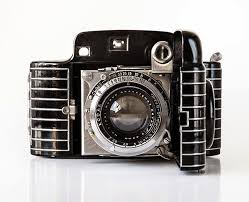
The Kodak Bantam Special.
By MICHAEL PERKINS
COMBINE THE ANTICIPATION OF CHRISTMAS with a severe lesson in humility and you’ve described the process involved in exposing a roll of film in an old camera that may or may not operate properly. The “Christmas” part, that deliciously torturous anticipation that came, in analog days, from sending one’s film away to a lab, for up to a week before reviewing your results, is something that everyone of a certain, ahem, age can relate to. The humility (humiliation?) part comes when the package of finished prints arrives in the mail and your dreams crash up against the Great Wall Of Reality…delineating that ugly gap between what you saw and what you managed to capture.
I always collect older cameras that are at least technically “operational”. They click and clack the way they’re supposed to. Frequently, they spend their time as lovely museum pieces, but, on occasion, I will invest a little money to see if they are truly functional and if I can make them make pictures of any degree of quality. It’s a fairly costly operation, since older film sizes can be expensive (if they can be found at all) , and the list of qualified practitioners of the filmic lab arts is shorter with every passing year. As to how I evaluate the results, that can depend on the camera. If it’s an old Brownie and the images aren’t too good, I can’t really fault myself, since there wasn’t a lot of control I could bring to the process of a one-button box. In the most recent case, however, I was testing a Kodak Bantam Special, a fairly deluxe device that cost nearly $90 dollars in 1936 and featured a rangefinder, widely variable shutter speeds and a fairly fast f/2 lens. So in shoving a roll of extremely scarce 828 film (a bygone size with a negative slightly larger than 35mm) through the works, there were two things to determine: whether I could master the camera with a test base of only eight exposures and whether the camera was still able to perform.
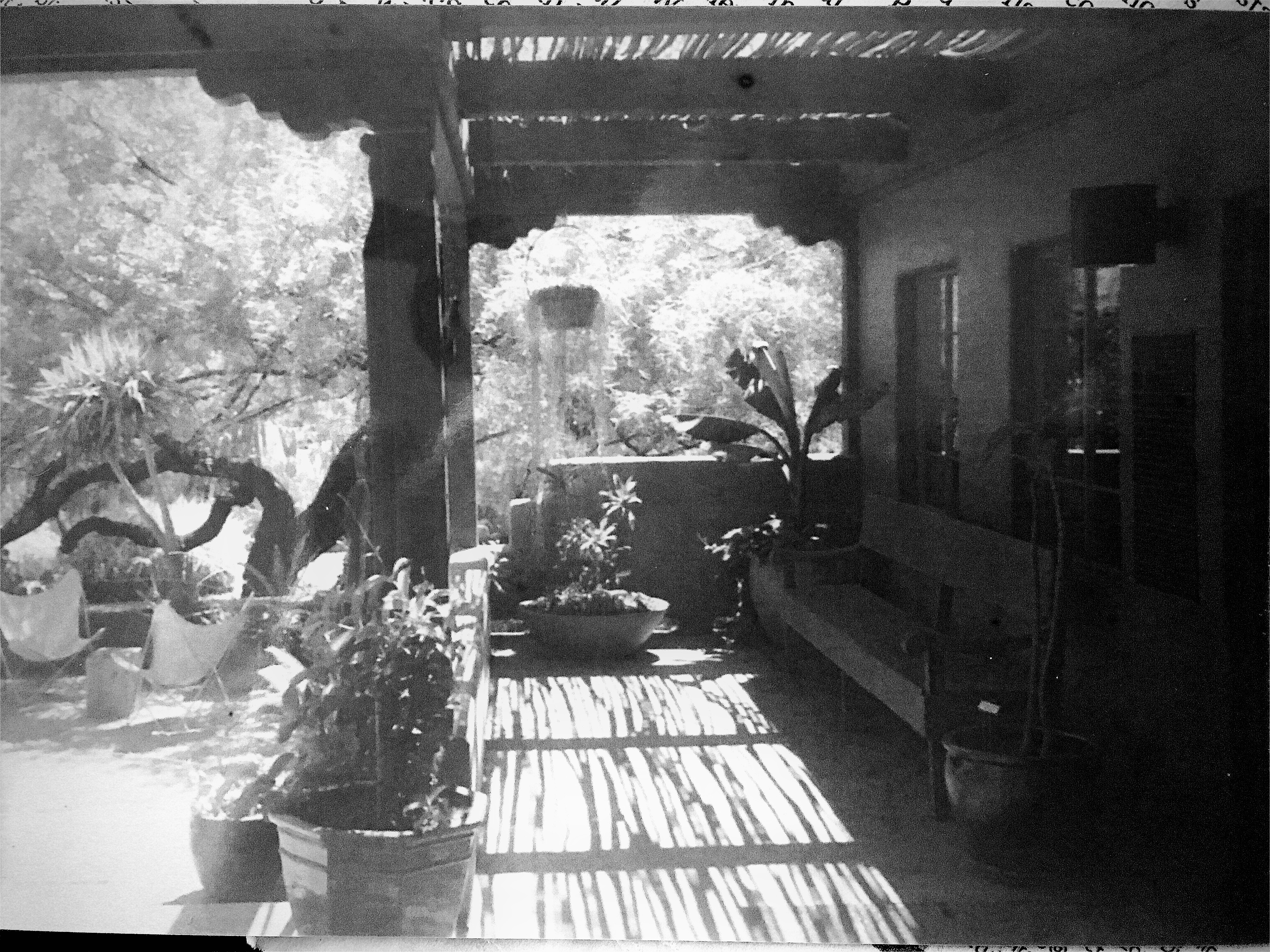
A frame from a Bantam test roll, adjusted, let us say, liberally.
One of the dozens of designs created by Walter Dorwin Teague during his time with Eastman Kodak, the Bantam Special has been called by many the most beautiful camera ever made. Now, while that may be aesthetically true, it’s an ergonomic nightmare, with controls jammed very, very close together, making it easy for ham-fisted users like me to fumble, lose their grip, even adjust one control when they think they’re working on another. In the case of this particular Bantam, most of the test roll revealed that the collapsible bellows on the camera leaks light like a sieve, producing wispy streaks across most of the frames. In other good news, the color rendition was very low contrast, with most hues having a decidedly bluish cast. Underexposure was also extremely easy, even with 400 speed film and wider apertures. And while that’s probably a mixture of old mechanics and my own poor calculation, the only way I could make the frame at left (one of the “keepers”) passable was to artificially tweak the contrast and convert it to monochrome after the fact. And that, again, is the “humility” part of our program, innit?
Moral of the story: If you ever find yourself getting cocky with the utterly cheap comfort of the digital age, take a time trip to the era when even the best laid-plans of mice and men often resulted in “what the hell?” pictures. Maybe the most enjoyable thing about shooting film, at this stage of the game, is knowing you can stop shooting film any time you want to.
ALL THERE IN BLACK AND WHITE(?)
By MICHAEL PERKINS
YOUR CONCEPT OF “STREET” PHOTOGRAPHY, assuming it interests you at all, is shaped by a variety of influences, including your idea of appropriate subject matter, biases in style or equipment, even your technical limits. But from my own particular perch, I think that the era into which I was born may be one of the strongest determinants of my preferences in street work, at least when it comes to the choice between black and white and color. To me, this kind of reportorial photography is vastly different either side of a key time line, with one side, say the world up to about 1955, weighted toward monochrome, and the other, the years that follow that mark and track forward up to the present day, being the more “color” era.
Before the mid-50’s, nearly all “important” photography was still being rendered in monochrome, much of it of a journalistic or editorial nature. From the crash of the Hindenburg to the New Deal’s chronicling of the impact of the Great Depression through endless newsreel and magazine essays, the pictures of record, of the stuff that mattered, was black and white. Consumer photography generally followed suit. Early color films were available from the 1930’s on, but the overarching curve of Everyman hobbyist work did not immediately flip to general use. Color was largely for commercial work, for selling things in a hyper-saturated advertising spread or brochure. Seminal black and white essays like Robert Frank’s The Americans or Henri Cartier-Bresson’s The Decisive Moment seemed to reinforce the idea of monochrome as the messenger of realism, authenticity, grit. Ugly, sad, tragic, important things happened in black and white. Color was for kids’ parties.
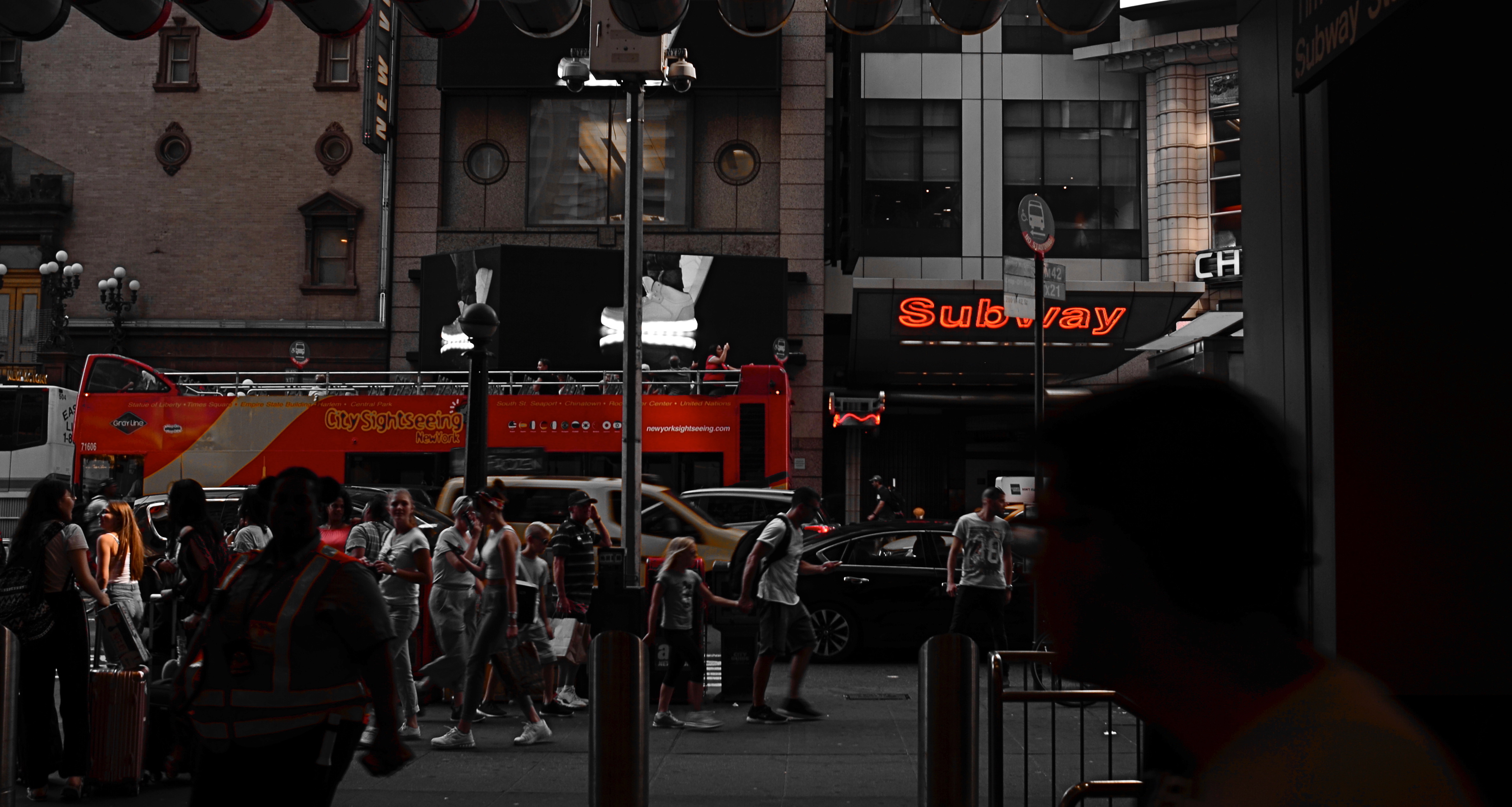
What “color” is your reality?
By the 1960’s, faster consumer color films changed candid photography virtually overnight as amateurs opted for more “lifelike” images. Color print, slide and movie film sales soared, and, while magazine and newspaper “documentarians” continued to emphasize mono as the “official” tonal language of street work, younger photographers began to reframe the argument as to what constituted a fit format for commentary. In the present day, both approaches live comfortably side by side, and many shooters are not exclusively in the ‘either” or “or” camp, deciding one frame at a time whether a narrow or wide palette is right for a given image. Even the shooters who embraced color as young photographers may, today, toggle back to monochrome for a singular impact or even a nostalgic evocation of the past. Fashion historians can easily lose count: we’ve zoomed past ironic, post-ironic, post-post-ironic, and back to innocence again, spinning through both unconscious and super-self-conscious styles like the blades of a pinwheel. Beneficiaries of technologies that abett and invite multiple ways to rendering the same subject, we shoot in all eras and influences at once. Everything about photography is a la carte.
For me, black and white isn’t a signature, but then again, neither is color. I find them both adequate for the candid work that encompasses “street”, and I reserve the right to make the choice between the two at a moment’s notice. Tonal properties, after all, should be as improvisational as the decision to make a given picture. We are freer than ever to worry less about the how of a photograph, and focus on the why.
WHO’S ZOOMIN’ WHO
By MICHAEL PERKINS
THE LONGER YOU’RE INVOLVED IN PHOTOGRAPHY, the greater chance there is that, at some point, you’ll at least wonder if a telephoto lens should be in your arsenal of gear. As with any other lens, I believe that, over time, the need for a zoom will become fairly obvious….either obviously needed or obviously superfluous. That is, your shooting will drive your technical needs and dictate what you deem as essential equipment.
That means not buying any lens, especially a zoom, before you find yourself in repeated situations where it might have made the difference in your work. The reason I deliberately state what should be a “duh”-type truth is that there are still some photographers who gear up with everything under the sun before they demonstrate their strengths or desires by the kind of images they pursue. This means that you don’t buy lenses and then try to find a use for them. Working that way all but guarantees that the things you never evolved a genuine need for wind up consigned to the top of the hall closet or on a yard sale table.
So let’s go back to the example of telephotos. It’s completely possible that your particular work will never indicate that you need one. I can cite many amazing photographers that seldom, if ever, use them. I myself have only one modest 55-300mm zoom, which I can safely is in use once, maybe twice a year. And that’s a net increase in its use, due to the fact that I now spend increasingly more time accompanying my wife on her birdwatching expeditions. Even at that, I seldom use the things for actually photographing birds. My eye is far too untrained to locate them in most cases, and I am just as content to use the 300mm for landscapes, macros and other wildlife. Were I bitten as hard by birding bug (bug?) as Marian, I may already have ponied up the dough for a more powerful version of what I use. But bitten I am not, and so I am stuck with my original biases against zooms…..that is, that they are generally too slow, too dark, too poor at color rendition, and supremely aggravating to focus on the fly. Am I grossly over-generalizing? Of course. But you judge these things on your own results (indifferent) and your own limits (considerable).
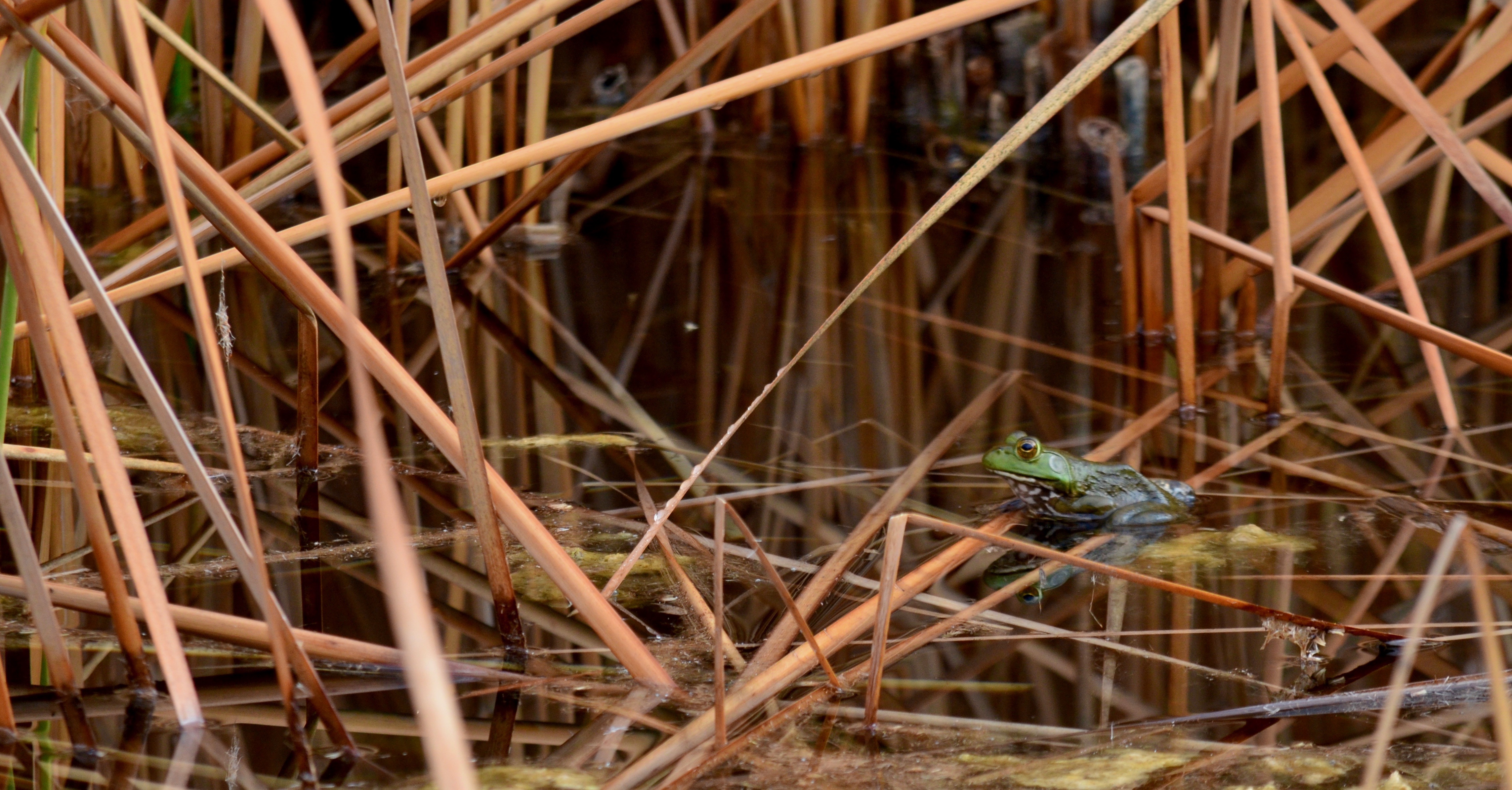
The Lord Of Little Things, 2019. 1/250 sec., f/10, ISO 500, 300mm.
In the view you see here, I am almost at the extreme limit of my 300’s usefulness, with my bullfrog quarry about thirty yards away, making him a medium-large speck in the viewfinder even when I’m fully zoomed out. This means that locking auto-focus on him will be strictly hit-or-miss, necessitating a shoot-check-shoot-check cycle in an effort to catch the toad before he can get bored and blow the scene. And that’s assuming that I can get auto-focus to lock at all. In many cases, going manual will keep me from issuing a verbal blast of mostly blasphemous bile in getting the shot, but even that is no guarantee when working hand-held. Are we having fun yet? My point is that, at least for me (notice the italics), zooms trade access for precision and speed. Sometimes, as in the marginally lucky result you see here, the trade-off is worthwhile. Other times….
So, to my earlier point. I could trade up to a more powerful zoom, if I were to demonstrate a need for one by the typical work I produce….. and if I decide to give up food and shelter to finance the thing. Again, the idea is….let what and how you shoot dictate what you’ll buy to shoot with. From where I stand, one frog a year still doesn’t scream ‘buy more glass”. As always, what makes some of us grin makes others of us grimace. And vice versa.
THE LOVELY BONES
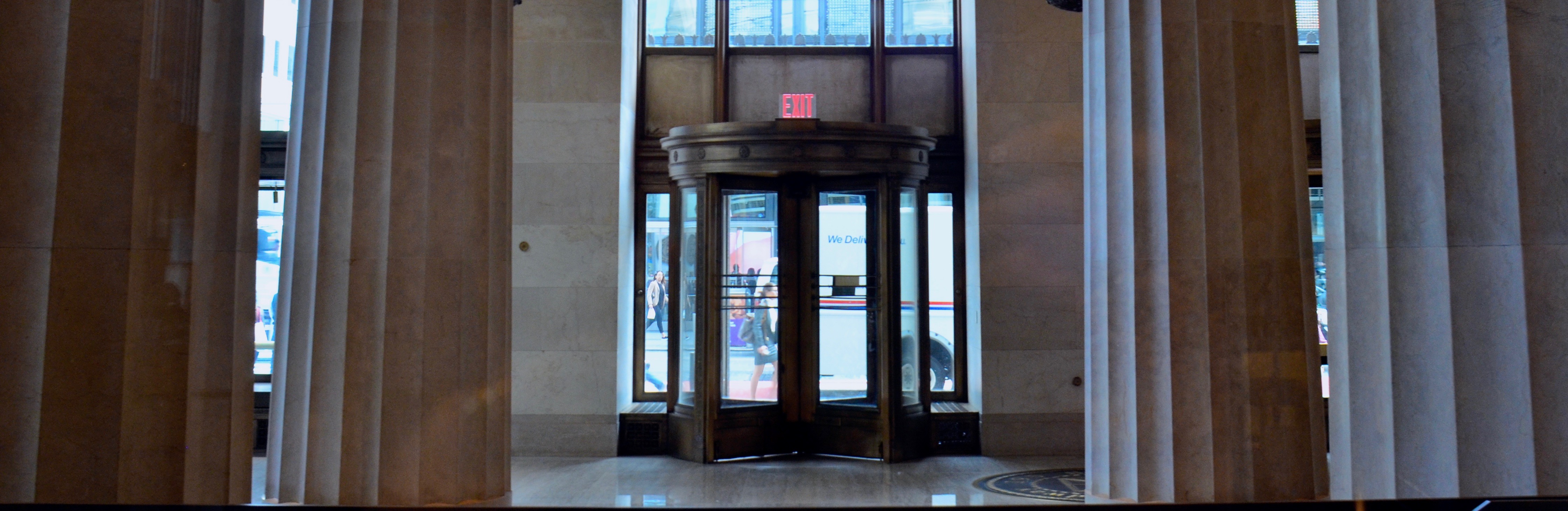
Oversized marble columns support the high lobby ceiling at 195 Broadway, former New York home of AT&T.
By MICHAEL PERKINS
195 BROADWAY IN LOWER MANHATTAN is one of hundreds of buildings that might escape your notice upon your first walk through the city’s financial district. Less garish than its gothic neighbor, the Woolworth Building and a lot shorter than its big-shouldered brethren, the 29-floor landmark doesn’t shout for attention. Its true beauty emerges when you walk inside the somewhat restricted lobby, take the measure of the “bones” of its regal inner structure, and breathe in its storied history. Completed in 1916 after AT&T moved its American headquarters from Boston to New York, 195 was the strong, silent type of skyscraper….functional, neo-classic, but restrained, understated. As a largely urban photographer, I try to keep track of structures that have outlasted several uses and landlords, carrying their essence forward through decades of shifting styles and fashions. It’s the totality of what has made them last that makes them interesting to me, more than any single fillip or ornament.
But ornament, as a visual metaphor for the new (20th) century of American technological dominance, was built into 195 Broadway from the start, both inside and out. Paul Manship, the sculptor whose public works, like the golden Prometheus statue at Rockefeller Plaza, still dot the Manhattan map, created one of his first major works, The Four Elements, as bronze relief’s on 195’s lower facades, his love of Greek and Roman mythology weaving itself into the Moderne movement (later re-dubbed as Art Deco). Architect William Bosworth took the Doric columns which usually adorned the outside approaches of other buildings and brought them into 195’s lobby, all 43 of them, their wondrous marble reflecting a variety of colors from the teeming parade of streetside traffic. And sculptor Chester Beach used the same lobby to commemorate the building’s role as one half of the first transcontinental phone line in 1915 with Service To The Nation In Peace And War, a bronze relief of a headphone-wearing hero standing under a marble globe of the Earth, bookended by classic figures and flanked by lightning bolts.
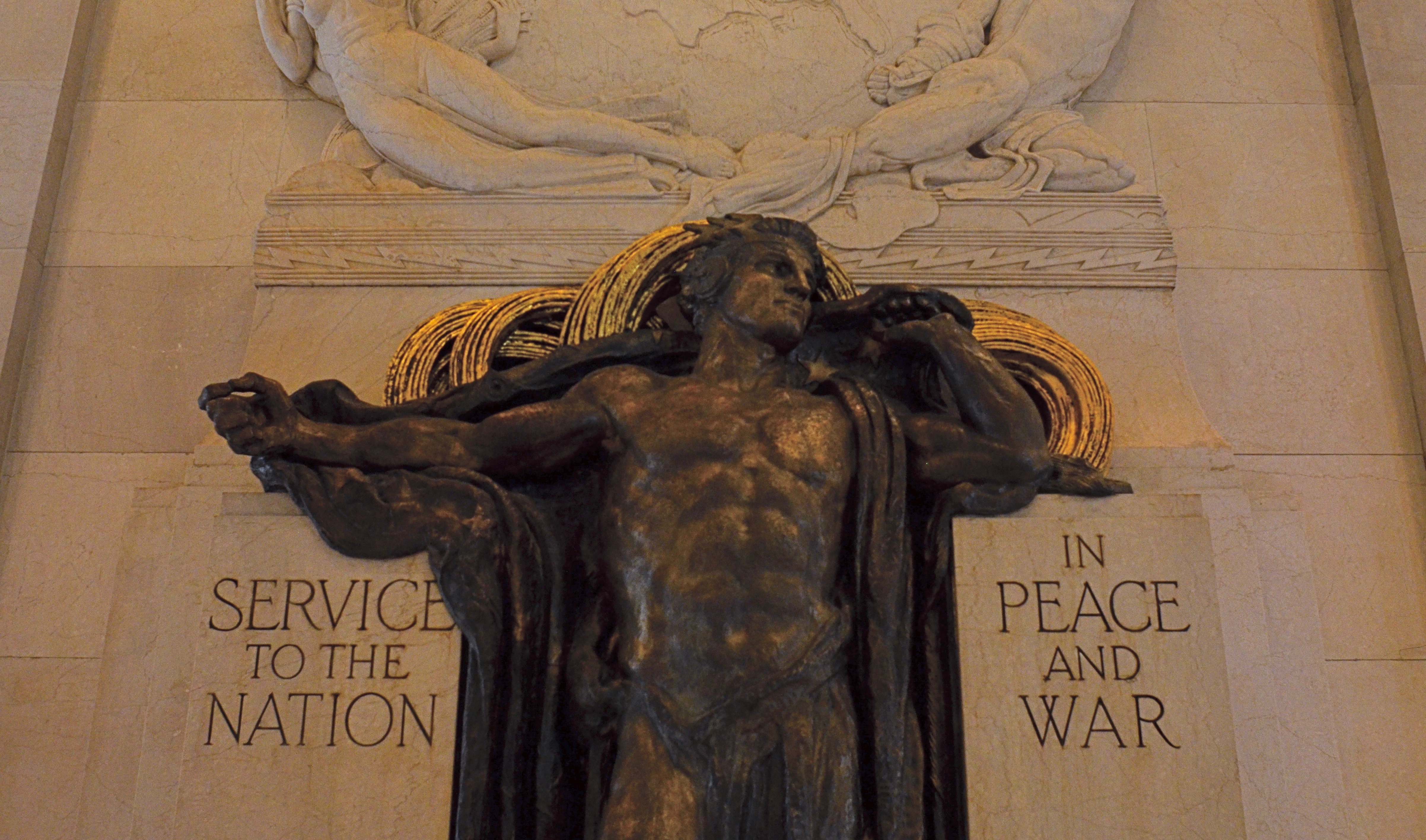
195’s lobby marks the origination point of the first transcontinental telephone line.
195’s long run includes the titles like the Telephone Building, the Telegraph Building, the Western Union Building, as well as appearances in popular culture, like its portrayal of Charlie Sheen’s office building in Wall Street. Sadly, a few of its most salient features have moved on, like the gilded 24-foot tall winged male figure originally known as Genius Of Telegraphy, which topped the pyramidal roof of the tower on the west side of the building until 1980, when it followed AT&T’s relocation to Dallas, Texas. However, the remaining treasures of 195 Broadway are still a delight for both human and camera eyes. Good buildings often present their quietest faces to the street. But look beyond the skin of the survivors, and marvel at the solid bones beneath.
I’M NOT WHAT I USED TO BE (AND I FEEL FINE)
 By MICHAEL PERKINS
I OFTEN FEEL THAT HABIT IS THE GREATEST POTENTIAL THREAT to the creative process. Once an artist approaches a new project through the comfort of his accumulated routines, he’s well on the road to mediocrity. If you find yourself saying things like “I always do” or “I typically use”…. you’re saying, in effect, that you’ve learned everything you need to learn in terms of your art. You already have all the ingredients for success. The ideal exposure. The perfect lens. The optimum technique. The Lost Ark…
Dangerous business.
And, if a kind of self-satisfied inertia is death-on-toast for artistic growth, then the most valuable tool in a photographer’s goodie bag is the ability to archive and curate his own work…..to keep a solid, traceable time line that clearly shows the evolution of his approach…..including the degree to which that approach has either moved along or stood still. That means not only hanging on to many of your worst pictures but also re-evaluating your best ones…..since your first judgement calls on both kinds of images will often be subject to change. Certainly there are photographs that are so clearly wonderful or wretched that your opinion of them won’t change over time. But they constitute the minority of your work. Everything in that vast middle ground between agony and ecstasy is a rich source of self-re-evaluation.
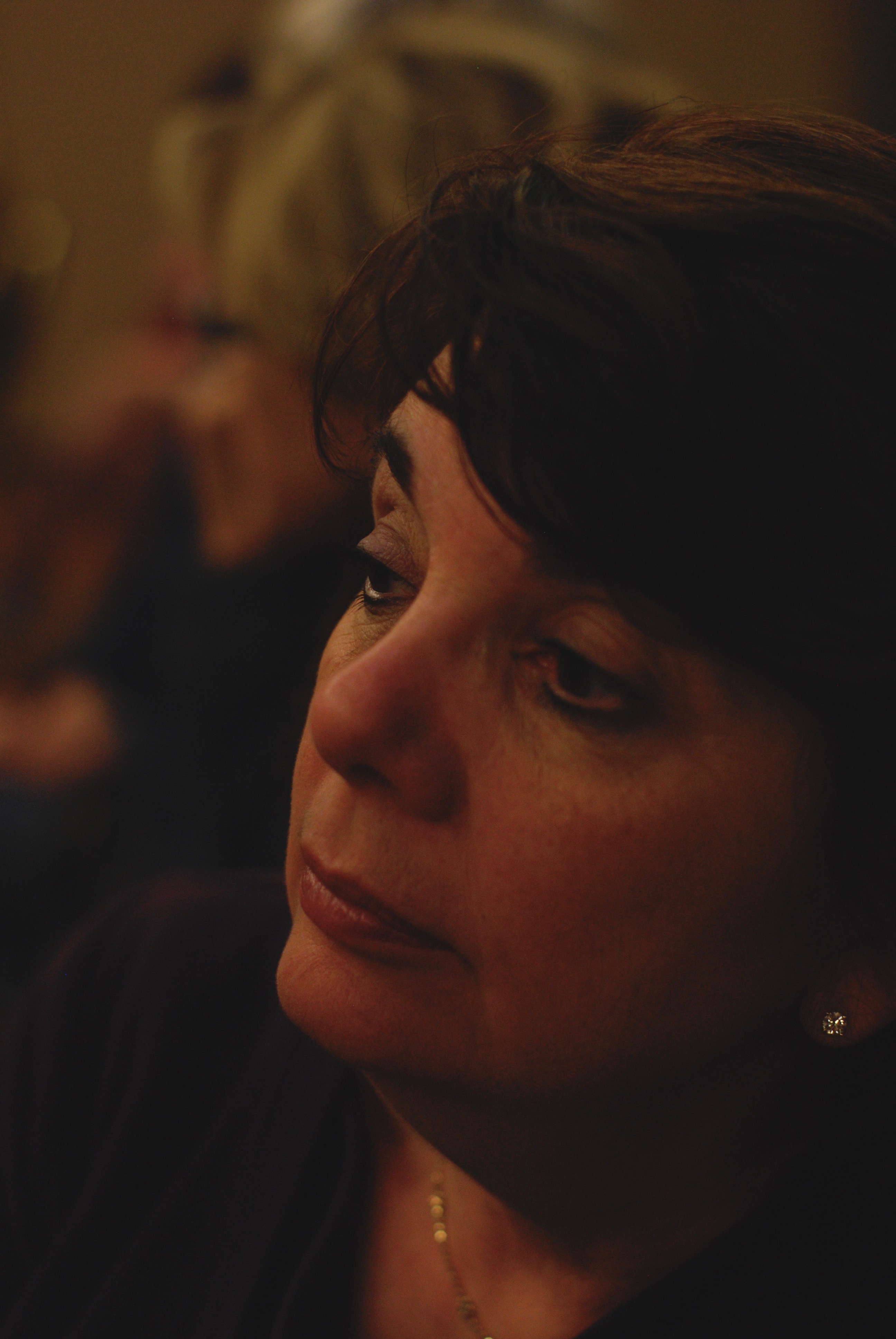
Revisiting old shoots doesn’t always yield hidden treasures. Sometimes the shot you thought was best from a certain day was best. But there may be only a hair’s-breadth of difference between the winners and the also-rans, and, at least in my own experience, the also-rans are where all the education is. For example, in the image seen here of my wife taken almost ten years ago and re-examined recently, I know two new things: first, I now know precisely why, at the time, I thought it was the worst of a ten-frame burst. Second, at this stage, I realize that it’s actually a lot closer to what I currently find essential about Marian’s face than the shot I formerly regarded as the “keeper”. I’m just that different in under a decade.
As you grow as a photographer, you will revise nearly every “must” or “never” in your belief system, from composition to focus and beyond. As life molds you, it will likewise mold the ways you see and comment on that life. An archive of your work, warts and all, is the most valuable resource you can consult to trace that journey, and it will nourish and inform every picture you make from here on.
FEARFUL URGENCIES
By MICHAEL PERKINS
PHOTOGRAPHS STOP BEING “REALITY” mere seconds after their creation, in that the truths they record have, in every sense, moved on, on their way to becoming a million other versions of themselves. We treasure our fragile little time thefts, those frozen testimonies to what some thing in the world looked like at some time. In this way, every photograph is a souvenir, an after-image of something lost.
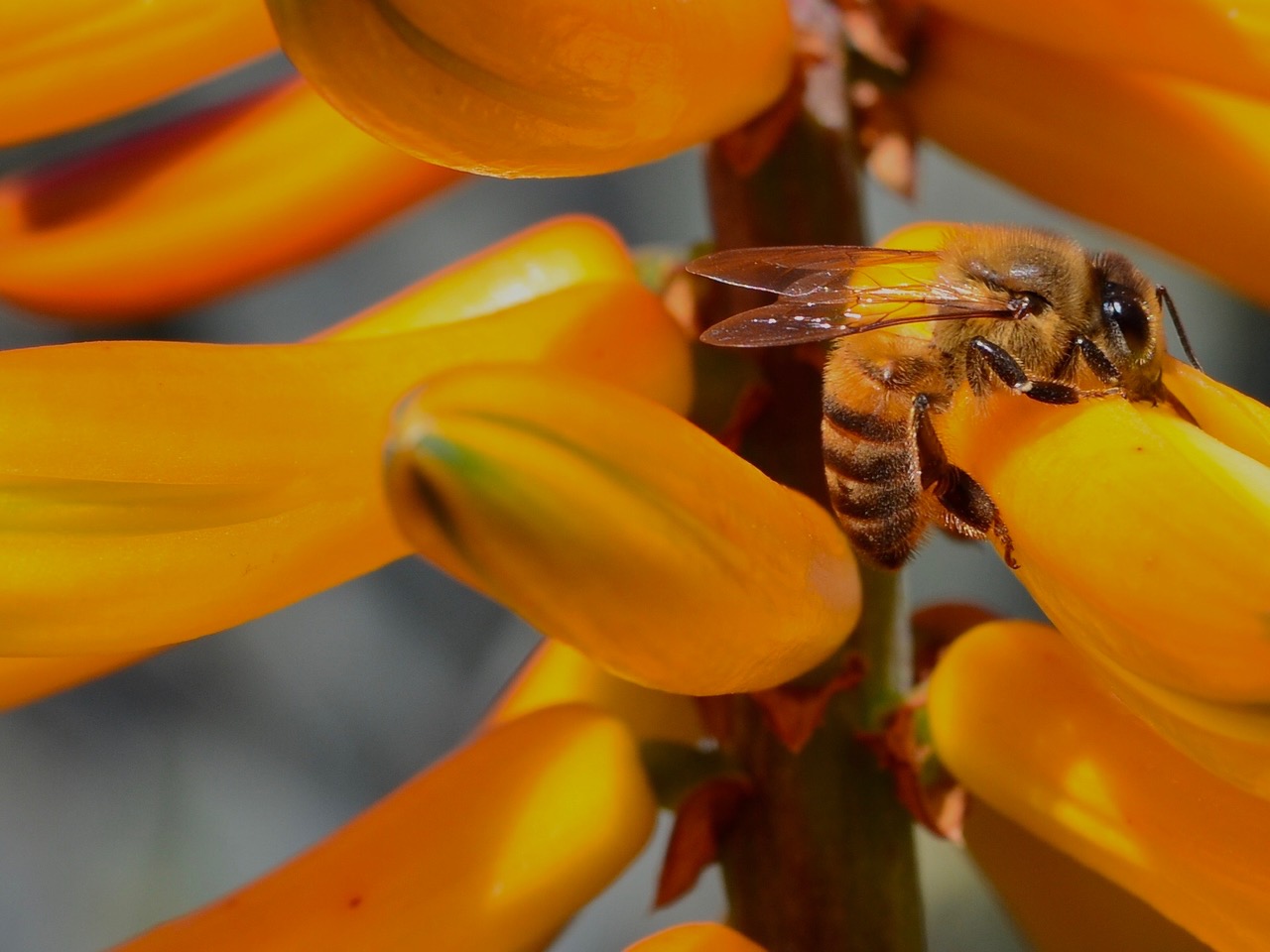
Bee The Flower, 2019
It’s small wonder that photographers often experience a sense of fearful urgency, a hurry-up-and-preserve-it fever bent on chronicling a world that is borning and dying at the same time. It’s hard sometimes not to think of everything as precious or picture-worthy. The beginnings of things are essential, because they cannot last. Vanishings are important because they are so final. Even an image of a person who is still living bears a poignancy…..because it was taken Before The War, When Mamma Was Alive, When We Still Lived Across Town.
And when it comes to the natural world, photographers and non-photographers alike are ever more aware that they may be capturing, for whatever reason, the lasts of things. Species. Coastlines. Remnants of a world whose regular timeline of goodbyes has been accelerated. Photographers always have a mission to immortalize the comings and goings most central to their own lives, and that’s understandably their primary emphasis. But the natural world will also press us to be reporters in a more general sense. As one reality passes away and others begin, our sense of what is real may come down to the images we make as life careens ever on.
TO BE CONTINUED
By MICHAEL PERKINS
AFTER YEARS OF STALLING AND DREAD, I just this week consigned my old desktop to the dustbin, and, at this writing, am taking a few days to reflect before its bright, shiny successor takes its place in my cluttered workspace. Normally, I wouldn’t even register the time blip between one computer and another, because, really, they’re just things, right?
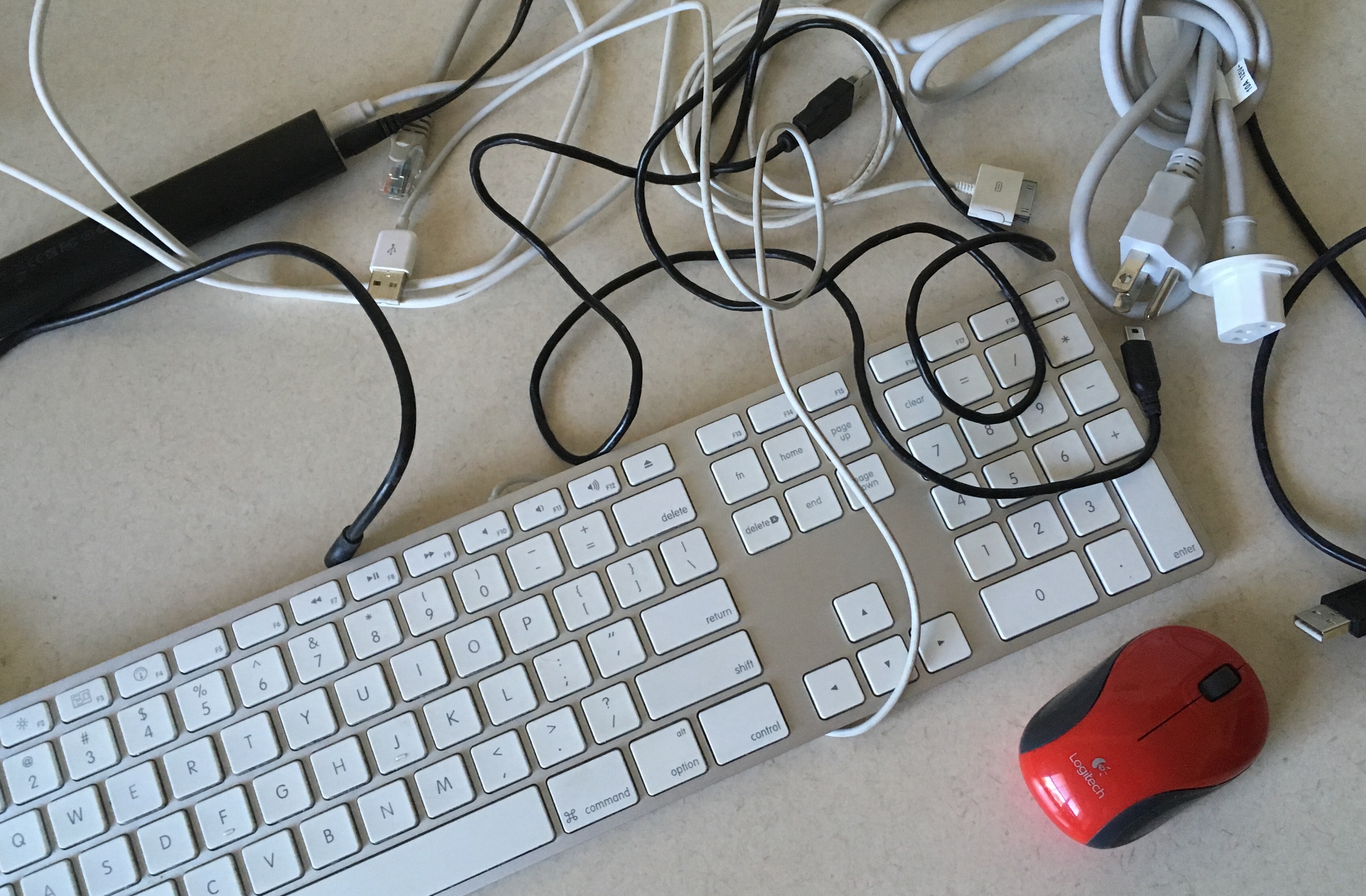
But this seems different, only because this particular gizmo became the extension of almost everything I endeavored to do as a photographer over the last ten years. When I first inboxed the old girl, I was still teetering between film-dominant and digital-dominant work. Photoshop was a series of way-expensive DVDs that you bought at “the computer store”, a term which, then, still meant Gateway and Radio Shack. Cel phones were equipped with cameras that produced images that looked like bad xeroxes viewed through a mosquito net. “Mirrorless” meant a bathroom with no place to check your hair and makeup. “Raw” was how your guru liked his vegetables.
When my now-euthanized kerputer was new, the average shooter was only passingly familiar with online post-processing, the “digital darkroom” that was quickly revolutionizing how images were shot, tweaked, transmitted, and published. The art of photo editing, in some quarters, became more about fixing a photo than taking it, with many editorial decisions about the picture on Page One being made by young Turks who had never held a camera in their hands. In my case, my computer took me into new areas of control and refinement, even as I strove to create most of my magic in-camera. I traveled through new lands with names like HDR, Lomography, and There’s An App For That. Most importantly, the blog you’re now reading was born on that now-obsolete device, as well as the means for illustrating and editing my personal journey from taking pictures to making them.
And so, yeah, I’m just moving from one tool to a newer version of that tool, just as I once moved on from my childhood piano to the one I play now. But, even though you may own many bikes during your lifetime, you hold a special place in your heart for the one you learned to ride on.
But it is, finally, about the ride, not the vehicle, just as photography is about normalizing the eye, not mastering a particular camera.
So let’s get pedaling, and see where this road goes.
CHOOSING YOUR CHOICES
By MICHAEL PERKINS
TO CONSIDER A PHOTOGRAPH “FINISHED“, I have to be at peace with the choices made in creating it. I can take either an active or passive role in making an image, each role with its own set of choices. At the most active end of the scale, I might be shooting completely on manual, micromanaging every step of the process, making what I call shaping choices. At my most passive, I might be snapping in full automode, which means, after the camera makes its own arbitrary decisions, my choices are merely editorial, with me choosing my favorites from among a group of photos essentially taken by “someone else”.
“Live” performances can be a challenge for me whether I’m shooting actively or passively. The stakes are as follows:
Shooting on manual (actively) means making lots of adjustments in the moment, with action progressing so quickly that, even at my fastest, I may miscalculate or simply miss a key opportunity. In short, I could work really hard and still go home with nothing. Or I could follow my instinct and bag a beauty.
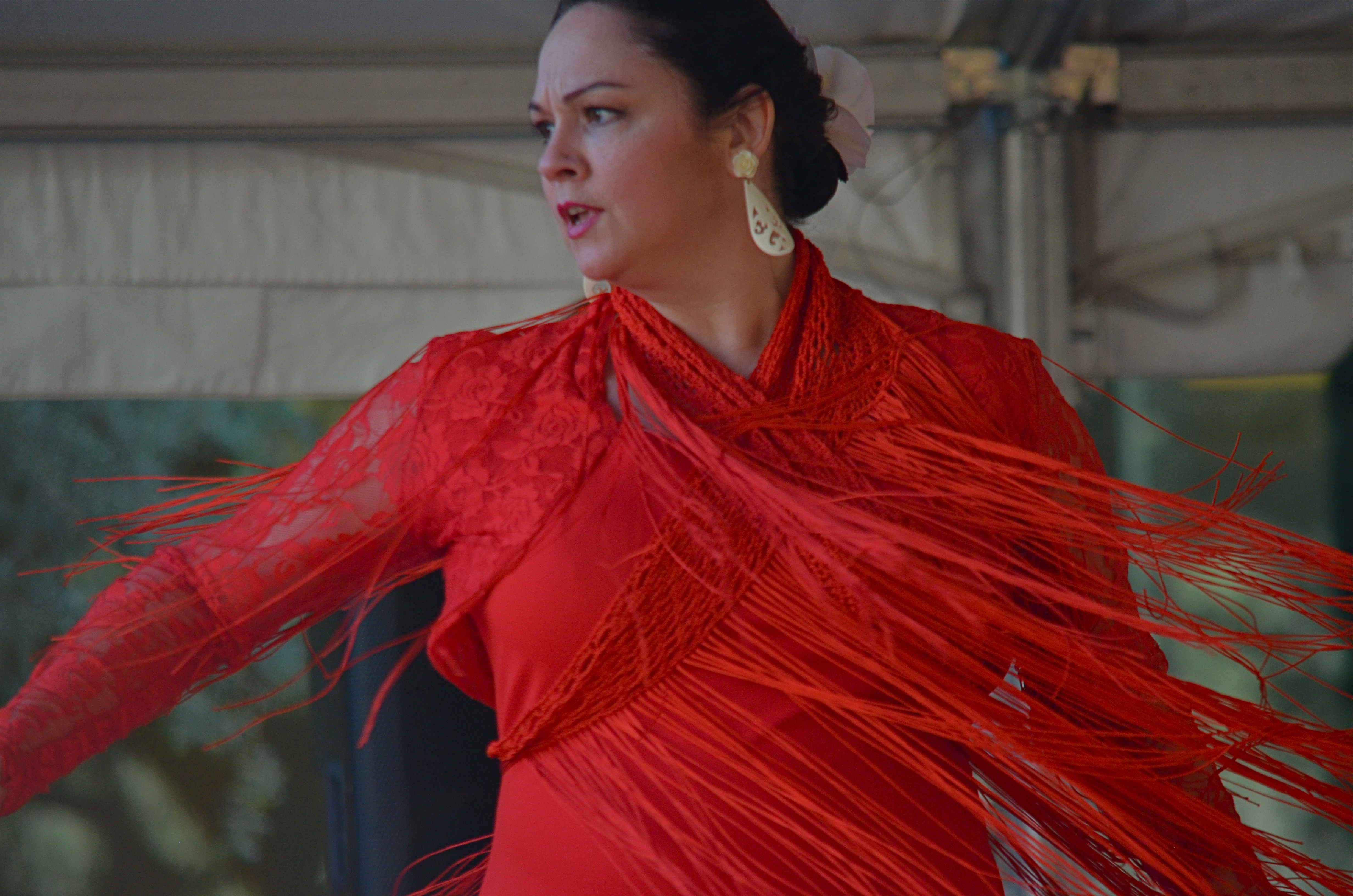
Now let’s say I shoot passively, using a mode designed for such situations. Some cameras call this mode “continuous”, while others refer to it as “sports” or “burst”, but it simply refers to the camera’s ability to crank off several frames per second, making all necessary adjustments to aperture, shutter speed, autofocus and ISO on the fly with just one touch from the shooter. Since the camera can make these shifts much faster than any human, you’ll have scads of shots to choose from, nearly all of which will be technically acceptable. You lose control over everything except choice of subject and composition, but you do get the final say over what constitutes a “keeper”, such as the image of a flamenco dancer you see here, which was caught on burst automode. Your choices are less creative and more editorial, and, if you disagree with all of the “other photographer’s” choices, you’re just as out of luck as if you had shot everything manually but hated it all. Wotta world, am I right?
As photographers, we choose subject matter, and then choose the best way to approach capturing it, based on whether you rate assistance from your camera as a bane or a blessing or something in between. Methods are a personal matter, but making a choice of some kind is key to comprehending what is happening in the picture-making process, and what role you want to play in it.
THE HOP-ON POINT
By MICHAEL PERKINS
PHOTOGRAPHY AT ITS MOST EFFECTIVE, is a pure and wordless kind of storytelling, virtually limitless and astoundingly efficient. Using a visual shorthand, that is, the static image stolen in an instant, we can suggest any narrative, past, present or future. Our tales not only feed off the storyteller’s intent but also off of what the viewer interprets. We can make anything mean anything. If stories are a constantly moving parade, we determine where the “hop on” and “hop off” points in it will be.
We do this by controlling the frame.
We make very intentional choices in a photographic frame. What is included is vital, but so is what is deliberately excluded, since both choices spark the imagination. We are, in effect, having a conversation, a debate over those choices with our audiences. Why did we show this and not that? Is this thing important because it naturally occurred in the picture, or am I making it important because I placed it there? And what do I think about what the photographer decided to leave out?
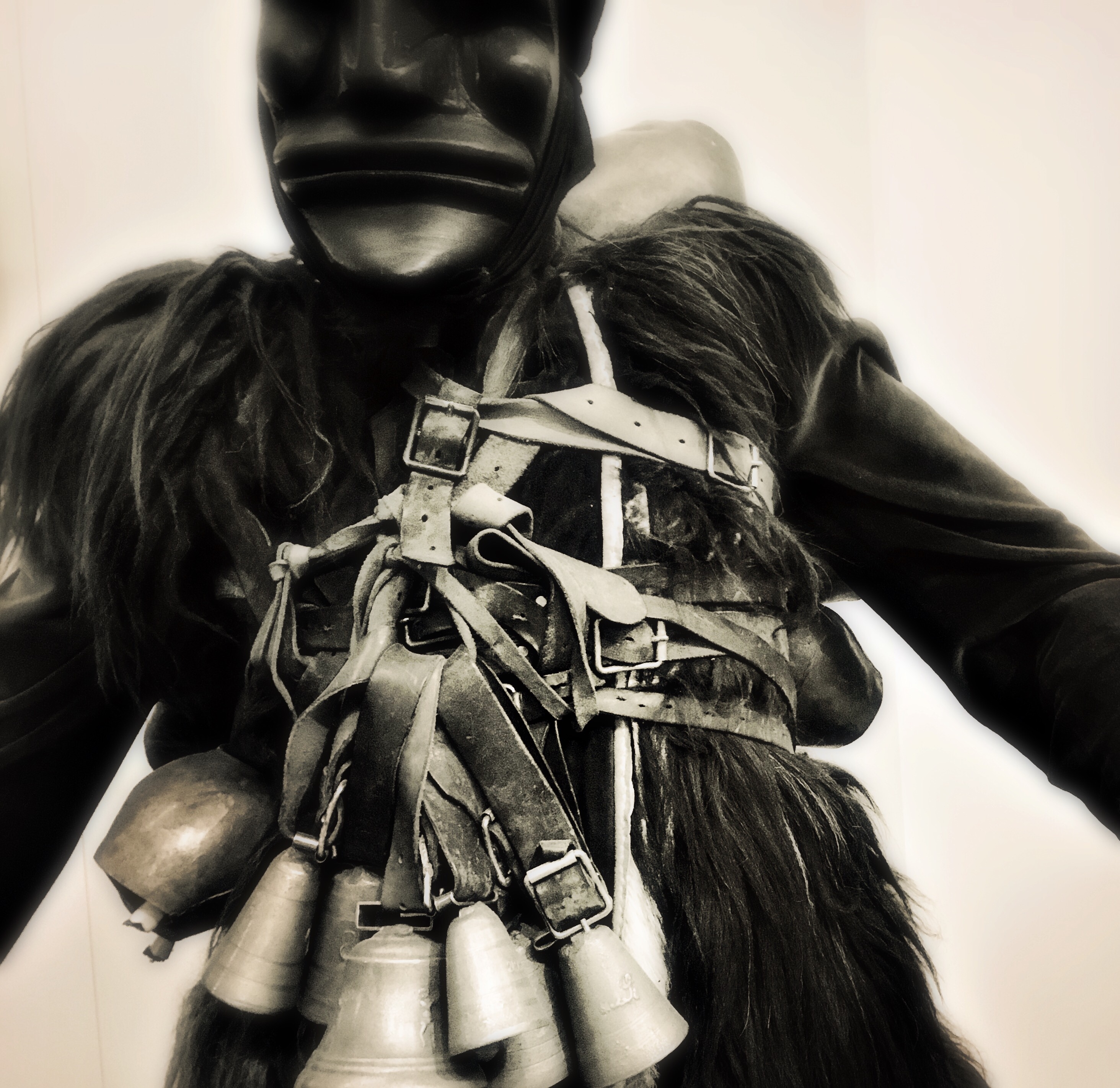
As the aforementioned parade of existence passes, the photographer’s hop-on point for the eye can supply context, showing connection between one thing and another…..or it can editorially destroy context, forcing us to see a thing in isolation, on its own terms. Consider, for a moment, the….. thing in the above image. Where did I get it? What was its purpose versus other things in its “world”? Can you, the viewer, assign it a new association that, for you, works just as well as the original?
All this discussion, all this interpretation, all these individual conceptions of what a thing “is”…all abetted by assembling the frame and than adding and subtracting within it. We talk a lot in these pages about the various sciences of photographic measurement…..exposure, light, apertures…. but I think composition outranks them all. Sure, know how to harness the tools that will help you record your message. But first, figure out what the hell you’re talking about.
And where you want your passengers to hop on.
A WORLD BOTH WIDE AND DEEP
By MICHAEL PERKINS
PHOTOGRAPHIC TECHNIQUES CAN BE THOUGHT OF as both active and passive. Some of the tools used to tell a visual story silently move narratives along without loudness or fuss, while others deliberately call attention as much to themselves as to the tales they tell. You can make pictures that betray very little of “how’d they do that?” or you can trumpet your tricks very loudly.
Or, of course, you can do both.
As a case study, consider one of 2018’s Oscar contenders, The Favourite, which tells a surreal tale of eighteenth-century castle intrigue with camera work that fairly screams to be noticed, mixing standard widescreen shots with ultra-wide and even fisheye compositions, shuffled together in jarring transitions, as if the director needs to remind us how twisted and nightmarish the story it by keeping us visually off-kilter for the entire length of the movie. Contrast this with most films that try to render their photographic tricks invisibly, in keeping with established Hollywood tradition. Is it a case of The Favorite’s director merely showing off his technical cleverness?
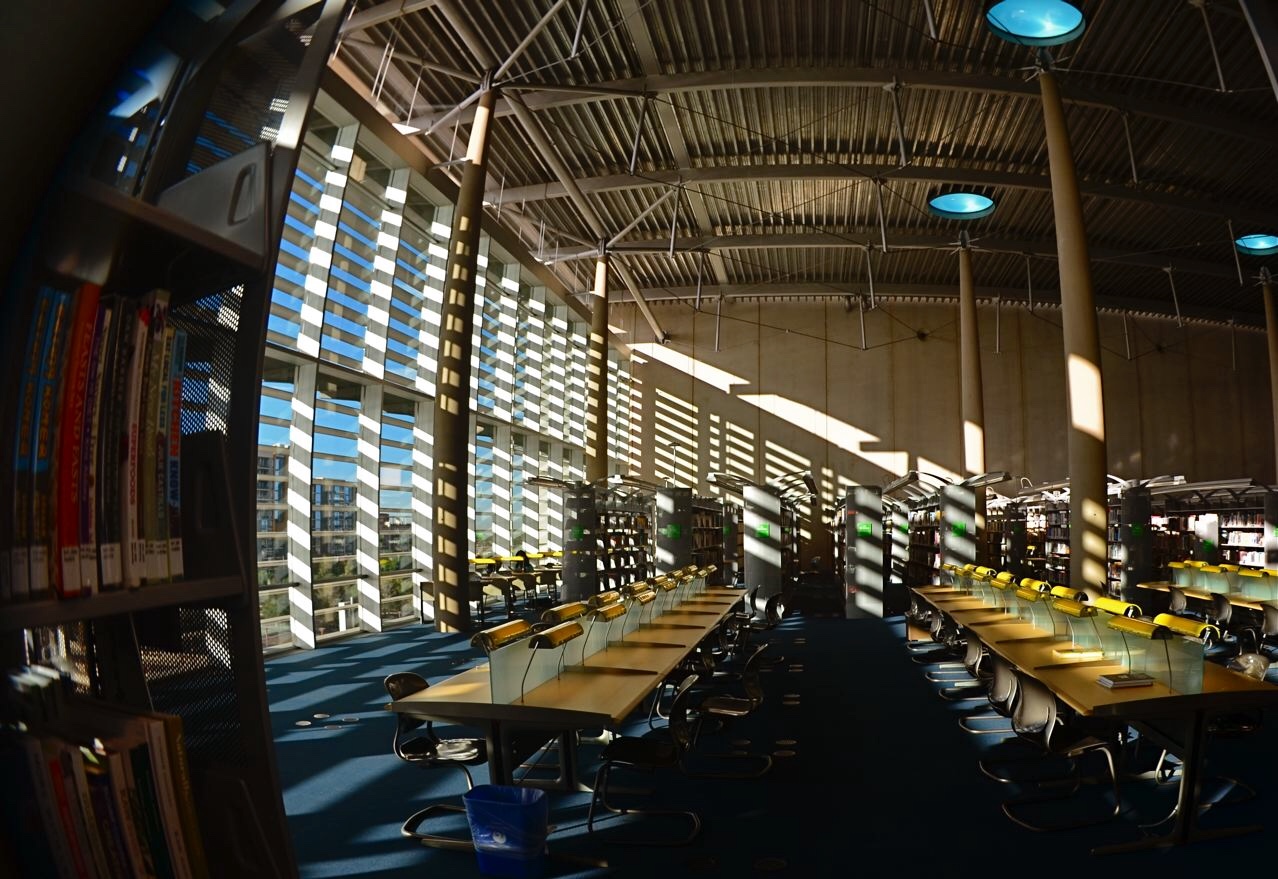
Creative lenses such as fisheyes dictate a photograph’s terms of engagement.
Well, yes and no. Various lenses convey vastly different concepts of space, of the width and depth of rooms, of the relationships between man and nature. Using an extreme tool like, say, a fisheye, changes the rules of engagement for the viewer, even when applied to a conventional subject. The photographer is, in effect, saying “composition is what I say it is, not what you’ve been led to expect.” Of course, when you drastically distort how a scene or object is presented, you risk your picture being “about” the visual effect, eclipsing your message instead of amplifying it.
The characters in The Favourite are in a constant state of moral disequilibrium, with everyone jostling for position or advantage, so an unsettling shift between various lenses reflects their uncertainty, the unreality of their situation, actually enhancing the nightmare quality for the audience. Does your picture call for a technique that, in turn, calls attention to itself? Flamboyant or not, the answer must, occasionally be yes.
Just because you’re showing off doesn’t mean you’re wrong.


GONE GATEWAYS
Ticket Kiosk (Ohio Theatre, Columbus, Ohio, opened 1926)
By MICHAEL PERKINS
PHOTOGRAPHERS ARE TRAINED TO REACT QUICKLY, the better to keep crucial moments from perishing unpreserved. We generally teach ourselves to measure, within an instant, what is fleeting and what deserves to be preserved. But there are times when important things actually disappear slowly, over years or decades, giving us a more generous window of time to record their passing. Cities, for example, don’t burst forth, grow, and die with the speed of mayflowers. They fade gradually, shedding their traditions and signature traits in a slow-motion oblivion that allows us to linger a little longer over the proper way for our cameras to say goodbye.
It’s the quotidian, the shared ordinary, in our world that is peeled off with the least notice. The boxy computers that give way to sleek tablets: the percolator that becomes the coffee maker: the paper billboard that morphs into the animated LED: or the movie theatre that changes from elegant palace to stark box to streaming video. All such passages are marked by physical transformations that the photographer’s eye tracks. The ornate gives way to the streamlined, function revising fashion in distinct visual cues.
The grand ticket kiosk seen here, which still graces the 1926 Ohio Theatre in Columbus, is now part of a vanished world: we don’t associate its details with elegance or “class” anymore. We don’t look to dedign elements of the old world to frame the new, as we did in the age of the flapper and the flivver. Images made of these disappearing gateways are poignant to the old and bizarre time machines for the young.
Most importantly, images are records. Once the familiar becomes the antique, our own memories suffer dropouts, missing bits of visual data that the camera can retrieve. Thus the making a picture is more than mere memory…it’s the logging of legacy as well.
Share this:
March 17, 2019 | Categories: Americana, Architecture, Commentary, Conception | Tags: Commentary, history, popular culture | Leave a comment