WORLDS WITHIN WORLDS
 By MICHAEL PERKINS
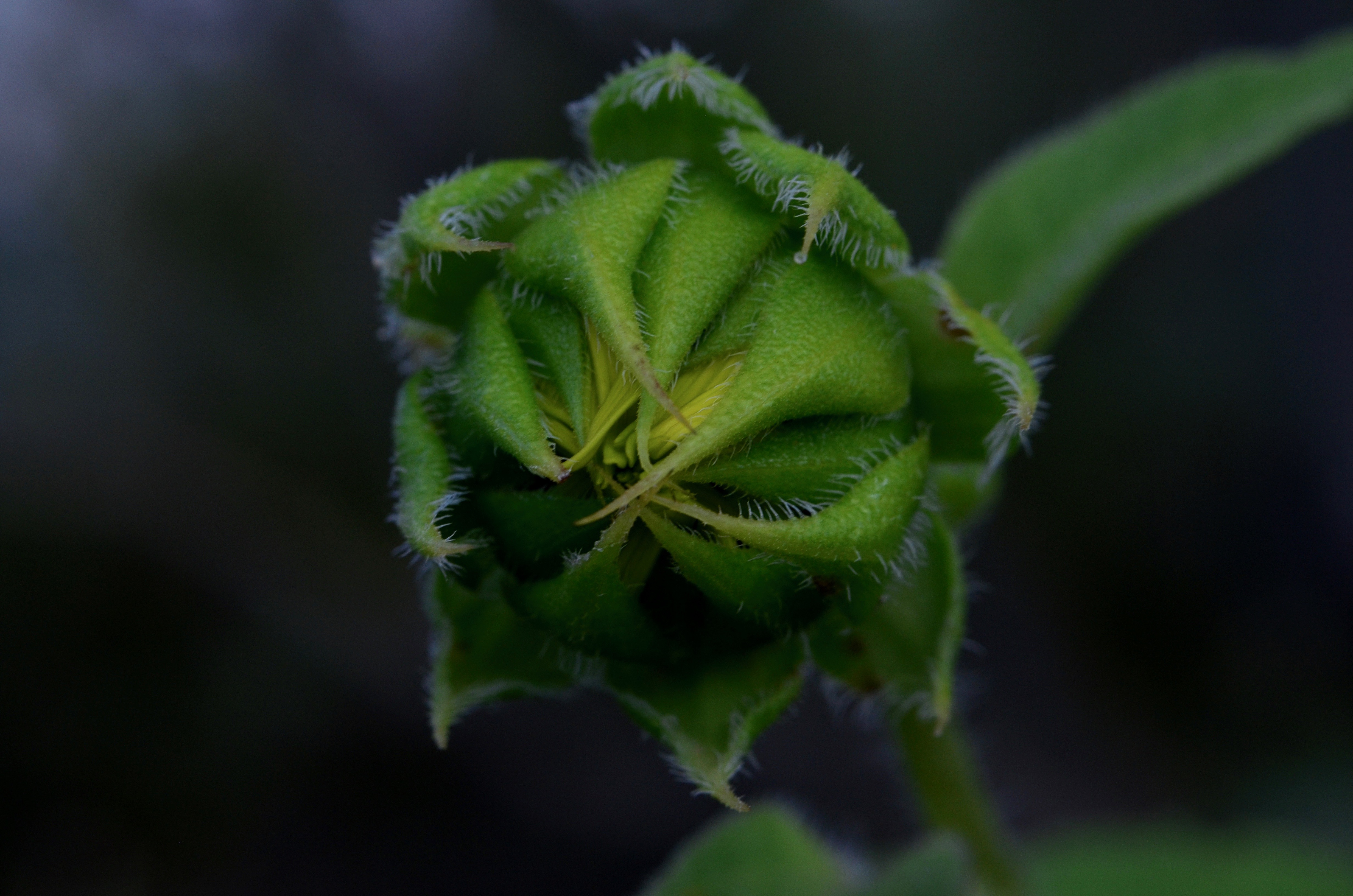
THE SPIRITUALIST POET WILLIAM BLAKE FAMOUSLY EXPRESSED HIS DESIRE to explore life in its smallest detail, to, as he put it in his poem Auguries of Innocence, “see the world in a grand of sand / and a heaven in a wild flower / hold infinity in the palm of your hand/ and eternity in an hour”. It’s the kind of sentiment that makes me believe he might have made a great photographer.
It’s unlikely that Blake, who was also a wonderfully gifted graphic artist and who died in 1827, ever held a camera in his hand, but from the first generation of photographers there was a decidedly Blakeian urge to explore the world at the most intimate levels, engineering lenses that allowed maximum magnification and resolution of the vast stories lingering right under our noses. Today, as never before, macro photography is finally within the technical and financial reach of the many, allowing spaces that barely comprise inches to reveal the complexities that we stroll past without regard on a daily basis. And just as all of photography is about extracting pieces of reality from the larger flow of time, so macro is about drawing things out of their original settings, to dramatize the elegance of design and pattern, to create a separate stillness. That certainly is what appeals to me about shooting in the small world….the ability to take things so far out of their regular context that we are forced to consider them as if we were encountering them for the first time.
To be sure, close-up work comes with its own set of unique technical challenges, but what makes it worthwhile is its ability to deliver the shock of the new, to depict the eternities residing within Blake’s grain of sand. For many of us, this process of discovery reaches its fullest expression in floral or botanical subjects, since magnifying their contours is almost like a crash course in geometry or architecture. Petals, seeds, pistils, stamens, leaves…..all are rotating in their own incredible orbits as if they were bit players in Fantasia, fantastic ballets in which size (or rather the transformation of scales and sizes) really does matter. In terms of technique, even a practiced photographer can be frustrated by the special demands raised by magnification. Certainly light and focal relationships work differently, as well as stabilization of the image. Predictably, every error of movement or lens flaw is utterly exposed once everything is increased in size, resulting in a higher percentage of failed shots and near misses. Still, one’s first plunge into macro is like Alice’s initial entry into a realm where everyday objects magically shrink and expand without warning.
Blake, like all artists, understood that art transforms and re-translates all experience, re-defines how we view everything, allows us to show all ranges of life from dark to light, remarking in Auguries that “man was made for Joy & Woe / and when this we rightly know / thro the World we safely go” Photography gets the big things right…. by paying attention to the worlds within worlds. It really is a game of inches, sometimes atoms.
HERE. NOT HERE. MAYBE HERE?
By MICHAEL PERKINS
1,000,000,000,000.
One trillion.
That’s the approximate number, in the digital era, of annual photo postings to the internet in a single year.
That’s a serious buncha digits. And a significant chunk of that staggering total comes from visitors to tourist sites and museums, many of whom, awestruck by the wonders in various collections, seek visual souvenirs of said wonders.
Except when they can’t.
Public attractions in the age of shared media are struggling to accommodate, regulate, or just plain rein in the photographic urge among their patrons. You can take pictures here, but not here. Here? Unsure, ask the guy in the uniform.
Flash? Selfie Sticks? Tripods? On the endangered species list. We have our reasons.
We don’t all have the same reasons, but still…
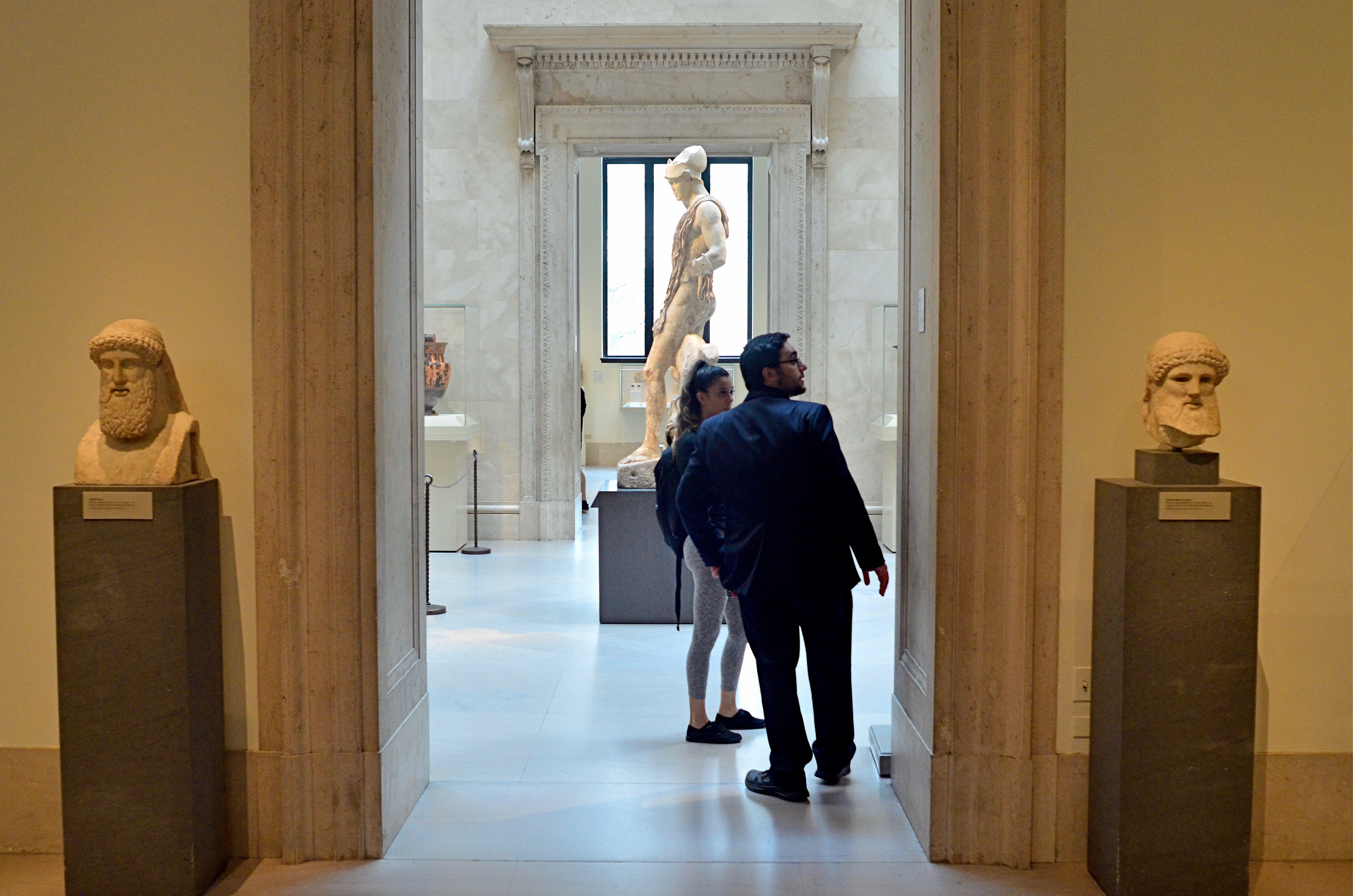
Which way to the “photos allowed” section?
Full disclosure: I am a docent at a museum. I fully understand the various problems that come with allowing photography in the halls. For example, the collection at my joint could actually be damaged by flash, so we allow clickers to go flashless. We also have found that the more hardware the hardcore photog packs in, the greatest hazard to our exhibits and our patrons, so no selfie sticks or tripods. Ours is what I would call a negotiated policy. Other shops, as you yourselves may have already painfully learned, are more draconian, from the places where no one is allowed to take any pictures anywhere to sites like the Natural History Museum of Rwanda, one of the institutions which actually charges a fee for the privilege of snapping. Between those two end zones is a lot of open field. A quick look at the challenges from both sides:
Even allowing for the fact that flashes can actually damage some types of artifacts, regulating the no-flash rule requires extra policing and essentially stands or falls on the honor of the individual photographer. Then there’s the issue of the particular kind of shooter I like to call The Selfish Jerk, who will camp out in front of a statue or a painting to the discomfort of other paying guests, because he’s just gotta get The Shot. Some of these same nitwits also employ improvised gymnastics that could get the institution sued and could (and do) get the photographer dead. Ask the undermanned park employees at the Grand Caaaaaaaanyon. Then let’s consider the “keepsake” motive that makes some people want to take a bit of their favorite art home with them. Cameras are getting better at making more perfect representations of paintings and statuary. At the same time, museum gift shops enjoy a sizable revenue stream from poster and postcard images of their own collections. If everyone can make their own, that revenue goes away, a purely and understandably fiscal reason for institutions to say “no mas”. The claim has also been made that art piracy could be exacerbated by the use of cameras, but that argument is anything but settled.
To further muddy the waters, museums and other public sites are fighting a losing technological battle, since, for every super-obvious Canon or Nikon there are legions of tinier and tinier snap machines that are damn near undetectable. Should the institutions forbid the higher-resolution DSLRs (art thieves!!) and allow the more humble iPhones (harmless amateur!)? And then there’s the problem of universal enforcement of camera bans, which is, let’s face it, impossible. What’s the answer? Some reasonableness all around: reasonable policies that do allow pictures, with limits: reasonable guests who can be asked to leave if they contravene stated policies or, well, decency: and a reasonable attitude toward the positive publicity that online sharing of images can produce for your exhibits and institutions. After all, it’s hard to buck a trillion photos a year, even if only a couple of hundred billion of them are headed in your particular direction. Policies, from free-for-all to pay-for-play, must be rooted in the real world, or they’re not worth the paper they’re (maybe not even) printed on.
SPLITTING THE INSTANT
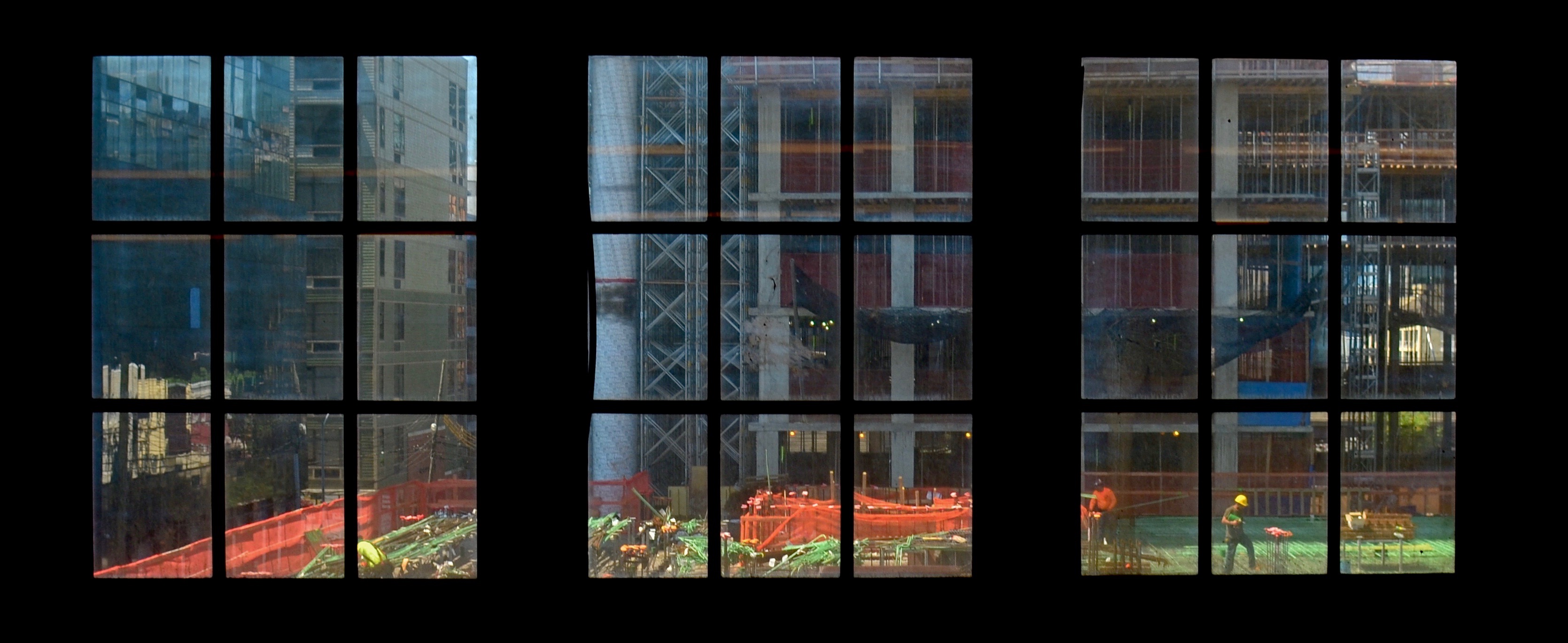
From The 7, 2018
By MICHAEL PERKINS
PHOTOGRAPHY IS ABSTRACTION, our subjective representation of what we think things “really look like”…..operative word being “we”. But it’s also a process of extraction, of pulling a moment out of time’s flowing sequence and trapping it in amber. If life is a continuously unfurling roll of movie film, photographers specialize in stealing single frames of that reality, hoping we can make the argument that our frozen sample symbolically stands for the organic whole. If we make that argument successfully, we’re great photographers. I emphasize this obvious concept because we need to remain mindful of what’s going on every time we frame a shot. Occasionally we have minutes to make the decisions on what that frame will be. More typically, it’s seconds. And occasionally, it’s pieces of seconds.
Shooters already have to grapple with the fact that we are usually making static shots of constantly moving things. That’s one kind of motion. Then there is the secondary stress created by the fact that we ourselves are also moving. We snap from car windows, from escalators, from trains and subways, even while physically chasing our quarry in papparazi “run-and-gun” mode. Thus what is already a difficult sorting and choosing process is made even quicker and more crucial. The extractions in our pictures are based on a furiously fast analysis of what’s important, as well as what’s dispensable, within the frame. It’s also about a virtually instantaneous formula for what’s technically required to get the picture made. These decisions become a little easier with practice, but any comfort we’ve built up over the years can be quickly shattered when a different kind of photo opp presents itself, one which upends our usual or comfortable approaches. Then everything’s a race.
Urban images are especially challenging. Cities themselves are convulsing with steadily increasing change, altering the nature or terms of a potential picture in days or hours. Like old-time news shutterbugs, the urban photographer is truly on deadline. With that in mind, I take a shoot-it-or-lose-it stance when moving past anything I regard in a city as temporary, figuring that it is even more fleeting for me than it may be for other people. In any event, I always harvest everything I can physically shoot, and sort out the weeds later. The makeshift subway stop viewing window of construction along the 7 train line between Queens and Manhattan that you see here is gone by now, but the picture stays. Perfection? Hardly. But photography is also a game of percentages, and I am at least 100% happier for having made the attempt as not.
AN OPEN SECRET
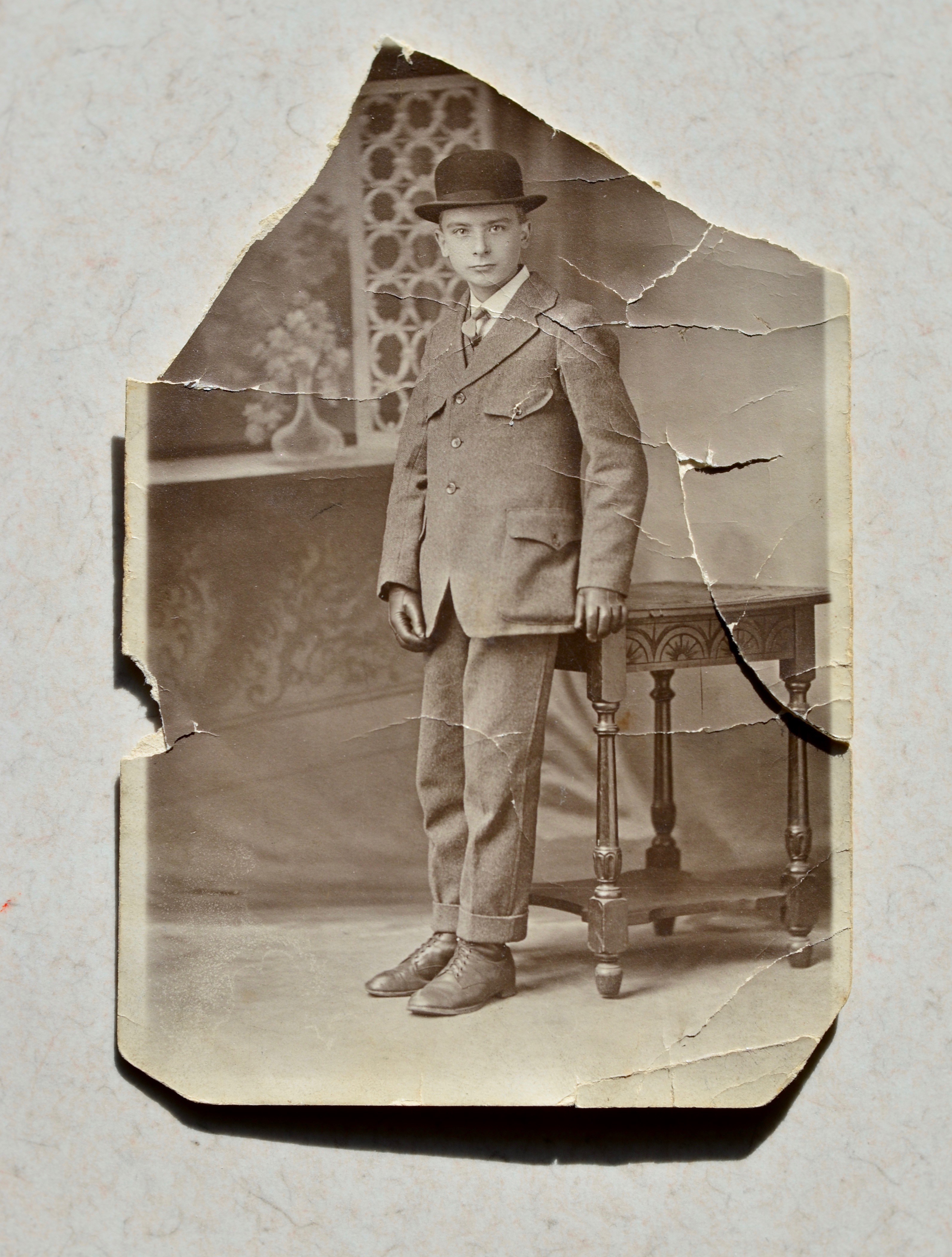
Leonard George Tate Perkins, c.1920.
Nothing is revealed.—-Bob Dylan
By MICHAEL PERKINS
THE YOUNG MAN IN THE PHOTOGRAPH IS A DANDY. A FOP. A DUDE. A slave to fashion. A symbol of the impossibly proper British spirit. A remnant of the Edwardian age, teetering on the dawn of the Roaring Twenties, a decade that will later seem uniquely American. But he is not an American. Not yet.
But he has dreams.
It is around 1920.
And he is my grandfather.
The photograph is formal, a studio portrait with someone else’s furniture and carpet suppled as homey props. His gaze is intense…too serious for a young man, some might think. And yet, of course, he will need all the determination that gaze implies to book passage, very soon, on the ship Mauritania (the Lusitania’s sister ship) and enter New York City through the thresher of Ellis Island, taking a train into the great midwest, to Lorraine, Ohio, where an uncle has vouched for his industry and loyalty. He will stay in his new country for the rest of his natural life.
The picture has come to me unexpectedly, just as you see it here, from a lost trove of family lore that my sister has kept for years, finally deciding that, with my archivist’s inclinations, I “might want to do something with it.” I have never seen this image over the course of my 67 years. And, yet, seeing it, I am struck by the strange double impact of photographs, these windows into “was” that reveal and conceal equally. It is, certainly, a treat to see my grandfather as this determined young man, to place him in the context of everything else that his life would hold afterwards. But the image is also absent nearly any context of its own. The back shows it to have been printed by a British postcard company, but the message portion of the card is gone, leaving several mysteries. Who was the intended recipient? If family, was the card to serve as a forever reminder of the boy who was just about to cross the Atlantic, never to return? And, if friend, what story is left untold between he and whoever? The card is inscribed with the word “effectionately” and his full name, not merely “Leonard”. Why the formality? Is it a clue to the relationship, or just the starchy propriety which we would later know to be his hallmark?
And then there is the outfit. “Fancy” is the word that comes to mind, with its formal bowler and short leather gloves. But therein lies a case of coloring the past with the sense of the present: in the age of torn cutoffs, flip-flops and selfies, we have lost all sense of what it was, around 1920, to “have one’s portrait made”. Certainly it was a rarer thing, an occasion. Even at the dawn of the Kodak-inspired age of candid photography, many millions of people around the world were still going to their mortal reward with their faces recorded but a few scant times by a camera, and many not at all. And now, to see this picture rise out of the mist, to show Grandfather as a real person with no connection (by that time) to anyone or anything else I have inherited as family legend, is to be teased by the fact that photographic interpretation does not cease with the shooter’s intention, of the way he chooses to show a thing. It continues infinitely through the eyes of other interpreters, who take the photographer’s “reality” and subject it to a scrutiny all their own. Revelation. Concealment. Discovery. Mystery.
He seems to be trying to appear older, just, as later, he would use clothing (always the top-drawer stuff) to appear military, dignified, taller, and, always, serious. I realize now that I never saw a truly candid photo of him, regardless of the occasion or setting. Every photo was a performance, a record, a testament. Leonard George Tate Perkins is a force to be reckoned with. I am nobody’s fool. Respect must be paid.
I am now paying that respect in a new way, forty years past his death, by looking into the face of that stern young dandy, and into the open secret that all photographs hold.
Think you see the truth?
Hold on.
Not so fast.
A BREAK IN THE CHAIN
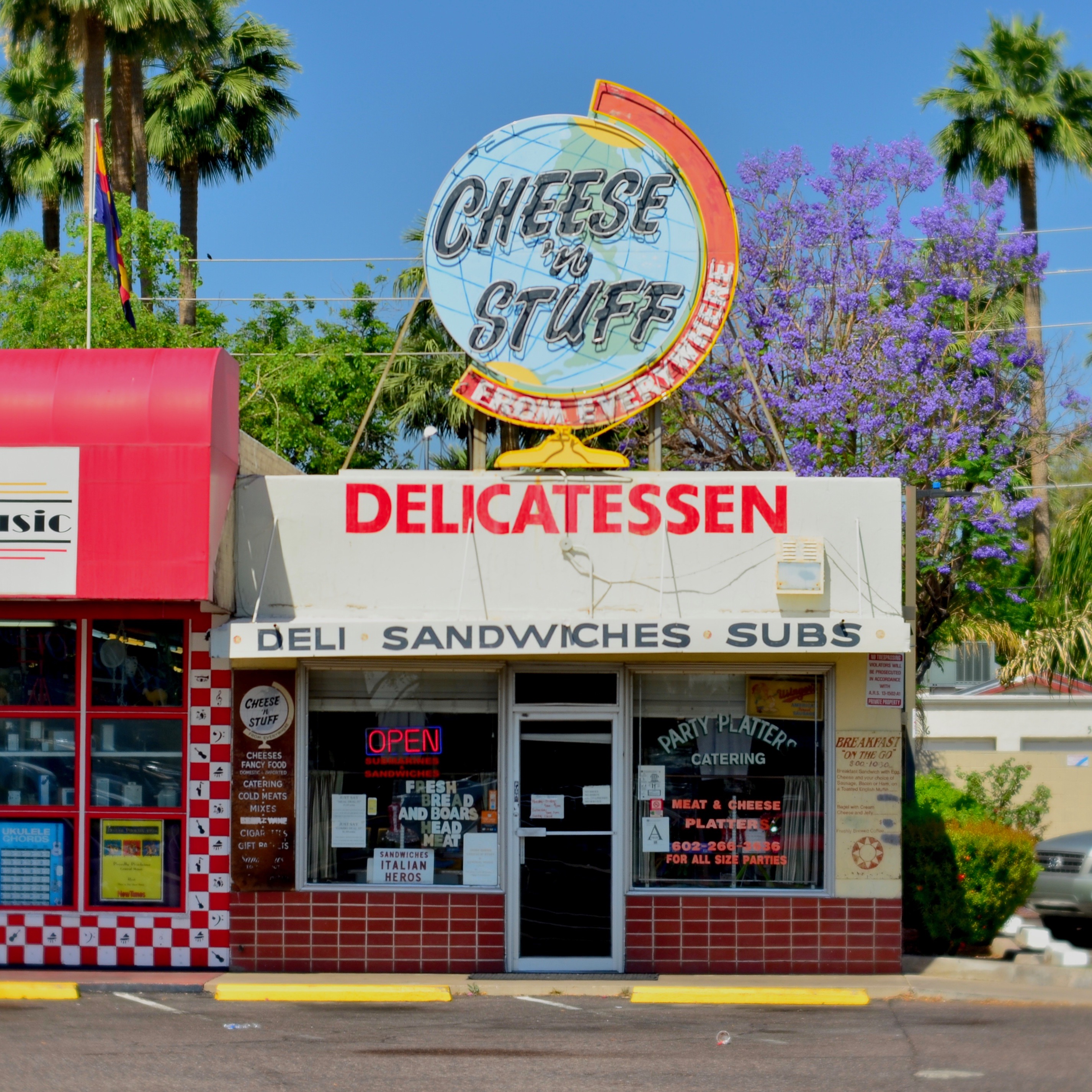
Deli Sandwiches Subs, 2019
By MICHAEL PERKINS
YOU RECOGNIZE THE ELEMENTS OF THEIR STRANGE VISUAL SIGNATURES AT ONCE: garish neon; outsized, surreal props: homemade window signs: and, always, for the storefronts of aging or vanishing businesses, the feeling that this is the creation of a single owner, not a faceless chain. It’s the Great American Mom ‘n’ Pop, and it is always flitting near the edge of extinction. And like all things endangered, it is fitting fodder for the photographer…for although these strange displays don’t include the standard features of the human face, yet still a human portrait of sorts can be made from their humble elements.
If you ever get the chance, thumb through an enormous volume called Store Front: The Disappearing Face of New York by James and Karla Murray (Gingko Press, 2008). Shot on simple 35mm film, this amazing collection offers both images and backstories from all five boroughs in the greater NYT metro, organized by region. The caption data for the pictures is often the personal remembrances of the most recent operators of the various neighborhood’s delis, dry cleaners, beauty salons, supply houses and markets, most of them in continuous operation for most or all of the twentieth century, many closing up forever even as the book was going to press. The “front” is a kind of short story, a miniature play about who we were, what we sought, what we settled for. Often the buildings have risen or fallen with their respective neighborhoods, their entrances falling prey to crime, time, neglect. Several owners lament not being able to get the parts to keep their neon signs in repair. Others wish they could add a new awning, a fresh coat of paint. And always, as the fronts wink out, regentrification rears its trendy head. But it doesn’t bring new good times for the old place. Instead, it erases their stories…with apartment blocks, Pizza Huts, a Verizon store.
The image seen here, along Central Avenue is Phoenix, Arizona, boasts of (at least) a world of cheese, at a deli which is short on space but long on local flavor. In the American Southwest, as compared to other cities, neighborhoods don’t often get to live long enough to become “venerable” or “historic”, such is the short loop between grand openings and final swings of the wrecking ball. In more traditional urban spaces, everything old is occasionally new again. In Phoenix, it’s old, and then….just gone. The insanely disproportionate worship of the new and shiny in this part of the country can be exhilarating, but the real loss it engenders is sad and final in the way that doesn’t always happen back east. As a consequence, urban chroniclers in this neck o’ the desert must keep their cameras forever at the ready. You can never assume that you’ll get that picture the next time you swing through the neighborhood. Because the neighborhood itself may not be around.
For photographic purposes, I believe that storefronts are best shot straight-on (rather than at an angle) so that their left-to-right information reads like a well-dressed theatre stage. This also makes us look at them differently than we do as either pedestrians or drivers, where they tend to slide along the edge of our periphery largely unnoticed. Some of them benefit from being decorated by the figures of passersby: others appear more poignant standing alone. The main thing, if for no other reason except to create a break in the “chain migration”, is to maintain a record. There is a reason why so many “then and now” books of urban photographs are so jarring in their contrasting images. We live so quickly that we simply do not record our environment even through the daily process of using it. We need reminders for reference, even on the things that we should be eventually letting go of. And the camera puts down mileposts in a compelling way. It marks. It delineates, stating in concrete terms, we were that, and now we’re this. I believe in getting out that tape measure on occasion. I think it matters.
WHAT DID I MEAN BY THAT?
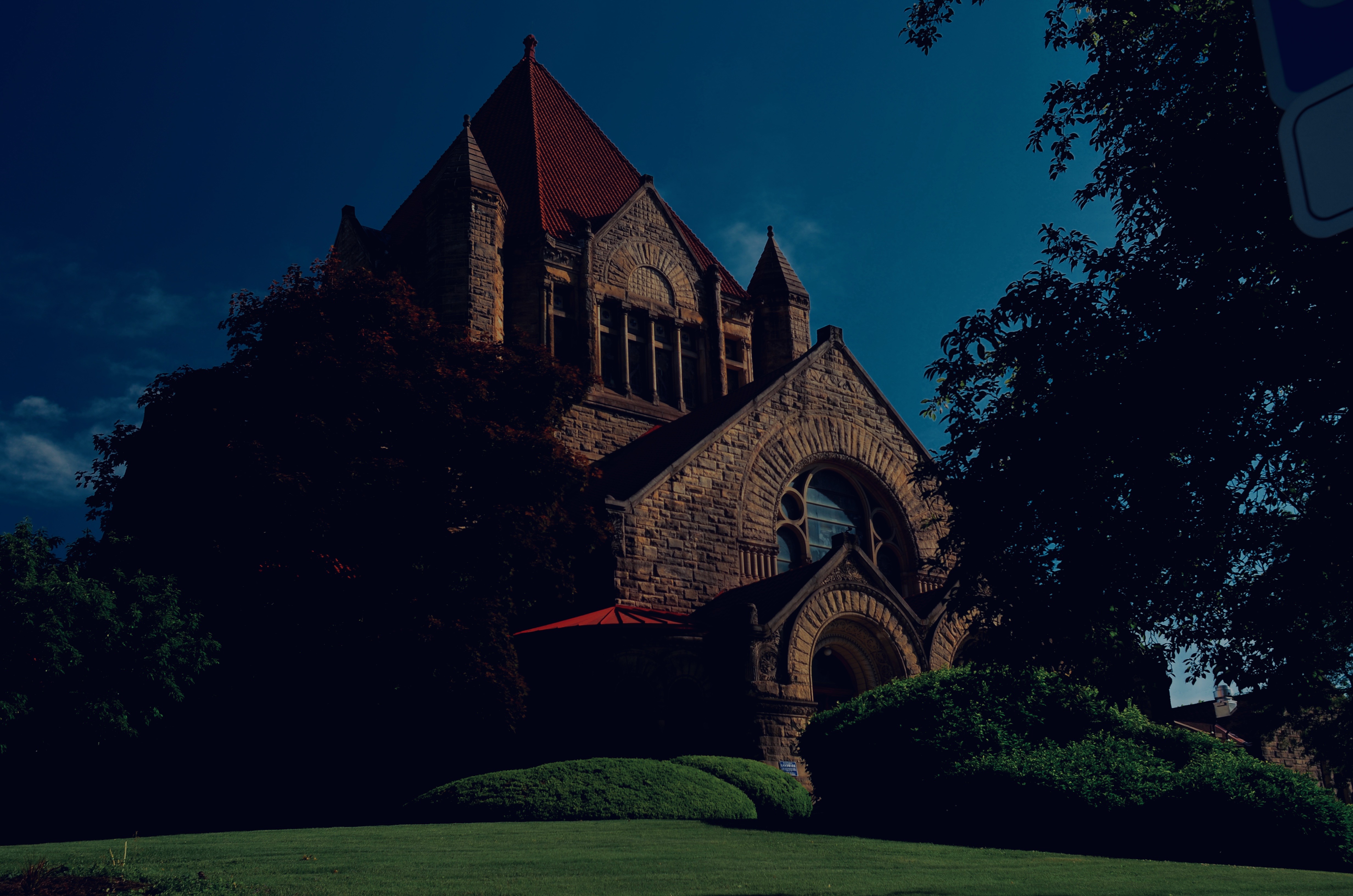
A “night” conversion of a shot originally shot in bright midday light.
By MICHAEL PERKINS
YOGA TEACHERS, AT THE START OF CLASS, often invite their students to “set their intention” for the session, making at least part of what is largely a physical effort a partially mental one as well. Said intention need not be the achievement of world peace or the eradication of disease, of course. Often, just deciding that you’re going to exit the hour with a clearer brain than you entered it is plenty. The idea is chiefly to form the habit of pre-planning the experience, of asking yourself “what do I expect from this?” It’s also the best kind of mental conditioning for the making (rather than the taking) of photographs.
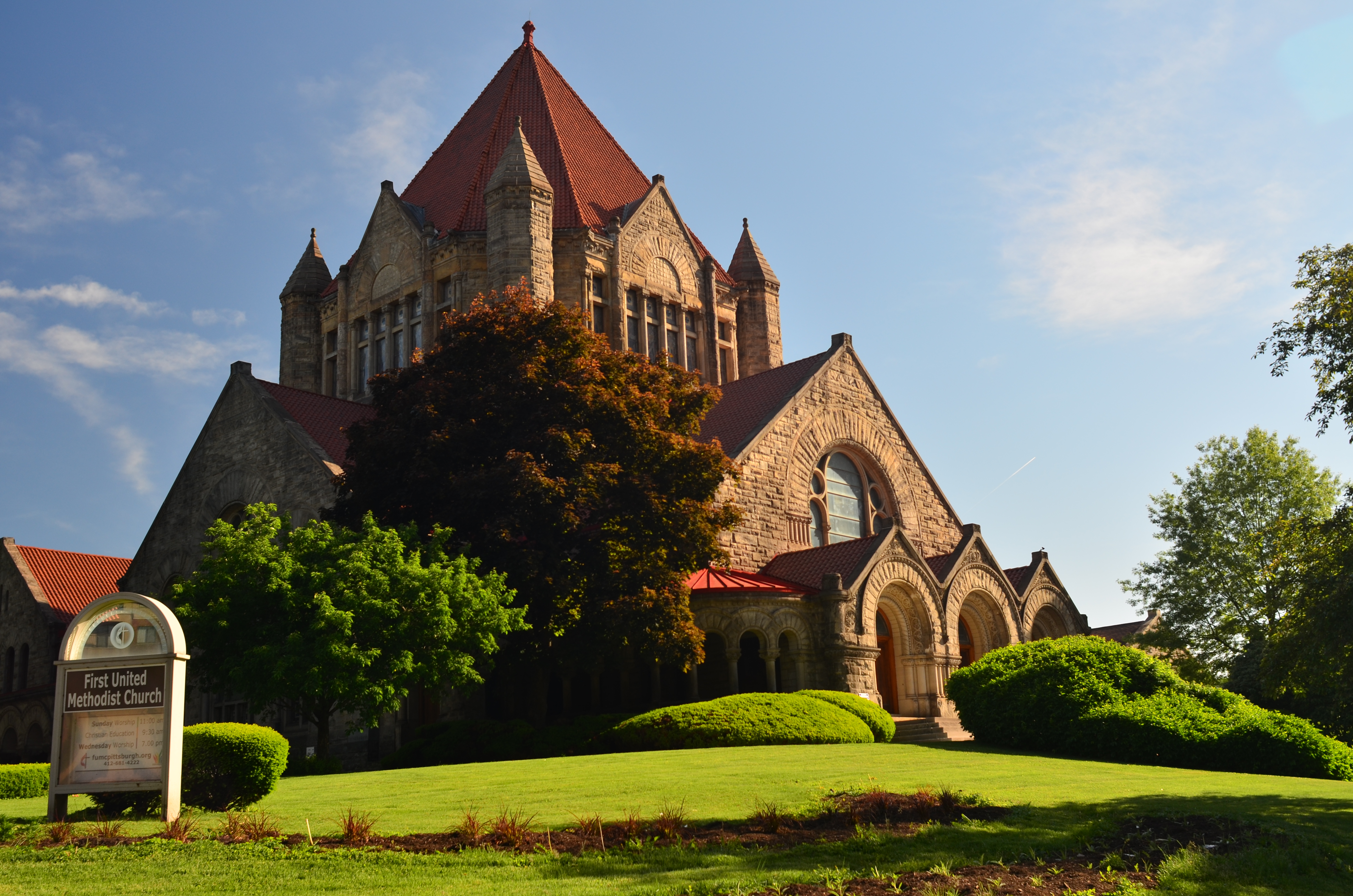
An original daylit image from the same shoot.
Even in the most casual snapshot, there is at least an instant in which “intention” is set and a plan is executed. There is, truly, no such thing as a pure photographic accident. Certainly, you may not have sufficient time or technique to make a shot work out, but just because you weren’t able to get what you set out to get, your intention was established. Some instantaneous judgement call that “this might make a good picture” is in operation, always.
The trick over time for improving one’s success rate is thus twofold: first, to close the gap between what you envision and what you can deliver, and, second, developing the means to, through processing and editing, rescue or even re-set your intention for a given picture. In normal-people circles, this process is called “changing your mind”. Seriously, what is post-processing in most cases but a renegotiation of your original intention? What photographer willingly accepts the ideal of “straight out of the camera” if it means that his/her vision actually goes straight into the sewer? When Ansel Adams called the photographic negative “the score” and the print “the performance”, he was, in fact, asserting that exactly half of a photograph’s destiny is decided after the click of the shutter, something that, thankfully, is a more universally embraced belief in the digital era, which, not incidentally, has placed more control within the reach and budget of billions of users, a control that means choices. Let’s be clear, however: this is not about “saving” bad pictures. It’s about polishing the gems.
One of the simplest ways I myself re-juggle the intention of a shot is in the light relationships. The image you see in the thumbnail here is an original from a series of shots I took on a gorgeous Saturday morning in spring of 2015, conditions which perfectly served the picture of the church as I first envisioned it. The sunlit version emphasizes detail and a very light color scheme. By comparison, the reprocessed version (above) is practically what movie folks used to call “day for night”…that is, shooting during the day in such a way that resembles night, but preserves discernible information in a way that true night shooting obscures. The color scheme is very deep, and nearly all detail is sacrificed except that of the front of the building, which is made to appear as if it were illuminated by the warm light of a setting sun. The shift of the intention exchanges the effect of all that fine detail for the impact of understatement. More to the point, I don’t need to show the grit of every stone or the grain of every slab of wood to make the picture work, and so what is paramount in a day-lit shot becomes expendable, even excessive, in the nighttime version.
Again, even in the most reactive of snaps, all photographers know what they are going for. If they get some of it ahead of the click, with the rest of it recoverable through processing, why are those tweaks any less of a “setting” than the shooter’s original choices of aperture or shutter speed? Can the precious purity of SOOC (straight out of the camera) actually make us abandon pictures that might, with a little encouragement, make the finals? And why should that be?
EYE OF THE BEHOLDER
By MICHAEL PERKINS
PHOTOGRAPHERS LOVE A GOOD SCRAP. We spar about gear: we argue about technique: we defend both film and digital with equal fervor: we crab about the purity of our own artistic vision (as opposed to the pedestrian pap of other shooters).
We even squabble about what blur is. Or isn’t.
If you have an afternoon to burn sometime (and if you care) Google the phrase “bokeh versus blur” and get ready to rumble. Notwithstanding the fact that few outside photography’s elite inner circle had even heard of the word “bokeh” (in the original Japanese, literally “blur” or “haze”) until about a decade ago, many of us are now choosing up sides about what it, and blur, are…or are not. Does it finally matter? Depends on who you ask, and whether they’ve had a good night’s sleep and a solid breakfast. But let’s put on our waders and tenderly tiptoe into the slipstream. Watch out for alligators.
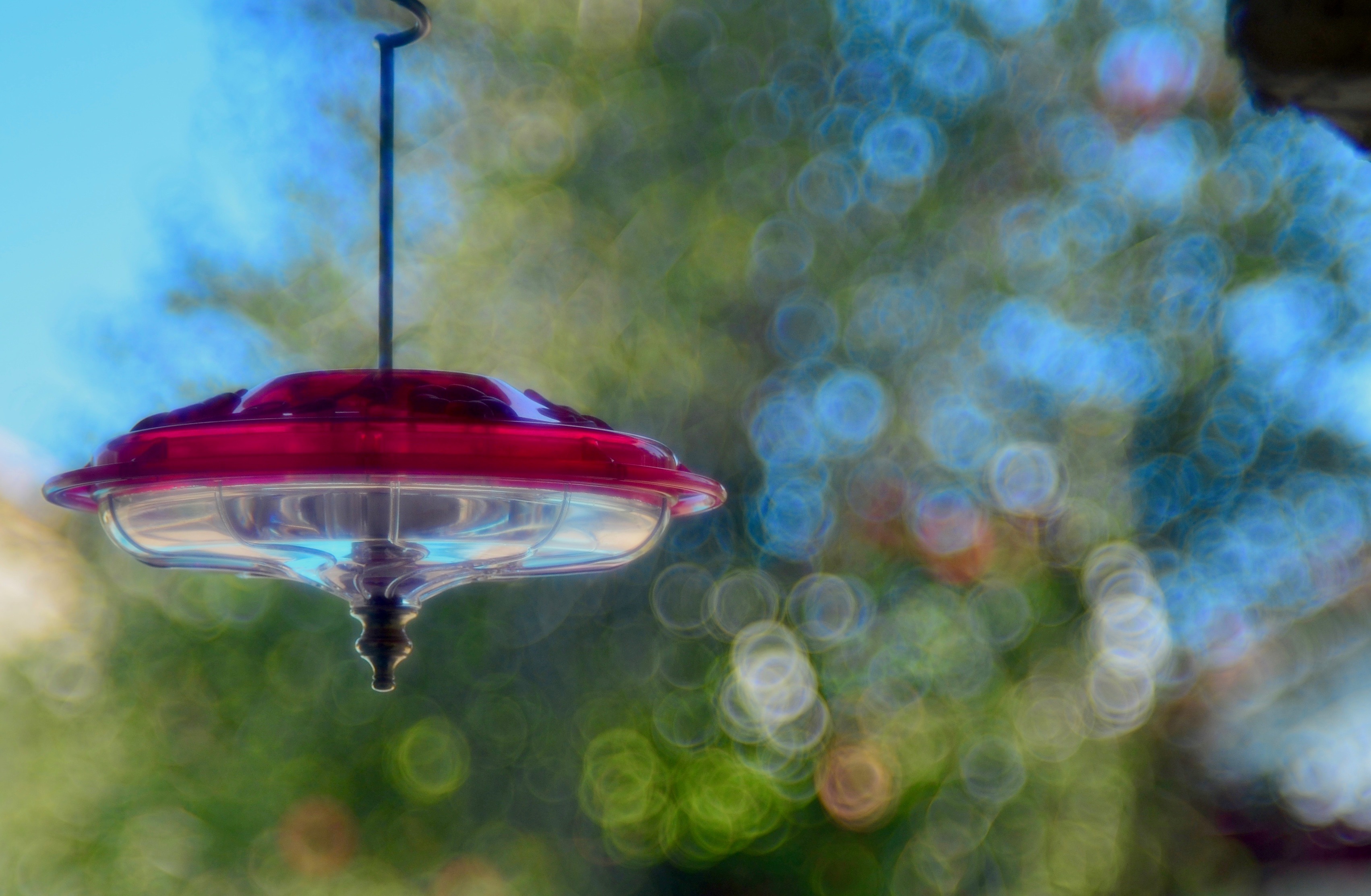
Photographers may choose an art lens like the Helios 44 for the unique shapes of its bokeh.
I would think of blur as any unfocused or under-defined area within a photograph, a place where textures become soft enough for their details to be indistinguishable. It is, essentially, a visual condition. Think of the trees behind your portrait subject that turn to soft mush when you set for a shallow depth of field. Because you want to showcase a face and not a tree, right? Simple.
By comparison, bokeh is the distinct pattern or texture of the blur, something which may or may not be considered “desirable” by photographers, as if it were another design element to be shaped to complement the foreground. This could be anything from replications of the shape of your aperture (little floating pentagrams) to egg-shaped dots in a swirl, or a million other things, depending on the performance and design of your particular lens. It is, as compared to mere blur, a visual quality.
Now, I realize that merely trying to assign simple definitions to these two things will automatically alienate me from a planet-sized portion of the internet, so go to it. But here’s the point I really want to make.
Blur or bokeh, their usefulness, their positive or negative effect, even their potential aesthetic appeal….these are all judgement calls and are totally in the eye of the beholder. Some of us will actually choose a lens based solely on what kind of bokeh it will produce. Conversely, others will never assign any artistic value or priority to the effect whatsoever…and that’s completely fine. I myself have definitely lived on both sides of the streets in this issue, and so, by turns, the whole thing both is and isn’t important, based on what the job at hand is. The main reason I study the debate is because it shapes the intentions of photographers, and so is part of an overall understanding of why we shoot, which is the main idea of this little small-town newspaper.
Bokeh has come to the fore in recent years because photographers seem to want to shape it no less than any other visual element within the frame. And, like anything else about our art that gets discussed to death, it can create clannish, even clownish posturing about what’s more “authentic”, a discussion which takes us nowhere fast. Finally, blur elements are just like trees, furniture, or buildings. Want ’em in your picture? Put ’em there, and God Bless. However, the only thing we don’t want to do, ever, is to try to develop a list of commandments, of things that are always good or always bad for the making of pictures. That shuts down discussion, and eventually clamps down on creativity.
FINDERS (SOMETIMES) KEEPERS
By MICHAEL PERKINS
THE NEW YORK TIMES recently published a marvelous article on the 1963 demolition of Manhattan’s iconic Penn Station, and the lasting lesson of its loss for cities of every size everywhere. On one level, it’s the specific story of how an essential public space fell to a specious idea of “progress”. On another, it’s a meditation on what kinds of buildings make or break a city. And then there’s the mythic quality we bestow on everything that is gone, a romantic pang we attach to that which can never be recovered. All of these discussions are fueled by what photography does to the popular imagination.
Because it was built in the very first days of the motion picture camera, Penn Station was more exhaustively documented in its death throes than at its opening. But one of the mixed blessings of its passing is the sheer photographic evidence that such a grand thing was, a way of bearing witness to why and how it vanished. In those pre-internet, three-tv-network days, photographs helped the building’s demolition function as a kind of global re-set in the thinking of civic planners worldwide. The ill-advised practices of what used to be called “urban renewal” were forever changed after Penn. Its destruction was just too great a mistake to allow for a repetition, and serious discussions began about what constitutes a legacy, even the elusive idea of a city’s “soul”.
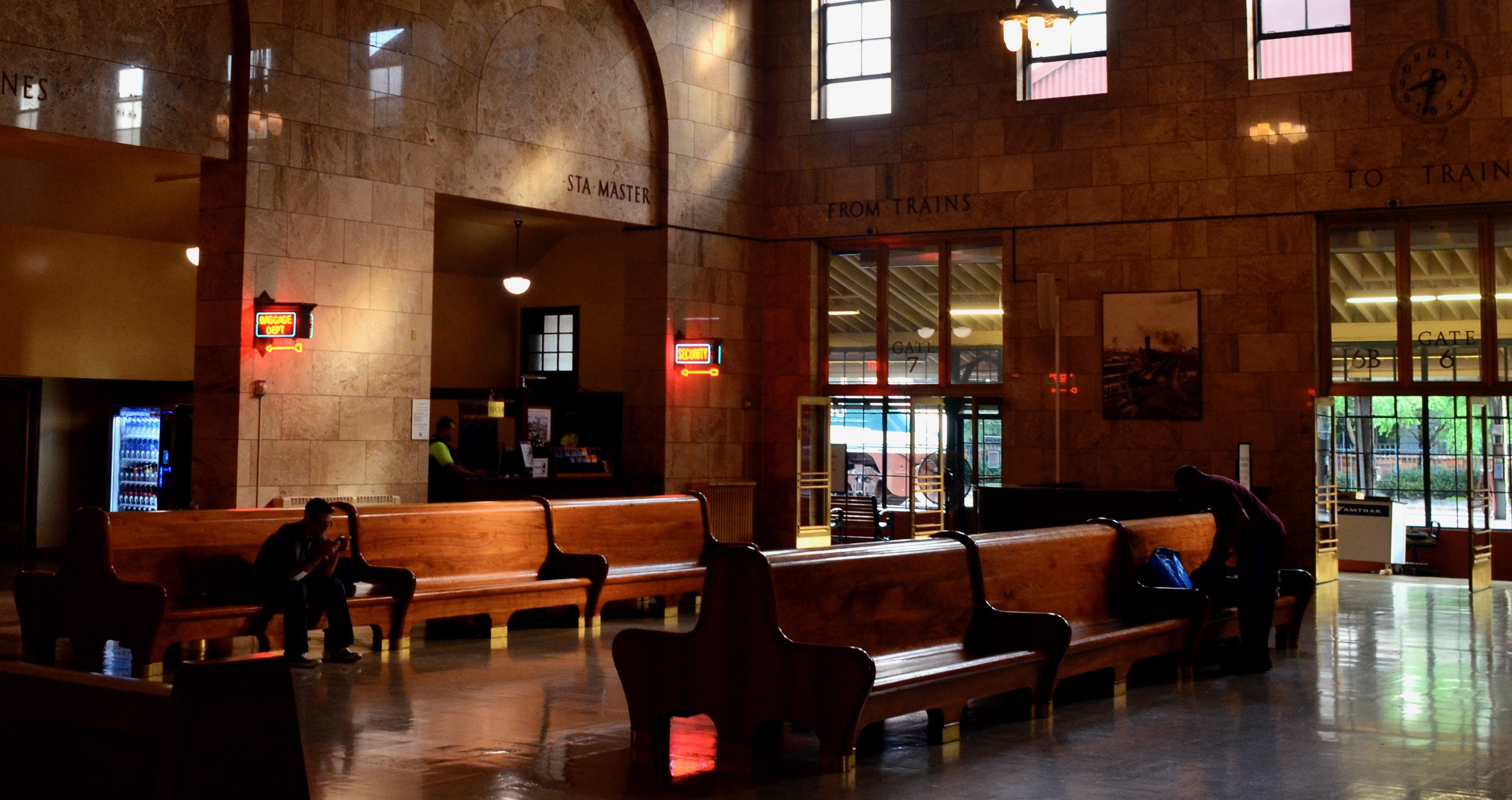
Union Station, Portland, Oregon, 2018. f/5.6, 1/30 sec., ISO 640, 24mm.
One of the things that proved fatal for Penn was a shift from a culture based on railroads to one based on the automobile…a simple matter of sustainable economics, or so it would seem. And yet, more than half a century later, many of the great railway stations are still with us, proving that the lives of buildings need not be tied to their original purpose. Rebirths of structures from the 20th century are the urban success stories of the 21st, due to a word which would have seemed alien to the America of the mid-60’s: re-purposing. Commuter travel is, certainly, a fraction of what it once was, but the beautiful palaces that once served as hubs for millions of day travelers have, in many cases, been allowed to serve new functions, many of them being converted into active museum or gallery space. Others, like Portland, Oregon’s Union Station (shown here), are still key connectors for pleasure travel, if not a nation of nine-to-fivers. All of these fresh starts are ripe for new photo-documentation, for telling the stories that, for now, are protected, but which remain terribly fragile.
In some ways, the nation has also grown up a bit. We had such a love affair for so long with All Things New that there seemed little need to preserve or protect anything into its old age. The frontier was limitless, resources were infinite, and anything edging toward decrepitude could merely be swept away for the newer and the better. Now, we seldom throw away entire neighborhoods just to provide a superhighway with a five-mile shortcut. We build in and much as we used to build out. And, with a cooperation between urban visionaries and those sentient eyes behind the viewfinder, there is a greater likelihood that at least some of the world we knew will be viewable, even viable, for those who come after us. The camera is a way of measuring us, as well as the things we create, a time machine with an infinite capacity for emotional as well as educational truth-telling, a way to assemble many small images to compose the Big Picture.
EVERYTHING OLD IS….. OLD AGAIN
By MICHAEL PERKINS
PHOTOGRAPHY IS NOW SOMEWHAT LIKE THE OLD GOD JANUS, whose two faces looked into the past and the future at the same time. No longer just an emerging art, the practice of making images with light now packs enough historical baggage that, even as we anticipate and adapt to the newest technology, we turn backward toward the comfort of technologies past. We love what’s coming but we can’t quite let go of what’s been.
That’s how you get somewhat ironic observances like this month’s Worldwide Pinhole Day, a celebration of the experience of making a photograph with the most minimal technology available…..that is, an actual bored hole in the front of a light-tight box, the aim being to take a picture without a lens. WPD is marked globally by field trips, competitions, workshops, and a bit of a cottage industry for the special pinhole gear, all of it aimed at delivering the same experience that the first snappers had when photography was the exclusive domain of tinkerers. Certainly the principle works: the pinholes are so incredibly small (often requiring very long exposures) that they actually register distant objects in fairly sharp focus, although sharpness isn’t really the goal. The idea, in the main, seems to be to conduct a successful science experiment that results in a picture, although high-end pictorial quality isn’t really the goal, either. If you’re only casually interested, various ready-made pinhole attachments are sold so you can adapt digital-era cameras to this nineteenth-century method. However, even greater authenticity and enjoyment is said to be had by shooting on 35mm roll film or 5×7 sheet film, or even making the camera itself from scratch, using cardboard boxes, coffee cans, or, as I recently saw, the inside of a plastic Star Wars tie fighter toy.
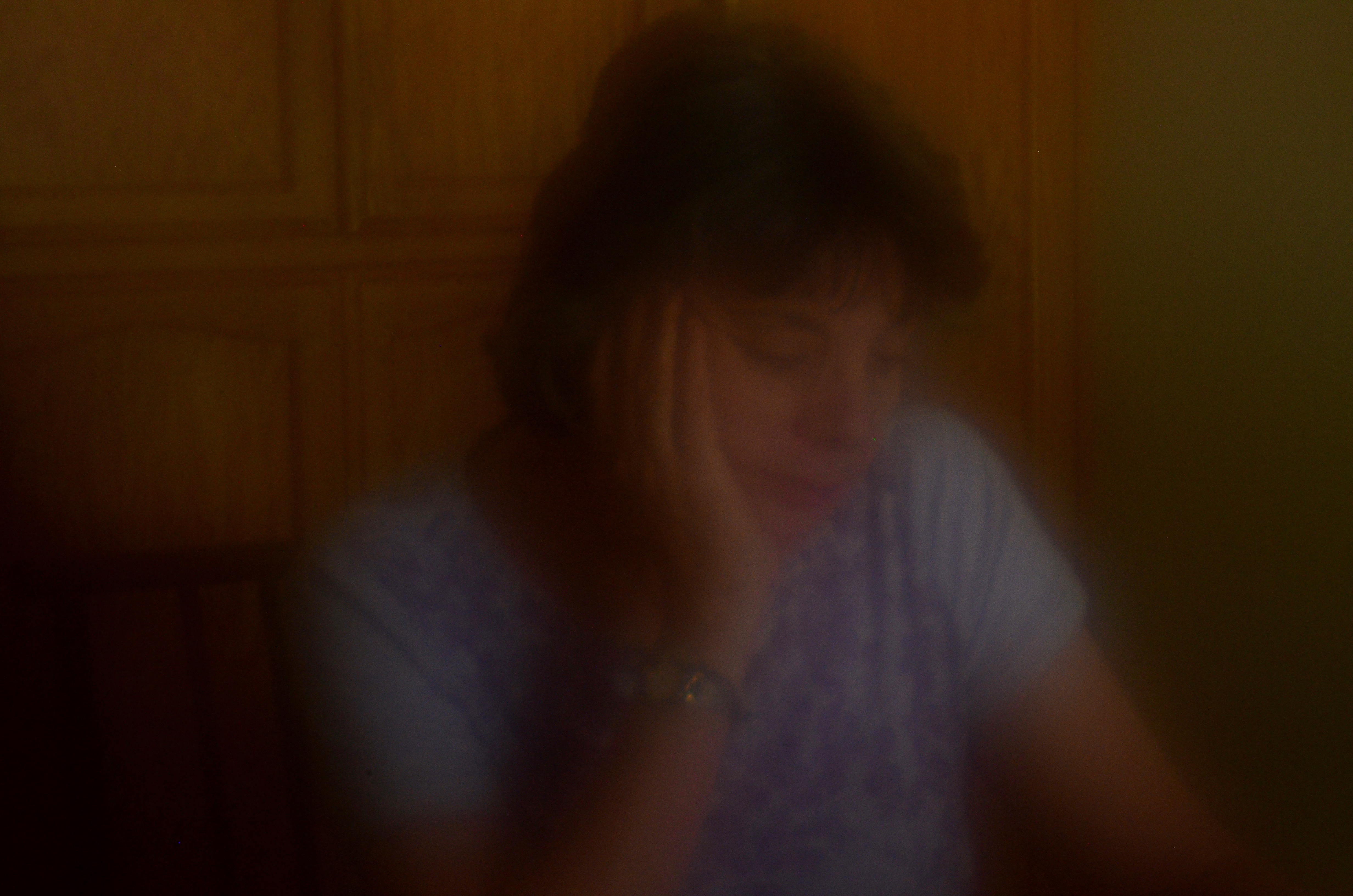
Kitchen Komtemplation, 2019. Taken with a Lensbaby pinhole optic, its aperture set at about f/177, a 1/5 sec.exposure time at an ISO of 640 (allowing a handheld shot), and a focal length of 35mm.
The entire thought process behind such time-travel faddism is fascinating. Unlike the first photographers, who constantly worked to expand and improve the leading tech of their time, we have reached a stage where making a picture is so mechanically simple that we find it fun to needlessly complicate, or even degrade the process again. In my own view, the more advanced cameras have become over the years, the less I’ve had to futz with the problem of how to take the photo, shifting the emphasis onto the why of it all, which is where I want it. Every scientific advance has been designed to make cameras more intuitive, imaging media more responsive, and everything generally more fool-proof. Now, however, we are far enough away from those balky first iterations of photography to develop a nostalgic fondness for them. Such is human nature.
I’m sure that, somewhere, there are festivals where the idea is to shoe your own horse, learn to darn your own socks, or field-dress the deer you just personally brought down with bow and arrow. Thing is, though, for most of us, modern life no longer requires so much effort from us merely to stay alive, which allows us to focus on the finer points of the experience. But, from our more advanced standpoint, we strangely think it’s quaint to add more accident, more randomness, more error and more uncertainty into the making of what turn out to be essentially inferior photographs, even though it has never been easier to make good ones. This is where we start to leave the realm of Art and enter the world of The Science Fair.
At one point in my son’s youth, I wrapped copper wire around an oatmeal box and scratched a hunk of germanium crystal to show him how to produce a primitive radio signal. It worked well enough to snag him a merit badge, but on the way home, he was right back to listening to his Sony Walkman. Because it sounded a helluva lot better than a wired-up Quaker Oats cannister. And while I acknowledge that artistically elegant images can be made with very rudimentary tools (of course, any image of my wife will automatically be a better picture, as seen above), pinhole images are hard to compose, expose or control in any proactive way, and thus predisposed to a high failure rate. If you’re personally wired to accept whatever the universe hands you, then the pictures that accidentally come out of your coffee can will no doubt be something of a scientific marvel, ablaze with the spark of discovery. As for me, I find that my own lack of vision or talent already interferes with my pictures far more than it should. I don’t need to further compromise my work with disobedient gear. It may be amazing, but it ain’t satisfying.
ALWAYS, OR ALMOST ALWAYS
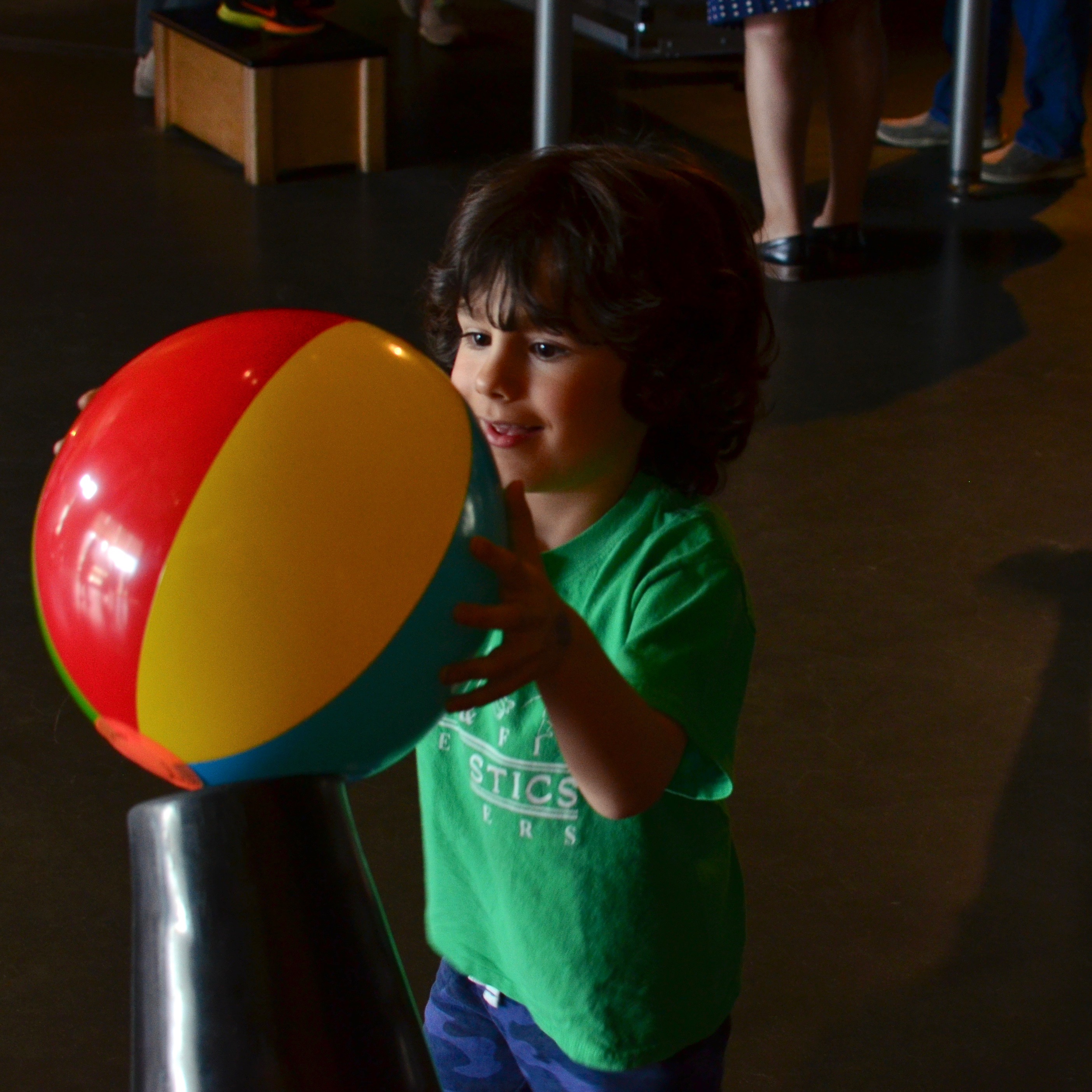
The Eureka Moment, 2019
By MICHAEL PERKINS
THERE ARE ENTIRE BOOKSTORES CRAMMED WITH TUTORIALS FROM PHOTOGRAPHERS who have developed what, for marketing purposes, is called a “style”. This is a catch-all word for the accumulated experiences, biases, tricks, shortcuts, philosophies or habits that inform one’s work, all of it showing up frequently enough to constitute some kind of artistic signature. It’s a list of “I usuallys” and “I almost alwayses” and ” I nevers”, and those of us who study the output of others can get into a bit of a trap over it.
We’d all love to be able to answer that tantalizing interviewer’s question, “what’s your personal approach?”, as if we could reduce what we do to a set formula. I certainly can’t do that with my own stuff, and I’m a little distrustful of those who figure that they’ve got themselves sussed out to the degree that they can define their style. Of course, just because I don’t think a single trait or phrase can sum up a photographer’s identity, it’s tempting to try to produce such a profile, like trying on a suit that you probably won’t buy just to see how it looks on you. That means that, occasionally, I wonder if (a) I have a discernible style at all, and (b) what its features might be.
I really can’t say that there’s an (a) at all for me, or at least one that I can discern. As for the (b) stuff, there are in fact things that I lean on or come back to from time to time, although they may not always serve what I’m trying to achieve. One very basic thing that I find myself returning to repeatedly is exposure, more specifically, under-exposure. If my work has anything like a consistent look to it, it’s probably in a predisposition to work with as little light as possible. Over the past thirty years, much of this may be attributable to having lived in the American southwest, a place so bleached in sunlight that I was forced long ago to drastically revise my idea of how much light I’d need for a given shot. These lessons were not only palpable but, initially, expensive, since my first disastrous outings out here as a tourist were shot on slide film, which was heinously unforgiving whenever I’d miscalculate an f-stop. We’re talking supernova white on entire rolls of film.
This is not to say that merely getting burned on a few runs of slides, all by itself, turned me toward minimalist exposures, but it sure as hell got my attention. Since I learned photography in the make-or-break era of film, I was already operating under a pretty mindful model of pre-planning strategy (fore-thought?) when it came to photo shoots, so that, once I transitioned into digital, while I was freed from the dollar smackdown associated with blown pictures, I still retained the habit of sweating shots before shooting them. I totally delighted in the fact that errors could be countered and corrected faster with the immediate feedback loop that was a given in digital, but I also still tended to purposely think of what the camera could and could not do, even without being bitten by mistakes. I began gradually to expose for the highlights, rather than worry about the loss of detail in darker patches. Get the parts that can ‘blow out’ right, I tended to believe, and most of the shadows will yield at least something in post-processing. I also experimented extensively with blending bracketed shots (a series of exposures of the same scene, ranging from bright to dark) in HDR or other processes, and that sometimes rescued a lot of dark information. Behind all of this was the belief that the only data you really can’t get back from a shot is the stuff you blew out from over-exposure. Shoot with less light and you’d be safer, generally.
In general I tend to control exposure by an adjustment of shutter speed rather than aperture, and to do everything manually, avoiding semi-automatic exposure modes like Aperture Priority, since, at least for me, they tend to over-expose. I see camera after camera whose auto settings deliver images that are much too bright and non-contrasty for my taste. This is uniformly true in the new generation of film-based instant cameras, many of which do not even allow the user to turn off the flash. Is my choice of exposure range a style, or just a mode of working? Certainly, I don’t perversely under-expose every shot I take, regardless of the conditions, so, to that extent, it’s not really a “signature” thing. Maybe it’s just like any other work habit, like always standing with your legs in a perfect “A” or constantly keeping a light meter at the ready….a starting point, a basis of procedure. I do know that there’s so much going on inside the head of the individual photographer that none of us can universally prescribe for each other. If it works for you, everyone else’s lip music is irrelevant. Bring even 50% of your original concept to your final picture and you’re a hero. Tools and techniques are only as valid as your work makes them.
JOE COOL VS THE TIME MACHINE
By MICHAEL PERKINS
ONE OF PHOTOGRAPHER RICHARD AVEDON’S MOST PERSONAL (and most controversial) projects involved the documentation of the deterioration and death of his beloved father. In a similar vein, Annie Leibovitz chronicled her partner Susan Sontag’s brave but ultimately unsuccessful battle with cancer. Both series are riveting and heartbreaking, truly valiant attempts by artists to face the most terrifying aspect of life, namely its end. I admire both works, as I do many others that traffic in the same aims.
But I just can’t bring myself to photograph my own father (who turns ninety at this writing) in that way. It’s not that I lack the courage. Or the curiosity. I might even possess the clinical detachment it would require. But if photography has meant anything to me, it’s been about focusing on what’s most important. And the impending end of Dad’s life is of no importance, especially if compared to the quality of the life he has lived. I just can’t make despairing pictures of him. Not on purpose, anyway.
Technically, I could easily record tender, textured studies of how fragile his marvelously gifted artist’s hands have become. I could dwell endlessly on the inexorable appetite of time in robbing him of his balance, his eyesight, even, occasionally, his memory. But while any of those factors might produce pictures that were poignant, even eloquent, they would not be true to the spirit of the things that have animated and excited him over a lifetime. Ideas. Passions. Projects. A love of every manifestation of the artistic impulse, from the avalanche of books that littered every corner of our house to the lazy summer Sundays when he and I would lay on a sheet on the living room floor near the box fan, put My Fair Lady on the hi-fi, and be transported to 1910 London. Life is certainly, to a degree, about setbacks. But it’s also about being indomitable. Yes, that’s it. I’ve slung a lifetime of compliments in Dad’s direction, but indomitable is the word that finally sums him up. Hemingway once said that a man can be destroyed, but not defeated. God knows I’ve been around to see the world take a whack at accomplishing the former process. Gladly, I have never witnessed the latter. The trips down to the canvas don’t count. The journeys back up from the canvas do.
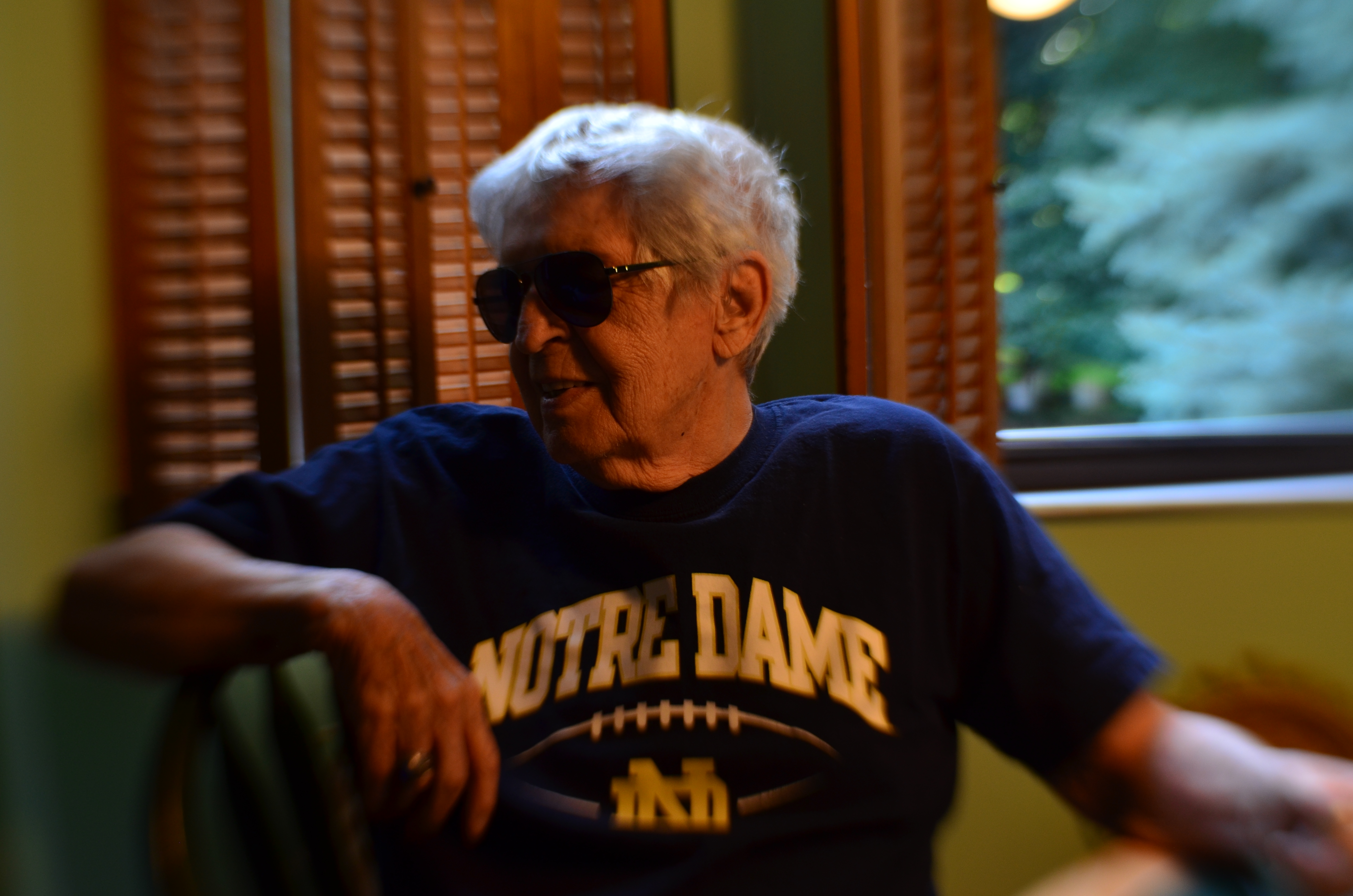
My Father, Summer 2018.
The image seen here began as an experiment with a particular art lens of mine. It’s based on selective focus, which means that you create pictures that actually conceal and much as they reveal. That means a less-than-reliable rendering of aged skin, a gauzy interpretation of the harder textures of aging. As for the sunglasses, while jaunty, they are not an attempt by the Chief to be cool but rather a very needful protection against over-loading his eyes with harsh light. And still, the overall affect, at least to me, is relaxed, comfortable. In this picture, I see no Sick Old Man. I see (or choose to see, maybe) an update on the dashing blockade runner I grew up with. The borderline shy smile, the posture of someone recalling a really good story. It’s the central nugget of his personality, which survives intact to this day, even if the machine that carries it around throws more cogs than it used to.
Photographs of such a man have to be resilient, even defiant. I grew up with too many instances of his quoting Dylan Thomas’ exhortation to “rage, rage, against the dying of the light” to snap pictures of him as weak or downhearted. And, of course, the man who loved that poem still bubbles up, even in conversations that are mostly about trouble or turmoil. Earlier this week, to change the subject from Time’s latest assaults on him and Mother, I mentioned that I had sent my sister “something you can use on your birthday.”
A pause, then:
“That’d be the motorcycle, right?”
“Yes”, I said, laughing with gratitude and relief, ” but I didn’t pop for the sidecar. I thought it would be too showy.”
Joe Cool was still on the job. And as for that Time Machine thing, you can take it and stick it.
Happy Birthday Daddy/Dad/Pop/Poppa/Daddy
ADD, SUBTRACT, REPEAT
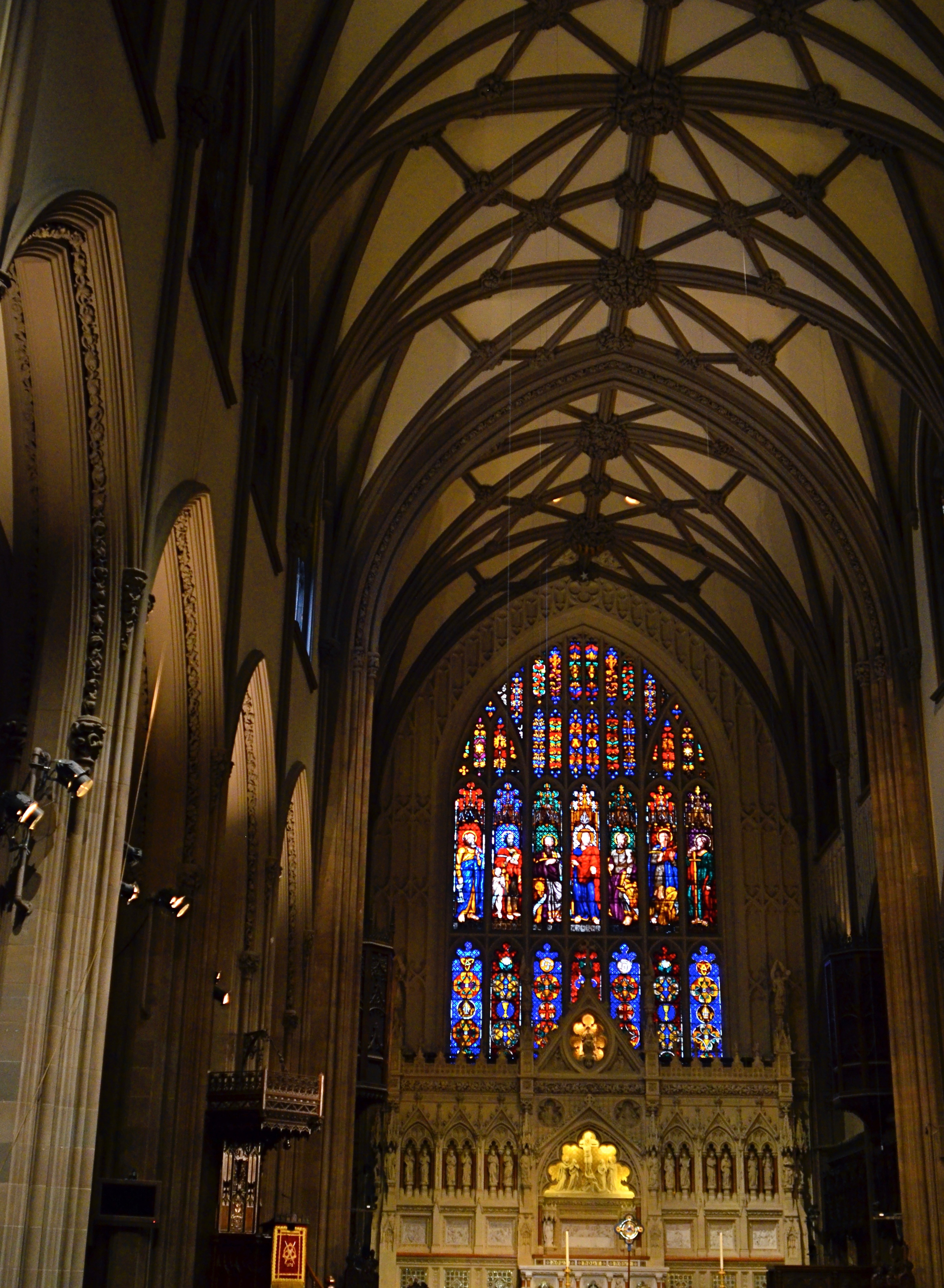
Manhattan’s Trinity Church, survivor of many a renovation and at least one fire.
By MICHAEL PERKINS
DEPENDING ON WHEN YOU HAVE CHOSEN TO READ THIS ENTRY (since blog posts are archived) the heartbreaking fire at Paris’ Notre Dame cathedral is either a fresh wound or a remembered tragedy. The Normal Eye doesn’t often address current events, since they can lose their relevance too quickly compared to the essential motivations that consistently shape our photography. However, the partial loss of this priceless global treasure has created a ripple which will echo throughout the art world, the religious world, and, certainly, photography. Any discussion of how we create and venerate sacred space invites a second exchange on how we visually preserve it.
Like many of the world’s most venerated buildings, Notre Dame is not purely an original but an amalgam of the aims of many different eras. It is a physical testament to what humankind valued (or yearned for) across many centuries. The structure itself, like many others like it, is the product of many additions, subtractions, and revisions. Thus there are, according to when you plop down in the continuum of time, many Notre Dames, including the abstractions of it that we carry in our hearts and those that have been depicted or interpreted by countless artists and visitors. Like a photograph, the Notre Dames of the world are preserved moments, pieces of time that have been plucked out of sequence. And like a photograph, they can be endlessly re-envisioned, repurposed to tell the stories in our own fashion.
America has few structures with the prolonged life-line of Europe’s seemingly eternal sites, but, even within our several short centuries of activity, we have created buildings that are presently on their second or even third life of service, each “version” marked by repairs, renovations, the ravages of war, and the selective erasures of memory. Places like NYC’s Trinity Church, which had already once burned to the ground and been rebuilt by the time Alexander Hamilton was buried in its churchyard in 1804, or the Empire State Building, which suffered a wound in its side at the 78th floor after a fog-bound pilot crashed a B-25 into it in 1945. And then there’s the period between the death of the Twin Towers and the rebirth of the entire Ground Zero district, which spans barely fifteen years, or the fall-and-rise cycle of innumerable repurposed American buildings, like the soon-to-be-opened Academy Museum of Motion Pictures, built around the bones of a May Company department store in midtown Los Angeles.
Certainly, compared to Europe, we have a more shallow history, but we have the very same save it / fix it / trash it arguments that spark discussion in France and countless other cities. In a way, architecture is like photography, in that it halts time in its course, making a document of where we were at a certain point in our evolution. Buildings act as snapshots in stone, or as one critic called an American skyscraper, “frozen music”. And, in the inevitable resurrection of Notre Dame, as with our most venerated places around the planet, the photograph is that most fortunate (and fairly recent) thing in our cultural bag of tricks: a physical record. With every thing we add or subtract or add back again to the places we have built, there is, now and forever, a way to mark our place, to create a comparison and reference, and to decide what in our world we will allow to pass away, or promote to immortality. Photography wears both its artist and historian hats for this important task, one which must now be brought to serve that house where dwell the better angels of our nature.
Vive la France.
A QUESTION OF INTENTION
By MICHAEL PERKINS
YOUR CAMERA IS FAIRLY CRAMMED with features and functions that may or may not help you make better pictures. Certainly, all are intended as conveniences or shortcuts, but, since no one will ever utilize 100% of their gear’s potential gimmicks, you alone must decide which menus and goodies will actually help you exercise the most control over your results, and which are merely distractions. Your own path as a photographer will decide the real value of your camera’s various add-ons.
One automatic setting that I personally toyed with for a time but now almost exclusively avoid is the so-called “burst” setting, which allows you to automatically snap a ton of images very quickly by merely depressing and holding the shutter button. Its appeal is chiefly in helping to track fast-moving activities, like sports, children, or any other rapidly changing situation that presents challenge in setting or formulating shots on the fly. The camera is basically taking pictures faster than you suppose that you could plan them yourself, the idea being that, upon review, something in that batch must be usable, with the also-rans just being deleted later.
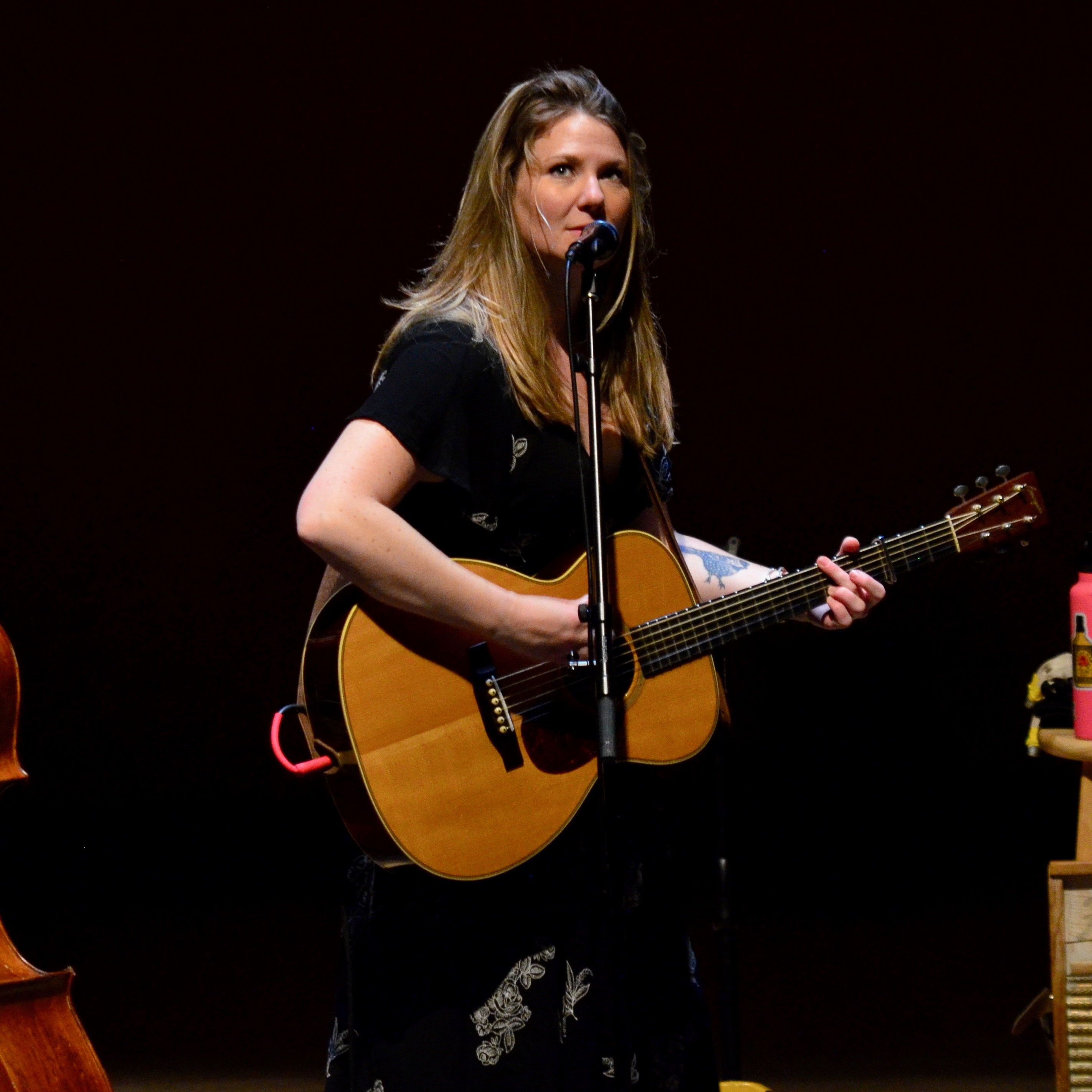
Celia Woodsmith of the bluegrass band Della Mae, April 10, 2019.
But I really find this mode a detriment, not a bonus, simply because the entire picture-taking process has been handed over to the camera. The shooter is completely passive, a bystander to a machine that is now making all the decisions. It’s like spraying a fusillade of bullets over a wide arc in the hope that you’ll hit something…anything, and it’s about as far from purposeful picture-making as you can get. I realize that the fear of missing something great can be tempting, but taking a whole bunch of pictures real fast, none of which could be anything other than a technically acceptable accident, is not a creative decision. How can it be?
Listen, I get it. Things happen fast, and it takes a great deal of practice in shooting in changing conditions. But the idea that there’s no time to frame or conceive an image just because it’s in motion is a false one. Will some opportunities be missed if you have to compose and click in the moment? Sure. Will some choices be unproductive? Yes. But the results will be your results. The image you see above was taken in a concert environment, which is just as volatile as any kid’s baseball game or birthday party. Faces, physical blocking, postures and light change mightily from moment to moment. But there is still time to plan a shot. Yes, your reaction time is measured in seconds, but there is time. More importantly, you can change your mind about whether to try something. You have direct influence over what’s planned and attempted. The camera is carrying out your commands. That’s the important part: they are your commands.
The shot you see here is the product of about fifty shots that were either deleted on the fly or winnowed out in the editing process. But I know what they are because I shot them. That’s not my vanity talking: it’s just the difference between learning to trust yourself and handing that trust over to the machine. For me, the choice is simple.
LINING UP THE STARS
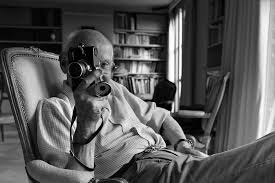
Henri Cartier-Bresson the way the world most often saw him, from behind his 35mm Leica.
By MICHAEL PERKINS
THE CREATION OF A PHOTOGRAPH IS, AT ONCE, A VERY SIMPLE ACT and one of the most complex of creative processes. It is both instinctual and intellectual, a thing of sudden inspiration and a constant weighing of variables. It is, simultaneously, a marveling at the random arrangement of all the stars in heaven, and an attempt to line them up in a pattern of one’s own desire. Few photographers have been able to consistently balance these disparate aims over the course of a career. Fewer still have been able to reduce the process to written wisdom as well, a quality which makes Henri Cartier-Bresson a prophet among poets. He not only defined human truth with his beloved Leica (which he called “the extension of my eye”) but also managed to speak about that miracle in a manner no less articulate than his grandiloquent images.
HCB’s career coincided with the rise of the great photographic feature magazines of the 20th century, like Life, Look, Parade, and Harper’s Bazaar, where a new kind of reportage was being invented on a daily basis, with photographs evolving from mere illustrations of mega-events to stories about people who lived their lives beyond the obvious ranks of fame and power. Photographers were entering into a more emphatically emotional role, both harvesting and inserting interpretive energy into what had formerly been a simple act of recording. Global displacements of individual humans, measured between the World Wars in the Great Depression and other seismic events generated image makers who could train their cameras to take the measure of joy and suffering in an incredibly intimate fashion. Cartier-Bresson’s beat, which was global as well, enhanced his eye for the universal, the common feelings that crossed cultural and geographical boundaries. But he was also helping to create a new way of seeing, a system that was equal parts brain and heart.
In describing what he would later call “the decisive moment”, that golden instant where subject and story reached their peak of impact, HCB described what, to him, was the aim of the enterprise:
For me, photography is to place head, heart, and eye along the same line of sight. It’s a way of life. (It is) the simultaneous recognition, in a fraction of a second, of the significance of an event, as well as of a precise organization of forms.
Composition. Interpretation. Empathy. Narrative clarity. These became the mainstay elements of Henri Cartier-Bresson’s work, the difference between just freezing something in a box and capturing something of fleeting but essential value. They also became the pillars of a discipline that would eventually be labeled “street photography”. Perhaps it was his practiced way of seeing which, late in life, led him back to painting, the visual medium for total control. It is one thing to learn to see, and it is something else entirely to be able to harness that vision, to make the camera execute it with a minimum of loss from the original conception. But the anticipation that something is about to happen keeps us addicted, and that in turn keeps us trying. As HCB himself recalled of the moments before the click, “I’m a bag of nerves waiting for ‘the moment’…and it wells up and up and it explodes…it’s a physical joy, dance, time and space all combined. Seeing is everything.” It is a testament to how perfectly Henri pre-conceived a composition that almost all of his photographs are exactly as he shot them, without cropping or re-framing of any kind. They were just that right…..the first time.
We all occasionally get seduced by equipment, techniques, fads, even windy essays like this one, veering from the central mission of our art. But that mission is as simple as it is elusive: seeing is everything. With it, you can light a candle against the darkness.
Without it, you are worse than blind: you are unknowing.
DO-IT-YOURSELF GROUNDHOG DAYS
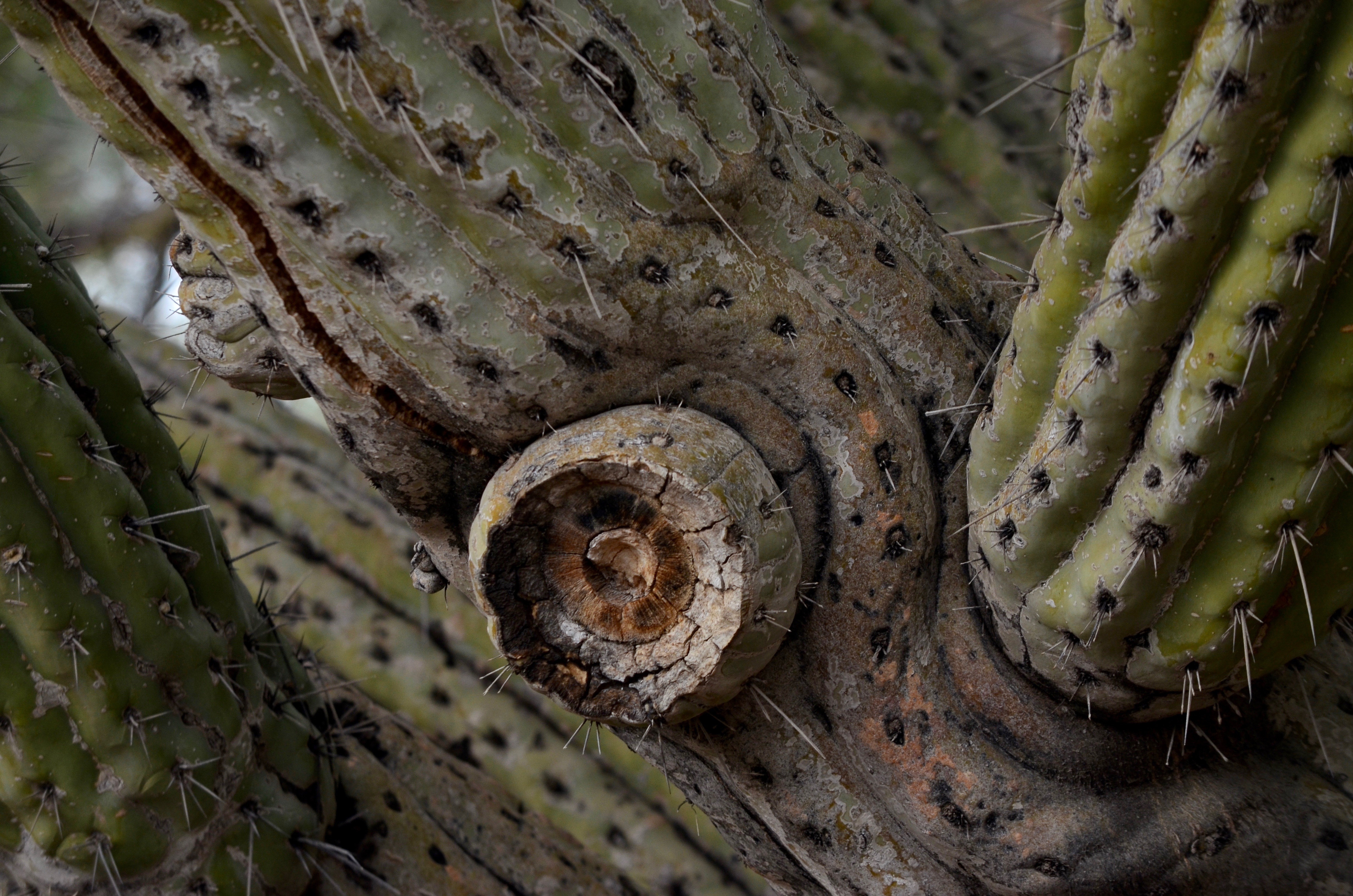
Sworls, 2018. Yes, I’ve shot thousands of cactus images over the years. But I never shot this one.
By MICHAEL PERKINS
IT MIGHT BE SAFELY SAID THAT THERE IS NO SUCH THING as a photograph that “doesn’t count”. There are, however, some whose purpose is not immediately apparent.
Photographers always intend to shoot something important, or compelling, or groundbreaking, producing images that have, in the eyes of the world, an obvious value or merit. And then there are the majority of the pictures we make, many of which are considered by others, as well as ourselves, as non-essential, trivial. But how do you get to the skill level needed to produce masterpieces if you don’t first produce many more failures? This may mean shooting photos that “don’t mean anything”, although that’s an odd way to describe one’s creative apprenticeship process. Everyone accepts that a young blacksmith will botch his first dozen projects on the way to ultimate artistry. Photography, on the other hand, is regarded by some to be as easy as raising your arm and plucking an apple off a tree. We strangely believe that some kind of beginner’s luck, even beginner’s excellence, ought to be automatic. Hey, it was a nice day. He had a full breakfast and a good camera. So great pictures should follow, right?
The Normal Eye picks up additional subscribers all the time (thank you) and so I believe it’s important, since this forum is about a journey, to occasionally re-emphasize the value of making a whole lot of inconsequential pictures on the road to the keepers. Learn, if you don’t already know it, the value of shooting on days when “there’s nothing to shoot” or when you are really forcing yourself to take the 4,532nd image of a place you’ve visited dozens of times. Great subjects don’t just appear: we all can’t fly to Paris on a whim. Often there is just the park down the street, a part of the back yard, the junk clustered on top of your desk. And a camera. And, hopefully, some little something that’s been added to your eye or technique that wasn’t there the last time you had to shoot pictures of boring stuff. The batters with the best averages still miss the ball most of the time. The best hunters can sometimes trudge home empty-handed. And every photographer has only one tool to bridge the gap between okay and amazing shots, and that’s to keep clicking away. At the stuff that don’t matter. On the days when you’re barely stifling a yawn. With the wrong camera, the worse light, the only lens you remembered to bring. Or, in the case of the above shot, during your twentieth year of walking through a particular park.
Photography is never an ideal situation. Something will be out of round. Some condition will be inhospitable. And there will often be a sense that “this isn’t the moment”. But here’s the deal: a better one isn’t coming. What is coming is a series of repeated exercises right out of Groundhog Day. Same day, different pictures. Maybe. Maybe not, but, still, maybe.
THE CAB IS HERE
By MICHAEL PERKINS
FEWER DEVICES HAVE SHORTENED THE DISTANCE between an artist’s thought and his deed like the camera. Unlike musical instruments, paint brushes, or other tools of the creator’s trade, the camera takes you from conception to completed act in a matter of seconds. Of course, that’s when everything else is going right….
There are times when even the seemingly immediate response of the shutter still lags behind the mind in conceiving a visual message, when super-fast still feels horribly slow. Some concepts sprout and die with the rapidity of heat lightning, with the photographer racing to traverse the distance from inspiration to execution, and, occasionally, failing. In such instances, such as the moment that the cab arrives or the light changes or someone is just urging you let’s go, you have to go for broke and gamble on your idea. Fortunately, even those instances in which your efforts seem to crash and burn are instructive. In aviation, the saying goes that any landing you walk away is a good one. I’d adapt that sentiment to read: any picture that shows any of what you were trying to portray is a step closer to the right shot.
But first you have to attempt it.
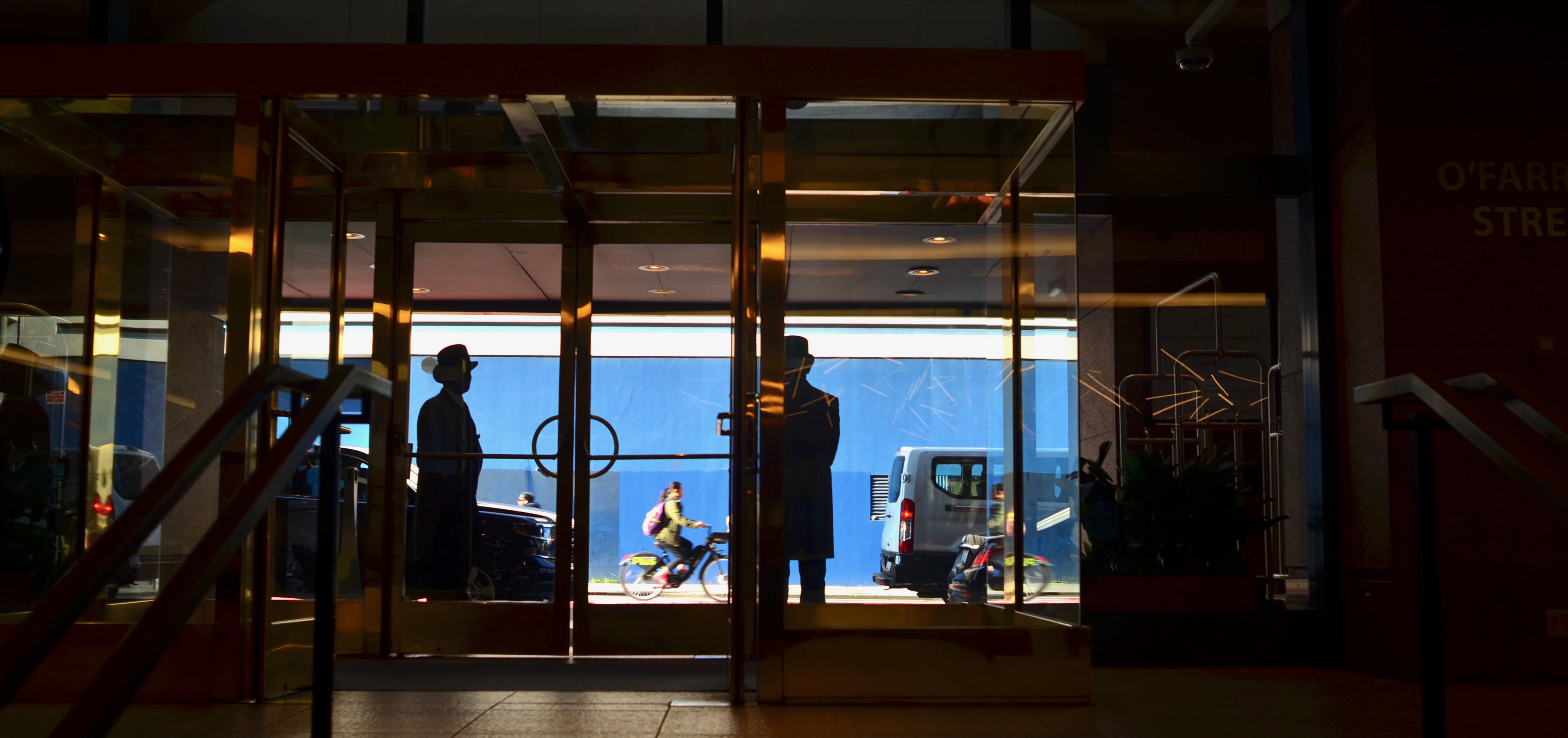
At Your Service, 2019
We’ve spoken at length in this forum about how the only picture you truly regret is the one you didn’t take, and, as cliched as that statement is, it bears repeating. Because among the shots that miss by a mile are the ones that only miss by inches, and those are the ones that keep us doing this. In the above image, I am scrambling. A lot. I am standing near the front entrance of what’s soon to become my former hotel, and waiting, waiting, waiting, for my wife to contact/hire a ride share service. I decide to burn away those unused moments by trying to catch the uniformed staff at their endless task of welcomes/goodbyes for guests connecting to curbside transportation. I’m pushing a carry-on, wearing a DSLR by a shoulder strap and trying to guess an exposure that I’ll have to try to hit one-handed. I’m seconds away from being ready when I’m told our ride is three minutes away. We have plenty of time to get to the airport, but just the same, I’m now on deadline. A short fuse. Make or break. I don’t want to dawdle needlessly, since, over a long weekend, I have already paused to frame enough shots that I have exhausted my allotted ration of marital goodwill. You know the moment. It’s somewhere between an exasperated sigh and the sentence, “are you still taking pictures?” I also hate to fight too ardently for this one, since I’m only half sure of not only the exposure but the concept in general. I should probably just grab by bag and git.
And yet.
Even at this point, I still can’t decide if I got everything I wanted here. I liked reducing the greeters and their gear to silhouettes, but in doing so I also eliminated a lot of the glowing gold of a late San Francisco afternoon. I said a quick prayer, squeezed off four shots with small adjustments in between, and decided I had to make a dignified exit. But what I said earlier about near misses still applies here. It’s not a complete boff, but it’s not a contest winner either. Can I use the experience to deliver a better result from a similar situation sometime in the future? Ah, well, that’s why we call this thing we do an “art” and not a “science”. I will live to fight,….er, shoot, another day. And that’s all any photographer wants anyhow. The next shot.
For therein lies redemption…….
LIGHT ‘EM UP
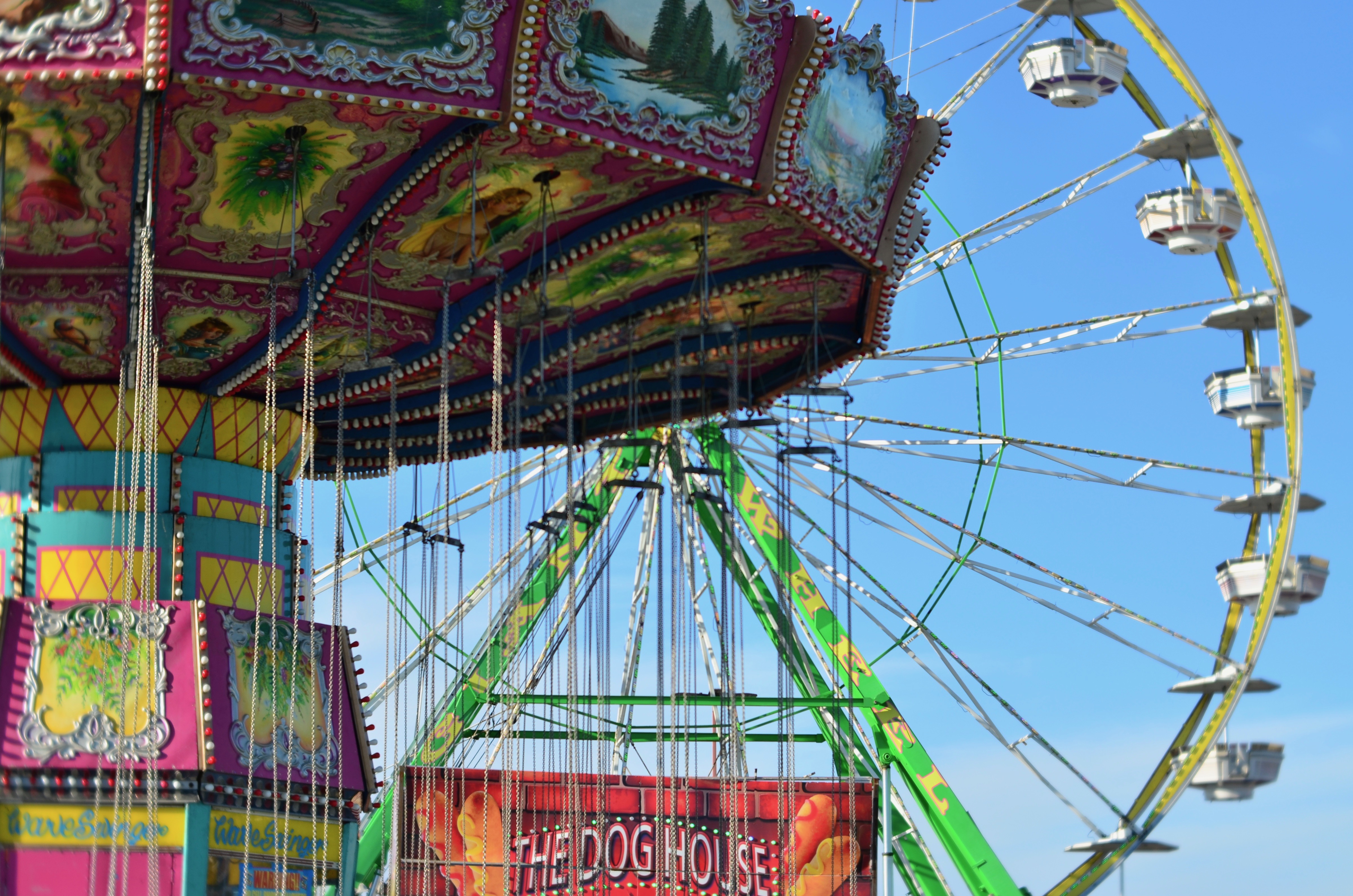
The Wave Swinger (Day), 2019
By MICHAEL PERKINS
THE GLOBAL INTRODUCTION OF ELECTRICITY IN THE 19th CENTURY was one of several singular scientific events that arrived in close parallel to the birth and development of photography. Prior to the throwing of the first voltage switches around the world, most objects had only one image identity, that being how they looked when delineated by natural daylight. After that first surge of power, however, the idea of “lighting” something….that is, creating a specific scheme for illuminating it at night, began to suggest itself as a specialized art in itself. These first mass glowings were, suitably, mass gatherings like expositions, world’s fairs, and circuses, with a new breed of engineer deliberately designing how something should appear when lit, making those kinds of choices for the very first time. And even as the Victorian era was exploring new ballets of shadow, frequency, intensity and color in cities all over the globe, photography was also trying to free itself from the limits of light as historically dictated by local sunset. Suddenly there were two ways to see everything, with many objects having a completely different visual signature when viewed after dark.
Decades later, we hardly stop to consider how very distinctive a city’s day is from its night. It seems as if things have always been this way, with many of us customizing the bright/dark light schemes of our personal gardens and homes in a way that only city planners and showmen could have accomplished a century ago. And yet, there are still things which create dramatic contrast between its daytime and nighttime versions. One of these is the brash collision of color and sensation that, as a holdover from the 1800’s, is finally vanishing from American life: the carnival midway. Subtle as a brickbat, corny as a Kansas cob and vivid to the point of vulgarity, carnies still crop up in vacant lots and small towns across America, continuing to enchant with their odd mix of ballyhoo and mystery. They are brash, loud, crude, and great fun. All our 21st-century entertainment options off to the side, there is still something visually visceral about these slightly disreputable encampments from the days of P.T. Barnum. They cry out for cameras, reminding us of an era in which a mere change of light was enough to quicken the imagination.
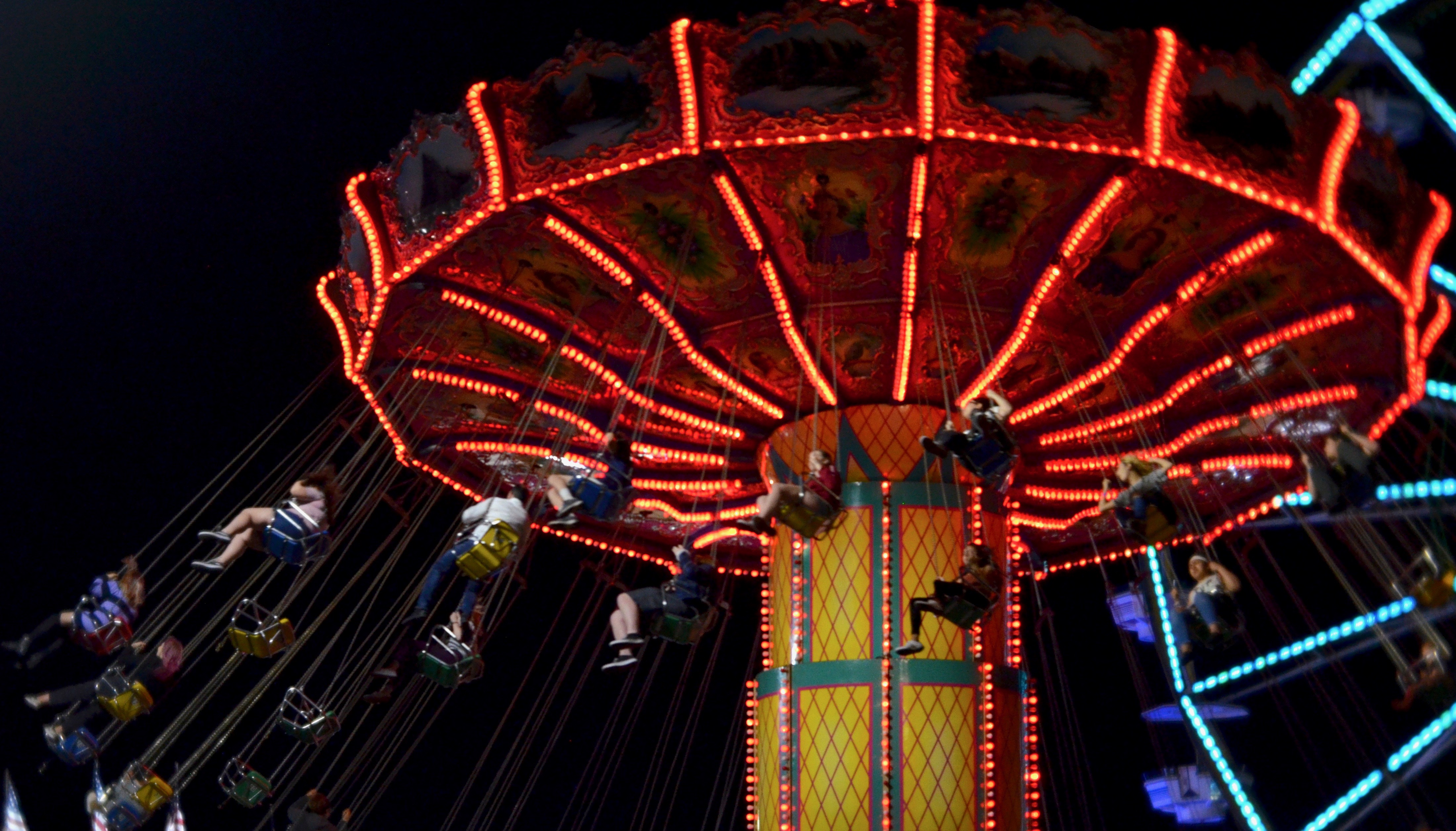
The Wave Swinger (Night), 2019
Daytime at a carnival is a tamer prelude to the noise and song that will explode from the tents and rides after sundown. Nothing is natural, yet everything is believable. The weird, seductive magic of blaring neon and exploding color still tugs at the photographer’s eye, building and intensifying as afternoon becomes dusk and dusk becomes show time. Everything in such an over-the-top environment deserves to be viewed by both day and night, as it’s often hard to imagine that two views of the same things could be so amazingly different. Circuses and tent shows historically were a great testing ground for the first color films, and they still test the performance of both gear and shooter today. Photography and artificial light, born side by side, are still strongly about putting on a performance. The show must go on.
THEN AGAIN, WHAT DO I KNOW, ANYWAY?
By MICHAEL PERKINS
SHOOT ENOUGH PHOTOGRAPHS AND YOU’LL ESTABLISH SOME KIND OF STANDARD of acceptability for your images….the inevitable “keeper” and “failure” piles by which we measure our successes (or lack thereof).
Now, we could fill pages with reflections on just how rational we all are (or aren’t) when it comes to editing ourselves. It’s a learned skill, one that’s practically a religion to some and a virtually unknown process to others. Be that as it may. Let’s assume for the purposes of this exercise that we are all honest, conscientious and humble when it comes to dividing our pictures into wins and losses. Even granting us all that wisdom, we are often less expert about whether a photograph is “worthy” than we think we are. You’d think that no one would know whether we took a bad image that we ourselves. But you’d be wrong, and often, wrong by a country mile.
Just as we are never so purely objective that we can be certain that we’ve generated a masterpiece, we can be just as unreliable in declaring our duds. I was reminded of that recently.
I have a lot of reasons to regard a given picture as “failed”. Some have to do with their effectiveness as narratives. Some I disdain because they’re nothing more than the faithful execution of a flawed idea. But the pictures of mine that the waste can catches the most of are simple technical botches….pure errors in doing. I’m old enough to hold certain rules of composition, exposure or focus as sacred, and I’m quick to dump any image that contravenes those laws.
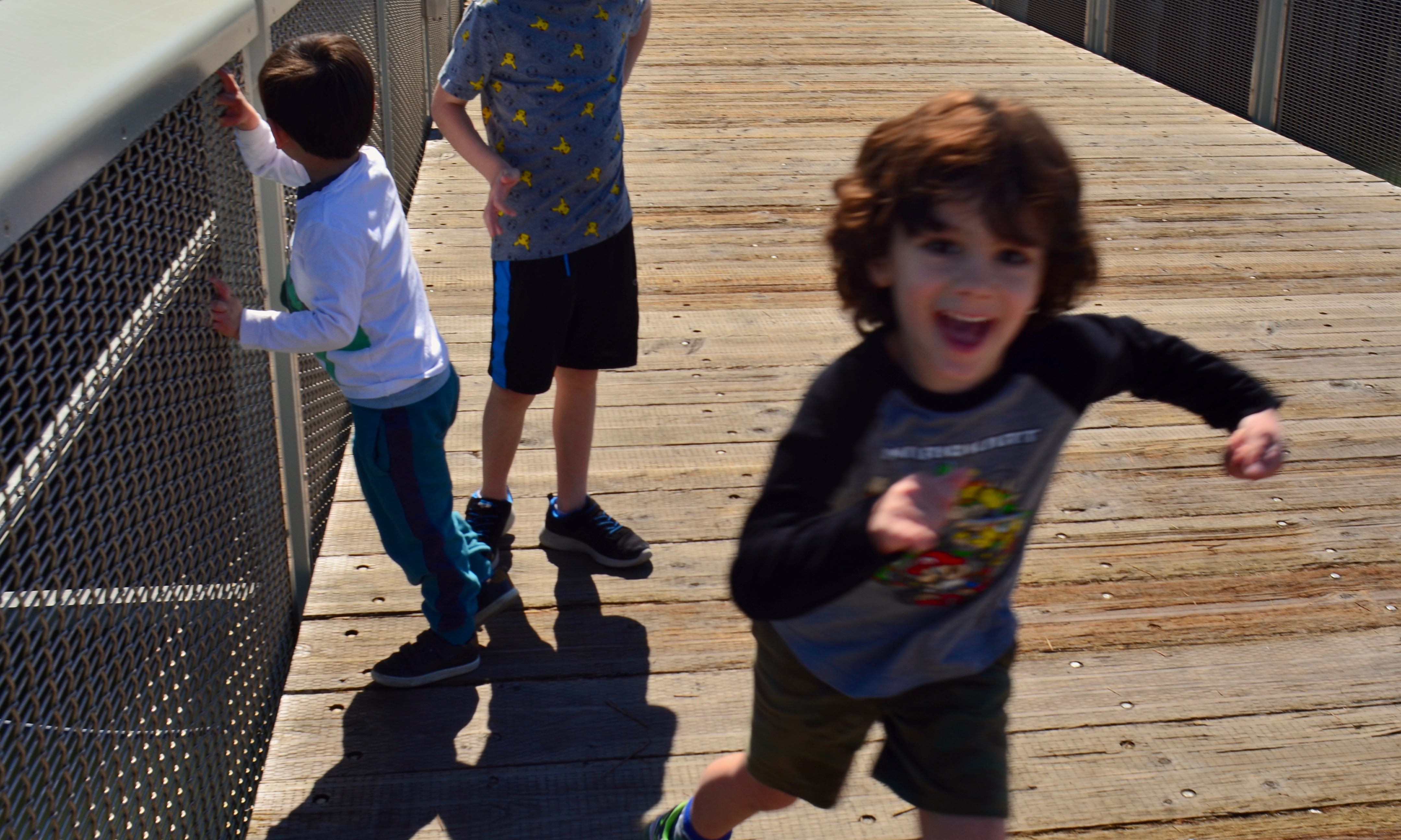
Here Comes Trouble, 2019
That’s why the picture you see here was originally something I had intended to hide from the mother of the manic young man in the foreground. I had attempted, one afternoon, to use a manual focus lens to track four very energetic boys, and in one shot their ringleader had made a sudden lunge at the camera that threw him into blur. Seemed like a simple call. I had blown the shot, and I was naturally eager to show his folks only my best work.
But the impact of the picture on the boy’s family was much more positive. Blurry or not, the picture captured something very true about the boy. Call it zest, enthusiasm, even a little craziness, but this frame was, to them, more “like him” than many of the more conventional shots I had originally chosen to show them. The real-ness of his face had, for his family, redeemed the purely operational imperfection that so offended me. To put it another way, my “wait, I can do it better” was their “this is fine just as it is.” Sadly, it was my wife who brought me to my senses and convinced me to move it to the “keeper” pile.
Which circles back to my first point. None of us absolutely know what our best pictures are. We do absolutely know the ones that connect to various audiences, but that may be a completely different pile of images from the ones we label as “right”. Passing or failing a photo largely on technical grounds would, over history, disqualify many of the most important pictures ever made. We have all emotionally loved things that our logical minds might regard as having fallen short. But, in photography as in all other arts, we’re often fortunate that logic is not the sole yardstick.
WHEN NOTHING TURNS OUT TO BE EVERYTHING
By MICHAEL PERKINS
EVER SINCE ADAM AND EVE BIT THAT DAMNED APPLE, humans have demonstrated that the thing they really want is the thing they are told they can’t have.
Stay with me here: this actually has a lot to do with photography.
Deny somebody something and they will long for it, lust after it, obsess about it. Consider the case of the Portugeuse, who, for a while, tried to run things in Mozambique, in order to harvest that African nation’s rubber, and who told the locals that their traditional ceremonial instrument, an early kind of xylophone called the mbila, would henceforth be forbidden as a cultural expression. As a result, an entire underground of information on how to play it was maintained by exiled miners, prisoners, and assorted other rebels. The result? Eventually the Portugeuse left: the mbila stayed. Today, the instrument is even featured on the local currency.
We can’t have it? Wanna bet?
Humans. Go figure.
But back to photography, where, similarly, the thing we are “told” we “can’t have”, at least in an image, is whatever is left out of the frame. Missing detail. People rendered in shadow. An activity that’s implied by the manner in which part of it is cropped. We love what the photographer shows but we hunger for what he leaves out.
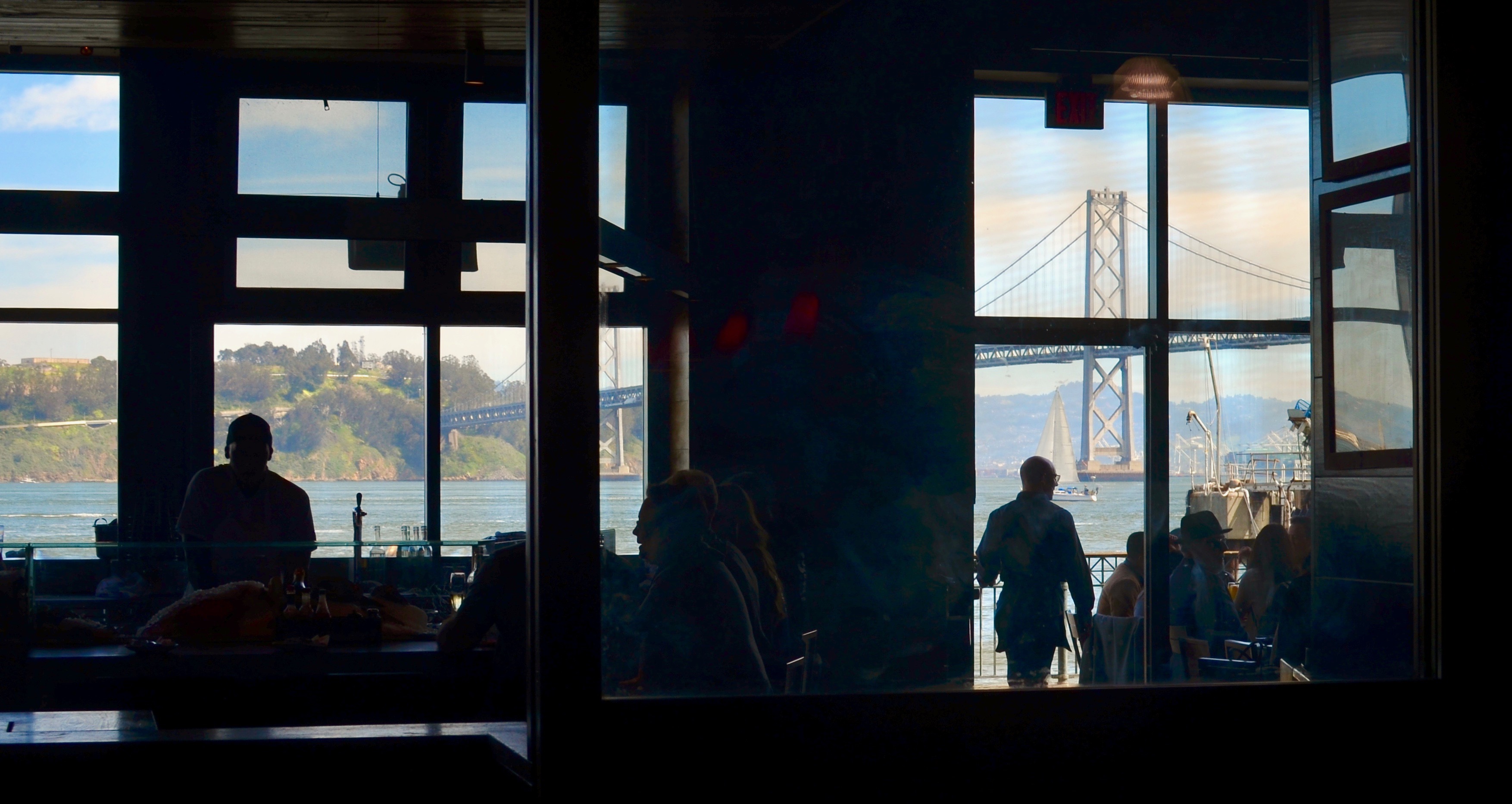
Subdued Baywatch, 2019
Out-the-window shots are a great source of this phenomenon, since shooters are usually forced to expose for either what is in front of said window or beyond it….but seldom both. The rise of HDR and tone mapping in recent years has tried to address this, rendering everything in the same degree of illumination, often with bracketed exposures, from light to dark, that are blended afterwords in software. But there’s a problem. Many HDR’s are simply over-processed, defying the mind’s knowledge of the proper relationships between light and dark. Everything’s visible but can easily be garish, unnatural. And so many of us go back to simply deciding what selected parts to illuminate in an image, and which to leave undefined. That means some darkness, which in turn means some things don’t get shown. And, if we’re lucky, those things that we don’t reveal can be more tantalizing than those that we do.
I was walking around the back of the old Terminal building in San Francisco, which is the place that all the city’s ferries used to dock and disembark before the Golden Gate Bridge was built, making many daily boat trips across the bay unnecessary. The building now houses eateries, produce stands, and an insane amount of tourist traffic, much of it crowded into restaurants such as the one seen here. The view out the back includes the Bay Bridge and the local ship traffic, as well as the occasional sailboat, such as the one seen here. I exposed for the scenery, leaving the restaurant’s patrons and workers in shadow. The scalloped, rather “peek-a-boo” view that resulted keeps the image from being a standard postcard shot, but while that “purity” is lost, what’s gained is a smidge of mystery about the shadowy folks in front. What are their conversations about? Why are they here?
I am just suggesting here that, instead of always regarding an image like this as a “blocked” or “obstructed” view of a scenic vista, you can choose to tantalize your viewer by providing a partial reveal of both foreground and background, since their inclination is already, like that of Adam and Eve, to obtain what they’re denied (in this case, by the exposure and the limits of the frame). Sometimes, in a photograph, a nothing can be a very important something. It all depends on who’s looking and what they themselves bring to the experience. In that way, they and the photographer are having a conversation. Which is kind of the idea.


BUPKIS
By MICHAEL PERKINS
A Failed Harvest.
The Fish That Got Away.
I Had It, But I Lost It.
Mistakes Were Made.
Bupkis.
However you term episodes of photographic failure…..I mean, complete, utter freaking camera-borne defeat, two things are true.
It does happen.
And it will happen to you.
Not that many of us want to admit it, mind you. In an age in which, on any given photo day, we almost always bring back some kind of technically complete image, it’s easy to confuse any product with a successful one. Yeah, it’s a picture. But that doesn’t make it a good picture.
The product of a three-hour walk, a stunning image of…..??…you got me.
In the old days, there were was a more dramatic line between success and failure, since failure usually meant no picture at all. Underexposed, unrecognizable blobs. Masses of color that, coherence-wise, added up to nothing. Not so in our current era, in which it’s much more likely that the resulting image is, for lack of a better term, usable. Factor in increasingly facile repair tools and editing processes, and that number of “acceptables” climbs even further.
But you know when a picture has what it takes, and to what extent you’ve bent the rules of editorial judegment with one, even going so far as to talking yourself into thinking it’s better than it really is. That’s the seductive power of digital, in that it brings even our worst work close to the passable mark, making it harder to disown our “kids” than it was in the day when a lousy picture was more irretrievably bad, that is, beyond intervention. But it’s our very ability to intervene that can convince us that the shot was worth intervening over, and that’s frequently just not true.
And so there will be bupkis days. We walk out boldly. We are equipped. We are artistically hungry. We are experienced and trained. We know what we want.
And yet we bring back nothing.
Never forget that the ability to know that you missed the mark (even mightily) is the most valuable skill you will ever develop as a photographer. The strength to say “no” to yourself evolves slowly. In some of us, it never evolves at all. But we should thank Camera God for it, and, by extension, thank the same God for the demonstrably bad photos we are likely to make from time to time. Because if we can’t tell excellent from excrement in our own work, the game really is up. That’s why I am always banging on about loving your mistakes, because finally, they are your best teachers. It ain’t fun to be around them, but, then again, as you recall your most astute mentors, how many of them were a groove to hang with? Whatever. For photography’s sake, we all need to become comfortable with dumping the occasional day’s work in the garbage. Because nothing converts garbage into gorgeous other than hard, unsentimental work. There never has been any other shortcut and there never will be. Or to frame it in food terms (and eventually I always do), consider software and such as sauce. It’s tasty, but it ain’t no substitute for steak.
Share this:
May 26, 2019 | Categories: Commentary, Conception, Essay | Tags: Composition, Editing, post-processing | Leave a comment