ANOTHER YEAR OUT THE WINDOW
By MICHAEL PERKINS
IF YOU WANT TO PUT A SMILE ON MY FACE WHEN I VISIT YOUR CITY, there is no sweeter sentence you can say to me than:
“I’ll drive”.
There is, for photographers, one way to maximize your time touring through other people’s towns, and that’s the time-honored tradition of “riding shotgun”. Drive me anywhere, but give me a window seat. I wasn’t trying to go for some kind of personal best in the area of urban side shots in 2013, but by good fortune I did snag a few surprises as I was ferried through various towns, along with a “reject” pile about a mile high. Like any other kind of shooting, the yield in window shooting is very low in terms of “killers per click”, but when you hit the target, you crack through a kind of “I’m new in town” barrier and take home a bit of the street for your own.
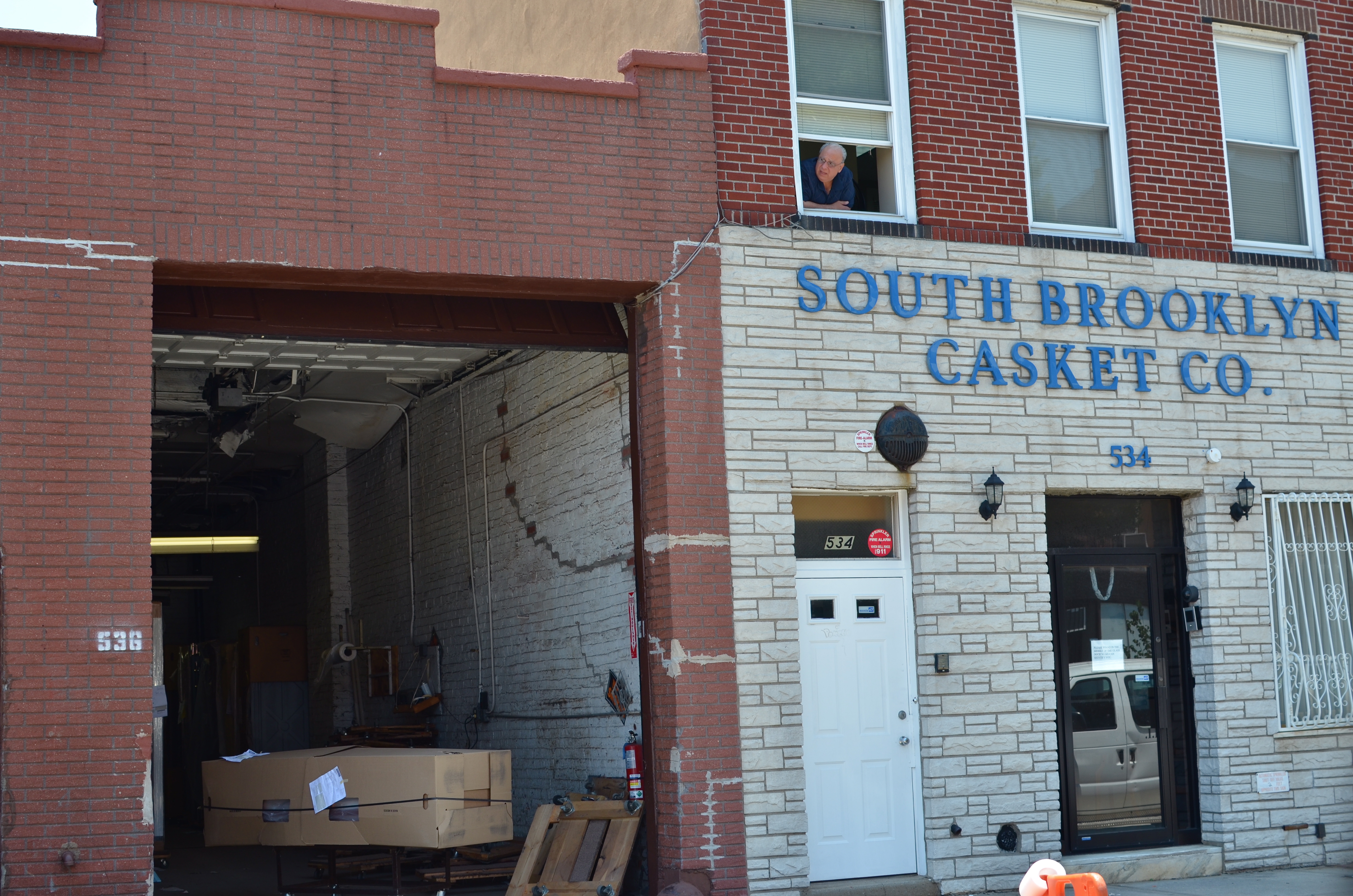
Business has been really dead lately. 1/250 sec., f/5.6, ISO 100, 35mm.
This guy just killed me (excuse the expression). He seemed like he was literally waiting for business to drop in (or drop dead), and meanwhile was taking in the view. Probably he didn’t even work for the casket company, in which case, what a bummer of neighbor to pick. Maybe he’s rent controlled.
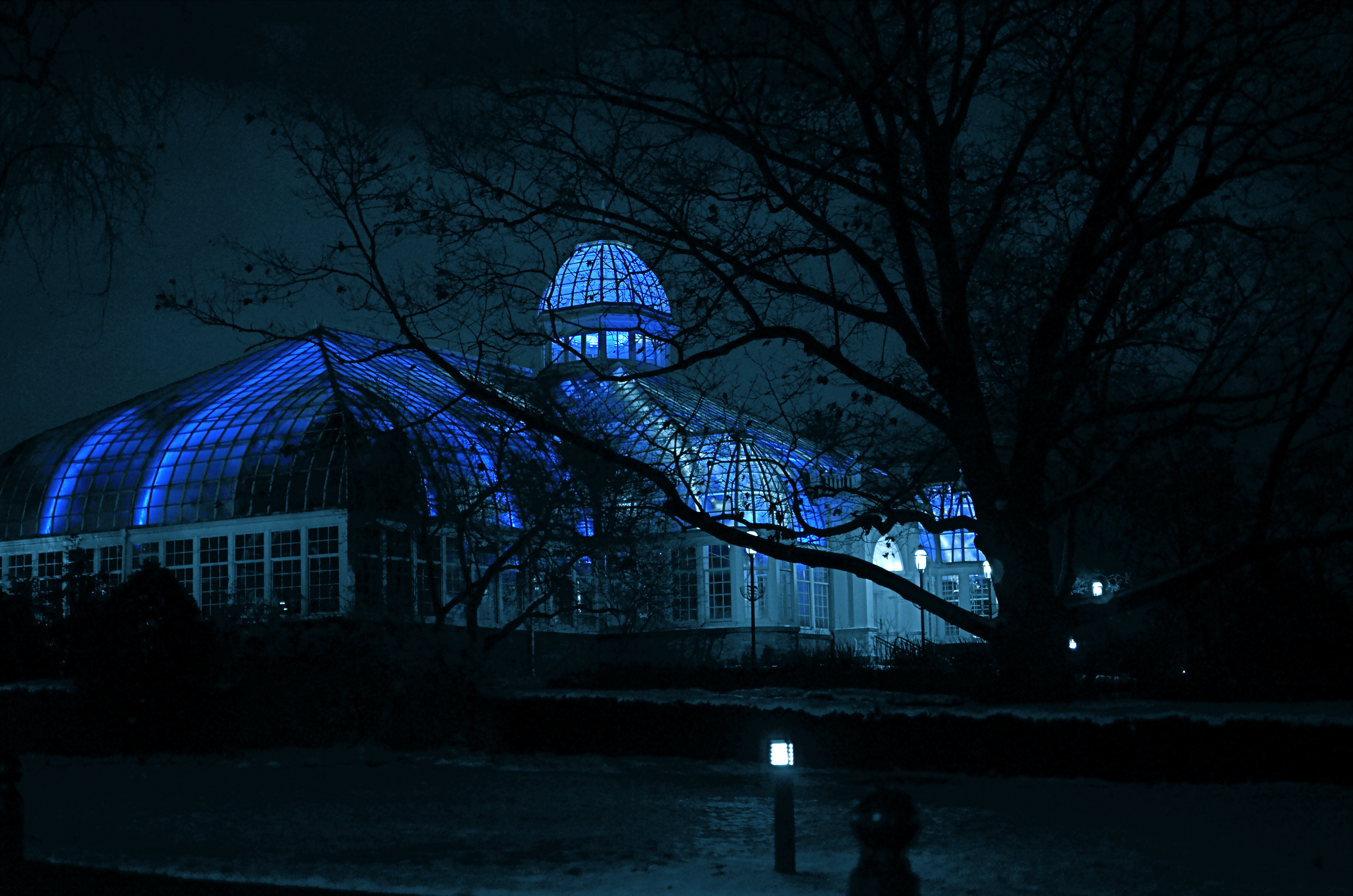
Franklin Park Conservatory, Columbus, Ohio. 1/40 sec., f/1.8, ISO 500, 35mm.
This one took a little tweaking. The building was actually blue, as you see here, lit with subdued mood for the holidays. However, in lightening this very dark shot, the sky registered as a muddy brown, so I made a dupe, desaturated everything except the conservatory, then added tint back in to make the surrounding park area match the building. All rescued from an “all or nothing” shot.
I’m also ashamed to admit that I bagged a few through-the-window shots while actually driving the car, all done at red lights and so not recommended. Don’t do as I do, do as I……oh, you know.
Here’s to long shots, at horse tracks or in viewfinders, and the few that finish in the money.
KICK-STARTING THE ENGINE
By MICHAEL PERKINS
THE POPULAR IMAGE OF A BLOCK-STRICKEN WRITER HELPLESSLY STARING AT A BLANK PAGE is enough to send an empathetic chill up the spine of anyone who has ever been haunted by a deadline or stymied by a narrative suddenly gone dry. And I am convinced, as both a writer and a photographer, that there is an equivalent “block” lurking in the shadows for any shooter, a visual desert that produces stretches of formless, pointless images, dry spells that are terrifying because they are open-ended. No one knows why, for everyone from time to time, the pictures stop coming, and no one can predict when they will come back.
It’s terrifying, because it’s as if vision or imagination were accounts that one can overdraw, bouncing artistic checks all over town and leaving you feeling, like Alice, that there is no bottom, only more hole. At least it’s terrifying to me.
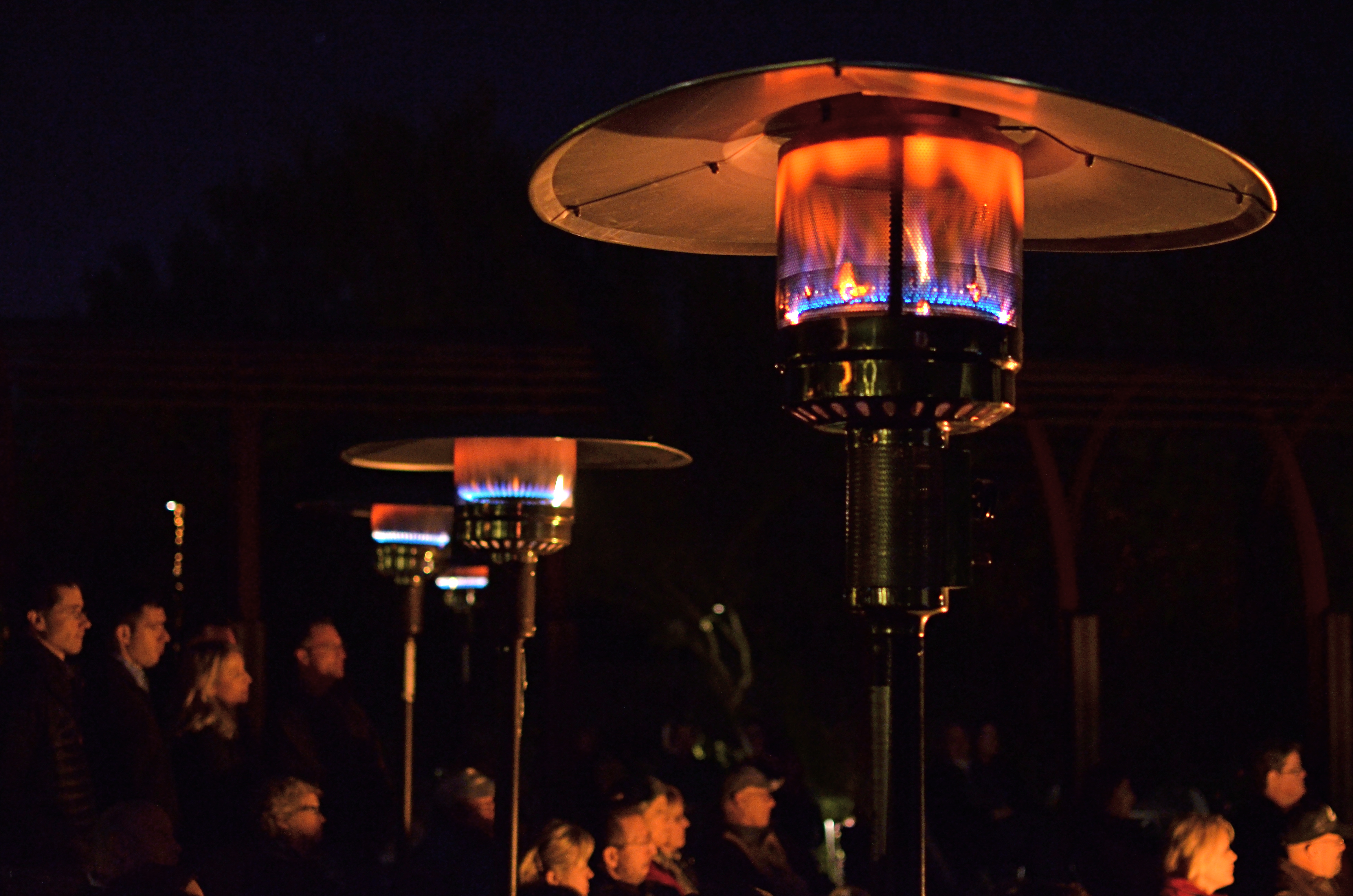
Torchlight Parade, 12/14/13. 1/40, f/2.5, ISO 1000, 35mm. You work your way through dry spells with what’s at hand.
As I write this, I have just come off several weeks of scrapings and scraps that should have been photographs but instead are equivalent to something smeared by an ape on his cage wall. I have seldom experienced such an extended period of mega-nothing, and it is only my unswerving oath to myself to shoot something, anything, every single day, that has allowed me to keep faith with the inevitable return of whatever eye I sometime possess. But, I have to admit, I am also suppressing strong urges to, like Norman Bates, lock my camera inside a car trunk and seek out the nearest swamp.
Okay, that’s a tad dramatic, but my current case of the “drys” is unnerving for a particular reason. I am typically able to conjure pictures out of nearly nothing, which is more liberating than having to wait for obvious or “big” projects. You can shoot daily if you can get off on still lifes of plastic spoons. You can’t shoot daily if you need a vacation, a birthday, or a mountain for inspiration. So it’s doubly troubling if you can’t even summon up the humble crumbs needed for some kind of image.
I know, that, at one point or another, something will demand my attention/obsession, and we’ll be off to the races again. But there is always the nagging question. What happens if I can’t kick-start the engine? Everything has a beginning and an end. So…?
Oh, wait, the light is doing something really cool just now…..
JUST ENOUGH
By MICHAEL PERKINS
PHOTOGRAPHERS SPEND HALF THEIR LIVES TRYING TO PUT AS MUCH INFORMATION INTO THEIR IMAGES AS POSSIBLE, and the other half trying to remove as much as practicable. Both efforts are in service of the telling of stories, and both approaches are dictated by what a particular photograph is trying to convey.
Sometimes you need the cast of The Ten Commandments to say “humanity”. Other times, just a whisper, an essence of two people talking carries the entire message. That’s where I wound up the other day…with one woman and one very young boy.
Their shared mission was a simple one: hooking up an iPhone Facetime visit with an aunt half a country away. Nothing dramatic, and yet plenty of story to fill a frame with. Story enough, it turned out, for me to get away with weeding out nearly all visual information in the picture, and yet have enough to work with. Time, of course, was also a factor in my choice, since I would be losing a special moment if I stepped into a dark hall and spent precious moments trying to mine it for extra light.
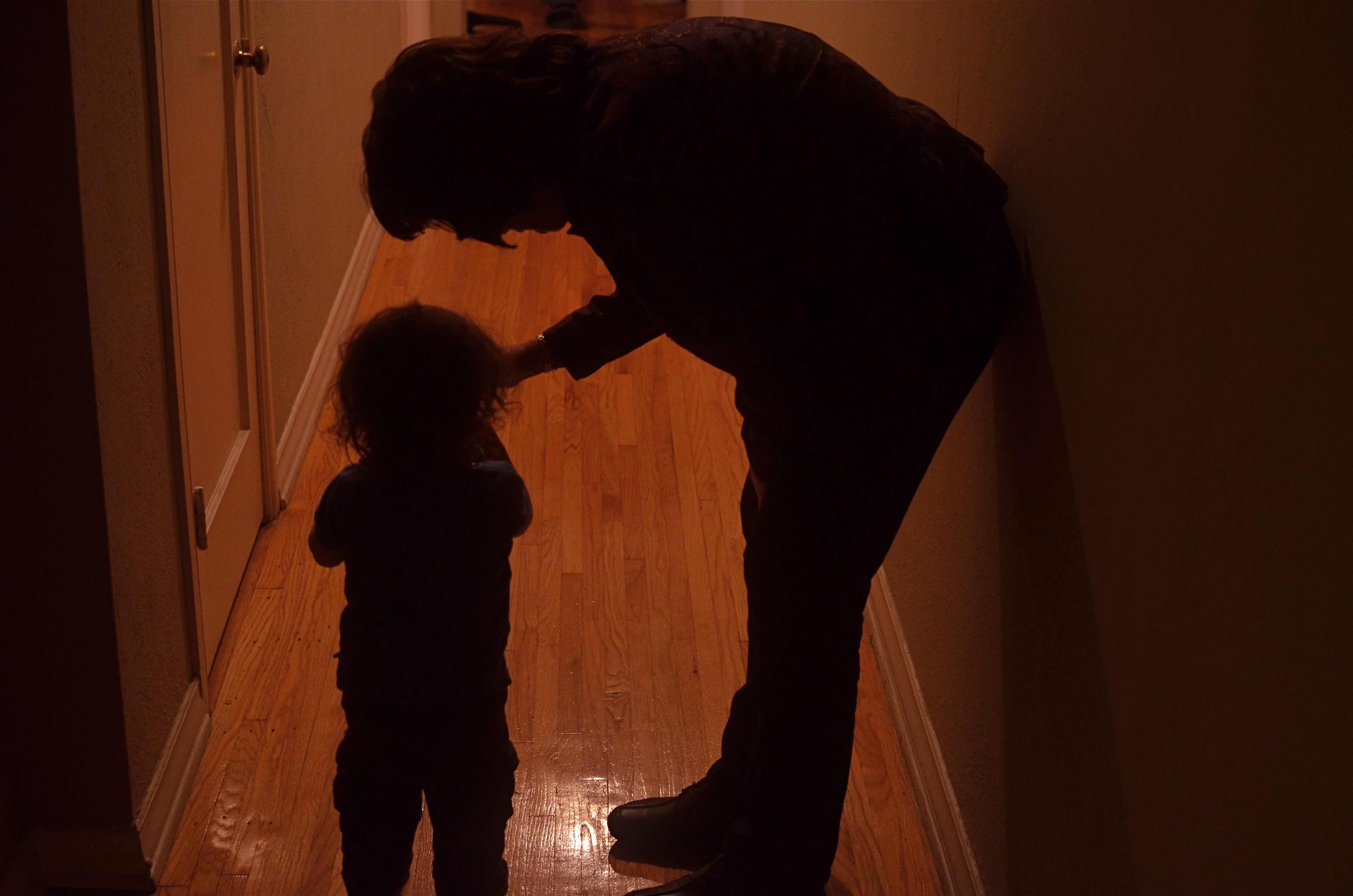
Conference call: 1/50 sec., f/3.5, ISO 800, 35mm.
In a second, I realized that silhouettes would carry the magic of the moment without any help from me. What would it matter if I could see the color of my subjects’ clothing, the detail in their hair, even the look on their faces? In short, what would I gain trying to massage an image that was already perfectly eloquent in shadow?
I exposed for the floor in the hall and let everything else go. There was plenty of story there already.
I just had to get out of its way.
DO SOMETHING MEANINGLESS
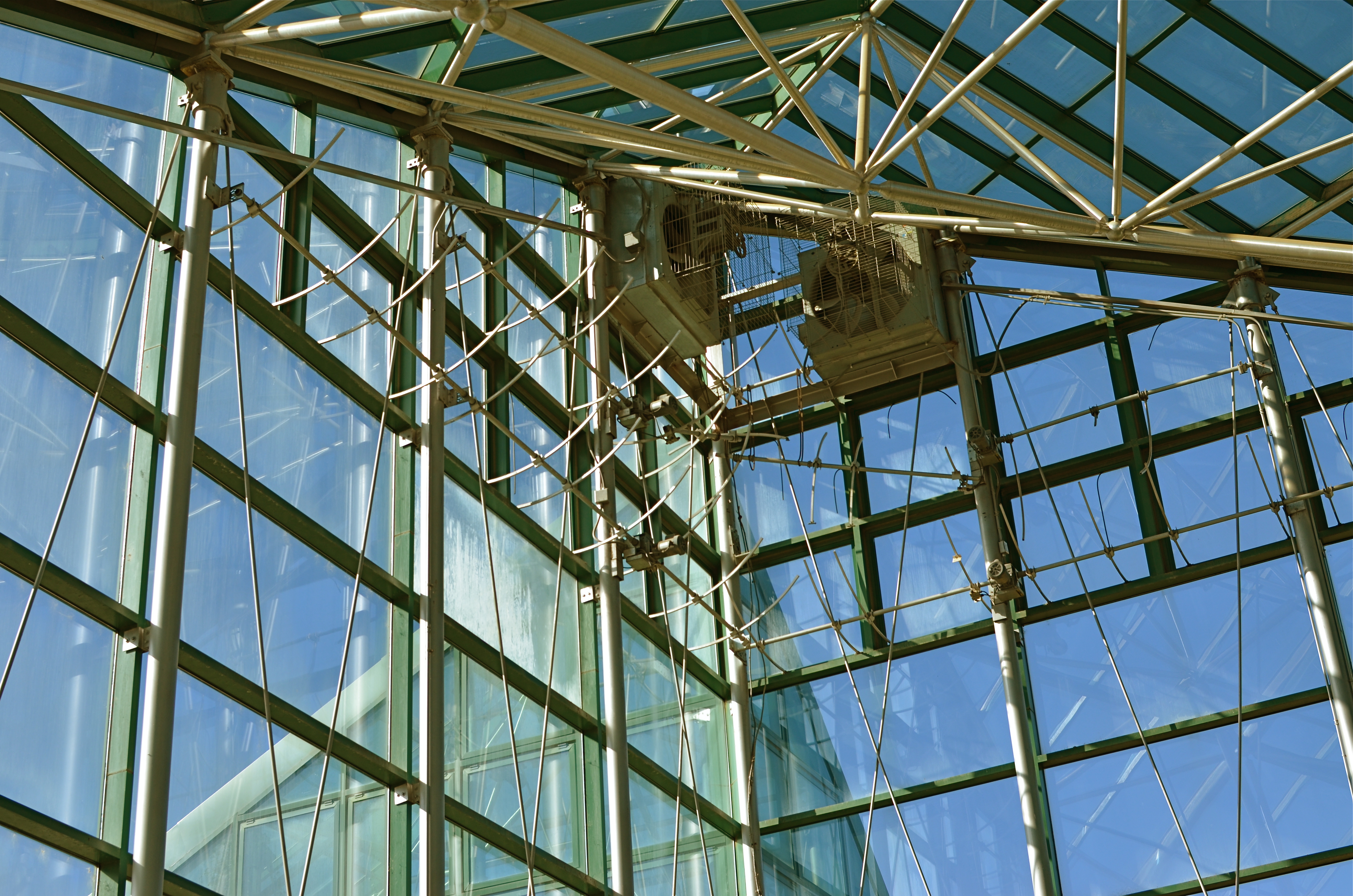
The subject matter doesn’t make the photograph. You do. A pure visual arrangement of nothing in particular can at least teach you composition. 1/400 sec., f/5.6, ISO 100, 35mm.
By MICHAEL PERKINS
SHOOT WHAT YOU KNOW. SHOOT WHAT YOU LOVE. Those sentences seem like the inevitable “Column A” and “Column B” of photography. And it makes a certain kind of sense. I mean, you’ll make a stronger artistic connection to subject matter that’s near and dear, be it loved ones or beloved hobbies, right? What you know and what you love will always make great pictures, right?
Well….okay, sorta. And sorta not.
I hate to use the phrase “familiarity breeds contempt”, but your photography could actually take a step backwards if it is always based in your comfort zone. Your intimate knowledge of the people or things you are shooting could actually retard or paralyze your forward development, your ability to step back and see these very familiar things in unfamiliar ways.
Might it not be a good thing, from time to time, to photograph something that is meaningless to you, to seek out images that don’t have any emotional or historical context for you? To see a thing, a condition, a trick of the light just for itself, devoid of any previous context is to force yourself to regard it cleanly, without preconception or bias.
Looking for things to shoot that are “meaningless” actually might force you to solve technique problems just for the sake of solving, since the results don’t matter to you personally, other than as creative problems to be solved. I call this process “pureformance” and I believe it is the key to breathing new life into one’s tired old eyes. Shooting pure forms guarantees that your vision is unhampered by habit, unchained from the familiarity that will eventually stifle your imagination.
This way of approaching subjects on their own terms is close to what photojournalists do all the time. They have little say in what they will be assigned to show next. Their subjects will often be something outside their prior experience, and could be something they personally find uninteresting, even repellent. But the idea is to find a story in whatever they approach, and they hone that habit to perfection, as all of us can.
Just by doing something meaningless in a meaningful way.
JUST SAY THANK YOU
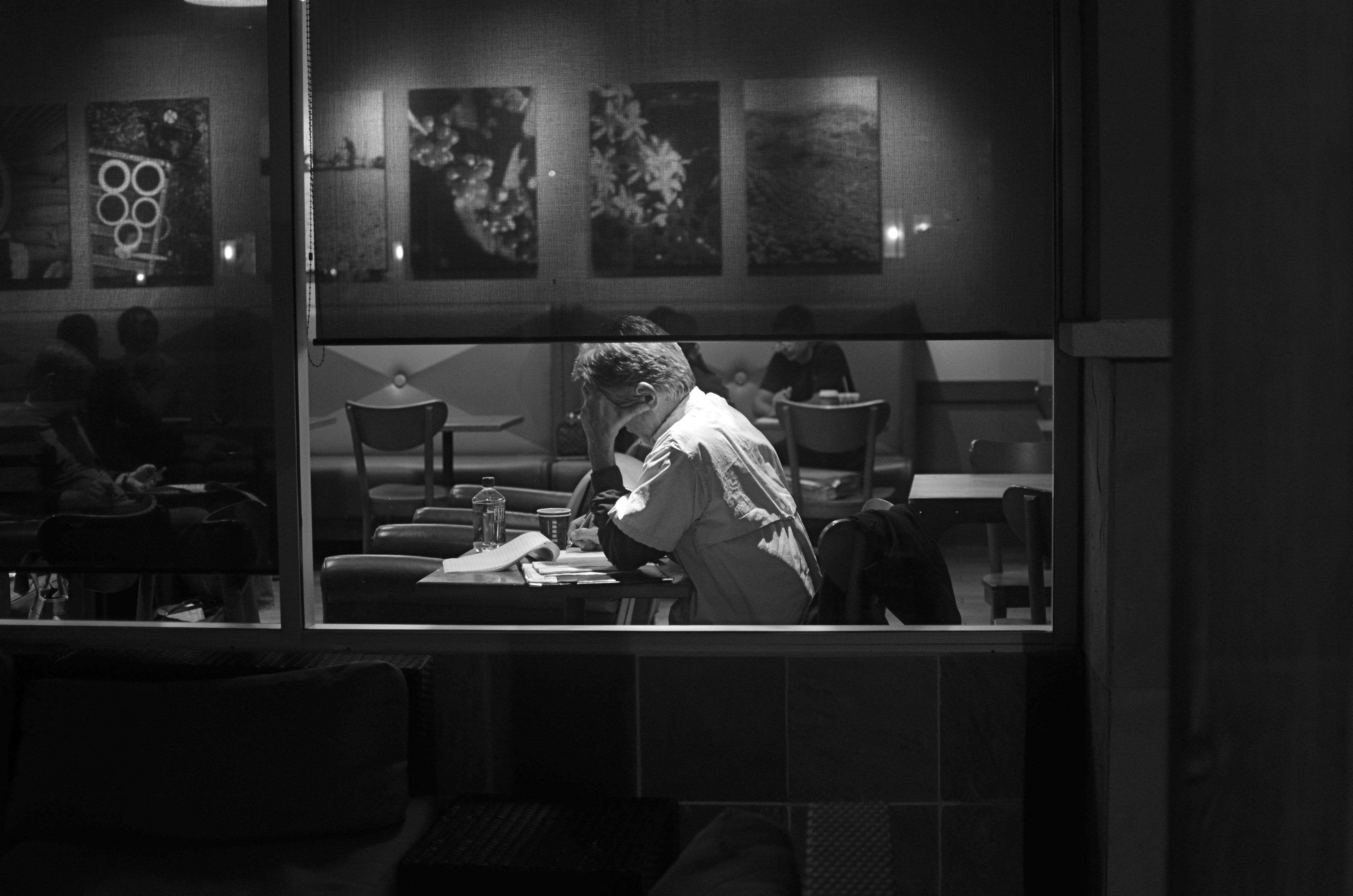
The All-Nighter: 1/60 sec., f/1.8, ISO 800, 35mm.
By MICHAEL PERKINS
PICTURES HAPPEN WHEN YOU’RE OUT TRYING TO TAKE “OTHER” PICTURES. Pictures happen when you didn’t feel like taking any pictures at all. And, occasionally, the planets align perfectly and you hold something in your hand, that, if you are honest, you know you had nothing to with.
Those are the pictures that delight and haunt. They happen on off-days, against the grain of whatever you’d planned. They crop up when it’s not convenient to take them, demanding your attention like a small insistent child tugging at your pants leg with an urgent or annoying issue. And when they call, however obtrusively, however bothersome, you’d better listen.
Don’t over-think the gift. Just say thank you….and stay open.
This is an overly mystical way of saying that pictures are sometimes taken because it’s their time to be taken. You are not the person who made them ready. You were the person who wandered by, with a camera if you’re lucky.
I got lucky this week, but not with any shot I had set out on a walkabout to capture. By the time I spotted the scene you see at the top of this post, I was beyond empty, having harvested exactly zip out of a series of locations I thought would give up some gold. I couldn’t get the exposures right: the framing was off: the subjects, which I hoped would reveal great human drama, were as exciting as a bus schedule.
I had just switched from color to monochrome when I saw him: a young nighthawk nursing some eleventh-hour coffee while poring over an intense project. Homework? A heartfelt journal? A grocery list? Who could tell? All I could see, in a moment, was that the selective opening and closing of shades all around him had given me a perfect frame, with every other element in the room diffused to soft focus. It was as if the picture was hanging in the air with a big neon rectangle around it, flashing shoot here, dummy.
My subject’s face was hidden. His true emotion or state of mind would never be known. The picture would always hide as much as it revealed.
Works for me. Click.
Just like the flicker of a firefly, the picture immediately went away. My target shifted in his chair, people began to walk across the room, the universe changed. I had a lucky souvenir of something that truly was no longer.
I said thank you to someone, packed up my gear, and drove home.
I hadn’t gotten what I originally came for.
Lucky me.
related articles:
- Crop and turn a bad picture into a good one (weliveinaflat.wordpress.com)
FRAGMENTING THE FRAME
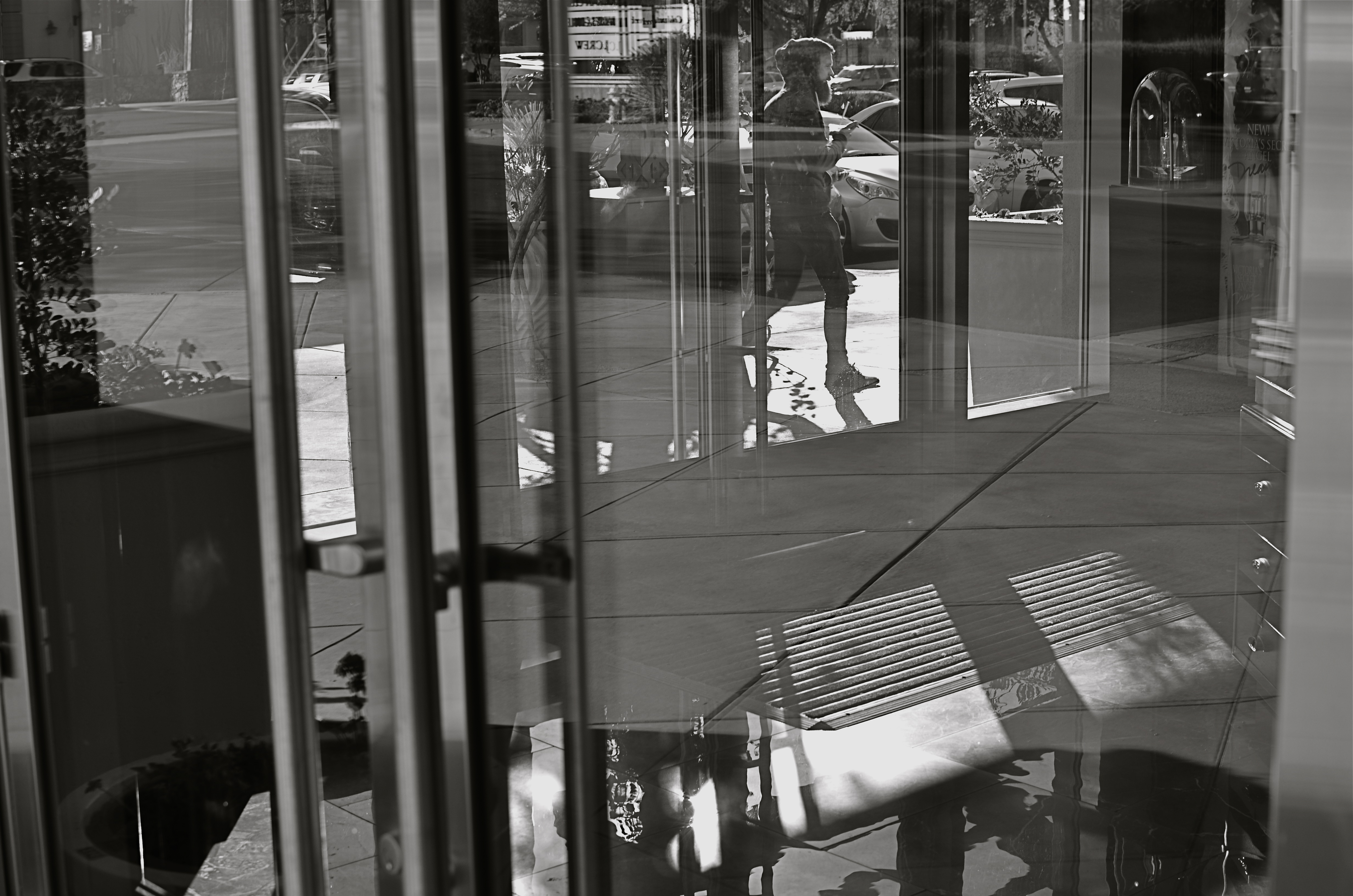
1/160 sec., f/5.6, ISO 100, 35mm.
By MICHAEL PERKINS
I HAVE MADE A CONSCIOUS EFFORT, IN RECENT YEARS, TO AVOID TAKING A “STRAIGHT SHOT” OUT OF, OR THROUGH A WINDOW, of using that rectangle or square as a conventional means of bordering a shot. Making a picture where a standard view of the world is merely surrounded by a typical frame shows my eye nothing at all, whereas the things that fragment that frame, that break it into smaller pieces, bisecting or even blocking information…..that’s fascinating to me.
This is not an arbitrary attempt to be “arty” or abstract. I simply prefer to build a little mystery into my shots, and a straight out-the-window framing defeats that. My showing everything means the viewer supplies nothing of his own. Conversely, pictures that both reveal and conceal, simultaneously, invite speculation and encourage inquiry. It’s more of a conversation.
Think about it like a love scene in a movie. If every part of “the act” is depicted, it’s not romantic, not sexy. It’s what the director leaves out of the scene that fires the imagination, that makes it a personal creation of your mind. Well-done love scenes let the audience create part of the picture. Showing everything is clinical….boring.
With that in mind, The Normal Eye’s topside menu now has an additional image gallery called Split Decisions, featuring shots that attempt to show what can result when you deliberately break up the normal framing in and out of windows. Some of the shots wound up doing what I wanted: others came up short, but may convey something to someone else.
As always, let us know what you think, and thanks for looking.
Related articles
- Framing Framing Framing!!! (destynimcbeth.wordpress.com)
CHOOSE NOT TO CHOOSE
By MICHAEL PERKINS
FOR MOST PHOTOGRAPHERS, THE ACT OF MAKING A PICTURE HAS TRADITIONALLY MEANT CHOOSING ONE THING OVER ANOTHER; exposing some things within a frame nearly perfectly, while, by default, settling for under-or-over-exposure of other objects within that same picture. We find ourself making priorities within the image, sorting things into piles marked “important” and “not important”. Get the color right on the surf and let the sky go white. Tamp down the snowy mountain and leave the surrounding forest black. Get this part right: leave this part wrong.
At least that’s what our earlier habits led us to accept. You can’t have it all, we tell ourselves. Decide what you really need to show and leave the rest. However, there’s a big difference between deciding to de-emphasize something in an image and feeling powerless to do anything else. Happily, ongoing developments in camera technology work to progressively minimize the number of scenarios in which you have to make these unholy choices, and one of the things that can save many such pictures is (a) readily at hand, (b) cheap, and (c) easy to work with; your on-board flash.
Now before I go further, know that I hate, hate, hate on-board flash 99.9999999% of the time. It’s only slightly less harsh than a blowtorch, lousy beyond a short distance, and generally hard to focus and direct. That said, I am occasionally an oh, hell yeah believer in fill flash, for which these rude little beacons can be useful.
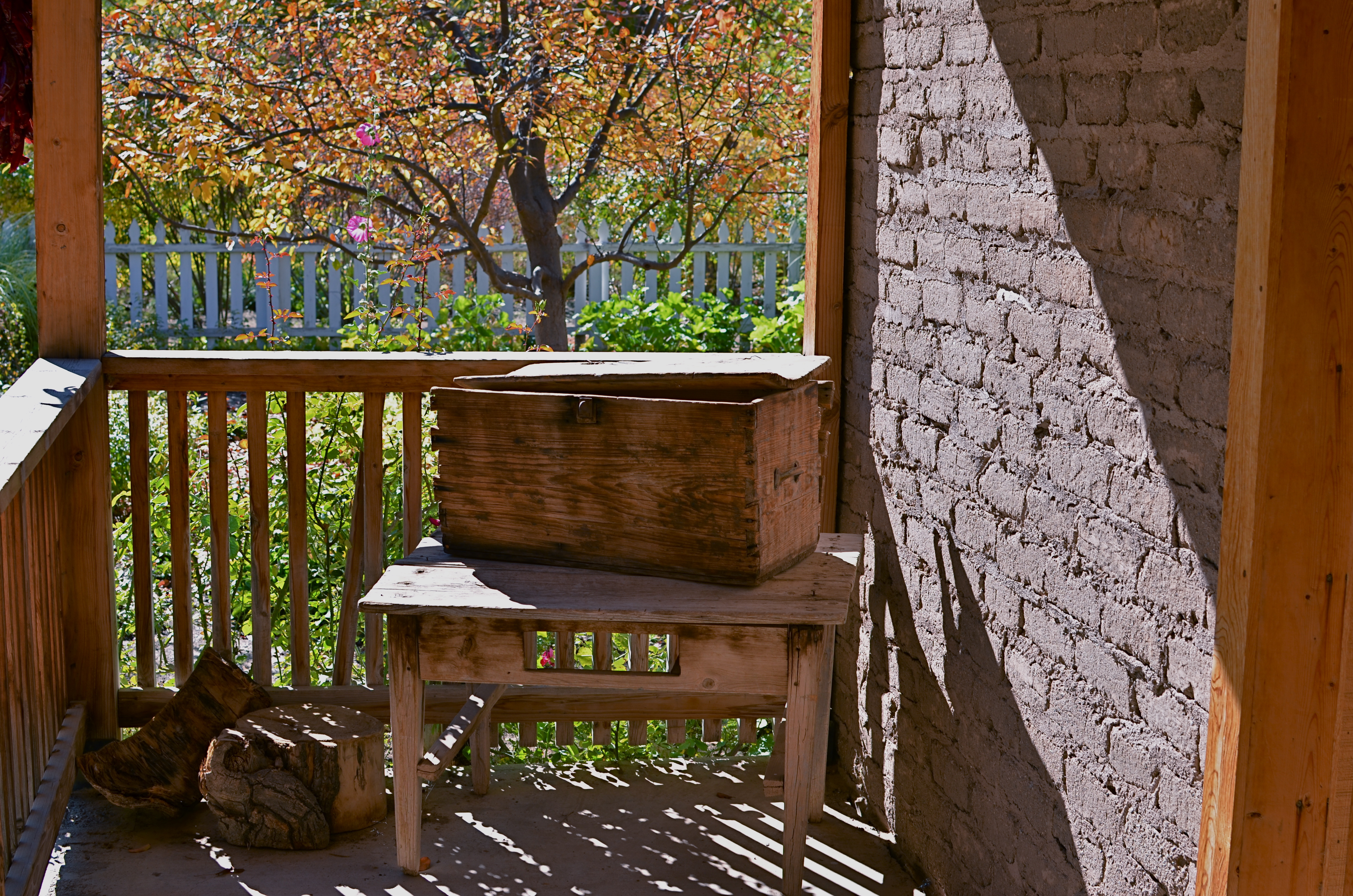
May not look like a job for your on-camera flash, but it really can help. 1/200 sec., f/5.6, ISO 100, 35mm.
In the above image, shooting the traditional way, you can choose a balanced exposure for either the front yard beyond this rustic homes’ porch or the detail on the porch itself, but not both. However, if you pop up the flash, expose for the yard, and then back off just beyond the flash’s outer range, a gentle bit of light illuminates the porch’s wood grain and reduces the shadow nooks without bleaching them out (Note that, with the flash up, you can’t shoot any faster than 1/200, so you may have to control the exposure of the yard by going for a smaller f-stop. I used 5.6 here). The result is an illusion, since you’ve tricked the camera into recording an even range of light that your eye and brain seem to see naturally, but the trick looks as if it ought to be “real”.
Of course, if the yard is so magnificent in its own right, you may choose to show the porch in silhouette just to call attention to all that floral glory, but the thing is, you’re not locked in to that choice alone. The horrible, harsh on-board flash can give you more options, and thus (barely) justify its existence.
And did I mention it’s cheap and easy?
Follow Michael Perkins on Twitter @MPnormaleye.
THE GREAT RIDDLE
By MICHAEL PERKINS
IT’S FORTUNATE THAT NONE OF US HAS ANY IDEA WHAT APPEALS TO OUR VIEWERS, or else everything we do would revert to a dull formula. If it was possible to predict which of our creations would establish a connection with other hearts and minds, wouldn’t our human nature tempt us to churn out clumsy duplicates of that creation again and again? You see this at craft shows where “artists” hawk dozens of copies of the same image to anyone who passes by, customizing only the frames and enlargement sizes. The first version of the idea was “art”; the cannily repackaged remakes are merely marketing.
With this in mind, the act of putting photographs on the web via various sharing sites is often a puzzling process, since I have no way of knowing whether anything I regard as “successful” will total even one view, and since the pictures I regard as merely “all right” may resonate in a fashion that I never foresaw. Again, I have no control over any of this, which makes it both gratifying and, well, stupefying.
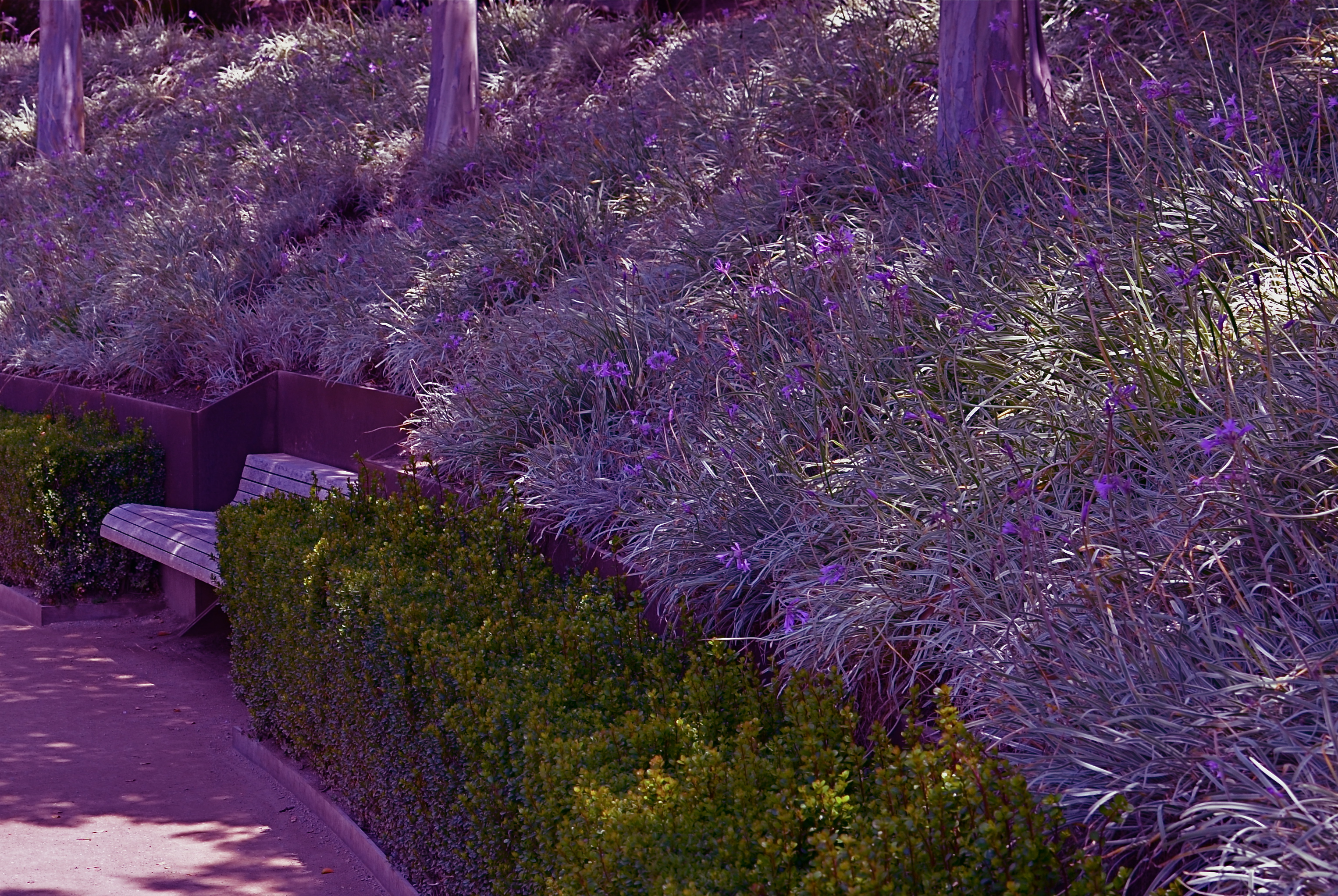
Dream Gardens, Los Angeles (2013). 1/250 sec., f/5.6, ISO 100, 35mm.
You’re looking at the runaway champ photo for total views in my entire Flickr photostream. To me, it’s a bit of whimsy at best, and, if I am totally truthful, an attempt at a partial “save” on what started out to be a rejected image. Backstory: the massive and visually busy central gardens at Los Angeles’ Getty art campus are wonderful to walk through, irresistible to shoot, and a nightmare to capture. If you do the cliché overhead “master shot” of the entire area from, say, two stories in the air, you get something which generally work. However, trying to get a sense of the densely landscaped details at ground level is a fool’s errand. This shot represents a kind of surrender, as it was an attempt to create a quiet composition along one of the more sparse sections of one footpath. Even so, what you’re seeing here is a paring-away of more than half the original frame. There was just too much visual information to work with.
The psychedelic rework on the color is yet another sign that I am not truly comfortable with what I am doing, but it at least represents an attempt to create an “otherness” with the image, to take it out of the normal world. This strategy gave me a picture I could live with, but hardly one I would point to with pride. The verdict from every one else? 5,000 % more eye traffic than the next most popular picture I’ve ever posted on the web, and no sign of slowing. And yet, I know that if I intentionally take another picture like this, it won’t become part of a “series” or a “school of thought”, merely me trying to cash in on a great riddle.
We use our photography to make a case for our various visions to an unknown jury, but, in most cases, we sort of “get” what worked about a picture. But when mysteries like these occur, we can merely
a) be grateful
b) say goodnight, Gracie.
I am reminded about an old bit where Billy Crystal “imitated” famous people by cutting out the mouths of big posters of various icons, then sticking his own lips where theirs should be and “speaking” for them. I fell on the floor as he took his place behind a huge image of Albert Einstein, and in his best Catskills accent, kept repeating, “WHO KNEW? WHAT DID WE KNOW??”
What, indeed.
Follow Michael Perkins on Twitter @MPnormaleye.
BLACKTOP GYPSIES
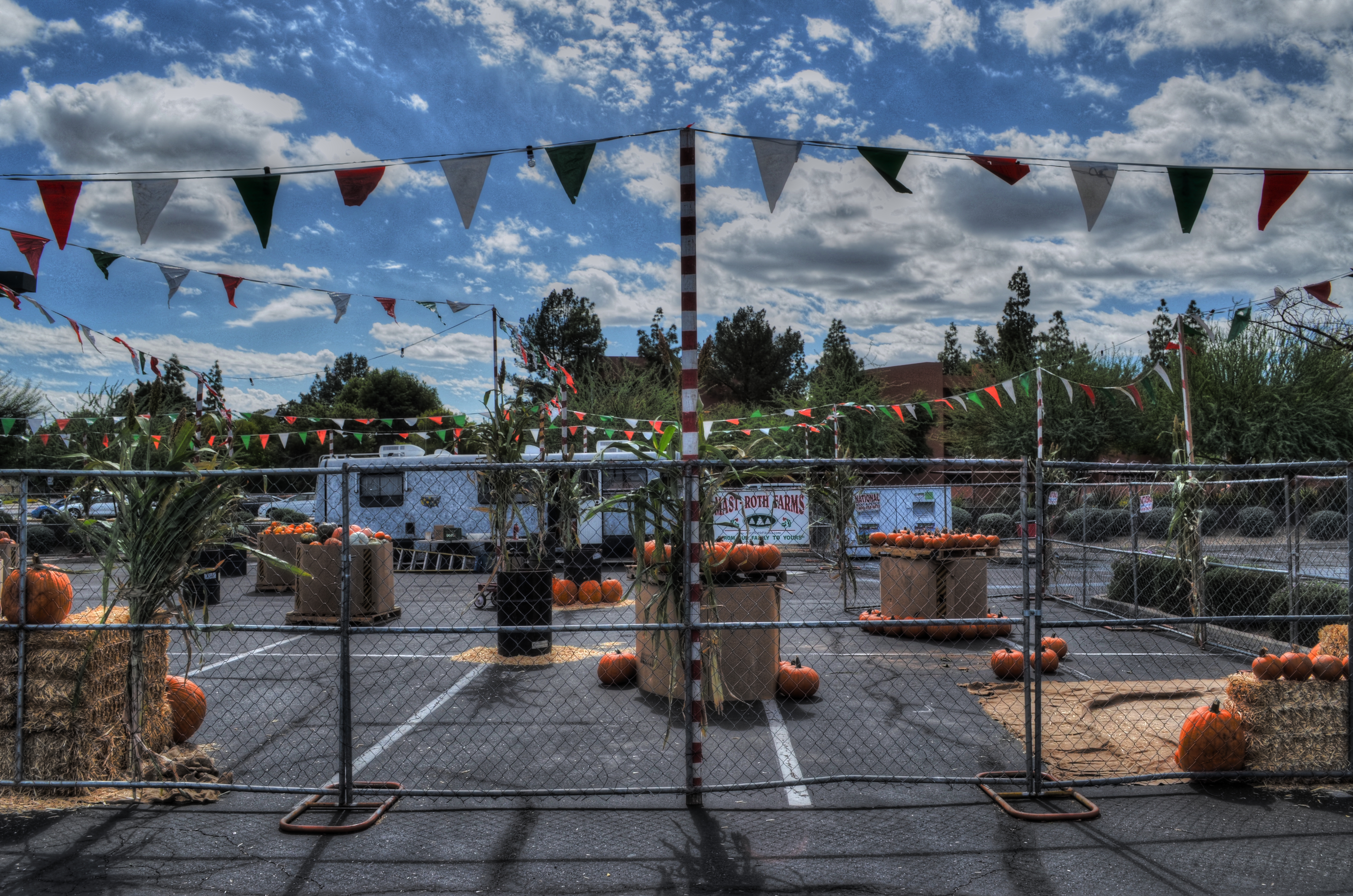
Low overhead? Hey, we invented it. A parking lot, some pumpkins, and opportunity. For the merchants and you.
By MICHAEL PERKINS
RETAIL CHAINS ARE STARVATION FOR A PHOTOGRAPHER, a barren field where nothing grows, at least visually. America used to be a place where, in our business doings, our petticoat showed a bit; a certain raw vitality showed through our saggy banners, our improvised displays, our homespun marketing. It’s no wonder that the photojournalists of the Great Depression or the choniclers of the Lower East Side of the early 1900’s made poetry out of our back-of-the-truck veggie stands, our horse-drawn pushcarts, our roadside tag sales. There was texture there. There was the real drama of struggle, and it was a pictorial gold mine.
Of course it’s not all gone, and we are not, uniformly, Wal-Mart Nation. Not yet.
As picture makers, we have so much more to work with looking at the human, the risky, the uncertain in our do-it-yourself capitalism. There are stories in it. There are real people on the front lines of the culture to watch and capture. It’s also a hell of a lot more fun than trying to find drama in the grand opening of, say, Kwikie Mart # 3425.
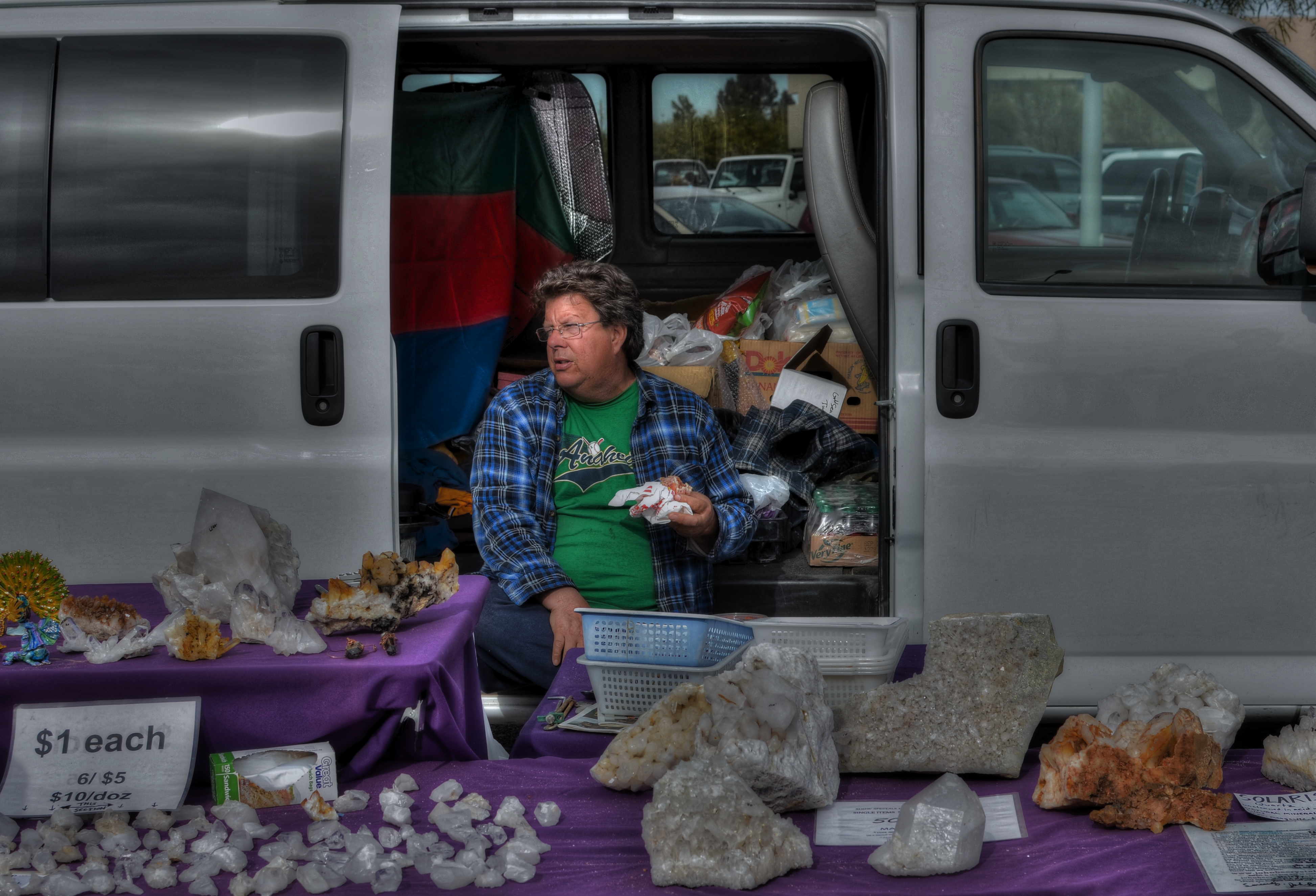
Look Around, See If You Like Anything, I’m Almost Done With My Lunch….
And picture opportunities, created by the blacktop gypsies of our time, are still setting up shop across the country…..six days in a Target parking lot to sell fireworks, four hours in a church driveway to hawk cakes and pies, three weeks in a vacant lot to peddle Christmas trees. And then there are the fairs, the craft shows, and the garage sales, those stubborn little machines of mercantile faith. You can’t not grab gold in these fields.
There may be a great epic just waiting to be shot inside a massive wholesale warehouse, but I prefer my drama smaller, and a little more on the human side. Show me a guy trying to make a buck against all odds and I’ll show you a picture.
Or make you one.
THE BOOK OF KODAK
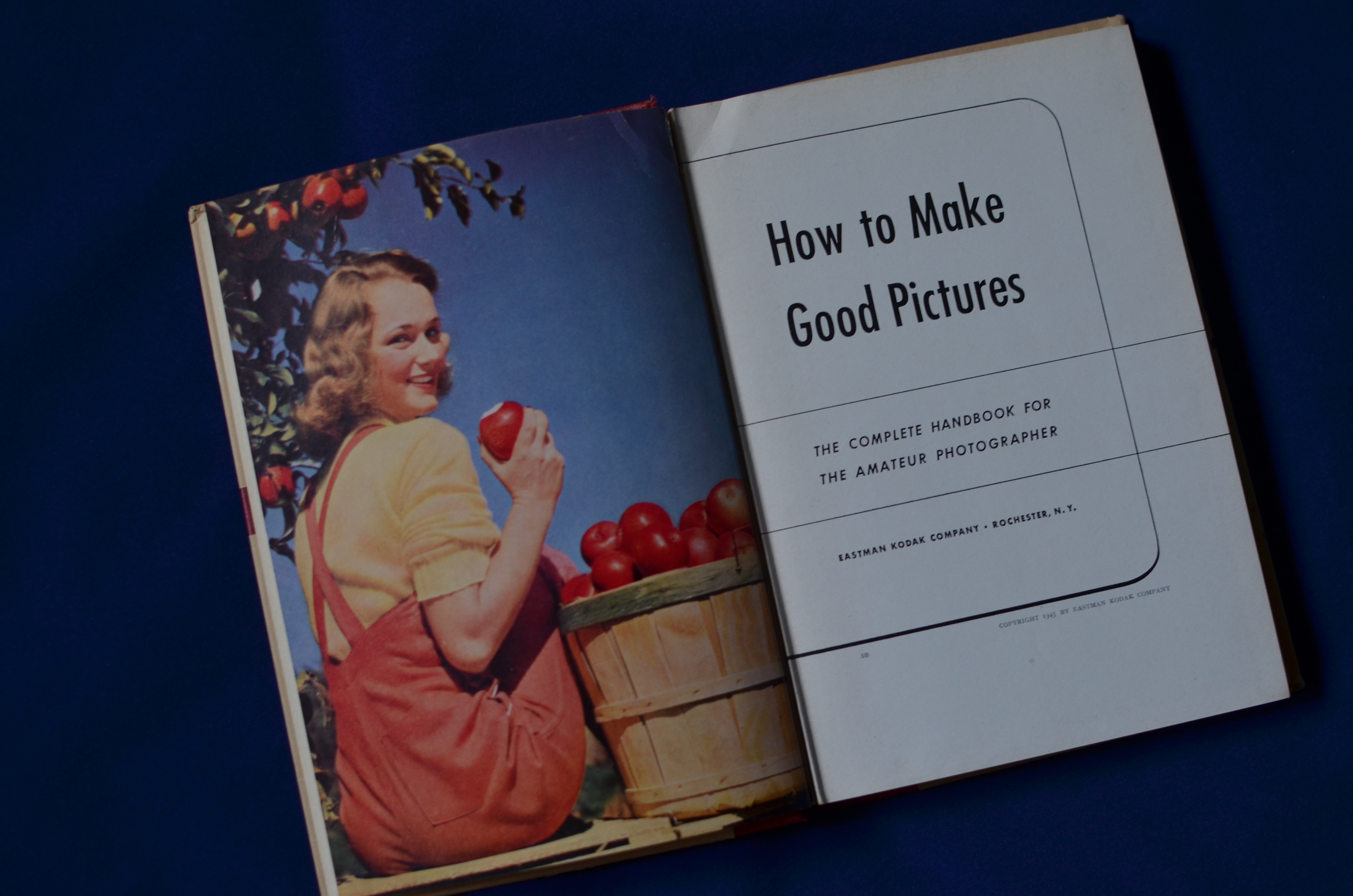
The Long-Distance Runner: The Most Successful Photography Instruction Series In History, Eastman Kodak’s How To Make Good Pictures (28th Edition,1943-47). From the collection of the author.
By MICHAEL PERKINS
KODAK’S SAD AND WOBBLY RE-EMERGENCE FROM BANKRUPTCY, announced this week, finalizes the process of “saving” a famous name, while annihilating the legacy of innovation that made that name great for over a century. Having already said goodbye to Kodachrome, most of its other trademark films, and camera production itself, Kodak will now concentrate on “imaging products”, which, for, most of us, means “printers”. Most of the news coverage of this corporate resurrection will “focus” (sorry) on what the new company stock will be worth, who goes, who stays, and a few scant mentions of the company’s original role as camera producer to the world.
That will leave a significant part of the story untold.
Certainly, George Eastman’s genius for marketing helped develop the first flexible roll films, then ingeniously created a market for them by putting a basic, usable camera in the hands of the Everyman. Nearly everyone has heard the slogan Kodak created to demonstrate how truly effortless its products had made photography: you press the button and we do the rest. But none of that would have guaranteed the company’s growth if Kodak has not also decided to become photography’s first great mass teacher, creating pro-active education programs to guarantee that, not only could Uncle Clem snap a photo easily, he could snap a good photo easily. What had once been a dark art for a select cabal of techno-wizards became, under Kodak’s outreach, something that could anybody could do.
And Kodak was going to show you how to do it.
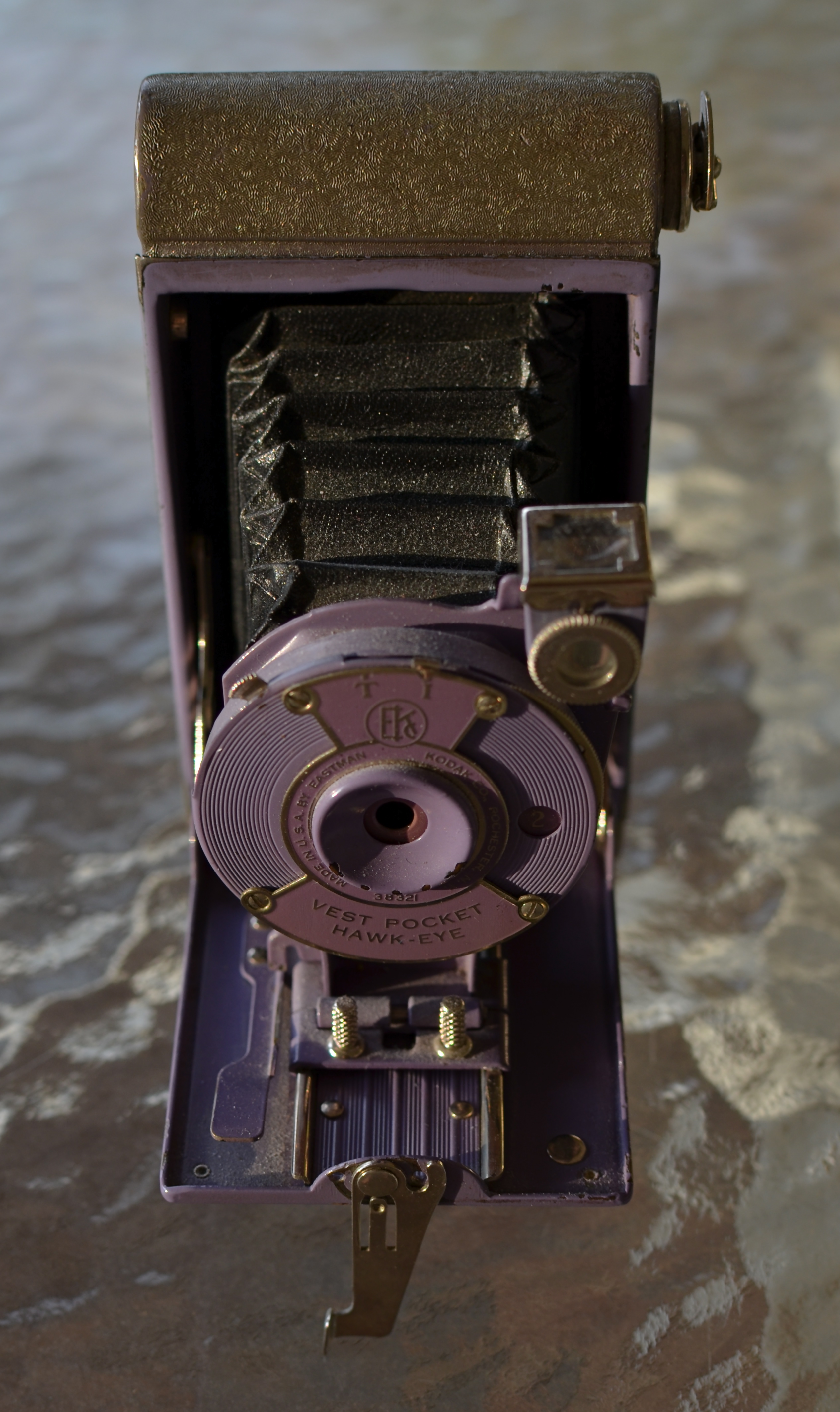
There was a time when this Kodak Vest-Pocket Hawkeye was truly intimidating. How To Make Good Pictures made it your friend.
Beginning before the end of the Victorian era, the company began to publish the first of an endless stream of practical guides on technique and simple theory aimed at the average shutterbug. Starting in 1898 with Picture Taking And Picture Making (115 pages of tips in a cardboard cover for fifty cents!), Eastman Kodak moved to 1905’s The Modern Way In Picture Making, and, finally, to the most successful photo instruction series in history, How To Make Good Pictures, introduced in 1912 and revised continually until finishing up with its 37th edition, in 1995. Over the years the “make” in the title had been changed to “take”, and its 1890’s essays on bromide paper, collodion matte, and ground-glass focusing had evolved, over the decades, to instructions on the use of flash, color, drop-in film cartridges, and “how to tell a picture story” with your Kodacolor slides. Hundreds of printings and millions of sales later, How To Make Good Pictures forged an ironclad link between consumer and company in a way no corporation before or since has done.
To everything there is a season. Kodak’s (now historically) tragic failure to see digital photography as a viable consumer revolution, until it was too late, is a matter of raw record. The company that taught the world to see had a blind spot, a fatal one, and the irony that nearly all of the rest of the industry developed digital technology by applying processes originated (and patented) by Kodak makes the story even sadder.
But, once upon a time, the Eastman Kodak Company not only knew what the future of photography was going to look like, it wrote a handy dandy little book that told everyone how to master that future.
Follow Michael Perkins on Twitter @MPnormaleye
Related articles
- Kodak moments are just a memory as company exits bankruptcy (kansascity.com)
LEARNING TO LIVE WITH “THE NUMBER”
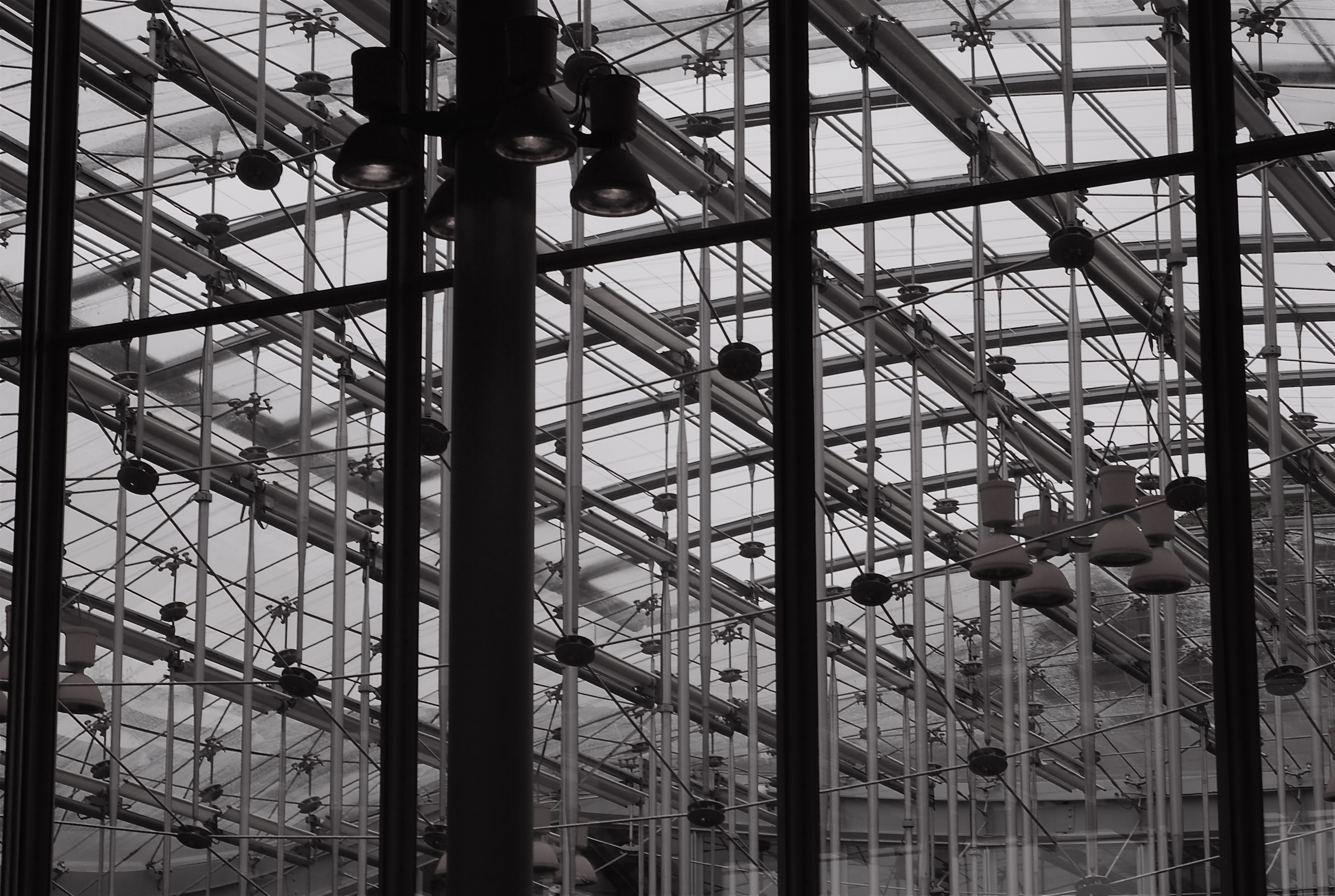
Will I have any regard for this image in five years? Ten? How about in six months? And why? 1/40 sec., f/9, ISO 100, 50mm.
By MICHAEL PERKINS
IT’S GUARANTEED. OVER OUR LIFETIMES, YOU AND I WILL TAKE REMARKABLE PHOTOGRAPHS.
There just won’t be a lot of them.
And that’s very good news.
Ansel Adams once remarked that “twelve significant photographs in any one year is a good crop”.
That’s right. Twelve.
Now, given the percentage of the massive Adams output that actually turned out to be flat-out amazing, the reverse math for how many “close, but no cigar” frames he shot would be staggering. And humbling. This after all, is a man who “experimented” with color for over thirty years, only to lament, near the end of his life that “I have yet to see–much less produce–a color photograph that fulfills my concepts of the objectives of art.” Bear in mind, also, that this lament is not coming from a hipster Instram-ing artsy close-ups of what he had for lunch.
What does this mean for us? It means that there is a number out there, the figure that enumerates how many flops we will have to be content with in order to get our own, small yield of golden eggs.
Learning to live with that number is the best hope have of getting closer to what we can be.
I can’t measure my work against anyone else’s, since “that way lies madness”. I can only mark how far I am along my journey by the distance between what made me smile today and the stuff I used to be able to look at without suppressing a strong gag reflex. Guess what: the same work that makes me want to gouge out my eyes with soup spoons, in the present, is often the exact same work that made my chest swell with pride, just the day before yesterday.
And that’s the way it should be. If your style is so wonderfully complete that it can’t be further improved on, then smash your camera on the street below and move on to something else that has the potential to either spank your ego or kick your creative butt. We’re not in this to get comfortable.
Ansel Adams one more time:
There is nothing worse than a sharp image of a fuzzy concept.
Yes, huzzah, what he said. Here’s to staying sharp.
And hungry.
And hard to please.
follow Michael Perkins on Twitter @mpnormaleye and on Flickr at

SECOND SIGHT, SECOND LIFE
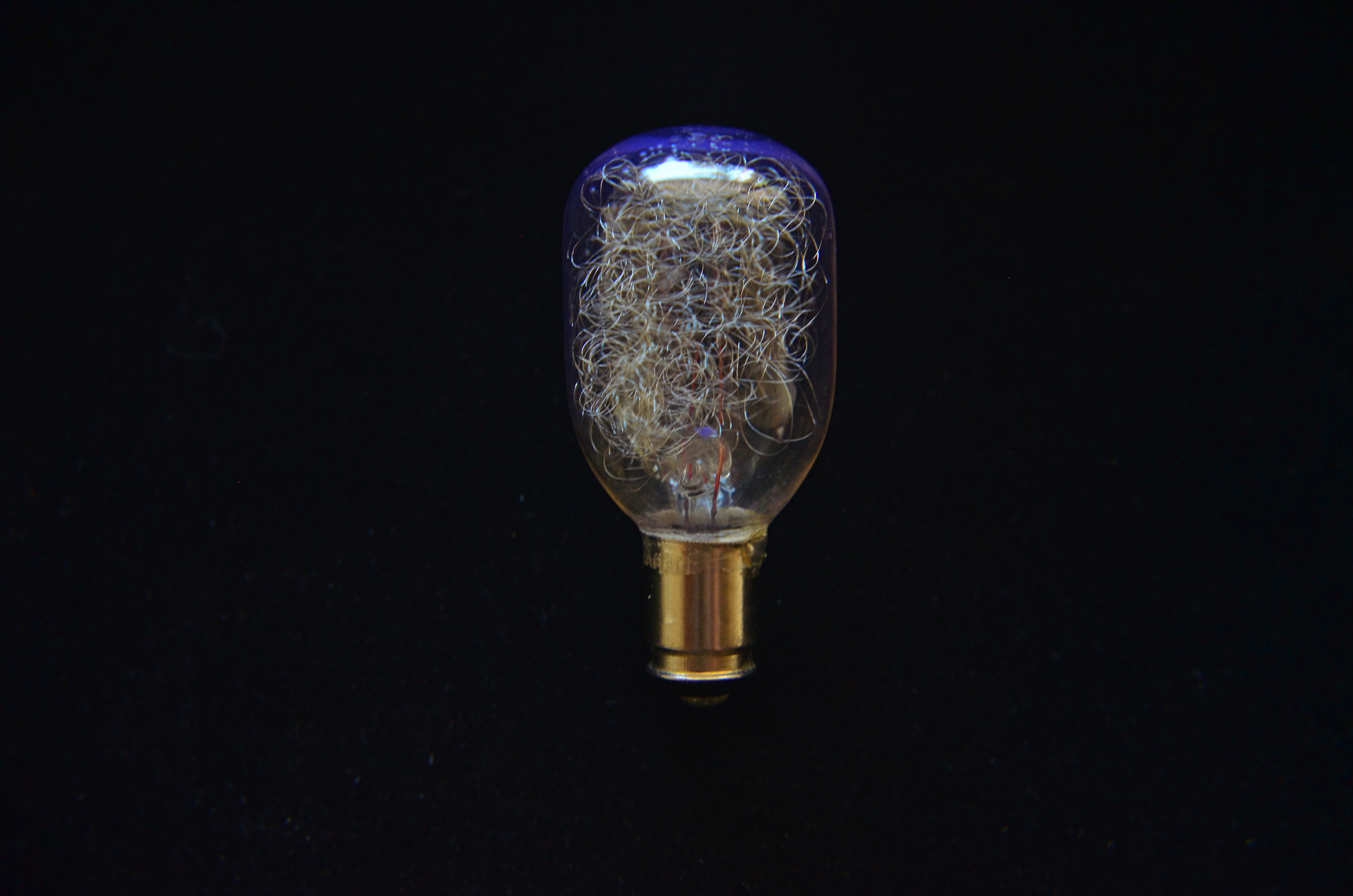
Pragmatically “useless” but visually rich: an obsolete flashbulb glows with window light. 1/80 sec., f/5.6, ISO 640, 35mm.
By MICHAEL PERKINS
A DECADE-AND-A-HALF INTO THE TWENTY-FIRST CENTURY, we are still struggling to visually comprehend the marvels of the twentieth. As consumers, we race from innovation to innovation so amazingly fast that we scarcely apprehend the general use of the things we create, much less the underlying aesthetic of their physical forms. We are awash in the ingenuity of vanishing things, but usually don’t think about them beyond what we expect them to supply to our lives. We “see” what things do rather than seeing their essential design.
As photographers, we need not only engage the world as recorders of “reality” but as deliberate re-visualizers of the familiar. By selecting, magnifying, lighting and composing the ordinary with a fresh eye, we literally re-discover it. Second sight gives second life, especially to objects that have outlasted their original purpose. No longer needed on an everyday basis, they can be enjoyed as pure design.
And that’s exciting for anyone creating an image.
The above shot is ridiculously simple in concept. Who can’t recognize the subject, even though it has fallen out of daily use? But change the context, and it’s a discovery. Its inner snarl of silvery filaments, designed to scatter and diffuse light during a photoflash, can also refract light, break it up into component colors, imparting blue, gold, or red glows to the surrounding bulb structure. Doubling its size through use of “the poor man’s macro”, simple screw-on magnifying diopters ahead of a 35mm lens, allows its delicate inner detail to be seen in a way that its “everyday” use never did. Shooting near a window, backed by a non-reflective texture, allows simple sculpting of the indirect light: move a quarter of an inch this way or that, and you’ve dramatically altered the impact.
The object itself, due to the race of time, is now “useless”, but, for this little tabletop scene, it’s a thing made beautiful, apart from its original purpose. It has become something you can make an image from.
Talk about a “lightbulb moment”….
Follow Michael Perkins on Twitter @mpnormaleye.
Related articles
- “A Sight Into My Photographic Mind” (Perspective) (mrphotosmash.wordpress.com)
HOLDING BACK
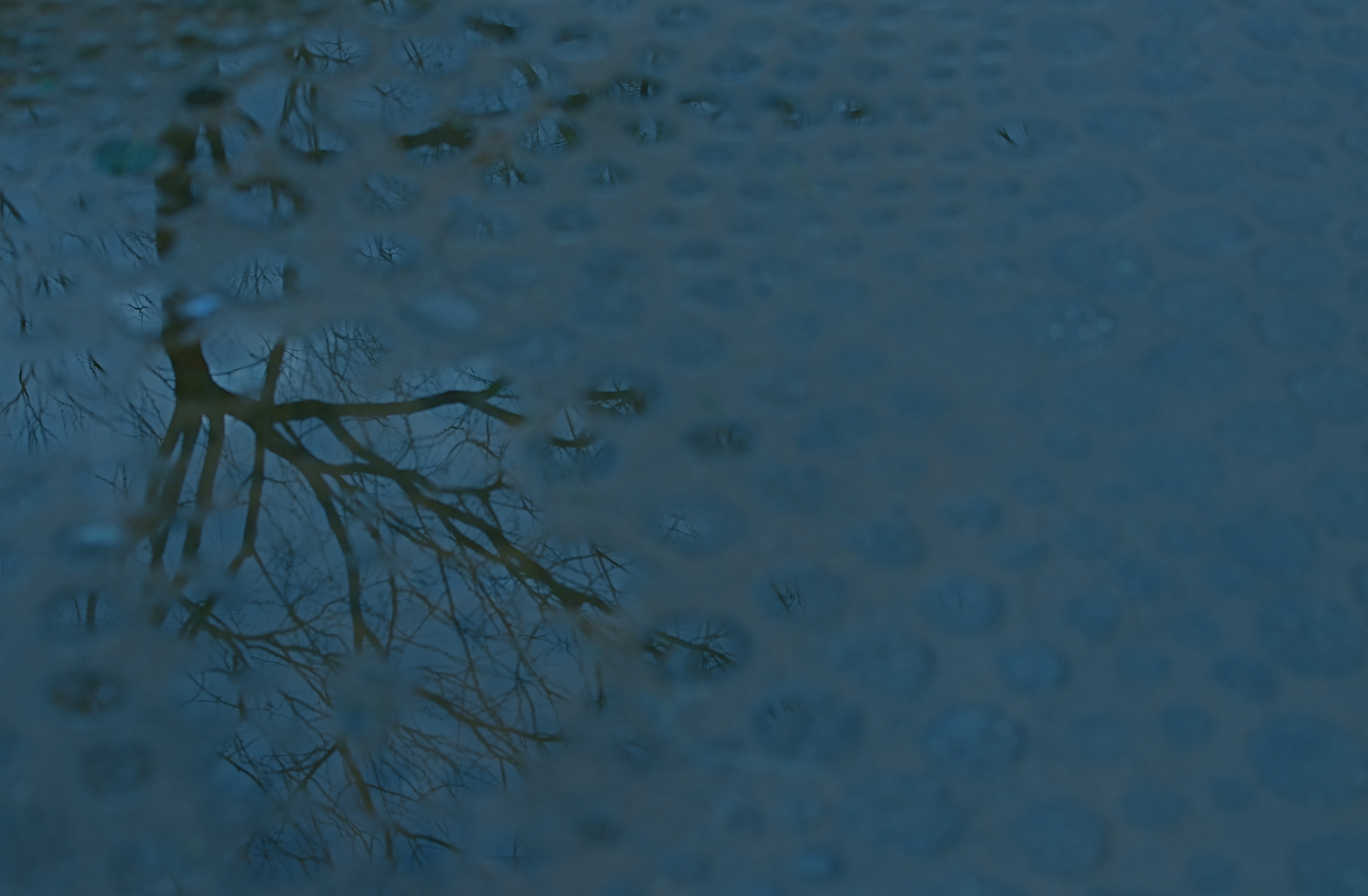
Rainy day dream away: 1/160 sec., f/4.5, ISO 100, 35mm.
By MICHAEL PERKINS
THE MIND WANTS TO PAINT ITS OWN PICTURES, and often responds better to art that veils at least part of its message in mystery. The old vaudeville adage, “always leave them wanting something” is especially applicable in the visual arts, where, often as not, the less you show, the better it connects with the viewing public. It’s precisely because you didn’t show everything that your work may reach deeper into people’s imaginations, which are then invited to “partner” in providing what you merely suggested.
This is why radio created more personal “pictures” than television, why an abstract suggestion of on-screen romance is more erotic than full-on depiction of every physical mechanic of an encounter, and why, occasionally, deciding to hold back, to withhold “full disclosure” can create an image that is more compelling because its audience must help build it.
Given the choice between direct depiction of an object and referential representation of it in a reflection or pool of water, I am tempted to go with the latter, since (as is the stated goal of this blog) it allows me to move from taking a picture to making one. Rendering a picture of a tree is basically a recording function. Framing a small part of it is abstraction, thus an interpretive choice. And, as you see above, showing fragments of the tree in a mosaic of scattered puddles gives the viewer a chance to supply the remainder of the image, or accept the pattern completely on its own merits. Everyone can wade in at a level they find comfortable.
I don’t always get what I’m going for with these kind of images, but I find that making the attempt is one of the only ways I can flex my muscles, and ask more of the viewer.
It’s the kind of partnership that makes everything worthwhile.
(follow Michael Perkins on Twitter @mpnormaleye)
Check out the excellent minds of our newest followers:
http://www.en.gravatar.com/insideoutbacktofront
A BRIEF AUDIENCE WITH THE QUEEN
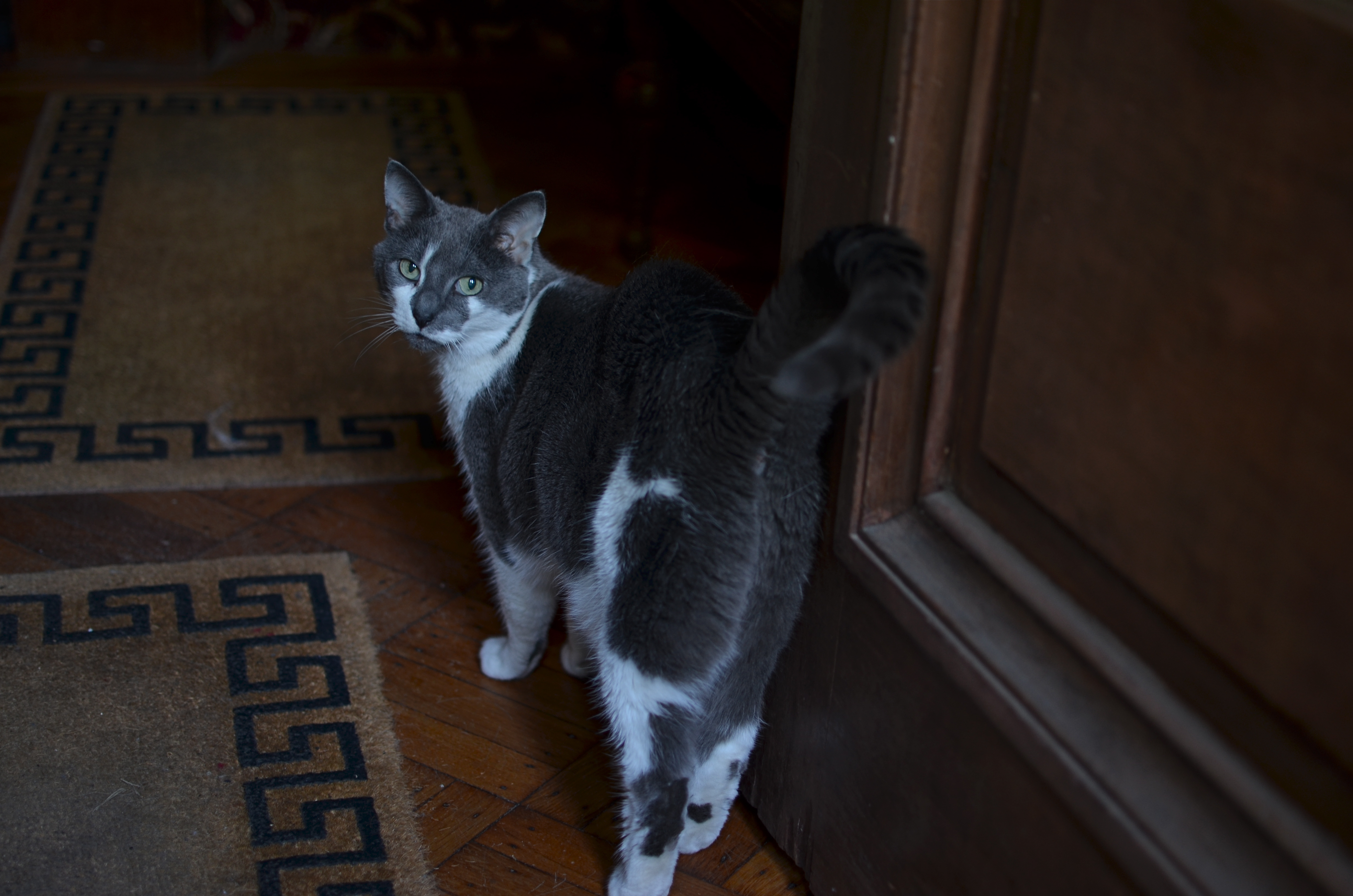
What, are YOU still here? 1/40 sec., f/1.8, ISO 100, 35mm.
By MICHAEL PERKINS
THERE IS ONLY ONE KIND OF PICTURE YOU WILL EVER TAKE OF A CAT, and that is the one she allows you to take. Try stealing an image from these spiritual creatures against their will, and you will reign over a bitter kingdom of blur, smear, and near misses.
It’s trickier to take photos of the ectoplasmic projections of departed relatives. But not by much.
I recently encountered this particular lady in a Brooklyn brownstone, a gorgeous building, but not one that is exactly flooded with light, even on a bright day. There are a million romantically wonderful places for darkness to hide inside such wonderful old residences, and any self-respecting feline will know how to take the concept of “stealth” down a whole other road. The cat in the above photo is, believe me, better at instant vaporization and re-manifestation than Batman at midnight in Gotham. She also has been the proud unofficial patrol animal for the place since Gawd knows when, so you can’t pull any cute little “chase-the-yarn-get-your-head-stuck-in-a-blanket” twaddle that litters far too much of YouTube.
You’re dealing with a pro here.
Her, not me.
Plus she’s from Brooklyn, so you should factor some extra ‘tude into the equation.
The only lens that gives me any luck inside this house is a f/1.8 35mm prime, since it’s ridiculously thirsty for light when wide open and lets you avoid the noticeable pixel noise that you’d get jacking up the ISO in a dark space. Thing is, at that aperture, the prime also has a razor-thin depth of field, so, as you follow the cat, you have to do a lot of trial framings of the autofocus on her face, since getting sharp detail on her entire body will be tricky to the point of nutso. And of course, if you move too far into shadow, the autofocus may not take a reading at all, and then there’s another separate complication to deal with.
The best (spelled “o-n-l-y”) solution on this particular day was to squat just inside the front foyer of the house, which receives more ambient light than any other single place in the house. For a second, I thought that her curiosity as to what I was doing would bring her into range and I could get what I needed. Yeah, well guess again. She did, in fact, approach, but got quickly bored with my activity and turned to walk away. It was only a desperate cluck of my tongue that tricked her into turning her head back around as she prepared to split. Take your stupid picture, she seemed to say, and then stop bothering me.
Hey, I ain’t proud.
My brief audience with the queen had been concluded.
I’ll just show myself out……
Follow Michael Perkins on Twitter @mpnormaleye.
A TALE OF TWO KINGS
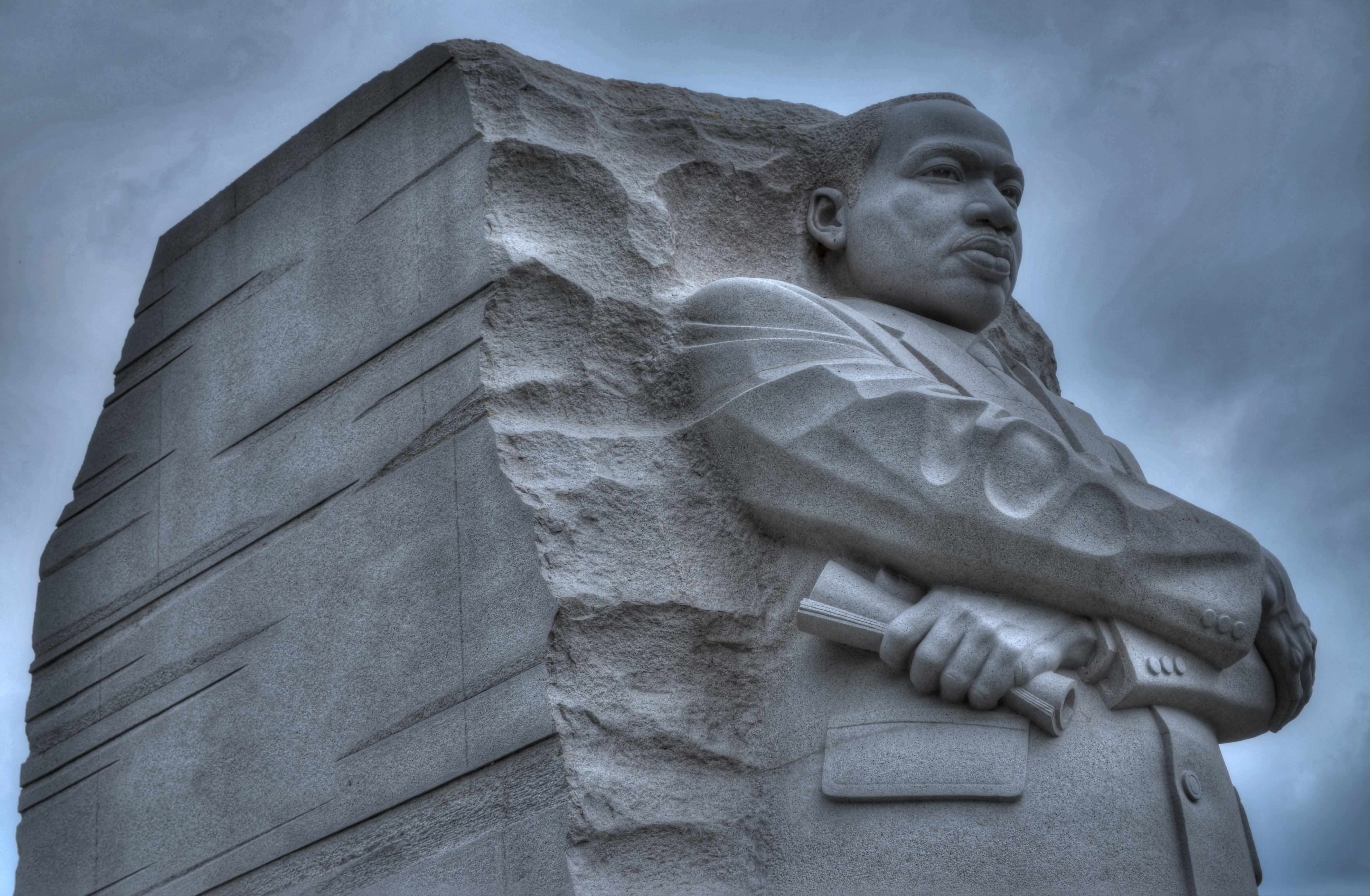
A determined Martin Luther King, Jr. stares forward into the future at the newly dedicated MLK Memorial on Washington’s National Mall. Fusion of three exposures, all with an aperture of f/5.6, all ISO 100, all 48mm. The shutter speeds, due to the high tones in the white statue, are 1/200, 1/320, and 1/500 sec.
By MICHAEL PERKINS
DEATH PERMANENTLY RENDERS REAL HUMAN BEINGS INTO ABSTRACTIONS. With every photo, formerly every painting, drawing, or statue of a renowned person, some select elements of an actual face are rearranged into an approximation, a rendering of that person. Not the entire man or woman, but an effect, a simulation. The old chestnut that a certain image doesn’t do somebody “justice”, or the mourner’s statement that the body in the casket doesn’t “look like” Uncle Fred are examples of this strange phenomenon.
Nothing amplifies that abstraction like having your image “officially” interpreted or commemorated after death, and, in the case of the very public Dr. Martin Luther King Jr., Washington’s National Mall offers two decidedly contrasting ways of “seeing” the civil rights pioneer. One is more or less a tourist destination, while the other is muted, nearly invisible amongst the splendors of the U.S. Capitol. Both offer a distinct point of view, and both are, in a way, incomplete without the other.
The official MLK memorial, opened in 2011 as one of the newest additions to the Mall, stands at the edge of the Tidal Basin, directly across a brief expanse of water from the Jefferson Memorial. Its main feature shows a determined, visionary King, a titanic figure seeming to sprout from a huge slab of solid stone, as if, in the words of the monument, “detaching a stone of hope from a mountain of despair”. Arms folded, eyes fixed on a point some distance hence, he is calm, confident, and resolute. This gleaming white sculpture’s full details can best be captured with several bracketed exposures (fast shutter speeds) blended to highlight the grain and texture of the stone, but such a process abstract’s King even further into something out of history, majestic but idealized, removed.
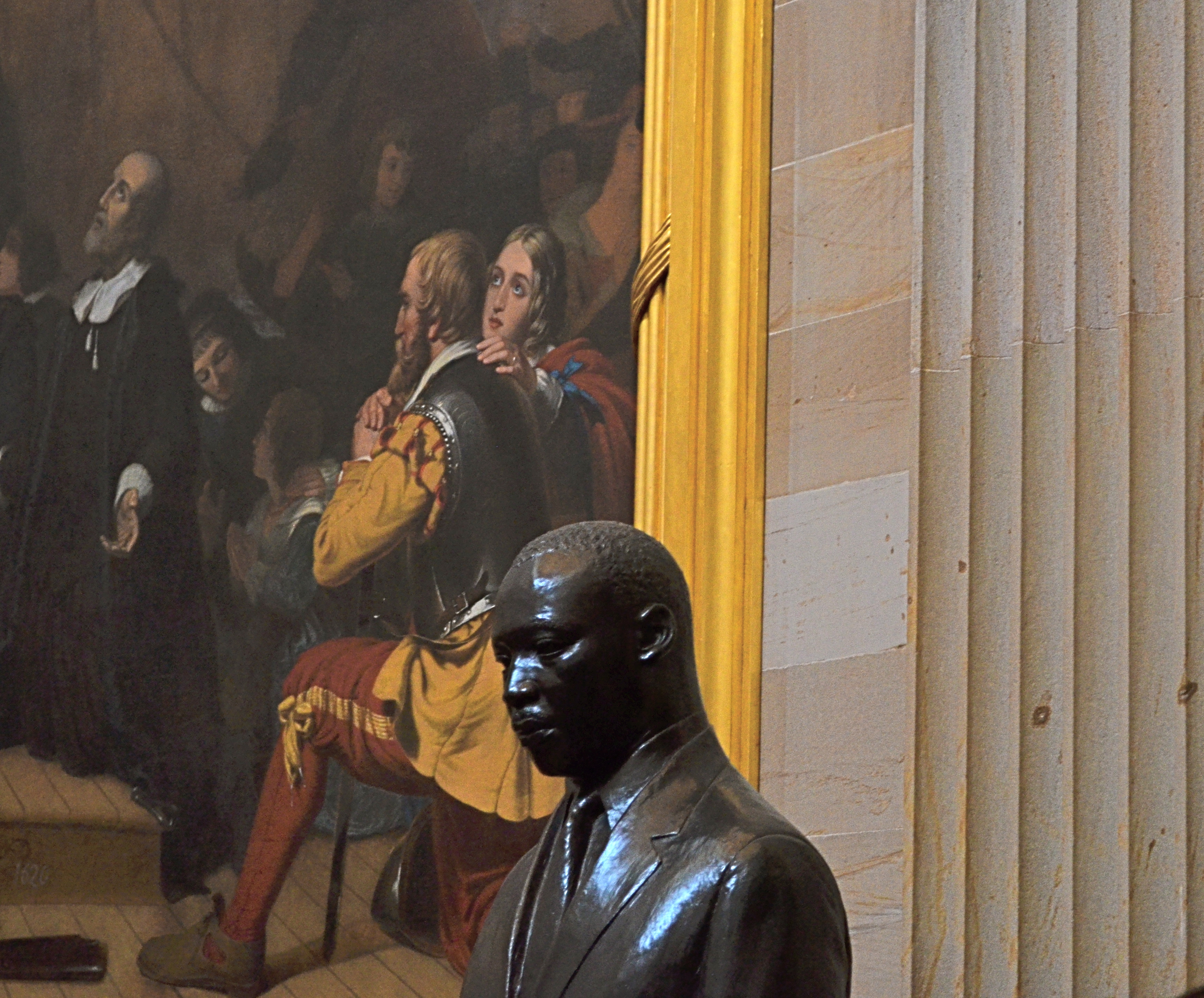
Another view: a somber bronze bust of Dr. King in the U.S. Capitol rotunda, flanked by the painting The Embarkation Of The Pilgrims. 1/30 sec., f/5.6, ISO 640, 55mm.
The contrast could not be greater between this view and the bronze bust of King installed in 1988 in the rotunda of the Capitol building. This King is worried, subdued, straining under the weight of history, burdened by destiny. The bust gains some additional spiritual context when framed against its near neighbor, Robert Weir’s painting The Embarkation Of The Pilgrims, which shows the weary wayfarers of the Mayflower, bound for America, on bended knee, praying for freedom, for justice. Used as background to the bust, they resemble a kind of support group, a congregation eager to be led. Context mine? Certainly, but you shoot what you see. Inside the capitol, light from the dome’s lofty skylights falls off sharply as it reaches the floor, so underexposure is pretty much a given unless you jack up your ISO. Colors will run rich, and some post-lightening is needed. However, the dark palette of tones seems to fit this somber King, just as the triumphant glow of the MLK Memorial’s King seems suited to its particular setting.
Death and fame are twin transfigurations, and what comes through in any single image is more highly subjective than any photo taking of a living person.
But that’s where the magic comes in, and where mere recording can aspire to become something else.
Follow Michael Perkins on Twitter @mpnormaleye.
CAUGHT IN THE CROSSFIRE
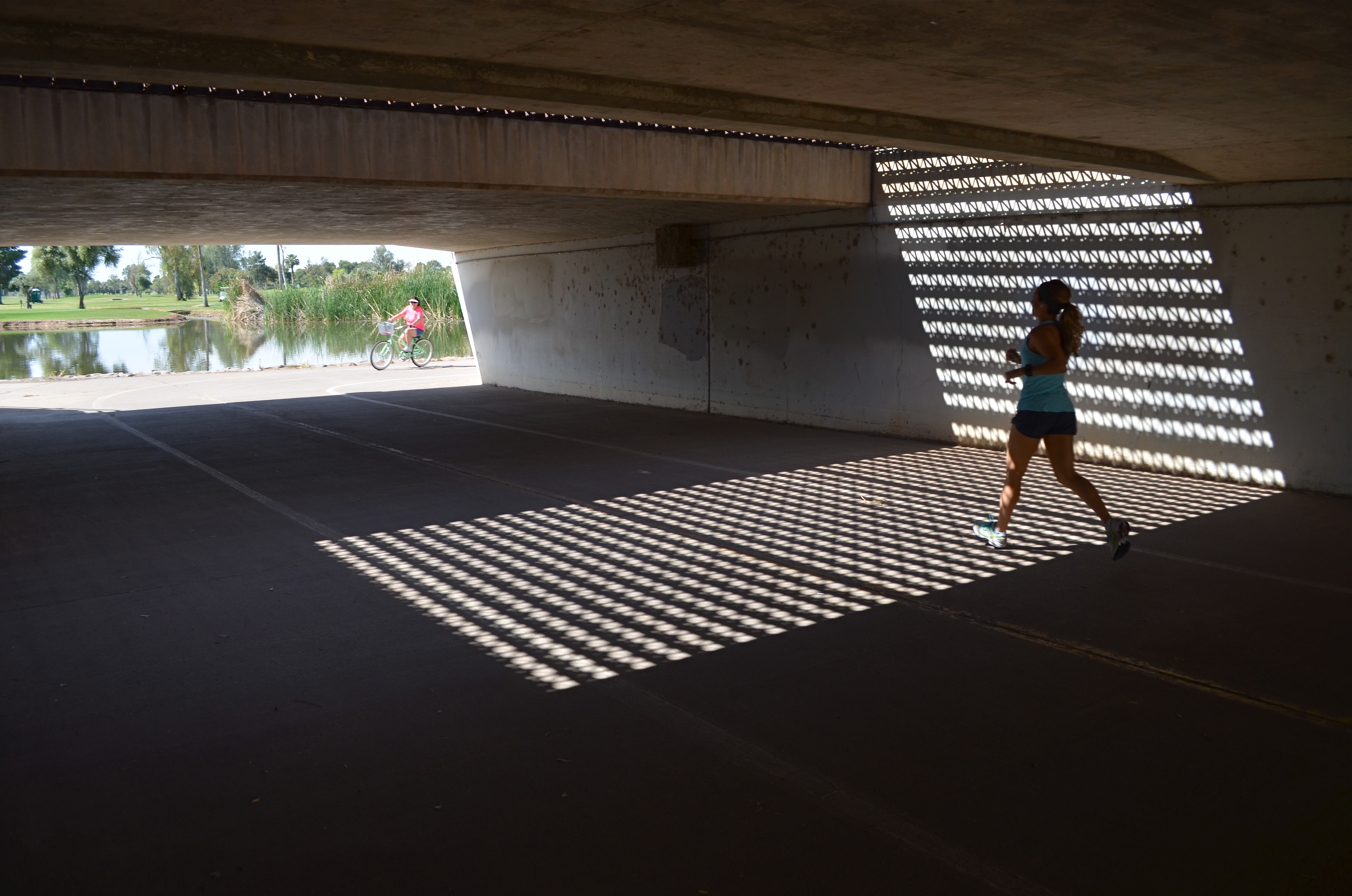
The jogger that saved my shot, albeit unwittingly. 1/250 sec., f/5.6, ISO 100, 18mm.
By MICHAEL PERKINS
THERE HAS BEEN A LOT OF MENTION, OF LATE, OF THE PHENOMENON KNOWN AS “PHOTOBOMBING“, the accidental or intentioned spoiling of our perfect Kodak moments by persons inserted into the frame at a crucial instant. Whether they block the bride’s face, eclipse Grandma’s beloved puppy, or merely pop up annoyingly behind the cute couple, they, and the images they ruin, are one of the hottest posting sources along the photo-internet galaxy right about now.
But fate photobombs us every day, and often drops a gift out of the sky, and into our pictures. The two-fold trick is to (a) be ready to improvise and (b) be grateful for the chance for something altogether different from what we originally conceived.
Happened to me several weeks ago. Total accident, since the thing I shot in the moment was not what I had started out for at all. Real simple situation:an underground walkway from one low-lying section of a city park to another, the sidewalk taking a short cut under a bridge. Overhead, six lanes of unheeding street-level traffic. Below, a concrete tunnel of sorts, with sunlight from the park illuminating either open end.
Oh, and the grate. Should mention that a section of the street overhead was, instead of solid roadbed, an open-pattern, structural steel grid, with dappled geometrics of light throwing a three-sided pattern of latticed shadows onto the side walls and floor of the tunnel below. Nice geometry. Now, I wasn’t looking to shoot anything down here at all. Like the chicken, I just wanted to get to the other side. But I had my wide-angle on, and a free light pattern is a free light pattern. One frame. A second, and then the bomb: a jogger, much more acquainted with this under-the-road shortcut than me, crossing from over my right shoulder and into my shot. Almost instinctively, I got her in frame, and relatively sharp as well.
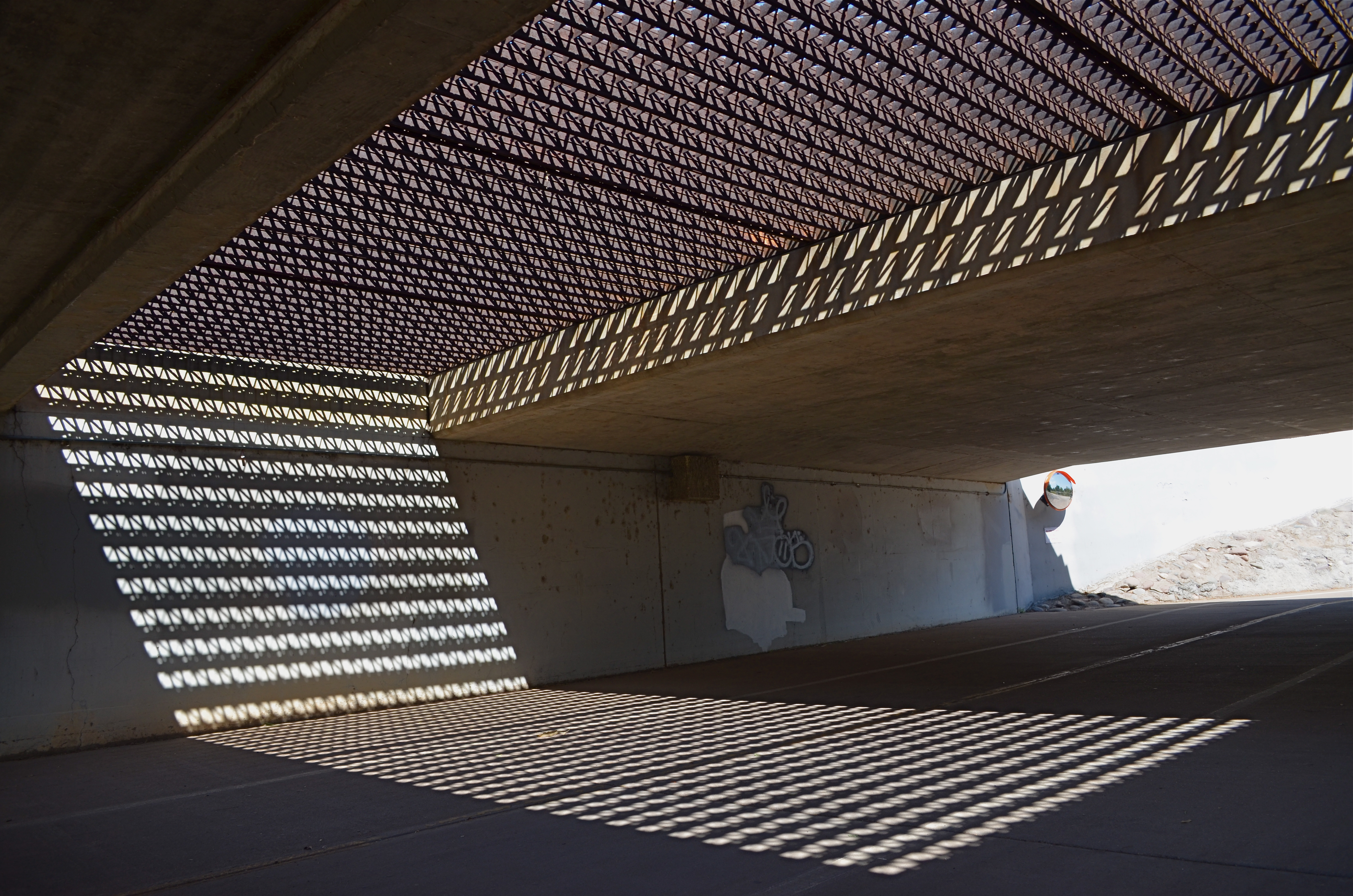
Same settings as in the “jogger” frame, but a little colder minus the human element. A matter of taste.
Not content to have caught the big fish of the day, I took the opposite angle and tried again to recoup my “ideal shot”, minus the human element. But something had changed. Even so, I still needed a gentle nudge from Fate to accept that I had already done as well as I was going to do.
My battery died.
I limped home, then, during my upload, found that what I had been willing to reject had become essential. I wish it was the first time I’ve had to be taught this lesson.
But I’d be lying.
Photobombed by circumstance.
And grateful for it.
follow Michael Perkins on Twitter @MPnormaleye.
THE GRADUAL REVEAL
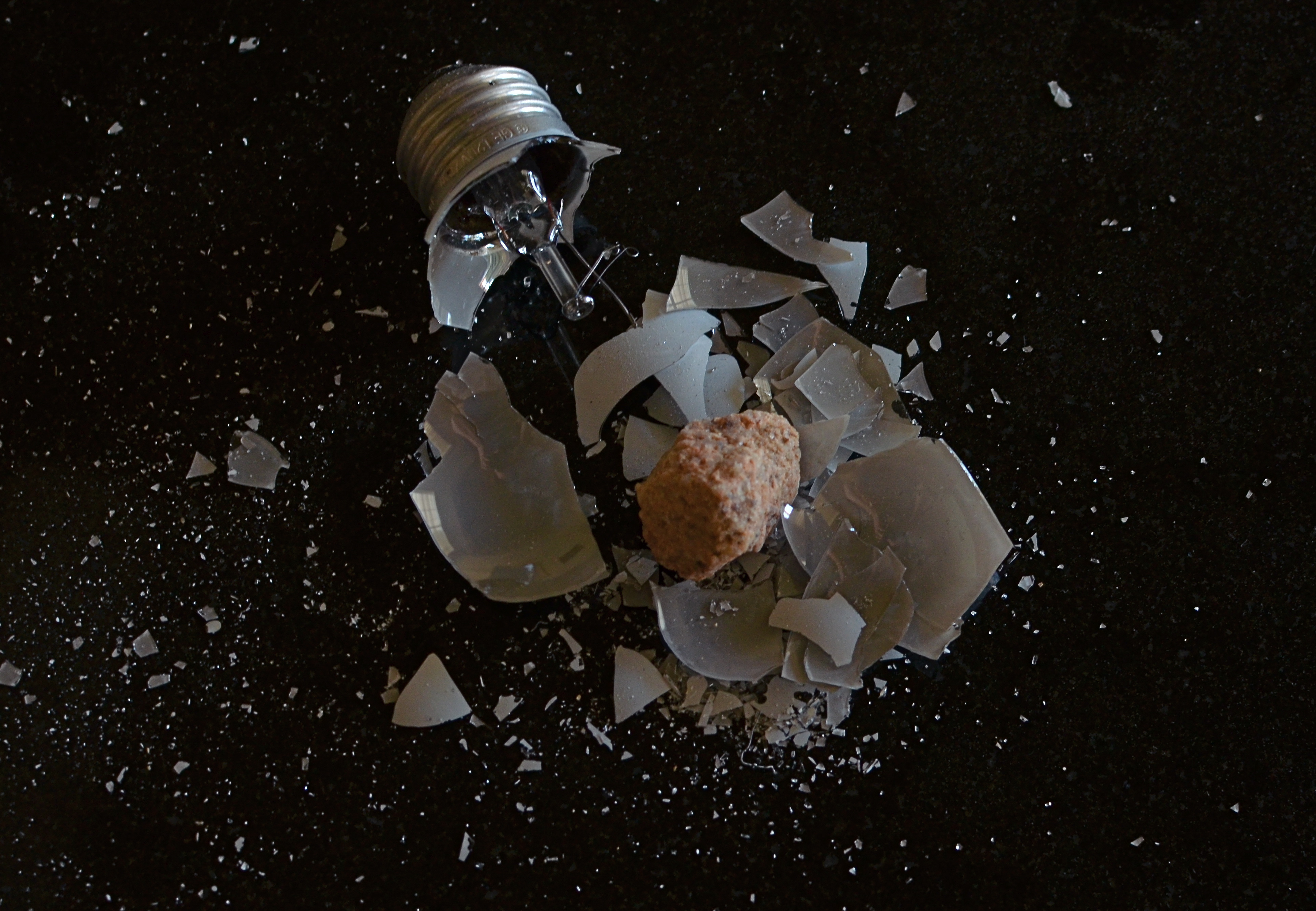
A cosmic disaster on a tabletop far, far away. 1/40 sec., f/5.6, ISO 400, 35mm.
by MICHAEL PERKINS
CREATING FANTASY IMAGES ON A TABLETOP IS A LITTLE LIKE WATCHING YOUR GRANDMA IN THE KITCHEN, if your grandma (like mine) was the “I-don’t need-no-recipe”,a dash here, a pinch there kind of cook. Sometimes I think she just kept chucking ingredients into the pot until it was either the right color or the correct thickness. All I know is, when she was done, it “ate pretty good”.
I use the same approach when I am building compositions from scratch. You’re not sure what the proportions are, but you kind of know when you’re done.
One of the photo sharing sites that I recommend most enthusiastically is called UTATA, a site which promotes itself as “tribal photography” since it require a certain level of communal kick-in from all its members, posing workshop assignments and themes that take you beyond merely posting your faves. Operating in tandem with its self-named Flickr group, UTATA is about taking chances and forcing yourself, often on a deadline, to see in new ways. If it sounds like homework, it’s not, and even if you have no time to work the various challenges, you’ll still reap a vast wealth of knowledge just riffing through other people’s work. Give it a look at http://www.utata.org.
One of the site’s recent so-called “weekend projects” was to photograph anything that in any way depicted broken glass. No special terms beyond that. Cheap glass, wine glass, churchy stained glass, pick your texture, pick your context. I decided to so something with a shattered light bulb, but with a few twists. Instead of just breaking the bulb and shooting a frame, I opted to place the bulb in a food storage bag, then hammer it until it burst. Due to the sudden release of pressure when light bulbs are breached, they don’t just crack, they sort of explode, and, given the chemical treatment of the glass, there is a lot of pure white dust that accompanies the very fine glass particles. Breaking the bulb inside the bag allowed me to retain all that sediment, then make it more visible by pouring the bits out onto a black, non-reflective surface…in this case, a granite tile that I use to model product shots on.
I already liked the look of all the atomized white dust across that dull blackness, rather like a “star field”, or a cluster of debris, scattered across a vast void in space. The effect was taking shape, but the “garbage cook” inside my head was still looking for one more ingredient. The great thing about building a fantasy visual is that it doesn’t have to make “sense”….it just needs visual impact sufficient to register with the gut. If the micro-fine bits of the bulb represented some kind of space catastrophe, where was the cause? Inner stresses, like volcanoes, rupturing the Mother Bulb asunder like the planet Krypton? No, wait, what if something collided with it, some asteroid-like something that spelled doom for Planet G.E.? A quick trip out to the back yard gave me my cosmic cataclysm….I mean chunk of quartz, and the rest was just arrangement and experiment.
What does it all mean? Heck, what does beef stew mean? Making a picture can be like gradually adding random veggies and spices until something tells you it’s “soup”. And with tabletop fantasies, you get to play God with all the little worlds you’ve created.
Hey, over a lifetime, plenty of other people will take turns blowing up your work.
Why not you?
follow Michael Perkins on Twitter @MPnormaleye.
YOU ARE THE CAMERA
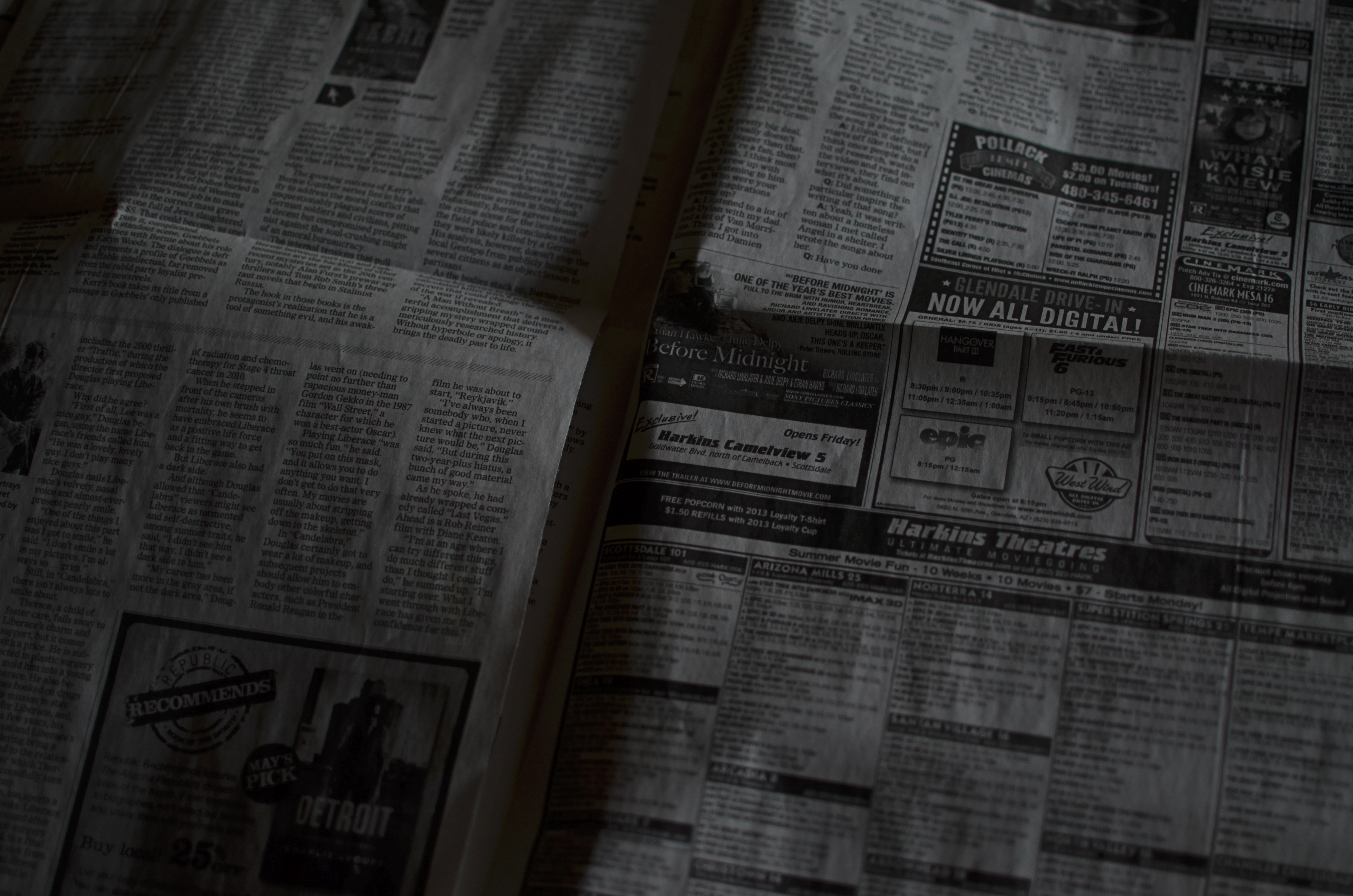
Dark Days for the printed page. 1/80 sec., f/1.8, ISO 100, 35mm.
By MICHAEL PERKINS
THE MOST ANNOYING COMMERCIAL ON TELEVISION AT PRESENT is the one from Apple reminding you that more people take pictures with the iPhone5 than with any other camera in the world. Now, I understand that The Men Who Would Be Steve at Apple need to assert their dominance in a rapidly accelerating race between smartphone camera brands. It’s just good business, and all that. Granting that, let’s agree that their statement is essentially meaningless for photography.
Apple can claim that their photo gadget is in more hands than anyone else’s? Ho-hum. The Kodak Brownie was able to make the same claim over 100 years ago, and successfully defend it for almost another fifty. We’re number one, sis-boom-bah, and what does that have to do with the kind of pictures that are being taken? The iPhone5 is a technical marvel on many levels, and it contains, among many other toys, a reasonably reliable, limited point-and-shoot-camera. You will always be able to get some kind of image on it under nearly any circumstances.
However, the Apple TV ad, while factually accurate, is artistically false, since it leads one to the spurious conclusion that more iPhone5 pictures means more excellent pictures. And there isn’t a camera, cheap or cherry, that can make that statement. I get just as agitated when trendo camera mags try to imply that if your gear costs thousands, your pictures will look like a million.
We’ve had almost two hundred years to shake off this childish notion. Equipment does not equal excellence. Convenience, speed, affordability, flexibility…cameras can make all these claims. But they do not confer the title of photographer on anyone.
Only you can do that.
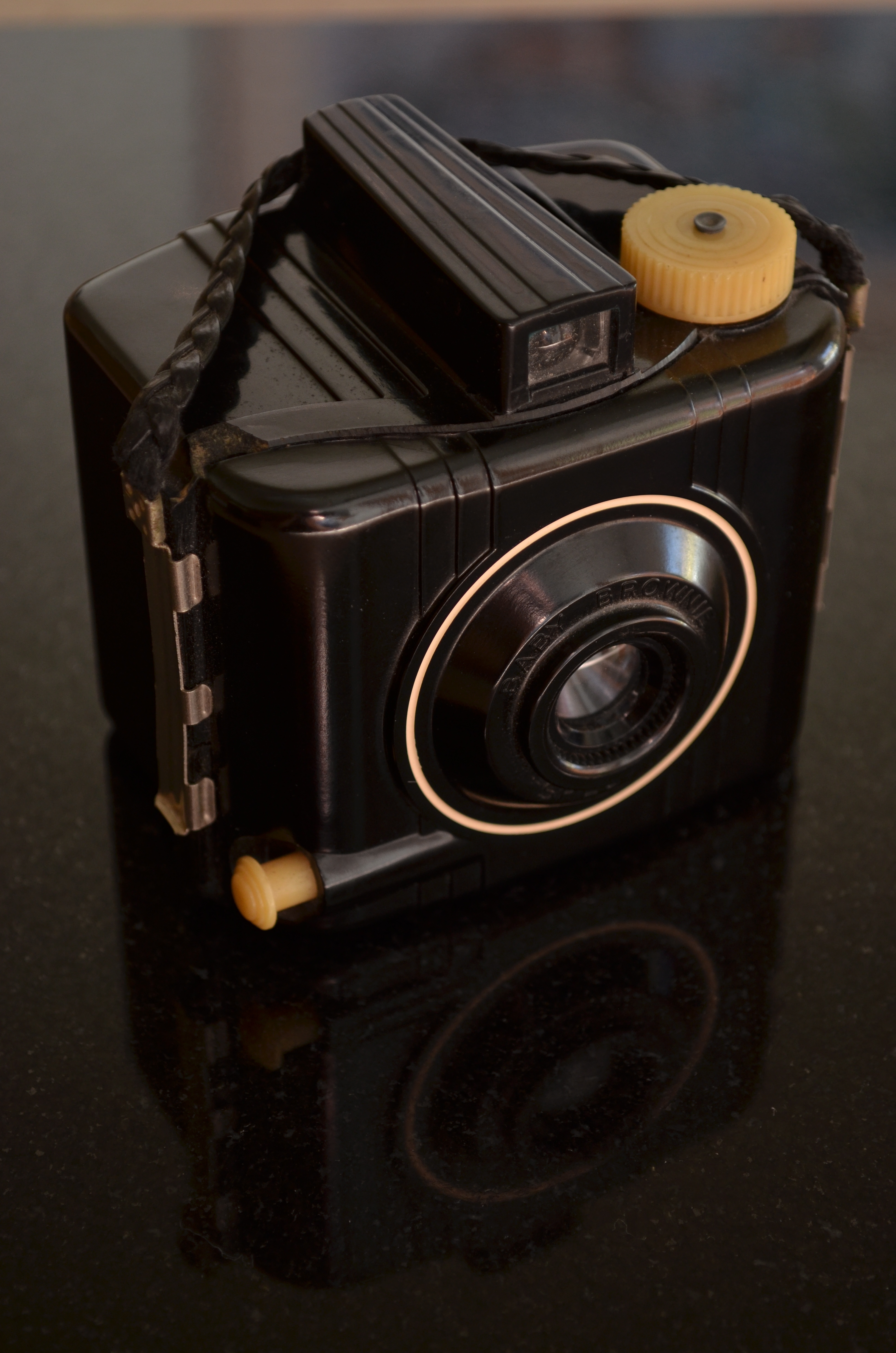
There used to be more of these than any other camera in the world, and so what?
And you can do it with a cheap piece of garbage, or a technical wonder, or any equipment stage in between. The idea is all. Everything else is just tinkering.
Here’s another piece of lunatic logic coming from another direction:
The idiotic recent decision of the Chicago Sun-Times to lay off all of its staff photographers, replacing them with freelancers (whom they will train on iPhones!), is not a lousy idea because there aren’t enough low-cost cameras out there to afford them some kind of coverage on their stories. It’s a lousy idea because it’s based on a flawed concept: the belief that photography is a universal skill, and that bystanders with smartphones are the equal of seasoned visual journalists, imbedded in their communities and schooled in its sources. They are not, and can never be.
Sadly,you can bet that editors across the nation are watching to see if the Sun-Times gets away with it. And they just might. Of course the quality of image reporting will take a hit, but since people are leaving the traditional newspaper as if it has leprosy anyway, will the customers know the difference? Look for this horrible move to be duplicated at a newspaper near you, since it’s (a) cheap, (b) easy to explain failure some other way, and (c) oh, yeah did I mention it’s cheap? Ironic sidebar: this is, officially the first time a newspaper has opted for less technology to become more competitive.
Expensive cameras and decent salaries are certainly no guarantee of good news coverage, but a staff loaded with veterans of wars, uprisings, elections, disasters and human interest is. The fact that several of them are Pulitzer Prize winners isn’t exactly a disqualifier, either.
You are the camera. You make the picture, regardless of the technology at hand. Forget that, and you might as well be holding a canned ham.
follow Michael Perkins on Twitter @MPnormaleye.com
Related articles
“SNAPSHOT” MOMENT, “SESSION” MINDSET
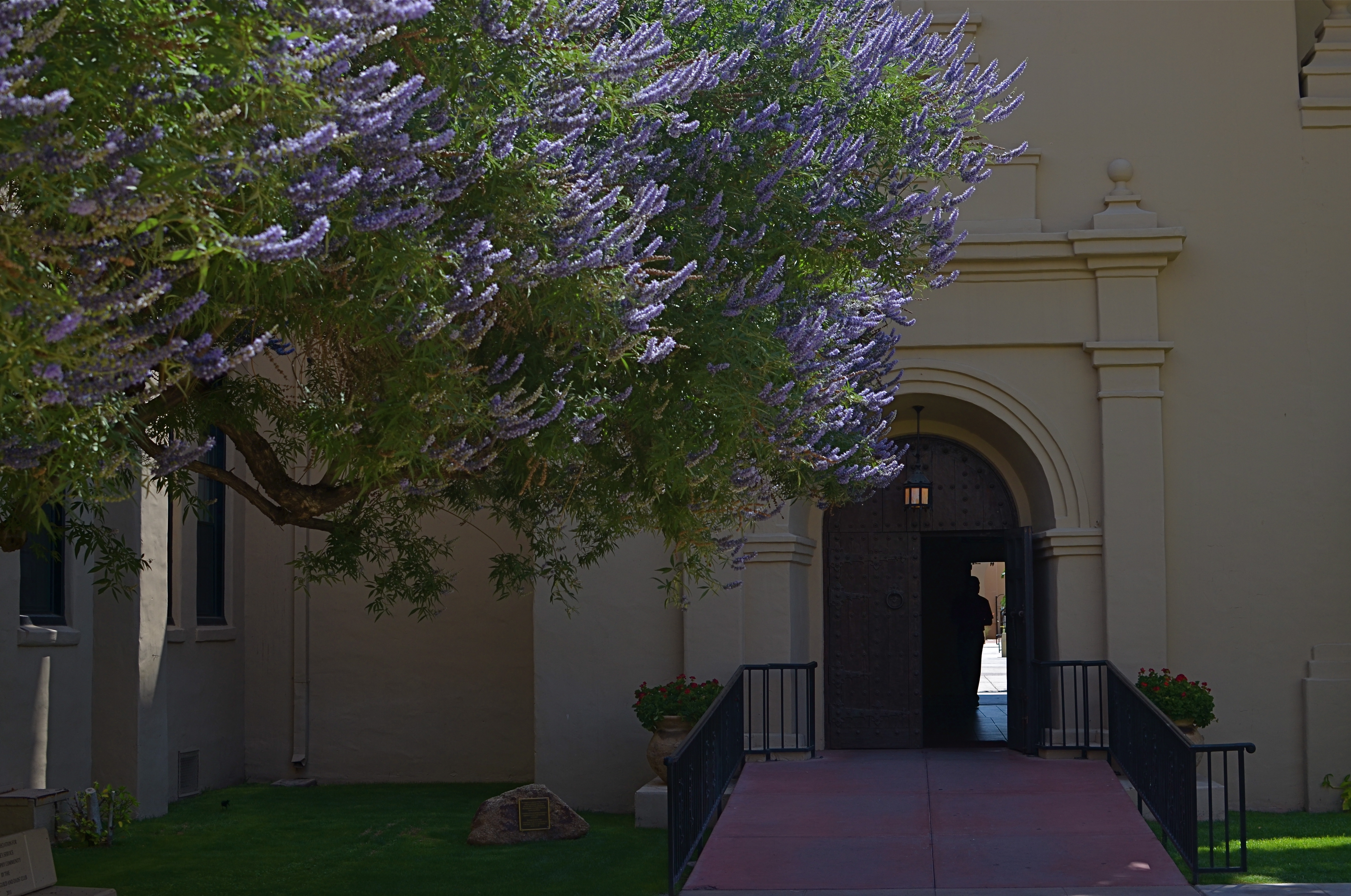
The light on the tree’s blossoms will be gone in three minutes. Best decision in the moment: slight underexposure to combat the mid-morning sun. 1/640 sec., f/5.6, ISO 100, 35mm.
By MICHAEL PERKINS
THE GREATEST ENEMY OF THE AMATEUR PHOTOGRAPHER IS TIME. Not the time spent perfecting our “eye”, nor the years invested in learning how to realize what we visualize. Sadly, the most tyrannical toll that time takes on us is in the meager number of moments in which we have to create most of our shots. Time…enough of it to work, to feel, and to act, is the only unbridgeable gap between ourselves and most of the pros.
I say “most” because some of the best photographers live absolutely in the moment, as in the case of imbedded journalists or sports shooters. No, what I’m talking about is the appointment that pros get to set for sessions, shoots that require set-up, tests, the issuance of permits, the re-routing of traffic. It’s not hard to see that a shooter for National Geo is at greater leisure planning his shot of a majestic waterfall than you are when your tour group is taking the tram from one Breathlessly Beautiful Natural Wonder to the next, all in time to rendezvous back at the terminal for a box lunch and precisely fifteen minutes in the gift shop. It’s not remarkable that millions of images are taken in Yellowstone each year. What’s amazing is that any of them work out.
Just saying.
Fact is, amateurs often can’t get the luxurious arrangements for creativity that are a given for the pros. And yet, since we don’t want our stuff to look like it was shot out the window at 55mph, we have to strive to combine the brief windows of our snapshot moments with the trained eye of a session mindset.
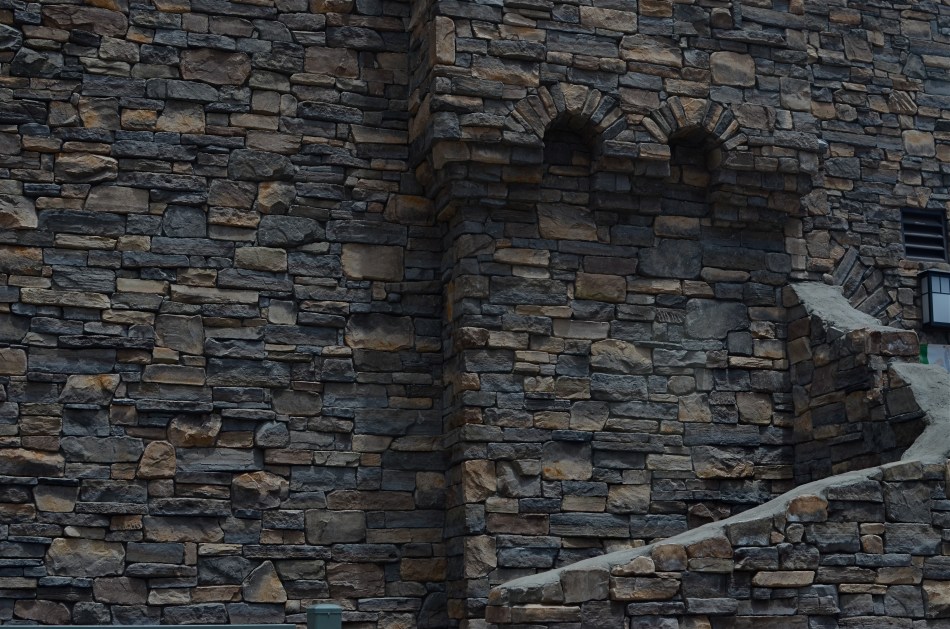
- Taken on pure impulse from a car as I was just about to drive off the property of this unique library. No planning except a fast exposure to give some depth to the stone textures. 1/640 sec., f/5.6, ISO 100, 35mm.
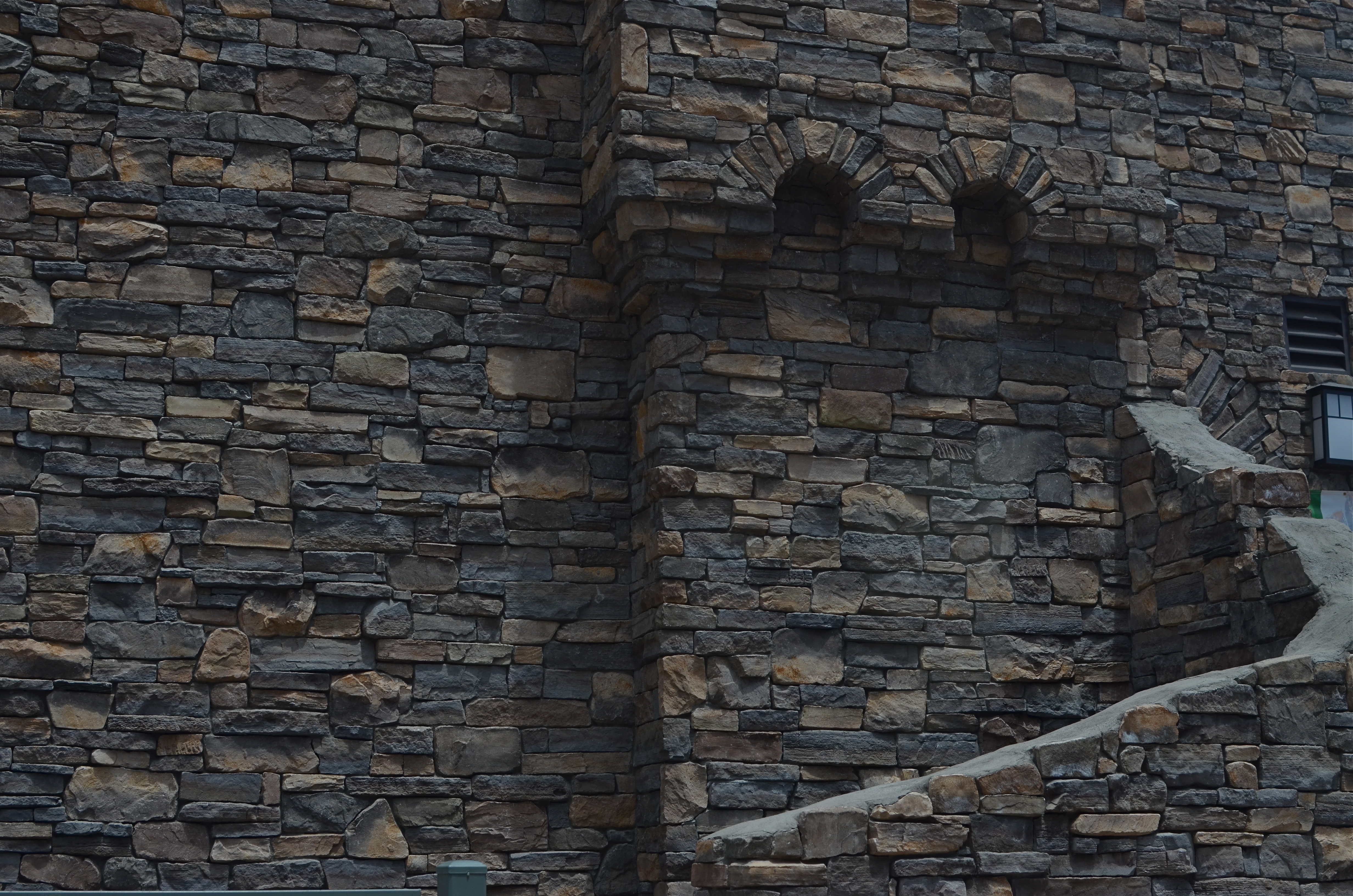
This is why it’s so important to always be shooting. Everyday. Good subject or bad. Great weather or lousy. Always. Because only the repetitive exercise of framing up and clicking off thousands of shots burns ways of seeing, ways of evaluating, into your brain, letting you make ever more complex calculations in increasingly shorter time. Shooting all the time speeds the arrival of the day when you can, in most cases, set and shoot and know that most of it will look intentional, done with some purpose in mind.
Repetition really is the best teacher, and the more direct control you take over your shooting, the more the universal laws emerge. At this focal length, certain things always happen. Under these lighting conditions, some things are always true. You’ll have your own truths, but, over time, they will be self-evident, because you will have faced these situations so many times that the essence of what you need for a shot will start to be as obvious as a glowing coal.
Time, or the lack of it, can rob us of the smart spontaneity we need in snapshot settings. However, the time we have invested learning how to shoot can give us a session mindset, and that affords us more control.
Are my snapshots better than anyone else’s? I doubt it. But over time, they are definitely better than my snapshots used to be.
Hey, I’ll take it.
follow Michael Perkins on Twitter @mpnormaleye
Related articles
- Snapshot (photography) (itscitrarizqinow.wordpress.com)
CONTAIN YOURSELF
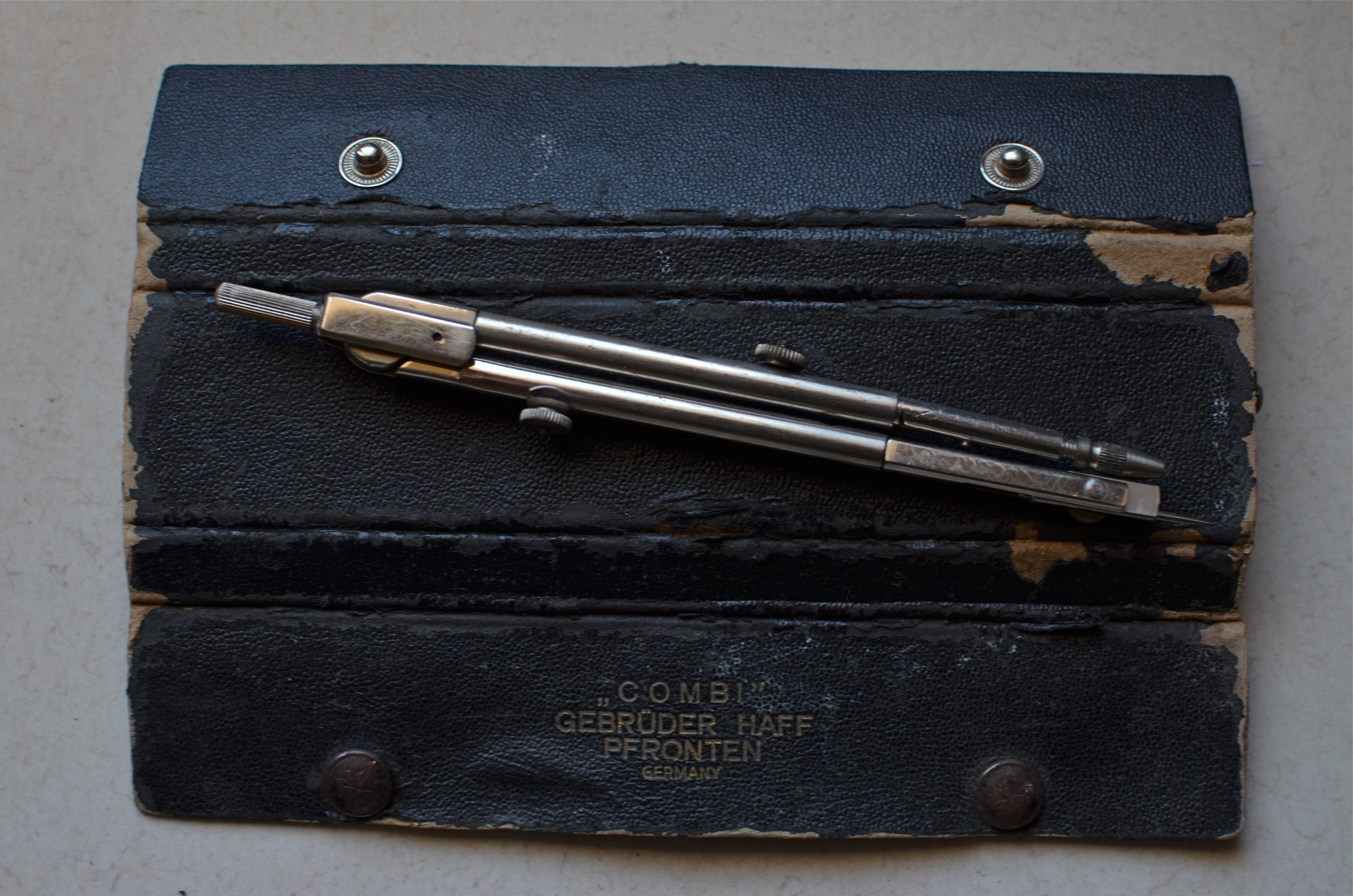
The Things They Carried: my wife’s father’s leather instrument case and compass. 1/60 sec., f/5.6, ISO 250, 35mm.
By MICHAEL PERKINS
WE LIVE IN AN AGE IN WHICH MOST OF OUR LIVES ARE EXHAUSTIVELY OVER-DOCUMENTED. We are, compared to our recent ancestors, photographically bitmapped from cradle to grave with a constellation of snaps that practically draw an outline around us and everything we do.
Globally, we will take more photographs in two minutes today than the entire world took over the entire 19th century.
That said, it’s amazing how few photos taken of, or by, us really look deeply into our souls, or whatever it is that animates us, makes us truly alive. It’s not that there aren’t enough pictures of us being taken: it’s how inarticulate so many of them are.
But go back just a generation or two, and observe the contrast. Far fewer images of most lives. And, with their increasing rarity or loss, more and more value attached to each and every one of those images that survives. Grandfather is gone, leaving only a handful of curled, cracked, and browning snapshots to mark his passing. But how rich the impact of those remaining pictures. The thirst for more, for a greatest number of clues to who this person was!
How to increase or deepen his spirit without having him here?
Explore the things he left behind. The tools he touched. The places where he invested his spirit, his aura. The parts of the world that he deemed important.
And I say: if you love someone, and have to let them go, use your camera to sniff around the found objects of their lives. It may not conjure them up like a holograph of Obi-Wan, but it will focus your thoughts about them in away which is nearly, well, visual.
I fell in love with the worn little instrument case you see at the top of this page. It belonged to my wife’s father, a man whose life was cut short by illness, a life under-represented in photographs. He made his living with his wits and with his hands. The compass which was carried in this case was a tool of survival, something he used to make his living, to measure out his skill and art. It’s a treasure to have it around to look at, and it’s a privilege to be able to photograph its worn corners, its tattered grain, its rusted buttons. Time has allowed it to speak, louder than its owner ever can, and to act as his visual proxy.
I’ve explored this theme in past posts, because I feel so strongly about the expressive power of things as emblems of lives. Long before our every action could be captured in an endless Facebook page of banal smartphone snaps, images had to work a lot harder, and say more. I’m not saying you should spend the next six months of your life raiding your closets for Ultimate Truth. I am saying you might be walking past a chunk of that Truth every day, and that it might just be worth framing up.
And thinking about.
(let’s help each other find amazing images! Follow Michael Perkins on Twitter @mpnormaleye.)
Related articles
- Behind the lens (theoriginalblogofthecentury.wordpress.com)
- Old Photographs Given New Life (modcloth.com)
 thenormaleye