TOOL OR TOY?
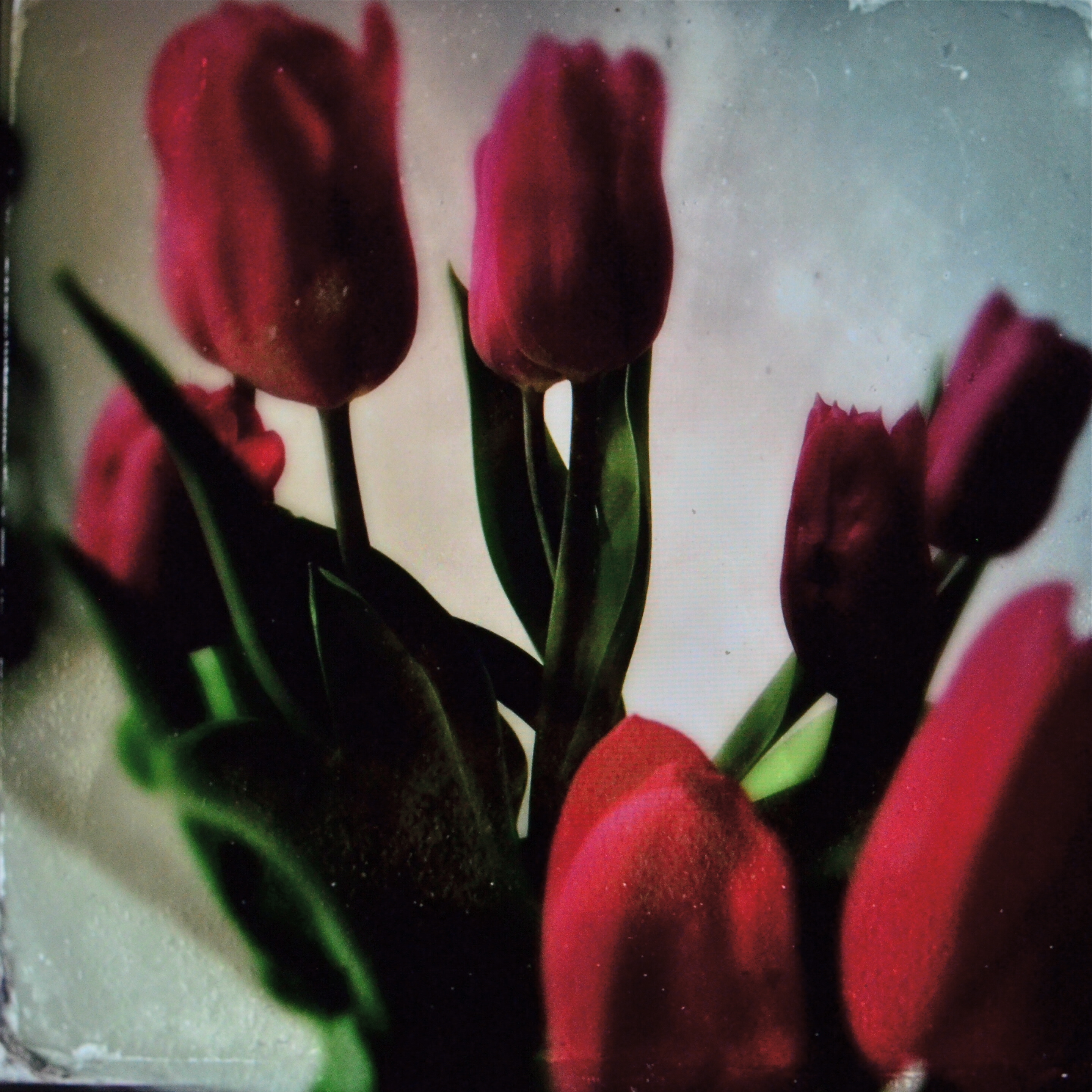
A cellphone shot modified with Hipstamatic’s dedicated “Tintype” app.
By MICHAEL PERKINS
GEORGE EASTMAN’S INTRODUCTION OF ROLL FILM onto the world camera market in 1884 became the biggest single factor in the mass popularization of photography. But it was not the first process to make pictures fast, easy, portable, or affordable. That honor must go to the humble tintype.
All of photography’s earliest processes were slow, inefficient in their use of light, and extremely perishable. Daguerreotypes, which recorded pictures as a positive developed on a chemically treated glass slide, created crisp, almost three-dimensional images, but they produced no negatives and were fragile, expensive one-of-a-kinds.Their long exposure times kept photography a prisoner of the studio, as well as pricing it out of the average person’s technical and financial reach.
The 1850’s saw the first appearance of the tintype, a process which recorded pictures on treated steel (no tin was ever used, ironically). This was something else again: itinerant shutterbugs at fairs and festivals could be trained to make them with a minimum of technical skill, and at a fraction of the time per exposure, with a finished portrait delivered to the customer within minutes. Better still for the tintype was its durability and portability. Thousands of servicemen posed for them before enlisting for the Civil War, and thousands more carried “counterfeits” of their sweethearts into battle. Tintypes became the everyman’s first personal photographic keepsake. They were Polaroids before Polaroid.
Like the daguerreotype, the tintype was irreplaceable, since it also produced no negative. Each image was also marked by its own visual tattoos, as uneven application of emulsion on the metal or surface irregularities in the plates”baking” errors into the pictures. Like diamonds, tintypes were beautiful partly because of their flaws: their imperfections lent them an unworldly quality, an unspoken time machine cue to the brain, an airy something that purely digital emulations have now brought back, as they have many other classic looks.
Hipstamatic, the most widespread lens and film simulator of the cell phone age, sells its own dedicated Tintype app, a cute faker that generates artificial plate grain, the random edges that occur with well-worn souvenirs, the random sharpness, even the option of decorating the conversion of your full-color original photo with the appearance of the hand-tinting of the early 1900’s. A useless toy? Perhaps, if all you do with it is to make a snap of your lunch look “retro”. But this is the world we live in: that which was once the leading edge of an art has become our plaything. Or, more precisely, tintype technique can only become either toy or tool, goldmine or gimmick, depending on whoever’s at the helm.
HAPPY-EN-STANCE
By MICHAEL PERKINS
IT’S FAIR TO SAY that photographers are occasionally the worst possible judges of what will save or spoil a picture. Try as we may to judiciously assemble the perfect composition, there are random forces afoot in the cosmos that make our vaunted “concepts” look like nothing more than lucky guesses. And that’s just the images that actually worked out.
All great public places have within them common spaces in which the shooter can safely trust to such luck, areas where the general cross-traffic of humanity guarantees at least a fatter crop of opportunity for happy marriages between passersby and props. At Boston’s elegant Isabella Stewart Gardner Museum, the surrounding walls of the central court are the main public collecting point, with hundreds of visitors framed daily by the arched windows and the architectural splendor of a re-imagined 15th-century Venetian palace. The couple seen here are but one of many pairings observable in a typical day.
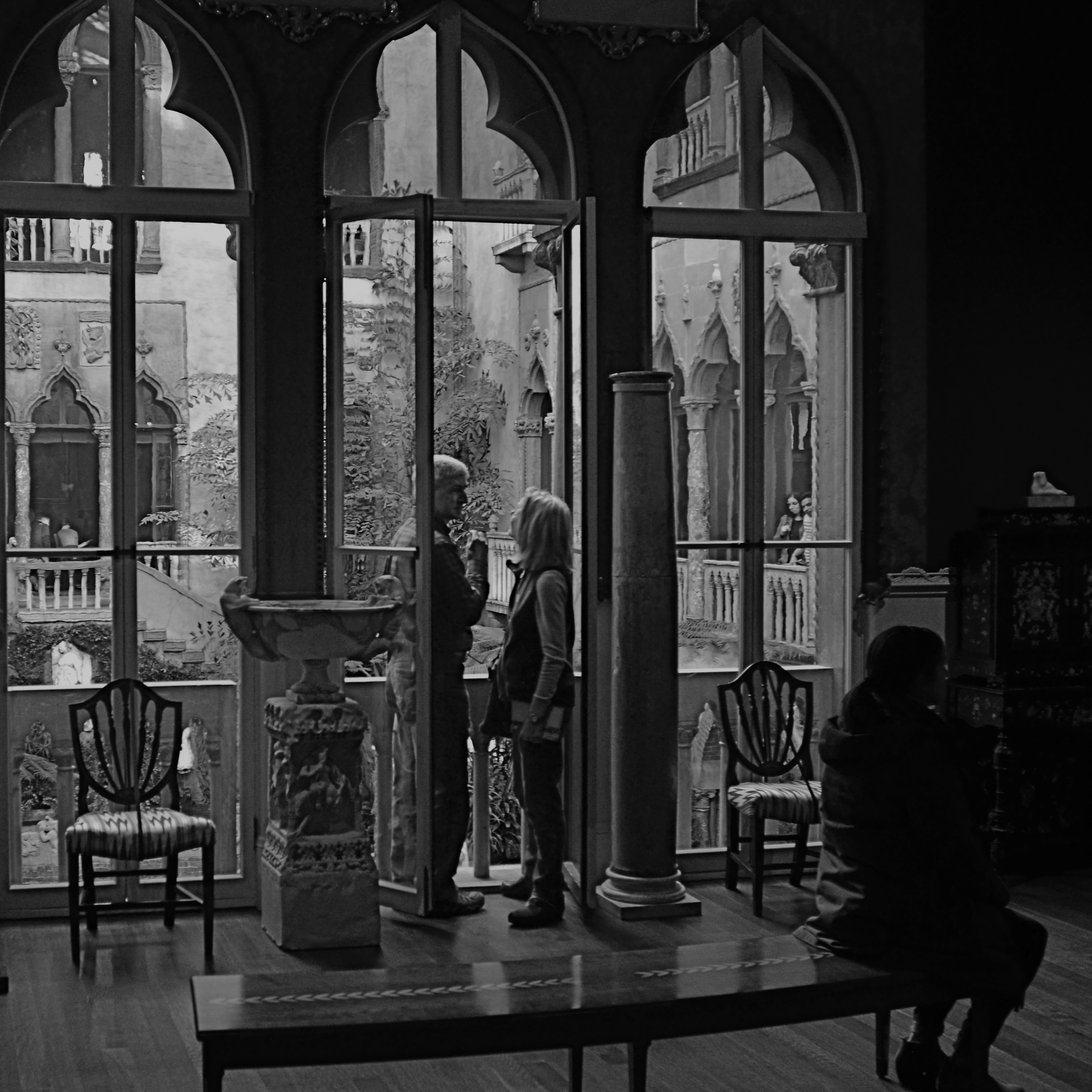
The pair just happens to come ready-made, with enough decent luck assembled in one frame for almost anyone to come away with a half-decent picture. The size contrast between the man and the woman, their face-to-face gaze, their balanced location in the middle arch of the window, and their harmony with the overall verticality of the frame seem to say “mission accomplished”. I don’t need to know their agenda: they could be reciting lines of Gibrhan to each other or discussing mortgage rates: visually, it doesn’t matter. At the last instant, however, the seated woman, in shadow just right of them, presents some mystery. Is she extraneous, i.e., a spoiler, or does she provide a subplot? In short, story-wise, do I need her?
I decide that I do. Just as it’s uncertain what the couple is discussing, it’s impossible to know if she’s overhearing something intimate and juicy, or just sitting taking a rest. And I like leaving all those questions open, so, in the picture she stays. Thus, what you see here is exactly one out of one frame(s) taken for the hell of it. Nothing was changed in post-production except a conversion to monochrome. Turns out that even the possibility of budding romance can’t survive the distraction of Mrs. Gardner’s amazing legacy seen in full color, and the mystery woman is even more tantalizing in B&W. Easy call.
As we said at the beginning, working with my own formal rules of composition, I could easily have concluded that my picture would be “ruined” by my shadowy extra. And, I believe now, I would have been wrong. As photographers, we try to look out for our own good, but may actually know next to nothing about what that truly is.
And then the fun begins….
HANDIWORK
By MICHAEL PERKINS
THERE ARE SEVERAL LANGUAGES OF HUMAN BEHAVIOR that are truly universal, experiential tongues for which no translation is neither possible nor necessary. The visual language of photography is one. Music is certainly another. Both have the ability to cross cultures, continents, and generations.
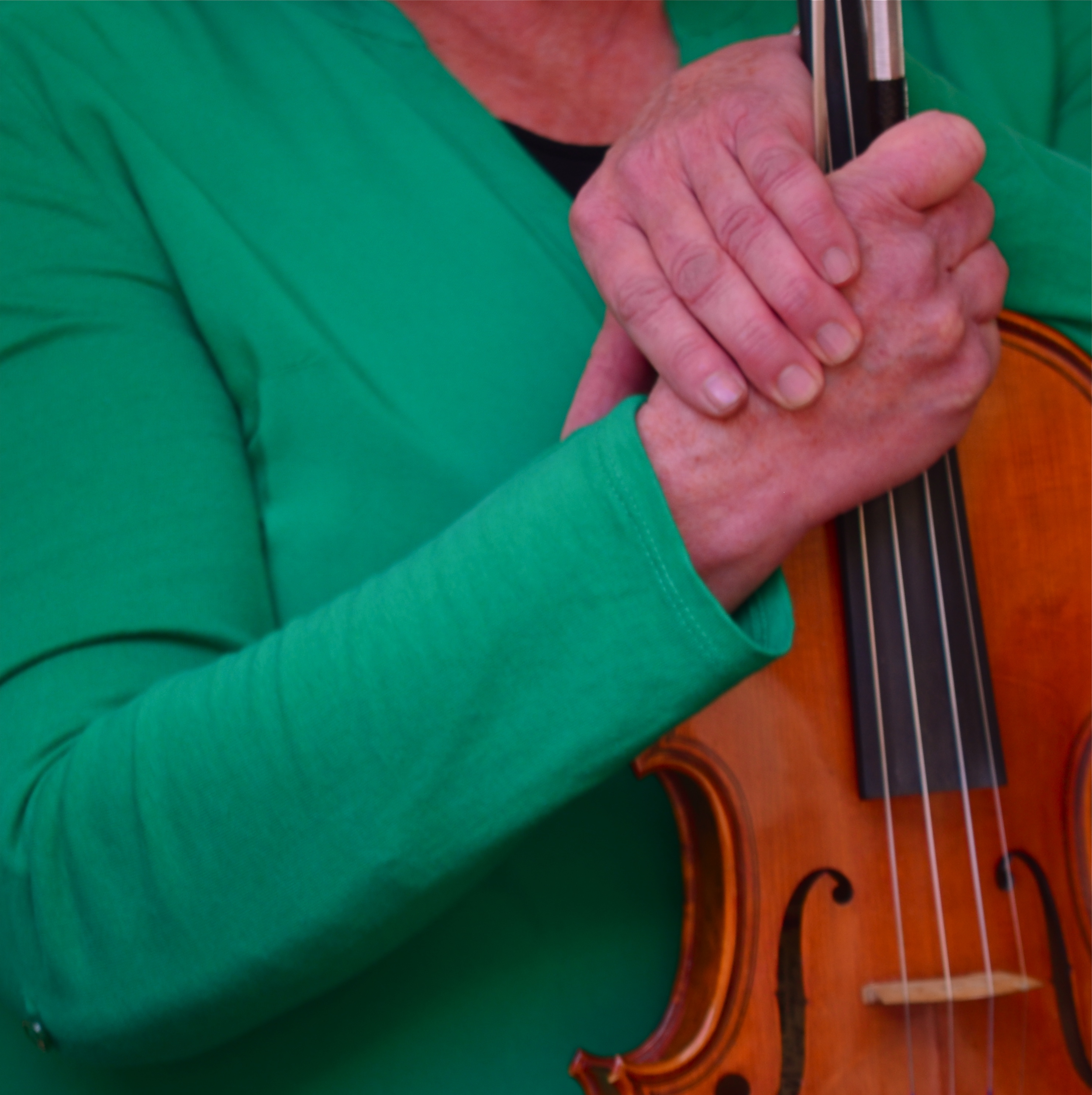
Almost since its arrival, the universal language of the visual has worked to capture the raw energy of the musical….attempting, even, to try to track that energy to its human source, the exact junction where the personality directs and guides the voice of the instrument. For some photographers, this energy is in the sweaty, furrowed brow of a Miles Davis, his lips laboring over a lyrical line in a dark club. For others, it may be the skyward arch of Jimi Hendrix’ wrist as it tears free from a Stratocaster. For me, the magic is in human hands.
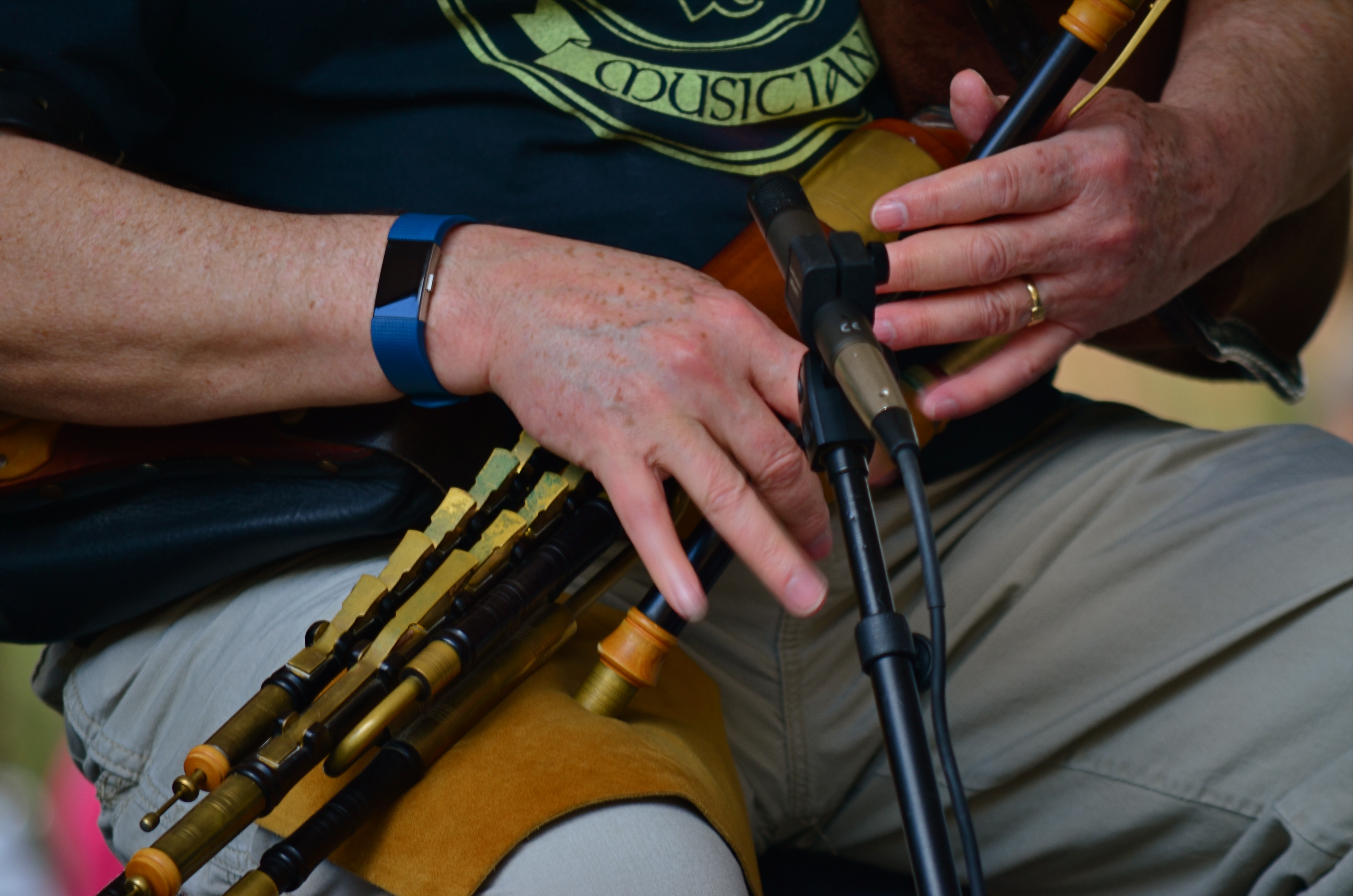
Hands are the tools through which musicians translate yet another language, that which starts in the brain and flows through to keys, pipes, buttons, strings. Fingers shape song, modify moods, and dictate terms to other musicians. They wield batons, transfer a composer’s wishes to paper. They signal, they hint. Hands are both the original maestros and the humblest servants of music. That qualifies them as wellsprings of visual drama, and where there is drama, there are pictures.
Of course, not all drama need be, well, dramatic. The unspoken linkage between musicians, even in small, simple gatherings such as the tight Irish quintet seen here, turns all those hands into a dance company: cues emerge: signals move from singer to soloist: and, if we’re lucky, photographs track all that transmission, that silent language, that unspoken eloquence.
CUES
By MICHAEL PERKINS
PHOTOGRAPHIC COMPOSITION is never the mere geographic assignment of elements within a frame. Certainly, mapping out what is to go up, down, left, or right in a picture is a vital part of the process, but you have to do more than rearrange the deck chairs. You also have to make real decisions about where the ship is sailing.
Aperture, focus, the use of light…..make up your own list of contributing factors… the assembly of a composition is about setting the terms of engagement between your vision and the eyes of the audience. It is never merely about the limits or contents within the frame. This means that a picture that you would shoot in a certain way today may seem completely out of synch with your thinking a year from now, because your idea of composition will (and should) be in constant flux.
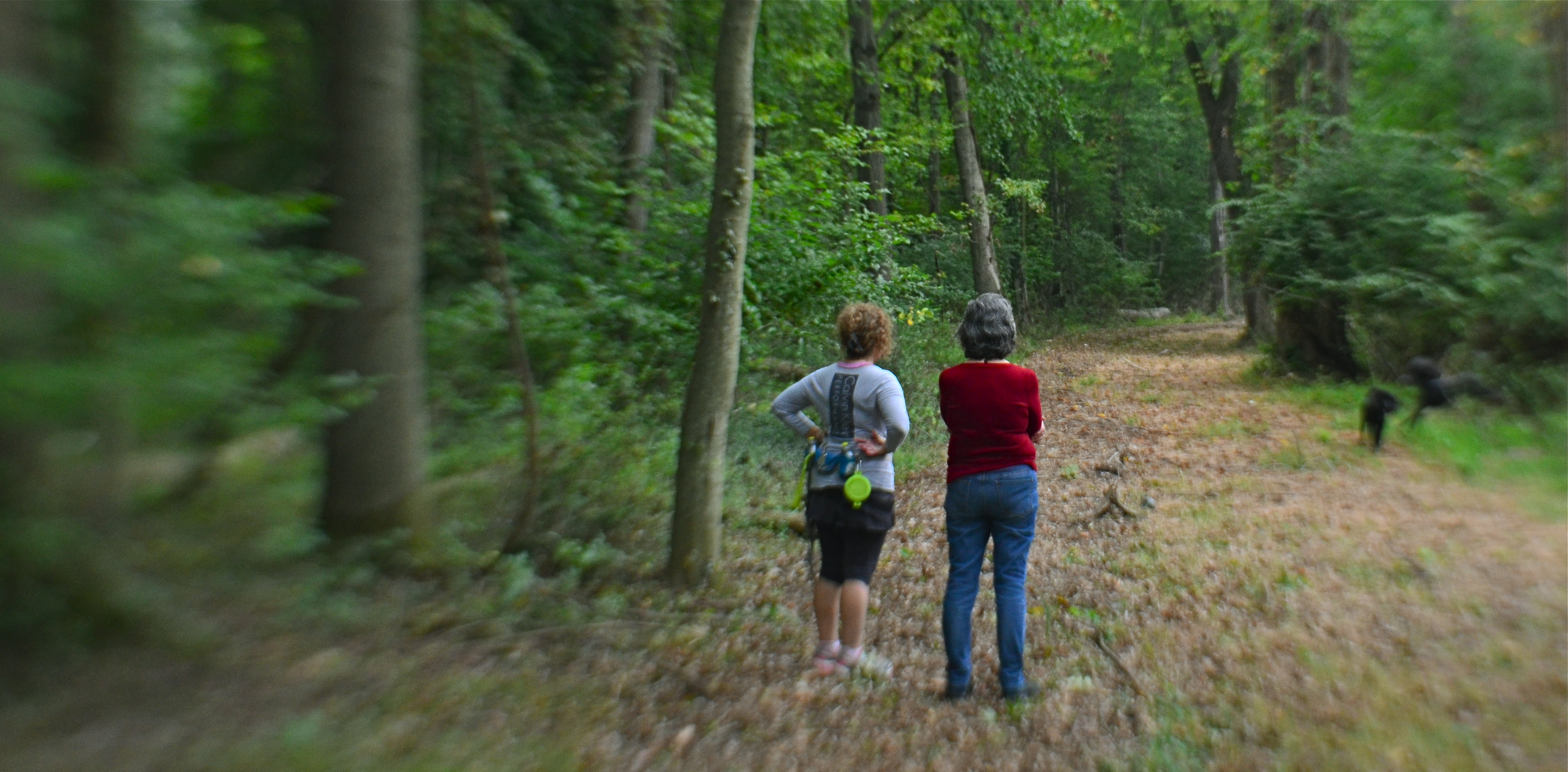
The Clearing (2016)
In my own case, I have spent a lot of the last five years re-evaluating focus, deciding in many more cases to use it selectively, where, previously, I might have applied it more evenly. This is an exploratory journey, and I am not sure where it will wind up. I don’t really feel as if I’m abandoning sharpness per se, just trying to decide how much of it I need in a given situation, making its use a lot more intentional choice than it has historically been for me.
Focus is a way of prioritizing the visual elements in a picture. It cues the audience as to what information there is and how hard to look to retrieve it. It also tells if there is no object or “mission” in a picture, as in a totally abstract arrangement. Photographer Uta Barth, describing why practically all of her work is deliberately refocused, notes that “the question, for me, is how I can make you more aware of your activity of looking. I value confusion…”
Indeed, placing incomplete information before a viewer, about focus or anything else in a photograph, is inviting him/her into an interaction…..with all parties having a conversation about what a picture means. For the viewer, it means exercising more control: for the photographer, who no longer has to spell everything out, it can be freeing.
ONE MOTIVE AT A TIME
By MICHAEL PERKINS
CROWDS ARE OFTEN DESCRIBED as if they were single entities, as if each member were acting in accord with all others, like cells combining to form an organ. Writers likewise use the word “crowd” as a kind of collective noun, as in “the crowd went wild” or ” the crowd grew restless”, again making it seem as if a collection of individuals can act as a single thing. Spend time in any crowd as a photographic observer, however, and it becomes obvious that there is virtually no such thing as group behavior. Everyone comes to a crowd separately, one motive, one agenda at a time, and photographers can begin to harvest real human stories by seeing them that way.
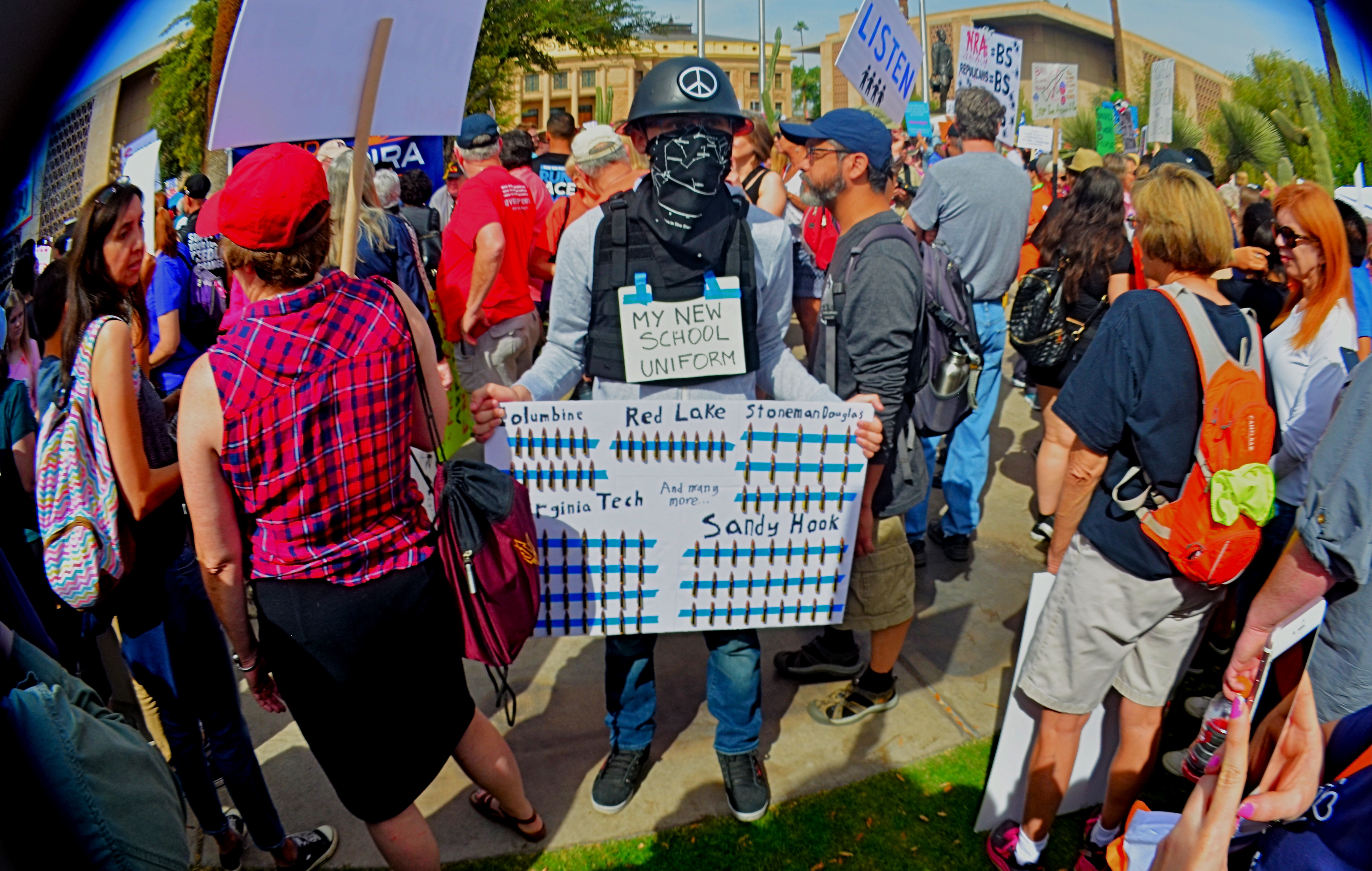
This person is not trying to be “part of the crowd“.
To be sure, there is scope and drama in making uber-pictures that convey the sheer size and scope of mass gatherings. Likewise, there are certainly moments when crowds seem to be moving or acting as one, as in the moment when the winning run is hit or a rousing orator evokes a roar of approval. But look carefully within those general waves of action and you will still see the individual proudly on display. By turns, he is, even in a crowd, engaged, irritated, enthusiastic, bored, tired, ecstatic, and angry, just as visibly as if he were in any other situation. Get close enough to a mass of people and you’ll see The Person…..perhaps attempting to be part of something larger than himself, but still pushing his own brand of street theatre, still brandishing his own quirks.
Demonstrations, parades, celebrations, protests….they’re all staging points for persons, persons who give up their stories to the photographer’s eye no less in a mob than in the family den. Wait for the moment when that happens and grab it. Teach yourself to look at a crowd and see the person who’s truly one in a million.
EVERYTHING IN ITS PLACE
By MICHAEL PERKINS
EVERY PHOTOGRAPH REMOVES SOMETHING from its original context, extracting it from its proper place in the world at large. In the act of placing things in a frame, the photographer excludes whatever else once surrounded that thing, so that, in the final result, a vast valley is reduced to one tree in one part of one meadow. Our mind stipulates to the supporting reality of whatever was extracted, and we either approve or disapprove of the shooter’s arbitrary editorial choice in composing the frame.
And so pictures often annihilate an object’s “origin story”, since we can’t often search them to view what something “came from”. Objects in a photograph merely are, with little obvious evidence of what they used to be. Sometimes that means that, when we do see where something originated, a picture of it can seem exotic or strange. And, as photographers, we can train ourselves to find that one view of a thing that has been, in effect, under-explored.
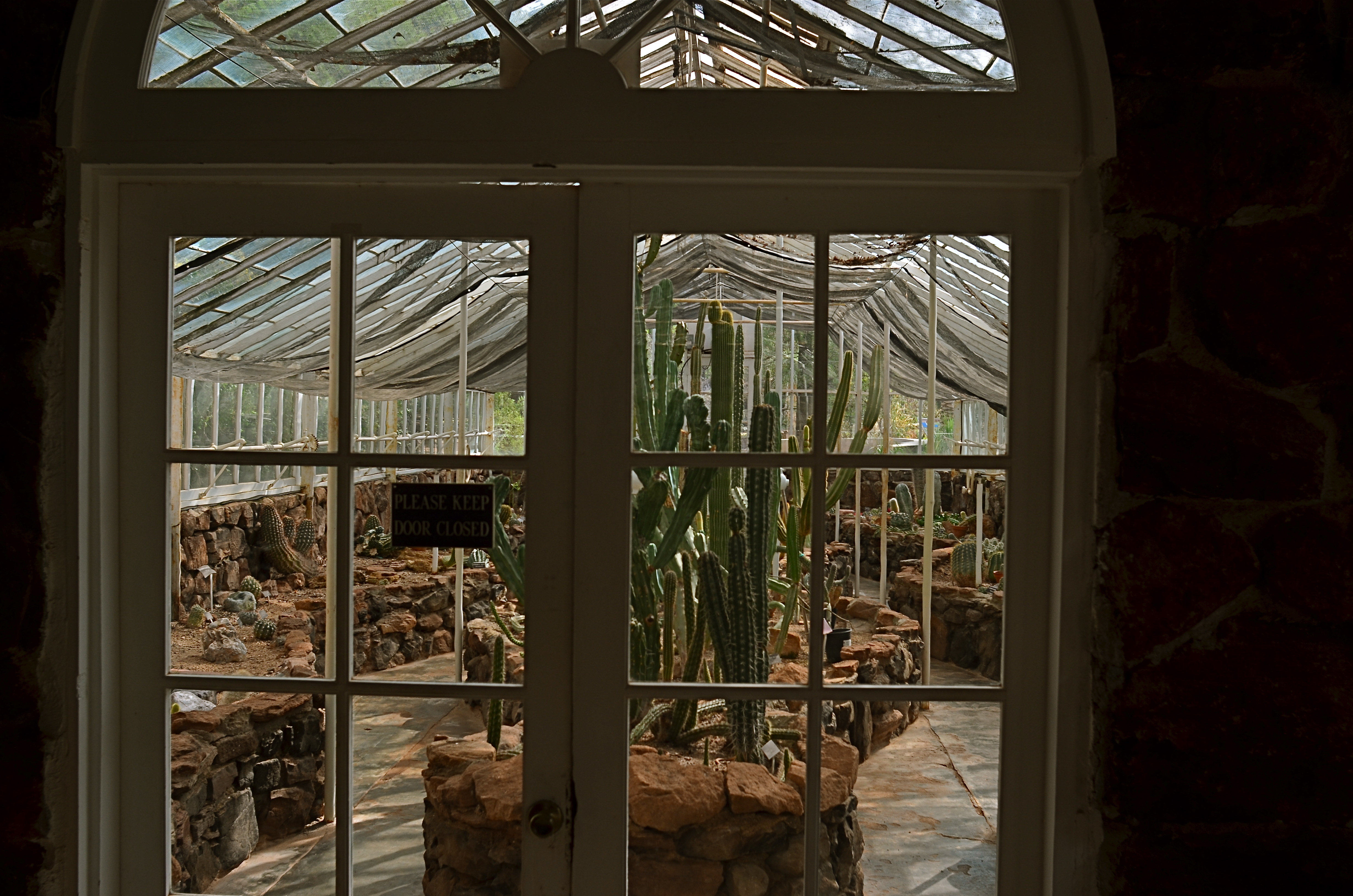
1/125 sec., f/5.6, ISO 100, 24mm.
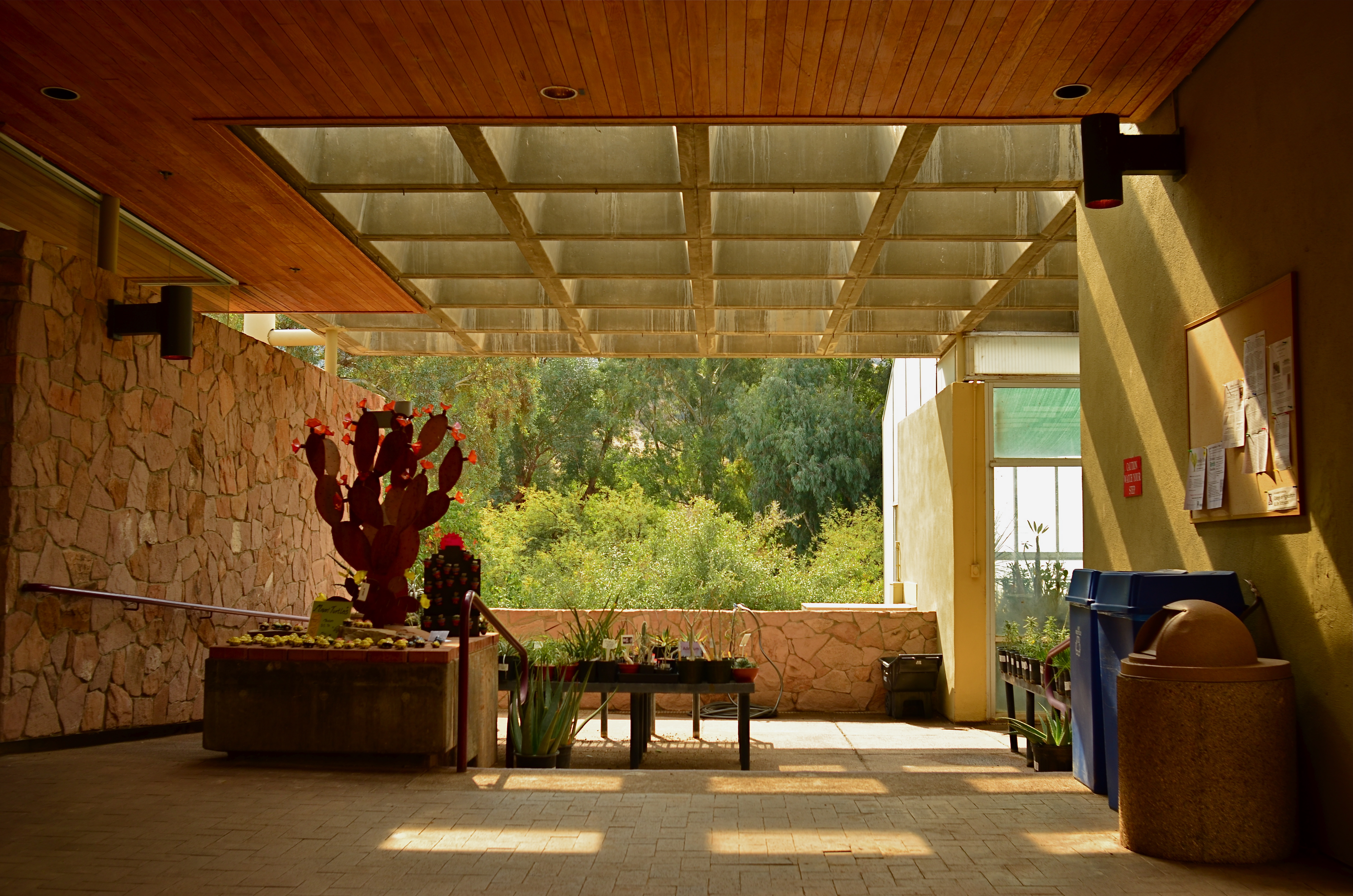
In the above picture, something that we tend to think of as being organically “born” in a natural setting (i.e., a cactus) is shown being deliberately farmed within a controlled environment (i.e., a greenhouse). It looks a little wrong, a bit strange…..certainly not typical. And yet, an interesting picture can be made from the scene, simply because we never see a cactus’ origin story, given that most photographs don’t select that story within their frames. This picture really doesn’t display its information in an original fashion: it’s the thing, in this particular context, that makes the photograph seem novel.
As always, the choices made inside and outside the frame of a photograph set the narrative for it. It’s therefore the most important choice a photographer can make.
STEP RIGHT UP
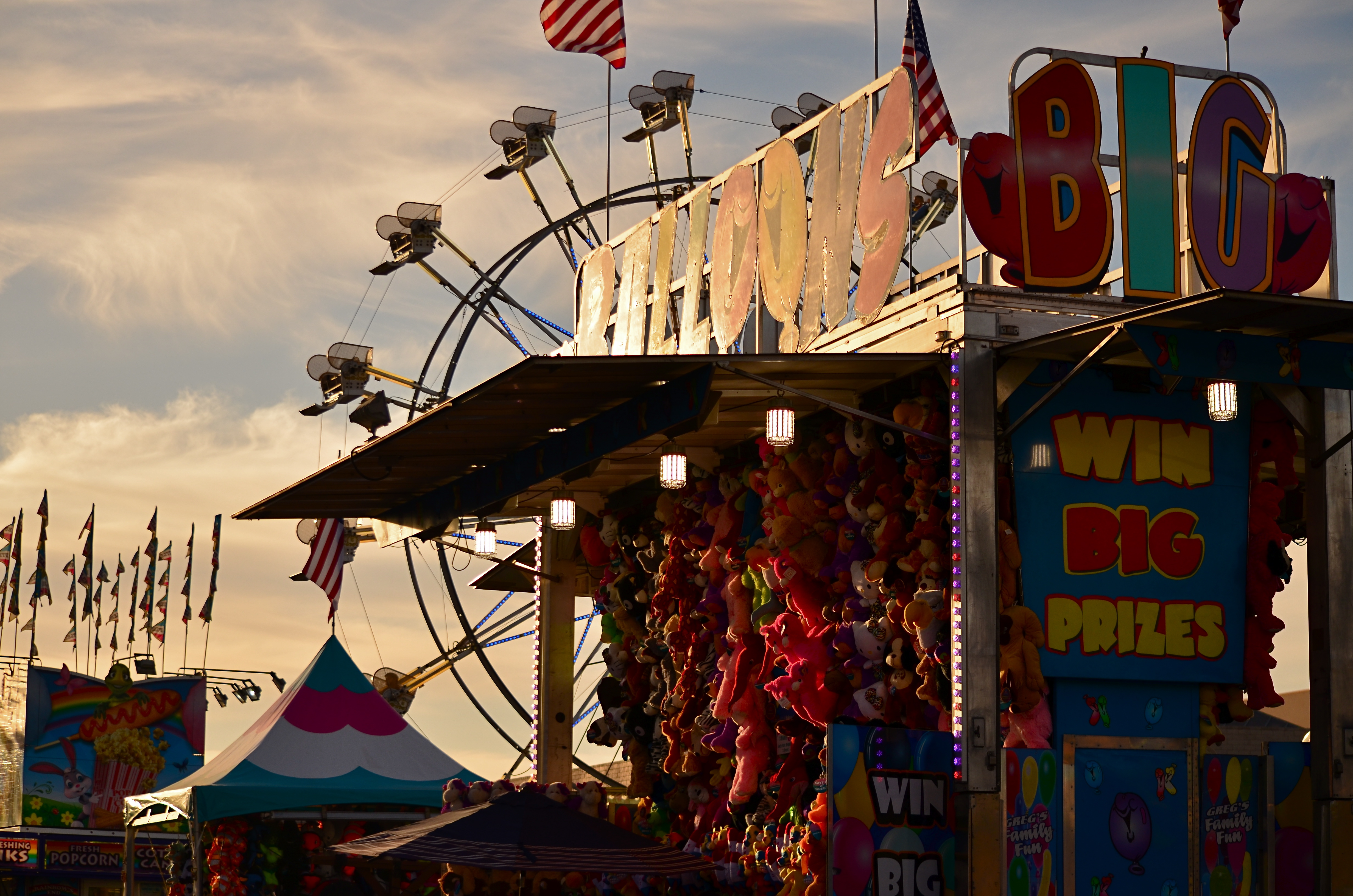
1/1250 sec., f/5, ISO 100, 55mm.
By MICHAEL PERKINS
PHOTOGRAPHY SHOULD ALWAYS OPERATE, at least to some extent, as a cultural mile marker, a chronicle of what time has taken away, a scrapbook of vanishings and extinctions. We make records. We bear witness. We take pictures of the comings and the goings.
One of the things that has been going, since the coming of the permanent, Disneyeque theme parks, those sanitized domains of well-regulated recreation, is the great American carnival, in all its gaudy and ever so slightly dodgy glory. Loud, crude and exotically disreputable, these neon and canvas gypsy camps of guilty pleasure once sprang up in fields and vacant lots across the nation, laden with the delicious allure of original sin, that is, if the first apple of Eden had been dipped in shiny red candy. We came, we saw, whe rode, we ate, we clicked off millions of snapshots on our Kodak Brownies.
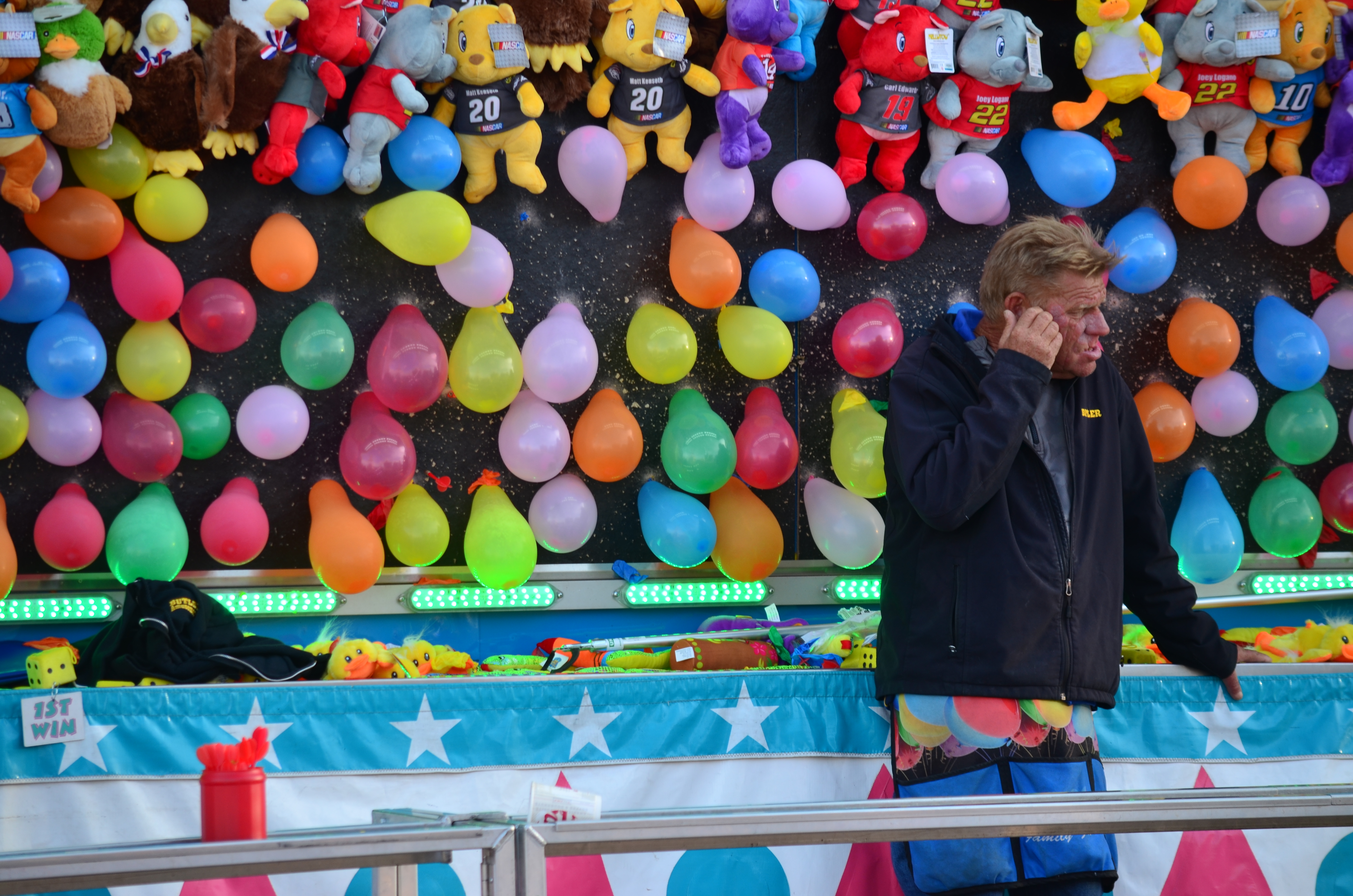
1/125 sec., f/5, ISO 100, 165mm.
The thing that made it all so magical was geography. Unlike Seven Flags or Cedar Point, the carnival came to us. Like the circus, the carnival was coming to your town, just down your block. That meant that your drab streets were transformed into wonderlands in the few hours it took for the roustabouts to assemble their gigantic erector sets into rickety Ferris wheels and Tilt-a-Whirls. And then there was the faint whiff of danger, with rides that made dads ask “is this thing safe?” and crews that made moms repeat horrific tales of what happens to Little Children Who Talk To Strangers.
It was heaven.
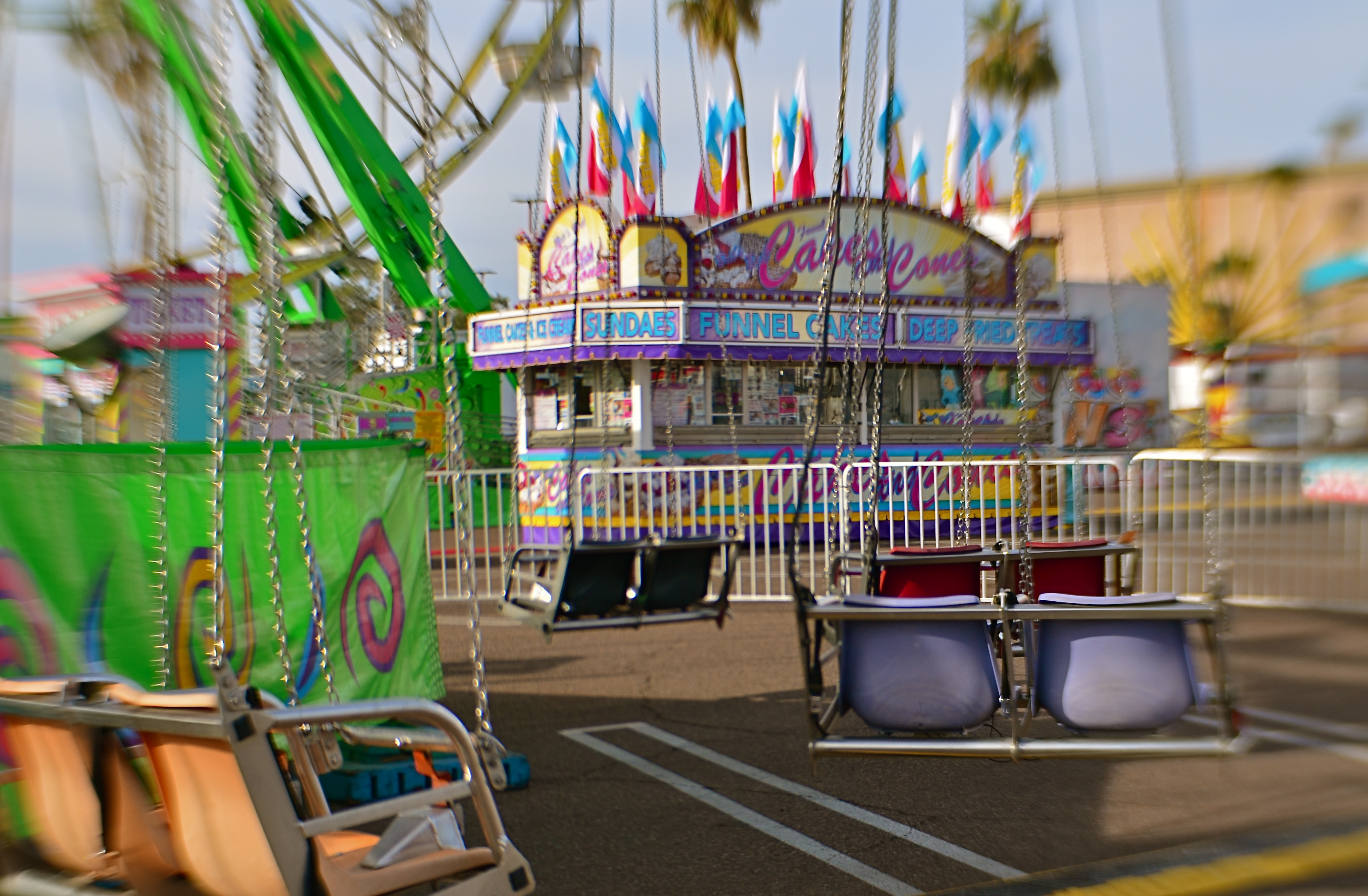
1/250 sec., f/5.6, ISO 100, 35mm.
The images seen here are a partial return to that sketchy paradise, with the arrival in my neighborhood, this week of a carnival in an area that hasn’t hosted one in well over a decade. It’s almost as if Professor Marvel just ballooned in from Oz, or Doc and Marty had suddenly materialized in the DeLorean. It’s that weird. Four days in, and I’m there with a different lens each time, sopping up as much trashy delight as I can before the entire mirage folds and all our lives return to, God help us, normal. Photographs are never a substitute for reality, any more than a hoof print is a horse. But when dreams re-appear, however fleetingly, well past their historical sell-by date, well, I’ll settle for a few swiftly stolen souvenirs.
PHASES AND STAGES
By MICHAEL PERKINS
MORE INK HAS BEEN POURED OUT about Henri Cartier-Bresson’s notion of “the decisive moment” than perhaps any other chunk of photographic philosophy ever hashed out between honest brokers. HCB’s assertion was, essentially, that there is a single, ideal instant in which a picture of something will be, like an apple, perfect for the plucking. Miss that moment, and all is lost.
While some applaud this theory as holy scripture, others dismiss it with a vulgar reference to bovine by-products. All well and good. Everyone needs to evolve a belief system that drives their personal photographic vision. The important thing is to evolve something.
Personally, while I don’t believe there is only a single moment that will make an image immortal, I also don’t think that just any moment you choose to freeze an event is as good as every other moment. Conditions, timing and decisions matter in the making of a picture, and, when they intersect, the magic happens.
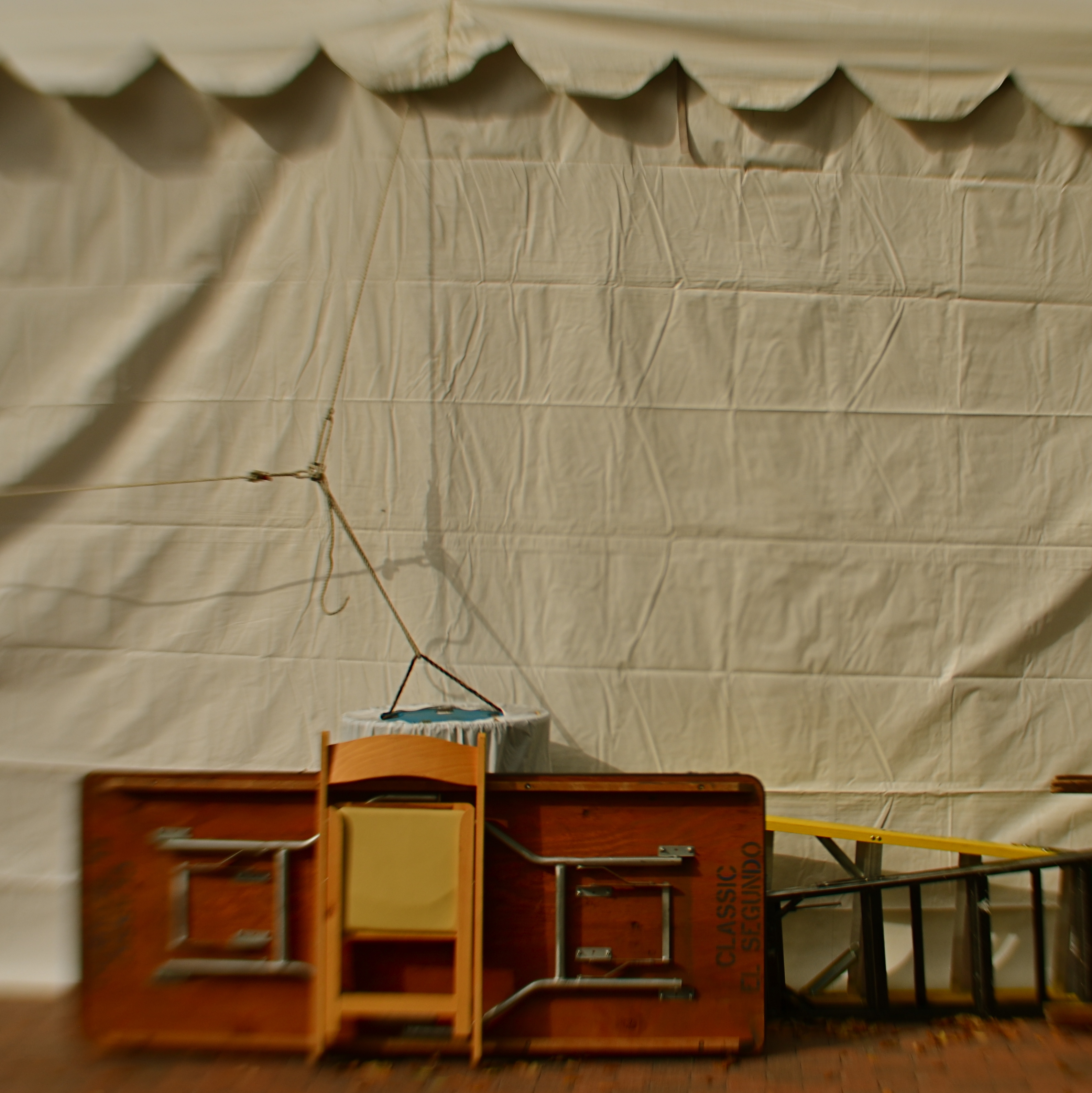
Backstage, 2018. 1/400 sec., f/5.6, ISO 100, 35mm
So the number of “decisive moments” for an event, for me, would number about three. Think of them as acts in a play, each act performing a distinct element in a dramatic story. Act One shows things that are about to happen: a nearly blooming blossom: the minutes before street lights are turned on for the evening. Act Two depicts something that is in the process of occurring: candles on a cake being blown out: a pistol shot. And Act Three shows where things have now completed. A concert crowd leaves the theatre: a dog snoozes after a long day of play.
The image seen here can potentially be an example of any of the three acts. Are the backstage props being spread out in anticipation of a show? Is the performance, unseen from this angle, being given right now? Or have the stage hands already begun to strike the tents and gather everything up before moving the players on to the next town? All three interpretations are of specific places in time. And all can be “decisive moments” when the right bond between photographer and viewer is established.
BRIGHTER IS BETTER
By MICHAEL PERKINS
JUST BECAUSE SOMETHING IS GLIB OR SIMPLE doesn’t mean it’s not true. We tire of people’s pet platitudes because saying things like “get a good night’s sleep” or “honesty is the best policy” seems too easy, as if the wisdom contained in these time-worn axioms must have dried up years ago. So when I tell you something extremely “well, duh!” about photography, it won’t sound wise or profound. It will sound like something any simpleton knows. Obvious. Goes without saying. And yet..
So, here’s my one immutable truth about making pictures:
Get enough light, and you will have solved 99% of any problems that bedevil your photos.
There’ll be a brief pause here for the crowd to collectively roll its eyes.
And before we proceed further, I’m speaking primarily of natural, organic, comes-through-the-window-like-God’s-gift-to-the-world light. Most of what you do with artificial light has to do with compensating and correcting for the fundamental wrongness of the stuff. Yes, I know you have an incredible flash set-up. I don’t care.
Buy the most voraciously light–hungry lenses you can afford.
Light is the only factor in photography that determines the efficacy of every other factor. Every major advancement in the design of lenses, recording media, and camera mechanics has been made for the sole purpose of gathering and utilizing more of it. Light alone can control how a subject is modeled, highlighted, presented. Get enough of it, and you shoot faster and simpler. Learn to shape it and you also learn how to create drama, to compose, to characterize things in precisely the way your mind has visualized them.
Light controls texture. It makes a shot either muted or loud. It can create the sensation of any moment of the day or night. It directs the eye. It makes bad lenses better and good lenses great. And, speaking of lenses, the best money you can spend on any lens, anywhere, is on how fast, how light-hungry it is. All other functions of high-tech optics aren’t worth a bucket of spit if the things can’t deliver lots of light in a hurry. Forget about chromatic aberration, vignetting and all the other headaches associated with glass: get enough light and you’re halfway home.
Most importantly, light is the only element in photography that is literally its own subject. A wonderful image can be of light, about light, because of light. So before you get good at anything else in the making of pictures, learn to gather light efficiently, mold it to your will, and serve it. Every other boat in your optical harbor will be lifted in the process.
A SUPERIOR DAY
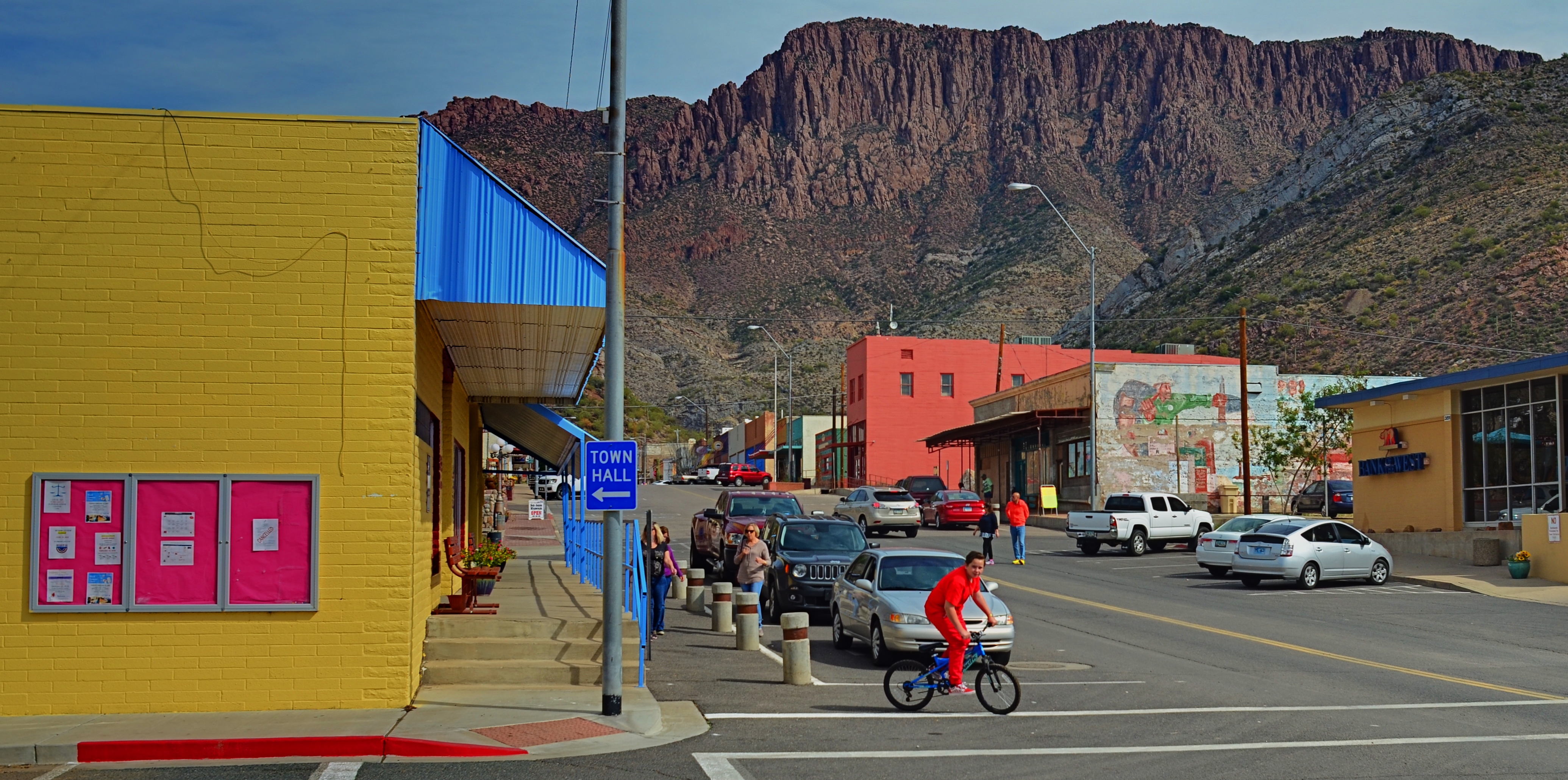
Downtown Superior, Arizona, February, 2018
By MICHAEL PERKINS
LIKE MANY TOWNS in the American southwest, Superior, Arizona sprung up in the nineteenth century primarily to get people close to something promising that Nature had already parked in the local dirt. So long as that something gushed up, flashed in a prospector’s pan or helped light or heat something, the towns flourished….. boomed, as the term goes.
Until they didn’t.
In the case of Superior (2010 census population 2,837), the silver that anchored the locals to the grim crags of the Superstitions mountain range tumbled in value when the metal lost its status as the backing for the American dollar in 1893. Fortunately, Superior had a second act, rebounding with the discovery of copper in the same area where silver had been mined. And then, of course, Hollywood came calling, seeking a visual taste of the Real Old West. Superior rose yet again, standing in for yesteryear in the films How The West Was Won, Blind Justice, and The Gauntlet, among many others. And the beat goes on; as recently as the 1990’s, yet another copper mining company hooked Superior up to yet one more source of life support. And how’s your hometown?
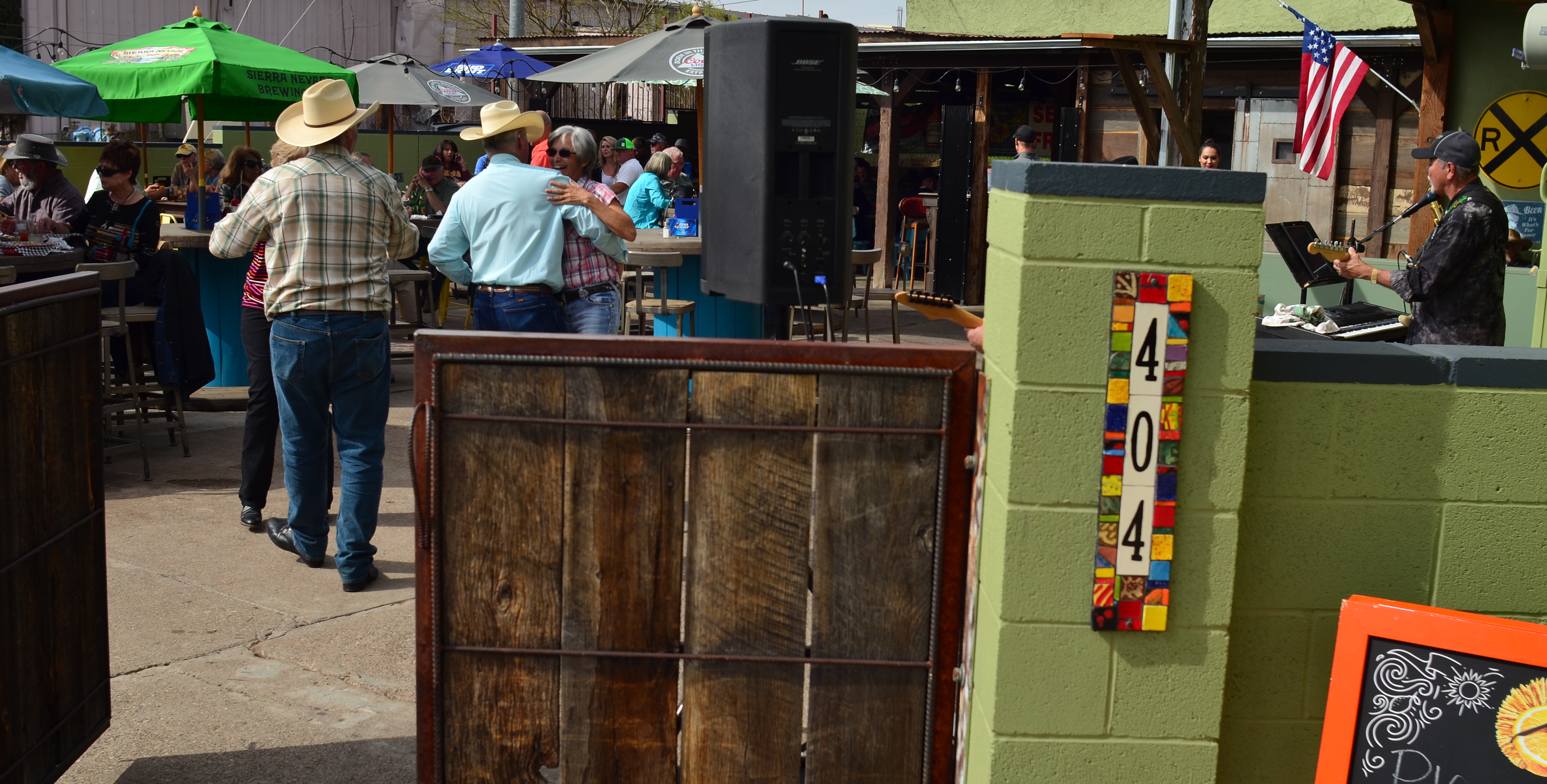
Saturday afternoon in Superior: everyone dance.
Even so, a photographer looking to take Superior’s pulse in the twenty-teens is well advised to look a little deeper than the shopworn storefronts of the main street, heavy with thrift shops and antique stores but also alive with hot pastels and the twang of Saturday afternoon dance music, complete with Stetsons and cold longnecks. The town is rusty and dusty down to its toenails, pressed up against gritty stone peaks, but it is still brave at the corners of its mouth. As a place that is “a fur piece” from Phoenix and a hoot and a holler from Globe, Superior is more mile marker than actual destination, but it is still standing, still smiling for the camera.
And, who knows, things could change.
They always have before….
CHECK THOSE ABS
By MICHAEL PERKINS
IT SEEMS ODD to hear someone refer to part of their photographic output as “abstract”…..as if the rest of their work somehow isn’t. I guess it depends on what you believe the word ” abstract” means, as well as what is meant by other words like, say, “reality”. For me , the whole discussion seems overthought. To my mind, all photography, all art is “abstract”.
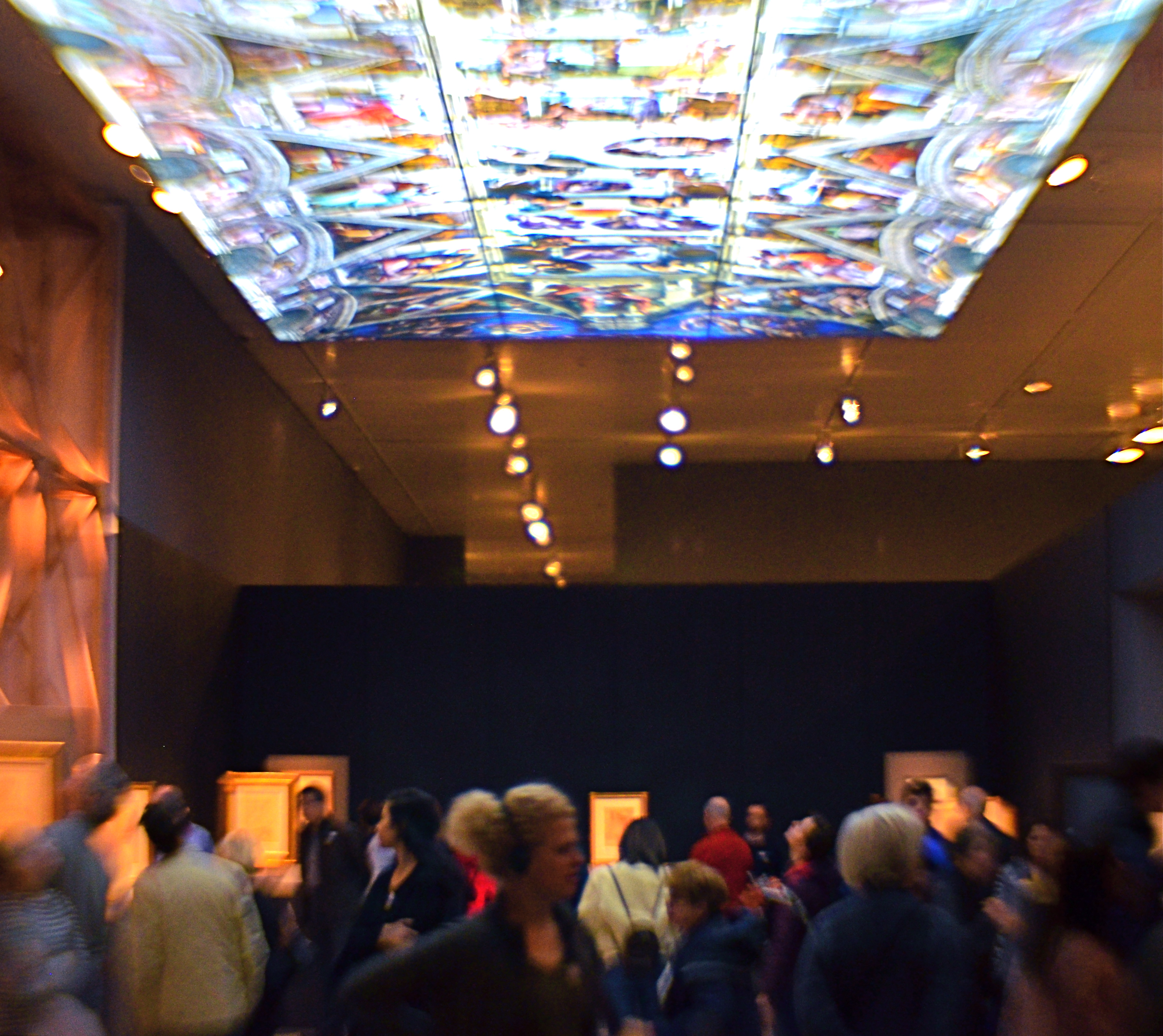 To abstract something is to extract it from its original context, to re-frame it, take it from one form and paste it into another. And there is no way not to do that with a photograph. We don’t show reality. We show shards, fragments, selectively sliced slivers of time. Even if we take great care to take a no-frills, documentary approach to the recording of an image, once we click the shutter, we have abstracted that moment from reality, making an editorial choice to pluck away this instant versus all others.
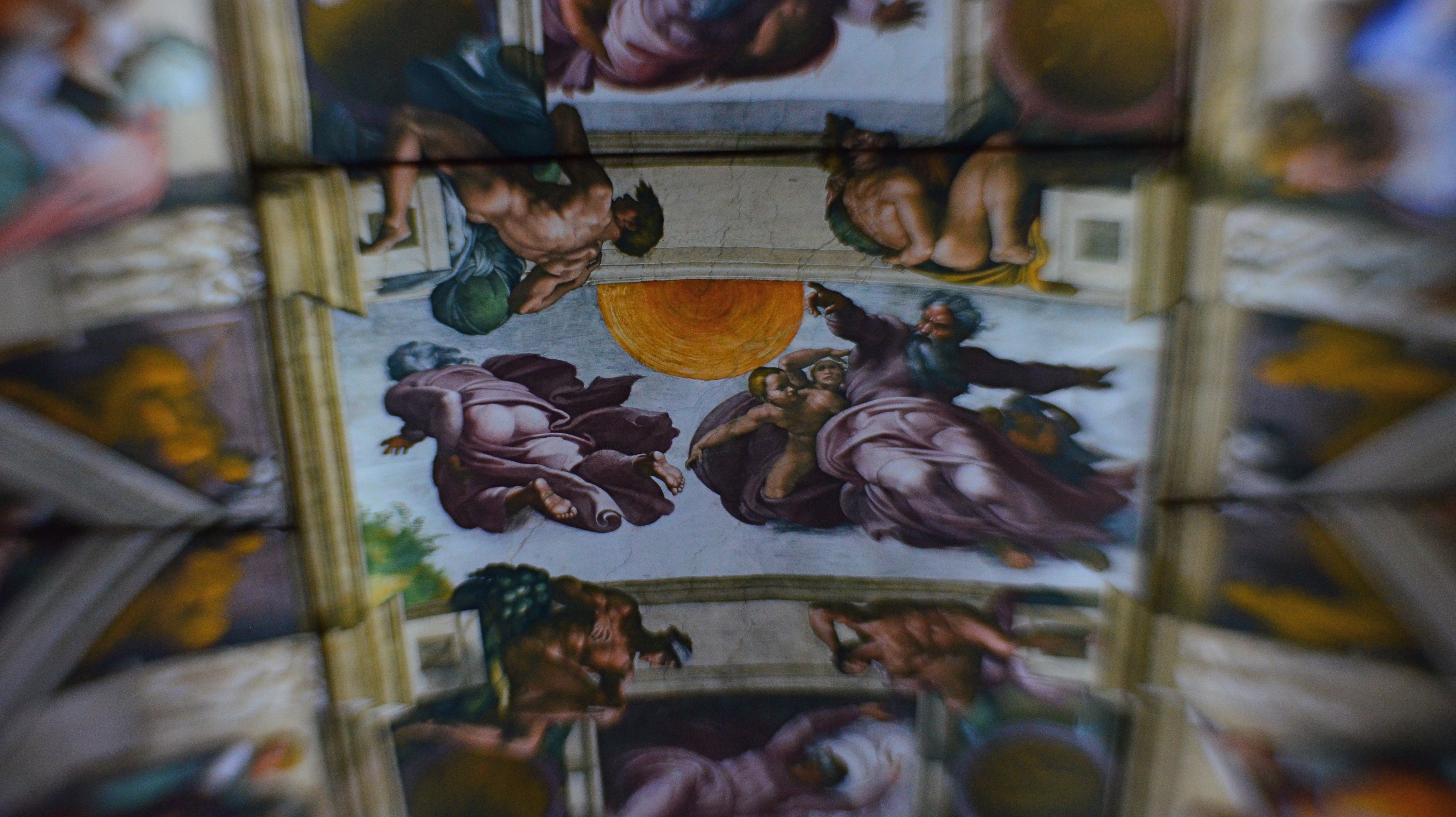
One way to illustrate this process is to consider the image at the top of the page, which represents a virtually endless chain of abstraction. Thinking backwards from this photo of a museum exhibit:
In the beginning, God creates man, an abstraction of himself. Then Michelangelo creates an abstraction of God (and a lot of other Biblical superstars) by depicting Him in the act of creation, even as he (the painter) is also abstracting representations of the Creator’s creatures. Centuries later, art historians take selective pictures of Michelangelo’s massive abstractions on the ceiling of the Sistine Chapel, abstracting them further by using selected excerpts as book illustrations. Inspired by those books, curators in Manhattan create an exhibit honoring Michelangelo’s ceiling by reproducing it as a miniature, assembling a replica composed of dozens of backlit transparencies suspended over guests at the Metropolitan museum in an artificial abstraction of the original Sistine frescoes. Finally, using a selective-focus art lens in 2017, I abstract those same guests to blobby smears of color and make editorial choices about which single panel in the faux-ceiling exhibit to shoot in sharp focus, thus hinting that it’s somehow more important than all the others.
Photographs snatch away parts of the real. To use a camera is to abstract that reality. Every snap of the shutter is a calculation of choice. Therefore choose wisely.
THE COWGIRL IN THE BLEACHERS
By MICHAEL PERKINS
I AM NEVER TRULY COMFORTABLE working with a camera that isn’t physically locked onto my eye. Shooting without a viewfinder was, for me, perhaps the hardest part of gradually embracing cel photography, and continues to be a control issue that still inclines me toward my Nikons most of the time. Part of it, I freely admit, is mere sentimental habit……maybe even, who knows, superstition?…..and yet when I’m crammed up against that little square of glass, I feel as if I’m “really” taking a picture.
That’s why it’s really a rare bird for me to “shoot from the hip” with a DSLR, to try to sneak a street candid without my camera anywhere near my face at all, holding the thing at mid-chest or waist level or even squeezing off a frame while it’s hanging from my shoulder. If the opportunity is literally too juicy to resist, and if looking like a (gasp) photographer will spook my quarry (or get a Coke thrown in my face), well, then, desperate times call for desperate measures.
I arrived at such a “desperate times” moment the other day by being caught out with the wrong lens. I had thought that I would be spending my afternoon at a horse show inside barns and stables, indicating a wide-angle to open up cramped spaces, so I packed a 24mm to go wide but keep distortion to a minimum. Once Marian and I arrived at the event, however, she got interested in an arena competition, and so in we went. Now I’m taking big shots of a cavernous hall punctuated by long lines of little tiny horses. If a rider lopes directly in front of my seat, I can almost make out his face. Otherwise I’m zoomless and story-less. Can we go home now?
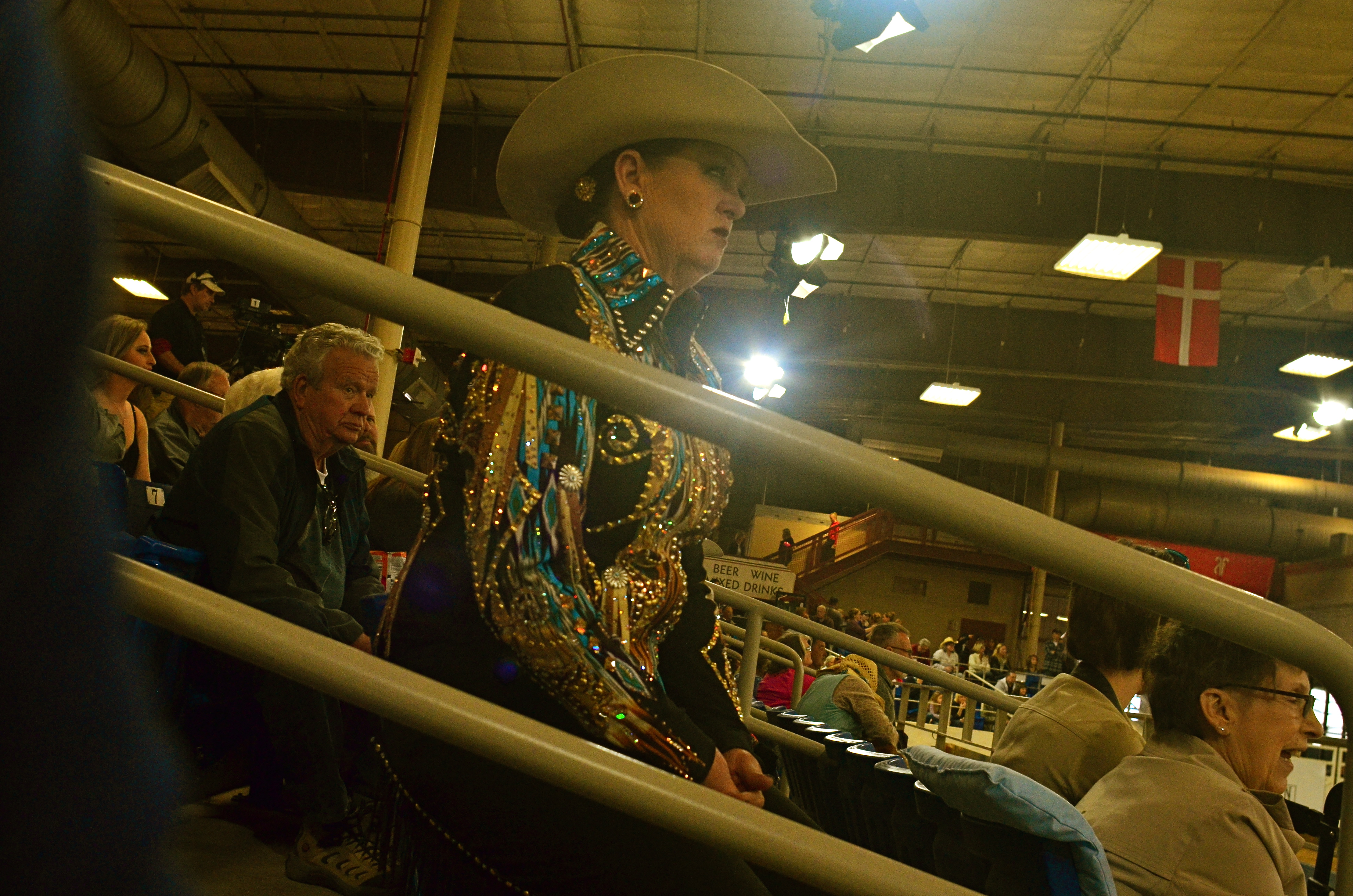
I hear a husky female drawl off to the left.
“Jus’ let her walk, Annie. She wants to walk.”
Turns out the voice belongs to a spangled matron with a Texas twang sharp enough to chop cheddar, herself apparently just off the competition track and now shouting guidelines to another woman in the field. I immediately fall in love with this woman, hypnotized by her steely stare, her no-nonsense focus, and the fact that, unlike the far-away formations of horses directly in front of me, she is a story. A story I need to capture.
But any visible sign of guy-with-a-camera will ruin it all. I will swing into the range of her peripheral vision. Her concentration will break. Worse, the change in her face will make the story all about the intrusive jerk six feet away. And so I hug the camera to the middle of my chest, the lens turned generally in her direction. Of course I have no reliable way to compose the shot, so I spend the next several minutes shooting high, low, losing her completely in the frame, checking results after every click, and finally settling on the image you see here, which, despite my “calculations” for a level horizon, looks a bit like a shot from the old Batman tv series. Holy carsickness.
Strangely, shooting at actual horses (at least with the glass I brung) was telling me nothing about horse culture. But the lady with the spangly blouse and Stetson got me there. It’s literally her beat, and I was grateful to, yes, sneak a glimpse at it.
REMAINS
By MICHAEL PERKINS
BIRTHDAYS. Glibly speaking, ya can’t live without ’em.
Thing is, after a while they don’t come alone. More and more, they show up accompanied by echoes. Ghosts. Remains and remnants. And the guest lists of Things That Were that trundle alongside all those birthdays often focus on buildings, structures that are barometers of where we started out and where we wound up.
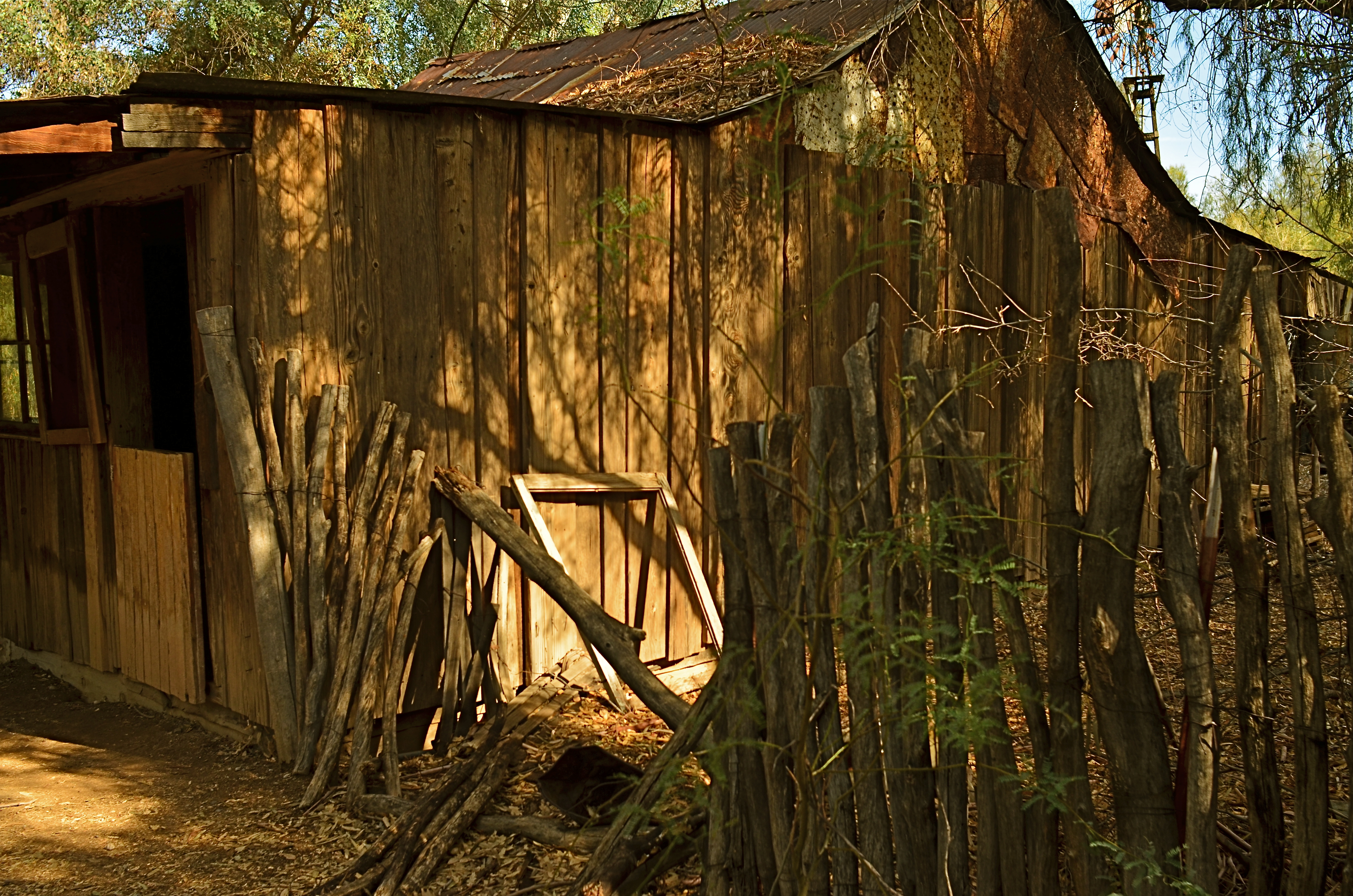
The image above was taken within days of this year’s natal anniversary, and put me in mind of one of the most eloquent musings ever on the subject of loss from singer–songwriter Judy Collins. Looking at this sad, sagging house, I could clearly hear her singing:
My grandmother’s house is still there, but it isn’t the same
A plain wooden cottage, a patch of brown lawn
And a fence that hangs standing and sighing in the Seattle rain
I drive by with strangers and wish they could see what I see
A tangle of summer birds flying in sunlight
A forest of lilies, an orchard of apricot trees
Secret gardens of the heart
Where the flowers bloom forever
I see you shining through the night
In the ice and snow of winter
PORTRAIT OF A PAINTED LADY
By MICHAEL PERKINS
THE BEST THEATRES ARE LIKE THE GREATEST PHOTOGRAPHIC STUDIOS, in that they are, occasionally, both the physical place where great things are staged and great things in and of themselves. They are distinctive in that, years after they house miracles, some of the magic seems to linger in the air, as if it’s imbedded in the very bricks. To see the room where Richard Avedon created key touchstones of twentieth-century culture is, for some, to see more than the room itself. And to see a grand painted lady of the theatrical world is, likewise, to breathe in a rich perfume of opening nights and ovations. And to be allowed to use one medium’s eye to capture another medium’s mystery is a gift, a privilege.
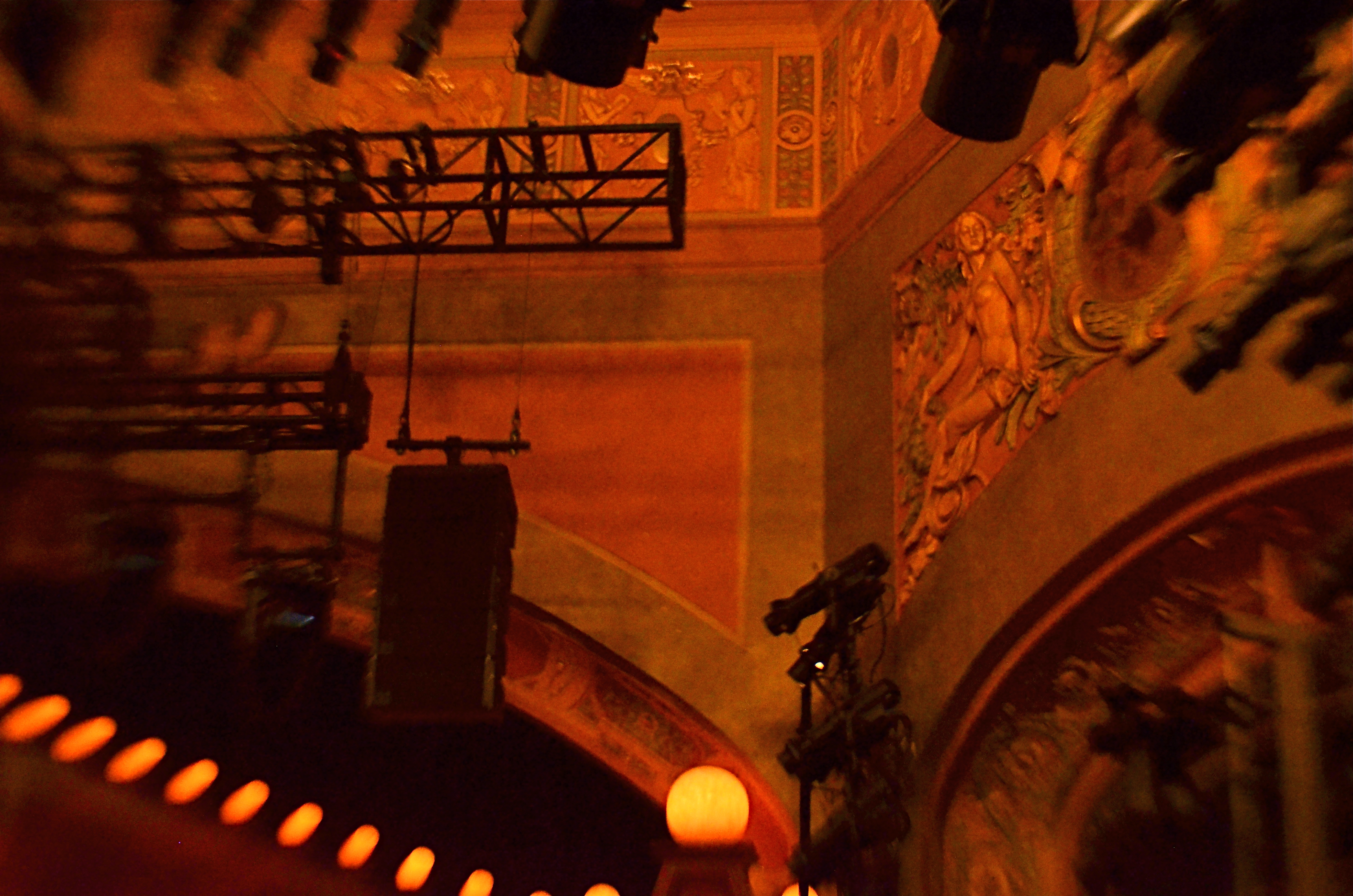
The Schubert Theatre, its arches and catwalks peopled by the ghosts of glories past.
New York’s Schubert Theatre qualifies, to my eye, as sacred space, the imperial nexus between ambition and triumph that has witnessed plenty of both since opening its doors with a production of Hamlet on October 2, 1913. The Schubert, like many of the theatre district’s most venerable venues, is rich in architectural grandeur but modest of scale, seating only 1,460. However, within that compact space, a century’s worth of peerless talent has rolled up the grandest roster of winners in all of Broadway history, still boasting the all-time record run with 6,137 performances of A Chorus Line, which graced the Schubert’s stage for an astonishing fifteen years. Hits not only come first to the Schubert: they come to stay, with multiple-year champs like Crazy For You, Chicago, and Spamalot carrying on the tradition of The Philadelphia Story, Pal Joey, Kiss Me, Kate, Bye–Bye, Birdie, Oliver!, and the 2017 revival of Hello, Dolly!, which set the all-time box office record for the place.
So, how to photograph the theatre of theatres? For my first attempt, a dark exposure to deepen the classic red of the main curtain, paired with a soft-focus foray into the molded plaster figures and light fixtures flanking the side boxes….a dreamy look designed to summon forth blythe spirits. Because, while you can put up four pieces of sheet rock and call the results a theatre, some studios, some stages ring with their own life, long after the last hurrah has faded, and trying to capture that echo in a box can be the greatest show in town.
WHO, ME? (ME, WHO?)
By MICHAEL PERKINS
I WOULD ARGUE that most of the photographs commonly referred to as “self-portraits” are anything but. The tidal wave of daily images in which the photographer is also the subject are, in the main, merely our own cheery faces stamped onto whatever locale we choose as background. They are certainly recordings of us, but seldom much more. Portraiture, as painters came to use the word, is intended to penetrate, to comment, to reveal. Selfies testify that we were here: self-portraits attempt to explain why it matters.
Taking one’s image is not merely about putting up an endless string of publicity releases to reaffirm to the world that we’re still happy, healthy and young. It shouldn’t merely be the latest opportunity to display our most practiced social masks. That’s not revelation: that’s camouflage.
I’m no less vain than the next person. I would love every photograph taken of me, by myself or others, to be flattering. But the photographer in me insists upon more: I need also to make images that show me as uncertain, bloated, fearful, tentative, even alienated from my own internal idea of how I appear outwardly. Moreover, I need to monitor the distance between that surface and what I feel, or, in the words of the old Steve Winwood song, when I am but a stranger to myself. No brave face, no “smile for the camera” can do that.
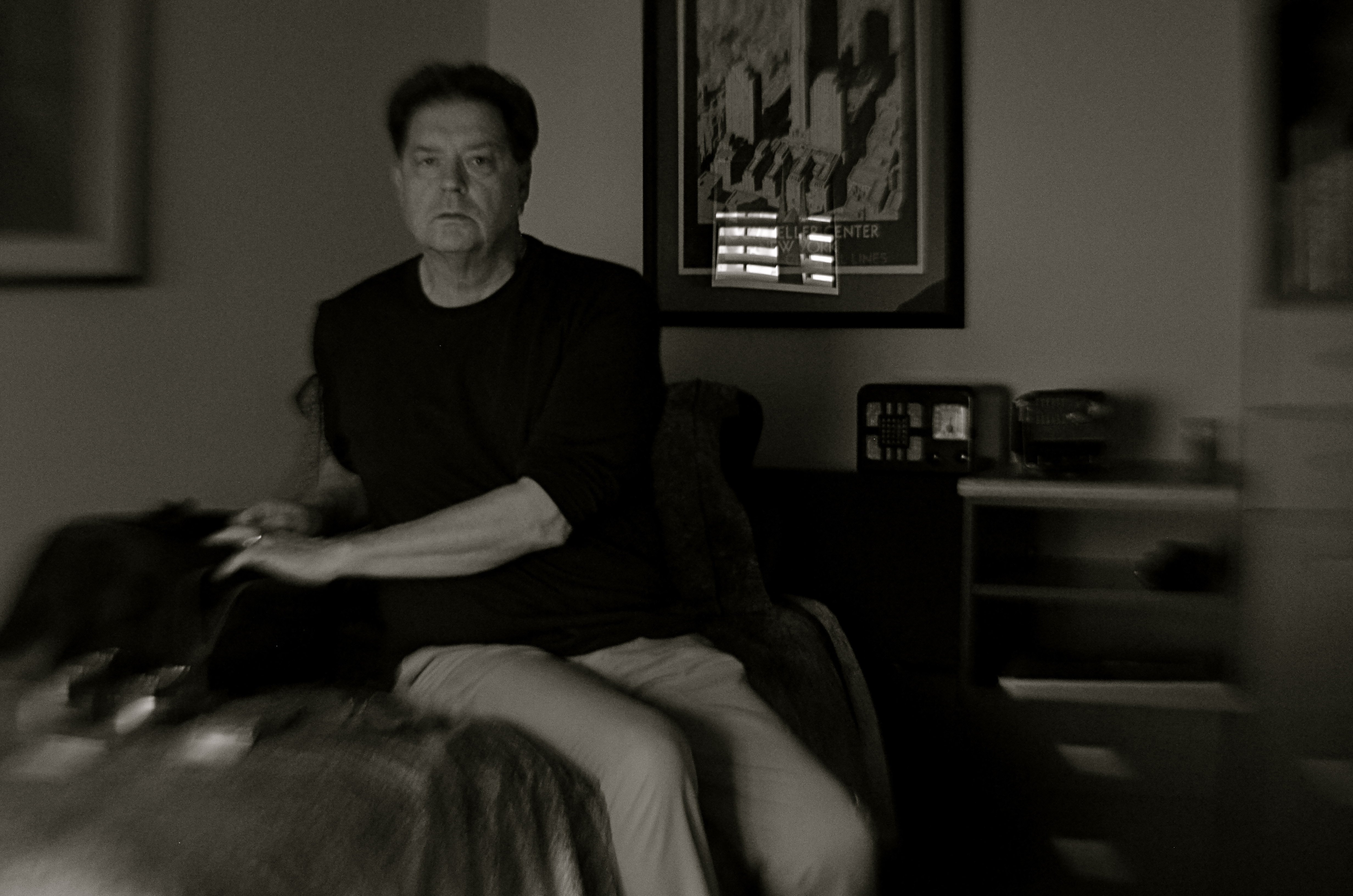
I’m not comfortable with image you see here. I chose selective focus and monochrome for it because I feel that way at present, just as my expression is one of someone in a transition, and a rather awkward one at that. I don’t mind grinning for a snapshot, certainly. But a portrait should intend something different. And it’s okay if, on any given day, I don’t feel like pretending that life has is one big endless party. We are all the world’s foremost authorities on who we genuinely are. Our photography should endeavor to give testimony to that truth.
BOOK BINDINGS
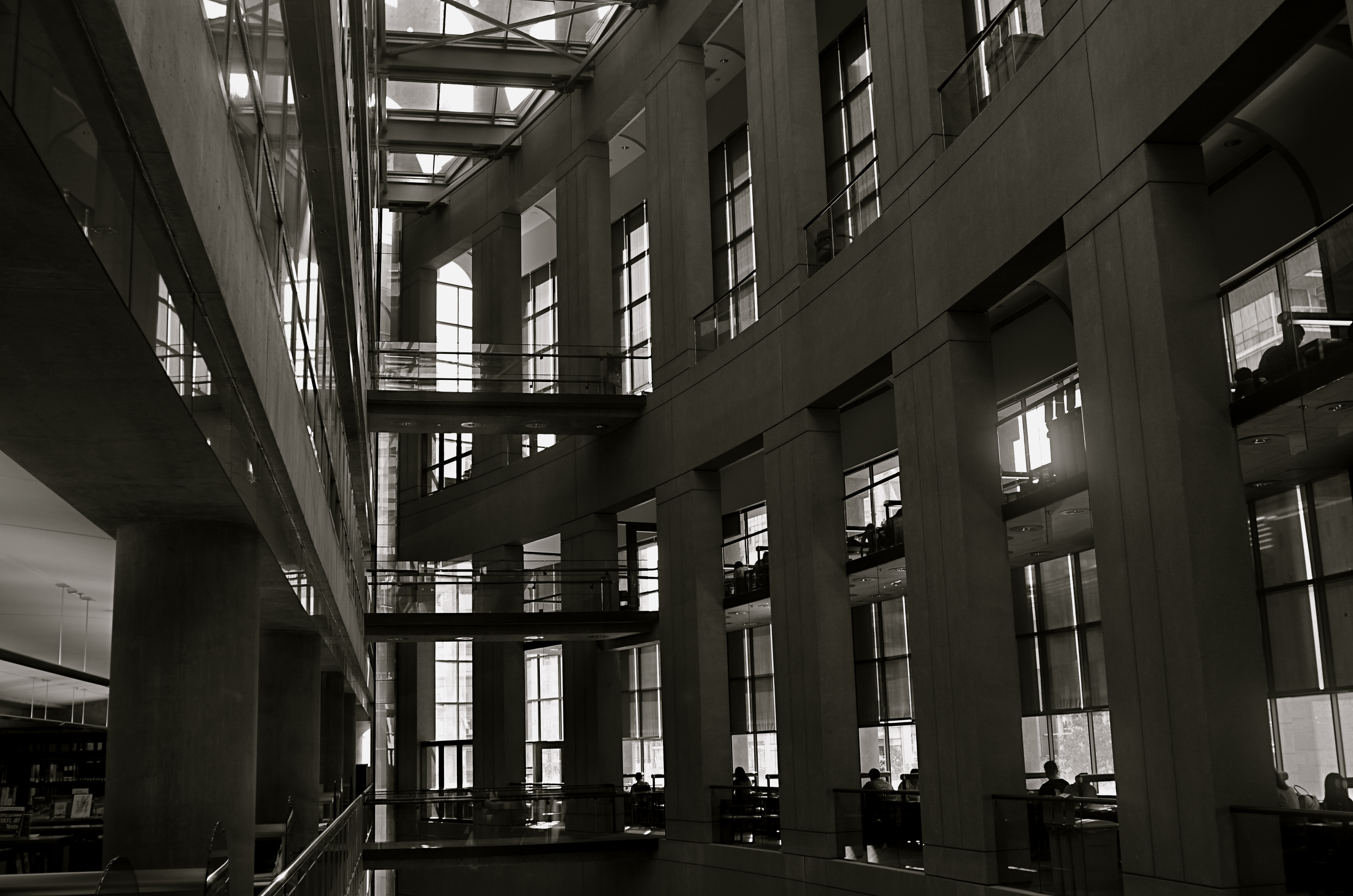
The future: In the grand atrium at Vancouver’s public library (opened in 1995).
By MICHAEL PERKINS
THE BUILDING YOU SEE HERE may not, on first glance, match your sensory memory of what a “public library” is supposed to look like. However, step into this amazing complex on West Georgia Street in Vancouver and you will certainly see, from every angle of its curvy vastness, the public….buzzing away at research, cozying next to comfy reads in cafes, tucked away in private warrens of study and solitude.
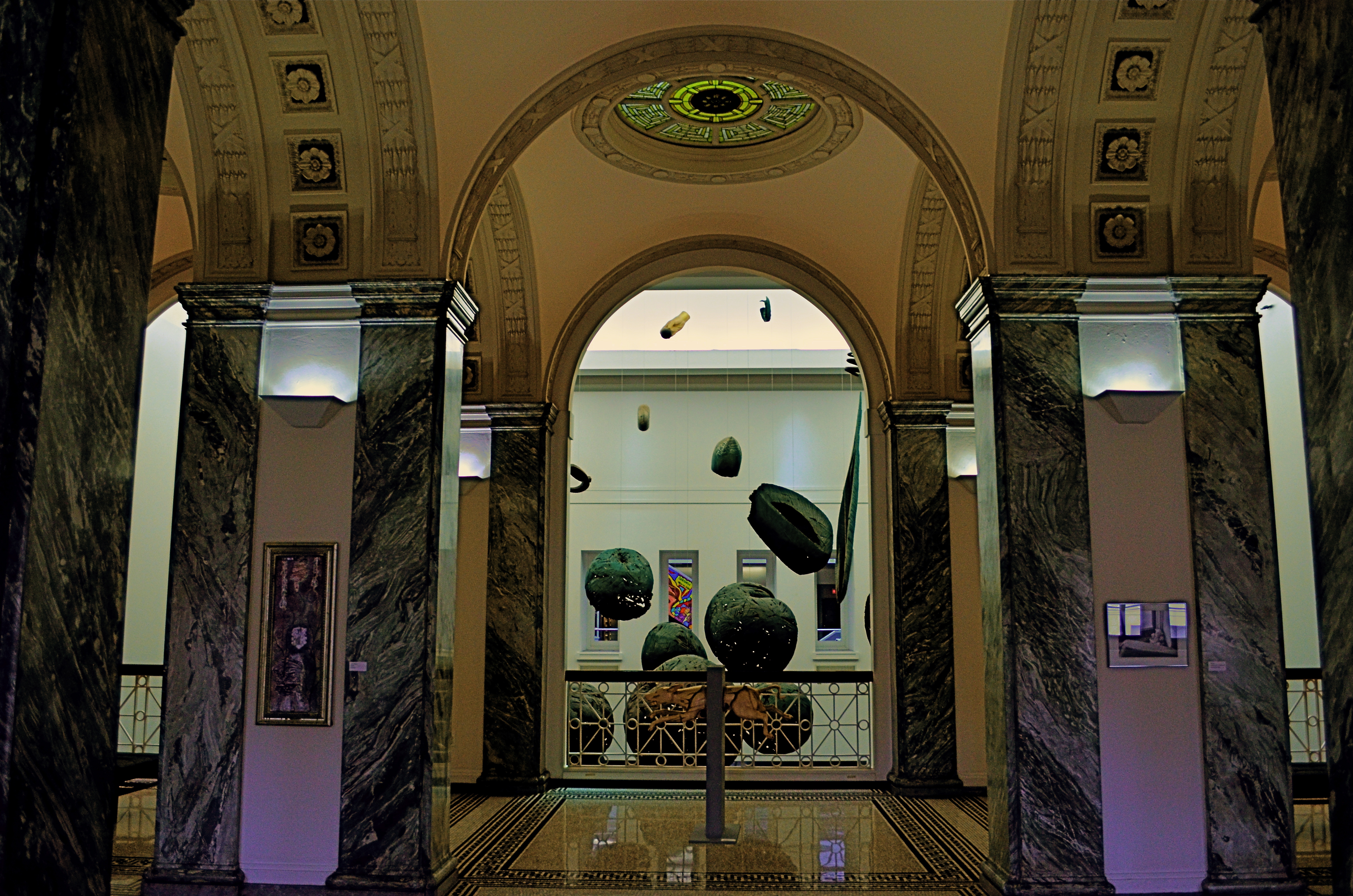
The venerable past: the mezzanine at the central branch of the Metropolitan Library in Columbus, Ohio (opened in 1907).
One of photography’s functions is to chronicle the public space that mankind creates, and how it occupies that space. And visually, there can be no greater illustration of the changes in how that space is defined than in the architectural evolution of public libraries. More than mere warehouses for books, libraries were the first common gathering places in our young republic, no less important than legislatures or marketplaces. Indeed, we built many libraries to be brick and mortar celebrations of learning, grand, soaring temples to thought, arrayed in oak clusters, dizzying vaults, sprawling staircases, and mottoes of the masters, wrought in alabaster and marble. To see these spaces today is to feel the aspiration, the ambitious reach inside every volume within the stacks of these palaces.
The library, in the twenty-first century, is an institution struggling to find its next best iteration, as books share the search for knowledge with a buffet of competing platforms. That evolution of purpose is now spelled out in new kinds of public space, and the photographer is charged with witnessing their birth, just as he witnessed the digging of the subways or the upward surge of the skyscraper. New paths to fortune are being erected within the provocative wings of our New Libraries. Their shapes may seem foreign, but their aim is familiar: to create a haven for the mind and a shelter for the heart.
There are legends to be written here, and some of them will be written with light…..
INCIDENTALS, ACCIDENTALS AND D.L.s

By MICHAEL PERKINS
YOU CAN’T BEGIN TO WRITE THE STORY OF PHOTOGRAPHY without acknowledging the role of the fortunate accident in the output of, well, everyone. Anyone who says he’s never been handed a rose from Lady Luck from time to time is either delusional or a dead-on liar. If we admit that chance occasionally turns our best plans to piddle, why not admit that we also randomly wind up in the winner’s circle on a free pass?
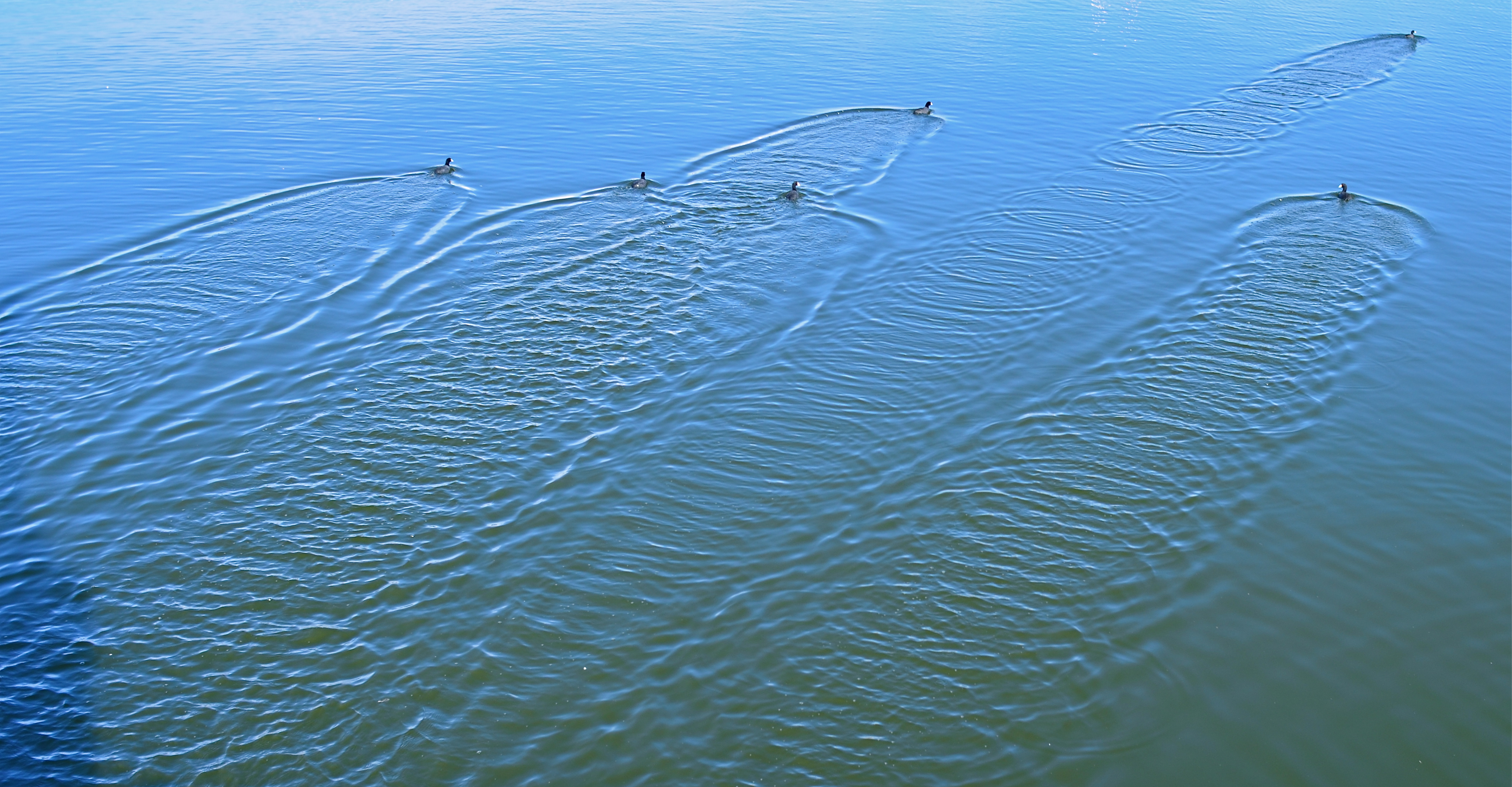
Here’s my freebie for probably the rest of this year, as I can’t see the triple crown of incidentals, accidentals and dumb luck converging as they did here anytime soon. Let’s look at the recipe in detail:
1: Accidentals. While walking along the edge of a footbridge alongside Tempe Town Lake in Arizona, I spooked a small flock of birds resting out of sight just beneath my feet. I heard them flee before I saw them head into open water.
2. Incidentals. For reasons I still can’t fathom, the birds did not take to the air, as you might expect, but escaped across the water, creating gorgeously trailing coils of ripples as they went. That slowed everything down enough that my startled synapses rebooted and started to shout, get your camera up to your eye. That led me to the one element that made the crucial difference, known to us all as:
3. Dumb Luck. After a lens change, I had walked almost a mile from my car when I realized that I had forgotten to slap on a polarizing filter, making shots across water in the sun of an Arizona midday almost guaranteed to saturated with glare. I had already improvised a crude hack my taking off my clip-on sunglasses and holding them in front of my lens. This had only intermittently worked, since I either left part of the field of view uncovered, or failed to hold the specs at the right angle, incurring wild variances in polarizing. As soon as my animal brain realized that I had one shot before my bird water ballet was out of reach, I had to frame, focus (I was already at f/8, so there was some help there), and get the sunglasses in position without deforming all that blue. Even at that, there’s quite a difference between the rendering of color in various parts of the frame.
What you see here, then, is the photo goddesses throwing me a bone. A big bone. We’re talking the rear haunch of a triceratops.
But, yeah, I’ll take it.
MIND OVER MACHINE
By MICHAEL PERKINS
I no longer believe that there is such a thing as objectivity. Everyone has a point of view. Some people call it style. But what we’re really talking about is the guts of a photograph. When you trust your point of view, that’s when you start taking pictures.
Annie Leibovitz
NONE OF MY FAVORITE PHOTOGRAPHERS are primarily technicians. Certainly I value the basic mastery required to extract the best mechanical performance out of one’s camera, but I don’t think that a lack of such knowledge necessarily dooms a picture. I do, however, believe that no lens on earth can compensate for a deficiency of mindfulness in the photographer. I cite Annie Leibovitz here because I believe she deftly walks the creative tightrope between an essential understanding of how photography works and a poetic gift for finding how it works for her. She knows her gear as much as is necessary: she knows her heart as much as is possible.
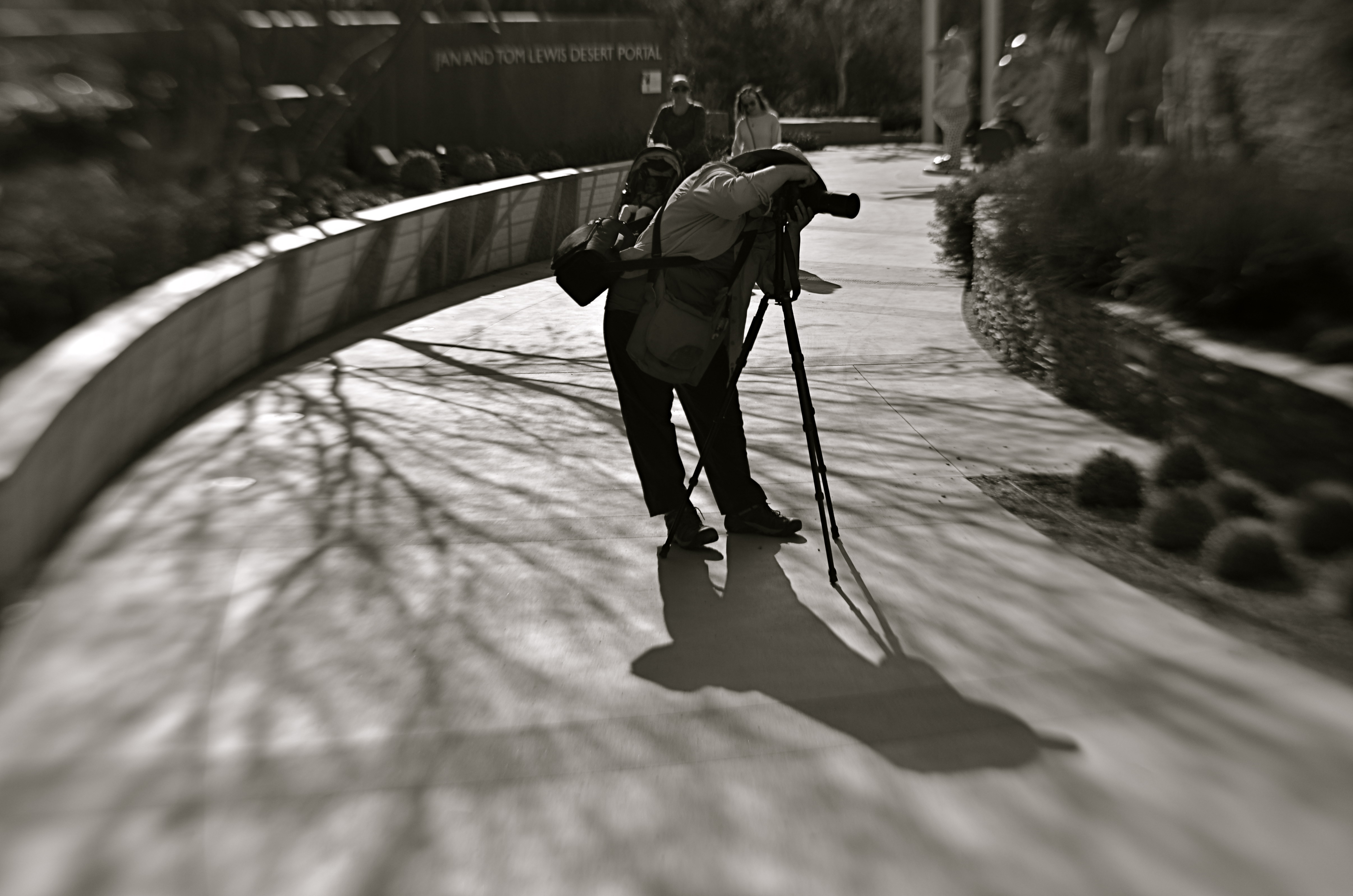
On a shoot, once I’ve established that the camera is on and the lens cap is off, I endeavor to disconnect with the gear and re-connect with the twelve-year-old who first gasped as he gazed through a viewfinder. That kid knew that everything was possible. More precisely, he didn’t know enough to realize what wasn’t possible, and so blithely proceeded to try it all. His older brother (me) wants to point out that the light is wrong, that he packed the wrong lens, and that, maybe, he just doesn’t actually know how to make the picture. Worse yet, he might know just enough to worry that his work won’t register with others. The twelve-year-old doesn’t care.
My photo gods are all people who know all the things that can go wrong with a shot and take the shot anyway. They are not waiting for their moment. They are jumping out of the plane and trusting the chute to open. More to the point, they are trusting themselves.
“I still have a very limited knowledge of the technical side of photography”, Linda McCartney wrote in 1992, looking back upon her amazing body of documentary work in the rock demimonde of the ’60’s. “I prefer to work by trial and error because some of my best pictures have come precisely because I didn’t know enough. By having the “wrong” setting, I’ve actually come up with something good….”
SUBDIVISIONS
By MICHAEL PERKINS
VAN LINES USED TO GIVE OUT SMALL GRIDDED PAPER SQUARES that prospective customers could use as room diagrams for the planning of their next homes. The fancier versions even came with pre-cut geometric shapes that you could place on the squares, to see if the couch would look good next to the settee, or whether the piano should go along the north wall. It was like paper dolls for easy chairs and coffee tables.
I recall those squares whenever I’m trying to photographically visualize the optimum composition of large spaces, especially if I’m lucky enough to do so from an elevated spot. Immense rooms start to look like rectangles within rectangles, squares butted up against other squares. Dividing lines between action and dead space begin to appear. Cropping parameters suggest one scheme, then argue for another. With enough time, a kind of strategy emerges for what should go where, much like those intricate battle maps used to illustrate the engagements in Ken Burns’ The Civil War.
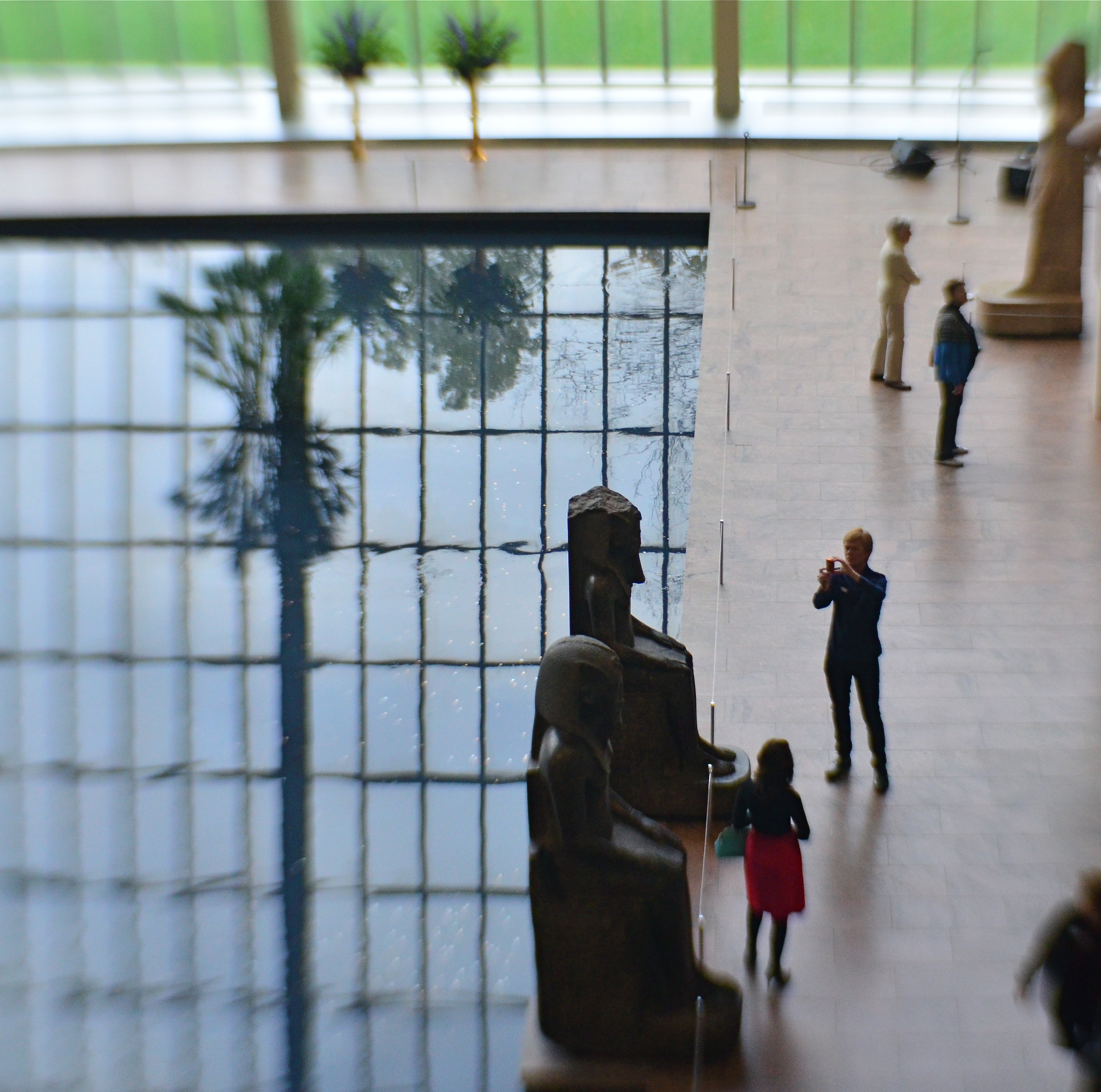
One square, or an assembly of squares?
The balance of “live” and “dead” space in public gathering places (like the museum seen here) has to carefully organized, since both kinds of space have their own special narrative power, and can intrude on each other if not orchestrated. In the above image, it’s almost as if the active roles by the tourists on the right ought to be contained, in order to avoid disturbing the abstract patterns on the left. A different method might also see the entire outer frame as a series of smaller squares and rectangles, just as a chessboard is a square composed of an infinite number of lesser squares. Depends on your eye.
Composition, if done at leisure rather than haste, is a negotiation, a bargaining session in which every inch of photographic real estate must earn its place in the final picture. It’d be glib to merely say “there’s no right answer”, but, if you look at images resulting from certain choices, it becomes apparent that such a statement cannot be true. Right will feel right. Wrong will always feel like you put the piano in front of the picture window. Not horrible… but not correct, either.
 thenormaleye
EVERYTHING OLD IS….OLD AGAIN
By MICHAEL PERKINS
ONE OF THE LOW–HANGING–FRUIT–EASY–LAY–UP STORIES in 2017 pop culture circles was the report that, after years of manufacturing its own version of the defunct Polaroid Corporation’s instant camera film, an appropriately named company known as the Impossible Project had acquired all of Polaroid’s remaining intellectual property. As a result, the IP, now re-born as Polaroid Originals, could now begin making it own brand-new Polaroid cameras.
The story had great appeal for the analog-was-better crowd, the LP-hugging CD haters who pegged the decline of civilization to the day mankind first embraced zeroes and ones. Writer after writer wiped aside a misty tear to rhapsodize about the OneStep2, the first new “Polaroid” camera in more than a decade, and to recount their own fond memories of the “unique” quality of each unreproducable shot, as well as the wonderfully unpredictable randomness of wondering if your next shot, or indeed the entire rest of the film pack, would yield anything in the way of an image that was worth wiping your nose on.
Which brings us to the Brutal Main Truth of the matter: Polaroids were never really good cameras. They were engineered to fulfill a need for uncomplicated and quick gratification, marketed to an audience of snapshooters and selfiemongers. Inventor Edward Land placed all of his emphasis on perfecting the spontaneous function of his film, and to simplifying the taking of pictures to the point that your goldfish could pretty much operate the cameras. That said, Polaroid film was unstable, balky, moody, mushy, and generally useless as an archival medium. Of course, the company tried to shape an alternate narrative: certain high-end, professional grade iterations of the camera appeared at the margins of the photo market, with Polaroid hiring Ansel Adams as a “consultant” on color (which is a little like hiring a childless person to head up a daycare), and the brand got a pass from culture vultures like Andy Warhol, who tried to legitimize the cool, what-the-hell factor of the cameras for a generation hooked on immediacy. But in the end, Polaroid photography delivered mere convenience and fun, seldom art.
In terms of its legacy, there are no classic Polaroid lenses, nor any other evidence that the company ever trusted its customers with taking pictures like grown-ups. Model after model refused to allow users to take even basic manual control of the process of photography, offering instead frozen focal lengths, a stingy array of shutter speeds, and cave-man-level focusing options. Finally, by the dawn of the digital age, Polaroid whimpered out as it had roared in, making the process ever easier, the gear ever cheaper, and the results ever worse.
Polaroid Originals is now poised to do something its namesake never did: make a real good camera for people who also like the tactile, hold-it-in-your-hand sensation of instant photography. But they’re off to a lame start, if the brainless, artless OneStep2 is any indication. Not only is this gob of plastic optically stunted, the film made by Polaroid Originals, who had to figure out the process without any blueprint or guidance from Polaroid, looks even worse than actual Polaroid film, which is a little like finding out that your mud pies don’t look as elegant as everyone else’s. And did we mention the cost, which works out to nearly two dollars per print?
And so, for analog hogs, everything old is really just old again. As we speak, Kodak is preparing to produce an all new Super-8 movie camera… for around $2,400. Surely we can’t be two far from a loving re-launch of the Ford Edsel. I hear they gots a cigarette lighter right in the dashboard…….
Share this:
April 1, 2018 | Categories: Americana, Commentary, History, Intellectual Property | Tags: Instant Photography, Polaroid | Leave a comment