GRAVEYARD SHIFT
By MICHAEL PERKINS
THERE IS, ALMOST CERTAINLY, A STORY BEHIND THE PHOTOGRAPH BELOW. Unfortunately, I don’t know what it is. And probably never will.
Images often state or at least imply a narrative, allowing the photographer to relate a dimensional story within the confines of a flat, static frame. It’s kind of a miracle when that happens, but there are also those pictures in which, although part of a story has been captured in mid-flight, the whole of the tale will never be revealed. Sometimes it’s because I flat-out don’t possess the skill to tell it properly. Sometimes it’s because, although I set out to tell something in a coherent fashion, I mucked it up in execution. And, in the most interesting/frustrating of cases, it’s because the photo simply contains too little content or context to make a story emerge.
Yet, these are the images that, perversely, I find myself returning to, as if staring at them multiple times will somehow solve the puzzle. It usually doesn’t, but that’s okay, since these “quandary” pictures also become some of my favorites. Maybe it’s because they’re orphans. Maybe I actually like that they defy explanation. It’s like reading Ulysses. I don’t get it, But then again, nobody else does, either.
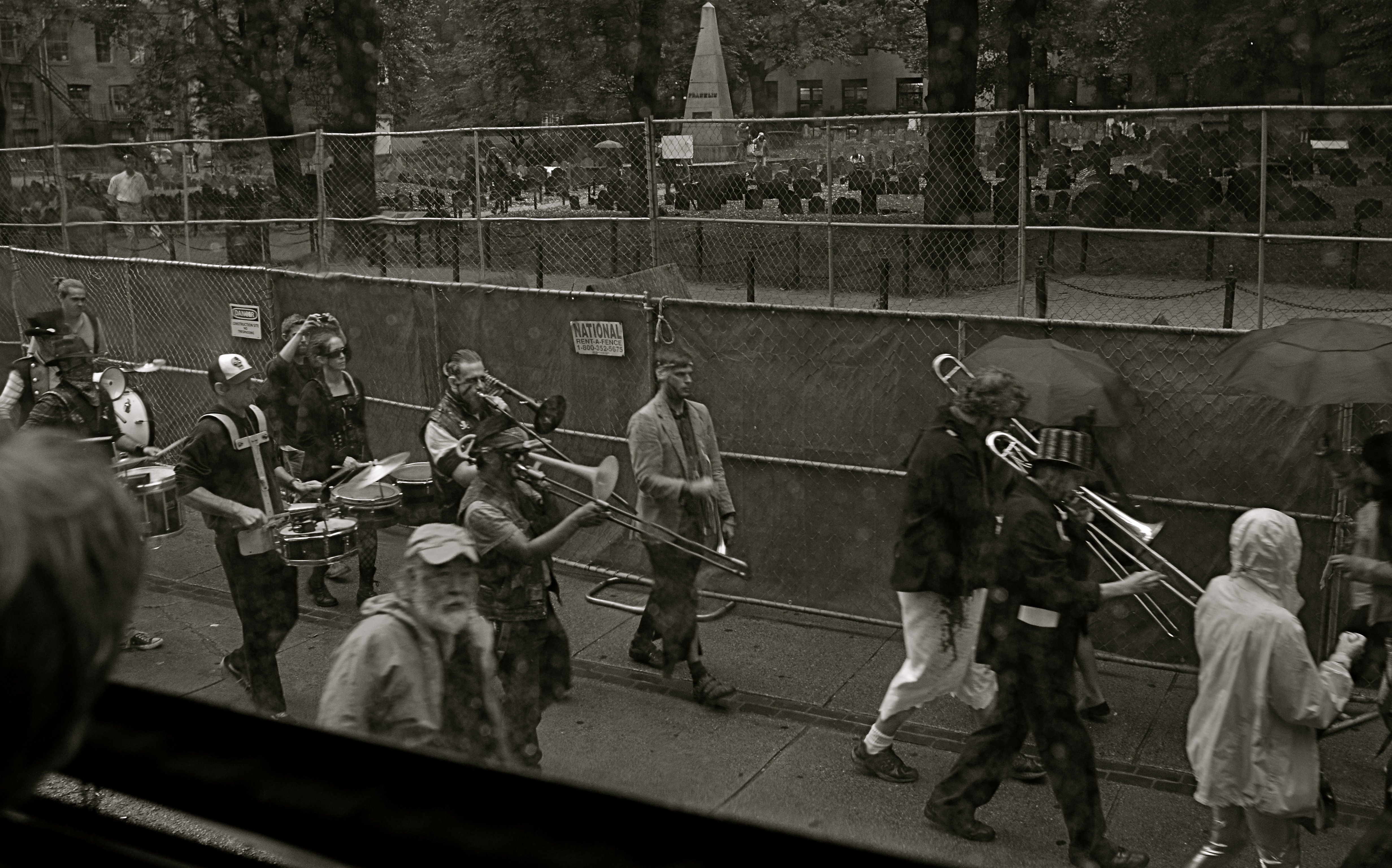
All Together, Now, With Gusto.
This particular question mark of a picture was snapped in Boston on a day soaked in enough rain to chase my wife and myself off a local walking tour around the Commons, trading squishy sneakers for butt lumps on a bus that spent 10% of its voyage hipping us to the local scene and 90% gridlocked in Beantown traffic, which is about average, as I understand it. There was, as a consequence, plenty of time to snap things out of the windows, even though the rain played serious hell with both focus and resolution. After a while, however,even the doomed task of trying to shoot anything usable became a kind of pastime all its own, especially after the driver was forced to retrace the same circle of traffic hell for a second or third go-round.
The scene you see here is in front of a historic graveyard right in the heart of the commons, a “who’s who” of honored dead, where, so say the locals, you can sit in a bar drinking a cold Sam Adams, and gaze out the window at (say it with me) a cold Sam Adams. What inspired the ragtag orchestra you see marching in front of the illustrious headstones, sans any insignia, uniforms, or sense of self-preservation is, and will remain, beyond me. What they were marching for, who their intended audience or cause might be….all of it is forever a befuddled “huh?”. Bonus round: what with the light being so meager amidst the downpour, I had dialed down to a pretty slow shutter speed, so even basic sharpness was DOA for this particular frame.
Somehow, however, I love this picture, even more than if it made any actual sense. Unmoored from reality, I can make up a dozen might-be scenarios that explain it, and so it actually has more entertainment value than many of my so-called “successful” photographs. Or maybe I just like sitting in a pew at the Church of Weird every once in a while. And, on particularly dreamy days, I can stare at this band of gypsies and wish I could take up a tuba and head their direction for a bit.
After all, they know where they’re going…
THE GOLDEN HALF-RULE
By MICHAEL PERKINS
THE STREET-HARDENED CRIME PHOTOGRAPHER ARTHUR FELLIG (1899-1968), who adopted the pseudonym “Weegee” was often asked the secret of his success as the journalist who best captured the stark essence of mobster arrests, gruesome murders, and various other manifestations of mayhem and tragedy. He had answered the “how do you do it” question so many times that he developed a uniform shorthand response which passed into photographic lore and stamped itself onto the brains of all future street shooters. The secret: “f/8 and be there.”
The “f/8” part spoke to the fact that Weegee, who seldom shot at any other aperture, was more interested in bringing back a usable picture than in creating great art. In the days before autofocus, shots taken on the fly at medium distance would almost always be reasonably sharp at that depth of field, no matter how sloppy the shooter’s finer focusing technique. Besides, since he was capturing sensation, not romance, why bother with subtle nuance? Weegee’s pictures were harsh, brutal, and grimy, just like the nether worlds they depicted. They were known for their high contrast and for the atomic blast of hard flashgun light he blew into the faces of society mavens and thugs alike. We’re talking blunt force trauma.
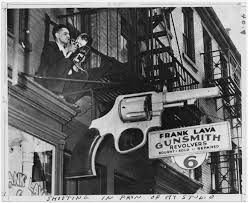
Familiar with action on both ends of guns, Arthur “Weegee” Fellig was the ultimate chronicler of America’s dark side.
The second half of Weegee’s golden rule was far more telling for any photographer purporting to be an effective narrator. When Fellig spoke of “being there” he was not only referring to arriving on a crime scene ahead of any competition (which he guaranteed by grabbing early bulletins from the police-band radio in his car and having a mobile darkroom in his trunk), but in being mentally present enough to know when and what to shoot, with very little advance prep. The bulkiness of the old Graphlex and Speed Graphic press cameras (the size of small typewriters) meant that shooting twenty frames in as many seconds, as is now a given with reporters, was technically impossible. Time was precious, deadlines loomed, and knowing when the narrative peak of a story was approaching was an invaluable instinct, one which distinguished Weegee from his contemporaries. Opportunities were measured in seconds, and photogs learned to nail a shot with very little notice that history was about to be on the wing.
There will always be arguments about the finer points of focus and exposure, with most debates centering on the first half of Weegee’s prime directive. However, for my money, the urgency of being ably to identify immediacy and grab it in a box far outweighs the niceties of art. Many a Pulitzer Prize-winning image is under-exposed or blurs, while many a technically perfect picture actually manages to drain a scene of any human emotion. Make it f/8, f/4, hell, take the damned thing with a pinhole if need be. But be there.
EYEWITNESSED AND UNDERLINED

Does the use of selective focus in this image disqualify it as a “news” photo?
By MICHAEL PERKINS
IT WASN’T LONG AFTER THE INTRODUCTION OF PHOTOGRAPHY that one of the biggest and most durable myths about the new art was launched to generally unquestioning acceptance. The line “the camera doesn’t lie” attached itself to the popular imagination with what seemed the purest of industrial-age logic. Photographs were, to the 19th-century mind, a flawless record of reality, a scientifically reliable registration of light and shadow. And yet the only thing that moved as quickly as photography itself was the race to use the camera to deliberately create illusion, and, eventually, to serve the twin fibbing mills of propaganda and advertising. The camera, it turned out, not only could lie, but did do so, frequently and indetectably.
Later, as photojournalism came into its own, the “doesn’t lie” myth seemed to drape news coverage in some holy mantle of trustworthiness, as if every cameraman were somehow magically neutral in the way he shot an event. This, in spite of the obvious fact that, merely by changing composition, exposure, or processing, the photographer could alter his image’s impact…..its ability to, in effect, transmit “truth”. Certainly, outright fakery got better and better, but, even without deliberately trying to falsify facts, the news photographer still had his own personal eye, an eye which could easily add bias to a seemingly straightforward picture. Did this proclivity make his pictures “lies”?
As a point of discussion, consider the above photo, which is, fundamentally, a document of part of an actual event. But what can really be learned from what’s in the frame? Are there thousands at this rally, or do the attendees shown here constitute the entire turnout? Are all those on hand peaceful and calm, or have I merely turned my lens away from others, immediately adjacent, who may be screaming or gesturing in anger? And how about my use of selective focus with the girl in pink? Am I simply calling attention to her face, the colors in her outfit, her sign, her physical posture… or am I trying to make her argument for her by using blur to make everyone else seem less important? Am I an artist, a reporter, a liar, or all three?
Here’s the thing: since I don’t make my living as a journalist, I can choose any or all of those three job titles without fear of conflict. I work only for myself, so I make no claim for the neutrality of my coverage of anything, including landscapes, still lifes and portraits. I likewise make no guarantees of objectivity in what I regard as an art. Only the observer can decide whether the camera, or I, have “lied”. We repeat this mantra frequently, but it bears clear emphasis: photographs are not (mere) reality. Never were, never can be.
Good thing or bad? You literally take that determination into your own hands.
THE PICK-UP GAME
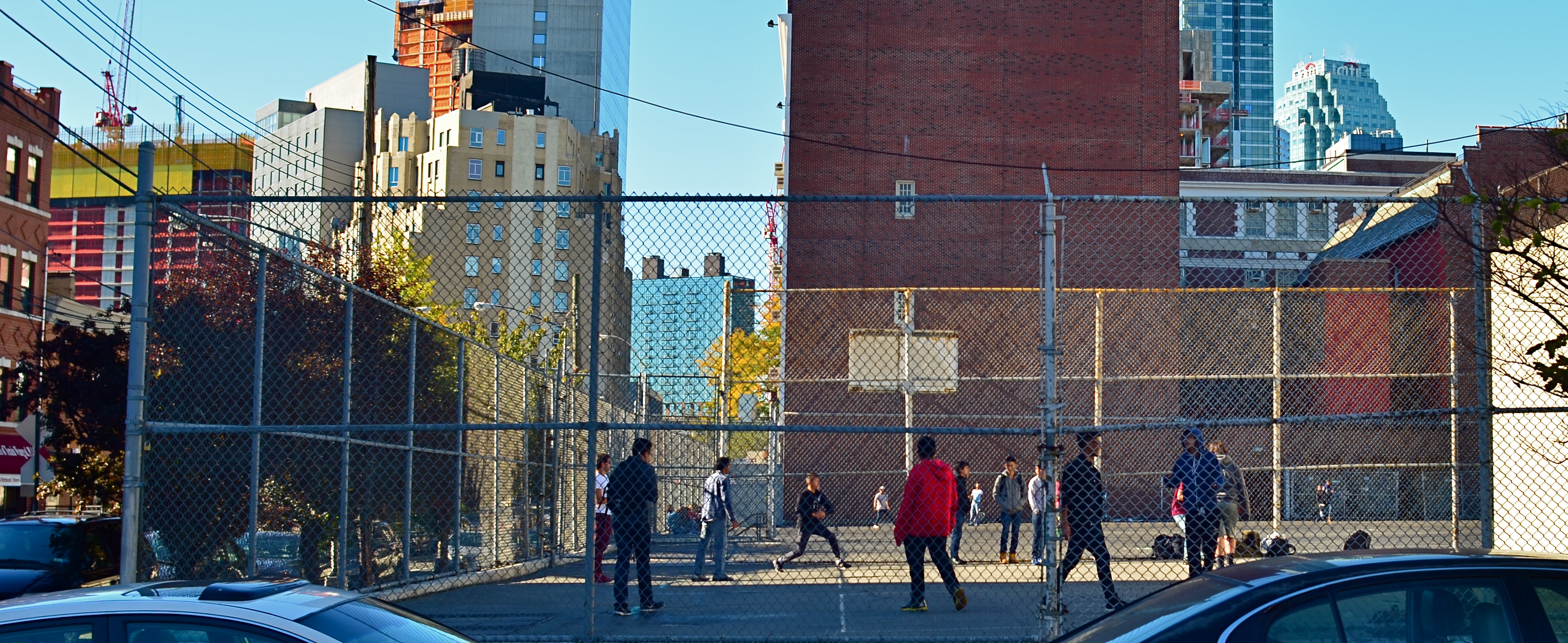
Oasis (2016)
By MICHAEL PERKINS
STREET PHOTOGRAPHY, FOR ME, INVOLVES AN OCCASIONAL BOUT OF LONGING, in that I am frequently on hand to record lives that, at least in part, I’d like to visit for longer than the length of a shutter snap. Not all street scenes are inviting, of course. Often we chronicle things that we are profoundly grateful are not part of our own lives. Other times, we accidentally preserve something that is so shrouded in mystery that the resulting images provide endless wellsprings of speculation…just what was it that we thought we saw, both at the moment of taking, and later? And then there’s what the taking of these images says about us personally. Some of our eavesdropping makes us feel privileged. Some makes us feel stained by the ugliness of our invasions.
And then there are the blessed accidents, the pictures we didn’t set out to take at all, such as the photo you see here. I was actually not in active shooting mode when I passed this pickup game of handball in a neighborhood in Queens over the past summer. To tell the truth, since I was trying to find an address at the time, I might very likely have passed these players completely by, had one of their tosses not jumped the fence of their tiny parcel of blacktop and literally rolled to my feet.
The ball re-directed my attention, as did several clear, high calls of “hey mister!” and “sir, would you mind..?” Pitching it back, I saw the boys’ playspace as the tiny oasis it was, crammed in on all sides by the neighborhood’s skyward crush. Next, I noticed the wonderful warmth of the mid-morning sun, and took a few seconds to allow the combatants to resume play, and, more importantly, forget about the Nice Old Guy Who Gave Them Back Their Ball. I took only two frames, fearful that one of the players would remember having seen the Nikon around my neck. Fortunately, the game was a much better claim on their attention, and I liked one of the tries I had made.
Street work is, more often than not, a matter of being there when someone else’s life happens. Seldom does that life reach out and ask to be noticed, to make a request on your time. In such moments, all of life becomes, for an instant, a universal pick-up game, something in which we’ve actually been invited to participate.
RE-OPENING THE LAB
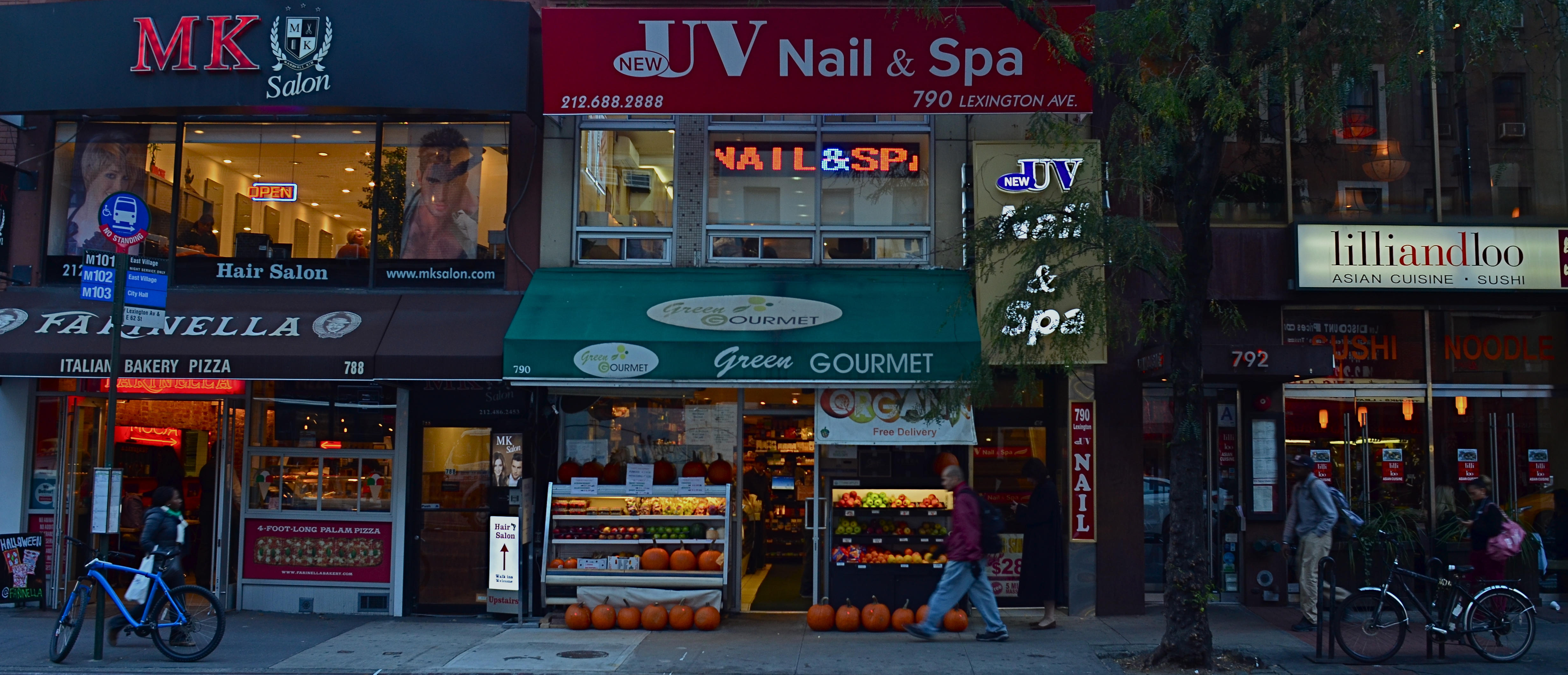
Lovin’ Life On Lex (New York City, 2016)
By MICHAEL PERKINS
PHOTOGRAPHERS WILL ALWAYS BENEFIT FROM SOCIOLOGICAL “PIVOT POINTS“, those unique junctures in time when tectonic plates between eras shift, grind and re-configure. Images, for better or worse, are the way we testify to big changes in our world. They are documents of where one age ends and a new one begins. They illustrate contrasts between then and now.
A change in society is an opportunity for pictures, photos which become obvious, even inevitable, in telling the story of how we evolve. And one of the biggest such changes over the last decade or so has been the re-birthing of the walking neighborhood. Urban cores long given up for dead are being re-vitalized by young people who want close, hands-on engagement with city life.
Whether this shift is a boomerang effect at the end of half a century of suburban flight, an economic remedy to rising housing prices (refurbishing is cheaper than new building), an ingenious way to re-purpose old resources for a greener planet (and get rid of cars), or just a generational restlessness, the old laboratory known as the urban neighborhood is back open for business, with darkened and deserted blocks sprouting new colors, shops, rhythms. Prime picking for photographers, who, first and foremost, go where the stories are.
For me, lateral, wide-angle portraits of businesses is great fun, as I try to channel the “neighborhood in miniature” panels made popular by painter Norman Rockwell during his magazine years. Watching foot traffic flow between laundries and liquor stores, with maybe a pizza joint in between, affords an instant variety of color, signage, reflections, and texture…in other words, lots to work with.
The street is dead. Long live the street.
INVITATION TO THE DANCE
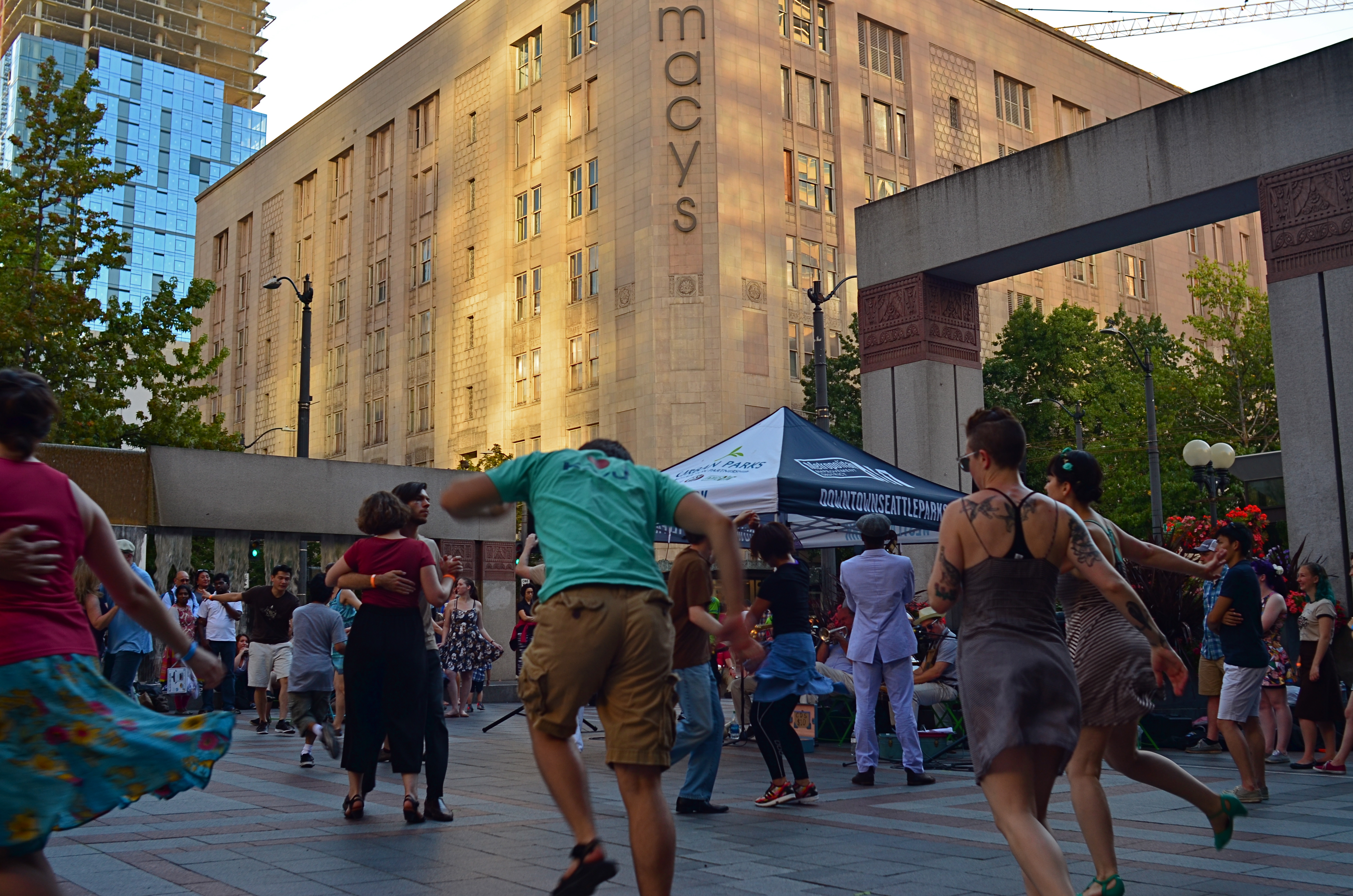
Seattle Street Stomp, Sunday Night (2016)
By MICHAEL PERKINS
PHOTOGRAPHY REACTS TO SHIFTS IN HUMAN BEHAVIOR, in that it both reports and creates the news. Let people surge or sparkle in any particular direction, and the camera will shift with them, for good or ill. Photographers are camp-followers by nature, and instinctively sniff out the Next Big Thing, the Next Medium Thing, even the next Is This A Thing? in search of subject matter.
There is, at this writing, a wealth of story-telling to be done in the rebirth of American urban centers, and it’s more than just stopping by the hottest new part of town. Suddenly, it’s about the complete reversal of the systemic desertion of cities that began right after World War II, with a new generation sizing up thousands of Spielbergian burbs and finding them wanting. Moreover, urban cores are being not just renovated but embraced, not merely as this year’s megatrend but as this age’s new answer. In city after city, we are coming home, transforming our idea of “a life” to define walkable neighborhoods, an explosion in the arts, dense diversity, and locally owned businesses. It’s a great time for cities, and a great time to be a photographer.
All of human activity, from ritual to celebration, social interaction to creativity, is being re-cast in urban terms, with block after block being claimed in the name of re-use and re-purpose. It’s greener, it’s groovier, and it is rich with visuals, as the barn dance becomes the street stomp and the dead warehouse becomes the very alive coffee-house. Most importantly, children are being born into places where they can walk to real shops versus driving to unreal chains. Something is up, and it’s not merely generational, and the camera has a role in all of this.
A role and a say.
ANTICIPATION
By MICHAEL PERKINS
SPORTS PHOTOGRAPHY IS FLAT-OUT REPORTORIAL IN MOST CASES, placing its crucial emphasis on the capture of “the decisive moment”. The play that saved the day, or, at least, earned the headline. Hail Mary passes. Impossible catches. Long, nothin’-but-net buzzer-beaters hurled hopefully from Downtown. These are the essence of sports coverage; images that freeze such moments, photos which often outlive the text that they were designed to accompany. Sports photography is, for the most part, about moments of record, moments of now.
Take it out of its pro-level context, however, and sports, as played by most of the rest of us, can simply be about someday….or more precisely, any moment now. Sports reports are often viewed as strongly edited segments that stitch together one now moment after another in breathless digests of daily “greatest hits”. For many of us regular slobs, however, life isn’t played out that way. Real time, on our playing fields, consists of an infinite number of long, eventless stretches. Sadly, most of us don’t move seamlessly from career high to career high. Instead, there are many stops along the way…to smell the roses, count down the clock, and praaaaaaay for the final bell.
Photographically, kid sports often strike me as more fun than adult games, principally because the terms of engagement are so very different from the grown-up stuff. Children’s games are free of the deadly seriousness that seems to have tainted sports in recent years, robbing them of much of their playful escape. Young Dick and Young Jane aren’t doing this for a living. There is seldom anything of consequence on the line, except maybe the vanity of their parents. And when it comes to providing great images, the mix of true technique and awkward innocence makes for a charming combination, as the young combatants ape their mentors, even as they betray their innate kid-ness.
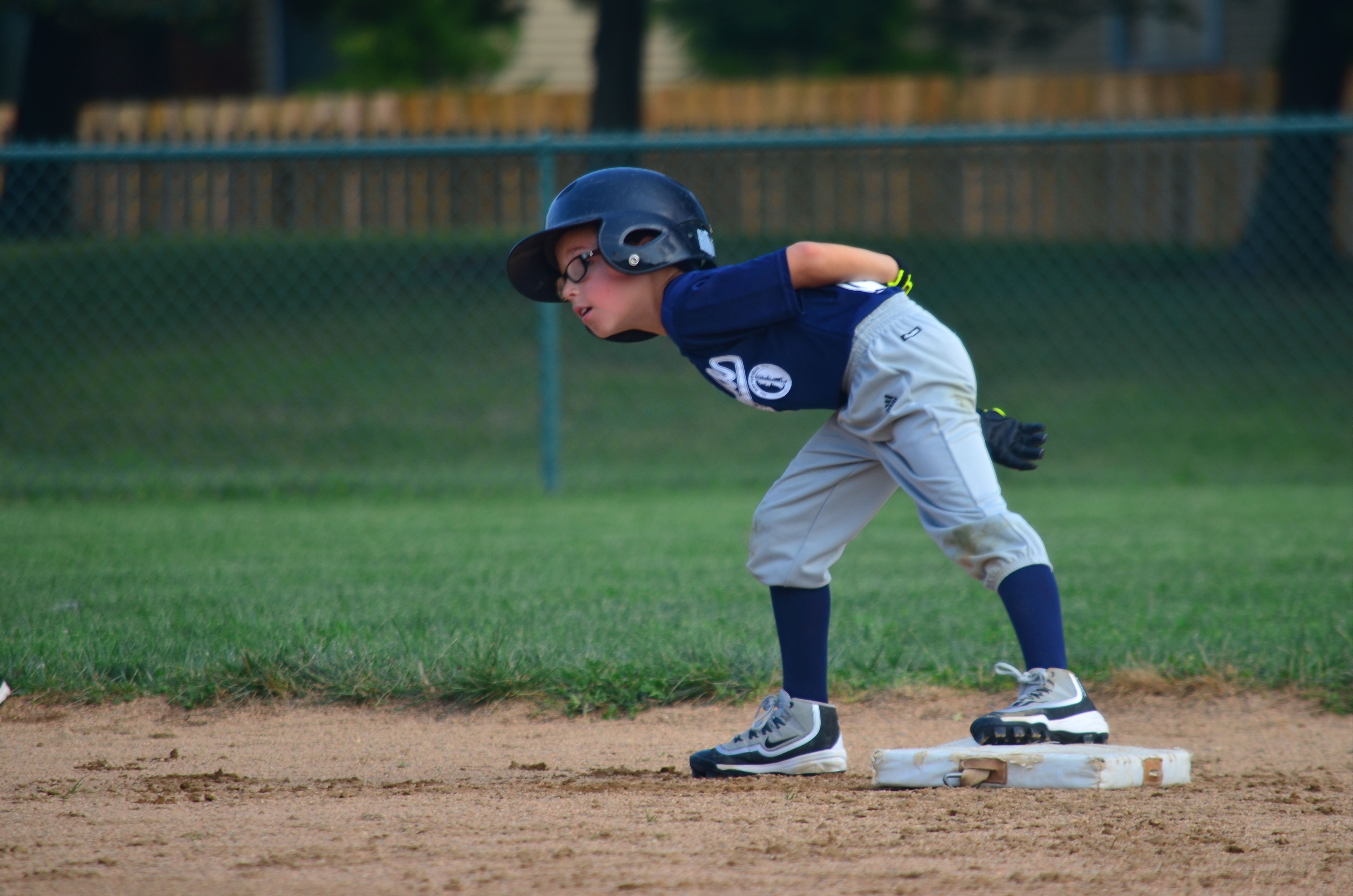
Opportunity..? (2016)
The young man captured here is, above all else, having fun. He’s enjoying the sweet anticipation of the unexpected. He already has the mechanics of a young pro, but his curious exploration of the option of stealing third is all little boy. Lots of story here, and in many moments which never approach the drama of a national championship or a three-peat. Images are narratives, and, in photographing more than just a player’s once-in-a-lifetime Grand Slam, we learn about striving. And waiting. And dreaming.
Theirs and ours.
ALL THAT REMAINS
By MICHAEL PERKINS
THE HISTORY OF PHOTOGRAPHY IS ALSO THE HISTORY OF A STRANGELY INTIMATE DANCE WITH DEATH, a fascination with its look, its effects, its ability to transform both man and materials, mood and matter. From the first images of combat in the mid-nineteenth century to today’s Instagram chronicles of turmoil and trauma, we have tried to testify about how the world changes when we, or others like us, pass out of existence. The process is a constant rug-of-war between intimacy and publicity, between the glare of public destruction and the privacy of inner oblivion. And the pictures that result are arguments, quarrels with ourselves, which can never truly be settled.
There seems to have been a shift over the past few decades in how we grieve, or at least in the visual vocabulary of that grief that we choose to put on display. The quiet graveside memorials of eras past seems to have been supplanted by increasingly public vigils. We cry our tears in front of each other now, and the creation of instantaneous, group-generated shrines has become a bizarre kind of performance art, as visible as graffiti, and as personal as each man’s ending. Whether it takes the form of mountains of teddy bears stacked around an accident site or candle-lit collages of mementos offering mute testimony from well-meaning strangers, mourning is now something we experience globally, tribally. John Donne’s 1624 sentiment that “every man’s death diminishes me” seems, in the present day, eerily prescient.
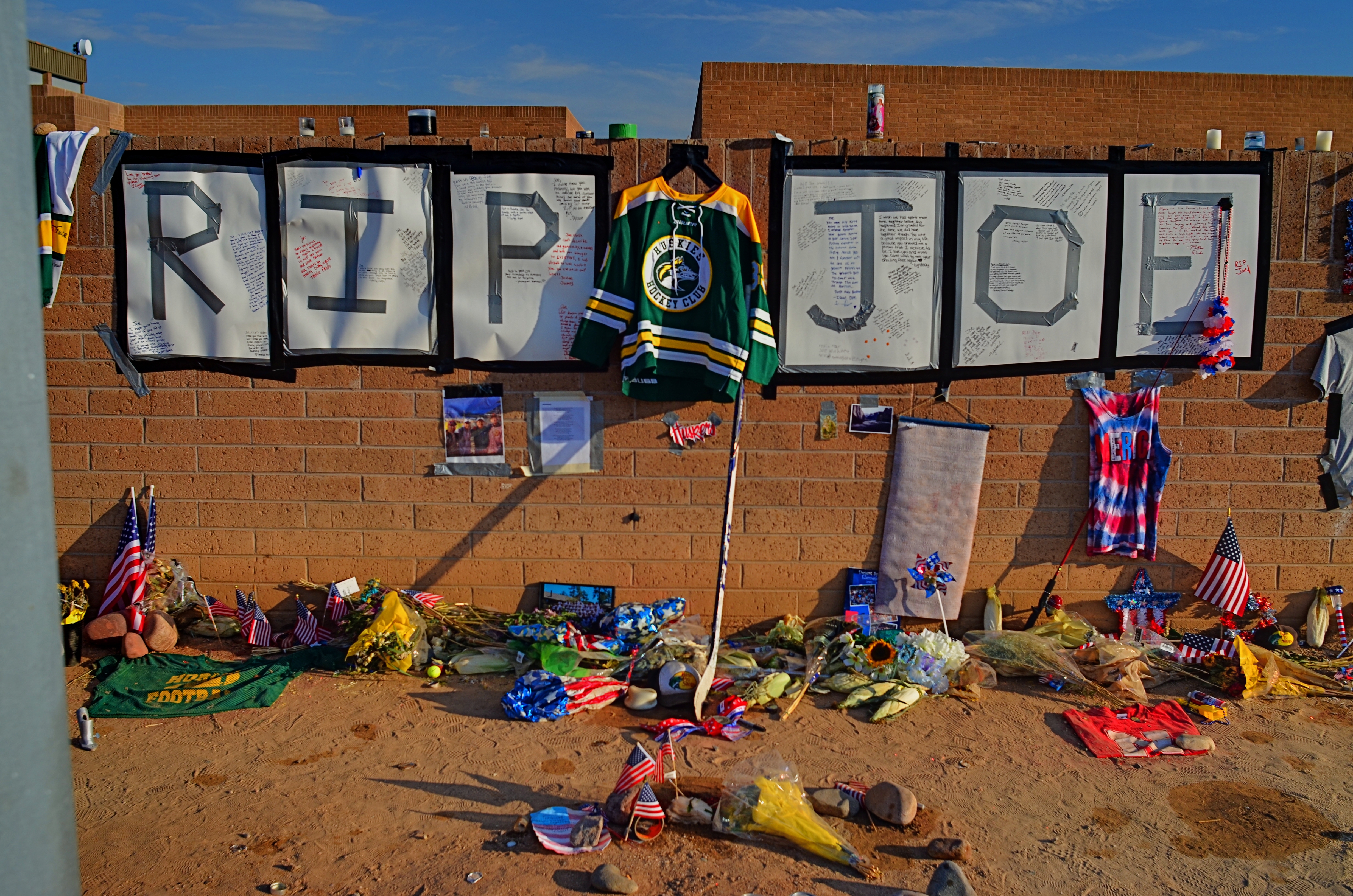
Flags, plaques, praise, prizes. Does all this add up to a life?
I recently drove past an improvised memorial for a deceased high school student. I knew nothing of his life beyond what his friends decided to collect to mark its passing. And so, visually, I was presented with a puzzle. What specific articles can be used to symbolize a life? Conversely, what should be excluded? How does an object that says something for one person presume to speak for he who has been silenced?
I made the shot you see here in as plain and reportorial a fashion as I could, shooting it head-on, in the manner of Walker Evan’s iconic images of signs and posters from the 1930’s. The only interpretive factor here, really, is the light in which I chose to shoot, deciding that sunset would help boost texture in the shot, and, incidentally, serve as a kind of metaphor. Make of that what you will.
Some pictures don’t need people in them to speak loudly for them. Today’s collectively assembled registries of loss are, in themselves, interpretive statements, not unlike paintings, editorials, or eulogies. Acknowledging them in pictures seems less like invasion and more like reportage, since they are clearly designed to be seen, to bear witness. The fact that they are anonymous makes them intriguing. The fact that they are so intensely personal makes them photographically essential.
SUNSETTING
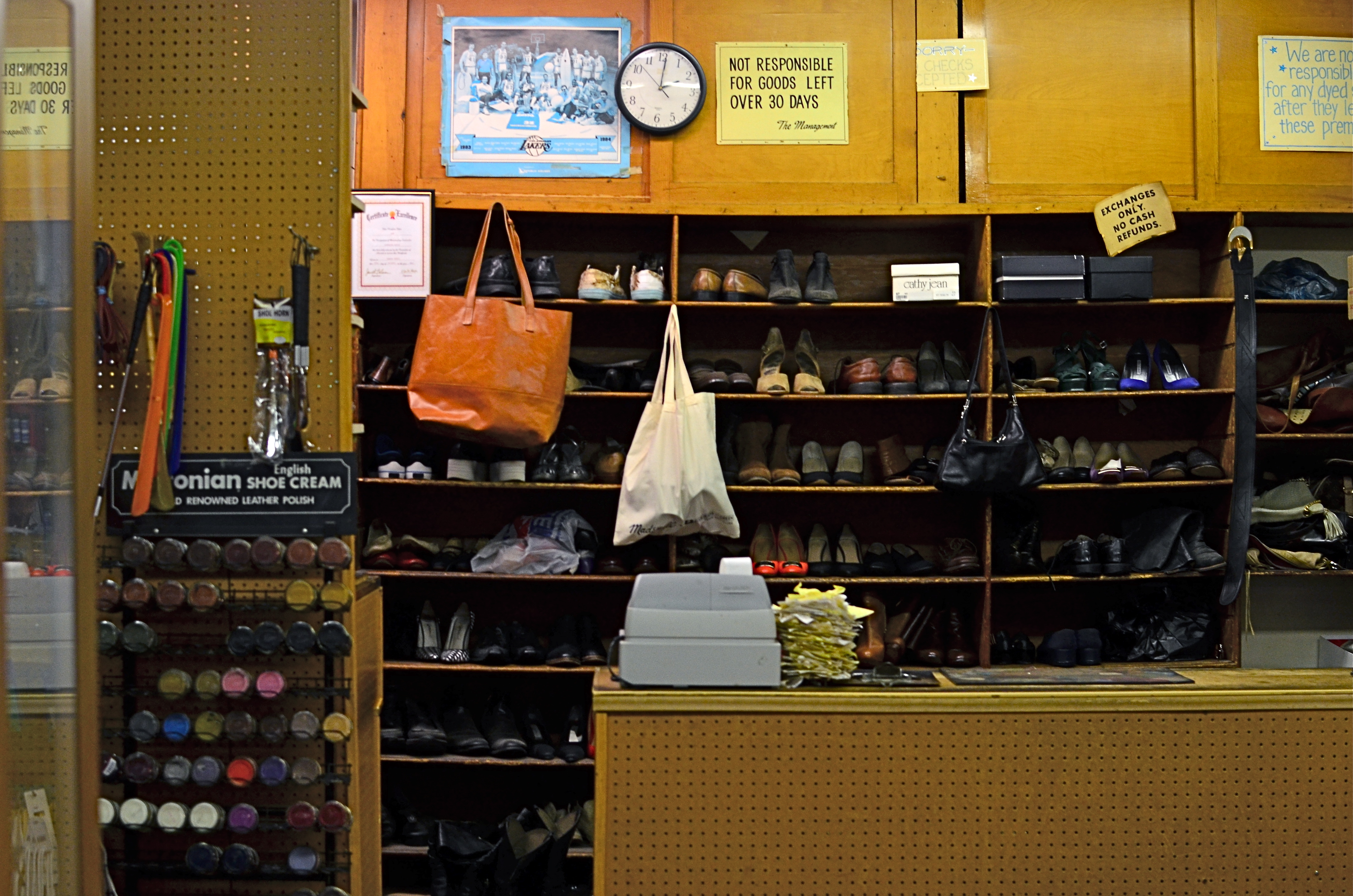
They’ll Be Ready Tuesday (2015)
By MICHAEL PERKINS
IN RAY BRADBURY’S WONDERFUL ONE-ACT PLAY, TO THE CHICAGO ABYSS, an old man equipped with a near-photographic memory makes both friends and enemies because he remembers so much of a world vanished in the aftermath of global war. His talent lies not merely in being able to conjure the world of large things….cathedrals, cars, countries, but of the micro-minutia of a life, a realm filled with the colors of cigarette packages, what compressed air sounded like hissing out of a newly opened can of coffee, the names of candy bars. The play reminds us that it is the million little pieces, the uncountable props of daily living, that matter…..especially when they are no more.
Professions and services offer the photographer the chance to preserve entire miniature worlds for the viewer, worlds which are in the constant process of sunsetting, of transitioning from “is” to “was”. Shops where we used to get our watches repaired. Bookstores that are now furniture warehouses. Home where those people we knew, oh, you know their names, used to live. Was it on the corner? Or over there?
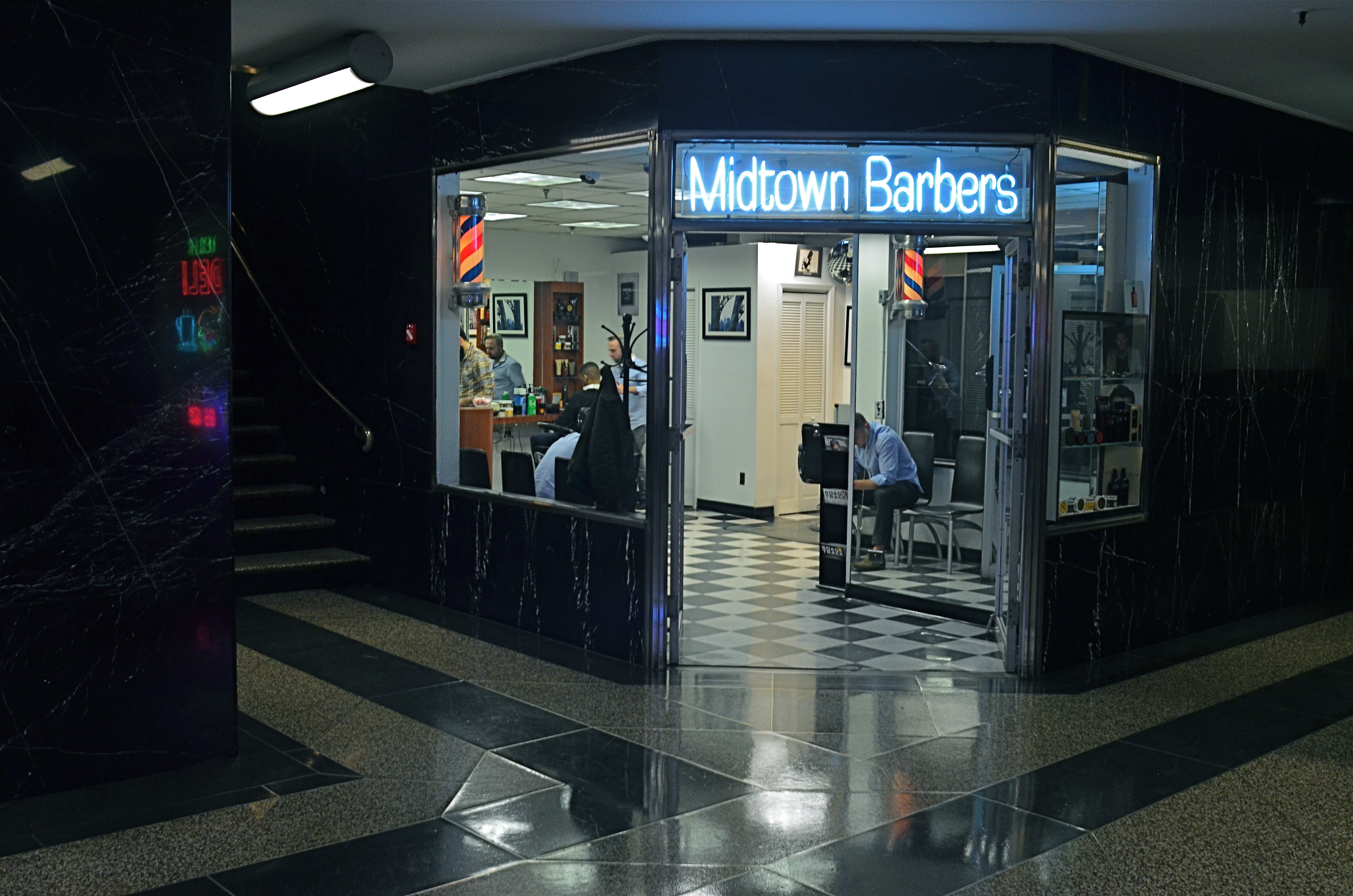
Clip Joint (2016)
Even when long-familiar things survive in some form, they are not quite as we knew them. Does anyone still get their shoes re-soled? Was there ever a time when “salons” were just “barber shops”? Was it, long ago, some kind of luxury to weigh yourself for a penny in the bus station? Photos of these daily rituals take on even greater import as time re-contexualizes our lives, shuffling our position in the cosmic deck. Decades hence, we almost need visible evidence that we ever lived this way, ever dressed like that.
I love shooting businesses that should not be around, but are, places that should have already been scrubbed from day-to-day experience, but stubbornly linger around the edges. Images taken of these places argue strongly that not all forward motion is progress, that the familiar and the comfortable are also little pieces of our identity. In the words of the old song, there used to be ballpark right here.
Here, I have a picture of it…..
THE WHEN OF WHIMSY
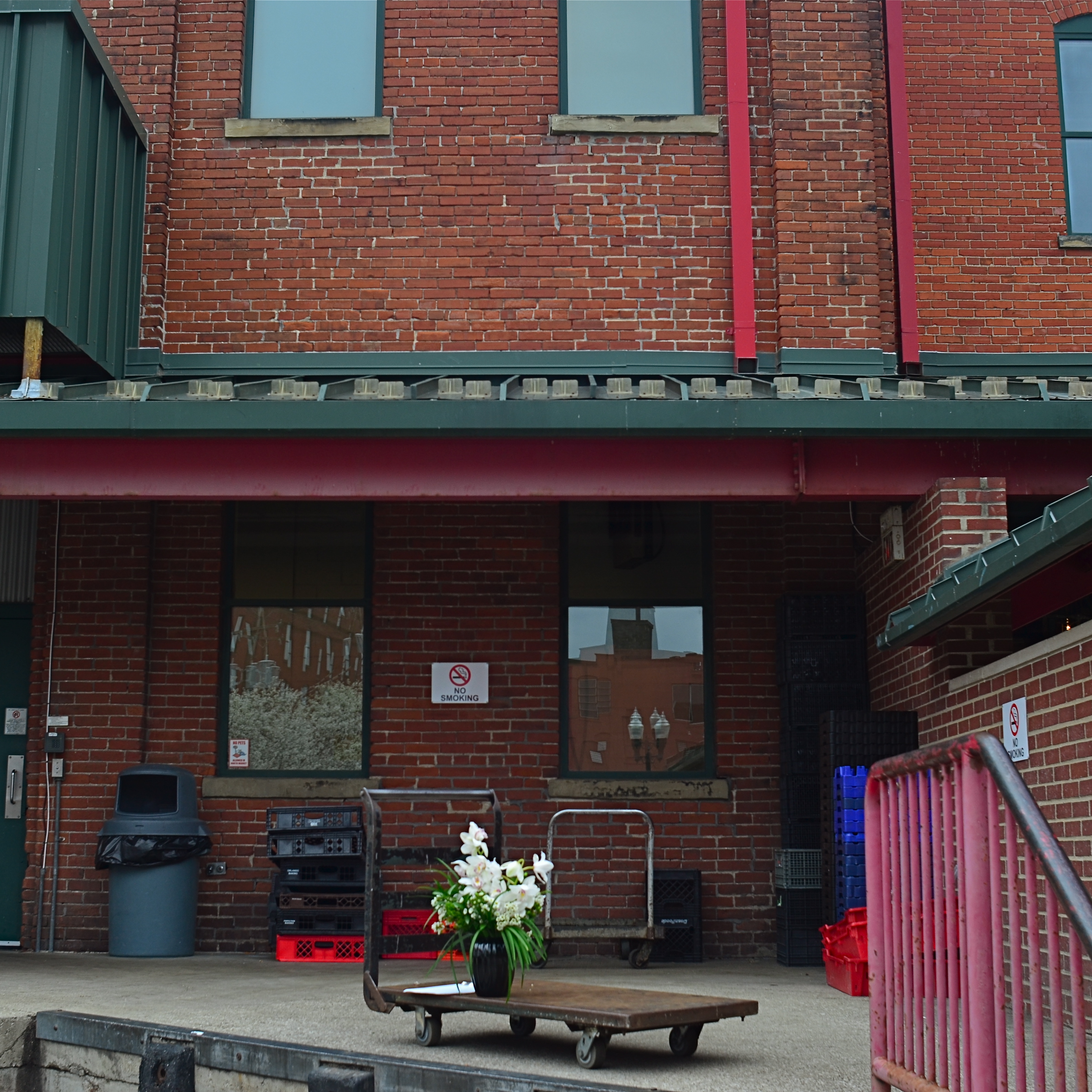
Yes, We Deliver, 2016. Who ordered the blooms?
By MICHAEL PERKINS
For decades, the legendary Life magazine provided richly illustrated summaries of the week’s events, competing with other photo-laden national weeklies from Look to Fortune, Collier’s to Liberty for the eyeballs of generations of subscribers. The weekly giants perfected the photo-essay, laying out stories on elections, wars, fashions and the arts in serial narrative form from opening headline to closing paragraph. Life has even had a second “life” of sorts, ceasing weekly publication clear back in 1972, but still visible on newsstands to the present day in re-mixed, themed reissues of its iconic image archives.
One of my favorite features in Life over the years was the Miscellany page, tucked just inside the magazine’s back cover, and reserved almost exclusively for whimsy or fun. Freed from the journalistic constraints of the rest of Life, the Miscellany images ended the week on an up note with novelty and warmth providing relief from starker, sterner material. Nearly all of the photos were “human interest” in nature, featuring amusing interactions between people. Lovers. Kids. Day laborers. There was a true “caught in the act” flavor to the shots, and most looked like lucky candids rather than staged or manipulated images.
The feature informed my own brand of street photography, the snap that makes the mind speculate on the story that takes place both before and after the click. Sometimes people figure in my own moments of whimsy. Other times, as in the case of the image up top, an unusual arrangement of elements captures my imagination, making me wonder how these particular things got to this particular place. The idea of a single blooming flowerpot on a cart standing outside a very industrial loading dock caught my eye, as the two things don’t seem, at first glance, to belong to the same world. I almost spent too long thinking about it, too, since, several seconds after I snapped the picture, a worker came into frame and removed the vase, vaporizing my little tableau forever. Snooze you lose.
Miscellany appealed to my child’s sense of how to tell a story in pictures, not by what was shown but by what else is going on. There is a limited “when” for all whimsy, and, as the editors of Life realized so well, a time when one picture on the page is worth a thousand more in the mind.
RUIN AND RESURRECTION
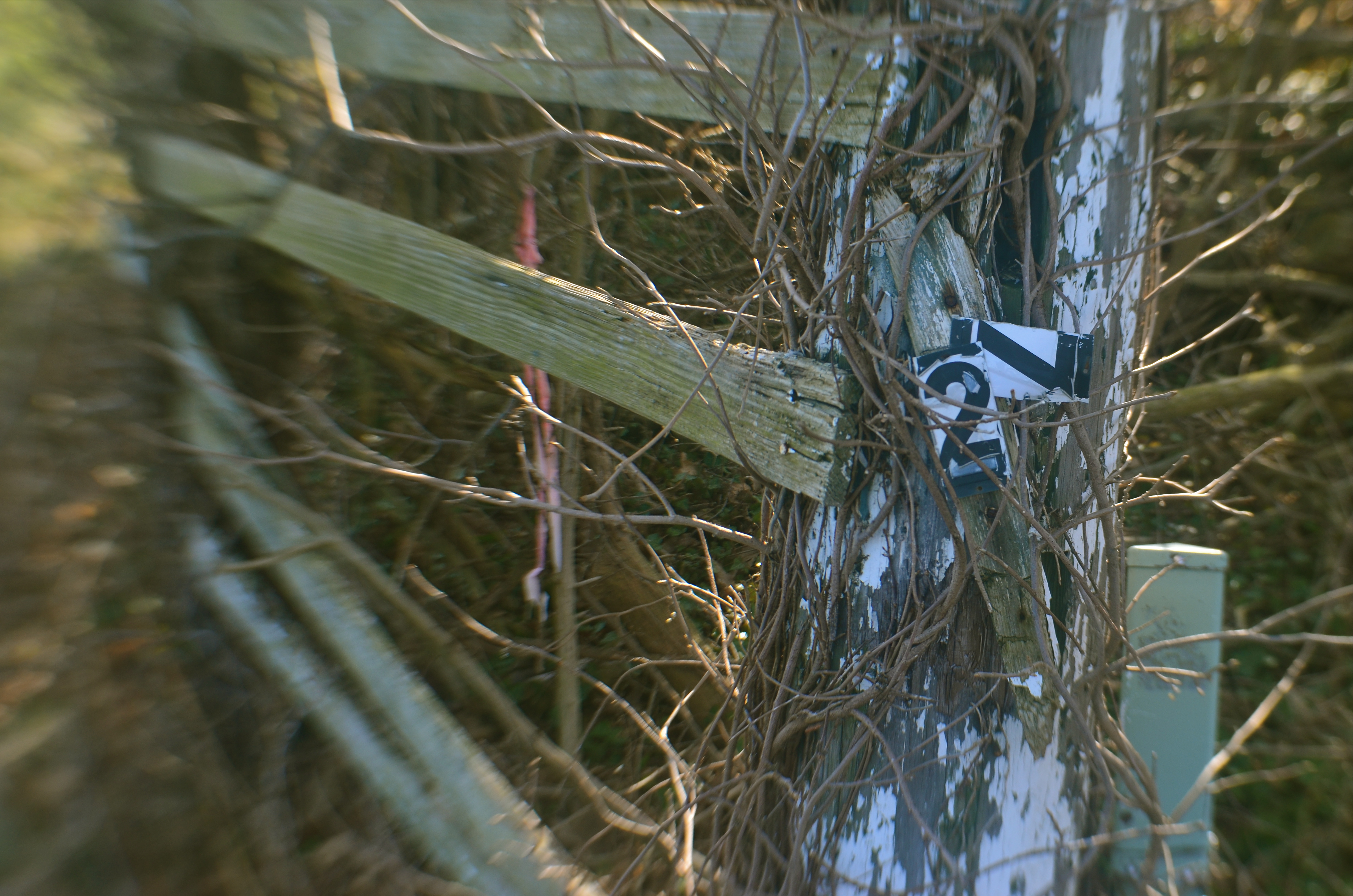
Down The County Line Road, 2016. A fairly obvious study in “ruin” photography. Or is it?
By MICHAEL PERKINS
IN THE BEGINNING, PHOTOGRAPHY WAS MOSTLY ABOUT RECORDING, arresting time in its flight in order to preserve scenes for posterity. And, for its earliest practitioners, that purely technical feat of stopping the clock was enough. We still use the word capture to describe this harvesting of moments. Soon, however, photographs became truly interpretive. That is, they set out to be about something beyond a mere logging of the physical world. In so doing, they passed from documents to statements, with shooters choosing which world view they wanted to present.
I find that, even in the most complex documentary photos, those views seem to collect into two main camps of thought. One kind of image, which may be called the “ruin” category, depicts what we have lost. Abandoned buildings, wrecked cities, damaged lives. “Ruin” campers show the deterioration of things and ask us to assess the loss of dreams. The second general kind of interpretive category, which I’ll call the “resurrection” camp, shows the things that might have experienced ruin but are rebounding, on their way back up. Rez campers show the resiliency of the human spirit, the belief that there will, indeed, be a tomorrow.
Human beings being partisan by instinct, curators, editors, and audiences can, and do, glorify the pictures of one camp while decrying the worthlessness of images from the other camp, in what is really a false choice. Life is never cleanly divided between heaven and hell, and neither should your pictures be.
Photographs that show what we have wasted are no more “authentic” than those that show us recovering from loss. And truly great photographers actually straddle both camps in their best work. But your purpose in a picture must be clear: the image at the top of this page seems to mourn the devastation of an old family farm. However, if I were to pull back to a larger frame, the camera would also show the freshly furrowed fields of a property that is in the process of being re-developed. Ruin or Resurrection? It’s down to approach, and context.
Some days it seems like the best story you can tell is a tragic one, but, at other times, there is nothing more courageously honest than depicting hope. It all depends on what comes to hand. The best plan is not to plan, to be open to whatever the best testimony is, right here, in this picture.
Right now.
A NEW PATH
A dream of life comes to me. Come on up for the rising tonight—-Bruce Springsteen
By MICHAEL PERKINS
THE POST 9/11 RESURRECTION OF LOWER MANHATTAN might have begun as a kind of act of defiance, a refusal to knuckle under to fear in the aftermath of the largest attack in history on American soil. Somewhere amidst the tears and rage, however, the project to re-establish this crucial corner of New York City moved onto a higher plane, transitioning from anger to elegance, mourning to…morning. And now, for both casual travelers and astounded visitors, the master plan for the area is an ever-blooming monument to faith. To excellence.
Photographers from around the world have known, from the days of the first cleanups, that an amazing opportunity for historic documentation was unfolding on this hallowed ground, and their images have provided an invaluable service in tracking the city’s transition between two distinct eras. The first two mile-markers in this transformation, the openings of World Trade Center One and the 9/11 Memorial Museum, have been interpreted in a global cascade of visual impressions, occurring, as they have, in the first explosion of social media and digital imaging. And now, the third piece of the puzzle, the stunning new Oculus PATH terminal, is nearly ready to serve as the proof that the city, along with all its millions of comings and goings, is still very much open for business.
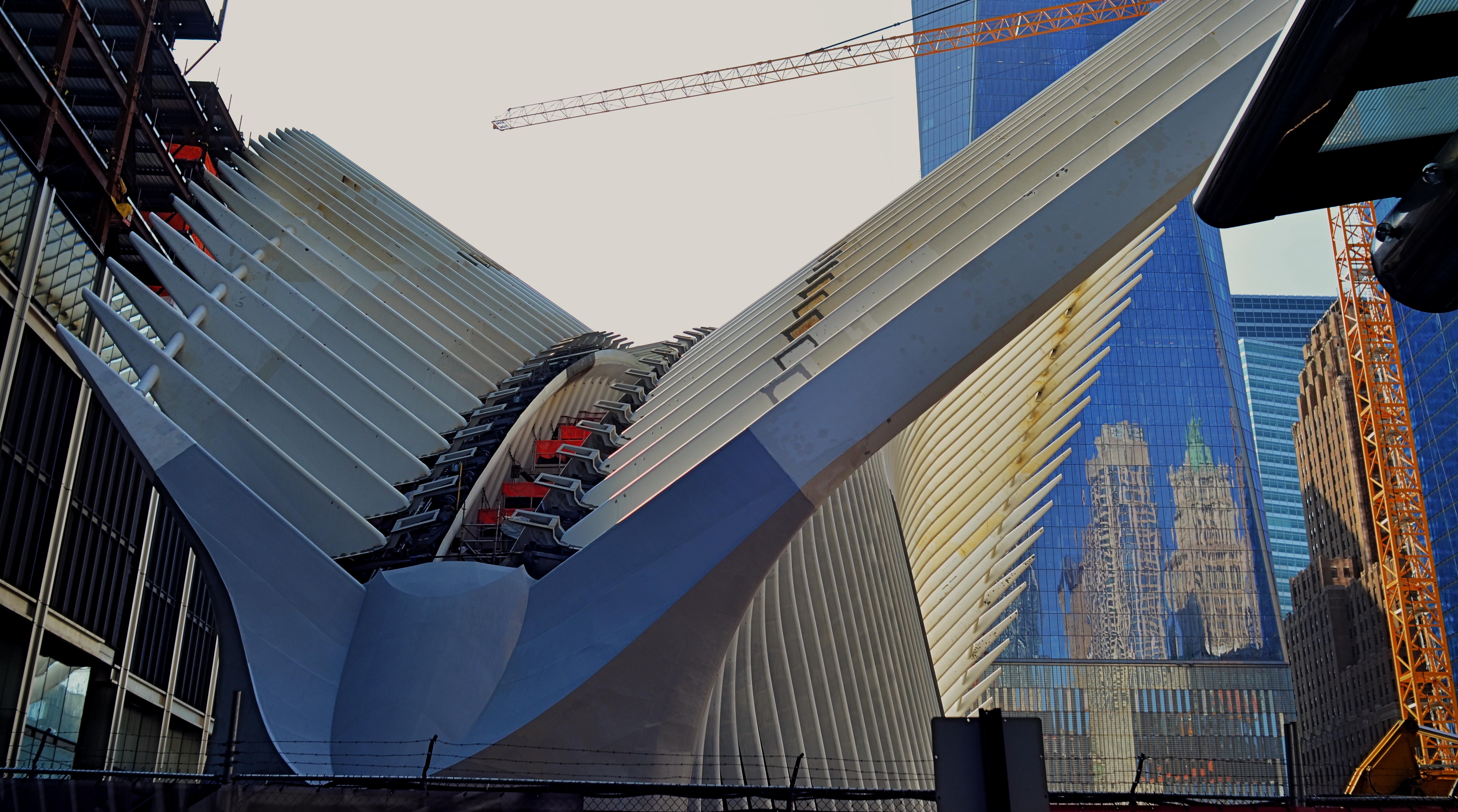
Oculus Aloft: the steel wings of the new PATH terminal for New York’s World Trade Center, nearing completion in 2015.
Photographers have already made a visit to Oculus something of a pilgrimage, and, looking over the first few photos to emerge from their visits, it might be closer, architecturally, to a religious experience. Designed by Santiago Calatrava, the structure, presenting its ribbed wings to the skies like an abstract bird of prey, resembles, within, a kind of sci-fi cathedral of kaleidoscopic light effects, serving as both monument and utility. An inventory of its features and a gallery of interior images can be seen here.
And, of course, this is New York, so opinion on the Oculus’ value, from poetic prayers to crass carping, will go through the usual grappling match. But, whatever one’s eventual take on the project, its power as a statement….of survival, of power, of hope, and, yes, of defiance, cannot be denied. To date, I’ve only been able to photograph limited parts of the construction phase (see above), but I will be back after the baby’s born. And my dreams will collide with Oculus’ own, and something magical will happen inside a box.
Make your way to Manhattan, and let your own camera weigh in on the new arrival.
Come On Up For The Rising.
CONJURING GHOSTS
I know all the songs that the cowboys know
‘Bout the big corral where the doggies go
‘Cause I learned them all on the radio
Yippie yi yo kai yay
“I’m An Old Cowhand”, music and lyrics by Johnny Mercer
By MICHAEL PERKINS
SOMETIMES IT SEEMS THAT WE ARE NEVER REALLY FINISHED with photography’s past, using today’s technology to summon forth the look and spirit of what we see as the early innocence of the art. Photographers are always trying to wrench free of yesteryear, and yet, in our images, we love to romance the echoes of the shooters that we were, as well as the world that what there to shoot.
We like to conjure ghosts.
We’ve reached a place where, through one process or another, it’s easy to evoke almost any phase of photography we desire, a strange nostalgia that has artificially extended the use of film by a good many years into the digital era. We like the feel, the habits, even the defects of film as a storage medium. We build brand-new pinhole box cameras: we revive and repair old tool dies so we can manufacture factory-fresh editions of defective old gizmos. We write computer code that allows our smartphones to imitate the grain and texture of archaic celluloid emulsions.
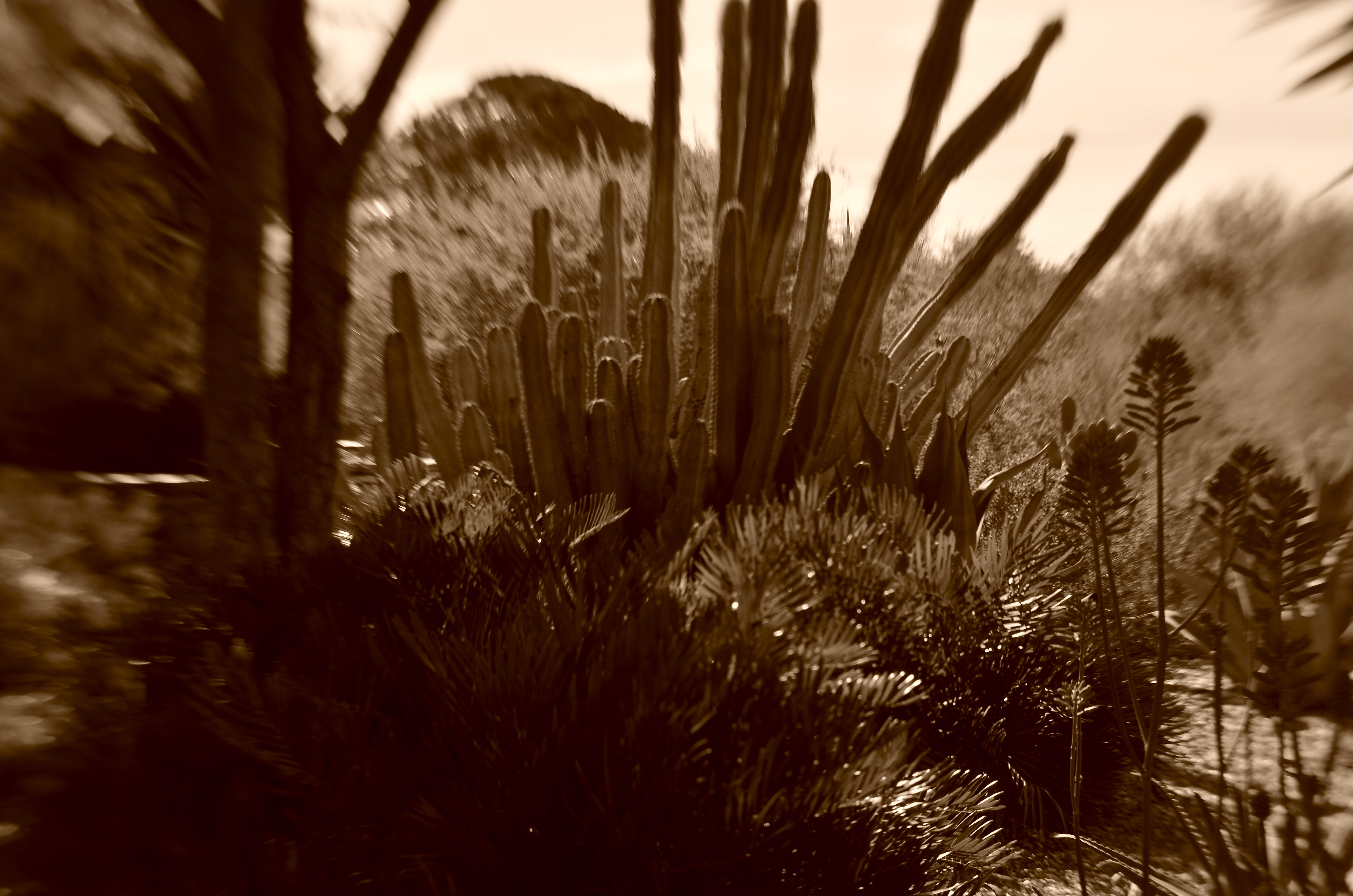
Of course, there has to be subject matter to feed all this retro-tech, and, in the American west, the medium matches the message as we drench memories of the frontier in our own brew of reflective processes. Sepia tone, soft focus, high contrast, long exposures, all of them are used to summon the bygone glories of cactus and canyon. The settling of the west will always create a kind of poignant ache for photographers. The surveyors, the settlers, even the Hollywood myth-makers all stole a march on us. We bring our cameras to try to spook up a smidgen of the Big Pictures that we missed.
It’s a kind of harmless fakery that we paint upon mesa and mountain, a re-interpretation of a truth none of us really knows for sure. It’s dressing up to play cowboys and indians, with the camera’s eye to help make the best, most authentic forgeries we can muster. Living in the west in the 21st century, I find that conjuring ghosts, like indulging in any other kind of fantasy photography, is like building a doll house. I control the furniture, the wall paper, the layout of the rooms. We all arrived to late to ask the Riders of the Purple Sage to smile for the birdie. But there are still smiles of a sort, even an occasional tear, to be drawn in the dust.
YESTER-ESSENTIALS
By MICHAEL PERKINS
ONE OF THE MOST REMARKABLE POP CULTURE TRENDS OF THE PAST FEW YEARS has been the improbable reemergence of the vinyl LP, inching its way back onto shelves in edgy fashion boutiques and chain stores alike along with an entire battery of support materials: preeners, cleaners, racks, boxes, even the iconic hippie fruit crate, along with a new generation of high-and-low tech turntables and speakers. It’s fun to watch the emotional re-run that people of, ahem, a certain age will experience as we recall a world that used to be divided into Side One and Side Two.
However, we’ re missing out on a very important part of all that lore. The humble 45 rpm record.
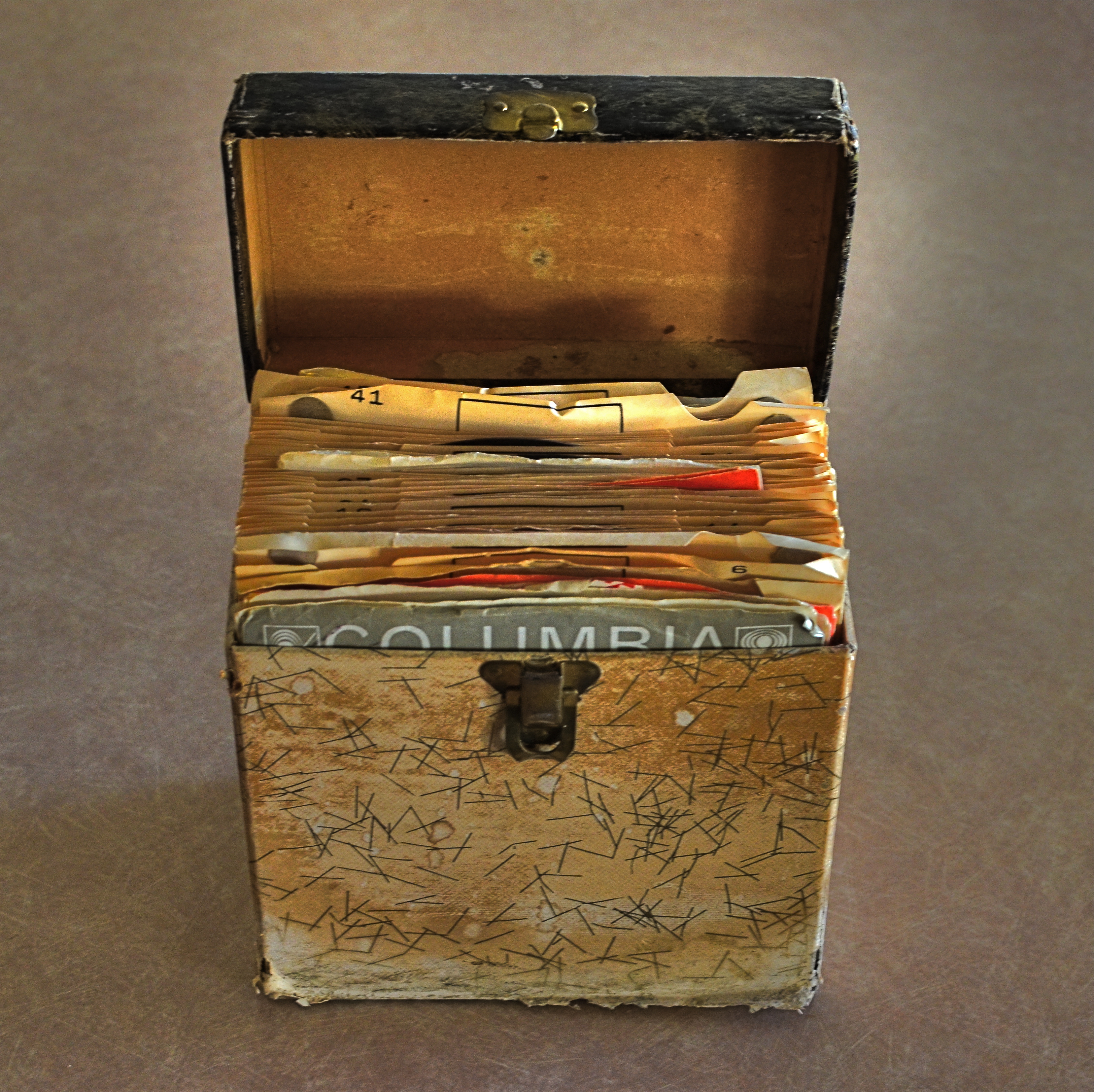
Party On, Garth: A pseudo-HDR made with two copies of the same starter exposure, blended in Photomatix.
Singles were the dominant format for record sales from the beginning of rock to the mid-’70’s, with marketing of pop tunes aimed squarely at the middle bulge of the Baby Boom, a flood of teens armed with disposable cash but consuming their music mostly two songs (A-side, B-side), or about a dollar’s worth, at a time. Eventually, a new crop of college students embraced the LP for its long-form story-telling potential, graduating from singles like Love Me Do to albums like Sergeant Pepper.
Photographically, the remains of all those singles-fed slumber parties and sock hops tell a strong story in the tattered textures of kid’s objects that, like action figures and train sets, were loved to death and treasured all the more because of their imperfections. In the above 45 carrier (party in a box!), half the visual story is told in the wear and tear that is hard-wired into analog. The battered box sings a song all its own.
For this shot, I took a single exposure, side-lit with bright but soft window light, then made a dupe of it, one copy tweaked to near-underexposure, the other to uber-brightness. The two were then made into a fake HDR in Photomatix, which is, above all, a great detail enhancer. Since the shot was done at f/5.6, the whole box is sharp, giving the software plenty to chew on. A few minor changes in contrast to amp up the differences in color along the faded box pattern, and presto, the golden age of Rock ‘n’ Roll.
Photography is about recording change, halting decay in its tracks for a moment….preservation, if you will. The new flawless vinyl reissues of our old faves possess the sound of yesterday, but they can’t tell us a thing about how it all looked.
And that’s where you, the guy with the camera, come in.
THE LAST OF MANY GOODBYES
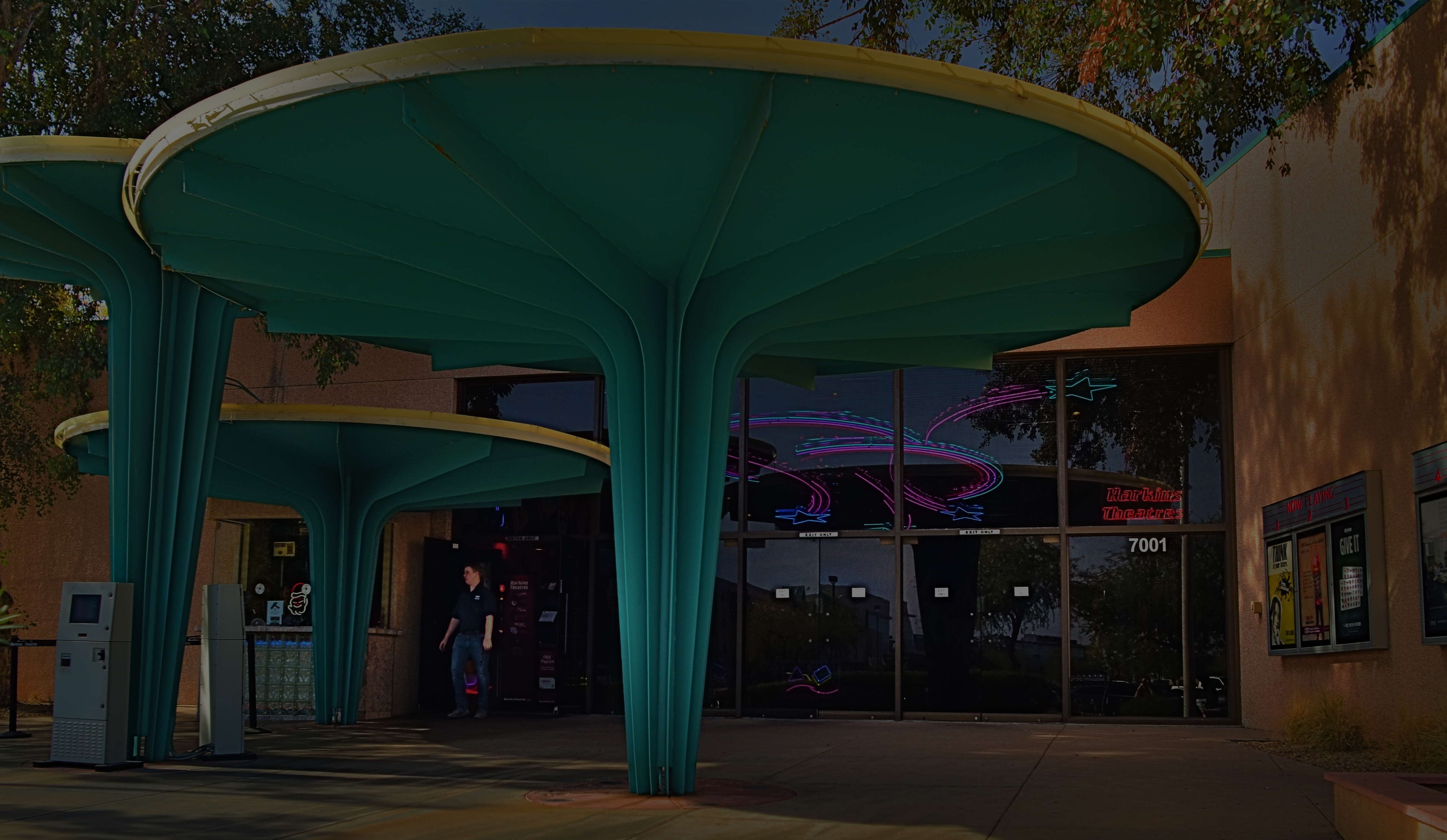
Scottsdale, Arizona’s gorgeous little art-house complex, the Camelview Theatre, on the afternoon of its final day, December 10, 2015.
By MICHAEL PERKINS
ON THE SPOCK SIDE OF OUR BRAINS, OF COURSE WE KNOW that there is nothing particularly magical about buildings per se. Stone and steel cannot, after all, generate memory or experience; they merely house the people who do. Still and all, the loss of certain edifices engenders a purely emotional response in us, perhaps because special things can no longer happen there, and the physical proof that any of it happened at all is being rendered, at least physically, into dust. That puts us in the realm of dreams, and that’s where great photographs are born.
When a place that is special to us is about to wink out of existence, everyone who used that place stamps it with their own stories. We went to school here. This is where I proposed to your mother. The bandstand was here, along this wall. So personal a process is this that our farewell photographs of these places can take on as many different flavors as the number of people who walked their halls. And, as a result, it’s often interesting to compare the final snaps of important places as filtered through the disparate experiences of all who come to reflect, and click, in the shadow of the wrecking ball.
I have attended many an opening at theatres, but I always make a point to attend their closings. Not the end of a certain film or engagement, but the final curtain on the theatres themselves. How best to see their final acts? As a quiet, gentle sunsetting, as with the above image of Scottsdale, Arizona’s Camelview theatre, shuttering in deference to a bigger, newer version of itself at the end of 2015? Or, in the colorful confusion of the venue’s final night, with crowds of well-wishers, local dignitaries and well-wishers crowding into the final screening?
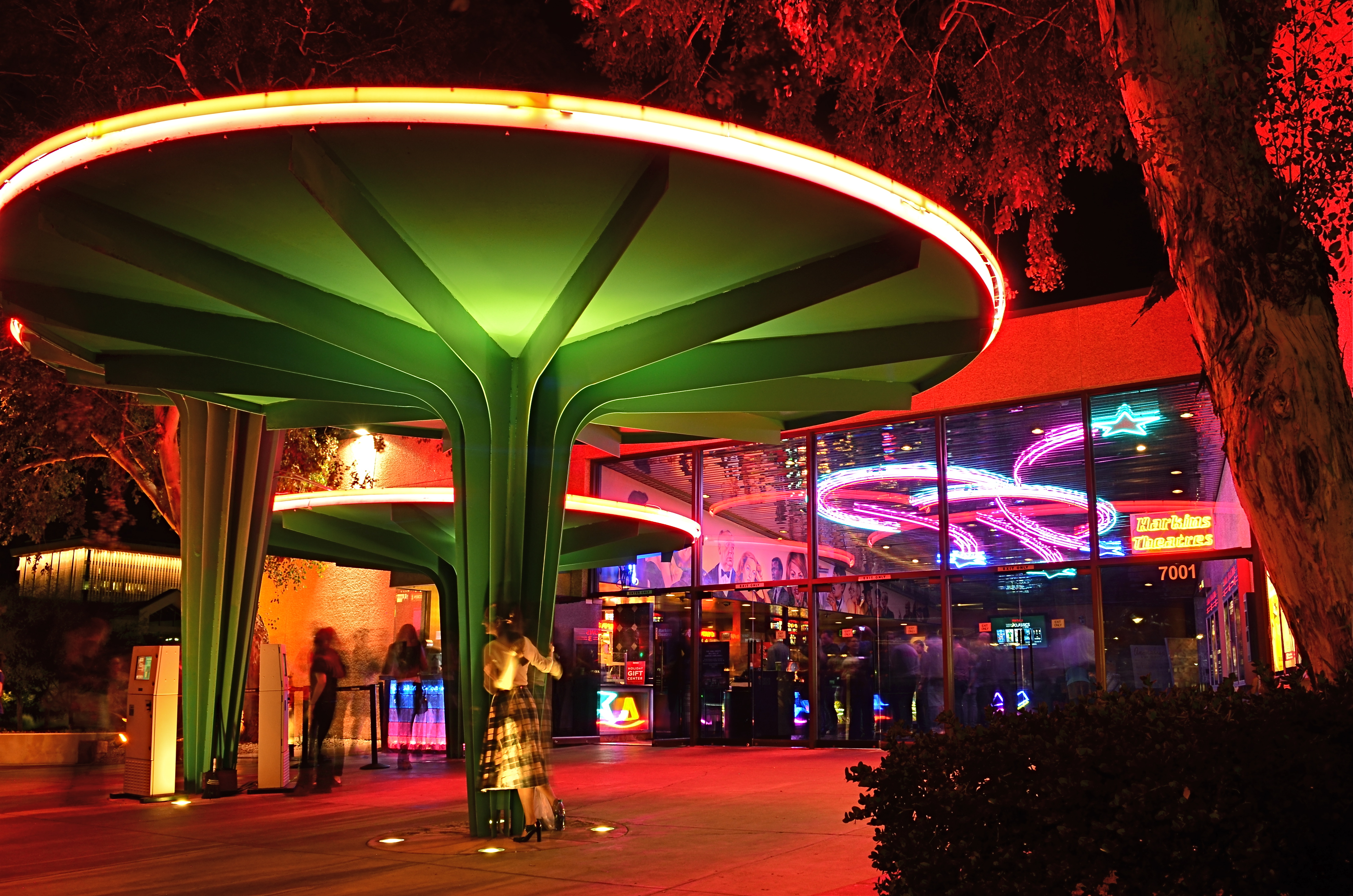
Later that same day: the Camelview’s last neon-lit night of glamour.
Each view projects my own feelings onto the resulting images, whether it be a golden dusk or a frenetic, neon-drenched, tomorrow-we-die send-off, complete with champagne and cheers. The introspective daytime shot has no teeming crowds or fanfare. The night, with its ghostly guest blurs (a result of the longer exposure) features people who are as fleeting as the theatre’s own finite run. Both are real, and neither is real. But they are both mine.
Buildings vanish. Styles change. Neighborhoods evolve. And photographic goodbyes to all these processes are never as simple as a one-size-fits-all souvenir snap. People, and memories, are too customized for that. As with movies themselves, there is always more than one way to get to the final fadeout.
THOSE WHO STAND AND WAIT
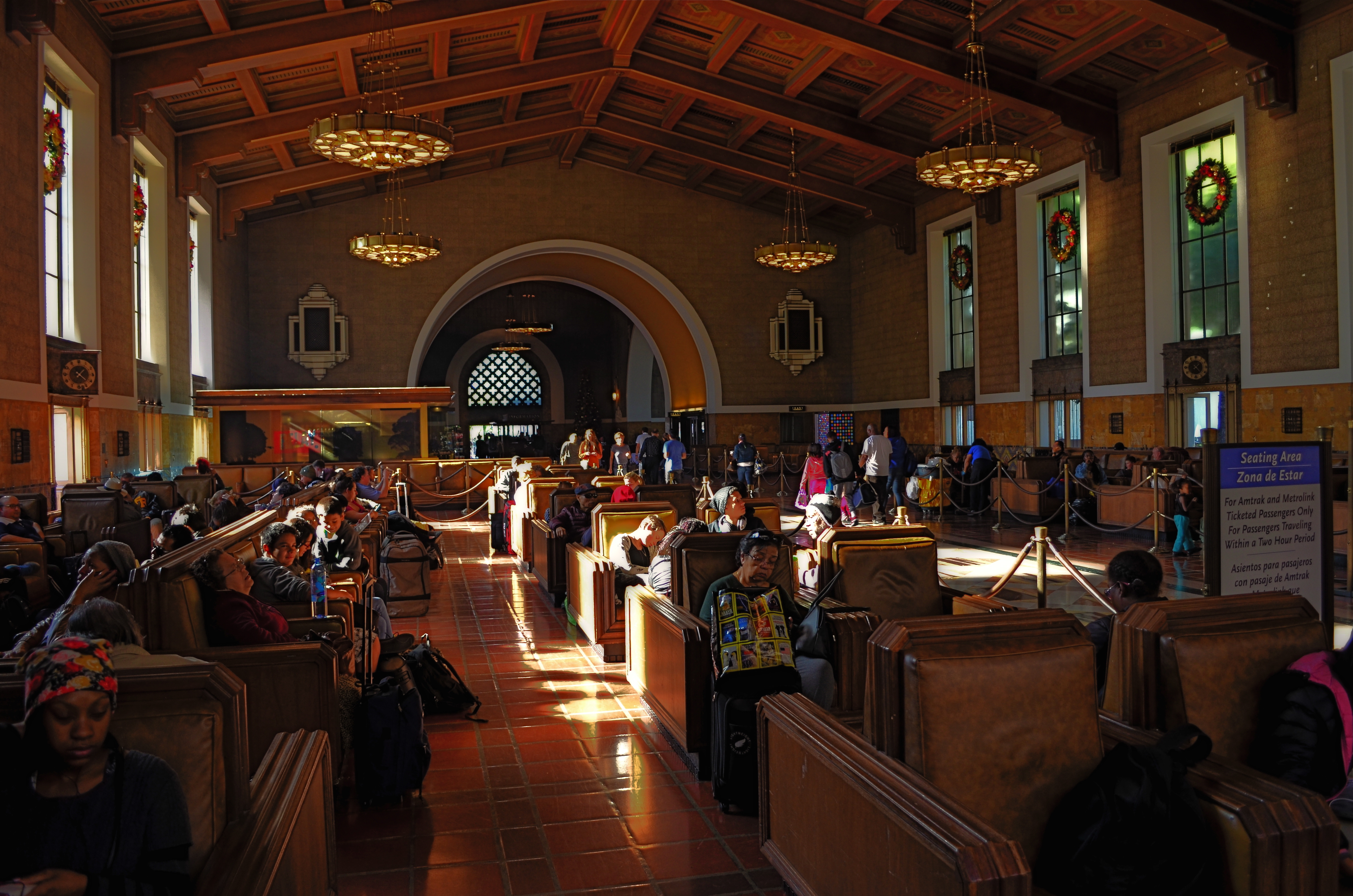
Please Listen For Announcements, 2015. The iconic waiting room at Los Angeles’ Union Station terminal.
By MICHAEL PERKINS
SHOW ME A HOLIDAY SEASON AND I’LL SHOW YOU PEOPLE WAITING FOR SOMETHING TO HAPPEN. They form lines for special orders, last-minute items, a kid’s brief audience with Santa. They hope to bump someone on a flight, beat someone out of a bargain, talk someone into a discount, refund or exchange. But mostly, they wait.
For as many festive holiday subjects that dance before the photographer’s eye, there are many more scenarios in which nothing much happens but..the waiting. And, while this seemingly endless hanging-out never offers images that define joy or wonder, they are fodder to the street shooter within us, the guy looking for stories. Stories of tired feet. Tales of people who can’t get a connecting flight ’til tomorrow at the earliest. Sagas of mislaid plans and misbegotten presents. Folklore of folks who are lost, lonely, disappointed, and down. In short, all of us, at various times.
Transit points are often among the most poignant during the season, with legions of faces that plead, what’ll I get for her? How will I get all the way down this list? How soon can I get home? Your best bet? Hang at the train stations, the port authorities, the airports, and hear the plaintive strains of I’ll Be Home For Christmas sung in the key of ‘as if’. Seek out those aches, that weariness, the many false starts and stumbling finishes of the holidays. And keep your camera ready, hungry for whatever visions dance in your head.
JUST OUT OF SIGHT
By MICHAEL PERKINS
PART OF THE EVOLUTION OF A PHOTOGRAPHER’S EYE is the imparting of new importance to things we have forgotten to see, those everyday objects that line or border our rituals and our daily to-and-froms, but which gradually are rendered invisible because our gaze is focused elsewhere. We fix upon the subway train that we have to catch, but miss the miniature tales buried in brick, steel, rust, entrances and exits. We’ve been down this street a million times, and always pause to peer in the window of, in order, the bakery, the newsstand, the Chinese take-out joint. Across the same street are a dry cleaner, a watch repair shop, and a storefront cathedral. We have never seen them.
Photography involves extracting stories where others see a blank slate, but that means first training ourselves to constantly re-see the things we believe we “know”, only to find that there are stunning revelations mere inches away from those known things. It’s the hardest habit to cultivate, this revealing of new layers in what we assume is the familiar. And yet it’s really the fresh blood that rejuvenates our art when it’s gone anemic.
One trick I try more often than I used to is to pause, after entering a building, to look back at the other side of that entrance…in other words, the view I would see facing me if I were using that entrance as an exit. It’s a very simply thing, but frequently there’s something fresh that presents itself, in something I believed I knew all about.
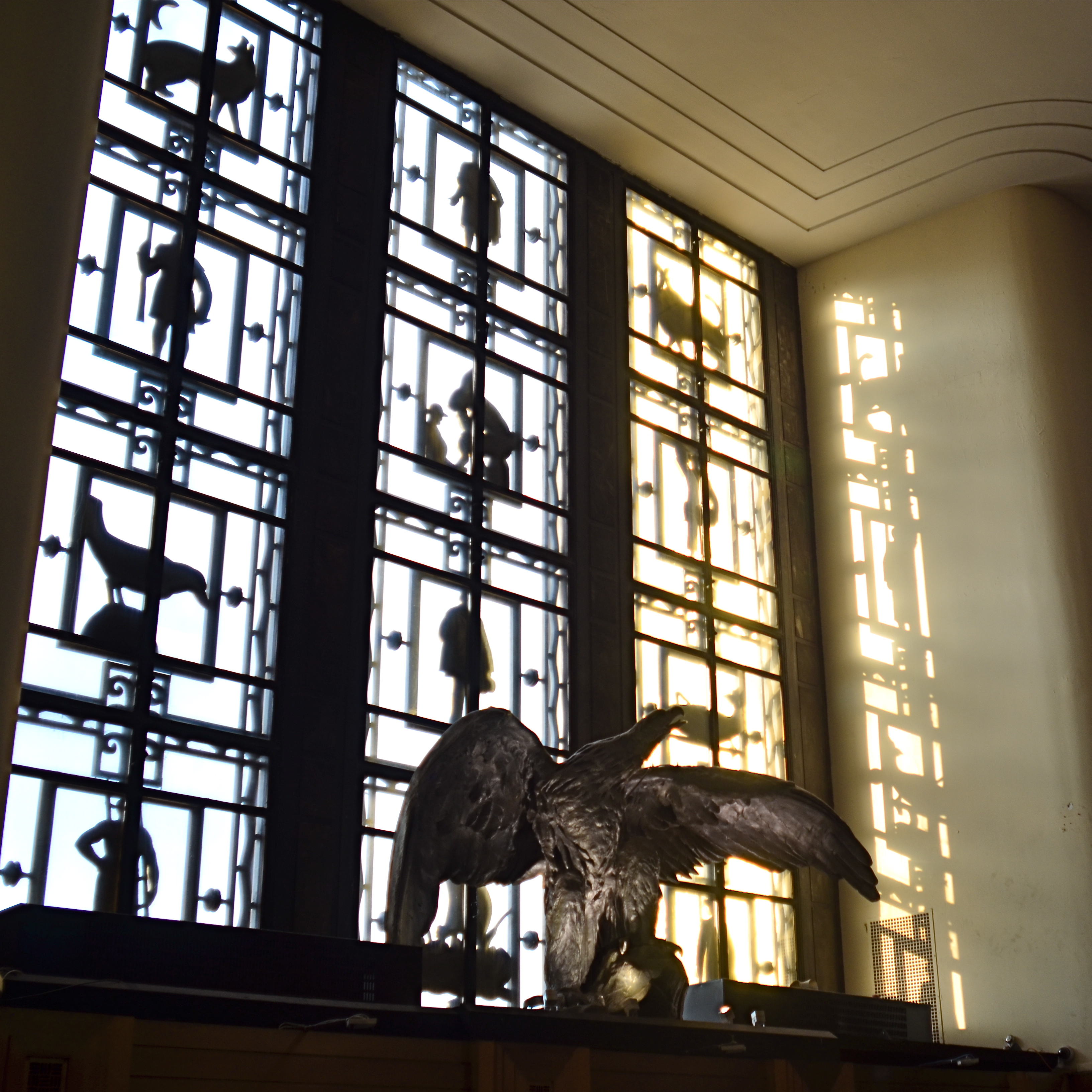
Flights of fancy, right under our wing….ah, nose.
The above image comes from such an exercise. It’s taken just inside the main entrance to the Brooklyn Public Library, which, as you can see, has a great Art Deco grille of storybook characters over the door. But that’s just as you walk in. Pay equal attention when you’re walking out, and you see a strange bird looming over the entrance (now your exit). But not just any bird. It is, in fact, a rescued statue which once graced the main lobby of the long-departed Brooklyn Eagle newspaper, out of its old context as a symbol of high-flying journalism, but now a reminder of one of the city’s best voices. Best of all, the late afternoon sun projects the silhouettes of the storybook grille onto the eagle and the adjacent wall in an unearthly display of shadow. It’s worth looking back at. Or I could say I am always looking forward to looking back at it.
When looking for something new to photograph, seek out the places in which you’ve seen it all. You’ll never be happier to be proven wrong.
A WONDROUS MESS

Too busy? Well, when it comes to seasonal shots, it’s a lot harder to say.
By MICHAEL PERKINS
Consulting the rules of composition before taking a photograph is like consulting the laws of gravity before going for a walk.
Edward Weston
PHOTOGRAPHERS LOVE TO COMPILE LISTS OF LAWS that must be obeyed to ensure the capture of great images. Bookshelves are jammed to fracturing with the collected works of wizards large and small who contend that all of this art stuff is really about craft, or adherence to techniques that are the equivalent of Einstein’s law. And, of course, with every fresh generation, a new slew of shooters come sneering along to deride this starched and stuffy discipline. All that matters, these young turks snigger, is my grand vision.
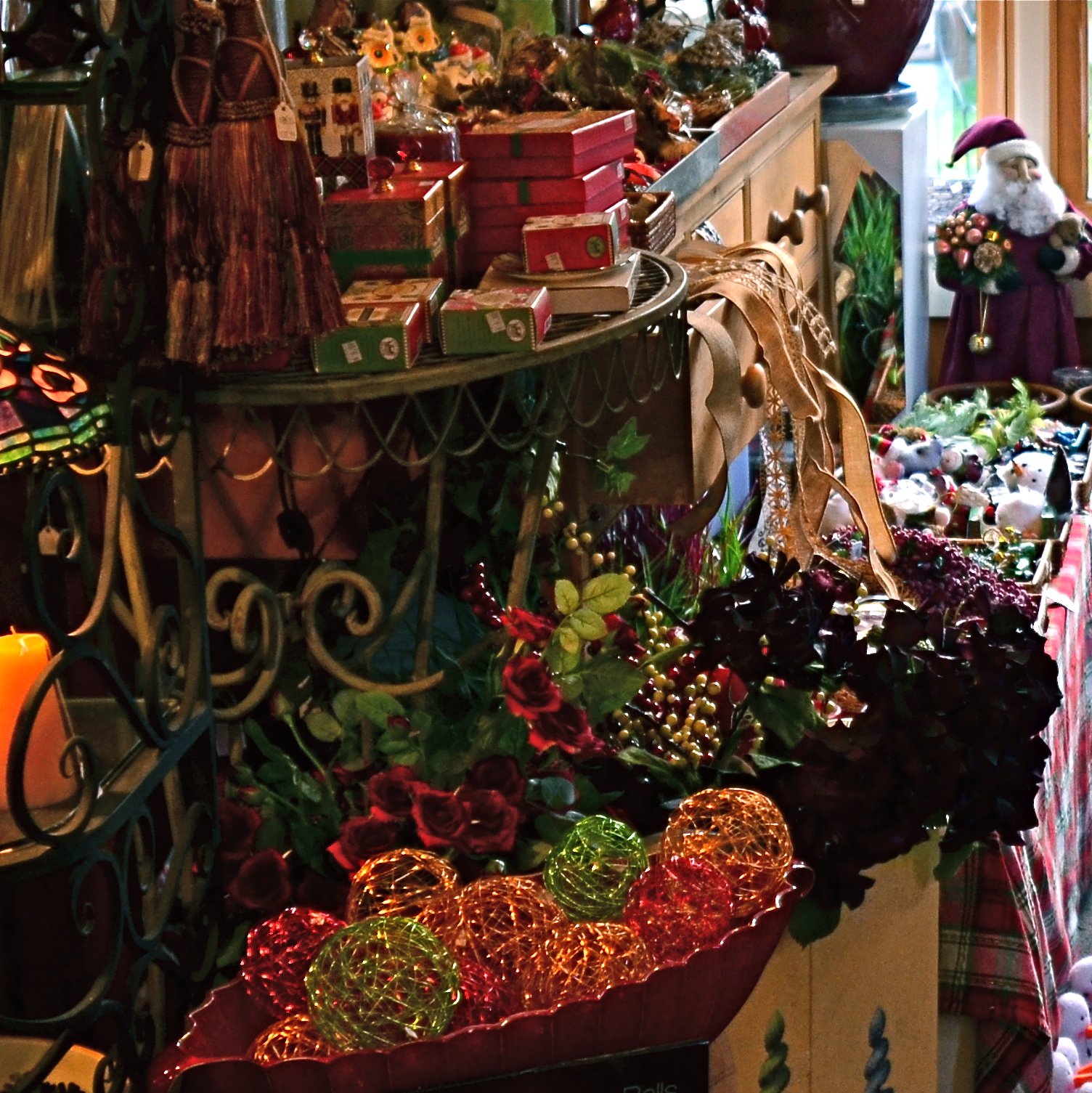
Worlds within worlds: many vast holiday scenes can be “subdivided with cropping.
Let me again re-state the obvious, which is that both viewpoints are correct and/or totally wrong. And since Mr. Weston has introduced the subject of composition, let us consider the special task of seasonal photos, specifically, arrangements of yuletide objects. The classic rule on still-life shots is that less is more, that it’s better to perfectly light and expose three pieces of fruit than whole baskets of the stuff. Meanwhile the festive, instinctual artist concedes that many holiday scenes are mad with detail and crammed with more, more, more…..and that’s okay.
The unique thing about Christmas decor is that in many cases, you not creating the compositions, but merely reacting to someone else’s creations…in nativity scenes, churches, and especially in retail environments. Obviously your local department store doesn’t adhere to the admonition “keep it simple”; quite the opposite. Seasonal trim in most stores is served up not by the spoonful but by the truckload. Anything less than overkill seems skimpy to many yuletide decorators, and so, if you favor basic subject matter, you’re either going to have to mount your own arrangements or selectively zoom and crop the more congested scenes. If, however, you already subscribe to the idea that more is better, then life gets easy fast.
Holidays come layered in much that is intensely personal, and that makes clean compositional judgements about “how much” or “how little” tricky at best. Just get the feelings right and let your regular rules relax into guidelines.
INTERACTIONS
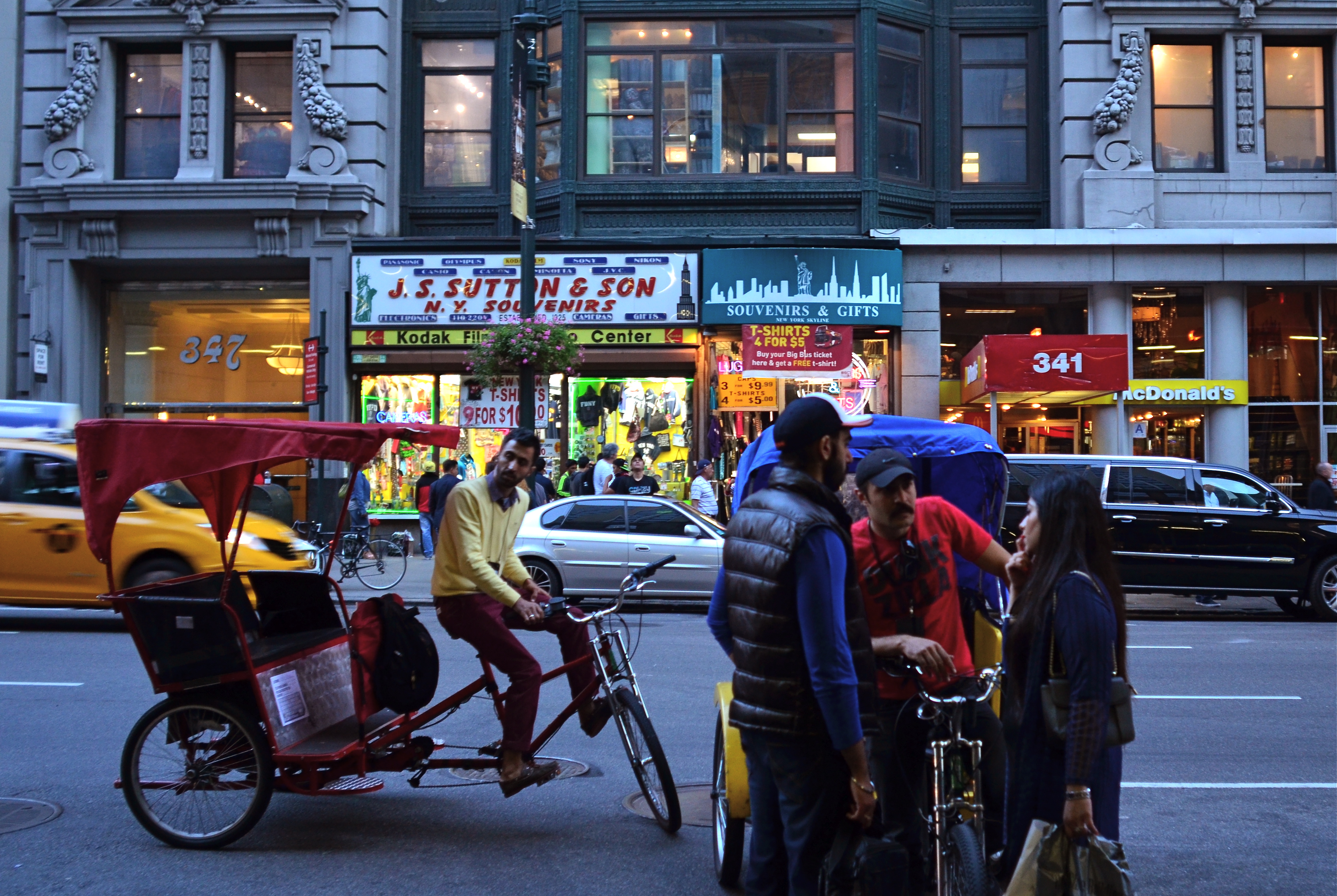
All Around The Town, 2015. 1/50 sec., f/5.6, ISO 320, 24mm.
By MICHAEL PERKINS
IT’S FAIRLY EASY TO FIGURE OUT WHERE TO TAKE YOUR CAMERA if you are trying to visually depict a vibe of peace and quiet. Landscapes often project their serenity onto images with little translation loss, and you can extract that feeling from just about any mountain or pond. For the street photographer, however, mining the most in terms of human stories is more particularly about locations, and not all of them are created equal.
Street work provides the most fodder for storytelling images in places where dramatically concentrated interactions occur between people. One hundred years ago, it might have been the risk and ravage of Ellis Island. On any given sports Sunday, the opposing dreams that surround the local team’s home stadium might provide a rich locale. But whatever the site, social contention, or at least the possibility of it, generates a special energy that feeds the camera.
In New York City, the stretch of Fifth Avenue that faces the eastern side of the Empire State Building is one such rich petri dish, as the street-savvy natives and the greener-than-grass tourists collide in endless negotiation. Joe Visitor needs a postcard, a tee-shirt, a coffee mug, or a discounted pass to the ESB observation deck, and Joe Hometown is there to move the goods. Terms are hashed over. Information slithers in and out a dozen languages, commingling with the verbal jazz of Manhattan-speak. Deals are both struck and walked away from. And as a result, stories flow quickly past nearly every part of the street in regular tidal surges. You just pick a spot and the pictures literally come to you.
At Their Posts, 2015. 1/50 sec ., f/5.6, ISO 500, 24mm.
In these images, two very different tales unfold in nearly an identical part of the block. In the first, bike rickshaw drivers negotiate a tourist fare. How long, how far, how much? In the second, two regulars demonstrate that, in New York, there is always the waiting. For the light. For parking. For someone to clear away, clear out or show up. But always, the waiting. These are both little stories, but the street they occur on is a stage that is set, struck and re-set constantly as the day unfolds. A hundred one-act plays a day circle around those who want and those who can provide.
Manhattan is always a place of great comings and goings, and here, in front of the most iconic skyscraper on earth, those who haven’t seen anything do business with those who’ve seen it all. Street photography is about opportunity and location. Some days give you one or the other. Here, in the city that never sleeps, both are as plentiful as taxicabs.
 thenormaleye
STREETER THAN THOU
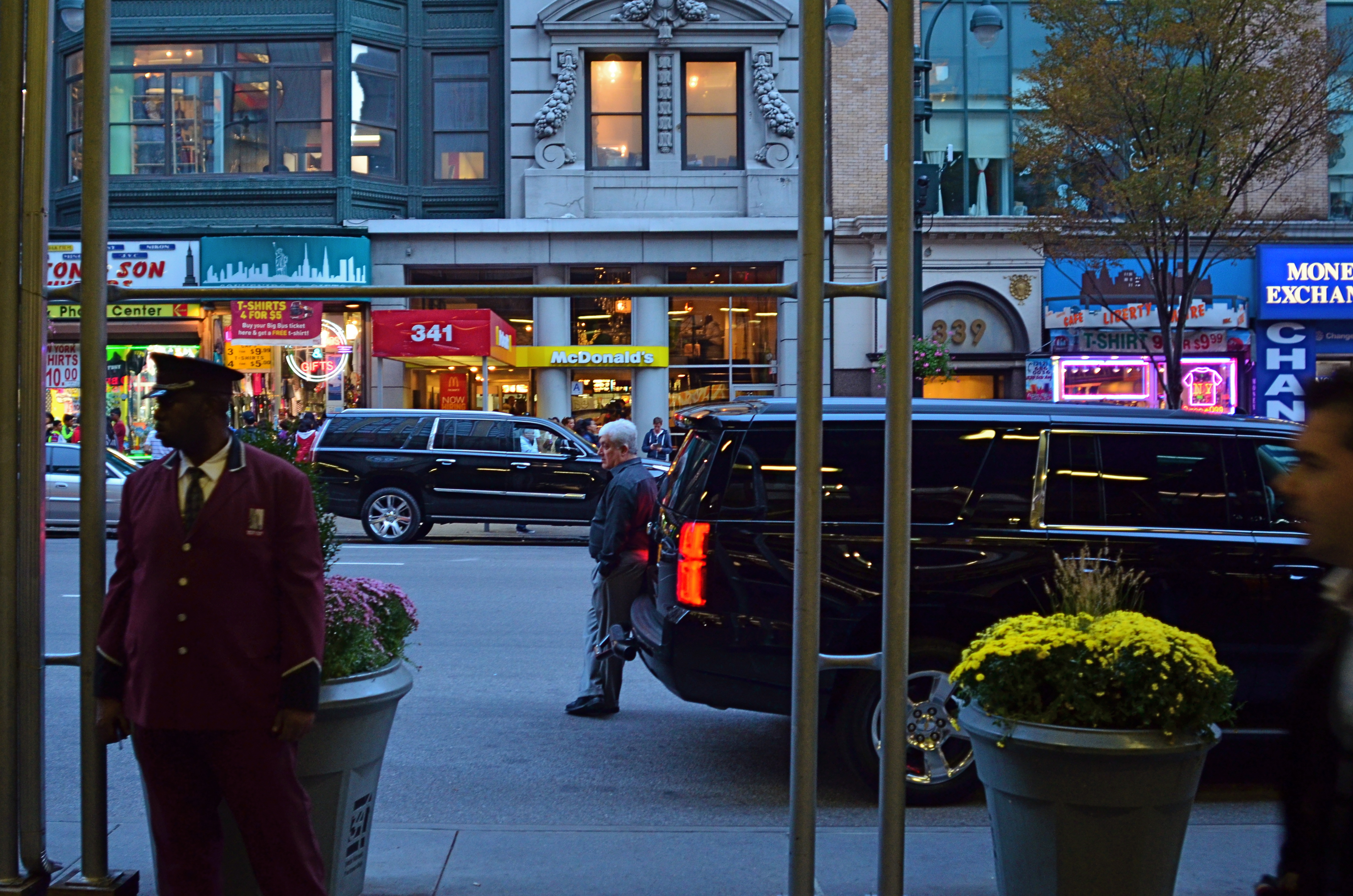
When people are mere compositional components in a scene, is that still “street photography”?
By MICHAEL PERKINS
ONE OF MY FAVORITE JOKES ABOUT HOW HUMANS END TO OVER-THINK THINGS involves a farmer standing by the side of the road with a herd of cattle, who is greeted by a passing urban tourist. “Excuse me”, says the visitor, “are those Herefords or Guernseys?” “Gee”, replies the farmer, “I just call ’em ‘moo-cows’!”
Similarily, I sometimes think that the weighted term street photography is more distinction than difference. City, country, street, pasture…hey, it’s all just pictures, right? Yes, I know….”street” is supposed to denote some kind of commentary, an interpretive statement on the state of humanity, an analysis on How We Got Here. Social sciences stuff. Street work is by nature a kind of preachment, born as it was out of journalism and artists like Jacob Riis and Lewis Hine, who used images to chronicle the city’s ills and point toward solutions. For these geniuses and so many that followed, those street scenes rested fundamentally on people.
And by people, we mean discernible faces, unposed portraits that seared our souls and pricked our consciences. Street photography came to focus almost solely on the stories within those faces: their joy, their agony, their buoyant or busted dreams. In my own work, however, I am also drawn to street scenes where people are not front and center, but blended into the overall mix of elements, props, if you like, in an overall composition, like streetlamps, cars or buildings. There can be strong commentary in images that don’t “star” people but rather “feature” them. Walker Evans, one of the premiere shooters working for the New Deal’s Farm Security Administration, and creator of many classic depictions of the Great Depression, remarked that folks, as such, were not his aim when it came to street shots. “I’m not interested in people in the portrait sense, in the individual sense”, he said in 1971. “I’m interested in people as part of the pictures….as themselves, but anonymous.”
There is always a strong strain of competition among photographers, and street photography can become a wrestling match about who is telling the most truth, drilling down to the greatest revelation….a kind of “streeter than thou” mentality. However, just because something is raw and real doesn’t make it interesting, or else we could all just shoot the inside of garbage cans all day and be done with it. Compelling is compelling and boring is boring and if you know how to make a picture that grabs the eye better than the next guy, then subject matter, even motivation, doesn’t matter a damn. The picture is all. The picture will always be all. Everything else is noise.
Share this:
January 7, 2017 | Categories: Americana, Commentary, Composition, Conception | Tags: Candids, documentary photography, Street Photography, Unposed | 3 Comments