RE-OPENING THE LAB
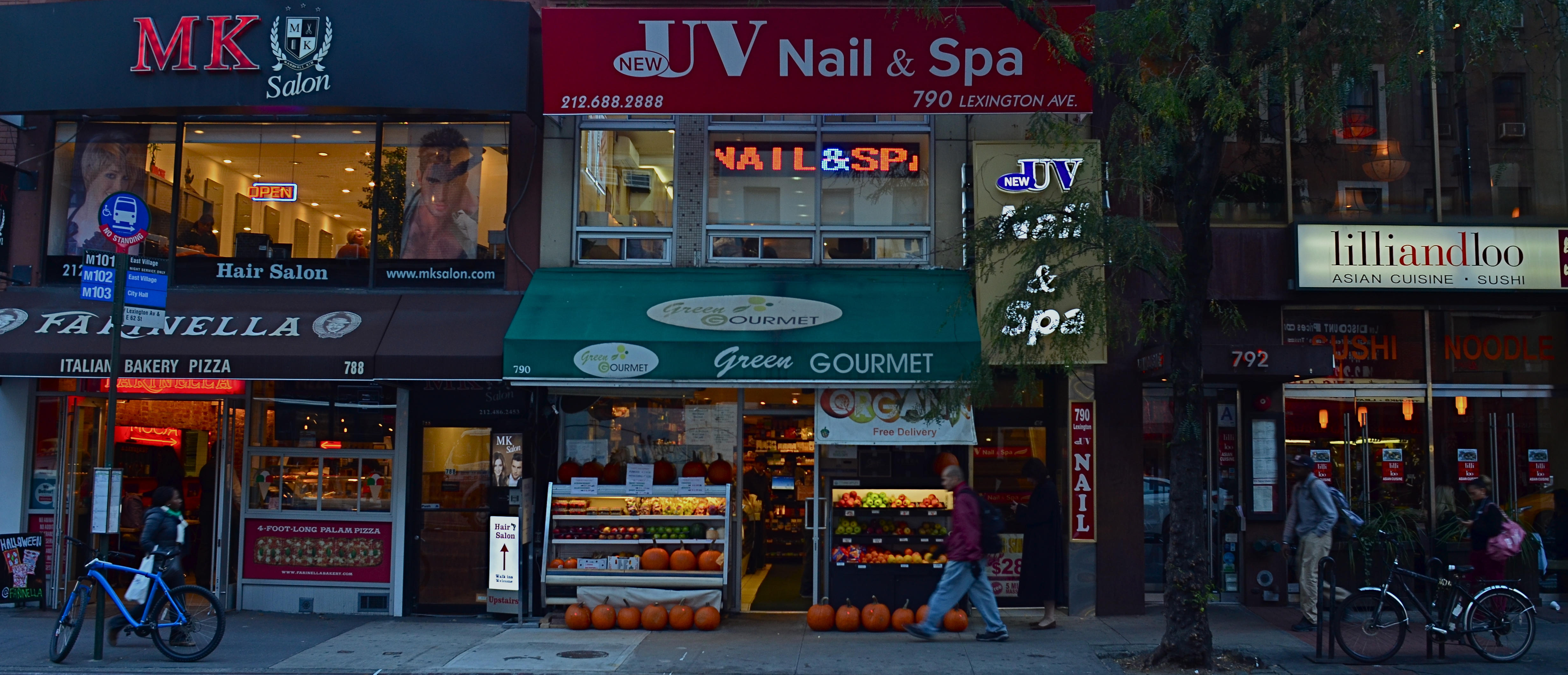
Lovin’ Life On Lex (New York City, 2016)
By MICHAEL PERKINS
PHOTOGRAPHERS WILL ALWAYS BENEFIT FROM SOCIOLOGICAL “PIVOT POINTS“, those unique junctures in time when tectonic plates between eras shift, grind and re-configure. Images, for better or worse, are the way we testify to big changes in our world. They are documents of where one age ends and a new one begins. They illustrate contrasts between then and now.
A change in society is an opportunity for pictures, photos which become obvious, even inevitable, in telling the story of how we evolve. And one of the biggest such changes over the last decade or so has been the re-birthing of the walking neighborhood. Urban cores long given up for dead are being re-vitalized by young people who want close, hands-on engagement with city life.
Whether this shift is a boomerang effect at the end of half a century of suburban flight, an economic remedy to rising housing prices (refurbishing is cheaper than new building), an ingenious way to re-purpose old resources for a greener planet (and get rid of cars), or just a generational restlessness, the old laboratory known as the urban neighborhood is back open for business, with darkened and deserted blocks sprouting new colors, shops, rhythms. Prime picking for photographers, who, first and foremost, go where the stories are.
For me, lateral, wide-angle portraits of businesses is great fun, as I try to channel the “neighborhood in miniature” panels made popular by painter Norman Rockwell during his magazine years. Watching foot traffic flow between laundries and liquor stores, with maybe a pizza joint in between, affords an instant variety of color, signage, reflections, and texture…in other words, lots to work with.
The street is dead. Long live the street.
FACES WITHOUT FEATURES
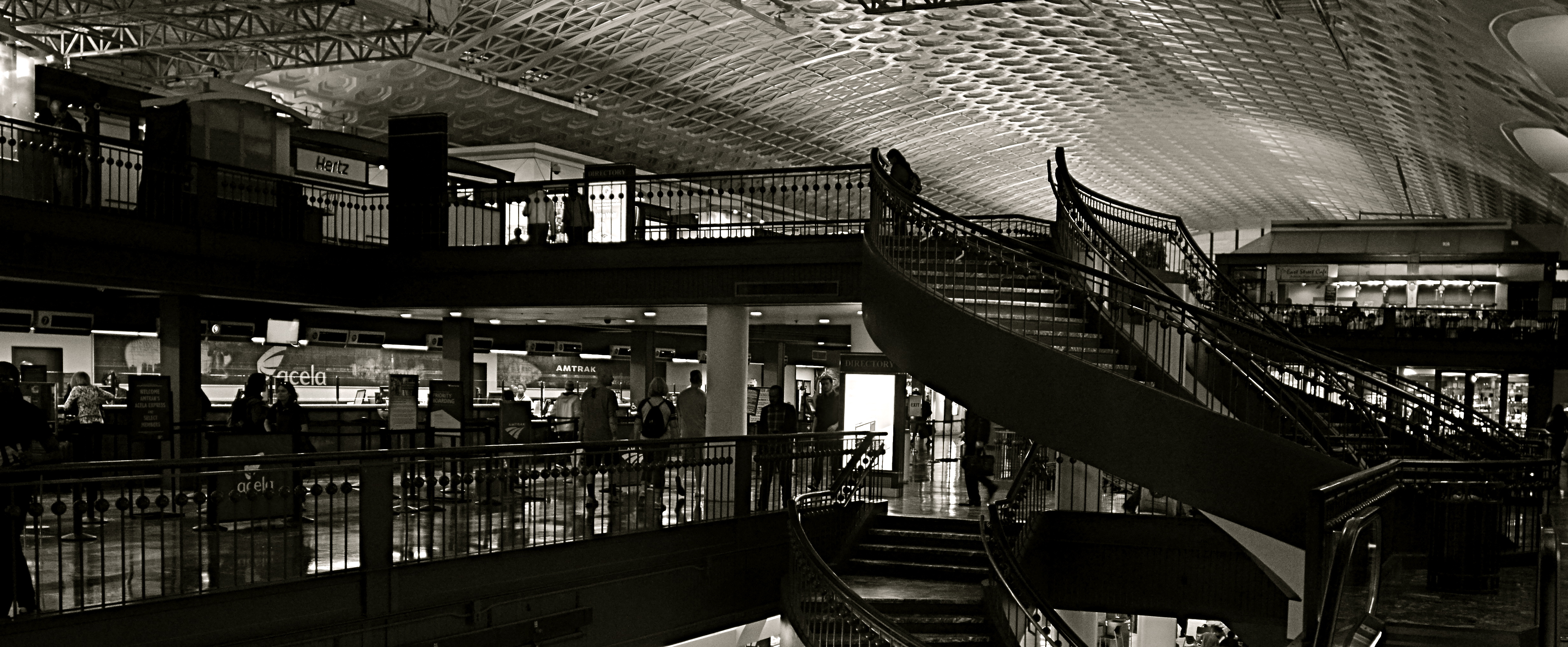
The Tube Hangar (2016)
By MICHAEL PERKINS
SOME OF MY URBAN PHOTOGRAPHY COULD POTENTIALLY STRIKE THE AVERAGE VIEWER as somewhat remote, even a bit cold. It flies in the face of some of the universally held “truths” about so-called street photography. Sometimes it doesn’t even have a face. Or faces.
If the best street shooters are thought to reveal truth in the features of the denizens of all those boulevards, then I might really be at a disadvantage, since many of my images are not about faces.
They are, however, about people.
I tend to use passersby, in city pictures, to several ends. beyond the regular kind of unposed portraiture that is standard “street” orthodoxy. One is scale, that is, how they dominate or are diminished by the sheer size or scope of their surroundings. Some cities seem to swallow people, reducing them to anti-sized props in an architect’s tabletop diorama. I try to show that effect, since, as a city dweller, it affects me visually. Other times, I show people completely silhouetted or swaddled in shadow. This is not because their faces aren’t important, but because I’m trying to accurately show their roles as components in an overall choreography of light, as I would a mailbox or a car. Again, the idea is not to avoid or conceal the stories that may reside in their faces, but to also accentuate their body language, how they occupy a space, and, yes, as abstract design elements in a large still life (okay, that sounds a bit clinical).
I certainly bow to the masters whose controlled ambushes of strangers have captured, in candid facial shots, harrowing, inspiring, or amusing emotions that deepen our understanding of each other. You could rattle off their names as easily as I. But using people in pictures isn’t only a miniature invasion into their features, and certainly isn’t the only way to depict their intentions or dreams.
And then there is the other problem for the street portraitist, in that some faces will remain ciphers, resisting the photographer’s probe, explaining or revealing nothing. In those cases, a face poses more questions than it answers. As usual, the argument is made by the individual picture.
INSIDE THE IRIS
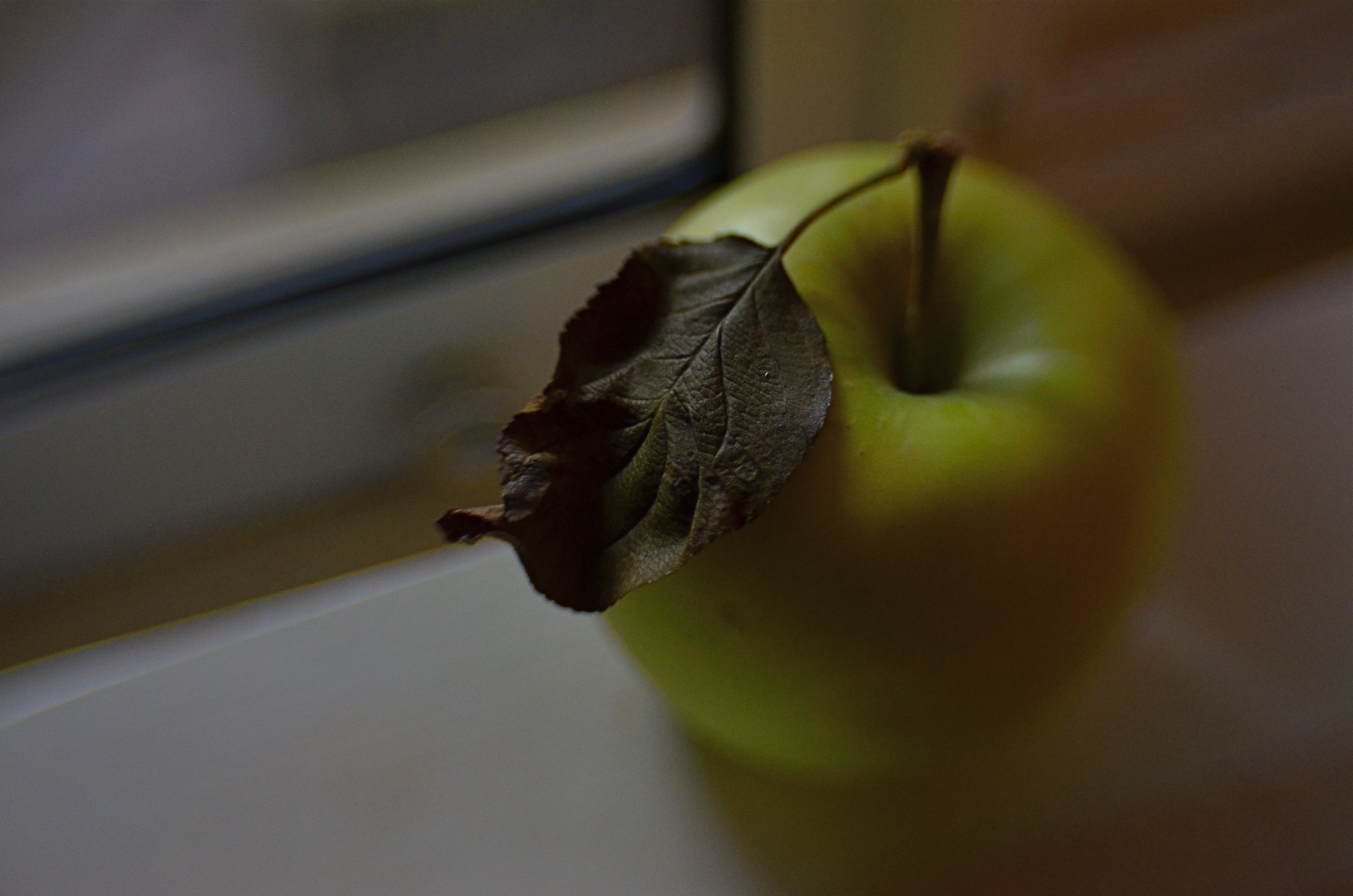
Just an apple. Or is it?
By MICHAEL PERKINS
IN ONE OF HIS EARLIEST SILENT FILMS, legendary director D.W. Griffith, one of the first cinematic pioneers to use tight shots to highlight vital narrative details, drew fire from theatre exhibitors, who objected to his new-fangled “close-up” or “iris” technique. “We have paid for the entire actor”, one wrote, apparently of the opinion that showing only a player’s hand or face, even in the interest of a good story, was somehow short-changing the audience. Griffith knew better, however. He was using his compositional frame to tell his viewers, in no uncertain terms, what was important. Outside the frame was all the other stuff that mattered less. If I show it, you should pay attention.
Photography is not so much about whether a subject is intrinsically important (think of the apple in a still-life) but whether an artist, armed with a camera and an idea, can make it important. At the dawn of the medium, painters pretty much dominated the choices about which images were immortalized as emblematic of the culture. The subject matter often ran to big targets; war, portraits of the elite, historical and religious events. And, indeed, the earliest photographs were “about something”, the “somethings” often being documents of the world’s wonders (pyramids, cathedrals) fads (politicians, authors) and foibles (crime, the occasional disaster). Subjects were selected for their importance as events, as leaves of history worthy of preservation.
In the 20th century the same abstract movements that engulfed painting allowed photography to cast a wider net. Suddenly that apple in the bowl was a worthy, even a vital subject. Light, composition, angle and mood began to weigh as heavily as the thing pictured. We made images not because the objects looked right, but because they looked right when made into a photograph. Pictures went from being about what “is” to being about what could be….evoking, like poetry, music or literature the magics of memory, dream, potentiality, emotion.
This is really the ultimate freedom of not only photography, but of any true art; the ability to confer special status on anything, anywhere. That doesn’t mean that all photographs are now of equal value; far from it. The burden of proof, the making of the argument for a particular subject’s preservation in an image, still rests squarely on the shooter’s shoulders. It’s just not necessary to wait for a natural disaster, a ribbon cutting, or a breathless landscape to make an amazing photograph. The eye is enough. In fact, it’s everything.
THE COMPOUND ILLUSION
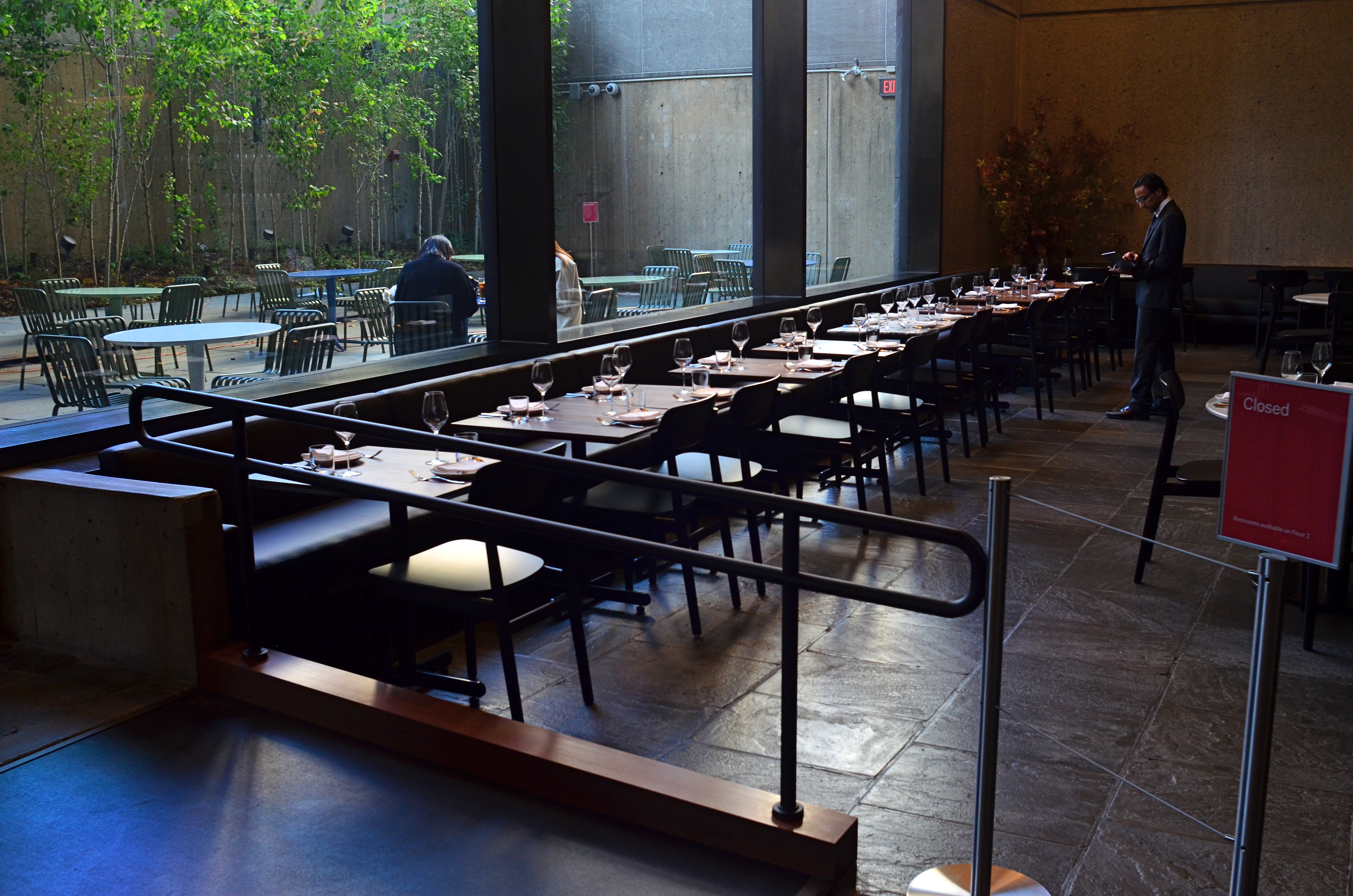
Next Will Be The Soup Course (2016). 1/60 sec., f/8, ISO 400, 24mm.
By MICHAEL PERKINS
ASK THE AVERAGE PERSON FOR A BRIEF COMPARISON BETWEEN PHOTOGRAPHY AND PAINTING, and you may hear the assertion that, ‘well, photographs are real..”, a statement that reveals the fundamental flaw in our thinking about photographs from their earliest beginnings. Simply because a camera measures and records light (perhaps also because it’s a machine), we’ve come to regard its end product as a literal representation of the world. But no serious examination of what artists have done with the photographic image will support that idea. Photographs are no more real than daubs of pigment, and no more reliable in their testimony.
Photographers twist and torture light and shadow to present their version of the world, not its literal translation. If they worked with top hats and wands instead of Leicas, their audiences would accept, with a wink. that a live rabbit was not actually produced out of the hat’s crown, but was, in fact, a feat of misdirection, of persuasion. The camera, on the other hand, gets far more credit for being faithful to the real world than it deserves. As the old saying goes, a photograph is a lie that tells the truth.
Making any kind of image, the photographer has any number of simple techniques available to him to make the inaccurate seem real, most of it achieved in-camera. Take, for example, the attempt, in the above photo, to create as great a sense of depth as is possible in a flat image. First, the use of a wide 24mm lens will optically exaggerate the distance between the front and back of the scene, nearly doubling the sense of space versus that of the actual room. On top of that, the image is composed with the most severe diagonal possible to pull the eye into its already over-accented dimensions.
As a final touch, the shot is taken at the smallest aperture practicable in the available light, insuring uniform sharpness as the eye looks “into” the scene. The result is a three-decker compound illusion……fairly removed from “reality” and yet suggesting itself to it, much as the rabbit seems to have emerged from the hat. Indeed, with the creative manipulation of the photographic process, you might not need, in terms of reality, either the hat or the rabbit to perform your “trick”. But you can certainly show them both in the shot.
Really.
ON ITS OWN TERMS
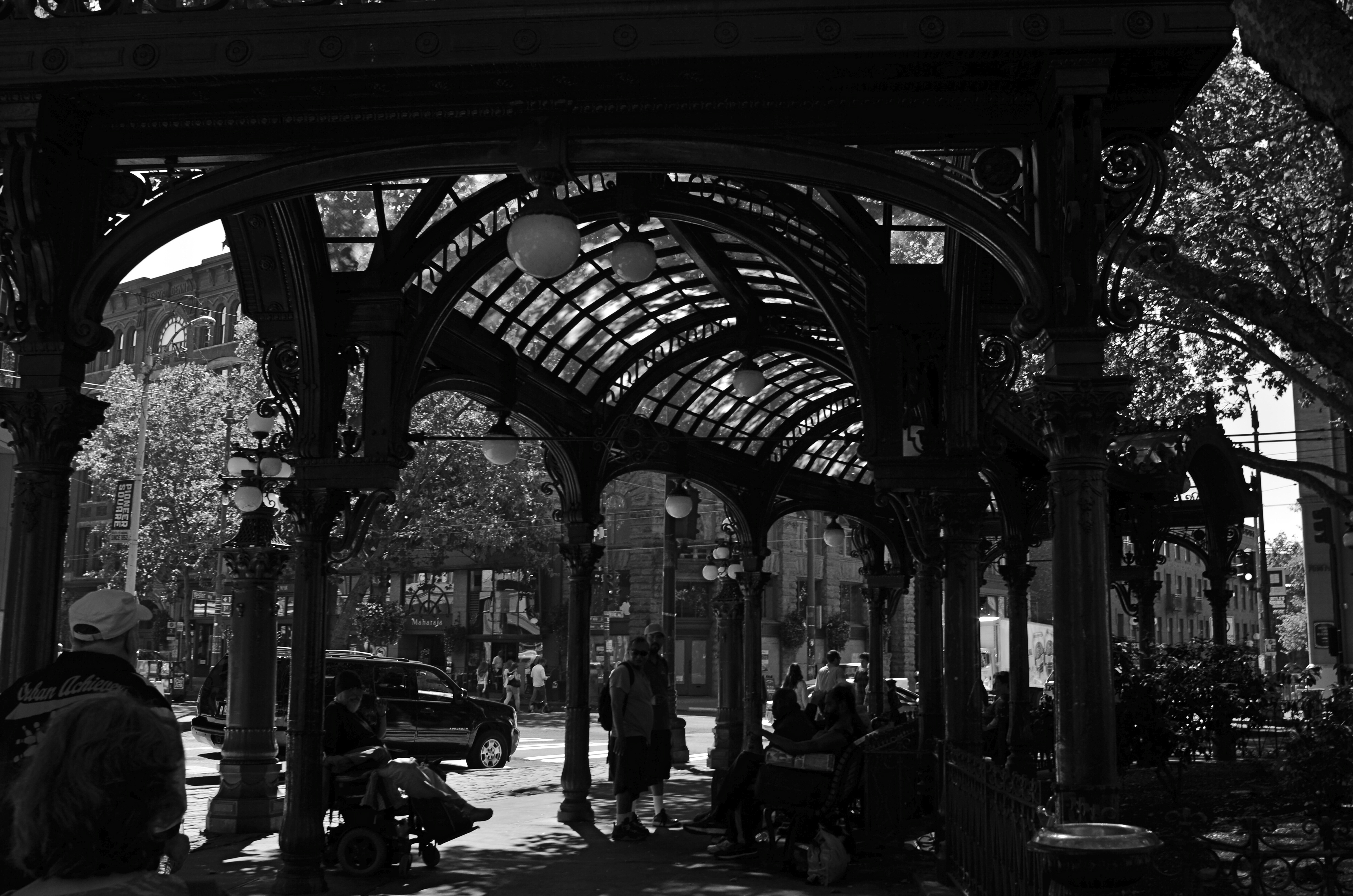
Gaslight Reverie (2016). Local characters convene under an aging arch in downtown Seattle.
By MICHAEL PERKINS
ONE OF THE FIRST EDITORIAL TRUTHS THAT PHOTOGRAPHERS LEARN is that just pointing and recording is not photography. The marvelous device which was designed to arrest time in its flight and imprison it for future reference is truly effective for setting down the facts of a scene….details, textures, dimensions, etc. But, once the shooter is bent upon making any kind of statement…amplifying, clarifying, commenting….then the unadorned data of reality may prove to be a set of chains holding him earthbound. Every picture has it own terms, its own rules of engagement. And sometimes that means moving mere reality to the second chair.
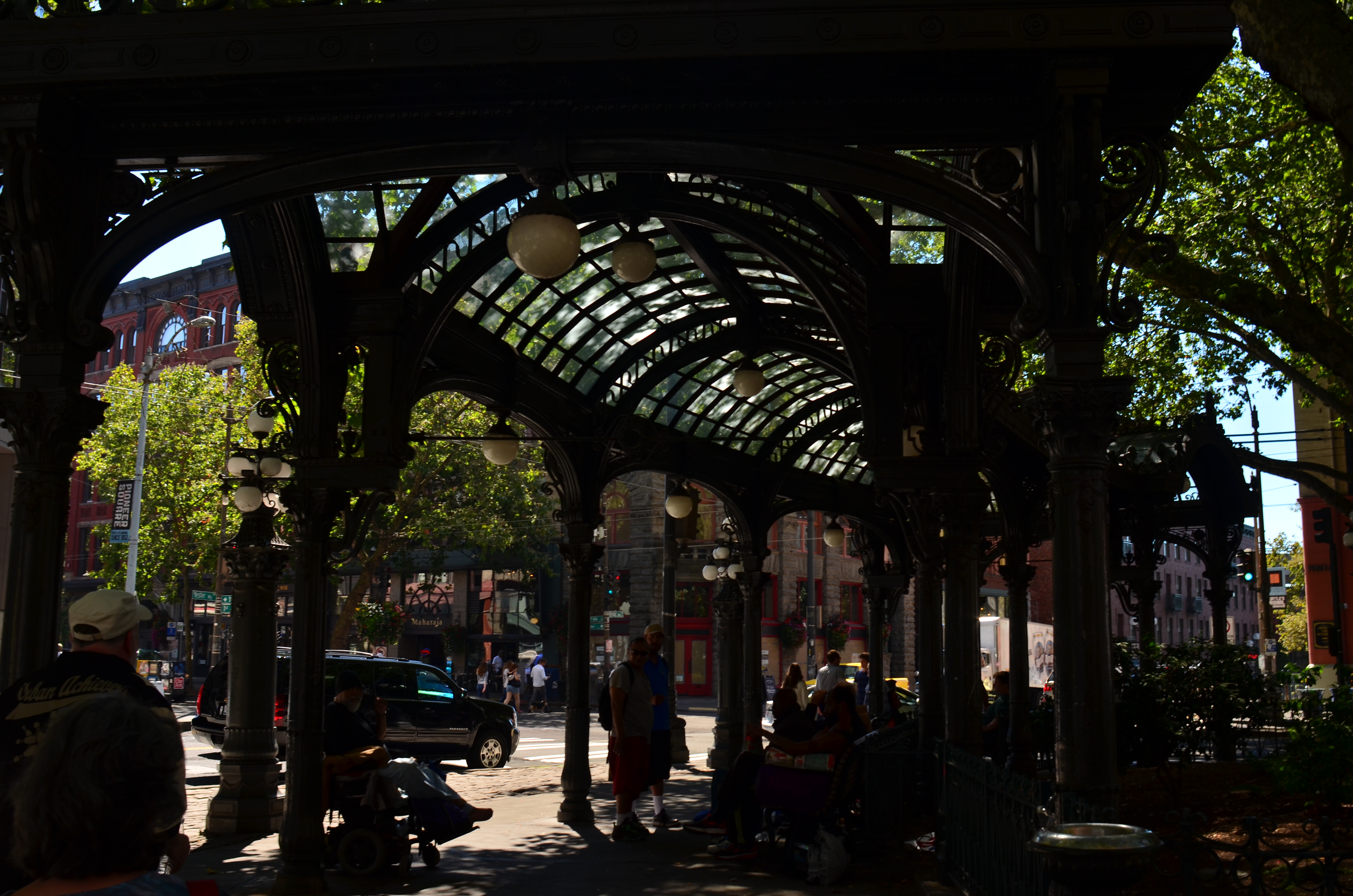
The same shot in color is a bit too charming.
Things that are only recorded are, to a degree, raw, in that they contain important information and extraneous data that might keep an image from being, well, a photograph. A deliberate act. Consider the purest form of “factual” photography, a reconnaissance flyover photo. Seen in its basic “real” state, the colllection of shapes, shades, and wiggles makes little sense to the observer. It needs the help of an interpreter to ferret out the pertinent narrative. Yes, this squiggle is a river. This grey smear is the warehouse. These scratchy cross-hatches are railroad lines. Photographs need to shaped so they can be interpreted. Sometimes this means, for lack of a more grammatical phrase, “including something out.”
There are many ways to achieve this, but, in the interest of brevity, I often find that a simple switch from color to monochrome goes a long way toward streamlining an image. Hues can be distractions, slowing the eye in its pursuit of a picture’s best impact. It prettifies. It luxuriates in tonal shifts, details, textures. Black and white can cut the busier parts of an image in half and convey a starkness (at least in some settings) that color can find problematic. Amping up the contrasts in black & white, eliminating many middle tones, can purify the image even further.
In the above comparison, a neighborhood in Seattle which is, in effect, its local Skid Row, is far more charming, far less gritty in the color rendering than in the mono version. Of course, the choice between the two approaches is made based on what you want to achieve. The same evaluation in a different situation dictates a different choice. Maybe.
Photography is not reality, and, if it were, it would never have flowered into an art, because reality is essentially dull. To make a picture, you have to determine the specific terms for that picture….what weight it wants to carry. Then it starts to become a photograph.
EDITING WITH LIGHT
By MICHAEL PERKINS
THE ETERNAL TUG OF WAR IN PHOTOGRAPHY SEEMS TO BE the pull between extremes of revelation and concealment. Toggling between the strategies of showing almost everything and showing nearly nothing, most shooters arrive at some negotiated mid-point which describes their own voice as a visual narrator. Shuttling between the two extremes, shooters have to decide how much information is appropriate not only for their overall style, but in each specific shooting situation.
Managing light in the moment, rather than trying to re-balance values after the picture is made, affords the most crucial control you will ever exercise over your subject. We tend, as beginners, to shoot things where there is “enough light”, growing ever more discriminating about the kind of light we prefer as we mature in our approach.
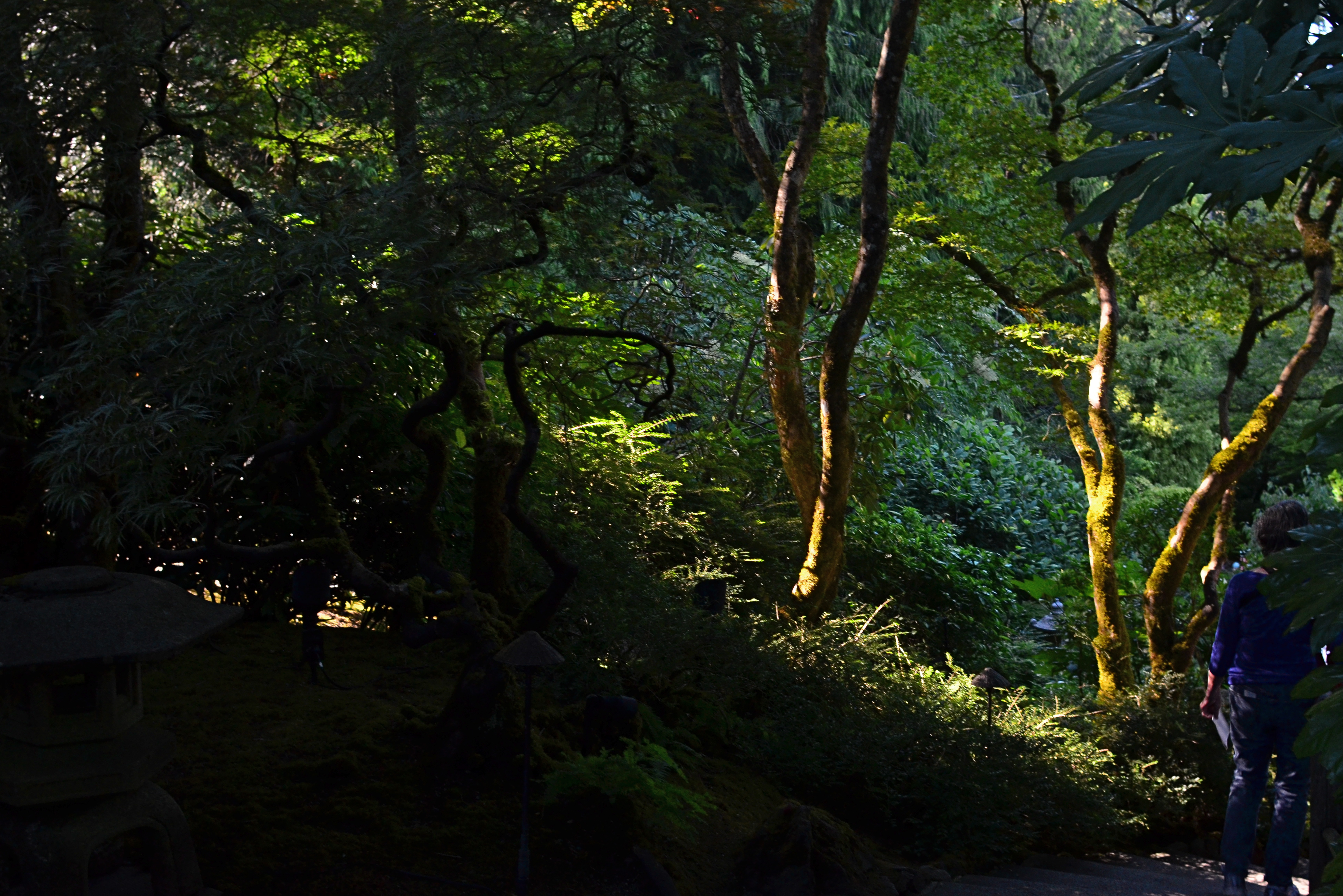
Down Into (2016). 1/40 sec., f/5.6, ISO 500, 24mm.
One of the most fruitful exercises for me has been those rare occasions in which I have had the luxury to remain in one area over a span of several hours, discovering the nuanced variations that prevail from minute to minute in a single setting. Many times, I have begun this process with an initial concept of the “ideal” lighting for a shot, then, through comparison, rejected that in favor of a completely different strategy. It’s strangely thrilling to come home completely satisfied with an image, even though it’s the dead opposite of the way you originally conceived it.
Waiting for the right light may be more time-consuming, but it is the cheapest, easiest, and surest way to control composition. If one particular lighting situation reveals too much in the shot, diluting the impact of your visual message, waiting for shadows to deepen and for bright spots to shift can make your photograph urge the eye more effectively toward the center of your “argument”. In the image seen above, I could not have sold the idea of a gradual walk from high left to lower right without the light actually working as a kind of directional arrow. A fully lit forest might have been lovely, and was, in fact, available to me just an hour earlier. But by the late afternoon, however, the partial dark helped me edit excess information out of the shot, and, in comparing the two approaches, I like the “less” version better.
Part of getting the shot you want is often learning to see, and edit out, the parts you don’t want, a process which is better when you wait for the “best”, rather than the “correct” light for right here, right now.
THE RIGHT PICTURE IN THE RIGHT FRAME
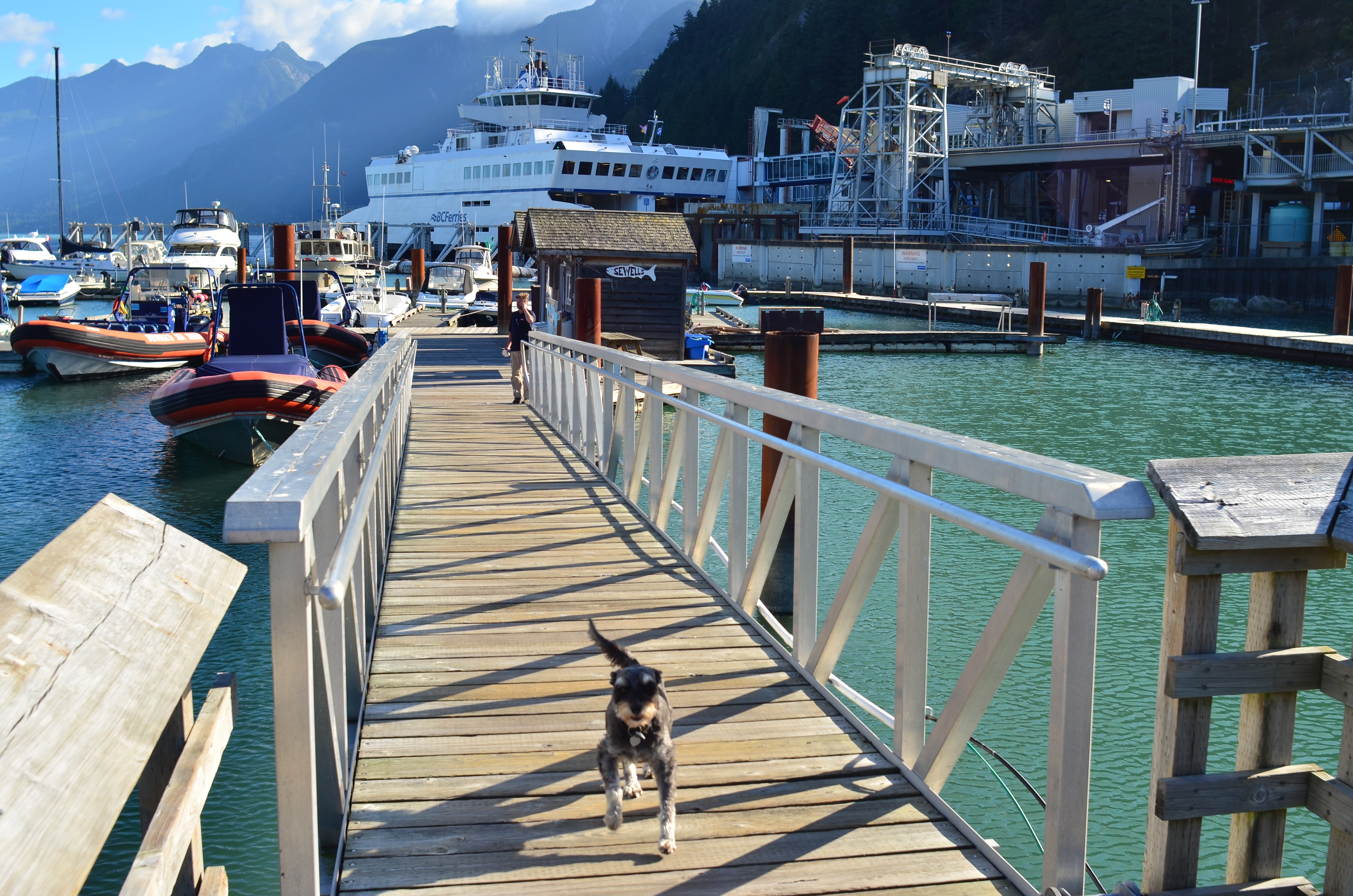
Horseshoe Bay, BC. The standard “post-card” scenic viewpoint.
By MICHAEL PERKINS
COMPOSITION IN PHOTOGRAPHY, FOR MANY OF US, CAN OFTEN INVOLVE NOTHING MORE than finding a thing we want to capture and getting it all in the frame. Click and done. It’s only later that we sometimes realize that we should have, shall we say, shopped around for the best way, from angle to exposure, to get our quarry in frame. Or even look for a better frame.
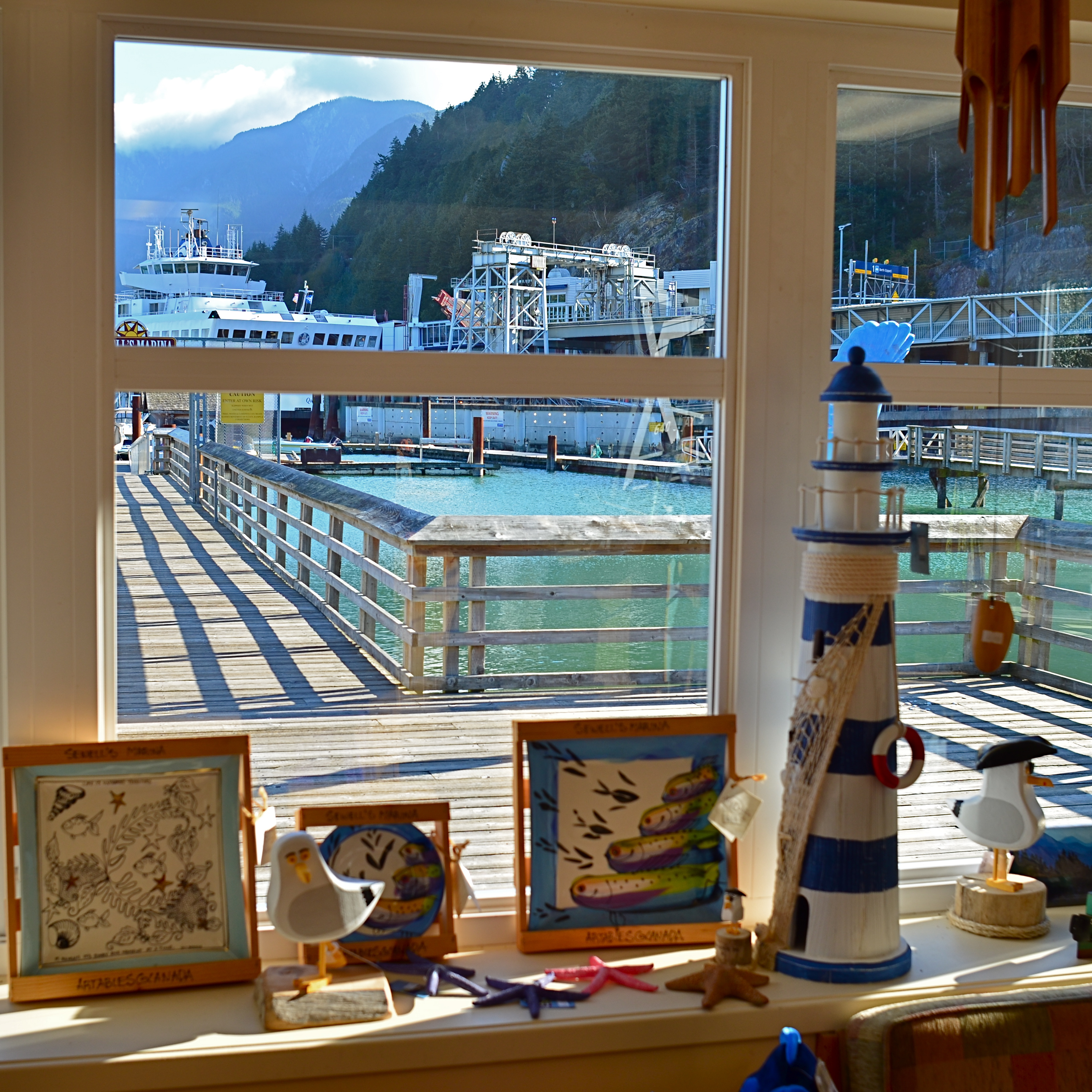
The same scene as viewed from a shop window, cropped to classic “View-Master” format.
One of the first tricks I learned in travel photography was from the old scenic shooters who created the travel titles for View-Master Reels, who always thought in terms of framing to maximize the image’s 3-d effect. For a start, since they were working in square format, they automatically had less real estate in which to compose. Secondly, they had to shoot in “layers”, since the idea was to have subject matter in multiple planes, for example, overhanging shade tree right at the front, a tourist midway into the shot, and Mount Rushmore at the back. They also learned to position things just inside the frame’s edge, what was called the “stereo window” to accentuate the sensation of looking into the photograph.
Thing is, all of these compositional techniques work exactly the same in a flat image, and can draw the viewer’s eye deeper into a picture, if used creatively. Certainly you can’t go wrong with a great exposure of a beautiful view. But experiment as well with things that force your audience to peer intently into that view. The image at the top is standard post-card, and works well enough. However, in the shot at left, in taking ten seconds to slip inside a gift shop that also looks out on the same view, I’ve tried to show how you can get an atmospheric framing that both accentuates depth and provides a bit more of a sense of destination. It all depends on what you’re looking to do, of course….but it makes sense to develop the habit of asking yourself how many different ways are available to tell the same story.
Editing a solid portfolio of shots can only begin with lots of choices. Hey, you’re there, anyway, so develop the habit of envisioning multiple versions of each picture, and weed out what doesn’t work. Remember again that the only picture that absolutely fails is the one you didn’t try to make.
INCONVENIENT CONVENIENCE
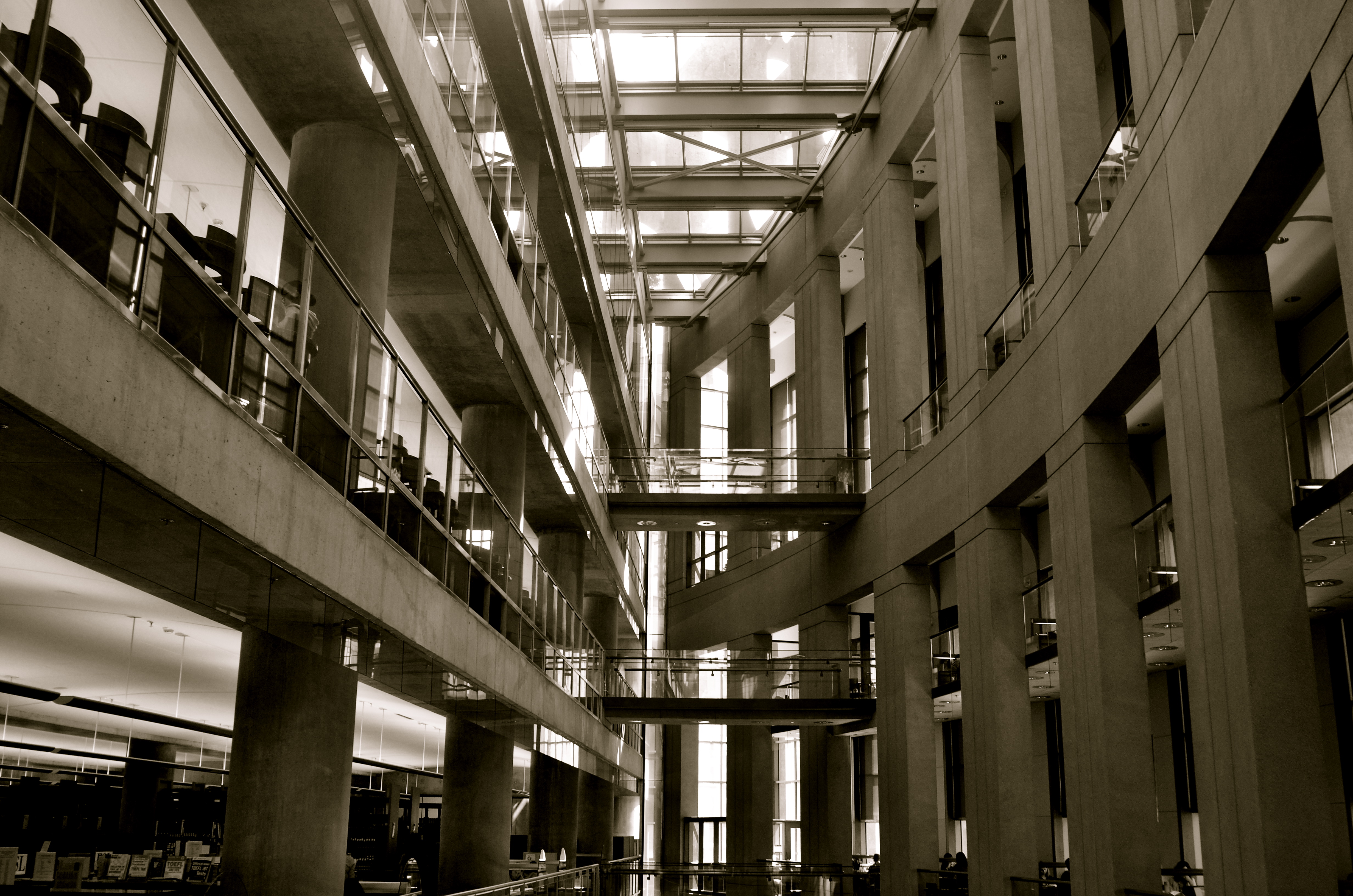
Every photograph has its own best avenue or route. It takes time to pick the best one.
By MICHAEL PERKINS
I HAVE LONG SINCE ABANDONED THE TASK OF CALCULATING HOW MANY DIGITAL IMAGES ARE CREATED every second of every day. The numbers are so huge as to be meaningless by this time, as the post-film revolution has removed most of the barriers that once kept people from (a) taking acceptable images or (b) doing so quickly. The global glut of photographs can never again be held in check by the higher failure rate, longer turnaround time, or technical intimidation of film.
Now we have to figure out if that’s always a good thing.
Back in the 1800’s. Photography was 95% technical sweat and 5% artistry. Two-minute exposures, primitive lenses and chancey processing techniques made image-making a chore, a task only suited to the dedicated tinkerer. The creation of cheap, reliable cameras around the turn of the 20th century tilted the sweat/artistry ratio a lot closer to, say, 60/40, amping up the number of users by millions, but still making it pretty easy to muck up a shot and rack up a ton of cost.
You know the rest. Making basic photographs is now basically instantaneous, making for shorter and shorter prep times before clicking the shutter. After all, the camera is good enough to compensate for most of our errors, and, more importantly, able to replicate professional results for people who are not professionals in any sense of the word. That translates to billions of pictures taken very, very quickly, with none of the stop-and-think deliberation that was baked into the film era.
We took longer to make a picture back in the day because we were hemmed in by the mechanics of the process. But, in that forced slowing, we automatically paid more active attention to the planning of a greater proportion of our shots. Of course, even in the old days, we cranked out millions of lousy pictures, but, if we were intent on making great ones, the process required us to slow down and think. We didn’t take 300 pictures over a weekend, 150 of them completely dispensable, nor did we record thirty “takes” of Junior blowing out his birthday candles. Worse, the age’s compulsive urge to share, rather than to edit, has also contributed to the flood tide of photo-litter that is our present reality.
If we are to regard photography as an art, then we have to judge it by more than just its convenience or speed. Both are great perks but both can actually erode the deliberation process needed to make something great. There are no short cuts to elegance or eloquence. Slow yourself up. Reject some ideas, and keep others to execute and refine. Learn to tell yourself “no”.
There is an old joke about an airpline pilot getting on the intercom and telling the passengers that he’s “hopelessly lost, but making great time”. Let’s not make pictures like that.
PROOF POSITIVE (AND NEGATIVE)
How charming it would be if it were possible to cause these natural images to imprint themselves durably and remain fixed upon the paper! And why should it not be possible? I asked myself. –William Henry Fox Talbot
By MICHAEL PERKINS
IMAGINE THAT, IN ADDITION TO MAKING THE AUTOMOBILE PRACTICAL AND AFFORDABLE, Henry Ford had also been the world’s foremost racing driver. Or that Rembrandt had also invented canvas. The history of invention occasionally puts forth outliers who not only envision an improvement for the world, but become renowned as the best, first models for how to use it. The early days of photography saw several such giants, tinkerers who nudged the infant technique forward even as they became its first artists.

William Henry Fox Talbot, Trees And Reflections (1842). The master technician was also a masterful artist.
Unlike the telephone or the incandescent bulb, there was, for the camera, no single parent, but rather a series of talented midwives who massaged the young art from exotic hobby to mass movement, the most democratic of all art forms. Thus, William Henry Fox Talbot (1800-1877) was not the first person to use light and chemistry to permanently fix and preserve images. But, without his contributions, printed photograph might never have evolved, nor would the negative, the easiest method for printing endless numbers of copies from a single master.
Talbot’s work began as a way to improve upon the daguerreotype, which dominated the photographic world in the early 1800’s and which was, as a positive image printed directly on glass, literally one of a kind, barring duplication or distribution. If photography were to be widely practiced, Talbot reasoned, a practical method had to be created to allow photos to be made from photos.
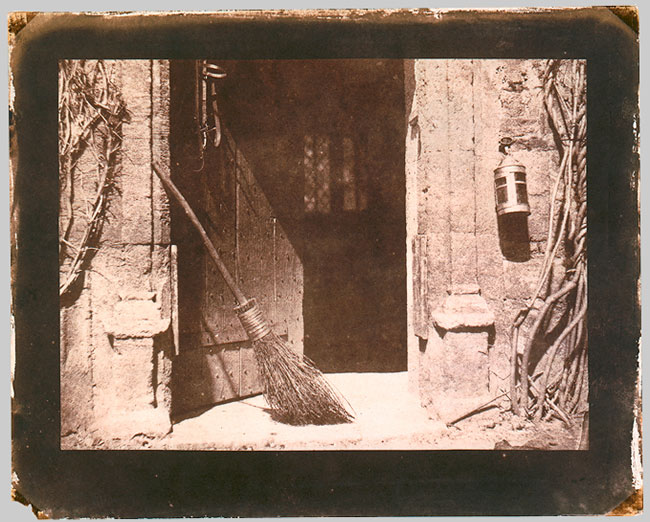
The Open Door (1842). Printed with Talbot’s “salted paper” negative process.
Talbot’s first attempts consisted of ordinary typing paper coated in a solution of salt and silver nitrate. The resulting silver-chloride mixture was highly sensitive to light, darkening as it was exposed, and registering the light and dark values of a subject backwards, as a negative. However, over the long exposures needed at the time, the darkening process often accelerated to make the image completely black, so Talbot had to experiment with other chemicals to render the process stable, to develop just so much and then stop. The next step was creating what would become the first chemical developers, allowing for shorter exposure times and more vivid images printed from his paper negatives.
Various refinements in the “calotype” process followed, along with a hash of bitter patent battles between Talbot and other inventors evolving similar systems. Interestingly, along the way, the need to demonstrate the superior results of his products had the accidental side effect of making Talbot himself one of the period’s most practiced early photographers, giving him equal influence over inventors and artists alike.
In time, Talbot’s calotype system would be further improved by coating glass with collodion, making for a sharper and more detailed negative from which to create prints. The final step toward universal adoption of photography would be George Eastman’s idea for a flexible celluloid-based film negative, the process that ushered in the age of the snapshot and put a camera in Everyman’s hands.
TWO-WAY GLASS
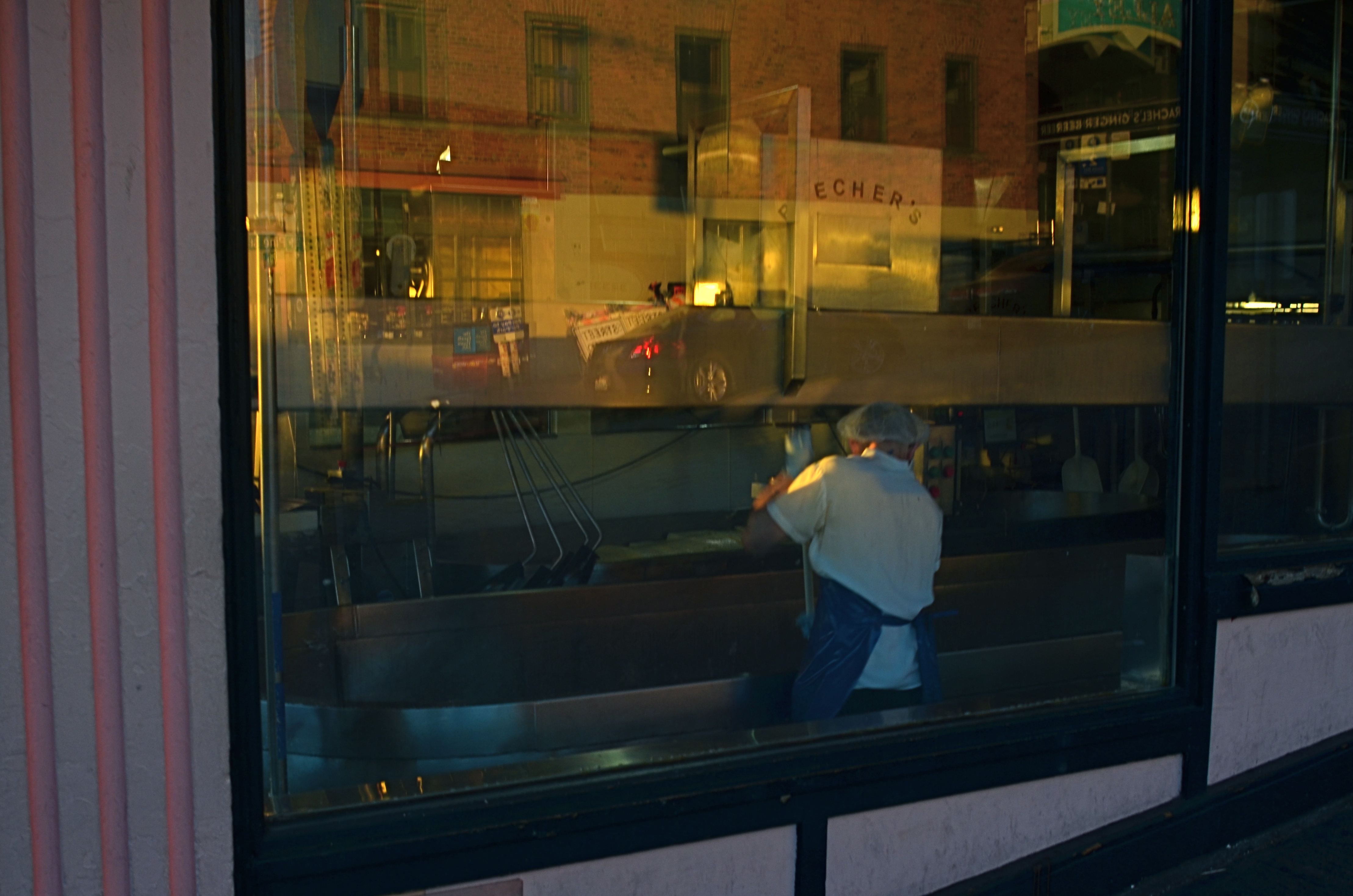
Closing Time (2016)
By MICHAEL PERKINS
IF THE EYES ARE THE WINDOW TO THE SOUL, then certain windows are an eye into contrasting worlds.
Photographers have devised a wide number of approaches when it comes to using windows as visual elements. Many choose to shoot through them with a minimum of glare, as if the glass were not there at all. Others use them as a kind of surreal jigsaw puzzle of reflected info-fragments.
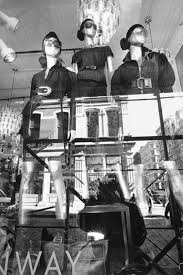
Lee Friedlander’s New York CIty (2011)
To show these two approaches through the eyes of two great photographers, examine first Eugene Atget’s shots of 19th-century Paris storefronts, which mostly concentrated on shopkeeper’s wares and how they were arranged in display windows. Straightforward, simple. Then contrast Lee Friedlander’s 21st-century layered blendings of forward view and backward reflection (seen at left), which suspends the eye between two worlds, leaving the importance of all that mixed data to the viewer’s interpretation.
Much of my own window work falls into the latter category, as I enjoy seeing what’s inside, what’s outside, and what’s over my shoulder, all in the same shot. What’s happening behind the glass can be a bit voyeuristic, almost forbidden, as if we are not fully entitled to enter the reality on the other side of the window. But it’s interesting as well to use the glass surface as a mirror that places the shop in a full neighborhood context, that reminds you that life is flowing past that window, that the area is a living thing.
Thus, in an urban setting, every window is potentially two-way glass. Now, just because this technique serves some people as a narrative or commentary doesn’t make it a commandment. You have to use the language that speaks for you and to your viewer. Whatever kind of engagement serves that relationship best dictates how you should be shooting. I just personally find layered windows a fun sandbox to play in, as it takes the static quality away from a still photo to some degree, as if the image were imbued with at least the illusion of motion.
Sometimes it’s good to conceal more than reveal, and vice versa. The only “must”, for this or any other technique in photography, is to be totally mindful as you’re creating. Choose what you mean to do, and do it with your eyes fully open.
(LESS THAN) PRIME OPPORTUNITY
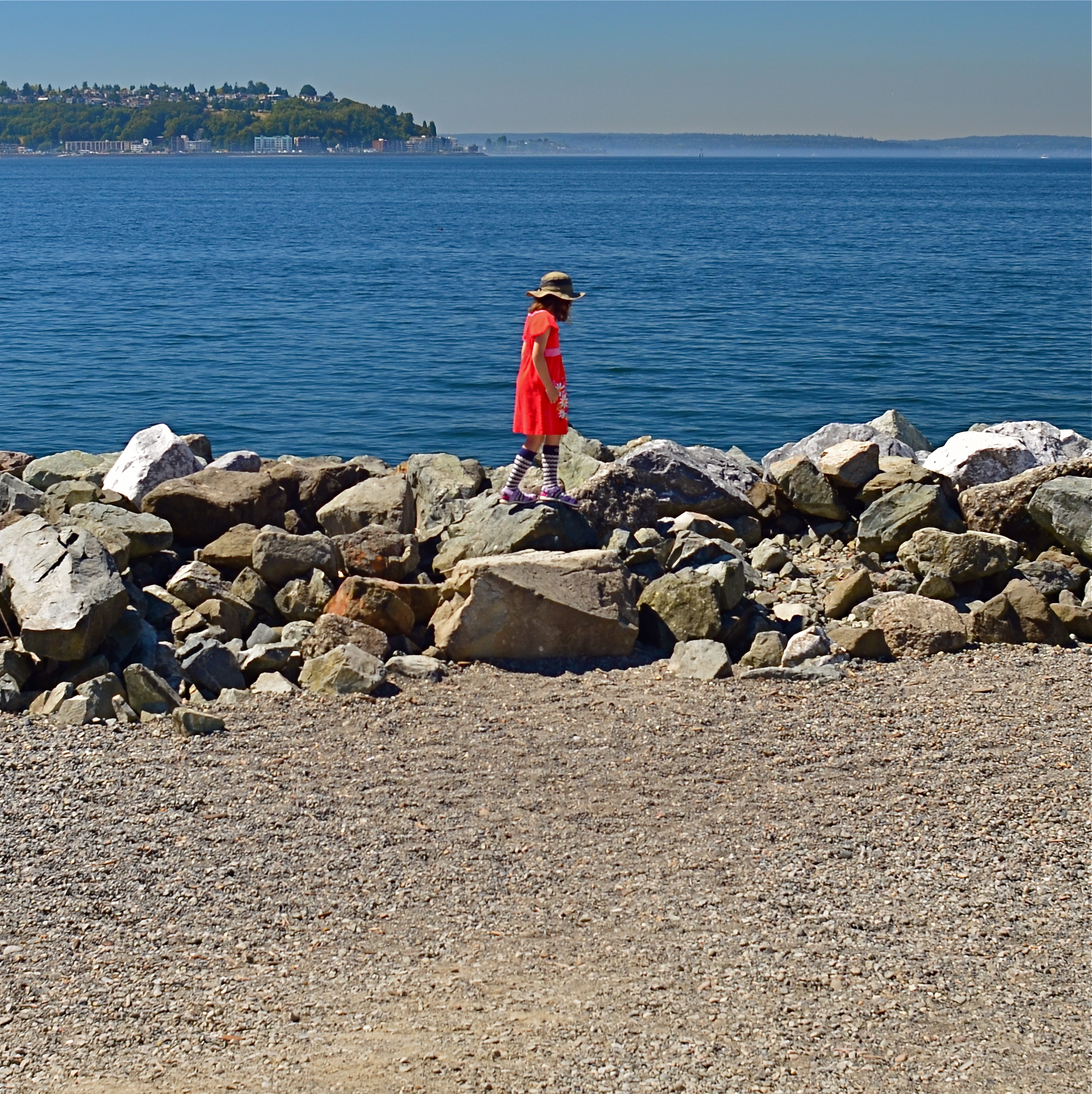
To Susan On The West Coast Waiting (2016). Shot from over 50 feet away with a 24mm wide-angle prime, then cropped nearly 70% from the original frame.
By MICHAEL PERKINS
EVERY DAY-LONG SESSION OF TRAVEL PHOTOGRAPHY dictates its own distinct rules of engagement. You can predict, to some degree, the general trend of the weather of the place where you’ll be staying/playing. You can pre-study the local attractions and map out at least a start-up list of things you might like to shoot. And you can choose, based on all your other prep, the equipment that will work best in the majority of situations, which keeps you from carting around every scrap of gear you own, saving reaction time, and, possibly, your marriage.
All well and good. However, even assuming that you make tremendously efficient choices about what lens you’ll most likely need on walkabout, there will be the occasional shot that is outside the comfort zone of said lens, something that it won’t do readily or easily. In such cases, the lens that would be perfect for that shot is likely forty miles away, back at your hotel. And here’s the place where you can pretty much predict what I advise.
Take the shot anyway.
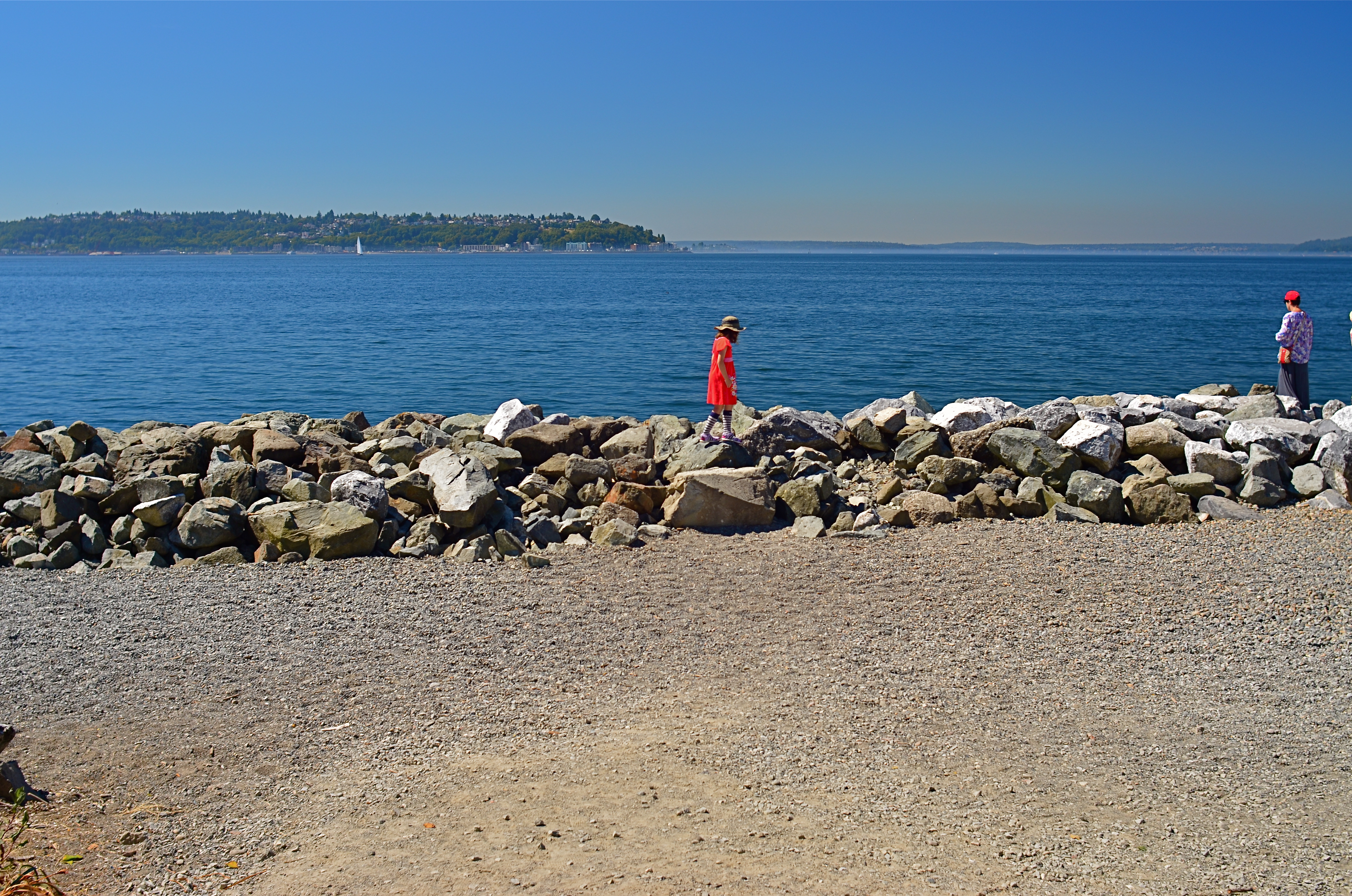
The original composition.
I tend to work with a 24mm prime f/2.8 lens when walking through urban areas. It just captures a wider field within crowded streets, allowing me to grab most vistas without standing in the path of onrushing traffic (a plus) or spending a ton of time re-framing before each shot (a pain). This particular 24 was made in the ’70’s and is both lightning fast and spectacularly sharp, which, being a manual lens, also saves time and prevents mishaps.
24mm, to me, produces a more natural image than the wide end of the more popular 18-55 kit lenses being sold today, since there is less perspective distortion (straight lines remain straight lines). However, since it is a wide-angle, front-to-back distances will appear greater than they are in reality, so that things that are already in the distance seem even more so. And, since it is also a prime, there is no zooming. In the case at left, I wanted the girl’s bonnet, dress and presence on those rocks, but, if I was going to get any picture at all, plenty of other junk that I didn’t need would have to come along for the ride.
You deal with the terms in front of you at the time. Without a zoom, I either had to take the shot, with the idea of later cropping away the excess, or lose it altogether. There are times when you just have to visualize the final composition in your mind and extract it when it’s more convenient. Simply capture what you truly need within a bigger frame of stuff you don’t need, and fix it later. It’s a cornball cliché, but the only shot you are guaranteed not to get is the one you don’t go for. And this is also a good time to remember that it’s always smart to shoot at the biggest file size you can, allowing for plenty of pixel density even in the aftermath of a severe crop.
You can’t pre-plan all the potential pitfalls out of a photo vacation. Can’t be done. Come as close as you can, and trust your eye to help you rescue the outliers down the road.
But take the shot.
ANTICIPATION
By MICHAEL PERKINS
SPORTS PHOTOGRAPHY IS FLAT-OUT REPORTORIAL IN MOST CASES, placing its crucial emphasis on the capture of “the decisive moment”. The play that saved the day, or, at least, earned the headline. Hail Mary passes. Impossible catches. Long, nothin’-but-net buzzer-beaters hurled hopefully from Downtown. These are the essence of sports coverage; images that freeze such moments, photos which often outlive the text that they were designed to accompany. Sports photography is, for the most part, about moments of record, moments of now.
Take it out of its pro-level context, however, and sports, as played by most of the rest of us, can simply be about someday….or more precisely, any moment now. Sports reports are often viewed as strongly edited segments that stitch together one now moment after another in breathless digests of daily “greatest hits”. For many of us regular slobs, however, life isn’t played out that way. Real time, on our playing fields, consists of an infinite number of long, eventless stretches. Sadly, most of us don’t move seamlessly from career high to career high. Instead, there are many stops along the way…to smell the roses, count down the clock, and praaaaaaay for the final bell.
Photographically, kid sports often strike me as more fun than adult games, principally because the terms of engagement are so very different from the grown-up stuff. Children’s games are free of the deadly seriousness that seems to have tainted sports in recent years, robbing them of much of their playful escape. Young Dick and Young Jane aren’t doing this for a living. There is seldom anything of consequence on the line, except maybe the vanity of their parents. And when it comes to providing great images, the mix of true technique and awkward innocence makes for a charming combination, as the young combatants ape their mentors, even as they betray their innate kid-ness.
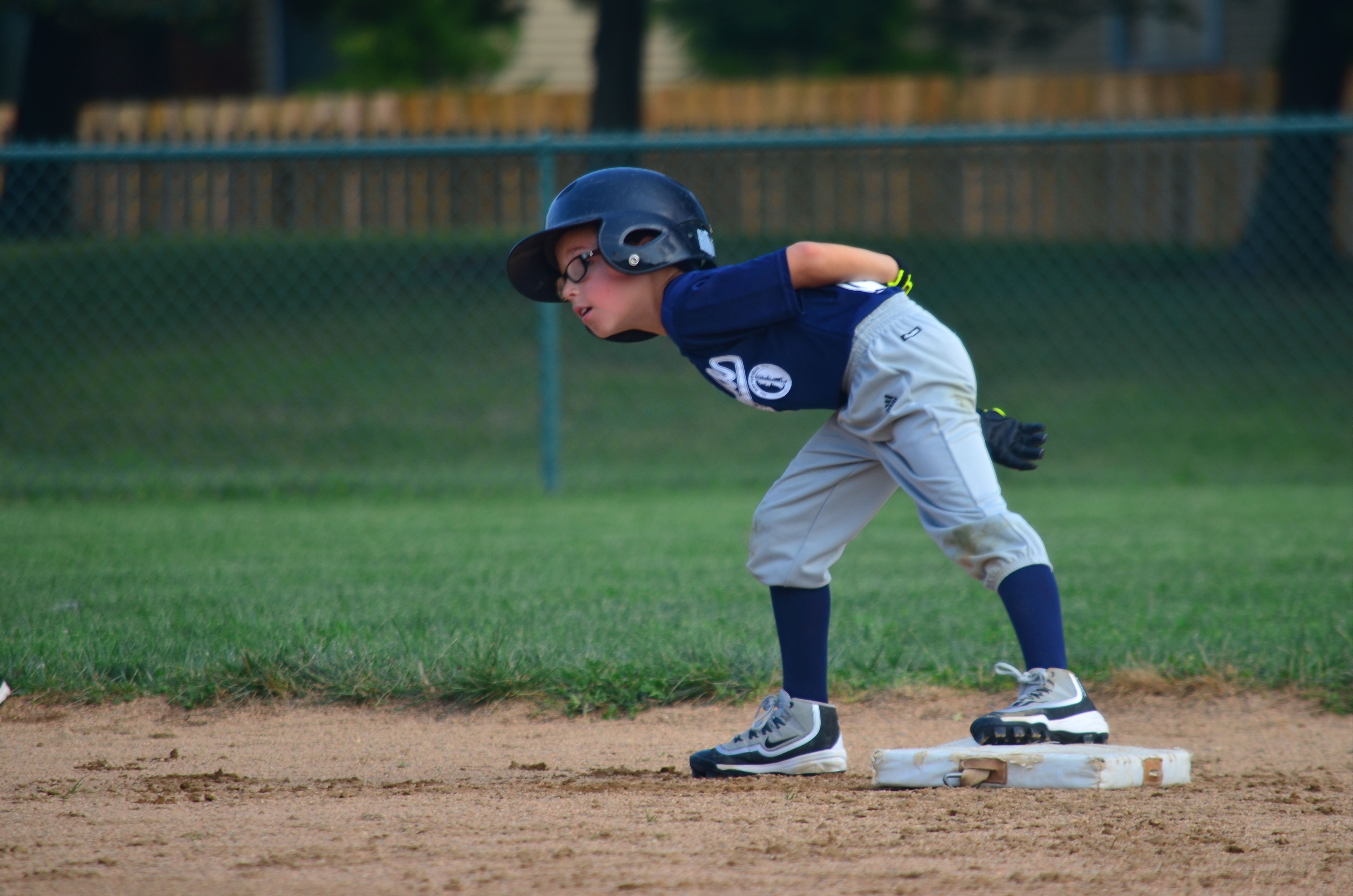
Opportunity..? (2016)
The young man captured here is, above all else, having fun. He’s enjoying the sweet anticipation of the unexpected. He already has the mechanics of a young pro, but his curious exploration of the option of stealing third is all little boy. Lots of story here, and in many moments which never approach the drama of a national championship or a three-peat. Images are narratives, and, in photographing more than just a player’s once-in-a-lifetime Grand Slam, we learn about striving. And waiting. And dreaming.
Theirs and ours.
OF TATTOOS AND STENCILS
By MICHAEL PERKINS
IN CITIES, ONLY A SMALL PORTION OF THE DAY’S NATURAL LIGHT actually makes it all the way to the street unbroken. You can almost think about it like rain, in that it drips, slithers, drains, and channels its way downward through a dense maze of structures and barriers. Along the way, that light is bisected, sliced, stenciled and tattooed by the surfaces it interacts with, stretching shadow patterns, glinting, ricocheting, stretching.
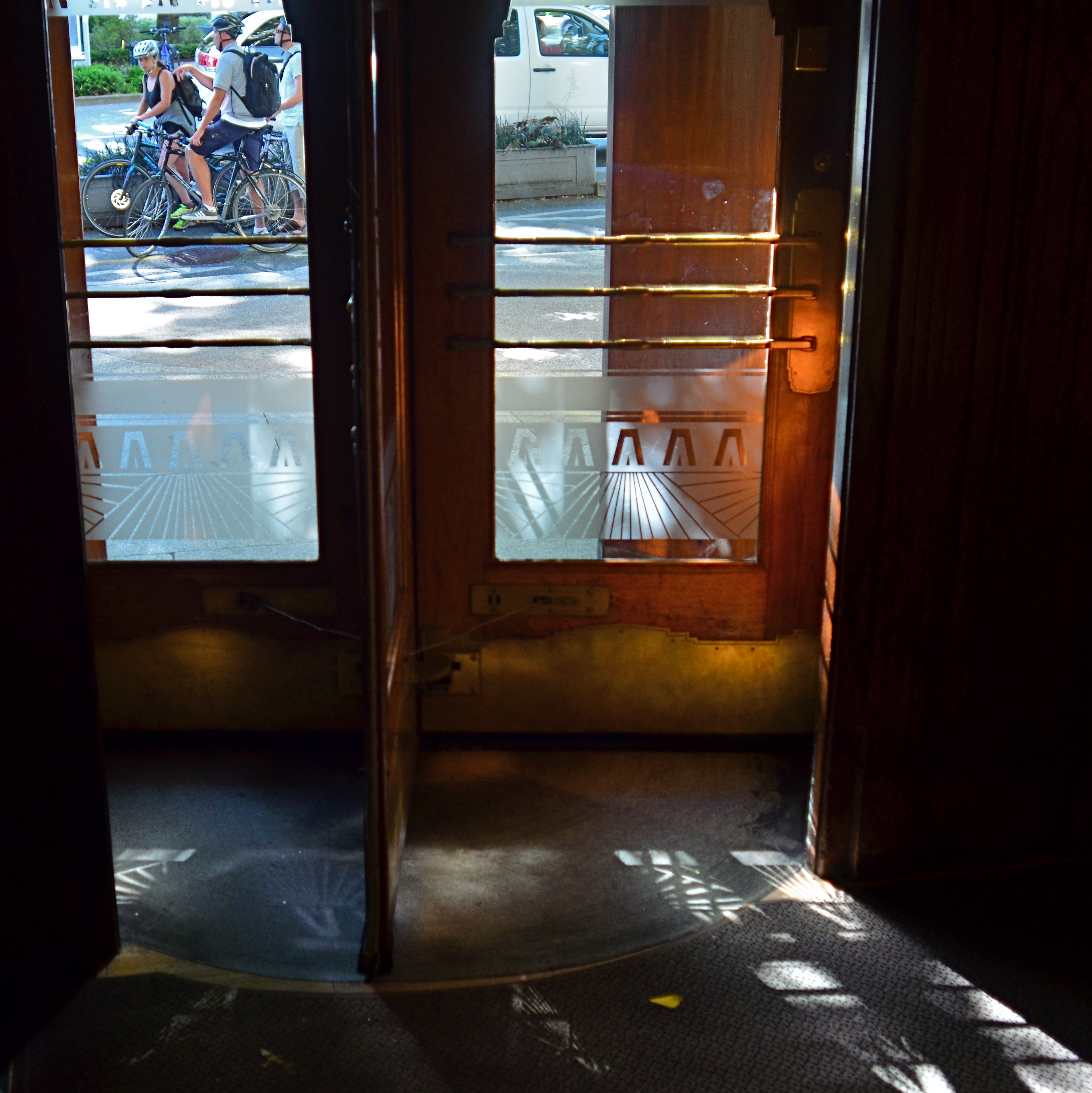
Glass, especially, constantly reshapes light, filtering it into delicate lattice-works and spectral spiderwebs, sifting it through windows, transoms, doors, windshields, storefronts. It reveals and conceals, crawling across buildings like an ever-changing sundial of shapes and schemes. Photographing the same hunk of glass on the hour can be like visiting a dozen different worlds, spread out like fanned playing cards over the course of a single day.
Light illuminates, making it a force that acts upon other objects, but it is almost more marvelous when it, itself, is acted upon, creating an endless choreography and echo of its colors and contours. It’s part of the great interactive ballet of cities, this push and pull between light and darkness. Sometimes you get a nearly kaleidoscopic effect from something very simple, like the etched glass in the revolving door seen above, which stamped a different snowflake of shapes onto the pavement at every turn and swivel.
If you’re given to experiment (or daydreaming), your own tabletop can become a tremendously valuable laboratory on the effect of light. Just grab the simplest object handy, be it an apple or a book, and arc a source of light from one side of it to the other. Imagine yourself a self-propelled sun and watch how easily you can create change in your private solar system. The actual design of such an exercise isn’t crucial, but making yourself mentally slow down, becoming aware of the tiny effects perpetually swimming about you, is invaluable. Photographs rise at the hands of some pretty small phenomena. Magnifying your gaze puts more images within your reach.
A GENTLER EDGE
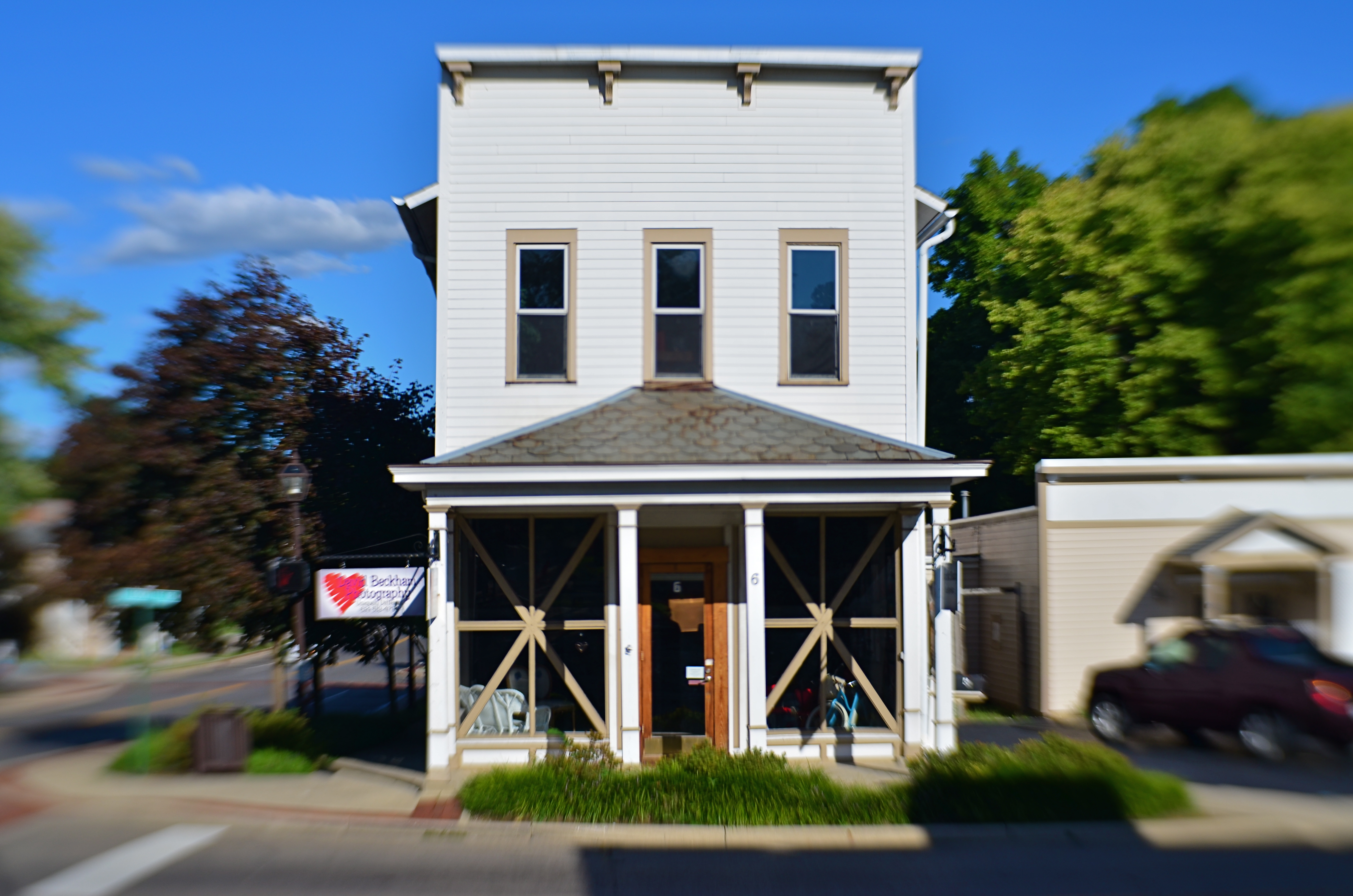
Storefront (2016). Details are used sparingly in the central building, even less crucial in the rest of the frame.
By MICHAEL PERKINS
CHOICES ABOUT FOCUS MIGHT JUST BE AMONG THE MOST IMPORTANT DECISIONS that a photographer will face. Clarity, sharpness, precision, call it what you might, focal crispness is a crucial determinant in the creation of an image, no less than light and subject matter. And it’s one of the easiest factors to manage, available to any one from the humblest point-and-shooter to master technicians on the Hubbell telescope.
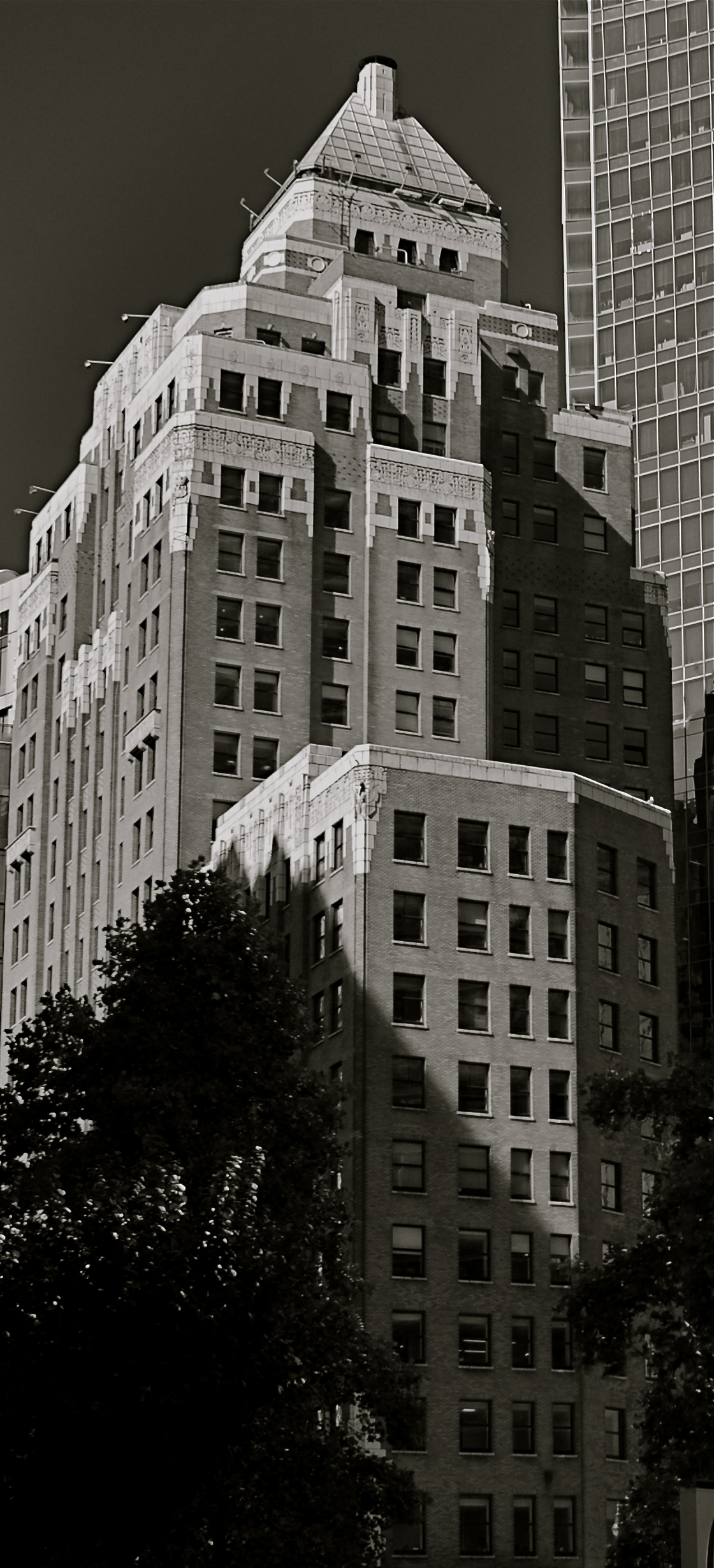
This urban shot seems to call for a sharp look overall.
There is a tendency for us to mentally default to an idea of “sharpness” when we hear the word focus, as if the only way to faithfully reproduce reality is strict adherence to that standard. But photography has never really been about reality, any more than painting or prose. We can’t help but add some small interpretive something to the process of making a picture, even if we believe a machine is largely in charge of the process. Amazingly, with very little effort, we can change the perception of an image by tiny adjustments in what is clear and what remains hazy or soft, straying selectively from the arbitrary sharpness standard.
Some subjects are rendered too coldly, too clinically, when subjected to razor focus, so that what you may gain in documentary detail you lose in intimacy, or in that undefinable feeling of being close. Applying this line of reasoning to my personal affection for architecture, there are buildings where the hard look of precision is perfectly suited to the subject; jutting skyscrapers, massive bridges, towering monuments, and the like. But put me in a small town, where the entire space feels sealed off from time itself, and the look, at least for me, becomes softer. Details take a back seat to feelings, and the harsh light of midday gives way to a soft, dreamy haze at late afternoon. The secrets of side lots, alleys and back yards become scavenger hunts. In both the big and small cities, focus is the key element in the creation of the image. And, also, in both cases, an advance visualization of the final result dictates exactly the degree of focus required.
Lenses and cameras possess wonderful technical properties that can deliver a slew of exotic effects. Still, with virtually no expense or fuss, a smarter mastery of focus is a decisive, even dramatic factor in helping a photograph develop its most effective language.
OFF-WHITES AND NEAR COLORS

Warmer than reality: A sunset processed through Nikon’s in-camera “shade” white balance setting.
By MICHAEL PERKINS
ONE OF THE MOST GRAPHIC DEMONSTRATIONS OF THE DIFFERENCE BETWEEN YOUR EYE AND A CAMERA’S occurs by accident for most photographers, with variations in the reading of white balance that make the colors in an image look “wrong”. While our own vision looks at everything in the world from light blues to medium greys and instantly converts them all to “white”, the camera makes looks at all those variants and makes what can be called its best guess.
All light has a temperature, not a measure of heat but an index of which colors combine to deliver hues of a certain intensity and range, and white balance helps photographers manage color more effectively. Film shooters, especially those using sophisticated flash technology, eventually develop an instinct as to which kind of light will deliver the hues they seek, but, as the digital era tracks onward, many more of us simply rely on our camera’s auto settings to deliver a white that strikes us as “correct”. And when auto white balance fails to deliver the goods, we can override it and select other settings that compensate for incandescent light, shade, cloudy skies, and so forth. We can also create a completely custom white balance with little fuss. Think Dad looks better with a green face, like the true extra-terrestrial that he is? It’s at your fingertips.

Same scene using Nikon’s fluourescent white balance setting.
The fun starts when you use white balance to depart from what is “real” in the name of interpretation. WB settings are a fast and easy way to create dramatic or surreal effects, and, when you have enough time in a shoot to experiment, you may find that reality can be improved upon, depending on what look you want. In the top image, taken during a long, lingering sunset at sea, I had plenty of time to see what my camera’s custom WB settings might create, so I bypassed standard auto WB, then amped up the reds in the sky by clicking over to a shade setting, resulting in a deep and warm look.
For the second shot of the same scene, I wanted to simulate the look of a sky just after sunset, when the blues of early evening might take over for the vanished sunlight, even providing a little radiance from a pale moon. One click to the setting and you see the result. Now, of course, I’ve just switched from one simulation of reality to another, but playing with WB in a variety of lighting situations can help you tweak your way to fantasy land with no muss or fuss.
Tweaking white balance is basically lying to your camera, telling it that it is not seeing what it think’s it’s seeing but what you want it to think it sees. You’re the grown-up, you’re in charge. “White” is what you say it is. Or isn’t.
OF DISTANCES AND DOMAINS
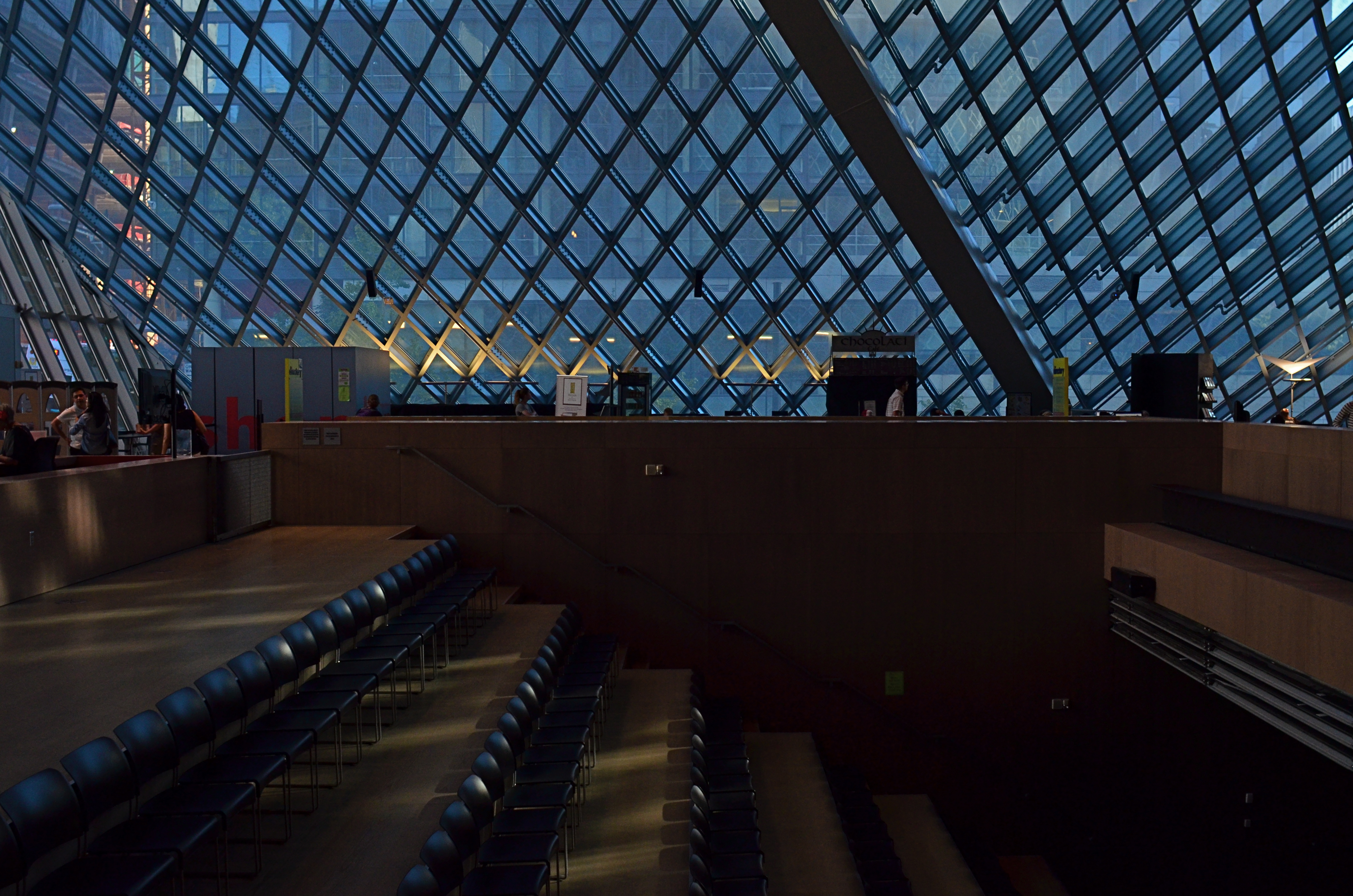
Designed by humans? Certainly. Designed for humans? Well….?
By MICHAEL PERKINS
PHOTOGRAPHY IS AN EFFECTIVE WAY TO MEASURE MAN’S RELATIONSHIP to his physical environment, giving us the distance we need to see these arrangements from a more objective distance. People design places in which other people are to live and work, but once these plans get off the drawing board, it can become unclear what people’s place in the whole puzzle was intended to be.
More to the point, there is real picture-making potential in the occasional mis-match between what we design and how we fit into it. Some things that seem terrific to the people on the planning board seem cold or intimidating to regular users once they’re actually built. Seeing us try to find our place in things that are really inhospitable can be visually interesting because it makes us look and feel somewhat alien. We can become oddly placed props in our own projects, as the places made to house our dreams look more like warehouses for our nightmares.
Of course, one man’s horror is another man’s heaven, a rule that has certainly been constant over the history of innovation. That means, artistically, that we can wind up, inevitably, making images that start arguments, which is, I believe, the perfect function for art anyway. It’s one thing to smear a daub of paint on a canvas and lacerate someone’s vision with it. After all, you can abandon the painting, leave the gallery, etc. But if the building that was meant to be the gallery seems like a bad fit for you as a human being, that’s something else entirely.
The right compositions with the right lenses deliver stark visual messages about how we slot ourselves into the world we’ve created. Sometimes we make a statement for the ages. Sometimes we erect mouse mazes. Either way, there’s a picture in the process.
THE WORKER’S SIGNATURE
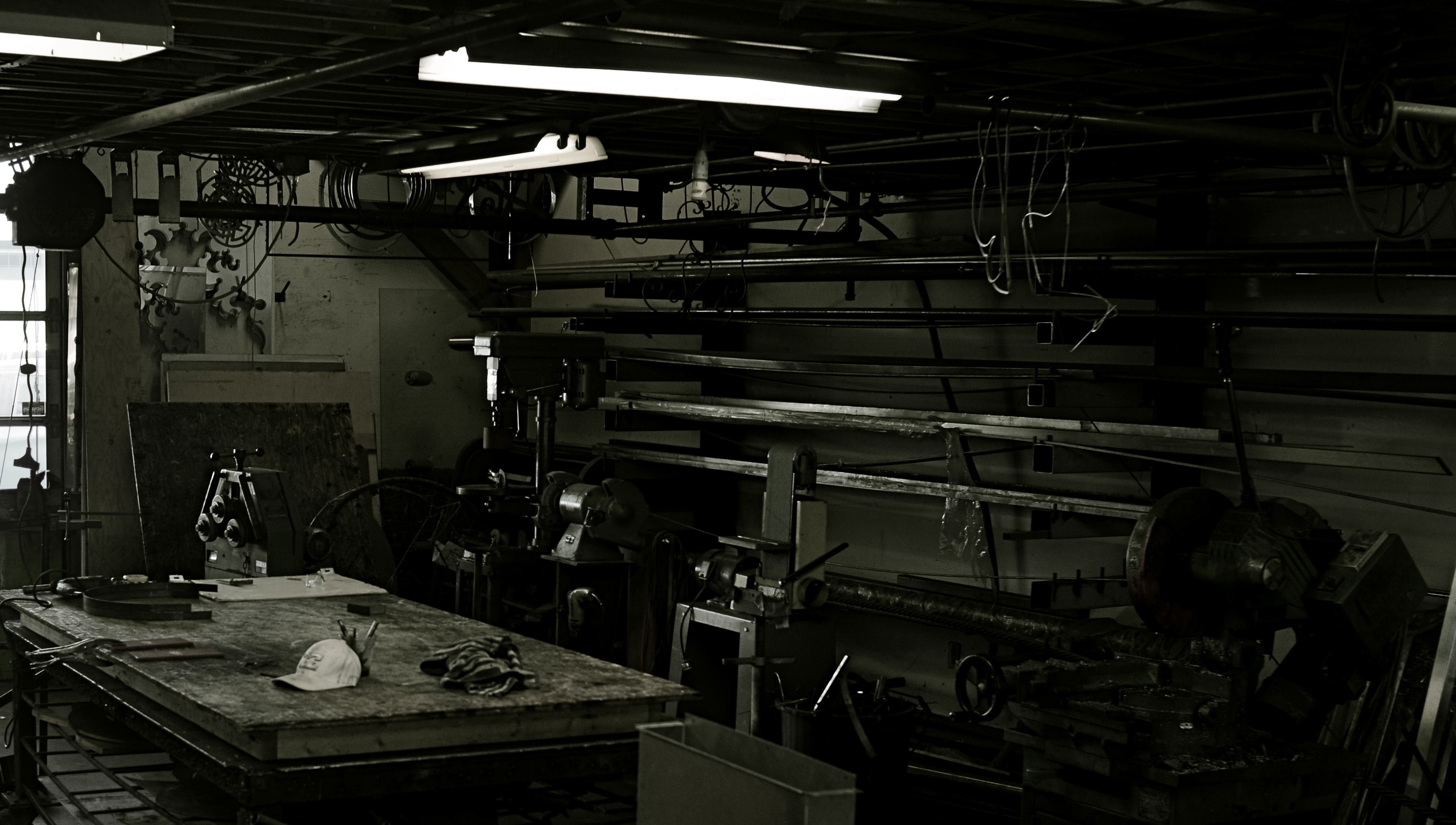
Shop (2016)
By MICHAEL PERKINS
THE GERMAN PHOTOGRAPHER AUGUST SANDER (1876-1964) created one of the most amazing projects in the history of portraiture with his seminal book The Face of Our Time. Born into a world that defined people much more by class division and by the literal work of their hands, Sander created a document of a vanishing world in a very simple way, surrounding bricklayers, cooks, soldiers, and dozens of other professionals with the literal tools of their trades. His work influenced street photography and portraiture throughout the 20th century, acting as both document and commentary.
The manual trades that Sanders celebrated are rapidly vanishing as automation and changing tastes take away the tv repairmen, cobblers, and pillow makers of yesteryear, taking with them the physical look of their workplaces. It’s feels like I’ve happened upon an archaeological dig when I run across a place where handcrafted work takes place, and to photograph the shops where the old magic still happens. The encroachment into urban neighborhoods of chain stores and the crush of ever-higher rents are chasing out the last generations of tinkerers and makers. Storefronts and the stories that reside within them are winking out across the urban landscape.
August Sander’s challenge to present-day photographers is to bear witness to the worker’s signature, the mark he makes on the world and the echo he leaves behind when he departs. The world is always in the act of going partly instinct. The camera measures what we lose in the process. In Sander’s elegant, simple pictures of working people, there is a peaceful quality, as everyone seems fitted to their place and role in the world. As we photograph the final days of such a world, we are commenting on the uncertainty that follows it into our present age.
EYE FOOD
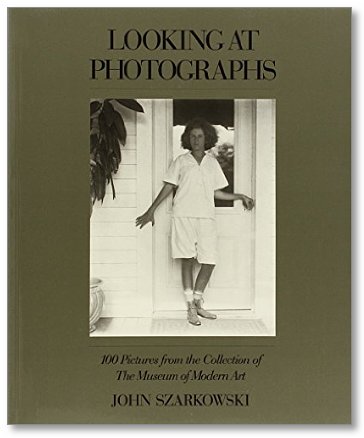
Even the smallest library on photography needs this book.
By MICHAEL PERKINS
A VIDEO BIOGRAPHY OF JOHN SZARKOWSKI, FORMER DIRECTOR OF PHOTOGRAPHY for the New York Museum Of Modern Art, makes the salient point that most great photographers begin by being great fans of photography, almost to the point of studying the work of others as much as they work to perfect their own craft. This makes perfect sense. Before you can teach others to see, you have to learn to see yourself. And that begins with watching how other people see.
Learning from the masters doesn’t necessarily mean stealing from them, or even being stylistically influenced by them. What you see most importantly in other photographers is how closely their selves are married to how they personally take the measure of the world in visual terms. You learn how few real accidents there are, how few miraculous pictures merely pop out of the camera fully formed. You see the deliberate agency of art, the conscious decision to choose this in order to achieve that.
Szarkowski, who oversaw MOMA’s photographic collections and exhibitions from 1962 to 1991, bore witness as well to the first true acceptance of photography as an art unto itself, with a vocabulary, a power, a poetry separate and distinct from painting. Under Szarkowski’s tutelage, the great new personal photographers, from Garry Winogrand to Diane Arbus to Lee Friedlander, moved from the periphery to the center of popular culture.
Not content to merely designate work worth seeing, or providing it with a prominent platform, Szarkowski also edited and published two of the most important general-use guides to what all of us should look for in a photograph. His seminal books The Photographer’s Eye and Looking At Photographs, both comprised of works from within MOMA’s collections, examined more than just subject matter or technical data, looking at the motives, biases, objectives and visions involved in the making of pictures. Most importantly, both books placed known and unknown shooters on an equal par, making the study of the art about what is achieved, not just how, or by whom.
I cannot imagine having sustained a lifelong interest in making images if I had not first encountered the works of, among others, Pete Turner, Alfred Eisenstaedt, Walker Evans, Robert Frank, Larry Burrows, Richard Avedon, Berenice Abbott, Alfred Stieglitz, Art Kane, Weegee, Sam Abell, or Francis Wolff. Many of these people thrilled and inspired me. Sometimes they infuriated or shocked me. And sometimes they did all of that in the same moment. All have knocked me upside of the head and repeated, over a lifetime: Look here. Look closer. Look again.
Don’t ever let anyone tell you that photography is about technique, gear, luck or natural ability. You can work around all that stuff. But if you can’t see, you can’t show.
Study. Read. Admire.
Feed your eye.
DECONSTRUCTING THE CARD
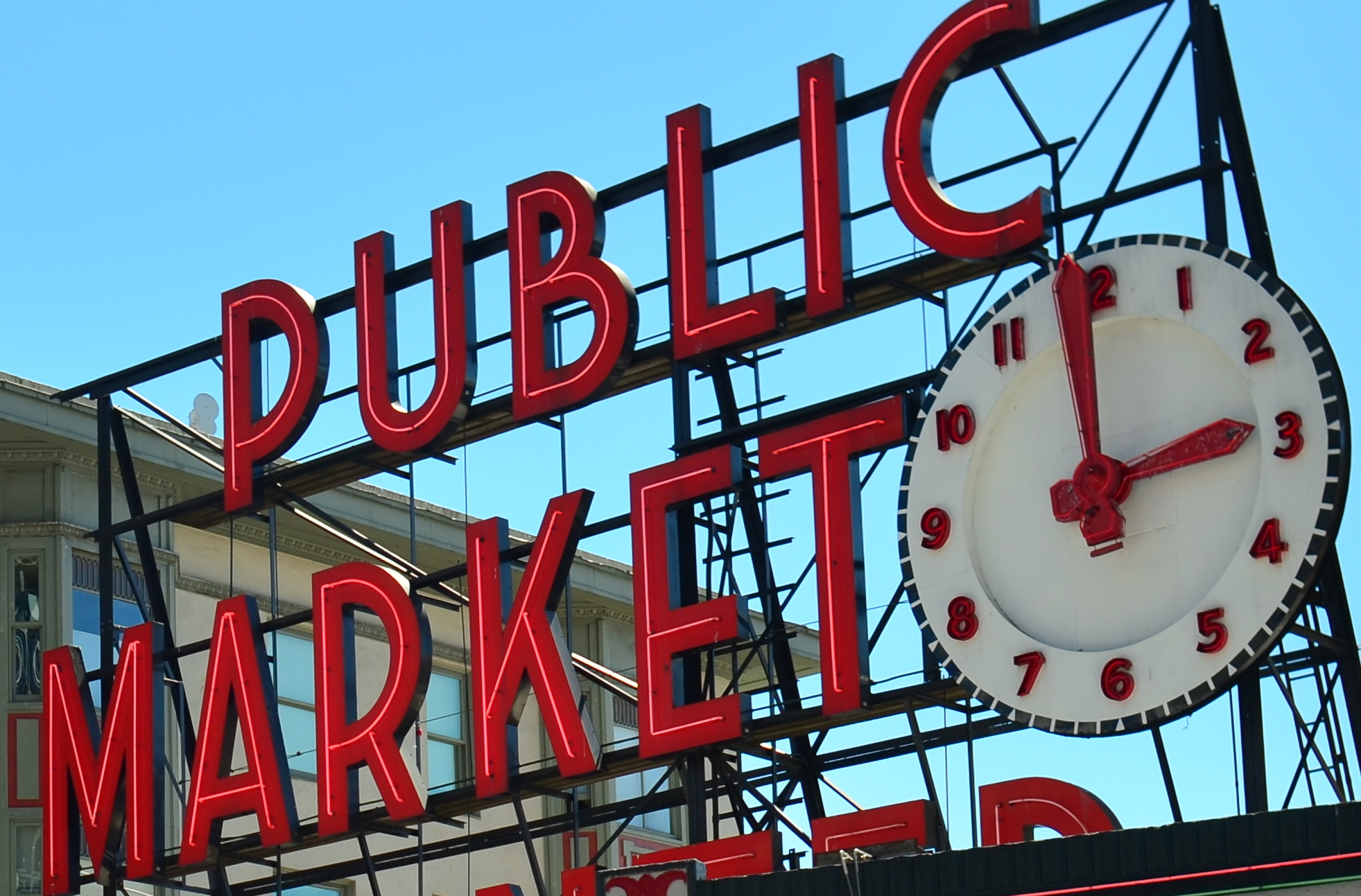
The standard view of Seattle’s Public Market
By MICHAEL PERKINS
WE HAVE ALL PLAYED THE CHILDREN’S GAME OF REPEATING A WORD UNTIL IT BEGINS TO SOUND FOREIGN, OR SILLY, to be drained, in fact, of all real meaning. Context being everything, no less in photography than in any other form of expression, we can often make images that, because they have been so endlessly replicated over the years, become drained of their power, and beg for a re-imagining.
In brief, some things have been photographed so many times that they need to be taken far out of context to rebirth them as vital subject matter.
Look around the next airport souvenir shop you encounter. Look at the paperweights, the tee-shirts, the memorial shot glasses. There, in a moment, you see the symbols of the town you’re visiting (or leaving), reduced to the most hideous kitsch ever created. Lady Liberty. The Space Needle. San Francisco trolleys. You can’t “do” the towns in which these icons hold court unless you visit them and crank off a few snaps. They’re “to do” items, but not “must do”‘s. And every depiction of them is post-card standard, seen from a certain angle and in a certain orientation.
Sadly, many of these sights still could hold the symbolic power they once had, except that few of us are demanding that said power be brought forth. Ironically, we approach totally unknown subjects, things we blithely stumble onto, with the freshest eyes, not knowing the “correct” way to visualize them. We produce instinctual reactions based on how and where we first saw a thing, without the accumulated cultural baggage about how it’s “supposed” to look. We visualize it personally, rather than measuring it against the standard of thousands of other images taken of it.
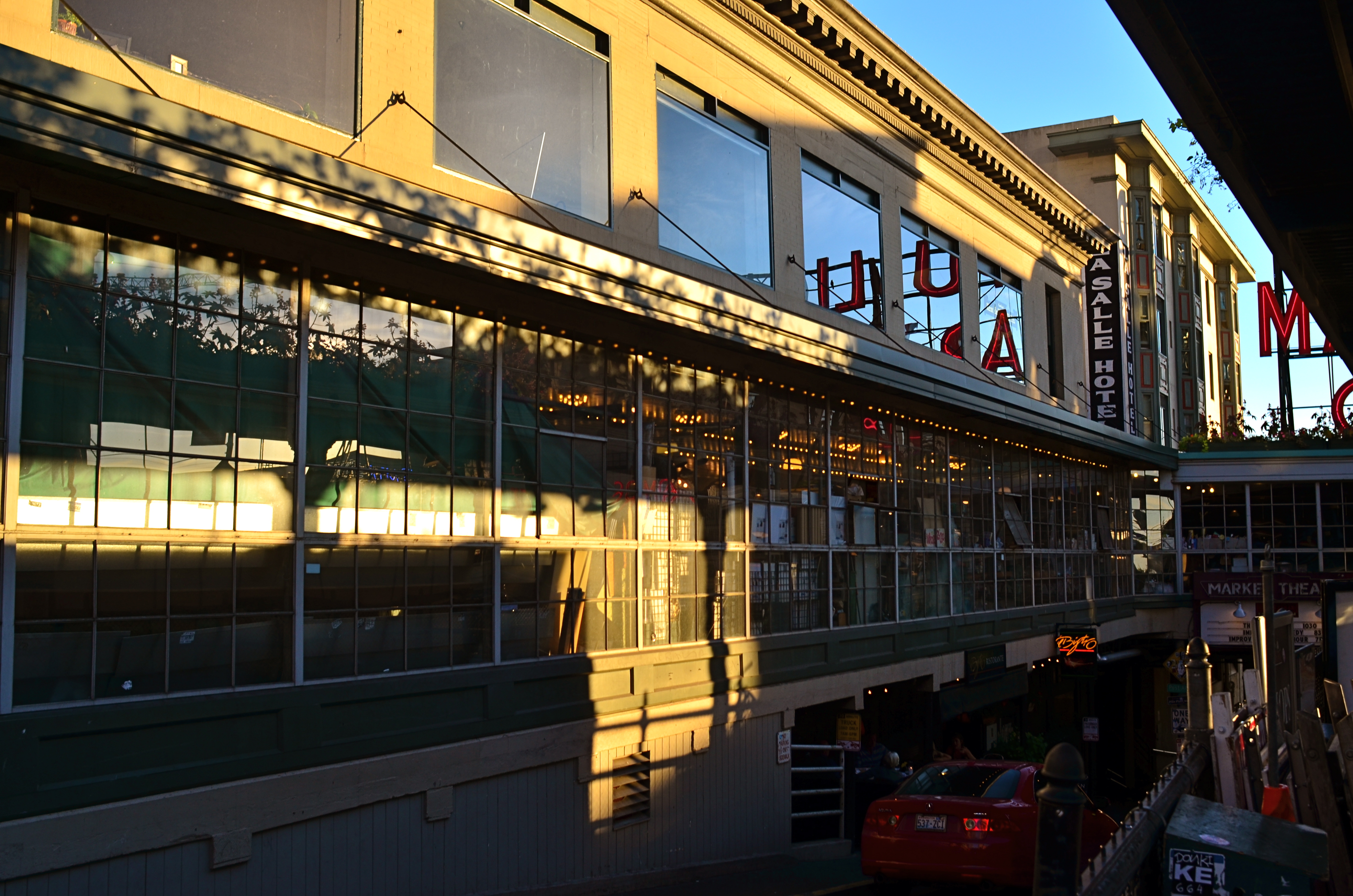
The market sign is still “there” in a sense that is known to the average viewer, but now it really is part of a market “place”.
So how to photograph the over-documented icon? Well, for one thing, the “postcard” view, the one in the travel brochures, must be abandoned completely. Instead of making it a homework assignment to visit a well-known place, why not assume you’ll get one random, fleeting glance at it….through a dirty window, a picket fence, a reflection in a window….and have that be your only chance to photograph it. Instead of trying to get the image “right”, pretend that you have never seen this thing, whether it be a temple or a tower. And imagine, further, that you didn’t even know the thing existed, but that, upon rounding a blind corner, you were suddenly forced to react to it.
As seen at the top of the page, the sign for Seattle’s famed Public Market is often photographed as if it were the market itself, filling the frame of many photos with just its giant red neon letters. In reality, it is a small component in a vital, bustling neighborhood filled with rich visuals. Why not merely suggest the sign as part of a larger tapestry? More importantly, what is your vision?
One great advantage in making new images of old icons is that you know so much of the standard view of the thing that, in abstracting it, you know the viewer will still follow you on the journey….that is, they can make the leap from the literal to the symbolic. It’s like improvising a jazz solo on a well-known melody.
Visualization is the photographer’s most important skill, but occasionally, re-visualization is even more vital…and revitalizing.
 thenormaleye
INVITATION TO THE DANCE
Seattle Street Stomp, Sunday Night (2016)
By MICHAEL PERKINS
PHOTOGRAPHY REACTS TO SHIFTS IN HUMAN BEHAVIOR, in that it both reports and creates the news. Let people surge or sparkle in any particular direction, and the camera will shift with them, for good or ill. Photographers are camp-followers by nature, and instinctively sniff out the Next Big Thing, the Next Medium Thing, even the next Is This A Thing? in search of subject matter.
There is, at this writing, a wealth of story-telling to be done in the rebirth of American urban centers, and it’s more than just stopping by the hottest new part of town. Suddenly, it’s about the complete reversal of the systemic desertion of cities that began right after World War II, with a new generation sizing up thousands of Spielbergian burbs and finding them wanting. Moreover, urban cores are being not just renovated but embraced, not merely as this year’s megatrend but as this age’s new answer. In city after city, we are coming home, transforming our idea of “a life” to define walkable neighborhoods, an explosion in the arts, dense diversity, and locally owned businesses. It’s a great time for cities, and a great time to be a photographer.
All of human activity, from ritual to celebration, social interaction to creativity, is being re-cast in urban terms, with block after block being claimed in the name of re-use and re-purpose. It’s greener, it’s groovier, and it is rich with visuals, as the barn dance becomes the street stomp and the dead warehouse becomes the very alive coffee-house. Most importantly, children are being born into places where they can walk to real shops versus driving to unreal chains. Something is up, and it’s not merely generational, and the camera has a role in all of this.
A role and a say.
Share this:
September 25, 2016 | Categories: Americana, Cities, Commentary, Neighborhoods | Tags: City Life, Street Photography, Urban Trends | Leave a comment