THE WHATS OF WHOS
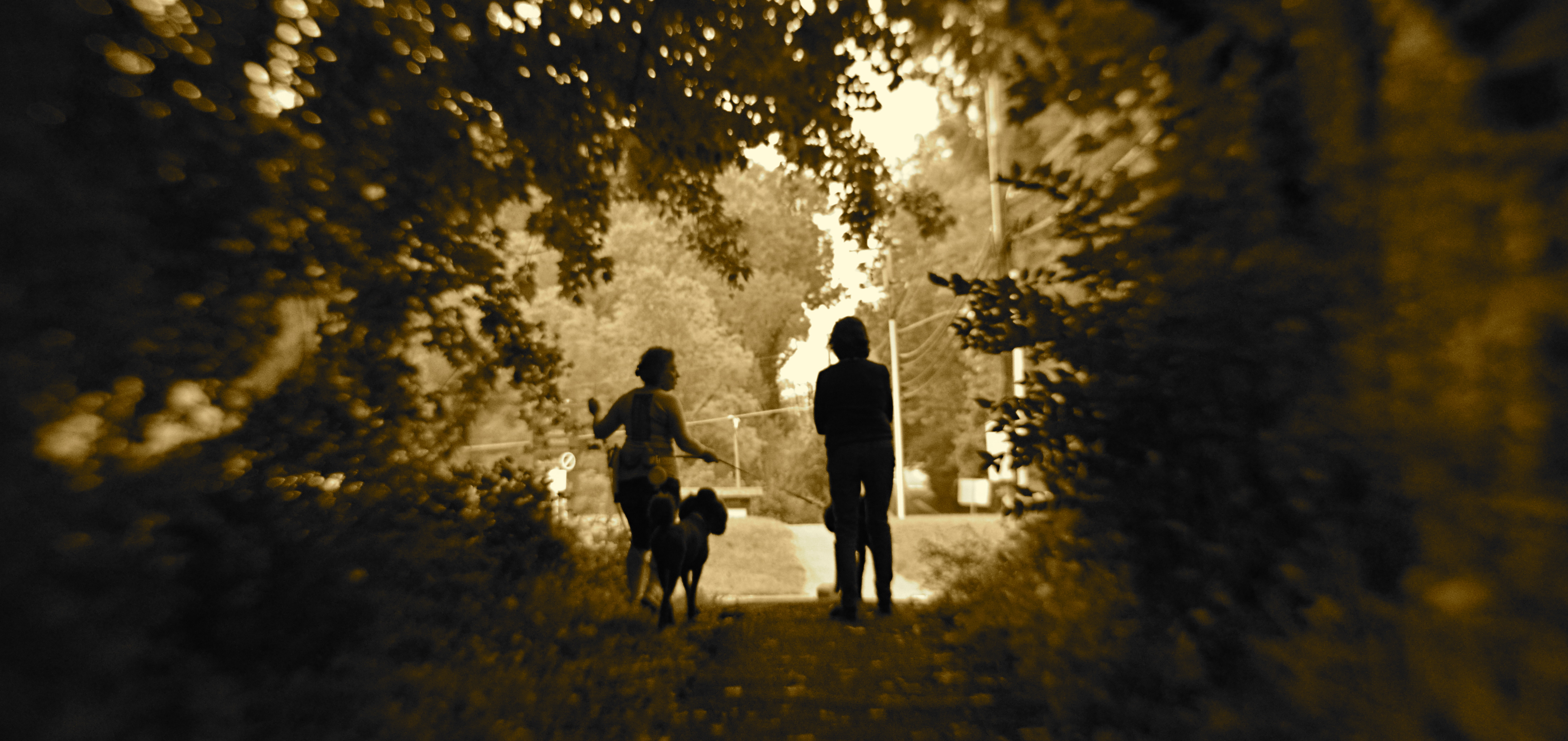
Portraits introduce and re–re–re–introduce us to people, in a process that never really ends.
By MICHAEL PERKINS
RENDERING THE HUMAN IN THE FULL CONTEXT OF THE WORLD is, for me, the one true way to produce a photographic portrait. Sitting someone in a nice room with flattering light and a serene atmosphere might be a formalized way to record a person’s features……but….
Yeah, that’s always the problem with pictures, innit? That insistent but. The part left unspoken. The case left unmade. The squirmy essence of personhood that stubbornly resists imprisonment in our little boxes. It’s quite revealing that, in trying to compliment someone on a portrait, we used to actually say, “I really think you’ve captured him”, as if “he” were a lightning bug in a jar. But such statements miss the very point of portraiture, even photography itself.
Photographs of people can’t be “one and done”, or “official”, or, God help us, “the last word”, any more than sunsets can. We aren’t making a document of a static thing, only serving up a time-slice of something that, by virtue of being in the world, is in constant flux.
To illustrate, the shot you see above is, for me, every bit as much a “portrait” of my wife (the one on the right) as any organized or traditional rendering of her face, because it shows her in the context of a world she inhabits: a world defined by nature, friendships, and animals. I don’t need her face to tell a story about her.
What people do is as telling as what they look like, and so it has to enter into any image-making about who they are.
AND NOW WE PAUSE FOR…
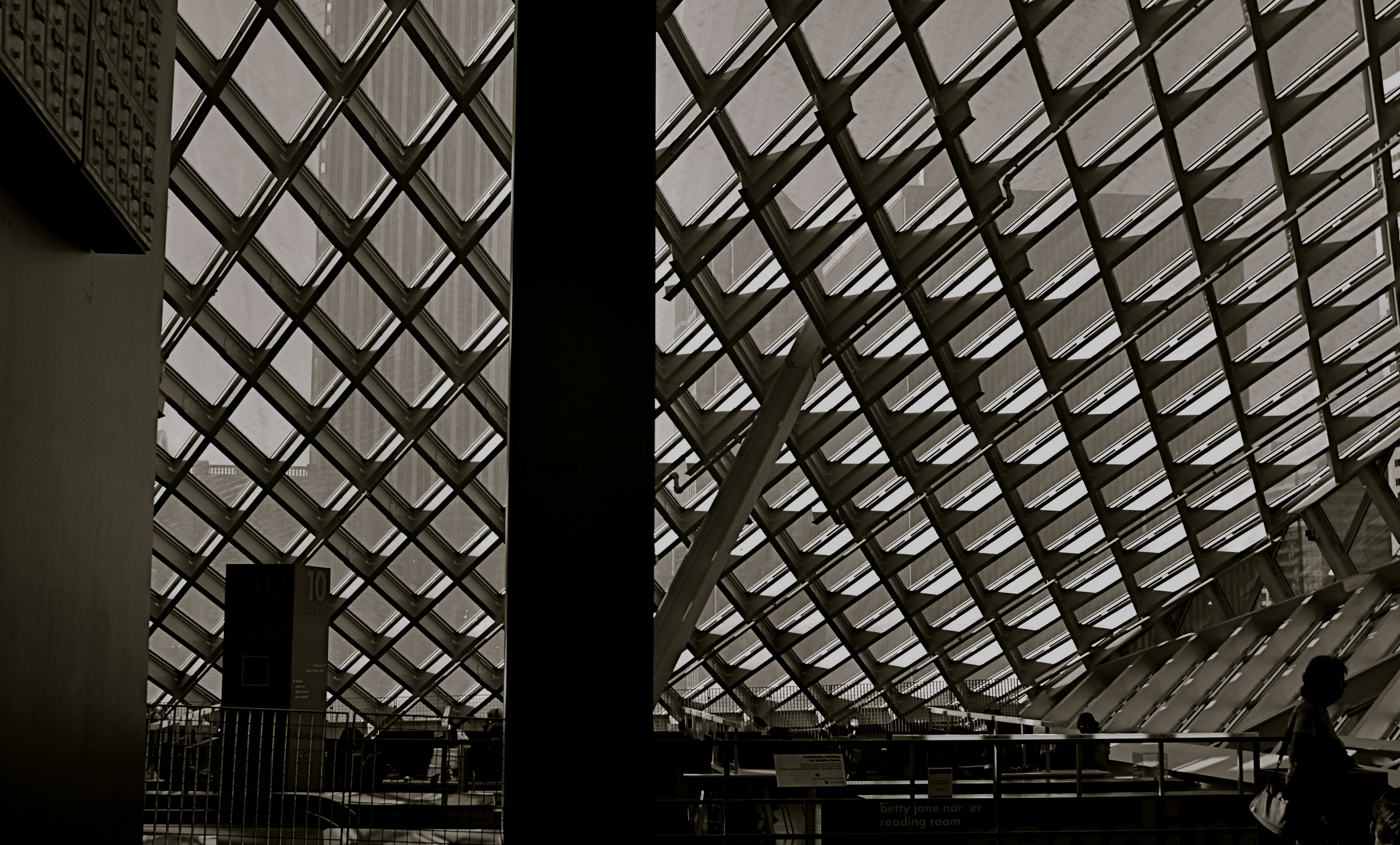
Patterns can gain impact when they are suddenly interrupted.
By MICHAEL PERKINS
A BREAK IN THE ACTION: a word from our sponsor: a coda before the chorus. Intrusions into the predictable rhythms of things can be either annoying or refreshing, depending on how we perceive them.
The right intervals between dots and dashes can drastically change the meaning of a telegram. A well-placed silence between musical notes can generate just the tension required to transform a composition into a masterpiece. And a sudden interruption in visual patterns can add impact to a photograph.
Once the eye detects, as they say on Sesame Street, that one of the things in a picture is not like the others, it pauses, re-evaluating every element in the scene, weighing it for relative value. Breaking an image’s pattern is either an unwelcome invasion or a kind of visual punctuation….again, varying as to the effect. The object violating the uniformity says pause, wait, re–consider, and begins a new conversation about what we’re seeing and what we think about it.
In the above picture, a human silhouette against the massive ceiling grid provides the basic context of scale, and defines the locale (a library) as a space where human activity takes place. The figure thus says how big the place is and what it is for, along with any other ancillary associations touched off in the viewer’s mind. Would the picture “work” without the figure? Certainly. The terms of engagement would just be different, that’s all.
Photographs are not merely pictures of things. They are also sets of instructions (suggestions?) on what to do with all that information. Think of them like roadside signs. It’s indeed helpful to be told, for example, that Sacramento is just another 100 miles away. But it’s just as important to have a big bright arrow telling you to head that–away.
TLI
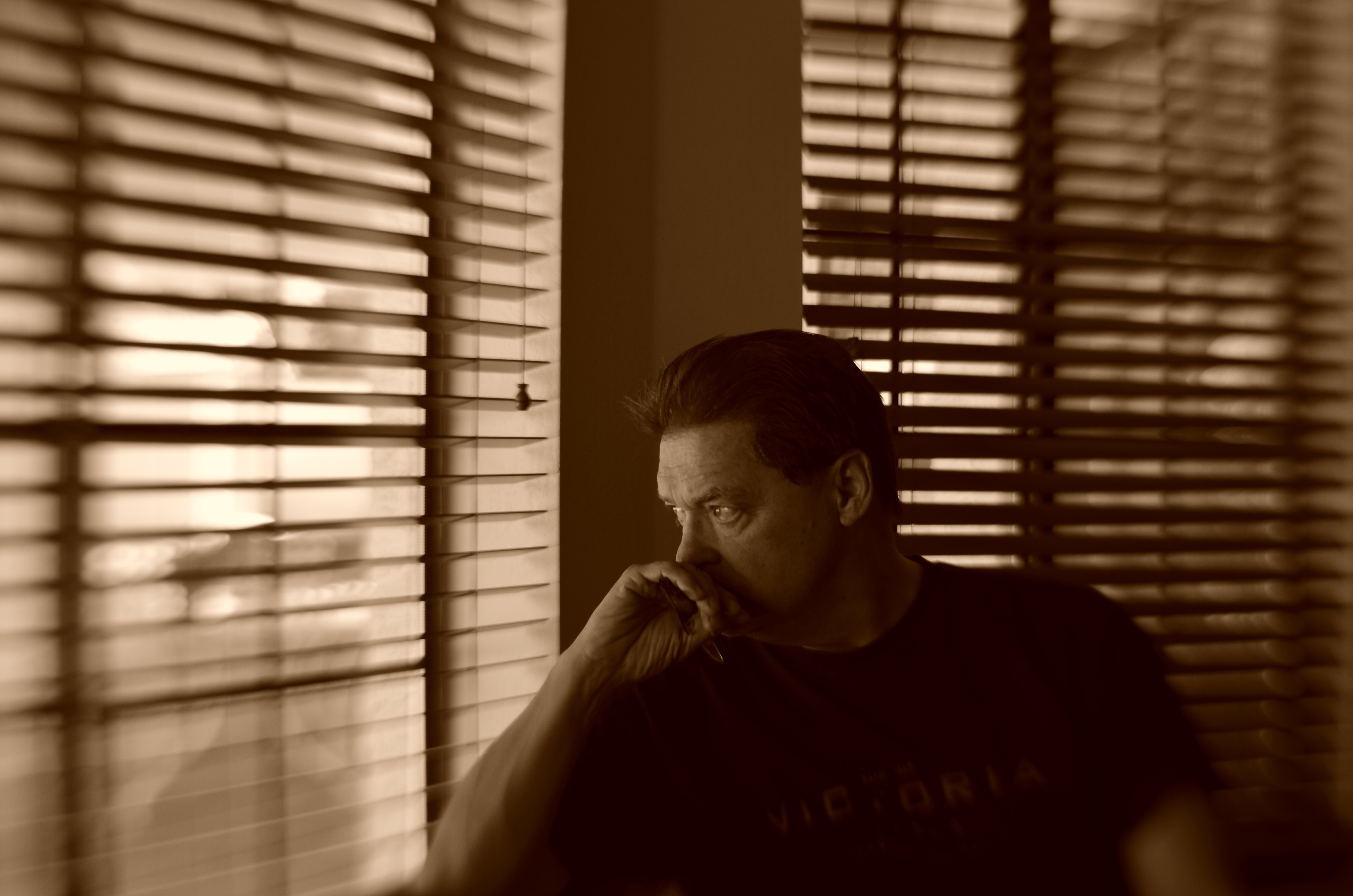
Is a self-portrait just a face crammed into an iPhone screen, or should it be more?
By MICHAEL PERKINS
THERE MAY BE NO PART OF PRESENT–DAY PHOTOGRAPHY that is more practiced and less understood than the humble self-portrait. This has not always been the case. Turning the lens on oneself was a much less common act until the arrival of mobile phones, at which time the somewhat awkward old technique of setting a timer and jumping into the picture was supplanted by an act that was at once instantaneous and effortless. Ironically, at that point, the sheer numerical proliferation of the selfie overwhelmed the artistic fact that many of us weren’t doing them very well.
The modern selfie has been degraded largely because any variance from the same banal fill-the-entire-frame-with-your-face approach is so rare. We get plenty of features and not much context, a condition that could be called TLI, or Too Little Information. Worse, selfies in the iPhone era are limited mostly to what framing is permitted by the length of the shooter’s arm, causing any surrounding people, places or events to be eclipsed from the shot, rendering an image of “me at the canyon” maddeningly identical to one of “me in front of the cathedral.” Add the distortion of near objects inherent in the wide-angle lenses of many mobiles, and too many selfies conceal or mutate more than they reveal. And don’t get me started on the effects of on-board flash. In short, who are these bloated ghosts?
A portrait is more than a mere record of one’s features. The self is also defined by its surroundings, with the accompanying props of one’s life anchoring that person in an era and providing scale, the staging needed for a complete narrative. Can the face alone sufficiently “sell” one’s story? In the hands of the right shooter, absolutely.But riff through a few hundred online selfies and see how often you behold such gems.
In all too many self-portraits, we mostly settle for mere volume, for blurred and puffy smears of ourselves instead of insights. And, as is often the case when taking pictures is so incredibly easy, we fail to plan. This isn’t vanity, but self-sabotage. The self-portrait needs to slow down, to once more become something of a special occasion.
More information, please..
RE-ASSIGNING VALUE
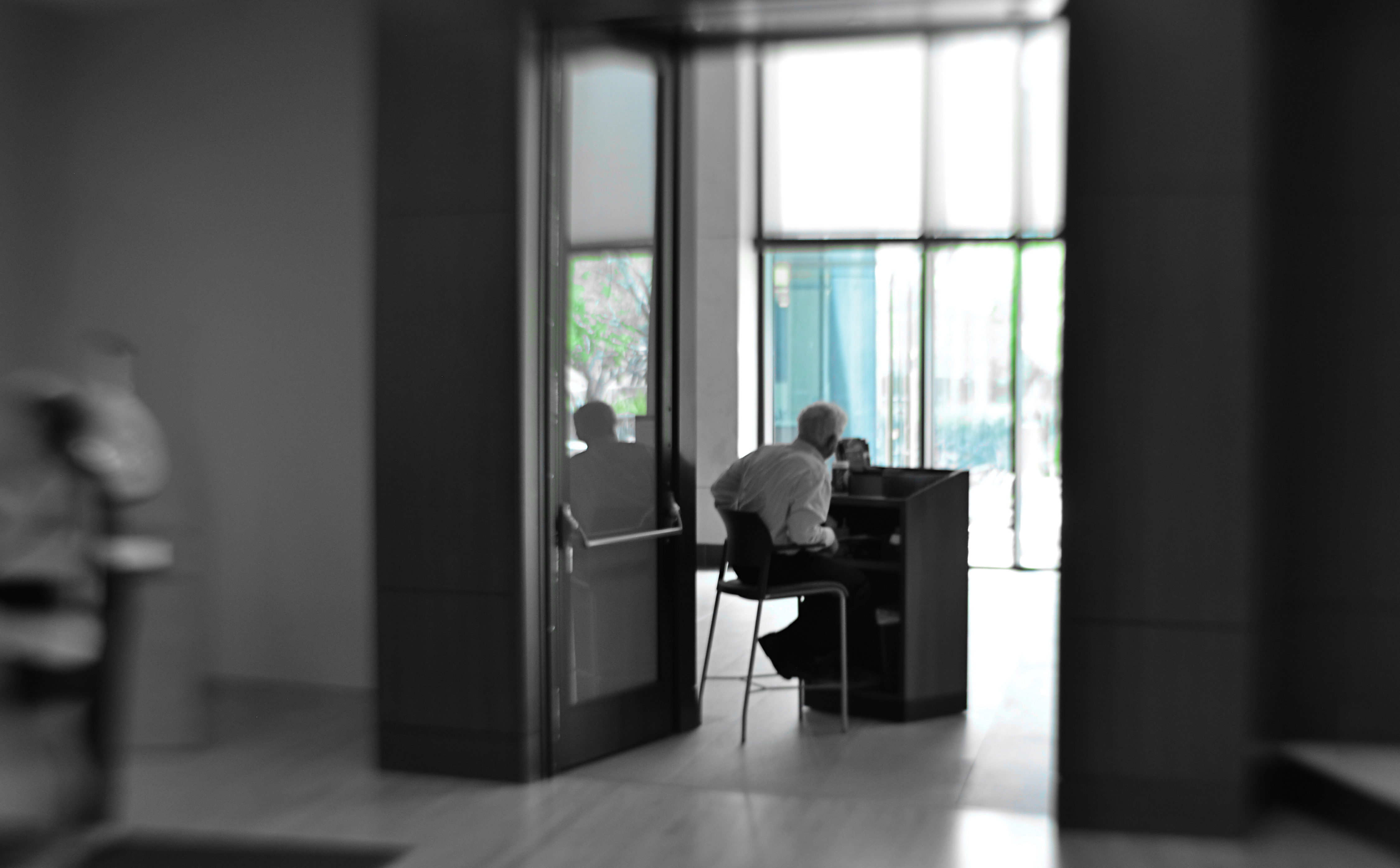
Can you judge this man’s mind from how he’s shown in the image?
By MICHAEL PERKINS
PHOTOGRAPHY DEMONSTRATED, EARLY IN ITS HISTORY, that, despite the assumption that it was merely a recording device, it regarded “reality” as….overrated. Since those dawning daguerreotype days, it has made every attempt possible to distort, lie about, or improve upon the actual world. There is no “real” in a photograph, only an arrangement between shooter and viewer, who, together, decide what the truth is.
So-called street photography is rife with what I call “reassigned value” when it comes to the depiction of people. Obviously, the heart of “street” is the raw observation of human stories as the photographer sees them, tight little tales of endeavor, adventure…even tragedy. However, the nature of the artist is not to merely document but also to interpret: he may use the camera to freeze the basic facts of a scene, but he will inevitably re-assign values to every part of it, from the players to the props. He becomes, in effect, a stage manager in the production of a small play.
In the above image you can see an example of this process. The man sitting at his assigned post at a museum gallery began as a simple visual record, but I obviously didn’t let the matter end there. Everything from the selective desaturation of color to the partial softening of focus is used to suggest more than what would be given in just a literal snap.
So what is the true nature of the man at the podium? Is he wistfully gazing out the distant window, or merely daydreaming? Is he regretful, or does he just suffer from sore feet? Is he chronically bored, or has his head in fact turned just because a patron asked him the direction of the restroom? And, most importantly, how can you creatively alter the perception of this (or any) scene merely by dealing the cards of technique in a slightly different shuffle?
Photographers traffic in the technical measure of the real, certainly. But they’re not chained to it. The bonds are only as steadfast as the limit of our imagination, or the terms of the dialogue we want with the world at large.
FIVE MINUTES OF FANCY
Start fooling around and see where it leads. It isn’t wasting time, it’s investing it.
By MICHAEL PERKINS
PUTTERING SUFFERS A BAD REPUTATION, coming somewhere on the disreputability scale between “screwing around” and “just passing the time”, poking an insolent finger in the eye of the Puritan work ethic. The headmaster’s voice echoes from the land of Hard-Won Wisdom: Time is money. Make something of yourself. Whattaya gonna do, waste the entire day?
Yeah, replies the photographer within you. Thought I might….
Making a picture isn’t the same process as building a bridge. You don’t always end the project with the same aims as you began with. Like any other artistic enterprise, the answer might come in the journey, rather than the destination. And a photographer, caught in mid-creation and asked, “what you doing?” should be quite comfortable answering, “you know, I’m not really sure yet…”
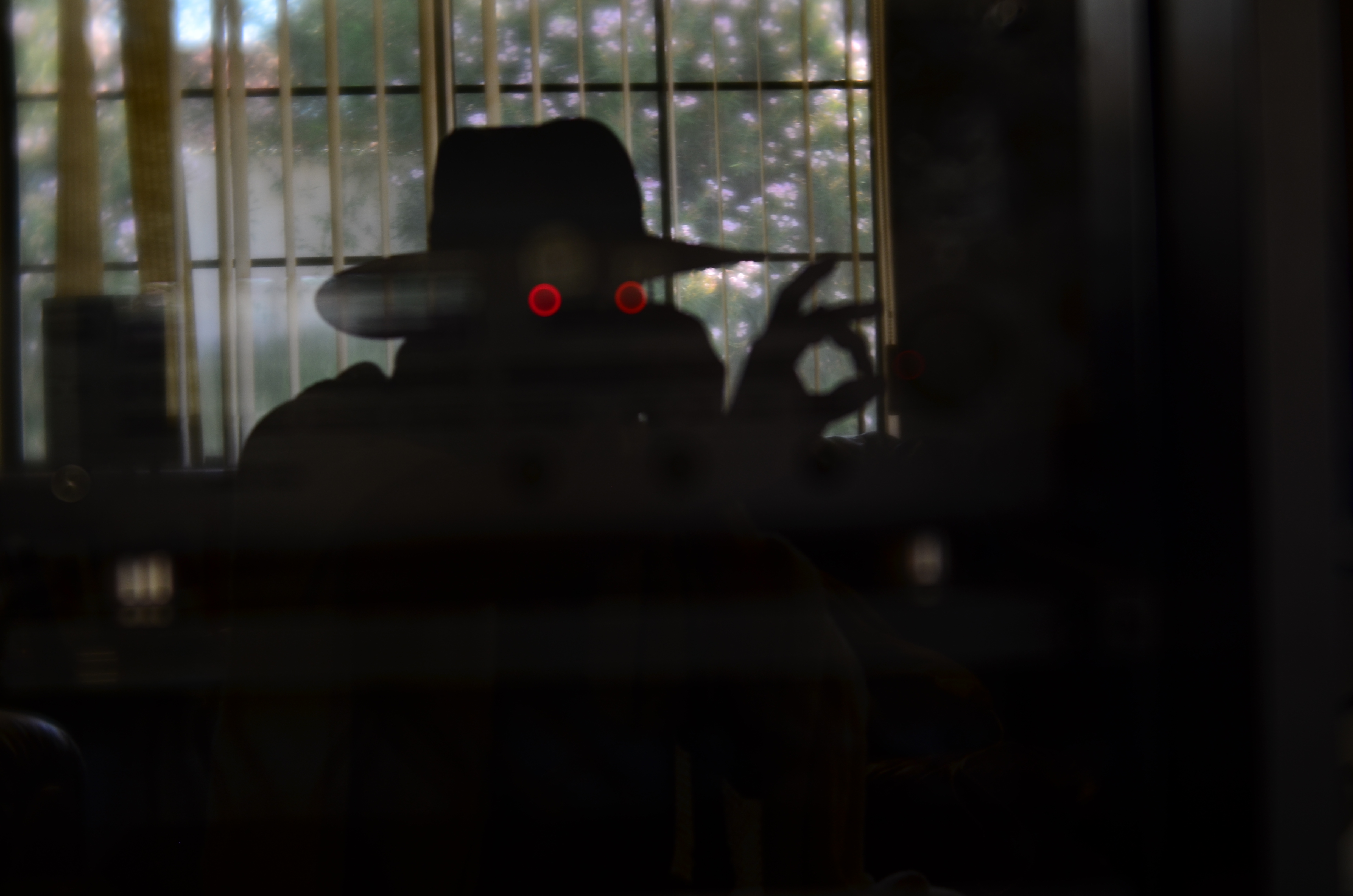
The above image is a total exercise in “let’s see what happens if I do this“, and at no time in the making of it did I have a set plan or firm objective: I just did know when to stop, but everything else was negotiable in the moment. I wasn’t wasting time: I was investing it.
At first, I was trying to take a picture of my back yard, which over my shoulder, as it was reflected in the glass cabinet door in front of me. I was about to kill the power on the amplifier on a shelf behind the door when a test shot revealed something unusual. At my chosen aperture, the amp’s two red LEDs weren’t reading as sharp points of light, but as diffuse outer circles surrounding soft inner circles, almost like a pair of feral eyes. And at that point, the garden scene slowly started to take a back seat.
Shooting the glass door at a slight angle made my body register as a reflection, while shooting straight on turned me into a silhouette, which would become handy. Now that I was just a shape, I could be anything, so I positioned myself to where the dots indeed appeared to glowing, spooky eyes. Shooting with my right hand, my body details now masked by shadow, I crossed my left hand over beyond the right edge of my body, posing it to look as if I were stealing something, or perhaps twisting the dial on a combination safe. Having thus established the behavior for the character I was now creating, I grabbed my wife’s garden hat and threw a bed blanket around my shoulders for some sinister atmosphere. Click and done, with my newly imagined Phantom Blot plotting his way into the house. I didn’t know the whole story, but I knew when to stop playing. Total time investment: five big minutes.
You won’t always have an organized blueprint for a picture when you set about making one. Besides, if you confine yourself solely to the familiar when shooting, eventually all of your photos will start to resemble each other, and not in a good, “cohesive body of work” way.
Screw with the formula. Embrace the uncertain.
WHAT DREAMS MAY COME
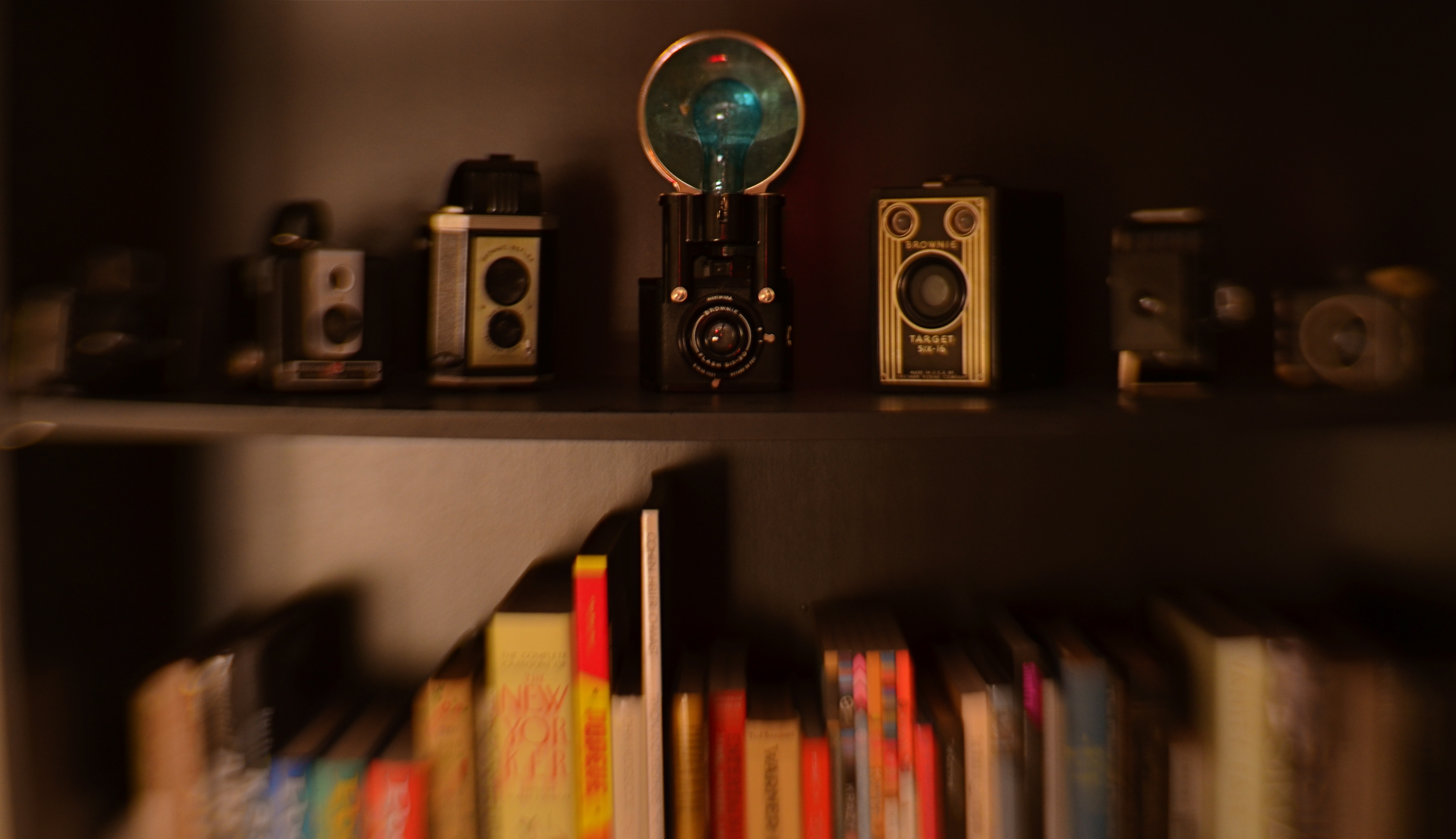
Yestertoys (2017). Making this image look merely “real” held no interest, so…..
By MICHAEL PERKINS
MEMORY ISN’T SHARPLY DEFINED OR TIDY, and so the act of conjuring remembrance in art is never as forensically factual as sliding open an autopsy drawer. The yester-thing that we treasure most dearly are the true opposite of clinical artifacts: they are, instead, bleary, distorted, indistinct, and mysterious. Small wonder that trying to fix memory on a camera sensor is like trying to pitchfork smoke.
Creating images in an attempt to capture the past is a huge part of photography, but it’s a no-man’s land without clear markings or signs. We begin our visual argument by asserting that our version of a memory is the official one… but official according to whom? Even people who have shared a specific event will offer different testimony of what it “really” was. And that very subjective uncertainty becomes one of photography’s greatest charms.
It only took a few years for early shooters to conclude that photographs need not be confined to merely measuring or documenting the world. Early on, they enlisted fancy and whimsy to the cause of depicting memory, just as painters did. And conversely, once there was a machine like the camera to perform the task of faithfully recording “reality”, painters began to abandon it for Impressionism and everything that followed after. Both arts began, like Alice, to regularly venture out on both sides of the looking glass.
A great part of photography’s allure is in discovering how little objective reality has to be in image involving memory, and what an adventure it is to escape the actual in the pursuit of the potential. The camera lets us tell lovely lies in pursuit of the truth.
SETTING THINGS STRAIGHT
By MICHAEL PERKINS
ONE OF THE MOST ELUSIVE EFFECTS IN ARCHITECTURAL PHOTOGRAPHY would seem to be the one most easily achieved: the look of a straight line, the foundation upon which an orderly image is built. However, the human eye is often more unreliable than assumed when it comes to reading and identifying that which is supposed to be “straight.”
We’ve all been confounded by optical illusions that present lines that are not, objectively, straight at all, even though our brains, based on our interpretation of the visual data, say they must be. However, we tend to dismiss this sensation as trickery, something we don’t have to sweat about in making a “real” picture. And that is probably a mistake.
Based on what kind of architectural design you’re shooting, what lens you choose, even where you stand, a straight line, either horizontal or vertical, can seem to bend or lean, making our “factual” images less than trustworthy.
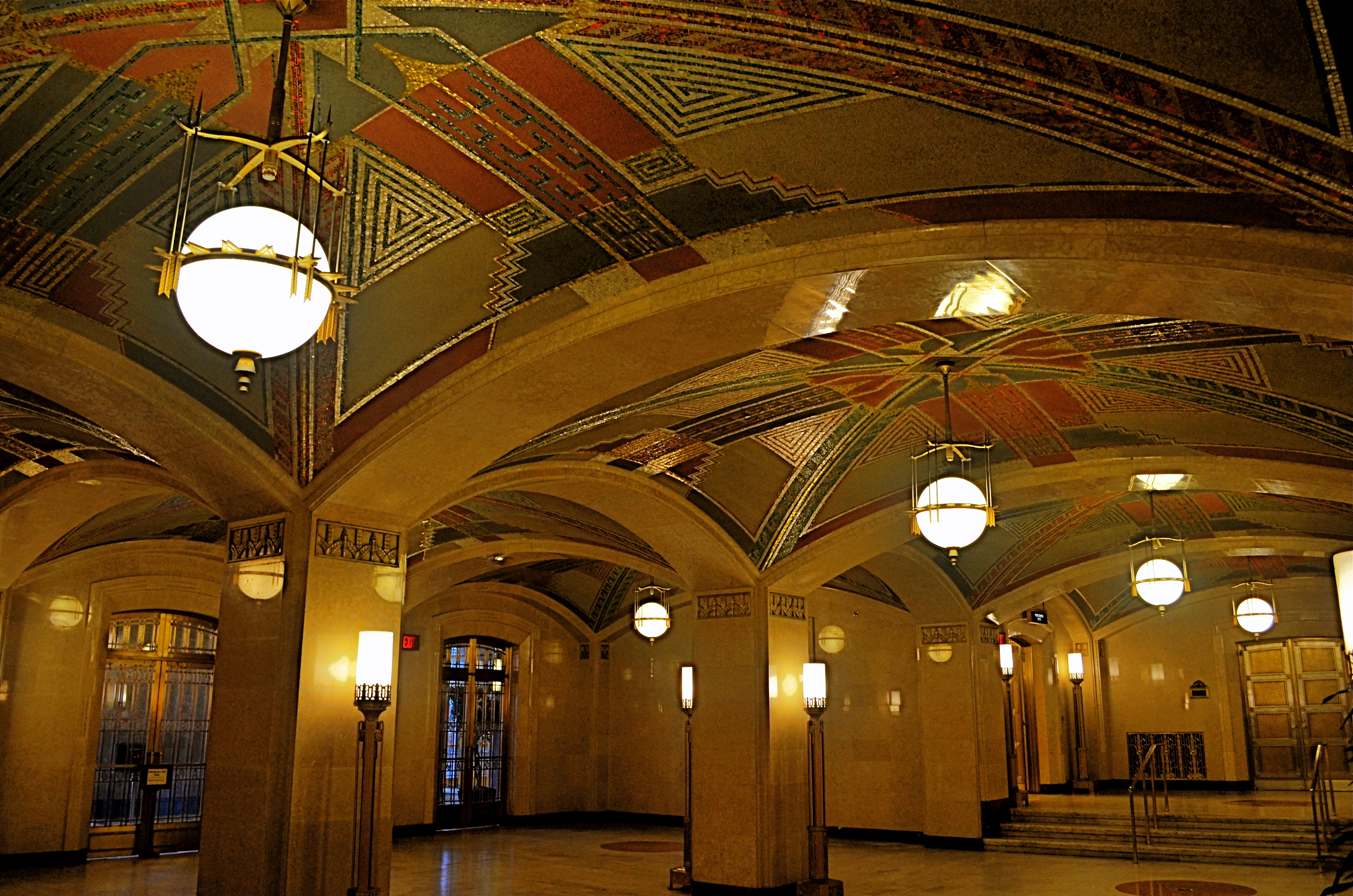
Even setting up a shot on a carefully calibrated tripod and a bubble level can produce a result that looks as if it was manipulated. Of course, based on what look you desire, you may regard geometric reality as irrelevant, and deliberately engineer ” unreality” into a photograph. That’s why we make a distinction between taking a picture and making one.
As an example, the picture seen above was taken super-wide, at 18mm, to intentionally exaggerate the size of the room, making some verticals bow in while others register normally, and playing stretchy with the ceiling arches and floor horizon. The idea here was to distort the already extreme Art Deco accents and give them an extra funhouse quality. Shooting with a more conventional focal length like 35 or 50 mm would have made for straighter lines, but would also have sacrificed every other effect achieved at 18mm.
Bottom (straight or crooked) line: dimensions and angles are suggestions, not commandments. But it’s a lot easier to break rules creatively once you understand how they work.
I’M LOOKING THROUGH YOU
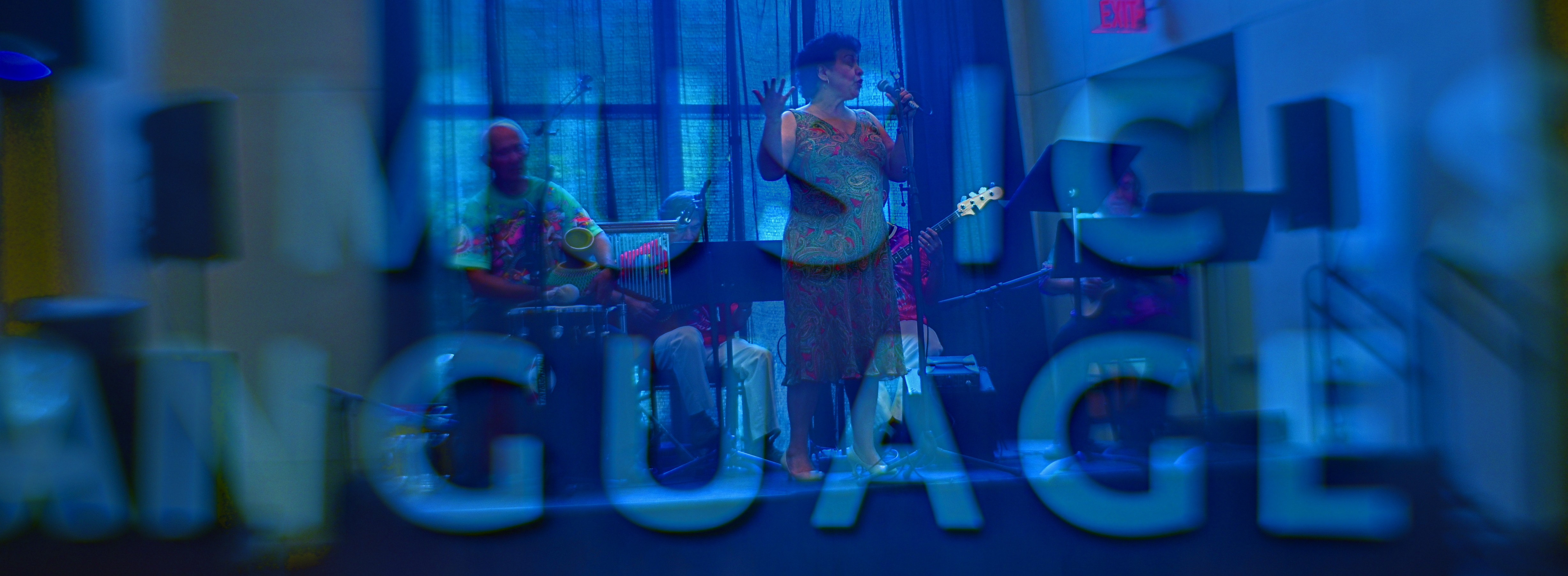
A double–exposure generated in Photomatix‘ “exposure fusion” mode, usually used to blend multiple exposures of the same subject, like the blending done in HDR programs.
By MICHAEL PERKINS
THERE IS A GROWING DEBATE OVER THE RECENT EMERGENCE of a process called exposure fusion, which has been touted as an alternative , if not a replacement for, High Dynamic Range or HDR processing. Which camp you fall into depends greatly upon what look you want in your final image, and both processes can be generated within a popular program call Photomatix.
So, first, a bit of review: HDR blends multiple frames of the same subject, shot at differing degrees of exposure, basically deepening the lighter values and rescuing detail in the darker ones. This means that you can potentially create a composite photo which “sees” the entire range of values in the same intensity, somewhat like your own eye (the ultimate camera) sees them.
Photomatix’ other main flavor, exposure fusion, takes the same multiple exposures and weighs every pixel in each of them for its value, letting some pixels from all exposures ” show through” in the final composite. The range of tones from light to dark is far less dramatic than in HDR, producing an image that strikes some as more natural. It’s worth noting that exposure fusion processes faster and easier than HDR and produces none of its annoying “halo” around the periphery of objects.
One additional fun aspect of exposure fusion, for me, is in its ease of use in creating montage, or controlled double-exposures, as well as same-subject composites. In the above shot, you’ll see a particularly clean amount of transparency between the musicians at a museum and a shot of part of a sign advertising its theme statement. Moreover, exposure fusion operates with several supple contrast and compression slider switches that make very minute adjustments in a snap.
The current HDR / Exposure Fusion “face-off” can only be resolved by actual users’ results, the only thing that matters in photography. Hey, if you made a piece of cowhide light-sensitive with a mix of lemonade and Lestoil and found a way to make a print with it, then mazel tov and God bless.
It’s always, and only, about the pictures.
TWILIGHT TIME
By MICHAEL PERKINS
I HAVE STRUGGLED OVER A LIFETIME to tell photographic stories with as few elements as possible. It’s not unlike confining your culinary craft to four-ingredient recipes, assuming you can actually generate something edible from such basic tools. The idea, after all, is whether they’ll eat what you’ve cooked.
With images, I’ve had to learn (and re-learn) just how easy it is to lard extra slop onto a picture, how effortlessly you can complicate it with surplus distractions, props, people, and general clutter. Streamlining the visual language of a picture takes a lot of practice. More masterpieces are cropped to perfection than conceived that way.
The super-salesman Bruce Barton once said that the most important things in life can be reduced to a single word: hope, love, heart, home, family, etc. And so it is with photographs: images gain narrative power when you learn to stop sending audiences scampering around inside the frame, chasing competing story lines. Some of my favorite pictures are not really stories at all, but single-topic expressions of feeling. You can merely relate a sensation to viewers, at which point they themselves will supply the story.
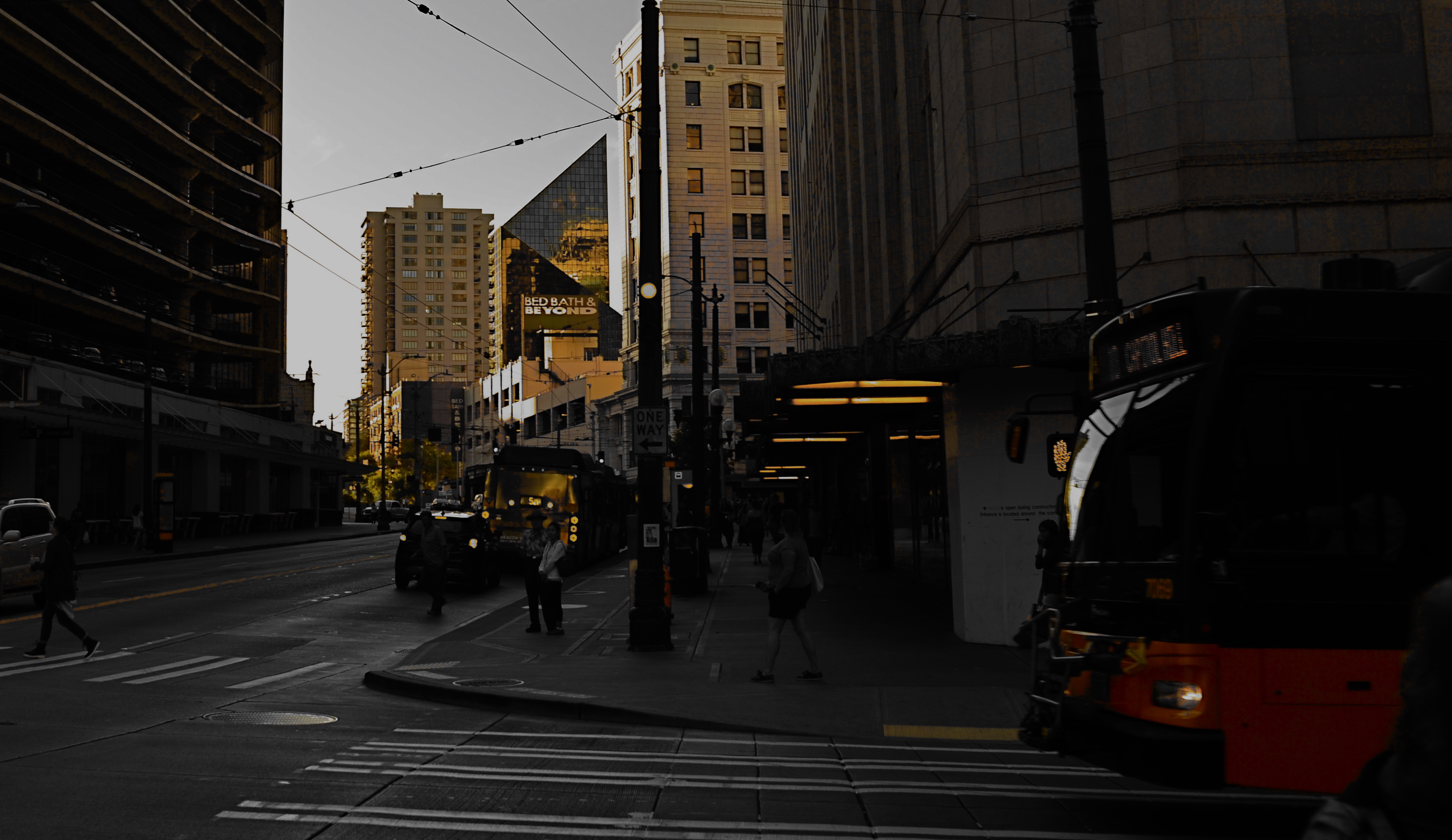
As an example, the above image supplies no storyline, nor was it meant to. The only reason for the photo is the golden light of a Seattle sunset threading its way through the darkening city streets, and I have decided that, for this particular picture, that’s enough. I have even darkened the frame to amp up the golds and minimize building detail, which can tend to “un-sell” the effect. And yet, as simple as this picture is, I’m pretty sure I could not have taken it (or perhaps might not even have attempted it) as a younger man. I hope I live long enough to teach myself the potential openness that can evolve in a picture if the shooter will Just. Stop. Talking.
YOU AND YOUR BRIGHT IDEAS
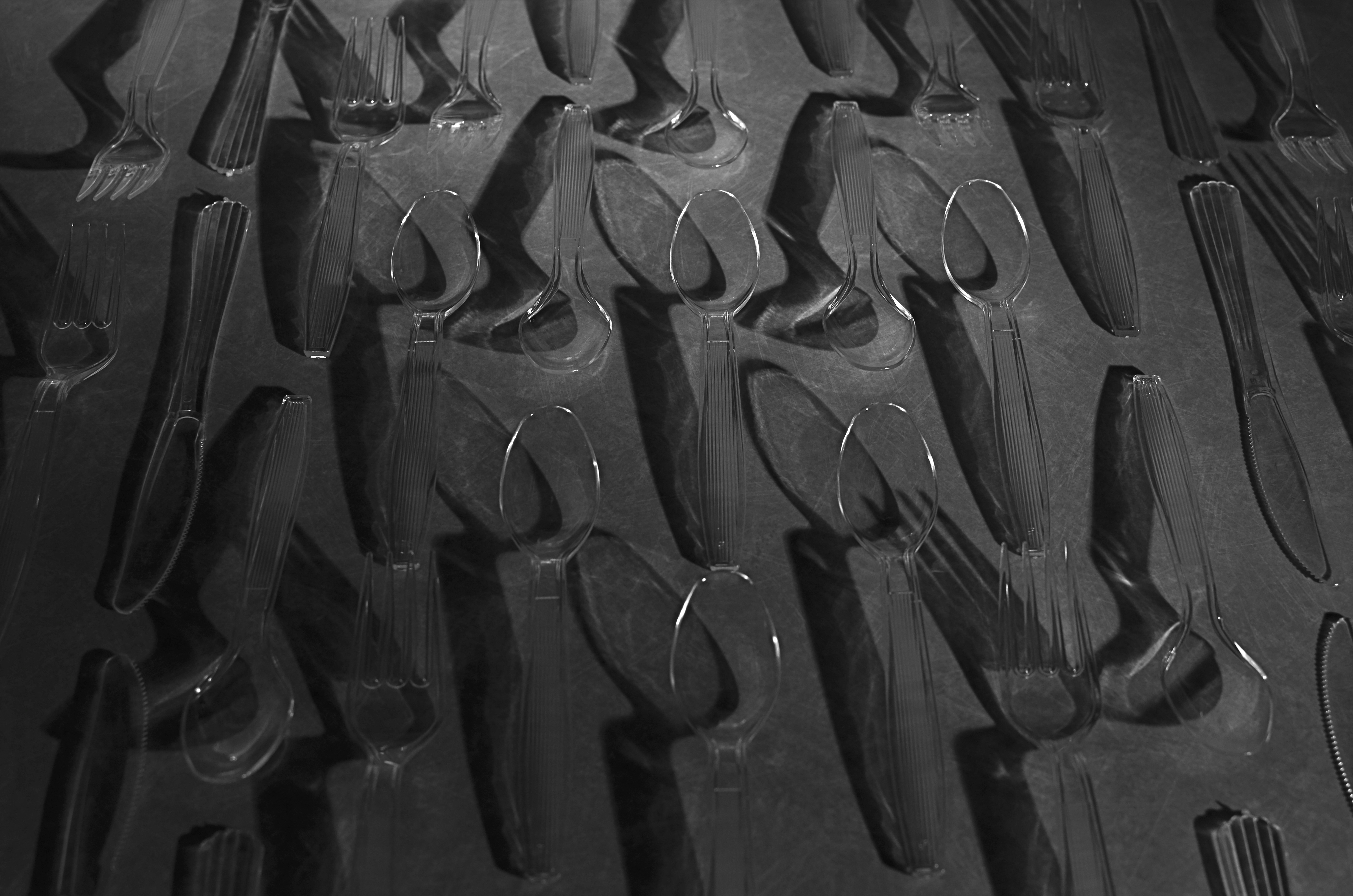
A simple manipulation of single–source light produces a wide range of effects.
By MICHAEL PERKINS
THE SELF–EDUCATION PROCESS INHERENT in photography is perpetual: that is, the lesson-learning doesn’t “clock out” merely because a given task is completed, but flows equally during the in-between moments, the spaces outside of,or adjacent to, the big ideas and big projects. Down time need not be wasted time.
Often it’s because the pressure of delivering on a deadline is absent that we relax into a more open frame of mind as regards experimentation. You find something because you’re not looking for it.
One such area for me is lighting. I seldom use flash or formal studio lights, so I obsess over cheap, mobile, and flexible means of either maximizing natural light or adding artificial illumination in some simple fashion. This isn’t just about making an object seem plausibly lit, or, if you like, “real: it’s also about choosing or sculpting lighting schemes, making something look like I want it to.
Small, powerful LEDs have really given me the chance to fill spare moments cranking out a wide array of experimental shots in a limited space with little or no prep, producing shaping light from every conceivable angle. I just lock the camera down on a tripod, make some simple arrangement on a table top, and shoot dozens of frames with different directional sweeps of the light, usually over the space of a time exposure of around a half a minute. I can move the light in any pattern, either by holding it static or tracking high/low, left/right, etc.
Frequently this activity does not result in a so-called “keeper” image. Such spare-time experiments are about process, not product. The real pay-off comes somewhere further down the road, when you have need of a skill that you developed over several days when you had.. nothing to do.
A FUNERAL AND A BIRTHDAY
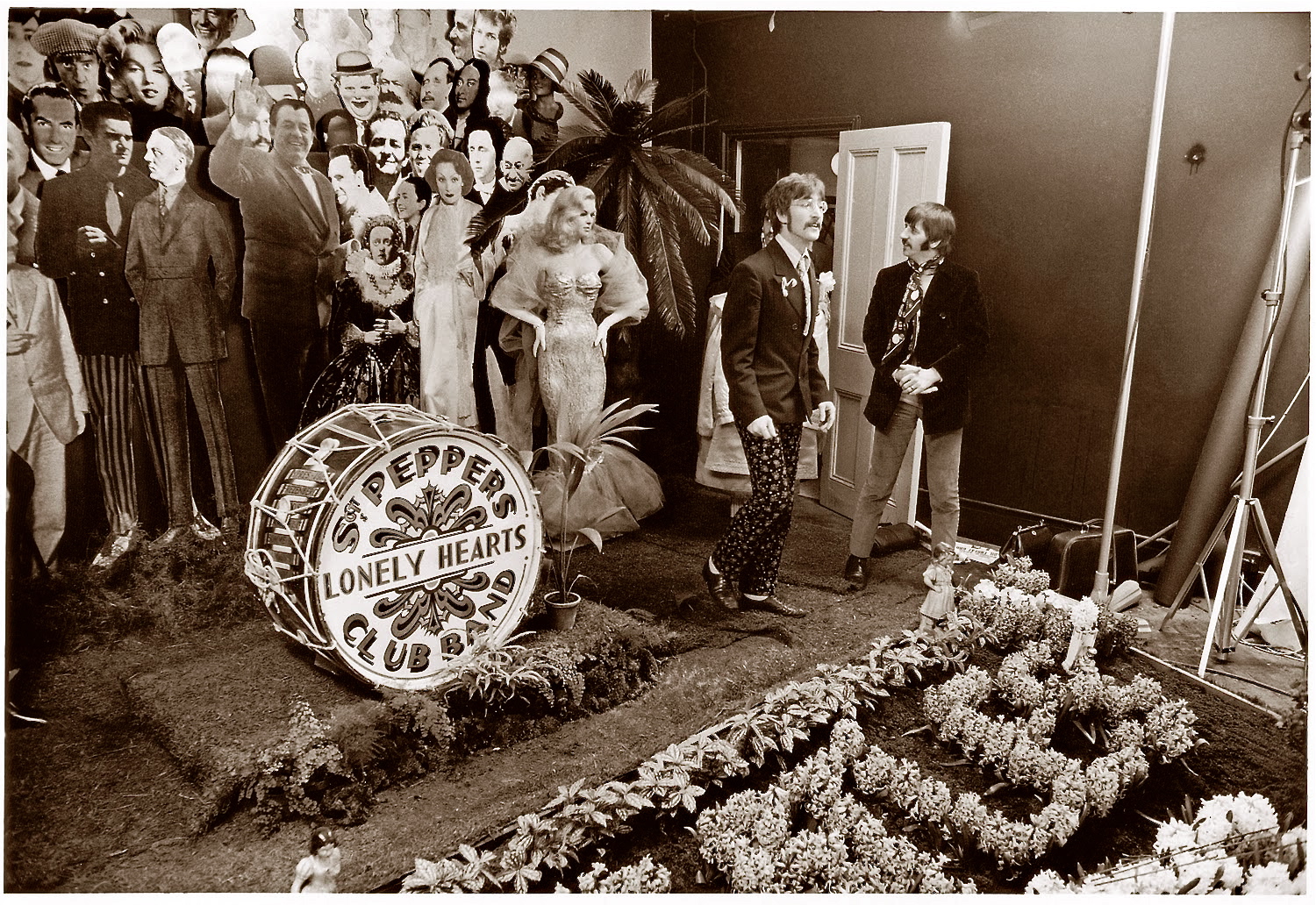
John Lennon and Ringo Starr inspect the assembly of the celebrity diorama that would be the main set piece for the Sgt. Pepper album cover, 1967.
By MICHAEL PERKINS
ANY COMPLETE DISCUSSION OF THE LEGACY OF THE BEATLES‘ Sgt. Pepper’s Lonely Hearts Club Band, marking its fiftieth anniversary in 2017, will include voluminous analyses of its ground-breaking production technique and breakthrough approach to musical composition, and rightfully so. But this most fundamental of pop culture events of the 1960’s must also be thought of in purely visual terms, since many of us first encountered it as an amazing, challenging image.
In truth, the collaboration between Pop Art designer Peter Blake and studio photographer Michael Cooper, with its ad-hoc gathering of cardboard celebrities grouped around a gravesite with the word BEATLES spelled out in blossoms, is the first act of a two-act play. The cover set the same audacious terms of engagement that the record inside the sleeve would abide by: Art and Music are what we say they are: We, the Beatles, are in complete charge of our music, our image, and our connection with the audience: we will not have “a” style, but will hybridize whatever schools of thought come to hand, from modes of composition to instruments to shifting patterns of Past, Present, and Future to coloring outside the lines of even our own culture. I read the news, today, oh, boy, and it said there are no more rules: there are no more walls. The stage can no longer hold us. Only the studio itself is vast enough to contain what we have to say.
The cover of Sgt. Pepper made a stunning break with the accepted practices used by record labels to market their goods. Quite simply, the suits in the front office were no longer in charge of the pictures. And what of that picture, or, more accurately, that picture of pictures? Is it a tribute? A put-on? A serving of notice that the Beatles are dead, long live the Beatles? Yes, yes, and hell, yes. Pepper made it plain, once and for all, that album covers, which had begun in the 1930’s as basic advertising sleeves for the goods within, could be venerated, influential, and, yeah, framed on some freak’s wall. Like, you know, man, art.
And, if Cooper and Blake were drawing a line between eras for the record world, they were doing so to an even greater degree for photography, which, in 1967, was still considered by some as more craft than art. Within a few years after A Day In The Life‘s long, ringing super-chord, museums were mounting shows by Diane Arbus, Lee Friedlander, and Robert Frank, right alongside the painters, and directly adjacent to people like Warhol who constituted categories all their own.
Just as Alice In Wonderland is somehow legless without John Tenniel’s illustrations, Sgt. Pepper’s’ outside will always be wedded to its inside, and vice versa. As the most popular multimedia product in commercial history, it owes much of its titanic impact to the image of four oddly costumed men with four strangely new mustaches and one big message: there is more to us than meets the eye. Like the best of photography, the picture issues a challenge. Nothing is real.
And nothing to get hung about…….
WHEN AND HOW
By MICHAEL PERKINS
I photograph late in the day, the time Rembrandt favored for painting, so that the subtlest tones surface. ———Marie Cosindas
ONE OF THE GREATEST SIDE EFFECTS OF MY HAVING LIVED IN THE AMERICAN SOUTHWEST over the past eighteen years has been its impact on how I harness light in my photography. The word harness conjures the act of getting a bit and bridle on a wild stallion, and so is extremely apt in reference to how you have to manage and predict illumination here in the land of So Much Damn Sun. It’s not enough here to decide what or how to shoot. You must factor in the When as well.
To see this idea in stark terms, study the work of photogs who have shot all day long from a stationary position along the rim of the Grand Canyon. The hourly, and sometimes minute-to-minute shift of shadows and tones illustrates what variety you can achieve in the outcome of a picture, if you consciously factor in the time of day. After a while, you can glance at a subject or site and predict pretty accurately how light will paint it at different times, meaning that many a session can produce a wild variance in results.
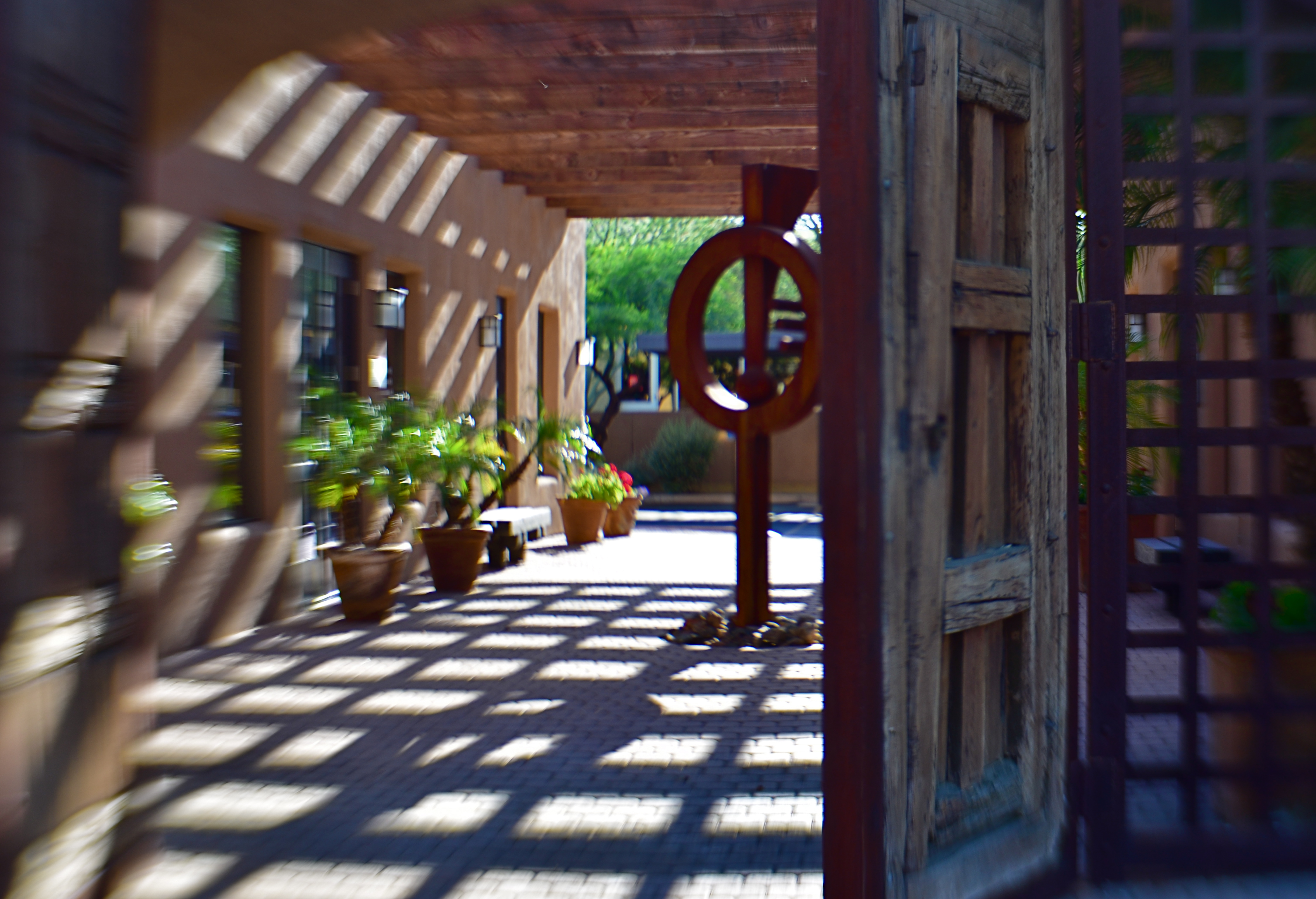
I scouted this location when sunlight was coming from the front of the court, then returned in the late afternoon to shoot it with the sun entering from the back to snag the shadow pattern I preferred.
The late photographer Marie Cosindas, whose miraculous early-1960’s work with the then-new Polacolor film helped change the world’s attitude toward color imaging, didn’t just load her film into a standard Polaroid instant camera. She shot it in her large format Linhof, experimenting with exposure times, filters and development techniques, and, above all, with the careful selection of natural light. She didn’t just wait for her subject; she waited on the exact light that would make it, and all its colors, sing. As a result, the art world began to rethink its opinion about color just being for advertising, or as somehow less “real” than black & white.
In my own work, I take the time, whenever feasible, to “case” locations a while before I shoot them, taking note over days, even weeks, to see what light does to them at specific times of day. As I mentioned, the West suffers from an overabundance of light, mostly the harsh, tone-bleaching kind that is the enemy of warm tone. In the above image, I scouted the location in the early morning, when the eastern sun was drenching the front end of the court, but waited about eight hours to return and get the precise projection of shadow grids that only occurred once the sun was in its western descent, about two hours before dusk. My test shots from the morning told me that the picture I wanted would simply not exist until ’round about suppertime. And that’s when I stole my moment.
There are three legs to the basic photographic tripod: What, How, and When. Over the years, paying greatest attention to that third leg has often given me one to stand on.
SAVING FACE
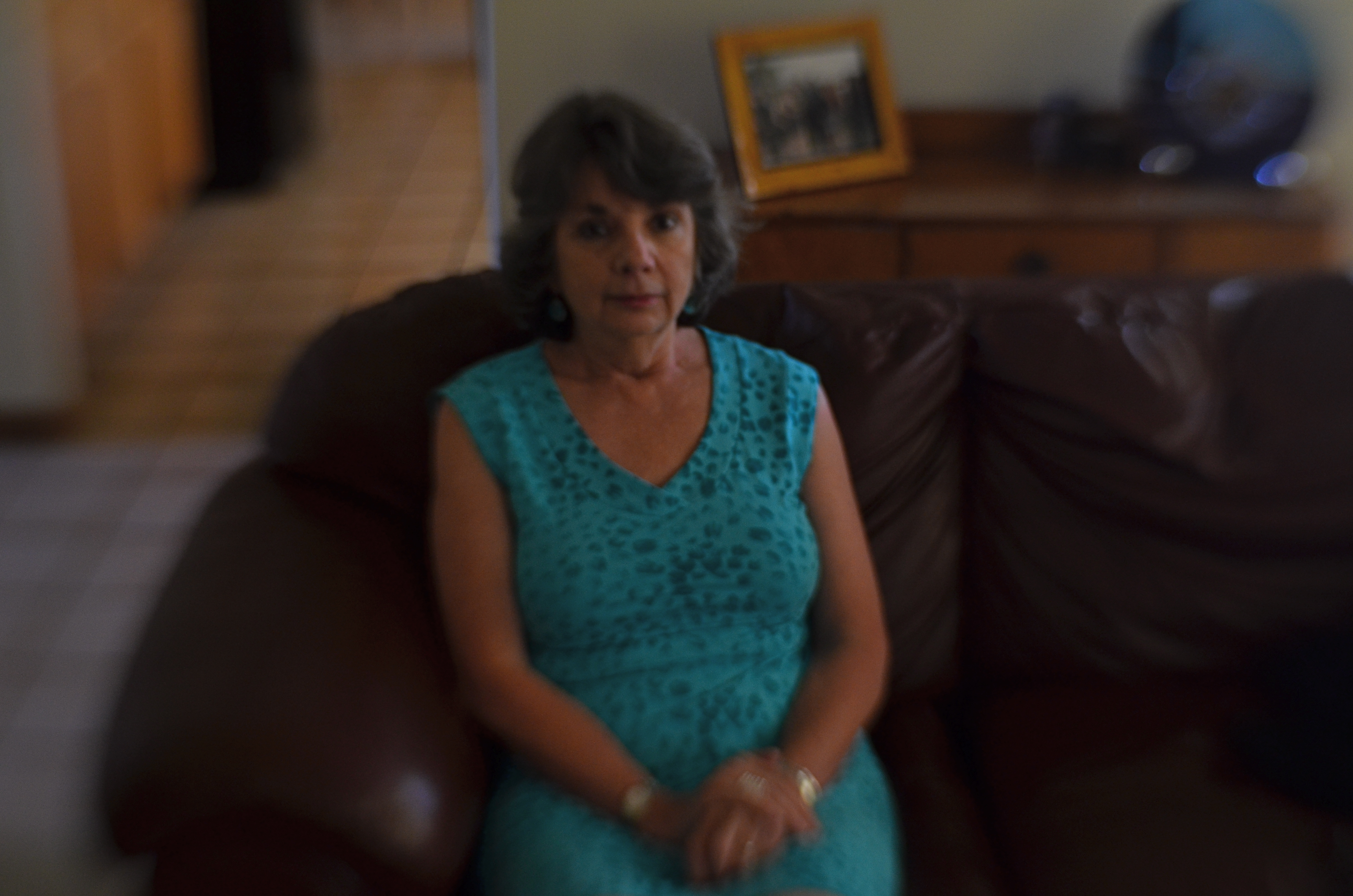
Faces are selves served up in slices.
By MICHAEL PERKINS
YOU WOULD SUPPOSE that sustained, intimate contact with a photographic subject would inevitably lead to a superior, if not perfect rendering of that subject in an image. And supposing further that said subject is a person, you’d assume that one’s close bond with the subject couldn’t fail to produce the ultimate visual depiction of that person….a glimpse into their very essence.
Or so you’d suppose.
There is a reason why so many shooters pursue the same faces, many belonging to dear friends or loved ones, over a lifetime of picture-making….never quite able to reduce a face to its essence or its definitive “version”. It’s not that they don’t yet know enough about that particular arrangement of shapes and features. It’s that they know too much to settle for any single interpretation of them.
No sooner does the face of the Dear One display a given mood or aspect than it shifts like an active weather front to a completely different mix of elements. Faces are selves arrested in mid-flight, and, being in constant motion, rob us of the picture we originally set out to capture, only to bestow a fresh one on us. The “new” person we now see is, certainly, the same individual, but changed enough that we are off on a completely different mission, visually speaking. That is both frustrating and fulfilling.
The slices of persona that we freeze in the camera are just that: shifting glimpses. That means that, unlike pictures of monuments or mountains, they can’t be “done” in any permanent way. Add to this the change in how we all relate to each other over time, and it makes perfect sense to refresh our view of the most familiar faces an infinite number of times.
PERFECT VS RIGHT
By MICHAEL PERKINS
OUR VERY HUMAN DESIRE TO MAKE OUR PHOTOGRAPHY TECHNICALLY FLAWLESS can be observed in the results you can glean from a simple Google search of the words “perfect” and “photos”. Hundreds of tutorials and how-tos pop up on how to get “the perfect portrait”, “the perfect family picture”, “the perfect sunset”, and of course, “the perfect wedding shot”. The message is all too clear; when it comes to making pictures, we desperately want to get it right. But how to get it right…that’s a completely different discussion.
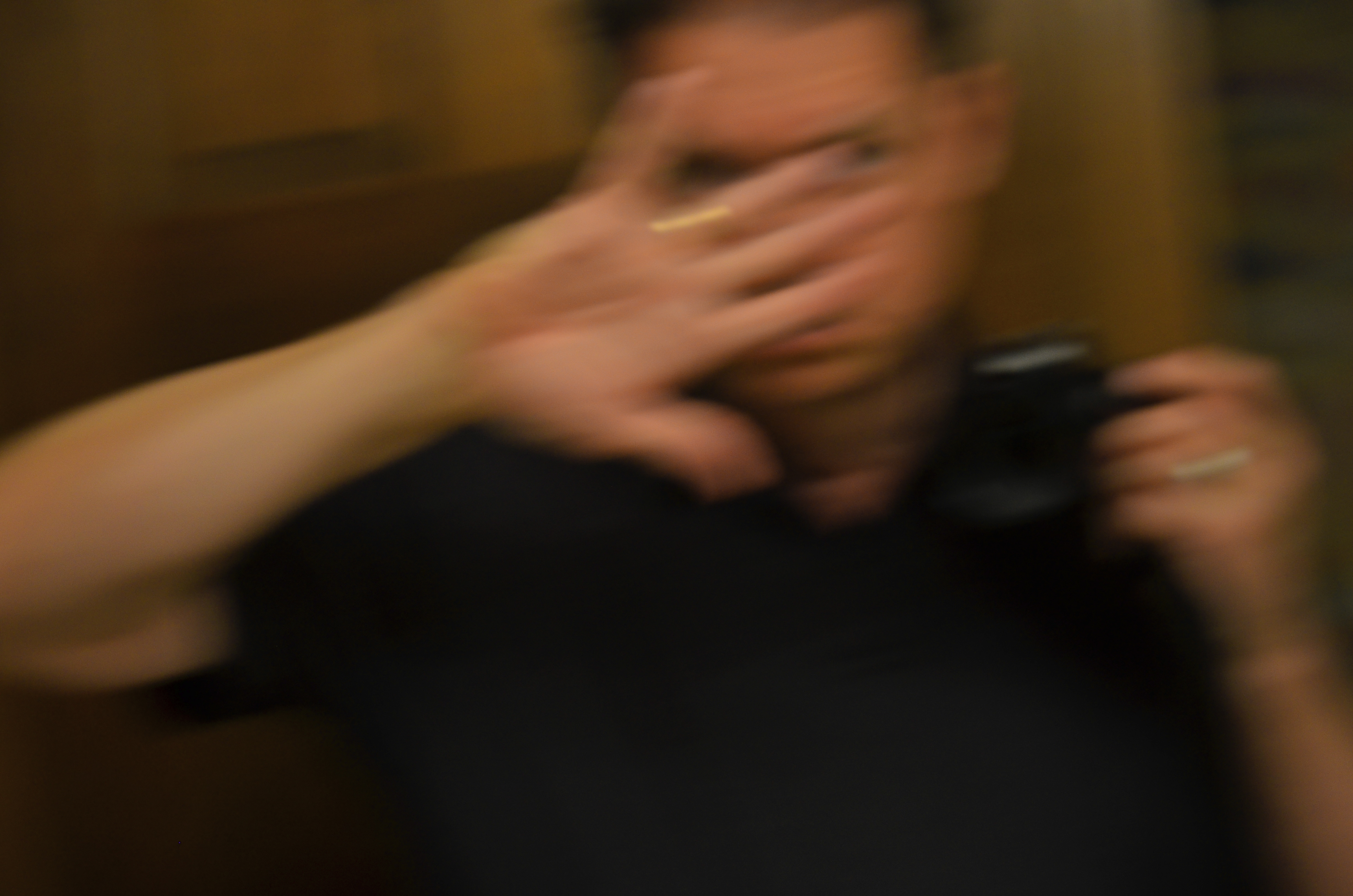
One of my favorite selfies, even though I can’t justify it by any technical standard.
Because if, by “perfect”, we means a seamless blend of accurate exposure, the ideal aperture, and the dream composition, then I think we are barking up a whole forest of wrong trees. Mere technical prowess in photography can certainly be taught, but does obeying all these rules result in a “perfect” picture?
If you stipulate that you can produce a shot that is both precise in technique and soulless and empty, then we should probably find a more reasonable understanding of perfection. Perfect is, to me, a word that should describe the emotional impact of the result, not the capital “S” science that went into its execution. That is, some images are so powerful that we forget to notice their technical shortcomings. And that brings us to the second part of this exercise.
Can a flawed image move us, rouse us to anger, turn us on, help us see and feel? Absolutely, and they do all the time. We may talk perfection, but we are deeply impressed with honesty. Of course, in two hundred years, we still haven’t shaken the mistaken notion that a photograph is “reality”. It is not, and never was, even though it has an optical resemblance to it. It became apparent pretty early in the game that photographs could not only record, but persuade, and, yes, lie. So whatever you shoot, no matter how great you are at setting your settings, is an abstraction. That means it’s already less than perfect, even before you add your own flaws and faults. So the game is already lost. Or, depending on our viewpoint, a lot more interesting.
Go for impact over perfect every time. You can control how much emotional wallop is packed into your pictures just as surely as you can master the technical stuff, and pictures that truly connect on a deep level will kick the keester of a flawless picture every single time. The perfect picture is the one that brings back what you sent it to do. The camera can’t breathe life into a static image. Only a photographer can do that.
FACTS NOT IN EVIDENCE
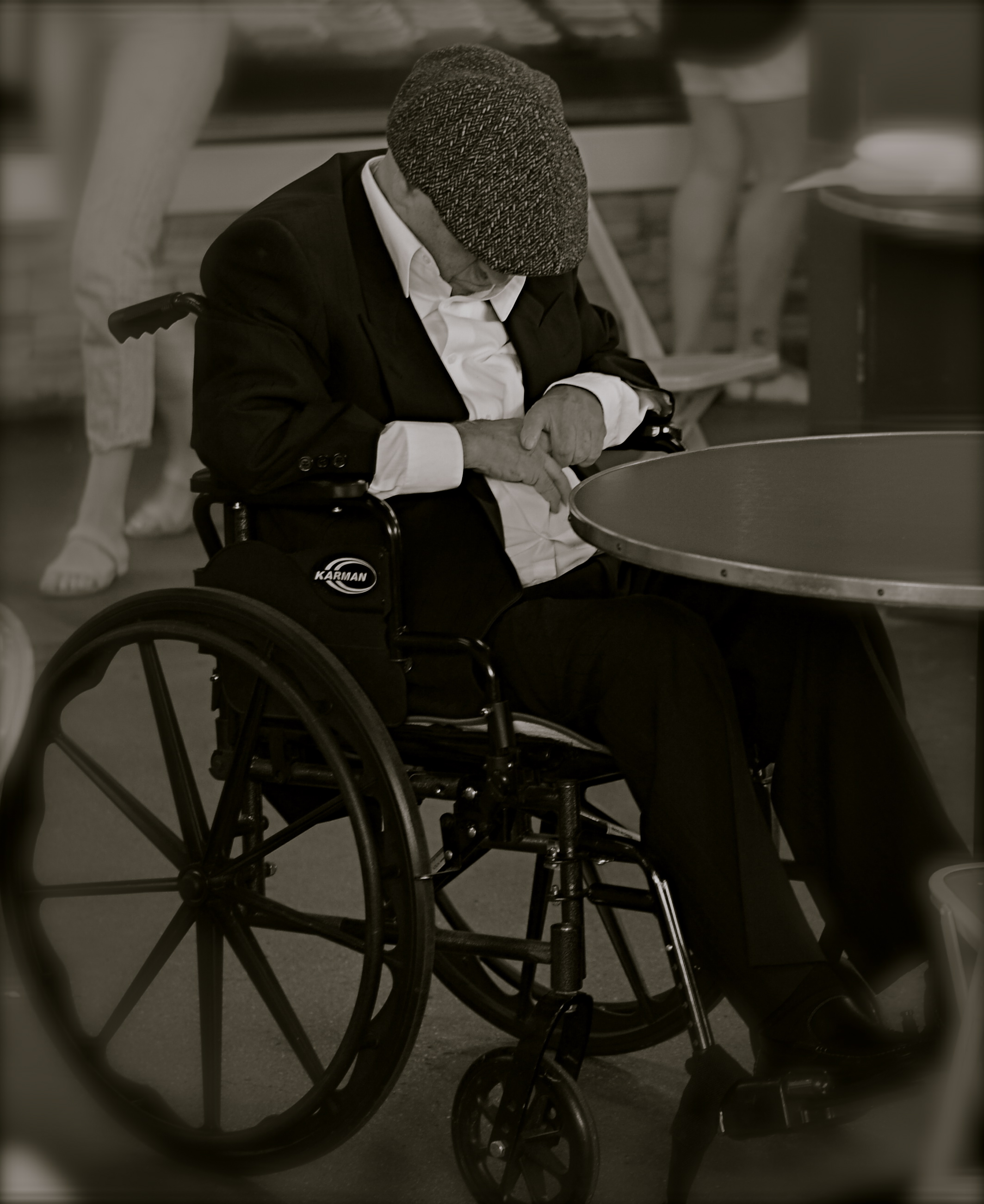
The more you study a picture like this, the more you can find wrong with it. Let me help you….
By MICHAEL PERKINS
IF A STREET PHOTOGRAPHER IS GOING TO ASK HIS AUDIENCE TO EXTRACT A STORY FROM AN IMAGE, then he must ensure that he is putting that same story into his pictures. Just suggesting a narrative, especially in a photograph, is not the same as conveying one. In legal terms, you are asking your viewers to “assume facts not in evidence.”
Do you have to spell everything out, like an S.O.S. in a bowl of alphabet soup? No, but just pointing your camera at just anything happening “on the street” doesn’t guarantee emotional impact, either. Nor does it imbue your pix with profundity, irony, or anything else that wasn’t happening through your eyes before it went through the lens. No street shot is guaranteed “authenticity” just because you were on the street when you pressed the shutter.
Look at the image at left, which I snapped rather accidentally while taking a lot of images of a crowded food market. I did not mean for the gentleman in the wheelchair to be the main appeal of this frame, but even though he’s been cropped to now be central to the shot, there is no clear narrative that “saves” this photo, or makes it compelling on its own terms.
Let’s dissect the picture to see why it fails. What it is, in raw terms, is a man in a wheelchair, sitting alone, wearing dark clothing, his face hidden.That is all that’s absolutely proven in the picture. Now, let’s assume that I was going for something poignant, a human “moment” if you will. Such moments are the heart and soul of great street shots, but this one is missing far too much vital information. If the man is “sad”, is it because he’s in a wheelchair? Why, and who am I to say so? After all, maybe he just had some restorative surgery which, after a month in the chair, will restore him to star-athlete status. Or maybe he is in the wheelchair for life and yet enjoys a richer existence than I do.
Let’s go farther. His face is hidden, but what story can I make the viewer believe is true about that? Is he catching a cat nap while his pile scores him a slice of pizza? Is he doing special exercises? Praying? Does his hat fit badly? Is he depressed, or actually a master of meditation who’s more connected to the cosmos than I can even dream of? And then there’s the monochrome. This picture began as a color shot, but I certainly didn’t increase its impact merely by sucking out the hues. That is, there isn’t some clear message that was being muffled by color which now speaks in a clear voice in mono. Finally, the cropping makes him the prominent feature in the photo without making him the dominant one. The background of the original was distracting, to be sure, but, as with the color, taking it away didn’t add to the picture’s force. If anything, it made it weaker. The man can’t be ironic or poignant since I’ve now cut him off from everything that provides context to his role in the picture.
You get the idea of the exercise. This shot, color or mono, cropped or wide, had nothing clear to say about the human condition. It was taken on the street but it ain’t “street” in effect. Try the same ruthless analysis with your own “near-miss” shots. It’s a humbling but educational process.
MR. KITE HAS LEFT THE BUILDING
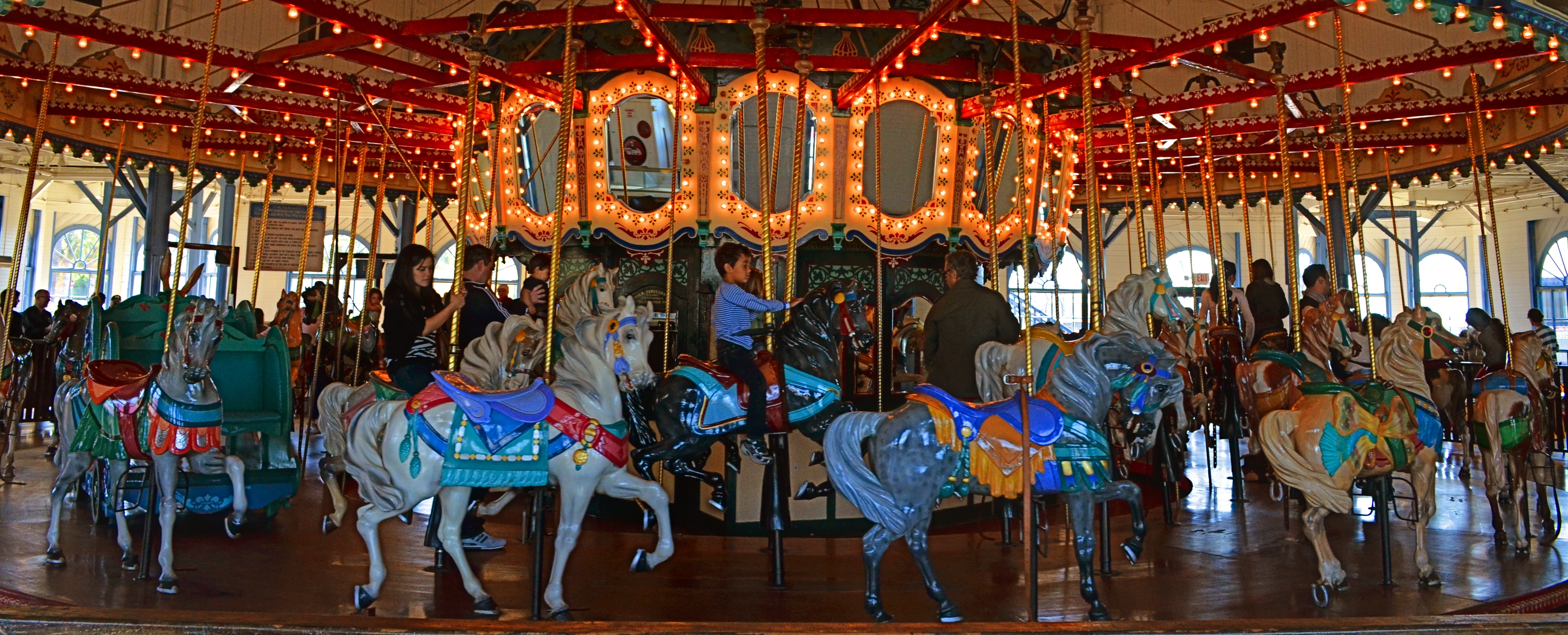
They’re Off And Running (2012) Ponies performing in the round at the Santa Monica Pier.
By MICHAEL PERKINS
PHOTOGRAPHY’S PRINCIPLE BENEFIT IS THE STEALING AND PRESERVATION OF THE FLEETING. That was the miracle that originally astonished the world, the ability to arrest time, to selectively snatch away droplets of the infinitely flowing river of moments and keep them in a jar. And as the young art flourished and began to flex, it proved capable of not only grabbing individual instants, but chronicling the passing of entire modes of life.
As the prairie was settled, as the great distances of the planet were traversed and tamed, as the horse gave way to the car, and as the country mouse became the city mouse, photography laid down mile markers, clearly labeled “this is”, “this is going away” and “this was”. As a consequence, we now have a visual record of worlds and ways of living that have already long since gone extinct. We rifle through shared and inherited images that mark the passing of empires, fashions, movements.
This is all, of course, beyond obvious, but there are times when photographers are more keenly mindful that something big is in the process of winking out. I experienced such a moment a few days ago with the news that Ringling Brothers’ circus was shuttering its operations after more than 150 years, ringing down the curtain on a mixed record of extravaganza and exploitation, depending on where you stand on the issue. Whether circuses were a wonder or an abomination or both, they represented a distinctly analog kind of entertainment, a direct tie between sensations and senses that is one of the last traces of 19th-century culture.
Along with world’s fairs, carnivals, vaudeville, even rodeo, the circus serves as a strange relic of a time when the arrival of the Wells Fargo wagon or the pitching of the Chautauqua tent could be the height of the social season in many a town. The visually rich pageant of having dozens of clowns, acrobats, and performing beasts parade right down your main street was, in the days before mass media, pretty heady stuff, and, even at its twilight, it still has a powerful, if quaint, pull on the imagination. All of this is fertile ground for the photographer/chronicler.
It’s now fifty years since John Lennon transcribed the text from an old circus poster to evoke a vanished era with the song Being For The Benefit Of Mr. Kite, overdubbing the music track with a montage of calliopes and hurdy-gurdys to paint a very visual piece of audio. To this day, I can’t hear the tune without concocting my own mental photo of prancing ponies and carnival barkers. Mr. Kite may already be retiring to his dressing room, as are so many analog forms of entertainment. But we have the pictures. Or we need to start making them.
EYES ON THE PRIZE FOR THE EYES
By MICHAEL PERKINS
THE INTERNET SCREECHED ITSELF HOARSE in 2016 when the Nobel Prize committee announced its intention to award one of its coveted awards for Literature to Bob Dylan, the first popular songwriter so honored. There were acrimonious screeds on both sides of the issue, as hands were wrung and garments were rent over whether Mr. D. was a poet or just a scribbler of post-beat pap. My initial reactions ranged from “really?” to, well, “really???“. But then I figured that, far from stretching the idea of “literature” too far, the Nobel gang hadn’t taken it far enough.
That is to say, it’s way past time for photographers to be invited onto the Nobel podium. As creators of visual literature.
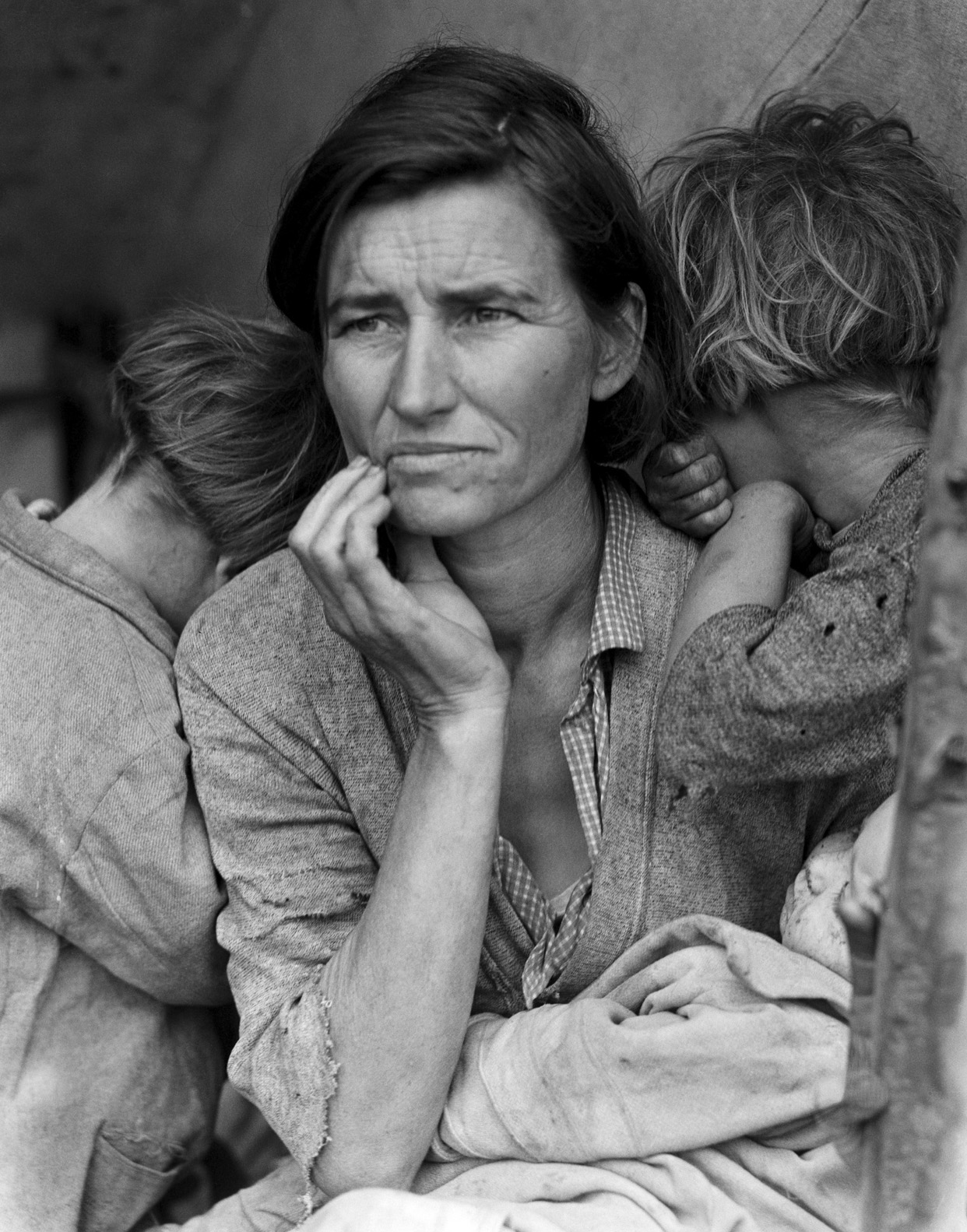
Dorothea Lange’s Dustbowl image Migrant Mother is the Library of Congress’ most requested image.
Founded as an attempt by Alfred Nobel to expiate his guilt for having invented dynamite, the awards were designed to reward those whose work enriched or enlivened the human condition in the areas of chemistry, economics, physics, physiology/medicine, peace, and, yes, literature. As compared to the Pulitzer prize, which confers news value on both the printed word and photographic images, and is awarded for a singular piece of work within a single year, the Nobels are awarded for a body of work. With that standard in mind, it would actually be easier to judge the value of a photographer over a lifetime, versus the potential for a lucky or instinctual snap to be taken in the recording of a brief moment. But photography is a visual art, and a young one at that, and, even though no one still argues against its importance or impact, it is a sticky wicket to compel the powers that be to confer the “L-word” upon it.
Considering that the slight jump from literary poetry (Seamus Haney) to commercial song lyrics (Dylan) nearly caused Nobel critics to hemorrhage, proposing that photographs could also meet the definition of literature must sound, to some, like reciting dirty limericks during High Mass. Further, word “originalists” will point to the fact that literature is strictly defined as a written work of permanence. And yet it’s the permanence part that matters. Pictures have, in fact, changed arguments, minds and history, just as paintings have. And, if literature is that art which endures, something which defines the human experience, then a photograph is certainly as big an influence upon culture as a play or novel. A document is a document.
In accepting his Nobel prize, author John Steinbeck declared, “the writer is delegated to declare and celebrate man’s proven capacity for greatness of heart and spirit..for gallantry in defeat…for courage, compassion, and love.” Now go from the general to the specific, considering Steinbeck’s amazing chronicle of the Oakie odyssey of the 1930’s, The Grapes Of Wrath. As a contrast, how does Dorathea Lange’s picture Migrant Mother, with its graphic depiction of the dust bowl era’s desperation and despair, have any less impact than Steinbeck’s glowing account of the Joad family’s trek to California? In my estimation, both works magnify and certify what it means to stand tall in the blowing gale of ill fortune. And that is a literary idea.
Migrant Mother, like Grapes, is no mere “one-off”, but a small part of an enormous oeuvre, a vast portfolio filled with eloquent testimonies that delineate humanity. The Nobel has slowly begun to mature with the awarding of Bob Dylan’s literature award. Now it’s time to regard the visual arts as part of that larger, and widening discussion.
ART ON THE CHEAP(ER)
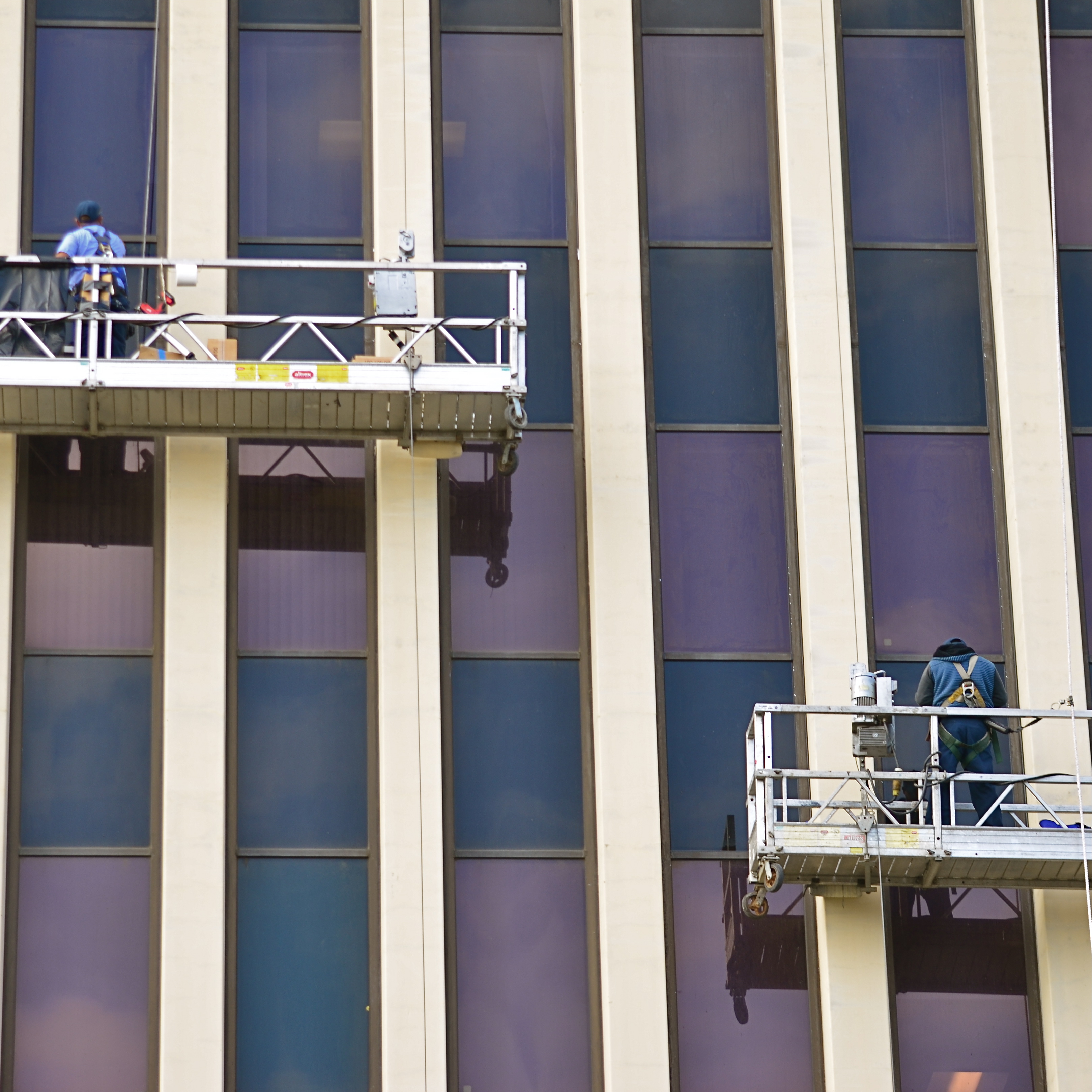
Conventional focus with a standard optical zoom lens.
By MICHAEL PERKINS
ONE OF THE GREATEST BONUSES OF THE APPS ERA IN PHOTOGRAPHY is how fast certain effects and processes in picture-making have moved from proprietary functions to discretionary ones. Certain “looks” which were the sole domain of well-funded professionals in the film era have been democratized to an insane degree, allowing many more of us to make images that required expensive gear or exhaustive training (or both) just a heartbeat ago.
Selective focus is but one such area. Manipulating sharpness within sections of an image used to be the stuff of cunning calculation and infinite patience…in both shooting and post-processing. Now it’s yours for the flick of a button. The app installs, you click the picture, and you massage the results. Minutes from start to finish. And manufacturers of conventional cameras have had to react to the immediacy of effects available in the mobile market, re-introducing art lenses and specialized optics (think Lomo and Lensbaby) that allow shooters to add “artifacts” or “classic film looks” to their work as they are shooting. At this rate, it’s only a matter of time before these proprietary (think expensive) art lenses become more discretionary (easier to use and cheaper).
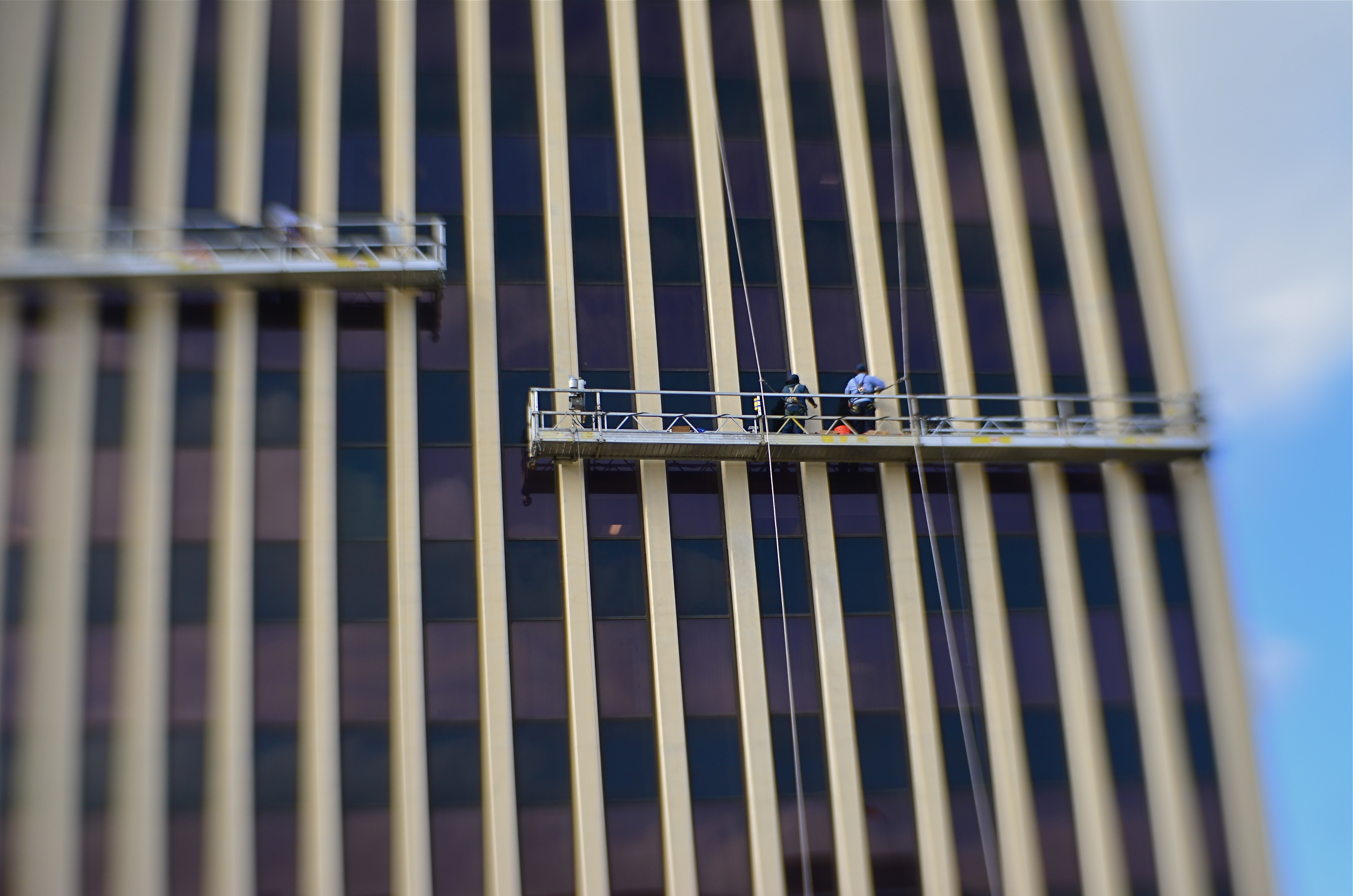
Same subject, five minutes later, with a selective-focus “art lens”.
When focus or any other main element in picture-making becomes more flexible, people experiment more and more. That, in turn, increases the number of average shooters who produce more sophisticated work. It’s part convenience, part economics: once the ability to do something on an occasional whim is granted to more people through innovation or pricing, the exotic becomes the normal, and the entire art advances. Photography began as a tinkerer’s hobby, costly and clunky in its execution. However, once it solved those problems, it went viral (or whatever one went in the 1800’s). And now digital apps are leading the entire market toward another level of ease and affordability.
The two pictures you see here were both, in fact, taken with camera-based lenses….but, those lenses are both infinitely more affordable to me today than they might have been a generation ago…something driven in part by the digital apps revolution. That means I had the option of trying two vastly different focal approaches on the same subject with little more effort than it took to swap one lens out for another. I used standard optics for this exercise because, frankly, the acuity and control in most mobiles is still less than I’d prefer. But that will change, and quickly. In just a few evolutionary clicks from now, I will be able to do this exact same study within my phone….cheaper, faster, and with less baggage to lug around. Will I abandon my traditional lenses at that point? I honestly can’t say. But if I don’t, I hope I have a better reason than “that’s not the way we used to do it.”
A NEW TAKE ON OPAQUE
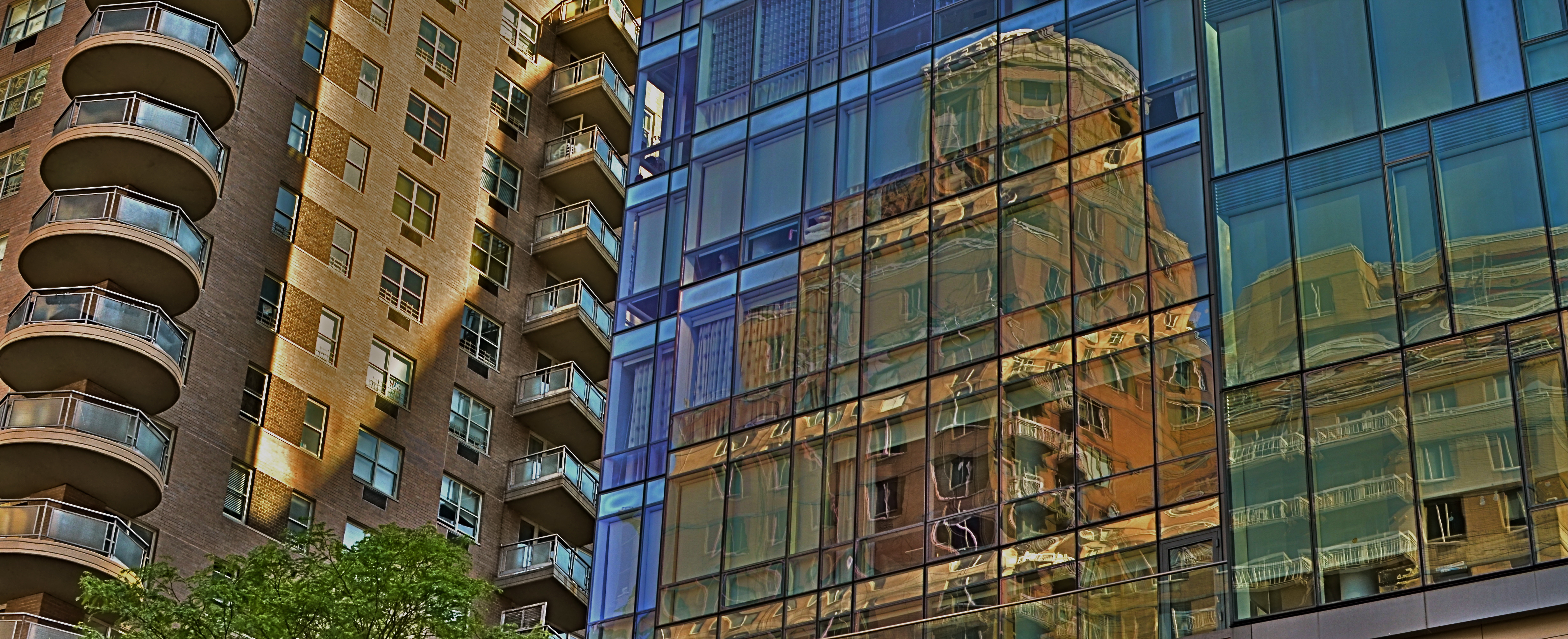
Canyon Echoes (2015). A circular polarizing filter helps the building across the street to be more vividly captured in the glass grids.
By MICHAEL PERKINS
THE TWENTIETH CENTURY’S REVOLUTION IN URBAN ARCHITECTURE produced a radical re-imagining of the physical science of erecting buildings, along with a remarkable shift in what those buildings should look like. An extreme shift in outward design can be tracked from the ornate Greco-Roman and Gothic textures of the Woolworth Building at century’s start to the stark, spare rectilinear boxes of the ’40’s and 50’s, as we jetted from doric columns, oak clusters and gargoyles to the completely un-ornamented glass boxes that we associate with, say, the Pan Am or United Nations buildings at the other end. That changed the way we live, and likewise transformed the way we photo-document our cities.
And, whatever your opinion of what came to be called the “International Style”, the boxes today co-exist with their more decorous ancestors, a contrasting mix which creates amazing opportunities for abstraction. The collision of the two periods creates an endless shuffling of visual cues, with all that glass and terra cotta dueling for dominance in our compositions. And therein lies a tip: one tool which you may find of enduring value in shooting in these situations is a circular polarizing filter, which can help you create a wide variety of effects…quickly, and on the cheap.
People in sun-soaked sectors of the world mostly use the CPL to deepen the blue in overly-bright skies, but the filter’s ability to cut glare on reflective surfaces like water and glass can also be dramatic, and that’s how I use it in urban settings. I’ve come to love the idea of a sheer wall of glass in one building being stamped with all the details of the building directly across the street (over my shoulder). Twisting the upper ring of the CPL dials in the degree of glare you want in your image, allowing you to see none, some, or all of your neighboring structure in the glass in front of you. One caution: the filter also deepens color and can rob you of up to a stop of light, so you want to plan your exposures more carefully, something that’s done easier shooting on full manual.
The dominant idea of design in the International Style was to eschew detail and ornament to as great a degree as possible. That resulted in a lot of very boring exteriors as a vast crop of largely faceless boxes shot off the assembly line. However, using their sheer screens of glass as a vibrant kind of video display for the neighborhoods around them actually breathes a little life into them, and the circular polarizing filter gives you a remarkable amount of control over that process.


THAT WHICH IS EARNED
By MICHAEL PERKINS
THE MORE INDEPENDENCE DAYS that I mark as an American, the more the holiday is fine-tuned, for me, from one of pure celebration to one of sober reflection. As a child, I waved my little flag, oohed and ahhed at fireworks, and ran up the scores of all our national wins and points of pride. As a middle-aged man, I think of the USA as a wonderful, but incomplete “to-do” list. I cherish what we’ve been but also try to be mindful of what we need to be. And that, in turn, widens my concept of what an Independence Day photograph can look like.
The above image, taken within the solemn sanctum of the 9/11 memorial, may not be many people’s choice for a “Happy 4th” -type picture, for a whole bunch of reasons. And I get that. There’s nothing celebratory about it. No wins, no rousing anthems. No amber waves of grain. That doesn’t mean, however, that it’s inappropriate. It may not rhapsodize about victory, but it does affirm survival. It doesn’t brag about what we have, but it does remind us of how much we stand to lose, if we take it easy, or take our eye off the ball.
The 9/11 site is unique in all the world in that it is battlefield, burial ground, transportation hub, commercial center, and museum all in one, a nexus of conflicting agendas, motives and memories. And while it’s a lot more enjoyable smiling at a snapshot of a kid with a sparkler than making pictures of the most severe tests of our national resilience, photography taken at the locations of our greatest trials are a celebration of sorts. Such pictures demonstrate that it’s the freedom we earn, as well as the freedom we inherit, that’s worth raising a cheer about.
And worth capturing inside a camera.
Share this:
July 3, 2017 | Categories: America, Americana, Commentary, Editorial | Tags: 4th of July, Street photography. composition | 3 Comments