By MICHAEL PERKINS
OVER THE NEARLY SEVENTY-YEAR HISTORY of the legendary View-Master, showing generations “seven more wonders of the world” with each fresh reel of views, the format has been used to depict everything from targeting exercises for sharpshooters in World War II to detailed cut-aways of the human body for anatomy students. And of course, VM’s two mainstays of popular appeal persist to this day: armchair tours of the globe’s greatest attractions and an endless variety of children’s titles, including scenes from tv shows, movies, and, most prominently, fairy tales.
View-Master’s original headquarters in Portland, Oregon operated mainly to print, duplicate and package the views taken by its roving band of freelance scenic photographers. However, there was one part of the plant that created special, homegrown bits of pure fancy within the factory walls: the company’s legendary “table-top” studios. Here were created wondrous dioramas of everything from Cinderella’s castle to the Emerald City, built to scale and populated by tiny princesses, heroes, animals, and storybook legends. The range of product, from the Grimm Brothers to Disney, was not, as in later years, just frozen animation cels but solid clay art figures, lovingly created by a select staff of model makers and photographed in 3-d Kodachrome images for the children’s division. Later on, corners were cut, budgets were slashed, and View-Master’s worlds of wonder became the stuff of legend, not to mention keen interest among collectors.
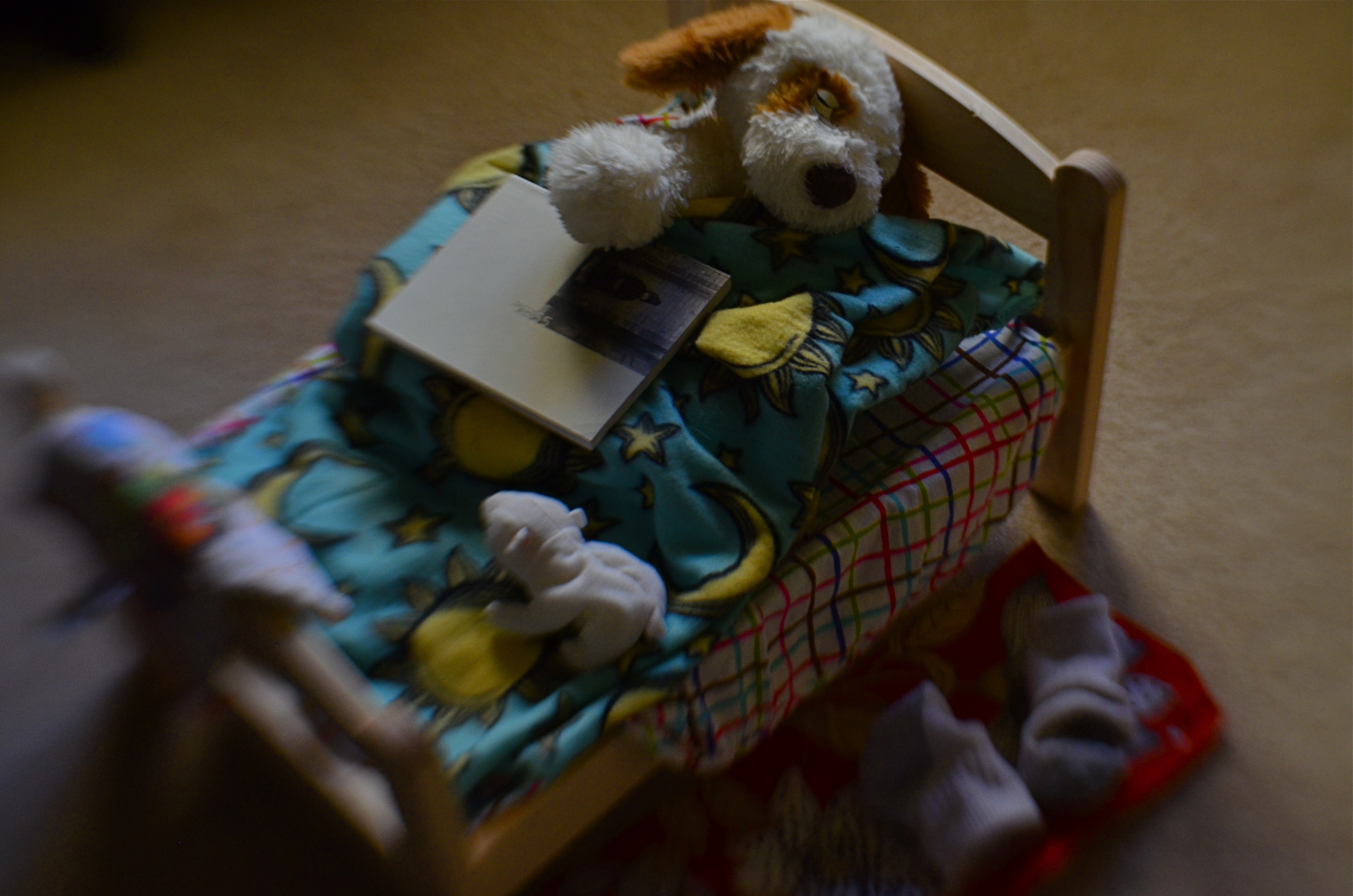
Dog Tired (2017)
Every once in a while, I take a crack at an imaginary scene that the wizards of Portland might have dreamed up, such as the concoction you see here. The stuffed dog and miniature bed had both been purchased to help the sole survivor of a quartet of rabbits get over her grief at being the Last Bunny Standing, but both props had been rejected out of hand. Turns out she rather liked having all the room, grub and water to herself, so she retired her black armband within twenty-four hours without a backward glance.
Walking by the two blacklisted toys each day, I started to imagine the dog as a small child, and wondered what his night-time retiring ritual might be, from the book that eased him off to Dreamland to the socks shed by the side of his bed. Ten minutes of prep and I was ready to shoot my tribute to the days when clay models transported us all from mere reality into View-Master’s exquisite realms of possibility. Days are often arranged in too straight a line. At such times, a slight detour into daydreaming is all you need to render the journey a little more worthwhile.
 thenormaleye
(ALMOST) NO ADMITTANCE
By MICHAEL PERKINS
DOORS PRESENT A MOST INTRIGUING PARADOX for the photographer. They are both invitations and barriers, the threshhold of opportunity and the end of it. Entrances and exits create a two-way traffic, with people either vanishing into or emerging from mystery either behind or in front of them. In either case, there are questions to be answered. And while the camera is certainly no x-ray, it does set the terms of the discussion…an endless discussion… about secrets.
Think of those fateful doors beyond which we know something portentous or crucial occurs. Ten Downing Street. The portal to an execution chamber. A confessional. An organization open to “Members Only”. Doors are like red meat to the photographer because they mean everything and nothing at once. Like the children of Pandora, we inherit the insatiable curiosity to know what’s back of that thing. Who’s there? Who’s not there? What does the great Oz look like? What’s going on inside that doesn’t invite me, doesn’t want me?
All barriers seem wrong, even cruel to us, on some level. “Something there is that doesn’t love a wall, that wants it down” writes Robert Frost in the poem Mending-Wall, and it seems like a reasonable sentiment. I can’t walk past a door, forbidding or friendly, without wanting my camera to go back and ask, knock, knock, who’s there? As an example the above image came to me unbidden, on a night in which my wife and I had walked along Queens Boulevard in New York in search of an all-night diner. Having succeeded in securing sustenance, we were walking home when a brief glimpse of a rather substantial iron gate became visible down a side street during the few scant moments it took us to skip through an intersection. I knew two things at once: I would never know what lay beyond that grand facade, and I would, still, have to make time to come back, on another night, to have my camera ask “the question.”
Photography can be about The Big Reveal, and often traffics in the solving of puzzles. But just picturing the puzzle is all right too. We don’t have to know whether the lady or the tiger is behind that door. We just have to use our magic boxes to knock on it.
Share this:
Posted by Michael Perkins | November 23, 2017 | Categories: Commentary, Composition, Conception | Tags: Framing, Point Of View | Leave a comment