GOING (GENTLY) OFF-ROAD
By MICHAEL PERKINS
WHEN YOU’RE BEHIND THE WHEEL, SOME PHOTOGRAPHS NAG THEIR WAY INTO YOUR CAMERA. They will not be denied, and they will not be silenced, fairly glowing at you from the sides of roads, inches away from intersections, in unexplored corners near stop signs, inches from your car. Take two seconds and grab me, they insist, or, if you’re inside my head, it sounds more like, whatya need, an engraved invitation? Indeed, these images-in-waiting can create a violent itch, a rage to be resolved. Park the car already and take it.
Relief is just a shutter away, so to speak.
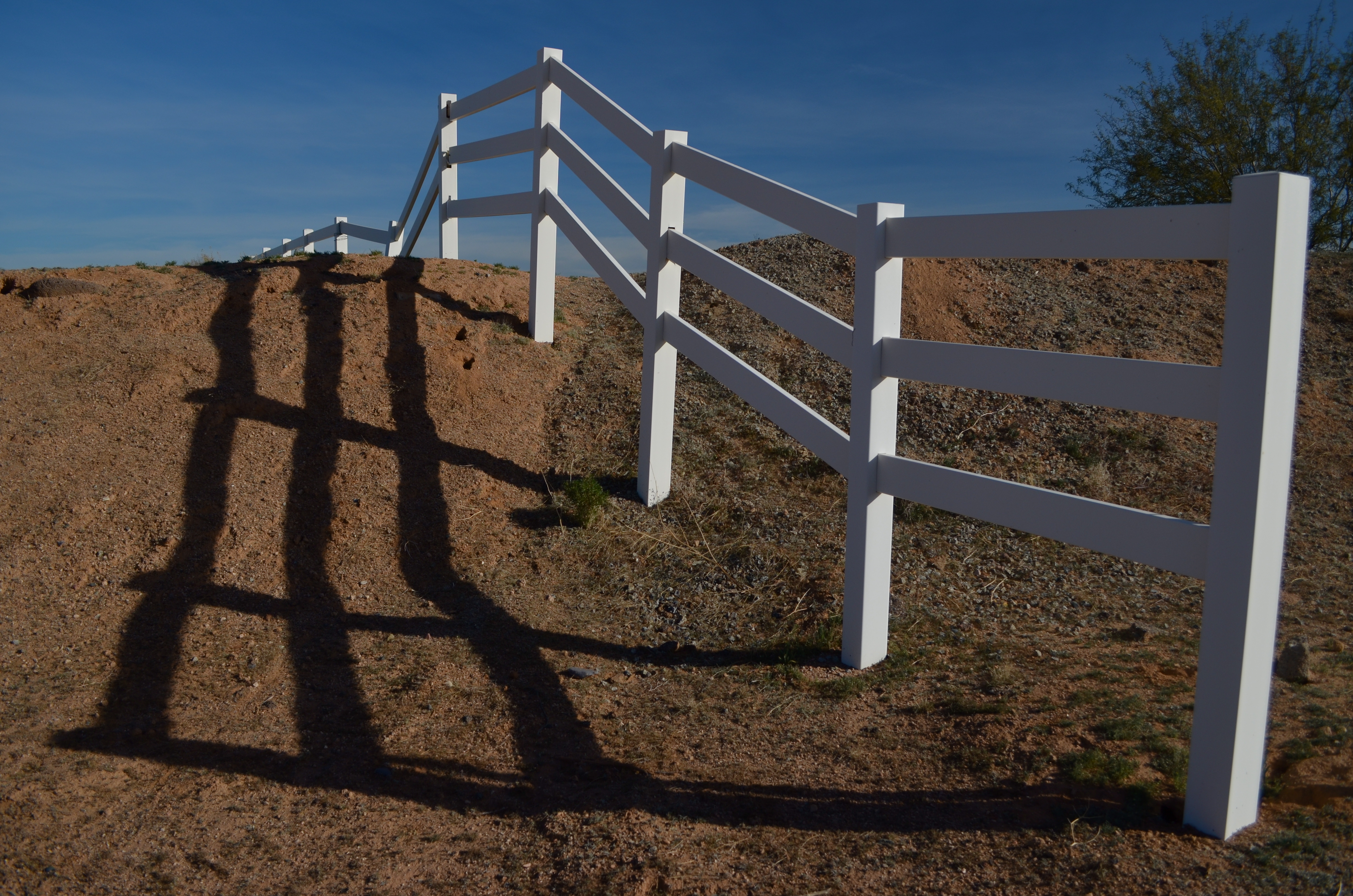
Wait too long and the light will break: 1/800 sec., f/5.6, ISO 100, 18mm.
The vanishing upward arc and sinuous mid-morning shadows of this bit of rural fencing has been needling me for weeks, but its one optimal daily balance of light and shadow was so brief that, after first seeing the effect in its perfection, I drove past the scene another half dozen times when everything was too bright, too soft, too dim, too harsh, etc., etc. There was always a rational reason to drive on.
Until this morning.
It’s nothing but pure form; that is, there is nothing special about this fence in this place except how light carves a design around it, so I wanted to eliminate all extraneous context and scenery. I shot wide and moved in close to ensure that nothing else made it into the frame. At 18mm, the backward “fade” of the fence is further dramatized, artificially distorting the sense of front-to-back distance. I shot with a polarizing filter to boost the sky and make the white in the wood pop a little, then also shot it in monochrome, still with the filter, but this time to render the sky with a little more mood. In either case, the filter helped deliver the hard, clear shadows, whose wavy quality contrasts sharply with the hard, straight angles of the fence boards.
I had finally scratched the itch.
For the moment….
STOP AT “YES”
By MICHAEL PERKINS
THERE SEEMS TO BE A PROPENSITY, WITHIN THE DNA OF EVERY PHOTOGRAPHER, to “show it all”, to flood the frame with as much visual information as humanly possible in an attempt to faithfully render a story. Some of this may track back to the first days of the art, when the world was a vast, unexplored panorama, a wilderness to be mapped and recorded. Early shutterbugs risked their fortunes and their lives to document immense vistas, mountain ranges, raging cataracts, daunting cliffs. There was a continent to conquer, an immense openness to capture. The objectives were big, and the resultant pictures were epic in scale.
Seemingly, intimacy, the ability to select things, to zero in on small stories, came later. And for some of us, it never comes. Accordingly, the world is flooded with pictures that talk too loudly and too much, including, strangely, subjects shot at fairly close range. The urge is strong to gather, rather than edit, to include rather than to pare away. But there are times when you’re just trying to get the picture to “yes”, the point at which nothing else is required to get the image right, which is also the point at which, if something extra is added, the impact of the image is actually diminished. I, especially, have had to labor long and hard to just get to “yes”….and stop.
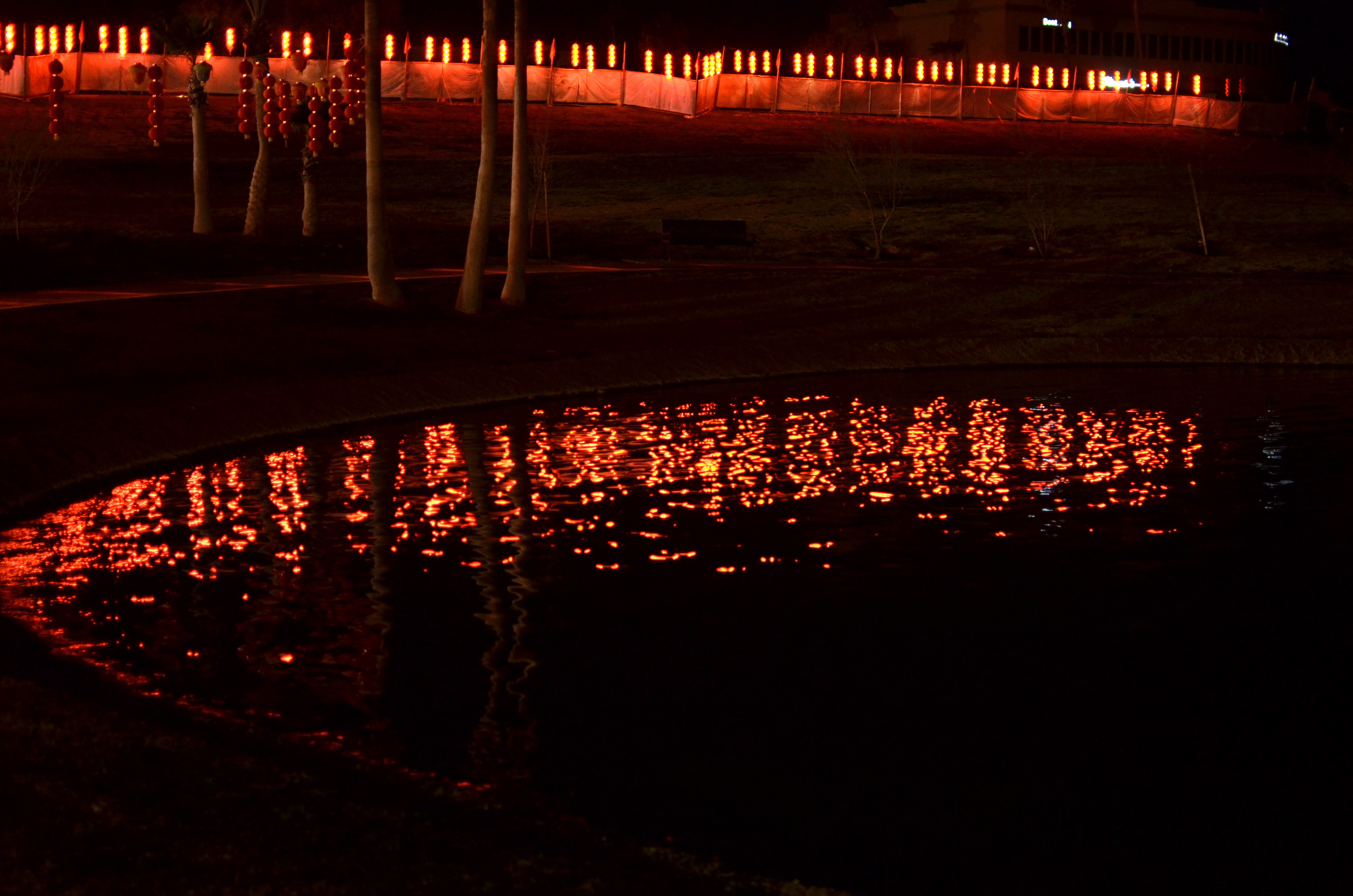
“Don’t overthink this”, say the Photo Phates. 1/25 sec., f/1.8, ISO 640, 35mm.
In the above image, there are only two elements that matter: the border of brightly lit paper lanterns at the edge of a Chinese New Year festival and the small pond that reflects back that light. If I were to exhaust myself trying to also extract more detail from the surrounding grounds or the fence, I would accomplish nothing further in the making of the picture. As a matter of fact, adding even one more piece of information can only lessen the force of the composition. I mention this because I can definitely recall occasions when I would whack away at the problem, perhaps with a longer exposure, to show everything in more or less equal illumination. And I would have been wrong.
Even with this picture, I had to make myself accept that a picture I like this much required so little sweat. Less can actually be more, but we have to learn to get out of our own way….to stop at “yes”.
NEAR MISS/NEAR SAVES
By MICHAEL PERKINS
THE PICTORIAL POTENTIAL OF SOME EVENTS, PHOTOGRAPHICALLY, TURNS OUT SOMEWHAT LESS MIRACULOUS THAN ADVERTISED. That is to say, a few of the things that you assume will certainly yield stunning image opportunities come off, in reality, with the majesty of, well, a flea circus. Sometimes, you think you’ll come home with the Seven Wonders Of The World inside your camera. Other times, you have to fight a strong urge to give up all this “pitcher-takin'” nonsense and take up honest work, like bank robbing, where you can at least set your own hours.
We’ve all been there.
Fairs, festivals, commemorations, parades…..these are all happenings which are ripe with potential, for which we have all camped out on the perimeter of what we hope and pray will be the Next Big Thing, only to come home with crumbs. Leavings. And the best thing to do when an event becomes a near-miss is to seek out what I call the “near saves”. That is, when the story at a given event is disappointingly small, go smaller….toward the intimate detail, the human component, the pertinent bit of texture or atmosphere. The overall panorama may fail, but a single face, a structural element, a series of shadows may deliver where the overall scene fails.
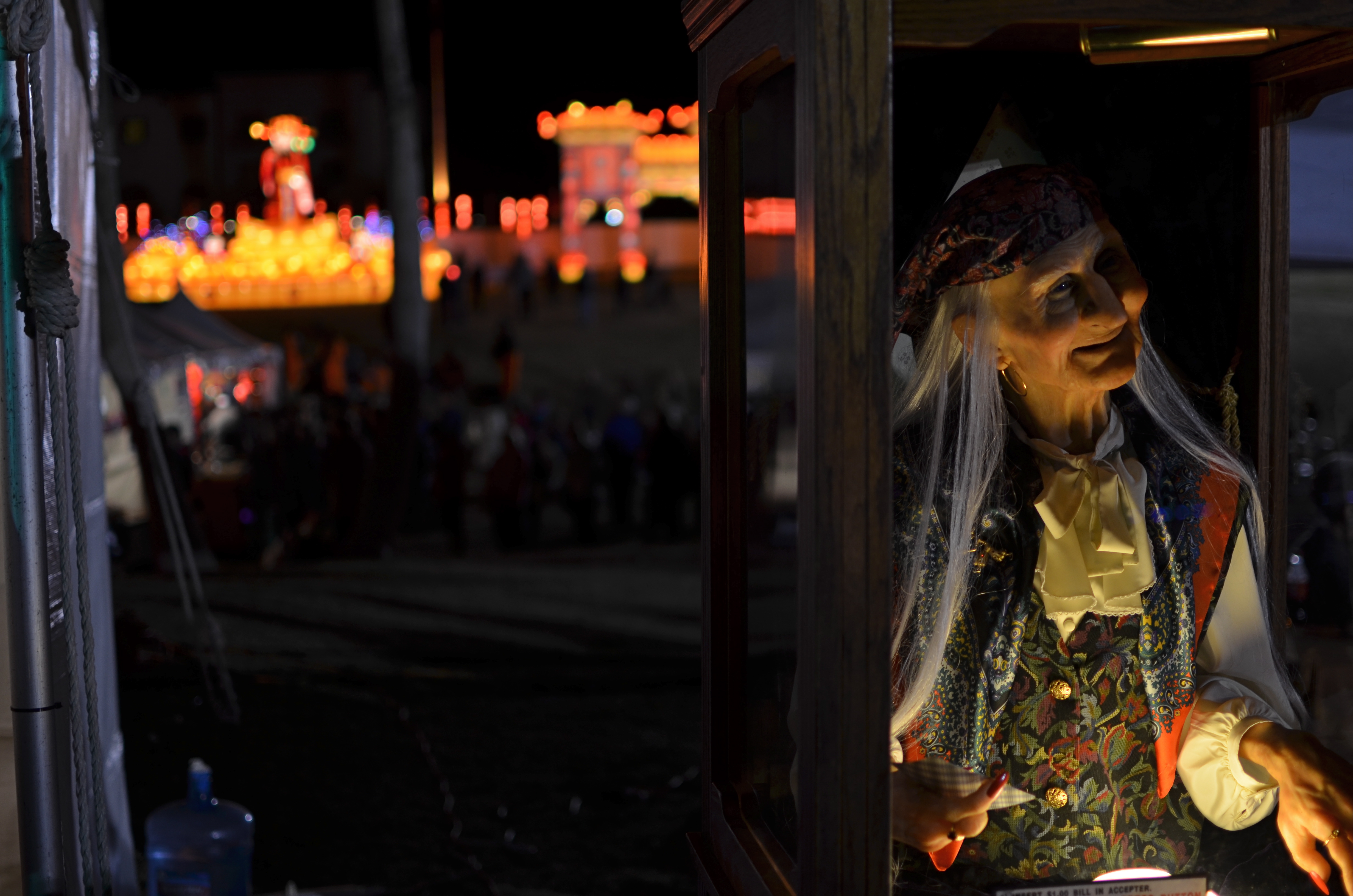
“Went To See The Gypsy…” 1/40 sec., f/1.8, ISO 100, 35mm.
The above image happened almost by accident. Around early sunset, I rushed into an over-hyped cultural festival which failed to achieve full wonderfullness (trust me), and, hours after sunset, I was leaving in defeat, when, near the exit, I spotted a genuine, weirdo-beardo-freak-yourself-out gypsy fortune-telling machine, right out of Tom Hanks’ Big, wonderfully lit by ambient neon on the midway and the device’s own built-in “spook light”. The deepening dark of night was suddenly my best friend, boosting the mystery with oodles of deep shadow. With a 35mm prime lens, I could open clear up to f/1.8, keeping my ISO low at 100 and allowing me to get plenty of light at 1/40 of a second. I was amazed that I had walked right past this treasure when I entered the festival, but I was grateful for a second chance. Snap and done.
Thus,my best shots from the night were of anything but the main “attractions” of the event. Going small meant going beyond the obvious, the difference between a near miss and a near save.
The difference.
I MAY HAVE TO WORK LATE
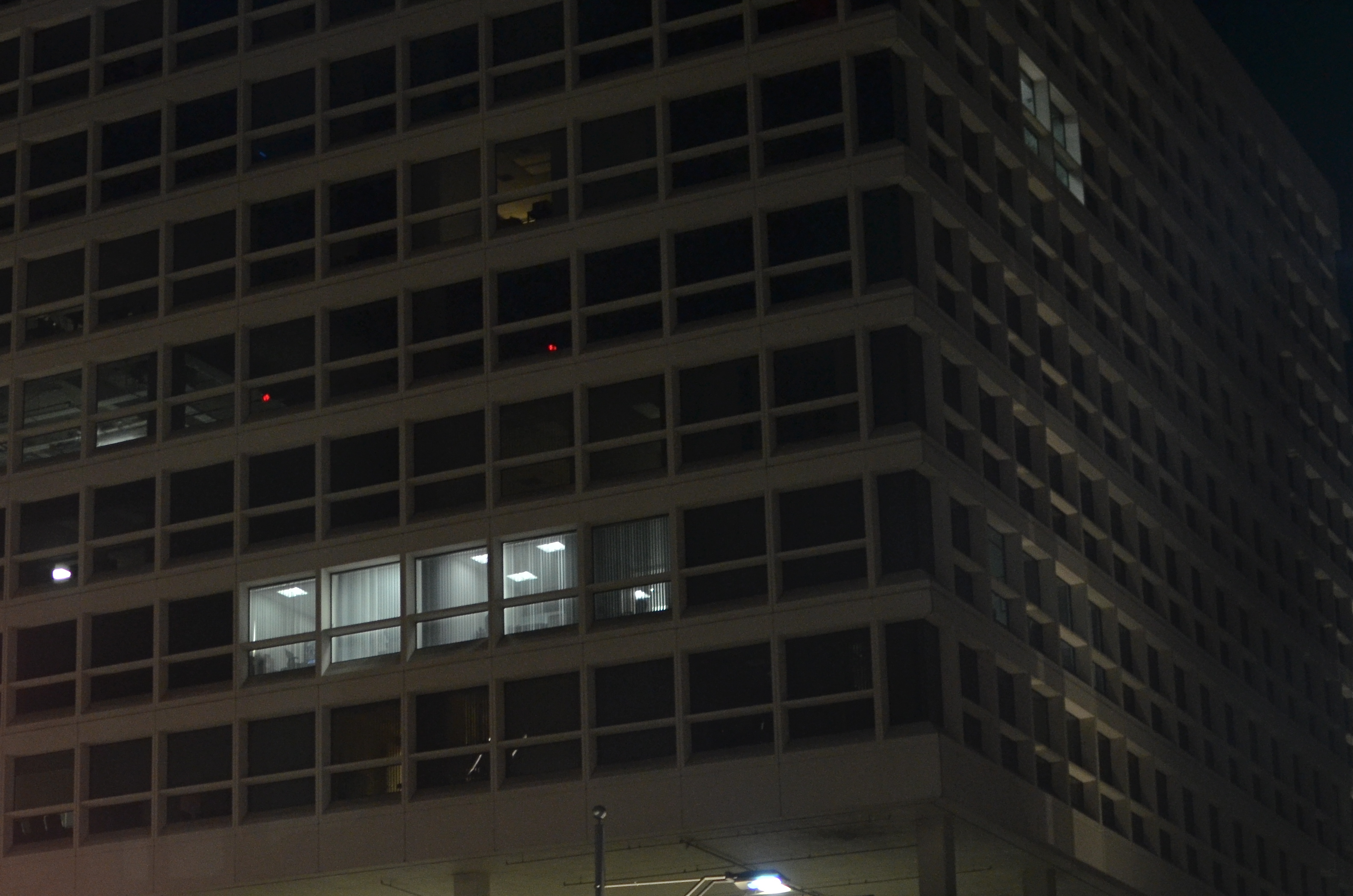
Say Hi To The Cleaning Crew: 1/50 sec., f/1.8, ISO 640, 35mm.
By MICHAEL PERKINS
SOME OF THE BEST HUMAN INTEREST STORIES, EVEN WITH A CAMERA, CAN ONLY BE VIEWED INDIRECTLY. There are many cases in which even the best of us have to merely hint or suggest something about people that we clearly cannot show (or cannot show clearly). Maybe that intractable bit of visual mystery actually bonds us to our audiences, united as we are in speculation about what is beyond that wall or behind that door. The visual tease such photos provide are part of the art of making pictures, in that we are challenged to do more with less, and “show” something beyond the visible.
One of the simplest such stories to capture is very urban in nature: the last remaining nighttime lights in largely dormant buildings. Many of us have been the “last man standing” at the end of an extended work day. Others flee to engagements, family, dinner, but there we sit, chained to our desks until the report/project/research/budget is ready to be put to bed. There’s a readily identifiable feeling of loneliness, plus a little bit of martyr complex, that we can share in the plight of these unknown soldiers of the night.
Whenever I am driving through a city at night, I deliberately seek out those bluish, tube-lit warrens within the cubes and grids of otherwise featureless glass boxes. Who is there? What private eureka or oh, no moments are they experiencing? Which of a million potential dramas are being acted out, and with whom? The uncertainty, even from a photograph with little detail, sparks the imagination, and suddenly our viewers are completing the picture we were forced to deliver unfinished.
It’s the ongoing paradox of photography: what you don’t show is as vital as what you do show.
AMPLIFIER
By MICHAEL PERKINS
EVERY MAJOR CITY AROUND THE WORLD THAT BOASTS BOTANIC GARDENS OR PLANT CONSERVATORIES HAS EXPERIENCED THE STRANGE MIXTURE of biology, art, and science created by the glass installations of Dale Chihuly. Beginning as a starving student in Venice in the late ’60’s, Chihuly has carved out a unique niche for himself as the premier maestro of art glass creations, marked by strange, venous bulbs, eerie tendrils, and massive towers of color, all wrought together in a psychedelic weave of texture and (frequently) enormous scale. If Peter Max blew glass instead of spewing paint, he’d be Dale Chihuly. Like Max, Chihuly has benefited greatly from the ever-hot debate over the permanence or value of his work. And if you don’t like it, he, in the words of Liberace, cries all the way to the bank.
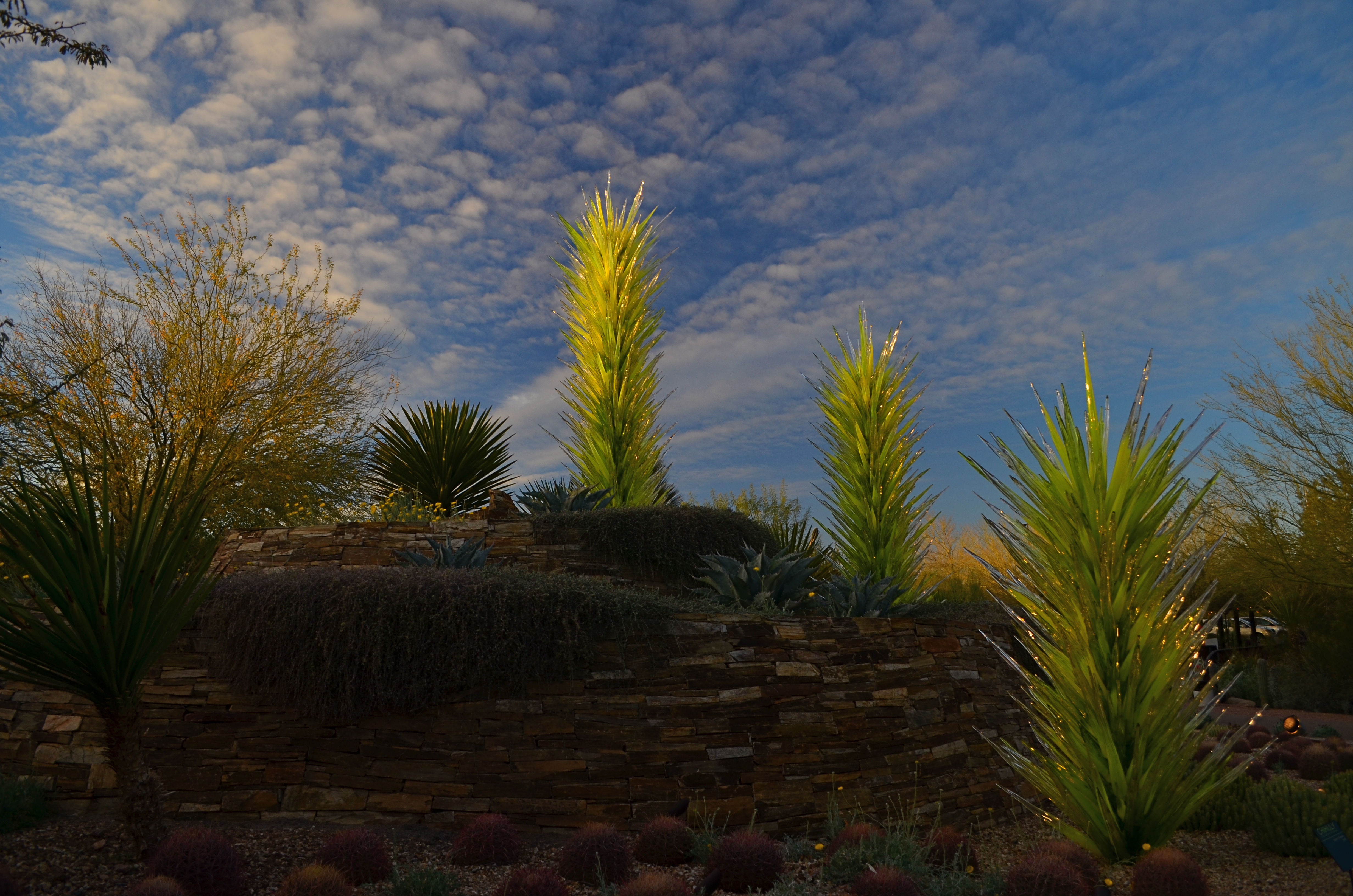
Doubling up on color by combining intense Arizona sunset light with some help from a polarized filter. 1/125 sec., f/5.6, ISO 100, 18mm.
For the botanical denizens of the non-profit universe, however, the Chihuly phenomenon does have one indisputable trait: it puts butts in the seats. Gardens the world over record insane increases in attendance far beyond their normal “fan base” when Dale’s gorgon-like creations hit town and go mano-a-mano with their daisies and daffodils. For photographers, the juxtaposition of the organic and the “alt-ganic” is irresistible, and, here in the southwest, where sun is all, the extreme effects of our desert light give Chihuly’s glassworks a supernatural quality.
The Arizona “golden hour” just before final sunset produces very deep and intense color, and the Chihuly works installed at Phoenix’ Desert Botanical Garden catch it like neon prisms. Go a little further and add, say, a polarizing filter to this natural amplification of color, and the hues go into overdrive. It’s Golden Hour on steroids.
The three glass “bushes” in the above frame, installed permanently at the DBG’s guest arrival area, are high enough above average terrain to act as light blotters for the late afternoon light. The addition of the polarizing filter seems to double the effect, although it will deepen and darken shadows in other parts of the images, and so exposure choices become a mite trickier. In this case, the striated clouds overhead also benefited from the tweak as they stood in sharper contrast against the sky, but, full disclosure, that part was dumb luck.
But hey, even dumb luck can make you a little smarter. And buy you a bigger chunk of “luck” next time. Does Dale do it for me as an artist? Does it even matter? His stuff creates light opportunities, and you can serve me up a plate of that anytime.
DRIVING THE IMAGE
 By MICHAEL PERKINS
YOU CAN FILL A LIBRARY SHELF WITH OPPOSING ARGUMENTS ON LIGHT’S ROLE IN PHOTOGRAPHY, not necessarily a debate on how to capture or measure it, but more a philosophical tussle on whether light is a mere component in a photograph or enough reason, all by itself, for the image to be made, regardless of the subject matter.
The answer, for me, is different every time, although more often than not I make pictures purely because the light is here right now, and it will not wait. I actually seem to hear a clock beginning to tick from the moment I discover certain conditions, and, from that moment forward, I feel as if I am in a kind of desperate countdown to do something with this finite gift before it drifts, shifts, or otherwise mutates out of my reach. Light is running the conversation, driving the image.
“In the right light, at the right time, everything is extraordinary”, the photographer Aaron Rose famously said, and I live for the chance to ennoble or, if you will, sanctify something by how it models or is embraced by light. Certainly I usually go out looking for things to shoot, but time and time again something shifts in my priorities, forcing me to look for ways to shoot.
The practical world will look at a photograph and ask, understandably,  “what is that supposed to be?”, or, more pointedly, “why did you take a picture of that?” This makes for quizzical expressions, awkward conversations and sharp disagreements within gallery walls, since our pragmatic natures demand that there be a point, an objective in all art that is as easily identifiable as going to the hardware for a particular screw. Only life, and the parts of life that inspire, can’t ever function that way.
We often decide to make an important picture of something rather than make a picture of something important. That’s not just artsy double-talk. It’s truly the decision that is placed before us.
Alfred Steiglitz remarked that “wherever there is light, photography is possible”. That’s an unlimited, boundless license to hunt for image-makers. Just give me light, the photographer asks, and I will make something of it.
THE OLD, DARK HOUSE
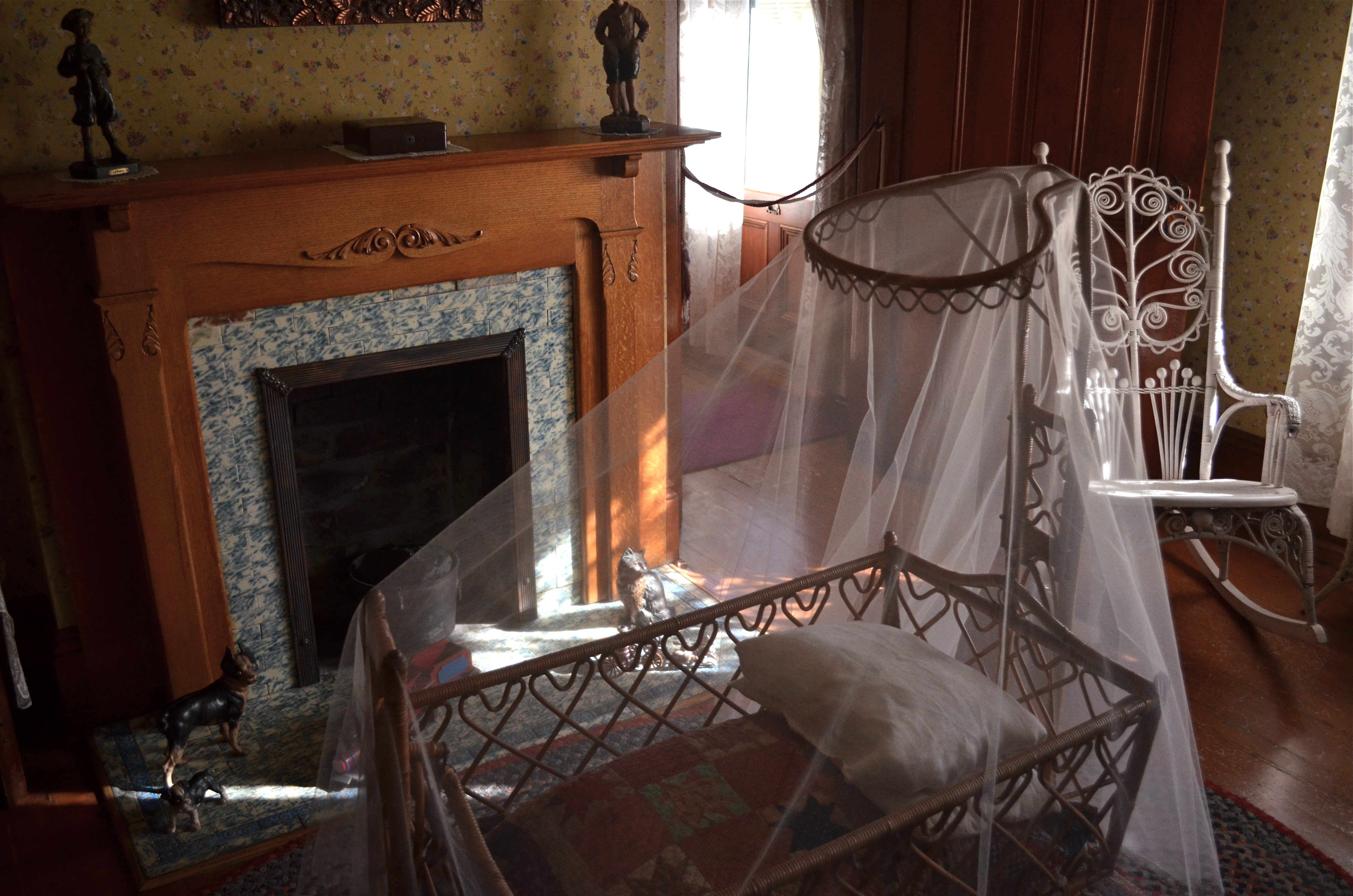
Child’s bedroom, Rosson House Museum, Phoenix, AZ. 1/80 sec., f/3.8, ISO 640, 22mm.
By MICHAEL PERKINS
THE ULTIMATE ADAGE ABOUT OLD HOUSES, I.E.,”THEY SURE DON’T MAKE ‘EM LIKE THIS ANYMORE“, is a sentiment which will haunt the casual photographer at every turn inside an historic home. No, they don’t make them anything like this anymore, especially when it comes to the size of rooms, angles of design, decorative materials, or light flow, and so shooting an antique residence requires a little re-fitting of the brain to insure that you come home with something that you can, you know, bear to look at.
Another cliché that comes to mind, this one about size: “the kitchen was so small, you had to go outside to chew.” Again, it can’t become a cliché unless it’s partially true, and it does apply to many of the rooms in pre-1950’s houses. People were shorter. The concept of personal space, especially in an urban setting, seems claustrophobic to us today. That makes for photos that will also look cramped and tight, so shoot with as wide a lens as you can. This is the place for that 18-55mm kit lens you got with your camera, since it will slightly exaggerate the side-to-side and front-to-back distances within the smaller rooms. It will also allow you to get more in the frame when composing at shorter distances, which, on velvet rope tours, can be reduced to inches.
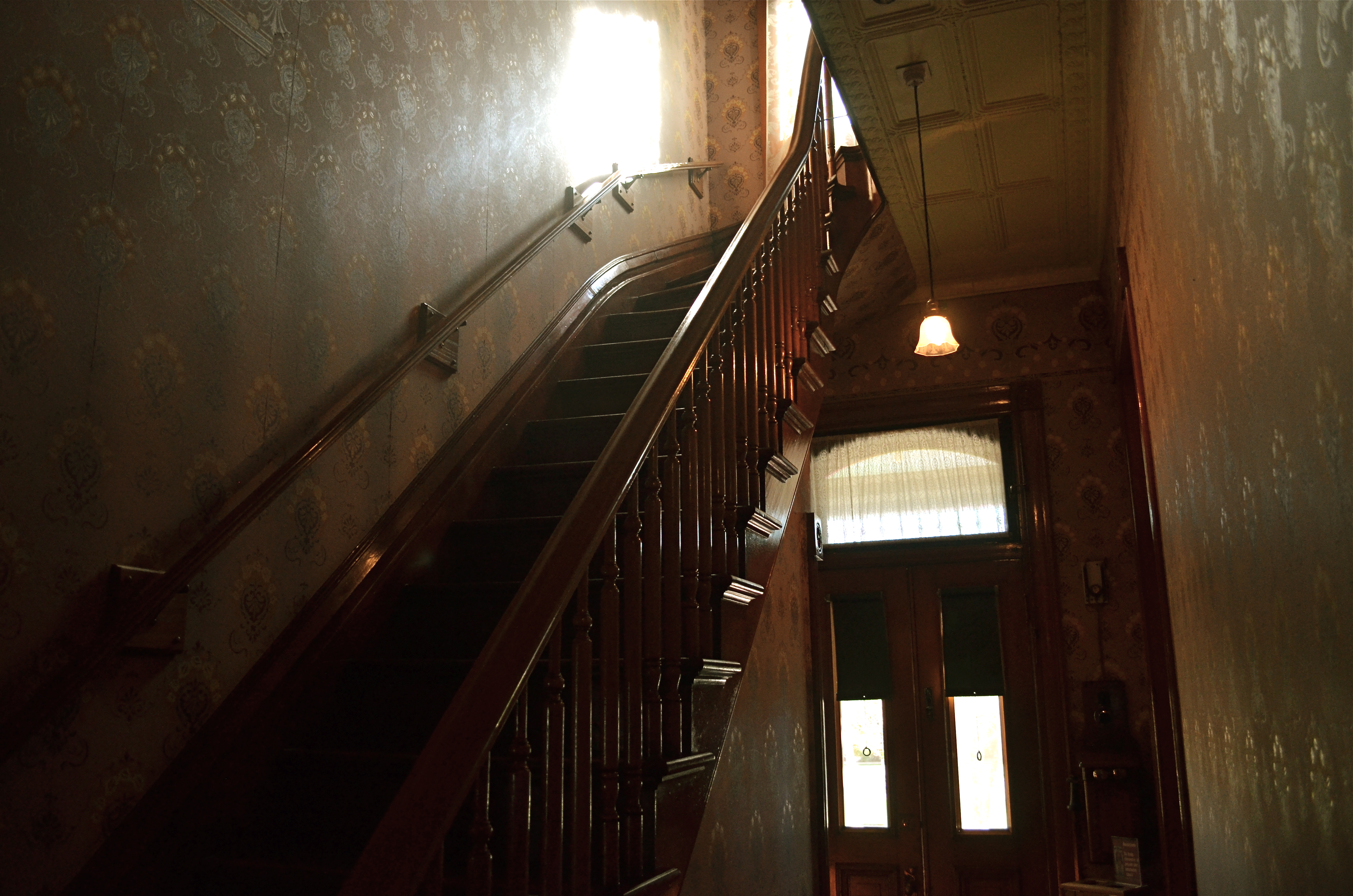
Multiple sources of light can make things tricky. 1/40 sec., f/3.5, ISO 800, 18mm.
One crucial thing to be mindful of is that 90% of the light you get on old house tours will be window light. Highlights will almost certainly be blown out on things like sheer drapes, but you need all the light you can get, since it’s a cinch that flash will be prohibited and the interior wood trims, floors and furnishings will likely be very dark in themselves, acting as light blotters. Learn to live with the extreme contrasts and resulting shadowy areas. Expose for the most important elements in a room. You cannot show everything to perfect advantage. In some interior rooms in older homes, you don’t have a shot at all, unless you ditch the rest of the tour group and have about twenty minutes to yourself to set things up. Unlikely.
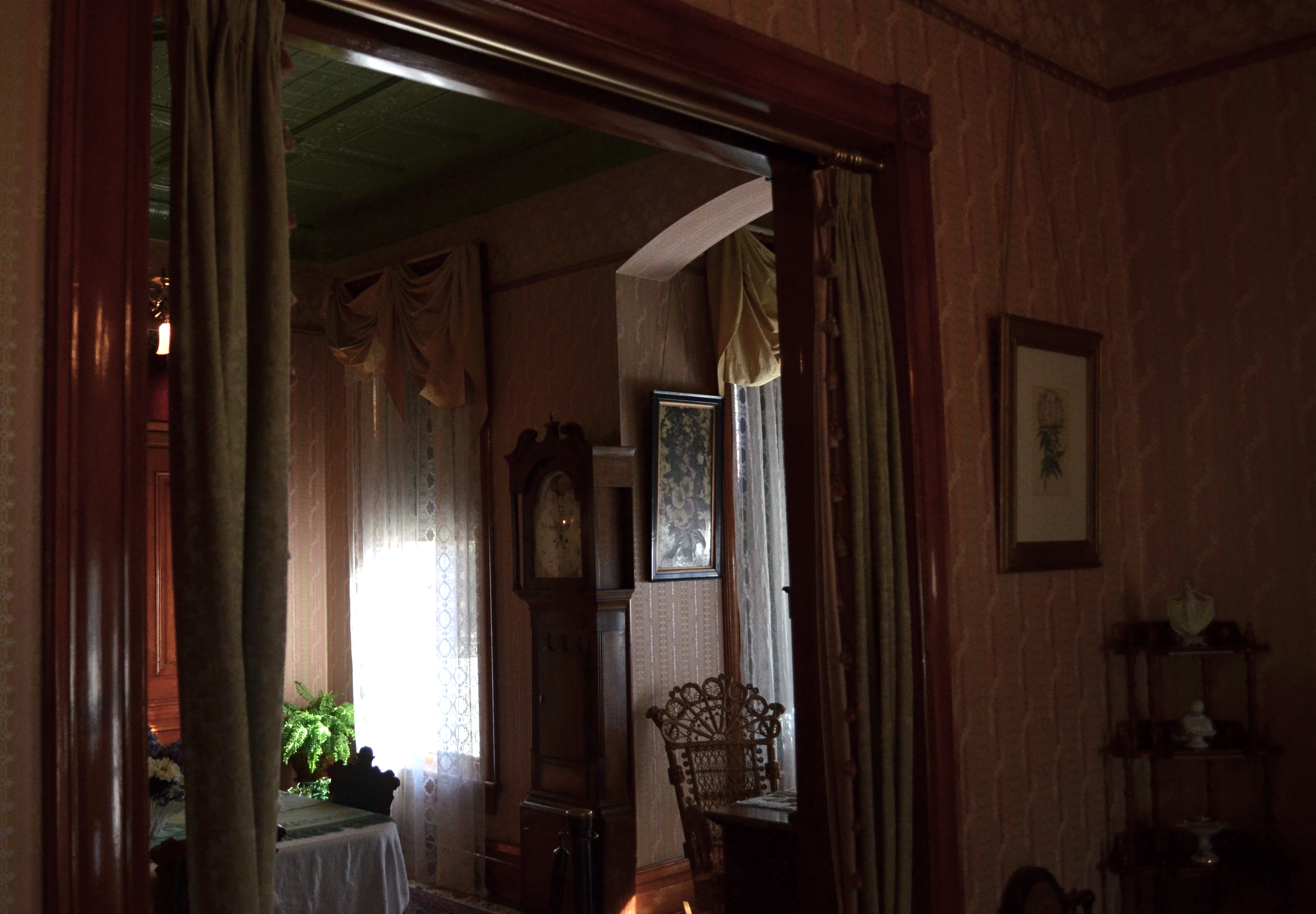
A wide-angle lens helps to open up shallow spaces with an enhanced sensation of depth. 1/50 sec., f/3.5, ISO 800, 18mm.
If you are shooting with a wide-angle, you may not be able to go any further open on aperture than about f/3.5. This means either working rock-solid handheld or cranking up the old ISO. If you do the latter, don’t go back later with an editor and try to rescue the darker areas: you will just show the smudgy noise that you allowed with the higher ISO, so, unless you like the warm look of black mayonnaise, resist.
Again, if shooting wide, remember that you can also zoom in tight enough to isolate clusters of items in charming still life arrangements with basically no effort on your part. Hey, an expert has already been paid to professionally build your composition for you with period bric-a-brac, so it’s easy pickings, right?
Admittedly, shooting in an old house can be like trying to conduct a prize fight inside a shoe box.
Or it can be like coming home.
THREE STEPS TO SOFT
By MICHAEL PERKINS
“But soft! What light through yonder window breaks…?” —Shakespeare
LIGHT IS A RAW RESOURCE, MUCH LIKE IRON ORE OR GOLD NUGGETS. It needs to be refined, alloyed for it to truly be a tool in picture making. For the purpose of photography, what we call “available” light means just that; it’s there, but not in its final form. Making images means becoming an active shaper of light–bouncing it, boosting it, adding or subtracting bits of it, harnessing it if you will. Turning “available” light into usable light is the true alchemy of photography.
That doesn’t mean you can’t benefit greatly from accidents.
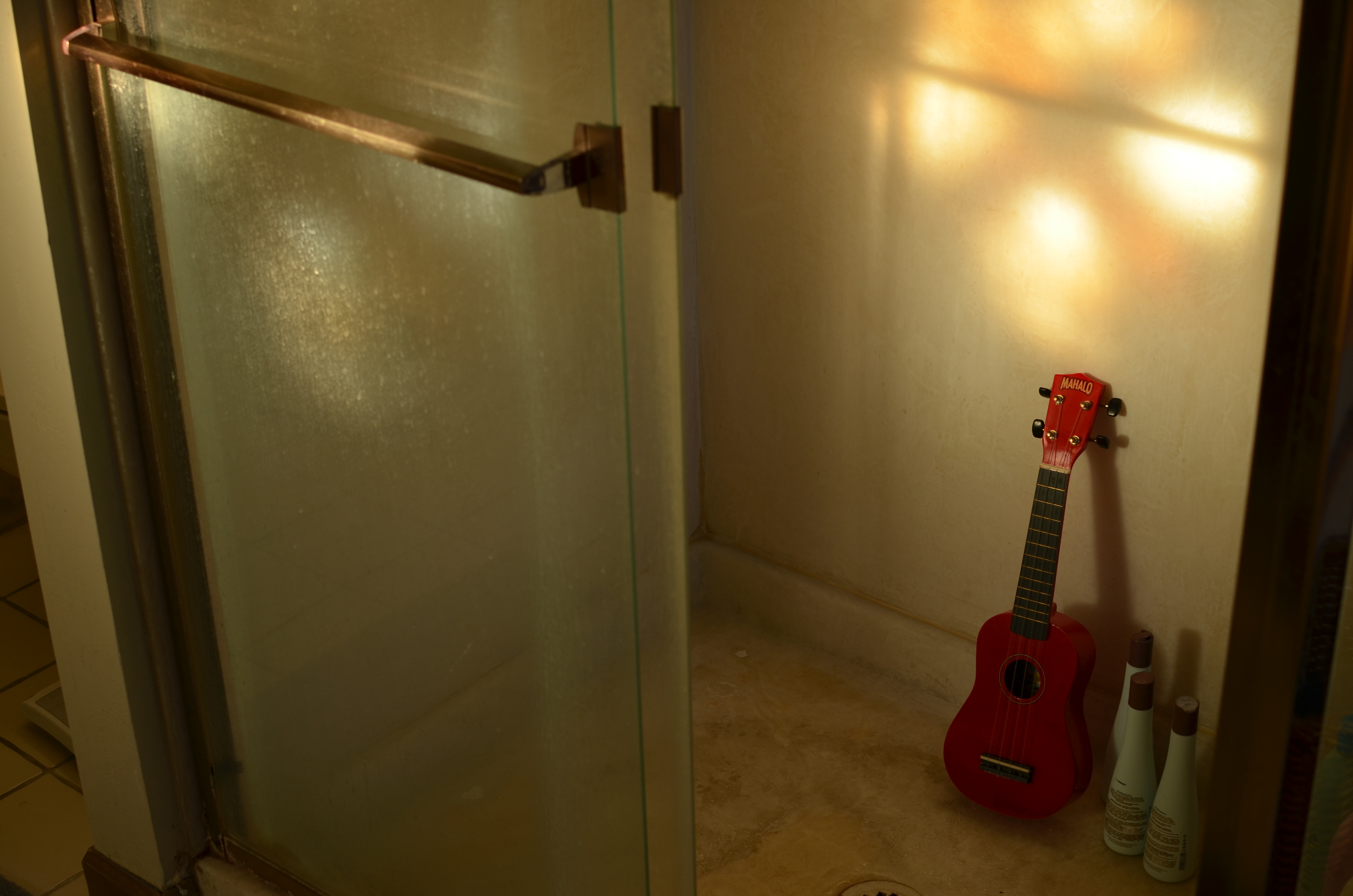
Uke can find good light showering down anywhere. 1/60 sec., f/4.5, ISO 100, 35mm.
The above image was the result of pure seat-of-the-pants whimsy, a momentary impulse to try an idea just to see what happens. However, it was a lucky reworking of available light that drew me to the location before the idea took shape.
I have written volumes on how very harsh the pure midday sunlight is in Arizona, and how it can only be of use if it is filtered or softened in some way. To that end, I have identified various sites around my house which get that done beautifully, depending on where the sun is in the sky during different parts of the day. Some of these sites occur just inside the garage, in the living room, and in a spare bedroom, and shoots will work wonderfully depending on when and where you schedule them. Best of all, the house apparently still holds a few more surprises.
Several days ago, I discovered a new and most unusual site…..a dense art window just to the left of our master bathroom shower stall, which turns out to be a triple softener for late afternoon light, just pre-golden hour. As light streams through the window, it gets softened for the first time, then hits the mirrored closet doors on the opposite wall, where it diffuses some more. Bouncing off the mirror, it then angle-bounces to the back wall of the shower stall, still fairly bright but now really fuzzed out and warm. And that’s where I saw it, as I was walking through the room.
As soon as I spotted the light, I started brainstorming about what kind of object I might stage in this little “studio”, and I hit on the idea of a ukulele, since I always have scads of them around the house, they’re colorful, and it’s kind of an absurd variation on the whole “singing in the shower” cliche. I liked the shot from a purely light effect standpoint, and the unique shaping of the glow in that space will definitely be back for a return engagement.
Maybe a saxophone….
ONE OUT OF FOUR
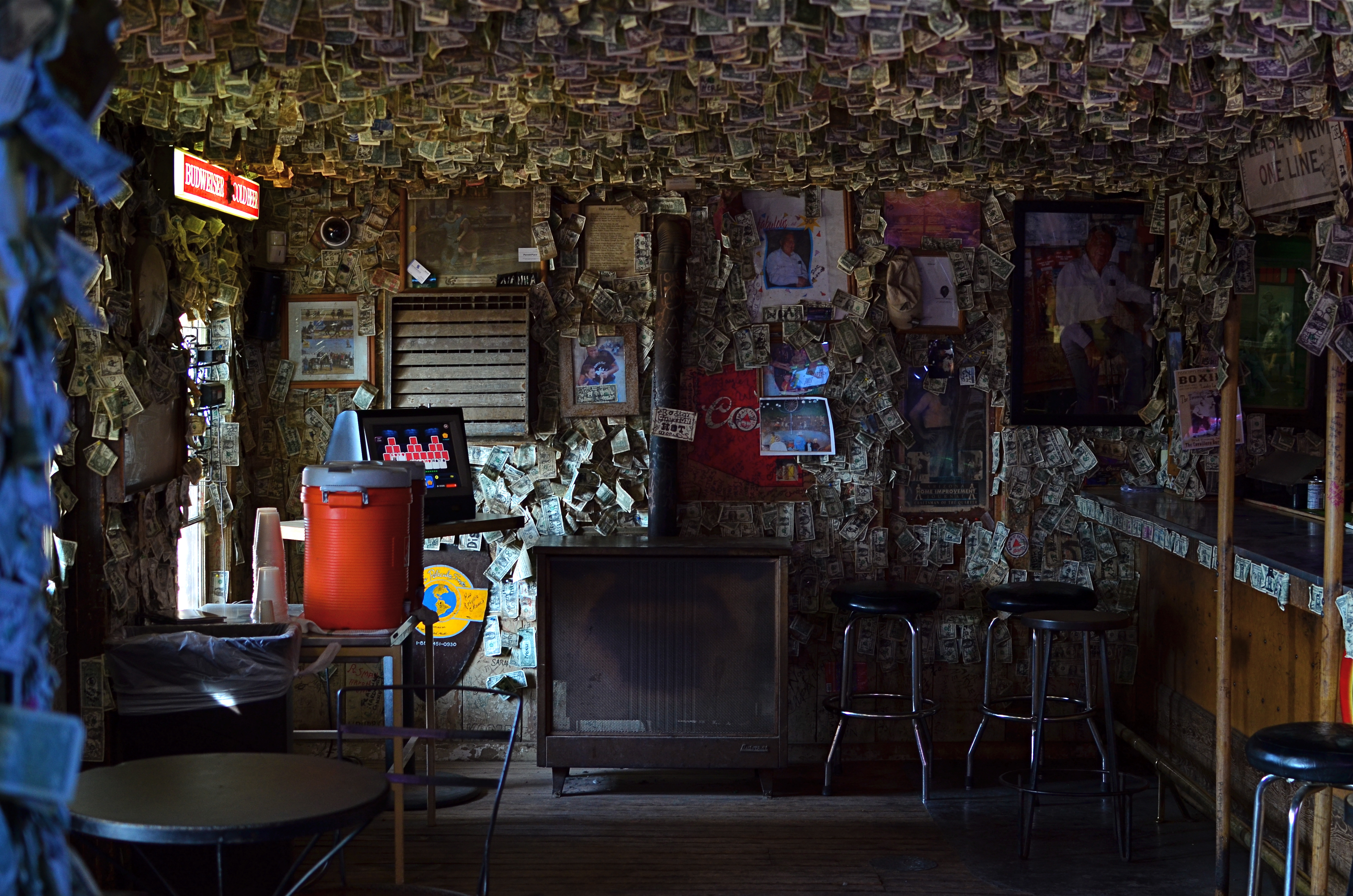
Main bar, Greasewood Flats, Arizona, 1/12/14. 1/30 sec., f/3.5, ISO 250, 35mm.
By MICHAEL PERKINS
IF YOU ARE DEPENDENT ON NATURAL LIGHT FOR YOUR ONLY SOURCE OF ILLUMINATION IN AN IMAGE, you have to take what nature and luck afford you. Making a photograph with what’s available requires flexibility, patience, and, let’s face it, a sizable amount of luck. It means waiting for your moment, hell, maybe your instant of opportunity, and it also means being able to decide quickly that now is the time (perhaps the only time) to press the button.
I recently had such a situation, measured in the space of several seconds in which the light was ready and adequate for a shot. And, as usual, the subject seemed as if it would serve up anything but acceptable conditions. The main bar of the classic western “joint” named Greasewood Flats, just outside of northern Scottsdale, Arizona, is anything but ideal in its supply of available light. Most of the room is a tomb, where customers become blobby silhouettes and fixtures and features are largely cloaked in shadow. I had squeezed off a few shots of customers queued up for bar orders, and they all registered as shifting shadows. The shots were unworkable, and I turned my attention to the fake-cowboy-ersatz-dude-ranch flavor of the grounds outside the bar, figuring that the hunt inside would be fruitless.
Minutes later, I was sent back inside the building to fetch a napkin, and found the bar empty of customers. I’m talking no human presence whatever. In an instant, I realized that the outside window light, which was inadequate to fill a four-sided, three-dimensional space, was perfectly adequate as it spread along just one wall. With crowds out of the way, the rustic detail that made the place charming was suddenly a big still-life, and the whole of that single wall was suddenly a picture. My earlier shots were too constrasty at f/5.6, so I tried f/3.5 and picked up just enough detail to fill the frame with Old West flavor. Click.
All natural light is a gift, but it does what it wants to do, and, to harness it for a successful shot, you need to talk nice, wait your turn, and remember to give thanks. And, in a dark room, be happy with one wall out of four that wants to work with you.
MORE BOUNCE TO THE OUNCE
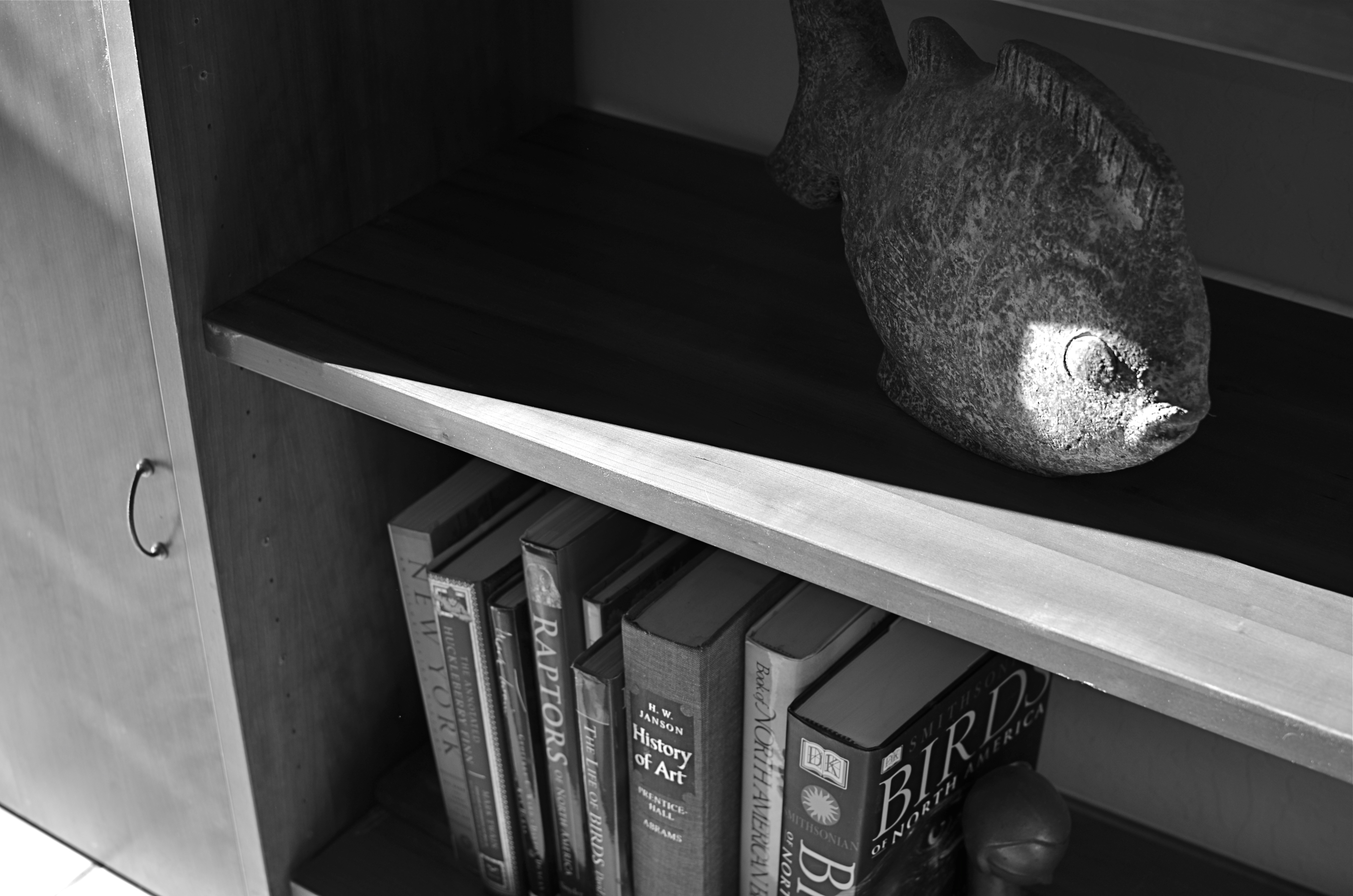
Fish ‘n’Books, 2013. 1/200 sec., f/3.5, ISO 100, 35mm.
By MICHAEL PERKINS
FOR THE MOST PART, THE USE OF ON-CAMERA FLASH SHOULD BE CONSIDERED A CRIME AGAINST HUMANITY. Scott Kelby, the world’s best-selling author of digital photography tutorials, famously remarked that “if you have a grudge against someone, shoot them with your pop-up flash, and it will even the score.” But, to be fair, let’s look at the pros and cons of using on-board illumination:
PROS : Cheap, handy
CONS: Harsh, Weak, Unflattering, Progenitor of Red-eye. Also, Satan kills a puppy every time you use it. Just sayin’.
There are, however, those very occasional situations where supplying a little bit of extra light might give you just the fill you need on a shot that is getting 90% of its light naturally. Even so, you have to employ trickery to harness this cruel blast of ouch-white, and simple bounces are the best way to get at least some of what you want.
In the above situation, I was shooting in a hall fairly flooded with bright mid-morning light, which was extremely hot on the objects it hit squarely but contrasty as an abandoned cave on anything out of its direct path. The fish sculpture in my proposed shot was getting its nose torched pretty good, but in black and white, the remainder of its body fell off sharply, almost to invisibility. I wanted the fish’s entire body in the shot, the better to give a sense of depth to the finished picture, but I obviously couldn’t flash directly into the shelf that overhung it without drenching the rest of the scene in superfluous blow-out. I needed a tiny, attenuated, and cheap fix.
Bending a simple white stationery envelope into a “L”, I popped up my camera’s flash and covered the unit with the corner of the envelope where the two planes intersected. The flash was scooped up by the envelope, then channeled over my shoulder, blowing onto the wall at my back, then bouncing back toward the fish in softened condition near the underside of the shelf, allowing just enough light to allow the figure’s bright nose to taper back gradually into shadow, revealing additional texture, but not over-illuminating the area. It took about five tries to get the thing to look as if the light could have broken that way naturally. Fast, cheap, effective.
The same principle can be done, with some twisting about, to give you a side or ceiling bounce, although, if high reflectivity is not crucial, I frankly recommend using your hand instead of the envelope, since you can twist it around with greater control and achieve a variety of effects.
Of course, the goal with rerouting light is to look as if you did nothing at all, so if you do save a picture with any of these moves, keep it to yourself. Oh, yes, you say modestly, that’s just the look I was going for.
Even as you’re thinking, whew, fooled ’em again.
THE “EITHER/ORs”
By MICHAEL PERKINS
CAMERAS CAN EITHER TAKE CHOICE AWAY OR CHALLENGE YOU TO MASTER IT. If you’re a regular reader of this comic strip, you know all too well that I advocate making images with all manual settings rather than relying on automodes that can only come in a distant second to the human process of decision-making. People take better pictures with a camera than a camera can take alone. Can I get an Amen?
There is, of course, one choice you don’t get to make for any picture you create. You can’t mark a box called “the choice I made guarantees that everything in the image will work out.” Worse, there is always more than one choice being made in the creation of a photograph, and, even if you’re well-practiced and fast, you can’t make all of them perfectly. Choose one option and you are “un-choosing” another. The sum of the effect of all your choices together is what determines the final picture. That’s real work, and it certainly accounts for many people’s preference for automodes, since they obviate all those tough calls.
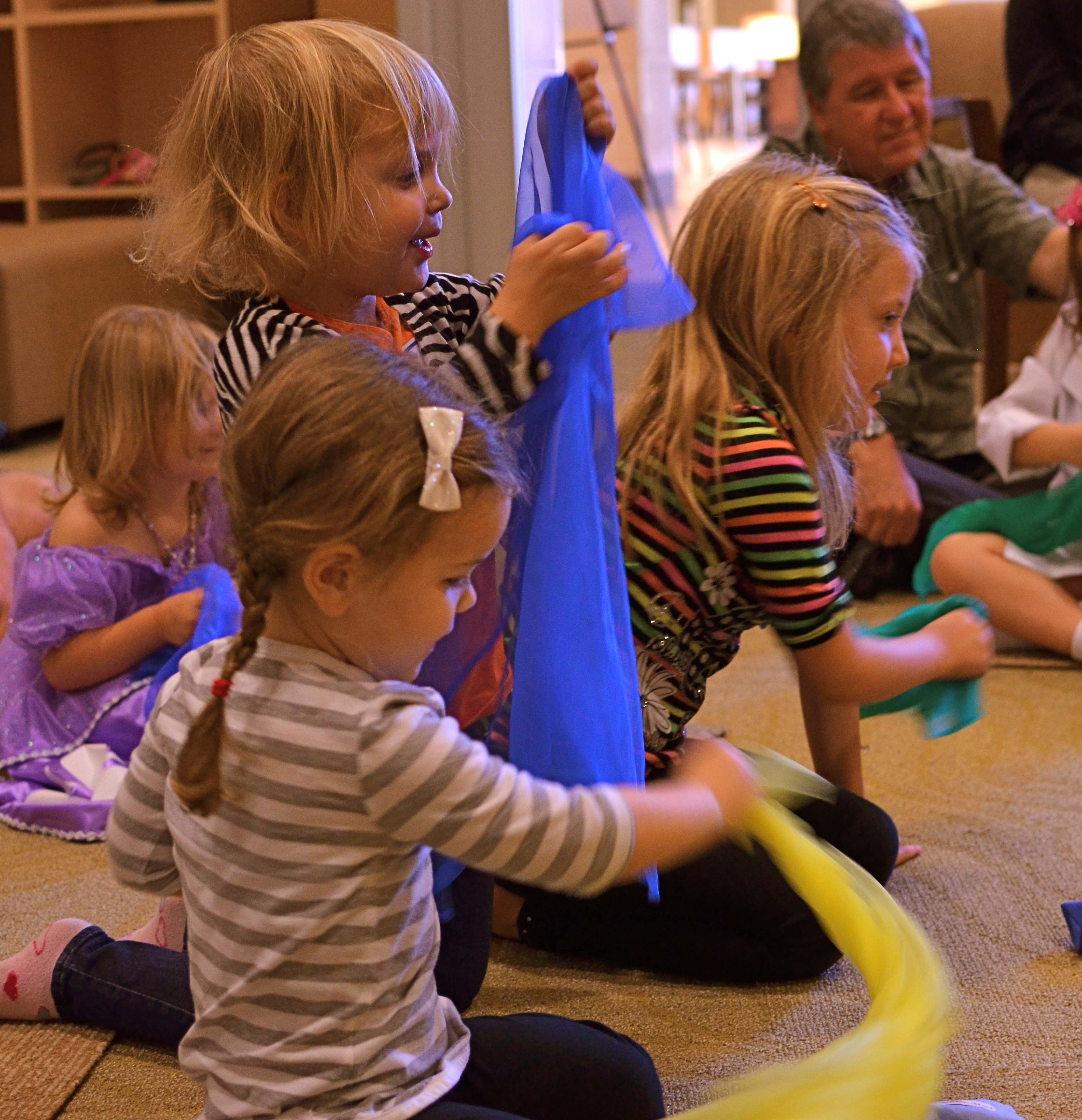
1/60 sec., f/3.5, ISO 640, 35mm.
Nothing will force you to choose lots of options in short order like taking pictures of children at play. The image posted here, taken at a kindergarten playdate, shows a number of fast decisions that may or may not add up to an appealing picture, as lots of things are going on all at once. In the room where this was shot, space was tight, action was swift, white balances were wildly different in various zones within the room, and posing the kids in any way was absolutely impossible, due to their tender age and the fact that I wanted to be as invisible as possible, the better to catch their natural flow. To get pictures under this particular set of conditions, I had to decide how best to frame children who were grouping and ungrouping rapidly, where to get a fairly accurate register of color, customize my shutter speed and ISO with nearly every shot, and, as you see here, make my peace with whether the action implied in the shot outweighed the need for super sharpness.
You simply get into situations with some shots where you are not going to get everything you’d like to have, and you make decisions in the moment based on what each individual image seems to be “about”. Here I went for the joy, the bonding, the surging energy of the girls and let everything else take a back seat. Faced with the same situation seconds later, I might have remixed the elements to create a completely different result, but that is both the thrill and the bane of manual shooting. Automodes guarantee that you will get some kind of image, a very safe, if average, picture that allows you to worry less and possibly enjoy being in the moment to a greater degree….but you are the only factor than can take the photo to another level, to, in fact, take full responsibility for the result. It’s like the difference between taking a picture of Niagara Falls from your hotel room and taking it from a tightrope stretched across the raging waters.
And, ah, that difference is everything.
THE RELENTLESS MELT
By MICHAEL PERKINS
THERE ARE PEOPLE YOU PHOTOGRAPH BECAUSE THEY ARE IMPORTANT. Others are chosen because they are elements in a composition. Or because they are interesting. Or horrific. Or dear in some way. Sometimes, however, you just have to photograph people because you like them, and what they represent about the human condition.
That was my simple, solid reaction upon seeing these two gentlemen engaged in conversation at a party. I like them. Their humanity reinforces and redeems mine.
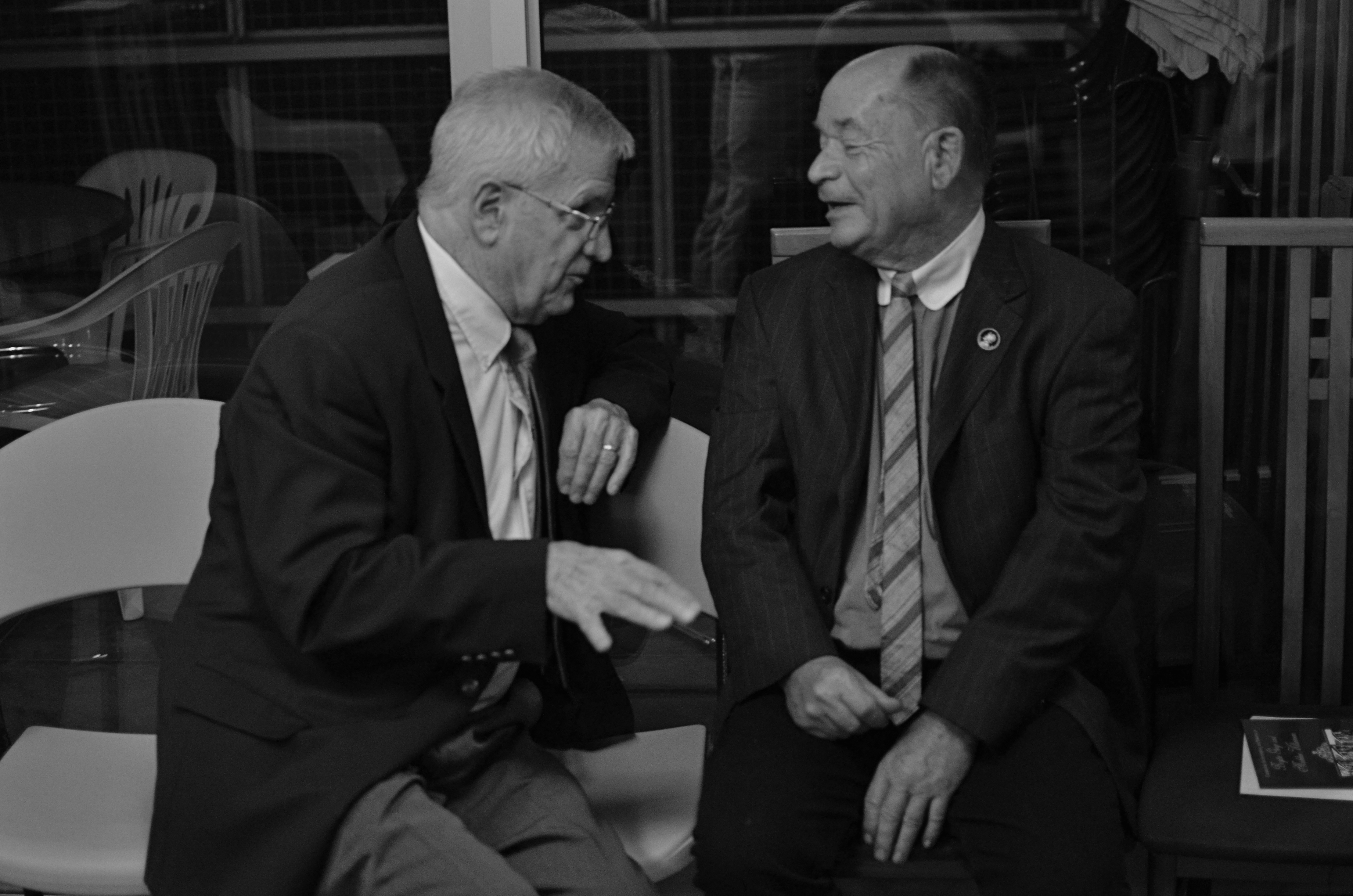
“Old friends sat on a park bench like bookends”: 1/80 sec., f/1.8, ISO 1000, 35mm.
This image is merely one of dozens I cranked out as I wandered through the guests at a recent reception for two of my very dearest friends. Given the distances many of us in the room traveled to be there, it’s unlikely I will ever see most of these people again, nor will I have the honor of knowing them in any other context except the convivial evening that herded us together for a time. Because I was largely eavesdropping on conversations between small groups of people who have known each other for a considerable time, I enjoyed the privilege often denied a photographer, the luxury of being invisible. No one was asked to pose or smile. No attempt was made to “mark the occasion” or make a record of any kind. And it proved to me, once more, that the best thing to relax a portrait subject is……another portrait subject.
I assume from the body language of these two men that they are friends, that is, that they weren’t just introduced on the spot by the hostess. There is history here. Shared somethings. I don’t need to know what specific links they have, or had. I just need to see the echoes of them on their faces. I had to frame and shoot them quickly, mostly to evade discovery, so in squeezing off several fast exposures I sacrificed a little softness, partly due to me, partly due to the animated nature of their conversation. It doesn’t bother me, nor does the little bit of noise suffered by shooting in a dim room at ISO 1000. I might have made a more technically perfect image if I’d had total control. Instead, I had a story in front of me and I wanted to possess it, so….
Susan Sontag, the social essayist whose final life partner was the photographer Annie Liebovitz, spoke wonderfully about the special theft, or what she called the “soft murder” of the photographic portrait when she noted that “to take a photograph is to participate in another person’s mortality, vulnerability, mutability. Precisely by slicing out this moment and freezing it, all photographs testify to time’s relentless melt.”
Melt though it might, time also leaves a mark.
Caught in a box.
Treasured in the heart.
Related articles
- Susan Sontag Musings Where You Least Expect Them (hintmag.com)
THE PARTY’S OVER
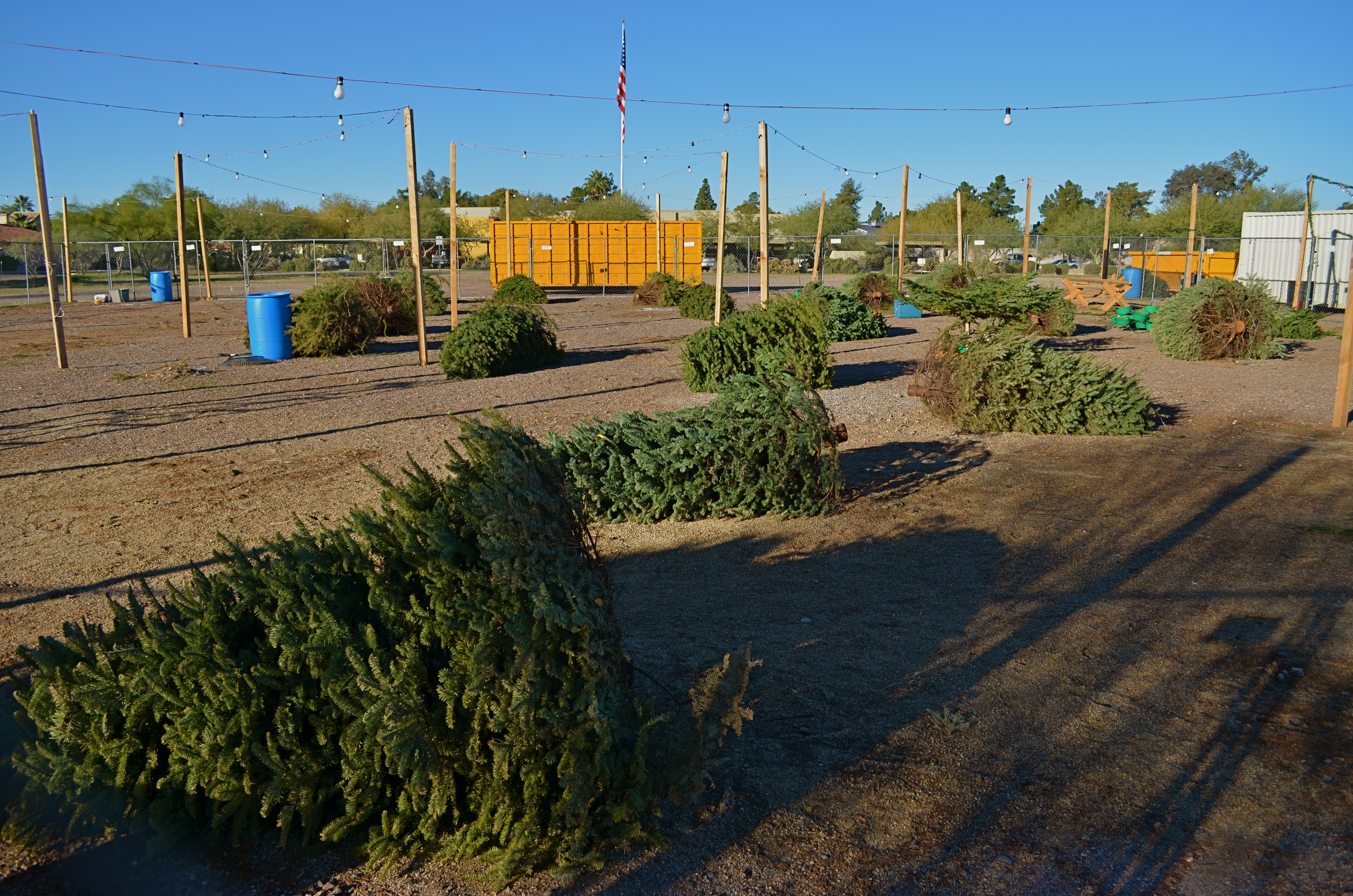
The Leavings: Christmas Tree Lot, Phoenix, AZ, 12/26/13. 1/500 sec., f/5.6, ISO 100, 18mm.
By MICHAEL PERKINS
PHOTOGRAPHY IS THE SCIENCE OF SECONDS. The seconds when the light plays past you. The seconds when the joy explodes. The seconds when maybe the building explodes, or the plane crashes. The micro moments of emotion’s arrivals and departures. Here it comes. There it goes. Click.
We are very good with the comings….the beginnings of babies, the opening of a rose, the blooming of a surprised smile. However, as chroniclers of effect, we often forget to also document the goings of life. The ends of things. The moment when the party’s over.
Christmas is a time of supreme comings and goings, and we have more than a month of ramp-up time each year during which we snap away at what is on the way. The gatherings and the gifts. The approaching joy. But a holiday this big leaves echoes and vacuums when it goes away, and those goings are photo opportunities as well.
This year, on 12/26, the predictably melancholy “morning after” found me driving around completely without pattern or design, looking for something of the magic day that had departed. I spun past the abandoned ruin of one of those temporary Christmas tree lots that sprout in the crevices of every city like gypsy camps for about three weeks out of the year, and something about all its emptiness said picture to me, so I got out and started bargaining with a makeshift cyclone fence for a view of the poles, lights and unloved fir branches left behind.
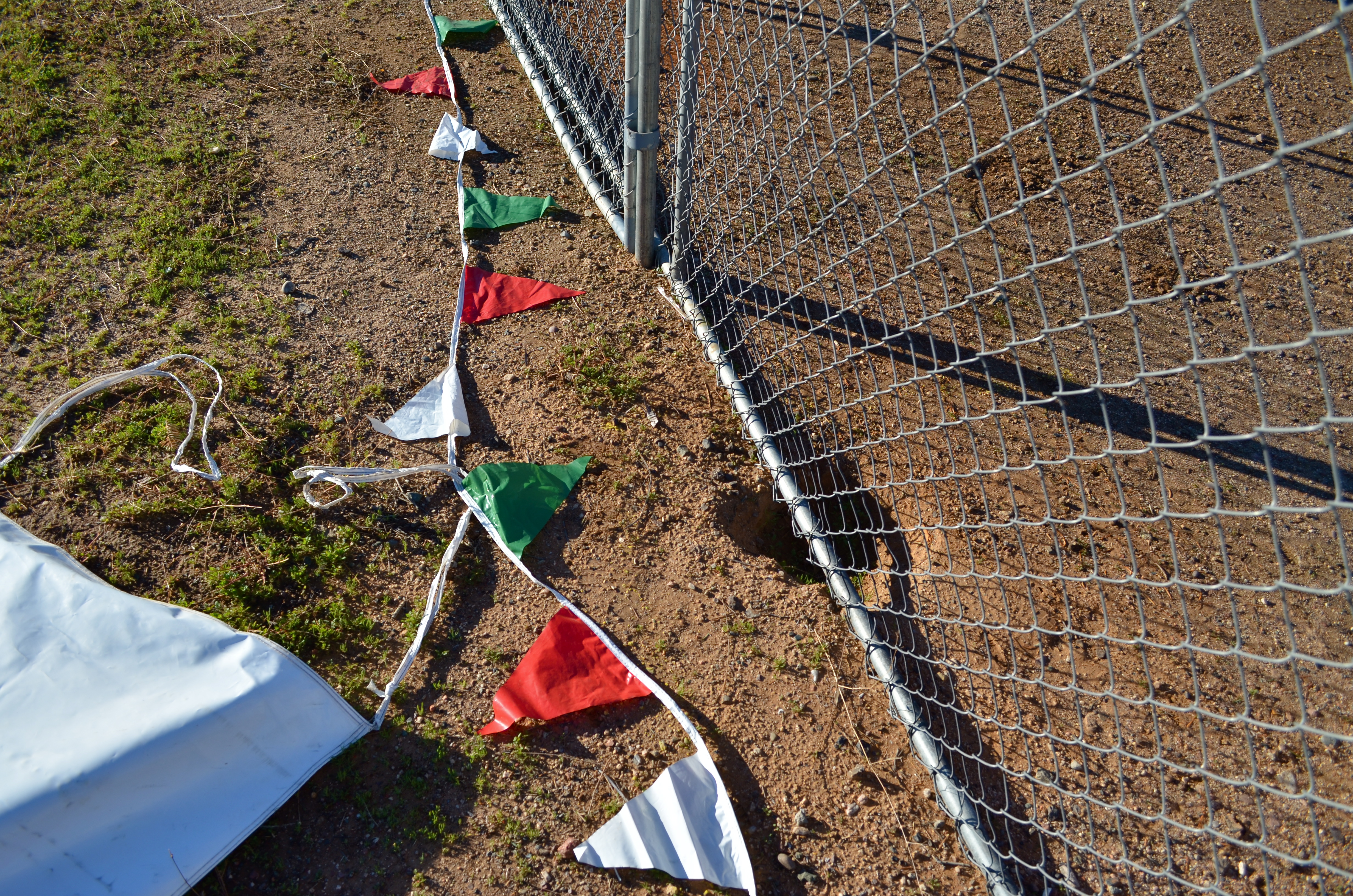
Pack up and get out of town.
The earliness of the hour meant that the light was a little warmer and kinder than would be the case later on in the bleached-out white of an Arizona midday, so the scene was about as nice as it was going to get. But what I was really after was the energy that goes out of things the day the circus drives out of town. The holidays are ripe with that feeling of loss, and, to me, it’s at least as interesting as recording the joy. Without a little tragedy you don’t appreciate triumph, and all that. Christmas trees are just such an obvious measure of that flow: one day you’re selling magic by the foot, the next day you’re packing up trash and trailer and making your exit.
Photographs come when they come, and, unlike us, they aren’t particular about what their message is. They just present chances to see.
Precious chances, as it turns out.
HERE COMES THE NIGHT
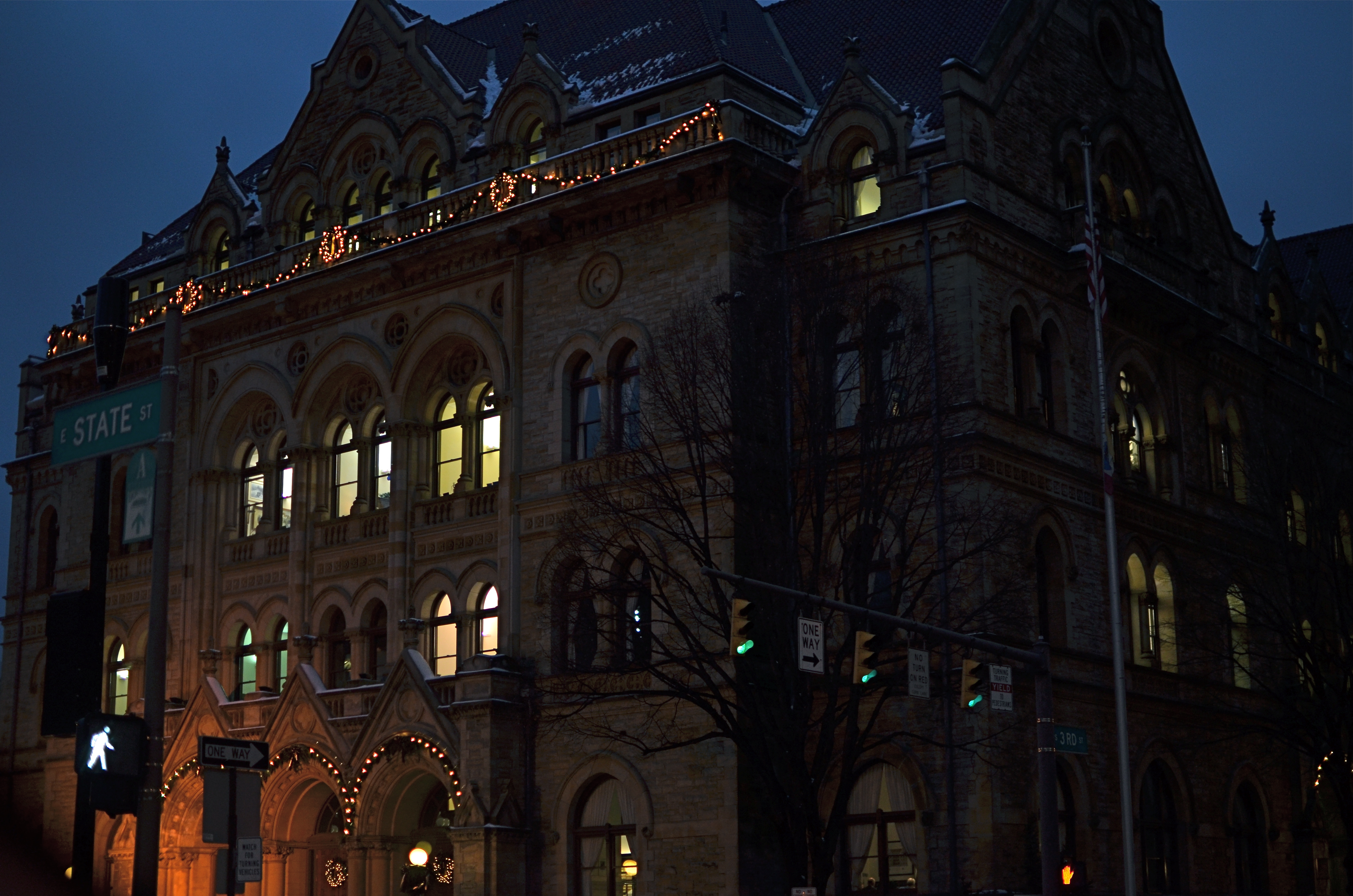
Letting the shadows be the shadows.1/100 sec., f/1.8, ISO 250, 35mm.
By MICHAEL PERKINS
FOR SOME PHOTOGRAPHERS, THE END OF A CALENDAR YEAR MEANS BUSTING OUT THE “BEST OF” LISTS, and, certainly,for people with a certain level of skill, that’s a normal instinct. I am always far too horrified by how many losing horses I put in a given year’s race to try to find the few who didn’t go lame, wander off the track, or finish last, so I confine my year’s-end computations to lists of what I tried, and whether I got close to learning anything. For 2013, one bulletin emerges:
I like the dark. A lot.
That is, a simple head count of shots taken this year reveal that I was outside, after supper, at nearly every opportunity. And yes, with mixed results. Always and forever will them results be mixed, amen. If my results were in a Waring blender, going at full “puree” speed, they could not be more mixed, okay?
But for some reason, the quest took me back into a renewed appreciation of shadows, shades, a lack of light. I probably embraced the missing information and detail that the dark represents more joyfully than I have in many years. And that’s something of a journey, since, if I had any kind of post-processing crack habit recently, it was the mania to rescue more and more of that detail, whether in High Dynamic Range photos, Exposure Fusion photos or Tone Compression photos. For a while, I was acting like your Grandpa the first week he owned his new Magnavox (“…hmm, needs a little more green….no, now the horses look purple….let’s add some red…”).
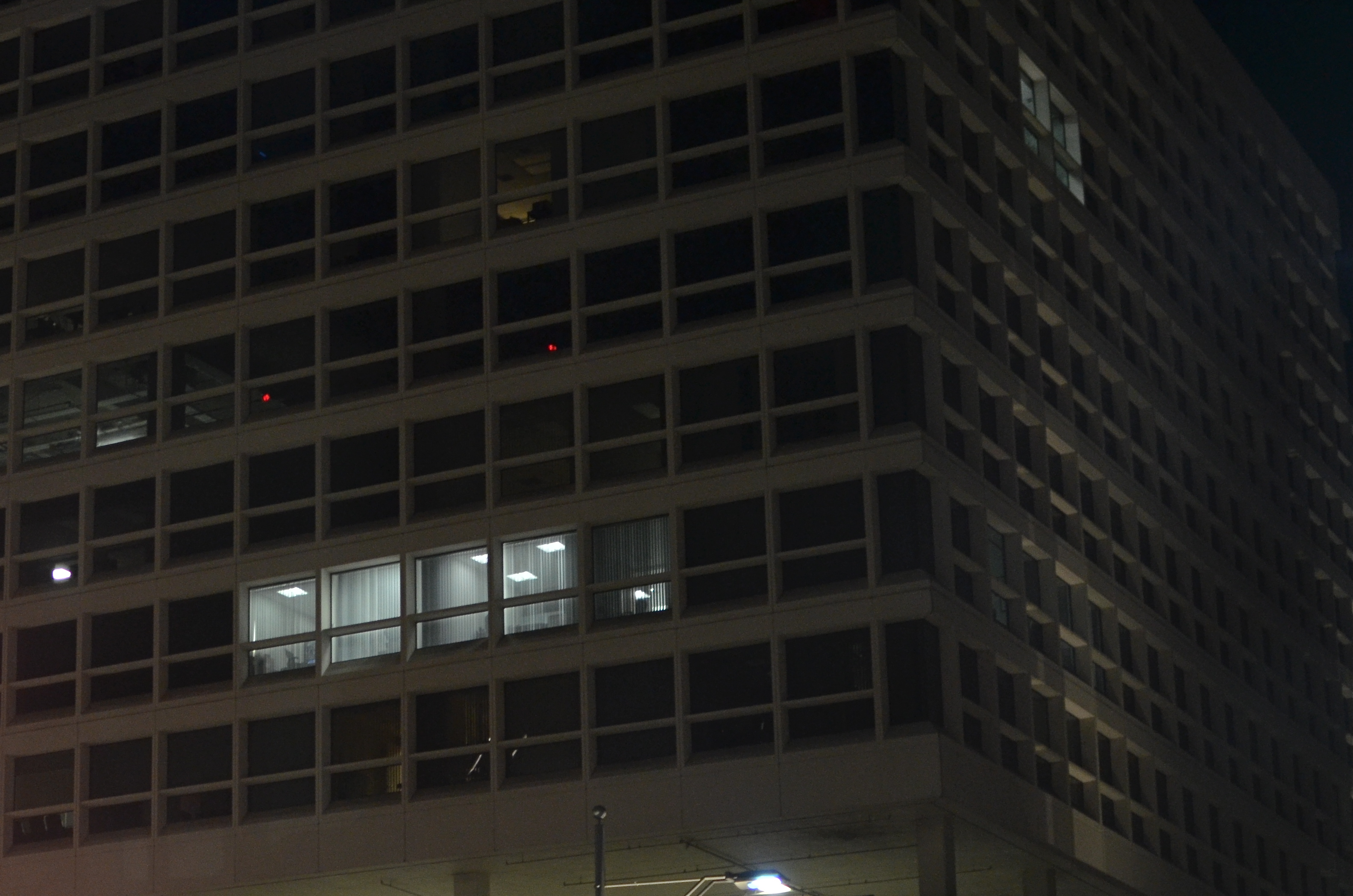
What’s left out is as vital as what’s shown. 1/50 sec., f/1.8, ISO 640, 35mm.
Maybe 2013 was the year I pulled back a bit and just let darkness be, let it express the unknown and the unknowable. Photography is always at least partly about what you don’t show, not depicting the world as a giant Where’s Waldo overdose of texture and detail. In ’13, I spent a lot more time shooting night shots at the technical limit of my camera, but did not fiddle about much further afterwards. I was interested in “getting as much picture into the click” as possible, but what couldn’t be achieved with faster lenses or mildly enhanced ISO just got left out of the pictures. I feel like it was a year of correction, with me playing the part of a new teen driver has to learn to correct for over-steer.
The whole thing is about remembering that technique is not style. What you have to say is style. The mechanical means you use to get it said is technique. Learning to execute a technique is like mastering the workings of a camera. It does not guarantee that your results will be revelatory or eloquent. That means that falling in love with the consistent polishing of processing is a danger, since you can begin to love it for its own sake. Technique says “Look what I can do!”. Style says, “but, is this what I should be doing?”
Anyway, whatever I presently think is essential for my growth will, eventually, become just one more thing that I do, and will be supplanted by something else. That said, a good year in photography should not end with the collection of a pile of hits, but an unafraid assessment of the misses.
That’s where the next batch of good pictures will come from, anyway.
DEPTH OF FEELING
By MICHAEL PERKINS
OFTEN, THERE ARE ONLY SCANT MOMENTS TO DETERMINE HOW TO “USE” PEOPLE IN YOUR PHOTOGRAPHS. The decision as to how prominently a person figures in the overall scheme of a given image is frequently made on the fly, and your result will reflect whether that person is an element of the picture or a select feature.
Of course, you can wind up with wonderful photos either way, which is one of the most attractive aspects of picture making. This is all multiple choice, and there is no wrong answer. Also, if the answer was right for you, chances are that it will be so judged by others. Your conviction carries the picture to its desired audience, if you will.
This October, I fell into a virtual pot of gold on a trip to visit friends in rural New Mexico, since the entire countryside was awash in a gilded flood of yellow with the turn of the leaves. You could literally point the camera at a trash can, and, if it was next to a cottonwood tree, the thing became a palace. As a midwestern kid who has spent nearly fifteen years in the Arizona desert, I was long overdue for the richness of the autumnal palette, and I got a little drunk on it all. I wanted to immortalize every tree, shooting generally at small apertures to get as much sharp detail as possible.
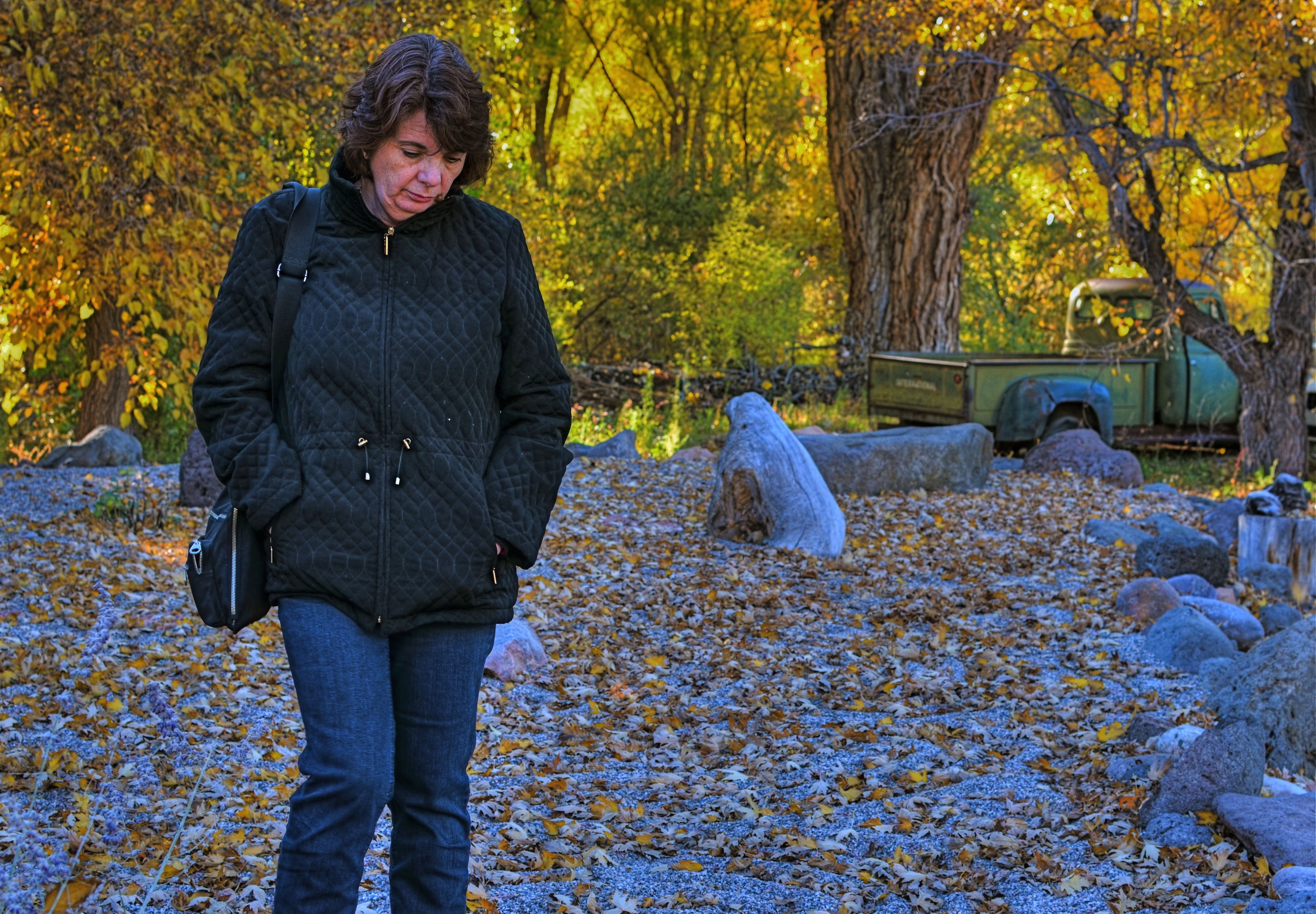
1/80 sec., f/5.6, ISO 100, 35mm.
That’s what I was doing in the side yard of a roadside gallery when my wife Marian wandered outside for a brief walk, so the first few frames I shot showed her and the background in about the same focus. Just for variety, I re-focused on mostly her at f/5.6, slightly softening the foliage beyond so it wouldn’t fight with her for the viewer’s attention. In that one frame, she morphed from element to feature, and all that color was put at her service, so to speak. As an afterthought, I made a dupe of the image, lightened it by about a third, then blended the two in Photomatix, since HDR processing also accentuates detail, giving me an even sharper contrast between her sharpness and the softer background. It wasn’t a big bump, processing-wise, just the bow on the box.
Experimental “light field” cameras, once perfected, may make such planning moot, since images taken with this very different technology allows the photographer to redo the depth of field on an image after it has been taken. For now, however, it’s a decision of the moment.
Again, part of the fun.
Related articles
- Depth of Field (mariatobon.wordpress.com)
ANOTHER YEAR OUT THE WINDOW
By MICHAEL PERKINS
IF YOU WANT TO PUT A SMILE ON MY FACE WHEN I VISIT YOUR CITY, there is no sweeter sentence you can say to me than:
“I’ll drive”.
There is, for photographers, one way to maximize your time touring through other people’s towns, and that’s the time-honored tradition of “riding shotgun”. Drive me anywhere, but give me a window seat. I wasn’t trying to go for some kind of personal best in the area of urban side shots in 2013, but by good fortune I did snag a few surprises as I was ferried through various towns, along with a “reject” pile about a mile high. Like any other kind of shooting, the yield in window shooting is very low in terms of “killers per click”, but when you hit the target, you crack through a kind of “I’m new in town” barrier and take home a bit of the street for your own.
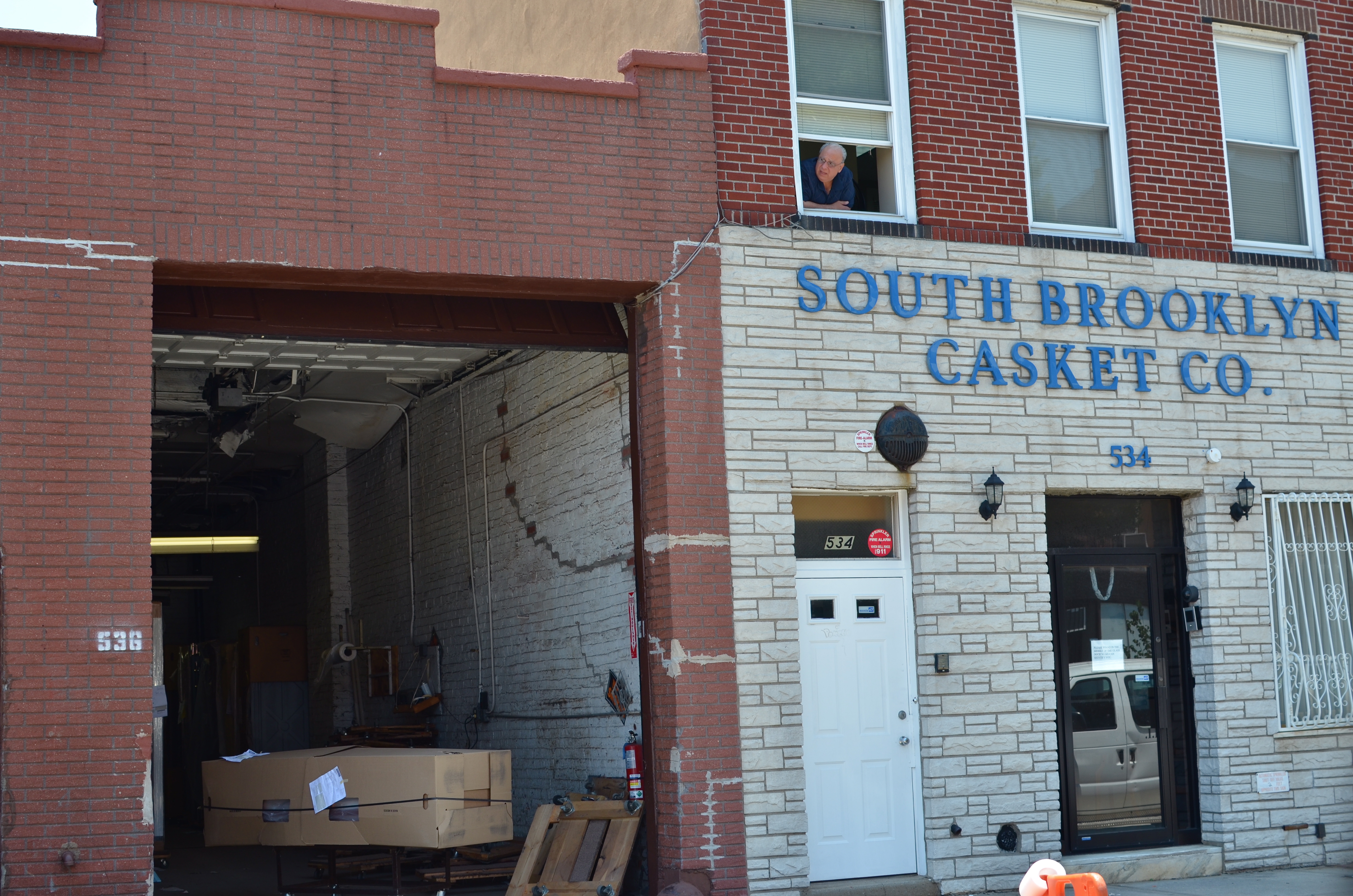
Business has been really dead lately. 1/250 sec., f/5.6, ISO 100, 35mm.
This guy just killed me (excuse the expression). He seemed like he was literally waiting for business to drop in (or drop dead), and meanwhile was taking in the view. Probably he didn’t even work for the casket company, in which case, what a bummer of neighbor to pick. Maybe he’s rent controlled.
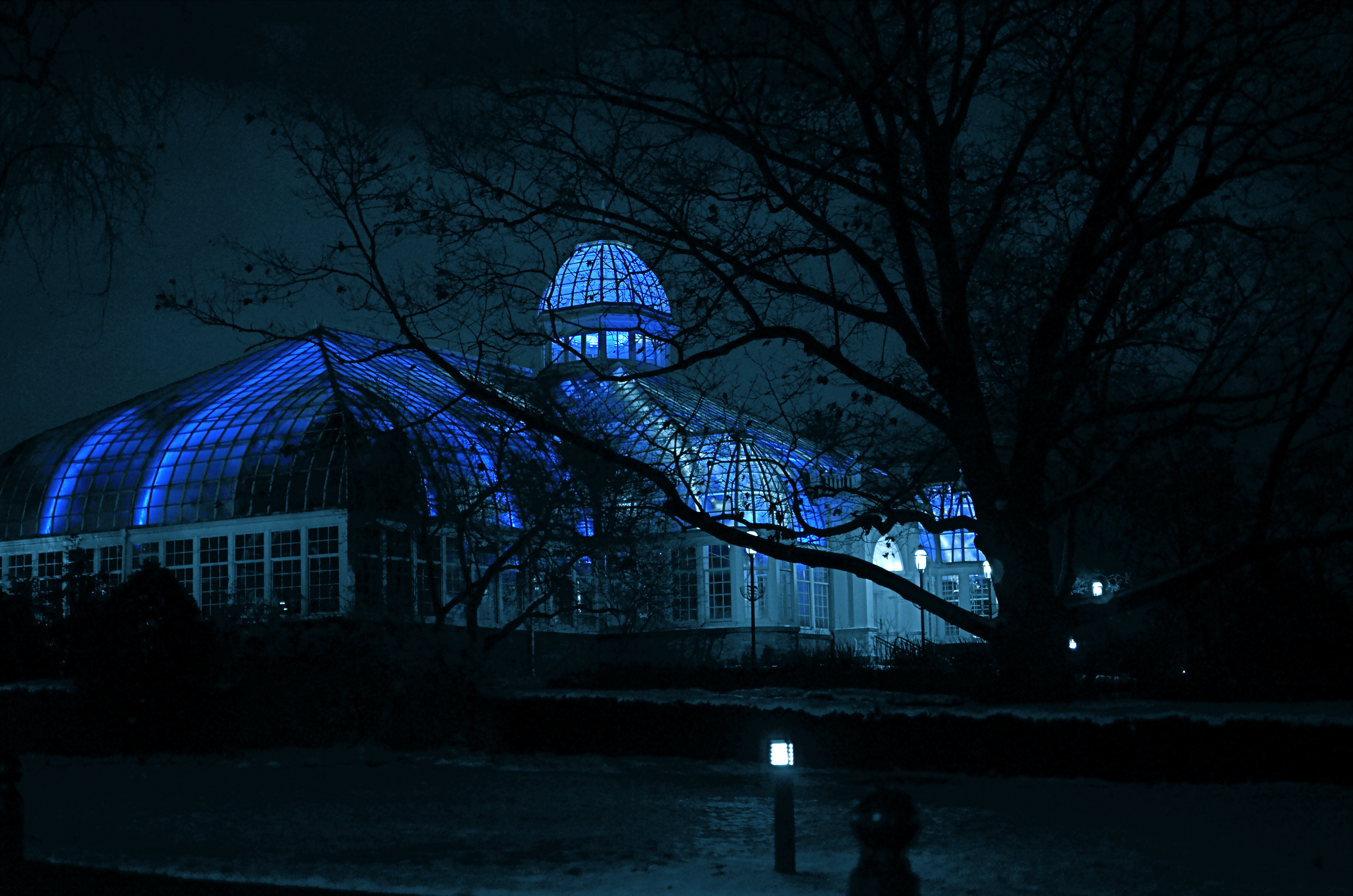
Franklin Park Conservatory, Columbus, Ohio. 1/40 sec., f/1.8, ISO 500, 35mm.
This one took a little tweaking. The building was actually blue, as you see here, lit with subdued mood for the holidays. However, in lightening this very dark shot, the sky registered as a muddy brown, so I made a dupe, desaturated everything except the conservatory, then added tint back in to make the surrounding park area match the building. All rescued from an “all or nothing” shot.
I’m also ashamed to admit that I bagged a few through-the-window shots while actually driving the car, all done at red lights and so not recommended. Don’t do as I do, do as I……oh, you know.
Here’s to long shots, at horse tracks or in viewfinders, and the few that finish in the money.
EAVESDROPPING ON REALITY
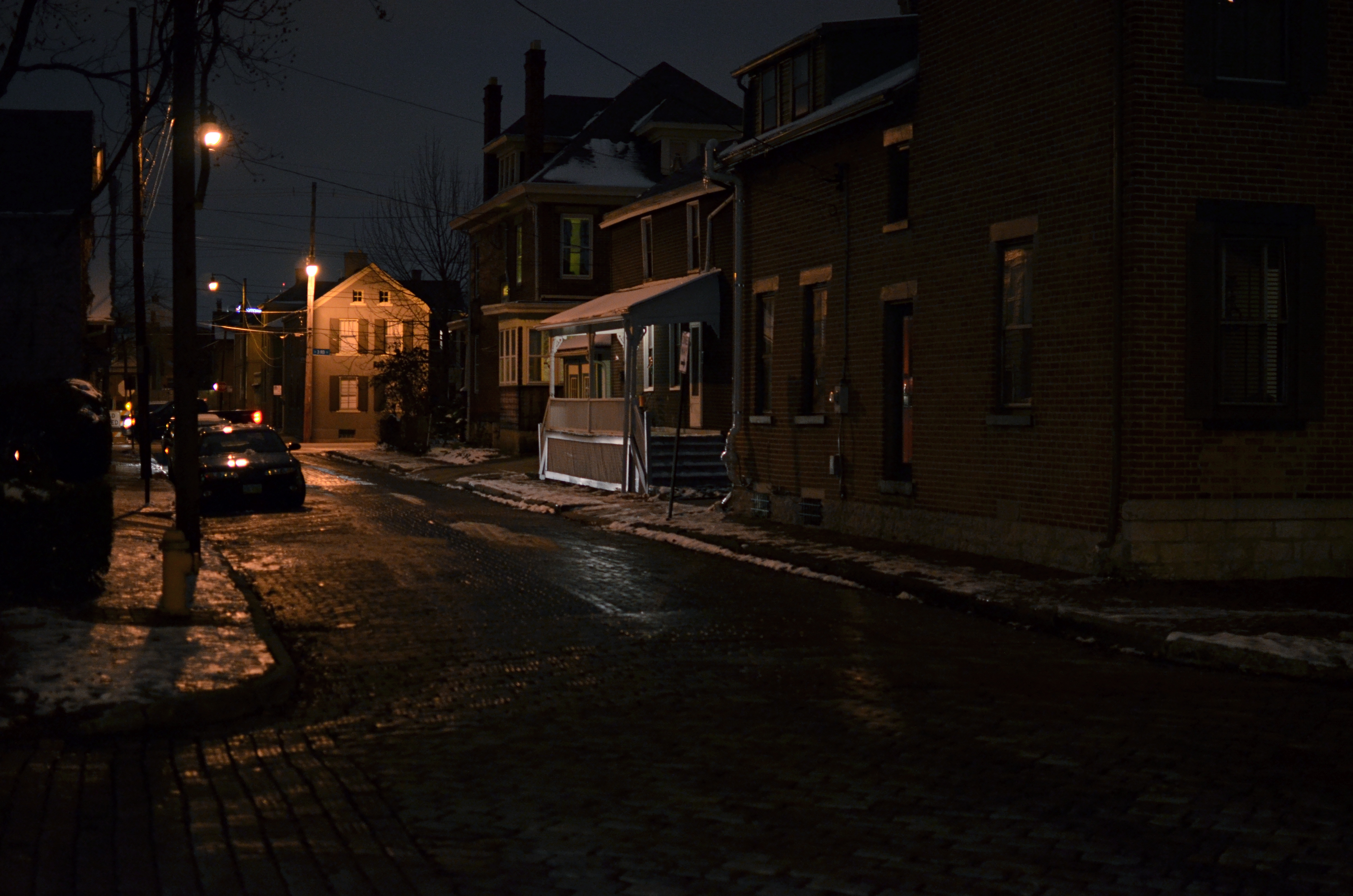
Stepping onto Blenkner Street and into history. Columbus, Ohio’s wonderful German Village district, December 2013. 1/60 sec., f/1.8, ISO 800, 35mm.
By MICHAEL PERKINS
THE FAMILIAR ADMONITION FROM THE HIPPOCRATIC OATH, the exhortation for doctors to, “First, Do No Harm” has applications to many kinds of enterprises beyond the scope of medicine, photography among them. We are so used to editing, arranging, scouting, rehearsing and re-imagining reality that sometimes, we need merely to eavesdrop on it.
Some pictures are so complete in themselves that, indeed, even minimal interference from a photographer is a bridge too far. Sometimes such images come as welcome relief after a long, unproductive spell of trying to force subjects into our cameras, only to have them wriggle away like so much conceptual smoke. I recently underwent several successive days of such frustration in, of all things, my own home town, fighting quirky weather, blocked access, and a blank wall of my own mental making. I finally found something I can use in (say it all together) the last place I was looking.
In fact, it was a place I hadn’t wanted to be at all.
Columbus, Ohio at night in winter is lots of things, but it’s seldom conducive to any urge more adventurous than reheating the Irish coffee and throwing another log on the fire. At my age, there’s something about winter and going out after sunset that screams “bad idea” to me, and I was reluctant to accept a dinner invite that actually involved my schlepping across the tundra from the outskirts to the heart of downtown. Finally, it was the lure of lox and bagel at Katzinger’s deli, not my artistic wanderlust, that wrenched me loose from hearth and home, and into range of some lovely picture-making territory.
The German Village neighborhood, along the city’s southern edge, has, for over a century, remained one of the most completely intact caches of ethnic architecture in central Ohio, its twisty brick streets evoking a mini-Deutschland from a simpler time. Its antique street lamps, shuttered windows and bricked-in gartens have been an arts and party destination for generations of visitors, casting its spell on me clear back in high school. Arriving early for my trek to Katzie’s, I took advantage of the extra ten minutes to wander down a few familiar old streets, hoping they could provide something….unfamiliar.
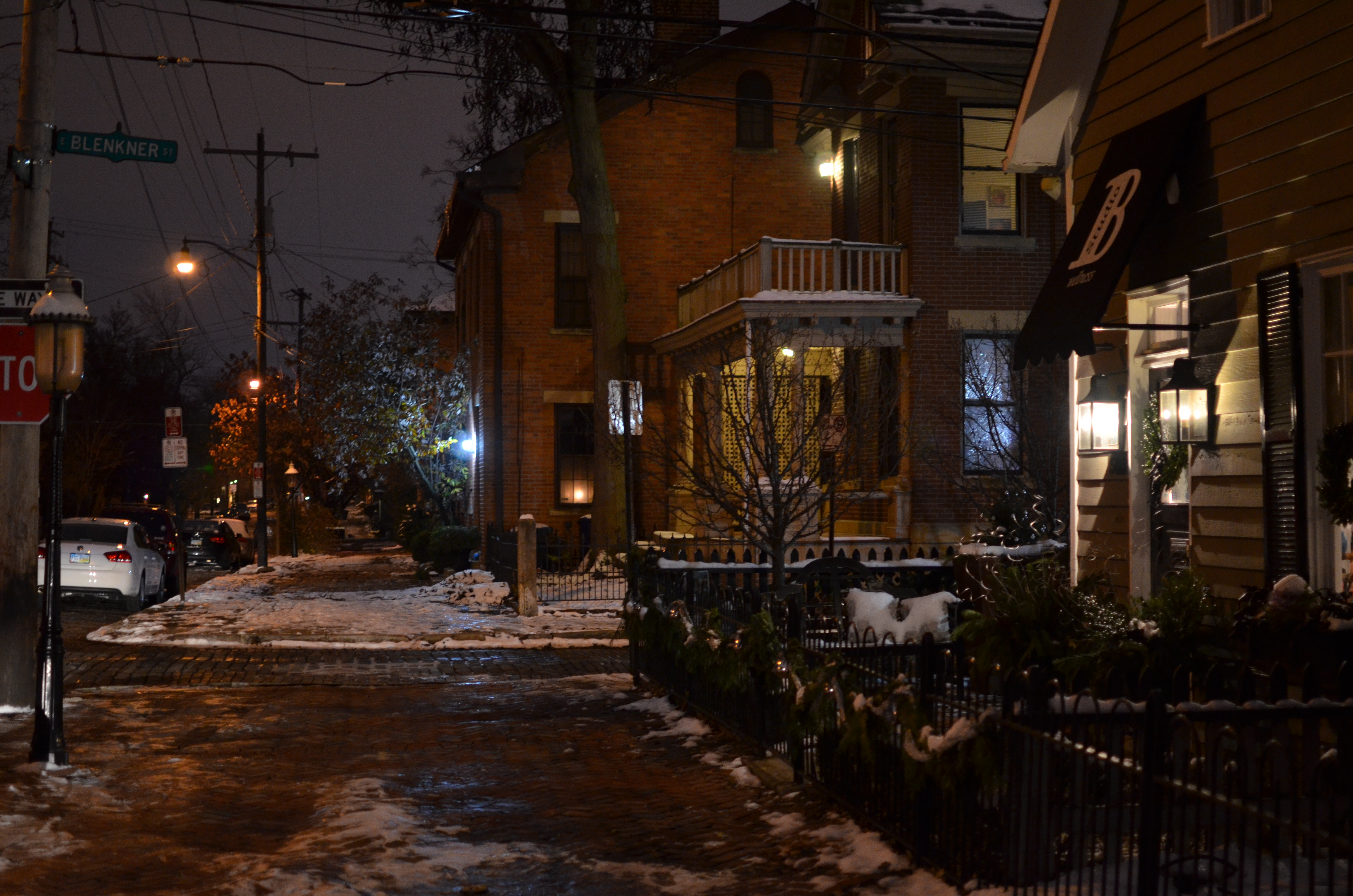
1/60 sec., f/1.8, ISO 800, 35mm.
The recently melted snowfall of several days prior still lent a warm glaze to the cobbled alleyways, and I soon found myself with city scenes that evoked a wonderful mood with absolutely minimal effort. The light was minimal as well, often coming from just one orange sodium-vapor street lamp, and it made sense to make them the central focus of any shots I was to take, allowing the eye to be led naturally from the illuminated streets at the front of the frame clear on back to the light’s source.
Using my default lens, a 35mm prime at maximum f/1.8 aperture, and an acceptable amount of noise at ISO 800, I clicked away like mad, shooting up and down Blenkner Street, first toward Third Street, then back around toward High. I didn’t try to rescue the details in the shadows, but let the city more or less do its own lighting with the old streets. I capped my lens, stole away like the lucky thief I had become, and headed for dinner.
The lox was great, too. Historic, in fact.
CHANGE OF PLAN
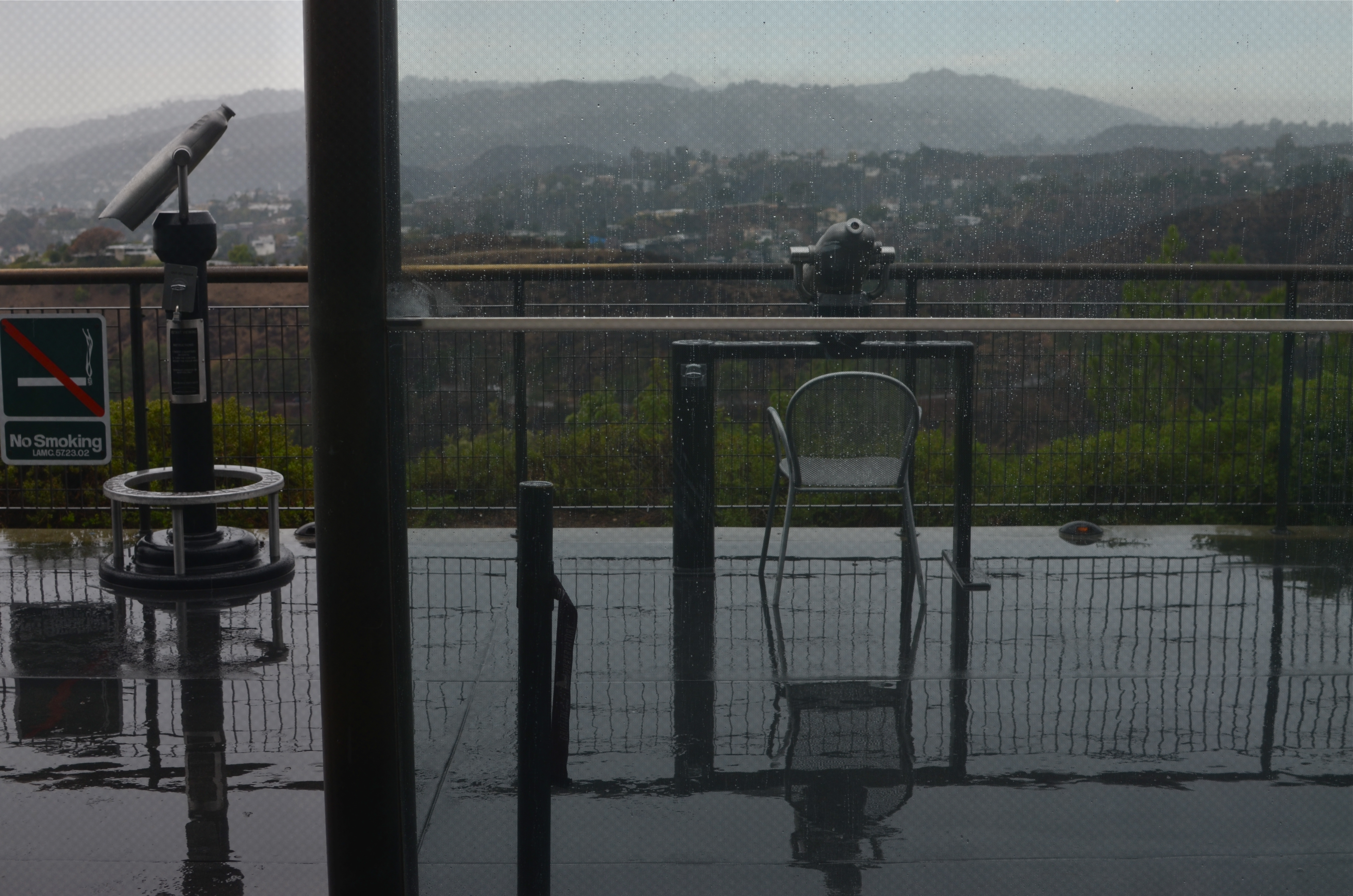
Rainy day, dream away. Griffith Observatory under early overcast, 11/29/13. 1/160, f/5.6, ISO 100, 35mm.
by MICHAEL PERKINS
VISUAL WONDERS, IN EVERY HOUR AND SEASON, ARE THE COMMON CURRENCY OF CALIFORNIA’S GRIFFITH OBSERVATORY. The setting for this marvelous facility, a breathtaking overlook of downtown Los Angeles, the Hollywood Hills, and the Pacific Ocean, will evoke a gasp from the most jaded traveler, and can frequently upstage the scientific wonders contained within its gleaming white Deco skin.
And when the light above the site’s vast expanse of sky fully asserts itself, that, photographically, trumps everything. For, at that moment, it doesn’t matter what you originally came to capture.
You’re going to want to be all about that light.
Upon my most recent visit to Griffith, the sky was dulled by a thick overcast and drenched by a slate-grey rain that had steadily dripped over the site since dawn. The walkways and common decks were nearly deserted throughout the day, chasing the park’s visitors inside since the opening of doors at noon. By around 3pm, a slow shift began, with stray shafts of sun beginning to seek fissures in the weakening cloud cover. Minute by minute, the dull puddles outside the telescope housing began to gleam; shadows tried to assert themselves beneath the umbrellas ringing the exterior of the cafeteria; the letters on the Hollywood sign started to warm like white embers; and people of all ages ventured slowly to the outside walkways.
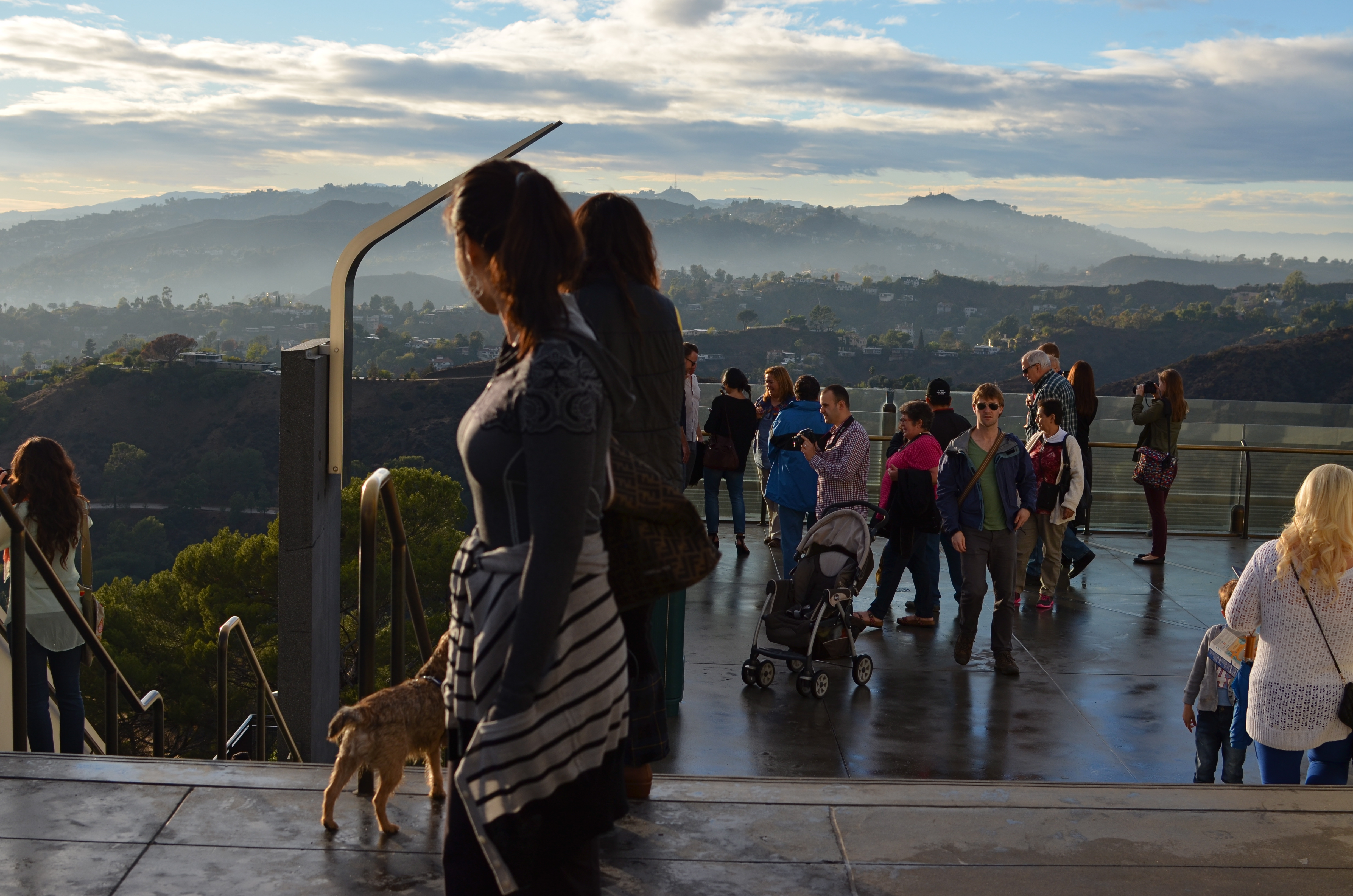
The moment the light broke, Griffith’s common areas after the rain,11/29/13. 1/640 sec., f/5.6 (this image), f/6.3 (lower image), ISO 100, 35mm.
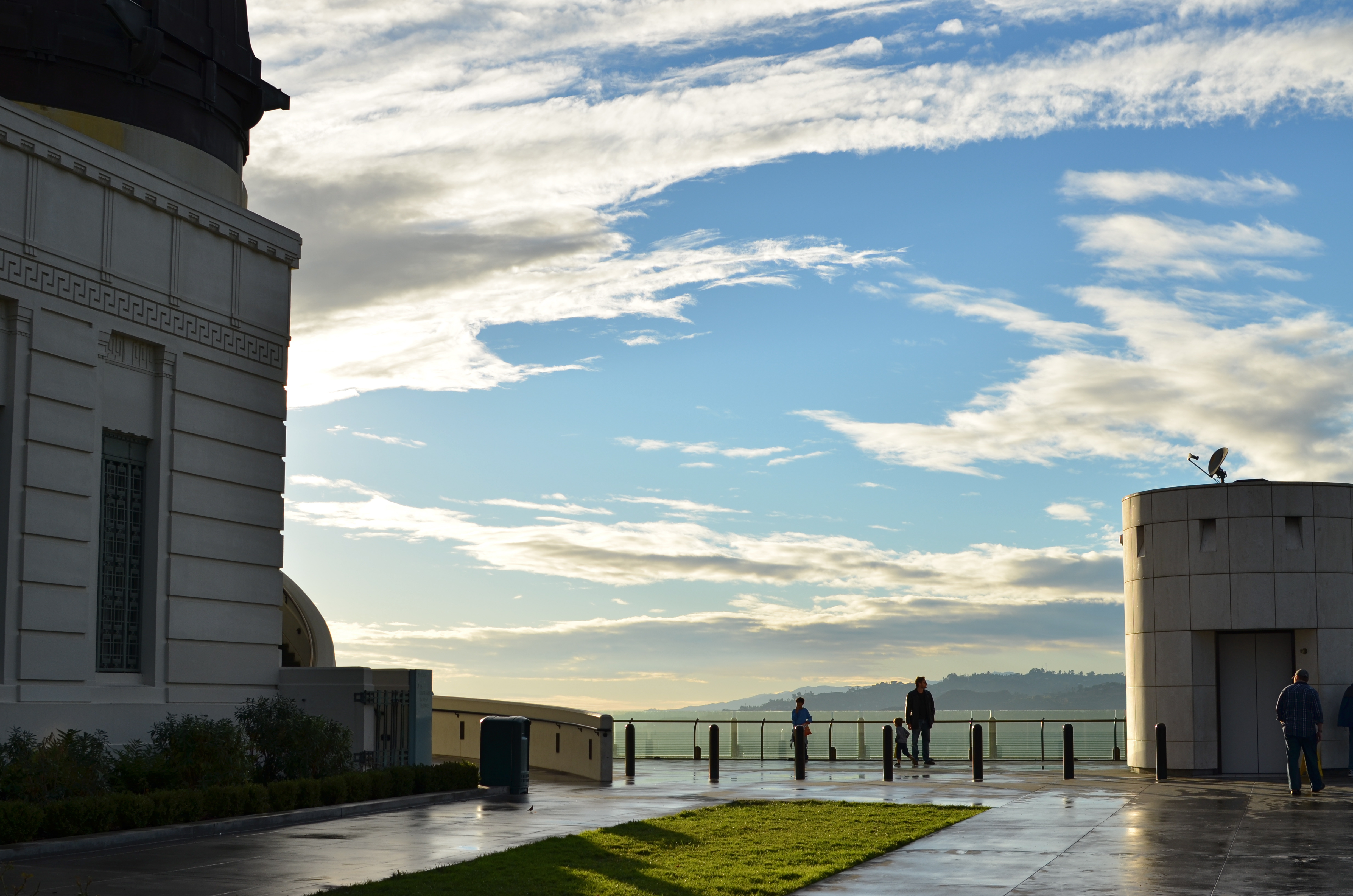
By just after 5 in the afternoon, the pattern had moved into a new category altogether. As the overcast began to break and scatter, creating one diffuser of the remaining sunlight, the fading day applied its own atmospheric softening. The combination of these two filtrations created an electric glow of light that flickered between white hot and warm, bathing the surrounding hillsides with explosive pastels and sharp contrasts. For photographers along the park site, the light had undoubtably become THE STORY. Yes the buildings are pretty, yes the view is marvelous. But look what the light is doing.
Like everyone else, I knew I was living moment-to-moment in a temporary, irresistible miracle. The rhythm became click-and-hope, click-and-pray.
And smiles for souvenirs, emblazoned on the faces of a hundred newly-minted Gene Kellys.
“Siiingin’ in the rainnnn…”
Related articles
RISING TO THE OCCASION
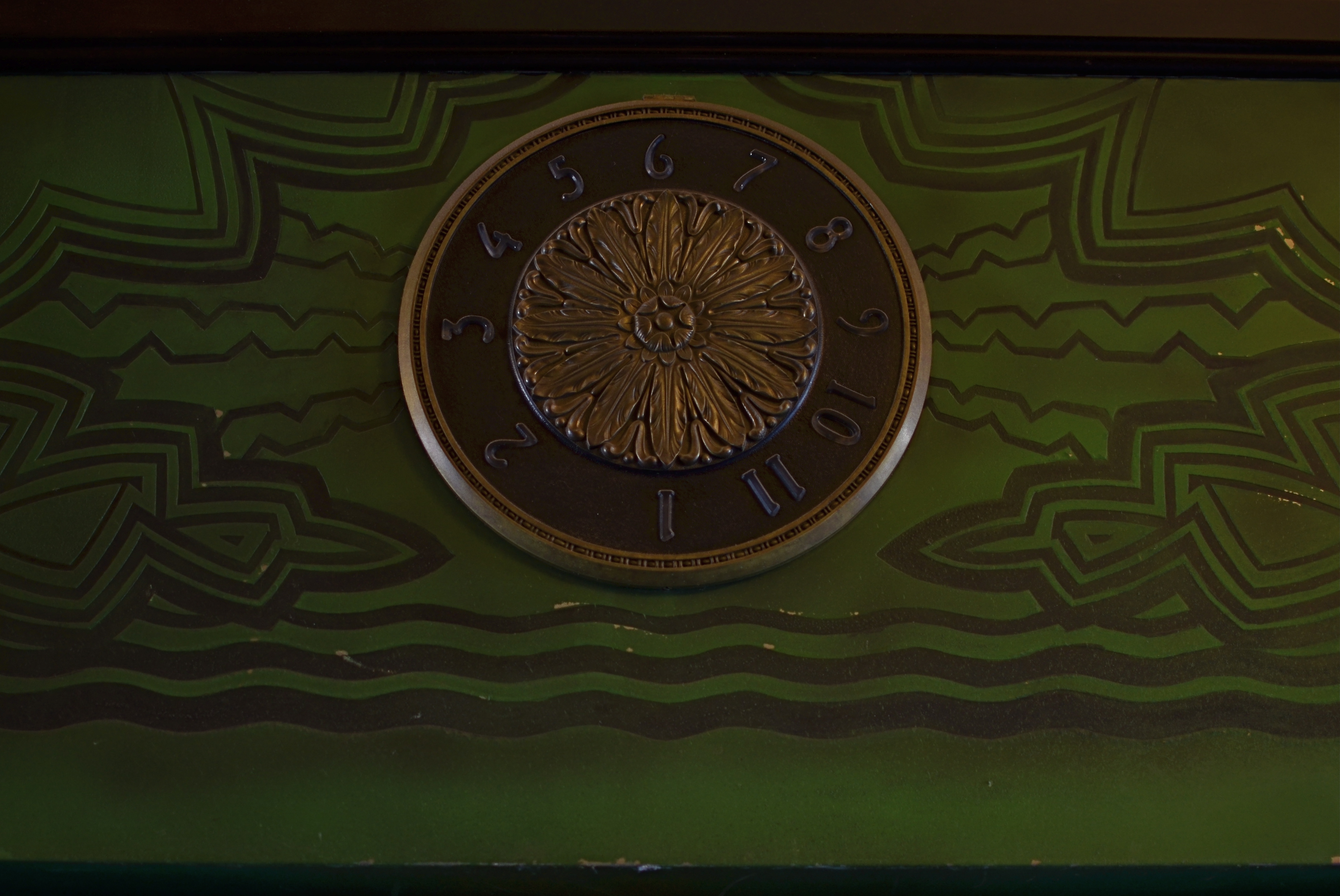
The Desmond building’s elevator floor indicator, circa 1928. 1/40 sec., f/1.8, ISO 100, 35mm.
By MICHAEL PERKINS
LOS ANGELES USED TO BE COMPOSED OF MANY PEOPLE LIKE RUBEN PARDO, the balding, beaming driver of the elevator at the Desmond building at 5500 Wilshire Boulevard. Once upon an urban time long, long, ago there were people who specialized in guiding, in fact, feeling the rise and fall of elevators in cabs they manually controlled. They were the unofficial greeters of their buildings, as familiar with the fortunes of the tenants and clients of their respective towers as the counterman at a diner.
Once, these ascension specialists were turned out in resplendent uniforms befitting their twin duties as both concierge and mechanic. Epaulets. Braided cords. Hats that earned the word “snappy”. Gloves. And always, the inextinguishable smile that Ruben still radiates to all, from the edgy curators of the Desmond’s second floor Gallery “A” to its street level Fed Ex workers to the Deco lovers who float into his lobby to admire his peacock-bedecked elevator doors and the warm mahogany wood of his stately 6×8 foot cab, all original from 1928.
And always, there is the science of measuring the distance between the floors himself, knowing when the car is level, waiting for the right moment to sweep back the flexible cage door that protects his passengers. Watch your step, sir. Turn right and go to the end of the hall, ma’am. Press the button to call me if you finish early, and I’ll come up and get you.
Mr. Pardo has seen Desmond’s descend into the ashes of yesterglory, and now, is still around to see new leases beginning to give the old girl a facelift in one of L.A.’s biggest comeback neighborhoods. Everything old is new again, and, as the crowds start coming back, he is ready.
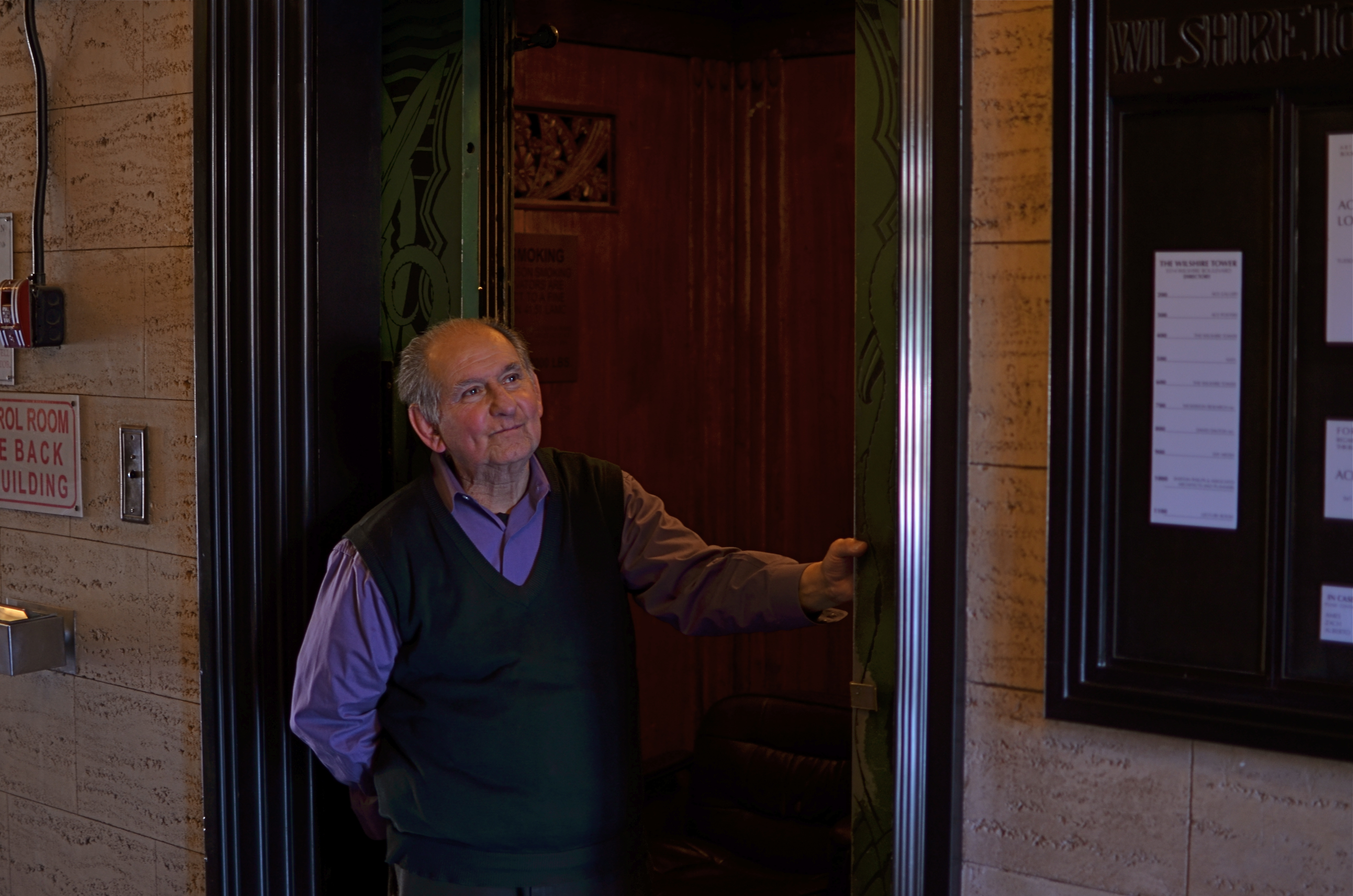
Don’t do the joke about his job having “its ups and downs”: he’s heard it. Ruben Pardo at his post at the Desmond’s elevator. 1/40 sec., f/1.8, ISO 100, 35mm.
I asked Ruben, after thirty-seven years on the job, if he would mind posing for me before his cab. “I’ll just look out toward the street”, he said, and he was right. Mid-morning sun from Wilshire lit his smiling face to perfection as he stood next to his beloved car. It was the look of someone who is doing exactly what he wants to do, a rare thing in a world where we hurry to throw things away, to surge on to we don’t know what. Ruben has earned his little vertical sliver of sky, and he’ll take you up there anytime, himself.
Whenever you’re ready.
Related articles
JUST ENOUGH
By MICHAEL PERKINS
PHOTOGRAPHERS SPEND HALF THEIR LIVES TRYING TO PUT AS MUCH INFORMATION INTO THEIR IMAGES AS POSSIBLE, and the other half trying to remove as much as practicable. Both efforts are in service of the telling of stories, and both approaches are dictated by what a particular photograph is trying to convey.
Sometimes you need the cast of The Ten Commandments to say “humanity”. Other times, just a whisper, an essence of two people talking carries the entire message. That’s where I wound up the other day…with one woman and one very young boy.
Their shared mission was a simple one: hooking up an iPhone Facetime visit with an aunt half a country away. Nothing dramatic, and yet plenty of story to fill a frame with. Story enough, it turned out, for me to get away with weeding out nearly all visual information in the picture, and yet have enough to work with. Time, of course, was also a factor in my choice, since I would be losing a special moment if I stepped into a dark hall and spent precious moments trying to mine it for extra light.
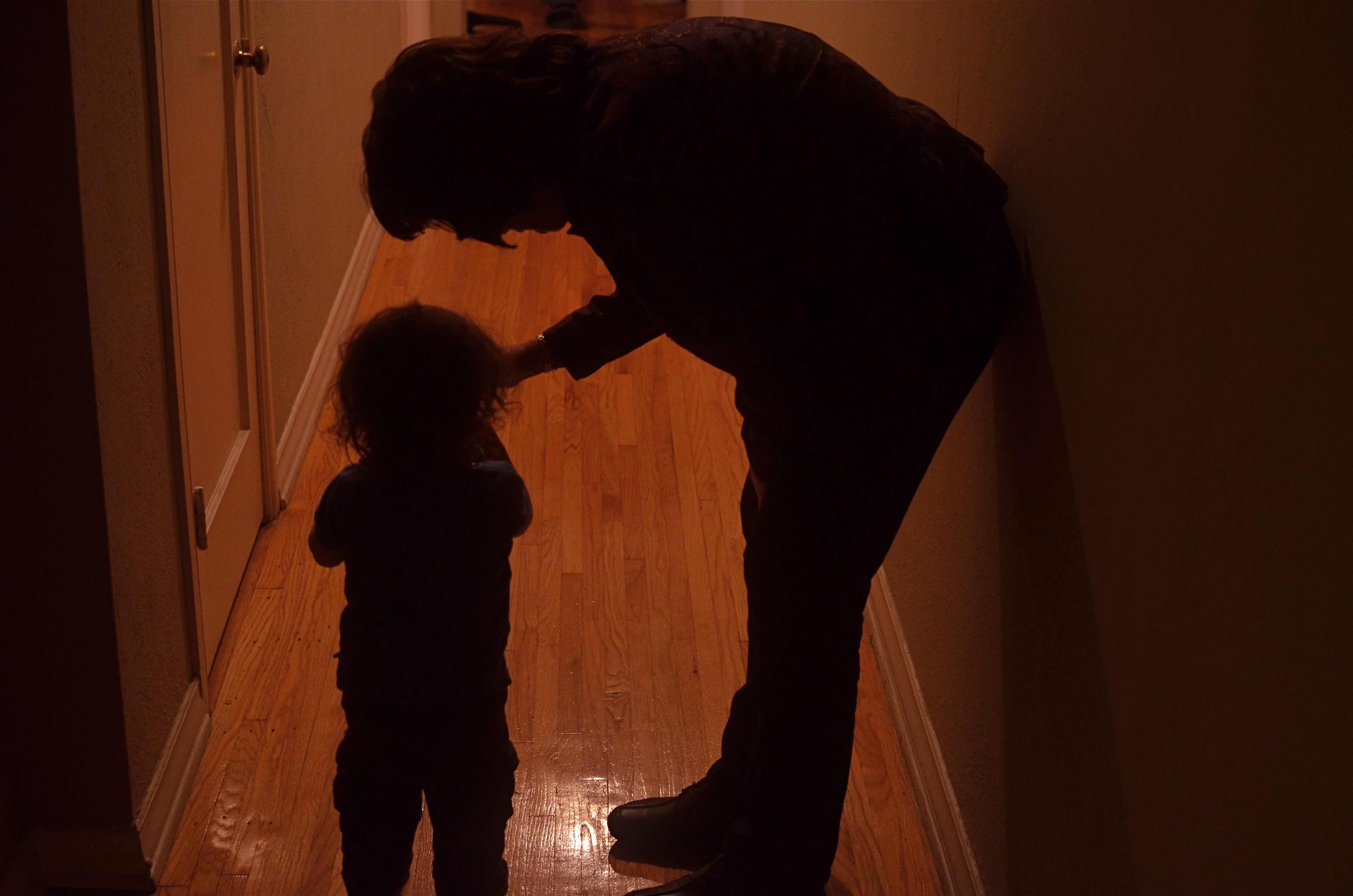
Conference call: 1/50 sec., f/3.5, ISO 800, 35mm.
In a second, I realized that silhouettes would carry the magic of the moment without any help from me. What would it matter if I could see the color of my subjects’ clothing, the detail in their hair, even the look on their faces? In short, what would I gain trying to massage an image that was already perfectly eloquent in shadow?
I exposed for the floor in the hall and let everything else go. There was plenty of story there already.
I just had to get out of its way.
 thenormaleye