OUT OF THE DEPTHS
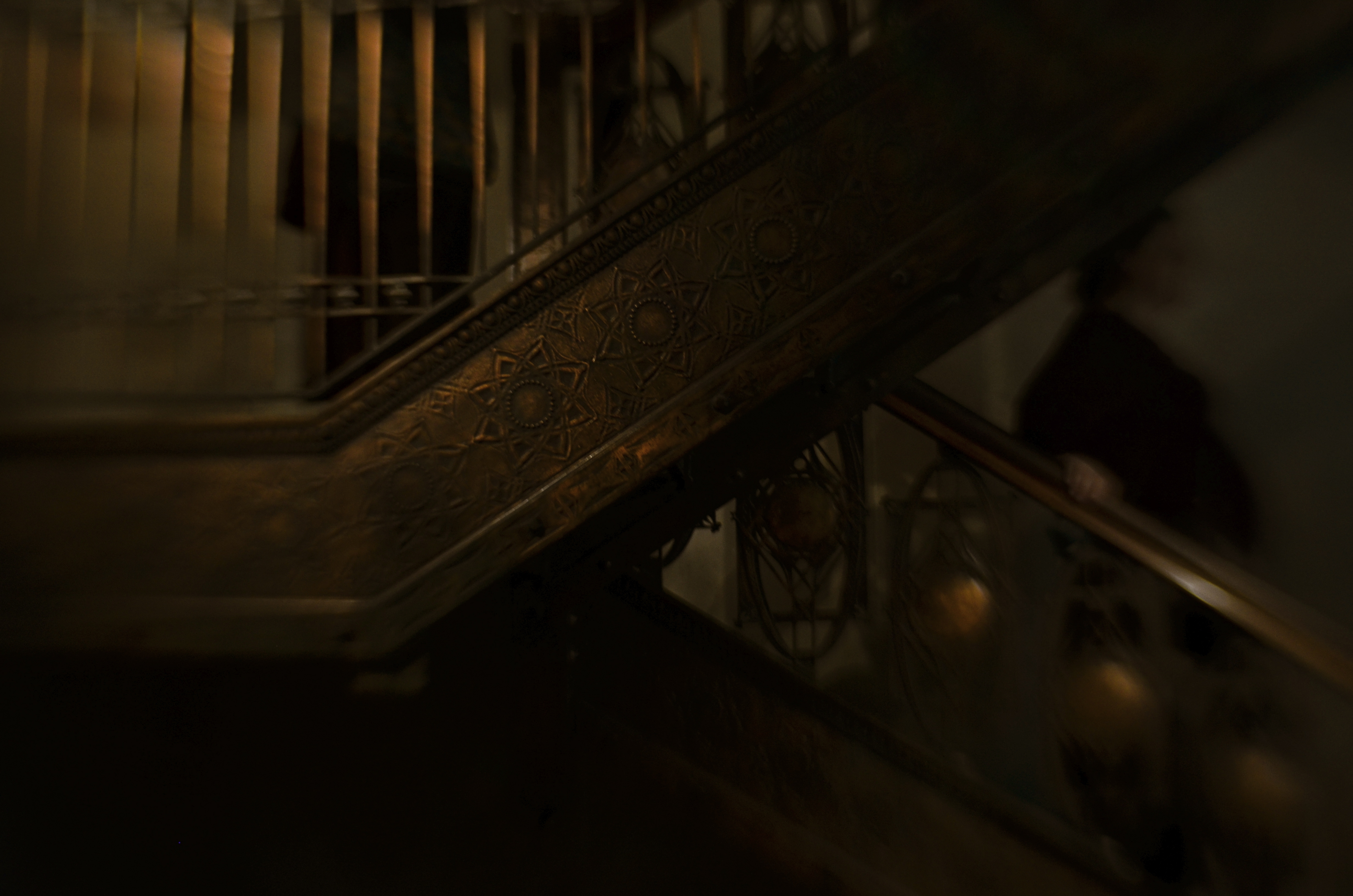
Descent Into…(2017)
By MICHAEL PERKINS
I MAY BE OVER-COMPENSATING A BIT OF LATE, making the kind of correction a newly-minted driver makes when he steers too far in one direction, then steers just as radically in the other. Five years ago, my photography was caught up in the feverish rescue of detail from dark places. I embraced HDR (High Dynamic Range) imaging as a way to illuminate every part of a frame, fearing that important information was being lost in the shadows. I was consumed with delivering what the camera was inefficient at seeing, and spent a lot of time making exposures “balanced”, making sure everything in them was viewable.
These days, by contrast, I seem to be all about the dark, or least its creative use as an element in more and more pictures. Darkness is a lot more subtle than that which is visible, as it merely hints, rather than states, information. I see darkness now the way that graphic artists might have several centuries ago, when the recording medium might be a treated paper that was all colored, or all dark, and the lighter values of a composition might be drawn onto that medium with white paint or chalk.
With such methods, early drawings by Michelangelo and others saw darkness as the start point, with so-called “positive” values sort of extracted from it. In photographic terms, I seem to be taking the same approach to a lot of pictures recently, beginning with a sea of undefined murk and pulling just enough information out of it to create a composition. Whereas, just a few years ago, I was summoning forth every hobnail of detail possible out of a frame, now I am mining the very minimum. I want the unanswered questions posed by darkness to remain largely unanswered. Too much detail means too much distraction.
The practitioners of chiaroscuro (artists like Rembrandt and Reubens) also started with a dark canvas but used light, usually from a single source such as a window, to model their subjects, to give them a three-dimensional quality. I sometimes do that too, but mostly, I am asking the viewer to enter into a partnership with me. The terms: I’ll show you part of the story, and you supply the rest.
Where will I be in the next five years? I’m totally in the dark.
MOZART’S CORONA
By MICHAEL PERKINS
SOME PRACTITIONERS OF PHOTOGRAPHY EMBRACE WHAT THEY CALL REALITY, while other factions run as far away as they can from the strictures of the “actual” world. There will always be shooters who see their main role as that of a chronicler or witness, recording “Joe Friday” pictures, i.e., just the facts, ma’am. Others see the real universe as nothing more than a point of departure. Their images could easily be labeled “based on a true story.”
Neither viewpoint can go it alone. Without reality as a reference point, flights of fancy float off into chaos. Conversely, without a sense of whimsy, the gravity of the world can make a photograph leaden and moribund. Let’s face it: dreamers and didacts need each other, and complement each other within a single picture the way fat flavors lean meat. Moreover, trying to attenuate a customized mix of these two disciplines is the real fun in photography.
I’ve been fascinated of late by the new surge of interest in manual typewriters. It’s the same longing for recently-departed technology that’s fired a revival in film and the rebirth of vinyl lps. We are moving so quickly forward in some ways that we are understandably reluctant to regard every part of our past as dispensible ballast to be jettisoned on the way to some perfect Futureworld. And so we linger a while. We prolong our goodbyes a bit.
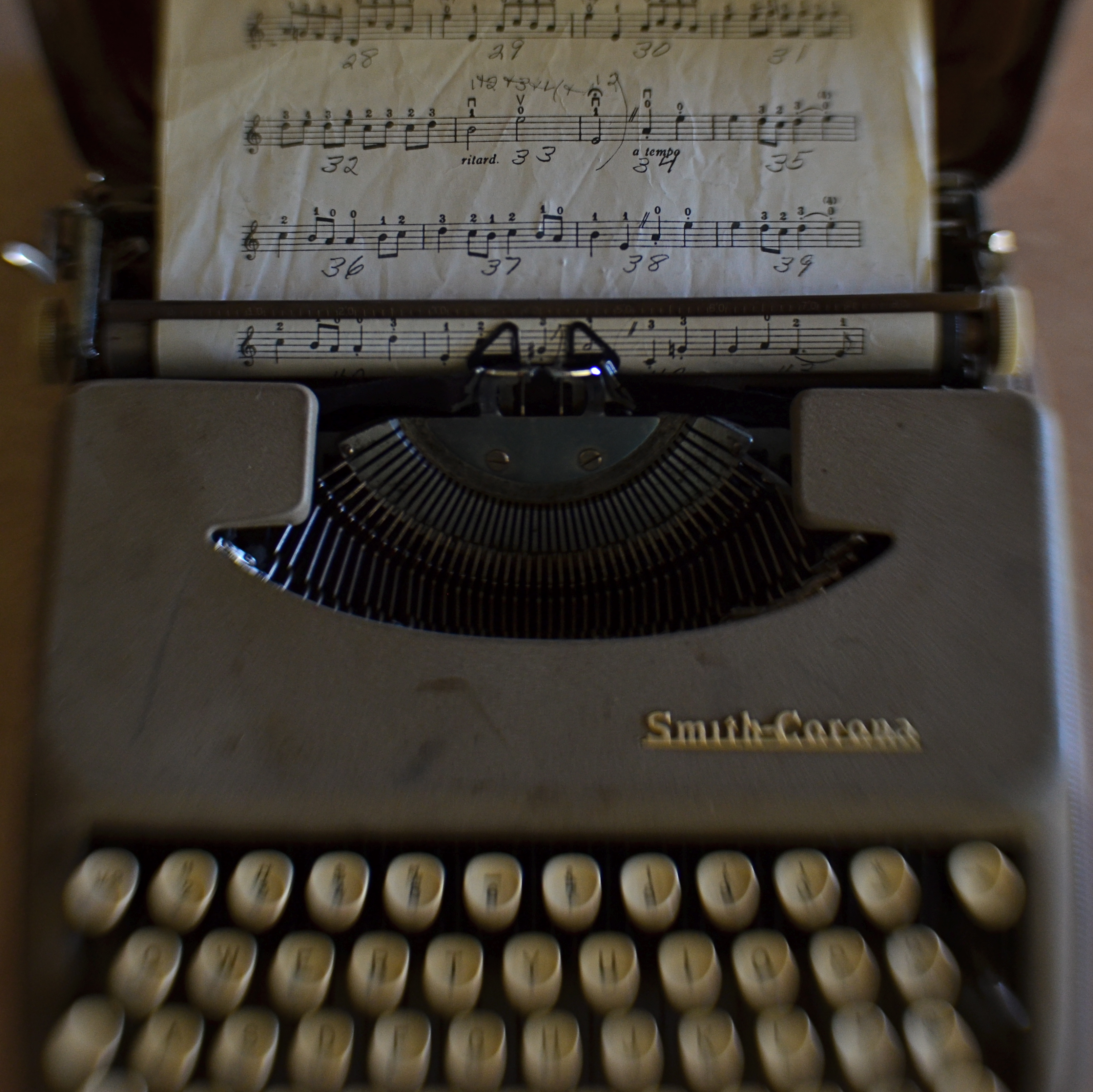
Compose Yourself (2017)
Some writers have recently renewed their love affair with the clack and clatter of the mechanical keyboard, marrying its noise, heft, and bulk to a kind of seriousness, as if a story or essay were somehow more authentic if pounded out on an old Royal or Smith-Corona. The recent documentary California Typewriter takes its title from a scrappy repair shop that survives to the present day by restoring old beaters for a new crop of trendy customers who either admire the sheer engineering wonder or the mystical oomph it confers on their scribblings. High-profile adherents like Tom Hanks, John Meyer and David McCullough rhapsodize about the contours, keyboard height, and return bell of their respective treasures. It’s great fun.
Photographically, I started to explore just how far the idea of the typewriter-as-magical-device could be stretched. Would it endow the user with the ability to solve knotty equations? Conjure ingenious recipes? What if the typewriter had unilateral power to enhance the creation of anything, even melody? What kind of typewriter might help Mozart crank out a concerto? Would his greatest works go mid-performed for centuries just because he transposed certain keys? And what would that process look like?
I decided to use a selective focus lens (the Lensbaby Composer with Sweet 35 optic) to de-emphasize the process of typing (the softly rendered keys) and call attention to the magical product (the sheet music being generated, focused more sharply) coming out of an imagined Corona wielded by an inspired Amadeus. The concept is so ridiculous that it’s compelling, producing a photograph which can’t be true but which ought to be true, rather like Dumbo using his ears to fly despite the fact that he weighs half a ton. I love these kinds of exercises because I embrace the fact that photographs can tell enchanting lies. And as Paul McCartney sings, “what’s wrong with that?”
CAN’T GET THERE FROM HERE
By MICHAEL PERKINS
THE “U.S.A.” OF THE EARLY NINETEENTH CENTURY was, in every way, a collection of separate and unconnected “Americas”. Cities were fewer in number, and the ones that did exist were hermetically sealed off from each other, each in their own orbits in a way that would end when telegraph wires and railroad tracks annihilated distance on the continent forever. At one end of the 1800’s, each town and village was its own distinct universe; at the other end, it was only one of many dots on a line chain-linking the nation as one entity.
In the 21st century, there is only spotty evidence of the days when your town was, in a very real way, the predominant version of “the world” to you. The terms of survival were so very different. “In town” and “out of town” were measured in blocks, not miles. There was a pronounced sense of “how we do things around here”. Local accents were a clearer stamp of identity. News from outer regions arrived slowly. People’s lives impacted each other directly. And the towns first canvassed by photographers reflected the isolation of one city from another, for good or ill.
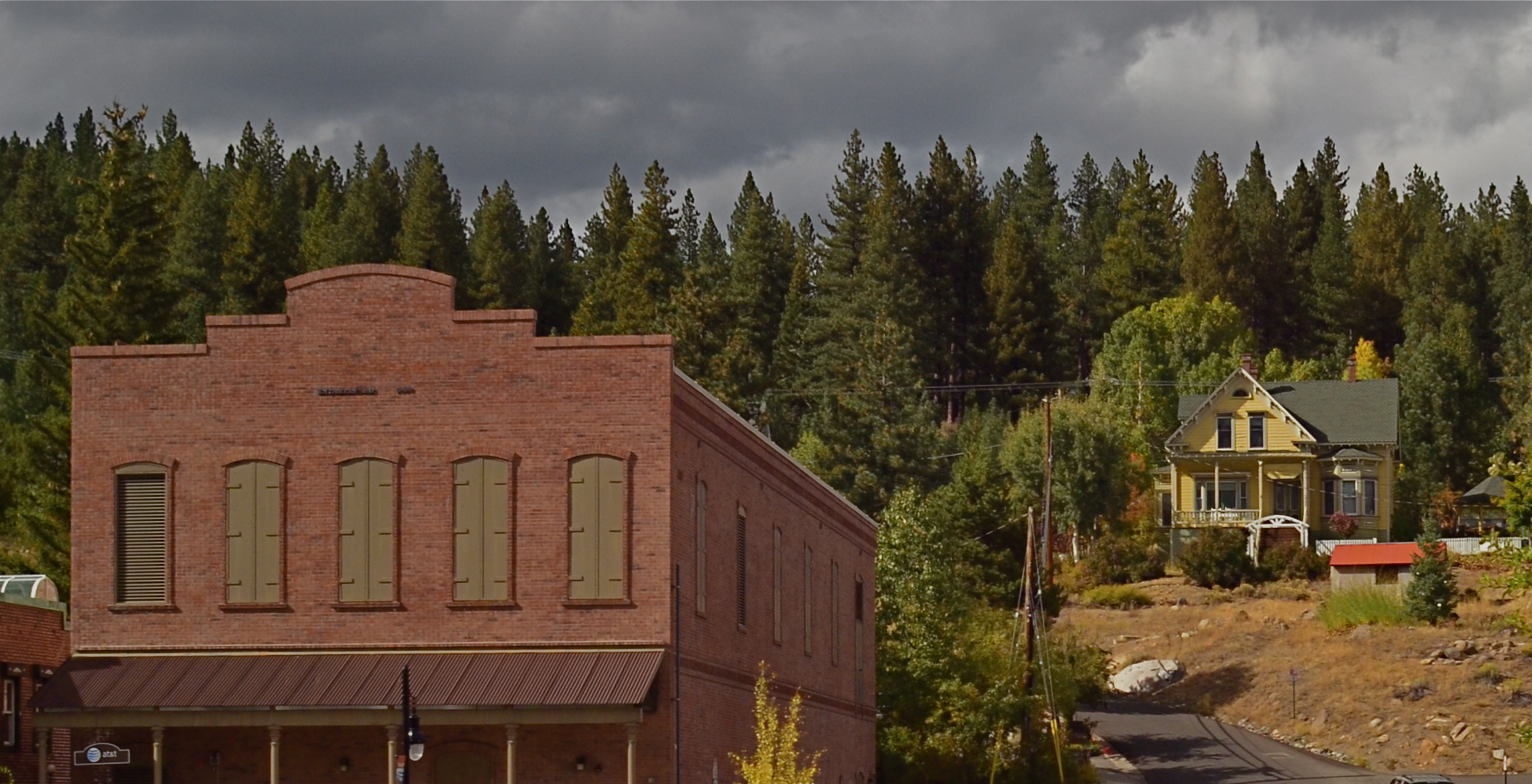
My parents met each other in a town that started small and stayed that way. It’s contracted now, the way a grape shrinks to a raisin; there is still enough of its old essence to identify what it was, but no hope for a future that resembles the past in any remote manner. I love making photographs of places in America where the feeling of apartness is still palpable. It is harder to be hidden away now. We are all one coast-to-coast nervous system, with impulses crossing the void in nanoseconds. The places which still say “our town” are often baffled off from other towns by raw geography….the mountains someone forgot to cross, the rivers no one wanted to ford. And, in the towns walled off by those last remaining barriers, as in this view of Truckee, California in the Sierras, there are still stories to be told, and images to be captured.
I was struck in this picture by how close the residential and business parts of town were to each other, long before we all started spreading out and, well, getting away from each other. It creates a longing in me for something I can’t fully experience, and a desire to use my camera to come as close as I can.
THE VIEW FROM (OTHER) HERE(S)
By MICHAEL PERKINS
THE FIRST EMOTION I EXPERIENCE IN LOOKING AT GREAT COMMERCIAL PHOTOGRAPHERS’ WORK, is, of course, the awe that vision and talent naturally elicit. The second emotion, although I’m not proud to say it, is something akin to old-fashioned, green-eyed envy, given that so many of the world’s best images are, no surprise, taken from the world’s best vantage points. National Geographic, The Audubon Society, NASA, and hundreds of amazing journalists take our breath away not only for what they shoot, but for where they shoot it. Theirs is the stuff of Pulitzers and mass circulation. They literally make the shots seen ’round the world.
But there is, in all this camera envy, a spark of hope for the rest of us. Consider: not all of us can create great work even, by being in the right place at the right time. We also have to be the right people to make a shot eloquent, even if we’re standing at the edge of momentous events or breathtaking views. Yes, sadly, many of us won’t be sent by our editor to the sites with the greatest potential, or have enough liquidity to venture to them on our own dime. Most of us won’t be across the street for those moments when the world changes.
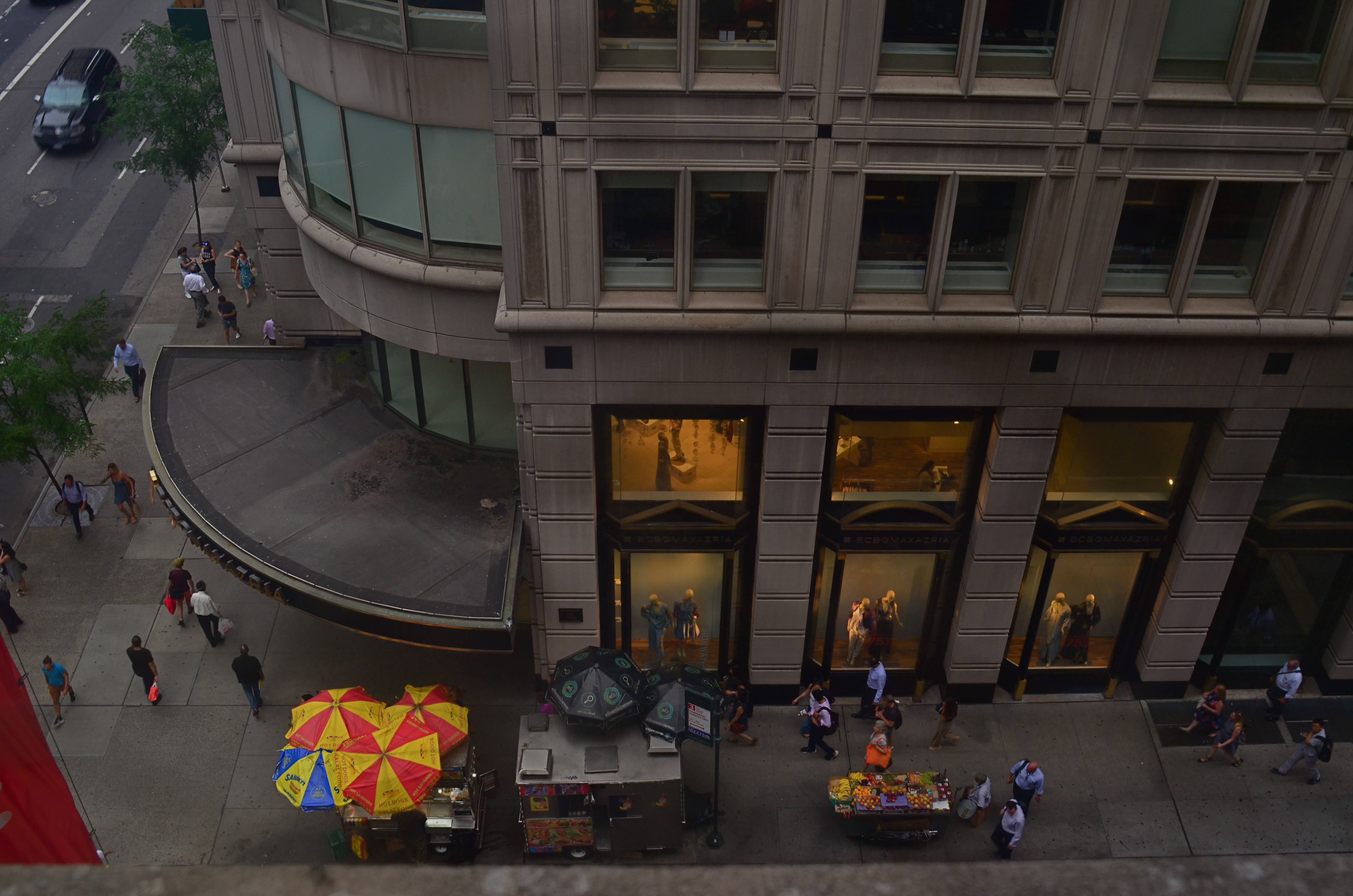
A bird’s-eye view of a “common” street scene. Does the point of view make a difference?
But here’s the deal: we do control the way we approach the places that we can get to. We can be the difference between a mundane and a miraculous image, even if the subjects we cover might escape everyone else’s glance. And we can re-imagine, through an angle, a viewpoint, a sensibility, something that’s been thought to be “photographed to death”, and harvest something fresh from it. Our cities, our daily routines, our most familiar mile markers need not have a single, “official” identity in photographs. Where we stand, what we choose to say, transforms even the most well-trod material. The street corner in the image at the top has mostly been seen or photographed at street level. Did I find something new in shooting it from an eighth-story window? And if I didn’t, could someone else?
Cameras, even the most expensive ones, don’t create beauty. Events, no matter how momentous, don’t guarantee stunning images. It’s the eye at the viewfinder, and the brain behind it, that determines whether a picture speaks.
NOMADS
Animate/Inanimate (2017)
By MICHAEL PERKINS
IN A PARTICULARLY CHILLING SCENE from the classic film The Third Man, Orson Welles, as the story’s amoral profiteer Harry Lime, looks down from a carnival ride to the teeming, tiny throngs on the pavement below, distancing himself from people that have been reduced, in his mind, to mere ‘dots’. ” Tell me”, he asks his friend Holly Martens, “would you really feel any pity if one of those dots stopped moving forever?” Lime has, in fact, been selling tainted medicine to desperate refugees in post-war Berlin, and his product does, almost certainly, make several of those dots stop moving. Forever. Horrible, and yet his estrangement from his fellow wanderers on that sidewalk occurs all the time in all our minds. When we look more carefully, more compassionately, however, photographs can happen.
We are all nomads, wanderers, dots on a map. We convince ourselves that our journey is surely taking us toward something….a very important something. As for everyone else….what? Like Harry Lime, we place great emphasis on our own story, with ourselves cast as the hero. In fact, though, pulling one’s eye just far enough back from the throng can show our camera’s eye the real story. Every journey, every destination is equal….equally vital or equally banal. It’s the process of observing that seeking that creates a tableau, a composition. That, and how we view it.
James Thurber, Destinations
I take a lot of images of crowds in motion: streaming in and out of buildings, rushing for trains, teeming through malls, crowding the subway. What they’re after isn’t what gives them the drama. It’s the continuous process of seeking, of going toward all our collective somewheres, that provides the narrative. I don’t try to record faces: these are moving chess boards, not portraits. Additional clinical distance can come from the use of monochrome, or angle of view. Sometimes I think of the overhead camera shots of director Busby Berkeley, he of the kaleidoscopic dance routines in 42nd Street and other ’30’s musicals. The rush of the crowd is all a kind of choreography, intentional and random at the same time.
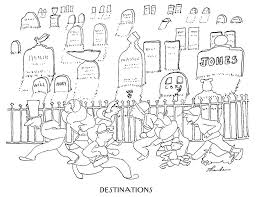
One of the images that brought this idea home to me as a child was a cartoon James Thurber drew for the New Yorker titled “Destinations”(above left). It shows, simply, a rightward mob rushing toward a leftward mob, with a cemetery in the background. Everyone is headed for the same end point but all act as if they are bound for someplace else. The story for a photographer in all this wandering lies in how we look as we do it. Where we eventually wind up may well be fate’s whim, but the story of all the comings and the goings, of ourselves and our fellow nomads, is in the hands of the camera.
ACCIDENTALLY ON PURPOSE
By MICHAEL PERKINS
THE IMAGE SHARING GROUP UTATA, which operates within Flickr, has been, for this boy snapper, a daily touch of Christmas. It expands upon the rather pointless online quest for mere “likes” and is, instead, a genuine dialogue with other like-minded strange-o’s who want to push the boundaries of at least their own eyes and commiserate with others who long to do the same. The administrators keep Utatans united with periodic, deadline-based homework assignments organized along a a variety of seriously unconventional themes. Some require serious thought. Some can be created almost completely on impulse. And many more fall somewhere in between.
One of the nice bits of insta-fame conferred upon Utatans is having their work occasionally plugged onto the utata.org welcome page. Even better, head honcho Greg Fallis and his fellow guardians of the Utata universe will often provide new captions, poems, or essays of their own for the images, as if to tangibly demonstrate that, just as there is more than one way to see, there are a million ways to be seen. Upon recently conferring home-page status on a rather hurried celphone image I’d posted, Greg also managed to perfectly crystallize thoughts I’ve mulled over recent years:
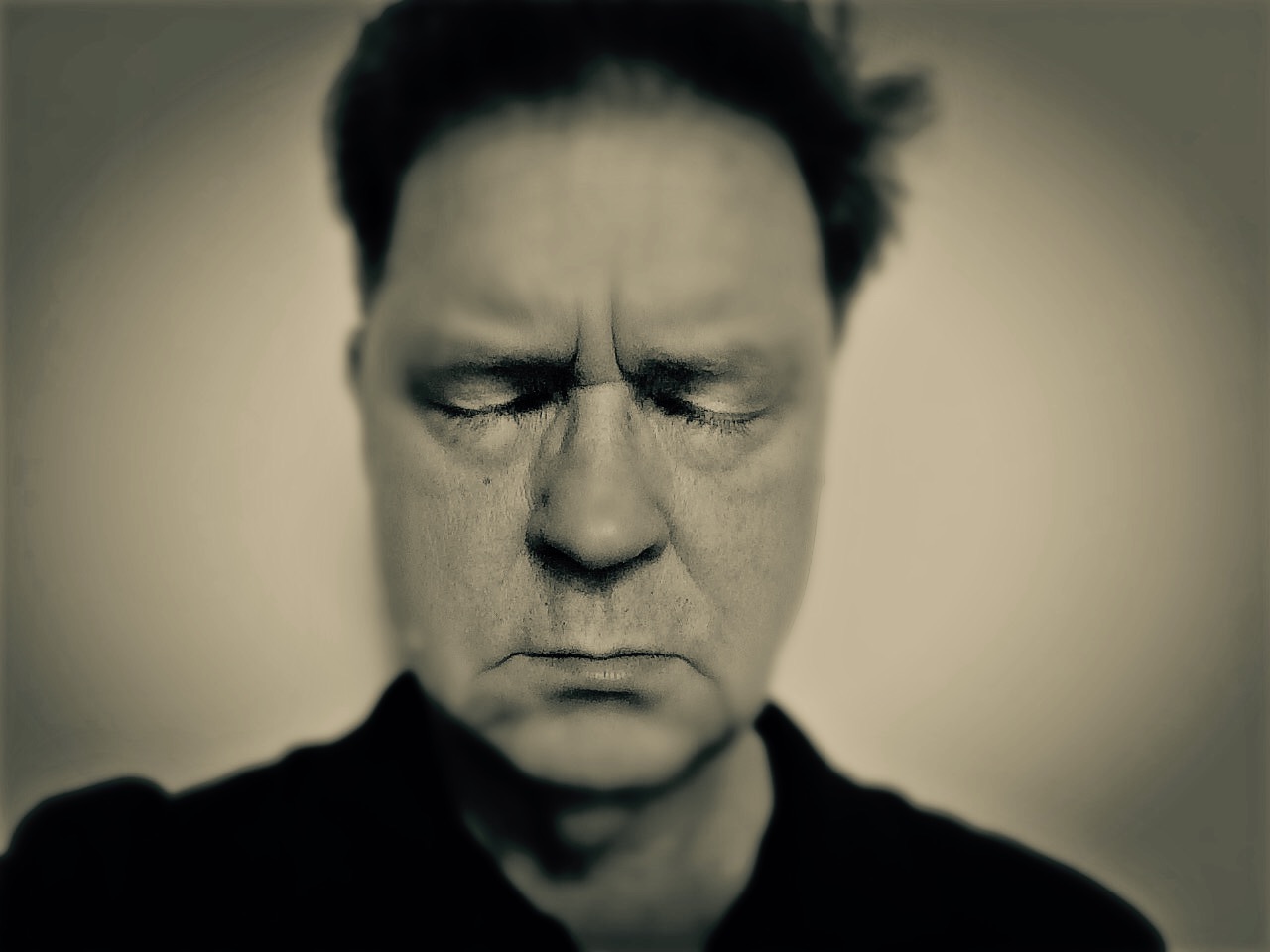
A quick impulse, a thing of no importance. And that, in itself, may be important.
See, here’s the thing about shooting photographs with your cell phone: it’s not a serious camera. That means you can relax. Try stuff. Shoot something different. Shoot something familiar in a different way. Shoot something different in a familiar way. It’s liberating because it’s “just” your cell phone.
In fact, the image was made in a very short space of time, shorter by far than if I’d made it with my “real” cameras. The original phone selfie was fed through an app designed to mimic both the strengths and weaknesses of antique portrait lenses, and, since I liked the ethereal quality it delivered, I decided to stop. Just stop. Stop fooling, fretting and fixing. Stop, and publish.
So, have I gotten to the point, at least some of the time, when I’m really living that old saw that “the best camera is the one you have with you?” Am I more spontaneous, more open to experiment, higher up the “wot the hell” scale when armed with a cel? Dunno. Really. Not being coy. I definitely still feel that umbilical-cord connection to my trad gear. But I dig immediate gratification as well, at least the gratification of shortening the gap between “wonder what would happen” and “hmm, that kind of worked.”
Is my conventional gear more “real”than my iPhone? Well, how do you define real? Obviously, there is an almost infinite number of post-processing tools available to compensate for whatever shortcomings the cameras themselves might possess. So, if I do advance prep in a DSLR before the shutter snap to ensure a good picture, does it disqualify an image if I snap it first and then enhance it afterwards in a cel? What is a darkroom? What is a workflow?
Big questions. And I don’t always get the same answers when I ask them.
ROLL-PLAYING
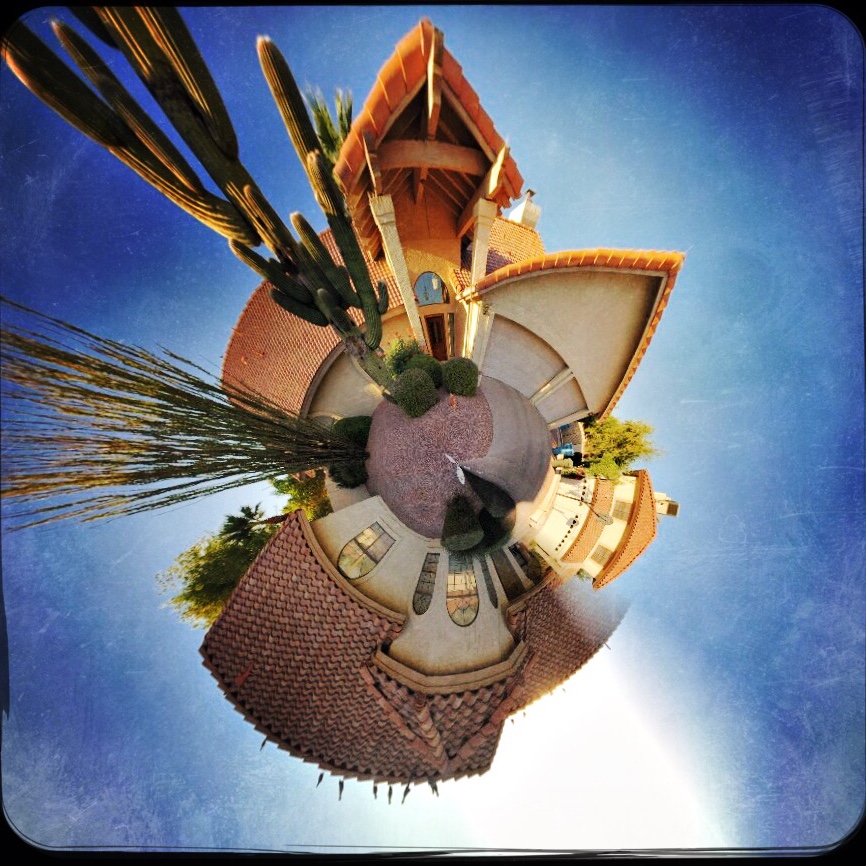
A typical “small planet” effect created in the phone app Rollworld.
By MICHAEL PERKINS
MANY OF THE APPS BEING PEDDLED as post-production fixes for mobile photographs are one-trick ponies, limited in their range. This is less so than it once was, with new apps adding progressively more features, but there are still tons of single-purpose processes out there, gobbling up phone storage with apps that perform one task well. Want a second task? Download another app.
The fun part for me is to discover that, while a given app may have been created to solve a particular problem, it can also be used creatively to do something completely different. Take the example of the now-cliched creation of so-called “small planet” pictures, in which a standard landscape is spiraled into a ball shape, with its various tree and buildings now looking like features on a self-contained world, rather like the illustrations in The Little Prince. This process was once a somewhat complicated one, but, like almost everything else in the digital world, it’s been shorthanded to a few clicks and sliders in apps like Rollworld, which is not only cheap but insanely simple to use.
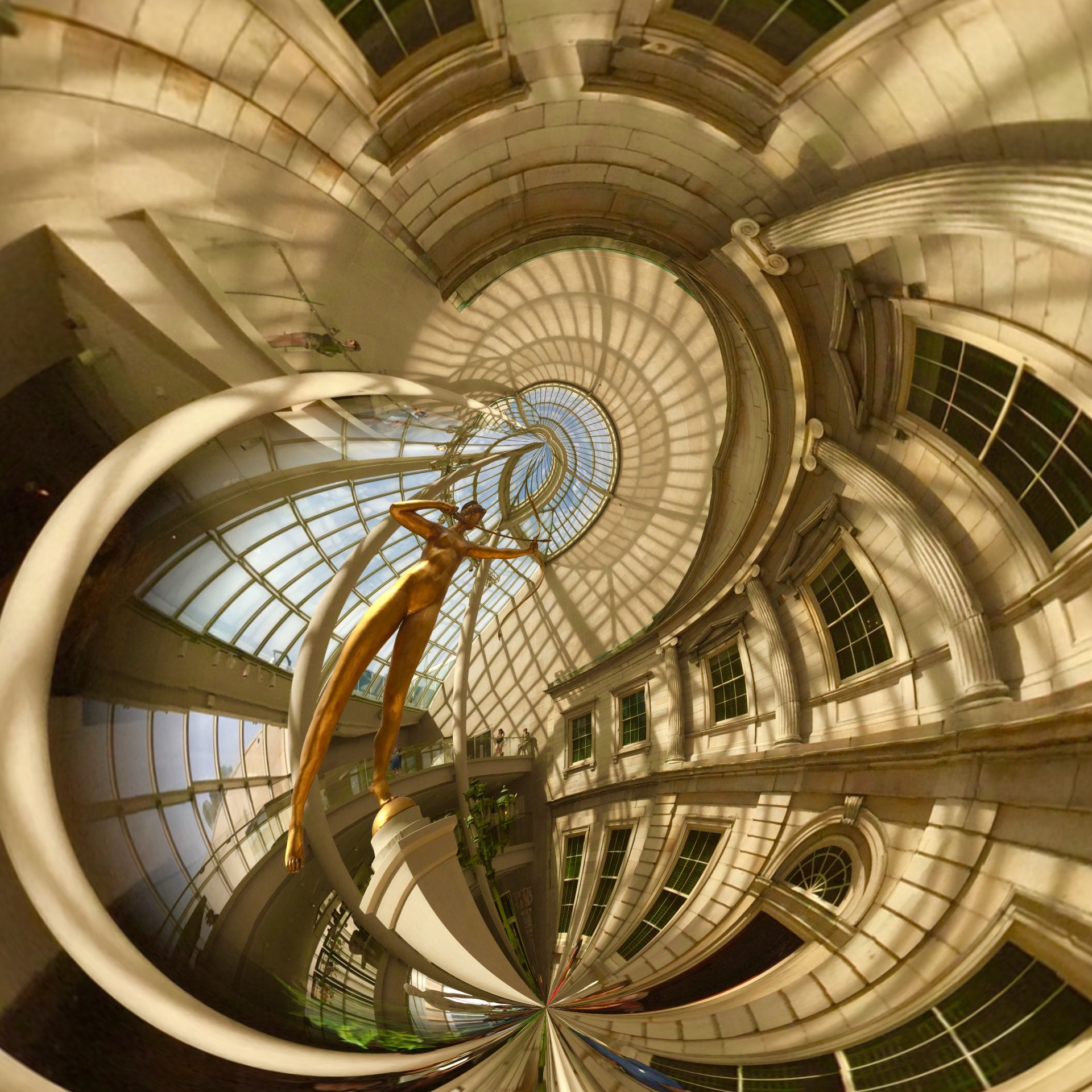
A DSLR image uploaded into a celphone and remixed in the Rollworld app.
If you approach the use of such a specialized app in the simplest way, you’ll produce your five or ten little planet images (see photo at upper left corner), get the novelty boiled out of your blood, and then move on to something newer and shinier. However, Rollworld and programs like it can be a nice creative tool beyond their most obvious trick. The various sliders in RW let you not only roll your original linear image but control how it rolls, allowing a kind of folding-in, folding-out distortion. You can thus completely abstract even the most mundane cityscape into a symmetric pattern of textures, maximizing small things or relegating prominent features to the background. Other Rollworld sliders allow you to determine the tightness or looseness of the roll, to control the angle of the pitch, even swipe features from one part of the image across parts of the others to mirror or multiply specific items into a better symmetry. Call it Kaleidoscope-in-a-box.
I even import some of my standard DSLR images from various websites like Flickr (see above right) into my phone so they can be processed by the app as well. One problem: You want to save your end product at the highest possible file size. Even at that, some of them will only display well on monitors or the web, and may be too small for good resolution when printed out. This is a major problem with phone images in general: they are still designed, for the most part, to be outputted to other phones and screens.
The idea here is that many apps are capable of giving you more than the advertised effect if you play a little. It takes so little time and effort to experiment that you quickly build experimentation into your typical workflow. And that can only help you grow faster as a photographer.
IT HAPPENED RIGHT HERE. DIDN’T IT?
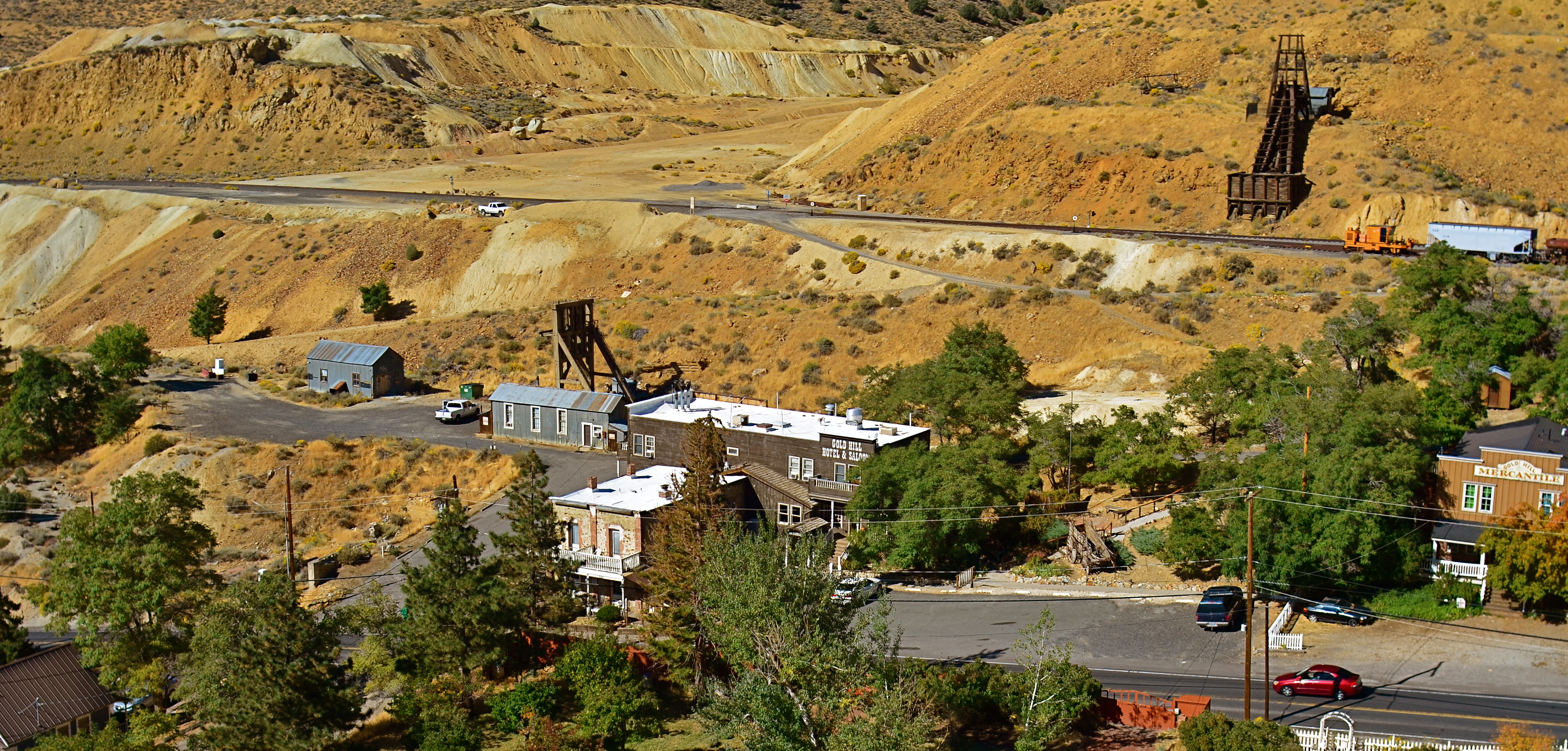
After The End, Before The Finish (2017). The back porch to Virginia City, Nevada, once one of the richest towns on the face of the earth.
By MICHAEL PERKINS
AMERICA HAS NO LOVE OF INTERMEDIATE CHAPTERS. We’re big fans on huge, new beginnings of things. We are likewise fascinated by catastrophic finales. By contrast, the stories that take place between the first and last episodes of things are like flyover cities between the coasts.
Consequently, we tend to generate photographic tonnage when the Bright Shiny New Mall cuts its opening day ribbon, and crank lots of frames on the day the Sad Old Mall is razed to the ground, but not much quotidian stuff. There may indeed be less drama in the day-to-day goings-on in towns, public works, and other human endeavors. or maybe we just bore easily. Or maybe we haven’t learned to detect the tiny stories that rise and fall between the more obvious bookends of history.
Boom and Bust are big news to photographers. Humming Along Normally, not so much.
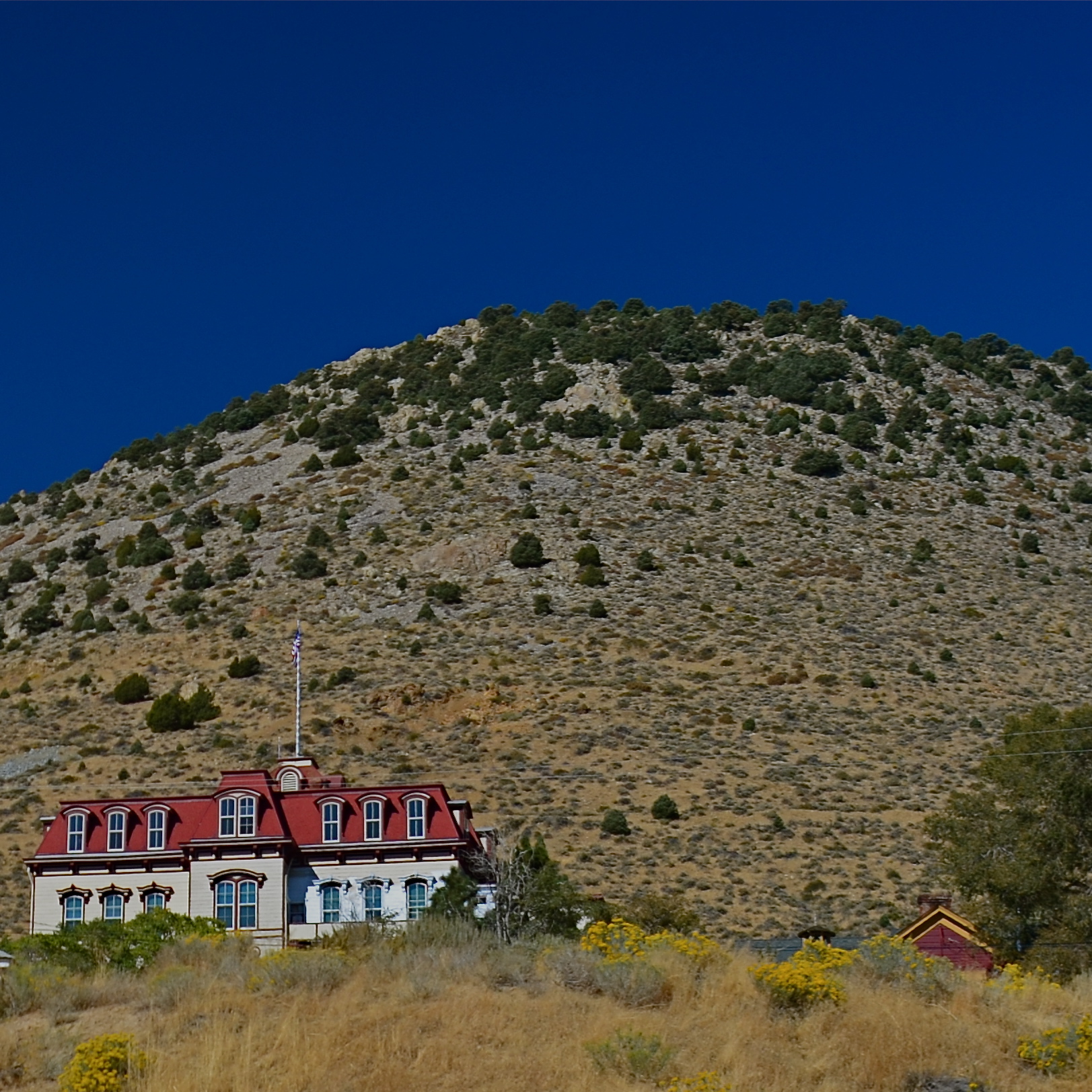
Virginia City’s Fourth Ward Schoolhouse, now a museum.
Virginia City, Nevada typifies what Americans call Ghost Towns, places which ran their life cycle from explosion to collapse but still physically exist in some way. Some are mere hollowed-out ruins crumbling in the dust, while others, like Virginia City, have survived as commercial entities (spelled: tourist traps) selling nostalgia. They make money recalling how they used to make money, which, in the case of V.C., was mining silver. This little bus stop of a town was once one of the wealthiest places on the planet, ripping ore out of the ground and sending it all over the world at a rate that minted a new millionaire every few minutes. Virginia City had its own short line railroad making freight runs hundreds of times each day. Its well-heeled lords imported materials from every continent to appoint opera houses, churches, hotels and saloons with glitter and grandeur. And the city created one of the most progressive elementary schools in the nation, equipped with central heating, flush toilets, water fountains, and individual student desks….in 1876.
Ghost towns are the walk-through museums, the pickled cadavers of American life. They’re finished but they aren’t through. There is a bright coat of paint replicating the gaiety of better times, but, beyond the fro-yo stands, ersatz whiskey joints and souvenir shoppes, the skeleton of a very different daily life is still visible. And a well-aimed camera can still summon a degree of Boom within the Bust.
THE MIDDLE OF WHATWHERE
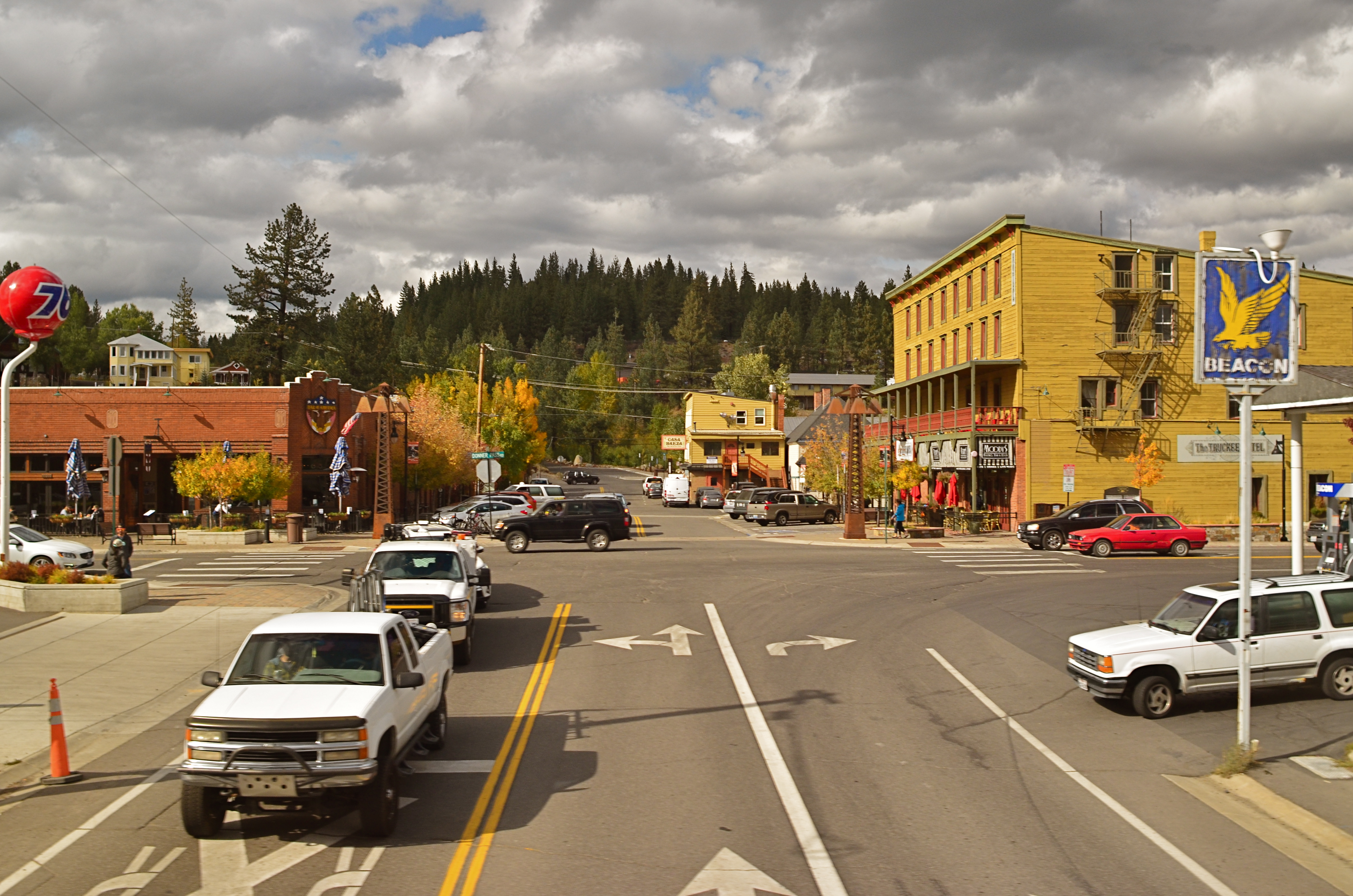
Rush Hour (2017). I don’t need to tell you what town this is. You already kind of know.
By MICHAEL PERKINS
EVEN THOSE AREAS OF THE WORLD WE ‘VE NEVER SET FOOT IN have, at least in our mind’s eye, a sense of place. Hearing about far-flung cities and towns in remembrances, histories, or novels, we tend to assign some kind of visual structure to their streets and sites. Our brains choreograph where the town hall is, what the schoolhouse looks like, maybe even the look of the setting sun on the sides of buildings. We see the unseen with very clear eyes.
For that reason, I love making images of towns that offer no clear clue as to their location or even era. I feel that the images made by a camera pair up, somehow, with the millions of mentally constructed towns we’ve held inside our minds, those many places to which we never journey but yet know by heart.
Train travel offers a great chance to deal with these places that have no context, sometimes no name. The view from a train window is ever-shifting, strangely framed. You have visual information it gives you and nothing else. Things swing into and out of view in an instant. You are always going somewhere and always leaving somewhere behind. Focusing and composing with a camera is largely a nightmare, and sharp results are rare. It’s a great way to view reality, and also a terrible arena for photographing it.
Occasionally, a slow crawl through a town or a scheduled stop offers enough stability to make a usable photo, and, when that happens, the sensation is still one of dislocation, since you often are seeing only pieces of cities, the outskirts of districts, or the all-too-real “wrong side of the tracks”. Recently traveling from Sacramento, California to Reno, Nevada through the Sierras, my train slowed almost to stopping as it made its way past a small town’s crossing gate. The city was both everywhere and nowhere. The activity in the intersection could be taking place in a thousand places, each of them interchangeable with the others. I left my seat and walked from the second level of the car halfway down to the lower, where a larger window was mounted, placing me as close to the street as if I were crossing it on foot. The train slowed long enough for me to snap off three stable frames, one of which you see here. For a moment, I’m in the town, nearly of it. I don’t know where I am. Still, I feel right at home.
Years from now, as I turn the pages of a magazine or listen to someone’s dreamy tales, this place might act as a visual stand-in for the dimensions and details of things I can’t directly view. I don’t know why or how the mind makes that work. Maybe, in a way, we’re always making pictures, with or without a camera.
PALLBEARING FOR HDR
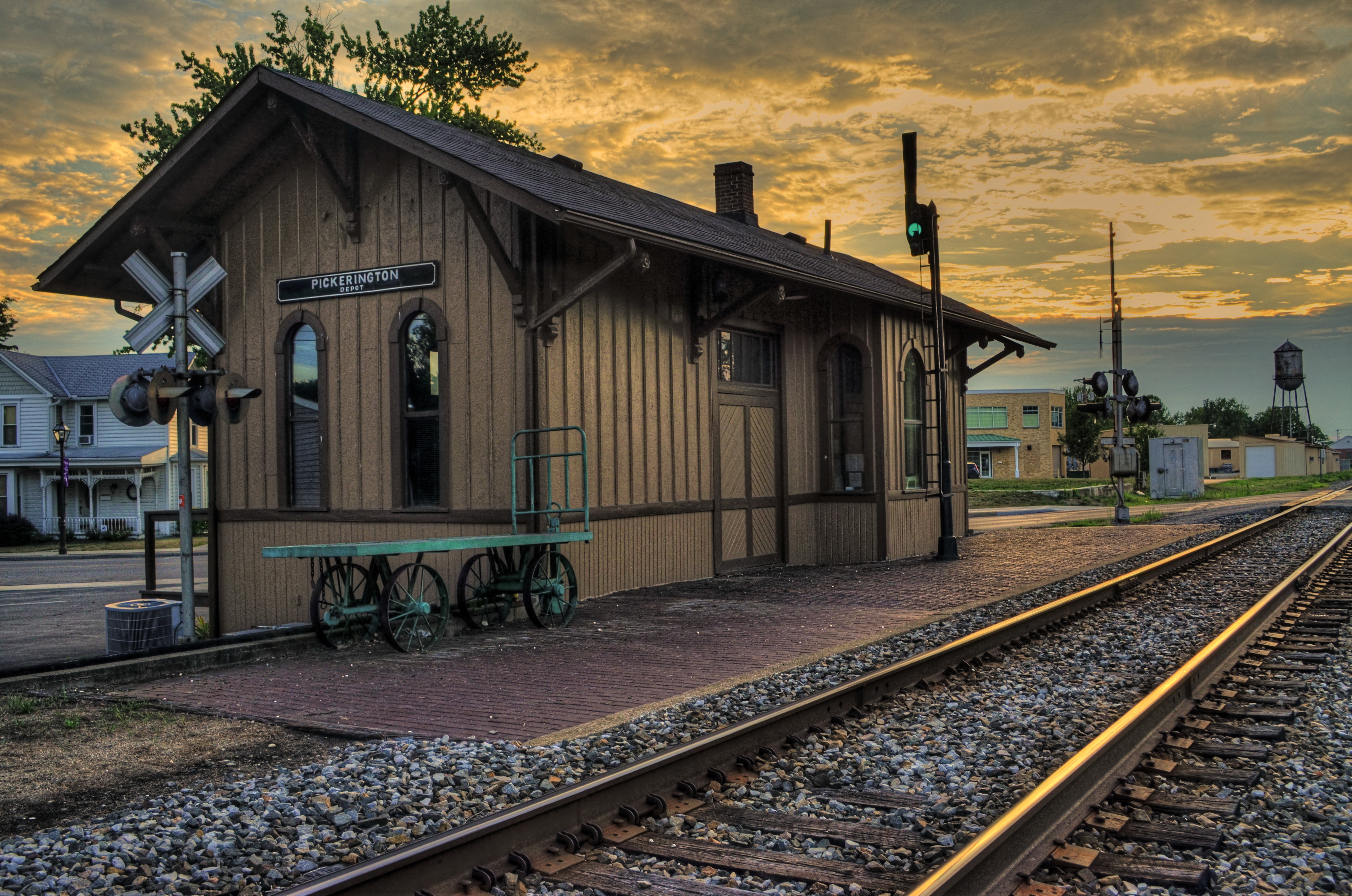
HDR processing, initially touted as a more “real” look, is actually anything but.
By MICHAEL PERKINS
MANY OF THE TECHNOLOGICAL ADVANCES IN PHOTOGRAPHY, over the centuries, have been made as specific remedies to the limits of either cameras or recording media. Lenses and films were made faster, sharper, or more accurate because photographers were thwarted by the cramped parameters of the media. Such a cycle of malady-and-cure creates temporary and manic convulsions, fads if you like, along with solid, permanent improvements. Sometimes, as in the case of the now declining technique known as High Dynamic Range, or HDR, it’s easy to confuse a quick fix for a permanent one.
To review, HDR was an attempt to compensate for the limited range of light recorded by first-generation digital sensors, which effectively “read” extreme highlights or shadows, but were spotty in the mid-ranges, delivering only a portion of what the eye could detect. The solution was to take a bracket of anywhere from three to seven frames over a wide exposure range (grab your tripod, kids), then blend them, via software, to more consistently even out all values for a “balanced” or “natural” view. The other side-benefit of the process was a drastic amplification in detail.
HDR was immediately praised as having helped the photographer hurdle the last remaining barrier between the camera and real life. It quickly muscled its way into everything from amateur landscapes to commercial real estate, conferring prophet (profit?) status on authors like Trey Radcliffe, who soared to best-selling fame with books brimming with hyperbolic color and iridescent textures, every hobnail and brick in his goth HDR cathedrals registering the same, loud detail.
And that sameness, eventually, became the problem. Every part of every picture was now shouting. In the hands of many, HDR did not make images evenly modest: it made them uniformly garish. Too many HDR pictures were overripe, overcooked, as if the world were awash in day-glo gravy. Worse, the technique couldn’t work with live subjects or hand-held shots. Worse yet, in-camera HDR simulators in DSLRs and phone apps were virtually useless. Finally, if you actually liked photographing, you know, actual people, HDR made human flesh look like wet liver inside a tanning booth.
In the end, the problem HDR was created to address actually resolved itself, with second-gen camera sensors finally performing better along a wider range of light, delivering more even exposures right out of the camera. More importantly, photographers fell back in love with shadow, understatement, and mystery, satisfied that you don’t have to show everything to see everything. So, rest in peace, HDR. There now are better ways to keep it real.
THE MAN IN THE ROUND CUBE
 By MICHAEL PERKINS
NOTHING IS SO TIMELESS as something whose time has come and gone.
Once a thing… a style, a design element, a fashion, an idea…has outlasted its original context, becoming truly out of sync with the world, it can become visually fascinating to the photographer. Instead of forward-looking, it’s dubbed “retro”. Rather than radical, it becomes something no one can ever remember having been excited about, like looking at Carol Brady’s shag haircut 25 years on.m
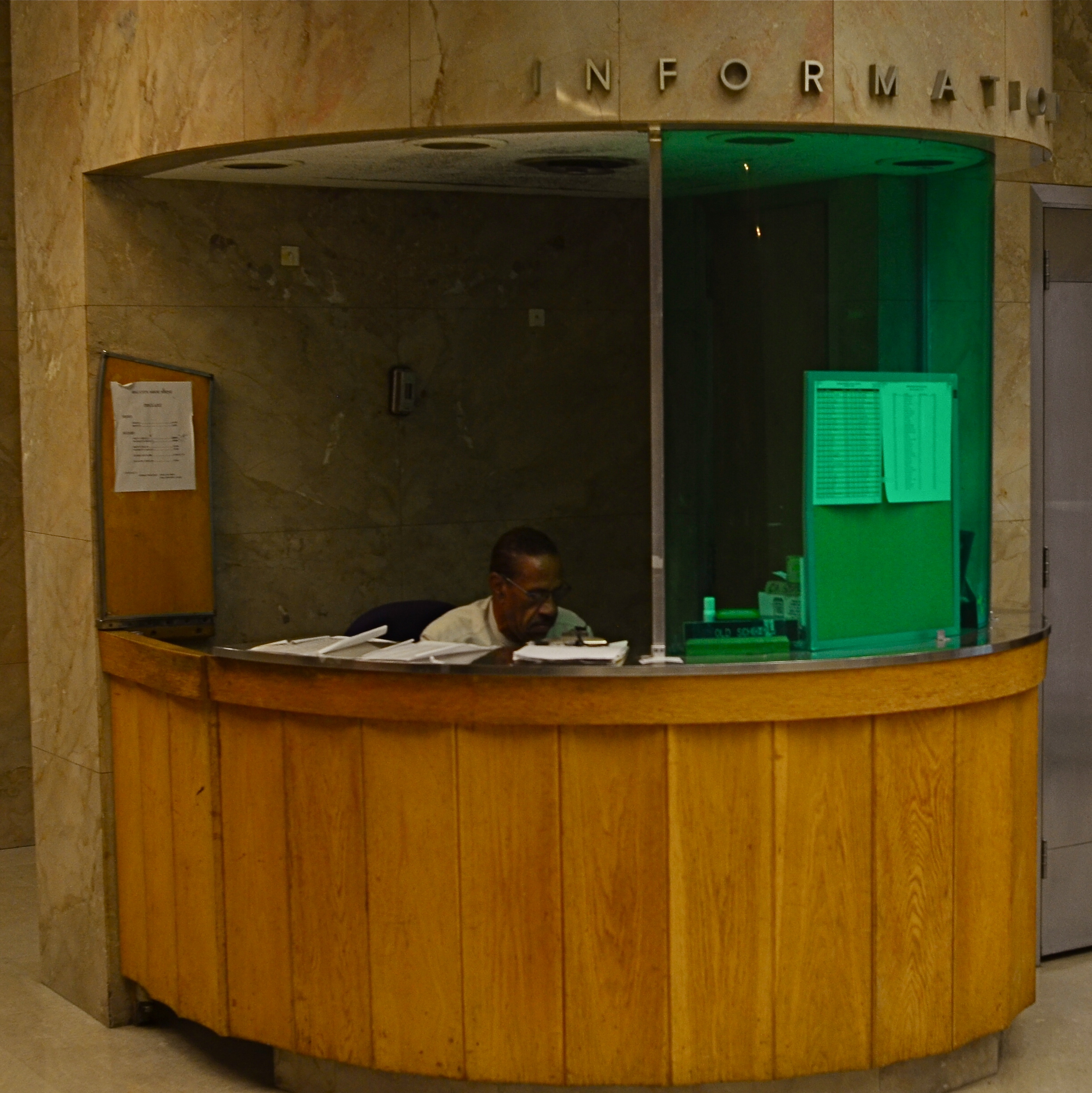
The information booth in the frame shown here is one such anomaly, so odd a fit in the building that it’s part of (the California state capitol annex) that it wrenched my attention away from a pretty good tour. The wing the booth is part of, built from 1949 to 1952, is, generously speaking, as dull as dishwater, indistinguishable from most generic government buildings, a box of sugar cubes.
But the booths are something else again.
Far from the typical marble-block, cage-and-window, bank teller enclosure many public servants call home, the booth is curved wood and glass, sounding a faint echo of Art Deco which extends even to the aluminum letters that spell out INFORMATION. And yet, at present, the modernity of the original design is now itself antique, its lonely occupant looking as if he were banished to his post rather than assigned.
The lighting within the booth is so minimal that the poor man’s features are nearly swallowed in deepening shadow: he looks like a recreation in some museum diorama about What Offices Will Look Like In The Future!!!, as strange to view as “modern” renderings of someday space rockets as seen from 1950. And then there’s the insect-repellant visor green on half of the glass, which is there, I assume, to protect Mr. Info from harsh gamma rays(??). The entire effect is one of loneliness, of, again, the evidence of a time (or a man) whose time has come and gone. And that calls, in my world, for a picture.
PLANDIDS
By MICHAEL PERKINS
NOWHERE ELSE IN PHOTOGRAPHY does the conflict between mere recording and deliberate interpretation manifest itself more than in the portrait. We love the spontaneity of the unposed snap, with its potential for capturing the innocent, unguarded moment. However, snaps are a random thing, and by nature undisciplined, raw. The control of the studio, with its calculated exposure and modulated light, has its allure as well. It’s not like we want it both ways: no, we definitely want it both ways.
Hence the emergence of the Plandid.
Recent trends on social media have given rise to a new portrait hybrid called the planned candid, or “plandid”, formalized shots that are designed to create the illusion of a spontaneous snap. In fact, people have been faking “happy accidents” like these for as long as there’ve been cameras. What distinguishes plandids from earlier versions of faked reality, however, is that most of them are self-portraits and the majority of them are created primarily on mobiles.
In some ways this was inevitable. Everyone, but everyone has already done the trombone-arm, face-only selfie, the wide-screen lenses on our phone cameras distorting our heads into ovoids and ballooning our noses into sausages. Enter the plandid, which feeds into two dearly held articles of human faith; one, nothing is more worth pointing a camera at than us; and two, the only person who gets us well enough to turn us into something even more fascinating is….wait for it……us.
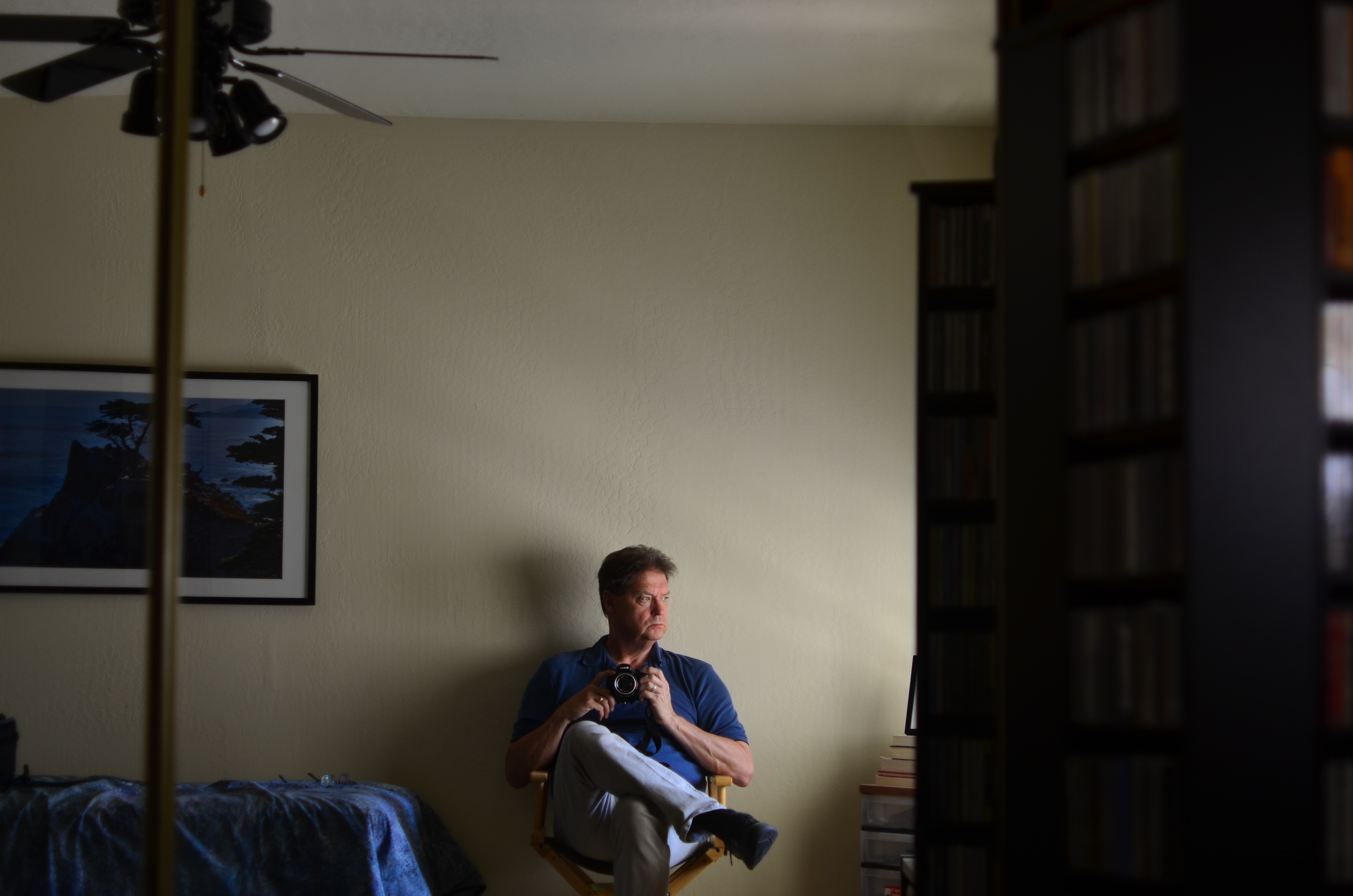
“Plandids” are a kind of Selfie 2.0.
And thus arrives the age of Selfie 2.0, in which we employ tripods and timers and pull the typical headshot back, to reveal entire bodies, props, and atmosphere. However, doing that much advance prep is way too much like conventional photography, and thus anathema to the hipster within, so the trick becomes faking the look of having “just stumbled upon” a great picture. Huh?
Of course, I’m exactly like the school dietitian who guiltily sneaks fries on the side, because of course I have absolutely hopped into this narcissistic playpen, doing my own plandids with a DSLR for that extra degree of control. Add my own patented, wistful away-from-the-camera look and you get the perfect moment in which I’m caught by some discerning, lucky amateur (me) in a stolen moment of quiet (fake) contemplation.
Diane Arbus once called a photograph a lie that tells you the truth. But there’s something to be said about just flat-out lying, just for fun.
ON THE JOB
Information, Please (2017)
By MICHAEL PERKINS
ONE OF THE MOST EXHAUSTIVE portrait projects in the history of photography was August Sander’s Face Of Our Time, a collection from the 1920’s of sixty formal portraits of German tradesmen of every class and social station, each shown with the tools or uniforms unique to his chosen profession. Sanders photographed his subjects as documents, without any hint of commentary or irony. The story in their pictures was, simply, the visual record of their place in society and, eventually, as cultural bookmarks.
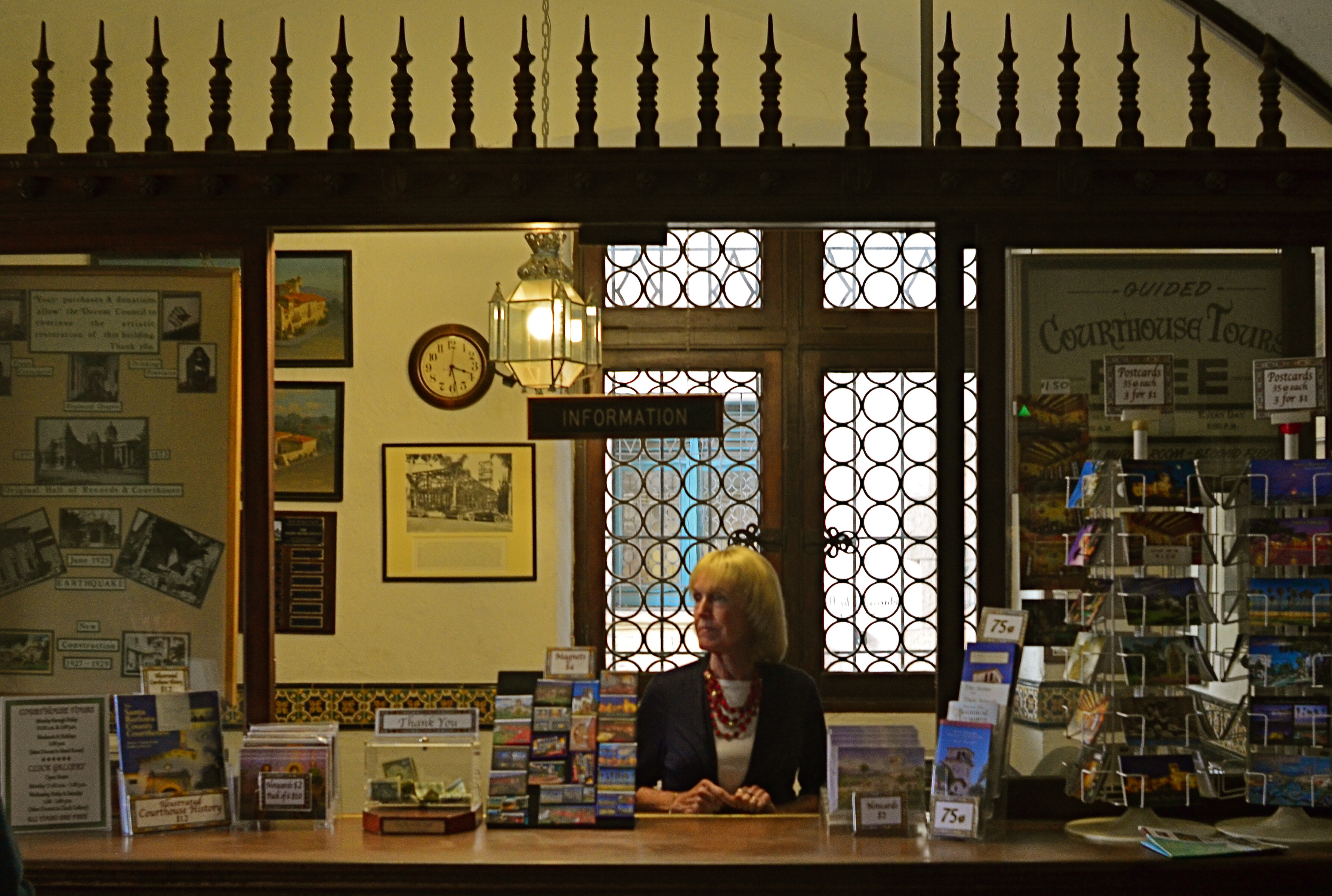
Since Sander’s eloquent, if clinical work, similar photo essays have taken on the same subject with a little more warmth, notably Irving Penn’s Small Trades portrait series from the early 1950’s. Like Sander, however, Penn also shot his images in the controlled environment of the studio. In my own work, I truly feel that it’s important to capture ordinary workers in their native working environment, framed by everything that defines a typical day for them, not merely a few symbolic tools, such as a bricklayer’s trowel or a butcher’s cleaver. I also think such portraits should be unposed candids, with the photographer posing as little distraction as possible.
I really like the formal look of a studio portrait, but it doesn’t lend itself to reportage, as it’s really an artificial construct….a version of reality. So called “worker” portraits need room to breathe, to be un-self-conscious. And, at least for me, that means getting them back on the street.
LEADING THE WITNESS
 By MICHAEL PERKINS
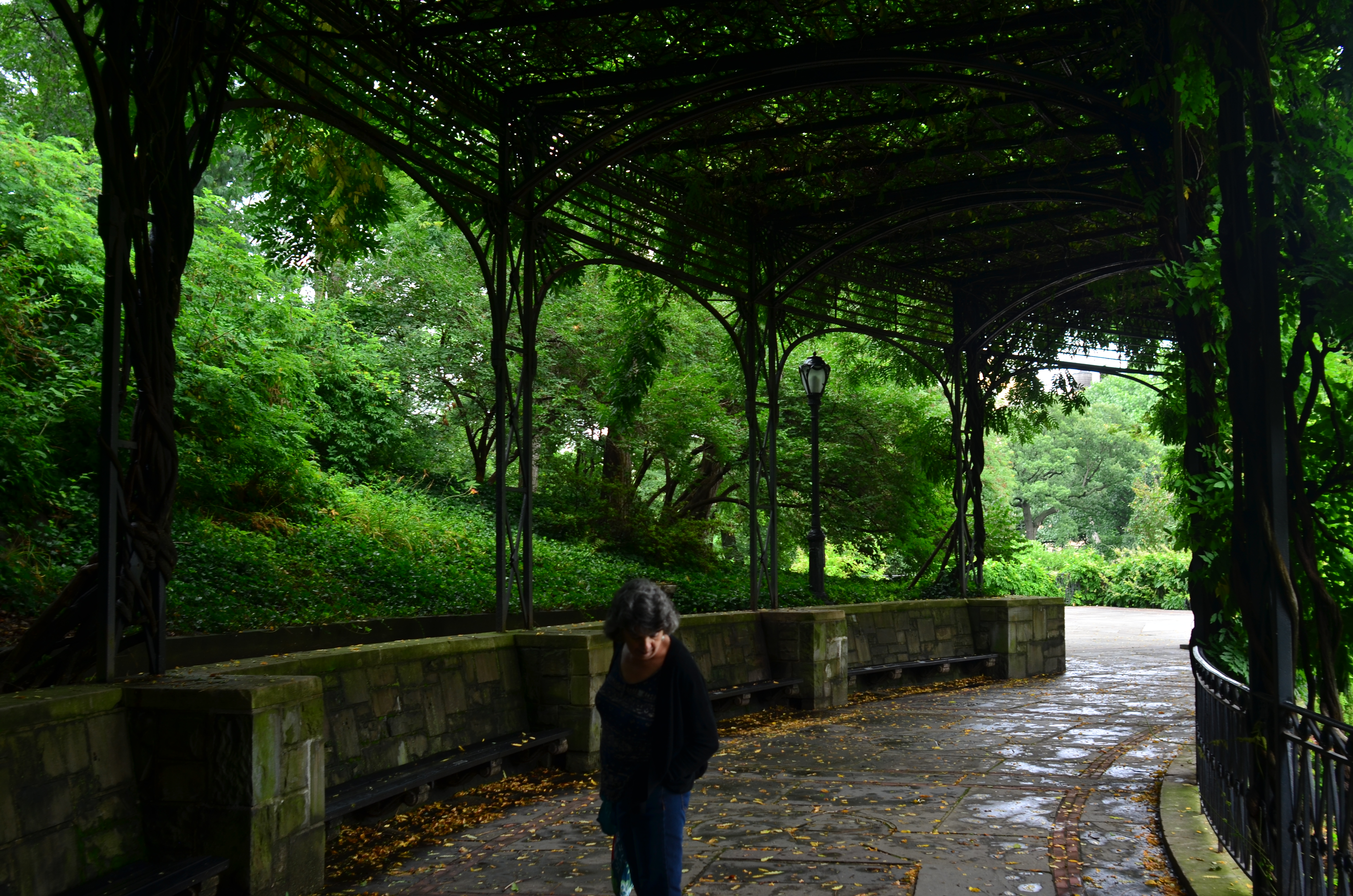
“MEN ARE NOT INTERESTED“, said Jerry Seinfeld, “in what’s on tv. Men are interested in what else is on tv.”
The joke conjures up an image of some remote-happy goof in a man-cave endlessly clicking through channels in search of something ever better than what he already has. And it’s true, which makes it all the funnier. It also speaks to how all humans, both men and “not men”, view photographs, and how shooters can play to that propensity.
All photos, sliced as they are out of the continual flow of time, come with an implied sense of what went before the click and what’s to come after it. Trying to use the information from a stilled moment of time to mentally supply those two temporal bookends is an ever-fascinating game between photographer and viewer. What happened just before this? What will happen next?
In composing a frame, the photographer uses all the tools at his command to influence his audience’s assessment, including the simple device of leading lines, which can be used to direct the viewer’s eye wherever the artist wants it to go. LLs are usually effective in drawing you deeper “into” a picture that obviously only has two dimensions. Think train tracks at the front of the picture, receding toward the horizon. These lines tell you that you are being asked to go somewhere, and that you should be curious about what’s waiting for you there.
Leading lines can also go from what is shown in the picture to what is implied, asking you to speculate, as in the case of the above frame, what’s around the next bend, or, in Seinfeldian terms, “what else is on tv”. It’s a strange fact that, no wonder what may be shown within a photo, the most fascinating thing to the viewer’s mind, at least, may be the stuff that was left out of it. We all want what we can’t have, and knowing that very human thing can empower a photographer to much more effectively control the frame.
ON DISPLAY
By MICHAEL PERKINS
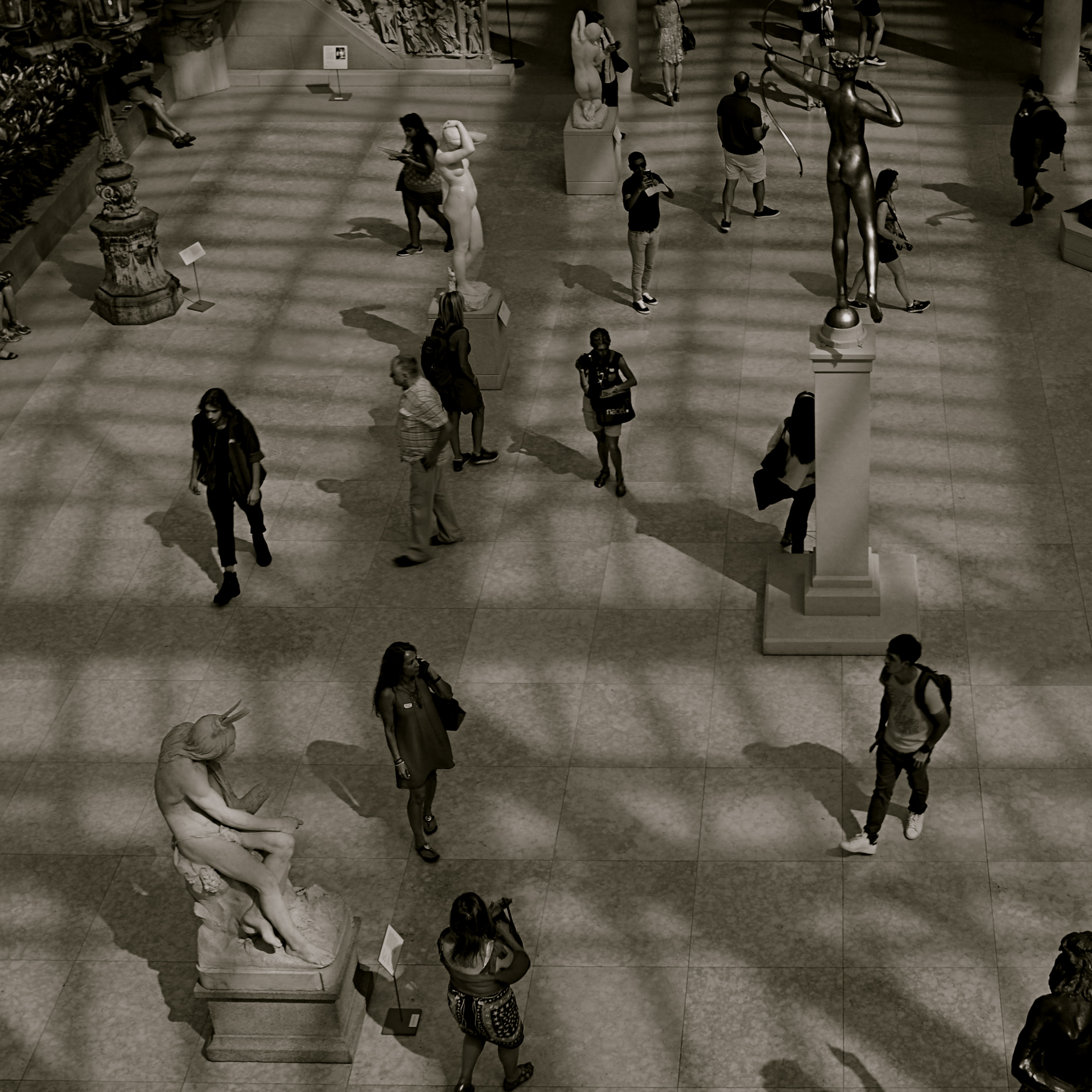
ALTHOUGH MUSEUMS ARE DESIGNED as repositories of history’s greatest stories, I often find that the most compelling narratives within those elegant walls, for the photographer in me, are provided by the visitors rather than the exhibits.
We’ve seen this effect at zoos: sometimes the guy outside the ape house bears a closer resemblance to a gorilla then the occupant within. With the museum experience, making controlled, serene exposures of the artifacts is never as interesting as turning your reporter’s eye on the folks who came in the door. The juxtaposition of all the museum’s starched, arbitrary order with humanity’s marvelously random energy creates a beautifully strange staging site for social interaction….great hunting for street shooters.
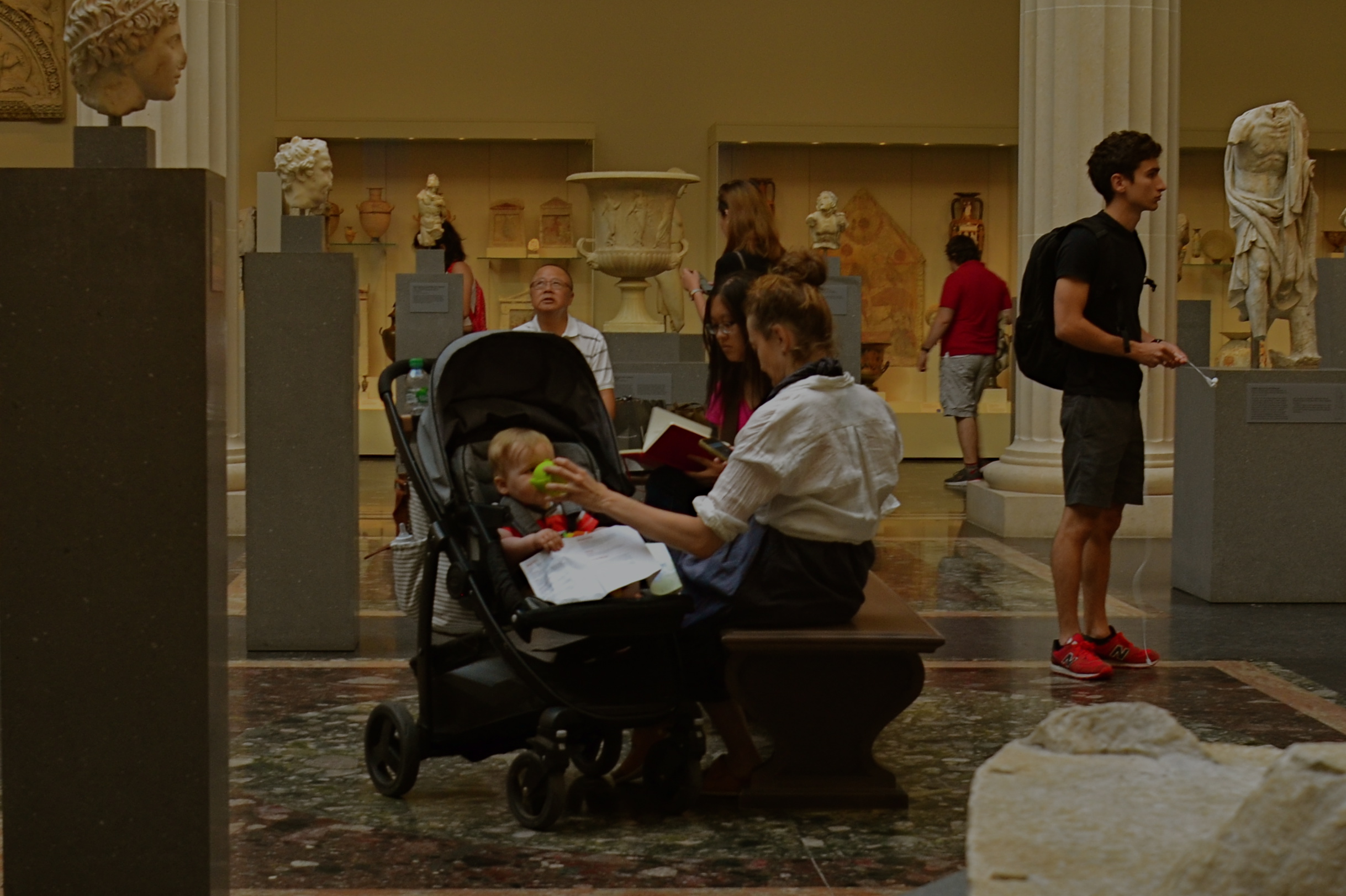
The sculpture gallery shown here, one of the most beautiful rooms in Manhattan’s Metropolitan Museum of Art, is certainly “picturesque”enough all by itself. However when the room is used to frame the chessboard-like weaving of live humans into the pattern of sculpted figures, it can create its own unique visual choreography, including the mother who would love to bottle-bribe her baby long enough to finish just one more chapter.
Anyone who’s visited The Normal Eye over the years recognizes this museum-as-social-laboratory angle is a consistent theme for me. I just love to mash-up big art boxes with the people who visit them. Sometimes all you get is statues. Other times, one kind of “exhibit” feeds off the other, and magic happens.
RIDING THE SLIDER
By MICHAEL PERKINS
ONE OF THE MUST–HAVES during the golden age of component stereo was the graphic equalizer, a panel on the front of many hi-fi receivers that divvied up the audible spectrum into five zones, allowing the discriminating audiophile to create a custom low-midrange-hi mix of frequencies by adjusting each zone’s vertical slider switch. It gave a clear representation of the desired fidelity curve. It was visual. It was visceral. Most importantly, it was cool, man.
The “slider” is also, for me, a frame of reference for my photography, since it gives me a mental picture of where I’m at along the track from work that’s left-brained (precision-driven, analytical) and right-brained (instinctual, reactive, emotional). The slider almost never travels to either extreme in the making of pictures, but veers closer to one or the other in a custom e.q.’d mix between rational control and total abandon. This is becoming more common with photographers in general than at any time in the past. When it came to crafting an image, we almost always asked about the how of things. Now many more of us also ask about the why.
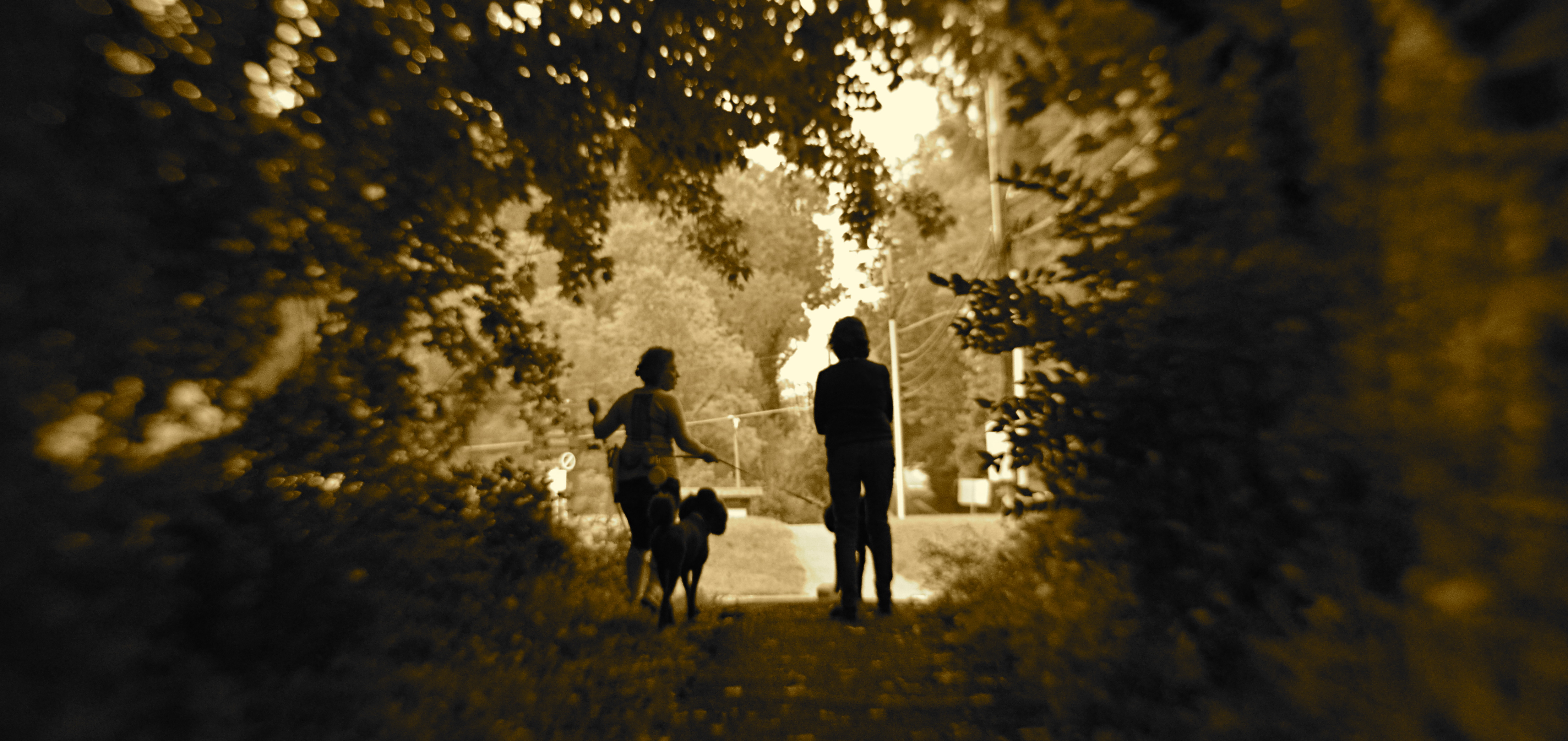
The above image is illustrative of this balancing act. In walking behind the two women emerging from a forest at the end of their dog walk, I was never going to have a lot of time to formally set up any one shot…..not unless I was willing to interrupt the ladies’ together time, which seemed counter-intuitive at best. Optically, I was shooting with a selective-focus lens, designed to be sharp at the center, then progressively softer at the edges. Additionally, I decided to under-expose both women, eliminating all detail and reducing them to silhouettes. This meant that I had to wait until they were fairly centered in the clearing at the edge of the woods, one of the only reference points I would have for sharp focus, the backlighting of their forms, and any suggestion of depth.
And so you have a shot which is neither all-rational nor all-instinctual but a mixture of the two, the slider’s mid-point between preparation and improvisation. Total adherence to the left brain can produce shots which are technically precise but emotionally sterile. Working too much on the right side can yield pictures that are chaotic or random. Learning to jockey the slider is at least as important a skill as either composition or conception.
GET YOUR MIND RITE
By MICHAEL PERKINS
“REALITY”, THOUGHT TO BE the normal end product of the process of pointing a camera at something, is actually rather limiting. Sure, our little boxes were originally created as an accurate, even scientific means for recording our world.. a method more reliable, somehow, than the imprecision of the painter. Soon afterward, however, the camera longed for a soul of its own, or at least the painter’s freedom to make a subjective choice as to what “real” should look like.
Bottom line: for photographers, mere reality turned out to be, well, kind of a yawner.
To go even further, it seems to me that certain subjects actually call for a kind of unworldly, almost hallucinatory quality, an attempt to make things look not like what they are but how they feel. Of course, we can’t actually show emotions or states of mind, but various photographic techniques can, and should suggest them.
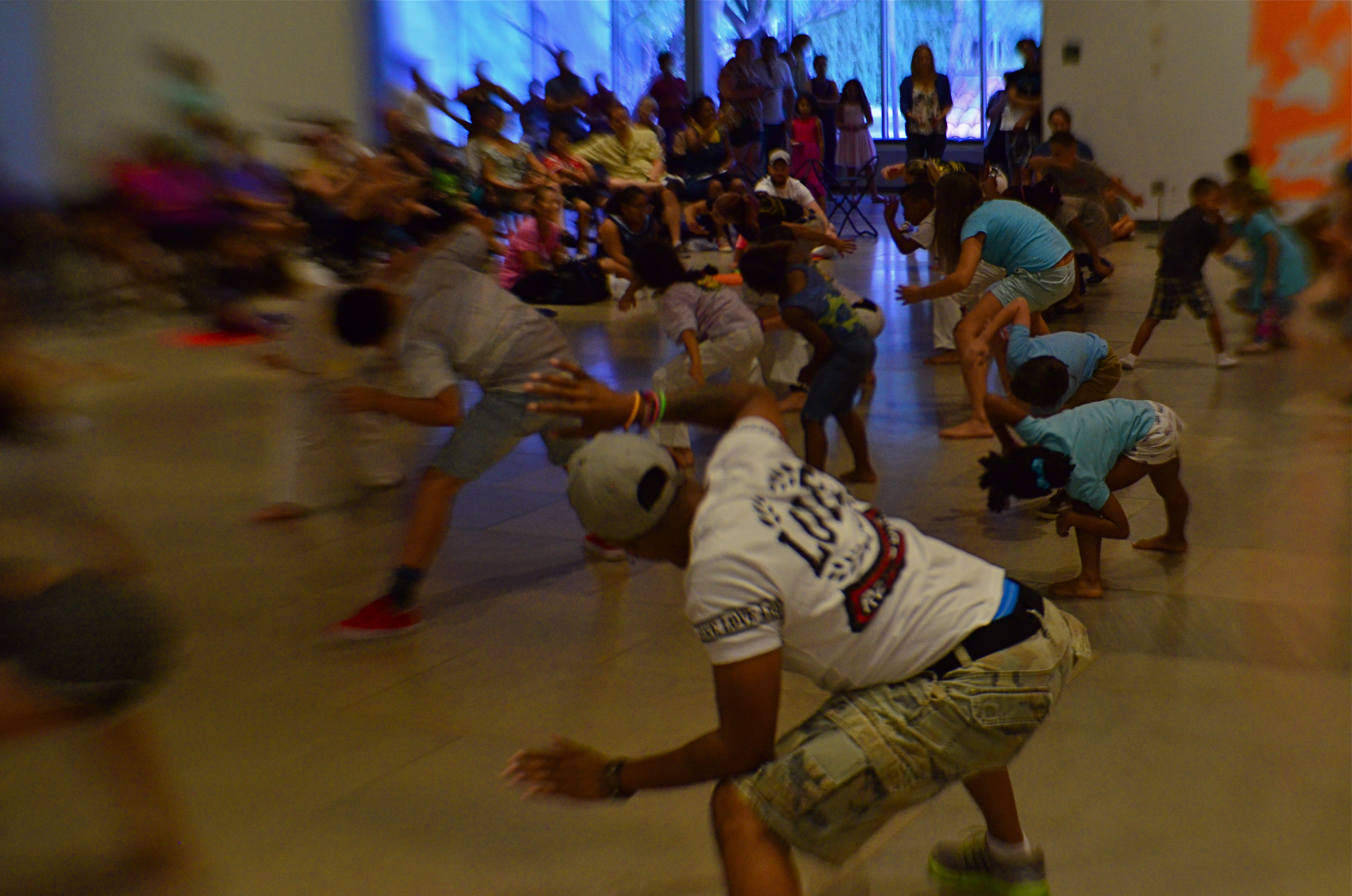
In visualizing ritual, ceremony, sacrament, or tradition, for example, you’re not merely chronicling activity. You’re also photographing mystery, or an extra dimension of consciousness. The above image, in terms of mere reality, is of a class for museum visitors curious to learn bout the Brazilian ritual of capoeira, a traditional fake-fighting martial arts performance that is performed during carnival and other national festivals. Now, you can shoot such a subject “realistically” (evenly lit, uniform focus, sharp detail), or aesthetically (dark, selectively blurred, even a little confusing), depending on what kind of feel you’re going for. This goes to the heart of interpretation. You’re not merely presenting reality: you are representing it.
Photographs originate in the mind, not in the camera, and so it must follow that there are as many “realities” as there are photographers.
ALONE OR LONELY?
By MICHAEL PERKINS
NO TWO ARTISTS view the human condition of solitude in quite the same way. In photography, there are scores of shades between alone and lonely, between the peace of private reflection and the terror of banishment, shades which define their images as everything from comforting to terrifying. Thoreau hangs out solo in the woods and finds fulfillment. Hansel and Gretel, stranded in the forest, feel only dread.
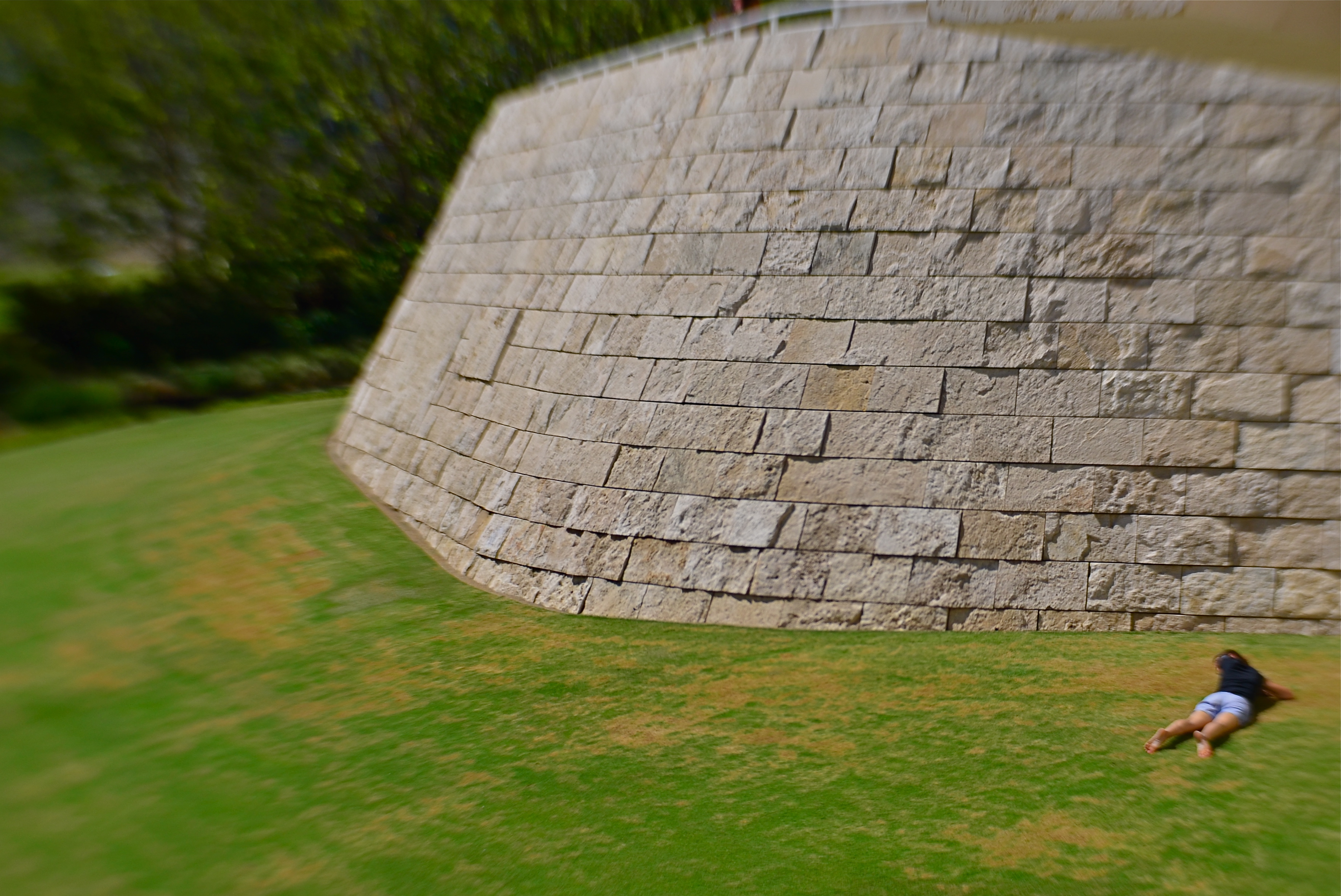
Alone again…..naturally?
The argument might be made that modern society at large fears solitude, that there is nothing more horrific than being alone left with one’s self. And, if that is your viewpoint, then that will eventually be reflected in how you depict people in isolation. Conversely, if you see “being apart” as an opportunity for self-discovery, then your photographs will show that, as well. You can’t “sit out” commenting on a fundamental part of the human condition. Some part of your own outlook will be stamped onto your photography.
That’s not to say that you can’t shade your “alone” work with layers of mystery, even some playfulness. Is the young woman shown here glad to be away from the crowd, or does she feel banished? Is her physical attitude one of relaxation or despair? The photographer need not spell everything out in bold strokes, and can even conspire to trick or confound the viewer as to his true feelings.
To make things even trickier, images can also convey the feeling of being alone in a crowd, lonely in a crushing multitude. That’s when the pictures get really complicated. With any luck, that is.
LOW INFO AND HIGH NARRATIVE
By MICHAEL PERKINS
YOU DON’T HAVE TO KNOW all the elements of a story to tell it visually. Yes, photography certainly has the technical means to tell a detailed tale, but that narrative need not be spelled out in every particular by the camera.
Indeed, it might be the very information that’s “missing” that may be the most compelling element of a visual story. That is to say, if you don’t know all the facts, make the picture. And if you do have all the facts, maybe leave out a few…. and make the picture anyway.
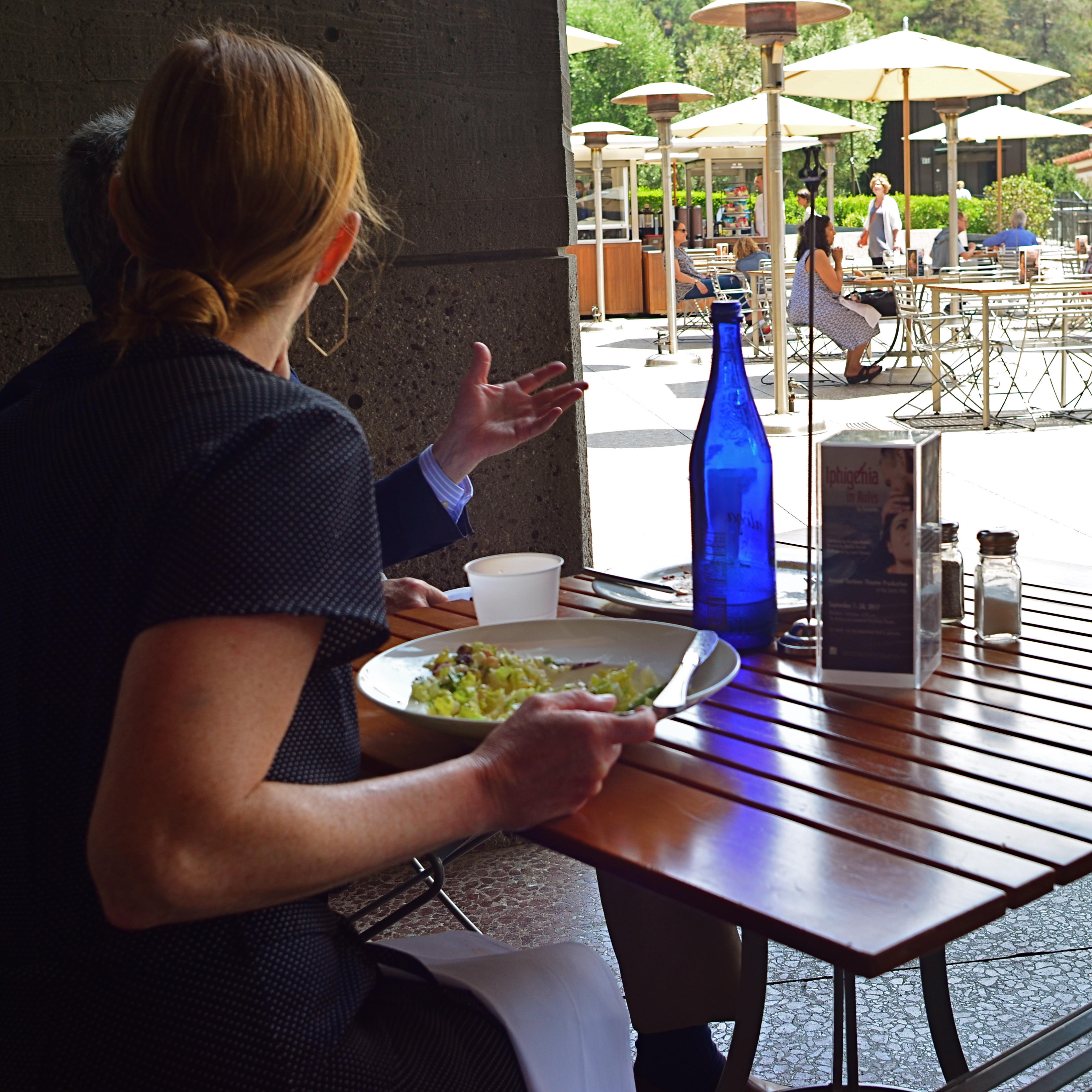
The above image illustrates this strange mis-match between storytelling and story material. As a shooter, I’m tantalizingly close to the couple at the table next door to me at a plaza restaurant. I mean, I can practically count the salt grains on the lady’s salad. I can also tell, by her male companion’s hand gestures, that a lively conversation is underway. But that is the sum total of what I know. I can’t characterize the discussion. A business planner? A lover’s quarrel? Closing the sale? Sharing some gossip? Completely unknown. Sure, I could strain to pick up a word here or there, but that alone may not be enough to provide any additional context, and, in fact, I don’t need that information to make a picture.
This is what I call “low info, high narrative”, because I don’t require all the facts of this scene to sell the message of the picture, which is conversation. As a matter of fact, my having to leave out part of the image’s backstory might actually broaden the appeal of the final product, since the viewer is now partnering with me to provide his/her version of what that story might be. It’s like my suggesting the face of a witch. By merely using words like ugly or horrible, I’ve placed you in charge of the “look” of the witch. You’ve provided a vital part of the picture.
You won’t always have the luxury of knowing everything about what you’re photographing. And, thankfully, it doesn’t really matter a damn. That’s why we call this process making a picture. We aren’t merely passive recorders, but active, interpretive storytellers. High narrative beats low info every time.


BINGE / PURGE
I AM STILL IN PAIN, several days after the most aggressive photographic housecleaning I’ve endured in years, the ruthless removal of years of deadwood from a photo-sharing site on which I’ve parked way, way too many wayward pictures. This was, finally, the week to toss away the old moose head in the attic, the day to tearfully admit that you no longer fit into your varsity jersey. Hail and farewell, parting is such sweet sorrow. Goodbye and good riddance.
OVERHEARD DURING MY EDITING/DELETING PROCESS
Oh, My Gawd…
What even is that?
Well, that certainly didn’t work…..
Nothing wrong with this one…..except the lighting, aperture, and composition…
Seriously, what the hell is that?
Lots of this concentrated cringing over pix of yesteryear speaks to my old acronym SLAGIATT, or Seemed Like A Good Idea At The Time, the simple truth that what you believe is profound at the time of the shutter click will strike you as reeking fish wrap several miles down the pike. We do outgrow, update, and disown old ideas, hopefully replacing them with better ones.
To take it a bit further, if a significant number of your old images don’t make you want to reach for the bilge bucket, one of two things is true. (1) You are already God’s messenger, the one true Messiah of photography (unlikely), or (2) you are so mired in habit and false comfort that the way you shoot is the way you always shot and the way you will always shoot. Given those choices, it may be preferable to regard at least some of one’s work the way Jack Nicholson’s Joker riffed through Vicki Vale’s portfolio, i.e, “crap…..crap….crap…” It hurts, but it’s healthy.
Every binge must have a purge, and the gluttonous output of the digital age guarantees one sure truth: they can’t all be gems. I hate having to disown my kids as much as the next shooter, but part of learning is learning to fail, admitting that at least some of those kids will never Get Into A Good School, Settle Down With Someone Nice, and Start Giving Us Some Grandchildren. If for no other reason than to help us know excellence when we see it, we need to be able to fearlessly label all the loves we have lost.
Share this:
October 14, 2017 | Categories: Commentary, Criticism, editing | Tags: editorial, Technique | 2 Comments