GROUND ZERO FOR VALOR
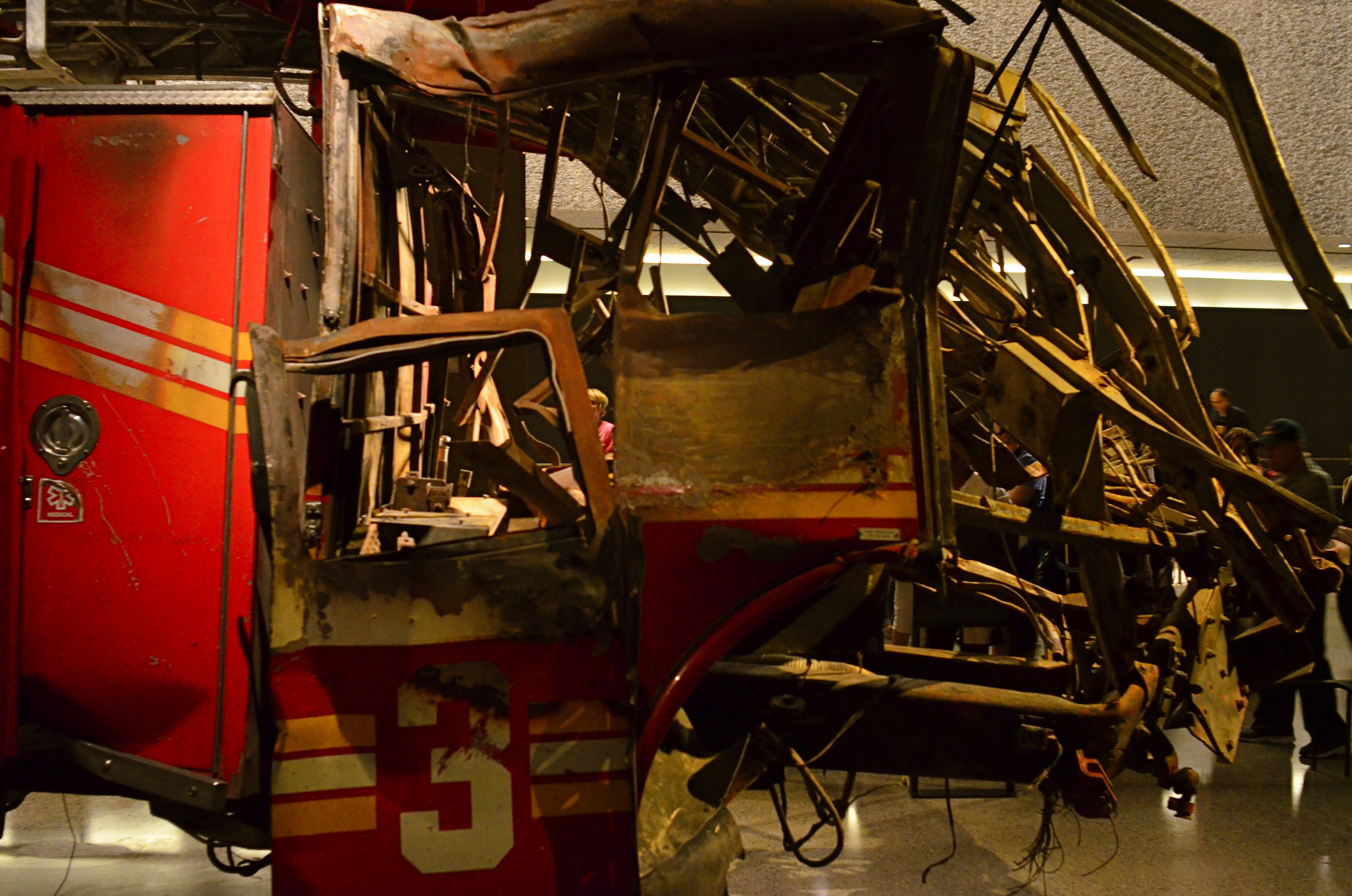
Sheared in half under the collapsed WTC’s North Tower, Ladder Company 3’s apparatus truck stands guard in the 9/11 Memorial Museum’s underground exhibit space.
By MICHAEL PERKINS
BEFORE THE ELEVENTH OF SEPTEMBER WAS DEFINED, for the New York Fire Department’s Ladder Company Number 3, by grief, the date had long stood as a milestone of devotion. Dedicated on September 11, 1865, Ladder 3 as one of Manhattan’s first fire companies, “the 3” was well on target toward its sesquicentennial on the morning that eleven of its finest perished while trying to evacuate the 40th floor of the doomed North Tower at the World Trade Center.* Death above was mirrored by destruction below: parked along West Street, the 3’s apparatus (ladder) truck was sheared in half, corkscrewed into a clawed snarl by the astonishing force of the building’s collapse.
And so it happened that one of the most poignant symbols of American valor was entombed, literally, at the epicenter of the nation’s most raw, most anguished loss, the geographic coordinates that quickly came to be called Ground Zero. However, the 3’s truck would not immediately serve as an official visual headstone, a graphic barometer of our loss. That day would have to wait.
First would be the accounting, the sorting out. As ashes were sifted and rebirth begun in this most vigorously contested patch of Lower Manhattan, the twisted remains of Ladder 3 were removed, the truck warehoused at JFK airport, silently sequestered against the day it would be re-purposed as a red-and-rust jewel in the reverent setting of the 9/11 memorial museum.
That resurrection and re-internment, a mixture of sacred fervor and steely defiance, would come on July 20, 2011, when the returned Ladder 3 apparatus truck, swaddled in U.S. and FDNY flags, would be lowered 70 feet down into the subterranean display space that serves as the nerve center of the museum. Now, before daily batteries of Nikons, Canons, and iPhones, its silent testimony can follow millions back home, the countless new images illustrating, as no words could, the full impact of history. Standing in as a grave marker for the thousands of human remains housed invisibly nearby, Ladder 3’s gnarled visage would pose as a surrogate, a way of marking valor’s Ground Zero.
* * * * *
*Ladder 3, in firefighter parlance, was “running heavy” on the morning of 9/11. The attack occurred almost precisely at the company’s change of shift, with both first and second shift crews remaining on duty to combat the catastrophe. This horrific quirk of fate doubled the 3’s losses at the site, claiming the lives of Captain Patrick “Paddy” Brown, Lt. Kevin W. Donnelly, Michael Carroll, James Raymond Coyle, Gerard Dewan, Jeffrey John Giordano, Joseph Maloney, John Kevin McAvoy, Timothy Patrick McSweeney, Joseph J. Ogden, and John Olson.
SILHOUETTE SHORTHAND
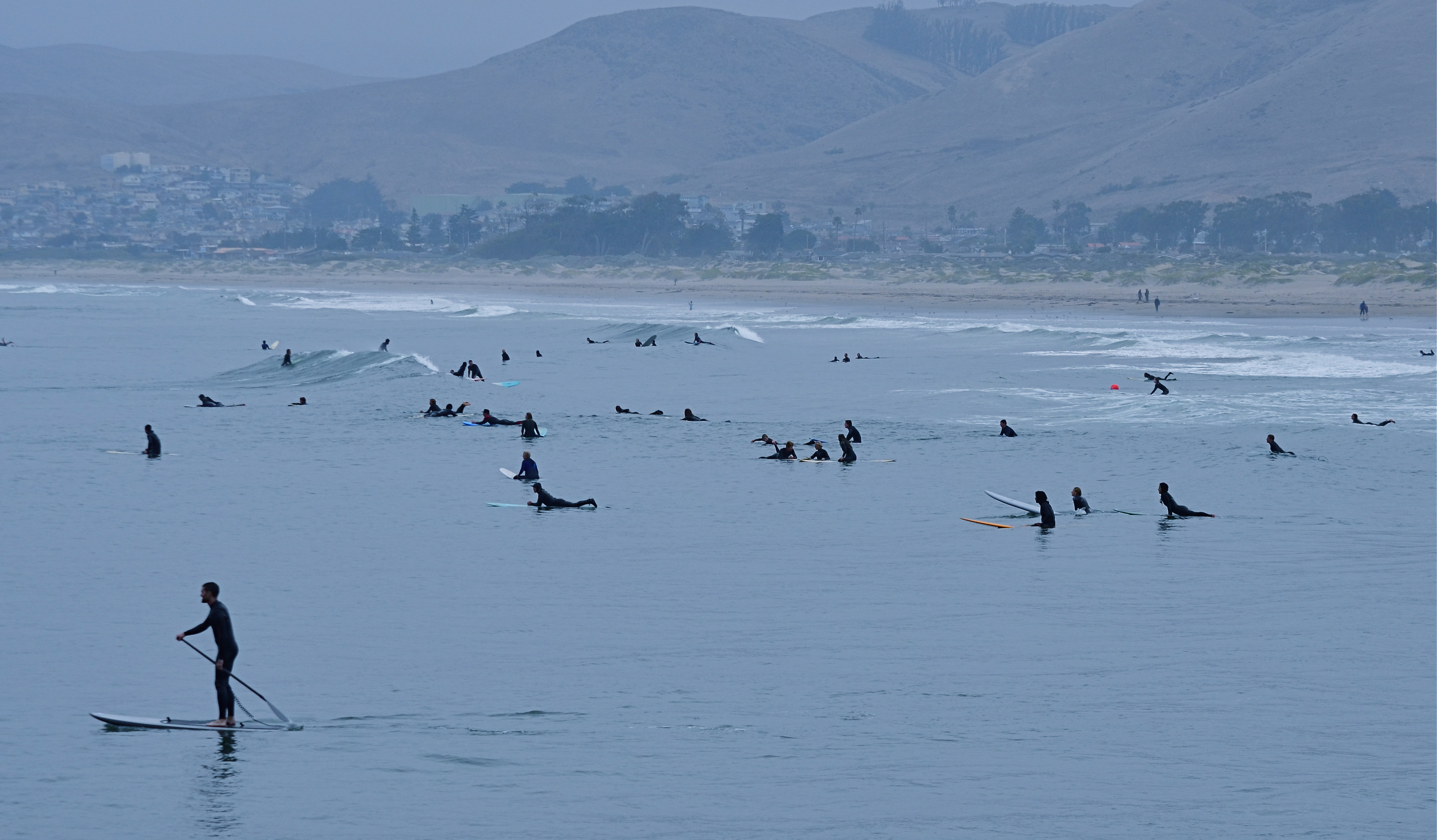
1/250 sec., f/8, ISO 100, 300mm.
By MICHAEL PERKINS
AS AN OBSESSIVE CHILD, I became crazed with the drawing of short animations on pads of paper known as “flip books.” You know the drill. Draw a picture on the top sheet, turn the page, draw another picture with a small change in position, and repeat several dozen times until you produce a brief cartoon by flipping the entire pad from the front to the back. I actually got pretty good at it, if, by “good” you mean manically addicted to perfection and insanely fixated on detail. I could make three seconds of cinematic grandeur. I just couldn’t do it fast.
Meanwhile, on the other side of the playroom, my sister and her partner, my cousin Mark, had so such problem. While I would spend the better part of a week sweating over the laws of locomotion for such classics as The Mummy Goes Mad or Spider–Man vs The Vulture, Liz and Mark cranked out ten titles a day, crude stick-figure blackouts created in ten-minute surges of creative hysteria, all ending with the unfortunate (and unnamed) hero exploding, then emitting a dialogue balloon with the single, sad existential word “WHY??” While I was doing DeMille parting the Red Sea, they were doing Mack Sennett one-reel wonders, heavy on the pie fights. Fact is, I found their stuff gut-achingly hilarious. There was no disputing which of the two “studios” better understood the entertainment biz.
Lizzie and Mark’s stick figures moved every bit as well as my fully-rendered players, but their impact was more immediate. Their drawings didn’t have even a single line that wasn’t absolutely essential to their narratives. I thought of all this recently when working with some distant crowds which were reduced to mere silhouettes in a deep telephoto of the coastline at California’s Morro Bay. As components in a larger composition, they were just markers, measures of linear space. Shooting even closer might have revealed their hair color, lines on their faces or the shine of water on their wet suits, but to what benefit for the overall effectiveness of the picture?
There are many forms of visual shorthand in the making of a photograph, and they can be effective in speeding the journey from the viewer’s eye to his heart. We might think of photography as the complete recording of detail, a piece-for-piece re-play of reality, just as I thought I had to draw every single web line on Spider-Man’s head. However, the most eloquent images often speak louder by using fewer words.
Sometimes, a stick figure is exactly what you need, and no more.
TILES
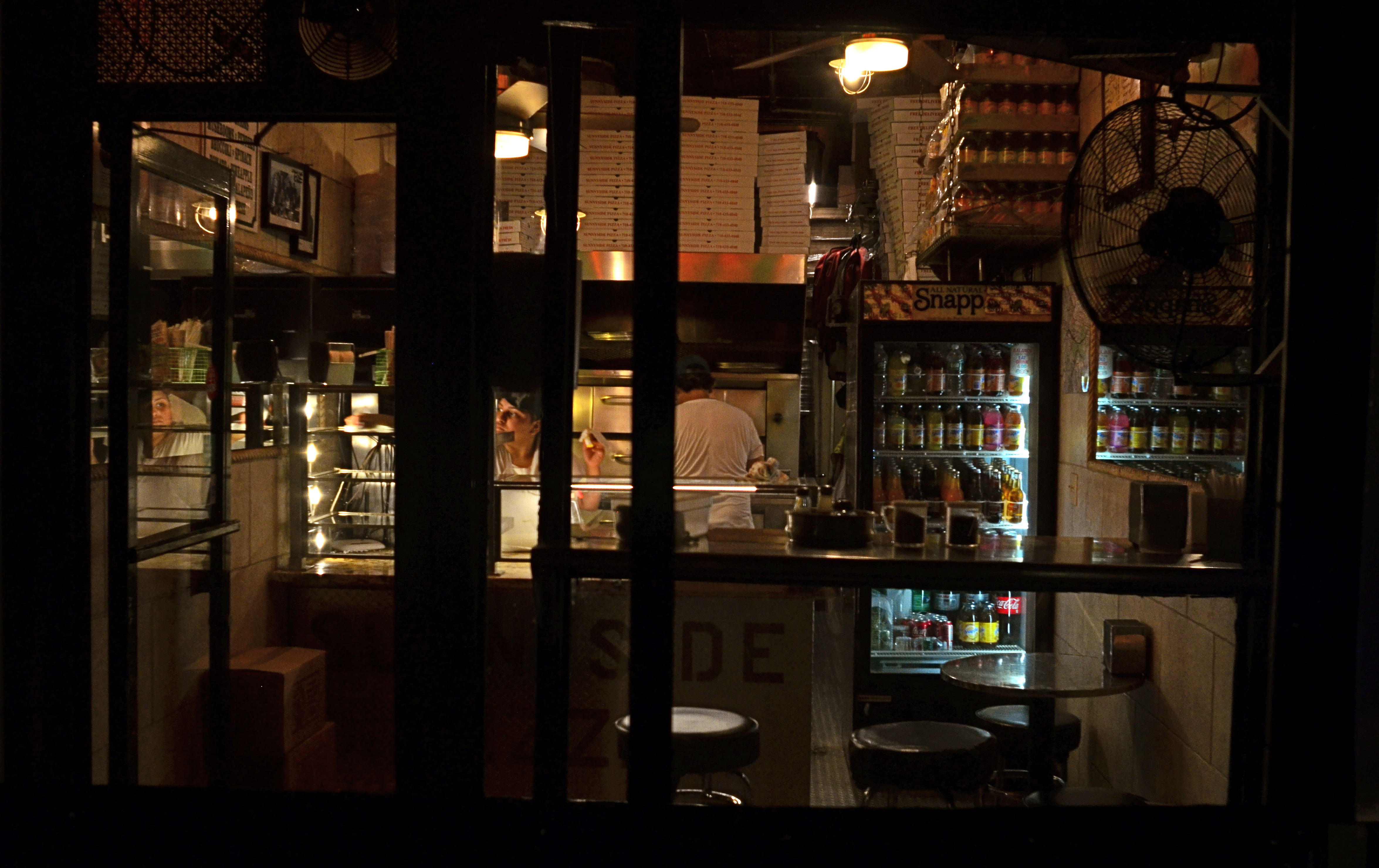
Carry Out (2017). 1/50 sec., f/4, ISO 640, 24mm.
By MICHAEL PERKINS
EVERY TIME I SEE SOMEONE working on a jigsaw puzzle, I can’t help but think that they’re missing all the fun. The idea of the project is, of course, to assemble enough pieces of a scene that it becomes recognizable. 200 pieces in: some kind of structure. 400 pieces in: looks like it’s made of iron, triangular maybe. 600 pieces in: oh, yeah, the Eiffel Tower!
But, whereas a picture puzzle is solved when the image looks complete enough, my favorite kind of photography centers on how few pieces of the puzzle can be supplied and still have the image communicate to the viewer. Formalists might call this minimalism: art curators might label it cubism: holy men in flowing robes might use the term zen. I just think of it as reducing pictures to the smallest number of components needed to convey ideas.
In fact, many photographic subjects actually present themselves in a kind of broken pattern right out of the gate, challenging us to create images from the spotty data they let through. For example, views through partially blocked windows, such as the one at the top of this page, in which what remains readable behind the darkened door and window framings, is more than enough to sell the message pizza shoppe.
For me, having everything spelled out to the Nth degree in a photograph is beyond boring. It’s much more interesting to engage the viewer in a kind of partnership in which he is looking on purpose and I am trying to maximize the power of my pitch, going as far beyond the obvious as I can while not letting the picture fly apart. The first minute I’ve snapped enough pieces into the puzzle to suggest the Eiffel Tower, I’m ready to leave the last 300 pieces in the box.
ONE GLIMPSE OF WAS
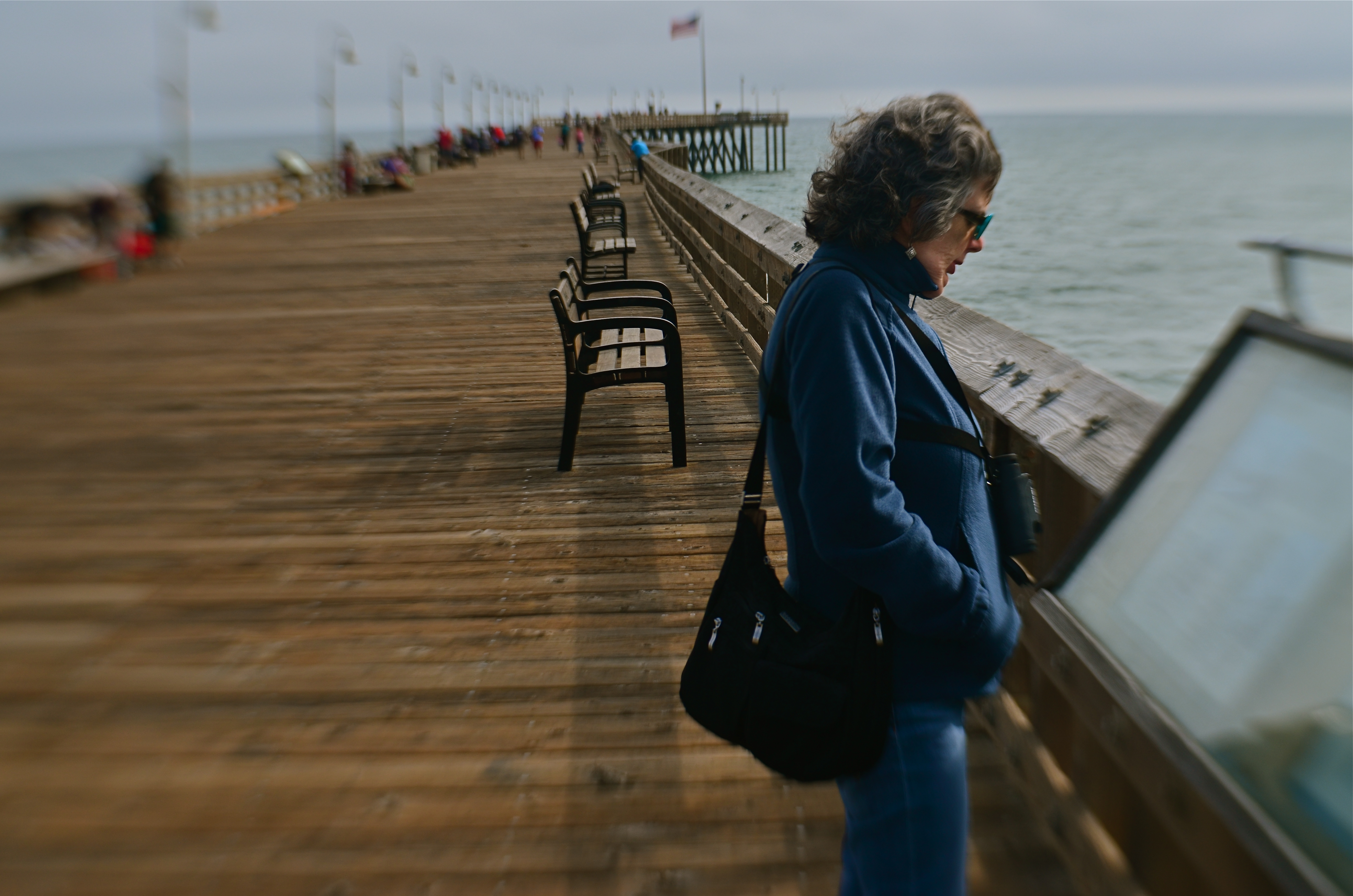
1/320 sec., f/5.6, ISO 100, 35mm.
By MICHAEL PERKINS
ONE OF THE EXQUISITE PLEASURES usually denied to even the best portrait photographers is the ability to turn back the clock, to use the camera to x-ray one’s way past a subject’s accumulated life layers, peering into the “them” that was. It’s not really that it’s impossible to retrieve part of a person’s yester-faces. It’s that it’s maddingly elusive, like getting a brief glimpse of a lighthouse beacon amidst billows of pea-soup fog. We have to take faces, for the most part, at, well, face value.
Case in point: meeting my wife, as I did, long after we both had lived fairly complete first lives, I can only know the early visual version of her through other people’s pictures. It allows me to look for parts of those earlier faces whenever I make new images of her, but I can never know when any of them will flash up to the surface. It does happen, but there’s no way to summon it at will.
Marian grew up in a beach town, with the seasons and rhythms of shore life defining her own to a degree. As a consequence, I always welcome the chance to shoot her near the sea….along beaches, atop windswept piers, weaving her way through the sights and sounds of boardwalks and harbors.
Of course, restoring Marian to her original context, by itself, is no guarantee that I’ll harvest any greater photographic truth about her face’s formative years than I do on any other day. Still, I find the idea romantic and brimming with tantalizing potential. Will I be given an audience with the ghosts of Marian past today? Will they even show up? The mystery of faces leads photographers on a blind chase, with only the occasional find to convince us to continue the hunt.
“LEVON”
By MICHAEL PERKINS
MANY PHOTOGRAPHERS ARRIVE AT WHAT I CALL a minimalist reset, evolving in their technique to the point at which they can do more varied work with fewer tools. This process leads many to designate a personal “go-to” lens, the chunk of glass that solves nearly every problem on a given shooting day by itself. I’ve tried to take this a step further, going from ” what one lens do I most need today?” to “what one lens can I probably use for everything, nearly every day?”, a lens so flexible that I’d actually have to have a very good reason not to use it on any given day. To express it another way, instead of thinking of a “go-to” lens, I’ve tended to work toward finding a “leave-on” lens.
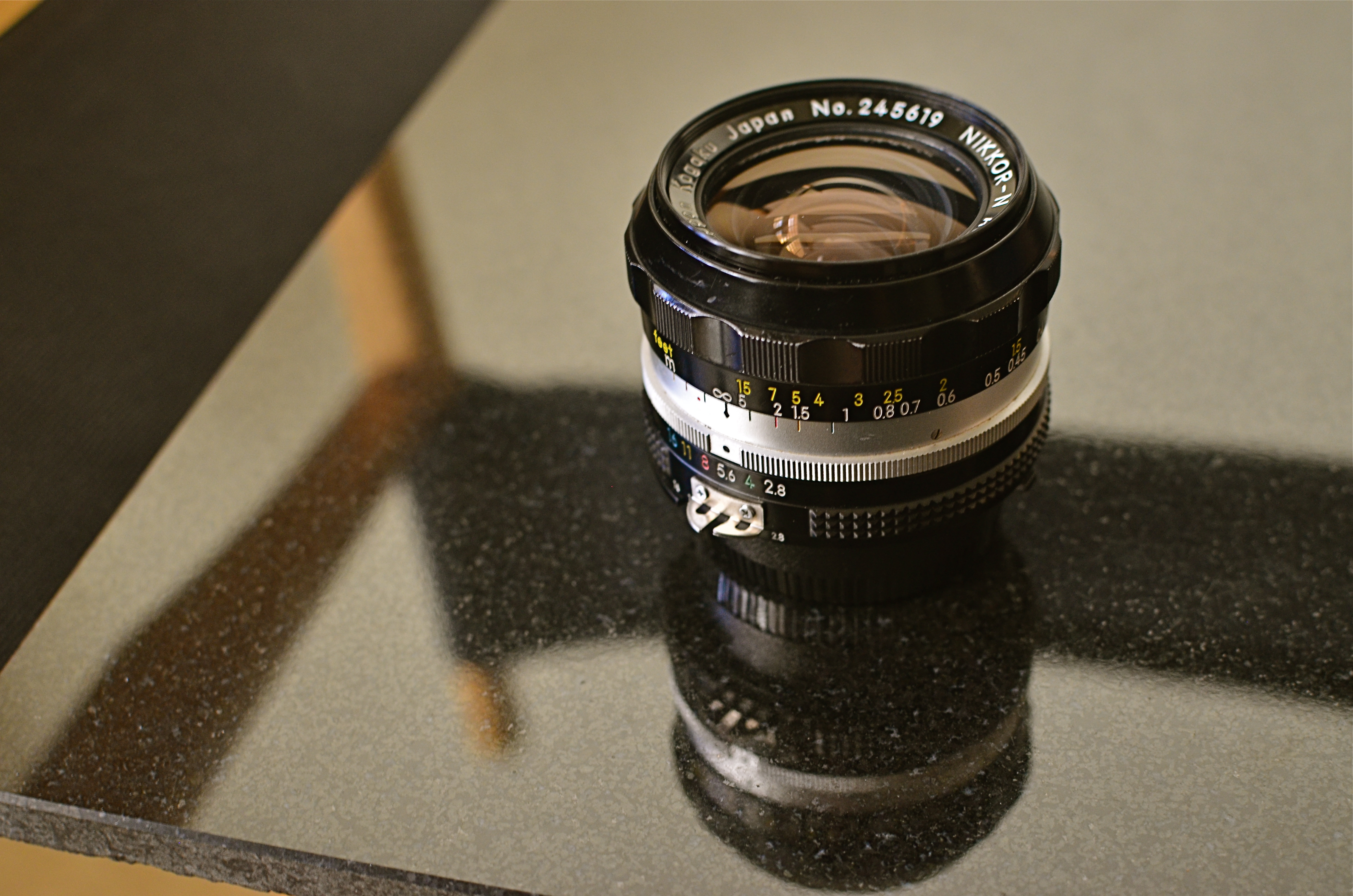
My “Levon” is the venerable Nikon 24mm f/2.8, in production continuously from 1967 (about when mine was made) to the present as a metal-barreled, fully manual lens. There is a cheaper, plastic autofocus version also available, but optics are generally the same. That is to say, damned sharp and damned fast. Both lenses are extremely compact and thus easy to lug about.
24mm is correctly called an “ultra-wide angle”, but I originally switched to it from something even wider, the ubiquitous 18-55mm “kit lens” most Nikons ship with these days. Doing a lot of shooting in big cities with crowded streets, I originally thrilled to just how much the 18 could cram into a frame. Eventually, however, I came to hate the severely in-bent slant on tall structures, and the fact that the 18, wide open, is pretty slow, at a max aperture of f/3.5. With the 24, I still get plenty of more natural-looking width and another fat half-stop of light in the bargain.
Handheld night scenes make up about a third of my urban shooting, and, here again, the 24 is Mikey’s Best Friend. Its manual focusing means my camera never spazzes in search of a focus lock in the dark, allowing me to actually shoot faster. And city scenes can be sharp even wide open at f/2.8, giving me crisp results from 12 feet all the way to just under 50, and from 17 feet pretty much to infinity. Combine that with a fairly low ISO like 800, and I can even keep the grain down.
Being a prime lens, the 24mm can’t zoom, but outside of occasional nature work, I seldom need a telephoto, so you don’t miss what you don’t use: another reason to leave the 18-55 home. Besides, primes, being optically simpler, are usually sharper, meaning it looks better than the kit lens dialed to 24mm. Finally, Levon is not a macro, but focuses at just one foot out, so some modest close-up work is feasible.
Standard disclaimer: this analysis is offered not to claim that any one lens is perfect for any one person. It’s just an exercise to show how, for the way I shoot, I have been able to do over 75% of my typical work without swapping out glass. I gain speed, ease, and flexibility in the process, and, if you conduct your own experiments, chances are you too can progressively spend less time fiddling and more time shooting.
“….and it shall be Leave-On…”
OTHER KINDS OF FACES
By MICHAEL PERKINS
AS A SON, I am extremely aware that my parents are in the final innings of their particular ballgame, a journey they began nearly sixty-seven years ago and a pairing that has defined their lives along with those of countless others. And, as a photographer, I have come to realize that every phase of Mother and Dad’s time together has produced its own unique visual treasures and challenges.
The images that are made of them these days….congratulatory parties, miraculous birthdays, mythic anniversaries….are repeats of similar occasions spanning decades, even as they are also emotional re-castings of old roles. Such pictures are both records of what has been and chronicles of what remains. For both Mother and Dad, steps do indeed come slower these days, but memories still move at light speed. Physical age and emotional wisdom conduct an ongoing tug-of-war across all their days. Making photographs of this process is tricky.
I know that, when my camera is too visibly present, it creates discomfort for them. For a variety of reasons that may include merely being over it all, they are not keen on the idea of “sitting for portraits”. I can best respect this by seizing other kinds of moments, in other kinds of ways.
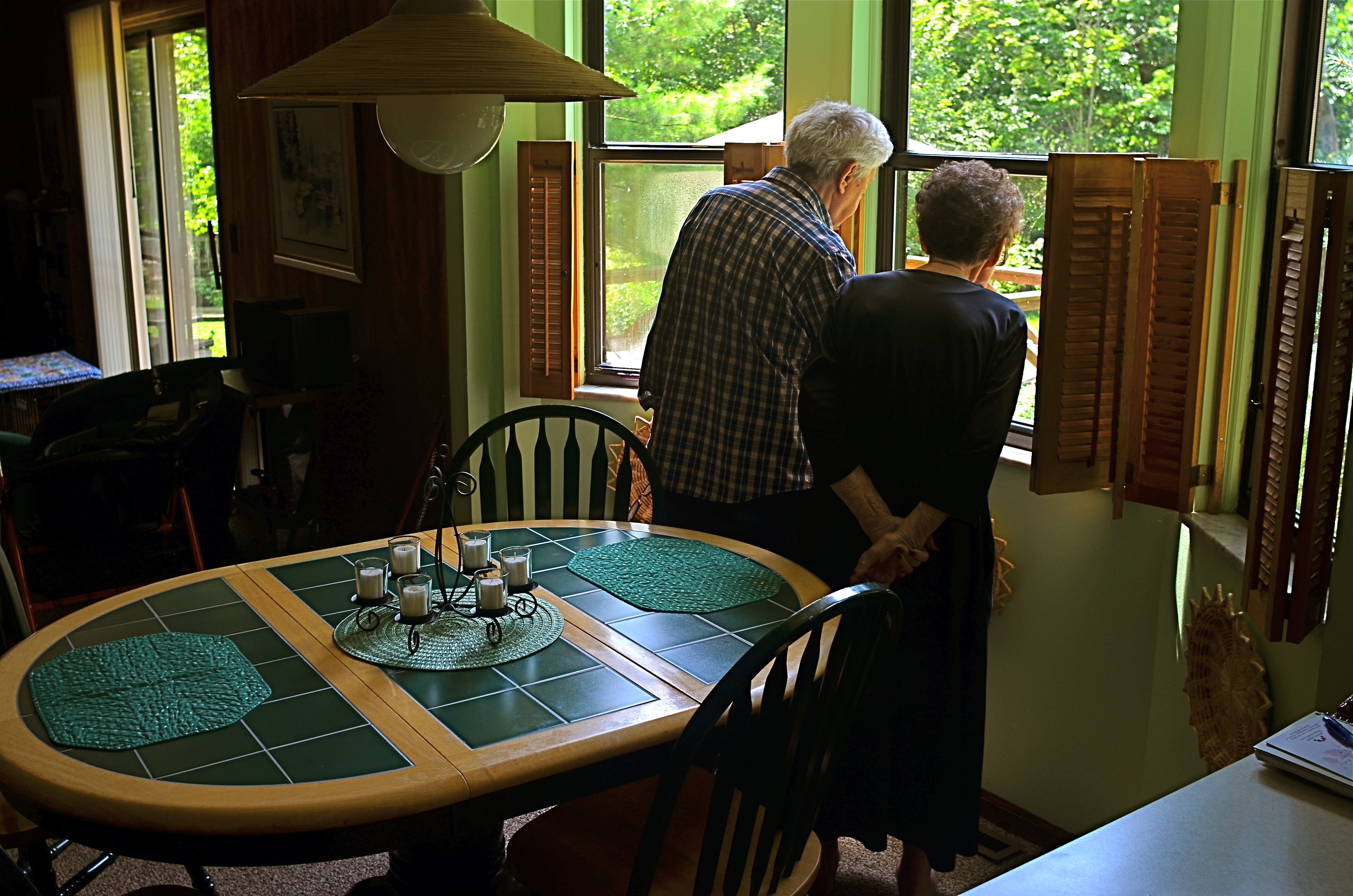
The long–distance newlyweds: Ralph and Jean Perkins, August 2017.
Recently, I caught a very lucky break, when they both went to their kitchen window to look over their beloved back yard, the acre lot resplendent with the tree plantings, deck buildings, and family events they’ve staged in it over more than a third of a century. Certainly, I don’t always instantly comprehend the value of a shot in the moment, but this one was obvious enough for even me.
There, in the moment, was the entire marriage in miniature: two people seeking, dreaming, discovering in tandem. No shy faces or self-conscious “say cheese” moments were needed to photograph their twinned hopes, their linked optimism. You can’t see their features, but these two people are unmistakably my parents.
Faces are remarkable documents, but they aren’t the only ones available to a photographer. That’s because there are a million tiny ways for humans to visually register emotional truth, a universe full of little grace moves that, singly or collectively, convey identity. My parents, like everyone’s, are eloquent, even when they do not stare into the camera to make their testimony.
POST STARTS NOW
By MICHAEL PERKINS
THE POST–PROCESSING REVOLUTION wrought by the introduction of Photoshop in 1988 has so profoundly influenced the act of picture-making that many shooters think of the program as half of a complete two-step process of photography. In Step One, you shoot the image. In Step Two, you fix it.
However, being conversant with more of the menu options built in to nearly every level of camera in use today can mean solving most “post” dilemmas without resorting to Photoshop’s full suite of solutions. Just as you change lenses less the more you understand what lenses can be stretched to achieve, you can avoid the extra step of computer-based tweaking the more you understand what’s already available while your subject, your shooting conditions and your mental presence are all in play. Some would argue that such adjustments would be more finely attenuated working with a RAW file in Photoshop than by fixing flaws in-camera with a JPEG, and you have to decide where you come down in that debate.
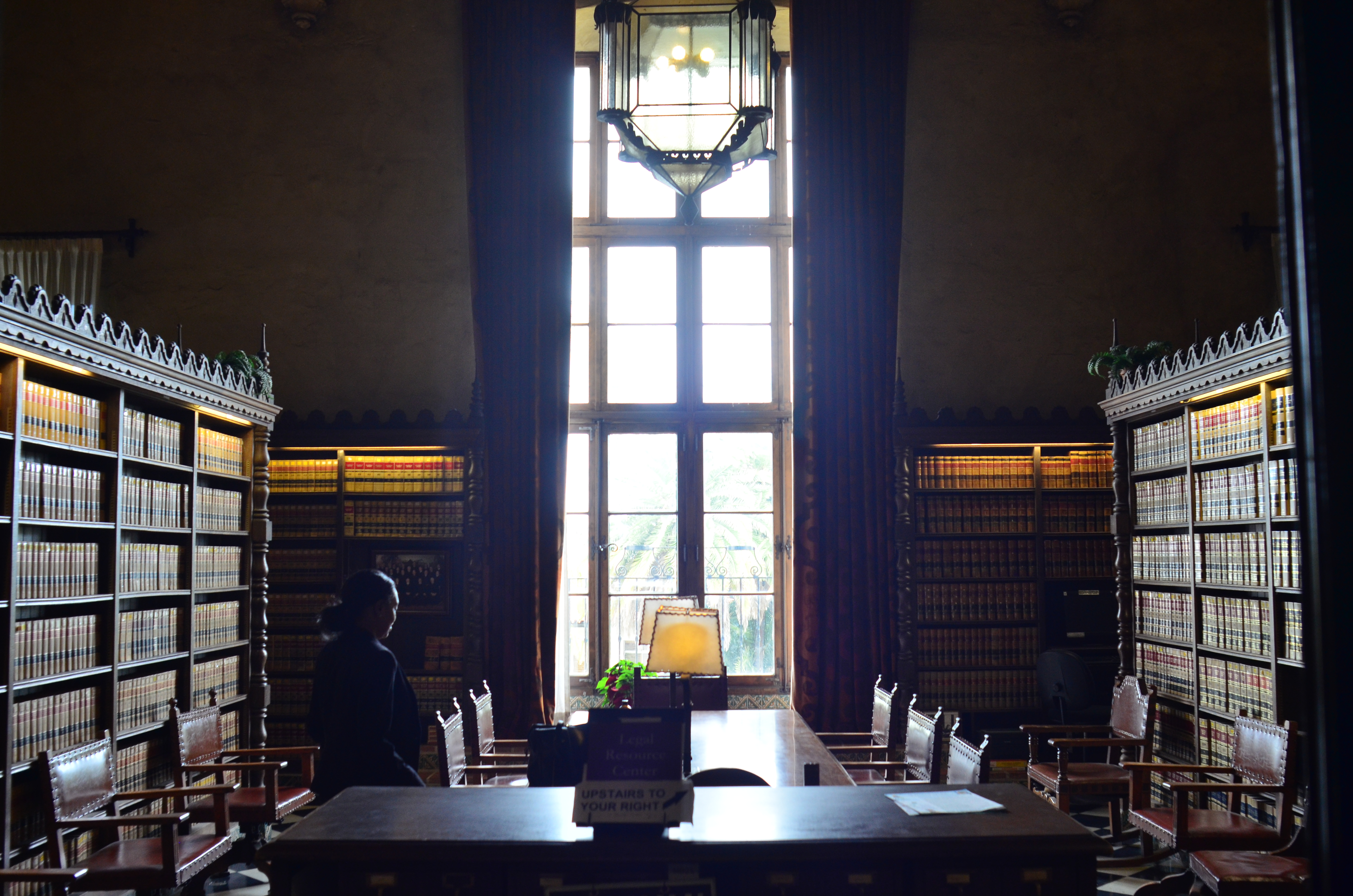
The original shot suffers from the “blues“.
Let’s take color as one example. A great many photographs with off-kilter values are corrected in Photoshoppish apps, yet can be quite satisfactorily fixed in-camera. White balance settings allow you to pre-program a number of light temperature pre-sets that make your camera “see” colors as if they are occurring in sunshine, shade, or a variety of artificial light sources. But even if you shoot everything on the “auto” white balance setting and get the wrong colors occasionally, there is still a way to repair the damage without resorting to Photoshop. What Nikon and Canon both call color balance allows fairly fine-tuned adjustments to get the hues to look either (a) more like you saw it, or (b) the way you wish it had looked.
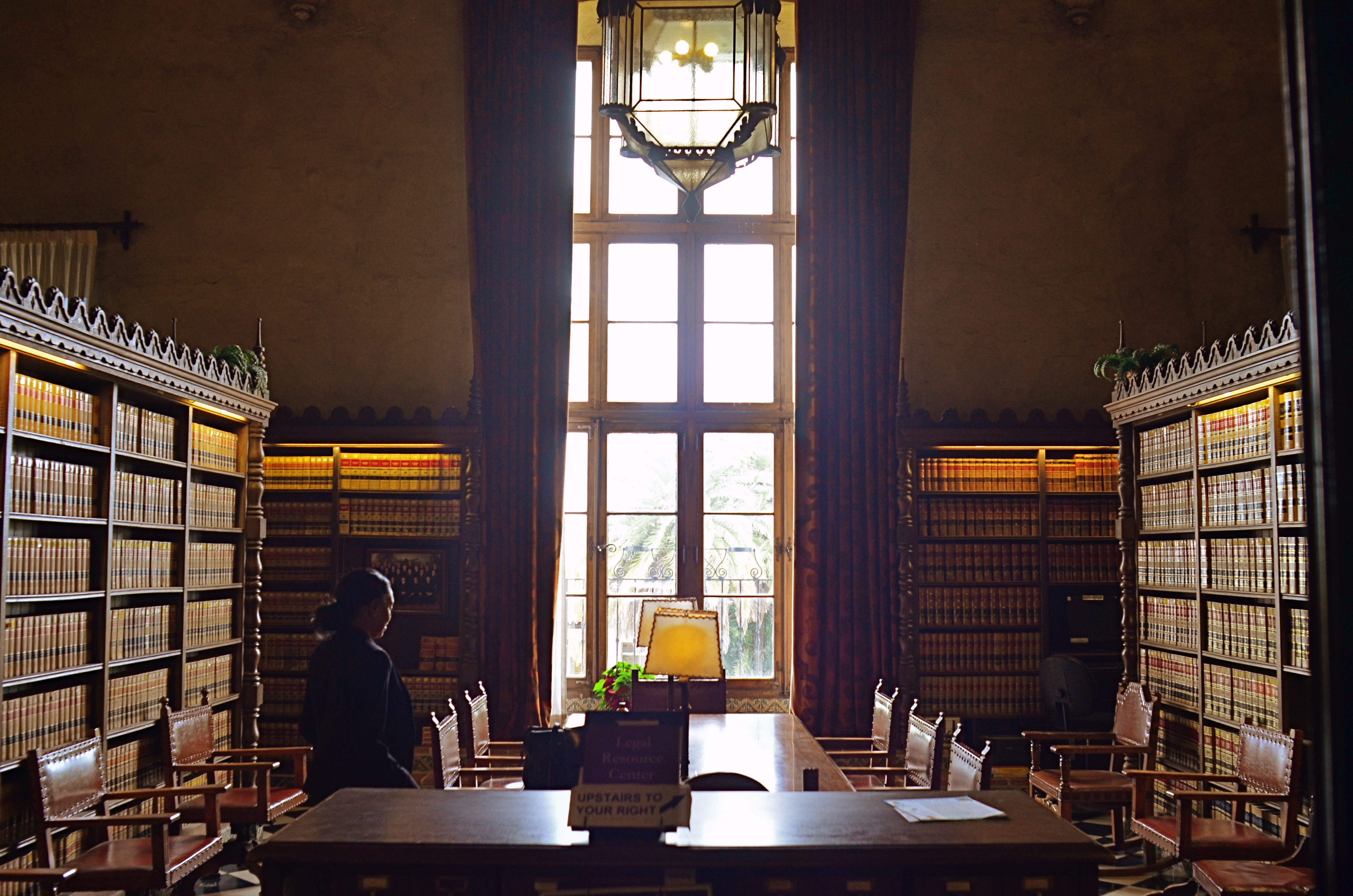
The shot at top, adjusted with Nikon’s color balance option, produced the warmer look in the bookshelves that would have resulted if the light coming through the window had been warmer. In the original image, taken with an auto white balance setting, the camera, far from “guessing wrong”, actually recorded the room light as it appeared in reality, since the sky was severely cloudy and was a little blue in cast. However, with the in-camera color balance tweak, no Photoshop intervention was required. Moreover, I could check my work while in the moment, a handy thing, since tours were moving in and out of the room all day, meaning that, if I wanted to shoot the room (nearly) empty, I had to work fast.
Digital photography’s original bragging point over film was the ability to shoot, fix, and shoot again rather than rely on the darkroom to rescue tragically few of our miscalculations. Working our in-camera menus for all they’re worth helps deliver on that promise.
BOOKENDING
By MICHAEL PERKINS
THE HUMAN EYE HAS A SOFT SPOT FOR SYMMETRY, for countervailing energies that face off against each other in a composition. Design elements that pit left against right, top against bottom, even corner vs. corner appeal to a certain Math-Bach sense of balance in the universe. And, as does every other kind of visual art, photography builds strong images by “book-ending” elements in opposition, eye cues both tug toward the center and pull toward the edges.
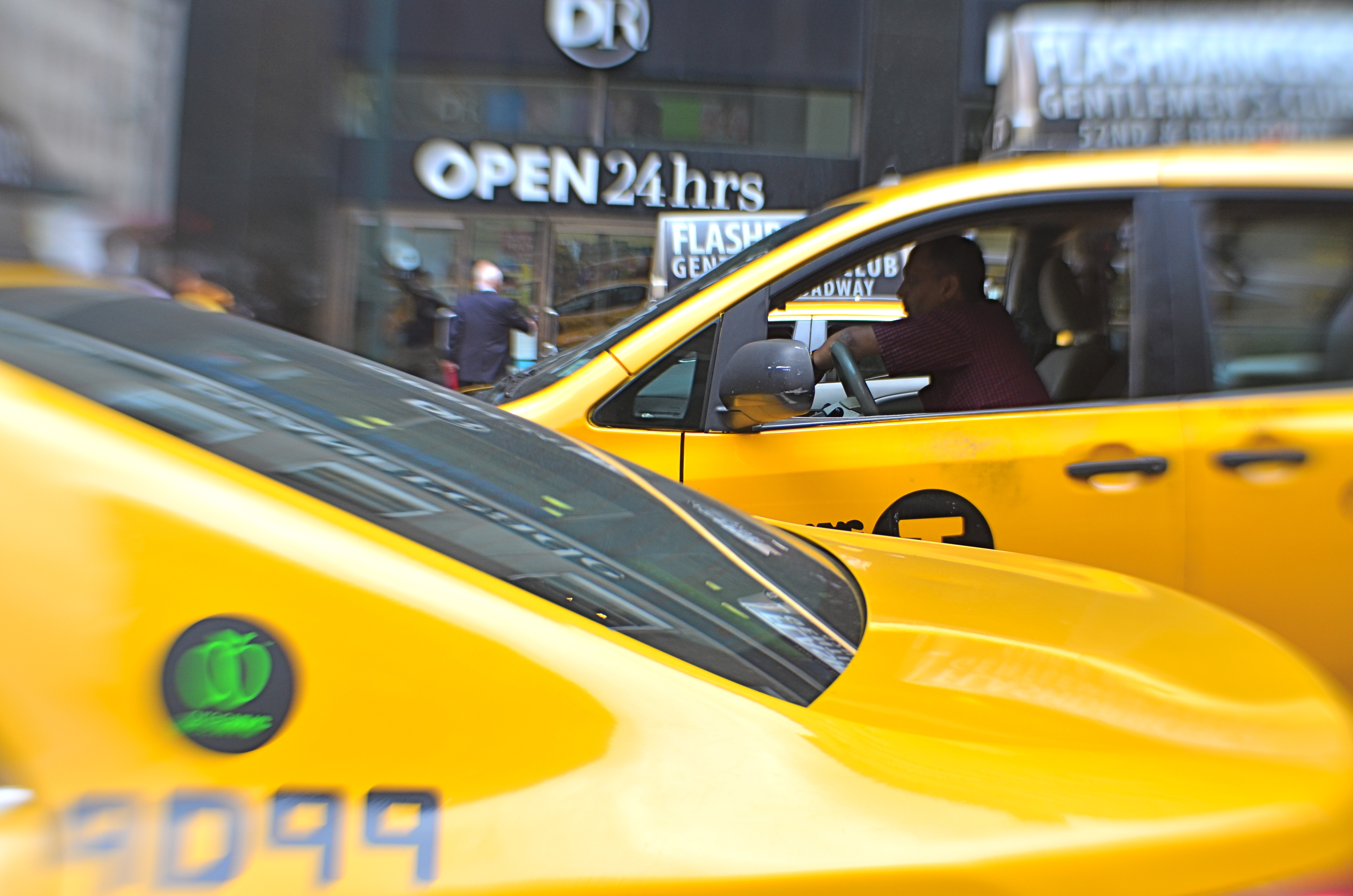
Pictures benefit from this tension, this dynamic argument over what’s more dominant, or, more correctly, what’s dominant in this moment. Book-ending between extremes or contrasting forces is a visual kind of debate, a photographic arm-wrestling match. Sometimes shapes or things occupy opposing spaces in the frame are not, literally, fighting with each other, as in the two overlapping taxicabs seen above. Even so, the two yellow wedges at bottom left and top right in the frame are in a kind of balancing act with each other: call it a conversation.
In your own work, you’ve no doubt observed this visual tension occurring organically or even deliberately built it into a composition. An old building next to a new one: a tragic mask alongside a comic one: a kumquat facing off against a tomato. It doesn’t have to be dramatic to be effective. The bookends can be ornate Greek warriors or abstract slabs: it’s the opposition in the frame that starts the process of yin/yang, and lends a photograph extra heft.
NOTHING AT FACE VALUE

By MICHAEL PERKINS
SOMETIMES I THINK THAT PHOTOGRAPHERS, especially beginners, needlessly hem themselves in by “pre-editing” their work. Being human, we all care, to some degree, about how our images “play” to various viewers, and so it’s understandable that we can be scared away from attempting certain things that are too jarring or disorienting to our intended audiences. We work to hard to avoid the attachment of certain labels to our pictures.
The “a” word, “abstract”, is one such label. It’s a scare word. And it can spook us out of truly innovative image-making.
Sure, we may know that, strictly speaking, abstraction really just means extraction, pulling a visual shorthand of essence out of a more complex subject. Rather than merely recording the full detail of an object in a photograph, the abstract photographer reduces it to its most effective basics. A baseball loses its stitches and writing and becomes just a sphere. Abstraction can also yank something out of its familiar context, forcing the viewer to regard it on its own merits, so that an entire salad is reduced to the sensual curvature of one section of a single vegetable.
Okay, so that’s what we know about abstraction. However, what we feel, even about just the word, can cow us into conformity. We fear being called “artsy”, avant-grade, pretentious. And we gradually adjust our images to reflect what others regard as “real”. It’s tough: learning to trust your own vision is the single hardest lesson in any art. But what’s the alternative? Cranking out the same systematic execution of a flower for the next forty years just to curry favor with the mob?
If you observe an orchid (like the one above), and see, not merely a flower, but a winged creature taking flight, why not take the extra step and reclaim the “realness” of that object for your own purpose? The camera is an interpretative tool, not a video recorder.
Anytime we are tempted to restrict our pictures to what the world at large regards as “real”, we should listen for abstraction’s quiet but persistent question. “Real” according to whom?
EYE OF THE BEHOLDER
By MICHAEL PERKINS
PHOTOGRAPHERS TRY TO IDENTIFY the so-called “eternal” verities of life, the common elements of experience that are unchanging over time. We all find our way to sunsets, shores, the mysteries of the human face, the course of light. But how about the more subjective “truths”, those purely emotional facts which may wax and wane with passing fancy?
Can we say, visually, what beauty is, or for that matter, what the depiction of humor, truth, or other subjective values should look like? Pictures of anything that is governed by fashion or fad will find themselves shredded by the same temporal process that makes Grandpa’s handlebar moustache seem ridiculous rather than rakish and makes the miniskirt a measure of folly instead of hipness.
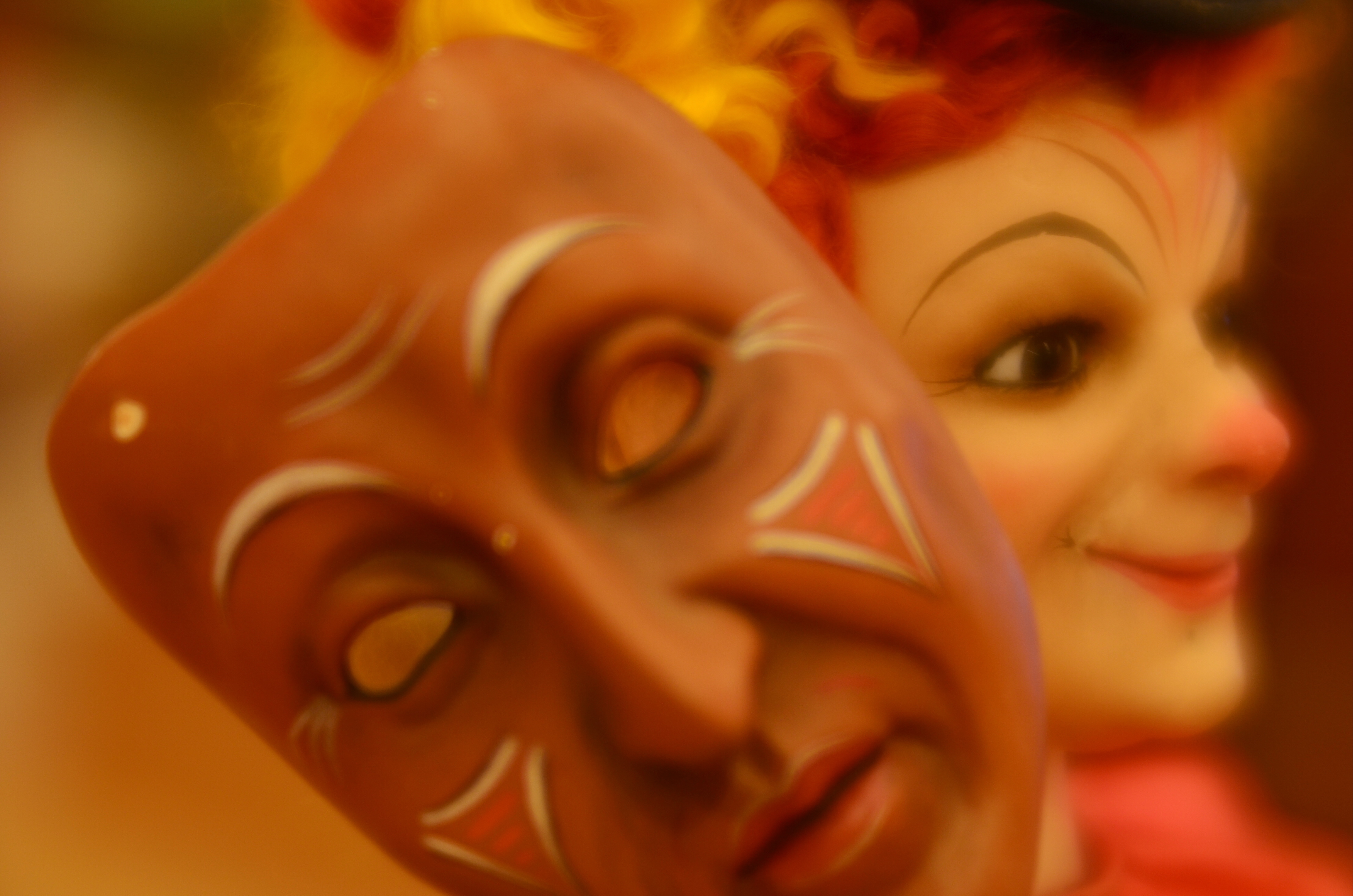
Consider something as personal as a toy. In one era, its features are comical and cute, whereas, a few decades later, they might register as, well, creepy. As a case in point, the image seen above is of a 19th-century automaton, a mechanized dancing musical doll called “The Mask Vendor”. The grinning harlequin on the right is the vendor, and the visage at left is one of his wares, which range in expression from foolish to demonic. Good times, eh? Oh, look at this jolly prankster selling “counterfeits” of faces! What rascally fun!
I can tell you, as a tour guide in the museum that “the Vendor” calls home, that he is regarded with horror, not joy, and that the feeling he projects on young visitors is one of dread, not mischief (one Hispanic tour guest, a seven-year-old, referred to him, shakily, as “el Diablo!”). So how to make a picture of such an oddity?
As a photographer, I’m in an odd place here. I have enough historic knowledge to know that the doll was originally associated with gaiety, and yet I live in a time in which its message of fun has long since been twisted and corrupted to suggest something dark…..so much so that any image I make of it, as filtered through current-day sensitivities, must shift between both “realities”. I am thus free to add as much irony or ghoulishness as I choose, like the veneer of haze I added to accentuate the dreariness/nightmarishness of the thing. Nothing is over the top.
Even when we snap something as eternal as a sunrise, we may unconsciously be adding some additional layer of ourselves as a similarly hazy veneer. But how can it be helped? Unlike the Vendor, we’re only human. Brrrrrr.
(VERY) STILL LIFE
By MICHAEL PERKINS
PHOTOGRAPHY, WHEN IT FLEXES TO ITS FULLEST LIMITS, should never be about merely accepting things at face value. The camera is a fairly reliable recording device, but simply using it to freeze time severely limits its narrative potential. Of course, on a purely personal level, that’s frequently just what we want: to stop the clock on the vanishing of tender times and loved ones: to preserve life.
However, I believe that the camera should also preserve death.
I’m not talking about doing a series of close-ups of Grandpa in the crypt. I’m mostly thinking biological subjects here. Living things are most typically photographed in the full bloom of health: the eye luxuriates over bright explosions of color, the hardy flesh of petals, the skyward reach of tender saplings. But if a photographic subject gains extra interpretive power as it’s removed from its standard context (nature in its regular settings), then a living thing achieves the ultimate visual re-contextualization as its life begins to ebb. Taking the familiar out of its comfort zone opens it up to alternate interpretations.
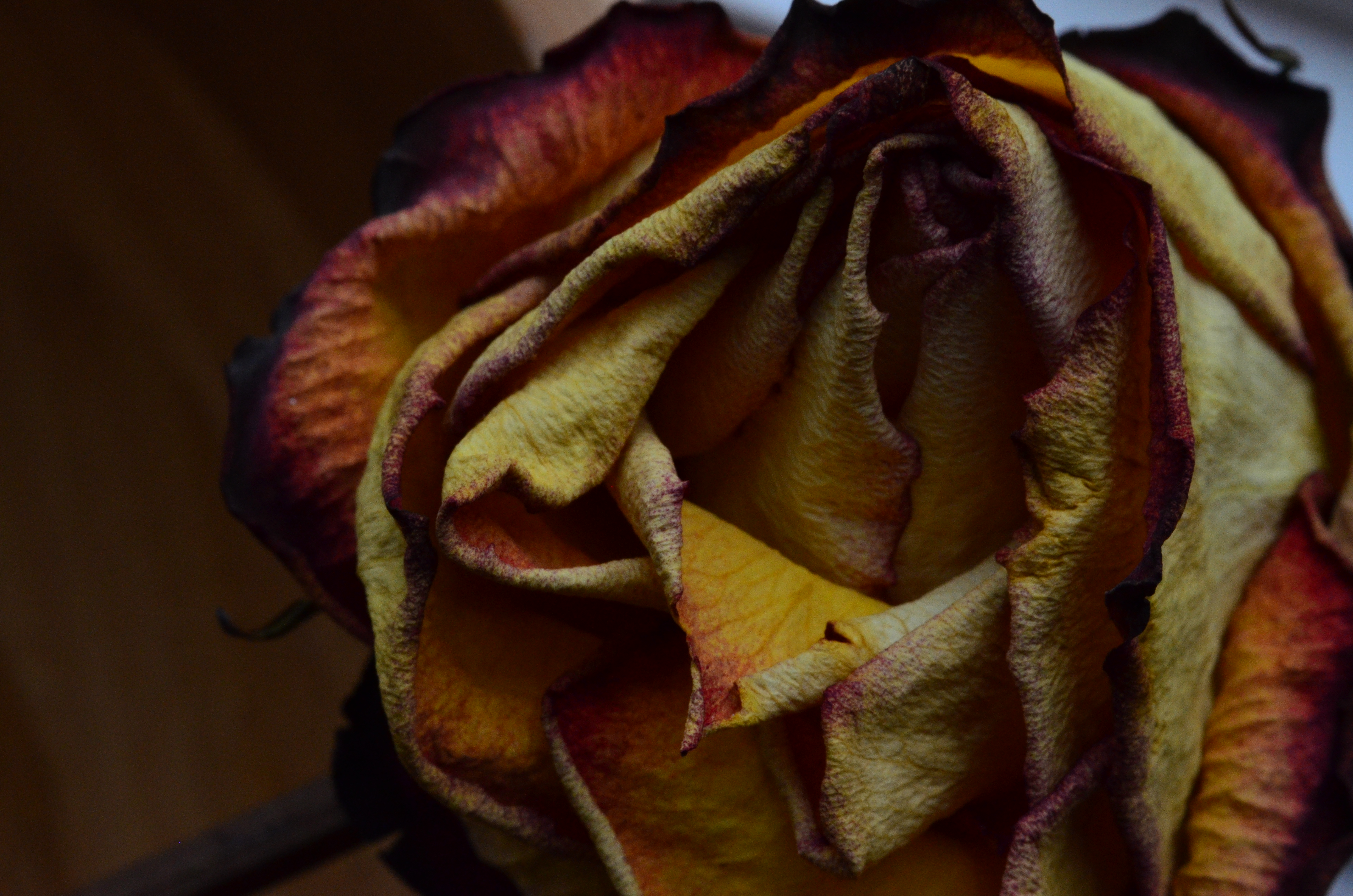
The rose seen above, taken with a Lensbaby Velvet 56 (a wonderful portrait lens which doubles as a decent macro), was days dead when I came upon it, and yet it presented textures more intriguing, colors deeper and richer than its fresher vase-mates. Is this ghoulish?
Depends. Decay is, after all, something we document with great enthusiasm as it applies to inanimate things like rusted cars, crumbling neighborhoods and abandoned infrastructures. How much more attention should be paid, then, to things that once mirrored our own fleeting arrangement with mortality, once throbbed with pulses as perishable as those bounding through our own veins.
IRVING’S CURTAIN
By MICHAEL PERKINS
BY THE TIME IRVING PENN (1917–2008) WAS ESTABLISHED as a portraitist without equal for Vogue magazine, he had chalked off clear parameters for his style. Natural over artificial light: large format, high-resolution monochromes: a patient talent for extracting the essence of even the most reluctant subject: and an almost lucky-charm devotion to the worn and stained curtain he would use, almost exclusively, as his backdrop for the length and breadth of his legendary career.
Salvaging the curtain from a Paris theatre in 1950, Penn used it as the great equalizer in all his portrait work, staging everything from Picasso’s puckish gaze to Audrey Hepburn’s gamine charm in front of its collection of stains, spills and discolorations. The curtain was as essential to a Penn shoot as the great man’s lenses, and where he went, from remote African villages to literary salons, it went also. And finally, eight years after his death, it traveled one more time to New York, for a supporting role in an Instagram near you.
As part of the Metropolitan Museum Of Art’s centennial celebration of Penn’s work for 2017, the curtain was installed in a room chocked with shots of the famous people with which it had co-starred. Studio-style, it was mounted on a curved panel to avoid hot spots from glare, and visitors were invited to pose themselves in front of it, fore-lit by a well-placed fashion light. The message was seductively mis-leading. If the cloth is magic, maybe it’s transferable! Maybe it is that black crow’s feather that makes Dumbo fly…..
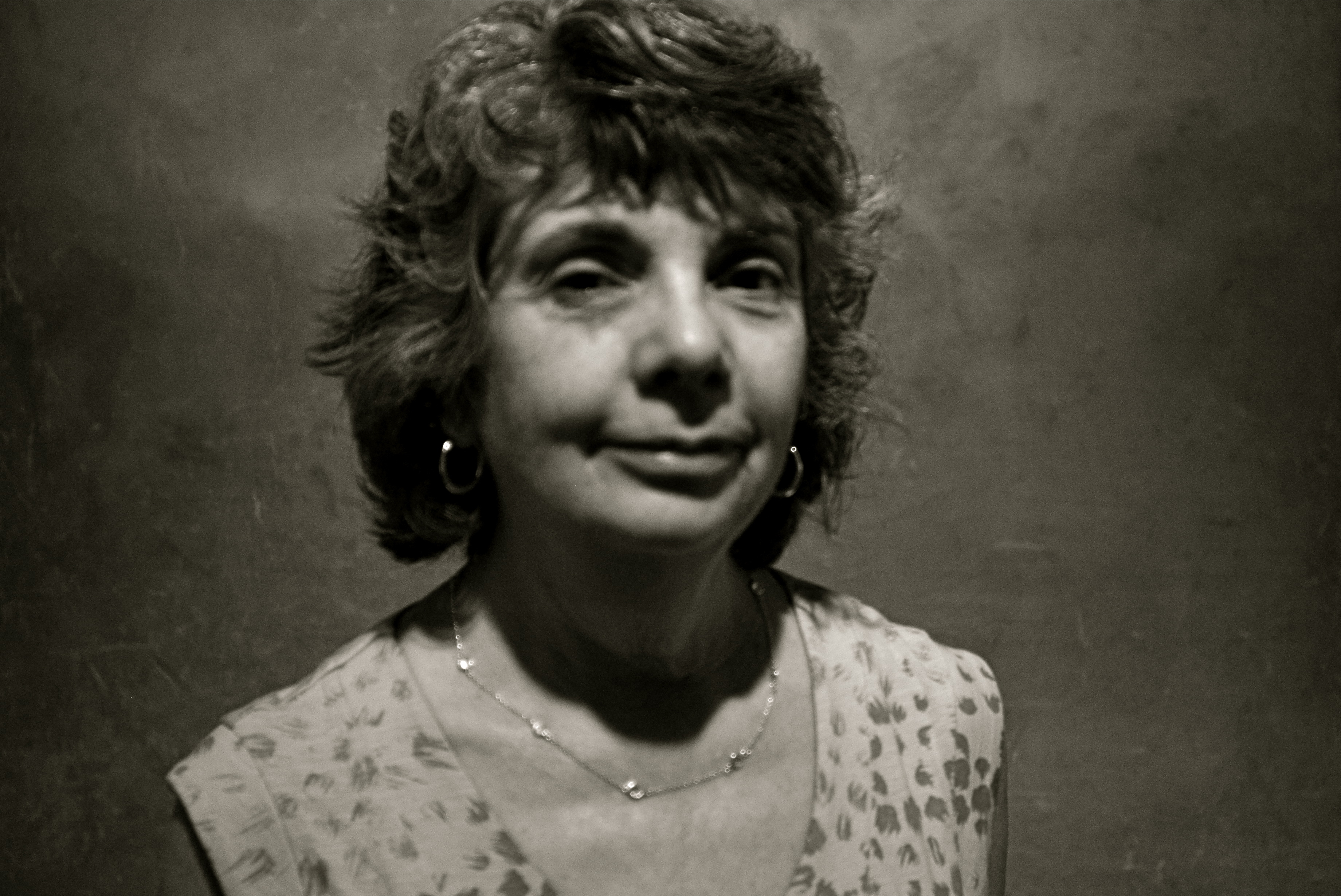
The Met’s true genius in installing this Penn-it-yourself feature in its exhibit became obvious once you took the bait. That is, there’s nothing better to teach you that his work was great than allowing you to take very bad pictures under some of the same circumstances. I certainly got the point after clicking off a seriously flawed candid of my wife, seen here. I mean, other than blowing the focus, the metering, and the placement of light and shadow, the shot’s perfect, right?
Of course, the Penn curtain challenge had a kind of theme-park appeal, sort of like when you stick your face through a hole in the back of a cartoon cutout at Coney Island to have your picture taken as a “strongman”…and just about as convincing. Because art isn’t gear: genius isn’t mere tools. And you can’t be Rembrandt just by picking up Rembrandt’s brush.
SPHERE ITSELF
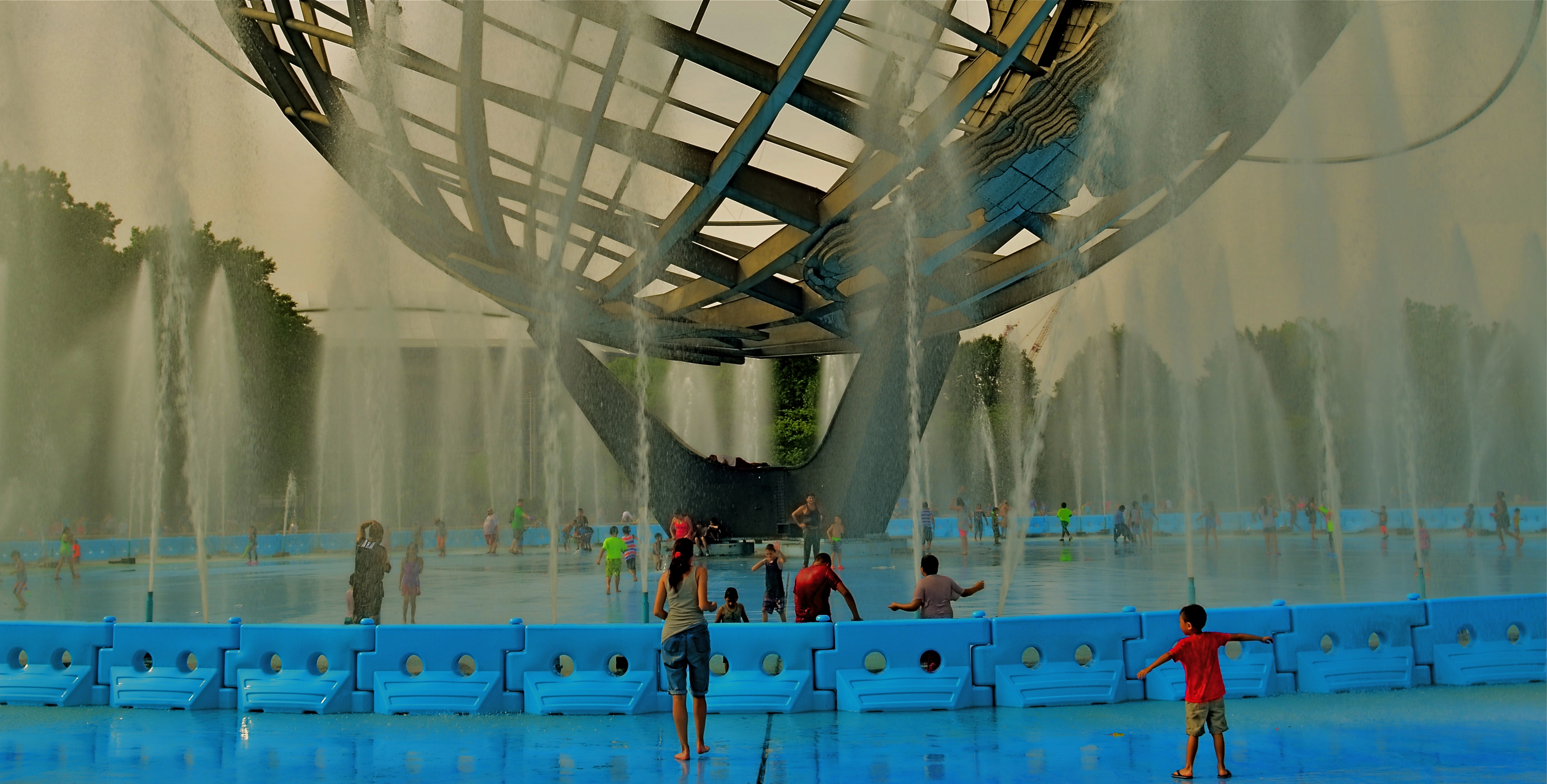
Wet Democracy (2017): The 1964 World’s Fair’s central icon as play space.
By MICHAEL PERKINS
CULTURAL ICONS, which burn very distinct patterns into our memory, can become the single most challenging subjects for photography. As templates for our key experiences, icons seem to insist upon being visualized in very narrow ways–the “official” or post card view, the version every shooter tries to emulate or mimic. By contrast, photography is all about rejecting the standard or the static. There must be, we insist, another way to try and see this thing beyond the obvious.
Upon its debut as the central symbol for the 1964 New York World’s Fair, the stainless steel structure known as the Unisphere was presented as the emblem of the peaceful ideals put forth by the Exhibition’s creators. Under the theme “Peace Through Understanding”, the Uni, 120 feet across and 140 feet in height, was cordoned off from foot traffic and encircled by jetting fountains,which were designed to camouflage the globe’s immense pedestal, creating the illusion that this ideal planet was, in effect, floating in space. Anchoring the Fair site at its center, the Unisphere became the big show’s default souvenir trademark, immortalized in hundreds of licensed products, dozens of press releases and gazillions of candid photographs. The message was clear: To visually “do” the fair, you had to snap the sphere.
After the curtain was rung down on the event and Flushing Meadows-Corona Park began a slow, sad slide toward decay, the Unisphere, coated with grime and buckling under the twin tyrannies of weather and time, nearly became the world’s most famous chunk of scrap metal. By 1995, however, the tide had turned; the globe was protected by the New York City Landmarks Preservation Commission, and its rehabilitation was accompanied by a restoration of its encircling fountains, which were put back in service in 2010. The fair park, itself staging a comeback, welcomed back its space-age jewel.
As for photography: over the decades, 99% of the amateur images of the Unisphere have conformed to the photographic norm for icons: a certain aloof distance, a careful respect. Many pictures show the sphere alone, not even framed by the park trees that flank it on all sides, while many others are composed so that not one of the many daily visitors to the park can be seen, robbing this giant of the impact imparted by a true sense of scale.
In shooting Uni myself for the first time, I found it impossible not only to include the people around it, but to marvel at how completely they now possess it. The decorum of the ’64 fair as Prestigious Event now long gone, the sphere has been claimed for the very masses for whom it was built: as recreation site, as family gathering place..and, yes, as the biggest wading pool in New York.
This repurposing, for me, freed the Unisphere from the gilded cage of iconography and allowed me to see it as something completely new, no longer an abstraction of the people’s hopes, but as a real measure of their daily lives. Photographs are about where you go and also where you hope to go. And sometimes the only thing your eye has to phere is sphere itself.
RE-PURPOSING INFORMATION
 By MICHAEL PERKINS
SIGNS ARE PRIMARILY SOURCES OF INFORMATION AND IDENTIFICATION, a utilitarian way of learning who’s who and what’s where. In photography, their primary use can move beyond those roles to become commentary, context, atmosphere, even pure abstract subject matter. As shooters, we all use signs in ways that are not strictly literal but are 100% visual. They are powerful tools.
This is a circular way of saying that, in an image, a sign is never just a sign, but a way of indicating and qualifying place, time, mood. Be it a hand-scrawled “keep out” warning outside a busted farmhouse or a day-glo neon “open” greeting outside a pawn shop, a sign is valuable narrative shorthand. Of course, just like human storytellers, some signs are untrustworthy narrators, undermining what they seem to “say” with the things they imply within an image. Managing their messaging then becomes the responsibility of the photographer, who can use their content to reveal, conceal, or comment as needed.
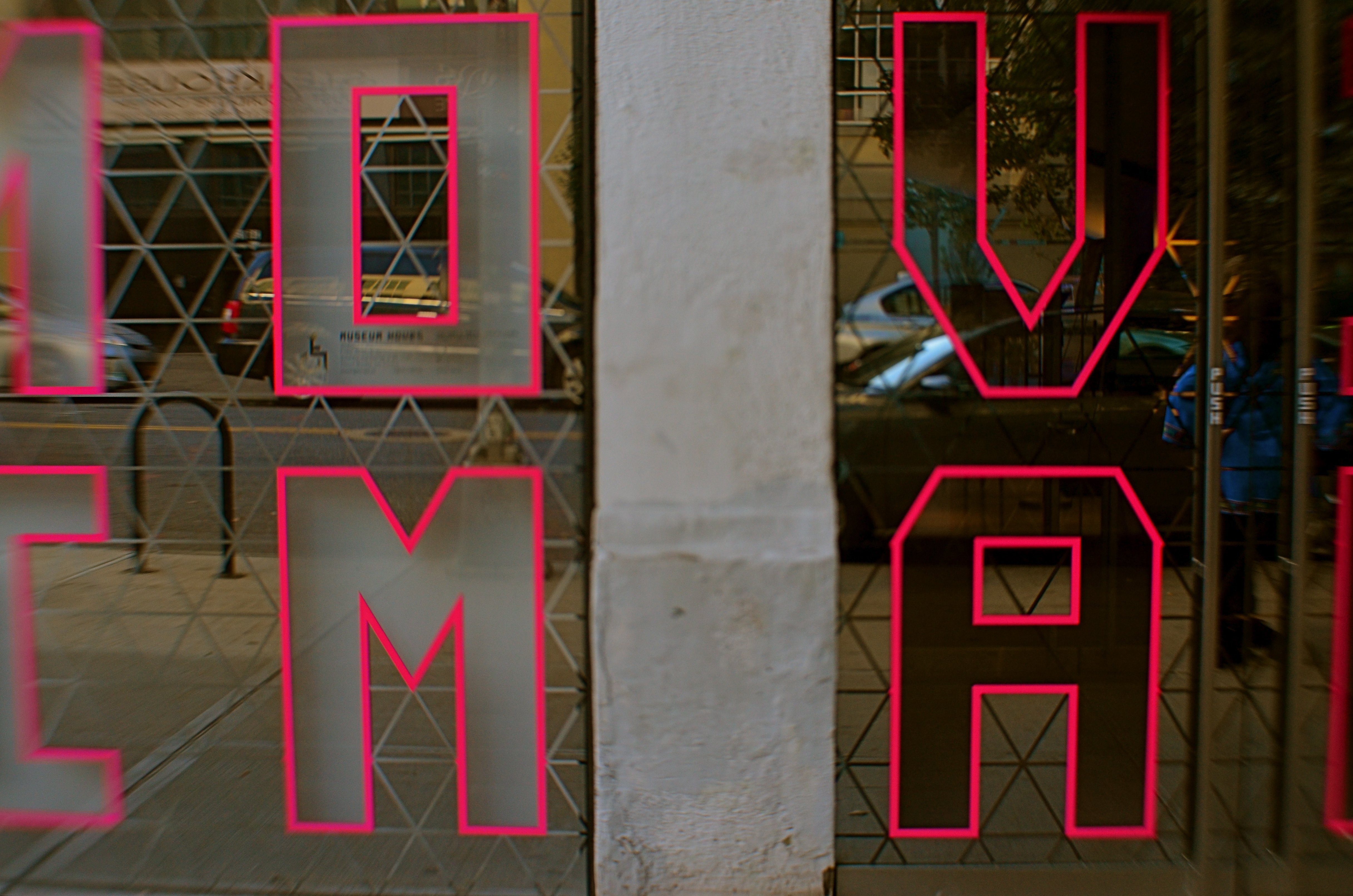
The sign seen here, announcing the Museum Of The Moving Image in Astoria,Queens, has its letters mounted on a mirror-like surface, allowing the viewer to see evolving street life over his shoulder as he “reads” the characters. It’s both advertisement and illustration, a low-tech demo of the museum’s intent. Like all signs, it’s a prop, a piece of stage dressing, interpreted as narrowly or broadly as you need it to be.
TWO WORLDS, ONE WALL
By MICHAEL PERKINS
PHOTOGRAPHS BEGAN AS A SIMPLE HEAD–ON ENGAGEMENT. The viewpoint of the camera was essentially that of an audience member viewing a stage play, or reading a page of text, with all visual information reading from left to right. People stood in front of the lens in one flat plane, giving the appearance, as they posed before offices or stores, that they themselves were components in a two-dimensional painting. Everyone stared straight ahead as if in military formation or a class portrait, producing fairly stiff results.
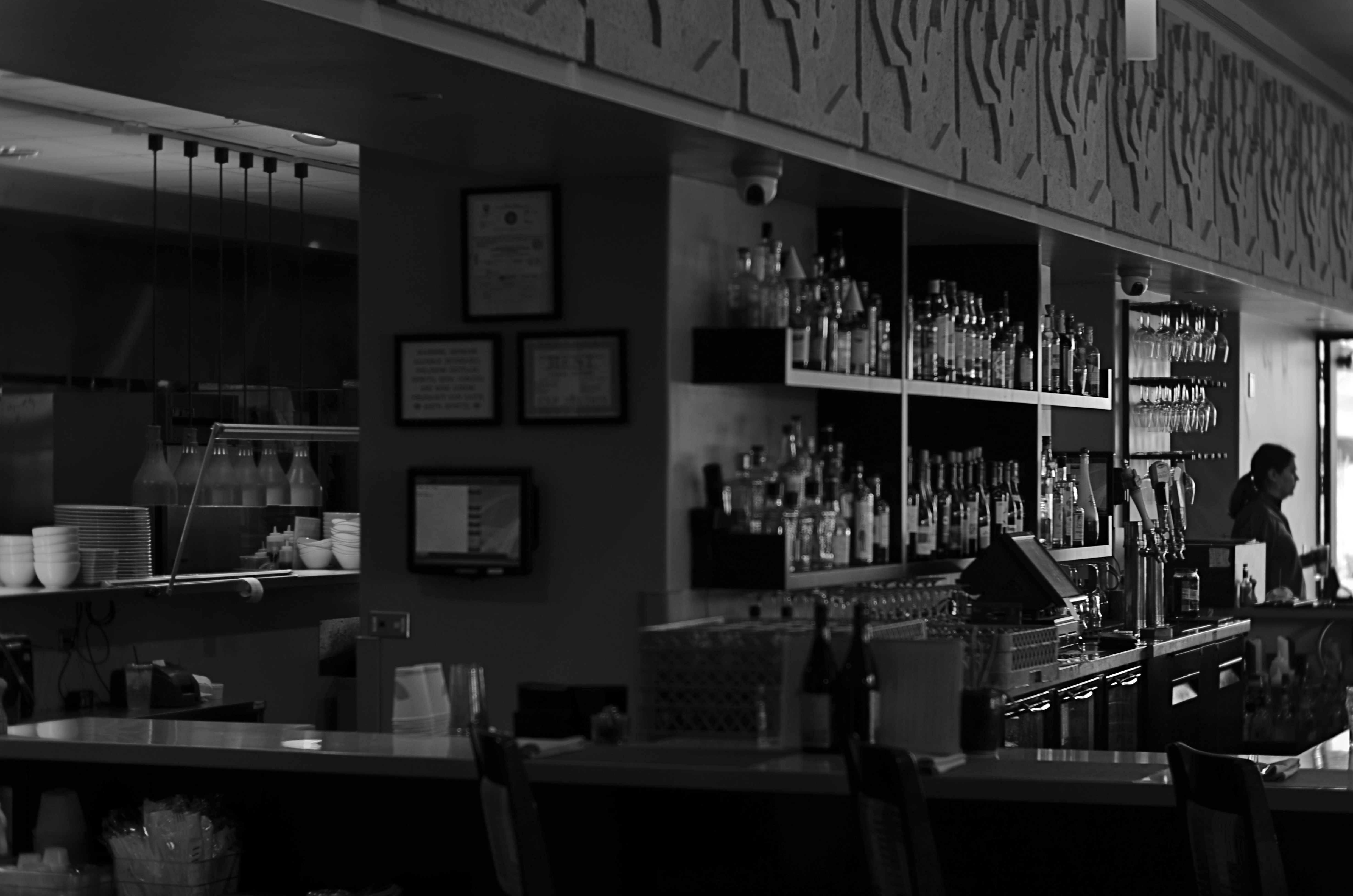
We started photography by placing people in front of walls, then learned, like good stage managers, that selectively positioning or moving those walls could help image-makers manage the techniques of conceal/reveal. Now you see it, now you don’t. Photography no longer takes place in one plane: barriers shift to show this, or to hide that. They are part of the system of composition. Control of viewing angle does this most efficiently, as in the above image, where just standing in the right place lets me view both the front and back activities of the restaurant at the same time.
Of course, generations after the rigid formality of photography’s first framing so, we do this unconsciously. Adjusting where walls occur to help amplify our pictures’ narratives just seems instinctive. However, it can be helpful to pull back from these automatic processes from time to time, to understand why we use them, the better to keep honing our ability to direct the viewer’s eye and control the story.
FAKING YESTERDAY (AND LOVING IT)
By MICHAEL PERKINS
PHOTOGRAPHS ARE POWERFUL ALLIES when it comes to wish fulfillment. One of the medium’s first great artists, Julia Margaret Cameron (1815-1879) not only preserved the faces of Charles Darwin, Alfred Lord Tennyson and Robert Browning for posterity, but also went the extra step into fantasy by draping her subjects in historical costumes and posing them in illustrations from Shakespeare and Arthurian legend. Her stars masqueraded as legends, their features made dreamy and ethereal with her soft, long exposures on collodion-coated glass plates.
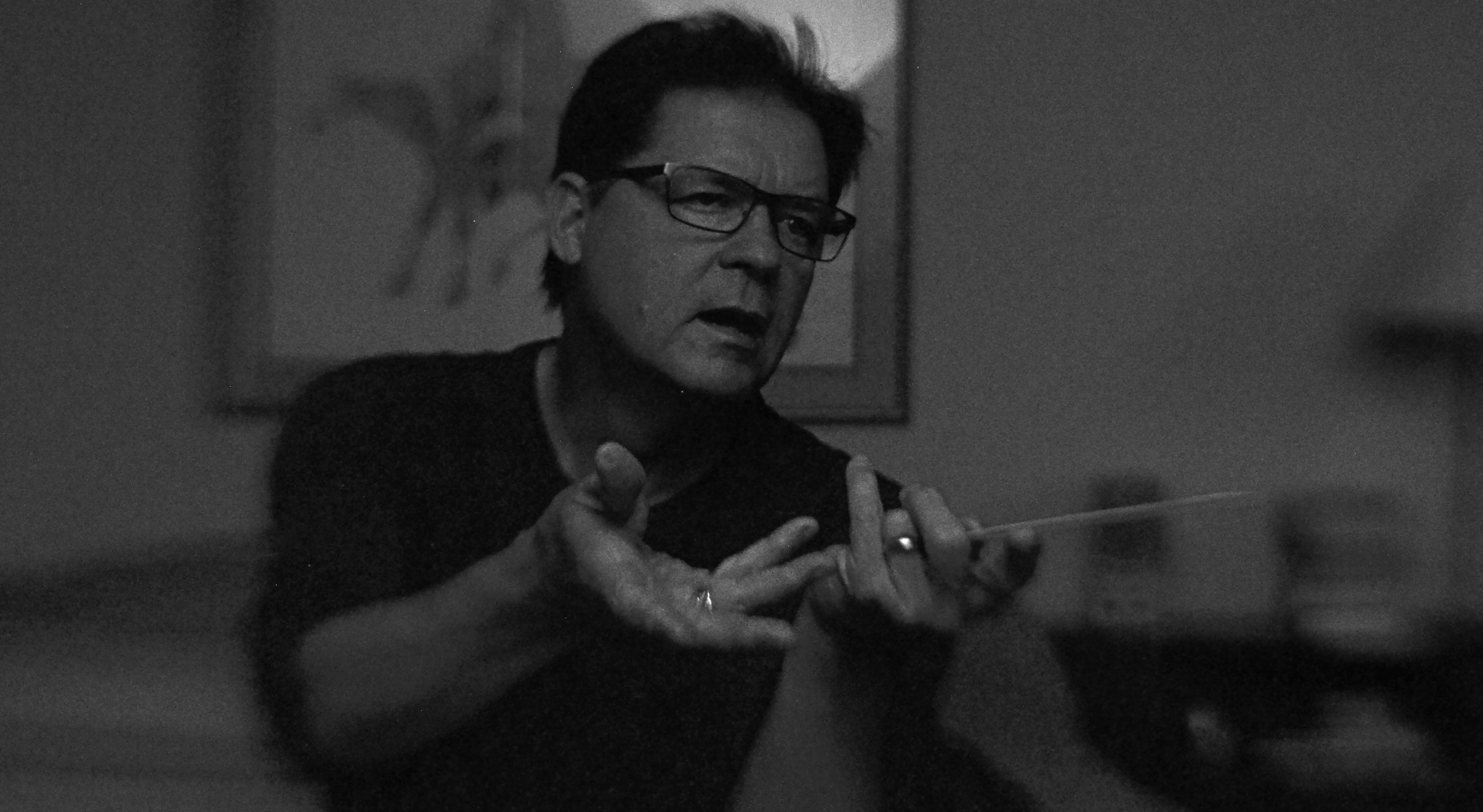
Everyone deserves at least one such photo fantasy, the chance to effectively leap into a treasured era while also creating the look that would have been common in that time. For a kid in baby-boom Ohio, daydreaming about standing up in front of a world-class orchestra, a kid who never played air guitar but who exhausted himself playing “air baton”, my photographic era of choice was that of Columbia Masterworks’ 30th Street recording studio in the Manhattan of the early 1960’s.
At the insistence of the label’s classical producer Goddard Lieberson, chief photographer Don Hunstein shot the greats not in starched, formal portraits, but in the very act of creation, immortalizing maestros from Leonard Bernstein and Pierre Boulez to George Szell and Igor Stravinsky. In terms of the “feel” of the images, most photo illustrations for album jackets from the period were still in black-and-white, lending Hunstein’s shots a gritty realism, as did the slower, higher-grain film emulsions and softer portrait lenses of the time.
Enter my self-generated conductor fantasy, shooting myself with a remote shutter release in a nearly dark room, just about half an hour after sunset at 1/40 of a second to allow me to hold a fake “caught in the action” pose with just a small amount of manually tweaked de-focusing for softness at f/4 and an ISO of 1250 to simulate the old Kodak Tri-X grain.
Vain beyond belief? You bet. More fun than my five best Halloweens combined? Indeed. “Alright everyone. Let’s take it from bar 124…”
WHEN COLOR IS ALL
By MICHAEL PERKINS
JUST A LITTLE SCROLL STROLL THROUGH GOOGLE will show just how long and how intensely the debate over color has raged in the photographic world……that is to say, whether color should be used at all, or whether, indeed, it was the spawn of Satan, turning the art of imaging into a crude carnival trick. Today, we routinely concede that both monochrome and color have distinct uses in the making of images, each bringing singular strengths to the process. But it was not that long ago that the two camps went at it like Hatfields and McCoys.
Many still feel that color should only be called on to help complete or “sell” a picture, a finishing touch of sorts. “In black and white you suggest”, wrote Paul Outerbridge in Modern Photography. “In color, you state.” Others, like myself, believe that there are times when color is content, complete in itself, regardless of the “official” subject of the image. Or, as Alex Webb writes, “Color is very much about atmosphere and emotion and the feel of a place.”

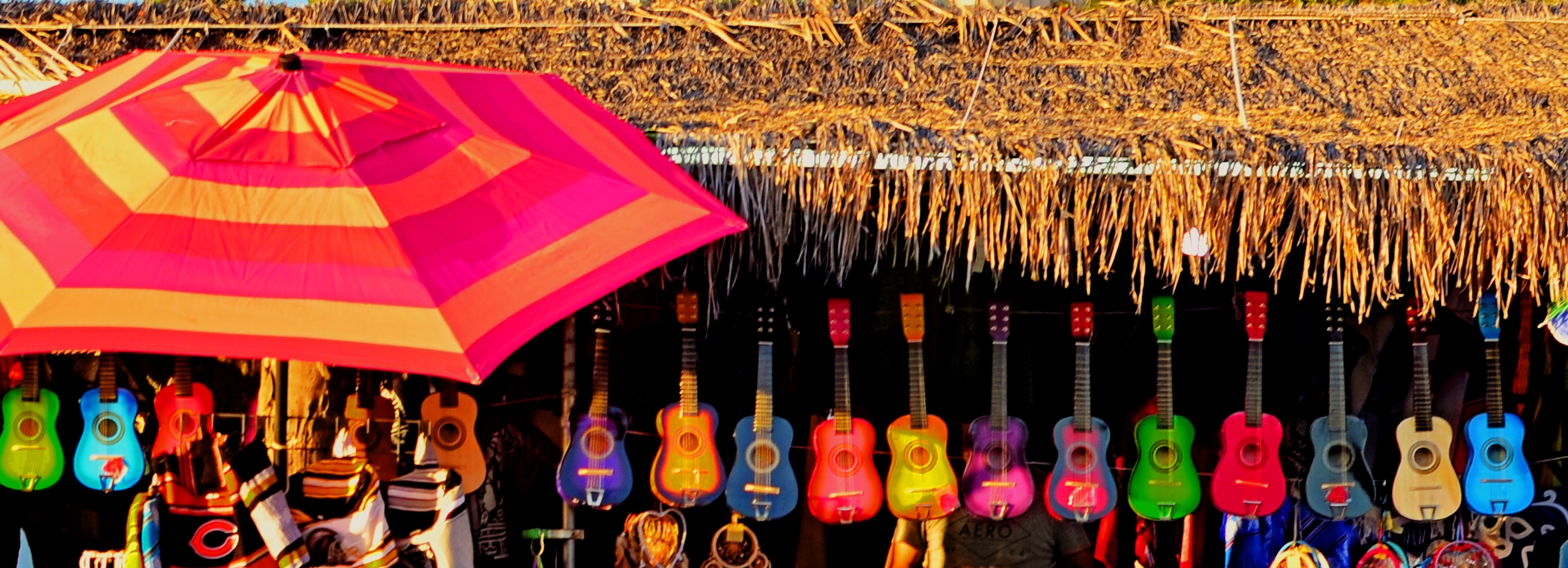
The photos seen here show how, if color is a compelling enough messenger, most of the visual information in a picture can be pared away to let that color message breathe. The master shot of a street vendor at sundown (seen at directly above) might have worked out if I had done one or two things better, but upon later examination, I realized that the long horizontal string of neon-hued ukuleles at the top of the shot could work if cropped loose from the less effective uber-shot (as seen at top). Better still, the color in the cropped shot is not actually about “ukuleles”, since a string of tropical fruits or a rack of hats with the same tonal palette would sell the image just as well. This is truly a case of color “just because”, conveying Alex Webb’s “emotion and feel” without assistance.
A lot of the photo world’s resistance to color, which ended barely more than a generation ago, stemmed in part from a loathing for the limited printing processes which made it harder to predict or control results compared to monochrome. But there was also the fear that untalented shooters would use it as a sensational crutch to boost mediocre work. Now it seems clear that color, like any other technical element, lives or dies based on what it is called upon to do, and how well the individual artist makes his argument.
SLAGIATT
Lighting A, Concept D…
By MICHAEL PERKINS
I CALL IT NO–FUNDAY, the painful exercise of poring over photographs that I once considered “keepers” and now must reluctantly re-classify as “obviously, I’m an idiot.” For any photographer, self-editing one’s output is just the kind of humiliation one needs to keep on shooting, if only to put greater distance between one’s self and one’s yester-duds.
To make the shame of disowning my photographic spawn even worse, I find that, more often than not, technical failure is usually not the reason I’m lunging for the delete button: it’s the weakness of the conception, a basic lifelessness or lack of impact that far outweighs any errors in exposure, lighting, even composition. In other words, my worst pictures are, by and large, bad because they are well-executed renditions of measly ideas.
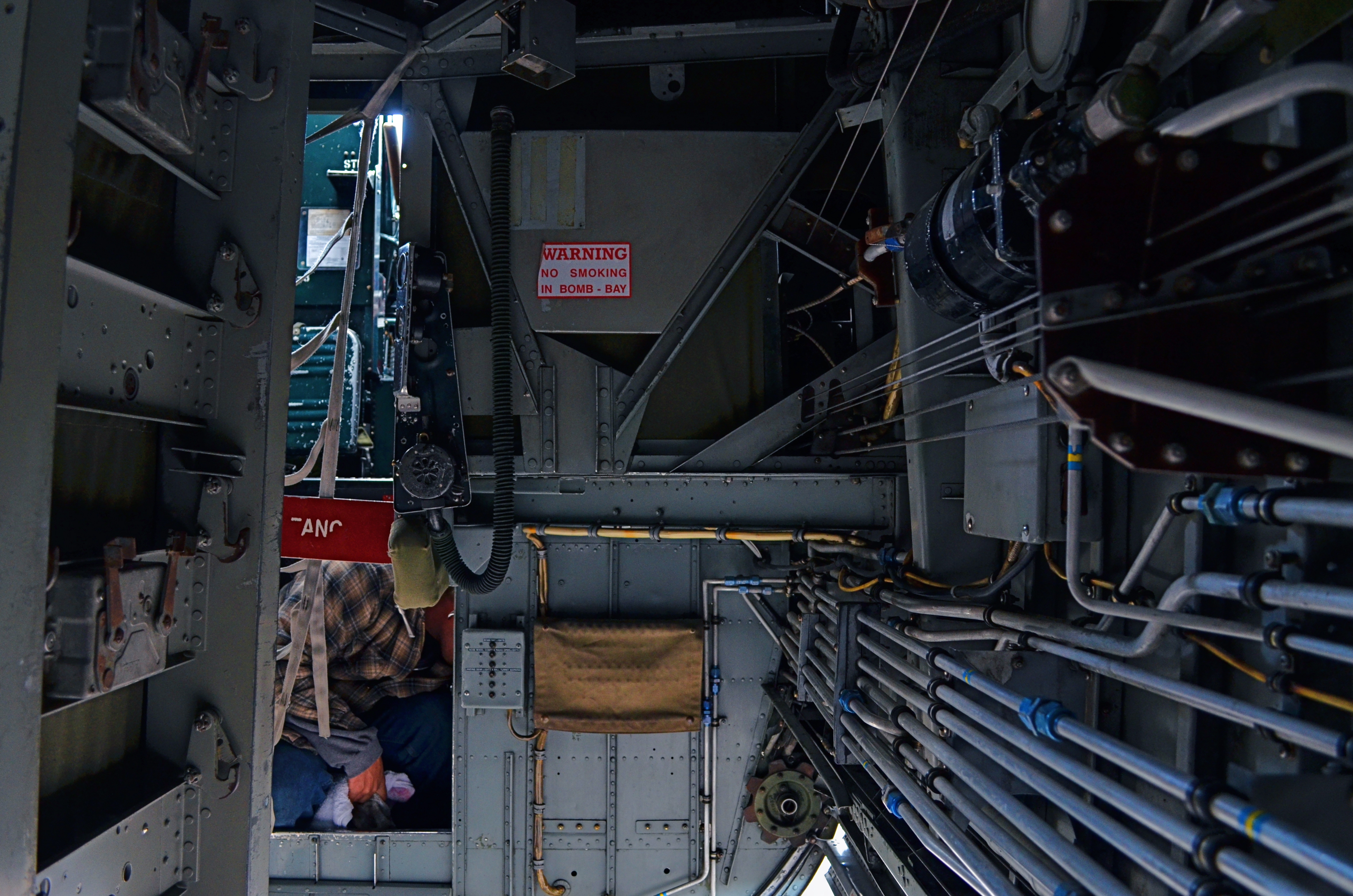
In my mental filing cabinet, I refer to these images under the acronym SLIGIATT, or Seemed Like A Good Idea At The Time. The image above is a perfect example. This shot, taken inside the underbelly of a WWII bomber, presented a ton of lighting challenges, but I spent so much time tweaking this aspect of it that I neglected to notice that there just isn’t a picture here. It tells no story. It explains nothing. It’s just an incomprehensible jumble of old equipment which lets the eye wander all over the frame, only to land on…..well, what exactly? But, boy howdy, it is well-lit.
SLIGIATT photos are, of course, necessary. You have to take all the wrong pictures to teach yourself how to create the good ones. And mere technical prowess can, for a time, resemble quality of a sort. But technique is merely craft, and can be had rather easily. The art part comes in when you’re lucky enough to also build a soul into a machine. As Frankenstein figured out, that’s the difference between being God and playing God.
SHATTERING THE FRAME
Which piece of the puzzle should be prominent?
By MICHAEL PERKINS
ONE OF THE MOST REVOLUTIONARY ACTS a photographer can commit is the thwarting of expectation, a deliberate subverting of what the viewer assumes will happen next. Composition-wise, this means not just deciding what information makes it into the frame, but, indeed, whether there will even be a frame at all.
Any demarcation or line within an image can be used to direct attention to a given location. Whether including or excluding, pointing toward or pointing away from, the photographer has pretty much limited authority on how he’ll direct traffic within a composition. And so we shoot through holes, slats, panes, and skylights. We observe borders marked by cast shadows: we cut spaces in half to make two rooms out of one: we reveal facts in parts of reflections while obscuring the objects they reflect.
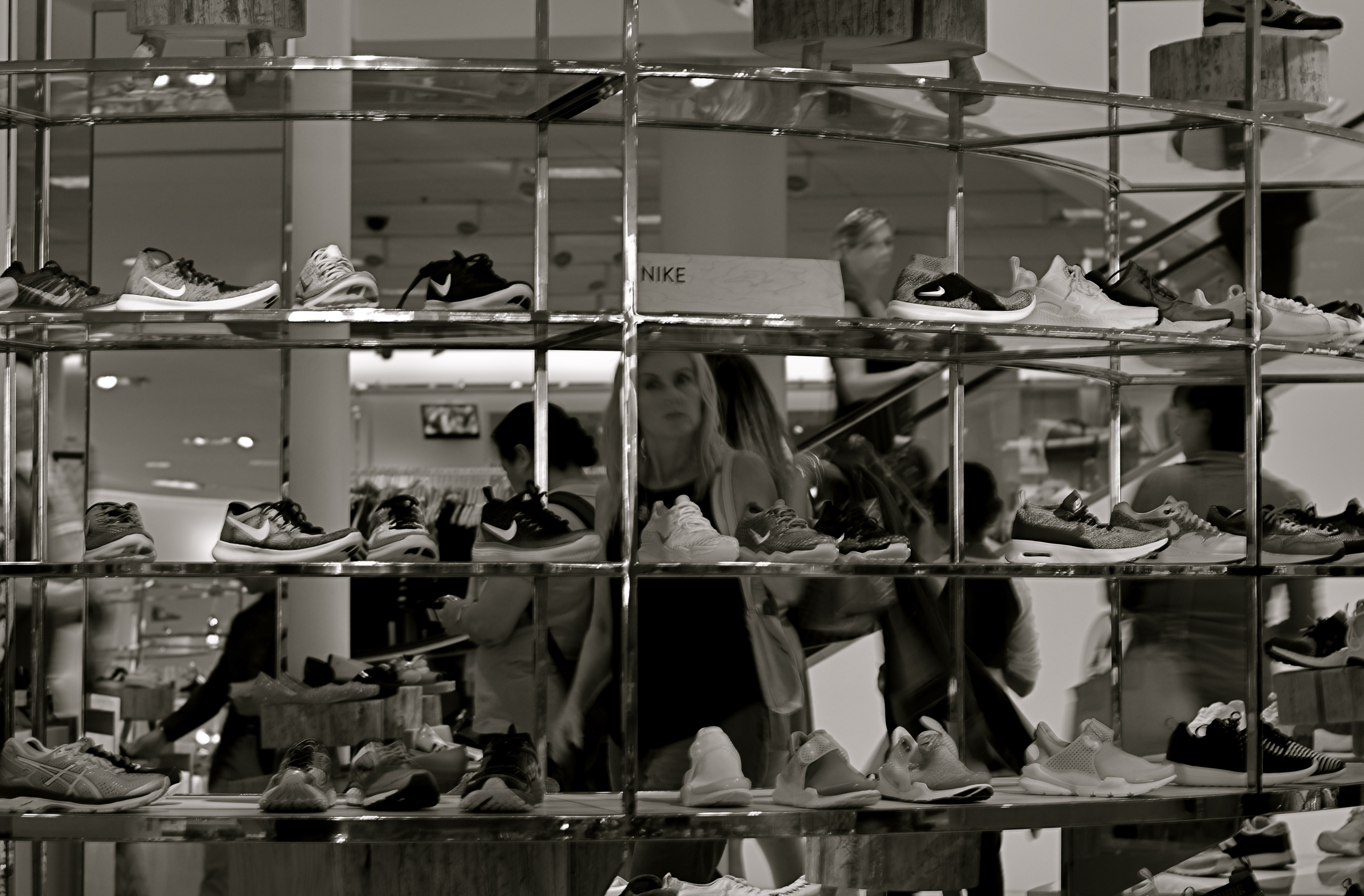
In the above image, I saw the subdivisions of the department store display unit like a wall of little tv’s, each screen showing its own distinct mini-drama. Is the woman seen eyeing the merchandise the most prominent “screen star”, or are we just seeing an arbitrary mosaic of the larger scene behind the display? Or is it both?
Framing within the larger frame of a composition can isolate and boost whatever message we’ve chosen to convey, and it’s perhaps the most total control a photographer can wield, more so in its way than even exposure or lighting.


SPEED OF LIFE
By MICHAEL PERKINS
NEW YORK CITY HAS BEEN CALLED MANY THINGS: words like titanic, exciting, merciless, dizzying, dangerous, even magical spring to mind immediately. By comparison, fewer observers refer to the metropolis with words like peaceful, tranquil, or contemplative, and fewer still would ever label it slow. Manhattan may be lacking for modern subways, open space, or a cheap cup of coffee, but it’s never short on speed.
NYC runs on velocity the way other towns run on electricity: the entire metro is one big panicky White Rabbit, glancing at his pocket watch and screeching “I’m late!” As a consequence, anyone making photographs in the Apple has to factor in all that velocity, or, more precisely, decide how (or whether) to depict it.
Do you try, for example, to arrest the city’s rhythm in flight, freezing crucial moments as if trapping a fly in amber, or, as in the image above, do you actively engage the speed, creating the sensation of New York’s irresistible forward surge as a visual effect?
Fortunately, there is more than a century of archival evidence that both approaches have their own specific power. Pictures made in the precise instant before something occurs are rife with potential. Images that show things in the process of happening convey a sense of excitement and immediacy. Like the lanes in a foot race, speed has discrete channels that can reward varying photographic approaches.
Share this:
August 15, 2017 | Categories: Commentary, Composition, Conception, Documentary, Uncategorized | Tags: Street Photography, urban neighborhoods | Leave a comment