the photoshooter's journey from taking to making

Latest

SETTING THE TERMS

By MICHAEL PERKINS

FOR NARRATIVE PHOTOGRAPHY, THE MOST COMPLETE CONTROL IN AN IMAGE can never consist merely in the mastery of technical factors like aperture or exposure. Depending on what kind of storytelling your pictures are about, those elements are certainly important, but, to my mind, Job One is always about control of the frame. The selection of what’s in or out of that space is the first step toward setting terms of engagement for a given picture. It is your audience’s cue sheet for what’s important to look at, the main argument for your message. Own the frame and you own the viewer’s eye, as well as whether it focuses precisely or meanders all over.

The word “frame” is, itself, a little vague in this context. Photographs are not only framed by the physical confines of the viewing area, say an 8 x 10 print. There are many ways to subdivide the space within the image to create frames within frames. Frames can be any line or demarcation in the photograph which isolate or amplify information. Framing does what you might do if you were verbally narrating or captioning your message, only it acts in a purely visual manner. Of course the physical limits of your final photo create mystery or mood merely by themselves, as the eye will naturally ask what is happening beyond the limits of the physical confines of the picture. But even inside the “hard” edges that are printed or projected, data can be revealed or concealed by what surrounds or delineates it.
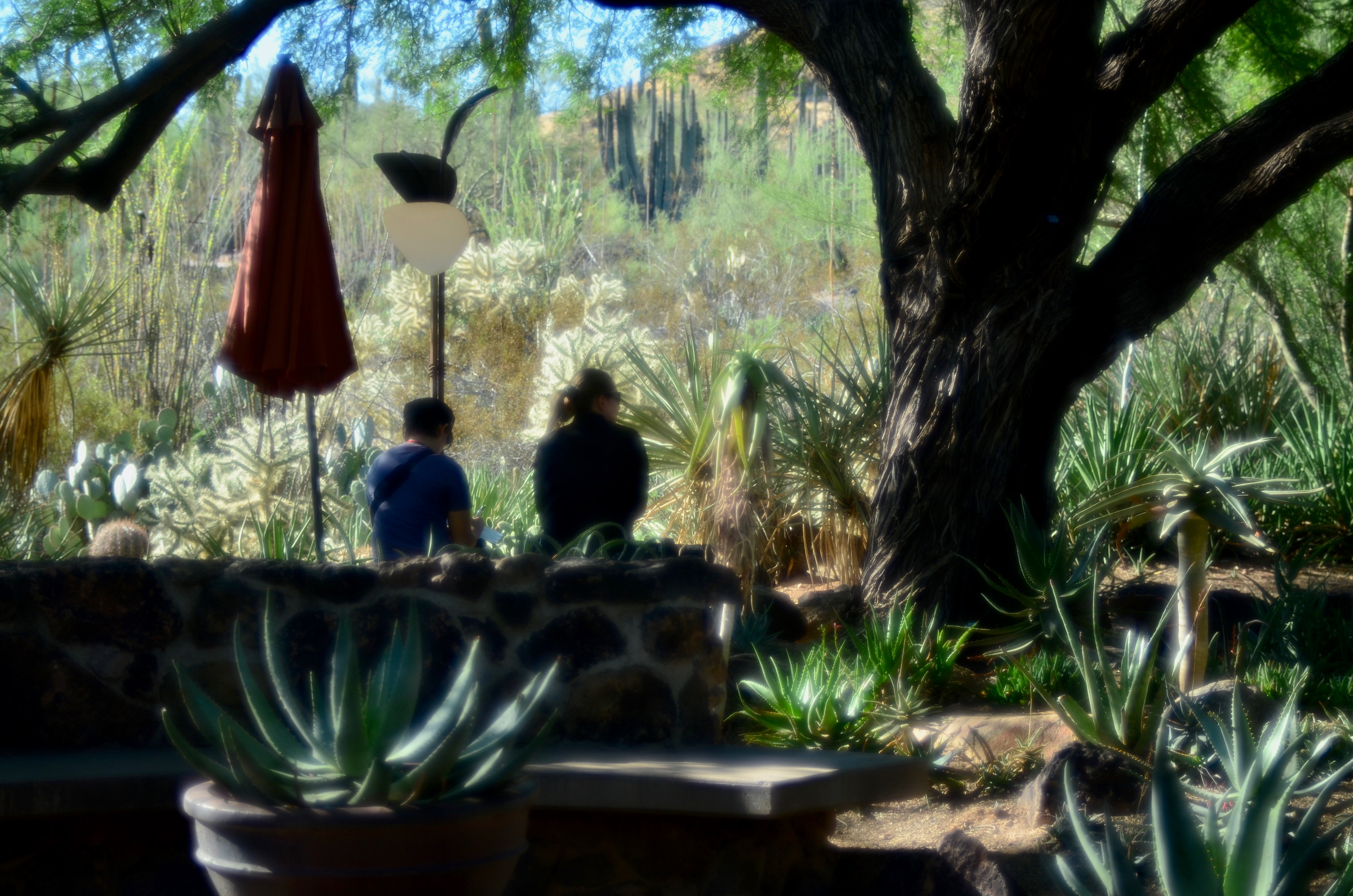
Even in a flat medium, framing can create an illusion of depth.

Framing is a little like capitalizing a letter at the head of a new sentence. As seen in the above picture, with some help from either selective focus or silhouetting, it can also create a perceptible distance between foreground and background, a kind of faux 3d that imitates the way actual stereo photographers are taught to compose to maximize the effect in a flat medium. In this specific case, the mother and son are separated by interior framing from the greater part of the composition, held in place between the tree at right at the stone wall beneath them. This acts as a dividing line between light and dark, major information and minor decor. Framing is a way of dividing your image into active and passive information, or prioritizing its components. What data gets left out, then, is as important as what gets left in, since both decisions can spark speculation in the viewer. A frame is like a proscenium where the audience both concentrates on what’s in front of the curtain and speculates about what’s behind it. The frame is the terms of engagement for a photograph. The clearer those terms, the more immediate your picture’s impact.
CUTTING YOUR LOSSES (BUT NOT TOO MUCH)

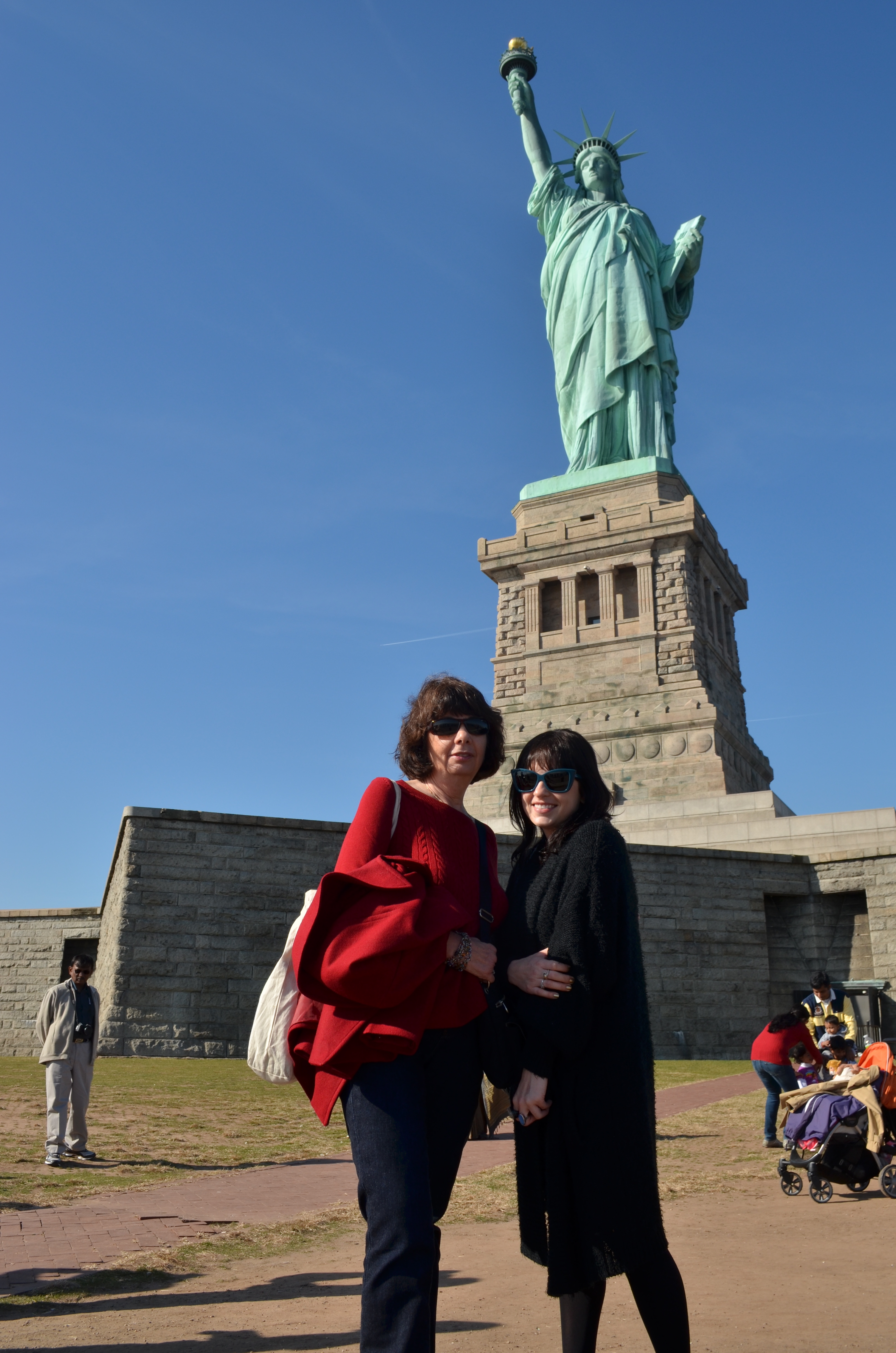
Ground-level snap of the SOL.

By MICHAEL PERKINS

I BELIEVE THAT PHOTOGRAPHERS HAVE A NUMBER OF INTENTIONS that can be set for their images, with only one of them being the raw product of original shots. Certainly we all hope that we’ll hit a perfect storm of equipment, conditions and executions when first we click the shutter, but we have all also learned to set a number of later intentions for those same pictures, strategies that are hatched long after they are in the can. That’s the all-too-human gap between what we meant to do and what we actually achieved, which sets us looking to re-frame our projects from “rescue” missions to “salvage” missions, otherwise known as There Must Be A Usable Picture In Here Somewhere. One man’s afterthought is another man’s Photoshop, and so forth.

Suppose for example, you’re in the position of your humble author, who, several years ago, started his day in Manhattan with an 18-55 kit lens…..ideal for getting wide compositions in close quarters and such. You suddenly decide to add a side-trip to Liberty Island, a completely different shooting situation that may, in fact, distance you from your main subject. Yes, a truly wide lens certainly shows lots of touristy “stuff”, including Lady Liberty herself, her pedestal, all the visitors in the area, the occasional tree or building….a lot of everything. But even “zoomed in” to 55mm, the statue will not seem close at hand or, if you like, intimate. You didn’t know beforehand that you’d need a telephoto and so you don’t have one. However, being here isn’t part of your daily, or even yearly ritual, so you will likely be going for broke, finding the real core images later, through cropping. Your in-the-moment control has been compromised, so your revised plan is to recompose all the shots later. And hope.

Cropping can become a source of photo-snobbery in some circles, since, of course, true geniuses know instinctively how to compose a perfect frame every time, a notion which, romantically, is appealing, but pragmatically, is poppycock. Paring away non-essential parts of an image to amplify what’s left is not a sign of weakness, since the final edit must, eventually rise or fall on its own merits. In this exercise, it’s pretty obvious that the statue is the main headline, no disrespect to hot dog stands or strollers full of infants. So the first cropping decisions are easy, unless you specifically came to snap pictures of grass or sidewalks. But now, within that new work regimen, what parts of the statue are needed most? Is the bottom half as dramatic, or as revelatory, as the top half? How do you want the viewer’s eye to travel, horizontally or vertically? If you had been equipped with a zoom, what would your most instinctual composition? Is the statue to be paired with other elements to demonstrate perspective or scale, or does it pack more punch in isolation?

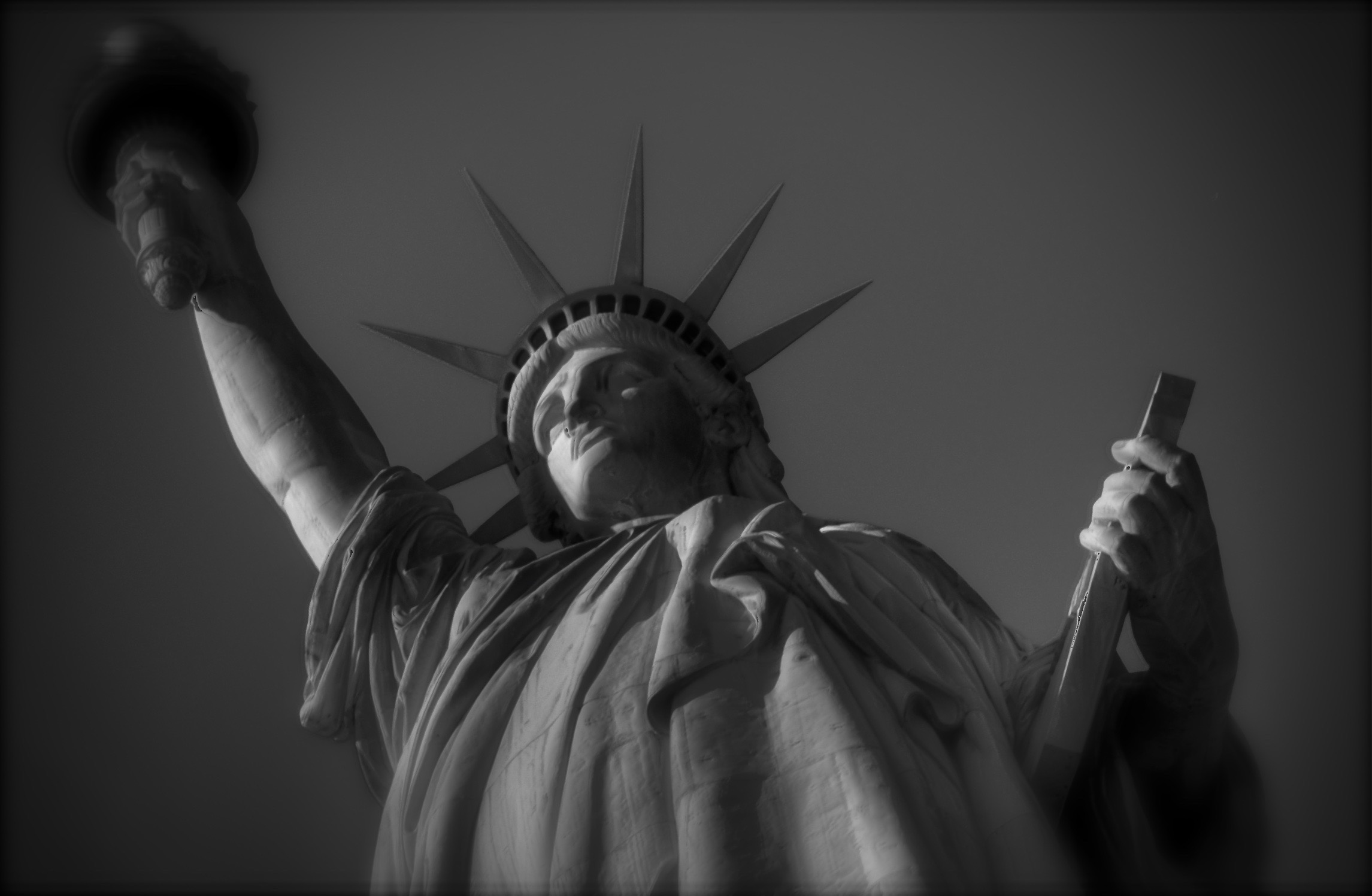
A drastically cropped reworking of one of my original ultra-wide ground-level snaps.

The cropped monochrome shot seen here is also, incidentally, an argument for shooting at the widest, most dense file size you can, so that image integrity is preserved, even with a dramatic loss of data. On this occasion, my “master” shots, seen at upper left and taken at ground level, were 3264 x 4928 pixels in size, whereas the drastically cut b&w version is still fairly solid at 2291 x 1496. A little processing was also used to cosmetically disguise the minor quality loss. The reason I am beating this particular drum is not to say that, with this stunt, I pulled some kind of rabbit out of my hat, saving a formerly useless picture. These particular images are not “keepers” per se, but can serve to remind me that the intention of a picture is not determined solely in the camera. Sometimes your best ideas for an image mean using imperfect first takes and seeing if they’ve missed the mark by millimeters or miles. It can mean either happy accidents or tragic misfires, but both outcomes afford you education, and that’s not nothing.


A SANDWICH WITH THE MAHATMA

By MICHAEL PERKINS

THE FIRST TIME I SAW THE STATUE, situated at the side of a newly opened bookstore, I thought it looked a bit…lonely, rather like the first chair you move into an otherwise empty apartment. The sheer amount of sidewalk and parking lot surrounding the bronze figure of Mahatma Gandhi made it look like someone had delivered it to the wrong place, and was perhaps returning at some future time to see it on to its rightful owner. And while I certainly have reverence for the eminent leader as, well, an eminent leader, I would have thought a more predictable bust of Poe or effigy of Twain might have made a better outside advertisement for the tomes within.

Then, a year later, I got a second chance to see the possibilities.

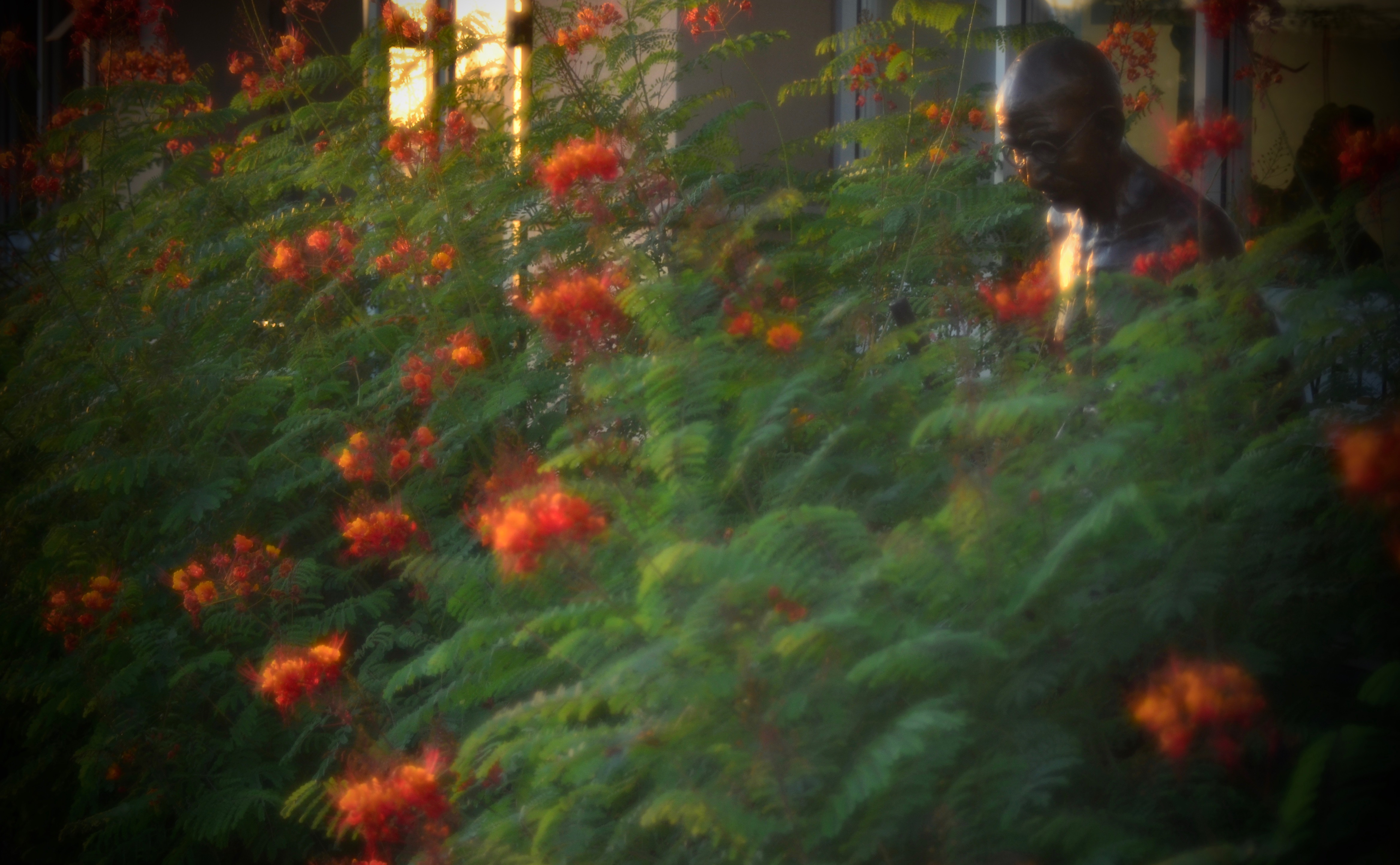
In the intervening period, and as they are wont to do, a very lush desert bird of paradise bush had sprung up, flowering fully by the end of this summer, nearly obscuring the Mahatma and placing him in a very different kind of visual space. Suddenly I visualized a design, or at least a design idea, for an image. In traditional Indian art, the same flame-tip orange found in the shrub’s flowers are a very dominant color, symbolizing sun, flames, birds, and the raiment of various gods. The sea of blossoms now fronting the statue seemed less to me like plants and more to me like banks of fire, or oceanic waves, or those brilliantly colored clouds of dye dust billowing up during celebrations and rituals all across India. I began to imagine Gandhi as a mystical figure emerging from those clouds, as if released from the bonds of time, or maybe even as Shiva himself summoned him forth. The problem with this whole conception now became how to render something fanciful with a machine (the camera) whose default is merely to document.

But, of course, that was the fun of it…

Suddenly Shiva Ordered The Mahatma Forth, 2019

I had one very fortunate ally in the fading, pre-sunset light, which amped up the orange in the blossoms and also bounced that same color off the shiner portions of the statue’s bronze. I also figured that the flowers on the bird of paradise might be more suggestive of movement if they weren’t rendered in absolutely sharp focus, so I opened my lens all the way to f/2, shrinking my depth of field to almost nothing. I then concentrated any sharpness to be had on the statue’s head alone, isolating it in a kind of focal sandwich with the softened foreground and background as the “bread”, if you will. The slight glowing affect achieved when shooting wide open on this particular lens (A Soviet-era Helios 44M) also helped the dreamlike quality suggested by what I saw in my mind. The result is not a technically perfect realization of all this, but it at least records the rudiments of my idea, much like a sketchbook “rough”, a field test of the idea that I may refine later.

The only really important thing here was in reminding myself that the addition of a single new element in our view of the familiar can substantially expand one’s options in photography. The newly added straw may not break the camel’s back, but someone may be inspired to remark, “oh, you stuck a straw on his back. That’s just what was needed….”

ETHEREAL ON THE CHEAP

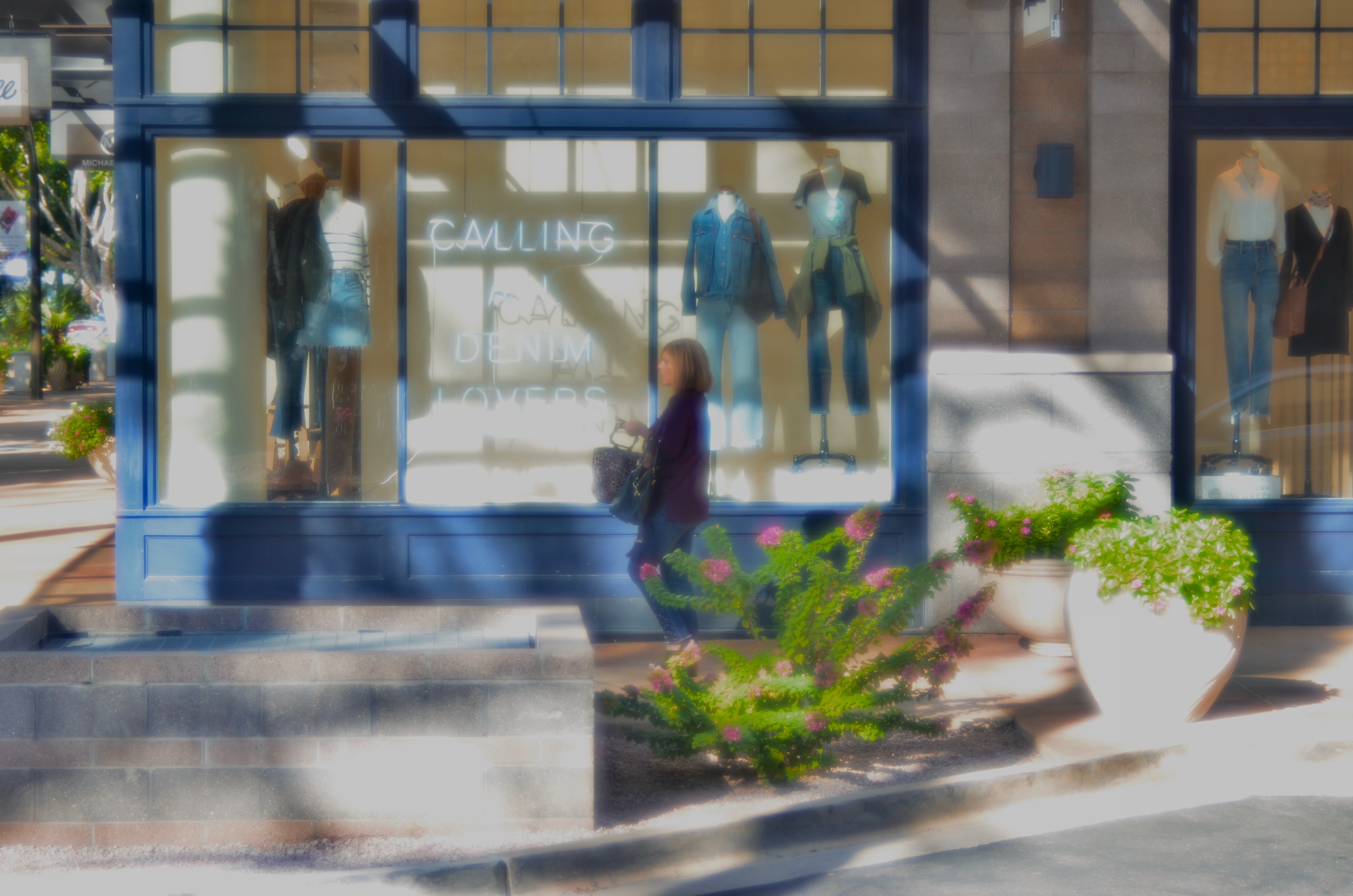
On the Town, 2019. Shot on a Soviet-era Helios 44M manual lens, wide open at f/2, ISO 100, and deliberately over-exposed at 1/250 sec to accentuate the dreamy quality. 

By MICHAEL PERKINS

FOR MANY PHOTOGRAPHERS OF, umm, A CERTAIN AGE, our first cameras came out of the box pretty much ready to go, with lens and body working as two halves of a predetermined factory assembly. The lens half frequently was pre-set at a single focal length, and, in the really rudimentary models, a single shutter speed. Varying the results of such tools meant doing something as simple as shooting in shade instead of direct sun, or accidentally standing too close to your subject for an express ticket to Blursville. We learned the limits of our earliest cameras by operating them badly.

But this was not a worthless exercise, since all those crummy misfires, while teaching us what didn’t work, also taught us to eagerly explore what might work. As we graduated to better, more responsive/instinctual gear, we carried that approach to learning with us, and can still call upon it when we care to. Because, even as we have become accustomed to more and greater options via ever more sophisticated lenses and gear, we can still learn a great deal about our own creativity by deliberately limiting our choices from time to time, which is why I became fascinated, years ago, with the idea of keeping a chosen lens on a camera for an extended period, forcing myself to shoot any and everything with it regardless of subject or conditions. In a sense, you’re re-introducing the uncertainty and occasional failure of your earlier shooting techniques back into your work. But you’re also learning to problem-solve and improvise, infusing a new kind of energy into your photography.

The Normal Eye, you may recall, originally sprang from a year that I spent shooting exclusively with an f/1.8 50mm lens. Since that time, I have occasionally attached other lenses, all with differing strengths and weaknesses, to various cameras for extended periods to see what I could do when I couldn’t do what I preferred to do. It has always yielded me surprises and a lot of fun. Lately I am going steady with an old Soviet-era Helios 44M, a f/2 58mm prime dating from the late 70’s. Having been built for some of Europe’s most mass-produced cameras, the Helios is a solid, well-built beauty that is also plentiful in Ebay Land. It’s also cheaper than devalued Russian currency and produces both flatteringly soft portraits and distinctive bokeh, so a win all around. Many contemporary “art lenses” produce some of the same effects as the Helios but at a premium price, so seeing if you like the looks it creates while risking less than $40 is hard to resist.

Wide open at f/2, the Helios, a fully manual lens, has an aggravatingly shallow depth of field. We’re talking taking fifty pictures to get five in which you truly nail the focus. However, the gentle drop-off you’ll see between cleanly defined objects and their immediate surroundings affords a buttery, smooth quality that, with a little intentional over-exposure, can produce a decidedly dreamlike, pastel-flavored effect, as seen in the example above. For $40, I will gladly use this thing chiefly for this look. Now, certainly, this lens, like every other hunk ‘o’ glass, has idiosyncratic deficiencies and is not great for everything. But at these prices, it is worth spending, let’s say, at least a week learning how to consistently produce the results you want with it, as much for your own education as for the number of keeper images you’ll harvest. Consider also that this lens was originally sold as the “kit” lens for Zenits and a range of other Euro-cameras. It came in the box attached to the body. It was supposed to do most of what you’d want to do without swapping out to other glass, so that, by shooting with it exclusively for extended periods in today’s world, you’re experiencing essentially the same learning curve that was engineered into the lens back in the glory days of the U.S.S.R. It’s not exactly like riding a bucking bronco without a saddle or rope, but still, the horse does buck.

Learning what to do when your gear hits its design limits can either be frustrating or liberating. The choice of which of those feelings you, yourself, will experience, like all other choices, is yours alone.

NOTHING EVER HAPPENS AROUND HERE

Midday At The Monte Vista, 2019

By MICHAEL PERKINS

AS THE CAMERA IS A KIND OF REPORTER, it is called upon to capture or convey every aspect of the human experience. In a strict journalistic context, this can mostly consist of emotional extremes…..that is, joy, devastation, triumph, disaster, life, death. Feelings that laugh (or scream) out loud sell newspapers and pump ratings. But photographers are also called upon to show that, for one reason or another, we humans spend a lot of time….waiting.

You can make your own list of all the things we actually wait upon: trains, planes, the next opportunity, the last piece of cake, Christmas, true love. To be human is to abide, to patiently hang until the next item on life’s menu comes along. Sometimes there is nothing visually special in all that waiting. On the other hand, sometimes we can use our cameras to depict our restlessness, our expectation. Certainly time can slow to a crawl, and, with it, the heartbeat of our existence. But occasionally, all that “nothing looks”, at least in a photograph, like something.

We learn to document and measure emptiness. Cities before they fully wake. Courtrooms that have just emptied out. The first seepage of night into the dying day. Places that should be bustling, but aren’t. Towns on the edge of the end. People who’ve been stood up, left out, or merely missed their connection. But, there’s no guarantee that when “nothing” happens, a picture with “something” results. Sometimes, nothing is just…nothing.

But then again….

The hotel lobby seen here has graced its small town for over a hundred years. And it stands to reason that, if the owners were making a promotional video of that century, the end product would feature plenty of images of the famous and infamous who crossed its threshold over the joint’s lifetime. The parties. The ends of wars. The changes from horse-drawn carriages to tin lizzies. But today, there are no greatest hits on the schedule. Today, there is only waiting. Killing time. Glancing at the clock, again. Last week’s stale gossip reheated for today’s visitors. Perhaps a weary remark by someone that “nothing ever happens around here”. The challenge, then: on this particular day, will all that nothing arrange itself into a scene, a small story about a small day, a tale worth telling? Or is the waiting all there is?

Making photographs on “nothing” days is an exercise, just like push-ups or jumping jacks. Often it merely amounts to keeping in practice. Staying limber. Just in case. Still, the pictures where nothing happens are occasionally, themselves, something else.

Or not.

Anyone around here have a deck of cards?


STOLEN FRUITS ARE SWEETER

By MICHAEL PERKINS

ONE WAY THE EMERGING ART OF PHOTOGRAPHY SOUGHT TO LEGITIMIZE ITSELF in the nineteenth century was to cloak itself in the vocabulary of painters, to certify its value in the same terms that were applied to the art people feared it was conspiring to replace. This meant speaking of perspective, tone, realism, and all the other trigger words of the dauber. It also meant that, in the early days of recording media (paper, glass, eventually celluloid), that the formal occasion of making a portrait was also, as it was for the painter, a slow, deliberative process. Early photo portraits had to be “managed to death” since exposures took a minute or longer, certainly more “instantaneous” than a painted effigy but still requiring that the subject formally “sit” for the occasion.

After 1900, as film speeds and supplemental lighting evolved, the portrait could be mechanically done with less preparation, but the formality, the august occasion of having one’s picture “made” persisted. But whereas a painted or an early photographic portrait, for folks in the Victorian era, may very well have been the only official record of a person’s face over a lifetime, snapshot technology made it possible to have hundreds, later thousands of portraits of oneself shot from cradle to grave. And yet, it’s only in recent years that the traditional idea of a “serious” portrait has begun to finally fade from general use, with even formal photogs breaking free of the studio walls, taking wedding or graduation shots by quiet streams or rolling hills.

Which, to me, is all to the good. I believe in trying to select the right facial expression from settings in which the subject is in his or her natural element, extracting the optimum view from the rolling movie of that person in action, in motion. It’s the best weapon against the powerful, if unconscious reflex people fall into once they fixate on the fact that they are having their picture “taken”. For reasons of shyness, vanity, or the urge to put forth their “best angle”, people cinch up and pose to at least some degree, making their face just that much less natural than it is when they have better things to worry about. Taking a 100% candid snap is nearly impossible unless the subject has something to do beyond waiting for the dreaded shutter click.

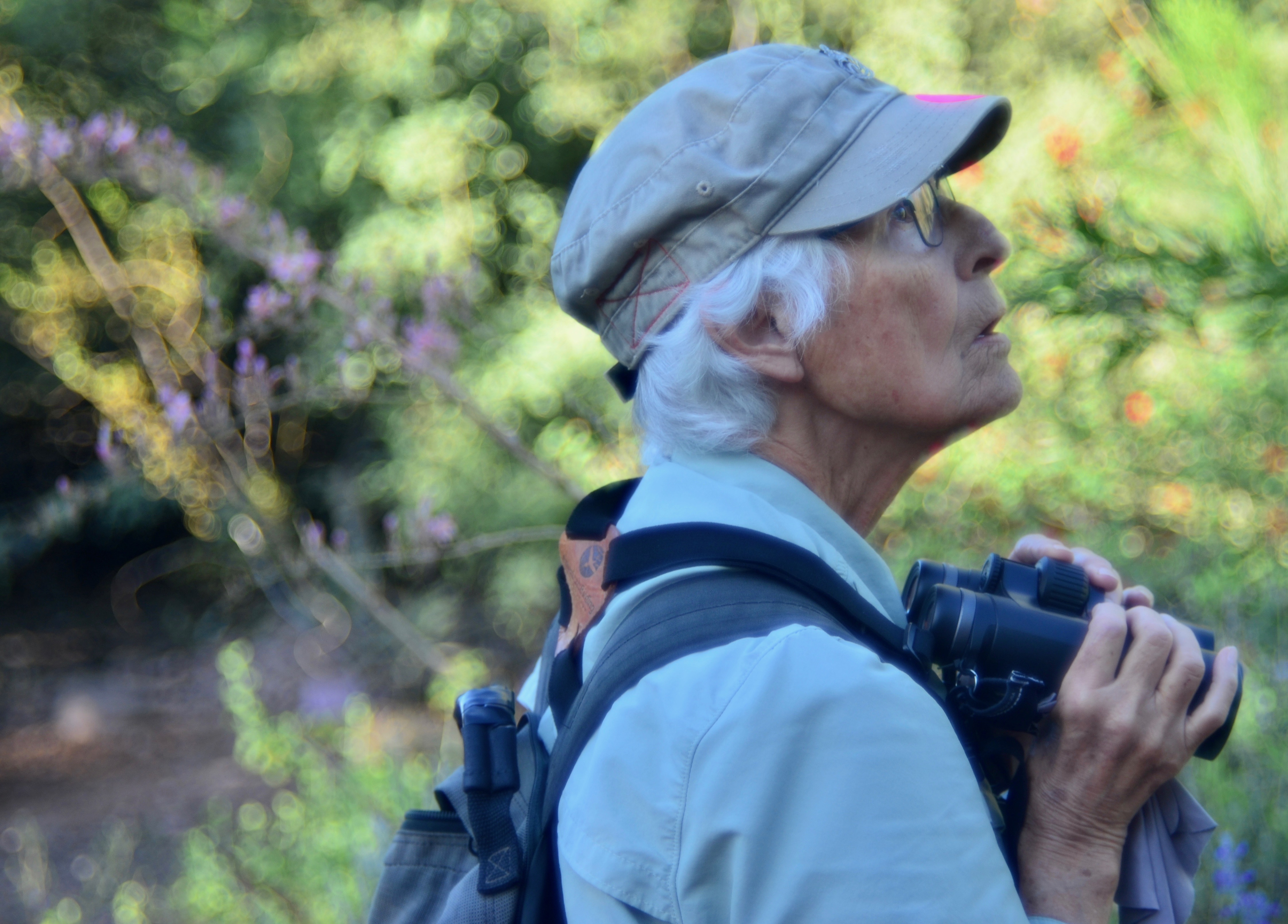
On The Wing, 2019. Shot with a Soviet-era Helios 44M manual lens at 1/320 sec., f/2, ISO 100, 58MM.

In the image shown here, I didn’t have to tell the subject to “act like you’re watching a bird”, because she was, in fact, watching a bird. She doesn’t have to portray a version of herself: she just has to be. The onus is rightfully on me to catch her looking like herself, not to attempt to replicate that self within the trappings of a studio in some kind of weird round of Let’s Pretend. It also helps that this setting isn’t my eye’s first acquaintance with her face, but rather a picture shot after months of watching her in the act of pursuing her passion. The old mind-set of portrait making from the 1800’s is thus reconstituted. My lengthy preparation and study for making the portrait happens ahead of the actual act of capture, with the physical execution of the shot taking as little time as possible, the better to relax the quarry and thus fend off any unconscious play-acting.

Ask yourself which your subject would prefer: being forced to simulate some version of themselves in a formal setting or being passively recorded while in the act of being themselves by a nearly invisible and non-invasive process. Portraits aren’t supposed to be homework and they aren’t effective when done solely on the photographer’s terms. Know your subject, get out of the way, and enjoy the surprises which are bound to result.

THE HOUSE I LIVE IN

By MICHAEL PERKINS

FRANK LLOYD WRIGHT OFTEN EXPRESSED THE BELIEF THAT, in architecture, “form and function are one”, that, in the best designs, what a thing is used for will generally dictate its appearance. And while it does seem to hold true that sports stadiums do look like places where sports are played, or that churches look like places where people worship, I’m not always sure, as a photographer, that I agree with FLLW that the form/function rule applies in all structures. I have a lifelong love for images of personal dwellings, places that, all too often, look ill-suited to house humans at all, as if, indeed, there was no conscious link between form and function. In many cases, we live in basic containers that just are, with how we live in them dictating their form almost as an afterthought or improvisation, draped as they are with the stuff we’ve accumulated over a lifetime.

Indeed, it’s how the infinitely adaptable human retrofits his house from the inside out that makes it look like somebody actually lives there, rather like a window looks more window-ish once someone hangs drapes in it. Urban living is littered with enclosures that will, sadly, never look like anyone’s domicile, and it’s only the personal things that spill outward from within that give them any visual identity or distinction at all. Thus, when I’m walking through a neighborhood, I pay less attention to the well-tailored or manicured houses and more attention to the littered ones, the ones where things are randomly hung or hammered into place, the houses where makeshift repairs or ill-performed additions are in evidence. Houses that otherwise seem as if they were extruded from a Play-Doh Fun Factory can become personalized by what is strewn in front of them, left in the yard, tacked on as a footnote. It is that randomness, that refusal to conform, that makes houses human, and thus ripe for picture-making.

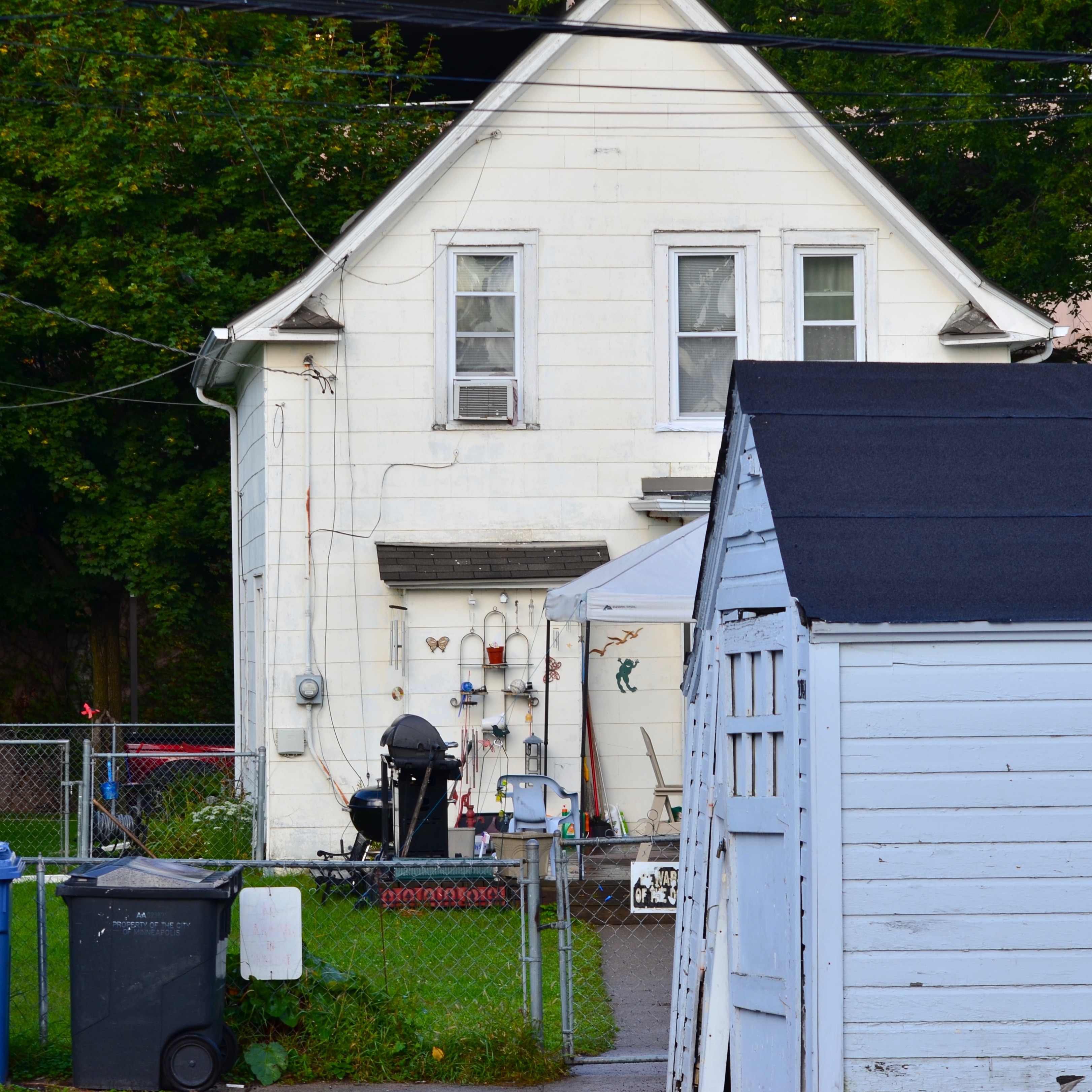
We Call It Home, 2019

In the image you see here, the house speaks eloquently about the most important things in its owners’ lives. It’s an outward barometer of their hobbies, pastimes, daily chores. The structure itself might never have struck anyone, from the architect to the builder, as unique, but as its true identity has been assembled, layered over it, its messages are all clear and direct. Wright was correct that buildings should reflect the purpose for which they were built. However, when they fail that task, design-wise, the way they are actually used will explode out of them, in a million different cues and clues over a million billion neighborhoods, in a visual shorthand that photographers will forever delight in decoding.

OUT ON THE EDGE OF NEXT

“…come on out and make romance”

By MICHAEL PERKINS

PHOTOGRAPHERS KNOW THAT THE NIGHT HOLDS A SPECIAL POTENTIAL FOR ACTION, a condition mysteriously distinct from that of daytime. Yes, we all know that there is, technically, nothing in our after-dark scenes that wasn’t there in the light (isn’t that what we tell anxious kids as we tuck them in?), but all the same, the shadows seem to, in a sense, withhold information, or at least re-shape it somehow. A conversation from the day becomes, in the night, slightly conspiratorial. Colors that register as merely garish in the day can become threatening in the shadows of evening. And photographers aren’t the only artists who sense this transformation. Poets, painters, songwriters….all take careful measure of the two worlds defined by the day/night demarcation, all taking note that light, or its absence, is more than mere atmosphere, but also mood, even intention.

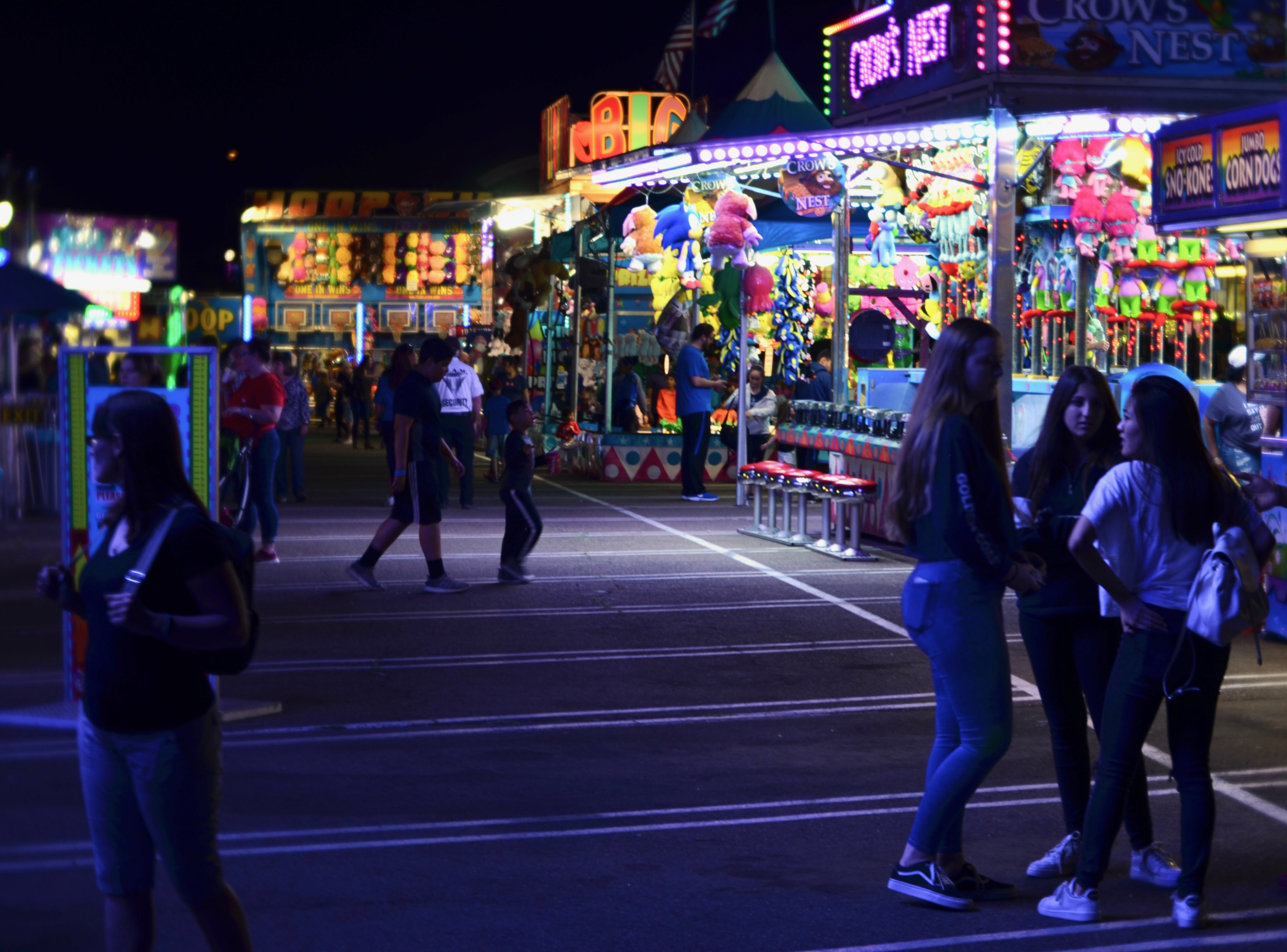
In recent days, as I tumble all this over in my mind, I’ve been reviewing a whole series of night shots that I believe have a particular flavor that they may not have had, were they shot during the day. I’ve also been running a musical playlist of songs that seek to capture this same strange phenomenon. Rock ‘n’ roll, with its special emphasis on the restless and rambling impulses of youth, is strongest when it comes to characterizing that urge to move, to discover, to dare or rebel. You will no doubt have songs that you believe best frame these feelings. Some are simple, others more ornate, but, for my money, none come close to the compact, precise, and emotionally direct language of Van Morrison’s Wild Night. Regard for a moment, if you will, the random carnival shot above, and sink yourself into Morrison’s unique invitation to join the ranks of a special kind of shadowy wanderer:

As you brush your shoes, stand before the mirror
And you comb your hair, grab your coat and hat
And you walk, wet streets tryin’ to remember
All the wild night breezes in your mem’ry ever

And ev’rything looks so complete when you’re walkin’ out on the street
And the wind catches your feet, sends you flyin’, cryin’

Ooo-woo-wee!
Wild night is calling
Oooo-ooo-wee!
Wild night is calling

And all the girls walk by, dressed up for each other
And the boys do the boogie-woogie on the corner of the street
And the people, passin’ by stare in wild wonder
And the inside juke-box roars out just like thunder

And ev’rything looks so complete when you’re walkin’ out on the street
And the wind catches your feet
And sends you flyin’, cryin’

Woo-woo-wee!
Wild night is calling
Ooo-ooo-wee!
Wild night is calling, alright

The wild night is calling

Come on out and dance
Whoa, come on out and make romance

c) 1971 WB Music. Corp / Caledonia Soul Music (ASCAP). All rights reserved.


Anticipation. Experimentation. Potential. Mystery.

The wild night is calling, and sending images racing into hearts.

And cameras.

Come on out and make romance.


SECOND HELPING (WITH A SIDE OF COMFORT)

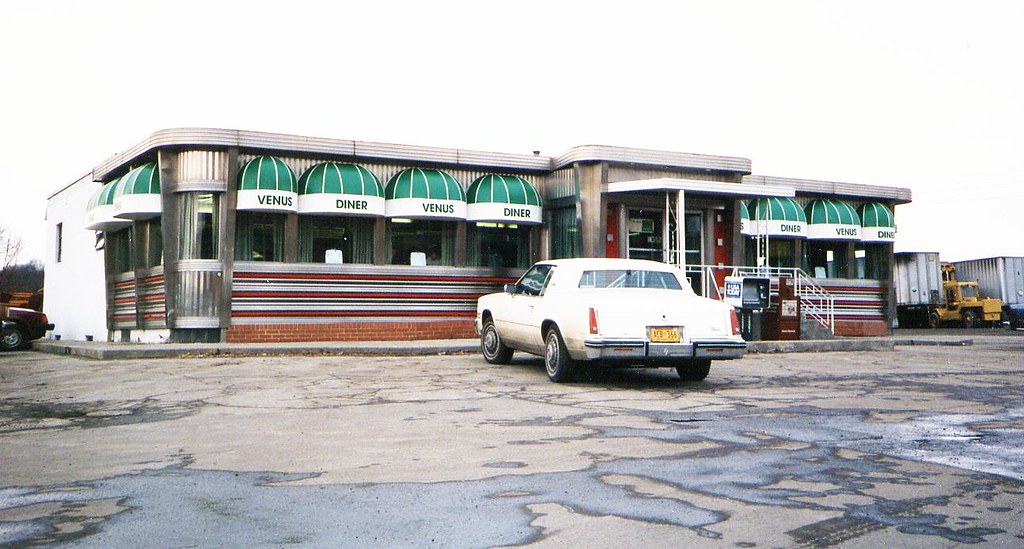
The Venus diner, a fixture of turnpike life in Gibsonia, Pa. during the 20th century.

By MICHAEL PERKINS

PHOTOGRAPHERS OFTEN FIND THAT SOME SUBJECTS HAVE A DISTINCT VISUAL SIGNATURE. That is to say, they instantly convey precisely what they are. The word iconic means something that stands as the defining symbol for its class and and category, signaling us in a moment exactly what we’re looking at. In architecture, some structures are, in a way, self-explanatory, and cannot be confused with anything else. Thus churches tend to look like churches, palaces kinda always look like palaces, and, for purveyors of twentieth-century pop culture, diners look, unmistakably, like diners. They bespeak informality, convenience, comfort, and, if luck holds, good eats. They also communicate immediate context and poignant memory for the camera.

Diners first appeared on the national scene in the 1920’s as horse-drawn wagons with food, then stretched out to resemble railroad dining cars clad in gleaming Art Deco chrome, all rounded corners, streamlined stainless steel, and mirrors. Lots of mirrors, like the ones in the ceilings, which allowed counter waitresses to quickly ascertain which booth needed a coffee refill. The eateries peaked just after World War II, when casual dining had become a national habit, the joints were finally attracting as many women as male laborers, and diner ownership served, for a time, as an affordable first business move for returning vets.

While most eating establishments are built like any other other structure, that is, on-site, working from a framework which is then layered over with different levels of support or decor, the classic American diner of the 20’s through the 50’s was produced modularly, much like an automobile. Indeed, the closest relative to the diner might be the Airsteam trailer, an edifice built as a single unit in a factory and shipped to its final destination. Over the half-century or so that diners dotted the national map, companies like Silk City, Kullman and Fodero manufactured compact, curvilinear eateries that were trucked, fully equipped inside and out, to their initial locations ready for business. Such was the origin of the diner you see in the above image (a Fordero diner…shout-out to New Jersey), which began its life near the Gibsonia exit of the Pittsburgh portion of the Pennsylvania turnpike. As the place was situated only seven miles from the neoghboring town of Mars, Pa., the diner’s owners decided to maintain the planetary theme, naming their joint the Venus.

Half a century later, another alignment of cosmic forces began to ready the Venus for a second life. Just as it was pouring its last cups o’ joe, the owners of a tony Minneapolis decor boutique called Modern Forage Workshop were getting pretty tired of the wretched view out their store window, which looked across the street to a dilapidated Taco Bell fronted by a seedy vacant lot. Mike Smith and James Brown almost simultaneously hit on the idea of obtaining a classic diner for the spot, but where to get one? Diner manufacturers were a speciality even back in the day, making their restoration even more of a niche skill in the twenty-first century. Smith and Brown sniffed about and unearthed Steve Harwin, a Cleveland tinkerer who had begun his career refurbishing high-end sports cars, then switched specialities when his European pals told him that diners were “the coolest things in America”.

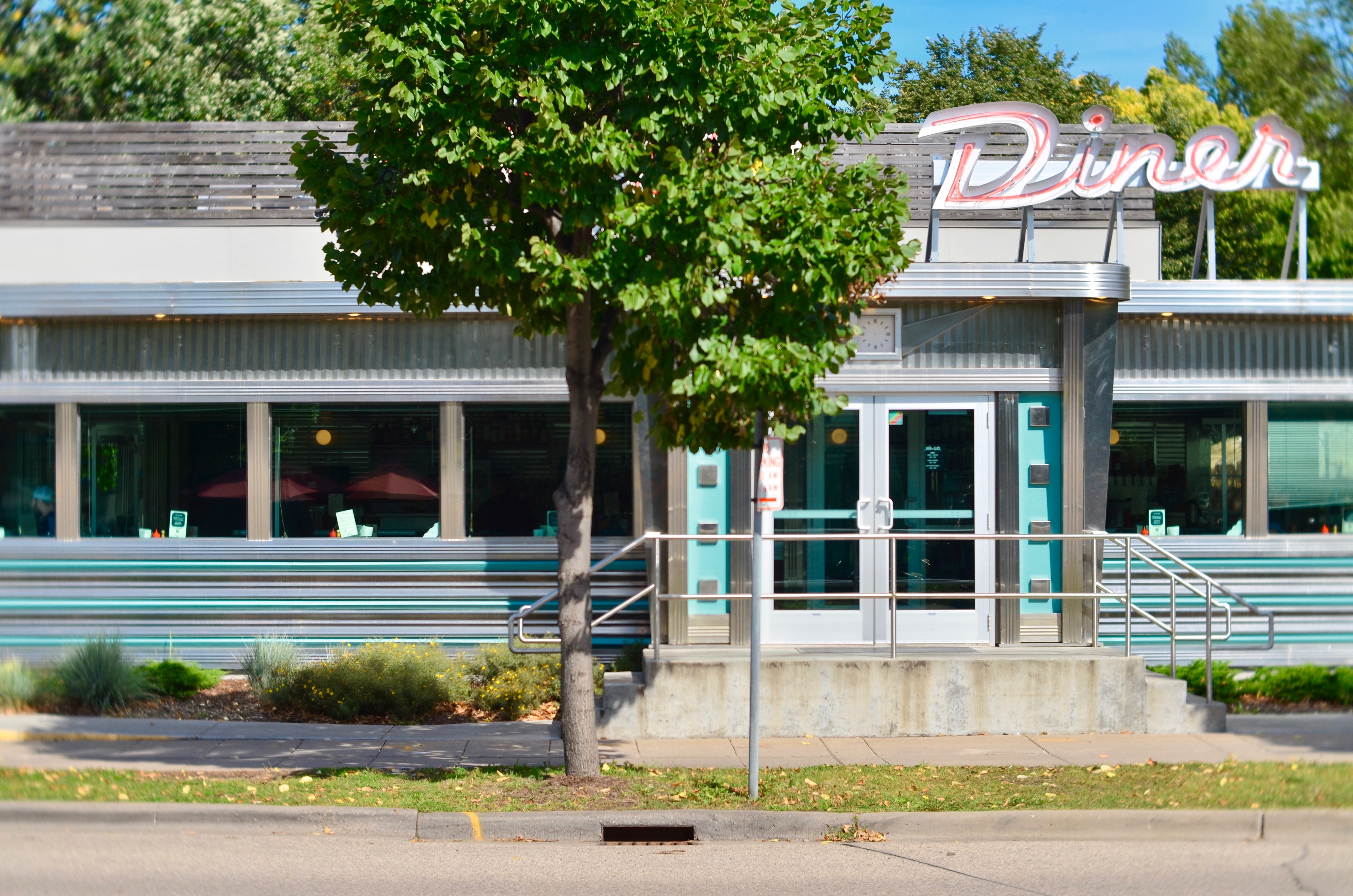
The reborn Venus now doing business in Minneapolis as the Hi-Lo.

Shipped to Harwin via flatbed truck and police escort (wiiiiiide load), the Venus was cleaned, sanded and primped for a second cross-country trek to the Twin Cities. As in the past, the local landscape determined the place’s new monicker, which celebrated the regentrification of both the HIawatha and LOngfellow neighborhoods to be christened the Hi-Lo, opening to rave reviews in 2016 and even opening a kitschy tiki patio around the side in 2018. Recently, my wife Marian and I caught a glimpse of the old girl out the car window en route to St. Paul and decided to circle back for a better look. One very intense plate of corned beef hash later, I betook myself to the opposite side of the street for the same vantage point that Smith and Brown once disdained, later celebrated. It goes without saying that the view is a helluva lot better these days.

And the coffee ain’t bad either.


EXCISING THE BLINDFOLD

Form may be the function in your personal photography. Or not.

By MICHAEL PERKINS

IN DISCUSSING THE UNIQUE WAY PHOTOGRAPHERS “SEE” THE WORLD, we often describe the process rather like the development of a muscle: work it, flex it, watch it become tougher and more responsive with each “rep”: repeat as necessary.

But lately, in looking at the general viewpoint that informs my own work, as well as the singular visions that seem to define a “style” for many others, I think we may be looking at the whole phenomenon a little backwards.

Instead of moving progressively toward some eventual destination of “seeing”, as if it’s a mountain top we hope to scale and plant a flag on, maybe the idea of a “photographer’s eye” is more internal, more zen if you like.

Maybe all the formative forces of our lives, including our raw experiences, our philosophical stance, and other stampers of individual personality, have already decided what our “eye” or viewpoint is. Perhaps what keeps us from seeing effectively with that eye is all the noise, distraction, and input from outside sources. Perhaps we arrive at our first camera with a clear windshield, knowing, on some inner level, how we view the world. And perhaps that pristine glass is obscured by the litter and smears of everything outside ourselves that serves to block our view. Maybe, just maybe, every photographer already has an innate knowledge of how he/she regards the world, and what kind of images support that view….if we can just keep the outside world from cluttering and occluding it.

Another way to express this condition might be to imagine ourselves as wearing a tilted blindfold, which is too askew to completely block our vision, but seriously compromises the quality of what we see. Under this idea, any real restoration of our inner eye must include the complete excising of that blindfold. And we approach that result through photography.

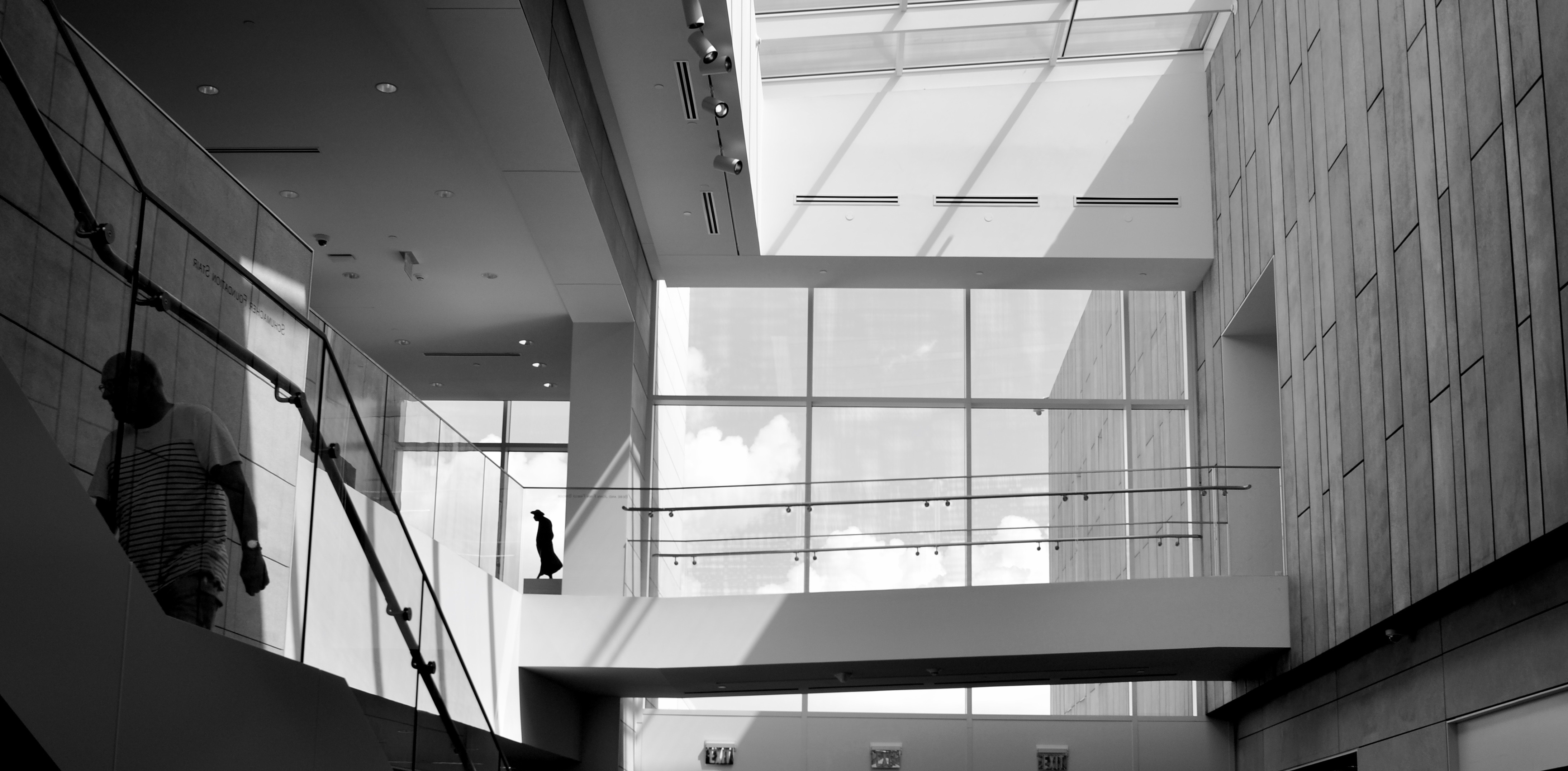
Testing these ideas takes a little honest introspection. Look at your own work over a protracted stretch of time. Aren’t there certain consistencies that emerge in the pictures you regard as the truest? It might be something very elemental, such as a love of landscapes, that perpetually re-asserts itself, despite the fact that you “shoot everything.” It might be a mood or a belief that recurs in your visual stories. You might be given to commentary, or celebration, or abstraction. Whatever features your “eye” has, it may have always been so, as a measure of your essential self, with your pictures becoming more and more effective the more you get out of your own way. In my own case, for example, I tend to see beauty or poetry in man-made objects to the same degree that others see in the natural world. Certainly I would never turn down the chance to snap a stunning sunset, and yet, in architecture, in design, or merely in the random arrangements of light and shadow, I can more persuasively argue for beauty than if I were to shoot a thousand roses a day for a thousand years. Some would use the above image to argue that I value things over people, but, to me, things make the case for people, and vice versa.

I also have a hard time deliberately creating something ugly, even in the cause of journalism or documentation. At some level I simply refuse to believe that the world is a horrible place, although I must often depict the horrible things within it. And so it is for you: that is, photography is also a self-assertion of some kind…..not a viewpoint that you are trying to acquire, but one which you are constantly struggling to refine and purify. That is, you already have a photographer’s eye. Now, you need to spend the rest of your life keeping garbage from flying into it or otherwise clouding your very trustworthy and personal vision.

THE ENTREPRENEUR

They’re going fast, folks.

By MICHAEL PERKINS

WE’VE ALL ENDURED ONE: a brave gig by a solitary volunteer musician, solemnly squeezing out a song set on a threadbare recreation-department stage, providing aural filler near the picnic tables at an art festival/neighborhood fair/neighborhood rally. Crowds are sparse to the point of threadbare: enthusiasm is restricted to a few anemic claps between tunes: stage announcements mostly involve updates on the change in location for the caramel corn tent. For the artist, the whole performance is the musical equivalent of a game of solitaire.

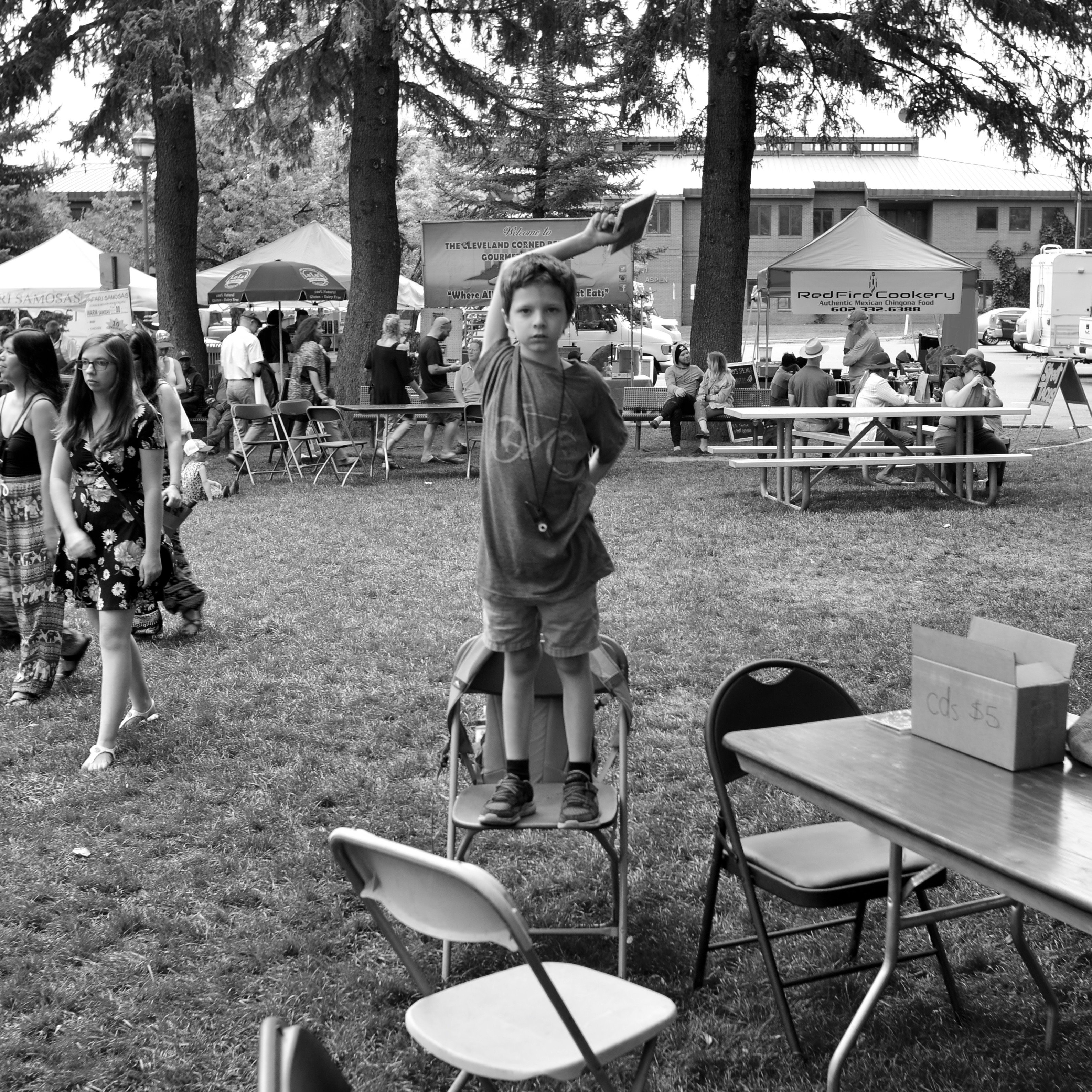
But, hey, my son has copies of my CD at the table over there.

Now that’s optimism.

On the day this image of a doggedly dedicated young pitchman was taken, his mother was smiling and slogging her way through a hot Labor Day afternoon on a nearby platform while he ran the store. The budding entrepreneur was referenced on mic several times, responding to the plug by pivoting, pirouetting, and punching the air with a $5 disc held aloft. His energy waxed and waned, now calming to a mild wave, now heating up to a wild flailing of arms, spinning on the ground, and, at the moment I snapped him, conducting from the height of a folding chair. As he spots me, his gaze is a mixture of caution, determination, and businesslike focus, as he tries to assess whether I am a fan, or a threat, or even his shot at the fame for which he is so earnestly striving. The sum of all these feelings is a perfect storm of childhood, and I scoop it up gratefully.

His dedication also earns a small cash dividend, as he manages to actually sell a few pieces, mostly to women who are hosting the art tents near him. Hey, I have a son of my own. Good boy.

Good indeed. He has given me a gift as well. Time to knock off, as I’m not going to find this kind of luck for the rest of the day. Now, where were they selling those corn dogs?

DOCTOR’S ORDERS

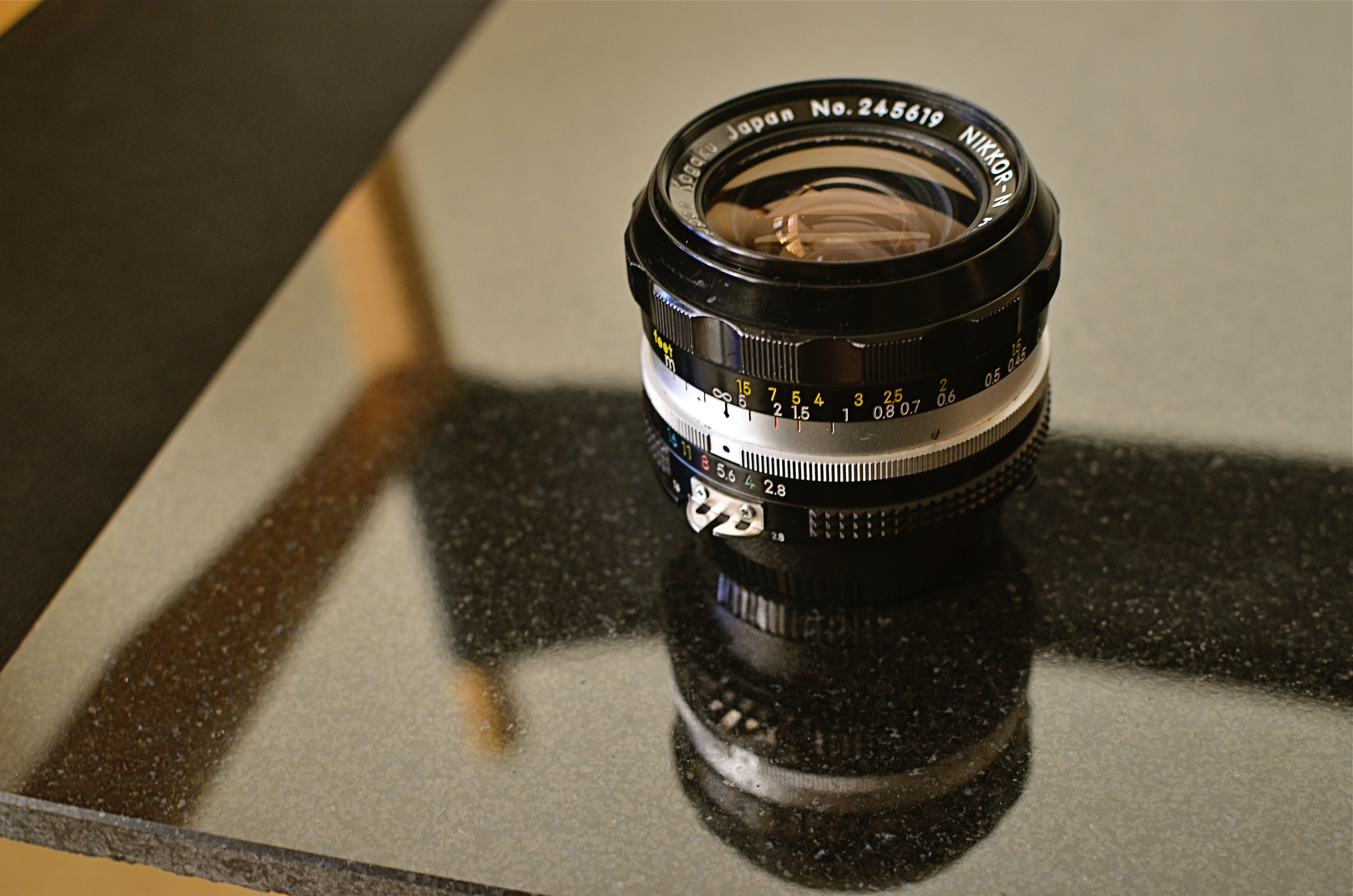
This Nikkor 24mm won’t do everything. But it will do everything I need for this particular trip…

By MICHAEL PERKINS

IN THE POST JUST PREVIOUS TO THIS ONE, I tried to explain the value, at least to me, of learning how to shoot the most with the least….that is, to streamline my photographic equipment options to the bare minimum, teaching myself how to make any kind of picture over an extended period of time with just a single lens. Having read the accounts, over the years, of many others who have undergone the same experiment, I see several words emerge again and again…words like “freeing”, “mindfulness”, even “revelatory”. Far from being a mere stunt, taking one’s entire tool bag and winnowing it down to one universal tool is an exercise in seeing, in self-reliance, and, to a great degree, in establishing just who is making the picture….us, or our equipment.

The reason this has again occupied my mind in recent weeks is the insistence by my doctor that, following recent surgery, I could only be approved for my next vacation if I were willing to keep any kind of lifting as close to a zero load as possible. Now, it’s no great trick to bribe my wife into hoisting my suitcase onto the luggage belt, but trimming out my camera bag for light travel has proven more problematic. Now, I don’t quite tote the toy tonnage of a NatGeo photog when I fly, but my shoulders and neck can attest to the fact that I tend to pack quite a few “just in case” items, items which, upon my return from various locales, spent the entire trip sleeping in the bottom of the satchel. For this flight, then, it was both medically and mentally smart to see how stripped-out I could manage to be.

Of course, no single lens can do everything, but I find that, if I’ve been even halfway accurate in assessing where I’ll be going, I can closely predict what kind of likely shooting situations I’ll face…certain “knowns” that I can factor into my decision. For example, during the trip at hand, I am likely to spend a lot of time walking in city streets, and, since I can’t predict how tall the buildings or how cramped the composing space will be, I will need something fairly wide, meaning that 85mm or greater will probably not work. I will also probably, percentage-wise, be about 80/20 urban-to-rural for my subject matter, so I will not need anything like a telephoto for, say, landscape work. I can also safely bet that Marian and I will be out at night, so I need something fast, since I will be working handheld and want to keep ISO below about 1400 to hold down noise.

Finally, in thinking about some of the places I might visit, there is a smaaaalll chance that I may want my lens to be easily adaptable for macro work, as in, compact screw-on diopters that fit in a pocket. So, to summarize, I need a pretty wide, fast, macro-capable, non-zoom lens, something inside a compact, light body that will not add a lot of bulk or weight. Weighing all of these factors, I have chosen my 1970’s-vintage Nikon 24mm prime. Its biggest aperture is f/2.8, so there’s plenty of light to be had. It’s also wide without being so wide that buildings look bent over backwards and perspectives seem somewhat normal. Additionally, it’s sharp as a razor, fast to focus, small in size, and will take 52mm screw-on diopters to nail focus at less than 12 inches out. Additional benefit: if I attach it to a crop-sensor body, the 24mm actually works more like 36mm, making the lens flattering for portraits as well.

So will I fly with just one lens? I might. I could. If I can convince myself that I’m not missing out on anything by not packing more choices (relaxing my control-freak death grip by a little), I probably will. Or maybe I’ll just throw all the equipment I own into my suitcase and make Marian heft it onto the belt. Hey, she’s been working out.

ENTROPY FOR SMARTIES

Having “too much camera” for the job is worse than not having enough.


By MICHAEL PERKINS

SEVEN YEARS AGO, THE NORMAL EYE BEGAN ITS BLOGGY INFANCY based on a very simple idea, one which I hoped might help its content outlast the comings and goings of trends or fashions. That idea was (is) that this photography thing is a journey, not a destination, that we are always on the way to something, be it personal development or increased technical mastery or both. Indeed, our welcome page specifically refers to the “journey from taking to making”, a trek which is designed to reveal something new about ourselves at every turn in the road. This small-town newspaper, then is never so much about the “how to” side of photography as it is about the “why do we do it?” side.

On a personal level, the blog was also a by-product of a yearlong stretch during which I used a 50mm prime lens exclusively, forcing myself to shoot anything and everything with a single optic in an effort to increase my own mindfulness. I needed something that would slow me down so I could anticipate, plan, even pre-imagine shots, rather than effortlessly clicking them off in mega-batches. I also stuck an additional pebble in my shoe by shooting only on manual, again with the idea that streamlining my lens choices and functions would allow me to take greater conscious control of whatever I set out to capture.

This is not just the photographic equivalent of setting off into the wilderness with just a hunting knife and some beef jerky to win some bar bet about your ability to live off the land. It’s not a stunt or a dare. It’s about learning to emphasize your own vision rather than relying on equipment to hand-deliver you technically acceptable but emotionally empty images. Using a single lens for everything still gives you just as many creative choices as you’ll find lugging around half a dozen different optics and gizmos, so what we’re talking about here is speeding up your reaction time (no fumbling to change out gear, hence fewer shots missed), teaching you a personally consistent way of imagining/framing a shot, and getting to the point where your bond with your camera is so instinctual, you’ll devote a much higher percentage of your day to seeing instead of calculating. Prime lenses, which have only one focal length, are also called “normal” lenses, and that word intrigued me. What, in terms of how we first learned to use our senses, could be more “normal” than seeing with a full and profound sense, versus just having things pass by our eyes largely unnoticed? Thus, as I worked to get everything out of my “normal” 50mm, I was also trying to re-normalize my own vision, taking it off the auto-mode settings imposed by cameras that have conditioned us to choose convenience over honesty.

I restate this little epistle from time to time because it continues to inform everything I try to do as a photographer. And because there will come times when you have, due to bad luck or fate or stupidity, limited options for getting the picture. Equipment will fail: cameras will be sucked up by a swamp or tumble over a cliff: batteries will die. And when that happens, even though your technical choices have become more narrow, your ability to make the picture you want will not. Your “normalized” eye will empower you to produce results with any camera, any lens, in any situation. And that’s what the journey is all about. Call it Entropy For Smarties.

In the next installment, I hope to illustrate how I’m trying to call on this flexibility to help me deal with an approaching shooting situation that I know will be more restrictive, gear-wise, than I’d like. I have to keep reminding myself that making images is only partly about the gear. The trick is to make it as small a part as possible.

(IN)COMPLETE STRANGERS

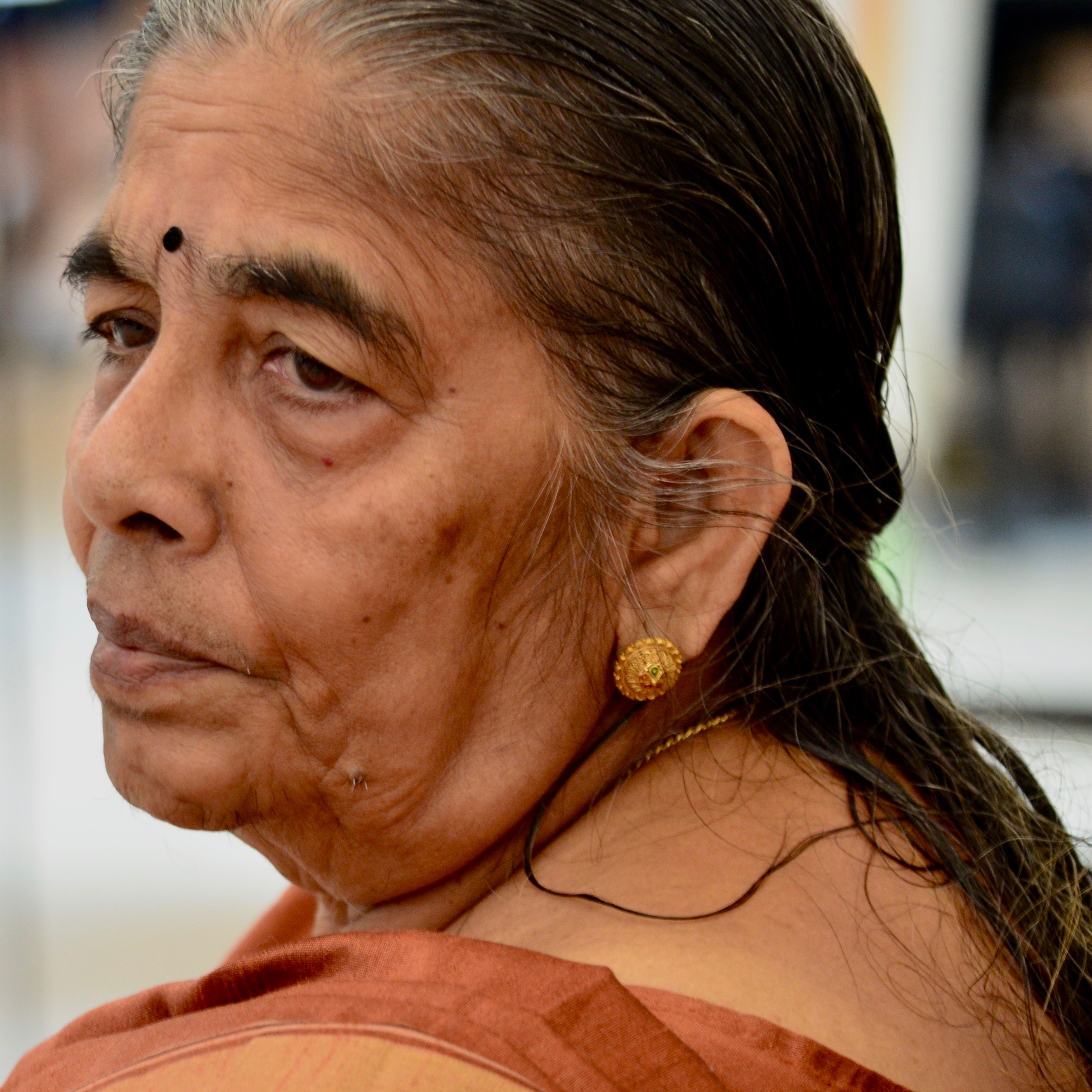
Nani, 2019

By MICHAEL PERKINS

“DO YOU KNOW THAT PERSON?”

If you’ve ever even dipped your little toe into street photography, chances are that you have fielded that question from somebody, right after they encounter an unfamiliar face among your pictures. Further, should you answer in the negative, you’re liable to be met with a quizzical look, as if the person were asking, “then why in the world would you take their picture?” Strangely, the answer isn’t that complicated: it’s because that face is at least as interesting, as full of mystery and misery and joy, as the face of any of my “tribe”: a face, in short, worth a picture.

Of course, the majority of faces we record with cameras are those that we know and cherish. But every face on the planet has the same potential to be treasured as every other face, since all record the same conflicts and aspirations. The features found in our own social circle are not exclusively magical: they don’t portray dramas or dreams that are peculiar to us alone. The “others” are just “us” with some of the information missing. The information that begins being amplified the moment the shutter clicks.

Street photography is a second cousin to journalism in one very key respect, in that both kinds of images endeavor to take us from the particular to the general, showing us faces that react the way we might react to a given stimulus, be it a celebration, a war, a comedy, or a tragedy. We are led by the best of these images from the very specific reaction of one person we don’t know to a general shared human feeling we all recognize. Magazines, televised news reports, documentaries all remind us of the feelings we all hold in common. And yet, when an unknown face invades a batch of pictures that we regard as “relevant” someone is bound to sneer that the photographer ” always takes pictures of complete strangers”, as if there could be such a thing. In the case of the woman seen above, with whom I had the great accidental luck to share a bench in a museum, I see a symphony of short stories, mixed and remixed every time I come back to the image. I will never be her intimate friend in the standard sense of the word, but, in another sense, we are communicating with each other on a very special level.

At minimum, once a photograph is made of a face, the person to whom it belongs can never again be a “complete stranger”. At most, he or she could be an “incomplete” stranger, with the strangeness of a good candid portrait ebbing away with each additional viewing. Like the reporter or journalist, the street photographer is finding the unguarded moment, the unanticipated event, the unforeseen result. And that humanness is universal, immediate in its cognitive effect. We know these people.

We are these people.

ANSEL’S ANGST (AND OURS)

By MICHAEL PERKINS

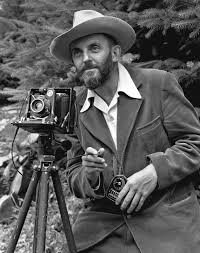
THERE IS SO MUCH HUMANITY TO LOVE IN ANSEL ADAMS: his spectacular inventiveness: his infinite patience: his unquenchable curiosity….the sum total of traits that produced one of the most amazing bodies of work in the history of any creative medium. But being fully human, or, more accurately, fully a human artist, consists not merely in one’s strengths, not even for the man who, for most people, defines the very idea of photography. It also lies in the very human emotion of doubt….something Ansel knew about, and thought about, over the wide expanse of his astonishing career.

Adams filled a good-sized library shelf with scholarly works on how he did what he did, much of it as scientifically exquisite as anything from the pen of a Newton or a DaVinci. He knew more about the physics of picture-making than nearly any man alive. But he also wrote and taught about the things he didn’t know, the things that danced teasingly just beyond the edge of his skills. In journals, letters to friends, and interviews over decades, Ansel Adams returned to the subject he saw as his own Achilles heel, a mystery that haunted him until his dying day…the challenge of color photography.

“My own reaction to color photography is a mixed one”, Adams wrote in a 1957 article for Image magazine. “I accept its importance as a medium of communication and information. (But) I have yet to see….much less produce…a color photograph that fulfills my concepts of the objectives of art. It never seems to achieve that happy blend of perception and realization which we observe in the greatest black-and-white photography…”

Of course, Ansel certainly didn’t shy away from the challenge of color work, having made over 3,500 such images in addition to his prodigious output in monochrome. But while he knew the values and tonal gradations of black and white like he knew his ABCs, it was color that seemed to him somehow less “real”, or, to look at it another way, presented more of a challenge in getting the reality right. “Black and white is accepted as a stylized medium”, he wrote in an article on the emergence of Polaroid color film in 1962. “Values are intentionally accented or subdued….there is little or no “reality” in either the informational or expressive black-and-white image, and yet we have learned to interpret these values as meaningful and “real“.

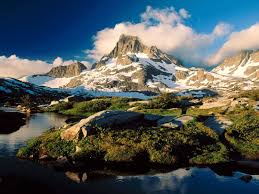
Adams tended to disdain his color work, such as this view of Banner Peak, Colorado

Strangely, as his own career began to run in parallel with the emergence of the great national magazines of the mid-twentieth century, it was his color work which was in increasing demand, paying the bills and funding the projects in which he was more personally invested. More and more, Adams’s commissions for Eastman Kodak, the Land Corporation and other manufacturers was to act as a strong second stream of income, helping to bolster his reputation in the mass market even as he believed that color was distracting him from his serious work. Part of his ongoing disappointment was not so much in his own execution of color but in the loss of accuracy that seemed inevitable once he handed his images off to the decidedly limited printing technology of the 30’s, 40’s, and 50’s. Angry at the final results on the printed page, Ansel kept most of his color images out of circulation during his lifetime, always referring to them with a mixture of frustration and regret, or seeing them as mere economic means to an end. But that, too, is a very human thing for an artist to do, as is the doubt that drives those feelings.

Doubt is a test of faith, a challenge to lazy or easy habit. Feeling that even your best efforts have come up short is the petrol that fuels a creative mind, at least until you plunge into depression a la Van Gogh and start hacking your ears off. I never trust a creative person who hasn’t been tempted, at least once, to take his entire life’s work and toss it in the garbage. The fact that he doesn’t is where the genius part comes in, and Ansel Adams never was derailed by the fact that his reach was always going to exceed his grasp. And that is not only instructive but inspirational, more inspiring, even, than his photographs themselves. Because this thing we do is a journey and not a destination. If we’re hungry, if we’re honest, we have to realize that we’ll never get where we’re going. Ansel Adams, the photographer that made more people want to become photographers than perhaps any other person in history, wrote, near the end of his life that, although he had hidden most of his color images away, “I feel the urge now, and only wish I were sixty years younger!” Indeed, for any of us who’ve ever clicked a shutter, the doubts persist. But the spirit does, as well.

THE NEW LONELY

By MICHAEL PERKINS

IF, AS A PHOTOGRAPHER, you wish to depict humanity as your mind would arrange and design it, then a formal sitting or a studio setting would seem to be the place where you could exercise the most creative control. If, on the other hand, you wish to capture humanity in the act of just, well, being, then street work is probably better. This means taking what you get from people, behavior-wise, and noticing how those behaviors shift and evolve.

Street work is truly a barometer on what’s important to people, from the fashions they wear to the conveyances that take them around to what they prize most about daily life. And, in this part of the twenty-first century, that means how they interact with cellular phones.

The ubiquity and non-stop use of these devices is now simply a part of the visual vocabulary of street photography. It has become, in a very short space of time, nearly impossible to take a candid scene without recording someone on their phone….consulting it, catching up with it, charging it, using it for social connectivity. This has become a real challenge for me, since I believe that the best social pictures come from evidence of inter-action between people in real time, in real physical places. What I have to work with, instead, is a crop of one-sided interactions. There may be some human drama in such images (imagine outrage, surprise, delight playing out on phoners’ faces), but I frequently just chuck many of these frames from a street batch because I, personally, can’t extract any kind of story from them.

Of course, isolation as an urban condition is not new, nor is it even novel in the street shooter’s experience. Seventy-year old photos of commuters crammed on the subway, each mesmerized by his or her own personal newspaper, reflects just as much loneliness as a present-day scene of crowds all separately entranced by their mobiles. And yet the cellphone has produced a new kind of lonely, with greater numbers of us showing a more complete pulling away from each other. I find this sad, and, while that feeling, by itself, can also produce a good picture, I still, typically, put such images in my “pass” pile.

This one registered a little differently with me.

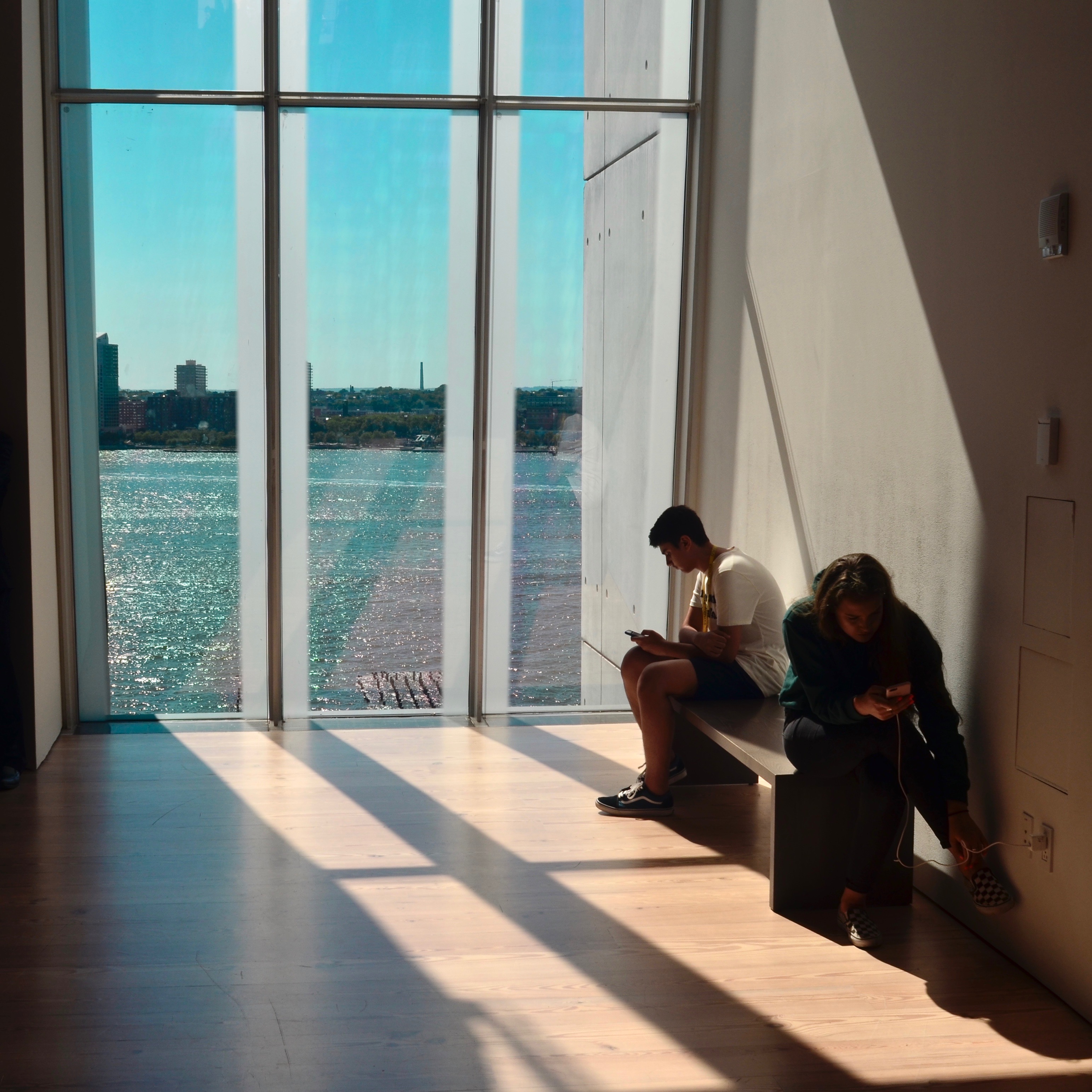
I really had no interest in the two people in the frame other than their ability to take up compositional space and account for a wide range of light contrast, something I always like to practice with. So I must be honest and report that, in the actual taking of the picture, their “story” was not on my radar. Moreover, given how many hundreds of other “phoners” I’ve accidentally recorded, usually concluding that there was “no picture there”, I think I can be forgiven a certain dismissiveness in snapping the photo. It was only later that the completeness of their isolation struck me. Not only are they facing away from the somewhat scenic, bright view out the window, but they are completely isolated from each other. As it happens, they are in a Manhattan museum which, even if you were to completely eschew the contents of the exhibits, offers any number of stunning skyline scenes out the windows, including several high-rise walk-out platforms. But none of that matters to this pair, any more than they matter to each other, or whether a live, nude performance of King Lear would matter, were it just inches away from them. Their place in the present world does not matter…..only their proximity to a wall outlet. This, to me, is beyond isolation. This is self-banishment, and, in this case, the image I accidentally snapped of the condition shows, at least in miniature, the crux of the dilemma: the fact that we have become one international village of strangers.

But if we completely ignore this phenomenon, of what are we to craft street images that are accurate testimony of our age? Are there deeper stories behind this tsunami of blank faces, stories that are worth pursuing? Or do we, as photographers, just turn away from those who have turned away?

I really wish I knew.

SQUARING UP YOUR SHOT

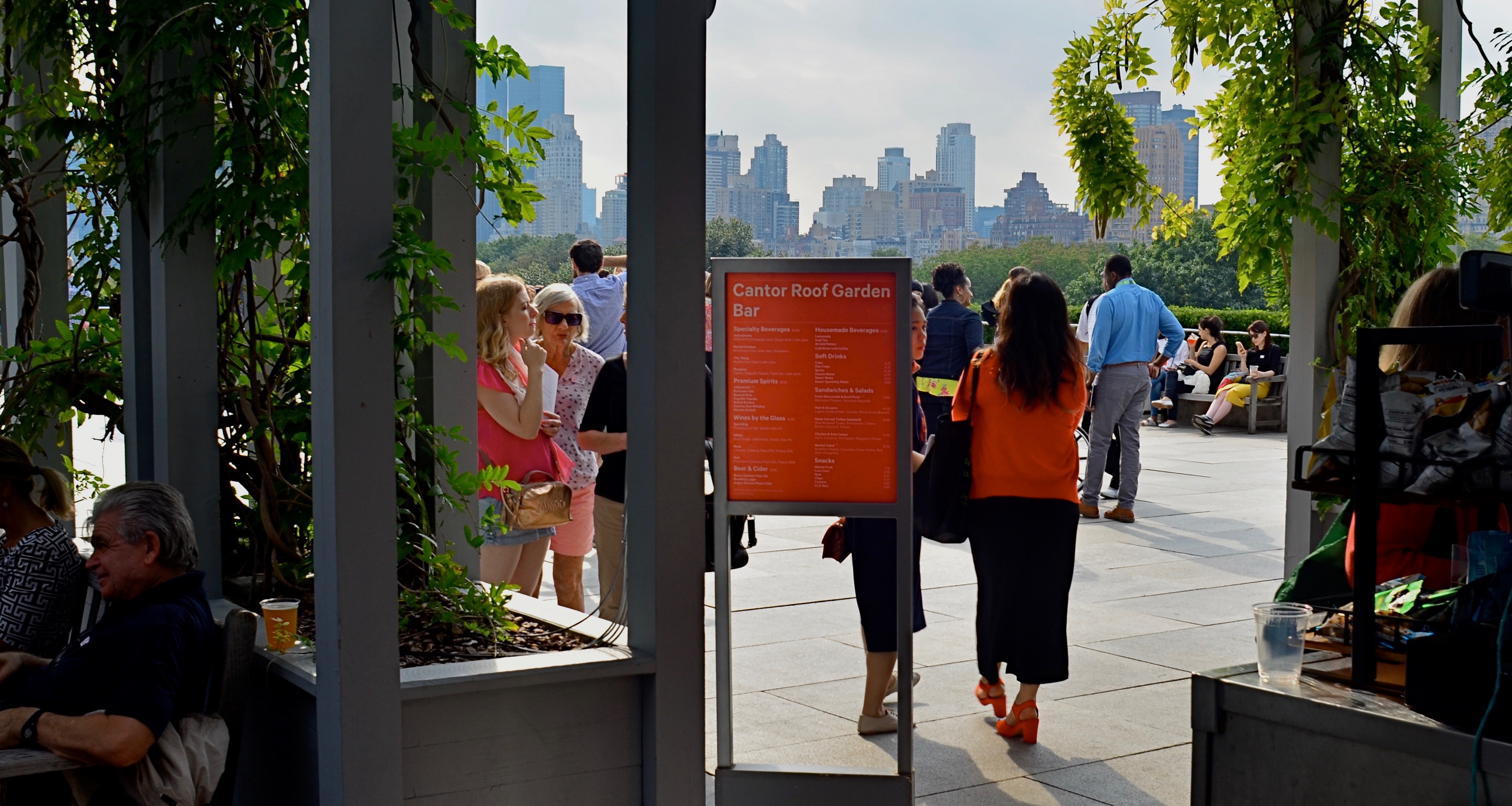
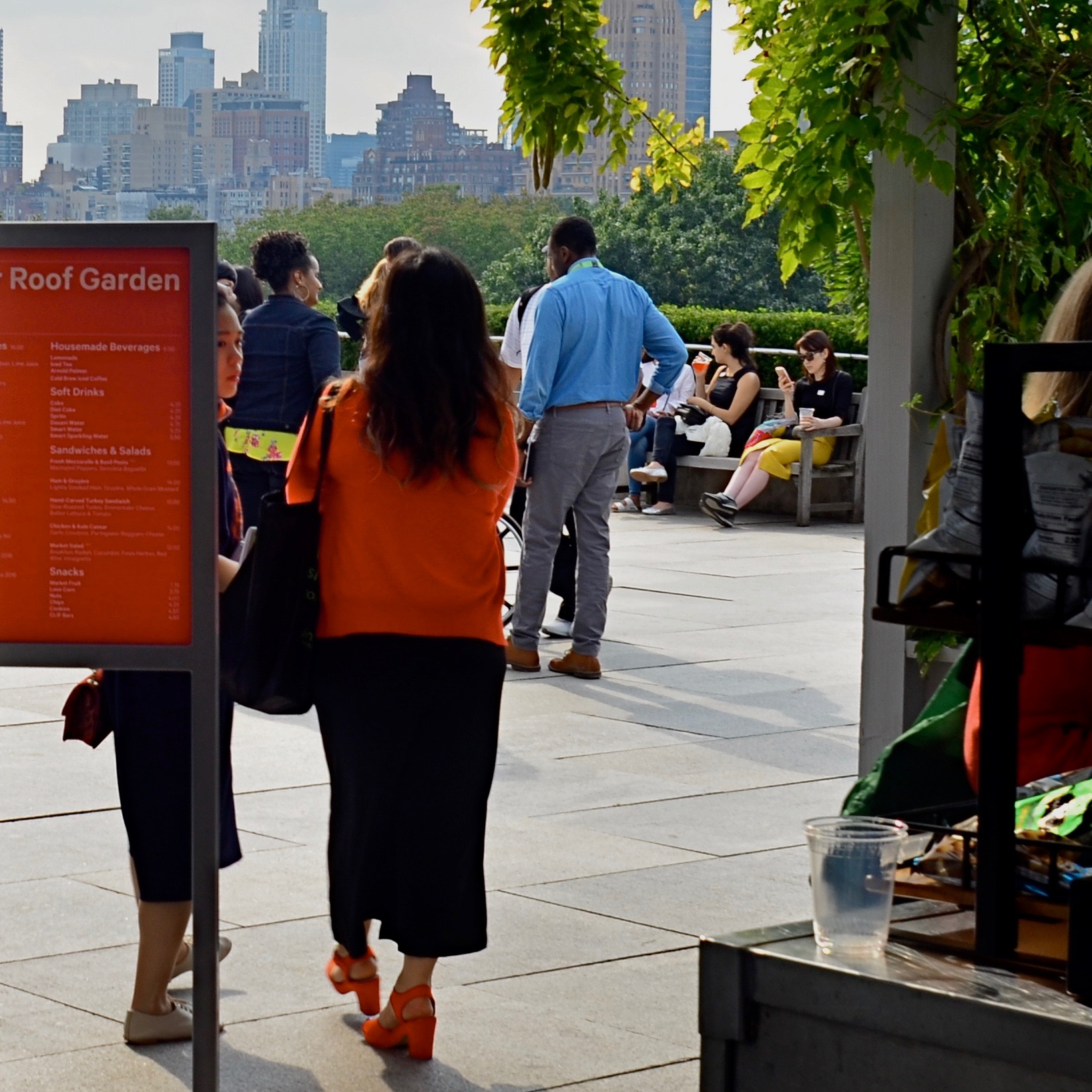
Master shot, taken at the entry to a roof garden atop the Met museum in Manhattan.

By MICHAEL PERKINS

IN THE PRESENT PHOTOGRAPHIC ERA, the default frame for composition is, with some notable exceptions, a rectangle, the 3-to-2 ratio that is the descendant of Oscar Barnack’s first 35mm Leicas of the late 1920’s. Most of us have been taught to automatically compose in this format, a hard-wired habit that informs our entire concept of how to fill a frame. The “notable exceptions” I refer to are the square films that have accompanied the return of instant photography, the lomography movement with its square-framed analog film formats, and, by virtue of a built-in app choice, the mobile phone. Strangely, some of the most sophisticated cameras on the market do not allow you to shoot an original square image: the shot must be captured in a 35mm equivalent and cropped later. But that’s a rant for another day.

The thing is, if you don’t typically investigate square composition, you are robbing yourself of an important tool, or, more specifically, you are allowing yourself to always see subjects in the same “frame” of mind. There are distinct advantages to creating a square composition, not the least of which is that it forces the viewer to take in your picture’s information in a distinct way. While shots that are wider than tall are marvelous for any number of reasons, they do, in effect, invite the viewer to scan an image linearly, that is, to look left to right and back again. By contrast, the square reinforces its equal dimensions, almost forcing the eye into a continuously circular sweep of the contents. I hear people complain that a square just “doesn’t give me enough room to get everything in”: however, I would counter that argument by contending that, in many 3/2 compositions, there is a wealth of visual information that not only is not needed, but actively distracts the eye from the most interesting parts of the photograph. Think of a glass of ice tea that, over time, actually has more volume in it, due to melted ice, than was originally poured into the glass. More liquid, but a greatly diluted flavor.

The problem is not that many square images aren’t being made…far from it. It’s that they are, in many cases, being re-made from rectangular originals, in the editing process. We have to shoot wide and edit square. But therein may lie the best way for us to start seeing what a square composition can do, not merely to define the space of a picture, but to invite the viewer into it  more efficiently. And it’s easy and cheap to do it.

The above image recomposed as a square shot. Net loss or net gain?

Try this: select a series of wide master shots that you feel fairly strongly about, dupe work copies of them, and then crop new compositions within the copies. Junk the ones that don’t work and do as many re-takes as you see fit. Did any of the cropped images emerge as stronger without all that extra stuff you originally felt you had to include? And even if they did not, that’s also a good thing. The mere fact that you’ve begun to intentionally look for pictures within pictures means you’ve entered a new phase of your vision as a photographer. We’re certainly used to thinking of pictures that “came out pretty good’ as final or complete, but it’s a good thing to think of them instead as workable drafts. In the wider shot seen ay top, I successfully conveyed that people were stepping onto the roof of the Met museum in NYC, but I also got a lot of things in the shot that aren’t necessary to the telling of that story. The main tellers in the picture are the two women, who, like us, have just arrived. They are our surrogates or guides. Cropping actually makes the red of the sign in front of one of the women cry for your attention, guiding you to the women even as it partly conceals one of them. Additionally, the same top to bottom space that they occupy also shows part of the skyline that borders Central Park. The front to back scale of the shot says “on the roof, in the city”, at some distance.”

So judge for yourselves, as you would with your own pictures. Did anything I took away in cropping diminish the impact of the picture? Does the lower frame now feel open, cramped, or, in Goldilocks fashion, about right? Is there an appropriate emotional distance from the subject, or a welcome intimacy with it? Is there, in short, an overall net gain for the narrative power of the image once it’s been cropped? And most importantly, even if this experiment fails (with the wider picture still being stronger), haven’t I already begun to see every picture in at least two fundamentally different ways? New ways of seeing are among the most powerful tools in a photographer’s kit. The world of cameras may indeed default to a rectangle, but that doesn’t mean our brains need to follow suit.

LAYING DOWN THE LAW ON STYLE

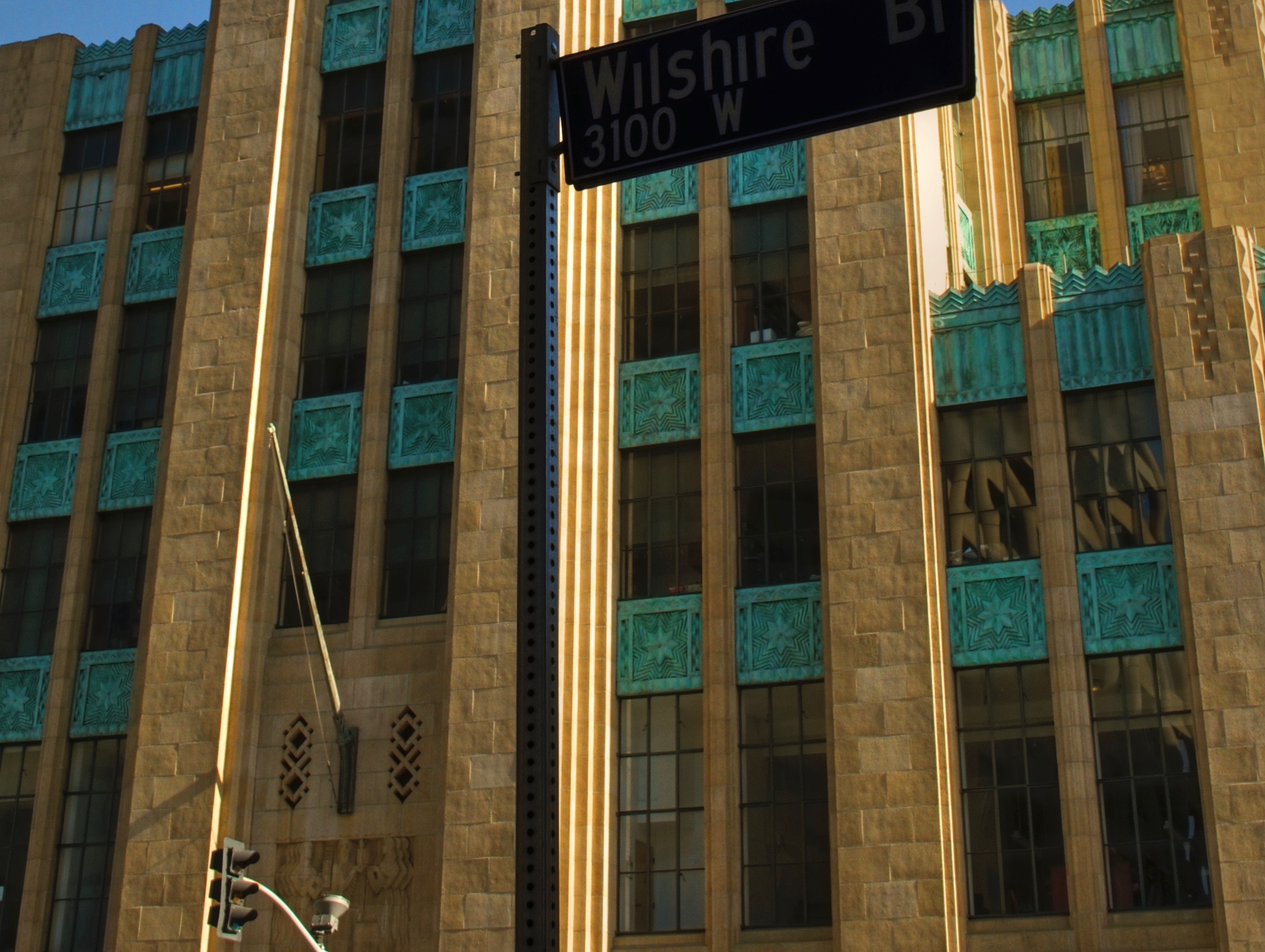
Southwestern Law School in Los Angeles, the current occupants of the city’s historic Bullocks Wilshire department store, opened in 1927.

By MICHAEL PERKINS

FOR JUST ONE DAY A YEAR, Los Angeles’ Southwestern Law School opens its doors to non-students from across the world, hundreds of whom stream through its halls with bulged eyes and gaping mouths. This reaction is not, as you rightly suspect, because the public, in general, is fascinated by endless banks of books on tort reform and intellectual property. It’s primarily due to the fact that the SLS conducts its day-to-day affairs in the shell of what once was, arguably, the most beautiful building in the City of Angels, the storied Bullocks Wilshire department store, opened to grand fanfare and a decidedly upscale clientele in 1927, the same year Warner Brothers brought Al Jolson’s voice to the world in The Jazz Singer.

In the age of Lindbergh, Bullocks’ mid-town location at mid-town 3050 Wilshire Boulevard was considered to be “out in the sticks”, a long trip from central L.A. and hence a substantial business risk (who’s ever gonna come out here?). Bullocks tried the pre-emptive move of capping the structure with an ornate, copper-tipped tower and designing the main entrance to its “cathedral of commerce” at the rear of the store, inviting motorists to enter its sumptuous porte-corchere (car port) for valet parking and a peek, across its ceiling, at Herman Sachs’ modern mural “The Age Of Transportation” featuring a winged Mercury surrounded by luxury liners, locomotives, biplanes, and the Graf Zeppelin. Having thus been so royally deposited on the store’s back porch, customers were ushered into the main showroom, its every case glistening with jewelry, perfumes and cosmetics for milady, its every wood-inlaid elevator door inviting the visitor to rise to floor after sumptuous floor of furnishings, fashions and refreshments.

The Bullocks store, with separate design/color schemes and innovative, elite shops on each of its five retail floors, truly revolutionized the relationship between retailer and customer, in a space where young lovelies modeled fashions in elegant salons for clients and where local polo players were serviced inside a custom saddlery shop. Concerned that your new riding breeches may pinch a bit when you start your next chucker? No worries: the store also featured its own full-sized horse mannequin so you could check your look in the saddle. The Bullocks local customer base typically included Hollywood stars, many of whom, like Mae West, might send their standing orders for lingerie or sports clothes to the store in the care of their… chauffeurs. Others looking to eventually climb the ladder of stardom themselves, such as a young Angela Lansbury, might be found working the Bullocks counters between studio gigs. Most importantly to generations of mothers, daughters, and granddaughters was the linen and white glove service at Bullocks’ fifth floor tea room, equipped with its own anteroom, the Cactus Lounge, where ladies could listen to live pianists as their lunch table was readied. Add to all these wonders the building’s predominantly Art deco appointments and you have, at least in my case, a photographer’s fever dream.

As to that….

Since this blog’s inception, the menu tabs at the top of the pages of The Normal Eye have been reserved for photographic essays too large to be contained within the scope of a single post, and, with the recent completion of my first-ever walk through the Bullocks building earlier this year, I thought it was time to paste together another little daisy chain of images to create a photo story on this most majestic of merchandisers. To view the results, just click the Bullish On Bullocks tab up top, just to the right of the “Blog” tab. Of course, if you haven’t already, feel free to also check out the neighboring tabs, including Small Slices From A Big Apple (street views of NYC), The Wonderful Woolworth (an interior tour of the old five-and-dime chain’s national headquarters), When Lights Are Low (adventures in under-exposure) and Wright Thinking (a visit to one of Frank Lloyd Wright’s final residential designs, created for his son David).

One more thing: the Southwestern Law School, whose exhaustive research and civic-minded sweat helped stabilize and restore the Bullocks Wilshire build to its 1920’s glory, hosts a special page on its site to highlight the beauty of the structure, including a seven-and-a-half minute campus video. Go here to check it out. It’s all hands on Deco (sorry).


W.T.R.?

By MICHAEL PERKINS

THE SHEER DURATION IN TIME REQUIRED TO MAKE A PHOTOGRAPH was, in the earliest days of the camera art, THE prime determinant of good results. Recording media was slow, and conditions had to be exhaustively massaged for a usable picture to be produced at all. Long exposures and other compromises made portraiture difficult and rendered many other subjects simply impracticable. Naturally, the forethought, the planning of an image was a conscious, deliberate process. If you wanted a photo, you had to prepare properly.

The emergence, around 1900, of the first amateur cameras, which made so-called “instantaneous”, hand-held exposures possible, ushered in the age of the “snap shot”, and meant that, suddenly, many millions of pictures were being produced each year. That revolution was later replicated at the dawn of the digital age, in which the time it took a camera to snap and deliver pictures became even shorter. That, in turn, created a secondary wave of mass amateur photography, as defined by the phone camera, creating a blinding hurricane of images produced far faster than a human could plan or pre-construct. In essence, we could take pictures almost quicker than we could think them through. And that, at least for me, is a problem.

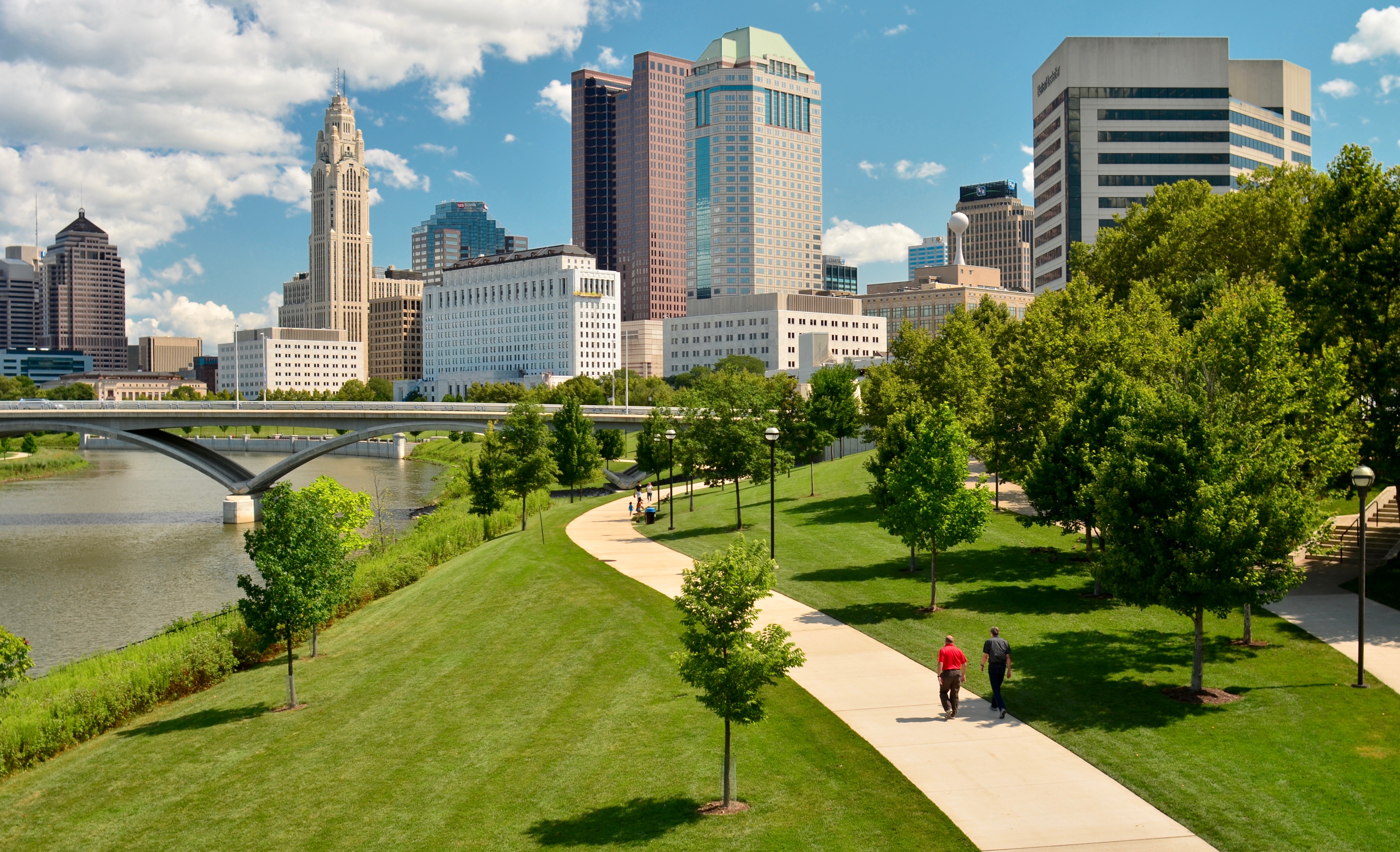
Half-an hour and twenty trial frames later, a postcard “snapshot” of downtown Columbus, Ohio.

The careful, contemplative aspect of photography, which originally had been forced on its earliest practitioners by primitive technology, is, of course, no longer a factor. However, slowing oneself down long enough to produce fewer but better pictures is still valuable, more valuable, in fact, than all our storied gear and toys combined. Walking along on a shoot, I have frequently felt this…. push at the back of my neck, this nagging urge to hurry up and get the picture, which actually means get any picture. And certainly that’s no tough feat, given the rapid response of contemporary cameras. However, a special kind of frustration comes later on, when I realize that, in being too eager to simply record a thing, I did not spend enough time to determine the best way to record it. I let the medium tell me when to click, with the primary emphasis on merely getting something in the can and moving on. Days later, looking at a series of technically adequate but artistically under-explored pictures, I feel a little sick. Turns out, the only thing worse than not being able to photograph something is to have had your chance and let your impulses propel you into mediocre results. In looking at such results, I initially respond with W.T.F. (if you don’t know what that is, Google it), then revise my jargon to W.T.R.(what’s the rush???).

As you no doubt can do with your own shots, I can now look at past photos and recall if I shot them at leisure, that is, with some intention or blueprint, or if I allowed myself to act as if I were on deadline. For instance, the above postcard scene could certainly have happened by happy accident if it were a stand-alone snapshot, but, in fact, it’s one of twenty frames taken on both sides of Columbus, Ohio’s Scioto River over the space of a half hour, since I was certain of my subject but unsure of how best to compose it. The point is that I came back with more choices than I needed on the thing I really came for, rather than shooting as many different things as quickly as I could.

I can’t over-emphasize the gift of time that only we can give ourselves when shooting. “W.T.R.” should always be echoing in our ears as a nagging question, and, if the answer is “no real rush in particular”, then take a beat, take your time, and make your pictures better. The camera can shoot faster than you can think, but that’s mainly because it isn’t troubled with thinking at all.

That’s your job.

THE SHOW STARTS AT THE CURB

By MICHAEL PERKINS

URBAN ARCHITECTURE IN THE EARLY 20th CENTURY convulsed our sense of what a “proper” building should be, with a seismic shift in aesthetics from the staid and respectable design of the Victorian age. It’s no coincidence that this revolution occurred at the very same time that the age of mass media washed over the world, as the dictates of print advertising were supplemented with the promotional energies of movies, radio, and, eventually, television. Cities whose businesses were born in this loud, aggressive crucible of modern advertising would drastically change the way those businesses competed for our attention. Structures from the 19th century sometimes bore advertisements on their exteriors, from signs to posters. Structures in the emerging 20th century were advertisements….their design screaming out their intentions with neon, explosions of color and extremes of design. In a real way, whatever show was inside the stores truly began at the sidewalk.

It’s show time. Again.

Photographers are still scrambling to chronicle the vanishing echoes of this design surge, which was most vividly expressed in the streamline, moderne, and Art Deco movements. Function dictated form: a boutique selling hats might actually look like a hat: a photo shop might design its storefront to resemble an enormous camera. Even banks went from the quietly dignified Doric columns and Romanesque scrolls of the Gilded Age to the bizarre Aztec-meets-Moorish-meets-Hollywood mishmashes of the the Jazz Age, with every place of business screaming for your eye. All of this proves catnip to photographers, who now experience pangs of nostalgia for the bold and brassy looks that predate their own lifetimes. Give me a blinking, blaring mass of zigzags and chevrons and I am in some kind of Busby Berkeley fever dream. Especially with theatres.

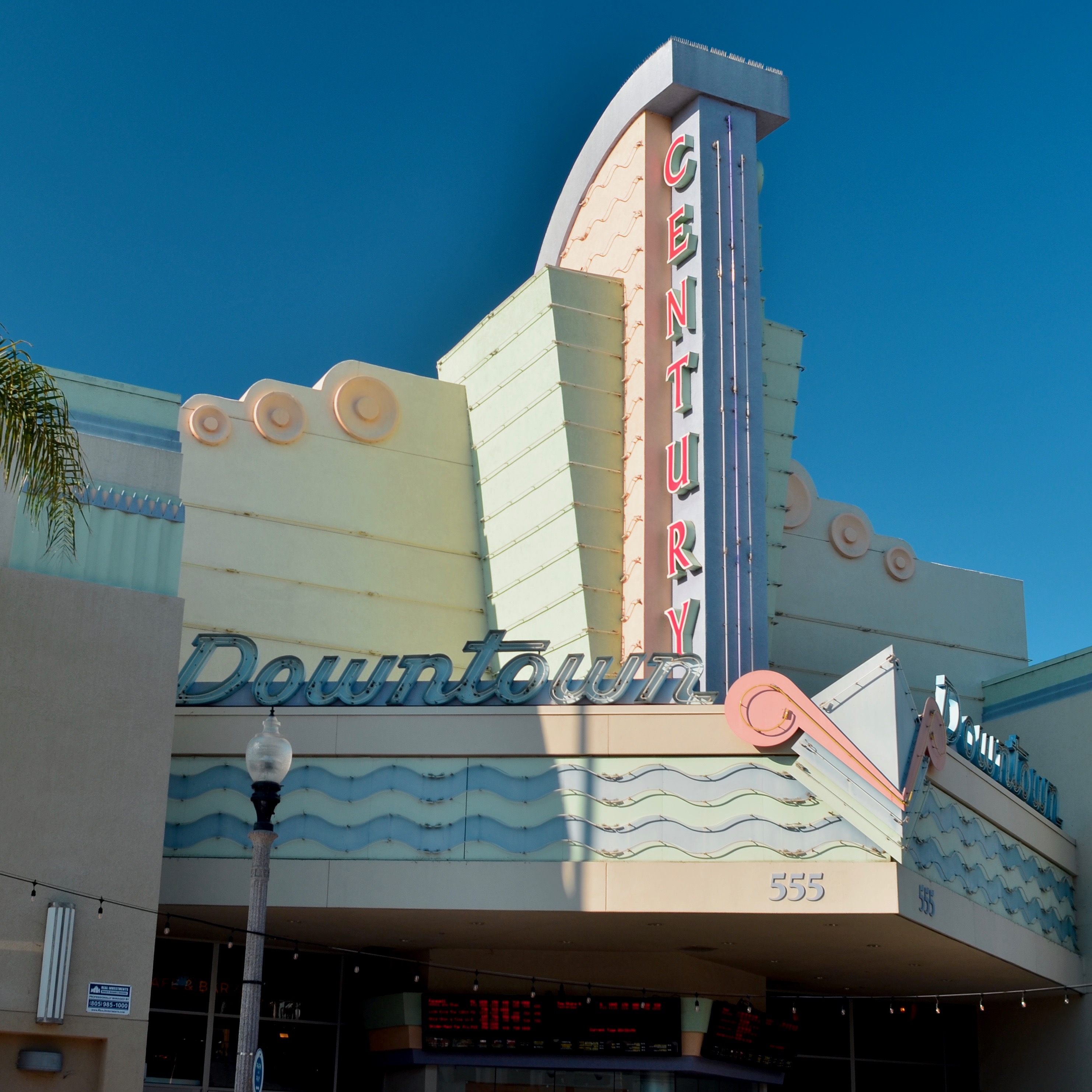
Many of the world’s old neighborhood bijous have gone down to dust, others converted to street corner churches, antique shops or themed cafes. And of those that do survive, some still actively celebrate their original functions, and thus are among my favorite things to shoot. The image seen here is of downtown Ventura, California’s Century theatre. The structure is particularly delightful, its soft pastels dreamily gleaming in the warm light of this charming seaside town. California as a whole, perhaps because of its direct connection to the film industry, has seemed to have salvaged a greater number of these little jewel boxes than is typical for other parts of the USA, although they, too, have seen many such houses crushed under the heel of what passes for progress. In any event, I can be counted upon to stop, stare, drool and shoot when encountering one of these picture palaces. Because the old theatre program billings, in which features were preceded by cartoons, newsreels, shorts or travelogues, left out an important first step….that “show” that starts at the curb.