SOFT EDGES, HARD TRUTHS
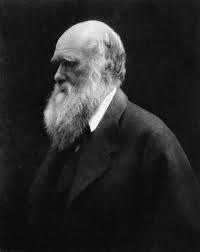
Charles Darwin sits for Julia Margaret Cameron. What she sacrificed in sharpness she gained in naturalness.
By MICHAEL PERKINS
WHATEVER MARVELS CURRENT TECHNOLOGY ALLOW US TO ACHIEVE IN PHOTOGRAPHY, there is one thing that it can never, ever afford us: the ability to be “present at the creation”, actively engaged at the dawn of an art in which nearly all of its practitioners are doing something fundamental for the very first time. The nineteenth century now shines forth as the most open, experimental and instinctive period within all of photography, peopled with pioneers who achieved things because there was no tradition to discourage them, mapping out the first roads that are now our well-worn highways. It is an amazing, matchless time of magic, risk, and invention.
Much of it was largely mechanical in nature, with the 1800’s marked by rapidly changing technical means for making images, for finding faster recording media and sharper lenses. The true thrill of early photography comes, however, from those who conjured ways of seeing and interpreting the world, rather than merely making a record of it. In some ways, creating a camera
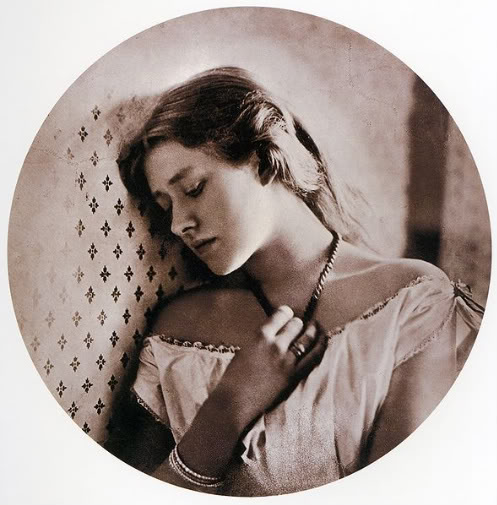
Most 19th photographers could barely capture people as objects: Cameron transformed them into subjects.
facile enough to fix portraits on glass was easy. compared with the evolving philosophy of how to portray a person, what part of the subject to capture within the frame. And it was in this latter wizardry that Julia Margaret Cameron entered the pantheon of genuine genius.
Born to courtly British comfort in India in 1815, Cameron, largely a hobbyist, was one of the first photographers to move beyond the rigid, lifeless portraits of the era to generate works of investigation into the human spirit. She was technically bound by the same long exposures that made sitting for a picture such torture at the time, but, somehow, even though she endlessly posed, cajoled, and even bullied her subjects into position, she nonetheless achieved an intimacy in her work that the finest studio pros of the early 19th century could not approximate. Far from being put off by the softness that resulted from long exposures, Cameron embraced it, imbuing her shots with a gauzy, ethereal quality, a human look that made most other portraits look like staged lies.
In many cases, Julia Margaret Cameron’s eye has become the eye of history, since many who sat for her, like Charles Darwin, seldom or ever sat again for anyone else, making her view of their greatness the official view. And while she only practiced her craft for a scant fifteen years, no one who hopes to illuminate a personality in a photographic frame can be free of her heavenly mix of soft edges and hard truths.
Extra Credit: for more samples of JMC’s work, take this link to the Metropolitan Museum of Art’s Cameron exhibition page:
http://www.metmuseum.org/exhibitions/listings/2013/julia-margaret-cameron
ORPHANS
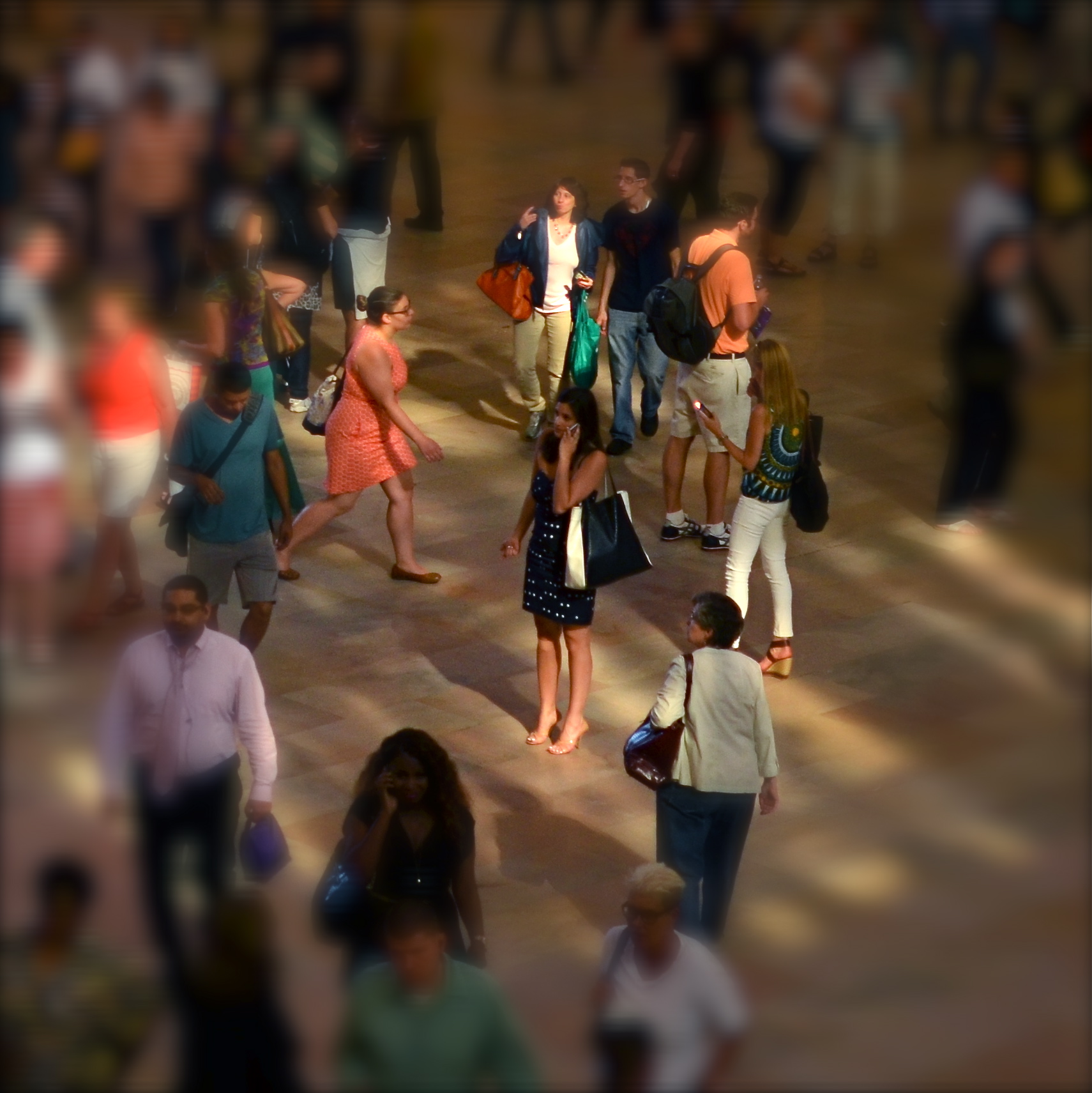
Grand Central, 2013. 1/160 sec., f/1.8, ISO 250, 35mm.
By MICHAEL PERKINS
IF YOU SHOOT ALL THE TIME, NEARLY EVERY DAY, THE SHEER TONNAGE of what you bring home guarantees that you will inevitably lose track of a large portion of your total output. Being that your alloted daily attention span is a finite number, you will literally run out of time before you can lavish affection on everything you’ve captured, on any occasion. Some shots will jump into your car like eager puppies, panting “take me home”, while others will be orphaned, tossed into the vast digital shoebox marked “someday”, many never seeing the light of day again.
The cure for this, oddly, lies in the days when no ideas emerge and no pictures are taken…the dreaded “drys”, those horrible, slow periods when you can’t buy an inspiration to save your life. In those null times, the intellectual equivalent of a snow day, you may find it useful to revisit the shoebox, to rescue at least a shot or two formerly consigned to the shadows.
Using your paralysis periods for reflection may get you off the creative dime (and it may not), but it will, at least, allow you to approach old experiments with a fresh eye, one seasoned by time and experience. Maybe you overlooked a jewel in your haste. You almost certainly left free lessons on either technique or humility by the wayside, wisdom that can be harvested now, since you’re currently watching your camera mock you from across the room (okay, mock is harsh).
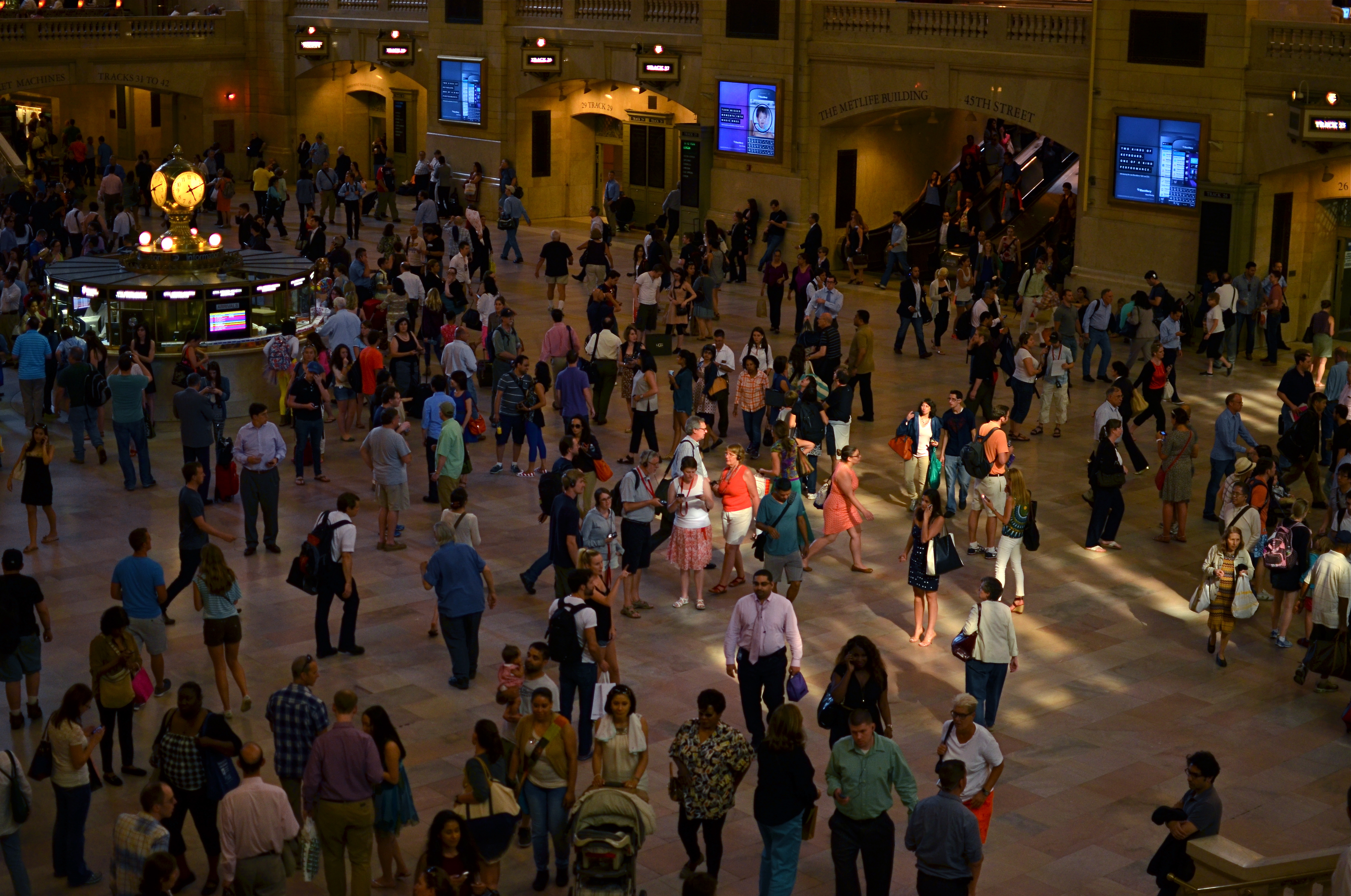
The master shot, before cropping.
During my last visit to Manhattan, I was determined to explore the limits of natural light streaming from the gigantic windows of the main terminal floor at Grand Central, and, for the most part, I framed the place’s architectural features in such a way as to dwarf the scurrying humanity heading to their various destinations. I did shoot a few floor shots as “crowd pieces”, but, upon editing, I failed to look within those big groupings for any kind of individual story or drama. I chose the gigundo-windows master shot I wanted, and left all the other frames in the dust.
Recently hitting a dead spot of several days’ duration, I decided to wander through The Ghosts Of Photo Attempts Past, and I saw a mix of bodies and light within the smallest 1/3 of a larger crowd shot that seemed worth re-framing, with a little softening effect to help the story along. Still not a masterpiece, but, since I was lucky enough to isolate it within a “Where’s Waldo” frame crammed with detail, it was something of a gift to salvage a chunk of it that I could actually care about.
Another orphan finds a home.
DRIVING THE IMAGE
 By MICHAEL PERKINS
YOU CAN FILL A LIBRARY SHELF WITH OPPOSING ARGUMENTS ON LIGHT’S ROLE IN PHOTOGRAPHY, not necessarily a debate on how to capture or measure it, but more a philosophical tussle on whether light is a mere component in a photograph or enough reason, all by itself, for the image to be made, regardless of the subject matter.
The answer, for me, is different every time, although more often than not I make pictures purely because the light is here right now, and it will not wait. I actually seem to hear a clock beginning to tick from the moment I discover certain conditions, and, from that moment forward, I feel as if I am in a kind of desperate countdown to do something with this finite gift before it drifts, shifts, or otherwise mutates out of my reach. Light is running the conversation, driving the image.
“In the right light, at the right time, everything is extraordinary”, the photographer Aaron Rose famously said, and I live for the chance to ennoble or, if you will, sanctify something by how it models or is embraced by light. Certainly I usually go out looking for things to shoot, but time and time again something shifts in my priorities, forcing me to look for ways to shoot.
The practical world will look at a photograph and ask, understandably, 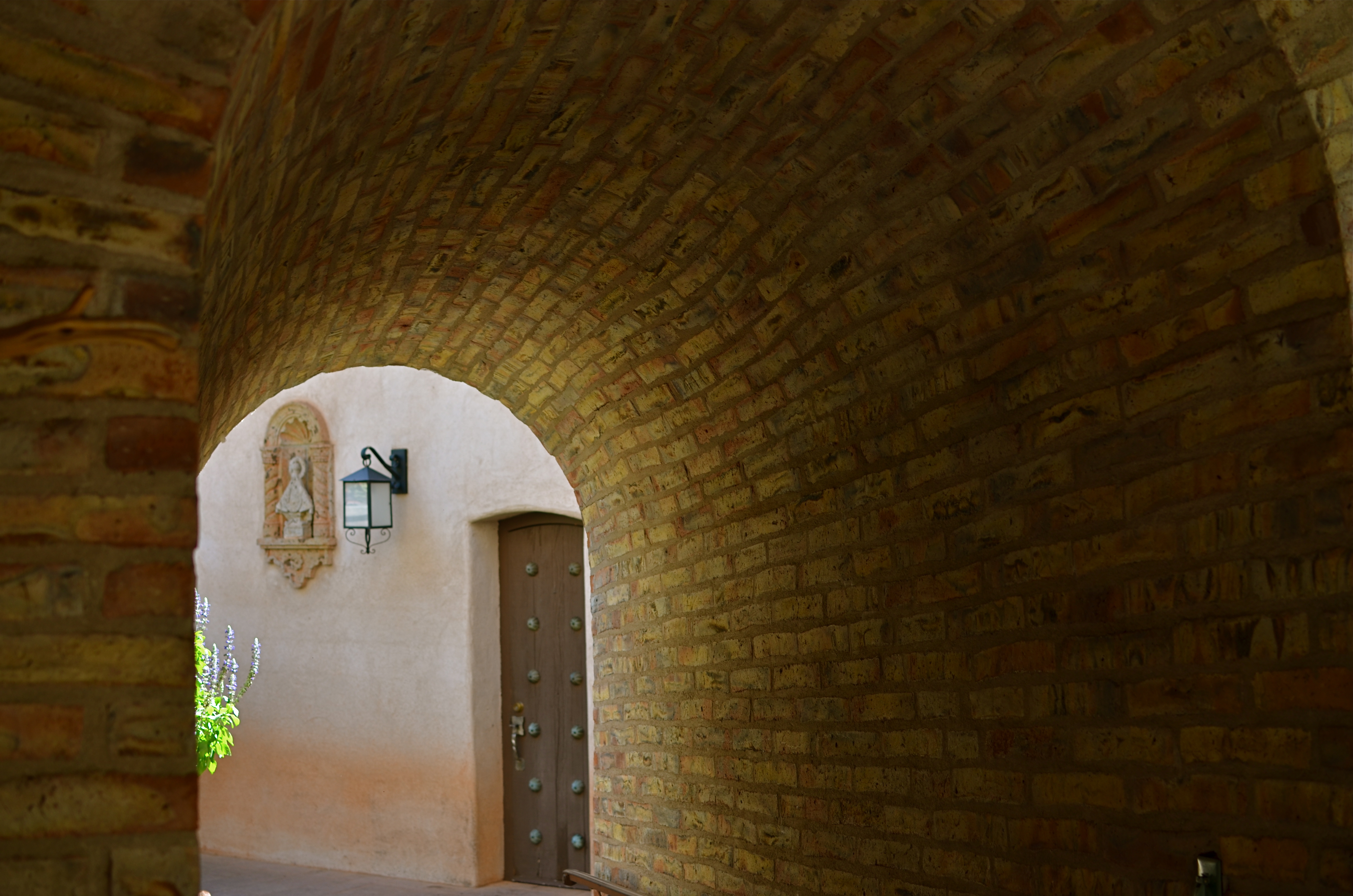 “what is that supposed to be?”, or, more pointedly, “why did you take a picture of that?” This makes for quizzical expressions, awkward conversations and sharp disagreements within gallery walls, since our pragmatic natures demand that there be a point, an objective in all art that is as easily identifiable as going to the hardware for a particular screw. Only life, and the parts of life that inspire, can’t ever function that way.
We often decide to make an important picture of something rather than make a picture of something important. That’s not just artsy double-talk. It’s truly the decision that is placed before us.
Alfred Steiglitz remarked that “wherever there is light, photography is possible”. That’s an unlimited, boundless license to hunt for image-makers. Just give me light, the photographer asks, and I will make something of it.
THE OLD, DARK HOUSE
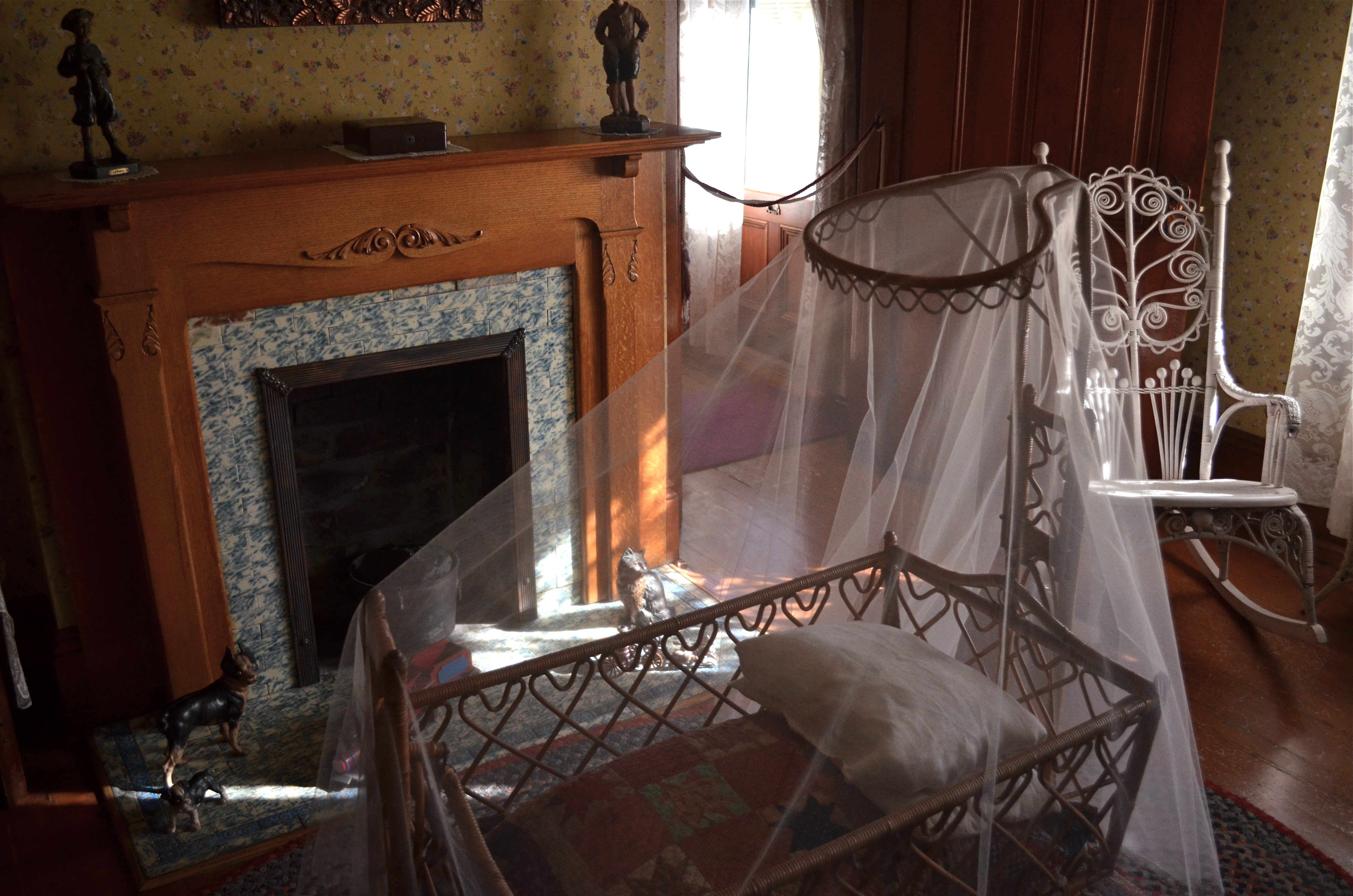
Child’s bedroom, Rosson House Museum, Phoenix, AZ. 1/80 sec., f/3.8, ISO 640, 22mm.
By MICHAEL PERKINS
THE ULTIMATE ADAGE ABOUT OLD HOUSES, I.E.,”THEY SURE DON’T MAKE ‘EM LIKE THIS ANYMORE“, is a sentiment which will haunt the casual photographer at every turn inside an historic home. No, they don’t make them anything like this anymore, especially when it comes to the size of rooms, angles of design, decorative materials, or light flow, and so shooting an antique residence requires a little re-fitting of the brain to insure that you come home with something that you can, you know, bear to look at.
Another cliché that comes to mind, this one about size: “the kitchen was so small, you had to go outside to chew.” Again, it can’t become a cliché unless it’s partially true, and it does apply to many of the rooms in pre-1950’s houses. People were shorter. The concept of personal space, especially in an urban setting, seems claustrophobic to us today. That makes for photos that will also look cramped and tight, so shoot with as wide a lens as you can. This is the place for that 18-55mm kit lens you got with your camera, since it will slightly exaggerate the side-to-side and front-to-back distances within the smaller rooms. It will also allow you to get more in the frame when composing at shorter distances, which, on velvet rope tours, can be reduced to inches.
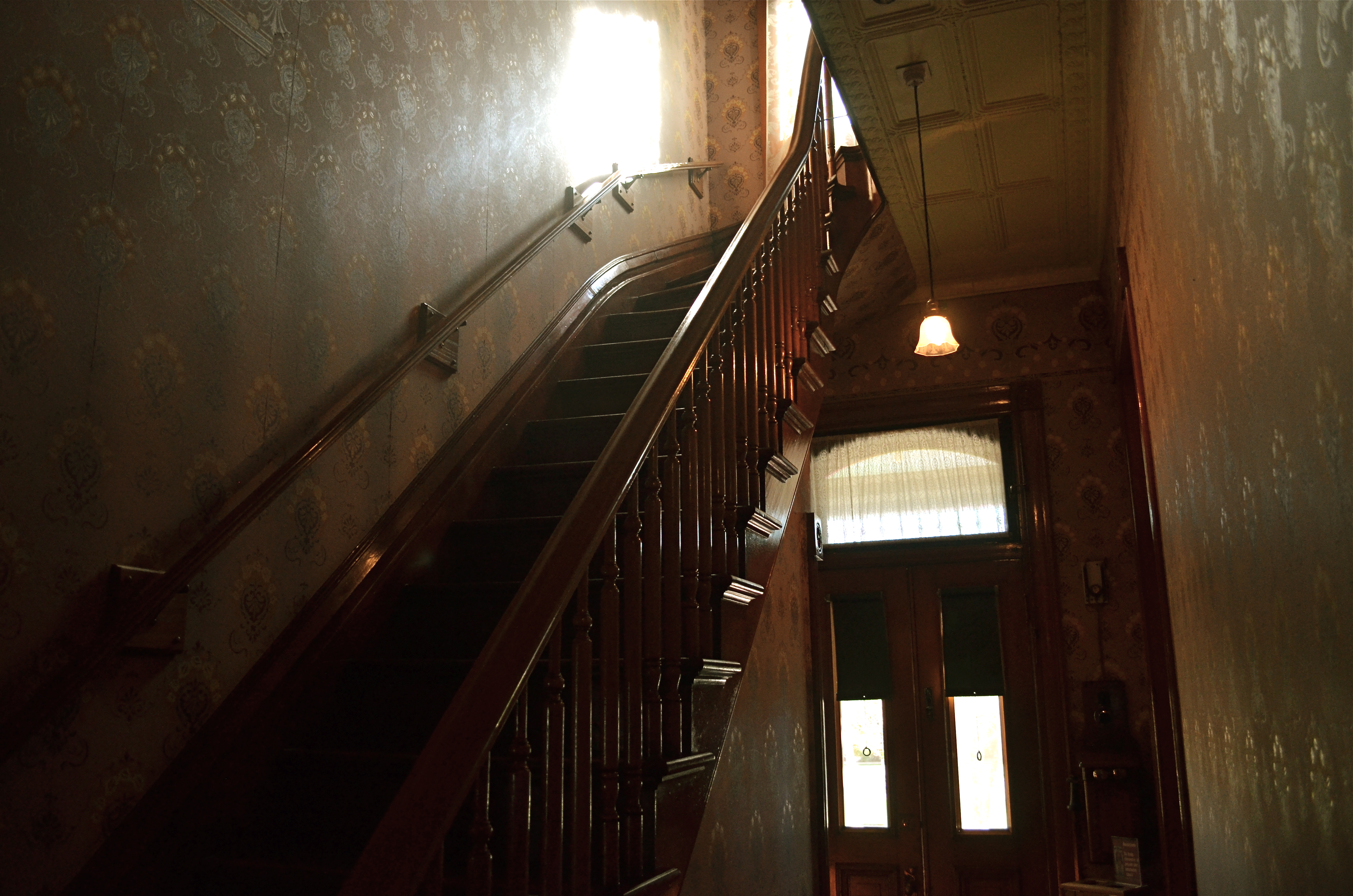
Multiple sources of light can make things tricky. 1/40 sec., f/3.5, ISO 800, 18mm.
One crucial thing to be mindful of is that 90% of the light you get on old house tours will be window light. Highlights will almost certainly be blown out on things like sheer drapes, but you need all the light you can get, since it’s a cinch that flash will be prohibited and the interior wood trims, floors and furnishings will likely be very dark in themselves, acting as light blotters. Learn to live with the extreme contrasts and resulting shadowy areas. Expose for the most important elements in a room. You cannot show everything to perfect advantage. In some interior rooms in older homes, you don’t have a shot at all, unless you ditch the rest of the tour group and have about twenty minutes to yourself to set things up. Unlikely.
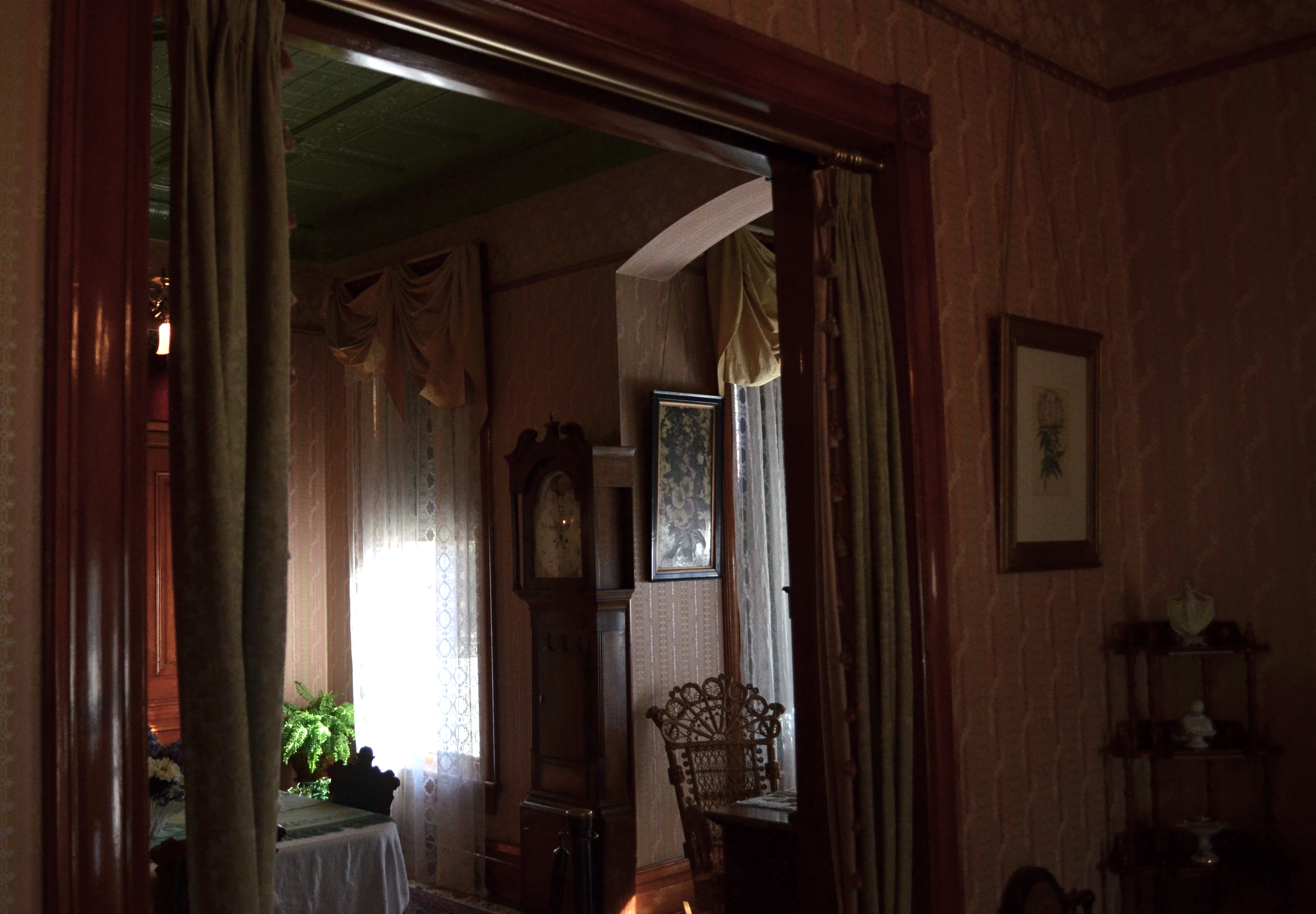
A wide-angle lens helps to open up shallow spaces with an enhanced sensation of depth. 1/50 sec., f/3.5, ISO 800, 18mm.
If you are shooting with a wide-angle, you may not be able to go any further open on aperture than about f/3.5. This means either working rock-solid handheld or cranking up the old ISO. If you do the latter, don’t go back later with an editor and try to rescue the darker areas: you will just show the smudgy noise that you allowed with the higher ISO, so, unless you like the warm look of black mayonnaise, resist.
Again, if shooting wide, remember that you can also zoom in tight enough to isolate clusters of items in charming still life arrangements with basically no effort on your part. Hey, an expert has already been paid to professionally build your composition for you with period bric-a-brac, so it’s easy pickings, right?
Admittedly, shooting in an old house can be like trying to conduct a prize fight inside a shoe box.
Or it can be like coming home.
THREE STEPS TO SOFT
By MICHAEL PERKINS
“But soft! What light through yonder window breaks…?” —Shakespeare
LIGHT IS A RAW RESOURCE, MUCH LIKE IRON ORE OR GOLD NUGGETS. It needs to be refined, alloyed for it to truly be a tool in picture making. For the purpose of photography, what we call “available” light means just that; it’s there, but not in its final form. Making images means becoming an active shaper of light–bouncing it, boosting it, adding or subtracting bits of it, harnessing it if you will. Turning “available” light into usable light is the true alchemy of photography.
That doesn’t mean you can’t benefit greatly from accidents.
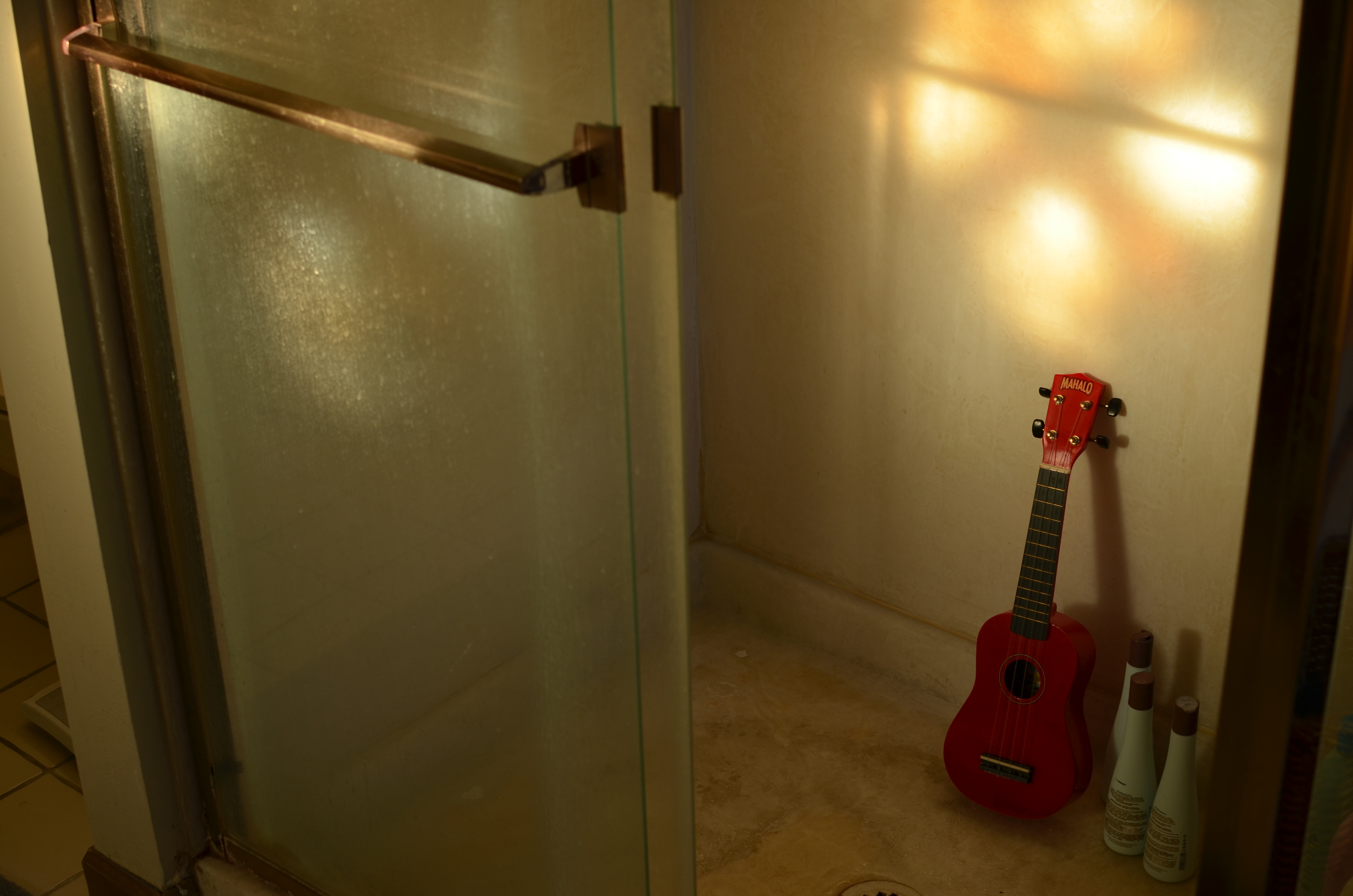
Uke can find good light showering down anywhere. 1/60 sec., f/4.5, ISO 100, 35mm.
The above image was the result of pure seat-of-the-pants whimsy, a momentary impulse to try an idea just to see what happens. However, it was a lucky reworking of available light that drew me to the location before the idea took shape.
I have written volumes on how very harsh the pure midday sunlight is in Arizona, and how it can only be of use if it is filtered or softened in some way. To that end, I have identified various sites around my house which get that done beautifully, depending on where the sun is in the sky during different parts of the day. Some of these sites occur just inside the garage, in the living room, and in a spare bedroom, and shoots will work wonderfully depending on when and where you schedule them. Best of all, the house apparently still holds a few more surprises.
Several days ago, I discovered a new and most unusual site…..a dense art window just to the left of our master bathroom shower stall, which turns out to be a triple softener for late afternoon light, just pre-golden hour. As light streams through the window, it gets softened for the first time, then hits the mirrored closet doors on the opposite wall, where it diffuses some more. Bouncing off the mirror, it then angle-bounces to the back wall of the shower stall, still fairly bright but now really fuzzed out and warm. And that’s where I saw it, as I was walking through the room.
As soon as I spotted the light, I started brainstorming about what kind of object I might stage in this little “studio”, and I hit on the idea of a ukulele, since I always have scads of them around the house, they’re colorful, and it’s kind of an absurd variation on the whole “singing in the shower” cliche. I liked the shot from a purely light effect standpoint, and the unique shaping of the glow in that space will definitely be back for a return engagement.
Maybe a saxophone….
ONE OUT OF FOUR
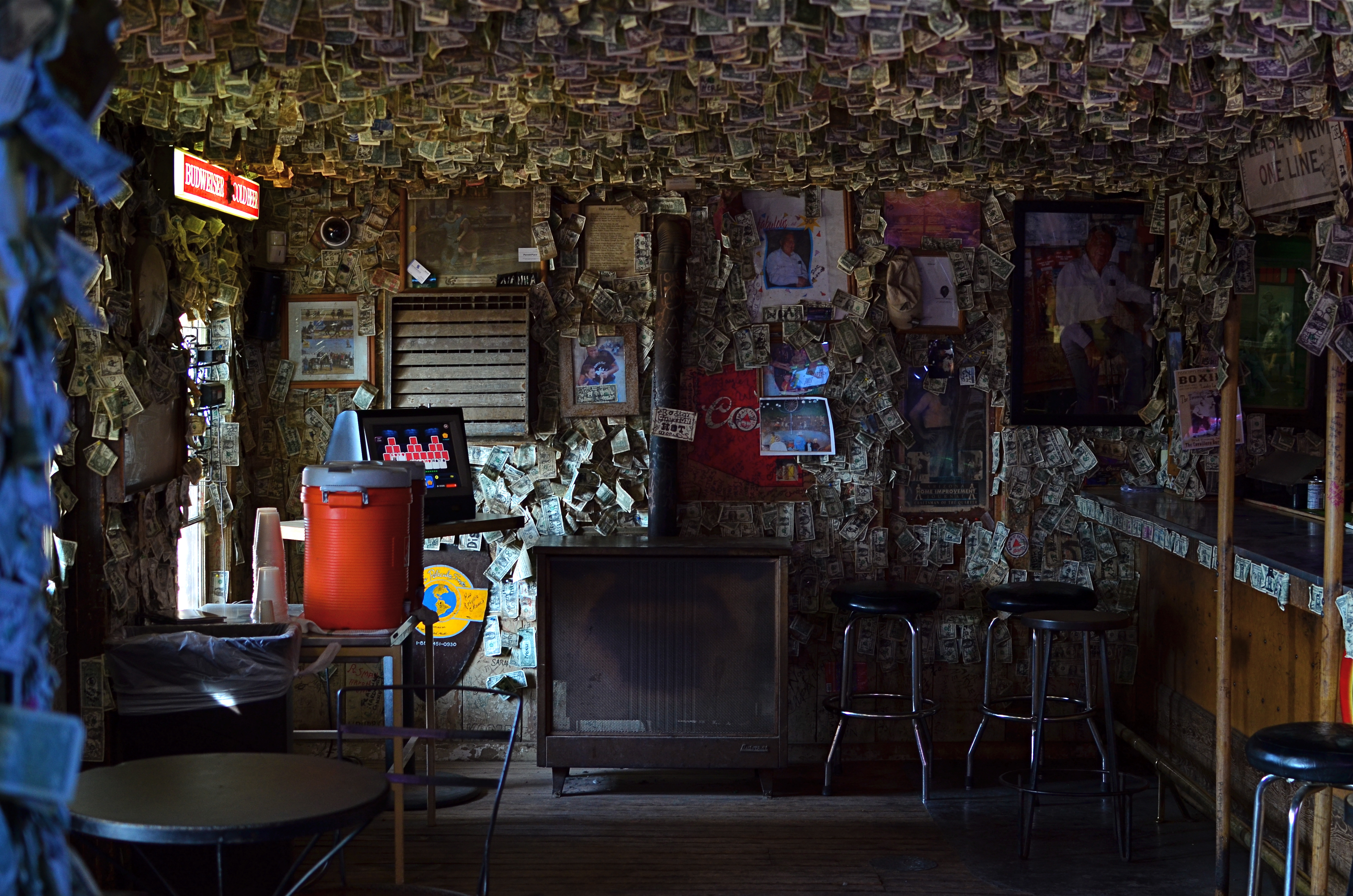
Main bar, Greasewood Flats, Arizona, 1/12/14. 1/30 sec., f/3.5, ISO 250, 35mm.
By MICHAEL PERKINS
IF YOU ARE DEPENDENT ON NATURAL LIGHT FOR YOUR ONLY SOURCE OF ILLUMINATION IN AN IMAGE, you have to take what nature and luck afford you. Making a photograph with what’s available requires flexibility, patience, and, let’s face it, a sizable amount of luck. It means waiting for your moment, hell, maybe your instant of opportunity, and it also means being able to decide quickly that now is the time (perhaps the only time) to press the button.
I recently had such a situation, measured in the space of several seconds in which the light was ready and adequate for a shot. And, as usual, the subject seemed as if it would serve up anything but acceptable conditions. The main bar of the classic western “joint” named Greasewood Flats, just outside of northern Scottsdale, Arizona, is anything but ideal in its supply of available light. Most of the room is a tomb, where customers become blobby silhouettes and fixtures and features are largely cloaked in shadow. I had squeezed off a few shots of customers queued up for bar orders, and they all registered as shifting shadows. The shots were unworkable, and I turned my attention to the fake-cowboy-ersatz-dude-ranch flavor of the grounds outside the bar, figuring that the hunt inside would be fruitless.
Minutes later, I was sent back inside the building to fetch a napkin, and found the bar empty of customers. I’m talking no human presence whatever. In an instant, I realized that the outside window light, which was inadequate to fill a four-sided, three-dimensional space, was perfectly adequate as it spread along just one wall. With crowds out of the way, the rustic detail that made the place charming was suddenly a big still-life, and the whole of that single wall was suddenly a picture. My earlier shots were too constrasty at f/5.6, so I tried f/3.5 and picked up just enough detail to fill the frame with Old West flavor. Click.
All natural light is a gift, but it does what it wants to do, and, to harness it for a successful shot, you need to talk nice, wait your turn, and remember to give thanks. And, in a dark room, be happy with one wall out of four that wants to work with you.
THE PARTY’S OVER
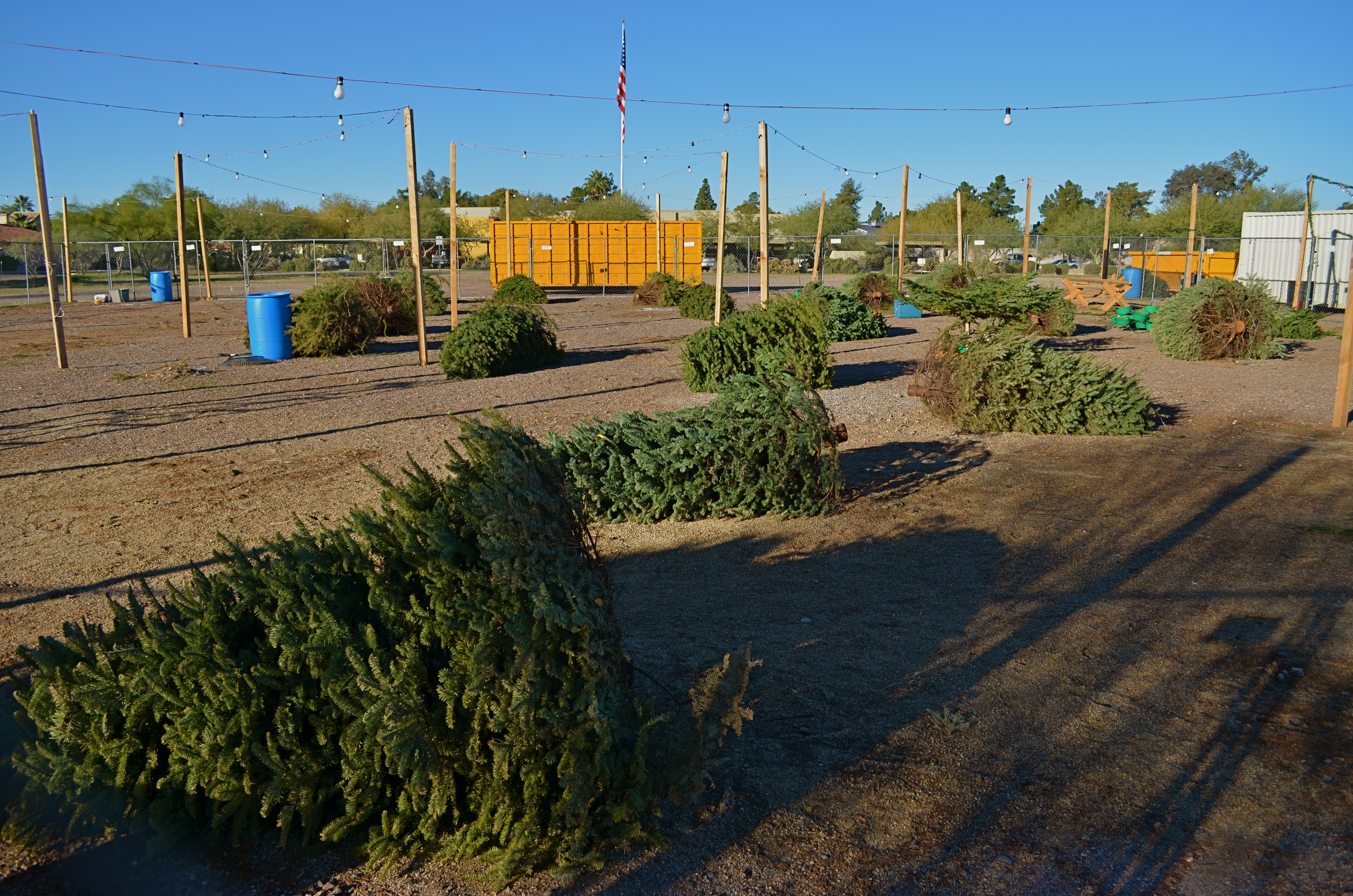
The Leavings: Christmas Tree Lot, Phoenix, AZ, 12/26/13. 1/500 sec., f/5.6, ISO 100, 18mm.
By MICHAEL PERKINS
PHOTOGRAPHY IS THE SCIENCE OF SECONDS. The seconds when the light plays past you. The seconds when the joy explodes. The seconds when maybe the building explodes, or the plane crashes. The micro moments of emotion’s arrivals and departures. Here it comes. There it goes. Click.
We are very good with the comings….the beginnings of babies, the opening of a rose, the blooming of a surprised smile. However, as chroniclers of effect, we often forget to also document the goings of life. The ends of things. The moment when the party’s over.
Christmas is a time of supreme comings and goings, and we have more than a month of ramp-up time each year during which we snap away at what is on the way. The gatherings and the gifts. The approaching joy. But a holiday this big leaves echoes and vacuums when it goes away, and those goings are photo opportunities as well.
This year, on 12/26, the predictably melancholy “morning after” found me driving around completely without pattern or design, looking for something of the magic day that had departed. I spun past the abandoned ruin of one of those temporary Christmas tree lots that sprout in the crevices of every city like gypsy camps for about three weeks out of the year, and something about all its emptiness said picture to me, so I got out and started bargaining with a makeshift cyclone fence for a view of the poles, lights and unloved fir branches left behind.
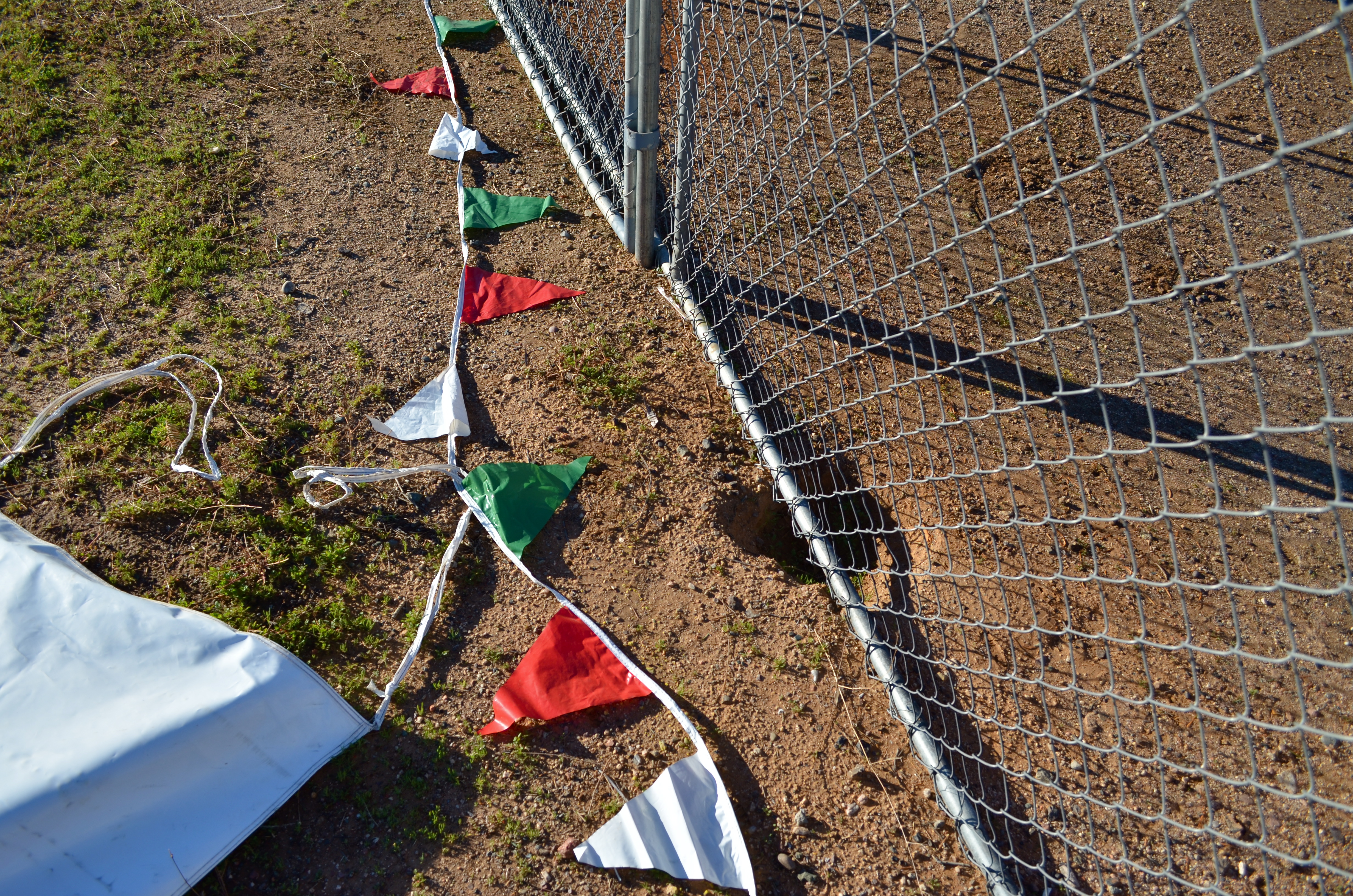
Pack up and get out of town.
The earliness of the hour meant that the light was a little warmer and kinder than would be the case later on in the bleached-out white of an Arizona midday, so the scene was about as nice as it was going to get. But what I was really after was the energy that goes out of things the day the circus drives out of town. The holidays are ripe with that feeling of loss, and, to me, it’s at least as interesting as recording the joy. Without a little tragedy you don’t appreciate triumph, and all that. Christmas trees are just such an obvious measure of that flow: one day you’re selling magic by the foot, the next day you’re packing up trash and trailer and making your exit.
Photographs come when they come, and, unlike us, they aren’t particular about what their message is. They just present chances to see.
Precious chances, as it turns out.
ANOTHER YEAR OUT THE WINDOW
By MICHAEL PERKINS
IF YOU WANT TO PUT A SMILE ON MY FACE WHEN I VISIT YOUR CITY, there is no sweeter sentence you can say to me than:
“I’ll drive”.
There is, for photographers, one way to maximize your time touring through other people’s towns, and that’s the time-honored tradition of “riding shotgun”. Drive me anywhere, but give me a window seat. I wasn’t trying to go for some kind of personal best in the area of urban side shots in 2013, but by good fortune I did snag a few surprises as I was ferried through various towns, along with a “reject” pile about a mile high. Like any other kind of shooting, the yield in window shooting is very low in terms of “killers per click”, but when you hit the target, you crack through a kind of “I’m new in town” barrier and take home a bit of the street for your own.
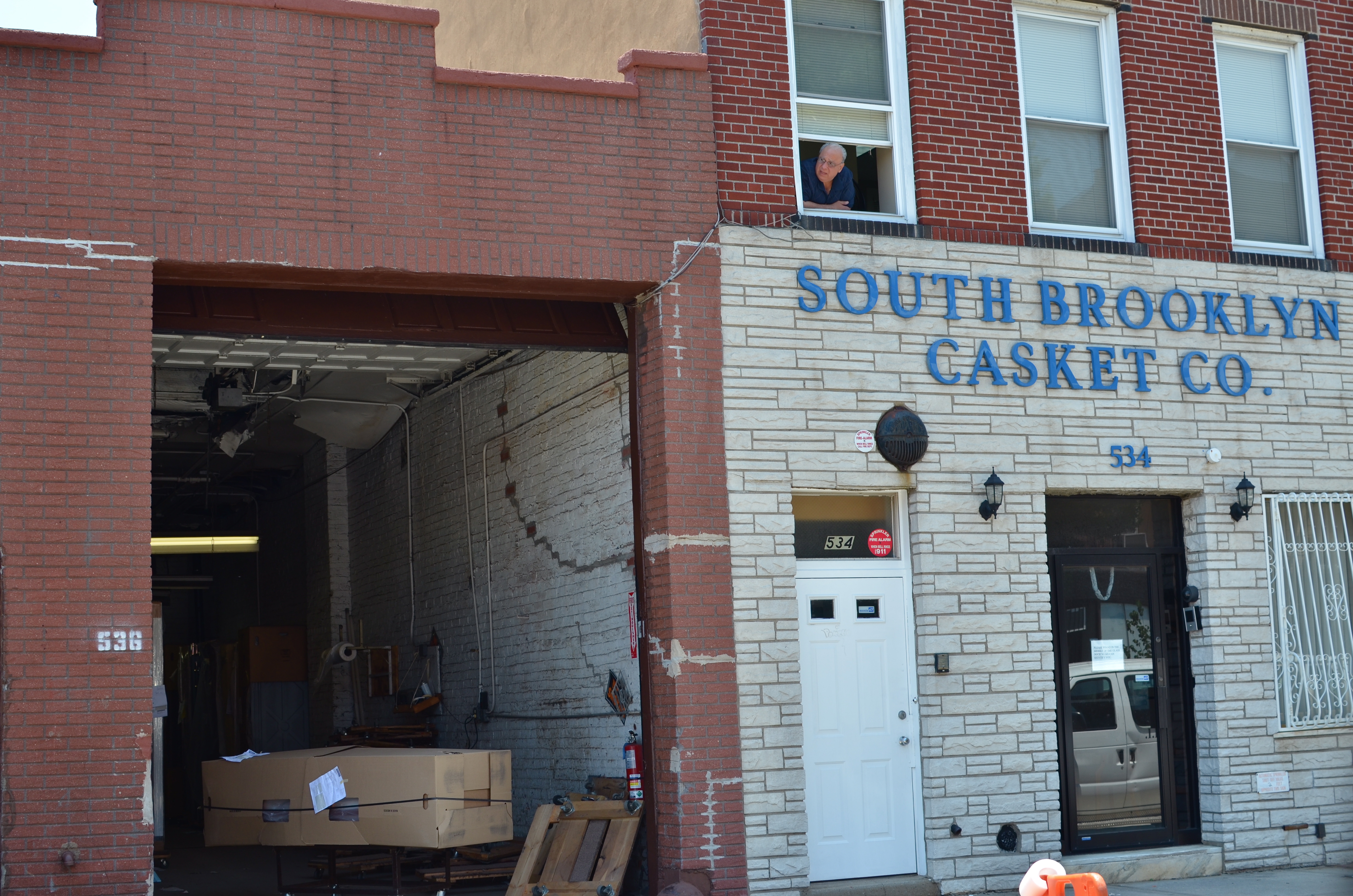
Business has been really dead lately. 1/250 sec., f/5.6, ISO 100, 35mm.
This guy just killed me (excuse the expression). He seemed like he was literally waiting for business to drop in (or drop dead), and meanwhile was taking in the view. Probably he didn’t even work for the casket company, in which case, what a bummer of neighbor to pick. Maybe he’s rent controlled.
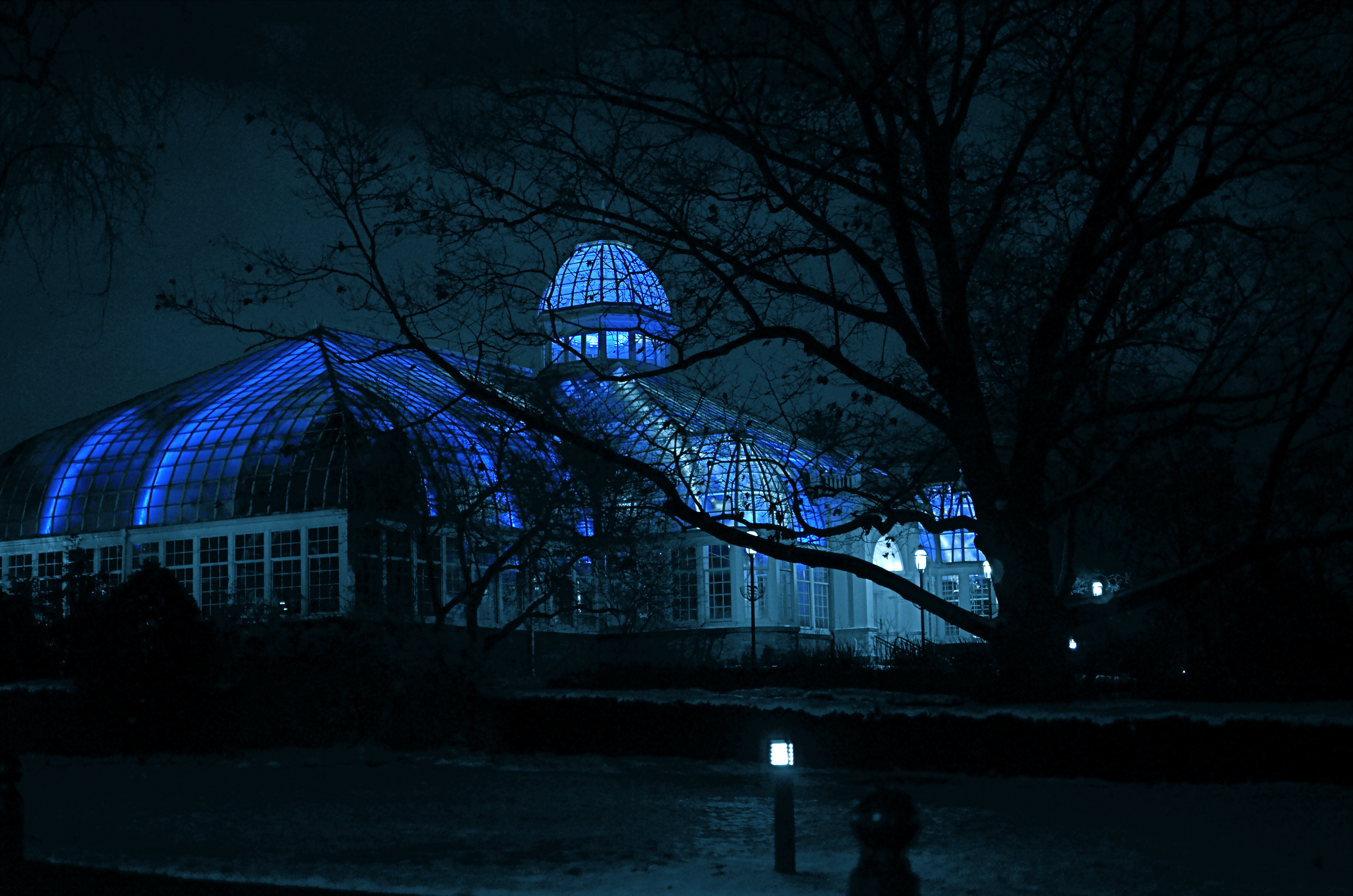
Franklin Park Conservatory, Columbus, Ohio. 1/40 sec., f/1.8, ISO 500, 35mm.
This one took a little tweaking. The building was actually blue, as you see here, lit with subdued mood for the holidays. However, in lightening this very dark shot, the sky registered as a muddy brown, so I made a dupe, desaturated everything except the conservatory, then added tint back in to make the surrounding park area match the building. All rescued from an “all or nothing” shot.
I’m also ashamed to admit that I bagged a few through-the-window shots while actually driving the car, all done at red lights and so not recommended. Don’t do as I do, do as I……oh, you know.
Here’s to long shots, at horse tracks or in viewfinders, and the few that finish in the money.
KICK-STARTING THE ENGINE
By MICHAEL PERKINS
THE POPULAR IMAGE OF A BLOCK-STRICKEN WRITER HELPLESSLY STARING AT A BLANK PAGE is enough to send an empathetic chill up the spine of anyone who has ever been haunted by a deadline or stymied by a narrative suddenly gone dry. And I am convinced, as both a writer and a photographer, that there is an equivalent “block” lurking in the shadows for any shooter, a visual desert that produces stretches of formless, pointless images, dry spells that are terrifying because they are open-ended. No one knows why, for everyone from time to time, the pictures stop coming, and no one can predict when they will come back.
It’s terrifying, because it’s as if vision or imagination were accounts that one can overdraw, bouncing artistic checks all over town and leaving you feeling, like Alice, that there is no bottom, only more hole. At least it’s terrifying to me.
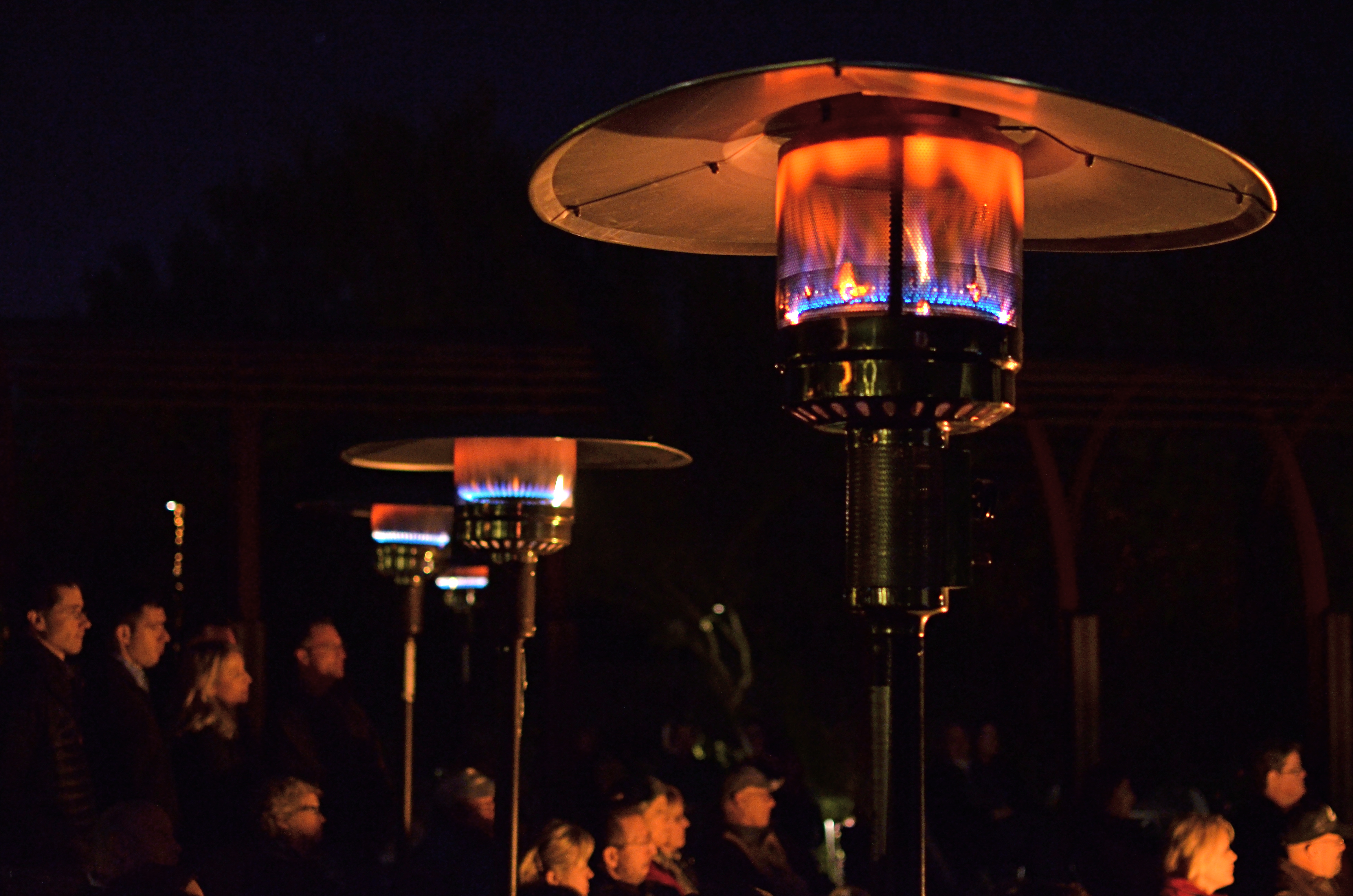
Torchlight Parade, 12/14/13. 1/40, f/2.5, ISO 1000, 35mm. You work your way through dry spells with what’s at hand.
As I write this, I have just come off several weeks of scrapings and scraps that should have been photographs but instead are equivalent to something smeared by an ape on his cage wall. I have seldom experienced such an extended period of mega-nothing, and it is only my unswerving oath to myself to shoot something, anything, every single day, that has allowed me to keep faith with the inevitable return of whatever eye I sometime possess. But, I have to admit, I am also suppressing strong urges to, like Norman Bates, lock my camera inside a car trunk and seek out the nearest swamp.
Okay, that’s a tad dramatic, but my current case of the “drys” is unnerving for a particular reason. I am typically able to conjure pictures out of nearly nothing, which is more liberating than having to wait for obvious or “big” projects. You can shoot daily if you can get off on still lifes of plastic spoons. You can’t shoot daily if you need a vacation, a birthday, or a mountain for inspiration. So it’s doubly troubling if you can’t even summon up the humble crumbs needed for some kind of image.
I know, that, at one point or another, something will demand my attention/obsession, and we’ll be off to the races again. But there is always the nagging question. What happens if I can’t kick-start the engine? Everything has a beginning and an end. So…?
Oh, wait, the light is doing something really cool just now…..
THE BLUE AND THE GREY
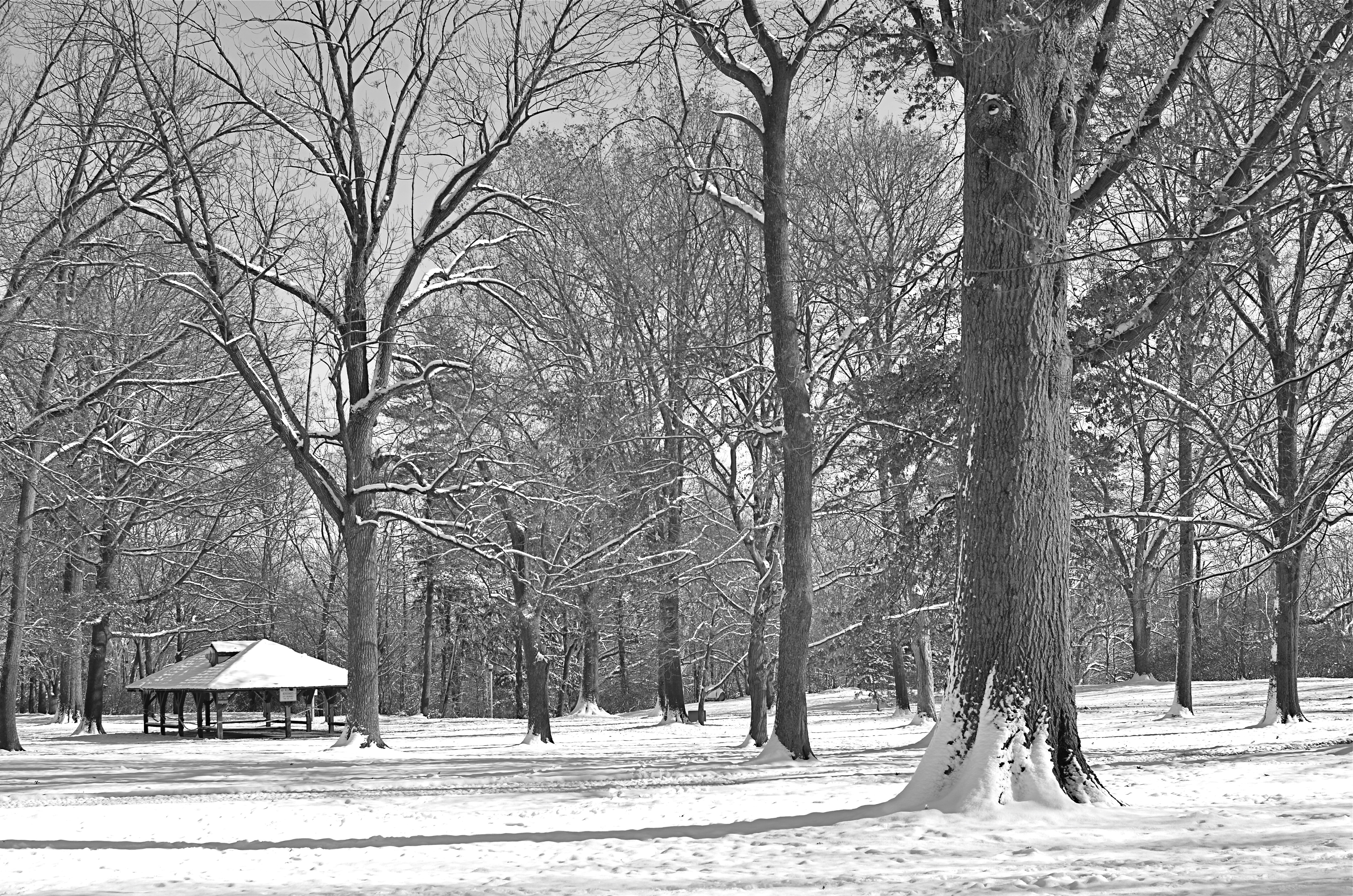
A decent winter scene, a bit too charming in its full color original, converted in-camera to straight monochrome. Now, however, it’s too bland.
By MICHAEL PERKINS
ONE OF THE GREAT BENEFITS OF DIGITAL PHOTOGRAPHY, other than its ease and affordability, is the speed at which it allows you to make comparative value judgements on images in the field. Even as digital darkrooms make it ever easier to change or modify your vision after the fact, today’s cameras also allow you to choose between several versions of a photograph while its subject is right at hand. This is an amazing mental and artistic economy, and it’s another reason why this is the absolute best time in history to be making pictures.
Many of us who made the transition from film have a lifelong habit of “bracketing”, taking multiples of the same image over a range of exposure rates to ensure that we are “covered” with at least one keeper in the batch. Others have already adopted the equivalent habit of taking several different frames with a sampling of varying white balances. I also find it helpful to use today’s in-camera filters to instantly convert color shots to three other monochrome “takes”….straight black and white, sepia and cyanotype. It’s a way to see if certain low-color subject matter will actually benefit from being reworked as duotone, and knowing that fact extra fast.
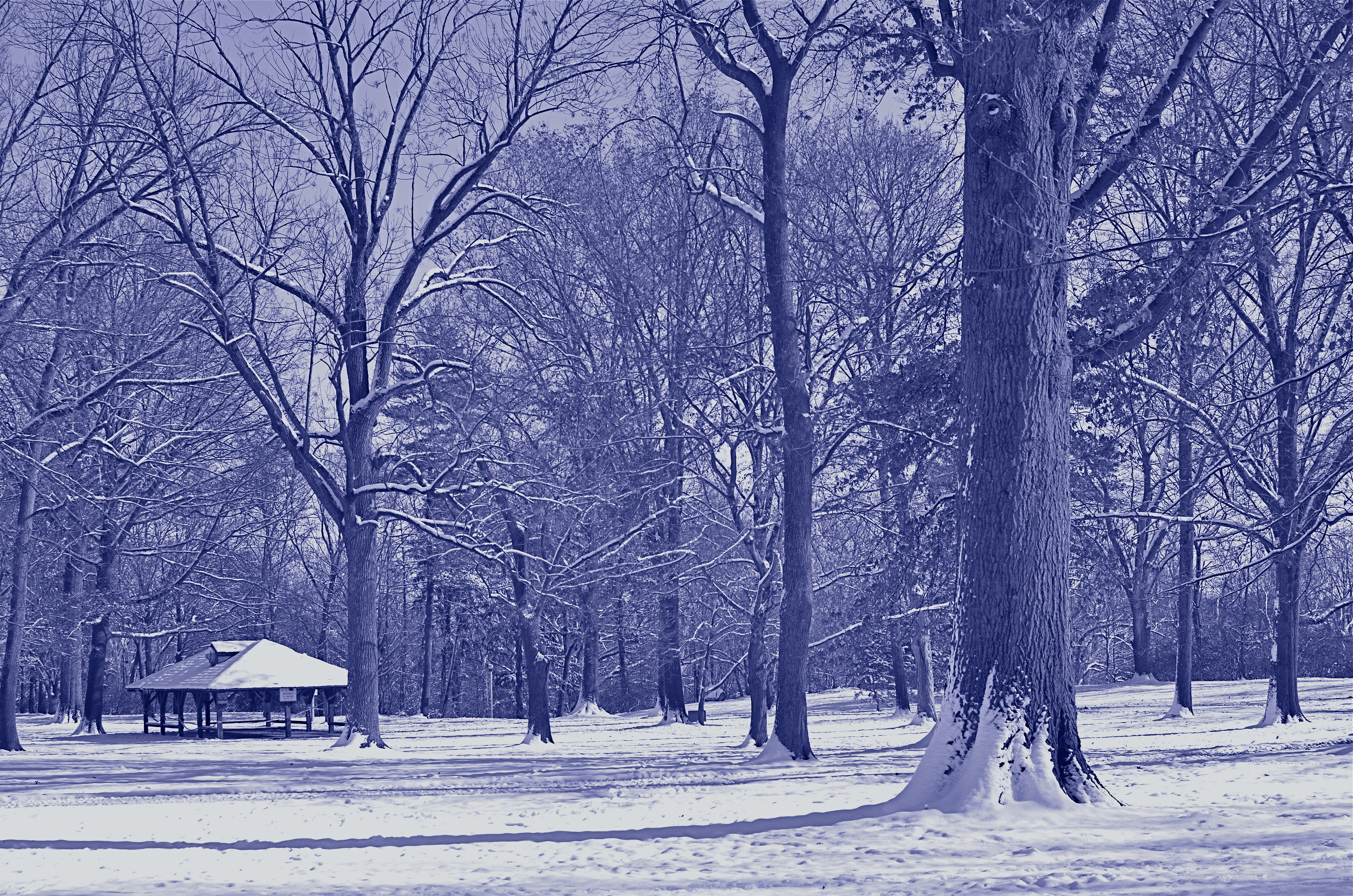
Another in-camera conversion, this time to cyanotype. This one says “winter” to me. 1/320 sec, f/5.6, ISO 100, 35mm.
Color or its selective elimination is one of the easiest tools to wield in photography. In the case of the series shown in this post, I decided that the winter scene was a little too warm and cheery in full color, a little flat in straight B&W, but properly evocative of winter’s severity in cyan. The choice was quick, and I still had the color master shot that I could choose to massage later on.
Shooting fast, that is, at the speed of your mood or whim, is a remarkable luxury, and exploiting it to the max is easy with even the most elementary camera. And anything that converts more “maybe” shots to “yes” is my idea of a good time.
I’ll have a Blue Christmas, thank you.
Related articles
- 5 Good Photography Habits to Start Today (digital-photography-school.com)
JUST ENOUGH
By MICHAEL PERKINS
PHOTOGRAPHERS SPEND HALF THEIR LIVES TRYING TO PUT AS MUCH INFORMATION INTO THEIR IMAGES AS POSSIBLE, and the other half trying to remove as much as practicable. Both efforts are in service of the telling of stories, and both approaches are dictated by what a particular photograph is trying to convey.
Sometimes you need the cast of The Ten Commandments to say “humanity”. Other times, just a whisper, an essence of two people talking carries the entire message. That’s where I wound up the other day…with one woman and one very young boy.
Their shared mission was a simple one: hooking up an iPhone Facetime visit with an aunt half a country away. Nothing dramatic, and yet plenty of story to fill a frame with. Story enough, it turned out, for me to get away with weeding out nearly all visual information in the picture, and yet have enough to work with. Time, of course, was also a factor in my choice, since I would be losing a special moment if I stepped into a dark hall and spent precious moments trying to mine it for extra light.
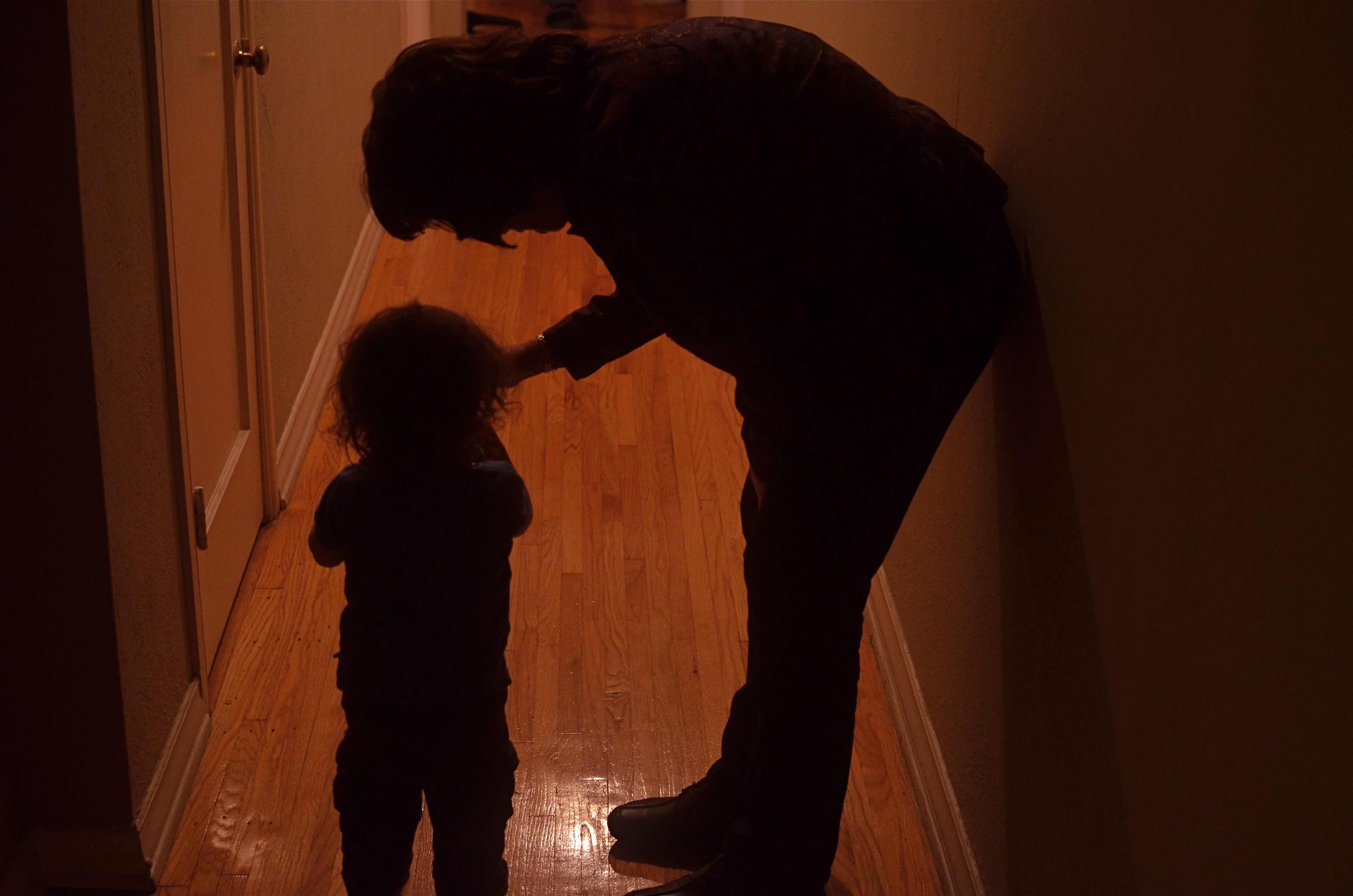
Conference call: 1/50 sec., f/3.5, ISO 800, 35mm.
In a second, I realized that silhouettes would carry the magic of the moment without any help from me. What would it matter if I could see the color of my subjects’ clothing, the detail in their hair, even the look on their faces? In short, what would I gain trying to massage an image that was already perfectly eloquent in shadow?
I exposed for the floor in the hall and let everything else go. There was plenty of story there already.
I just had to get out of its way.
KEEPING SPIRITS BRIGHT
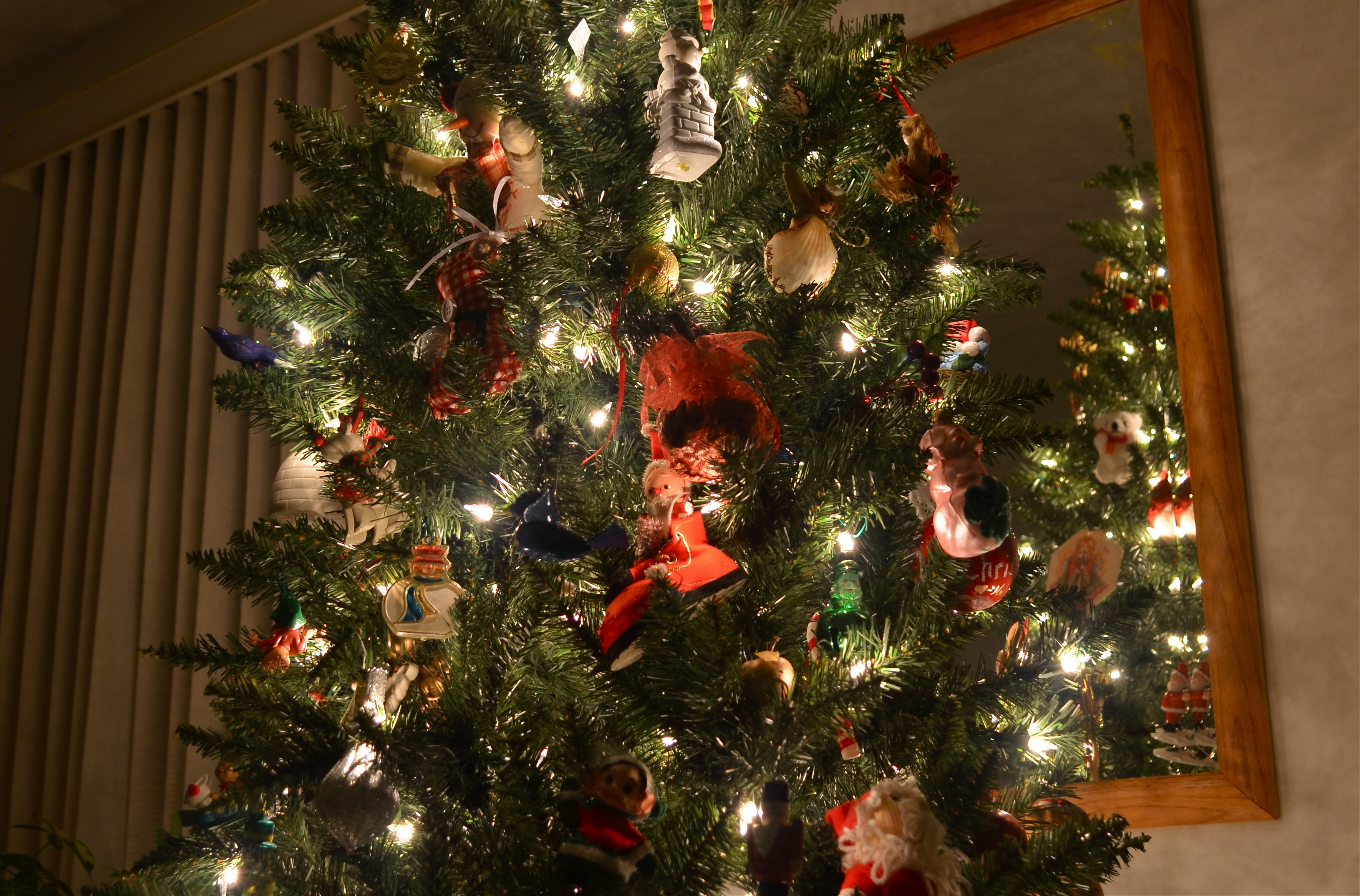
1/16 sec., f/4, ISO 100, 20mm.
By MICHAEL PERKINS
IT IS A SEASON OF LIGHT AND COLOR, perhaps one of the key times of the year for all things illuminated, burning, blazing and glowing. It is a time when opportunities for vivid and brilliant images explode from every corner.
And one way to unleash all that light is to manage darkness.
One example: your family Christmas tree involves more delicate detail, tradition and miniature charm than any other part of your home’s holiday decor, but it often loses impact in many snapshots, either blown out in on-camera flash or underlit with a few colored twinkles surrounded by a blob of piny silhouette.
How about a third approach: go ahead and turn off all the lights in the room except those on the tree, but set up a tripod and take a short time exposure.
It’s amazing how easy this simple trick will enhance the overall atmosphere. With the slightly slow exposure, the powerful tree LEDs have more than enough oomph to add a soft glow to the entire room, while acting as a multitude of tiny fill lights for the shaded crannies within the texture of the tree. Ornaments will be softly and partially lit, highlighting their design details and giving them a slightly dimensional pop.
In fact, the LED’s emit such strong light that you only want to make the exposure slow enough to register them. The above image was taken at 1/16 of a second, no longer, so the lights don’t have time to “burn in” and smear. And yes, some of you highly developed humanoids can hand-hold a shot steadily at that exposure, so see what works for you. You could also, of course, shoot wide open to f/1.8 if you have a prime lens, making things even easier, but you might run into focus problems at close range. You could also just jack up your ISO and shoot at a more manageable shutter speed, but in a darkened room you’re trading off for a lot of noise in the areas beyond the tree. Dealer’s choice.
Lights are a big part of the holidays, and mastery of light is the magic that delivers the mystery. Have fun.
JUST SAY THANK YOU
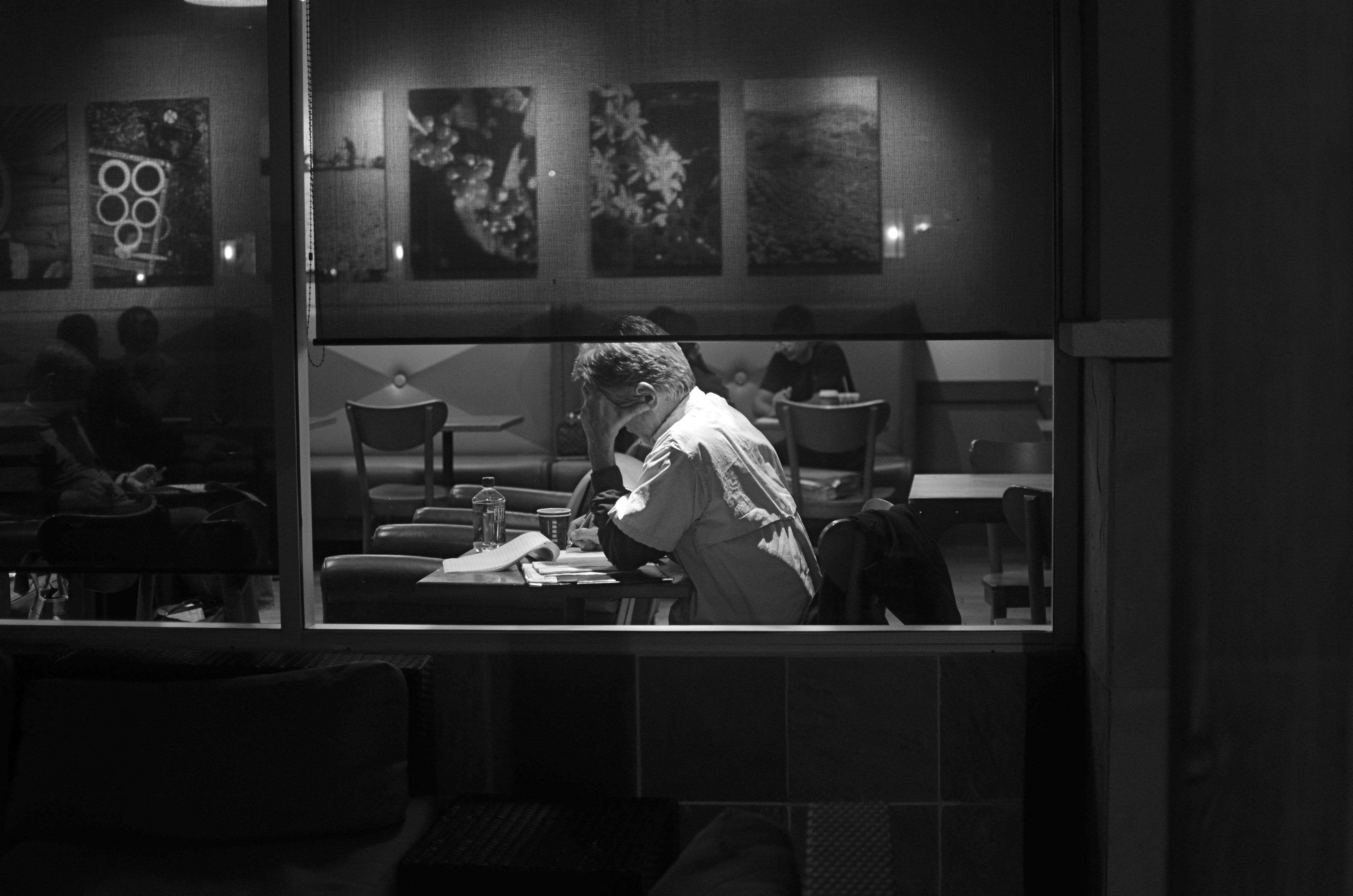
The All-Nighter: 1/60 sec., f/1.8, ISO 800, 35mm.
By MICHAEL PERKINS
PICTURES HAPPEN WHEN YOU’RE OUT TRYING TO TAKE “OTHER” PICTURES. Pictures happen when you didn’t feel like taking any pictures at all. And, occasionally, the planets align perfectly and you hold something in your hand, that, if you are honest, you know you had nothing to with.
Those are the pictures that delight and haunt. They happen on off-days, against the grain of whatever you’d planned. They crop up when it’s not convenient to take them, demanding your attention like a small insistent child tugging at your pants leg with an urgent or annoying issue. And when they call, however obtrusively, however bothersome, you’d better listen.
Don’t over-think the gift. Just say thank you….and stay open.
This is an overly mystical way of saying that pictures are sometimes taken because it’s their time to be taken. You are not the person who made them ready. You were the person who wandered by, with a camera if you’re lucky.
I got lucky this week, but not with any shot I had set out on a walkabout to capture. By the time I spotted the scene you see at the top of this post, I was beyond empty, having harvested exactly zip out of a series of locations I thought would give up some gold. I couldn’t get the exposures right: the framing was off: the subjects, which I hoped would reveal great human drama, were as exciting as a bus schedule.
I had just switched from color to monochrome when I saw him: a young nighthawk nursing some eleventh-hour coffee while poring over an intense project. Homework? A heartfelt journal? A grocery list? Who could tell? All I could see, in a moment, was that the selective opening and closing of shades all around him had given me a perfect frame, with every other element in the room diffused to soft focus. It was as if the picture was hanging in the air with a big neon rectangle around it, flashing shoot here, dummy.
My subject’s face was hidden. His true emotion or state of mind would never be known. The picture would always hide as much as it revealed.
Works for me. Click.
Just like the flicker of a firefly, the picture immediately went away. My target shifted in his chair, people began to walk across the room, the universe changed. I had a lucky souvenir of something that truly was no longer.
I said thank you to someone, packed up my gear, and drove home.
I hadn’t gotten what I originally came for.
Lucky me.
related articles:
- Crop and turn a bad picture into a good one (weliveinaflat.wordpress.com)
FIND YOURSELF A KID
 By MICHAEL PERKINS
“MAKING PHOTOGRAPHS” IS ONLY HALF OF PHOTOGRAPHY. The other half consists of placing yourself in the oncoming path of that runaway truck Experience so that you can’t help getting run over, then trying to get the license plate of the truck to learn something from the crash. You need to keep placing your complacency and comfort in harm’s way in order to advance, to continue your ongoing search for better ways to see. Thus the role models or educational models you choose matter, and matter greatly.
Lately, much as I thrive on wisdom from the masters and elders of photography, I am relying more and more on creative energy and ideas from people who are just learning to take pictures. This may sound like I am taking driving lessons from toddlers instead of licensed instructors, but think about it a moment.
Yes, nothing teaches like experience….seasoned, life-tested experience. Righty right right. But art is about curiosity and fearlessness, and nothing says “open to possibility” like a 20-year-old hosting a podcast on what could happen “if you try this” with a camera. It is the fact that the young are unsure of how things will come out (the curiosity)  which impels them to hurry up and try something to find out (the fearlessness). Moreover, if they were raised with only the digital world as a reference point, they are less intimidated by the prospect of failure, since they are basically shooting for free and their universe is one of infinite do-overs. There is no wrong photograph, unless it’s the one you just didn’t try for.
Best of all, photography, always the most democratic of arts, has just become insanely more so, by putting some kind of camera in literally everyone’s fist. There is no more exclusive men’s club entitlement to being a shooter. You just need the will. Ease of operation and distribution means no one can be excluded from the discussion, and this means a tidal wave of input from those just learning to love making pictures.
One joke going around the tech geek community in recent years involves an old lady who calls up Best Buy and frets, “I need to hook up my computer!”, to which the clerk replies, “That’s easy. Got a grandchild?”
Find yourself a path. Find yourself a world of influences and approaches for your photography. And, occasionally, find yourself a kid.
Related articles
- Resist the need to Get some new Camera – Change your Photography Instead (textb.wordpress.com)
CHOOSE NOT TO CHOOSE
By MICHAEL PERKINS
FOR MOST PHOTOGRAPHERS, THE ACT OF MAKING A PICTURE HAS TRADITIONALLY MEANT CHOOSING ONE THING OVER ANOTHER; exposing some things within a frame nearly perfectly, while, by default, settling for under-or-over-exposure of other objects within that same picture. We find ourself making priorities within the image, sorting things into piles marked “important” and “not important”. Get the color right on the surf and let the sky go white. Tamp down the snowy mountain and leave the surrounding forest black. Get this part right: leave this part wrong.
At least that’s what our earlier habits led us to accept. You can’t have it all, we tell ourselves. Decide what you really need to show and leave the rest. However, there’s a big difference between deciding to de-emphasize something in an image and feeling powerless to do anything else. Happily, ongoing developments in camera technology work to progressively minimize the number of scenarios in which you have to make these unholy choices, and one of the things that can save many such pictures is (a) readily at hand, (b) cheap, and (c) easy to work with; your on-board flash.
Now before I go further, know that I hate, hate, hate on-board flash 99.9999999% of the time. It’s only slightly less harsh than a blowtorch, lousy beyond a short distance, and generally hard to focus and direct. That said, I am occasionally an oh, hell yeah believer in fill flash, for which these rude little beacons can be useful.
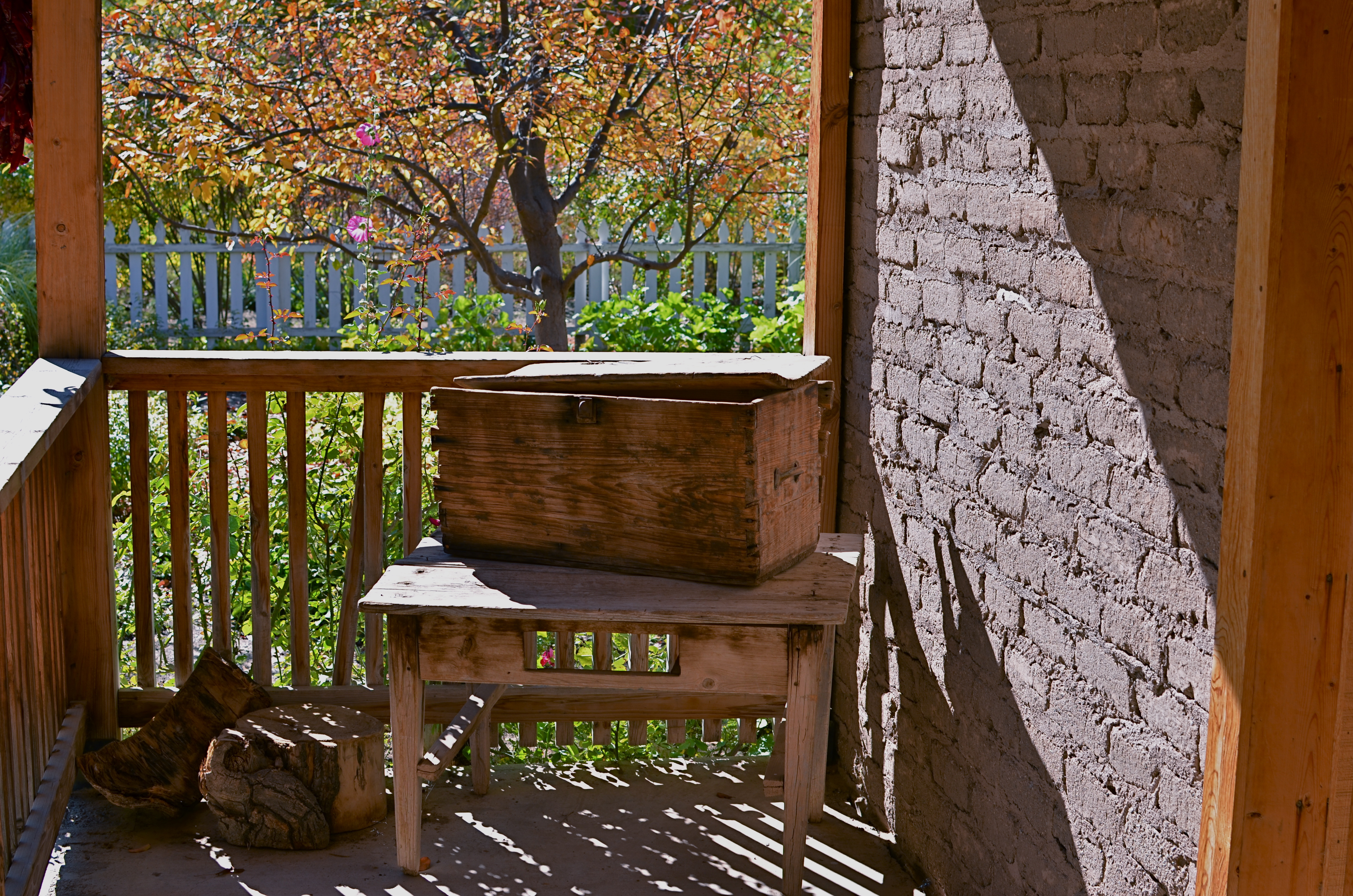
May not look like a job for your on-camera flash, but it really can help. 1/200 sec., f/5.6, ISO 100, 35mm.
In the above image, shooting the traditional way, you can choose a balanced exposure for either the front yard beyond this rustic homes’ porch or the detail on the porch itself, but not both. However, if you pop up the flash, expose for the yard, and then back off just beyond the flash’s outer range, a gentle bit of light illuminates the porch’s wood grain and reduces the shadow nooks without bleaching them out (Note that, with the flash up, you can’t shoot any faster than 1/200, so you may have to control the exposure of the yard by going for a smaller f-stop. I used 5.6 here). The result is an illusion, since you’ve tricked the camera into recording an even range of light that your eye and brain seem to see naturally, but the trick looks as if it ought to be “real”.
Of course, if the yard is so magnificent in its own right, you may choose to show the porch in silhouette just to call attention to all that floral glory, but the thing is, you’re not locked in to that choice alone. The horrible, harsh on-board flash can give you more options, and thus (barely) justify its existence.
And did I mention it’s cheap and easy?
Follow Michael Perkins on Twitter @MPnormaleye.
DARK NIGHT, BRIGHT NIGHT
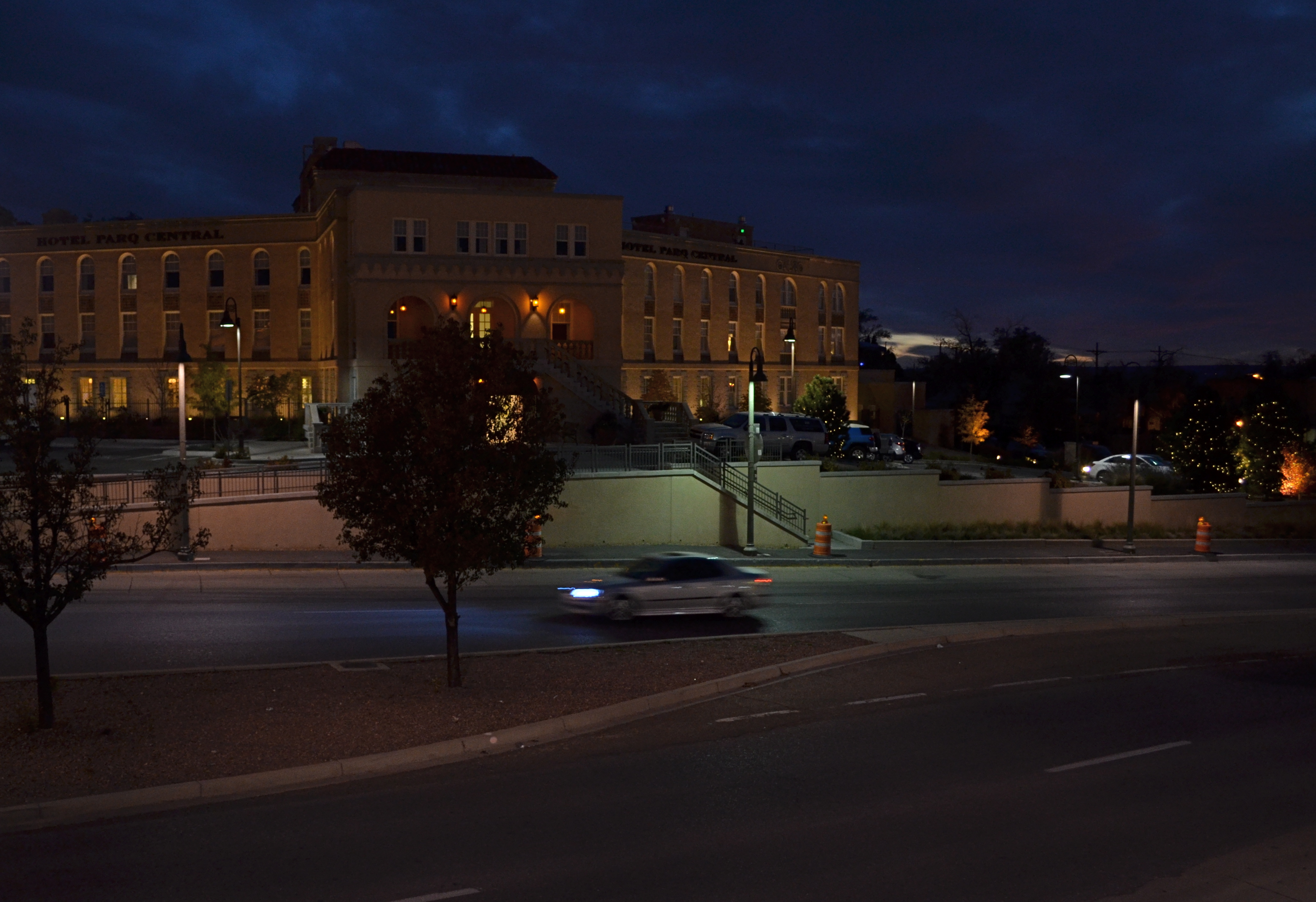
Handheld post-sunset image, shot at 1/30 sec., f/3.5, 18mm, ISO 500.
By MICHAEL PERKINS
OFTEN, THE SHOT YOU GET HAPPENS ON THE WAY TO THE SHOT YOU THOUGHT YOU WANTED. We all like to think we are operating under some kind of “master plan”, proceeding along a Spock-o-logical path of reason, toward a guaranteed ( and stunning) result, but, hey, this is photography, so, yeah, forget all that.
Night shots are nearly always a series of surprises/rude shocks for me, since sculpting or harvesting light after dark is a completely different skill from what’s used in the daytime. Even small tweaks in my approach to a given subject result in wild variances in the finished product, and so I often sacrifice “the shot” that I had my heart set on for the one which blossomed out of the moment.
This is all French for “lucky accident”. I’d love to attribute it to my own adventurous intellect and godlike talent, but, again, this is photography, so, yeah, forget all about that, too.
So, as to the image up top: in recent years, I have pulled away from the lifelong habit of making time exposures on a tripod, given the progressively better light-gathering range of newer digital sensors, not to mention the convenience of not having to haul around extra hardware. Spotting this building just after dusk outside my hotel the other night, however, I decided I had the time and vantage point to take a long enough exposure to illuminate the building fully and capture some light trails from the passing traffic.
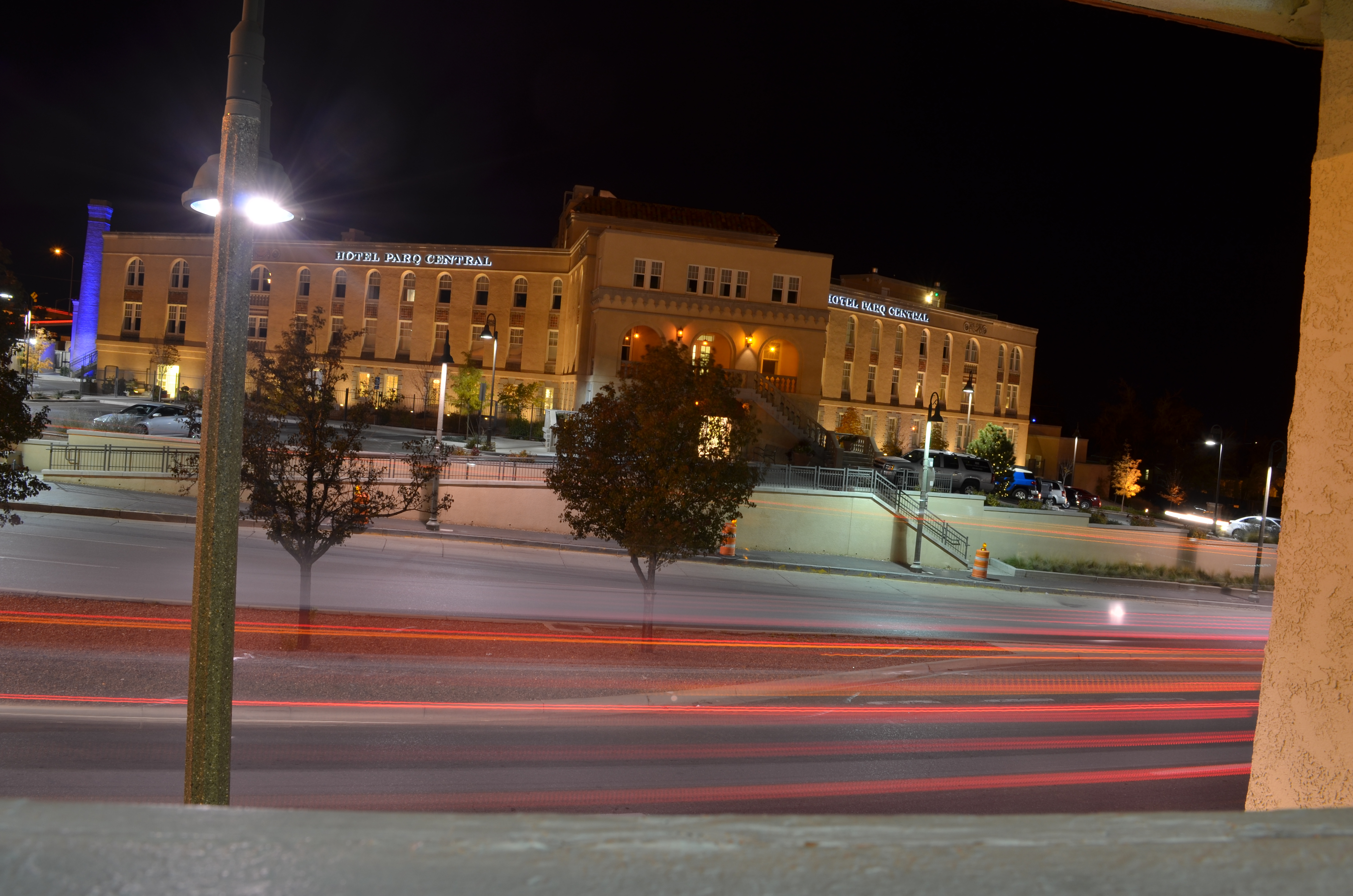
Same subject, almost same time of night, time-exposed on a tripod. 8 sec., f/13, 18mm, ISO 100.
Minutes before setting up my ‘pod, I had taken an earlier snap with nothing but available light, a relatively slow shutter speed and an ISO of 500 , but hadn’t seriously looked at it: traditional thinking told me I could do better with the time exposure. However, when comparing the two shots later, the longer, brighter exposure drained the building of its edgier, natural shadow-casting features, versus the edgier, somber, burnt-orange look of it in the snapshot. The handheld image also rendered the post-dusk sky as a rich blue, while the longer shot lost the entire sky in black. I wanted the building to project a slight air of mystery, which the longer shot completely bleached away. I knew that the snapshot was a bit noisy, but the better overall “feel” of the shot made the trade-off easier to live with. I could also survive without the light trails.
Time exposures render an idealized effect when rendering night-time objects, not an accurate recording of “what I saw”. Continual experimentation can sometimes modulate that effect, but in this case, the snatch-and-grab image won the day. Next time, everything will be different, from subject to result. After all, this is photography.
THE GREAT RIDDLE
By MICHAEL PERKINS
IT’S FORTUNATE THAT NONE OF US HAS ANY IDEA WHAT APPEALS TO OUR VIEWERS, or else everything we do would revert to a dull formula. If it was possible to predict which of our creations would establish a connection with other hearts and minds, wouldn’t our human nature tempt us to churn out clumsy duplicates of that creation again and again? You see this at craft shows where “artists” hawk dozens of copies of the same image to anyone who passes by, customizing only the frames and enlargement sizes. The first version of the idea was “art”; the cannily repackaged remakes are merely marketing.
With this in mind, the act of putting photographs on the web via various sharing sites is often a puzzling process, since I have no way of knowing whether anything I regard as “successful” will total even one view, and since the pictures I regard as merely “all right” may resonate in a fashion that I never foresaw. Again, I have no control over any of this, which makes it both gratifying and, well, stupefying.
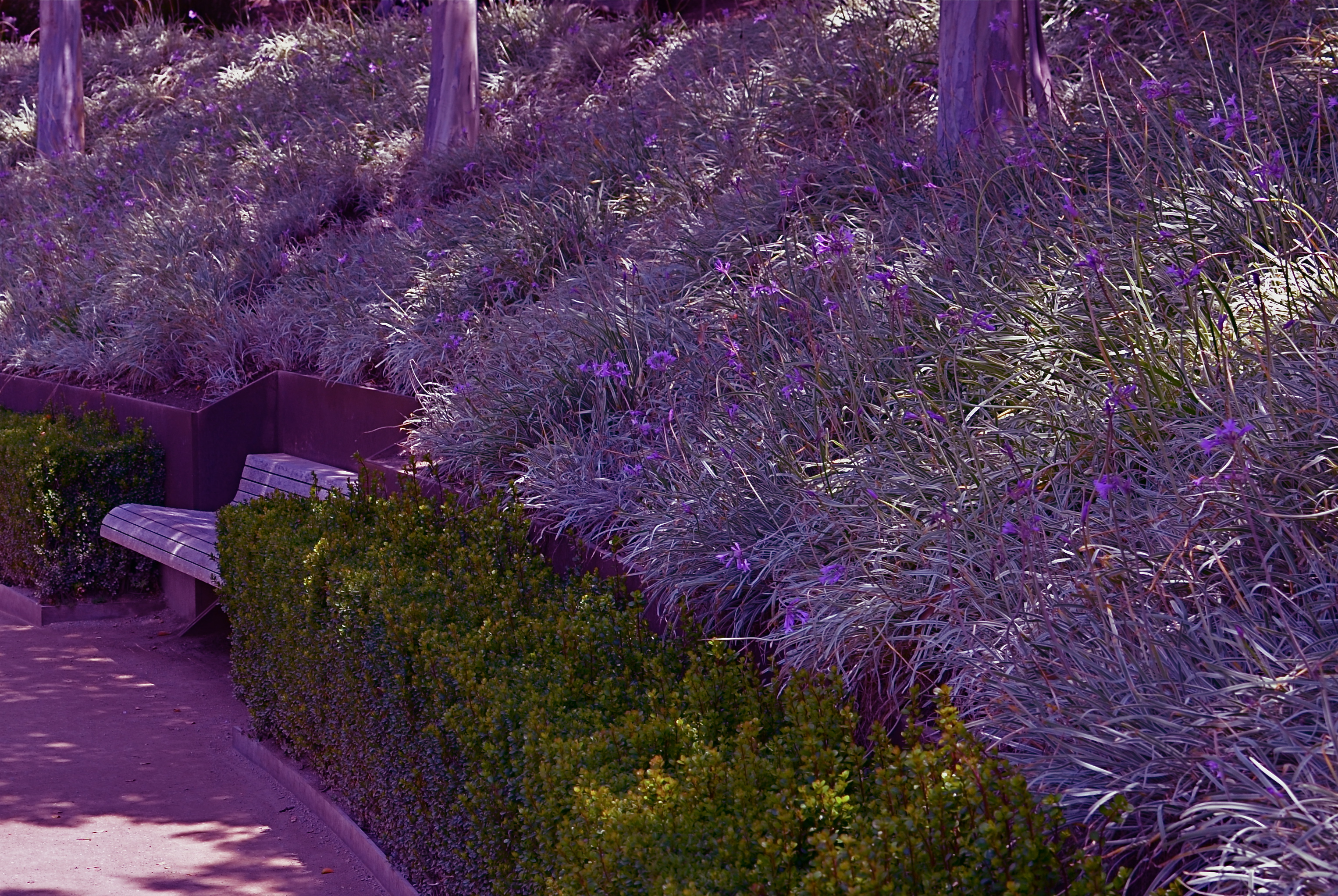
Dream Gardens, Los Angeles (2013). 1/250 sec., f/5.6, ISO 100, 35mm.
You’re looking at the runaway champ photo for total views in my entire Flickr photostream. To me, it’s a bit of whimsy at best, and, if I am totally truthful, an attempt at a partial “save” on what started out to be a rejected image. Backstory: the massive and visually busy central gardens at Los Angeles’ Getty art campus are wonderful to walk through, irresistible to shoot, and a nightmare to capture. If you do the cliché overhead “master shot” of the entire area from, say, two stories in the air, you get something which generally work. However, trying to get a sense of the densely landscaped details at ground level is a fool’s errand. This shot represents a kind of surrender, as it was an attempt to create a quiet composition along one of the more sparse sections of one footpath. Even so, what you’re seeing here is a paring-away of more than half the original frame. There was just too much visual information to work with.
The psychedelic rework on the color is yet another sign that I am not truly comfortable with what I am doing, but it at least represents an attempt to create an “otherness” with the image, to take it out of the normal world. This strategy gave me a picture I could live with, but hardly one I would point to with pride. The verdict from every one else? 5,000 % more eye traffic than the next most popular picture I’ve ever posted on the web, and no sign of slowing. And yet, I know that if I intentionally take another picture like this, it won’t become part of a “series” or a “school of thought”, merely me trying to cash in on a great riddle.
We use our photography to make a case for our various visions to an unknown jury, but, in most cases, we sort of “get” what worked about a picture. But when mysteries like these occur, we can merely
a) be grateful
b) say goodnight, Gracie.
I am reminded about an old bit where Billy Crystal “imitated” famous people by cutting out the mouths of big posters of various icons, then sticking his own lips where theirs should be and “speaking” for them. I fell on the floor as he took his place behind a huge image of Albert Einstein, and in his best Catskills accent, kept repeating, “WHO KNEW? WHAT DID WE KNOW??”
What, indeed.
Follow Michael Perkins on Twitter @MPnormaleye.
PLEASE PLAY WITH YOUR FOOD
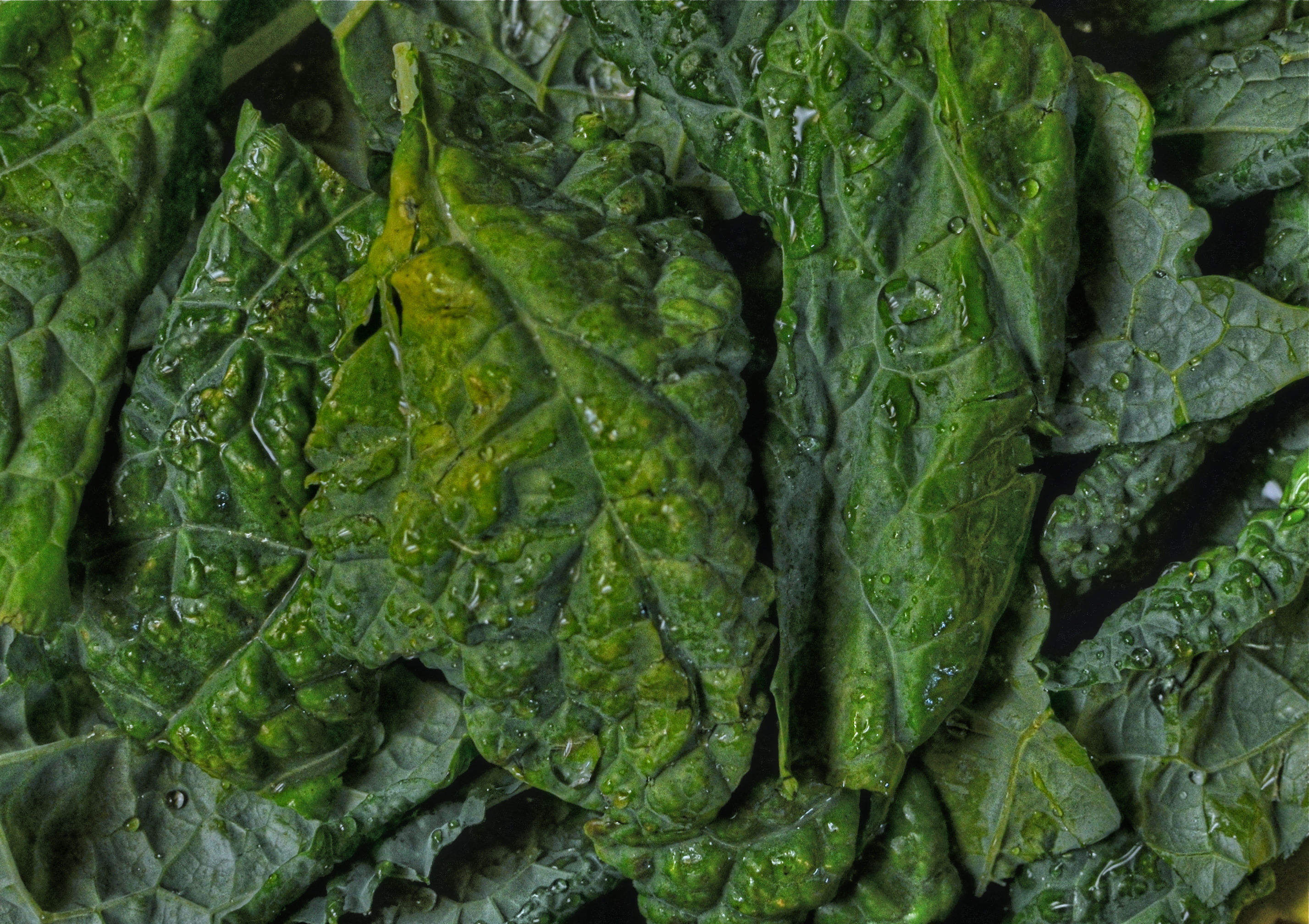
Verdant, 2013. 1/60 sec., f/5.6, ISO 500, 35mm.
By MICHAEL PERKINS
PHOTOGRAPHIC STILL-LIFES ARE THE POOR MAN’S PRACTICE LAB. All the necessary elements for self-taught imaging are plentiful, nearby, and generally cheap. As has been demonstrated perpetually across the history of photography, the subjects themselves are only of secondary importance. What’s being practiced are the twin arts of exposure and composition, so it doesn’t matter a pig whistle whether you’re assembling a basket of oranges or throwing together a pile of old broken Barbie dolls. It’s not about depicting a thing so much as it is about finding new ways to see a thing.
That’s why an entire class of shooters can cluster around the same randomly chosen subject and produce vastly different viewing experiences. And why one of the most commonly “seen” things in our world, for example, food, can become so intriguingly alien when subjected to the photographer’s eye.
Shooting food for still-life purposes provides remarkably different results from the professional shots taken to illustrate articles and cookbooks. “Recipe” shots are really a way of documenting what your cooking result should resemble. But other still-life shots with food quickly become a quest to show something as no one else has ever shown it. It’s not a record of a cabbage; it’s a record of what you thought about a cabbage on a given day.
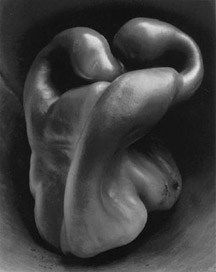
Edward Weston, Pepper # 30 (1930).
Many books over the years have re-printed Edward Weston’s famous black-and-white shots of peppers, in which some people “saw” things ranging from mountain terrain to abstract nudes. These remarkable shots are famous not for what they show, but for what they make it possible to see. Food’s various signature textures, under the photographer’s hand, suggest an infinite number of mental associations, once you visually unchain the source materials from the most common perception of their features.
As the head chef around my house, I often pick certain cooking days where I will factor in extra time, beyond what it takes to actually prepare whatever meal I’m planning. That additional time is reserved so I can throw food elements that interest me into patterns…..on plates, towels, counters, whatever, in an effort to answer the eternal photog question, is this anything? If it is, I snap it. If it’s not, I eat it (destroying the evidence, as it were).
Either way, I get what I call “seeing practice”, and, someday, when a rutabaga starts to look like a ballerina, I might be ready. Or maybe I should just lie down until the feeling passes.
Follow Michael Perkins on Twitter @MPnormaleye.
Related articles
- Is Food Art: Notes from a Food Photographer (okramagazine.org)
GOING OFF-MENU
By MICHAEL PERKINS
I AM ALREADY ON RECORD AS A CHAMPION OF THE ODD, THE OFF-KILTER, AND THE JOYFULLY STRANGE IN AMERICAN RETAIL. As a photographer, I often weep over the endangered status of the individual entrepreneur, the shopkeeper who strikes out in search of a culturally different vibe, some visual antidote to the tsunami of national chains and marts that threatens to drown out our national soul. Sameness and uniformity is a menace to society and a buzzkill of biblical proportions for photography. Art, like nature, abhors a vacuum.
It is, of course, possible that someone might have created a deathless masterpiece of image-making using a Denny’s or a Kohl’s as a subject, and, if so, I would be ecstatic to see the results, but I feel that the photog’s eye is more immediately rewarded by the freak start-ups, the stubborn outliers in retail, and nowhere is this in better evidence than in eateries. Restaurants are like big sleeves for their creators to wear their hearts on.
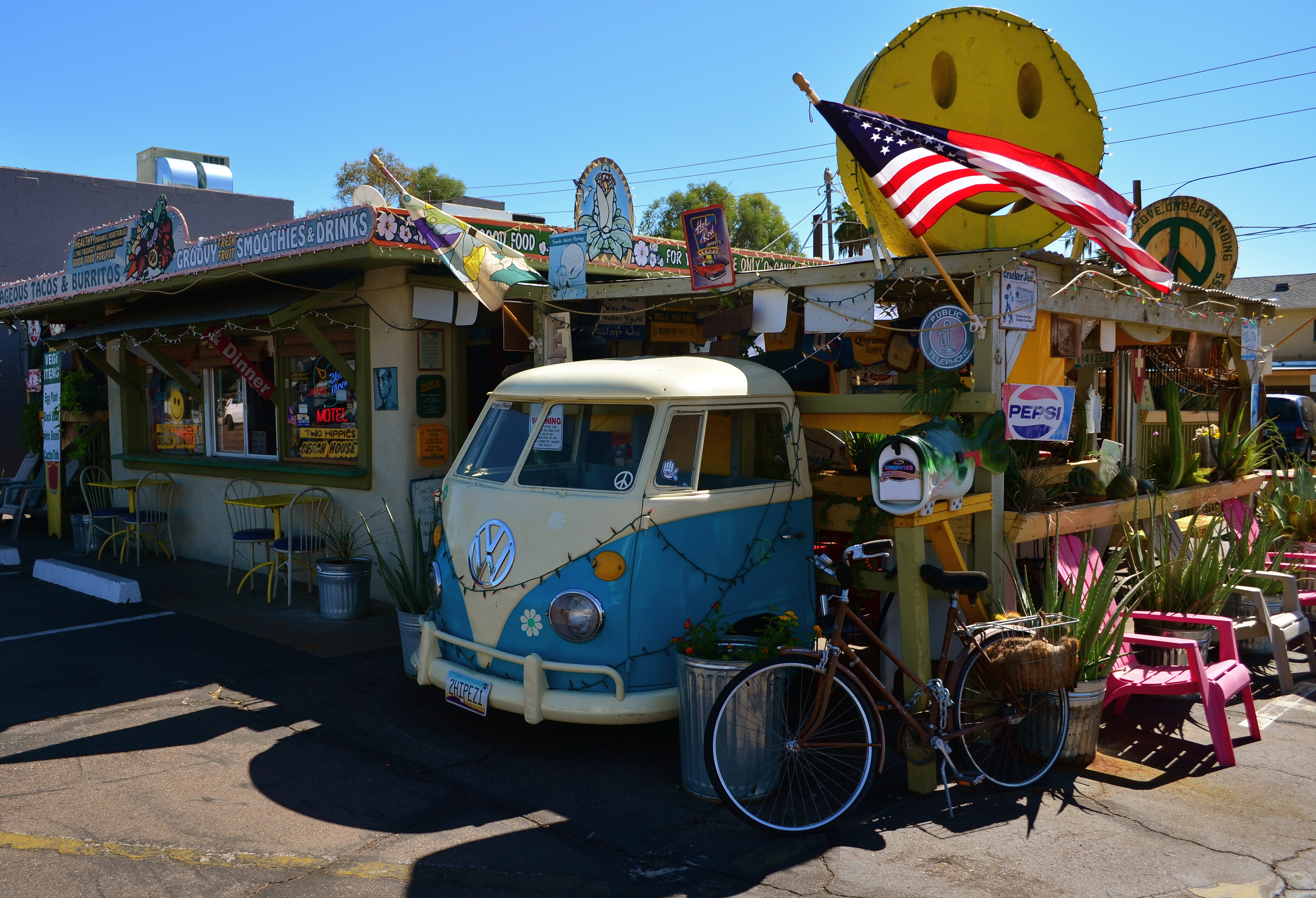
The surf is seldom “up” at the Two Hippies’ Beach House Restaurant in Phoenix, AZ, but the joint is “awash” in mood. 1/640 sec., f/5.6, ISO 100, 18mm.
That’s why this divinely misfit toy of a diner, which was hidden in plain sight on one of the main drags in central Phoenix, has given me such a smile lately. I have never eaten at the swelegant Two Hippies’ Beach House, but I have visually feasted on its unabashed quirkiness. And if the grub is half as interesting as the layout, it must be the taste equivalent of the Summer of Love.
Even if the food’s lousy, well, everyone still gets a B+ anyway for hooking whoever is induced to walk in the door.
On the day I shot this, the midday sun was (and is) harsh, given that it’s, duh, Arizona, so I was tempted to use post-processing to even out the rather wide-ranging contrast. Finally, though, I decided to show the place just as I discovered it. Amping up the colors or textures would have been overkill, as the joint’s pallette of colors is already cranked up to 11, so I left it alone. I did shoot as wide as I could to get most of the layout in a single frame, but other than that, the image is pretty much hands-off.
Whatever my own limited skill in capturing the restaurant, I thank the photo gods for, as the old blues song goes, “sending me someone to love.”
Trippy, man.
Follow Michael Perkins on Twitter @MPnormaleye.
THE INVISIBLE ARMIES
By MICHAEL PERKINS
WE LEARN, OVER A LIFETIME, NOT TO SEE THEM. The sweepers, the washers, those who clean up, clear away and reassemble our daily environment. They are hidden in plain sight, these silent crews of keepers and caretakers. They are the reason there are towels in the restrooms, liners in the trash bins, forks on the table. A silent machine of constantly moving gears readies our way in so many unseen ways each days, tended by the invisible armies of our cities.
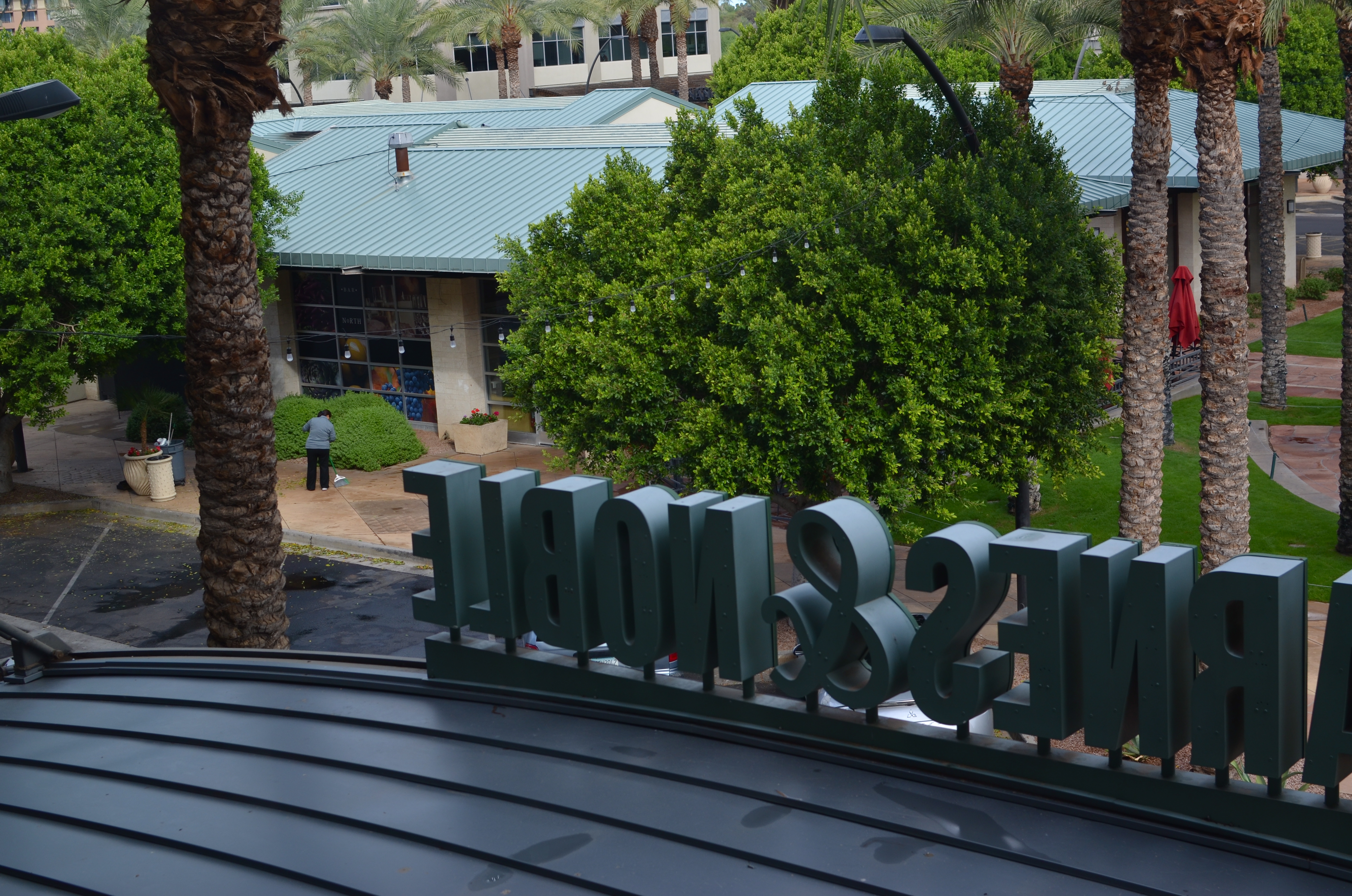
Morning Rounds. 1/125 sec., f/5.6, ISO 100, 35mm.
They start early, finish late, glide by silently, and move on to the next task. Busy as we are, once we first hold a camera, they are stories dying to be revealed, wondered at, worried over.
The unnamed lady at the broom in the above image came into my view just because I had chosen, at a particular moment, to cross the window side of the second floor of a bookstore. Framed naturally between a giant rooftop sign and a tree, she was served up as a ready-made subject for me, and would have been completely unseen had I not visited the store at the very moment it opened.
The invisible armies roll in and out, like some silent tide, and their work is usually done before we crank up our day. Their world and ours can dovetail briefly, but in large part we occupy difference spaces in time. I love catching people in the act of prepping the morning.
The best images are the ones you dig for a bit.
Follow Michael Perkins on Twitter @MPnormaleye.
 thenormaleye